Continued from Part 1: The Story of The Maha Kumbh and the Naga Sadhus
We had taken help from a local person, Sunny, to make a last-minute hotel booking at Banaras. Sunny was a young lad who freelanced as a local guide, and was referred to us by one of my friends who had availed his services earlier. My friend and I checked into the hotel booked on the main road of Banaras, slept without dinner as were tired.
Meeting the Nagas
It was around 02:00 a.m. when I was woken up. “Wake up, Hitha. There is something happening on the road, I can hear people shouting slogans.”, my friend sounded very anxious.
“It is Shivaratri. People maybe chanting Har Har Mahadev, as many were doing so when we arrived here.” I said.
“No, wake up! I have been hearing this from quite some time, and it is getting louder now.” She barged outside the room to check what was going on.
“Hitha, hurry up and come outside! All the Naga Sadhus are right here!” she shouted, while running towards my bed, huffing and puffing in the next couple of minutes. Then, we both ran out to the reception area.
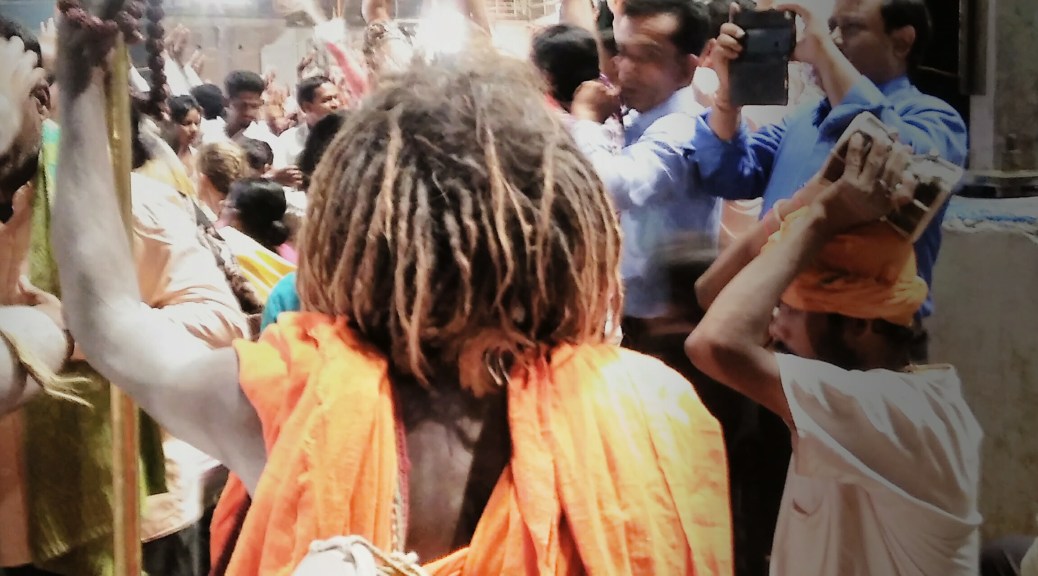
We were spellbound with what we saw there. With ash smeared bare bodies, matted locks, strings of Rudrakshas around their necks, trident and damrgo in hands, there were hundreds, or perhaps thousands of Naga Sadhus and Sadhwis representing every known Akhada with their respective Tableaux, had all assembled right in front of us. Calls of ‘Har Har Mahadev’ reverberated not just on this road but across the city as their convoy began with all the Nagas throwing ashes up in the air. Tight security with the CRPF barricading the streets on both sides ensured the convoy reached the ‘Kashi Vishweshwar Mandir’ thereby the Nagas got the first glimpse of their Adi Guru on the day of Maha Shivaratri before the rest of the public were allowed. A sight that seemed like a dream that I had just woken up from, one that I will cherish as one of the TOP memories of my life which I would have missed in a matter of seconds hadn’t my friend woken me up at the right time. The crowd then dispersed and we returned to our room to freshen up before starting our day.
In a couple of hours, Sunny updated us to stay at the entrance of the hotel for the procession was to return along the same path, with the Akhadas returning from the temple, back to their camps set along the Ghats from where they would all packup to head towards their respective abodes scattered across parts of India. When they all did arrive, I stood on the side of the road to capture a few shots for memory of this amazing day. Despite the security, my friend and I had unknowingly become a part of the parade. The parade of the Nagas. We were walking beside and amid the Nagas from Godowlia street, right until the Juna Akhada office before someone realized that we were outsiders and politely asked us to step aside. WOW! It was indeed an experience that gives us goosebumps just by imagining even today.
Shiv-ji ka Baraat
Meanwhile, Sunny had us racing towards, yet another ceremony scheduled to happen on the parallel streets. The grand Shiv Baraat procession was on its way from Shri Tilbhandeshwar Mahadev temple towards the Gauri Kedareshwar temple, where the idols of Shiv and Parvati are set up the day before the main event. Sunny placed us both on strategic soots on the street from where we could watch the arrival of the Baraat clearly.
First, the camels arrived. Then the elephants. Then, all the Baraatis from the groom’s side accompanied by various orchestra/Band sets and tableaux from across the city arrived on different vehicles, chariots etc. (Children and young adults dressed in masks and costumes depicting various gods and Goddesses from Hindu Mythology) and Finally the groom made his appearance on horseback (yet, another young boy dressed like Lord Shiva), travelling across various lanes, streets and main roads of Banaras and finally reaching Gauri kund located at Kedar Ghat where the divine union of Lord Shiva and Goddess Parvati was to take place later that night.
We found a strategic spot on the stairs of the Kedar Ghat to witness the grandest wedding that was supposed to take place all night with all the devotees staying up on night vigil as witnesses to the wedding on the banks of River Ganga. Ofcourse, any Indian wedding is incomplete without a grand feast for its attendees. How could it not be so when it is the wedding of their dear Lord himself? There was free and unlimited supply of potato sabzi and Thandai throughout the night to all devotees (guests) in attendance at Kedar Ghat, witnessing the wedding by participating in rituals and discourse of vedic chants. The common man seated hundreds in numbers occupying the riverfront stairs played witness to the divine marriage ceremony conducted in a style typical to the Uttar Pradesh region. My friend was on top of the world when she was randomly picked from the gallery of people to make her offerings to the newlyweds (perform abhisheka with milk on small lingas moulded out of a flour dough on a decorated silver plate). The chants and offerings went on until the break of dawn post which the audiences and witnesses dispersed.
Date with the Lord and his consort
If this was about witnessing the celestial wedding, wait. Our visit to Banaras was incomplete without this: Greetings to Lord Kashi Vishweshwara. We had decided to skip the temple visit on the day of Shivaratri to avoid the crowd and try our luck on the following day. So that day was about resting and catching up on the sleep deprived from the last night.
Come the following day, there were no signs of any less crowd. Rather it looked like the entire crowd from Prayag had alighted at Banaras after closing the Kumbha Mela. The queue to enter the temple extended several kilometers. But we are Indians with local contacts. Be it getting access to a no-entry spot or to wave a quick ‘Hai’ to our favourite god, why wouldn’t we utilize our privileges to bypass rules? We will! We found a legal way (Oh, that’s a secret!) to cut the longer queue and reduce our wait time to just an hour. Amid chants of ‘Har Har Mahadev’ we had finally arrived at the Lord’s doorstep, a window from where we were blessed with a view of a beautiful Pushpa alankar or the floral decoration. Despite wanting to stay there for a little longer, we had to move away making way for the lakhs of devotees waiting behind us.
A visit to any Shiva temple is incomplete without taking the blessings from his consort, Shakthi. In Kashi, Lord Vishweshwara’s consort is Goddess Vishalakshi. We expected another long line but as surprising as we were, we had just another 10 to 15 people along with us, all standing and praying inside the temple without any pressure to move out. It was such divine energy felt in peace. So, after coming out of there, the next important thing to do on our list was to eat food, food at the Annapurna temple, the home of the goddess of food and abundance. Let me not add more paragraphs into my story describing how symbolic this temple is from a religious and mythological context; Google Mata is just a click away with all the details. So, we had to satiate our fasting stomachs by finding our way to the temple of Annapurna (actually, to the dining hall!).
Upon enquiry of the route, we understood that we had to navigate through the same long queue of the Vishwanath temple before arriving at a small deviation that led to the temple that we were looking for. The same local contact who had helped us to jump the previous line provided us with some tips to skip the queue all together because we were not going to Vishwanath temple this time. We followed his hacks, paid a deaf ear to dozens of abuses that were being hurled at us by frustrated people who had been standing for hours in the long queue before joining a crowd that seemed unusual to an Annapurna temple (since we had not encountered it on our way to the Vishalakshi temple) or rather familiar (with the structure and chants around us were similar to that of Vishwanatha temple). It didn’t take us too long to realize that we had indeed arrived at the window of Lord Vishwanatha again, by entering from a different gate. This time, his darshana was without any of his adornments, a blessed moment briefly happening before he is completely covered up by his next alankaara and the offerings made by the devotees. It felt surreal. How lucky could one get to have a second chance on such a cringe day?
Anyway, moving on from there, we had to talk to few security personnel to help us find our way to the Annapurna temple. It was a short walk away with a maddening density of people pulling and pushing their way through a small temple verandah to enter the dining hall. Once there, we both had goosebumps thanking our fortunes for having us the opportunity to devour that meal! It was simple and comforting yet felt luxurious!
Lighting the Diyas at the Ganga Aarti
The famous Ganga Aarti performed twice daily on the ghats of the Ganga had been halted over the last couple of weeks, ever since the stampede had happened at Prayag. It was while having our lunch at the Annapurna temple, Sunny had dropped us as SMS informing us to arrive early at the Dashashwamedh Ghat as the evening aarti would be restarted from that evening. Even as we arrived at the ghat at 04:00 p.m., let alone sitting, it seemed impossible to find space to even keep our feet firmly on ground. The crowd had assembled on the ghats, on boats, atop all surrounding buildings, poles and structures to witness the Ganga Aarti that was scheduled to begin post-sunset. We both barely managed to find space just enough to cling on a supporting wall in front of the anchored boats.
It was finally time for the aarti and the all the priests who had to perform the Ganga aarti had assembled on the podiums. Call it our luck or divine intervention, the head priest who overlooked the preparedness of the dais before commencing the sacred ceremony pointed at the two of us from the massive crowd that had gathered. He asked us to come over and light up all the clay lamps arranged around the podiums. After that, he offered us to sit on a red-carpeted arena, right behind the performing priests that provided us the best possible comfort and view that evening! We couldn’t help but pinch each other to convince ourselves that the way our day had unfolded was indeed real.
Parvati ki Bidaai
On the third day, we stayed back to play witness to the Bidaai ceremony of the daughter, Goddess Parvathi with her husband: Shiva. With the entire Banaras gathering on the streets, the pomp and grandeur of the send-off was even larger than the Baraat which finally culminated on the outskirts of Banaras. With that, it was also time for us to return to our hotel and pack our bags to head back to Bangalore.

 The Lost Lander