All posts by thelostlander

Experiences from the Indian roads

10 Best Places to Visit in Dubai for First-Time Travelers

Anyone who is visiting Dubai for the first time is bound to be excited but also confused. The City of Gold is brimming with attractions, both modern and new. One of the seven emirates of the United Arab Emirates, Dubai has innumerable buildings, monuments, and attractions – some of them being world-record holders. Hence, it is natural to find oneself overwhelmed about the sheer number of places to visit and things to do here. So, if you have a Dubai visit visa and are gearing up for your holiday in this emirate city, here are the top 10 places you must visit in Dubai.

1. Dubai Mall

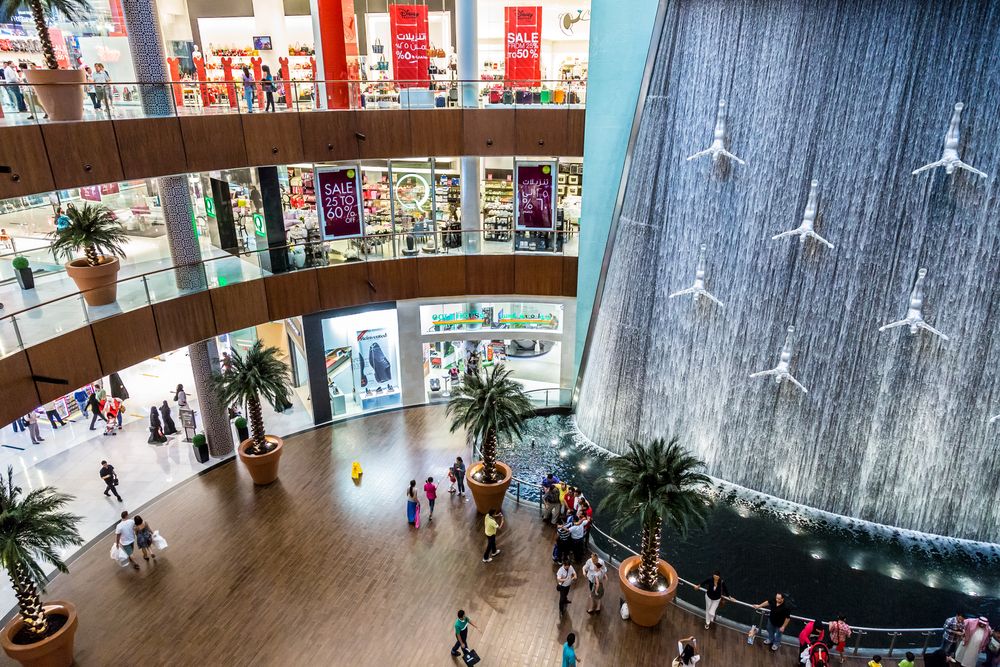
A mall may not be a typical tourist location. But Dubai Mall is no ordinary shopping mall. Spread around 12 million square feet, this is one of the largest shopping malls in the world and is home to over 1200 retail stores. But what sets it apart is that you will also find an aquarium, an underwater zoo, an ice rink, a kid-friendly theme park, a digital art museum, and entertainment avenues within its walls. You must also check out the Burj Lake right outside the mall, which plays the Dubai Fountain Show multiple times, every evening.

2. Burj Khalifa

One of the best places to visit in Dubai that you must not miss is the Burj Khalifa. Standing at the height of 829.8 meters, Burj Khalifa is the tallest building in the world. While the building has luxury hotels, restaurants, residential houses, and corporate offices, the most visited here is the observation decks on the 124th & 125th and 148th floors. Whichever observation deck you choose, you will get to see a 360-degree view of the entire city. Another highlight of you Burj Khalifa visit is to ride on one of the the fastest elevators in the world.

3. Desert Safari

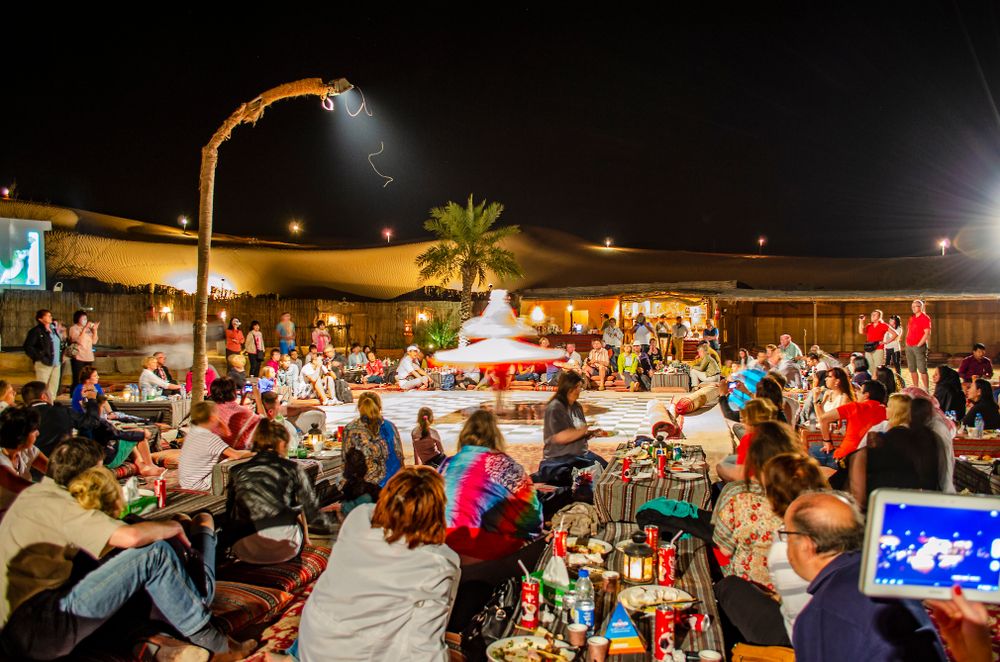
One of the ultimate experiences in Dubai is the desert safari. It is quite thrilling to drive away from the city and spend an evening surrounded by the golden desert dunes. Moreover, the evening desert safari is filled with thrilling and entertaining activities as well. During the safari, you get to enjoy dune bashing, camel riding, and sandboarding. Belly dance and Tanoura dance performances are also arranged for your entertainment. Sunset photography, henna designing, falcon photography, and BBQ dinner are the highlights of the desert safari.

4. The View at Palm Jumeirah

The Palm Jumeirah is the pride and joy of Dubai. This is the largest manmade island in the world. But what makes it unique is its palm-shape. Spread around 5.72 square kilometre, Palm Jumeirah is made up of large trunk, 16 fronds, and a crescent at the top. The island is filled with luxurious hotels, villas, malls, restaurants, and buildings. To enjoy the complete view of the Palm Jumeirah, you must head to The View at The Palm Jumeirah, located on level 52 of the Palm Tower. Perched 240 meters above the ground, The View gives you an uninterrupted aerial view of the island. You can also visit the interactive exhibition that tells you all about the development of Palm Jumeirah.

5. Dubai Marina

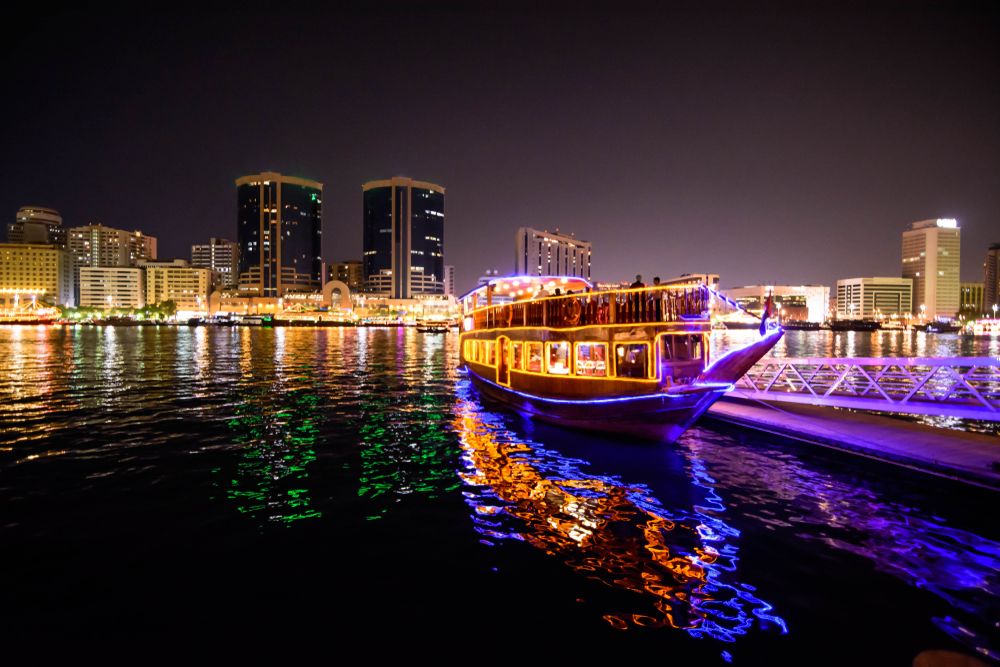
If there is a place that reflects everything Dubai is known for, it has to be Dubai Marina. Luxurious, vibrant, and buzzing, Dubai Marina is the perfect place to spend an evening for everyone, be it honeymooning couples, families, thrill seekers, or youngsters looking for a memorable night out. It is a waterfront city built around a Venetian-style canal, which adds to its charm. You can walk around the 7-kilometer-long, Marina Walk, cruise on a dhow cruise or luxury yacht, visit the JBR Beach, dine at one of the fine dining restaurants, and check out some of the classiest nightclubs of Dubai.

6. Old Dubai

Glamour is something that defines Dubai for most people. However, if you want to see a different side of the city, a visit to Old Dubai is a must. Located on the shores of the Dubai Creek, Old Dubai is the historical and cultural heart of the city. The area is lined with traditional buildings and homes made of coral and gypsum. As you walk around the narrow-cobbled streets, you will see homes with wind towers, a fort turned into a museum (Dubai Museum), old buildings converted into boutique hotels and cafes, traditional markets or souks. A visit to Old Dubai is your chance to glimpse into how life in Dubai was in the yesteryears.

7. Dubai Miracle Garden

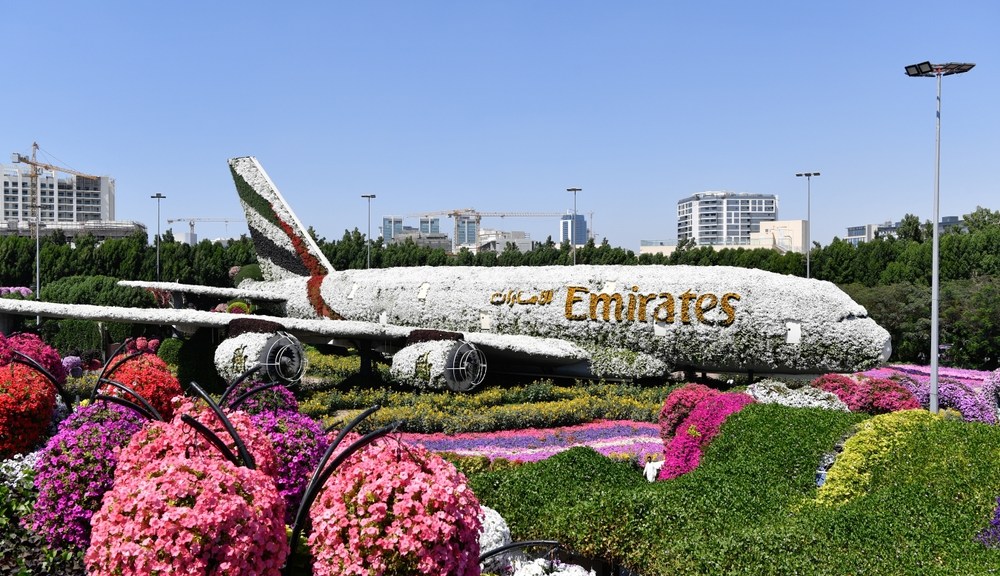
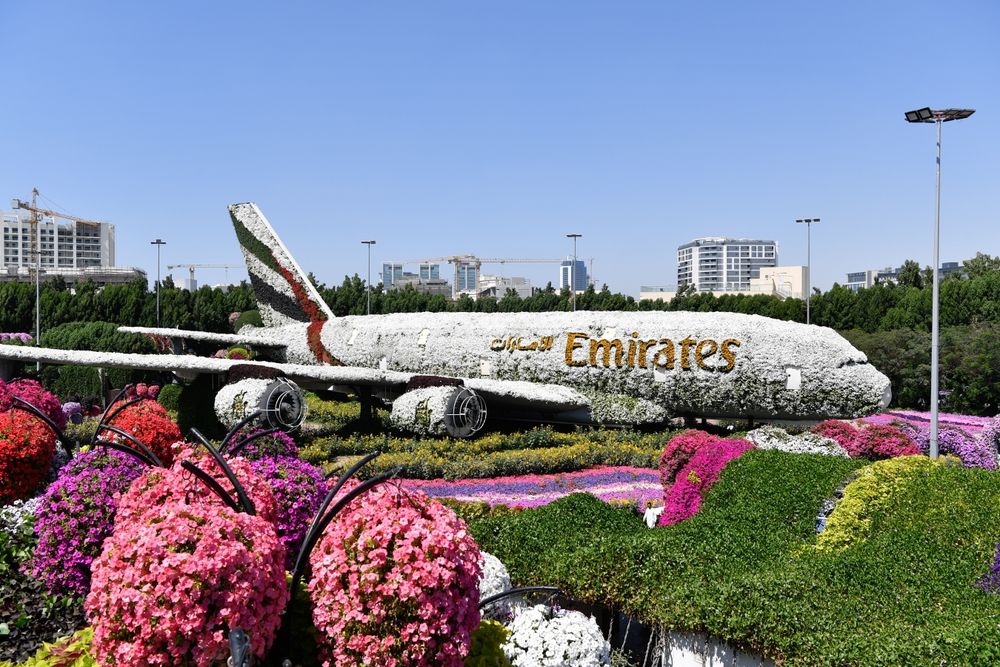
Dubai Miracle Garden is one of the top attractions in Dubai. True to its name, the Dubai Miracle Garden is truly a miracle, as it is the largest natural flower garden in the world. Spanning an area of 72,000 square meters, the Dubai Miracle Garden has more than 150 million flowers and plants. Moreover, these blooms are all presented in the form of jaw-dropping art installations. The 15-meter floral clock, Airbus A380, floral Mickey Mouse sculpture, etc., are some of the award-winning installations here. There are also floral castles, animal structures, passageways, and so much more to see here. The Dubai Miracle Garden is a seasonal attraction, open from October to March/April.

8. Ski Dubai

When Dubai’s warm desert climate becomes overwhelming, it is best to visit Ski Dubai, a winter paradise where you can have fun. This theme park is located inside Mall of Emirates and is the largest indoor ski park in the world. Here, you can enjoy winter sports like skiing, snowboarding, etc., all year long. There is a huge ski mountain that offers five difficulty levels. You can also try zorbing, tobogganing, tubing, ziplining, snow bullet, etc., here. It is also possible to play in real snow and see Genting and King Penguins at Ski Dubai.

9. The Green Planet

Dubai seems to do the impossible, and the Green Planet is a fine example of the same. The Green Planet is an indoor rainforest resting within a biodome. This is a vertical rainforest, with a large tree at its centre. The tree is divided into four parts: Canopy, Midstory, Forest Floor, and Flooded Forest, each representing the different features of a rainforest. During the tour of the rainforest, you will get to see different flora and fauna. More than 300 species of animals can be found here, including snakes, sloths, parrots, marmosets, porcupine, reptiles, echidna, etc. There are special experiences like animal encounters, being zookeeper for a day, and even a night tour.

10. Dubai Parks & Resorts

As a first-time traveller, your Dubai trip need not be only about sightseeing. If you want to have a day filled with fun, the city offers you Dubai Parks & Resorts. The place offers you not one but four world-class theme parks, and you can choose any one of them as per your interests. Motiongate Dubai is for Hollywood fans, while football lovers will have the time of their day at Real Madrid World. Both these theme parks have an amazing array of thrilling rides and rollercoasters. Families traveling with young kids must visit Legoland Dubai and Legoland Water Park. The World of Riverland Dubai and Neon Galaxy Indoor Playworld are also worth visiting.

Conclusion

There is no doubt that Dubai is an exciting place with lots of interesting places to visit and things to do, and one trip may not be enough to see and do everything. But do include most of the places mentioned here to understand the essence of the place.

Annapurna Base Camp & Circuit Trek – The Ultimate Himalayan Adventure

Imagine waking up to the sun rising over 8,000m Himalayan giants, the crisp mountain air filling your lungs, and trails that wind through vibrant rhododendron forests, terraced villages, and sparkling rivers. This is not just a trek—it’s a life-changing journey.

Welcome to Annapurna Base Camp (ABC) and the legendary Annapurna Circuit, where every step promises adventure, romance, culture, and breathtaking natural beauty.

The Annapurna region is magical for everyone, but especially:

1. Couples Seeking Romance:

  • Walk hand-in-hand along trails with panoramic views of Machapuchare (“Fishtail Mountain”)
  • Cozy teahouses in Ghorepani or Chhomrong make for perfect quiet nights
  • Sunrise at Poon Hill – a memory that lasts a lifetime

2. Adventure Seekers:

  • Cross the legendary Thorong La Pass at 5,416m
  • Trek through glacial rivers, high-altitude deserts, and lush subtropical valleys
  • Multiple trail options like Tilicho Lake or Nar Phu Valley for hardcore explorers

3. Cultural Enthusiasts & Food Lovers:

  • Experience Gurung and Thakali villages, interact with locals, and understand their traditions
  • Sample authentic local dishes like dal bhat, momo, and sel roti in mountain teahouses
  • Witness traditional festivals, rituals, and the energy of Himalayan communities

4. Nature Lovers & Photographers:

  • Panoramic Himalayan views, frozen waterfalls, alpine meadows, and serene lakes
  • Flora and fauna diversity, from rhododendron blooms in spring to snowy alpine landscapes in winter
  • Every trail offers Instagram-perfect viewpoints

Difficulty & Fitness Levels

| Trek | Duration | Difficulty | Fitness Level Needed | Best For |

|——|———-|————|——————-|———-|

| Annapurna Base Camp (ABC) | 7–12 days | Moderate | Average fitness; can handle 4–6 hrs/day | Couples, beginners, first-time trekkers |

| Annapurna Circuit | 12–20 days | Moderate to Challenging | Good fitness; must handle 6–8 hrs/day & high altitudes | Adventure seekers, experienced trekkers, culture lovers |

| Mardi Himal Trek | 5–7 days | Moderate | Average fitness; shorter days | Photographers, couples, offbeat trek lovers |

| Tilicho Lake Trek | 10–14 days | Challenging | High fitness; high-altitude trekking (4,919m) | Experienced trekkers, adventure enthusiasts |

| Ghorepani Poon Hill Trek | 4–6 days | Easy | Light fitness; beginner-friendly | Couples, beginners, short-trek lovers |

| Nar Phu Valley Trek | 12–15 days | Challenging | High fitness; remote trekking | Adventure seekers, offbeat cultural experience lovers |

Fitness Tips:

  • Start walking or light cardio before your trek
  • Do uphill training if possible
  • Hydrate and eat well during the trek
  • Take rest days for acclimatization

Why Annapurna is So Popular?

  • From subtropical forests to alpine meadows and snow-capped peaks
  • Glacial rivers, terraced farms, and waterfalls all along the way
  • Annapurna South, Machapuchare, Dhaulagiri, and Gangapurna—every step is a photo opportunity
  • Walk through Gurung, Thakali, and Tibetan-influenced villages
  • Explore ancient temples, monasteries, and local festivals
  •  Comfortable lodges, hearty food, and supportive local communities make it easier than remote treks
  • Couples, solo travelers, adventure junkies, culture lovers, foodies—all find something here
  • Start from Pokhara, just a few hours from Kathmandu
  • Trekking routes are well-mapped and can be customized
  • Sunrise hikes, remote passes, and cozy nights in teahouses
  • Authentic local food and energy-filled villages
  • A trek that is emotionally fulfilling as much as physically rewarding

Top Treks and Trails Around Annapurna

1. Annapurna Base Camp (ABC) Trek – Classic & Scenic

  • Duration: 7–12 days
  • Difficulty: Moderate
  • Highlights: Sunrise at Poon Hill, Machapuchare views, base camp 4,130m
  • Vibes: Peaceful, romantic, photogenic, and cozy

2. Annapurna Circuit – Epic Himalayan Adventure

  • Duration: 12–20 days
  • Difficulty: Moderate to Challenging
  • Highlights: Thorong La Pass, Muktinath Temple, Mustang landscapes
  • Vibes: Thrilling, spiritual, culturally immersive

3. Mardi Himal Trek – Hidden Gem

  • Duration: 5–7 days
  • Difficulty: Moderate
  • Highlights: Close-up views of Machapuchare
  • Vibes: Offbeat adventure, intimate experience, perfect for photographers

4. Tilicho Lake Trek – Ultimate Challenge

  • Duration: 10–14 days
  • Difficulty: Challenging
  • Highlights: One of the world’s highest lakes (4,919m)
  • Vibes: Remote, pristine, for hardcore trekkers

5. Ghorepani Poon Hill Trek – Quick & Rewarding

  • Duration: 4–6 days
  • Difficulty: Easy
  • Highlights: Sunrise views, short trek
  • Vibes: Romantic, accessible, colorful trails

6. Nar Phu Valley Trek – Offbeat Adventure

  • Duration: 12–15 days
  • Difficulty: Challenging
  • Highlights: Tibetan-style villages, untouched culture
  • Vibes: Remote, adventurous, culturally enriching

Best Seasons to Trek

  • Spring (March–May): Rhododendron blooms, clear skies, perfect views
  • Autumn (September–November): Best visibility, pleasant weather, and festive vibes
  • Winter (December–February): Snowy trails, peaceful and less crowded
  • Monsoon (June–August): Lush greenery, waterfalls, and serene forests

Insider Tips

  • Acclimatize properly for high passes like Thorong La
  • Pack layers: weather changes fast in the Himalayas
  • Carry trekking poles for comfort
  • Try local foods and interact with villagers—they make the trek magical
  • Start from Pokhara for convenient access and pre-trek relaxation

The Annapurna region is more than a trek—it’s a complete Himalayan experience. 

  • For couples, it’s romance amid majestic peaks 
  • For adventure seekers, it’s thrill and challenge 
  • For culture lovers, it’s immersion into Himalayan life 
  • For foodies, it’s a journey of flavors and mountain hospitality 

Every trail, every meal, every sunset here becomes a story you’ll carry forever. Annapurna isn’t just a trek—it’s a journey of the heart, mind, and soul.

Celebrating the chariot of light- Purapaadu Festival at Cheriyanaad

When I visited Pattanamthitta for the first time, I was blown away by the natural and cultural landscapes of this district. But little did I know I would return here more often than I expected. Each time, to experience a new festival. In this post, I am going to talk about my experience of the Purapaadu Festival at Cheriyanaad.

It is the annual festival of the Shri Bala Subramanya Swami temple, which usually falls on the first day of the Kumbham month of the Malayalam calendar. The Purapaadu festival is mostly known for the celebration of Pallivilakku, a grand procession of oil-lit lamps taken on wooden temple cars along the temple street on the night of the 5th day of the temple festival. It also aligns closer to the Thaipooyam and the Kavadiyettam celebration at the temple. The Shri Bala Subramanya Swami temple is in Cheriyanaad, a village in the current Allapuzha district of Kerala. Cheriyanaad lies on the border between the erstwhile kingdoms of Kayamkulam and Pandalam. Hence, its proximity is the same as that to Pattanamthitta.

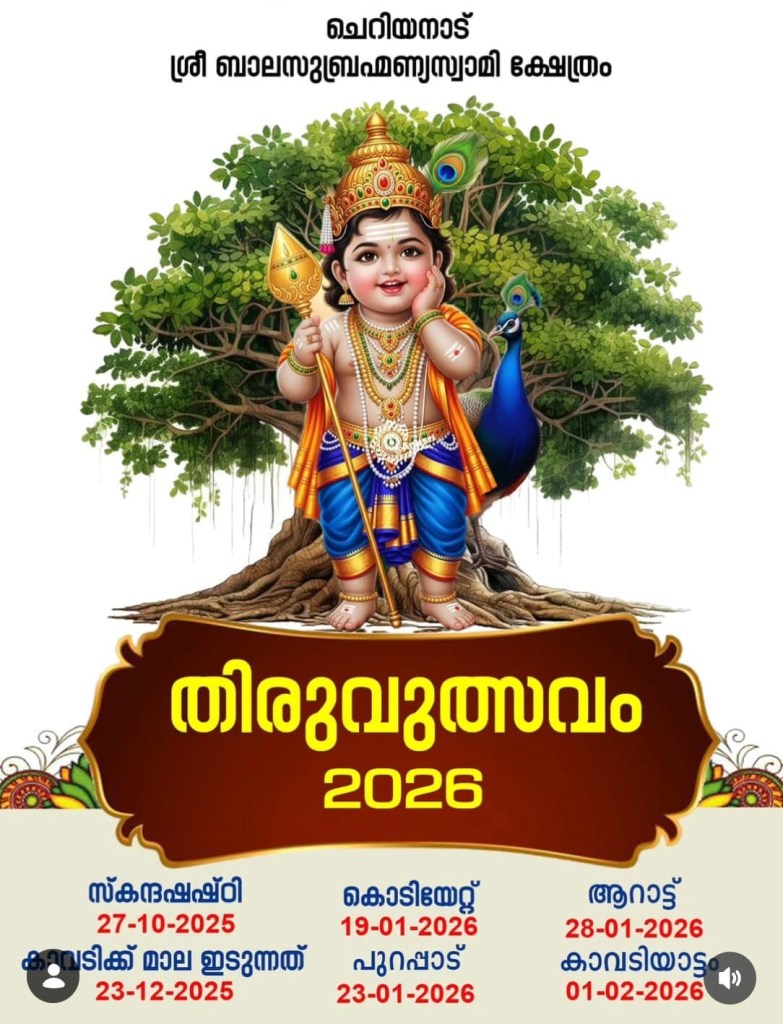
Based on my study across multiple sources of information, I have put up a brief itinerary with some of the main events during the Purappadu festival as follows.

Purapaad festival 2026 itinerary
Purapaad festival 2026 itinerary Source: Cheriyanaad Bala Subramanya temple Instagram handle

Day 1: Kodiyetttam– This is the ceremonial flag hoisting to signify the formal inauguration of the festival.

Day 2, 3 & 4: Special poojas and offerings to lord Bala Subramanya Swami.

Day 5: Pallivilakku / The Procession of lamps: 03:00 a.m. onwards, followed by the Thiruvabharanamchart (exhibition of the deity’s ornaments) and the ritual of putting a garland on the feet of the main idol, at around 5:30 a.m.

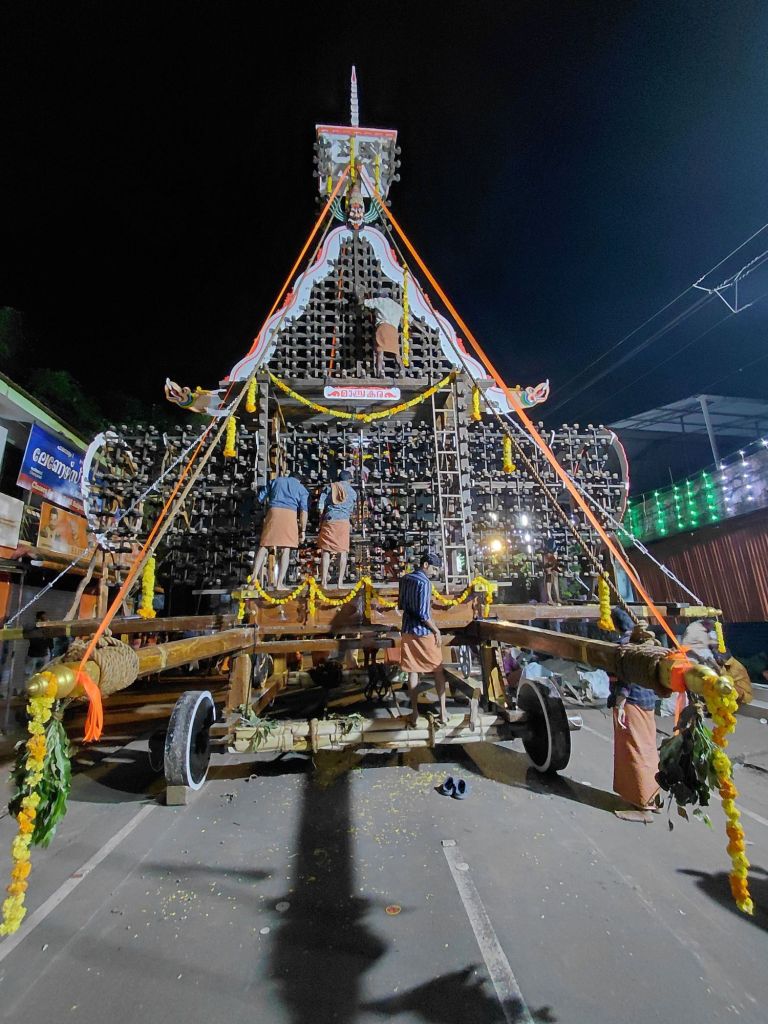
The temple car getting ready for the Purapaad festival, Cheriyanad
The temple car getting ready for the Purapaad festival

Day 6: The first time coming out ceremony of the deity, which includes the morning service starting at around 04:30 a.m. onwards and the circumambulation of the temple with the deity’s idol on a palanquin at around 05:30 p.m.

Day 9: Skanda Shashti: People keep fast on this day, followed by rituals like Shashti Pooja at around noon and the Peacock chariot procession from 07:00p.m. onwards.

Day 10: Arattu: this is the “sacred bath,” marking the final ritual of a 10-day temple festival.

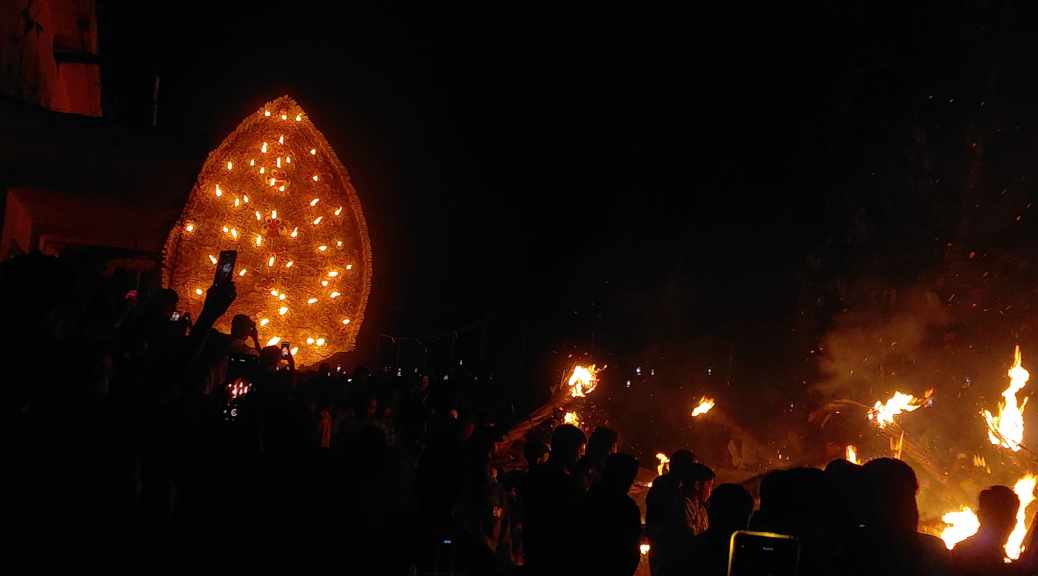
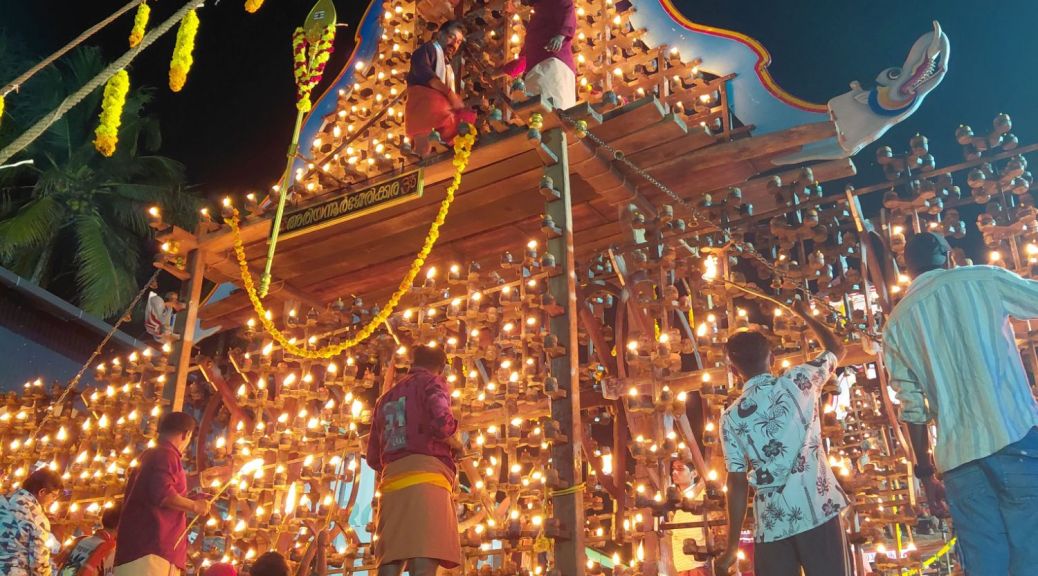
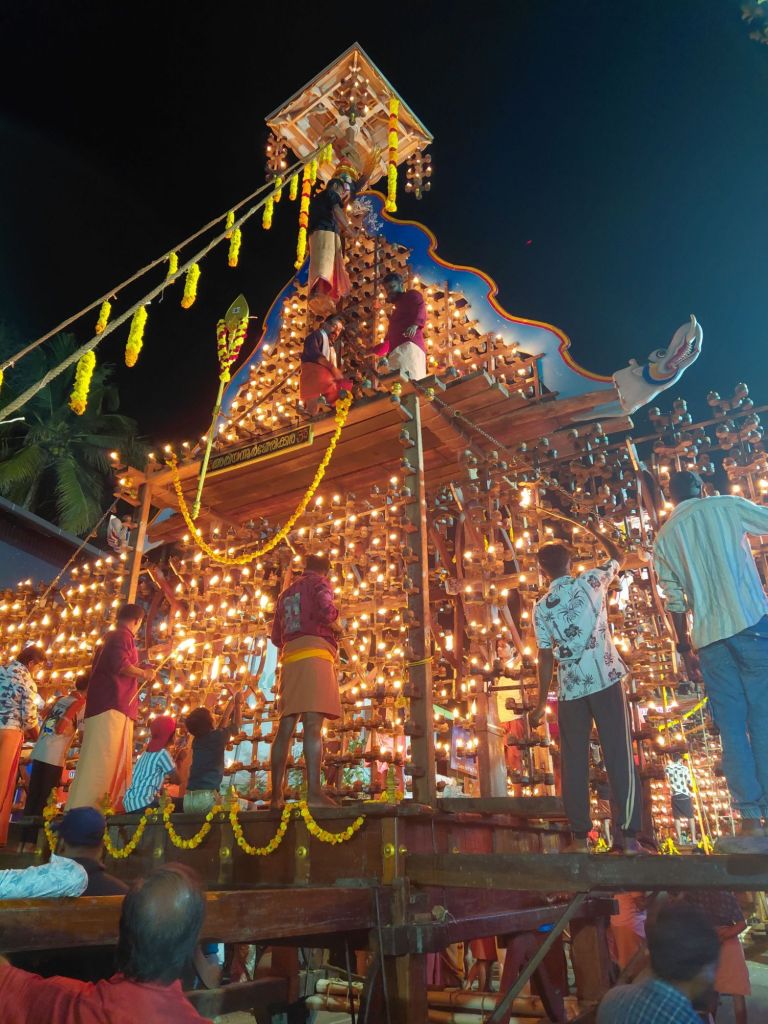
During the early hours of the 5th morning of the festival, around 13 wooden chariots representing 13 karas (surrounding villages) are taken on a procession along the road extending from the Shri Bala Subramanya Swami temple and the Padanilam. These wooden chariots are decorated with oil-lit lamps made with the empty shells of the chaulmoogra fruit (Hydnocarpus pentandrus, locally called Marotti in Malayalam) and are pulled manually by men representing each kara shouting slogans in the name of lord Subramanya.

The illuminated temple car Purapaad festival, Cheriyanad
The illuminated temple car

After a coconut-breaking ceremony and the lighting of the Nilavilakku (the traditional floor lamp), the procession begins. Five large chariots lead the convoy. A railway track crosses this path and has a height gauge installed. Hence, the medium-sized or larger 04 chariots at the trailing end will reach only this point and then return to the temple. 03 decorated elephants of the temple accompany the remaining 04 smaller chariots and make it past this railway crossing to join the leading 05 chariots at the Padanilam ground. The Padanilam ground, which was once a battleground, is also called the ‘Shastham Kunnu’ because it had a temple dedicated to Shasthavu and a fortified raised platform.

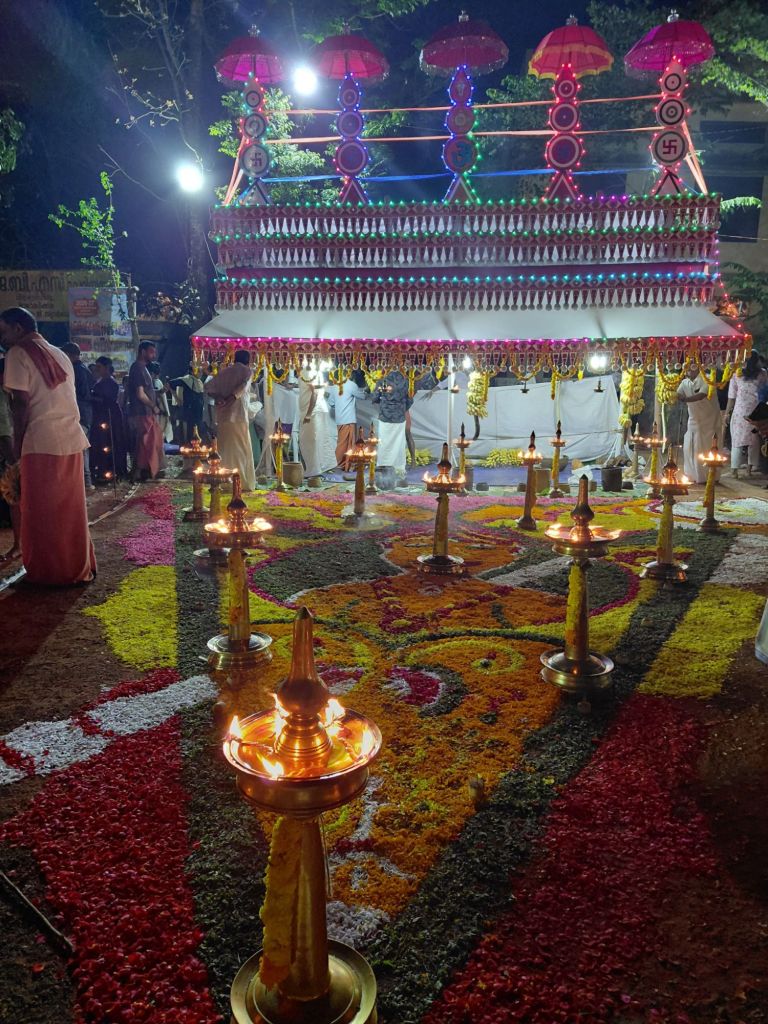
A large Pookkalam is made at the Shastham Kunnu, where a small shrine is set up and decorated with thousands of banana bunches. The procession culminates here with the chariots carrying the lamps parked in a circle, and the elephants perform the final rituals. The first bunches of bananas are fed to the elephants, and the remaining are distributed as prasada among everyone who has gathered there.

My friend and I arrived at the temple late in the evening on the 4th day, before the Pallivilakku. We saw a few devotees on the highway, walking towards the temple carrying the Kavadis. Though these kavadi bearers were performing this ritual quite early, it is to be noted that this year’s Kavadi festival at the Cheriyanaad Bala Subramanya Swami temple was scheduled to happen back-to-back. I will share the Kavadi festival itinerary at the end of this post.

The Nadaswaram Seva at Subramanya temple, Cheriyanad

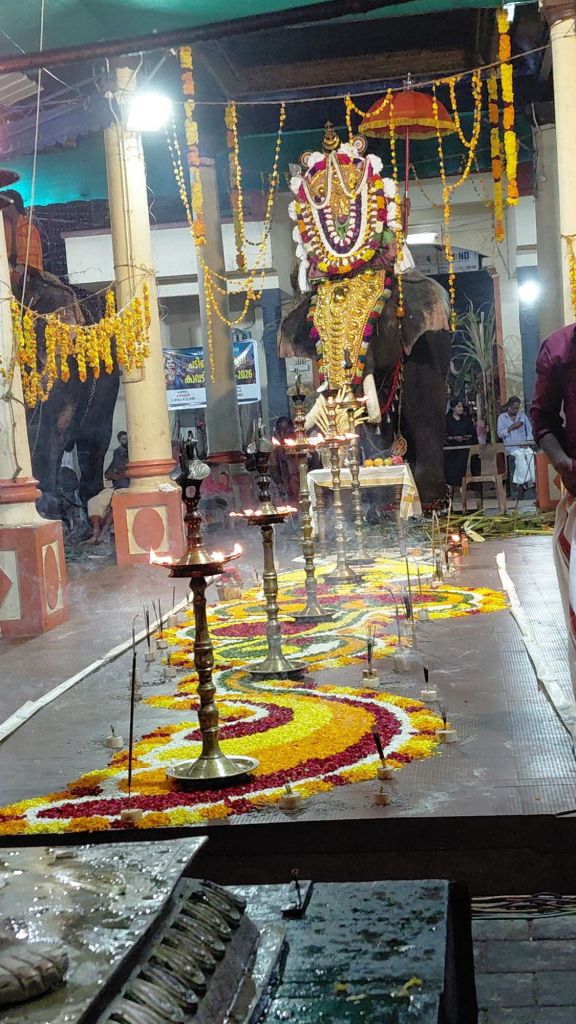
Coming back to our story of the Purapaadu festival, and upon our arrival at the temple, the wooden chariots were still being prepared and assembled on the road leading to the entrance. Inside the premises, 03 elaborately decorated elephants stood in front of a beautifully laid Pookalam, at the end of which the Nadaswaram Seva began. The Seva was deeply soulful, and the music continued to play in my mind even after the ritual was completed. We had the darshana of the lord at his sanctum sanctorum and watched other devotees offer their prayers in the form of donations of paddy and other grains.

We then followed the crowd towards the open-air auditorium and found ourselves seated amid hundreds of others on the ground. Shortly after, all lights were turned off, whistles and hoots sounded, and there was total darkness. An interesting event was about to begin. It was the first time I was watching a stage cinema. The cinema went on for a couple of hours while the wooden chariots were being prepared for the grand show.

Halfway through the cinema, we decided to take a stroll along the procession trail. We watched all the lamps being arranged, oil being filled and lit. We also spoke with the locals to understand the traditions and to find a good vantage point to view all the lit chariots as they moved. Finally, the procession commenced around 04:00 a.m., and it was indeed a walk I will remember, one of spectacle and memories. And oh! I picked up a few fallen Marotti lamps and kept them as a souvenir before bidding goodbye to this wonderful festival.

The pookalam at Padinalam ground, Cheriyanad

Cheriyanaad is located about 8 km away from Chengannur, the nearest major town. Frequent public buses ply between Cheriyanaad and Chengannur if you are commuting during the day. Since we commuted after sunset and before sunrise hours, we hired an autorickshaw that was easily available from Chengannur town. While Cheriyanaad has its own railway station, Chenganur is well connected with major cities like Bangalore and Chennai with direct trains. However, I travelled by a direct bus due to my work schedule. We booked accommodation at Chengannur town, the nearest place to avail a decent lodging facility.

Shri Bala Subramanya Swami temple at Cheriyanaad is also known for its Thaipusam and Kavadiyattam festival. In 2026, it started on the day following the Purappad festival. This is brief information on the same.

  • Day 1: Idumban Pooja, a sacred ritual dedicated to Idumban, the devotee and guardian of Lord Murugan’s shrines, is performed. It is performed to seek permission to carry the Kavadi and involves offering prayers to Idumban with milk and fruits.
  • Day 2 & 3: dedicated to various rituals involved in Kavadi Alms.
  • Day 4: Thaiposam & Kavadiyattam festival involving three main types of Kavadis as mentioned below:
  • Paal Kavadi: Pots of milk are carried on the heads.
  • Mayil Kavadi: Decorated with peacock feathers to represent the peacock, the vehicle of Subramanya Swami.
  • Vel Kavadi: Involves different types of body piercings by the devotees, like the skin, cheeks and tongue, with “vel” (spears). (You can also read about the ‘Mayana Kollai festival‘ to understand similar rituals that are performed in Tamil Nadu.)

To be continued as “A grand celebration of masks- Padayani Festival at Othera”

Goa backpacking: Netravali Wildlife Sanctuary

Continued from Goa backpacking: Makarotsav Celebration and Temple Hopping.

Based out of Colva, my friend and I had hired a motorbike to explore Goa. Our plan for today was to see some prehistoric sites, take a dip at one of the nearby waterfalls and return to Colva by late evening. With a set of clothes for changing and a towel for each of us, we had woken up to start our day quite early. But the rain gods had brutally taken over the skies, and hence, our day started late.

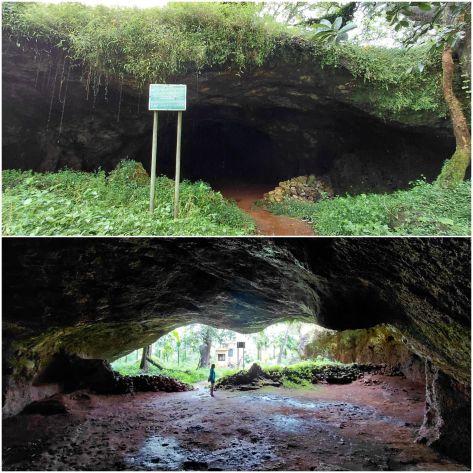
I was about 10 a.m. when the rain slowed to drizzle, and we left our cottage. We stopped for a quick breakfast in Madgaon before continuing. Using Google Maps, we headed to our first destination: the ancient Buddhist meditation cave at Rivona. Although we struggled slightly with the directions initially, we managed to find the site through local inquiries, without too much trouble. The asphalt road first passes through a residential area before reaching a large natural pond. At this point, the road splits, and we took a muddy route to the right, stopping at a small grassland at the end. From there, a small staircase carved into the laterite ground leads down. We were unexpectedly greeted by a security guard from the ASI (Archaeological Survey of India), who checked our attendance before we entered the cave. We were told a guide is usually available, but none was present at the time. We took a few photos before leaving. If you’re not interested in history and are just a tourist, I recommend skipping this site.

Buddhist cave at Rivona, Goa

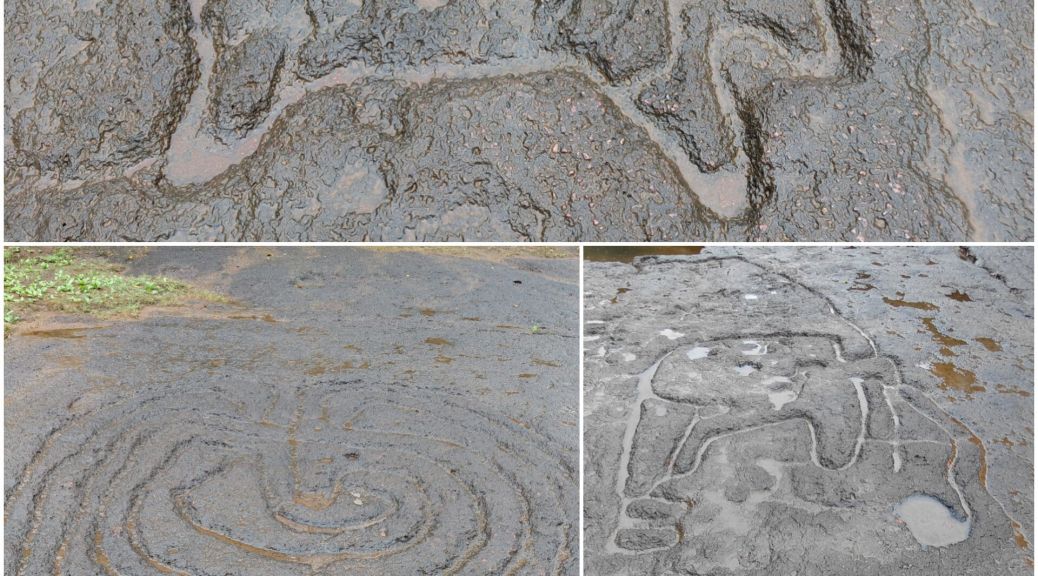
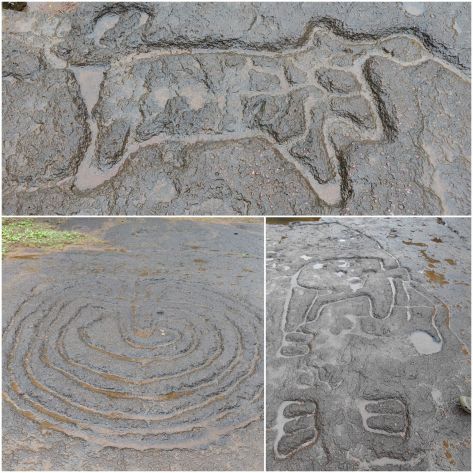
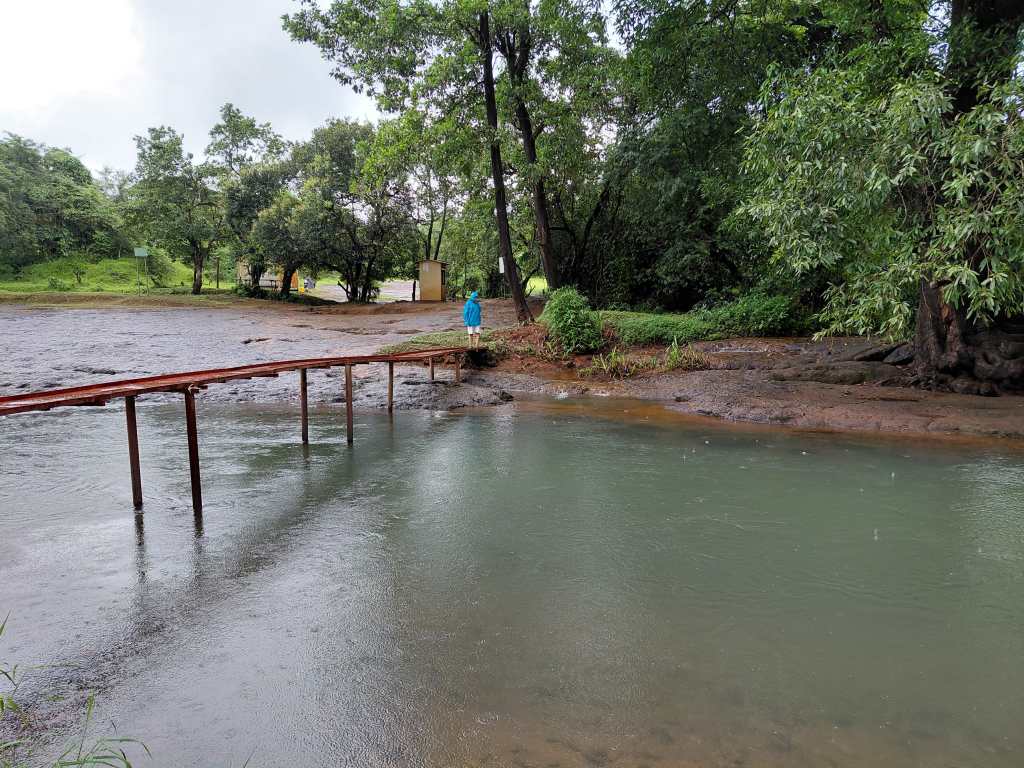
From there, we continued to follow the maps to our next destination- Usgalimal village, one that I was most excited about. For the first time, I was going to see petroglyphs, that too in Goa! The muddy trail that splits across the main road passes through thick forest right up to where the Google Map Pin takes you. After passing through a stretch of confusing deviations, patches of open grasslands and a laterite pond, the location pin finally took us to the banks of the river Kushavati, We parked our bike at the security post and wrote our names in the logbook. The security guard then walked along with us, guiding us through the riverbank. He showed us around various depictions/ Petroglyphs carved on the laterite stone bed of the river. He helped us identify several of the 100+ carvings discovered there, among which were various hunting scenes, several domesticated and wild animals, a trident, a labyrinth, etc., some of the notable ones. Seeing something like this for the first time piqued a new interest within me to learn more about Petroglyphs and ancient rock art, which I would want to travel to in future to explore.

Petroglyphs at Usgalimal, Goa

After spending enough time trying to observe and decipher the art there, we casually asked the guard accompanying us if there was a spot somewhere nearby where we could take a dip in the river. He thought for a moment and nodded while looking at the riverbank on the other side. There’s a spice & areca farm across, where you can approach the caretakers to permit you into the safer section of the river that passes through the property. We thanked him for the recommendation, picked up our luggage from the bike, and crossed a little brook across the river, where we were able to secure our permission. There are NO words to describe the joy our two little hearts had found inside the safe, sweet and soulful waterbody. With just the two of us swimming and enjoying ourselves in the water all the while, we did not realise that we had spent over 2 hours already without being bothered by the rain that bashed down or by any deadlines to get back to waiting families back home. But soon it struck us that we had to make the most of the time when the rain had taken a break. Since we had already spent a lot of time at Usgalimal waters, we skipped our original plan to swim in the waterfalls later. We quickly changed into fresh clothes and got the bike running again.

Not too long after we hit the road, the rain gods took over again, and the terrain changed to an even denser canopied area. A little board read that we had officially entered the Netravali Wildlife Sanctuary. The natural light had become less, and riding harder due to the constant bashing of the heavy rain and wind. We had no option to stop in between since the houses were scarce along the forest, and we had to reach the destination before it got too late so that we could return to Colva safely before it was too late.

River Kushavati, Usgalimal, Goa

Upon our arrival at the forest gate, we were told that the entry to the waterfalls was closed at 05:00 p.m. We had arrived at 05:05 p.m. The forest personnel did not oblige us, even after several requests and explanations of our long ride back and forth. Now we had two options- One, skip exploring the sanctuary altogether, and return to Colva. Two, find accommodation nearby and explore Netravali (also called Netraulim) at leisure on the following day. We took a moment to think over, looked up at the constantly pounding rain and decided to stay back in Netravali. Even if we wanted to skip visiting places, riding back in the rain and darkness would only be next to madness.

Since the eco-stay run by the Goa forest department was all booked, the guards helped us to find a local homestay nearby. Shortly, our stay was arranged with a local family, and it got dark after that. We took a shower and changed back to the same clothes (there was no other option), devoured a comforting hot meal before retiring for the night.

After waking up in the morning, we watched our host light up a lamp at the Tulsi katte in their courtyard and milk their cows in the shed attached to the family home. We had our breakfast and left towards the forest gates soon after. In fact, we wanted to be the first visitors for the day so that we could avoid the crowd and start our return ride as early as we could. So, there are two waterfalls as one enters the gated area, which require separate permits. We were briefed about the condition of the roads leading to both and asked to register ourselves accordingly at the entry. We decided to visit the Mainapi waterfall by hiring a forest Jeep and riding our bike to the Neturlem (Saoli) waterfall later.

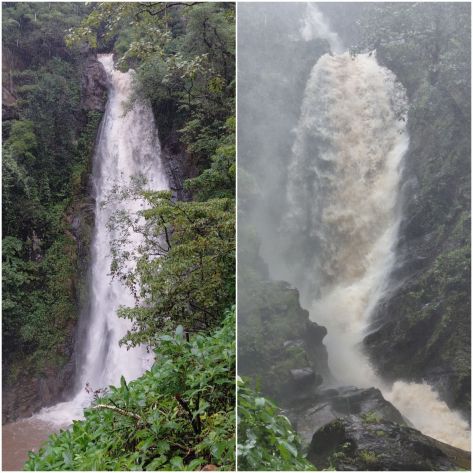
Waterfalls in Netravali Wildlife sanctuary, Goa
Left: Mainapi waterfall. Right: Saoli Waterfall. Netravali Wildlife sanctuary, Goa

The adventurous 5km drive to Mainapi waterfall constituted a crazy, bumpy drive on the rocky-hilly road cutting through thick canopied forest and river crossings. Further, a short hike down to the waterfall was accompanied by leeches, brightly coloured miniature crabs, frogs and other insects found commonly during monsoons. The first glimpse of the waterfalls had our breath pause for a moment. We hadn’t expected anything so beautiful in Goa, which is otherwise popular for its beaches. Thanks to the monsoons, the path further down to the waterfall was blocked for safety reasons. We sat down on the stairs, watching the water roaring down in all its might until we realised that a couple of leeches had entered my raincoat. I had to quickly get them out and also head back to keep the day’s schedule under control. After a good, bumpy drive back to the forest office, we returned to the forest on our bike. The road was good right up to the start point of the Saoli waterfall. After parking the bike, a short descent down the stairs leads us to the banks of the Saoli waterfall. We could get into the water, but the currents were still strong, and the water looked muddy from the heavy rain. We spent some time there, too, before exiting the forest gates.

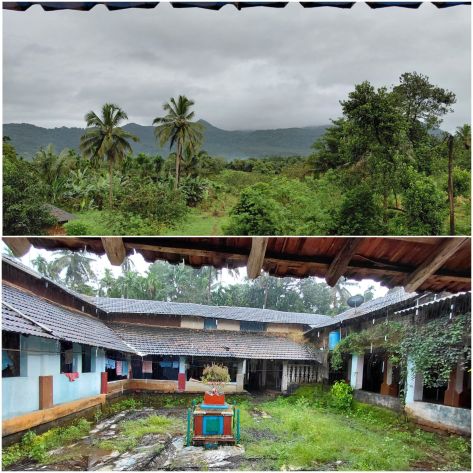
We returned to the homestay where our host had promised to take us around their ancestral village. After a short drive in their car, we arrived in front of an old mansion, which was the ancestral home of our host, the Desai family. It was very interesting for me to walk into a traditional Hindu home because its history dated back to even before the Catholic-Portuguese mansions which I had seen thus far elsewhere in Goa. As we entered through the towering arch-like entrance to this house, we were greeted by a large open courtyard, which was divided into dwelling spaces for each member of the family. To the left of the entrance was a space dedicated to the sacred arms once used by the ancestors of the family. We were told that some even had the original blood stains with a history of valour and martyrdom dating centuries. Laterite walls, red-oxide floor and clay tiles set on wooden beams- it invoked nostalgia instantly. While the kids surrounded us in excitement to tell us about their stories from the rooms, the senior women wove garlands with colourful flowers picked from their backyard while being entertained by the chatter of their husbands. They were all happy to have us amongst them.

Goan Homestay
Top: View from our homestay; Bottom: Courtyard of the ancestral home

We then walked through the exit door on the back side, passing by a series of bathrooms where we could hear the water in the firewood-lit boilers. As rain-fed streams came to life while walking through their rubber plantation, we crossed a little river to arrive at Datta-Gufa, a family-maintained temple. This is an important temple in the village accessible from the main road as well, but we were more privileged to get private access from the other side. After spending time on their property, we returned to the homestay from where we took our bike and commenced our return ride towards Colva.

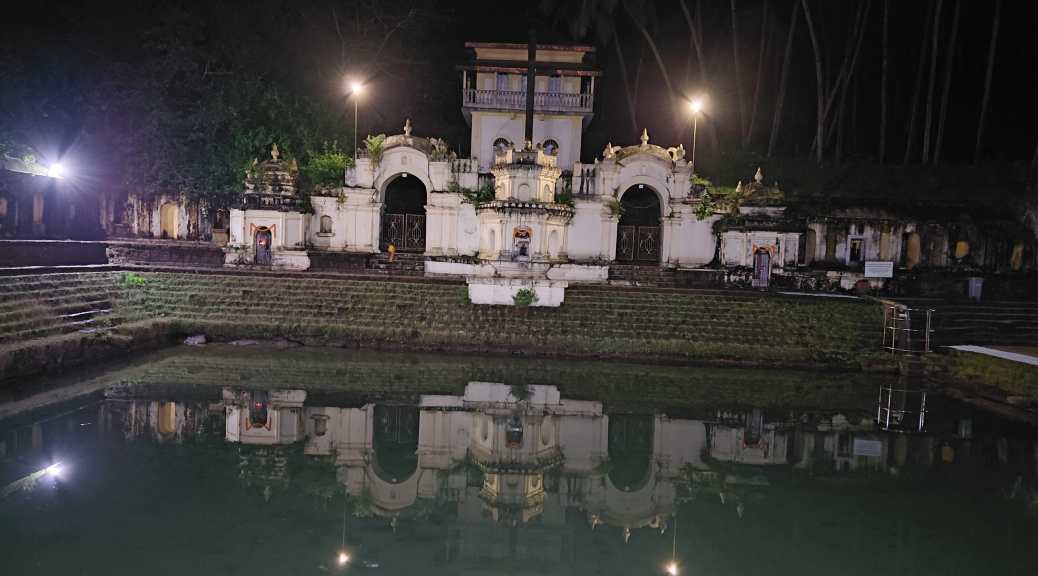
En route, our first stop was at the Gopinath temple in Netravali. The temple is rather popular for its sacred tank. Fondly called Bud-bud Lake, the pond water is believed to bubble up when one claps while standing in front of it. We too did witness the interesting phenomena, but felt it did so as a response to some other air pressure occurring naturally in the otherwise silent environment. In any case, it was something we were experiencing for the first time.

From there, we started to ride again to make the most of the time when the rain seemed to have taken a break. A short ride ahead were directions to ASI sites like the ancient ruins of Sri Lakshmi Narayani temple and Kajur Petroglyphs. But by seeing the Google Photos uploaded by past visitors, we decided to give them a miss. Shortly, we reached Rivona. Someshwar Sansthan, Jawali Damodar Sansthan and Vimleshwar temple were landmarks and renowned local temples that we visited along our ride. This has been written about separately in my previous post: Goa backpacking: Makarotsav Celebration and Temple Hopping. We had a quick coffee break at Margaon before reaching our home during the trip at Colva.

To be continued as Goa backpacking: Day trip to Rachel and Big Foot.

Goa backpacking: Makarotsav Celebration and Temple Hopping

Continued from Goa backpacking: Mahavir National Park.

I returned to Goa with a friend to spend our Dasara vacation and we chose to stay put at the same homestay in Colva that was our base while my family and I had explored Madgaon, Old Goa, and its surroundings during our earlier visit. Everybody associates Goa with the yuletide cheer, but my friend and I were more inclined towards experiencing Goa’s unique tradition of Makarotsav as part of the Dasara festival celebration. We had heard about it through our friends belonging to the Saraswat Brahmin communities, most of whose Kula devata (patron God of their community) happen to be in Goa.

“Makar’ is a boxy frame like swing decorated beautifully and carries the idol of the deity. It is rocked to the rhythmic beats of dhols, Tasha, temple bells along with Aarti. The history of this unique Dasara tradition dates to the 16th Century. During the Portuguese rule, several Hindu temples were destroyed across Goa. Many people fled these places overnight and arrived at the forests of Ponda region to take refuge.

It is said that these Hindus also carried their deities along with them which were installed across the region. Since then, Makarotsav has become a symbolic celebration. The act of ‘Swinging the deity’ is a representation of their God being with them in times of hardship, moving, swaying and living among the people.

The original sites at which the idols were installed eventually saw significant renovations under the Maratha rule. The style of temple architecture is typical to the region and is a blend of domes, pillars, and large lamp posts/towers in the courtyard. Some of the oldest structures that still stand strong bear the original wooden bars, intricate paintings alongside reliefs and carvings in their original condition. Water tanks or Kalyanis, are integral to the vast premises housing these temples.

Today, Ponda has the highest density of Hindu temples across the state of Goa and therefore revered as the Temple town of Goa. ‘Makarotsav’ is celebrated in most temples in and around Ponda which can be broadly classified into three categories. Temples that worship Shiva, Temples that worship Vishnu and Temples that worship Parvathi (Shakthi). Goddess Parvathi is worshipped as Shanta Durga and is believed to be the guardian of every village.

The legend has it that Goddess Shantadurga is the one who mediated peace between Shiva & Vishnu when they fought to establish who was the greatest among the two of them. Hence, her name is Shanta+Durga, a combination of two words ‘Shanthi+Shakthi. The Goddess is (Peaceful) Gentle enough to resolve any egos and (Brave) fierce enough to slay any demons. There are over 20 temples dedicated to Shantadurga located across Ponda and its surroundings where one can participate in Makarotsav.

The celebration happens simultaneously at different temples on all nine days of the Navaratri /Dasara festival, usually starting by 08.00.p.m. and finishing by 11.00.p.m. Hence, it is difficult to cover all temples in just 1 or 2 days, and requires detailed scheduling to take part in as many Makarotsavs as possible.

Shri Shantadurga temple, Kavalem

Below is the list of temples we visited on one of the evenings. We had planned them considering their proximity to each other and before knowing the timing of the Makarotsav at each temple.

1. Shree Shanta Durga, Kavalem (Temple dedicated to goddess Parvathi): This was our first stop by around 08.00.p.m. The outside of this temple felt like a village fair with lot of makeshift stalls selling things. It was crowded at the time of our visit, and we saw the Makar still being decorated extremely elaborately. We waited for some time in the belief that the utsav would start but we were told that it was scheduled for later at 10.30.p.m. Meanwhile, we were invited for dinner at the temple’s dining hall. However, we chose to politely reject since we had eaten a light meal before arriving. We decided to visit other temples in our list without spending further time waiting there. Our plan was to witness the utsav at whichever temple we arrived at, at the time or return to this place by 10.30.p.m as the case may turn out.

2. Shri Shanta Durga Shankleshwari temple, Veling (Temple dedicated to goddess Parvathi): It was roughly 09.30.p.m. when we arrived here by chance, on our pursuit to a different temple. But we considered ourselves most fortunate as we had come just in time before the Makarotsav started. We found ourselves on the floor, somewhere in the front with a good view of the Makar. The celebration lasted for about 45 minutes post which a large queue was formed to distribute the prasada offerings comprising of Black-chana dal salad, cut fruits and whole fruits. We devoured them and quickly proceeded towards the next temple located a short distance away where we were told that the Makarotsav was about to begin.

Shri Shantadurga Shankaleshwari Makarotsav

3. Shree Lakshmi Narasimha temple, Veling (Temple dedicated to Vishnu): The most beautiful temple I have been to on this trip, the temple complex has retained most of its old-world feel. The smell of seasoned wood used in its constructions, the frescos and paintings and the moss-laden temple tank with a backdrop of coconut and banana trees had all my heart. The Makarotsav began by 10.00.p.m. with the idol of Lord Narasimha and it was a transcending experience. The prasada was distributed to all devotees to wherever they were seated and the crowd dispersed immediately after the utsav had ended.

Shri Lakshmi Narasimha temple, Veling, Goa
Shri Lakshmi Narasimha temple, Veling

4. Shree Mahalasa Narayani, Mardol (Temple dedicated to Shakthi): Mahalasa is venerated in two forms in Goa. Mahalasa Narayani to be a female avatar (Mohin) of Vishnu and as a form of Parvathi, consort of Khandoba (a form of Shiva). One of the must-visit temples in this circuit, we missed the Makarotsav as the timing overlapped with Shree Lakshmi Narasimha temple and hence, we could only see the temple by requesting us get a glimpse while the security guards were closing the gates and not witness the Utsav.

5. Shree Mangesh temple, Mardol (Temple dedicated to Shiva): Our next stop was at yet another famous temple in this circuit, well after everything had wrapped up for the day. It was well past 11.30.p.m and hence, I had to make peace just seeing the temple arch.

6. Shree Kamakshi, Shirodha (Temple dedicated to goddess Parvathi): We visited this temple around afternoon, hence could not see the Makarotsav. However, the Makar was available but closed for viewing until evening. But for us the visit, though in the afternoon was still a highlight of temple hopping thus far because we had ended up here by chance on a random countryside exploration of Rachol (Written about in a separate post). But I got lucky to devour the hearty lunch at the temple distributed to everybody who came. Genuinely, it was unexpected and tasted so divine. We spent enough time resting on its courtyard before proceeding towards our next destination.

Shri Kamakshi temple, Shiroda, Goa
Shri Kamakshi temple, Shiroda

7. Vimleshwar temple, Rivona (Temple dedicated to Shiva): We arrived at this temple just when it had opened early in the evening and while we were on our way back from our Netravali exploration (Written about in a separate post). We did see the Makar carrying the idol of Lord Vimleshwar and all decorated for the Utsav but were quite early for the Utsav which was scheduled to start later around 08.00.p.m. as per the priest with whom we got talking. Without anybody else at the time of our visit and the strong energy of the temple itself, it was truly a wonderful time.

8. Damodar Sansthan, Fatorda (Temple dedicated to Shiva): Despite Damodar recognized as one of the names of Lord Vishnu elsewhere across regions where Hinduism is practiced, it is a reference to Lord Shiva in Goa. A massive temple complex in expanse, we happened to drop by here while on our way to Colva from Netravall. Our visit was unplanned. Hence, our attire was messy, and rain soaked but not as bad that we had to be chased out of the temple by the presiding priest. Therefore, we left without seeing the idol or anything else inside the temple despite having stepped inside.

The main deity inside the sanctum sanctorum is worshipped in various forms like anthill, wooden sculpture, Kalasa, brass, bronze idols etc. depending on the local legend about the deity. However, the Utsava Moorthi (idol) placed in the Makar is different from that worshipped inside the sanctum.

As a basic feature of all Makarotsavs, the rocking/ swinging of the wooden frame (Makar) to rhythmic sound of the instruments and Aarti is same across all temples. However, the beats of the music and the procedures preceding or succeeding the Utsav differ slightly from temple to temple. Once the swinging ceremony is completed, the following rituals may vary from temple to temple. For example, we witnessed it at two temples.

At the Shri Shanta Durga Shankleshwari temple in Veling, the floral decorations adorning the deity are auctioned among the gathered people. This is a way of raising funds for the upkeep of the temple and its maintenance. The prasad was served where in the devotees had to stand in queue to collect it. At the Shree Lakshmi Narasimha temple, The Prasada was distributed in pre-packed disposable leaf bowls to wherever the devotees were seated even as the Makarotsav was going on. There was no auctioning of anything associated with the temple or the Pooja. Even waste bins were kept across the main hall to collect the waste so that all could leave the premises as soon as the celebration was over and the gates were quickly closed for the day.

While the Makar was adorned and kept ready for viewing of everyone at the Vimleshwar temple by 05.00.p.m., at the other Shanta Durga temples that we visited, the decorated Makar was closed with a curtain and opened for public viewing just before the start of the Aarti. This might be something else in other temples.

If you know any other practice at any other temple that celebrates Makarotsav, share it with me in the comments below.

To be continued as Goa backpacking: Netravali Wildlife Sanctuary.

Goa backpacking: Mahavir National Park

I am not a person who enjoys large social gatherings with heart thumping loud music and parties. For me relaxation comes in silence, slowness and engaging in self-paced activities. I had always thought and heard about the cultural amalgamation that Goa is and what Goa must have been before the Europeans came. I have friends from the Saraswat Brahmin communities who always mentioned that the temple of their Kula devata (patron God of their community) was in Goa despite their long history of residence in Karnataka. Infact, the name Goa itself is a corrupted version of GauMantak, a Sanskrit word meaning ‘Land of Cows’, a sacred animal as per Hindu mythology. I wanted to learn more about this cultural amalgamation brought in by the influence of the Portuguese and that is why I decided to spend my post-monsoon vacation in the southern parts of this state. Through a fortnight long on a backpacking trip, I explored Mollem- Old Goa- Rivona-Netravali-Colva- Ponda-Rachol- Louterim- Shiroda-Palolem-Panjim. In this post, I would like to share the places we explored in and around Mollem.

My family and I started our drive from Bangalore by early morning and arrived at the nature-stay / an eco-friendly luxury resort we had booked at Mollem by late afternoon. Fortunately, or unfortunately for us, it had been pouring cats and dogs since the previous day of our arrival. Unfortunate because, driving in the rain was extremely blinding; Fortunate because, heavier the rains, better would be the sight for which we had driven down all the way. So what sight am I talking about? We had specifically booked this resort to do the night walk with them in the rainforests due to its proximity to the Mahavir National park. The night walk was a unique way to explore the lesser known “Nightlife” of Goa, a night crawl that introduced us to the nocturnal flora and fauna of the region rather than the bars and pubs.

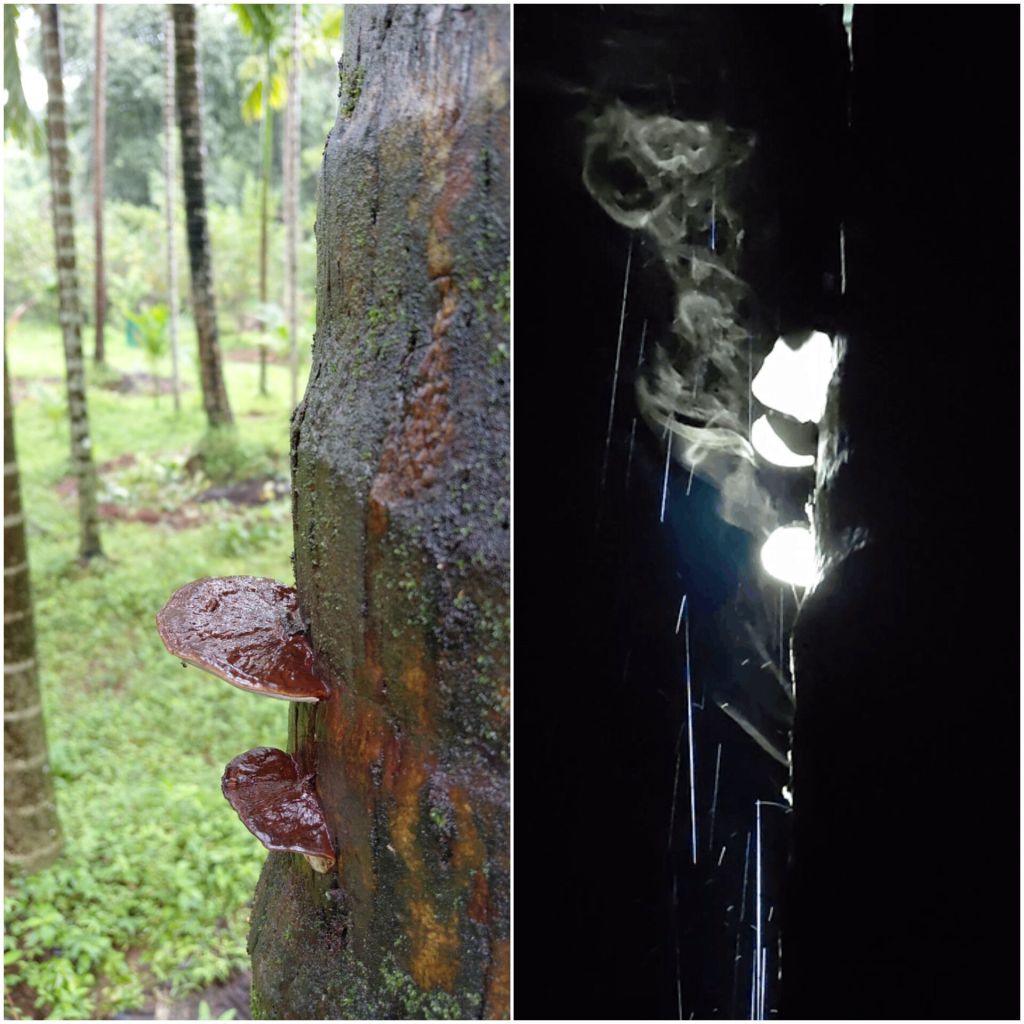
The lunch and dinner menu featured an all-local cuisine made with only locally sourced ingredients and tasted divine. Post dinner, we wore our raincoats, gumboots and headtorches and marched towards the forest after a short briefing. A guzzling water-steam flowing somewhere along in proximity stayed invisible in the darkness. Spiders, lizards, scorpions (that glowed under UV light), snakes and several types of mushrooms kept us accompanied in the constantly pouring rain during the entire walk. We then arrived at a spot in the middle of the forest, surrounded by massive trees and thick canopies. Our guide asked us to turn off all artificial lights and close our eyes for about a minute. It was for our eyes to set into the darkness of the forest after walking with flashlights until there. When we opened, we were all stunned by what our eyes beheld. The entire forest floor and the tree trunks were lit like radium. We were witnessing truly magical moments as bioluminescence was seen at its peak. The luminous fungi growing all over the ground, on tree trunks and even tiny wigs below my feet were glowing in the dark. An experience that I had wished to witness since so rftany years had finally come true.

The same Mushroom photographed during day(left) and night(right). Spores can be seen under torchlight at night.

We then returned to our cottages still holding the magic of the flowing forests still in our eyes. The other times of witnessing nature’s magic with light have been documented in separate posts.

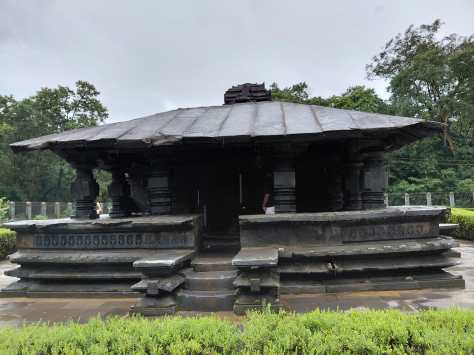
It was still raining as we devoured our breakfast and checked out of the resort. Our first visit was to Tambdi-Surla Mahadev temple. This is the oldest surviving Hindu temple in Goa, established by the Kadamba-Yadava dynasty and dates to 12th Century CE. It was a peaceful little temple built on the bank of the river Surla, whose upstream forms a cascading waterfall called by the same name. However, due to the monsoons, entry into the river or the hiking to the waterfall was prohibited at the time of our visit.

Tambdi Mahadev Temple, Goa
Tambdi Mahadev Temple at Tambdi Surla

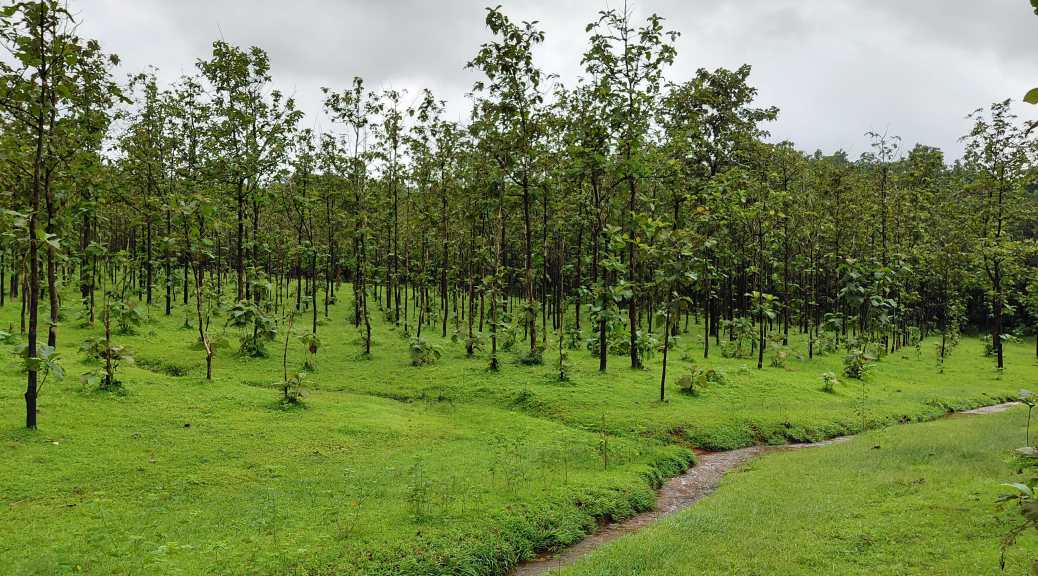
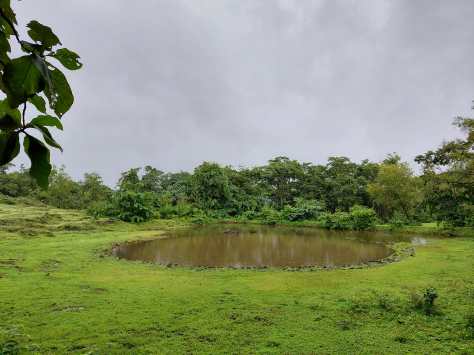
Upon our return from the Tambdi-Surla Mahadev temple, we were enchanted by the green cover all along the way. It was so tempting to the point that we parked our car by the roadside and simply walked into the neon green meadows running parallel to the road. We jumped across a tiny rainfed stream flowing across teak plantations which led us straight into a place that looked like a Windows wallpaper. We took lots of photos before coming across another random location on google maps that was named as a ‘crater lake’. Curious to find out what the lake was, we drove a little further and hiked a short distance by following google maps until we came across a small round shaped lake in the middle of a forest. I am still unsure if that was man-made or a natural pond which looked almost perfectly rounded in shape, but nevertheless it was a beautiful setting for yet another set of photography.

The Crater lake at Goa
The Crater Lake at Mollem National park, Goa

The stretch was mostly cut-off from mobile Connectivity, and we loved the peace we found amidst the chaotic monsoon drive. We occasionally stopped by at shops running in the backyards of small homes along the way to use free Wi-Fi in the name of drinking chai or coffee, local snacks sold in glass jars. It was thus far a beautiful trip exploring Mollem and Mahavir National Park.

We then proceeded towards Colva where we found our home for the next few days to explore the least explored places in Goa beyond beaches and parties. To be continued as Goa backpacking: Makarotsav Celebration and Temple Hopping.

10 offbeat things to do in Hampi

From a tourist’s perspective, Hampi can be broadly divided into two parts, separated by the Tungabhadra River. The heritage site of historical ruins is in the Vijayanagar district, whilst places of mythological importance and most homestays offering local experiences are concentrated in the Koppal district side (This is popular as the Hippie island). So, if one is planning a trip to Hampi for the first time, this geographical classification should provide you with a brief idea before you arrive there.

Everybody knows Hampi and there is enough content widely available on places to explore in this historical town. But here are some lesser-known experiences that I loved during my repeated visit to this UNESCO heritage site.

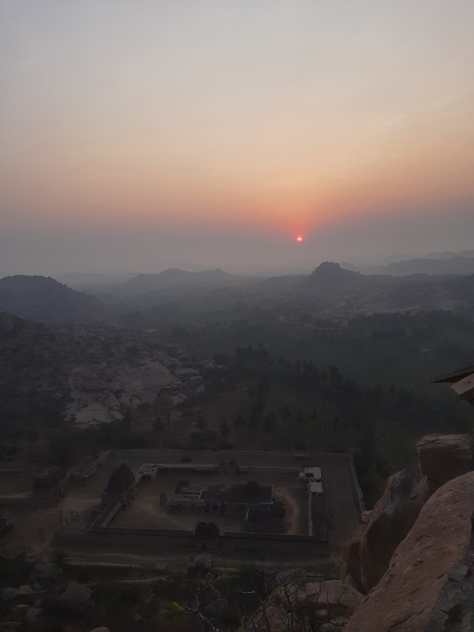
1. Sunrise at Matanga hills: How much amazement can your voracious vision hold? “Boundless” defines the view from the top of the Matanga hills. It was a dreamy view of the entire historical town in its ruined form scattered across the river flowing from one end to the other. And adding to the already picture-perfect frame was a bloody red rising sun in the backdrop. This is by far the BEST sunrise of my life. The early morning climb up the hill and the wait in the cold winds was so worth it that I had goosebumps watching the magic unfold.

Sunrise at Matanga hills

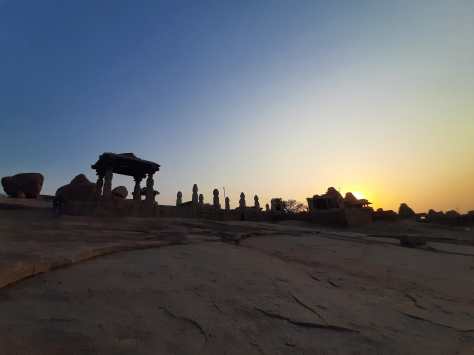
2. Sunset at Hemkuta hills: A short ascent to the rocky hill by the side of the Virupaksa temple leads you to this best spot to catch the sunset at Hampi. Comfortable benches or the grainy-pebbly ground, you can choose the surface to just lose yourself in experiencing the glorious horizons of Hampi turn from Indigo to blue to misty to bright to rosy to a star-studded sky.

Sunset at Hemkuta hills

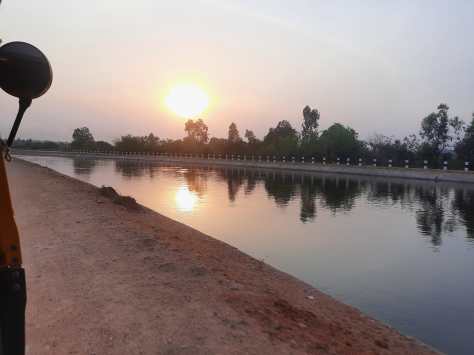
3. Bathing in the canal water: This is a closely guarded secret. There are irrigation canals passing through the villages in which you want to enjoy a quick dip, only if you befriend a local. If you do not get to enter the water, no worries, simply sitting by its side and seeing the time go by itself would be so comforting.

Water canals of Hampi

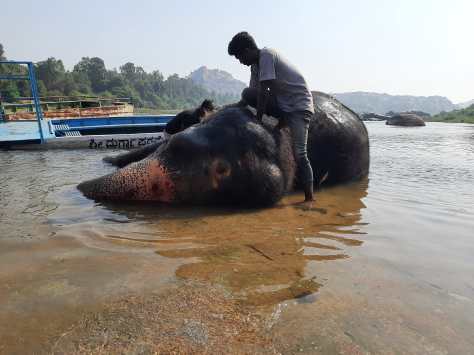
4. Coracle riding & elephant bathing: The river flows right behind the Virupaksa temple, and the temple elephant has a daily schedule of taking a shower in the river. Time your visit right and you can lend your helping hand too. A small ticket can help you cross the river on a coracle-a traditional round flat-bottomed boat built by knitting seasoned bamboo or cane. You can also see locals transporting their bicycles and motorcycles across the river through these boats.

Elephant bathing in Tunga river at Hampi

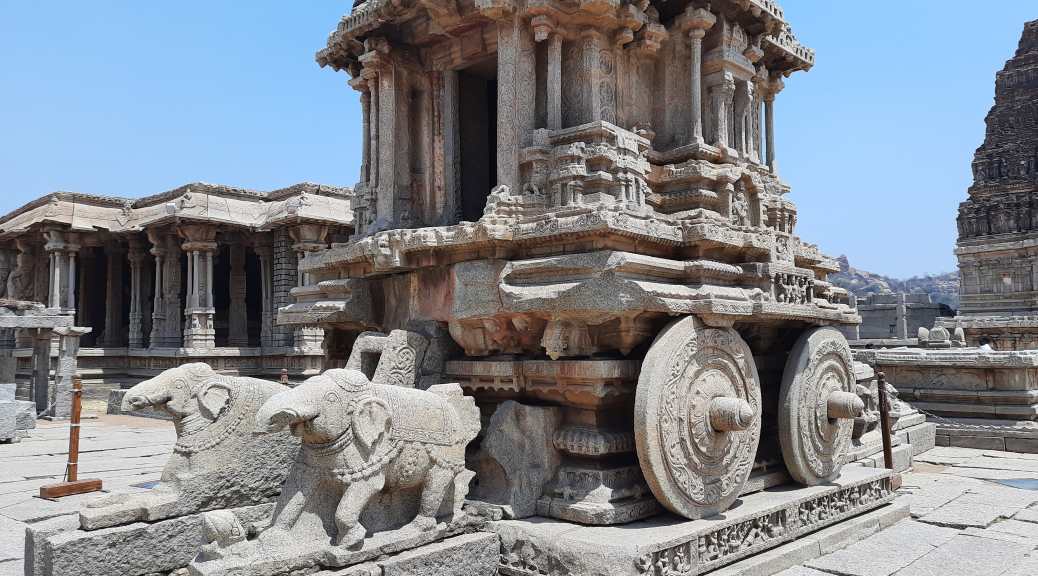
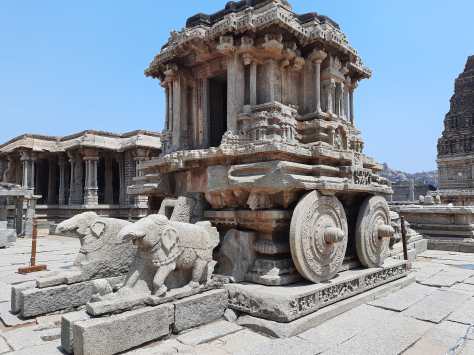
5. Cycle tour around the historical monuments: Several shops rent out bicycles to tourists. If you have a tourist map in hand and the luxury of time, trust me, it is one of the highly recommended ways to explore Hampi. For a little more comfort on a sunny day, you can opt for an autorickshaw with a good driver dueling as your tour guide.

Stone Chariot- Hampi

6. Sunrise at Anjanadri Betta: Believed to be the birthplace of Lord Hanuman, it is frequented by pilgrims which tends to receive higher footfalls as the day progresses. So, if you make it to the peak of this hill as early for sunrise, you can enjoy the view of the surroundings in peace and calm.

7. Sunset at Bala Anjaneya Betta: Another popular spot in the hippie island, it is best when visited during sunset.

8. Bouldering: This area is part of the larger Deccan plateau, and the rocky boulder terrain forms its core geographical feature. Short workshops in free hand bouldering is a great way to either learn a new skill or simply let the inner monkey in you to hang around in the land of the monkey kingdom (it is the birthplace of Lord Hanuman after all).

9. Bike riding in the paddy fields of Gangavathi: Gangavathi is called the rice bowl of Karnataka, and this is where you can see infinite stretches of green paddy fields. Now imagine large boulders and bare old trees standing scattered across these green fields as if they had witnessed all the stories of the past. And then you cut across on a moped or a motorbike casually soaking up this view. Trust me the views will linger in your mind long after you leave Hampi.

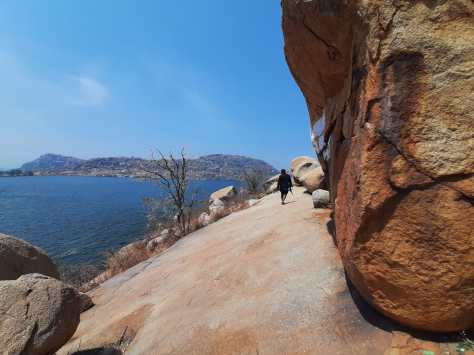
10. Cliff jumping & Coracle riding at Sanapur lake: This is not really a lake but the backwaters of a reservoir. It offers amazing activities to get your adrenaline rushing while you jump off a cliff to the depths and a crazy coracle ride along the rapid of the waterbody. A must do while you are on a trip to Hampi.

Sanapur lake
Sanapur lake

Are you going to try these experiences on your next trip to Hampi? Or what else have I missed out in this list? Tell me in the comments below.

Things to do in Yercaud

I chose Yercaud primarily because it is a hill station and ideal for a quick summer getaway from Bangalore. I was lured into it more because it is a coffee growing destination at the closest proximity to Bangalore (apart from my own hometown, Kodagu) Interestingly, Yercaud is a 100% Arabica coffee growing region, while it a Robusta major in Kodagu.

We were a bunch of friends who travelled from Bangalore to Salem by train and hired two-wheelers from Salem to Yercaud which we thought was the most convenient and fun way to explore a hill station for a good chilling scene in the peak of the summer season. Since it was sunset time by the time we started our ride from Salem towards Yercaud, darkness engulfed quickly. And even as we rode up the coffee hills via the 32 kms adventurous loop road, we were accompanied by strong winds, uprooted trees across the road, falling branches, a surprisingly heavy downpour and fearful thunderstorms. Despite being drenched to our bones and having a scary ride, we were still thankful that we could navigate the two-wheelers and not be stranded on a 4-wheeler for the rest of the night after being blocked by a fallen tree. The return ride during daylight was equally beautiful because our vacation coincided had with the Coffee blossom season and the entire valley looked and smelled amazing!

If you’re planning to make Yercaud your destination next weekend, here is a list of places you can visit. It is a small hill town, hence I highly recommend having your vehicle to explore as all places are quite a ride away from each other.

  1. Yercaud Lake: For a very laid-back day, you can spend it at the lake located in the heart of the town Boating and other water activities can be opted along with some coffee and local snacks by the lakeside.
  2. Lady’s seat, Gent’s seat, Children’s seat, Botanical Garden: Don’t go by the names of these spots like I did to find what the seats were about, they are just names for viewing towers that are built there. You can cover all these spots along a single stretch of a walking trail which offers good views of the surrounding hill ranges.
  3. Kiliyur waterfalls: You can have a rejuvenating day here by taking a dip in the waterfall here. However, keep the waterflow in check before deciding to venture into the waters depending on the season you visit there.
  4. Shevarayan hills: The hill gets its name from Shevarayan, the local deity who is worshipped inside a small cave at the top of the hill. The hilltop offers a flat area at the peak with great view of the surrounding hills and a favorite among the locals for short drives from the town. At then time of our visit, there was a small fair going on here with giant wheels, merry-go rounds etc, and a lot of small shacks selling snacks, chai and smoke.
  5. Karadiyur viewpoint: Thanks to the downpour from the previous night, our ride was hard, tricky and slippery through the muddy last stretch to get to the entrance of this place. But it was completely worth it, and it gets my highest recommendation to visit here for a sunset view. It was beautiful. Among all the viewpoints we had thus far explored in Yercaud, the entry here was ticketed but the view made complete justice to it. A short ride from here is the Sri Chakra Maha Meru temple. But we decided to skip this since we spent more time at the viewpoint rather that rushing to a more recently constructed temple before it got dark.
  6. Annamalaiyar temple: This place gets my second highest recommendation if I were allowed to rate places. We visited here in the afternoon and yet the 360 degrees view from here was just amazing. The temple itself was a small structure whose top can be accessed by a small ladder which serves as a watch tower also. Even at peak noon, the winds were so strong, the temperatures so cool and the vibe so peaceful.
  7. Pagoda viewpoint: A landmark usually marked on a touristy map of Yercaud, there is a watch tower which provides a good view but not as best as what I have seen at the above-mentioned less-frequented spots. There is also a telescope installed by the government for education purposes which can be accessed by any interested public. The access is free of charge, but it would be generous on your part to tip the person guiding you through when you handle the instrument by yourself.
Annamalaiyar temple
Annamalaiyar temple

We stayed at a luxury resort built within a 100+ acres coffee and spice plantation in Yercaud. We spent our vacation without packing too many things as the hills themselves are very laid back. Apart from spending time doing activities like plantation walks, birdwatching etc. at the resort, we explored the places listed above and feel that our time was aptly occupied. Depending on whether you want to extend your stay for another leisurely day or pack your day with few more spots, you can visit the places below.

Karadiyur viewpoint- Yercaud
  1. Montfort School: Located in the heart of the town, it came as a recommendation on google for places to visit. However, when we arrived at the school gates, we were denied entry into the premises. Not sure of the reason, maybe because it was still school time.
  2. Sangalathudi viewpoint: We skipped this since we had done few viewpoints already.
  3. Manjakuttai viewpoint: This was a high recommendation on google for a sunrise view. We decided to give this a miss considering the distance from our accommodation and the laziness to wake up so early on a leisurely weekend trip.
  4. Tippery viewpoint: Located on the southernmost point of Yercaud, it is another good place to see the hills.
  5. Norton bungalow: This used to be a British bungalow, now owned by a private entity on the way to Shevarayan temple. So, it requires prior permission to enter the premises. We tried to locate it on google, but could not get the right directions and leads for the required permits.
  6. Bear’s cave: This is a google landmark located inside a private estate near the Norton bungalow. But we had to skip it since we couldn’t locate it.
  7. Nallur waterfalls: We skipped this since we had already added Kiliyur waterfalls to our visit and Nallur was quite far away from our accommodation.
Pagoda viewpoint

Food:

We mostly ate our breakfast and dinner at the resort itself since they had good buffet and ala-carte menu. Apart from that, they also made good woodfired pizza served in an outdoor seating adding to the ambience. But we tried lunch at Sweet Rascal restaurant based on high user ratings. They serve Sri Lankan cuisine with a limited menu to choose from that menu changes every day. Since all the ingredients are freshly bought in limited quantities daily, it is highly recommended you make a prior reservation of a table. The food was good and the ambience even better. They have indoor and outdoor seating with lot of greenery and various kinds of pet animals around. But what makes your visit even more exciting is the collection of hearty anecdotes and funny quotes pasted and painted all around the property.

I hope this post is useful to plan your next weekend getaway from Bangalore. Let me know in comments if you have any questions or feedback.

Largest Railway Station in India | Complete List You Must Know

Collecting amazing information about the largest railway station in India that can blow your mind with its operations. Indian Railways operates many railway stations, but certain stations made their place on the list of the top 10 largest railway stations within India.

Railway stations are considered the largest in different terms, such as the area covered by the railway station, the number of available platforms, the number of trains that halt daily, the number of tracks, and passenger traffic and the availability of services like food in train, including station food courts, onboard catering, and online meal delivery options for passengers during their journey.

This post will explore railway stations that are considered the largest, based on the number of platforms or tracks, including platform length, which contribute to their ranking as top railway stations within India.

List of the Top 10 Largest Railway Stations in India

Check the list of the top 10 largest railway stations operated under the Indian Railways.

Largest Railway Stations in India

Key Details and Facts About the Largest Railway Station in India

1. Howrah Junction (HWH)

Howrah Junction comes in the top list automatically when you talk about the largest station in India due to the following.

  • Located in Howrah (West Bengal)
  • One of the oldest railway stations in India.
  • Operated under the Eastern Railway zone
  • Connect major cities like Mumbai, Delhi, Guwahati, and Chennai.
  • More than 23 platforms handle 1000K passengers daily.

2. Sealdah Railway Station (SDAH)

It is the 2nd largest railway station in India, located in West Bengal (Kolkata), due to the following reasons.

  • 21 Operational Platforms.
  • Handles about 1000K passengers daily.
  • One of the busiest suburban railway networks.
  • Major hub for local or non-local railway stations.
  • Railway food order with RailRestro to get delivery at the next station.

3. Chhatrapati Shivaji Maharaj Terminus (CSMT)

This station is popular as CSMT due to its iconic landmark. Therefore, check the PNR status before reaching the boarding station via the RailRestro app. So, check the following reasons behind it.

  • It counts as a UNESCO World Heritage Site.
  • It operates around 18 platforms with 40 tracks to manage a large number of trains.
  • This railway station is located in Mumbai (Maharashtra) as headquarter of central railway.
  • One of the busiest railway stations in India, managing around 700K passengers daily.

4. Chennai Central Railway Station (MAS)

Chennai Central is the primary railway terminus in Chennai, Tamil Nadu, and is considered the busiest railway station in South India. Reasons are as follows.

  • It operates 17 platforms with 30 tracks for a large number of trains.
  • It connects Tamil Nadu to other states and is considered a major terminal in South India.
  • MAS handles more than 500K traffic daily.
  • Online food on train service is available with the RailRestro train app.

5. New Delhi Railway Station (NDLS)

New Delhi railway station is one of the busiest and largest railway stations in India in terms of handling daily passengers.

  • It operates around 16 platforms that connect all the major cities.
  • Top revenue generating railway station in India.
  • Handles 400+ trains on a daily basis.
  • Located in the capital of India, which connects East, West, North, and South India.

6. Ahmedabad Junction (ADI)

It is another largest railway station that operates under indian Railways. The following points pull it into the list of the largest stations in India.

  • It operates 12 platforms to serve around 200K passengers daily.
  • It is a major Junction in the Western Railway zone.
  • A massive redevelopment project that can offer better connectivity to passengers.
  • Offering modern amenities such as 31 passenger lifts, 50 escalators, and others.

7. Kharagpur Junction (KGP)

Kharagpur Junction is not considered for its number of platforms or number of tracks. But it comes in the list of the largest railway station because of the following.

  • Longest railway platform in India and also one of the longest across the world.
  • It has a 1072-meter-long platform that grabs the attention of travel enthusiasts.
  • It handles 200K passengers daily.
  • Majorly connected with cities like Delhi, Mumbai, Kolkata, Chennai, and others.

8. Praygraj Junction (PRYJ)

Prayagraj Junction, formerly known as Allahabad Junction, is an important station in Uttar Pradesh. This railway station comes in the longest railway station due to the following reasons.

  • It has 10 platforms with 20 tracks to deal with hundreds of trains in a single day.
  • It deals with more than 300K footfalls daily.
  • This North Central Railway station has major connections with Kanpur, Varanasi, Delhi, Mumbai, and Kolkata.
  • Multiple tracks for local and long-distance trains.

9. Vijayawada Junction (BZA)

Vijayawada Junction is the most strategic railway station in Andhra Pradesh including southern India. Certain reasons make it count as the Indian largest railway station are as follows and passengers can easily check the Train Time Table for all arriving and departing trains.

  • This railway station operates 10 platforms and 24 tracks to manage hundreds of trains every day.
  • It handles over 200K passengers daily.
  • The station has major connections with Bengaluru, Chennai, Kolkata, Hyderabad, Howrah, and Delhi.

10. Patna Junction (PNBE)

Patna Junction is one of the largest railway stations in India due to the following reasons.

  • The important and busiest railway station in Bihar.
  • It connects eastern and northern India with other major cities.
  • It also facilitates the passengers and freight traffic.
  • PNBE operates 10 platforms and 20 tracks.
  • Offers facilities like modern waiting halls, food courts, digital information systems, including ticket counters.

Also Read:

Chain Pulling in Train: Rules, Valid Reasons & Fines

Five Types of Trains to Experience in India

Frequently Asked Questions

Q. Why is Howrah Junction considered the largest railway station in India?
Ans. Howrah Junction is considered as the largest in terms of number of platforms (23) in India, with more than 6000 train movements and daily traffic of about 10 lakh per day.

Q. How many platforms are there at Howrah Junction?
Ans. Howrah Junction operates 23 platforms, which makes it an Indian largest railway station. It helps to deal with large traffic and manage 600+ trains on a daily basis.

Q. What facilities are available at Howrah Junction railway station?
Ans. There are various facilities available at the HWH (Howrah Junction) that are listed below.

  • Escalators & Lifts
  • Free Wi-Fi
  • Retiring Room and Dormitories
  • Waiting Room (AC or Non-AC)
  • Clock Room
  • Parking Facilities
  • Food Courts
  • Road Connectivity

Q. Which is the second largest railway station in India?
Ans. Sealdah Railway Station is considered the 2nd largest railway station in India because of passenger traffic and numbers of platforms available. It operates with 21 numbers of platforms to deal with 800K to 1000K traffic daily.

Part 2-The Story of The Maha Shivaratri and the Naga Sadhus

Continued from Part 1: The Story of The Maha Kumbh and the Naga Sadhus

We had taken help from a local person, Sunny, to make a last-minute hotel booking at Banaras. Sunny was a young lad who freelanced as a local guide, and was referred to us by one of my friends who had availed his services earlier. My friend and I checked into the hotel booked on the main road of Banaras, slept without dinner as were tired.

Meeting the Nagas

It was around 02:00 a.m. when I was woken up. “Wake up, Hitha. There is something happening on the road, I can hear people shouting slogans.”, my friend sounded very anxious.

It is Shivaratri. People maybe chanting Har Har Mahadev, as many were doing so when we arrived here.” I said.

No, wake up! I have been hearing this from quite some time, and it is getting louder now.” She barged outside the room to check what was going on.

Hitha, hurry up and come outside! All the Naga Sadhus are right here!” she shouted, while running towards my bed, huffing and puffing in the next couple of minutes. Then, we both ran out to the reception area.

We were spellbound with what we saw there. With ash smeared bare bodies, matted locks, strings of Rudrakshas around their necks, trident and damrgo in hands, there were hundreds, or perhaps thousands of Naga Sadhus and Sadhwis representing every known Akhada with their respective Tableaux, had all assembled right in front of us. Calls of ‘Har Har Mahadev’ reverberated not just on this road but across the city as their convoy began with all the Nagas throwing ashes up in the air. Tight security with the CRPF barricading the streets on both sides ensured the convoy reached the ‘Kashi Vishweshwar Mandir’ thereby the Nagas got the first glimpse of their Adi Guru on the day of Maha Shivaratri before the rest of the public were allowed. A sight that seemed like a dream that I had just woken up from, one that I will cherish as one of the TOP memories of my life which I would have missed in a matter of seconds hadn’t my friend woken me up at the right time. The crowd then dispersed and we returned to our room to freshen up before starting our day.

In a couple of hours, Sunny updated us to stay at the entrance of the hotel for the procession was to return along the same path, with the Akhadas returning from the temple, back to their camps set along the Ghats from where they would all packup to head towards their respective abodes scattered across parts of India. When they all did arrive, I stood on the side of the road to capture a few shots for memory of this amazing day. Despite the security, my friend and I had unknowingly become a part of the parade. The parade of the Nagas. We were walking beside and amid the Nagas from Godowlia street, right until the Juna Akhada office before someone realized that we were outsiders and politely asked us to step aside. WOW! It was indeed an experience that gives us goosebumps just by imagining even today.

Naga Sadhus returning to their akhadas

Shiv-ji ka Baraat

Meanwhile, Sunny had us racing towards, yet another ceremony scheduled to happen on the parallel streets. The grand Shiv Baraat procession was on its way from Shri Tilbhandeshwar Mahadev temple towards the Gauri Kedareshwar temple, where the idols of Shiv and Parvati are set up the day before the main event. Sunny placed us both on strategic spots on the street from where we could watch the arrival of the Baraat clearly.

First, the camels arrived. Then the elephants. Then, all the Baraatis from the groom’s side accompanied by various orchestra/Band sets and tableaux from across the city arrived on different vehicles, chariots etc. (Children and young adults dressed in masks and costumes depicting various gods and Goddesses from Hindu Mythology) and Finally the groom made his appearance on horseback (yet, another young boy dressed like Lord Shiva), travelling across various lanes, streets and main roads of Banaras and finally reaching Gauri kund located at Kedar Ghat where the divine union of Lord Shiva and Goddess Parvati was to take place later that night.

Gauri kund before the wedding prep

We found a strategic spot on the stairs of the Kedar Ghat to witness the grandest wedding that was supposed to take place all night with all the devotees staying up on night vigil as witnesses to the wedding on the banks of River Ganga. Ofcourse, any Indian wedding is incomplete without a grand feast for its attendees. How could it not be so when it is the wedding of their dear Lord himself? There was free and unlimited supply of potato sabzi and Thandai throughout the night to all devotees (guests) in attendance at Kedar Ghat, witnessing the wedding by participating in rituals and discourse of vedic chants.

Feast being prepared for the wedding

The common man seated hundreds in numbers occupying the riverfront stairs played witness to the divine marriage ceremony conducted in a style typical to the Uttar Pradesh region. My friend was on top of the world when she was randomly picked from the gallery of people to make her offerings to the newlyweds (perform abhisheka with milk on small lingas moulded out of fine soft sand from the Ganges on a decorated silver plate). The contents in each plate was offered back to the river as a part of the culmination of the marriage rituals. The chants and offerings went on until the break of dawn post which the audiences and witnesses dispersed.

The celestial wedding in progress at Gauri kund

Date with the Lord and his consort

If this was about witnessing the celestial wedding, wait. Our visit to Banaras was incomplete without this: Greetings to Lord Kashi Vishweshwara. We had decided to skip the temple visit on the day of Shivaratri to avoid the crowd and try our luck on the following day. So that day was about resting and catching up on the sleep deprived from the last night.

Come the following day, there were no signs of any less crowd. Rather it looked like the entire crowd from Prayag had alighted at Banaras after closing the Kumbha Mela. The queue to enter the temple extended several kilometers. But we are Indians with local contacts. Be it getting access to a no-entry spot or to wave a quick ‘Hai’ to our favourite god, why wouldn’t we utilize our privileges to bypass rules? We will! We found a legal way (Oh, that’s a secret!) to cut the longer queue and reduce our wait time to just an hour. Amid chants of ‘Har Har Mahadev’ we had finally arrived at the Lord’s doorstep, a window from where we were blessed with a view of a beautiful Pushpa alankar or the floral decoration. Despite wanting to stay there for a little longer, we had to move away making way for the lakhs of devotees waiting behind us.

A visit to any Shiva temple is incomplete without taking the blessings from his consort, Shakthi. In Kashi, Lord Vishweshwara’s consort is Goddess Vishalakshi. We expected another long line but as surprising as we were, we had just another 10 to 15 people along with us, all standing and praying inside the temple without any pressure to move out. It was such divine energy felt in peace. So, after coming out of there, the next important thing to do on our list was to eat food, food at the Annapurna temple, the home of the goddess of food and abundance. Let me not add more paragraphs into my story describing how symbolic this temple is from a religious and mythological context; Google Mata is just a click away with all the details. So, we had to satiate our fasting stomachs by finding our way to the temple of Annapurna (actually, to the dining hall!).

Upon enquiry of the route, we understood that we had to navigate through the same long queue of the Vishwanath temple before arriving at a small deviation that led to the temple that we were looking for. The same local contact who had helped us to jump the previous line provided us with some tips to skip the queue all together because we were not going to Vishwanath temple this time. We followed his hacks, paid a deaf ear to dozens of abuses that were being hurled at us by frustrated people who had been standing for hours in the long queue before joining a crowd that seemed unusual to an Annapurna temple (since we had not encountered it on our way to the Vishalakshi temple) or rather familiar (with the structure and chants around us were similar to that of Vishwanatha temple). It didn’t take us too long to realize that we had indeed arrived at the window of Lord Vishwanatha again, by entering from a different gate. This time, his darshana was without any of his adornments, a blessed moment briefly happening before he is completely covered up by his next alankaara and the offerings made by the devotees. It felt surreal. How lucky could one get to have a second chance on such a cringe day?

Anyway, moving on from there, we had to talk to few security personnel to help us find our way to the Annapurna temple. It was a short walk away with a maddening density of people pulling and pushing their way through a small temple verandah to enter the dining hall. Once there, we both had goosebumps thanking our fortunes for having us the opportunity to devour that meal! It was simple and comforting yet felt luxurious!

The reception of Lord Shiva and Goddess Parvathi

Lighting the Diyas at the Ganga Aarti

The famous Ganga Aarti performed twice daily on the ghats of the Ganga had been halted over the last couple of weeks, ever since the stampede had happened at Prayag. It was while having our lunch at the Annapurna temple, Sunny had dropped us as SMS informing us to arrive early at the Dashashwamedh Ghat as the evening aarti would be restarted from that evening. Even as we arrived at the ghat at 04:00 p.m., let alone sitting, it seemed impossible to find space to even keep our feet firmly on ground. The crowd had assembled on the ghats, on boats, atop all surrounding buildings, poles and structures to witness the Ganga Aarti that was scheduled to begin post-sunset. We both barely managed to find space just enough to cling on a supporting wall in front of the anchored boats.

It was finally time for the aarti and the all the priests who had to perform the Ganga aarti had assembled on the podiums. Call it our luck or divine intervention, the head priest who overlooked the preparedness of the dais before commencing the sacred ceremony pointed at the two of us from the massive crowd that had gathered. He asked us to come over and light up all the clay lamps arranged around the podiums. After that, he offered us to sit on a red-carpeted arena, right behind the performing priests that provided us the best possible comfort and view that evening! We couldn’t help but pinch each other to convince ourselves that the way our day had unfolded was indeed real.

Parvati ki Bidaai

On the third day, we stayed back to play witness to the Bidaai ceremony of the daughter, Goddess Parvathi with her husband: Shiva. With the entire Banaras gathering on the streets, the pomp and grandeur of the send-off was even larger than the Baraat which finally culminated on the outskirts of Banaras. With that, it was also time for us to return to our hotel and pack our bags to head back to Bangalore.