Continued from Goa backpacking: Makarotsav Celebration and Temple Hopping.
Based out of Colva, my friend and I had hired a motorbike to explore Goa. Our plan for today was to see some prehistoric sites, take a dip at one of the nearby waterfalls and return to Colva by late evening. With a set of clothes for changing and a towel for each of us, we had woken up to start our day quite early. But the rain gods had brutally taken over the skies, and hence, our day started late.
Day 1: Exploring the prehistoric sites of Rivona
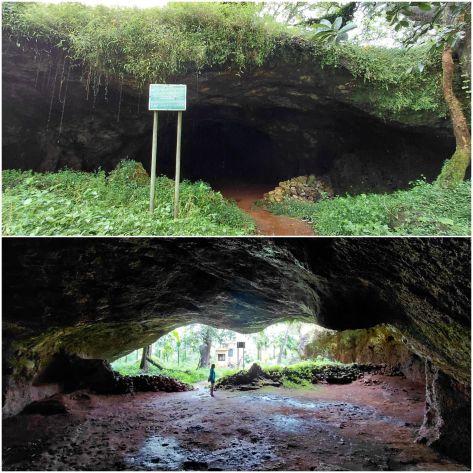
I was about 10 a.m. when the rain slowed to drizzle, and we left our cottage. We stopped for a quick breakfast in Madgaon before continuing. Using Google Maps, we headed to our first destination: the ancient Buddhist meditation cave at Rivona. Although we struggled slightly with the directions initially, we managed to find the site through local inquiries, without too much trouble. The asphalt road first passes through a residential area before reaching a large natural pond. At this point, the road splits, and we took a muddy route to the right, stopping at a small grassland at the end. From there, a small staircase carved into the laterite ground leads down. We were unexpectedly greeted by a security guard from the ASI (Archaeological Survey of India), who checked our attendance before we entered the cave. We were told a guide is usually available, but none was present at the time. We took a few photos before leaving. If you’re not interested in history and are just a tourist, I recommend skipping this site.
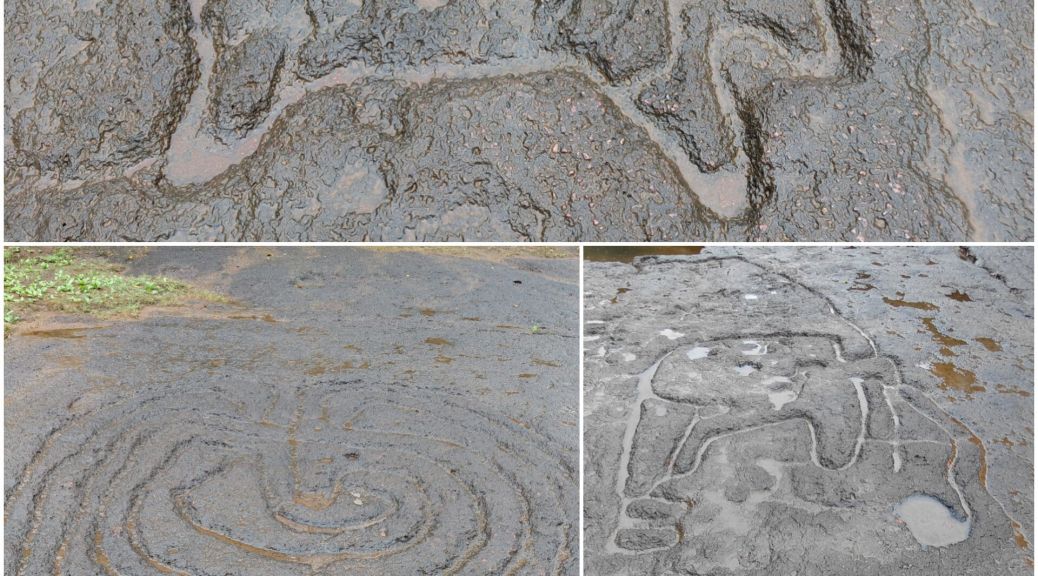
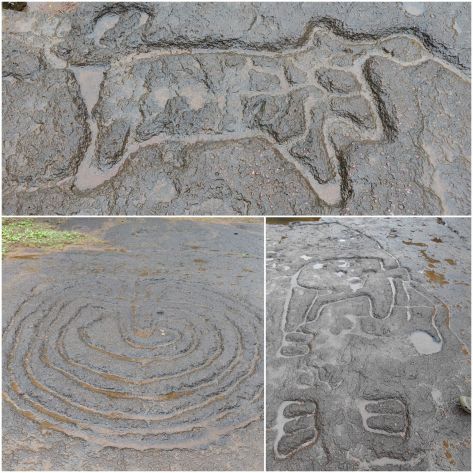
From there, we continued to follow the maps to our next destination- Usgalimal village, one that I was most excited about. For the first time, I was going to see petroglyphs, that too in Goa! The muddy trail that splits across the main road passes through thick forest right up to where the Google Map Pin takes you. After passing through a stretch of confusing deviations, patches of open grasslands and a laterite pond, the location pin finally took us to the banks of the river Kushavati, We parked our bike at the security post and wrote our names in the logbook. The security guard then walked along with us, guiding us through the riverbank. He showed us around various depictions/ Petroglyphs carved on the laterite stone bed of the river. He helped us identify several of the 100+ carvings discovered there, among which were various hunting scenes, several domesticated and wild animals, a trident, a labyrinth, etc., some of the notable ones. Seeing something like this for the first time piqued a new interest within me to learn more about Petroglyphs and ancient rock art, which I would want to travel to in future to explore.
After spending enough time trying to observe and decipher the art there, we casually asked the guard accompanying us if there was a spot somewhere nearby where we could take a dip in the river. He thought for a moment and nodded while looking at the riverbank on the other side. There’s a spice & areca farm across, where you can approach the caretakers to permit you into the safer section of the river that passes through the property. We thanked him for the recommendation, picked up our luggage from the bike, and crossed a little brook across the river, where we were able to secure our permission. There are NO words to describe the joy our two little hearts had found inside the safe, sweet and soulful waterbody. With just the two of us swimming and enjoying ourselves in the water all the while, we did not realise that we had spent over 2 hours already without being bothered by the rain that bashed down or by any deadlines to get back to waiting families back home. But soon it struck us that we had to make the most of the time when the rain had taken a break. Since we had already spent a lot of time at Usgalimal waters, we skipped our original plan to swim in the waterfalls later. We quickly changed into fresh clothes and got the bike running again.
Not too long after we hit the road, the rain gods took over again, and the terrain changed to an even denser canopied area. A little board read that we had officially entered the Netravali Wildlife Sanctuary. The natural light had become less, and riding harder due to the constant bashing of the heavy rain and wind. We had no option to stop in between since the houses were scarce along the forest, and we had to reach the destination before it got too late so that we could return to Colva safely before it was too late.
Upon our arrival at the forest gate, we were told that the entry to the waterfalls was closed at 05:00 p.m. We had arrived at 05:05 p.m. The forest personnel did not oblige us, even after several requests and explanations of our long ride back and forth. Now we had two options- One, skip exploring the sanctuary altogether, and return to Colva. Two, find accommodation nearby and explore Netravali (also called Netraulim) at leisure on the following day. We took a moment to think over, looked up at the constantly pounding rain and decided to stay back in Netravali. Even if we wanted to skip visiting places, riding back in the rain and darkness would only be next to madness.
Since the eco-stay run by the Goa forest department was all booked, the guards helped us to find a local homestay nearby. Shortly, our stay was arranged with a local family, and it got dark after that. We took a shower and changed back to the same clothes (there was no other option), devoured a comforting hot meal before retiring for the night.
Day 2: Waterfall chasing and cultural immersion in Netravali
After waking up in the morning, we watched our host light up a lamp at the Tulsi katte in their courtyard and milk their cows in the shed attached to the family home. We had our breakfast and left towards the forest gates soon after. In fact, we wanted to be the first visitors for the day so that we could avoid the crowd and start our return ride as early as we could. So, there are two waterfalls as one enters the gated area, which require separate permits. We were briefed about the condition of the roads leading to both and asked to register ourselves accordingly at the entry. We decided to visit the Mainapi waterfall by hiring a forest Jeep and riding our bike to the Neturlem (Saoli) waterfall later.
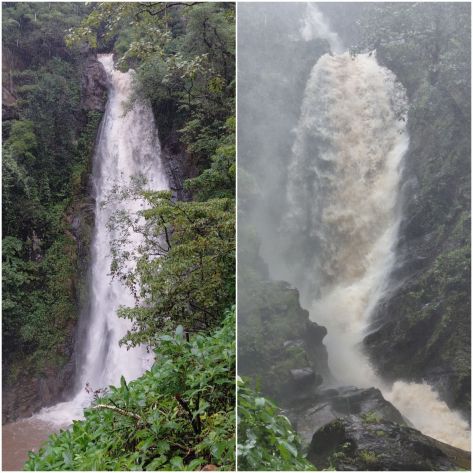
The adventurous 5km drive to Mainapi waterfall constituted a crazy, bumpy drive on the rocky-hilly road cutting through thick canopied forest and river crossings. Further, a short hike down to the waterfall was accompanied by leeches, brightly coloured miniature crabs, frogs and other insects found commonly during monsoons. The first glimpse of the waterfalls had our breath pause for a moment. We hadn’t expected anything so beautiful in Goa, which is otherwise popular for its beaches. Thanks to the monsoons, the path further down to the waterfall was blocked for safety reasons. We sat down on the stairs, watching the water roaring down in all its might until we realised that a couple of leeches had entered my raincoat. I had to quickly get them out and also head back to keep the day’s schedule under control. After a good, bumpy drive back to the forest office, we returned to the forest on our bike. The road was good right up to the start point of the Saoli waterfall. After parking the bike, a short descent down the stairs leads us to the banks of the Saoli waterfall. We could get into the water, but the currents were still strong, and the water looked muddy from the heavy rain. We spent some time there, too, before exiting the forest gates.
We returned to the homestay where our host had promised to take us around their ancestral village. After a short drive in their car, we arrived in front of an old mansion, which was the ancestral home of our host, the Desai family. It was very interesting for me to walk into a traditional Hindu home because its history dated back to even before the Catholic-Portuguese mansions which I had seen thus far elsewhere in Goa. As we entered through the towering arch-like entrance to this house, we were greeted by a large open courtyard, which was divided into dwelling spaces for each member of the family. To the left of the entrance was a space dedicated to the sacred arms once used by the ancestors of the family. We were told that some even had the original blood stains with a history of valour and martyrdom dating centuries. Laterite walls, red-oxide floor and clay tiles set on wooden beams- it invoked nostalgia instantly. While the kids surrounded us in excitement to tell us about their stories from the rooms, the senior women wove garlands with colourful flowers picked from their backyard while being entertained by the chatter of their husbands. They were all happy to have us amongst them.
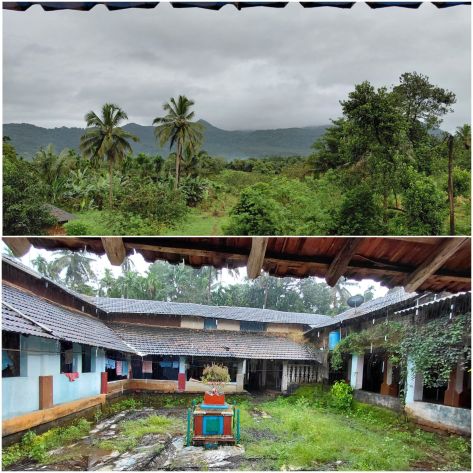
We then walked through the exit door on the back side, passing by a series of bathrooms where we could hear the water in the firewood-lit boilers. As rain-fed streams came to life while walking through their rubber plantation, we crossed a little river to arrive at Datta-Gufa, a family-maintained temple. This is an important temple in the village accessible from the main road as well, but we were more privileged to get private access from the other side. After spending time on their property, we returned to the homestay from where we took our bike and commenced our return ride towards Colva.
En route, our first stop was at the Gopinath temple in Netravali. The temple is rather popular for its sacred tank. Fondly called Bud-bud Lake, the pond water is believed to bubble up when one claps while standing in front of it. We too did witness the interesting phenomena, but felt it did so as a response to some other air pressure occurring naturally in the otherwise silent environment. In any case, it was something we were experiencing for the first time.
From there, we started to ride again to make the most of the time when the rain seemed to have taken a break. A short ride ahead were directions to ASI sites like the ancient ruins of Sri Lakshmi Narayani temple and Kajur Petroglyphs. But by seeing the Google Photos uploaded by past visitors, we decided to give them a miss. Shortly, we reached Rivona. Someshwar Sansthan, Jawali Damodar Sansthan and Vimleshwar temple were landmarks and renowned local temples that we visited along our ride. This has been written about separately in my previous post: Goa backpacking: Makarotsav Celebration and Temple Hopping. We had a quick coffee break at Margaon before reaching our home during the trip at Colva.
To be continued as Goa backpacking: Day trip to Rachel and Big Foot.

 The Lost Lander