
From Waitlist to Confirmed: How to Actually Read Your PNR
Few things in Indian travel cause as much quiet anxiety as a string of letters on a train ticket. WL. RAC. CNF. For my first few trips, I genuinely did not know whether I would have a berth until I reached the platform. Once I understood what these codes actually mean, that anxiety vanished. Reading your reservation is a skill, and like most skills, it is simple once someone explains it clearly.
Here is everything I wish I had known the first time I stared at a waitlisted ticket.
What your reservation status really tells you
In one line: your pnr status tells you whether you have a confirmed berth, a shared one, or none yet and how your position is changing as departure nears.
Every ticket carries a 10-digit Passenger Name Record number. That number is the key to every update. As other passengers cancel before the journey, waitlisted and RAC tickets move up. Checking your status simply shows you where you stand in that queue at any moment.
This matters because Indian Railways carries around 21 million passengers a day, and confirmed berths on popular routes are genuinely scarce. A waitlisted ticket is not a dead end; it is a position in a line that keeps moving.
The three codes that decide your journey
Almost everything you need comes down to three statuses.
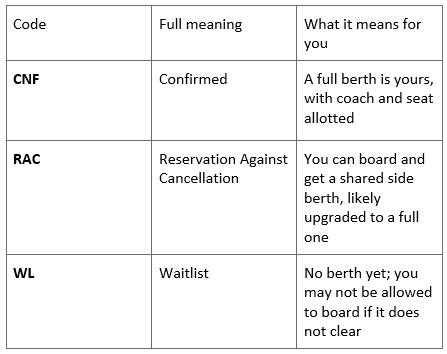
When I see CNF, I stop checking and start packing. When I see RAC, I know I am travelling for certain, just possibly sharing a side berth for part of the journey. When I see WL, I watch the number and prepare a backup.
Decoding the waitlist numbers
A waitlist is not one thing. The letters before “WL” tell you how likely it is to clear, and this is the detail most travellers miss.
- GNWL (General Waitlist): the most common and the most likely to confirm.
- RLWL (Remote Location Waitlist): issued for intermediate stations; clears more slowly.
- PQWL (Pooled Quota Waitlist): shared across several stations; confirmation is harder.
- TQWL (Tatkal Waitlist): for Tatkal bookings; clears only if Tatkal tickets are cancelled.
If my ticket reads “GNWL 4,” I am usually relaxed. If it reads “PQWL 20,” I start looking at alternatives straight away.
When to hold your plan and when to switch
This is the practical heart of reading your reservation. Over many trips I developed a rough decision guide.
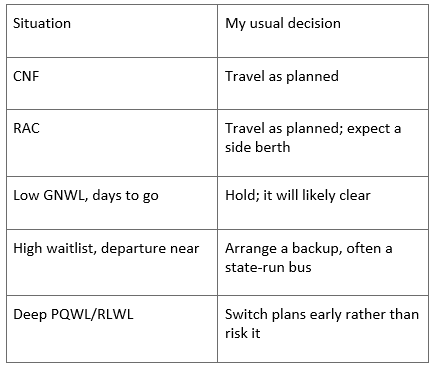
The key is to decide early. A waitlisted ticket checked the night before leaves you no time to react. Checked a few days out, it gives you options.
A real example of the queue in motion
On one trip my ticket started at GNWL 9 about ten days before travel. I checked every couple of days rather than obsessively. Five days out it was GNWL 4. Two days out it was RAC. By the morning of travel it read CNF, with a confirmed lower berth. Nothing I did changed the outcome, but watching the queue move meant I never panicked and never wasted money on a needless backup booking.
How booking choices affect your odds
Smart irctc ticket booking habits improve your chances before the waitlist game even begins. A few that consistently help:
- Book the moment the 60-day window opens for high-demand routes.
- Prefer GNWL over other waitlist types when you have a choice of trains.
- Consider a slightly less popular train on the same route with a shorter waitlist.
- Keep documents ready, since you must carry valid ID to travel.
What happens if a waitlisted ticket does not clear
It helps to know the rules so you are never caught out. For online tickets, a fully waitlisted ticket that does not confirm is generally cancelled automatically, and the fare is refunded. The cancellation charges that apply to confirmed tickets, for reference, around ₹120 for Sleeper, ₹180 for 3A and ₹200 for 2A when cancelled at least 48 hours before departure, do not hurt your wallet the same way on an unconfirmed online ticket. Knowing this removes the fear of “losing everything” on a waitlist, which is what pushes many travellers into panic decisions.
How chart preparation decides your berth
A detail that removed most of my waitlist anxiety was understanding when the queue actually settles. The reservation chart is usually prepared a few hours before the train departs from its origin. That is the moment most waitlisted and RAC tickets receive their final answer, as the system incorporates all cancellations up to that point.
Practically, this means:
- Until the chart is prepared, your status can still improve as others cancel.
- Most movement happens in the last day or two, when plans firm up across thousands of passengers.
- Once the chart is out, your status is effectively final for that journey.
Knowing this stops the urge to refresh every hour. The useful checks are a few days out, when you still have time to arrange a backup, and once more around chart preparation, when you get your real answer.
Checking your status without obsessing
Early on, I checked my reservation a dozen times a day and felt worse for it. A waitlist number that has not moved in two hours is not bad news; it simply means no one has cancelled in that window. A calmer rhythm serves you far better.
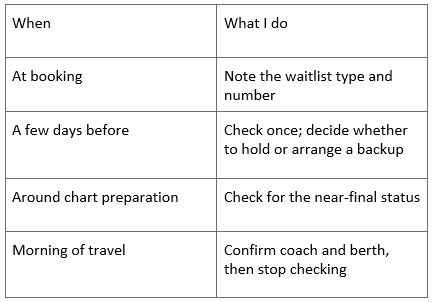
This rhythm gives you all the information you need at the moments it actually matters, without turning the days before a trip into a waiting game.
A simple way to act on what you see
When the status updates, my response is almost automatic now:
- CNF: pack and travel; nothing more to do.
- RAC: travel as planned and expect a shared side berth.
- Low GNWL with days to go: hold; it will most likely clear.
- High or pooled waitlist near departure: arrange a backup, often a state-run bus, before it is too late.
The whole point of reading your reservation is to turn uncertainty into a decision. Once you can do that, a string of letters on a ticket stops being a source of dread and becomes just another piece of useful travel information.
Frequently asked questions
What does PNR status confirmed mean? A confirmed status, shown as CNF, means a full berth has been allotted to you with a specific coach and seat number. You can board and travel without any further uncertainty.
Can I board the train with an RAC ticket? Yes. An RAC ticket allows you to board and gives you a shared side berth. There is a strong chance it upgrades to a full berth as other passengers cancel before departure.
Will a waitlisted ticket get confirmed? It depends on the waitlist type and number. A low General Waitlist (GNWL) usually clears, while a high Pooled or Remote Location Waitlist is less certain. Check a few days ahead so you can plan a backup if needed.
What happens to a waitlisted ticket booked online? If an online ticket remains fully waitlisted and does not confirm, it is generally cancelled automatically and the fare refunded, so you are not left stranded with a useless ticket.
How often should I check my reservation status? There is no need to check obsessively. Note your status at booking, check once a few days before travel to decide whether to hold or arrange a backup, then once more around chart preparation for the near-final result.

 The Lost Lander