Tag Archives: Harvest season in India

Purple Farms of the Saffron Flowers- Kashmir Story

Long ago, I watched a visual documentary about the farmers of Kashmir who woke up early on freezing cold mornings to gather fresh flowers from their fields. They all rose with the sun to harvest saffron, the most expensive spice in the world. Ever since, these romanticized visuals had me imagining myself walking on those farms someday.

For close to a year, I had been trying to reach out to people to know when the exact time of the year was to witness these inflorescences. I got in touch with a local person from Srinagar who would take me around the farms. I learnt that the flowers would bloom around late October when autumn sets in. As the season approached, I was getting too anxious to not miss the season. Thus, booked a last-minute flight ticket from Bengaluru, for a long weekend at Srinagar. After a missed connecting flight and spending almost an entire day at the Delhi airport, I had finally arrived at Srinagar on a late Friday evening.

‘Be ready early in the morning, we will be heading towards Pampore’, my local guide said to me before dropping me off at a homestay in the city.

On the following morning, the Chinar leaves of autumn had started to paint my entire journey in gold. The sun rising over the overlooking mountains that surrounded us all around only enhanced my excitement to reach my destination. The saffron grown in the Jammu and Kashmir region has gained a GI tag in the year 2020 with Pulwama, Budgam and Kishtwar districts being key saffron producing areas.

Welcome to the Saffron town of India’, a board stood at the entrance of Pampore in Pulwama. The wide stretch of land on both sides of the highway looked bare and dry, without sight of a single flower or even plants of saffron that I had come to see from 2000 kilometers away. I looked at the person accompanying me, enough for him to understand the meaning of the perplexing look on my face. “Haven’t the farmers cultivated saffron this year?”, I asked him.

He walked me down to one of the farms on the roadside and explained to me that even yield ready plants aren’t prominently visible, with barely one or two grass-like looking leaves emerging from each root (bulb). Only the flowers come out from the root that are extremely sensitive to the environmental temperature. “This stretch of the farms has no shade and the heat due to the highway traffic delays the blossom. We will go to the interior villages of Pampore which have more shade because of orchards like apples, almonds, apricots, etc. The blossom season begins in the shaded-cooler areas and ends with the open-warmer areas”, he said giving me some relief.

We then met a farmer at Pulwama town who then drove us through the interior village of Pulwama, which is otherwise untouched by tourists. Finding our way through the misty morning while being greeted by endless orchards on either side, my guide on the steering stopped at a point. “Madam, here you go!”, he said.
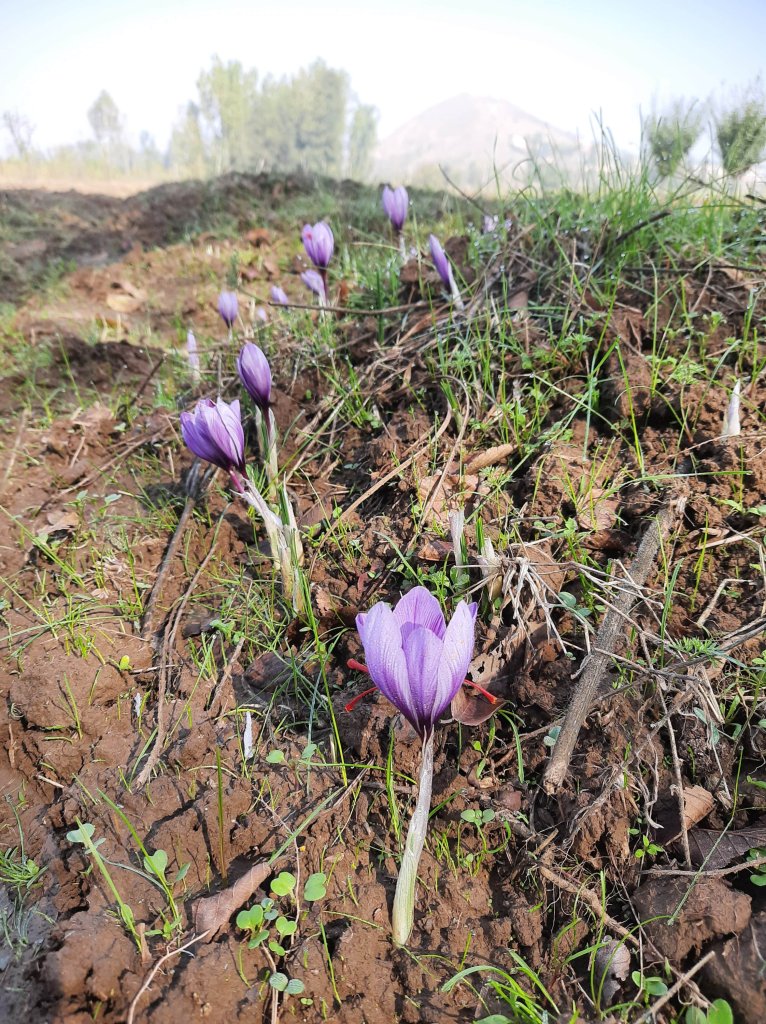
Saffron flowers in Kashmir farms
The purple flowers of saffron in Kashmir

I ran out of the car and watched the sight in awe. It seemed like a faint purple carpet of flowers had been laid on a hazy morning, with the apple orchards writing testimony to my presence and the snowy mountains standing guard against this beautiful view. I had a tear rolling down my cheek, which I am still unsure if was because of sheer joy or in disbelief that I had made it there. I spent hours that morning walking between the purple blossoms, caressing the tender, dewy and moist flowers of saffron, taking pictures of the flowers while enjoying the crisp autumn air. The people accompanying me for sure must have thought that I was a psychopath wandering and meandering all alone, who had travelled from so far just to see these flowers. A few flowers made it to my books, pressed carefully between the pages and getting to go home with me.
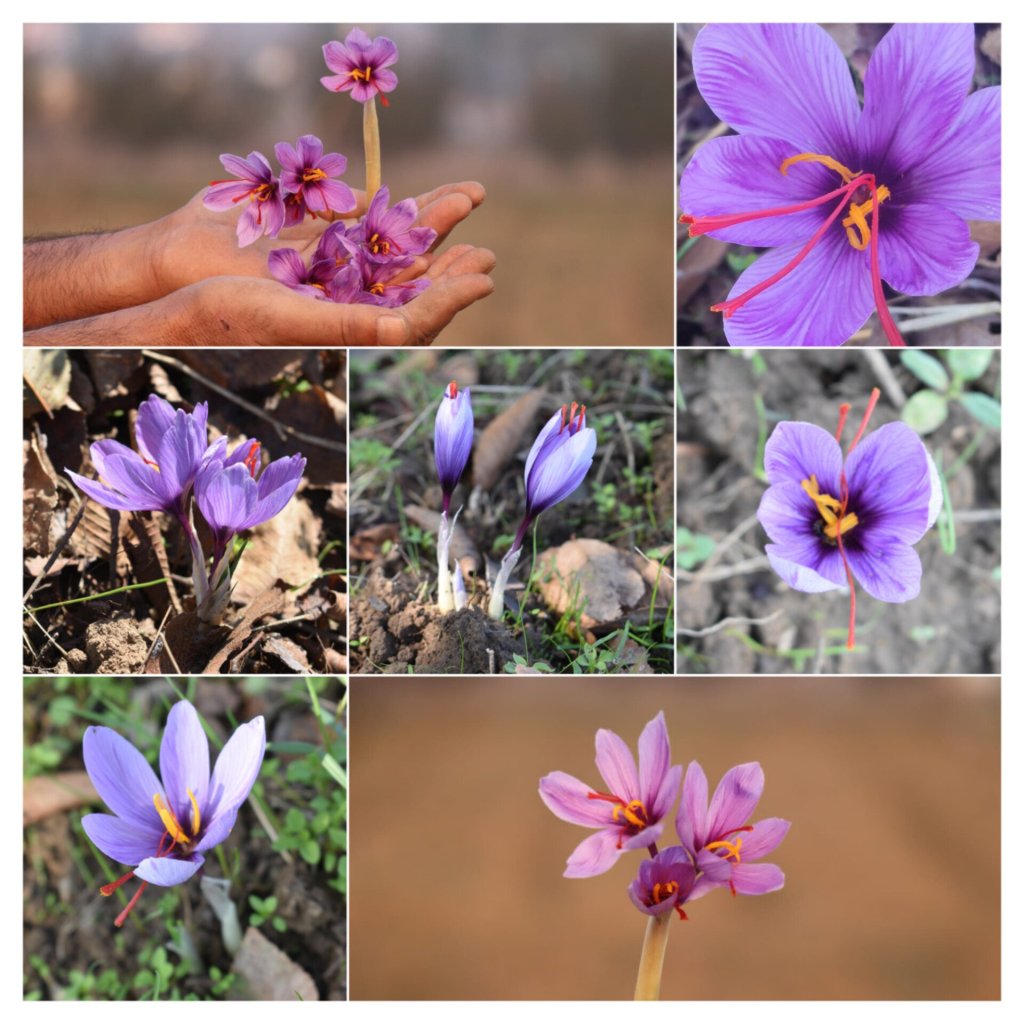
Saffron flowers in Kashmir farms

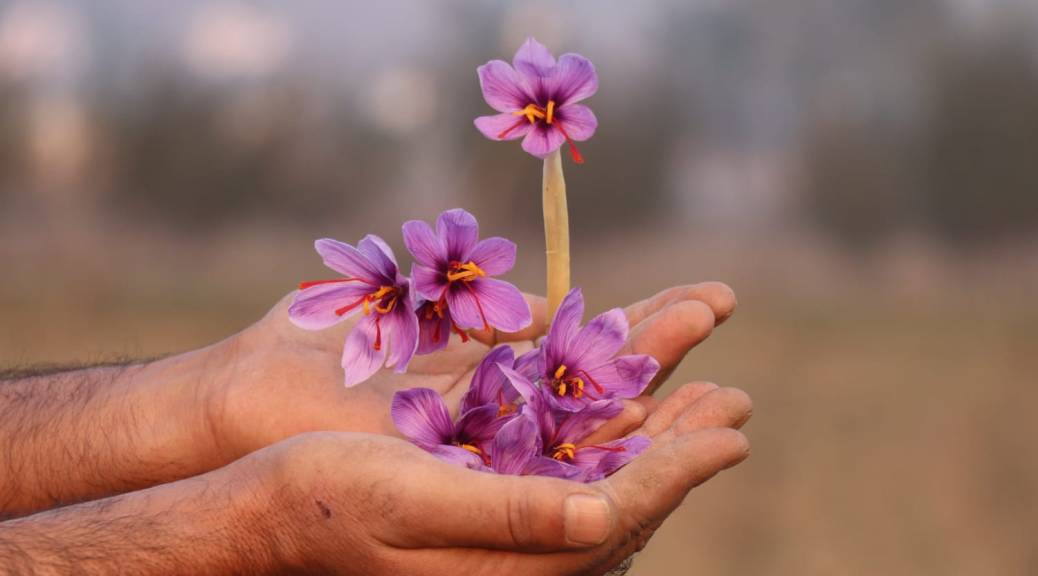
He picked the tender flowers and rested a bunch on my hands while pulling out the saffron strands from one, for me to eat. My tongue had turned yellow upon consumption which he explained was an indication of the authenticity of the spice. I was then invited to his work area where his family had gathered around a table and were separating the different parts of the flowers that would be used for different purposes. He explained the entire process of separation of the saffron strands (the stigma or the female part of the flower), the drying and the packaging. Sipping on hot brew of Kahwa served with the same strands of the saffron that I was holding a few moments ago was overwhelming.
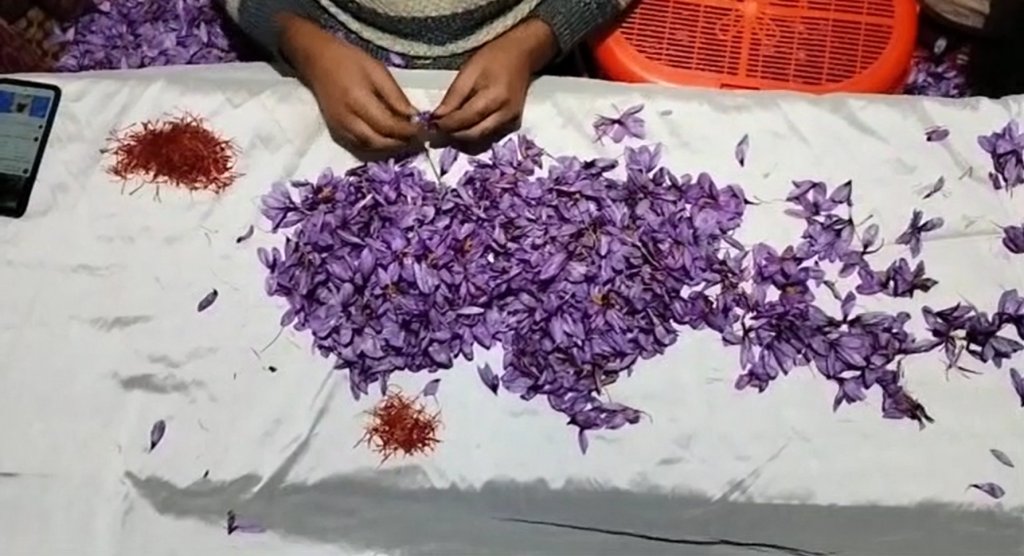
Saffron flowers in Kashmir
Saffron flowers Separation

Of course, my visit would have been incomplete without picking up stashes of saffron from their shop as souvenirs for friends and family. In this short visit to the land of saffron, I had witnessed the world’s richest spice travel from farm to market. Sigh, it was a dream come true, to experience these fully blown saffron fields!

Fact file:

  • It is recommended to get in touch with proper sources and book taxis in advance who could take you on such guided tours of the saffron fields.
  • Pampore and Budgam can be reached on day trips from Srinagar. J&K tourism runs guests houses in Kishtwar as well, which can be reached via taxis hired from Jammu city.

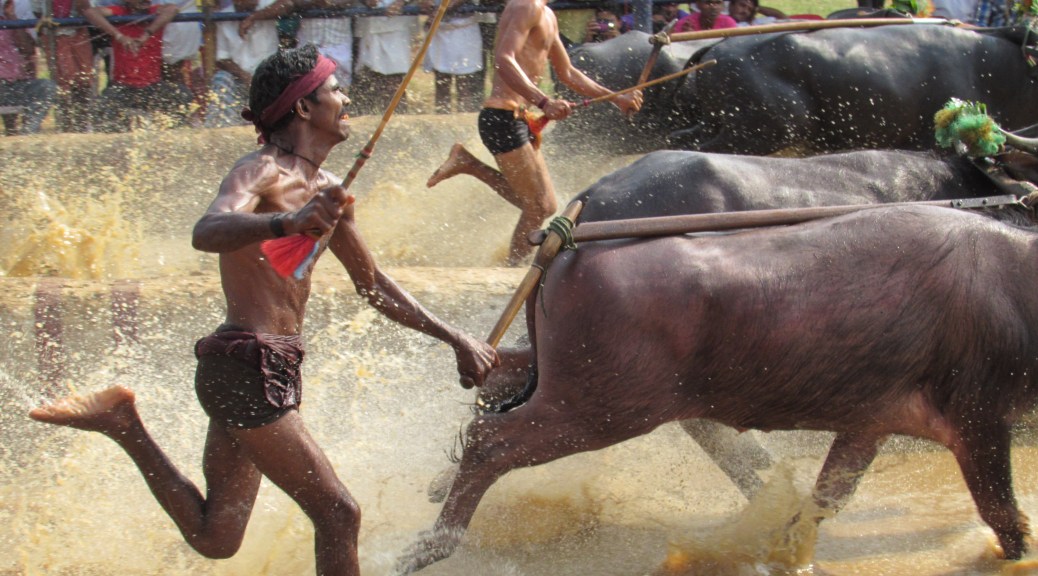
A Buffalo Valentine at Kambala

14-Feb-2016

The air painted red with romance and roses, the atmosphere illuminated with candles and balloons.. Couples holding hands out on dates- both young and old…. That’s the scene in rest of the world on that day.. But for me, Valentine’s day was an unusual form of celebration amid the Tulu-Naadu people. It was a celebration of folk culture and a celebration of earth’s gifts. While in some parts, it is the celebration post harvest, yet in other parts it is a celebration to commence the sowing season for the next crop. The Dakshina Kannada region, fondly called ‘Tulu-Nadu’ was a place where love and war co-existed on that day.. LOVE for a sport of thousands of passionate spectators and a WAR of prestige for hundreds of participating landlords. And amid all pomp and pride, a buffalo soldier fights it out in glory thus emerging as the showstopper..!!

A rickshaw ride from the Mangalore city centre traversed through some Kuccha roads, then across a highway and completely off-road to reach the banks of river Nethravati. Coconut tree lined mud road flanked with dozens of anchored fishing boats on the river bank ended straight at the arena where the big-event was set to take place. As I stood amid thousands of spectators in the gallery, the air felt heavy with anxiety. The show-stealers of the day walked down the ramp(Read it the slush pool) one-by-one to take their places and get set for their D-day. A day where all the effort and hard-work of hundreds of buffalo owners will be put to test. It was time to score off ‘Kambala’ from my bucket list when I decided to spend my weekend at ‘Joppinamogaru Kambala-2016’ in the coastal stretches of Mangalore.

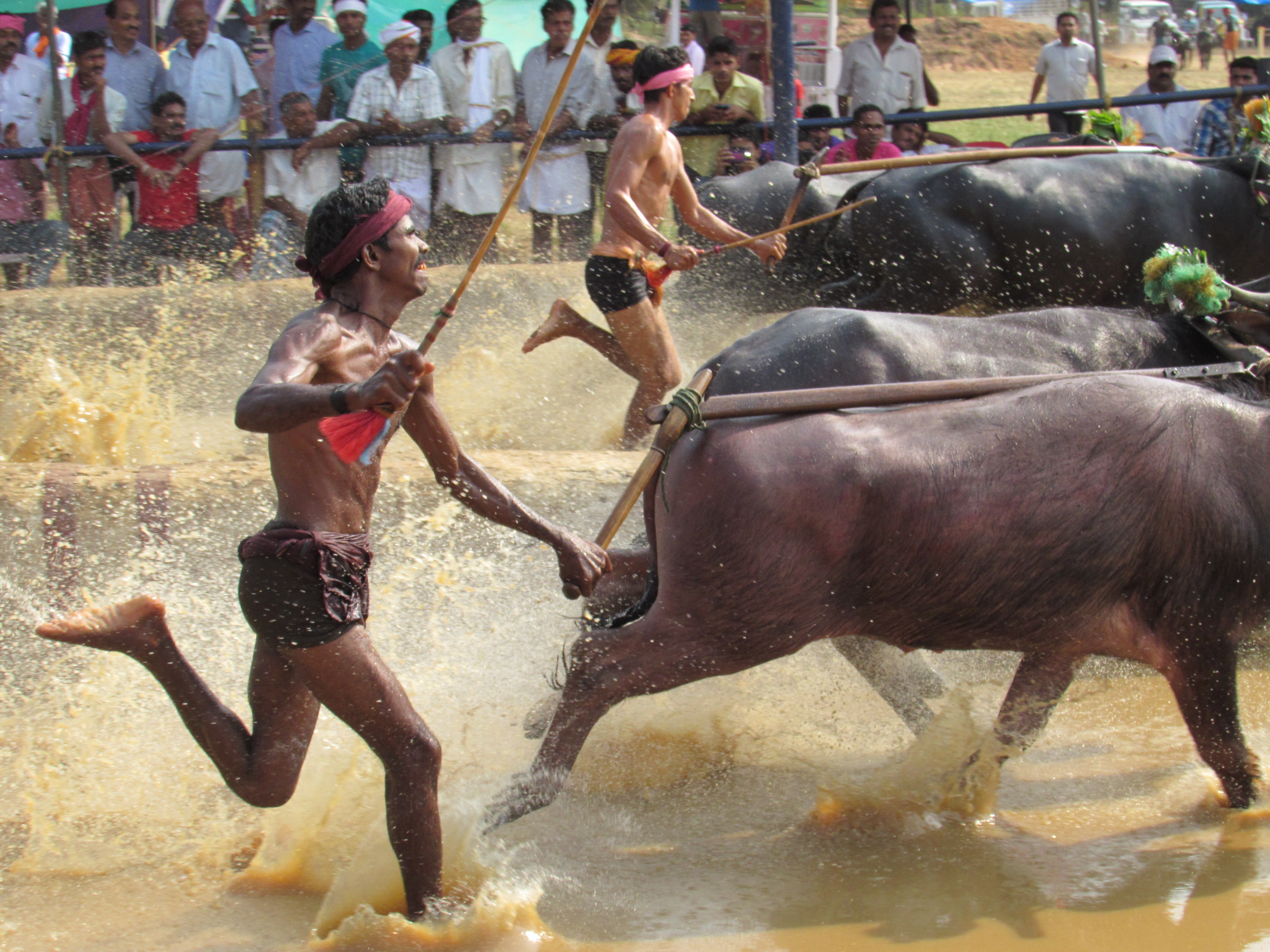
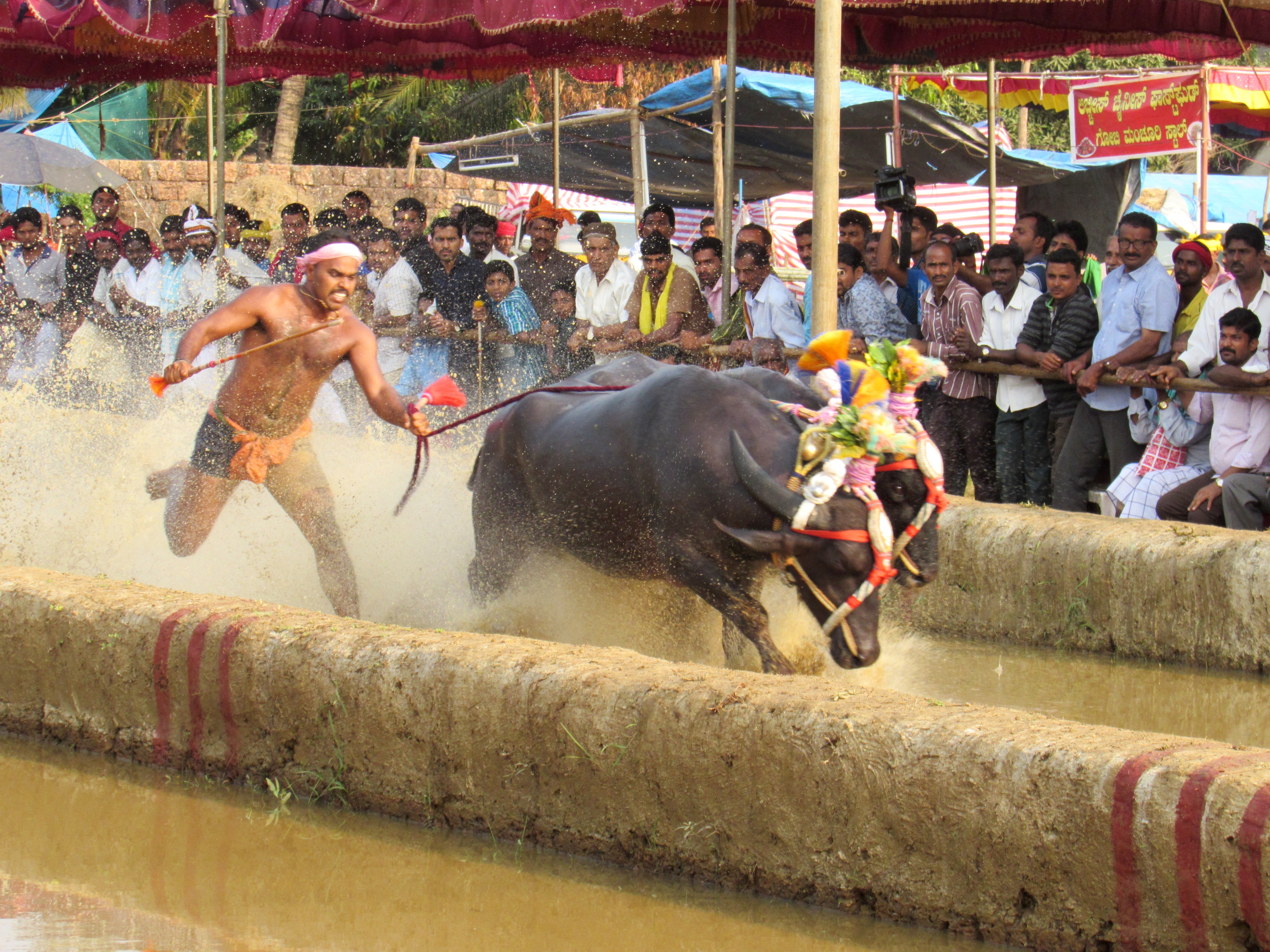
The ‘Raging bull’, the ’Buffalo skinned’ are idioms that we commonly refer to humans as expressions of exasperation. But when all the action brings forth the literal sense of these words- The event happens to be ‘Kambala’. Kambala is a sport where He-buffaloes are made to run on a mud filled slush track to reach the ‘Nishana’ or the finishing post. In the modern races, there are usually two tracks running parallel and thus called ‘Jodu Kare’ or ‘pair of tracks’. Each track is given a name so that it becomes easy to communicate in events where both the tracks are being used. In Joppinamogaru, the tracks are called Jaya kare and Vijaya kare. A coin is tossed for the team to choose the track. As loud drums beats and hoot sound of the timekeeper goes out, the whip lash of the runner crackles in the air before it hits the buffalo and the action finally takes off… The soldiers begin the battle..

There are different forms of kambala. Firstly, the Negilu category- Here, a representation of a plough is attached to the buffaloes which has evolved over period of modernisation. This is a race mostly for the younger buffaloes. Usually two pairs of buffaloes are made to run at a time and the fastest of the two is considered for the consecutive rounds.

IMG_3172
Negilu Kambala

Hagga kambala- This form is similar to the Negilu kambala, only difference being that the negilu or the plough is replaced by a hagga or a rope. Both these forms of the sport requires a great deal of stamina for the runner as he too is expected to run as fast as the buffaloes.

IMG_3236
Hagga Kambala

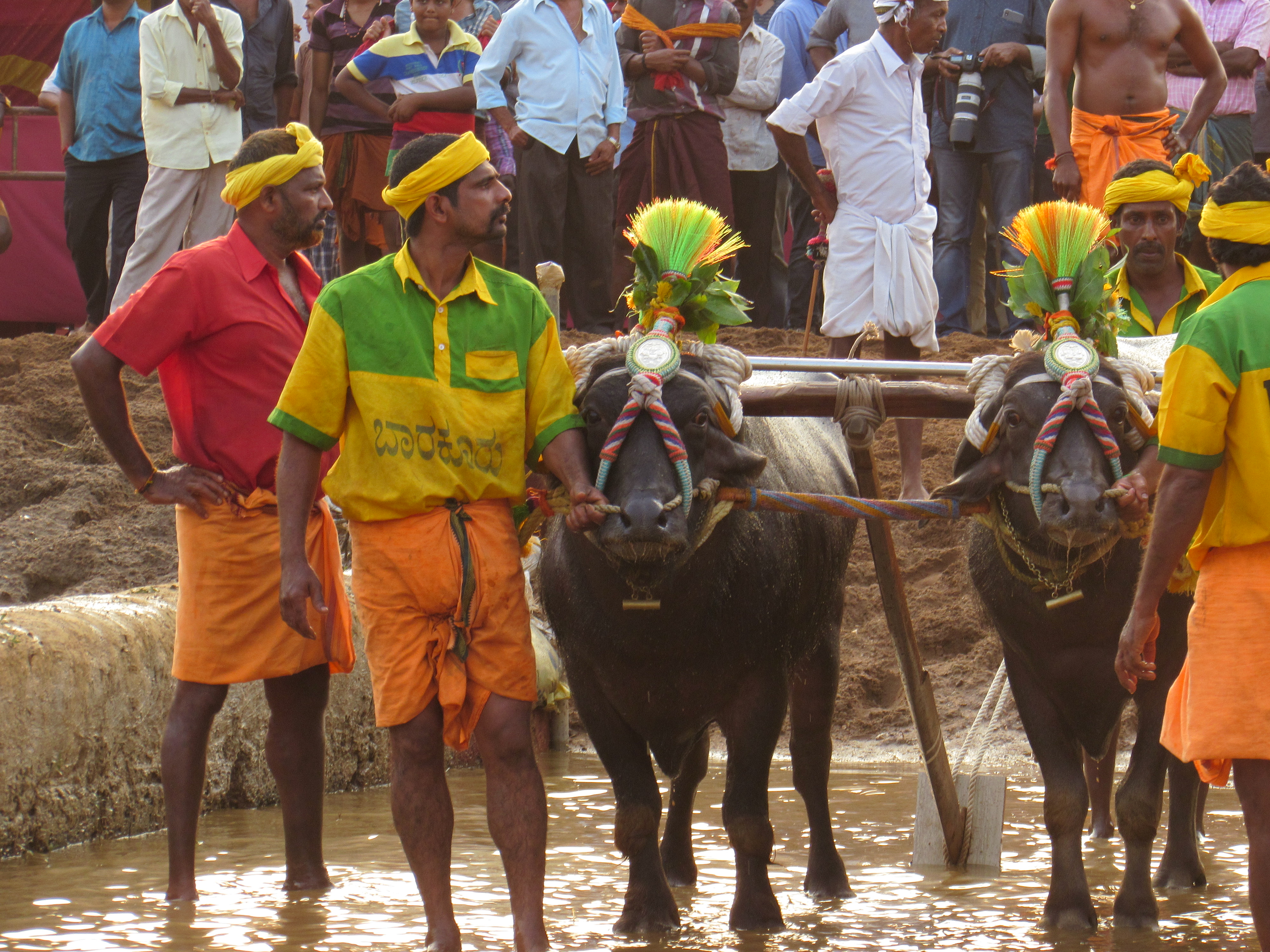
Adda halage kambala- This is a category mainly for the senior buffaloes(decided by age). A cross wooden plank is attached to the buffaloes on which the driver stands firmly and controls the speed and direction of the buffaloes to reach the Nishana. This is mostly a time based event where one pair runs at a time and the fastest pair is awarded.

IMG_3261
A pair of buffaloes getting ready to run the Adda Halage Kambala

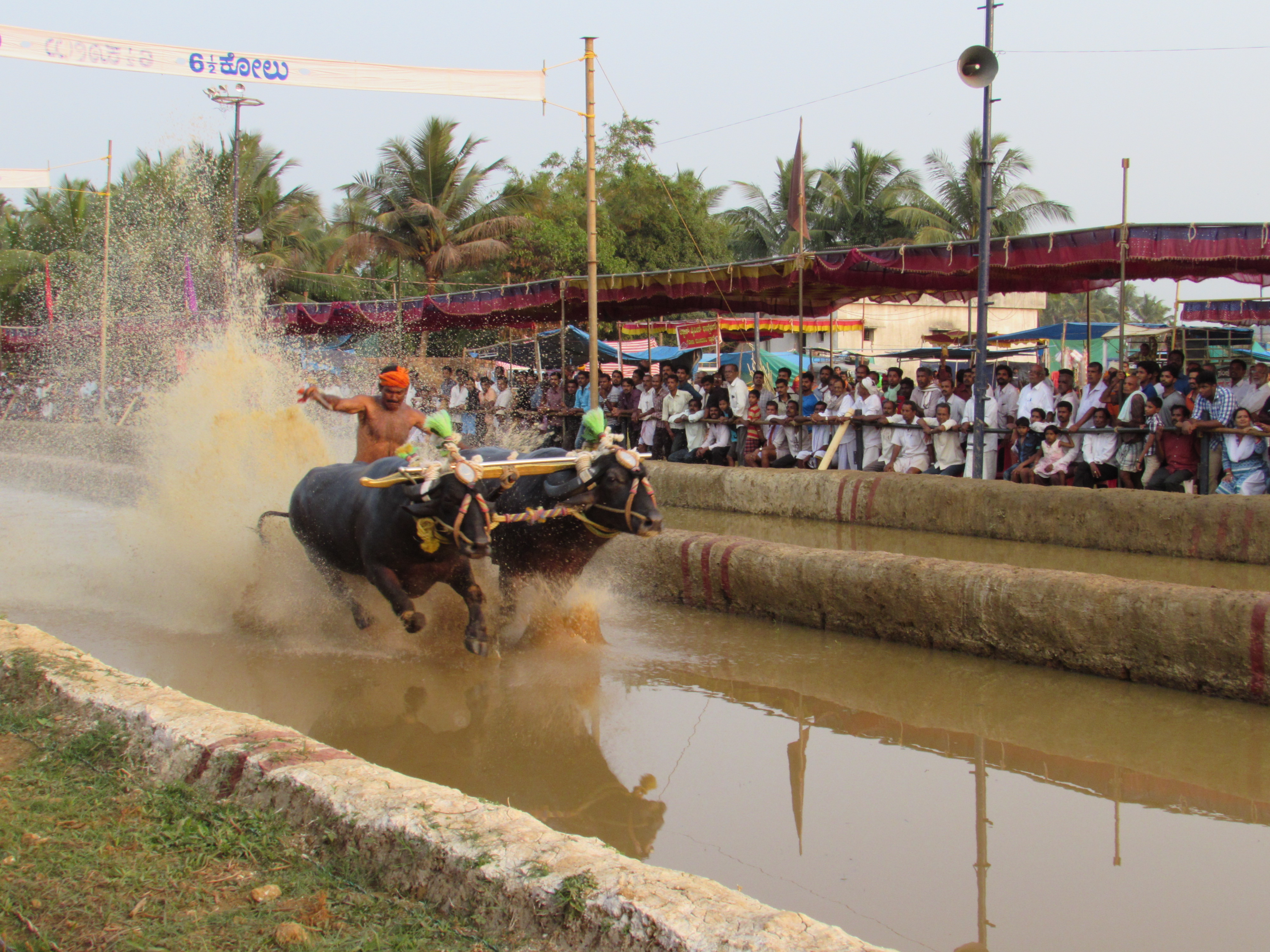
Kane halage kambala- In this form, a round wooden plank with two holes is tied to the buffalo pair and the driver stands on it to control them. Two strips of white cloth are tied across the track which are used for measurement of the height of water spurt. One cloth is tied at a height of 7.5kolu(9.37mts) and the other at 6.5kolu(8.125mts). Faster the pair runs, higher the water spurts out of the holes on the plank. Here, one pair runs at a time and is specific to the senior buffalo category. It is very difficult to run at the expected speed and hence every team that spurts high enough to wet the cloth is awarded unlike the other forms.

IMG_3265
Kane Halage Kambala

With a history of over 500years, the event is a treat to watch the enthusiasm and the energy of the participants and the spectators. However, it is heart wrenching at the same time to see the welts and the swollen bruises on the buffaloes as a result of continuous whip lashing. For this reason, Kambala has been in the radar of seeing a ban for a while now as demanded by several animal rights activists. We don’t know what the future beholds, but one MUST experience the vibrance of India’s rich folk culture in all forms before its name joins the pages of history..