Tag Archives: Ayodhya

Exploring Ramnami Community: A Journey into Tradition

Over recent years, my travels across India ignited my fascination with how tattoos hold cultural significance among different Indian communities. In many areas, tattoos serve as symbols tied to tribal customs. One community that particularly intrigued me was the Ramnami of Central India. When I shared this with a friend, she too showed interest in delving deeper into this culture. We eventually connected with a community member who graciously allowed us to visit his village, even inviting us to stay with his family. We happily arranged our visit.

We initially flew from Bangalore to Raipur. From there, we caught a local bus to the GPM district. Subsequently, we explored GPM by taxi, which dropped us off at Chandlidih, the Ramnami village. It was raining heavily as we navigated the damaged, flooded roads and finally arrived at the location indicated by Google Maps. We carried our backpacks while crossing a small reservoir wall built over a stream swollen by the monsoon. On the other side was our host’s house. By the time we reached the front yard of the Ramnami family’s modest home, we were covered in mud from puddles stretching from the parking lot to the house.
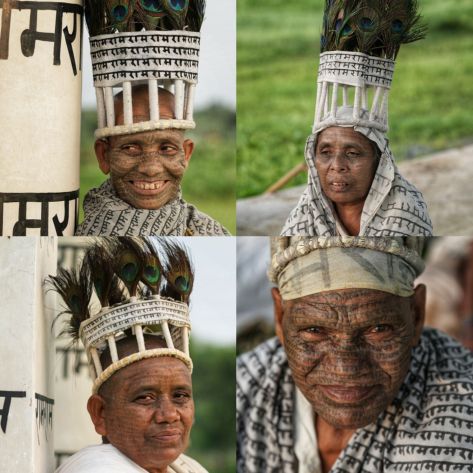
Portraits of the Ramnamis

Our host welcomed us upon arrival and directed us to the guest room to drop off our luggage. The room, an extension of the main house, was built with cob and wood, offering basic amenities such as two beds for resting and a light bulb for illumination at night. We relied on mobile internet throughout our stay. According to tradition, anyone visiting from outside must bathe and cleanse themselves before entering a Ramnami home. The next experience was something my friend and I will both remember for a long time: the bathroom!

It was a simple enclosure with two and a half walls and a roof. Half of the third wall was intentionally built to shoulder height, making it easy to bring in water from outside either with buckets or through a gravity pipe connected to a nearby perennial stream that filled a concrete tank inside the bathroom. The fourth side was left open for easy access, featuring a modest saree stitched into a sliding blind that could be moved to open or close. There was no running water; hot water had to be fetched from an outdoor firewood oven, or one had to make do with the chilly water stored in the tank inside. Our city dwelling bodies were used to a sturdy lockable door for bathing with unlimited hot water from a tap or shower. While the cold-water setup was tolerable for my outdoor spirit, I could not imagine standing unclothed inside a doorless bathroom.
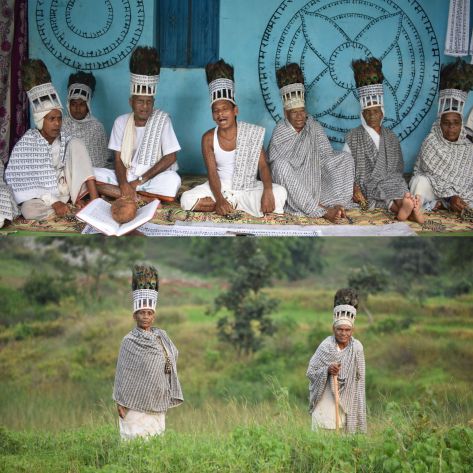
The Ramnami Community

If I were hiking, I could go days without bathing, but here, it was crucial to start our trip by experiencing the Ramnami culture. Hesitantly, I took off my clothes and poured a couple of mugs of water, just as I heard giggles outside. I paused to check if I was imagining things or if it was real. Soon, I saw the shadows of a few kids moving behind the curtain. As I began applying soap, I saw two toddler heads peeking in from the sides of the curtain, giggling again. I panicked, yelled my friend’s name, and hoped she would come to help. She got scared and ran over to see what was wrong. I told her about the curious kids, and she decided to stay at the bathroom entrance until I finished. Later, I returned the favor.

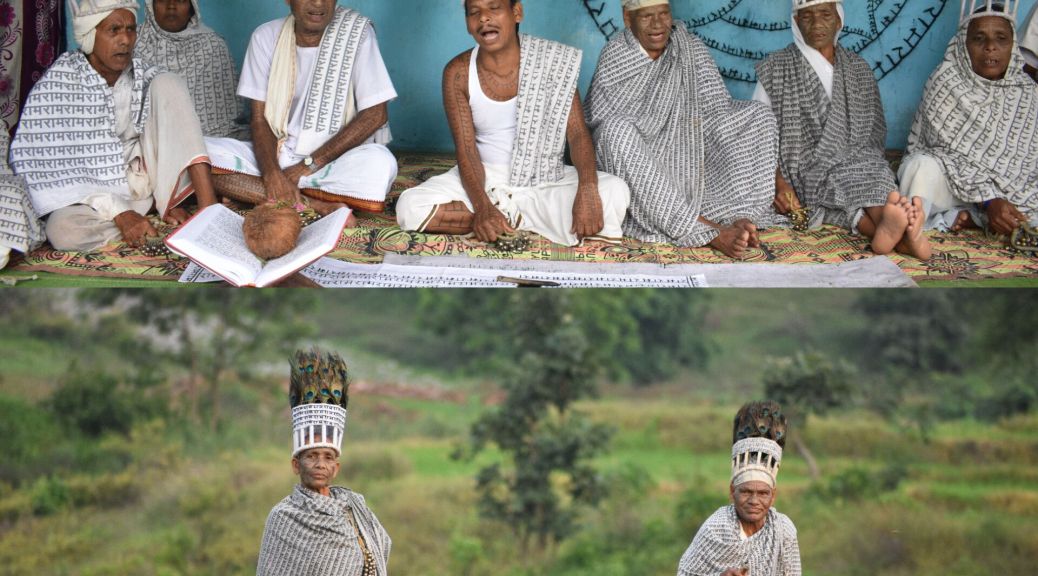
After changing into fresh clothes, my friend and I headed to the porch of their house, where the entire family had been singing hymns of Lord Ram since sunrise, even before we arrived. We greeted them with a coconut and some fresh flowers, which we were asked to bring as part of their tradition of introducing a new guest to the family. Most adults had tattoos reading ‘Ram-Ram’ in Hindi covering their bodies. Some had full-body tattoos, while others had only face, arm, or forehead patches. They all wore pure white clothes handwritten with ‘Ram-Ram’ patterns. Their Dhotis, shawls, and headgear featured the same ‘Ram’ writing in a consistent style. The handmade headgear, unique to the Ramnami, was decorated with peacock feathers. All participants in the Ram bhajan carried strings of small jingling metal bells, each stamped with ‘Ram’ during casting.

We introduced ourselves and joined their Bhajan until lunch was served. I savored a simple Satvik meal made with ingredients from their farm. The faint aroma of firewood used in cooking enhanced the local flavors with a divine touch.
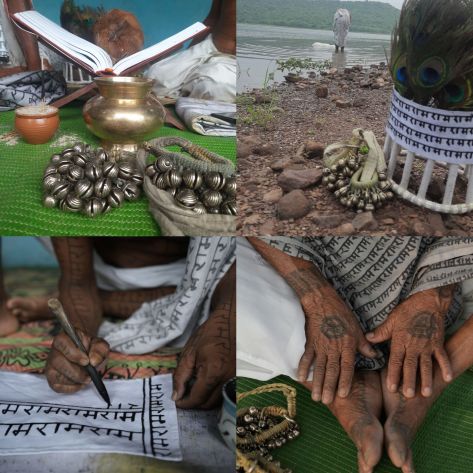
Daily utility items and life of the Ramnamis

We traveled without a fixed schedule, aiming for a slow, immersive experience of this community’s daily life. After lunch, my friend and I joined members singing Ram Bhajans on the porch to understand what defines the Ramnami. We were transported back to the 1890s to learn about their history. Like the rest of India at that time, casteism barred lower castes from entering shared places of worship. Some rebelled by declaring their bodies as temples dedicated to Ram, tattooing the Ram-Nam (Lord’s Name) with a locally made ink derived from herbs. They formed the Ramnami community. A senior member leads events, whether a baby’s birth or a funeral. Their greetings and farewells are solely marked by singing Ram-Bhajans, even during major life events like marriages. They do not conduct any Brahminical rituals, poojas, or havans as part of their practices.
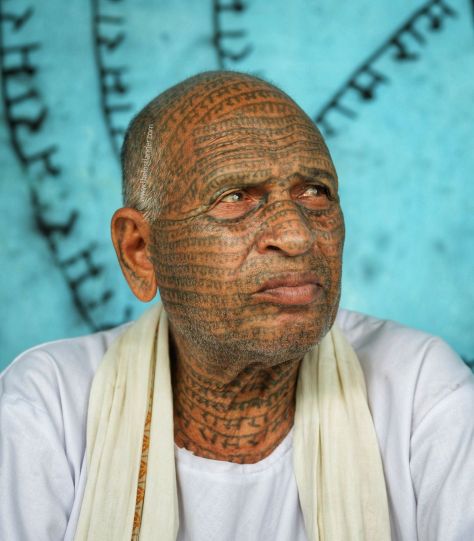
A portrait of a Ramnami community member

With the rain gods commanding the skies and earth, we saw them prepare their shawls, made from woven, stitched white cloth they crafted themselves. These shawls were then covered with Ram-Nam. After carefully observing them write with their native ink for a while, we joined in to write on some of the other pieces. Once finished, they set them aside to dry, initiating a series of procedures to prevent the white cloth from bleeding black.
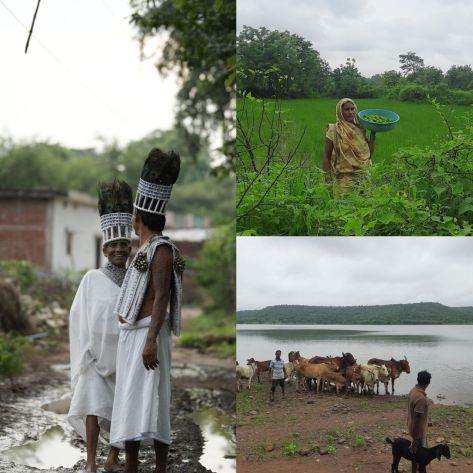
A walk through Ramnami village

When the rains stopped, our host guided us through their village. We crossed a stream, carefully walked along the paddy field edges, and eventually made our way along muddy, winding roads. We met several members of the Ramnami community, mostly relatives or neighbors from the same village. We greeted women working in the fields and enjoyed coffee at welcoming houses. Later, we visited JayaStambh, a small monument commemorating the annual Ramnami mela held here a few years prior. Some older community members joined us there at sunset, singing Ram bhajans as a tribute to the setting sun. Afterwards, we visited a small reservoir across the lake. The Ram Bhajans, sung warmly around a bonfire, echoed over the calm water, with the sky changing colors dramatically until nightfall.
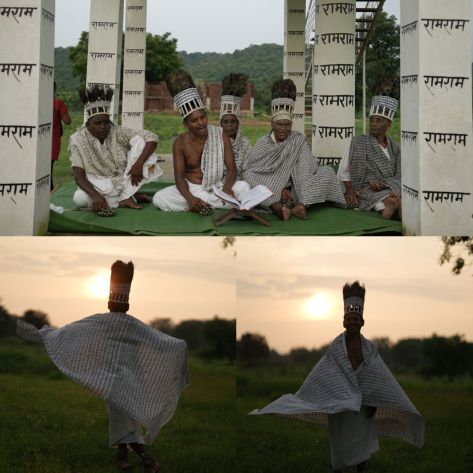
The evening prayers at the Ramnami Jayastambh

We walked home carefully through the night darkness to avoid slipping on the slush. After a satisfying dinner, we drifted into a peaceful, childlike sleep, concluding a long and exhausting day.

The following morning, we rose early to witness a normal day in the life of the Ramnami. We went to the reservoir with the elder members of our host family, who offered prayers to the sun god and recited blessings before their water dip. After changing into clean clothes, they went back home to continue household tasks such as cleaning, preparing food, and having breakfast.
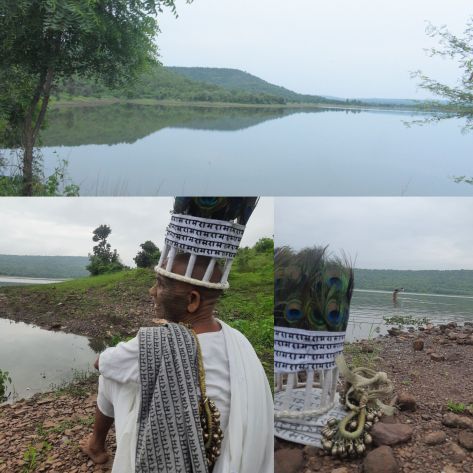
The morning at the Chandlidih reservoir

Spending time at a Ramnami home offered a genuine glimpse into a culture that is remarkably different from the rest of India. The younger Ramnami generation might not be eager to follow the traditional paths laid out by their elders. However, this community exemplifies how faith in God can help us overcome great challenges. They defied the odds, forging their path, which they believe will lead them to a divine connection.

After a simple breakfast and Ram Bhajans, we packed our bags for our next destination in Chhattisgarh. Our host assisted us with pillion rides on two motorbikes, skimming over the slushy village roads before reaching the highway, where we caught a local bus to continue our journey.

A Weekend at the Land of Ramayana- Ayodhya

This visit to Ayodhya is a part of my fortnight long backpacking in the typical pilgrimage circuit of Uttar Pradesh covering Lucknow- Ayodhya- Faizabad- Varanasi- Saranath– Allahabad- Agra- Mathura-Brindavan– Fathehpur Sikri– Delhi

We were scheduled to arrive at the land of Ramayana- The Epic of Indian Mythology! Ayodhya is believed to be built by Manu, the first man on earth as per the Vedas. This land was the capital of Ikshvaku dynasty of Suryavamsha- lineage of the Sun, of which Lord Ram was the most popular ruler. Lord Ram has been revered as a symbol of a perfect man. Irrespective of religion, every child born in India grows up listening to stories from the Ramayana. Young girls grow with dreams of having a husband similar to Lord Ram. That said, it was no less a dream to travel all the way to the land where the greatest empire of all times existed, at Ayodhya.

Our Itinerary:

  • Day 1: Arrive at Ayodhya, Lakshman ghat & Saryu Aarti during sunset, boat ride in river Saryu
  • Day 2: Saryu Aarti during sunrise, Treta Ke Thakur, Ram ki Paidi, Nageshwarnath temple, Hanuman Garhi, Dashrath Mahal, Kaikeyi Mahal, Baal Ram Mandir, Dant Dhawan kund, Kanak Bhawan, Ram janmabhoomi, return to Faizabad.

The Details:

A small platform which ended even before the train made its 1 minute long stop, very laid back village scene and just 2 tracks with a yellow ‘AYODHYA’ railway board welcomed us as we arrived there by an afternoon train. An old man and his cycle rickshaw awaited us on the other side of the tracks. We told him our hotel’s name and he said 50 Rs. We hopped on to the cycle and our dream journey kickstarted!

It was as if the rickshaw was our time machine that took us back in time as it slowly inched through the main commercial area.. A typical rural setup. Dusty roads were flanked by old tenements on both sides from end to end. The rich embossings on the facades of each house was unique and gave us a sense of an era bygone. Each house enclosed a shrine from where the smell of incense had filled the environment. The main street had everything being sold in the stalls from colourful plastic ware, brass souvenirs, religious beads, clay articles et all. The Chai-wallas were busy serving their brew in clay cups and the Jalebi-wallas were spiraling the batter into hot oil. Fruit vendors did brisk business on carts.. Amid all this, the prayer chants of ‘Ram Siya Ram, Siya Ram Jai Jai Ram’ from the temples in the bylanes echoed in the air giving us the sense of a heavy atmosphere. There was so much character in this small stretch! Just as if we were woken up from a dream, our rickshaw halted and our driver broke the silence- “Madam, your hotel.” he said pointing out at a very modern building which looked very sophisticated for an otherwise laid back country side.

We freshened up and had a rather sumptuous meal at their inhouse restaurant. It was already sunset time and upon enquiring about the nearest sightseeing places, our hotel caretaker told us to head towards the ghats to catch the Saryu Aarti. We had to rush as the sun was nearing the horizon. While we were asking for directions and running towards the Lakshman Ghat, my friend and I stopped abruptly at a sight.. The first glance of the Ayodhya that we had heard about, as kids. A visual treat that looked straight out of a fairy tale. ‘This is AYODHYA, Man!” we both blurted in unison. The oblique rays of the setting sun added a glorious gold to this Royal beauty. Although the structure is relatively new from the 19th century or so and not the original Kingdom that Ram had spent his days at, we stood there dumbfounded for a couple of minutes. After taking an eyeful of it, we walked towards the Lakshman Ghat where the Aarti was about to begin. We hitched a boat ride across river Saryu and back, from where we watched the aarti. Upon return to the river bank, we took a rickshaw to the Hanuman garhi main road to get our dose of kulladwala chai before calling it a day.

IMG_20170307_070712
Our “The AYODHYA view” at Lakshman ghat

Next day, we woke up early to reach the ghats for the aarti during sunrise. Post that, we took a walk along the chawl photographing the artistic friezes. We explored the inside streets and the several temples inside those ancient tenements. Treta Ke Thakur, Ram ki Paidi, Nageshwarnath temple are all in this surrounding. We got talking to several residents both Muslims and Hindus and they all seemed excited to share what Ram meant to them. For some Lord Ram was a brother, for some a father and a son for some.. A curious family from the chawl even invited us over to their house for breakfast and took us across the fortress to introduce us to their relatives.. We were deeply moved by the innocence and simplicity of these people. We then bid a warm goodbye and headed towards the heart of the town..

From there, we reached the Hanuman Garhi, an important temple built on a fortified walled structure high above the ground level. Lord Hanuman is believed to have had kept a vigil on Lord Ram as a kid. A man offered to guide us around other important temples around the place. Some being Dashrath Mahal, Kaikeyi Mahal, Baal Ram Mandir, Dant Dhawan kund among the important places out of the 7500+ temples that are believed to exist in Ayodhya. Some of these places accepted donation towards the construction of the Ram temple. One’s name would be then sculpted out on a tile or a block of stone which would be used in the construction of the temple, that the localites were hopeful would be built someday, soon.

Kanak Bhawan was the highlight of the places with its architectural beauty. This structure is said to have been entirely plated with gold (Kanak) back when Kaikeyi had gifted it to Sita during Ramayana. A board on the wall explains the evolution and modifications done over different periods and by different rulers who ruled Ayodhya. We attended the aarti at noon before heading towards THE PLACE!! “Ram Janmabhoomi”.

Being one of the MOST controversial areas in India, we had to deposit all the things in a safety locker including watches, water bottles, cameras- basically everything before entering the premises of the birth place of Ram! Rifle armed commandos guarded the entire area. We had a long queue and four rounds of frisking to really get there. Women guards frisked us in really uncomfortable places and it was a strange experience to go through, inside our own country. I was made to throw away even the vermillion I had kept in my pocket from the Hanuman Garhi temple because they couldn’t trust me on carrying random powder.

With all the embarrassment, uncomfort, tiredness in the scorching sun- when we finally made it there: I did not realize that it was Lord Ram’s birth place. The King of Ayodhya!!! Small idols of Ram, Sita and Lakshman were placed inside a Swiss tent as if the trio were still continuing their vanavas in the Kaliyug. Off-beat camping in a deforested jungle. I had still not come into belief that this is how India’s mythological hero was treated in his own house. I burst into tears and I didn’t have a reaction. I went berserk for a while until my friend calmed me down.

We couldn’t visit the Ayodhya research centre which has lot of information collected from across the world about Ramayana and the holy land of Ayodhya. Mani Parvat on the outskirts is another place I would suggest if you have time which gives a good view of Ayodhya. Although a 20Rs. per head ride in a tempo can take you to Faizabad, the district headquarters; I would recommend you to take a 1000Rs. boat ride along the Saryu which will take you to Ram Ghat at Faizabad for the evening aarti.

Summary:

My entire stay here has been a great one with both Hindus and Muslims coexisting and helping me get around the place. Never did I feel the communal rife. It is one BIG political ticket for easy votes and in interest of no social harmony. Like really!! When there is Ali in Diwali and Ram in Ramzan, do we really need to fight in the name of God??? The question needs to be pondered over…

Fact file:

Must buys: Chillums (clay pipes), handmade religious cotton carry bags.
Must dos: Get a glance of the Ramayana trail on the India map at the Ayodhya research centre, boat ride from Lakshman ghat(Ayodhya) to the Ram ghat (Faizabad)