When I visited Pattanamthitta for the first time, I was blown away by the natural and cultural landscapes of this district. But little did I know I would return here more often than I expected. Each time, to experience a new festival. In this post, I am going to talk about my experience of the Purapaadu Festival at Cheriyanaad.
What is the Purapaadu Festival?
It is the annual festival of the Shri Bala Subramanya Swami temple, which usually falls on the first day of the Kumbham month of the Malayalam calendar. The Purapaadu festival is mostly known for the celebration of Pallivilakku, a grand procession of oil-lit lamps taken on wooden temple cars along the temple street on the night of the 5th day of the temple festival. It also aligns closer to the Thaipooyam and the Kavadiyettam celebration at the temple. The Shri Bala Subramanya Swami temple is in Cheriyanaad, a village in the current Allapuzha district of Kerala. Cheriyanaad lies on the border between the erstwhile kingdoms of Kayamkulam and Pandalam. Hence, its proximity is the same as that to Pattanamthitta.
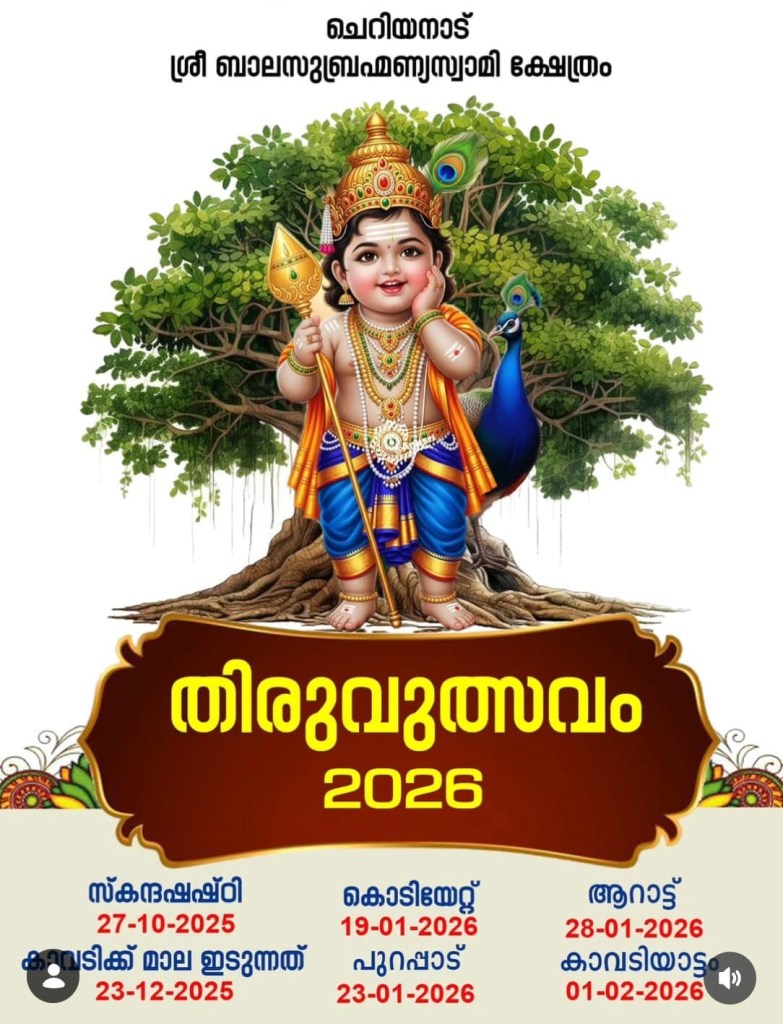
Based on my study across multiple sources of information, I have put up a brief itinerary with some of the main events during the Purappadu festival as follows.
Source: Cheriyanaad Bala Subramanya temple Instagram handle
Day 1: Kodiyetttam– This is the ceremonial flag hoisting to signify the formal inauguration of the festival.
Day 2, 3 & 4: Special poojas and offerings to lord Bala Subramanya Swami.
Day 5: Pallivilakku / The Procession of lamps: 03:00 a.m. onwards, followed by the Thiruvabharanamchart (exhibition of the deity’s ornaments) and the ritual of putting a garland on the feet of the main idol, at around 5:30 a.m.
Day 6: The first time coming out ceremony of the deity, which includes the morning service starting at around 04:30 a.m. onwards and the circumambulation of the temple with the deity’s idol on a palanquin at around 05:30 p.m.
Day 9: Skanda Shashti: People keep fast on this day, followed by rituals like Shashti Pooja at around noon and the Peacock chariot procession from 07:00p.m. onwards.
Day 10: Arattu: this is the “sacred bath,” marking the final ritual of a 10-day temple festival.
What happens during the Pallivilakku?
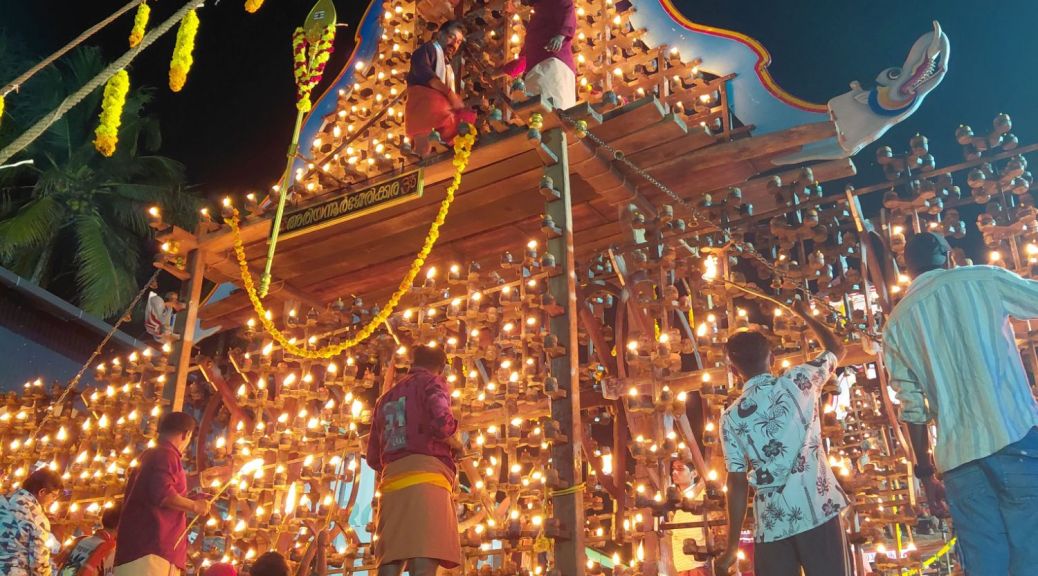
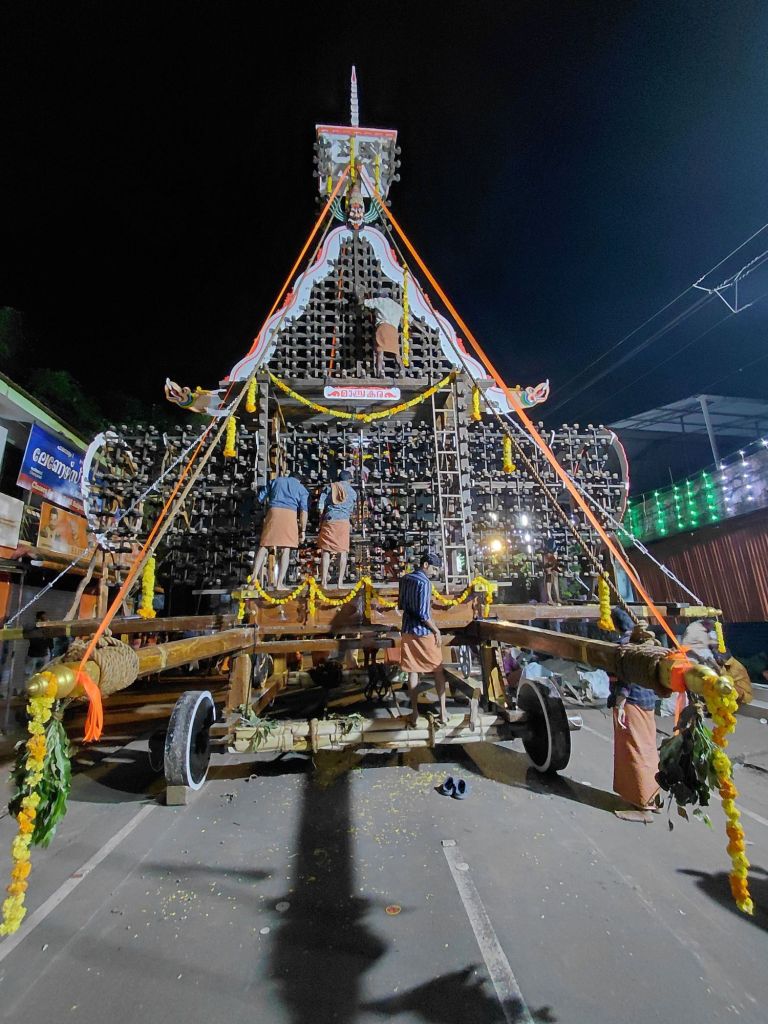
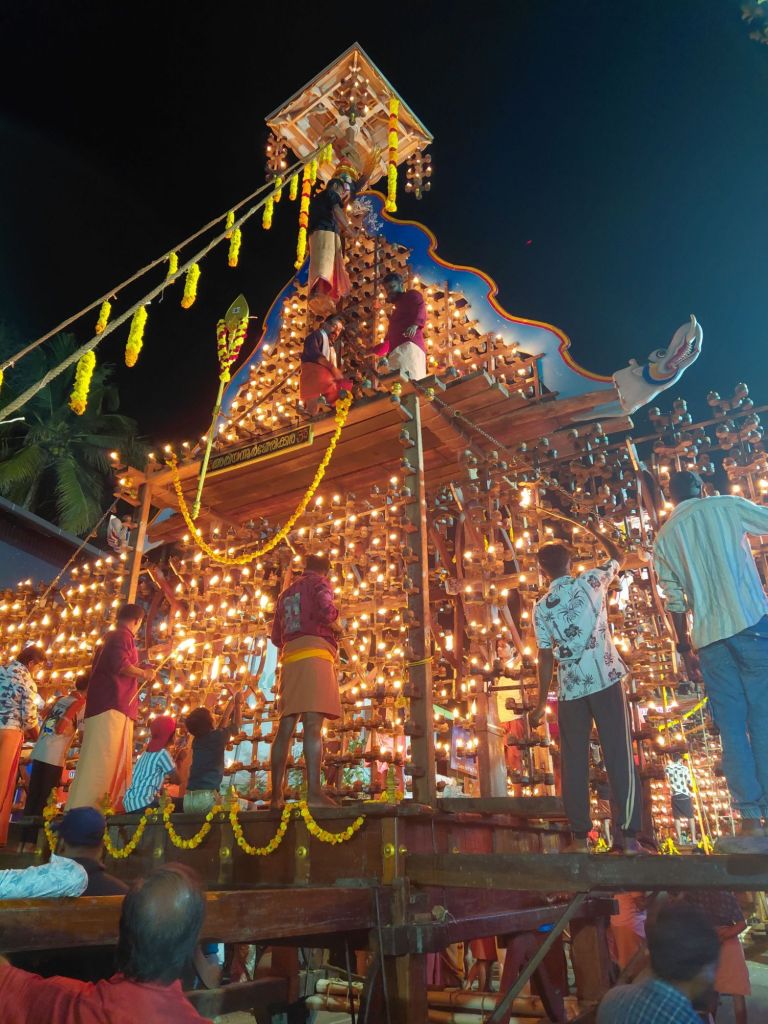
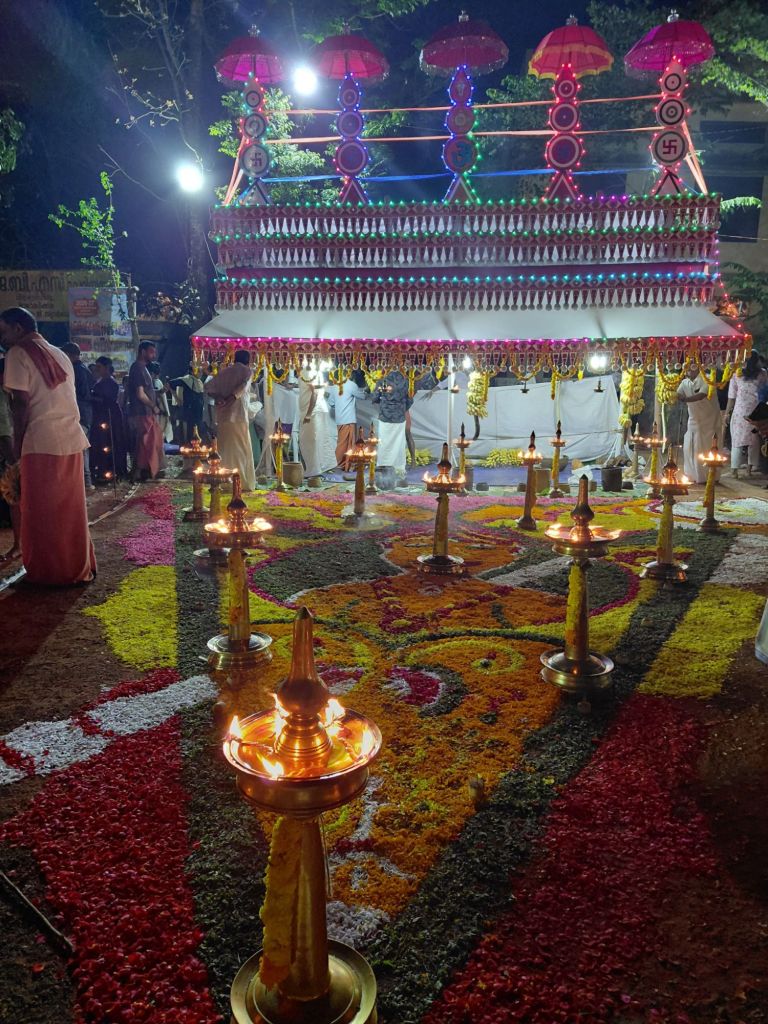
During the early hours of the 5th morning of the festival, around 13 wooden chariots representing 13 karas (surrounding villages) are taken on a procession along the road extending from the Shri Bala Subramanya Swami temple and the Padanilam. These wooden chariots are decorated with oil-lit lamps made with the empty shells of the chaulmoogra fruit (Hydnocarpus pentandrus, locally called Marotti in Malayalam) and are pulled manually by men representing each kara shouting slogans in the name of lord Subramanya.
After a coconut-breaking ceremony and the lighting of the Nilavilakku (the traditional floor lamp), the procession begins. Five large chariots lead the convoy. A railway track crosses this path and has a height gauge installed. Hence, the medium-sized or larger 04 chariots at the trailing end will reach only this point and then return to the temple. 03 decorated elephants of the temple accompany the remaining 04 smaller chariots and make it past this railway crossing to join the leading 05 chariots at the Padanilam ground. The Padanilam ground, which was once a battleground, is also called the ‘Shastham Kunnu’ because it had a temple dedicated to Shasthavu and a fortified raised platform.
A large Pookkalam is made at the Shastham Kunnu, where a small shrine is set up and decorated with thousands of banana bunches. The procession culminates here with the chariots carrying the lamps parked in a circle, and the elephants perform the final rituals. The first bunches of bananas are fed to the elephants, and the remaining are distributed as prasada among everyone who has gathered there.
How was our experience of witnessing the Pallivilakku?
My friend and I arrived at the temple late in the evening on the 4th day, before the Pallivilakku. We saw a few devotees on the highway, walking towards the temple carrying the Kavadis. Though these kavadi bearers were performing this ritual quite early, it is to be noted that this year’s Kavadi festival at the Cheriyanaad Bala Subramanya Swami temple was scheduled to happen back-to-back. I will share the Kavadi festival itinerary at the end of this post.
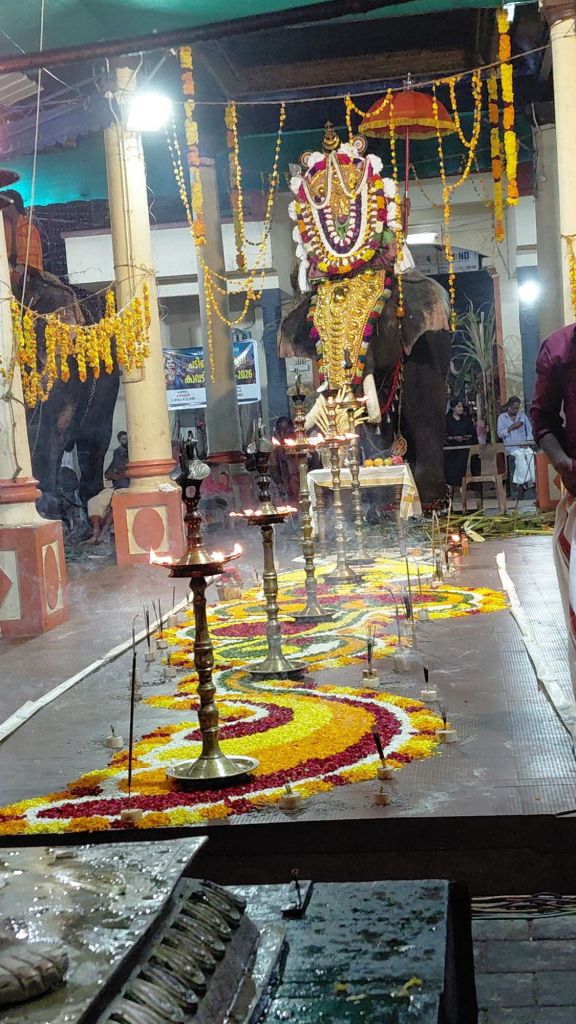
Coming back to our story of the Purapaadu festival, and upon our arrival at the temple, the wooden chariots were still being prepared and assembled on the road leading to the entrance. Inside the premises, 03 elaborately decorated elephants stood in front of a beautifully laid Pookalam, at the end of which the Nadaswaram Seva began. The Seva was deeply soulful, and the music continued to play in my mind even after the ritual was completed. We had the darshana of the lord at his sanctum sanctorum and watched other devotees offer their prayers in the form of donations of paddy and other grains.
We then followed the crowd towards the open-air auditorium and found ourselves seated amid hundreds of others on the ground. Shortly after, all lights were turned off, whistles and hoots sounded, and there was total darkness. An interesting event was about to begin. It was the first time I was watching a stage cinema. The cinema went on for a couple of hours while the wooden chariots were being prepared for the grand show.
Halfway through the cinema, we decided to take a stroll along the procession trail. We watched all the lamps being arranged, oil being filled and lit. We also spoke with the locals to understand the traditions and to find a good vantage point to view all the lit chariots as they moved. Finally, the procession commenced around 04:00 a.m., and it was indeed a walk I will remember, one of spectacle and memories. And oh! I picked up a few fallen Marotti lamps and kept them as a souvenir before bidding goodbye to this wonderful festival.
How to get there?
Cheriyanaad is located about 8 km away from Chengannur, the nearest major town. Frequent public buses ply between Cheriyanaad and Chengannur if you are commuting during the day. Since we commuted after sunset and before sunrise hours, we hired an autorickshaw that was easily available from Chengannur town. While Cheriyanaad has its own railway station, Chenganur is well connected with major cities like Bangalore and Chennai with direct trains. However, I travelled by a direct bus due to my work schedule. We booked accommodation at Chengannur town, the nearest place to avail a decent lodging facility.
Other information:
Shri Bala Subramanya Swami temple at Cheriyanaad is also known for its Thaipusam and Kavadiyattam festival. In 2026, it started on the day following the Purappad festival. This is brief information on the same.
- Day 1: Idumban Pooja, a sacred ritual dedicated to Idumban, the devotee and guardian of Lord Murugan’s shrines, is performed. It is performed to seek permission to carry the Kavadi and involves offering prayers to Idumban with milk and fruits.
- Day 2 & 3: dedicated to various rituals involved in Kavadi Alms.
- Day 4: Thaiposam & Kavadiyattam festival involving three main types of Kavadis as mentioned below:
- Paal Kavadi: Pots of milk are carried on the heads.
- Mayil Kavadi: Decorated with peacock feathers to represent the peacock, the vehicle of Subramanya Swami.
- Vel Kavadi: Involves different types of body piercings by the devotees, like the skin, cheeks and tongue, with “vel” (spears). (You can also read about the ‘Mayana Kollai festival‘ to understand similar rituals that are performed in Tamil Nadu.)
To be continued as “A grand celebration of masks- Padayani Festival at Othera“


One thought on “Celebrating the chariot of light- Purapaadu Festival at Cheriyanaad”