Tag Archives: rural tourism

Celebrating the chariot of light- Purapaadu Festival at Cheriyanaad

When I visited Pattanamthitta for the first time, I was blown away by the natural and cultural landscapes of this district. But little did I know I would return here more often than I expected. Each time, to experience a new festival. In this post, I am going to talk about my experience of the Purapaadu Festival at Cheriyanaad.

It is the annual festival of the Shri Bala Subramanya Swami temple, which usually falls on the first day of the Kumbham month of the Malayalam calendar. The Purapaadu festival is mostly known for the celebration of Pallivilakku, a grand procession of oil-lit lamps taken on wooden temple cars along the temple street on the night of the 5th day of the temple festival. It also aligns closer to the Thaipooyam and the Kavadiyettam celebration at the temple. The Shri Bala Subramanya Swami temple is in Cheriyanaad, a village in the current Allapuzha district of Kerala. Cheriyanaad lies on the border between the erstwhile kingdoms of Kayamkulam and Pandalam. Hence, its proximity is the same as that to Pattanamthitta.

Based on my study across multiple sources of information, I have put up a brief itinerary with some of the main events during the Purappadu festival as follows.

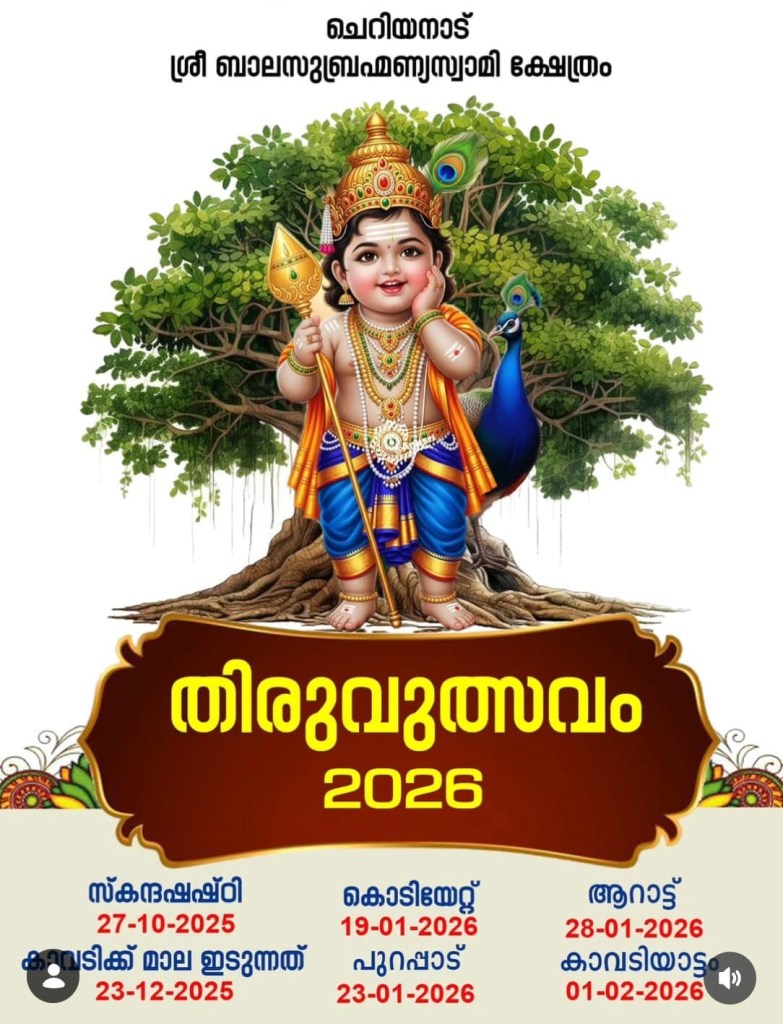
Purapaad festival 2026 itinerary
Purapaad festival 2026 itinerary Source: Cheriyanaad Bala Subramanya temple Instagram handle

Day 1: Kodiyetttam– This is the ceremonial flag hoisting to signify the formal inauguration of the festival.

Day 2, 3 & 4: Special poojas and offerings to lord Bala Subramanya Swami.

Day 5: Pallivilakku / The Procession of lamps: 03:00 a.m. onwards, followed by the Thiruvabharanamchart (exhibition of the deity’s ornaments) and the ritual of putting a garland on the feet of the main idol, at around 5:30 a.m.

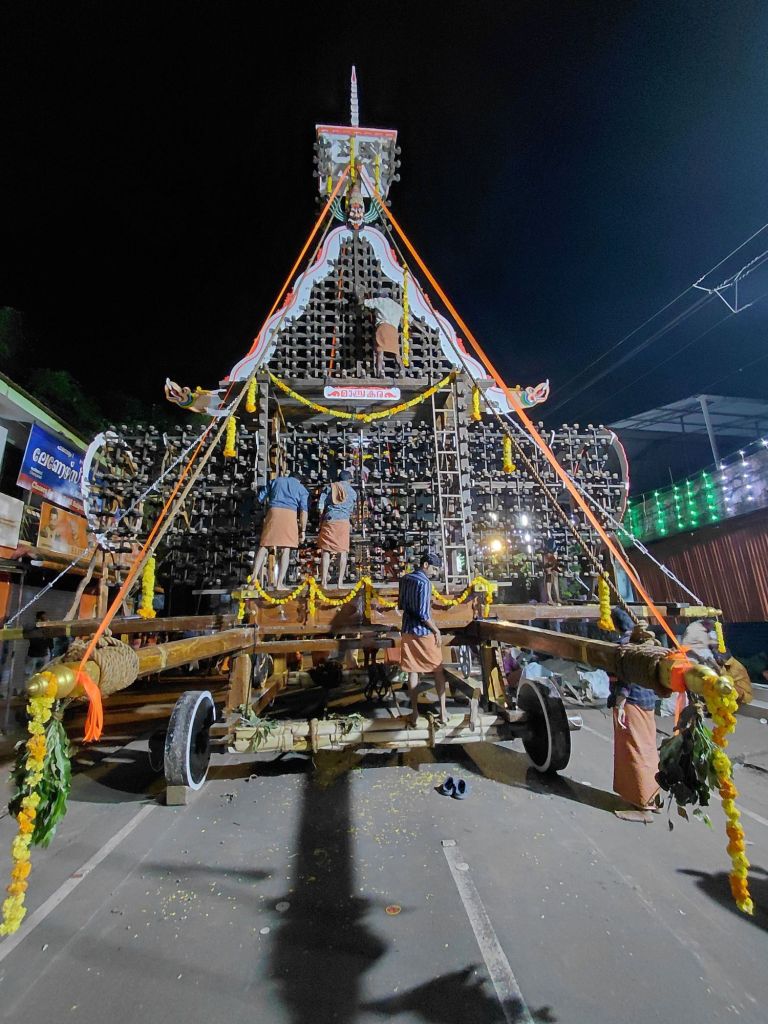
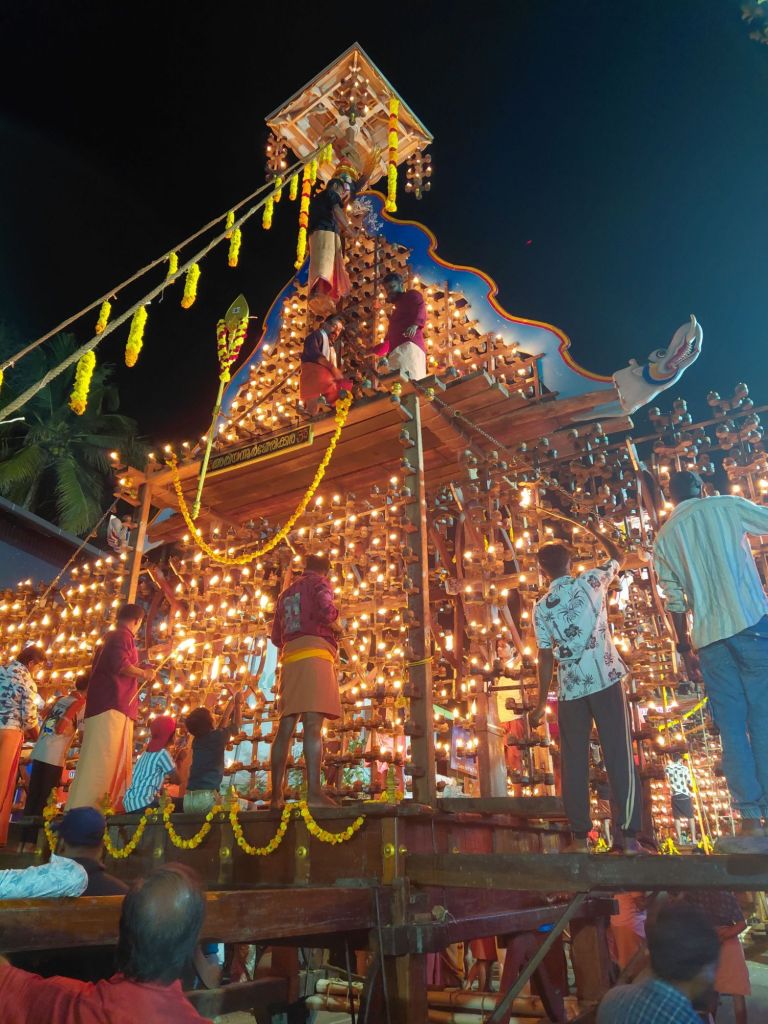
The temple car getting ready for the Purapaad festival, Cheriyanad
The temple car getting ready for the Purapaad festival

Day 6: The first time coming out ceremony of the deity, which includes the morning service starting at around 04:30 a.m. onwards and the circumambulation of the temple with the deity’s idol on a palanquin at around 05:30 p.m.

Day 9: Skanda Shashti: People keep fast on this day, followed by rituals like Shashti Pooja at around noon and the Peacock chariot procession from 07:00p.m. onwards.

Day 10: Arattu: this is the “sacred bath,” marking the final ritual of a 10-day temple festival.

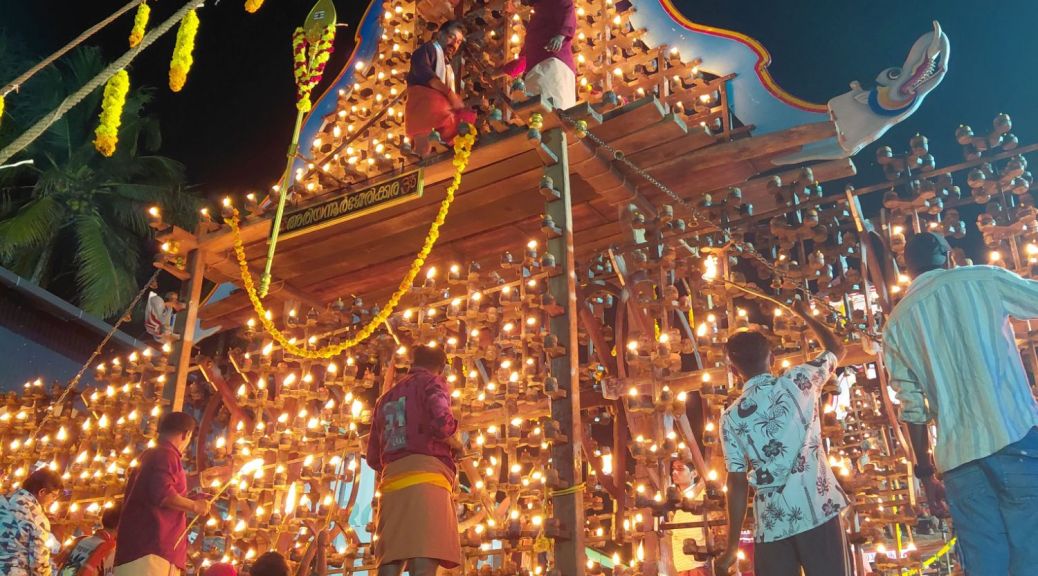
During the early hours of the 5th morning of the festival, around 13 wooden chariots representing 13 karas (surrounding villages) are taken on a procession along the road extending from the Shri Bala Subramanya Swami temple and the Padanilam. These wooden chariots are decorated with oil-lit lamps made with the empty shells of the chaulmoogra fruit (Hydnocarpus pentandrus, locally called Marotti in Malayalam) and are pulled manually by men representing each kara shouting slogans in the name of lord Subramanya.

The illuminated temple car Purapaad festival, Cheriyanad
The illuminated temple car

After a coconut-breaking ceremony and the lighting of the Nilavilakku (the traditional floor lamp), the procession begins. Five large chariots lead the convoy. A railway track crosses this path and has a height gauge installed. Hence, the medium-sized or larger 04 chariots at the trailing end will reach only this point and then return to the temple. 03 decorated elephants of the temple accompany the remaining 04 smaller chariots and make it past this railway crossing to join the leading 05 chariots at the Padanilam ground. The Padanilam ground, which was once a battleground, is also called the ‘Shastham Kunnu’ because it had a temple dedicated to Shasthavu and a fortified raised platform.

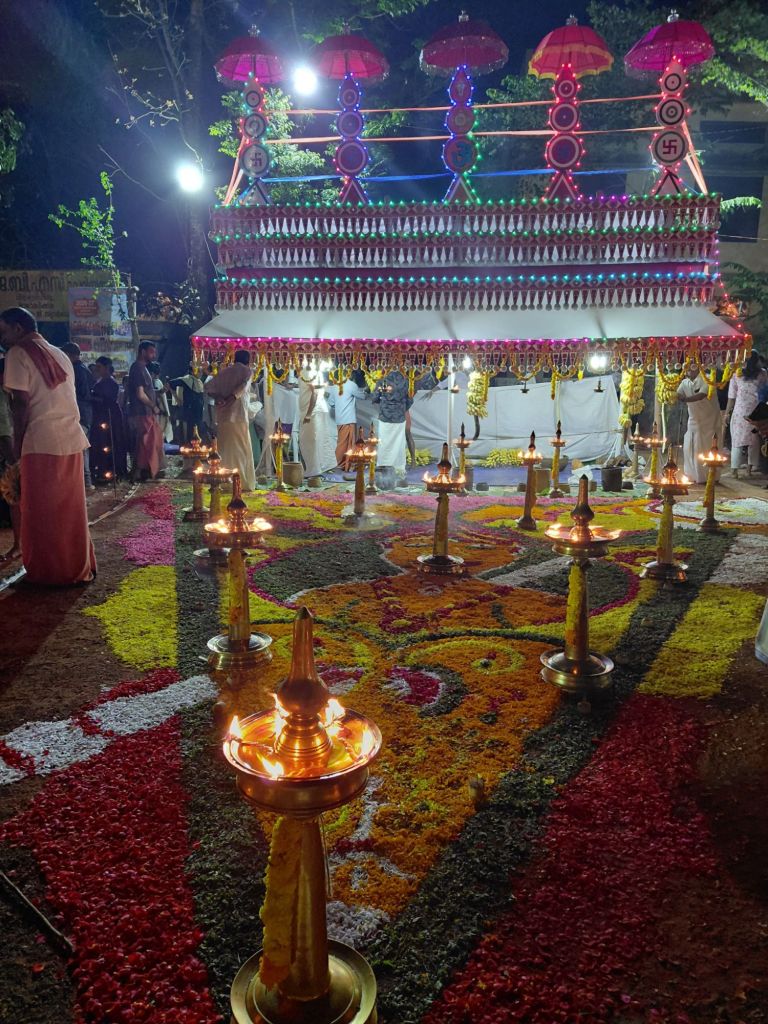
A large Pookkalam is made at the Shastham Kunnu, where a small shrine is set up and decorated with thousands of banana bunches. The procession culminates here with the chariots carrying the lamps parked in a circle, and the elephants perform the final rituals. The first bunches of bananas are fed to the elephants, and the remaining are distributed as prasada among everyone who has gathered there.

My friend and I arrived at the temple late in the evening on the 4th day, before the Pallivilakku. We saw a few devotees on the highway, walking towards the temple carrying the Kavadis. Though these kavadi bearers were performing this ritual quite early, it is to be noted that this year’s Kavadi festival at the Cheriyanaad Bala Subramanya Swami temple was scheduled to happen back-to-back. I will share the Kavadi festival itinerary at the end of this post.

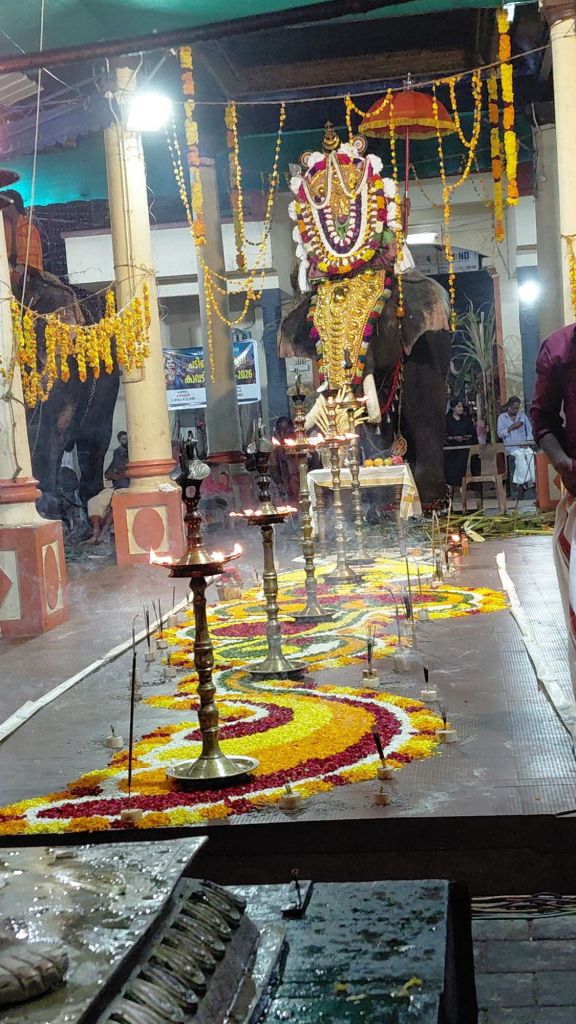
The Nadaswaram Seva at Subramanya temple, Cheriyanad

Coming back to our story of the Purapaadu festival, and upon our arrival at the temple, the wooden chariots were still being prepared and assembled on the road leading to the entrance. Inside the premises, 03 elaborately decorated elephants stood in front of a beautifully laid Pookalam, at the end of which the Nadaswaram Seva began. The Seva was deeply soulful, and the music continued to play in my mind even after the ritual was completed. We had the darshana of the lord at his sanctum sanctorum and watched other devotees offer their prayers in the form of donations of paddy and other grains.

We then followed the crowd towards the open-air auditorium and found ourselves seated amid hundreds of others on the ground. Shortly after, all lights were turned off, whistles and hoots sounded, and there was total darkness. An interesting event was about to begin. It was the first time I was watching a stage cinema. The cinema went on for a couple of hours while the wooden chariots were being prepared for the grand show.

Halfway through the cinema, we decided to take a stroll along the procession trail. We watched all the lamps being arranged, oil being filled and lit. We also spoke with the locals to understand the traditions and to find a good vantage point to view all the lit chariots as they moved. Finally, the procession commenced around 04:00 a.m., and it was indeed a walk I will remember, one of spectacle and memories. And oh! I picked up a few fallen Marotti lamps and kept them as a souvenir before bidding goodbye to this wonderful festival.

The pookalam at Padinalam ground, Cheriyanad

Cheriyanaad is located about 8 km away from Chengannur, the nearest major town. Frequent public buses ply between Cheriyanaad and Chengannur if you are commuting during the day. Since we commuted after sunset and before sunrise hours, we hired an autorickshaw that was easily available from Chengannur town. While Cheriyanaad has its own railway station, Chenganur is well connected with major cities like Bangalore and Chennai with direct trains. However, I travelled by a direct bus due to my work schedule. We booked accommodation at Chengannur town, the nearest place to avail a decent lodging facility.

Shri Bala Subramanya Swami temple at Cheriyanaad is also known for its Thaipusam and Kavadiyattam festival. In 2026, it started on the day following the Purappad festival. This is brief information on the same.

  • Day 1: Idumban Pooja, a sacred ritual dedicated to Idumban, the devotee and guardian of Lord Murugan’s shrines, is performed. It is performed to seek permission to carry the Kavadi and involves offering prayers to Idumban with milk and fruits.
  • Day 2 & 3: dedicated to various rituals involved in Kavadi Alms.
  • Day 4: Thaiposam & Kavadiyattam festival involving three main types of Kavadis as mentioned below:
  • Paal Kavadi: Pots of milk are carried on the heads.
  • Mayil Kavadi: Decorated with peacock feathers to represent the peacock, the vehicle of Subramanya Swami.
  • Vel Kavadi: Involves different types of body piercings by the devotees, like the skin, cheeks and tongue, with “vel” (spears). (You can also read about the ‘Mayana Kollai festival‘ to understand similar rituals that are performed in Tamil Nadu.)

To be continued as “A grand celebration of masks- Padayani Festival at Othera”

The Povvadi Namme of Ibbanivalavadi

It was back during my school going days, that I had an opportunity to visit the Haleri (Paaleri) Bhadrakali temple in Madikeri taluk. I was especially intrigued by several antlers hung on the wooden beams through the length of the temple verandah. Upon enquiry, the temple priest fed my curiosity by letting me know that the antlers are used during the temple festival to perform ‘Kombaat.’ Kombaat is a word derived as a combination of two Kodava words, Kombu (antler) and Aat (dance). It is one of the ritualistic dances performed during temple festivals of Bhadrakali, a local deity of Kodagu. Ever since then, I was trying to get details or the schedule to witness one of these festivals where Kombaat is performed.

Finally, it was in the year 2024 when my friend informed me that the Povvadi festival at her native village was scheduled to be held in April. After a long wait, I had finally arrived at the ‘Kaitale’ (ground) attached to the ‘Bhadrakali temple’ of Valavadi village. ‘Ibbani’ and ‘Valavadi’ are two sister villages in Madikeri taluk. The annual temple festival is hosted by each of these two villages on alternating years at the Bhadrakali temple premises of the respective village. This year, it was the turn of Valavadi villagers to host this festival. There are eleven clans that are the original inhabitants of Ibbanivalavadi. Therefore, they take precedence in the conduction of the overall festival.

Bhadrakali, also known as Bhagavathi or Povvadi, is a local deity worshipped in every village of Kodagu with dedicated temples. The annual festival celebrated in her honor is the Povvadi festival. There are several native communities in Kodagu and each of these members have their own significant roles and responsibilities to be performed at these festivals.

‘Maadayi Kaavu’ is a Bhagavathi temple located in the Malabar region of Kerala. It is believed to be the Aadi Neley (primary destination) from where the deity took station at several places across Kodagu. Among these places, is a group of temples called as the ‘Elu Neley’ (seven station) Bagavathi located across the northern and western parts of Kodagu. This group comprises of one brother- Appangeriappa at Kaatakeri and six sisters, namely- Poramalenaad Povvadi at Galibeedu, Karavale Badaga Povvadi, Paaleri Povvadi, Ummeti Povvadi at Makkandur, Kedakal Povvadi, Ibbni and Valavadi Povvadi at Ibbanivalavadi

Peeli aat

The beginning of the festivities is marked by a ritual called as ‘Kett boovo’. Thereafter, none in the village is allowed to consume non-vegetarian and alcohol over the next fifteen days. The festival is celebrated towards the last seven days with specific rituals on each day.

Kombaat

On the first day, the Ooru-thakka (Village-keepers), Deva-thakka (Keepers of the temple administration) and Bandara-thakka (Keepers of the temple’s valuables) all arrive in a grand procession, carrying the Bandara-Potti (Donation box) and the jewelry for the deity from its treasury to the temple. This marks the beginning of the festival. The people are accompanied by the music of the ‘Dudi’ and ‘Poda mani’ kott (traditional percussion instruments). There are noteworthy rituals like the Boad kali, boad aat etc. among others.

There are other rituals performed over the next three days. The fifth day is the most interesting as several traditions unique to the ‘Elu Neley’ Bagavathi temples can be witnessed. The day began with ‘Kadi-aat’ followed by a ritual called Aangola-Pongola. It is performed by married couples as an offering to the goddess after their prayers for having children are fulfilled. The vow is fulfilled by their kids by cross-dressing in a wedding ceremonial attire any time before they hit puberty. A son dresses up as a traditional bride (Pongola) and a daughter wears a groom’s costumes (Pongola) as the family together offers their prayers to the Goddess.

Kombaat

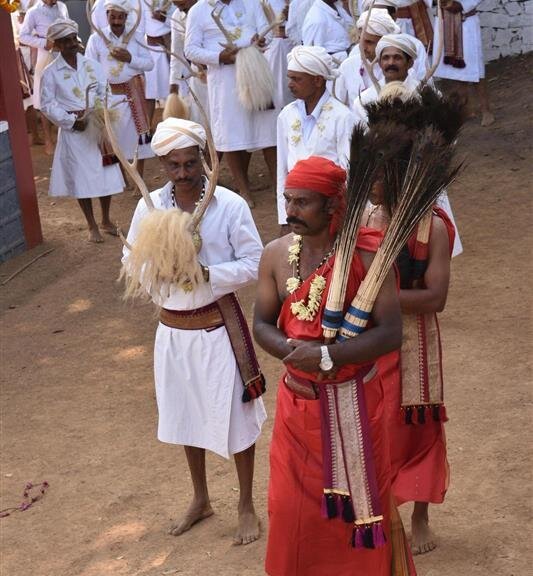
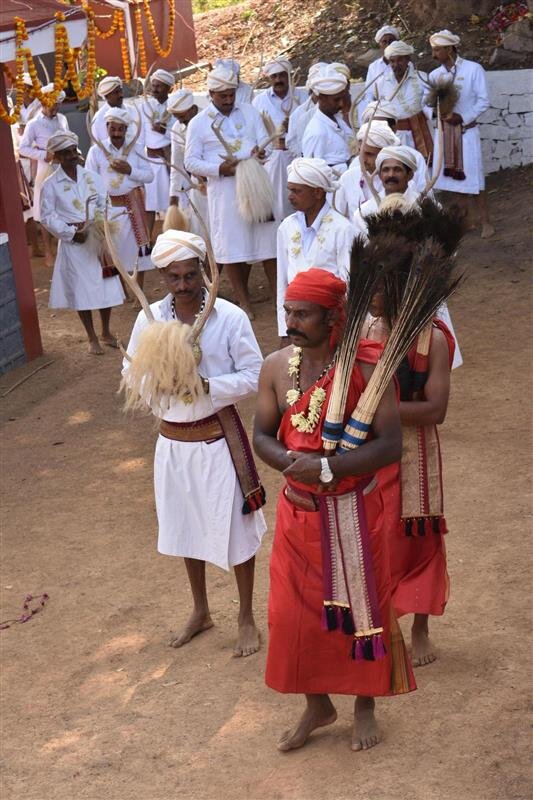
Then, all the men of the native clans get dressed in ‘Boltha Kupya’- The white robe worn only on auspicious occasions. They then hold a bundle of peacock feathers (peeli) in their hands and perform a rhythmic dance to drumbeats in a circular formation around a ‘Kutthi bolcha’ (traditional lamp). This dance is called ‘Peeli-aat’. Post the performance, the crowd dispersed from the kaitale and gathered around the temple.

Here, the men in white kupya again perform the Kombaat to the beats of the traditional drums and Valaga (traditional wind instruments played by the members of the Meda community). Along with the ‘Ajjappa,’ (a person possessed by the spirit of ‘Ajjappa’, another local deity), all the other men in white Kupya circumambulate the temple while dancing with the Kombu and Chowri (a cluster of yak hair).

After that, all the villagers gathered to offer bandara to Ajjappa and Bhadrakali. After everyone had finished offering their prayers, they then went back to the podium with a spirit that was competitive. Competitive, because the next ceremony was like a competition of sorts. All the native clans of the village competed against each other in a coconut shooting competition. Three coconuts tied to a distant high pole were to be shot at as targets. It was a fun event to end the day of festivities.

After the sun went down, the men came together in an area nearby to the temple to offer animal sacrifice to the deity. Women are not allowed to this space. The food is then distributed among all the village folk.

Povvadi Namme, Kodagu

On the following day, there is a similar celebration with Kombaat and Valaga, but on a smaller grandeur. on the seventh day of the festival, a pooja is offered to the goddess by all the thakkas, before returning the bandara potti and the temple jewelry to the treasury. The last and the final day of the fortnight long festival was marked by a ‘Kalasa Pooja’ offered to the goddess before drawing curtains on such a beautiful festival until next year.

Disclaimer: The purpose of this article is for documentation of lesser known festivals of India. The above information is only based on what I could gather by discussing with people who had come together at the temple. My apologies for any wrong representation. Readers are welcome to contribute any information that is deemed important and useful to be shared here.

This post was featured  on 24-Oct-24 edition of ‘Spectrum’ in Deccan Herald National daily.

Nestled in the oblivion of Bannerghatta- Koratagere Doddi

This is yet another of my family’s random drive day, thanks to Corona unlock weekends… This time, our random pick was in the direction of Bannerghatta forest. We drove past Jigani marble market towards Ragihalli state forest. We drove around randomly and stopped wherever we thought we had a good vantage point. The place being around the fringes of a national park and in the fertile stretch of countryside, there was lots and lots of greenery all along. We stopped by at the IIM-B new campus plot near Mahanthalingapura from where we got a distant view of the ‘Ragihalli Betta’. (Remember our drive to Gullahatti Kaval? We had the view of the hill from a different direction- Click here to read the complete article) The cloudy and cool weather here made everything perfectly amazing, with a great combination of bright green and dull grey. With permission of a millet farm owner present there, we sat in his farm overlooking the green valley for a while, with some packed food and water.

After resuming our drive and on recommendation of a friend, we deviated from the main road leading to the Ragihalli state forest. It was quite an offbeat surprise for our ageing hatchback, but he performed smoothly compared to any youthful 4×4 SUV. A random deviation got our hatchback into an overflowing stream (with water level almost up to the doors). We didn’t know the way ahead, but our driver(my brother) didn’t switch off in the middle of the stream. Another car in the opposite direction directed us to the correct road from where, it was an unpaved gravel laid forest path for a few more kilometers, before passing through a couple of laidback villages. After the tree laden trail was over, small rocky hillocks appeared to our left and a vast stretch of farmland flanked the valley to our right. Apart from a few villagers transporting their goods on two wheelers, we were the only people in this stretch for most distance. We continued an uphill drive until there appeared a junction with a temple at the top. Watch the video of our drive below:

The drive to Koratagere Doddi

A milestone at the junction read that it was ‘Koratagere Doddi’. Thanks to the lockdown and social distancing norms, it had been several months since I had been to a temple and I was excited at the sight of it. From the architecture of it, the structure seemed to be a Sun temple. But google says it is a ‘Paanchala Kshetra’ that was closed at that time. However, the place seemed to be beautiful and we decided to park our car and take a stroll. We walked a few yards to our right and believe me when I say, it looked BEAUTIFUL! We were at a flat rocky tabletop cliff from where we could see a good stretch of the city outskirts. We decided to sit there for an hour at least and enjoy the strong breeze that kissed our faces hard. But yeah, the time was cut short by the rain gods who manifested themselves from the distant dark clouds to a sudden pounding of rain.

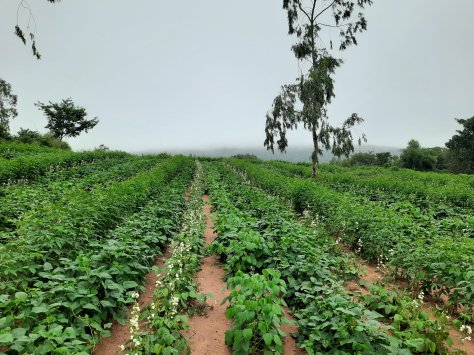
The misty Ragihalli forest viewed from a farm

We had no choice but run to our car for shelter. But wow, what a wonderful setting it was: Green grass, grey sky, hill on one side, valley on the other and a lonely temple ahead of us. We saw no signs of the rain stopping as we waited in our car and decided to continue our drive, back home but in the direction of the road ahead of us. Thanks to the rain, we did nothing specific to stop-by and take note of. But yeah, the Ragihalli Betta now appeared closer and COMPLETELY mist / cloud laden, a view not everyone gets lucky with.

Overall, a wonderful day out with family to a place where I belong: to Nature 😊