Continued from ‘Celebrating the chariot of light- Purapaadu Festival at Cheriyanaad‘
In my previous post, I had told you that I returned to Pattanamthitta more often than I expected. I was in Chengannur again to experience yet another festival. In this post, I am going to talk about my experience of the Padayani festival at Othera.
What is the Padayani Festival?
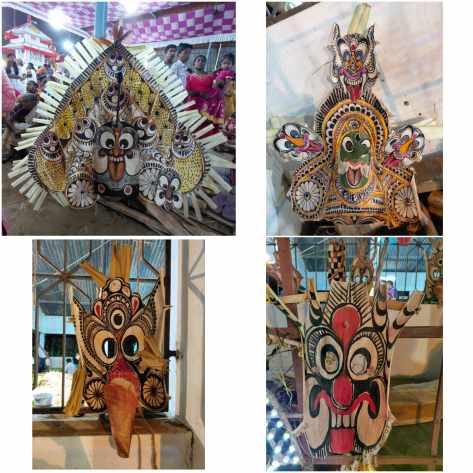
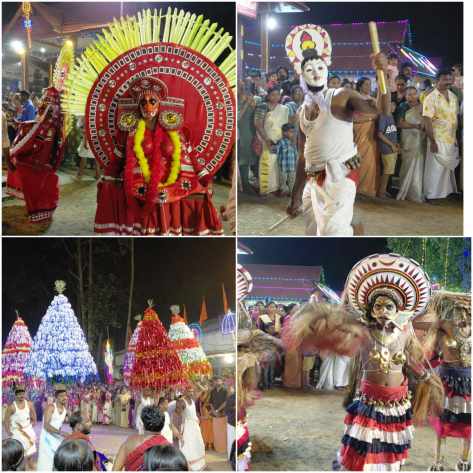
Padayani loosely translates to ‘Row of warriors’ in Malayalam. It is a ritualistic art form involving folk music, dance, theatre and hand-painted masks, observed in several Bhagavati temples across central Kerala, particularly in and around Pattanamthitta. ‘Kolam thullal’ is an important part of the festival to appease Goddess Bhagwati through the performance of rhythmic dance steps to the music played by traditional instruments like the thappu, chenda, para and kumba while wearing leafy costumes and masks made from arecanut and coconut sheaths, which are painted into various forms with the use of natural pigments. The impersonators performing Kolam thullal (Mask dance) represent both the divine and the evil forms through various depictions.
Although the festival’s origins are rooted in history, contemporary practices involve different duties and responsibilities assigned to members of various communities in Kerala. The duration of the festival ranges from 7 to 28 days, depending on the temple’s tradition, with the final day typically being the most elaborate and grand and therefore called the ‘Valiya Kolam’.
What happens during the Padayani festival at Othera?
The Padayani festival at Puthukkulangara Devi temple in Othera village, Pattanamthitta district, is one of Kerala’s renowned Padayani celebrations. This ten-day annual event takes place from the 03rd to the 12th day of the Meenam month of the Malayalam calendar, featuring various Kolam dances performed nightly in the temple courtyard as acts of devotion. All the masks used in the Padayani festival are hand-painted by skilled men on each day of the festival and discarded after each use. The highlight of the festival, however, is the ‘MahaBhairavi Kolam’ a grand mask crafted from 1001 areca sheaths that draws large crowds from across the region on the last night of the festival.
A brief itinerary of the 10-day-long Padayani festival at Othera Puthukkulangara Devi temple is listed below. It is also noteworthy that each ritualistic performance begins with Chootuvaippu and ends with a Chootuvalathu and Kotti Vilikkal. ‘Chootuvaippu’ is the burning of torches made with dried coconut fronds behind whom each performer walks to the Padayani arena. ‘Chootuvalathu’ is a circumambulation of the temple by the performer, including the ‘Kotti Vilikkal’, meaning to inform the goddess after the performance is done.
Day 1 (Chathayam Nakshatra): The festival officially starts with the hoisting of the Adavi Kollika, the traditional flag and the lighting of the ‘Bhadra Deepam’, a traditional brass lamp with 21 wicks. It is followed by the arrival of the Vetapoola offerings to the idols. After this, the performance of thappu kottu (traditional frame drums played by hand), Ettu Kappoli (a rhythmic performance of multiple traditional music instruments), and Pulavrittam (a ritualistic dance performed by men in a circular formation) set the stage for all other performances on each day of the festival, starting this day.
Day 2 (Pooruruttathi Nakshatra): The performance of Thavadi (a ritualistic dance performed by rows of men by clapping hands to the tunes of drums and cymbals) gets added to Thappu Kottu, Ettu Kappoli and Pulavrittam from this day. This day also marks the beginning of the Kolam thullal and Panchakolam, which is performed for the next three days.
Day 3 (Uthrattathi Nakshatra): The evening begins with a Thiruvattira dance performance followed by Thappu kottu, Ettu Kappoli, Pulavrittam, Thavadi, Kolam thullal and Panchakolam. The Panchakolam is accompanied by the Sundarayakshi Kolam on this day.
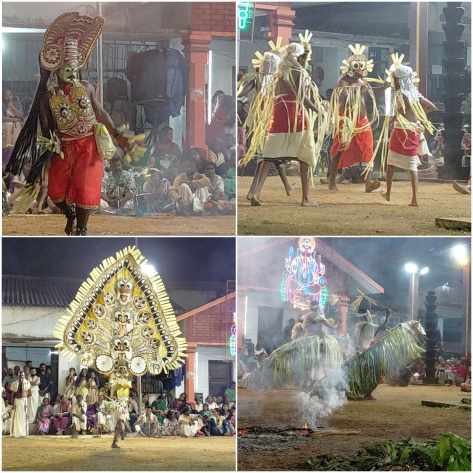
Day 4 (Revathi Nakshatra): The Panchakolam is accompanied by the Kalayakshi and Bhairavi Kolam.
Day 5 (Ashwathi Nakshatra): This day includes Ettu Kappoli, Pulavrittam, Thavadi and the Kalankekalam Kolam.
Days 6 to 9: These days have performances of Ettu Kappoli, Pulavrittam, Thavadi and the Kalan Kolam.
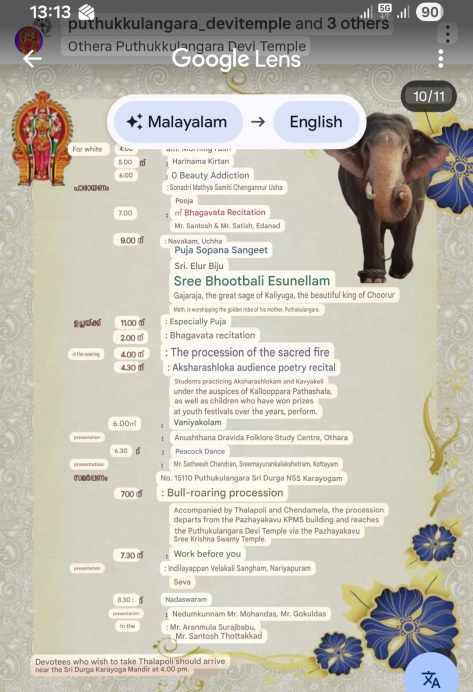
Day 10 (Thiruvathira Nakshatra): All the rituals conducted over the last 9 days are repeated on this day. All the kolams come to the festival arena in a procession, which is traditionally called the ‘Nirathi Thullal’. Various Kolams alongside the Kakarisshi natakam and Paradeshi performances continue throughout the night, with the Mangalabhairavi Kolam and Poopada (A ritualistic dance performance to the music of percussion instruments and comic interludes) marking the end of the festival. A brief itinerary of the last evening of the Othera Padayani festival is indicated in the image below.
What is the ‘MahaBhairavi Kolam’ at the Othera Padayani festival?
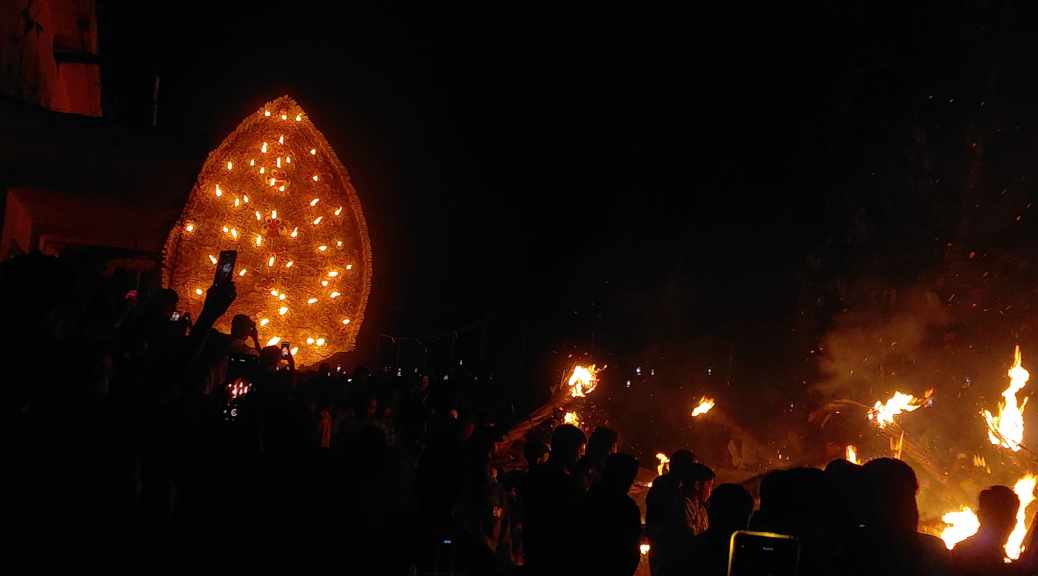
While all Kolams in the Padayani festival feature a human impersonator wearing a mask made from hand-painted areca sheaths, the MahaBhairavi Kolam stands out primarily because of its enormous size. A Bhairavi kolam is the largest wearable mask during Padayani, with the load resting on the wearer’s neck and shoulders, supported by their hands. In contrast, the MahaBhairavi is crafted from 1001 sheaths, all held in place by arranging them on a sturdy wooden frame from behind. It is nearly impossible for a single person to carry this. Therefore, after arranging the sheaths, the large mask/Kolam is lifted from the ground and mounted on a wooden cart using a crane. Community members then hand-draw the Kolam from the setup area to the Padayani arena. The cart is moved forward and backward three times to appease Goddess Bhadrakali, and the Kolam remains in the arena for several days, marking the festival’s conclusion.
Ladies are prohibited from entering the areas where the masks are painted and assembled. After the kolam is over, the masks are left for nature to take over them in its own way.
How was our experience of witnessing the Othera Padayani festival?
To summarise the entire experience in simple words, it was a festival so unique and unlike anything else I have experienced before. Based on the above itinerary shared by the temple authorities, my friend and I reached Othera by 05.30.p.m. At the same time, the procession of the sacred fire was in progress. Since the fire was accompanied by an elephant and devotees carrying thalapoli (a metal plate with rice, flowers, coconut and an earthen lamp), the narrow lane leading to the temple was blocked for vehicular movement, and we had to walk past to the temple. All the houses along the way had ‘Nela vilakku’ (the traditional brass lamp) with small pookalam (floral decorations) placed in front of their gates, as a greeting to the sacred fire at their homes.
After the procession reached the temple premises, it went towards the banks of the river Varattar for offerings and returned with tree branches. It was followed by cultural performances like Chendamelam, Vaniyakolam, Peacock dance, Kettukazhcha ceremony (procession of the bull-effigy), a parade of various folk-art forms like Malavazhiyattam, Amman Kudam (Karaga), etc. and the Nadaswaram Seva before the Kolam Thullal began extending right until dawn’s break. Simultaneously, the artists painted the masks, whilst another group of people readied the wooden frame on which the painted sheaths were later arranged. And finally, the fireworks went up while the horizontal wooden frame went up vertically, along with all the sheaths in place. We knew that the big wait was inching closer when we saw a crane carrying a man with a torch, lighting up the cotton burners attached to the MahaBhairavi Kolam. I believe it was a culturally immersive experience that one must experience at least once in their lifetime.
How to get there?
Othera is located about 4 km away from Chengannur, the nearest major town that is well connected with major cities like Bangalore and Chennai with direct trains and buses. One can conveniently hire an autorickshaw from Chengannur town to reach Othera.
To be continued as “An Onam Celebration I will never forget at Aranmula Parthasarthy Temple“

 The Lost Lander