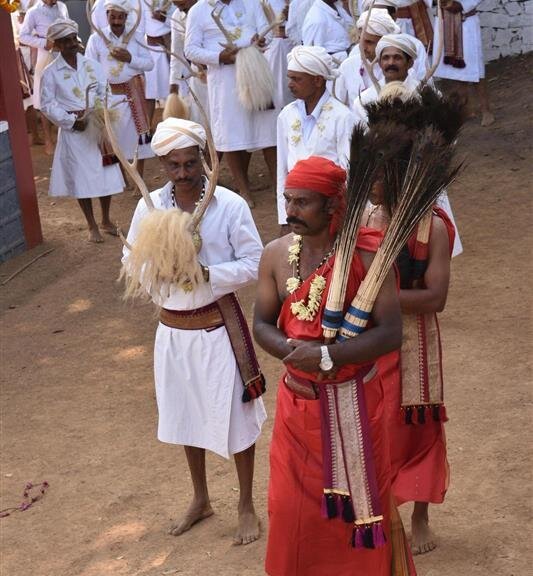
It was back during my school going days, that I had an opportunity to visit the Haleri (Paaleri) Bhadrakali temple in Madikeri taluk. I was especially intrigued by several antlers hung on the wooden beams through the length of the temple verandah. Upon enquiry, the temple priest fed my curiosity by letting me know that the antlers are used during the temple festival to perform ‘Kombaat.’ Kombaat is a word derived as a combination of two Kodava words, Kombu (antler) and Aat (dance). It is one of the ritualistic dances performed during temple festivals of Bhadrakali, a local deity of Kodagu. Ever since then, I was trying to get details or the schedule to witness one of these festivals where Kombaat is performed.
Finally, it was in the year 2024 when my friend informed me that the Povvadi festival at her native village was scheduled to be held in April. After a long wait, I had finally arrived at the ‘Kaitale’ (ground) attached to the ‘Bhadrakali temple’ of Valavadi village. ‘Ibbani’ and ‘Valavadi’ are two sister villages in Madikeri taluk. The annual temple festival is hosted by each of these two villages on alternating years at the Bhadrakali temple premises of the respective village. This year, it was the turn of Valavadi villagers to host this festival. There are eleven clans that are the original inhabitants of Ibbanivalavadi. Therefore, they take precedence in the conduction of the overall festival.
Brief history of Povvadi festival:
Bhadrakali, also known as Bhagavathi or Povvadi, is a local deity worshipped in every village of Kodagu with dedicated temples. The annual festival celebrated in her honor is the Povvadi festival. There are several native communities in Kodagu and each of these members have their own significant roles and responsibilities to be performed at these festivals.
‘Maadayi Kaavu’ is a Bhagavathi temple located in the Malabar region of Kerala. It is believed to be the Aadi Neley (primary destination) from where the deity took station at several places across Kodagu. Among these places, is a group of temples called as the ‘Elu Neley’ (seven station) Bagavathi located across the northern and western parts of Kodagu. This group comprises of one brother- Appangeriappa at Kaatakeri and six sisters, namely- Poramalenaad Povvadi at Galibeedu, Karavale Badaga Povvadi, Paaleri Povvadi, Ummeti Povvadi at Makkandur, Kedakal Povvadi, Ibbni and Valavadi Povvadi at Ibbanivalavadi
Details of the Povvadi Namme at Valavadi
The beginning of the festivities is marked by a ritual called as ‘Kett boovo’. Thereafter, none in the village is allowed to consume non-vegetarian and alcohol over the next fifteen days. The festival is celebrated towards the last seven days with specific rituals on each day.
On the first day, the Ooru-thakka (Village-keepers), Deva-thakka (Keepers of the temple administration) and Bandara-thakka (Keepers of the temple’s valuables) all arrive in a grand procession, carrying the Bandara-Potti (Donation box) and the jewelry for the deity from its treasury to the temple. This marks the beginning of the festival. The people are accompanied by the music of the ‘Dudi’ and ‘Poda mani’ kott (traditional percussion instruments). There are noteworthy rituals like the Boad kali, boad aat etc. among others.
There are other rituals performed over the next three days. The fifth day is the most interesting as several traditions unique to the ‘Elu Neley’ Bagavathi temples can be witnessed. The day began with ‘Kadi-aat’ followed by a ritual called Aangola-Pongola. It is performed by married couples as an offering to the goddess after their prayers for having children are fulfilled. The vow is fulfilled by their kids by cross-dressing in a wedding ceremonial attire any time before they hit puberty. A son dresses up as a traditional bride (Pongola) and a daughter wears a groom’s costumes (Pongola) as the family together offers their prayers to the Goddess.
Then, all the men of the native clans get dressed in ‘Boltha Kupya’- The white robe worn only on auspicious occasions. They then hold a bundle of peacock feathers (peeli) in their hands and perform a rhythmic dance to drumbeats in a circular formation around a ‘Kutthi bolcha’ (traditional lamp). This dance is called ‘Peeli-aat’. Post the performance, the crowd dispersed from the kaitale and gathered around the temple.
Here, the men in white kupya again perform the Kombaat to the beats of the traditional drums and Valaga (traditional wind instruments played by the members of the Meda community). Along with the ‘Ajjappa,’ (a person possessed by the spirit of ‘Ajjappa’, another local deity), all the other men in white Kupya circumambulate the temple while dancing with the Kombu and Chowri (a cluster of yak hair).
After that, all the villagers gathered to offer bandara to Ajjappa and Bhadrakali. After everyone had finished offering their prayers, they then went back to the podium with a spirit that was competitive. Competitive, because the next ceremony was like a competition of sorts. All the native clans of the village competed against each other in a coconut shooting competition. Three coconuts tied to a distant high pole were to be shot at as targets. It was a fun event to end the day of festivities.
After the sun went down, the men came together in an area nearby to the temple to offer animal sacrifice to the deity. Women are not allowed to this space. The food is then distributed among all the village folk.
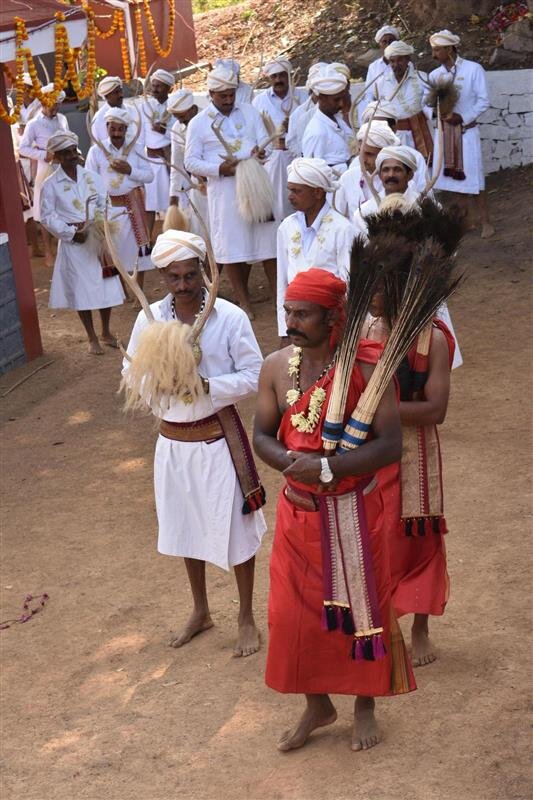
On the following day, there is a similar celebration with Kombaat and Valaga, but on a smaller grandeur. on the seventh day of the festival, a pooja is offered to the goddess by all the thakkas, before returning the bandara potti and the temple jewelry to the treasury. The last and the final day of the fortnight long festival was marked by a ‘Kalasa Pooja’ offered to the goddess before drawing curtains on such a beautiful festival until next year.
Disclaimer: The purpose of this article is for documentation of lesser known festivals of India. The above information is only based on what I could gather by discussing with people who had come together at the temple. My apologies for any wrong representation. Readers are welcome to contribute any information that is deemed important and useful to be shared here.
This post was featured on 24-Oct-24 edition of ‘Spectrum’ in Deccan Herald National daily.



 The Lost Lander