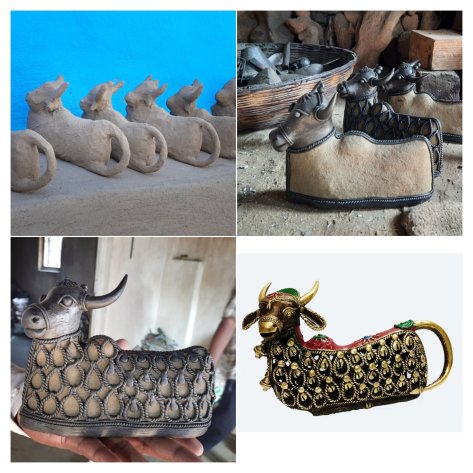
Tag Archives: South Indian arts

A Grand Celebration of Masks- Padayani Festival at Othera

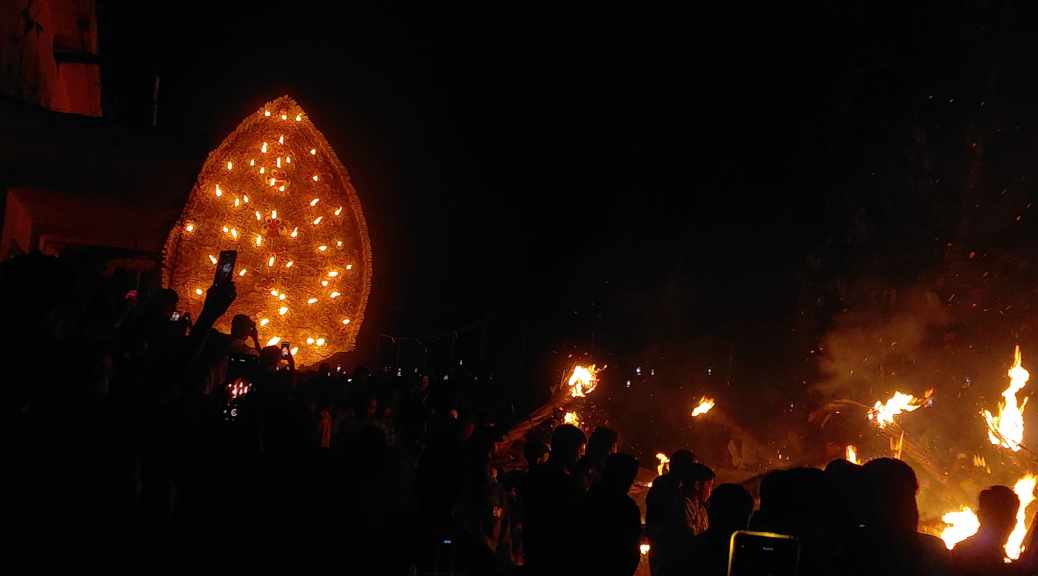
Continued from ‘Celebrating the chariot of light- Purapaadu Festival at Cheriyanaad

In my previous post, I had told you that I returned to Pattanamthitta more often than I expected. I was in Chengannur again to experience yet another festival. In this post, I am going to talk about my experience of the Padayani festival at Othera.

Padayani loosely translates to ‘Row of warriors’ in Malayalam. It is a ritualistic art form involving folk music, dance, theatre and hand-painted masks, observed in several Bhagavati temples across central Kerala, particularly in and around Pattanamthitta. ‘Kolam thullal’ is an important part of the festival to appease Goddess Bhagwati through the performance of rhythmic dance steps to the music played by traditional instruments like the thappu, chenda, para and kumba while wearing leafy costumes and masks made from arecanut and coconut sheaths, which are painted into various forms with the use of natural pigments. The impersonators performing Kolam thullal (Mask dance) represent both the divine and the evil forms through various depictions.

Although the festival’s origins are rooted in history, contemporary practices involve different duties and responsibilities assigned to members of various communities in Kerala. The duration of the festival ranges from 7 to 28 days, depending on the temple’s tradition, with the final day typically being the most elaborate and grand and therefore called the ‘Valiya Kolam’.
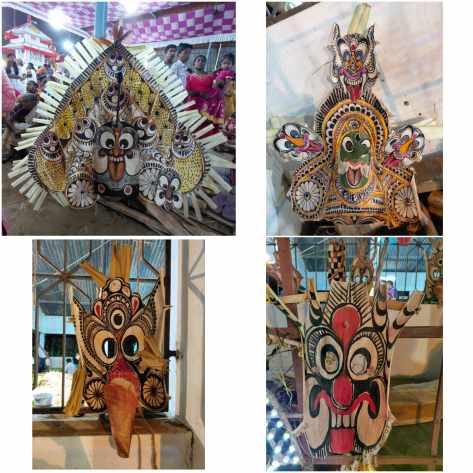
Various areca sheath painted Masks used for Kolam thullal

The Padayani festival at Puthukkulangara Devi temple in Othera village, Pattanamthitta district, is one of Kerala’s renowned Padayani celebrations. This ten-day annual event takes place from the 03rd to the 12th day of the Meenam month of the Malayalam calendar, featuring various Kolam dances performed nightly in the temple courtyard as acts of devotion. All the masks used in the Padayani festival are hand-painted by skilled men on each day of the festival and discarded after each use. The highlight of the festival, however, is the ‘MahaBhairavi Kolam’ a grand mask crafted from 1001 areca sheaths that draws large crowds from across the region on the last night of the festival.

A brief itinerary of the 10-day-long Padayani festival at Othera Puthukkulangara Devi temple is listed below. It is also noteworthy that each ritualistic performance begins with Chootuvaippu and ends with a Chootuvalathu and Kotti Vilikkal. ‘Chootuvaippu’ is the burning of torches made with dried coconut fronds behind whom each performer walks to the Padayani arena. ‘Chootuvalathu’ is a circumambulation of the temple by the performer, including the ‘Kotti Vilikkal’, meaning to inform the goddess after the performance is done.

Day 1 (Chathayam Nakshatra): The festival officially starts with the hoisting of the Adavi Kollika, the traditional flag and the lighting of the ‘Bhadra Deepam’, a traditional brass lamp with 21 wicks. It is followed by the arrival of the Vetapoola offerings to the idols. After this, the performance of thappu kottu (traditional frame drums played by hand), Ettu Kappoli (a rhythmic performance of multiple traditional music instruments), and Pulavrittam (a ritualistic dance performed by men in a circular formation) set the stage for all other performances on each day of the festival, starting this day.

Day 2 (Pooruruttathi Nakshatra): The performance of Thavadi (a ritualistic dance performed by rows of men by clapping hands to the tunes of drums and cymbals) gets added to Thappu Kottu, Ettu Kappoli and Pulavrittam from this day. This day also marks the beginning of the Kolam thullal and Panchakolam, which is performed for the next three days.

Day 3 (Uthrattathi Nakshatra): The evening begins with a Thiruvattira dance performance followed by Thappu kottu, Ettu Kappoli, Pulavrittam, Thavadi, Kolam thullal and Panchakolam. The Panchakolam is accompanied by the Sundarayakshi Kolam on this day.
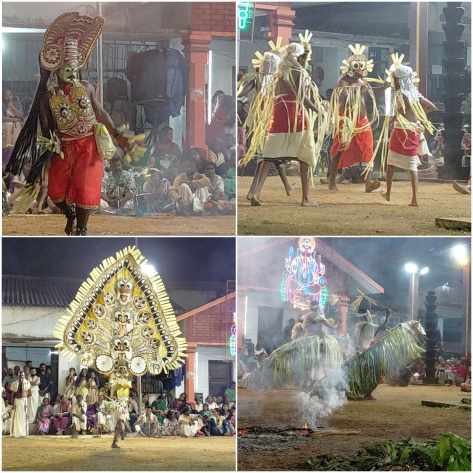
Kolams at Puthukulangara Devi padayani festival
Kolams at Puthukulangara Devi padayani festival. Clockwise from Top left: Yakshi; Top right: Pakshi; Bottom right: Kudiran; Bottom left: Bhairavi

Day 4 (Revathi Nakshatra): The Panchakolam is accompanied by the Kalayakshi and Bhairavi Kolam.

Day 5 (Ashwathi Nakshatra): This day includes Ettu Kappoli, Pulavrittam, Thavadi and the Kalankekalam Kolam.

Days 6 to 9: These days have performances of Ettu Kappoli, Pulavrittam, Thavadi and the Kalan Kolam.

Day 10 (Thiruvathira Nakshatra): All the rituals conducted over the last 9 days are repeated on this day. All the kolams come to the festival arena in a procession, which is traditionally called the ‘Nirathi Thullal’. Various Kolams alongside the Kakarisshi natakam and Paradeshi performances continue throughout the night, with the Mangalabhairavi Kolam and Poopada (A ritualistic dance performance to the music of percussion instruments and comic interludes) marking the end of the festival. A brief itinerary of the last evening of the Othera Padayani festival is indicated in the image below.
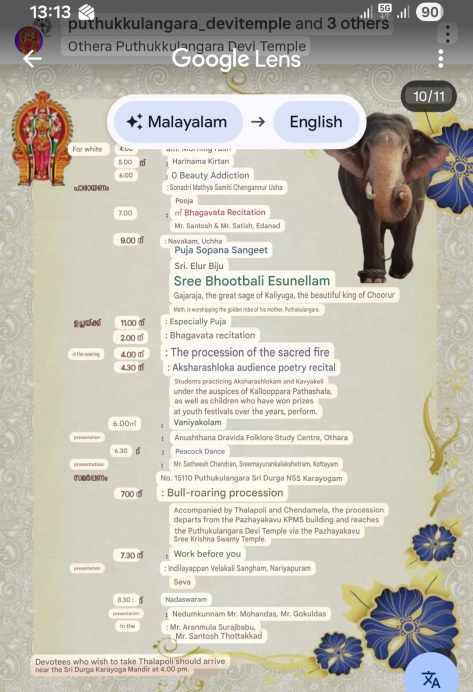
Day10 padayani festival itinerary- Othera

While all Kolams in the Padayani festival feature a human impersonator wearing a mask made from hand-painted areca sheaths, the MahaBhairavi Kolam stands out primarily because of its enormous size. A Bhairavi kolam is the largest wearable mask during Padayani, with the load resting on the wearer’s neck and shoulders, supported by their hands. In contrast, the MahaBhairavi is crafted from 1001 sheaths, all held in place by arranging them on a sturdy wooden frame from behind. It is nearly impossible for a single person to carry this. Therefore, after arranging the sheaths, the large mask/Kolam is lifted from the ground and mounted on a wooden cart using a crane. Community members then hand-draw the Kolam from the setup area to the Padayani arena. The cart is moved forward and backward three times to appease Goddess Bhadrakali, and the Kolam remains in the arena for several days, marking the festival’s conclusion.

Ladies are prohibited from entering the areas where the masks are painted and assembled. After the kolam is over, the masks are left for nature to take over them in its own way.

The MahaBhairavi Kolam at Puthukulangara Devi Padayani festival, Othera, Kerala

To summarise the entire experience in simple words, it was a festival so unique and unlike anything else I have experienced before. Based on the above itinerary shared by the temple authorities, my friend and I reached Othera by 05.30.p.m. At the same time, the procession of the sacred fire was in progress. Since the fire was accompanied by an elephant and devotees carrying thalapoli (a metal plate with rice, flowers, coconut and an earthen lamp), the narrow lane leading to the temple was blocked for vehicular movement, and we had to walk past to the temple. All the houses along the way had ‘Nela vilakku’ (the traditional brass lamp) with small pookalam (floral decorations) placed in front of their gates, as a greeting to the sacred fire at their homes.

After the procession reached the temple premises, it went towards the banks of the river Varattar for offerings and returned with tree branches. It was followed by cultural performances like Chendamelam, Vaniyakolam, Peacock dance, Kettukazhcha ceremony (procession of the bull-effigy), a parade of various folk-art forms like Malavazhiyattam, Amman Kudam (Karaga), etc. and the Nadaswaram Seva before the Kolam Thullal began extending right until dawn’s break. Simultaneously, the artists painted the masks, whilst another group of people readied the wooden frame on which the painted sheaths were later arranged. And finally, the fireworks went up while the horizontal wooden frame went up vertically, along with all the sheaths in place. We knew that the big wait was inching closer when we saw a crane carrying a man with a torch, lighting up the cotton burners attached to the MahaBhairavi Kolam. I believe it was a culturally immersive experience that one must experience at least once in their lifetime.
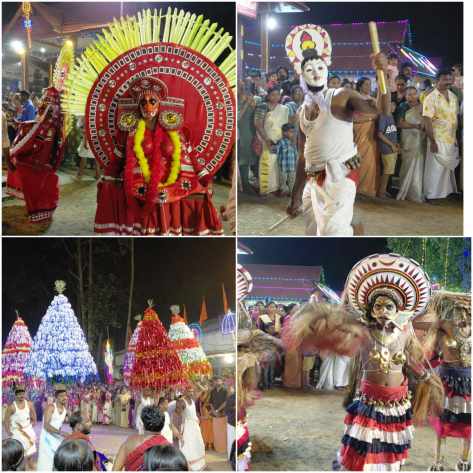
Various Folk artists at Puthukulangara Devi Padayani festival, Othera

Othera is located about 4 km away from Chengannur, the nearest major town that is well connected with major cities like Bangalore and Chennai with direct trains and buses. One can conveniently hire an autorickshaw from Chengannur town to reach Othera.

To be continued as “An Onam Celebration I will never forget at Aranmula Parthasarthy Temple

10 offbeat things to do in Hampi

From a tourist’s perspective, Hampi can be broadly divided into two parts, separated by the Tungabhadra River. The heritage site of historical ruins is in the Vijayanagar district, whilst places of mythological importance and most homestays offering local experiences are concentrated in the Koppal district side (This is popular as the Hippie island). So, if one is planning a trip to Hampi for the first time, this geographical classification should provide you with a brief idea before you arrive there.

Everybody knows Hampi and there is enough content widely available on places to explore in this historical town. But here are some lesser-known experiences that I loved during my repeated visit to this UNESCO heritage site.

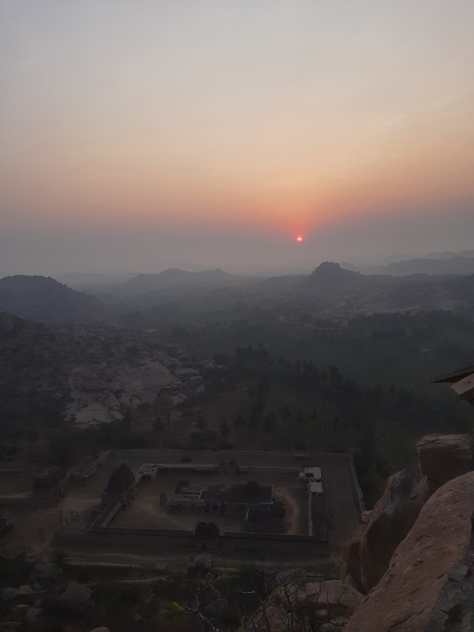
1. Sunrise at Matanga hills: How much amazement can your voracious vision hold? “Boundless” defines the view from the top of the Matanga hills. It was a dreamy view of the entire historical town in its ruined form scattered across the river flowing from one end to the other. And adding to the already picture-perfect frame was a bloody red rising sun in the backdrop. This is by far the BEST sunrise of my life. The early morning climb up the hill and the wait in the cold winds was so worth it that I had goosebumps watching the magic unfold.

Sunrise at Matanga hills

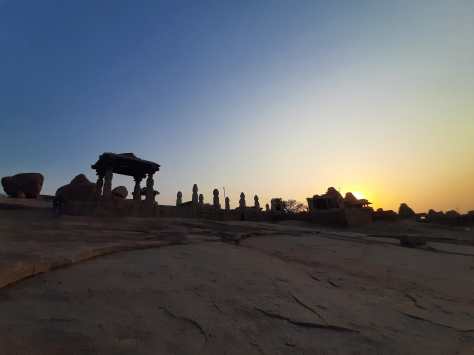
2. Sunset at Hemkuta hills: A short ascent to the rocky hill by the side of the Virupaksa temple leads you to this best spot to catch the sunset at Hampi. Comfortable benches or the grainy-pebbly ground, you can choose the surface to just lose yourself in experiencing the glorious horizons of Hampi turn from Indigo to blue to misty to bright to rosy to a star-studded sky.

Sunset at Hemkuta hills

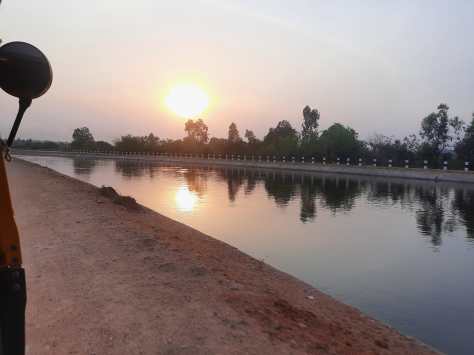
3. Bathing in the canal water: This is a closely guarded secret. There are irrigation canals passing through the villages in which you want to enjoy a quick dip, only if you befriend a local. If you do not get to enter the water, no worries, simply sitting by its side and seeing the time go by itself would be so comforting.

Water canals of Hampi

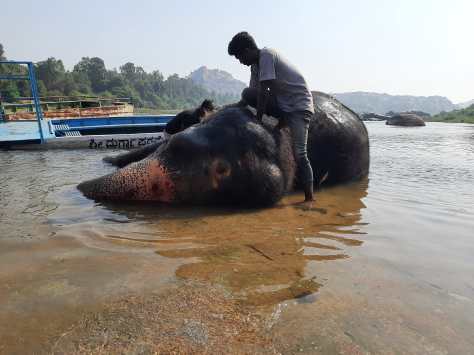
4. Coracle riding & elephant bathing: The river flows right behind the Virupaksa temple, and the temple elephant has a daily schedule of taking a shower in the river. Time your visit right and you can lend your helping hand too. A small ticket can help you cross the river on a coracle-a traditional round flat-bottomed boat built by knitting seasoned bamboo or cane. You can also see locals transporting their bicycles and motorcycles across the river through these boats.

Elephant bathing in Tunga river at Hampi

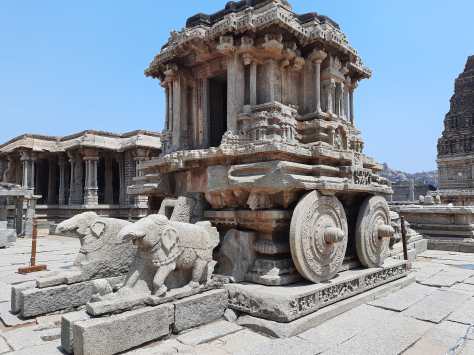
5. Cycle tour around the historical monuments: Several shops rent out bicycles to tourists. If you have a tourist map in hand and the luxury of time, trust me, it is one of the highly recommended ways to explore Hampi. For a little more comfort on a sunny day, you can opt for an autorickshaw with a good driver dueling as your tour guide.

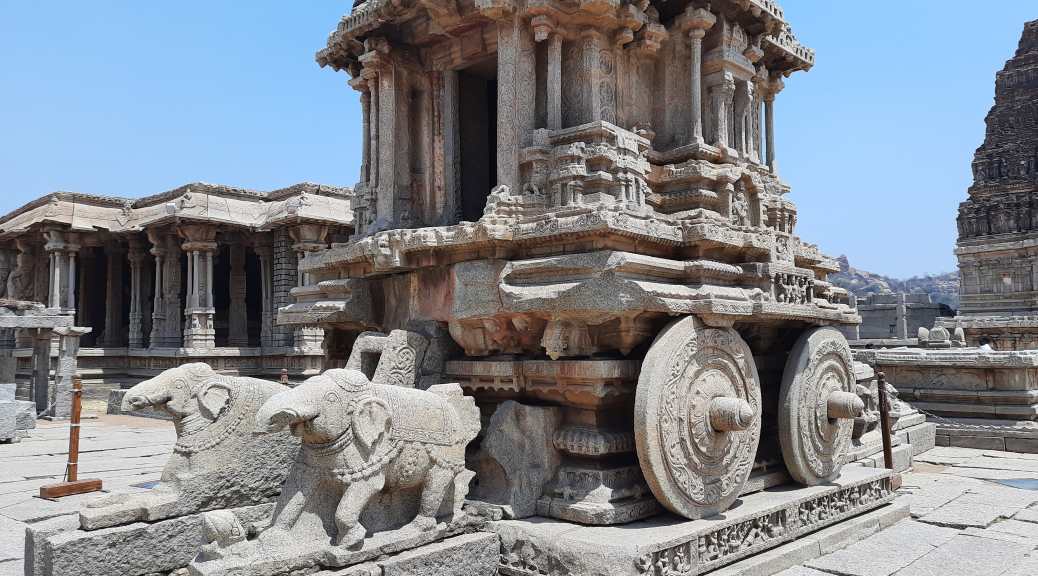
Stone Chariot- Hampi

6. Sunrise at Anjanadri Betta: Believed to be the birthplace of Lord Hanuman, it is frequented by pilgrims which tends to receive higher footfalls as the day progresses. So, if you make it to the peak of this hill as early for sunrise, you can enjoy the view of the surroundings in peace and calm.

7. Sunset at Bala Anjaneya Betta: Another popular spot in the hippie island, it is best when visited during sunset.

8. Bouldering: This area is part of the larger Deccan plateau, and the rocky boulder terrain forms its core geographical feature. Short workshops in free hand bouldering is a great way to either learn a new skill or simply let the inner monkey in you to hang around in the land of the monkey kingdom (it is the birthplace of Lord Hanuman after all).

9. Bike riding in the paddy fields of Gangavathi: Gangavathi is called the rice bowl of Karnataka, and this is where you can see infinite stretches of green paddy fields. Now imagine large boulders and bare old trees standing scattered across these green fields as if they had witnessed all the stories of the past. And then you cut across on a moped or a motorbike casually soaking up this view. Trust me the views will linger in your mind long after you leave Hampi.

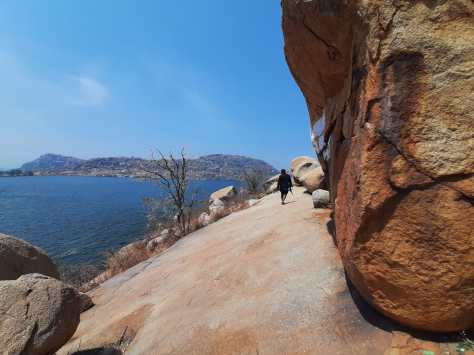
10. Cliff jumping & Coracle riding at Sanapur lake: This is not really a lake but the backwaters of a reservoir. It offers amazing activities to get your adrenaline rushing while you jump off a cliff to the depths and a crazy coracle ride along the rapid of the waterbody. A must do while you are on a trip to Hampi.

Sanapur lake
Sanapur lake

Are you going to try these experiences on your next trip to Hampi? Or what else have I missed out in this list? Tell me in the comments below.

Visiting the Panchabhuta Temples- The Five Elements of Life

There are five temples located across Southern Indian states representing the five elements of life or the Panchabhutas. They are built in such a way that the are all aligned in a single latitude and longitude with respect to each other. Through this article, I would like to share a summary of my stories of visiting each of these temples.

It all started with a family trip, way back in 2014 to Trichy. I had made a long list of places to visit in and around the temple town, and we happened to visit this temple by chance. It was a beautiful temple where the main Linga is believed to have been created by Goddess Parvathi with water from the nearby river. Today, the Linga is surrounded by a perennial stream of water. (Click here to read about my trip to Trichy)

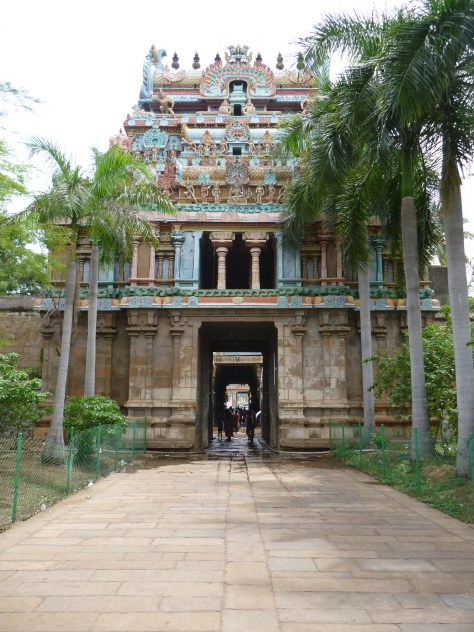
The entrance to Jambukeshwara temple

On a casual day trip with my mother to buy some sarees at Kanchipuram, I also made a list of temples to visit in this town which is also known as a ‘City of 100 temples’. Among the long list of sacred places we visited in Kanchipuram, the Ekambareshwara temple was also one. Here, the main Linga is made out of sand and is believed to have been installed by Goddess Parvati. Shiva is a lover of Abhisheka, however due to the nature of the porous & loose sand of the Linga, there is no abhishekam offered here. Instead, offered to another small bronze idol kept beneath it. (Click here to read about my trip to Kanchipuram)

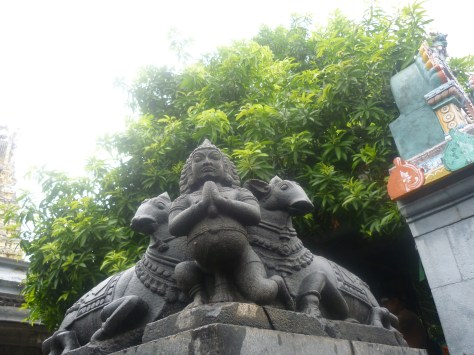
The Sthala Vrushka inside the Ekambareshwara temple

My brother and I happened to explore Chidambaram town during a backpacking trip along the East-coast of Tamil Nadu. We arrived at the temple on time for the first aarti when the doors opened in the evening. We were in the front line when the curtains were raised, and we had a stunning view of the main idol. I instantly felt a compelling energy from the idol in which Lord Shiva is depicted to be performing the Ananda Tandava dance. (Click here to read about my trip to Chidambaram)

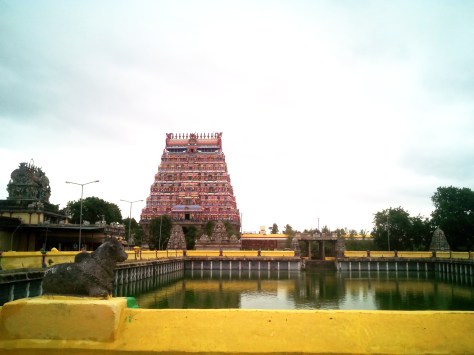
One of the temple gopurams and the holy Sivaganga tank at Thillai Natarajar temple

We halted in this temple town on our way to Sriharikota to watch a rocket launch in 2019. We stood in a long queue to finally get a magical darshana of the Linga here which is made of a massive sized Camphor. Since the camphor is susceptible to fire, there is no direct aarti performed to this Linga. However, an eternal lamp / light is lit behind forming the silhouette of the Linga which indicates that there is continuous flow of air allowing the fire to burn. (Click here to read about my trip to Srikalahasthi)

It was indeed a long wait until 2025 when my wish to visit this temple manifested. I got extremely lucky as my visit also coincided with the auspicious Karthika Deepam. I performed the Girivalam before I got the darshan of the Linga, illuminated by oil lamps around inside the sanctorum. The hill itself is believed to be a manifestation of Lord Shiva and the Karthika Deepam, a representation of cosmic fire (Click here to know more about my Girivalam trip)

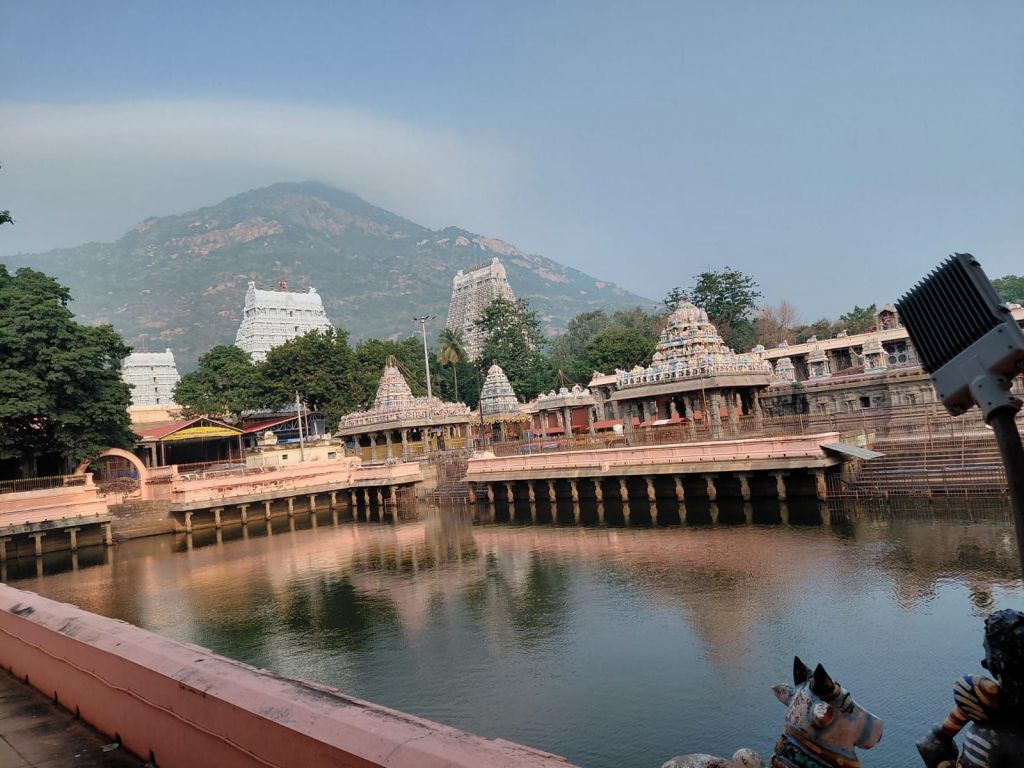
The Tiru-Annamalai hill in the background of the Arunachaleshwara temple pond

The Boad Namme of Chembebellur

‘Boad’ in Kodava language means to beg/ request. ‘Namme’ translates to ‘festival.’ Thus, the ‘Boad Namme’ can be loosely called as the festival in which the people of Kodagu request ‘Goddess Bhagavati’ to grant their wishes.

The Boad namme is observed across Bhagavathi temples located in several villages in the southern part of Kodagu district, in series. The first Boad of the year starts at the temple of Kunda and the last one is observed at Parana village. Kudure (Horse) worship is an integral part of the Boad namme. In this, a young boy belonging to a designated clan from the respective village dresses up in the costumes of a horse and participates in the various ceremonies during the festival. Hence, it is said that ‘Kundath-ra Bott-le nenda Kudure, Parana mani-le ilinja Kudure.’ Translating to ‘the horse which rises at Kunda will only settle at Parana.’

I will talk about these two Boad festivals in separate posts. Among a series of all other Boad namme that are observed across villages in South Kodagu, I am starting from the middle, at Chembebellur village. The Boad Namme of Chembebellur is among the most popular of them all. It is observed over a period of four days and usually happens around the last week of April of each year.

Day one is Pattani. People belonging to all the native clans of Chembebellur observe ‘Fast’ on this day.

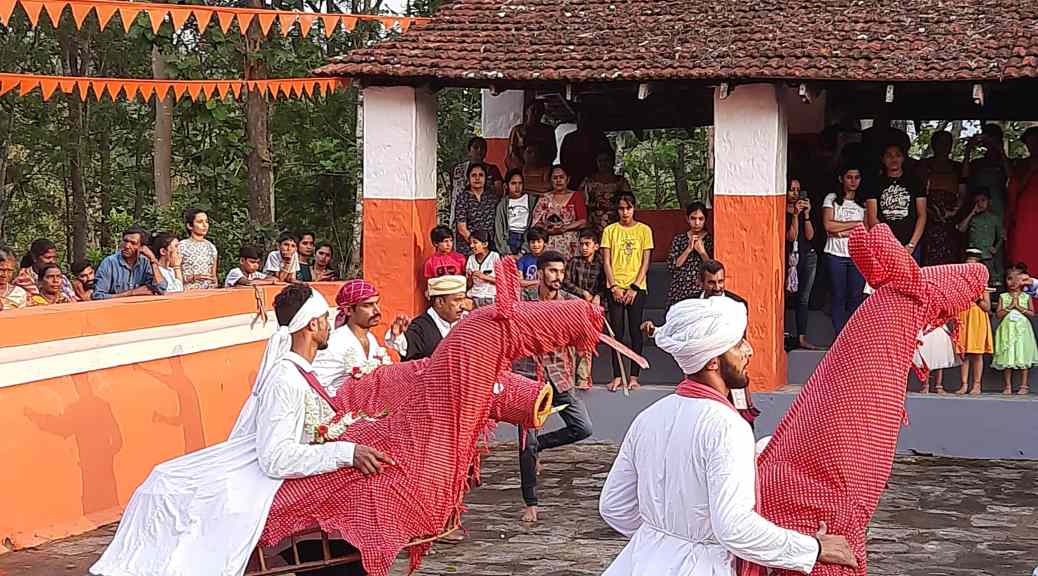
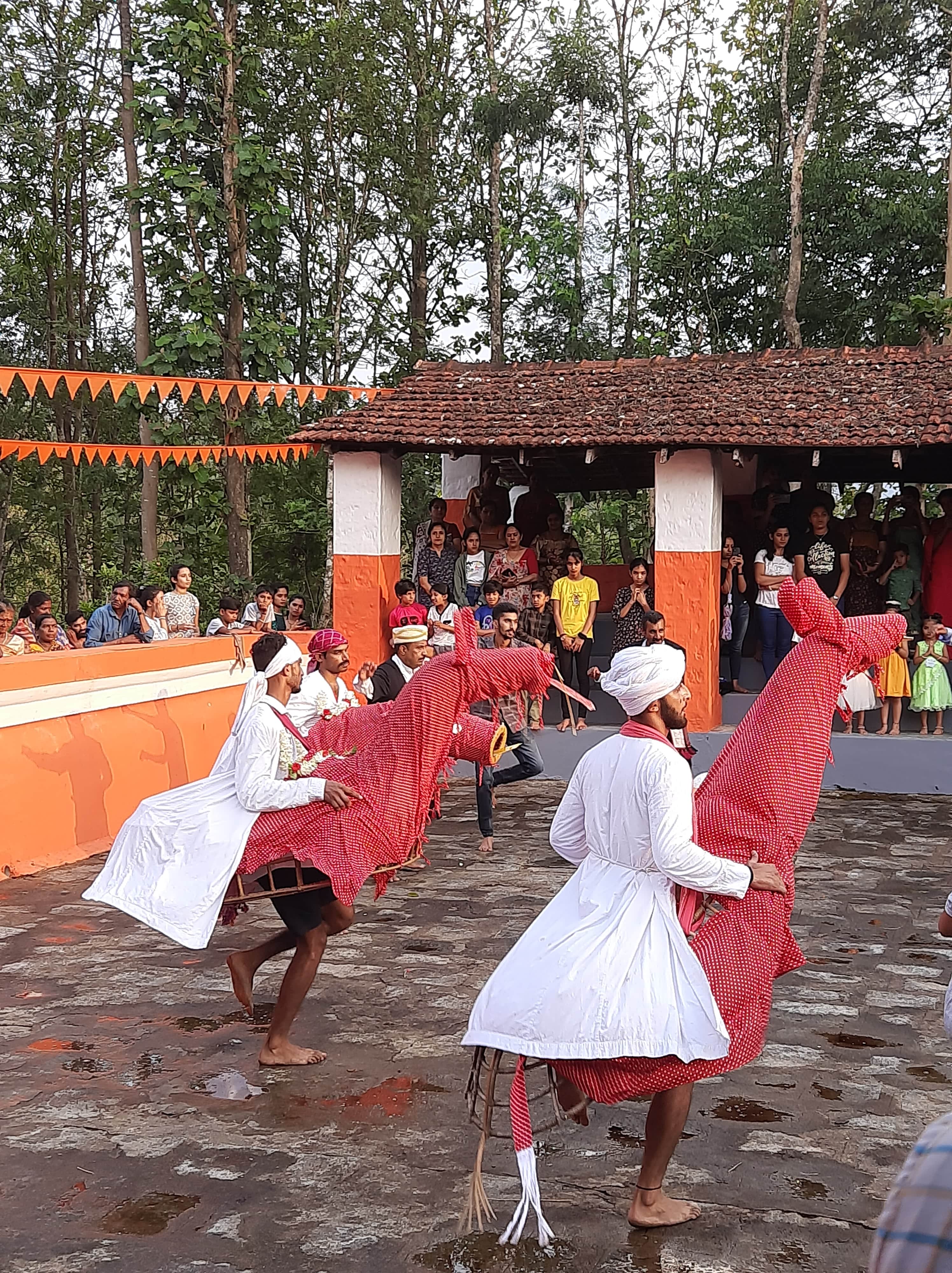
Day two is Kudure. Three young boys representing three clans of the three main Keris (areas) of Chembebellur i.e., Ajjinakanda clan of Podakeri, Coluvanda clan of Podakote and Chembanda clan of Nadikeri wear the costumes resembling horses (Kudure) and start from their respective Ain mane (clan’s ancestral home). They are accompanied by men impersonating other local deities of the village like Choundi, Aiyappa and the others during their march towards the Bhadrakali temple where they all assemble and hold the following rituals. Post this, there is a fire set up in front of the temple in which effigies are burnt.

Kudure at Chembebellur Bhadrakali temple
Day 2: Kudure at Chembebellur Bhadrakali temple

The gathering then moves towards the village’s ‘Eshwara temple’ where the rest of the men and boys of all age groups dress up in various costumes. This dressing-up is a form of a vow they make to invoke Goddess Bhadrakali’s blessings. The costumes could range from traditional Bund-kali (Mud-smearing), Pill-Bhoota (Hay man), Puli-vesha (Tiger costume) etc. to more modern forms of cricketers, Llamas, swamijis, seducers etc. These dressed up men folk visit every house of Chembebellur asking/begging’ for alms all night and it is a fun time for all the households who host these men in the houses.

Day Three is Boad. This part of the festival is the most awaited and the highlight of the four-day celebration. All the dressed men congregate at the Bhadrakali temple in the afternoon. They are accompanied by the men impersonating the local deities as well. They all together circumambulate the temple thrice and go around begging form alms from the thousands of people who gather there to participate in the festivities. The end of the circumambulation marks the end of the Boad where all the men collectively offer all the money collected through begging to the Goddess and seek her blessings.

Day 3- Boad festival at Chembebellur Bhadrakali temple

Day four is Choole. Young boys who are yet to reach adolescence, cross-dress in attire of Kodava women and offer their prayers at the Bhadrakali temple. This day marks the end of a fun and yet traditionally rooted festival of Chembebellur, paving way for a Boad namme to start at yet another village of South Kodagu.

Disclaimer: The purpose of this article is for documentation of lesser known festivals of India. The above information is only based on what I could gather by discussing with people who had gathered at the temple. My apologies for any wrong representation. Readers are welcome to contribute any information that is deemed important and useful to be shared here.

The Hoysala Trail 2- Belavadi

In my wish list to visit as many Hoysala temples as possible in this lifetime, this is the second documentation. I started this series with the temples of Belur and Halebidu, as these were the erstwhile capital cities of the Hoysala. I will move on from there.

Continued from The Hoysala Trail 1- Belur & Halebidu

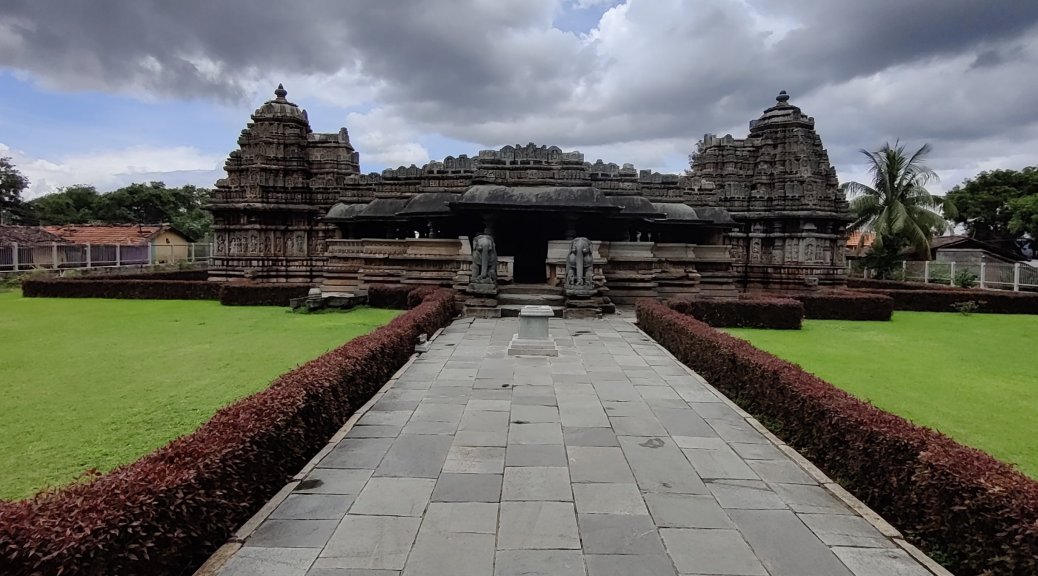
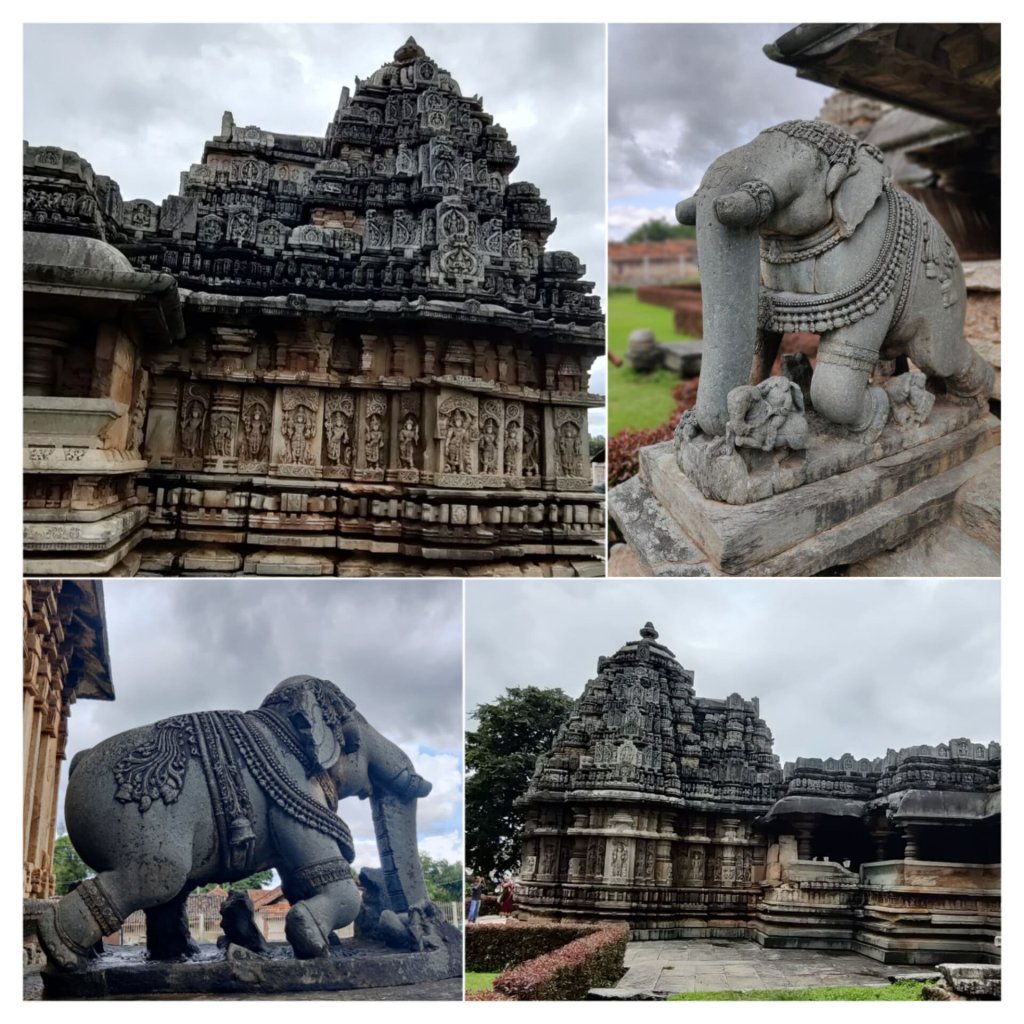
Belavadi is a quaint little village located approximately an hour away from the Hoysala capital town, Belur. The Veera Narayana swamy temple of Belavadi is one of those where the main idol of the presiding deity is still intact and regular prayers continue to be offered. The intricacy of the artwork on stone is very similar to that of the temples at Belur and Halebidu.

Veeranarayanaswamy temple, Belavadi
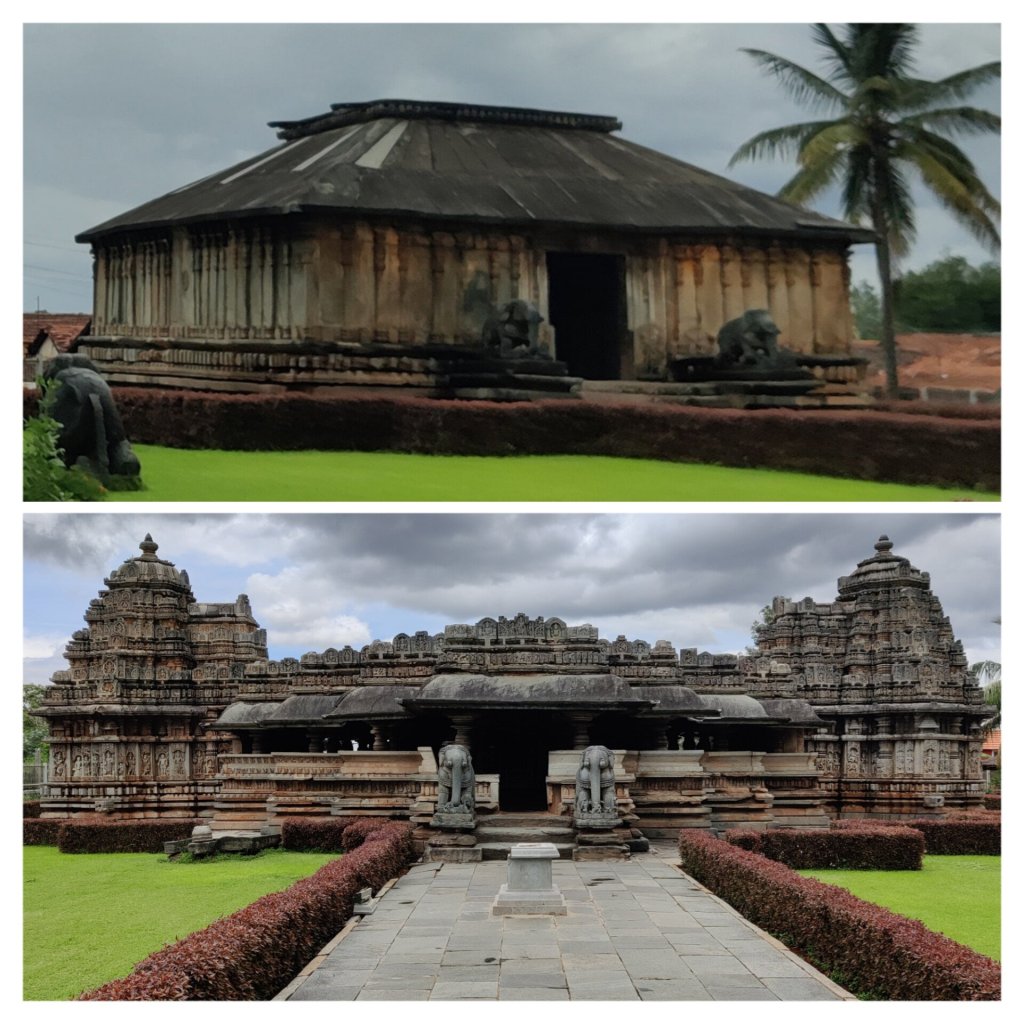
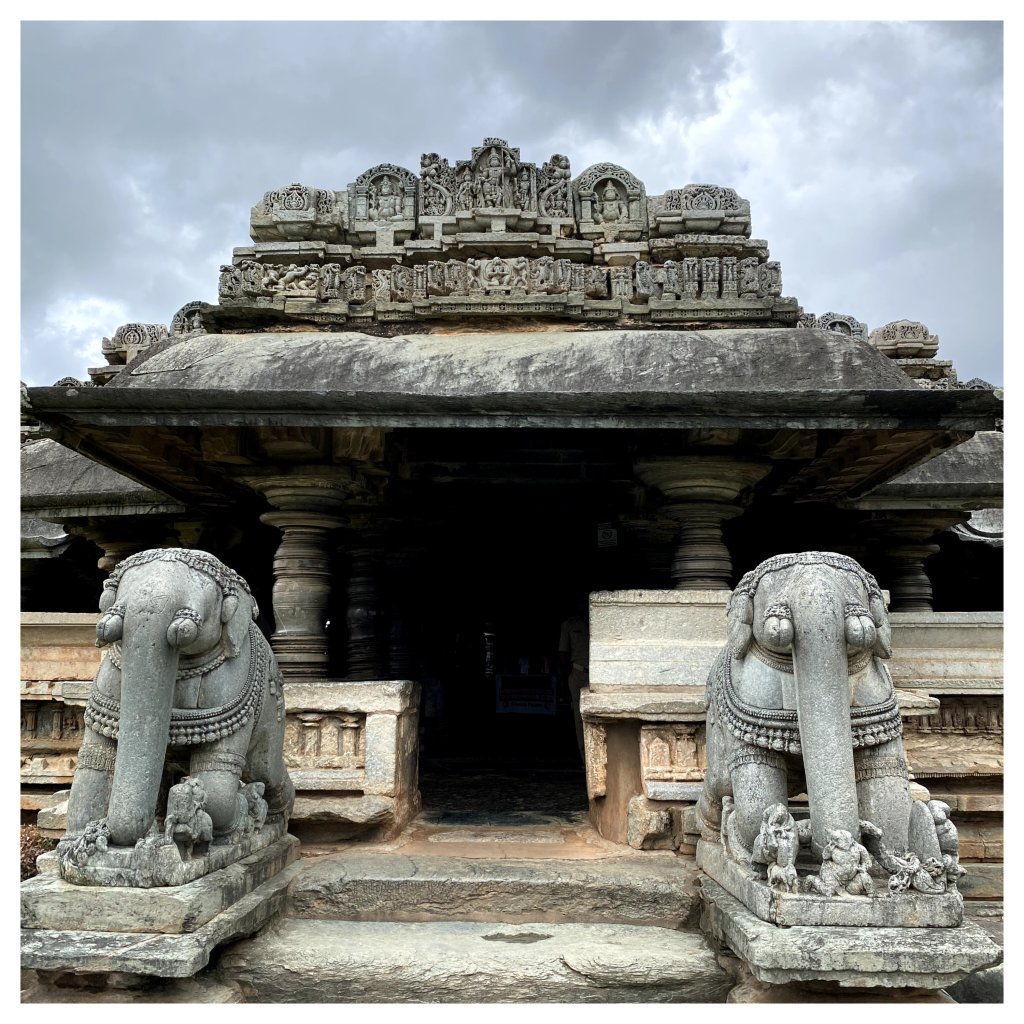
Images: Veeranarayanaswamy temple, Belavadi Top: Outer entrance gate to the temple Below: Inner entrance to main shrine at Veeranarayanaswamy temple, Belavadi

Unlike the main Gopuram (temple tower) at Belur, the entrance gate at the Belavadi temple is small. There are two ornate statues of two elephants that greets you inside. The sculpture on the outer wall is simple and minimalistic. as you enter, you notice that the inner walls are plain. It is possible that these were stolen, vandalized, or lost over the course of time, only historians can tell me better.

Veeranarayana swamy temple, Belavadi
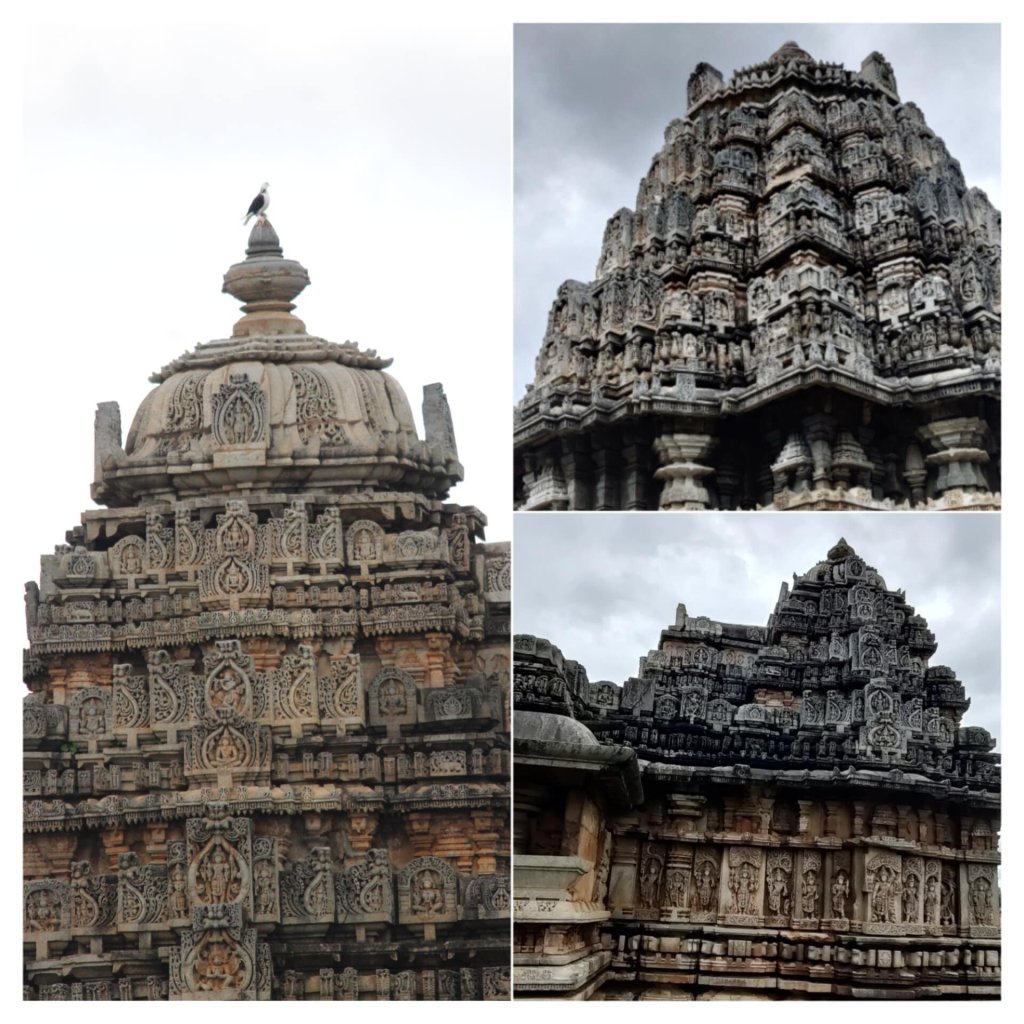
The sculptures on the exterior of Veeranarayana swamy temple, Belavadi

As you walk past this entrance gate, arch you pass the courtyard and are greeted again by a pair of standing elephant statues into the main temple that encompasses the shrines in the trikuta style of temple architecture. The three shrines inside houses idols of Lord Vishnu in three different forms. Huge lathe turned stone pillars and walls bearing fine and intricately carved figurines adorn the inner walls of the temple where photography is prohibited at the time of my visit (in July-2022).

Veeranarayana swamy temple, Belavadi
The Trikuta temple towers at Veeranarayana swamy temple, Belavadi

The outer walls are equally gorgeous too with intrinsic stone carvings and embossings all over. Due to limited permissions for photography, my photo story here consists only of photos of the exterior of the temple, but more than sufficient to give an idea of this marvel.

Veeranarayana swamy temple, Belavadi
The inner and the main entrance of Veeranarayana swamy temple, Belavadi

Also, a walk around the tiny hamlet of Belavadi is highly recommended. I loved the unique design of these traditional houses that emanated a vibe of an old world.

To be continued as Hoysala Trail 3

A compilation of art and science from the by-lanes of India

I am an art enthusiast by passion and an engineer by qualification. I seek to be an art aficionado and a curious kid within me is always on the lookout to learn how things are made and work. In fact, I believe the best art is created by the culmination of science and creativity. As a traveler, I do not miss a chance to visit and interact with artisans and understand how they make things what they are good at.

When I travel to a new place, I try to accommodate time to explore the lesser touristy streets of any place because according to me, the real soul of any place lives in its by-lanes. I try to meet enthusiasts (across genres) and visit their creative abodes or workshops to see things take form.

Here is a compilation of such posts describing the souvenirs that combine two worlds of art and science which one can buy when visiting these destinations.

  1. Bangalore : HMT Watches
  2. Rajahmundry: Ratnam fountain pens
  3. Aranmula: Metallic mirrors
  4. Bastar: Metal crafts (wrought iron and bell-metal crafts)
  5. South India: Bronze icons

How many of these souvenirs have you collected, yet?

A Rare Connection of Hockey Between Karnataka and Tamil Nadu

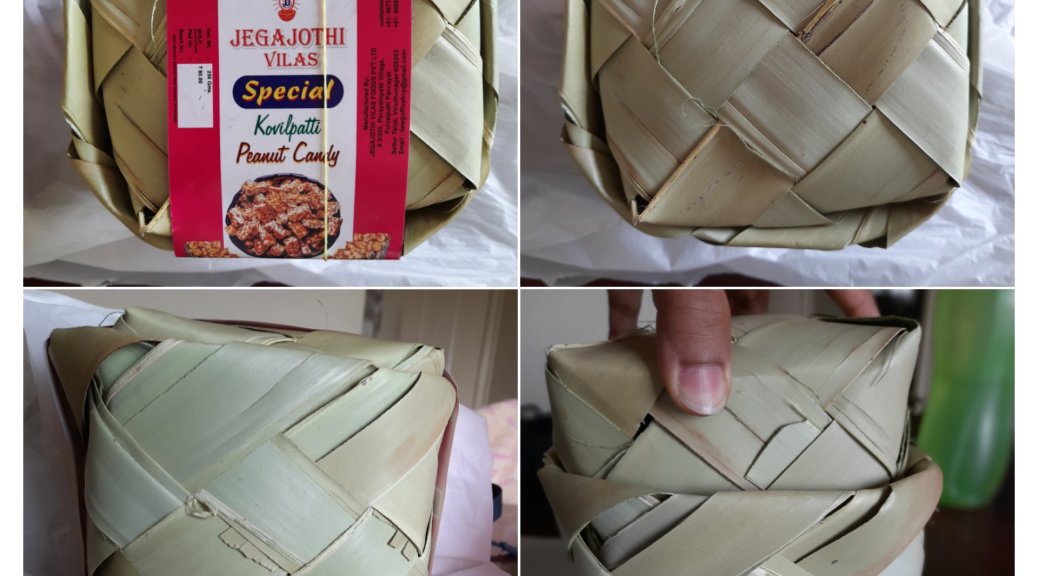
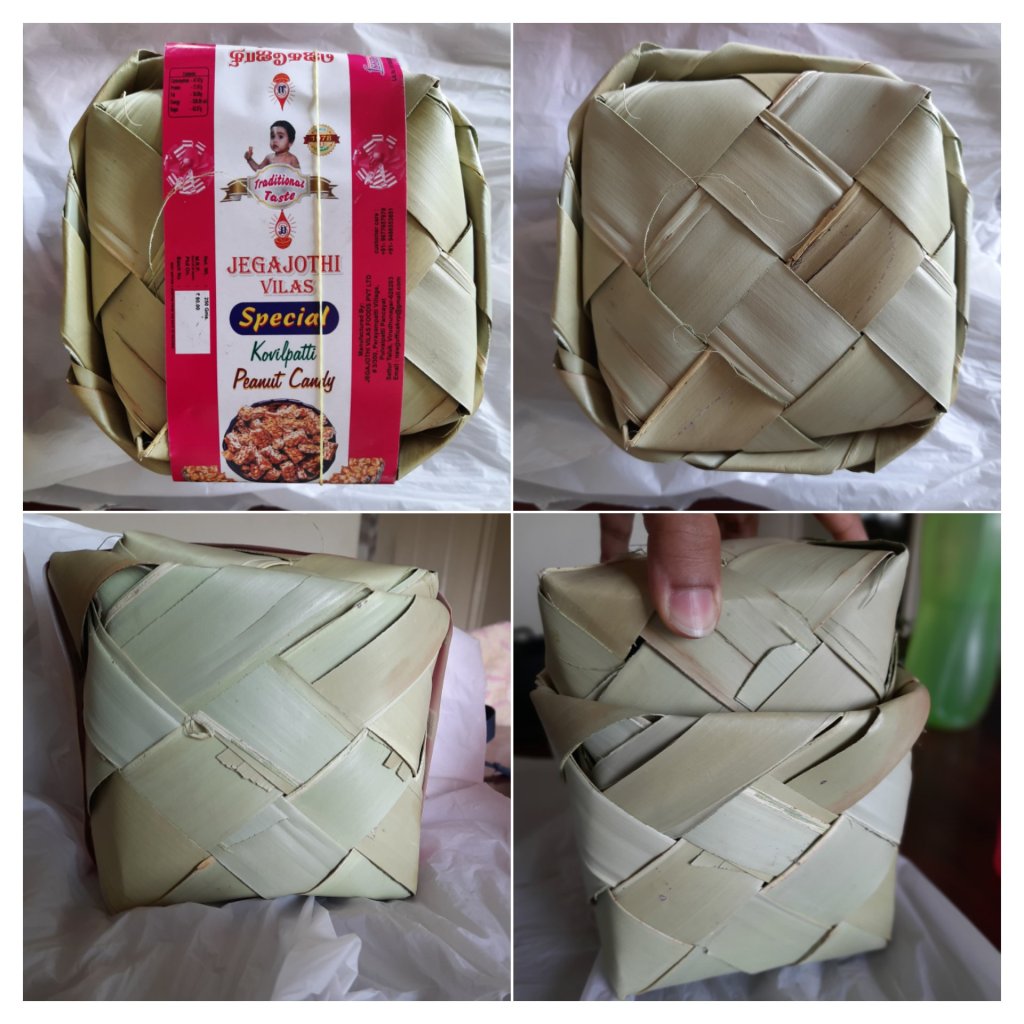
I have been fortunate to meet many like-minded people online, through travel blogging. Recently, I happened to meet one of such friends offline, during his visit to Bangalore. He greeted me with a souvenir, a nice palm leaf box containing chikkis. He explained that it was the ‘panai olai petti’ containing the famous candies from his hometown. After I returned home, a little bit of online browsing about this souvenir unfolded some interesting facts for me.

The palm leaf box containing the Kovilpatti chikki

Talking about the southern states of India, two neighbours have a lot in common. What triggered this thought were the names of places starting with the letter ‘K’, one from each state. Kodagu and Kovilpatti from Karnataka and Tamil Nadu respectively. Meanwhile, the ‘C’ is what makes these two ‘K’ places famous. ‘Cauvery’, the holy river originates in Kodagu and ‘Chikkis’, the peanut candies of Kovilpatti has earned a GI tag for itself. Enough is written and done on the internet about either of the places.

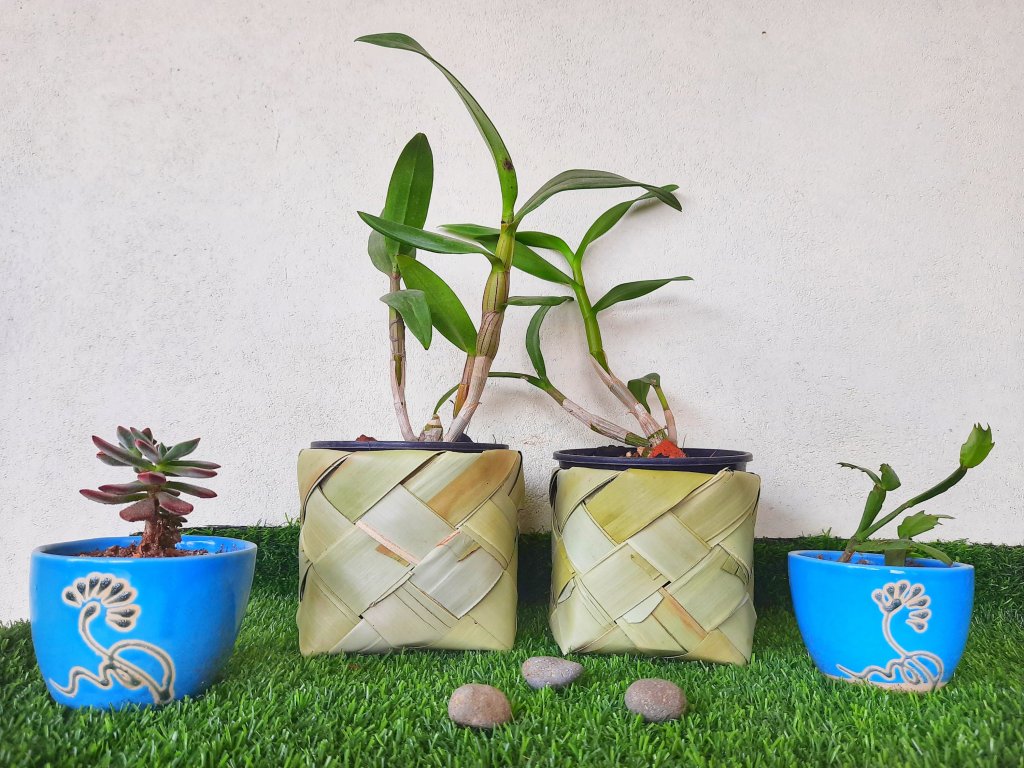
Palm leaf boxes of Kovilpatti mithai being Repurposed as planters

But what turned out to be more surprising and a rather rare connection between the two ‘K’ places of these states is their common love for the National sport of India- Hockey. In my earlier post, I have mentioned how the largest festival in the world dedicated for any sport (hockey) is celebrated in Kodagu. But what I learn now is that Kovilpatti too, shares its history with Indian military and the influences of the British to have a strong hockey culture. With at least a dozen hockey clubs and several players making it to the Indian national team over time, the people of Kovilpatti have an unabated enthusiasm for the national sport.

What I do know is, that there are several other lesser-known places in India where people celebrate sports other than cricket. Only initiatives by governments, support from sponsors and adequate media publicity can encourage and motivate more people to nurture a sporting culture in our country, anything other than cricket.

I Belong to Everywhere: Chamarajpet

This is an attempt to bring back nostalgia. Continued from- “I Belong to Everywhere: Malleswaram

Chamarajpet is one of the two well planned residential areas of Old Bengaluru. Chamarajpet is in the South whereas the other one is Malleswaram, in the North of the original geography of Bengaluru. Chamarajpet is where my parents lived and worked through all the years at the time of my schooling at Madikeri. So, this locality is like my 1.5th home 😛 (first home is in Madikeri and 2nd home was at Vasanthanagar). I came to Bangalore (and thus, to Chamarajpet) only when I had a long vacation from school. Twice a year, to be precise: Once during the monsoon and once during the summers).

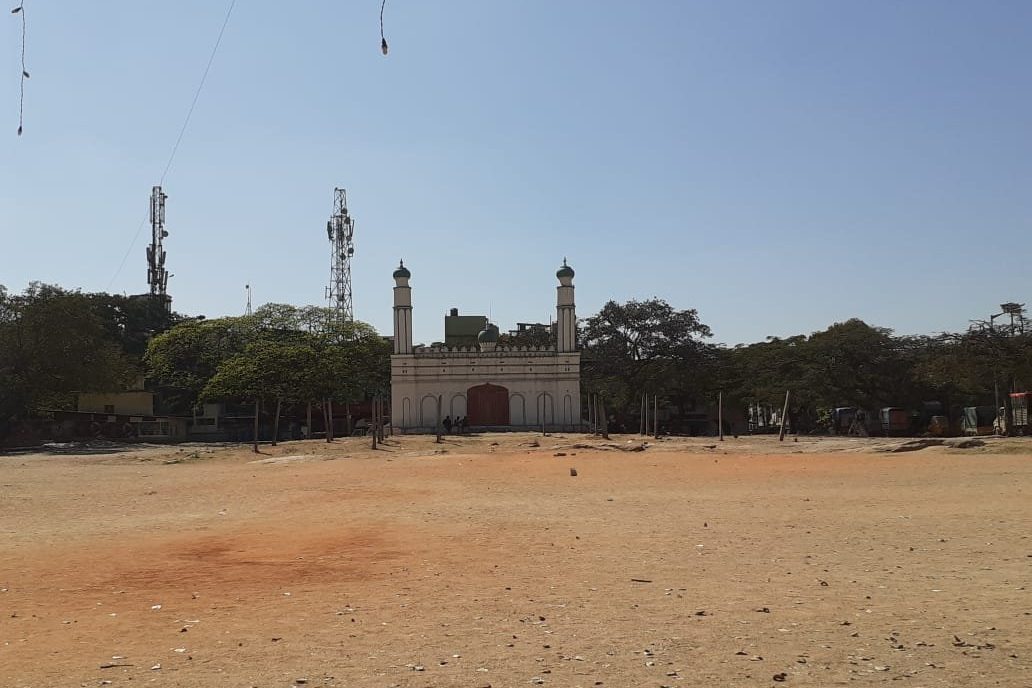
One of the earliest memories I have from this locality is of my family and all our neighbours watching and distributing drinking water and snacks to people who gathered for prayers during festivals at the ‘Eidgah grounds‘ and for the all-night harikatha renditions that happened at the ‘Male-Mahadeshwar temple’ in 2nd main. A large jamun tree in the premises of our house was often mobbed by kids from the entire locality for its fine fruits and the aroma of Rasam from the ‘Vataaras’ of 3rd main are some unforgettable memories.

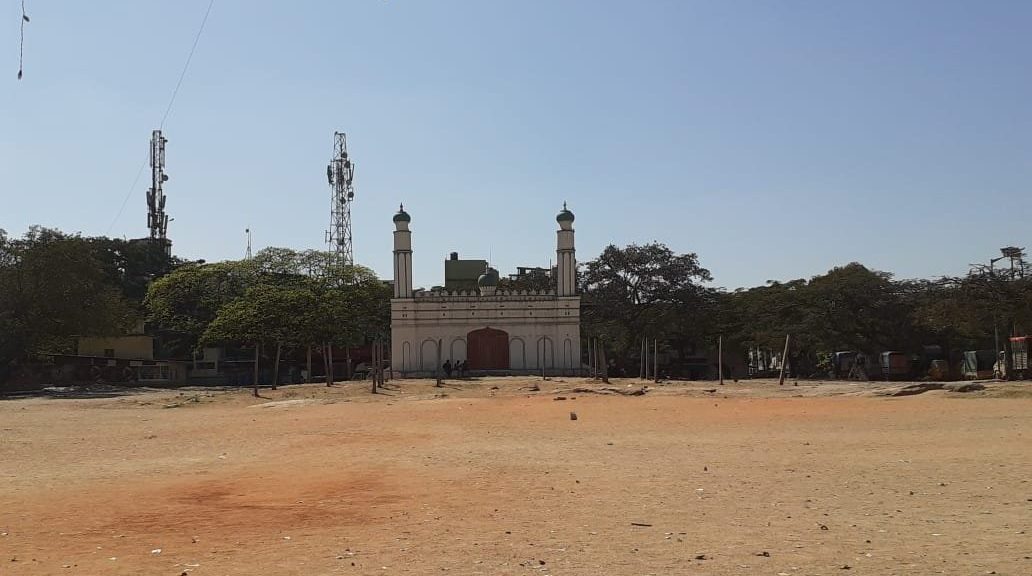
Eidgah ground at Chamarajpet

There were several things that I saw on TV (Doordarshan) and wanted to learn along with regular school while growing up. But there was unavailability of trained people who could teach me any of these extra curricular skills in the small town (Madikeri). Whenever I visited Bangalore during vacation, my effective time spent with my working parents were mostly for eating out in the evenings and making day trips over the weekends. A major chunk of my Bangalore visits was mostly meant for attending summer schools. With a very large community of literary scholars living in and around Chamarajpet, I could learn different art forms. I attended crash courses across various streets of Chamarajpet (and Basavanagudi) to learn sketching, painting, dance and music.

Every stone, structure and lane has history in Chamarajpet. Makkala koota, Bangalore fort area, Tippu’s palace, all the temples around the fort and the old pete area: Talk about them to my mother and she would be in tears of nostalgia. These are the places she saw every day during her career that spanned nearly four decades.

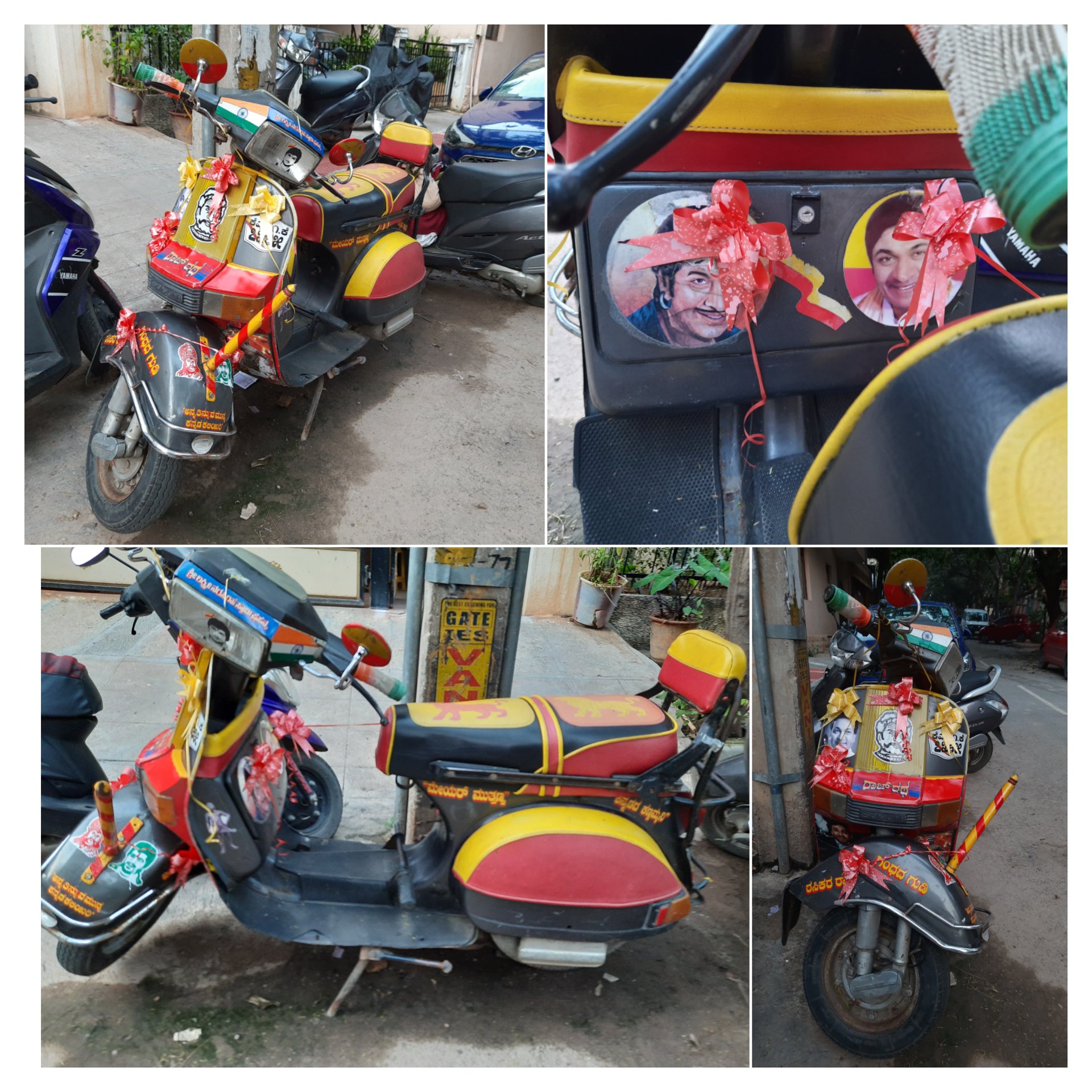
A scooter decked up in a Sandalwood theme (Kannada film industry)

Talking about my family’s favorite eateries, many things have changed and so many old-world structures have been erased now. However, Karnataka Bhel house in 3rd main road along with Gajanana fruit juice center and Iyengar’s bakery in 4th main have managed to stand the test of time.

My family has lived here for 15 years and there is a bond with every lane and its people that we share in Chamarajpet. Here live so many friends, who are more than family to us! Going to Chamarajpet every time is nothing less than travelling to our hometown! So, it is definitely difficult to quantify how much part of me belongs to this area!

To be continued as- “I Belong to Everywhere: Theralu

A souvenir from Rajahmundry- Ratnam pen

This was a part of our family’s five state road trip covering Chhattisgarh – Odisha – Andhra – Telangana – Karnataka in Dec’20.

They say a pen is mightier than a sword. A good writer can win a great battle. I guess it has been all the more true in the Gen-Z era. Although the pen has been replaced with keypads, the social media warriors have continuously upped the war of words 😛 But for a few old-school goers like me, nothing can replace the joy of holding a pen between the fingers and scribbling on paper. The thought instantly takes me back to the earliest days of life when I graduated from a chalk and slate to a pencil and paper. When we reached middle-school, I was a proud owner of my first pen. Writing with a pen was a symbol of growing up; we flaunted it around with those younger than us in school. “Don’t use a ball-point pen, it will spoil your handwriting“, was an instruction given by a teacher to all of us. Filling ink into the fountain pens was a mandatory part of our daily chores. On days that we either wrote more or forgot to fill inks, we would barter drops of ink with our classmates. Although ball-point pens made their way and stayed in the comp-boxes of my pals by the time we reached high-school, I somehow carried the instructions of my teacher with myself for a little longer. I switched over to a ball-point pen only after I graduated from college. But my love for fountain pens and writing on paper still lives on. This is the long story in short, about my connection with fountain pens.

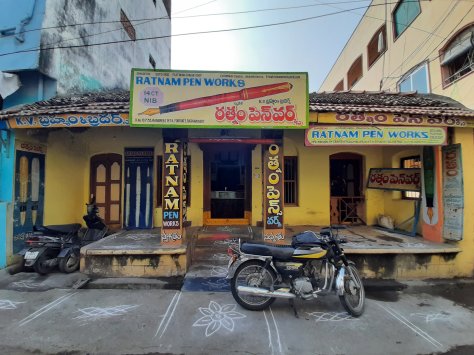
Rajahmundry is a big city in Andhra Pradesh. It is one of the largest exporters of textiles, rice and horticultural products in India. But ignoring all that, my need for exploring the congested bustling streets of the city was to find a fountain pen. With the help of Google maps, I walked through the narrow lanes of the busy shopping area to locate an old graceful house dating back to pre-independence era and surrounded by tall modern buildings. The house was an elegant traditional structure built and maintained in its original form with clay tiled roof and a large open central courtyard. That morning, I had come there to buy an art piece – ‘The Ratnam Pen’.

Ratnam Pens- Manufacturing and Sales Outlet

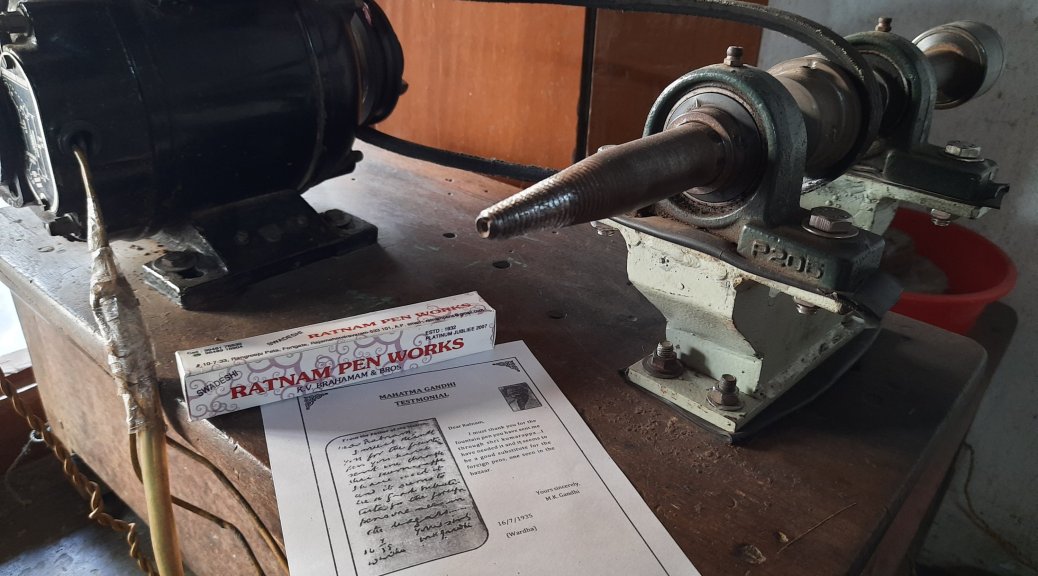
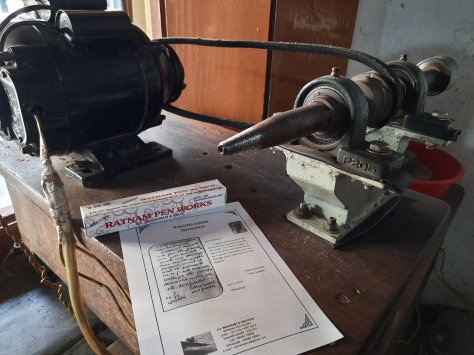
‘Ratnam pen works’ is a heritage fountain pen maker who has been one of the earliest in this business when Mahatma Gandhi largely promoted ‘Make in India’ concept through his ‘Swadeshi’ movement. These pens have been used by some of the famous personalities from across the country and the world. Ratnam pens are a delight for every pen collector. A framed paper on the wall is a prized possession of this craftsman. It is the original copy of a handwritten letter by Gandhiji to the owner of this place in appreciation of his contribution towards the swadeshi movement.

A copy of Gandhiji’s letter, a fountain pen case and the lathe machine at Ratnam pens workshop

Apart from being the shelter to the owner’s family, this house of ‘Ratnam pens’ is a workshop where the mightier pens take form. These famous fountain pens are made and sold only here to which people come down from across the globe. Although these pens are unavailable for online purchases, “Anyone interested to buy them or want spares and service for existing products can do so by calling me directly on my phone”, the owner says. I was more than excited to lay my hands on this new addition to my collection of pens. A happy me was then set on continuing my travel towards another noteworthy village nearby- Details on my next post 

This is my humble attempt at promoting domestic tourism and local artisans. I urge my readers to support small businesses by buying locally produced substitutes for imported goods.

What is that one favourite souvenir you have bought from your travels? What are your memories from school? Please do share your thoughts on this post with me. I would love to hear them.

A Tour of Indian Foundries- Investment Casting

In this post today, I like to discuss a technical subject by standing in the shoes of a traveler. During my student life, I have never been in a race to become a top-scorer. However, it was Professor Mukunda’s enthusiastic teaching method, that ‘Material science and Metallurgy’ has been one subject that I topped the department (I like to show-off a bit, with those dark glasses emoticon). With an in-hand admission letter to one of the top universities to pursue a post-graduation in the subject, the lostlander deviated along the way, only to become a professional ‘Metallurgical Failure Mode Analyst’ much later in her career. If not for Prof.Mukunda, a seed of interest in the subject would have never been sown and I wouldn’t be writing about such an unconventional travel post, it seems.

Metallurgy is a science in which India has mastered from even before the world could imagine. The Vedas have a devoted section to teach these techniques. Prof.Mukunda’s favorite topic was ‘Metal casting with the lost wax technique’. His face beamed in joy every time he mentioned the intricacies that were achieved in the metal art thus created. “No two pieces that are exact replicas of each other can ever be created”, he stressed. We had foundry visits as part of our curriculum but that’s where we could only see sand, centrifugal and other forms of metal casting. Without having easy access, investment casting, also called as the ‘lost wax technique’ of metal casting was only left to our imagination. Many years after my graduation, I have been fortunate that I have been able to visit some of the amazing and traditional foundries in my country that practice the lost wax technique. These places have got them their individual ‘GI’ tags. Here is a walk through my foundry visits which I believe I should share with my fellow readers.

Idols of Swamimalai:

Swamimalai translates to the ‘Hill of the Lord’ that is named after an important temple in Tamil culture dedicated to Lord Murugan. This little town is famous beyond just this holy abode. One doesn’t need explanation at the mention of the bronze idols of the Cholas era. Apart from several of these antiques being prized possessions at museums across the globe, these treasures are among the highly traded commodities in the black market. These are ALL brought to form in Swamimalai. It is believed that the artisans of Swamimalai are a group of skilled men called as the Stapathis who have passed on their heritage of metal idol making, since the 12th century. The precision of composition and the measurements of these metal idols, mostly bronze are followed as per the ‘Agama Shastras’. This holy land of the alchemists was a part of my weeklong backpacking with my brother, back in Year-2015.

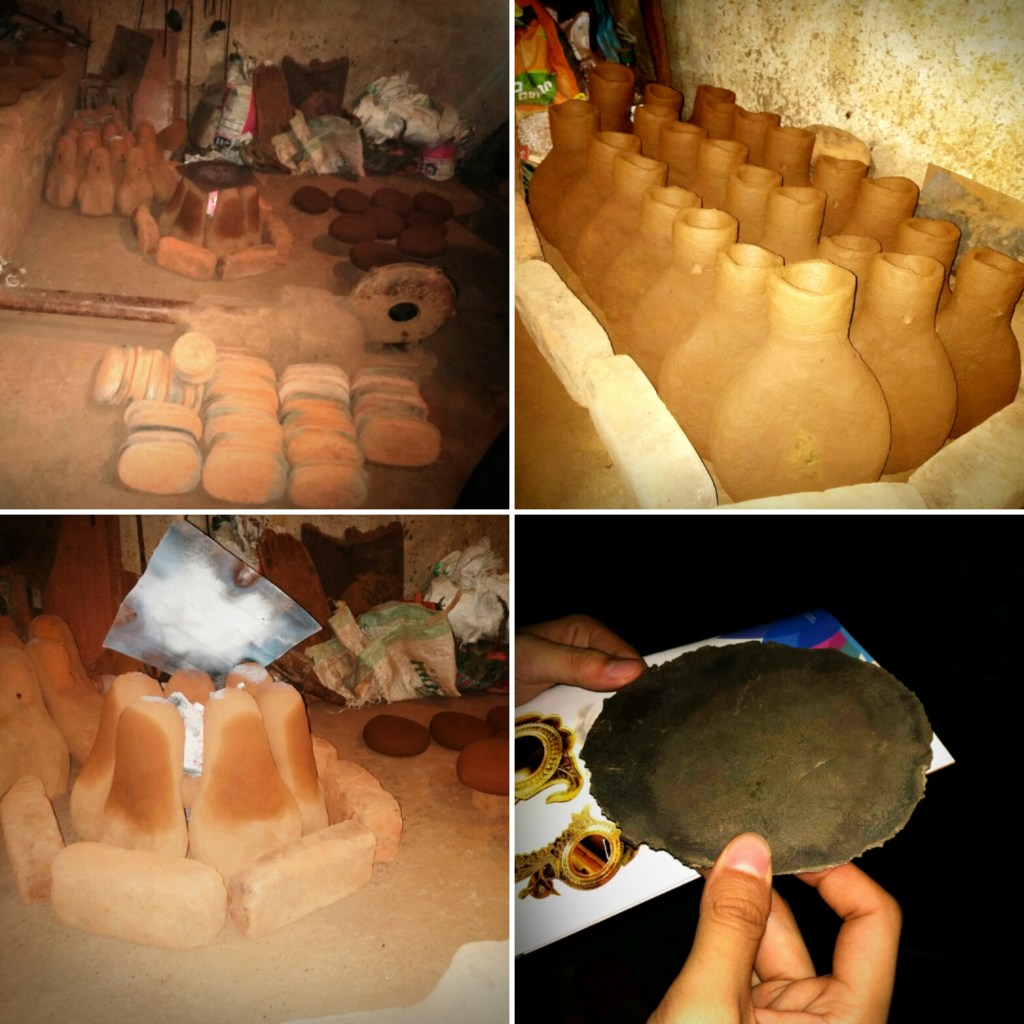
Work-in-progress at a foundry that makes Aranmula Kannadi
Clockwise from top left: 1. Raw material for mould making with the furnace and blower 2. The mould 3. Furnace 4. Metal sheet after moulding ready to be polished

Aranmula Kannadi:

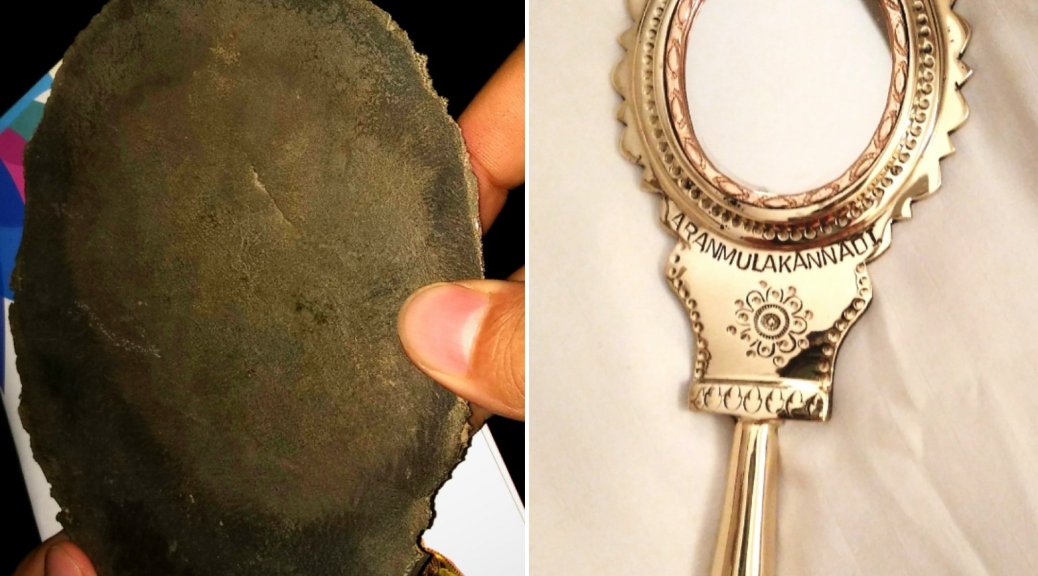
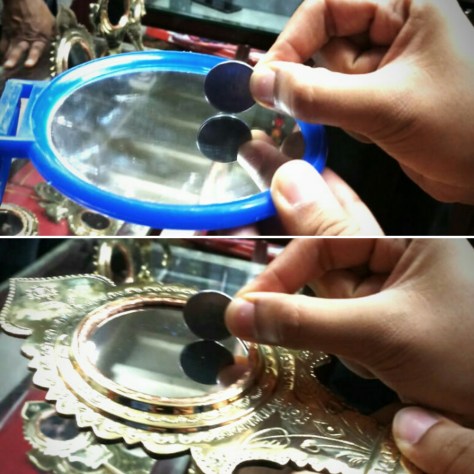
An extremely important part of malayalee culture, this handcrafted mirror is a quintessential part of Kerala. I was told that on the day of ‘Vishu’ festival, after waking up in the morning- he/she should first see themselves in an Aranmula Kannadi placed alongside the ‘Canacona flowers and a lit oil lamp’ before anything else. ‘What is it about a mirror?’ a person unknown to the traditions of this land might ask. ‘These mirrors are not glass!’ These mirrors are super-polished metal surfaces that are capable of reflecting real images. A glass always reflects a secondary image (you can notice that there is a distance from the reflecting surface to the image formed) whereas, the metal surface reflects primary images (There is no additional distance between the object and the image).

Two images that give the comparison of reflection in a glass and a metal mirror (Aranmula kannadi)
Top: The secondary reflection in a glass mirror; Below: The primary reflection in a metal ‘Aranmula Kannadi’ mirror

These manually polished mirrors are created through investment casting whose composition remains to be a secret that is passed down through generations of just 1 family. The small group of these master craftsmen who are protecting their secret recipe of the Malayalee culture all reside around the Aranmula Parthasarthy temple in the state of Pathanamthitta. I had the esteemed opportunity of visiting one of these foundries when I sneaked out after working hours on one of my business trips in Year-2019.

Video of my visit to the mirror making foundry at Aranmula

Dokra art of Bastar:

This non-ferrous metal art is created by the forest dwelling tribes of Chhattisgarh. Historians believe that this art has evolved from what was used by the primitive tribes to create figurines of their local deities for worship and for jewellery purposes. The metals used were earlier collected directly from earth in the mineral rich area of Bastar, then smelted to separate the desired elements and mixed in intended proportions to form the final material for casting. This is an undocumented tribal technique that has been passed down through several centuries. Today, it is widely used for commercial purposes of decoration and gifting. It is now revered as a part of the tribal culture that represents the state of Chhattisgarh. I had an opportunity to visit one of these foundries and observed keenly the lifeless metal take form into art during my family’s five states’ road trip in Year-2020.

Work-in-progress at a foundry that makes Dokra art in Bastar
Dokra art at various stages of metal casting

Kola masks of Karkala:

Talking about all these foundries, I cannot be leaving my homestate behind. Although the folk art of metal mask making is slowly dying, these masks are an extremely important part of the culture of the Tulunad region. These bell metal masks are used in the spiritual performance of the ‘Bhoota Kola‘. Today, the art is used beyond mask making and can be seen in idols, lamps, bowls, utensils among other things used and sold extensively in Udupi district of Karnataka.

The lamps and idols of Nagamangala:

The contribution of the Hoysalas to the art and heritage of Karnataka cannot be justified with any number of words. Their intricacies and detailing in their work can be seen not only in the stone sculptures of their temples but also in their metal crafts. A few of the practitioners of the Hoysala style of metal casting have saved and passed on their knowledge to a few artisans who have made the town of Nagamangala their home. This thriving art can be seen in the traditional bronze lamps widely used across Karnataka and in the idols of various deities in this region. Although bronze is believed to be a godly material, other metals like tin, copper etc. too are cast into various articles using this technique.

This post is my small attempt towards promoting local art. I look forward to influence at least a few of my readers to learn more about the rich heritage of India and encourage local artisans in various ways possible. Do share your thoughts with me through the comments below.