Tag Archives: Southeast Asia

A Grand Celebration of Masks- Padayani Festival at Othera

Continued from ‘Celebrating the chariot of light- Purapaadu Festival at Cheriyanaad

In my previous post, I had told you that I returned to Pattanamthitta more often than I expected. I was in Chengannur again to experience yet another festival. In this post, I am going to talk about my experience of the Padayani festival at Othera.

Padayani loosely translates to ‘Row of warriors’ in Malayalam. It is a ritualistic art form involving folk music, dance, theatre and hand-painted masks, observed in several Bhagavati temples across central Kerala, particularly in and around Pattanamthitta. ‘Kolam thullal’ is an important part of the festival to appease Goddess Bhagwati through the performance of rhythmic dance steps to the music played by traditional instruments like the thappu, chenda, para and kumba while wearing leafy costumes and masks made from arecanut and coconut sheaths, which are painted into various forms with the use of natural pigments. The impersonators performing Kolam thullal (Mask dance) represent both the divine and the evil forms through various depictions.

Although the festival’s origins are rooted in history, contemporary practices involve different duties and responsibilities assigned to members of various communities in Kerala. The duration of the festival ranges from 7 to 28 days, depending on the temple’s tradition, with the final day typically being the most elaborate and grand and therefore called the ‘Valiya Kolam’.
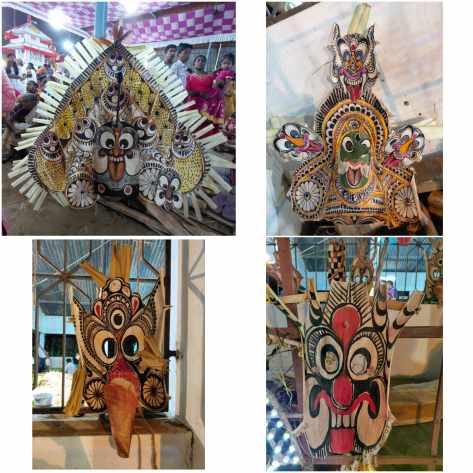
Various areca sheath painted Masks used for Kolam thullal

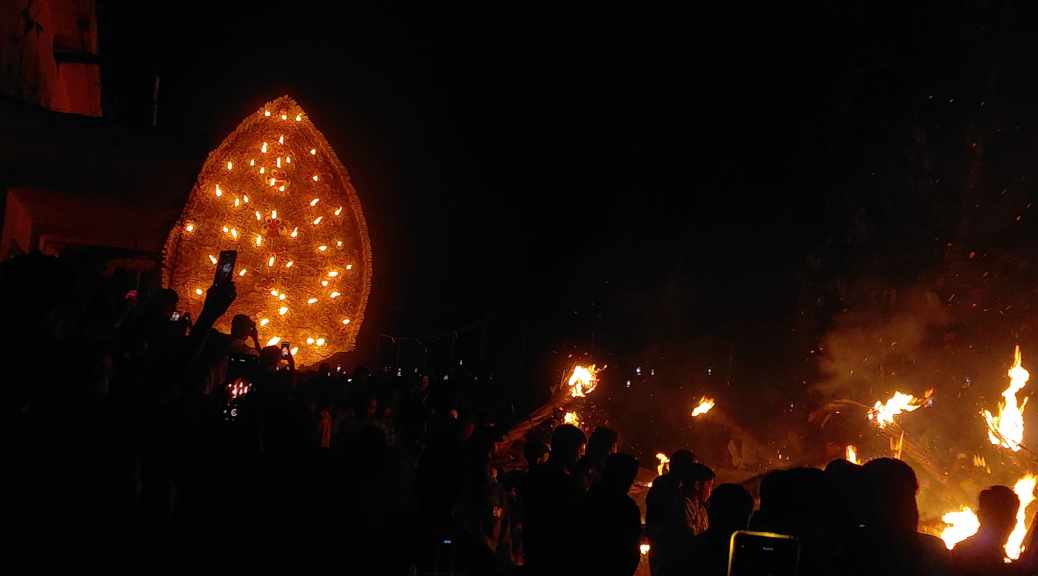
The Padayani festival at Puthukkulangara Devi temple in Othera village, Pattanamthitta district, is one of Kerala’s renowned Padayani celebrations. This ten-day annual event takes place from the 03rd to the 12th day of the Meenam month of the Malayalam calendar, featuring various Kolam dances performed nightly in the temple courtyard as acts of devotion. All the masks used in the Padayani festival are hand-painted by skilled men on each day of the festival and discarded after each use. The highlight of the festival, however, is the ‘MahaBhairavi Kolam’ a grand mask crafted from 1001 areca sheaths that draws large crowds from across the region on the last night of the festival.

A brief itinerary of the 10-day-long Padayani festival at Othera Puthukkulangara Devi temple is listed below. It is also noteworthy that each ritualistic performance begins with Chootuvaippu and ends with a Chootuvalathu and Kotti Vilikkal. ‘Chootuvaippu’ is the burning of torches made with dried coconut fronds behind whom each performer walks to the Padayani arena. ‘Chootuvalathu’ is a circumambulation of the temple by the performer, including the ‘Kotti Vilikkal’, meaning to inform the goddess after the performance is done.

Day 1 (Chathayam Nakshatra): The festival officially starts with the hoisting of the Adavi Kollika, the traditional flag and the lighting of the ‘Bhadra Deepam’, a traditional brass lamp with 21 wicks. It is followed by the arrival of the Vetapoola offerings to the idols. After this, the performance of thappu kottu (traditional frame drums played by hand), Ettu Kappoli (a rhythmic performance of multiple traditional music instruments), and Pulavrittam (a ritualistic dance performed by men in a circular formation) set the stage for all other performances on each day of the festival, starting this day.

Day 2 (Pooruruttathi Nakshatra): The performance of Thavadi (a ritualistic dance performed by rows of men by clapping hands to the tunes of drums and cymbals) gets added to Thappu Kottu, Ettu Kappoli and Pulavrittam from this day. This day also marks the beginning of the Kolam thullal and Panchakolam, which is performed for the next three days.

Day 3 (Uthrattathi Nakshatra): The evening begins with a Thiruvattira dance performance followed by Thappu kottu, Ettu Kappoli, Pulavrittam, Thavadi, Kolam thullal and Panchakolam. The Panchakolam is accompanied by the Sundarayakshi Kolam on this day.
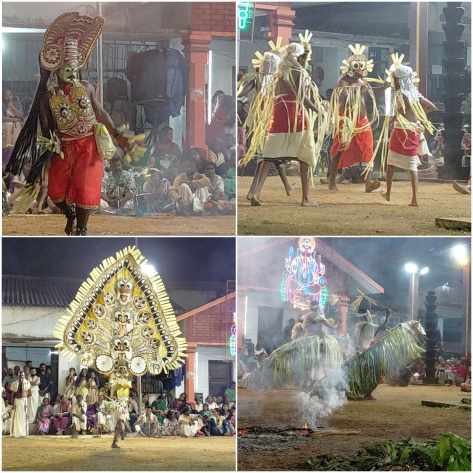
Kolams at Puthukulangara Devi padayani festival
Kolams at Puthukulangara Devi padayani festival. Clockwise from Top left: Yakshi; Top right: Pakshi; Bottom right: Kudiran; Bottom left: Bhairavi

Day 4 (Revathi Nakshatra): The Panchakolam is accompanied by the Kalayakshi and Bhairavi Kolam.

Day 5 (Ashwathi Nakshatra): This day includes Ettu Kappoli, Pulavrittam, Thavadi and the Kalankekalam Kolam.

Days 6 to 9: These days have performances of Ettu Kappoli, Pulavrittam, Thavadi and the Kalan Kolam.

Day 10 (Thiruvathira Nakshatra): All the rituals conducted over the last 9 days are repeated on this day. All the kolams come to the festival arena in a procession, which is traditionally called the ‘Nirathi Thullal’. Various Kolams alongside the Kakarisshi natakam and Paradeshi performances continue throughout the night, with the Mangalabhairavi Kolam and Poopada (A ritualistic dance performance to the music of percussion instruments and comic interludes) marking the end of the festival. A brief itinerary of the last evening of the Othera Padayani festival is indicated in the image below.
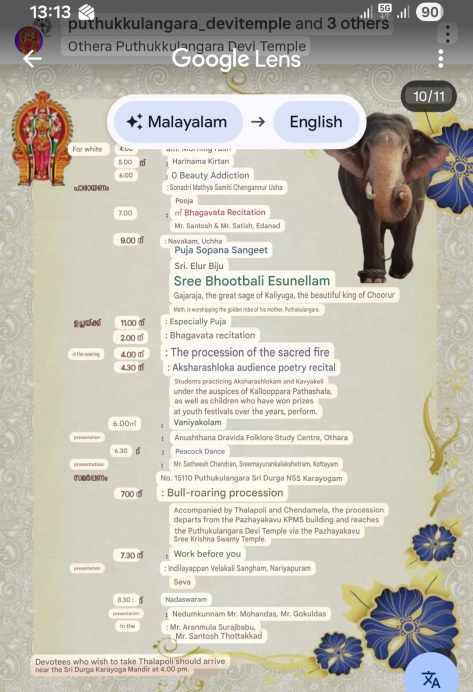
Day10 padayani festival itinerary- Othera

While all Kolams in the Padayani festival feature a human impersonator wearing a mask made from hand-painted areca sheaths, the MahaBhairavi Kolam stands out primarily because of its enormous size. A Bhairavi kolam is the largest wearable mask during Padayani, with the load resting on the wearer’s neck and shoulders, supported by their hands. In contrast, the MahaBhairavi is crafted from 1001 sheaths, all held in place by arranging them on a sturdy wooden frame from behind. It is nearly impossible for a single person to carry this. Therefore, after arranging the sheaths, the large mask/Kolam is lifted from the ground and mounted on a wooden cart using a crane. Community members then hand-draw the Kolam from the setup area to the Padayani arena. The cart is moved forward and backward three times to appease Goddess Bhadrakali, and the Kolam remains in the arena for several days, marking the festival’s conclusion.

Ladies are prohibited from entering the areas where the masks are painted and assembled. After the kolam is over, the masks are left for nature to take over them in its own way.

The MahaBhairavi Kolam at Puthukulangara Devi Padayani festival, Othera, Kerala

To summarise the entire experience in simple words, it was a festival so unique and unlike anything else I have experienced before. Based on the above itinerary shared by the temple authorities, my friend and I reached Othera by 05.30.p.m. At the same time, the procession of the sacred fire was in progress. Since the fire was accompanied by an elephant and devotees carrying thalapoli (a metal plate with rice, flowers, coconut and an earthen lamp), the narrow lane leading to the temple was blocked for vehicular movement, and we had to walk past to the temple. All the houses along the way had ‘Nela vilakku’ (the traditional brass lamp) with small pookalam (floral decorations) placed in front of their gates, as a greeting to the sacred fire at their homes.

After the procession reached the temple premises, it went towards the banks of the river Varattar for offerings and returned with tree branches. It was followed by cultural performances like Chendamelam, Vaniyakolam, Peacock dance, Kettukazhcha ceremony (procession of the bull-effigy), a parade of various folk-art forms like Malavazhiyattam, Amman Kudam (Karaga), etc. and the Nadaswaram Seva before the Kolam Thullal began extending right until dawn’s break. Simultaneously, the artists painted the masks, whilst another group of people readied the wooden frame on which the painted sheaths were later arranged. And finally, the fireworks went up while the horizontal wooden frame went up vertically, along with all the sheaths in place. We knew that the big wait was inching closer when we saw a crane carrying a man with a torch, lighting up the cotton burners attached to the MahaBhairavi Kolam. I believe it was a culturally immersive experience that one must experience at least once in their lifetime.
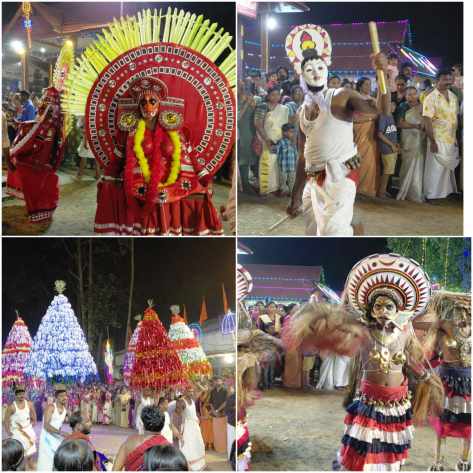
Various Folk artists at Puthukulangara Devi Padayani festival, Othera

Othera is located about 4 km away from Chengannur, the nearest major town that is well connected with major cities like Bangalore and Chennai with direct trains and buses. One can conveniently hire an autorickshaw from Chengannur town to reach Othera.

To be continued as “An Onam Celebration I will never forget at Aranmula Parthasarthy Temple

A Rare Connection of Hockey Between Karnataka and Tamil Nadu

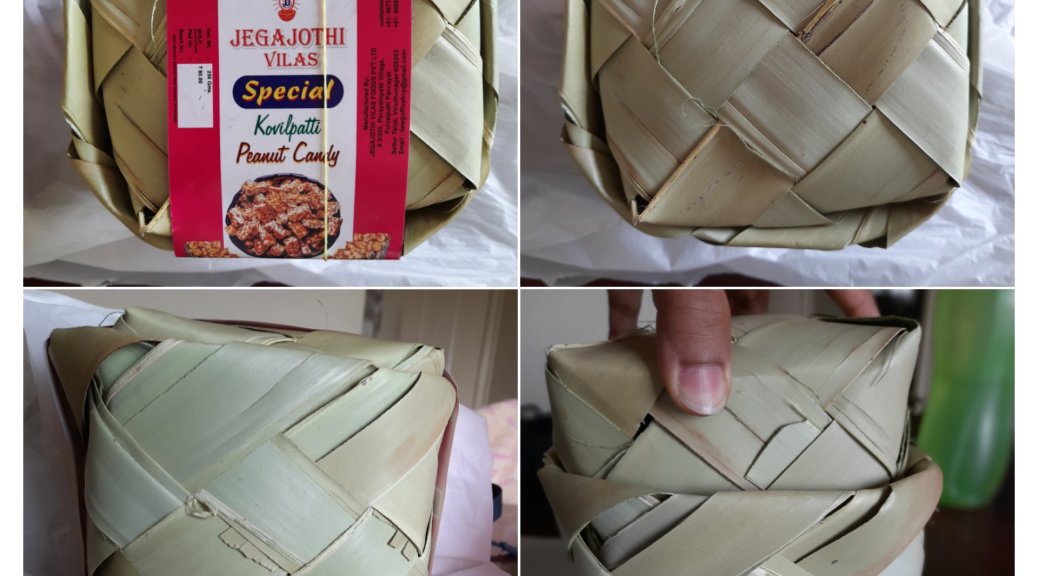
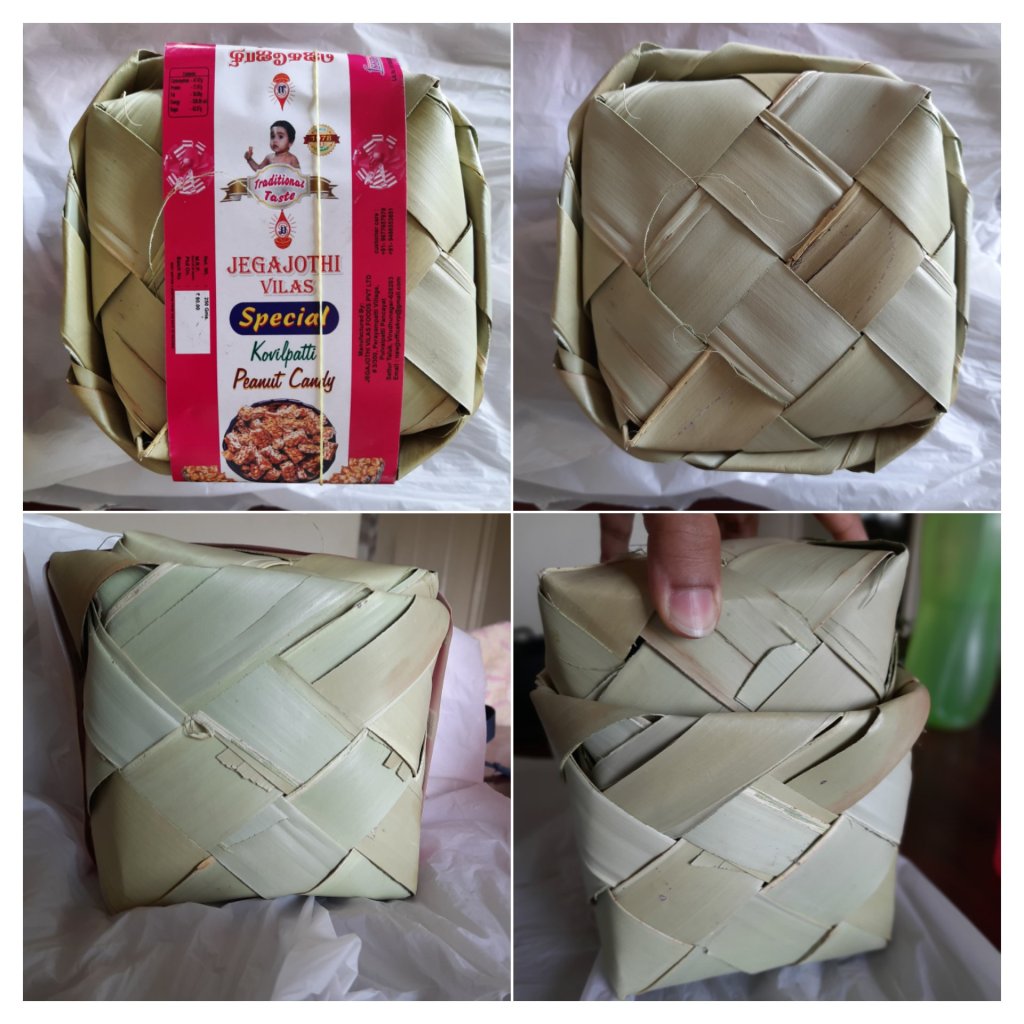
I have been fortunate to meet many like-minded people online, through travel blogging. Recently, I happened to meet one of such friends offline, during his visit to Bangalore. He greeted me with a souvenir, a nice palm leaf box containing chikkis. He explained that it was the ‘panai olai petti’ containing the famous candies from his hometown. After I returned home, a little bit of online browsing about this souvenir unfolded some interesting facts for me.

The palm leaf box containing the Kovilpatti chikki

Talking about the southern states of India, two neighbours have a lot in common. What triggered this thought were the names of places starting with the letter ‘K’, one from each state. Kodagu and Kovilpatti from Karnataka and Tamil Nadu respectively. Meanwhile, the ‘C’ is what makes these two ‘K’ places famous. ‘Cauvery’, the holy river originates in Kodagu and ‘Chikkis’, the peanut candies of Kovilpatti has earned a GI tag for itself. Enough is written and done on the internet about either of the places.

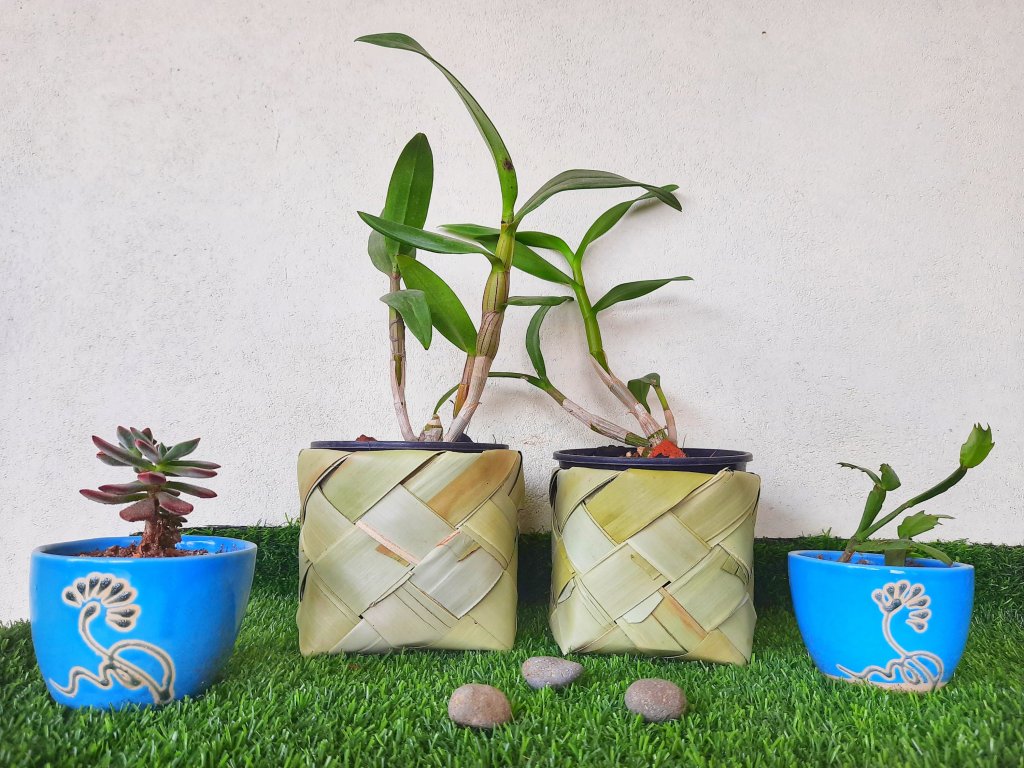
Palm leaf boxes of Kovilpatti mithai being Repurposed as planters

But what turned out to be more surprising and a rather rare connection between the two ‘K’ places of these states is their common love for the National sport of India- Hockey. In my earlier post, I have mentioned how the largest festival in the world dedicated for any sport (hockey) is celebrated in Kodagu. But what I learn now is that Kovilpatti too, shares its history with Indian military and the influences of the British to have a strong hockey culture. With at least a dozen hockey clubs and several players making it to the Indian national team over time, the people of Kovilpatti have an unabated enthusiasm for the national sport.

What I do know is, that there are several other lesser-known places in India where people celebrate sports other than cricket. Only initiatives by governments, support from sponsors and adequate media publicity can encourage and motivate more people to nurture a sporting culture in our country, anything other than cricket.

I Belong to Everywhere: Theralu

This is an attempt to bring back nostalgia. Continued from- “I Belong to Everywhere: Chamarajpet“.

This is a small village in South Kodagu that is closer to Kerala borders than it is to Madikeri. This is where my maternal cousins originally hail from, and they went to school with me at some point while staying together at our maternal grandparents’ house. So, it was natural that I too would accompany them to their native village on several occasions when they went to their parent’s house at Theralu.

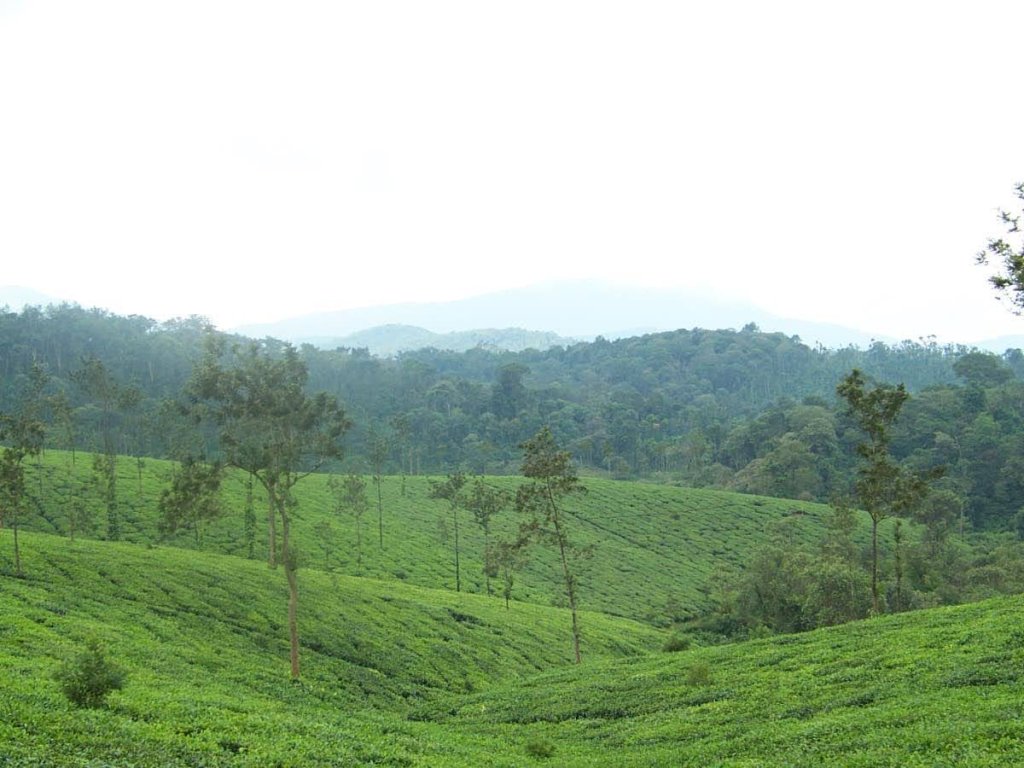
Apart from the expansive Tata tea estates and the Kerala borders some of the other popular landmarks that I enjoyed day tripping here were Irupu waterfalls, Mrithyunjaya temple and the Nagarhole National Park.

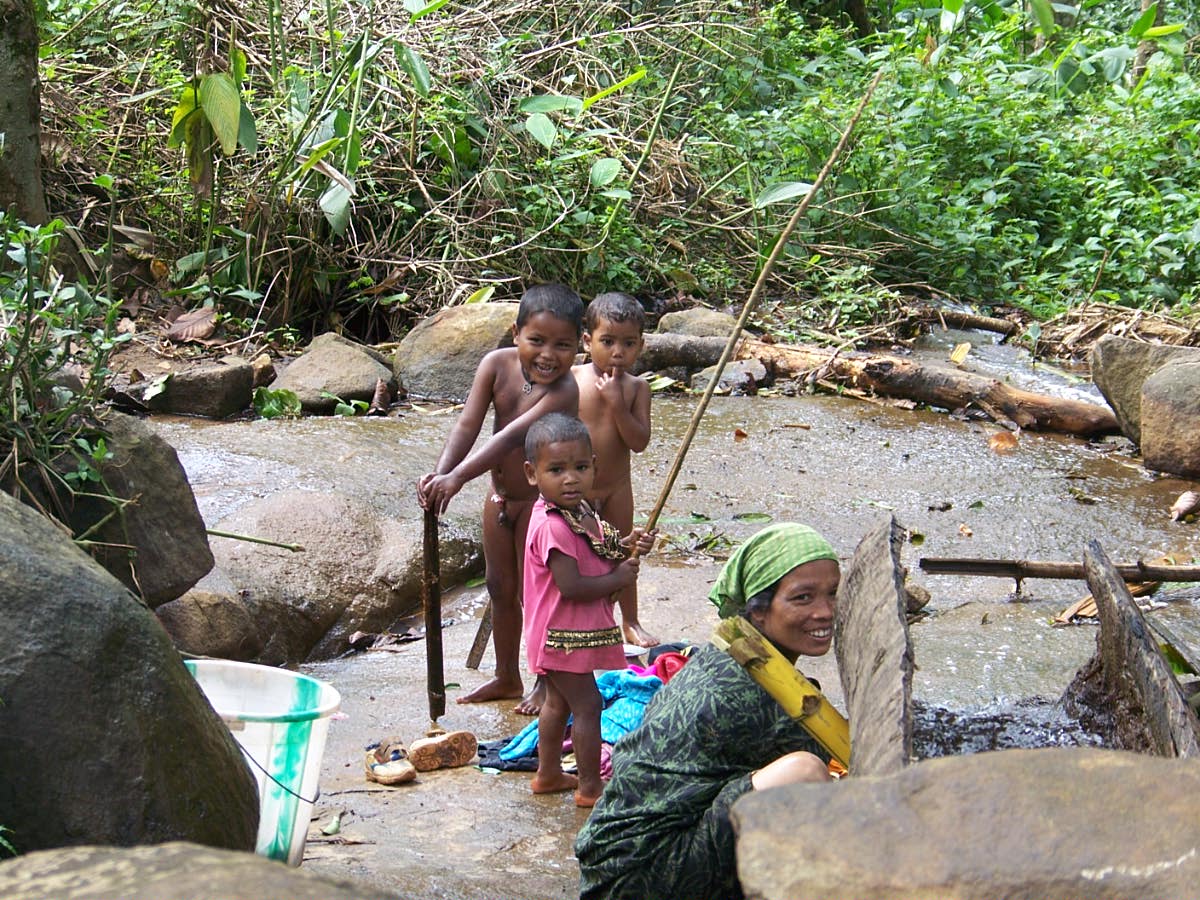
For all that I can remember from those visits were that there were people speaking and following different culture than I was familiar with. All the workers that worked in both my maternal and paternal hometowns were from the local tribal communities who spoke and ate quite same as what I did at home. But those working at my Uncle’s estate in Theralu spoke so many different languages. The larger group had almost created a mini-Assam in the site of their labourers quarters. They had built so many structures, equipment, tools out of bamboo (the most common site in all over Assam) and ate food that was made with ingredients that we in Kodagu didn’t know were edible until we saw them.

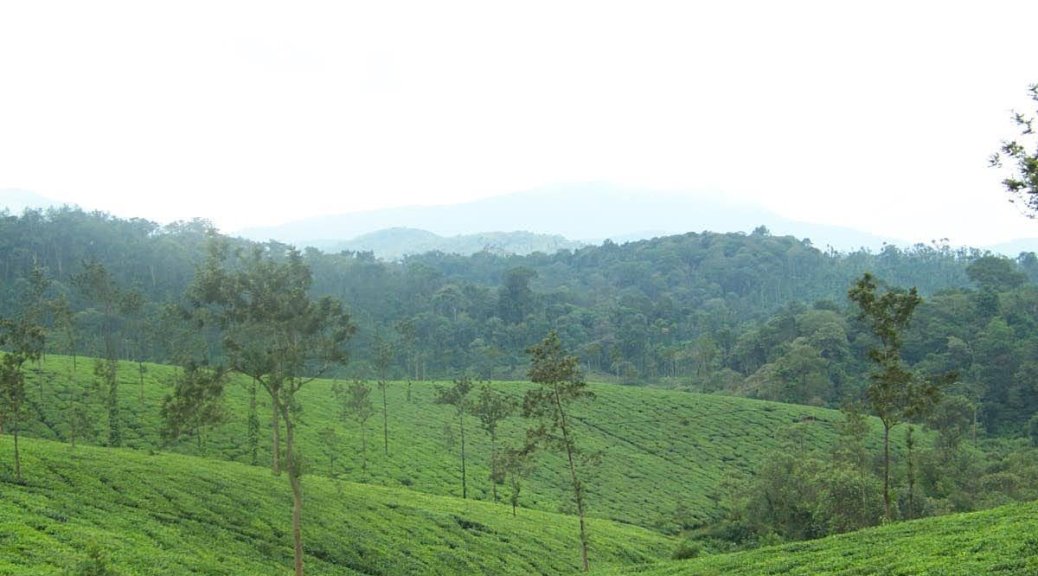
The Glenlorna tea estate Coorg

This is also where I was introduced to Tamil language and their movies. A large group of workers came to work in the farm at Theralu during the peak coffee harvest season and returned back to Tamil Nadu after the season ended. During evenings or on weekends, these workers often came to my cousins house to watch TV. Although I didn’t know their language and didn’t comprehend with most things they communicated, I picked up names of the stars whom they clapped hands in enjoyment or sounded a “Shhhhhh” to express disappointment while watching their favorite stars on the screen. In spite of not understanding a word of what the movie or tele-serial was about, it was an inevitable situation for me to sit and watch through whatever was being played 😀 Looking back at the days, those stars from the early 2000s are the only few whom I can associate with while talking about movies with a Tamilian!

Assamese kids enjoying their shower in a small stream in the estate

With limited means of communication, the major exposure we had in this small hill-district was just limited to living in estates or serving the army. Here, I saw migrant workers coming from faraway places in search of ANY doable jobs, saved a portion of their limited income and sent it to their families back in their hometowns and still lived a life of modesty. I learnt that life was not all easy for people living in other parts of the earth. It always made me think and reflect how unequal and different life was for everyone. Theralu taught me lessons of gratitude for the life I am living!

To be continued as- “I Belong to Everywhere: Jalahalli

The Heritage bridges of Rajahmundry

River Godavari is the longest river in South India that travels over 1000 kilometers. My first glimpse of this beauty was at Rajahmundry, where the ritualistic ‘Godavari Arati’ is offered to this mighty river every evening. The sunset and a boat ride from the Godavari ghat are experiences in themselves. Among the umpteen dams, reservoirs, bridges that are a built across her, the most noteworthy bridges are located in Rajahmundry. Here is a quick look at these heritage structures.

The heritage bridges in Rajahmundry
  1. Old Godavari bridge – This is the oldest of the three major bridges built across Godavari here. It was originally called as ‘Havelock bridge’ since it was named after Sir Arthur Elibank Havelock, the then governor of Madras. This is a Stone masonry & Steel girder bridge whose construction started in 1897 and commissioned in 1900. After completing 100 years, this railway bridge was decommissioned in 1997.
  2. Godavari bridge – Also called as the ‘Kovvur-Rajahmundry bridge’, was commissioned in 1974. This truss bridge has a two-way road deck over a single-track rail deck making it Asia’s second longest railroad bridge with a length of 4.1kms.
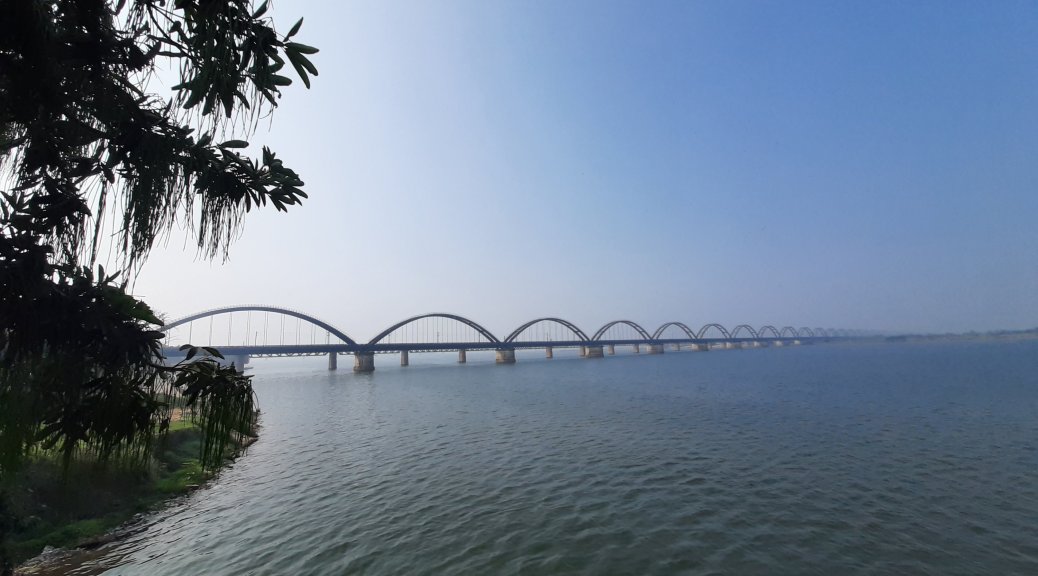
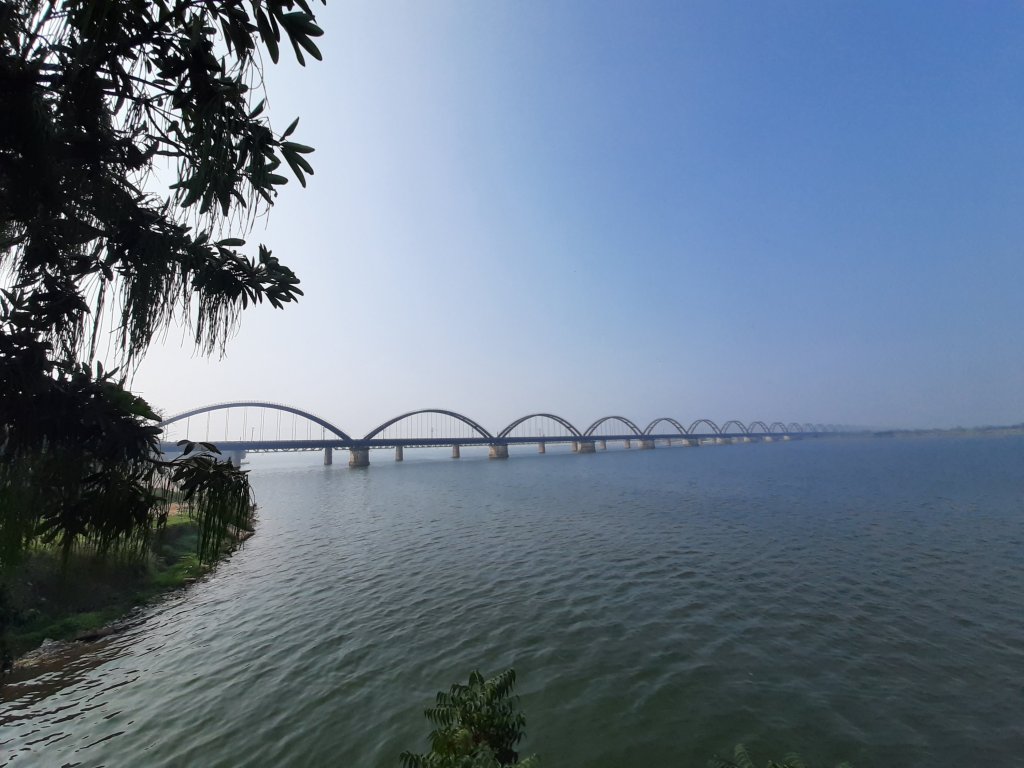
  3. Godavari Arch bridge – Commissioned in 1997, this single line railway bridge is the latest of the three major bridges in Rajahmundry and was constructed as a replacement for the Havelock bridge. This concrete- Bowstring-girder bridge is built parallel to the Havelock bridge with a distance of 200mts.
The arch Bridge at Rajamundry

Apart from the above bridges, there is another road bridge that connects Rajahmundry city with the islands of Konaseema. But what makes this bridge special is that it runs parallel to another heritage structure built across the mighty river. Dowleshwaran Barrage is an irrigation structure built in 1850 by a British engineer, Sir Arthur Thomas Cotton. Earlier to the construction of the barrage, the place used to be constantly flooded and unworthy of anything. This 3.5kms long barrage then allowed the floods to pass through and enriched the place making the unused land worthy of cultivation. It was rebuilt in 1970 and renamed as Sir Arthur Cotton Barrage or Godavari Barrage.

A Not so Blissful Trip to the City of Eternal Bliss- Chidambaram

This trip was part of a backpacking by my brother and me with an original itinerary to cover Bangalore- Kumbakonam – Gangaikondacholapuram – Chidambaram – Pichavaram – Pondicherry – Tiruvannamalai – Bangalore

As per this, we left Bangalore on a Sunday night in a bus and decided to explore further at our own pace, using public transport and staying at places with bookings made on the go. Plan was all set. But well, with a small glitch. We assumed that the monsoon season was the same in the entire southern India. But what we hadn’t taken into consideration was the fact that Tamil Nadu doesn’t come under the south-western monsoon. Hence, the monsoon peaks (with north-east winds) after the season ends in its neighboring states. So, we were now on an exploration of Tamil Nadu in October, during the peak of its monsoon season! Anyway, with its share of travel miseries, poor planning gave us the benefit of experiencing a different kind of backpacking.

Firstly, we explored Kumbakonam, a place which is often spoken less about on a typical tourist’s circuit. It was a wonderful experience to explore a place that is soaked in history and RICH architectural heritage, mostly from the Chola era. (This is elaborated in a separate post, click here to read). From Kumbakonam, our next planned destination for a major halt was the place that’s is often referred as ‘a city of eternal bliss’. But our experience was as unblissful as it could get, even as we wished to get a glimpse of the deity of a temple whose manifestation is revered to be as one of the five elements of life- ‘Space’. I would like to elaborate this trip for my readers to get a wholesome idea of our visit to this city was like for us!

With incessant rains, our mobile-phone network had been patchy. On day 2 at Kumbakonam, we received a call from our parents who had been trying to get in touch with us since the previous night. They informed us about the alert issued by the Met. Department. We checked online and confirmed the news about the weather forecast of cyclone- Roanu and a deep depression in the Bay of Bengal. We were asked not to venture near the seacoast. Our intended trip itself was supposed to be along the Coromandel coast- including Cuddalore and Pondicherry. Since the day was bright, we did not take our Met.dept. seriously and decided to take a chance by continuing with the plan from Kumbakonam.

With a visit to the Brihadeeshwara temple at Gangaikondacholapuram (another of the three living Chola temples), we boarded a bus to Mannarkudi. From Mannarkudi, we were supposed to take another bus towards our next planned destination: Chidambaram. However, the conductor informed us that the road beyond Mannarkudi was blocked since the previous night due to an uprooted tree. Although the tree was cleared, he wasn’t sure if the route was worthy for us to go. Without really understanding the seriousness of his advice, we boarded an overly priced private bus which ferried us to Chidambaram. Our road was flanked by the Kollidam until most stretch. Last time we had seen this part of the state was with our family, during our quest to see the end of river Kaveri. The dam was empty and dry back then. Today, she was flowing in full spate and the Grand Anicut was filled till its maximum limit. Kaveri looked beautiful with her brown waters reflecting back the sun rays that sneaked from amid the thick grey clouds. That was the point from where, the real saga of our road trip started.

As we covered a little distance ahead of the dam, the river began to touch the road around the corners at most turns. Gradually, the river started to spill over the road at some stretches. Instead of plying on the road, it seemed like our bus was driving over the river at these junctions. Further into the journey, the water level increased. Several stretches (in kilometers) of the road was submerged by the river. Our driver was a real super star- who could figure out exactly where the road laid in the ground in spite of the water being above the tire height. Even a slight slip in the road only meant death and nothing less. The entire bus with about 25-30 passengers could have been washed away by the currents of the spiteful river. I had only seen such things in the news. Now I was right there, experiencing a flood scene, firsthand.

The flooded villages enroute to Chidambaram

Stretches of villages laid submerged ahead. At some places, the thatched roofs and the hay huts had given away. We could see utensils floating around on the road, helpless villagers wading across the (once existent) streets, even as the flood water stayed above their waist level. Their plight was heart rendering to see, even as the rest of us inside the bus continued to wonder if we were going to see a safe arrival at our destination at all. The rain of just one night had wreaked so much havoc across the state of Tamil Nadu. However, our driver remained focused and drove us across to reach the safe harbor at Chidambaram by around 03.00.p.m.

My brother and I decided to drop the luggage at the hotel which we had booked online and find some food for ourselves. We hadn’t eaten anything since that morning. On arrival at the hotel, we were a little perplexed to see our room. The bedsheets looked extremely old, torn and dirty. The bathroom was a disaster. The toilet floor was covered with a thick layer of algae, slush and mud, all that had accumulated over years without washing it. The flush lever was broken, the taps rusted and a crazy layer of deposits on the bucket and the mug. The nasty smell of alcohol hit our noses from outside through the opened door even as we continued to feel suffocated inside that room. My brother and I looked at each other’s face- and both of us knew what was running in each other’s mind. In spite of being exhausted and hungry, we decided to leave the place and find some other place to stay. Just when we started to descend the stairs and as if the injury (of finding a bad room online) wasn’t enough, I happened to step on a large mess of barf, thrown up by some drunkard on the stairs and slip down a couple of steps.

Until this moment of our day, I had managed to keep my calm, but my brother gave up. He wanted to end the trip right there and return to Bangalore. While he found no buses that would leave Chidambaram immediately to Bangalore, I managed to convince him to stay calm until we boarded a night bus at least. I found a place near the ‘Nataraja temple’ where I could clean myself and headed to get the darshan of the lord. The visit was peaceful, maybe I will write about in another post someday.

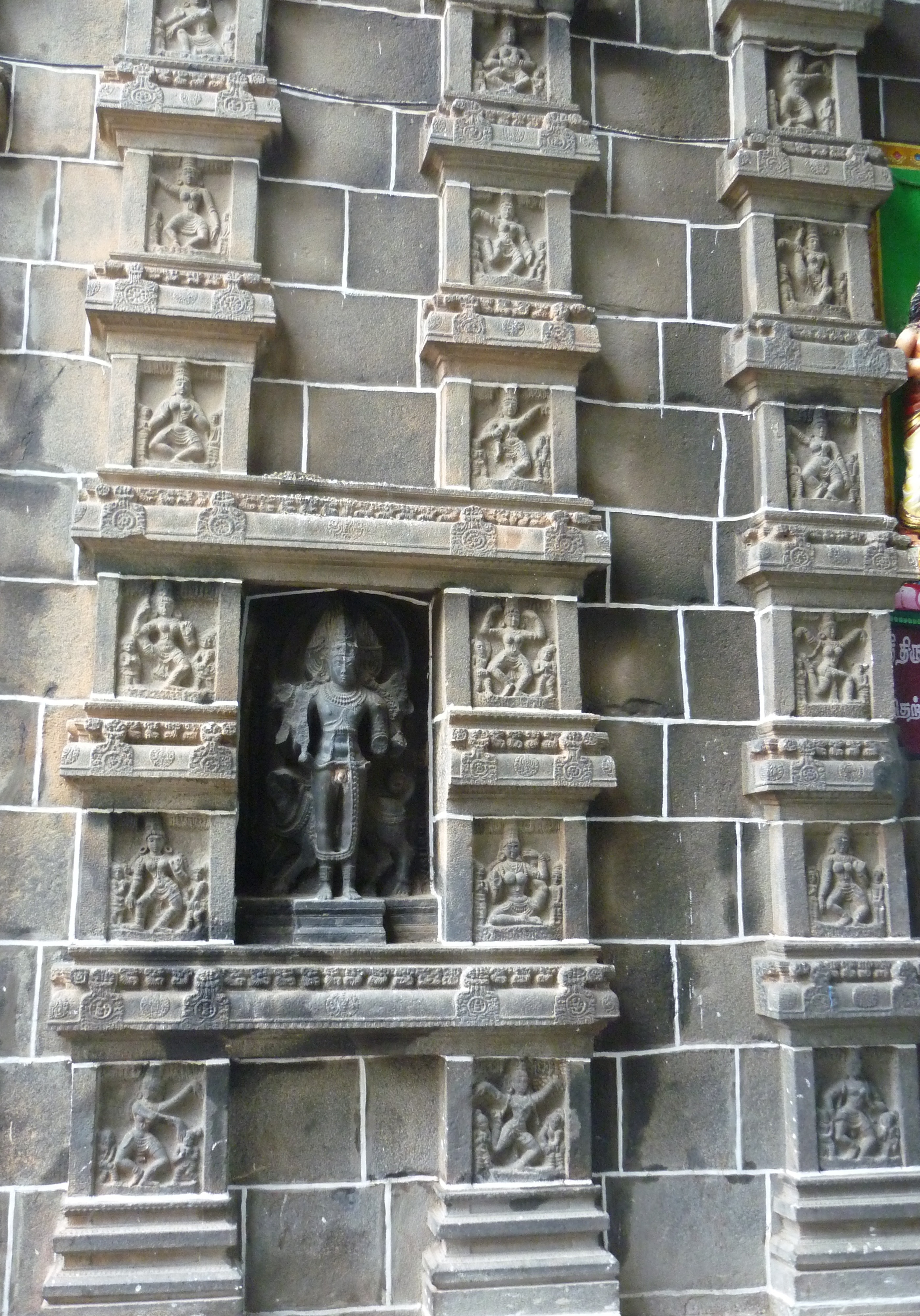
The Bharatanatyam postures sculpted on the walls of the west-tower of the temple

After finishing the evening prayers, my brother booked our tickets to Bangalore for the same night. Since my holidays were still not over, somewhere deep in my mind, I still wanted to complete my trip. I didn’t want one bad experience of the day ruin the entire holiday for us. But, given the weather condition further ahead in our planned route, I couldn’t rule out my apprehensions of getting stranded in the cyclone at Pondicherry as well.

But right now, our priority was different. We had been starving since morning and had to find something to fill our stomach. In spite of walking the WHOLE of Chidambaram town, we couldn’t locate a single place where we could find food. Thanks to the day of Deepawali festival- there were absolutely NO eateries open! Also, the entire town was SOO DIRTY with garbage littered everywhere. After a long search, we finally found ONE supermarket in the entire town. And what did we get to eat there? Just a cup of sweet corn to sate our hungry bodies.

Our city woes did not end after eating the steamed corn. It was still 07.00.p.m and we had three hours more to kill. On enquiring with a few locals, we were told that we would find a decent restaurant near the bus stand. And so as per the recommendations of the local people, we found this AC luxury restaurant called ‘Vandayar- Southern Spice’.

When we arrived there, the waiter informed us that they served only fried rice for the day. The waiter came to our table thrice to take our order (for the only dish available) and after two hours of waiting for food, there arrived a convoy of VIP customers at the restaurant. Bonus for waiting: A feast was set for this VIP family that comprised of all dishes from the menu. Even while all the tables were occupied with middle-class customers including my brother and me, there was no one from the restaurant that cared for our existence that day. Wondering if we were waiting for any free food to be served at 09.00.p.m. several customers grew furious and started to walk out of the restaurant. It was also time for us to board our bus. As we too walked out of this VIP restaurant, there was power cut in the town.

In a dark and dingy bus-stand, we spotted the only stall that served tea and some biscuits. The little candlelight was just enough for the tea-stall guy to reach out to things in his kiosk. We were essentially scared of stamping some more muck that could’ve been laid in the littered path. As we dunked the last biscuit into our chai, we had yet another surprise for us. Our bus to Bangalore was delayed by 2 hrs.!!! As we waited there in the dark platform of the bus stand, some drunk men started to throw glass bottles at the crowd there. Luckily no one was injured, but the downpour of bottles and splatter of glass pieces continued for a while. Our bus arrived after a while and we boarded at 10.00.p.m.

With all the crazy stuff that happened that day, we fell asleep quickly… Only to be woken up at sunrise. That’s when the rain was battering outside, and our bus had broken down on the highway. Although we were given an alternate bus in a while, our anxiety continued until we reached home.

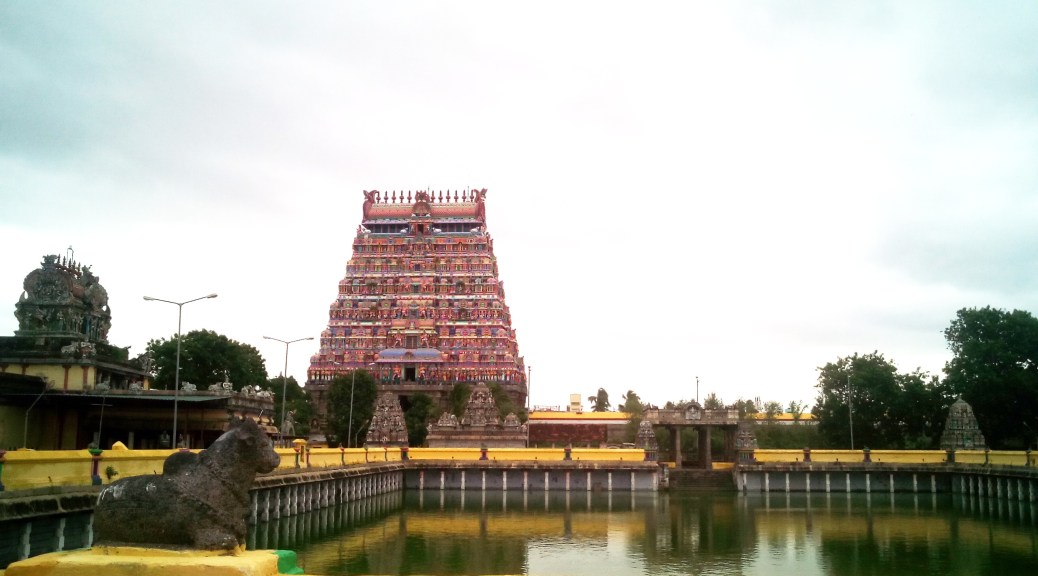
The temple Gopuram at Chidambaram Nataraja temple

Conclusion Remarks: The people on the east coast are god’s chosen ones to have a grand celebration of festivals. Tsunami for Christmas. Cyclones for Diwali…!! One cannot sit in a place, hear stories and imagine of places and people. You need to move yourself to places to experience and explore. This trip was one such experiences where I got a first had experience of braving a flood and starvation of food. Also, this is a trip where I managed to find a place in India that I wouldn’t want to return.

Snake boating in LOL- Kerala

<11-Aug-2012>

After a lot of last minute hiccups, the planning of more than 3 months had finally materialised.. And there we were… At Allapuzha.

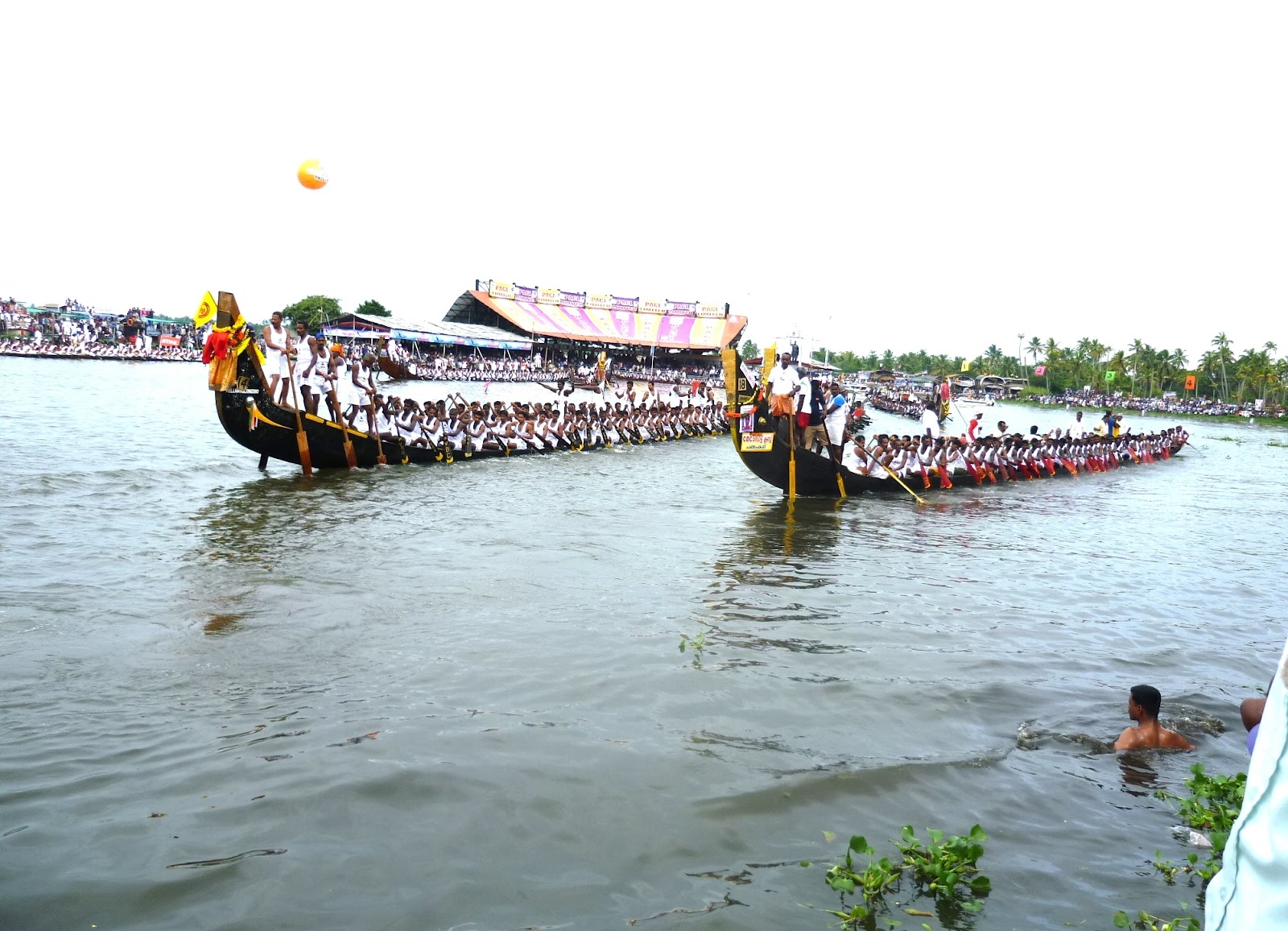
At 10.a.m we were on the stands looking out for a nice place which would give us a good view of the river. The 60th Annual Nehru Boat Race was scheduled to start at 2.30.p.m. ‘The crowd had started to pour in from as early as 6.a.m., to get a good seat’, we were told.

Pam and I were sitting in the last row (We considered ourselves fortunate enough for getting chairs to sit).. Sam had ventured out of our stands to get some good photographs and to find a better corner seat for all of us.

Just then, this gang of 6 huge Malayali men dressed in their white Lungis came in and stood behind us.. They pushed our chairs forward so that they could accommodate a few more chairs on the already crammed podium. We barely had space to keep our legs and we were wondering what they were upto. Without knowing the language, we only ended up giving them some wild stares. Pam belted out a few words in Kannada.

Next thing we saw was: Each of these men placing biiig hand bags in between their legs, covered by their lungis and each- pulling out a bottle of local brew (the tags on the bottle indicated that it was pure-strong-local). They pulled out a glass from their bag and poured the drink and gulped it all down RAW in the blink of an eye (It was faster than that of one drinking water). And then… One of them started to utter something to us- From the fact that he had just finished a bottoms up and the tone of his speech, we knew for sure that we were being verbally abused. Although with my little knowledge of the language, I managed to understand a few swears, I instructed Pam not to react. We would surely be outnumbered by men there, in God’s own country. Like a call from God himself- Sam called us to inform us that he had found a better place for all of us to sit. We vacated the spot in the very same minute.

On the way, Pam walked upto a cop and said, “Those men in the last row there, are boozing; Each man is carrying at least a bottle which they are not supposed to possess in a public gathering”. The cop replied an apologetic “OK, OK Sir, We will look into it” and walked off as if Pam had just spoken to deaf ears.

We met Sam and just as we were narrating the scene to him- We saw 2 more men carrying handbags and settling down right beside us. And soon they pulled out a bottle each, bottoms up, gobbled up some minced beef and then started cheering at the water in front of them, where the race was yet to begin. Even before we reacted, Sam pointed at the platform onto our left. More than 10 men were repeating the same procedure- handbags covered by lungis- bottoms up- cheer out loud. And then we looked behind at the gallery- and we were like “What the F***…??”. Every lungi fellow had a glass in his hand..!!! And then we knew, the exact reason for getting such a vague response from that cop. The Policemen were clearly outnumbered by those drunkards and that seemed like quite a normal phenomenon to the cops to take any action. And we too quickly learnt to live with it..!! Soon, the crowd of drunkards increased and also the excitement.

Boat Race finals (49)

And.. The boat race had a roaring start with a lot of frenzy and madness.. We too were at the peak of our excitement.. And suddenly this scuffle started between 2 groups. The next thing we saw was random people being thrown into the river by random people… Typical to any Indian movie, the cops gave a late entry. They arrived in speed boats and pulled out a couple of them from the water and sped away..

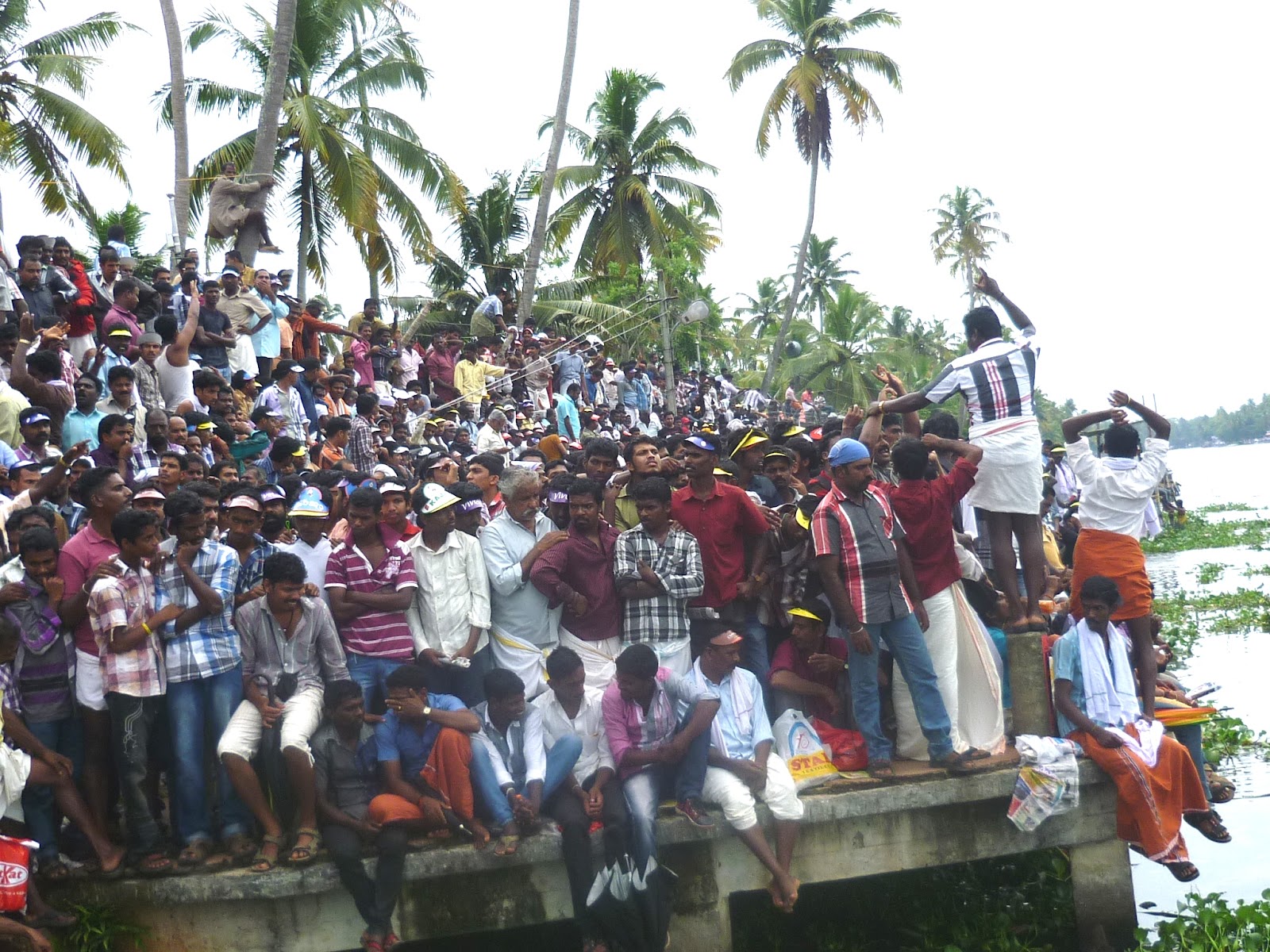
The below picture shows:

  1. A hard core fan who watched the match sitting on a coconut tree from 10.a.m to 7.00.p.m.
  2. A drunk fan standing on a pole and cheering for his team whose limbs finally gave way into the water after 5hrs.
  3. Another bunch of fans seated in the gallery who are supporting themselves by holding onto the electric lines.

Boat Race finals (36)

This was definitely one hell of a maddening-superbly-awesomeness-crazy-experience that I am going to cherish for life.

Kerala: “The Land Of Lungis” is truly God’s own Country… L.O.L. 😀

Have you ever experienced any such psychotic crowds? Share it with me.. 🙂