Tag Archives: Banaras

Part 2-The Story of The Maha Shivaratri and the Naga Sadhus

Continued from Part 1: The Story of The Maha Kumbh and the Naga Sadhus

We had taken help from a local person, Sunny, to make a last-minute hotel booking at Banaras. Sunny was a young lad who freelanced as a local guide, and was referred to us by one of my friends who had availed his services earlier. My friend and I checked into the hotel booked on the main road of Banaras, slept without dinner as were tired.

Meeting the Nagas

It was around 02:00 a.m. when I was woken up. “Wake up, Hitha. There is something happening on the road, I can hear people shouting slogans.”, my friend sounded very anxious.

It is Shivaratri. People maybe chanting Har Har Mahadev, as many were doing so when we arrived here.” I said.

No, wake up! I have been hearing this from quite some time, and it is getting louder now.” She barged outside the room to check what was going on.

Hitha, hurry up and come outside! All the Naga Sadhus are right here!” she shouted, while running towards my bed, huffing and puffing in the next couple of minutes. Then, we both ran out to the reception area.

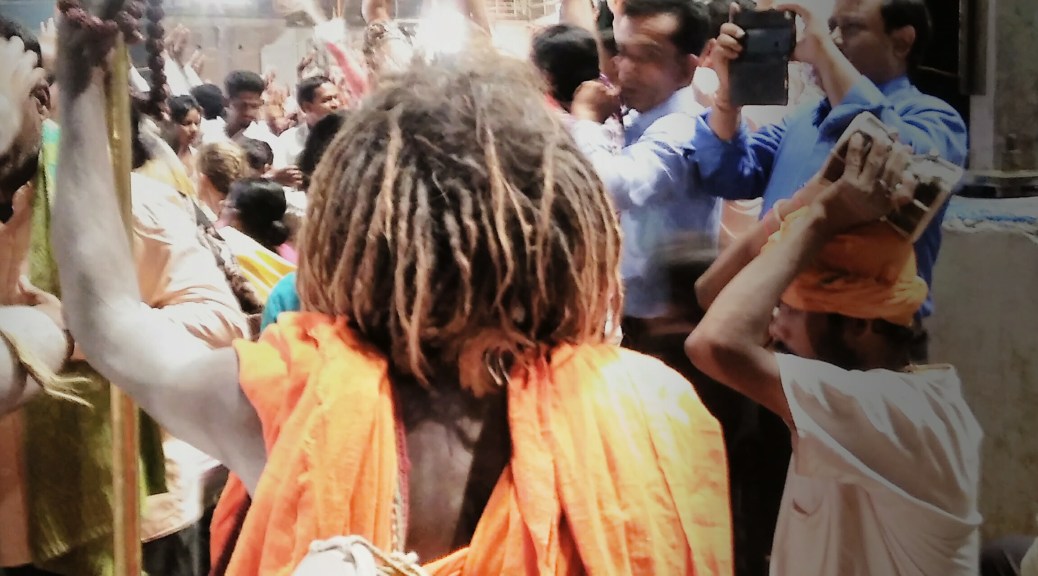
We were spellbound with what we saw there. With ash smeared bare bodies, matted locks, strings of Rudrakshas around their necks, trident and damrgo in hands, there were hundreds, or perhaps thousands of Naga Sadhus and Sadhwis representing every known Akhada with their respective Tableaux, had all assembled right in front of us. Calls of ‘Har Har Mahadev’ reverberated not just on this road but across the city as their convoy began with all the Nagas throwing ashes up in the air. Tight security with the CRPF barricading the streets on both sides ensured the convoy reached the ‘Kashi Vishweshwar Mandir’ thereby the Nagas got the first glimpse of their Adi Guru on the day of Maha Shivaratri before the rest of the public were allowed. A sight that seemed like a dream that I had just woken up from, one that I will cherish as one of the TOP memories of my life which I would have missed in a matter of seconds hadn’t my friend woken me up at the right time. The crowd then dispersed and we returned to our room to freshen up before starting our day.

In a couple of hours, Sunny updated us to stay at the entrance of the hotel for the procession was to return along the same path, with the Akhadas returning from the temple, back to their camps set along the Ghats from where they would all packup to head towards their respective abodes scattered across parts of India. When they all did arrive, I stood on the side of the road to capture a few shots for memory of this amazing day. Despite the security, my friend and I had unknowingly become a part of the parade. The parade of the Nagas. We were walking beside and amid the Nagas from Godowlia street, right until the Juna Akhada office before someone realized that we were outsiders and politely asked us to step aside. WOW! It was indeed an experience that gives us goosebumps just by imagining even today.
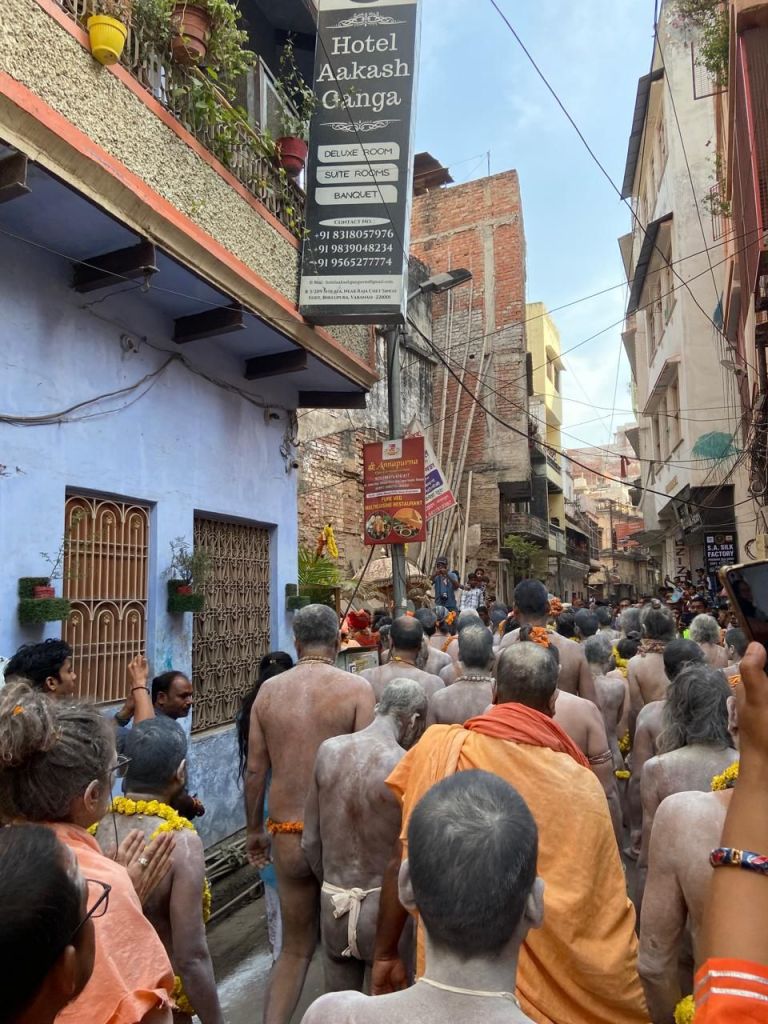
Naga Sadhus returning to their akhadas

Shiv-ji ka Baraat

Meanwhile, Sunny had us racing towards, yet another ceremony scheduled to happen on the parallel streets. The grand Shiv Baraat procession was on its way from Shri Tilbhandeshwar Mahadev temple towards the Gauri Kedareshwar temple, where the idols of Shiv and Parvati are set up the day before the main event. Sunny placed us both on strategic spots on the street from where we could watch the arrival of the Baraat clearly.

First, the camels arrived. Then the elephants. Then, all the Baraatis from the groom’s side accompanied by various orchestra/Band sets and tableaux from across the city arrived on different vehicles, chariots etc. (Children and young adults dressed in masks and costumes depicting various gods and Goddesses from Hindu Mythology) and Finally the groom made his appearance on horseback (yet, another young boy dressed like Lord Shiva), travelling across various lanes, streets and main roads of Banaras and finally reaching Gauri kund located at Kedar Ghat where the divine union of Lord Shiva and Goddess Parvati was to take place later that night.
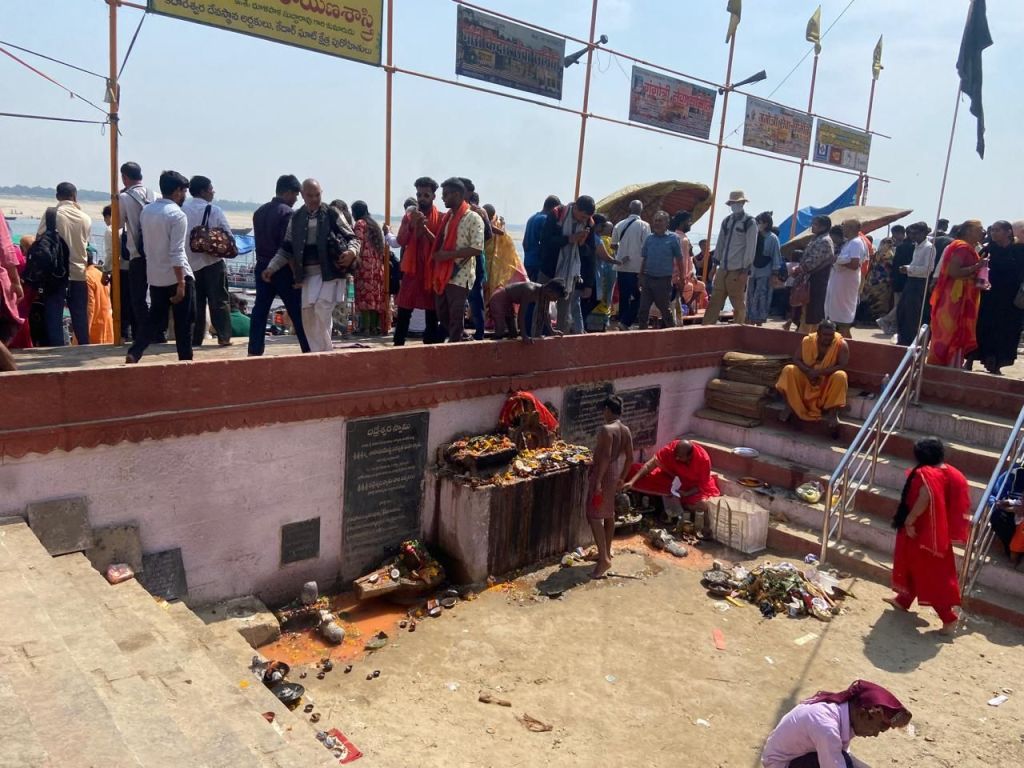
Gauri kund before the wedding prep

We found a strategic spot on the stairs of the Kedar Ghat to witness the grandest wedding that was supposed to take place all night with all the devotees staying up on night vigil as witnesses to the wedding on the banks of River Ganga. Ofcourse, any Indian wedding is incomplete without a grand feast for its attendees. How could it not be so when it is the wedding of their dear Lord himself? There was free and unlimited supply of potato sabzi and Thandai throughout the night to all devotees (guests) in attendance at Kedar Ghat, witnessing the wedding by participating in rituals and discourse of vedic chants.
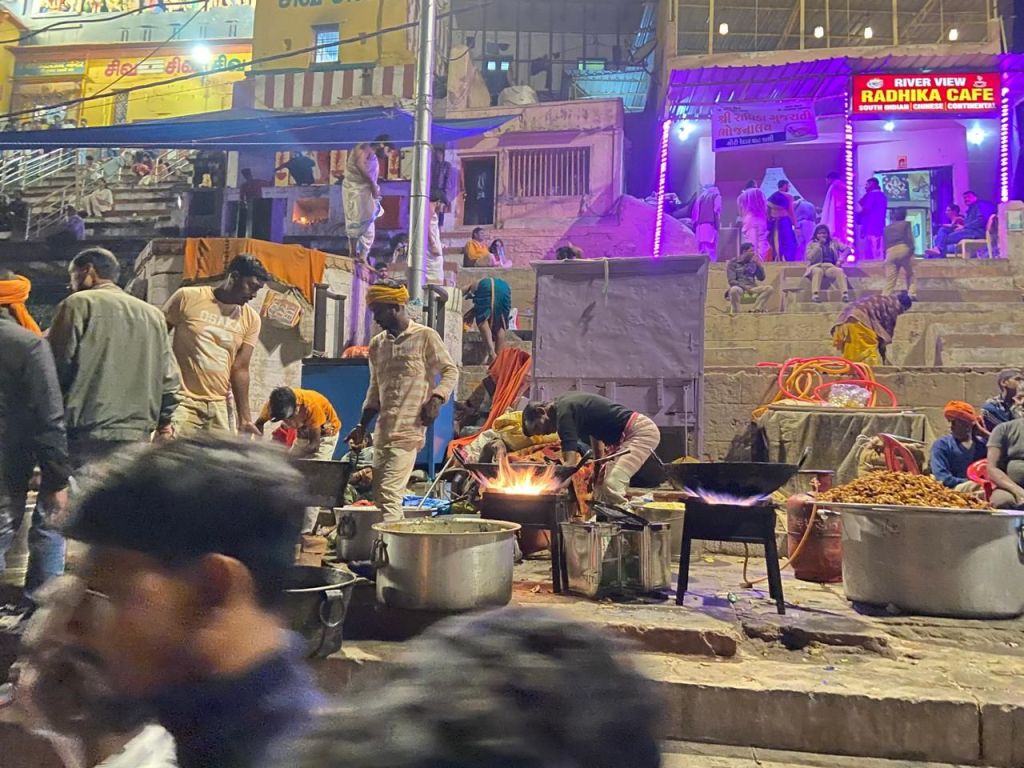
Feast being prepared for the wedding

The common man seated hundreds in numbers occupying the riverfront stairs played witness to the divine marriage ceremony conducted in a style typical to the Uttar Pradesh region. My friend was on top of the world when she was randomly picked from the gallery of people to make her offerings to the newlyweds (perform abhisheka with milk on small lingas moulded out of fine soft sand from the Ganges on a decorated silver plate). The contents in each plate was offered back to the river as a part of the culmination of the marriage rituals. The chants and offerings went on until the break of dawn post which the audiences and witnesses dispersed.
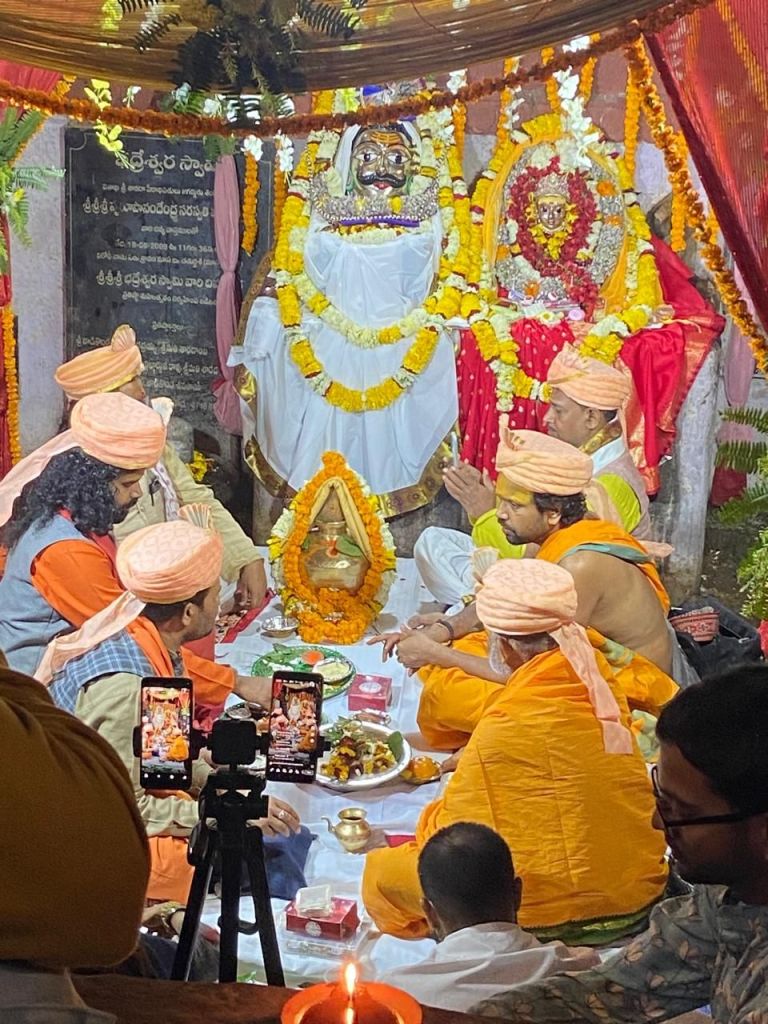
The celestial wedding in progress at Gauri kund

Date with the Lord and his consort

If this was about witnessing the celestial wedding, wait. Our visit to Banaras was incomplete without this: Greetings to Lord Kashi Vishweshwara. We had decided to skip the temple visit on the day of Shivaratri to avoid the crowd and try our luck on the following day. So that day was about resting and catching up on the sleep deprived from the last night.

Come the following day, there were no signs of any less crowd. Rather it looked like the entire crowd from Prayag had alighted at Banaras after closing the Kumbha Mela. The queue to enter the temple extended several kilometers. But we are Indians with local contacts. Be it getting access to a no-entry spot or to wave a quick ‘Hai’ to our favourite god, why wouldn’t we utilize our privileges to bypass rules? We will! We found a legal way (Oh, that’s a secret!) to cut the longer queue and reduce our wait time to just an hour. Amid chants of ‘Har Har Mahadev’ we had finally arrived at the Lord’s doorstep, a window from where we were blessed with a view of a beautiful Pushpa alankar or the floral decoration. Despite wanting to stay there for a little longer, we had to move away making way for the lakhs of devotees waiting behind us.

A visit to any Shiva temple is incomplete without taking the blessings from his consort, Shakthi. In Kashi, Lord Vishweshwara’s consort is Goddess Vishalakshi. We expected another long line but as surprising as we were, we had just another 10 to 15 people along with us, all standing and praying inside the temple without any pressure to move out. It was such divine energy felt in peace. So, after coming out of there, the next important thing to do on our list was to eat food, food at the Annapurna temple, the home of the goddess of food and abundance. Let me not add more paragraphs into my story describing how symbolic this temple is from a religious and mythological context; Google Mata is just a click away with all the details. So, we had to satiate our fasting stomachs by finding our way to the temple of Annapurna (actually, to the dining hall!).

Upon enquiry of the route, we understood that we had to navigate through the same long queue of the Vishwanath temple before arriving at a small deviation that led to the temple that we were looking for. The same local contact who had helped us to jump the previous line provided us with some tips to skip the queue all together because we were not going to Vishwanath temple this time. We followed his hacks, paid a deaf ear to dozens of abuses that were being hurled at us by frustrated people who had been standing for hours in the long queue before joining a crowd that seemed unusual to an Annapurna temple (since we had not encountered it on our way to the Vishalakshi temple) or rather familiar (with the structure and chants around us were similar to that of Vishwanatha temple). It didn’t take us too long to realize that we had indeed arrived at the window of Lord Vishwanatha again, by entering from a different gate. This time, his darshana was without any of his adornments, a blessed moment briefly happening before he is completely covered up by his next alankaara and the offerings made by the devotees. It felt surreal. How lucky could one get to have a second chance on such a cringe day?

Anyway, moving on from there, we had to talk to few security personnel to help us find our way to the Annapurna temple. It was a short walk away with a maddening density of people pulling and pushing their way through a small temple verandah to enter the dining hall. Once there, we both had goosebumps thanking our fortunes for having us the opportunity to devour that meal! It was simple and comforting yet felt luxurious!
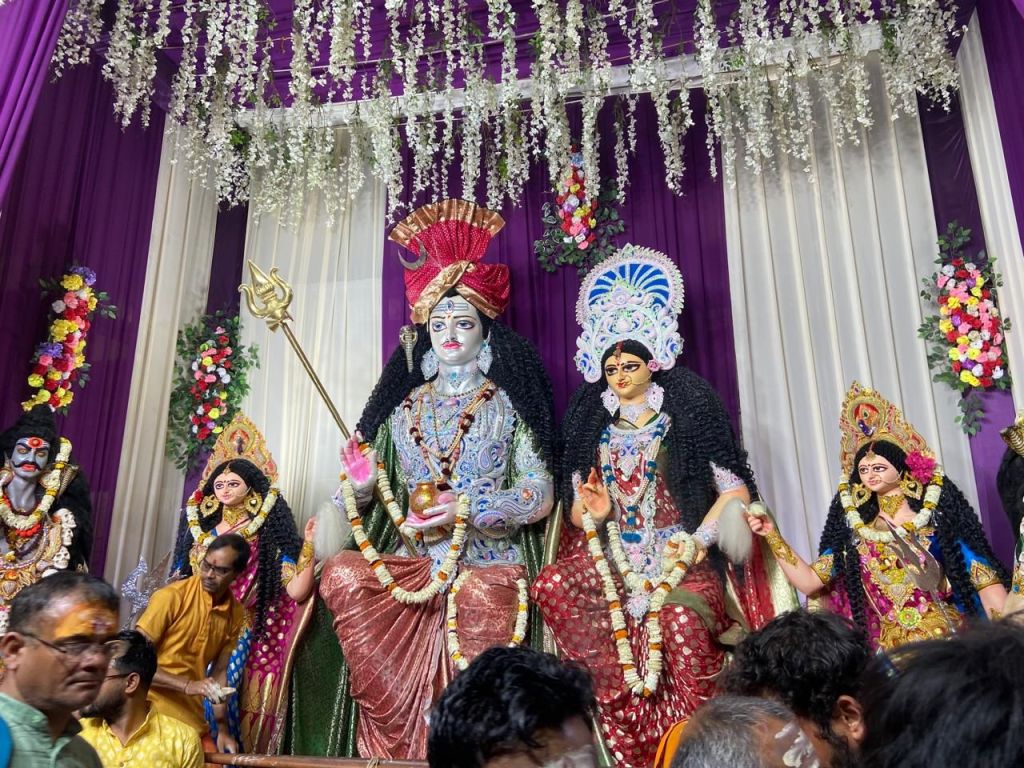
The reception of Lord Shiva and Goddess Parvathi

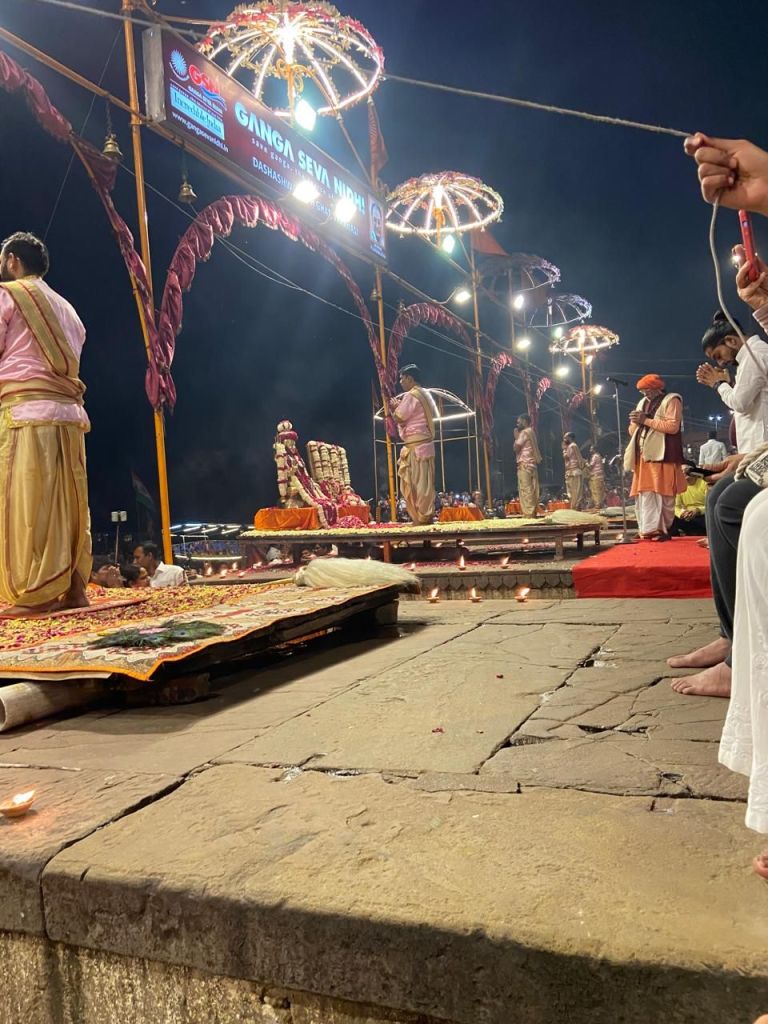
Lighting the Diyas at the Ganga Aarti

The famous Ganga Aarti performed twice daily on the ghats of the Ganga had been halted over the last couple of weeks, ever since the stampede had happened at Prayag. It was while having our lunch at the Annapurna temple, Sunny had dropped us as SMS informing us to arrive early at the Dashashwamedh Ghat as the evening aarti would be restarted from that evening. Even as we arrived at the ghat at 04:00 p.m., let alone sitting, it seemed impossible to find space to even keep our feet firmly on ground. The crowd had assembled on the ghats, on boats, atop all surrounding buildings, poles and structures to witness the Ganga Aarti that was scheduled to begin post-sunset. We both barely managed to find space just enough to cling on a supporting wall in front of the anchored boats.

It was finally time for the aarti and the all the priests who had to perform the Ganga aarti had assembled on the podiums. Call it our luck or divine intervention, the head priest who overlooked the preparedness of the dais before commencing the sacred ceremony pointed at the two of us from the massive crowd that had gathered. He asked us to come over and light up all the clay lamps arranged around the podiums. After that, he offered us to sit on a red-carpeted arena, right behind the performing priests that provided us the best possible comfort and view that evening! We couldn’t help but pinch each other to convince ourselves that the way our day had unfolded was indeed real.
Parvati ki Bidaai

On the third day, we stayed back to play witness to the Bidaai ceremony of the daughter, Goddess Parvathi with her husband: Shiva. With the entire Banaras gathering on the streets, the pomp and grandeur of the send-off was even larger than the Baraat which finally culminated on the outskirts of Banaras. With that, it was also time for us to return to our hotel and pack our bags to head back to Bangalore.

Part 1- The Story of The Maha Kumbh and the Naga Sadhus

The Kumbh Mela is the largest human gathering in the world, at least according to my school lessons. Since then, I’ve been curious to see what this massive congregation looks like. I happened to redo most of this route again in the company of another friend when I decided to witness the Maha Kumbh Mela in 2025.

By 2025, with the ability to fund my own travel and enough mental maturity to understand the world, I planned to attend the ‘Maha Kumbh Mela,’ scheduled for 45 days starting from the day of Makar Sankranti in January 2025 and ending on Maha Shivaratri in February 2025. Initially, I planned everything for a solo trip. Considering my leave, expected crowds, and other factors, I intended to take a holy dip at the Triveni Sangam in Prayag on Shivaratri. I had booked flights and accommodation well in advance. However, as the Kumbh Mela approached, news spread rapidly about this rare celestial event happening once every 144 years, attracting people worldwide eager to dip in the river. Many flocked to the site, driven more by FOMO, less by spirituality. Due to this unprecedented rush, transportation and public infrastructure were eventually overwhelmed. One of my friends decided to join me in my quest to wash away all my sins in the river confluence.

My plan was finalised well before the global frenzy began. I had a clear list of places I wanted to visit, the order of my travels, and the experiences I sought. This was the condition I set for my friend before accepting her request to join me. We flew from Bangalore to Ayodhya, where I finally got to see the Ram temple after his return from Vanavas. (My previous visit to Ayodhya has been detailed in a separate post). From there, the plan was to take the train to Prayag to experience the energy of the Kumbh Mela during its last two days. Afterwards, we would travel by train to Banaras, stay for a few days without a fixed itinerary, and then fly back to Bangalore.

When we reached Ayodhya, the small pilgrimage town was packed with crowds. Luckily, we had secured a slot to visit the Ram temple through online booking after staying awake until midnight, two weeks earlier. That sleepless night made our Shri Ram darshan quick and smooth. Without staying on the crowded streets, we slept through the night to catch the morning train to Prayag. Media reports emphasized the massive crowds at all railway stations around Prayag, raising our concerns before we arrived. We heard that daily visitors could reach 1-2 crores, excluding the main ‘Snan / Royal Bath’ days during the mela.

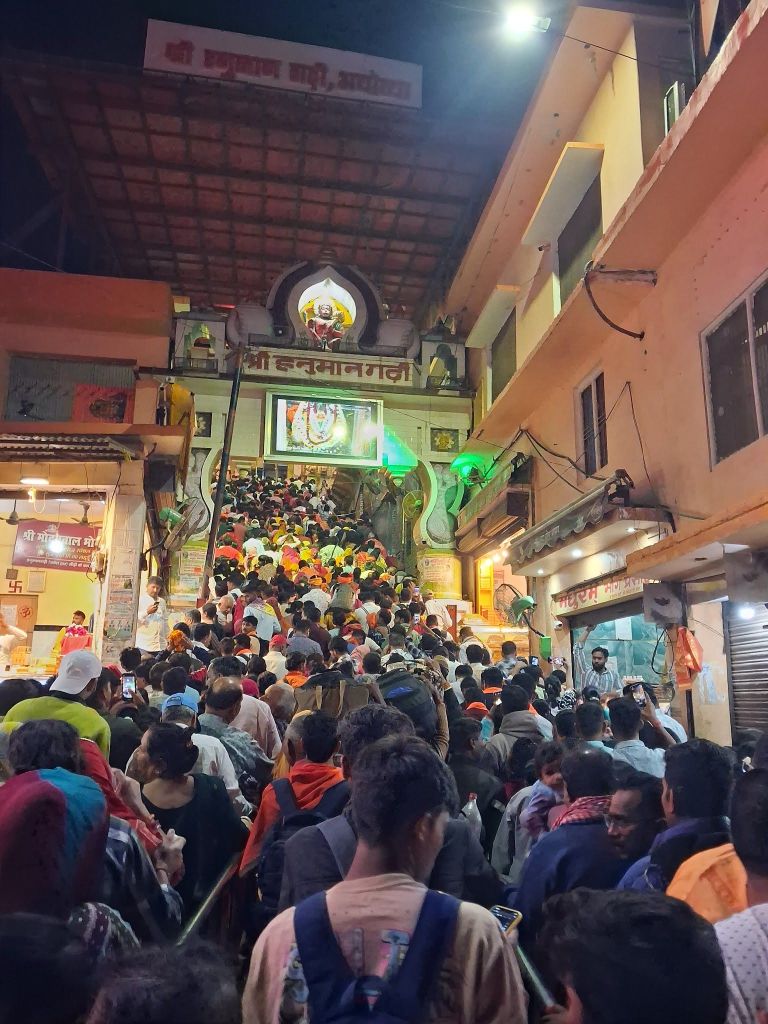
The Crowd at Hanuman Garhi temple, Ayodhya

We had a small list of things to do and experience, that were exclusive to the Kumbh Mela. Upon alighting at Prayag, two things happened. First, apart from the holy dip in the confluence, another priority was to see and interact with the Naga Sadhus. We believed this was a golden opportunity to experience the energy of so many ascetics in the same place who otherwise live in solitary dwellings in remote natural areas like mountains, forests or caves. However, we learnt that most Nagas had left the mela after the royal bath on the day of Basanth Panchami.

Second, I received an SMS notification on my phone that the scheduled train from Prayag to Banaras on the MahaShivaratri day had been cancelled, as a precautionary to avoid a stampede like situation that had happened on the day of the holy bath on Mauni Amavasya. This was the same train in which he had a confirmed ticket to Banaras. This cancellation then put us in even more distress wondering how we are going to navigate our travel through the crammed-up transportation system that had garnered widespread coverage on media.

After arriving at Prayag railway station, there was still hope. Things didn’t seem as bad as we had imagined, and it was rather easy to navigate from the station to the hotel we had booked earlier. Also, during other occasions, the Nagas belonging to the major thirteen Akhadas leave for their abodes after the Kumbh mela. But this time was special, the last day of the Kumbh coincided with the Maha Shivaratri. They had all headed to Banaras, for the Lord’s darshan on the most important night of their Adi Guru, Lord Shiva. We still had a probability to see them all if we reached Banaras for Shivaratri. But, we had planned to take our holy dip on that same day as it was one of the most important bathing days.

On the other hand, some good Samaritans recommended us to leave Prayag before the last day of the mela as a large crowd was expected to flock to not miss out the once in 144 years opportunity to wash off their sins. All holy sites and landmarks within the proximity of the confluence were closed for the next couple of days to avoid overcrowding. Roads would be blocked for vehicular movement and reaching either the airport, railway stations or bus stations would be far off to be accessible by foot. Finding some wisdom in the words of so many people, my friend and I both decided to reschedule our plan for Prayag.

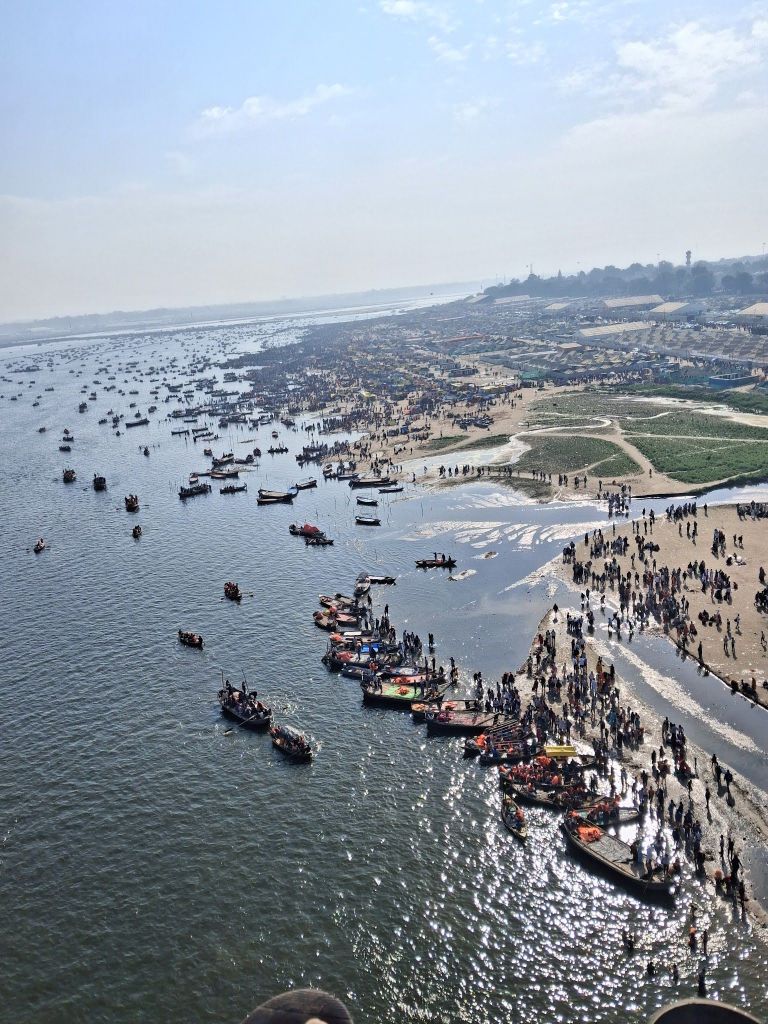
Bird's eye view of Triveni Sangam, Prayag
Bird’s eye view of Triveni Sangam, Prayag

Accordingly, after freshening up in our tented accommodation by late noon, we set out on a triple riding bike taxi to complete few of the things from our to-do list. Firstly, we tried para-motoring. Getting a bird’s eye view of the massive wall of the Allahabad fort setting a backdrop for the holy confluence and the tent city was a beautiful experience we had waited for. From there, we went visiting the temporary sets of the twelve jyotirlingas and finally reaching for the Ganga aarti at the ghat. We participated in the bhajans, did the aarti and slid into the warmth of the blankets in our tent.

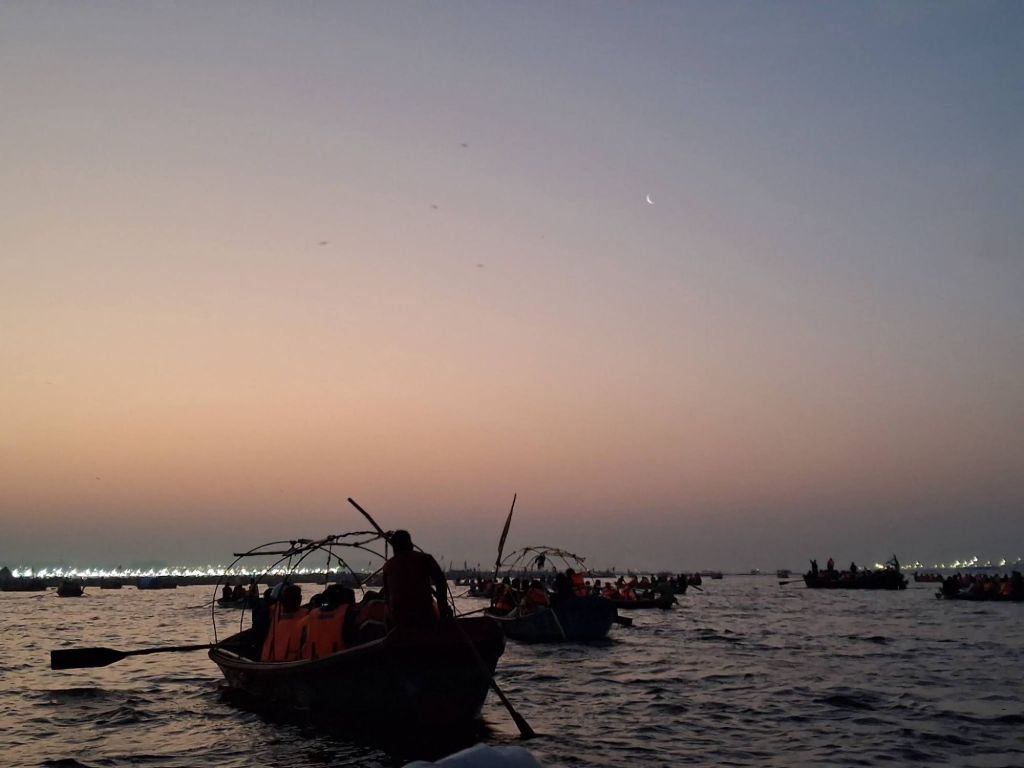
Early morning boat ride to the Sangam, Prayagraj

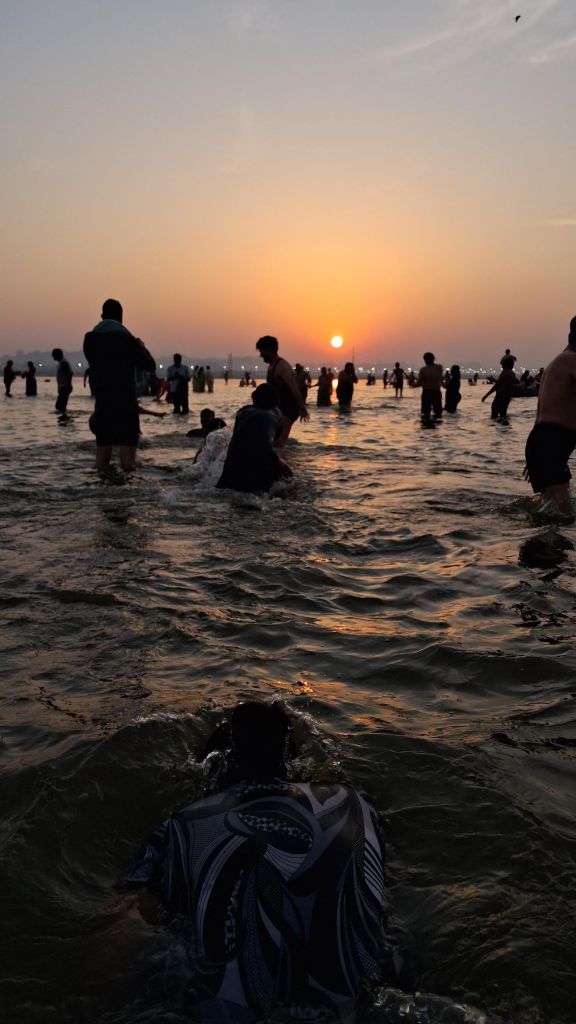
We woke up the following morning to board the boat that we had booked on the previous evening. The biting cold temperature made us a little hesitant to take the dip, but when we finally reached the confluence- the energy felt different. We both thanked the waters, greeted the rising sun and dipped ourselves in the Triveni Sangam, praying for good of us, our families and the world. It was a moment that I had looked forward to all my life, that twinkle in the eyes of the younger me was beaming with joy.

The Sangam dip during MahaKumbha 2025

After changing into dry clothes, we packed up and decided to move out of Prayag at the earliest. We hired bike taxis to reach a bus-station located on the outskirts of Prayag. To our surprise upon reaching, none of the buses were as crowded as we had expected them to be. Each bus left the stands as soon as the seats were occupied. The frequency was such that no passengers needed to stand on the aisle for their journey to Banaras from Prayag. The journey was smooth and rather on time, thanks to dedicated lanes marked for local and outside registered vehicles each and for public buses.

Continued as Part 2: The Story of The Maha Shivaratri and the Naga Sadhus

What has the spiritual capital taught me at Banaras?

Kashi for the pilgrims, Banaras for the historians and Varanasi for the modern… How it is religiously important, culturally vital, historically notable… There is enough said and done about this city through literature that is available as early as mythology, history and the modern contemporary. If I had to write about the same stuffs here, then this post would be just another summary with my perspective in it. However, I still use this one sentence to re-iterate the common belief: ‘No time is long enough to be at Banaras’.

The immovable faith of the people, the ever crowded streets, delectable street food, the elusive power of the Naga Babas, the hippie culture of the westerners, the rich history, the mythological importance, the intriguing cultural heritage, dance, music, poetry, handloom, education, art, architecture- The list goes on endlessly that holds so much significance. Hence, keeping it all aside, I wish to make a list of what this city offered to teach me-

1. Work is Worship: This old man agreed to pedal us around for a rickshaw tour of the heritage campus of the Banaras Hindu University. The humility in his speech, the five-o’clock shadow in grey on his weather beaten face and the sinewy legs spoke volumes of his wisdom and hard work for this 60+ someone. He has seen those innumerous people come and go to this sacred land. At the end of the tour, he stopped at the Bharat Kala Bhavan museum complex on the university premises. We told him that we wouldn’t need much time there and would be back in half-an-hour. We failed with our words, and the quickest we could come out is after one-and-half hours. There was no sight of this old man for as long as our vision could stretch. The man did not carry a cellphone and we didn’t know his name to enquire with the people around. We had waited for another 30minutes now. We were uncertain whether to wait for some more time or leave without paying his fees. In just then, we heard the tinkle of his cycle bell as it screeched to a halt in front of us with a little girl in the rear seat. He explained, “I was getting late to go pick up the kids from school and drop them home, they would panic or else”. This man did not worry if he lost the money that we owed him, there was something else he considered more important. As we sat on the rear with the little girl on my lap, I was reminded how for this man ‘Work was Worship’. One has to stay committed to what has been assigned.

2. Solo travel helps in self-discovery but having a travel mate provides security: While we finished the Ganga Aarti, savoured some delectable street food and returned to the hostel at around 10.00.p.m. we found that 3 of our roommates were fallen motionless. We checked with them to know what had happened. While one held on to her stomach and started to cry of pain, the other 2 ran to the restrooms… Having barely any strength to talk or stand, one of them managed to say that they had food poisoning. On being requested for help, the men running the hostel conveniently pushed the responsibility of nursing the girls on us. Since 2 of them were burning with high fever, we rushed them to the hospital (supposedly the best in town) for medication. On arrival, the hospital authorities refused to provide first aid without submitting their passport and paying an advance of Rs.30000. Forget being able to talk, these girls barely had any conscious to tell us where they had kept their belongings. And we ourselves being strangers in the place, it wasn’t going to be easy helping those girls. It was well past 12.00.a.m. while we were running around the dark, rainy streets of Varanasi for the required documentations so that the girls could get their first aid ASAP. With the physical condition they were in, with a no-electricity night, cocky/horny street hawkers who were hovering around and adamant auto-rickshaw drivers trying to make quick bucks out of the helpless situation, it would have been rather impossible for the expats hadn’t they found us! While the attitude of the guys running the hostel, the hospital and one of the girls among the patients itself is a story to write about, this whole episode taught me one thing- The importance of having company while travelling or at least having an acquaintance in the place one wishes to travel.

3. Serving food is divine, do it from your heart: There are eateries in every nook and corner of Varanasi that serve authentic cuisines from almost all parts of the world to cater to the international tourists who throng in large numbers. Any food that is offered with a true heart gets its added flavours… We had found our favourite hangout at the Phulwari restaurant, conveniently sharing the premises of the Godowlia Kaali mata temple. With a traditional ornate welcome gate opening into a casual shack like place with basic cushions and bamboo chairs and a mud-smeared kiln for making their wood fried pizzas, it offered a very warm ambience. And having personal attention from the waiter was overwhelming. He made sure we got precisely what we wanted while we were confused running through the long menu. He even went to the extent of getting some herbal drink from the next street to help me with my headache. He offered us with the best thandai of Varanasi, chilled to perfection and served in clay bowls to retain its authentic flavour; delivered at our hostel on the last day of our visit! There is so much more about providing customer service and hospitality- this man was at his best!

4. Do not question the untold: The Ganges is a powerhouse of inspiration. She’s holy, pure, sacred and selfless. While we took a ride along the shores of the holy river, the veteran boat man patiently answered all our questions about the holy city. While umpteen things can be discussed in lines of communalism, history and science, Not to be debated about: the Ganga at Banaras is a lifeline. It’s a way of life. Irrespective of religion, caste and creed, faith is the only thing that has kept the people going here… Every baby born in this land imbibes it in the genes… It’s at times important to understand the significance and let things be. Do not be overwhelmed to exhibit your education by venturing into a zone to only be littled by the magnificence of the faith.

5. There is no escape from the cycle of life and death: While we were sitting on the steps of the Manikarnika Ghat and watching the flames engulf the body of the deceased on the banks of the holy river, a volunteer sat next to us to proffer his knowledge about the significance of every ritual in Hinduism starting from the birth of a person until he bites the dust. He goes on to explain why Hindu culture does not encourage women from performing the last rites. Women being emotionally weak, tend to cry at funerals. This makes it difficult for the soul to break the attachment and leave the body. With soot from the fumes rising from the burning ghat settling all over us, it was a good long 2 hours of narration of the rituals associated with life and afterwards. At the end of which, I was left wondering with a continuously running stream of questions about life and finding its worth. They were thousands of unanswered questions which I hope to go back to the ghats someday, to find all my answers!

The home of the Indian National Emblem- Saranath

This visit to Saranath is a part of my fortnight long backpacking in the typical pilgrimage circuit of Uttar Pradesh covering Lucknow- Ayodhya- Faizabad- Varanasi- Saranath- Allahabad- Agra- Mathura-Brindavan- Fathehpur Sikri– Delhi

This article was featured in Toyota’s in-house magazine ‘Carz’ Apr~Jun’18 edition

The Details:

Back then, I had read history for the heck of passing the subject and today here I am… Travelling to know more about the rich history soaked heritage of my country… And in the pursuit, my friend and I stumbled upon this little forgotten land from the pages of history- Saranath. It was as if the history textbooks of primary school were walking alive with us… Saranath is an important destination both religiously and historically. So, people of varied interests can be found strolling the streets of Saranath. When we alighted, a volunteer offered to take us for a guided tour around the place and we nodded a yes! A couple of visitors from different countries joined us seeking me to be their translator while the Hindi speaking guide took us around. So I was doubling as a curious traveler and a travel guide cum translator.

Firstly, Saranath is the place where Lord Buddha delivered his first sermon to the five disciples after attaining enlightenment. Hence, a very important place religiously for the Buddhists. Today, the Chaukhandi Stupa, an octagonal structure made of brick and mortar stands at the very same place welcoming the visitors to this town. It was originally built in the Gupta era and later renovated during the Mughal rule.

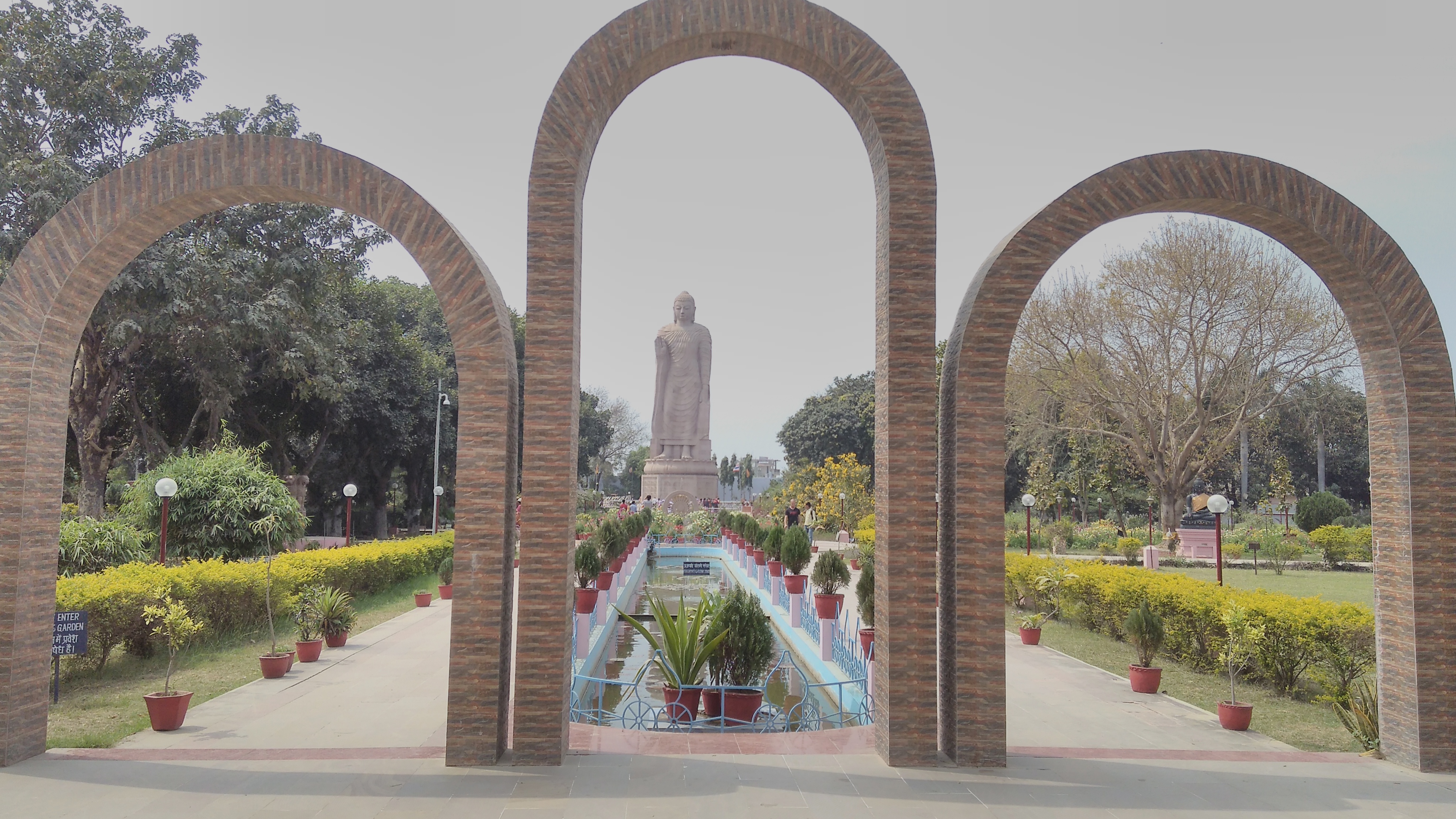
As I explored the place, I realized that people from different countries have made their presence with Buddha temples built in their native styles of architecture. The Nepali, Thai, Chinese, Japanese, Tibetan, Bhutanese etc. to name a few. While each temple style is unique and beautiful, you realize that the statue of Lord Buddha too is different in each of them. Buddha is worshipped in different forms in different countries… Seated Buddha, sleeping Buddha, standing Buddha, meditating Buddha ET all… The murals inside the Japanese temple grabbed my attention… I was told that the complete interiors is made of sandalwood… The idol, palanquin, the doors and even the chandeliers!

A small walk from there, is ‘Mulagandha Kuti Vihar’, the Nepali temple. What makes this place special is the third generation peepal tree adjacent to its premises. Fondly called as the grandson of the Bodhi tree, it is grown from a twig of a peepal tree believed to be the son of the original Bodhi tree that exists in Sri Lanka. With prayer chants and smell of incense in the air, it is truly a place of calm and solitude. We were quick to pick a few leaves of this holy tree as a souvenir from this little place.

IMG_20170309_121021
The Thai temple

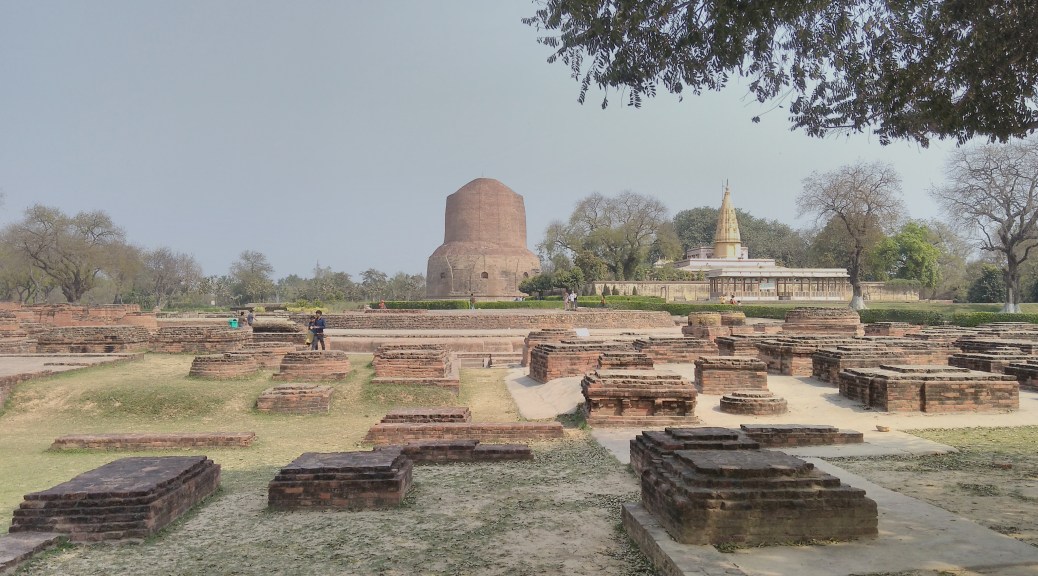
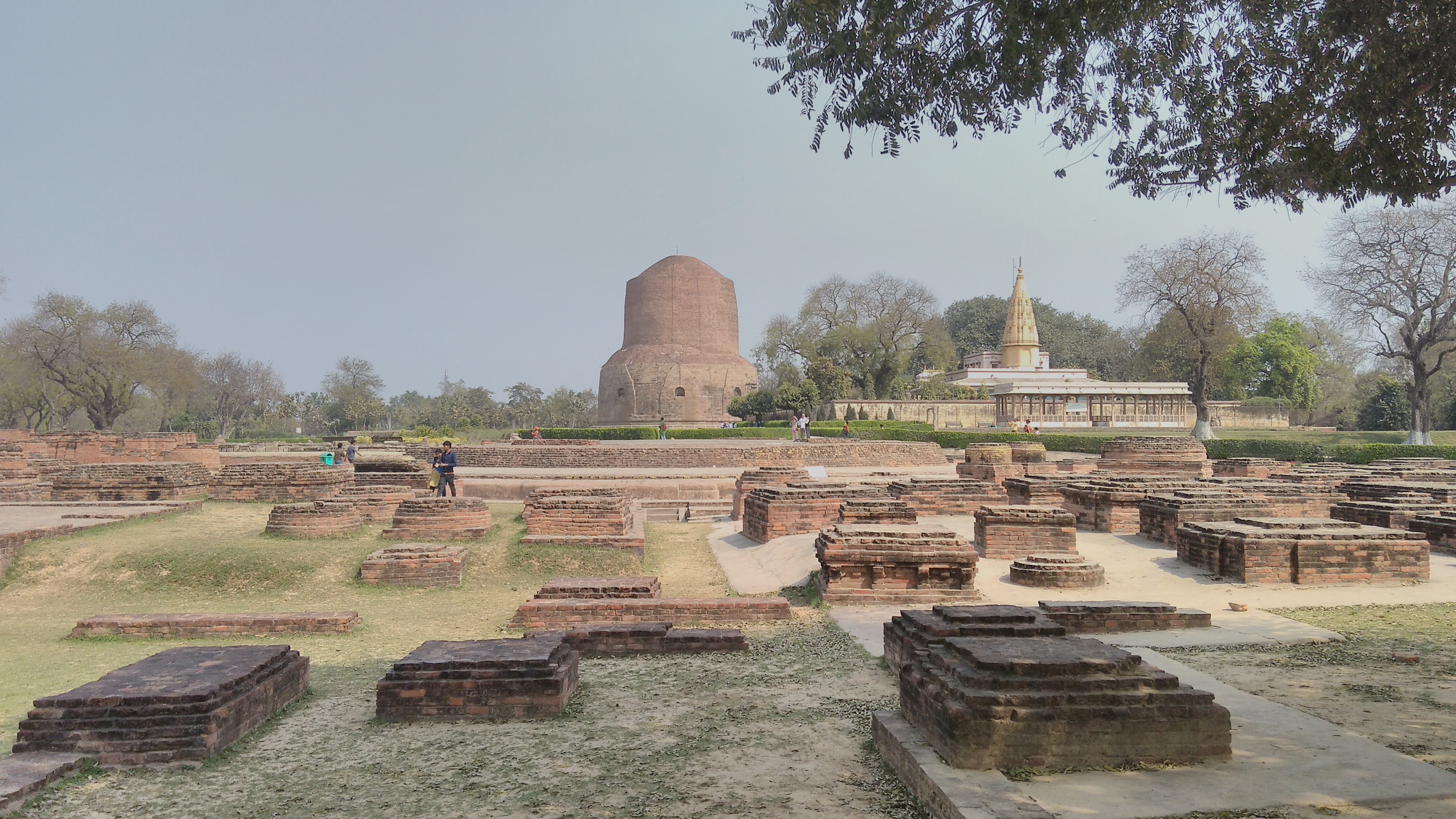
Next, it was some history time! We bought an entry ticket at the ASI counter to take a stroll around the ruins surrounding the Dhammek stupa. It is believed that the Mauryan emperor Ashoka had built small clay mounds at ten places where the ashes, the urn and the embers of Lord Buddha were buried which were eventually refurbished as large stupas by the different rulers in the course of history. Dhammek stupa is believed to be one among these ten stupas and hence, a very important one for the Buddhist pilgrims who throng here from across the globe. And that very place where the Indian National emblem was born! The pillar on which the four headed lion is seated was commissioned by emperor Ashoka to commemorate his visit to Saranath. The broken part of the pillar was found during the excavations of this site and later transferred to the ASI museum in Saranath. Today, the bottom portion of the pillar surrounded by four posts holding a stone slab are the things remaining from the original relics at the exact same spot. One way it is nice that nobody has tried to restore this pillar back as the easy accessibility to it would have got the emblem all over the internet with the insensitive photo/selfie-enthusiastic tourists.

IMG_20170309_135651
The site of Ashoka pillar with the Dhammek Stupa in the backdrop

A visit to Saranath would definitely be incomplete without getting a glimpse of the ORIGINAL National emblem of India. We deposited our valuables including cameras and cellphones in lockers provided along with the entry ticket to the ASI museum and headed to THE place. A chill ran down my spine on being greeted by this majestic sandstone structure bearing the lion capital, the original form of our National emblem. The four headed Asiatic Lion is seated on a lotus- The national flower of India. Our guide narrated the religious relevance of the emblem in Buddha’s life. The lion represents Buddha himself who stressed upon equality and justice in all spheres of life (all 4 directions). While Gautama was in his mother’s womb- she had a dream of a white elephant entering her womb representing prosperity. The bull represents the young prince Siddhartha’s strength, the horse depicts Siddhartha’s renouncing his royal life and Lion is the depiction of Siddhartha’s transformation into Buddha. When Baby Siddhartha learnt to walk, a lotus bloomed under his feet after the first seven steps and the lotus is said to have faded at the passing away of the Lord- Hence, the inverted lotus. The Ashoka wheel is called the Dharma Chakra, representing the movement of life with 24 spokes- each for the hours of a day… It is true to admit that the national emblem evoked a sense of pride in my heart.

Ours is such a rich country in terms of history, culture and heritage! Every stone in India has a tale to tell… Having been restricted from the access of shutterbugs makes this sight all the more valuable and meaningful! There are several other sculptures and artefacts in this museum making it THE BEST museum day in my life!

The last leg of our Saranath walk tour was a visit to the handloom centre where demonstration of weaving a Banarasi saree was given and there it concludes! Sometimes you end up having this feeling of unplanned trips are the best things to happen… And Saranath is one such place!

Conclusion Remarks:

  • Must do– Walk tour of the town
  • Must see– The Original form of the Indian National emblem at the ASI museum
  • Best souvenir– The leaves of the Grandson of the Bodhi tree.
  • How to reach– There is a railway station in Saranath. It is more convenient to hire an autorickshaw for a 30minute ride from Varanasi.
  • Stay– There are several Dharamshalas run by people from different countries.