Tag Archives: Handlooms of India

Exploring Ramnami Community: A Journey into Tradition

Over recent years, my travels across India ignited my fascination with how tattoos hold cultural significance among different Indian communities. In many areas, tattoos serve as symbols tied to tribal customs. One community that particularly intrigued me was the Ramnami of Central India. When I shared this with a friend, she too showed interest in delving deeper into this culture. We eventually connected with a community member who graciously allowed us to visit his village, even inviting us to stay with his family. We happily arranged our visit.

We initially flew from Bangalore to Raipur. From there, we caught a local bus to the GPM district. Subsequently, we explored GPM by taxi, which dropped us off at Chandlidih, the Ramnami village. It was raining heavily as we navigated the damaged, flooded roads and finally arrived at the location indicated by Google Maps. We carried our backpacks while crossing a small reservoir wall built over a stream swollen by the monsoon. On the other side was our host’s house. By the time we reached the front yard of the Ramnami family’s modest home, we were covered in mud from puddles stretching from the parking lot to the house.
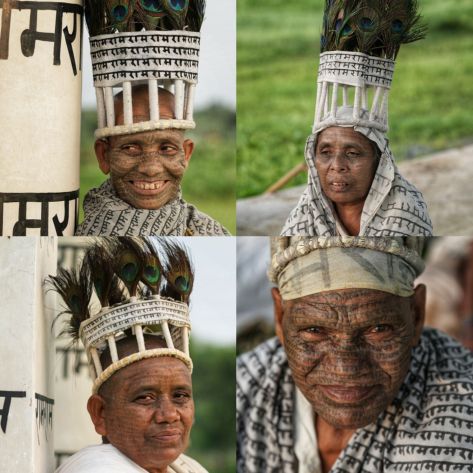
Portraits of the Ramnamis

Our host welcomed us upon arrival and directed us to the guest room to drop off our luggage. The room, an extension of the main house, was built with cob and wood, offering basic amenities such as two beds for resting and a light bulb for illumination at night. We relied on mobile internet throughout our stay. According to tradition, anyone visiting from outside must bathe and cleanse themselves before entering a Ramnami home. The next experience was something my friend and I will both remember for a long time: the bathroom!

It was a simple enclosure with two and a half walls and a roof. Half of the third wall was intentionally built to shoulder height, making it easy to bring in water from outside either with buckets or through a gravity pipe connected to a nearby perennial stream that filled a concrete tank inside the bathroom. The fourth side was left open for easy access, featuring a modest saree stitched into a sliding blind that could be moved to open or close. There was no running water; hot water had to be fetched from an outdoor firewood oven, or one had to make do with the chilly water stored in the tank inside. Our city dwelling bodies were used to a sturdy lockable door for bathing with unlimited hot water from a tap or shower. While the cold-water setup was tolerable for my outdoor spirit, I could not imagine standing unclothed inside a doorless bathroom.
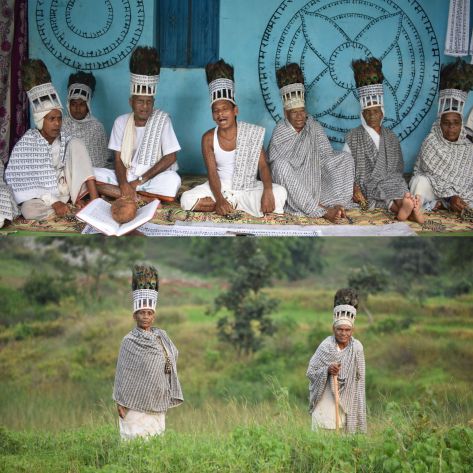
The Ramnami Community

If I were hiking, I could go days without bathing, but here, it was crucial to start our trip by experiencing the Ramnami culture. Hesitantly, I took off my clothes and poured a couple of mugs of water, just as I heard giggles outside. I paused to check if I was imagining things or if it was real. Soon, I saw the shadows of a few kids moving behind the curtain. As I began applying soap, I saw two toddler heads peeking in from the sides of the curtain, giggling again. I panicked, yelled my friend’s name, and hoped she would come to help. She got scared and ran over to see what was wrong. I told her about the curious kids, and she decided to stay at the bathroom entrance until I finished. Later, I returned the favor.

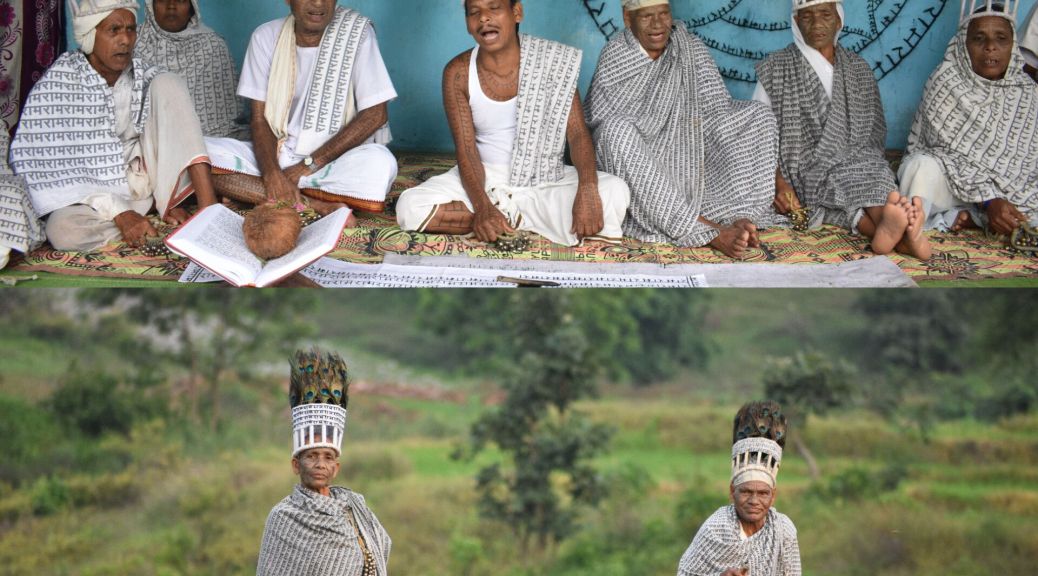
After changing into fresh clothes, my friend and I headed to the porch of their house, where the entire family had been singing hymns of Lord Ram since sunrise, even before we arrived. We greeted them with a coconut and some fresh flowers, which we were asked to bring as part of their tradition of introducing a new guest to the family. Most adults had tattoos reading ‘Ram-Ram’ in Hindi covering their bodies. Some had full-body tattoos, while others had only face, arm, or forehead patches. They all wore pure white clothes handwritten with ‘Ram-Ram’ patterns. Their Dhotis, shawls, and headgear featured the same ‘Ram’ writing in a consistent style. The handmade headgear, unique to the Ramnami, was decorated with peacock feathers. All participants in the Ram bhajan carried strings of small jingling metal bells, each stamped with ‘Ram’ during casting.

We introduced ourselves and joined their Bhajan until lunch was served. I savored a simple Satvik meal made with ingredients from their farm. The faint aroma of firewood used in cooking enhanced the local flavors with a divine touch.
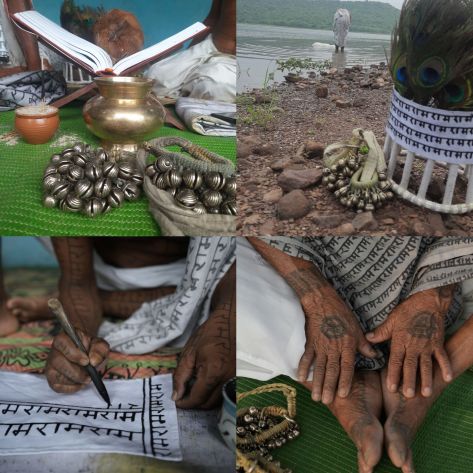
Daily utility items and life of the Ramnamis

We traveled without a fixed schedule, aiming for a slow, immersive experience of this community’s daily life. After lunch, my friend and I joined members singing Ram Bhajans on the porch to understand what defines the Ramnami. We were transported back to the 1890s to learn about their history. Like the rest of India at that time, casteism barred lower castes from entering shared places of worship. Some rebelled by declaring their bodies as temples dedicated to Ram, tattooing the Ram-Nam (Lord’s Name) with a locally made ink derived from herbs. They formed the Ramnami community. A senior member leads events, whether a baby’s birth or a funeral. Their greetings and farewells are solely marked by singing Ram-Bhajans, even during major life events like marriages. They do not conduct any Brahminical rituals, poojas, or havans as part of their practices.
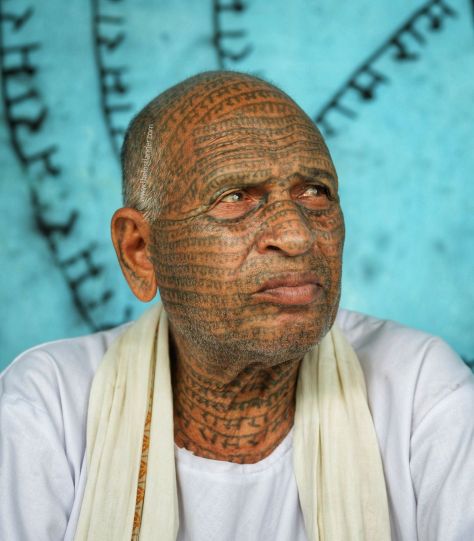
A portrait of a Ramnami community member

With the rain gods commanding the skies and earth, we saw them prepare their shawls, made from woven, stitched white cloth they crafted themselves. These shawls were then covered with Ram-Nam. After carefully observing them write with their native ink for a while, we joined in to write on some of the other pieces. Once finished, they set them aside to dry, initiating a series of procedures to prevent the white cloth from bleeding black.
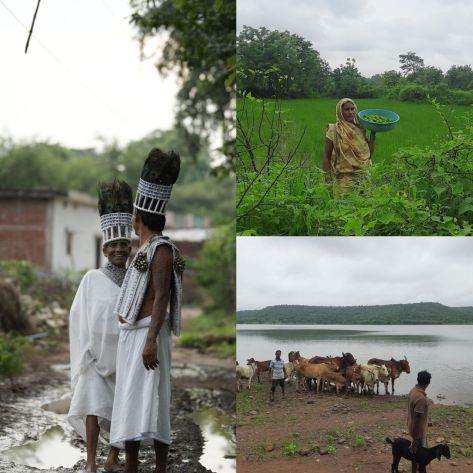
A walk through Ramnami village

When the rains stopped, our host guided us through their village. We crossed a stream, carefully walked along the paddy field edges, and eventually made our way along muddy, winding roads. We met several members of the Ramnami community, mostly relatives or neighbors from the same village. We greeted women working in the fields and enjoyed coffee at welcoming houses. Later, we visited JayaStambh, a small monument commemorating the annual Ramnami mela held here a few years prior. Some older community members joined us there at sunset, singing Ram bhajans as a tribute to the setting sun. Afterwards, we visited a small reservoir across the lake. The Ram Bhajans, sung warmly around a bonfire, echoed over the calm water, with the sky changing colors dramatically until nightfall.
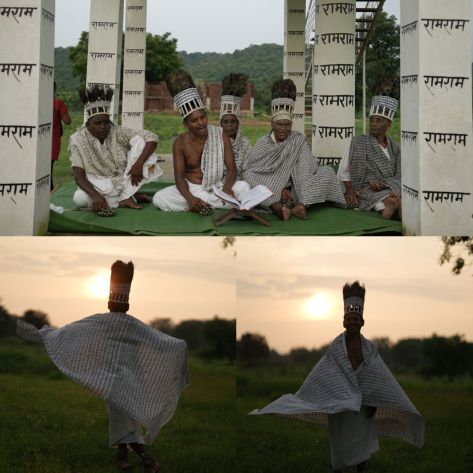
The evening prayers at the Ramnami Jayastambh

We walked home carefully through the night darkness to avoid slipping on the slush. After a satisfying dinner, we drifted into a peaceful, childlike sleep, concluding a long and exhausting day.

The following morning, we rose early to witness a normal day in the life of the Ramnami. We went to the reservoir with the elder members of our host family, who offered prayers to the sun god and recited blessings before their water dip. After changing into clean clothes, they went back home to continue household tasks such as cleaning, preparing food, and having breakfast.
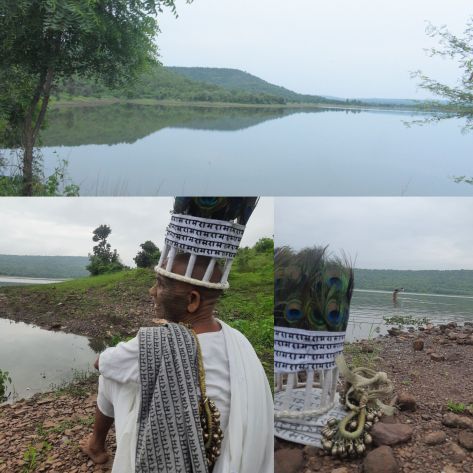
The morning at the Chandlidih reservoir

Spending time at a Ramnami home offered a genuine glimpse into a culture that is remarkably different from the rest of India. The younger Ramnami generation might not be eager to follow the traditional paths laid out by their elders. However, this community exemplifies how faith in God can help us overcome great challenges. They defied the odds, forging their path, which they believe will lead them to a divine connection.

After a simple breakfast and Ram Bhajans, we packed our bags for our next destination in Chhattisgarh. Our host assisted us with pillion rides on two motorbikes, skimming over the slushy village roads before reaching the highway, where we caught a local bus to continue our journey.

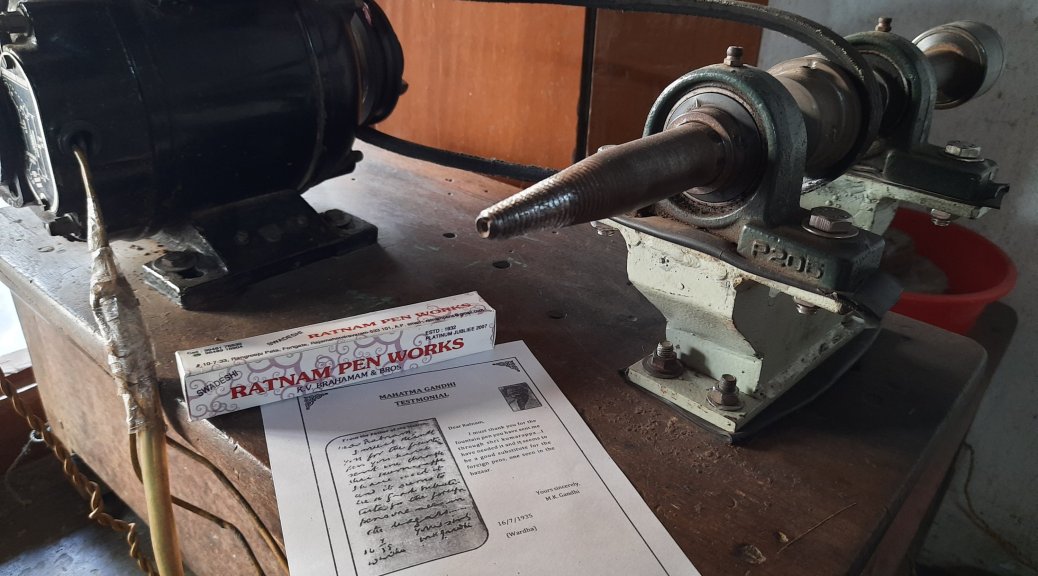
A souvenir from Rajahmundry- Ratnam pen

This was a part of our family’s five state road trip covering Chhattisgarh – Odisha – Andhra – Telangana – Karnataka in Dec’20.

They say a pen is mightier than a sword. A good writer can win a great battle. I guess it has been all the more true in the Gen-Z era. Although the pen has been replaced with keypads, the social media warriors have continuously upped the war of words 😛 But for a few old-school goers like me, nothing can replace the joy of holding a pen between the fingers and scribbling on paper. The thought instantly takes me back to the earliest days of life when I graduated from a chalk and slate to a pencil and paper. When we reached middle-school, I was a proud owner of my first pen. Writing with a pen was a symbol of growing up; we flaunted it around with those younger than us in school. “Don’t use a ball-point pen, it will spoil your handwriting“, was an instruction given by a teacher to all of us. Filling ink into the fountain pens was a mandatory part of our daily chores. On days that we either wrote more or forgot to fill inks, we would barter drops of ink with our classmates. Although ball-point pens made their way and stayed in the comp-boxes of my pals by the time we reached high-school, I somehow carried the instructions of my teacher with myself for a little longer. I switched over to a ball-point pen only after I graduated from college. But my love for fountain pens and writing on paper still lives on. This is the long story in short, about my connection with fountain pens.

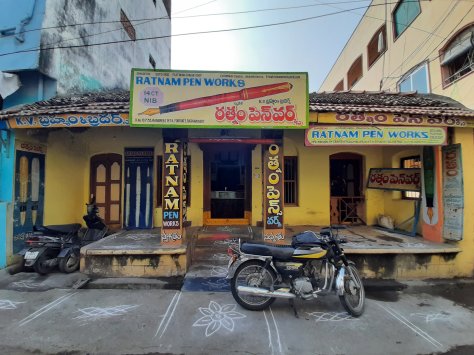
Rajahmundry is a big city in Andhra Pradesh. It is one of the largest exporters of textiles, rice and horticultural products in India. But ignoring all that, my need for exploring the congested bustling streets of the city was to find a fountain pen. With the help of Google maps, I walked through the narrow lanes of the busy shopping area to locate an old graceful house dating back to pre-independence era and surrounded by tall modern buildings. The house was an elegant traditional structure built and maintained in its original form with clay tiled roof and a large open central courtyard. That morning, I had come there to buy an art piece – ‘The Ratnam Pen’.

Ratnam Pens- Manufacturing and Sales Outlet

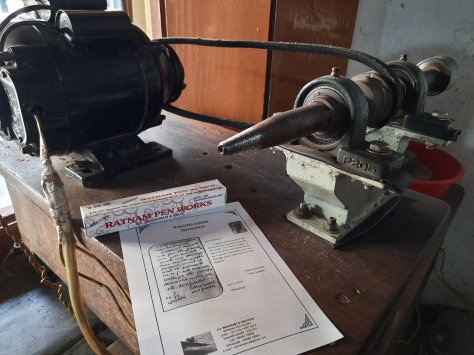
‘Ratnam pen works’ is a heritage fountain pen maker who has been one of the earliest in this business when Mahatma Gandhi largely promoted ‘Make in India’ concept through his ‘Swadeshi’ movement. These pens have been used by some of the famous personalities from across the country and the world. Ratnam pens are a delight for every pen collector. A framed paper on the wall is a prized possession of this craftsman. It is the original copy of a handwritten letter by Gandhiji to the owner of this place in appreciation of his contribution towards the swadeshi movement.

A copy of Gandhiji’s letter, a fountain pen case and the lathe machine at Ratnam pens workshop

Apart from being the shelter to the owner’s family, this house of ‘Ratnam pens’ is a workshop where the mightier pens take form. These famous fountain pens are made and sold only here to which people come down from across the globe. Although these pens are unavailable for online purchases, “Anyone interested to buy them or want spares and service for existing products can do so by calling me directly on my phone”, the owner says. I was more than excited to lay my hands on this new addition to my collection of pens. A happy me was then set on continuing my travel towards another noteworthy village nearby- Details on my next post 

This is my humble attempt at promoting domestic tourism and local artisans. I urge my readers to support small businesses by buying locally produced substitutes for imported goods.

What is that one favourite souvenir you have bought from your travels? What are your memories from school? Please do share your thoughts on this post with me. I would love to hear them.

Art and Crafts of Bastar

Bastar is an area soaked in rich culture. And art is an integral and unique part of this indigenous culture. It is safe to say that Kondagaon district is the art hub where there are entire villages dedicated to each of these handicrafts, with households registered with the ministry of culture & art. Several of these artisans are National award winners and visiting faculty at universities across the world. During my week long stay at Bastar, I managed to find time to visit some of these villages and interact with the artisans.

Blame it on me being an experienced professional in materials, manufacturing and heat-treatment processes, I have this weird fancy for everything that involves these aspects. One would not want to seize a travel opportunity from me when there is an element of art and engineering in it…. On similar lines, is the first part of this post.

The major and famous handicrafts of Bastar can be listed as below:

Wrought iron artefacts:

Chhattisgarh is a state blessed with a mineral rich geography. Until a few decades ago, the tribes inhabiting the region used to collect raw iron ore from the naturally available soil or portions of earth, heat it in a furnace and separate the molten iron to make wrought iron. Today, wrought iron is directly purchased from the market. This is then melted and beaten into sheets. The sheets are then formed into various patterns and welded into beautiful artefacts. Although the traditional designs are based on the local tribal culture and represent aspects of daily life in Bastar like animals, hunting, the tribal folk, tribal deities, etc., modern adaptations have been inspired by the Indian epics among many other things. But still, each piece is handmade and unique with no two pieces being exactly the same.

Demonstration of making wrought iron craft by an artisan

Dokra art:

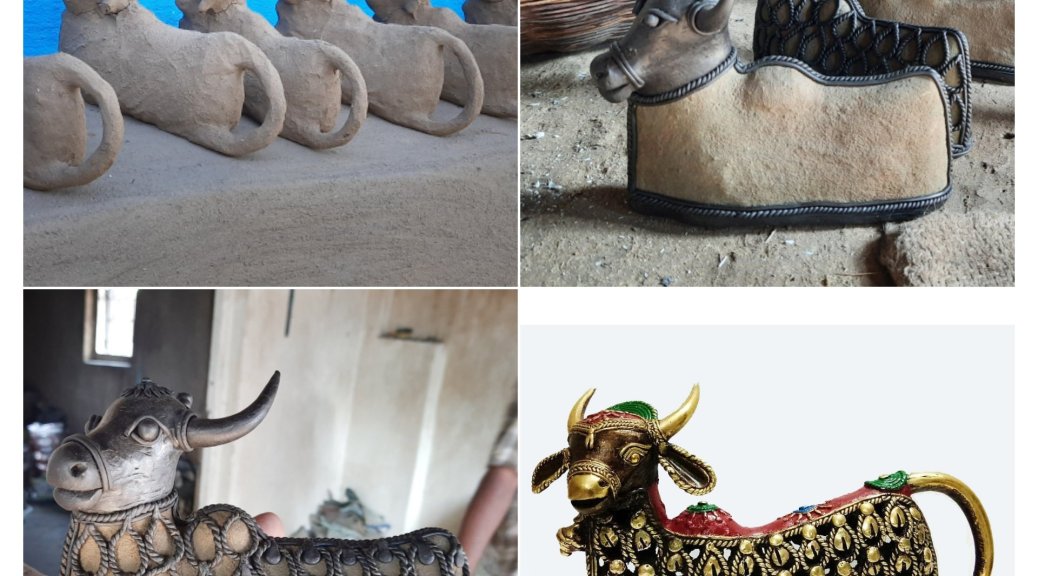
Bell-metal is an alloy prepared locally and cast into various patterns through a technique called as ‘lost-wax technique’ of metal casting. Although this technique was primarily used by the indigenous tribes to mold their traditional jewelry back in the time, it has slowly evolved into making idols and other home décor items. These indigenous metal cast items are collectively called as Dokra art.

Dhokra art at various stages of metal casting

Terracotta pottery:

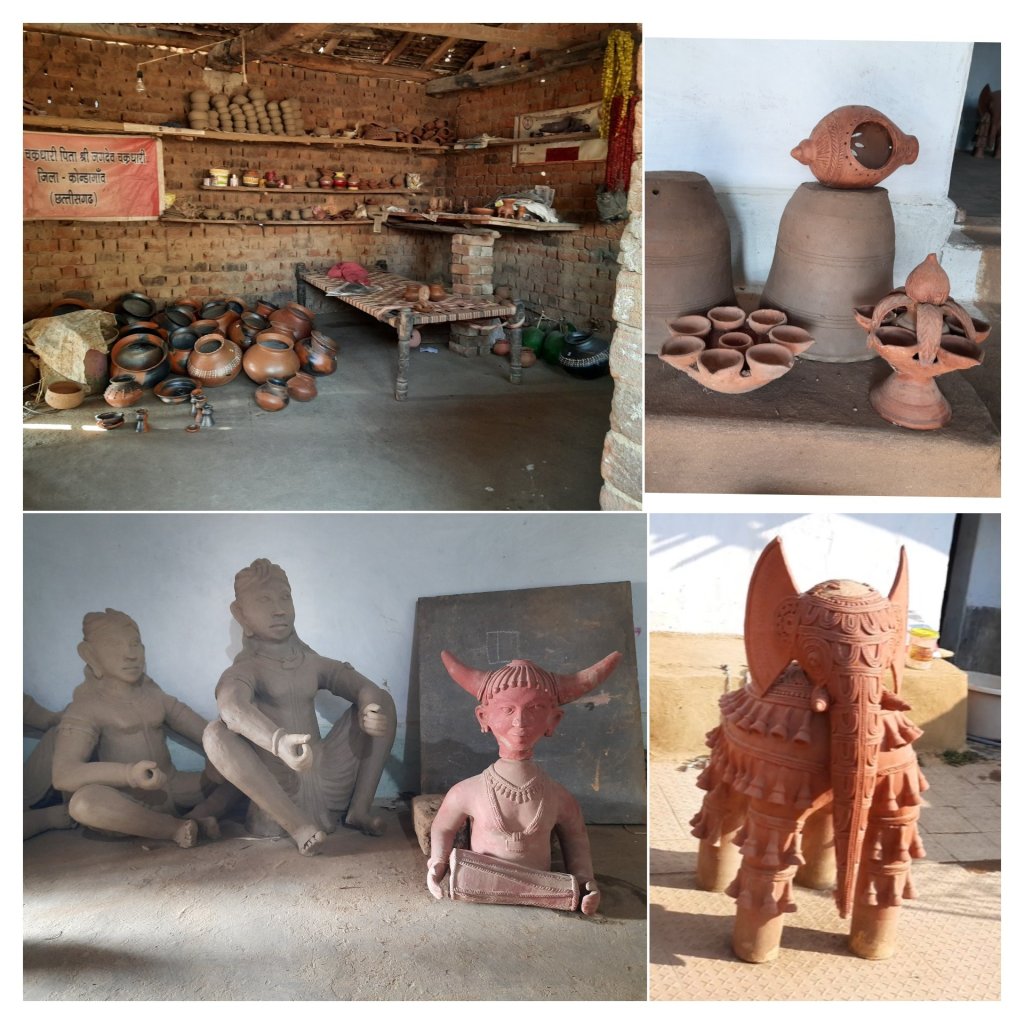
A special type of clay is dug from the vast paddy farms and is then crafted into various artefacts. The specialty of the art here in Bastar is that very large and real-life sized objects are crafted completely with clay. After the potter assembles the product piece by piece, he then burns it as a whole unit to give it the required strength and rigidity. Well, there’s an entire village of potters / Terracotta artisans in Kondagaon.

Terracotta art at Bastar’s pottery village

Wooden carvings & Carpentry:

With the abundance of forest cover and timber availability, wood craft is a major part of the handicraft culture here. Large tree trunks and roots are given the form of beautiful figurines, animals, etc. by very skilled artisans. This can also be seen in the rich carvings on doors and friezes of various old and traditional structures across the region.

Stone sculpture:

With the mineral rich earth of the region, various types of soil and stone are available. Several of these earthy materials are used to make beautiful sculptures.

Mural Paintings:

With a somewhat influence of the Patachitra art from the neighboring state of Odisha, the local Gondi artform and several other influences, the indigenous wall and fabric painting has evolved. Beautiful pictures of tribal deities, everyday life etc. can be seen being depicted through these paintings.

Handloom:

A small portion of the local tribes are involved in collection of the naturally available cotton and Kosa silk from the forests and weaving them into traditional textiles.

Jewelry:

Each of the tribes who inhabit the remote jungles of Chhattisgarh have their own unique pieces of jewelry. Anything that ranges from silver, fabric, plant fiber, shells or animal bones, the locally available materials from the wild are adapted into their culture in the form of traditional jewelry.

Kanchipuram- Beyond its sarees

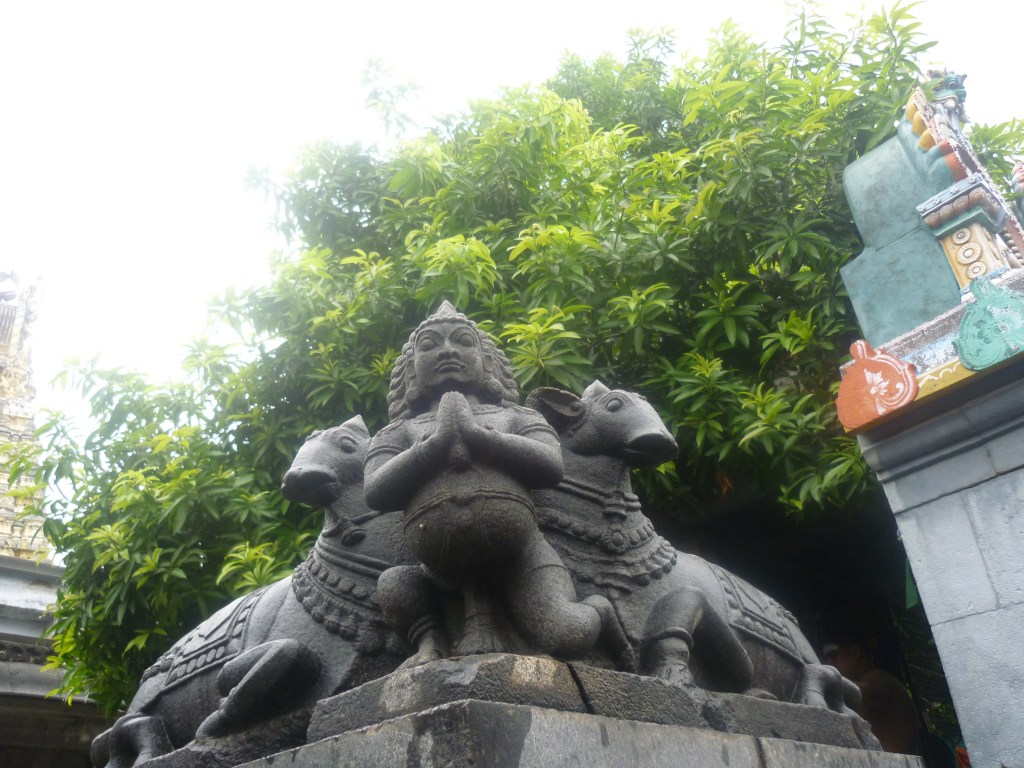
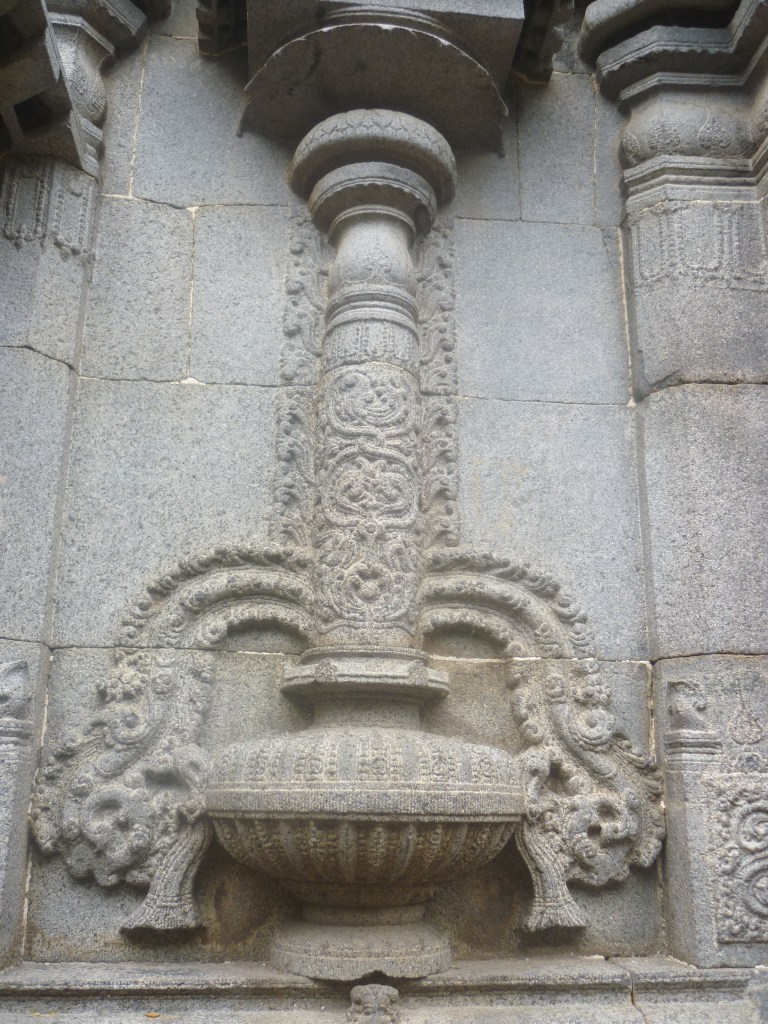
The first thing that hits your mind when you hear this city’s name is its Silk sarees. The Kanjeevaram or Kanchi silk sarees define a sense of style, gorgeousness, elegance, classy and royalty. But what goes rather unnoticed is the fact that Kanchipuram is also called a ‘City of temples’. Despite being the erstwhile capital of the Pallavas, the influences of Pandyas, Cholas, Hoysalas, and Vijayanagaras can also be significantly observed in the artistic structures constructed across the city. Also, it is noteworthy that the influences in temple architecture are across different sects of faith. The City of Kanchi can be broadly classified into three- Shiva Kanchi-the holy land of the Shaivaites, the Vishnu Kanchi- the holy land of the Vaishnavaites and the Jaina Kanchi- the holy land of the Jains. Kanchipuram is known to be a land of 108 ancient temples, all unique in their own way. Beyond its world-famous handloom, the sculptures, architecture, classical dance, music and all those traditional art forms of Kanchi puts up the city high up on centers of history and heritage on the map of India. That’s why I like to call Kanchipuram as ‘an abode of the trio- Art, culture and history’.

When my mom planned to buy some drapes from the local weavers of Kanchi, I chanced upon the opportunity to explore this city, beyond its sarees and handlooms. Obviously, one day wouldn’t be sufficient if I had to visit each of these 108 temples, and hence, I made a list of 10 temples based on their mythological importance. Given that I’m mostly a public transport-dependent creature, the ease of commutation was also a factor considered while making my list. We boarded an overnight bus from Bangalore to Kanchipuram.

As we alighted at the Kanchipuram bus terminus, we were greeted by the drizzling rain. Usually, the autorickshaws work this way in this city. You tell them the purpose of your visit, and they will plan and handle the entire itinerary for you. Thus, we hired an autorickshaw and that sorted our transportation for the entire duration of our visit around the city. Our auto driver took us to a travellers’ dormitory where we freshened up quickly and then headed to the first temple on my list.

1. Kanchi Kamakshiamman temple: The timing of our visit was important and we wanted to reach there before sunrise. This is one of the Shakthi peethas in India. The prayers in all other temples in Kanchi starts only after prayers are offered here. Unlike any other temples in India, the first pooja to the presiding deity is offered by an elephant and a cow in the sanctum here. The positive energy we felt in witnessing the ritual was enough to keep us going for at least another week.

The entrance of Kanchi Kamakshiamman temple

2. Next up was a quick visit to Adi Kanchi temple, a relatively smaller of the 3 main temples dedicated to Parvathi in Kanchi. But this place is considered a must if one is on a pilgrimage in Kanchipuram.

3. Adjacent to the Adi Kanchi temple is the Kumarakottam- Murugan Swami temple. It is believed that Lord Bramha was imprisoned by Murugan at this place and later released with Shiva’s interference. The temple is known for the idol in the Soma Skanda posture.

4. Ekambareshwara temple: This is the biggest temple in the city. I’d need a separate post altogether to write about the significance of this temple alone. But the primary reason for me to include this temple in my itinerary is the fact that this is one of the Panchabhuta sthalas of Shiva’s manifestations. The linga here is made up of sand and hence represents Prithvi or the element ‘Earth’. This majestic temple complex houses a very sacred mango tree at its centre, whose 4 branches are believed to represent the 4 Vedas that give its name to the temple. Each branch bears mangoes of four different tastes(sweet, sour, bitter, and spicy) in the 4 seasons. The special souvenir that I take back from Kanchi was not a saree, but a priceless green leaf that withered off from this holy tree right there, as if the tree was communicating with me.. I was quick to pick it up and wrap it carefully to be kept in my handbag.

Under the mango tree at the Ekambareshwara temple

5. Next was the Varadaraja Perumal temple. We had to stand in a really long queue to get a glimpse of the main deity seated atop the elephant hill. As if this wasn’t enough, another long queue to get to touch the sculptures of the holy lizards. These metal lizards are believed to have been installed by lord Indra after he was released from the curse by Goddess Saraswati. It is also believed that people who touch these 2 lizard sculptures (the Golden lizard representing the sun and the silver lizard representing the moon) will be relieved of all sins that are associated with lizards. Another specialty of this temple is the fact that the wooden idol of lord Vishnu is kept deep down inside a 3 tiered well that in turn is in between a large pond at the temple entrance. The idol is taken out only once in 40 years for pooja offerings. (The latest festival was held in 2019.) I would recommend you to hire a guide at this complex so that you can get a better insight into the intricacies of the ornate pillars adorning a 100-pillared hall. You can find sculptures of vivid yogic postures, representations of the usage of arms and ammunitions in ancient battles, musical pillars, etc., which explains the rich heritage of Indian art, history, and science.

A mural at Varadaraja Perumal temple

Thus, with Kamakshiamman temple, Ekambareshwar temple, and the Varadaraja Perumal temple, we had completed the mumurthivasam- or the abode of the trio in Kanchipuram.

6. Just a few meters away from there is the Ulagalandar temple, primarily constructed by the Cholas. Here, Vishnu is celebrated in his Trivikrama pose or the Vamana Avatar. The main idol is a massive 30+ feet tall, and the devotees can see only the legs of the Vamana moorthi. The temple itself is small but an important one for pilgrims on the Divyadesams circuit.

7. Further from here is the Kacchappa Eshwarar temple. Here, Vishnu is seen in his Kuruma avatar or the Tortoise form, worshipping Lord Shiva.

8. We did a quick stopover at Vaikunta Perumal temple or the Tiruparameshwara Vinnagaram, another among the 108 divyadesams. The temple houses lord Vishnu in 3 different postures- sitting, lying, and standing. The corridors are decorated with fine carvings from the Ramayana and Mahabharata, and fine stone pillars around the sanctum.

9. The Kailasanathar temple needs a special mention. This temple, dating back to the Pallava period, is located slightly on the outskirts and hence away from the regular tourist/pilgrim circuit. It is an entire complex of intricate artwork sculpted on limestone. Although a board claims it to be a protected monument, most of the statues have eroded over time and need maintenance. Yet, this place has a very powerful force to draw art lovers and travelers looking for an offbeat experience. One really needs to spend a lot of time here to appreciate the intricacies with which legends and mythological episodes have been carved out. Don’t miss spotting the statue of laughing Parvathi and Shiva performing the thandava here.

The Kailasanathar temple

10. There is also the Vijayaraghava Perumal temple at about 7kms from the city center. It is one of the 108 divyadesams of Rama, where he is believed to have performed the funeral rites of Jatayu, the vulture friend. Since the vulture(Pul) was buried in a pit(Kuli), this place is also called Thiruputkuli.

Not only is Hinduism, but the city is an important place for the Jains too.. Bonus for your temple tour, if you have some more time left. You can include the Trilokyanatha & Chandraprabha twin temples dedicated to lord Mahaveer at Tirupparuthikkundram. It has inscriptions belonging to Pallavas, Cholas, and the Vijayanagara period. I’m told that the place houses beautiful paintings of these periods but lies in utter neglect. The place is frequented by fewer tourists and more vandals, gamblers, and hawkers.

Enroute, we passed through ‘Kanchi Kudil’- an old traditional house that has now been converted to a museum that exhibits the rich Tamilian tradition.

But well, Saree shopping was why the entire visit to Kanchipuram was planned in the first place. Hence off we were, on a handloom circuit. Our driver took us through the narrow bylanes of Kanchi to some of the finest weavers and their handloom workshops. A spectrum of colours, heavy brocades, golden zaris, heavy pattu sarees… we were spoilt for choice… We thanked our driver, Mr.Ravi, heartily for taking us around the city and bearing with us so patiently as we hopped from one shop to another. We picked up some beautiful sarees in silk and cotton and returned to Bangalore in an evening bus.

Thus, ended an eventful weekend…. 🙂