Tag Archives: Offbeat things to see in Varanasi

Part 2-The Story of The Maha Shivaratri and the Naga Sadhus

Continued from Part 1: The Story of The Maha Kumbh and the Naga Sadhus

We had taken help from a local person, Sunny, to make a last-minute hotel booking at Banaras. Sunny was a young lad who freelanced as a local guide, and was referred to us by one of my friends who had availed his services earlier. My friend and I checked into the hotel booked on the main road of Banaras, slept without dinner as were tired.

Meeting the Nagas

It was around 02:00 a.m. when I was woken up. “Wake up, Hitha. There is something happening on the road, I can hear people shouting slogans.”, my friend sounded very anxious.

It is Shivaratri. People maybe chanting Har Har Mahadev, as many were doing so when we arrived here.” I said.

No, wake up! I have been hearing this from quite some time, and it is getting louder now.” She barged outside the room to check what was going on.

Hitha, hurry up and come outside! All the Naga Sadhus are right here!” she shouted, while running towards my bed, huffing and puffing in the next couple of minutes. Then, we both ran out to the reception area.

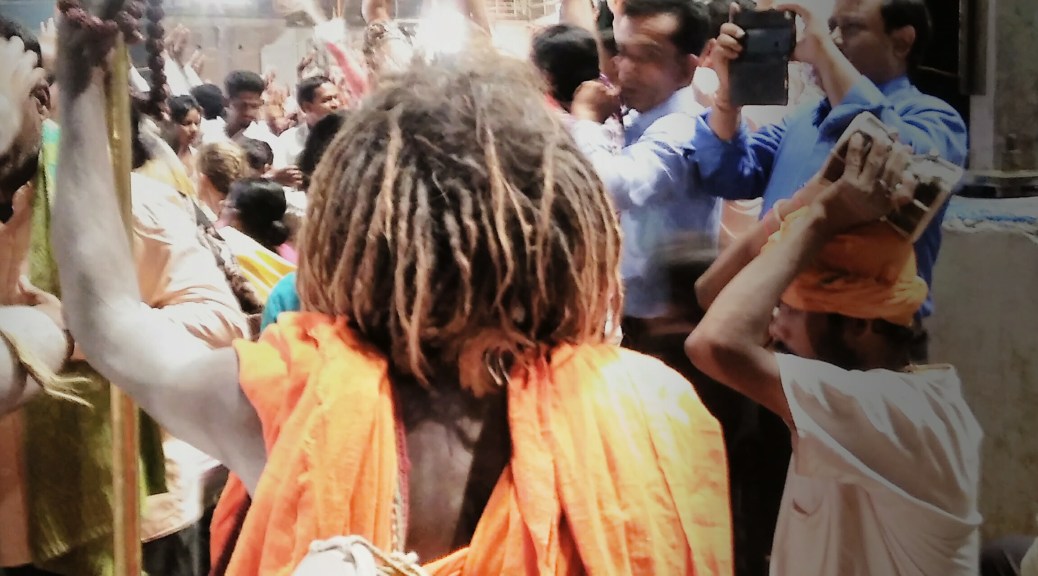
We were spellbound with what we saw there. With ash smeared bare bodies, matted locks, strings of Rudrakshas around their necks, trident and damrgo in hands, there were hundreds, or perhaps thousands of Naga Sadhus and Sadhwis representing every known Akhada with their respective Tableaux, had all assembled right in front of us. Calls of ‘Har Har Mahadev’ reverberated not just on this road but across the city as their convoy began with all the Nagas throwing ashes up in the air. Tight security with the CRPF barricading the streets on both sides ensured the convoy reached the ‘Kashi Vishweshwar Mandir’ thereby the Nagas got the first glimpse of their Adi Guru on the day of Maha Shivaratri before the rest of the public were allowed. A sight that seemed like a dream that I had just woken up from, one that I will cherish as one of the TOP memories of my life which I would have missed in a matter of seconds hadn’t my friend woken me up at the right time. The crowd then dispersed and we returned to our room to freshen up before starting our day.

In a couple of hours, Sunny updated us to stay at the entrance of the hotel for the procession was to return along the same path, with the Akhadas returning from the temple, back to their camps set along the Ghats from where they would all packup to head towards their respective abodes scattered across parts of India. When they all did arrive, I stood on the side of the road to capture a few shots for memory of this amazing day. Despite the security, my friend and I had unknowingly become a part of the parade. The parade of the Nagas. We were walking beside and amid the Nagas from Godowlia street, right until the Juna Akhada office before someone realized that we were outsiders and politely asked us to step aside. WOW! It was indeed an experience that gives us goosebumps just by imagining even today.
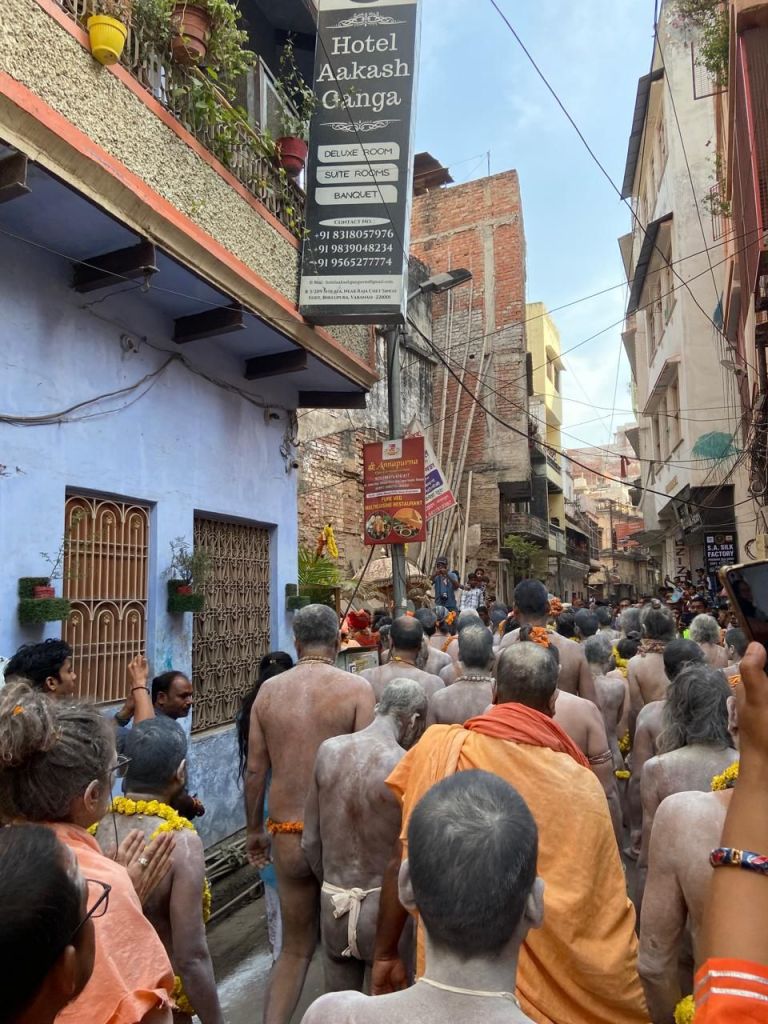
Naga Sadhus returning to their akhadas

Shiv-ji ka Baraat

Meanwhile, Sunny had us racing towards, yet another ceremony scheduled to happen on the parallel streets. The grand Shiv Baraat procession was on its way from Shri Tilbhandeshwar Mahadev temple towards the Gauri Kedareshwar temple, where the idols of Shiv and Parvati are set up the day before the main event. Sunny placed us both on strategic spots on the street from where we could watch the arrival of the Baraat clearly.

First, the camels arrived. Then the elephants. Then, all the Baraatis from the groom’s side accompanied by various orchestra/Band sets and tableaux from across the city arrived on different vehicles, chariots etc. (Children and young adults dressed in masks and costumes depicting various gods and Goddesses from Hindu Mythology) and Finally the groom made his appearance on horseback (yet, another young boy dressed like Lord Shiva), travelling across various lanes, streets and main roads of Banaras and finally reaching Gauri kund located at Kedar Ghat where the divine union of Lord Shiva and Goddess Parvati was to take place later that night.
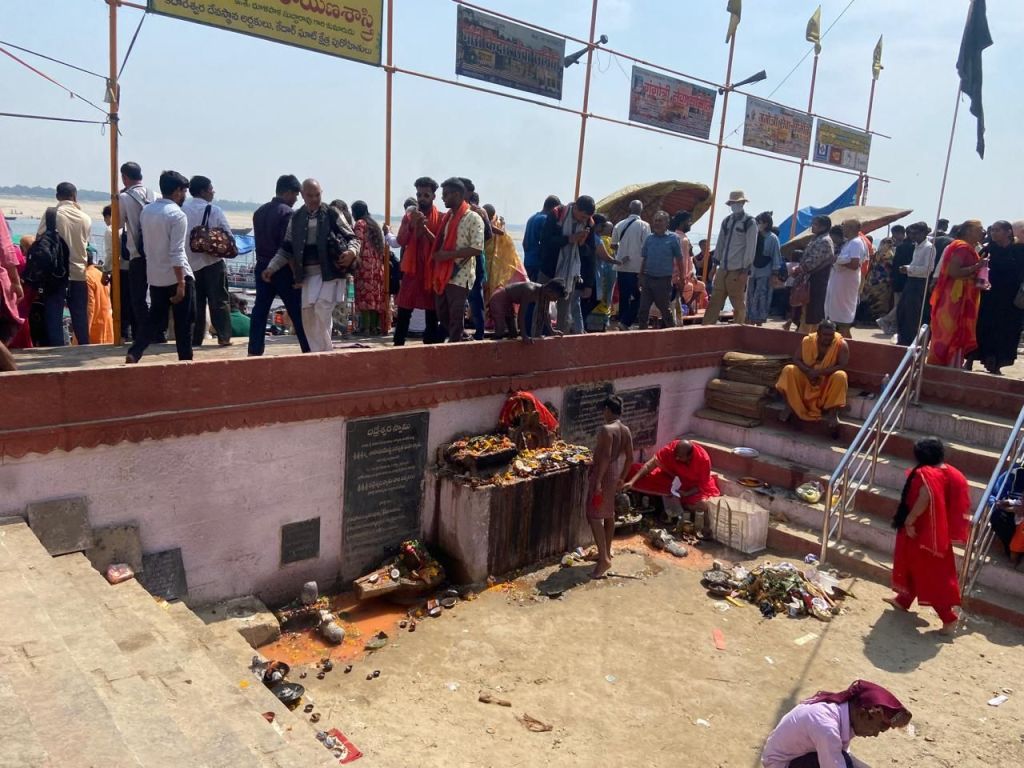
Gauri kund before the wedding prep

We found a strategic spot on the stairs of the Kedar Ghat to witness the grandest wedding that was supposed to take place all night with all the devotees staying up on night vigil as witnesses to the wedding on the banks of River Ganga. Ofcourse, any Indian wedding is incomplete without a grand feast for its attendees. How could it not be so when it is the wedding of their dear Lord himself? There was free and unlimited supply of potato sabzi and Thandai throughout the night to all devotees (guests) in attendance at Kedar Ghat, witnessing the wedding by participating in rituals and discourse of vedic chants.
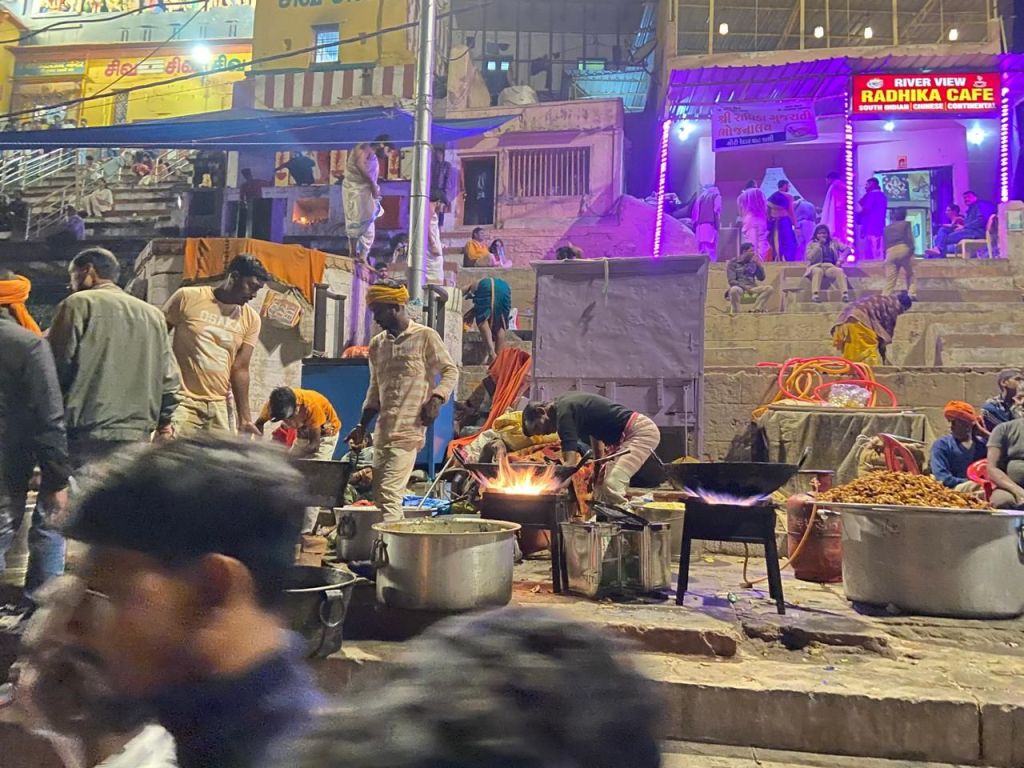
Feast being prepared for the wedding

The common man seated hundreds in numbers occupying the riverfront stairs played witness to the divine marriage ceremony conducted in a style typical to the Uttar Pradesh region. My friend was on top of the world when she was randomly picked from the gallery of people to make her offerings to the newlyweds (perform abhisheka with milk on small lingas moulded out of fine soft sand from the Ganges on a decorated silver plate). The contents in each plate was offered back to the river as a part of the culmination of the marriage rituals. The chants and offerings went on until the break of dawn post which the audiences and witnesses dispersed.
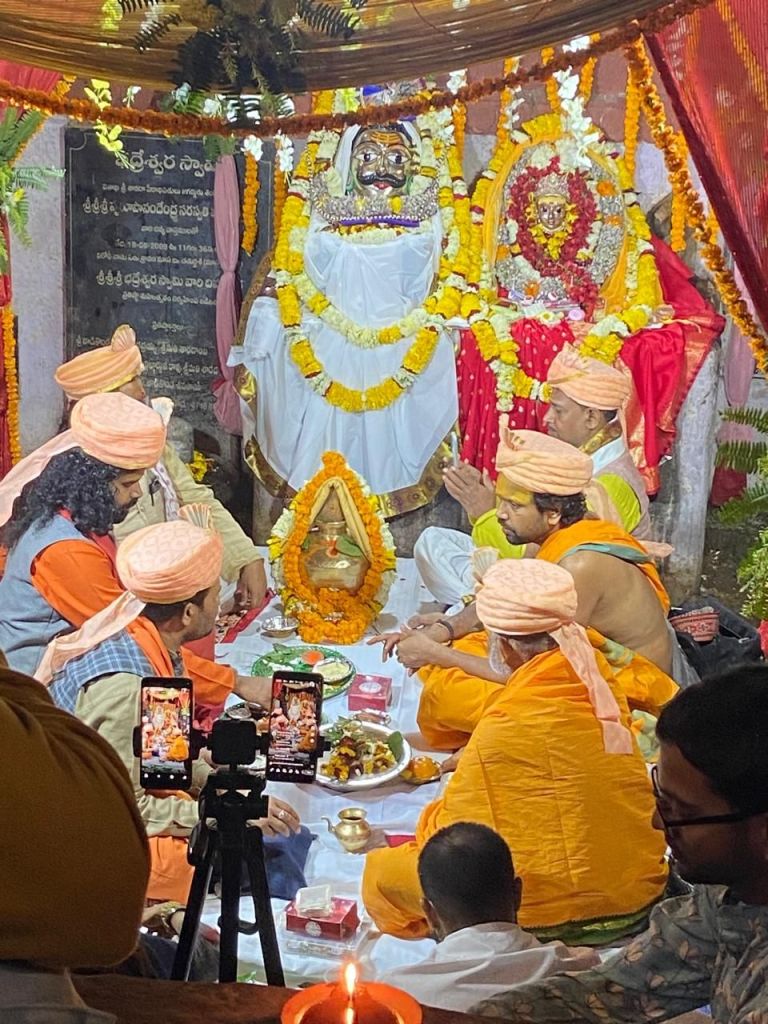
The celestial wedding in progress at Gauri kund

Date with the Lord and his consort

If this was about witnessing the celestial wedding, wait. Our visit to Banaras was incomplete without this: Greetings to Lord Kashi Vishweshwara. We had decided to skip the temple visit on the day of Shivaratri to avoid the crowd and try our luck on the following day. So that day was about resting and catching up on the sleep deprived from the last night.

Come the following day, there were no signs of any less crowd. Rather it looked like the entire crowd from Prayag had alighted at Banaras after closing the Kumbha Mela. The queue to enter the temple extended several kilometers. But we are Indians with local contacts. Be it getting access to a no-entry spot or to wave a quick ‘Hai’ to our favourite god, why wouldn’t we utilize our privileges to bypass rules? We will! We found a legal way (Oh, that’s a secret!) to cut the longer queue and reduce our wait time to just an hour. Amid chants of ‘Har Har Mahadev’ we had finally arrived at the Lord’s doorstep, a window from where we were blessed with a view of a beautiful Pushpa alankar or the floral decoration. Despite wanting to stay there for a little longer, we had to move away making way for the lakhs of devotees waiting behind us.

A visit to any Shiva temple is incomplete without taking the blessings from his consort, Shakthi. In Kashi, Lord Vishweshwara’s consort is Goddess Vishalakshi. We expected another long line but as surprising as we were, we had just another 10 to 15 people along with us, all standing and praying inside the temple without any pressure to move out. It was such divine energy felt in peace. So, after coming out of there, the next important thing to do on our list was to eat food, food at the Annapurna temple, the home of the goddess of food and abundance. Let me not add more paragraphs into my story describing how symbolic this temple is from a religious and mythological context; Google Mata is just a click away with all the details. So, we had to satiate our fasting stomachs by finding our way to the temple of Annapurna (actually, to the dining hall!).

Upon enquiry of the route, we understood that we had to navigate through the same long queue of the Vishwanath temple before arriving at a small deviation that led to the temple that we were looking for. The same local contact who had helped us to jump the previous line provided us with some tips to skip the queue all together because we were not going to Vishwanath temple this time. We followed his hacks, paid a deaf ear to dozens of abuses that were being hurled at us by frustrated people who had been standing for hours in the long queue before joining a crowd that seemed unusual to an Annapurna temple (since we had not encountered it on our way to the Vishalakshi temple) or rather familiar (with the structure and chants around us were similar to that of Vishwanatha temple). It didn’t take us too long to realize that we had indeed arrived at the window of Lord Vishwanatha again, by entering from a different gate. This time, his darshana was without any of his adornments, a blessed moment briefly happening before he is completely covered up by his next alankaara and the offerings made by the devotees. It felt surreal. How lucky could one get to have a second chance on such a cringe day?

Anyway, moving on from there, we had to talk to few security personnel to help us find our way to the Annapurna temple. It was a short walk away with a maddening density of people pulling and pushing their way through a small temple verandah to enter the dining hall. Once there, we both had goosebumps thanking our fortunes for having us the opportunity to devour that meal! It was simple and comforting yet felt luxurious!
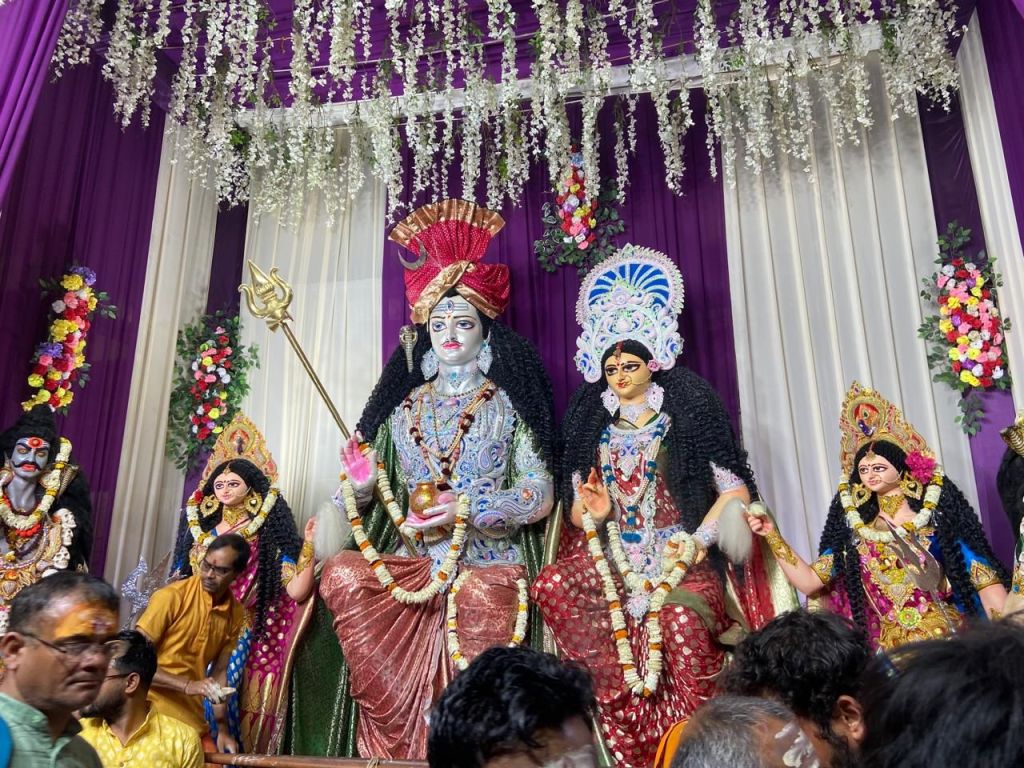
The reception of Lord Shiva and Goddess Parvathi

Lighting the Diyas at the Ganga Aarti

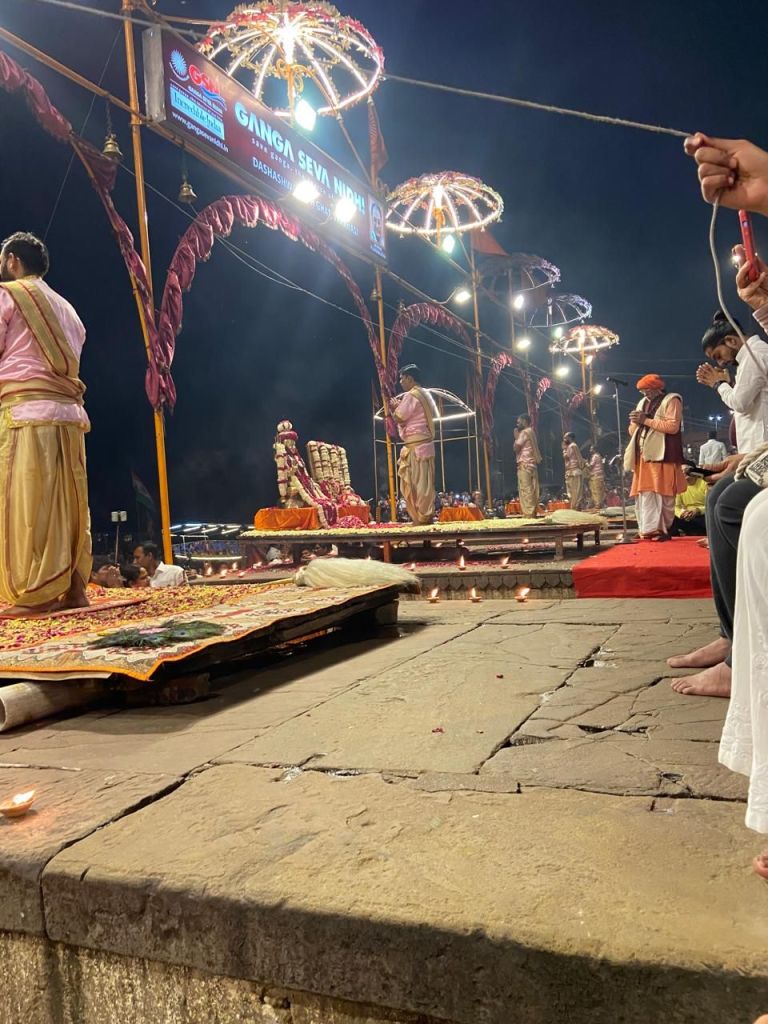
The famous Ganga Aarti performed twice daily on the ghats of the Ganga had been halted over the last couple of weeks, ever since the stampede had happened at Prayag. It was while having our lunch at the Annapurna temple, Sunny had dropped us as SMS informing us to arrive early at the Dashashwamedh Ghat as the evening aarti would be restarted from that evening. Even as we arrived at the ghat at 04:00 p.m., let alone sitting, it seemed impossible to find space to even keep our feet firmly on ground. The crowd had assembled on the ghats, on boats, atop all surrounding buildings, poles and structures to witness the Ganga Aarti that was scheduled to begin post-sunset. We both barely managed to find space just enough to cling on a supporting wall in front of the anchored boats.

It was finally time for the aarti and the all the priests who had to perform the Ganga aarti had assembled on the podiums. Call it our luck or divine intervention, the head priest who overlooked the preparedness of the dais before commencing the sacred ceremony pointed at the two of us from the massive crowd that had gathered. He asked us to come over and light up all the clay lamps arranged around the podiums. After that, he offered us to sit on a red-carpeted arena, right behind the performing priests that provided us the best possible comfort and view that evening! We couldn’t help but pinch each other to convince ourselves that the way our day had unfolded was indeed real.
Parvati ki Bidaai

On the third day, we stayed back to play witness to the Bidaai ceremony of the daughter, Goddess Parvathi with her husband: Shiva. With the entire Banaras gathering on the streets, the pomp and grandeur of the send-off was even larger than the Baraat which finally culminated on the outskirts of Banaras. With that, it was also time for us to return to our hotel and pack our bags to head back to Bangalore.

The home of the Indian National Emblem- Saranath

This visit to Saranath is a part of my fortnight long backpacking in the typical pilgrimage circuit of Uttar Pradesh covering Lucknow- Ayodhya- Faizabad- Varanasi- Saranath- Allahabad- Agra- Mathura-Brindavan- Fathehpur Sikri– Delhi

This article was featured in Toyota’s in-house magazine ‘Carz’ Apr~Jun’18 edition

The Details:

Back then, I had read history for the heck of passing the subject and today here I am… Travelling to know more about the rich history soaked heritage of my country… And in the pursuit, my friend and I stumbled upon this little forgotten land from the pages of history- Saranath. It was as if the history textbooks of primary school were walking alive with us… Saranath is an important destination both religiously and historically. So, people of varied interests can be found strolling the streets of Saranath. When we alighted, a volunteer offered to take us for a guided tour around the place and we nodded a yes! A couple of visitors from different countries joined us seeking me to be their translator while the Hindi speaking guide took us around. So I was doubling as a curious traveler and a travel guide cum translator.

Firstly, Saranath is the place where Lord Buddha delivered his first sermon to the five disciples after attaining enlightenment. Hence, a very important place religiously for the Buddhists. Today, the Chaukhandi Stupa, an octagonal structure made of brick and mortar stands at the very same place welcoming the visitors to this town. It was originally built in the Gupta era and later renovated during the Mughal rule.

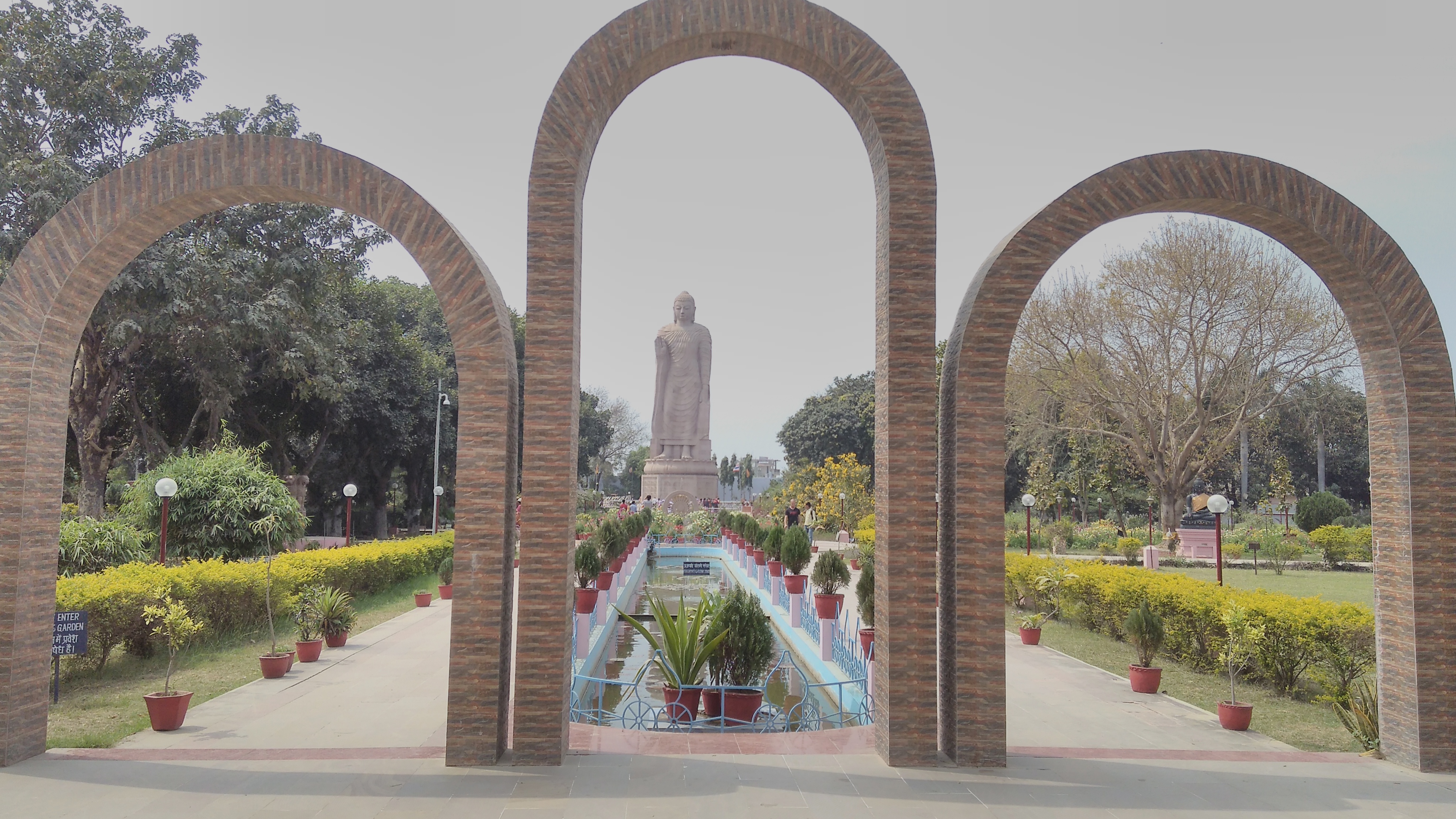
As I explored the place, I realized that people from different countries have made their presence with Buddha temples built in their native styles of architecture. The Nepali, Thai, Chinese, Japanese, Tibetan, Bhutanese etc. to name a few. While each temple style is unique and beautiful, you realize that the statue of Lord Buddha too is different in each of them. Buddha is worshipped in different forms in different countries… Seated Buddha, sleeping Buddha, standing Buddha, meditating Buddha ET all… The murals inside the Japanese temple grabbed my attention… I was told that the complete interiors is made of sandalwood… The idol, palanquin, the doors and even the chandeliers!

A small walk from there, is ‘Mulagandha Kuti Vihar’, the Nepali temple. What makes this place special is the third generation peepal tree adjacent to its premises. Fondly called as the grandson of the Bodhi tree, it is grown from a twig of a peepal tree believed to be the son of the original Bodhi tree that exists in Sri Lanka. With prayer chants and smell of incense in the air, it is truly a place of calm and solitude. We were quick to pick a few leaves of this holy tree as a souvenir from this little place.

IMG_20170309_121021
The Thai temple

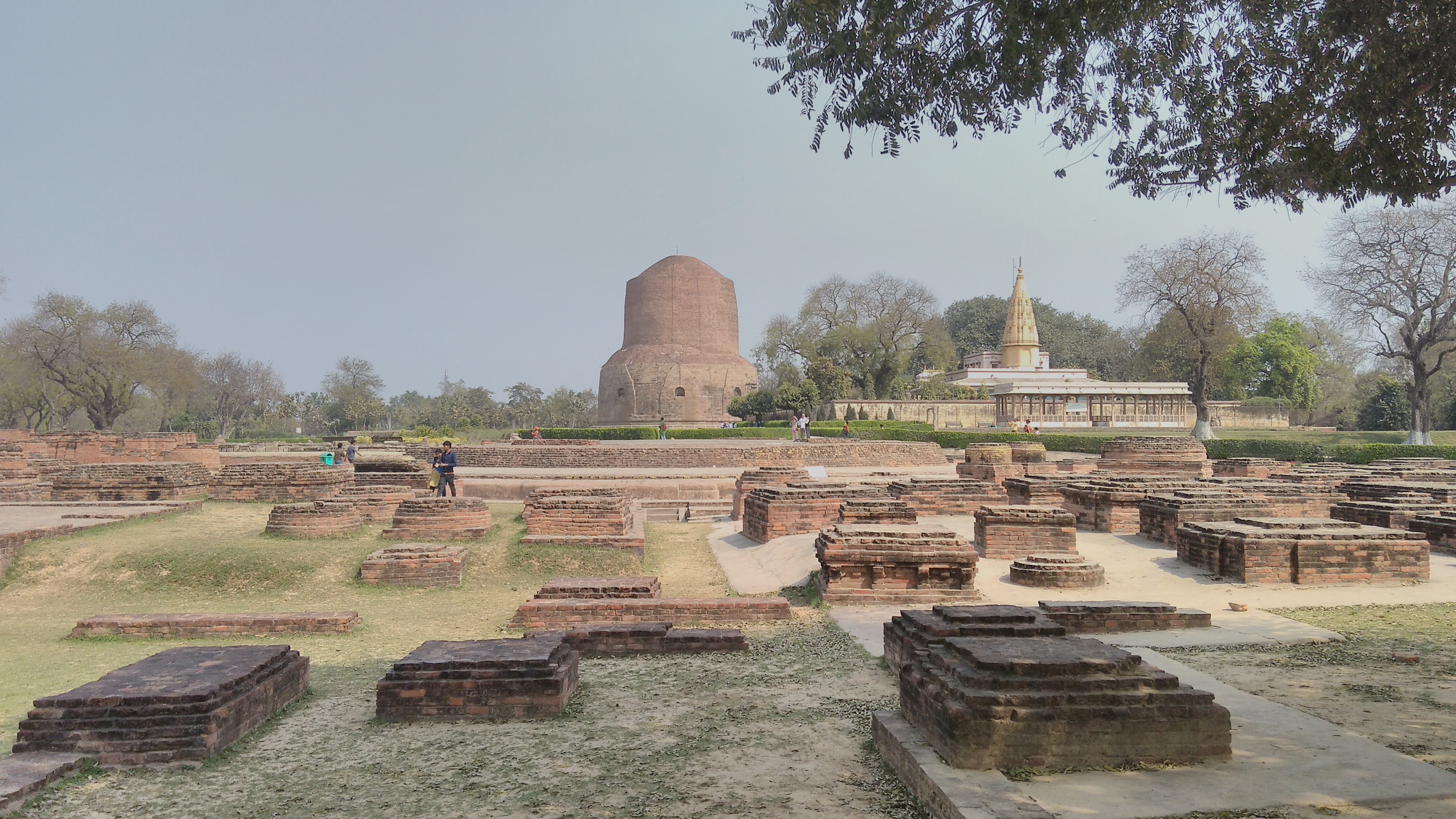
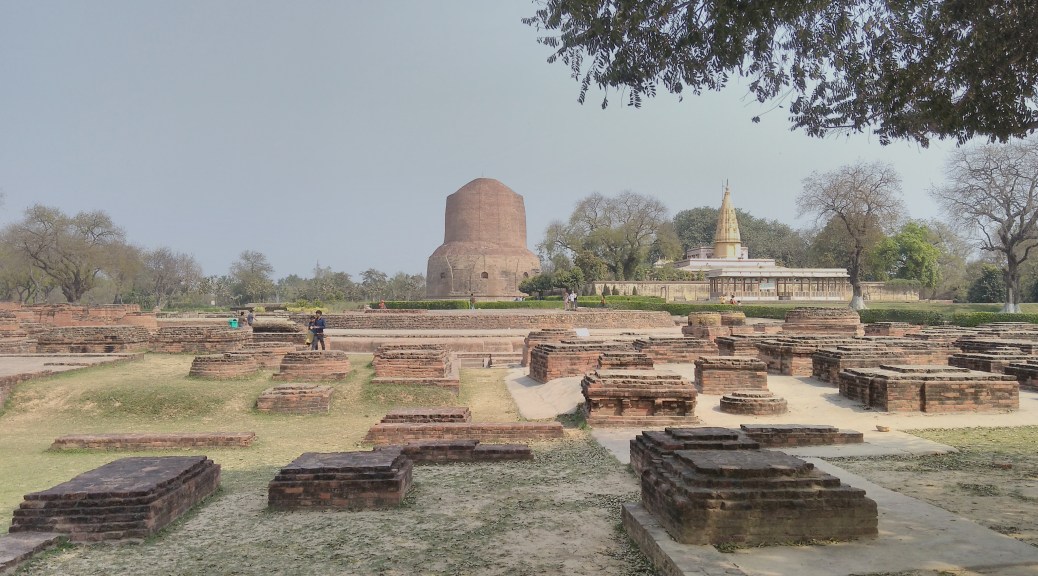
Next, it was some history time! We bought an entry ticket at the ASI counter to take a stroll around the ruins surrounding the Dhammek stupa. It is believed that the Mauryan emperor Ashoka had built small clay mounds at ten places where the ashes, the urn and the embers of Lord Buddha were buried which were eventually refurbished as large stupas by the different rulers in the course of history. Dhammek stupa is believed to be one among these ten stupas and hence, a very important one for the Buddhist pilgrims who throng here from across the globe. And that very place where the Indian National emblem was born! The pillar on which the four headed lion is seated was commissioned by emperor Ashoka to commemorate his visit to Saranath. The broken part of the pillar was found during the excavations of this site and later transferred to the ASI museum in Saranath. Today, the bottom portion of the pillar surrounded by four posts holding a stone slab are the things remaining from the original relics at the exact same spot. One way it is nice that nobody has tried to restore this pillar back as the easy accessibility to it would have got the emblem all over the internet with the insensitive photo/selfie-enthusiastic tourists.

IMG_20170309_135651
The site of Ashoka pillar with the Dhammek Stupa in the backdrop

A visit to Saranath would definitely be incomplete without getting a glimpse of the ORIGINAL National emblem of India. We deposited our valuables including cameras and cellphones in lockers provided along with the entry ticket to the ASI museum and headed to THE place. A chill ran down my spine on being greeted by this majestic sandstone structure bearing the lion capital, the original form of our National emblem. The four headed Asiatic Lion is seated on a lotus- The national flower of India. Our guide narrated the religious relevance of the emblem in Buddha’s life. The lion represents Buddha himself who stressed upon equality and justice in all spheres of life (all 4 directions). While Gautama was in his mother’s womb- she had a dream of a white elephant entering her womb representing prosperity. The bull represents the young prince Siddhartha’s strength, the horse depicts Siddhartha’s renouncing his royal life and Lion is the depiction of Siddhartha’s transformation into Buddha. When Baby Siddhartha learnt to walk, a lotus bloomed under his feet after the first seven steps and the lotus is said to have faded at the passing away of the Lord- Hence, the inverted lotus. The Ashoka wheel is called the Dharma Chakra, representing the movement of life with 24 spokes- each for the hours of a day… It is true to admit that the national emblem evoked a sense of pride in my heart.

Ours is such a rich country in terms of history, culture and heritage! Every stone in India has a tale to tell… Having been restricted from the access of shutterbugs makes this sight all the more valuable and meaningful! There are several other sculptures and artefacts in this museum making it THE BEST museum day in my life!

The last leg of our Saranath walk tour was a visit to the handloom centre where demonstration of weaving a Banarasi saree was given and there it concludes! Sometimes you end up having this feeling of unplanned trips are the best things to happen… And Saranath is one such place!

Conclusion Remarks:

  • Must do– Walk tour of the town
  • Must see– The Original form of the Indian National emblem at the ASI museum
  • Best souvenir– The leaves of the Grandson of the Bodhi tree.
  • How to reach– There is a railway station in Saranath. It is more convenient to hire an autorickshaw for a 30minute ride from Varanasi.
  • Stay– There are several Dharamshalas run by people from different countries.

The not so Holi- Festival of Braj Bhoomi

Holi is Big in Northern India and the most beautiful in the Braj Bhoomi- the Land of Lord Krishna. Festivities start a week in advance with Lath-mar Holi in Barsana and Nandgaon, phoolonwali Holi (Holi played with flowers) and Widow’s Holi in Vrindavan, Huranga at Baldeo and Holika dahan and Rangowali Holi at Mathura and Vrindavan are some of the major parts of the festival. Articles, blogs and photos are all over the internet about how beautiful this celebration is and the fun of participating in the festival of colours. Deeply inspired, a two week trip was planned through the state of Uttar Pradesh whole-ly, to soak in the festive fervor of Holi.

This visit to Mathura is a part of my fortnight long backpacking in the typical pilgrimage circuit of Uttar Pradesh covering Lucknow- Ayodhya- Faizabad– Varanasi- Saranath– Allahabad- Agra- Mathura-Brindavan- Fathehpur Sikri– Delhi

As per plan, we reached Vrindavan to spend the last two days of Holi- the main days and get coloured in different hues of Gulal. The plan was to reach the hotel, change to clothes that we had kept aside specifically for Holi and then go out to the areas where the colours were being thrown at. However, the entire town was already painted with colours by the time we arrived in our delayed train. A samaritan helped us get an e-rickshaw so that we could reach our hotel. The rickshaw had to squeeze its way through the crowd that had already gathered out on all roads. By the time we reached the hotel, we started to feel miserable about having wasted our leaves and having travelled all the way to Mathura from Bangalore was a big mistake. It was very unfortunate that our experience of the famous Vrindavan Holi was no-where close to fun. Although we were inside the rickshaw, we felt more vulnerable to getting coloured than the rickshaw itself. Goon like mobs would specially target people who were new to this kind of celebration. I had atleast 4-5 men together hold me by my head inside the rickshaw and colour my face. Few others even pulled my scarf and shawl to ensure that every inch of skin was coloured. No! It was not a pleasant way to welcome guests to a new place!

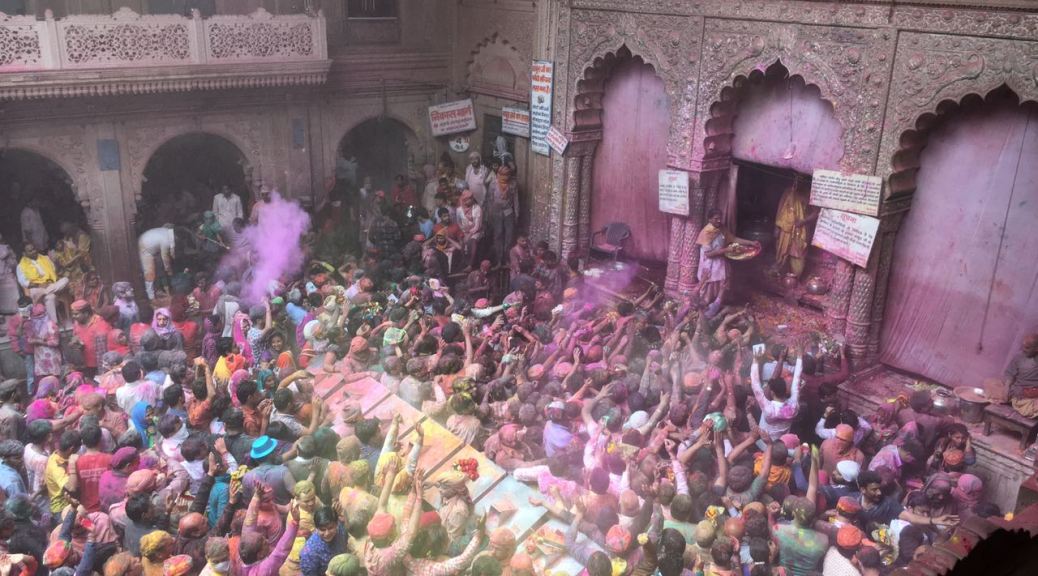
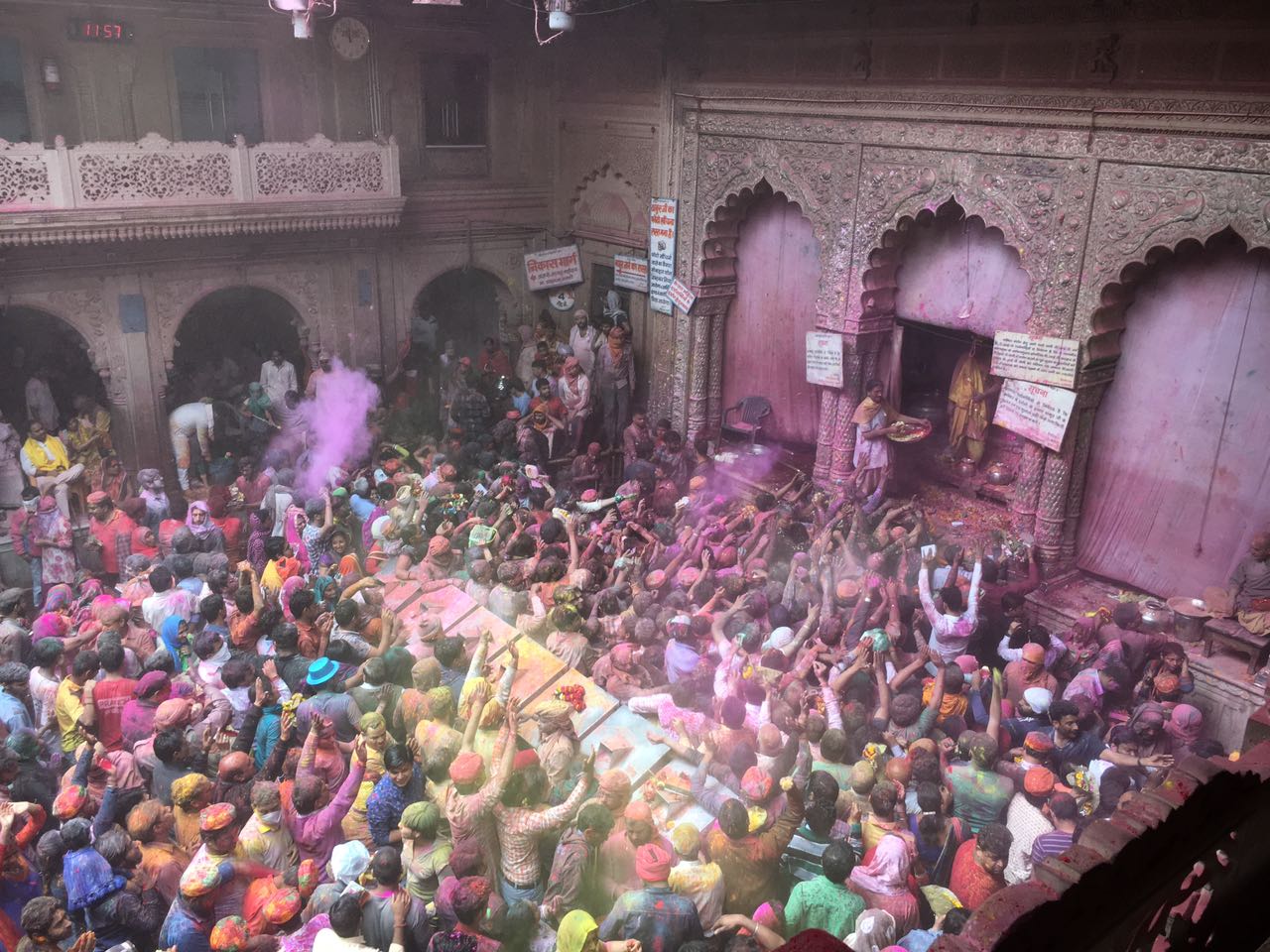
Banke Bihari temple in Vrindavan is where Holi is best celebrated with the priests throwing colours at everyone. On the day of Choti Holi, although we managed to go to the temple, we were drenched in wet colours. Leave that, our faces, hands and every bit of skin was chapped because we were smeared either with coloured cement or sand. This mixture is a norm and hurts like hell when it is being thrown at. We somehow managed to catch glimpses of Holika that were being burnt in some interior corners of the town. Women folk had gathered around effigies placed in the middle of firewood, food grains, vegetables and all other important things required for burning the pyre. We were colour soaked till the bone by the time we braved the task of reaching the safe confines of our hotel doorstep amid all the cemented colours and sand. Taking pity at our plight, our hotel incharge asked us to stay indoors the following day, as the last day could get wilder.

Finally, the main day of our fortnight long trip had arrived. But, we could barely think of venturing out on the streets on the day of Rangowali holi. Since our hotel was located in the main city area, we set our chairs out in the balcony of our room on the 3rd floor and watched the frenzy on the streets. It was disappointing to watch the Rangowali Holi turn into an event of Kheechadwali Holi (Holi played with water from the drainage). This kind of celebration can give the worst memories especially for girls and foreigners while goons attempt with ruthless amount of coloured glass powder. It can affect your eyes, skin, blood vessels anything! On top of it all, people are sloshed in Bhang and one cannot be sure of what’s gonna happen next!

Really, I’m not exaggerating the displeasure; the festival of colours is exaggerated through good photography by the photo enthusiasts who are all mostly male. I’d bet you not to plan your Holi trip to Braj with a bunch of girlfriends or with anyone who is new to this area. I strongly recommend you either plan on the day of Phoolon wali Holi or be a part of a private Holi celebration at a friend’s place amidst known crowd. This trip to Mathura has left scars of ir-repairable displeasure and sadness!

IMG-20170311-WA0001
The Banke Bihari temple Clicking credits: Gowtham Shastry

The journey through Uttar Pradesh State Elections- 2017

This post is part of my fortnight long backpacking in the typical pilgrimage circuit of Uttar Pradesh covering Lucknow- Ayodhya-Faizabad- Varanasi – Saranath- Allahabad- Agra- Mathura- Brindavan– Fathehpur Sikri– Delhi

I’m not a political person and I don’t prefer blogging about something that can spark a political row with my writings.. But, this one goes here because I want to narrate the election campaign as seen through my eyes as a traveler traversing through a state where the election fever had hit hard! One of the most awaited elections of the country and an important one for the current ruling party of the state to prove their influence.. Uttar Pradesh State assembly elections!

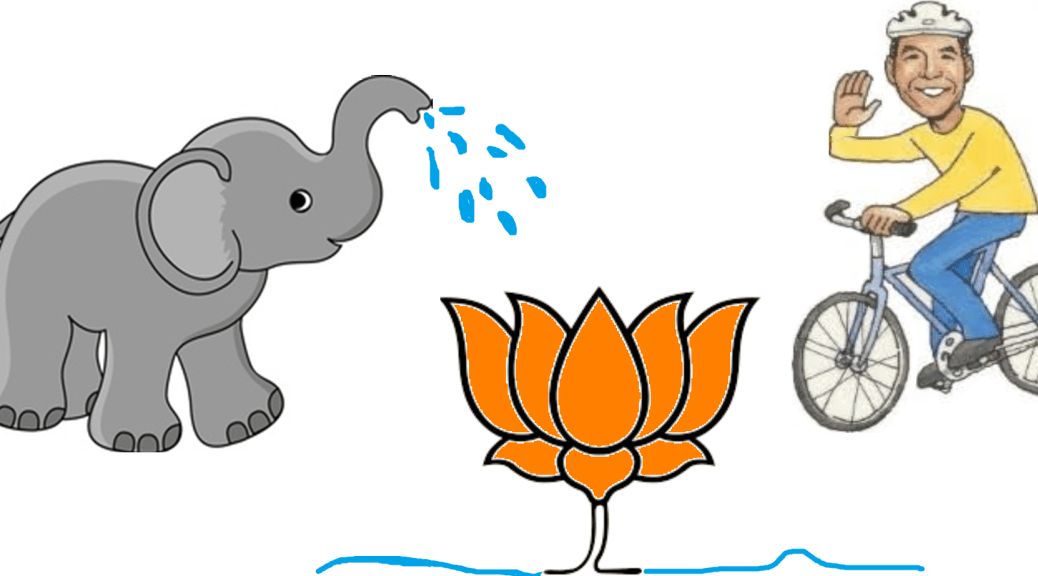
Firstly, we were roaming the streets of the state capital- Lucknow. One fellow told us, “There were elephants standing at all corners and across all streets, then the cycle lanes were laid. Neither the elephants nor the cycles did any good to the city. Unemployment is an evil left over by the previous governments. Ours kids are struggling in the slush. Let us give a chance for the lotus to bloom.”

Moving ahead, we were temple hopping at Ayodhya. A local boy offered to be our guide. We were amused with the stringent security checks and the big political drama directed by man in the name of God. Just as we were talking among ourselves, our guide blatantly told- “Don’t worry, you will not have to go through all this when you are here next time. ModiJi aayenge tho sab theek hojayega! (ModiJi will resolve everything)”

The following day we were at Varanasi, the Lok Sabha constituency of Modiji himself! It was election day when we arrived there. The security was tight and with very less traffic, the spiritual city was a sight. That said, we went for a boat ride along the Ghats of the Ganges.. Explaining the history and significance of each ghat, our boatman rowed the vessel forward. In between he said- “Do you see that structure up there? Modiji aayenge tho uss Masjid ka samasya ka hal mil jayega (The issue around that mosque will be solved if Modiji wins), pointing at a mosque that is a subject of historical controversy.

It was 11th March: The D-day.. We were travelling to our next destination- Allahabad. The counting of votes was in progress and the poll trend was being aired by all news channels.. The customers in shops and hotels were glued to their TV screens.. Our fellow passengers were lost with news updates on their smartphones.. The driver and conductor of our bus caught up every now and then to get updates on the running poll trend.. Clearly, curiosity and anxiety were the only things in the air.. Everybody was discussing about who or which party would win the elections. We caught up with a conversation with our oarsman while being rowed to the confluence. He was casually talking about how he had left home to find a better job but later returned back to his family with the grace of mother Ganges et all.. And in the event, he told us that, “Mother Ganges gets more polluted on her journey forward through Banaras. But, Let us give a chance to Modiji, Ganga Zaroor Saaf hojaayegi! (Ganga will definitely become clean)”.

It is a very tough deal to commit for something as big as this, given the various religious, cultural and sentimental dimensions linked to everything that requires a change. These were not just hopes, It was an assurance given by the BJP.. It made me realize how just one man has changed the way common man looks at politics.. At any situation, we must stick to the basic morals of being an Indian- Secularism is the beauty of India! Exhibit ‘Unity in Diversity’ because the nation needs us.

And in between all the frenzy, we were waiting at Faizabad junction for our night train to Varanasi.. A train with no display board thugged slowly on Platform no.1. In the next few minutes, we were amused by looking at the platform. It was crowded with the men in uniform till as far as our eyes could reach on both ends. We saw arms and ammunitions being stacked up on the pavement and dedicated men with rifles guarding them. In a time where the entire nation was celebrating Holi, it was a strange but an overwhelming event to watch so many personnel from the armed forces who were there on duty. I hold very high regard for the defence personnel who guard us regardless of time and place. I had goose-bumps for having been in the midst of all this action. I couldn’t contain my anxiety and spoke to one of the men, while a couple of others joined in. We were told that they were from the Border Security Force (BSF) and had travelled down from Srinagar for security reasons during the state elections. That gave us an idea of how massive and sensitive the event of elections in UP is for whom, things are a lot peaceful and easy back in our home state- Karnataka.

Coming back to politics, declaring the party leader / Ministerial candidate before elections is a normal way to attract votes from the public based on various other parameters. In contrary to this style, having fielded no chief ministerial candidate; the BJP (Bharatiya Janata Party) has managed to win the great battle with just the name of one man- ModiJi! A sweeping victory of 325 /403 votes that has pushed the entire nation into amazement. Now, that the lotus has bloomed, whether the fragrance of the flower or the stench of the drainage would spread is left for the citizen to watch..