A venue for hundreds of family get-togethers, a reason for annual Dasara shops, a greenroom for hundreds of celebrities, a place where we got numerous forever family friends, a shelter to over a hundred families, a temple for annual pooja offerings, a dining area for hundreds of hungry villagers, a warehouse for all the farm equipments, a bedroom for all the tired souls- adjectives alike aren’t sufficient to describe what this little place once meant. A portico, 2 bedrooms, 1 hall, 1 kitchen, 4 labour quarters and above all- A one of its kind drying chamber for the spices.
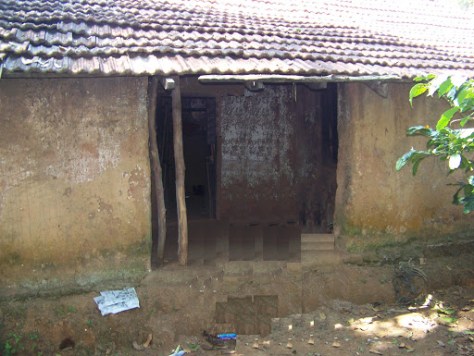
A walkway lined by coffee plantations on either sides, dotted by coconut trees in between leads you to this little thatched house with mud smeared walls; just as you enter you are greeted by a stream of water that is diverted from the bigger waterfall, opens into a pond with blossoms of purple lilys and golden fishes and further narrows down running through a garden full of flowers overlooked by scenic hills all around. A matter of everyone’s envy–
This was ‘The Abbi Villa’ in brief.
The Abbi Villa: Then
This is where my grandpa spent most of his life- the busy days of his life- the peaceful moments of his life- This is the place which was home to his heart and his soul.
The stream that widens into a pond
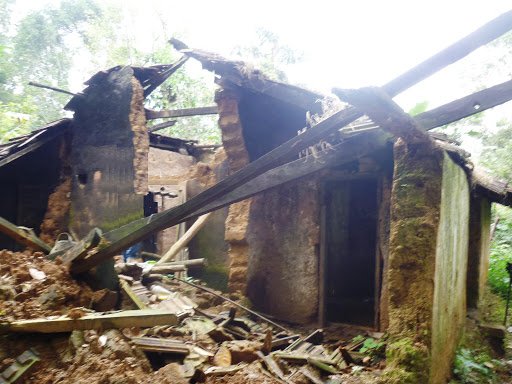
No doubt that the warmth of the place passed away with grandpa, but 2012 has showed its negative vibes with the year’s monsoons putting an end to all the glory that this place once boasted of. The Wall has finally given way.. Every bordering wall has collapsed: But when I stood infront of the rumbles- A cold chill ran down my spine. I did feel my grandpa’s presence there.. He stood right there holding on to the pillar and a part of the wall that divided his bedroom and his prayer room.. It was a helpless face that told me aloud to do something about the utter neglect that followed his departure; I looked back at him in utter helplessness too.. There is so much I need to do but very less ways I can put his dreams back in place and reconstruct the entire estate that today lies there vandalised and in the state of horrible negligence..
The Abbi Villa- Now
How I wish…. I could do something..!!! How I wish some miracle happened… How I wish…… The place was as heavenly as it once was….How I wish……
I had always wanted to witness this celebration but had been quite apprehensive about facing the wrath of the abuses that would follow with the joy of celebration.. And moreover, this festival happens in the southern part of Kodagu district and I always got to know about the celebration of this festival only after it was over!
But some wild wishes and what one truly seeks, do come true. This time my encounter was unplanned and I’m glad it happened.. I got to witness the unique celebration in Kodagu district, of a festival called “Kunde Namme” a.k.a. Kunde Habba or the “Festival of abuses”.
The tribes belonging to the Jenu-kurubas, Betta-Kurubas, Yeravas, Paniyas, Kembetti and other sects all congregate in a common place- usually a town area to celebrate their festival of abuses and to make merry. By abuse- I mean abuse God, man, machine and everything that they come across on that day. This is a tradition that has passed on through generations among these tribes.
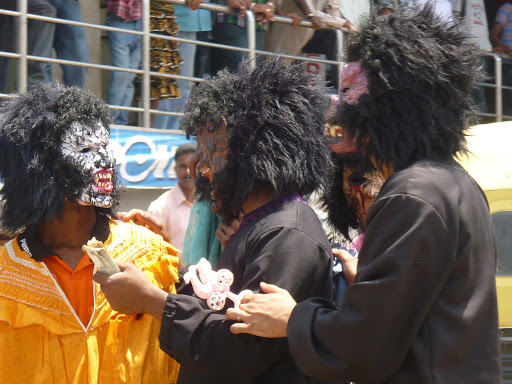
Kunde Namme- The masked men
Legend has it that the main deity Aiyyappa had taken the tribe into a thick jungle for hunting. Deep in the jungle, he fell in love with Bhadrakali and eloped with her leaving his followers abandoned. Since then, the day is observed every year where these tribes abuse their god for betraying them. They find god in everything and every person they come across and hence abuse them in turn.
The tribal folk, mostly men are togged in weird clothes. Many take to cross-dressing, some dress like ghosts, some like witches and some dress up in costumes that are just random and as weird as possible.
They block every man(folk who belong to communities outside the above mentioned tribes) on roads, barge into shops in the town and demand money. If their demands are not met, then profound abuses are hurled at them. But one must not assume that they can escape from the wrath of the abuses by simply meeting their demands- they still get abused..!! Remember, no god will come to your rescue on that day as he himself is in being abused 😀
Kunde Namme- Dressed up men all set to charge into a shop
Also, most of the members of this group belong to the labour class who work in estates, domestic helps etc. Hence, the day doubles as a good opportunity for them to vent out all the frustration on their masters..!!
Kunde Namme- The band set guys
But, by the end of the day, they all congregate in their common place of worship and surrender to their god, plead for his mercy and ask for his blessings for the rest of the year. A portion of the total money collected by them on that day is religiously offered to the deity and the remaining is used for a lavish community dinner.
This festival happens on the 4th Thursday in the month of May and is celebrated in and around Gonikoppal considering its proximity to the Nagarhole National Park where most of these tribes are based.
Karnataka Bundh: The whole city of Bangalore was protesting against the Kaveri water verdict- 32 buses vandalized in the city and all that jazz. Well, I was away from the entire hustle bustle, where fighting for the water of Kaveri made no sense for the people. That day, I was spending time with my mom who was away from home since the last couple of months, on business travel.
My itinerary: Day 0: Bangalore to Bidar (Overnight bus) Day 1: Jharani Narasimha Swami Cave temple, Karanja reservoir, Basavakalyan (Basaveshwara temple, Basavanna statue, Basavanna Guhe, Akkamahadevi Guhe Anubhav Mantapa, Basavakalyan fort) Day 2: Nanak Jira Gurudwara, Bareed Shahi park, Bidar Fort; Return from Bidar to Bangalore (night bus).
The details: People in the Mysore-Karnataka region know Bidar and the rest of the districts of Kalyana Karnataka or Uttara-Karnataka mostly through media that only talks about them when there is a drought in the state. This somewhat had influenced me to paint a dry and a dusty picture of the region inside my head. There was not much that I had heard about this part of Karnataka on a typical tourist circuit of state and that’s why I chanced upon travelling to Bidar for a weekend. Since my mom was posted there for some time, I thought it was an opportunity for me to go and see what is in the northern-most district of my home state. Mom usually has a vehicle at her disposal whenever she travels and stays during the entire business trip. This solves most of the commutation problems.
Day 1: When I reached there after a long overnight bus journey of 12hrs, I had a roaring welcome in the city, quite literally…!! An IAF “Hawk” flew past right above my head during their daily flying sorties. Right then, I had my first GK (general knowledge) moment of the tour. Bidar has been an important training base since the early 1960’s for the Indian Airforce. Bidar serves as the main base for Hawk AJTs and the Suryakiran HJTs. The first thing that I learnt about Bidar and is never shown or spoken about on mainstream media.
My mom received me at the bus stand and took me to the Inspection bungalow where she was staying at. After freshening up and post a quick breakfast, we headed to “the Jharani Narasimha Swami Cave temple”. The myth mentions that Lord Narasimha killed Hiranyakashipu and then proceeded to slay the demon Jalasura, a staunch devotee of Lord Shiva. After being killed by Lord Narasimha, the demon Jalasura turned into water and started flowing down the feet of Lord Narasimha. Today, devotees have to walk across a cave with water (1.7mts depth) to worship the idol. With bats flying around, roaches swimming with us and dimly lit path to lead us, it was a new experience for me, and I was seeing such a religious site for the first time.
Inside the cave- enroute to the Narasimha idol
We then proceeded towards our next destination. Enroute, we stopped by the Karanja dam, a small reservoir built across the Karanja river.
In a while from there, we had arrived at Basavakalyan- our main destination for the day. There, we visited the Basaveshwara temple, 108ft high Basavanna statue, Basavanna Guhe and Akkamahadevi Guhe. Then it was a turn to the right that took us to “Anubhav Mantapa”. This is a replica of the ShivanubhavaMantapa- an academy of mystics, saints and philosophers of the ‘Lingayat’ faith in the 12th century. Anubhav Mantapa is often referred as the first parliament in the world.
A view of Hyder Mahal at the Basavakalyan fort
From there we visited the Basavakalyan fort, sparsely visited apart from a few localites who come there to play cricket. But it is indeed a monument forgotten on the maps. The lights falling on the inner chambers of the fort called for some good photography. Some of points of interest inside the Basavakalyan fort for an explorer may be the open-air theatre at the entrance of the fort and the view of Hyder Mahal from the Kadak Bijli Toph viewpoint. With that, it was dark, and we returned to our place of stay.
Day 2: We started the day by spending some tranquil moments at the ‘Nanak Jira’. This Gurudwara is known for being the second occurrence out of the supernatural powers of Guru Nanak. The first one was ‘Sri Punja Sahib’. This is now in Pakistan and strictly prohibited for free visits. Hence Gurudwara Sri Nanak Jira Sahib is referred to as the ‘Second Punja Sahib’ of India and hence a very holy site for the Sikhs. The sweet water flowing from a spring is believed to clear one off, all sins.
The Nanak Jhira Gurudwara
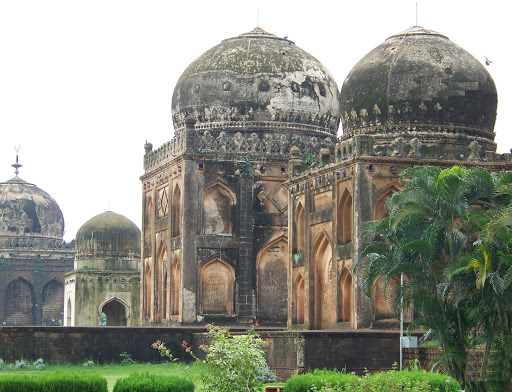
Next, on the list was the Bareed Shahi park. The tombs of the Bahamani rulers lay here. This is small but a nice park maintained just to provide some lung space for morning joggers and evening walkers. We were told that this was a neglected piece of history just a year ago and good efforts have been made by the authorities for its restoration.
We had an invitation from one of the colleagues at my mom’s office to visit his home for lunch. To think of it, it is by far and large one of the MOST sumptuous and wholesome meal I have had all my life. Hahaha call it the downside or the funny part of relishing such a wonderful meal- My mom and I were handed over a large towel to wipe off our teary eyes and watery noses. The regional cuisine here is notoriously famous for being high on chilly. But even with the hot flames flying out of our senses, we couldn’t resist the taste of the flavorful spread. It was a typical North-Karnataka cuisine with a spread of over 50 dishes. We were overwhelmed by their hospitality and the flavorful cooking. Apart from the Millet roti and gunpowder, most of the dishes were new discoveries for me. I even had a box packed with roti and keema-curry for my return journey by train in the night.
The Bahamani tombs
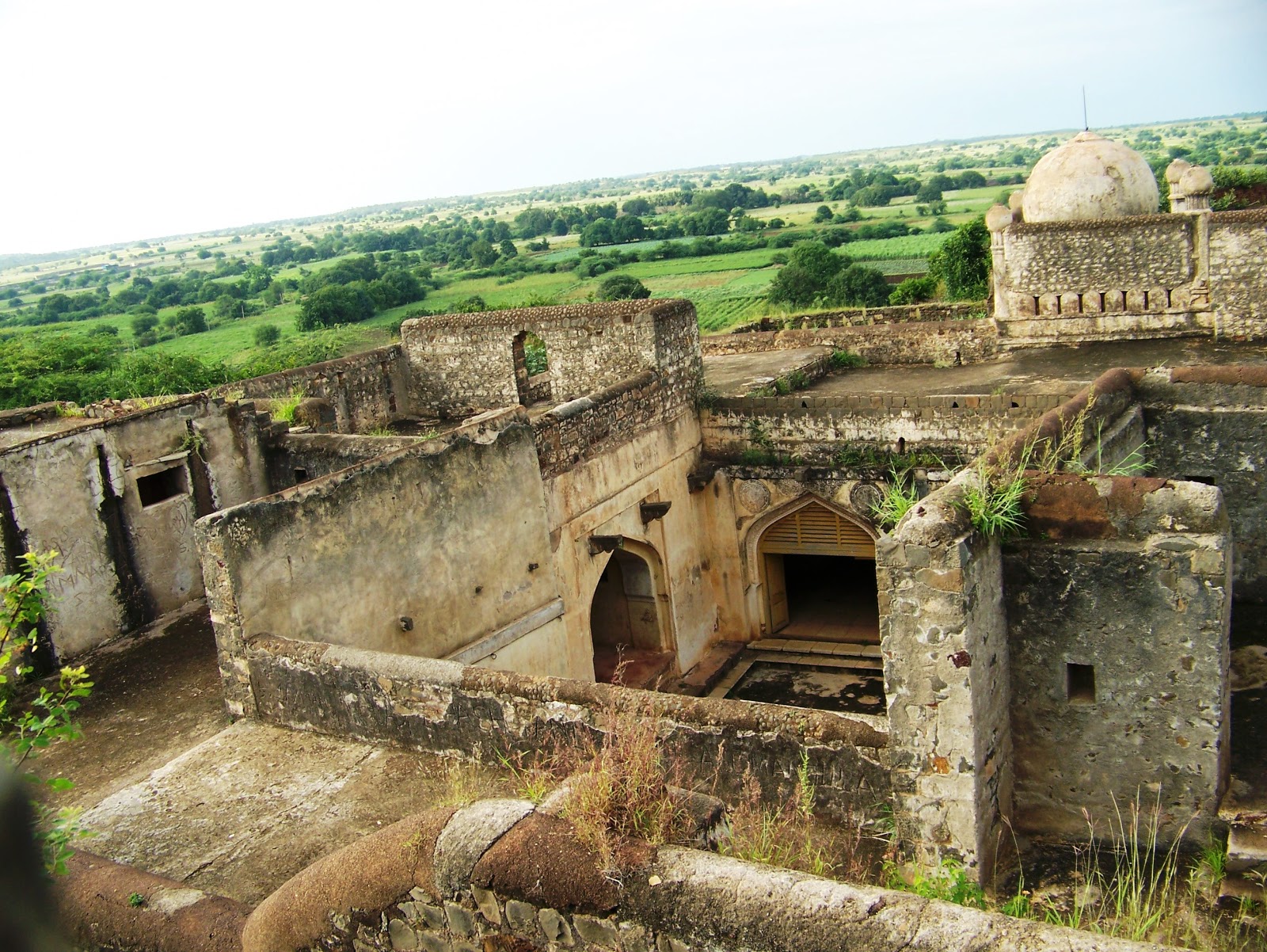
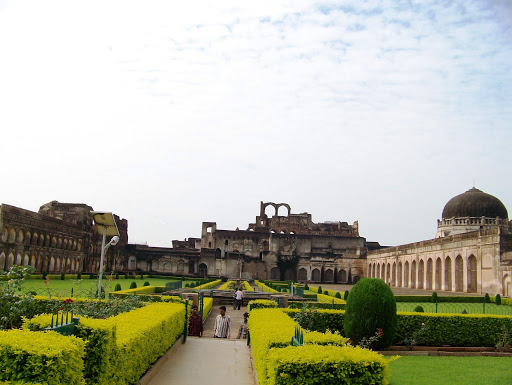
The last and final destination was the Bidar Fort: It is a multi-layered fort to say in simple words. It does not have a quantifiable boundary, though a few localites specify some digits to measure its expanse. The entire city of Bidar is actually within a fort wall which was the area where the citizens lived back during the rulers’ time. The second round of the wall is where the ministers lived. The third and the innermost zone is where today’s tourism is concentrated, the area where the King & the queen lived. This fort needs a minimum of half a day to explore for a person interested in history, architecture or archeology. In a tourist circuit in Bidar that I barely heard of, this fort came in as a surprise when I had least expected. It is HUGE!
The Royal Residence within the main fort
Bidar has so much to offer for a backpacker on a tight budget. Apart from the travel distance between places, everything else is very affordable. Even the entry to all the major landmarks on the potential tourist trail was free. In spite of it, very few people plan a trip to this district. Maybe because the name pulls down an image of a dry, barren, hot, poor, drought prone landscape. What my eyes met here was contradicting to the imagination that I had, largely based on what I heard in the media. In reality, the city was lush green, well fed with good rains and clean (at least compared to the cleanest places of Bangalore).
Souvenirs to take back: Bidariware is a local form of metal art that has a GI (Geographical Identification) tag and extremely laborious and artistic. It takes an 8 stepped process to create one piece of art and a symbol of royalty, that’s been carried on from 14th century, largely promoted by the Bahamani Sultans.
So, a lesson to take back: Stop imagining how a place would be; go there and see it yourself.
“Let’s Go Places” evokes the forward-looking and optimistic momentum of Toyota in America. It invites consumers on a journey to see new places, discover new possibilities and dream big dreams together with Toyota. “Let’s Go Places” begins today to engage consumers to discover Toyota and will debut nationally on December 31, 2012, as part of the campaign for the radically new Avalon, the embodiment of Toyota’s new direction. “Let’s Go Places” replaces the previous Toyota tagline “Moving Forward.”
Toyota has changed its global tagline from “Moving forward” to “Let’s go places”. This has come much in the wake of my next trip.. It is a great sense of bonding I feel that I am able to relate the thought of my mind and the feeling of my heart with the new tagline 🙂
Just as I discovered a new group of travel minded friends, I have set a target for myself to go on atleast one expedition/adventure travel per month. This means, I am looking forward for a lot of trips to see new places, meet new people and explore new civilizations 🙂
The phrase conveys a dual meaning of physically going to places and taking off on an adventure, while also expressing optimism and the promise of exciting innovation that enriches people’s lives… Toyota and The Lost Lander together take off on a new phase of life- “The Travel Phase”
It’s just a great feeeellliiinggggg…..
I wish Toyota all the best in its journey ahead and I wish the Lost Lander to have many more pleasant landings and successful missions in future.. Toyota and I move forward for a new life with new ways of Quality Innovation… 🙂
This post is based on my trek to Dudhsagar waterfalls in the year 2013. If you have read my previous post: The railway adventure, then you’re sure to have had an insight to the adventure part of my trip to Dudhsagar waterfalls. This post is more on the trip and the sightseeing part of the story. I elaborate on the beautiful vistas that we came across as passed tunnel after tunnel, walking along a railway track, in the middle of a National park and finally seeing the beautiful Dudhsagar waterfalls.
17 of us boarded ‘MAS-Vasco express’ from ‘YPR’ on a Friday night and alighted at ‘Castle rock station’ on the following morning at 9.15.a.m. ‘Castle Rock’ is cute little station that divides the village into two- on one side is the railway colony, school, hospital, offices etc. and on the other side is the town(if at all it is called so) with basic amenities like a grocery store and a few petty shops. Since we were travelling in monsoon, the station was all green and a treat to all the eyes that had just landed from a concrete city.
With no facilities available anywhere around the station and even the basic offices closed on a weekend, we all freshened up in the washroom of the railway station itself. This is a point from where our railway trek starts. It is less of a trek and more of a walk along the railway track, all the way to our destination: The Dudhsagar waterfalls. But like they say, its is the journey more than the destination that matters, the entire stretch of this trail is what makes the trip all the more special.
We couldn’t and just couldn’t ignore the gazillion scenic spots that we come across for which we had to stop after every minute or 5 minutes of the walk for a photo. The Castle rock railway station itself was so good looking. This green moss laden station is located in the midst of the Braganza Ghats, in the heart of a National park. Take for example, this ART (Accident Relief Train) parked by the side of the tracks. It is adding so much colour to a photospot.
@Castle rock station- in the midst of the Braganza Ghats ART a.ka. Accident Relief Train is parked by the side
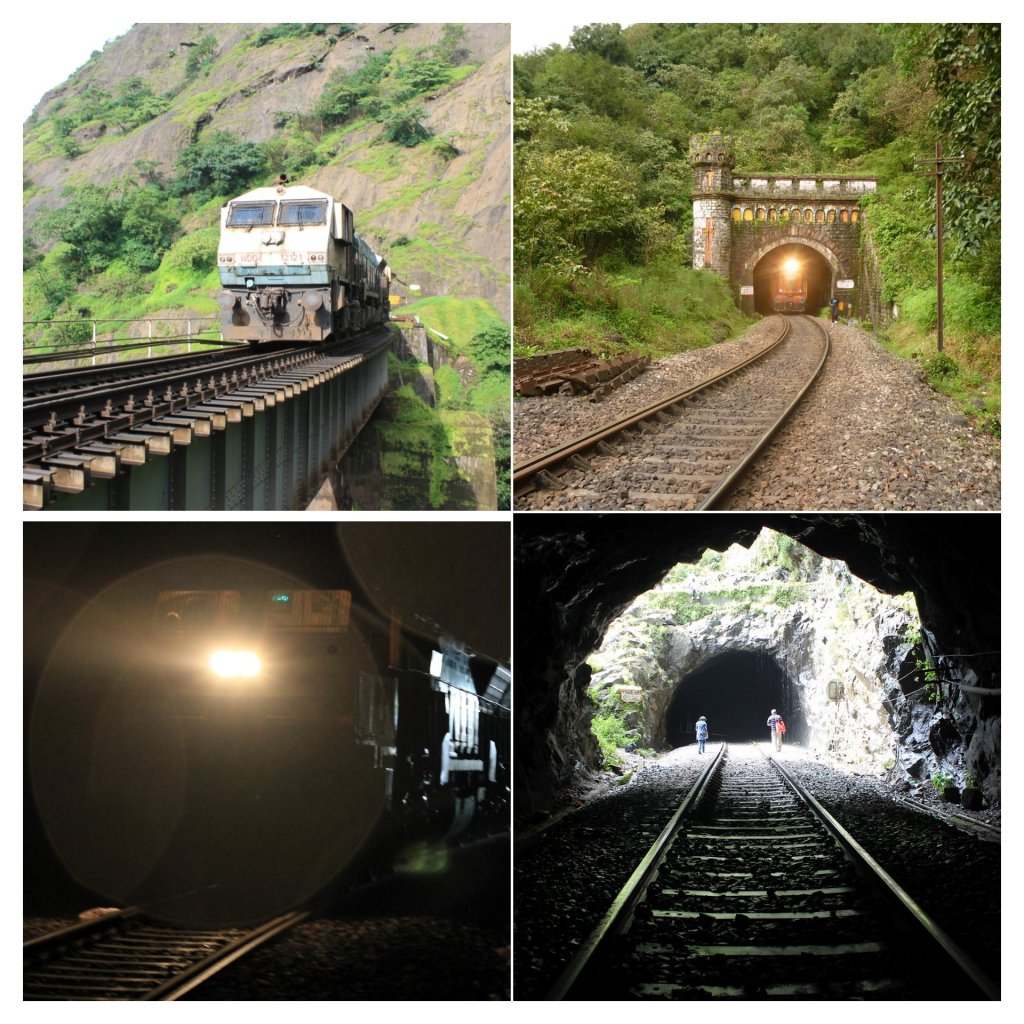
We continued to walk in the direction of Dudhsagar, but were unable to ignore the numerous waterfalls we encountered on our way. We stopped every time for photos. We had to walk through a total of 11 railway tunnels before reaching the main waterfalls. The first one can be approached by crossing a girder bridge laid over a scenic view of the valley.
The 2nd tunnel is the longest-at 624m. and the most beautiful one. It resembles an entrance of a Castle.
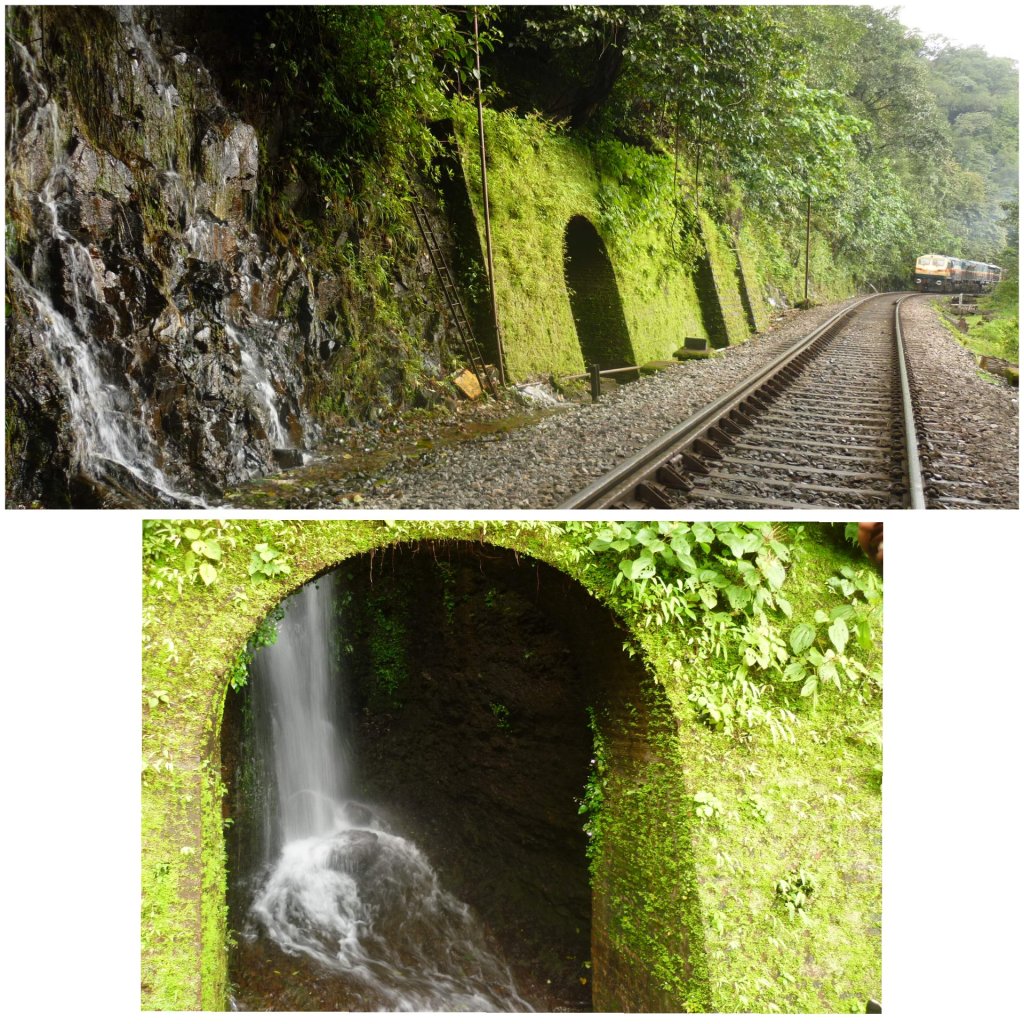
After crossing tunnel no.3, we walked slightly off the track, into the woods to see another large waterfall. Then came another waterfall, plunging down inside a vault kind of a structure built into the cliff.
Top: The vault by the trackside; Below: The waterfall within the vault
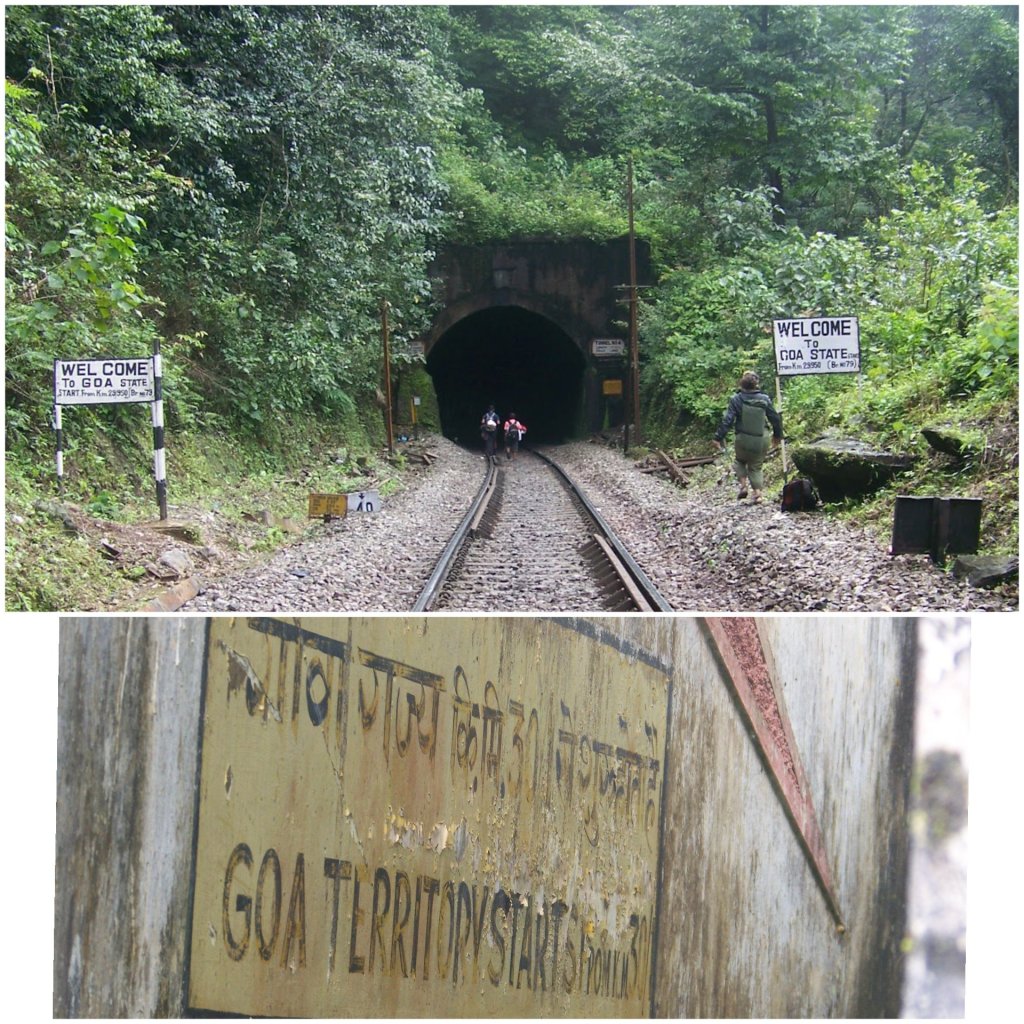
The 4th tunnel is special. After crossing this tunnel, we would be setting foot in another state altogether. This tunnel marks the border between Karnataka and Goa.
Top: The first tunnel on the Goa side of the land; Below: The location marked where the actual Goa territory starts
After a long walk from there, we crossed tunnel no.5. While still navigating our way with torchlights on the tracks, inside the tunnel, we heard the hooting of a train approaching us from behind. There wasn’t much time for us to get out and hence, we all decided to get down from the track and stick as close as possible to the wall of the tunnel to stay safe. When the goods train arrived, we literally held onto our dear lives. It was dark inside the tunnel and no place to move.
Clockwise from top left: A train passing over the girder bridge before tunnel no.1; Exit of tunnel no.2; Light between tunnel no.6&7; A train inside tunnel no.5
The 6th and the 7th tunnels came together. The 7th one was nothing more than a small arch. Then we walked through tunnel no. 8, 9 and 10.
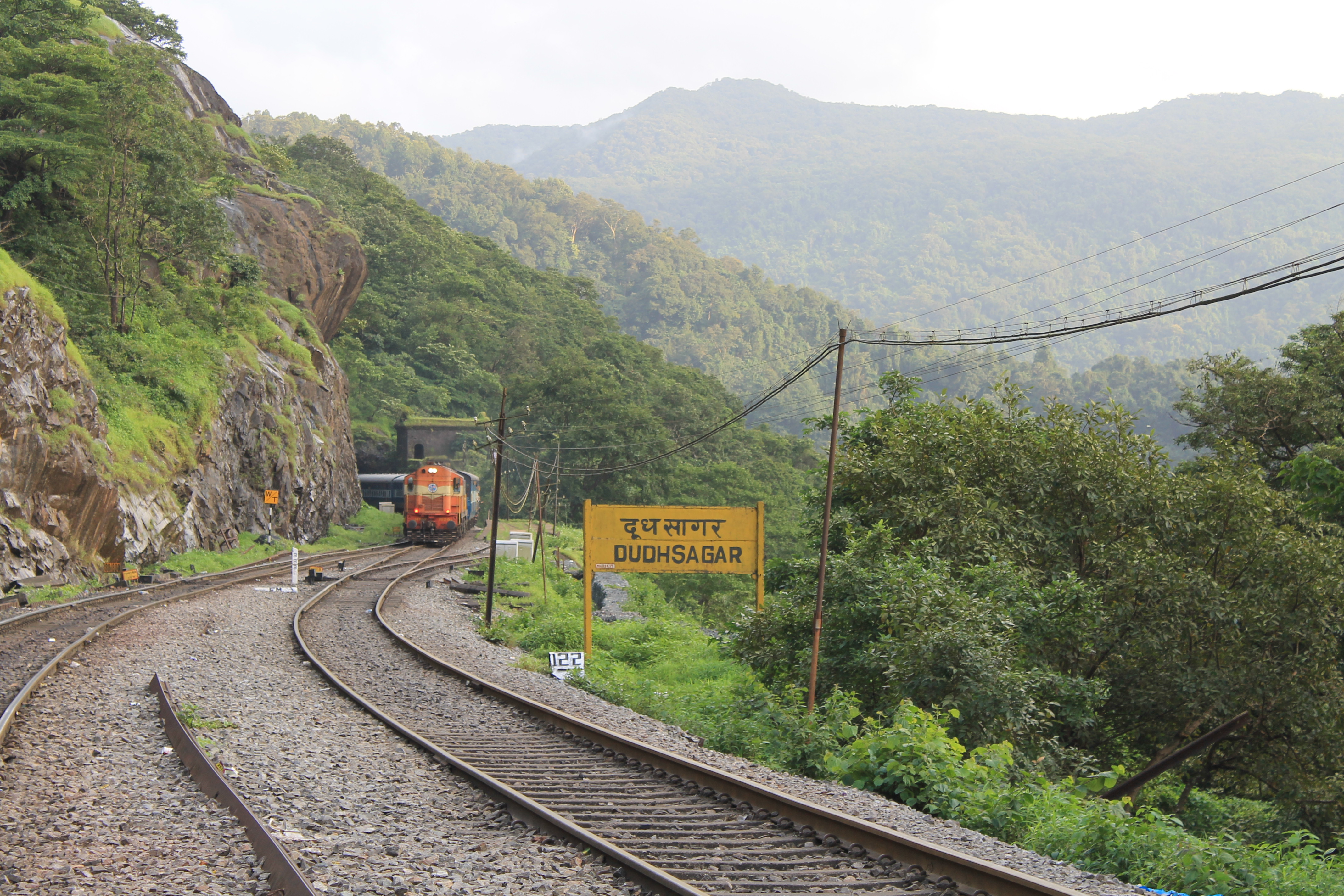
The 10th one was long and dark. And with exiting it, we saw Light at the end of darkness.. We had arrived at the ‘Dudhsagar station’. This is a de-func station and hence, neither the trains stops nor any tickets are issued for passengers who board from here. However, some lucky visitors manage to get a stop here but, they take a risk with a ticket-less travel. But, this is where we all realized that we were all tired by walking along the tracks. But, the fact that our destination was nearby gave us energy.
The DDS station
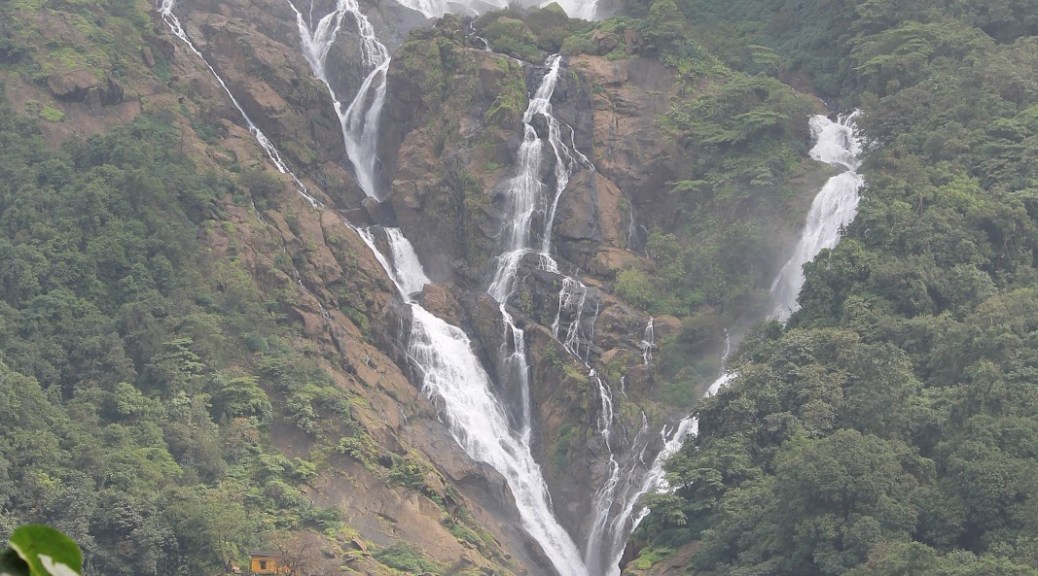
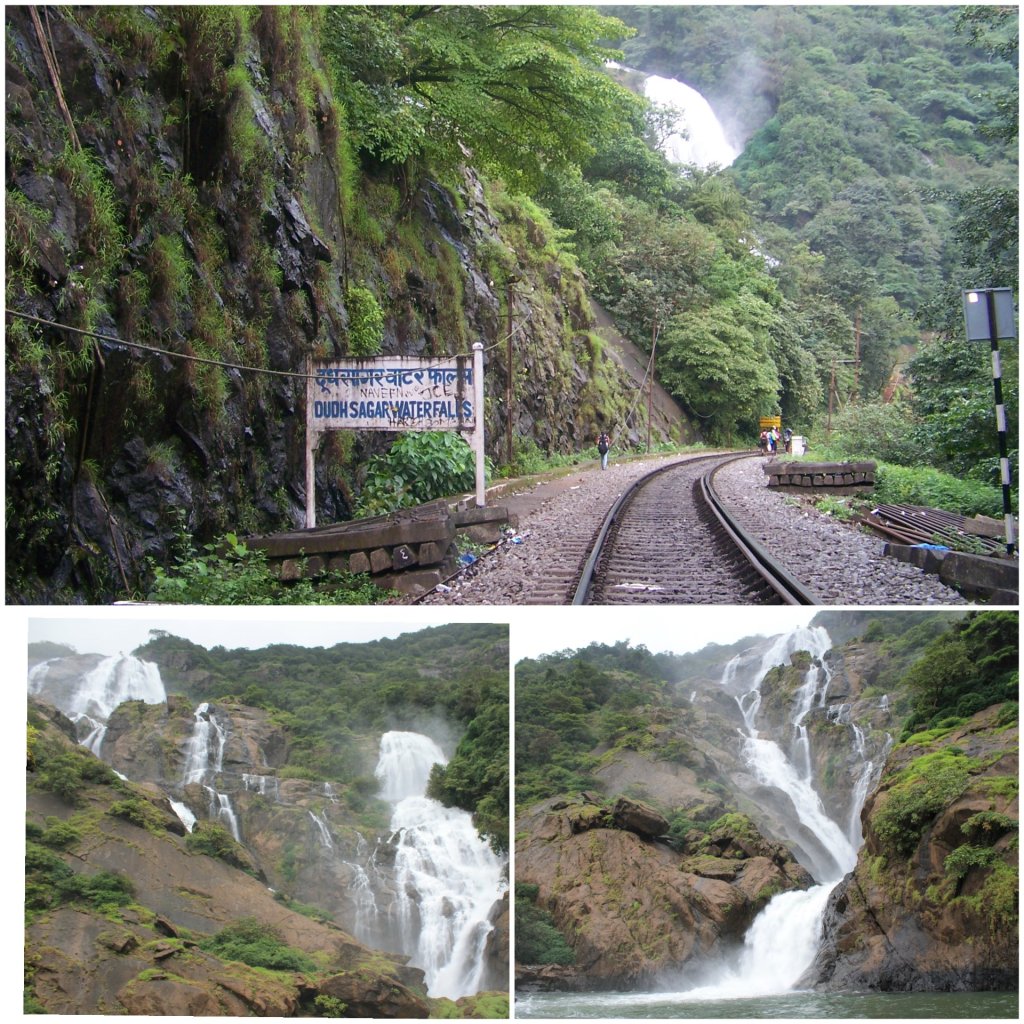
Then, we proceeded towards the 11th tunnel…. When we were exiting it, we were all hooting and clapping in joy. That’s because we all got our first glance of our destination. The mighty Dudhsagar: “Ocean of Milk”. The feeling was inexplainable. It was a great sense of contentment after a long tiring walk that was alllllll worth it..!! There was now a sudden spike in our energy levels and we all hurried towards the waterfalls. We dumped all our luggage right there, in front of the waterfall and crashed down in awe. As we were basking in the glory of the waterfalls, it had started to get dark. We looked out for space to unpack our luggage and our tents.
Top: The first glimpse of Dudhsagar waterfall out of tunnel 11; Below: Different views of the Dudhsagar waterfall
The only shelter (a small roofed structure) available to pitch a tent was already occupied by a large group who had arrived before us. We had no choice but to camp in the open, just by the side of the railway tracks. We put up a small campfire sort of a thing so that we had enough light to see each other’s face. But mind you, we were in the middle of a monsoon season in the western Ghats. The rain gods who had been kind on us during the entire hike were now playing spoilt sport. The campfire was put off too soon and we managed the rest of the night with our torches.
It poured cats and dogs the whole night.. The roaring noise of the waterfalls in the backdrop and the loud hooting sound of the train that passed atleast once in every half an hour, the tent pitched right next to the track with the waterfalls on the other side, it was indeed a night to remember..!!
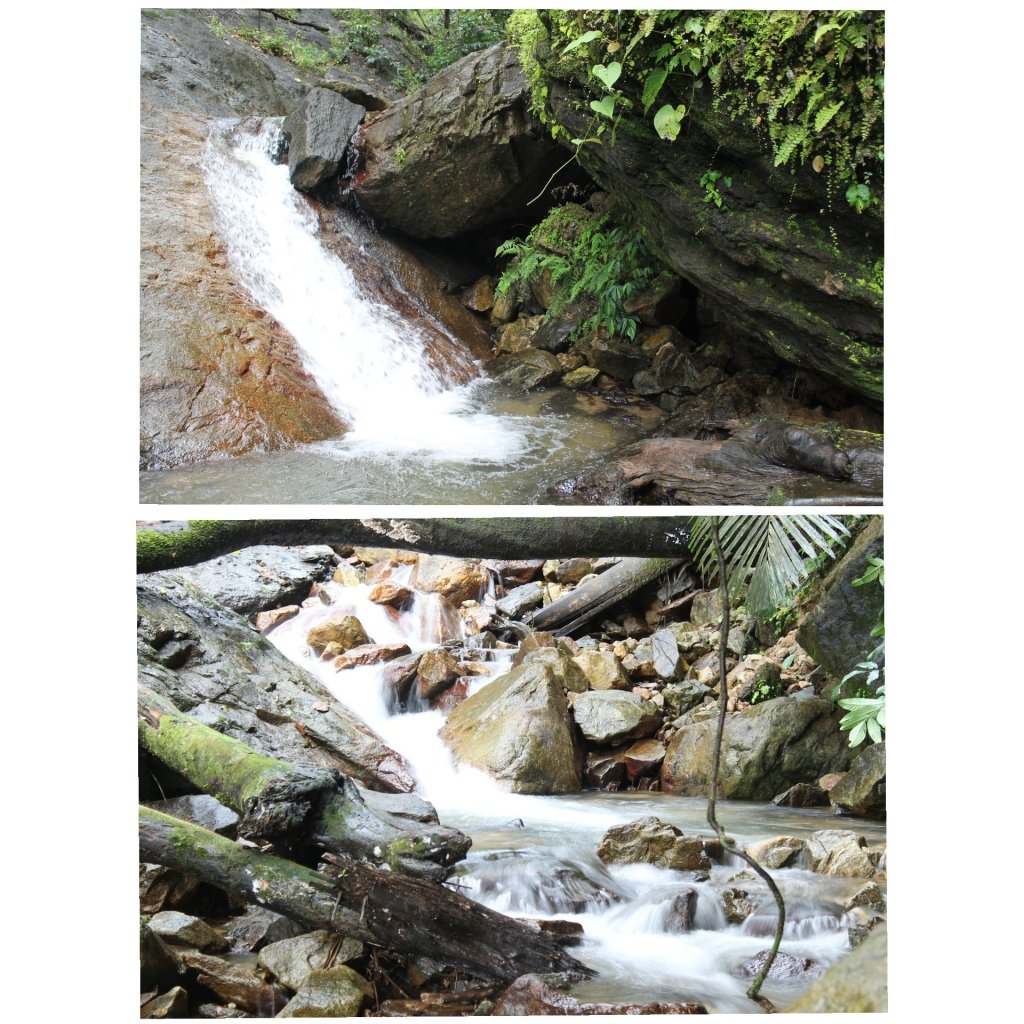
Next morning, we all rose with the sun and spent some peaceful time in watching the water gushing down violently. Apart from freshening up last at Castle rock, it was already 2 days & 2 nights since we had last seen a decent restroom or a bathroom. We looked around to find a little place where we could finish off our stuff in peace. A small waterfall nestled deep inside the woods is what we found instead. All the girls in our group jumped into the water while the guys kept a watch for any trespassers 😉
Mythology says that the “DevaKannikas or the Apsaras are often seen bathing in the midst of the woods, before sunrise.. and if one is lucky, he can see them walk by in wet clothes” to think of it from a strangers’ perspective, I guess the scene that morning must have been something similar to that. We couldn’t find a place near the waterfall where we could change into dry clothes. Hence, we all wore our jackets over wet clothes and walked 1.5kms towards our tents. On the way, we came across tens of trekkers who desperately stared at us.. I understand the natural human instinct to drool at divine looking girls who are walking wet after getting all soaked in pristine water. Nobody could help the sight.!!
The waterfall where we took our morning shower at Dudhsagar
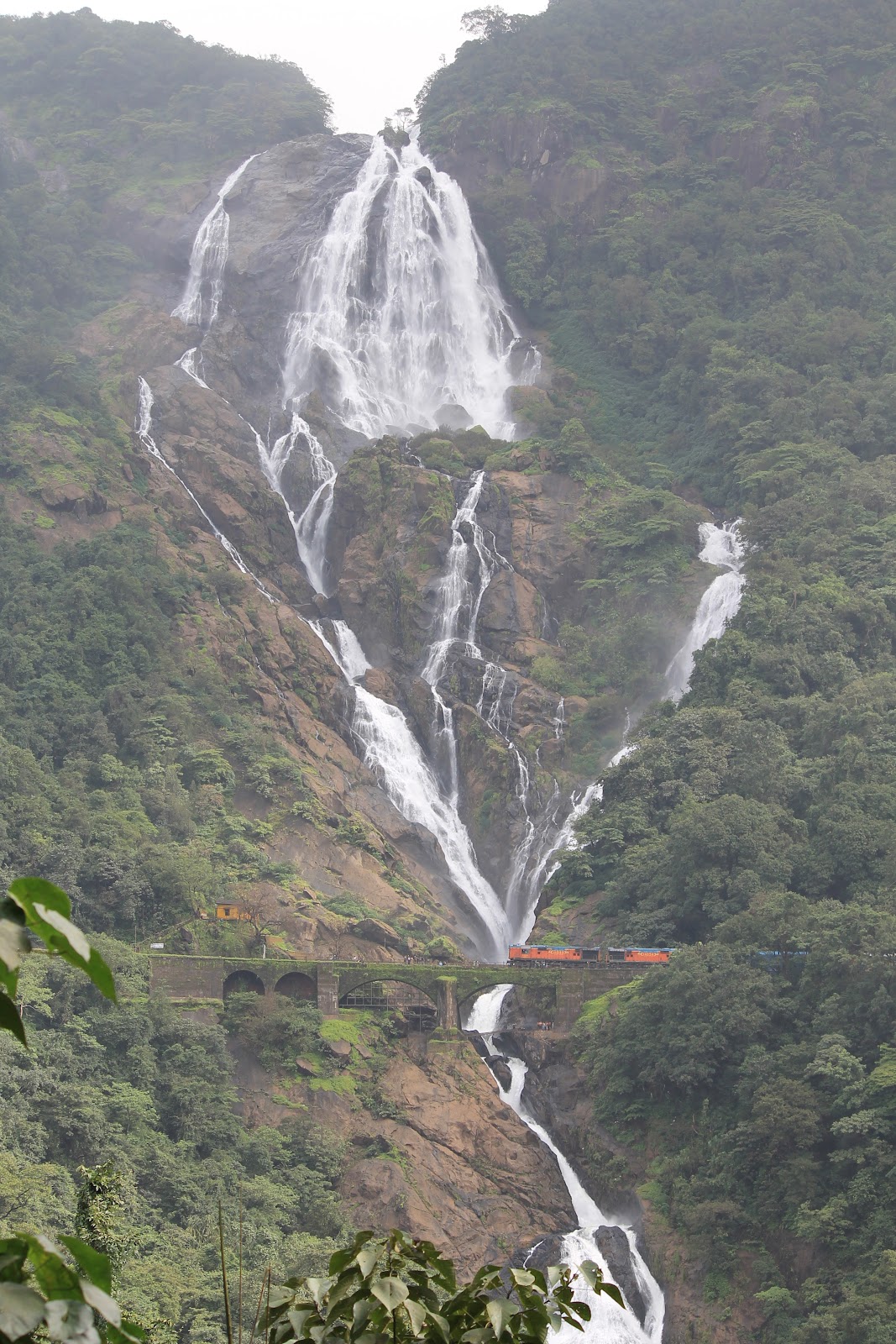
We were told that the passenger train would cross the waterfalls by 9.15.a.m. This meant that we had to be at the view point by that time to get that perfect internet photo..!! It took us to cross the 2 more tunnels to reach the viewpoint. After reaching there and waiting for a few minutes, we finally got the wallpaper worthy photo that we wanted.
Finally.. We got what we wanted..!!
After a long photo session of the large group that we were and before the crowd who had just arrived in that passenger train would spoil the peace, we headed back to our tents.. We had a round of heavy brunch (carried from home) and slowly packed up. The initial plan was to walk the track all the way to Kulem, but owing to the cruel sun and the tiring walking experience on the tracks on the previous day, we decided to wait to find a train ride, either to Kulem or Castle rock. We missed the goods’ train to Kulem by a few minutes and so, we had to wait at the Dudhsagar station for the passenger train going towards Castle Rock.And with that.. Curtains down to our trip to DDS falls..!!!
Update as on Year 2019: • Trekking on the tracks in prohibited as it passes through a National park. There is a risk of a human-animal conflict. • If you wish to visit the Dudhsagar waterfalls, you can sign up with one of the organisers based out of Londa in Karnataka or Kulem in Goa. They can take you through an authorized trail or a 4WD ride to a nearest point can be arranged.
When you are back from a trek to Dudhsagar and talk about a “Railway adventure”- the usual things that strike anybody are train spotting, tunnels, wild encounters, the rail line that passes across the mighty waterfalls so on and so forth..!!! And there is ample information available all over the net about this walk along the railway tracks… So that’s the railway adventure…!!!
“NO…!!! ” I’m not here to speak about such a lame adventure- What if we did not come across any wildlife on our way..? There is always something even better that comes across as a compensation for not having any wild encounters..!!
We were all on our return part of our trip.. and were just happy that everything went on well so far.. And then began the actual adventure unfolding one by one..
Scene no.1:
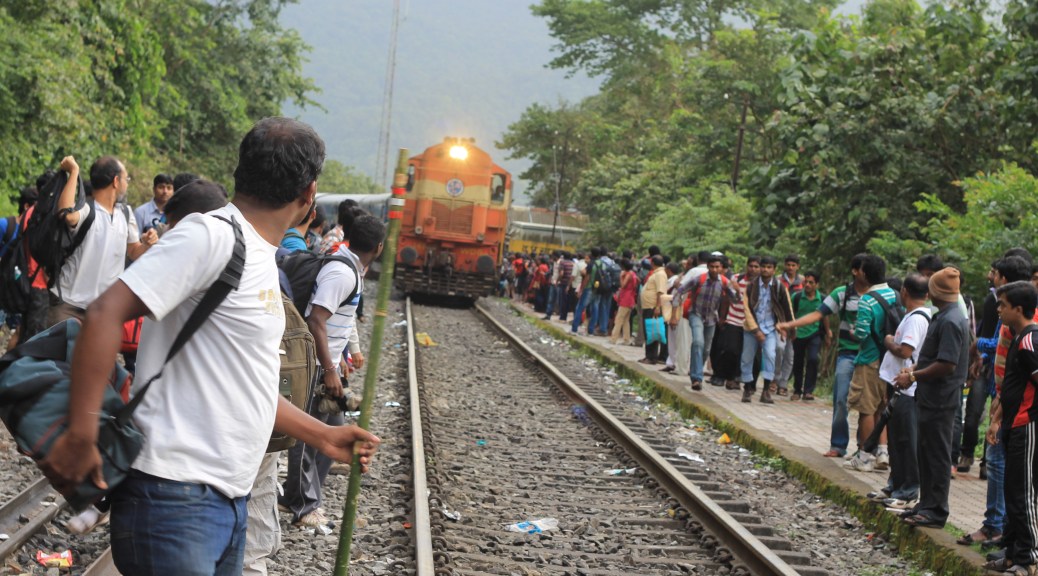
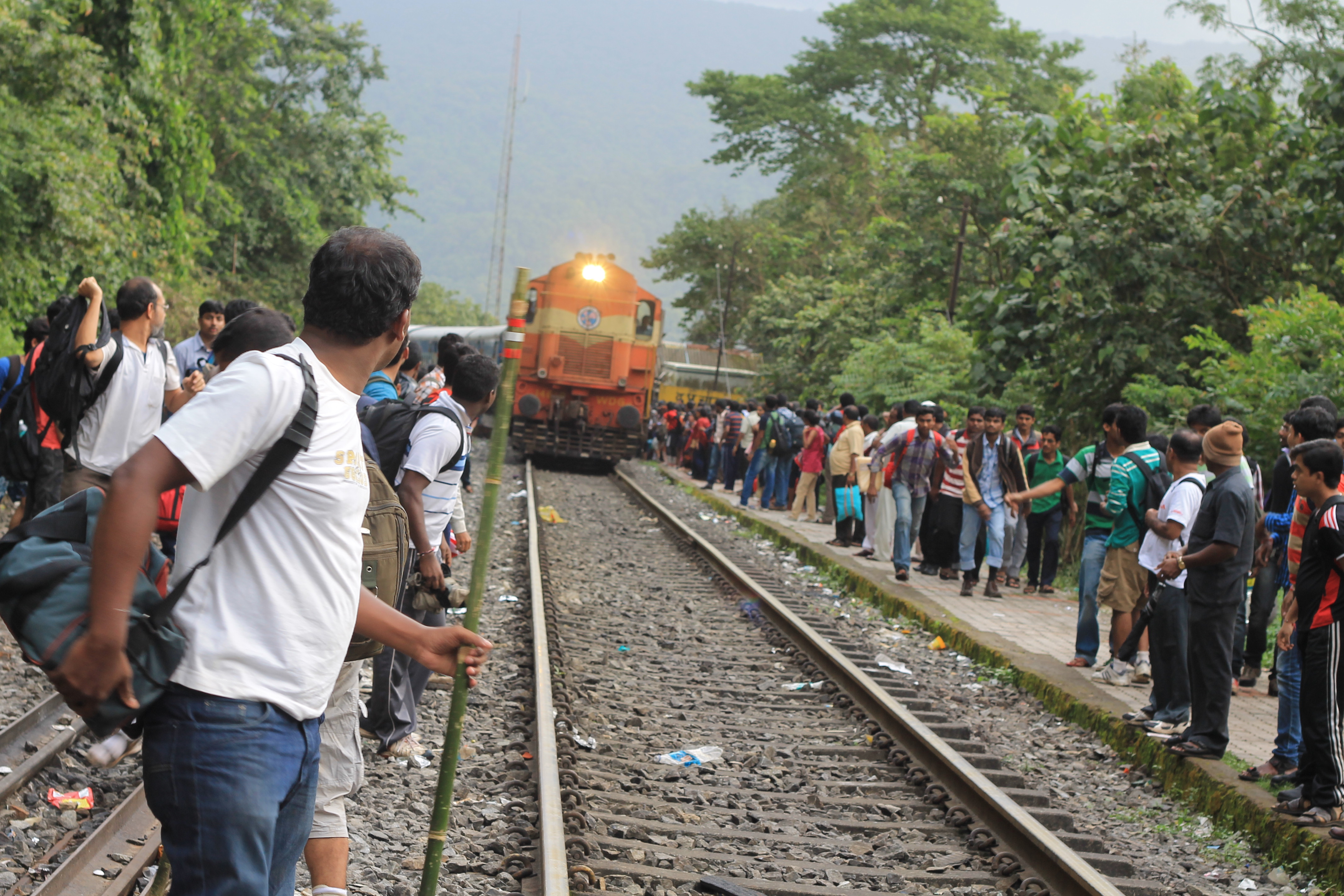
We were mocked at, at Dudhsagar station when we enquired about the tickets. Why that? We had even requested the person at the ticket counter in Castle Rock to issue return tickets from Kulem to Londa as we did not want to take any chances. But, our requests were all turned down telling that it was not needed. Like every other tourist/trekker who comes to Dudhsagar, we too decided to travel ticket-less till Castle Rock station. There were more than 500 people who got into the Vasco-Nizamuddin express with us- all without a ticket..!! This is nothing unusual as each and every blog on the net speaks about ticket-less travel. In less than 5 minutes after the train had started, the TT came asking for our tickets. We honestly displayed our tickets(from Londa to Bangalore). He told us to show the tickets from Dudhsagar to Londa and we told him this was the only one we had. His voice sounded a little harsh this time. We explained all that we knew about the reason for this kind of travelling.. But now he told us to pay a fine of 500Rs per head. 17X500???? Noway..!!!! Finally.. he took us all to one end of the bogie and settled the scene for a total of Rs.460. That too- Till Londa 🙂 Now it calls for an adventure of travelling ticket-less right..??
But that’s not the case, everybody knows that there is no ticket issued from DDS, so this kind of checking is a major scam happening in these trains..
All ticket-less trekkers ready to jump into the Vasco-Nizamuddin exprs
Scene no.2:
Onboard Rani Chennamma Express:
Approx.9.00.p.m.: 17 of us are playing dumbcharades, all seated in the same compartment and the entire bogie looking at us in awe(some jealous of us for the fun we were having, some surprised of the size of the gang, some enjoying the game with us, and some definitely pissed with the loud noise we were making). 2 police men walk across the bogie without bothering to notice anybody in particular.
Approx.11.00.p.m.: We all decide to go to sleep as we were all pooped out of the long trek and most of us had to go to office the next morning. All are dispersed from the seats and preparing the bed.
Approx.11.30.p.m.: Less than 2 minutes before we turned the lights off.. The 2 policemen appear out of nowhere..
“What’s going on here? We have received a call from the control room that there is a lot of noise coming from this bogie. Other passengers have complained about it..!!”
“But, we are sorry Sir, We had stopped playing half an hour ago and were just about to hit the bed”
“What are you playing with all these girls I say? and You.. dressed up like Y*su Chr*sta….” pointing out at XYZ..
XYZ got pissed off and revolted, “Mind your tongue, how dare you talk like that……”
The rest of us dragged him away before the scene got worse..
“Oh not just causing public nuisance, now you are fighting with a cop huh? All of you get off the train at Davangere station and lets talk about it in the station” the Cop asserted..
“But Sir, We will keep quiet now on and take responsibility not to disturb others. We are sorry..!!”
“We don’t know all that, get down at the next station or else pay a fine of 1000Rs. per head”
“Please consider, girls are travelling with us. We can’t get down in the middle of the night and we are on our way back, we don’t have so much money either”
“Just get down and lets see at the station”
This went on till approx.1.30.a.m and the entire bogie was watching the fun with no one even bothering to support us considering that we were all kids(or something like that, atleast out of courtesy)
Finally we all pooled in all the ‘Tens’ we had and settled the matter with Rs.500. A toll for absolutely no mistake of ours..!!
“The Indian Police”..!!! They are more than wild and entertaining who could well give an excellent replacement for the Orangutans- which are critically endangered.!!
Anything for money….. There is NOTHING that can be done to eliminate corruption in our country..!! We all speak volumes about a corruption free nation but we ourselves promote it in absolute helplessness..!! And Ohh?? Safety and respect for women???? what does that mean? I don’t remember coming across any term like that during my journey…
On a weekend, my family planned to go for a day trip from Bengaluru. Since my dad wanted to visit Lepakshi since long, that was our destination for the weekend. There are several other small and major historical landmarks in a 50-100kms radius from Lepakshi; hence we had an initial plan to cover a few other places during our return as well. A super awesome NH7 from Bengaluru took us till Bagepalli, from where, Lepakshi was a small deviation away…
The belief is that, Jataayu- The vulture King (mentioned in the Ramayana) fell here when he was shot by Ravana’s arrow. Later, Rama is said to have commanded the bird to rise- Le Pakshi, and hence the name of that town. But not just its name, this entire place turned out to be a storehouse of history. Be it from mythology or the recent past history of the Vijayanagar Empire, every stone at Lepakshi had a tale to tell… We walked carefully reading every story that unfolded at every step
Although, I might advice you to take a personal guide while at Lepakshi who will be able to better put up all the stories and facts to you, here I would like to enlist a few noteworthy stories and art representations from Lepakshi.
The main shrine of this architectural complex is the Virbhadra temple. The human figurines/ sculptures in its main hall are believed to be made up to the specifications to measure the beauty of a perfect man and a perfect woman.
Left: The perfect man; Right: The perfect woman
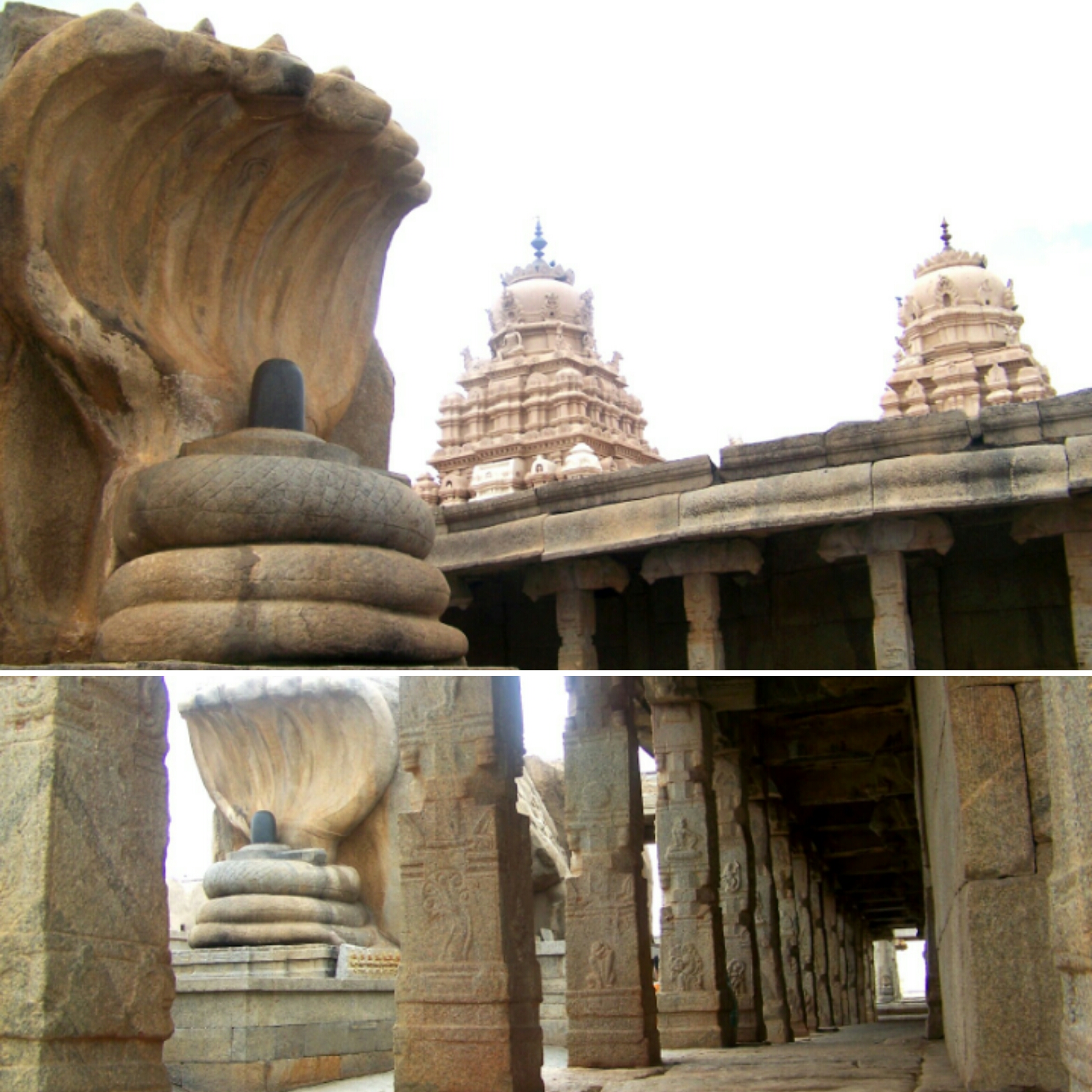
2. The idol of Nagalingesvara– Carved out of a natural boulder to the west of the shrine, is a seven-hooded Naga sheltering a black-polished lingam cradled in its ribbed coils. A saptamatrika panel is placed below to the right. History tells us that the sculptor had come home for lunch one day. His mother said she would be back soon with food for him. She was surprised with her son’s work when she returned and exclaimed “Oh my son..!! You have carved such a big and a beautiful statue in such a short interval.” Even before she completed, a big crack developed across the linga. This makes it un-worthy of any Pooja/ offerings at the temple.
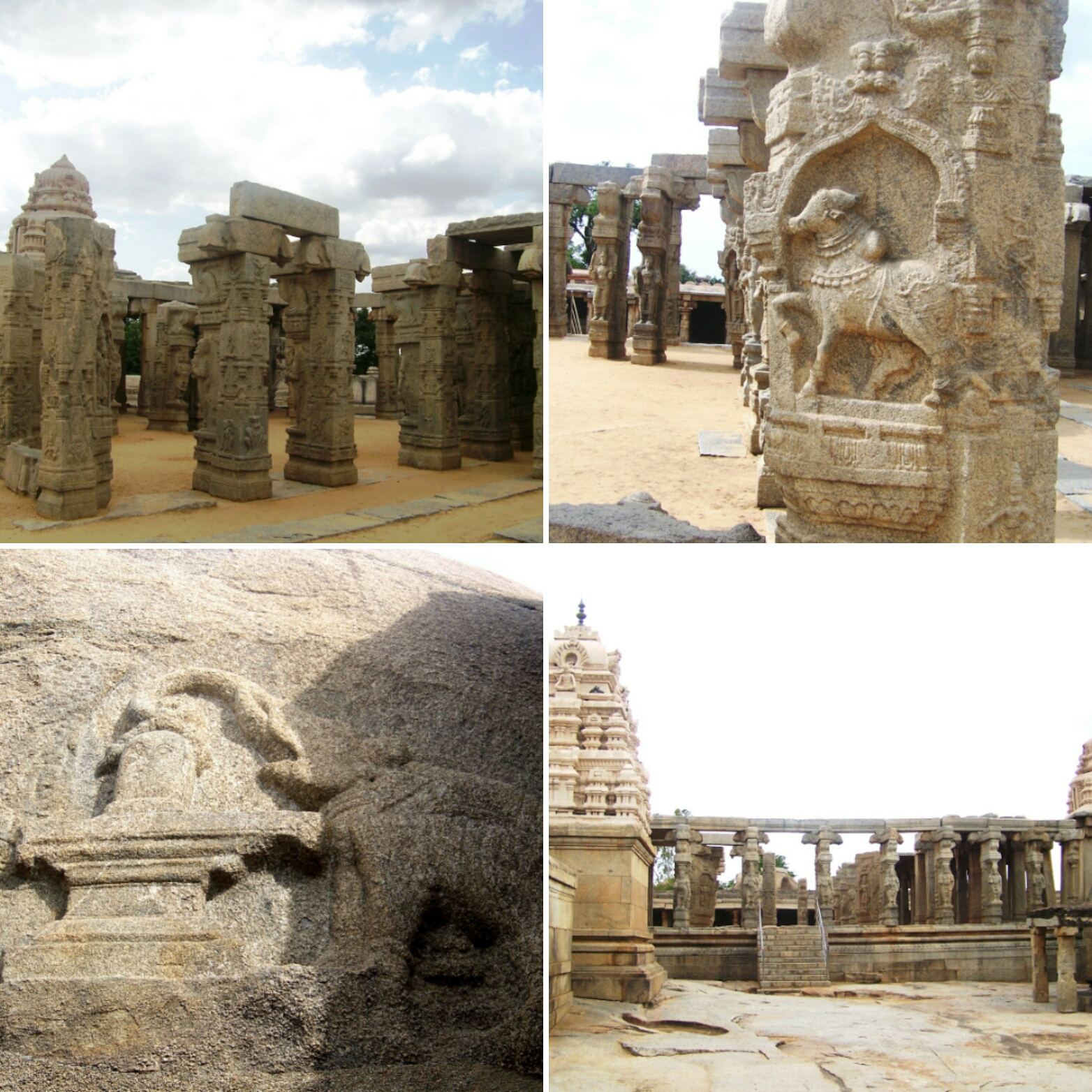
3. The hanging pillar– Among the several ornate pillars that decorate the temple corridor, this one takes a special mention as an architectural marvel. The pillar doesn’t rest completely on the ground and hence a sheet of paper can be easily passed through the gap beneath it. The roofs of these corridors are also adorned with several ancient painting, however they are largely lost due to apathy. Another noticeable feature on these pillars are the certain designs engravings specific to this temple. These designs are said to be the inspiration for the traditional Lepakshi prints found on Sarees around this area.
4. Kalyana mantapa-This incomplete structure has been depicted as the site of the celestial wedding of Shiva and Parvati. Each pillar here is supposed to be installed in celebration of this event. Hence, one can notice that there are depictions of drummers and musicians, gods and goddesses among others engraved in these pillars. A similar place is believed to exist in Kailash and it was therefore pronounced that a place more beautiful shouldn’t exist on the earth. And hence, this Kalyana mantapa was left unfinished.
The Kalyana Mantapa
5. History says, the place could have got its name referring to the two brothers- Veeranna and Virupanna, under King Achutaraya of the Vijayanagar dynasty. Virupanna got this temple built as a tribute to the Lord as his mute son regained his speech while he was playing near the Udbhava Moorthy of Shiva on this hillock. It is said that Virupanna spared no expense while having this temple constructed. However, since he was the treasurer of Penukonda province (today’s Anantapur), the money he was splurging lead to suspicions from the king about embezzlement of money. It is said that, Virupanna plucked out his own eyes and threw them against the wall in grief and in anticipation of royal punishment. And thus, lepa-akshi (blinded eyes). Till date one can find those blood stains on that wall. The locals say that it has even test have proven that the blood stains are indeed real..!!
6. The Natya Mantapa– This is an arena where the celestial dances are believed to have been performed. Besdie it, one can see a large footprint embedded on the ground and beleived to be the footprint of Sita. It is so large that is hard to imagine what it could have been or imagined to be when it was made.
Clockwise from top left: The Natya Mantapa; The idol of Chowti Ganesha; The Sita Paada; The bloodstains of Virupanna’s eyes
7. The statue of Basava or the Nandi is the largest monolithic Nandi in India. It is built facing the Naga Linga within the temple complex. However, this is half a kilometer away from the main temple.
The largest monolithic Nandi in the world- Facing the Veerabhadra temple
Jataayu is believed to have died at another place which is located at about 2 kms from the complex.This is quite sad that a place of such importance is not maintained or highlighted anywhere in the map. It didn’t have any walkable road to the exact spot. But, by this time we had already spent more than half a day at Lepakshi which we hadn’t anticipated. It was also very hot and dry and we were feeling all exhausted. Hence, decided to save all the other places for another day and returned to Bengaluru.
Conclusion: A wonderful place to visit if you are a history and art buff and looking for a place located at just about 120kms from Bangalore..!!
Every girl has a Superman in her life.. For some it could be her father or in some case- a distant uncle.. And for me- it is “My Super Grandpa”.The wooden bridge layed across a brook in my hometown is one of the many reasons for which he is immortal in the memories of the nearby villagers even a decade after his departure. So, now I get down to how this happened:
Introduction:
There are three ways to reach Abbi falls:
A motor able asphalted road- about 8kms from Madikeri town. The most comfortable one if you have own transport from the town.(Lots of details are available on the net)
A partially adventurous one- about 8kms from Madikeri. One needs to take a private bus from Madikeri to Kootpole. And hike for about 4 kms to reach the falls.
The most adventurous route(difficult)- trek through thick jungle lined by deep valley on one side and thorny bushes on the other side.(Will write about this one some other day)
I choose to write about the 2nd route- The closest to my heart..!!
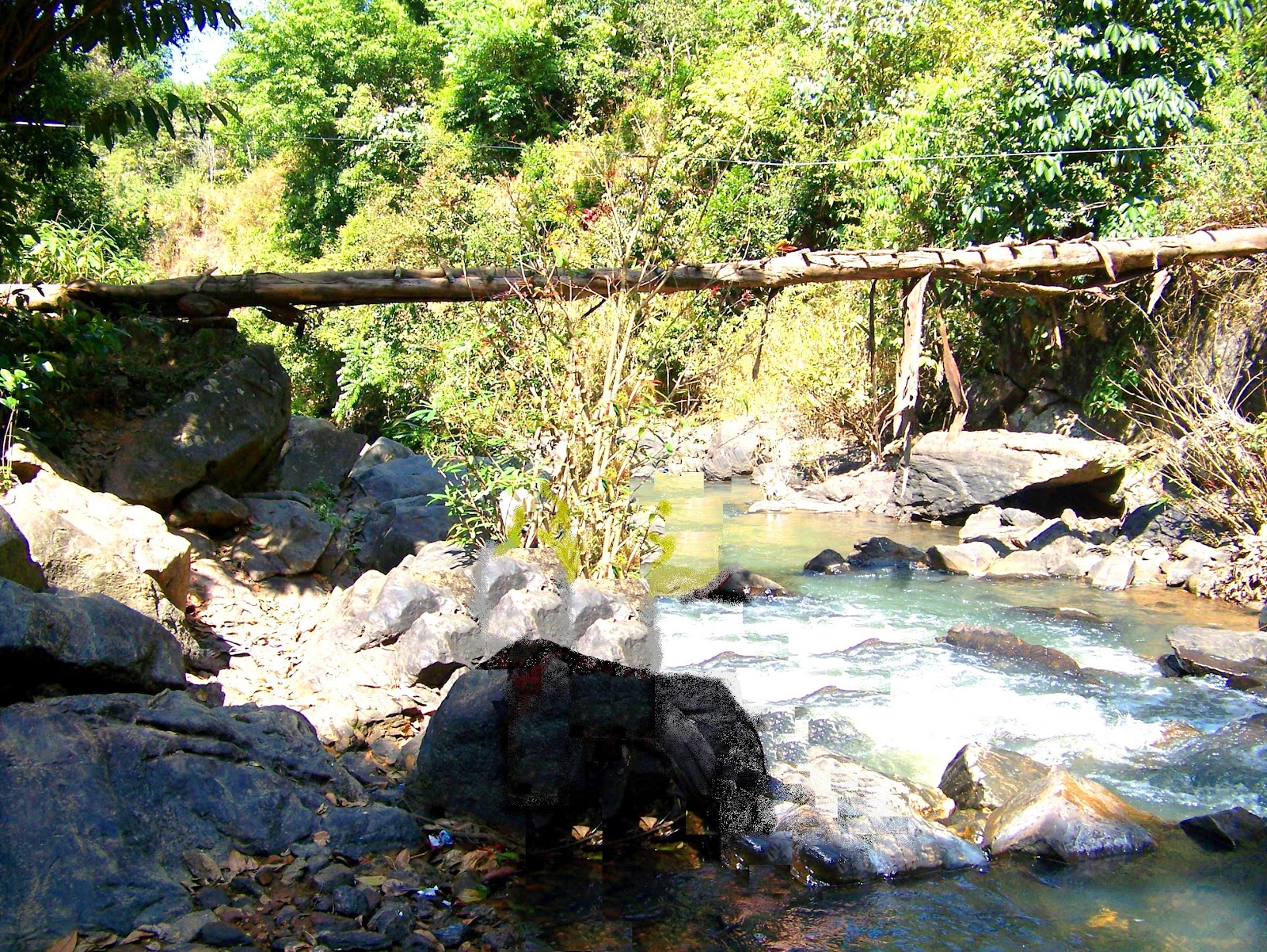
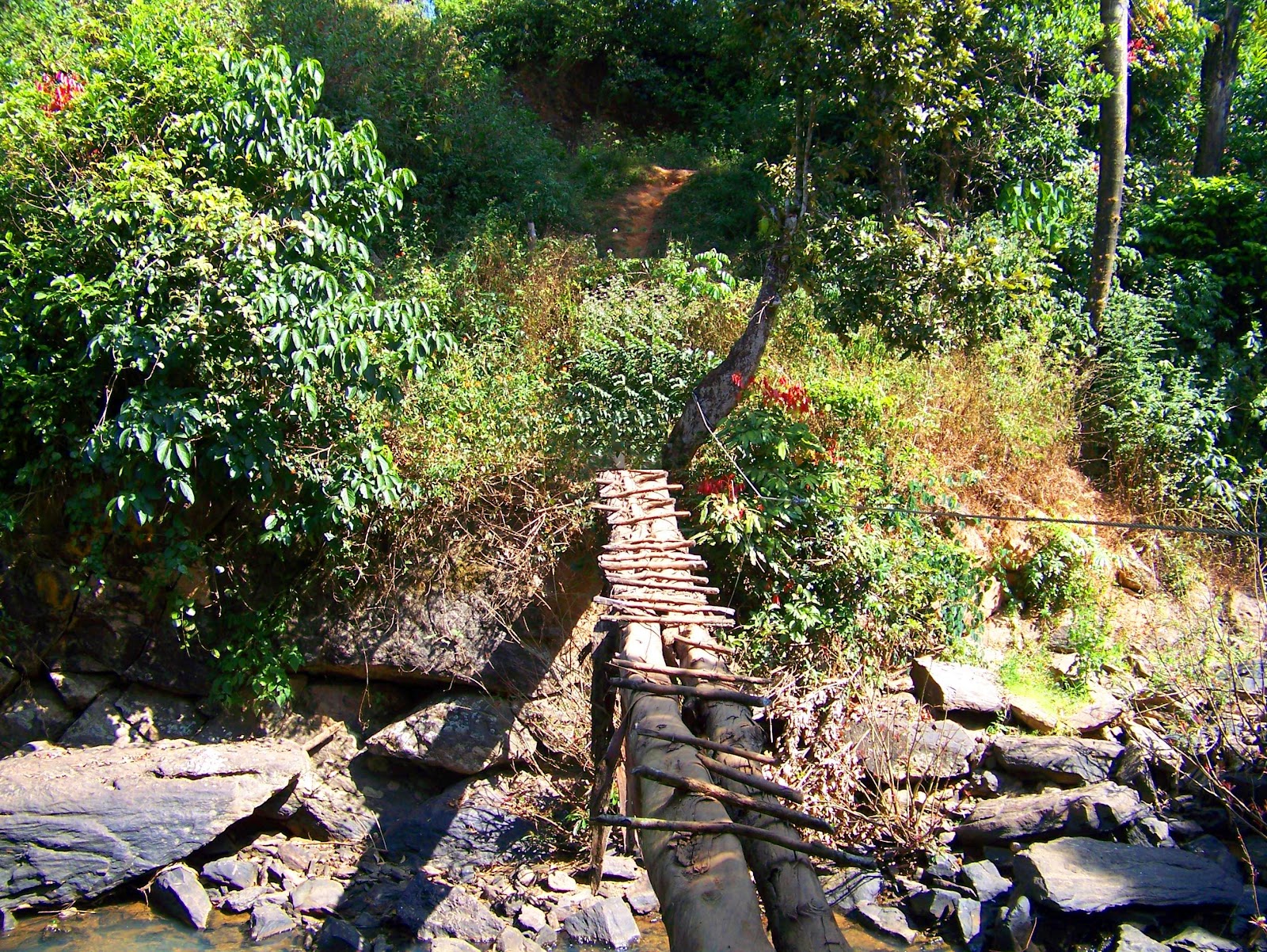
It is in this route, that one has to cross a brook in order to reach the waterfalls. When I say a brook- it is not a small stream that you can jump across; especially during the monsoons. One needs to walk over a carefully laid wooden bridge holding tightly onto nothing more than a thin steel wire..!!
The Bridge across the brook
This is a bridge which is not meant for the tourists and that is why it continues to remain unknown. This bridge is actually one single tree kept across the river carefully. It was laid across with a purpose of providing accessibility to the nearby villagers who could not afford a taxi for daily commutation.
And among these villagers, the one who stands out is “The Superman- My Grandpa”. He is the sole man behind the existence of this bridge. From selection of the finest tree(neeredithakai Mara- in Kodava Thakk), to gathering labourers to pull it all the way up from his estate to the river bank and putting it across the rivulet(about 60 feet wide)- he is the only mastermind behind it all..!!
I recollect faint memories of sitting by the side and watching all this action as a little girl… Some 25 odd men pulling the tree up the sloppy estate, I lending a squirrel’s help with my tiny hands to my grandpa in his mission, getting a pat on my back for my hard work.. And once the bridge was done, I remember the days when grandpa used to hold my hands tight and teach me how to cross the river.. It just fills my heart with coldness…
Walking over the wooden bridge
This bridge stands strong till date- even after bearing all seasons for more than two decades now.. It is become a part of the villagers’ everyday life… Though it was built with the idea of having easy access for grandpa to reach his estates every day, he did not restrict it only for himself. It was open for the public too, helping all the villagers living around this area. This truly stands out as a symbol of his greatness… And I miss him so much every time I walk this way or I hear of people speak of this great man..!!
Update as on 10-July-20:
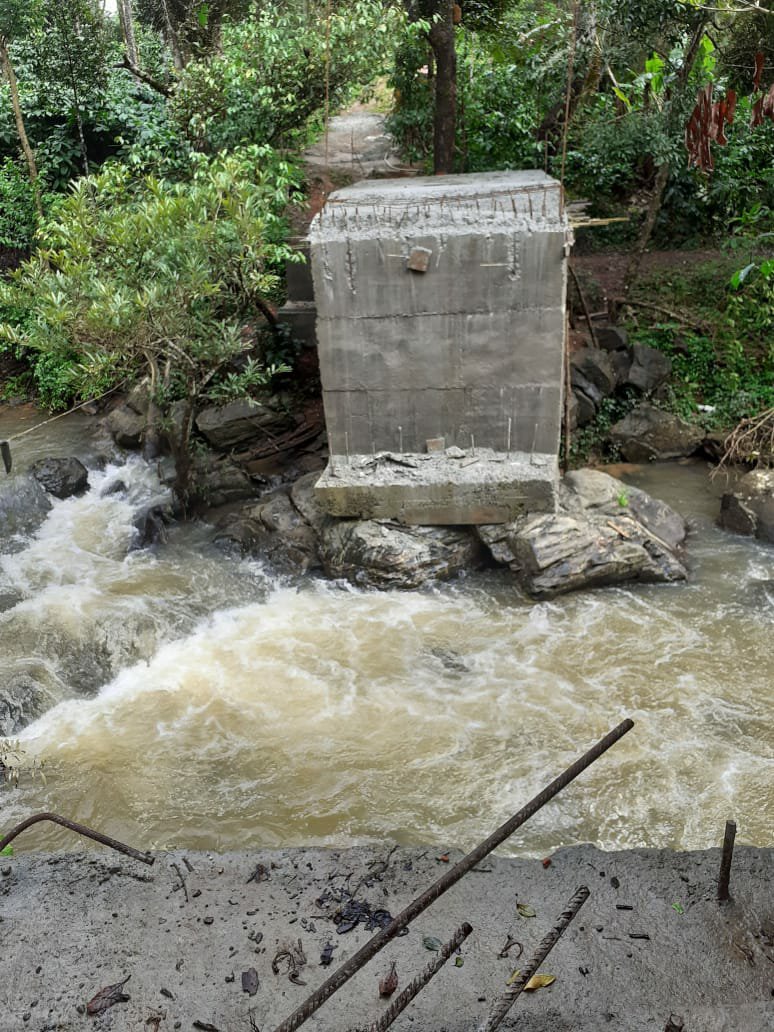
The wooden brooke that connected worlds for so many decades is now gone. A concrete walk bridge is underway. Thanks to the lockdown due to Covid19, the work on the bridge has stopped and there exists none at the moment.
‘Jog’ is a charmer on all Karnataka tourism promotions. Why not? It’s the second highest waterfall in India after all! A glimpse of the mighty Jog at least once in a lifetime is an unwritten rule for every person born or living in Karnataka. And why not see it take a plunge in all its might? This exclusive visit could happen in no better time than the monsoons. So, my mother, brother and I planned this weekend trip to see the Jog. such that we could reach Shimoga by 6.00.a.m.
Our itinerary: Day 0: Leave Bangalore to Shimoga (Overnight bus) Day 1: Shimoga to Sagara (local transport), visit Linganamakki dam and hydroelectric project, The Jog falls, Tyarekoppa Lion & tiger safari. Return from Shimoga to Bangalore (overnight bus)
The details: When we reached Shimoga in the morning, it was pouring not just cats & dogs, but also cows & buffaloes. A jeep’s ride had been arranged by my mother’s colleague to take us from Shimoga to Sagara town. The rains were so heavy that we could barely see the road ahead. With that, we would fall into just every other pothole that was covered under the flooded roads. Finally, we had managed to reach Sagara, the nearest accessible town to Jog falls.
Once there, we thought to see the Linganamakki Hydroelectric project that falls on the way to Jog. There also used to be a cable car ride down the reservoir that we were interested to go on. Unfortunately for us, our visit was timed just about when permission to visit the project was cancelled for some security reasons. Nevertheless, the view of the Linganamakki dam and the scenery around almost evened up for the miss.
Top: the view of Sharavati valley; Below: The Linganamakki dam
And then, with an uphill drive of about six kilometers, we reached the place which was the sole motive of our travel from Bangalore. “The Jog”!! But, there was more disappointment awaiting us on our arrival. It was something that caused us total dismay…!!! The clouds paired up with thick mist had enshrouded the waterfalls completely. And our entire surrounding had just blanked out with mist. There was absolutely nothing in front of us except the mist and more mist… To top it all, it was raining cats and dogs. There was no Jog, nothing. ‘What an unfortunate day for us’, we thought and decided to return after a futile wait.
We turned our backs and started to walk towards the jeep with a heavy heart. As we did, I just happened to turn back and check on our luck with the waterfalls. And yes…. we were LUCKY…!! The mist was slowly clearing out… And we could faintly spot the Sharavathi streaming down in full action.
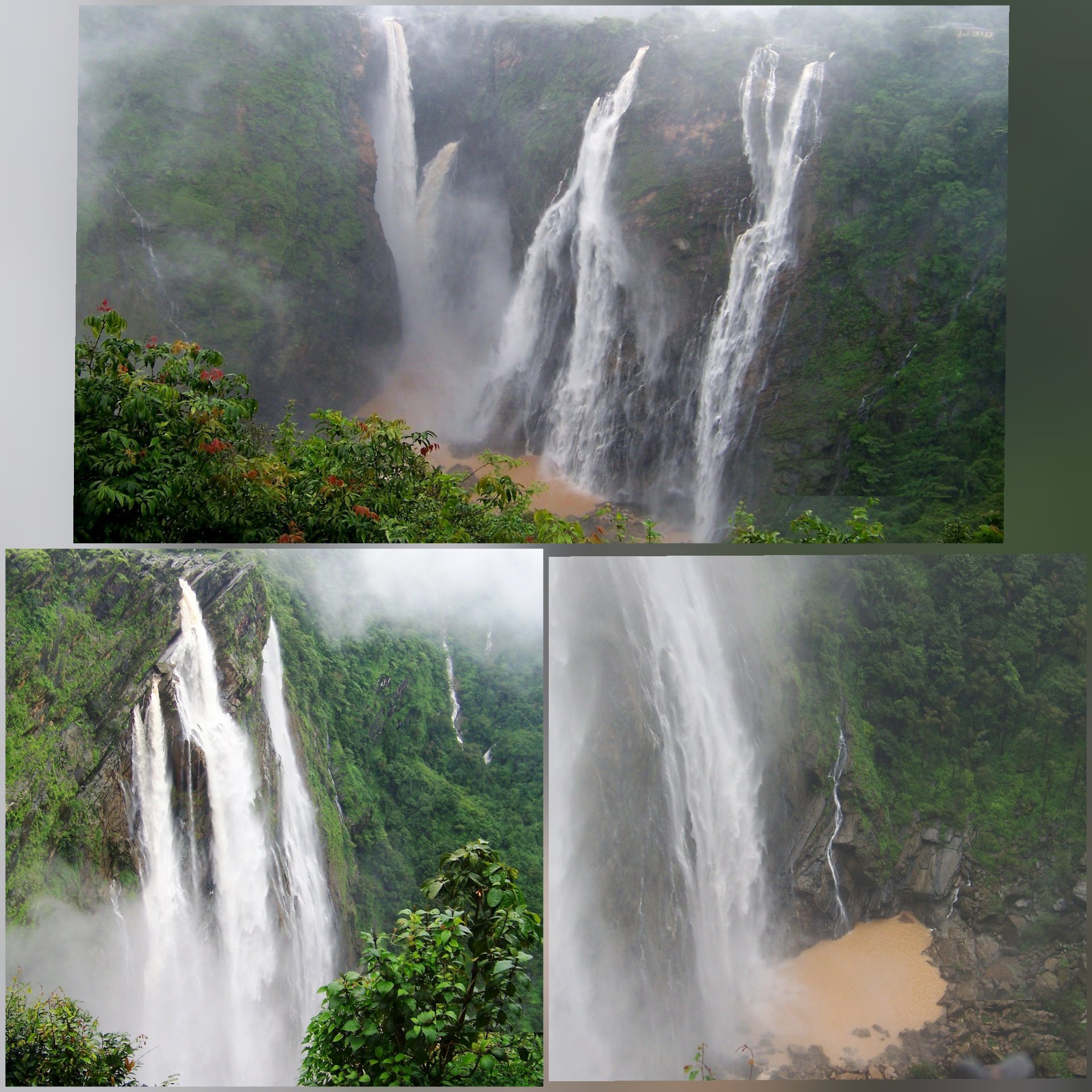
As we stood for two minutes more, the view was then all clear: The Mighty King (Raja), the Graceful Queen (Rani), the Thunderous Roarer and the Storming Rocket – YES… We saw them! We felt a great sense of achievement, very contrary to what we had felt just a couple of minutes ago. While we got some nice clicks, the mist enclothed the falls, back again. We waited for it to clear out to capture a few more photos because this time, we knew that the action was repetitive.
Jog, from different view points
After a while we walked around to get different views of the falls. We went to the top of the waterfalls, walked down closer to the bottom of the waterfall, locatiosn from where we got the side view of the Jog, and so on… It was quite an adventure in itself to get around these difficult spots, especially considering the heavy rains and the slippery path. But, the excitement of getting to these locations was all worth the risk! After having an eyeful and heart full of ‘The JOG falls’, we decided to say good-bye to the place.
On our way back to Shimoga, we visited ‘Tyarekoppa Lion & tiger safari’. Along with spotting a lot of deer, sambars and peacocks, we also counted on the big cats like the lion and tigers on a safari ride. It wasn’t a typical safari you would have in the wild, but it was more like taking a ride inside a fenced enclosure. But, it is a well maintained place and great if you are travelling with children.
Roarrr, a tiger at the safari
And that was all the time we had with us. We had almost reached the end of a fun day-Sunday and we boarded the bus back to Bangalore at night. We had to gear up for the crazy week that was awaiting us…
Conclusion: An experience of the monsoon in the western ghats and a glimpse of the Jog in the monsoon are retreats that should go into the bucket list of everyone visiting India.
It was a Sunday morning and our family outing was fixed. We decided to take a day trip to Belur, Halebeedu and Shravanabelagola. These are places that I can NEVER get bored of visiting and can go over and over and over again. I prefer to write less in this post because I choose the pictures to speak for themselves.
‘Karnataka- is One State, many Worlds’.
-KSTDC, Karnataka State Tourism Development Corporation
As a part of an endless list of things that Karnataka has to offer to every traveler, are its unending list of historical and architectural monuments. With several kingdoms ruling over Karnataka at different points in history, the temple architecture in Karnataka doesn’t fail to get a ‘WOW’ even from a person not interested in art and history. And one such place that has always and always mesmerized me are the temples built by the Hoysalas. These temples are not as big in size as the grand Chola temples but aesthetically BRILLIANT and I run short of adjectives to describe their grandeur.
With the Hoysala style of architecture evolving over centuries, I take it quite seriously to visit and explore as many of these structures as possible.The erstwhile capital towns (now located in Hassan district) of the Hoysala empire hold the finest surviving examples of the Hoysala style today. Out of 900+ temples built across Central and South Karnataka, only around 400+ remain now many of which still need restoration and maintenance. Most of the now inexistent temples are believed to be destructed by the Delhi Sultanates in the 14th century and the remaining smaller ones bit into the dust due to apathy and negligence.
Our first place of visit for the day was Belur, or Velapura as it was called back in the time when it was the capital city of the Hoysalas. The Chennakeshava temple complex is a group of temples and the epitome of this style of art. This complex is located inside a walled fortress and has a tall Gopura at the entrance. For someone visiting it for the first time, the first look of the Gopura from the outside is quite deceitful of what is in store inside.
Hoysala structures within the Chennakeshava temple premises at Belur
Salient features of the Hoysala temples: • Although the earliest Hoysala temples were made with the local sandstone, their finest temples are made by carving one of the hardest materials for making stone sculptures- the granite stone. • The ceilings of the Hoysala temples have extremely intricate and multi-tiered mural designs. • The pillars are lathe machined and mirror finished.
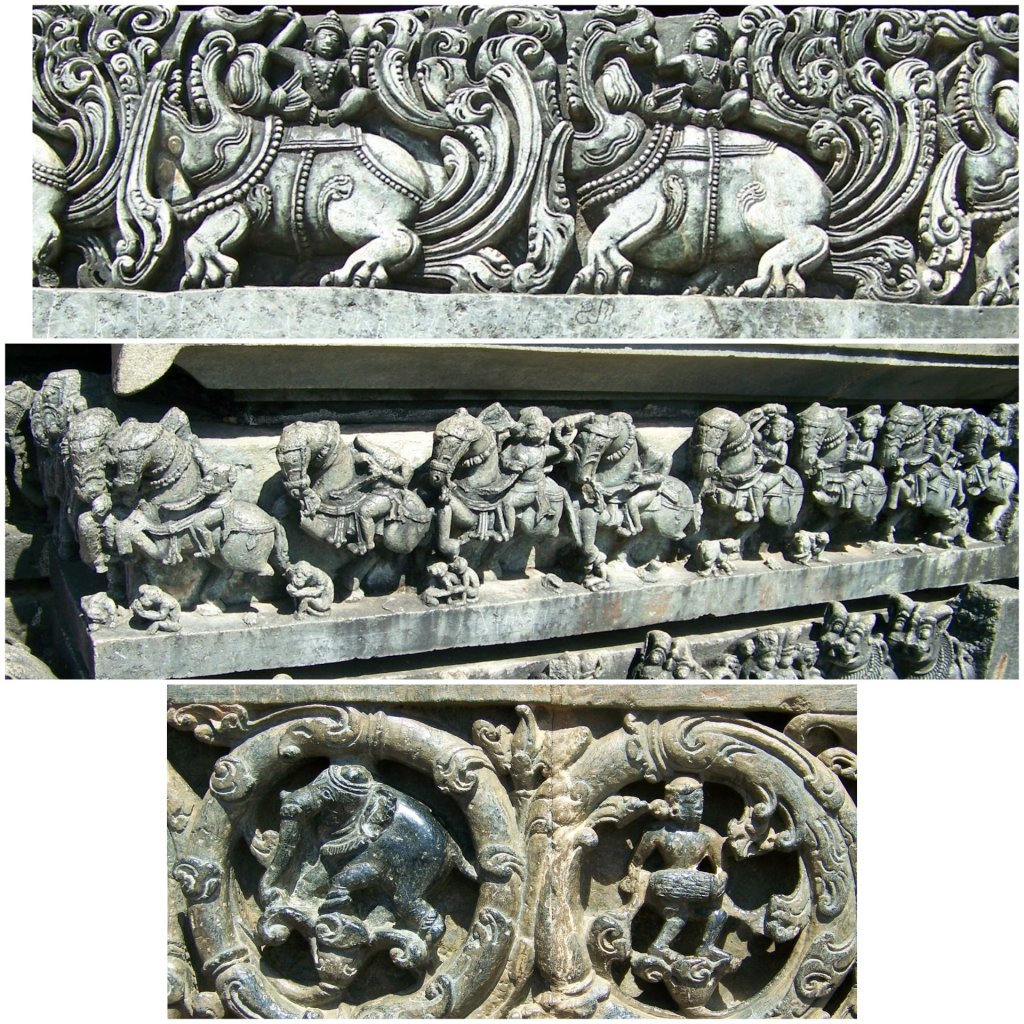
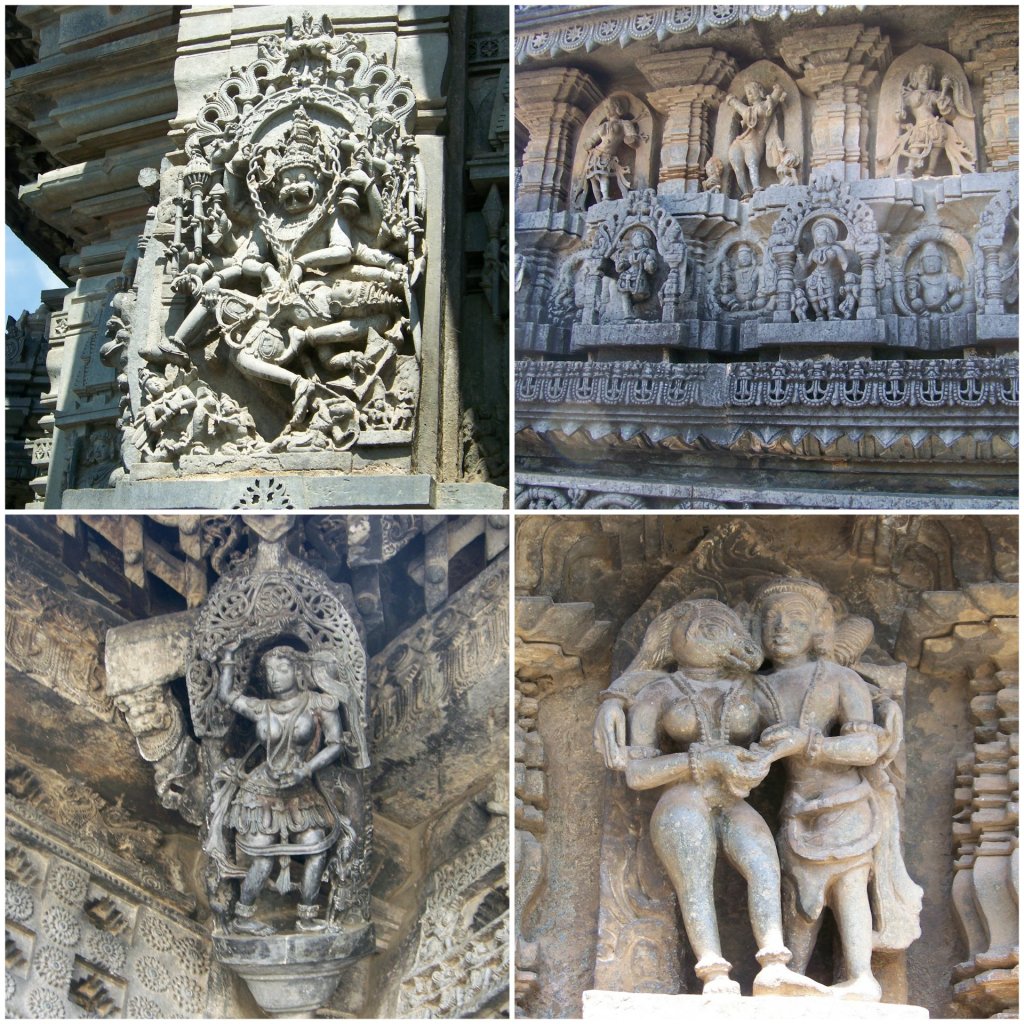
Friezes and murals at Chennakeshava temple, Belur
Fun Facts about the Hoysalas: • Jakanachari is the revered master craftsman behind most of the marvelous temples of this era. Legend has it that he was however challenged by his own son, Dankanacharya about a possible flaw in the sculpture made by his father. Jakanacharilost the challenge when a toad and water emerged out of an idol made by him after which he cut-off his right hand as a symbol of submission to his son’s skill. • Shantala, the wife of King Vishnuvardhana (One of the most prominent Hoysala ruler) was so mesmerised by the Sculptures of the dancing ladies carved here in different postures, it is believed that she used to dance with these Madalikes or ShilaBalikas in her dreams.
Art at Chennakeshava temple
The capital of the Hoysalas was shifted from Belur to Halebeedu, then called Dwarasamudra. The Hoysaleshwara temple is the most prominent among all. The monolithic statue of Nandi here, is the sixth largest in the world.
Hoysala sculptural Art at Halebidu
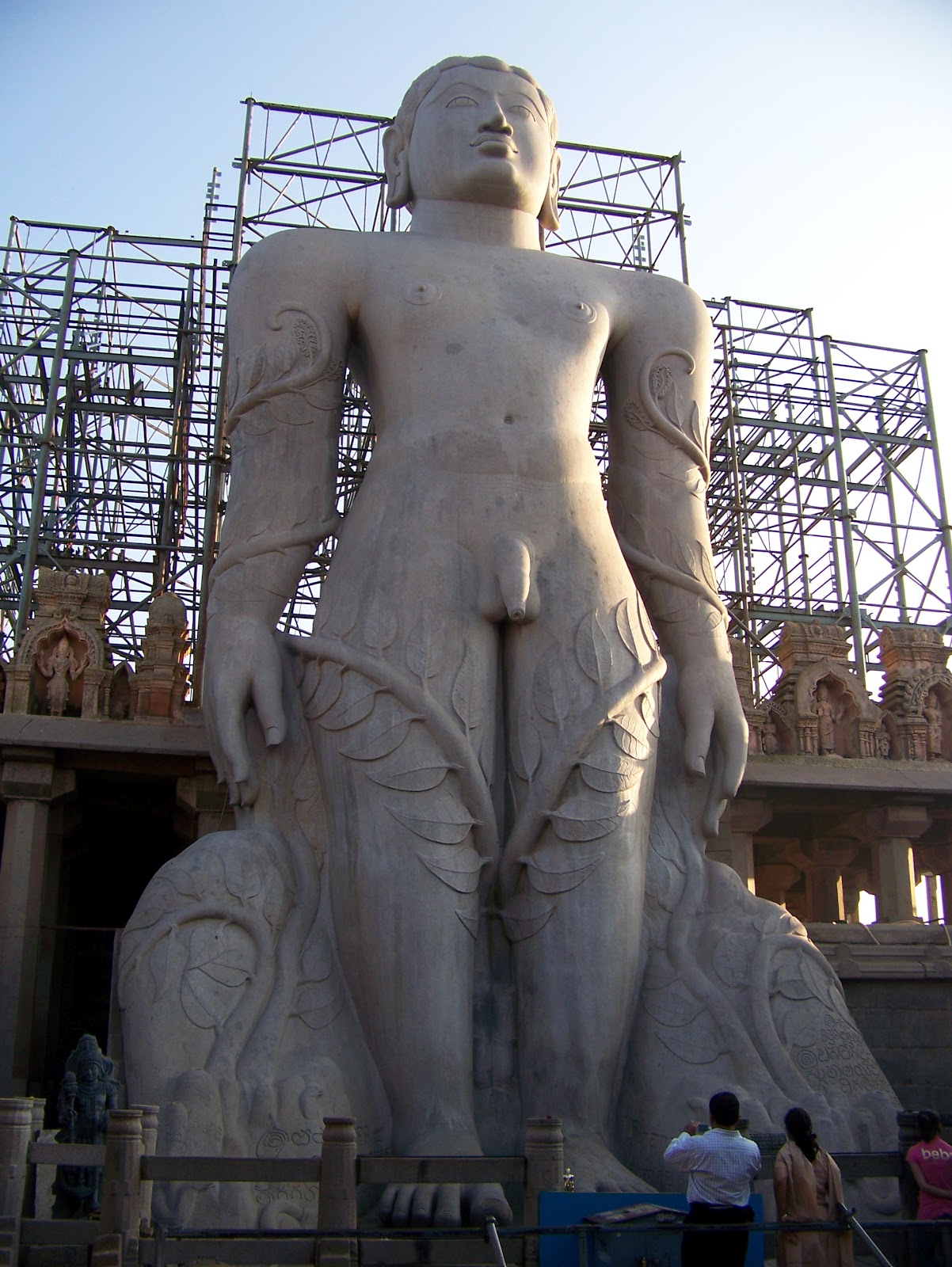
Although our next destination is not a Hoysala hotspot, we decided to include it in our itinerary as it was just around. We headed towards Shravanabelagola, one of the most important pilgrimage sites for the Jains. Shravanabelagola has two hills- Chandragiri and Vindhyagiri. The twin hills offer a panoramic view of the surrounding plains. Chandragiri hill gets its name from Chandragupta, one of the greatest emperors of India who converted to Jainism, gave up all his worldly pleasures and is believed to have passed away on this hill. The statue of Bahubali/ Gomateshwara located on the Vindhyagiri hill is the largest monolithic stone statue in the World.
The Gomateshwara Monolith statue
With this, I wind up with Part 1: of visiting the Hoysala temples. To put it in my words, I survived an ‘Art attack’ at Belur and Halebeedu.
Please do find a day to visit these places and you will not regret, trust me!























 The Lost Lander