Tag Archives: Folk music

Exploring the untouched gems of GPM district

Gaurela-Pendra-Marwahi (GPM) is one of the youngest districts of Chhattisgarh and I recently had an opportunity to explore this region along with a friend. It has a deep-rooted connection with mythological stories and hence, several local tourists come here for pilgrimage. Otherwise, GPM is least explored on a typical tourist circuit and remains to be a hidden gem in the jungle, quite literally. Hence, through my trip to GPM, I wanted to explore, learn and document the adventure and cultural aspects of GPM district. On this journey, we had the guidance of GPM-tourism in arranging our accommodation and getting local experiences in some of the most exquisite places.

We started from Bilaspur that morning in a taxi to arrive at our first destination- Gaurela. My first encounter of a new religious practice was of the kavadis. Of course, Kavadi itself is not new to me. It is observed in different forms across different regions of South India. But Kavadi of Chhattisgarh was new to me. During the Shravan month, the pilgrims leave their respective houses on a barefooted march all dressed in saffron dhotis, carrying the Kavadi on their shoulders and chanting bhajans and praises for Lord Shiva. Along their way, they are joined by others whose houses fall enroute and the march progresses. The group is large towards the end of their feat when they all arrive at the Amreshwar temple.

Anyway, after passing this large group of pilgrims, we continued our drive through a very beautiful stretch of Sal forests and paddy fields. Our pre-ordered lunch was ready by the time we arrived at our first destination- Jhojha waterfalls. This region is presided over by the people of the Pando tribal community, whose culture we were unaware of until then. A tiny canteen run by a couple belonging to this community provided us with food cooked fresh and served in the most sustainable way possible. All the fresh and locally grown ingredients (organic veggies) cooked with firewood and served with handmade plates and bowls of Sal leaves. The simplest, yet a sumptuous meal was relished by us before heading out on our short hike into the woods.

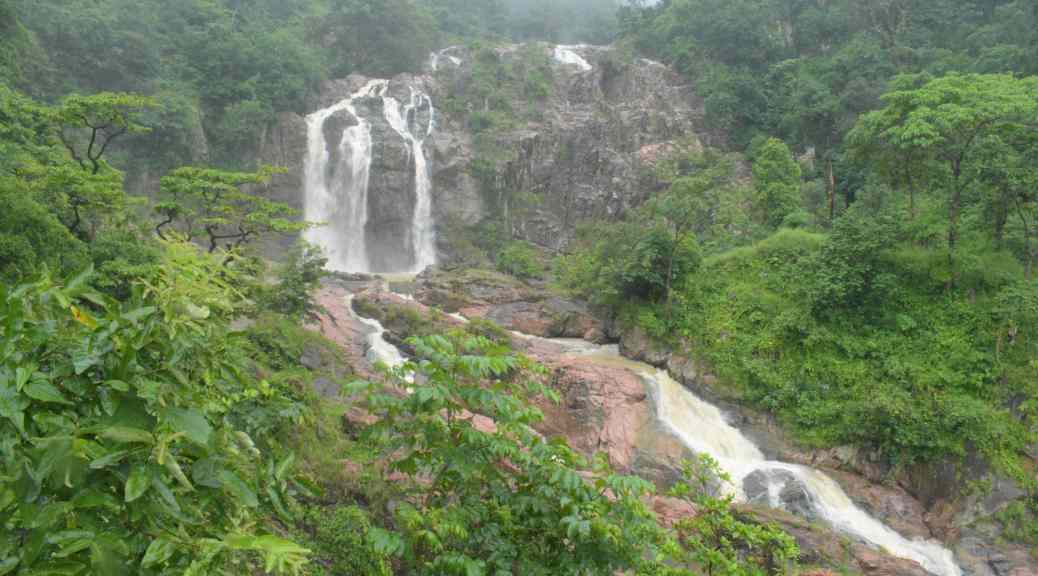
As the rain gods had taken over the skies briefly, we wore our raincoats and tamed our legs towards the trail. There is a biking trail for the biker-heads and then there is the hiking trail for people like me. It is a trail of about 4 kms with moderate difficulty for beginners. As we approached the Jhojha waterfall, believe me as I say that I hadn’t heard or imagined the existence of such an offbeat and majestic waterfall in this part of Chhattisgarh before arriving here. It was beautiful. On a day otherwise, one can go closer to the waterfall or get into the water. But I refrained from it since the monsoon fury wasn’t a safe idea.

Jogi Gufa was a place close by where we had originally planned to visit the cave and a waterfall. Ghaghra dam is frequented by locals for watersports and Son-kund and Kariam Ashram are popular places of local pilgrimage. All located at a drivable distance from Basti / Jhojha. By the time we returned to the base after the hike, the other members of the Pando community had joined in. Hence, we decided to spend the remaining time at Jhojha itself. It was a good decision as the evening was filled with song and fun giving us a better acquaintance with the tribal culture of the Pando community.

Mahua liquor is an essential part of Chhattisgarhi culture in general. There are several folk songs and stories composed around Mahua’s significance in the tribal life. The folk who had joined us for the night sang these songs and narrated undocumented stories that had been passed on through generations. Later, we had the supper cooked by the same family and retired at the little mud-cottage / homestay run by them next to the canteen. One of the most serene and silent locations I had ever imagined retiring.

We started our day by having breakfast at a local restaurant at Pendra road (Town area). for someone whose taste palette is used to idly, dosa, roti etc., for breakfast, the samosas and jalebis were quite unusual to be consumed as a meal. But that’s how the rest of our day turned out to be- Sweet and Surprising. The untouched landscapes and the unaccounted number of mythological references make a great combination for hodophiles to explore Pendra. As soon as we moved away from the town area, the weather and the landscape took a dramatic change. crowded streets turned green and dry sunny skies began to cry rain.

This region is predominantly resided by the Baiga tribes and hence, meeting folks from this community and documenting their stories were my focus on this visit. We drove past the mountainous road and flat paddy fields to arrive at our first stop. It was an under-construction nature camp run by the GPM-tourism and managed by a local family of the Baiga tribes. Traditional tribal cottages flanked a serene waterbody and together overlooked by a canopy of trees. Apart from a group of local boys who occasionally dropped by for a game of fishing, it was a paradise in seclusion. The only thought that I had while there was, if I ever felt the urge to run away from the city hustle to a non-Himalayan place filled with silence and solitude, where no known person would find me, it would be this. To simply put- I fell in love with this location. We visited the home of a local Baiga family, took leisurely stroll in their village and farms and shared warm conversations and laughter with their little kids, all even as the rain gods continued to show no mercy on us.
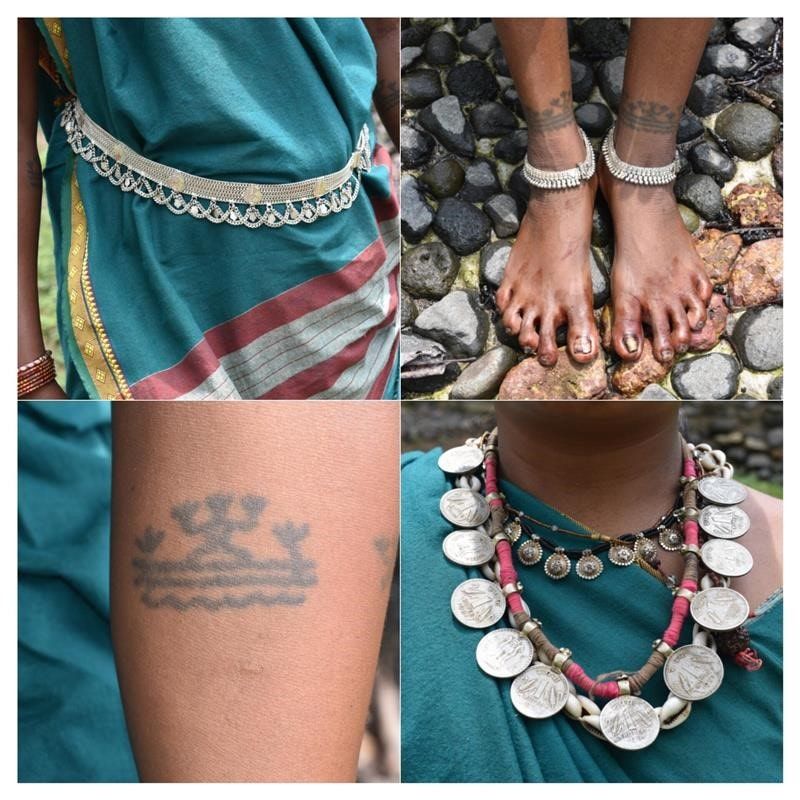
Traditional jewelry of Baiga tribes in Pendra, Chattisgarh.

A few kilometers away from there is a pilgrimage site, Mai ki Mandap’. It falls on the way for people visiting Amarkantak. Mythology has it that river Narmada was all dressed in her bridal attire, awaiting the arrival of Son Bhadra, the groom and his party but was cheated by her friend. Since then, Narmada has been hiding inside a cave here where an eternal flame has been burning for ages. The river Amravathi ganga cascades down the valley here forming a multi-tiered waterfall, which needs to be crossed by foot to get to the temple dedicated to Narmada. Since it was monsoon time, the currents were quite strong and the river crossing was an adventure.

This region is dotted with several pilgrimage sites that are inter-connected with each other through mythological stories. Although we drove past most of them, we decided to skip a ‘stop and visit’ to them. Some of them were Durga Dhara waterfalls, Amreshwar temple, and Jaaleshwar Mahadev temple. Achanakmar tiger reserve, Kabir Chabutara and Malaniya dam are few other local hang-out spots in Pendra region which we decided to skip due to lack of time.

The highlight of this entire trip to GPM was the drive to Rajmergarh hilltop and the best ending for this short stay that I could have asked for. The adventurous people hike up this hill over a couple of days’ time, but we were not in luxury of so many days. Lines of Sal trees and herds of cows grazing on the tabletop grasslands were a treat for the eyes. The drizzly rains and the gusty winds not only caressed my hair and cheeks but also my mind and soul, as I stood on the edge of the green grasslands. We were lucky to get a glimpse of the setting sun even on a cloudy evening. The locals informed us that this hilltop is a favorite haunt of adventure seekers who usually hike up to pitch their camps and wake up for the sunrise over these hills. Such a beautiful place feels wasted without good amenities for the tourists. Outdoor lovers can get their own tents and pitch their own tents here, basic meals and tea can be availed with prior information to the caretaker of this place. But I highly recommend a day visit to this place, especially during the monsoon if you are looking for something more offbeat, less crowded and yet beautiful. The night’s stay was arranged at Gagnai nature camp, a property run by the government.

The luxury of an additional day’s time would have allowed us to explore the Marwahi region, thus circling around the entire GPM district. ‘Beni Bai’ is an important and rare Jain pilgrimage site which I personally wanted to visit but couldn’t. A full day’s trip could include AdiShakti Mandir, Tara Khara waterfall, Pareva path, Chunha Dai, Shiv ghat, Samundalai kund and Lakhan ghat to complete a circuit before you head back to Bilaspur.

However, in our case, we started before sunrise because we had an afternoon flight to take from Raipur to Bangalore. Thus ended an offbeat trip to the heart of India, Chhattisgarh!

I Belong to Everywhere: Chamarajpet

This is an attempt to bring back nostalgia. Continued from- “I Belong to Everywhere: Malleswaram

Chamarajpet is one of the two well planned residential areas of Old Bengaluru. Chamarajpet is in the South whereas the other one is Malleswaram, in the North of the original geography of Bengaluru. Chamarajpet is where my parents lived and worked through all the years at the time of my schooling at Madikeri. So, this locality is like my 1.5th home 😛 (first home is in Madikeri and 2nd home was at Vasanthanagar). I came to Bangalore (and thus, to Chamarajpet) only when I had a long vacation from school. Twice a year, to be precise: Once during the monsoon and once during the summers).

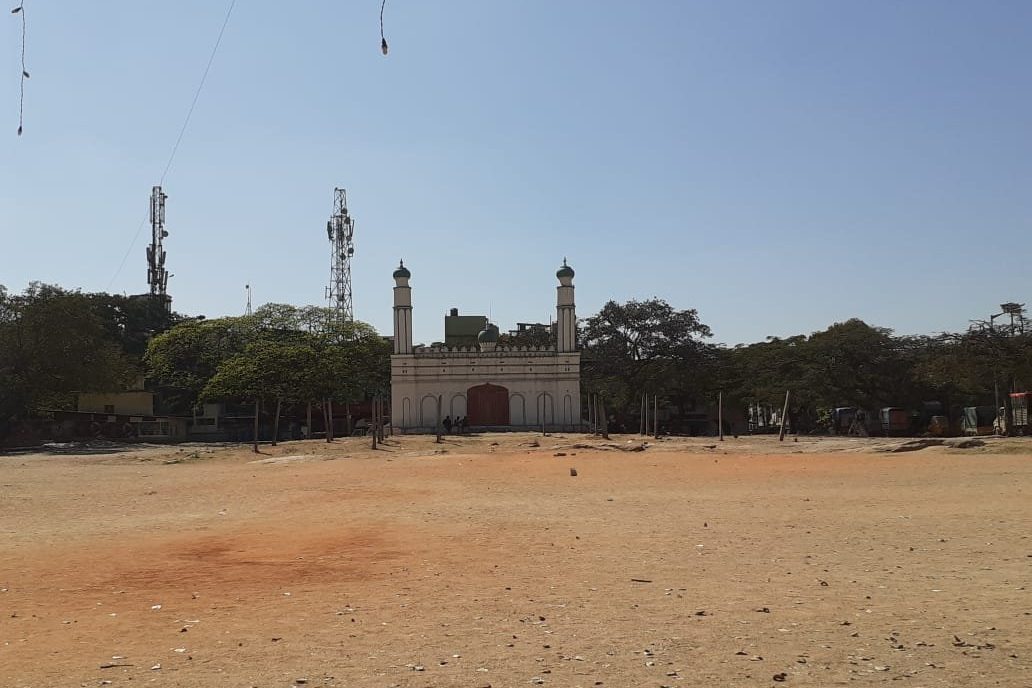
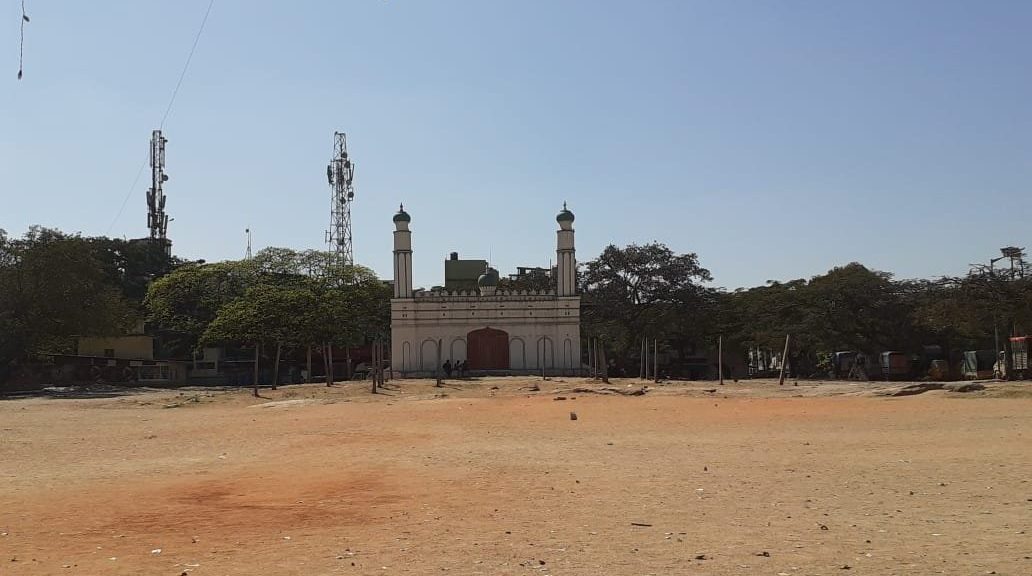
One of the earliest memories I have from this locality is of my family and all our neighbours watching and distributing drinking water and snacks to people who gathered for prayers during festivals at the ‘Eidgah grounds‘ and for the all-night harikatha renditions that happened at the ‘Male-Mahadeshwar temple’ in 2nd main. A large jamun tree in the premises of our house was often mobbed by kids from the entire locality for its fine fruits and the aroma of Rasam from the ‘Vataaras’ of 3rd main are some unforgettable memories.

Eidgah ground at Chamarajpet

There were several things that I saw on TV (Doordarshan) and wanted to learn along with regular school while growing up. But there was unavailability of trained people who could teach me any of these extra curricular skills in the small town (Madikeri). Whenever I visited Bangalore during vacation, my effective time spent with my working parents were mostly for eating out in the evenings and making day trips over the weekends. A major chunk of my Bangalore visits was mostly meant for attending summer schools. With a very large community of literary scholars living in and around Chamarajpet, I could learn different art forms. I attended crash courses across various streets of Chamarajpet (and Basavanagudi) to learn sketching, painting, dance and music.

Every stone, structure and lane has history in Chamarajpet. Makkala koota, Bangalore fort area, Tippu’s palace, all the temples around the fort and the old pete area: Talk about them to my mother and she would be in tears of nostalgia. These are the places she saw every day during her career that spanned nearly four decades.

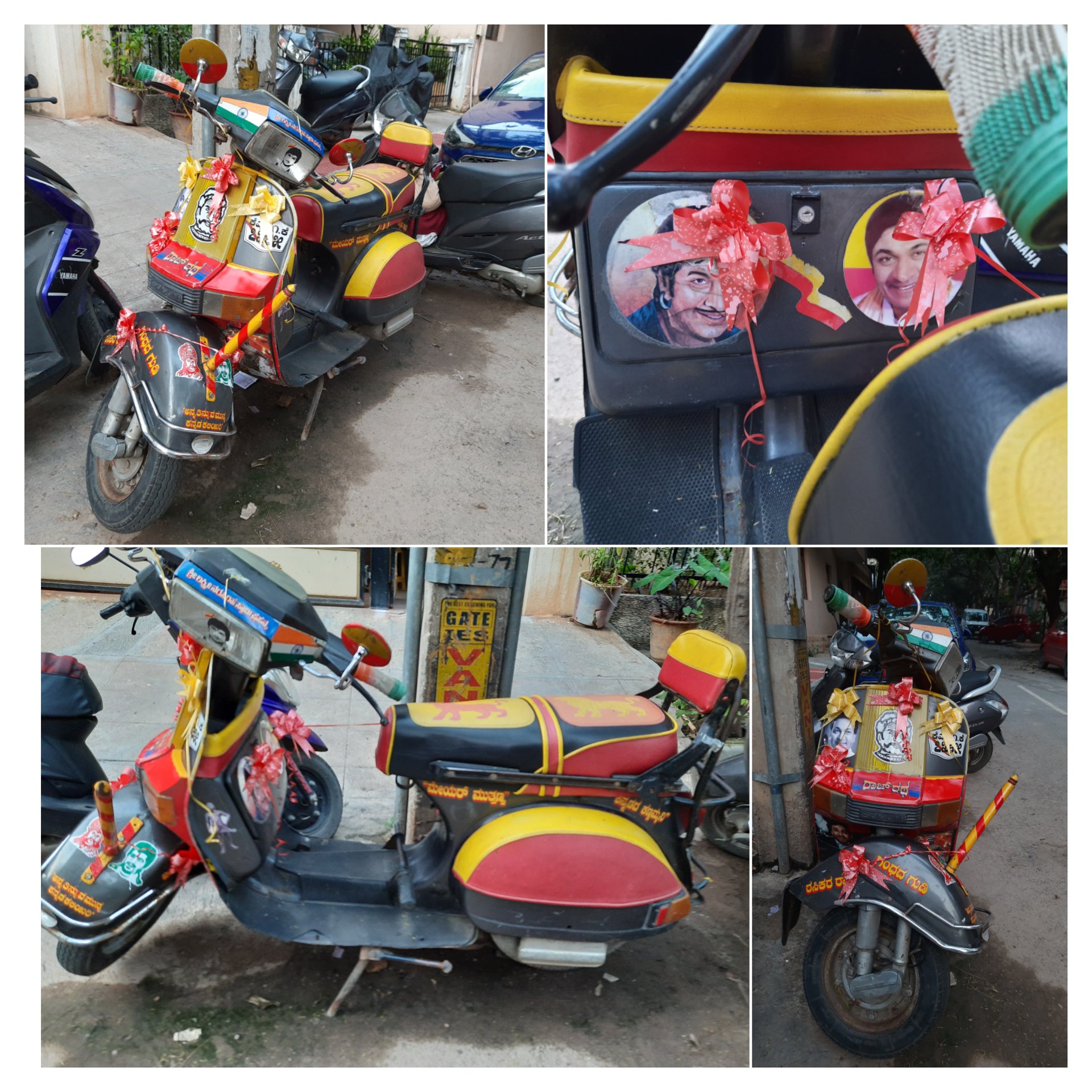
A scooter decked up in a Sandalwood theme (Kannada film industry)

Talking about my family’s favorite eateries, many things have changed and so many old-world structures have been erased now. However, Karnataka Bhel house in 3rd main road along with Gajanana fruit juice center and Iyengar’s bakery in 4th main have managed to stand the test of time.

My family has lived here for 15 years and there is a bond with every lane and its people that we share in Chamarajpet. Here live so many friends, who are more than family to us! Going to Chamarajpet every time is nothing less than travelling to our hometown! So, it is definitely difficult to quantify how much part of me belongs to this area!

To be continued as- “I Belong to Everywhere: Theralu

Folk Musical Instruments of Bastar

Ever since I chose to do ‘Slow travel, it has given me ample opportunities to understand newer cultures and traditions. Since slow travel allows me to interact with more local people, I also get exposed to a lot of local music and art. One such knowledge gained during my interactions with the various tribes of Bastar is the various musical instruments made and used by them for various purposes.

  1. Khut/ Khoot: This percussion instrument is a hollow trapezoidal shaped wooden block. It is hung around the neck of the person playing it and is struck with two wooden sticks to create a unique sound.
  2. Maandaar: This is a small size drum that resembles a dholak. It has a hollow wooden body and wound with leather strips from end to end. The two sides used to create the sound are made using specially chose animal hide. It is tied around the waist and struck either with bare hands or using very thin wooden sticks to create the sound.
  3. Gadha Baja: This is another percussion instrument with a resemblance to the (Bayan) Tabla. It has a hollow wooden body with a wide playing surface firmed with leather. It is used either individually by hanging on to the neck of the player during a celebration or used in pairs at temples and religious gatherings. Sticks are used for generating the sound here as well.
  4. Taal: This instrument is a pair of metallic hand cymbals that are common to the rest of India’s folk music scenes as well.
Clockwise from top left: Khut, Maandaar, gadha baaja, Taal,

I got an opportunity to witness the indigenous music of the Muriya Gonds during my visit to a Gotul. All the above-mentioned instruments can be seen in their performance. Click below to watch the Muriya tribal performance with all these instruments.

Tribal ceremony at a Gotul in Bastar, Chattisgarh

The other musical instruments used by the tribes of Bastar are as below:

5. Sulur: This is a wind flute handcrafted out of a specific bamboo. The sound is generated by swinging the flute in the air (unlike the normal flutes that needs air to be blown into it). The bamboo tube is decorated with very fine and artistic designs engraved on to it. This flute is used for two purposes. Firstly, it is sounded while grazing their cattle and secondly, it is used in festivals and similar ceremonies. Click on the below video to watch how a wind flute is played.

Playing Sulur, the flute of Bastar

6. Mohiri: This is a wind instrument made using bell metal. There are two types. The ‘Bada mohiri’ is used in festive occasions and the ‘Chota Mohiri’ is used during all other ceremonial and social gatherings.

7. Tribal trumpet: Another common feature of the popular ‘Dokra bell metal craft’ in the region is the tribal trumpet. I couldn’t certainly tell which tribe uses this in particular, but this wind instrument is a popular souvenir picked by the tourists and art enthusiasts who flock the region in large numbers.

The Folk Musical Instruments of Nagaland

It is that traveling exposes one to a multitude of cultures and people. The diverse geography of India is home to some of the most unheard traditions and untold folklores. During my 10 day stint of backpacking in Nagaland, I was introduced to so many of it all, as this little Indian state, tucked in the far North-east is home to more than 17 tribal sects and sub-tribes; each having their own culture, language, traditions and cuisine. Here, is a small list of indigenous musical instruments used in the folk culture of the Nagas.

Mrabung:

Mrabung is an indigenous musical instrument of the Zeliang Nagas. It is a single stringed instrument that is crafted with a hollow/ cured bottle gourd and a fretless wooden neck of about 12 inches long. It is played with hair string bow (Usually a cluster of horse tail tightly tied together to two ends of a thin wooden stick). This bow is used to strike the chords (like a violin) with one hand and the string along the neck is pressed down with the other hand at appropriate places to get the required tune and legato of the song. It is played during merry making in social gatherings and festivals where men and women congregate. I was narrated with a popular folklore of the Nagas wherein, a singer called Arum played the Mrabung. His music captivated the farmers so much that everyone working on the field left their work undone and sat around Arum listening to his songs. Arum had to be barred from playing any songs further just so the people went back to work on their farms. Click below to see an artisan playing the Mrabung.

Atutu:

The Atutu is a handcrafted bamboo trumpet used by the Pochury tribes of Meluri. A particular variety of bamboo is used in making the varied components that are fitted together to make this crafted trumpet. It is played to mark special occasions. For example, blowing of this trumpet towards the end of February means to herald and announce the advent of the Nazhu festival. Also, the male members of the tribe play it in their morungs in the evenings throughout the festival. Apart from this, the trumpet sound is used to ward off birds and animals from the rice fields and prevent from crop damage. In earlier days, trumpeting was a way to alert the collective habitat or a village of a possible enemy attack or as a signal of declaration of a war.

20191204_1102368093835930586387810.jpg
The Atutu: The bamboo trumpet

Dholak:

This common musical instrument has its own version and avatar in every region of India. Be it weddings or festivals, it is the most common and almost an essential part of any merry making in Indian celebrations. Similarly, each tribe in Nagaland has its own version of the dholaks or the Indian hand drums. Made with an outer casing of wood, laced tightly with cotton strings and the drumming surfaces made with the locally available materials, more often animal hide. Here are samples of the dholaks used by the Garos (Long slender shaped, narrowing at the ends), the Mech Kacharis (fatter and shorter than the Garos) and the Aao tribes (Shorter and fatter than the previous two types and Uniform sized throughout its length) of Nagaland. (Click the below link to watch the ceremonial dances of the Naga tribes with their dholaks)

This is my humble attempt at documenting some unique musical instruments that are lesser known to the world outside North-east India. These have been listed based on my actual experiences and interactions with the Nagas during the hornbill festival-2020. If you know any such unique musical instruments, please do share in the comments section below. I would be happy to learn it from you 🙂