Category Archives: Goa

Goa backpacking: Netravali Wildlife Sanctuary

Continued from Goa backpacking: Makarotsav Celebration and Temple Hopping.

Based out of Colva, my friend and I had hired a motorbike to explore Goa. Our plan for today was to see some prehistoric sites, take a dip at one of the nearby waterfalls and return to Colva by late evening. With a set of clothes for changing and a towel for each of us, we had woken up to start our day quite early. But the rain gods had brutally taken over the skies, and hence, our day started late.

I was about 10 a.m. when the rain slowed to drizzle, and we left our cottage. We stopped for a quick breakfast in Madgaon before continuing. Using Google Maps, we headed to our first destination: the ancient Buddhist meditation cave at Rivona. Although we struggled slightly with the directions initially, we managed to find the site through local inquiries, without too much trouble. The asphalt road first passes through a residential area before reaching a large natural pond. At this point, the road splits, and we took a muddy route to the right, stopping at a small grassland at the end. From there, a small staircase carved into the laterite ground leads down. We were unexpectedly greeted by a security guard from the ASI (Archaeological Survey of India), who checked our attendance before we entered the cave. We were told a guide is usually available, but none was present at the time. We took a few photos before leaving. If you’re not interested in history and are just a tourist, I recommend skipping this site.
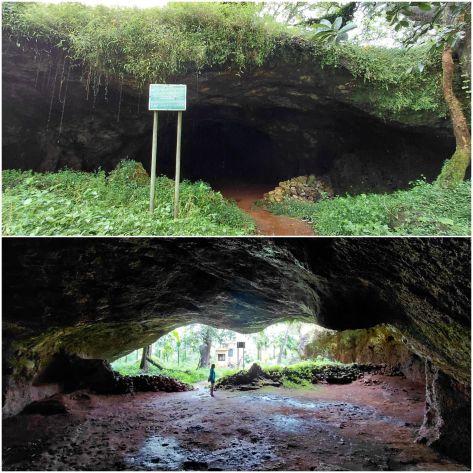
Buddhist cave at Rivona, Goa

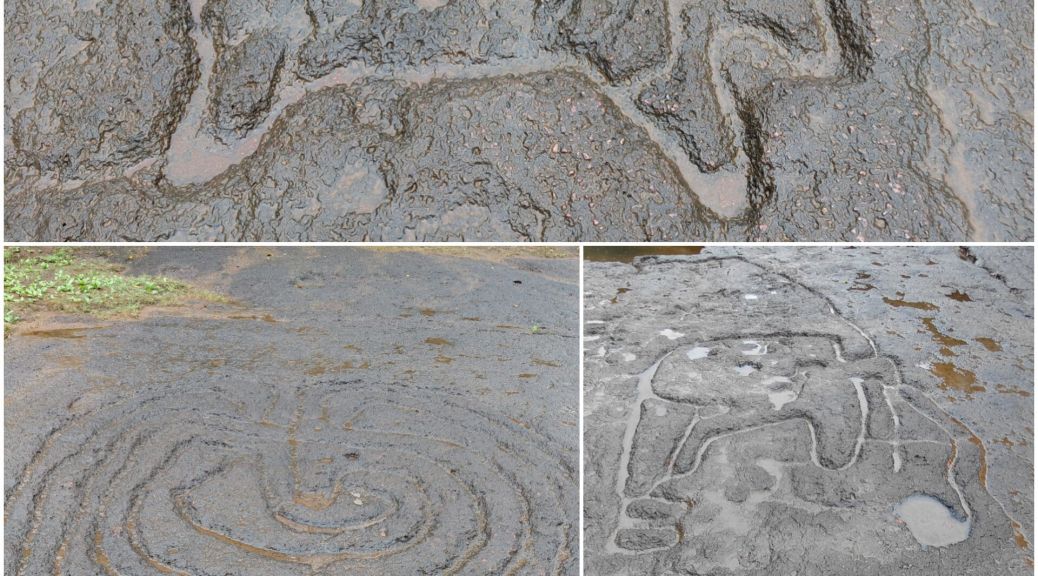
From there, we continued to follow the maps to our next destination- Usgalimal village, one that I was most excited about. For the first time, I was going to see petroglyphs, that too in Goa! The muddy trail that splits across the main road passes through thick forest right up to where the Google Map Pin takes you. After passing through a stretch of confusing deviations, patches of open grasslands and a laterite pond, the location pin finally took us to the banks of the river Kushavati, We parked our bike at the security post and wrote our names in the logbook. The security guard then walked along with us, guiding us through the riverbank. He showed us around various depictions/ Petroglyphs carved on the laterite stone bed of the river. He helped us identify several of the 100+ carvings discovered there, among which were various hunting scenes, several domesticated and wild animals, a trident, a labyrinth, etc., some of the notable ones. Seeing something like this for the first time piqued a new interest within me to learn more about Petroglyphs and ancient rock art, which I would want to travel to in future to explore.
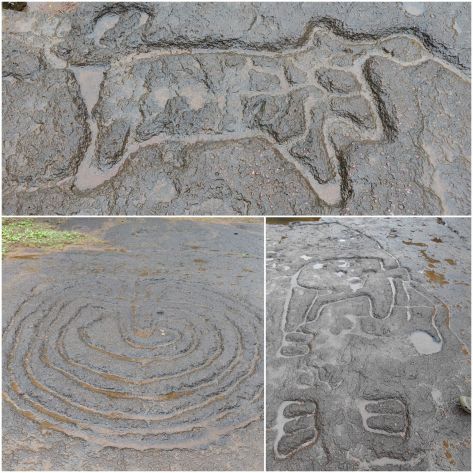
Petroglyphs at Usgalimal, Goa

After spending enough time trying to observe and decipher the art there, we casually asked the guard accompanying us if there was a spot somewhere nearby where we could take a dip in the river. He thought for a moment and nodded while looking at the riverbank on the other side. There’s a spice & areca farm across, where you can approach the caretakers to permit you into the safer section of the river that passes through the property. We thanked him for the recommendation, picked up our luggage from the bike, and crossed a little brook across the river, where we were able to secure our permission. There are NO words to describe the joy our two little hearts had found inside the safe, sweet and soulful waterbody. With just the two of us swimming and enjoying ourselves in the water all the while, we did not realise that we had spent over 2 hours already without being bothered by the rain that bashed down or by any deadlines to get back to waiting families back home. But soon it struck us that we had to make the most of the time when the rain had taken a break. Since we had already spent a lot of time at Usgalimal waters, we skipped our original plan to swim in the waterfalls later. We quickly changed into fresh clothes and got the bike running again.

Not too long after we hit the road, the rain gods took over again, and the terrain changed to an even denser canopied area. A little board read that we had officially entered the Netravali Wildlife Sanctuary. The natural light had become less, and riding harder due to the constant bashing of the heavy rain and wind. We had no option to stop in between since the houses were scarce along the forest, and we had to reach the destination before it got too late so that we could return to Colva safely before it was too late.

Upon our arrival at the forest gate, we were told that the entry to the waterfalls was closed at 05:00 p.m. We had arrived at 05:05 p.m. The forest personnel did not oblige us, even after several requests and explanations of our long ride back and forth. Now we had two options- One, skip exploring the sanctuary altogether, and return to Colva. Two, find accommodation nearby and explore Netravali (also called Netraulim) at leisure on the following day. We took a moment to think over, looked up at the constantly pounding rain and decided to stay back in Netravali. Even if we wanted to skip visiting places, riding back in the rain and darkness would only be next to madness.

Since the eco-stay run by the Goa forest department was all booked, the guards helped us to find a local homestay nearby. Shortly, our stay was arranged with a local family, and it got dark after that. We took a shower and changed back to the same clothes (there was no other option), devoured a comforting hot meal before retiring for the night.

After waking up in the morning, we watched our host light up a lamp at the Tulsi katte in their courtyard and milk their cows in the shed attached to the family home. We had our breakfast and left towards the forest gates soon after. In fact, we wanted to be the first visitors for the day so that we could avoid the crowd and start our return ride as early as we could. So, there are two waterfalls as one enters the gated area, which require separate permits. We were briefed about the condition of the roads leading to both and asked to register ourselves accordingly at the entry. We decided to visit the Mainapi waterfall by hiring a forest Jeep and riding our bike to the Neturlem (Saoli) waterfall later.
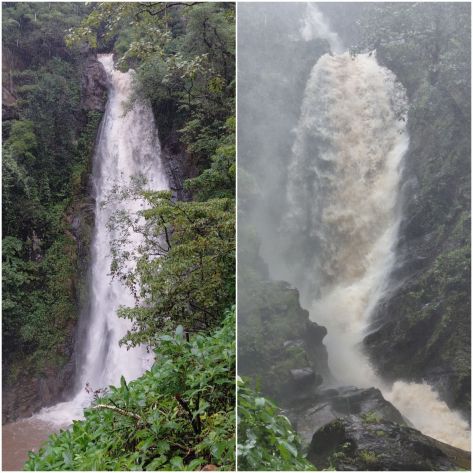
Waterfalls in Netravali Wildlife sanctuary, Goa
Left: Mainapi waterfall. Right: Saoli Waterfall. Netravali Wildlife sanctuary, Goa

The adventurous 5km drive to Mainapi waterfall constituted a crazy, bumpy drive on the rocky-hilly road cutting through thick canopied forest and river crossings. Further, a short hike down to the waterfall was accompanied by leeches, brightly coloured miniature crabs, frogs and other insects found commonly during monsoons. The first glimpse of the waterfalls had our breath pause for a moment. We hadn’t expected anything so beautiful in Goa, which is otherwise popular for its beaches. Thanks to the monsoons, the path further down to the waterfall was blocked for safety reasons. We sat down on the stairs, watching the water roaring down in all its might until we realised that a couple of leeches had entered my raincoat. I had to quickly get them out and also head back to keep the day’s schedule under control. After a good, bumpy drive back to the forest office, we returned to the forest on our bike. The road was good right up to the start point of the Saoli waterfall. After parking the bike, a short descent down the stairs leads us to the banks of the Saoli waterfall. We could get into the water, but the currents were still strong, and the water looked muddy from the heavy rain. We spent some time there, too, before exiting the forest gates.

We returned to the homestay where our host had promised to take us around their ancestral village. After a short drive in their car, we arrived in front of an old mansion, which was the ancestral home of our host, the Desai family. It was very interesting for me to walk into a traditional Hindu home because its history dated back to even before the Catholic-Portuguese mansions which I had seen thus far elsewhere in Goa. As we entered through the towering arch-like entrance to this house, we were greeted by a large open courtyard, which was divided into dwelling spaces for each member of the family. To the left of the entrance was a space dedicated to the sacred arms once used by the ancestors of the family. We were told that some even had the original blood stains with a history of valour and martyrdom dating centuries. Laterite walls, red-oxide floor and clay tiles set on wooden beams- it invoked nostalgia instantly. While the kids surrounded us in excitement to tell us about their stories from the rooms, the senior women wove garlands with colourful flowers picked from their backyard while being entertained by the chatter of their husbands. They were all happy to have us amongst them.
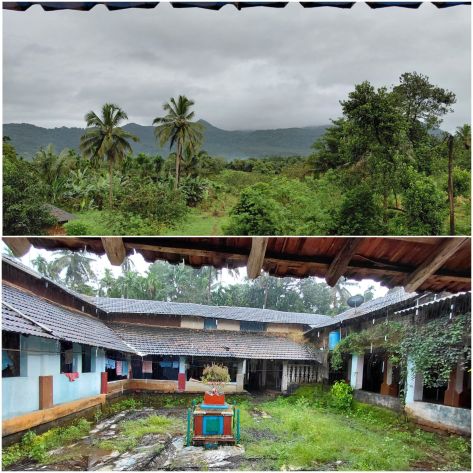
Goan Homestay
Top: View from our homestay; Bottom: Courtyard of the ancestral home

We then walked through the exit door on the back side, passing by a series of bathrooms where we could hear the water in the firewood-lit boilers. As rain-fed streams came to life while walking through their rubber plantation, we crossed a little river to arrive at Datta-Gufa, a family-maintained temple. This is an important temple in the village accessible from the main road as well, but we were more privileged to get private access from the other side. After spending time on their property, we returned to the homestay from where we took our bike and commenced our return ride towards Colva.

En route, our first stop was at the Gopinath temple in Netravali. The temple is rather popular for its sacred tank. Fondly called Bud-bud Lake, the pond water is believed to bubble up when one claps while standing in front of it. We too did witness the interesting phenomena, but felt it did so as a response to some other air pressure occurring naturally in the otherwise silent environment. In any case, it was something we were experiencing for the first time.

From there, we started to ride again to make the most of the time when the rain seemed to have taken a break. A short ride ahead were directions to ASI sites like the ancient ruins of Sri Lakshmi Narayani temple and Kajur Petroglyphs. But by seeing the Google Photos uploaded by past visitors, we decided to give them a miss. Shortly, we reached Rivona. Someshwar Sansthan, Jawali Damodar Sansthan and Vimleshwar temple were landmarks and renowned local temples that we visited along our ride. This has been written about separately in my previous post: Goa backpacking: Makarotsav Celebration and Temple Hopping. We had a quick coffee break at Margaon before reaching our home during the trip at Colva.

To be continued as Goa backpacking: Day trip to Rachel and Big Foot.

Goa backpacking: Makarotsav Celebration and Temple Hopping

Continued from Goa backpacking: Mahavir National Park.

I returned to Goa with a friend to spend our Dasara vacation and we chose to stay put at the same homestay in Colva that was our base while my family and I had explored Madgaon, Old Goa, and its surroundings during our earlier visit. Everybody associates Goa with the yuletide cheer, but my friend and I were more inclined towards experiencing Goa’s unique tradition of Makarotsav as part of the Dasara festival celebration. We had heard about it through our friends belonging to the Saraswat Brahmin communities, most of whose Kula devata (patron God of their community) happen to be in Goa.

“Makar’ is a boxy frame like swing decorated beautifully and carries the idol of the deity. It is rocked to the rhythmic beats of dhols, Tasha, temple bells along with Aarti. The history of this unique Dasara tradition dates to the 16th Century. During the Portuguese rule, several Hindu temples were destroyed across Goa. Many people fled these places overnight and arrived at the forests of Ponda region to take refuge.

It is said that these Hindus also carried their deities along with them which were installed across the region. Since then, Makarotsav has become a symbolic celebration. The act of ‘Swinging the deity’ is a representation of their God being with them in times of hardship, moving, swaying and living among the people.

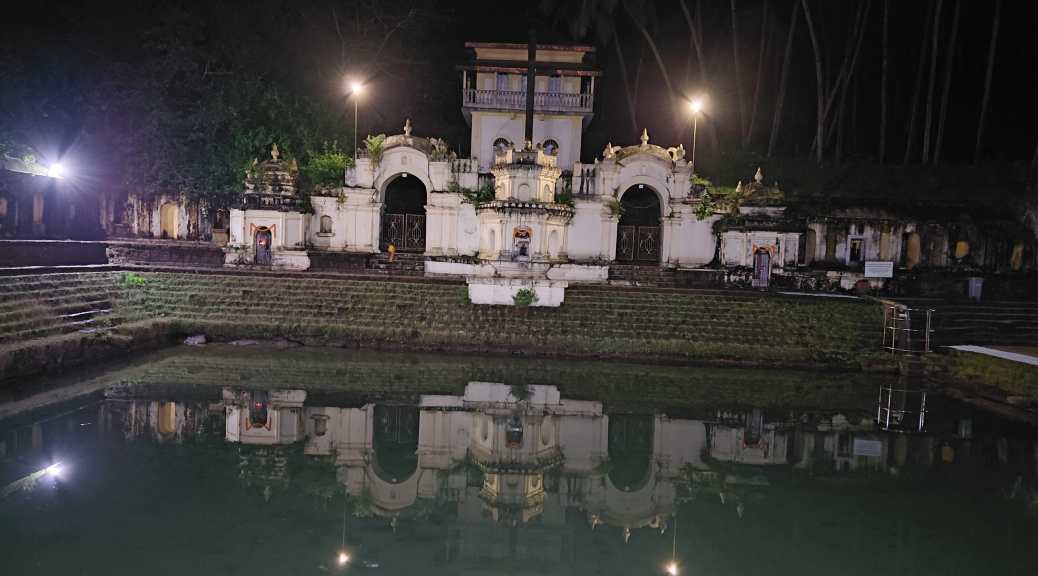
The original sites at which the idols were installed eventually saw significant renovations under the Maratha rule. The style of temple architecture is typical to the region and is a blend of domes, pillars, and large lamp posts/towers in the courtyard. Some of the oldest structures that still stand strong bear the original wooden bars, intricate paintings alongside reliefs and carvings in their original condition. Water tanks or Kalyanis, are integral to the vast premises housing these temples.

Today, Ponda has the highest density of Hindu temples across the state of Goa and therefore revered as the Temple town of Goa. ‘Makarotsav’ is celebrated in most temples in and around Ponda which can be broadly classified into three categories. Temples that worship Shiva, Temples that worship Vishnu and Temples that worship Parvathi (Shakthi). Goddess Parvathi is worshipped as Shanta Durga and is believed to be the guardian of every village.

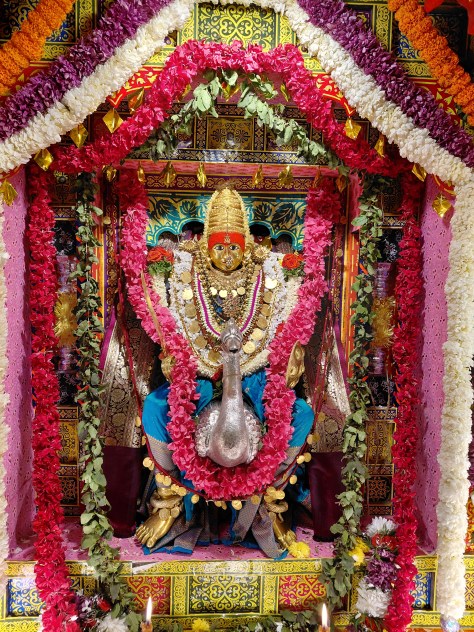
The legend has it that Goddess Shantadurga is the one who mediated peace between Shiva & Vishnu when they fought to establish who was the greatest among the two of them. Hence, her name is Shanta+Durga, a combination of two words ‘Shanthi+Shakthi. The Goddess is (Peaceful) Gentle enough to resolve any egos and (Brave) fierce enough to slay any demons. There are over 20 temples dedicated to Shantadurga located across Ponda and its surroundings where one can participate in Makarotsav.

The celebration happens simultaneously at different temples on all nine days of the Navaratri /Dasara festival, usually starting by 08.00.p.m. and finishing by 11.00.p.m. Hence, it is difficult to cover all temples in just 1 or 2 days, and requires detailed scheduling to take part in as many Makarotsavs as possible.

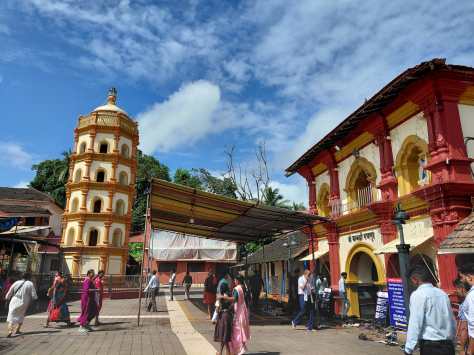
Shri Shantadurga temple, Kavalem

Below is the list of temples we visited on one of the evenings. We had planned them considering their proximity to each other and before knowing the timing of the Makarotsav at each temple.

1. Shree Shanta Durga, Kavalem (Temple dedicated to goddess Parvathi): This was our first stop by around 08.00.p.m. The outside of this temple felt like a village fair with lot of makeshift stalls selling things. It was crowded at the time of our visit, and we saw the Makar still being decorated extremely elaborately. We waited for some time in the belief that the utsav would start but we were told that it was scheduled for later at 10.30.p.m. Meanwhile, we were invited for dinner at the temple’s dining hall. However, we chose to politely reject since we had eaten a light meal before arriving. We decided to visit other temples in our list without spending further time waiting there. Our plan was to witness the utsav at whichever temple we arrived at, at the time or return to this place by 10.30.p.m as the case may turn out.

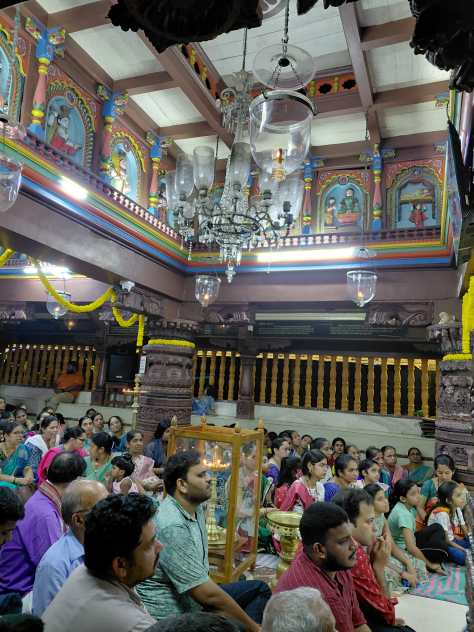
2. Shri Shanta Durga Shankleshwari temple, Veling (Temple dedicated to goddess Parvathi): It was roughly 09.30.p.m. when we arrived here by chance, on our pursuit to a different temple. But we considered ourselves most fortunate as we had come just in time before the Makarotsav started. We found ourselves on the floor, somewhere in the front with a good view of the Makar. The celebration lasted for about 45 minutes post which a large queue was formed to distribute the prasada offerings comprising of Black-chana dal salad, cut fruits and whole fruits. We devoured them and quickly proceeded towards the next temple located a short distance away where we were told that the Makarotsav was about to begin.

Shri Shantadurga Shankaleshwari Makarotsav

3. Shree Lakshmi Narasimha temple, Veling (Temple dedicated to Vishnu): The most beautiful temple I have been to on this trip, the temple complex has retained most of its old-world feel. The smell of seasoned wood used in its constructions, the frescos and paintings and the moss-laden temple tank with a backdrop of coconut and banana trees had all my heart. The Makarotsav began by 10.00.p.m. with the idol of Lord Narasimha and it was a transcending experience. The prasada was distributed to all devotees to wherever they were seated and the crowd dispersed immediately after the utsav had ended.

Shri Lakshmi Narasimha temple, Veling, Goa
Shri Lakshmi Narasimha temple, Veling

4. Shree Mahalasa Narayani, Mardol (Temple dedicated to Shakthi): Mahalasa is venerated in two forms in Goa. Mahalasa Narayani to be a female avatar (Mohin) of Vishnu and as a form of Parvathi, consort of Khandoba (a form of Shiva). One of the must-visit temples in this circuit, we missed the Makarotsav as the timing overlapped with Shree Lakshmi Narasimha temple and hence, we could only see the temple by requesting us get a glimpse while the security guards were closing the gates and not witness the Utsav.

5. Shree Mangesh temple, Mardol (Temple dedicated to Shiva): Our next stop was at yet another famous temple in this circuit, well after everything had wrapped up for the day. It was well past 11.30.p.m and hence, I had to make peace just seeing the temple arch.

6. Shree Kamakshi, Shirodha (Temple dedicated to goddess Parvathi): We visited this temple around afternoon, hence could not see the Makarotsav. However, the Makar was available but closed for viewing until evening. But for us the visit, though in the afternoon was still a highlight of temple hopping thus far because we had ended up here by chance on a random countryside exploration of Rachol (Written about in a separate post). But I got lucky to devour the hearty lunch at the temple distributed to everybody who came. Genuinely, it was unexpected and tasted so divine. We spent enough time resting on its courtyard before proceeding towards our next destination.

Shri Kamakshi temple, Shiroda, Goa
Shri Kamakshi temple, Shiroda

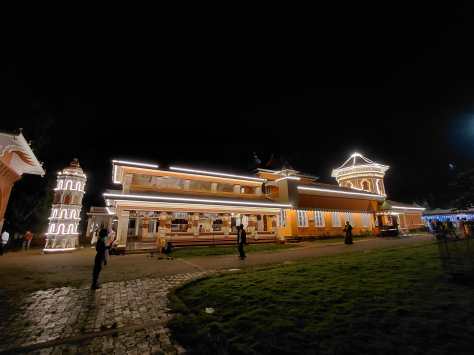
7. Vimleshwar temple, Rivona (Temple dedicated to Shiva): We arrived at this temple just when it had opened early in the evening and while we were on our way back from our Netravali exploration (Written about in a separate post). We did see the Makar carrying the idol of Lord Vimleshwar and all decorated for the Utsav but were quite early for the Utsav which was scheduled to start later around 08.00.p.m. as per the priest with whom we got talking. Without anybody else at the time of our visit and the strong energy of the temple itself, it was truly a wonderful time.

8. Damodar Sansthan, Fatorda (Temple dedicated to Shiva): Despite Damodar recognized as one of the names of Lord Vishnu elsewhere across regions where Hinduism is practiced, it is a reference to Lord Shiva in Goa. A massive temple complex in expanse, we happened to drop by here while on our way to Colva from Netravall. Our visit was unplanned. Hence, our attire was messy, and rain soaked but not as bad that we had to be chased out of the temple by the presiding priest. Therefore, we left without seeing the idol or anything else inside the temple despite having stepped inside.

The main deity inside the sanctum sanctorum is worshipped in various forms like anthill, wooden sculpture, Kalasa, brass, bronze idols etc. depending on the local legend about the deity. However, the Utsava Moorthi (idol) placed in the Makar is different from that worshipped inside the sanctum.

As a basic feature of all Makarotsavs, the rocking/ swinging of the wooden frame (Makar) to rhythmic sound of the instruments and Aarti is same across all temples. However, the beats of the music and the procedures preceding or succeeding the Utsav differ slightly from temple to temple. Once the swinging ceremony is completed, the following rituals may vary from temple to temple. For example, we witnessed it at two temples.

At the Shri Shanta Durga Shankleshwari temple in Veling, the floral decorations adorning the deity are auctioned among the gathered people. This is a way of raising funds for the upkeep of the temple and its maintenance. The prasad was served where in the devotees had to stand in queue to collect it. At the Shree Lakshmi Narasimha temple, The Prasada was distributed in pre-packed disposable leaf bowls to wherever the devotees were seated even as the Makarotsav was going on. There was no auctioning of anything associated with the temple or the Pooja. Even waste bins were kept across the main hall to collect the waste so that all could leave the premises as soon as the celebration was over and the gates were quickly closed for the day.

While the Makar was adorned and kept ready for viewing of everyone at the Vimleshwar temple by 05.00.p.m., at the other Shanta Durga temples that we visited, the decorated Makar was closed with a curtain and opened for public viewing just before the start of the Aarti. This might be something else in other temples.

If you know any other practice at any other temple that celebrates Makarotsav, share it with me in the comments below.

To be continued as Goa backpacking: Netravali Wildlife Sanctuary.

Goa backpacking: Mahavir National Park

I am not a person who enjoys large social gatherings with heart thumping loud music and parties. For me relaxation comes in silence, slowness and engaging in self-paced activities. I had always thought and heard about the cultural amalgamation that Goa is and what Goa must have been before the Europeans came. I have friends from the Saraswat Brahmin communities who always mentioned that the temple of their Kula devata (patron God of their community) was in Goa despite their long history of residence in Karnataka. Infact, the name Goa itself is a corrupted version of GauMantak, a Sanskrit word meaning ‘Land of Cows’, a sacred animal as per Hindu mythology. I wanted to learn more about this cultural amalgamation brought in by the influence of the Portuguese and that is why I decided to spend my post-monsoon vacation in the southern parts of this state. Through a fortnight long on a backpacking trip, I explored Mollem- Old Goa- Rivona-Netravali-Colva- Ponda-Rachol- Louterim- Shiroda-Palolem-Panjim. In this post, I would like to share the places we explored in and around Mollem.

My family and I started our drive from Bangalore by early morning and arrived at the nature-stay / an eco-friendly luxury resort we had booked at Mollem by late afternoon. Fortunately, or unfortunately for us, it had been pouring cats and dogs since the previous day of our arrival. Unfortunate because, driving in the rain was extremely blinding; Fortunate because, heavier the rains, better would be the sight for which we had driven down all the way. So what sight am I talking about? We had specifically booked this resort to do the night walk with them in the rainforests due to its proximity to the Mahavir National park. The night walk was a unique way to explore the lesser known “Nightlife” of Goa, a night crawl that introduced us to the nocturnal flora and fauna of the region rather than the bars and pubs.

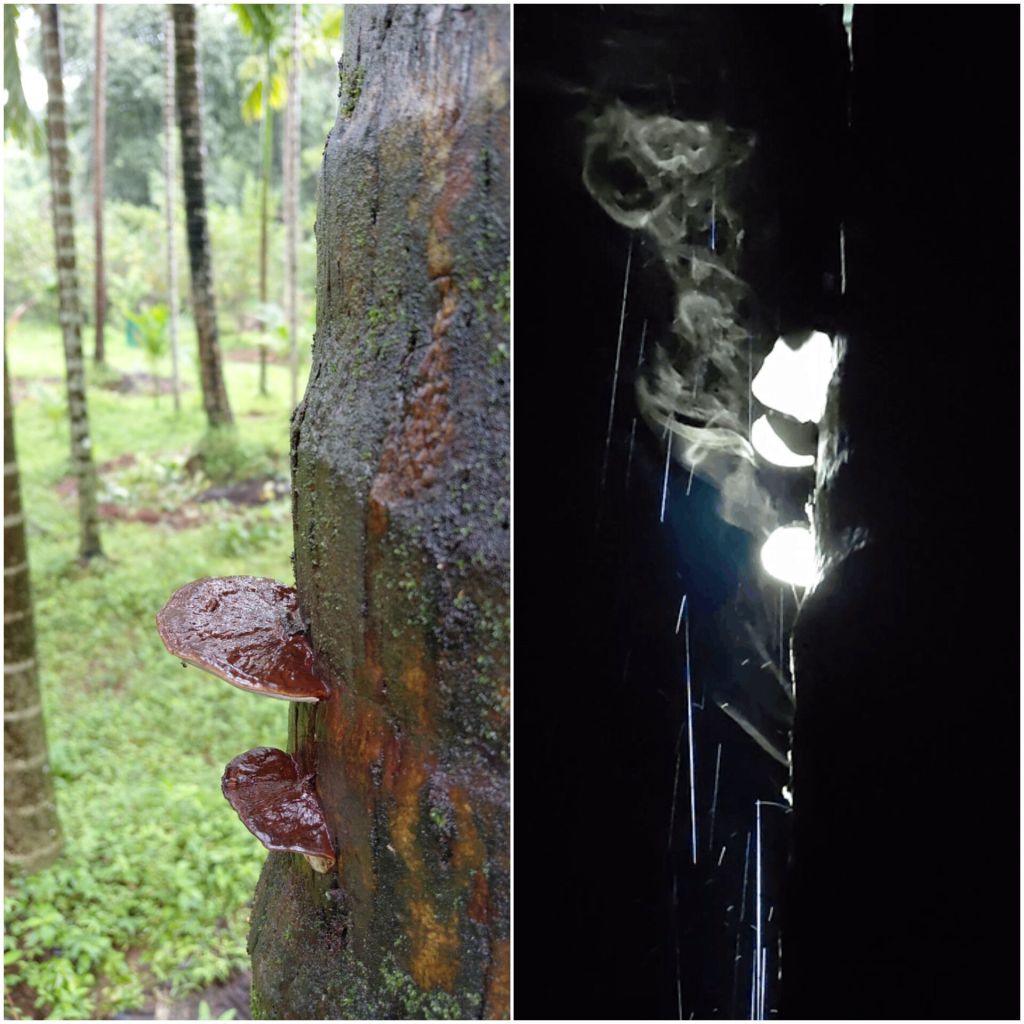
The lunch and dinner menu featured an all-local cuisine made with only locally sourced ingredients and tasted divine. Post dinner, we wore our raincoats, gumboots and headtorches and marched towards the forest after a short briefing. A guzzling water-steam flowing somewhere along in proximity stayed invisible in the darkness. Spiders, lizards, scorpions (that glowed under UV light), snakes and several types of mushrooms kept us accompanied in the constantly pouring rain during the entire walk. We then arrived at a spot in the middle of the forest, surrounded by massive trees and thick canopies. Our guide asked us to turn off all artificial lights and close our eyes for about a minute. It was for our eyes to set into the darkness of the forest after walking with flashlights until there. When we opened, we were all stunned by what our eyes beheld. The entire forest floor and the tree trunks were lit like radium. We were witnessing truly magical moments as bioluminescence was seen at its peak. The luminous fungi growing all over the ground, on tree trunks and even tiny wigs below my feet were glowing in the dark. An experience that I had wished to witness since so rftany years had finally come true.

The same Mushroom photographed during day(left) and night(right). Spores can be seen under torchlight at night.

We then returned to our cottages still holding the magic of the flowing forests still in our eyes. The other times of witnessing nature’s magic with light have been documented in separate posts.

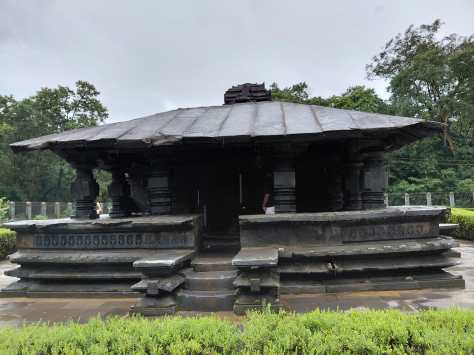
It was still raining as we devoured our breakfast and checked out of the resort. Our first visit was to Tambdi-Surla Mahadev temple. This is the oldest surviving Hindu temple in Goa, established by the Kadamba-Yadava dynasty and dates to 12th Century CE. It was a peaceful little temple built on the bank of the river Surla, whose upstream forms a cascading waterfall called by the same name. However, due to the monsoons, entry into the river or the hiking to the waterfall was prohibited at the time of our visit.

Tambdi Mahadev Temple, Goa
Tambdi Mahadev Temple at Tambdi Surla

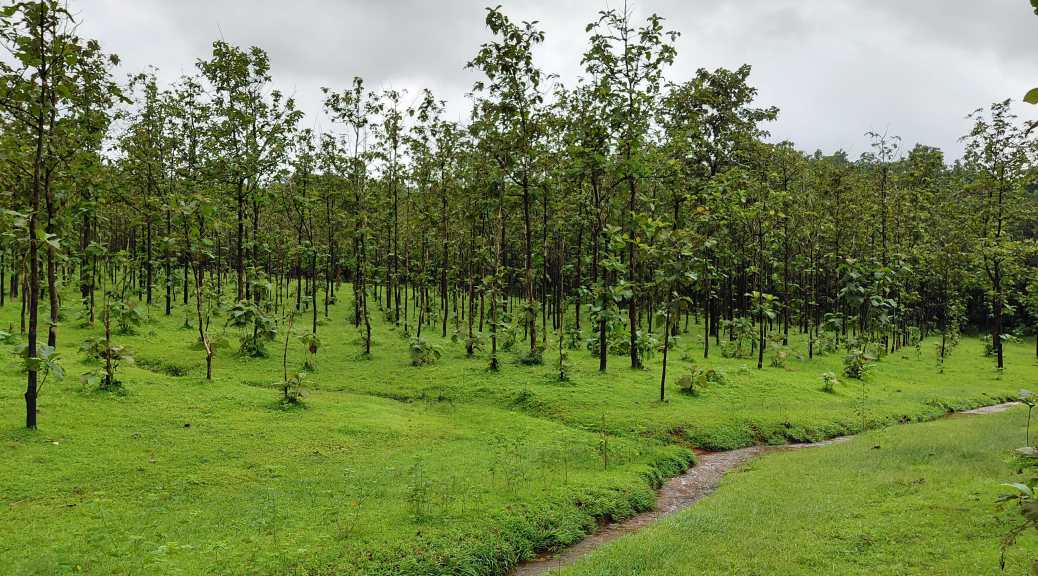
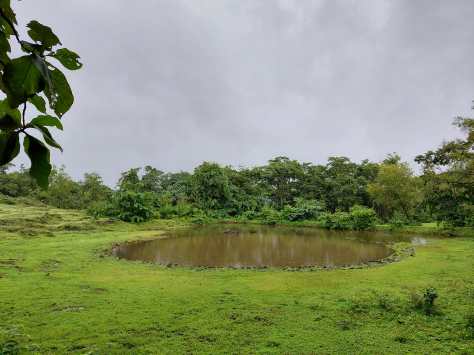
Upon our return from the Tambdi-Surla Mahadev temple, we were enchanted by the green cover all along the way. It was so tempting to the point that we parked our car by the roadside and simply walked into the neon green meadows running parallel to the road. We jumped across a tiny rainfed stream flowing across teak plantations which led us straight into a place that looked like a Windows wallpaper. We took lots of photos before coming across another random location on google maps that was named as a ‘crater lake’. Curious to find out what the lake was, we drove a little further and hiked a short distance by following google maps until we came across a small round shaped lake in the middle of a forest. I am still unsure if that was man-made or a natural pond which looked almost perfectly rounded in shape, but nevertheless it was a beautiful setting for yet another set of photography.

The Crater lake at Goa
The Crater Lake at Mollem National park, Goa

The stretch was mostly cut-off from mobile Connectivity, and we loved the peace we found amidst the chaotic monsoon drive. We occasionally stopped by at shops running in the backyards of small homes along the way to use free Wi-Fi in the name of drinking chai or coffee, local snacks sold in glass jars. It was thus far a beautiful trip exploring Mollem and Mahavir National Park.

We then proceeded towards Colva where we found our home for the next few days to explore the least explored places in Goa beyond beaches and parties. To be continued as Goa backpacking: Makarotsav Celebration and Temple Hopping.

The railway trek to Dudhsagar

This post is based on my trek to Dudhsagar waterfalls in the year 2013. If you have read my previous post: The railway adventure, then you’re sure to have had an insight to the adventure part of my trip to Dudhsagar waterfalls. This post is more on the trip and the sightseeing part of the story. I elaborate on the beautiful vistas that we came across as passed tunnel after tunnel, walking along a railway track, in the middle of a National park and finally seeing the beautiful Dudhsagar waterfalls.

17 of us boarded ‘MAS-Vasco express’ from ‘YPR’ on a Friday night and alighted at ‘Castle rock station’ on the following morning at 9.15.a.m. ‘Castle Rock’ is cute little station that divides the village into two- on one side is the railway colony, school, hospital, offices etc. and on the other side is the town(if at all it is called so) with basic amenities like a grocery store and a few petty shops. Since we were travelling in monsoon, the station was all green and a treat to all the eyes that had just landed from a concrete city.

With no facilities available anywhere around the station and even the basic offices closed on a weekend, we all freshened up in the washroom of the railway station itself. This is a point from where our railway trek starts. It is less of a trek and more of a walk along the railway track, all the way to our destination: The Dudhsagar waterfalls. But like they say, its is the journey more than the destination that matters, the entire stretch of this trail is what makes the trip all the more special.

We couldn’t and just couldn’t ignore the gazillion scenic spots that we come across for which we had to stop after every minute or 5 minutes of the walk for a photo. The Castle rock railway station itself was so good looking. This green moss laden station is located in the midst of the Braganza Ghats, in the heart of a National park. Take for example, this ART (Accident Relief Train) parked by the side of the tracks. It is adding so much colour to a photospot.

@Castle rock station- in the midst of the Braganza GhatsART a.ka. Accident Relief Train is parked by the side
@Castle rock station- in the midst of the Braganza Ghats
ART a.ka. Accident Relief Train is parked by the side

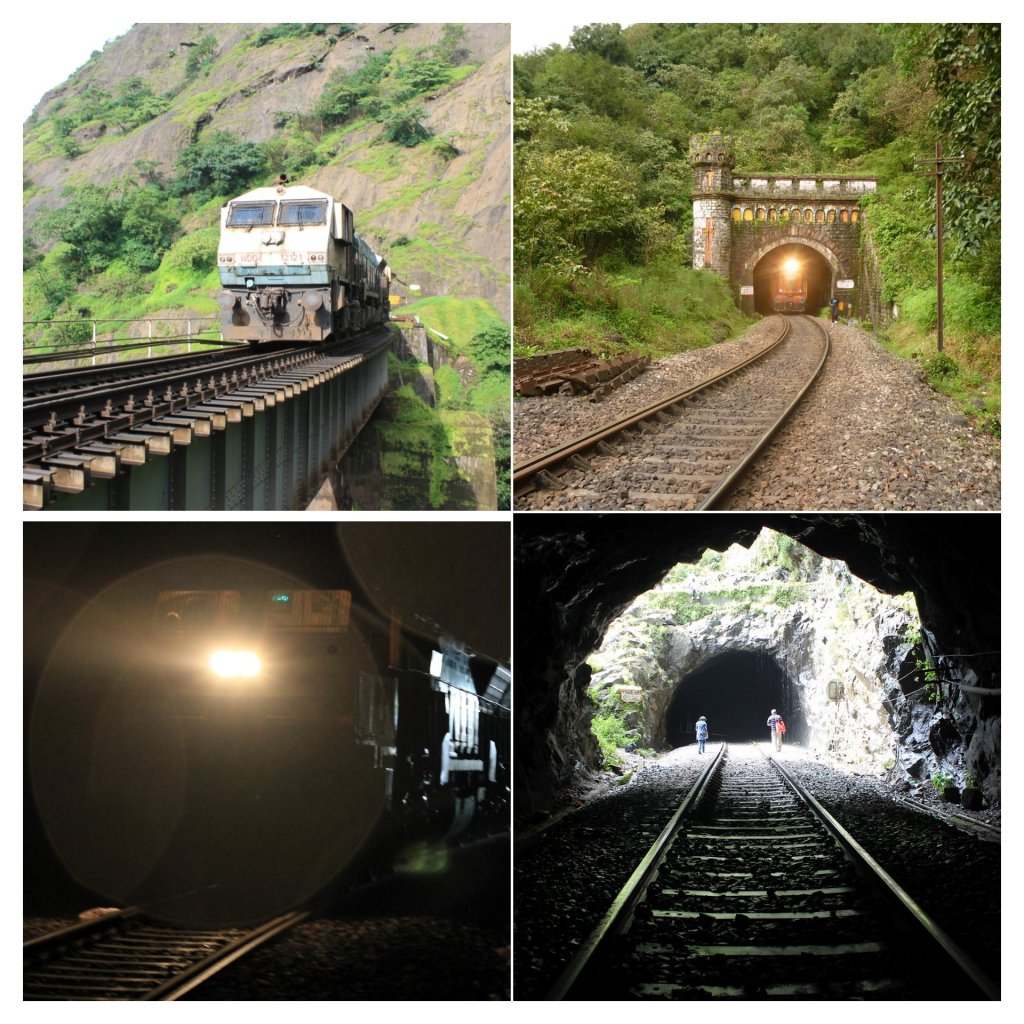
We continued to walk in the direction of Dudhsagar, but were unable to ignore the numerous waterfalls we encountered on our way. We stopped every time for photos. We had to walk through a total of 11 railway tunnels before reaching the main waterfalls. The first one can be approached by crossing a girder bridge laid over a scenic view of the valley.

The 2nd tunnel is the longest-at 624m. and the most beautiful one. It resembles an entrance of a Castle.

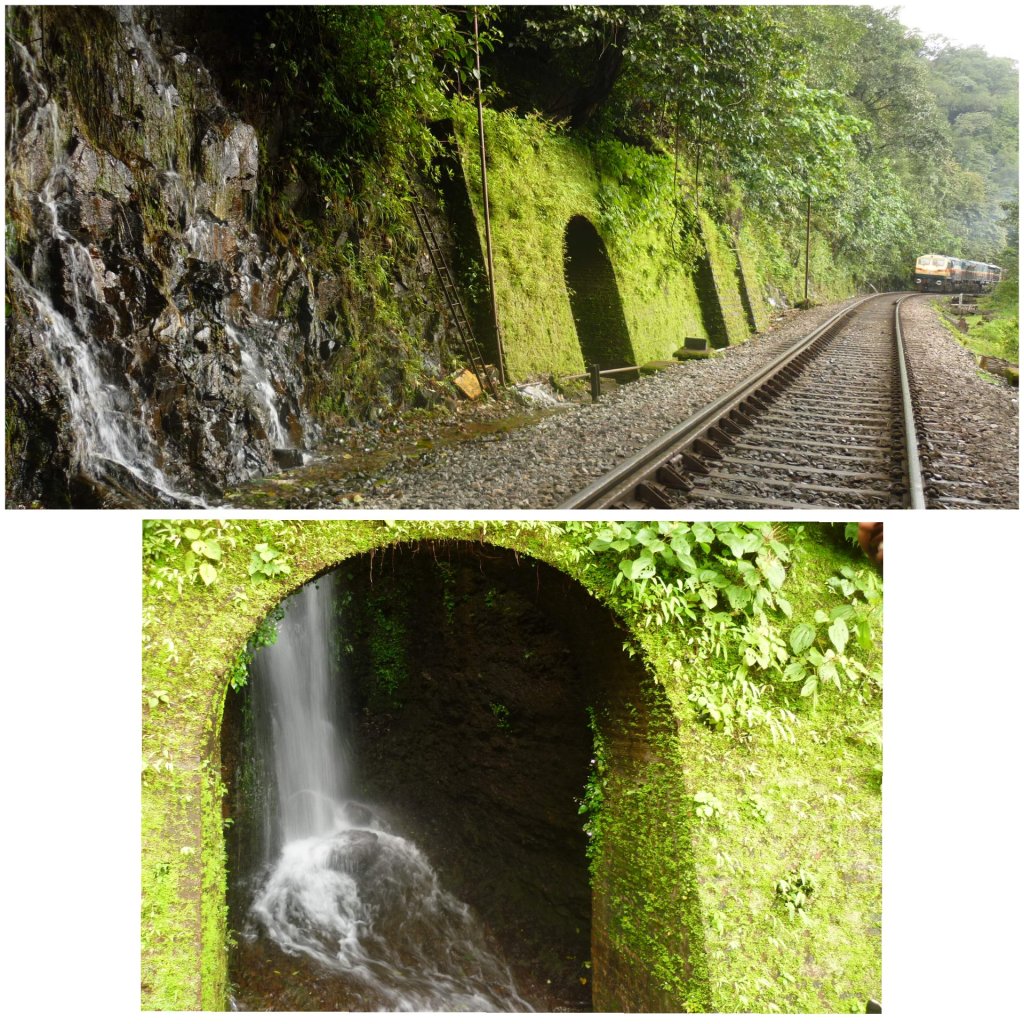
After crossing tunnel no.3, we walked slightly off the track, into the woods to see another large waterfall. Then came another waterfall, plunging down inside a vault kind of a structure built into the cliff.

Top: The vault by the trackside; Below: The waterfall within the vault

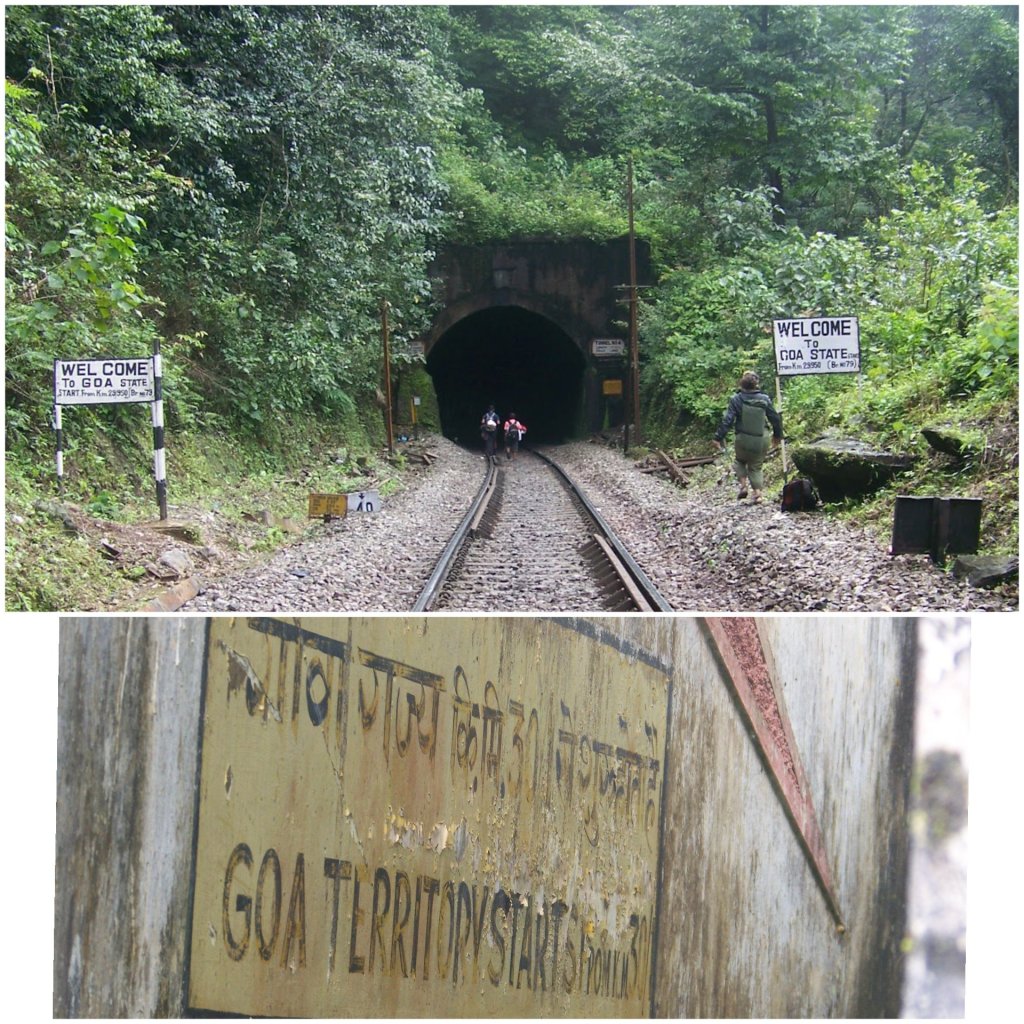
The 4th tunnel is special. After crossing this tunnel, we would be setting foot in another state altogether. This tunnel marks the border between Karnataka and Goa.

Top: The first tunnel on the Goa side of the land; Below: The location marked where the actual Goa territory starts

After a long walk from there, we crossed tunnel no.5. While still navigating our way with torchlights on the tracks, inside the tunnel, we heard the hooting of a train approaching us from behind. There wasn’t much time for us to get out and hence, we all decided to get down from the track and stick as close as possible to the wall of the tunnel to stay safe. When the goods train arrived, we literally held onto our dear lives. It was dark inside the tunnel and no place to move.

Run for life..!!
Clockwise from top left: A train passing over the girder bridge before tunnel no.1; Exit of tunnel no.2; Light between tunnel no.6&7; A train inside tunnel no.5

The 6th and the 7th tunnels came together. The 7th one was nothing more than a small arch. Then we walked through tunnel no. 8, 9 and 10.

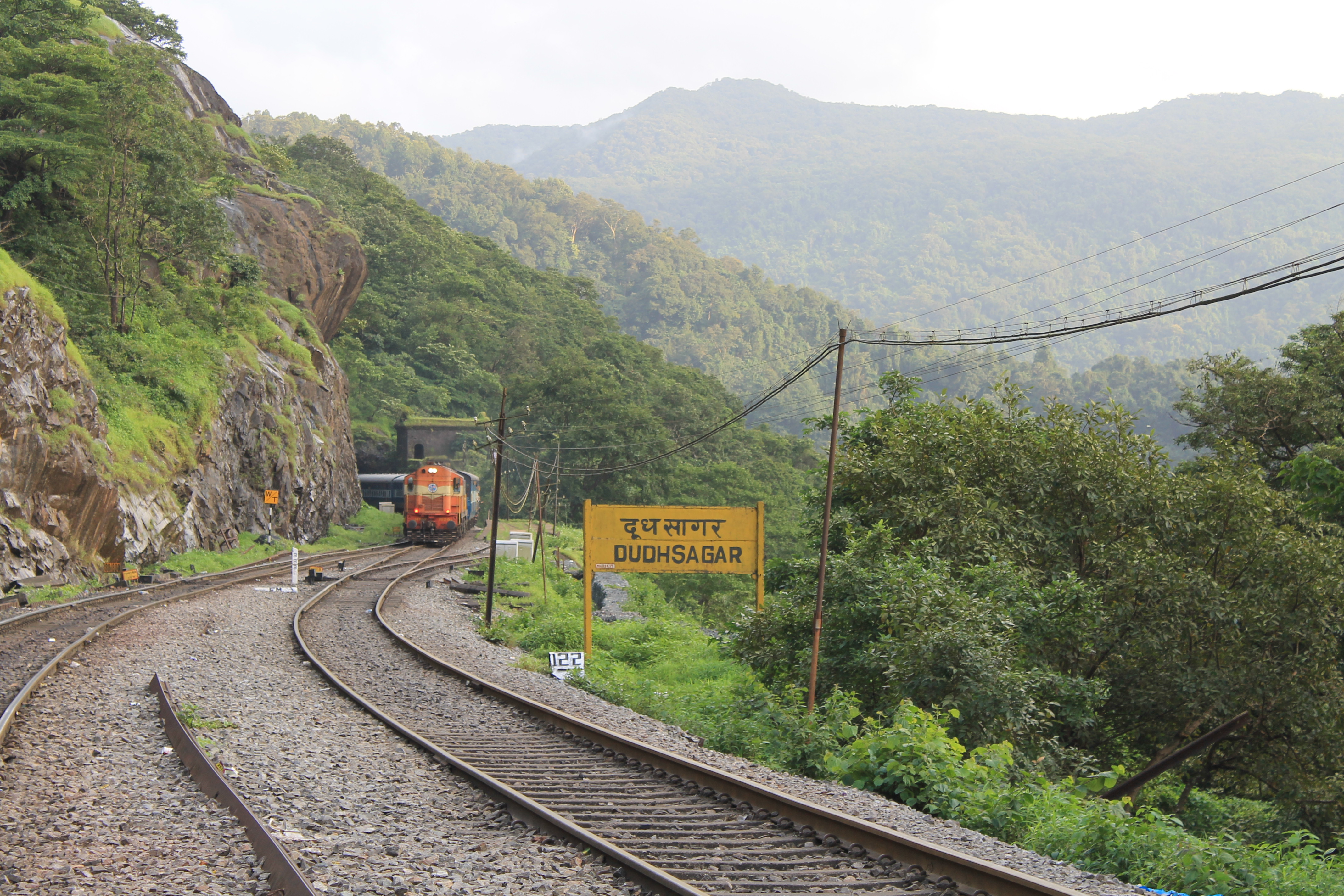
The 10th one was long and dark. And with exiting it, we saw Light at the end of darkness.. We had arrived at the ‘Dudhsagar station’. This is a de-func station and hence, neither the trains stops nor any tickets are issued for passengers who board from here. However, some lucky visitors manage to get a stop here but, they take a risk with a ticket-less travel. But, this is where we all realized that we were all tired by walking along the tracks. But, the fact that our destination was nearby gave us energy.

The DDS station
The DDS station

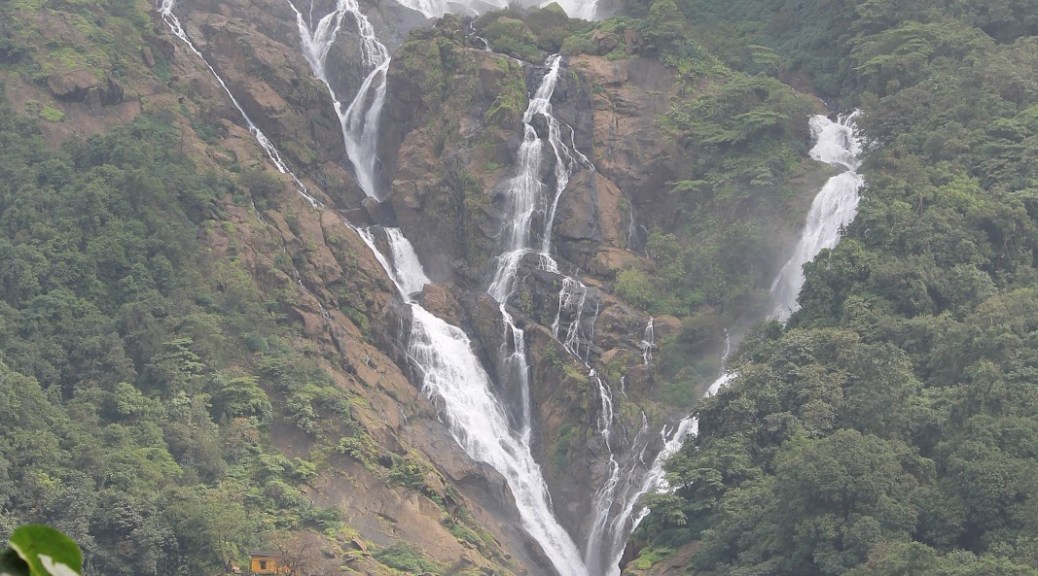
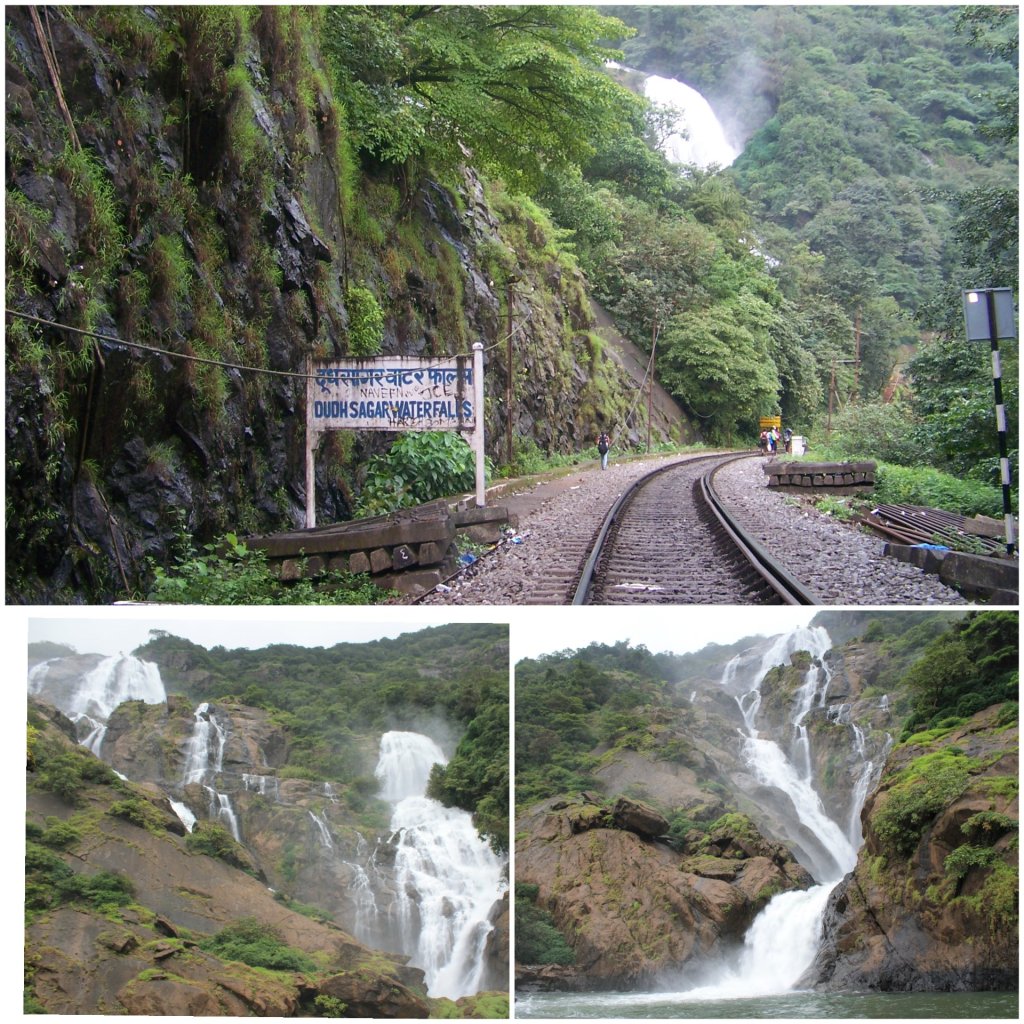
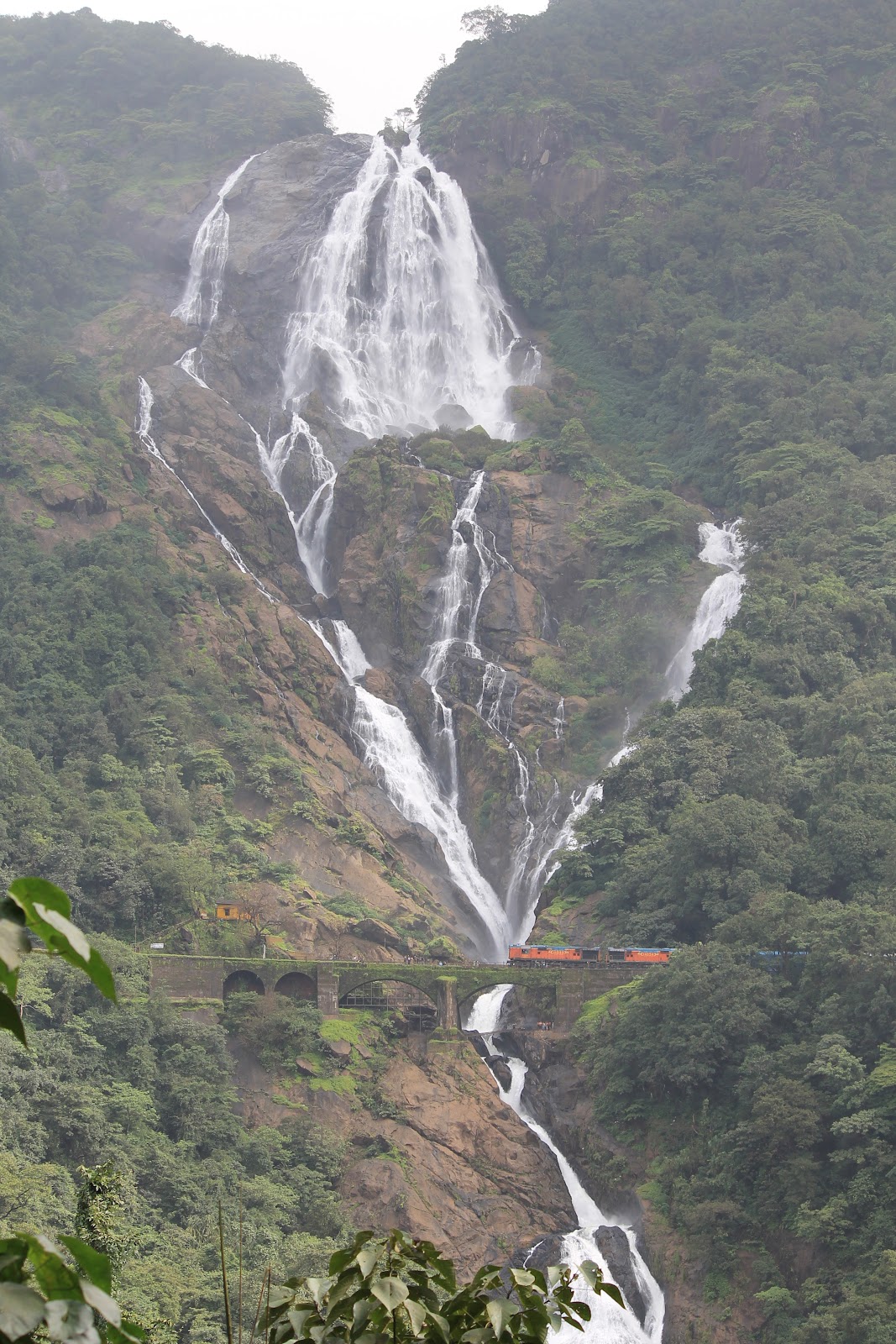
Then, we proceeded towards the 11th tunnel…. When we were exiting it, we were all hooting and clapping in joy. That’s because we all got our first glance of our destination. The mighty Dudhsagar: “Ocean of Milk”. The feeling was inexplainable. It was a great sense of contentment after a long tiring walk that was alllllll worth it..!! There was now a sudden spike in our energy levels and we all hurried towards the waterfalls. We dumped all our luggage right there, in front of the waterfall and crashed down in awe. As we were basking in the glory of the waterfalls, it had started to get dark. We looked out for space to unpack our luggage and our tents.

Top: The first glimpse of Dudhsagar waterfall out of tunnel 11; Below: Different views of the Dudhsagar waterfall

The only shelter (a small roofed structure) available to pitch a tent was already occupied by a large group who had arrived before us. We had no choice but to camp in the open, just by the side of the railway tracks. We put up a small campfire sort of a thing so that we had enough light to see each other’s face. But mind you, we were in the middle of a monsoon season in the western Ghats. The rain gods who had been kind on us during the entire hike were now playing spoilt sport. The campfire was put off too soon and we managed the rest of the night with our torches.

It poured cats and dogs the whole night.. The roaring noise of the waterfalls in the backdrop and the loud hooting sound of the train that passed atleast once in every half an hour, the tent pitched right next to the track with the waterfalls on the other side, it was indeed a night to remember..!!

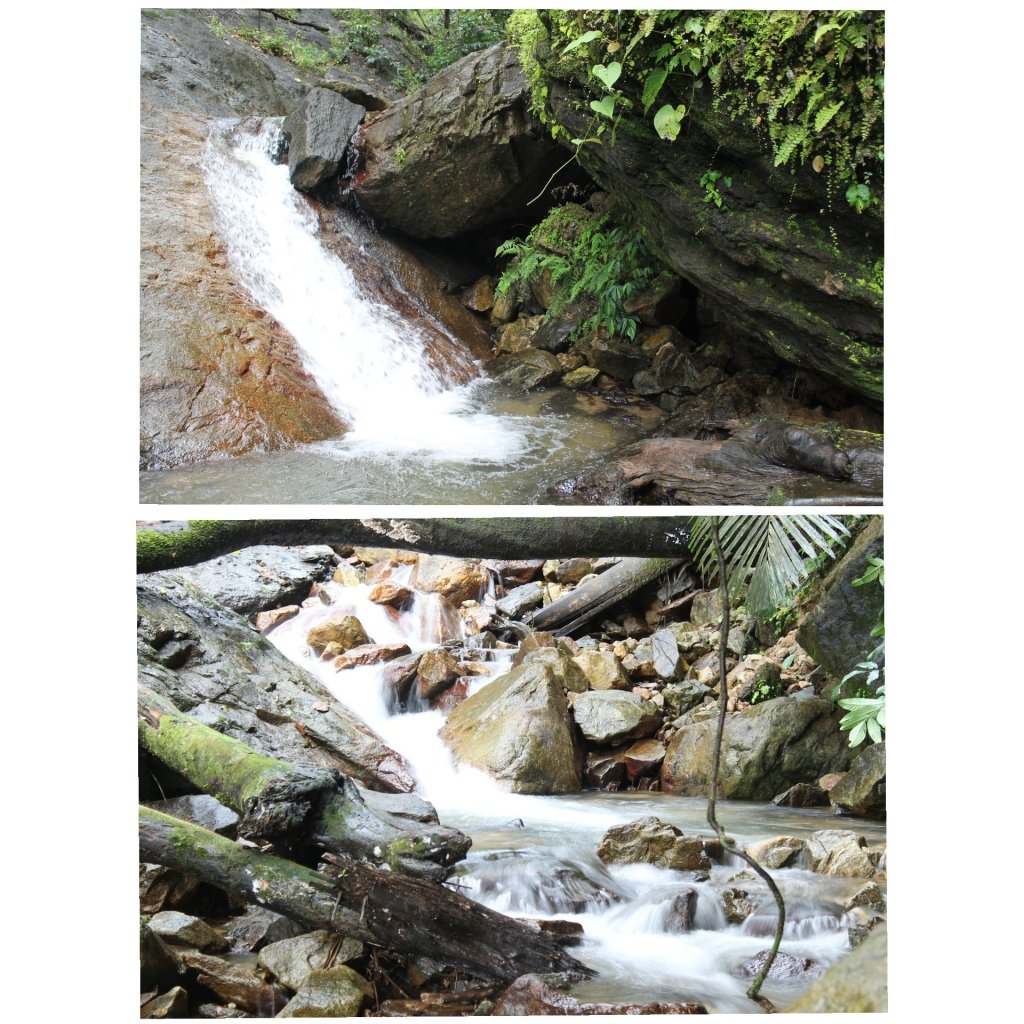
Next morning, we all rose with the sun and spent some peaceful time in watching the water gushing down violently. Apart from freshening up last at Castle rock, it was already 2 days & 2 nights since we had last seen a decent restroom or a bathroom. We looked around to find a little place where we could finish off our stuff in peace. A small waterfall nestled deep inside the woods is what we found instead. All the girls in our group jumped into the water while the guys kept a watch for any trespassers 😉

Mythology says that the “DevaKannikas or the Apsaras are often seen bathing in the midst of the woods, before sunrise.. and if one is lucky, he can see them walk by in wet clothes” to think of it from a strangers’ perspective, I guess the scene that morning must have been something similar to that. We couldn’t find a place near the waterfall where we could change into dry clothes. Hence, we all wore our jackets over wet clothes and walked 1.5kms towards our tents. On the way, we came across tens of trekkers who desperately stared at us.. I understand the natural human instinct to drool at divine looking girls who are walking wet after getting all soaked in pristine water. Nobody could help the sight.!!

The waterfall where we took our morning shower at Dudhsagar

We were told that the passenger train would cross the waterfalls by 9.15.a.m. This meant that we had to be at the view point by that time to get that perfect internet photo..!! It took us to cross the 2 more tunnels to reach the viewpoint. After reaching there and waiting for a few minutes, we finally got the wallpaper worthy photo that we wanted.

Finally.. We got what we wanted..!!

After a long photo session of the large group that we were and before the crowd who had just arrived in that passenger train would spoil the peace, we headed back to our tents.. We had a round of heavy brunch (carried from home) and slowly packed up. The initial plan was to walk the track all the way to Kulem, but owing to the cruel sun and the tiring walking experience on the tracks on the previous day, we decided to wait to find a train ride, either to Kulem or Castle rock. We missed the goods’ train to Kulem by a few minutes and so, we had to wait at the Dudhsagar station for the passenger train going towards Castle Rock.And with that.. Curtains down to our trip to DDS falls..!!!

Update as on Year 2019:
• Trekking on the tracks in prohibited as it passes through a National park. There is a risk of a human-animal conflict.
• If you wish to visit the Dudhsagar waterfalls, you can sign up with one of the organisers based out of Londa in Karnataka or Kulem in Goa. They can take you through an authorized trail or a 4WD ride to a nearest point can be arranged.

The railway adventure from Dudhsagar

< 16-Sept-12>

When you are back from a trek to Dudhsagar and talk about a “Railway adventure”- the usual things that strike anybody are train spotting, tunnels, wild encounters, the rail line that passes across the mighty waterfalls so on and so forth..!!! And there is ample information available all over the net about this walk along the railway tracks… So that’s the railway adventure…!!!

“NO…!!! ” I’m not here to speak about such a lame adventure- What if we did not come across any wildlife on our way..? There is always something even better that comes across as a compensation for not having any wild encounters..!!

We were all on our return part of our trip.. and were just happy that everything went on well so far.. And then began the actual adventure unfolding one by one..

Scene no.1:

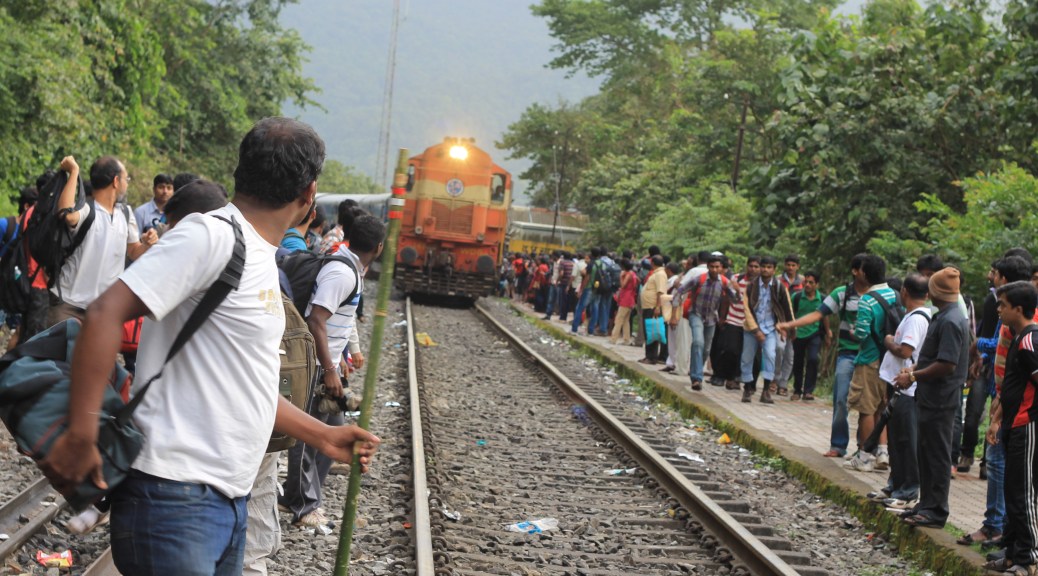
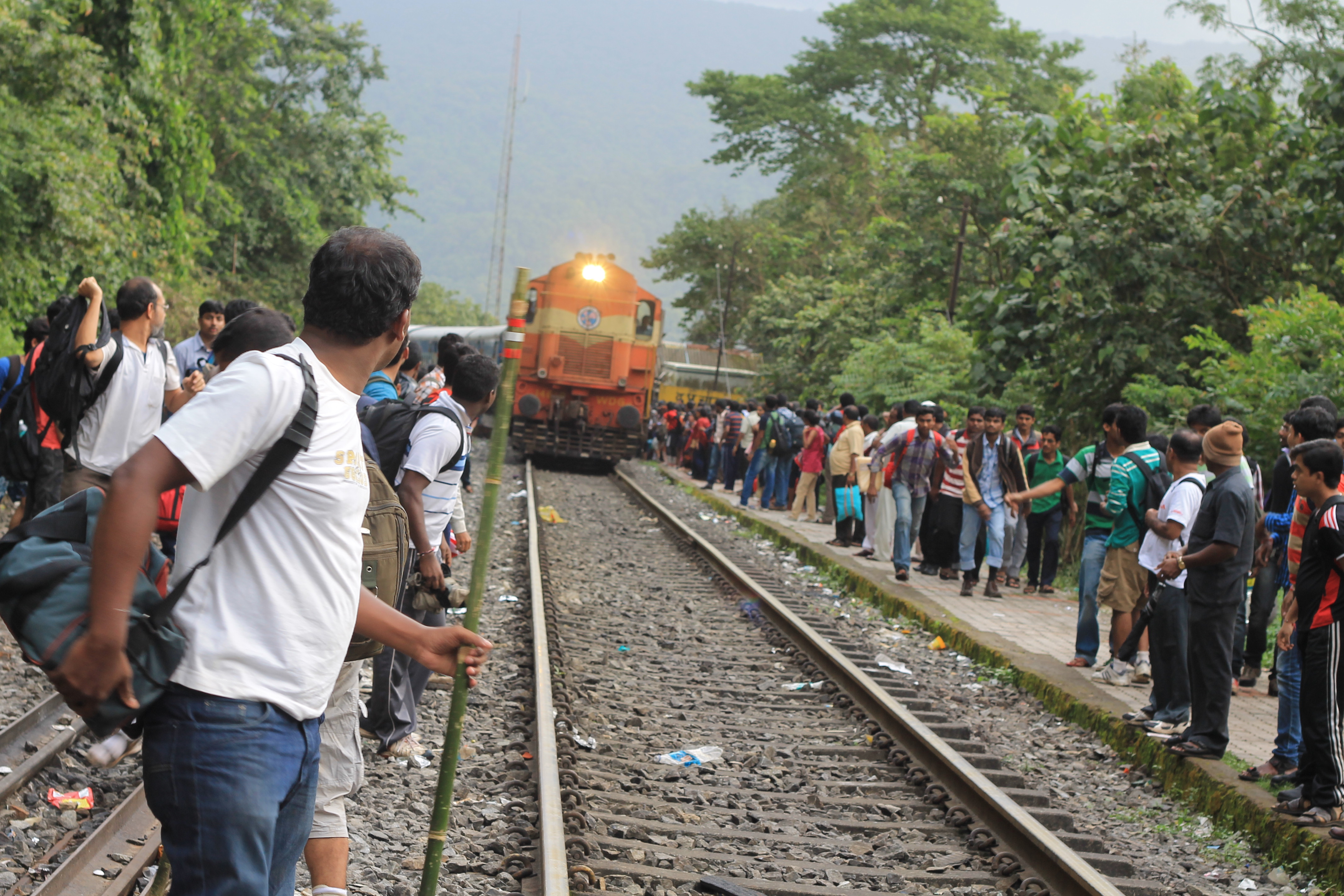
We were mocked at, at Dudhsagar station when we enquired about the tickets. Why that? We had even requested the person at the ticket counter in Castle Rock to issue return tickets from Kulem to Londa as we did not want to take any chances. But, our requests were all turned down telling that it was not needed. Like every other tourist/trekker who comes to Dudhsagar, we too decided to travel ticket-less till Castle Rock station. There were more than 500 people who got into the Vasco-Nizamuddin express with us- all without a ticket..!! This is nothing unusual as each and every blog on the net speaks about ticket-less travel. In less than 5 minutes after the train had started, the TT came asking for our tickets. We honestly displayed our tickets(from Londa to Bangalore). He told us to show the tickets from Dudhsagar to Londa and we told him this was the only one we had. His voice sounded a little harsh this time. We explained all that we knew about the reason for this kind of travelling.. But now he told us to pay a fine of 500Rs per head. 17X500???? Noway..!!!! Finally.. he took us all to one end of the bogie and settled the scene for a total of Rs.460. That too- Till Londa 🙂 Now it calls for an adventure of travelling ticket-less right..??
But that’s not the case, everybody knows that there is no ticket issued from DDS, so this kind of checking is a major scam happening in these trains..

All ticket-less trekkers ready to jump into the Vasco-Nizamuddin exprs

Scene no.2:

Onboard Rani Chennamma Express:

Approx.9.00.p.m.:  17 of us are playing dumbcharades, all seated in the same compartment and the entire bogie looking at us in awe(some jealous of us for the fun we were having, some surprised of the size of the gang, some enjoying the game with us, and some definitely pissed with the loud noise we were making). 2 police men walk across the bogie without bothering to notice anybody in particular.

Approx.11.00.p.m.:   We all decide to go to sleep as we were all pooped out of the long trek and most of us had to go to office the next morning. All are dispersed from the seats and preparing the bed.

Approx.11.30.p.m.:   Less than 2 minutes before we turned the lights off.. The 2 policemen appear out of nowhere..

“What’s going on here? We have received a call from the control room that there is a lot of noise coming from this bogie. Other passengers have complained about it..!!”

“But, we are sorry Sir, We had stopped playing half an hour ago and were just about to hit the bed”

“What are you playing with all these girls I say? and You.. dressed up like Y*su Chr*sta….” pointing out at XYZ..

XYZ got pissed off and revolted, “Mind your tongue, how dare you talk like that……”

The rest of us dragged him away before the scene got worse..

“Oh not just causing public nuisance, now you are fighting with a cop huh? All of you get off the train at Davangere station and lets talk about it in the station” the Cop asserted..

“But Sir, We will keep quiet now on and take responsibility not to disturb others. We are sorry..!!”

“We don’t know all that, get down at the next station or else pay a fine of 1000Rs. per head”

“Please consider, girls are travelling with us. We can’t get down in the middle of the night and we are on our way back, we don’t have so much money either”

“Just get down and lets see at the station”

This went on till approx.1.30.a.m and the entire bogie was watching the fun with no one even bothering to support us considering that we were all kids(or something like that, atleast out of courtesy)

Finally we all pooled in all the ‘Tens’ we had and settled the matter with Rs.500. A toll for absolutely no mistake of ours..!!

“The Indian Police”..!!! They are more than wild and entertaining who could well give an excellent replacement for the Orangutans- which are critically endangered.!!

Anything for money….. There is NOTHING that can be done to eliminate corruption in our country..!! We all speak volumes about a corruption free nation but we ourselves promote it in absolute helplessness..!! And Ohh?? Safety and respect for women???? what does that mean? I don’t remember coming across any term like that during my journey…