In my wish list to visit as many Hoysala temples as possible in this lifetime, this is the second documentation. I started this series with the temples of Belur and Halebidu, as these were the erstwhile capital cities of the Hoysala. I will move on from there.
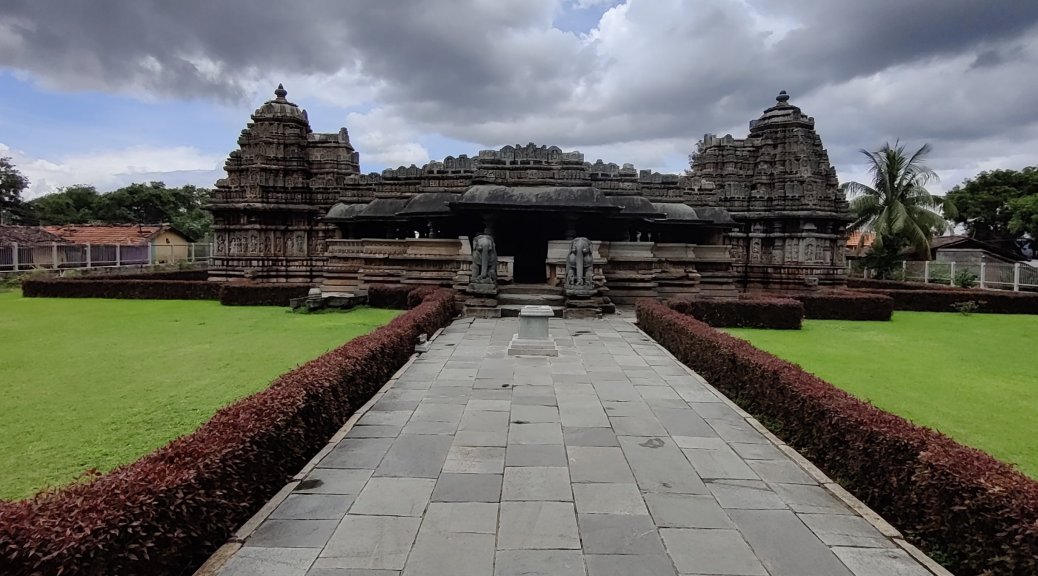
Belavadi is a quaint little village located approximately an hour away from the Hoysala capital town, Belur. The Veera Narayana swamy temple of Belavadi is one of those where the main idol of the presiding deity is still intact and regular prayers continue to be offered. The intricacy of the artwork on stone is very similar to that of the temples at Belur and Halebidu.
Images: Veeranarayanaswamy temple, Belavadi
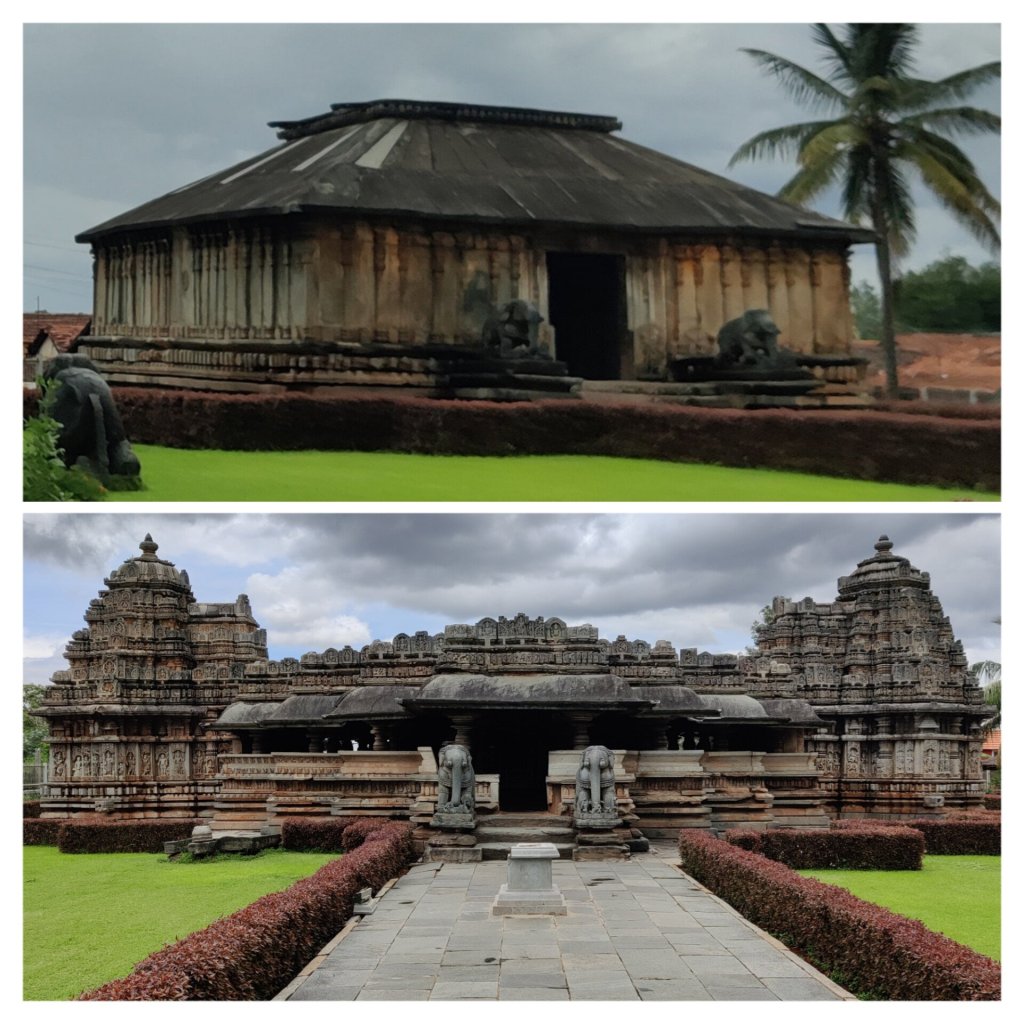
Top: Outer entrance gate to the temple
Below: Inner entrance to main shrine at Veeranarayanaswamy temple, Belavadi
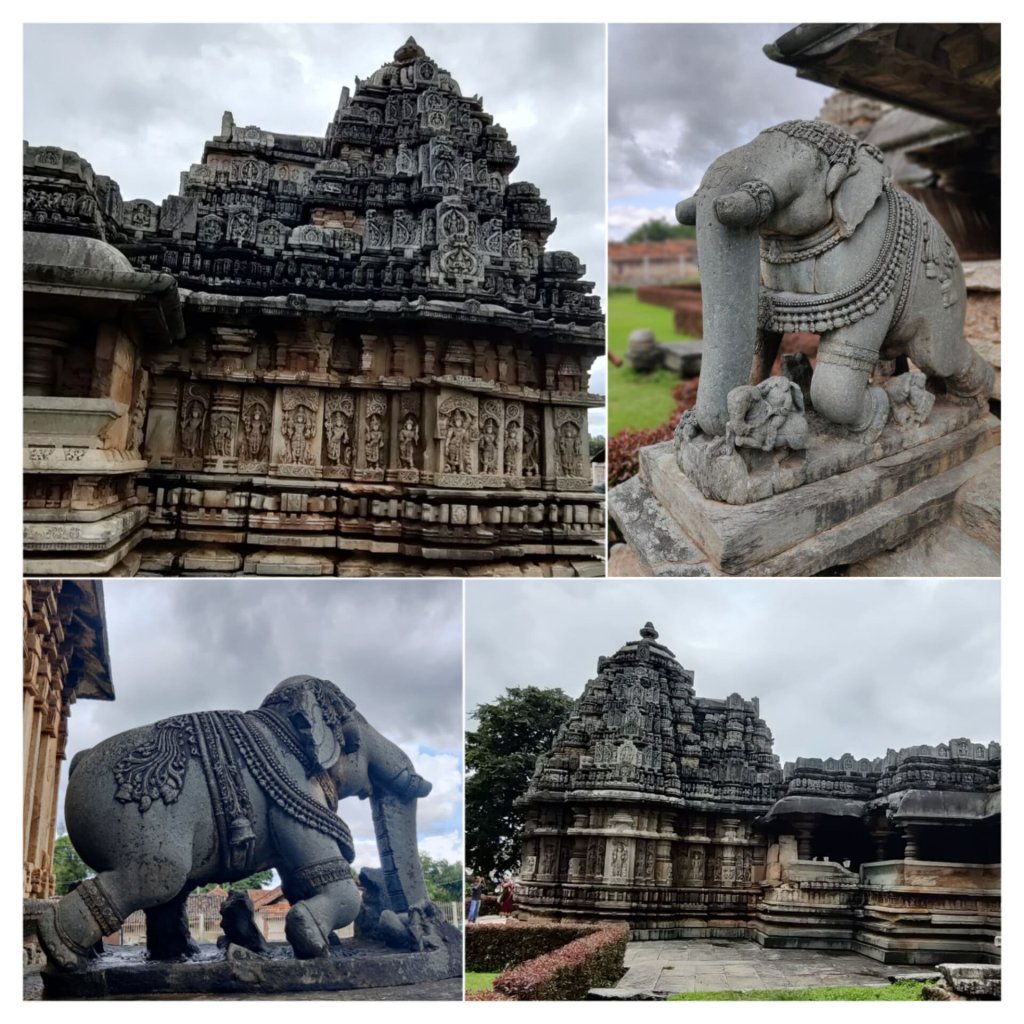
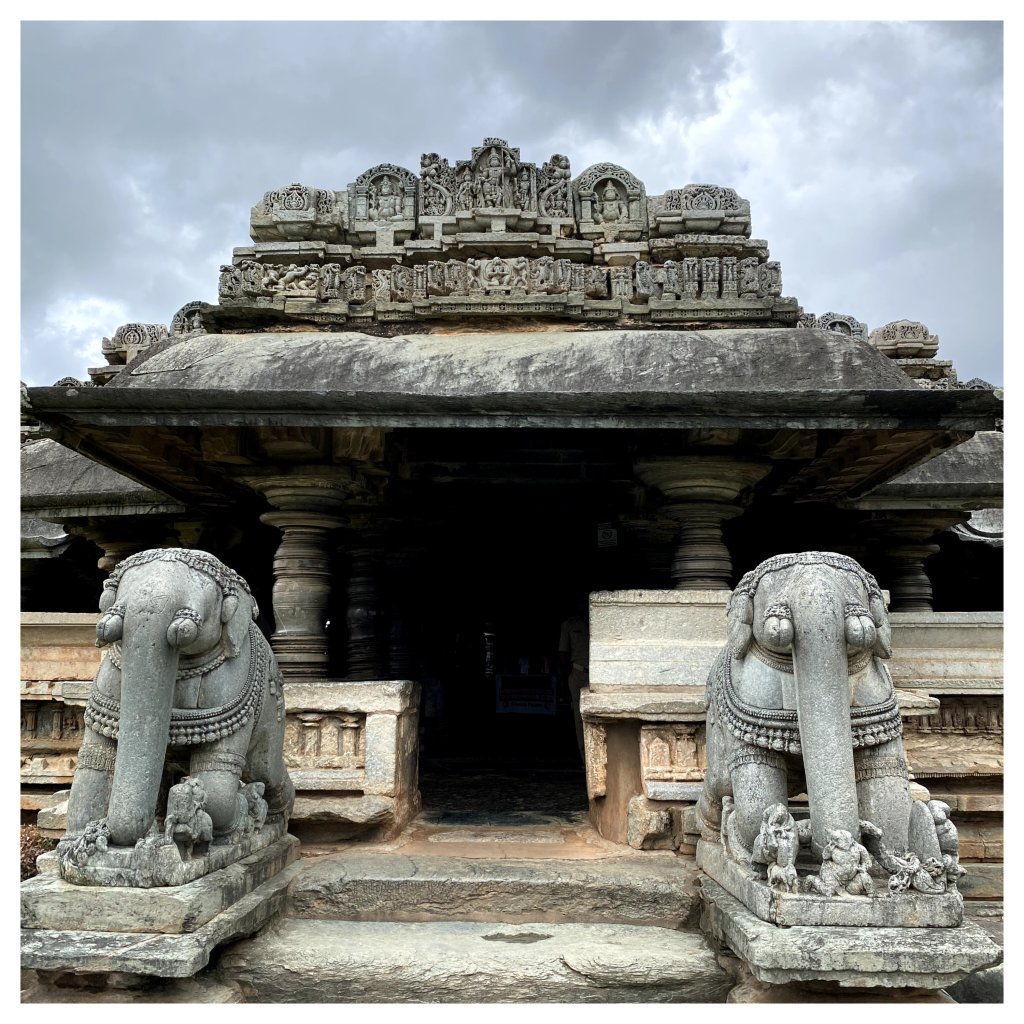
Unlike the main Gopuram (temple tower) at Belur, the entrance gate at the Belavadi temple is small. There are two ornate statues of two elephants that greets you inside. The sculpture on the outer wall is simple and minimalistic. as you enter, you notice that the inner walls are plain. It is possible that these were stolen, vandalized, or lost over the course of time, only historians can tell me better.
The sculptures on the exterior of Veeranarayana swamy temple, Belavadi
As you walk past this entrance gate, arch you pass the courtyard and are greeted again by a pair of standing elephant statues into the main temple that encompasses the shrines in the trikuta style of temple architecture. The three shrines inside houses idols of Lord Vishnu in three different forms. Huge lathe turned stone pillars and walls bearing fine and intricately carved figurines adorn the inner walls of the temple where photography is prohibited at the time of my visit (in July-2022).
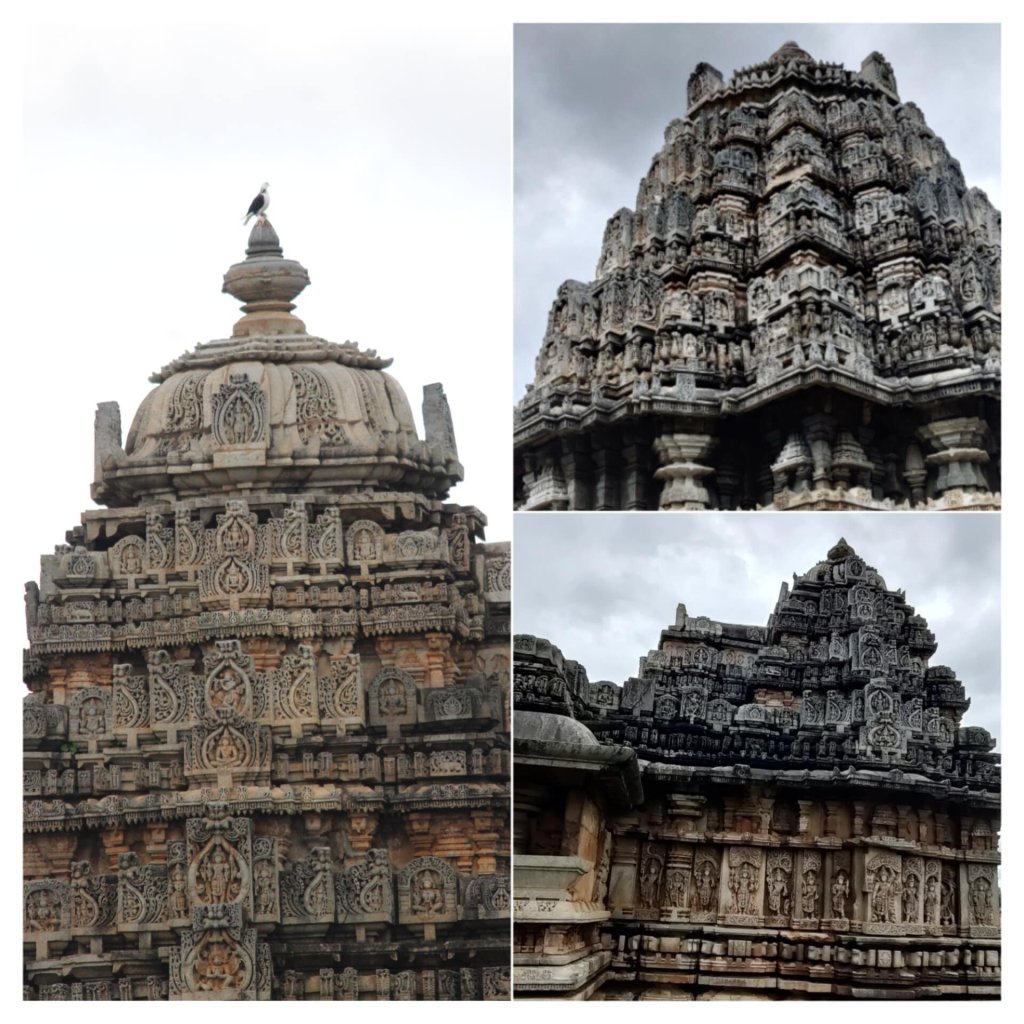
The Trikuta temple towers at Veeranarayana swamy temple, Belavadi
The outer walls are equally gorgeous too with intrinsic stone carvings and embossings all over. Due to limited permissions for photography, my photo story here consists only of photos of the exterior of the temple, but more than sufficient to give an idea of this marvel.
The inner and the main entrance of Veeranarayana swamy temple, Belavadi
Also, a walk around the tiny hamlet of Belavadi is highly recommended. I loved the unique design of these traditional houses that emanated a vibe of an old world.
Heard of the potential of Aqua-tourism in Karnataka? We did just that. Read Further.
Water activities like kayaking, surfing, and diving are slowly catching up with enthusiasts, both for recreation and as a sport. Thanks to favorable winds, some of the most serene estuaries with mangrove ecosystems and untouched diving spots, Karnataka’s coastal region has been attracting enthusiasts and vacationers from all over. It was a family road trip driving down from the hills of Kodagu to the coast of Karnataka.
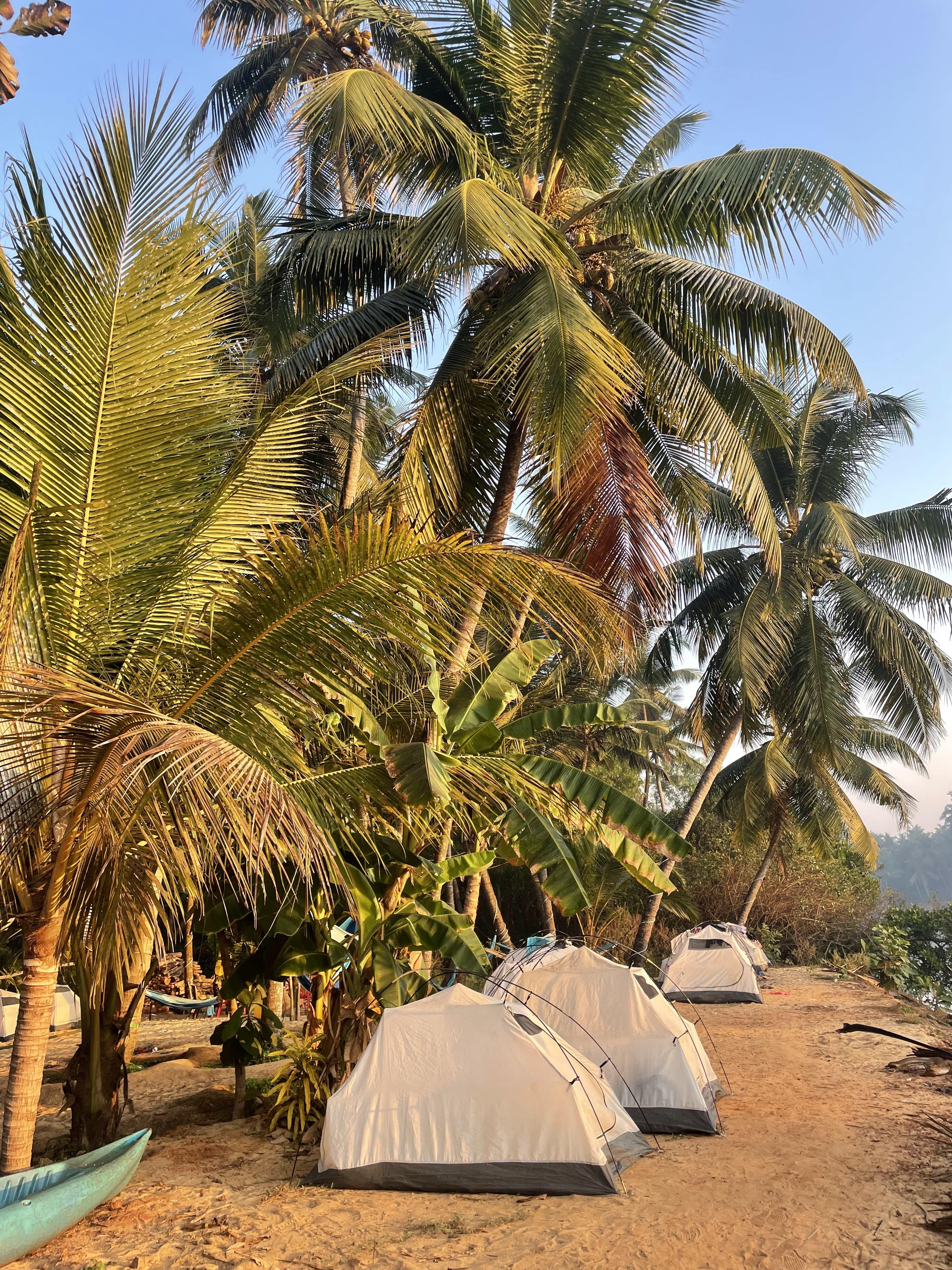
Just like the gad-bad ice-cream that originated in this region, our itinerary was packed with experiences. We wanted to see the bioluminescent waters. Bioluminescence is a naturally occurring phenomenon in which the microorganisms present in the water emit light when disturbed thus making the water glow. The darker the surroundings, the better the visibility of this phenomenon. Hence, we had signed up for a night kayaking session on a no-moon night in the backwaters of river Shambavi at Mulki. We chose to camp by the riverbank to have a closer connection to the waters.
Our Campsite at Shambavi river bank, Mulki
After arriving at the campsite and while my parents enjoyed their time strolling around the place, my brother and I took our lessons on taming the waves with the surfboards. Although my brother was quick to get the knack of balancing himself on the surfboard, I fell into the water several times before finally getting it right. It was a fun session under the harsh sun until we returned to the campsite. We then tried some wakeboarding in the backwaters and then headed towards the beach again, to see the sunset.
Padubidri beach is among the only twelve beaches in India and two in Karnataka to have the blue flag certification. The drive to the beach itself was a beautiful experience with coconut trees towering over the narrow road running parallel to the sea. With all facilities including clean washrooms and good restaurants, the swim, and the sunset at Padubidri was one for the books. After grabbing some refreshments at the stalls there, we headed back to our campsite to relax a bit before the beautiful night that had to follow.
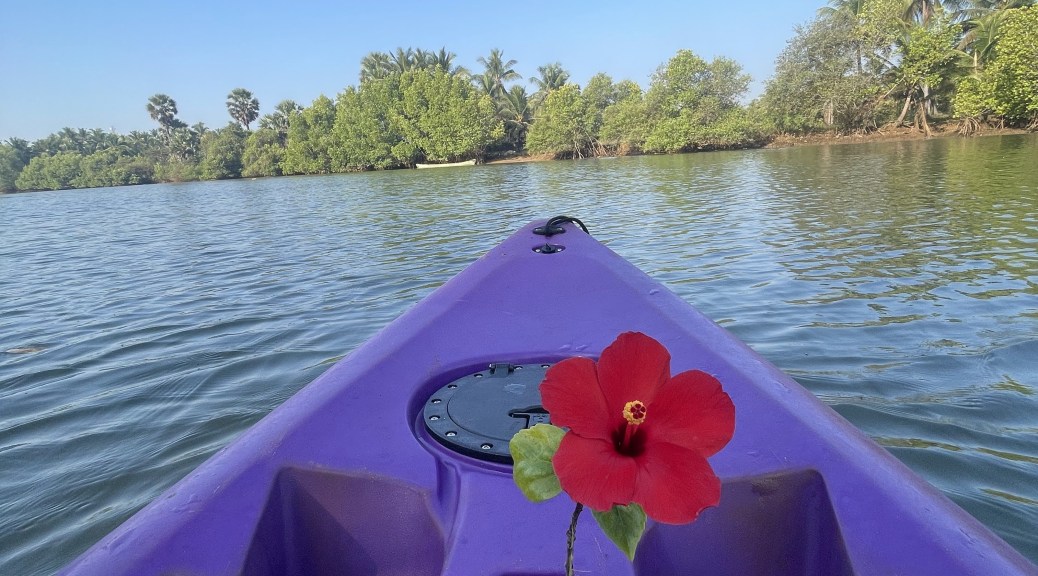
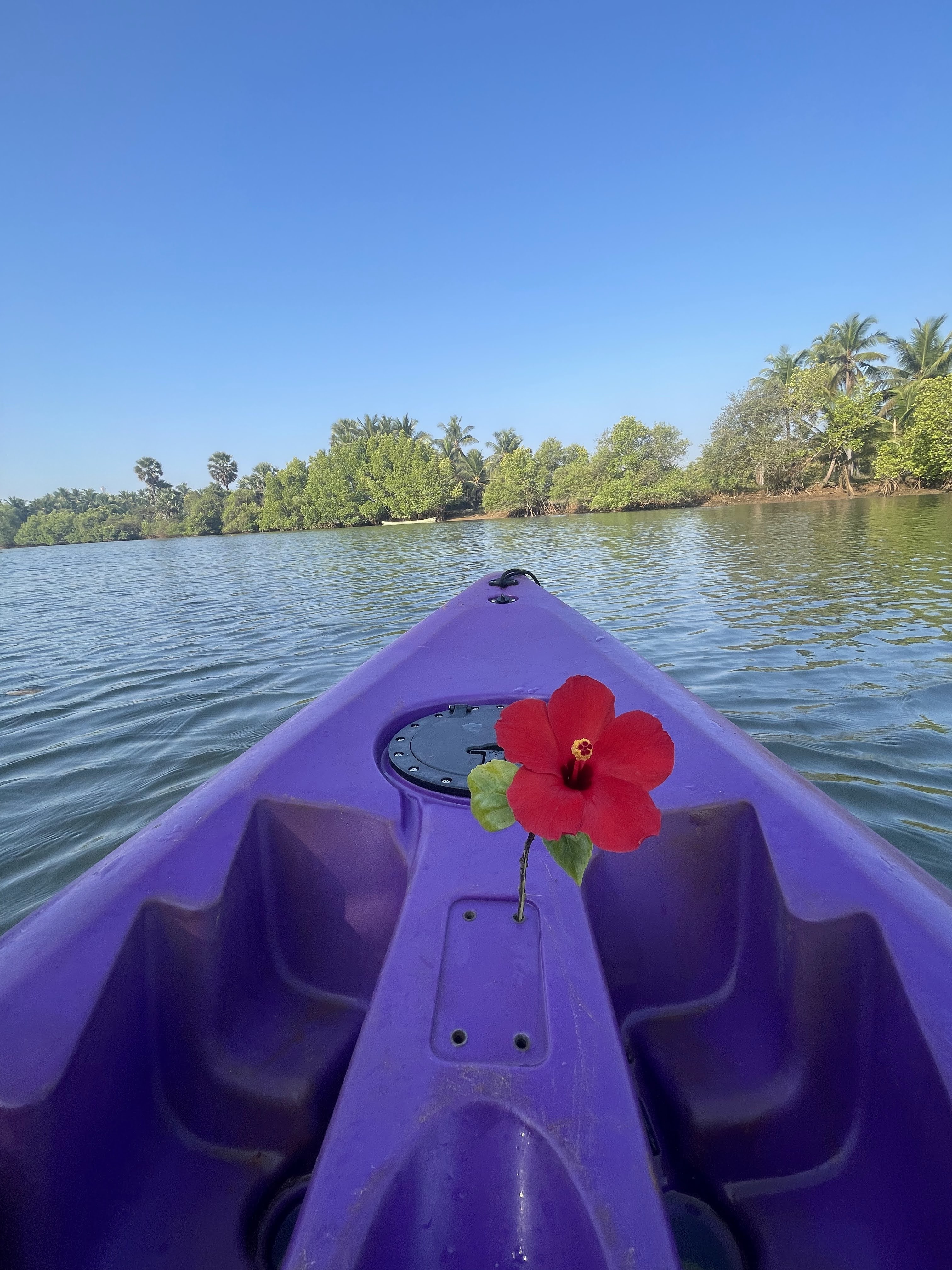
Since it was a no-moon night, the tides had caused the water levels to rise. It was pitch dark as we set our individual kayaks out into the water and began to paddle along the river. Geared with life jackets and our oars, we were ready to set the water ablaze, quite literally! We had no sense of where we were going but to follow a faint beam of torch light on the first kayak that guided us in the correct direction. The magic slowly started to unfold in the water after we had covered a certain distance. The glowing waters peaked while we all had gathered at the river mouth on our kayaks. Although, it is said that bioluminescent waters are a sign of unhealthy water, I convince myself of not being guilty of enjoying this experience. We all screamed with joy as we splashed the blue waters on each other with our hands and our paddles. With each dip of our hand in the river, our arms would glow in neon blue, which seemed nothing but a fairytale.
Kayaking in Shambavi backwaters
The following morning, we drove up to the temple town of Murudeshwara to score off yet another item on my bucket list. At about 20 kilometers off the coast of this temple town is Netrani island, a strategic patch of land controlled by the Indian Navy. Although entry to the island itself is restricted, the surrounding waters are open for public access during the spring months each year. This area is one of the best dive-sites in mainland India and that’s why I had been contemplating a visit here. We had pre-booked our slot for scuba diving with one of the several diving agencies around there.
Soon after filling out forms, a boat arrived at the beach to take us on a ride of approximately one hour to reach the dive spot. Our family was accompanied by a few other travelers, who like us were enthusiastic about their dive. Enroute, the instructions were given to everyone on the boat, both first timers and experienced. After reaching the site, without wasting time sitting inside the boat and waiting for our turn to scuba dive, we grabbed the snorkel gears and jumped into the water. The view inside had already set a good momentum for the expectations we had for the deep dive. Soon, each of us took turns to go underwater, touch the seabed and live our moments in a new world under the water. Especially for my sexagenarian parents, it was something that they hadn’t done before, and they felt a sense of accomplishment. It was evening by the time we returned to the shore with our boat tossing hard in the unusually rough sea.
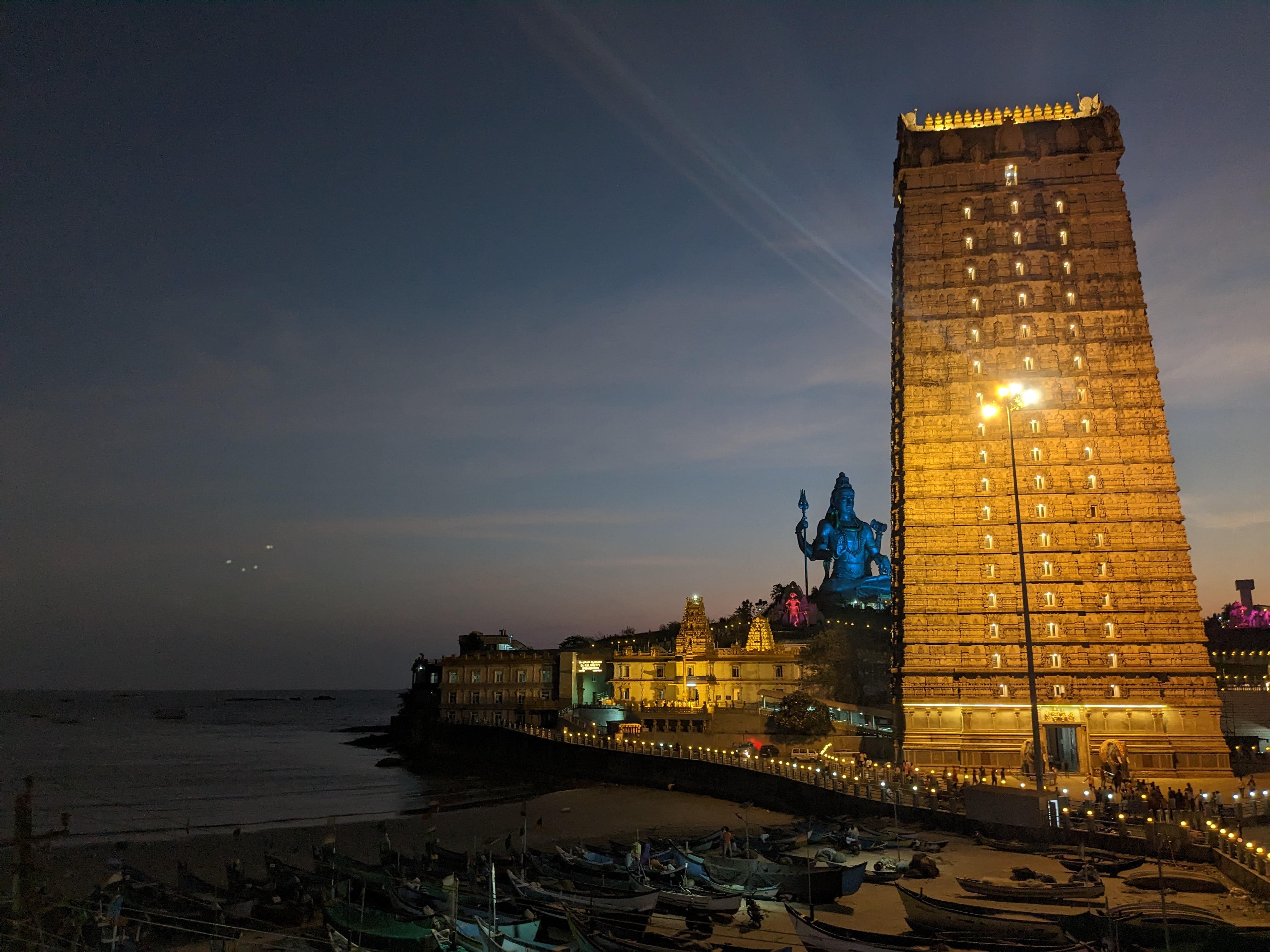
Murudeshwar temple during Sunset
We freshened up at a nearby lodge before visiting the Murudeshwara temple. We called it a day while watching the sun go down from atop the temple tower. It is highly recommended that this spring-summer trip to the coast of Karnataka should go onto everyone’s bucket list!
Initially, when a friend mentioned the destination for an impromptu drive on a Saturday morning, I hoped to correct him by telling it was ‘Biligiri Ranganathaswamy Betta’. “No, it is Bili-Kal’, he specified. ‘Bili’ translates to ‘white’ in Kannada. ‘Giri’ means ‘hill’. ‘Kallu’ means ’stone/ rock’. In this context, we were both talking about two different destinations. Although the presiding deity at the temples located atop both these hills are common, Biligiri is more popular than its counterpart at Bilikal. While Biligiri forms the core of Biligiri Ranganathaswamy Temple (BRT) tiger reserve, Bilikal is in the heart of a reserve forest that comes under Kodihalli wildlife division of Bannerghatta National Park. So, this time, we were heading to ‘Bilikal Ranganathaswamy Betta’, the closest of the two to Bangalore city limits, reachable through Kanakapura road.
We stopped by Halagur town for breakfast which has several old and popular eateries that serve unique types and authentic recipes of idlis for breakfast. (Comment below if you need hotel recommendations). Post this break, we followed google maps to reach our destination.
There is a forest check post enroute where one needs to make an entry to continue the journey ahead. The temple hill can be summited via two routes, one is a trek route with stairs, and another is through an unpaved road that is clearly marked till the end. Although four-wheel drive is not mandatory for those opting to drive up, it is recommended to have a vehicle with good ground clearance.
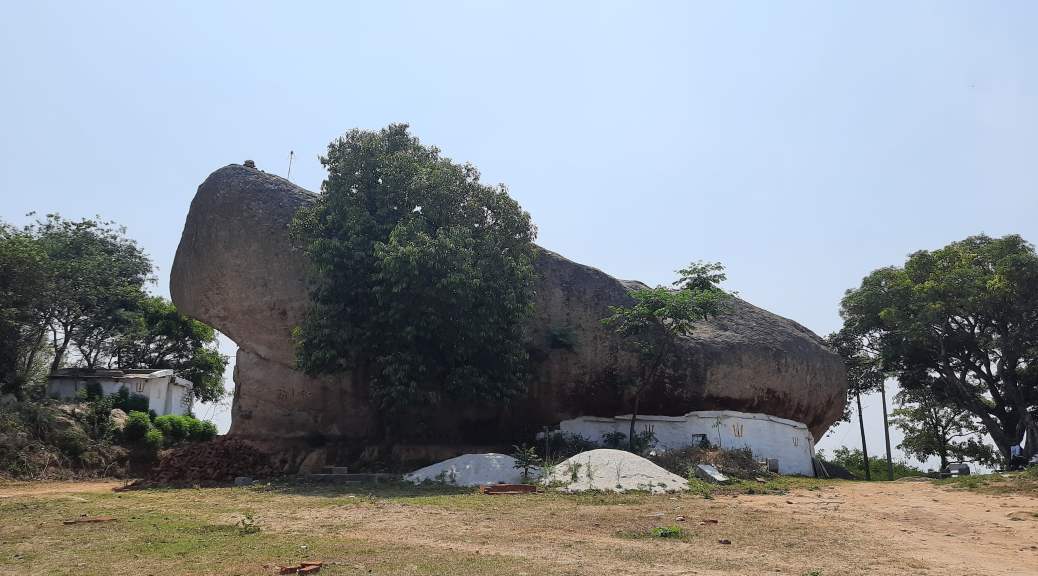
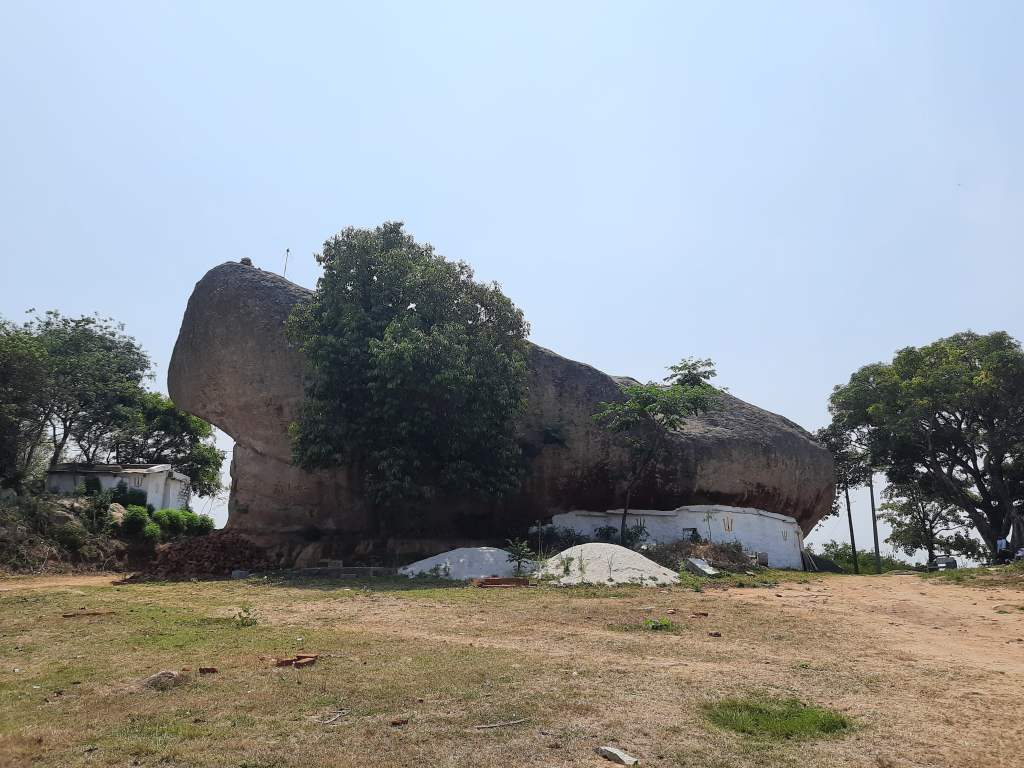
Bilikal ranganathaswamy temple, Rear view of the Monolithic rock
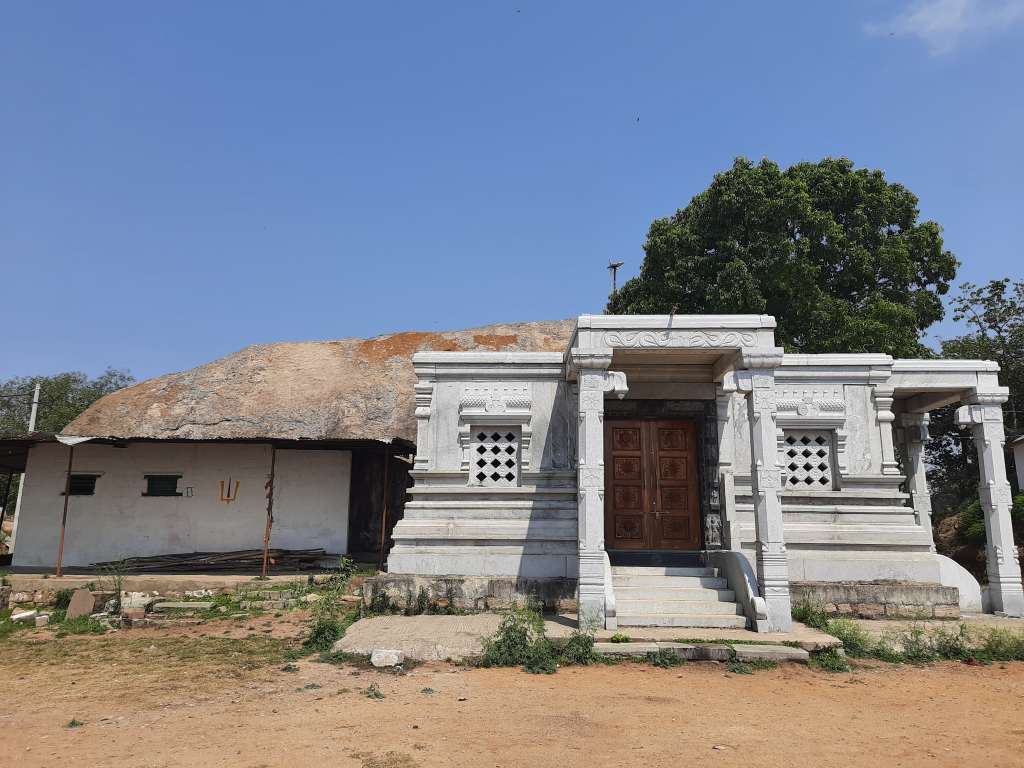
Upon reaching the peak, it was a large open area which came as quite a surprise. While one side of the hill had the temple pond dug into the edge of the rocky hill, the main temple of Ranganathaswamy is located on another side of the hill, overseeing a magnificent view of the surrounding hills. The main deity is carved out of a large monolithic rocky outcrop on the hill, which makes this place unique among all that I had visited thus far. There is a small sculpture on this rock which we were told is the original figurine of worship until it was damaged many years ago. Since then, an alternate idol has been carved out of the larger rock and a simple temple has been built outside leading into the prayer chamber within the monolithic rock.
Next to the temple rock, is another old and small room like stone structure. A few localites who were present there told us that it was the house of an old lady Kamalamma, who lived there and had dedicated her life in the service of Lord Ranganatha. Amid the wilderness of the thick jungle, she lived all alone in the belief that Ranga was her caretaker. She was accompanied by a few cattle that lived there whose milk was used to distribute buttermilk to pilgrims who arrived there every Saturday after a tiring ascent by foot (before the drivable route was laid out). She is no more, and her tomb is now housed inside the structure where she lived.
Bilikal ranganathaswamy temple, front view of the rock temple
A short climb from this structure is another viewpoint, where one can sit on the rocky outcrop under the shade of the surrounding trees and take in some good views of the valley around. We returned after spending some time there. Overall, this was a pleasant and an offbeat outing from the city.
Things to note:
The temple and the forest check-post are open for public access only on Saturdays. Only one Pooja is offered to the deity, once per week.
The annual temple fair is held here in January when a wooden temple car is assembled and taken around the rock-temple.
All along our way, we observed a lot of fresh elephant dung. Hence, we are certain that the trail is frequented by elephants and other wild animals at all times of the day. As both the routes pass through dense forest, it is recommended to comply with all guidelines laid by the forest department.
Other nearby places that you can combine your visit with:
Shri Govinakallu Anjaneya swami temple (an offroad drive in the same forest limits)
Suvarnamukhi is located inside the reserved forest area within the boundaries of Bannerghatta National Park which can be accessed through a main road till its base. This was one of the unplanned and random destinations that my family had arrived at, a couple of years ago, which I believe needed to be documented.
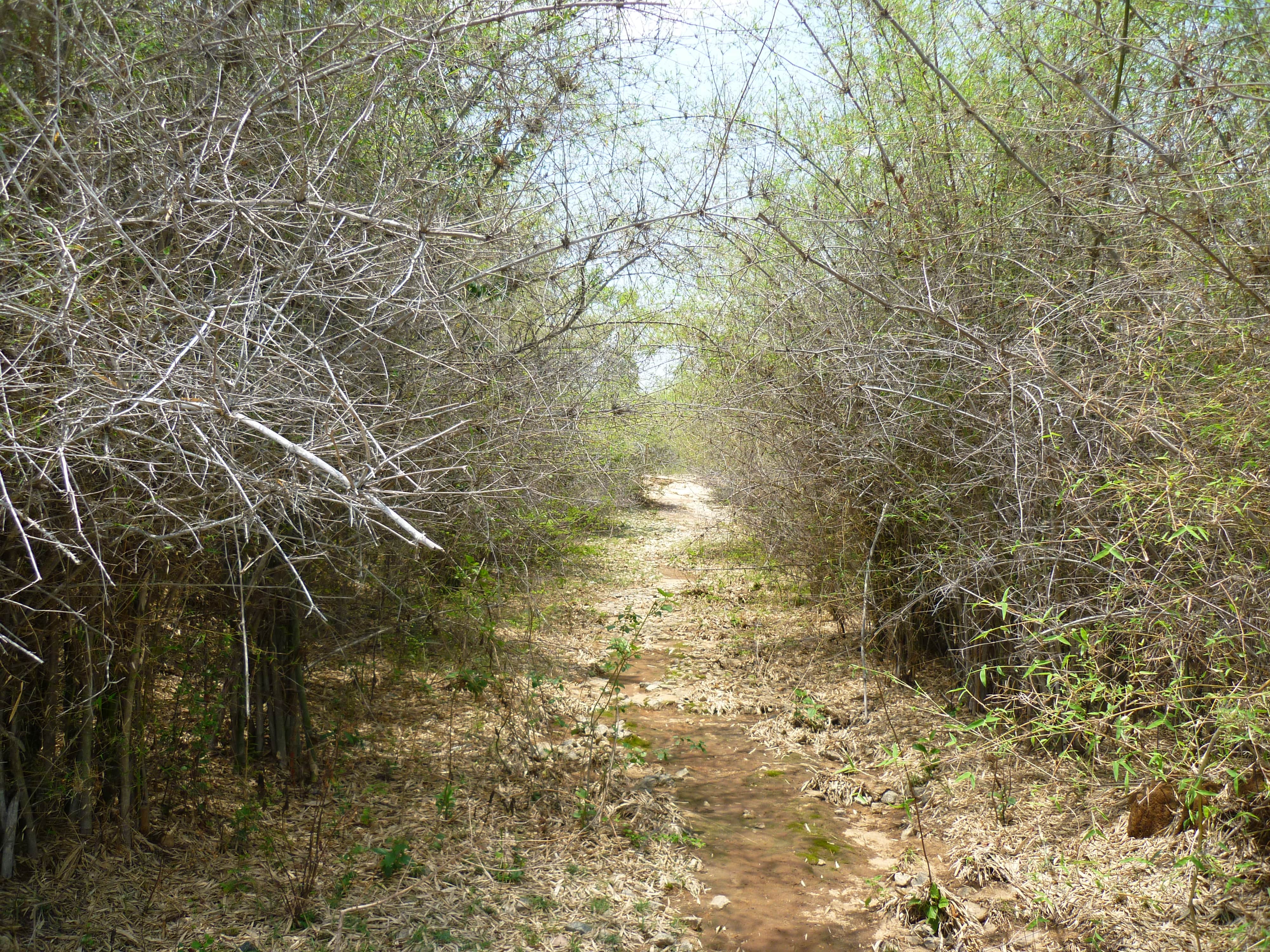
It was a brief hike through the forest terrain which was rough and interspersed with bushes and rocks that lead us to an ancient temple. Along the way, we observed pebbles and stones arranged in circular and a maze-like pattern depicting various complex themes. We were told that it dates to the pre-historic era and represents some kind of tribal worship or dolmens.
Hike trail to Suvarnamukhi temple, Bannerghatta
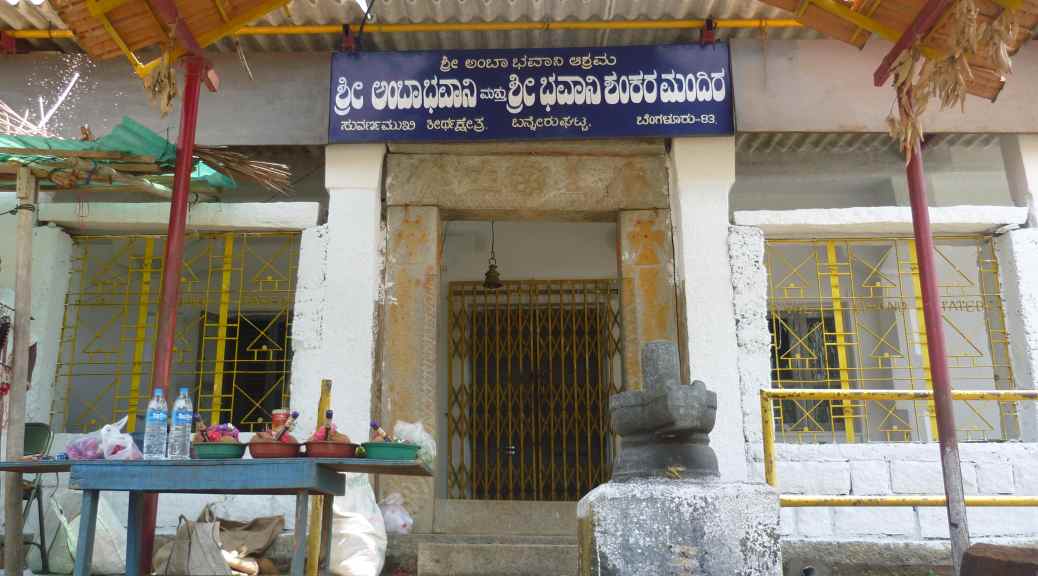
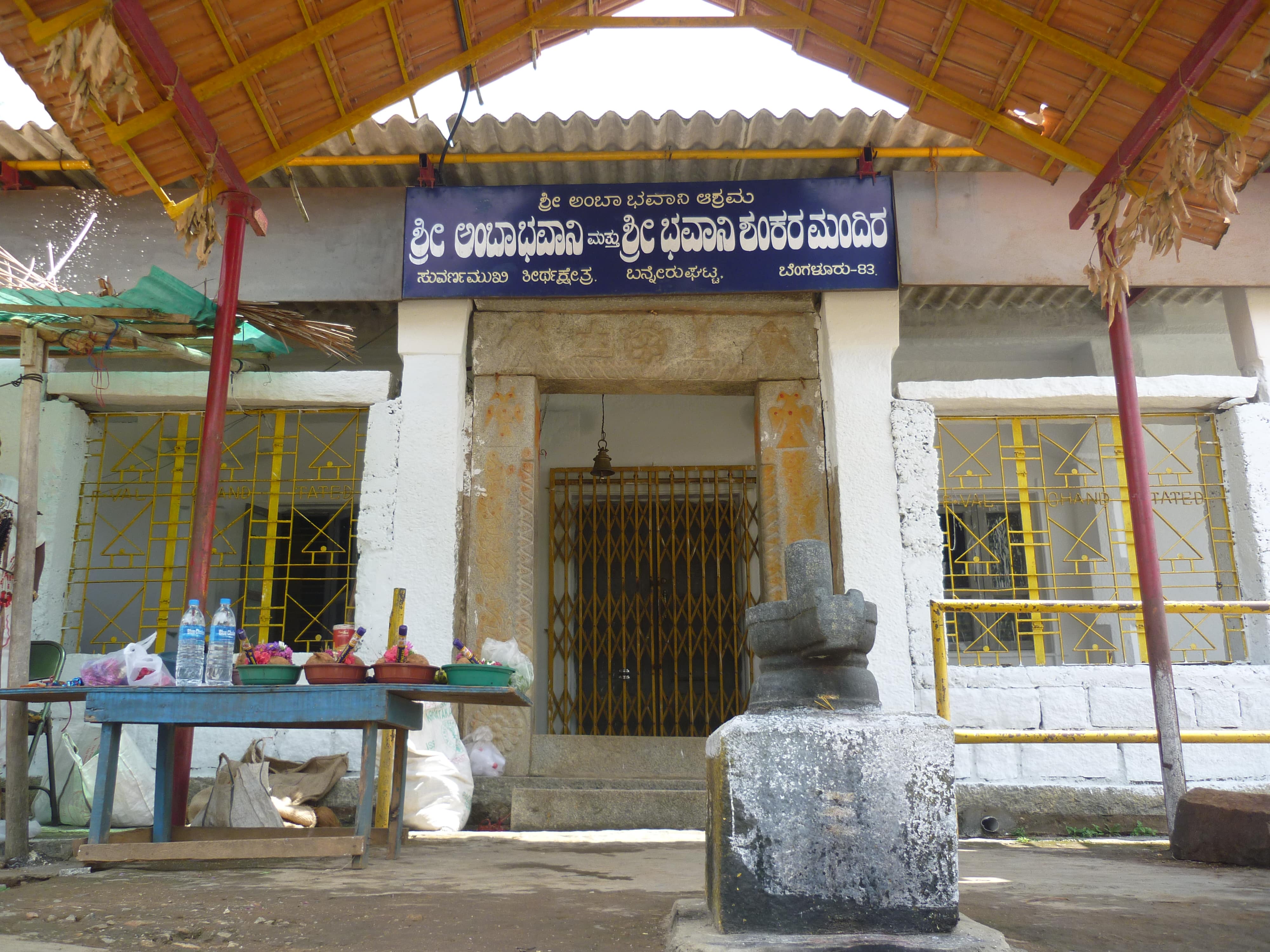
Walking past, we arrived at the AmbaBhavani and SriBhavani temple which was closed at the time. There is a pushkarini / Temple tank in front of this temple whose water is believed to be able to heal skin ailments. I was told that the tank is emptied once a year, to worship a Hanuman sculpture that lays at the bottom of this tank.
Ambabhavani temple at Suvarnamukhi, Bannerghatta
A short walk away from here is the Champaka swamy temple, an important site of local worship. Alternatively, people arriving by own transport can park their vehicles at the Champaka swamy temple before starting their hike towards Suvarnamukhi. The relevance of these temples and the pond in Indian mythology attracts people in large numbers on special occasions to visit this place.
A few meters away from the temple is the Vahnigiri peak, which gives an unhindered view of Bangalore’s expanding skyline. I remember spending some time sitting atop the rocky hill as the wind continued to waft past us before walking back down through the forest.
Things to note:
The entire hike trail passes through thick forest area that will be frequented by wild animals including elephants. This visit of ours was a few years ago when we needed no forest permits. It is recommended to check the latest rules with the authorities for any relevant permits before venturing out all by yourself.
Karnataka is “One State Many Worlds, without a doubt! To explore a different aspect of travelling through this beautiful state, I take you on a path that is en-Lightening, in literal sense- ‘Bioluminescence’. Bioluminescence is a naturally occurring phenomenon of production and emission of light in living organisms. Apart from the visual treat to senses that they offer, the presence of these organisms can tell a lot about our environment as well.
With the Arabian Sea forming the entire coastal belt and the Western Ghats forming most of the green-cover of Karnataka, it is easy to witness bioluminescence anywhere in the state. Traversing a path from the southern rainforests of the state to the northern plainlands through the coastal beaches across all the seasons, here is a list of the different kinds of bioluminescence that one can experience in Karnataka.
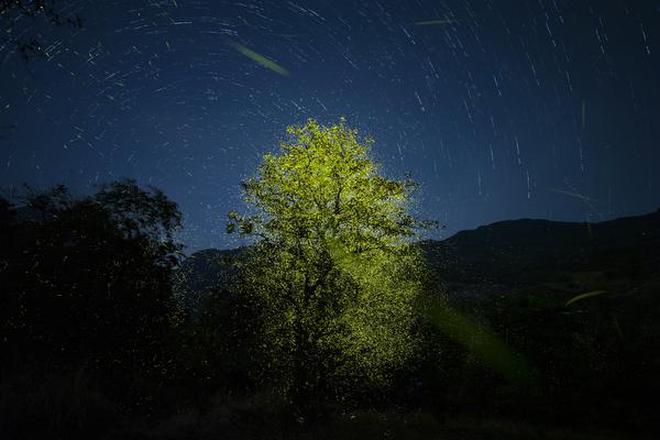
Fireflies: An aerial illumination for spectators, these insects produce light to attract a potential mate. Abundant during the months of pre-monsoon showers and summers, the untouched sacred groves and the organic farms of Kodagu and Malenadu offer a post sunset visual delight. A good number of fireflies indicates the good soil and air quality.
Bioluminescent planktons: These light emitting micro-organisms are present in the sea water. They produce a greenish-blue light when disturbed. This means, they produce light irrespective of day or night but can be seen with normal eyes after dark. These glowing waters can be viewed at their brightest best on a no-moon night between two consecutive monsoon months. But what is not the brighter about it is the fact that the brighter the sea glows due to these planktons, the poorer is the health of the sea water.
Bioluminescent fungi: This can be the hardest find of them all. Enter the core of the rainforest during the peak of the monsoon season, with a slow and careful walk and without use of any torch or flashlights. Only if you are lucky, you can spot these glowing sticks or the fallen barks covered by the glowing fungi. Documented sightings have been found in Karnataka, but I’m sure the Western Ghats are home to more species of luminant mushrooms.
Glow worms: These are larvae of some insects that can be largely found along the banks of streams, rivers and under the foliage on moist ground. An indication of healthy soil, these worms emit light to ward off predators and visually offering a delight to the human eyes.
Have you witnessed any other bioluminescent experiences? Are there any specific place that you wish to share your stories about? Do let me know in comments below!
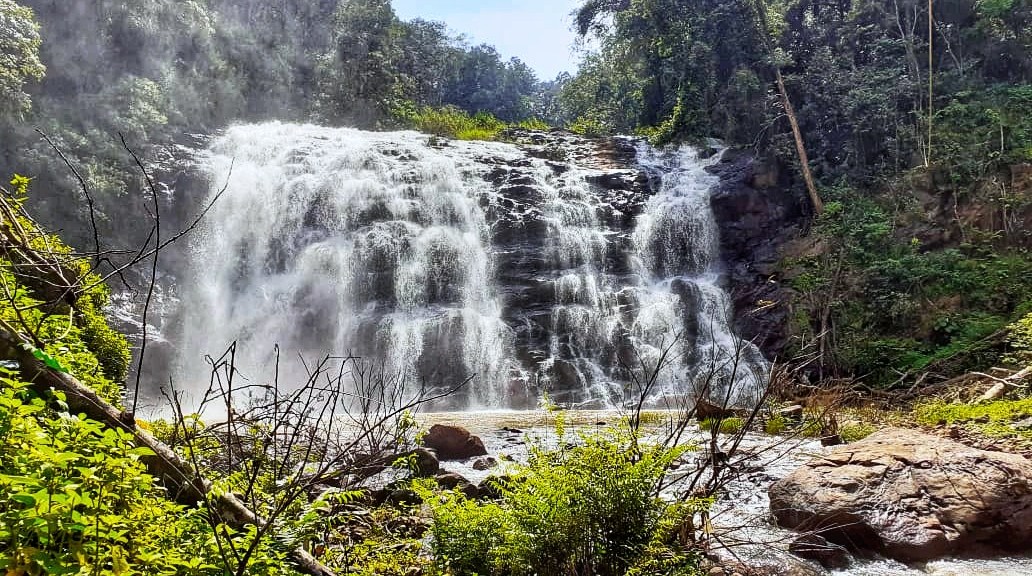
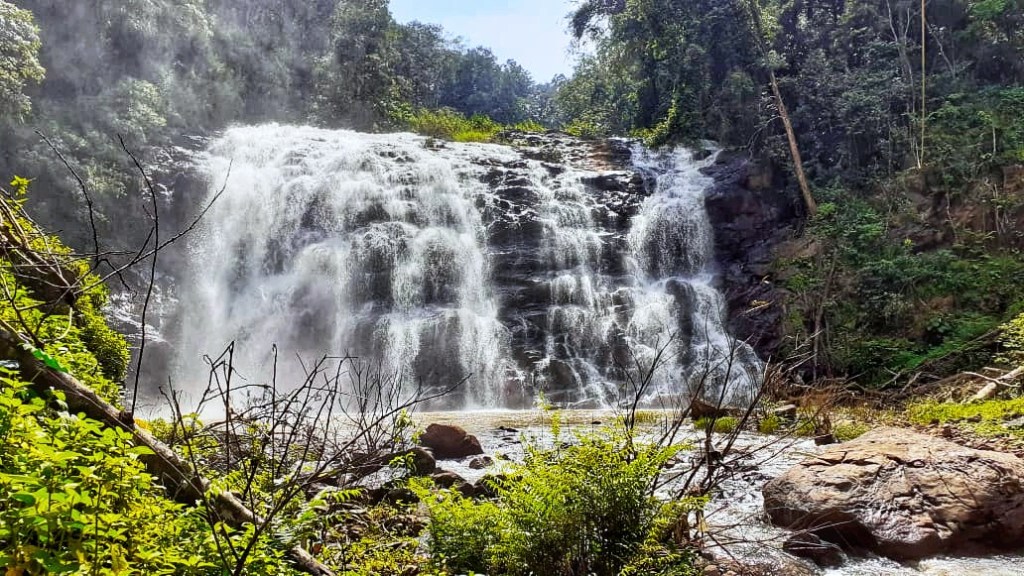
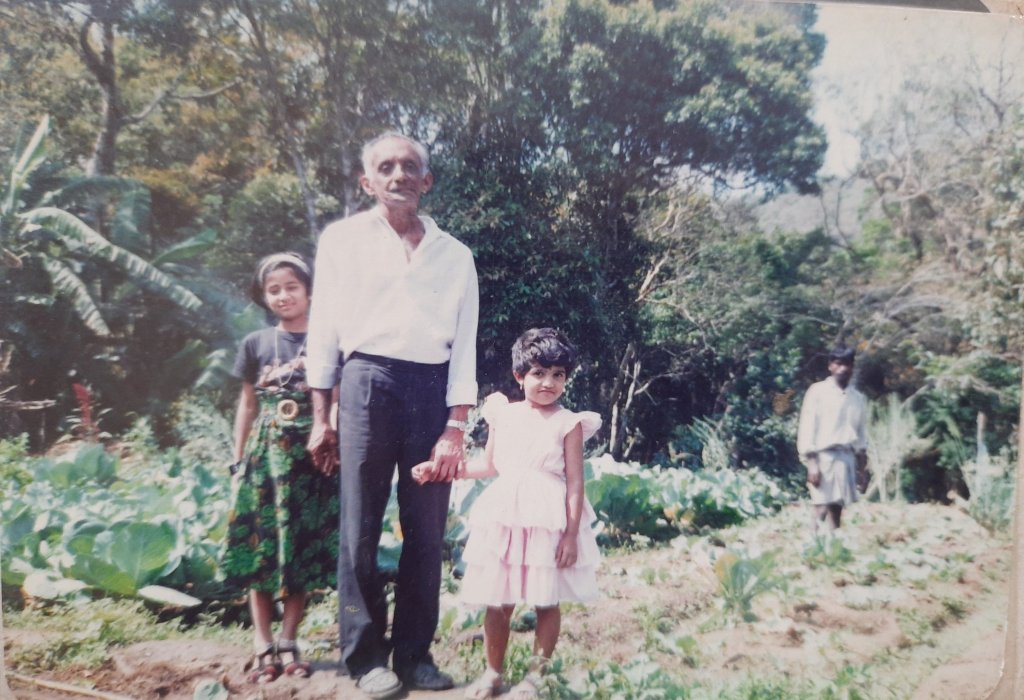
Abbi falls is one of the most popular landmarks in Kodagu, located in ‘Kalakeri Nidugane village’ on the outskirts of Madikeri. This is where the Lostlander was stung by the travel bug, much before she was born! History speaks about Columbus and Vasco-da-Gama, but the lostlander grew up listening to the stories of her grandfather’s adventures of discovering Abbi falls. Those are the very stories that sowed the seeds of seeking adventure and finding her own life path for the Lostlander.
The memories associated with Abbi falls is an endless list, so this post is going to be a photo tour with some old photos of the Lostlander with her grandfather at Abbi falls estate.
Abbi falls, Madikeri
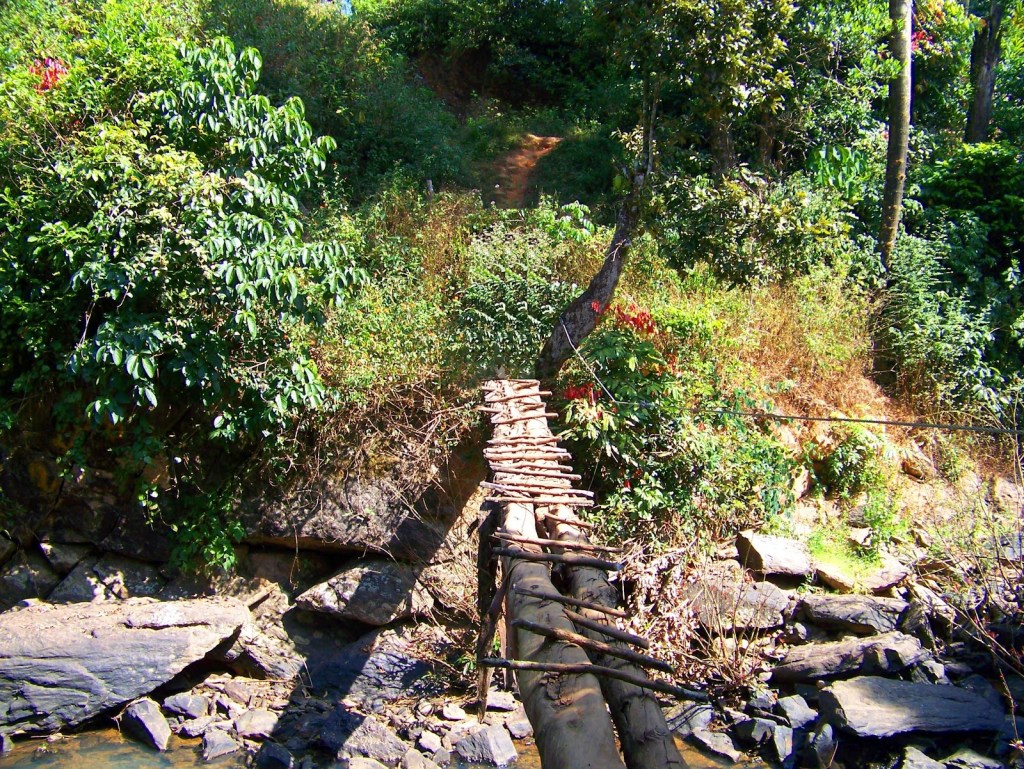
This is a brook built by my grandfather to provide accessibility to the surrounding villagers to get across the river, on the upstream of Abbi waterfalls during the monsoons. It has been replaced by a concrete bridge only in yr.2021, several decades after it was originally requested for. (Click here to read further)
The wooden bridge, upstream at Abbi falls
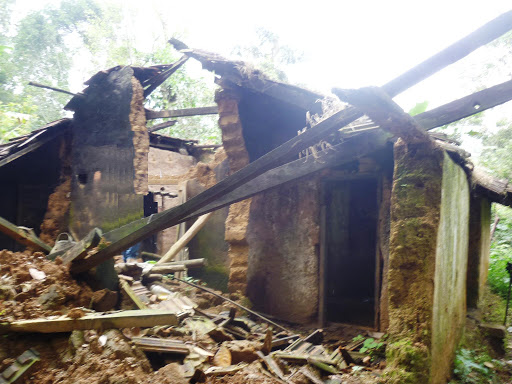
Only memories remain of a house that once served as the heart of the family’s life. (Click here to read further)
The Abbi Villa- Now
In this photo, the lost lander is lost in the vegetable garden, set in the middle of the coffee plantations, overlooked by the beautiful hills of the Pushpagiri ranges. Gravity fed sprinkler jets sprayed water from the stream that was fed by the larger waterfall. (Click here to read further about the LostLander’s love for honeybees).
The author with her grandfather (center) and cousin in the vegetable garden at Abbi falls
I wish to compile a book someday, comprising of all these stories from the life of “My grandfather”. Do share in all your thoughts and any personal stories associated with this place that I will be glad to add them in my book with due credits.
The original plan for this short family outing was to make an early morning visit to Sanjeevaraya Swamy temple in Channapatna Taluk of Ramanagara district and return. But, since my workplace is located along the same route, I expressed my disinterest in traveling that way. I pitched in the idea to have a change of route at least for one-way. Hence, I added a couple of other landmarks, picked up an offbeat village road and created a circuit with aid from google maps.
For those of you who are not familiar with the geography of Karnataka, Ramanagara is popularly known for its Sholay hills that was featured as the village- ‘Ramgarh’ in the Bollywood movie Sholay. Channapatna is popular for its cottage industries of wooden toys. I am not going to write about any of these places, the search engines are already flooded enough! I am going to take you around some lesser known places in Channapatna, for a half a day’s trip from Bengaluru.
We set out on a Saturday morning and decided to have our breakfast on the way. Sri.Renukamba tatte idly (translates to ‘Plate idli’ in Kannada) needs no introduction for the Bengalureans. So, after a filling plate of tatte idly at Bidadi, we proceeded towards our intended destination for the day. To reach there, we had to pass through Kengal, a village popular for yet another Hanuman temple. Moving ahead from there along a small deviation, we arrived at our first major destination: Sanjeevaraya Swamy temple at Devarahosahalli village. This is a small stone structure dedicated to Lord Hanuman and dates back to the Vijayanagar era. The deity is believed to be powerful and hence, we were there to offer or prayers following the recommendations of some well-wishers.
After spending some time there, we continued onward to our next destination, a little cave temple located atop of a hill. The drive, the scenery, the canopy of the majestic trees along the highway was a pleasant one. We stopped by to do some bird watching at the Neelasandra lake as well. We could see Pelicans flocking in large numbers.
Our next major stop came as a rather surprise to us. Gavi Ranganatha Swamy temple was a random destination included in our day based on an internet search result. The drive, the location of the temple, the valley, the village view from the temple porch and the overall scenery was just so stunning and unexpected. There was just no one else in the temple apart from our family and a few local kids playing in the hill, atop which this temple is located. You can watch the video of our visit to Gavi Ranganatha Swamy temple below:
Drive to Gavirangana betta
By this time, the sun was already up and beaming bright. So, we decided to drive back, of course through a different route. We descended the Gavi Ranganatha Swamy hill and took the route that connected to Kanakapura. On the way, we stopped at this beautiful location where the highway passes through green farms on one side, a large lake on the other side and the entire scenery was being overlooked by the temple hill.
Vittalenahalli highway and lake
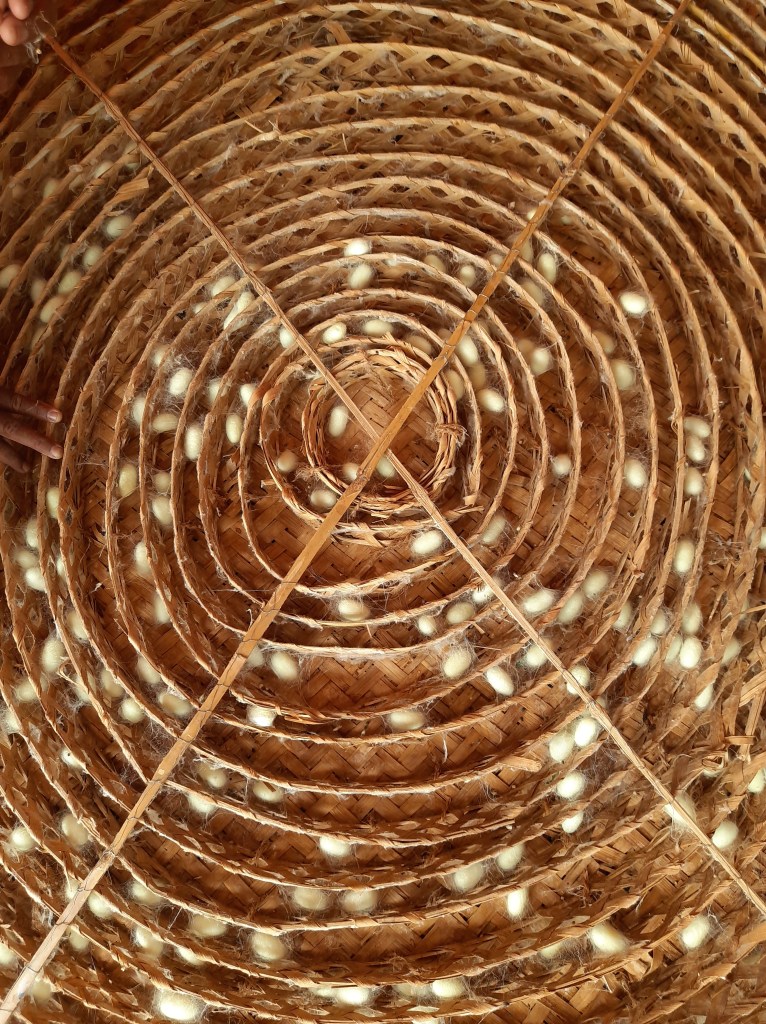
Our drive from there continued through large stretches of rocky hillocks, mango orchards, paddy fields, coconut groves and mulberry farms. Ramanagara is also known for sericulture. Several households in the villages here are involved in silkworm rearing. As we passed through, we noticed that families were sitting out in the verandahs of their traditional houses and collecting the fully grown cocoons from the bamboo trays. We stopped by and walked over to one of the houses on our way and learnt a thing or two about sericulture from them.
Silk Cocoon trays
In a short while, we reached the Kanakapura main road where we had our lunch. Well, it was a late evening lunch before continuing towards home and thus ending a quick trip to the Bengaluru outskirts.
Karnataka is one of the most beautiful Indian states that weave both heritage and contemporary culture together in a beautiful blend. Karnataka is a hub for travellers looking for some adventurous things to do or for globetrotters planning to travel amidst nature. From the strikingly beautiful hill station of Coorg to the ancient ruins of Hampi and from historic Mysore to the tech city Bangalore, Karnataka has never failed to amaze people with its hospitality.
And since this state attracts thousands of travellers each year, one can easily find some amazing resorts right from the budget category to the most luxurious ones. Luxury resorts in Karnataka help you tailor your vacation or work trip just the way you want! The cities have quaint boutique resorts that will make you forget the bustle of the town, and then there are resorts where you can go and have the perfect business meeting. These resorts are some of the best in the State, offering world-class amenities with all the warmth of traditional Indian hospitality.
1. Purple palms resort & spa, Kushalnagar
Purple Palms Resort and Spa is one of the best luxurious resorts in Karnataka. Relax in a magical paradise that makes your greatest wishes come true. Experience the lush green surrounding and serene beauty bounding the resort and witness the beautifully crafted rooms with the bliss of luxury and soothing comfort. Dive down in the swimming pool and fill your day with fun and give yourself a treat by relishing a delicious breakfast with a local touch at Purple palms resort & spa.
Indulge in the luxurious ambience of his amazing resort that makes you feel royal. If you can’t resist the allure of the hills, step out for a regal sojourn. This resort has all that you and your family are looking for a perfect holiday with all the tourist attractions in the vicinity. You may relax and rejuvenate at the Resort’s Spa with Ayurvedic and Western massage that will cleanse your mind and body to make your stay at our resort more meaningful.
2. Evolve Back, Hampi
One of Karnataka’s most treasured gems, Hampi is full of history and serenity. With various rulers reigning over the Vijayanagar Empire, the map of Hampi was designed in such a way that today, it stands as one of God’s blessings to humankind. Offering a spa centre and hot tub, Evolve Back Hampi is located just 4 km from the UNESCO World Heritage Site of Hampi.
Here at Evolve back resort, you will experience the Vijayanagara Royal Style at Evolve Back Kamalapura Palace, Hampi – an opulent palace whose stone-paved boulevards, arched hallways and regal chambers reflect the royal lifestyle of a past but glorious era.
3. The Tamara, Coorg
The Tamara Coorg, a luxury experience nestled in the heart of the hills, is a perfect place where you can rediscover the joy of being in nature, where your quest for serenity will end. Lush greenery, aromatic coffee plantations, spices, beautiful streams, and flowing waterfalls, all experienced in a stunning eco-resort. Your stay at The Tamara Coorg will be filled with uniquely curated experiences and nature-based activities as the resort spans 180 acres and is located over 3,500 feet above sea level where you will experience nature and luxury at its best as you wake up to the breathtaking view and the calming silence of the hills, disturbed only by the chirping birds and the crackle of leaves.
Wake up to the smell of tranquilizer coffee, and enjoy the scenic beauty and try so many activities in the house, and the expert yoga instructor will tailor a perfect session for you. You can even enjoy a private gourmet meal under an open sky at a variety of stunning spots.
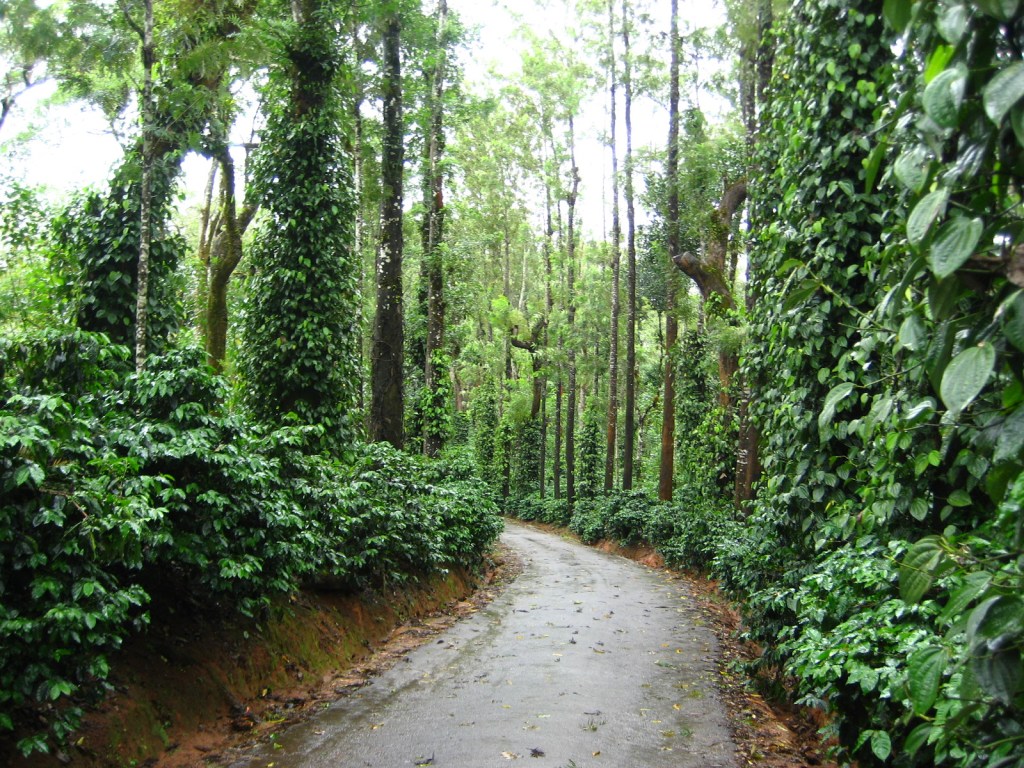
Coorg- Coffee trails
4. Coorg Wilderness Resort
Coorg Wilderness Resort is nestled amid the deep valleys, majestic hills of Coorg and away from the hustle and bustle of the city. Move into the wild and find a distinctive ethos of extravagance implanted in the thoughtful lap of nature. The luxury from this resort with rich European-style masterful rooms and palatial suites that are spread across a large area and allows you to stay in Karnataka luxuriously.
The ambience is so warm, and the air is so cool and cozy, air-conditioning is not required throughout the resort. During romantic rainy days of the famed monsoons and lazy, gentle winters, you will find each room is cozily warmed with traditionally designed electric fireplaces; the facilities and unparalleled quality of services provided by the staff are worth spending your vacation. For adventure and thrill lovers, the Coorg wilderness resort will fill your heart with contentment and excitement through various outdoor activities like trekking, coffee plantation tours, and other adventurous activities.
5. Machaan Plantation Resort, Sakleshpur
The resort is tucked within a coffee plantation in Sakleshpur. Machaan Plantation Resort is ideal for a quick getaway to relax, rejuvenate, and refresh your inner self. Workspace at the resort will help you break free from routine, and your family would also rejoice in a change in environment. Your pre and post-work routine could be a host of activities ranging from estate walks, yoga in the outdoors, visit a waterfall, trekking, evening barbeque, to name a few. The resort has an outdoor pool where you can just lounge all day and enjoy splashing pool water. The sit-outs are ideal for lazing in & enjoying marvellous views of the hills and valley. On a rainy day, one can curl up with a book and a blanket here if you want to be in the room. Then each room caters for the views of hills and mountains, which will refresh you in seconds. A day here would not be complete without a campfire, a bonfire area that gives access to a 360° view of the night sky.
If you are someone who has been following my blogs for some time now, you would know that most of our family trips are on weekends and to random destinations located around the Bangalore outskirts. We leave home with random reasons to drive out and then pick up equally random roads and follow-it till the road reaches a dead-end. We have thus far explored several villages like this. This weekend too was a similar one. And the reason to drive out, you may be curious to know, right?
My dad had long heard of a pig farm located somewhere around Kanakapura road. We had first stopped for lunch at a hotel on Kanakapura road. There, my dad enquired with the hotelier if they knew of any pig-farm around. They informed us that the kitchen waste from their hotel too was collected by someone who runs a pig farm but was unsure of its location. He gave us the possible location of the place with rough directions. After lunch, we headed out in that direction, a deviation before Kaggalipura.
Our drive to Gulakamale lake
With just the deviation, there was a sudden and a contrasting change in the scenery to drive through as compared to the super congested Kanakapura highway. For a moment I felt as if I were driving through some remote lanes of Coastal Karnataka or the Malnad region. There were stretches of areca and banana plantations on either side creating abundant greenery and change in the ambience. Since there were barely any people on the road, we continued to drive till we found some village ahead. By this time, we had covered a good distance and passed through several types of fruit and vegetable farms.
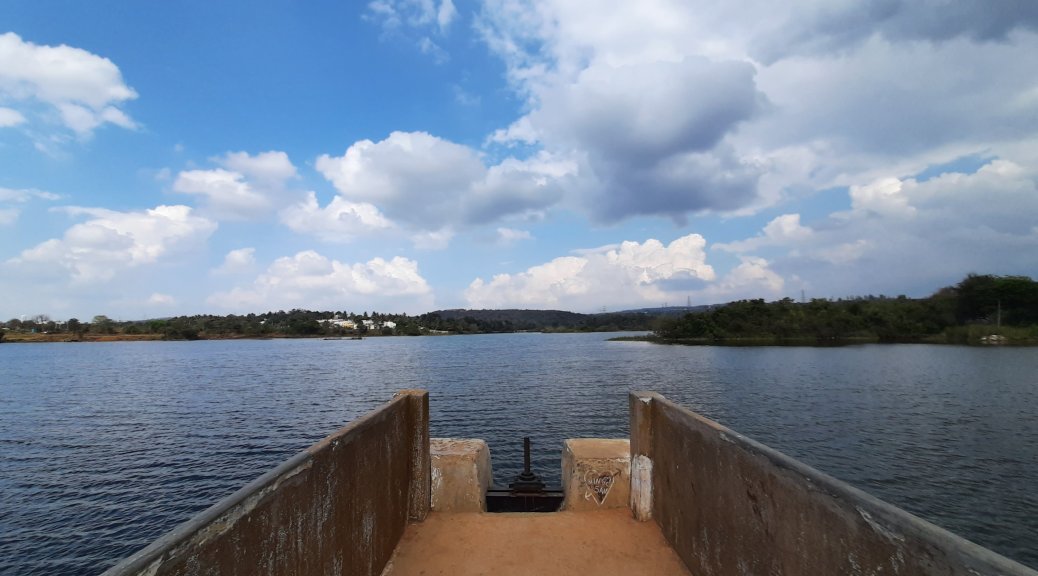
After reaching the village, we stopped by to enquire a villager on the roadside about the farm, he guided us to a pig-farm located next to his farm. But after reaching there, we realized that it was a different one that my dad had heard of and we had no entry into the place where we had now reached. So, we continued our drive further and reached a junction where we had to pick a direction to turn, the left or the right. Instead, we chose to stop the car in a side and walk up a large wall in front of us that looked like a high-rise wall of a reservoir or something. Indeed, it was a lake up there and surrounded by farms and distant hills of Bannerghatta on the other side. A flock of migratory birds too seemed to be resting in a small islet in the middle of the lake. I checked the location on google maps and I learnt that the place was called as ‘Gulakamale lake’.
Gulakamale lake
The water looked so good and we sat there for some time, enjoying the cool breeze even on a hot and humid afternoon. It was just my family in the entire place until we noticed some local kids who arrived there. They removed their clothes and jumped into the lake one after the other, enjoying their fair share of fun time. They took all of us back to our childhood days and it was a pleasure to watch them enjoy it that way.
After a while, we decided to move further on the road. This time, we chose to take the road to our left and continued at it. We passed through millet farms, taking a round about of the same lake, papaya farms and other vegetable farms before arriving at a village called ‘Nallakkanadoddi’. It was a small settlement with nothing noteworthy to see or do. Hence, we went ahead as we saw that the road was newly laid and in good condition.
The road reached a dead-end and that was the parking lot of ‘Tottikallu falls’ commonly known as TK falls among the urban crowd of Bangalore. This was the second time for me that I had reached the entrance of TK falls, both times an unplanned drive had taken me there. Again, I decided not to go there on both occassions given the large crowd that had come down over the weekend. More so, given the Covid-19 situation and the crazy crowd this time, we didn’t even dare to step out of our car. So, TK falls has to wait until next time. From here, we decided to head back home and not stop anywhere on the way. Thanks to the weekend rush on Kanakapura road, we would need good number of hours to make our way back through the traffic.
The standard itinerary with PTU: Day 1: Depart from Bangalore (Leave HSR layout) by 08.00.p.m. Day 2: Reach homestay by 06.00.a.m., freshen up and start the hike by 09.00.a.m.; Return to the homestay by evening Day 3: Visit Nagara fort enroute home, reach Bengaluru by evening.
The story of my weekend: A total of 16 people including two trek leaders were supposed to board the bus at various pickup points across Bangalore. While HSR layout was the first pickup point, the last and the biggest bunch of people were supposed to board at Mekhri circle. When the driver cranked the engine to leave HSR, the last member boarding the bus noticed that a rear tyre had a flat. So, it needed to be changed and the punctured tyre required to be fixed before proceeding for the long journey. After about an hour, the stepney was replaced and the bus arrived at the second stop.
People boarded and the Bus… did not start. This time, the battery had drained, completely! A mechanic arrived in a while and told that it could not be topped up and needed a replacement. Well, it was another good couple of hours until the bus finally left…. With an assurance from the ‘travels company’ assuring that there won’t be any more breakdowns.
Meanwhile, I had taken an autorickshaw to reach Mekhri circle to hold up all the people who had arrived there. The co-leader managed the people who had already boarded the PTU bus. Most of them being first timers on their solo travel, their growing anxiety with the extending delay in the tour was quite a challenge to clarify all their doubts and questions. It was 00.30.a.m. by the time the bus finally arrived at Mekhri circle instead of the scheduled 09.30.p.m. We quickly wrapped up the initial welcome and introduction that usually takes a while on normal trips. Everyone needed some sleep before climbing up the Kodachadri trail.
It was approximately 01.30~02.00. a.m. and the bus had reached somewhere around Sira town. Then suddenly, everyone in the bus woke up for a LOUUUD thud noise. The driver stopped the bus. I walked to his cabin and got down with the driver with a torch light to check what the issue was. The driver found a broken bolt under the bus, near the engine room. The radiator had started to leak profusely, and the engine belt had ripped off. The driver informed me that there was no way that the bus could move. Trying to find a mechanic in the middle of the night would only be futile. The options we had was to find one back in Nelamangala (this would take a good few hours) or wait in the bus until morning, find a mechanic in Sira, find spares, get the bus fixed and then proceed. Proceed further to Kodachadri or return to Bangalore. In either case, Saturday would be gone. We pushed the bus to the side of the highway and decided to take time to figure out the next POA (Plan of Action).
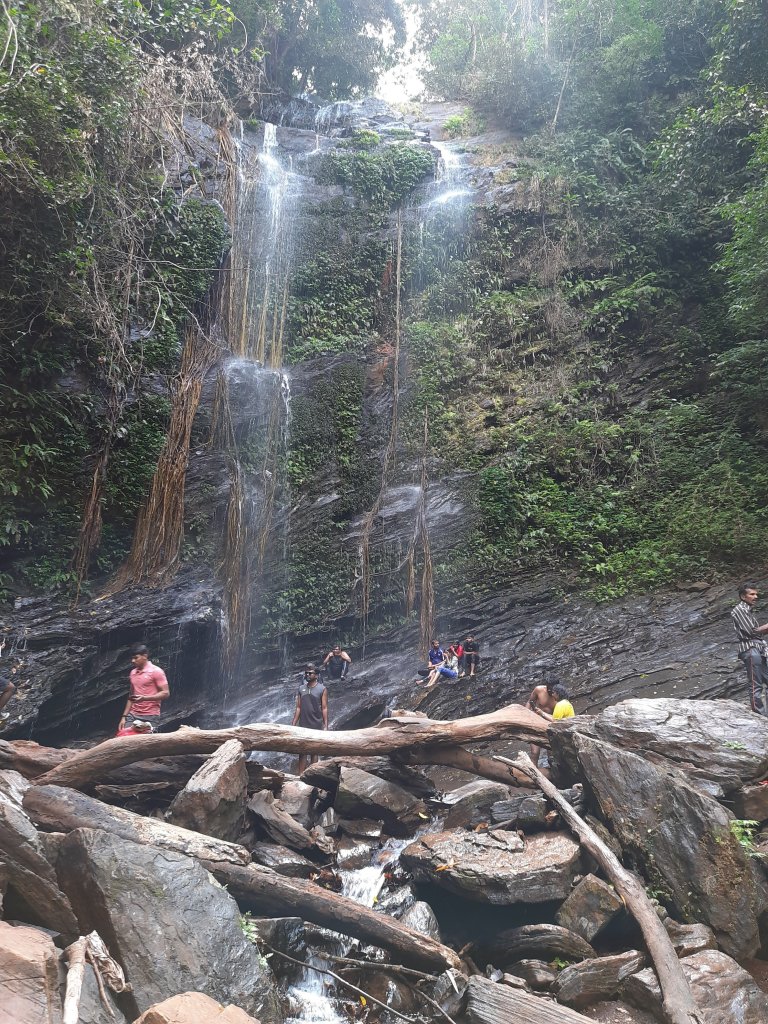
Hidlumane falls
I called up the PTU organizers and informed them of the situation. We were fortunate to find a chaiwala (petty Angadi), the ONLY place with light and people movement in the drop-dead night. The people in the bus got down and occupied themselves with their dose of mid-night chai and smokes until we figured out an alternative. None of them would settle for a full refund and wanted PTU to ensure that they got what they had signed up for.
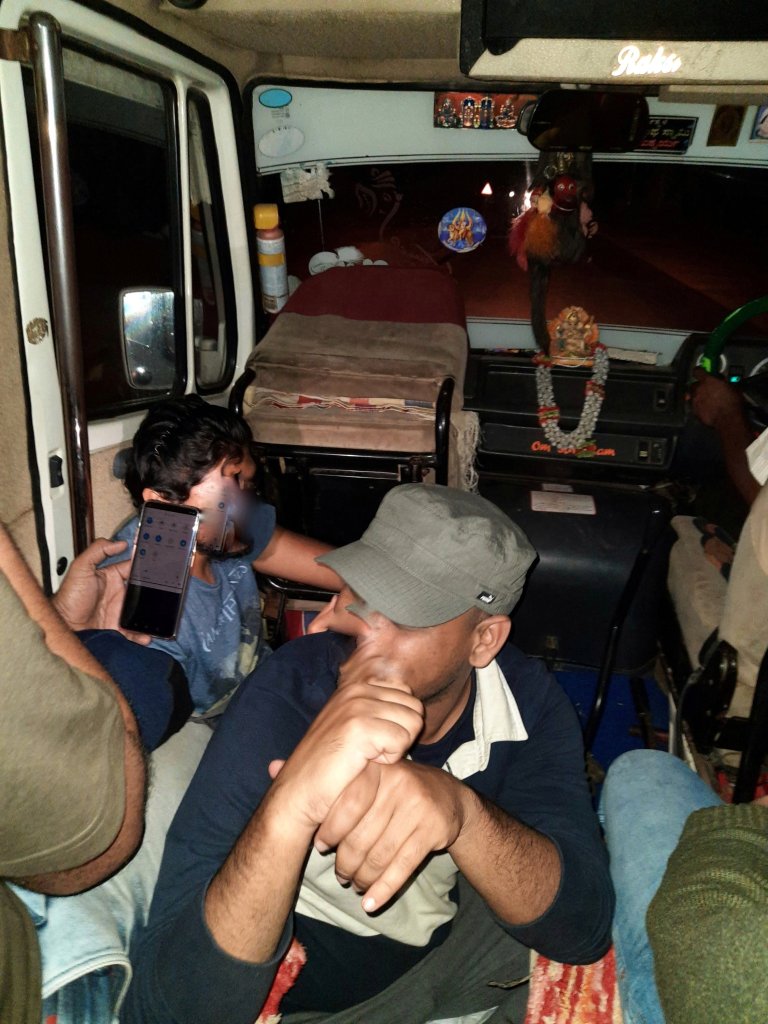
It was a weekend. It wasn’t going to be easy to find an alternate bus or a TT (Tempo Traveler). While my co-lead was waving at every other bus that came on the highway (both KSRTC and private buses) to check if there were empty seats, I was calling up every random travel company listed on google and checking for availability of buses. Either they were all booked for the weekend or people would just abuse me for waking them up in the middle of the night and hang up. To add to it, I was the ONLY person in the entire bus who could speak Kannada. So yeah, I literally had to manage the show and all the translations, communications and co-ordinations. Finally, one KSRTC bus stopped! They had sufficient seats to accommodate all of us as well. But we had a new challenge. The travellers with us had ganged up and would not agree to board a red bus (Karnataka Sarige bus). All requests to convince seemed futile and we let go off the KSRTC bus. After a total of about an hour, the chaiwala managed to find us a localite who had agreed to come with us for a per kilometer charge that was double the normal price. PTU organizers agreed. The TT arrived. Next challenge? It was a 12-seater TT, we were 16 in total. We, the leaders convinced ourselves to sit on the floor of the ramp between the two rows of seats and another 2 travelers volunteered to fill the already crammed space. Ensuring that everyone else got a comfortable space, the journey continued. Fortunately, we had no more surprises and we reached the homestay by 09.30.a.m.
That’s how we rolled, in our TT (Faces intentionally blurred)
We took time to freshen up, have breakfast, get the forest permits for the trek and finally started our ascend by 11.00.a.m. All went fine, by god’s grace. This was my first PROPER trek in Kodachadri, the previous one was another adventure worth a read. We climbed up the Hidlumane waterfall, arrived at a local house enroute to have a surprise Majjige (buttermilk) stop, crossed paddy fields, areca and banana plantations, Mookambika temple and finally arrived at the peak marked by the Shankaracharya Mantapa. The landscape and the entire path were unrecognizable for me from what I had seen on my previous visit. It was now exploited and overdone by tourists. There were a few hikers who felt exhausted and wanted to give-up halfway. But as a trek leader, it was my personal obligation to ensure that EVERYONE completed what they had signed up for and no one stayed back without some safe company. Finally, everyone made it to the peak, and it was now mission accomplished. Well, only partially!
The real deal was in the descend. We had a 4×4 ride awaiting us for our return. It is one that is BEYOND explanation and you only hold on to the roof bars hoping that you don’t have a few broken bones or dislocated joints by the time it ends. There is NO road, only a slide down a ditchy/bumpy gradient path. This 4×4 jeep ride alone supports the livelihood of several people around the area. Hence, the localites aren’t letting a road happen even if the government wants to develop this important site of tourism (we were told so by one of them). So, if this ride is considered as an adventure and a source of employment, then you can imagine how memorable this experience must be, right?
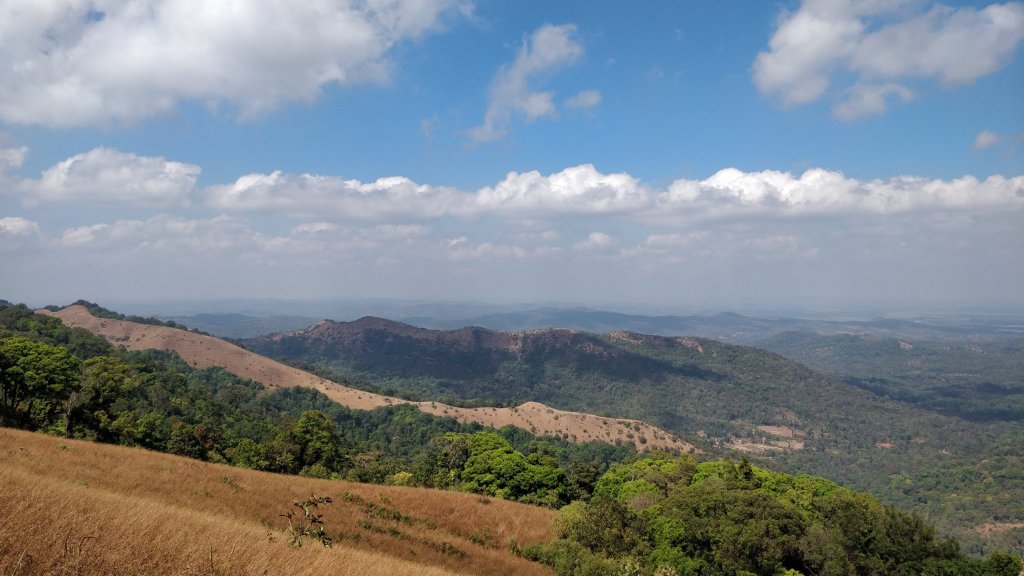
The view after reaching the keep trail
Well, in spite of all the delays and breakdowns, it gave me a sense of achievement by the end of the day for having met the itinerary. Though we paid late exit fine at the gates, this was a PTU experience in its true sense. More adventures to come, until then- Keep tripping…. Plan the Unplanned!











 The Lost Lander