Tag Archives: Hornbill festival

The Povvadi Namme of Ibbanivalavadi

It was back during my school going days, that I had an opportunity to visit the Haleri (Paaleri) Bhadrakali temple in Madikeri taluk. I was especially intrigued by several antlers hung on the wooden beams through the length of the temple verandah. Upon enquiry, the temple priest fed my curiosity by letting me know that the antlers are used during the temple festival to perform ‘Kombaat.’ Kombaat is a word derived as a combination of two Kodava words, Kombu (antler) and Aat (dance). It is one of the ritualistic dances performed during temple festivals of Bhadrakali, a local deity of Kodagu. Ever since then, I was trying to get details or the schedule to witness one of these festivals where Kombaat is performed.

Finally, it was in the year 2024 when my friend informed me that the Povvadi festival at her native village was scheduled to be held in April. After a long wait, I had finally arrived at the ‘Kaitale’ (ground) attached to the ‘Bhadrakali temple’ of Valavadi village. ‘Ibbani’ and ‘Valavadi’ are two sister villages in Madikeri taluk. The annual temple festival is hosted by each of these two villages on alternating years at the Bhadrakali temple premises of the respective village. This year, it was the turn of Valavadi villagers to host this festival. There are eleven clans that are the original inhabitants of Ibbanivalavadi. Therefore, they take precedence in the conduction of the overall festival.

Bhadrakali, also known as Bhagavathi or Povvadi, is a local deity worshipped in every village of Kodagu with dedicated temples. The annual festival celebrated in her honor is the Povvadi festival. There are several native communities in Kodagu and each of these members have their own significant roles and responsibilities to be performed at these festivals.

‘Maadayi Kaavu’ is a Bhagavathi temple located in the Malabar region of Kerala. It is believed to be the Aadi Neley (primary destination) from where the deity took station at several places across Kodagu. Among these places, is a group of temples called as the ‘Elu Neley’ (seven station) Bagavathi located across the northern and western parts of Kodagu. This group comprises of one brother- Appangeriappa at Kaatakeri and six sisters, namely- Poramalenaad Povvadi at Galibeedu, Karavale Badaga Povvadi, Paaleri Povvadi, Ummeti Povvadi at Makkandur, Kedakal Povvadi, Ibbni and Valavadi Povvadi at Ibbanivalavadi

Peeli aat

The beginning of the festivities is marked by a ritual called as ‘Kett boovo’. Thereafter, none in the village is allowed to consume non-vegetarian and alcohol over the next fifteen days. The festival is celebrated towards the last seven days with specific rituals on each day.

Kombaat

On the first day, the Ooru-thakka (Village-keepers), Deva-thakka (Keepers of the temple administration) and Bandara-thakka (Keepers of the temple’s valuables) all arrive in a grand procession, carrying the Bandara-Potti (Donation box) and the jewelry for the deity from its treasury to the temple. This marks the beginning of the festival. The people are accompanied by the music of the ‘Dudi’ and ‘Poda mani’ kott (traditional percussion instruments). There are noteworthy rituals like the Boad kali, boad aat etc. among others.

There are other rituals performed over the next three days. The fifth day is the most interesting as several traditions unique to the ‘Elu Neley’ Bagavathi temples can be witnessed. The day began with ‘Kadi-aat’ followed by a ritual called Aangola-Pongola. It is performed by married couples as an offering to the goddess after their prayers for having children are fulfilled. The vow is fulfilled by their kids by cross-dressing in a wedding ceremonial attire any time before they hit puberty. A son dresses up as a traditional bride (Pongola) and a daughter wears a groom’s costumes (Pongola) as the family together offers their prayers to the Goddess.

Kombaat

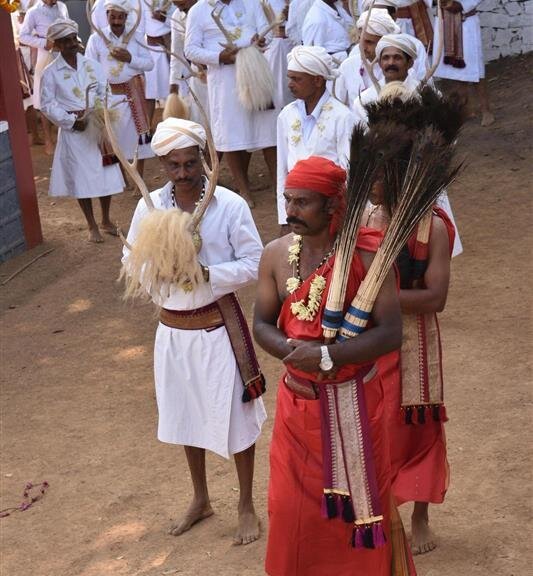
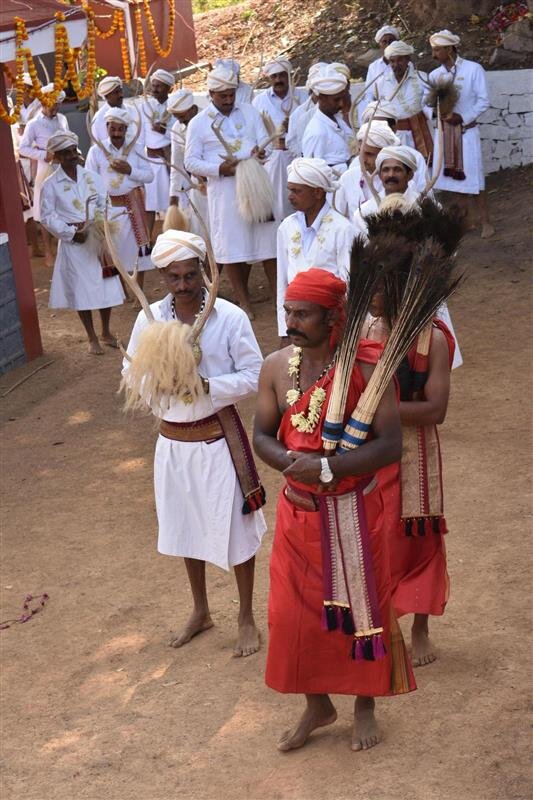
Then, all the men of the native clans get dressed in ‘Boltha Kupya’- The white robe worn only on auspicious occasions. They then hold a bundle of peacock feathers (peeli) in their hands and perform a rhythmic dance to drumbeats in a circular formation around a ‘Kutthi bolcha’ (traditional lamp). This dance is called ‘Peeli-aat’. Post the performance, the crowd dispersed from the kaitale and gathered around the temple.

Here, the men in white kupya again perform the Kombaat to the beats of the traditional drums and Valaga (traditional wind instruments played by the members of the Meda community). Along with the ‘Ajjappa,’ (a person possessed by the spirit of ‘Ajjappa’, another local deity), all the other men in white Kupya circumambulate the temple while dancing with the Kombu and Chowri (a cluster of yak hair).

After that, all the villagers gathered to offer bandara to Ajjappa and Bhadrakali. After everyone had finished offering their prayers, they then went back to the podium with a spirit that was competitive. Competitive, because the next ceremony was like a competition of sorts. All the native clans of the village competed against each other in a coconut shooting competition. Three coconuts tied to a distant high pole were to be shot at as targets. It was a fun event to end the day of festivities.

After the sun went down, the men came together in an area nearby to the temple to offer animal sacrifice to the deity. Women are not allowed to this space. The food is then distributed among all the village folk.
Povvadi Namme, Kodagu

On the following day, there is a similar celebration with Kombaat and Valaga, but on a smaller grandeur. on the seventh day of the festival, a pooja is offered to the goddess by all the thakkas, before returning the bandara potti and the temple jewelry to the treasury. The last and the final day of the fortnight long festival was marked by a ‘Kalasa Pooja’ offered to the goddess before drawing curtains on such a beautiful festival until next year.

Disclaimer: The purpose of this article is for documentation of lesser known festivals of India. The above information is only based on what I could gather by discussing with people who had come together at the temple. My apologies for any wrong representation. Readers are welcome to contribute any information that is deemed important and useful to be shared here.

This post was featured  on 24-Oct-24 edition of ‘Spectrum’ in Deccan Herald National daily.

The Folk Musical Instruments of Nagaland

It is that traveling exposes one to a multitude of cultures and people. The diverse geography of India is home to some of the most unheard traditions and untold folklores. During my 10 day stint of backpacking in Nagaland, I was introduced to so many of it all, as this little Indian state, tucked in the far North-east is home to more than 17 tribal sects and sub-tribes; each having their own culture, language, traditions and cuisine. Here, is a small list of indigenous musical instruments used in the folk culture of the Nagas.

Mrabung:

Mrabung is an indigenous musical instrument of the Zeliang Nagas. It is a single stringed instrument that is crafted with a hollow/ cured bottle gourd and a fretless wooden neck of about 12 inches long. It is played with hair string bow (Usually a cluster of horse tail tightly tied together to two ends of a thin wooden stick). This bow is used to strike the chords (like a violin) with one hand and the string along the neck is pressed down with the other hand at appropriate places to get the required tune and legato of the song. It is played during merry making in social gatherings and festivals where men and women congregate. I was narrated with a popular folklore of the Nagas wherein, a singer called Arum played the Mrabung. His music captivated the farmers so much that everyone working on the field left their work undone and sat around Arum listening to his songs. Arum had to be barred from playing any songs further just so the people went back to work on their farms. Click below to see an artisan playing the Mrabung.

Atutu:

The Atutu is a handcrafted bamboo trumpet used by the Pochury tribes of Meluri. A particular variety of bamboo is used in making the varied components that are fitted together to make this crafted trumpet. It is played to mark special occasions. For example, blowing of this trumpet towards the end of February means to herald and announce the advent of the Nazhu festival. Also, the male members of the tribe play it in their morungs in the evenings throughout the festival. Apart from this, the trumpet sound is used to ward off birds and animals from the rice fields and prevent from crop damage. In earlier days, trumpeting was a way to alert the collective habitat or a village of a possible enemy attack or as a signal of declaration of a war.

20191204_1102368093835930586387810.jpg
The Atutu: The bamboo trumpet

Dholak:

This common musical instrument has its own version and avatar in every region of India. Be it weddings or festivals, it is the most common and almost an essential part of any merry making in Indian celebrations. Similarly, each tribe in Nagaland has its own version of the dholaks or the Indian hand drums. Made with an outer casing of wood, laced tightly with cotton strings and the drumming surfaces made with the locally available materials, more often animal hide. Here are samples of the dholaks used by the Garos (Long slender shaped, narrowing at the ends), the Mech Kacharis (fatter and shorter than the Garos) and the Aao tribes (Shorter and fatter than the previous two types and Uniform sized throughout its length) of Nagaland. (Click the below link to watch the ceremonial dances of the Naga tribes with their dholaks)

This is my humble attempt at documenting some unique musical instruments that are lesser known to the world outside North-east India. These have been listed based on my actual experiences and interactions with the Nagas during the hornbill festival-2020. If you know any such unique musical instruments, please do share in the comments section below. I would be happy to learn it from you 🙂

The coldest place with the warmest hospitality- Pfutsero

This post is part of my fortnight long backpacking in the north eastern state of Nagaland in India, specifically covering Dimapur- Kohima– Phek districts of the state during the Hornbill festival.

More often than always, the stories we carry back from our travel are about the people we meet and less about the places we see. Our definition of whether our trip is good or bad is defined by the way we are made to feel by the people we come across. My experience in Pfutsero too has been one of those, where the warmth of the people made me fall in love with Nagaland. All I knew about Pfutsero was that it is the largest town in Phek district, and it is the highest inhabited place in the state of Nagaland. High altitude also means that it is the coldest place in the entire state. Having very little information available on the internet only meant that the place is still off the radar of mainstream tourism. This is what got me inquisitive and itched me to visit Pfutsero which would give ample scope to explore and experience something so raw and unknown to the outside world.

From the day I arrived at Nagaland, I had started to talk to a lot of people to get information about getting from Kohima to Pfutseru. With lack of clear information and high cost of travel, I had almost dropped the plan until the end of my 10-day trip in the state. One last try at finding a cheaper travel to Pfutsero, landed me in a small grocery store at Kezekie taxi stand in Kohima. My friend and I realised that we were at the right place. The courteous owner of the store guided us with all the required information and got our seats booked in the shared taxi that plied from Kohima to Pfutsero the next morning.

My itinerary to explore Phek district:

Day 1: Leave from Kohima to Pfutsero (shared taxi), visit Glory peak (Frozen lake trek if time permits), explore Pfutsero town (Night’s stay at the tourist lodge)
Day 2: Chida lake/ Lowho, Lazami village (spirited stone), Kami village view point, return to Kohima.

Video of the view from Glory peak

The Details:

As instructed, we had reached Kezekie by 07.00.am. the following morning to be assured of a seat. But thanks to the traffic, it was 10.30.a.m. by the time we left Kohima. However, there was one ambiguity before leaving for Pfutsero- We hadn’t booked a hotel at Pfutsero for our stay yet. Despite several failed attempts of calling the mini-tourist lodge at Pfutsero, their phone continued to remain switched off. But my friend and I were up for some adventure and decided to travel without a confirmed stay, go there and find one.

Phek district is inhabited by the members of the Chakesang tribes in majority. With the friendliness of the grocery store owner, we had already started to feel the positive vibes of the place we were going to. She had given the contact information of her family who lives in Kezakeno, another village in Phek. She had not just shared the contact info, in fact forced us to stay with her family. We were feeling grateful and partially sorted in the eventuality of not finding a hotel at Pfutsero.

Day 1:

There were both good roads and no roads, all adding up to a patchy drive to Pfutsero. Apart from the mountainous roads that seemed charming outside, the people with whom we shared our drive made our trip indeed a memorable one. One of them helped us to contact the tourist lodge and confirmed our stay at Pfutsero even before we reached. I had clearly started to feel overwhelmed with the hospitality of the people in this part of the country where the locals wanted to make all visitors feel at home. Almost everyone whom we got talking to, was excited to invite us over for a meal with them. Finally, it was 02.00.p.m. when we reached Pfutsero and a cup of hot tea was what we relished at our co-passenger’s house before checking-in at the tourist lodge. A colourful garden welcomed us into her wooden house that was perched on the slope of the hill. Its windows opened out into a majestic view of the entire town and overlooked a lake surrounded by green lawn. The dreamy house seemed to be no less than out of a Bollywood flick. We soon bid her a warm goodbye and headed to the tourist lodge, freshened up and proceeded to the target destination, before the sun called it a day!

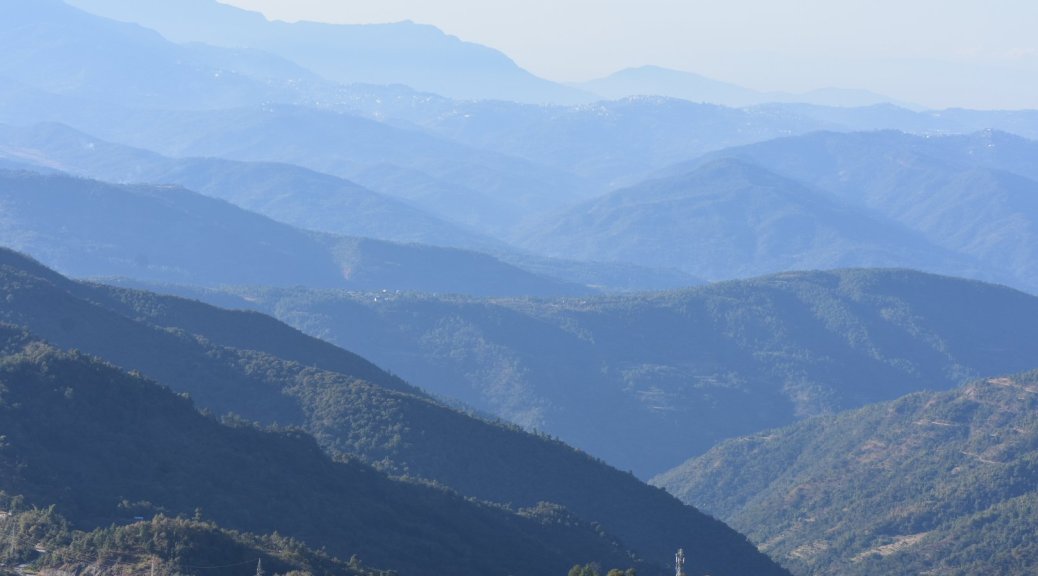
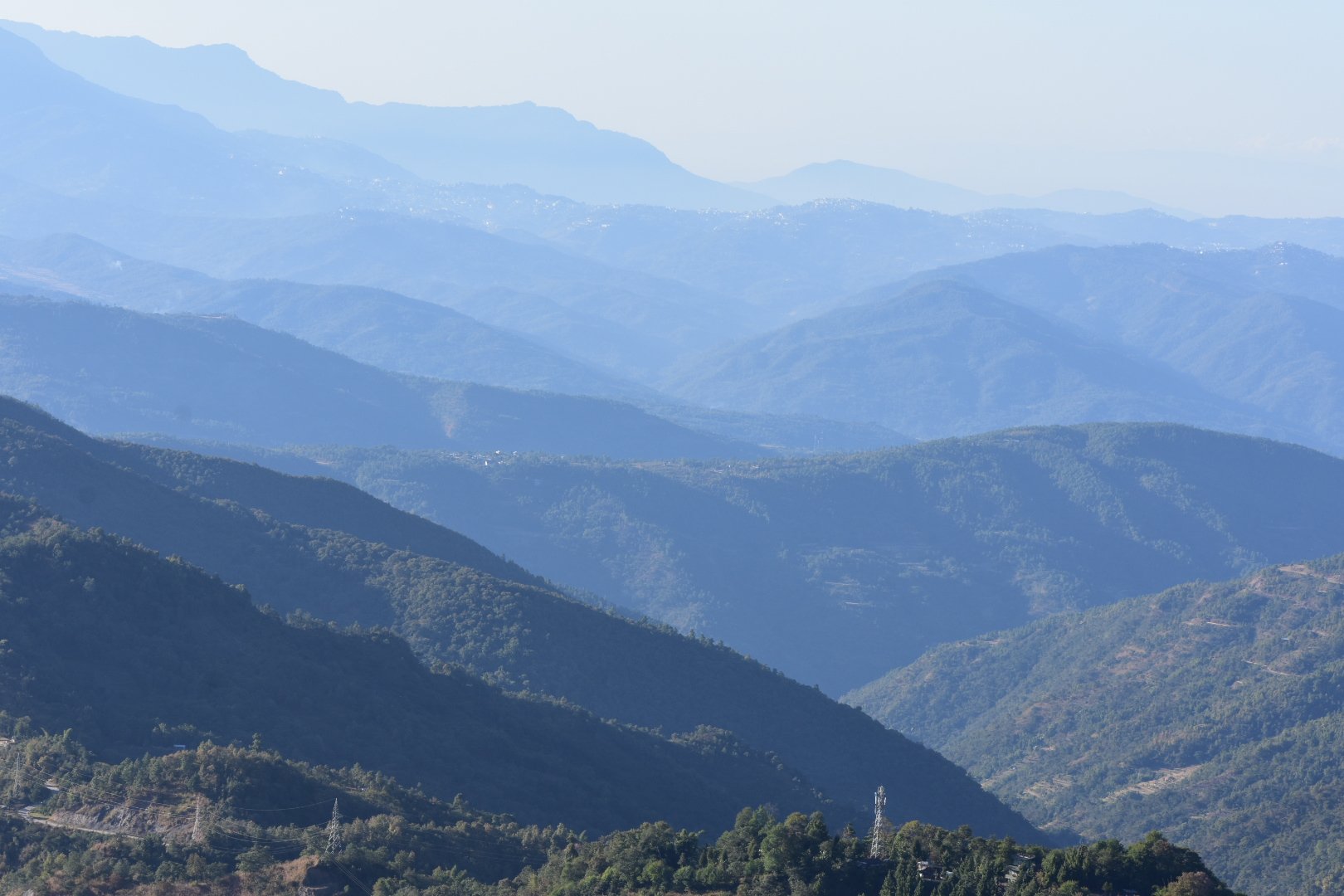
Glory peak is the highest point in Pfutsero. A short taxi ride of 3kms through an under-construction road, jaw-dropping view of the surrounding valleys and a climb on a watch tower got us to the top of the town. Mt. Saramati is the highest peak in Nagaland and Mt. Everest needs no introduction. On a clear, bright afternoon, both the mountains can be seen from Glory peak. Since, we had reached there before sunset, the distant mountains were partially hidden by the haze and hence we could get a clear view of only Mt. Saramati. Nevertheless, the 360deg view of verdant hills from the glory peak was something to die for.

dsc_03735231748998416964061.jpg
View from Glory peak, Pfutsero

For those who have an additional day at hand, a day hike to the frozen lake from the glory peak is highly recommended by the locals. We decided to explore the town a little bit, before it was dark. A hike down the peak was fun as the staircase leading to the town passed through thick forests, strange creepers and colourful butterflies. We spent time exploring the town until sunset. It seemed dusty with poor roads. Apart from a few local snacks, we couldn’t find anything interesting. However, there is one souvenir shop run by an NGO that supports local artisans. One can buy some traditional Chakesang tribal jewellery, textile and food products as souvenirs from here.

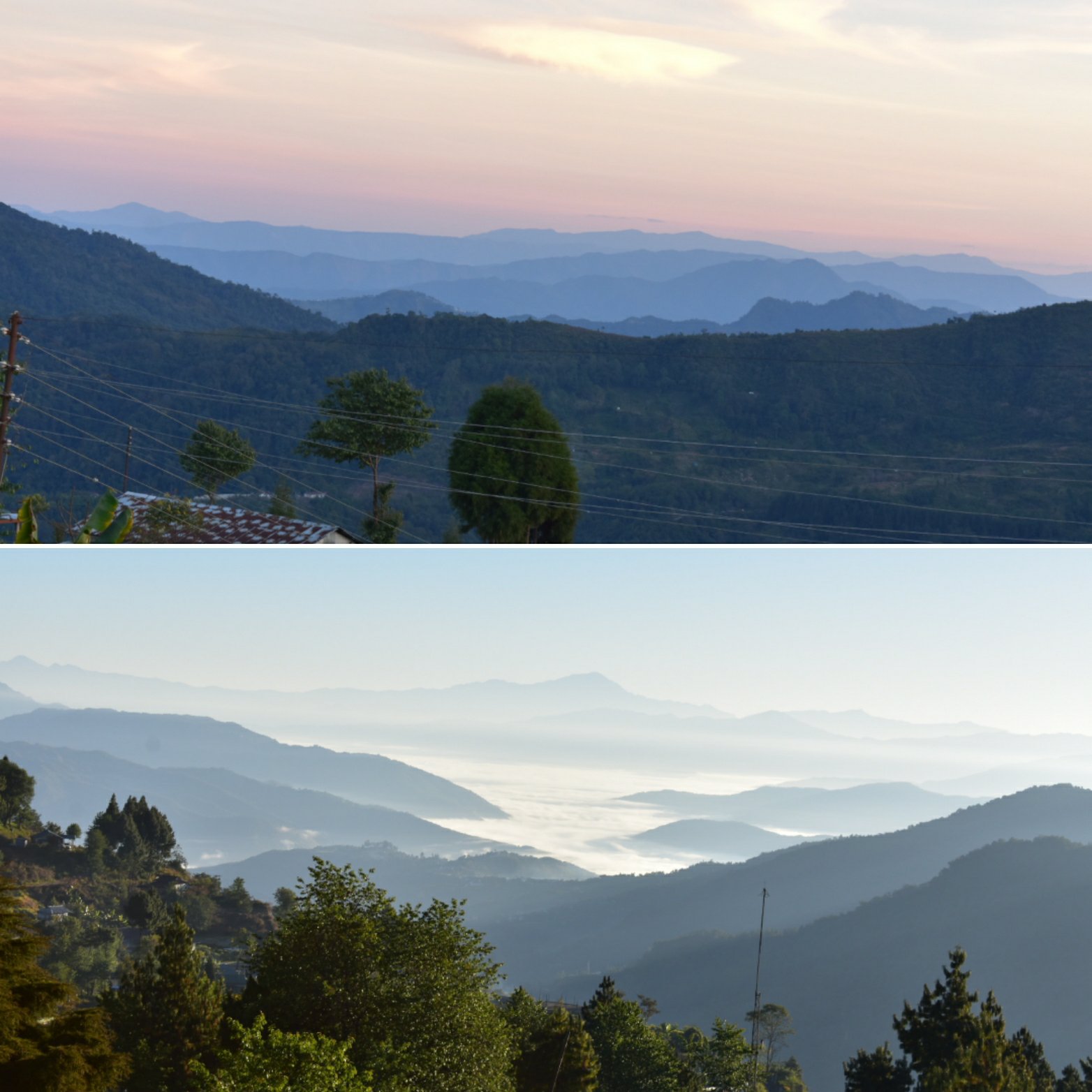
The dropping Pfutsero temperature had started to numb our fingers and we decided to head back to the lodge. The lodge is situated on top of a hill and the setting sun looked glorious from the corridor. After wearing my thermals and gloves, I decided to take a stroll around the lodge. It is located adjacent to defence property and that gave me a sense of confidence to venture alone after dark. All the people from the neighbourhood were busy in decorating a nearby church for Christmas. They got me talking to them and eventually I joined them in their chore of setting up the wreaths and light bulbs. It was a fun evening until I decided to head back for the warmth of my room. The lodge was a HUGE property, but we were only two girls staying there that night. Although it was a little scary at the first thought to be the only guests, we were soon occupied in long conversation with the caretaker family of the property living in the same building, later to be joined by the owners. The conversation covered a range of topics and ran into the night. Given the lesser crowd of the cliched tourists, company of comforting hosts and warm conversations, we couldn’t have asked for a safer and a better place to be!

img_20200105_1611043685340147598805647.jpg
Top: Sunset view from Tourist lodge corridor, Pfutsero; Below: Sunrise view from Tourist lodge room, Pfutsero

Day 2:

The comfort of the heater, cosy blankets and carpeted floors let us sleep like logs, unaware of the freezing sub-zero Pfutsero temperature outside. We were woken up by the alarm next morning, only to be mind-blown by the view of the rising sun over the clouds from our balcony. We packed up and prepared to leave as that was our last day in Nagaland and we had to make it to Dimapur for the night’s train. Meanwhile, we had booked a personal taxi for our return, since we wanted to explore Kezakeno on our way back.

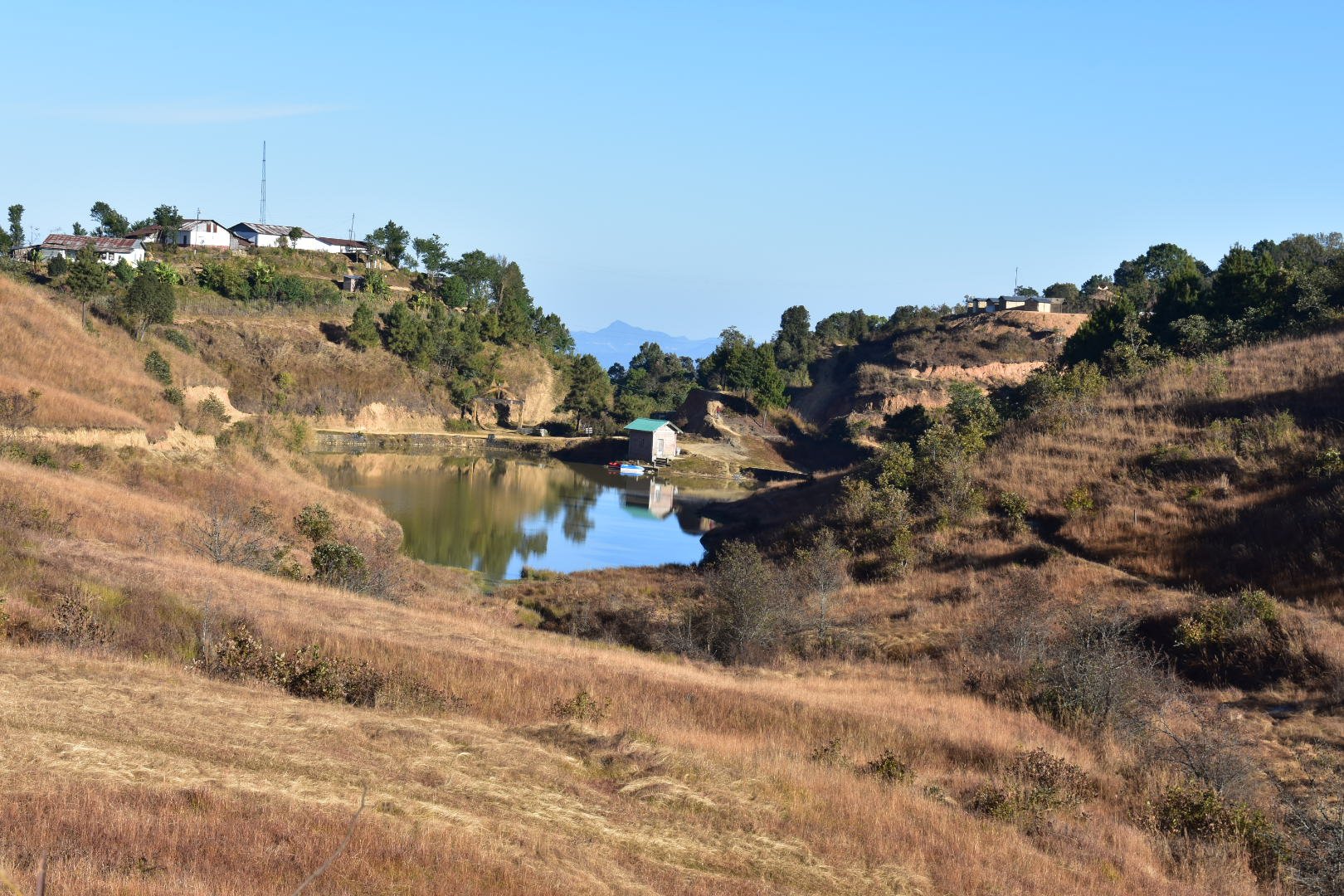
The first stop was at- Chida lake. Locally called as Lowho, this off-road destination is a favourite hangout among the locals who come here for games like fishing and boating. Some enjoy a trekking trail from glory peak to Chida along the Kapamedzu range as well. There is a Border Security Force camp at Chida and hence, it is also referred as Chida Post at times. Since we had reached very early, we were the only tourists there and the place looked absolutely calm and serene.

dsc_0431262998177924315700.jpg
Lowho lake at Chida, Kezakeno

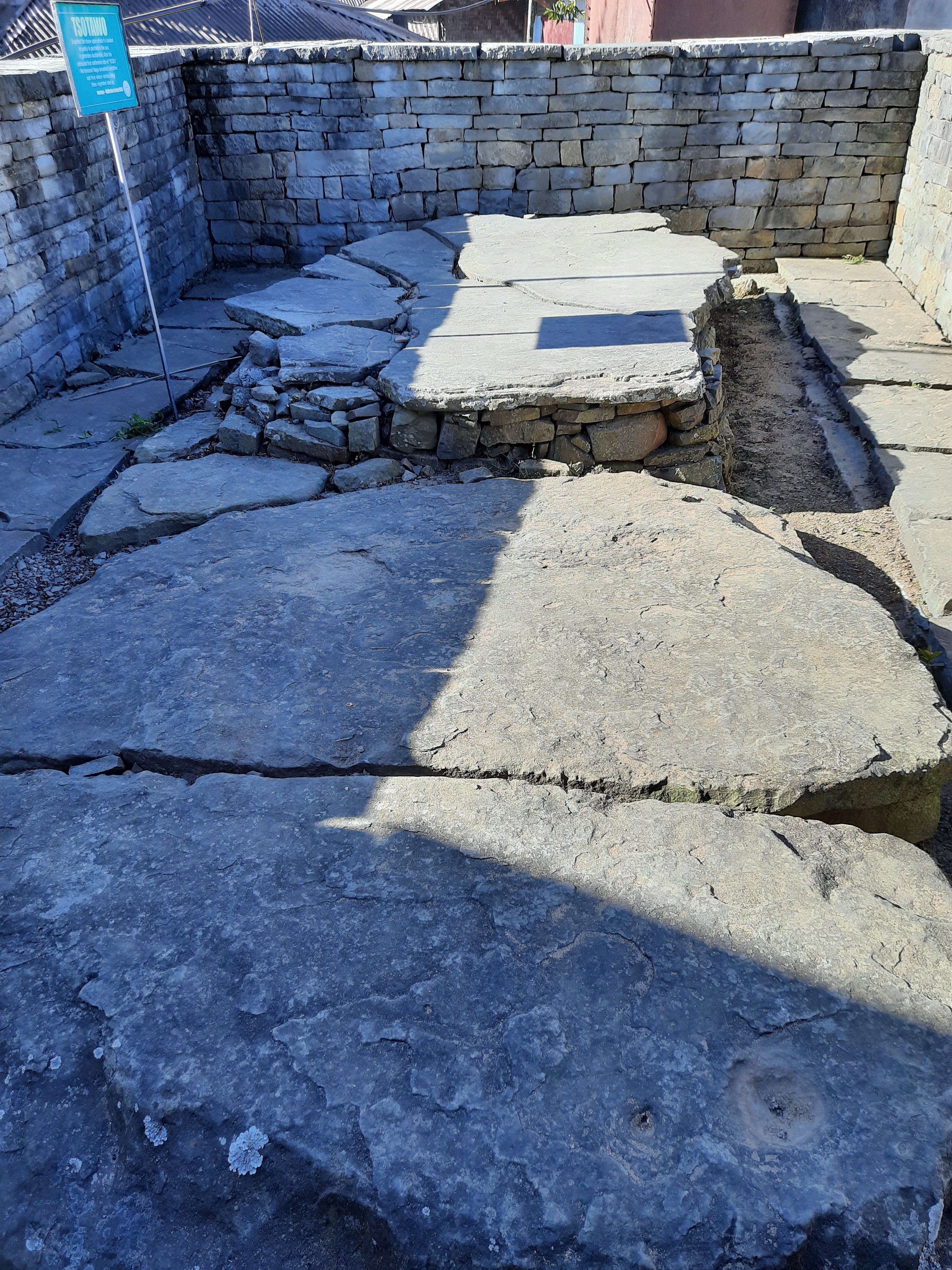
From there, we headed to Lazami village. This tiny village is of very high historical importance as it is the site from where the various Naga tribes are believed to have migrated to different parts of the state. A veteran from the village was excited to narrate the legend of Tsotawo, the spirited stone in the village. We were warmly invited by almost every person in this village into their house. We finally settled down at a little traditional house for breakfast and a large cup of tea. We carried back love in the form of guavas and local walnuts given by our hosts from this village. Seeing so much affection in these hills was a wonderful feeling that cannot be expressed, for which a city soul in me would want to come back again.

20191207_0813055438719679675247622.jpg
The spirit stone

While continuing our journey from there, we did have a stop at Kami village view point to admire the terraced paddy fields of Lekhromi village, the view looked magnificent under the oblique rays of the early sun.

Making our way through the maddening traffic jam of Kohima is for another story to be written about, some other day! Thus, ended our 2 days of amazement and overwhelming hospitality in the Land of the Chakesang Nagas- Phek district.

dsc_04289012507604352153301.jpg
Terraced farms at Lekhromi village, Phek

Fact file:

Must eats:

  • Pfutsero is famous for its organic farming and terrace cultivation. We bought fruits (some known and some new) from the local shops that we could eat once we were back in our room.
  • One would find a lot of bakeries in the town selling local cookies and muffins. Sticky rice cake, banana cake and banana chips are few of the things I recommend.
  • Getting around:
  • Daily shared taxis ply between Kohima and Pfutsero. There are limited seats and the taxis leave immediately when filled. The taxi leaves Pfutsero around 6.00.a.m to Kohima and the same returns to Pfutsero on the same day on a first-cum-first serve basis. So, if one is not early enough to get a seat, he will have to hire a full taxi for him/herself or stay back until the next morning to share it. A one-way shared taxi seat costs 300Rs. Per head and a personal taxi would cost 5-6000rs. irrespective of whether it is a 1 or a 2-way journey.
  • Within Pfutsero, most places are at walkable distances. But internal taxis are available for local commute. Talk to one of the shopkeepers in the town and they must be able to help in finding one.
  • Stay:
  • A very well-maintained tourist lodge and a government run mini lodge are available at a very affordable price.
  • There are a few homestays available for a more local experience.

Stone Pulling Ceremony with the Angami Nagas

Stone pulling Ceremony is an annual traditional event held across the Angami villages to commemorate a certain important day. It takes place in one village per year on a rotational basis. So that way, it takes about 5 to 10 years by the time this ceremony reoccurs in a particular village. This event is usually timed around the Hornbill festival as there will be people from across Nagaland and outside visiting Kohima (The region where the Angami tribe is a majority).

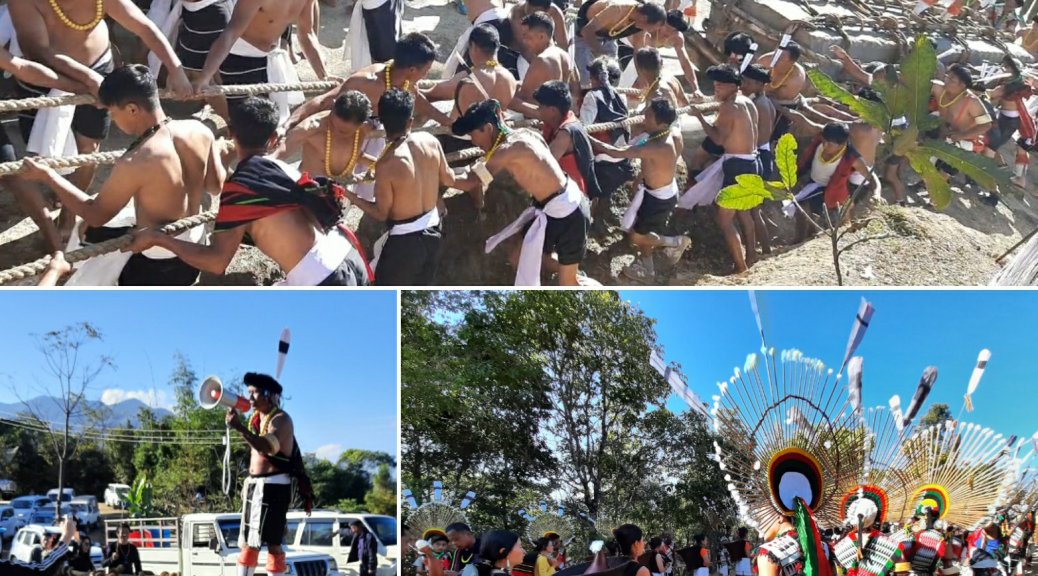
The stone referred here is a large monolith that weighs several tons and the size and shape is not fixed. It is at the villagers’ liberty to pick the monolith they want to use for the occasion and can be either quarried from the village itself or bought from somewhere else depending on the resources. The large stone slab is then placed on a sled that is made of tree trunks and pulled using thick entwined vines from the forest. Thousands of Angami Naga men pull the large monolith over a few kilometers to finally errect it upright, engrave the details of the event and mark the day.

This year, the stone pulling ceremony was held at Mima village. It was organised to commemorate the 75th anniversary of christianity in the village. The monolith was symbolized for forgiveness, friendship and peace to the enmities that the village had with various villages before the coming of the gospel to Mima village.

The typical stone pulling ceremony (Click here to watch the complete video) is solemnised by the pastor from the village’s church with recitals from the Angami bible before the start. It is then followed by firing a round of shots from the muzzle loaded guns in the air. The captain stands on the slab and shouts Angami cheers through a loudspeaker to motivate the pullers. While all the strong and younger men folk of the village join hands to pull the stone, The eldest two men of the clan walk, leading the tribe. The women get dressed in their traditional attire and walk with a khophi (an utility basket woven with bamboo or cane) hung on their back and they stay around as a mark of support to the pullers. A few of these women carry cotton in containers made of dried bottle guard and walk ahead of the pullers as a part of the tradition. And yet, the remaining women go around distributing gruel made of ‘Job’s tears or Chinese pearl barley’ to all the passersby and the participants from their traditional Aluminium pots. It is served in bamboo cups that are carried in the baskets hung around their foreheads. The gruel provides an instant boost of carbohydrates for the toiling men in the hot sun.

In a Christian majority state, the tribal traditions are still thriving. It was a different experience watching the entire village dressed in their ethnic best and gathering to pull the stone uphill from the starting point to its destination. I somehow drew parallels with the chariot pulling tradition of the Puri Jagannath and several other temples of South India.

Isn’t it true that we all somehow follow the same way of life, only with different names for our faith and the process we follow to achieve it?