Category Archives: Karnataka

Travelling around my home state

Tracing the abode of celestial congregation- Kollur

While I was flipping through old photos of my college days, I was taken back in time to this so-called ‘Industrial trip’. This class trip consisted of trekking, pilgrimage, beaching and lastly, not to forget our industrial visit (only If time permitted, that was!). Basically, it was less of industries and more of place hopping. So here goes the first part of the so called ‘Not-so-Industrial-Trip’.

Although I had walked for miles to reach places during my school days, this was my first ‘Official’ trek! A trek in the ‘Kodachadri hills’ in Malnad region of the western ghats.. After a really long bus journey, we alighted at the Nittoor forest checkpost late in the evening. We got the permits at the forest checkpost for the night’s camping ahead, at the old forest guesthouse. We parked our bus there and got into the 4WD jeeps that were waiting for us since early evening. There is NO road from Nittor to the guest house and is only a muddy pathway. And in monsoon, it makes way for a deep trench kinda massive slush pool. This stretch can be covered by various modes based on each person’s interest. You can walk up or drive or ride.. The more adventurous people choose the latter; cycling comes with the greatest challenge. We chose the safest- The 4WD. But, driving through such terrain calls for great skill of steering control, lest have at least 7-8 people thrown off the road. That said, it was a crazy drive up the hill, until we reached the guesthouse in the darkness of 10~11.00.p.m.

After reaching the guesthouse, we could barely stand because of the strong winds. So, you can only imagine our next task of pitching tents.. We called off the idea of camping under the moonlight as we struggled to even hold the tents firmly in our hands. The winds were so strong. That’s when we had to camp indoors, at the guesthouse 😛 We had only a roof above us and no mats or sleeping bags. So we decided to pitch the tents inside the guesthouse hall for the rest of the night.

We woke up early next morning and started our hike up the Kodachadri hill. Our hike mainly consisted of two target activities- one was to reach the Shankaracharya mantapa at the peak, for sunrise and the second was to take a shower in the Hidlumane waterfall. We did not hire a guide as the organisers claimed their familiarity with the route. The sight all the way till the mantapa was beautiful and the sunrise and the Arabian Sea at the distant horizon just added up to the view! The climb was great, giving us an eyeful of the valley that was in all bloom with colourful wild flowers. After a brief walk, we reached the Mantapa. After spending some time at the peak, we readied ourselves for the descent.
bye-bye-6
The Kodachadri hills- Overlooking the Arabian sea

The descend was towards the waterfall. With the descending gradient, we slipped, jumped down, clung onto wild creepers in the event of finding our way to the waterfall amidst the thicket of the forest. Somewhere, we had already started to realize that we were lost in the forest. The thumb rule of finding the way out of a forest is to follow a flowing water body. The organisers followed the sound of flowing water and we followed the organisers. We stopped by at a small cave like structure enroute, where someone had installed an idol of Lord Ganesha and offered some flowers. We prayed for our safe exit out of the forest and continued with our pursuit of the waterfall. So we finally reached at the source of the flowing water!

Sure it was a waterfall.. But ain’t the mighty one that we had thought it would be. It was a stream that was directed to a storage tank by the localites and the tank was overflowing forming a waterfall!! Neither the organisers nor the others knew how to react at our misadventurous pursuit. But we were all happy that we had found some pure water where we could fill our water bottles and ease ourselves out of the tiring hike that we had been through so far! We were now sure that the tank was there for a purpose and the pipe attached would lead us back to base point. And the descent continued, along the same stream to the base.

There is a small temple dedicated to Mookambika Devi at the base. It is believed to be the original temple that is tagged to the legend of Shankaracharya’s installation of the idol at Kollur. We reached the priest’s house near the temple where we had a simple-wholesome breakfast. After packing our stuffs from the guesthouse, it was time for us to head out to our next destination: Kollur.

morning-trek-34

A view of the Arabian sea from the Kodachadri peak

People who prefer to trek further, can cover the Agnitheertham waterfalls enroute to Kollur Mookambika temple. But, having had enough in the quest of a waterfall, we decided to take the bus route. The bumpy drive continued until we reached Kollur, the small temple town known for the Mookambika temple, one of the Shakti peethas. This temple is said to have been developed by the Keladi rulers later in time so that pilgrims don’t have to trek up the overlooking Kodachadri hills to worship the goddess. Another legend has it that Lord Shiva appeared before Sage Kola and agreed to be present there in the form of Linga with his consort Devi. Along with Shiva and Parvathi, all other gods and goddesses are believed to be residing in a non-form in the Linga. Hence, Kollur is referred as ‘an abode of the entire celestial congregation’. We took a little time to offer our prayers and admire this beautiful little temple built in the typical Kerala style of architecture. Post that, we proceeded to the forest guest house where we had our stay booked for the night.
7th-morning-6
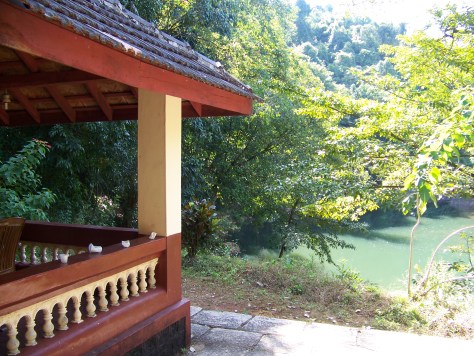
The forest guesthouse

The forest guest house is located in a serene location in the middle of the ‘Mookambika wildlife sanctuary’ and on the banks of river Sowparnika. With banks I mean, just a couple of steps lie in between the guesthouse and the river. This river is frequented by spotted deers & leopards to drink water. And we were told that just the previous morning, a tiger was spotted on the same steps that we were standing on, at that time! The river flowed gracefully with the crystal clear water and the school of fishes enjoying their swim in between the tree roots that grew beneath. It was a SPECIAL place to go back again indeed! We cherished every moment of our stay there while being in harmony with nature in its purest form.
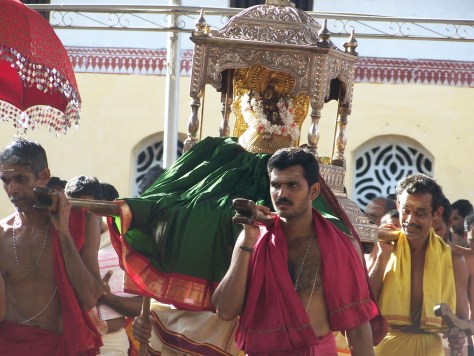
mookambika-temple-8
The Idol of Mookambika being taken out as a part of the daily ritual

Soon, the dawn broke the next morning awakening us to another day reminding us of our journey to the next destination- Bhadravathi. It was the last day of our tour and that meant we had to do the most important part of this trip ‘Our Industrial visit’! That’s for another story altogether…

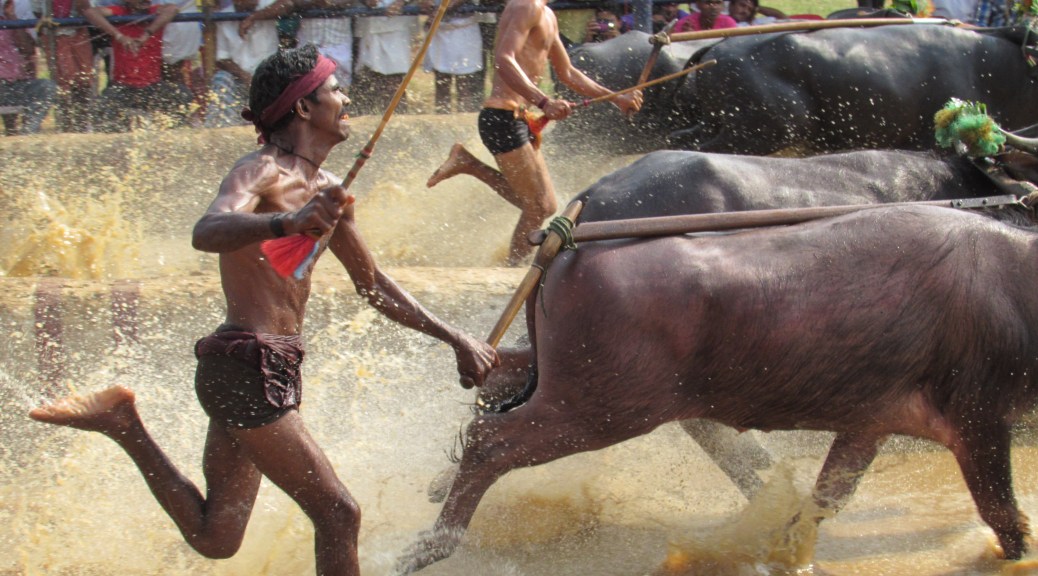
A Buffalo Valentine at Kambala

14-Feb-2016

The air painted red with romance and roses, the atmosphere illuminated with candles and balloons.. Couples holding hands out on dates- both young and old…. That’s the scene in rest of the world on that day.. But for me, Valentine’s day was an unusual form of celebration amid the Tulu-Naadu people. It was a celebration of folk culture and a celebration of earth’s gifts. While in some parts, it is the celebration post harvest, yet in other parts it is a celebration to commence the sowing season for the next crop. The Dakshina Kannada region, fondly called ‘Tulu-Nadu’ was a place where love and war co-existed on that day.. LOVE for a sport of thousands of passionate spectators and a WAR of prestige for hundreds of participating landlords. And amid all pomp and pride, a buffalo soldier fights it out in glory thus emerging as the showstopper..!!

A rickshaw ride from the Mangalore city centre traversed through some Kuccha roads, then across a highway and completely off-road to reach the banks of river Nethravati. Coconut tree lined mud road flanked with dozens of anchored fishing boats on the river bank ended straight at the arena where the big-event was set to take place. As I stood amid thousands of spectators in the gallery, the air felt heavy with anxiety. The show-stealers of the day walked down the ramp(Read it the slush pool) one-by-one to take their places and get set for their D-day. A day where all the effort and hard-work of hundreds of buffalo owners will be put to test. It was time to score off ‘Kambala’ from my bucket list when I decided to spend my weekend at ‘Joppinamogaru Kambala-2016’ in the coastal stretches of Mangalore.

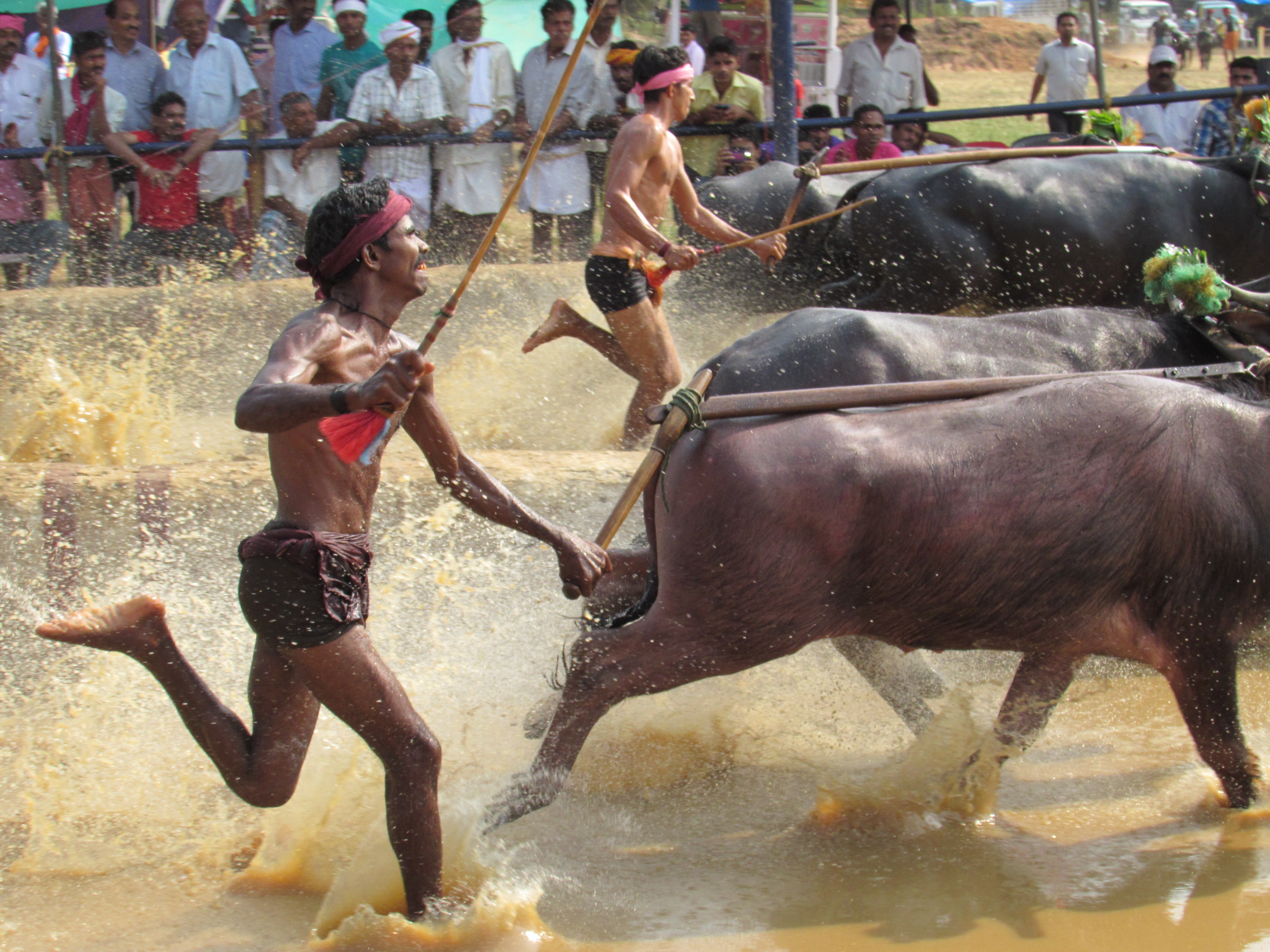
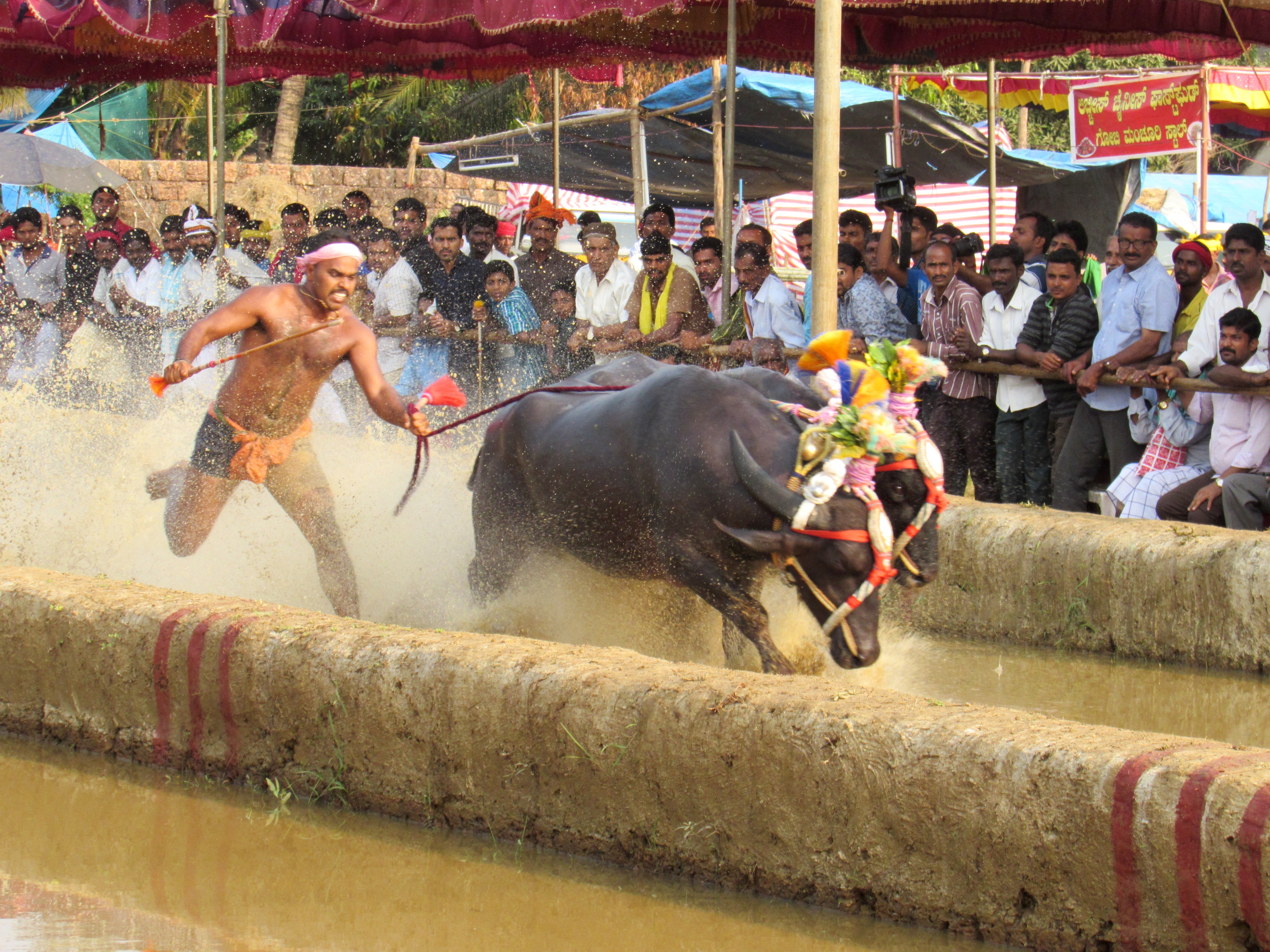
The ‘Raging bull’, the ’Buffalo skinned’ are idioms that we commonly refer to humans as expressions of exasperation. But when all the action brings forth the literal sense of these words- The event happens to be ‘Kambala’. Kambala is a sport where He-buffaloes are made to run on a mud filled slush track to reach the ‘Nishana’ or the finishing post. In the modern races, there are usually two tracks running parallel and thus called ‘Jodu Kare’ or ‘pair of tracks’. Each track is given a name so that it becomes easy to communicate in events where both the tracks are being used. In Joppinamogaru, the tracks are called Jaya kare and Vijaya kare. A coin is tossed for the team to choose the track. As loud drums beats and hoot sound of the timekeeper goes out, the whip lash of the runner crackles in the air before it hits the buffalo and the action finally takes off… The soldiers begin the battle..

There are different forms of kambala. Firstly, the Negilu category- Here, a representation of a plough is attached to the buffaloes which has evolved over period of modernisation. This is a race mostly for the younger buffaloes. Usually two pairs of buffaloes are made to run at a time and the fastest of the two is considered for the consecutive rounds.

IMG_3172
Negilu Kambala

Hagga kambala- This form is similar to the Negilu kambala, only difference being that the negilu or the plough is replaced by a hagga or a rope. Both these forms of the sport requires a great deal of stamina for the runner as he too is expected to run as fast as the buffaloes.

IMG_3236
Hagga Kambala

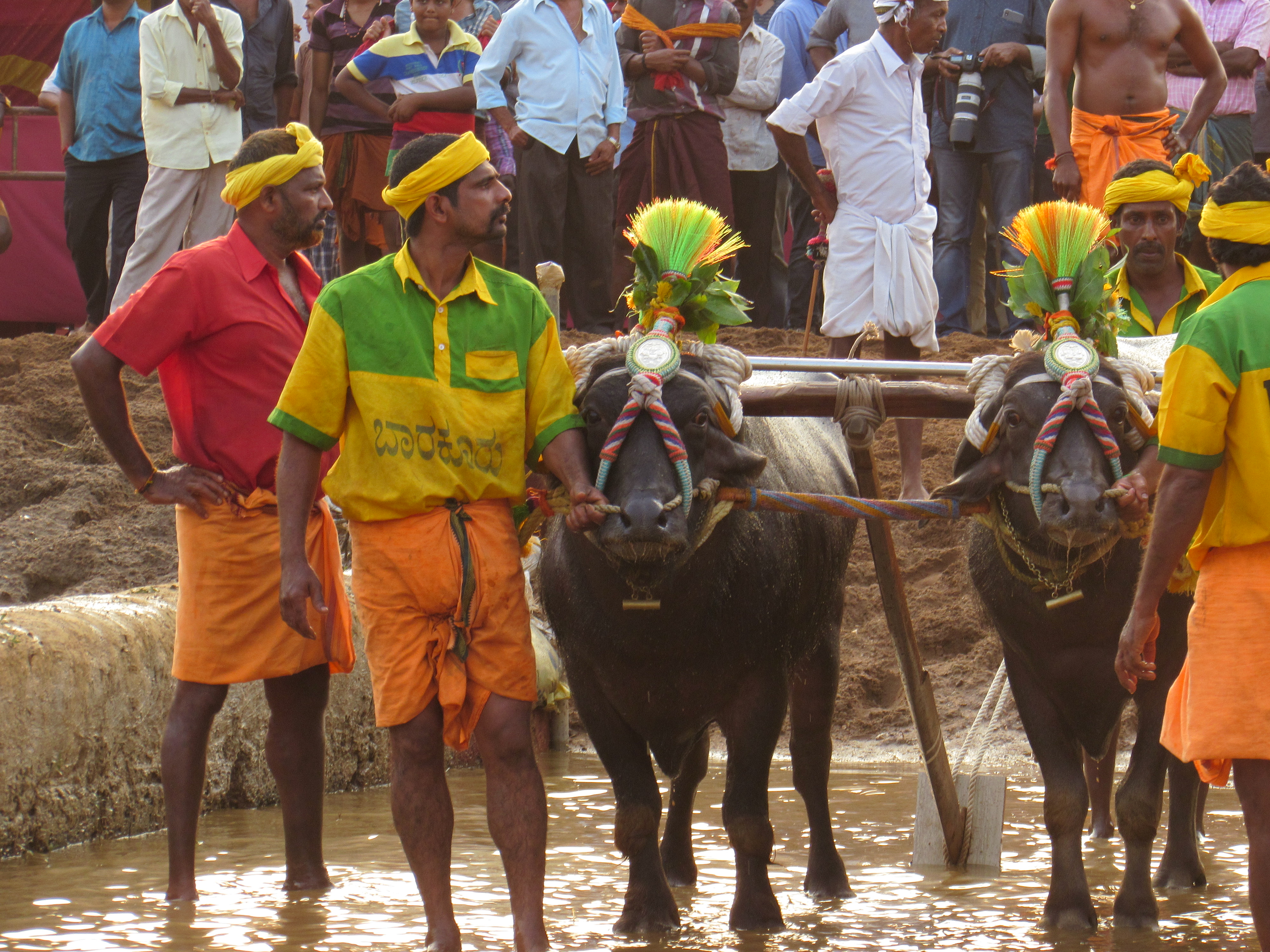
Adda halage kambala- This is a category mainly for the senior buffaloes(decided by age). A cross wooden plank is attached to the buffaloes on which the driver stands firmly and controls the speed and direction of the buffaloes to reach the Nishana. This is mostly a time based event where one pair runs at a time and the fastest pair is awarded.

IMG_3261
A pair of buffaloes getting ready to run the Adda Halage Kambala

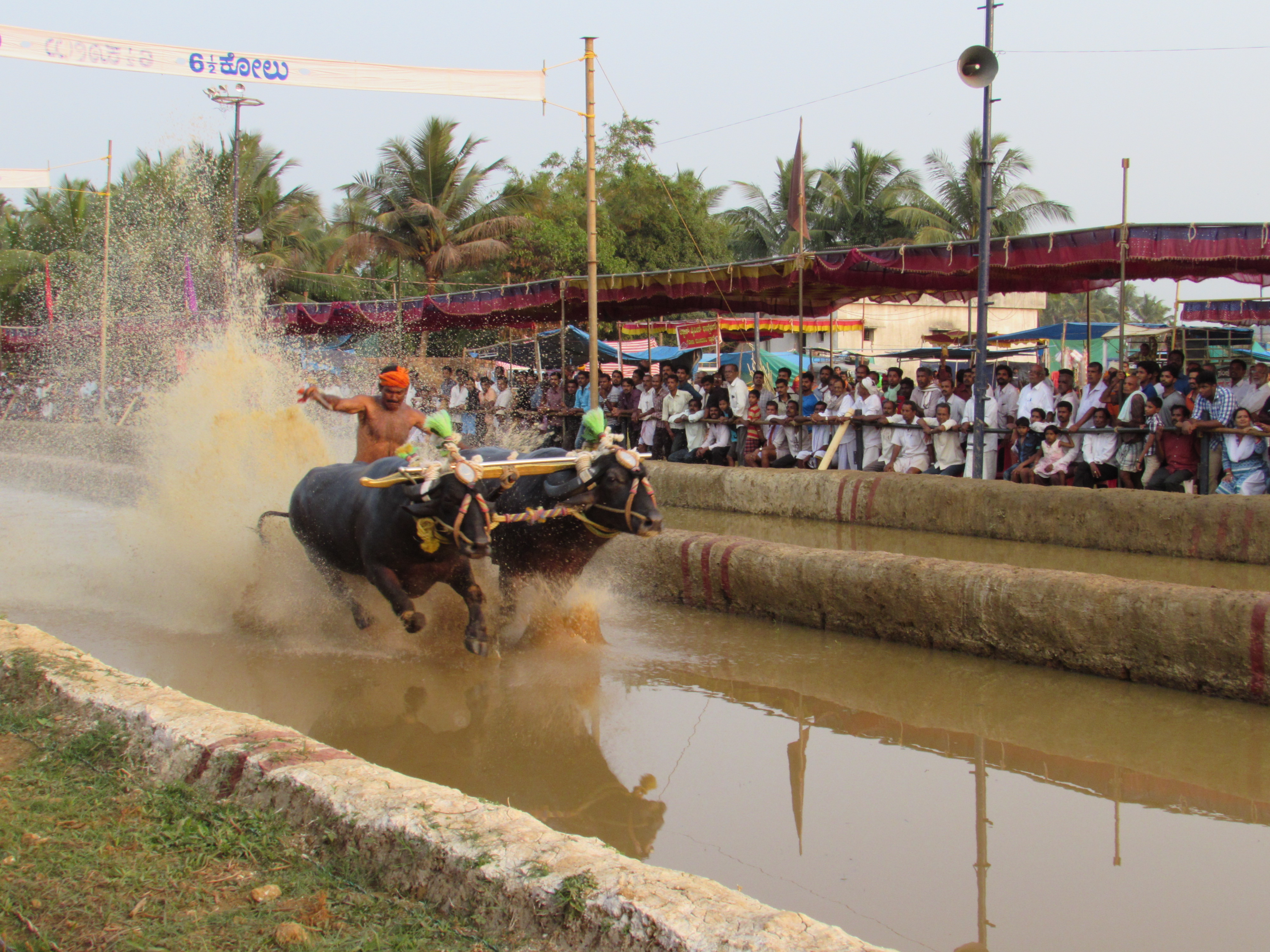
Kane halage kambala- In this form, a round wooden plank with two holes is tied to the buffalo pair and the driver stands on it to control them. Two strips of white cloth are tied across the track which are used for measurement of the height of water spurt. One cloth is tied at a height of 7.5kolu(9.37mts) and the other at 6.5kolu(8.125mts). Faster the pair runs, higher the water spurts out of the holes on the plank. Here, one pair runs at a time and is specific to the senior buffalo category. It is very difficult to run at the expected speed and hence every team that spurts high enough to wet the cloth is awarded unlike the other forms.

IMG_3265
Kane Halage Kambala

With a history of over 500years, the event is a treat to watch the enthusiasm and the energy of the participants and the spectators. However, it is heart wrenching at the same time to see the welts and the swollen bruises on the buffaloes as a result of continuous whip lashing. For this reason, Kambala has been in the radar of seeing a ban for a while now as demanded by several animal rights activists. We don’t know what the future beholds, but one MUST experience the vibrance of India’s rich folk culture in all forms before its name joins the pages of history..

Visiting the Niagara of Karnataka- Gokak

This is a pick from old memories of exactly a year ago, in August 2013. My mother was away in Belagavi for a month-long business trip and I had decided to catch up with her over the weekend. We then got together, and explored the places around Belgaum, fondly called Belagavi. This time, it was only a day trip around Belgaum with a quick visit to the widest waterfall in my state, the Niagara of Karnataka.

Our Itinerary:
Friday: Overnight journey from Bangalore to Belgaum
Saturday: Explore Gokak (waterfalls, hanging bridge & Tarakeshwara temple), Godchinmalki waterfalls, Savadatti Yellamma temple)- Return to Bangalore by night journey.

The Details:

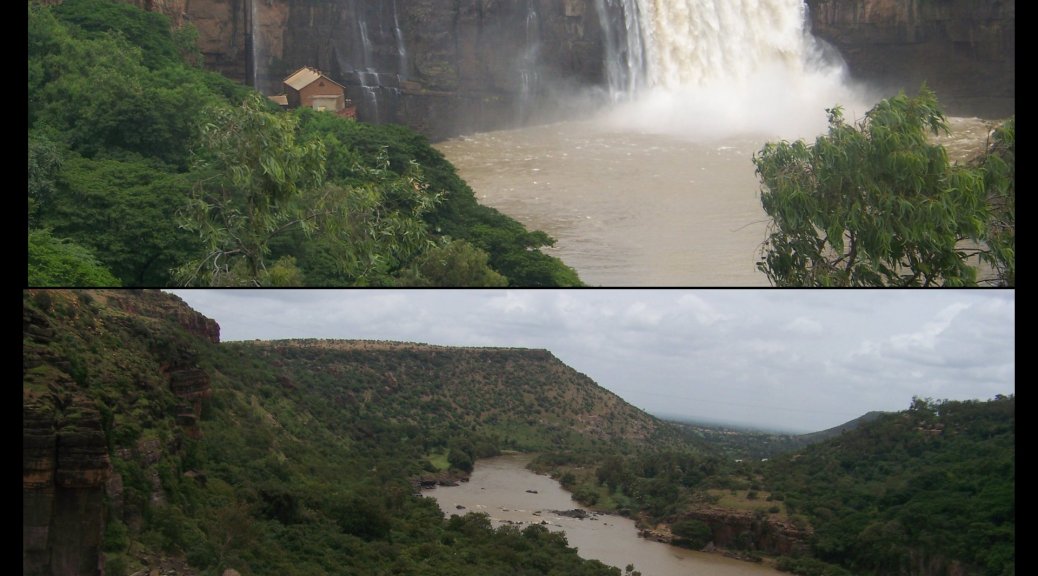
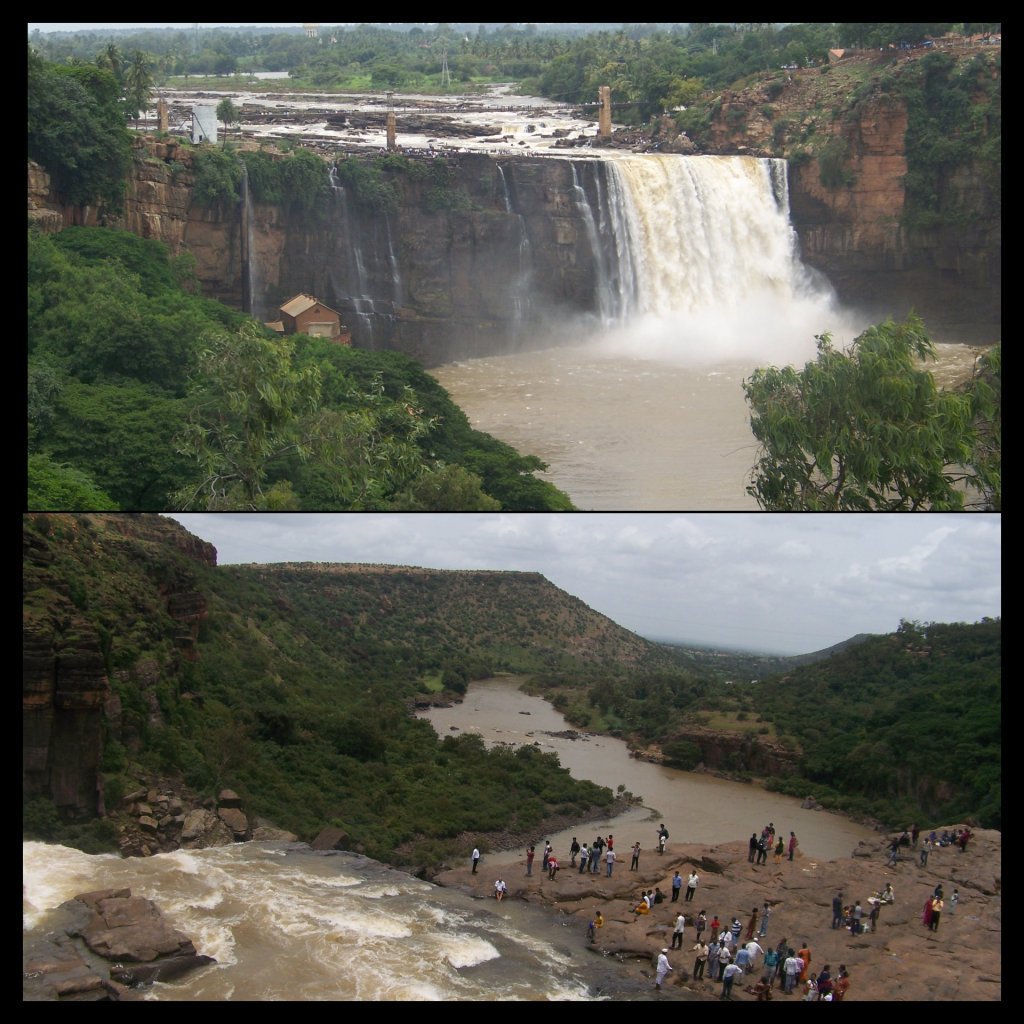
I boarded the bus to Belgaum from Bangalore and my mom was there to receive me when I alighted there the next morning… We freshened up at the place where mom was put up and then headed straight to Gokak. The little town known for its cotton mill, is also famous for the nature’s treat- the mighty Niagara of Karnataka. The bubbling, roaring and crashing waters of the Ghataprabha river creates steady patterns here with endless rhythm while it leaps down from 52meters between two tall, craggy cliffs to form the Gokak falls.

The century old hanging bridge, the only mode for the textile workers to cross the river allows the public to enjoy the breathtaking vista of the waterfall as the gushing water plummets down. The presence of turbines dating back to 1885 stands testimony to the electricity generation station established here which still provides power source for the cotton mill across the street. The 11th century Shiva temple dedicated to Lord Mahalingeshwara (Locally known as Tarakeshwara temple), built in the Kalyani Chalukyan style, faces the cotton mill and flanks one side of the gorge.

Above: The front view of Gokak falls from the Volkart view point; Below: A view from the Hanging bridge.

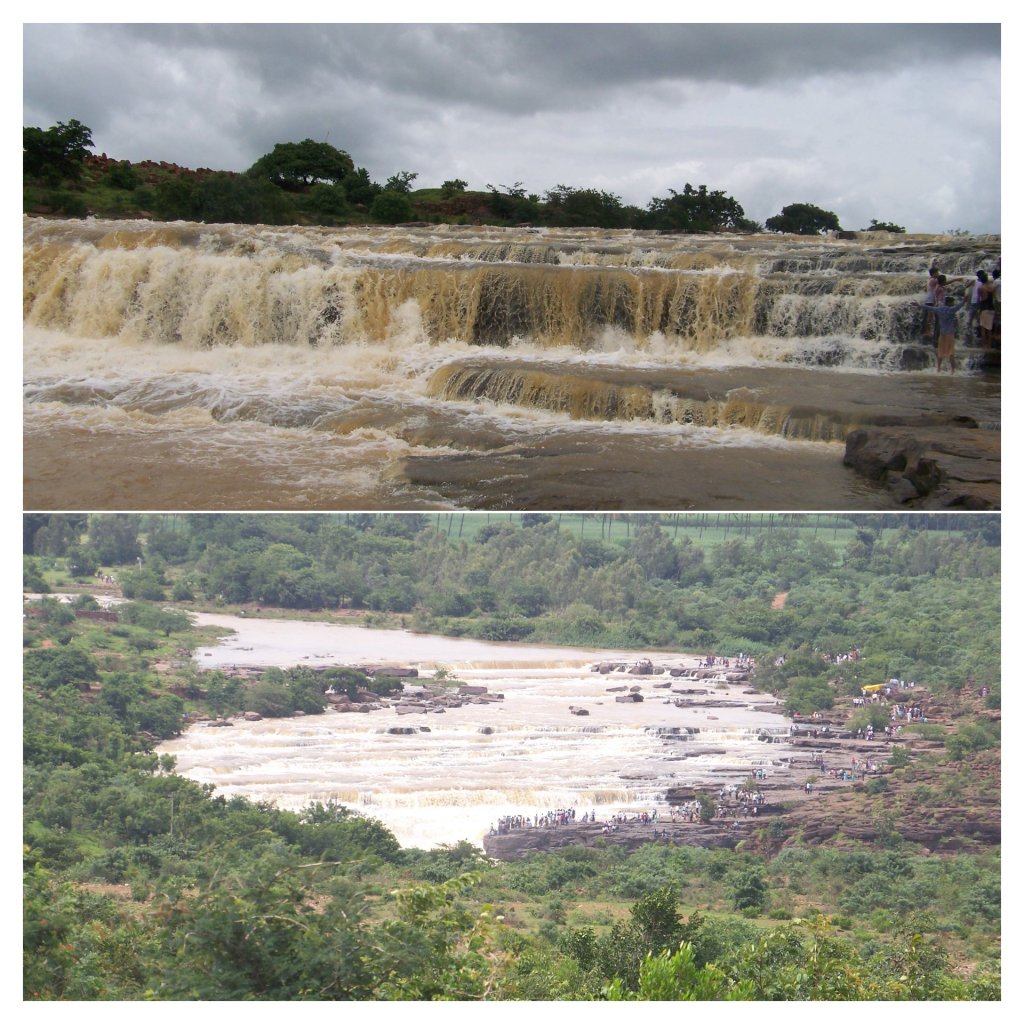
Meanwhile, I called a friend of mine who hails from Belagavi district to enquire about other places that we could visit around his hometown. He guided us to a small village named Godchinmalki where river Markandeya cascades down amid a scenic backdrop forming another beautiful waterfall called by the same name. Mom and I walked down for 2kms through rolling green pastures, fields of maize and banana plantation to reach this waterfall that plummets down in 2 tiers. Once we reached the place, it was a thorough treat to our senses to watch the waterfalls racing ferociously through the deep gorge.

On our way back, we took a little longer route from where we got a complete view of river Markandeya snaking through the greens. A 9kms long underground canal carries water from the river across which can be seen emerging out of the hill from this viewpoint. The snaking roads with beautiful views of the valley was a wonderful drive to the city.

Top: The Godchinmalki waterfalls; Below: The Gochinmalki view point from the main road

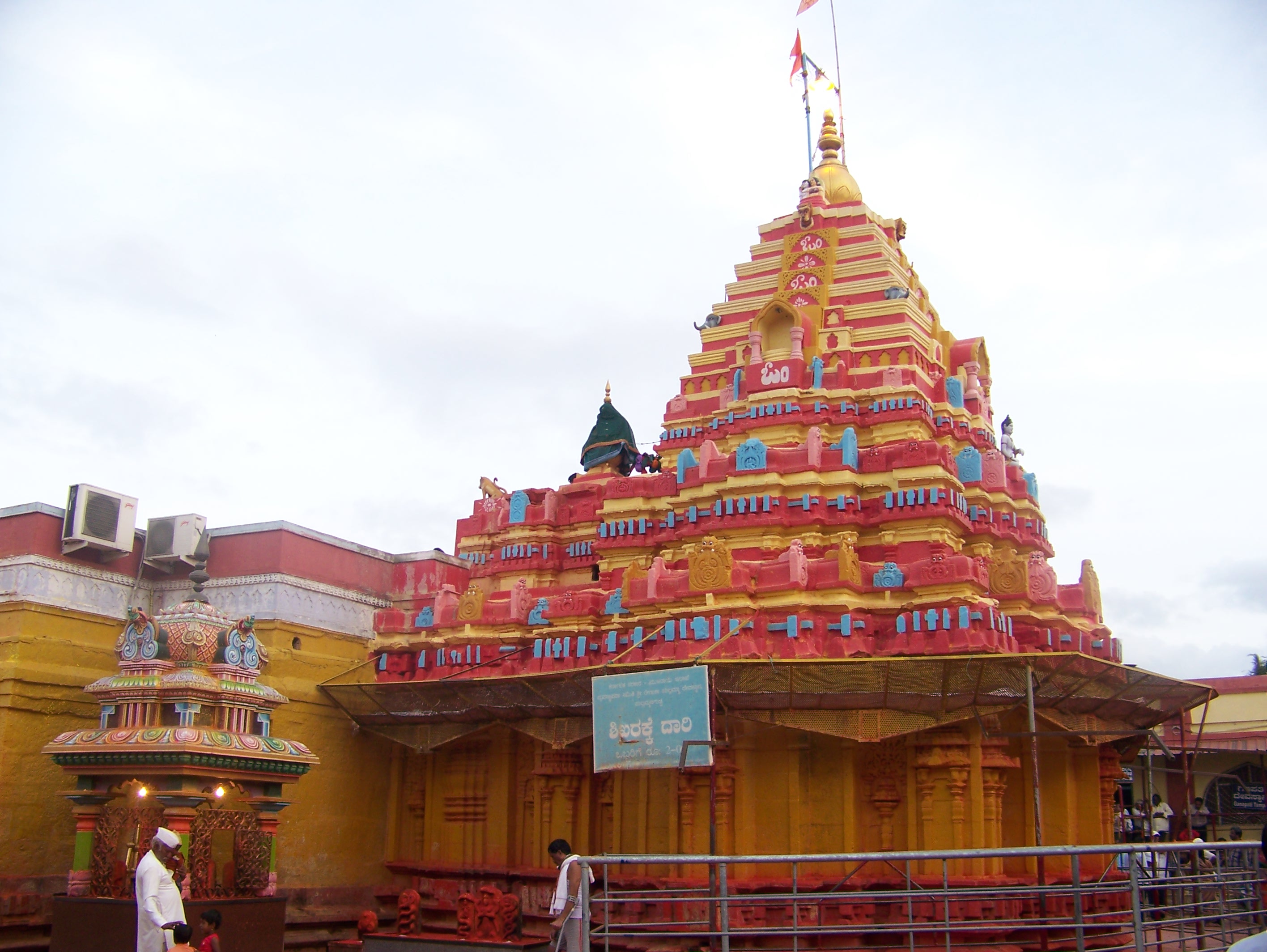
After all the waterfall hopping was done, it was time for some temple visit. We headed to Saundatti a.k.a. Savadatti. This place was the capital of the Ratta / Rastrakuta dynasty from 820, until it was shifted to Belgaum in 1230. There is a fort here also called the Parasgad fort. But the most famous is the Renukadevi temple located atop the Yellamma gudda. This is an important place for devout followers of Goddess Shakthi and also for the devadasis- or the servants of god. We had a good darshan during the evening pooja time.

Savadatti Yellamma temple

With that, it was a quick wrap for a short weekend and time for me to head back to Bangalore for another long and boring work week ahead…

Must eat while at Belagavi/ Belgaum:

  • Karadantu at Gokak– it is a sweet made with dry fruits rolled into balls with jaggery.
  • Kunda at Belgaum– This is a sweet made with milk.

Mission accomplished- Kumara Parvatha

This trek was planned to celebrate the 1st anniversary of Sam’s farewell trek (Click here for details).. on the same day, exactly a year ago..

Let me get you going directly from where this trek to Kumara parvatha or KP peak is actually supposed to start. We reached Kukke Sri kshetra and checked into the lodge(a meagre 100Rs. Per day) run by the temple trust, freshened up and feasted on some sumptuous Mangalorean food for breakfast. Without wasting much time, we started the much hyped- one of the toughest treks in South India.. to the Kumara parvatha peak in the Pushpagiri wildlife zone.

The original plan was to start from the base by 7.00.a.m and camp at Bhatru mane. Then, leave Bhatru mane by 3.00.a.m the next morning and reach the peak to witness the sunrise, what is supposedly one of the best.

As planned, we entered the trekking trail.. It starts off with thick forest around and steep climbs uphill.. There was NO water sources along the way (We didn’t know that there was a perennial stream, with a small deviation after 2.5km) and a possibility of occasional encounters with elephants. We took frequent stops before taking a longer halt at Bhima’s rock. This stretch of 3km had oozed the fluid out of us..

 A view from Bhima's rock
A view from Bhima’s rock

Once this 3kms stretch was covered, we got our first view of Kukke town.. The thick canopy of forests made way to the grasslands after walking 1km further from there.. It was well past noon and the sun shined at its hottest.. We were running out of water already.. We started to wonder if Bhatru mane really existed and literally pulled ourselves to reach there. Or rather say, we pushed ourselves to walk the small distance that seemed never ending.. Finally… we were overjoyed at the first glimpse of Bhatru mane…

The first glance of Bhatru mane

We ran down to his nestle amid a small piece of green land.. I find NO words to express the joy of finding water.. That too, clear and cold water from the stream that ran through his farm.. We had a simple, yet the tastiest lunch served by Bhatru and rested under the shades of his arecanut farm..

We then made a small change in the plan and decided to continue the trek until it was dark. We feared the pace at which we were climbing up and did not want to return late on the following day.. We halted at a view point along the way for some photographs, before reaching the forest checkpost. We continued our hike up after registering our names at the forest office.. We stopped again at yet another view point.. The sun was coming down by the time we reached kal-mantapa and hence we decided to pitch our tent near the stream that ran by..

The sunset from our tent

The sunset from our tent

I don’t remember which sane person in the group chose the place.. I agree that we got a place which became every other trekker’s envy.. The place was for sure, a top rated spot for sunset viewing.. But we girls, who stayed inside the tent know what we went through that night.. The tent was pitched on a slope, on the edge of a rocky cliff which seemed like the place where the earth ended.. It was soon dark and we ate the little food that we had carried and hit the bed (Read hit the rocks)..

The boys comforted themselves in their sleeping bags and threw the poor girls inside the tent.. The entire night went by like this: ‘Our respective backpacks were used as pillows inside our tent. We all would slide down with our bags inside the tent.. again we would push back everything and move up.. Slide down.. Slide up.. Phew..!!’ And a while into midnight.. The intensity of the wind also increased.. The cover of the tent started to fly.. We hoped for it to be 3.00.a.m soon so that we all could start our ascend.. But another surprise was awaiting us.. Madhu heard the cracking sound of the tent support and scared all the girls inside to vacate the tent. We carried our luggage from inside and jumped out of the tent, one by one.. The last girl just came out and the tent crashed down to a flat.. The guys woke up and one of them attempted to slowly remove the pegs.. One peg was removed and then… The tent flew.. away from our reach.. off the cliff.. down the valley.. We had borrowed the tent, on hire.

Everyone woke up and sat wondering why this had to happen. It was still dark at 4.00.a.m. and with the wind that continued to blow ruthlessly, our ascend to the peak seemed impossible.. We stayed back until sunrise 😦 We decided to compromise on one of the main agenda of our trek- Watching the sunrise at KP peak.

After there was dawn,one of the boys dared to go down the cliff. He had a thrilling feat with adventure and managed to bring back the tent that had settled on a boulder in the middle of a water body, down below in the valley.. More than getting excited about finding the tent, we were all celebrating his safe return.. It was around 7.00.a.m by the time we started our ascent.

Inspite of missing the sunrise, the views post that period were equally spectacular, all along the way. The climb was pretty smooth. It was around 11.00.a.m. by the time we reached the first peak/ false peak- Shesha parvatha.

Post sunrise

The view from the base of Shesha Parvatha

After just a few photo moments, we decided to continue our journey.. We descended the steep rock and waded through super cool, thick jungles.. And then, climbed up another steep rock. This rockclimbing with bare hands and legs reminded me of our monkey ancestors.!! A small walk further up took us to the actual end of the earth. Right there, we had conquered our destination- Kumara Parvatha..!!

Shiva temple atop Pushpagiri hill

Shiva temple atop Kumara parvatha

Thanking the diety with a small bow in the temple on the peak, we set our return journey.. Getting down the rocky slope of KP seemed tricky with one of my friends ending up with torn trousers when he decided to sit and slide down on his butt 😉

The descend from Shesha Psrvatha was no easy task either. The loose gravel all along the trail made walking difficult without slipping. It was 4.00.p.m by the time we reached Bhatru mane.. We realised that we had covered only half the distance and had very less time left with sunlight.. We had to complete the remaining distance before it got dark because that was the toughest stretch with thick forests and wild animals. We had a quick lunch at Bhatru mane and got some rest in fast forward mode and started our descend by 5.00.p.m..

We knew we had very less time in hand and a LONG way to go.. We all walked as fast as we could. Our legs had given up already.. I was preparing my mind to stay back in the forest and make a feast of myself to some wild animal at night.. I ran down the slope at times.. My knees seemed like they would part away from my thighs.. We saw the sun coming down.. We continued to walk fast.. We saw the sun going down the horizon.. We paced up.. Suddenly we all halted.. There was pin drop silence.. We realised that some wild animal(mostly elephant) was somewhere around.. It took us a few minutes to feel the sound move away from us.. Then, we resumed our walk. We saw the bright day fade into darkness and every shade in this process. The toughest and the last stretch was almost coming to an end.. We had FINALLY reached the KP gate… And the last ray of light too waned into darkness.. Thus came an end to the KP trek- a mission….. accomplished..!!

We all then freshened up at the same lodge and did a quick visit to the Kukke temple before hitting the roads on our return journey.

NOTE: The above story is written based on my trek back in 2013 when there was no restriction on camping in the entire trail. As on 2019, camping is allowed only around the forest checkpost and Bhatru mane. So, it is wiser to plan the distance, hiking time and camping accordingly.

Must do things/ Highlights of Kumara parvatha trek:

  • Bhatru mane is the ONLY place you will find food and it is an experience in itself to get your turn in the queue to have your meal served. The same basic rice and sambar is served for all 3 meals and nobody complains. Not tasty, but finding food after a long day is LUXURY here. Bhatru has a fixed time for serving food and very punctual. The crowd is huge especially on weekends and the wait for your meal can take longer if you dont have your own plate.
  • The sunset from the view point enroute forest checkpost or Kal-Mantapa
  • To watch the Sunrise from Kumara parvatha is like going to a different world. Try to make it there in time.
  • The sky is in its clearest form and star gazing at night is a whole different experience. You see so many stars, bright and clear that it feels as if the sky has moved closer to earth. We got lucky as it was also a night of a meteor shower, so we saw many shooting stars.
  • Drinking water from the stream felt like nectar. So clean and tasty. You can fill your bottles at 4 places along the way. First after 3kms, near the Bhimas rock. Second, at Bhatru mane. Third, at the forest checkpost. Fourth, at a stream just before kal-mantapa.

Of pre-monsoon showers and coffee blossoms

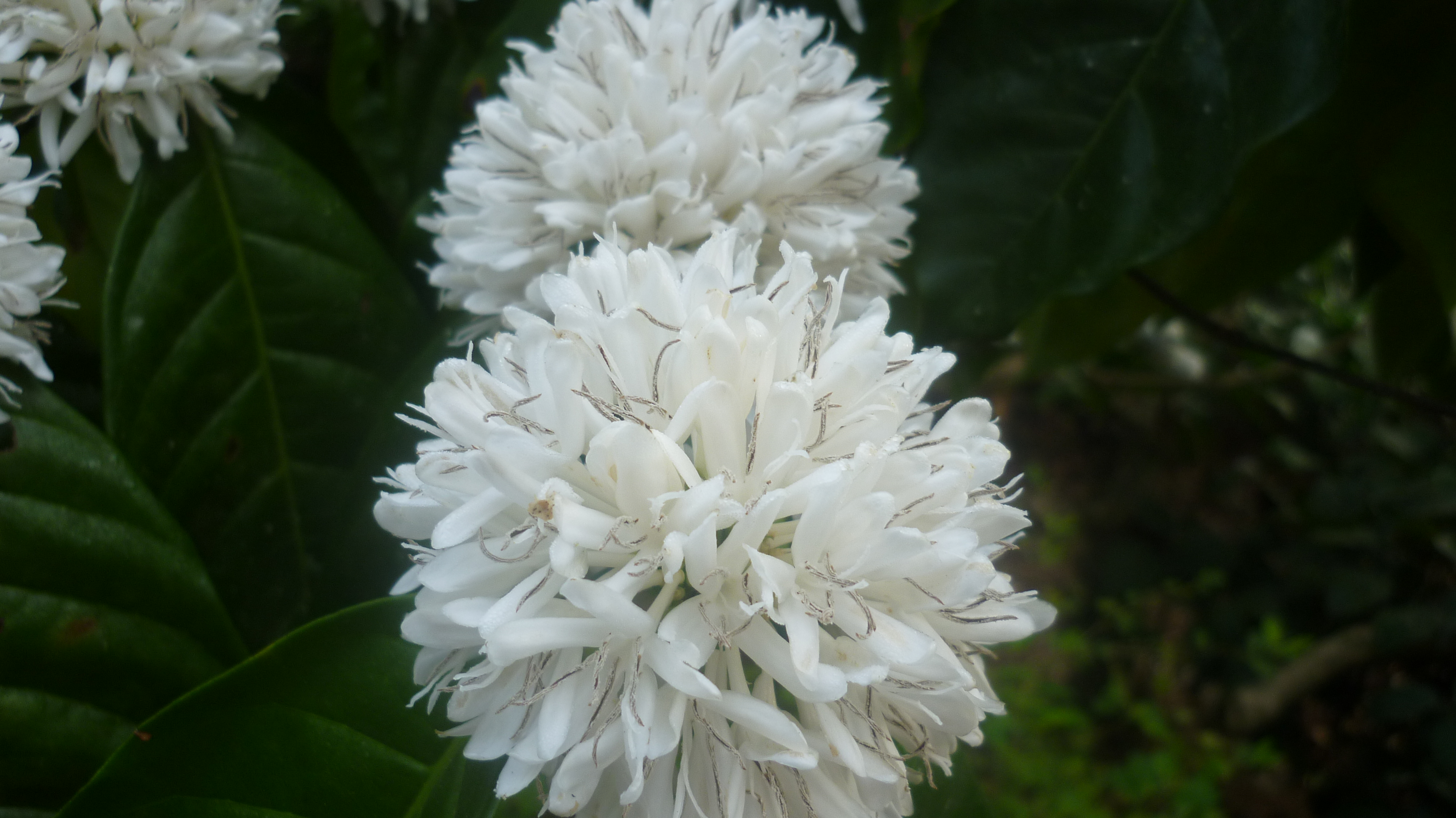
It is that time of the year when the entire hill station awakens with the fragrance of the blossoms.. On the ninth day after the 1st pre-monsoon showers, the coffee plants around the hills of Kodagu will be in bloom..

P1000890

It is an annual spectacle of nature whose occurance is unpredictable and is wholely dependent on the pre-monsoon showers. If the rain fails, it creates some sort of panic among the growers who then resort to artificial sprinkling sytems.. Be it rain showers or irrigation, in either case, what follows is something that one must experience atleast once in a lifetime..

White bunches of coffee blossoms adorn the trees as if some one has strewn cotton all over the hills.. And these flowers last for a maximum of 24 hrs which makes it even more special.. And like the saying goes.. You HAVE to be at the right place at the right TIME to see the right thing happen..

Have you experienced the fragrance of coffee flowers?

Day tripping at Tumkur

It was exactly a year ago, that I decided to celebrate my birthday by taking a short trip and break from my work. Mom and I drove our car from home in Bangalore at around 8.00.a.m. and headed towards Tumkur with a plan to spend the entire day outside. We wanted to cover as many landmarks in Tumkur as possible.

List of places covered:

  • Devarayanadurga hills: This area has two ancient temples, also a reserved forest area at Naamada chilume
  • Koratagere: Goravanahalli Lakshmi temple and the reservoir nearby.
  • Siddaganga Mutt: You can combine this with a short trek up the Siddaganga hilltop.

First, we headed towards Devarayanadurga hills where the twin temples are located. A winding road along a picturesque landscape lead us to Yoga Narasimha Swamy temple atop. The view from the top was beautiful with early morning dew settling on the warm rocks. We got the first aarathi (Pooja) of the day and rushed to Bhoganarasimha Swamy temple situated at the base of the hill. It is the custom that the doors of the later opens only after pooja at the hilltop.

Top: The view of Devarayanadurga hills; Bottom left: the temple pond at Yoganarasimha temple; Bottom right: Bhoganarasimha temple

From there, we drove towards Naamada chilume. This is a small spring nestled amid the greenery protected by the forest department. It is believed that Lord Rama rested at this place enroute to Lanka. When he woke up in the morning, he did not find water to make his vermillion (Naama- in Kannada). Hence, shot an arrow to a boulder from where a small spring emerged. This is a perennial water source even till date. This is part of a reserve forest area and there are a few spotted deer kept in an enclosure. Nothing very exciting about this place, we would have skipped it if we had known.

Top: The road to Naamada Chilume; Bottom left: A guesthouse at Naamada Chilume park, Bottom right: the water spring where Lord Rama’s arrow struck

From there, we lost our way and reached the main road after a very long drive. We asked the locals for directions towards Goravanahalli. This village is famous for the Lakshmi temple and better known for- Late Kamalamma, the holy lady. We finished our pooja amidst the crowd, took turns to make a wish at the wishing pillar. There is a small lake and a reservoir at a walkable distance from there. We went up there and had our packed lunch with the cool breeze and a good view. Soon after, we planned our next destination- Sri.Siddaganga Mutt.

We were blessed with the holy water of Siddaganga. We took a stroll around the huge campus of the mutt and were awestruck with the service rendered to the society. And then, we were in for a BIG surprise… An occult of the least expected. We felt blessed when we got the darshan of his holiness Sri.Shivakumara Swamiji… It is when least expected, miracles happen. Swamiji who is fondly called ‘the walking god’, was gracefully sitting on the porch of the Mutt and blessing the visitors. Even after several days of planning to get an opportunity to see him, people consider it hard to be able to see him. And there I was, right at his feet, taking blessings from this Holy man. I was thrilled, ecstatic and had goosebumps. Only countable people on this planet have this magical aura around them (according to me), and he is one!

Sri Siddaganga Mutt
A nandi carved out of a rock at Sri Siddaganga Mutt with the image of Sri.Shivakumara Swamiji

With that, it was a wrap to our day tripping, and we headed back home, feeling all blessed (literally! With a long day of temple visits) and having a small peek into history and mythology here and there along our way.

Trekking enthusiasts have a lot of options around Tumkur. I have covered these places on separate occasions.

  • Siddara Betta: A trek and a holy place
  • Madhugiri Betta: A trek with a good view and has ruins of an old fort atop
  • Siddaganga Betta: A hike accessible near the mutt, offers good view from the top with some mythological spots along the way.
  • Seebi: A place for those interested in history

Tiger Census Part 1- The Chase

Tiger Census is a week long quadrennial event conducted all over India at the same time. A total of 5,00,000 sq.kms area – 17 states- 40,000 forest beats to be covered with 2000 personnel pulled in to count an estimated 1700 tigers nationwide. The event was scheduled from 16-Dec-13 to 23-Dec-13. With 2 days of training, the census will be done in 2 parts. The 1st 3days will mainly concentrate on tracking the carnivore population(including tigers, leopards etc) through critical carnivore trails and the next 3 days will be through specified transact lines identified to count the herbivores and evaluate the healthiness of the carnivore habitat.

The public can participate based on an online application and selection procedure. It is purely voluntary wherein, 1 volunteer will be accompanied by 2 forest guards and allocated a specific beat inorder to spot the mighty one with the stripes..!! The forest department would provide bare minimum logistics (read it food) However, beddings need to be carried by the volunteers themselves 🙂

So all said and done, I was shortlisted as a volunteer for Kallahalla Wildlife Range in the Nagarhole Tiger Reserve. Last minute preparations, arguments with folks for permission, hunt for a notary for getting the indemnity bond attested.. I was all done and all set for the LONG week ahead 🙂

Day 1: After getting misguided by google maps a couple of times, I had arrived at the forest office in Kallahalla by noon. After the enrollment formalities were done, there was a small briefing for the volunteers about the do’s and don’ts in the forest. We were not in a luxury campsite, we had to remember and be alert always. We were then directed to the camp to grab some rest before the hectic week ahead 🙂

The camp itself was in the middle of the national park that boasts of the highest density of tigers in India. The shelter we had to look upto during our next few days was an old abandoned 3 BHK house which once served as a forest staff quarters. Now, there laid only the walls and a thatched roof with no doors, no electricity and no phone connectivity. We would have the privilege of being greeted by wild animals at our door step every morning and reptiles creeping in to the living room every now and then. We did not have to be surprised even if one fine morning, the tiger himself waved a ‘Hai’ at us while sitting on the porch.. The only things that we had with us to protect ourselves were our sleeping bags, camouflage clothing, trekking boots, torches and some insect repellents. That evening, we opted to sit out in the open, under the clear starry sky until the biting cold of the December night froze us. It was just a day past full moon 🙂

Day 2: We all assembled by 6.00.a.m in front of our camp where I was introduced to Mr.Swamy & Chikkanna. They were the guards who would accompany me through the due days ahead. Chikkanna was a ‘Kaadu Kuruba’ tribal person. He could recognize the forest with just it’s sounds and smell. He knew every grain and twig in the forest. Swamy was a Bachelor’s in Biology. Chikkanna’s role was to manage the team with the survival skills for the deep jungle and help identify things with their local names. Swamy would then document everything with the local and their scientific names. And me? I was a general public, getting aware of various aspects of forestry and the habitat census procedure itself.

Mr.Swamy saved the camp as the reference point in his GPS and the three of us marched towards our beat. We stopped by every now and then to make a note of the different animal scats that we found along our way. Also, the forest grass cover, vegetation, commercial trees, medicinal plants, herbs, shrubs, every thing were recorded. The scat samples that we collected in small sachets included those of wild cat, barking deer, rabbits, sambars, spotted deers, bears etc. along with that of the tiger as well.. Further ahead, as we marched a few kilometres into the thicket, we reached a small bit of moist land. We spotted aleast a dozen of jungle fowls around there. We walked around the place and noted fresh pug marks of a tiger mother & a cub who had just dropped by, to quench their thirst. We proceeded further and the sight I encountered next needs a special mention. Atleast 50 parakeets emerged out of a small bush when I walked by. It was truly Awesome 🙂 I cursed myself several times for not being able to identify the innumerable bird species I came across all the way. We saw a tree-full of langurs, Malabar giant squirrels and sambars. We encountered a pack of wild dogs(dholes) who surely were upto a well laid strategy. However, the day soon ended without any major direct sighting of the tiger.

Day 3: Another day, filled with anxiety began at 6.00.a.m. We were greeted at the entrance of the transact line by some wild hogs. The 2km stretch of the transact was covered without any sightings apart from elephant dung all the way. Further downhill, we saw fresh tiger scat and I had already started to crib about having missed a glimpse of the striped beast by a few minutes 😦 Peacocks, barking deers peeked into our way at times. We then grabbed some wild berries from one of the trees along our way. We consumed it only after it was okayed as ‘Safe for consumption’ by Chikkanna.

When we continued our walk further, Chikkanna stopped us suddenly and asked us to stay still for a while. He pointed- “Elephant..!!” He concentrated on the sound and again said- “There are 2..!!” Within moments, we heard the thumping sound of the elephants moving towards us.. 100mts.. 50mts.. 10 mts.. SHIT.. We saw them both right there.. “RUN…”Chikkanna commanded.!! The three of us just ran… and the elephant mother & calf duo followed us… We ran.. they ran.. We ran further. “TREE..” Chikkanna pointed. And we three climbed and reached the top of the tree within seconds. (It is unbeleivable how you end up doing things that you have never done before, when it is for life.. I had never climbed a tree before. Atleast not one this high..!!) The duo continued towards us. Swamy grabbed a few crackers from his bag and lit them one by one. After bursting 5-6 crackers, the elephant duo decided to spare us. Although petrified a little bit at my first near death adventure, I descended the tree and continued our walk further.

We passed by something that looked like a tiger’s den with few bones stranded here and there. We reached Kiggere- the tropical moist deciduous part of the forest. It is a grassland, where we saw herds of spotted deers grazing all around. We rested there for a while and feasted on the fruits that we had collected along our way. The second leg of the day continued here on, towards Kebbekatte.

Climbers, creepers, bushes, thorns- we waded them all.. and suddenly pug marks appeared from nowhere. “The tiger has just walked down to the watering hole-200mts down the line(Kebbekatte), we might be lucky“- Chikku said. “Shh..” followed an alarming sound. “It’s a tusker.!! He is close..” We looked around and couldn’t find any trees this time. We real7sed that we were stranded between an elephant chase. Swamy reached out to his supervisor over the walkie-talkie to inform him of our status. He was informed that we were stuck midway and it was not possible for help to reach us from either ends of the beat. Without an option, Swamy lit a couple of crackers this time. And, we were all releived for getting lucky again, for the 2nd time.. We then walked towards Kebbekatte. It was an unfortunate day for us as we had just scared the tiger away which was spotted by the other beat who had arrived there before us.

Day 4: My heart kept thumping a little harder than usual. I felt a bit nervous while I was heading towards the jungle. My fingers were crossed all the way hoping to have no more adventures. I felt it was okay even if I did not spot a tiger, but wanted to reach back alive and kicking. I kept walking blindly behind Chikkanna who lead Swamy and me. We had to literally find our way out of the bushes which had overgrown all of us, blinding our way further. We could not even see if a tiger sat by, snarling at us. I heaved a sigh of releif when I got the 1st glance of the Kiggere grassland. the 1st part of the beat was accomplished, peacefully..!! Chikkanna moved into the bushes to answer the nature’s call. And so did Swamy, behind another one. I was trying to pacify my thumping heart standing all alone in the meadow. Tigers are mostly spotted in open grasslands, I had read. Then, on hearing the trumpet of an elephant, Chikkanna emerged out of the bush. He signaled Swamy to join us asap. He explained to us that the tusker was calling for a fight and is moving towards Baalekatte(our route further). We walked ahead slowly along the same route. Suddenly, Swamy pointed out to our right and screamed- “Run Run… its a Herd.. Herd..

It took few seconds for Chikkanna & me to believe our eyes. We had forgotten to look out in other directions while we were concentrating on the lone tusker. About 10-12 gigantic pachyderms were marching towards us, at a distance of barely 20mts from us… We three started to run… Chikkanna shouted- “The tusker & the herd, both are heading towards Baalekere, let us run towards Doddkere“. We three ran..

Tadan…. Another tusker stood right infront of us…. We three were surrounded by these pachyderms from 3 sides.. Chikkanna and Swamy ran.. I followed them.. While the two were running much ahead of me, I got entangled in between a thick bunch of creepers. “F**K… This is it..!!” I thought. But, I saw god in disguise running towards me with a dagger in his hand and free me out of the tangle. It was Chikkanna. After running for a distance, he had turned back to check on me. On noticing that I wasn’t there, he had come back.

The monsters were close, we continued to run.. I again tripped over a snake that crossed my leg.. I leaped over and continued to run. Meanwhile, Swamy had lit a few crackers and planted them along the way. Out of 6 odd something crackers, only one bursted. The sound was good enough to shoo the tuskers away.. We continued to run and reached the safe confines of a tree trunk on the otherside of Kebbekatte lake.

After a short while, we met the group from the other beat and headed towards Sulekere along with them. This was the last option we had, to catch a glimpse of the striped monster. We waited there for a long while hoping for him to come there to drink some water. We saw bisons and other animals walking in there, but hard luck- we could not spot a TIGER 😦

And thus ended our tryst with the wild.. The pug marks were all accounted which will be matched with the camera images captured by NCTA and a compiled report will be out in a few months’ time 🙂

Whether it was my chase of the ‘Tiger trail’ or if it was ‘Me getting chased for being in the elephant trail’, I don’t know. But what I’m certain was ‘The Chase’ was over..

Well wait, did I say the chase ended? No wait, our adventure followed us all the way to Bangalore and stayed with me for atleast another month. You’d be excited to know…. Click here to read Part TWO!

The monsoon delicacies of Coorg

So stuck up with my professional life.. I am finding little / No time to visit my native, where my basics belong to.. Politics, emotions, manners, education- on the whole the basics of every aspect of the human that I am today 🙂

Nostalgia fills my heart as I hear of heavy rains in the recent weeks- little villages have turned into islands, water levels are atleast 2 feet above bridges, waterlogged paddy fields now look like a never ending stretch of the river itself.. WOWwww…. An amazing picture of a rain fed rather filled-green COORG flashes infront of me.. And what my heart is craving for at the moment is some AWESOME Coorgie food.. And what my taste buds are asking for are the lesser known typical monsoon delicacies native to Coorg and cannot match their original taste if tried to re-create in any part of this wide world even by the greatest chef ever born..!! So here goes the list..

VEGETARIAN:

1. Therme thoppu palya (Fern salad)

2. Kembu suli curry ( Colocasia shoots)

3. Baimbale curry (Bamboo shoot curry)

These are varieties found only on river banks.

4. Kaad maange curry (Wild mango curry)

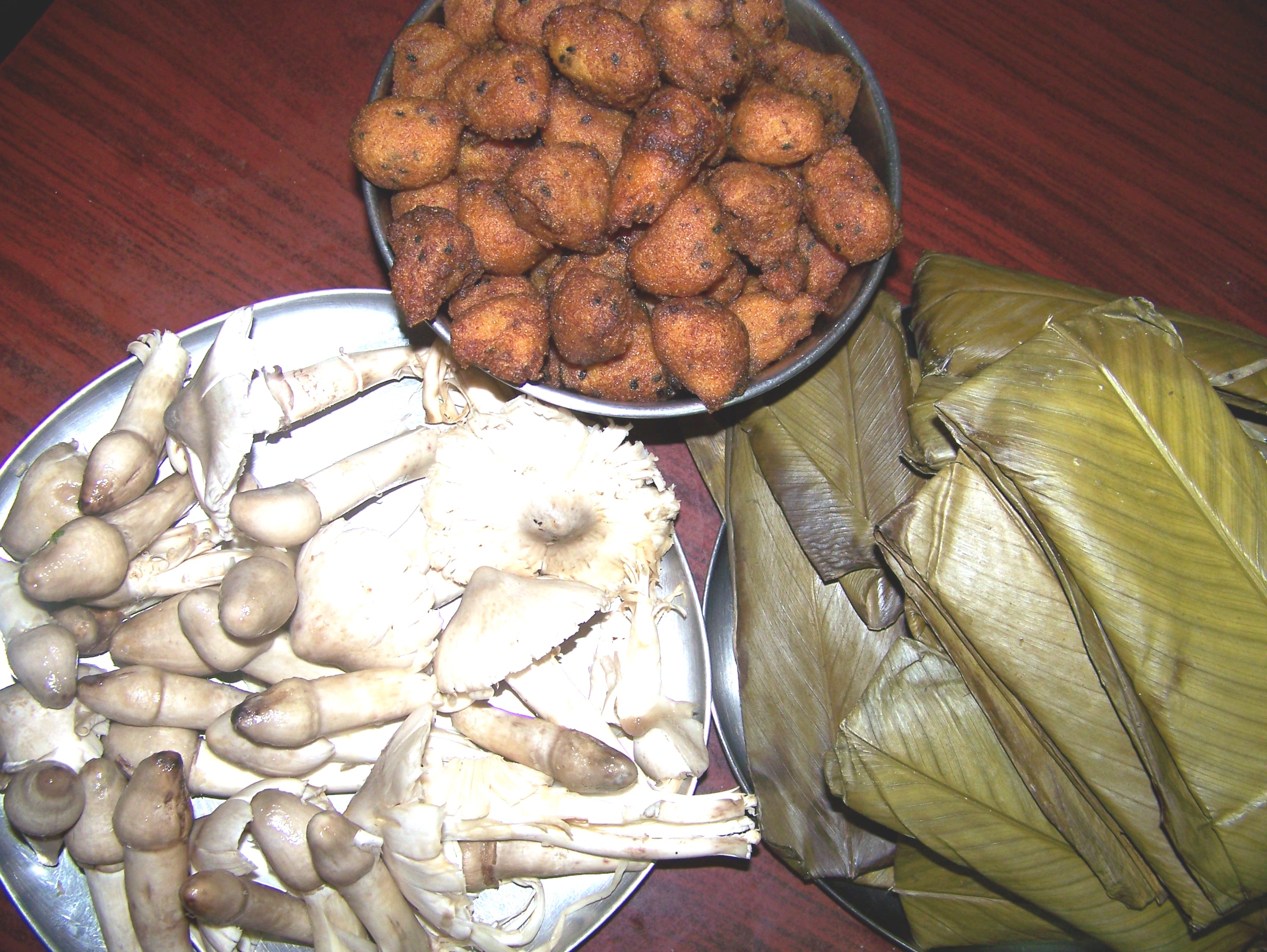
5. Kummu curry (Mushroom curry) especially the wild varieties- Aalandi kummu, Nucchi kummu, kaatola kummu.

The above stuffs taste deadly when combined with hot Akki Otti(Rice rotis) prepared on mud ovens lit with firewood 😉

6. Chutta chekke kuru (Roasted seeds of ripe jackfruit smeared with red soil and dried in the sun and preserved especially for the monsoon)

NON-VEGETARIAN:

7. Njend curry / Chutta njend (Fresh water crab curry /Roasted crabs)

8. Chutta yarchi (Barbecued meat)

9. Onak yarchi fry (Since Coorgs hunted regularly, venison, wild boar, barking deer and several other kinds of wild game formed part of their diet. These meats were also sliced, rubbed with salt and turmeric, strung or skewered and sun-dried or hung from the rafters in smoky, wood fired kitchens)

10. Koile meen curry (Used to be in abundance where bamboo traps were laid in cold, swift flowing streams and the flooded paddy fields were full of these tiny freshwater eels)

SWEET DISHES:

11. Kuvale putt (Prepared with ripe Kuvale chekke (a variety of jackfruit, locally called Kuvale) wrapped in Kuvale ele (Leaf from a local plant found on riverbanks) and steam cooked.

12. Baale nurk / nurk putt ( Bananas fritters)

13. Maddh paaysa/ Maddh putt (Porridge /cake made of an aromatic herb, which is expected to have 18 types of medicine available only during the month of kakkada or aadi)

And last but definitely not the least – A peg of Nell-kall (vodka made of paddy) and some homemade wine…. Or a cup of steaming hot ‘Bellatha Kaapi’ for the teetotalers .. 🙂

People often complain about my eating habits and how choosy I get about what I eat and the little quantity that I peck onto.. Treat me with a platter filled with the above stuffs and see how I can binge on… This city food is CRAP.. and not what I savour…Not even the 6-course expensive meal cooked by the executive chef de cuisine of the costliest restaurant in the world…!!

Kuvaleputt , Nurkputt & Kummu

The Kodava Hockey Festival

Army and Hockey runs in Kodava blood.. It is that time of the year again when the schools and colleges are closed for summer.. Bosses have approved the leave requests from their Kodava employees atleast a month in advance.. Schedule is out.. Flight tickets booked in time as a player /Techie/Banker working abroad has to make it for their family match.. Its the biggest and the maddest festival dedicated to a sport anywhere in the world… It’s the ‘Kodava Hockey Festival’ yet again…!!

Over 300 teams participate with players including people of all age groups- right from a 10yr old primary school kid to a 75 yrs old granma.. Anyone with a mere passion for the game are allowed to join the team, only to fight it out for the coveted trophy each year.. Only 2 rules apply to participate- #1. Be a Kodava and represent your family team   #2. Play the game with passion.

One Kodava family volunteers to take the ownership to organise this huge event each year. This year- it was the ‘Madanda’ family. Hooked up with too much work, I couldn’t make it to this year’s tournament.

The Iychettira cup cover photo

Hence, I’d like to make a mention of the last tournament I had attended- ‘The Iychettira Cup-2012’.

The Indian hockey team during the opening match

The opening ceremony was a gala event with some of the who’s who of the Indian VVIP league gracing the event.. It was followed by a nail biting, action packed, stiff fight during the exhibition match between the ‘Indian national team’ and the ‘Coorg XI’.. The men in blue(Oops.. in white) battled it out at the end though..

Palanganda vs Kaliyanda match in progress

During the 23 days long sporting fiesta, the family where I belong to- The Somayanda family, came through till the 5th round/the quarter finals, but failed to make it further.. The last day was the final fight between Palanganda and Kaliyanda.. The latter lost the cup inspite of a tough fight of 1-2.

Trophies lined up for the final presentation ceremony

One has to experience the madness sitting amidst the crowd cheering for their family teams atleast once in their lifetime.. All up there in the spectator gallery with just one thought in their mind and one feeling in their hearts- ‘HOCKEY’..!!

Picture courtesy: Iychettira cup website

A farewell trek to Madhugiri

That’s what we call bidding farewell in style…

One of our friends was moving out of India and we thought it was good idea to send him off on a happy note; with something that he likes doing and something that he will cherish. With that, my group of friends hosted him for a dinner and then planned a trek to Madhugiri. Madhugiri is Asia’s second highest monolithic hill and has the ruins of an old fort at the top.

After a dinner party on a Friday night, we started to drive towards NH-4 in 2 cars and 2 bikes at 1.00.a.m. With a smooth highway road and bumpy country sides, we reached the guest house at the foothill of Madhugiri by around 4.00.a.m. The initial plan was to reach the peak for sunrise. But, on reaching the guesthouse, we were advised by the caretaker to start the hike after sunrise. There were recent cases of hikers attacked by bears reported on the hills. We waited in anticipation until sunrise.

From the foothills of Madhugiri - A view from our guest house
From the foothills of Madhugiri – A view from our guest house

It was 7.00.a.m by the time we started our ascent after a coffee break at a petty shop in front of the fort entrance. The start of the trek made me feel like it was going to be an easy climb. A well laid flight of concrete stairs took us to about 1/5 th of the total climb of the hill. However, the climb started to get tricky further from there. The hill seemed a little steep, the concrete stairs were replaced by steps carved out of the rock itself. With this stretch, we covered 2/5th of the total distance.

The Madhugiri fort entrance

The steps disappeared in the next stretch. There was only a rod fixed firmly to the monolith with some barbed wire and the hill had become a little steeper. This was covering 3/5th of the ascent.

A view of the Madhugiri town after climbing the flight of stairs

And then the steps disappeared. There was only a rod fixed firmly to the monolith with some barbed wire and the hill had become a little more steeper. This was covering 3/5th of the ascent.

Somewhere in between, an old and ruined wall emerged out. This added to the climbing woes which gave us only limited space to place our footsteps and less grip to place our hand. And then, we had to jump across a crack in the monolith to get to the other side was the steep valley. Once we reached the other side, every structure that was man made suddenly disappeared. It was just one super steep hill stretching into the sky. we had to literally use all four limbs to scale this 4/5th of the hill.

Fort Madhugiri
Fort Madhugiri

And finally, there emerged the first glimpse of the Madhugiri fort- gritty, yet seemingly elegant. This was built by Raja Heere Gowda who owed allegiance to the Vijayanagara kings, which was later reinforced by Hyder Ali. It is believed that this fort was a comfortable hideout for many freedom fighters during the Independence struggle. Beehives on the ramparts of the fort were the only means of sustenance for them and that is said to have given the place its name – Madhu(honey)- Giri(hill).

We walked across the structure in its dilapidated form, where the view on the other side was a treat to our eyes and feast for our tired souls. Our joy knew no bounds when we found a puddle of rainwater, which tasted no less than nectar from a beehive.

A puddle of water atop the hills

We spent some time atop and started our descent so that we could reach the base before the scorching sun made his way. The descent was a rather difficult, with me losing my grip every now and then and having nothing to hold onto. I had to sit and slide down inch by inch at most places. And finally, Bang at 12.00. noon, we had reached the base…

Overall, it was an awesome trek and the last one with our friend.

Cheers..!!

P.S.: photo credits to Sam (I’d left my camera in the safe confines of my home)