Journey away from Bangalore that includes night journey and an overnight stay… Especially ones planned on long weekends with Saturday and Sunday off :)
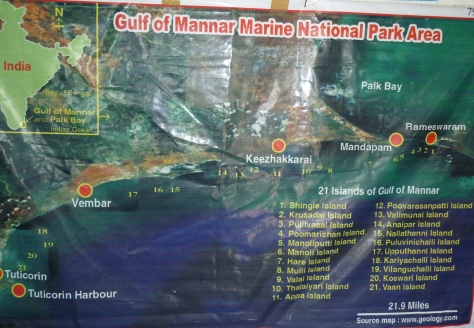
Fisheries, Coastal police, wildlife conservation NGOs.. We have dialed any random and all possible numbers to get clarity and the permission to go to the Kurusudai island.. Thanks to Madhu, with a struggle for over a month to get permission from the authorities- the right phone number struck, and we finally pulled it off… 🙂 Kurusudai is one among the 21 islands in the gulf of Mannar and a site of importance in research due to its rich marine bio reserves.
Gulf of Mannar marine national park area
So, our last day at Rameshwaram- Our destination ahead was fixed 🙂 An early morning bus from Pamban dropped us half way till Manimandapam. From there, a rickshaw ride took us to Vivekananda memorial hall where the 2 forest guides, the oarsman and the motorboat were all waiting for us 🙂 without wasting much time, our boat set sail.. We could see Kurusudai island at a kilometer’s distance across the clear blue waters of the Gulf of Mannar. We had to contain our excitement lest be quoted as psychos by the people who accompanied us.
We stepped on land in no time- we were briefed about the island in the information center and were also instructed not to use our cameras for any sort of photography. There are nearly 3600 marine species spread around 10,500sq.kms of the marine reserve. 117 coral species, 13 mangrove species, 460 molluscan species and 12 species of sea grasses are found here.. A haven for a bird watcher too with over 217 species of birds found here.. And then our guided tour around the island took wings.. or rather.. set sail 🙂
We first sighted a vibrant red star fish seated comfortably on a barrel coral.. But we soon realised.. that echinoderms were the highlight of the walk.. about 100 species of echinoderms are found in this marine reserve. Sea urchins, Sea potatoes, Sea cookies(sand dollar, snapper biscuit, pansy shell, sea biscuit, sand disc, sand cake, cake urchin and sea pancake are other common names given for these relatively shy invertebrates), sea cucumbers (of varying colours and sizes) dotted the entire shoreline of the island.. Sea lotus of different colours was another highlight of the walk.. We saw the marine plant- Pemphis acidula- an endemic plant to this area. The sea grass(Enhalus acuroidus) is another plant endemic to these reserves found abundantly all around. However, we were more keen on spotting the Balanoglossus(Ptychodera flura)- which happens to be the only living fossil in the world which links vertebrates and invertebrates; endemic to this area as well.. However, our guide could not understand what we were trying to ask due to the language barrier of Tamil:(
Since it was low tide, we could walk into the sea- all along the shore where an infinite range of sea weeds, multi-hued reefs and sea grasses spread over the shallow bed of the sparkling water brightened up the entire ambience of the place. From shades of violet to red, the raised coral reefs of the Islands are not only a special attraction of the place but also chart high on the list of marine biologists. We also spotted a notable array of algae, sponges, sea anemones, cowries, volutes, whelks, crabs, strombids, tonnids, sting rays, oysters among others too..
However, in high tides– this island is a good sighting place for the endangered Sea cows(Dugongs) and dolphins(bottle-nosed dolphin, the common dolphin and the finless porpoise). The land is also home to 3 species of turtles which includes the Hawksbill, Green and Olive Ridley turtles. No.. we didn’t sight them… We had to be EXTREMELY LUCKY for that and needed more time(which we were deprived of:( )
However, the main purpose of this blog post…. Tourism is prohibited here and getting permission for a genuine research itself is such a tough deal.. And we really hope that the general public behave themselves when they encounter such rarity of sightings, do not pollute and RESPECT mother nature for the immense amount of patience she beholds and admire the beauty of what she has to offer.. it really hurts when we find even a small candy wrapper sailing or flying up in the otherwise clean atmosphere where so many other genuinely interested people put in their hearts and souls in the conservation activities. What we give only comes back.. Give respect and take respect.. If not, nature has her own ways to take a toll on all the disrespect..!!
This was a destination that my friend and I had been contemplating to travel for some time. The trip turned into certainty only when my friend had the confirmed tatkal tickets in her hands after a wait of over an hour in the queue at the railway station. Then on the following evening, the two of us commenced our weekend journey towards Rameswaram by boarding our train from Bengaluru cantonment station to Madurai. We had a few important things to check-off on our small list for places to see and things to do at Rameswaram. Since the travel tickets were confirmed in the last moment, we had barely any time to make hotel reservations. We decided to go there and find something for ourselves.
Our Itinerary:
Day 0: Evening train to Madurai from Bengaluru Cantonment railway station. Day 1: Arrival at Rameswaram and visit to Ramanathaswamy temple (TNSRTC bus from Madurai to Rameswaram) Day 2: Visit to Dhanushkodi (Local bus from Rameswaram to Dhanushkodi), Rameswaram local sightseeing (hire an autorickshaw for half day), Sunset & Beach walk near Pamban bridge. Day 3: Visit to Kurusudai islands (Local bus to Vivekananda Mandapam & hire a local boat from there to reach Kurusudai islands), Return to Pamban boat jetty; Return to Bangalore (Train to Madurai & change train from Madurai to Bangalore).
The details:
Day 1– Arrival at Rameswaram and visit to Ramanathaswamy temple
The train reached Madurai by 7.20.a.m. After freshening up at the station itself, we left for our main destination. The TNSRTC buses are quite frequent and it took us a journey of 3.5 hours to reach Rameswaram. Enroute, we passed through Ramanathapuram- the last stretch of mainland India. Once we reached Mandapam, the entry point to the island town of Rameswaram, we had our excitement running at its peak. For the next 15minutes, our bus was cruising over the bow shaped road bridge that oversaw the famous Pamban rail bridge. Pamban bridge is an edifice of engineering that is still standing strong on its 100th year in commissioning. This is a bridge that would connect us to the other side of the land, to a town that would host hundreds of stories from the Ramayana during our stay there, over the next couple of days.
After arriving at the Rameswaram bus stand, we noticed the tourist office that stood right opposite. We wanted to try our chance to get permission to the Kurusudai island and hence, registered our names as tourists in their logbook. This island is a protected area and we had tried hard to get permission for our visit even before starting our trip. Though indirectly, our random chance visit to the tourist office in fact helped us BIG time (Click here to read the story in detail).
Lord Rama is believed to be an incarnation of Lord Vishnu. Then, why is the city named after Eshwar? It is important to know at least this while you are there in Rameswaram. Here goes the story… Ravana, (a Brahmin) was a devotee of Lord Shiva (aka Eswaran). On performing penance, Ravana was blessed with a boon by Shiva such that- anyone who tried to harm Ravana would face Brahma dosha. Further, during the war between Rama & Ravana, Rama (a Kshatriya) killed Ravana who then happened to face the wrath of the dosha. Rama then, had to perform pooja to Shiva, the only one who could help him out of the dosha. Here, Eswaran helped Rama. Thus, the name to the town- Rameshwar. I was told that there is a similar story for a town called Ravaneshwar in Lanka.
We walked towards the temple road, roamed around a bit and finally checked into a decent looking hotel close to the main temple. After freshening up, we headed to the main landmark of this pilgrim town, Sri Ramanathaswamy temple. The world’s fifth largest monolithic Nandi statue guards the entrance of this temple. We were overwhelmed to walk across the longest temple corridor in the world and felt blessed after bathing in the water from the 22 sacred wells on the temple. Since it was quite a tiring day due to all the traveling, we decided to sleep early as we had a long day of exploration on the itinerary, next.
Day 2: Exploring Dhanushkodi and local sightseeing at Rameswaram
On the following day, it was Holi: The festival of colors. We were sitting at the Agnitheertham beach at 4.30.a.m watching hundreds of devotees taking a holy dip in the sea. But we were waiting for something else. We were waiting to welcome a day that would unfold with a palette of the best colors that nature could show. Although the wait was long, it was only by 07.00.a.m. when we witnessed what is by far, one of the best sunrises we had seen till date.
Sunrise viewed from Agnitheertham beach
We boarded a bus from there to Dhanushkodi- The ghost city. Although a visit to Dhanushkodi was one of the most awaited part of the trip, it was not our best. From all the stories and experiences, we had imagined of Dhanushkodi, we had expected to need at least one full day there. It is a place that we wanted to explore and not run through which can be best done only if one had a vehicle at his / her own disposal. However, we were at the mercy of public transportation on this budget trip. Like all visitors or “tourists” who had come down there, we too had to settle for a tour of this deserted city in one of the local tourist buses. A round trip was completed in about 3hours with a cost of 100Rs per head not satiating our need to see more of this abandoned town.
Apart from the few main structures and temples (old railway station, church, temple of the floating stone, etc.) that you would see during your tour package(local bus), a few other things that you can do during your trip to Dhanushkodi are:
A walk through the waters of the Bay of Bengal till the Kodandaramasamy temple is a must do. The water level never goes above your knees.
The Ramasetu or the Sethusamudram is something that can be visualized if you have a proper guide with you.
A drive on the asphalt road that stretches up to Dhanushkodi is something to die for. With the calm Bay of Bengal on one side and the rough Arabian sea on the other, the drive is every traveler’s delight.
On your return, you can cover Jada Teertha & Nambu Nayagiamman temple (both located at just a couple of kms before Dhanushkodi.
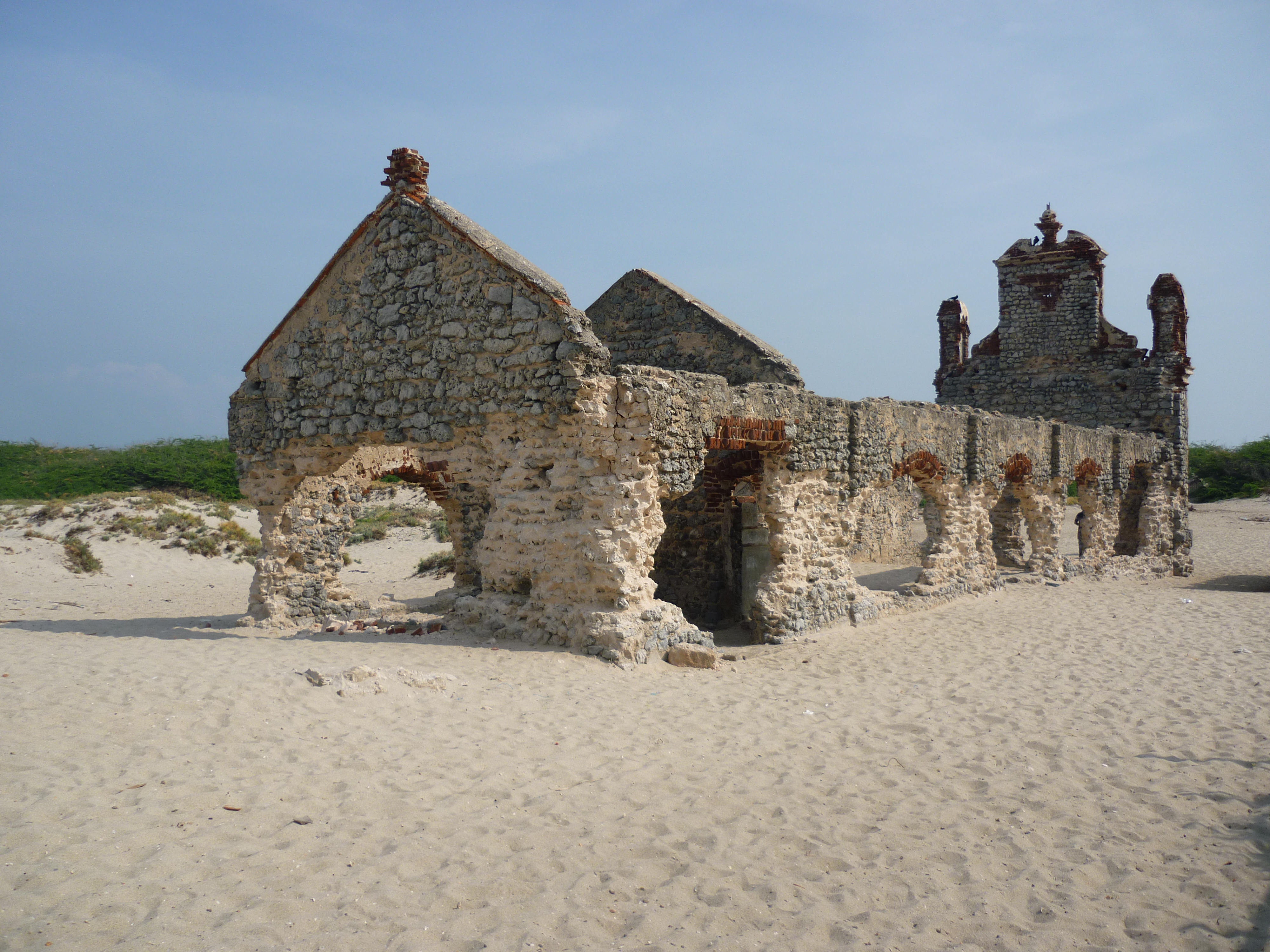
Ruins of the old church
One hour up on our watches and we were back in the main town. We settled a deal for Rs.250 with an autorickshaw guy who would take us on a quick visit of the major places around the town. Some of the places thus covered include:
• Gandaparvatham / Rama paadam- the highest point in the island town from where one can catch a good view of the scenery around. • Sugriva Teertha (a small pond) • Saatchi Hanuman temple • Bhadrakali Amman temple • Rama Teertha • Krishna temple • Lakshmana Teertha • Five-faced Hanuman temple- The floating stones used for the construction of Rama Sethu can be seen here as well. • The house of former President of India, his honor: A.P.J. Abdul Kalam- It is now converted into a museum.
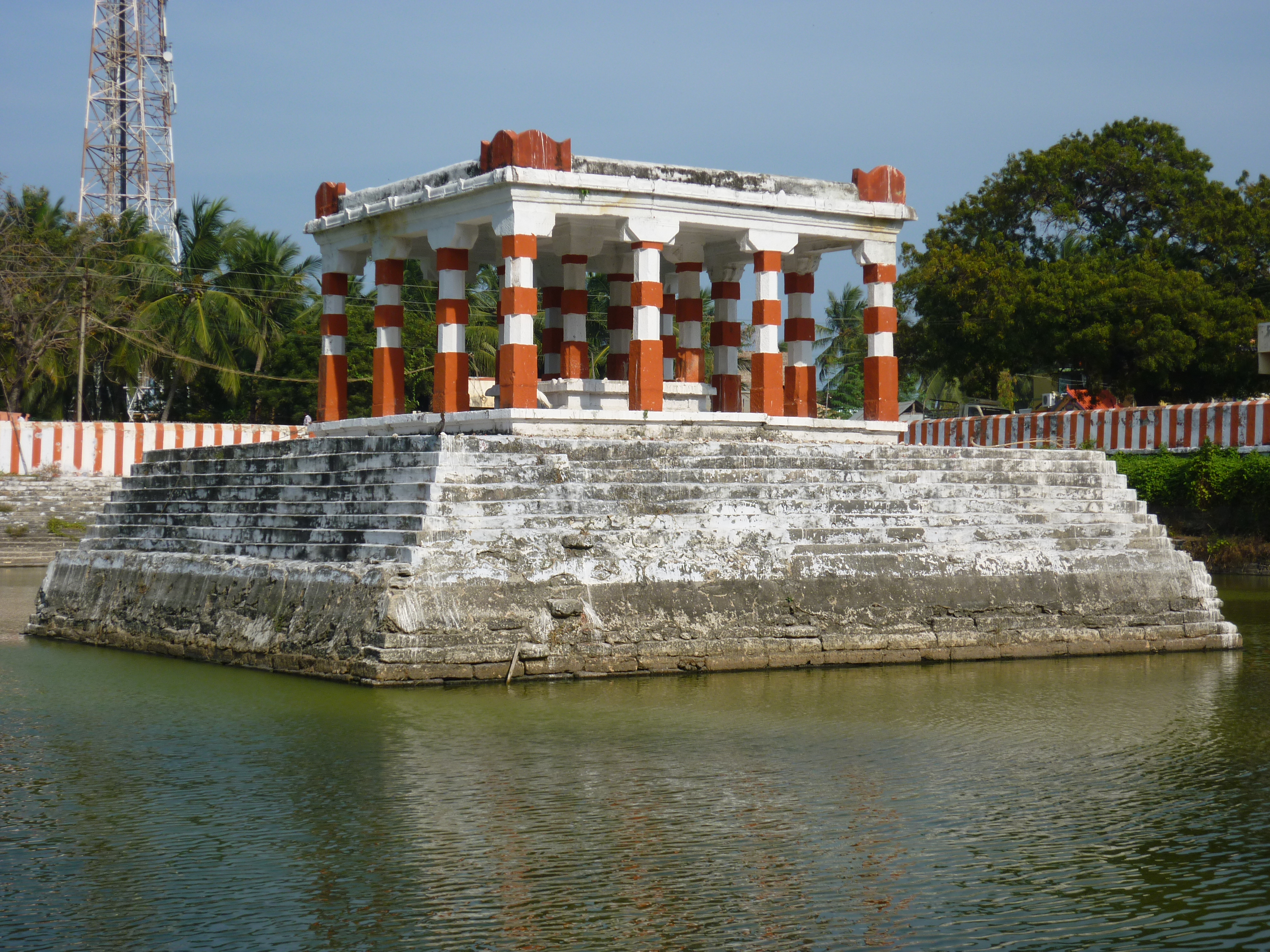
Sri Rama theertham
An interesting thing we noticed in the architectural style of all the structures in Rameswaram was that with the Ramanathaswamy temple being an exception, all the other temples that I have mentioned above are typically built in the Nagara style of architecture. Having covered Rama, Sugriva and Lakshmana teertha, we were curious to enquire if there was a ‘Sita Teertha’ too. Our guide cum autorickshaw driver nodded and brought us to a place on the highway. And to our dismay, he pointed to a small tank by the roadside. It was filled with green stagnant water and a good mosquito breeding ground. “Damn…!! this patriarchal Indian society…!!” I exclaimed.
We were done with local sightseeing by early evening, and still had a LOT of time left until sunset. Standing on the road bridge and peeking down at the train tug over the century old engineering marvel- Pamban was a sight not to be missed. So, we decided to head towards Pamban bridge.
Once we saw a train pass over it, we decided to stroll around a small fishing hamlet that we just across the street. We got some good clicks of the Pamban from the boat jetty in this fishing hamlet. While straying around there, my eyes fell on the light house that was located a few meters across the village. We asked for directions and reached there in less than half and hours’ time. While we waited for the gates to the lighthouse to open, we tagged along with a few kids, our new friends at the fishermen’s cove. With the kids excited to converse in English with us, we did so while taking a walk further down to the seashore. With a magnificent view of the sun setting in the backdrop of the Pamban in the distant end, we settled down under the shade of a mangrove tree until the sun went down completely.
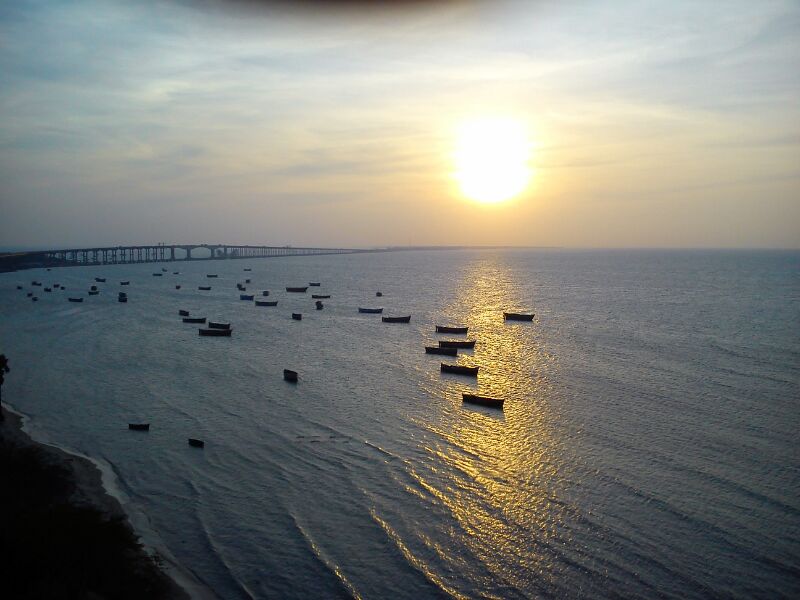
The sunset from the fishermen’s cove
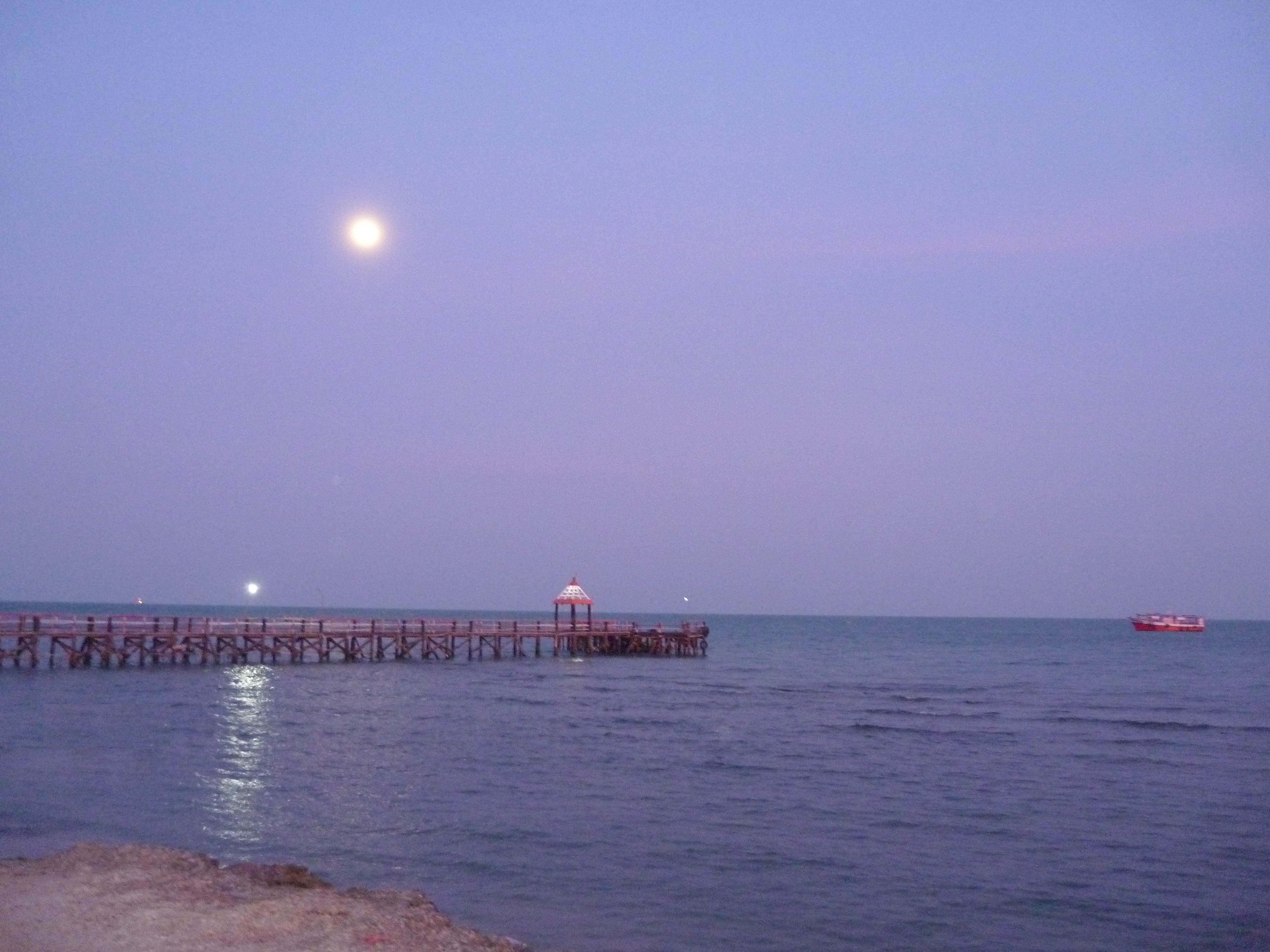
It was soon dark, and we had to head back to the temple road for a safer crowd. We bought some peanuts masala from the vendor on the seashore and found a comfortable seat for ourselves to catch some peaceful time. It was a full moon night.
On that wonderful day: We had seen the faint horizon emerge out from the pitch darkness of the sky that brightened into broad daylight with a series of color change and then the white sky of the day fade into the black of the night … And again, the night’s sky was lit up by the beautiful full moon… Yes… We had witnessed one COMPLETE day…
Full moon lit night sky as seen from the Agnitheertham boat jetty
Day 3: Visit to Kurusudai island and return to Bengaluru
Based on some local contacts, we had got a last-minute permit to visit the Kurusudai island. As per the directions given, we had to check out early and catch the 8.00.a.m bus from Akka-Madang to Vivekananda memorial hall. Our boat was waiting for us with the guide to take us to another world- A world of exotic marine animals- ‘the Kurusudai island ‘. (A more elaborate article on this visit can be read by clicking here). To sum up- “We were lucky to get there”.
From Kurusudai island, we got dropped at the Pamban boat jetty. Our boat was anchored somewhere amid hundred other boats and hence, we had to walk across through knee deep sea water to get to the shore. This walking experience was unique in its own way as one doesn’t get such a sight in any other boat jetty. We had to place every step of ours’ so carefully that we did not want to accidentally step on and kill the in-numerous star fishes or sea cucumbers that were lying on the shore bed.
We walked further up to the Pamban railway station and bought our tickets for the 12.00. O’clock train to Madurai. And soon the train arrived. We boarded and our hearts were pounding hard with excitement. We had bought tickets for a train…. A train to Madurai which would actually ply over the Pamban bridge, an experience that we were waiting to live through. It was an even special ride since it was a journey over the historical Pamban bridge on its 100th year of existence. We couldn’t ask for more…!!!
View of the bow shaped road bridge from the Pamban bridge
In 4 hours, we alighted at the Madurai junction… But yeah, even as I was wondering how everything went so fine through this entire trip, the surprise was waiting for us at the station- our train to Bengaluru would arrive 3hours late. And what followed is… history.
Have you visited Rameswaram? What was the purpose of your visit, Pilgrimage, family vacation or backpacking? What is your story from your visit? I would be excited to hear from you!
It was exactly a year ago, that I decided to celebrate my birthday by taking a short trip and break from my work. Mom and I drove our car from home in Bangalore at around 8.00.a.m. and headed towards Tumkur with a plan to spend the entire day outside. We wanted to cover as many landmarks in Tumkur as possible.
List of places covered:
Devarayanadurga hills: This area has two ancient temples, also a reserved forest area at Naamada chilume
Koratagere: Goravanahalli Lakshmi temple and the reservoir nearby.
Siddaganga Mutt: You can combine this with a short trek up the Siddaganga hilltop.
First, we headed towards Devarayanadurga hills where the twin temples are located. A winding road along a picturesque landscape lead us to Yoga Narasimha Swamy temple atop. The view from the top was beautiful with early morning dew settling on the warm rocks. We got the first aarathi (Pooja) of the day and rushed to Bhoganarasimha Swamy temple situated at the base of the hill. It is the custom that the doors of the later opens only after pooja at the hilltop.
Top: The view of Devarayanadurga hills; Bottom left: the temple pond at Yoganarasimha temple; Bottom right: Bhoganarasimha temple
From there, we drove towards Naamada chilume. This is a small spring nestled amid the greenery protected by the forest department. It is believed that Lord Rama rested at this place enroute to Lanka. When he woke up in the morning, he did not find water to make his vermillion (Naama- in Kannada). Hence, shot an arrow to a boulder from where a small spring emerged. This is a perennial water source even till date. This is part of a reserve forest area and there are a few spotted deer kept in an enclosure. Nothing very exciting about this place, we would have skipped it if we had known.
Top: The road to Naamada Chilume; Bottom left: A guesthouse at Naamada Chilume park, Bottom right: the water spring where Lord Rama’s arrow struck
From there, we lost our way and reached the main road after a very long drive. We asked the locals for directions towards Goravanahalli. This village is famous for the Lakshmi temple and better known for- Late Kamalamma, the holy lady. We finished our pooja amidst the crowd, took turns to make a wish at the wishing pillar. There is a small lake and a reservoir at a walkable distance from there. We went up there and had our packed lunch with the cool breeze and a good view. Soon after, we planned our next destination- Sri.Siddaganga Mutt.
We were blessed with the holy water of Siddaganga. We took a stroll around the huge campus of the mutt and were awestruck with the service rendered to the society. And then, we were in for a BIG surprise… An occult of the least expected. We felt blessed when we got the darshan of his holiness Sri.Shivakumara Swamiji… It is when least expected, miracles happen. Swamiji who is fondly called ‘the walking god’, was gracefully sitting on the porch of the Mutt and blessing the visitors. Even after several days of planning to get an opportunity to see him, people consider it hard to be able to see him. And there I was, right at his feet, taking blessings from this Holy man. I was thrilled, ecstatic and had goosebumps. Only countable people on this planet have this magical aura around them (according to me), and he is one!
A nandi carved out of a rock at Sri Siddaganga Mutt with the image of Sri.Shivakumara Swamiji
With that, it was a wrap to our day tripping, and we headed back home, feeling all blessed (literally! With a long day of temple visits) and having a small peek into history and mythology here and there along our way.
Trekking enthusiasts have a lot of options around Tumkur. I have covered these places on separate occasions.
Tiger Census is a week long quadrennial event conducted all over India at the same time. A total of 5,00,000 sq.kms area – 17 states- 40,000 forest beats to be covered with 2000 personnel pulled in to count an estimated 1700 tigers nationwide. The event was scheduled from 16-Dec-13 to 23-Dec-13. With 2 days of training, the census will be done in 2 parts. The 1st 3days will mainly concentrate on tracking the carnivore population(including tigers, leopards etc) through critical carnivore trails and the next 3 days will be through specified transact lines identified to count the herbivores and evaluate the healthiness of the carnivore habitat.
The public can participate based on an online application and selection procedure. It is purely voluntary wherein, 1 volunteer will be accompanied by 2 forest guards and allocated a specific beat inorder to spot the mighty one with the stripes..!! The forest department would provide bare minimum logistics (read it food) However, beddings need to be carried by the volunteers themselves 🙂
So all said and done, I was shortlisted as a volunteer for Kallahalla Wildlife Range in the Nagarhole Tiger Reserve. Last minute preparations, arguments with folks for permission, hunt for a notary for getting the indemnity bond attested.. I was all done and all set for the LONG week ahead 🙂
Day 1: After getting misguided by google maps a couple of times, I had arrived at the forest office in Kallahalla by noon. After the enrollment formalities were done, there was a small briefing for the volunteers about the do’s and don’ts in the forest. We were not in a luxury campsite, we had to remember and be alert always. We were then directed to the camp to grab some rest before the hectic week ahead 🙂
The camp itself was in the middle of the national park that boasts of the highest density of tigers in India. The shelter we had to look upto during our next few days was an old abandoned 3 BHK house which once served as a forest staff quarters. Now, there laid only the walls and a thatched roof with no doors, no electricity and no phone connectivity. We would have the privilege of being greeted by wild animals at our door step every morning and reptiles creeping in to the living room every now and then. We did not have to be surprised even if one fine morning, the tiger himself waved a ‘Hai’ at us while sitting on the porch.. The only things that we had with us to protect ourselves were our sleeping bags, camouflage clothing, trekking boots, torches and some insect repellents. That evening, we opted to sit out in the open, under the clear starry sky until the biting cold of the December night froze us. It was just a day past full moon 🙂
Day 2:We all assembled by 6.00.a.m in front of our camp where I was introduced to Mr.Swamy & Chikkanna. They were the guards who would accompany me through the due days ahead. Chikkanna was a ‘Kaadu Kuruba’ tribal person. He could recognize the forest with just it’s sounds and smell. He knew every grain and twig in the forest. Swamy was a Bachelor’s in Biology. Chikkanna’s role was to manage the team with the survival skills for the deep jungle and help identify things with their local names. Swamy would then document everything with the local and their scientific names. And me? I was a general public, getting aware of various aspects of forestry and the habitat census procedure itself.
Mr.Swamy saved the camp as the reference point in his GPS and the three of us marched towards our beat. We stopped by every now and then to make a note of the different animal scats that we found along our way. Also, the forest grass cover, vegetation, commercial trees, medicinal plants, herbs, shrubs, every thing were recorded. The scat samples that we collected in small sachets included those of wild cat, barking deer, rabbits, sambars, spotted deers, bears etc. along with that of the tiger as well.. Further ahead, as we marched a few kilometres into the thicket, we reached a small bit of moist land. We spotted aleast a dozen of jungle fowls around there. We walked around the place and noted fresh pug marks of a tiger mother & a cub who had just dropped by, to quench their thirst. We proceeded further and the sight I encountered next needs a special mention. Atleast 50 parakeets emerged out of a small bush when I walked by. It was truly Awesome 🙂 I cursed myself several times for not being able to identify the innumerable bird species I came across all the way. We saw a tree-full of langurs, Malabar giant squirrels and sambars. We encountered a pack of wild dogs(dholes) who surely were upto a well laid strategy. However, the day soon ended without any major direct sighting of the tiger.
Day 3:Another day, filled with anxiety began at 6.00.a.m. We were greeted at the entrance of the transact line by some wild hogs. The 2km stretch of the transact was covered without any sightings apart from elephant dung all the way. Further downhill, we saw fresh tiger scat and I had already started to crib about having missed a glimpse of the striped beast by a few minutes 😦 Peacocks, barking deers peeked into our way at times. We then grabbed some wild berries from one of the trees along our way. We consumed it only after it was okayed as ‘Safe for consumption’ by Chikkanna.
When we continued our walk further, Chikkanna stopped us suddenly and asked us to stay still for a while. He pointed- “Elephant..!!” He concentrated on the sound and again said- “There are 2..!!” Within moments, we heard the thumping sound of the elephants moving towards us.. 100mts.. 50mts.. 10 mts.. SHIT.. We saw them both right there.. “RUN…”Chikkanna commanded.!! The three of us just ran… and the elephant mother & calf duo followed us… We ran.. they ran.. We ran further. “TREE..” Chikkanna pointed. And we three climbed and reached the top of the tree within seconds. (It is unbeleivable how you end up doing things that you have never done before, when it is for life.. I had never climbed a tree before. Atleast not one this high..!!) The duo continued towards us. Swamy grabbed a few crackers from his bag and lit them one by one. After bursting 5-6 crackers, the elephant duo decided to spare us. Although petrified a little bit at my first near death adventure, I descended the tree and continued our walk further.
We passed by something that looked like a tiger’s den with few bones stranded here and there. We reached Kiggere- the tropical moist deciduous part of the forest. It is a grassland, where we saw herds of spotted deers grazing all around. We rested there for a while and feasted on the fruits that we had collected along our way. The second leg of the day continued here on, towards Kebbekatte.
Climbers, creepers, bushes, thorns- we waded them all.. and suddenly pug marks appeared from nowhere. “The tiger has just walked down to the watering hole-200mts down the line(Kebbekatte), we might be lucky“- Chikku said. “Shh..” followed an alarming sound. “It’s a tusker.!! He is close..” We looked around and couldn’t find any trees this time. We real7sed that we were stranded between an elephant chase. Swamy reached out to his supervisor over the walkie-talkie to inform him of our status. He was informed that we were stuck midway and it was not possible for help to reach us from either ends of the beat. Without an option, Swamy lit a couple of crackers this time. And, we were all releived for getting lucky again, for the 2nd time.. We then walked towards Kebbekatte. It was an unfortunate day for us as we had just scared the tiger away which was spotted by the other beat who had arrived there before us.
Day 4: My heart kept thumping a little harder than usual. I felt a bit nervous while I was heading towards the jungle. My fingers were crossed all the way hoping to have no more adventures. I felt it was okay even if I did not spot a tiger, but wanted to reach back alive and kicking. I kept walking blindly behind Chikkanna who lead Swamy and me. We had to literally find our way out of the bushes which had overgrown all of us, blinding our way further. We could not even see if a tiger sat by, snarling at us. I heaved a sigh of releif when I got the 1st glance of the Kiggere grassland. the 1st part of the beat was accomplished, peacefully..!! Chikkanna moved into the bushes to answer the nature’s call. And so did Swamy, behind another one. I was trying to pacify my thumping heart standing all alone in the meadow. Tigers are mostly spotted in open grasslands, I had read. Then, on hearing the trumpet of an elephant, Chikkanna emerged out of the bush. He signaled Swamy to join us asap. He explained to us that the tusker was calling for a fight and is moving towards Baalekatte(our route further). We walked ahead slowly along the same route. Suddenly, Swamy pointed out to our right and screamed- “Run Run… its a Herd.. Herd..
It took few seconds for Chikkanna & me to believe our eyes. We had forgotten to look out in other directions while we were concentrating on the lone tusker. About 10-12 gigantic pachyderms were marching towards us, at a distance of barely 20mts from us… We three started to run… Chikkanna shouted- “The tusker & the herd, both are heading towards Baalekere, let us run towards Doddkere“. We three ran..
Tadan…. Another tusker stood right infront of us…. We three were surrounded by these pachyderms from 3 sides.. Chikkanna and Swamy ran.. I followed them.. While the two were running much ahead of me, I got entangled in between a thick bunch of creepers. “F**K… This is it..!!” I thought. But, I saw god in disguise running towards me with a dagger in his hand and free me out of the tangle. It was Chikkanna. After running for a distance, he had turned back to check on me. On noticing that I wasn’t there, he had come back.
The monsters were close, we continued to run.. I again tripped over a snake that crossed my leg.. I leaped over and continued to run. Meanwhile, Swamy had lit a few crackers and planted them along the way. Out of 6 odd something crackers, only one bursted. The sound was good enough to shoo the tuskers away.. We continued to run and reached the safe confines of a tree trunk on the otherside of Kebbekatte lake.
After a short while, we met the group from the other beat and headed towards Sulekere along with them. This was the last option we had, to catch a glimpse of the striped monster. We waited there for a long while hoping for him to come there to drink some water. We saw bisons and other animals walking in there, but hard luck- we could not spot a TIGER 😦
And thus ended our tryst with the wild.. The pug marks were all accounted which will be matched with the camera images captured by NCTA and a compiled report will be out in a few months’ time 🙂
Whether it was my chase of the ‘Tiger trail’ or if it was ‘Me getting chased for being in the elephant trail’, I don’t know. But what I’m certain was ‘The Chase’ was over..
While considering Ooty to Bangalore distance, the Ooty is one of the favourite haunts for Bangaloreans, along with the people from nearby cities like Mysore, Coimbatore, Chennai etc. Popular for its well-groomed tea estates, the pleasant Ooty weather although the year has earned it the title of ‘Queen of Hills’. We were nine friends in two cars on this monsoon weekend trip to explore Ooty district. But this trip was planned by skipping all the tourist places of Ooty and exploring the lesser known corners of the district. We started from Bangalore on a Friday night at 2.00.a.m. hoping to reach Bandipur by 6.00.a.m. That’s when the forest check-post opens, and we hoped that could spot some wild animals along our way. But, due to frequent pit-stops, we made it to the check-post only by 7.00.a.m. Nevertheless, we spotted a good number of elephants, peafowls, fox, deer, sambars, wild boars etc. With so many sightings, it was quite a good start for a trip, I must say! The itinerary for our weekend is as given below.
Itinerary:
Day 0: Leave from Bangalore by night Day 1: Explore Avalanche forest reserve, explore Ooty, stay at Masinagudi Day 2: Trekking and other activities at Masinagudi, Wildlife safari at mudumulai forest or Bandipur range, drive back to Bangalore through Bandipur. (Visit Himavad Gopala Swamy temple, if time permits)
The details:
Part 1: Avalanche and Ooty
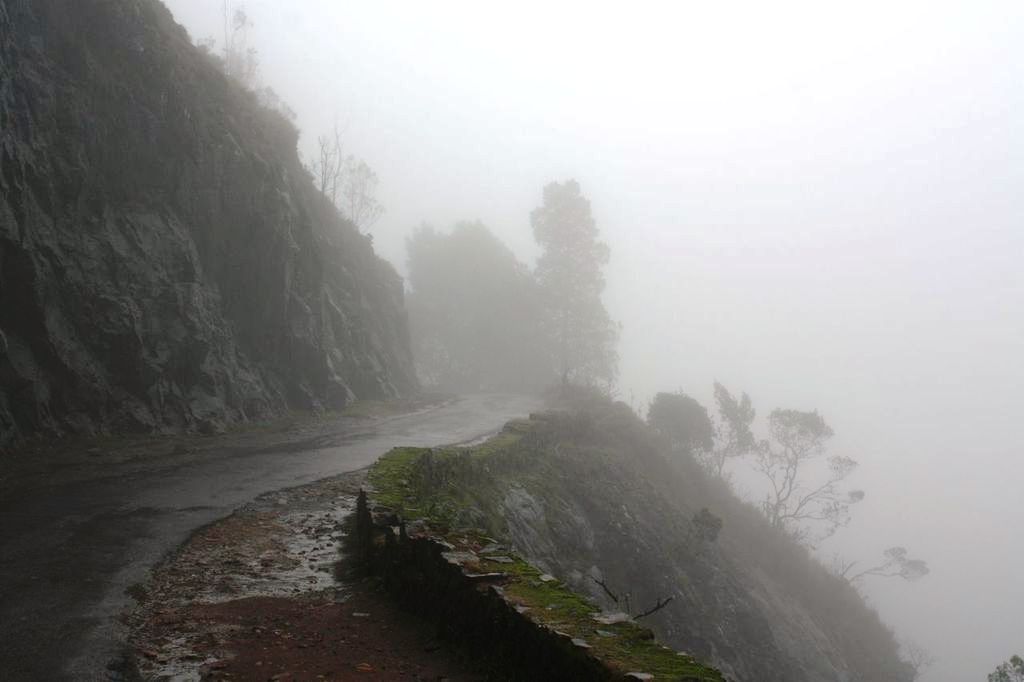
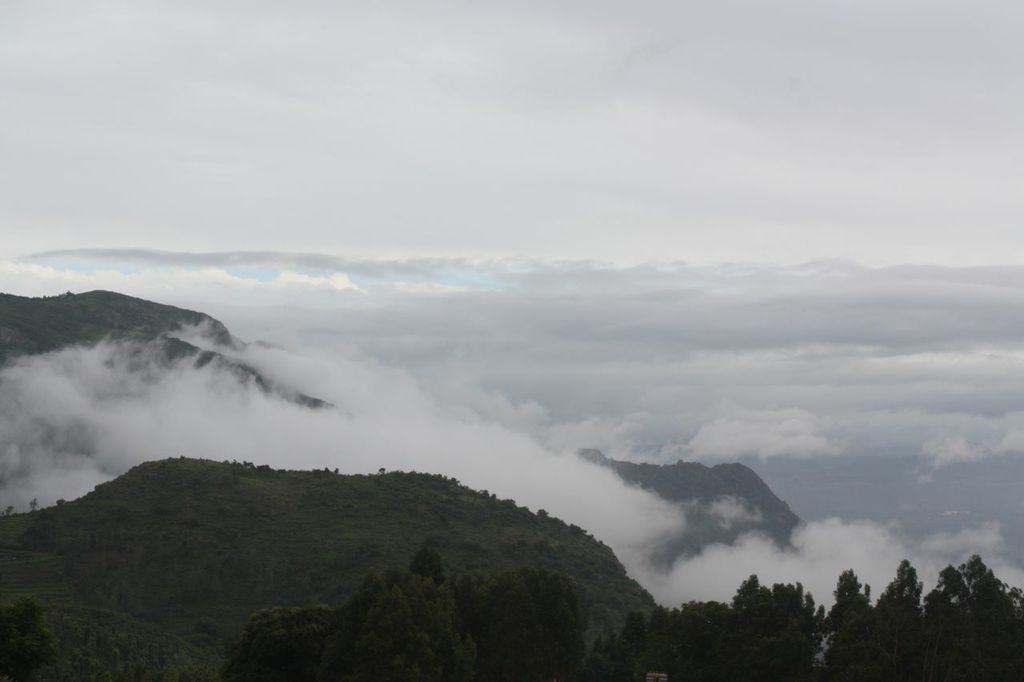
First in the visit list was the Avalanche, a steep & breathtaking climb of 35 hairpin bends with deep valley covered by thick white snowy clouds on one side led us to Udhagamandalam a.k.a. Ootacamund a.k.a. Ooty. Without wasting much time amidst the maddening crowd of tourists there, we drove down another set of 34 hairpin curves- 25 kms further from Ooty to reach the forest check post of Avalanche. Thick rainforests on either side, bumpy waterlogged potholes and scenic view of the Emerald dam backwaters at every turn, accompanied us all the way till the start point of the eco-tour. Once there, we hired the forest jeep for a 24 kms drive through the Shola forests- A place that was BEAUTIFUL.
Enroute to the Bhavani temple at Avalanche
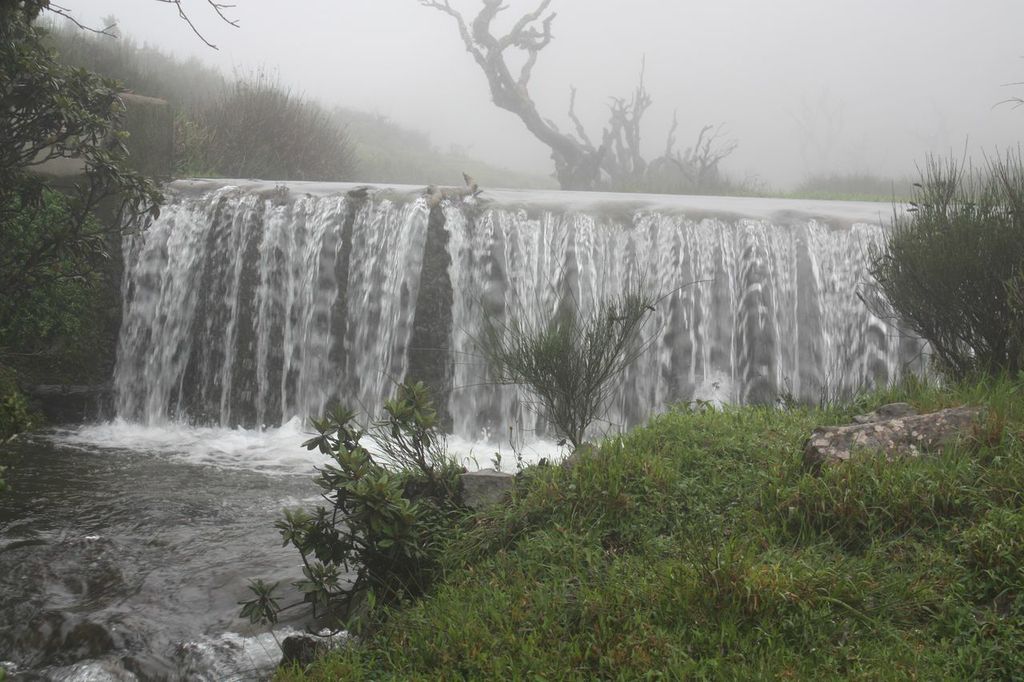
On a clear day, one can see the dam from this place. If one is lucky, he could spot a leopard or an elephant on the way, we were told. Since we were there during monsoon, the thick fog made the visibility poor adding onto the adventure of our jeep ride. On this eco-tour, we visited a century old Bhavani temple, innumerous waterfalls and ended at a beautiful spot called as ‘Lakdi spot’. It had a small stream cascading down in full fury and then running through the shola grasslands surrounded all around. After spending some time there and getting all drenched, we realized that we were all wet till the bones and chattering with cold. Thus, decided to head back to our cars at the entrance.
One of the many waterfalls tucked away in the Avalanche forest
From Avalanche, we commenced our drive towards our next and the main destination of the trip: “Masinagudi. Masinagudi is a part of the Mudumulai forest range, the extension of Bandipur National park (in Karnataka) towards the state of Tamil Nadu. Since Ooty is the only and the last town before heading towards the forest area, we decided to take a short break there. We filled our cars with fuel, withdrew cash from the ATM and bought some Ooty chocolates along with other essentials before heading towards the cottage we had booked for our stay. Our stay was in a private estate adjoining the forest fringes or rather say it was located within the reserve forest itself. It was late evening (already dark) by the time we reached our cottage. (NOTE: The forest check-post closes by 06.p.m)
A view of the valley from one of the hairpin bends of Ooty
Part 2: Masinagudi
We parked our cars at the Singara check post, beyond which the roads are drivable only with a 4WD/SUVs to reach the cottages. Two Mahindra Jeeps were arranged by the cottage guys itself. This 3 km ride from the Singara check post to our cottage was a GRAND welcome in itself: Our road was blocked by herds of elephants, bison and deer. These encounters took our excitement to a soaring high…!!
After a quick round of dinner, we all got ready for the highlight of the trip- The night safari: at 00.00 hrs. in the night, who can believe if we say we drove in an open jeep into the heart of the national park in search of a tiger that was feasting on its latest kill..?? Our safari guide and his clients had been lucky to get this rare sighting on the previous night. And once we were there in the middle of the forest, the screeching engines of our jeep halted, lights were switched off. It was a new-moon day. So, there was no moonlight even, only the open sky with the twinkling stars guided us through. The only 2 sounds we could hear were that of the orchestra of the cicadas and the pounding of our anxious hearts. What we all discovered right there, in the middle of nowhere was “ETERNAL BLISS”. Even after a thorough search through the remotest corners of the grassland, we could not find the tiger until 2.00.a.m. Although we spotted a few other animals, we were definitely sad about the fact. But the bumpy ride to the forest and back was an experience in itself that was all worth it!
Next morning, we were greeted by the excellent view of the Blue mountains (Nilgiris hills) through the window glasses. We all jumped up for the guided walk along the stream, lining the boundary of the reserve area. We captured some rare fauna like the Nilgiri langurs, Malabar grey hornbill, Malabar giant squirrel, peafowl etc. in our machine-gun-sized cameras. The climb to the tree top house is also worth a mention that gave us a good view of the forest around. It was afternoon already by then and we had to pack up for our return journey towards Bangalore.
At Bandipur National forest
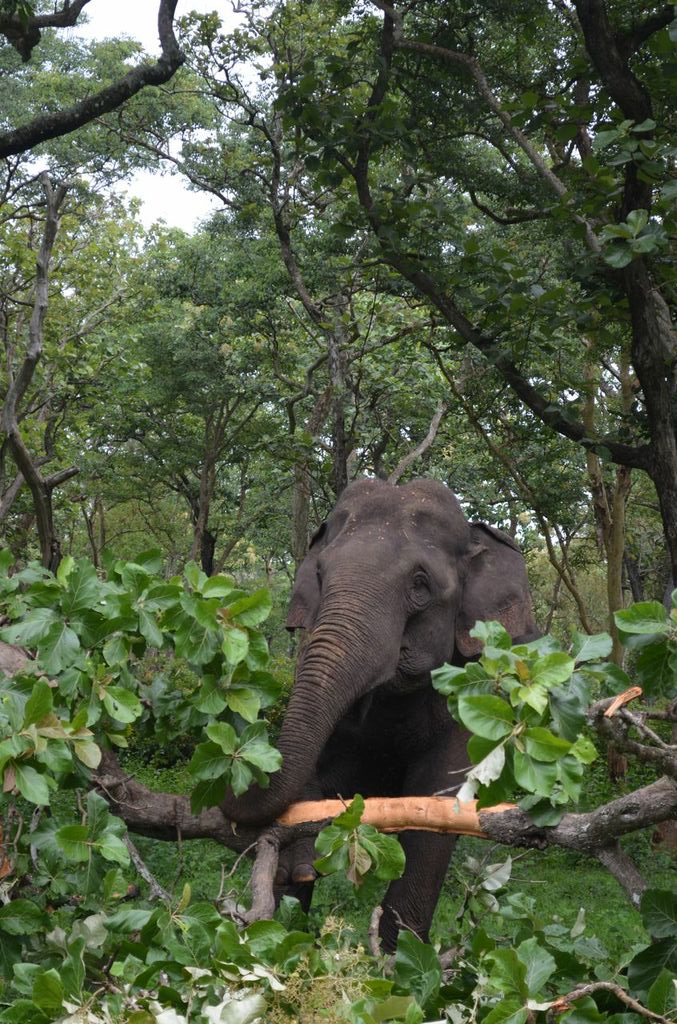
Contrary to the normal boring return journeys when all are usually exhausted and silent, all the 9 of us were jumping off our seats every now and then, until we crossed Bandipur: We encountered at least 24 elephants including a herd with a new born, at least 20 peacocks all set to open up their feathers as it had started to drizzle, sounder of wild boars etc.
For someone who finds peace in nature, this was a magical trip! This is that ONE trip that I would love to do all over again and that time, it would be for a longer stay here… in the cradle of mother nature.
So stuck up with my professional life.. I am finding little / No time to visit my native, where my basics belong to.. Politics, emotions, manners, education- on the whole the basics of every aspect of the human that I am today 🙂
Nostalgia fills my heart as I hear of heavy rains in the recent weeks- little villages have turned into islands, water levels are atleast 2 feet above bridges, waterlogged paddy fields now look like a never ending stretch of the river itself.. WOWwww…. An amazing picture of a rain fed rather filled-green COORG flashes infront of me.. And what my heart is craving for at the moment is some AWESOME Coorgie food.. And what my taste buds are asking for are the lesser known typical monsoon delicacies native to Coorg and cannot match their original taste if tried to re-create in any part of this wide world even by the greatest chef ever born..!! So here goes the list..
VEGETARIAN:
1. Therme thoppu palya (Fern salad)
2. Kembu suli curry ( Colocasia shoots)
3. Baimbale curry (Bamboo shoot curry)
These are varieties found only on river banks.
4. Kaad maange curry (Wild mango curry)
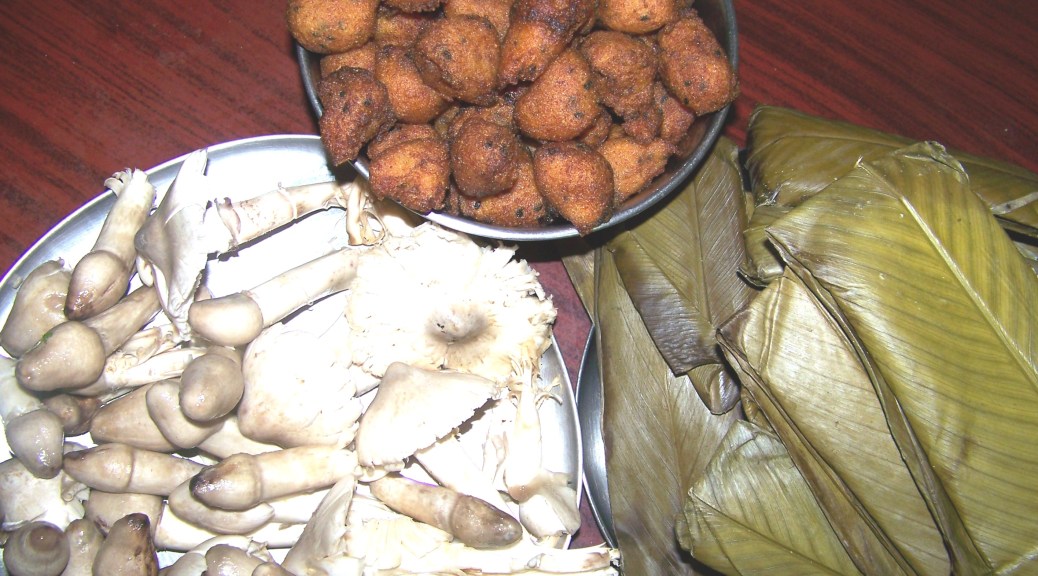
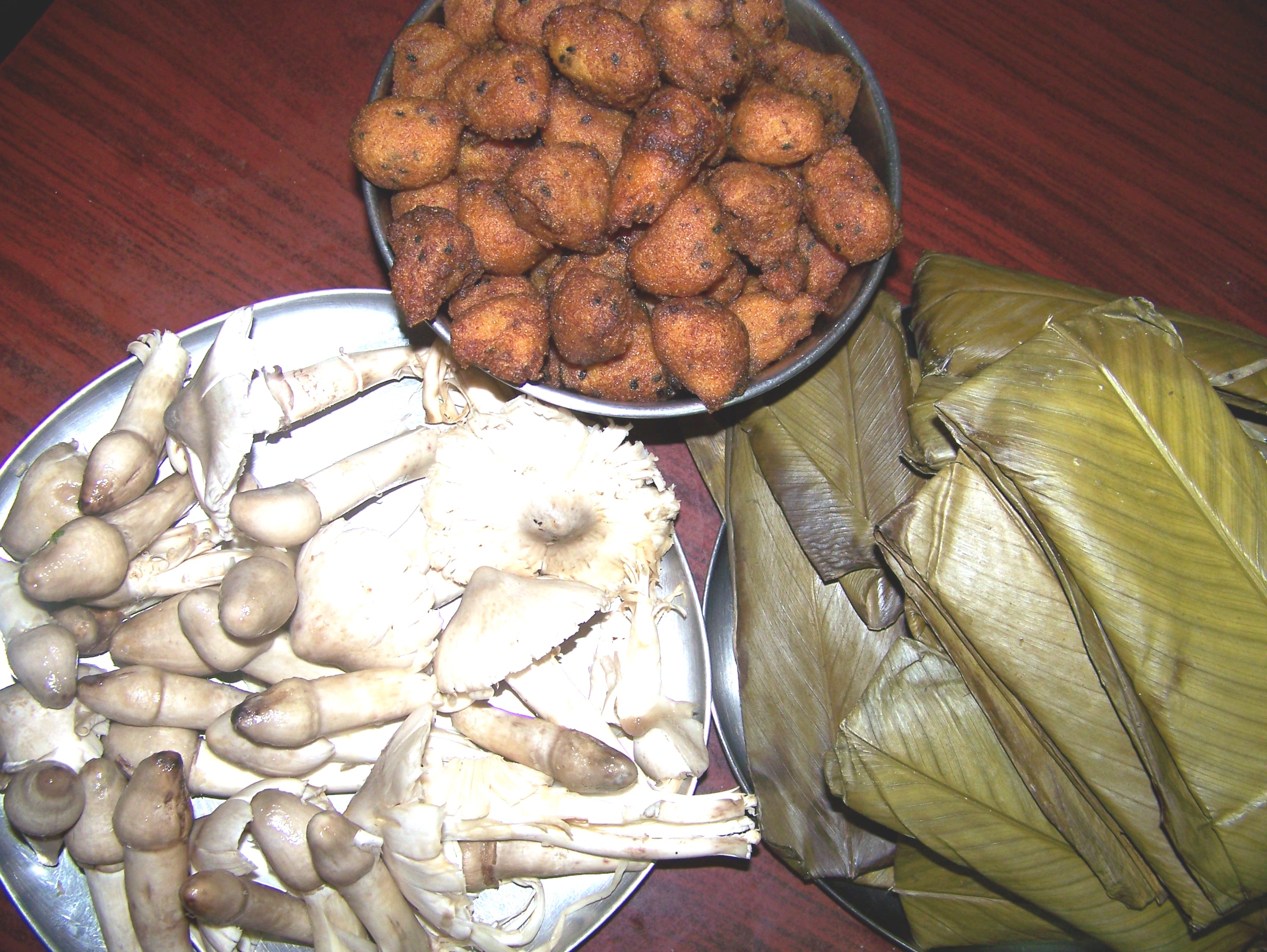
5. Kummu curry (Mushroom curry) especially the wild varieties- Aalandi kummu, Nucchi kummu, kaatola kummu.
The above stuffs taste deadly when combined with hot Akki Otti(Rice rotis) prepared on mud ovens lit with firewood 😉
6. Chutta chekke kuru (Roasted seeds of ripe jackfruit smeared with red soil and dried in the sun and preserved especially for the monsoon)
9. Onak yarchi fry (Since Coorgs hunted regularly, venison, wild boar, barking deer and several other kinds of wild game formed part of their diet. These meats were also sliced, rubbed with salt and turmeric, strung or skewered and sun-dried or hung from the rafters in smoky, wood fired kitchens)
10. Koile meen curry (Used to be in abundance where bamboo traps were laid in cold, swift flowing streams and the flooded paddy fields were full of these tiny freshwater eels)
SWEET DISHES:
11. Kuvale putt (Prepared with ripe Kuvale chekke (a variety of jackfruit, locally called Kuvale) wrapped in Kuvale ele (Leaf from a local plant found on riverbanks) and steam cooked.
12. Baale nurk / nurk putt ( Bananas fritters)
13. Maddh paaysa/ Maddh putt (Porridge /cake made of an aromatic herb, which is expected to have 18 types of medicine available only during the month of kakkada or aadi)
And last but definitely not the least – A peg of Nell-kall (vodka made of paddy) and some homemade wine…. Or a cup of steaming hot ‘Bellatha Kaapi’ for the teetotalers .. 🙂
People often complain about my eating habits and how choosy I get about what I eat and the little quantity that I peck onto.. Treat me with a platter filled with the above stuffs and see how I can binge on… This city food is CRAP.. and not what I savour…Not even the 6-course expensive meal cooked by the executive chef de cuisine of the costliest restaurant in the world…!!
I had the opportunity of visiting this city in the southernmost part of India as a part of a Business trip. Our work was mostly sufficient to do for one full day. However, the transportation options connecting Bengaluru to Trivandrum weren’t convenient. Trains took nearly 48 hours one way and the distance is too far to cover by road. The connecting flights are scheduled around noon. Hence, by choosing to fly to complete my work assignment (as a car doctor), I had some time to explore the city as well. Since my visit spanned over a period of three days, I used my spare time (early mornings and evenings) to cover major landmarks in and around Trivandrum (officially called as Thiruvananthapuram). If you are someone visiting this city for exclusively tourism purpose, then these places can be covered in one day and combine it with an additional day trip to Kanyakumari- the southern-most tip of mainland India.
My Itinerary:
Day 1: Bengaluru to Thiruvananthapuram (morning flight), drive past Shangamughan beach, Sri Padmanabhaswamy temple visit, Puthenmalika / Kuthiramalika Palace & wooden museum, Day 2: Shopping at SMSM institute crafts emporium, Maha Chips store, Covalam beach & Vizhinjam lighthouse. Day 3: Return from Thiruvananthapuram to Bengaluru (Flight)
The details:
Was it the coastal line being abundantly lined by the coconut trees along with the rhythmic beats of the famous drums resonating in the air? Or could it be the SUVs & MUVs that underwent the brutal checkup by me during my so called ‘Business trip’? Well, I’m not sure. But, all these definitely made my visit to this little silent capital city, an AWESOME one. A city of Trees & Vans & Drums put together, Trivandrum it was!
Day 1:
A morning flight from Bangalore landed my colleague and myself at the Trivandrum airport by 09.30 a.m. A car was waiting for us outside, which drove us past a fishing hamlet enroute to our workplace. We began our work without wasting much time. My job (as a car doctor) more often involves driving around the places we go to as part of the checking routine of the automobiles. It was no different here either.
We got to see scenic and offbeat roads around this capital city of Kerala. Fishing dories anchored, fishermen carrying their day’s catch, the blue sea water reaching to the horizon and a lovely lady’s figurine sculptured by the Shangamughan beach side were some of the views I caught from the cabin. Further, as we crossed the toll road and drove across a bridge through the by-pass road, we were greeted by the backwaters dotted by the houseboats. It was indeed a warm welcome to the city..
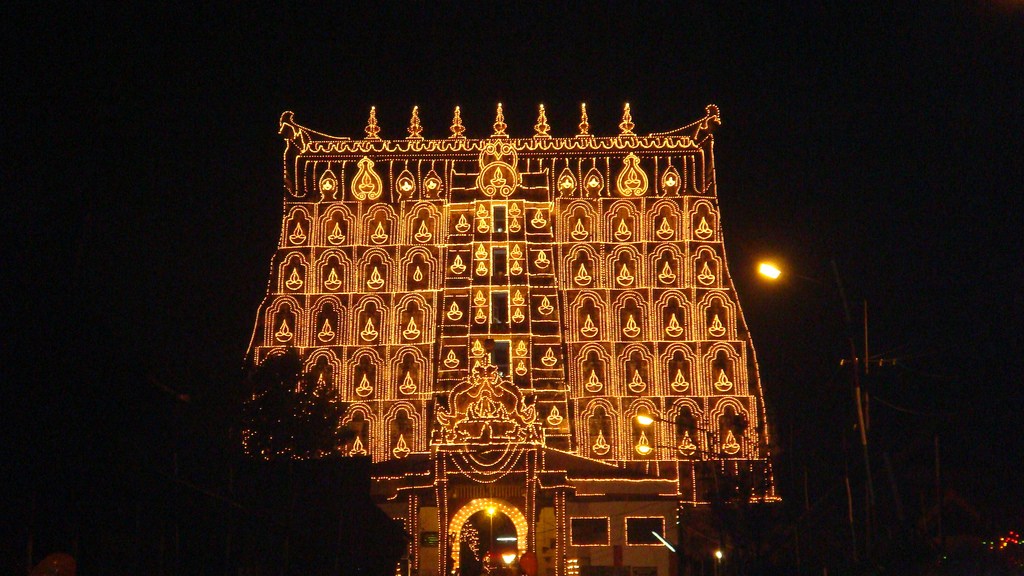
After finishing the day’s work in the evening, we freshened up at the hotel and headed out for the much anticipated part of our visit to Thiruvananthapuram. A visit to the richest temple in the country: Sri Padmanabhaswamy. For all the hype and media space grabbed by this temple, I had expected a BIG crowd of tourists(Not Pilgrims) here. I had imagined the sight to be like all other famous temples in India with fussy godmen, lot of petty shops dotting the walkway selling pooja items etc. among other things. But in total contrast to what I had imagined, this has been one of the BEST temples I have visited till date (among the well-known and famous landmarks).
I’m not a pious or a temple person, but this place has truly stood apart. I am someone who believes that ‘a temple is a place where one has to FEEL god and that’s possible only when the place is PEACEful’. I prefer holy places to be silent and less-crowded. And this place stood out for just that..!! A strict dress code and prohibited entry for non-hindus, a stringent adherence to the temple rules, limited crowd, silent ambience, an eyeful of the darshan of the massive idol lit by mere oil fed lamps: The place hadn’t given up its sanctity in the form of commercialisation, to all the attention grabbed by it’s hidden chambers of gold.
Main gate – Padmanabhaswamy temple
After offering our prayers, we visited the old wooden museum inside the Puthenmalika / Kuthiramalika Palace just outside the temple premises. The structure built by the erstwhile Travancore kings is a damn nice place for the art lovers. Like most regions in Kerala that sleeps with the setting sun, we headed back to the hotel to call it a day.
Day 2:
After finishing our work around evening, we set-out to do a little bit of city trotting. No visit is complete without taking back souvenirs. The rule in my work team is (on a lighter side), ‘Whether you finish your assigned job or not, whether you return safely or not, we don’t care. Bring us souvenirs and the local snacks to eat.’ So, we shopped for some local crafts at SMSM institute crafts emporium.
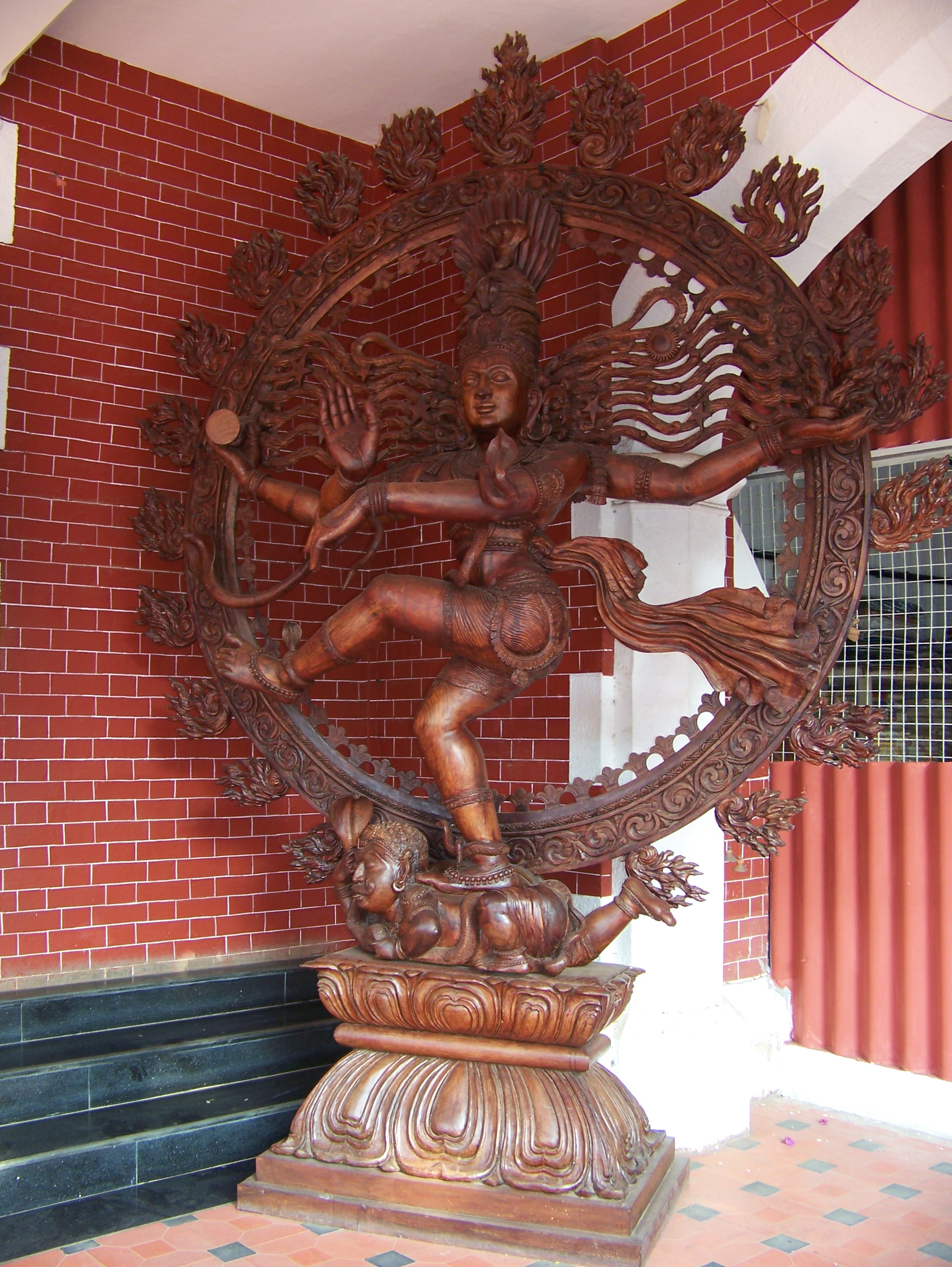
A wooden piece of art at SMSM institute crafts emporium
From there, we walked through the narrow lanes to one of the biggest shops I have ever known that sells just ‘CHIPS’: ‘The Mahachips store’. Chips of different varieties, made to order and packed just then. I picked up about 10kilos of banana chips & jackfruit chips as giveaways, something that will be much awaited for back home in Bangalore, even more than my safe return. (The even funnier part was that this bag of chips was the single largest (Fragile) cabin baggage I was carrying with me. The cabin-crew was amused to know what was in it when she offered help to place it in the upper cabinet).
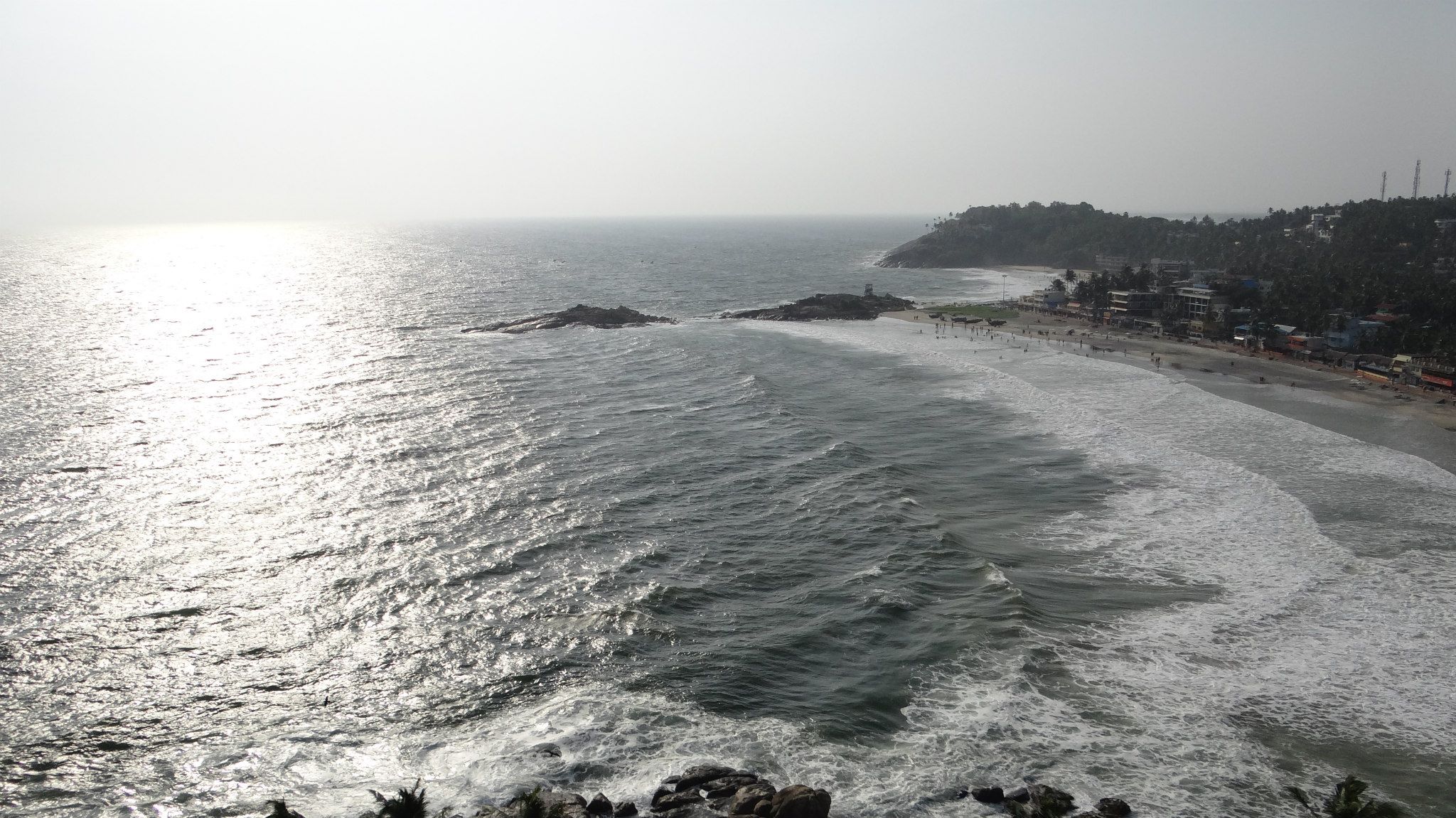
What’s a visit to Thiruvananthapuram, without soaking your feet in Covalam beach? That’s where we were headed next. After strolling along the beaches, we walked upto the Vizhinjam lighthouse for a good view of the sea. The view was simply delightful. A stroll along the crowded beach, beautiful view of the sunset, some yummy local chaats to munch on, it was indeed an awesome end to an eventful business trip. And we head back to Bangalore in the earliest flight on the following day.
The view from the Vizinjam lighthouse
Don’t miss to try these three things while you are in Trivandrum (or anywhere else in Kerala):
Fresh banana & jackfruit chips and Kerala halwa
Hot palam puri with a cup of burning hot Kerala tea
Words are not enough and pages needed are endless to write about this trip.. The much awaited, dreamt of and anticipated vacation was finally here.. For reasons galore, only Mom & I ended up going..
I cannot make justice, but will sum up the entire trip with as less words as possible.. “White sand, Blue sea, crystal clear waters, lashing waves, spotting the flying fishes, sunset from the ship’s deck, diverse deep sea, ever mesmerising beaches, if ever I had a choice to choose my death, I’d love to get washed away by the waves right there.. @ the Andaman sea.”
This should be an easy guide to anyone who wants to visit the Andamans.. I would say: please don’t plan your trip if it is not atleast a week’s holiday you are aiming at..
Day 1:
10.20.a.m- Depart from Chennai; 12.45.p.m- Check-in @ Port Blair
2.45.p.m- Quick walk through the Science Centre and proceed to Corbyn’s Cove beach
4.00.p.m- Leave for the Cellular jail. Walk around the historic memorial of brave martyrs- the backbone for Indian freedom movement
6.00.p.m- Sound & music show at the Cellular jail
07.30.p.m – A brisk walk through the Gandhi park
08.00.p.m- Water scooter ride @ Rajiv Gandhi sports complex, a speedy walk through the Traffic police park in the same premises
Day 2:
8.30.a.m- Board the ferry @Rajiv Gandhi sports complex jetty for 3 island tour with a seven harbour view
10.30.a.m- Alight for delight @ Ross island– the place of erstwhile British settlement which is now a live museum.
11.30.a.m- Off to Viper island with the gallows of imprisonment established before the cellular jail.
12.30.p.m- Arrive at North Bay island– go snorkelling, walk upto the light house and go SEA WALKING..!!
05.00.p.m- Reach Port Blair
06.00.p.m- Freshen up and leave for shopping at Aberdeen bazaar– the local market.
Day 3:
08.30.a.m- Arrive at Phoenix bay jetty
09.00.a.m- Aboard Makruzz(a Catamaran) to Havelock islands
11.00.a.m- Off to Radhanagar beach– Asia’s no.7 best beach.
12.00.p.m- Catch the ferry to Elephanta beach: one of the best dive sites in Andamans and home to world’s only snorkeling elephant- Rajan 🙂
02.00.p.m- Begin the explorations deep in the beds of the sea- SCUBA DIVING
04.00.p.m- Onboard Baratang- the government ferry from Havelock
Day 4:
07.30.a.m- Leave the confines of our nest for the day’s work- We’ve got lots to explore
09.00.a.m- Registration for the convoy at the forest checkpost. This is a must for anyone travelling on the Grand Trunk road through the Jarawa tribal reserve. Jarawas are one of the aboriginal tribal group out of the 6 tribes inhabiting in the island groups.
11.30.a.m- Aboard the govt. ferry at Middle Strait
11.45.a.m- Alight at Baratang island
12.00.p.m- Cruising on a motor boat through one of the best mangrove creeks I have ever been to.
12.30.p.m- End of the jungle trek- reaching the destiny. One of the 46 limestone caves in the Islands. A spellbinding experience..!!
1.00.p.m- An 8kms flight(read it jeep ride) to see the mud volcano
02.00.p.m- Back at Baratang jetty, ferry ride back to Middle strait.
06.00.p.m- Walk around Port Blair.
Day 5:
07.30.a.m- Sippighat horticultural farm visit.
08.00.am.- A quick turn-up at Wandoor beach
08.30.a.m- Walk around the Mahatma Gandhi museum
09.00.a.m- Off for a ride- An un-expressible journey to the Mahatma Gandhi Marine National Park
11.00.a.m.- Glass bottom boat ride, sun-bathing & SNORKELING in the crystal clear waters of Jolly Buoy island
01.00.p.m- A spicy walk through the Mongluton rubber & spices plantation. ‘Coconut Malai Sharbat’ is a must try drink there.
03.30.p.m- A super drive through a very different part of the Andamans- took us to ChidiyaTapu. We were the last people for the day to get entry into the mini zoo there.
04.00.p.m- I’m on one of the best beaches hitherto- backwaters of the tsunami affected area.. We did not even realise that we had walked over a kilometer deep into the sea- and the water level had not risen beyond our ankles.
04.30.p.m- Exploring the Chidiyatapu hills. An AMAZING place for the landscape photographers
05.00.p.m.- Sunset point – by far the BEST sunset I have witnessed on a seashore.
06.30.p.m- We are at Sagarika– the govt. emporium for shopping for souvenirs
Day 6:
09.00.a.m- Chawtham island– Asia’s biggest timber saw mill and forest museum
10.15.a.m- Samudrika– A museum maintained by the Indian Navy
11.00.a.m- Anthropological museum visit
12.00.p.m- Check out and arrive at Veer Savarkar airport.
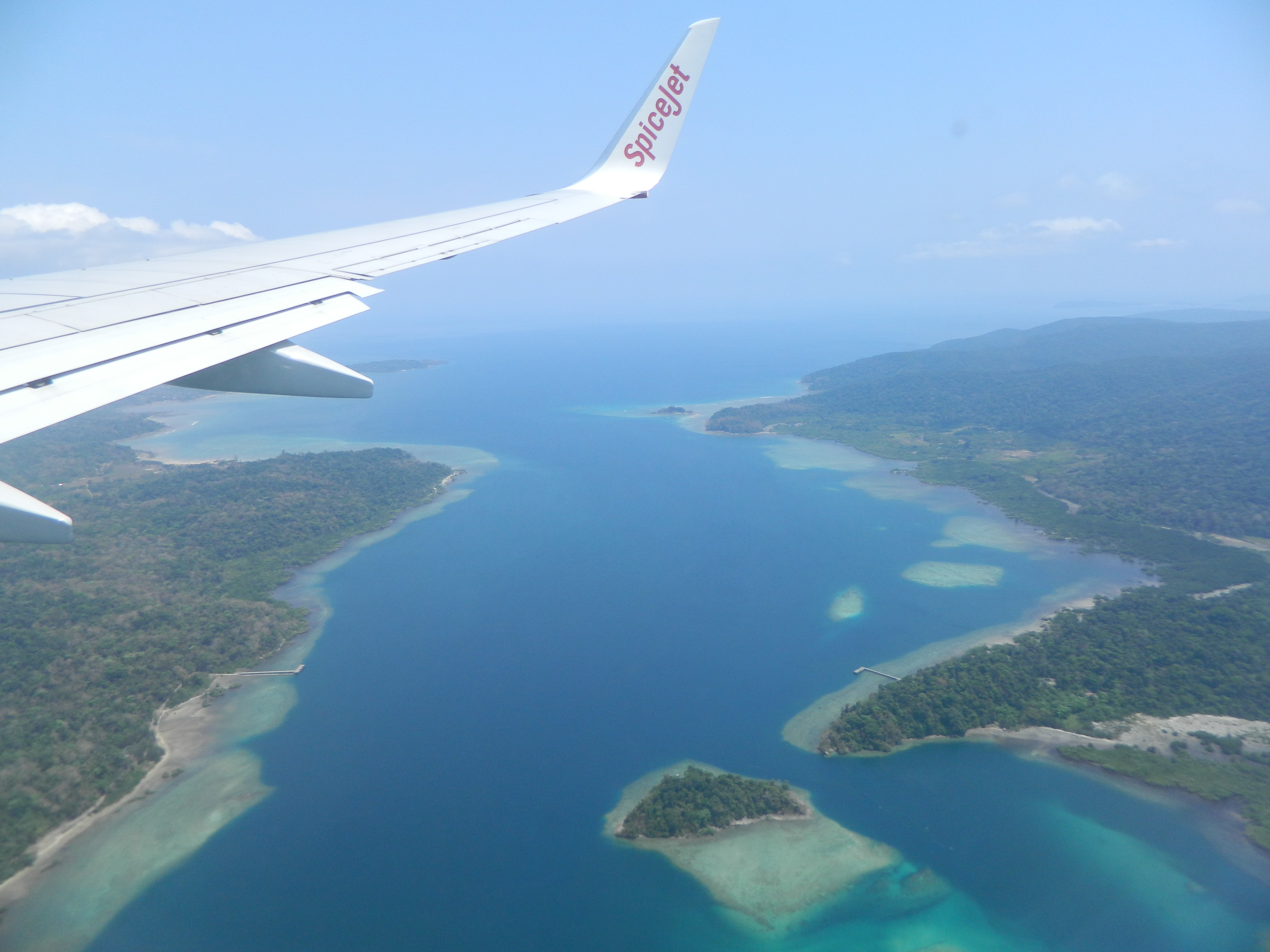
Andamans from the air
This is the maximum number of places anyone could squeeze into the list for a Sunday to Sunday trip.. The islands has so much to explore that only a month long vacation can do justice 🙂 I’d suggest you take a 2hr motor boat ride from Havelock to South button island- the smallest national park in India for scuba diving known for its shallow waters Tropical coral reefs. You could add Mt. Harriet, Niel island, Cinque island, Barren island, Diglipur, Mayabunder, Rangat, Ross & smith island, Saddle peak etc. among the important places of Andamans. However, a trip to Nicobar islands has to be planned separately as it is special in its own way.
Words of caution:
Please adhere to your time schedule strictly because every ferry ride, every museum, every zoo runs/remains open only on a specified time frame.
The city remains awake only between 8.00.a.m and 08.00.p.m. Plan your entertainment well to keep yourself occupied.
If you are planning to eat out or take a coffee walk, it has to be before 7.00.p.m. All shops shut down after that.
Army and Hockey runs in Kodava blood.. It is that time of the year again when the schools and colleges are closed for summer.. Bosses have approved the leave requests from their Kodava employees atleast a month in advance.. Schedule is out.. Flight tickets booked in time as a player /Techie/Banker working abroad has to make it for their family match.. Its the biggest and the maddest festival dedicated to a sport anywhere in the world… It’s the ‘Kodava Hockey Festival’ yet again…!!
Over 300 teams participate with players including people of all age groups- right from a 10yr old primary school kid to a 75 yrs old granma.. Anyone with a mere passion for the game are allowed to join the team, only to fight it out for the coveted trophy each year.. Only 2 rules apply to participate- #1. Be a Kodava and represent your family team #2. Play the game with passion.
One Kodava family volunteers to take the ownership to organise this huge event each year. This year- it was the ‘Madanda’ family. Hooked up with too much work, I couldn’t make it to this year’s tournament.
The Iychettira cup cover photo
Hence, I’d like to make a mention of the last tournament I had attended- ‘The Iychettira Cup-2012’.
The Indian hockey team during the opening match
The opening ceremony was a gala event with some of the who’s who of the Indian VVIP league gracing the event.. It was followed by a nail biting, action packed, stiff fight during the exhibition match between the ‘Indian national team’ and the ‘Coorg XI’.. The men in blue(Oops.. in white) battled it out at the end though..
Palanganda vs Kaliyanda match in progress
During the 23 days long sporting fiesta, the family where I belong to- The Somayanda family, came through till the 5th round/the quarter finals, but failed to make it further.. The last day was the final fight between Palanganda and Kaliyanda.. The latter lost the cup inspite of a tough fight of 1-2.
Trophies lined up for the final presentation ceremony
One has to experience the madness sitting amidst the crowd cheering for their family teams atleast once in their lifetime.. All up there in the spectator gallery with just one thought in their mind and one feeling in their hearts- ‘HOCKEY’..!!
















 The Lost Lander