If you thought Jammu was all about shrines and temples, wait a minute. You are not alone. Even I did not know about all the beautiful places that exist within a driveable distance from the city. This trip to Basohli was a part of our ‘Peace ride’, sponsored by Jammu tourism as a part of the Himalayan expedition to promote tourism in the lesser explored places of Jammu. The route we covered over the week was Jammu-Mansar-Basholi–Sarthal–Baderwah-Kishtwar-Gulabgarh-Sansari-Gulabgarh-Patnitop-Udhampur-Jammu.This trip was an opportunity for us to see so many beautiful places that are off the tourist map, totally untouched and waiting to be explored.
Places to visit in Basohli:
• Surinsar-Mansar wildlife sanctuary • Surinsar lake • Mansar lake • Atal bridge • Sunset at Ranjit Sagar Dam & RSD backwaters • Sunrise from Chanchala mata mandir
The Details:
On a warm Saturday morning, we started from Jammu on a well asphalted highway cutting through the Surinsar-Mansar wildlife sanctuary towards Basohli. Needless to say, the route is blessed with natural bounty with the road flanked by wooded hills all the way. We did a quick stopover at the twin lakes from where the sanctuary gets it same. The Surinsar lake and Mansar lake are serene patches of nature which play an important role among the Hindu pilgrims as it is associated with mythology. It is believed that the arrow shot by Arjuna pierced the earth at Surinsar and came out at Mansar spouting water, what are now the two bunyanesque lakes. If you have nothing to do, then you can forget your watches by just sitting on the banks and feeding the squillion fishes there. These lakes are also known for the Indian flapshell turtles that are found in abundance.
At Mansar lake
After freshening up at the TRC guest house, we headed to the Atal bridge built across river Ravi. This happens to be the first cable suspension bridge in the state of Jammu & Kashmir. We got an eyefull of the setting sun from there and got some good silhoute photos of the fishermen busy with their last catch on their vessels drifting past us from under the bridge. The view of the surrounding lush green hills and several islets in the backwaters of the Ranjit Sagar Dam was a feast for the eyes with a golden backdrop. On a summer evening, it is highly recommended that you spend some time at the dam backwaters, what is fondly refered as the RSD beach by the localites. With swaying palm trees along the sandbars of the river bed, it is a very picturesque place surrounded by the lashing waves of the dam’s backwaters.
Our bike at the Atal bridge
Although we had plans of reaching the Chanchala mata mandir to catch the sunrise next morning, we were woken up rather early by the roaring thunder and the rattle of our window glasses. It was pouring cats and dogs and we watched the dawn break into a bright day while sitting by the window side. There seemed no signs of the rain gods taking a break and hence, we decided to head out in the rains…
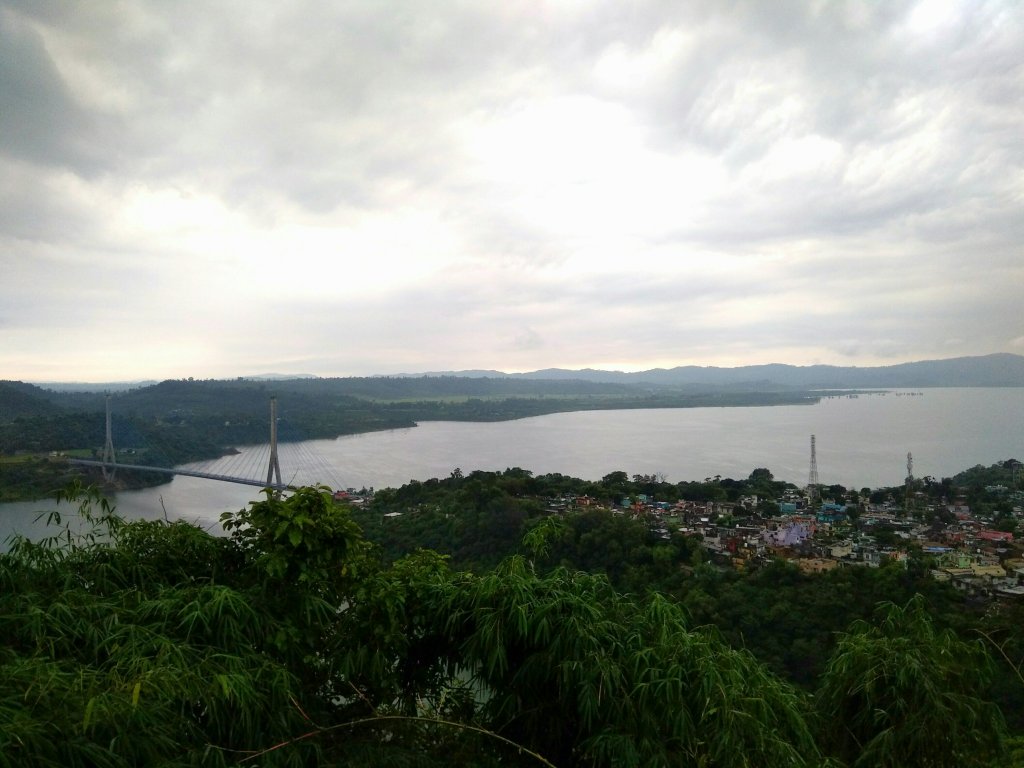
While we sought directions from the public, we realised that this town was home to over a dozen temples dedicated to Durga Mata. With a wild guess, we hit the accelerator towards one that was located atop a hillock. Oh Man! The view from up there was stunning… The temple had a 360degree view of the dam water and the hills. We could see the bridge along with several ruins of the old town dotting the view here and there. With the rocky valley at a distance, the entire Basohli town was visible from up there treating our eyes on a perfect morning!! With such a view around, the silver lightning in the dark grey sky, we couldn’t ask for a better start for the day…We were drenched to the bone but coudn’t get enough of the view. We somehow dragged ourselves back to our bikes, lest be a reason for the delay of all other fellow travellers back in the guest house.
view of Ranjit Sagar dam from Chanchala mata mandir
Basohli is known for the traditional miniature paintings that carry a heritage tag with it. Basohli is believed to be a cradle of a new school of mythological paintings. But sadly, only a handful of practicing artists exist today in this hill town. How much ever I intended to meet these artists and buy a couple of paintings as souvenirs from this land, I couldn’t. A countable number of shops selling these artworks would open only later during the day, a few kilometers away from the place where we were staying at. We decided to return to the guest house.
We were already running late and had nothing left for breakfast, we satiated our stomachs with fruit juices and coffee. When the rain gods seemed to calm down a bit, we called it a wrap for the wonderful time spent in this historical town of Basohli. The journey continued, to yet another beautiful place waiting to be explored, waiting to be talked about to the world outside. A place that I call as my “FAVOURITE” destination in India- Sarthal.
Fact file:
Getting there: Jammu is well connected by airport, rail and road. You can hire a self-drive car or a taxi from the city to visit the other sightseeing places. Basohli is 147kms(about 3hrs) by road from Jammu city.
Stay: TRC (Tourist Reception Centre) guesthouse is run by the J&K tourism dept. on the banks of Ranjit Sagar dam and offers great views.
This trip was part of a backpacking by my brother and me with an original itinerary to cover Bangalore- Kumbakonam – Gangaikondacholapuram – Chidambaram – Pichavaram – Pondicherry – Tiruvannamalai – Bangalore
As per this, we left Bangalore on a Sunday night in a bus and decided to explore further at our own pace, using public transport and staying at places with bookings made on the go. Plan was all set. But well, with a small glitch. We assumed that the monsoon season was the same in the entire southern India. But what we hadn’t taken into consideration was the fact that Tamil Nadu doesn’t come under the south-western monsoon. Hence, the monsoon peaks (with north-east winds) after the season ends in its neighboring states. So, we were now on an exploration of Tamil Nadu in October, during the peak of its monsoon season! Anyway, with its share of travel miseries, poor planning gave us the benefit of experiencing a different kind of backpacking.
Firstly, we explored Kumbakonam, a place which is often spoken less about on a typical tourist’s circuit. It was a wonderful experience to explore a place that is soaked in history and RICH architectural heritage, mostly from the Chola era. (This is elaborated in a separate post, click here to read). From Kumbakonam, our next planned destination for a major halt was the place that’s is often referred as ‘a city of eternal bliss’. But our experience was as unblissful as it could get, even as we wished to get a glimpse of the deity of a temple whose manifestation is revered to be as one of the five elements of life- ‘Space’. I would like to elaborate this trip for my readers to get a wholesome idea of our visit to this city was like for us!
With incessant rains, our mobile-phone network had been patchy. On day 2 at Kumbakonam, we received a call from our parents who had been trying to get in touch with us since the previous night. They informed us about the alert issued by the Met. Department. We checked online and confirmed the news about the weather forecast of cyclone- Roanu and a deep depression in the Bay of Bengal. We were asked not to venture near the seacoast. Our intended trip itself was supposed to be along the Coromandel coast- including Cuddalore and Pondicherry. Since the day was bright, we did not take our Met.dept. seriously and decided to take a chance by continuing with the plan from Kumbakonam.
With a visit to the Brihadeeshwara temple at Gangaikondacholapuram (another of the three living Chola temples), we boarded a bus to Mannarkudi. From Mannarkudi, we were supposed to take another bus towards our next planned destination: Chidambaram. However, the conductor informed us that the road beyond Mannarkudi was blocked since the previous night due to an uprooted tree. Although the tree was cleared, he wasn’t sure if the route was worthy for us to go. Without really understanding the seriousness of his advice, we boarded an overly priced private bus which ferried us to Chidambaram. Our road was flanked by the Kollidam until most stretch. Last time we had seen this part of the state was with our family, during our quest to see the end of river Kaveri. The dam was empty and dry back then. Today, she was flowing in full spate and the Grand Anicut was filled till its maximum limit. Kaveri looked beautiful with her brown waters reflecting back the sun rays that sneaked from amid the thick grey clouds. That was the point from where, the real saga of our road trip started.
As we covered a little distance ahead of the dam, the river began to touch the road around the corners at most turns. Gradually, the river started to spill over the road at some stretches. Instead of plying on the road, it seemed like our bus was driving over the river at these junctions. Further into the journey, the water level increased. Several stretches (in kilometers) of the road was submerged by the river. Our driver was a real super star- who could figure out exactly where the road laid in the ground in spite of the water being above the tire height. Even a slight slip in the road only meant death and nothing less. The entire bus with about 25-30 passengers could have been washed away by the currents of the spiteful river. I had only seen such things in the news. Now I was right there, experiencing a flood scene, firsthand.
The flooded villages enroute to Chidambaram
Stretches of villages laid submerged ahead. At some places, the thatched roofs and the hay huts had given away. We could see utensils floating around on the road, helpless villagers wading across the (once existent) streets, even as the flood water stayed above their waist level. Their plight was heart rendering to see, even as the rest of us inside the bus continued to wonder if we were going to see a safe arrival at our destination at all. The rain of just one night had wreaked so much havoc across the state of Tamil Nadu. However, our driver remained focused and drove us across to reach the safe harbor at Chidambaram by around 03.00.p.m.
My brother and I decided to drop the luggage at the hotel which we had booked online and find some food for ourselves. We hadn’t eaten anything since that morning. On arrival at the hotel, we were a little perplexed to see our room. The bedsheets looked extremely old, torn and dirty. The bathroom was a disaster. The toilet floor was covered with a thick layer of algae, slush and mud, all that had accumulated over years without washing it. The flush lever was broken, the taps rusted and a crazy layer of deposits on the bucket and the mug. The nasty smell of alcohol hit our noses from outside through the opened door even as we continued to feel suffocated inside that room. My brother and I looked at each other’s face- and both of us knew what was running in each other’s mind. In spite of being exhausted and hungry, we decided to leave the place and find some other place to stay. Just when we started to descend the stairs and as if the injury (of finding a bad room online) wasn’t enough, I happened to step on a large mess of barf, thrown up by some drunkard on the stairs and slip down a couple of steps.
Until this moment of our day, I had managed to keep my calm, but my brother gave up. He wanted to end the trip right there and return to Bangalore. While he found no buses that would leave Chidambaram immediately to Bangalore, I managed to convince him to stay calm until we boarded a night bus at least. I found a place near the ‘Nataraja temple’ where I could clean myself and headed to get the darshan of the lord. The visit was peaceful, maybe I will write about in another post someday.
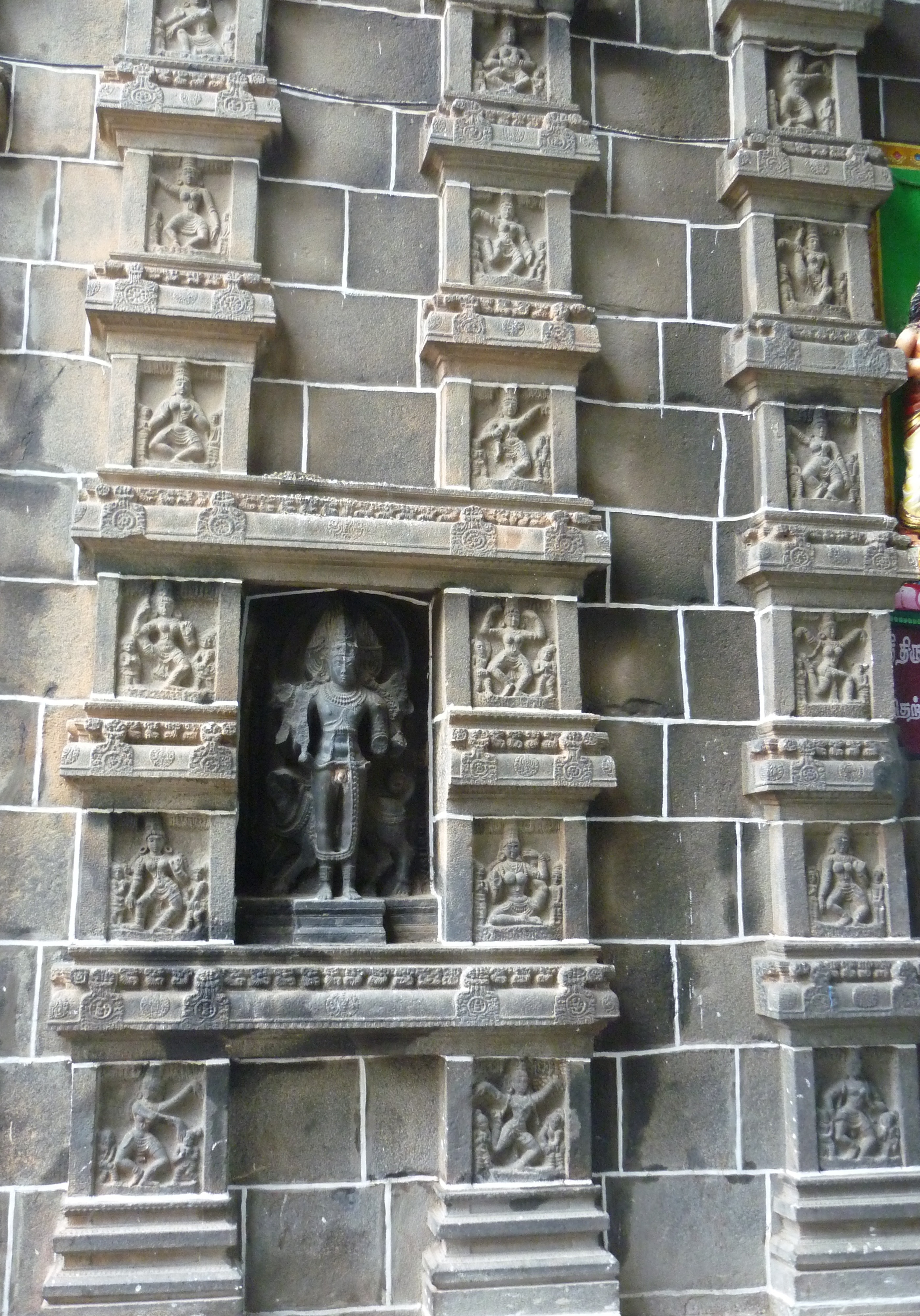
The Bharatanatyam postures sculpted on the walls of the west-tower of the temple
After finishing the evening prayers, my brother booked our tickets to Bangalore for the same night. Since my holidays were still not over, somewhere deep in my mind, I still wanted to complete my trip. I didn’t want one bad experience of the day ruin the entire holiday for us. But, given the weather condition further ahead in our planned route, I couldn’t rule out my apprehensions of getting stranded in the cyclone at Pondicherry as well.
But right now, our priority was different. We had been starving since morning and had to find something to fill our stomach. In spite of walking the WHOLE of Chidambaram town, we couldn’t locate a single place where we could find food. Thanks to the day of Deepawali festival- there were absolutely NO eateries open! Also, the entire town was SOO DIRTY with garbage littered everywhere. After a long search, we finally found ONE supermarket in the entire town. And what did we get to eat there? Just a cup of sweet corn to sate our hungry bodies.
Our city woes did not end after eating the steamed corn. It was still 07.00.p.m and we had three hours more to kill. On enquiring with a few locals, we were told that we would find a decent restaurant near the bus stand. And so as per the recommendations of the local people, we found this AC luxury restaurant called ‘Vandayar- Southern Spice’.
When we arrived there, the waiter informed us that they served only fried rice for the day. The waiter came to our table thrice to take our order (for the only dish available) and after two hours of waiting for food, there arrived a convoy of VIP customers at the restaurant. Bonus for waiting: A feast was set for this VIP family that comprised of all dishes from the menu. Even while all the tables were occupied with middle-class customers including my brother and me, there was no one from the restaurant that cared for our existence that day. Wondering if we were waiting for any free food to be served at 09.00.p.m. several customers grew furious and started to walk out of the restaurant. It was also time for us to board our bus. As we too walked out of this VIP restaurant, there was power cut in the town.
In a dark and dingy bus-stand, we spotted the only stall that served tea and some biscuits. The little candlelight was just enough for the tea-stall guy to reach out to things in his kiosk. We were essentially scared of stamping some more muck that could’ve been laid in the littered path. As we dunked the last biscuit into our chai, we had yet another surprise for us. Our bus to Bangalore was delayed by 2 hrs.!!! As we waited there in the dark platform of the bus stand, some drunk men started to throw glass bottles at the crowd there. Luckily no one was injured, but the downpour of bottles and splatter of glass pieces continued for a while. Our bus arrived after a while and we boarded at 10.00.p.m.
With all the crazy stuff that happened that day, we fell asleep quickly… Only to be woken up at sunrise. That’s when the rain was battering outside, and our bus had broken down on the highway. Although we were given an alternate bus in a while, our anxiety continued until we reached home.
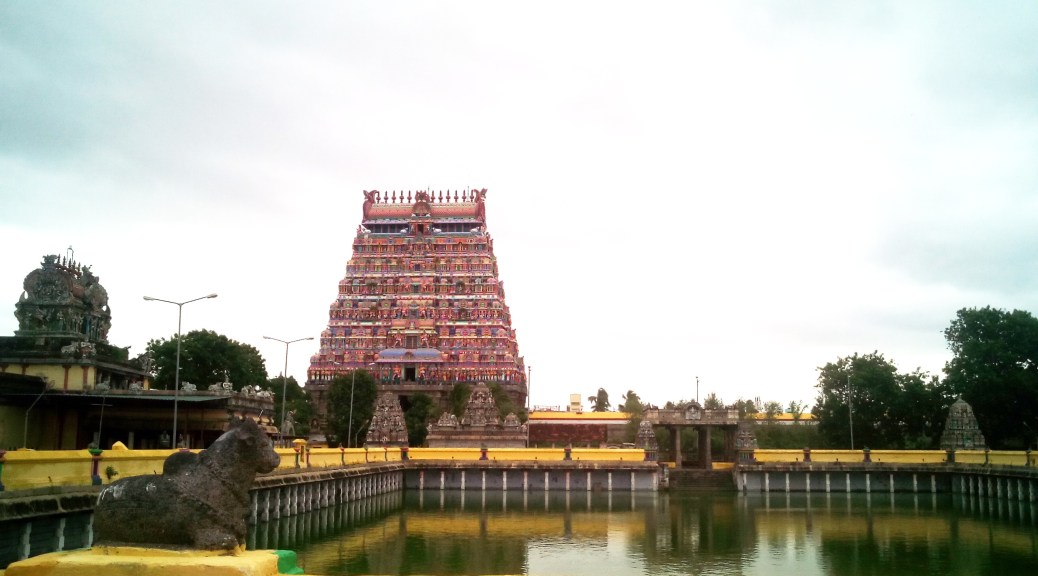
The temple Gopuram at Chidambaram Nataraja temple
Conclusion Remarks: The people on the east coast are god’s chosen ones to have a grand celebration of festivals. Tsunami for Christmas. Cyclones for Diwali…!! One cannot sit in a place, hear stories and imagine of places and people. You need to move yourself to places to experience and explore. This trip was one such experiences where I got a first had experience of braving a flood and starvation of food. Also, this is a trip where I managed to find a place in India that I wouldn’t want to return.
It was the 2nd Friday of August 2012, a day before the Biiigg sporting event of South India: “The Nehru trophy boat race”. After a long haul of planning, two of my friends and I had alighted at our destination- Allapuzha, a popular little town on a tourist circuit in Kerala. Fondly known as Alleppey, we were there to experience the festivities of ‘The Olympics of Kuttanad’- Vallamkali or the boat race. The Nehru trophy boat race is an annual event held in the Vembanad lake, in the Kuttanad region of Kerala. Vembanad lake is the longest lake in India and spans across several districts of Kerala. Depending on the region, the lake is known by different names. It is called as the Punnamada Lake here in Kuttana, of which Alleppey is a part. Along with the boat race, we wanted to explore the backwaters that’s a popular haunt of the tourists in this region.
My Itinerary:
Day 0: Leave from Bangalore to Kochi (Overnight train); Day 1: Kochi to Alleppey (local train), Shikara ride in the Vembanad lake, Sunset at Alleppey beach. Day 2: Nehru trophy boat race, Champakulam St. Mary Forane Church, Kalloorkkadu Angadi (local & oldest market in the region), Latin church. Return from Alleyppey to Bengaluru (Overnight Train)
Other Places of Interest: • Karumadi Thodu- famous for the black granite idol of lord Buddha • Ambalapuzha Sree Krishna temple- known for the ‘Palpayasam’ or the milk porridge offered as prasad to the deity. • Kokkothamangalam church- This is one of the seven churches founded by St.Thomas, one of the twelve disciples of Jesus Christ. • Ayyappan temple in Mukkal vattam (near Muhamma)- known for the Kalari from which Lord Ayyappa is believed to have learnt his skills in martial arts. The hermitage where Ayyappan lived during the training period has been preserved in its original form by successive generations of the Cheerappanchira family.
The Details:
Day 1:
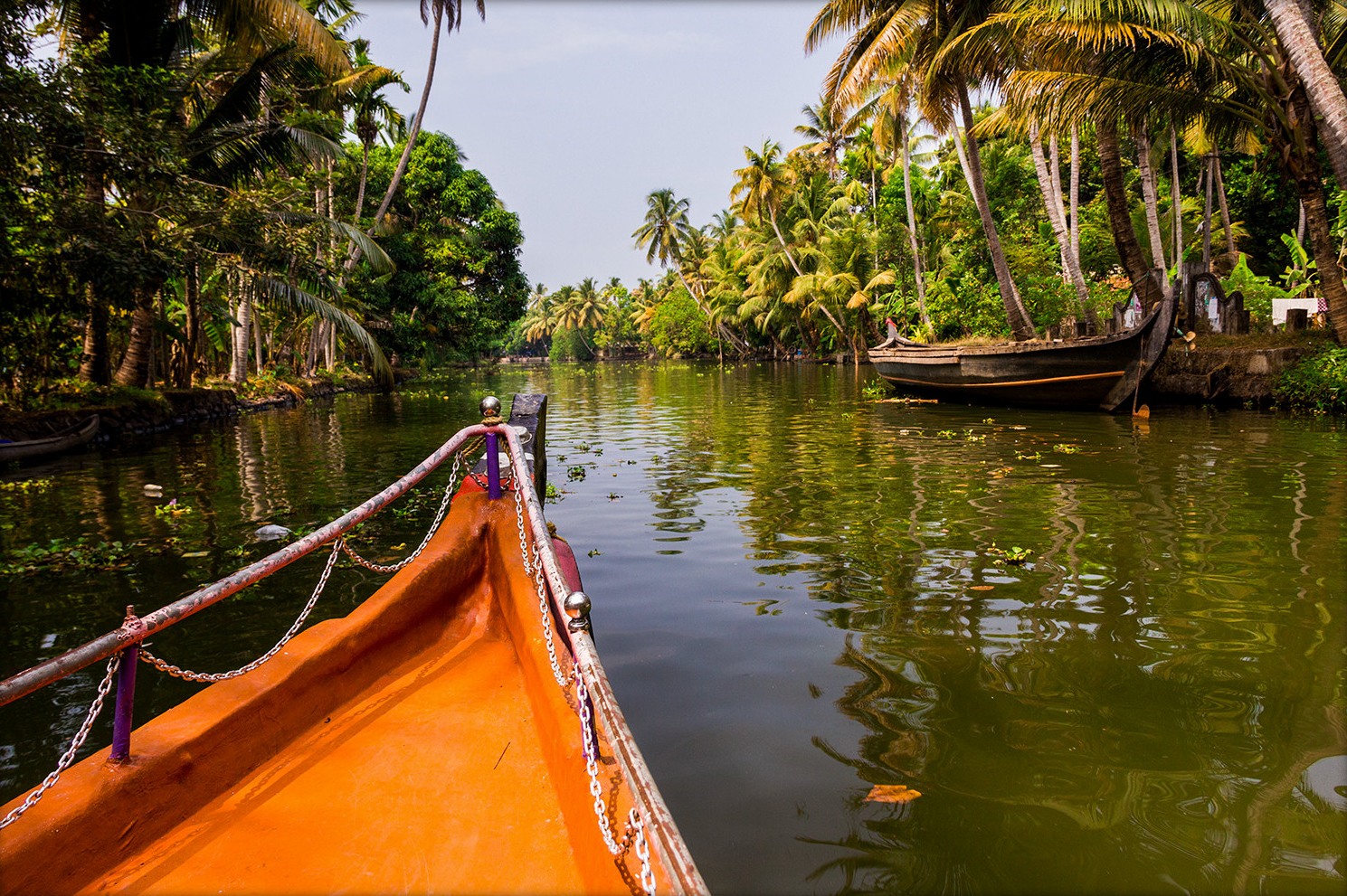
It was noon by the time we checked into our hotel room. We freshened up quickly and set out to explore Alleppey. We walked around a little bit and reached at a small boat jetty. We hired a ‘Shikhara’, a local motorboat to cruise around the narrow canals, passing through several fishing hamlets. While the womenfolk were washing clothes, the men were spiralling their fishing nets into the water and a few kids were diving into the waters for a refreshing swim. It was a nice experience of seeing local lifestyle of the people for whom, the backwaters are a lifeline. Along our ride, we picked up some fresh lobsters and pomfret at a local market and got them cooked in the local style at a fisherman’s house.
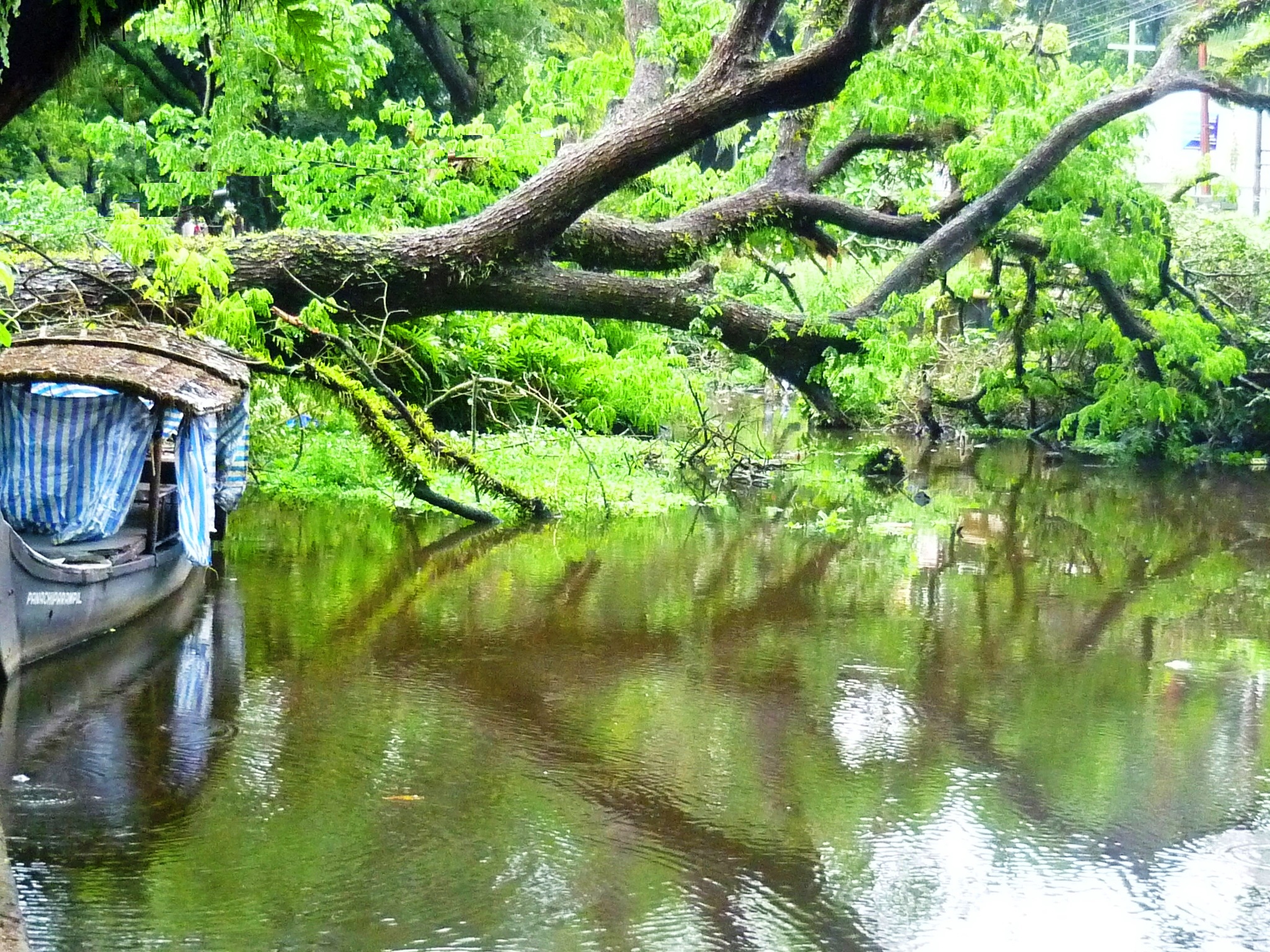
The Shikara cruise in the narrow canals of Alleppey
Further, we were oared across to the end of the canal which opened into the wide Vembanad lake where all the teams were practising for the boat race and the venue was getting set for the ‘Big’ event. The energy and enthusiasm in the atmosphere was no less than that of the main event itself. Though we wanted to stay there till sunset, the government deadline for all activities in the waters forced us to return to the jetty before 06.00.p.m.
On returning to the mainland, we meandered through the lanes of Alleppey town searching for a dose of Kerala chai and palam-pori (Banana fritters). We then decided to settle down by the beach until dark. While finding our way to the beach, we walked past the coir industries that Alleppey was once known for, and now remained shut and non-functional.
A stationed shikara enroute to the Alleppey beach
While walking back to the town area from the beach, we happened to see a hoarding of a concert happening at a nearby stadium. Post sunset on normal days, most towns in Kerala sleep to silence after 7.00.p.m. and there will be not many options to see or do after that. Since we did not want to waste the remaining evening by sitting inside our hotel room, we decided to head to the stadium to kill the rest of our evening. ‘Music never disappoints’, all the three of us had the same thought. Upon arrival at the stadium, we enjoyed the on-going performance of ‘Theyyam’, one of the colourful, traditional & spiritual dances of the state. But after some time in the audience gallery, is when we experienced a surprise on the stage. A MIND-BLOWING show by the violin maestro- Balabaskaran and team.. It was there that we were LOST in dreamland..!!
Day 2:
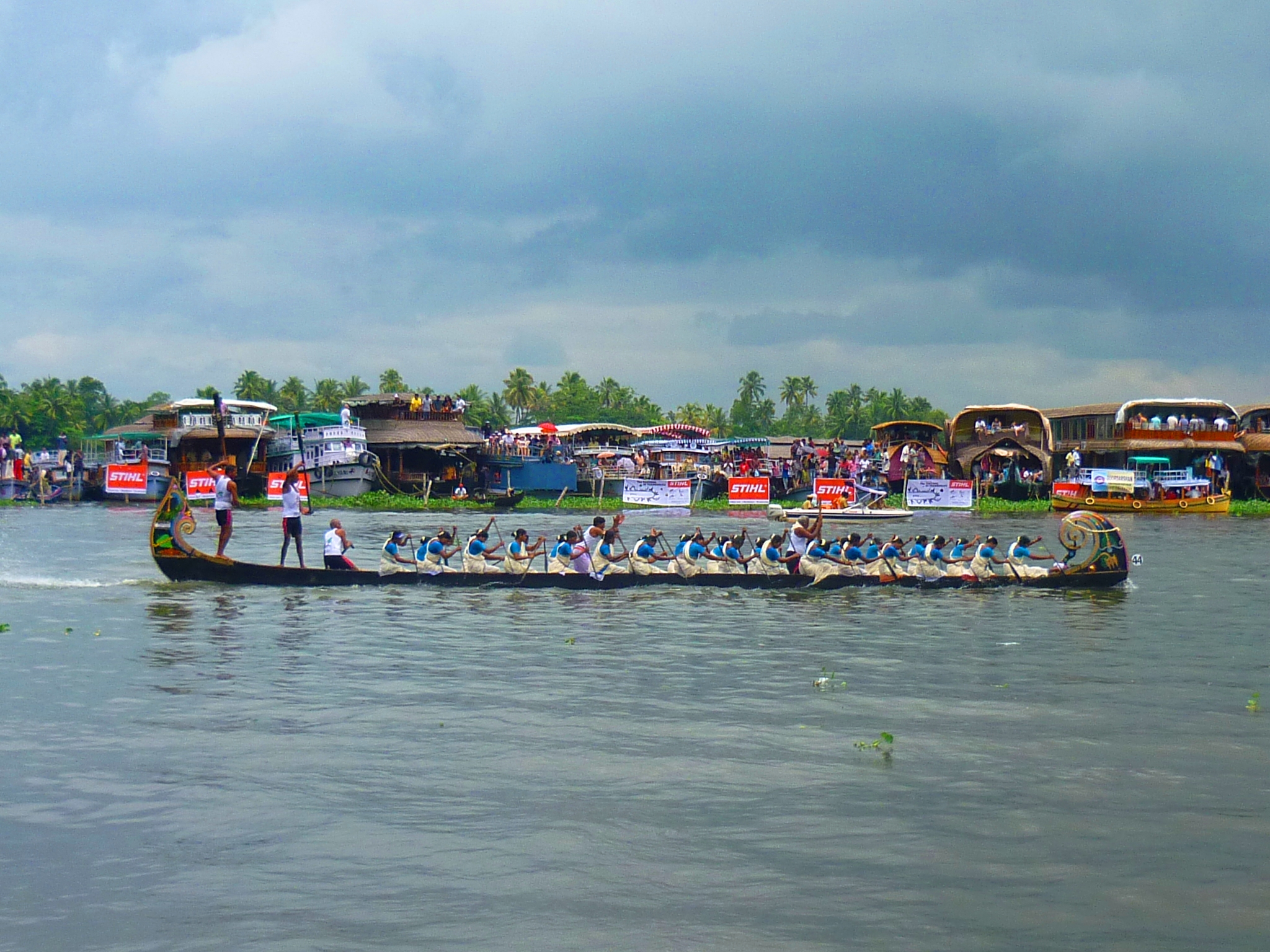
The next morning, we had to reach the racing venue as early as 08.00.a.m. to ensure that we had a place to sit. (Read about the madness of the event). The snake boats are the world’s biggest water vessel used for sports. One by one, they arrived for assembly. Locally called as the Chundan Vallam (Beaked boats), these 100~120 feet long wooden canoes carry 90- 110 rowers and move like snakes through the channels. And soon, the races started under different categories. Every single soul in the arena was singing songs of cheer. All through the event, only one thing echoed in the atmosphere: Vanchipattu or the Boat song. It was a once in a lifetime experience to be a part of that enthusiastic crowd.
The oarsmen ‘”Women”
Post the event, we still had time to explore the town and hence boarded a bus to Champakulam. As we passed through the waterlogged villages of Kuttanad, we were reminded that the region we were passing through was the ‘granary of Kerala’ or the rice bowl of Kerala. It is one of the few places in the world where farming is done below sea level.
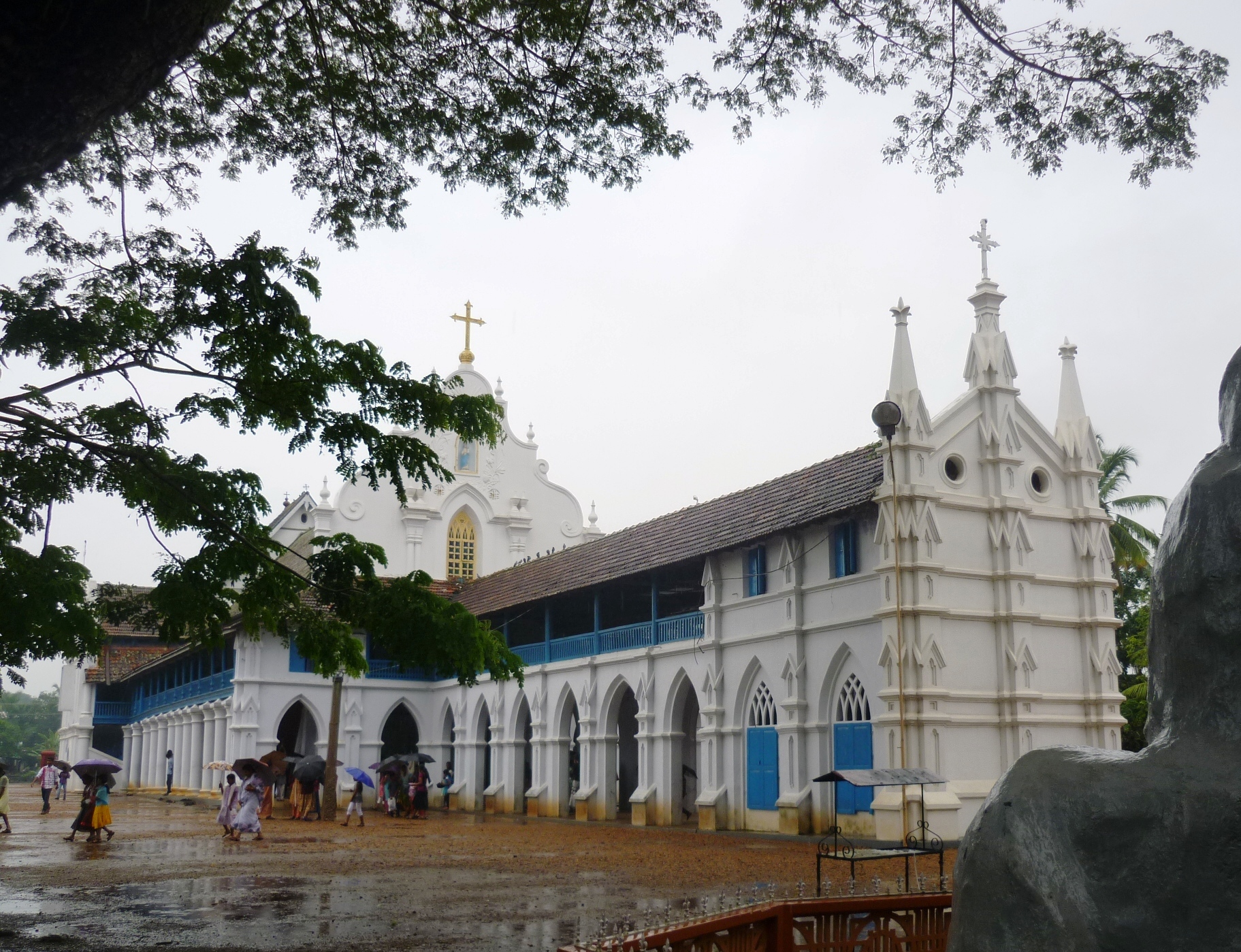
Soon, we reached the St. Mary Forane Church. Since it was a Sunday, we were lucky to take part in the mass. Built in 427A.D., this riverside church is a testimony of time with its finely maintained beautiful mural paintings. From there, we took a boat to reach the other end of the river: the oldest market in the region known as Kalloorkkadu angadi.
Champakulam St. Marys church
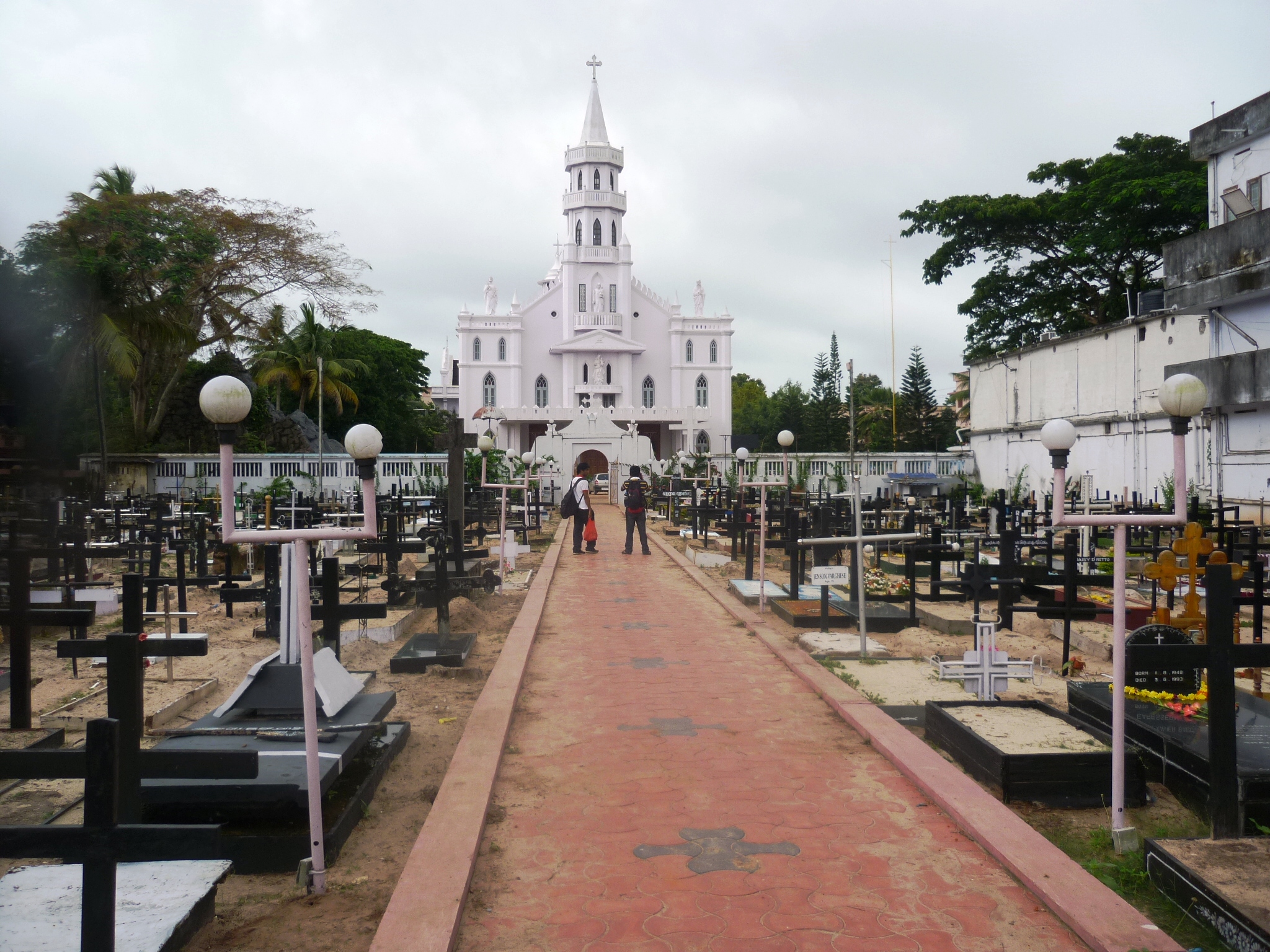
With a local bus ride from there, back to the town, we then took a walk to the Latin church in the town. The entire town of Alleppey can be viewed from the terrace of this church (permitted only during visiting hours). What particularly caught our interest was the cemetery where all members of a family were buried in the same pit. Hundreds of such graves laid within the church premises.
The premises of the Latin Church
We then checked out our lodge and headed to the railway station for our return, scheduled for the night. It was time for us to depart with a mind filled with beautiful memories of sailing afloat on a boat in the backwaters of land that is called ‘God’s own country’ and hope to return soon.
Must dos: Experience the madness of the Snake boat race Must eat: Freshly caught and cooked seafood while on a backwater cruise tour
This was a destination that my friend and I had been contemplating to travel for some time. The trip turned into certainty only when my friend had the confirmed tatkal tickets in her hands after a wait of over an hour in the queue at the railway station. Then on the following evening, the two of us commenced our weekend journey towards Rameswaram by boarding our train from Bengaluru cantonment station to Madurai. We had a few important things to check-off on our small list for places to see and things to do at Rameswaram. Since the travel tickets were confirmed in the last moment, we had barely any time to make hotel reservations. We decided to go there and find something for ourselves.
Our Itinerary:
Day 0: Evening train to Madurai from Bengaluru Cantonment railway station. Day 1: Arrival at Rameswaram and visit to Ramanathaswamy temple (TNSRTC bus from Madurai to Rameswaram) Day 2: Visit to Dhanushkodi (Local bus from Rameswaram to Dhanushkodi), Rameswaram local sightseeing (hire an autorickshaw for half day), Sunset & Beach walk near Pamban bridge. Day 3: Visit to Kurusudai islands (Local bus to Vivekananda Mandapam & hire a local boat from there to reach Kurusudai islands), Return to Pamban boat jetty; Return to Bangalore (Train to Madurai & change train from Madurai to Bangalore).
The details:
Day 1– Arrival at Rameswaram and visit to Ramanathaswamy temple
The train reached Madurai by 7.20.a.m. After freshening up at the station itself, we left for our main destination. The TNSRTC buses are quite frequent and it took us a journey of 3.5 hours to reach Rameswaram. Enroute, we passed through Ramanathapuram- the last stretch of mainland India. Once we reached Mandapam, the entry point to the island town of Rameswaram, we had our excitement running at its peak. For the next 15minutes, our bus was cruising over the bow shaped road bridge that oversaw the famous Pamban rail bridge. Pamban bridge is an edifice of engineering that is still standing strong on its 100th year in commissioning. This is a bridge that would connect us to the other side of the land, to a town that would host hundreds of stories from the Ramayana during our stay there, over the next couple of days.
After arriving at the Rameswaram bus stand, we noticed the tourist office that stood right opposite. We wanted to try our chance to get permission to the Kurusudai island and hence, registered our names as tourists in their logbook. This island is a protected area and we had tried hard to get permission for our visit even before starting our trip. Though indirectly, our random chance visit to the tourist office in fact helped us BIG time (Click here to read the story in detail).
Lord Rama is believed to be an incarnation of Lord Vishnu. Then, why is the city named after Eshwar? It is important to know at least this while you are there in Rameswaram. Here goes the story… Ravana, (a Brahmin) was a devotee of Lord Shiva (aka Eswaran). On performing penance, Ravana was blessed with a boon by Shiva such that- anyone who tried to harm Ravana would face Brahma dosha. Further, during the war between Rama & Ravana, Rama (a Kshatriya) killed Ravana who then happened to face the wrath of the dosha. Rama then, had to perform pooja to Shiva, the only one who could help him out of the dosha. Here, Eswaran helped Rama. Thus, the name to the town- Rameshwar. I was told that there is a similar story for a town called Ravaneshwar in Lanka.
We walked towards the temple road, roamed around a bit and finally checked into a decent looking hotel close to the main temple. After freshening up, we headed to the main landmark of this pilgrim town, Sri Ramanathaswamy temple. The world’s fifth largest monolithic Nandi statue guards the entrance of this temple. We were overwhelmed to walk across the longest temple corridor in the world and felt blessed after bathing in the water from the 22 sacred wells on the temple. Since it was quite a tiring day due to all the traveling, we decided to sleep early as we had a long day of exploration on the itinerary, next.
Day 2: Exploring Dhanushkodi and local sightseeing at Rameswaram
On the following day, it was Holi: The festival of colors. We were sitting at the Agnitheertham beach at 4.30.a.m watching hundreds of devotees taking a holy dip in the sea. But we were waiting for something else. We were waiting to welcome a day that would unfold with a palette of the best colors that nature could show. Although the wait was long, it was only by 07.00.a.m. when we witnessed what is by far, one of the best sunrises we had seen till date.
Sunrise viewed from Agnitheertham beach
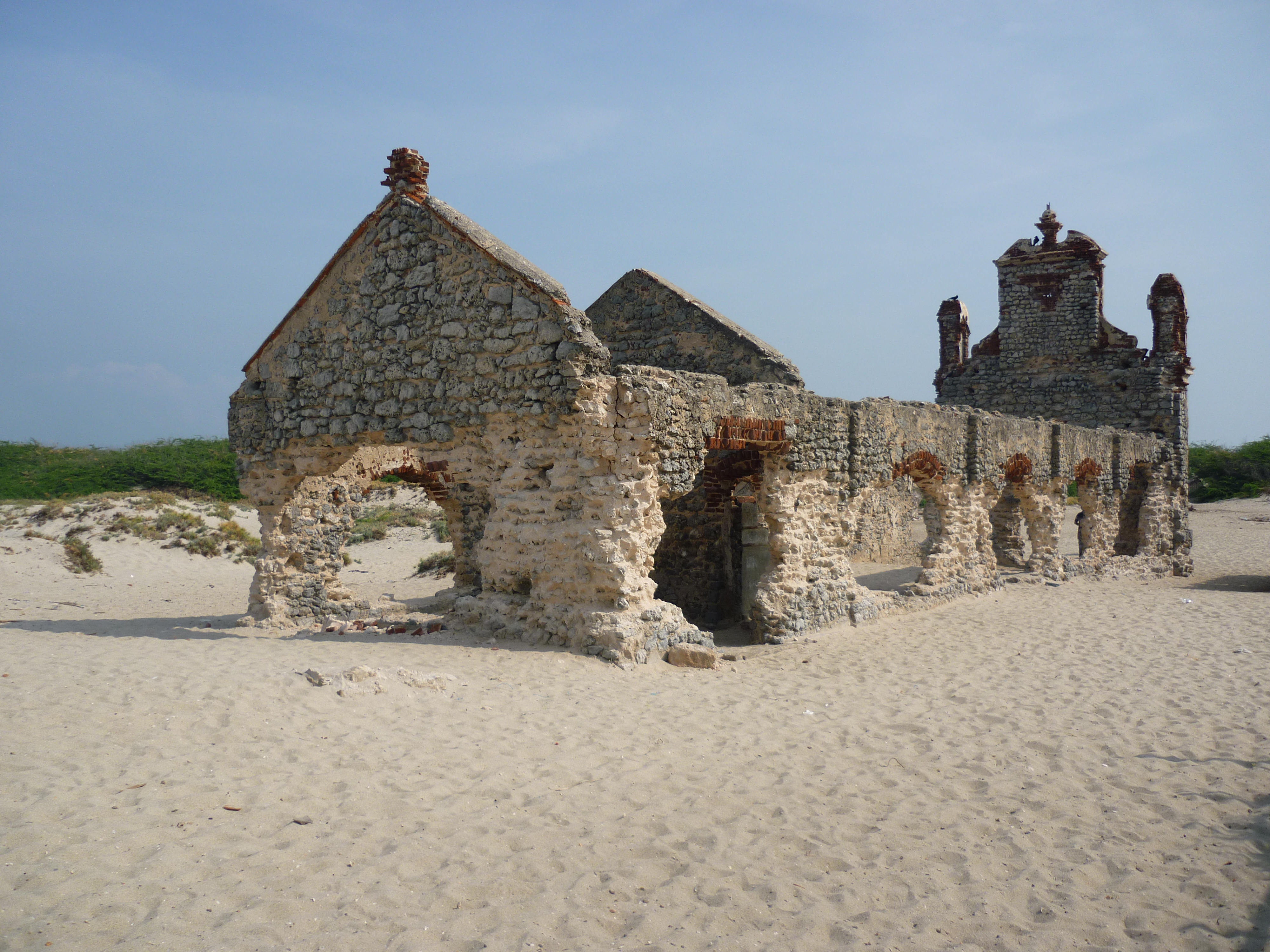
We boarded a bus from there to Dhanushkodi- The ghost city. Although a visit to Dhanushkodi was one of the most awaited part of the trip, it was not our best. From all the stories and experiences, we had imagined of Dhanushkodi, we had expected to need at least one full day there. It is a place that we wanted to explore and not run through which can be best done only if one had a vehicle at his / her own disposal. However, we were at the mercy of public transportation on this budget trip. Like all visitors or “tourists” who had come down there, we too had to settle for a tour of this deserted city in one of the local tourist buses. A round trip was completed in about 3hours with a cost of 100Rs per head not satiating our need to see more of this abandoned town.
Apart from the few main structures and temples (old railway station, church, temple of the floating stone, etc.) that you would see during your tour package(local bus), a few other things that you can do during your trip to Dhanushkodi are:
A walk through the waters of the Bay of Bengal till the Kodandaramasamy temple is a must do. The water level never goes above your knees.
The Ramasetu or the Sethusamudram is something that can be visualized if you have a proper guide with you.
A drive on the asphalt road that stretches up to Dhanushkodi is something to die for. With the calm Bay of Bengal on one side and the rough Arabian sea on the other, the drive is every traveler’s delight.
On your return, you can cover Jada Teertha & Nambu Nayagiamman temple (both located at just a couple of kms before Dhanushkodi.
Ruins of the old church
One hour up on our watches and we were back in the main town. We settled a deal for Rs.250 with an autorickshaw guy who would take us on a quick visit of the major places around the town. Some of the places thus covered include:
• Gandaparvatham / Rama paadam- the highest point in the island town from where one can catch a good view of the scenery around. • Sugriva Teertha (a small pond) • Saatchi Hanuman temple • Bhadrakali Amman temple • Rama Teertha • Krishna temple • Lakshmana Teertha • Five-faced Hanuman temple- The floating stones used for the construction of Rama Sethu can be seen here as well. • The house of former President of India, his honor: A.P.J. Abdul Kalam- It is now converted into a museum.
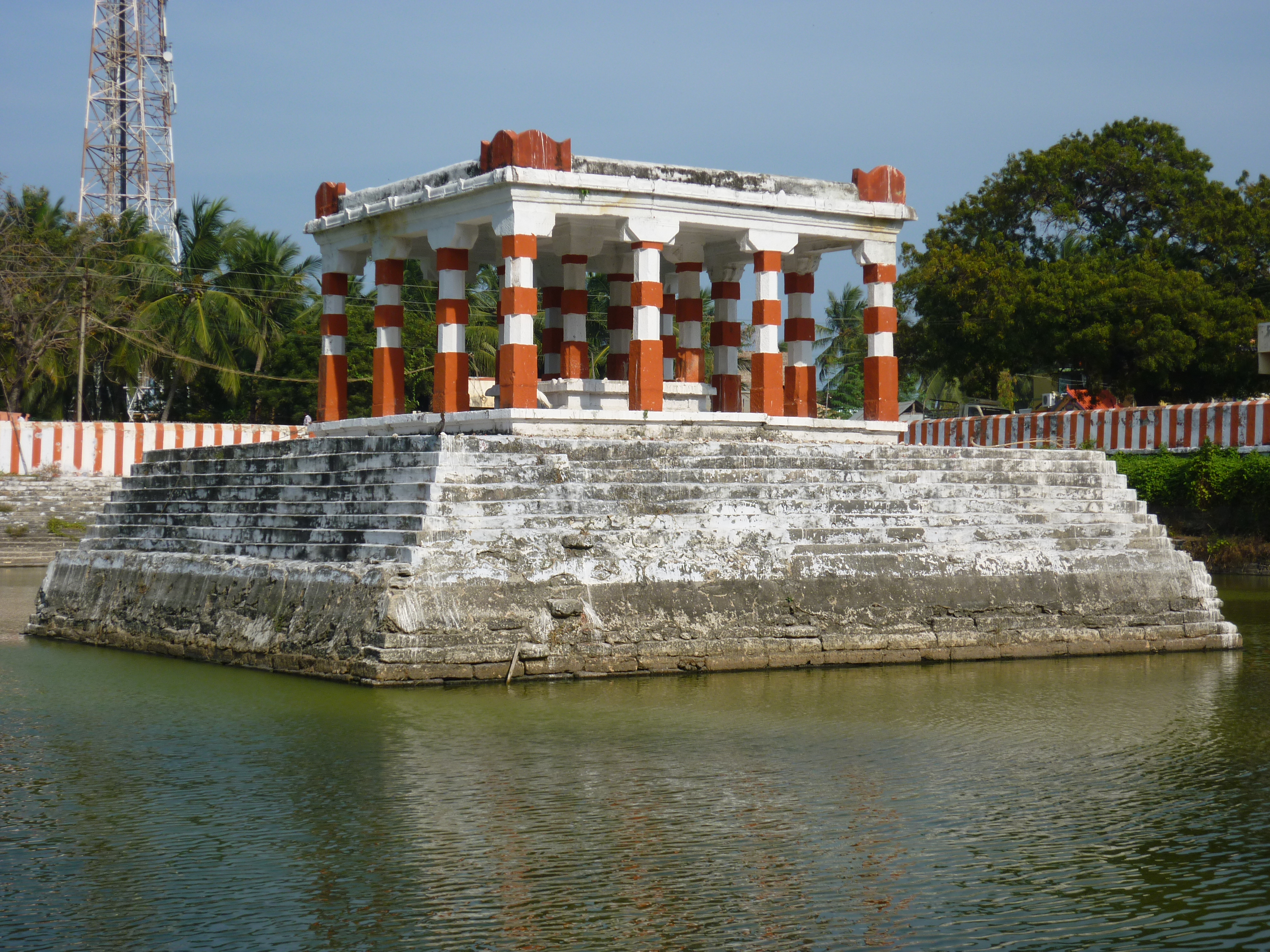
Sri Rama theertham
An interesting thing we noticed in the architectural style of all the structures in Rameswaram was that with the Ramanathaswamy temple being an exception, all the other temples that I have mentioned above are typically built in the Nagara style of architecture. Having covered Rama, Sugriva and Lakshmana teertha, we were curious to enquire if there was a ‘Sita Teertha’ too. Our guide cum autorickshaw driver nodded and brought us to a place on the highway. And to our dismay, he pointed to a small tank by the roadside. It was filled with green stagnant water and a good mosquito breeding ground. “Damn…!! this patriarchal Indian society…!!” I exclaimed.
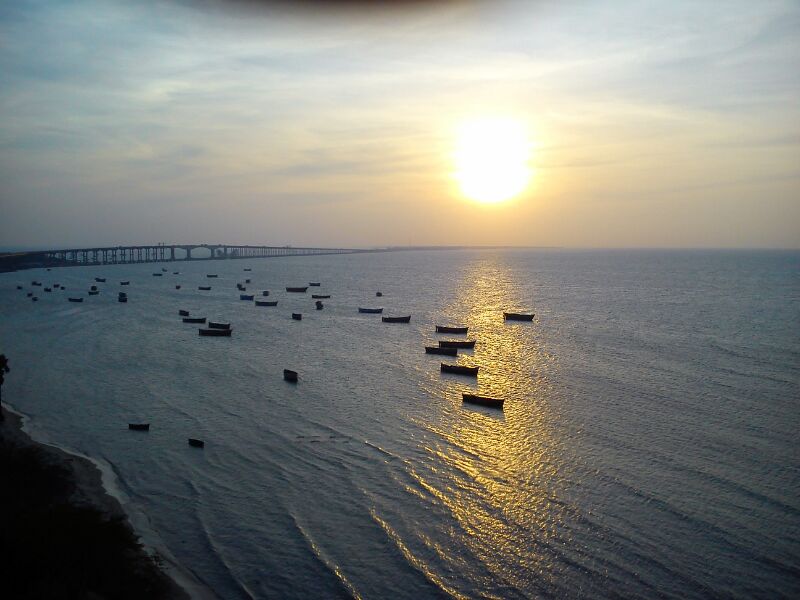
We were done with local sightseeing by early evening, and still had a LOT of time left until sunset. Standing on the road bridge and peeking down at the train tug over the century old engineering marvel- Pamban was a sight not to be missed. So, we decided to head towards Pamban bridge.
Once we saw a train pass over it, we decided to stroll around a small fishing hamlet that we just across the street. We got some good clicks of the Pamban from the boat jetty in this fishing hamlet. While straying around there, my eyes fell on the light house that was located a few meters across the village. We asked for directions and reached there in less than half and hours’ time. While we waited for the gates to the lighthouse to open, we tagged along with a few kids, our new friends at the fishermen’s cove. With the kids excited to converse in English with us, we did so while taking a walk further down to the seashore. With a magnificent view of the sun setting in the backdrop of the Pamban in the distant end, we settled down under the shade of a mangrove tree until the sun went down completely.
The sunset from the fishermen’s cove
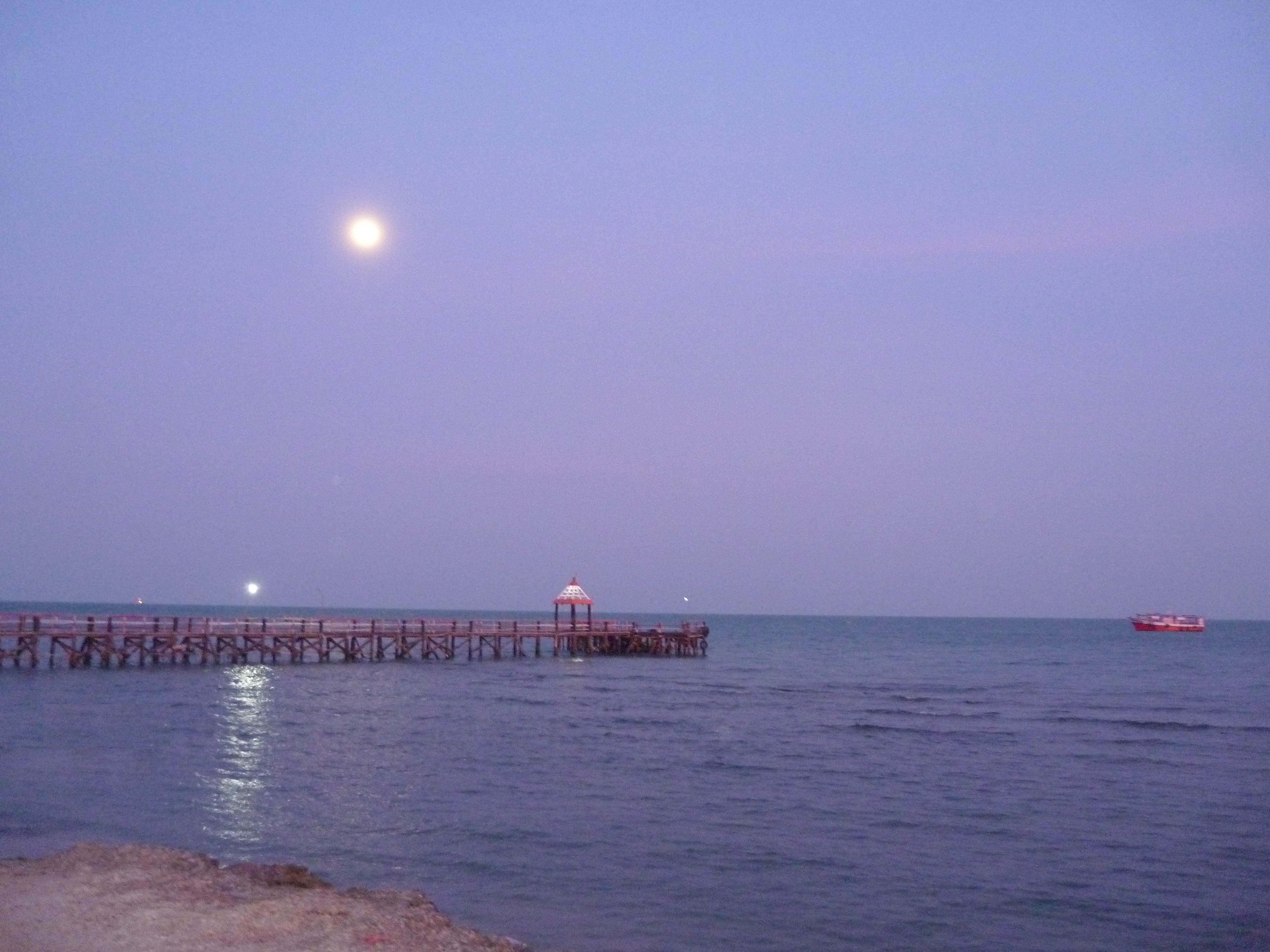
It was soon dark, and we had to head back to the temple road for a safer crowd. We bought some peanuts masala from the vendor on the seashore and found a comfortable seat for ourselves to catch some peaceful time. It was a full moon night.
On that wonderful day: We had seen the faint horizon emerge out from the pitch darkness of the sky that brightened into broad daylight with a series of color change and then the white sky of the day fade into the black of the night … And again, the night’s sky was lit up by the beautiful full moon… Yes… We had witnessed one COMPLETE day…
Full moon lit night sky as seen from the Agnitheertham boat jetty
Day 3: Visit to Kurusudai island and return to Bengaluru
Based on some local contacts, we had got a last-minute permit to visit the Kurusudai island. As per the directions given, we had to check out early and catch the 8.00.a.m bus from Akka-Madang to Vivekananda memorial hall. Our boat was waiting for us with the guide to take us to another world- A world of exotic marine animals- ‘the Kurusudai island ‘. (A more elaborate article on this visit can be read by clicking here). To sum up- “We were lucky to get there”.
From Kurusudai island, we got dropped at the Pamban boat jetty. Our boat was anchored somewhere amid hundred other boats and hence, we had to walk across through knee deep sea water to get to the shore. This walking experience was unique in its own way as one doesn’t get such a sight in any other boat jetty. We had to place every step of ours’ so carefully that we did not want to accidentally step on and kill the in-numerous star fishes or sea cucumbers that were lying on the shore bed.
We walked further up to the Pamban railway station and bought our tickets for the 12.00. O’clock train to Madurai. And soon the train arrived. We boarded and our hearts were pounding hard with excitement. We had bought tickets for a train…. A train to Madurai which would actually ply over the Pamban bridge, an experience that we were waiting to live through. It was an even special ride since it was a journey over the historical Pamban bridge on its 100th year of existence. We couldn’t ask for more…!!!
View of the bow shaped road bridge from the Pamban bridge
In 4 hours, we alighted at the Madurai junction… But yeah, even as I was wondering how everything went so fine through this entire trip, the surprise was waiting for us at the station- our train to Bengaluru would arrive 3hours late. And what followed is… history.
Have you visited Rameswaram? What was the purpose of your visit, Pilgrimage, family vacation or backpacking? What is your story from your visit? I would be excited to hear from you!
It was exactly a year ago, that I decided to celebrate my birthday by taking a short trip and break from my work. Mom and I drove our car from home in Bangalore at around 8.00.a.m. and headed towards Tumkur with a plan to spend the entire day outside. We wanted to cover as many landmarks in Tumkur as possible.
List of places covered:
Devarayanadurga hills: This area has two ancient temples, also a reserved forest area at Naamada chilume
Koratagere: Goravanahalli Lakshmi temple and the reservoir nearby.
Siddaganga Mutt: You can combine this with a short trek up the Siddaganga hilltop.
First, we headed towards Devarayanadurga hills where the twin temples are located. A winding road along a picturesque landscape lead us to Yoga Narasimha Swamy temple atop. The view from the top was beautiful with early morning dew settling on the warm rocks. We got the first aarathi (Pooja) of the day and rushed to Bhoganarasimha Swamy temple situated at the base of the hill. It is the custom that the doors of the later opens only after pooja at the hilltop.
Top: The view of Devarayanadurga hills; Bottom left: the temple pond at Yoganarasimha temple; Bottom right: Bhoganarasimha temple
From there, we drove towards Naamada chilume. This is a small spring nestled amid the greenery protected by the forest department. It is believed that Lord Rama rested at this place enroute to Lanka. When he woke up in the morning, he did not find water to make his vermillion (Naama- in Kannada). Hence, shot an arrow to a boulder from where a small spring emerged. This is a perennial water source even till date. This is part of a reserve forest area and there are a few spotted deer kept in an enclosure. Nothing very exciting about this place, we would have skipped it if we had known.
Top: The road to Naamada Chilume; Bottom left: A guesthouse at Naamada Chilume park, Bottom right: the water spring where Lord Rama’s arrow struck
From there, we lost our way and reached the main road after a very long drive. We asked the locals for directions towards Goravanahalli. This village is famous for the Lakshmi temple and better known for- Late Kamalamma, the holy lady. We finished our pooja amidst the crowd, took turns to make a wish at the wishing pillar. There is a small lake and a reservoir at a walkable distance from there. We went up there and had our packed lunch with the cool breeze and a good view. Soon after, we planned our next destination- Sri.Siddaganga Mutt.
We were blessed with the holy water of Siddaganga. We took a stroll around the huge campus of the mutt and were awestruck with the service rendered to the society. And then, we were in for a BIG surprise… An occult of the least expected. We felt blessed when we got the darshan of his holiness Sri.Shivakumara Swamiji… It is when least expected, miracles happen. Swamiji who is fondly called ‘the walking god’, was gracefully sitting on the porch of the Mutt and blessing the visitors. Even after several days of planning to get an opportunity to see him, people consider it hard to be able to see him. And there I was, right at his feet, taking blessings from this Holy man. I was thrilled, ecstatic and had goosebumps. Only countable people on this planet have this magical aura around them (according to me), and he is one!
A nandi carved out of a rock at Sri Siddaganga Mutt with the image of Sri.Shivakumara Swamiji
With that, it was a wrap to our day tripping, and we headed back home, feeling all blessed (literally! With a long day of temple visits) and having a small peek into history and mythology here and there along our way.
Trekking enthusiasts have a lot of options around Tumkur. I have covered these places on separate occasions.
I had the opportunity of visiting this city in the southernmost part of India as a part of a Business trip. Our work was mostly sufficient to do for one full day. However, the transportation options connecting Bengaluru to Trivandrum weren’t convenient. Trains took nearly 48 hours one way and the distance is too far to cover by road. The connecting flights are scheduled around noon. Hence, by choosing to fly to complete my work assignment (as a car doctor), I had some time to explore the city as well. Since my visit spanned over a period of three days, I used my spare time (early mornings and evenings) to cover major landmarks in and around Trivandrum (officially called as Thiruvananthapuram). If you are someone visiting this city for exclusively tourism purpose, then these places can be covered in one day and combine it with an additional day trip to Kanyakumari- the southern-most tip of mainland India.
My Itinerary:
Day 1: Bengaluru to Thiruvananthapuram (morning flight), drive past Shangamughan beach, Sri Padmanabhaswamy temple visit, Puthenmalika / Kuthiramalika Palace & wooden museum, Day 2: Shopping at SMSM institute crafts emporium, Maha Chips store, Covalam beach & Vizhinjam lighthouse. Day 3: Return from Thiruvananthapuram to Bengaluru (Flight)
The details:
Was it the coastal line being abundantly lined by the coconut trees along with the rhythmic beats of the famous drums resonating in the air? Or could it be the SUVs & MUVs that underwent the brutal checkup by me during my so called ‘Business trip’? Well, I’m not sure. But, all these definitely made my visit to this little silent capital city, an AWESOME one. A city of Trees & Vans & Drums put together, Trivandrum it was!
Day 1:
A morning flight from Bangalore landed my colleague and myself at the Trivandrum airport by 09.30 a.m. A car was waiting for us outside, which drove us past a fishing hamlet enroute to our workplace. We began our work without wasting much time. My job (as a car doctor) more often involves driving around the places we go to as part of the checking routine of the automobiles. It was no different here either.
We got to see scenic and offbeat roads around this capital city of Kerala. Fishing dories anchored, fishermen carrying their day’s catch, the blue sea water reaching to the horizon and a lovely lady’s figurine sculptured by the Shangamughan beach side were some of the views I caught from the cabin. Further, as we crossed the toll road and drove across a bridge through the by-pass road, we were greeted by the backwaters dotted by the houseboats. It was indeed a warm welcome to the city..
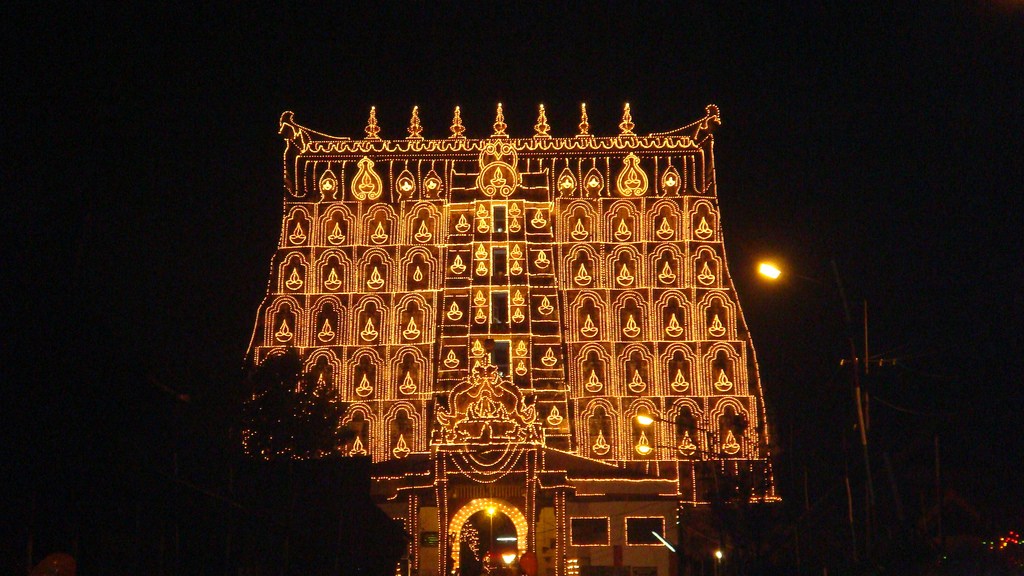
After finishing the day’s work in the evening, we freshened up at the hotel and headed out for the much anticipated part of our visit to Thiruvananthapuram. A visit to the richest temple in the country: Sri Padmanabhaswamy. For all the hype and media space grabbed by this temple, I had expected a BIG crowd of tourists(Not Pilgrims) here. I had imagined the sight to be like all other famous temples in India with fussy godmen, lot of petty shops dotting the walkway selling pooja items etc. among other things. But in total contrast to what I had imagined, this has been one of the BEST temples I have visited till date (among the well-known and famous landmarks).
I’m not a pious or a temple person, but this place has truly stood apart. I am someone who believes that ‘a temple is a place where one has to FEEL god and that’s possible only when the place is PEACEful’. I prefer holy places to be silent and less-crowded. And this place stood out for just that..!! A strict dress code and prohibited entry for non-hindus, a stringent adherence to the temple rules, limited crowd, silent ambience, an eyeful of the darshan of the massive idol lit by mere oil fed lamps: The place hadn’t given up its sanctity in the form of commercialisation, to all the attention grabbed by it’s hidden chambers of gold.
Main gate – Padmanabhaswamy temple
After offering our prayers, we visited the old wooden museum inside the Puthenmalika / Kuthiramalika Palace just outside the temple premises. The structure built by the erstwhile Travancore kings is a damn nice place for the art lovers. Like most regions in Kerala that sleeps with the setting sun, we headed back to the hotel to call it a day.
Day 2:
After finishing our work around evening, we set-out to do a little bit of city trotting. No visit is complete without taking back souvenirs. The rule in my work team is (on a lighter side), ‘Whether you finish your assigned job or not, whether you return safely or not, we don’t care. Bring us souvenirs and the local snacks to eat.’ So, we shopped for some local crafts at SMSM institute crafts emporium.
A wooden piece of art at SMSM institute crafts emporium
From there, we walked through the narrow lanes to one of the biggest shops I have ever known that sells just ‘CHIPS’: ‘The Mahachips store’. Chips of different varieties, made to order and packed just then. I picked up about 10kilos of banana chips & jackfruit chips as giveaways, something that will be much awaited for back home in Bangalore, even more than my safe return. (The even funnier part was that this bag of chips was the single largest (Fragile) cabin baggage I was carrying with me. The cabin-crew was amused to know what was in it when she offered help to place it in the upper cabinet).
What’s a visit to Thiruvananthapuram, without soaking your feet in Covalam beach? That’s where we were headed next. After strolling along the beaches, we walked upto the Vizhinjam lighthouse for a good view of the sea. The view was simply delightful. A stroll along the crowded beach, beautiful view of the sunset, some yummy local chaats to munch on, it was indeed an awesome end to an eventful business trip. And we head back to Bangalore in the earliest flight on the following day.
The view from the Vizinjam lighthouse
Don’t miss to try these three things while you are in Trivandrum (or anywhere else in Kerala):
Fresh banana & jackfruit chips and Kerala halwa
Hot palam puri with a cup of burning hot Kerala tea
There is no existence of a place without the people, and with civilization exists its culture. Madurai has its own share. My previous post (Madurai Part 1) was exclusively about the architectural landmarks spread across the city. But it would be injustice if the other things associated with this amazing city goes without a mention. Of course, the write-up could run into books if I had to write about each of them. And it isn’t necessary that everyone travelling is a pilgrim or a history buff or an architecture enthusiast. Hence, here’s an attempt to throw light on other aspects that any visitor to Madurai can expect. This is not a detailed one, but I touch upon various dimensions that you can theme your trip around Madurai. Do let me know if this post helps or if there is any other dimension I missed. Here goes my list.
Art:
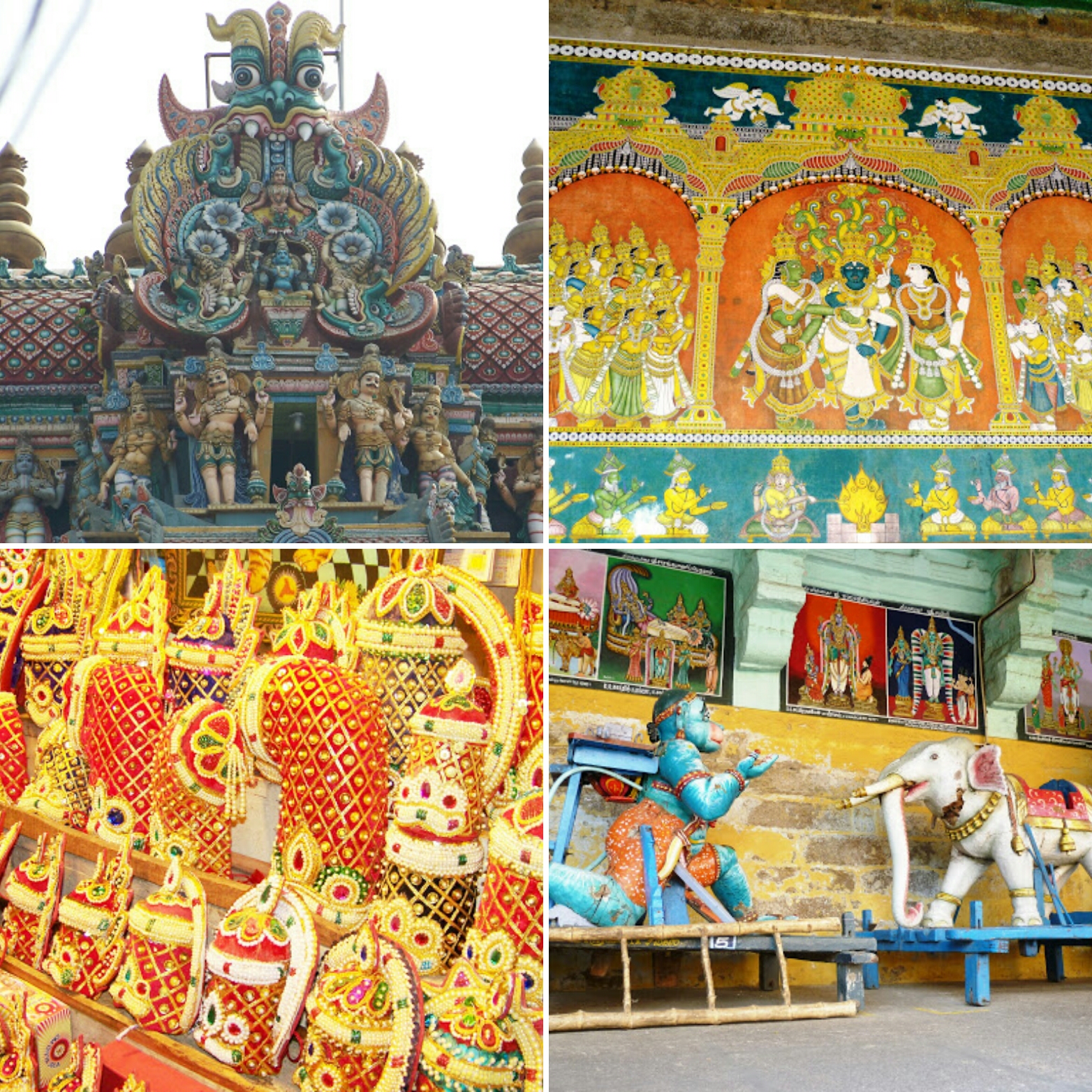
Sculptures: adorning every temple wall, pillar and their towers are a marvel in itself.
Carpentry: Several wooden vahanas used to carry the idols of the various deities in the temple are something that need the attention of art afficionados.
Handicrafts: Various accessories used for decorating Devi idols, made of delicate sequins, etc. are sold in several stall inside the large corridors of the Meenakshi temple.
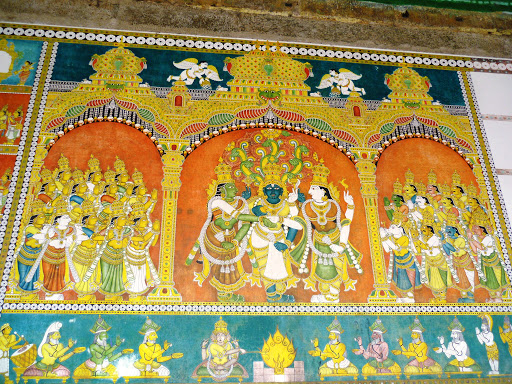
Mural paintings: This needs no introduction, the famous Madurai paintings are a gift of the Pandyan era, adorning the temple walls.
Clockwise from top left: 1.The sculptures on the western tower of the Meenakshi temple; 2.One of the mural paintings from the temple walls; 3.The wooden carriages for the temple idols; 4: Handicrafts from the temple stalls
Food:
Listing just a fixed menu while in Madurai would just be an understatement. If you are a foodie, Madurai would need two full days to explore its culinary delights alone. It is famous for both vegetarian and non-vegetarian specialties. I’d probably write a separate post about it sometime later. But this list is the list that we had when my family visited. But believe me- it is BEYOND!
Breakfast – Idly & Sambar, Pongal + a cup of filter coffee 11.00.a.m – Jigarthanda (it’s more like a combination of falooda & kulfi)
Dinner- Anything after 7.00.p.m is called meals. Must try is the ghee roast & rava Masala dosa
Costume:
Sarees for women & Dhotis for men.
Madurai cotton sarees with simple prints and zari borders with temple designs are popular.
Jewellery:
Among the locals- particularly those belonging to the Thevar cast, it is believed that women are prettier with bigger earlobes. Hence, the girl child born in this community is made to wear a traditional earring called the ‘Thandatti’ when she is young. The thandatti is said to evoke the 3 levels of our world: terrestrial, astral and divine and these levels are associated with Mandala. Each piece of this weighs 27gms and is made of gold and this piece of jewelry is specific to Madurai.
A Thevar woman wearing the traditional Thandatti earring
Shopping:
Shopping at Madurai is all about wholesale vendors and there are specified streets for each of them.
Cotton sarees/ dress materials: Shops are all around the temple complex
Steel utensils: Plastic beads & girls’ accessories, gold plated imitation jewelry to name a few.
Pooja related accessories & crafts: Particularly inside Pudumandapam (1000 years old market)
Farm produce: Varieties of plantains / bananas and green groceries among the others.
A brief intro to a city full of life and activities. Justice yet to be done. Signing off with a hope that it has helped someone somewhere in some form who is seeking for some info on this Pandyan city….
This was a family backpacking trip planned exclusively to explore Madurai. This city has served as the capital of the Pandyas and is a key destination that has nurtured the Dravidian culture. For anyone who hears the name of this famed city, they know of the Meenakshi Amman Kovil. A typical traveler / tourist / pilgrim would visit just that temple and takes pride in marking it in their travel map of places visited. But what one doesn’t realize is, that Madurai is beyond just this. The contribution of the Pandya kingdom is not limited to just the Madurai Meenakshi temple and can be seen and felt in several structures just around the same city. Also, a portion of the Madurai city has a history beyond the Pandyas too. Hence, our family wanted to reserve this long weekend, exclusively for Madurai. We boarded an overnight bus from Bangalore and reached Madurai at 6.00.a.m. on the following morning.
Like most of our family trips, we wanted this also to be an impromptu vacation. Apart from to and fro travel, nothing else was fixed. As per me, you would need a good 2-3 days to have a quick run around doing this same itinerary as ours, exploring ONLY Madurai. If you are an art and history buff or a foodie, I warn you to carry additional days!
Itinerary:
Day 0: Leave from Bangalore by night (KSRTC Bus) Day 1: Reach Madurai. Visit Meenakshi temple, Thirumalai Nayaka Mahal, Vandiyur temple tank, Koodal Alagar temple, Gandhi museum, Pudumandapam. Day 2: Alagar Kovil, Alagar Murugan temple, Pazhamudhir Solai temple, Tiruppanakundram Murugan temple, Dargah of Hazrat Sultan, return to Bengaluru.
The details:
After alighting the bus, we walked around the Meenakshi Amman Kovil to find a good hotel. Since this is the heart of the city, it wasn’t hard to find a decent lodge around there. We checked into a hotel that was located just in front of the temple’s west gate. We freshened up quickly and left for the main part of the trip for anyone visiting Madurai.
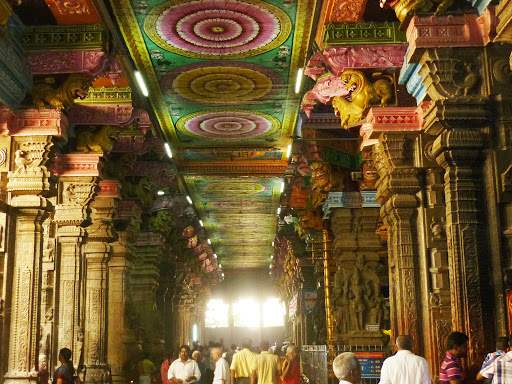
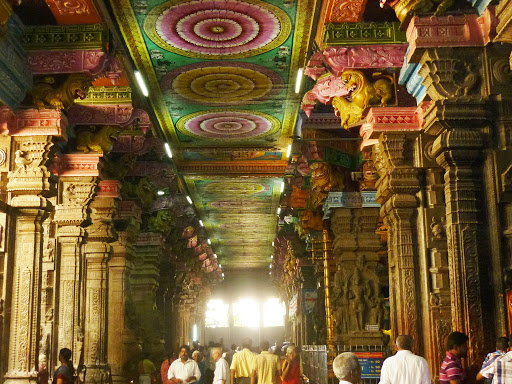
Meenakshi temple: A visit to the abode of the Pandya architecture. The entire temple complex is fortified and has 4 entrance towers, one on each of the 4 directions. The sculptures on each of these towers are out of the world. Once inside the complex, I started to wonder which world of wonder I had stepped into. It took us more than 4 hours to finish only a quick walk around inside the temple and also get the darshan of Meenakshi Amman and Lord Sundareswaran.
The finely decorated interiors of the Meenakshi Temple
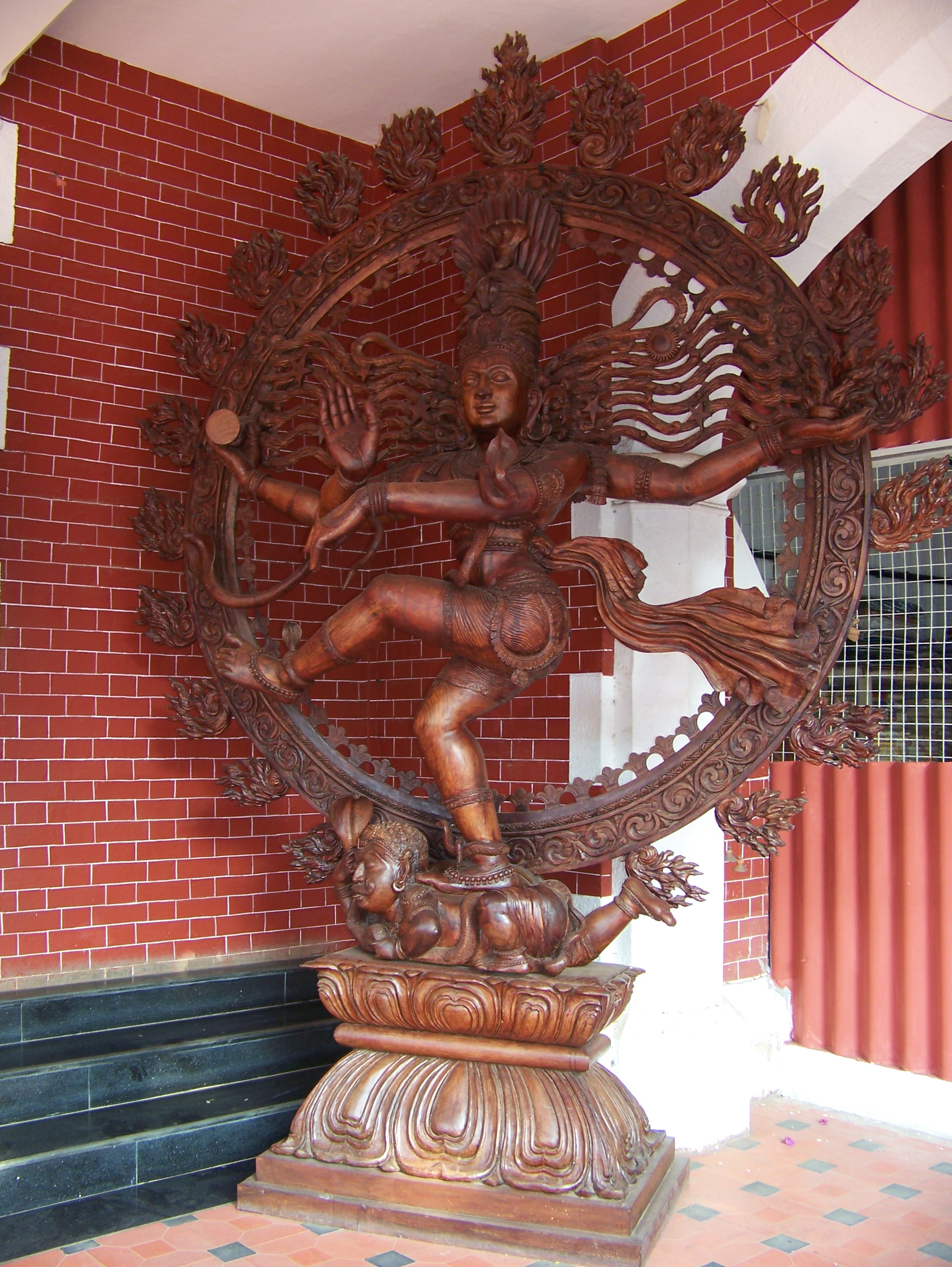
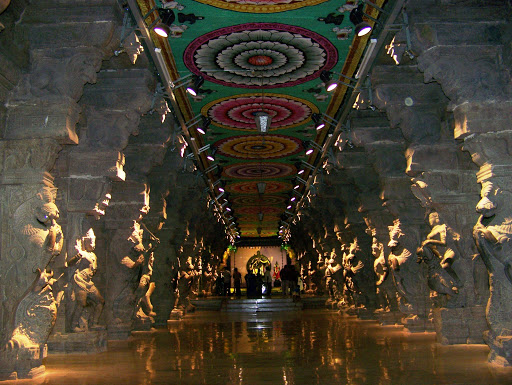
There are a lot of stalls inside the complex selling various handcrafted articles. The temple art museum within the same premises is a must visit. The central sculpture of Natarajan, or the dancing form of Shiva is believed to be one of the Pancha Sabha of the lord. This place represents the silver hall and Shiva is believed to have performed the ‘Sandhya Thandava’ dance form here (More on the Pancha Sabha Kshetras in another post). Also, there are 1000 pillars, all decorated with intricate pieces of sculpture. The dim light used for each pillar added up to the beauty of the place. The Madurai paintings adorning the walls of the temple requires another post to talk about. I go speechless when I get to explain about the South Indian temples. They are beyond words. Internet has plenty to feed and I don’t want to get into the details. After a tour of this massive temple complex, we decided to head out to explore the city beyond the Meenakshi Kovil.
Inside the Temple art museum
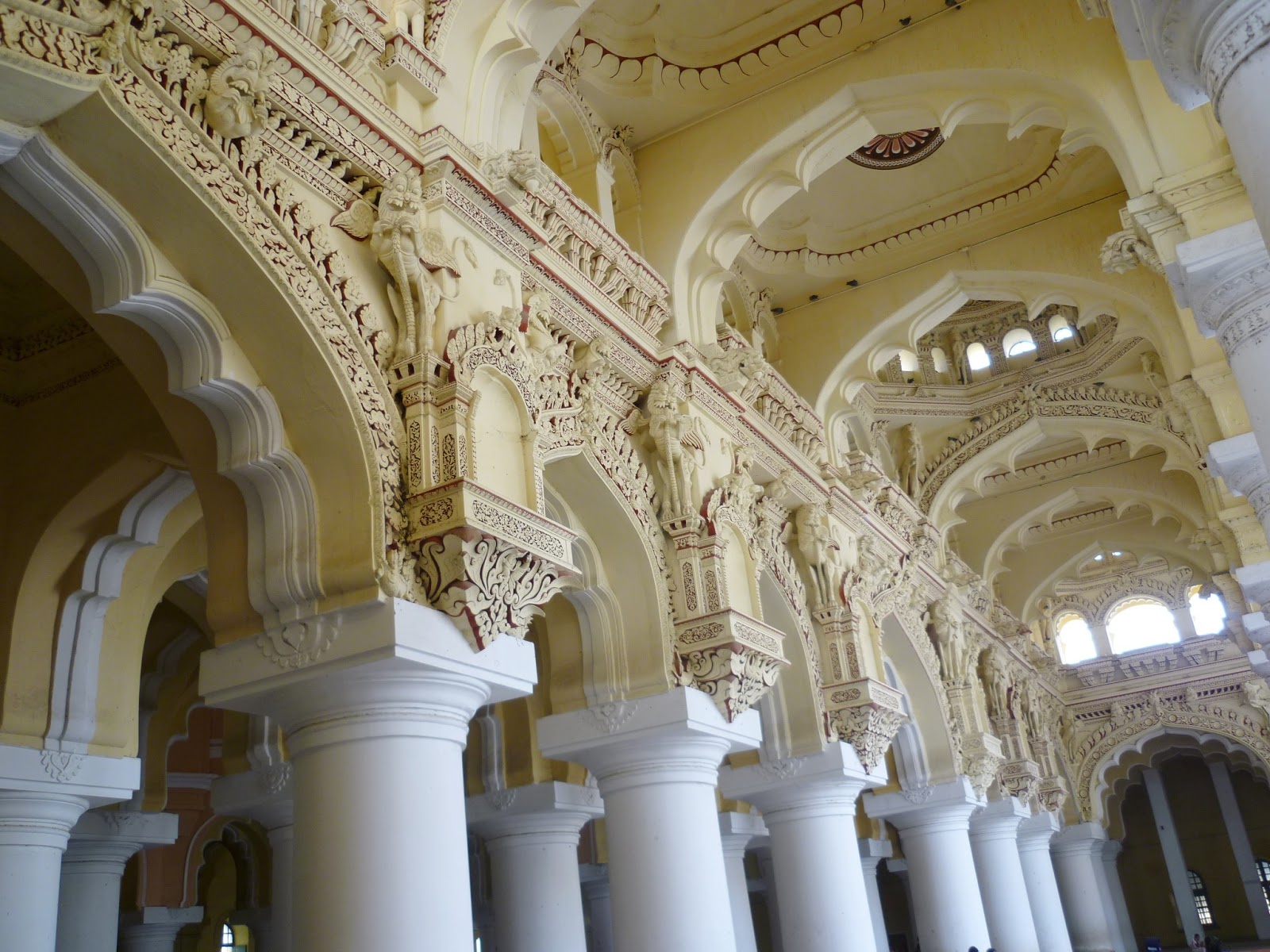
2. A small walk through the narrow lanes took us to the Thirumalai Nayaka Mahal built in the 16th century. Fine architecture with elegant paintings on the roofs and vaults is neatly presented in a simple combination of half-white and velvet red colors. There is sound and lights show conducted here every evening. However, we could not make it.
The interiors of Thirumalai Naickar Mahal
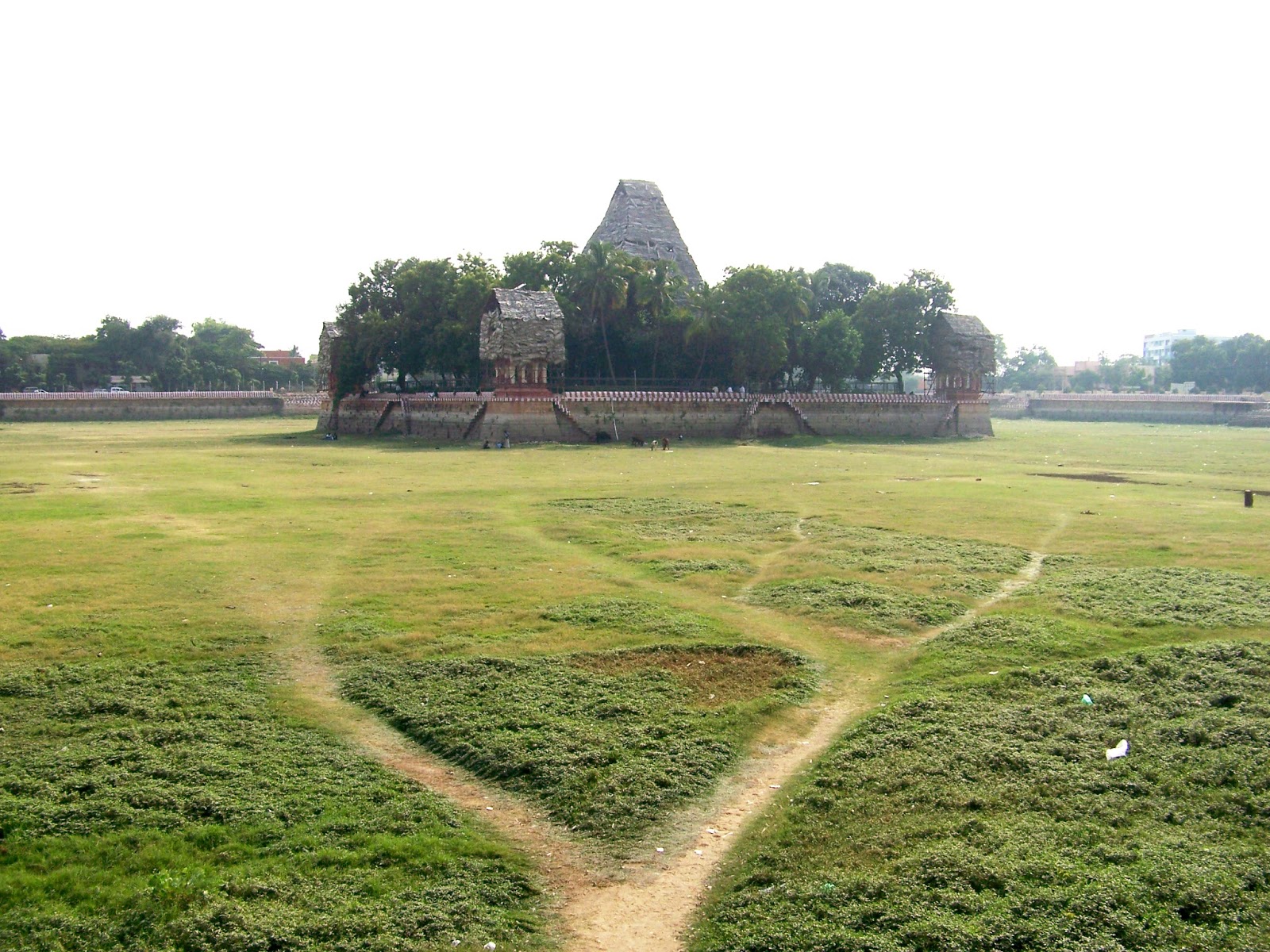
3. From there, we took a local bus to Vandiyur. This is where the annual event of the famed Teppotsavam / Float festival takes place to celebrate the birthday of King Thirumalai Nayak in January. This tank is supposedly the biggest of its kind in the state of Tamil Nadu. With the float festival just 2 months away and monsoon season just passing by, this tank still remained dry during our visit. When we enquired with a few locals passing by about how the event was going to be conducted in a dry tank, we were told that the water will be fed in January from the Vaigai river through artificially laid underground channels. This is truly amazing how such a concept was laid way back in the 16th century. But for a newcomer like me, the dried lake was an eye sore as it was used was a watering hole by many vandals at the time of our visit.
Vandiyur Mariamman Teppakulam – the island temple
4. Taking another bus from there to Periyar and a small walk from there through the stinking / dirty by-lanes, we reached the Koodal Alagar temple. A quick pooja and a walk around the temple was a nice boost up. The architecture here too, is similar to that of Meenakshi temple.
5. We had to rush to The Gandhi museum as it would close by 6.00.p.m. However, we could not make it on time. This was once called the Tamakkum palace of Rani Mangammal. Today, the museum supposedly houses 14 articles that were used by Gandhiji, along with his sacred ashes and blood-stained dhotis. Gandhiji is said to have visited the city five times during his lifetime.
6. On our walk back to our hotel, we came across an old marketplace called as Pudumandapam. This is a 1000 years old shopping mall, supported by huge sculpture rich stone pillars. The stalls are occupied with tailors, handicrafts vendors, wholesale dealers of pooja related and general accessories. A good place for shopping traditional artefacts at Madurai, and that too in a market that is so old!
Entrance of the Pudumandapam
7. On the following morning, we boarded a local bus from Periyar bus stand to travel 21kms towards Alagar Kovil. The temple is dedicated to Lord Vishnu, Meenakshi Amman’s brother. The village is surrounded by an old fort wall, it gives a good view of the green hills around the temple. The architecture is similar to Koodal Alagar temple in the city.
8. A trek of 3kms uphill, through green forests and monkey infested walkways lead us to the Murugan temple. It is one among the six abodes of Lord Murugan and hence important among the pilgrims.
9. A walk of half a kilometer further uphill took us to Pazhamudhir Solai temple. A temple dedicated to Goddess Rakkaya exists close to a natural spring called Nuburagangai here, where devotees take a holy bath. But what seemed strange to me was that the place was probably the only temple I had ever been to, which charges an entry fee into the temple itself. This is where the famed Chittrai festival is observed during the month of April.
10. From there, we took the next bus back to Periyar, from where we had to take another connecting bus to Tiruppanakundram. This was a cave temple at the foothills of a hillock. It is believed that Lord Murugan was wedded to Devyani, daughter of Indra at this place. Hence, this is also counted one among the 6 abodes of Lord Murugan.
Entrance to the Tiruppanakundram Murugan temple
11. Up the hills, is the Dargah of Hazrat Sultan Sikandar Badshah shaheed Radiyallah Ta’al anhu. Owing to time constraint and exhaustion, we thought of skipping the climb.
Other lesser known places we skipped due to time constraints were the Kazimar mosque and Goripalyam Dargah. At the center of the city is the Kattabomman junction. This is where a part of the old Madurai fort exists. Today this is not more than a public library. Further, every street in the city has a history behind it: This link to an article from “The Hindu” don’t do this usually, but would make a special mention about the streets of Madurai. Every street in the city has a history behind it: This link to an article from “The Hindu” explains it all- ‘Where moats made way for motorways‘
This was all about us getting around the place for seeing some of the historically important landmarks around Madurai. But the list is endless and time, very limited ☹ I have covered a few other must-do things while at Madurai in a separate post. I wish to be of some use if you are planning a trip there. (Click here to read further)
Karnataka Bundh: The whole city of Bangalore was protesting against the Kaveri water verdict- 32 buses vandalized in the city and all that jazz. Well, I was away from the entire hustle bustle, where fighting for the water of Kaveri made no sense for the people. That day, I was spending time with my mom who was away from home since the last couple of months, on business travel.
My itinerary: Day 0: Bangalore to Bidar (Overnight bus) Day 1: Jharani Narasimha Swami Cave temple, Karanja reservoir, Basavakalyan (Basaveshwara temple, Basavanna statue, Basavanna Guhe, Akkamahadevi Guhe Anubhav Mantapa, Basavakalyan fort) Day 2: Nanak Jira Gurudwara, Bareed Shahi park, Bidar Fort; Return from Bidar to Bangalore (night bus).
The details: People in the Mysore-Karnataka region know Bidar and the rest of the districts of Kalyana Karnataka or Uttara-Karnataka mostly through media that only talks about them when there is a drought in the state. This somewhat had influenced me to paint a dry and a dusty picture of the region inside my head. There was not much that I had heard about this part of Karnataka on a typical tourist circuit of state and that’s why I chanced upon travelling to Bidar for a weekend. Since my mom was posted there for some time, I thought it was an opportunity for me to go and see what is in the northern-most district of my home state. Mom usually has a vehicle at her disposal whenever she travels and stays during the entire business trip. This solves most of the commutation problems.
Day 1: When I reached there after a long overnight bus journey of 12hrs, I had a roaring welcome in the city, quite literally…!! An IAF “Hawk” flew past right above my head during their daily flying sorties. Right then, I had my first GK (general knowledge) moment of the tour. Bidar has been an important training base since the early 1960’s for the Indian Airforce. Bidar serves as the main base for Hawk AJTs and the Suryakiran HJTs. The first thing that I learnt about Bidar and is never shown or spoken about on mainstream media.
My mom received me at the bus stand and took me to the Inspection bungalow where she was staying at. After freshening up and post a quick breakfast, we headed to “the Jharani Narasimha Swami Cave temple”. The myth mentions that Lord Narasimha killed Hiranyakashipu and then proceeded to slay the demon Jalasura, a staunch devotee of Lord Shiva. After being killed by Lord Narasimha, the demon Jalasura turned into water and started flowing down the feet of Lord Narasimha. Today, devotees have to walk across a cave with water (1.7mts depth) to worship the idol. With bats flying around, roaches swimming with us and dimly lit path to lead us, it was a new experience for me, and I was seeing such a religious site for the first time.
Inside the cave- enroute to the Narasimha idol
We then proceeded towards our next destination. Enroute, we stopped by the Karanja dam, a small reservoir built across the Karanja river.
In a while from there, we had arrived at Basavakalyan- our main destination for the day. There, we visited the Basaveshwara temple, 108ft high Basavanna statue, Basavanna Guhe and Akkamahadevi Guhe. Then it was a turn to the right that took us to “Anubhav Mantapa”. This is a replica of the ShivanubhavaMantapa- an academy of mystics, saints and philosophers of the ‘Lingayat’ faith in the 12th century. Anubhav Mantapa is often referred as the first parliament in the world.
A view of Hyder Mahal at the Basavakalyan fort
From there we visited the Basavakalyan fort, sparsely visited apart from a few localites who come there to play cricket. But it is indeed a monument forgotten on the maps. The lights falling on the inner chambers of the fort called for some good photography. Some of points of interest inside the Basavakalyan fort for an explorer may be the open-air theatre at the entrance of the fort and the view of Hyder Mahal from the Kadak Bijli Toph viewpoint. With that, it was dark, and we returned to our place of stay.
Day 2: We started the day by spending some tranquil moments at the ‘Nanak Jira’. This Gurudwara is known for being the second occurrence out of the supernatural powers of Guru Nanak. The first one was ‘Sri Punja Sahib’. This is now in Pakistan and strictly prohibited for free visits. Hence Gurudwara Sri Nanak Jira Sahib is referred to as the ‘Second Punja Sahib’ of India and hence a very holy site for the Sikhs. The sweet water flowing from a spring is believed to clear one off, all sins.
The Nanak Jhira Gurudwara
Next, on the list was the Bareed Shahi park. The tombs of the Bahamani rulers lay here. This is small but a nice park maintained just to provide some lung space for morning joggers and evening walkers. We were told that this was a neglected piece of history just a year ago and good efforts have been made by the authorities for its restoration.
We had an invitation from one of the colleagues at my mom’s office to visit his home for lunch. To think of it, it is by far and large one of the MOST sumptuous and wholesome meal I have had all my life. Hahaha call it the downside or the funny part of relishing such a wonderful meal- My mom and I were handed over a large towel to wipe off our teary eyes and watery noses. The regional cuisine here is notoriously famous for being high on chilly. But even with the hot flames flying out of our senses, we couldn’t resist the taste of the flavorful spread. It was a typical North-Karnataka cuisine with a spread of over 50 dishes. We were overwhelmed by their hospitality and the flavorful cooking. Apart from the Millet roti and gunpowder, most of the dishes were new discoveries for me. I even had a box packed with roti and keema-curry for my return journey by train in the night.
The Bahamani tombs
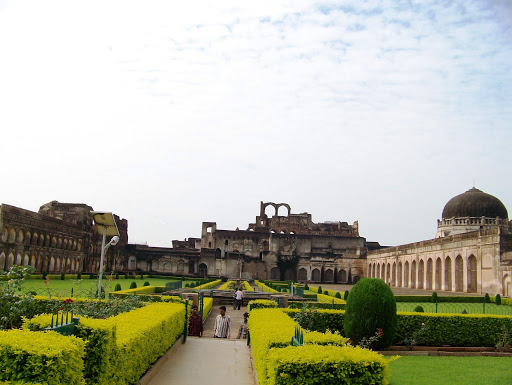
The last and final destination was the Bidar Fort: It is a multi-layered fort to say in simple words. It does not have a quantifiable boundary, though a few localites specify some digits to measure its expanse. The entire city of Bidar is actually within a fort wall which was the area where the citizens lived back during the rulers’ time. The second round of the wall is where the ministers lived. The third and the innermost zone is where today’s tourism is concentrated, the area where the King & the queen lived. This fort needs a minimum of half a day to explore for a person interested in history, architecture or archeology. In a tourist circuit in Bidar that I barely heard of, this fort came in as a surprise when I had least expected. It is HUGE!
The Royal Residence within the main fort
Bidar has so much to offer for a backpacker on a tight budget. Apart from the travel distance between places, everything else is very affordable. Even the entry to all the major landmarks on the potential tourist trail was free. In spite of it, very few people plan a trip to this district. Maybe because the name pulls down an image of a dry, barren, hot, poor, drought prone landscape. What my eyes met here was contradicting to the imagination that I had, largely based on what I heard in the media. In reality, the city was lush green, well fed with good rains and clean (at least compared to the cleanest places of Bangalore).
Souvenirs to take back: Bidariware is a local form of metal art that has a GI (Geographical Identification) tag and extremely laborious and artistic. It takes an 8 stepped process to create one piece of art and a symbol of royalty, that’s been carried on from 14th century, largely promoted by the Bahamani Sultans.
So, a lesson to take back: Stop imagining how a place would be; go there and see it yourself.
On a weekend, my family planned to go for a day trip from Bengaluru. Since my dad wanted to visit Lepakshi since long, that was our destination for the weekend. There are several other small and major historical landmarks in a 50-100kms radius from Lepakshi; hence we had an initial plan to cover a few other places during our return as well. A super awesome NH7 from Bengaluru took us till Bagepalli, from where, Lepakshi was a small deviation away…
The belief is that, Jataayu- The vulture King (mentioned in the Ramayana) fell here when he was shot by Ravana’s arrow. Later, Rama is said to have commanded the bird to rise- Le Pakshi, and hence the name of that town. But not just its name, this entire place turned out to be a storehouse of history. Be it from mythology or the recent past history of the Vijayanagar Empire, every stone at Lepakshi had a tale to tell… We walked carefully reading every story that unfolded at every step
Although, I might advice you to take a personal guide while at Lepakshi who will be able to better put up all the stories and facts to you, here I would like to enlist a few noteworthy stories and art representations from Lepakshi.
The main shrine of this architectural complex is the Virbhadra temple. The human figurines/ sculptures in its main hall are believed to be made up to the specifications to measure the beauty of a perfect man and a perfect woman.
Left: The perfect man; Right: The perfect woman
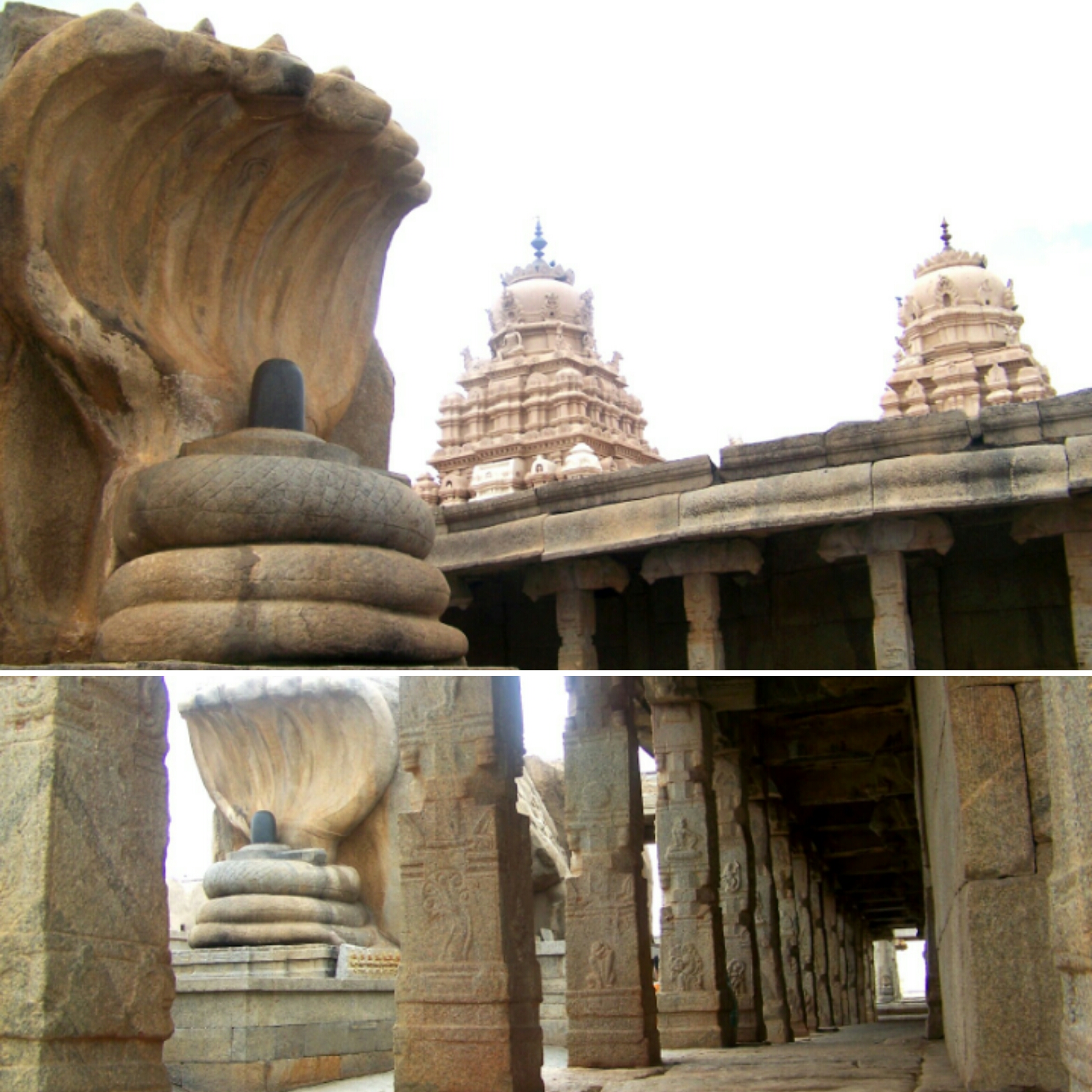
2. The idol of Nagalingesvara– Carved out of a natural boulder to the west of the shrine, is a seven-hooded Naga sheltering a black-polished lingam cradled in its ribbed coils. A saptamatrika panel is placed below to the right. History tells us that the sculptor had come home for lunch one day. His mother said she would be back soon with food for him. She was surprised with her son’s work when she returned and exclaimed “Oh my son..!! You have carved such a big and a beautiful statue in such a short interval.” Even before she completed, a big crack developed across the linga. This makes it un-worthy of any Pooja/ offerings at the temple.
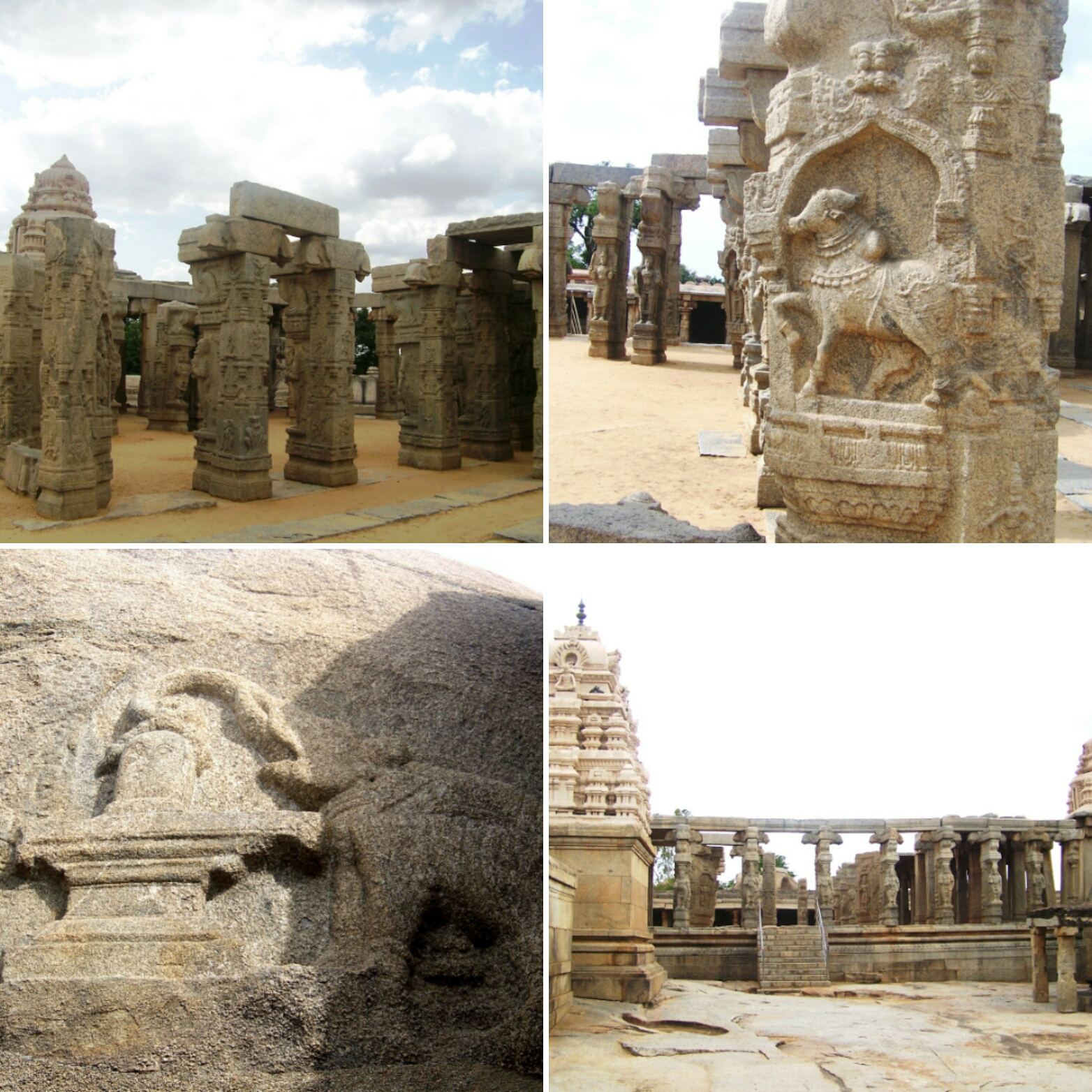
3. The hanging pillar– Among the several ornate pillars that decorate the temple corridor, this one takes a special mention as an architectural marvel. The pillar doesn’t rest completely on the ground and hence a sheet of paper can be easily passed through the gap beneath it. The roofs of these corridors are also adorned with several ancient painting, however they are largely lost due to apathy. Another noticeable feature on these pillars are the certain designs engravings specific to this temple. These designs are said to be the inspiration for the traditional Lepakshi prints found on Sarees around this area.
4. Kalyana mantapa-This incomplete structure has been depicted as the site of the celestial wedding of Shiva and Parvati. Each pillar here is supposed to be installed in celebration of this event. Hence, one can notice that there are depictions of drummers and musicians, gods and goddesses among others engraved in these pillars. A similar place is believed to exist in Kailash and it was therefore pronounced that a place more beautiful shouldn’t exist on the earth. And hence, this Kalyana mantapa was left unfinished.
The Kalyana Mantapa
5. History says, the place could have got its name referring to the two brothers- Veeranna and Virupanna, under King Achutaraya of the Vijayanagar dynasty. Virupanna got this temple built as a tribute to the Lord as his mute son regained his speech while he was playing near the Udbhava Moorthy of Shiva on this hillock. It is said that Virupanna spared no expense while having this temple constructed. However, since he was the treasurer of Penukonda province (today’s Anantapur), the money he was splurging lead to suspicions from the king about embezzlement of money. It is said that, Virupanna plucked out his own eyes and threw them against the wall in grief and in anticipation of royal punishment. And thus, lepa-akshi (blinded eyes). Till date one can find those blood stains on that wall. The locals say that it has even test have proven that the blood stains are indeed real..!!
6. The Natya Mantapa– This is an arena where the celestial dances are believed to have been performed. Besdie it, one can see a large footprint embedded on the ground and beleived to be the footprint of Sita. It is so large that is hard to imagine what it could have been or imagined to be when it was made.
Clockwise from top left: The Natya Mantapa; The idol of Chowti Ganesha; The Sita Paada; The bloodstains of Virupanna’s eyes
7. The statue of Basava or the Nandi is the largest monolithic Nandi in India. It is built facing the Naga Linga within the temple complex. However, this is half a kilometer away from the main temple.
The largest monolithic Nandi in the world- Facing the Veerabhadra temple
Jataayu is believed to have died at another place which is located at about 2 kms from the complex.This is quite sad that a place of such importance is not maintained or highlighted anywhere in the map. It didn’t have any walkable road to the exact spot. But, by this time we had already spent more than half a day at Lepakshi which we hadn’t anticipated. It was also very hot and dry and we were feeling all exhausted. Hence, decided to save all the other places for another day and returned to Bengaluru.
Conclusion: A wonderful place to visit if you are a history and art buff and looking for a place located at just about 120kms from Bangalore..!!

























 The Lost Lander