Tag Archives: Uttar Pradesh tourism

Part 2-The Story of The Maha Shivaratri and the Naga Sadhus

Continued from Part 1: The Story of The Maha Kumbh and the Naga Sadhus

We had taken help from a local person, Sunny, to make a last-minute hotel booking at Banaras. Sunny was a young lad who freelanced as a local guide, and was referred to us by one of my friends who had availed his services earlier. My friend and I checked into the hotel booked on the main road of Banaras, slept without dinner as were tired.

Meeting the Nagas

It was around 02:00 a.m. when I was woken up. “Wake up, Hitha. There is something happening on the road, I can hear people shouting slogans.”, my friend sounded very anxious.

It is Shivaratri. People maybe chanting Har Har Mahadev, as many were doing so when we arrived here.” I said.

No, wake up! I have been hearing this from quite some time, and it is getting louder now.” She barged outside the room to check what was going on.

Hitha, hurry up and come outside! All the Naga Sadhus are right here!” she shouted, while running towards my bed, huffing and puffing in the next couple of minutes. Then, we both ran out to the reception area.

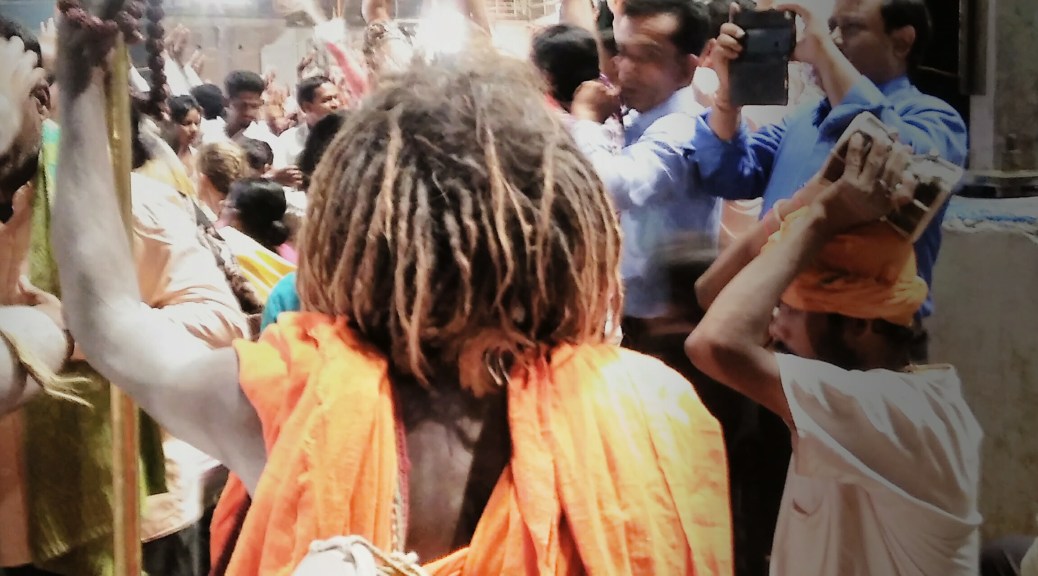
We were spellbound with what we saw there. With ash smeared bare bodies, matted locks, strings of Rudrakshas around their necks, trident and damrgo in hands, there were hundreds, or perhaps thousands of Naga Sadhus and Sadhwis representing every known Akhada with their respective Tableaux, had all assembled right in front of us. Calls of ‘Har Har Mahadev’ reverberated not just on this road but across the city as their convoy began with all the Nagas throwing ashes up in the air. Tight security with the CRPF barricading the streets on both sides ensured the convoy reached the ‘Kashi Vishweshwar Mandir’ thereby the Nagas got the first glimpse of their Adi Guru on the day of Maha Shivaratri before the rest of the public were allowed. A sight that seemed like a dream that I had just woken up from, one that I will cherish as one of the TOP memories of my life which I would have missed in a matter of seconds hadn’t my friend woken me up at the right time. The crowd then dispersed and we returned to our room to freshen up before starting our day.

In a couple of hours, Sunny updated us to stay at the entrance of the hotel for the procession was to return along the same path, with the Akhadas returning from the temple, back to their camps set along the Ghats from where they would all packup to head towards their respective abodes scattered across parts of India. When they all did arrive, I stood on the side of the road to capture a few shots for memory of this amazing day. Despite the security, my friend and I had unknowingly become a part of the parade. The parade of the Nagas. We were walking beside and amid the Nagas from Godowlia street, right until the Juna Akhada office before someone realized that we were outsiders and politely asked us to step aside. WOW! It was indeed an experience that gives us goosebumps just by imagining even today.
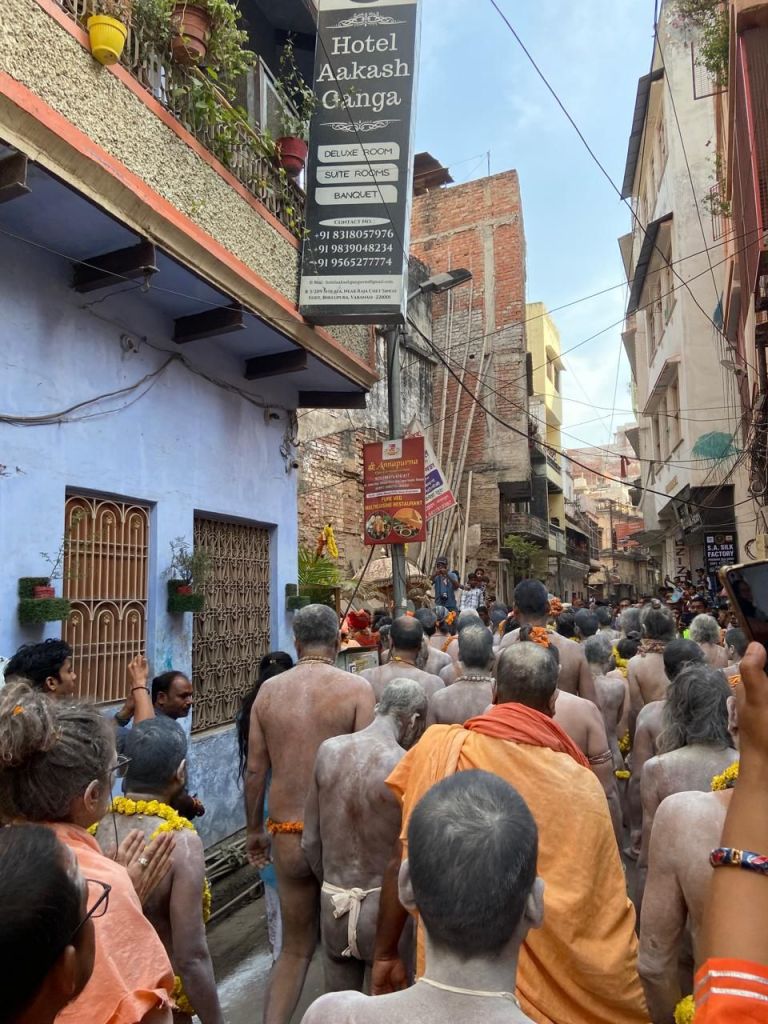
Naga Sadhus returning to their akhadas

Shiv-ji ka Baraat

Meanwhile, Sunny had us racing towards, yet another ceremony scheduled to happen on the parallel streets. The grand Shiv Baraat procession was on its way from Shri Tilbhandeshwar Mahadev temple towards the Gauri Kedareshwar temple, where the idols of Shiv and Parvati are set up the day before the main event. Sunny placed us both on strategic spots on the street from where we could watch the arrival of the Baraat clearly.

First, the camels arrived. Then the elephants. Then, all the Baraatis from the groom’s side accompanied by various orchestra/Band sets and tableaux from across the city arrived on different vehicles, chariots etc. (Children and young adults dressed in masks and costumes depicting various gods and Goddesses from Hindu Mythology) and Finally the groom made his appearance on horseback (yet, another young boy dressed like Lord Shiva), travelling across various lanes, streets and main roads of Banaras and finally reaching Gauri kund located at Kedar Ghat where the divine union of Lord Shiva and Goddess Parvati was to take place later that night.
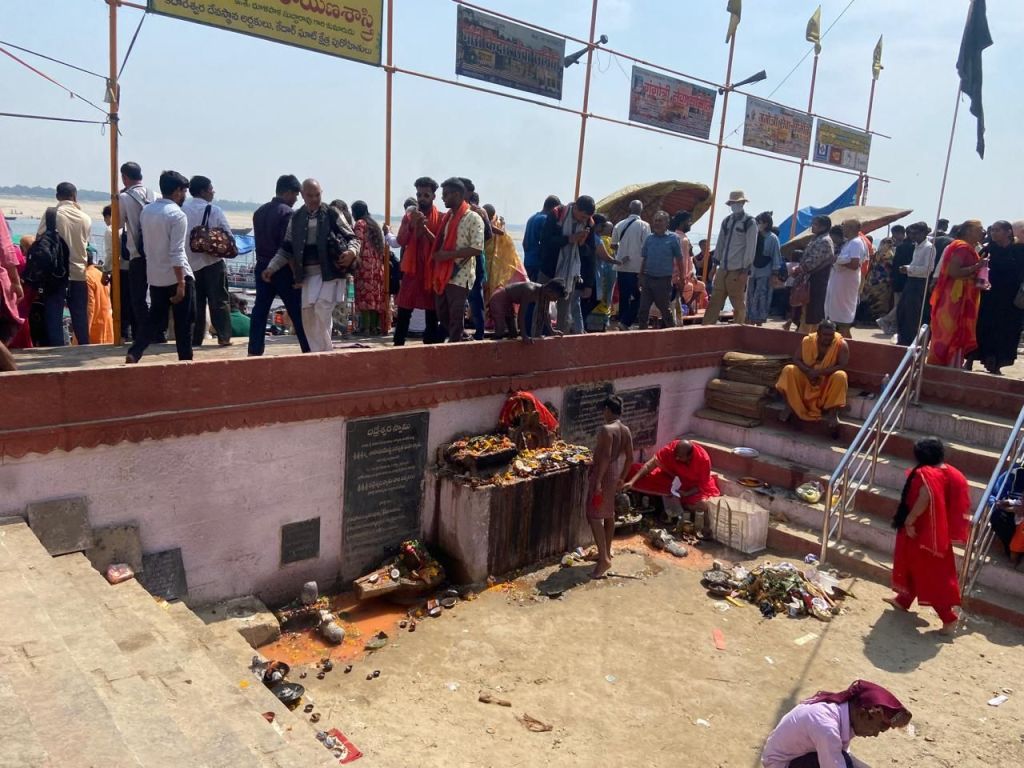
Gauri kund before the wedding prep

We found a strategic spot on the stairs of the Kedar Ghat to witness the grandest wedding that was supposed to take place all night with all the devotees staying up on night vigil as witnesses to the wedding on the banks of River Ganga. Ofcourse, any Indian wedding is incomplete without a grand feast for its attendees. How could it not be so when it is the wedding of their dear Lord himself? There was free and unlimited supply of potato sabzi and Thandai throughout the night to all devotees (guests) in attendance at Kedar Ghat, witnessing the wedding by participating in rituals and discourse of vedic chants.
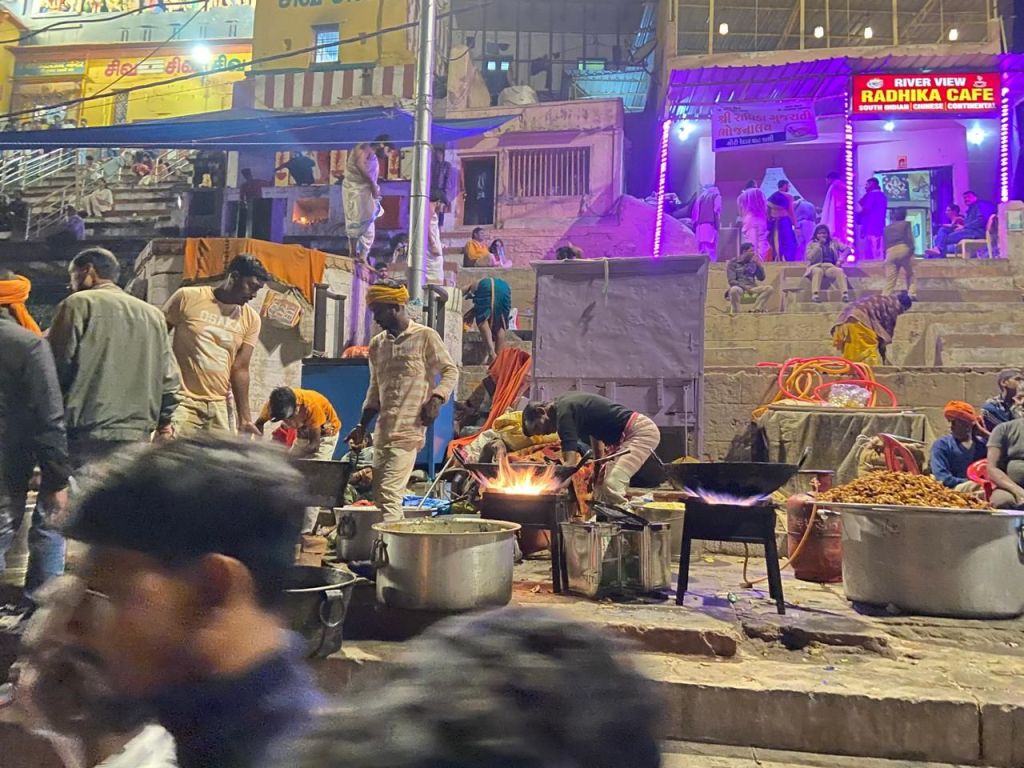
Feast being prepared for the wedding

The common man seated hundreds in numbers occupying the riverfront stairs played witness to the divine marriage ceremony conducted in a style typical to the Uttar Pradesh region. My friend was on top of the world when she was randomly picked from the gallery of people to make her offerings to the newlyweds (perform abhisheka with milk on small lingas moulded out of fine soft sand from the Ganges on a decorated silver plate). The contents in each plate was offered back to the river as a part of the culmination of the marriage rituals. The chants and offerings went on until the break of dawn post which the audiences and witnesses dispersed.
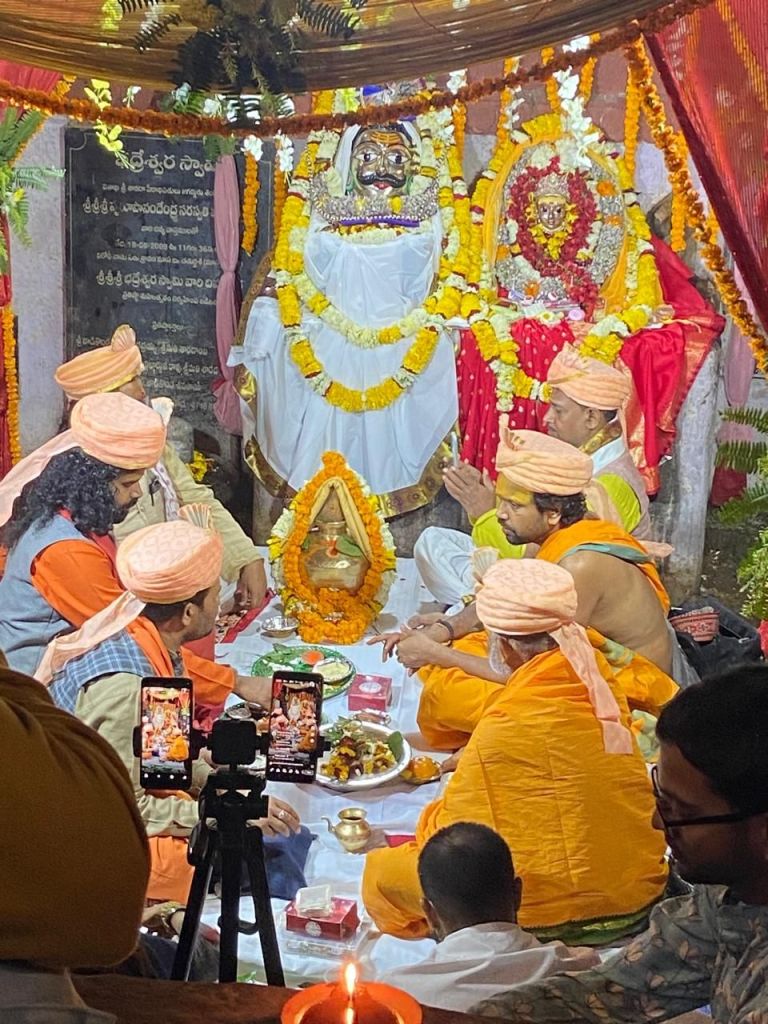
The celestial wedding in progress at Gauri kund

Date with the Lord and his consort

If this was about witnessing the celestial wedding, wait. Our visit to Banaras was incomplete without this: Greetings to Lord Kashi Vishweshwara. We had decided to skip the temple visit on the day of Shivaratri to avoid the crowd and try our luck on the following day. So that day was about resting and catching up on the sleep deprived from the last night.

Come the following day, there were no signs of any less crowd. Rather it looked like the entire crowd from Prayag had alighted at Banaras after closing the Kumbha Mela. The queue to enter the temple extended several kilometers. But we are Indians with local contacts. Be it getting access to a no-entry spot or to wave a quick ‘Hai’ to our favourite god, why wouldn’t we utilize our privileges to bypass rules? We will! We found a legal way (Oh, that’s a secret!) to cut the longer queue and reduce our wait time to just an hour. Amid chants of ‘Har Har Mahadev’ we had finally arrived at the Lord’s doorstep, a window from where we were blessed with a view of a beautiful Pushpa alankar or the floral decoration. Despite wanting to stay there for a little longer, we had to move away making way for the lakhs of devotees waiting behind us.

A visit to any Shiva temple is incomplete without taking the blessings from his consort, Shakthi. In Kashi, Lord Vishweshwara’s consort is Goddess Vishalakshi. We expected another long line but as surprising as we were, we had just another 10 to 15 people along with us, all standing and praying inside the temple without any pressure to move out. It was such divine energy felt in peace. So, after coming out of there, the next important thing to do on our list was to eat food, food at the Annapurna temple, the home of the goddess of food and abundance. Let me not add more paragraphs into my story describing how symbolic this temple is from a religious and mythological context; Google Mata is just a click away with all the details. So, we had to satiate our fasting stomachs by finding our way to the temple of Annapurna (actually, to the dining hall!).

Upon enquiry of the route, we understood that we had to navigate through the same long queue of the Vishwanath temple before arriving at a small deviation that led to the temple that we were looking for. The same local contact who had helped us to jump the previous line provided us with some tips to skip the queue all together because we were not going to Vishwanath temple this time. We followed his hacks, paid a deaf ear to dozens of abuses that were being hurled at us by frustrated people who had been standing for hours in the long queue before joining a crowd that seemed unusual to an Annapurna temple (since we had not encountered it on our way to the Vishalakshi temple) or rather familiar (with the structure and chants around us were similar to that of Vishwanatha temple). It didn’t take us too long to realize that we had indeed arrived at the window of Lord Vishwanatha again, by entering from a different gate. This time, his darshana was without any of his adornments, a blessed moment briefly happening before he is completely covered up by his next alankaara and the offerings made by the devotees. It felt surreal. How lucky could one get to have a second chance on such a cringe day?

Anyway, moving on from there, we had to talk to few security personnel to help us find our way to the Annapurna temple. It was a short walk away with a maddening density of people pulling and pushing their way through a small temple verandah to enter the dining hall. Once there, we both had goosebumps thanking our fortunes for having us the opportunity to devour that meal! It was simple and comforting yet felt luxurious!
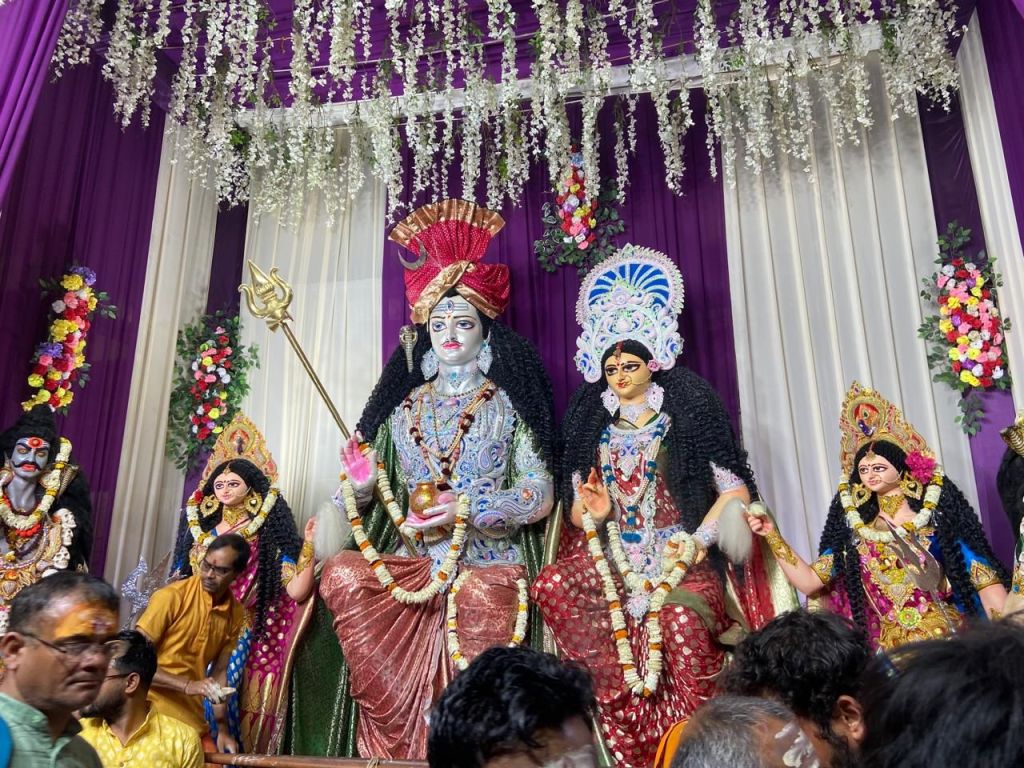
The reception of Lord Shiva and Goddess Parvathi

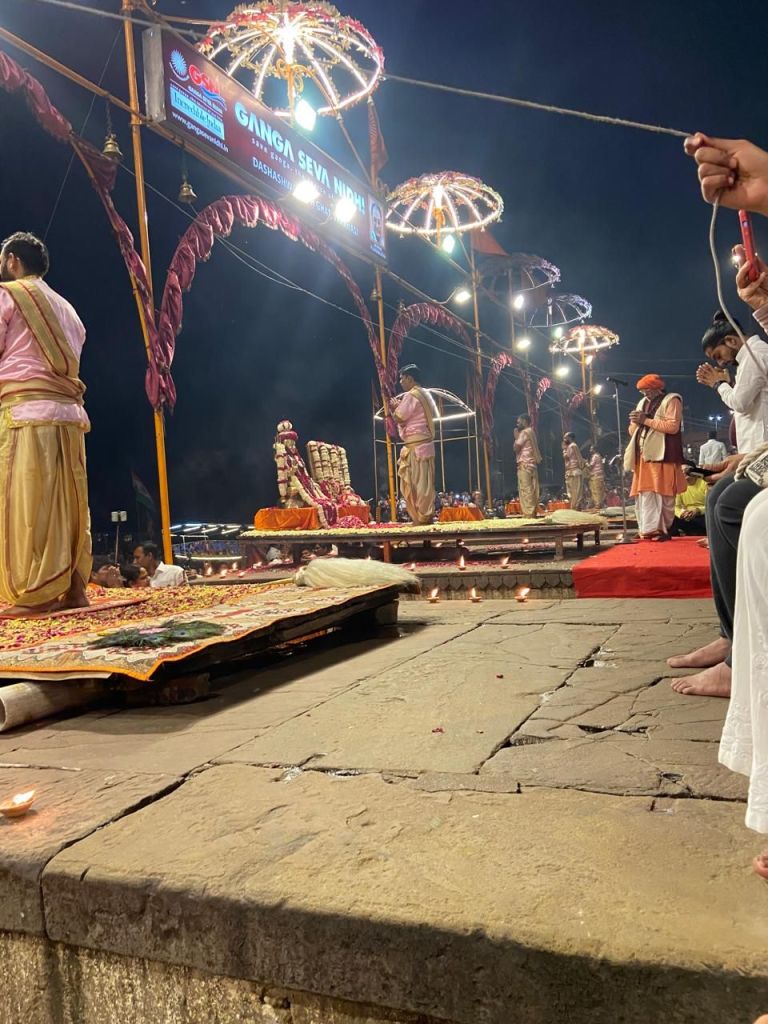
Lighting the Diyas at the Ganga Aarti

The famous Ganga Aarti performed twice daily on the ghats of the Ganga had been halted over the last couple of weeks, ever since the stampede had happened at Prayag. It was while having our lunch at the Annapurna temple, Sunny had dropped us as SMS informing us to arrive early at the Dashashwamedh Ghat as the evening aarti would be restarted from that evening. Even as we arrived at the ghat at 04:00 p.m., let alone sitting, it seemed impossible to find space to even keep our feet firmly on ground. The crowd had assembled on the ghats, on boats, atop all surrounding buildings, poles and structures to witness the Ganga Aarti that was scheduled to begin post-sunset. We both barely managed to find space just enough to cling on a supporting wall in front of the anchored boats.

It was finally time for the aarti and the all the priests who had to perform the Ganga aarti had assembled on the podiums. Call it our luck or divine intervention, the head priest who overlooked the preparedness of the dais before commencing the sacred ceremony pointed at the two of us from the massive crowd that had gathered. He asked us to come over and light up all the clay lamps arranged around the podiums. After that, he offered us to sit on a red-carpeted arena, right behind the performing priests that provided us the best possible comfort and view that evening! We couldn’t help but pinch each other to convince ourselves that the way our day had unfolded was indeed real.
Parvati ki Bidaai

On the third day, we stayed back to play witness to the Bidaai ceremony of the daughter, Goddess Parvathi with her husband: Shiva. With the entire Banaras gathering on the streets, the pomp and grandeur of the send-off was even larger than the Baraat which finally culminated on the outskirts of Banaras. With that, it was also time for us to return to our hotel and pack our bags to head back to Bangalore.

Part 1- The Story of The Maha Kumbh and the Naga Sadhus

The Kumbh Mela is the largest human gathering in the world, at least according to my school lessons. Since then, I’ve been curious to see what this massive congregation looks like. I happened to redo most of this route again in the company of another friend when I decided to witness the Maha Kumbh Mela in 2025.

By 2025, with the ability to fund my own travel and enough mental maturity to understand the world, I planned to attend the ‘Maha Kumbh Mela,’ scheduled for 45 days starting from the day of Makar Sankranti in January 2025 and ending on Maha Shivaratri in February 2025. Initially, I planned everything for a solo trip. Considering my leave, expected crowds, and other factors, I intended to take a holy dip at the Triveni Sangam in Prayag on Shivaratri. I had booked flights and accommodation well in advance. However, as the Kumbh Mela approached, news spread rapidly about this rare celestial event happening once every 144 years, attracting people worldwide eager to dip in the river. Many flocked to the site, driven more by FOMO, less by spirituality. Due to this unprecedented rush, transportation and public infrastructure were eventually overwhelmed. One of my friends decided to join me in my quest to wash away all my sins in the river confluence.

My plan was finalised well before the global frenzy began. I had a clear list of places I wanted to visit, the order of my travels, and the experiences I sought. This was the condition I set for my friend before accepting her request to join me. We flew from Bangalore to Ayodhya, where I finally got to see the Ram temple after his return from Vanavas. (My previous visit to Ayodhya has been detailed in a separate post). From there, the plan was to take the train to Prayag to experience the energy of the Kumbh Mela during its last two days. Afterwards, we would travel by train to Banaras, stay for a few days without a fixed itinerary, and then fly back to Bangalore.

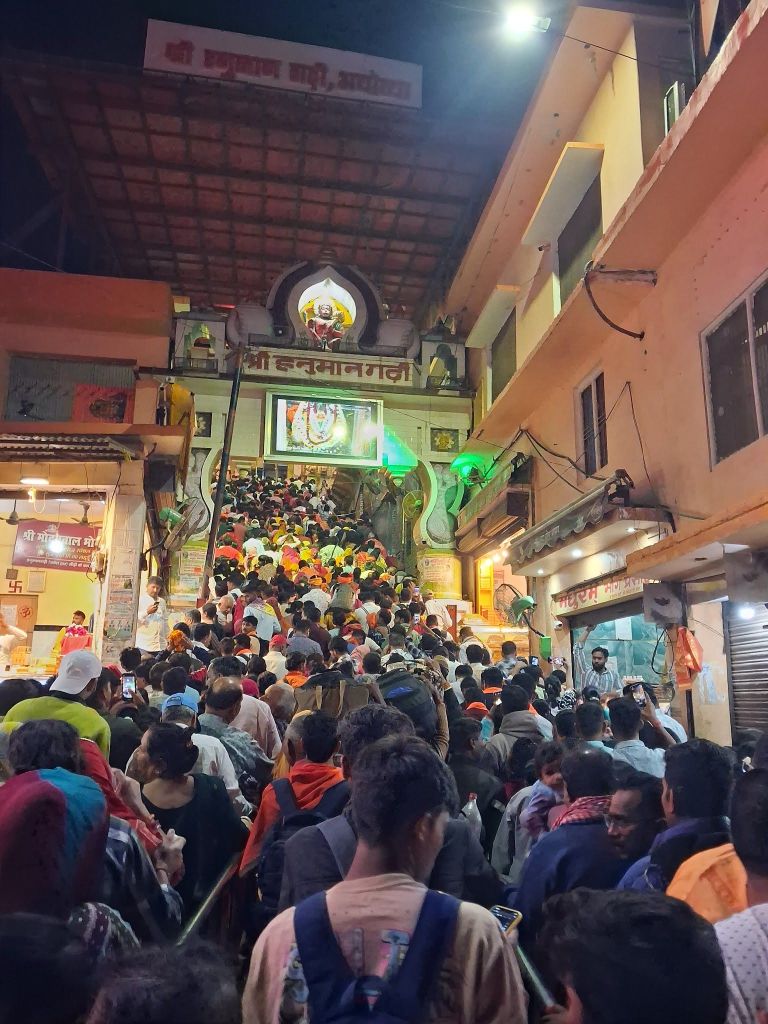
When we reached Ayodhya, the small pilgrimage town was packed with crowds. Luckily, we had secured a slot to visit the Ram temple through online booking after staying awake until midnight, two weeks earlier. That sleepless night made our Shri Ram darshan quick and smooth. Without staying on the crowded streets, we slept through the night to catch the morning train to Prayag. Media reports emphasized the massive crowds at all railway stations around Prayag, raising our concerns before we arrived. We heard that daily visitors could reach 1-2 crores, excluding the main ‘Snan / Royal Bath’ days during the mela.

The Crowd at Hanuman Garhi temple, Ayodhya

We had a small list of things to do and experience, that were exclusive to the Kumbh Mela. Upon alighting at Prayag, two things happened. First, apart from the holy dip in the confluence, another priority was to see and interact with the Naga Sadhus. We believed this was a golden opportunity to experience the energy of so many ascetics in the same place who otherwise live in solitary dwellings in remote natural areas like mountains, forests or caves. However, we learnt that most Nagas had left the mela after the royal bath on the day of Basanth Panchami.

Second, I received an SMS notification on my phone that the scheduled train from Prayag to Banaras on the MahaShivaratri day had been cancelled, as a precautionary to avoid a stampede like situation that had happened on the day of the holy bath on Mauni Amavasya. This was the same train in which he had a confirmed ticket to Banaras. This cancellation then put us in even more distress wondering how we are going to navigate our travel through the crammed-up transportation system that had garnered widespread coverage on media.

After arriving at Prayag railway station, there was still hope. Things didn’t seem as bad as we had imagined, and it was rather easy to navigate from the station to the hotel we had booked earlier. Also, during other occasions, the Nagas belonging to the major thirteen Akhadas leave for their abodes after the Kumbh mela. But this time was special, the last day of the Kumbh coincided with the Maha Shivaratri. They had all headed to Banaras, for the Lord’s darshan on the most important night of their Adi Guru, Lord Shiva. We still had a probability to see them all if we reached Banaras for Shivaratri. But, we had planned to take our holy dip on that same day as it was one of the most important bathing days.

On the other hand, some good Samaritans recommended us to leave Prayag before the last day of the mela as a large crowd was expected to flock to not miss out the once in 144 years opportunity to wash off their sins. All holy sites and landmarks within the proximity of the confluence were closed for the next couple of days to avoid overcrowding. Roads would be blocked for vehicular movement and reaching either the airport, railway stations or bus stations would be far off to be accessible by foot. Finding some wisdom in the words of so many people, my friend and I both decided to reschedule our plan for Prayag.

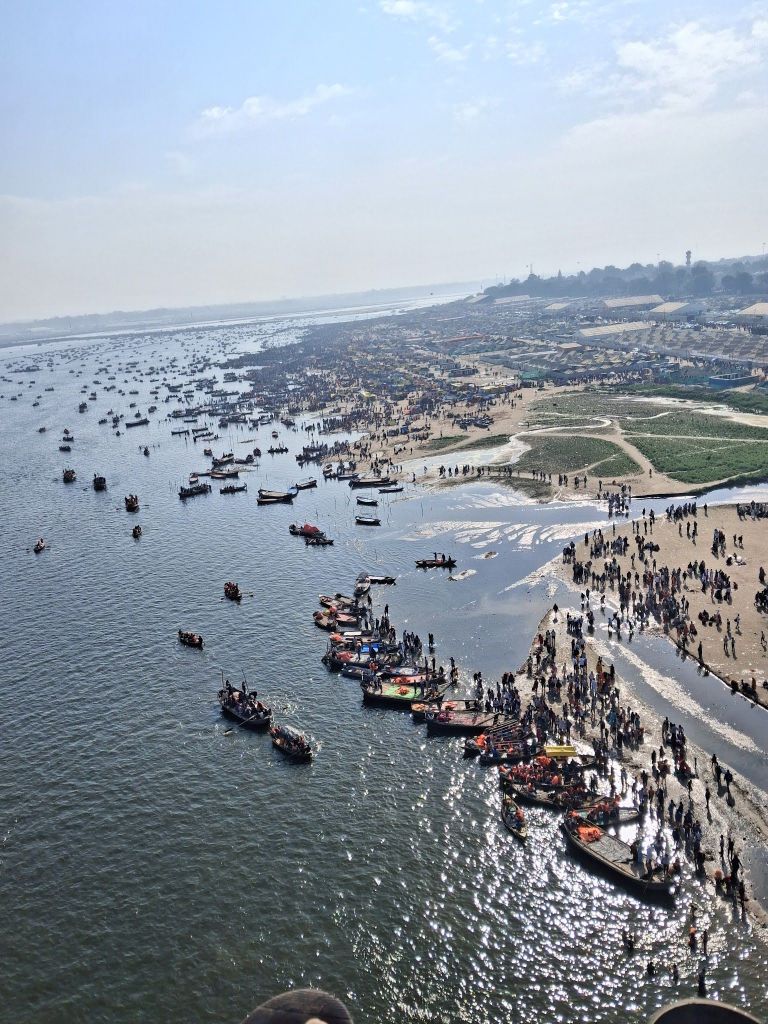
Bird's eye view of Triveni Sangam, Prayag
Bird’s eye view of Triveni Sangam, Prayag

Accordingly, after freshening up in our tented accommodation by late noon, we set out on a triple riding bike taxi to complete few of the things from our to-do list. Firstly, we tried para-motoring. Getting a bird’s eye view of the massive wall of the Allahabad fort setting a backdrop for the holy confluence and the tent city was a beautiful experience we had waited for. From there, we went visiting the temporary sets of the twelve jyotirlingas and finally reaching for the Ganga aarti at the ghat. We participated in the bhajans, did the aarti and slid into the warmth of the blankets in our tent.

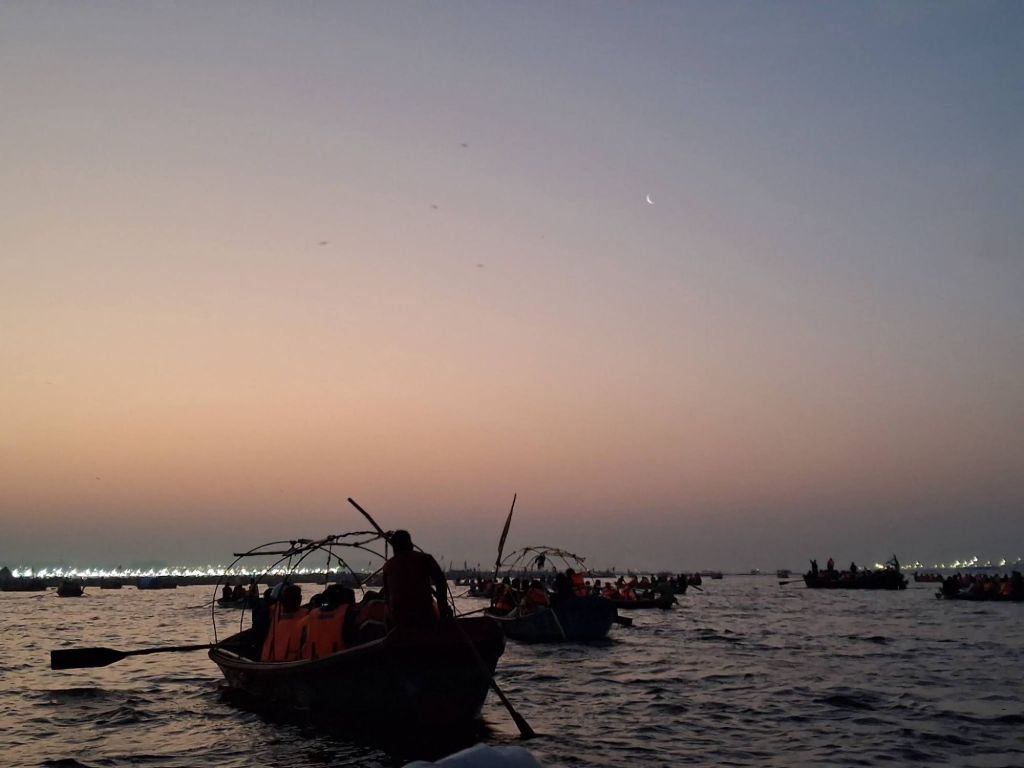
Early morning boat ride to the Sangam, Prayagraj

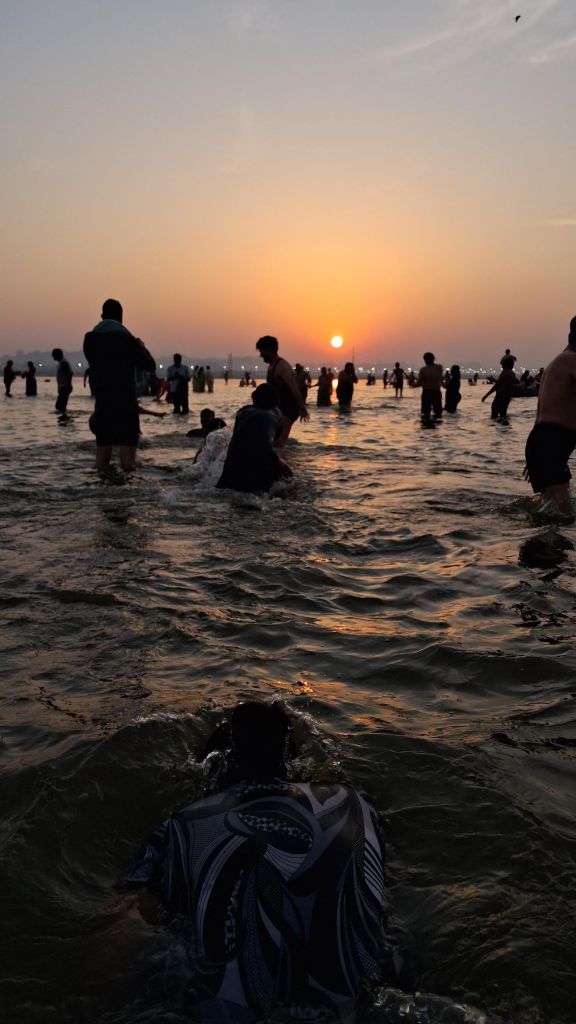
We woke up the following morning to board the boat that we had booked on the previous evening. The biting cold temperature made us a little hesitant to take the dip, but when we finally reached the confluence- the energy felt different. We both thanked the waters, greeted the rising sun and dipped ourselves in the Triveni Sangam, praying for good of us, our families and the world. It was a moment that I had looked forward to all my life, that twinkle in the eyes of the younger me was beaming with joy.

The Sangam dip during MahaKumbha 2025

After changing into dry clothes, we packed up and decided to move out of Prayag at the earliest. We hired bike taxis to reach a bus-station located on the outskirts of Prayag. To our surprise upon reaching, none of the buses were as crowded as we had expected them to be. Each bus left the stands as soon as the seats were occupied. The frequency was such that no passengers needed to stand on the aisle for their journey to Banaras from Prayag. The journey was smooth and rather on time, thanks to dedicated lanes marked for local and outside registered vehicles each and for public buses.

Continued as Part 2: The Story of The Maha Shivaratri and the Naga Sadhus

8 Best Things to Do in India with Your Partner

India, with its rich history, diverse landscapes, and vibrant culture, offers a plethora of romantic experiences for couples. Whether you’re newlyweds on a honeymoon or partners looking to rekindle your romance, India provides the perfect backdrop for unforgettable moments. Picture yourselves cruising through Kerala’s serene backwaters on a houseboat, exploring the majestic palaces of Rajasthan, relaxing on the sun-kissed beaches of Goa, or trekking the scenic hills of Uttarakhand. Envision witnessing the timeless beauty of the Taj Mahal, experiencing the serene charm of Kashmir’s valleys, wandering through the lush tea gardens of Darjeeling, and discovering the rich cultural heritage of South India. Each destination offers a unique blend of romance, adventure, and tranquility, making India an ideal choice for creating cherished memories with your loved one. Here are the eight best things to do in India with your partner.

1. Cruise the Backwaters of Kerala

Kerala, often referred to as “God’s Own Country,” is a paradise for couples. A 5-day Kerala tour package is perfect for exploring the serene backwaters, lush greenery, and tranquil beaches. Start your journey with a houseboat cruise on the backwaters of Alleppey or Kumarakom. The houseboats, equipped with modern amenities, offer a unique experience as you drift through the calm waters, surrounded by coconut groves and paddy fields. Enjoy the picturesque views, indulge in delicious Kerala cuisine, and relax in the peaceful ambiance with your partner.

The Shikara cruise in the narrow canals of Alleppey

2. Explore the Royal Heritage of Rajasthan

Rajasthan, known for its royal heritage and grand palaces, offers a romantic escape into the past. Visit the stunning city of Udaipur, often called the “Venice of the East.” Take a boat ride on Lake Pichola, visit the magnificent City Palace, and stroll through the colorful markets. Jaipur, the Pink City, is another must-visit with its impressive forts and palaces. Stay at one of the heritage hotels to experience royal hospitality. The desert city of Jaisalmer, with its golden sand dunes, offers an adventurous yet romantic camel safari under the starlit sky.

3. Relax on the Beaches of Goa

Goa, with its sun-kissed beaches, vibrant nightlife, and laid-back vibe, is an ideal destination for couples. Spend your days lounging on the sandy shores, swimming in the azure waters, and enjoying beachside meals. For a more secluded experience, head to the beaches of South Goa like Palolem and Agonda. Explore the charming streets of Old Goa, visit the famous churches, and indulge in water sports for an adrenaline rush. As the sun sets, the beach shacks come alive with music and dance, offering a perfect end to a romantic day.

4. Trek the Hills of Uttarakhand

Uttarakhand, with its scenic beauty and tranquil environment, is a haven for couples who love nature and adventure. A 10-day Uttarakhand tour package can take you through the stunning hill stations of Nainital, Mussoorie, and Ranikhet. Enjoy boating on Naini Lake, take a cable car ride to Gun Hill, and explore the lush forests and waterfalls. For a spiritual experience, visit the holy towns of Haridwar and Rishikesh, and attend the evening Ganga Aarti. If you’re into trekking, the Valley of Flowers and Chopta Tungnath treks offer breathtaking views and an unforgettable experience.

5. Witness the Romance of the Taj Mahal

No trip to India is complete without visiting the iconic Taj Mahal in Agra. This magnificent white marble mausoleum, built by Emperor Shah Jahan in memory of his beloved wife Mumtaz Mahal, stands as a symbol of eternal love. Walk hand in hand with your partner through the beautifully manicured gardens, and admire the intricate architecture and craftsmanship. For a magical experience, visit the Taj Mahal at sunrise or sunset when the monument is bathed in a golden hue, creating a truly romantic atmosphere.

6. Experience the Serenity of Kashmir

Kashmir, often described as “Paradise on Earth,” is a dream destination for couples. Stay in a traditional houseboat on Dal Lake in Srinagar, and enjoy a shikara ride amidst the floating gardens and vibrant markets. Visit the Mughal Gardens, and take a stroll through the fragrant blooms. In winter, Gulmarg transforms into a winter wonderland, offering skiing and snowboarding opportunities. The pristine beauty of Pahalgam and Sonmarg, with their lush meadows, sparkling rivers, and snow-capped peaks, provide a perfect setting for romance.

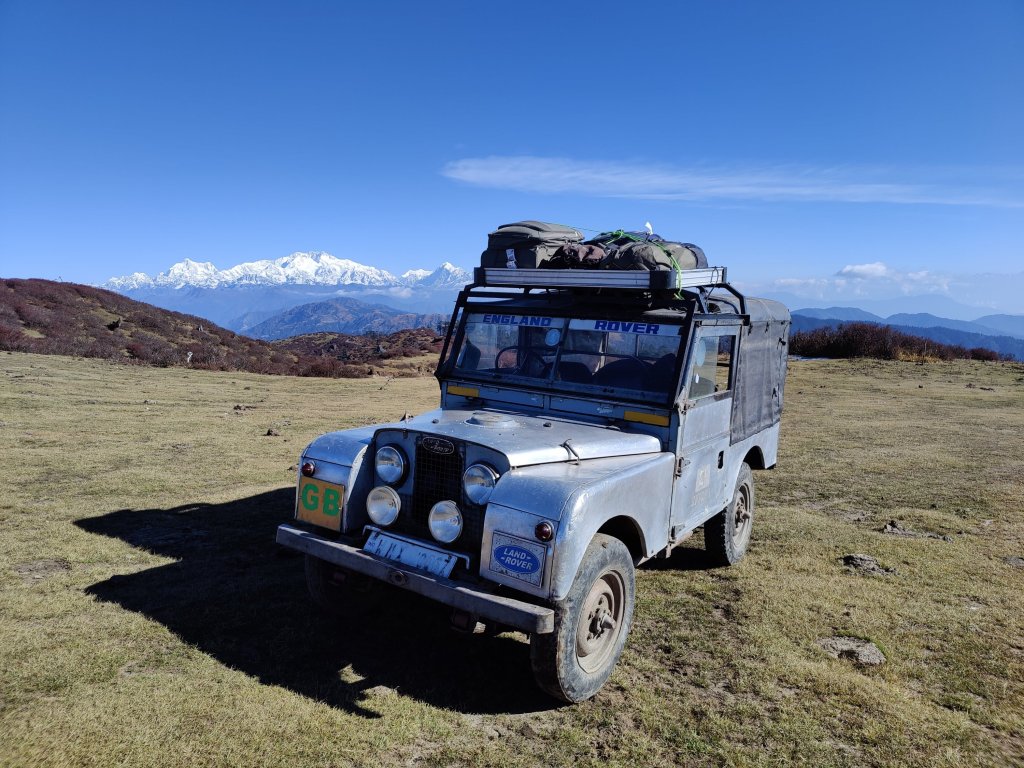
Land rover Defender and 'Sleeping Buddha' at Sandakphu
Our Land rover Defender with the ‘Sleeping Buddha’ in the Background at Sandakphu

7. Enjoy the Tea Gardens of Darjeeling

Darjeeling, with its rolling tea gardens and stunning views of the Himalayas, offers a peaceful retreat for couples. Take a ride on the Darjeeling Himalayan Railway, a UNESCO World Heritage Site, and enjoy the scenic journey. Visit the tea estates, where you can walk through the lush plantations and learn about the tea-making process. The Tiger Hill viewpoint offers breathtaking sunrise views over the Kanchenjunga range. Explore the vibrant local markets, and don’t miss out on tasting the delicious momos and local delicacies.

8. Discover the Vibrant Culture of South India

South India, with its rich cultural heritage, ancient temples, and beautiful landscapes, is perfect for a romantic getaway. Visit the temples of Tamil Nadu, such as the Brihadeeswarar Temple in Thanjavur and the Meenakshi Temple in Madurai, known for their architectural brilliance. Explore the backwaters and beaches of Kerala, and take a trip to the hill stations of Munnar and Wayanad. In Karnataka, the historical sites of Hampi and the royal city of Mysore offer a blend of history and romance. The serene beaches of Pondicherry and the French colonial charm make it a unique destination.

The Brihadeeshwaran temple at the backdrop

Plan Your Kerala and Uttarakhand Tours

When planning your romantic getaway in India, consider Kerala tour packages for 5 days and Uttarakhand tour packages for 10 days to make the most of these beautiful regions. In Kerala, opt for packages that include houseboat cruises, beach stays, and visits to hill stations like Munnar and Thekkady. For Uttarakhand, look for packages that cover the hill stations, spiritual towns, and trekking destinations to experience the diverse offerings of this picturesque state.

India, with its diverse landscapes and rich cultural heritage, offers endless possibilities for romantic escapades. Whether you’re cruising the backwaters of Kerala, witnessing the grandeur of the Taj Mahal, or trekking the hills of Uttarakhand, each experience promises to bring you closer to your partner. So, pack your bags and embark on a journey of love and adventure in this incredible country.

Stories Through Souvenirs- An e-book

A compilation of 18 short stories based on my experiences of traveling on the roads of India, I’m happy to share that my second e-book is now available for my readers.

My book- ‘Stories Through Souvenirs‘ is a compilation of my stories of meeting people, hearing their stories and the learnings from my experiences. These are the stories of how these stories influenced me to become who I am.

Do give it a read and I am sure you will like it 😊

The two greatest Indian epics- The Conclusion

Where do the two largest Indian epics end?

I remember how Indians went frenzy to watch the movie- ‘Bahubali 2: The conclusion’, a story that is something purely fictitious. But, ever bothered to know what the ending of the two greatest stories of Indian mythology is like? What happens to the protagonists in Ramayana and Mahabharata? No, they don’t end at wars. There’s more to it and I’m pretty sure most of you wouldn’t know.

I was lucky that my travels took me to these places that are often spoken less about. Tucked away from the mainstream tourist circuit, these places were a sort of discoveries for me that happened only because I travelled. Read further to know more.

1. Ramayana- The conclusion
Ayodhya and SriLanka are two places that comes to our mind instantly when we think of the epic Ramayana. The climax of the story has Lord Rama bringing back his wife Sita safely, after waging a war against the demon King Ravana. They then return to Ayodhya where preparations are on for Lord Rama’s coronation as the King. But sooner, he realizes that the purpose of his incarnation on earth was completed and he had to return to his abode- Vaikuntha. The story concludes in Lord Rama undertaking his Jal-Samadhi by walking and drowning in river Sarayu. This place is marked by the modern day ‘Guptar Ghat’ at Ayodhya.

IMG_20170307_070712
Our “The AYODHYA view”

2. Mahabharata- The conclusion
Kurukshetra, in the modern state of Haryana is one place that we immediately associate with epic of Mahabharata. Of course, the climax has the war between the Kauravas and the Pandavas at this place. But the primary protagonist of the epic- Lord Krishna sees his end in the modern state of Gujarat. He finds his way back to vaikunta after serving the purpose of his avatar on earth. As he readies himself to leave earth, he sits under a tree in meditation at Bhalka theerth also known as Golok Dham. Krishna’s feet are shot at by a hunter named Jara, mistaking it to be that of a wild animal. Krishna who is fatally wounded then walks into the river Hiran, where he drowns for life. This spot is marked by a marble replica of a pair of feet on the banks of the river, near Somnath.

dsc_02162499234078978353895.jpg
The replica of Krishnas Footprint at Golokdham

The home of the Indian National Emblem- Saranath

This visit to Saranath is a part of my fortnight long backpacking in the typical pilgrimage circuit of Uttar Pradesh covering Lucknow- Ayodhya- Faizabad- Varanasi- Saranath- Allahabad- Agra- Mathura-Brindavan- Fathehpur Sikri– Delhi

This article was featured in Toyota’s in-house magazine ‘Carz’ Apr~Jun’18 edition

The Details:

Back then, I had read history for the heck of passing the subject and today here I am… Travelling to know more about the rich history soaked heritage of my country… And in the pursuit, my friend and I stumbled upon this little forgotten land from the pages of history- Saranath. It was as if the history textbooks of primary school were walking alive with us… Saranath is an important destination both religiously and historically. So, people of varied interests can be found strolling the streets of Saranath. When we alighted, a volunteer offered to take us for a guided tour around the place and we nodded a yes! A couple of visitors from different countries joined us seeking me to be their translator while the Hindi speaking guide took us around. So I was doubling as a curious traveler and a travel guide cum translator.

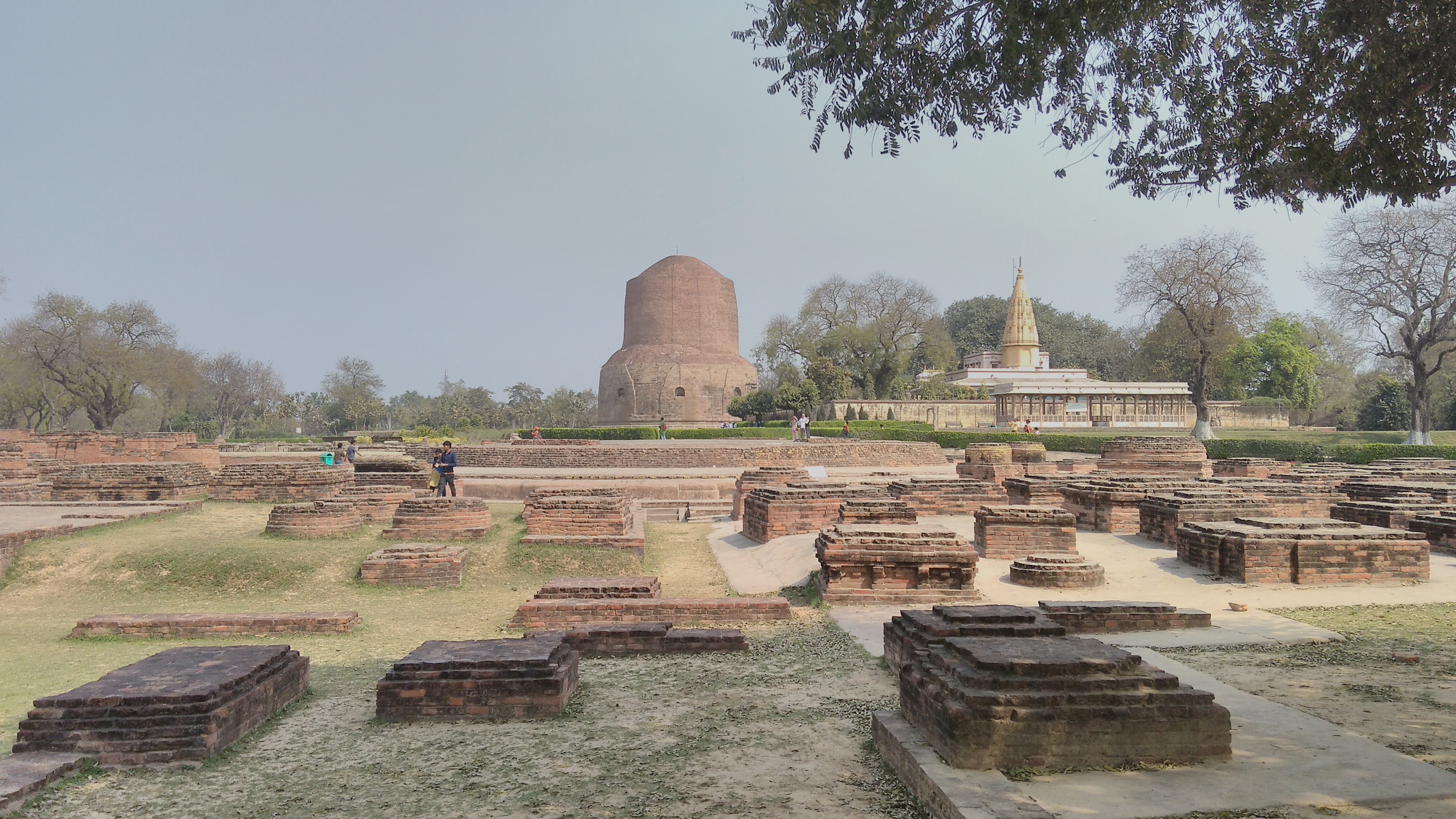
Firstly, Saranath is the place where Lord Buddha delivered his first sermon to the five disciples after attaining enlightenment. Hence, a very important place religiously for the Buddhists. Today, the Chaukhandi Stupa, an octagonal structure made of brick and mortar stands at the very same place welcoming the visitors to this town. It was originally built in the Gupta era and later renovated during the Mughal rule.

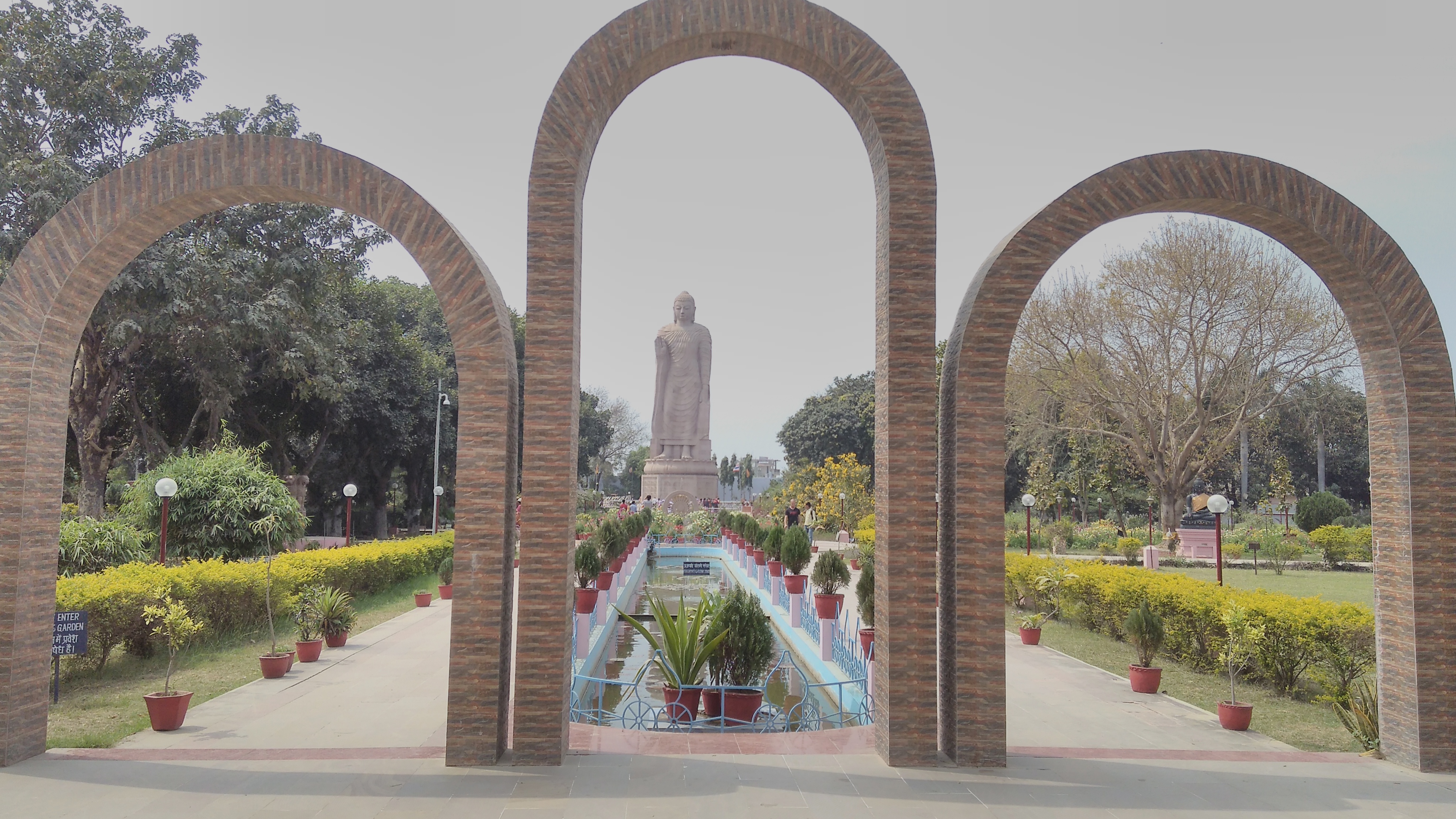
As I explored the place, I realized that people from different countries have made their presence with Buddha temples built in their native styles of architecture. The Nepali, Thai, Chinese, Japanese, Tibetan, Bhutanese etc. to name a few. While each temple style is unique and beautiful, you realize that the statue of Lord Buddha too is different in each of them. Buddha is worshipped in different forms in different countries… Seated Buddha, sleeping Buddha, standing Buddha, meditating Buddha ET all… The murals inside the Japanese temple grabbed my attention… I was told that the complete interiors is made of sandalwood… The idol, palanquin, the doors and even the chandeliers!

A small walk from there, is ‘Mulagandha Kuti Vihar’, the Nepali temple. What makes this place special is the third generation peepal tree adjacent to its premises. Fondly called as the grandson of the Bodhi tree, it is grown from a twig of a peepal tree believed to be the son of the original Bodhi tree that exists in Sri Lanka. With prayer chants and smell of incense in the air, it is truly a place of calm and solitude. We were quick to pick a few leaves of this holy tree as a souvenir from this little place.

IMG_20170309_121021
The Thai temple

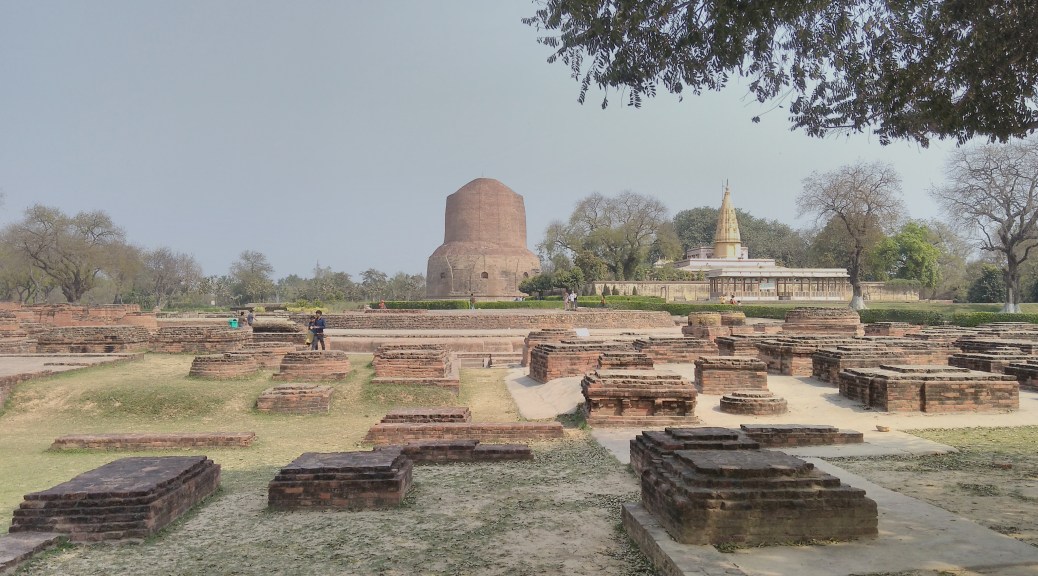
Next, it was some history time! We bought an entry ticket at the ASI counter to take a stroll around the ruins surrounding the Dhammek stupa. It is believed that the Mauryan emperor Ashoka had built small clay mounds at ten places where the ashes, the urn and the embers of Lord Buddha were buried which were eventually refurbished as large stupas by the different rulers in the course of history. Dhammek stupa is believed to be one among these ten stupas and hence, a very important one for the Buddhist pilgrims who throng here from across the globe. And that very place where the Indian National emblem was born! The pillar on which the four headed lion is seated was commissioned by emperor Ashoka to commemorate his visit to Saranath. The broken part of the pillar was found during the excavations of this site and later transferred to the ASI museum in Saranath. Today, the bottom portion of the pillar surrounded by four posts holding a stone slab are the things remaining from the original relics at the exact same spot. One way it is nice that nobody has tried to restore this pillar back as the easy accessibility to it would have got the emblem all over the internet with the insensitive photo/selfie-enthusiastic tourists.

IMG_20170309_135651
The site of Ashoka pillar with the Dhammek Stupa in the backdrop

A visit to Saranath would definitely be incomplete without getting a glimpse of the ORIGINAL National emblem of India. We deposited our valuables including cameras and cellphones in lockers provided along with the entry ticket to the ASI museum and headed to THE place. A chill ran down my spine on being greeted by this majestic sandstone structure bearing the lion capital, the original form of our National emblem. The four headed Asiatic Lion is seated on a lotus- The national flower of India. Our guide narrated the religious relevance of the emblem in Buddha’s life. The lion represents Buddha himself who stressed upon equality and justice in all spheres of life (all 4 directions). While Gautama was in his mother’s womb- she had a dream of a white elephant entering her womb representing prosperity. The bull represents the young prince Siddhartha’s strength, the horse depicts Siddhartha’s renouncing his royal life and Lion is the depiction of Siddhartha’s transformation into Buddha. When Baby Siddhartha learnt to walk, a lotus bloomed under his feet after the first seven steps and the lotus is said to have faded at the passing away of the Lord- Hence, the inverted lotus. The Ashoka wheel is called the Dharma Chakra, representing the movement of life with 24 spokes- each for the hours of a day… It is true to admit that the national emblem evoked a sense of pride in my heart.

Ours is such a rich country in terms of history, culture and heritage! Every stone in India has a tale to tell… Having been restricted from the access of shutterbugs makes this sight all the more valuable and meaningful! There are several other sculptures and artefacts in this museum making it THE BEST museum day in my life!

The last leg of our Saranath walk tour was a visit to the handloom centre where demonstration of weaving a Banarasi saree was given and there it concludes! Sometimes you end up having this feeling of unplanned trips are the best things to happen… And Saranath is one such place!

Conclusion Remarks:

  • Must do– Walk tour of the town
  • Must see– The Original form of the Indian National emblem at the ASI museum
  • Best souvenir– The leaves of the Grandson of the Bodhi tree.
  • How to reach– There is a railway station in Saranath. It is more convenient to hire an autorickshaw for a 30minute ride from Varanasi.
  • Stay– There are several Dharamshalas run by people from different countries.

A Weekend at the Land of Ramayana- Ayodhya

This visit to Ayodhya is a part of my fortnight long backpacking in the typical pilgrimage circuit of Uttar Pradesh covering Lucknow- Ayodhya- Faizabad- Varanasi- Saranath– Allahabad- Agra- Mathura-Brindavan– Fathehpur Sikri– Delhi

We were scheduled to arrive at the land of Ramayana- The Epic of Indian Mythology! Ayodhya is believed to be built by Manu, the first man on earth as per the Vedas. This land was the capital of Ikshvaku dynasty of Suryavamsha- lineage of the Sun, of which Lord Ram was the most popular ruler. Lord Ram has been revered as a symbol of a perfect man. Irrespective of religion, every child born in India grows up listening to stories from the Ramayana. Young girls grow with dreams of having a husband similar to Lord Ram. That said, it was no less a dream to travel all the way to the land where the greatest empire of all times existed, at Ayodhya.

Our Itinerary:

  • Day 1: Arrive at Ayodhya, Lakshman ghat & Saryu Aarti during sunset, boat ride in river Saryu
  • Day 2: Saryu Aarti during sunrise, Treta Ke Thakur, Ram ki Paidi, Nageshwarnath temple, Hanuman Garhi, Dashrath Mahal, Kaikeyi Mahal, Baal Ram Mandir, Dant Dhawan kund, Kanak Bhawan, Ram janmabhoomi, return to Faizabad.

The Details:

A small platform which ended even before the train made its 1 minute long stop, very laid back village scene and just 2 tracks with a yellow ‘AYODHYA’ railway board welcomed us as we arrived there by an afternoon train. An old man and his cycle rickshaw awaited us on the other side of the tracks. We told him our hotel’s name and he said 50 Rs. We hopped on to the cycle and our dream journey kickstarted!

It was as if the rickshaw was our time machine that took us back in time as it slowly inched through the main commercial area.. A typical rural setup. Dusty roads were flanked by old tenements on both sides from end to end. The rich embossings on the facades of each house was unique and gave us a sense of an era bygone. Each house enclosed a shrine from where the smell of incense had filled the environment. The main street had everything being sold in the stalls from colourful plastic ware, brass souvenirs, religious beads, clay articles et all. The Chai-wallas were busy serving their brew in clay cups and the Jalebi-wallas were spiraling the batter into hot oil. Fruit vendors did brisk business on carts.. Amid all this, the prayer chants of ‘Ram Siya Ram, Siya Ram Jai Jai Ram’ from the temples in the bylanes echoed in the air giving us the sense of a heavy atmosphere. There was so much character in this small stretch! Just as if we were woken up from a dream, our rickshaw halted and our driver broke the silence- “Madam, your hotel.” he said pointing out at a very modern building which looked very sophisticated for an otherwise laid back country side.

We freshened up and had a rather sumptuous meal at their inhouse restaurant. It was already sunset time and upon enquiring about the nearest sightseeing places, our hotel caretaker told us to head towards the ghats to catch the Saryu Aarti. We had to rush as the sun was nearing the horizon. While we were asking for directions and running towards the Lakshman Ghat, my friend and I stopped abruptly at a sight.. The first glance of the Ayodhya that we had heard about, as kids. A visual treat that looked straight out of a fairy tale. ‘This is AYODHYA, Man!” we both blurted in unison. The oblique rays of the setting sun added a glorious gold to this Royal beauty. Although the structure is relatively new from the 19th century or so and not the original Kingdom that Ram had spent his days at, we stood there dumbfounded for a couple of minutes. After taking an eyeful of it, we walked towards the Lakshman Ghat where the Aarti was about to begin. We hitched a boat ride across river Saryu and back, from where we watched the aarti. Upon return to the river bank, we took a rickshaw to the Hanuman garhi main road to get our dose of kulladwala chai before calling it a day.

IMG_20170307_070712
Our “The AYODHYA view” at Lakshman ghat

Next day, we woke up early to reach the ghats for the aarti during sunrise. Post that, we took a walk along the chawl photographing the artistic friezes. We explored the inside streets and the several temples inside those ancient tenements. Treta Ke Thakur, Ram ki Paidi, Nageshwarnath temple are all in this surrounding. We got talking to several residents both Muslims and Hindus and they all seemed excited to share what Ram meant to them. For some Lord Ram was a brother, for some a father and a son for some.. A curious family from the chawl even invited us over to their house for breakfast and took us across the fortress to introduce us to their relatives.. We were deeply moved by the innocence and simplicity of these people. We then bid a warm goodbye and headed towards the heart of the town..

From there, we reached the Hanuman Garhi, an important temple built on a fortified walled structure high above the ground level. Lord Hanuman is believed to have had kept a vigil on Lord Ram as a kid. A man offered to guide us around other important temples around the place. Some being Dashrath Mahal, Kaikeyi Mahal, Baal Ram Mandir, Dant Dhawan kund among the important places out of the 7500+ temples that are believed to exist in Ayodhya. Some of these places accepted donation towards the construction of the Ram temple. One’s name would be then sculpted out on a tile or a block of stone which would be used in the construction of the temple, that the localites were hopeful would be built someday, soon.

Kanak Bhawan was the highlight of the places with its architectural beauty. This structure is said to have been entirely plated with gold (Kanak) back when Kaikeyi had gifted it to Sita during Ramayana. A board on the wall explains the evolution and modifications done over different periods and by different rulers who ruled Ayodhya. We attended the aarti at noon before heading towards THE PLACE!! “Ram Janmabhoomi”.

Being one of the MOST controversial areas in India, we had to deposit all the things in a safety locker including watches, water bottles, cameras- basically everything before entering the premises of the birth place of Ram! Rifle armed commandos guarded the entire area. We had a long queue and four rounds of frisking to really get there. Women guards frisked us in really uncomfortable places and it was a strange experience to go through, inside our own country. I was made to throw away even the vermillion I had kept in my pocket from the Hanuman Garhi temple because they couldn’t trust me on carrying random powder.

With all the embarrassment, uncomfort, tiredness in the scorching sun- when we finally made it there: I did not realize that it was Lord Ram’s birth place. The King of Ayodhya!!! Small idols of Ram, Sita and Lakshman were placed inside a Swiss tent as if the trio were still continuing their vanavas in the Kaliyug. Off-beat camping in a deforested jungle. I had still not come into belief that this is how India’s mythological hero was treated in his own house. I burst into tears and I didn’t have a reaction. I went berserk for a while until my friend calmed me down.

We couldn’t visit the Ayodhya research centre which has lot of information collected from across the world about Ramayana and the holy land of Ayodhya. Mani Parvat on the outskirts is another place I would suggest if you have time which gives a good view of Ayodhya. Although a 20Rs. per head ride in a tempo can take you to Faizabad, the district headquarters; I would recommend you to take a 1000Rs. boat ride along the Saryu which will take you to Ram Ghat at Faizabad for the evening aarti.

Summary:

My entire stay here has been a great one with both Hindus and Muslims coexisting and helping me get around the place. Never did I feel the communal rife. It is one BIG political ticket for easy votes and in interest of no social harmony. Like really!! When there is Ali in Diwali and Ram in Ramzan, do we really need to fight in the name of God??? The question needs to be pondered over…

Fact file:

Must buys: Chillums (clay pipes), handmade religious cotton carry bags.
Must dos: Get a glance of the Ramayana trail on the India map at the Ayodhya research centre, boat ride from Lakshman ghat(Ayodhya) to the Ram ghat (Faizabad)

The not so Holi- Festival of Braj Bhoomi

Holi is Big in Northern India and the most beautiful in the Braj Bhoomi- the Land of Lord Krishna. Festivities start a week in advance with Lath-mar Holi in Barsana and Nandgaon, phoolonwali Holi (Holi played with flowers) and Widow’s Holi in Vrindavan, Huranga at Baldeo and Holika dahan and Rangowali Holi at Mathura and Vrindavan are some of the major parts of the festival. Articles, blogs and photos are all over the internet about how beautiful this celebration is and the fun of participating in the festival of colours. Deeply inspired, a two week trip was planned through the state of Uttar Pradesh whole-ly, to soak in the festive fervor of Holi.

This visit to Mathura is a part of my fortnight long backpacking in the typical pilgrimage circuit of Uttar Pradesh covering Lucknow- Ayodhya- Faizabad– Varanasi- Saranath– Allahabad- Agra- Mathura-Brindavan- Fathehpur Sikri– Delhi

As per plan, we reached Vrindavan to spend the last two days of Holi- the main days and get coloured in different hues of Gulal. The plan was to reach the hotel, change to clothes that we had kept aside specifically for Holi and then go out to the areas where the colours were being thrown at. However, the entire town was already painted with colours by the time we arrived in our delayed train. A samaritan helped us get an e-rickshaw so that we could reach our hotel. The rickshaw had to squeeze its way through the crowd that had already gathered out on all roads. By the time we reached the hotel, we started to feel miserable about having wasted our leaves and having travelled all the way to Mathura from Bangalore was a big mistake. It was very unfortunate that our experience of the famous Vrindavan Holi was no-where close to fun. Although we were inside the rickshaw, we felt more vulnerable to getting coloured than the rickshaw itself. Goon like mobs would specially target people who were new to this kind of celebration. I had atleast 4-5 men together hold me by my head inside the rickshaw and colour my face. Few others even pulled my scarf and shawl to ensure that every inch of skin was coloured. No! It was not a pleasant way to welcome guests to a new place!

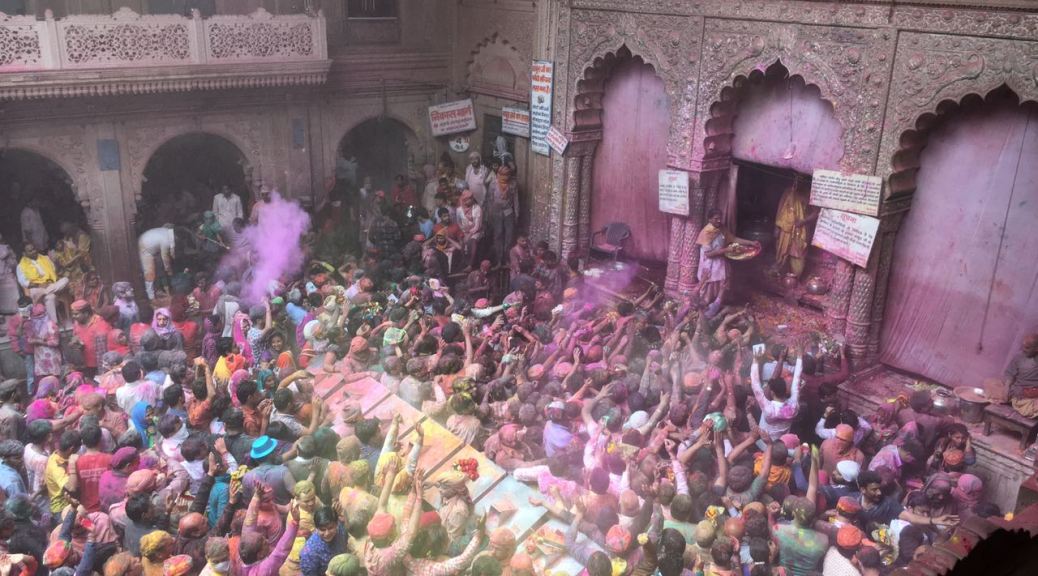
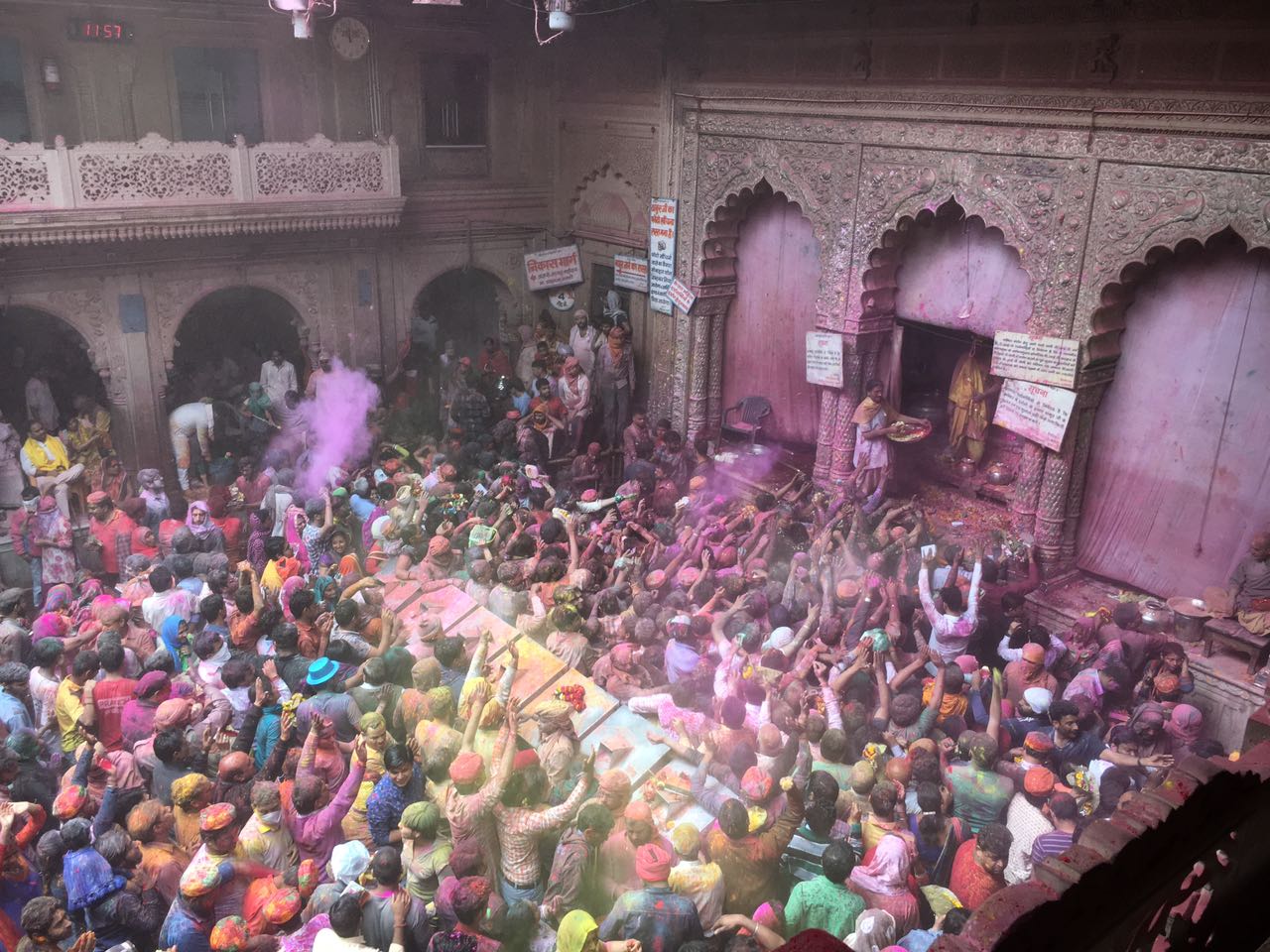
Banke Bihari temple in Vrindavan is where Holi is best celebrated with the priests throwing colours at everyone. On the day of Choti Holi, although we managed to go to the temple, we were drenched in wet colours. Leave that, our faces, hands and every bit of skin was chapped because we were smeared either with coloured cement or sand. This mixture is a norm and hurts like hell when it is being thrown at. We somehow managed to catch glimpses of Holika that were being burnt in some interior corners of the town. Women folk had gathered around effigies placed in the middle of firewood, food grains, vegetables and all other important things required for burning the pyre. We were colour soaked till the bone by the time we braved the task of reaching the safe confines of our hotel doorstep amid all the cemented colours and sand. Taking pity at our plight, our hotel incharge asked us to stay indoors the following day, as the last day could get wilder.

Finally, the main day of our fortnight long trip had arrived. But, we could barely think of venturing out on the streets on the day of Rangowali holi. Since our hotel was located in the main city area, we set our chairs out in the balcony of our room on the 3rd floor and watched the frenzy on the streets. It was disappointing to watch the Rangowali Holi turn into an event of Kheechadwali Holi (Holi played with water from the drainage). This kind of celebration can give the worst memories especially for girls and foreigners while goons attempt with ruthless amount of coloured glass powder. It can affect your eyes, skin, blood vessels anything! On top of it all, people are sloshed in Bhang and one cannot be sure of what’s gonna happen next!

Really, I’m not exaggerating the displeasure; the festival of colours is exaggerated through good photography by the photo enthusiasts who are all mostly male. I’d bet you not to plan your Holi trip to Braj with a bunch of girlfriends or with anyone who is new to this area. I strongly recommend you either plan on the day of Phoolon wali Holi or be a part of a private Holi celebration at a friend’s place amidst known crowd. This trip to Mathura has left scars of ir-repairable displeasure and sadness!

IMG-20170311-WA0001
The Banke Bihari temple Clicking credits: Gowtham Shastry

The journey through Uttar Pradesh State Elections- 2017

This post is part of my fortnight long backpacking in the typical pilgrimage circuit of Uttar Pradesh covering Lucknow- Ayodhya-Faizabad- Varanasi – Saranath- Allahabad- Agra- Mathura- Brindavan– Fathehpur Sikri– Delhi

I’m not a political person and I don’t prefer blogging about something that can spark a political row with my writings.. But, this one goes here because I want to narrate the election campaign as seen through my eyes as a traveler traversing through a state where the election fever had hit hard! One of the most awaited elections of the country and an important one for the current ruling party of the state to prove their influence.. Uttar Pradesh State assembly elections!

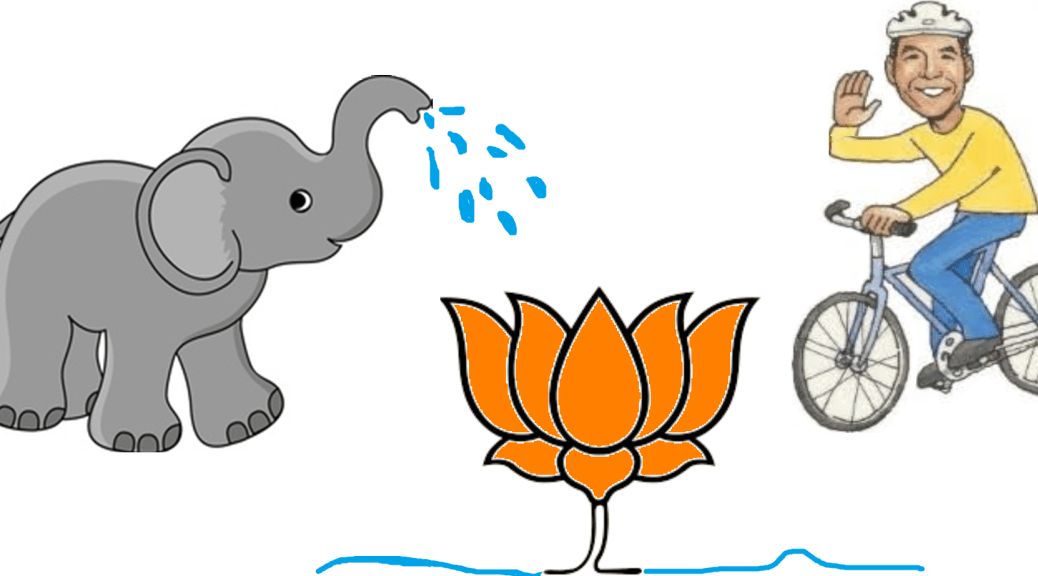
Firstly, we were roaming the streets of the state capital- Lucknow. One fellow told us, “There were elephants standing at all corners and across all streets, then the cycle lanes were laid. Neither the elephants nor the cycles did any good to the city. Unemployment is an evil left over by the previous governments. Ours kids are struggling in the slush. Let us give a chance for the lotus to bloom.”

Moving ahead, we were temple hopping at Ayodhya. A local boy offered to be our guide. We were amused with the stringent security checks and the big political drama directed by man in the name of God. Just as we were talking among ourselves, our guide blatantly told- “Don’t worry, you will not have to go through all this when you are here next time. ModiJi aayenge tho sab theek hojayega! (ModiJi will resolve everything)”

The following day we were at Varanasi, the Lok Sabha constituency of Modiji himself! It was election day when we arrived there. The security was tight and with very less traffic, the spiritual city was a sight. That said, we went for a boat ride along the Ghats of the Ganges.. Explaining the history and significance of each ghat, our boatman rowed the vessel forward. In between he said- “Do you see that structure up there? Modiji aayenge tho uss Masjid ka samasya ka hal mil jayega (The issue around that mosque will be solved if Modiji wins), pointing at a mosque that is a subject of historical controversy.

It was 11th March: The D-day.. We were travelling to our next destination- Allahabad. The counting of votes was in progress and the poll trend was being aired by all news channels.. The customers in shops and hotels were glued to their TV screens.. Our fellow passengers were lost with news updates on their smartphones.. The driver and conductor of our bus caught up every now and then to get updates on the running poll trend.. Clearly, curiosity and anxiety were the only things in the air.. Everybody was discussing about who or which party would win the elections. We caught up with a conversation with our oarsman while being rowed to the confluence. He was casually talking about how he had left home to find a better job but later returned back to his family with the grace of mother Ganges et all.. And in the event, he told us that, “Mother Ganges gets more polluted on her journey forward through Banaras. But, Let us give a chance to Modiji, Ganga Zaroor Saaf hojaayegi! (Ganga will definitely become clean)”.

It is a very tough deal to commit for something as big as this, given the various religious, cultural and sentimental dimensions linked to everything that requires a change. These were not just hopes, It was an assurance given by the BJP.. It made me realize how just one man has changed the way common man looks at politics.. At any situation, we must stick to the basic morals of being an Indian- Secularism is the beauty of India! Exhibit ‘Unity in Diversity’ because the nation needs us.

And in between all the frenzy, we were waiting at Faizabad junction for our night train to Varanasi.. A train with no display board thugged slowly on Platform no.1. In the next few minutes, we were amused by looking at the platform. It was crowded with the men in uniform till as far as our eyes could reach on both ends. We saw arms and ammunitions being stacked up on the pavement and dedicated men with rifles guarding them. In a time where the entire nation was celebrating Holi, it was a strange but an overwhelming event to watch so many personnel from the armed forces who were there on duty. I hold very high regard for the defence personnel who guard us regardless of time and place. I had goose-bumps for having been in the midst of all this action. I couldn’t contain my anxiety and spoke to one of the men, while a couple of others joined in. We were told that they were from the Border Security Force (BSF) and had travelled down from Srinagar for security reasons during the state elections. That gave us an idea of how massive and sensitive the event of elections in UP is for whom, things are a lot peaceful and easy back in our home state- Karnataka.

Coming back to politics, declaring the party leader / Ministerial candidate before elections is a normal way to attract votes from the public based on various other parameters. In contrary to this style, having fielded no chief ministerial candidate; the BJP (Bharatiya Janata Party) has managed to win the great battle with just the name of one man- ModiJi! A sweeping victory of 325 /403 votes that has pushed the entire nation into amazement. Now, that the lotus has bloomed, whether the fragrance of the flower or the stench of the drainage would spread is left for the citizen to watch..