Category Archives: Karnataka

Travelling around my home state

Monsoon retreat- Jog falls

‘Jog’ is a charmer on all Karnataka tourism promotions. Why not? It’s the second highest waterfall in India after all! A glimpse of the mighty Jog at least once in a lifetime is an unwritten rule for every person born or living in Karnataka. And why not see it take a plunge in all its might? This exclusive visit could happen in no better time than the monsoons. So, my mother, brother and I planned this weekend trip to see the Jog. such that we could reach Shimoga by 6.00.a.m.

Our itinerary:
Day 0: Leave Bangalore to Shimoga (Overnight bus)
Day 1: Shimoga to Sagara (local transport), visit Linganamakki dam and hydroelectric project, The Jog falls, Tyarekoppa Lion & tiger safari. Return from Shimoga to Bangalore (overnight bus)

The details:
When we reached Shimoga in the morning, it was pouring not just cats & dogs, but also cows & buffaloes. A jeep’s ride had been arranged by my mother’s colleague to take us from Shimoga to Sagara town. The rains were so heavy that we could barely see the road ahead. With that, we would fall into just every other pothole that was covered under the flooded roads. Finally, we had managed to reach Sagara, the nearest accessible town to Jog falls.

Once there, we thought to see the Linganamakki Hydroelectric project that falls on the way to Jog. There also used to be a cable car ride down the reservoir that we were interested to go on. Unfortunately for us, our visit was timed just about when permission to visit the project was cancelled for some security reasons. Nevertheless, the view of the Linganamakki dam and the scenery around almost evened up for the miss.

Views of the Sharavati project around Jog falls
Top: the view of Sharavati valley; Below: The Linganamakki dam

And then, with an uphill drive of about six kilometers, we reached the place which was the sole motive of our travel from Bangalore. “The Jog”!! But, there was more disappointment awaiting us on our arrival. It was something that caused us total dismay…!!! The clouds paired up with thick mist had enshrouded the waterfalls completely. And our entire surrounding had just blanked out with mist. There was absolutely nothing in front of us except the mist and more mist… To top it all, it was raining cats and dogs. There was no Jog, nothing. ‘What an unfortunate day for us’, we thought and decided to return after a futile wait.

We turned our backs and started to walk towards the jeep with a heavy heart. As we did, I just happened to turn back and check on our luck with the waterfalls. And yes…. we were LUCKY…!! The mist was slowly clearing out… And we could faintly spot the Sharavathi streaming down in full action.

As we stood for two minutes more, the view was then all clear: The Mighty King (Raja), the Graceful Queen (Rani), the Thunderous Roarer and the Storming Rocket – YES… We saw them! We felt a great sense of achievement, very contrary to what we had felt just a couple of minutes ago. While we got some nice clicks, the mist enclothed the falls, back again. We waited for it to clear out to capture a few more photos because this time, we knew that the action was repetitive.
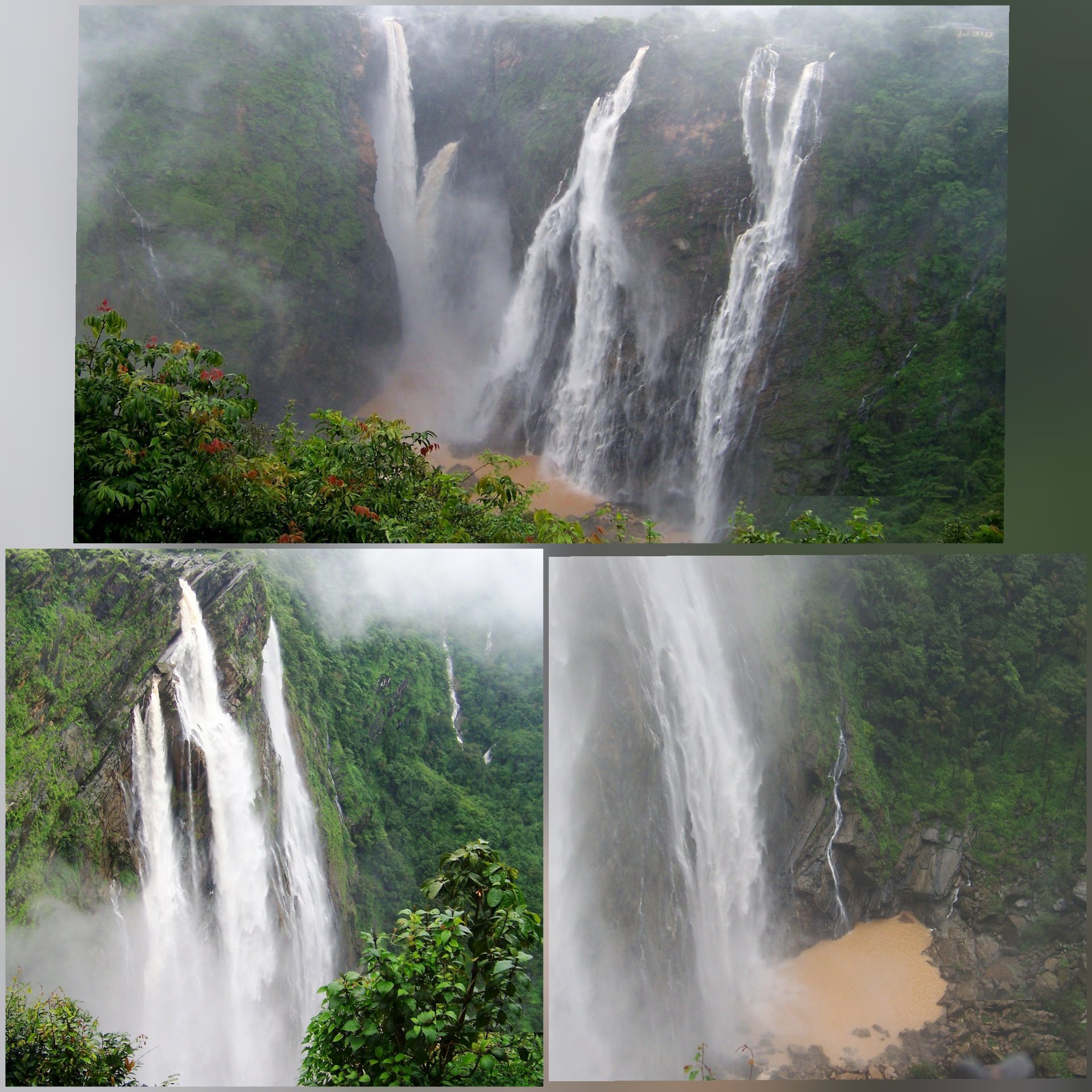
Jog falls in monsoon
Jog, from different view points

After a while we walked around to get different views of the falls. We went to the top of the waterfalls, walked down closer to the bottom of the waterfall, locatiosn from where we got the side view of the Jog, and so on… It was quite an adventure in itself to get around these difficult spots, especially considering the heavy rains and the slippery path. But, the excitement of getting to these locations was all worth the risk! After having an eyeful and heart full of ‘The JOG falls’, we decided to say good-bye to the place.

On our way back to Shimoga, we visited ‘Tyarekoppa Lion & tiger safari’. Along with spotting a lot of deer, sambars and peacocks, we also counted on the big cats like the lion and tigers on a safari ride. It wasn’t a typical safari you would have in the wild, but it was more like taking a ride inside a fenced enclosure. But, it is a well maintained place and great if you are travelling with children.

Tiger safari near Shimoga
Roarrr, a tiger at the safari

And that was all the time we had with us. We had almost reached the end of a fun day-Sunday and we boarded the bus back to Bangalore at night. We had to gear up for the crazy week that was awaiting us…

Conclusion: An experience of the monsoon in the western ghats and a glimpse of the Jog in the monsoon are retreats that should go into the bucket list of everyone visiting India.

A Weekend Drive to Belur and Halebeedu

It was a Sunday morning and our family outing was fixed. We decided to take a day trip to Belur, Halebeedu and Shravanabelagola. These are places that I can NEVER get bored of visiting and can go over and over and over again. I prefer to write less in this post because I choose the pictures to speak for themselves.

Karnataka- is One State, many Worlds’.

-KSTDC, Karnataka State Tourism Development Corporation

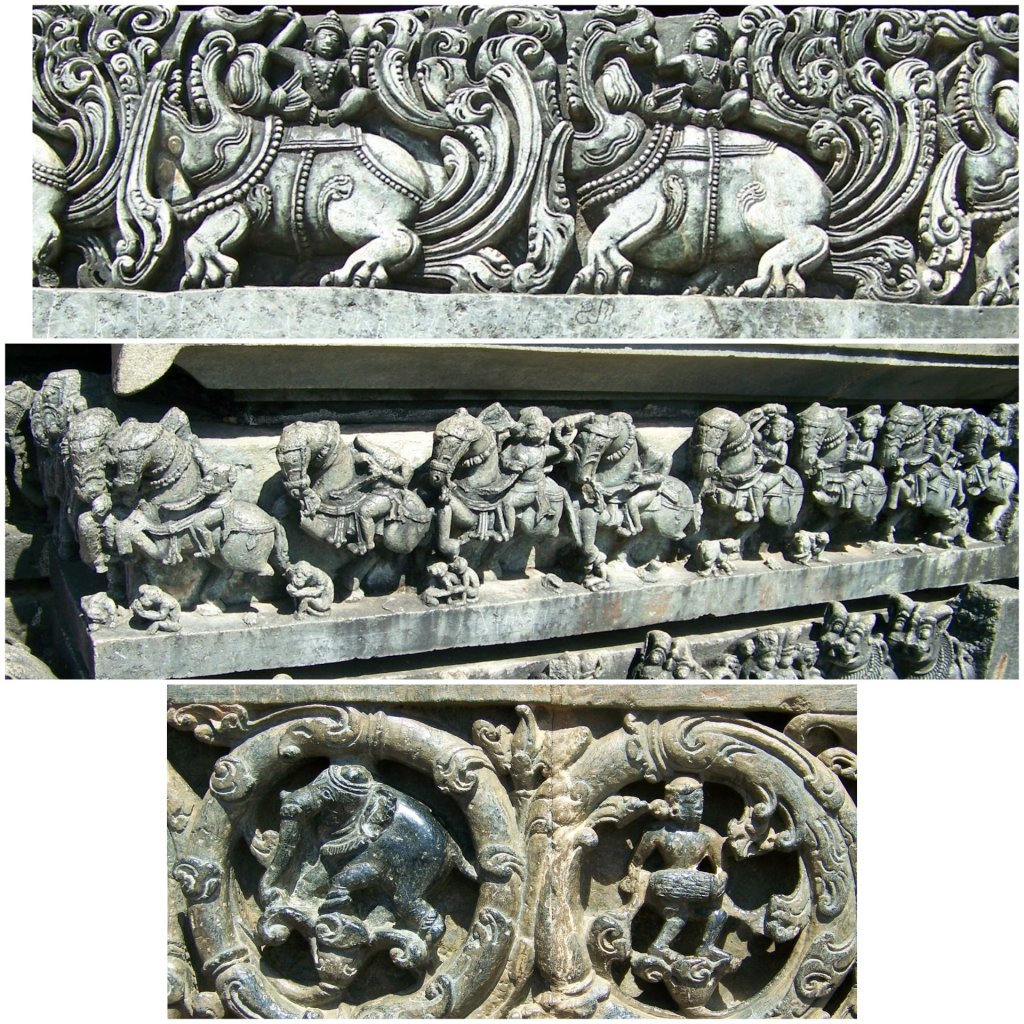
As a part of an endless list of things that Karnataka has to offer to every traveler, are its unending list of historical and architectural monuments. With several kingdoms ruling over Karnataka at different points in history, the temple architecture in Karnataka doesn’t fail to get a ‘WOW’ even from a person not interested in art and history. And one such place that has always and always mesmerized me are the temples built by the Hoysalas. These temples are not as big in size as the grand Chola temples but aesthetically BRILLIANT and I run short of adjectives to describe their grandeur.

With the Hoysala style of architecture evolving over centuries, I take it quite seriously to visit and explore as many of these structures as possible.The erstwhile capital towns (now located in Hassan district) of the Hoysala empire hold the finest surviving examples of the Hoysala style today. Out of 900+ temples built across Central and South Karnataka, only around 400+ remain now many of which still need restoration and maintenance. Most of the now inexistent temples are believed to be destructed by the Delhi Sultanates in the 14th century and the remaining smaller ones bit into the dust due to apathy and negligence.

Our first place of visit for the day was Belur, or Velapura as it was called back in the time when it was the capital city of the Hoysalas. The Chennakeshava temple complex is a group of temples and the epitome of this style of art. This complex is located inside a walled fortress and has a tall Gopura at the entrance. For someone visiting it for the first time, the first look of the Gopura from the outside is quite deceitful of what is in store inside.

The Belur Chennakeshava temple complex
Hoysala structures within the Chennakeshava temple premises at Belur

Salient features of the Hoysala temples:
• Although the earliest Hoysala temples were made with the local sandstone, their finest temples are made by carving one of the hardest materials for making stone sculptures- the granite stone.
• The ceilings of the Hoysala temples have extremely intricate and multi-tiered mural designs.
• The pillars are lathe machined and mirror finished.

Murals at Chennakeshava temple complex
Friezes and murals at Chennakeshava temple, Belur

Fun Facts about the Hoysalas:
• Jakanachari is the revered master craftsman behind most of the marvelous temples of this era. Legend has it that he was however challenged by his own son, Dankanacharya about a possible flaw in the sculpture made by his father. Jakanacharilost the challenge when a toad and water emerged out of an idol made by him after which he cut-off his right hand as a symbol of submission to his son’s skill.
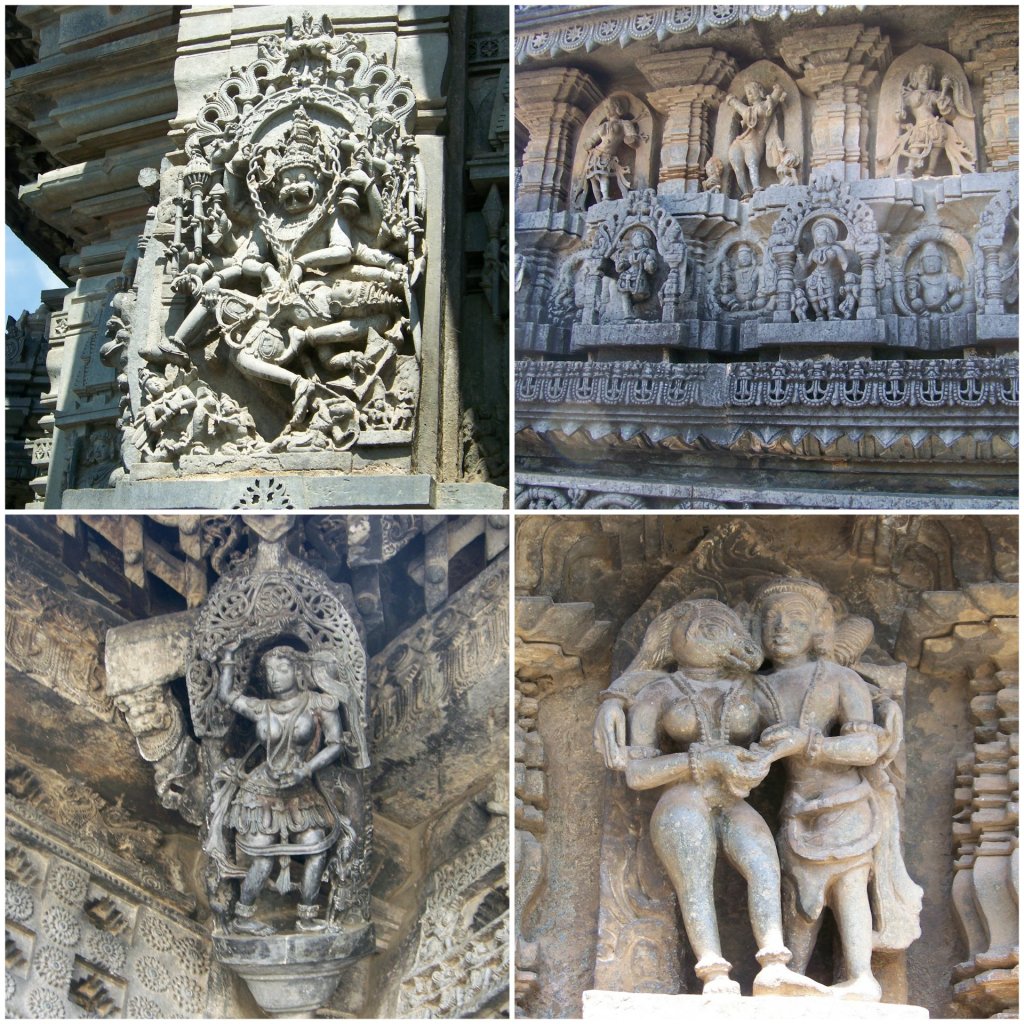
• Shantala, the wife of King Vishnuvardhana (One of the most prominent Hoysala ruler) was so mesmerised by the Sculptures of the dancing ladies carved here in different postures, it is believed that she used to dance with these Madalikes or ShilaBalikas in her dreams.

Art at Chennakeshava temple

The capital of the Hoysalas was shifted from Belur to Halebeedu, then called Dwarasamudra. The Hoysaleshwara temple is the most prominent among all. The monolithic statue of Nandi here, is the sixth largest in the world.

The Hoysaleshwara temple at Halebeedu
Hoysala sculptural Art at Halebidu

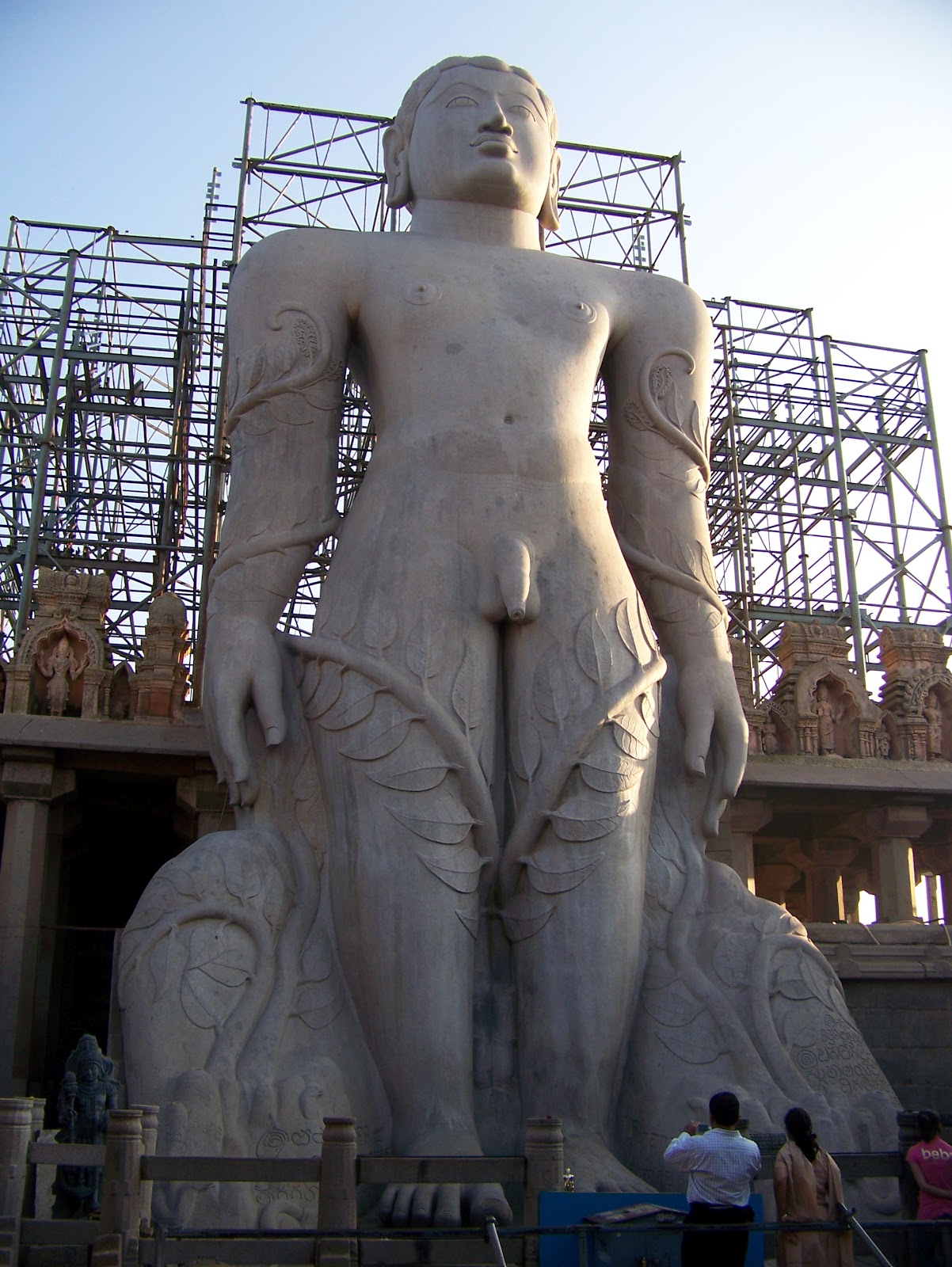
Although our next destination is not a Hoysala hotspot, we decided to include it in our itinerary as it was just around. We headed towards Shravanabelagola, one of the most important pilgrimage sites for the Jains. Shravanabelagola has two hills- Chandragiri and Vindhyagiri. The twin hills offer a panoramic view of the surrounding plains. Chandragiri hill gets its name from Chandragupta, one of the greatest emperors of India who converted to Jainism, gave up all his worldly pleasures and is believed to have passed away on this hill. The statue of Bahubali/ Gomateshwara located on the Vindhyagiri hill is the largest monolithic stone statue in the World.

The statue of Gomateshwara at Shravanabelagola
The Gomateshwara Monolith statue

With this, I wind up with Part 1: of visiting the Hoysala temples. To put it in my words, I survived an ‘Art attack’ at Belur and Halebeedu.

Please do find a day to visit these places and you will not regret, trust me!

A day out at Kaiwara

Our company has recently changed its working calendar and now, we have our weekly off on Wednesdays instead of Sundays. When I woke up this Wednesday morning, a weekend for me and when the rest of the world is working their asses off, halfway through their week… I sat wondering how I was going to kill the rest of the day amidst the four walls of my house, all jobless.

Then suddenly, I remembered a place that a friend had told me about, long ago. She had done her internship at ‘Kaiwara’ during the final year of her MBBS course. I jumped out of my bed and began to google for it. With lot of information available online, I was able to jort down a list of places to see in and around Kaiwara and with a quick route map. I dragged my mum along, pulled the car out of the garage and zooommm we went…….

List of Places covered:
Narayanapa Mutt; Bheemeshwara temple; Bheema baana Betta or Kaiwara Betta; Tapovana; Vaikunta betta; MahaKailasaGiri Betta; ChenaKeshava Cave Temple; Alambagiri Venkateshwara temple

The details:
It was around 09.00.a.m. when we started from Bangalore. We reached Devanahalli from where we took the Vijayapura bypass road. At an average speed of 60kmph, a drive of a good 45min from the Bengaluru airport is what it took us to reach Kaiwara.

As soon as one enters the Kaiwara town, a small lane on the left leads you to the Narayanappa ģMutt. This is where Saint Narayanappa attained ‘Jeeva Samadhi’ and the mutt is currently being managed by the M.S.Ramaiah trust. Half a kilometer away from the Mutt is the ‘Bheemeshwara temple’. This is where the mythology has it that Bheema killed Bakasura while the Pandavas were in exile. There is a group of small temples there, each named after the Pandavas within the same premises. Overlooking the Mutt is the Bheema baana Betta or Kaiwara Betta. We thought of skipping our visit there, considering the number of steps we had to climb up. Maybe a hike that I can plan for some other day.

Entrance to Vaikunta betta
The Entrance to Vaikunta betta

We drove for one kilometer further and reached ‘Tapovana’, the place where Saint Narayanappa used to meditate, back in the days. There is a small garden around there, which can be given a miss if you wish. Few yards uphill from there, we reached the ‘Vaikunta Betta’. At the base of the hill is the ‘Amaranareyana Temple’ dedicated to Lord Vishnu built by the Hoysala king Vishnuvardhana. With our climb upstairs, we reached the ‘Yoga Narasimha Temple’. The structure seemed to be ignored by the visitors. But we enjoyed the calm in this cave temple, believed to be the place where the Lord appeared in front of Narayanappa. The temple terrace had an excellent view of the entire town. A word of caution though: With too many monkeys around there, it was no monkey business.!!

A view from The Vaikunta temple
A view from the Vaikunta temple

We then commenced the best stretch of the drive. After an uphill drive of 5kilometers, we wondered how beautiful Mount Kailash (in the Himalayas) could be if the lesser known ‘MahaKailasaGiri Betta’ in Kaiwara was this beautiful. Atop the hill, is a set of newly chiseled man-made caves that houses 3 temples.

Enroute to Kailasa
Enroute to Kailasa

Unlimited food is provided to every pilgrim/visitor at KailasaGiri temple and the Mutt between 12.30.p.m and 3.00.p.m. So, we decided to hog some yummy temple food at Kailasa Giri itself. By this time, we had covered all the places I had enlisted in Kaiwara. But it was still 2.30.p.m and we had a lot of time left. While coming downhill, we decided to follow a signboard which indicated the way to ‘ChenaKeshava Cave Temple’. But it was quite a disappointment after reaching there. We could’ve probably skipped the visit to this place.

I then remembered someone mentioning about ‘Venkateshwara Temple’ in Alambagiri, located about 10kms from Kaiwara. The place is supposedly famous for Paper made handicrafts. So, we decided to explore this place too. But some renovation work in this ancient temple was in progress and there were absolutely no shops in that place (forget handicrafts stores). We were disappointed again by the unfruitful drive until there.

Alambagiri Venkateshwara temple (1)
Alambagiri Venkateshwara temple

As per google, there was ‘Ambaji Durga Cave temple’ 7kms away from Kaiwara, and we tried to enquire with a few locals about the place. But nobody seemed to have heard of it and hence, we thought of giving it a miss too. With this, we thought it was time for us to return back to where we belong to- The Bengaluru city.

Conclusion:

  • Kaiwara alone is a nice place to plan a drive with family or a group of biking friends. Though it was a small trip, it was a pleasant one.
  • Kaiwara is famous for silk rearing & weaving. You will come across several houses stacking up the cocoon rearing trays for most of your way. Maybe you should try to pick up some silk stuffs while you are there or get hands-on working experience at silk rearing.

Devanahalli- The town within a Fort

On a casual weekday off, dad and I decided to take a train trip to some random place on the fringes of Bangalore. So, with tickets that costed us Rs.4 per head, we headed towards the platform. We boarded the Yeswantapur-Devanahalli Passenger train. What surprised us what this train with 5 bogies had just 5 passengers, for a round trip. That makes it 1 passenger per bogie 😛

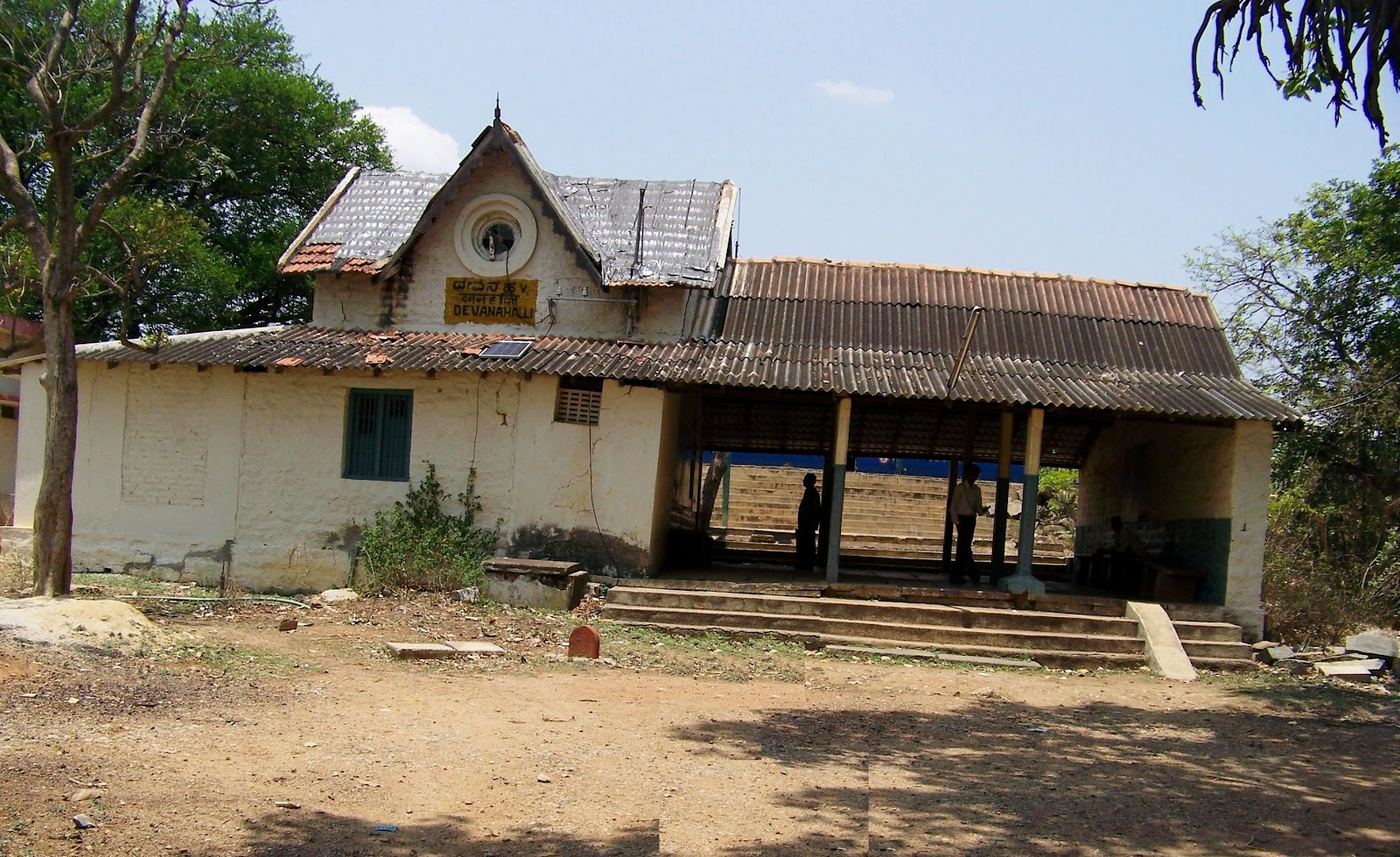
Anyway, the journey towards Devanahalli began and considering that the train still plied well within Bangalore, it felt like we were riding through some unknown green route. We alighted at Devanahalli Railway Station, a small structure from the colonial era (Updated as on Yr.2019, the structure doesn’t exist any longer. It has been demolished making way for a newer station that now welcomes modern passengers who alight here to go to the Bengaluru International Airport) We decided to undertake some exploration and started to walk towards the main town area of Devanahalli.

Places of interest:

Birthplace of Tipu Sultan, Fort Devanahalli, a few ancient temples located within the fortress.

Devanahalli railway station

The Details:

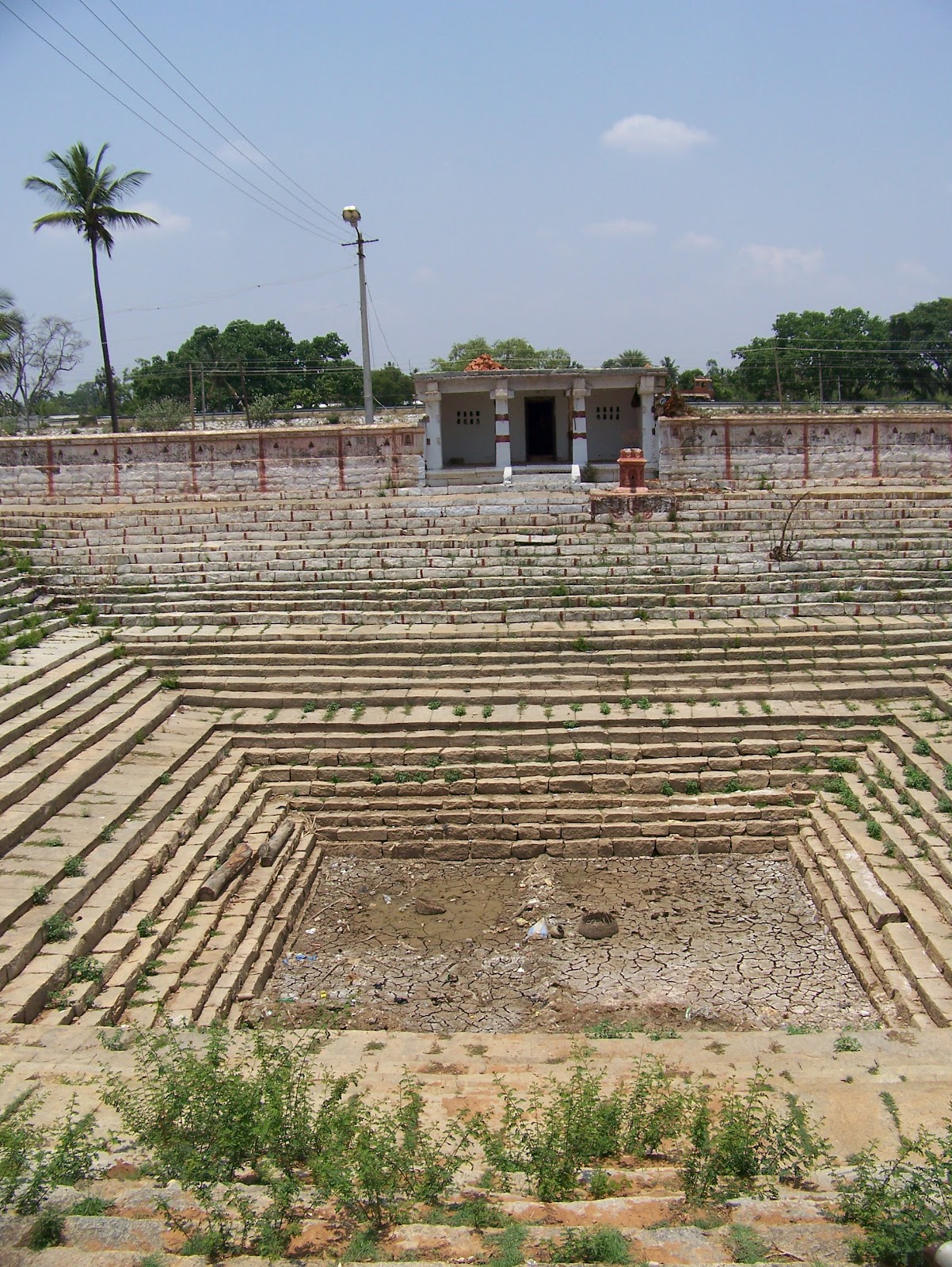
Enroute, we came across a large stepwell (the only memoir of an once existent temple) which was all dried up now. As we continued to walk further from there, we came across several ancient temples along our way.

Things to see in Devanahalli
An Old temple pond

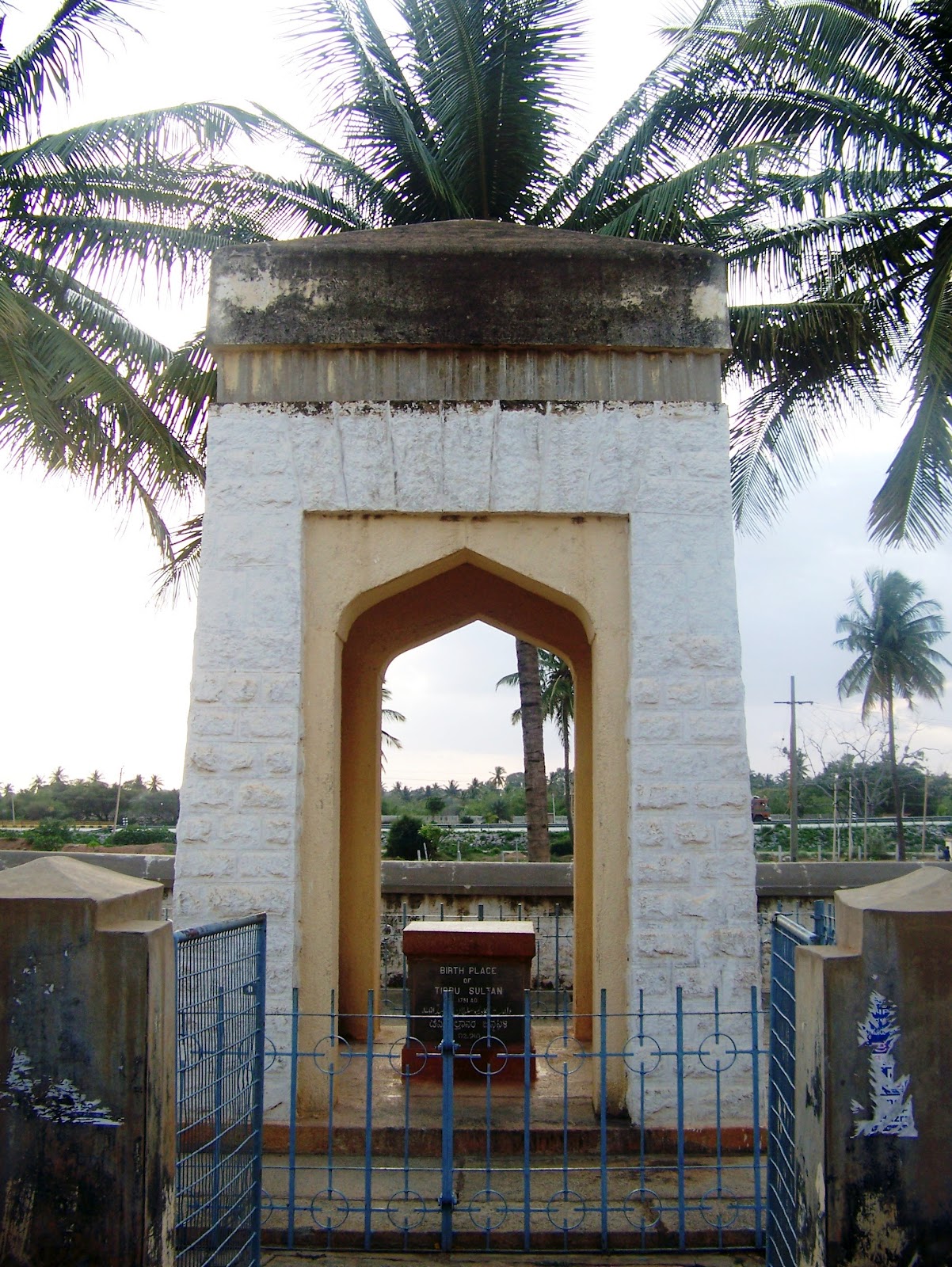
Before the Bengaluru Airport was shifted to the neighbourhood of this little village, Devanahalli was already popular as the hometown of Tippu Sultan, often referred as the ‘Tiger of Mysore’. We arrived at a small mantap like structure which has an engraved stone that mentions it as the Birth place of this controversial ruler in South India. With this structure lying right by the side of the main road, it didn’t seem very exciting to me to think of whether this famous ruler was born by the road side (or so it seemed).
Tippu's Birth place
Tippu’s Birth place

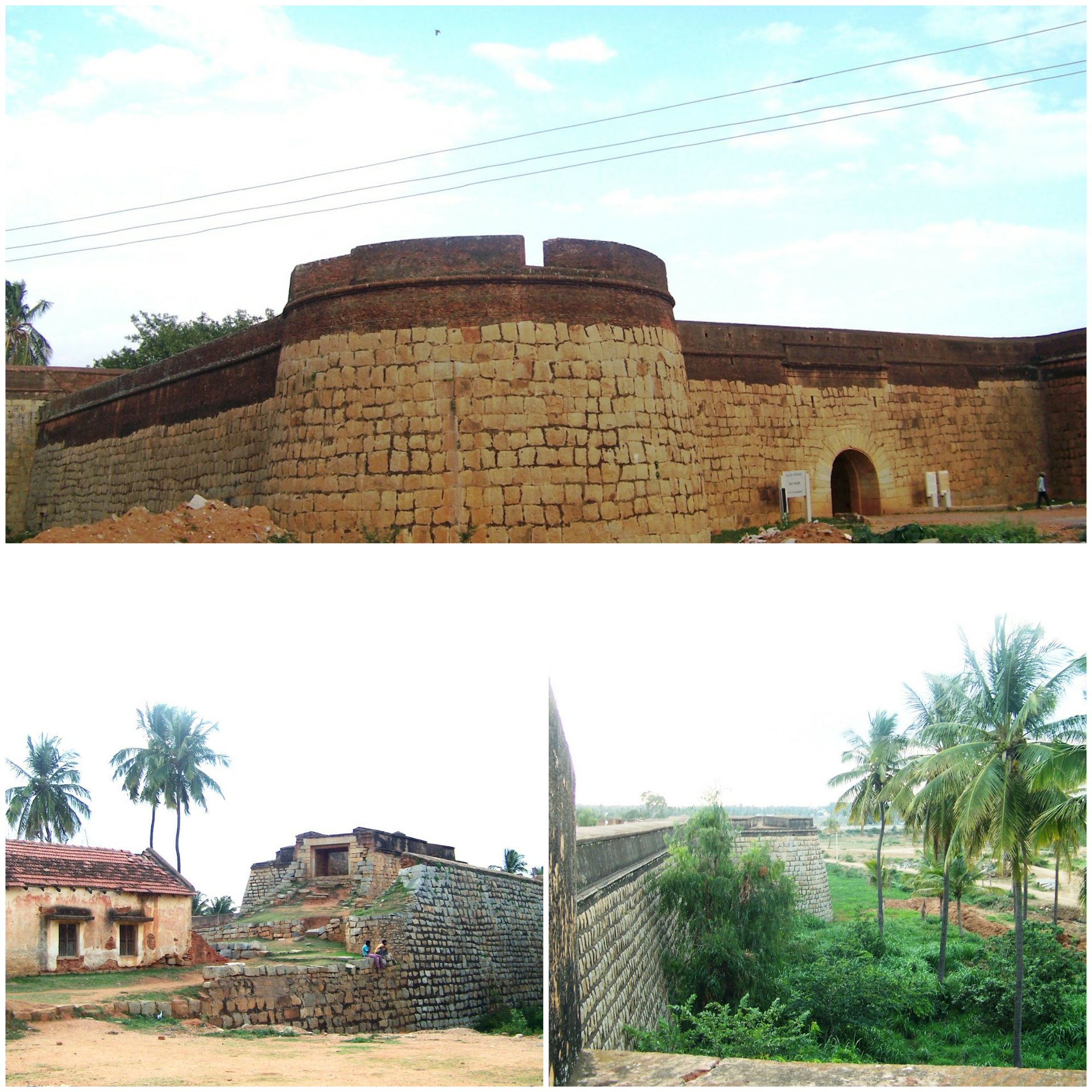
As we continued to walk further, we came across a large walled structure. With rain water stagnating by its side, excavation waste from the city dumped at the entrance, unpaved dusty roads and all that, it seemed to me like it was a neglected piece of history with a first glance. As we passed through the super narrow doorway in this wall, we realized that we were entering a fortress.

After entering it, we decided to walk on a raised platform along the inner side of the fortress wall. It was a walk longer than we expected it to be and we soon realized that it is one whole town that actually exists within the walls of the fort. The actual ‘Devanahalli’ from the history books existed within the walls and what one knows around the highway is just an extension of the town that overgrew the walls due to the boom in real estate that followed the commencement of the airport.

Things to see in Devanahalli

But after walking so much around this place, it felt like there was nothing much in this place that spoke about Tippu’s valour that is often spoken about in history books.Talking about back in the time in history and with my experience of visiting Srirangapatna (a stronghold of Tippu & his father), Devanahalli as a town lacked development.We walked around the place till evening and were able to cover one half of the Fort. But, with that we had already exited from the other end of the town. We boarded a BMTC bus back to the city from there.

Closing Remarks:
• A good day for a jobless person like me seeking for offbeat places around the city
• It isn’t an exclusive place, but if someone has couple of hours of transit at the airport and don’t know what to do, this is an option. It is the nearest place to venture out in a taxi from the airport as Bengaluru city is too far to reach.

Gold Market to Gold Fields in a Railbus

One Saturday off in a month and the crunch for exploration was at its peak… Dad and I decided to board the train to sit in a bus that runs on rails.. I mean.. We wanted to travel in the “RailBus”. There are only 2 railbuses still running in the country, one runs on narrow guage and the other runs on broad gauge. While the former is a part of the Kalka-Shimla mountain railways, the latter is operated by the South western railways. And we were interested in the one closer to home i.e. in South India. It plies between Bangarpet (literally translates to Gold Market in Kannada) and KGF a.k.a. Kolar Gold Fields.

Bangalore Cantonment Railway Station

It leaves Bangarpet at 9.00.a.m and returns by noon. Again leaves Bangarpet by 5.30.p.m and returns before its dark. So, technically we wanted to reach Bangarpet before 9.00.a.m. But the laziness that had set in because of a hectic work week, we woke up late and boarded the Bangarpet-Bangalore express at 9.45.a.m from Cantonment railway station. So the entire idea of railbus travel flopped even before it happened. Jeez..!!!

Once at Bangarpet, we walked from the railway junction to the dusty town and boarded a private bus that took us to KGF which had passengers 2.5XFOS (2.5 times the Factor of Safety) the bus was designed for..!! And our arrival at the destination was rather fast considering the time we had before we died of suffocation due to the availability of very little air to breathe(forget Oxygen) in the completely choked up bus 😛 (I seriously don’t know how to put our plight in words..!!)

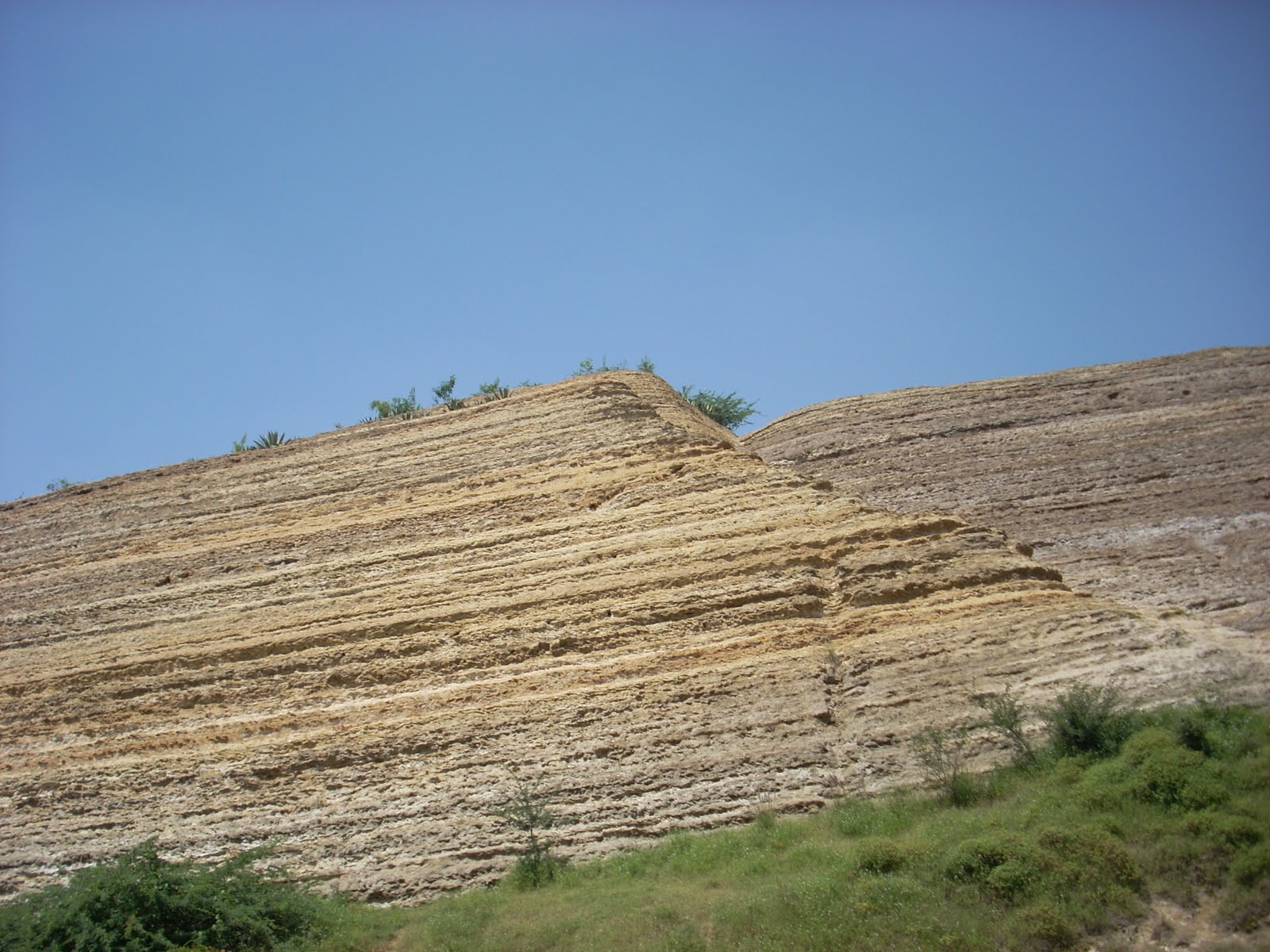
The Cyanide Dumps
The Cyanide Dumps

KGF.. The road welcomes you with a continuous stretch of this really awesome looking hill on one side and an old dusty town on the other side. It is dusty because it is a mining hub and it has a hill because of the same reason.. These hills are called cyanide dumps- the slurry left over after gold extraction from the mines using Cyanide based alkalis are dumped here and this has hardened over time making it look like a hill. It reminded me of the formations in the Grand Canyon for some reason.

Kotilingeshwara Temple

From here, we again boarded a bus to reach the “Kotilingeshwara temple”. This place is said to have more than 1 crore Shivalingas, all donated by people. Though I’m not a very religious person, I wanted to visit the place for the history it unfolded. It was soon pack-up time for us as the scorching sun had sucked out most of our energy. But, most importantly, we had to return to Bangarpet before we could miss a glance of the sole reason of our trip..!! And.. We were back at BWT junction as per schedule.

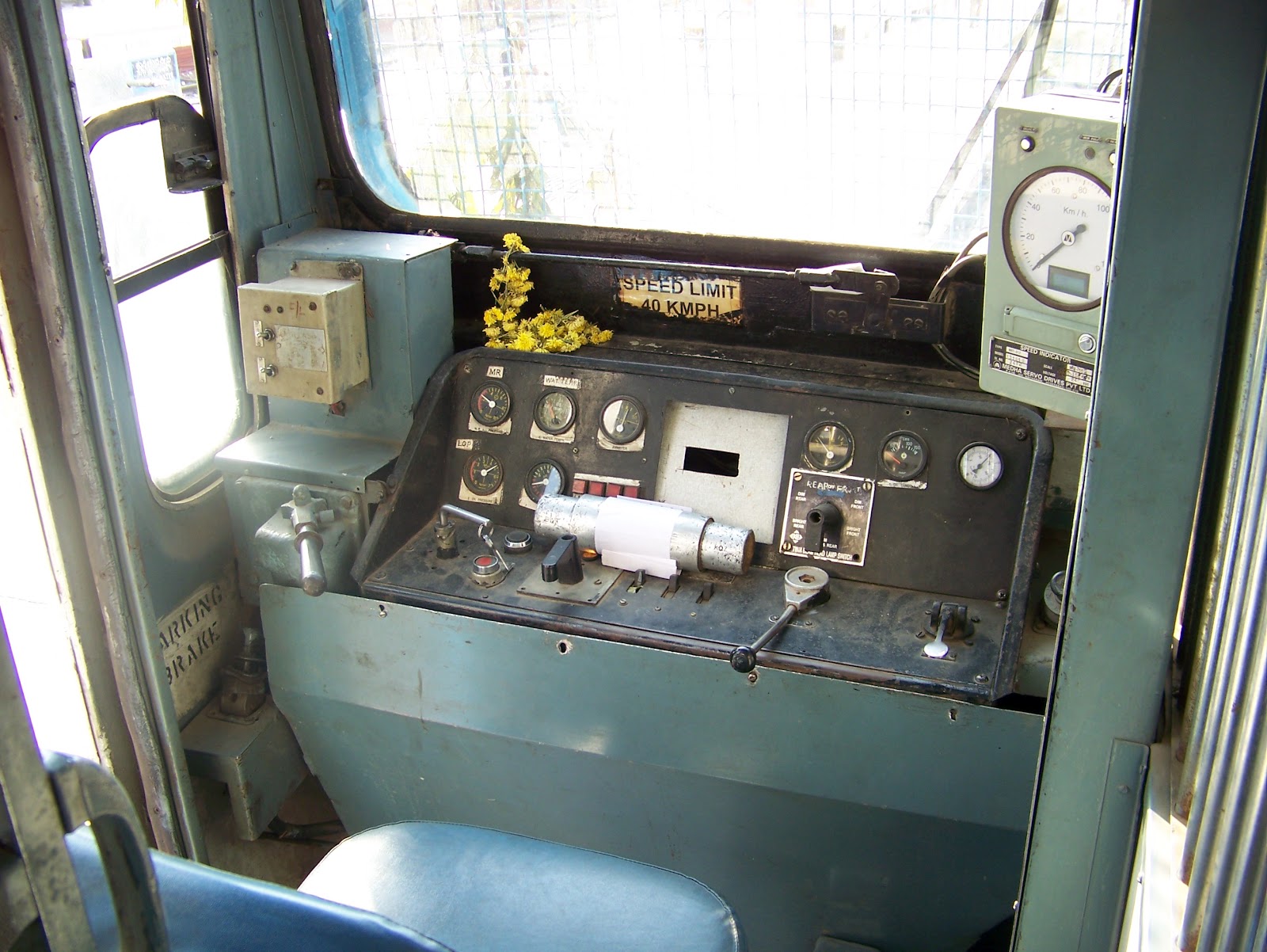
The loner was resting in the shade of a tree. And the loco pilot obliged to open the door and let us have a look inside of the train. It felt nice to see the last one left in the country but the trip ended soon. Ofcourse, it was with a heavy heart that we could not travel in it 😥

The RailBus in Karnataka
The RailBus
The RailBus in Karnataka

Have you been in a bus that travels on railway lines???? Do share your experiences below. I’d love to hear them!

A Green University Campus in the City – GKVK

This is quite an old story. But, nevertheless worth writing about, especially if you are looking for a quick outing in Bangalore within a short driving distance…

GKVK is the short form for Gandhi Krishi Vignana Kendra a.k.a. University of Agricultural Sciences (UAS). It is a research institute funded and managed by the Karnataka state government. With several sub-campuses located across the state, their main campus is located near Jakkur in Bangalore. If one travelling to Bengaluru airport is alert, he may find it on his way.

My cousin who was studying her undergraduate course in Agricultural science at that time, informed us about the “Agri-Mela” happening in her campus. It is an annual event organized sometime in November. Hailing from a farmer background, our family has the natural instincts to learn more about various crops, research and related advancement in technology. With that curiosity, my dad and I went for a bike ride to the venue. The bike ride was intended with two basic ideas. One, of getting some fresh air from their vast campus and the other was of course to look out for any suitable technology that we could implement in our farm back in my hometown. This is an excellent place for bird watching too.

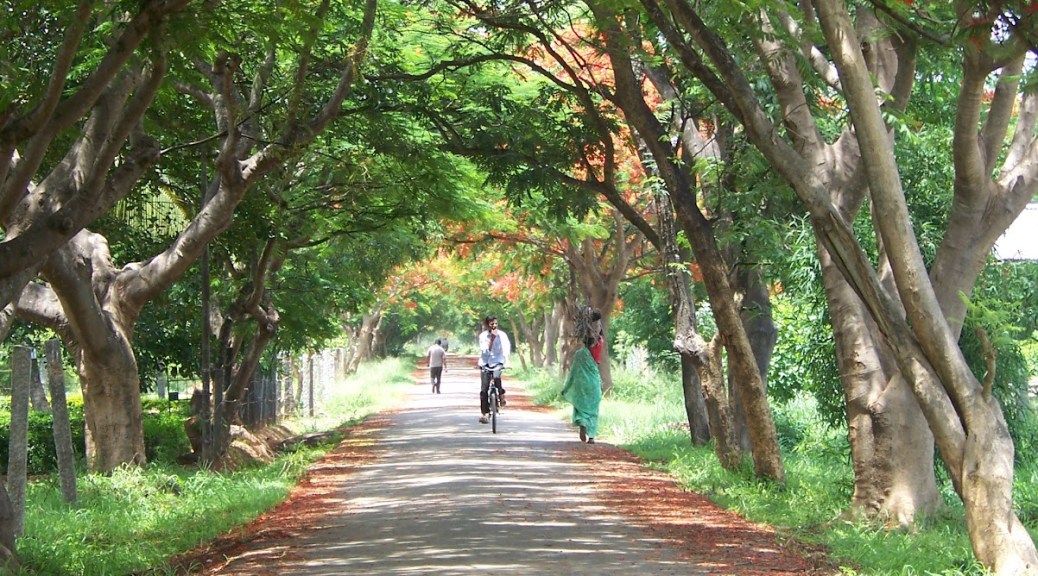
The Gulmohur trees inside the GKVK campus
The best stretch in the city- The Gulmohur Avenue

Although this 1000 odd acres university campus serves as a good lung space in the overburdened concrete city at any given time of the year, this is a season when it beams with extra life. The various plants across the campus will be bearing fruits and flowers in full bloom. Since the research in agriculture covers a range of topics, you could walk or ride around different patches of land with different types of crop, all mostly grown and managed by the students as part of their curriculum.

There are stalls covering range of topics like horticulture, sericulture, apiculture, cattle farming, poultry, food processing, storage, logistics, marketing, irrigation etc. covering almost all areas of agriculture and provides a platform for farmers from the state to share and learn newer developments in this field.

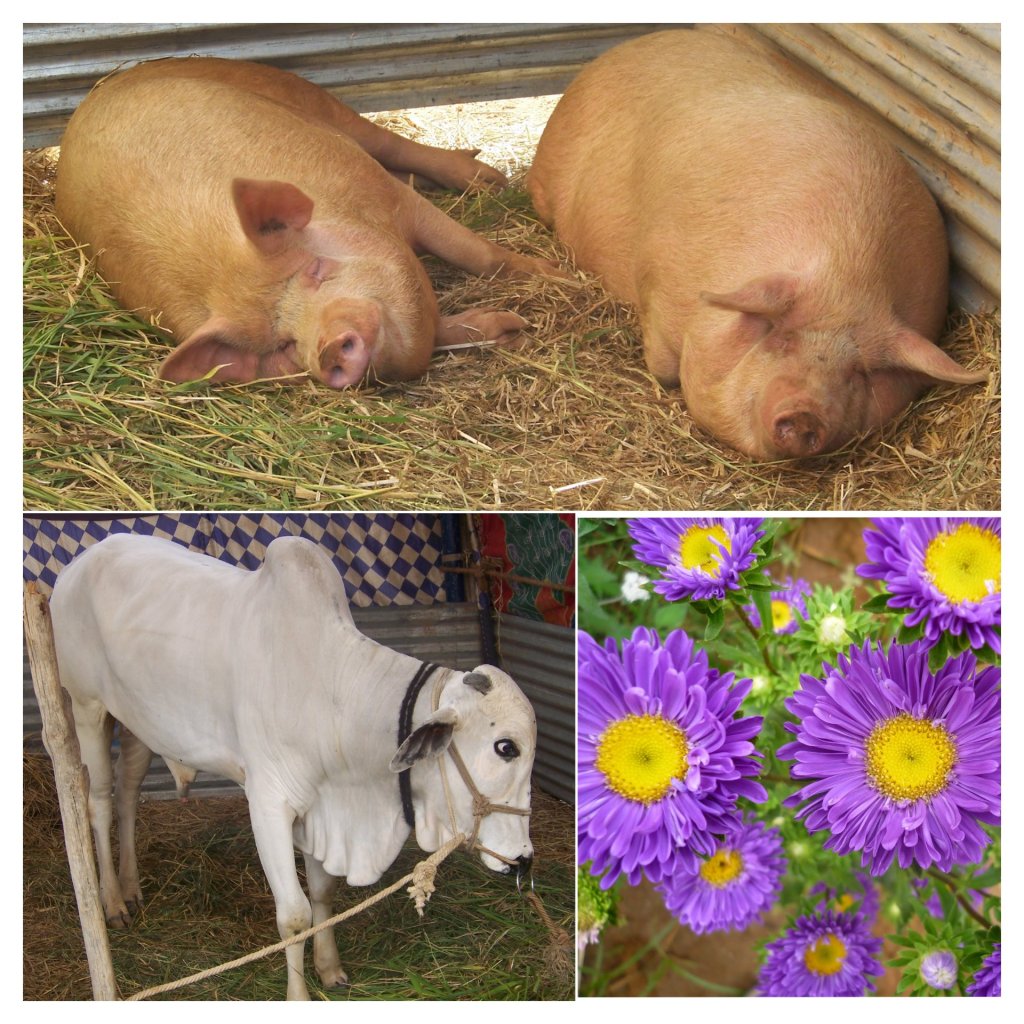
Images from Animal husbandry and horticulture stalls during the annual Krishi mela at GKVK
The exhibits at the agricultural stalls at GKVK

It was well over afternoon by the time we finished roaming around just a portion of the campus and exhausted. We bought a few homemade & processed foods from the stalls with an excitement to try newer flavors and decided to head back home. All in all, it was an afternoon well spent.

Things to do (on any day of the year):
• Take a drive if you want some fresh air without going too far from the city on a lazy evening.
• Spend a day bird watching here, there are often bird watching workshops conducted by hobbyists.
• You can buy fresh fruits and vegetables at their outlet on campus, many a times organic and sold at relatively cheaper prices as compared to the city.
• Sign up for one of the several training workshops conducted on campus, throughout the year.
• Visit the annual ‘Krishi-Mela’ and interact with farmers from across the state and the country.

Haniyur – A village with simplicity

It was a visit due for a couple of years now… Subbanna uncle is a family friend of ours and after repeated invitations from his family; the long pending plan had finally materialized. Mom woke up early that morning and prepared sufficient food for the two families. The idea was that the two families- Subbanna uncle’s and our’s, ate lunch together. We left home around noon towards Haniyur, a small village located at around 10kms away from Rajanukunte on Doddaballapur road. That’s where the Subbanna family lives, a little away from their farm.

As we entered Haniyur village, we were welcomed by fragile houses with mud smeared walls, dry- unpaved roads which had never seen Asphalt, dusty animals and open drainage running up to their brim in front of the houses on both sides of the road. When we arrived at his house, the door was locked and the neighbors informed us that the family was off to their farm. So, we decided to meet them in their farm itself rather than troubling them to walk back home in the hot sun.

Asters horticulture farm
A warm welcome laid by the Asters’ garden

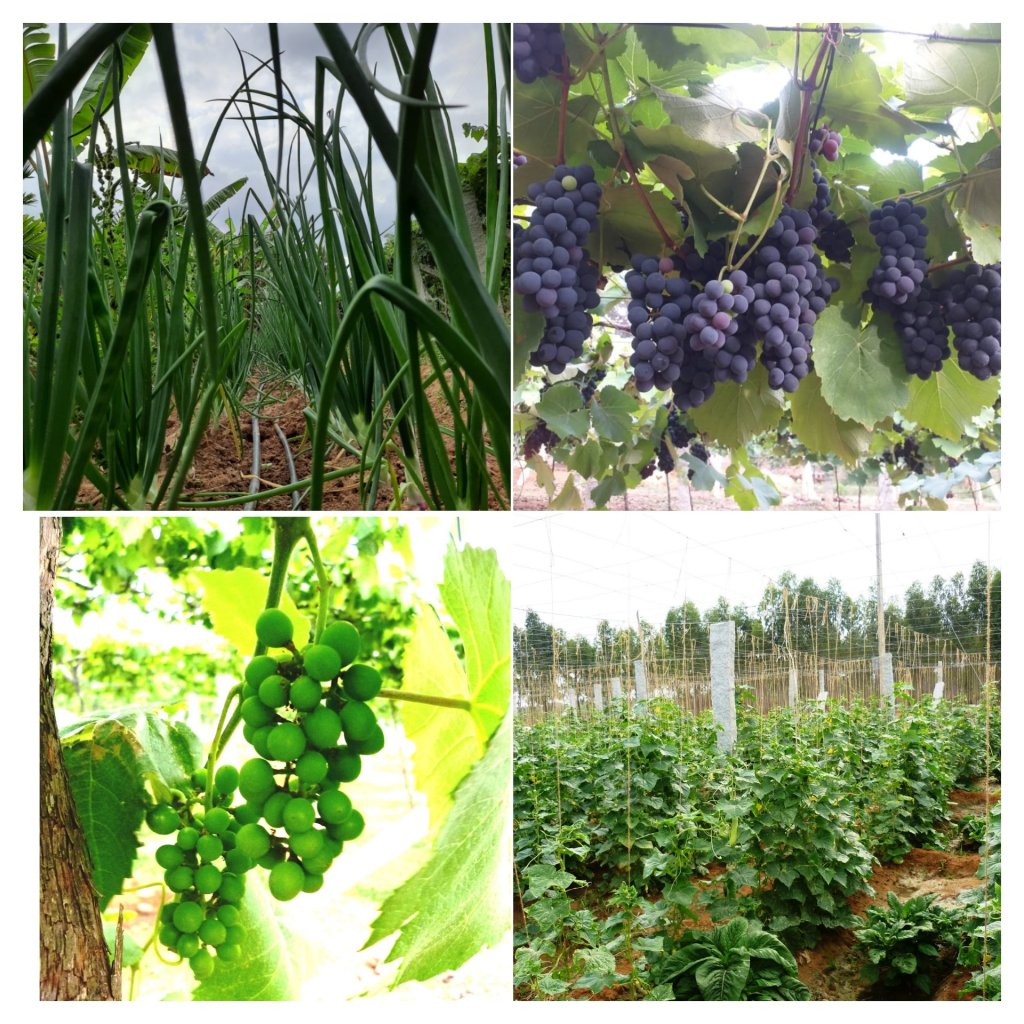
Their farm extends to a very large area that has been divided into several portions depending on what crop is grown. The crops are largely short term and comprise of fruits, vegetable and flowers. This time around they had Asters’ flower garden and a grape vineyard. While the elders in the family were busy with the labourers, the youngest member of the family- Uncle’s grandson was busy playing with the water pipes that were laid for drip irrigation. They were all excited to see us in their farm and some welcome drink (Tender coconut water) was sanctioned immediately. We told them that we would be having lunch with them in the farm itself and opened all the packages we had carried with ourselves. For salad, we had fresh tender cucumbers from the garden. Main course was ‘Kodava food’ from my mom’s kitchen and some nice ‘Ragi-Mudde’ from the Subbanna family’s large lunchbox. Yummy lunch ended with fresh chikkus, guavas and plantains- all from his farm. No restaurant could make up for the cool, fresh and pleasant ambience under the grape vine, in spite of the scorching sun seeming ruthless just outside.

Grapes vineyard visit
Clockwise from top left: Onion farm; Grapes vineyard; Gerkins farm; raw grapes

Later, we walked around their farm and the village and breathed in the rusty country side as much as we could take in. After having a hot cup of chai from the fresh milk from the cattle in the family’s backyard, we decided to bid good bye to this wonderful family.

Local dieties and place for worship
Some kind of a place for worship of the Local deity

It was still around 05.00.p.m, when we started from there. We decided to take a small deviation from our road and visit a temple located at around 4kms from Haniyur before heading towards the city. I’m not a temple kind of person, but for my parents’ sake, we went to the “Madurai- Shaneeshwara temple”. We were done with the darshan in 15mins or so… and headed back to the grind.

Conclusion remarks: There was no set agenda, just catching up for lunch with some old friends in the shades of a simple village and farm. The simplicity of the people who live there and the simple, yet tastiest food from their kitchen, with fresh and chemical free vegetables from their own garden… It’s a different feeling. We the city souls will never understand what money can’t buy. ‘Keeping it simple’ is the way of life!

A lazy weekend at Railway Gollahalli

This is yet another outing from our endless list of random weekends. This time, it was the three of us. Dad, bro and myself who boarded a random train with a ticket to a random destination. We first enquired about the next earliest train leaving from Yeshwantapur railway station. And then decided the destination based on the parameter of distance that the train would cover such that it is not too far from the city and it is easy to find a transportation to return to the city. After the destination was decided, we bought a ticket and headed towards the platform.

So, at around 2.00.p.m.on a lazy weekend, we boarded the train going towards Tumkur. After a good 20minutes or so, we arrived at our destination, a small station called “Gollahalli”. Since every corner of Bangalore has a village named Gollahalli, it is normal if you are wondering which Gollahalli I am talking about. This one is called “Railway Gollahalli”. I don’t know why the name, maybe because it is the only Gollahalli connected by trains or so…

After alighting at the railway station, we decided to explore the village using our favorite mode of transport: “leg motor service”. Like always, we started to walk in a random direction from the railway station, without a set destination. We walked and walked, miles together… It was a thorough exploration of the rustic side!

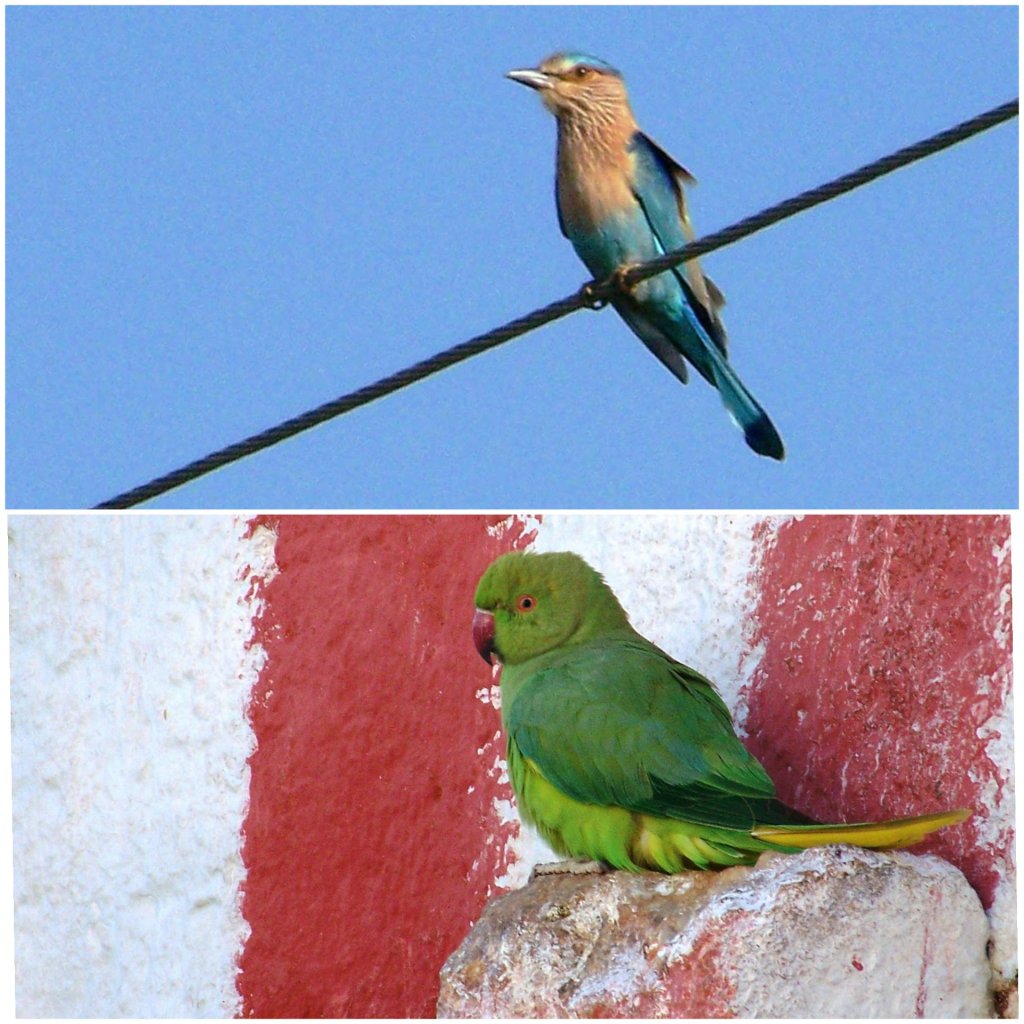
We spotted a good deal of blunders with English which could give one a hearty laugh. And of course, the fresh village atmosphere, an unending list of birds, lush green farms, the charming village folk- All which definitely plays its magic on people like us who are frustrated with the hustle & bustle of the metro.

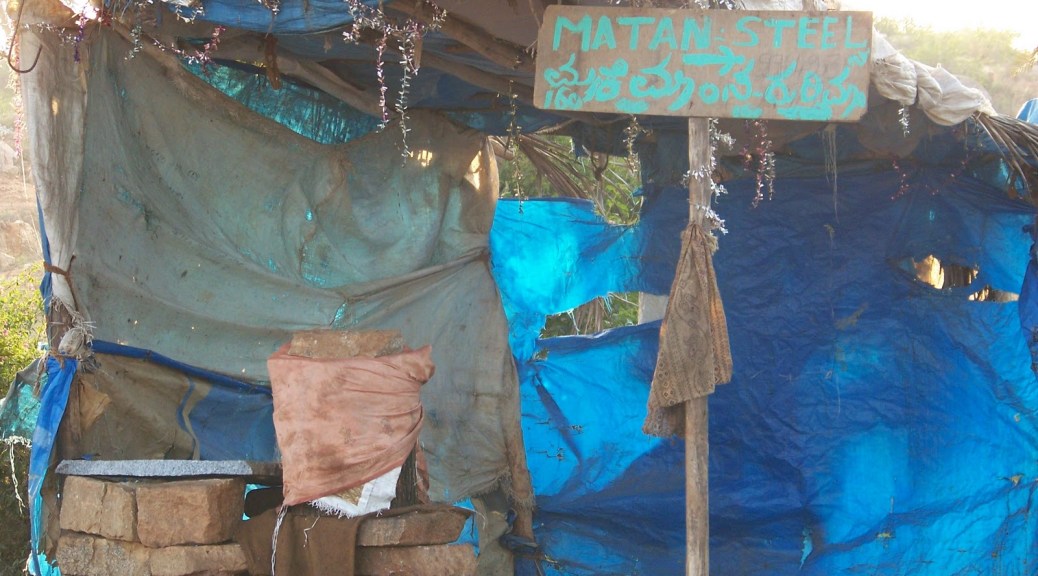
funny translations on roadside shops
Mutton stall- Matan steel- ಮೇಕೆ ಮಾಂಸ shop

It was a village that is neither of any scientific or architectural recognition, nor of any historical or mythological importance, but yet an amazing place in its own way. We were our own guides here. We did not want to ask for directions from any localite as we ourselves did not know where we wanted to go… We continued to walk… reached some main road… we further followed the main road… we reached Nelamangala BMTC bus stand. This was where our exploration ended and we boarded a bus back to the city.

Birds spotted around Bangalore
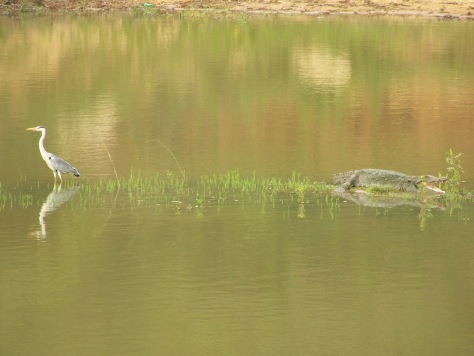
Birds at Railway Gollahalli

Closing Remarks: Be not a Columbus or an Amerigo, but one must definitely explore a new place, try out a new dish, make a new friend. It feels AWESOME 🙂

Up, close and personal with wildlife at Bannerghatta

I believe that we develop interests based on the environment and the social circles that we are exposed to. Born in a small hill-dwelling community whose lineage takes pride in hunting games, it once got me to think where my interests towards nature and wildlife conservation came from. Although I couldn’t join too many dots, one significant period was my high-school days where I would have long conversations with a friend, about animals’ health, their behavior, their habitat etc. Her father worked in the Karnataka forest department. I thus chanced upon once, to stay for a couple of days along with her, in the official quarters located inside the Bannerghatta Biological park.

A stay dating back to June 2007: Five friends and I embarked on this memorable trip (yeah, I can call it life changing too.. It probably changed my perspective about zoo keeping and keeping animals in captivity).

Day 1:
After bracing through long traffic jams and burping on our pre-booked lunch at the Jungle resorts within the park, it was Safari time for us. Even though I’ve been to Bannerghatta innumerous number of times in the past, this was a nice experience. On my previous visits as a normal visitor in the zoo, I would have to buy separate passes for each section. But this time, I was exploring the place with special privileges. The herbivores safari, tiger safari, lion safari, bear safari all done by sunset time and we unwound at the quarters.. You have 6 chatter-box girls in one house and what do you expect? A lot of gossip 😛 The evening thus passed by. The cook served our dinner and post that, we all geared up for one of the most memorable nights of our lives.

Photos of wildlife taken at Bannerghatta National park
Deep inside the jungle

We were all set for “The Night Safari”. The forest guards would go on their regular night beats in the forest and this time, we would accompany them. Apart from being the first experience for all of us out at night in deep jungle, what was more exciting was that we were going in an open pick-up vehicle. As the eeriness of the deep dark wild started to excite us more and more, we got a better understanding of such places at night. While we were being attentive and soaking in all the sensuousness of mother nature, we spotted some wild animal that crossed our path.. and then came back and stood infront of our vehicle. I thought it was some sort of a wild cat and my jaws dropped in awe. I shouted in excitement, “Cat, Cat!”. Then noticing the weird glances I received and the silence of others, I realized I had to shut up. A friend was quick to realise what it was. She shouted “Leopard, Leopard!”. Imagine a LEOPARD, totally untamed and WILD.. right infront of us…!!! The driver halted the vehicle. Another friend yelled out, “Don’t stop, don’t stop.. Move move..”. But the driver took the jeep in reverse and closer to the cat. The leopard had now walked past our jeep and come to the rear side. At a distance of less than 10meters or so.. Instead of pouncing on us and grabbing one of us, strangely the leopard ran away within a few seconds. PHEWWW… still feels like I just woke up from a dream..!!

We were then told that the leopard had littered cubs somewhere in the vicinity and hence, ran away. The forest guards know their forests and its inhabitants. The leopard was frightened about a threat to its babies and hence ran away to protect them. They are usually in defensive mode during these time unless attacking is an absolute necessary. The Safari continued.. We spotted bisons, antelopes, spotted deers, neelghais, wild cat, black bucks, mongoose, rabbits, so on and so forth… The nigh safari was indeed an experience in itself!

Day 2:
Next morning we all woke up before sunrise and again, headed towards the jungle. This time, it was a morning ride with a hope of spotting a few wild elephants. As we travelled deep, deeper and deepest into the forest, the terrain got more bumpier and rocky. The painful ride however, did not yield any good sightings apart from fresh elephant dung everywhere. But, some wonders of the jungles that we had missed in the darkness of the previous night, made up for the disappointment of our morning ride. Picture these little scenes: hundreds of butterflies flying out of a bush, all at once; the glittering clear waters of the lakes lost in the deep jungle; many more.

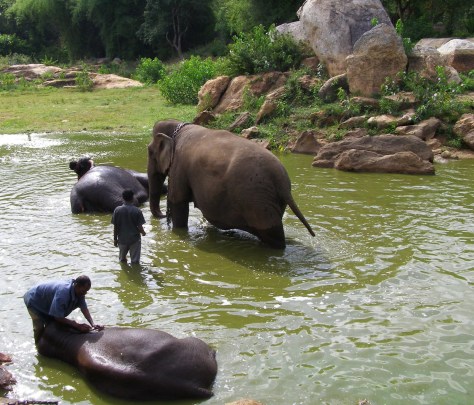
After reaching back to the quarters, we immediately headed to a pond located behind the quarters. It was bathing time for the pachyderms at the zoo… Two majestic sweethearts walked past us, with a calf: Vanaraja, Darshan & Baby Nisarga (Those are the names of the elephants at Bannerghatta). We too stretched ourselves to give them a scrub and in the process, got all wet with the ever playfull little Nisarga.

Photos of elephants taken at Bannerghatta National park

It was our zoo time post breakfast. In a separate area, an elephant calf named Geetha was in deep slumber. The calf who was barely as old as a month-and-a-half was guarded by her mother. We accompanied the mahout to feed them and spent. During this, the little one woke up and we got lucky to spend some time playing around with her. She would nod her head and playfully chase us. We would run around the tree until both of us got tired, and then start the cycle again. While at this, the vetinerary doctors of the zoo welcomed us to the backyard of the Vet-hospital. Under their supervision, we got an opportunity to touch, carry and care for wounded or sick animals that were being treated there. Among them were an alligator, civet cat, guinea pigs, rabbits etc.

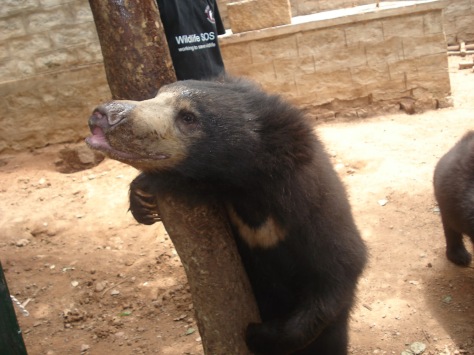
Later in the afternoon, we visted the SOS centre. I didn’t even know such a place existed within the premises despite coming to the zoo several times in the past Special privileges! This is a rehabilitation center for wounded lions, tigers, bears etc. These animals are mostly rescued from circuses, bear charmers etc. treated here before letting them into the actual zoo area. This is a public prohibited zone. The handsome Siberian tigers were my favourite.

Sloth bears at the SOS center in Bannerghatta National Park
At the SOS centre

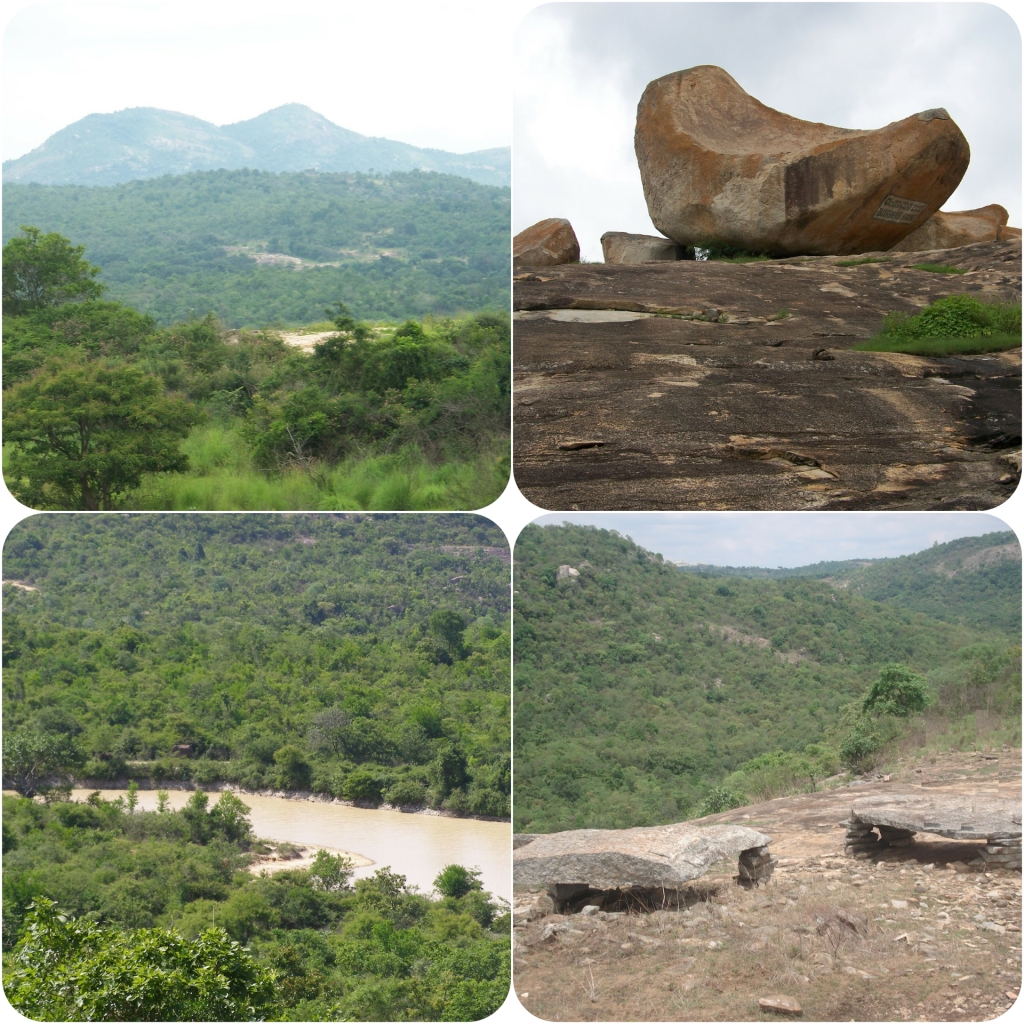
Next was the drive uphill- to Udige bande. We got a nice view of the ‘Bannerghatta National Park’ from here. You can find innumerous dolmens here, believed to be the place where the local tribes once laid their dead ancestors to sleep. There is also another large rock, called as the Barber’s stone which is believed to have been featured in Dr.Rajkumar’s ‘Gandhada Gudi’ movie.

Views of the forest cover at Bannerghatta National park
From Top left: 1.The view from Udige Bande, 2. The Barber’s stone, 3.The Dolmens atop Udige Bande, 4.View of a small check dam constructed by the forest department as a watering hole for the wild animals.

Day 3:
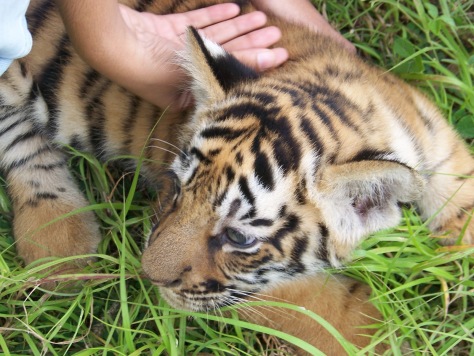
We were taken to the tiger and lion conservation area. The pictures taken here are something that I would be flaunting for the rest of my life. Not all get a chance to touch and play around with tiger cubs 😉 The big cats that are ready for their breeding / mating are brought here. After the cubs are born, the parents and the cubs are nurtured here until the cubs are of a suitable age to go back to the wild. Here, there is no wild as such. They are let in the safari area to mingle with the other cats in a controlled space, which is also another form of captivity.

A tiger cub at the animal breeding center at Bannerghatta National park
Playing with a tiger cub at Bannerghatta lion and tiger conservation area

We took a walk around the museum and got a few insights into preservation and conservation of our natural heritage. We then headed to the last part of our long weekend. The butterfly park was newly set back then and it was a good crowd puller among the public.

To my experiences of going on wildlife safaris and what I had watched on discovery & Nat-geo, I guess this trip gave me a new insight into wildlife conservation. Until now I had only been hearing and watching it. This trip gave me an opportunity to EXPERIENCE it. You cannot connect with nature unless, you get up, close and personal with wildlife.

The Hesaraghatta de-tour

My wants are vague… This weekend I wanted to drive through countryside. As you may know, my mother worked for a government bank, a subsidiary of NABARD that lends agricultural loans. While she was processing one of the farm loan files, I had once chanced to take a glance at the filename- Hesaraghatta. Through her, I had heard that Hesaraghatta is an important centre of several agricultural research in India. I had been familiar with the campus of Gandhi Krishi Vigyan Kendra (GKVK) in Bangalore and the amount of green cover there. Hence, I assumed that there must be a lot of greenery around Hesaraghatta too, and decided to head there.

We started from home at around 8.00.a.m towards Hesaraghatta. We first passed through a village called Aivaragandapura. It is a small village that gets its name from the Pandavas. ‘Aivara-Kanda-pura’ translates to ‘A village that has seen the five people’. There is a temple complex dedicated to the Pandavas who are beleived to have stayed here, briefly during their exile.
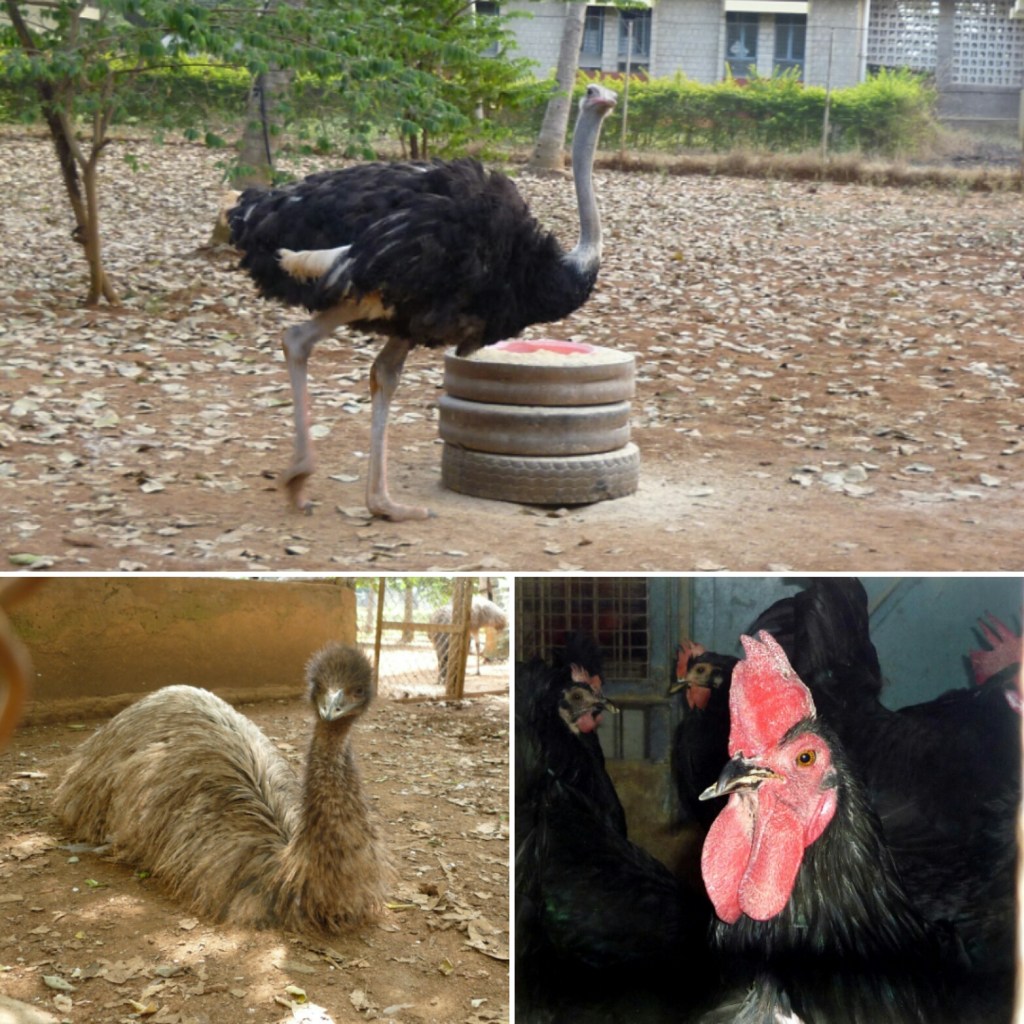
We continued our drive to catch up with our plan of going to the area of agricultural research. The government run research institute is spread across a massive area and is divided into separate sections, each having its own administration and permit requisites. We first reached the poultry farm. Various poultry breeds are kept in separate enclosures for research purposes. Along with several native varieties, we also saw Ostriches, Emus, turkeys, ducks, white geese, grey geese, swans etc. With permission from the concerned authorities, we could also visit the Indo-Danish cattle farm. I was awestruck with their size. They were massive, comparable with elephants. I mean, really! There is also rabbit farm, pig farm etc. which we thought of giving a miss because we could not figure out the route. Hesarghatta is also a centre for Horticulture-research. You will pass through large stretches of seasonal flowers, mango orchards and other farm crops.

Birds at the poultry farm at Hesaraghatta
The birds at the Hesarghatta farms

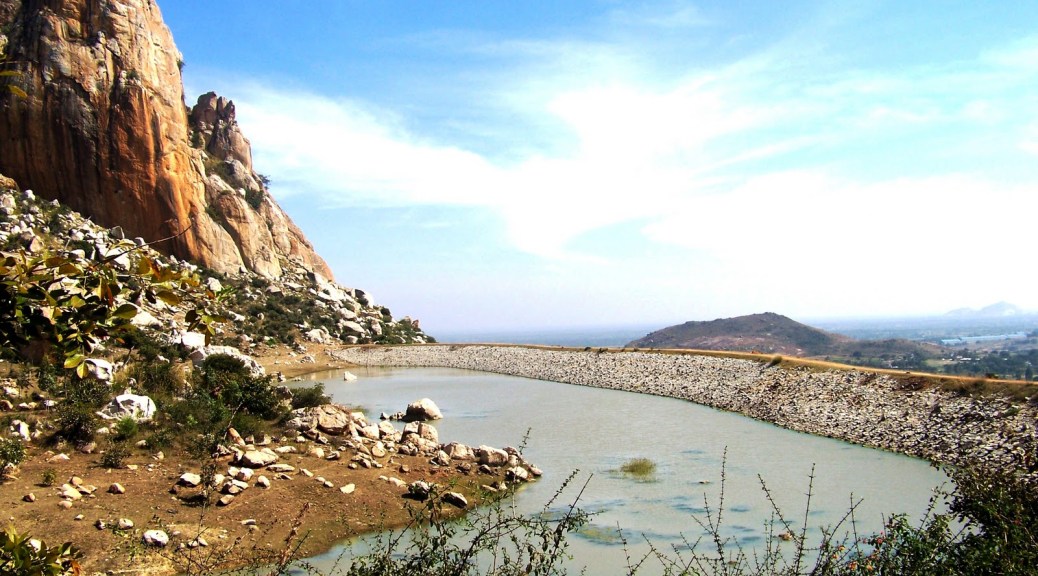
We were done with our pursuit of agricultural research and still had a lot of time with us. We decided to drive around and explore hesaraghatta a little more. We drove further ahead and passed through a narrow pot-holed road. We stopped by a high wall by the roadside which we learnt, was the once famous Hesaraghatta lake. This reservoir served as an important part of water supply to Bangalore City in the past. This is now just a stretch of barren land, open for cattle grazing and a playground for some village boys who go there for a game of cricket. These days, it barely fills even during the heaviest monsoon. While we stood on the tank bund, we could see some village youth playing cricket on the tank bed with a little water at the far end of the large area. The breeze was indeed good and that’s why we spent some time walking along the tank wall.

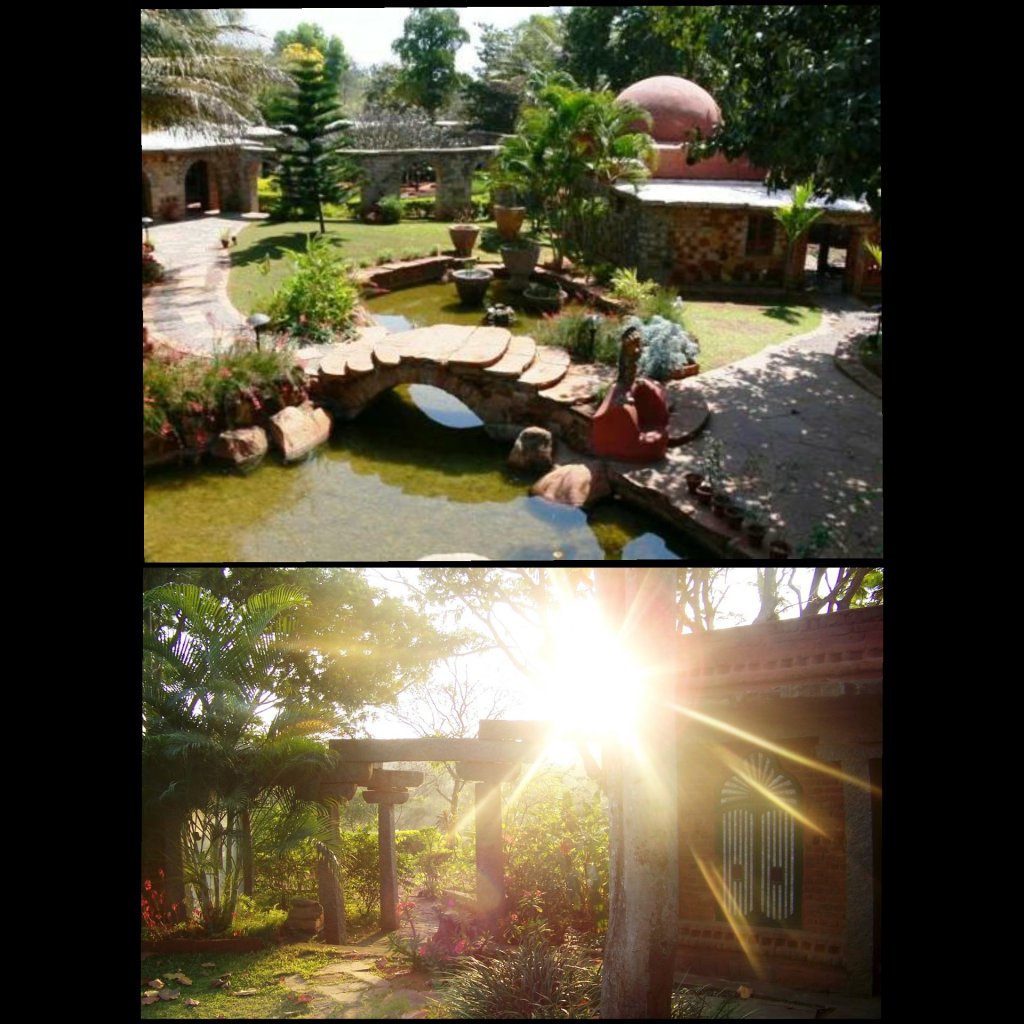
From there, our eyes fell on a direction board that read “Nrityagram”. It sounded familiar and it struck to me that it was a Gurukul dedicated to “Learning Dance”, founded by the famous danseuse Late. Pratima Bedi. When we reached there, we were told that the place was not open to visitors. However, there was hope. A portion of the beautiful dance school (constructed of natural materials) is now maintained by the Taj group. They run the “Taj Kuteeram”, a nice cozy resort. We dropped in for light snacks and coffee, as we were well into evening. We walked around the area and spent some good time amidst the chirping birds and the splendid nature. Since the setting sun was coming down, we thought of heading back home.

Taj Kuteeram / Nrityagram in Hesaraghatta
The Taj- Nrityagram, at Hesaraghatta

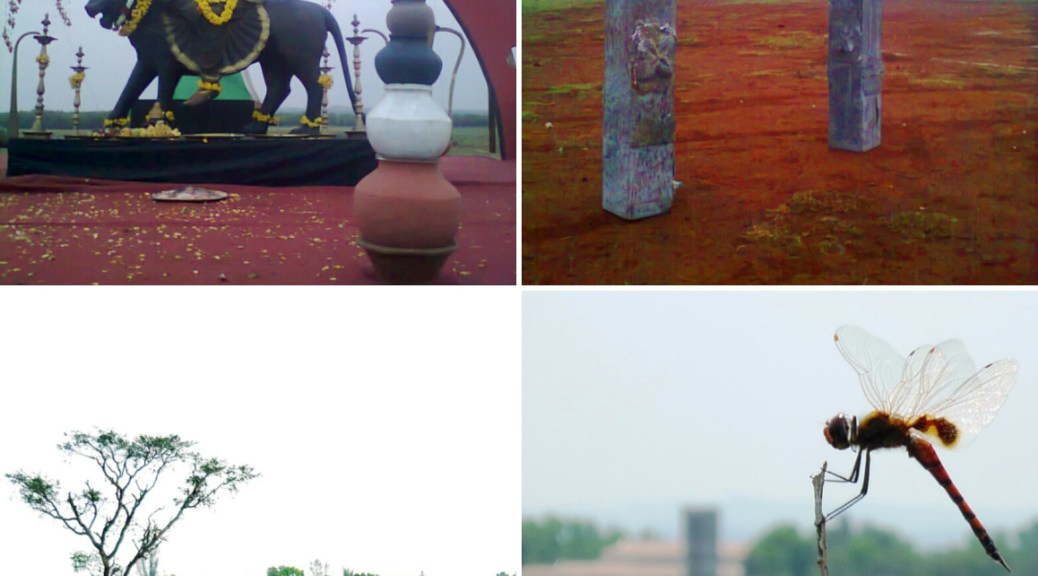
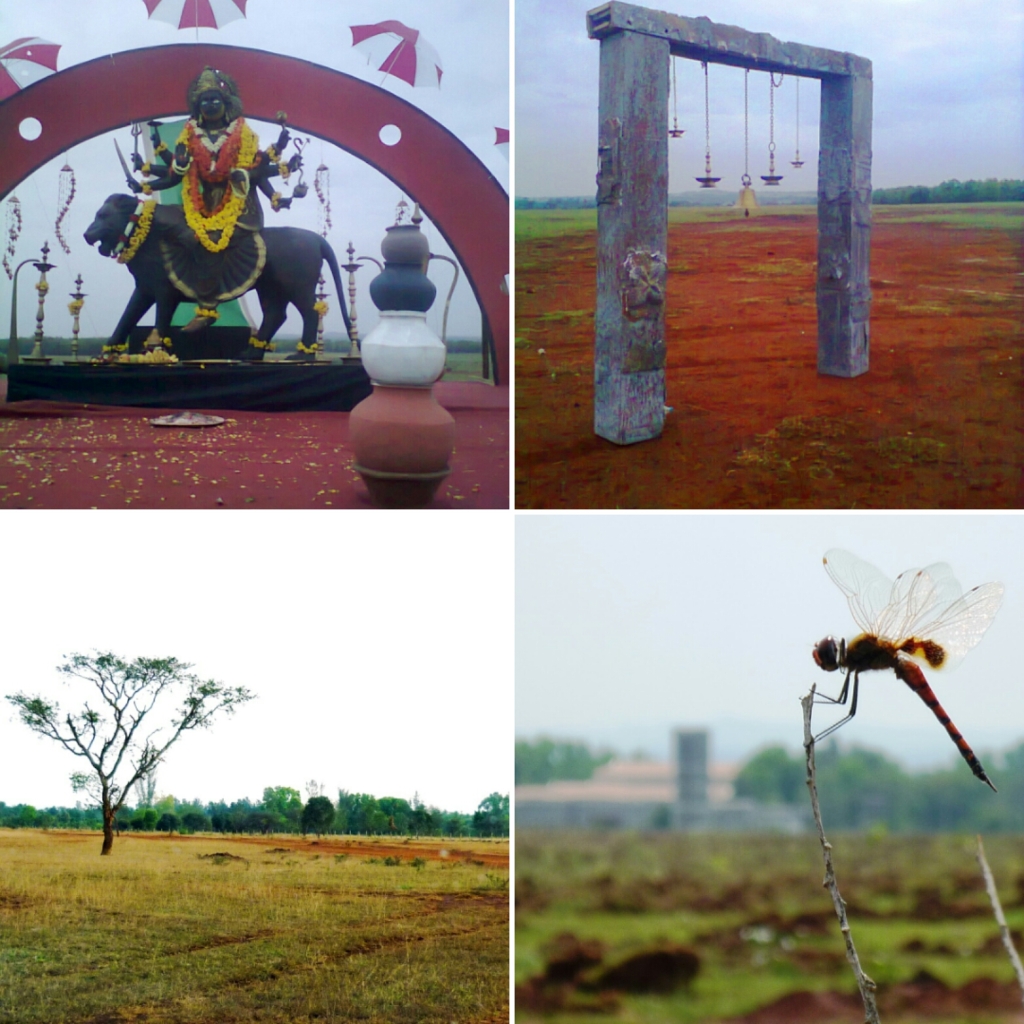
Half a kilometer from The Taj towards Bangalore city, we saw many vehicles going to a place to our left. The place looked secluded but made us curious to check out what was in there. We followed the vehicles that were going there. Oh, believe me! It was a nice suspicion. There lied a vast-neverending-wide-open stretch of plain-land. All those vehicles were actually ferrying some film crew. So that means, we also got to be on the sets of a movie shoot. A stage was set, some other make shift pillars were put up etc. We learnt that, many many movies and ads are shot here almost everyday. This barren land is converted to anything from a helipad to a swimming pool, a crowded village to a concert hall depending on the requirement. It is popularly called as the Hesaraghatta Grasslands.

the Hesaraghatta grasslands
Top: A movie set at Hesarghatta grasslands; Below: The grasslands

We also had a good view of the sunset from the open area. It was getting dark by then. So, we drove back to the hustling and bustling city—away from the calm and rusty countryside. It was hard to believe that such calmness prevailed in our very own Bengalooru. I will surely go back there soon.. Very soon… It was a total get away from the maddening city life.