Tag Archives: Hiking

Kashmir Great Lakes Trek – Cost, Best Time, Route & Highlights

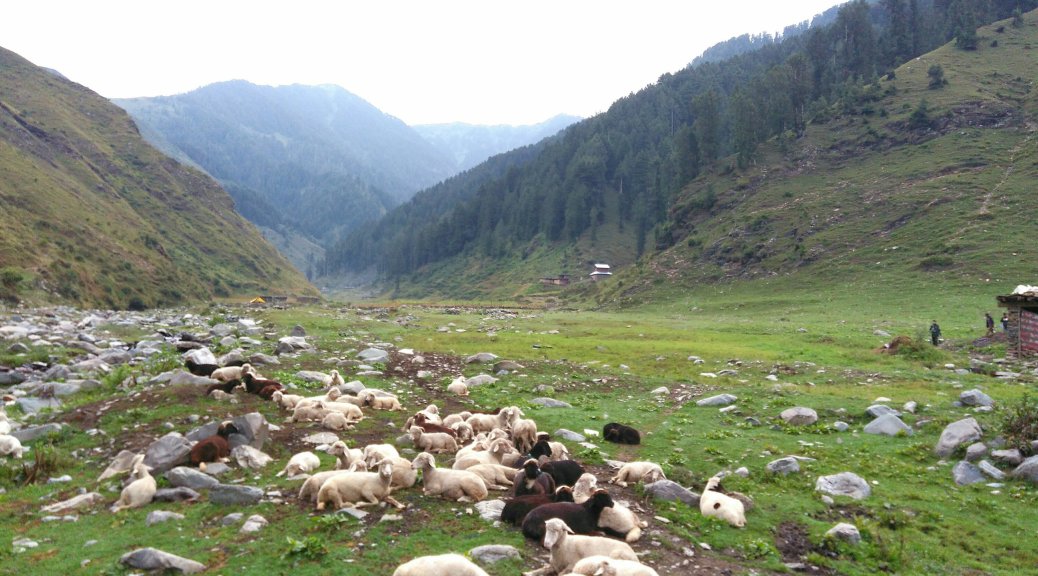
The Kashmir Great Lakes (KGL) trek is widely regarded as one of India’s most spectacular high-altitude circuits. Rolling alpine meadows, jagged granite ridges, and a string of emerald and turquoise lakes make this route feel like walking through a painter’s brightest palette. Great Lakes of Kashmir is a classic 7–9 day trek that usually takes trekkers from Sonamarg to the Naranag valley (or the reverse), crossing several high passes and visiting lakes such as Vishansar, Krishansar, Gadsar, Satsar and Gangabal.

This guide covers the route, daily plan, difficulty, best season, permits and safety, gear, food and packing, acclimatisation and practical tips so you can plan and enjoy the Kashmir Great Lakes trek with confidence.

  • Typical duration: 7–9 days (6–8 days of trekking).
  • Typical distance: ~65–75 km depending on start/end points and exact route.
  • Maximum altitude encountered: ~4,200–4,300 m (Gadsar / Nichnai passes). Most camps lie between 3,500–3,900 m.
  • Difficulty: Moderate to difficult (long days and 1–2 steep passes; not technical but physically demanding).
  • Best months: Late June to early September (peak July–August).

What sets KGL apart is the variety compressed into a single circuit. In a week you move from thick forest and pastoral Sonamarg meadows to barren moraines and dramatic glacial basins. Each lake has its own character — Vishansar’s wide shallow shores, Krishansar’s twin lake views, the dramatic bowl around Gadsar and the grand Gangabal beneath steep cliffs. The landscape changes day by day, making every campsite feel like a new world. Many trekkers call it a once-in-a-lifetime trek for the views alone.

This is a standard itinerary many operators and independent trekkers follow. Distances and times vary by pace and route choice.

Day 1: Srinagar to Sonamarg
Arrive in Srinagar and drive (~2–3 hours) to Sonamarg. Final gear checks, stay in a guesthouse or camp at Sonamarg (2,700–2,800 m).

Day 2: Sonamarg to Nichnai (~10–12 km, 6–8 hrs)
The trail climbs out of Sonamarg through meadows, forests and the Shekdur stretch before arriving at the high pasture of Nichnai (~3,500 m). There may be an army checkpost where ID is required.

Day 3: Nichnai to Vishansar Lake (~10–14 km, 5–7 hrs)
Cross the Nichnai pass (often ~4,100–4,150 m depending on route), then descend and reach Vishansar lake (~3,650 m). A spectacular first high-altitude lake.

Day 4: Vishansar to Gadsar (via Gadsar Pass) (~16 km, 6–8 hrs)
A long but rewarding day: ascent to Gadsar Pass (~4,200 m) and then a descent to the turquoise Gadsar Lake. Gadsar is in a sharp amphitheatre of cliffs and often has ice in early season.

Day 5: Gadsar to Satsar (~11–12 km, 4–6 hrs)
Cross rolling meadows and reach the Satsar lakes — a cluster of multiple small lakes — with scenic campsites.

Day 6 : Satsar to Gangabal (via Zaj or other pass) (~9–12 km, 5–7 hrs)
Cross the pass (sometimes called Zaj or another local saddle) into the Gangabal basin and camp by Gangabal Lake below Mount Harmukh. Gangabal is one of the most dramatic high-altitude lakes in Kashmir.

Day 7: Gangabal to Naranag / Thajiwas valley (~10–14 km)
Descend to Naranag, meet transport and drive back to Srinagar. Naranag has historical temple ruins and is a popular exit point.

Note: Many operators add a buffer day for weather, or extend to 8–9 days to allow lighter daily distances and better acclimatisation.

Kashmir Great Lakes Trek is not a technical climb since you won’t need ropes or glacier travel skills on the usual route but it is a sustained high-altitude Kashmir Trek with long ascents and descents. Expect:

  • Daily walking of 5–8 hours on varied terrain.
  • Two or three high passes around 4,000–4,250 m (steep sections, loose scree on approaches).
  • Nights at 3,500–3,900 m, so altitude symptoms are possible.

Fitness prep: a few weeks of aerobic conditioning (brisk walking, stair climbing, light trail runs) and weekend hikes will help. If you’re new to high altitude, allow an extra acclimatisation day (e.g., at Nichnai or a day in Sonamarg), many guided trek agencies like Cliffhangers India include one buffer day in their itinerary.

The trek is seasonal because snow blocks the high passes for much of the year. Late June to early September is the practical window: the snow melts, meadows bloom and passes are mostly passable. July–August are peak months. Trails are busiest then and weather is most stable; monsoon influence is limited compared with the lower Himalaya but occasional storms and afternoon rain/snow at high altitudes can occur. Early June may still have heavy snow; September can be cold with early snowfall. Plan accordingly.

  • Army or local checkposts are common near Sonamarg; keep valid photo ID (Aadhaar/passport/driving licence) handy for checks. Some itineraries require village levies or fees, your operator will handle.
  • Guided groups: using a local, licensed operator with experienced guides is strongly recommended if you’re new to Himalayan trekking. Operators provide tents, meals, porters/ponies and local knowledge of passes and weather patterns.
  • Altitude sickness: know the symptoms (headache, nausea, dizziness, reduced performance). Don’t push through progressive symptoms, descend immediately and seek medical help. Carry a basic first-aid kit and consider medications like acetazolamide only after consulting a doctor.
  • Operators provide 3 meals a day (simple, high-calorie trekking food). If self-supported, carry freeze-dried meals or easy staples (oats, pasta, nuts, energy bars).
  • Water: treat with chlorine tablets, purification drops or boil. Streams flowing from glaciers look clean but carry microscopic risks. Carry a 2–3 litre hydration setup; water points are frequent near lakes and streams.
  • Campsites are grassy meadows (pack down if wet); expect cold nights and  sleeping bags rated to at least -5°C to -10°C recommended for safety and comfort.
  • Sturdy trekking shoes/boots (broken in).
  • Waterproof shell jacket + insulated midlayer (down or synthetic).
  • Trekking pants, base layers (thermal if early/late season).
  • Hat, gloves (warm, windproof), sunhat.
  • Sleeping bag (rated to –5°C or lower).
  • SPF, sunglasses (high UV at altitude), lip balm.
  • Trekking poles (hugely helpful on steep descents).
  • Headlamp, spare batteries.
  • Water purification method and 1–2 litre bottles or bladder.
  • Light stove if self-cooking (or plan with operator food).
  • Basic medicines, blister kit, altitude info card.
  • ID and photocopies.

The region is home to mountain fauna (pheasants, marmots, ibex at very high altitudes, and sometimes brown bears in the lower forests).

Respect local wildlife, don’t feed animals, keep a safe distance, and store food properly.

The fragile alpine meadows recover slowly from damage, so follow Leave-No-Trace principles: carry out all plastics, avoid cutting vegetation, use designated campsites and follow toilet protocols (bury waste away from water sources or pack out).

Local communities and park authorities also emphasise low-impact travel.

  • Guided trek: expect a price range depending on services,  basic group treks are cheaper; private departures cost more. Pricing covers transport from Srinagar, tents, cooks, ponies/porters, permits and guide fees. Booking through reputable local agencies ensures safety infrastructure.
  • Independent: possible for experienced trekkers who can source local ponies and cooks, but permits, navigation and emergency response are more your responsibility. For first-timers, a guided trek is the safer, simpler option.
  • Gadsar Pass and Gadsar Lake — dramatic bowl views, turquoise water and cirques: one of the most photogenic spots on the trek.
  • Vishansar and Krishansar — approach views from the pass reveal twin lakes and meadows.
  • Gangabal below Harmukh — large alpine basin with sheer cliffs and reflective water — great for sunrise and sunset photos.

Bring a polarising filter if you shoot and protect gear from sudden drizzle or dust.

  • Pace yourself — better to arrive fresh at camp than collapsed; shorter, steadier steps up and down help.
  • Hydrate and snack — dehydration hides behind fatigue; sip water constantly and eat salty snacks to keep electrolytes.
  • Early starts — weather is most stable in the morning and you avoid afternoon wind or cloud.
  • Practice with poles — they save knees on long descents and steady you on screen.
  • Respect local advice — guides know micro-weather patterns and which days are risky for passes.
  • Check weather and pass conditions with your operator 48–24 hrs before start.
  • Confirm transport and meeting points in Srinagar/Sonamarg.
  • Carry sufficient cash (ATMs are not available en route).
  • Make a small emergency plan: share your itinerary with someone and ensure you know how to contact your operator or local authorities.
  • Pack exactly what you’ll need — light but complete.

The Kashmir Great Lakes trek is not the easiest Himalayan circuit, but with good preparation it is one of the most rewarding. Whether you go with a trusted local operator or plan a careful independent trip, respect the mountain, pace yourself, and soak in the views , the lakes will repay every step.

Beyond the physical challenge, KGL rewards with a sense of wonder: silent mornings by glassy lakes, wildflowers in meadows, the crunch of alpine gravel underfoot and nights under impossibly bright stars. It’s a trek that changes how many people think about scale and stillness, a lasting memory rather than just a checklist. Expect to return quieter, tired and richer in stories.

Top Things to Do in Spiti Valley in 2025

Things to Do in Spiti Valley: Adventure Awaits in the Himalayas

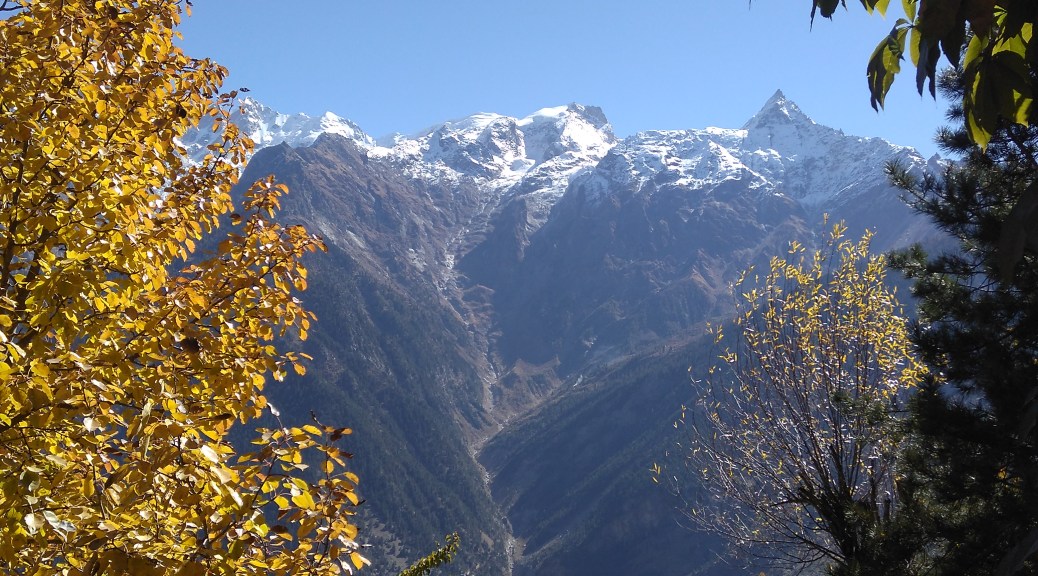
Have you ever dreamed of visiting a place filled with towering mountains, tranquil villages, and clear blue skies? Spiti Valley is an enchanting destination in Himachal Pradesh. Visitors can discover a variety of wondrous things to do in Spiti Valley, such as exploring monasteries, searching for fossils, and stargazing. A thrilling bike trip is one of the best ways to uncover this magnificent region, unveiling breathtaking vistas at every turn. Alternatively, if you prefer a more relaxed experience, you can choose a Spiti Valley tour package for a smooth and organised journey. Spiti welcomes every traveller with open arms and unforgettable experiences.

Best Things to Do in Spiti Valley

Here, you will find some of the best activities in to enjoy on a Spiti Valley bike trip that create unforgettable travel memories. From serene monasteries to thrilling adventures, everyone will find something to cherish in this destination.

1. Visit Key Monastery

Visiting the ancient Key Monastery, named Kye Gompa, ranks among the top things to do in Spiti Valley. Proudly resting on a hilltop for 1000 years, this ancient Tibetan Buddhist monastery appears like it is a carving of a fairy tale. The monastery consists of peaceful prayer halls where visitors can meet friendly monks and even choose to stay at night. The panorama from the high location becomes truly exceptional during sunrise. A visit to this venue offers educational experiences, and visitors can find both peace and photography opportunities.

2. Explore Chandratal Lake

Among all things to do in Spiti Valley, camping next to Chandratal Lake ranks as one of the most ethereal activities. Under the moonlit sky, the shimmering water creates the illusion of a mirror. During the daytime, the lake exhibits a visible transition from blue to green. The complete surround of snowy peaks and total silence transforms this place into the ultimate spot for observing stars. The destination is accessible after a brief walking trek from the parking area. Stay overnight in camps near the lake for a once-in-a-lifetime experience that feels nothing less than magical.

3. Experience Life in Kaza

Kaza stands as the leading town, which serves as the starting point for every adventure in Spiti Valley. It’s a blend of old-world charm and modern comforts. Visitors can roam through Kaza’s markets, where they can try momos and thukpa alongside opportunities to interact with locals and even rent bikes. Warm food and lovely views await visitors at The Himalayan Café and Sol Café. People planning a road trip or needing basic supplies should make Kaza their first stop because it provides all the necessities.

4. Fossil Hunting in Langza

Fossil hunting in Langza stands as one of the most exciting things to do in Spiti Valley for those who love mysteries. Millions of years ago, this area was under the sea. Now, the mountains hide ancient marine fossils like ammonites and shells. Hire a local guide who will accompany you on hill walks and help you to find genuine fossils sticking out from the rock surfaces. You can choose to purchase ancient fossils from residents, which serve as unique souvenir options.

5. See the Mummy at Gue Village

One of the most unique things to do in Spiti Valley is visiting Gue Village, where you’ll find a real 500-year-old mummy! You can witness a genuine monk mummy that naturally protects itself and is displayed in an enclosed glass case. Some believe that meditation enabled the monk to become self-mummified. The journey to Gue village provides beautiful natural scenery, and the place remains less crowded, making it a hidden destination. This mystical and spiritual site reveals a distinct side of Spiti that stays in your memory forever.

6. Trek to Dhankar Lake

Trekking to Dhankar Lake stands as the supreme peaceful outdoor experience within Spiti Valley. Starting at Dhankar Monastery, you can reach the destination in 1.5 hours by trekking. The lake exists deep within mountain territory, untouched by humans. Very few tourists visit these locations, which means you could become one with the surroundings. You can find the entire area to be an ideal location for a picnic because it allows quiet contemplation of nature. When visiting this site, remember to bring water, snacks, and wear comfortable footwear because the terrain contains stone pathways.

7. Spot Wildlife in Kibber

Looking for adventurous things to do in Spiti Valley? Try spotting snow leopards in Kibber Wildlife Sanctuary. Kibber maintains its position as the world’s highest permanently settled village and simultaneously serves as a habitat for ibex, blue sheep, and Himalayan wolves. One can observe snow leopards during winter months, and summer offers suitable conditions for hiking. Local guides organise wildlife tours, and even if you don’t spot a leopard, the mountain views and fresh air are worth it.

8. Take a Thrilling Bike Trip

A bike trip rates as one of the most exhilarating things to do in Spiti Valley. Riding through twisting paths while crossing rivers and visiting traditional settlements under the protective gaze of mountains becomes an unforgettable experience. You can stop at monasteries, lakes, and local cafes during your journey.  Riding on two wheels will create a memory you will never forget.

Conclusion

This region of Spiti Valley holds various stunning surprises, along with tranquillity and remarkable scenic views. Whether you are riding through its high mountain roads, walking through quiet villages, or sitting under a sky full of stars, every moment here feels special. Numerous things to do in Spiti Valley welcome all types of travellers seeking adventure, experiencing natural beauty, local culture, and enjoying tranquillity. It’s a place where time slows down, and your heart feels full. So pack your bags, take the road less travelled, and let Spiti Valley fill your heart with unforgettable memories.
Frequently Asked Questions

1.     What is Spiti Valley famous for?

Spiti Valley is famous for its natural surroundings, ancient monasteries, and soaring peaks.

2.     How many days are enough for Spiti Valley?

A trip of 5 to 7 days is ideal for exploring Spiti Valley, which includes acclimatisation, exploration, and travel across challenging terrain.

3.     Is oxygen low in Spiti Valley?

Yes, Spiti Valley has low oxygen levels because it is located at a height of 4,270 meters (14,010 ft).

4.     Can we see the Milky Way in Spiti Valley?

Yes, the Milky Way is visible to the naked eye throughout Spiti Valley from September to February.

A Weekend Adventure: Hiking to Ankushagiri Fort

On yet another weekend, we were off on yet another hiking expedition. This time, we went to a lesser-known trail on Hosur-Krishnagiri road. The initial plan was to hike to ‘Aiyur Sami Lake’, a day hike organized by the Eco-tourism wing of the Tamil-Nadu tourism department. However, their site was not accepting registrations due to unknown reasons, and hence, we decided to randomly pick a hill around the region on Google Maps and hike it up. That’s when we came across the Ankushagiri fort.

Following the route indicated on Google Maps, we arrived at the base of the start point of the ascent to Ankushagiri. There is a Perumal temple and, hence, a proper space for vehicle parking. Since we arrived on a Saturday morning in the winter months, some pilgrims had already arrived to worship the chief deity here. However, we skipped the temple visit and began our hike toward the fort that was located (once upon a time) on the hilltop.

Ankushagiri Fort and Perumal Temple at Tamil Nadu
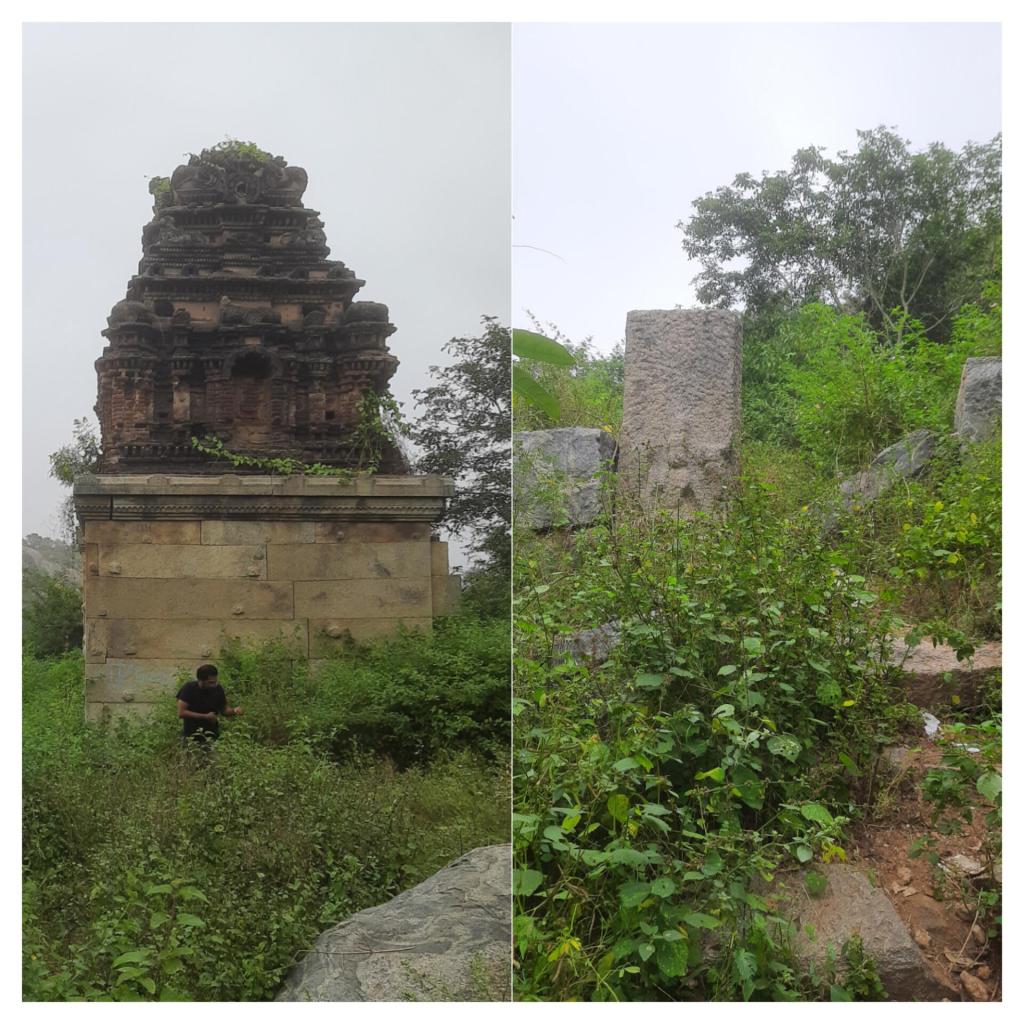
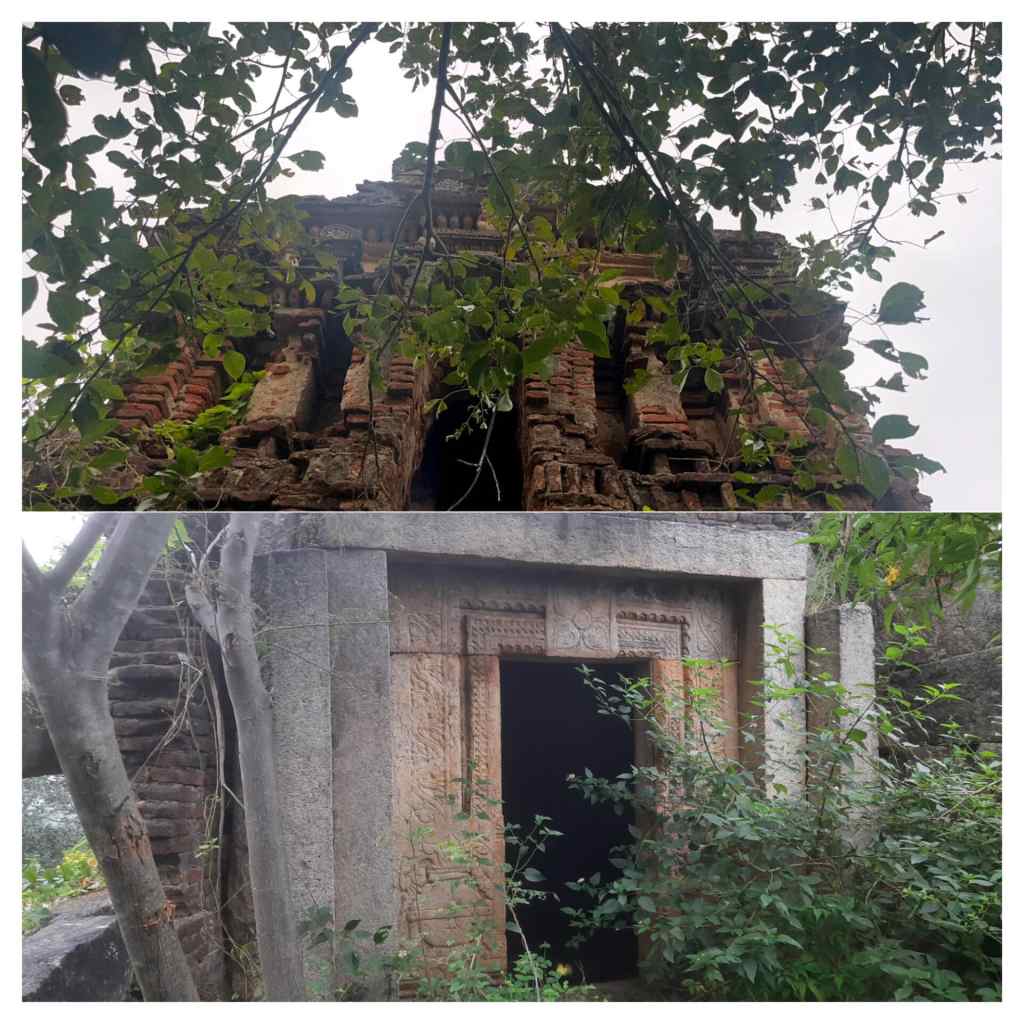
The ruins of the ancient temple at the base of Ankushagiri Hike

At the beginning of the hike route, there is an ancient structure, now in a dilapidated condition. Today, the Sanctorum lay empty with wild bushes and creepers taking over what once must have been a grand temple. The motifs on the walls of the two adjacent temple structures indicated both Perumal and Shiva.

Ankushagiri Fort and Perumal Temple at Tamil Nadu
The ruins of the ancient temple at the base of Ankushagiri Hike

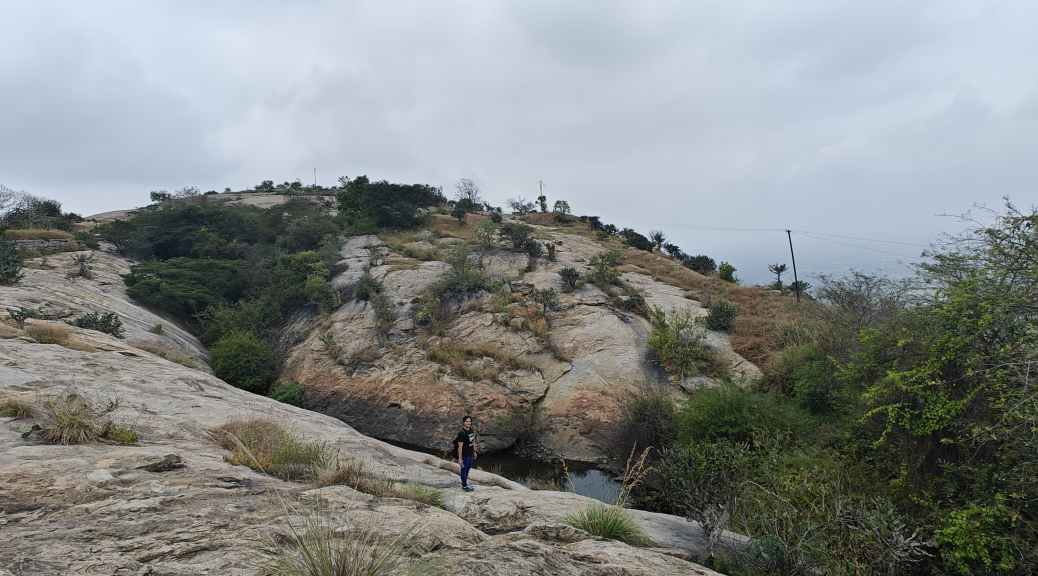
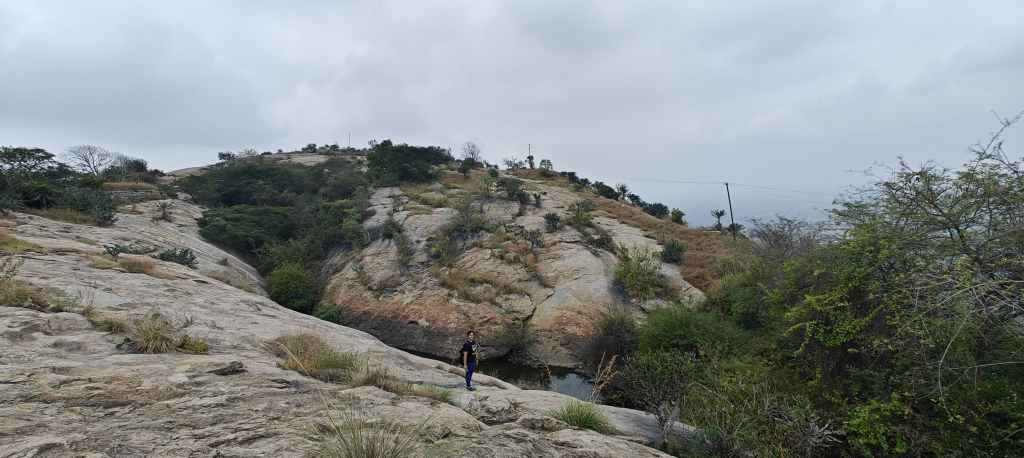
We went ahead from there and stopped after a brief walk. We were confused about the correct trail which seemed to split at a point from where either of them needed some more wear. We casually picked a path and continued to walk on the trail where the thorny bushes then opened to a rocky terrain. The rock looked interesting with varying patterns all over.

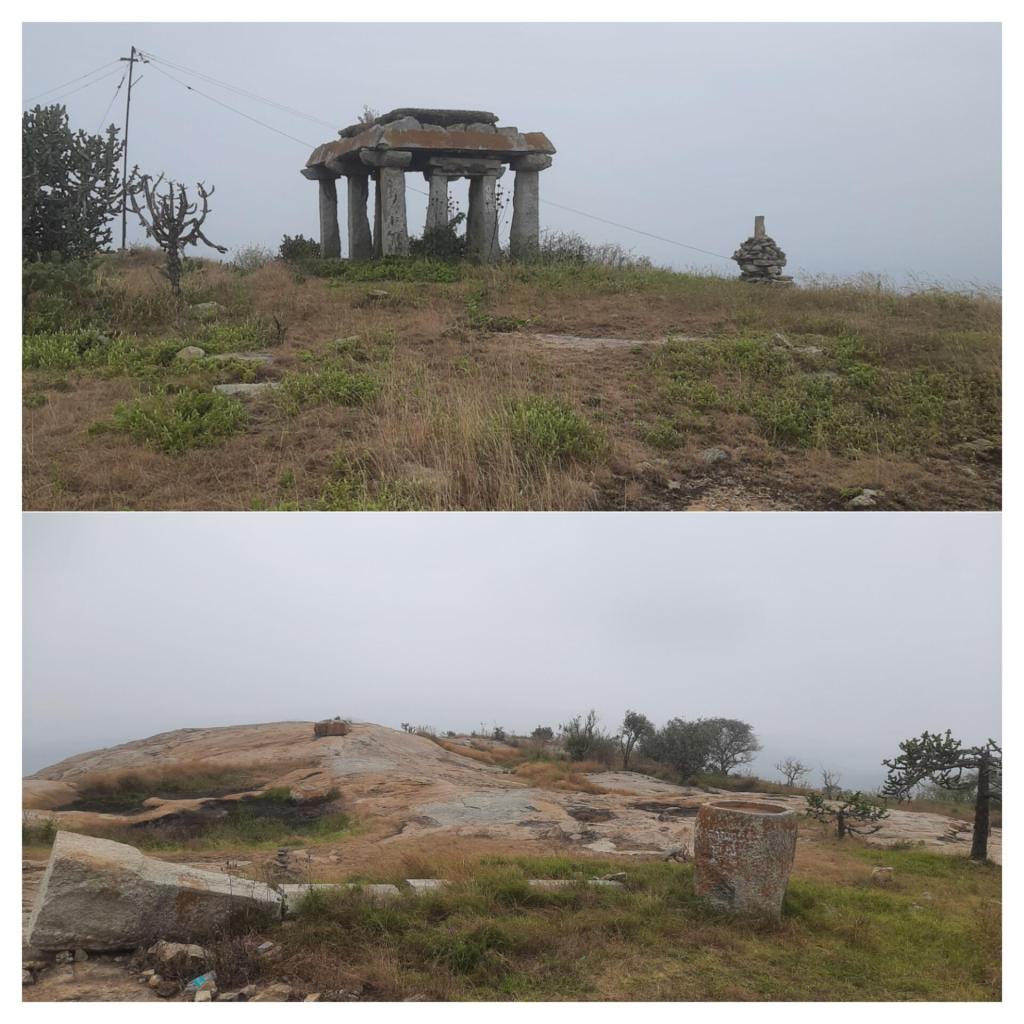
At the top, there were massive cacti plants dotting the area around an abandoned ancient temple structure. Only the pillars remained with the tall Garuda stambha lying down on the side and a stoneware that appeared to be an urn or a waterpot. Some previous visitors to this place had written ‘Someshwara Swamy Temple’ on the stoneware pot for our reference. We rested beside the temple on the large open rock bed overlooking the landscape. The gentle wind caressed our faces while we watched the hills appear one by one at a distance amid the clearing fog.

Ankushagiri Fort and Perumal Temple at Tamil Nadu
The ruins of Someshwara Swamy temple at the peak of Ankushagiri fort

After relaxing for a while and munching on some fruits and nuts that we had carried with us, we proceeded toward the next part of the hill. The trail was beautiful with a rocky gorge on one side and huge cacti lining the path on the other. There, we arrived at a single electric pole that stood in the middle of a heap of ruins of what appeared to be an old fort. Although a circular marking can still be seen to date, only a few large pillars, a few hero-stones like inscriptions, and a couple of kolam designs engraved on the floor were all that existed for us to decipher what might have been the real grandeur, expanse and the purpose of the structure there. Almost little to no history is available to us about who or how this place had served.

Ankushagiri Fort and Perumal Temple at Tamil Nadu
Ankushagiri Hike

Anyway, it was a very interesting outing for us to explore a place so lost in an area where we were the only humans in kilometers around us. We spent ample time there before descending back to the base. We photographed several other patterns on the rocks before arriving at the same bushy junction where we had chosen to take the random path for our ascent.

Upon our return, we paid a quick visit to the Perumal temple before heading back to the city.

A daytrip from Bengaluru- Adi Chunchanagiri

Adi-Chunchanagiri mutt is the spiritual headquarters of the Natha Parampara and Jogi Cult of Hindus of Karnataka. My dad, who had earlier visited this place with his friends, happened to insist on going there again with his family. His intention was not to take us on the spiritual path but rather to introduce us to a hiking path which he found picturesque after having ascended.

One Saturday morning, our family set forth to enjoy this day trip towards Adi-Chunchanagiri. We drove towards Hassan, along an excellent highway until Bellur cross from where we had to take a deviation towards Adi-Chunchanagiri betta (hill) as indicated on google-maps. There on, we enjoyed our drive through the countryside, with traditional homes scattered between vegetable farms, coconut groves, and forest patches of brown boulders and green trees. Google is not always right and that’s why we deviated from the course a little more than necessary until we found the correct track again. But it was the deviation which we enjoyed. We realized that the region is declared as Adi-Chunchanagiri peacock sanctuary. It was no surprise that dozens of peacocks were grazing freely on every other farm, moving around at every turn of the road and everywhere else along our way right until we reached the parking lot at the base of the Adi-Chunchanagiri hill.

Adichunchanagiri
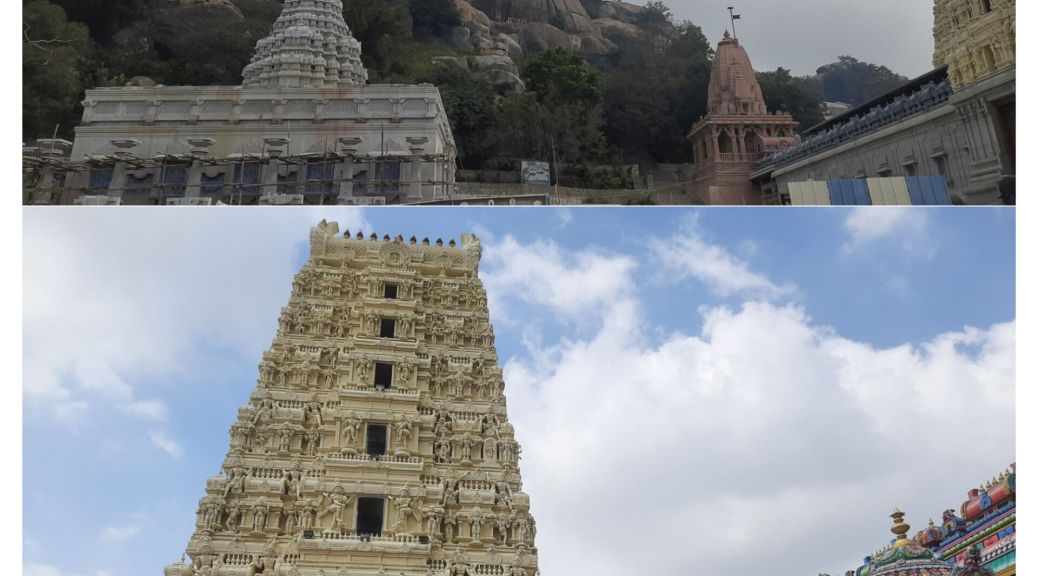
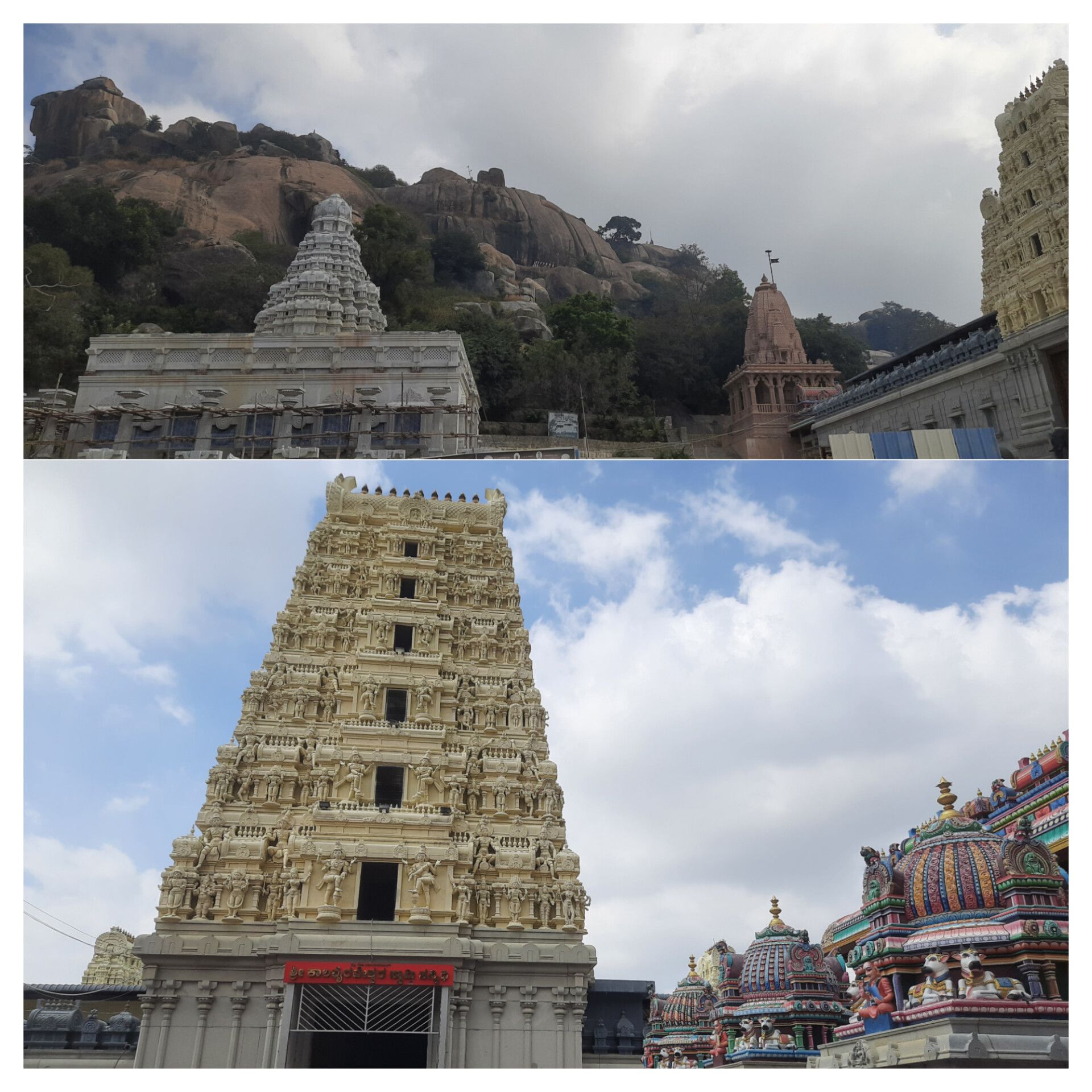
Top: The first glimpse of the Adichunchanagiri premises; Below: The entrance tower of the main temple

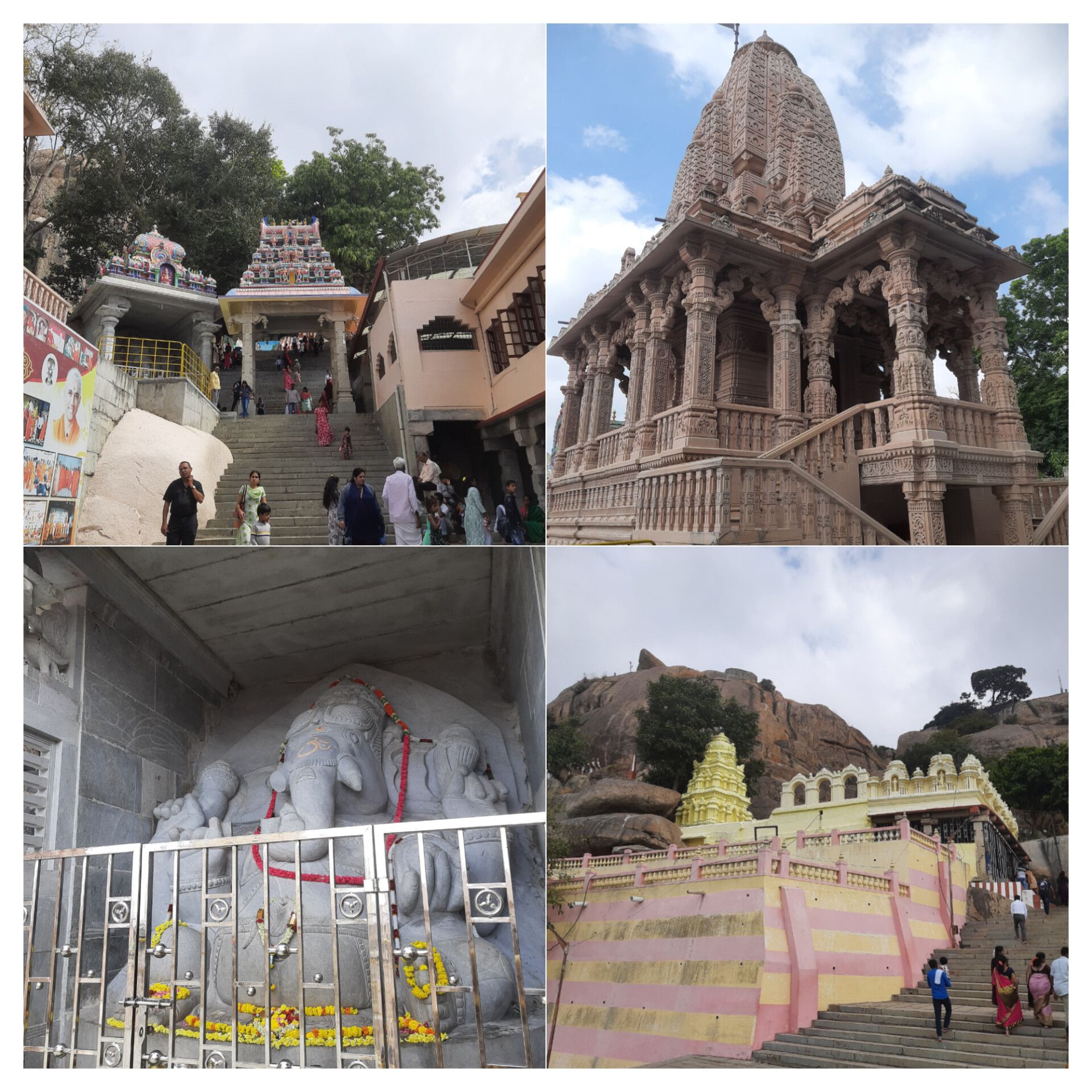
The initial approach towards the mutt premises starts with an ascent of about 100 steps leading to the welcome gate/ arch giving a visitor the first glimpse of the main temple. The large doors of the main temple opened into an ambience that felt divine and calm. It is entirely built with stones, and it gives a feeling of being in one of the ancient Dravidian temples though this one was built in modern times. The deities believed to be residing inside and revered highly by the pilgrims here are Sri Kalabhairaveshwara Swamy and Sri Stambhambika (Kambadamma).
After sitting there for some time, we began our ascent towards the peak of the hill. Just after coming out of the main temple, there is a large Ganesha idol sculpted out of the rocky wall of the surrounding. We continued our climb by passing by some smaller temples with a look around offering beautiful views of the green cover.

Adichunchanagiri
The temples and shrines at the Adichunchanagiri hill

Scores of people were seen climbing up and down for pilgrimage purposes. The climb to the hilltop is done to see the Panchalingas comprising Gangadhareshwara, Malleshwara, Katthale Someshwara, Gavisiddeshwara and Chandramouleshwara, whose temples or shrines are scattered along the trail leading to the summit. But we were there to hike that hill as a recreational activity for the weekend. We climbed up the steep stairs right up to the top with the trail splitting at random places. My family ended up getting lost from each other’s’ sight and then picked whatever trail lied ahead of us and met each other again at the top. Well, not the peak exactly, but just beneath it.

That’s where I gave up any further climb. The peak point of the hillock is known as Akasha Bhairava. It can be reached by climbing the last bit of the rocky hill which had no stairs but only with the aid of a big, suspended metal chain. It was a straight climb (almost 90 deg. gradient) which included a small jump from one rock to an another. I doubted my ability to descend safely even if I were able to reach the peak. My brother, on the other hand, climbed it up and down with so much ease (and grace) demonstrating that he still possessed his ancestors’ (apes) strongest traits.

Adichunchanagiri hill
The view from the top where I was standing beneath the last rock which leads to the peak

After he returned, we all came down towards the main temple where we were guided towards the dining hall. We devoured the delicious temple food before heading back towards Bangalore.

We started back just after lunch to avoid the weekend traffic at Bangalore. But, if you are interested to cover more places in this day, you can google for some of the Hoysala temples along your way and add it into your itinerary.

6 Best Things to Do in Kashmir tour in 2024

The ‘Heaven on Earth” region of Kashmir with the onset of 2024 offers a bucket list of experiences that captivates the soul. This exquisite destination is immersed in hues of emerald-green valleys and azure-blue lakes that are intertwined to weave a timeless tale of its beauty.

The well-curated Kashmir tours invites you to unfurl these layers of beauty in this paradise. With so many options to explore, it becomes difficult to decide from where to begin your journey. Ideally, consider a peaceful shikara ride on the calm waters of the Dal Lake or visit the pilgrimage sites and religious places of worship.

Seek Blessings at Shankaracharya Temple in Srinagar

The magic unfolds if you take up any of the Srinagar tours and visit the Shankaracharya Temple. It is the oldest temple in the valley and is dedicated to Lord Shiva. Many believe that the great saint Adi Shankaracharya meditated here and attained spiritual enlightenment.

Perched atop a hill it offers a mesmerising bird’s eye view of Srinagar and is also known as the Jyeshteshwara temple. The temple dates back to the 9th century and features a fusion of Persian and Indian styles of architecture, with minute detailing and inscriptions embellishing the structure.

The temple holds a special historical and religious importance as it attracts devotees and visitors alike for its tranquil atmosphere, architectural grandeur, and the aura that transcends the surroundings. Pilgrims ascend a fleet of two hundred and fifty stairs, and along the way experience a spiritual vacation.

Golfing in Gulmarg Golf Club

Gulmarg is located around fifty-two km from Srinagar and houses the highest golf course in the world. This prime golf course was opened in 1911 by the British and designed by Colonel Neville Chamberlain. Located amidst the pristine beauty of the Himalayan mountain, it is encompassed by verdant meadows and snow-covered peaks.

This eighteen-hole course blends natural beauty and pits it against a challenging layout, making it a golfer’s delight. As you play at an elevation of 2,600 m, golfers can enjoy the fresh mountain air against a backdrop of tall pine trees. It has been a favourite hub for golf fanatics looking for a unique and stunning experience.

In summer it provides a lush green landscape, while the winters transform the course into a winter wonderland. Making it a year-round golfing destination that is beyond the ordinary. Whether seasoned or novice golfer, a game of golf in Gulmarg is a charming experience to be cherished for a lifetime.

Trekking in Kashmir

Kashmir, regarded as “Paradise on Earth” houses several treks through its alpine meadows and lakes making it a favourite destination for trekkers. The Great Lakes Trek is the most renowned in Kashmir. It leads the wanderers through alpine lakes enveloped by snow-covered peaks, while the Tarsar Marsar unfolds meadows adorned with untamed blooms.

Explore scenic trails from  Gulmarg to the iconic Amarnath Yatra route, and immerse yourself in the pristine beauty that Kashmir’s trekking trails have to offer. The mountain breeze, the music orchestrated by the gushing streams, and the panoramic views stir the adventure soul of the trekkers leaving a heart full of happiness.

Pony Ride Excursions in Pahalgam

Pony ride excursions in Kashmir present a unique and delightful way to come up close and personal with the scenic beauty of the region. The gentle stride of the ponies adds an element of charm as the riders travel across meandering trails, verdant valleys, and remote villages.

The pony rides in Pahalgam take the visitors to places of interest like Betaab Valley and Aru Valley. It is an enchanting experience as the riders are greeted with lush meadows and gurgling rivers. Pony rides traverse through narrow lanes and guide you toward remote areas and hidden gems that are not easily accessible.

Pony rides are also available in Sonmarg where they tread through alpine forests and meadows heading towards captivating viewpoints like Thajiwas Glacier. You can also enjoy pony rides in Srinagar around the Dal Lake offering a glimpse into the city’s alluring surroundings.

Go wild with  Wildlife Tours

The dense forests and snow capped mountains house some of the most amazing and rare species of flora and fauna. Protected amidst the boundaries of more than seven wildlife sanctuaries and national parks, wildlife enthusiasts can explore places such as Dachigam National Park, Hemis National Park, and Kishtwar National Park.

Snow leopards, musk deer, brown bears, black Himalayan bears, griffon vultures, and Monal pheasants are some of the rare animals found in the area. Visitors can also visit birds in one of the twenty-four wetlands as they are home to more than five hundred species of birds.

Shop for Kashmiri Exclusives

Kashmir is a paradise for shopaholics as you can buy souvenirs that blend tradition and craftsmanship. Nobody can deny the warmth of Pashmina and Shahtoosh shawls which have won the hearts of many. The lively and bustling markets are known for hand woven carpets and beautifully crafted paper-mache items.

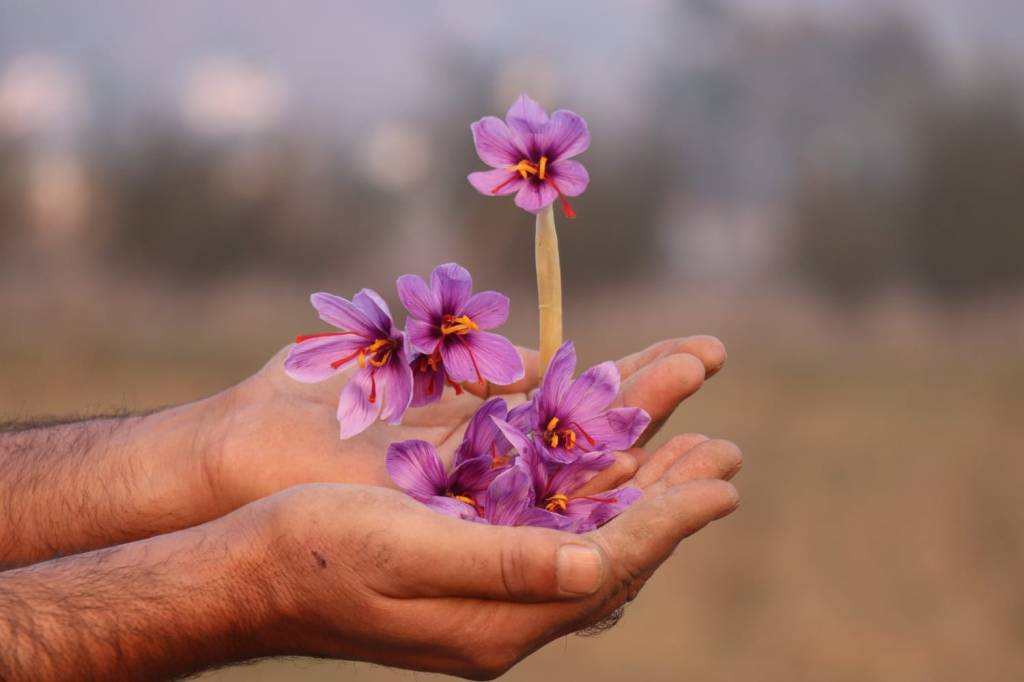
Other exclusive items included are walnut wood carvings, spices like Kashmiri red chilies and saffron to special green tea leaves. Floating markets on Dal Lake are known for unique shopping experiences as vendors sell fresh produce and handicrafts from their jam-packed boats.

Saffron flowers in Kashmir

Weekend Drive- Biligundlu Ranganatha Swamy Temple

Another weekend and another offbeat destination. This time, we found a temple on a small hillock in Dharmapuri district of Tamil Nadu. In my earlier post about Hogeynakal waterfalls, I have elaborated on how river Kaveri marks the boundary between the two states of Karnataka and Tamil Nadu. This post is somewhat related to the same connection. Because the history of the temple that we were planning to visit this weekend is rooted on the other side of the river, on the fertile plains of Karnataka.

The original Ranganatha swamy temple dating to the Cholas or the Vijayanagara era (as described by the locals) was on the Karnataka side. The stone structure of the temple is present even today (we hope to visit the structure on another weekend trip). The idol of the deity was destroyed by the British (which needs fact checking) and then, a new idol was reinstated on the Tamil Nadu side of the land where it stands today. The Ranganatha Swamy temple that we were heading to is in Biligundlu village and hence the name. The idol of the deity is carved out of a rock which is part of the hill overlooking the river.

On a summer day, when the water levels in the river are low, one can walk across to the other bank. Whereas, when the river is flowing full, the roads leading to both the old and the new temples are long ones. The old location is reachable via MM. hills in Chamarajanagar district of Karnataka, and the new temple is reachable via Anchetty forests in Dharmapuri district in Tamil Nadu.

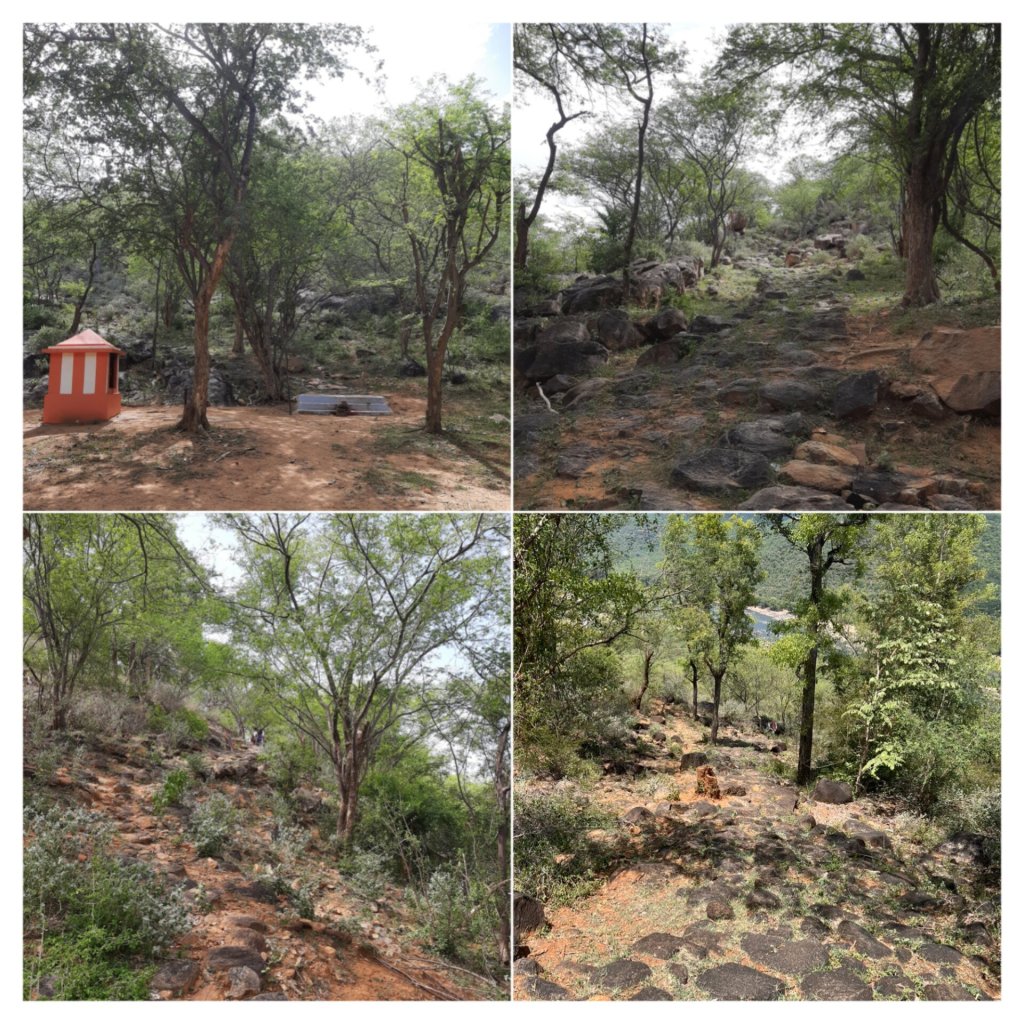
The trail to Biligundlu Ranganatha swamy temple

Anyway, coming back to this weekend, we started early on a weekend morning along the Anchetty forest leading to Hogeynakal waterfalls. We skipped the highway restaurants and stopped by a small local restaurant in Anchetty town for breakfast. It was a good decision as the experience was good with local food and the local atmosphere.

A few kilometers after the Biligundlu cemetery and few kilometers before Hogeynakal waterfalls, we stopped by at a location where river Kaveri flowed onto our right and a tiny structure of brick and mortar was built onto our left… We parked our vehicle there and started our short hike up from there. A properly laid stone path is there all the way to the hilltop which took us around half an hour to hike. The views of the river and hills around were just amazing all the way.

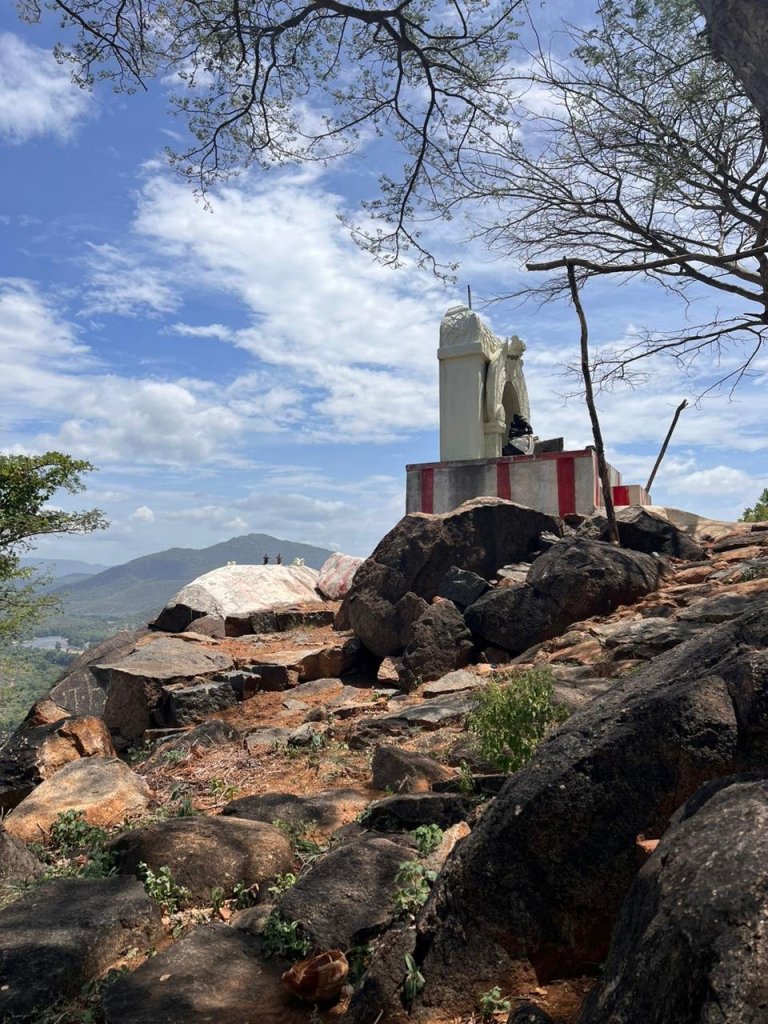
The Ganesha idol at the peak of Biligundlu Ranganatha swamy temple hill

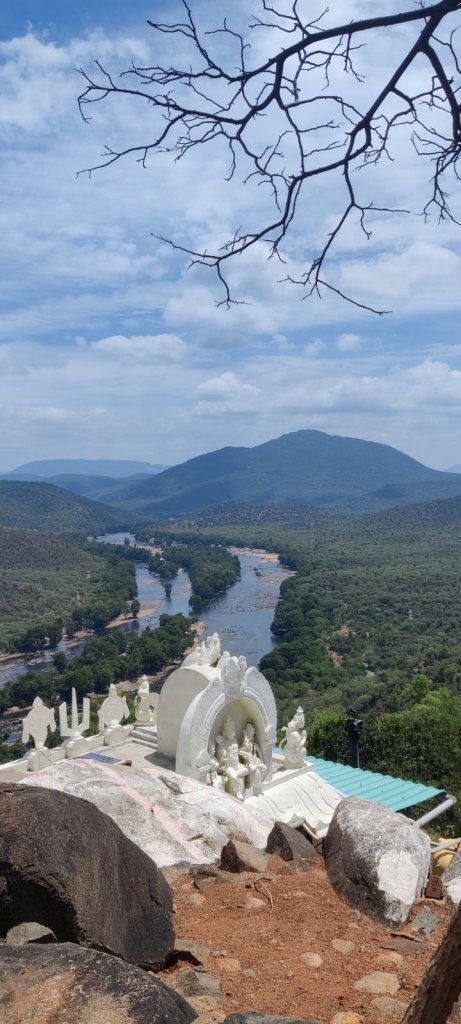
First, we were greeted by an idol of Ganesha sitting under the tree at the peak. This spot gave a splendid view of the river and the hills beyond. We sought Ganesha’s blessings and proceeded to the Ranganatha temple located below, connected by a short flight of stairs. The temple was closed by the time we arrived. However, we could see the idol through the meshed gate. After offering our prayers, we found a spot adjacent to the temple wall and sat there to soak in the beauty of the place. The view of river Kaveri flowing with a backdrop of green rolling hills looked amazing even as the winds caressed our faces. It was a beautiful place, indeed!

View from Biligundlu Ranganatha swamy temple
View from Biligundlu Ranganatha swamy temple; Photo Credits: Sugan @ TheBuffalorider

We headed back after a while and decided to take a dip in the shallow waters of the river to beat the summer sun. A word of caution if you plan to get into the river, that there will be a sudden drop in the depth at many spots and it is believed to have whirlpools as well. We stayed by the shores before calling it a day after a while.

Other nearby places to visit:

A quick getaway from Bangalore- Siddarabetta trek

Lockdown 5.0. simply put, was just another normal day in Karnataka, except that the educational institutions were still under lockdown. So, unwinding on a weekend after a long work week was normal too. With friends, I chose to hike on a Sunday morning to Madhugiri betta, the second highest monolithic hill in Asia. We started from Bangalore at 04.30.am. hoping to start the hike as soon as the gates were opened. While KSTDC has been abundantly promoting post-Covid tourism in the state, we had a surprise awaiting us at the trek base. Since Madhugiri fort comes under ASI’s protected monuments (controlled by the central government), we were told that trekking wasn’t permitted by the Central government. Hence, we were left with two options. Either return home or find another hill nearby where we could hike.

We chose the latter. So instant suggestions that came from someone in the group was Devarayanadurga and Siddarabetta. Then, we decided to give Devarayanadurga a miss as we all favoured a hike over a flight of stairs. We arrived at the base of Siddarabetta where we noticed a board that said, ‘climbing the hill with footwear was a sin’. Since many people use this path to visit a temple situated halfway, we didn’t want to hurt the local sentiments by wearing our shoes. Thinking that ‘a barefoot hike was definitely going to be an experience’ in our heads, we left our shoes back in our car.

img_20200629_012548158654532609925636.jpg
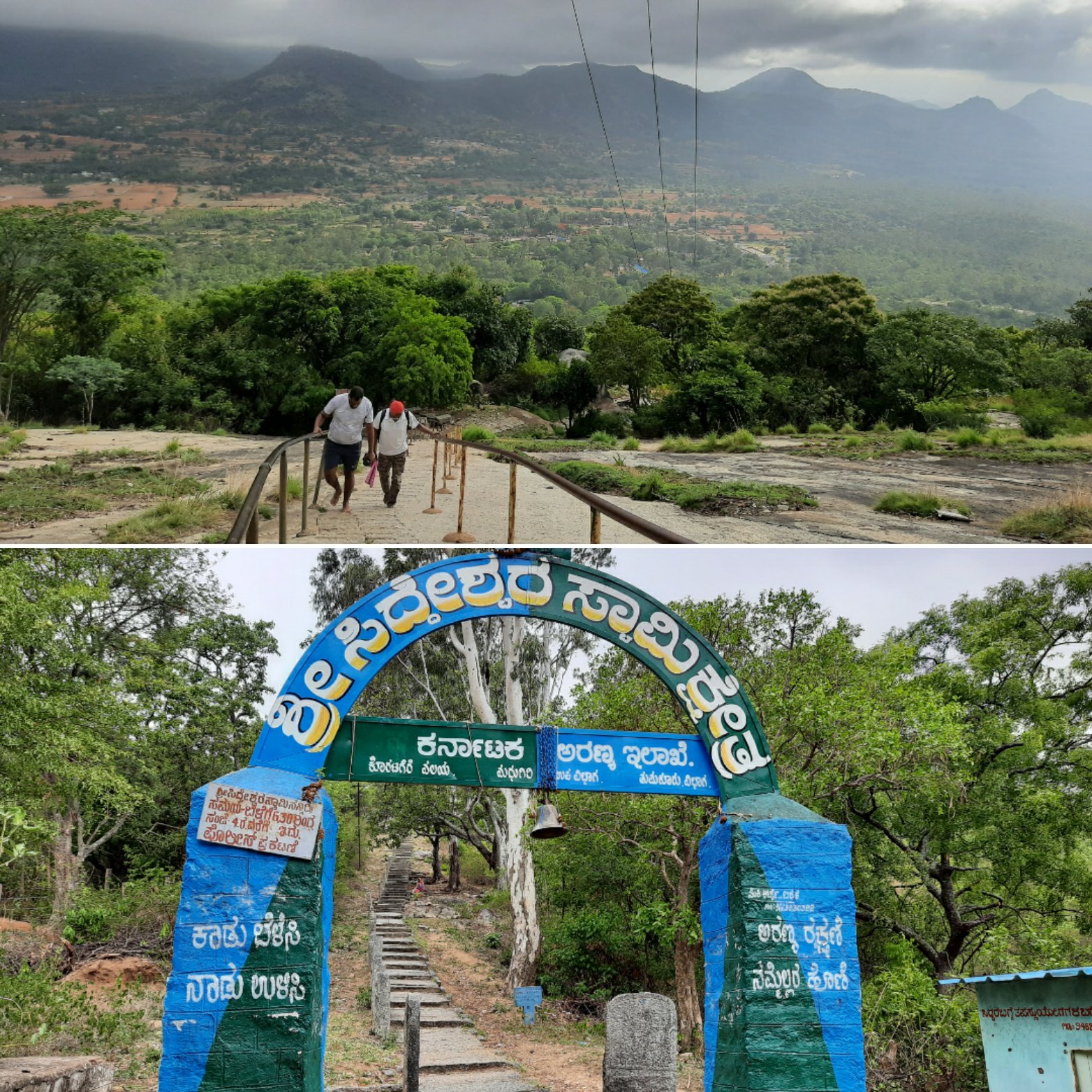
Below: The welcome arch at the base; Top: The initial climb

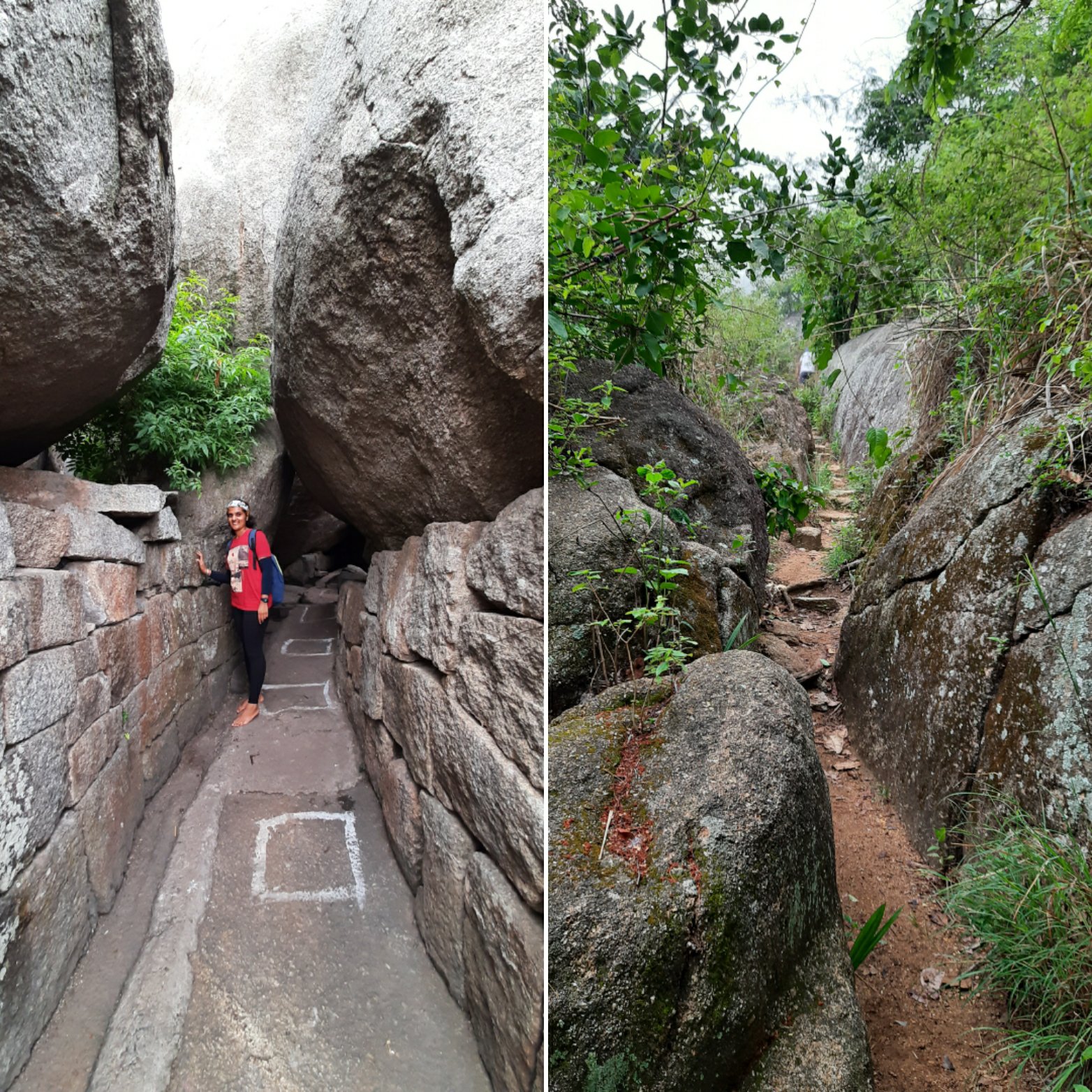
The initial part of the climb, until the Siddeshwara Swamy temple was steep but easy with well laid out steps and iron rods to hold onto. When we reached a small temple kind of a spot, the path split into two. The Siddeshwara Swamy temple was to the left, where too many people seemed to be as if there was no pandemic going on and there exists no concept called ‘Social distancing’. We decided to distance ourselves from the gathering and took the path to the right. With having to pass between too many boulders, it did seem a little confusing initially. The distant passing clouds now seemed as if they had come to meet and greet us. But after walking a little ahead, we reached an area that was a transition from dry rocky mountain to rain soaked green forests. The real challenge of walking barefoot started there, with unassumed ground with gravel and possible thorns from the shrubs.

img_20200629_0129244787596993008460311.jpg
Left: The rocky path to the temple; Right: The forest path to the view point

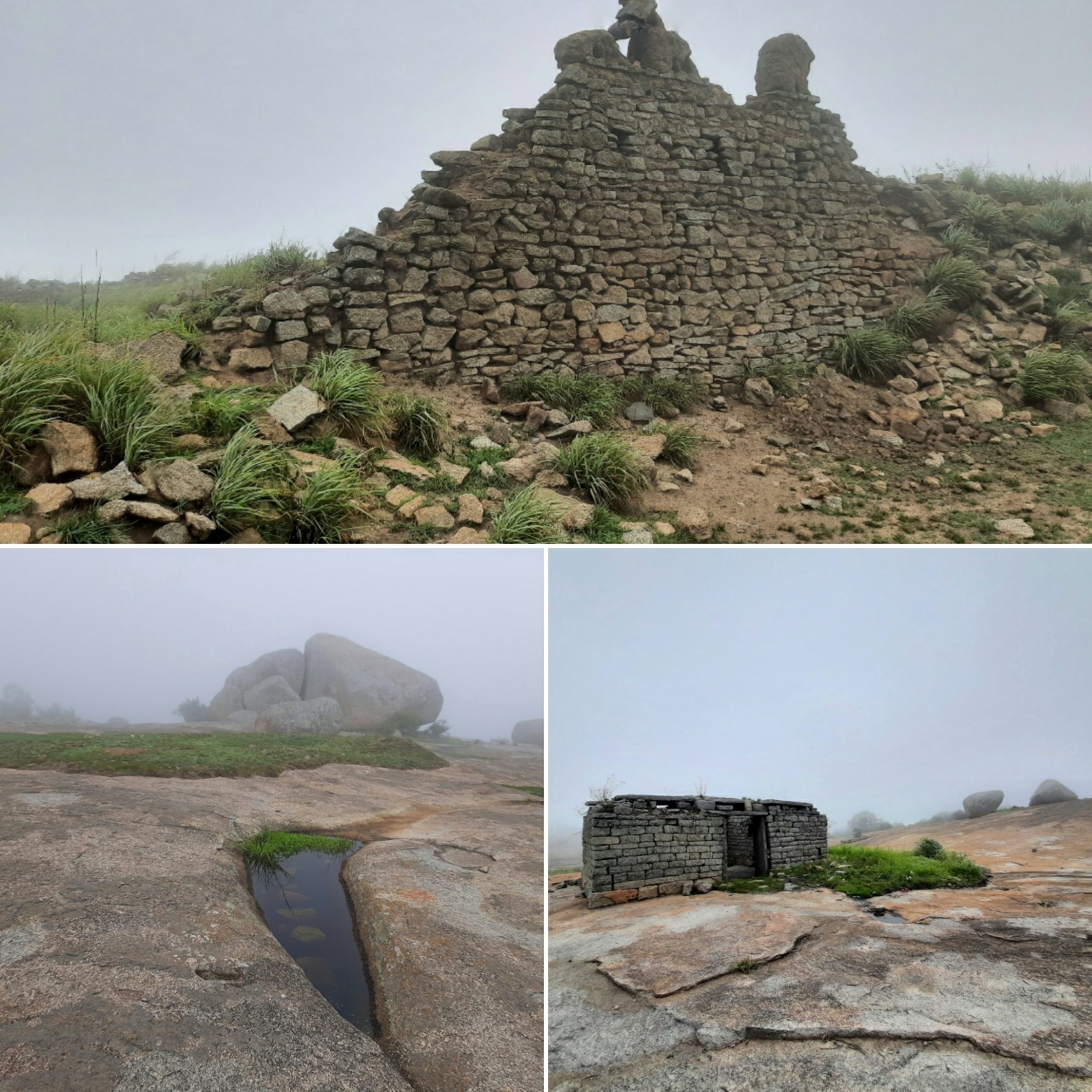
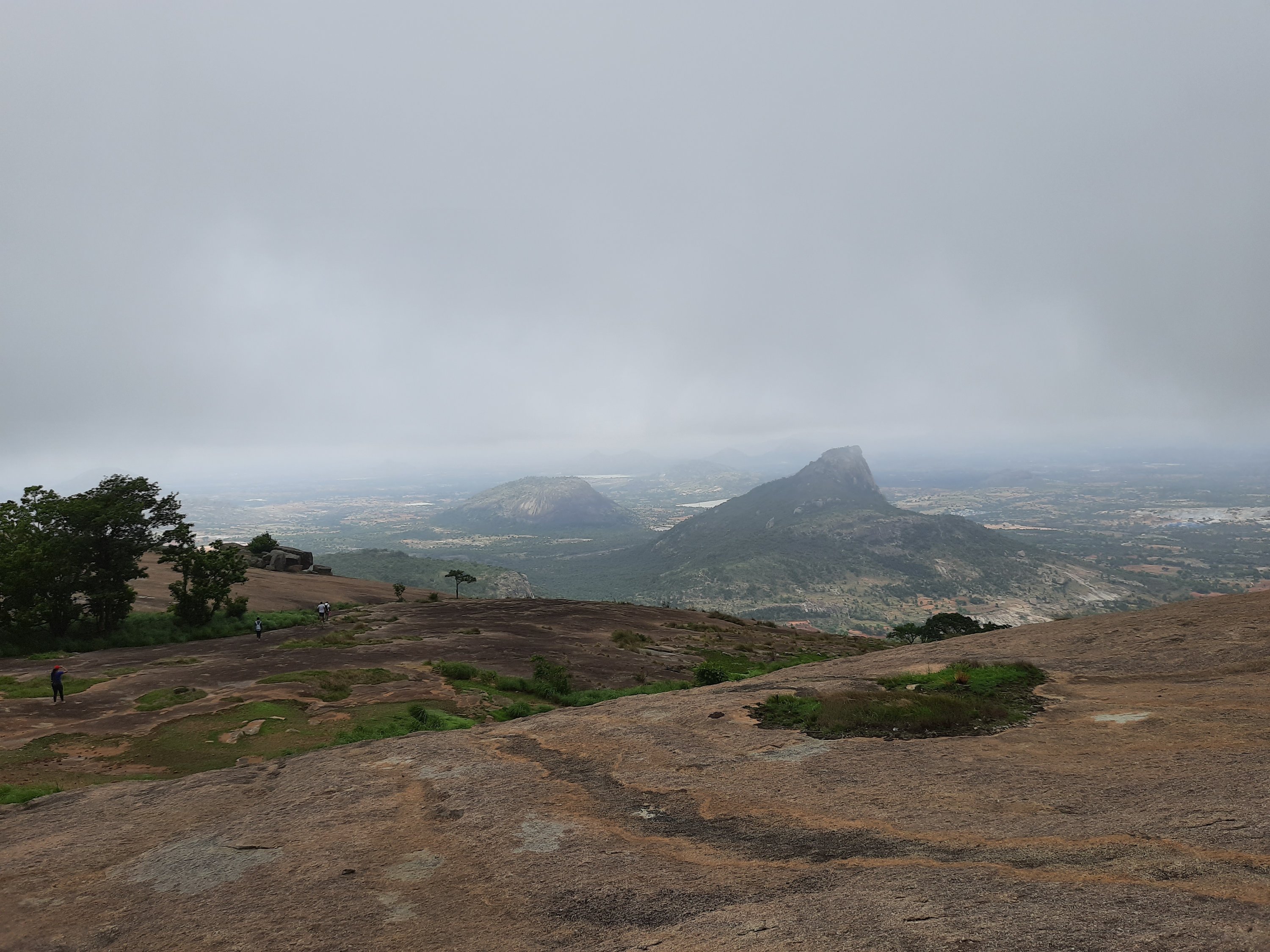
A little further, we reached an open rocky area where the view in front of us was playing hide and seek with each passing cloud. Apart from the drizzle and gusty winds that made it difficult for us to stand, we were mind-blown by the view we saw each time the clouds cleared out. There exists a small rain fed pond, a couple of meditating chambers that house Shiva Lingas (history unknown) and dilapidated remains of an old fortress. There was nobody else other than us in this entire stretch. We walked further and crossed two more hills before deciding to return, or else we would lose our way back.

img_20200629_012750-017598474413961497382.jpeg
Top: The dilapidated fortress wall; Bottom left: A large rock; Bottom right: One of the meditating chambers

It started to rain on our return, and we were quite drenched by the time we made it to the car that was parked just at the base point. The small eateries and stalls were slowly opening by that time which we chose not to visit, in order to avoid any social contacts with anyone else outside the group that we had gone in. We ate a few biscuits as a substitute for breakfast that we had carried from home and decided to stop the car next, only at home. It was a much-needed break and a pleasant little hike.

20200614_085356239470391692277572.jpg
The view at from the peak

Summary:

A valley frozen in time- Dzukou

Rolling hills that has many faces to call it BEST described… Every description depends on who saw it during which time of the year. I was heading to this valley in early winter, 1st week of December to be precise. That’s when the days are warm and nights are cold, but there is no snowfall.

So, as planned my friend and I set foot to see a valley that borders the states of Nagaland and Manipur. ‘It’s a magical place’ is the only thing we had heard. I had done enough research about getting there from Nagaland side and learnt that there are two routes with different difficulty levels. One starts from Jakhama village and the other is through Vishema village. Since we had hired a trek guide, we decided to take the route recommended by her. Initially, not knowing what terrain we would be trekking through, we had carried our large backpacks with all the stuff for our fortnight long trip in Nagaland. But then, our guide asked us to carry just thermals and enough water. “Food and blankets can be bought at the peak” we were told. Anyway, additionally we carried our sleeping bags and some food since we had to utilize what we had carried all the way from Bangalore 😛 We left our luggage at our guide’s house in Jakhama and took a short taxi ride to the start point of the trek. (Watch the video below)

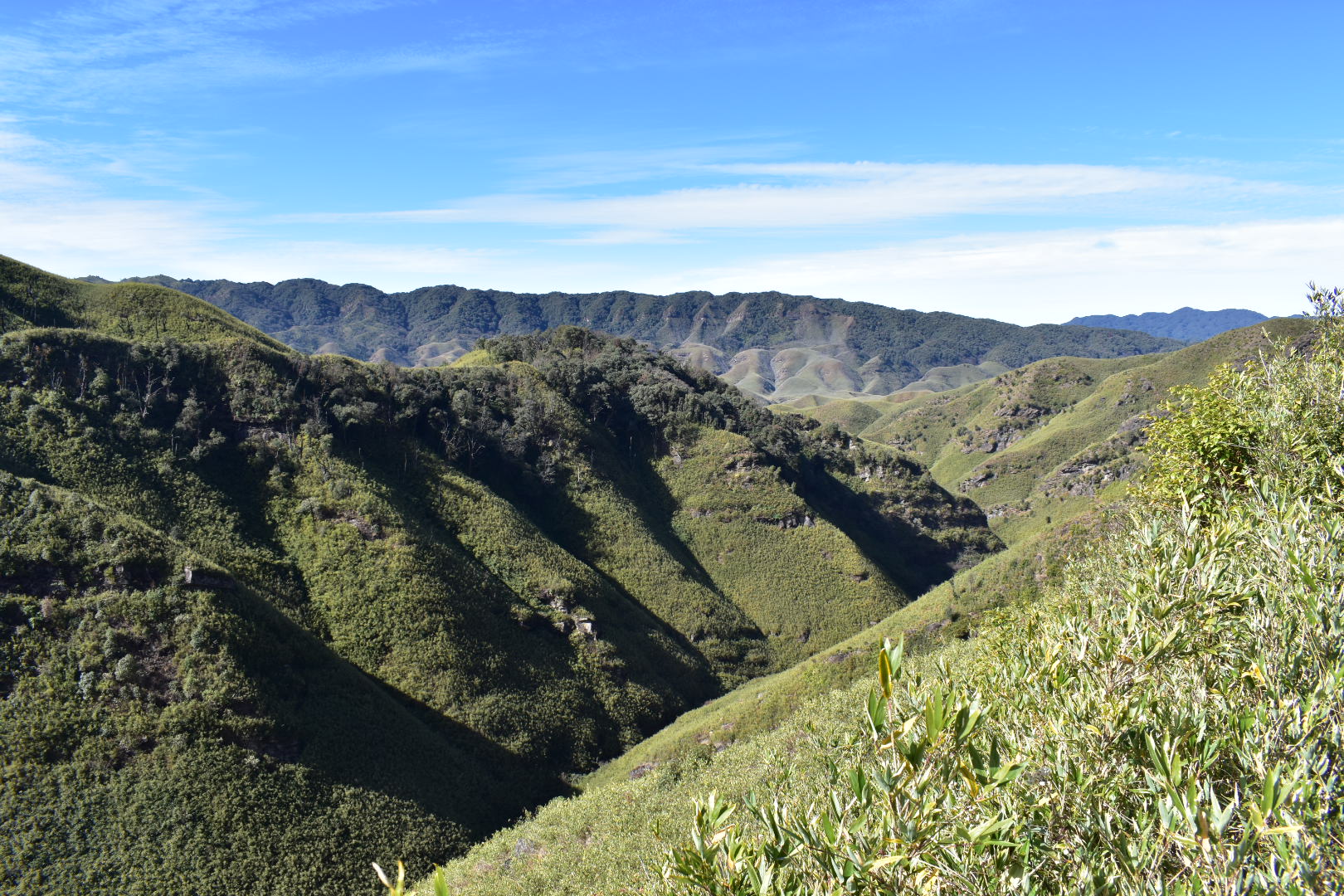
We started to climb up from Jakhama by around 11.30.a.m. and the path was unassumingly steep. The entire trail was encompassed in a thick canopy of trees through which the sun rays could hardly penetrate. Although we were climbing at peak noon, it felt as if it was post sunset. The heat generated by the body while burning the calories seemed insufficient to warm us up. The trail only got steeper at almost 80deg gradient and we kept thanking our guide for telling us to leave our excess luggage at the base. Then suddenly, the forests opened to the blue skies… Before our eyes could adjust to the bright light, we were staring at our first glimpse of the valley. I was at a loss of breath. Not because of the tiring climb or the cold winds that was making it difficult for me stand on my feet, but because I was transported to a different world by the setting sun which had engulfed the green valley. I don’t know if I can express that feeling rightly with words, to simply put it: I was SPELLBOUND!

DSC_0713
The first view of the valley

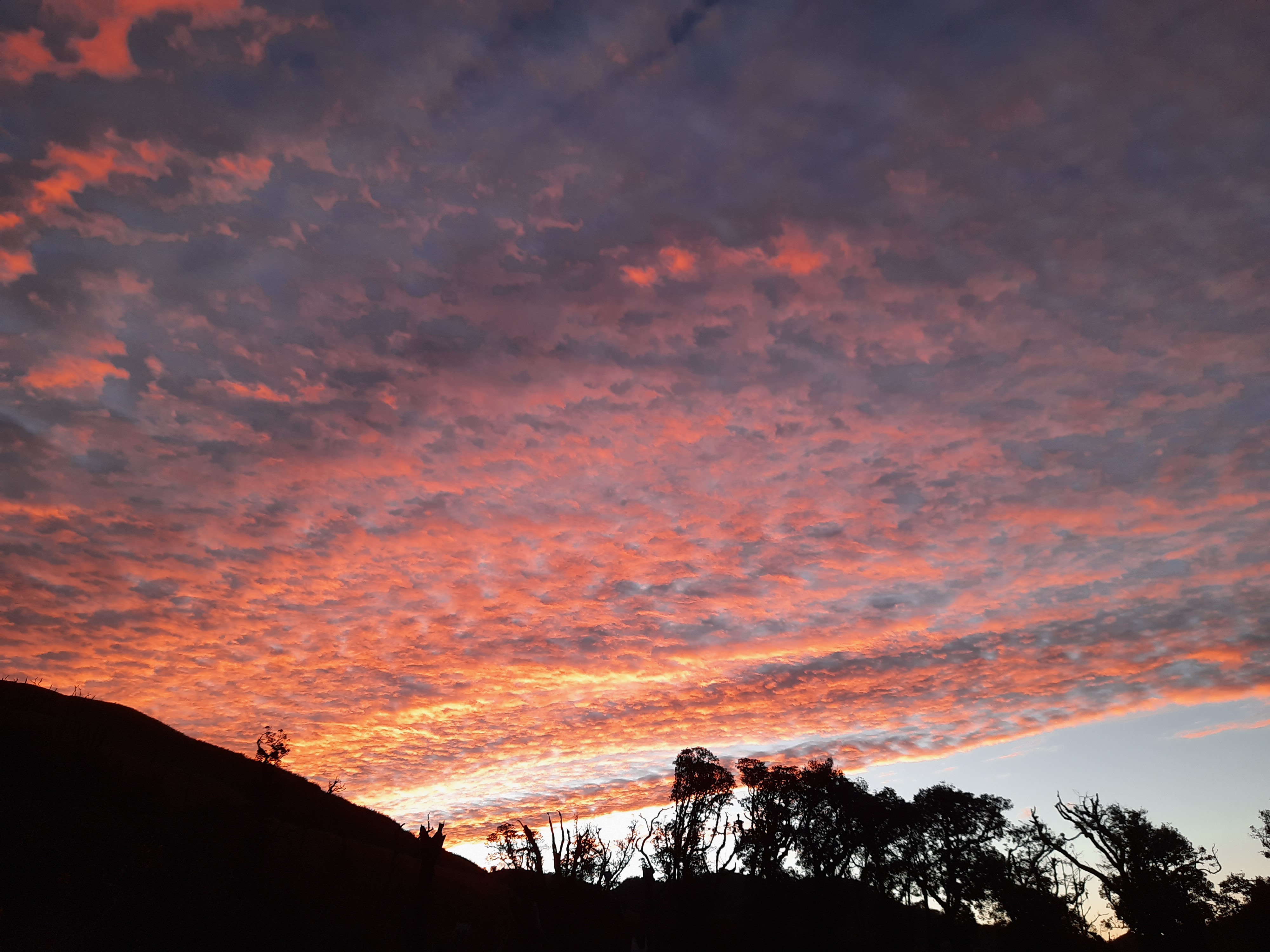
It was a short walk further from there. The trail along the cliff with the green hills appearing one after the other and the sky changing its shade with every second, kept us going until we had finally made it to the guest house for the night’s stay. At 4.30.p.m., when we reached there, it just got dark with the last ray of white light. But the sky continued to mesmerize us as it turned from red to black, in between illuminating the silhouettes of the surrounding hills. I had started to freeze and shiver by this time as the temperatures dropped to single digits. But I did not want to move from there as I stared at what was the clearest night’s sky I had seen in a long while. So many stars twinkled over the Dzukou valley! As reality started to hit me hard, I had started to get cramps in my feet and had to hurriedly go and warm myself with the thermals and the firewood that was lit to cook food in the kitchen.

20191202_053509

As the night passed, the temperatures dropped further. Our thermals and sleeping bags didn’t seem enough and we borrowed additional blankets to help ourselves in the large hall which had just walls, a roof and a wooden floor to sleep on. I could barely sleep through the cold night. Although awake, I was waiting for the alarm to ring at 05.00.a.m. We were supposed to head out to see the Dzukou valley…

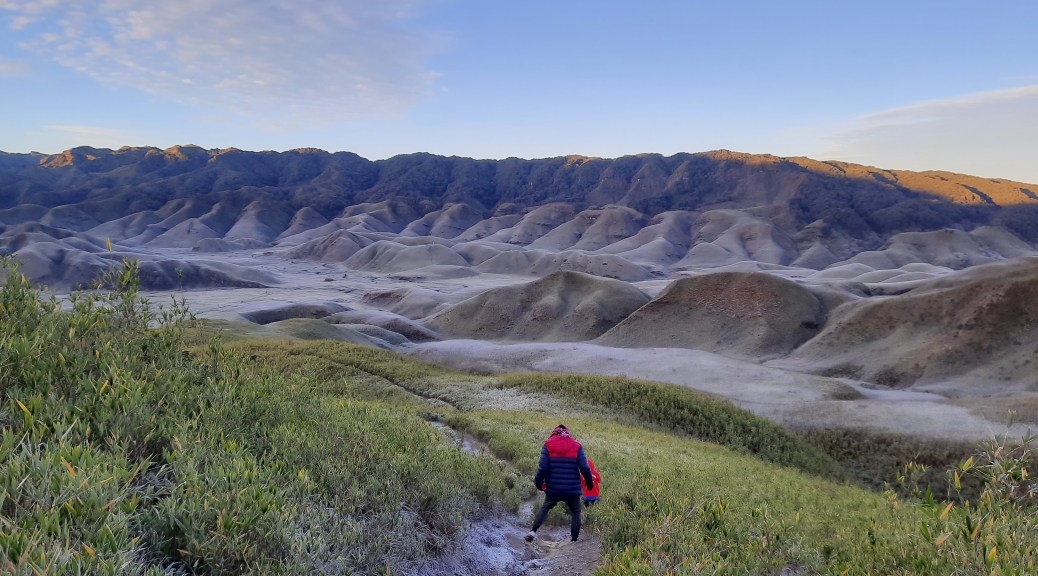
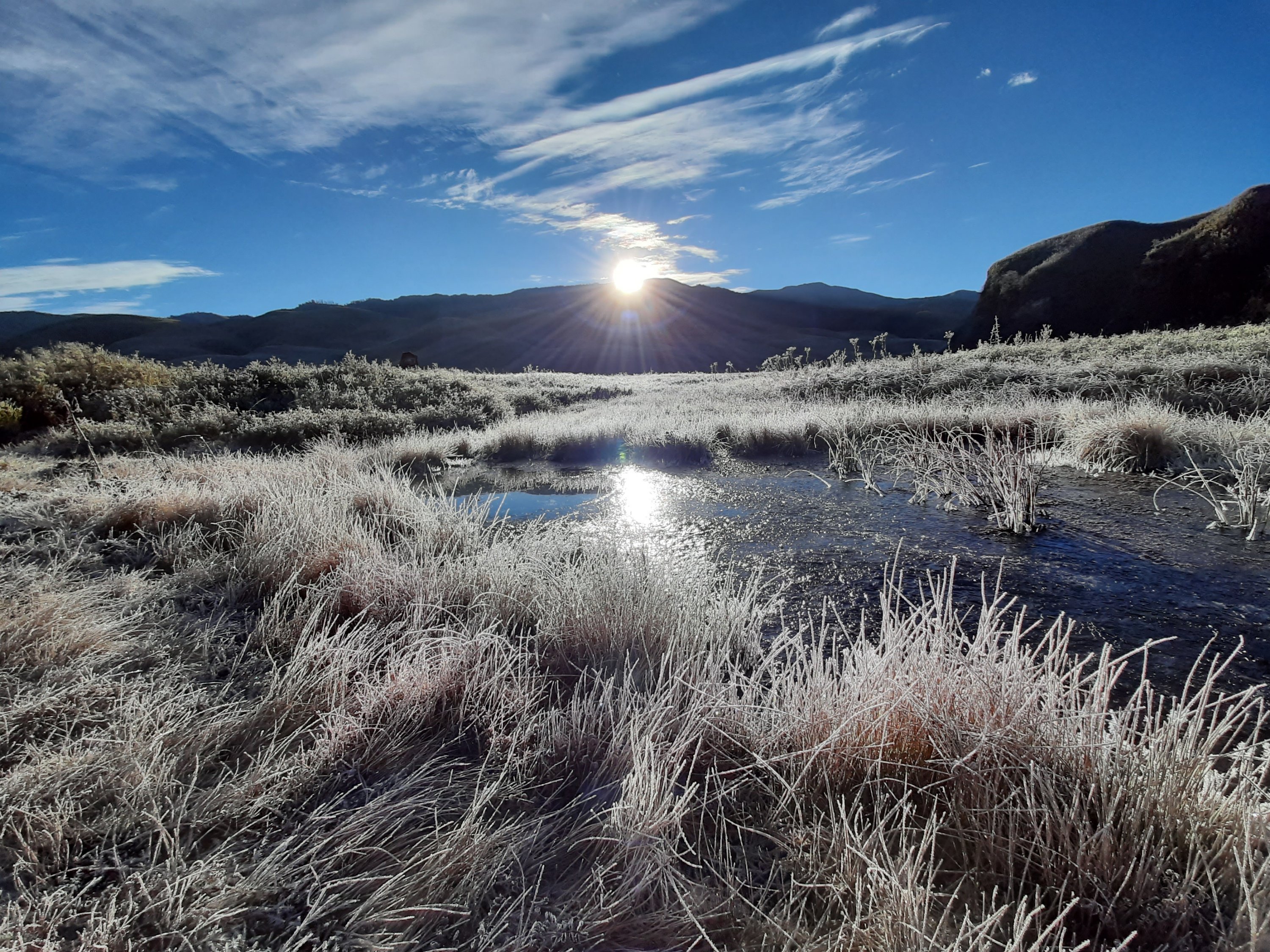
At 05.00.am. I was the first one to get up and step out for the hike down to the valley. The morning light was still dim, and I felt the earth below my feet crackle. It did not take me too long to realize that all the grass on which I was walking and the entire valley that surrounded me was frozen. The temperatures had dropped below zero and the frozen valley at a distance looked splendid! Soon, the others joined me, and we walked down the valley to witness what is supposed to be the main reason for our trek to Dzukou. The sunrise! We walked past what the locals call as the cave and walked over a frozen stream. We clenched bits of frozen waterfalls along the way too… And when the sun rose above and shone over the valley- It looked surreal. It seemed like the phrase ‘Frozen in time’ was framed after someone saw this place. The frozen dew drops reflected the lights of the rising sun and the sight was beyond my ability to describe. What I was experiencing from within was a sense of emptiness, accomplishment, happiness- well a medley of emotions. There has been NO place I had been to more beautiful than this, no I’m not exaggerating.

20191202_0647561534095250733529797.jpg
A frozen pond in Dzukou at Sunrise

The entire valley has a peculiar kind of bamboo grass which gives it its green color. The same valley looks as if it is covered in red/ pink during monsoon. That’s when the lilies, endemic to Dzukou valley bloom. And come during the peak of winter: The entire valley is painted white in snow. This is a photo my guide had shared with me of how the valley looked just 10 days after we returned. The valley does not fail to mesmerize people irrespective of the season they come. Well, after spending a good amount of time, we returned to the guest house, packed up to head back to Kohima, for the hornbill festival.

dsc_07144379477596795501608.jpg
The sky on our way to Vishema

By now, we were a big team of trekkers and backpackers who had all bonded over at the guest house and together we decided to take the Vishema route for our return. It was a brilliant decision, I guess! Had we taken the same route for our return; we would have missed the magical sky behind the forest canopy. The sky seemed surreal with every turn in the trail. The valley too looked magical at every corner. It was flat land that we were walking on mostly, apart from a short trail of very steep rocks to slide down from, until we finally arrived at the base. A pre-booked Sumo was waiting to pick us back to Kohima. I want to bluntly end this post because this place is something better experienced than written about.

img_20200203_2330265481290338984320661.jpg
The view point from the guest house. Top: After snowfall; Below: before snowfall

About the trek in short:

  • I believe what one calls difficult or easy largely depends on individual’s fitness level and trekking experience. According to me, the distance to the peak is short and could be done in 1-1.5hrs if it was me alone. But it was the first hike EVER for my friend and it took us around 4hours to reach the guest house at the peak.
  • Although people feel Vishema route is easier onwards, in my opinion- we made a good decision by walking the Jakhama route while going up. Since it is steep, climbing would be slow but the distance is shorter. In contrary, if we took Jakhama route to climb down, the gradient would put enormous strain on our knees which is why I suggest taking the Vishema route for the descent.
  • Cooked (basic & hygienic) food and potable running water is available at the top, so apart from energy bars for your walk, avoid carrying unwanted luggage.

This blogpost has been featured in ‘DH Travel’, the Travel Supplement of Deccan Herald National daily on 05 November, 2023.

Stone Pulling Ceremony with the Angami Nagas

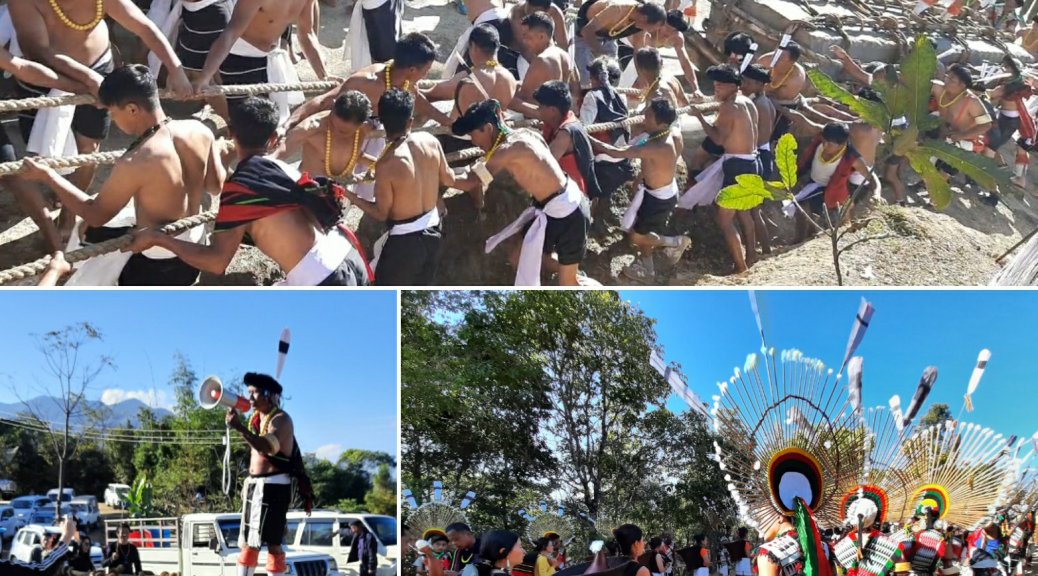
Stone pulling Ceremony is an annual traditional event held across the Angami villages to commemorate a certain important day. It takes place in one village per year on a rotational basis. So that way, it takes about 5 to 10 years by the time this ceremony reoccurs in a particular village. This event is usually timed around the Hornbill festival as there will be people from across Nagaland and outside visiting Kohima (The region where the Angami tribe is a majority).

The stone referred here is a large monolith that weighs several tons and the size and shape is not fixed. It is at the villagers’ liberty to pick the monolith they want to use for the occasion and can be either quarried from the village itself or bought from somewhere else depending on the resources. The large stone slab is then placed on a sled that is made of tree trunks and pulled using thick entwined vines from the forest. Thousands of Angami Naga men pull the large monolith over a few kilometers to finally errect it upright, engrave the details of the event and mark the day.

This year, the stone pulling ceremony was held at Mima village. It was organised to commemorate the 75th anniversary of christianity in the village. The monolith was symbolized for forgiveness, friendship and peace to the enmities that the village had with various villages before the coming of the gospel to Mima village.

The typical stone pulling ceremony (Click here to watch the complete video) is solemnised by the pastor from the village’s church with recitals from the Angami bible before the start. It is then followed by firing a round of shots from the muzzle loaded guns in the air. The captain stands on the slab and shouts Angami cheers through a loudspeaker to motivate the pullers. While all the strong and younger men folk of the village join hands to pull the stone, The eldest two men of the clan walk, leading the tribe. The women get dressed in their traditional attire and walk with a khophi (an utility basket woven with bamboo or cane) hung on their back and they stay around as a mark of support to the pullers. A few of these women carry cotton in containers made of dried bottle guard and walk ahead of the pullers as a part of the tradition. And yet, the remaining women go around distributing gruel made of ‘Job’s tears or Chinese pearl barley’ to all the passersby and the participants from their traditional Aluminium pots. It is served in bamboo cups that are carried in the baskets hung around their foreheads. The gruel provides an instant boost of carbohydrates for the toiling men in the hot sun.

In a Christian majority state, the tribal traditions are still thriving. It was a different experience watching the entire village dressed in their ethnic best and gathering to pull the stone uphill from the starting point to its destination. I somehow drew parallels with the chariot pulling tradition of the Puri Jagannath and several other temples of South India.

Isn’t it true that we all somehow follow the same way of life, only with different names for our faith and the process we follow to achieve it?

My First as a Trek lead- Gokarna

When you feel things are not going right, life has its own ways to heal its kids, you see? While I was feeling morally weak, an unexpected trip to Gokarna was awaiting my way. This time, I was going to lead a group of people, or at least assist a leader with ‘Plan The Unplanned’. With many firsts of experiences in its kitty, I was looking forward for this weekend trip.

So, after braving the outbound traffic on a Friday evening, the group of 25 of us left Bangalore and alighted at Gokarna the next morning. Blame it on the bus driver or the roads, 11.30.a.m. was late by all standards to reach Gokarna for the team that left GGpalya at 11.00.p.m. on the previous night. Anyway, that’s where the leadership aspects began to be tested. Considering that we were 3+hrs behind schedule and all 25 in the group were first time hikers, controlling the overall time to cover all that was mentioned in the itinerary was crucial.

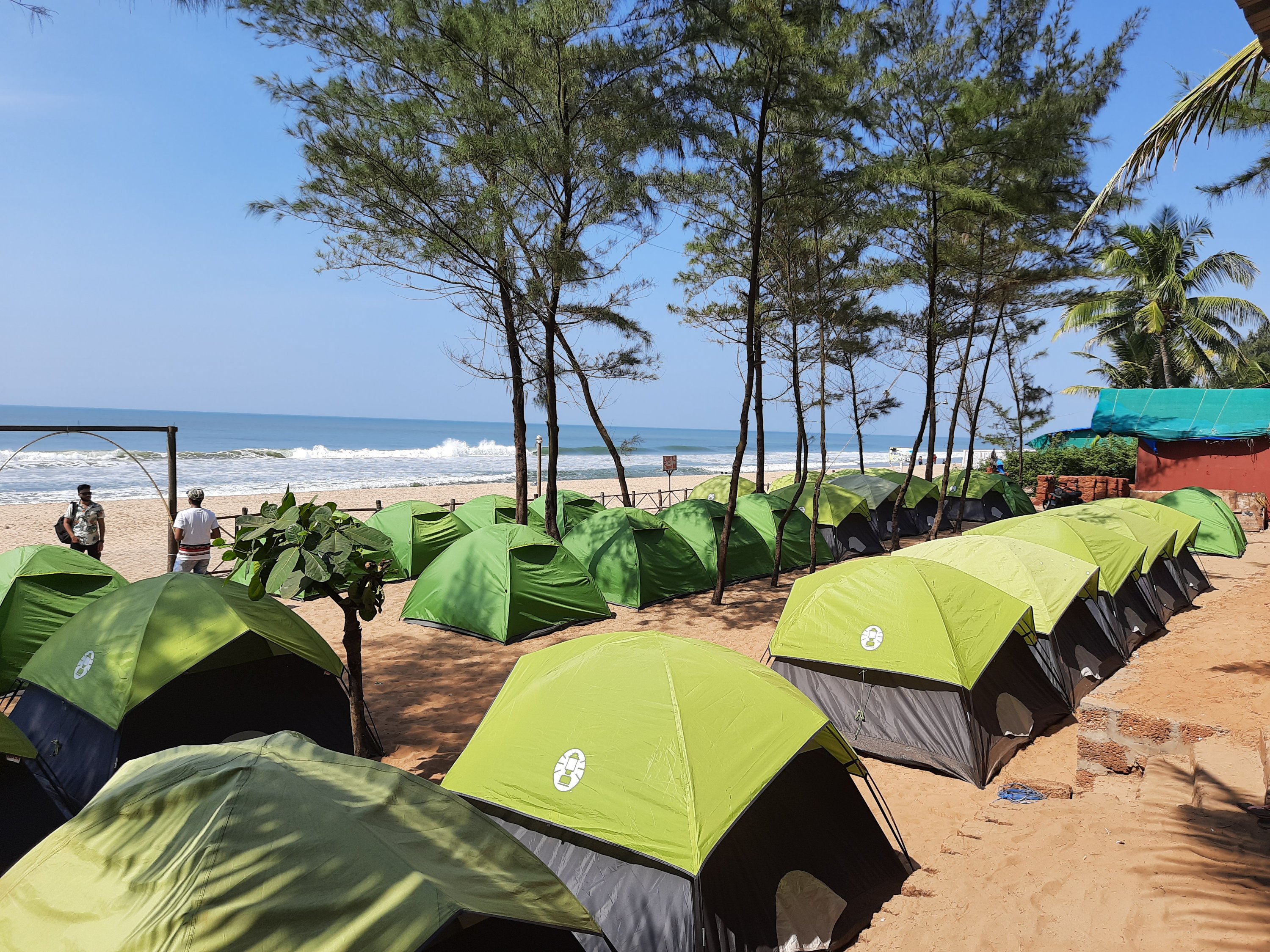
That said, we checked-in to the campsite where our tents were pitched by the seashore. Without wasting much time, the team freshened up and started the hike quickly after a filling breakfast. A minibus took us to the start point of our hike- the Belekan beach. From there, the actual weekend started to unfold. Since the internet is filled with itineraries for a Gokarna trip, I will not add another one to them. Unlike my usual style of writing long detailed posts, I’d like to keep this short and to the point.

20191214_1202132936725430722663151.jpg
The beachfront campsite at Gokarna

For the experienced trekkers, this was merely a walk along the coastline. But even for them, the small stretches of forests opening to amazing views of the blue sea now and then made the walk worthwhile.

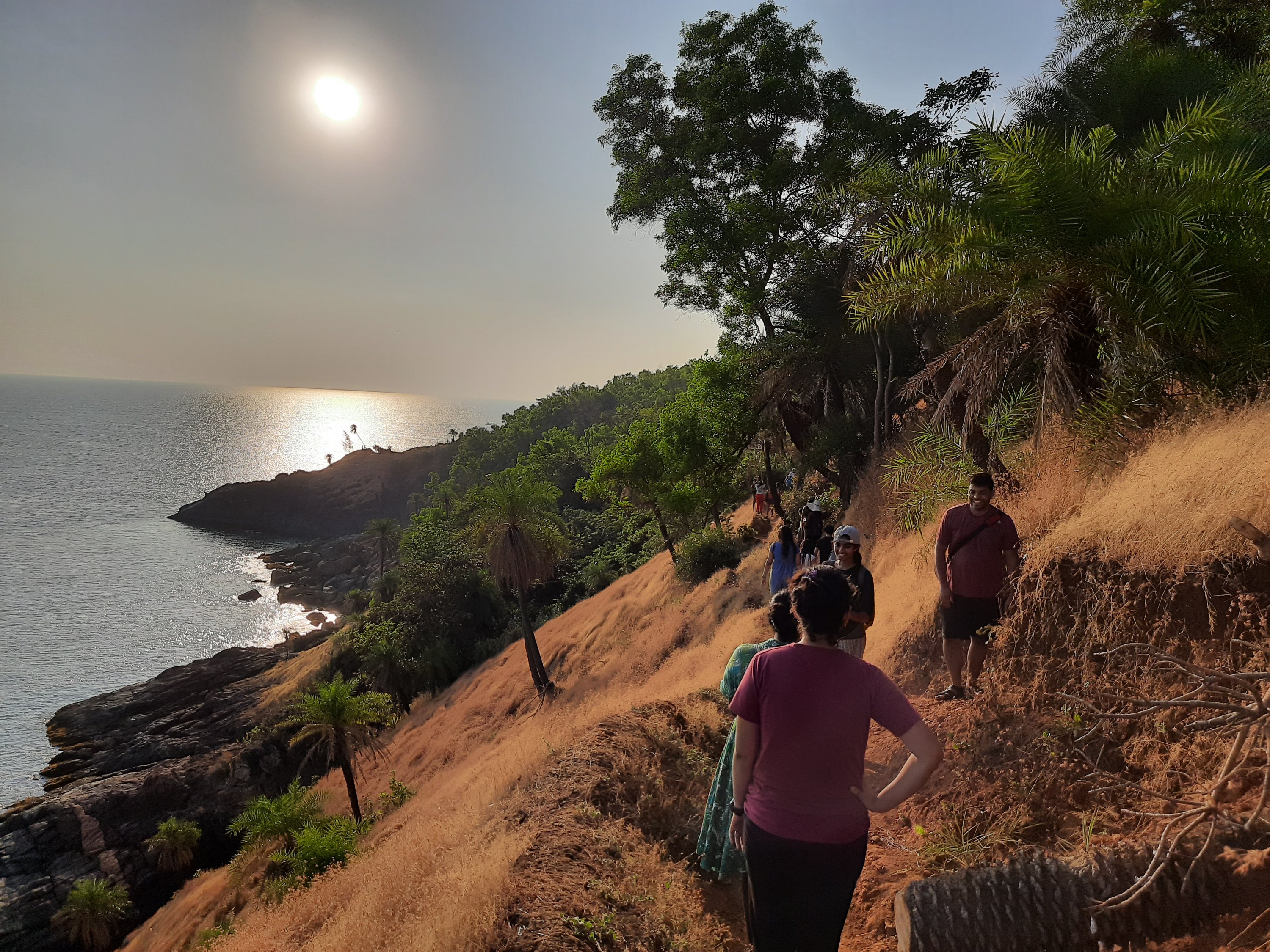
Despite being late, we caught up with the schedule and spent ample time to take a swim in each of the beaches along the trail. Paradise beach for a snack break (fresh tender-coconut water and cut-pineapple with masala are a mandate on any Indian beach), Half-moon beach for a filling lunch (The beachside shacks serve an array of cuisines catering to its large visitors’ base from across the globe), Om beach for chasing the most mesmerizing sunset of the year, Kudle beach for a sumptuous dinner and finally walking along the Gokarna main beach to reach our campsite on a moonlit night… We spotted dolphins from the rock of peace, something that I had been wanting to see for the longest time. And then, I got that long pending hair braid done by a beachside vendor (Click here to read about it in detail). These were the highlights of my beach walk. Until then, I thought my day was GREAT!

20191214_1648531958167003538987319.jpg
The hiking trail between paradise and Om beach

But wait, my co-leads took it up a notch higher. It was late into the night by the time the team had settled down in their tents. And I too was settling down to call it a day. By that time, my co-leads asked me to ditch my tent for the night and join them with my sleeping bag on the beach. The beaches of Gokarna are infamously known only next to Goa for having some badass drunken hippies strolling around. I did not want any misadventures on my first assignment as a lead. Although I was a little hesitant to do something wacky, I soon hit the sands with my co-leads and a fellow traveler.

Just in a bit and even before I realized it, I was sleeping under a clear sky, watching the stars. Well… watching a meteor shower! It was that night when the Geminids meteor shower was at its peak. We laid on the beach counting the number of shooting stars. When only one of us saw the meteor, the others would pull her leg telling that she was hallucinating. When all of us saw it together, we would shout in unison scaring away a few drunken people loitering around the beach. They would wonder who was drunk 😀

Eight… Nine… Ten… We counted the number of stars until we fell asleep to the lullaby sound of the waves. When I opened my eyes again, I was lying on the beach and seeing the white lights from the distant ships disappear into the light of the breaking dawn. This beach experience is something that killed it for the mountain girl in me!!! Only because I could strike a similar chord of interests with an awesome pair of co-leads and I can’t thank them enough for the night!

Yeah, managing a large group comes with its own set of challenges. Managing medical emergencies in the middle of the trail, accommodating quick changes in the itineraries and finding alternate destinations when abnormality struck were the unexpected things which I believe we handled with diligence. All said and done, the trip has been a memorable one in more than one way and a thumbs up to my new journey with Plan The Unplanned 😊

Join me in my future expeditions with Plan The Unplanned. Click here to sign up!