Sometimes, it is not about the place.. It is about the people that brings you closer.. And that’s precisely my take on this little quaint village called Mawlynnong.. After a refreshing drive through some breathtaking views and best roads of India, we had alighted at ‘God’s Own garden’ nestled deep in the East Khasi hills of Meghalaya. Although it is being largely promoted by the Meghalaya Tourism Department(MTD) as Asia’s cleanest village after being awarded so by the ‘Discover India Magazine’ in 2003, I feel it holds a different charm in it with the warmest people I have met so far!
This post is part of my fortnight long road trip across North-east India, specifically covering parts of Meghalaya – Assam – Arunachal Pradesh I had tagged along with two other travelers and drove around the state of Meghalaya visiting Shillong – Smit – Cherrapunjee – Mawlynnong – Dawki – Ribhoi- Shillong.
Tourists flock to this place in large numbers just because they have heard about it in MTD handouts. These senseless creatures litter the place extensively with chocolate wrappers, chips sachets etc. all strewn around this supposedly cleanest village they have come to see.. But, the humble villagers watch on with a smile and pick up these wastes themselves and put them in the cane trash bins places visibly infront of every household in the village, thus keeping up to its reputation of being clean!
Things to see in Mawlynnong:
• Inside Mawlynnong village: The old church, floating stone, the water shed and the Bangladesh view point. • 1 kilometer away: Riwai village (Living root-bridge)
The Details:
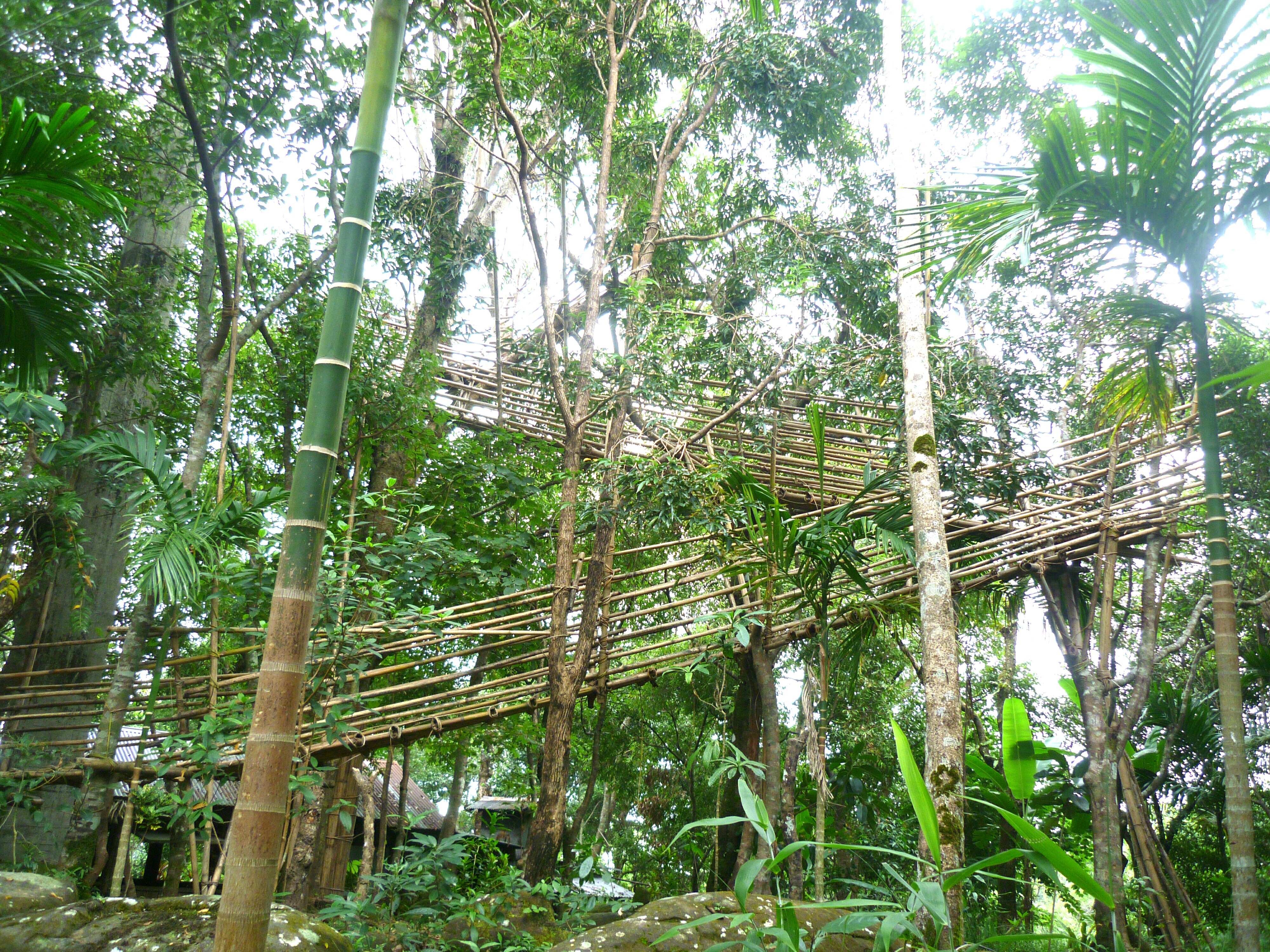
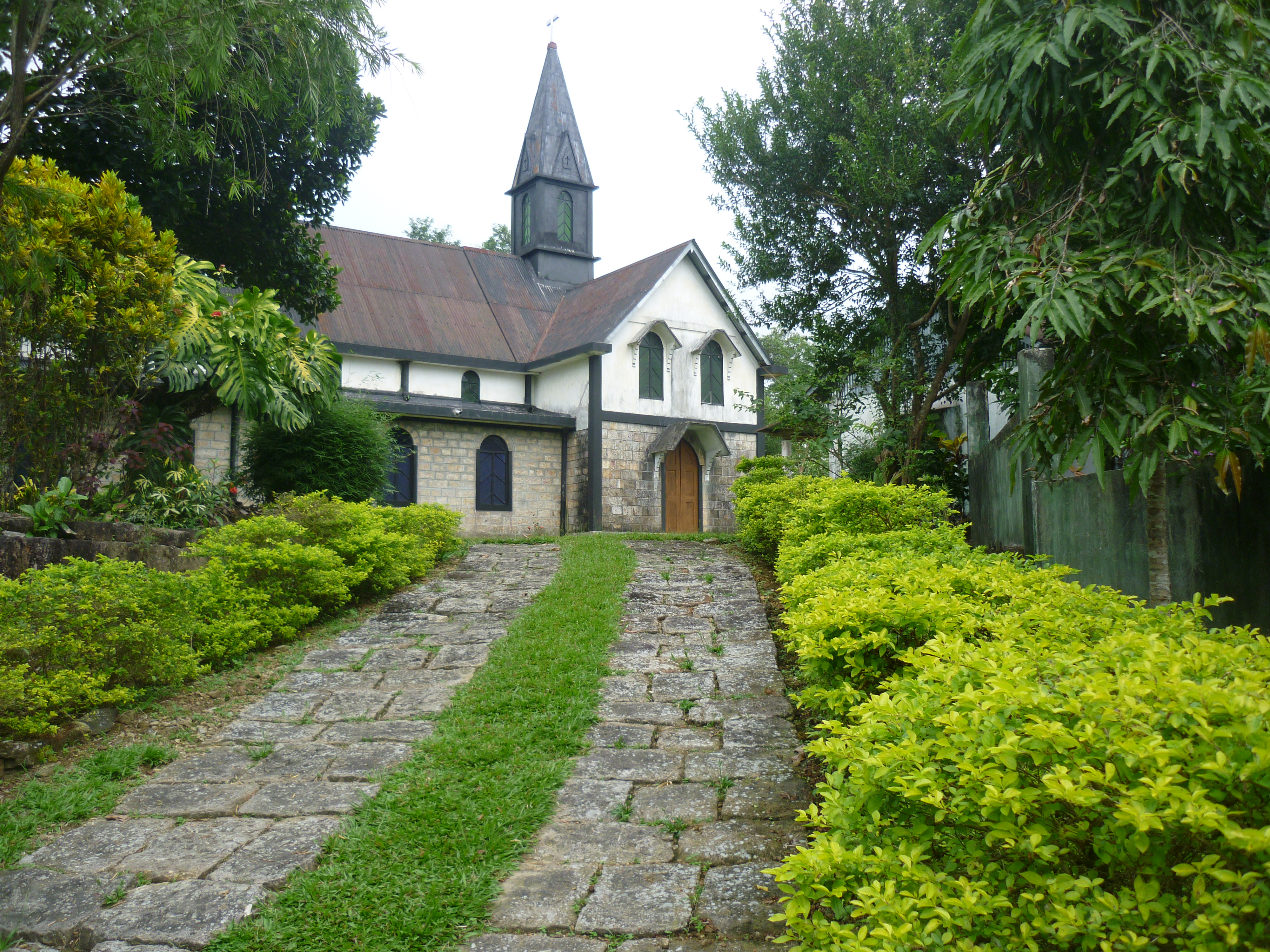
I walked around the laid back lanes of the village exploring the old church, the floating stone and the water shed maintained by the villagers. The flowers lining the fences of each household added myriad hues to the green village and grey of the cloudy sky.. I climbed up the skywalk laid up with bamboo and cane that threw up a nice view overlooking the plains of Bangladesh.
The Skyview bridge at Mawlynnong
Finally, I settled down at a locally run restaurant for a cup of chai to beat the chills of the cloudy weather. I caught up on a conversation with a pretty Khasi lady draped in her Asiangyake (the traditional dress of the Khasi women also called Dhara). While she helped me to memorise a few words in her dialect, I learnt about the Khasi culture and customs. Being a matrilineal society, women are respected and are given the preference to choose her husband-to-be. It is considered a bad omen, if a man proposes to a woman.
While she was attending to other customers at the restaurant, I called out for ‘Oikong’ (Khasi alternative for addressing ‘Didi’ in other parts of northern India) to help me with some Soh (Khasi for fruit). “Ohhhh” A voice filled with humility came in response… She then sat down with me and prepared a plate of pineapple seasoned with salt and flakes of the ‘Bhut Jholokias’ (the spiciest chilli in the world). It was one of the best snack I had in years!
I then walked down to the playground where some local kids were playing. They seemed excited to meet me, talk in English and pose for a few candid photos. It was a warm and a very pleasant evening for me. There is nothing in particular in this village to see or do.. Yet, the nomad in me strongly intended to stay there for an extra day. There are homestays that are available where the warmth of the Khasi hospitality can be experienced.
Kids playing on the lanes of Mawlynnong
I would recommend an early morning walk to Riwai village that helps you avoid the chaotic tourists who flock in later during the day. At a distance of about 1km before Mawlynnong, is the most easily accessible living root bridge and hence, a lot of visitors throng down. So after a nice walk, savouring a nice Khasi breakfast and lemon tea, it was time to pack bags to head out to my next destination- Dawki: the last village of Meghalaya on the Indian border!
The church at Mawlynnong
Request to tourists:
Please remember that the sole reason that you are at Mawlynnong is to see how ‘Asia’s cleanest village’ looks like. How on earth will you ever feel like littering such a place? Do you want to see if you can take off the ‘Cleanest’ tag from the place? Or do you want to just prove that you are only an uncultured educated rich person who could afford enough money to tour the North-east India? Ask yourself… Be sensible and responsible!
This post is part of my fortnight long road trip across North-east India, specifically covering parts of Meghalaya – Assam – Arunachal Pradesh I had tagged along with two other travelers and drove around the state of Meghalaya visiting Shillong – Smit – Cherrapunjee – Mawlynnong – Dawki – Ribhoi- Shillong.
A long winding highway up the hill from Guwahati leads to Meghalaya: Abode of the clouds. And up there, one will be greeted by blue waters of a calm lake flanking the road on the right with no sign boards indicating the arrival at Ri Bhoi district. With no major landmark to explore for a typical tourist, this small distrct is full of fables and legends. If you’re someone interested in fairy tales, I highly recommend you to take a local person with you and follow my trail.
The Umiam lake from NH40
The Umiam Lake or Barapani has been gracefully present there in a serene backdrop of green hills of the state. There is no passerby who doesn’t stop for at least a minute to capture the beauty of this place! This is a man-made lake formed due to the construction of a reservoir across the Umiam river. Today, this reservoir is one of the main sources of potable water to Shillong. For people looking for a leisure trip, one can go for boat rides in the clear waters of the lake. It is also called as the ‘water of tears’ named after a legend which talks about two sisters who were travelling to heaven. It is beleived that one of the sisters slipped from the hills and died, the other sister cried out of grief and her tears are said to have trickled down and formed the lake!
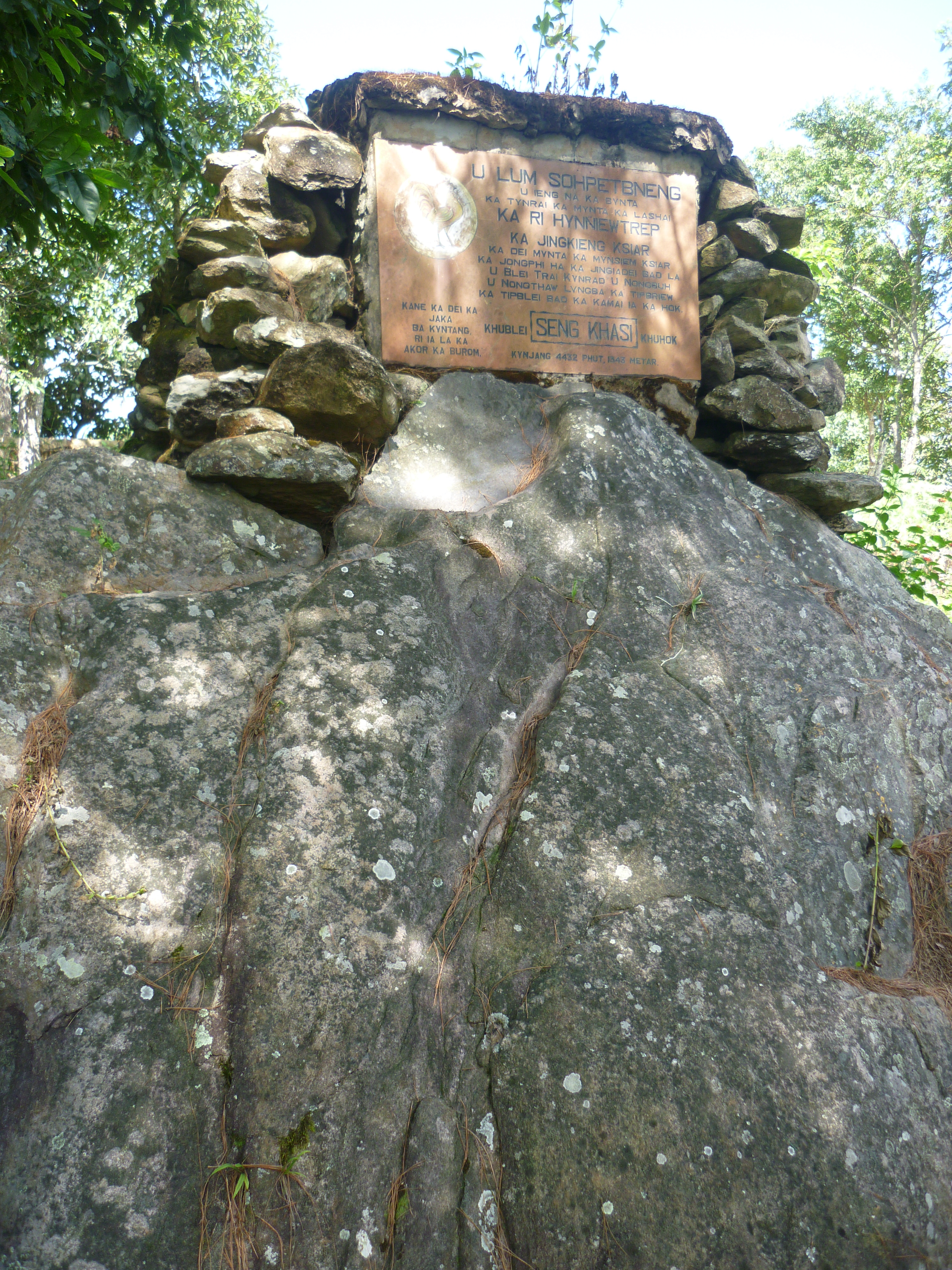
We had read about this place called ‘Lum Sohpetbneng’ close to Umiam and asked our driver if he could take us there. Although he himself had never been there earlier, he readily agreed to take us there. ‘Lum Sohpetbneng’ is a sacred grove of pine trees where a golden ladder is believed to have existed which connected Heaven and Earth. Although there is a motorable road, the place looked eerily deserted with absolutely NO ONE until the peak. We kind of got lost with several deviations in the route but since we were in the middle of the forest, we decided to reach the destination before we gave up. We wanted to know how the ladder looked like that connected God and Man. Finally, we arrived there… Only a dilapidated structure what appeared like some prayer hall and an under-construction structure was there, which our driver told us was a place where an annual fair is held with a large congregation of Hindus.
An epitaph at Lum Sohpetbneng
A few steps away from the concrete structure, our driver took us to a neglected patch of land under an old withering tree. He pointed at a rock and told us, “See, these massive footprints here? It is of the humans who tried to climb heaven. Back in the days, humans used to be massive in size. One day, God realized that heaven was getting full and so he cut-off the ladder which laid right here, where this tree is now growing.” Although the shape of a feet with heels and toes were demarked clearly in the footprints, it is interesting to know how we grow up with fables without understanding the scientific logic behind.
There isn’t much to do on the peak apart from a good view of the Umiam Lake on one side and the Jaintia hills, Shillong airport, the Asian highway on the other. We drove back to Shillong.
A view of Umiam lake from Lum Sohpetbneng
I personally would not recommend this trip if you are on a packed schedule. But if you are an explorer, interested in studying religion and culture, I would advise you to go there with a person familiar and knowledgeable about the place. A deviation from Umiam Lake can help one to explore the Diengiei Peak, where a crater formed by an extinct volcano exists. Dwarksuid is yet another place we gave a miss on the Umroi Bhoilymbong road where a rocky lake exists and is believed to be ‘Devil’s doorway’ because of the dark colored rocks surrounding the lake.
Closing remarks: Being the first scenic spot while entering Meghalaya through NH40, Umiam Lake is a good stop-over to watch the sunset and chill with friends on the banks. There, you can flip your arms open and let Meghalaya breathe some life into you before you head over for a wonderful trip ahead!
Under the influence of watching Tamil movies, my friend and I had sufficiently heard about the mansions of Chettinad. Further, our curiosity was piqued when we heard stories about how rich a land this region had been around a century ago, how the native people were involved in a lot of trade between Chettinad and Burma (present Myanmar). There is a Tamil settlement in modern day Myanmar consisting mainly Chettiars who decided to settle there. Burma Teak is still a word that is abundantly used for those familiar with timber and carpentry, primarily adorning these mansions of Chettinad. With that, we wanted to visit this region over a weekend and worked on our google research to set our travel plan.
The native community inhabiting Chettinad are the Chettiars. Well-educated, affluent, entrepreneurial are some adjectives that are synonymous with the Chettiars. The region comprises of 73 villages and spans over two districts of Shivagangai and Pudukkottai. Since we couldn’t be driving down, our usual resort for commutation was public transportation. Given that we had only a weekend’s time in hand, we wanted to plan our itinerary well and be able to make the most use of whatever time and resources we had.
The stay options on the other hand were limited to just a couple of Chettinad houses that have been converted to luxury resorts or heritage homestays. Although we wished that we could stay at one of those palatial mansions, we were restricted with our budget (we had just started to work after graduation from college). There were no budget stays anywhere in the region. So that was something we wanted to figure out after reaching there. In the worst case, we wanted to find at least a floor space where we could lay our sleeping bags.
This article is a first of the two part story about my trip to Chettinad. This post has been featured on BlogAdda’s ‘Spicy Saturday’s Picks’ column.
Our Itinerary:
Day 0: Leave from Bengaluru (Overnight bus to Karaikudi) Day 1: Explore Karaikudi- Koviloor, Devakottai & Pallathur (Night’s stay at Kaanadukathan) Day 2:Explore Kaanadukathan- Aathangudi (Return to Bengaluru by overnight bus from Trichy)
The Details:
Upon reaching Karaikudi on Saturday morning, we freshened up at a nearby hotel. Our day started with a delicious south-Indian breakfast with aromatic ghee roast masala dosa and idiyappams served with coconut milk sweetened to perfection. A piping hot cuppa filter coffee topped it up. Meanwhile, we worked out our options of commutation as we got taking with a very friendly waiter at the hotel. We figured out that hiring an autorickshaw was the best way if we had to get to the remote villages and unexplored lanes of Chettinad. The local bus or even a self-driven car wouldn’t be of much help as it needed someone familiar with the streets to wade through and the hot summer sun would just add up to our woes. After finishing our breakfast, we struck a good deal with an autorickshaw guy who would show us around and help us do a bit of mansion hopping.
Part 1:Exploring Karaikudi
Ariyakudi Perumal temple:Following the plan on our list, we decided to visit the temple first as the temples in South India close by 11.00.a.m. The history of this temple mentions it as an alternative Tirupati. Unfortunately, the temple remained shut at the time of our arrival due to the demise of the temple priest that morning. We spent some time photographing random things around the temple before heading to our next destination, to see the Chettinad houses in Karaikudi.
Ayiram jannal: This was our first tryst with the palatial residential structures of Chettinad. The name that literally translates to “mansion with 1000 windows”, this Chettinad house in Karaikudi is a common shoot location for those familiar with South Indian cinema. Much to our disappointment, tourists do not have access to the inside of this house as the people still live in this house.
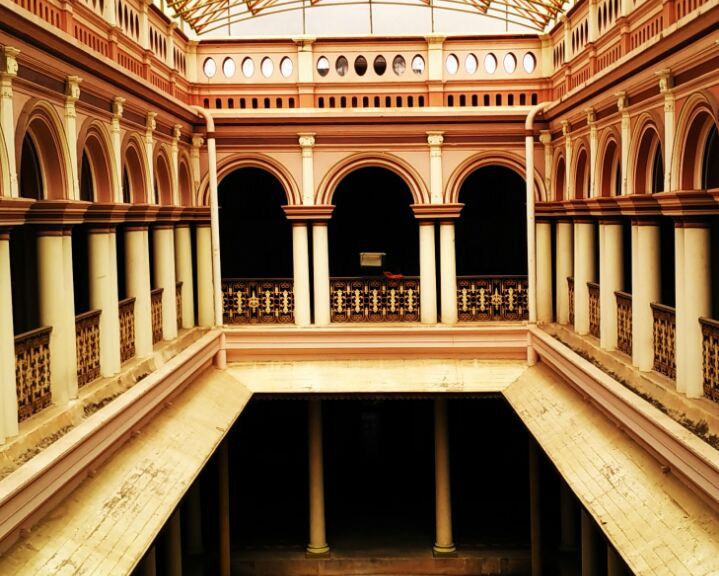
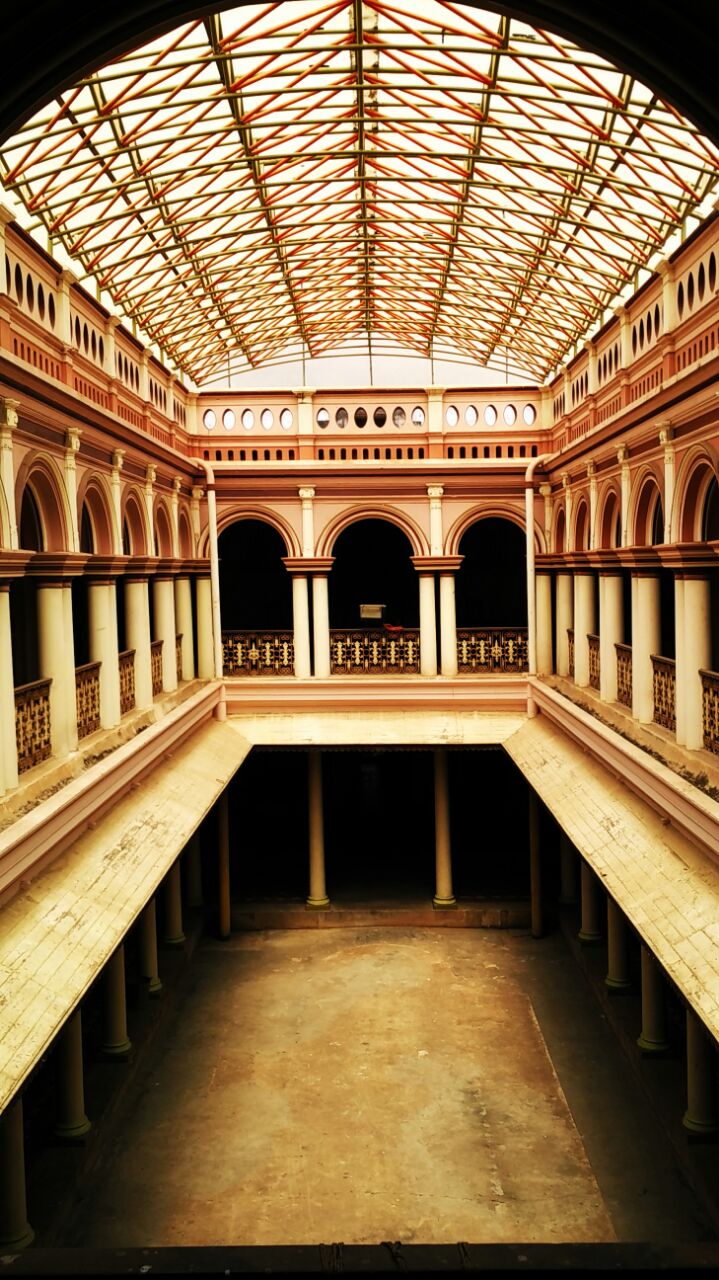
The Inner courtyard of one of the mansions in Devakottai
Meenakshi-Sundareswaran temple: We were surprised to see the assembly of 108 idols of lord Ganesha at this temple. He is seen in rare avatars and seated on vahana that are usually considered as the others. We had visited this temple on the outskirts of Karaikudi, while on our way to Devakottai. It was a bumpy auto ride with the stiff tarmac having been withered off at several places and a lot of dust entering our ears, eyes and nose.
Koviloor Shiva temple:This beautiful little temple is set in a very pleasant location and is surrounded with mansions. We had gotten busy clicking photos.
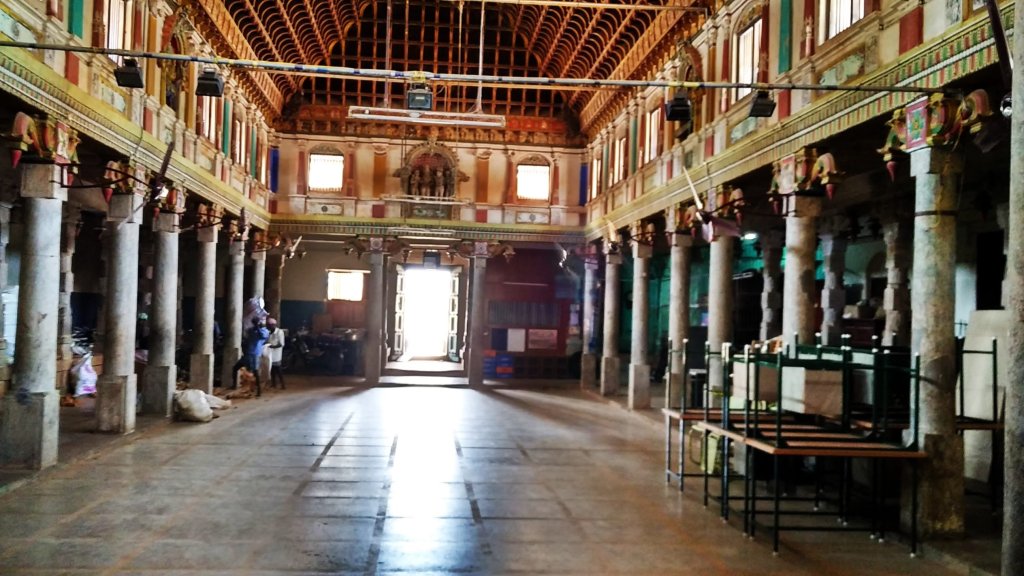
Koviloor antique museum: Excitement was at its peak when our entry into the first stately house happened. It was a strong structure built of granite blocks facing the temple. One part of it has been converted into a museum of antiques that were used by the Chettiars, one part has been converted to a government office while another part is used by some self-help groups for basket weaving, coconut de-husking etc. A few localites had gathered for the afternoon prayers in the two temples housed inside the mansion -one dedicated to Shiva & Parvathi each which had served as personal prayer rooms for the family in the yester years. We envied the people who lived there a century ago thinking of how peacefully they could decorate their own temple with flowers and lamps and celebrate the festivals without the interference of random people in their way of offering prayers.
One of the warehouses at Koviloor
Memorials built for the famous Tamil poets: Since we weren’t keen on visiting memorials, we gave it a miss to visiting the Kamban Mani mandapam & Kaviarasu Kannadasan Mani Mandapam.
Nagara Shivan temple: This temple stop happened by chance as our auto-driver cum guide stopped for a break at a random place after a short ride. We walked into this temple where a sumptuous lunch was served as part of donations from the devotees and that kept us full for the rest of the day.
Devakottai: We had read that this village has some of the well-kept mansions in the region. By now, our driver had a good understanding of our interests in exploring the region. Over the course of the day, he was very accommodative and stopped at several mansions thereby letting us admire and awe at the vast and artistic dwelling places. He even spoke to a dozen of localites to permit us inside their houses as this would help our studies (We never mentioned we were architecture students though!!) Although a couple of mansion owners were kind enough to entertain strangers like us to have a look at their magnificent mansions, we got shooed away at the gate by several others.
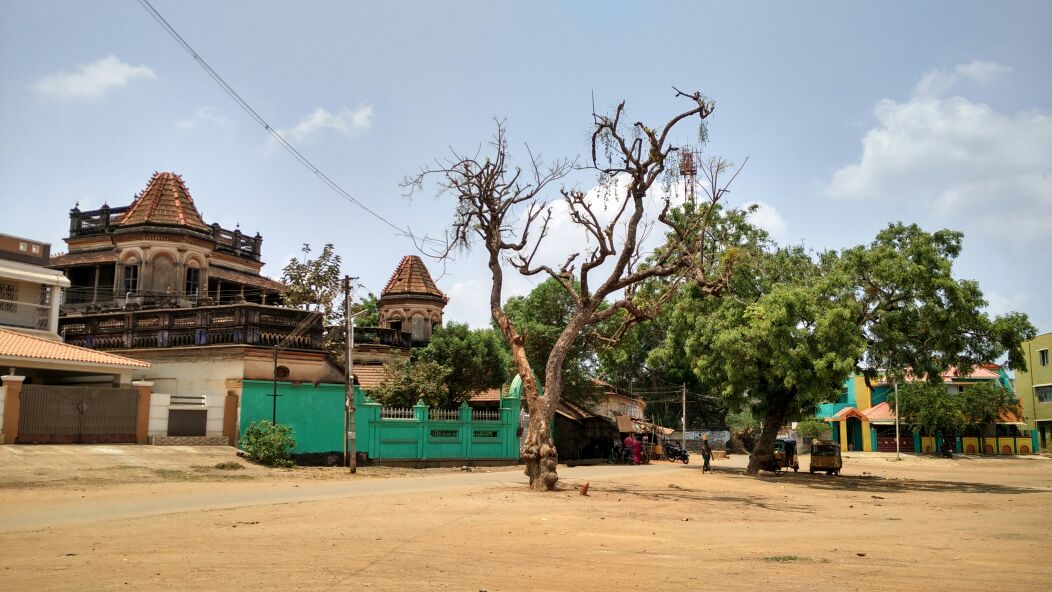
The Mansion filled streets of Devakottai
There was one such incident where the proud caretakers gave us a guided tour of the entire house and we were even greeted by a colony of bats flying past our heads when one of the most unused parts of that mansion was opened just for our academic purpose! We climbed up the guano filled wooden stairs leading to an attic where hundreds of bats roosted. We ducked down as we further walked across a wooden bridge opening out into the terrace to be treated with an amazing view of the overstretching lanes of Devakottai filled with mansions.
Kandadevi temple: We stopped at this temple on our way back to Karaikudi from Devakottai. The temple pond is spread across 2 acres and is believed to be the largest in Chettinad.
Alagappa University & the Annavar memorial: Originally, these were not in our list. But we visited these places as our enthusiastic auto-driver wanted us to see these landmarks named after prominent personalities who have contributed in the development of this region.
The making of Athangudi tiles
After an exhausting day exploring the streets crammed with Chettinad houses in Karaikudi, we were dropped at the bus stand to board the local bus to our next destination. The bus snaked through the narrow lanes and we craned our necks out of the window to stare at a few bungalows along the road at Pallathur before we finally alighted at ‘THE’ destination of our tour- Kaanadukathan.
This post is a follow-up on my 3-days backpacking trip to Satara. If you haven’t read it already, you can do so by clicking here. I had backpacked across Satara district covering Satara town – Wai – Panchgani – Mahabaleshwar – Khas plateau – Satara town
In this post, I have tried to share details of my day trip to Mahabaleshwar. The place as such, doesn’t needs any special introduction. This hill station is a favorite haunt of tourists from the nearby metropolis and afar. While its stunning views of the surrounding Sahyadri mountains and Deccan traps attracts the weekenders in large numbers, it sees a large footfall of Hindu pilgrims as well. Mahabaleshwar can be broadly classified into two parts, the New and the Old. I started my day trip to Mahabaleshwar from Panchgani on a Sunday morning. I have tried to explain my Mahabaleshwar trip in detail through this post.
Part 1: New Mahabaleshwar
This part of the hill station is popular for its breathtaking sceneries of the western Ghats or the Sahyadri mountains. It was mainly popularized as the summer capital by the British. The table top mountains were strategically used by the Marathas for holding up enemies. Today, it is especially popular among the honeymooners and millennials as a short getaway from the nearby cities.
With many good viewpoints falling on the way, the 15kilometer stretch from Panchgani to Mahabaleshwar calls for many pitstops enroute. We stopped in the following order of places.
a. Parsi point: that gives a view of the Dhom dam from a different direction than what we had been seeing all through the previous day.
b. The Lingmala & Bhilawar waterfalls: These places weren’t as appealing as the case would have been with a good monsoon season.
c. Mapro garden & chocolate factory: This is the venue of the annual strawberry festival and one can see the chocolate making process at the factory through a glass wall. We tried shots of different juices & crushes they offer at the factory and picked up some bottles and chocolates as souvenirs from our trip.
The Mapro strawberry garden and Chocolate factory
d. Kate’s point: It was a pleasant drive amid the Koyna forest reserve to get here. The highlight for tourists visiting this valley is the echo point and the elephant’s head / Needle hole point. From here, we caught a beautiful view of Dhom dam, Balkawadi dam, Krishna valley and the Kamalgarh fort.
e. Savitri point: We drove through the forests hoping to sight a few peafowls, deer etc. but had no luck. Our visit to Savitri point was disappointing because the entire valley had been engulfed by mist. Since the entire valley was filled with mist even at peak noon-time, there seemed no signs of it clearing out.
Kate’s point & the elephant head
f. Castle rock, 3 monkey point, Malcom point, window point, tiger spring, hunter’s point, echo point and Arthur’s point: These are view-points in the same valley, but now enshrouded by the clouds. We only walked past all these spots without being able to see even the faces of the people standing next to us. In fact, this very valley was what had inspired me to plan my trip to Mahabaleshwar. The view of these deccan traps / table-top mountains had mesmerized me through several Bollywood movies that had been shot here. However, that visit was a matter of bad luck.
g. Marjorie and the Elphinstone points: The drive through these places too meant only disappointment.
Part 2: Old Mahabaleshwar
This part of Mahabaleshwar spikes up the interest of the history buffs and those that are culturally or spiritually inclined. Several ancient temples are dotted here amid the serenity of the Krishna valley. Some of the important landmarks are listed below:
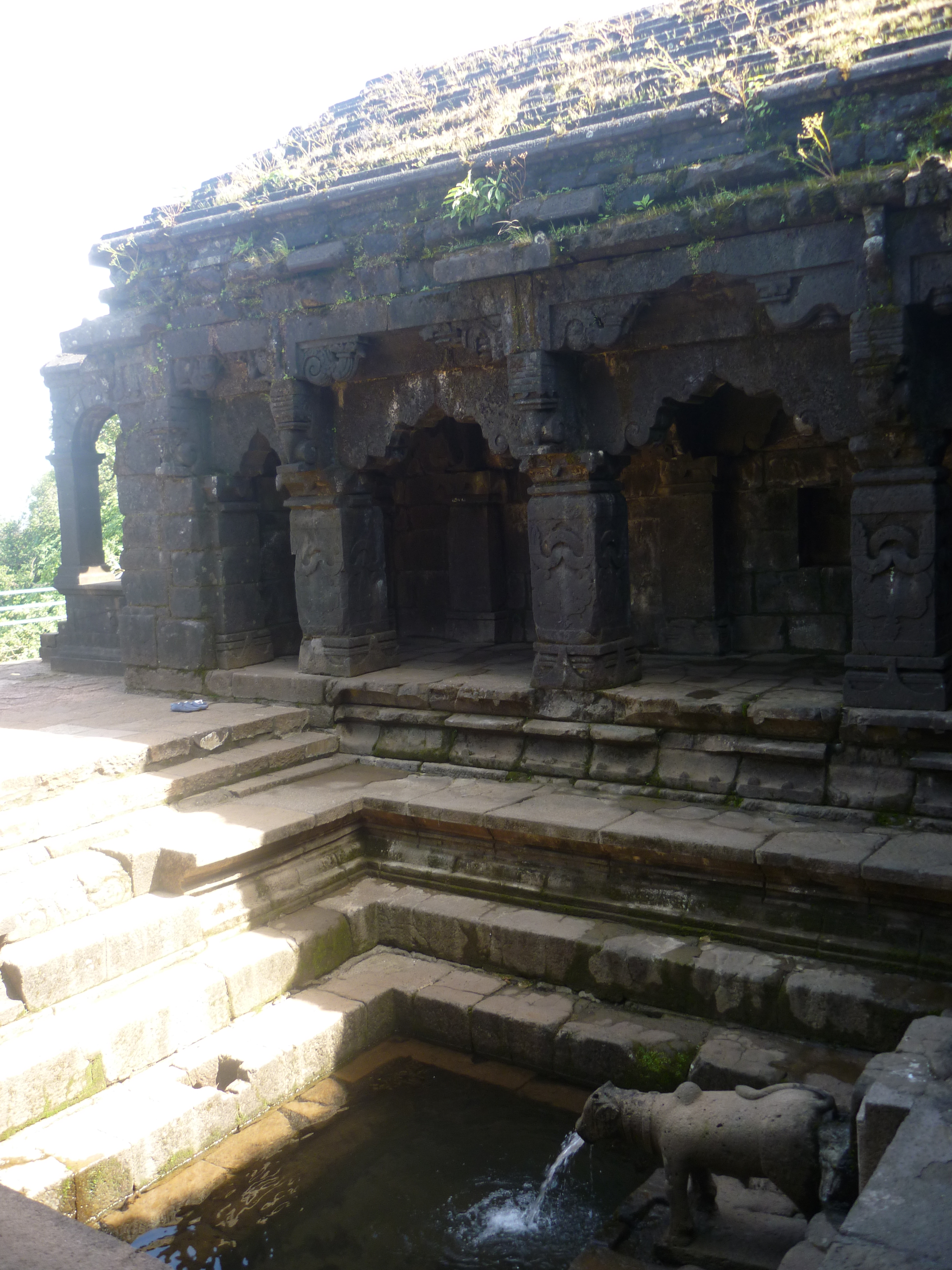
h. Panchganga temple: This is the place of origin for 5 important rivers in the region, namely Gayathri, Savitri, Koyna, Venna and Krishna. The five rivers conflux underground and then spout together through the mouth of a cow carved out of a stone about 4500 years ago.
i. Mahabaleshwar temple: This temple dedicated to lord Shiva is accessible from the Panchganga temple, after a small walk through the shopping lanes. This temple is what gives the hill station, it’s name. The legends mention about Atibaleshwar and Kotibaleshwar also, but those are temples that are lost.
j. Krishnabhai temple: A further walk of about 100 meters from the Mahabaleshwar temple led us to an archeological treasure that remains untouched by mainstream tourists. The stream of water spouting from a Gomukh (the mouth of a stone sculpted cow) in this 13.C.E temple is believed by a few to be the origin of river Krishna. Situated almost on a cliff, the place offered a great view of the Krishna valley around. For those familiar with ancient architectural styles, this temple is a good example of the Hemadpanti style of temple architecture.
The Krishnabhai temple
k. Venna lake: A popular and a beautiful place otherwise, we decided not to stop here when we arrived there. The place was maddening and crowded with tourists.
l. Other places of interest in Mahabaleshwar: On a clear day, one could plan to see the sunrise at Wilson point that is known to be the highest part of Mahabaleshwar and Sunset at Bombay point. Both viewpoints are part of the Sindola hill.
NOTE:
The entry and exit to Mahabaleshwar is only between 06.00.a.m. to 06.00.p.m. as it is a protected forest area. So, it is required to plan your travel or stay at Mahabaleshwar accordingly.
This hill station contributes to 80% of the total strawberry produce of India. Hence, it is safe to call it as the strawberry heartland of India. DO NOT miss to eat fresh strawberry with cream for dessert after a nice Maharashtrian lunch at any of the restaurants in the Mahabaleshwar market.
It was the 2nd Friday of August 2012, a day before the Biiigg sporting event of South India: “The Nehru trophy boat race”. After a long haul of planning, two of my friends and I had alighted at our destination- Allapuzha, a popular little town on a tourist circuit in Kerala. Fondly known as Alleppey, we were there to experience the festivities of ‘The Olympics of Kuttanad’- Vallamkali or the boat race. The Nehru trophy boat race is an annual event held in the Vembanad lake, in the Kuttanad region of Kerala. Vembanad lake is the longest lake in India and spans across several districts of Kerala. Depending on the region, the lake is known by different names. It is called as the Punnamada Lake here in Kuttana, of which Alleppey is a part. Along with the boat race, we wanted to explore the backwaters that’s a popular haunt of the tourists in this region.
My Itinerary:
Day 0: Leave from Bangalore to Kochi (Overnight train); Day 1: Kochi to Alleppey (local train), Shikara ride in the Vembanad lake, Sunset at Alleppey beach. Day 2: Nehru trophy boat race, Champakulam St. Mary Forane Church, Kalloorkkadu Angadi (local & oldest market in the region), Latin church. Return from Alleyppey to Bengaluru (Overnight Train)
Other Places of Interest: • Karumadi Thodu- famous for the black granite idol of lord Buddha • Ambalapuzha Sree Krishna temple- known for the ‘Palpayasam’ or the milk porridge offered as prasad to the deity. • Kokkothamangalam church- This is one of the seven churches founded by St.Thomas, one of the twelve disciples of Jesus Christ. • Ayyappan temple in Mukkal vattam (near Muhamma)- known for the Kalari from which Lord Ayyappa is believed to have learnt his skills in martial arts. The hermitage where Ayyappan lived during the training period has been preserved in its original form by successive generations of the Cheerappanchira family.
The Details:
Day 1:
It was noon by the time we checked into our hotel room. We freshened up quickly and set out to explore Alleppey. We walked around a little bit and reached at a small boat jetty. We hired a ‘Shikhara’, a local motorboat to cruise around the narrow canals, passing through several fishing hamlets. While the womenfolk were washing clothes, the men were spiralling their fishing nets into the water and a few kids were diving into the waters for a refreshing swim. It was a nice experience of seeing local lifestyle of the people for whom, the backwaters are a lifeline. Along our ride, we picked up some fresh lobsters and pomfret at a local market and got them cooked in the local style at a fisherman’s house.
The Shikara cruise in the narrow canals of Alleppey
Further, we were oared across to the end of the canal which opened into the wide Vembanad lake where all the teams were practising for the boat race and the venue was getting set for the ‘Big’ event. The energy and enthusiasm in the atmosphere was no less than that of the main event itself. Though we wanted to stay there till sunset, the government deadline for all activities in the waters forced us to return to the jetty before 06.00.p.m.
On returning to the mainland, we meandered through the lanes of Alleppey town searching for a dose of Kerala chai and palam-pori (Banana fritters). We then decided to settle down by the beach until dark. While finding our way to the beach, we walked past the coir industries that Alleppey was once known for, and now remained shut and non-functional.
A stationed shikara enroute to the Alleppey beach
While walking back to the town area from the beach, we happened to see a hoarding of a concert happening at a nearby stadium. Post sunset on normal days, most towns in Kerala sleep to silence after 7.00.p.m. and there will be not many options to see or do after that. Since we did not want to waste the remaining evening by sitting inside our hotel room, we decided to head to the stadium to kill the rest of our evening. ‘Music never disappoints’, all the three of us had the same thought. Upon arrival at the stadium, we enjoyed the on-going performance of ‘Theyyam’, one of the colourful, traditional & spiritual dances of the state. But after some time in the audience gallery, is when we experienced a surprise on the stage. A MIND-BLOWING show by the violin maestro- Balabaskaran and team.. It was there that we were LOST in dreamland..!!
Day 2:
The next morning, we had to reach the racing venue as early as 08.00.a.m. to ensure that we had a place to sit. (Read about the madness of the event). The snake boats are the world’s biggest water vessel used for sports. One by one, they arrived for assembly. Locally called as the Chundan Vallam (Beaked boats), these 100~120 feet long wooden canoes carry 90- 110 rowers and move like snakes through the channels. And soon, the races started under different categories. Every single soul in the arena was singing songs of cheer. All through the event, only one thing echoed in the atmosphere: Vanchipattu or the Boat song. It was a once in a lifetime experience to be a part of that enthusiastic crowd.
The oarsmen ‘”Women”
Post the event, we still had time to explore the town and hence boarded a bus to Champakulam. As we passed through the waterlogged villages of Kuttanad, we were reminded that the region we were passing through was the ‘granary of Kerala’ or the rice bowl of Kerala. It is one of the few places in the world where farming is done below sea level.
Soon, we reached the St. Mary Forane Church. Since it was a Sunday, we were lucky to take part in the mass. Built in 427A.D., this riverside church is a testimony of time with its finely maintained beautiful mural paintings. From there, we took a boat to reach the other end of the river: the oldest market in the region known as Kalloorkkadu angadi.
Champakulam St. Marys church
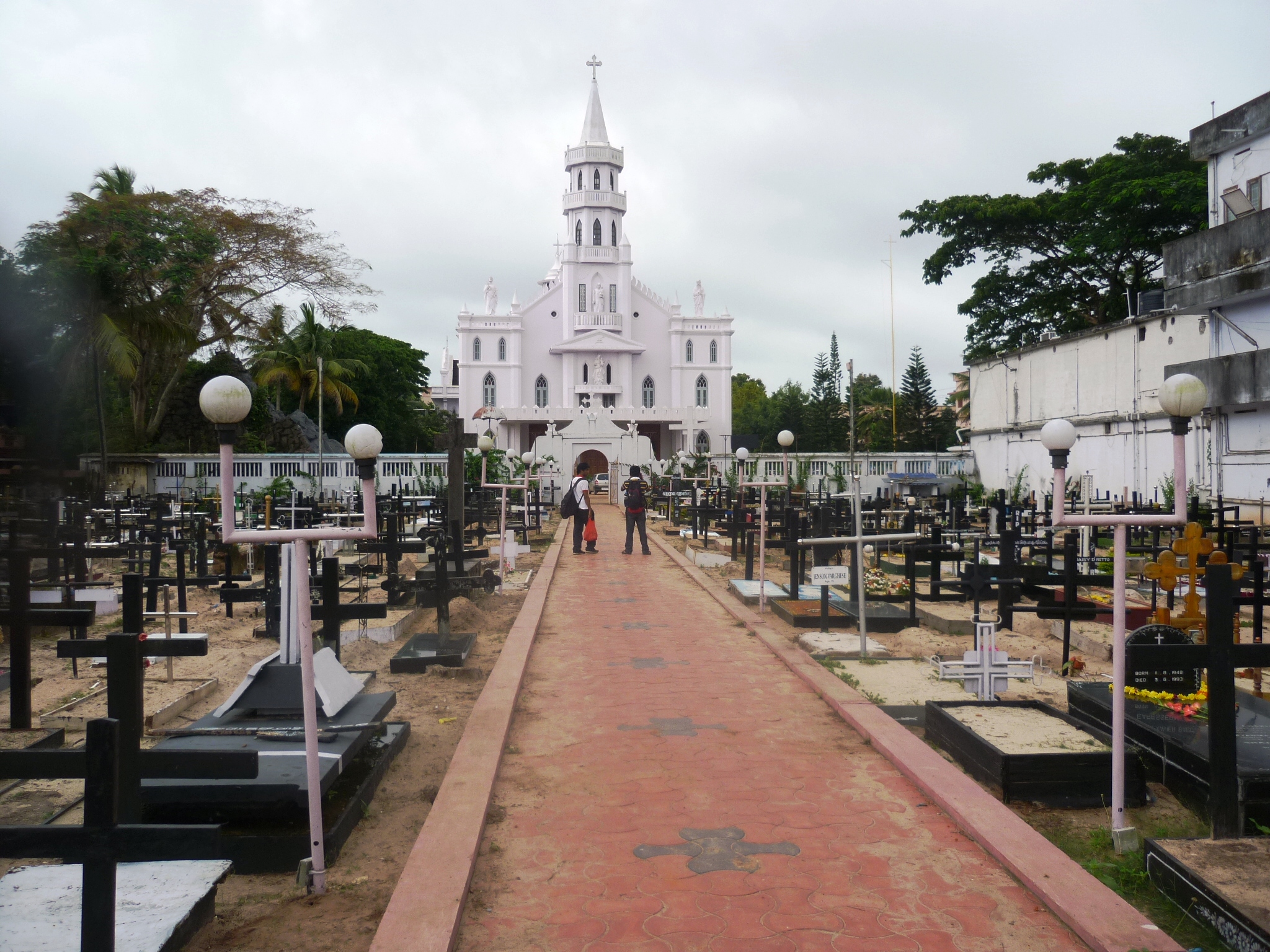
With a local bus ride from there, back to the town, we then took a walk to the Latin church in the town. The entire town of Alleppey can be viewed from the terrace of this church (permitted only during visiting hours). What particularly caught our interest was the cemetery where all members of a family were buried in the same pit. Hundreds of such graves laid within the church premises.
The premises of the Latin Church
We then checked out our lodge and headed to the railway station for our return, scheduled for the night. It was time for us to depart with a mind filled with beautiful memories of sailing afloat on a boat in the backwaters of land that is called ‘God’s own country’ and hope to return soon.
Must dos: Experience the madness of the Snake boat race Must eat: Freshly caught and cooked seafood while on a backwater cruise tour
I had seen the name of this place on the boards of inter-state private buses plying in the roads of Bangalore. On a little bit of research, I came to know that it was a popular summer destination of the British which has twin hills called Devarabetta, with a good view point.
One day, when my friends and I were looking for a destination for a random ride to kill time, Thally popped up in my head. In what was meant to be just a ride to kill time on a weekend, turned out to be a discovery of a new hideout to escape the frenzy of the city..
We used google maps for navigation. A small ride through Jigani, past Chandapura town lead us to a small barricade that marked the Karnataka- Tamil Nadu border. There was a sudden drop in temperature leading to a rather pleasant ride than expected, in an otherwise hot Tamil Nadu.
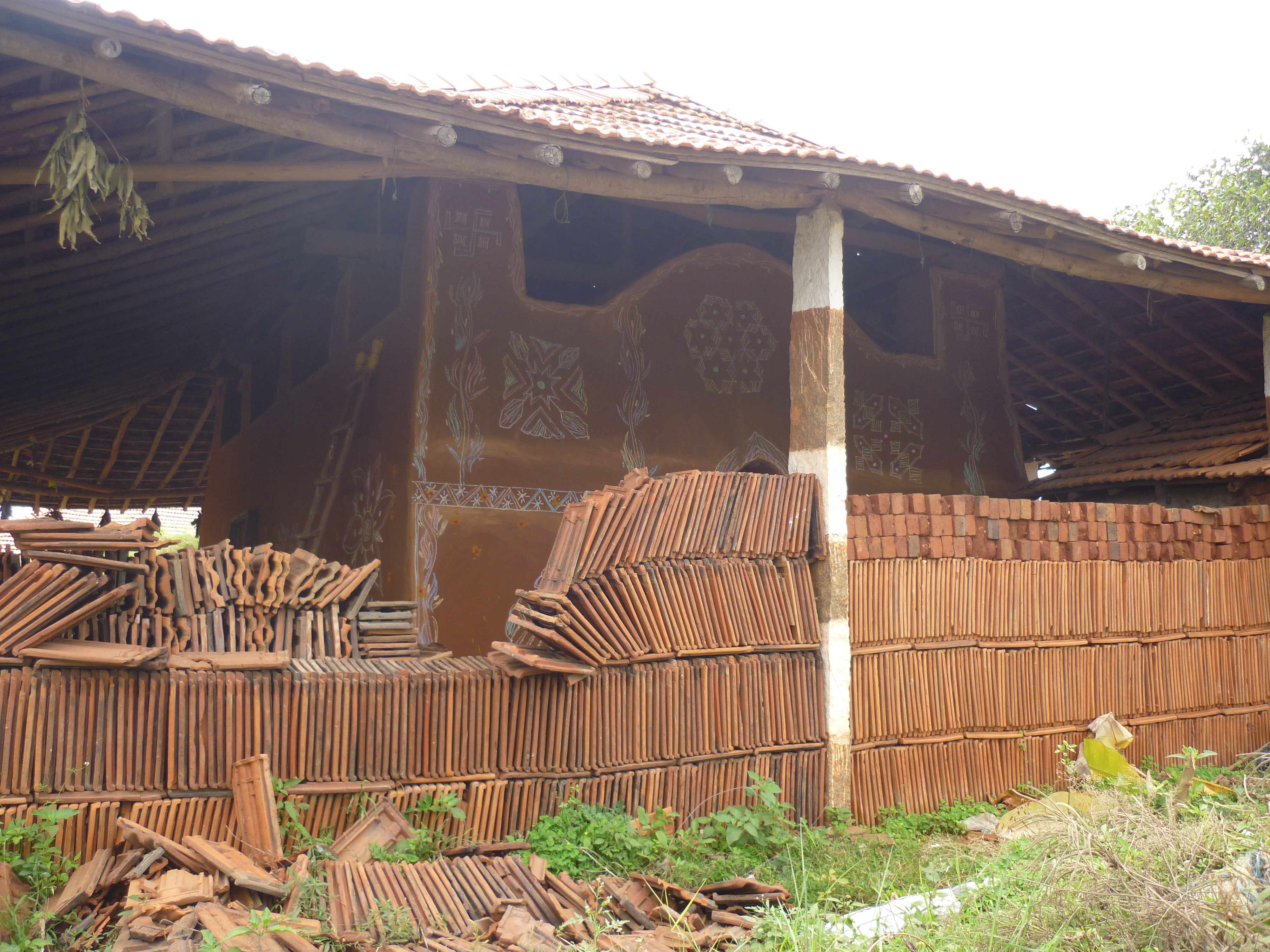
The colourful brick making kilns
Brick making kilns and artistically structures built with raw bricks and tiles dotted some stretch of the bordering village. We proceeded through the serene greens of vegetable farms and yellow blossomed mustard fields to reach the junction of Thally town. The temple fair seemed to be happening beside the huge Thally lake. We thought of giving it a miss owing to the village crowd and proceeded towards our next destination: ‘Devarabetta’.
View of the Twin Devarabetta hills from the farm lined road
We were excited as we spotted the twin hills from a distance. We passed through rough countryside terrain and kaccha roads that finally lead us to the temple at the foothill of Devarabetta.
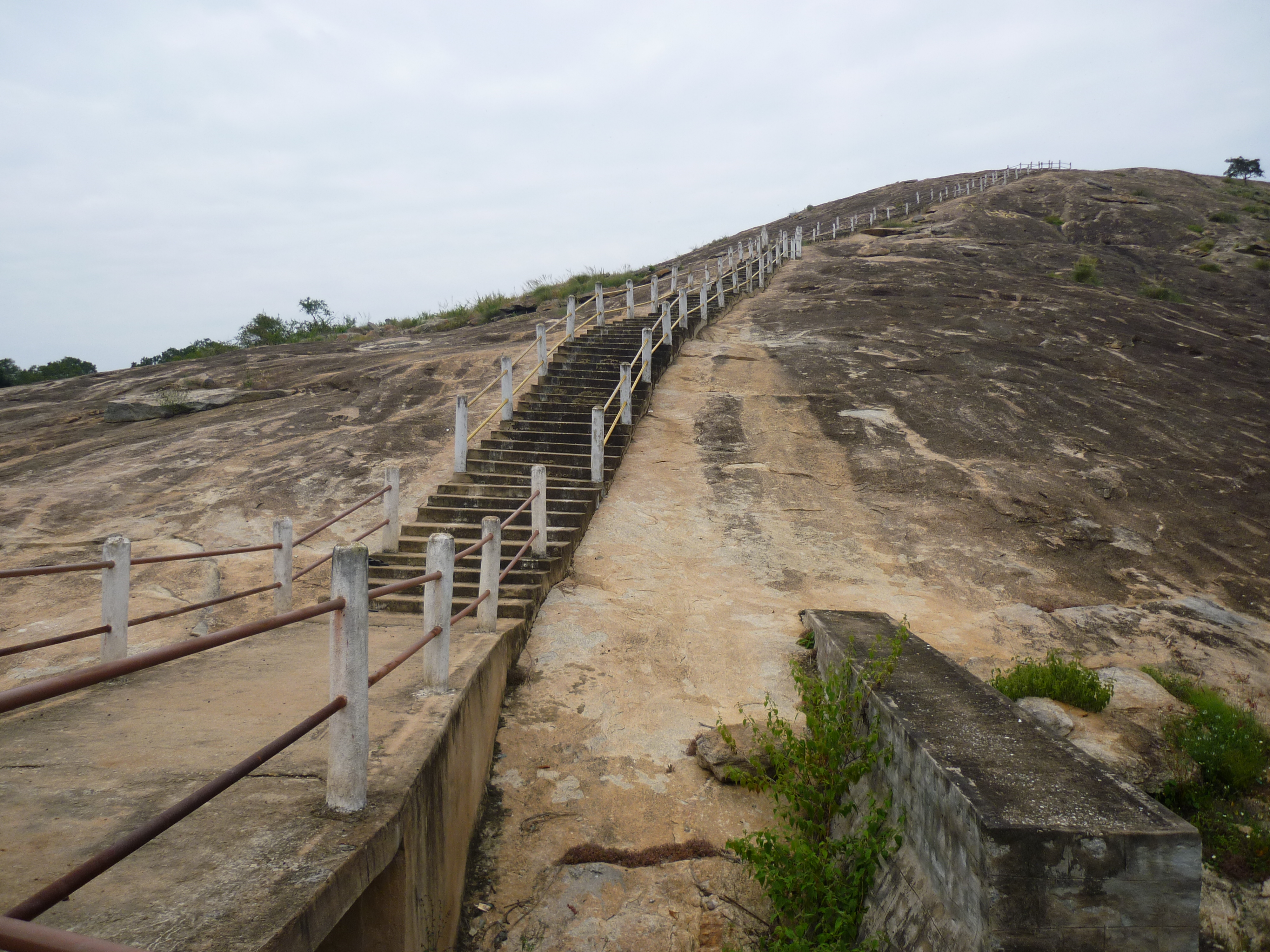
The stairway to Devarabetta 😛
It wasn’t a strenuous climb with mere 100+ steps leading us to the top (Read about scaling the second highest monolith in Asia- A day trek in Bangalore) where an ancient temple exists. We took a 360 deg view around and it looked beautiful.. Surrounded by the Anchetty /Bannerghatta forest range on one side, the rocky hillock on another side and green pastures all around.. And a very pleasant weather: This could be why this place was once called ‘The Little England’. We spent sometime soaking in some pure air of the forest cover around and chatting up for a while.
Since our stomachs were growling and there were no hotels nearby to sate our hunger, we decided to head back to the city. (This update is as on Jan-2015. Current condition might be different as the rapid urbanisation and expasion of Bengaluru city limits has reached Thally)
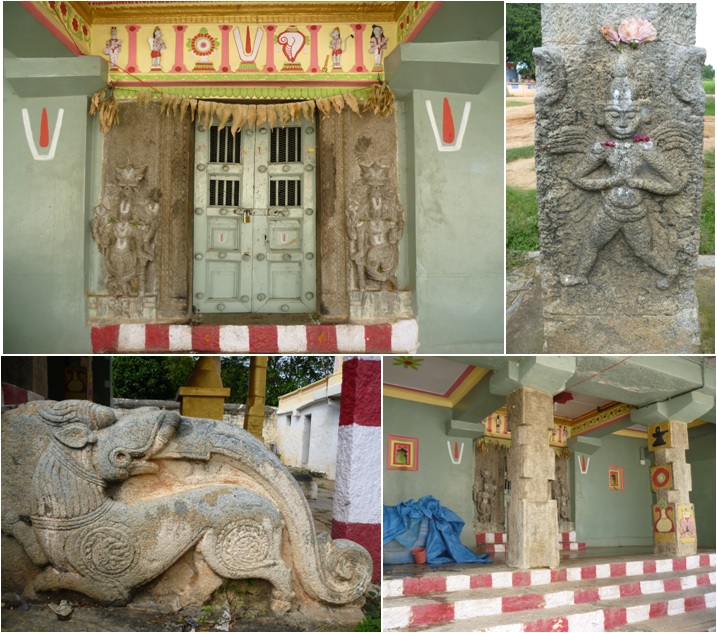
The Vishnu temple enroute to Devarabetta from Thally
But on our way back, I found an interesting piece of architecture, I wanted to explore more. We parked our bike and walked into this old temple complex. The door to the sanctum was closed. There was no one around who could throw some light about this place. However, the design looked liked a scaled down version of the temple at Tirupathi, suggesting that it was dedicated to Lord Vishnu. There was an old well, a wooden temple car and a dilapidated mantap adjacent to the temple. Further, with my little knowledge of temple architecture, I recognise that the art had some relevance to the Chola style of architecture (the stairs had resemblance to the Varadaraja Perumal Temple at Kanchipuram & the Big temple at Tanjavur).
Inside the temple premises
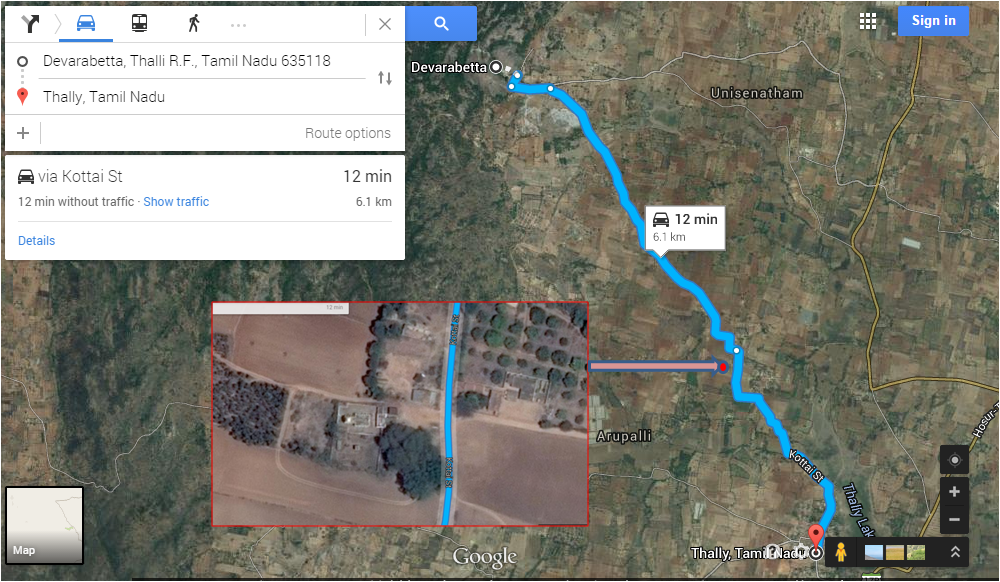
I would be really happy if someone could help me out in knowing the actuals about the history of this temple. The map of the temple is shared below.
The forgotten Chola temple- Google maps
Thereafter, we continued our return journey to the city. This place makes for half a day’s outing if you are looking for some solace with nothing much to do, at a stone’s throw away distance from the city. You can make a full day outing if you combine it with a tour to hosur, Denkanikottai fort in Tamil nadu or the pearl valley in Karnataka.
Conclusion Remarks:
Not a great place to plan an exclusive trip, you can consider it only if you’re planning for a random ride on a weekend to get away from the Bangalore chaos.
This was a family backpacking trip, mainly conceptualized by my dad and had been long due. He wanted to see how the end of River Kaveri; our family deity looks like. Accordingly, we made an itinerary and a route map. Our family of four backpacked with the below itinerary:
Our Itinerary:
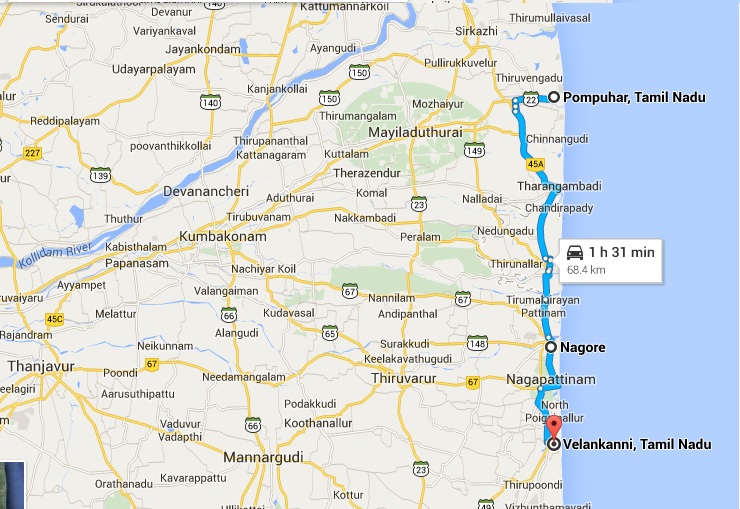
Day 0: Depart from Bangalore (Travel mode: Overnight train to Mayiladuthurai) Day 1: Visit Poompuhar, Tarangambadi, Karaikal, Nagore and Velankanni (Travel mode: local bus; Stay: Church run lodges at Velankanni) Day 2: Explore Tanjavur (Travel mode: local bus; Stay: Hotel at Trichy) Day 3:Explore Trichy (Depart to Bangalore by overnight bus)
The first day of our backpacking is presented here, which took us across three important landmark destinations along the east-coast, covering all three prominent faiths in India. That’s why I call this part of the trip as a ‘secular trip’ with of course covering the intended destination: Poompuhar, the end of the River Kaveri or the point where this Holy river meets the sea.
Destination 1– Poompuhar
The name reminds one of the arts and crafts of Tamil Nadu while Cauvery emporium strikes a similar bell back home at Karnataka. The link for both the names is common. While the latter relates to Tala-Cauvery, the birthplace of river Cauvery at Karnataka, the former marks the end of the same river at Tamil Nadu. Both being holy places for the Hindus of South India.
We were welcomed by a stretch of fishermen selling salted/seasoned & dried fish at the shore of this historic beach. There is a sculpture art museum on to the right side, at the entrance. To the left is Ilanji Mandran, a bathing place said to have had mysterious powers of curing health ailments that dates back to the Chola era. A walk for about a kilometer along the roaring sea leads us to the river mouth. It is believed that river Cauvery (a female) runs towards the sea (a male) at this point. If one stands and watches the river mouth at this point, the rapids of the river joining the calm sea can be seen quite evidently. The calm sea lashes her back towards the land with his waves side by side. A dip at this juncture is believed to be very holy (Hailing from a community that worships this river as a family deity, at least this is what I have grown up listening to). This place is also called Kaveripoompattinam as called by the Cholas and is a place of importance to the archaeologists.
The Ilanji Mandran at Poompuhar
Apart from the river mouth and a walk through the historical monuments mentioned above, there is nothing much to do at Poompuhar otherwise. The Kethu & Budha sthalams among the Navagraha temples are close by- I will save them for another article.
With that, we boarded a bus to our next destination- Tarangambadi. Then from there, to Karaikal beach.
Destination 2- Nagore
The little town of Nagore is known for the Hazrat Syed Shahul Hameed Dargah of the Islam faith. We were welcomed warmly by the priests there who helped us with the procedures of offering our prayers. Going by history, this dargah stands as a symbol of peaceful co-existence between the Hindus & the Muslims as people from all faiths come here for worship. There are 5 minarets out of which the tallest one was built by a Maratha King of Tanjavur for being cured of his ailment by the miracles of Shahul Hameed. From there, we headed to our last destination of the day.
One of the 5 minarets at the Nagore dargah
Destination 3: Velankanni
It was sunset time when we arrived at the Catholic shrine of Our Lady of Good Health. We walked through the lines of stalls bustling with activities, pilgrims, tourists, hotels and other urchins to reach the seashore. This place is so crowded almost all through the year, that if one just stands in the crowd, the crowd will take you forward without you actually having to try to walk. We walked back to the Basilica of the Arogya Matha as she is fondly called to offer our prayers. The history dates back to 3 events occurring from 16th century onwards where Mother Mary appeared to a milk vendor, a buttermilk vendor and the Portuguese sailors who survived a severe sea storm. There is Matha Kulam / the holy pond and 2 chapels built at the respective places of the above occurrences.
We then took a brief walk at the donation’s library where all the gold, silver & other expensive offerings made by the devotees are kept for exhibits.
The shrine of Our Lady of Good Health at Velankanni
With that, a tiring, yet a pleasant journey in quest of god ended in a peaceful slumber at a Church run lodge… The following morning, we board another TNSRTC bus to our next destination: Tanjavur.
This is a pick from old memories of exactly a year ago, in August 2013. My mother was away in Belagavi for a month-long business trip and I had decided to catch up with her over the weekend. We then got together, and explored the places around Belgaum, fondly called Belagavi. This time, it was only a day trip around Belgaum with a quick visit to the widest waterfall in my state, the Niagara of Karnataka.
Our Itinerary: Friday: Overnight journey from Bangalore to Belgaum Saturday: Explore Gokak (waterfalls, hanging bridge & Tarakeshwara temple), Godchinmalki waterfalls, Savadatti Yellamma temple)- Return to Bangalore by night journey.
The Details:
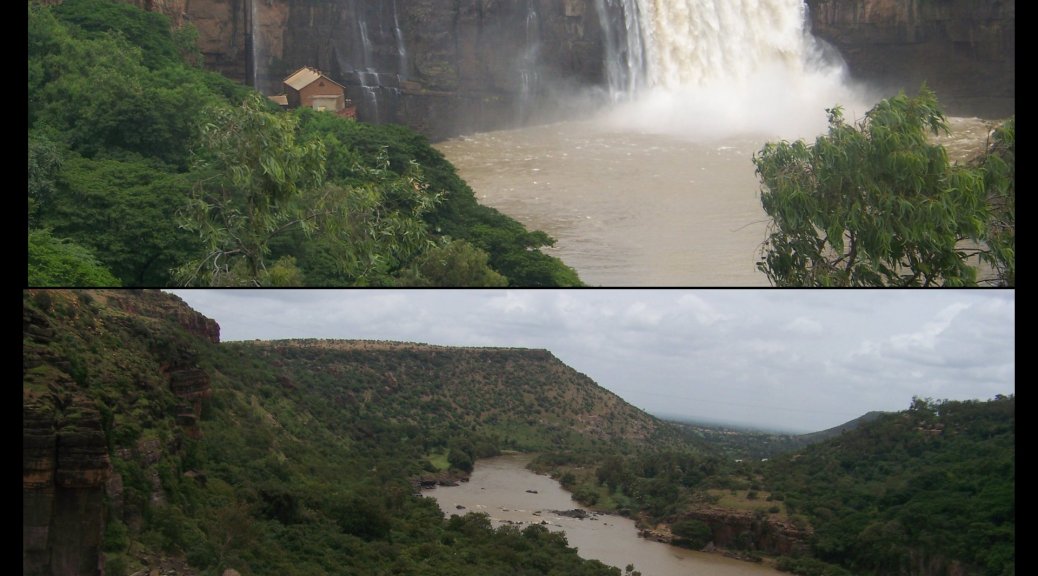
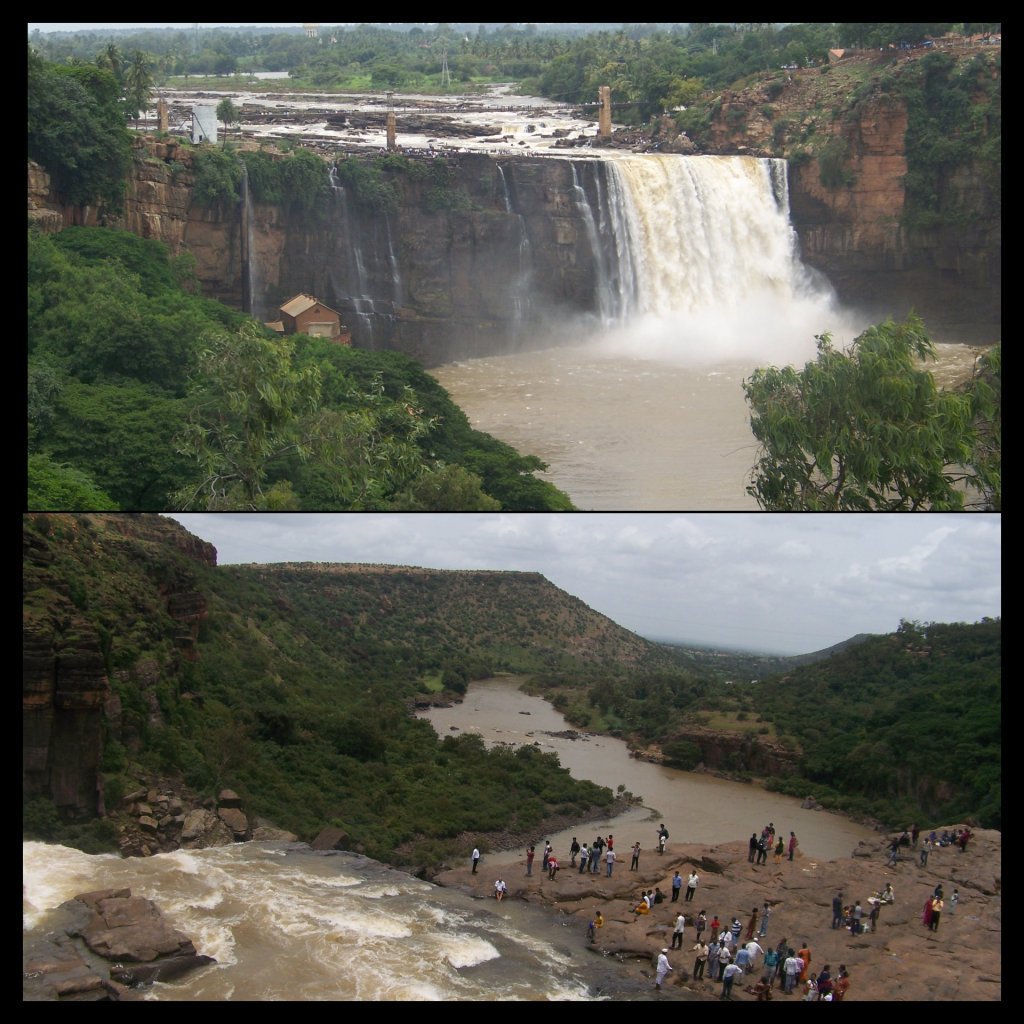
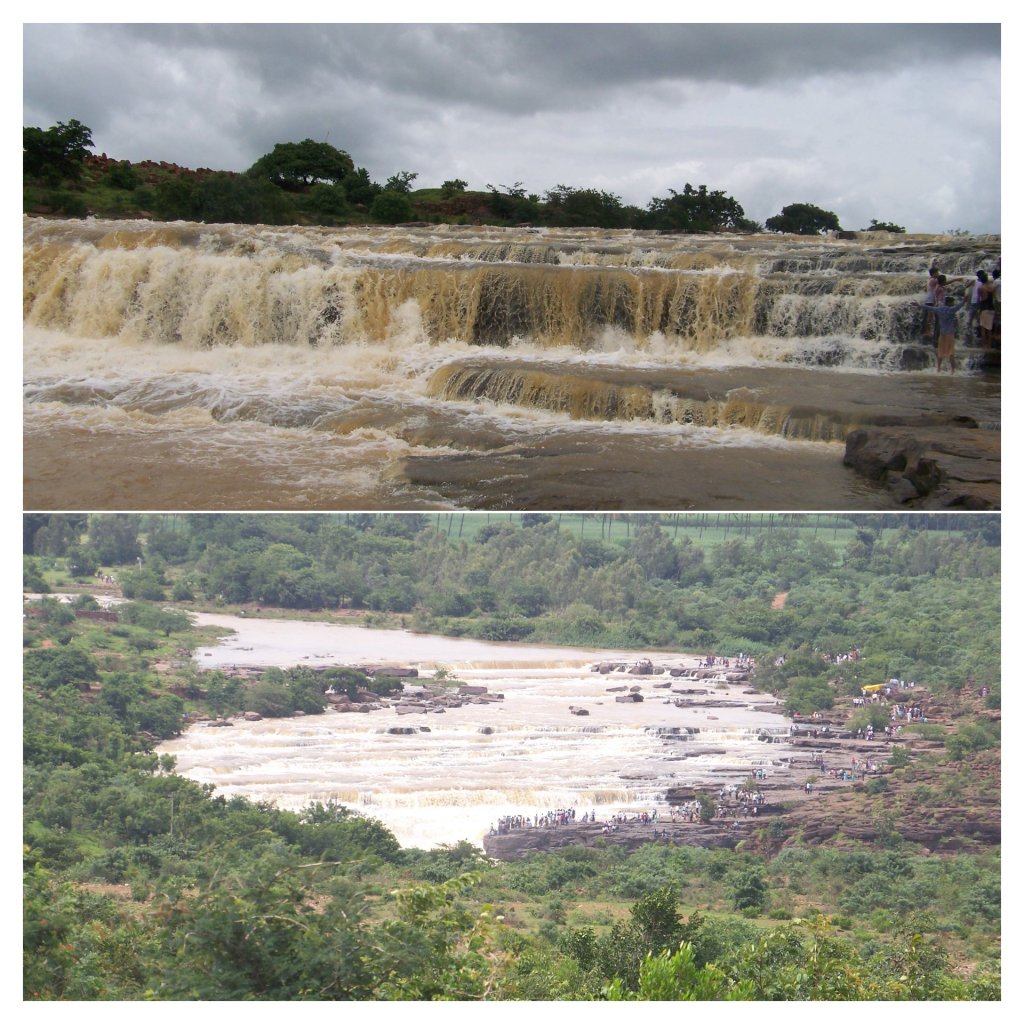
I boarded the bus to Belgaum from Bangalore and my mom was there to receive me when I alighted there the next morning… We freshened up at the place where mom was put up and then headed straight to Gokak. The little town known for its cotton mill, is also famous for the nature’s treat- the mighty Niagara of Karnataka. The bubbling, roaring and crashing waters of the Ghataprabha river creates steady patterns here with endless rhythm while it leaps down from 52meters between two tall, craggy cliffs to form the Gokak falls.
The century old hanging bridge, the only mode for the textile workers to cross the river allows the public to enjoy the breathtaking vista of the waterfall as the gushing water plummets down. The presence of turbines dating back to 1885 stands testimony to the electricity generation station established here which still provides power source for the cotton mill across the street. The 11th century Shiva temple dedicated to Lord Mahalingeshwara (Locally known as Tarakeshwara temple), built in the Kalyani Chalukyan style, faces the cotton mill and flanks one side of the gorge.
Above: The front view of Gokak falls from the Volkart view point; Below: A view from the Hanging bridge.
Meanwhile, I called a friend of mine who hails from Belagavi district to enquire about other places that we could visit around his hometown. He guided us to a small village named Godchinmalki where river Markandeya cascades down amid a scenic backdrop forming another beautiful waterfall called by the same name. Mom and I walked down for 2kms through rolling green pastures, fields of maize and banana plantation to reach this waterfall that plummets down in 2 tiers. Once we reached the place, it was a thorough treat to our senses to watch the waterfalls racing ferociously through the deep gorge.
On our way back, we took a little longer route from where we got a complete view of river Markandeya snaking through the greens. A 9kms long underground canal carries water from the river across which can be seen emerging out of the hill from this viewpoint. The snaking roads with beautiful views of the valley was a wonderful drive to the city.
Top: The Godchinmalki waterfalls; Below: The Gochinmalki view point from the main road
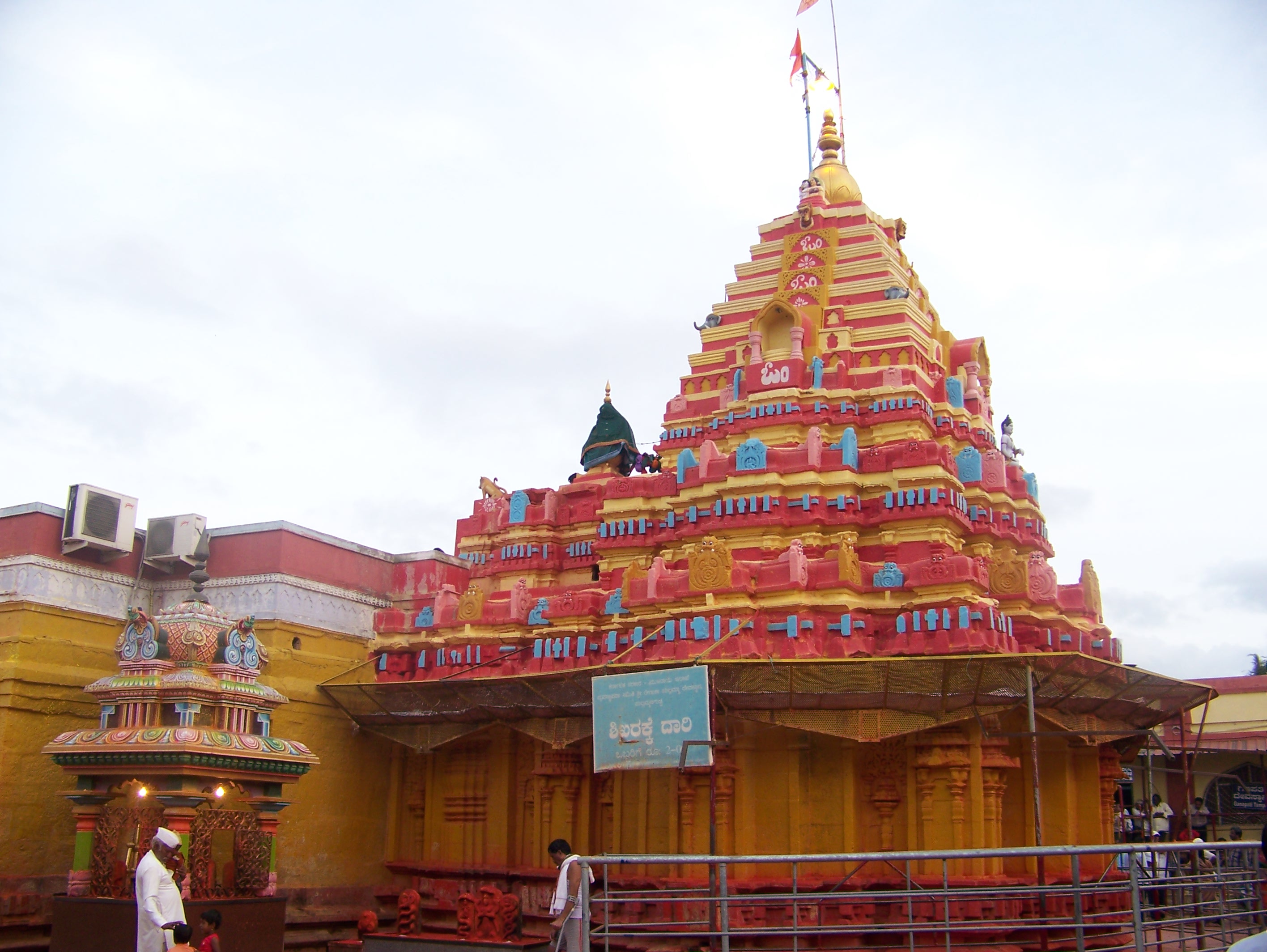
After all the waterfall hopping was done, it was time for some temple visit. We headed to Saundatti a.k.a. Savadatti. This place was the capital of the Ratta / Rastrakuta dynasty from 820, until it was shifted to Belgaum in 1230. There is a fort here also called the Parasgad fort. But the most famous is the Renukadevi temple located atop the Yellamma gudda. This is an important place for devout followers of Goddess Shakthi and also for the devadasis- or the servants of god. We had a good darshan during the evening pooja time.
Savadatti Yellamma temple
With that, it was a quick wrap for a short weekend and time for me to head back to Bangalore for another long and boring work week ahead…
Must eat while at Belagavi/ Belgaum:
Karadantu at Gokak– it is a sweet made with dry fruits rolled into balls with jaggery.
Let me get you going directly from where this trek to Kumara parvatha or KP peak is actually supposed to start. We reached Kukke Sri kshetra and checked into the lodge(a meagre 100Rs. Per day) run by the temple trust, freshened up and feasted on some sumptuous Mangalorean food for breakfast. Without wasting much time, we started the much hyped- one of the toughest treks in South India.. to the Kumara parvatha peak in the Pushpagiri wildlife zone.
The original plan was to start from the base by 7.00.a.m and camp at Bhatru mane. Then, leave Bhatru mane by 3.00.a.m the next morning and reach the peak to witness the sunrise, what is supposedly one of the best.
As planned, we entered the trekking trail.. It starts off with thick forest around and steep climbs uphill.. There was NO water sources along the way (We didn’t know that there was a perennial stream, with a small deviation after 2.5km) and a possibility of occasional encounters with elephants. We took frequent stops before taking a longer halt at Bhima’s rock. This stretch of 3km had oozed the fluid out of us..
A view from Bhima’s rock
Once this 3kms stretch was covered, we got our first view of Kukke town.. The thick canopy of forests made way to the grasslands after walking 1km further from there.. It was well past noon and the sun shined at its hottest.. We were running out of water already.. We started to wonder if Bhatru mane really existed and literally pulled ourselves to reach there. Or rather say, we pushed ourselves to walk the small distance that seemed never ending.. Finally… we were overjoyed at the first glimpse of Bhatru mane…
The first glance of Bhatru mane
We ran down to his nestle amid a small piece of green land.. I find NO words to express the joy of finding water.. That too, clear and cold water from the stream that ran through his farm.. We had a simple, yet the tastiest lunch served by Bhatru and rested under the shades of his arecanut farm..
We then made a small change in the plan and decided to continue the trek until it was dark. We feared the pace at which we were climbing up and did not want to return late on the following day.. We halted at a view point along the way for some photographs, before reaching the forest checkpost. We continued our hike up after registering our names at the forest office.. We stopped again at yet another view point.. The sun was coming down by the time we reached kal-mantapa and hence we decided to pitch our tent near the stream that ran by..
The sunset from our tent
I don’t remember which sane person in the group chose the place.. I agree that we got a place which became every other trekker’s envy.. The place was for sure, a top rated spot for sunset viewing.. But we girls, who stayed inside the tent know what we went through that night.. The tent was pitched on a slope, on the edge of a rocky cliff which seemed like the place where the earth ended.. It was soon dark and we ate the little food that we had carried and hit the bed (Read hit the rocks)..
The boys comforted themselves in their sleeping bags and threw the poor girls inside the tent.. The entire night went by like this: ‘Our respective backpacks were used as pillows inside our tent. We all would slide down with our bags inside the tent.. again we would push back everything and move up.. Slide down.. Slide up.. Phew..!!’ And a while into midnight.. The intensity of the wind also increased.. The cover of the tent started to fly.. We hoped for it to be 3.00.a.m soon so that we all could start our ascend.. But another surprise was awaiting us.. Madhu heard the cracking sound of the tent support and scared all the girls inside to vacate the tent. We carried our luggage from inside and jumped out of the tent, one by one.. The last girl just came out and the tent crashed down to a flat.. The guys woke up and one of them attempted to slowly remove the pegs.. One peg was removed and then… The tent flew.. away from our reach.. off the cliff.. down the valley.. We had borrowed the tent, on hire.
Everyone woke up and sat wondering why this had to happen. It was still dark at 4.00.a.m. and with the wind that continued to blow ruthlessly, our ascend to the peak seemed impossible.. We stayed back until sunrise 😦 We decided to compromise on one of the main agenda of our trek- Watching the sunrise at KP peak.
After there was dawn,one of the boys dared to go down the cliff. He had a thrilling feat with adventure and managed to bring back the tent that had settled on a boulder in the middle of a water body, down below in the valley.. More than getting excited about finding the tent, we were all celebrating his safe return.. It was around 7.00.a.m by the time we started our ascent.
Inspite of missing the sunrise, the views post that period were equally spectacular, all along the way. The climb was pretty smooth. It was around 11.00.a.m. by the time we reached the first peak/ false peak- Shesha parvatha.
The view from the base of Shesha Parvatha
After just a few photo moments, we decided to continue our journey.. We descended the steep rock and waded through super cool, thick jungles.. And then, climbed up another steep rock. This rockclimbing with bare hands and legs reminded me of our monkey ancestors.!! A small walk further up took us to the actual end of the earth. Right there, we had conquered our destination- Kumara Parvatha..!!
Shiva temple atop Kumara parvatha
Thanking the diety with a small bow in the temple on the peak, we set our return journey.. Getting down the rocky slope of KP seemed tricky with one of my friends ending up with torn trousers when he decided to sit and slide down on his butt 😉
The descend from Shesha Psrvatha was no easy task either. The loose gravel all along the trail made walking difficult without slipping. It was 4.00.p.m by the time we reached Bhatru mane.. We realised that we had covered only half the distance and had very less time left with sunlight.. We had to complete the remaining distance before it got dark because that was the toughest stretch with thick forests and wild animals. We had a quick lunch at Bhatru mane and got some rest in fast forward mode and started our descend by 5.00.p.m..
We knew we had very less time in hand and a LONG way to go.. We all walked as fast as we could. Our legs had given up already.. I was preparing my mind to stay back in the forest and make a feast of myself to some wild animal at night.. I ran down the slope at times.. My knees seemed like they would part away from my thighs.. We saw the sun coming down.. We continued to walk fast.. We saw the sun going down the horizon.. We paced up.. Suddenly we all halted.. There was pin drop silence.. We realised that some wild animal(mostly elephant) was somewhere around.. It took us a few minutes to feel the sound move away from us.. Then, we resumed our walk. We saw the bright day fade into darkness and every shade in this process. The toughest and the last stretch was almost coming to an end.. We had FINALLY reached the KP gate… And the last ray of light too waned into darkness.. Thus came an end to the KP trek- a mission….. accomplished..!!
We all then freshened up at the same lodge and did a quick visit to the Kukke temple before hitting the roads on our return journey.
NOTE: The above story is written based on my trek back in 2013 when there was no restriction on camping in the entire trail. As on 2019, camping is allowed only around the forest checkpost and Bhatru mane. So, it is wiser to plan the distance, hiking time and camping accordingly.
Must do things/ Highlights of Kumara parvatha trek:
Bhatru mane is the ONLY place you will find food and it is an experience in itself to get your turn in the queue to have your meal served. The same basic rice and sambar is served for all 3 meals and nobody complains. Not tasty, but finding food after a long day is LUXURY here. Bhatru has a fixed time for serving food and very punctual. The crowd is huge especially on weekends and the wait for your meal can take longer if you dont have your own plate.
The sunset from the view point enroute forest checkpost or Kal-Mantapa
To watch the Sunrise from Kumara parvatha is like going to a different world. Try to make it there in time.
The sky is in its clearest form and star gazing at night is a whole different experience. You see so many stars, bright and clear that it feels as if the sky has moved closer to earth. We got lucky as it was also a night of a meteor shower, so we saw many shooting stars.
Drinking water from the stream felt like nectar. So clean and tasty. You can fill your bottles at 4 places along the way. First after 3kms, near the Bhimas rock. Second, at Bhatru mane. Third, at the forest checkpost. Fourth, at a stream just before kal-mantapa.
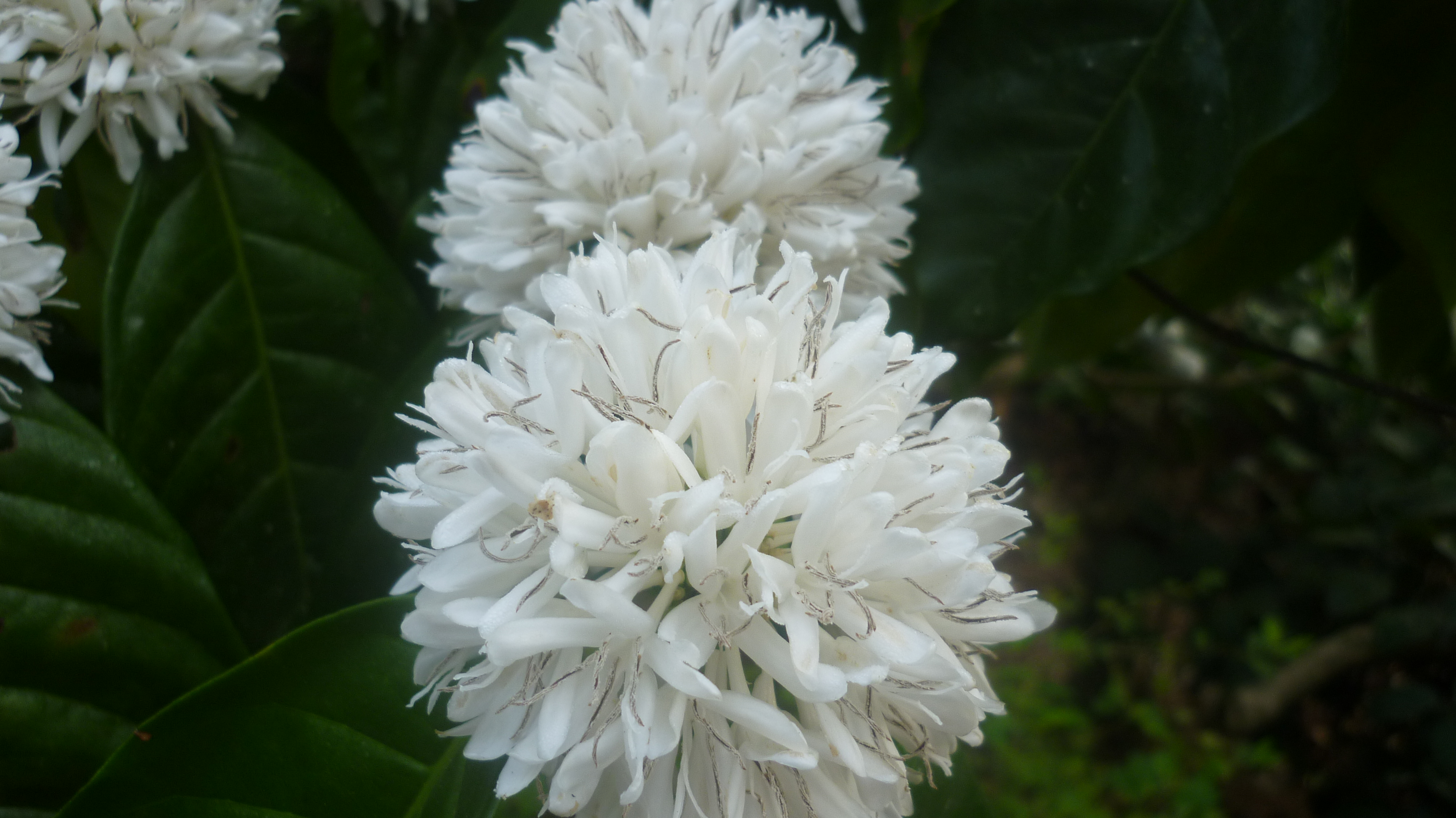
It is that time of the year when the entire hill station awakens with the fragrance of the blossoms.. On the ninth day after the 1st pre-monsoon showers, the coffee plants around the hills of Kodagu will be in bloom..
It is an annual spectacle of nature whose occurance is unpredictable and is wholely dependent on the pre-monsoon showers. If the rain fails, it creates some sort of panic among the growers who then resort to artificial sprinkling sytems.. Be it rain showers or irrigation, in either case, what follows is something that one must experience atleast once in a lifetime..
White bunches of coffee blossoms adorn the trees as if some one has strewn cotton all over the hills.. And these flowers last for a maximum of 24 hrs which makes it even more special.. And like the saying goes.. You HAVE to be at the right place at the right TIME to see the right thing happen..
Have you experienced the fragrance of coffee flowers?






















 The Lost Lander