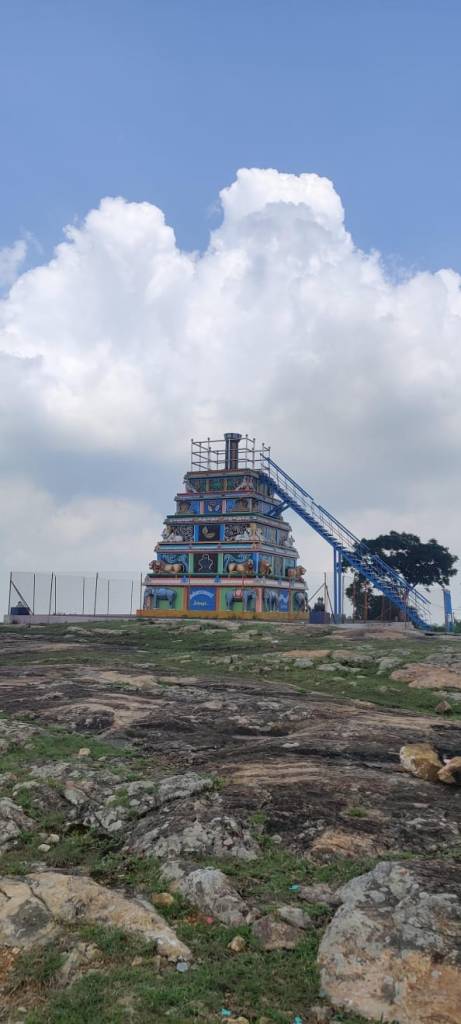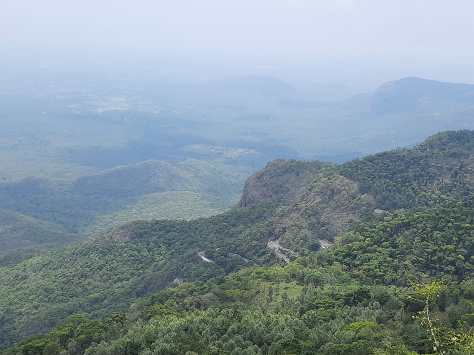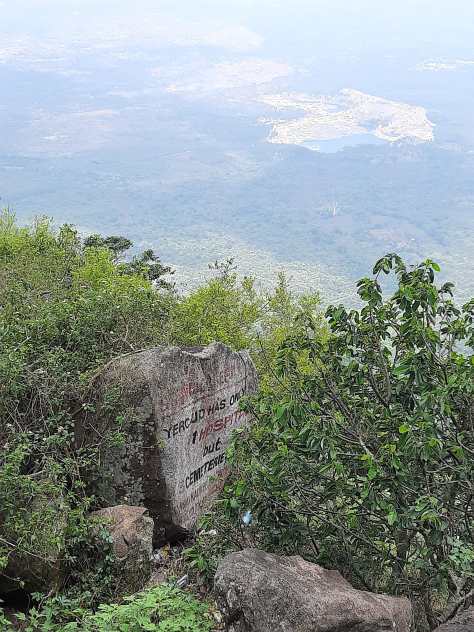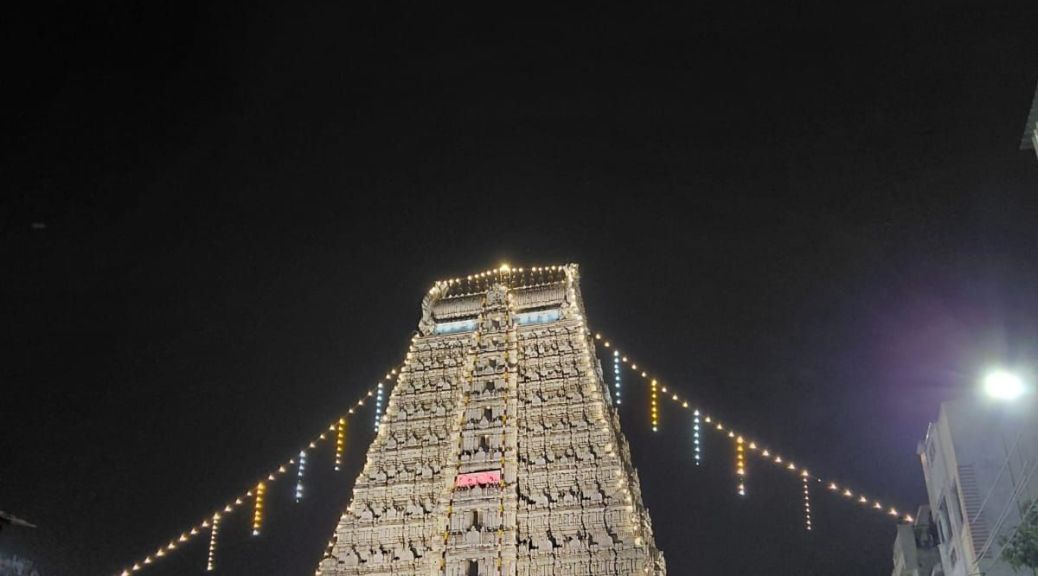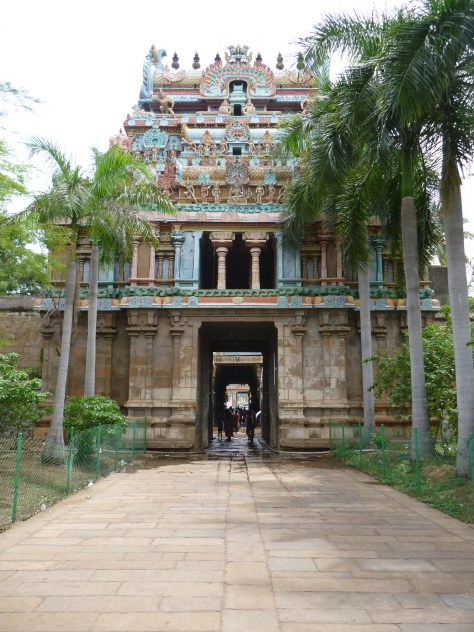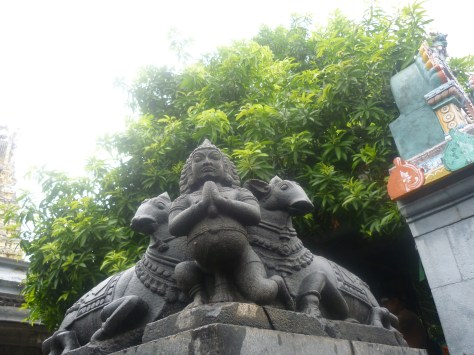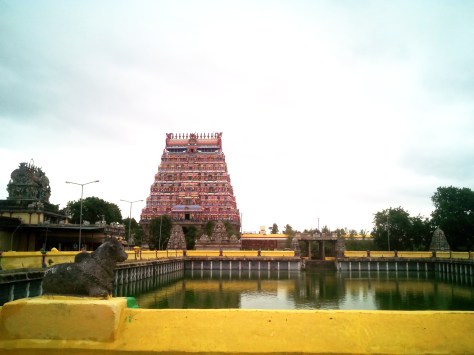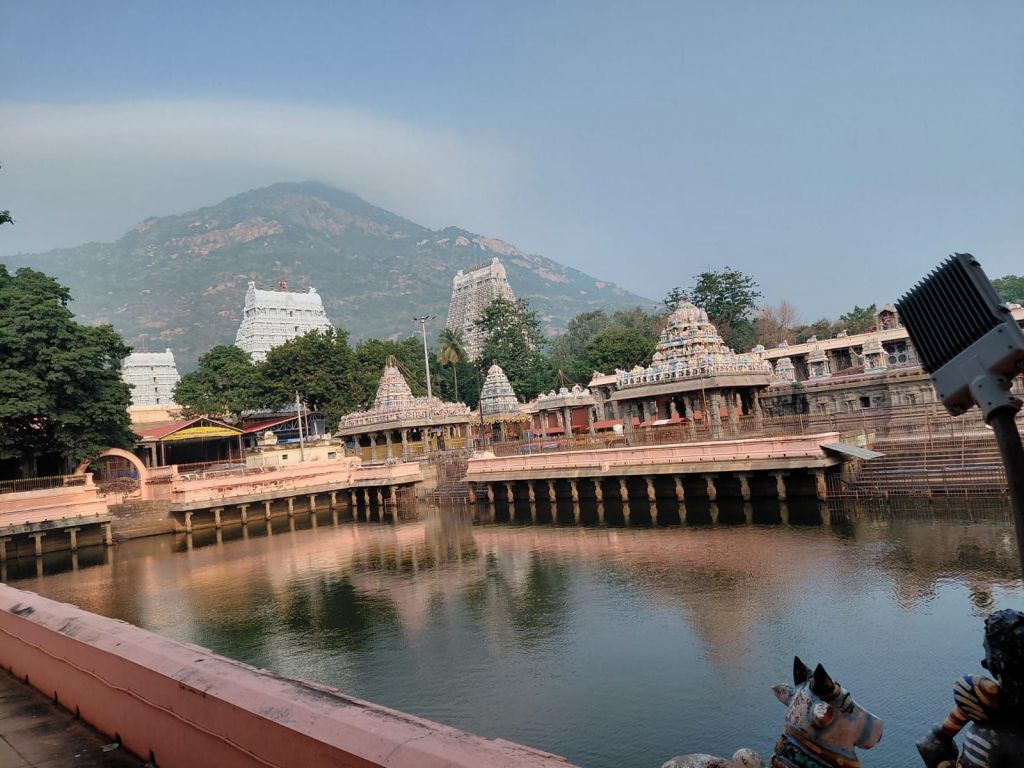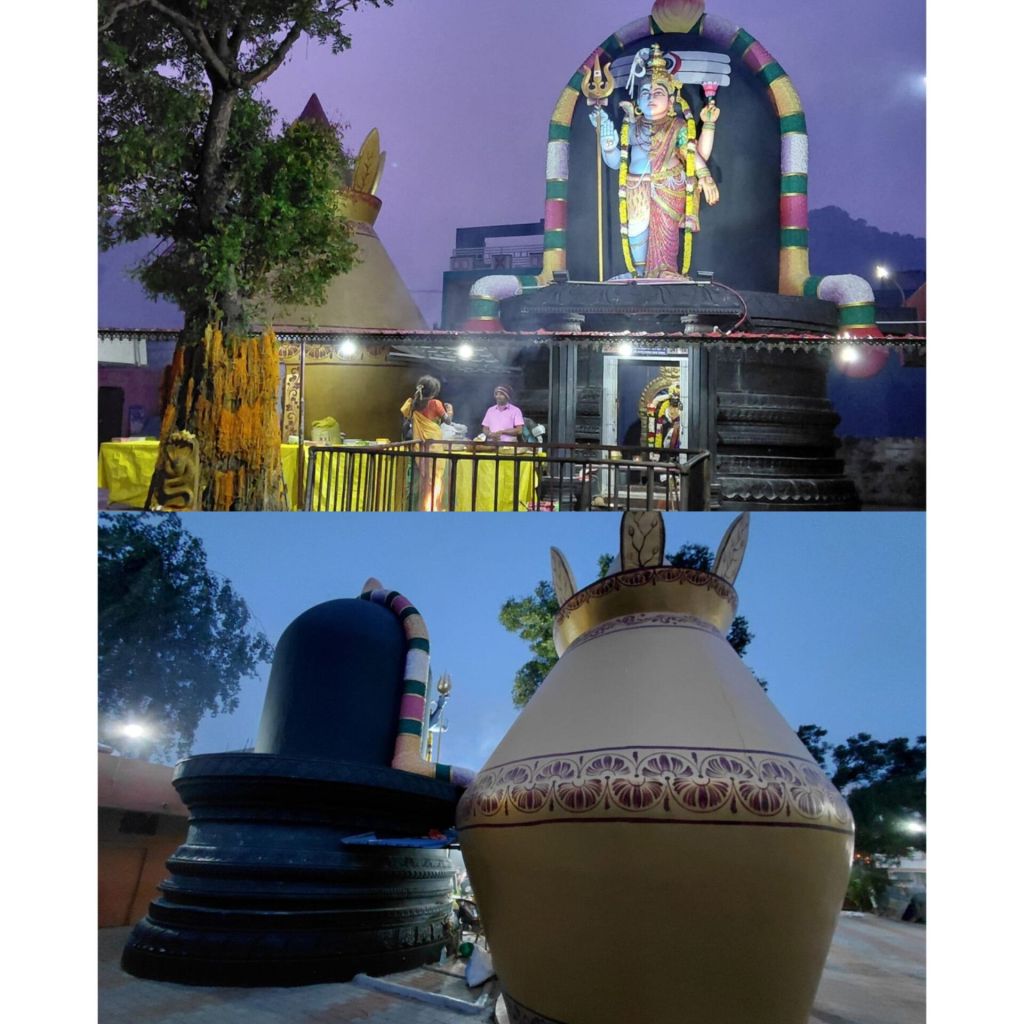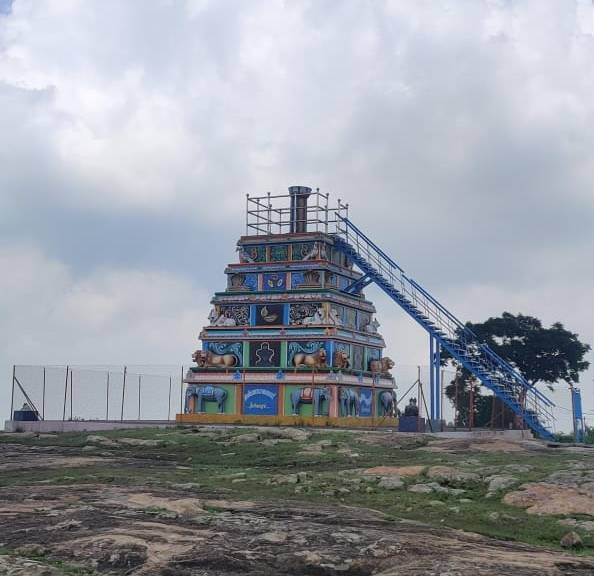
On yet another weekend, we were off on yet another hiking expedition. This time, we went to a lesser-known trail on Hosur-Krishnagiri road. The initial plan was to hike to ‘Aiyur Sami Lake’, a day hike organized by the Eco-tourism wing of the Tamil-Nadu tourism department. However, their site was not accepting registrations due to unknown reasons, and hence, we decided to randomly pick a hill around the region on Google Maps and hike it up. That’s when we came across the Ankushagiri fort.
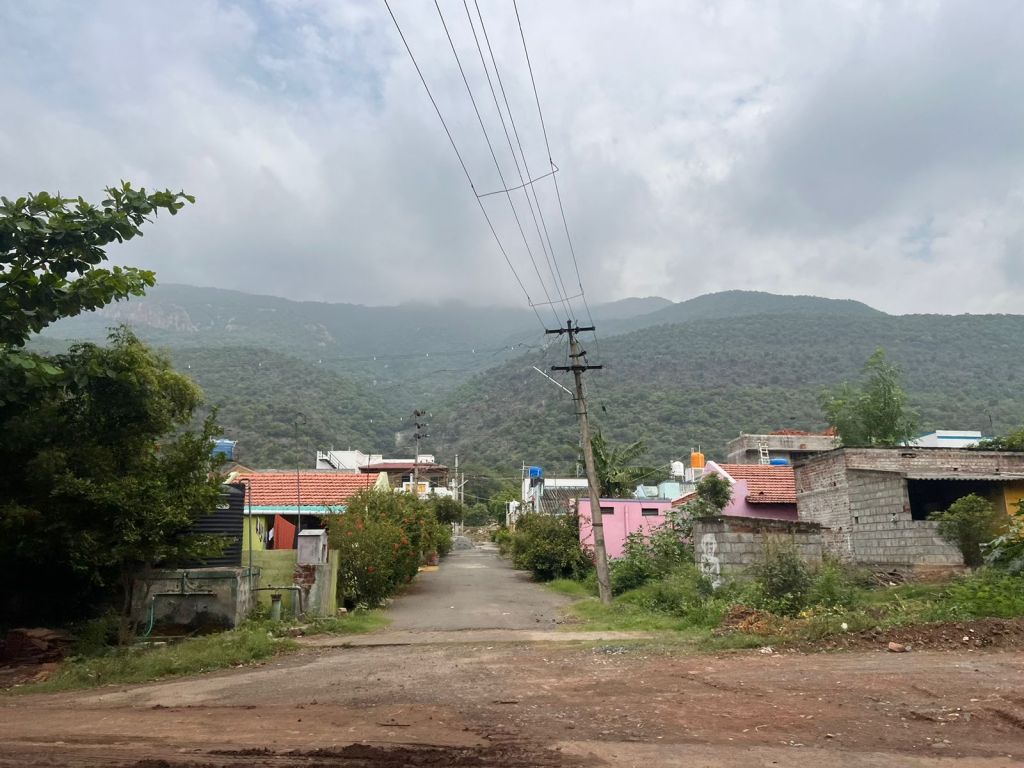
Following the route indicated on Google Maps, we arrived at the base of the start point of the ascent to Ankushagiri. There is a Perumal temple and, hence, a proper space for vehicle parking. Since we arrived on a Saturday morning in the winter months, some pilgrims had already arrived to worship the chief deity here. However, we skipped the temple visit and began our hike toward the fort that was located (once upon a time) on the hilltop.
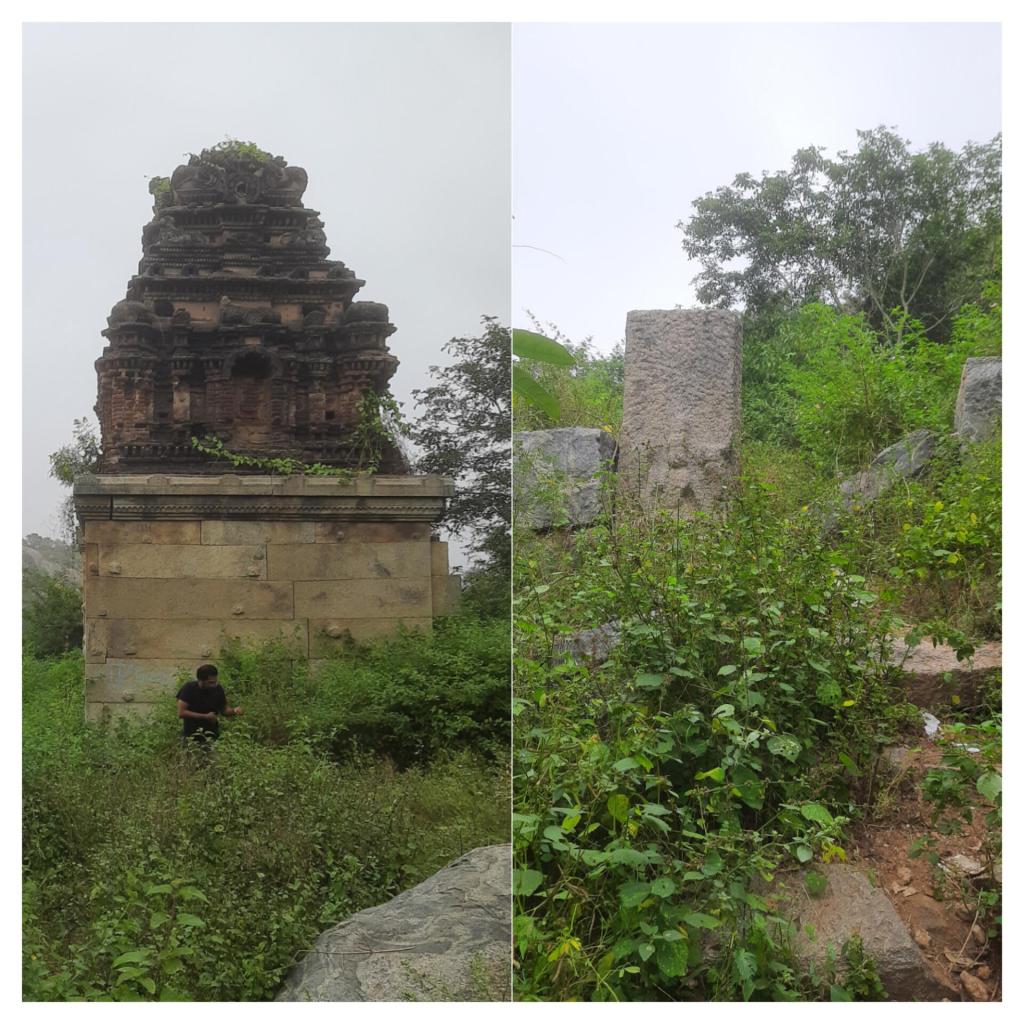
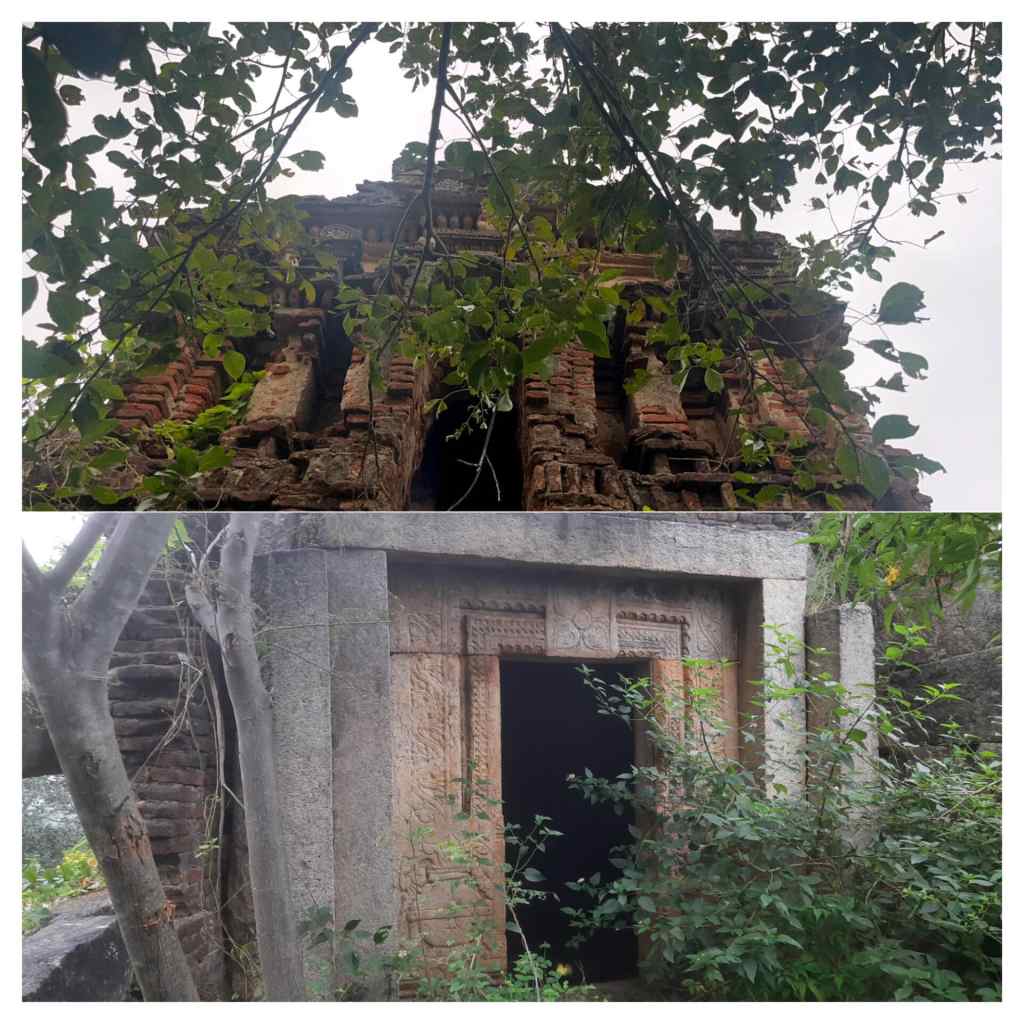
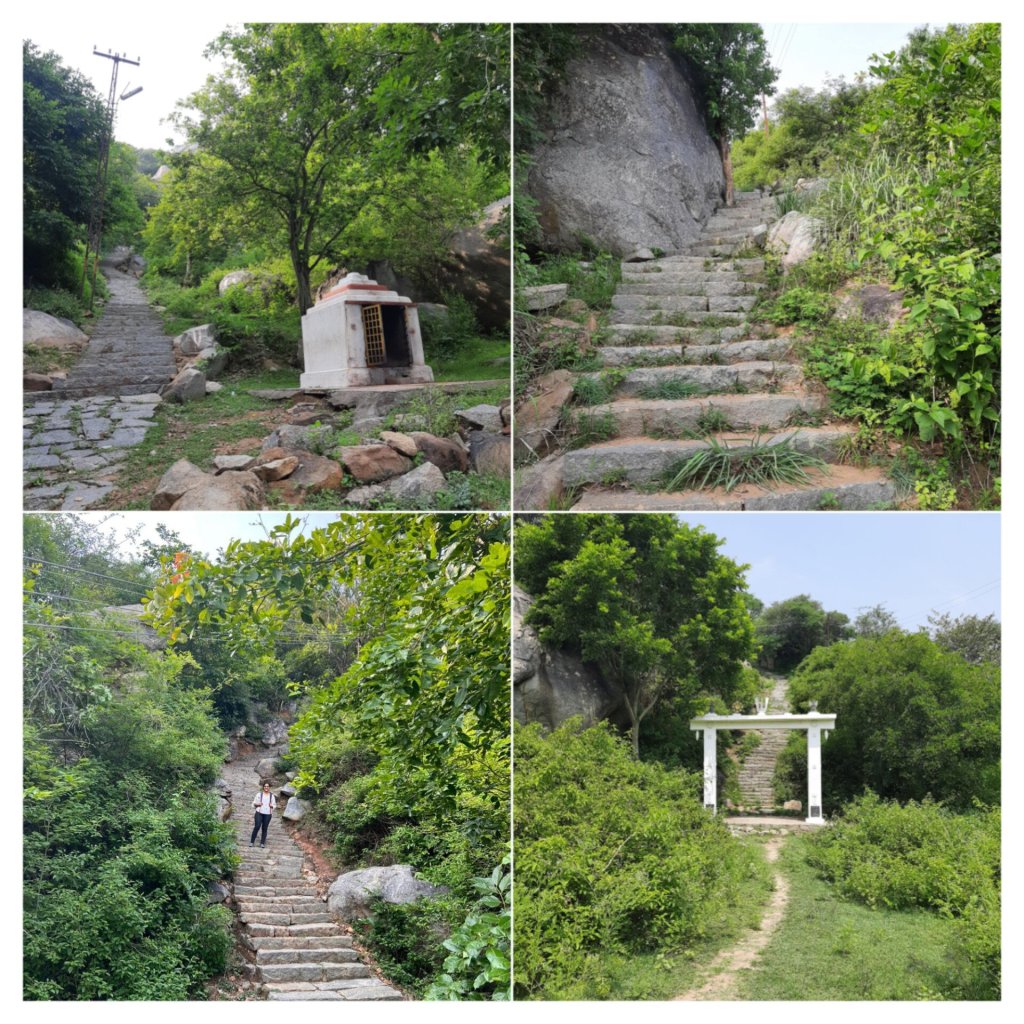
The ruins of the ancient temple at the base of Ankushagiri Hike
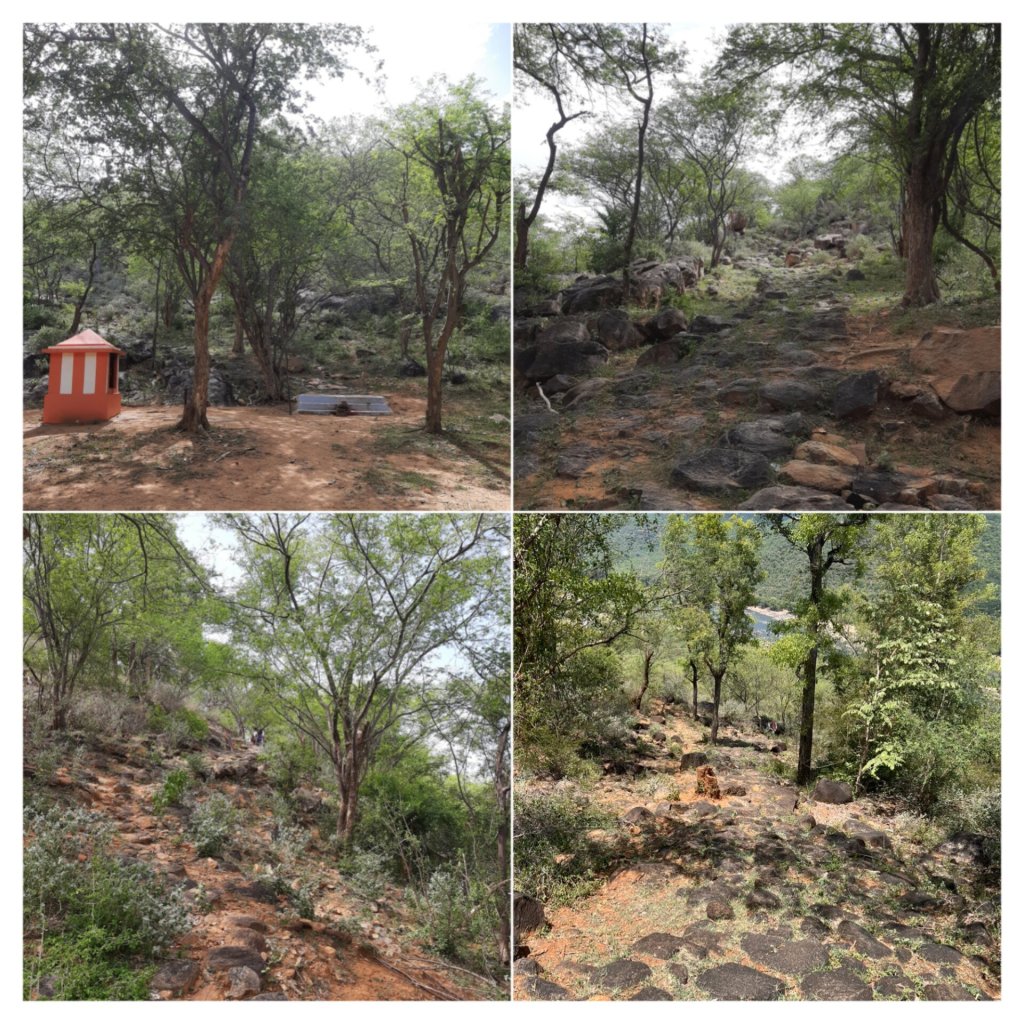
At the beginning of the hike route, there is an ancient structure, now in a dilapidated condition. Today, the Sanctorum lay empty with wild bushes and creepers taking over what once must have been a grand temple. The motifs on the walls of the two adjacent temple structures indicated both Perumal and Shiva.
The ruins of the ancient temple at the base of Ankushagiri Hike
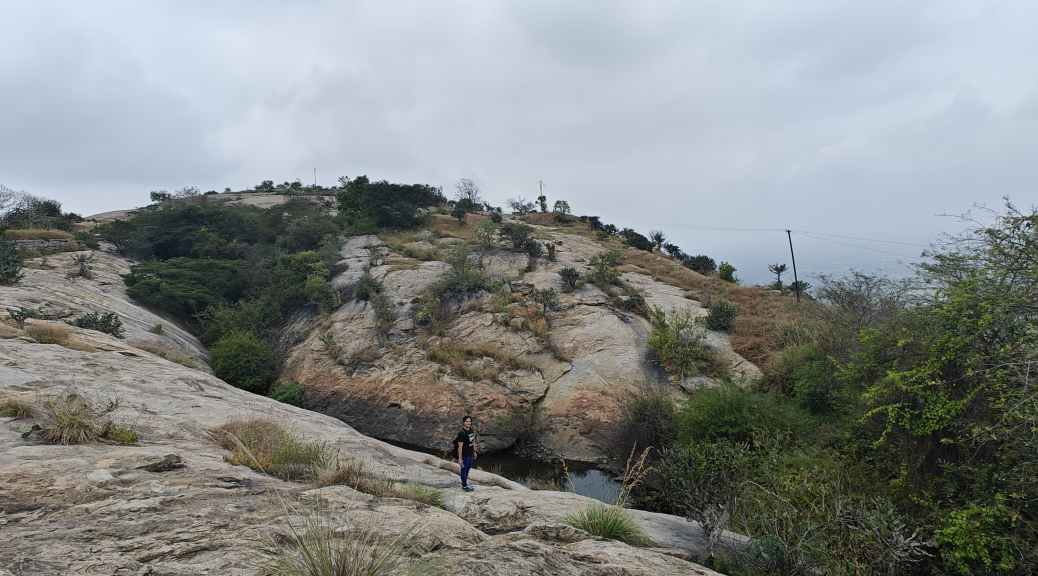
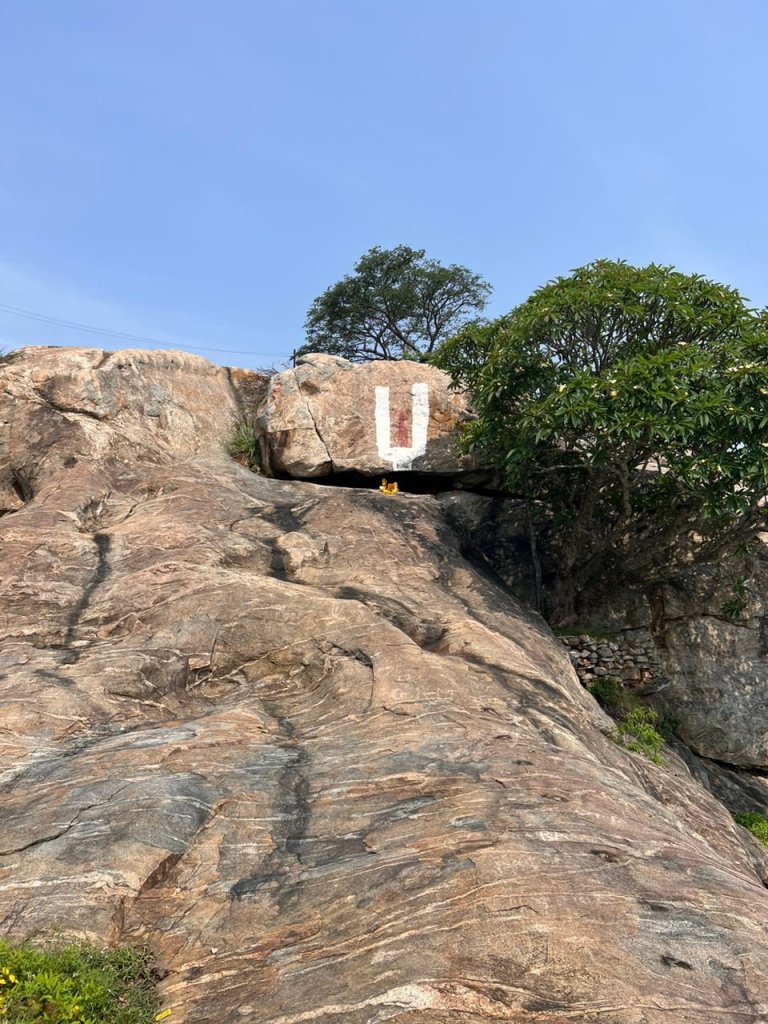
We went ahead from there and stopped after a brief walk. We were confused about the correct trail which seemed to split at a point from where either of them needed some more wear. We casually picked a path and continued to walk on the trail where the thorny bushes then opened to a rocky terrain. The rock looked interesting with varying patterns all over.
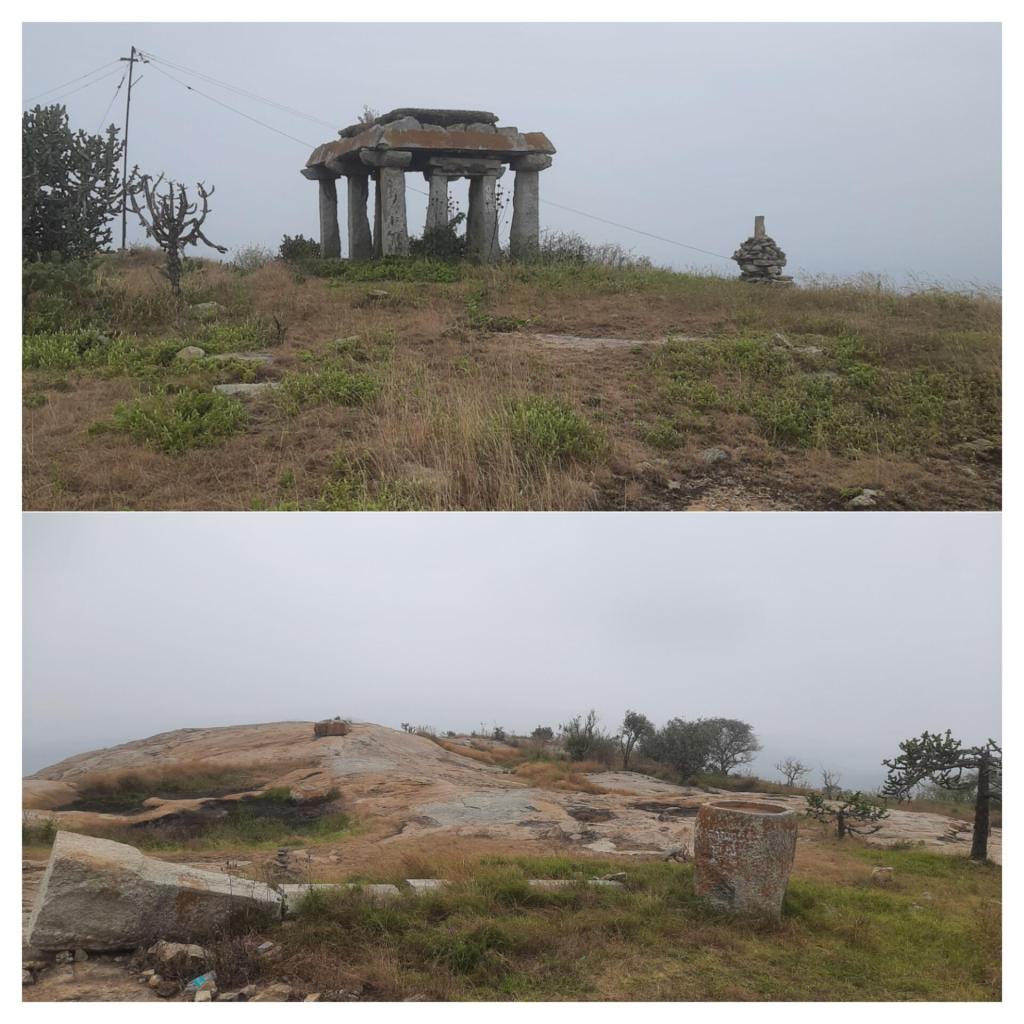
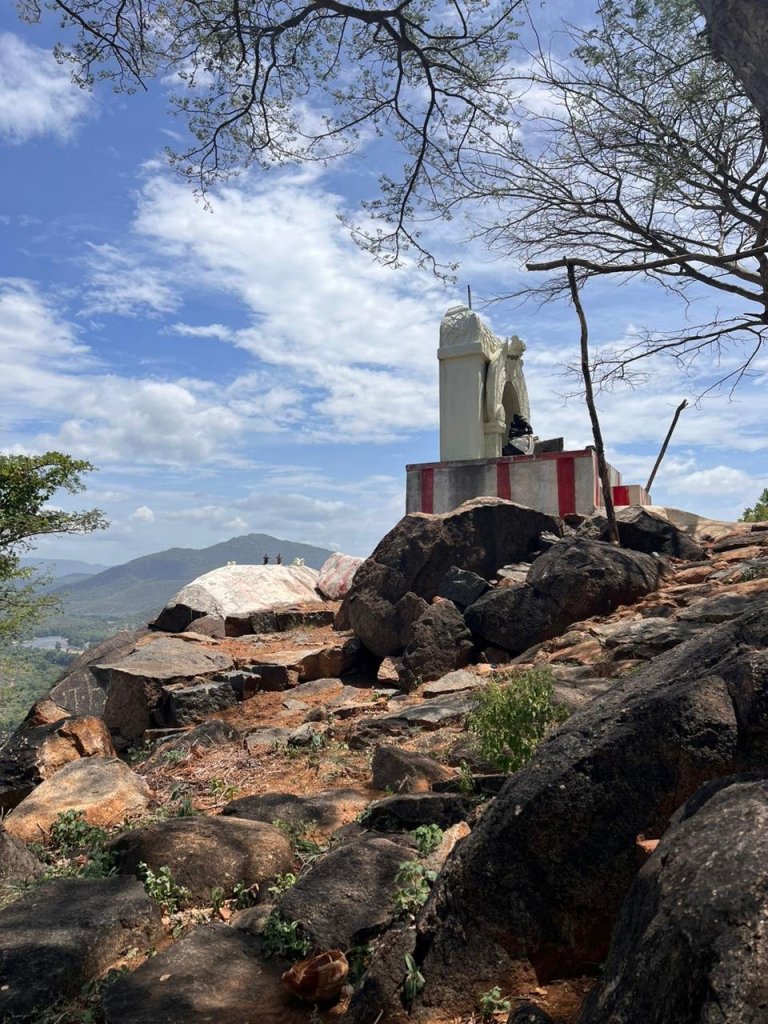
At the top, there were massive cacti plants dotting the area around an abandoned ancient temple structure. Only the pillars remained with the tall Garuda stambha lying down on the side and a stoneware that appeared to be an urn or a waterpot. Some previous visitors to this place had written ‘Someshwara Swamy Temple’ on the stoneware pot for our reference. We rested beside the temple on the large open rock bed overlooking the landscape. The gentle wind caressed our faces while we watched the hills appear one by one at a distance amid the clearing fog.
The ruins of Someshwara Swamy temple at the peak of Ankushagiri fort
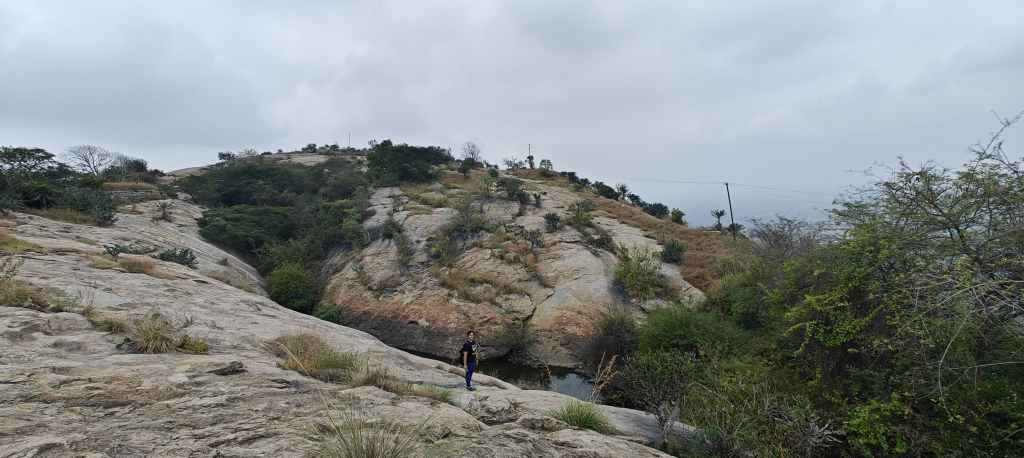
After relaxing for a while and munching on some fruits and nuts that we had carried with us, we proceeded toward the next part of the hill. The trail was beautiful with a rocky gorge on one side and huge cacti lining the path on the other. There, we arrived at a single electric pole that stood in the middle of a heap of ruins of what appeared to be an old fort. Although a circular marking can still be seen to date, only a few large pillars, a few hero-stones like inscriptions, and a couple of kolam designs engraved on the floor were all that existed for us to decipher what might have been the real grandeur, expanse and the purpose of the structure there. Almost little to no history is available to us about who or how this place had served.
Ankushagiri Hike
Anyway, it was a very interesting outing for us to explore a place so lost in an area where we were the only humans in kilometers around us. We spent ample time there before descending back to the base. We photographed several other patterns on the rocks before arriving at the same bushy junction where we had chosen to take the random path for our ascent.
Upon our return, we paid a quick visit to the Perumal temple before heading back to the city.
It was an online link that led me to a few photographs of a rare celebration. The images were accompanied by very little write-up for me to get a clear idea about the occasion. All I could infer was that it was a festival called ‘Padai Kavadi,’ celebrated in a village called Valangaiman, near Kumbakonam in Tamil Nadu.
I reached out to a few friends from Tamil Nadu who, in turn, connected with their acquaintances from the region and gave me information that the festival is celebrated annually, on the second Sunday of the Palguni month as per the Tamil calendar. Since I had ample time, I could meticulously plan my itinerary for that weekend and wait for my arrival at Kumbakonam. I had earlier visited Kumbakonam, so I included a few places that I could not cover in my previous trip. But that is for another story. For now, the focus is on ‘the Valangaiman Padai Kavadi festival.’
What is the festival about?
For a South Indian in general, one might think the Kavadi festival happens in every other village during this season. So, what got me curious about this place? Well, this Kavadi festival at Valangaiman celebrates the rebirth of a person. As per the local belief, people suffering from smallpox (still considered a deadly illness in most parts of India) make a vow at the Sri Padaikatti Maha Mariamman temple to perform the Padai Kavadi if cured. Once completely cured, they believe they have seen death and returned. Therefore, the convalesced person is made to lay on a bier or a handbarrow, lifted and carried by pallbearers, and the entire ceremony or the ritual of a traditional funeral is conducted as if he/she were dead.
There are primarily two types of biers. One, a simple yellow cloth tied to a bundle of sugarcanes or a single sturdy bamboo that is used as a cradle for kids and carried by two men on either end; second, a handbarrow with two bamboo culms knitted together with coconut fronds on which an adult convalesced is carried by four men. The adult bier is made more elaborate and decorative depending upon the interest and financial status of the person offering his vow.
An adult-female laying on a bier at Valangaiman Paadai Kavadi festival
I was told that three sister goddesses are living (at dedicated temples) in parallel streets of the village. The kavadi (usually body piercings or holy water carried in decorated pots on heads) is offered as vows to all three sisters, but the Padai Kavadi (the resumption of the dead, celebrated by sleeping on a bier) is offered only to Sri Padaikatti Maha Mariamman, the second among the three sisters, during the auspicious day of Palguni month.
A child being carried on a bier at the Valangaiman Paadai Kavadi festival
What happens on the festival day?
The procession of the convalesced people lying on biers starts early morning, mostly to avoid the noon sun. One can find hundreds of devotees who gather either at the small shrine of Vinayakan on the banks of the river Kudamurti or at a dozen makeshift temporary shrines set up by various local priests on the dried riverbed. Here, the bier, the person supposed to lay on it, and the respective kith and kin assemble for the rituals. Each person offering their vow is made to sleep on the bier after their family deity is invoked. Their eyes, nose, and mouth are closed with yellow cotton fabric, hands and legs are tied together as if those of dead people lying in coffins. Holy water is sprinkled around, and all the people gathering touch the feet of the sleeping person to take his/her blessings before the pallbearers carry them for the procession towards the Mariamman temple. For as long as a convalesced person is sleeping on the bier, he/she is treated equivalent to God as they are someone who has neared death, seen God, and returned. Then, a person carrying a clay pot with burning wood and incense leads the procession, and one with a pot full of water trails them, all being accompanied by drumbeats and flower throwers.
A funeral entourage going towards Padikatti Maha Mariamman temple
The procession circumambulates the Mariamman temple thrice, and then the bier is lowered down in front of the temple. Rituals are performed, post which the person descends from it and goes inside the temple to see the goddess and complete his vow. This is about the Padai Kavadi for people who survived death.
An adult man being carried on a bier at Valangaiman Paadai Kavadi festival
However, people who have suffered other ailments also make vows to offer a replica of the body part/ organ that has been cured through their prayers to Mariamman. One can see models in clay or silver, like eyes, legs, hands, etc., being sold around and offered by people at the temple, depending on their cured illnesses.
Apart from this, one can also see several people with various kinds of body piercings walking on the road (which is also a form of Kavadi) and circumambulating the three sister temples to offer their vows and prayers. A man suspended from a crane with his back hooked with metal loops and circumambulated around and in front of the temple, some men with full torsos pierced with lemons, long and heavy tridents passed through both cheeks, etc., were some of the unique and different Kavadi offerings I witnessed here. A detailed post of a dedicated festival of body piercings called ‘Mayana Kolai’ is available on my blog for further reading.
Body piercings at Valangaiman Paadai Kavadi festival
After all the kavadi offerings are over, the presiding deity, Goddess Padaikatti Maha Mariamman, is then brought out of the temple by around 03.00.p.m. on a procession. Around that time, cattle (goats and sheep) and poultry donated by the devotees are tied to another central post that is erected in front of the temple and suspended up and down with their bodies held firmly in the center. I could not gather sufficient information about the significance of this ritual, but I would be glad to learn from any of my readers here.
A devotee with body piercings; Also the wooden post used to swing cattle hoisted infront of the Padikatti Maha Mariamman temple
The festival then culminates after the deity returns inside the temple.
When a friend mentioned taking a road trip to a fair at Anthiyur village, neither of us had many expectations. What can one expect at a village festival in India, after all? All that we had learnt before commencing our road trip was that it was a cattle fair, which was held as part of the annual festival of the Gurunathaswamy temple at Anthiyur village. Supplemented by a handful of YouTube videos in Tamil, we decided to take the long drive from Bangalore to spend a weekend.
We started from Bangalore before dawn to reach Anthiyur at the earliest and get sufficient time to see all the cattle stalls before returning. But only to our surprise, the scale of this temple village fair was anything beyond our imagination. Neither of us had seen or heard of a small village festival to be of such a large scale and spread.
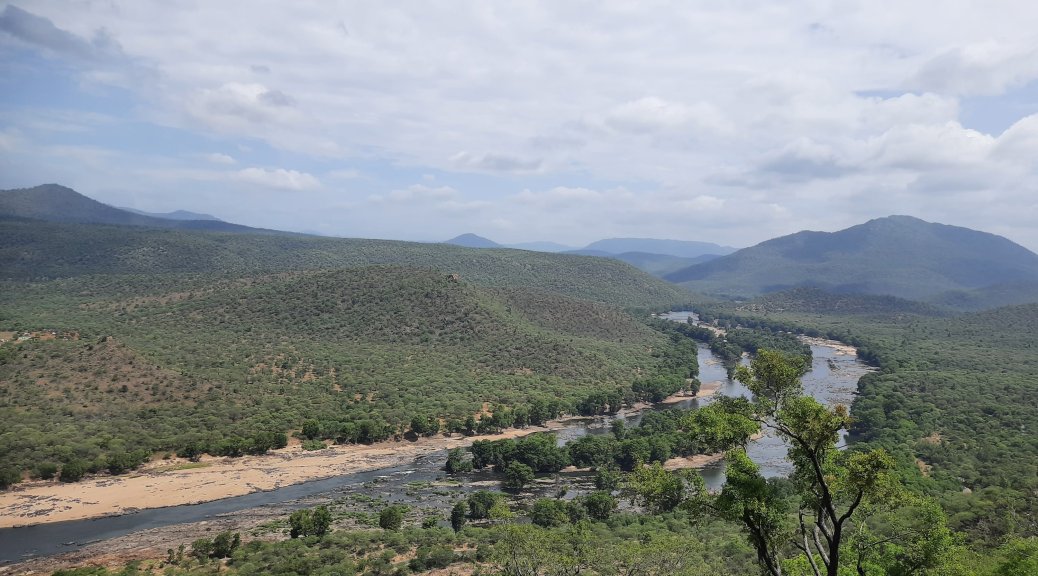
The beautiful hills around Anthiyur village
Mythology of Anthiyur Gurunathar temple:
The story dates to around 600 years, when there lived a clan near Pichavaram forest, that worshipped three stones known as ‘Kutty Aandavar’ (translates to ‘Small God’, in Tamil). The local ruler wanted to marry the priest’s daughter. However, the priest’s family was against the marriage proposal. Meanwhile, one of the members of the priest’s clan gets possessed by their deity’s spirit, and the family is told to abandon the village along with the three prayer stones to avoid the outrage of the ruler’s anger. Following this, the family started to move north until they found a safe place to settle down. At some point, the family felt that their survival was going to be difficult and that the stones being carried by them were an additional burden. Hence, they continued their journey by throwing the stones into a nearby pond. They halted at Anthiyur for the night.
On the following morning, Santhakumaran (one of the family members) was surprised to find the same three stones back in his bag. They realized the powers of their deity and resumed worship of the stones by giving them three different names. The first stone was called Kamatchi, the second one was Perumal (Vishnu), and the last one was Gurunatha Swamy (a combination of Shiva and Kantha).
During the festival, three deities are taken on a procession from the main shrine at Anthiyur village to a temple in the nearby forest. As per mythology, a demon is believed to have occupied the forest in which Goddess Kamatchiamman wanted to reside. A fierce war was then fought between Veerabhadra (the warrior assistant of the Lord, protector of Kamatchi-amman) and the demon, in which the demon eventually surrendered. It is said that instead of leaving the forest, the demon requested lord Gurunathar to allow him to stay there on a condition that Kamatchiamman came there once a year to visit him. However, Veerabhadra agreed to this on the condition that he, too, was allowed to stay in the same forest. This temple is today called Vanakovil (translates to ‘Temple in the forest’ in Tamil), where Kamatchiamman is brought in a palanquin from the main temple.
The history of the Anthiyur temple festival
The current temple structure is believed to have been built by the Pandya kings. The Gurunathar temple houses an 11*11*11 feet kulukai. A kulukai is a large earthen storage container mainly used for storing food grains, with a large opening at the top (to fill the container) and a small vent at the bottom (to take the grains out for consumption). It is believed that the kulukai in this temple is used to store the jewels and other items related to worship, and is guarded by snakes. Only the head priest is allowed to enter the container and access the stored things, and is unharmed by the guarding snakes. Therefore, this kulukai is worshipped by the local people and it is believed to keep them safe from reptiles, scorpions, etc.
The month-long temple festival held during the Aadi month of the Tamil calendar hosts a range of unique rituals and celebrations during this time. Temple cars built for each deity are prepared and managed by the respective caste of people. Two large, towering, nicely decorated temple cars (the largest is of Gurunathaswamy and the smaller is of Perumal Swamy) are pulled by thousands of devotees who gather from across the nearby villages, from the main Gurunathaswamy temple to the Vanakovil and back. Today, animal sacrifice is practiced in Vanakovil.
The history of the Anthiyur cattle fair
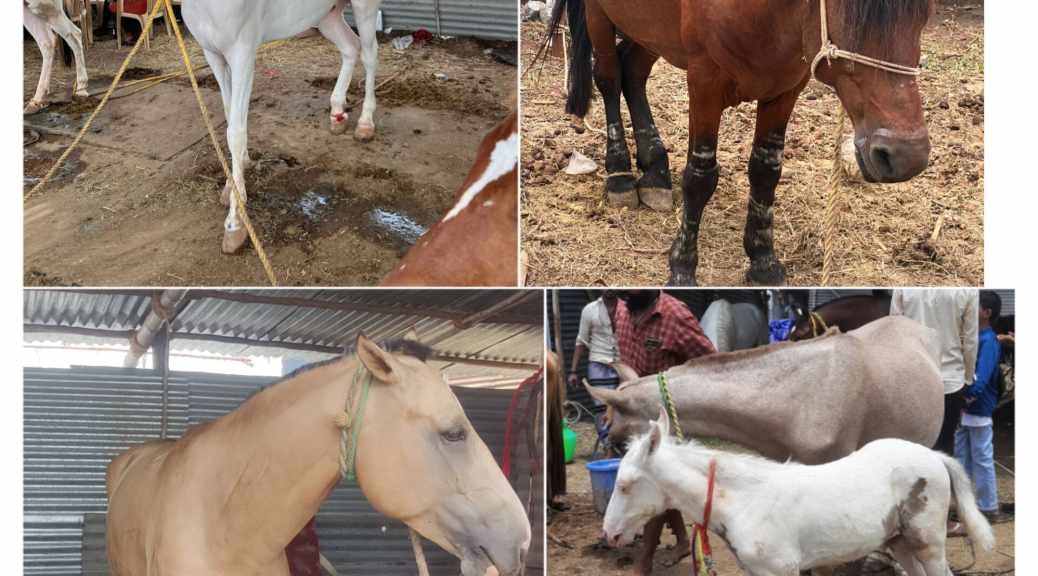
A four-day-long cattle fair is, however, the highlight of the festival for which people come from across the districts of Tamil Nadu and the states of India. There are only two cattle fairs held at this scale in India. First, at Anthiyur (more popular for the horse fair) and second, at Pushkar in Rajasthan (Primarily a Camel fair). The history of the ‘Kudurai Santhai’ (the Horse fair) dates to the times when Tipu Sultan was the ruler of Mysore. He visited this cattle market to buy the best horses for his cavalry and sold his horses that were no longer fit for battles.
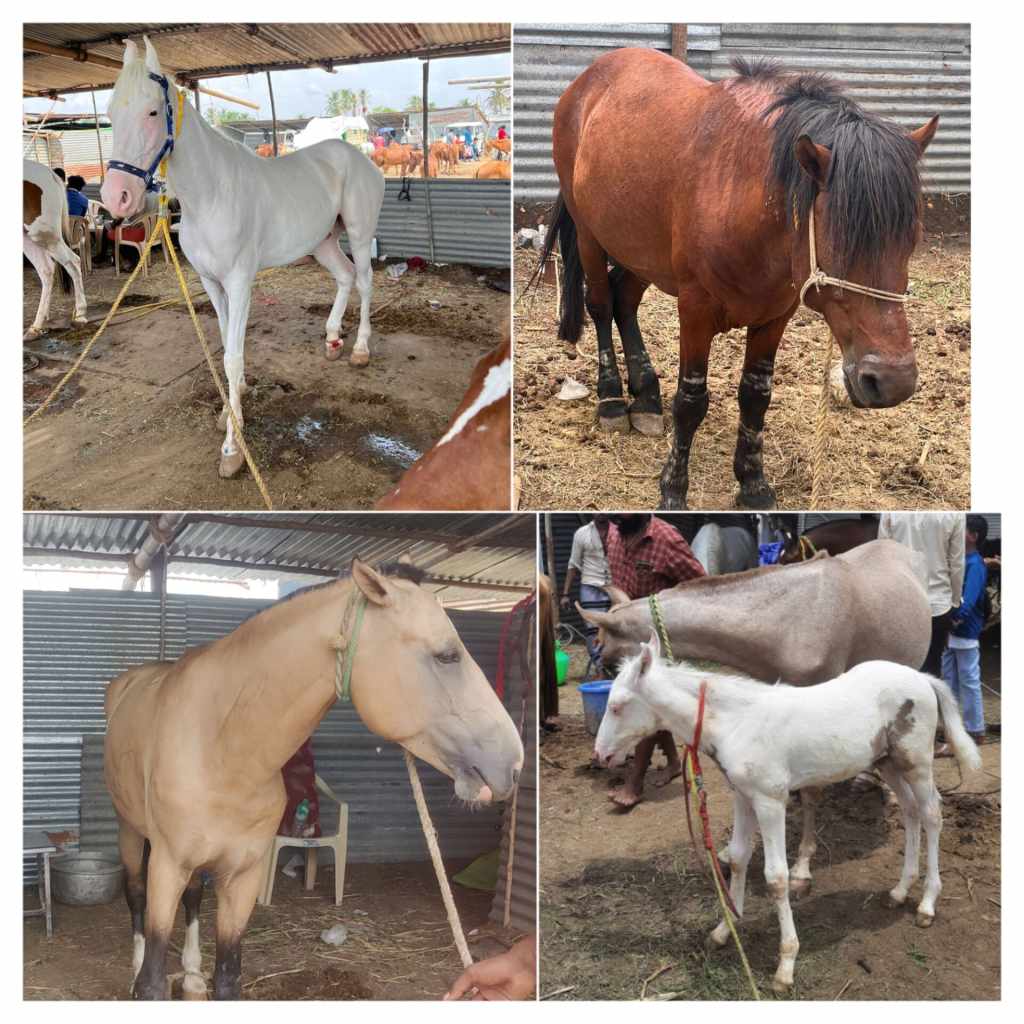
It has, over time, gained popularity among horse enthusiasts across the country who consider buying horses from this market as a matter of pride and prestige. The cost of each horse can range anywhere between 50 thousand to 50 lakhs rupees. Today, apart from buying and selling horses at the ‘Kudurai Santhai’, many horse owners come here to simply display their prized possessions. One gets to see stallions, mares, sires, and ponies of various native indigenous and pure breeds here. Some horses are made to perform to drumbeats and kept on exhibition. On the last day of the four-day-long ‘horse fair’, Geegees are judged based on their structure, build, and looks, and finally, awards are given away. On the day we visited in 2023, there were over 1000 horses at the fair brought in for various purposes.
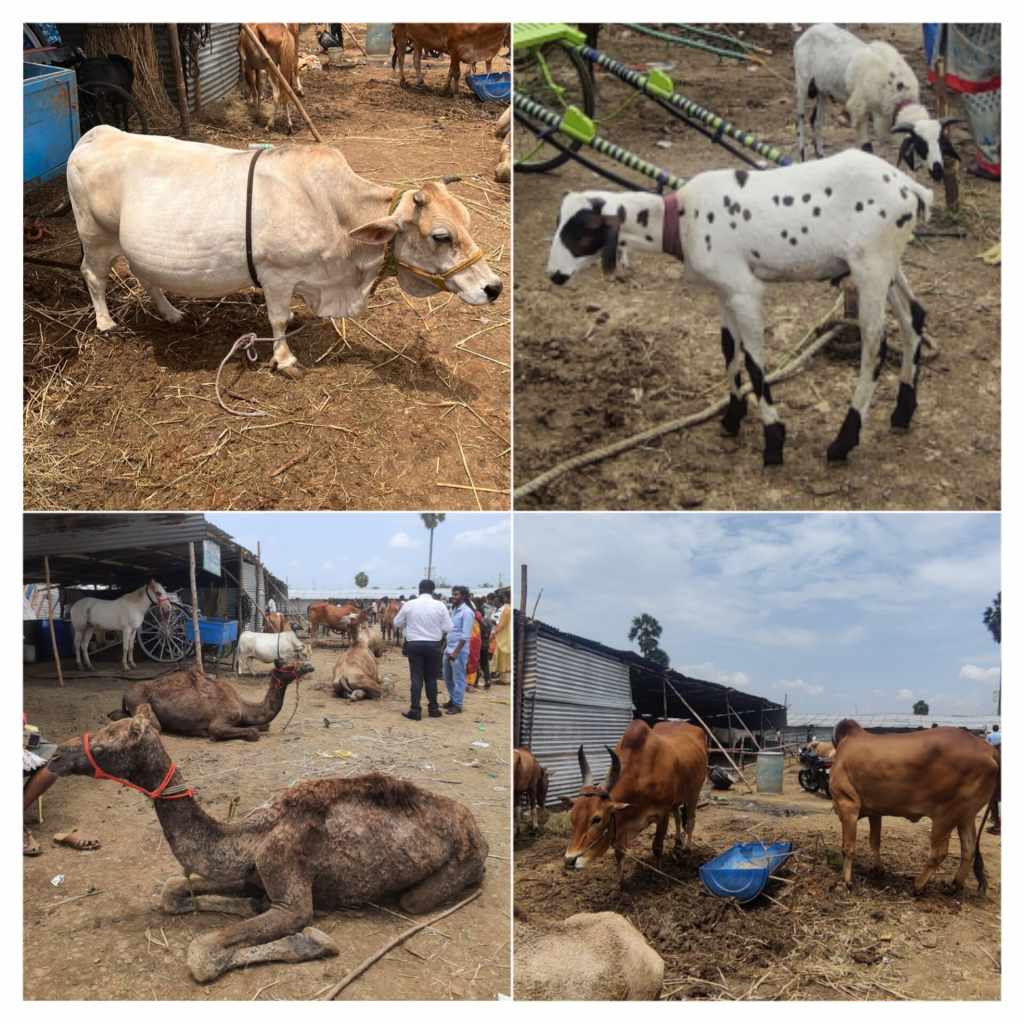
All accessories, equipment, and other things that are associated with horse-keeping and equestrian training can be found and are sold here. Apart from horses, this fair is also the largest marketplace in India for other breeds of cattle and livestock like cows, goats, sheep, camels, rabbits, dogs, and birds. With encouragement given to native breeds, it is a great experience to see cattle across the 34+ acres of land.
Largest Makeshift Amusement Park:
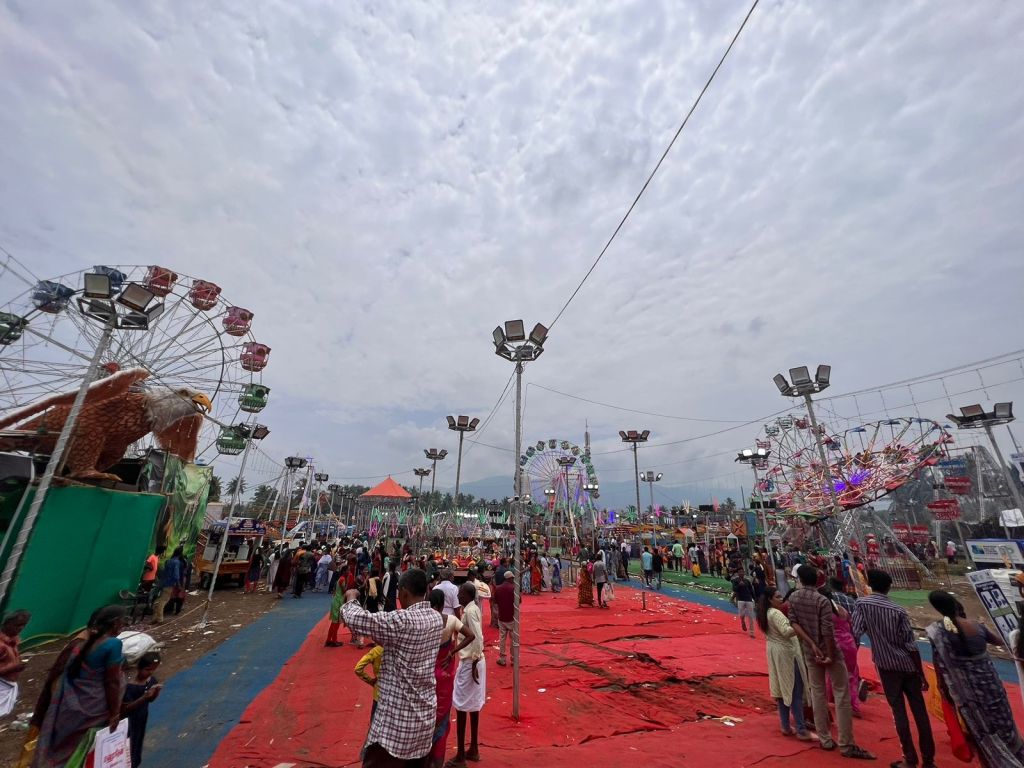
To supplement the cattle markets, there is a makeshift amusement park set up, which is also by far the largest makeshift amusement park I have ever seen. Over ten giant wheels, rollercoasters, circus tents, and at least three globes of death are set up among several other types of amusement rides. The energy and ecstasy of this fair is all together only to be witnessed rather than to be read about.
The makeshift amusement park at Anthiyur festival
Souvenirs bought:
Bamboo staff- You will find people buying them, as it is considered auspicious to keep this weapon of Gurunathar Swamy at home.
Colorful horse whips
Horseshoes- this is believed to absorb negative energy if hung at the entrance of houses.
Disclaimer: This article is posted to document folklore and lesser-known festivals of India. If any mistakes are found, it could be based on what was heard as stories. Kindly comment below or message directly for any corrections required.
Another weekend and another offbeat destination. This time, we found a temple on a small hillock in Dharmapuri district of Tamil Nadu. In my earlier post about Hogeynakal waterfalls, I have elaborated on how river Kaveri marks the boundary between the two states of Karnataka and Tamil Nadu. This post is somewhat related to the same connection. Because the history of the temple that we were planning to visit this weekend is rooted on the other side of the river, on the fertile plains of Karnataka.
The original Ranganatha swamy temple dating to the Cholas or the Vijayanagara era (as described by the locals) was on the Karnataka side. The stone structure of the temple is present even today (we hope to visit the structure on another weekend trip). The idol of the deity was destroyed by the British (which needs fact checking) and then, a new idol was reinstated on the Tamil Nadu side of the land where it stands today. The Ranganatha Swamy temple that we were heading to is in Biligundlu village and hence the name. The idol of the deity is carved out of a rock which is part of the hill overlooking the river.
On a summer day, when the water levels in the river are low, one can walk across to the other bank. Whereas, when the river is flowing full, the roads leading to both the old and the new temples are long ones. The old location is reachable via MM. hills in Chamarajanagar district of Karnataka, and the new temple is reachable via Anchetty forests in Dharmapuri district in Tamil Nadu.
The trail to Biligundlu Ranganatha swamy temple
Anyway, coming back to this weekend, we started early on a weekend morning along the Anchetty forest leading to Hogeynakal waterfalls. We skipped the highway restaurants and stopped by a small local restaurant in Anchetty town for breakfast. It was a good decision as the experience was good with local food and the local atmosphere.
A few kilometers after the Biligundlu cemetery and few kilometers before Hogeynakal waterfalls, we stopped by at a location where river Kaveri flowed onto our right and a tiny structure of brick and mortar was built onto our left… We parked our vehicle there and started our short hike up from there. A properly laid stone path is there all the way to the hilltop which took us around half an hour to hike. The views of the river and hills around were just amazing all the way.
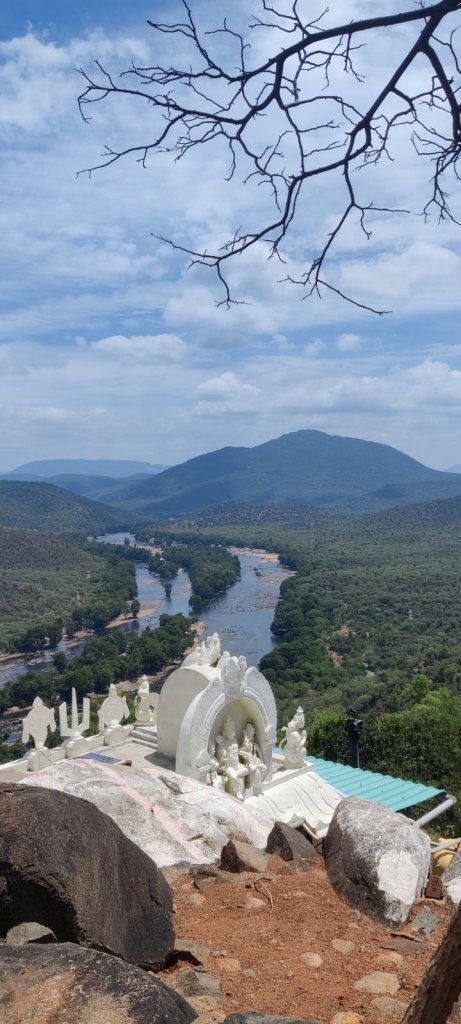
The Ganesha idol at the peak of Biligundlu Ranganatha swamy temple hill
First, we were greeted by an idol of Ganesha sitting under the tree at the peak. This spot gave a splendid view of the river and the hills beyond. We sought Ganesha’s blessings and proceeded to the Ranganatha temple located below, connected by a short flight of stairs. The temple was closed by the time we arrived. However, we could see the idol through the meshed gate. After offering our prayers, we found a spot adjacent to the temple wall and sat there to soak in the beauty of the place. The view of river Kaveri flowing with a backdrop of green rolling hills looked amazing even as the winds caressed our faces. It was a beautiful place, indeed!
We headed back after a while and decided to take a dip in the shallow waters of the river to beat the summer sun. A word of caution if you plan to get into the river, that there will be a sudden drop in the depth at many spots and it is believed to have whirlpools as well. We stayed by the shores before calling it a day after a while.
Although this destination is a recommendation for weekend and day hikers of Bengaluru, it is in Krishnagiri, a district bordering the two states of Karnataka and Tamil Nadu.
The views from an ancient temple had caught the attention of my friend and me, who are always in the look out for less crowded and less explored landscapes and places with cultural and historical importance. One such place was the ‘BalaKodandaraya Swamy temple’ whose history dates to the Vijayanagara era. Based on our online research, we found out that getting to the temple involved a short hike.
We started early on a Saturday morning by car. We had our breakfast along the way, in one of the several restaurants on the Hosur highway. From there, we followed the route on Google maps to reach our destination. A steep deviation to the left of the highway led us through villages. There were asphalted roads and good views of the surrounding hillocks for as long as the road passed through villages. The last couple of kilometers were through unpaved muddy roads passing through a slight forest stretch. We finally arrived at a small open space where we parked our car, at the base of the temple hill.
The trail through the forest cover, starting from the base to the temple arch
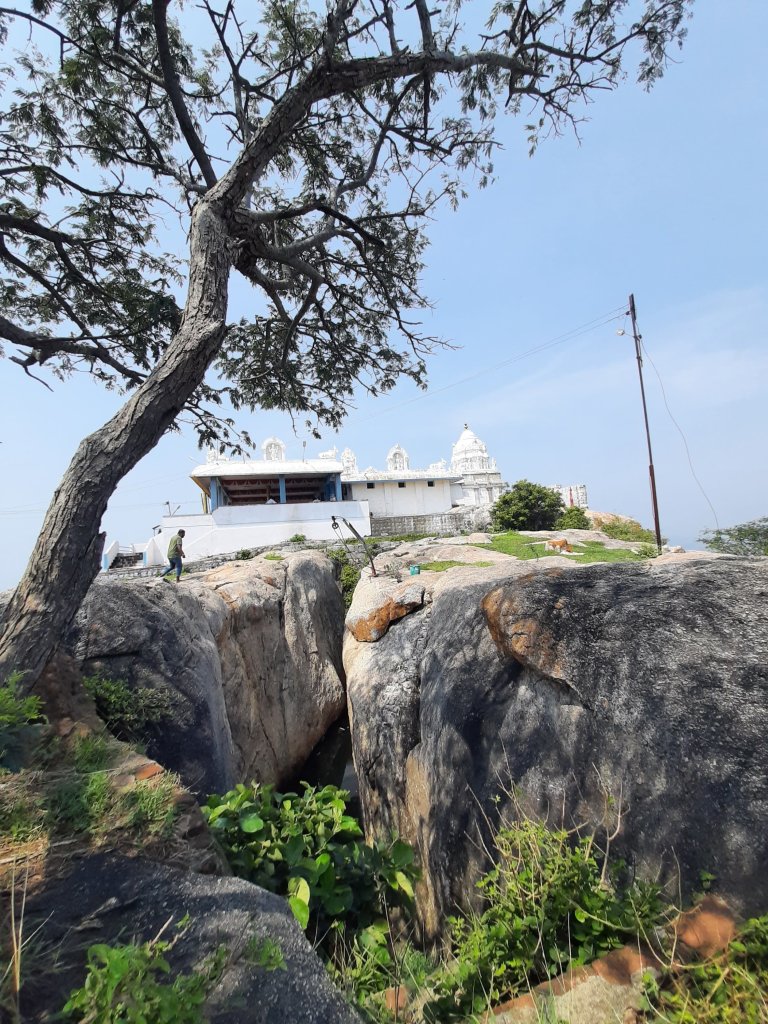
There was a small structure of brick and mortar (gudi) at the base, from where a flight of stairs led to the hilltop. People lit lamps, agarbattis and camphor here before starting their ascent. It took us about half an hour’s climb along properly laid stone steps leading to the top. These stone slabs bear the names of the devotees who have donated them and the count of their donations on each step. The ascent curved around at multiple places and offered amazing views of the valley below at every turn. The first half of the climb had a forest cover and large boulders on both sides, until we arrived at the welcome arch of the temple.
The path towards the left of the trail, towards the temple
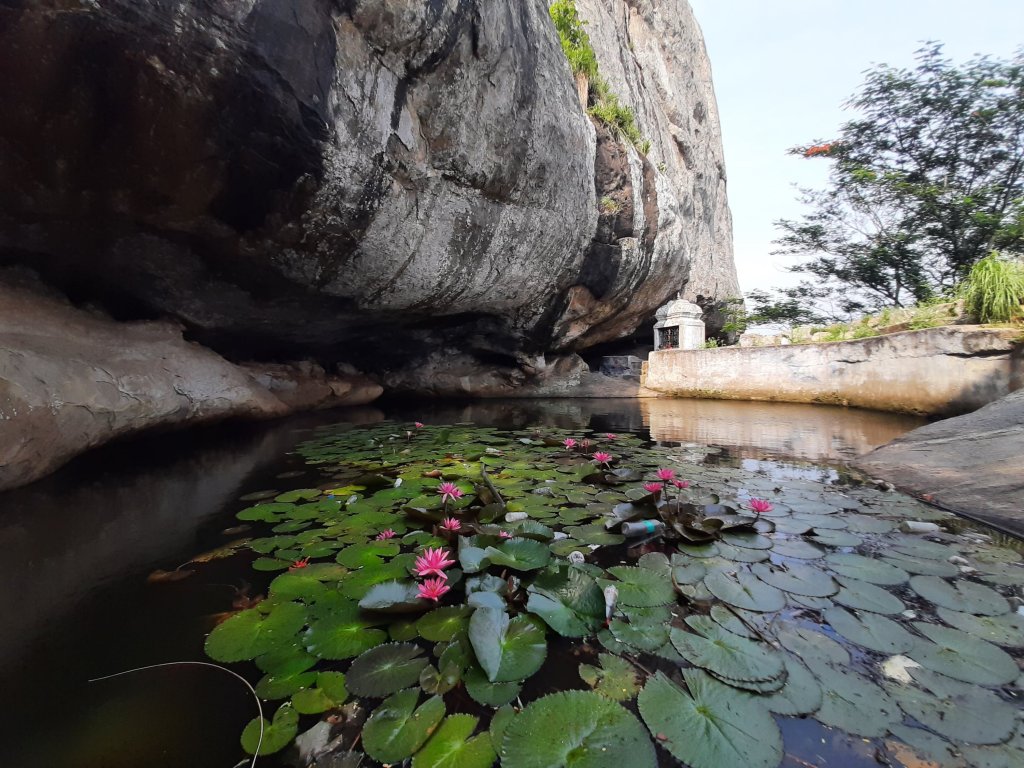
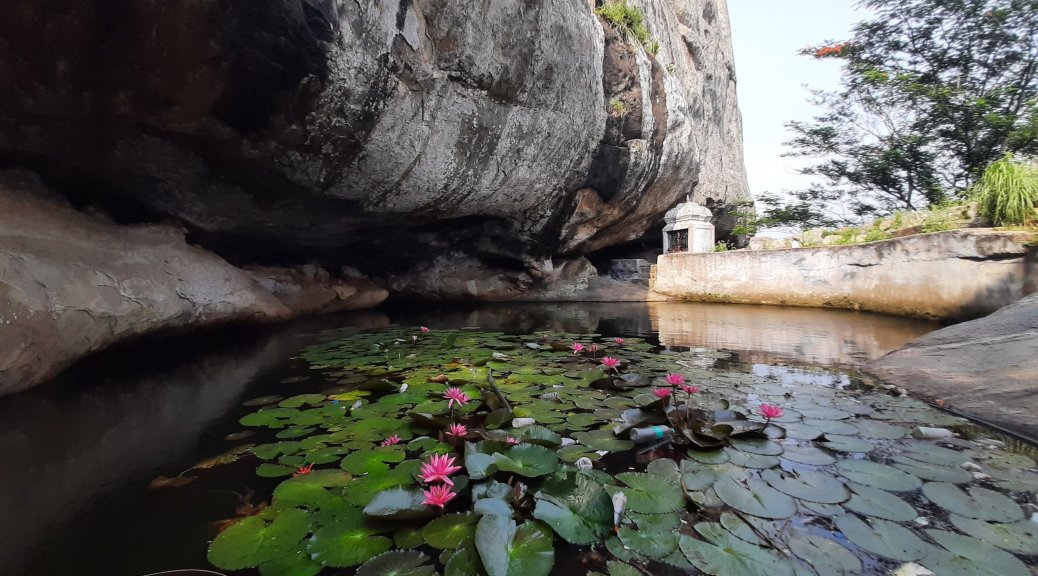
The forest cover ended after a few steps further from there and opened to a panoramic view of the valley of the villages and farms below. As one stands on a large rocky outgrowth, you will find the trail split into two paths. One, straight down through some Gulmohur trees. Second, up towards the temple. We decided to first walk the trail going straight. A few yards from there, the trees made way to a beautiful pond of pink lilies, dug right beneath a large rocky monolith. We later realized that devotees take a dip in this pond before proceeding towards the temple.
The path towards the right of the trail, leading to the temple pond
The view of the valley from there and the magical vibe of sitting by this pond of lilies could not let us go easily from there. My friend settled on the banks, with a book to read. Although the water was heavily littered with plastics, it was still a super calm spot to soak in some good energy. After spending a while, we then headed towards the temple, located on the peak of the hill, a short walk away. There was a panoramic 360 degrees view of Hosur and Krishnagiri from the temple, the green cover around, Krishnagiri dam and the Then Pennai river. The temple priest arrived much later at around 10.00.a.m. for the daily prayers.
Balakodandaraya swamy temple and the cleft for drawing water
Surprisingly, a small cleft in the rocky hill serves as a perennial source of potable water for temple use. The people who had gathered there by then, helped the priest in drawing water from this cleft and clean the temple premises before offering the day’s prayers. We sat there for a while and decided to head back to the base before the sun took over the skies and heated the rocks around. Overall, it was an incredibly beautiful place for a short trip from the city.
Other nearby places:
If you are looking at making it a full day trip, then you can explore the nearby places that include:
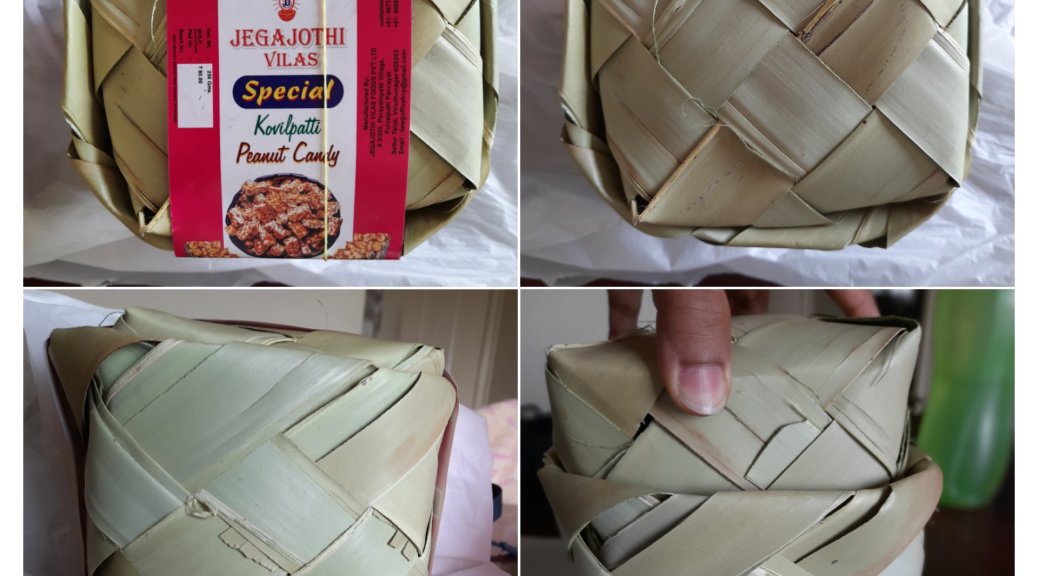
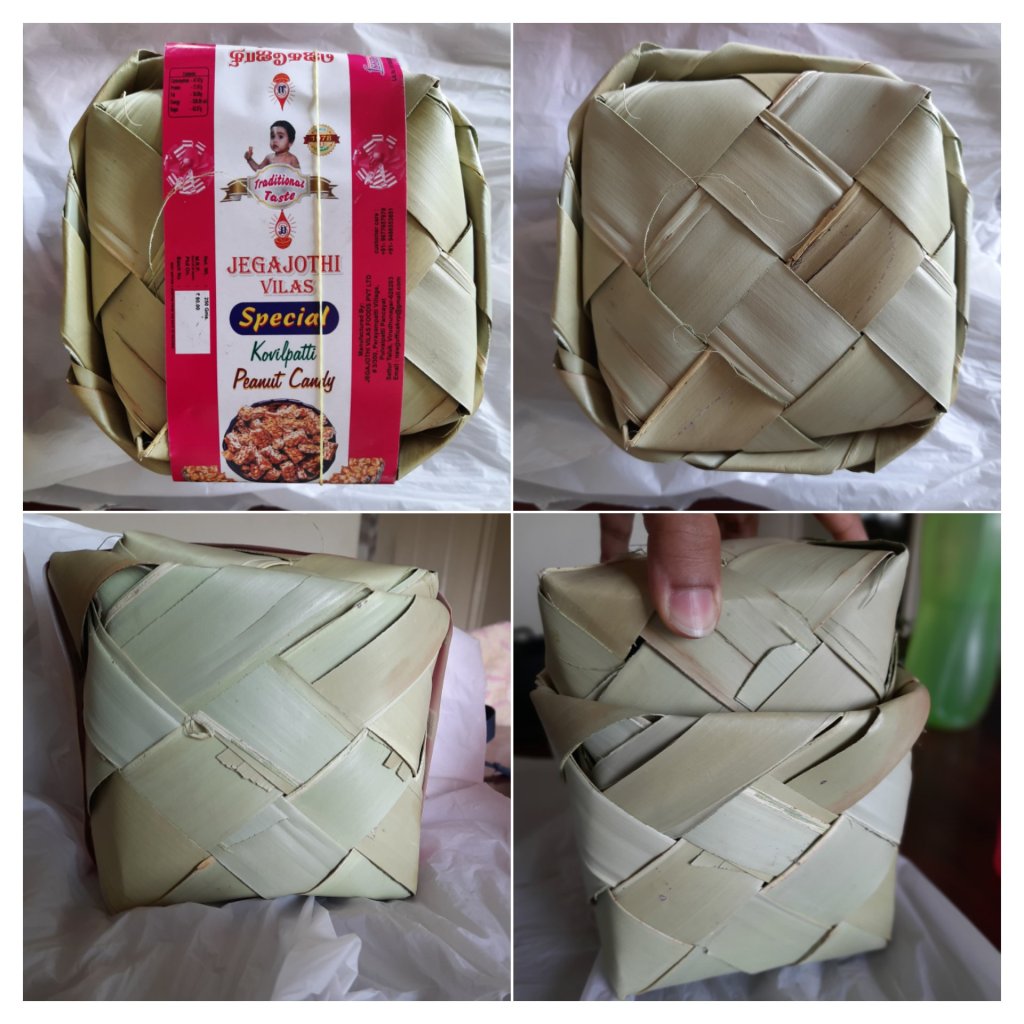
I have been fortunate to meet many like-minded people online, through travel blogging. Recently, I happened to meet one of such friends offline, during his visit to Bangalore. He greeted me with a souvenir, a nice palm leaf box containing chikkis. He explained that it was the ‘panai olai petti’ containing the famous candies from his hometown. After I returned home, a little bit of online browsing about this souvenir unfolded some interesting facts for me.
The palm leaf box containing the Kovilpatti chikki
Talking about the southern states of India, two neighbours have a lot in common. What triggered this thought were the names of places starting with the letter ‘K’, one from each state. Kodagu and Kovilpatti from Karnataka and Tamil Nadu respectively. Meanwhile, the ‘C’ is what makes these two ‘K’ places famous. ‘Cauvery’, the holy river originates in Kodagu and ‘Chikkis’, the peanut candies of Kovilpatti has earned a GI tag for itself. Enough is written and done on the internet about either of the places.
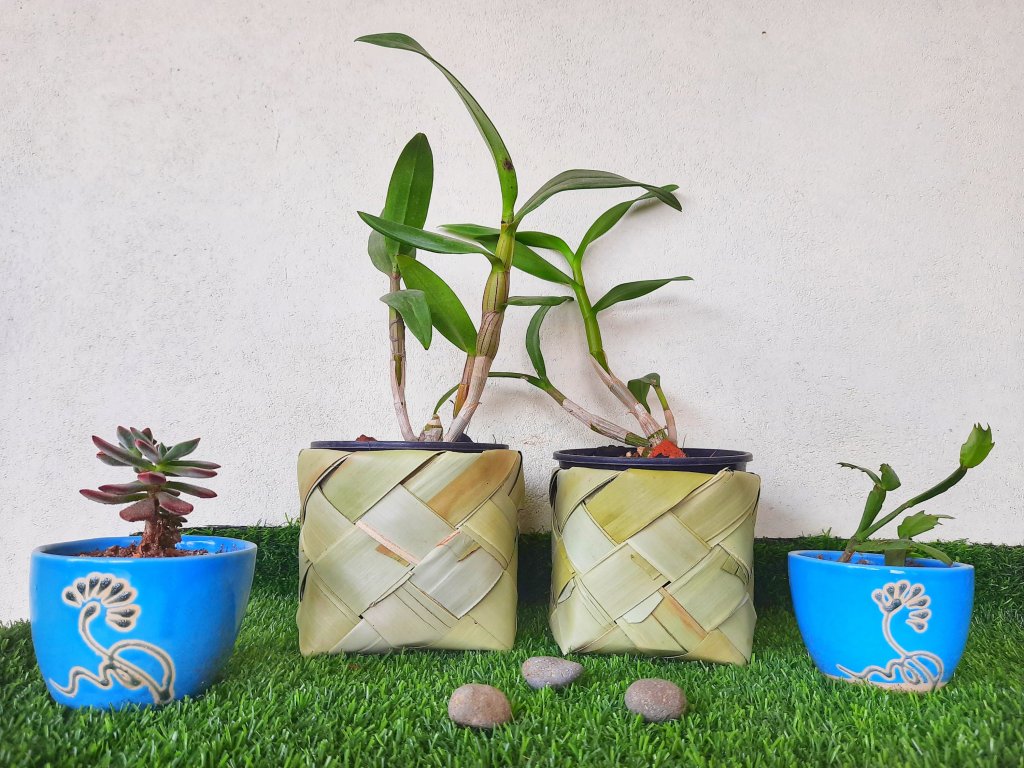
Palm leaf boxes of Kovilpatti mithai being Repurposed as planters
What I do know is, that there are several other lesser-known places in India where people celebrate sports other than cricket. Only initiatives by governments, support from sponsors and adequate media publicity can encourage and motivate more people to nurture a sporting culture in our country, anything other than cricket.
After an exhausting day exploring the streets crammed with Chettinad houses in Karaikudi, we were dropped at the bus stand to board the local bus to our next destination. The bus snaked through the narrow lanes and we craned our necks out of the window to stare at a few bungalows along the road at Pallathur before we finally alighted at ‘THE’ destination of our tour- Kaanadukathan.
Part 2: Exploring Kaanadukathan
Although we had listed down the must-see things, we felt lost upon our arrival at this village. The place looked like any other village in India and we wondered where had all the stately houses gone, the only reason that had brought us there. It was evening already, and we still didn’t have a definite place to stay. Without having a clue on how to go about further on our trip, we decided to follow our instincts.
Firstly, we decided to walk till that road’s end hoping to find some hotel for our night’s stay. After a short distance, we heaved a sigh of relief when we came across ‘Visalam heritage hotel’. It was a heritage property and expensive on our budget, but it was assurance that there was some place we could fall back to in the worst case of not finding a stay for the night. Having some relief, we decided to walk further down the street in our quest for both a hotel that would fit our budget or for the palatial mansions that had brought us all the way from Bangalore.
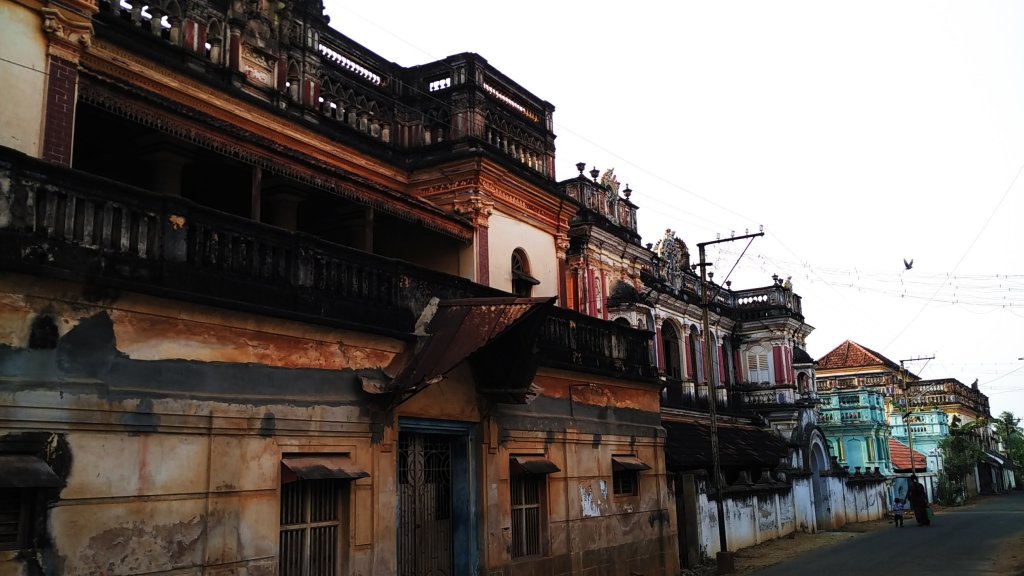
After walking further down the street, my friend and I stopped at the sight in front of us. We were psyched out for a minute when our eyes caught a never-ending stretch of road flanked by the Palatial- country homes on both sides… We were in for an unexpected shock!! We knew there were many large mansions but had never imagined a real street to look just out of a movie setting. The facades of these large villas had fine sculptures of their family deities and the heavy wooden doors at the main entrances were decorated with artistic friezes.
The streets of Kaanaadukathan village
This village in particular did not seem to be very tourist friendly with most of these bungalows being locked up and their owners living elsewhere for various reasons. A few residents, however, have been kind to the keen travelers by permitting entry to their princely manors. Here is a summary of our pursuits of landmarks at Kaanadukathan.
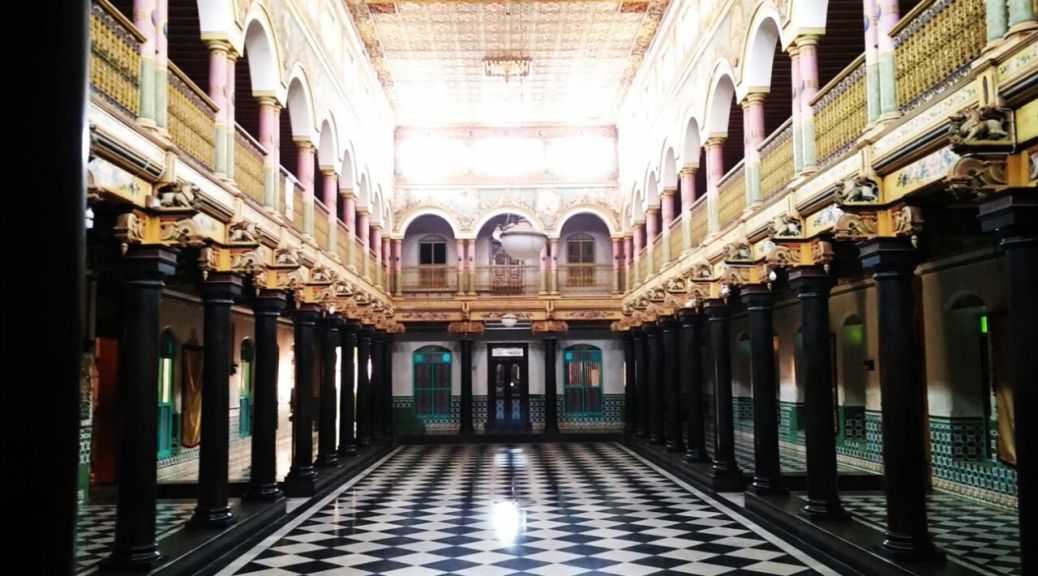
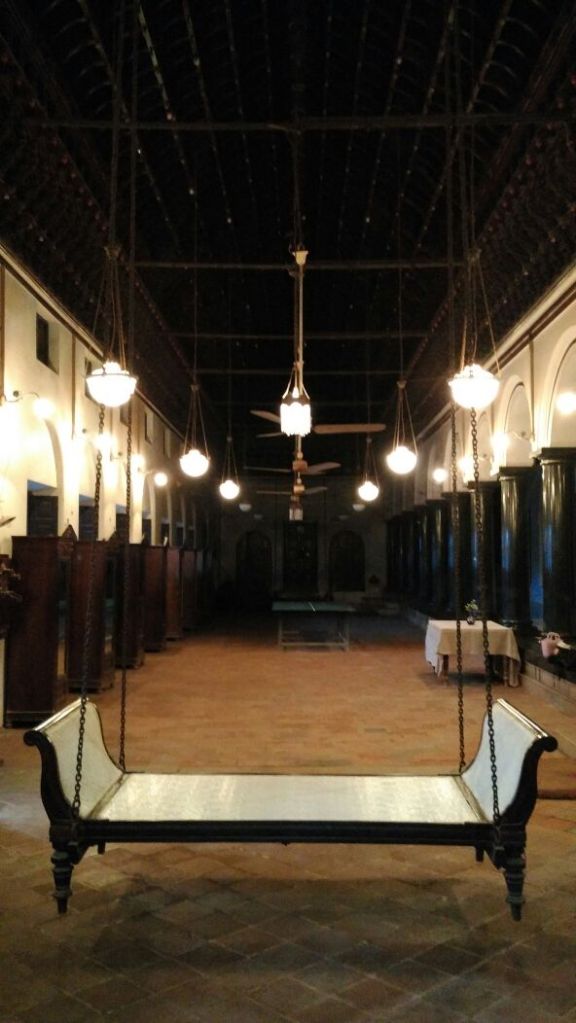
CVRM house: This is one of the very few Chettinad mansions that are open for public viewing that can be visited with a small entry fee. Although, nobody lives in this house now where once lived a large and an affluent family, it is well maintained with some of its antique cupboards, piano, swings etc. kept intact to retain the grandeur of this house. While we were admiring the grand interiors, the caretaker at the mansion recognized that we were lost and offered to accommodate us at her house for the night. Well, meeting such Samaritans needs a separate post.
The CVRM house at Kaanadukathan
We started early on the following morning to make best use of the time before the sun became fully active. There were (ancient) temple visits in the day’s itinerary and a lot of walking to be done. With our host’s support, we managed to book an auto-rickshaw for the entire day and to take us around places as listed below.
The nine clan temples of Chettinad: Temples of Soorakudi, Kundrakudi Murugan temple, Pillayarpatti Vinayaka temple and Vairavanpatti temples are beautiful structures dating back to the Pandya era. These architectural treasures are a win for history buffs in quest of places least touched by the maddening tourists. If one is a pious traveler, one may also consider visiting the temples at Iraniyur, Tirupattur, Velankudi, Kottaiyur, Kandanur and Mathur. Collectively, these temples represent the family deity of each of the nine major clans inhabiting around the region. After having our lunch served by donors at the Vairavanpatti temple, we headed towards our next destination
Aathangudi Palace: Fondly called as the ‘Periyaveedu’ for being the biggest house in the village, this mansion is aptly named as the Aathangudi palace. The roofs, the floors, the walls- they made our jaws drop in awe at their splendor and grandeur as we stood in the portico at its entrance. Although, we were charged an entry fee, we weren’t allowed to stay inside the mansion beyond 15 minutes by the caretakers. Their behavior towards visitors was somewhat a turn-off as they chased us out with verbal abuses. Forget observing the intricacies of the architecture of such a place, 15 minutes weren’t sufficient to even take a casual walk around the entire house.
Inside the Periyaveedu- The Athangudi Palace
There was no heed given to requests by our driver even as he tried to convince them in the local language. Pissed off with their attitude, our driver drove us off from there, towards our next destination. Before I continue ranting about our exploration of the region, I pause a bit to talk about my autorickshaw ride: The cranking lever of the vehicle had come off and was kept under our feet (in the rear seat) and the brake pads had worn out till their last dust. That meant, that the vehicle needed to be push started every time we stopped, and the driver had to jump out of the slow-moving rickshaw to stop it every time we wanted to halt. Especially under the blazing sun and some annoying caretakers like the one mentioned above, it is natural to gain a few additional horsepower in our muscles. So, the raging ride from Aathangudi palace until our next stop was quite a thing!
Aathangudi tiles factory & wood art restoration center: This is a place where we met the men who create beauty out of lifeless soil and wood. We observed demonstration of how these GI tagged colorful tiles are created. An art in themselves, apart from adorning all Chettinad mansions, I remember the grandeur of the Mysore and Bangalore palaces whose flooring is made with tiles sourced from Aathangudi.
Making of the Athangudi tiles
Chettinad railway station: This small and least haunted railway station on a typical traveler’s itinerary was included in our list after we had heard that the local Raja had a special waiting room for himself in the railway station. This quick and an exhausting ride ended in disappointment when we reached there. We learnt that the special room is not open to public viewing and will be opened only on special occasions for the members of the Raja’s family.
The entrance to one of the houses at Kaanadukathan
By this time, our tummies were grumbling of hunger. In spite of having been in the land of spices for two days, our taste buds hadn’t savored authentic Chettinad cuisine yet. It was a hard hunt for us to find a good hotel that served us authentic Chettinad food. Our craving gustatory cells were finally satiated with a lip-smacking array of culinary delight at a small hotel that we found on a random lookout. Post lunch, we decided to spend the rest of the day exploring the somnolent streets of Kaanadukathan by foot.
Local weaving centers: We shopped for the Kandangi handloom saris from one of the many local weaving centers.
Chettinad Raja’s palace: The largest mansion in the whole of Chettinad is a sprawling edifice extending over an entire lane on all four sides. And that’s why it is called as the Chettinad palace. We made futile attempts to get a small peek into the interiors of this massive dwelling space that I had seen in some of the movies.
Our walk tour of Kaanadukathan continued until dusk. We clicked some nice photos of this ‘heritage’ village with the perfect lighting by the setting sun. Along with the setting sun, we set ourselves for the return journey. We had to reach Trichy on time to catch our bus back to Bangalore. Thus, concluded a weekend in Chettinad- the land of palatial mansions and piquant cuisine.
Must-dos in Chettinad:
Take a walk in the Muneeshwaran Koil street or the antique market in Karaikudi
Shop for a colorful palm basket- The local handicraft that has gained a GI tag
Treat your palette with Chettinad cuisine (I definitely mean Non-Veg)
Take a bicycle / walk tour around the streets of Kaanadukathan
In this post today, I like to discuss a technical subject by standing in the shoes of a traveler. During my student life, I have never been in a race to become a top-scorer. However, it was Professor Mukunda’s enthusiastic teaching method, that ‘Material science and Metallurgy’ has been one subject that I topped the department (I like to show-off a bit, with those dark glasses emoticon). With an in-hand admission letter to one of the top universities to pursue a post-graduation in the subject, the lostlander deviated along the way, only to become a professional ‘Metallurgical Failure Mode Analyst’ much later in her career. If not for Prof.Mukunda, a seed of interest in the subject would have never been sown and I wouldn’t be writing about such an unconventional travel post, it seems.
Metallurgy is a science in which India has mastered from even before the world could imagine. The Vedas have a devoted section to teach these techniques. Prof.Mukunda’s favorite topic was ‘Metal casting with the lost wax technique’. His face beamed in joy every time he mentioned the intricacies that were achieved in the metal art thus created. “No two pieces that are exact replicas of each other can ever be created”, he stressed. We had foundry visits as part of our curriculum but that’s where we could only see sand, centrifugal and other forms of metal casting. Without having easy access, investment casting, also called as the ‘lost wax technique’ of metal casting was only left to our imagination. Many years after my graduation, I have been fortunate that I have been able to visit some of the amazing and traditional foundries in my country that practice the lost wax technique. These places have got them their individual ‘GI’ tags. Here is a walk through my foundry visits which I believe I should share with my fellow readers.
Idols of Swamimalai:
Swamimalai translates to the ‘Hill of the Lord’ that is named after an important temple in Tamil culture dedicated to Lord Murugan. This little town is famous beyond just this holy abode. One doesn’t need explanation at the mention of the bronze idols of the Cholas era. Apart from several of these antiques being prized possessions at museums across the globe, these treasures are among the highly traded commodities in the black market. These are ALL brought to form in Swamimalai. It is believed that the artisans of Swamimalai are a group of skilled men called as the Stapathis who have passed on their heritage of metal idol making, since the 12th century. The precision of composition and the measurements of these metal idols, mostly bronze are followed as per the ‘Agama Shastras’. This holy land of the alchemists was a part of my weeklong backpacking with my brother, back in Year-2015.
Clockwise from top left: 1. Raw material for mould making with the furnace and blower 2. The mould 3. Furnace 4. Metal sheet after moulding ready to be polished
Aranmula Kannadi:
An extremely important part of malayalee culture, this handcrafted mirror is a quintessential part of Kerala. I was told that on the day of ‘Vishu’ festival, after waking up in the morning- he/she should first see themselves in an Aranmula Kannadi placed alongside the ‘Canacona flowers and a lit oil lamp’ before anything else. ‘What is it about a mirror?’ a person unknown to the traditions of this land might ask. ‘These mirrors are not glass!’ These mirrors are super-polished metal surfaces that are capable of reflecting real images. A glass always reflects a secondary image (you can notice that there is a distance from the reflecting surface to the image formed) whereas, the metal surface reflects primary images (There is no additional distance between the object and the image).
Top: The secondary reflection in a glass mirror; Below: The primary reflection in a metal ‘Aranmula Kannadi’ mirror
These manually polished mirrors are created through investment casting whose composition remains to be a secret that is passed down through generations of just 1 family. The small group of these master craftsmen who are protecting their secret recipe of the Malayalee culture all reside around the Aranmula Parthasarthy temple in the state of Pathanamthitta. I had the esteemed opportunity of visiting one of these foundries when I sneaked out after working hours on one of my business trips in Year-2019.
Video of my visit to the mirror making foundry at Aranmula
Dokra art of Bastar:
This non-ferrous metal art is created by the forest dwelling tribes of Chhattisgarh. Historians believe that this art has evolved from what was used by the primitive tribes to create figurines of their local deities for worship and for jewellery purposes. The metals used were earlier collected directly from earth in the mineral rich area of Bastar, then smelted to separate the desired elements and mixed in intended proportions to form the final material for casting. This is an undocumented tribal technique that has been passed down through several centuries. Today, it is widely used for commercial purposes of decoration and gifting. It is now revered as a part of the tribal culture that represents the state of Chhattisgarh. I had an opportunity to visit one of these foundries and observed keenly the lifeless metal take form into art during my family’s five states’ road trip in Year-2020.
Dokra art at various stages of metal casting
Kola masks of Karkala:
Talking about all these foundries, I cannot be leaving my homestate behind. Although the folk art of metal mask making is slowly dying, these masks are an extremely important part of the culture of the Tulunad region. These bell metal masks are used in the spiritual performance of the ‘Bhoota Kola‘. Today, the art is used beyond mask making and can be seen in idols, lamps, bowls, utensils among other things used and sold extensively in Udupi district of Karnataka.
The lamps and idols of Nagamangala:
The contribution of the Hoysalas to the art and heritage of Karnataka cannot be justified with any number of words. Their intricacies and detailing in their work can be seen not only in the stone sculptures of their temples but also in their metal crafts. A few of the practitioners of the Hoysala style of metal casting have saved and passed on their knowledge to a few artisans who have made the town of Nagamangala their home. This thriving art can be seen in the traditional bronze lamps widely used across Karnataka and in the idols of various deities in this region. Although bronze is believed to be a godly material, other metals like tin, copper etc. too are cast into various articles using this technique.
This post is my small attempt towards promoting local art. I look forward to influence at least a few of my readers to learn more about the rich heritage of India and encourage local artisans in various ways possible. Do share your thoughts with me through the comments below.
Heard of the blue hills? Does the name ‘Nilgiris’ strike any bell? For those who know less, it is a part of the Western Ghats, a UNESCO World heritage site in the southern peninsula of India. The ‘Neel-giris’ literally translates to ‘Blue-Hills’ because these hills get their colour from a particular phenomenon. A particular species of the Strobilanthes kunthiana flowers, locally called the Neela-Kurinji bloom once in twelve years. When in full bloom, the entire hill range looks blue, thus giving the hills their name. The last mass-flowering of the neelakurinji flowers happened in 2018 and I left no leaf unturned to witness this spectacle. There were a couple of hotspots identified by the Kerala forest department where arrangements were made to allow visitors to see the flowers. My friends and I decided to visit the Eravikulam National park, located close to Munnar. This stretch of the hills was where most of the blossoms were supposed to happen. After finalizing the visit dates in Sept’18, the Delhi friends had booked their flight tickets to fly down and the remaining of us booked our bus tickets from Bangalore to Munnar. I had got all the necessary entry permits from the forest authorities and booked accommodation in Munnar for all of us. All this was done months in advance to have a confirmed entry anticipating the tourist influx for such a spectacle, if we waited until later. We were all set and waiting for the travel to finally happen.
Come July’18, the rain gods had wreaked havoc in the western Ghats. The entire stretch of western Ghats in Karnataka and Kerala had been damaged by the heaviest rains in eight decades. The damage done was massive to geography, property and life along these areas. In the event of things, damage was done even to the neelakurinji plants and the blossoms were feared to be washed out. Once the rain gods had calmed down and the ground situation of floods seemed to have receded, we waited to see if there was any luck in waiting until September. We were in constant touch with a few locals who gave us the updates on the status of the blue hills. Come September and we decided to go ahead with our original plan. We all had finally arrived at Munnar and were heading towards Eravikulam National Park.
Once there, Yes, there were enough plants destroyed. The stronger few, had managed to bear flowers. We walked along the laden path, feeling grateful for at least so many of the plants had survived. Since these plants blossom only once every 12 years, it means that their reproduction cycle is longer than usual. This also means that, most of the Neelakurinji vegetation is lost in the 2018 monsoon and the next flowering cycle of the year 2030 may not happen at a mass-scale as it is usually supposed to happen at all!! Anyway, we enjoyed whatever we were witnessing.
The Neelakurinji flowers at Eravikulam National park
Also, Neelakurinji is only a sub-species of the larger group of flowers called the Kurinji. The Kurinji flowers come in several colors- white, peach, purple, etc. Here is a collection of the Kurinji flowers from Eravikulam National park that we saw during our visit.
The various Kurinji flowers at Eravikulam National park
So that said, I was back in my hometown the following week and visited our piece of farmland to check on its status after the monsoon. It used to be a spice plantation that remained unmaintained for a long time before we, siblings ventured into developing it. our farm is a short walk away from the main road. When we arrived there and decided to walk, the entire path was filled with what seemed like some weed that had overgrown during the monsoon. We used a machete to make way for ourselves to walk further. Just a few steps into the area, we were surrounded with pink/ maroon flowers all around us. ‘These weeds had flowered expansively’, we wondered. We took a lot of photos, made way for ourselves, finished our work and returned home. When we discussed about the weeds with the elders in the family, we were surprised to hear that these plants also belonged to the Kurinji family.
The Kurinji flowers from our farm in Kodagu
Further, an important month in the Kodava and the Tamil calendar is the month of Kakkada or Aadi. In Kodagu, on the 18th day of this month a special dish is prepared using a locally available herb. Its juice is believed to contain 18 medicinal values. It leaves a very deep blue/violet pigment when cooked and consumed only on this day. And what is this plant called? Don’t even guess… Locally called ‘Maddh thoppu’ or ‘Aadi soppu’, it is also a variety of Kurunji. So, Kodagu primarily has three types of Kurinji; the flowering weed(Maley Kurinji(as in hill), Etth Kurinji(as in cattle) and Maddh Kurinji(as in medicine). A little bit of googling allowed me learn that there are many sub-species of the Kurinji and each have their own flowering cycles. While some bloom annually, some bloom once in six years and some take a couple of decades. Neelakurinji was just one among them.
Lesson learnt: How often do we tend to ignore the little things from our own backyard? We think these are too trivial to spend time and look for things elsewhere. It is often that people associate that better things come only when money is spent and distances are travelled, but the truth may be that it is something that we have been conveniently ignoring in our own vicinity. What is your take on this thought?
Come the night of Mahashivaratri, there will be festivities across the country. People stay up all night and participate in bhajans, pooja offerings, chariot pulling etc. all to keep themselves awake for the night, so that their beloved Lord, Shiva gets good rest after taking care of them all year. But it is the day that follows the revered night, that is the essence to this story of mine. The day that follows Mahashivaratri is when Shakthi, the consort of Shiva and thus, the female power is celebrated across the Northern part of Tamil Nadu. The companionship of Mother Angalamman to Shiva, the graveyard dweller is celebrated with a festival called the ‘Mayana Kollai’. As a friend explains, Mayana Kollai translates to the ‘Raid of the graveyard’ in Tamil. I had planned to witness this festival at one such temple dedicated to Angalamman, closer home, at Kaveripattinam.
The festivities had started as early as the sunrise at the Angalamman temple, with the Goddess being taken on a temple car/ chariot. She is supposed to travel along the streets of the town, to the graveyard by evening from where she returns to the temple by night. All other rituals that are part of this journey of her’s are what make this festival more interesting. It is a festival where the entire town / village participates with no barrier of caste or societal status. The chariot leaves the temple with the idol of Angalamman.
The diety- Angalamman being taken on a procession on the temple car / chariot
She is greeted by devotees who throw a mixture of salt crystals and black pepper or beans all along her way. She is hailed as a symbol of fertility who is calm throughout the year and takes on her powerful form on this day, once in a year. The villagers get their body pierced with various things near the temple premises and walk across the village to the graveyard, where the piercings are removed. This body paining is what they believe, is a gratitude to the almighty for the wishes that have come true or as a part of a prayer that needs to be fulfilled. The size and things pierced can vary depending on individual’s prayers. While those with tridents pierced around their mouth are a very common sight, the more pious go further to get their torso pierced with hundreds of lemons. Yet, a few pull cars, buses, trucks or large stones with ropes that are hooked through their bare skin.
Stones being readied to be hooked to the body as a man with a trident pierced to his cheeks walks past
If u peek into one of the many shops (I don’t know if that is the correct noun for such places) around the town, apart from those getting the body piercings, you will find another set of people. Men and children will be getting their faces painted and dressed up in sarees, a representation of Angalamman. With metal arms attached to the backs, elaborate costumes, jewelry and crown worn, Angalamman is impersonated by these people. They hold tridents and dance to the beats of drums across the streets. Several times on their way, they get possessed or get into a state of trance, until they all finally congregate at the graveyard. Animal sacrifice too is a common sight on the streets on this day.
Stalls where the body piercings and paintings will be done
It is evening by the time the temple car and everyone else reaches the graveyard. That is when the most interesting part of the rituals takes place. The folk impersonating the goddess gather around a random grave and dig it up. The bones from the grave are pulled out and chewed by them. This is called the ‘bone chewing’ ritual or what gives the festival its name: Mayana Kollai or the ‘Raid of the graveyard’.
Men and kids dressed up like Angalamman
There are several legends and references that explain the significance of this ritual, depending on the region. Here are some of the references I found on the internet.
Post this ritual, the goddess calms down and returns to the temple on the temple car. The festival culminates when the it reaches its home.
While witnessing all this self-violence, I started to deeply think, why this is necessary to please the gods. Although I couldn’t find a convincing conclusion, what I realized is that this form of ritual is not unique to Hinduism alone. It has been largely practiced worldwide, across all major religions. Some of the closest references are:
Whichever faith be it and whatever the belief, the intentions of every person involved is the same. To get closer to god. Aren’t all our beliefs connected?