Being one of the first hotspots of the elusive black panthers and a place known as the ‘Rishikesh of the South’ for its river rafting in the waters of River Kali weren’t reasons enough for me to grab-in when opportunity struck! A Solo trip that was long due, finally happened one weekend. I packed my backpack and hit the road in an overnight bus to reach Dandeli. This trip was part of an invitation to review a resort and a homestay at Dandeli, arranged by www.dandeli.com However, the reviews of the places are in separate posts and this one is something else, worth your reading time. Or so, I believe.
Apart from the cool and wonderful green cover that Dandeli has, I had a surprise awaiting me on the second day of my trip. It added yet another perspective to my travels- “Bird-watching”. If you have been following my blogs for a while, then you must already be aware that I have always been interested in wildlife and its conservation. But I neither did I have an opportunity to meet someone closely involved in such form of travel nor did I have any close acquaintances who was good at bird or animal tracking. Here, at Dandeli I met a person who has dedicated time and money in tracking and documenting the birds of the region. The entire experience of birdwatching with this person is something that I will cherish for long time.
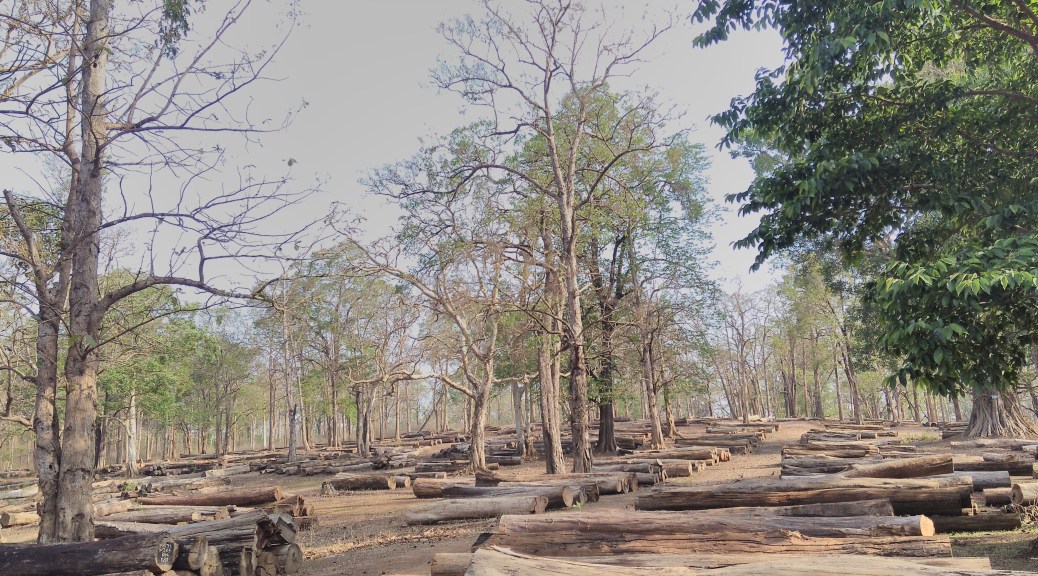
As a part of the trip package by the homestay, I was asked to be ready by 6.00.a.m. and was taken to the Dandeli timber depot. I was introduced to Ms. Rajani, a government schoolteacher by profession and an avid nature keeper by passion. She was assigned to take me on a bird watching tour around the depot where over 150 bird species could be spotted on any given day- A true haven for the bird watchers!
Dandeli timber depot
Among several species that she went on showing me around and shedding light on facts about them, the one that opened my eyes to an all new perspective of seeing avian life were the ‘Hornbills’. The hornbill is one species that is referred to Lord Ram and Sita for the couple bonding that they share. These birds have a very unique way of finding their mates and if ever happened that one bird dies anytime, the other remains single all life without finding another mate which is unique to hornbills. The reproduction cycle of these birds is once in 5 years and hence, the male bird is extremely protective about the female and the chick. The male bestows his beloved with berries of her choice from faraway places during this period. While it carries around 40-50 berries in its beak to feed its family, a few fruits may fall down during its flight, thus contributing to afforestation- The hornbills are the farmers of the forests in true sense and live a life of awe and inspiration to mankind. Another interesting fact is among the 54 species of hornbill across the world, 9 are found in India. Out of these, the world’s largest species- The great Indian hornbill and world’s smallest- the Malabar Grey hornbill with Malabar pied and Indian Grey, 4 species can be found in Dandeli alone. And I was fortunate to see all 4 of these during my 3 days of stay at Dandeli, an experience that cannot be explained but only be felt.
Another unique sighting was of the jungle babbler or the ‘seven sister birds’. With enormous untold stories, the tour ended rather quickly as we both lost track of time.
My enthusiastic guide visits this place every morning and evening which she describes as her day being incomplete without talking to the woods and strengthening her nature connect. She ensures she talks about them to her pupils at school as well. That’s a novel way to inculcate the habit and awareness about nature conservation among children from a very young age itself. I gave her a tight hug for the wonderful ways of teaching her students in school about conservation of natural resources and I bid farewell.
Bonus tip for birdwatching at Dandeli: Watch the hornbills mud-bathing on the riverbank near Ganeshgudi (sometime around winter)
Kashi for the pilgrims, Banaras for the historians and Varanasi for the modern… How it is religiously important, culturally vital, historically notable… There is enough said and done about this city through literature that is available as early as mythology, history and the modern contemporary. If I had to write about the same stuffs here, then this post would be just another summary with my perspective in it. However, I still use this one sentence to re-iterate the common belief: ‘No time is long enough to be at Banaras’.
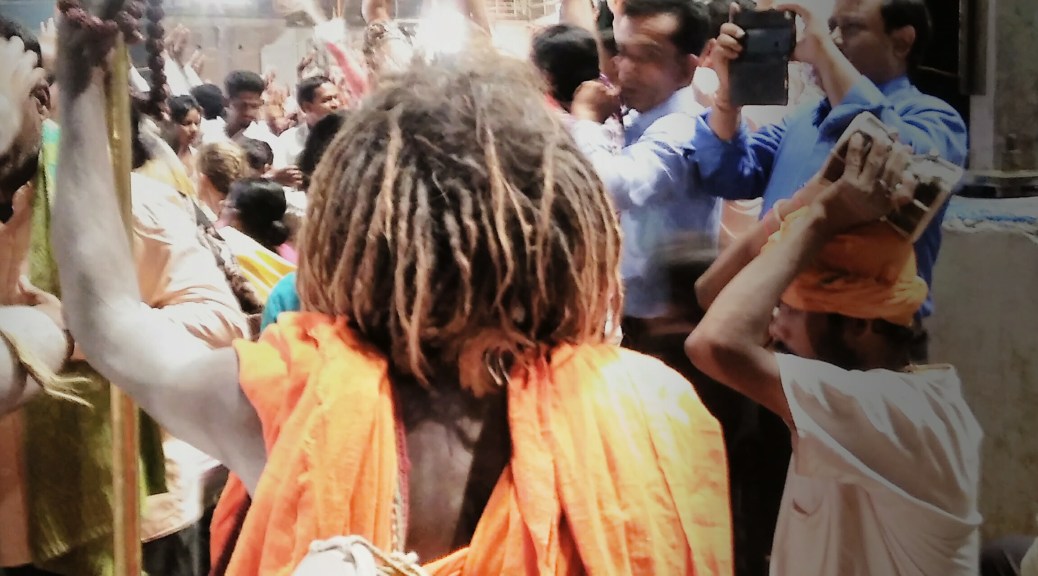
The immovable faith of the people, the ever crowded streets, delectable street food, the elusive power of the Naga Babas, the hippie culture of the westerners, the rich history, the mythological importance, the intriguing cultural heritage, dance, music, poetry, handloom, education, art, architecture- The list goes on endlessly that holds so much significance. Hence, keeping it all aside, I wish to make a list of what this city offered to teach me-
1. Work is Worship: This old man agreed to pedal us around for a rickshaw tour of the heritage campus of the Banaras Hindu University. The humility in his speech, the five-o’clock shadow in grey on his weather beaten face and the sinewy legs spoke volumes of his wisdom and hard work for this 60+ someone. He has seen those innumerous people come and go to this sacred land. At the end of the tour, he stopped at the Bharat Kala Bhavan museum complex on the university premises. We told him that we wouldn’t need much time there and would be back in half-an-hour. We failed with our words, and the quickest we could come out is after one-and-half hours. There was no sight of this old man for as long as our vision could stretch. The man did not carry a cellphone and we didn’t know his name to enquire with the people around. We had waited for another 30minutes now. We were uncertain whether to wait for some more time or leave without paying his fees. In just then, we heard the tinkle of his cycle bell as it screeched to a halt in front of us with a little girl in the rear seat. He explained, “I was getting late to go pick up the kids from school and drop them home, they would panic or else”. This man did not worry if he lost the money that we owed him, there was something else he considered more important. As we sat on the rear with the little girl on my lap, I was reminded how for this man ‘Work was Worship’. One has to stay committed to what has been assigned.
2. Solo travel helps in self-discovery but having a travel mate provides security: While we finished the Ganga Aarti, savoured some delectable street food and returned to the hostel at around 10.00.p.m. we found that 3 of our roommates were fallen motionless. We checked with them to know what had happened. While one held on to her stomach and started to cry of pain, the other 2 ran to the restrooms… Having barely any strength to talk or stand, one of them managed to say that they had food poisoning. On being requested for help, the men running the hostel conveniently pushed the responsibility of nursing the girls on us. Since 2 of them were burning with high fever, we rushed them to the hospital (supposedly the best in town) for medication. On arrival, the hospital authorities refused to provide first aid without submitting their passport and paying an advance of Rs.30000. Forget being able to talk, these girls barely had any conscious to tell us where they had kept their belongings. And we ourselves being strangers in the place, it wasn’t going to be easy helping those girls. It was well past 12.00.a.m. while we were running around the dark, rainy streets of Varanasi for the required documentations so that the girls could get their first aid ASAP. With the physical condition they were in, with a no-electricity night, cocky/horny street hawkers who were hovering around and adamant auto-rickshaw drivers trying to make quick bucks out of the helpless situation, it would have been rather impossible for the expats hadn’t they found us! While the attitude of the guys running the hostel, the hospital and one of the girls among the patients itself is a story to write about, this whole episode taught me one thing- The importance of having company while travelling or at least having an acquaintance in the place one wishes to travel.
3. Serving food is divine, do it from your heart: There are eateries in every nook and corner of Varanasi that serve authentic cuisines from almost all parts of the world to cater to the international tourists who throng in large numbers. Any food that is offered with a true heart gets its added flavours… We had found our favourite hangout at the Phulwari restaurant, conveniently sharing the premises of the Godowlia Kaali mata temple. With a traditional ornate welcome gate opening into a casual shack like place with basic cushions and bamboo chairs and a mud-smeared kiln for making their wood fried pizzas, it offered a very warm ambience. And having personal attention from the waiter was overwhelming. He made sure we got precisely what we wanted while we were confused running through the long menu. He even went to the extent of getting some herbal drink from the next street to help me with my headache. He offered us with the best thandai of Varanasi, chilled to perfection and served in clay bowls to retain its authentic flavour; delivered at our hostel on the last day of our visit! There is so much more about providing customer service and hospitality- this man was at his best!
4. Do not question the untold: The Ganges is a powerhouse of inspiration. She’s holy, pure, sacred and selfless. While we took a ride along the shores of the holy river, the veteran boat man patiently answered all our questions about the holy city. While umpteen things can be discussed in lines of communalism, history and science, Not to be debated about: the Ganga at Banaras is a lifeline. It’s a way of life. Irrespective of religion, caste and creed, faith is the only thing that has kept the people going here… Every baby born in this land imbibes it in the genes… It’s at times important to understand the significance and let things be. Do not be overwhelmed to exhibit your education by venturing into a zone to only be littled by the magnificence of the faith.
5. There is no escape from the cycle of life and death: While we were sitting on the steps of the Manikarnika Ghat and watching the flames engulf the body of the deceased on the banks of the holy river, a volunteer sat next to us to proffer his knowledge about the significance of every ritual in Hinduism starting from the birth of a person until he bites the dust. He goes on to explain why Hindu culture does not encourage women from performing the last rites. Women being emotionally weak, tend to cry at funerals. This makes it difficult for the soul to break the attachment and leave the body. With soot from the fumes rising from the burning ghat settling all over us, it was a good long 2 hours of narration of the rituals associated with life and afterwards. At the end of which, I was left wondering with a continuously running stream of questions about life and finding its worth. They were thousands of unanswered questions which I hope to go back to the ghats someday, to find all my answers!
It is needless to elaborate on the names Tirumala and Tirupathi! Famous as the richest temple in the world, the seat of Swamy Venkateshwara- the lord of seven hills. What goes beyond just this RICH temple is its geographical location. For someone who has been there and used the 11km long stairs to get to the top, I’m sure he must have enjoyed the multiple pit stops and deviations off the course to see the ‘Papavinasanam’ and ‘Akasha Ganga’ waterfalls enroute. And then there is the magnificent Silathoranam, the natural arch bridge formed due to volcanic erosions several million years ago… As if these pit stops weren’t enough, one is bound to get enchanted by the stunning view of the entire range of hills surrounding the temple with the Nagari quartzite formations… Ever since I had been there, exploring these hills has always been on my bucket-list… And when I chanced upon an opportunity to do it over a weekend, I jumped in with excitement. Taking cue from a random couch-surfing meet-up, we had decided to hit the roads to explore the hill ranges of Eastern Ghats. So on a Saturday morning, we started from Bangalore before sunrise to see the highest waterfall in the state of Andhra Pradesh, nestled in the Venkateshwara National Park. While I slept for most of the way, I was awakened to a blurred view of a fiery-red sunrise seen through the dew-laden window glass of our car, cruising through misty roads with hazy paddy fields around. We stopped by at one of the several restaurants on the way for a nice south-Indian breakfast and coffee.
With good asphalted road all the way, we arrived at the forest check-post at Talakona. While our friend was getting the required permits / entry tickets into the national park, we got chatting with a fruit vendor who let us try the variety of fruits in his cane basket which all tasted as sweet as nectar. He then told us that he could be our guide (at a small cost) and show us some offbeat corners of the forest. We agreed upon the idea and promised to buy more fruits from him on our return to make up for his business. We then reached the eco-lodge, managed by the forest department and ordered for food which would be kept ready by the time we returned from our trek from the woods. We then drove up, till the Siddeshwara Swamy temple and parked our vehicle near the foothills of the waterfalls. Our guide took us off the course from there on through stone-laid stairs that seemed like we were walking into oblivion in the jungle that is notoriously famous for red-sandalwood smugglers and the elusive beasts- the Royal Bengal tigers. Our first stop was at this view point from where most of the green and brown stretch of alternating forest and quartzite was seen. After a short climb thereon, our guide made us cross a stream of water and took us to the edge of the rocky path. The stream now seemed like it was jumping down in a mad rush from the cliff we were standing upon, and we could hear the screaming of several tourists down beneath. That’s when our guide burst the bubble for us- We were standing right on top of the highest waterfall of the state. It was a nerve wracking experience to stand atop there and watch the water gush down under our feet and have a post-monsoon gorgeous view of the green ranges.
The view of the ranges atop the waterfall
We were then guided through a canopy of lush green trees and hanging branches along the flowing water, at the end of where our feet stopped! Stopped in amusement… Amusement at what our eyes were seeing… A thick moss laden semi-circular rocky wall due to the flowing water over ages across whom several creepers hung and the water dropped down with all grace. This entire set-up of nature reflected in the mirror-like crystal clear water of the pond formed beneath where the golden fishes were enjoying their undisturbed swim. The rocks inside the pool made it appear rather shallow and was enticing us for a quick swim! With absolutely nobody else in the place- No exaggeration, it felt like we had found our long lost connection with nature right there! All unprepared for a swim, we put our legs into the freezing cold water to get a nice fish pedicure that de-stressed the city souls in us!
The pool atop the Talakona waterfall
After getting our natural fish pedicure done, we headed back towards the base of the Talakona waterfall. But, it was a different route this time… It was a beautiful path with a canopy of trees, a deep gorge to our left and the massive rocky caves to our right accompanied by an eerie silence of the jungle… At the end was another waterfall. It was one of the levels of this multi-tiered waterfall which we had to cross through. For a look from the distance, we could not gauge the level of difficulty until we actually got on the rocky path to cross it. While each one of us mocked and took fun in laughing at why the other person couldn’t cross it with ease, we dreaded our own feat of the waterfall-crossing when we slipped, slid and even glided across the super slippery rock over which the algae had settled making it an armed to the teeth adventure. We had a friend who slid and landed right at the edge of the cliff, just an inch further would have taken him rolling down the multiple tiers of the highest waterfall of the state 😛 All said and done, with we being drenched to our bones, our jaws chattering with cold and an unexplainable feeling of accomplishment, we had reached the last part of our hike.
The path across the caves
We then walked down to get a good look of the mighty Talakona waterfall from its base right-up, to understand where we had just arrived from… We then drove to the eco-lodge to dry ourselves, get some food and to call it a wrap for an eventful day that we concluded at twilight!
Although the places that I choose to write about may not stand a chance to be compared with the Sundarbans or the Pichavaram forests… None the less- The Arabian seacoast has its own share of beautiful places in terms of its mangrove creeks. And while Kerala is synonymous with its enchanting backwaters, Karnataka too has its fair share of backwater system which is still untouched and yet to be explored… Through my innumerous journeys in this coastal stretch, I don’t remember a time when I did not put my neck out to be tantalized by the view of the backwaters as I passed on those bridges that fall in between Mangalore and Udupi. So, this time I had set aside one weekend exclusively to explore these lesser known places of the west coast and mark myself in those remote places on the map-of-India.
My itinerary: Friday: Start from Bangalore – Overnight bus journey to Udupi Saturday: Kemmannu (Explore the backwaters in a traditional boat ride), Kodi bengre (explore the village and an estuary), Malpe beach (water sports), Krishna temple and the seven Mathas, Sunday: Chill at Sasihitlu beach and estuary, Kapu beach & lighthouse, return to Bangalore by bus (You can alternate this with a day visit to St. Mary’s island)
The details:
First things first- Having good connectivity, taking the public transport to reach these places has its own experience, the way I enjoyed my trip. But I strongly recommend having your own vehicle to these places. Given the hassle of waiting for a ride, the remoteness of the place and the joy of riding through such a beautiful stretch of road be best enjoyed on a two-wheeler only. That said, my mother and I had reached Udupi by an overnight bus and stayed at a hotel close to the Krishna temple. We freshened up and headed to the service bus stand located at a walkable distance to the hotel.
street leading to Kemmannu
The entire district of Udupi is dotted by innumerous temples and churches and hence, I prefer not to make a mention of them in this post. There is no dearth of local buses to any place within the coastal belt of Karnataka and hence, I relied totally on public transportation for my commutation. All set to explore Thonse, we boarded a bus that passed through Kallianpur village (This was once, a part of the Vijayanagara empire). The ruins of an old laterite fort stand testimony to that era.
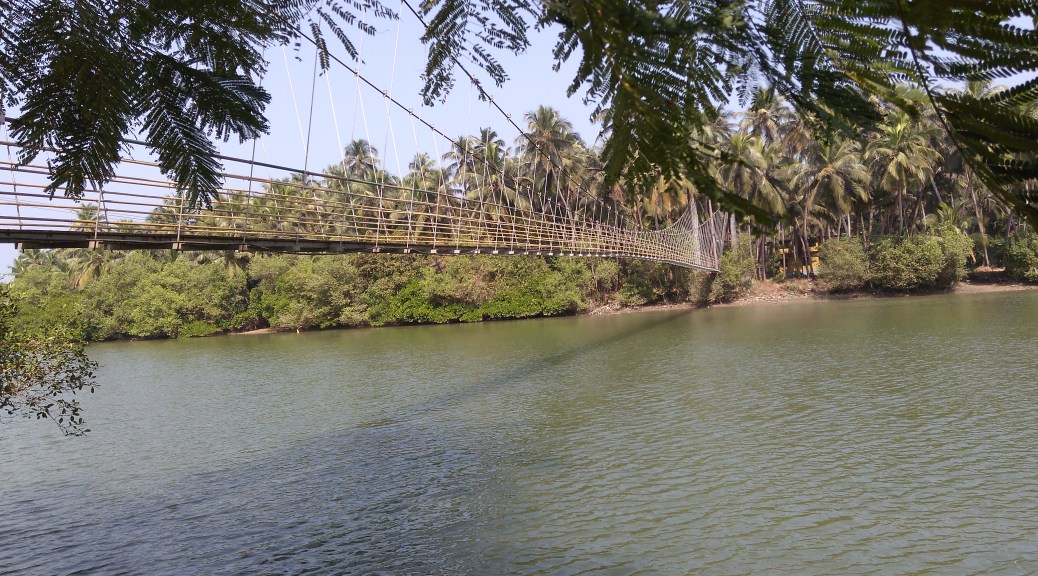
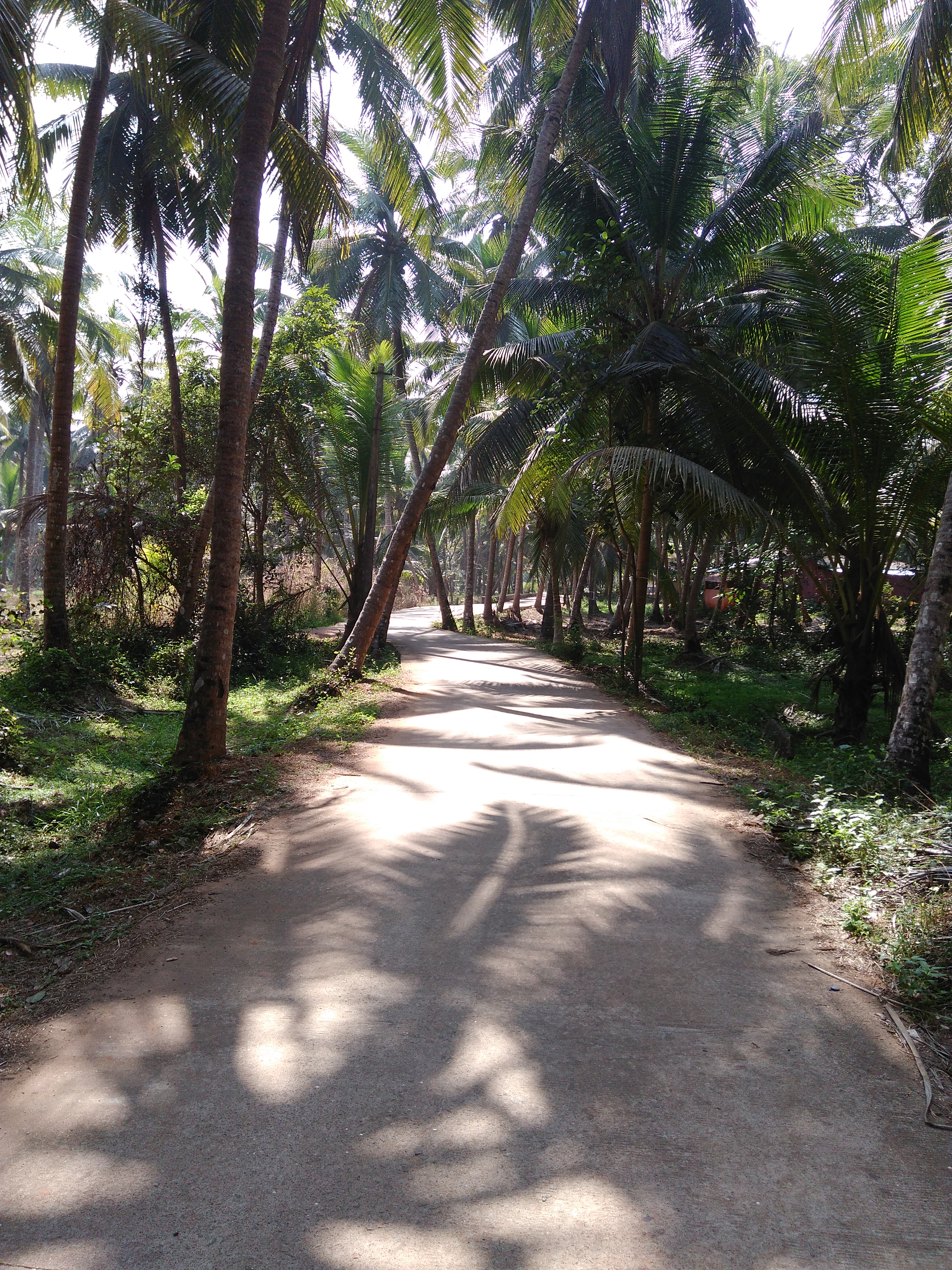
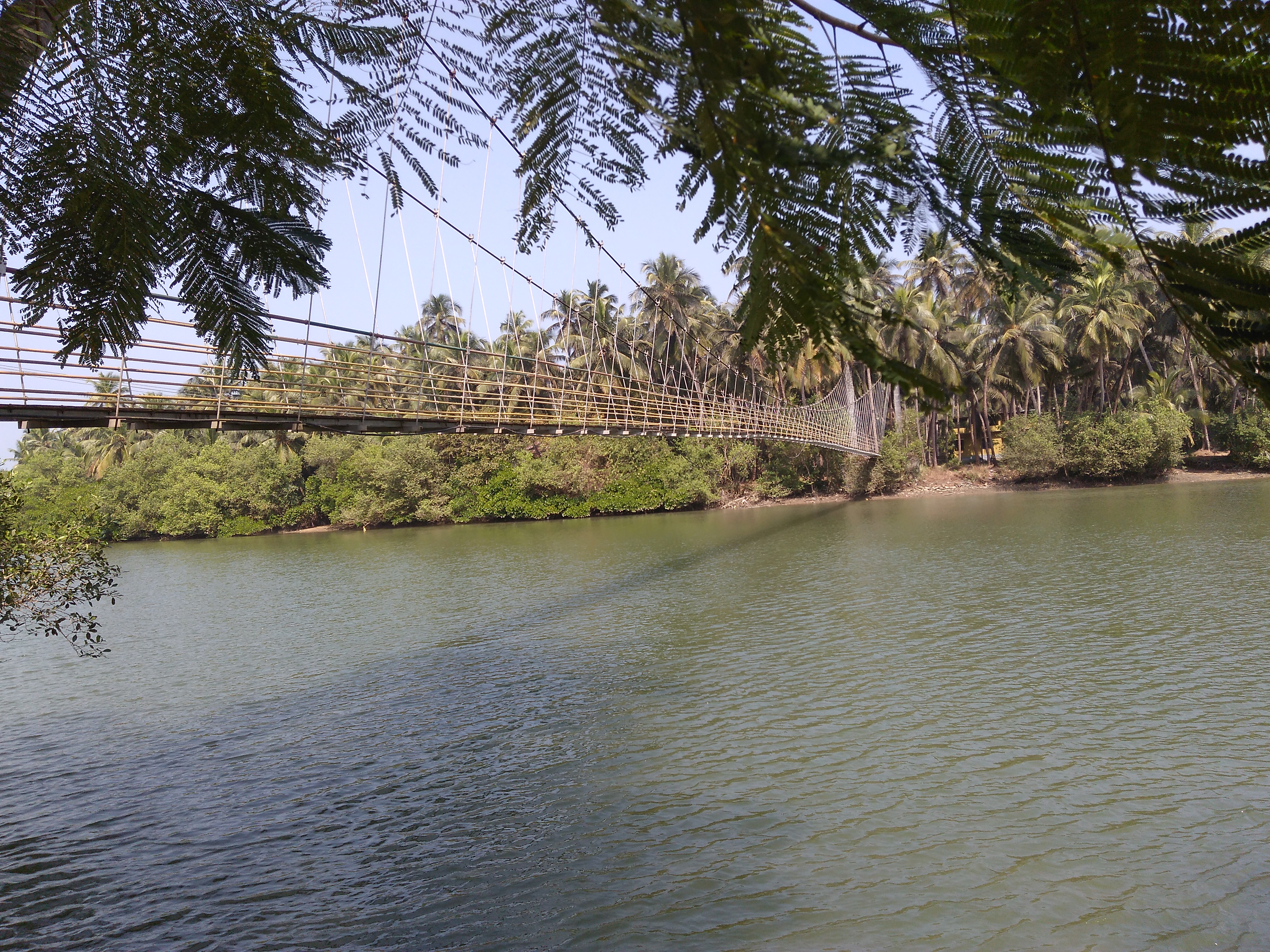
My first stop was at Kemmannu. A short walk on a meandering road through coconut plantations took me to a serene system of backwater canals connected to river Swarna. A suspension bridge has been laid across the river and set in an idyllic location of mangrove creeks. There was a boatman and his family living in a small house on the riverbank. When we enquired with the, they agreed to take us on a ride into the river for a fee. As our country boat set sail in the river, the oarsman suggested us to take a boat ride in the high tides either for sunrise or sunset. According to him, the delta beach would look brilliant at that time. He took us around several islets in the backwaters of river Swarna that gave us good sighting of rare birds. It was a very pleasant experience of sailing in the lap of nature, after having landed from the madness of the metropolis.
The suspension bridge at Kemmannu
From there, we walked back to the main road to get a vehicle to our next destination. While we walked beside a broken bridge, something caught my attention near the harbored boats. There was something amusing happening down there at the canals. I felt as if I was witnessing a bioluminescent spectacle in daylight. The sight was something I had never seen before. On a closer look, I realized that the canal was filled endlessly with jelly fishes of various colors and sizes. After spending some time there video graphing the sight, we boarded the bus to our next destination- Kodi bengre.
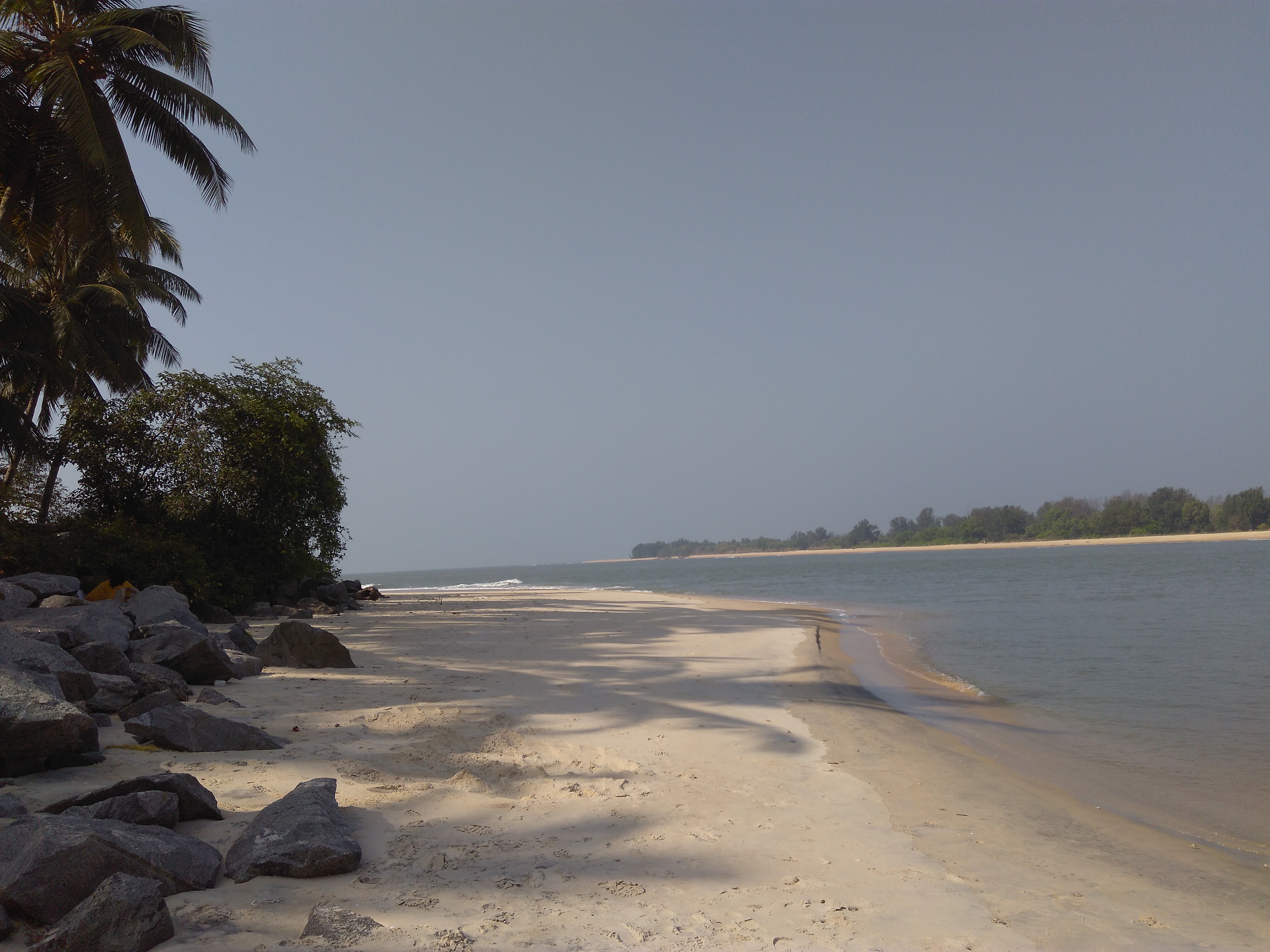
This small fishing hamlet is located on a narrow strip of land mass, placed geographically between river Swarna and the Arabian sea. While your heart will surely skip a beat at the first sight of the vastness of the sea at Hoodi beach, a deviation to the right is what we took. This road narrows into the village and gave us an experiential ride, right until the estuary at Bengre beach. The ‘tip of land’ is a great place for sunset viewing and enjoying the silence with the waves. The several shacks in the hamlet serves freshly caught sea food served spicy hot which is something not to be missed while you’re there!
The Kodi Bengre beach
From there, we took a bus to the coast, on the other side of the junction (Hoodi beach) where we had taken a right deviation from. With a quick ride through country roads flanked with traditional sea facing mansions, we reached Malpe beach. This being a popular tourist place, it was bustling with activities including various water sports. We walked down to the fish market / port area, away from the crowd- and got a good sight of the setting sun. There is a dedicated ferry service from the jetty to the Saint Mary’s Island for those seeking for a day trip which I personally recommend for anyone who is visiting this coastal town. It’s a great place and there is enough information available all over the net to get there… If you are driving your own vehicle, then I recommend you take the Pithrody route to reach back the Udupi town. This will complete your coastal stretch of Udupi giving you an experience of driving through yet another estuary and delta- that’s formed by river Udyavara and the Arabian sea.
You can complement your beach trip with a visit to the Krishna temple and the seven Mathas that are associated with the temple administration. Top it up with delectable Udupi chaats and the famous Gadbad ice-cream that saw its origin in this coastal town.
If you thought Jammu was all about shrines and temples, wait a minute. You are not alone. Even I did not know about all the beautiful places that exist within a driveable distance from the city. This trip to Basohli was a part of our ‘Peace ride’, sponsored by Jammu tourism as a part of the Himalayan expedition to promote tourism in the lesser explored places of Jammu. The route we covered over the week was Jammu-Mansar-Basholi–Sarthal–Baderwah-Kishtwar-Gulabgarh-Sansari-Gulabgarh-Patnitop-Udhampur-Jammu.This trip was an opportunity for us to see so many beautiful places that are off the tourist map, totally untouched and waiting to be explored.
Places to visit in Basohli:
• Surinsar-Mansar wildlife sanctuary • Surinsar lake • Mansar lake • Atal bridge • Sunset at Ranjit Sagar Dam & RSD backwaters • Sunrise from Chanchala mata mandir
The Details:
On a warm Saturday morning, we started from Jammu on a well asphalted highway cutting through the Surinsar-Mansar wildlife sanctuary towards Basohli. Needless to say, the route is blessed with natural bounty with the road flanked by wooded hills all the way. We did a quick stopover at the twin lakes from where the sanctuary gets it same. The Surinsar lake and Mansar lake are serene patches of nature which play an important role among the Hindu pilgrims as it is associated with mythology. It is believed that the arrow shot by Arjuna pierced the earth at Surinsar and came out at Mansar spouting water, what are now the two bunyanesque lakes. If you have nothing to do, then you can forget your watches by just sitting on the banks and feeding the squillion fishes there. These lakes are also known for the Indian flapshell turtles that are found in abundance.
At Mansar lake
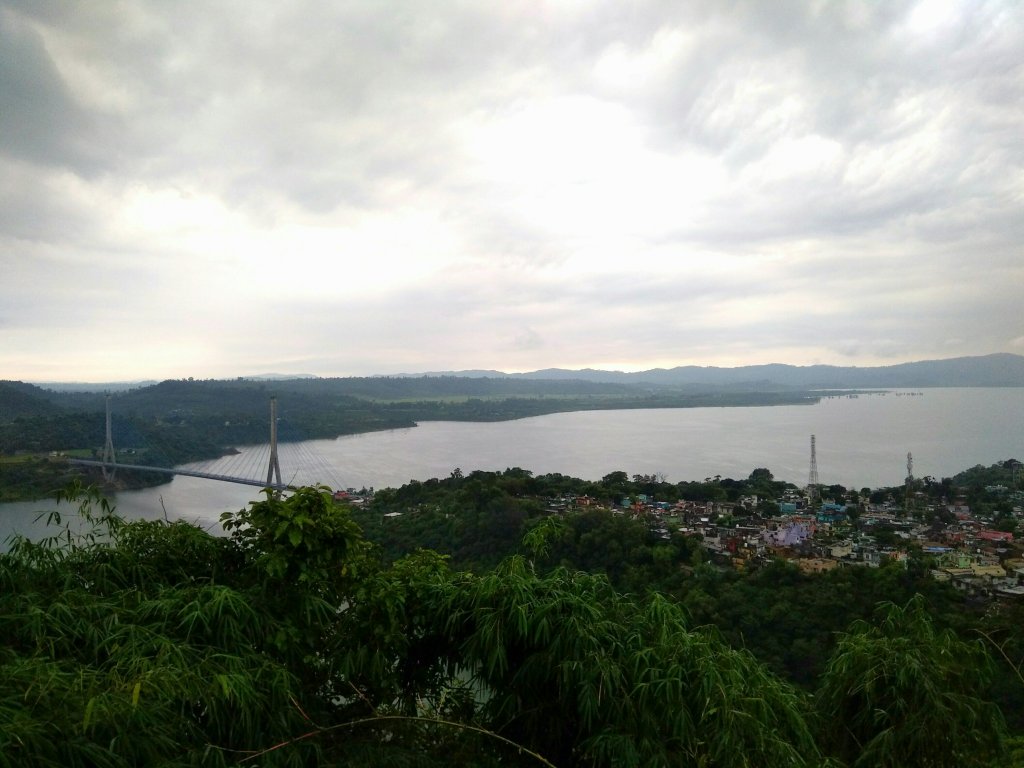
After freshening up at the TRC guest house, we headed to the Atal bridge built across river Ravi. This happens to be the first cable suspension bridge in the state of Jammu & Kashmir. We got an eyefull of the setting sun from there and got some good silhoute photos of the fishermen busy with their last catch on their vessels drifting past us from under the bridge. The view of the surrounding lush green hills and several islets in the backwaters of the Ranjit Sagar Dam was a feast for the eyes with a golden backdrop. On a summer evening, it is highly recommended that you spend some time at the dam backwaters, what is fondly refered as the RSD beach by the localites. With swaying palm trees along the sandbars of the river bed, it is a very picturesque place surrounded by the lashing waves of the dam’s backwaters.
Our bike at the Atal bridge
Although we had plans of reaching the Chanchala mata mandir to catch the sunrise next morning, we were woken up rather early by the roaring thunder and the rattle of our window glasses. It was pouring cats and dogs and we watched the dawn break into a bright day while sitting by the window side. There seemed no signs of the rain gods taking a break and hence, we decided to head out in the rains…
While we sought directions from the public, we realised that this town was home to over a dozen temples dedicated to Durga Mata. With a wild guess, we hit the accelerator towards one that was located atop a hillock. Oh Man! The view from up there was stunning… The temple had a 360degree view of the dam water and the hills. We could see the bridge along with several ruins of the old town dotting the view here and there. With the rocky valley at a distance, the entire Basohli town was visible from up there treating our eyes on a perfect morning!! With such a view around, the silver lightning in the dark grey sky, we couldn’t ask for a better start for the day…We were drenched to the bone but coudn’t get enough of the view. We somehow dragged ourselves back to our bikes, lest be a reason for the delay of all other fellow travellers back in the guest house.
view of Ranjit Sagar dam from Chanchala mata mandir
Basohli is known for the traditional miniature paintings that carry a heritage tag with it. Basohli is believed to be a cradle of a new school of mythological paintings. But sadly, only a handful of practicing artists exist today in this hill town. How much ever I intended to meet these artists and buy a couple of paintings as souvenirs from this land, I couldn’t. A countable number of shops selling these artworks would open only later during the day, a few kilometers away from the place where we were staying at. We decided to return to the guest house.
We were already running late and had nothing left for breakfast, we satiated our stomachs with fruit juices and coffee. When the rain gods seemed to calm down a bit, we called it a wrap for the wonderful time spent in this historical town of Basohli. The journey continued, to yet another beautiful place waiting to be explored, waiting to be talked about to the world outside. A place that I call as my “FAVOURITE” destination in India- Sarthal.
Fact file:
Getting there: Jammu is well connected by airport, rail and road. You can hire a self-drive car or a taxi from the city to visit the other sightseeing places. Basohli is 147kms(about 3hrs) by road from Jammu city.
Stay: TRC (Tourist Reception Centre) guesthouse is run by the J&K tourism dept. on the banks of Ranjit Sagar dam and offers great views.
Talk about beautiful places in India- my mind will take me to this untouched valley in the lower Himalayas tucked away from the maddening frenzy of the tourists in the Kathua district, located in the state of Jammu and Kashmir. Thanks to snowfall in the winters, this region will be cut off from civilization for almost 6months and when the snow disappears, it does not fail to mesmerize every passerby with a different landscape each time.
If you have been following me in this journey, my day started on a rainy morning as a part of the Himalayan expedition from Basohli (Click here to read the complete story) towards Sarthal. In a bid to keep myself warm (like duh!!) I opted a seat in the comfort of the tempo-traveler over a pillion seat of a bike. Although I regretted my choice later, I had my share of fun getting to stop the vehicle almost everywhere and capture the beauty of the landscape all along. The consistent rains over the past couple of days had brought in greenery for as long as the eyes could see. With winding roads, I was accompanied by the tributary of river Ravi on one side and vibrant hills on the other for most part of the road. There was even a magnificent stretch of the dam backwaters and dotting waterfalls by the roadside that added their charm to the beautiful landscape. We stopped over at one of the small rivulets where we relished the packed lunch we had carried for ourselves. The drive along the curvaceous roads almost until the town of Bani is definitely a delight for every passionate rider. Bani is the last major town one arrives until the next destination on this stretch where we all stopped by for a cup of tea. The roads beyond Bani gets a little treacherous with poor roads, deep valley and possible landslides. I remember how we had missed a landslide by a whisker!! But, the beauty of the mountains did not let us down even a bit and continued to fascinate us all the way. It was dark by the time we arrived at the ‘Tourist Reception Centre’ where we were hosted by the Jammu tourism for the night’s stay. Comfortable tents were pitched in with bon-fire to keep us warm through a cold night under a clear starry night’s sky that I had been longing for a long time…
Enroute to Bani from Basohli
When I came out of my tent at the break of dawn- I was blown away with the beauty of the place. Our camp site was surrounded by the beautiful mountain on all sides which we barely knew of while sleeping through the freezing night! The tranquil atmosphere was filled with fragrant air that carried perfumes of wildflowers from the distant mountains. While the other fellow travelers seemed to be snoring still, I decided to venture out to explore the place on my own… After a small stroll amidst the livestock including buffaloes, sheep, goats, horses, donkeys etc. outside the camp, I was warmly greeted by a Gujjar family for a cup of ‘Desi Chai’ with them. The life of these Bakarwals (the shepherd community) was a good motivation for the nomad in me. They are continuously on the move with their makeshift tents who earn their livelihood purely through diary and wool. Meanwhile, I was joined by my brothers who then decided to walk further towards the Gujjar settlements on the slopes. The beautiful setting with rock-laden plains, flat-roofed clay/rock houses, the sturdy wooden bridges across the murmuring stream hoaxed us to get into its ice-cold water. It was a wonderful morning!!
Livestock at Sarthal
We then decided to rush on the bikes to soak in the views of the Lawang valley that we had missed out on the previous evening, since we had travelled after sunset. For the pious ones, there are several temples around the valley that can be done by foot all of which have Chandi mata as the presiding deity. We were looking out for an adventurous trail. We were fascinated by the beauty of the seven waterfalls at around 3kms behind our campsite. The stream that probably originates from the molten glaciers, gushed down in seven tiers making it a surreal place. We wished we had more time with us to hike down the valley and spend a couple of peaceful hours by the water, alas! A quick breakfast post this short ride and we had to pack-up for the road ahead towards Baderwah… Since, the TT I was travelling in was the backup vehicle, we had to drive behind the last rider… So when a rider stayed back with more than 10 punctures in a single tyre, it meant that we had over 2 hours of time to kill… Meanwhile, I hiked up a small hillock from where I got a good view of the Gujjar valley below… Along with a couple of unicorns that had strayed down from nowhere, the local flora was another thing that caught my attention up there!! After spending a couple of peaceful hours, the silence of the atmosphere was broken by the roaring beasts (bikes) that hinted us to get ready to continue our onward journey…
The Gujjar settlements at the Sarthal valley
The roads that we traversed ahead came as a stunner… The drive through the loose gravel laid roads flanked by tall pine trees, snaking through virgin hills which was abundantly blessed with wild flowers of different colours seemed nothing less than traveling in a fairyland. I enjoyed every bit of this road all the way up to Chattargala top, the highest point in this area. We shared a cup of tea and a nice conversation with the soldiers of the Indian army posted up there. Bidding a warm goodbye to them, I then hopped on to the pillion seat of brother’s bike and got set to pull down the valley to our next destination- Baderwah!
Summary:
Must do: • Spot a white vulture at the Chattargala top. These birds are critically endangered. • Participate in the 3-day Bani festival and enjoy the Shinj- the wrestling competition. Must have: Sip on a cup of piping hot ‘Desi Chai’, a pink coloured drink prepared with tea twigs boiled in sheep milk. It can be consumed either with salt or sugar.
The monsoon has caused the mighty Brahmaputra to take a toll on the North-eastern part of India causing innumerable and irreplaceable losses. I saw this one particular photo of a floating carcass of the striped beast, the National animal of India in the newspaper this morning and I was taken back in time when I visited Kaziranga last year, post monsoon.
This post is part of my fortnight long road trip across North-east India, specifically covering parts of Meghalaya – Assam – Arunachal Pradesh I had tagged along with two other travelers and drove around the places in a self-drive car hired at Guwahati. Our visit to Kaziranga had just one agenda, a safari in the Kaziranga National park and get a glimpse of at least one rhinocerous! Kazhiranga National Park is counted in the list of UNESCO’s world Heritage sites.
My Itinerary:
Day 1: Evening drive from Guwahati to Kaziranga (Kohora forest range) Day 2: Early morning elephant safari & jeep safari in Kaziranga national park, Orchid research centre. Continue the journey onward to Jorhat.
The Details:
After a wonderful drive through the National highway from Guwahati, we reached Kaziranga on a night lit with Diwali lamps all around. Kaziranga national park is divided into four main areas: The Central range at Kohora, Western range at Bagori, Eastern range at Agaratoli and the Burapahar range at Ghorakhati. Here, the tourists can enjoy the elephant and jeep rides into the forest that are organized by either government or private parties. The park is closed during monsoon and we were lucky that the central zone at Kohora had opened just around our visit time. We had a nice meal and settled down at one of the numerous resorts that exist on the boundary of the National park in the Kohora range. Meanwhile, our resort guys helped us to get tickets for a safari ride scheduled for early next morning.
We woke up the next morning and headed towards the forest gates where the elephant ride was supposed to commence. The drive from the resort until the forest gate was so refreshing in itself. With the addictive smell of wet ground, kaccha roads passing through green paddy fields dotted with bamboo huts here and there, thick mist slowly clearing up with dew drops reflecting the rising sun: It was just wonderful all the way.
Enroute to the forest gates
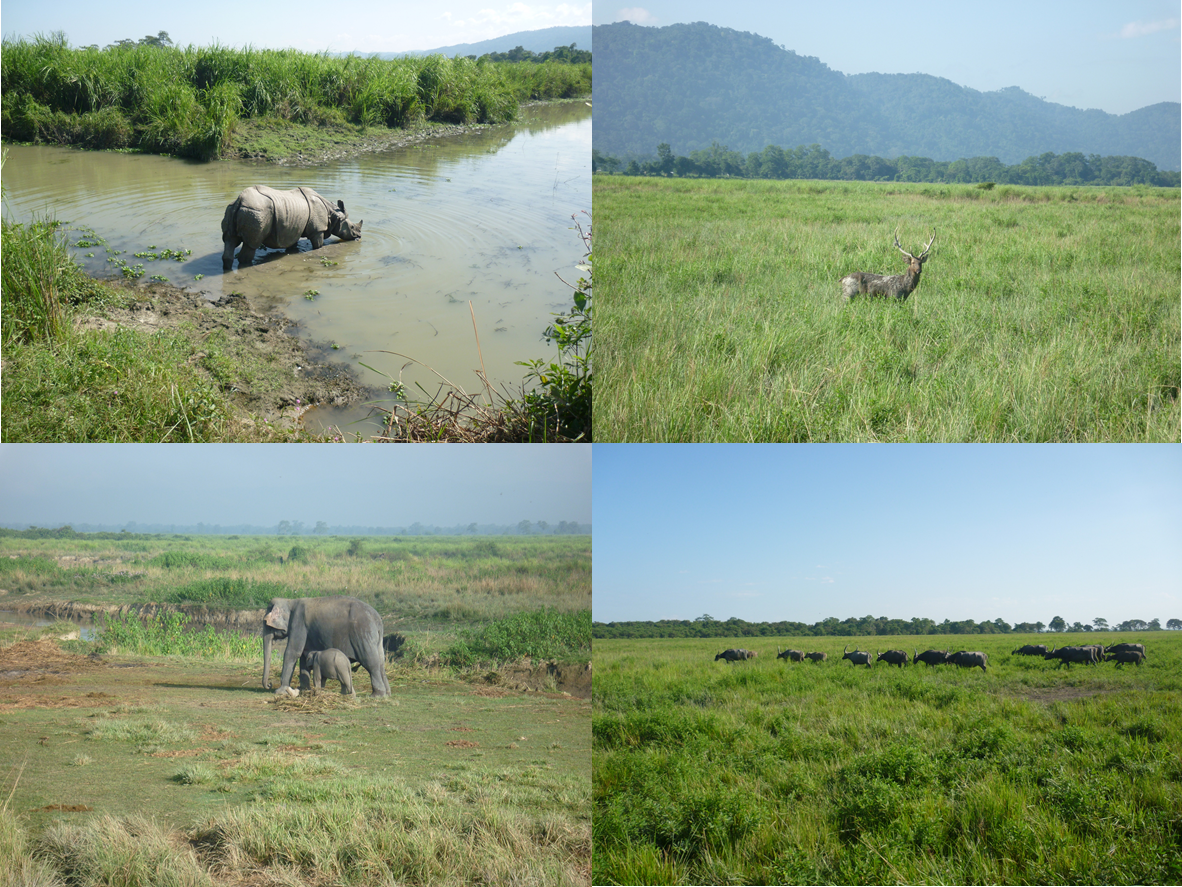
Kaziranga is synonymous with the one-horned rhinoceros. With about 2/3rd of the world’s population of these beauties found in just this area, it was no surprise that we began to spot them one after the other. Even before we started our ride, we spotted rhino families all around the watch tower we were standing at. We even found a few of them grazing in the fields on the sides of the highway. With that we realized, that Kaziranga was beyond rhinos. There are some other wild animals that are exclusive to the park and are collectively called as the ‘Big Five’, a must on the list of every wildlife enthusiast visiting the state of Assam.
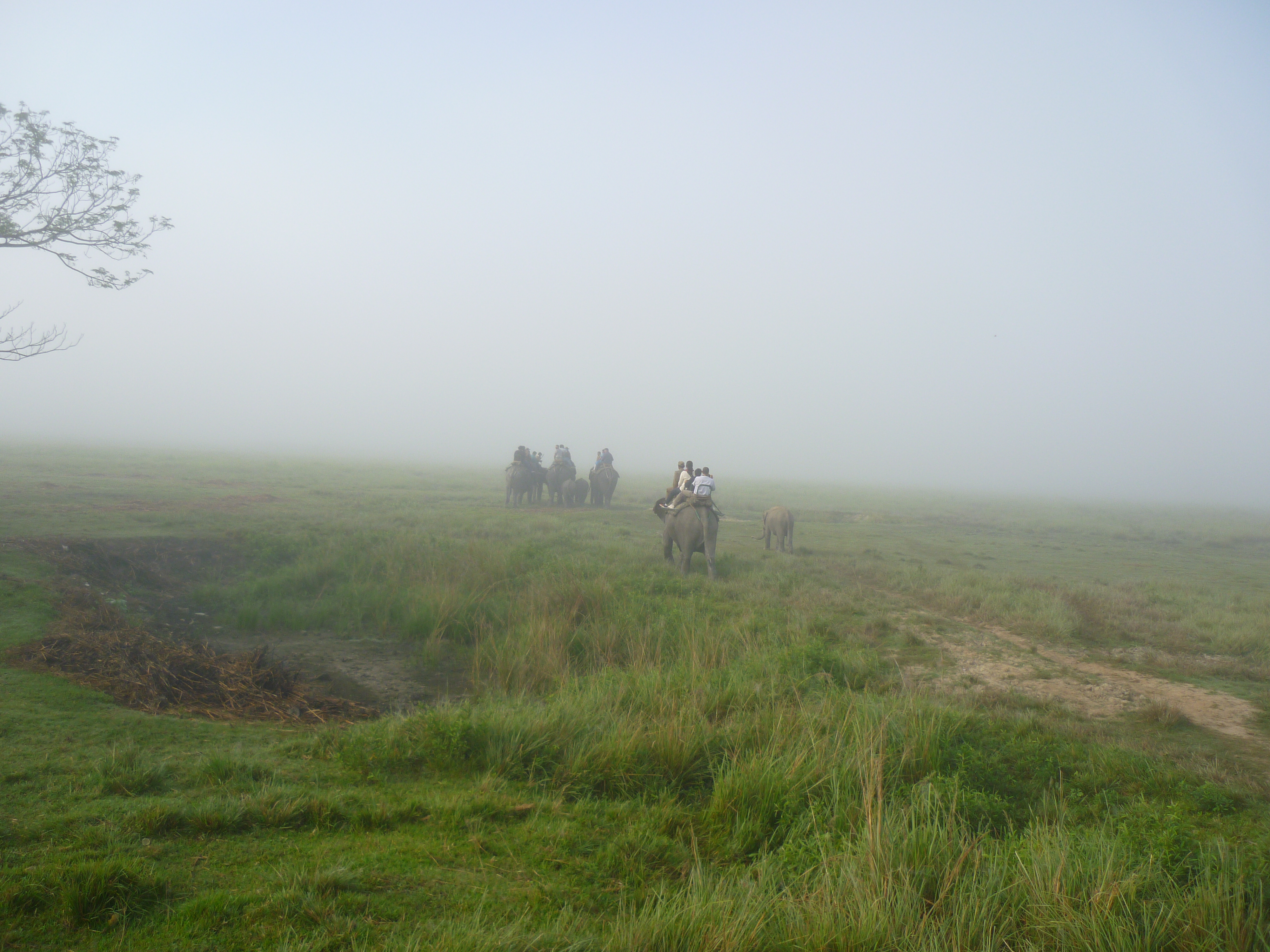
Our elephant had arrived in a bit. We sat atop and started our ride into the haze of the misty green grasslands of Kazhiranga to track the ‘Big Five’ of the this land. The elephants that we were seated on, were walking through dense thickets of elephant grass: the grass that was taller even for elephants to walk through. Slowly, the mahout started to point out and show us the animal at far distance.
The elephants marching into the forest
First, it was a wild elephant with its calf. We were told that rhino and elephant conflicts were common and that mother elephant was wounded just that morning in a bid to protect its new born calf. So, that meant we were not safe sitting on one either! We slowly moved out of tall grass to another area where a couple of rhinos were finishing their morning chores. It was very surprising for us to know that large rhino groups identify space where each rhino marks its own spot (making a private toilet space for itself) and does not let any other rhino enter the area.
Wow! We slowly passed that place and spotted herds of swamp deer. World’s largest population of these herbivores too is concentrated in these forests. Swamp deer are handsome animals.
Just as we were photographing them, we saw a herd of Asiatic wild water buffaloes marching out of a slush pool. Until our guide told us, we had no idea that over 57% of the world’s water buffaloes too were accommodated in the woods here!
Clockwise: The Single horned Rhino, Swamp deer, Wild water buffaloes and the Asiatic elephants
Another surprise information awaited us: Kazhiranga national park has the highest density of the Royal Bengal tigers in the world!!! Whoa!!!! That’s like……..something that was unknown to me, a person who hails from the land of Nagarhole, Bandipur & Bannerghatta. But as always, no luck with spotting the elusive beast. Seeing a tiger in the wild is a LONG dream, awaiting to be realised. (So much adventure to see a wild tiger, Click here to read more!)
So, we had checked off 4 out of the big 5 of the Kazhiranga before heading towards the exit gates- The One horned rhinos, Asiatic elephants, swamp deer and wild water buffaloes. Meanwhile, we realized that we still had time to make it for the morning batch of jeep ride. So, after enquiry and booking at the counter, we had a gypsy to take us into the forest again. Needless to mention, we were greeted by herds and herds of rhinos all along our path. Wild boars, barking deer etc. too were spotted in abundance. The highlight was however, the innumerable species of migratory birds that were spotted. Our driver cum guide mentioned several bird names, out of which only pelicans and spoon-billed storks were the ones that I have managed to remember.
On the other end of our drive into the forest, we were taken to a watch tower from where we could catch a very good view of hundreds of animals that had come to drink water from the flowing river. It was a very calm and a serene place to spend a while with nature. What caught our curiosity was some random years mentioned on the wall of the watch tower. So, here is a picture that may give an idea of the monsoon fury and severity of floods that affect this area year after year.
The tower itself is located at an elevation from the river. My friend in the below picture is a 6-footer. The water level of 2016 is marked above him… Can you imagine how impossible it is for the animals to escape out of the area??? It’s insane to think of and the image of the floating tiger’s carcass hovers around in my thoughts.
Record of the flood water level of the Bramhaputra
The drive back to the resort, on the highway was an extremely nice one which had gone unnoticed during the hurried drive through misty roads in the morning. Tea plantations flanked the roads on both sides. The famous Assam tea grows in flat lands and under shade, totally contrary to what I had seen and grown up seeing in the hills in down South. We stopped by to sip on some hot brew and bought some processed tea leaves for our caffeine addicts back home. A quick visit to the Orchid research centre was an interesting place to drop by too.
The Assam tea estate
Overall, our day was eventful at Kazhiranga with warm memories from the woods before heading to our next destination- Jorhat. Although a little disappointed for not being able to spot a tiger by the end of our safari ride, we were feeling content for having our long pending wish of visiting this heritage site come true!
Concluding remarks:For those of you planning to visit Kaziranga, I strongly recommend to try both ways of exploring the woods, on elephant back and by a four-wheel drive. Both are different experiences and the type of terrain and sightings are different. While an elephant will be able to take you through the tall grass, a 4-wheel automobile will be able to enter deeper areas of the forest. If you wish to spend more time with nature, I recommend you all to explore all the 4 ranges of the national park. Don’t go by recommendations of people of which range to go in… Each area is distinct with different types of vegetation, landscape, flora and fauna concentrations.
The long list of places I’ve travelled to and stayed at have given me a new insight to life and a new outlook at seeing life through.. The journeys have been enriching and the stays have added a new dimension to the travel. From five-star luxury to shoe-string budget hostels- I’ve stayed there all. While the pleasant ones were many, there is its own share of hopelessly aweful places. So here are a few ghastly and horrendous stays I have opted for during the course of my Indian discovery.
1. It being a pleasant season in the holy town of Rameshwaram, we had checked into a decent non-AC lodge at noon. After freshening up, we went out for sightseeing and returned to our room post dinner. We unpacked all our girly goods and let most of our wet lingerie strewn out for drying. It was around mid-night and I was just about to fall asleep and my friend Madhu screamed out loud. HECK! I jumped out asking what had happened. She switched the light on and started to pick up 1,2,3.. Bedbugs! She was allergic to them and the rashes had spread across her body. We spoke to the hotel manager and he arranged for an alternate room which he claimed would be good due to A/C facility. While we moved in our luggage and shut the doors, my friend lifted the bed to just reconfirm that everything was alright. Alas! More bedbugs were partying around the hemline.. We ran to the reception and asked them to give a permanent solution. They somehow managed to arrange a room in a nearby hotel after having themselves confirmed the room quality. So the next thing we were found doing was- Two girls walking the empty streets of Rameshwaram at well past midnight with half zipped backpacks, untied shoes in our feet, wet lingerie hanging out of the luggage, random plastic bags on both hands and anxious faces searching for a place to spend the night.. It was almost dawn by the time we settled down in the alternate accommodation provided.
2. We can’t blame anyone for this one- there was nothing else for us to expect while being stranded in the middle of a winter trek and the night temperature at 25 below zero!! We were at Leh town in Ladakh. No plumbing would work in that part of the world in that season for obvious reasons. We found ourselves in a homestay where we had to fetch water to do our daily chores. We had to break through the frozen layer of ice just so, that we could get half a bucket of hot (warm) water from the bottom of the same drum placed on fire. The bathroom waste was collected in containers which would overflow now and then making us want to throw-up very often.
3. The overly broken plumbing of the Chidambaram lodge is something that tops the list. It was a place that changed my mind to cutting-short my week long trip on just the 2nd day and making me want to go back home ASAP.. As if the stench from the nearby gutter, the smell of alcohol from the adjacent rooms and the super dirty bed covers weren’t enough, the washroom was moss covered and the faucet rusted as if it would break if operated… And to top it all, We stepped on someone’s barf that was spewed up on the stairs.. YUCK!! This has really given me strong reasons to have apprehensions towards online hotel booking based on guest reviews..
4. This one was a highly recommended budget stay option at Panchgani. It used to be a school hostel until being converted to a hotel which has hosted several movie shoots in the past. After hearing positive reviews, we two girls were surprised to find that the property seemed rather deserted when we arrived there. We were the only guests and that too on a weekend.. Although the room seemed decent for the tariff quoted, we still had some apprehensions for being the only people and our safety.. Just when we were in the process of decision making, both our eyes were caught by some strange thing just a little outside our hostel room.. Some white fur like stuff hung out of a large boiler sort of an equipment. We kind of panicked and asked the warden what that was. He told us it was a water boiler and the hard water had deposited along with some insulating material on the top. It definitely looked strange and scary. We did feel that it was a dog inside the boiler and it was their long furry tail hanging out of the barrel.. If it was our imagination, it is so not possible that both of us had the same thought.. We stared at each other and rushed out of the place without any further discussion..
5. So after a nightmare-ish pursuit of an accommodation, we finally checked into a hotel that evening at Panchgani. Everything was fine until my friend came out running from the bathroom. When asked what happened, she anxiously pointed out at the bucket placed under a running tap with a blood red liquid! The bucket was half full already with what seemed like blood.. I ran down to the reception and they came upstairs to check for facts from our bathroom :p They realized that it was rust particles from the overhead metal tank and pipes due to hardwater being constantly heated. We were somehow convinced with the explanation given, but I had no courage to continue to bathe in that water. However, to our rescue the water from other taps seemed to have a normal colour and we completed our basic chores…!!
Summary:
Do not suggest hotels, places and dishes/food to anybody. The choices and preferences vary from each person based on their character, mood, budget etc. Avoid being blamed later!
The first thing that hits your mind when you hear this city’s name is its Silk sarees. The Kanjeevaram or Kanchi silk sarees define a sense of style, gorgeousness, elegance, classy and royalty. But what goes rather unnoticed is the fact that Kanchipuram is also called a ‘City of temples’. Despite being the erstwhile capital of the Pallavas, the influences of Pandyas, Cholas, Hoysalas, and Vijayanagaras can also be significantly observed in the artistic structures constructed across the city. Also, it is noteworthy that the influences in temple architecture are across different sects of faith. The City of Kanchi can be broadly classified into three- Shiva Kanchi-the holy land of the Shaivaites, the Vishnu Kanchi- the holy land of the Vaishnavaites and the Jaina Kanchi- the holy land of the Jains. Kanchipuram is known to be a land of 108 ancient temples, all unique in their own way. Beyond its world-famous handloom, the sculptures, architecture, classical dance, music and all those traditional art forms of Kanchi puts up the city high up on centers of history and heritage on the map of India. That’s why I like to call Kanchipuram as ‘an abode of the trio- Art, culture and history’.
When my mom planned to buy some drapes from the local weavers of Kanchi, I chanced upon the opportunity to explore this city, beyond its sarees and handlooms. Obviously, one day wouldn’t be sufficient if I had to visit each of these 108 temples, and hence, I made a list of 10 temples based on their mythological importance. Given that I’m mostly a public transport-dependent creature, the ease of commutation was also a factor considered while making my list. We boarded an overnight bus from Bangalore to Kanchipuram.
As we alighted at the Kanchipuram bus terminus, we were greeted by the drizzling rain. Usually, the autorickshaws work this way in this city. You tell them the purpose of your visit, and they will plan and handle the entire itinerary for you. Thus, we hired an autorickshaw and that sorted our transportation for the entire duration of our visit around the city. Our auto driver took us to a travellers’ dormitory where we freshened up quickly and then headed to the first temple on my list.
1. Kanchi Kamakshiamman temple: The timing of our visit was important and we wanted to reach there before sunrise. This is one of the Shakthi peethas in India. The prayers in all other temples in Kanchi starts only after prayers are offered here. Unlike any other temples in India, the first pooja to the presiding deity is offered by an elephant and a cow in the sanctum here. The positive energy we felt in witnessing the ritual was enough to keep us going for at least another week.
The entrance of Kanchi Kamakshiamman temple
2. Next up was a quick visit to Adi Kanchi temple, a relatively smaller of the 3 main temples dedicated to Parvathi in Kanchi. But this place is considered a must if one is on a pilgrimage in Kanchipuram.
3. Adjacent to the Adi Kanchi temple is the Kumarakottam- Murugan Swami temple. It is believed that Lord Bramha was imprisoned by Murugan at this place and later released with Shiva’s interference. The temple is known for the idol in the Soma Skanda posture.
4. Ekambareshwara temple: This is the biggest temple in the city. I’d need a separate post altogether to write about the significance of this temple alone. But the primary reason for me to include this temple in my itinerary is the fact that this is one of the Panchabhuta sthalas of Shiva’s manifestations. The linga here is made up of sand and hence represents Prithvi or the element ‘Earth’. This majestic temple complex houses a very sacred mango tree at its centre, whose 4 branches are believed to represent the 4 Vedas that give its name to the temple. Each branch bears mangoes of four different tastes(sweet, sour, bitter, and spicy) in the 4 seasons. The special souvenir that I take back from Kanchi was not a saree, but a priceless green leaf that withered off from this holy tree right there, as if the tree was communicating with me.. I was quick to pick it up and wrap it carefully to be kept in my handbag.
Under the mango tree at the Ekambareshwara temple
5. Next was the Varadaraja Perumal temple. We had to stand in a really long queue to get a glimpse of the main deity seated atop the elephant hill. As if this wasn’t enough, another long queue to get to touch the sculptures of the holy lizards. These metal lizards are believed to have been installed by lord Indra after he was released from the curse by Goddess Saraswati. It is also believed that people who touch these 2 lizard sculptures (the Golden lizard representing the sun and the silver lizard representing the moon) will be relieved of all sins that are associated with lizards. Another specialty of this temple is the fact that the wooden idol of lord Vishnu is kept deep down inside a 3 tiered well that in turn is in between a large pond at the temple entrance. The idol is taken out only once in 40 years for pooja offerings. (The latest festival was held in 2019.) I would recommend you to hire a guide at this complex so that you can get a better insight into the intricacies of the ornate pillars adorning a 100-pillared hall. You can find sculptures of vivid yogic postures, representations of the usage of arms and ammunitions in ancient battles, musical pillars, etc., which explains the rich heritage of Indian art, history, and science.
A mural at Varadaraja Perumal temple
Thus, with Kamakshiamman temple, Ekambareshwar temple, and the Varadaraja Perumal temple, we had completed the mumurthivasam- or the abode of the trio in Kanchipuram.
6. Just a few meters away from there is the Ulagalandar temple, primarily constructed by the Cholas. Here, Vishnu is celebrated in his Trivikrama pose or the Vamana Avatar. The main idol is a massive 30+ feet tall, and the devotees can see only the legs of the Vamana moorthi. The temple itself is small but an important one for pilgrims on the Divyadesams circuit.
7. Further from here is the Kacchappa Eshwarar temple. Here, Vishnu is seen in his Kuruma avatar or the Tortoise form, worshipping Lord Shiva.
8. We did a quick stopover at Vaikunta Perumal temple or the Tiruparameshwara Vinnagaram, another among the 108 divyadesams. The temple houses lord Vishnu in 3 different postures- sitting, lying, and standing. The corridors are decorated with fine carvings from the Ramayana and Mahabharata, and fine stone pillars around the sanctum.
9. The Kailasanathar temple needs a special mention. This temple, dating back to the Pallava period, is located slightly on the outskirts and hence away from the regular tourist/pilgrim circuit. It is an entire complex of intricate artwork sculpted on limestone. Although a board claims it to be a protected monument, most of the statues have eroded over time and need maintenance. Yet, this place has a very powerful force to draw art lovers and travelers looking for an offbeat experience. One really needs to spend a lot of time here to appreciate the intricacies with which legends and mythological episodes have been carved out. Don’t miss spotting the statue of laughing Parvathi and Shiva performing the thandava here.
The Kailasanathar temple
10. There is also the Vijayaraghava Perumal temple at about 7kms from the city center. It is one of the 108 divyadesams of Rama, where he is believed to have performed the funeral rites of Jatayu, the vulture friend. Since the vulture(Pul) was buried in a pit(Kuli), this place is also called Thiruputkuli.
Not only is Hinduism, but the city is an important place for the Jains too.. Bonus for your temple tour, if you have some more time left. You can include the Trilokyanatha & Chandraprabha twin temples dedicated to lord Mahaveer at Tirupparuthikkundram. It has inscriptions belonging to Pallavas, Cholas, and the Vijayanagara period. I’m told that the place houses beautiful paintings of these periods but lies in utter neglect. The place is frequented by fewer tourists and more vandals, gamblers, and hawkers.
Enroute, we passed through ‘Kanchi Kudil’- an old traditional house that has now been converted to a museum that exhibits the rich Tamilian tradition.
But well, Saree shopping was why the entire visit to Kanchipuram was planned in the first place. Hence off we were, on a handloom circuit. Our driver took us through the narrow bylanes of Kanchi to some of the finest weavers and their handloom workshops. A spectrum of colours, heavy brocades, golden zaris, heavy pattu sarees… we were spoilt for choice… We thanked our driver, Mr.Ravi, heartily for taking us around the city and bearing with us so patiently as we hopped from one shop to another. We picked up some beautiful sarees in silk and cotton and returned to Bangalore in an evening bus.
This trip was part of a backpacking by my brother and me with an original itinerary to cover Bangalore- Kumbakonam – Gangaikondacholapuram – Chidambaram – Pichavaram – Pondicherry – Tiruvannamalai – Bangalore
As per this, we left Bangalore on a Sunday night in a bus and decided to explore further at our own pace, using public transport and staying at places with bookings made on the go. Plan was all set. But well, with a small glitch. We assumed that the monsoon season was the same in the entire southern India. But what we hadn’t taken into consideration was the fact that Tamil Nadu doesn’t come under the south-western monsoon. Hence, the monsoon peaks (with north-east winds) after the season ends in its neighboring states. So, we were now on an exploration of Tamil Nadu in October, during the peak of its monsoon season! Anyway, with its share of travel miseries, poor planning gave us the benefit of experiencing a different kind of backpacking.
Firstly, we explored Kumbakonam, a place which is often spoken less about on a typical tourist’s circuit. It was a wonderful experience to explore a place that is soaked in history and RICH architectural heritage, mostly from the Chola era. (This is elaborated in a separate post, click here to read). From Kumbakonam, our next planned destination for a major halt was the place that’s is often referred as ‘a city of eternal bliss’. But our experience was as unblissful as it could get, even as we wished to get a glimpse of the deity of a temple whose manifestation is revered to be as one of the five elements of life- ‘Space’. I would like to elaborate this trip for my readers to get a wholesome idea of our visit to this city was like for us!
With incessant rains, our mobile-phone network had been patchy. On day 2 at Kumbakonam, we received a call from our parents who had been trying to get in touch with us since the previous night. They informed us about the alert issued by the Met. Department. We checked online and confirmed the news about the weather forecast of cyclone- Roanu and a deep depression in the Bay of Bengal. We were asked not to venture near the seacoast. Our intended trip itself was supposed to be along the Coromandel coast- including Cuddalore and Pondicherry. Since the day was bright, we did not take our Met.dept. seriously and decided to take a chance by continuing with the plan from Kumbakonam.
With a visit to the Brihadeeshwara temple at Gangaikondacholapuram (another of the three living Chola temples), we boarded a bus to Mannarkudi. From Mannarkudi, we were supposed to take another bus towards our next planned destination: Chidambaram. However, the conductor informed us that the road beyond Mannarkudi was blocked since the previous night due to an uprooted tree. Although the tree was cleared, he wasn’t sure if the route was worthy for us to go. Without really understanding the seriousness of his advice, we boarded an overly priced private bus which ferried us to Chidambaram. Our road was flanked by the Kollidam until most stretch. Last time we had seen this part of the state was with our family, during our quest to see the end of river Kaveri. The dam was empty and dry back then. Today, she was flowing in full spate and the Grand Anicut was filled till its maximum limit. Kaveri looked beautiful with her brown waters reflecting back the sun rays that sneaked from amid the thick grey clouds. That was the point from where, the real saga of our road trip started.
As we covered a little distance ahead of the dam, the river began to touch the road around the corners at most turns. Gradually, the river started to spill over the road at some stretches. Instead of plying on the road, it seemed like our bus was driving over the river at these junctions. Further into the journey, the water level increased. Several stretches (in kilometers) of the road was submerged by the river. Our driver was a real super star- who could figure out exactly where the road laid in the ground in spite of the water being above the tire height. Even a slight slip in the road only meant death and nothing less. The entire bus with about 25-30 passengers could have been washed away by the currents of the spiteful river. I had only seen such things in the news. Now I was right there, experiencing a flood scene, firsthand.
The flooded villages enroute to Chidambaram
Stretches of villages laid submerged ahead. At some places, the thatched roofs and the hay huts had given away. We could see utensils floating around on the road, helpless villagers wading across the (once existent) streets, even as the flood water stayed above their waist level. Their plight was heart rendering to see, even as the rest of us inside the bus continued to wonder if we were going to see a safe arrival at our destination at all. The rain of just one night had wreaked so much havoc across the state of Tamil Nadu. However, our driver remained focused and drove us across to reach the safe harbor at Chidambaram by around 03.00.p.m.
My brother and I decided to drop the luggage at the hotel which we had booked online and find some food for ourselves. We hadn’t eaten anything since that morning. On arrival at the hotel, we were a little perplexed to see our room. The bedsheets looked extremely old, torn and dirty. The bathroom was a disaster. The toilet floor was covered with a thick layer of algae, slush and mud, all that had accumulated over years without washing it. The flush lever was broken, the taps rusted and a crazy layer of deposits on the bucket and the mug. The nasty smell of alcohol hit our noses from outside through the opened door even as we continued to feel suffocated inside that room. My brother and I looked at each other’s face- and both of us knew what was running in each other’s mind. In spite of being exhausted and hungry, we decided to leave the place and find some other place to stay. Just when we started to descend the stairs and as if the injury (of finding a bad room online) wasn’t enough, I happened to step on a large mess of barf, thrown up by some drunkard on the stairs and slip down a couple of steps.
Until this moment of our day, I had managed to keep my calm, but my brother gave up. He wanted to end the trip right there and return to Bangalore. While he found no buses that would leave Chidambaram immediately to Bangalore, I managed to convince him to stay calm until we boarded a night bus at least. I found a place near the ‘Nataraja temple’ where I could clean myself and headed to get the darshan of the lord. The visit was peaceful, maybe I will write about in another post someday.
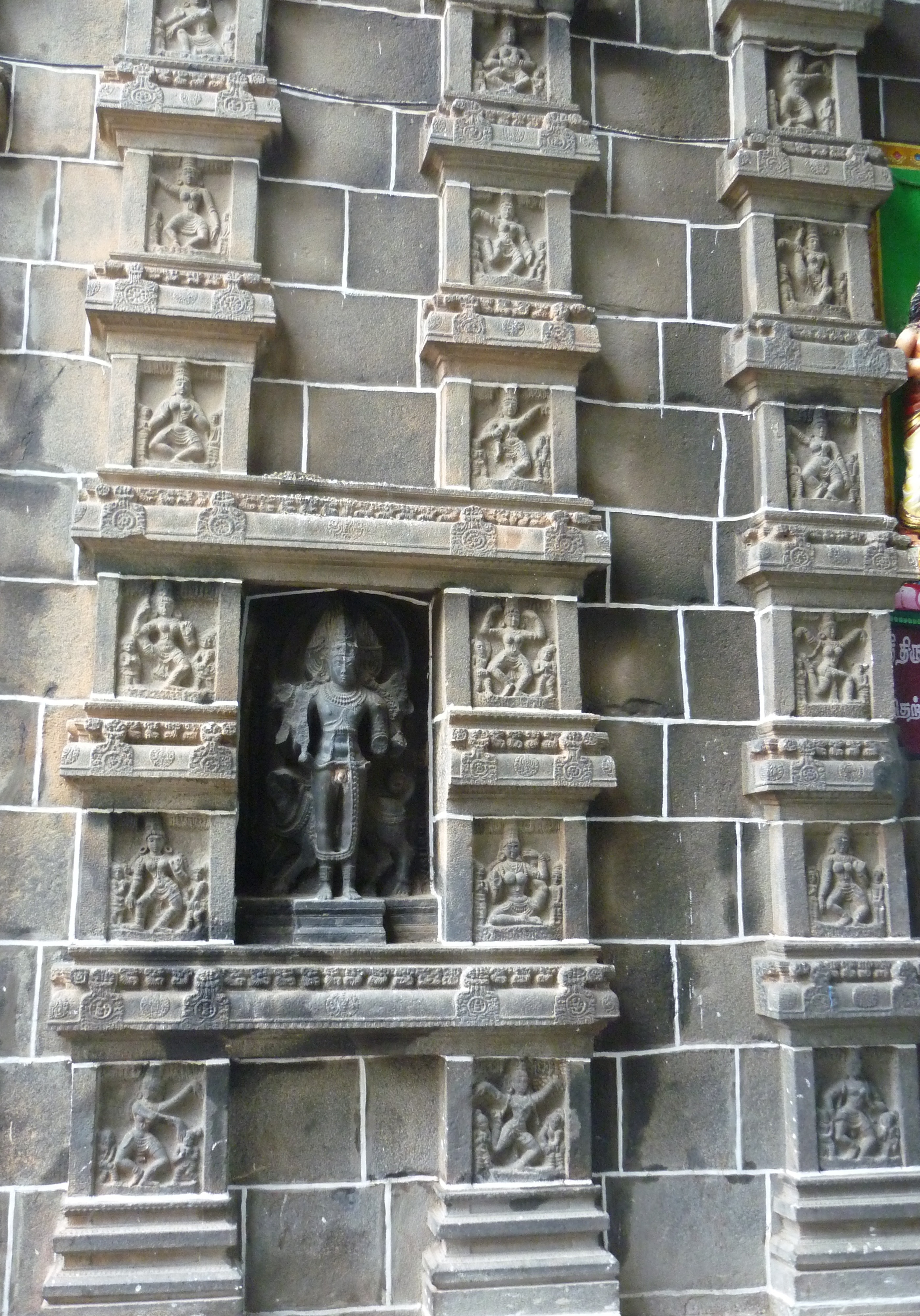
The Bharatanatyam postures sculpted on the walls of the west-tower of the temple
After finishing the evening prayers, my brother booked our tickets to Bangalore for the same night. Since my holidays were still not over, somewhere deep in my mind, I still wanted to complete my trip. I didn’t want one bad experience of the day ruin the entire holiday for us. But, given the weather condition further ahead in our planned route, I couldn’t rule out my apprehensions of getting stranded in the cyclone at Pondicherry as well.
But right now, our priority was different. We had been starving since morning and had to find something to fill our stomach. In spite of walking the WHOLE of Chidambaram town, we couldn’t locate a single place where we could find food. Thanks to the day of Deepawali festival- there were absolutely NO eateries open! Also, the entire town was SOO DIRTY with garbage littered everywhere. After a long search, we finally found ONE supermarket in the entire town. And what did we get to eat there? Just a cup of sweet corn to sate our hungry bodies.
Our city woes did not end after eating the steamed corn. It was still 07.00.p.m and we had three hours more to kill. On enquiring with a few locals, we were told that we would find a decent restaurant near the bus stand. And so as per the recommendations of the local people, we found this AC luxury restaurant called ‘Vandayar- Southern Spice’.
When we arrived there, the waiter informed us that they served only fried rice for the day. The waiter came to our table thrice to take our order (for the only dish available) and after two hours of waiting for food, there arrived a convoy of VIP customers at the restaurant. Bonus for waiting: A feast was set for this VIP family that comprised of all dishes from the menu. Even while all the tables were occupied with middle-class customers including my brother and me, there was no one from the restaurant that cared for our existence that day. Wondering if we were waiting for any free food to be served at 09.00.p.m. several customers grew furious and started to walk out of the restaurant. It was also time for us to board our bus. As we too walked out of this VIP restaurant, there was power cut in the town.
In a dark and dingy bus-stand, we spotted the only stall that served tea and some biscuits. The little candlelight was just enough for the tea-stall guy to reach out to things in his kiosk. We were essentially scared of stamping some more muck that could’ve been laid in the littered path. As we dunked the last biscuit into our chai, we had yet another surprise for us. Our bus to Bangalore was delayed by 2 hrs.!!! As we waited there in the dark platform of the bus stand, some drunk men started to throw glass bottles at the crowd there. Luckily no one was injured, but the downpour of bottles and splatter of glass pieces continued for a while. Our bus arrived after a while and we boarded at 10.00.p.m.
With all the crazy stuff that happened that day, we fell asleep quickly… Only to be woken up at sunrise. That’s when the rain was battering outside, and our bus had broken down on the highway. Although we were given an alternate bus in a while, our anxiety continued until we reached home.
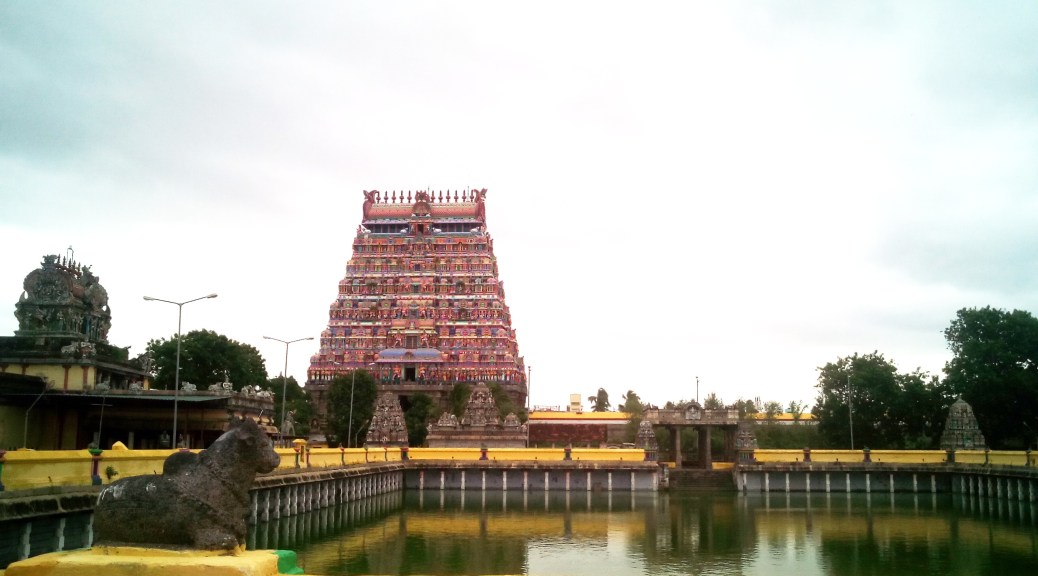
The temple Gopuram at Chidambaram Nataraja temple
Conclusion Remarks: The people on the east coast are god’s chosen ones to have a grand celebration of festivals. Tsunami for Christmas. Cyclones for Diwali…!! One cannot sit in a place, hear stories and imagine of places and people. You need to move yourself to places to experience and explore. This trip was one such experiences where I got a first had experience of braving a flood and starvation of food. Also, this is a trip where I managed to find a place in India that I wouldn’t want to return.

















 The Lost Lander