Tag Archives: South Indian temples

Places to Visit in Trichy in a day

This visit to Trichy was a part of our family’s backpacking trip, mainly conceptualized to cover a portion of the Coromandel coast during this trip. Our itinerary for this trip was Bangalore – Mayiladuthurai – Poompuhar – Tarangambadi – Karaikal – Nagapattinam – Velankanni – Tanjavur – Trichy – Bangalore.

After a long day exploring Tanjavur, we boarded an evening bus to Tiruchirappalli. Trichy is a name given by the British, perhaps the shortened version of the original used for the ease of pronunciation. After reaching the town, we checked into a lodge in front of the central bus stand, had a sumptuous meal and retired early.

  • It was day 3 of our backpacking. The places covered in our Trichy day trip were:
    • The island town of Srirangam
    • Thiruvannaikaval
    • St. Lourdes’s church
    • Rock Fort

The visit in detail:

Since this was not the first visit to Trichy for my parents, this plan was just a Trichy day trip. They wanted to just go around the major landmarks that are typically frequented on a traveler’s circuit. But Trichy is beyond just pilgrimage and ours is a family of explorers. So, in spite of covering these popular landmarks, we still added a few elements of history and architectural explorations into it to make it more meaningful than just going around these places. In fact, as someone who views places from a historian’s perspective, places are usually recognized by a specific dynasty that had an influence in its overall culture. For example, Mahabalipuram is associated with the Pallavas, Tanjavur or Kumbakonam is a major territory of the Cholas, Madurai with the Pandya and so on. But, when it comes to Trichy, this town was never a capital of one particular kingdom. However, it has remained a very important place throughout history and across timelines, thereby picking up influences of all major dynasties that ruled over this region. Hence, it is safe to say that Trichy represents a confluence of all south-Indian architectural styles.
I would like to elaborate on the places we visited to give my readers a brief idea of these places when they plan their trip to Trichy.

Landmark 1: Srirangam

We got ready early next morning and boarded a local bus to Srirangam- the abode of Sri Antya Ranganatha Swamy. This is the Tamilian counterpart of AdiRanga at Srirangapatna and MadhyaRanga in Shivana Samudra (All three are island towns formed by river Kaveri). Srirangam is an important place of worship for the Vaishnava sect of Brahmins or the followers of Lord Vishnu. When we arrive there, there was a long queue and we managed to get a glimpse of the historic idol of Sri Ranganatha sleeping on a serpent after a long wait in the queue. (There is a long history of how this idol came into being, worth a read).

But pilgrimage aside, we were there to enjoy the architectural marvels of the city. If you are someone who loves to walk and explore a place by foot, it would take a good 2-3 hours to simply walk around the main temple complex. Although the main gopuram or the outermost tower is the latest among all the towers in this temple complex, it is the largest temple tower in the world. With a spread of 156 acres, the temple complex itself is believed to be the largest functional temple premises in the world.

The complex consists seven rounds of walls/fortifications before you reach the sanctum sanctorum. Each wall was added by the successive dynasties that reigned in this town including the Pandya, Cholas, Hoysala, Vijayanagar, Pallavas and the others. The art specific to each of these eras can be noticed in the complex. The entire complex has 21 temple gopurams where one could easily get lost in the vastness of the complex if attempting to see each of them individually. After entering the main complex, a ticket of Rs.10 per head took us through narrow stairs leading to the roof of the temple. This is called the temple viewpoint, from where all 21 temple towers could be seen from a single spot. There is also a 1000 pillar hall which was earlier used as a venue to host dance events, now remained locked. We admired the fine sculptures on these pillars through the bars of the closed gates and continued our walk further.

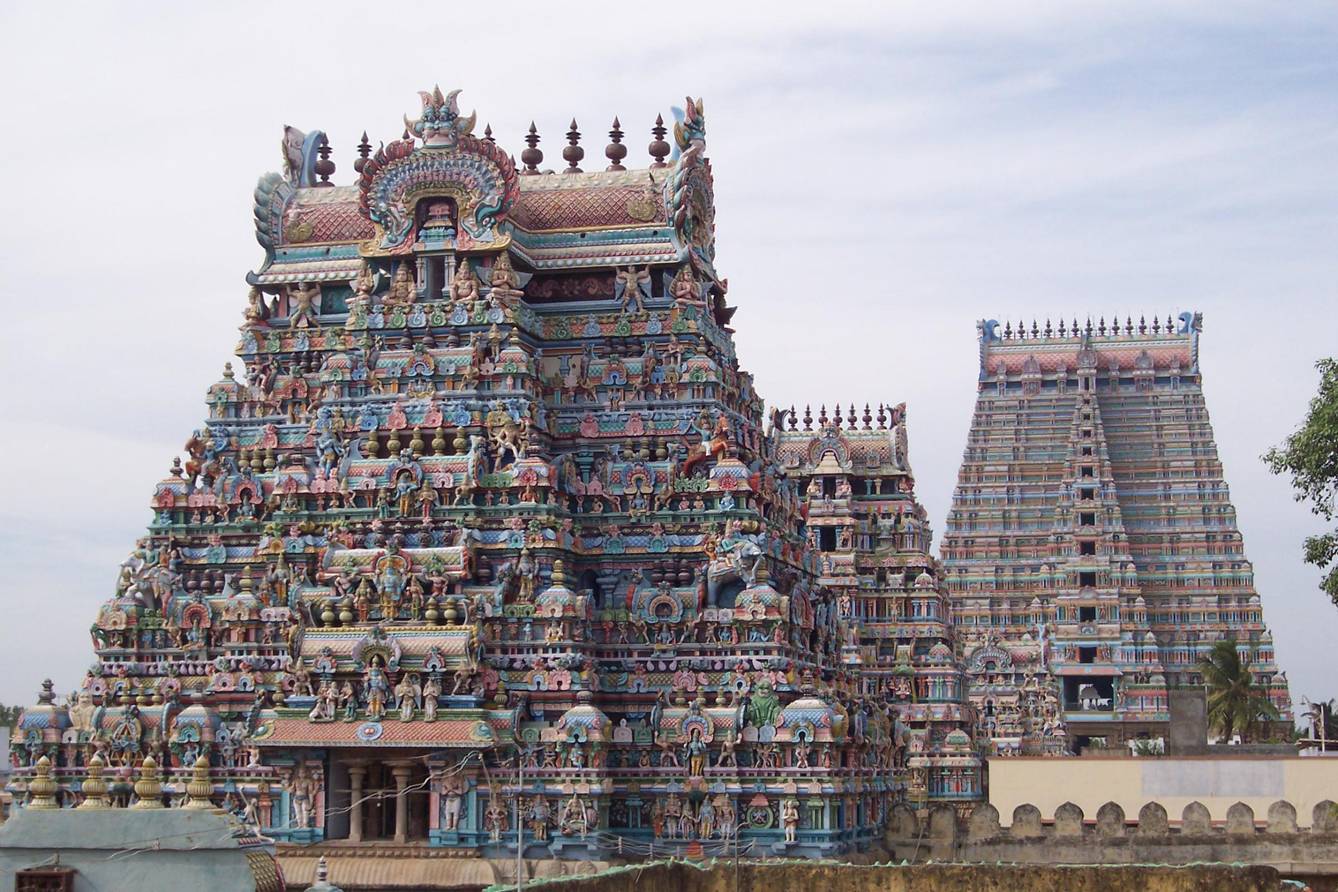
The Antya Ranganathar swamy temple at Srirangam

The banks of river Kaveri is just behind the temple, which can be accessed by walking through the rear door of the temple. With blazing sun even at 10.00.a.m, the sand and the asphalt road were already heated up. Hence, our barefooted attempt to walk to the riverbank was less a walk and more a run. Hailing from a place where the holy river originates and flows gracefully with water all through the year, it was unexpected and disappointing and to see her riverbed running TOTALLY dry in this part of her journey. But after talking to the localites, I cheered up a bit as they were looking forward for a good monsoon in the coming month. We were told that the river would flow almost in spate during the monsoons (Even submerging the very place that I was standing at). We came back to the temple again, had some fresh fruit juice from one of the stalls outside, wore our footwear and took a walk around the temple.

Big houses, with very small entrance, compactly built next to each other, allowing no or very less ventilation inside was the trademark style of Srirangam. These streets take pride in being home to one of the highly educated communities of the country- the Iyengar Brahmins.

Oh yeah…!! It was BURNING hot and I was pretty sure I’d go back home like a grilled chicken after this walk. But then, we wanted to make the most of the visit because life is uncertain, and no one knows for sure when we would be visiting again.

Landmark 2: Thiruvannaikaval

Though the population of Srirangam mainly comprises the Iyengar (the followers of Vaishnavism), the then rulers have also built temples for the Iyers (the followers of Shaivism). Hence, our next destination was to see the temple built for Lord Shiva. We boarded a bus to Thiruvannaikaval. This temple is as beautiful as the Ranganatha temple, however, the history behind the latter has made it more prominent. Though many people visiting this city give a miss to this temple, it should be noted that this is one among the five temples built for Shiva representing the five elements of life. This one represents water or Jala Linga. One of the residents in the complex noticed our interest in exploration and suggested us to visit the Amma or Parvathi temple, another beautiful ancient temple usually missed by visitors. It is located right behind the Shiva temple.

The entrance to Thiruvannaikaval Shiva temple

Landmark 3: St. Lourdes’s church

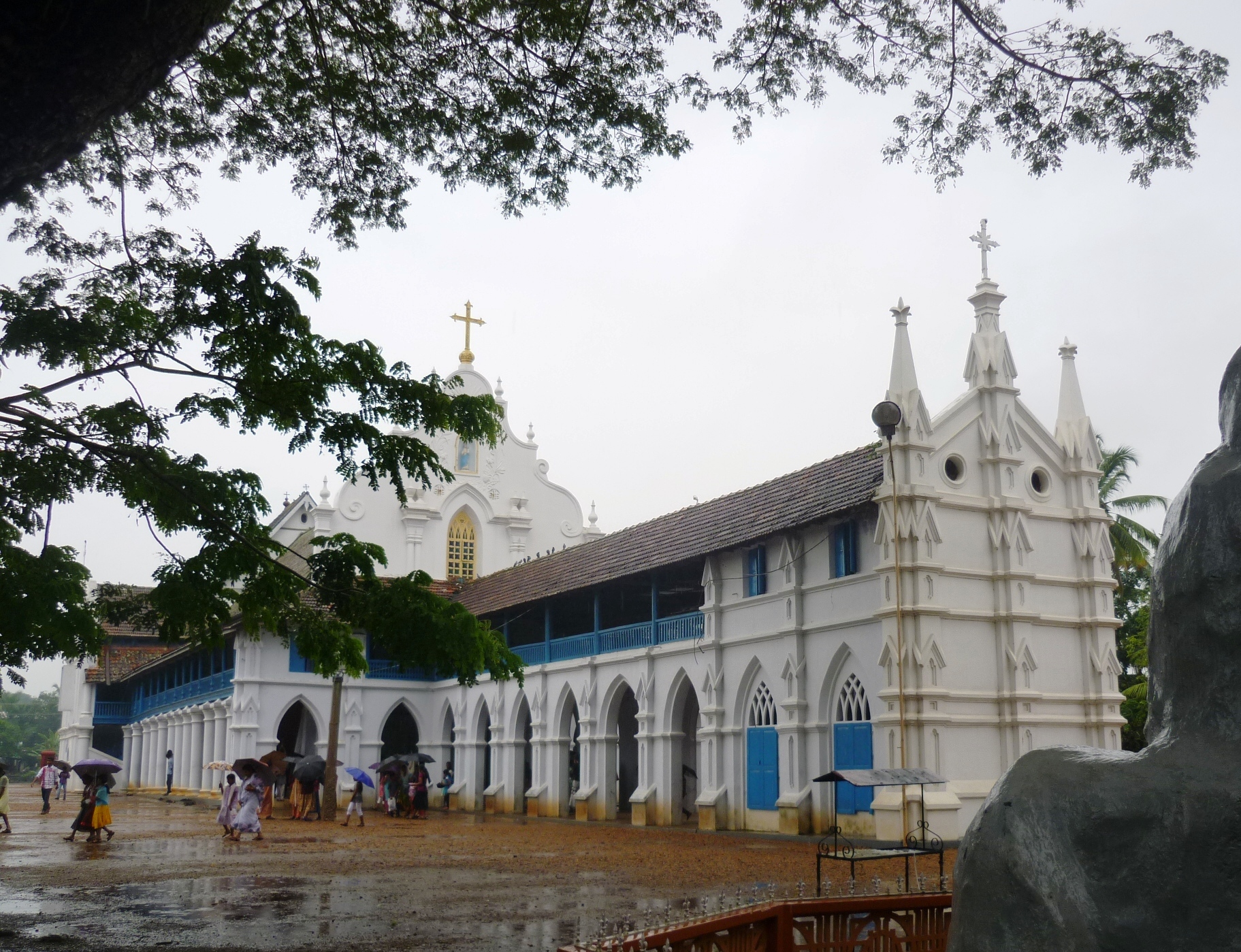
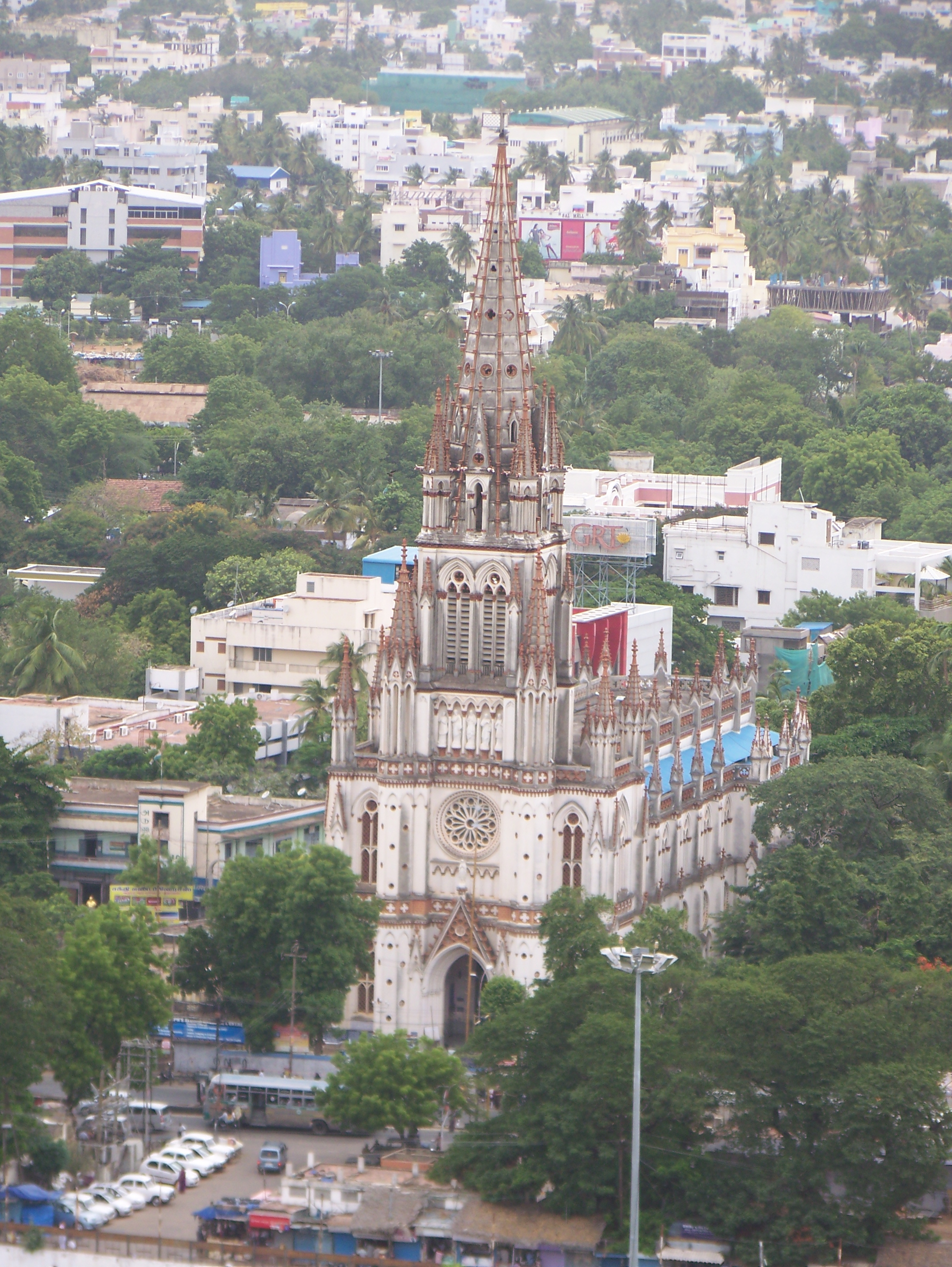
From the temple, we had a nice south Indian meal at a nearby hotel after which we headed back to Trichy town. We visited the St. Lourdes’s church in the city. The Gallo-Catholic design of the church architecture and the neo-Gothic spires are beautiful in this early 2 centuries old heritage structure.

St. Lourde's church
St. Lourde’s church

We did a bit of shopping in the by lanes and the Trichy market around the Teppakulam (Temple tank) before we started our ascend to our next destination.

Landmark 4: Rock Fort

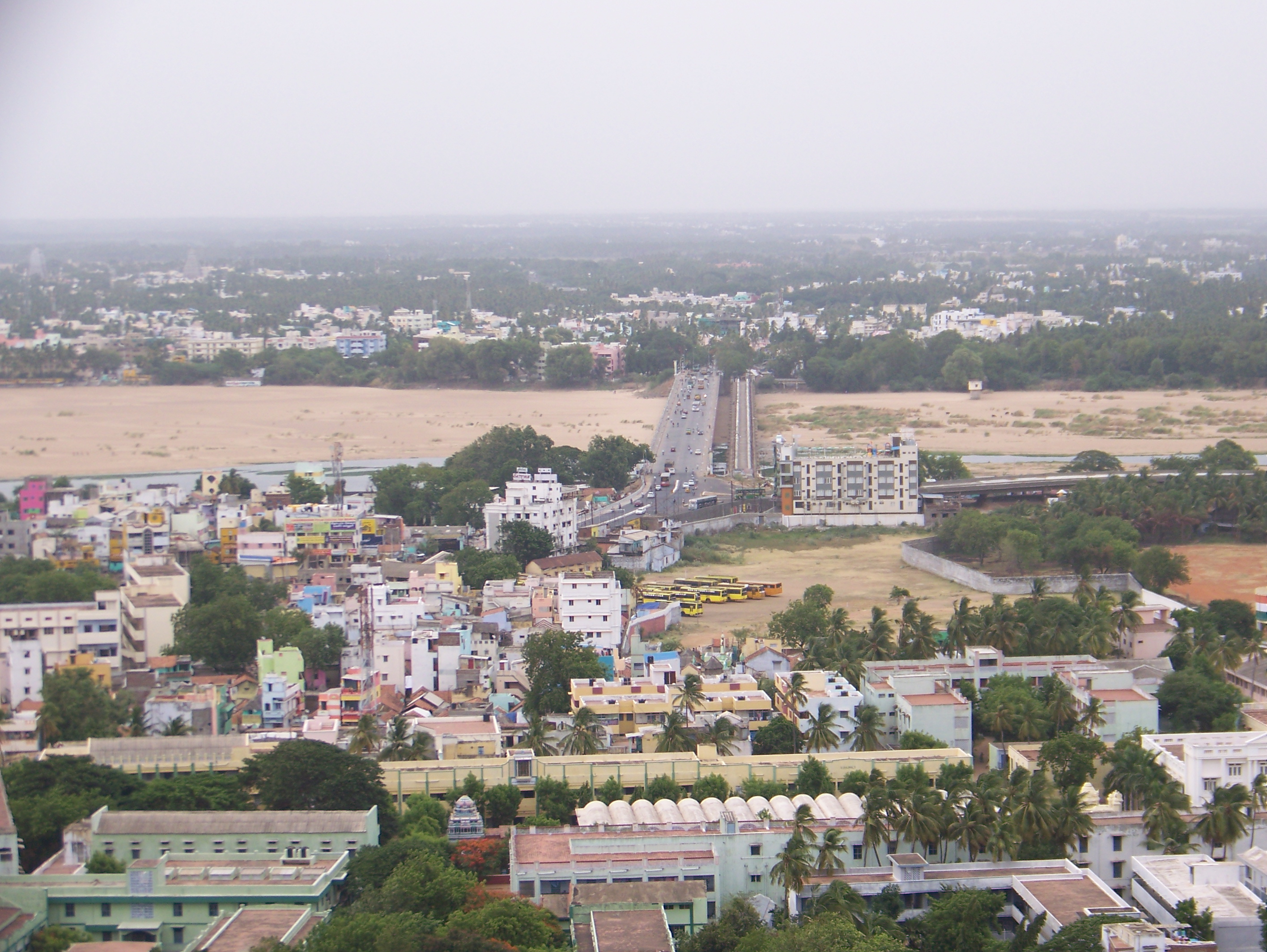
This single projection of land in an otherwise low/Flat Trichy town dates back to the pre-historic era. It is beyond words to describe how in those days, could someone has created such beautiful structures out of a hard monolith. What appears to be just a random protrusion of earth from outside, is in fact a haven for the art lovers in the inside. There are stairs, numerous temples, artistic pillars and idols carved out of the same rock all the way up. There is a Ganesha temple at the summit from where one can enjoy the view of the entire Trichy town, the Kaveri river flowing around Srirangam, the temple gopuram, the rail lines traveling in and outside the city. The fun was doubled by the cool but strong winds that blew taking away all the tiredness from our minds.

The view of river Kaveri from the summit of Rockfort
The view of Srirangam and the river bed from the summit of Rockfort

As we decided to descend down, we realized that a door that had remained closed during our ascent was now wide open. There were some beautiful paintings peeking out of the door intimidating us to go inside and see what was there. We stepped inside and it was amusement that followed. It was a vast hall carved out inside the same rock with beautifully sculptured pillars and amazing paintings adorning the walls. A priest noticed our interest and started explaining the story depicted by each painting. He then told us to hurry up and walk inside through another door. There, the maha mangalaarthi (the last pooja of the day.!!) for goddess Parvathi was just about to begin. Just as we reached there, they unveiled the curtains for us to get an eyeful of the beautifully decorated goddess.

Just while we were sipping the holy water, we were again asked to rush through another door, cross a narrow chamber that led to the Shiva temple. The deity was getting ready for the final pooja of the day. Prayers are offered only thrice a day: During sunrise, at noon and before sunset. And we were lucky for being there for one of these (the last one). The curtains were parted from the deity and the huge idol was being bathed in the pancha-Amrutha. Then, he was neatly dressed in dhoti, decorated with fresh flowers and the pooja culminating with Arathi. The curtains were back signaling us that the god would then go to sleep. We felt truly BLESSED…!! by the end of this, I could see my mom weeping in joy for being lucky to witness this Pooja. We had witnessed an event that was so unexpected.

At the exit of the Cave temple / Rockfort

Again, the presence and strong hold of almost all major south Indian dynasties could be felt there with the exquisite designs present in the art there. We thanked the priest and took leave to descend the stairs leading us down to the market.

Landmark 5: GR restaurant

A final destination to our tour: a local recommendation for an evening chai. GR restaurant is housed in an old building in the heart of the city (enroute to Rock fort). The Valli appam is a must try here. The interiors of the hotel are commendable which has rock pillars, structures & collectibles that reminds one of the grandeurs of temple architecture that this region is renowned for. A cup of piping hot filter coffee was a grand ending to our Trichy day trip!
There are many lesser known temples around Trichy and equally beautiful with rich artwork which takes up another full day. But one day was all the time we had with us before wrapping up trip in Trichy to Bangalore. So, I shall come back soon.

Mission accomplished- Kumara Parvatha

This trek was planned to celebrate the 1st anniversary of Sam’s farewell trek (Click here for details).. on the same day, exactly a year ago..

Let me get you going directly from where this trek to Kumara parvatha or KP peak is actually supposed to start. We reached Kukke Sri kshetra and checked into the lodge(a meagre 100Rs. Per day) run by the temple trust, freshened up and feasted on some sumptuous Mangalorean food for breakfast. Without wasting much time, we started the much hyped- one of the toughest treks in South India.. to the Kumara parvatha peak in the Pushpagiri wildlife zone.

The original plan was to start from the base by 7.00.a.m and camp at Bhatru mane. Then, leave Bhatru mane by 3.00.a.m the next morning and reach the peak to witness the sunrise, what is supposedly one of the best.

As planned, we entered the trekking trail.. It starts off with thick forest around and steep climbs uphill.. There was NO water sources along the way (We didn’t know that there was a perennial stream, with a small deviation after 2.5km) and a possibility of occasional encounters with elephants. We took frequent stops before taking a longer halt at Bhima’s rock. This stretch of 3km had oozed the fluid out of us..

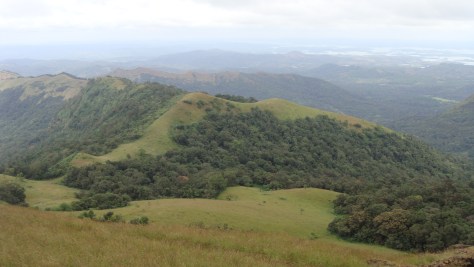
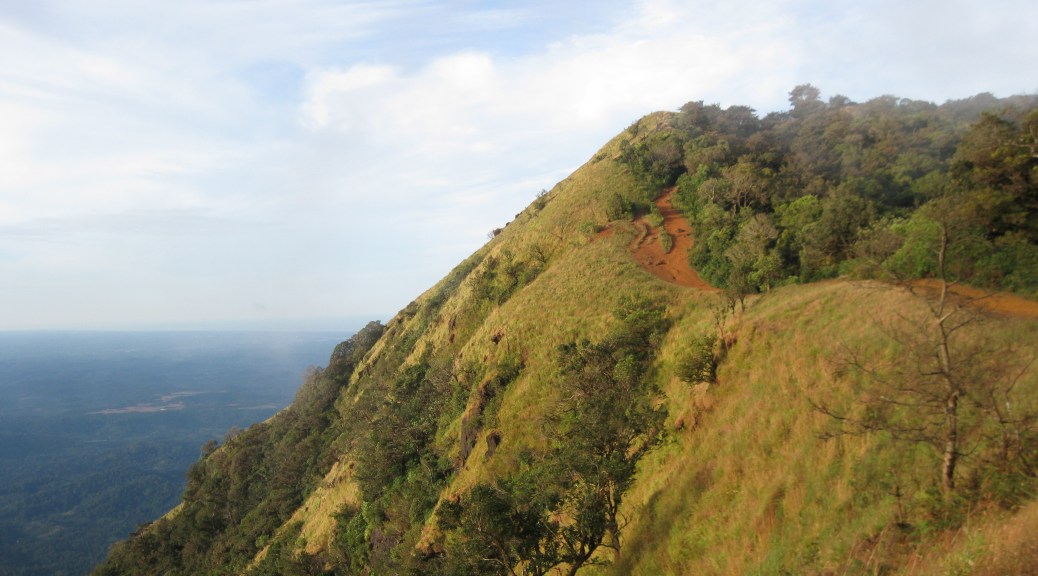
 A view from Bhima's rock
A view from Bhima’s rock

Once this 3kms stretch was covered, we got our first view of Kukke town.. The thick canopy of forests made way to the grasslands after walking 1km further from there.. It was well past noon and the sun shined at its hottest.. We were running out of water already.. We started to wonder if Bhatru mane really existed and literally pulled ourselves to reach there. Or rather say, we pushed ourselves to walk the small distance that seemed never ending.. Finally… we were overjoyed at the first glimpse of Bhatru mane…
The first glance of Bhatru mane

We ran down to his nestle amid a small piece of green land.. I find NO words to express the joy of finding water.. That too, clear and cold water from the stream that ran through his farm.. We had a simple, yet the tastiest lunch served by Bhatru and rested under the shades of his arecanut farm..

We then made a small change in the plan and decided to continue the trek until it was dark. We feared the pace at which we were climbing up and did not want to return late on the following day.. We halted at a view point along the way for some photographs, before reaching the forest checkpost. We continued our hike up after registering our names at the forest office.. We stopped again at yet another view point.. The sun was coming down by the time we reached kal-mantapa and hence we decided to pitch our tent near the stream that ran by..

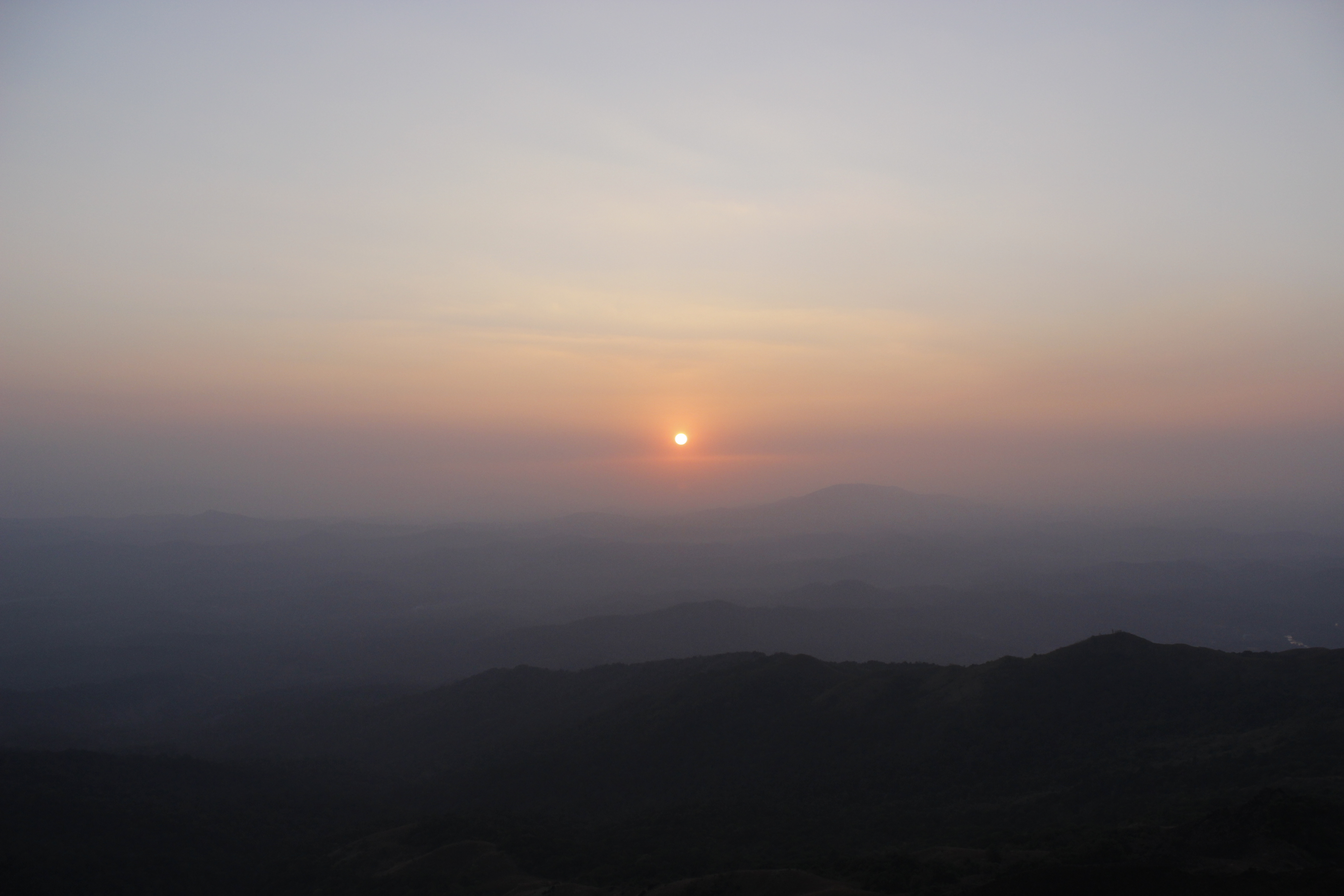
The sunset from our tent

The sunset from our tent

I don’t remember which sane person in the group chose the place.. I agree that we got a place which became every other trekker’s envy.. The place was for sure, a top rated spot for sunset viewing.. But we girls, who stayed inside the tent know what we went through that night.. The tent was pitched on a slope, on the edge of a rocky cliff which seemed like the place where the earth ended.. It was soon dark and we ate the little food that we had carried and hit the bed (Read hit the rocks)..

The boys comforted themselves in their sleeping bags and threw the poor girls inside the tent.. The entire night went by like this: ‘Our respective backpacks were used as pillows inside our tent. We all would slide down with our bags inside the tent.. again we would push back everything and move up.. Slide down.. Slide up.. Phew..!!’ And a while into midnight.. The intensity of the wind also increased.. The cover of the tent started to fly.. We hoped for it to be 3.00.a.m soon so that we all could start our ascend.. But another surprise was awaiting us.. Madhu heard the cracking sound of the tent support and scared all the girls inside to vacate the tent. We carried our luggage from inside and jumped out of the tent, one by one.. The last girl just came out and the tent crashed down to a flat.. The guys woke up and one of them attempted to slowly remove the pegs.. One peg was removed and then… The tent flew.. away from our reach.. off the cliff.. down the valley.. We had borrowed the tent, on hire.

Everyone woke up and sat wondering why this had to happen. It was still dark at 4.00.a.m. and with the wind that continued to blow ruthlessly, our ascend to the peak seemed impossible.. We stayed back until sunrise 😦 We decided to compromise on one of the main agenda of our trek- Watching the sunrise at KP peak.

After there was dawn,one of the boys dared to go down the cliff. He had a thrilling feat with adventure and managed to bring back the tent that had settled on a boulder in the middle of a water body, down below in the valley.. More than getting excited about finding the tent, we were all celebrating his safe return.. It was around 7.00.a.m by the time we started our ascent.

Inspite of missing the sunrise, the views post that period were equally spectacular, all along the way. The climb was pretty smooth. It was around 11.00.a.m. by the time we reached the first peak/ false peak- Shesha parvatha.

Post sunrise

The view from the base of Shesha Parvatha

After just a few photo moments, we decided to continue our journey.. We descended the steep rock and waded through super cool, thick jungles.. And then, climbed up another steep rock. This rockclimbing with bare hands and legs reminded me of our monkey ancestors.!! A small walk further up took us to the actual end of the earth. Right there, we had conquered our destination- Kumara Parvatha..!!

Shiva temple atop Pushpagiri hill

Shiva temple atop Kumara parvatha

Thanking the diety with a small bow in the temple on the peak, we set our return journey.. Getting down the rocky slope of KP seemed tricky with one of my friends ending up with torn trousers when he decided to sit and slide down on his butt 😉

The descend from Shesha Psrvatha was no easy task either. The loose gravel all along the trail made walking difficult without slipping. It was 4.00.p.m by the time we reached Bhatru mane.. We realised that we had covered only half the distance and had very less time left with sunlight.. We had to complete the remaining distance before it got dark because that was the toughest stretch with thick forests and wild animals. We had a quick lunch at Bhatru mane and got some rest in fast forward mode and started our descend by 5.00.p.m..

We knew we had very less time in hand and a LONG way to go.. We all walked as fast as we could. Our legs had given up already.. I was preparing my mind to stay back in the forest and make a feast of myself to some wild animal at night.. I ran down the slope at times.. My knees seemed like they would part away from my thighs.. We saw the sun coming down.. We continued to walk fast.. We saw the sun going down the horizon.. We paced up.. Suddenly we all halted.. There was pin drop silence.. We realised that some wild animal(mostly elephant) was somewhere around.. It took us a few minutes to feel the sound move away from us.. Then, we resumed our walk. We saw the bright day fade into darkness and every shade in this process. The toughest and the last stretch was almost coming to an end.. We had FINALLY reached the KP gate… And the last ray of light too waned into darkness.. Thus came an end to the KP trek- a mission….. accomplished..!!

We all then freshened up at the same lodge and did a quick visit to the Kukke temple before hitting the roads on our return journey.

NOTE: The above story is written based on my trek back in 2013 when there was no restriction on camping in the entire trail. As on 2019, camping is allowed only around the forest checkpost and Bhatru mane. So, it is wiser to plan the distance, hiking time and camping accordingly.

Must do things/ Highlights of Kumara parvatha trek:

  • Bhatru mane is the ONLY place you will find food and it is an experience in itself to get your turn in the queue to have your meal served. The same basic rice and sambar is served for all 3 meals and nobody complains. Not tasty, but finding food after a long day is LUXURY here. Bhatru has a fixed time for serving food and very punctual. The crowd is huge especially on weekends and the wait for your meal can take longer if you dont have your own plate.
  • The sunset from the view point enroute forest checkpost or Kal-Mantapa
  • To watch the Sunrise from Kumara parvatha is like going to a different world. Try to make it there in time.
  • The sky is in its clearest form and star gazing at night is a whole different experience. You see so many stars, bright and clear that it feels as if the sky has moved closer to earth. We got lucky as it was also a night of a meteor shower, so we saw many shooting stars.
  • Drinking water from the stream felt like nectar. So clean and tasty. You can fill your bottles at 4 places along the way. First after 3kms, near the Bhimas rock. Second, at Bhatru mane. Third, at the forest checkpost. Fourth, at a stream just before kal-mantapa.

Offbeat Places to Visit in Rameshwaram on a Weekend

This was a destination that my friend and I had been contemplating to travel for some time. The trip turned into certainty only when my friend had the confirmed tatkal tickets in her hands after a wait of over an hour in the queue at the railway station. Then on the following evening, the two of us commenced our weekend journey towards Rameswaram by boarding our train from Bengaluru cantonment station to Madurai. We had a few important things to check-off on our small list for places to see and things to do at Rameswaram. Since the travel tickets were confirmed in the last moment, we had barely any time to make hotel reservations. We decided to go there and find something for ourselves.

Our Itinerary:

Day 0: Evening train to Madurai from Bengaluru Cantonment railway station.
Day 1: Arrival at Rameswaram and visit to Ramanathaswamy temple (TNSRTC bus from Madurai to Rameswaram)
Day 2: Visit to Dhanushkodi (Local bus from Rameswaram to Dhanushkodi), Rameswaram local sightseeing (hire an autorickshaw for half day), Sunset & Beach walk near Pamban bridge.
Day 3: Visit to Kurusudai islands (Local bus to Vivekananda Mandapam & hire a local boat from there to reach Kurusudai islands), Return to Pamban boat jetty; Return to Bangalore (Train to Madurai & change train from Madurai to Bangalore).

The details:

Day 1– Arrival at Rameswaram and visit to Ramanathaswamy temple

The train reached Madurai by 7.20.a.m. After freshening up at the station itself, we left for our main destination. The TNSRTC buses are quite frequent and it took us a journey of 3.5 hours to reach Rameswaram. Enroute, we passed through Ramanathapuram- the last stretch of mainland India. Once we reached Mandapam, the entry point to the island town of Rameswaram, we had our excitement running at its peak. For the next 15minutes, our bus was cruising over the bow shaped road bridge that oversaw the famous Pamban rail bridge. Pamban bridge is an edifice of engineering that is still standing strong on its 100th year in commissioning. This is a bridge that would connect us to the other side of the land, to a town that would host hundreds of stories from the Ramayana during our stay there, over the next couple of days.

After arriving at the Rameswaram bus stand, we noticed the tourist office that stood right opposite. We wanted to try our chance to get permission to the Kurusudai island and hence, registered our names as tourists in their logbook. This island is a protected area and we had tried hard to get permission for our visit even before starting our trip. Though indirectly, our random chance visit to the tourist office in fact helped us BIG time (Click here to read the story in detail).

Lord Rama is believed to be an incarnation of Lord Vishnu. Then, why is the city named after Eshwar? It is important to know at least this while you are there in Rameswaram. Here goes the story… Ravana, (a Brahmin) was a devotee of Lord Shiva (aka Eswaran). On performing penance, Ravana was blessed with a boon by Shiva such that- anyone who tried to harm Ravana would face Brahma dosha. Further, during the war between Rama & Ravana, Rama (a Kshatriya) killed Ravana who then happened to face the wrath of the dosha. Rama then, had to perform pooja to Shiva, the only one who could help him out of the dosha. Here, Eswaran helped Rama. Thus, the name to the town- Rameshwar. I was told that there is a similar story for a town called Ravaneshwar in Lanka.

We walked towards the temple road, roamed around a bit and finally checked into a decent looking hotel close to the main temple. After freshening up, we headed to the main landmark of this pilgrim town, Sri Ramanathaswamy temple. The world’s fifth largest monolithic Nandi statue guards the entrance of this temple. We were overwhelmed to walk across the longest temple corridor in the world and felt blessed after bathing in the water from the 22 sacred wells on the temple. Since it was quite a tiring day due to all the traveling, we decided to sleep early as we had a long day of exploration on the itinerary, next.

Day 2: Exploring Dhanushkodi and local sightseeing at Rameswaram

On the following day, it was Holi: The festival of colors. We were sitting at the Agnitheertham beach at 4.30.a.m watching hundreds of devotees taking a holy dip in the sea. But we were waiting for something else. We were waiting to welcome a day that would unfold with a palette of the best colors that nature could show. Although the wait was long, it was only by 07.00.a.m. when we witnessed what is by far, one of the best sunrises we had seen till date.

Sunrise viewed from Agnitheertham beach

We boarded a bus from there to Dhanushkodi- The ghost city. Although a visit to Dhanushkodi was one of the most awaited part of the trip, it was not our best. From all the stories and experiences, we had imagined of Dhanushkodi, we had expected to need at least one full day there. It is a place that we wanted to explore and not run through which can be best done only if one had a vehicle at his / her own disposal. However, we were at the mercy of public transportation on this budget trip. Like all visitors or “tourists” who had come down there, we too had to settle for a tour of this deserted city in one of the local tourist buses. A round trip was completed in about 3hours with a cost of 100Rs per head not satiating our need to see more of this abandoned town.

  • Apart from the few main structures and temples (old railway station, church, temple of the floating stone, etc.) that you would see during your tour package(local bus), a few other things that you can do during your trip to Dhanushkodi are:
    • A walk through the waters of the Bay of Bengal till the Kodandaramasamy temple is a must do. The water level never goes above your knees.
    • The Ramasetu or the Sethusamudram is something that can be visualized if you have a proper guide with you.
    • A drive on the asphalt road that stretches up to Dhanushkodi is something to die for. With the calm Bay of Bengal on one side and the rough Arabian sea on the other, the drive is every traveler’s delight.
    • On your return, you can cover Jada Teertha & Nambu Nayagiamman temple (both located at just a couple of kms before Dhanushkodi.
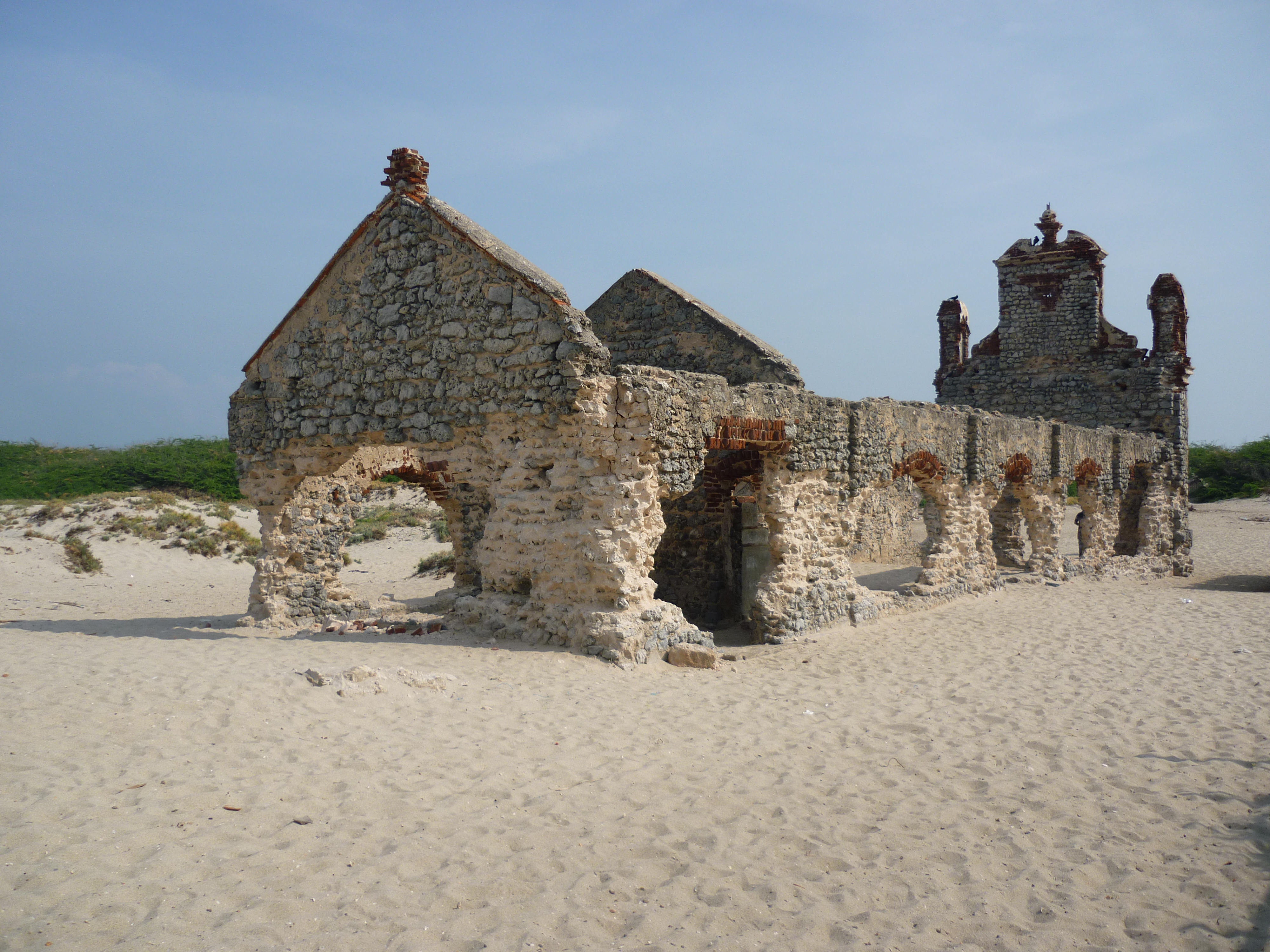
Ruins of the old church

One hour up on our watches and we were back in the main town. We settled a deal for Rs.250 with an autorickshaw guy who would take us on a quick visit of the major places around the town. Some of the places thus covered include:

• Gandaparvatham / Rama paadam- the highest point in the island town from where one can catch a good view of the scenery around.
• Sugriva Teertha (a small pond)
• Saatchi Hanuman temple
• Bhadrakali Amman temple
• Rama Teertha
• Krishna temple
• Lakshmana Teertha
• Five-faced Hanuman temple- The floating stones used for the construction of Rama Sethu can be seen here as well.
• The house of former President of India, his honor: A.P.J. Abdul Kalam- It is now converted into a museum.

Sri Rama theertham
Sri Rama theertham

An interesting thing we noticed in the architectural style of all the structures in Rameswaram was that with the Ramanathaswamy temple being an exception, all the other temples that I have mentioned above are typically built in the Nagara style of architecture. Having covered Rama, Sugriva and Lakshmana teertha, we were curious to enquire if there was a ‘Sita Teertha’ too. Our guide cum autorickshaw driver nodded and brought us to a place on the highway. And to our dismay, he pointed to a small tank by the roadside. It was filled with green stagnant water and a good mosquito breeding ground. “Damn…!! this patriarchal Indian society…!!” I exclaimed.

We were done with local sightseeing by early evening, and still had a LOT of time left until sunset. Standing on the road bridge and peeking down at the train tug over the century old engineering marvel- Pamban was a sight not to be missed. So, we decided to head towards Pamban bridge.

Once we saw a train pass over it, we decided to stroll around a small fishing hamlet that we just across the street. We got some good clicks of the Pamban from the boat jetty in this fishing hamlet. While straying around there, my eyes fell on the light house that was located a few meters across the village. We asked for directions and reached there in less than half and hours’ time. While we waited for the gates to the lighthouse to open, we tagged along with a few kids, our new friends at the fishermen’s cove. With the kids excited to converse in English with us, we did so while taking a walk further down to the seashore. With a magnificent view of the sun setting in the backdrop of the Pamban in the distant end, we settled down under the shade of a mangrove tree until the sun went down completely.

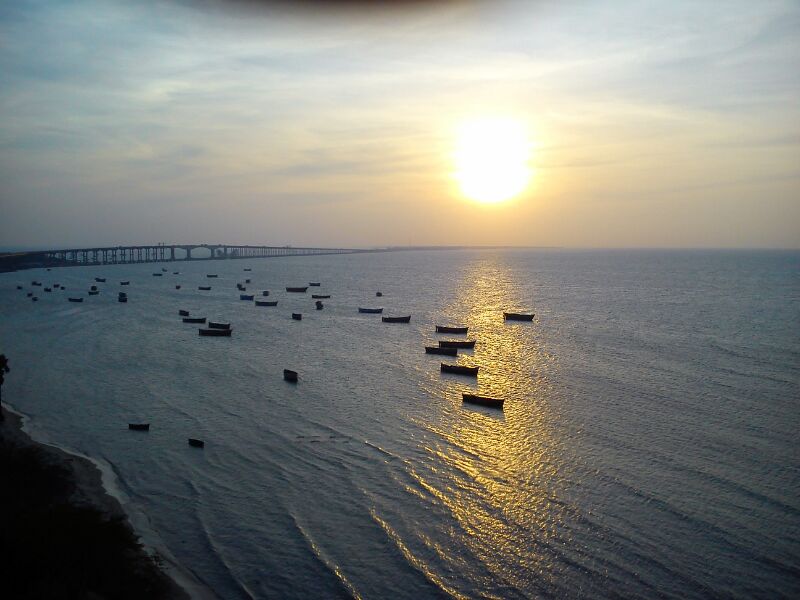
The sunset from the fishermen's cove
The sunset from the fishermen’s cove

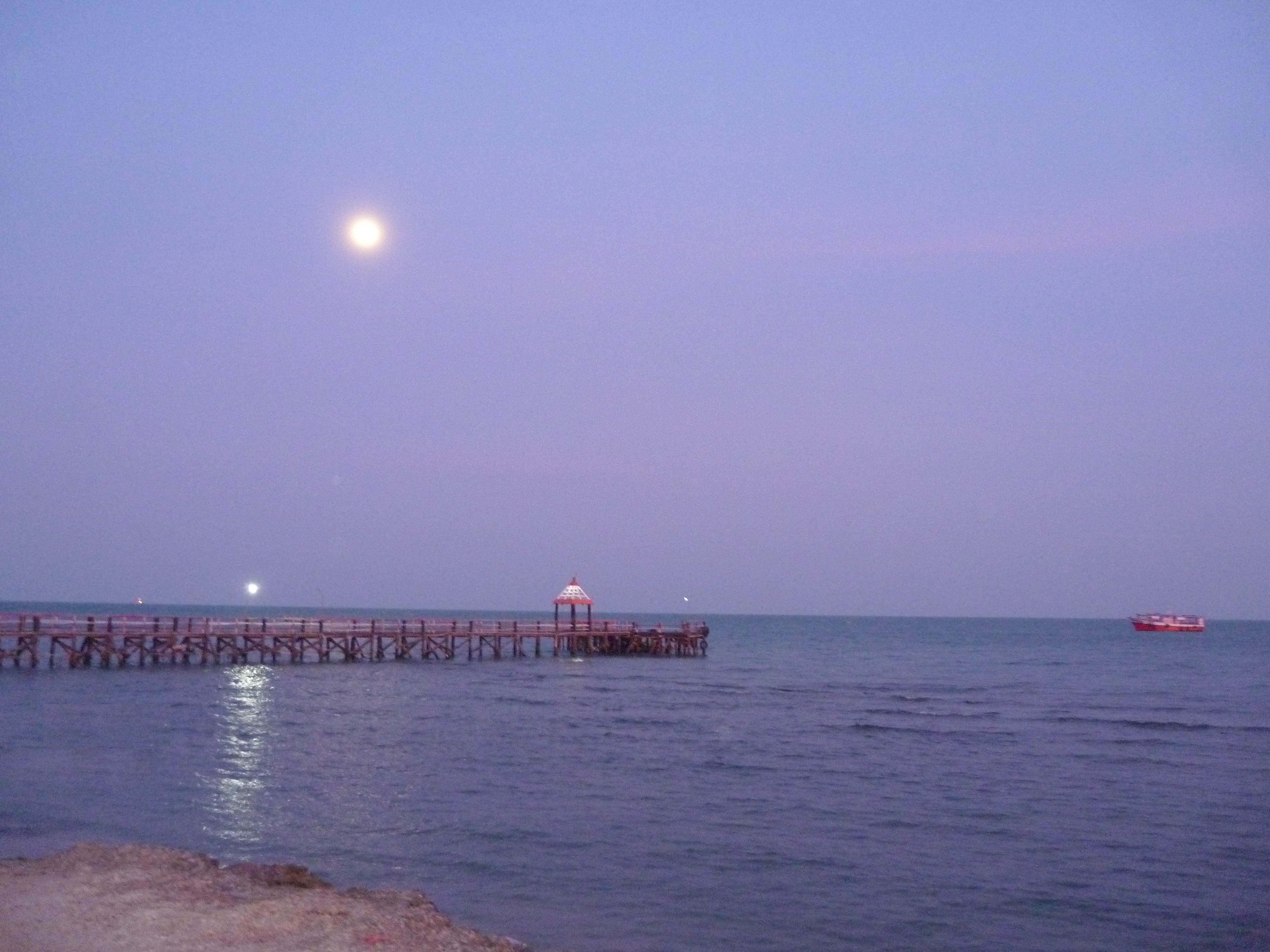
It was soon dark, and we had to head back to the temple road for a safer crowd. We bought some peanuts masala from the vendor on the seashore and found a comfortable seat for ourselves to catch some peaceful time. It was a full moon night.

On that wonderful day: We had seen the faint horizon emerge out from the pitch darkness of the sky that brightened into broad daylight with a series of color change and then the white sky of the day fade into the black of the night … And again, the night’s sky was lit up by the beautiful full moon… Yes… We had witnessed one COMPLETE day…

Full moon lit night sky as seen from the Agnitheertham boat jetty

Day 3: Visit to Kurusudai island and return to Bengaluru

Based on some local contacts, we had got a last-minute permit to visit the Kurusudai island. As per the directions given, we had to check out early and catch the 8.00.a.m bus from Akka-Madang to Vivekananda memorial hall. Our boat was waiting for us with the guide to take us to another world- A world of exotic marine animals- ‘the Kurusudai island ‘. (A more elaborate article on this visit can be read by clicking here). To sum up- “We were lucky to get there”.

From Kurusudai island, we got dropped at the Pamban boat jetty. Our boat was anchored somewhere amid hundred other boats and hence, we had to walk across through knee deep sea water to get to the shore. This walking experience was unique in its own way as one doesn’t get such a sight in any other boat jetty. We had to place every step of ours’ so carefully that we did not want to accidentally step on and kill the in-numerous star fishes or sea cucumbers that were lying on the shore bed.

We walked further up to the Pamban railway station and bought our tickets for the 12.00. O’clock train to Madurai. And soon the train arrived. We boarded and our hearts were pounding hard with excitement. We had bought tickets for a train…. A train to Madurai which would actually ply over the Pamban bridge, an experience that we were waiting to live through. It was an even special ride since it was a journey over the historical Pamban bridge on its 100th year of existence. We couldn’t ask for more…!!!

View of the bow shaped road bridge from the Pamban bridge

In 4 hours, we alighted at the Madurai junction… But yeah, even as I was wondering how everything went so fine through this entire trip, the surprise was waiting for us at the station- our train to Bengaluru would arrive 3hours late. And what followed is… history.

Have you visited Rameswaram? What was the purpose of your visit, Pilgrimage, family vacation or backpacking? What is your story from your visit? I would be excited to hear from you!

Day tripping at Tumkur

It was exactly a year ago, that I decided to celebrate my birthday by taking a short trip and break from my work. Mom and I drove our car from home in Bangalore at around 8.00.a.m. and headed towards Tumkur with a plan to spend the entire day outside. We wanted to cover as many landmarks in Tumkur as possible.

List of places covered:

  • Devarayanadurga hills: This area has two ancient temples, also a reserved forest area at Naamada chilume
  • Koratagere: Goravanahalli Lakshmi temple and the reservoir nearby.
  • Siddaganga Mutt: You can combine this with a short trek up the Siddaganga hilltop.

First, we headed towards Devarayanadurga hills where the twin temples are located. A winding road along a picturesque landscape lead us to Yoga Narasimha Swamy temple atop. The view from the top was beautiful with early morning dew settling on the warm rocks. We got the first aarathi (Pooja) of the day and rushed to Bhoganarasimha Swamy temple situated at the base of the hill. It is the custom that the doors of the later opens only after pooja at the hilltop.

Top: The view of Devarayanadurga hills; Bottom left: the temple pond at Yoganarasimha temple; Bottom right: Bhoganarasimha temple

From there, we drove towards Naamada chilume. This is a small spring nestled amid the greenery protected by the forest department. It is believed that Lord Rama rested at this place enroute to Lanka. When he woke up in the morning, he did not find water to make his vermillion (Naama- in Kannada). Hence, shot an arrow to a boulder from where a small spring emerged. This is a perennial water source even till date. This is part of a reserve forest area and there are a few spotted deer kept in an enclosure. Nothing very exciting about this place, we would have skipped it if we had known.

Top: The road to Naamada Chilume; Bottom left: A guesthouse at Naamada Chilume park, Bottom right: the water spring where Lord Rama’s arrow struck

From there, we lost our way and reached the main road after a very long drive. We asked the locals for directions towards Goravanahalli. This village is famous for the Lakshmi temple and better known for- Late Kamalamma, the holy lady. We finished our pooja amidst the crowd, took turns to make a wish at the wishing pillar. There is a small lake and a reservoir at a walkable distance from there. We went up there and had our packed lunch with the cool breeze and a good view. Soon after, we planned our next destination- Sri.Siddaganga Mutt.

We were blessed with the holy water of Siddaganga. We took a stroll around the huge campus of the mutt and were awestruck with the service rendered to the society. And then, we were in for a BIG surprise… An occult of the least expected. We felt blessed when we got the darshan of his holiness Sri.Shivakumara Swamiji… It is when least expected, miracles happen. Swamiji who is fondly called ‘the walking god’, was gracefully sitting on the porch of the Mutt and blessing the visitors. Even after several days of planning to get an opportunity to see him, people consider it hard to be able to see him. And there I was, right at his feet, taking blessings from this Holy man. I was thrilled, ecstatic and had goosebumps. Only countable people on this planet have this magical aura around them (according to me), and he is one!

Sri Siddaganga Mutt
A nandi carved out of a rock at Sri Siddaganga Mutt with the image of Sri.Shivakumara Swamiji

With that, it was a wrap to our day tripping, and we headed back home, feeling all blessed (literally! With a long day of temple visits) and having a small peek into history and mythology here and there along our way.

Trekking enthusiasts have a lot of options around Tumkur. I have covered these places on separate occasions.

  • Siddara Betta: A trek and a holy place
  • Madhugiri Betta: A trek with a good view and has ruins of an old fort atop
  • Siddaganga Betta: A hike accessible near the mutt, offers good view from the top with some mythological spots along the way.
  • Seebi: A place for those interested in history

The best of Trivandrum in a day

I had the opportunity of visiting this city in the southernmost part of India as a part of a Business trip. Our work was mostly sufficient to do for one full day. However, the transportation options connecting Bengaluru to Trivandrum weren’t convenient. Trains took nearly 48 hours one way and the distance is too far to cover by road. The connecting flights are scheduled around noon. Hence, by choosing to fly to complete my work assignment (as a car doctor), I had some time to explore the city as well. Since my visit spanned over a period of three days, I used my spare time (early mornings and evenings) to cover major landmarks in and around Trivandrum (officially called as Thiruvananthapuram). If you are someone visiting this city for exclusively tourism purpose, then these places can be covered in one day and combine it with an additional day trip to Kanyakumari- the southern-most tip of mainland India.

My Itinerary:

Day 1: Bengaluru to Thiruvananthapuram (morning flight), drive past Shangamughan beach, Sri Padmanabhaswamy temple visit, Puthenmalika / Kuthiramalika Palace & wooden museum,
Day 2: Shopping at SMSM institute crafts emporium, Maha Chips store, Covalam beach & Vizhinjam lighthouse.
Day 3: Return from Thiruvananthapuram to Bengaluru (Flight)

The details:

Was it the coastal line being abundantly lined by the coconut trees along with the rhythmic beats of the famous drums resonating in the air? Or could it be the SUVs & MUVs that underwent the brutal checkup by me during my so called ‘Business trip’? Well, I’m not sure. But, all these definitely made my visit to this little silent capital city, an AWESOME one. A city of Trees & Vans & Drums put together, Trivandrum it was!

Day 1:

A morning flight from Bangalore landed my colleague and myself at the Trivandrum airport by 09.30 a.m. A car was waiting for us outside, which drove us past a fishing hamlet enroute to our workplace. We began our work without wasting much time. My job (as a car doctor) more often involves driving around the places we go to as part of the checking routine of the automobiles. It was no different here either.

We got to see scenic and offbeat roads around this capital city of Kerala. Fishing dories anchored, fishermen carrying their day’s catch, the blue sea water reaching to the horizon and a lovely lady’s figurine sculptured by the Shangamughan beach side were some of the views I caught from the cabin. Further, as we crossed the toll road and drove across a bridge through the by-pass road, we were greeted by the backwaters dotted by the houseboats. It was indeed a warm welcome to the city..

After finishing the day’s work in the evening, we freshened up at the hotel and headed out for the much anticipated part of our visit to Thiruvananthapuram. A visit to the richest temple in the country: Sri Padmanabhaswamy. For all the hype and media space grabbed by this temple, I had expected a BIG crowd of tourists(Not Pilgrims) here. I had imagined the sight to be like all other famous temples in India with fussy godmen, lot of petty shops dotting the walkway selling pooja items etc. among other things. But in total contrast to what I had imagined, this has been one of the BEST temples I have visited till date (among the well-known and famous landmarks).

I’m not a pious or a temple person, but this place has truly stood apart. I am someone who believes that ‘a temple is a place where one has to FEEL god and that’s possible only when the place is PEACEful’. I prefer holy places to be silent and less-crowded. And this place stood out for just that..!! A strict dress code and prohibited entry for non-hindus, a stringent adherence to the temple rules, limited crowd, silent ambience, an eyeful of the darshan of the massive idol lit by mere oil fed lamps: The place hadn’t given up its sanctity in the form of commercialisation, to all the attention grabbed by it’s hidden chambers of gold.

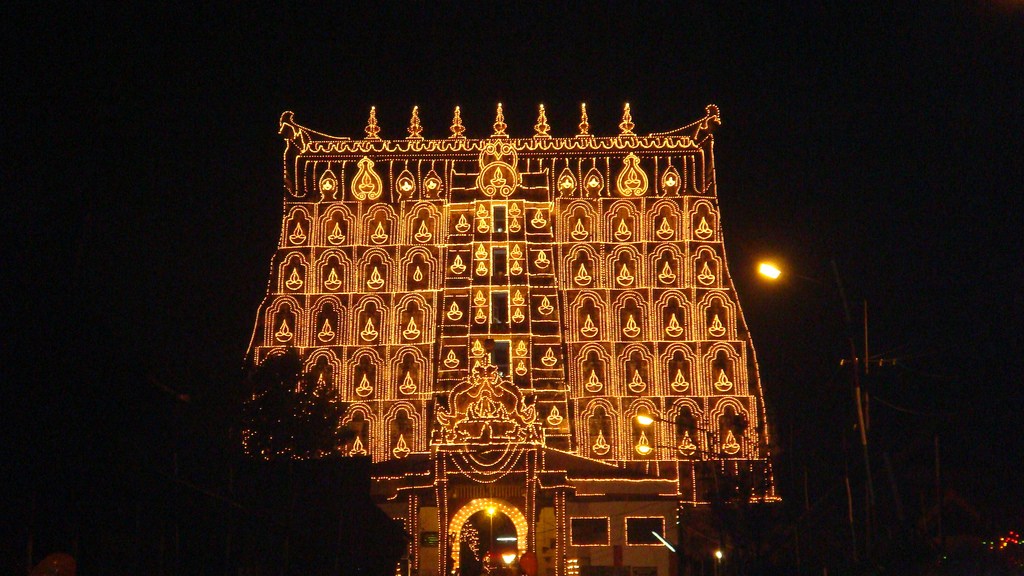
Main gate - Padmanabhaswamy temple
Main gate – Padmanabhaswamy temple

After offering our prayers, we visited the old wooden museum inside the Puthenmalika / Kuthiramalika Palace just outside the temple premises. The structure built by the erstwhile Travancore kings is a damn nice place for the art lovers. Like most regions in Kerala that sleeps with the setting sun, we headed back to the hotel to call it a day.

Day 2:

After finishing our work around evening, we set-out to do a little bit of city trotting. No visit is complete without taking back souvenirs. The rule in my work team is (on a lighter side), ‘Whether you finish your assigned job or not, whether you return safely or not, we don’t care. Bring us souvenirs and the local snacks to eat.’ So, we shopped for some local crafts at SMSM institute crafts emporium.

SMSM institute crafts emporium
A wooden piece of art at SMSM institute crafts emporium

From there, we walked through the narrow lanes to one of the biggest shops I have ever known that sells just ‘CHIPS’: ‘The Mahachips store’. Chips of different varieties, made to order and packed just then. I picked up about 10kilos of banana chips & jackfruit chips as giveaways, something that will be much awaited for back home in Bangalore, even more than my safe return. (The even funnier part was that this bag of chips was the single largest (Fragile) cabin baggage I was carrying with me. The cabin-crew was amused to know what was in it when she offered help to place it in the upper cabinet).

What’s a visit to Thiruvananthapuram, without soaking your feet in Covalam beach? That’s where we were headed next. After strolling along the beaches, we walked upto the Vizhinjam lighthouse for a good view of the sea. The view was simply delightful. A stroll along the crowded beach, beautiful view of the sunset, some yummy local chaats to munch on, it was indeed an awesome end to an eventful business trip.
And we head back to Bangalore in the earliest flight on the following day.

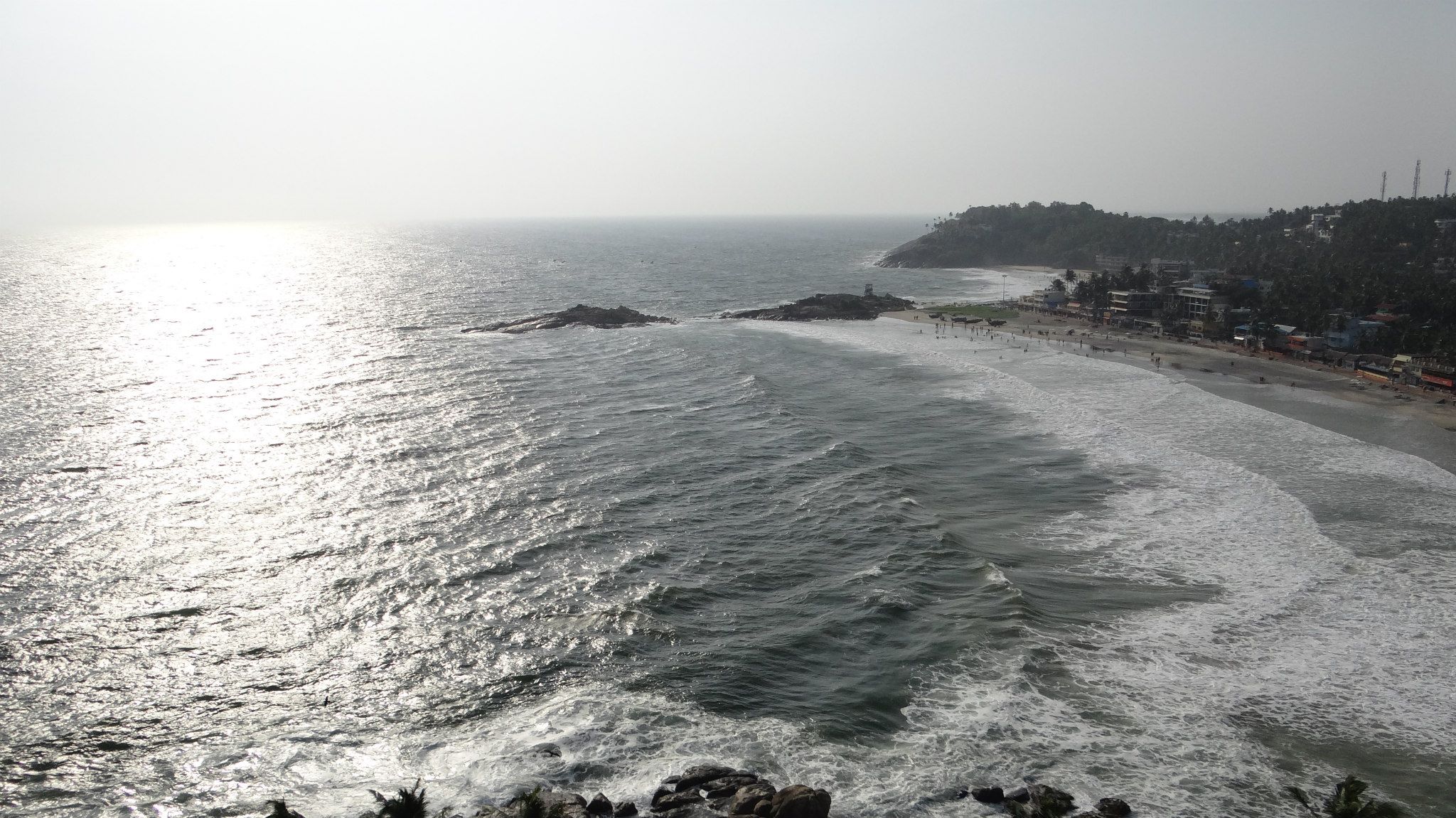
View from the Vizinjam lighthouse
The view from the Vizinjam lighthouse

Don’t miss to try these three things while you are in Trivandrum (or anywhere else in Kerala):

  • Fresh banana & jackfruit chips and Kerala halwa
  • Hot palam puri with a cup of burning hot Kerala tea
  • Frog thigh fry (available only in select places).

Madurai (Part 2) – Centre of arts and culture

There is no existence of a place without the people, and with civilization exists its culture. Madurai has its own share. My previous post (Madurai Part 1) was exclusively about the architectural landmarks spread across the city. But it would be injustice if the other things associated with this amazing city goes without a mention. Of course, the write-up could run into books if I had to write about each of them. And it isn’t necessary that everyone travelling is a pilgrim or a history buff or an architecture enthusiast. Hence, here’s an attempt to throw light on other aspects that any visitor to Madurai can expect. This is not a detailed one, but I touch upon various dimensions that you can theme your trip around Madurai. Do let me know if this post helps or if there is any other dimension I missed. Here goes my list.

Art:

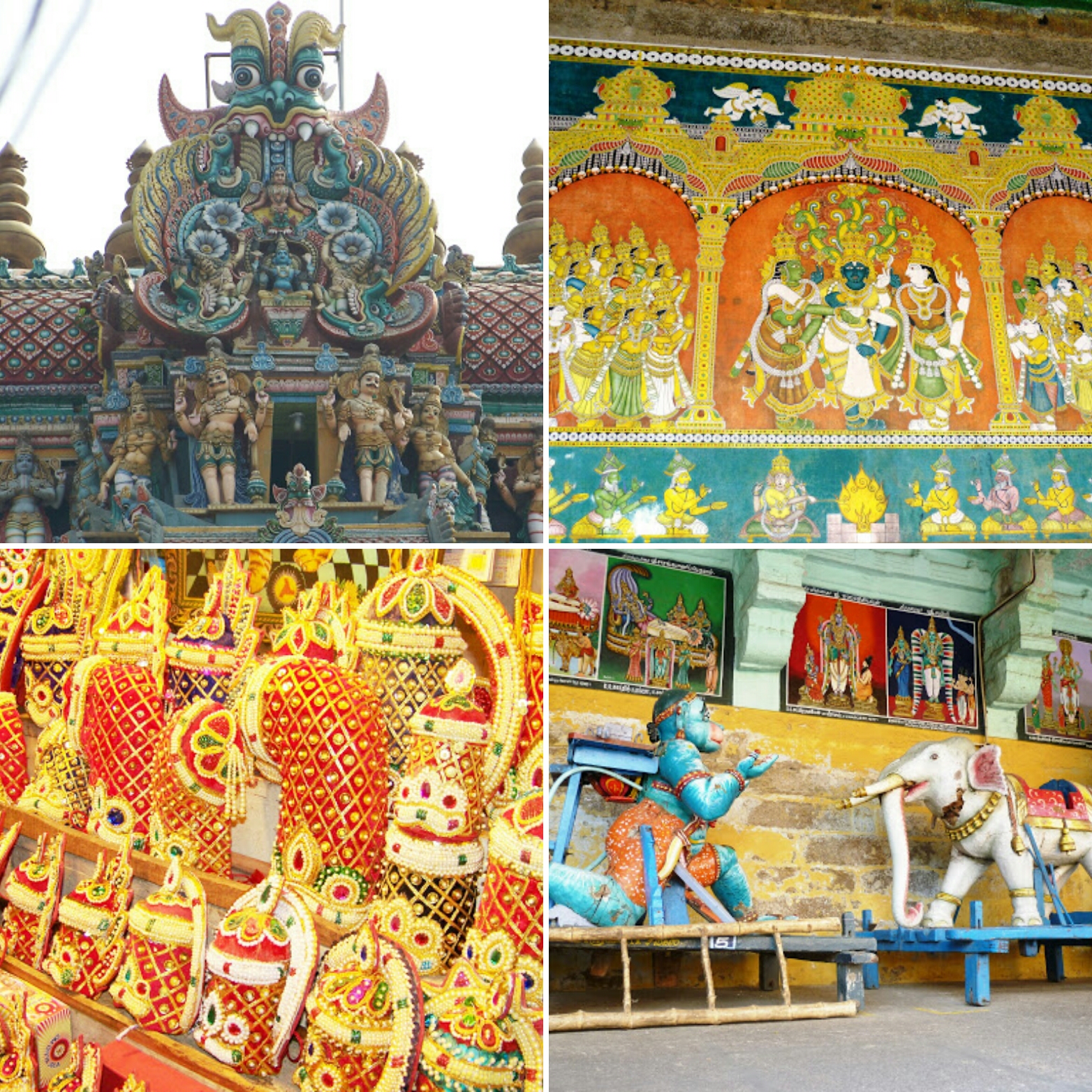
  • Sculptures: adorning every temple wall, pillar and their towers are a marvel in itself.
  • Carpentry: Several wooden vahanas used to carry the idols of the various deities in the temple are something that need the attention of art afficionados.
  • Handicrafts: Various accessories used for decorating Devi idols, made of delicate sequins, etc. are sold in several stall inside the large corridors of the Meenakshi temple.
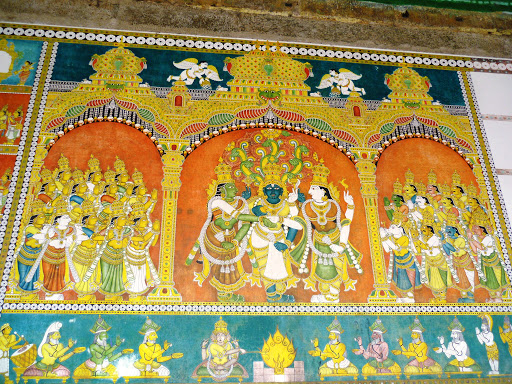
  • Mural paintings: This needs no introduction, the famous Madurai paintings are a gift of the Pandyan era, adorning the temple walls.
Clockwise from top left: 1.The sculptures on the western tower of the Meenakshi temple; 2.One of the mural paintings from the temple walls; 3.The wooden carriages for the temple idols; 4: Handicrafts from the temple stalls

Food:

Listing just a fixed menu while in Madurai would just be an understatement. If you are a foodie, Madurai would need two full days to explore its culinary delights alone. It is famous for both vegetarian and non-vegetarian specialties. I’d probably write a separate post about it sometime later. But this list is the list that we had when my family visited. But believe me- it is BEYOND!

  • Breakfast – Idly & Sambar, Pongal + a cup of filter coffee
    11.00.a.m – Jigarthanda (it’s more like a combination of falooda & kulfi)
  • Lunch- Puliyogare @ the temple store, curd rice, Sambar rice
    4.00.p.m.- Karupatti (palm sugar) coffee
  • Dinner- Anything after 7.00.p.m is called meals. Must try is the ghee roast & rava Masala dosa

Costume:

  • Sarees for women & Dhotis for men.
  • Madurai cotton sarees with simple prints and zari borders with temple designs are popular.

Jewellery:

Among the locals- particularly those belonging to the Thevar cast, it is believed that women are prettier with bigger earlobes. Hence, the girl child born in this community is made to wear a traditional earring called the ‘Thandatti’ when she is young. The thandatti is said to evoke the 3 levels of our world: terrestrial, astral and divine and these levels are associated with Mandala. Each piece of this weighs 27gms and is made of gold and this piece of jewelry is specific to Madurai.

A Thevar woman wearing the traditional Thandatti earring

Shopping:

Shopping at Madurai is all about wholesale vendors and there are specified streets for each of them.

  • Cotton sarees/ dress materials: Shops are all around the temple complex
  • Steel utensils: Plastic beads & girls’ accessories, gold plated imitation jewelry to name a few.
  • Pooja related accessories & crafts: Particularly inside Pudumandapam (1000 years old market)
  • Farm produce: Varieties of plantains / bananas and green groceries among the others.

A brief intro to a city full of life and activities. Justice yet to be done. Signing off with a hope that it has helped someone somewhere in some form who is seeking for some info on this Pandyan city….

Exploring the Architectural Marvels of Madurai

This was a family backpacking trip planned exclusively to explore Madurai. This city has served as the capital of the Pandyas and is a key destination that has nurtured the Dravidian culture. For anyone who hears the name of this famed city, they know of the Meenakshi Amman Kovil. A typical traveler / tourist / pilgrim would visit just that temple and takes pride in marking it in their travel map of places visited. But what one doesn’t realize is, that Madurai is beyond just this. The contribution of the Pandya kingdom is not limited to just the Madurai Meenakshi temple and can be seen and felt in several structures just around the same city. Also, a portion of the Madurai city has a history beyond the Pandyas too. Hence, our family wanted to reserve this long weekend, exclusively for Madurai. We boarded an overnight bus from Bangalore and reached Madurai at 6.00.a.m. on the following morning.

Like most of our family trips, we wanted this also to be an impromptu vacation. Apart from to and fro travel, nothing else was fixed. As per me, you would need a good 2-3 days to have a quick run around doing this same itinerary as ours, exploring ONLY Madurai. If you are an art and history buff or a foodie, I warn you to carry additional days!

Itinerary:

Day 0: Leave from Bangalore by night (KSRTC Bus)
Day 1: Reach Madurai. Visit Meenakshi temple, Thirumalai Nayaka Mahal, Vandiyur temple tank, Koodal Alagar temple, Gandhi museum, Pudumandapam.
Day 2: Alagar Kovil, Alagar Murugan temple, Pazhamudhir Solai temple, Tiruppanakundram Murugan temple, Dargah of Hazrat Sultan, return to Bengaluru.

The details:

After alighting the bus, we walked around the Meenakshi Amman Kovil to find a good hotel. Since this is the heart of the city, it wasn’t hard to find a decent lodge around there. We checked into a hotel that was located just in front of the temple’s west gate. We freshened up quickly and left for the main part of the trip for anyone visiting Madurai.

  1. Meenakshi temple: A visit to the abode of the Pandya architecture. The entire temple complex is fortified and has 4 entrance towers, one on each of the 4 directions. The sculptures on each of these towers are out of the world. Once inside the complex, I started to wonder which world of wonder I had stepped into. It took us more than 4 hours to finish only a quick walk around inside the temple and also get the darshan of Meenakshi Amman and Lord Sundareswaran.
The finely decorated interiors of the Meenakshi Temple

There are a lot of stalls inside the complex selling various handcrafted articles. The temple art museum within the same premises is a must visit. The central sculpture of Natarajan, or the dancing form of Shiva is believed to be one of the Pancha Sabha of the lord. This place represents the silver hall and Shiva is believed to have performed the ‘Sandhya Thandava’ dance form here (More on the Pancha Sabha Kshetras in another post). Also, there are 1000 pillars, all decorated with intricate pieces of sculpture. The dim light used for each pillar added up to the beauty of the place. The Madurai paintings adorning the walls of the temple requires another post to talk about. I go speechless when I get to explain about the South Indian temples. They are beyond words. Internet has plenty to feed and I don’t want to get into the details. After a tour of this massive temple complex, we decided to head out to explore the city beyond the Meenakshi Kovil.

Inside the Temple art museum

2. A small walk through the narrow lanes took us to the Thirumalai Nayaka Mahal built in the 16th century. Fine architecture with elegant paintings on the roofs and vaults is neatly presented in a simple combination of half-white and velvet red colors. There is sound and lights show conducted here every evening. However, we could not make it.

The interiors of Thirumalai Naickar Mahal

3. From there, we took a local bus to Vandiyur. This is where the annual event of the famed Teppotsavam / Float festival takes place to celebrate the birthday of King Thirumalai Nayak in January. This tank is supposedly the biggest of its kind in the state of Tamil Nadu. With the float festival just 2 months away and monsoon season just passing by, this tank still remained dry during our visit. When we enquired with a few locals passing by about how the event was going to be conducted in a dry tank, we were told that the water will be fed in January from the Vaigai river through artificially laid underground channels. This is truly amazing how such a concept was laid way back in the 16th century. But for a newcomer like me, the dried lake was an eye sore as it was used was a watering hole by many vandals at the time of our visit.

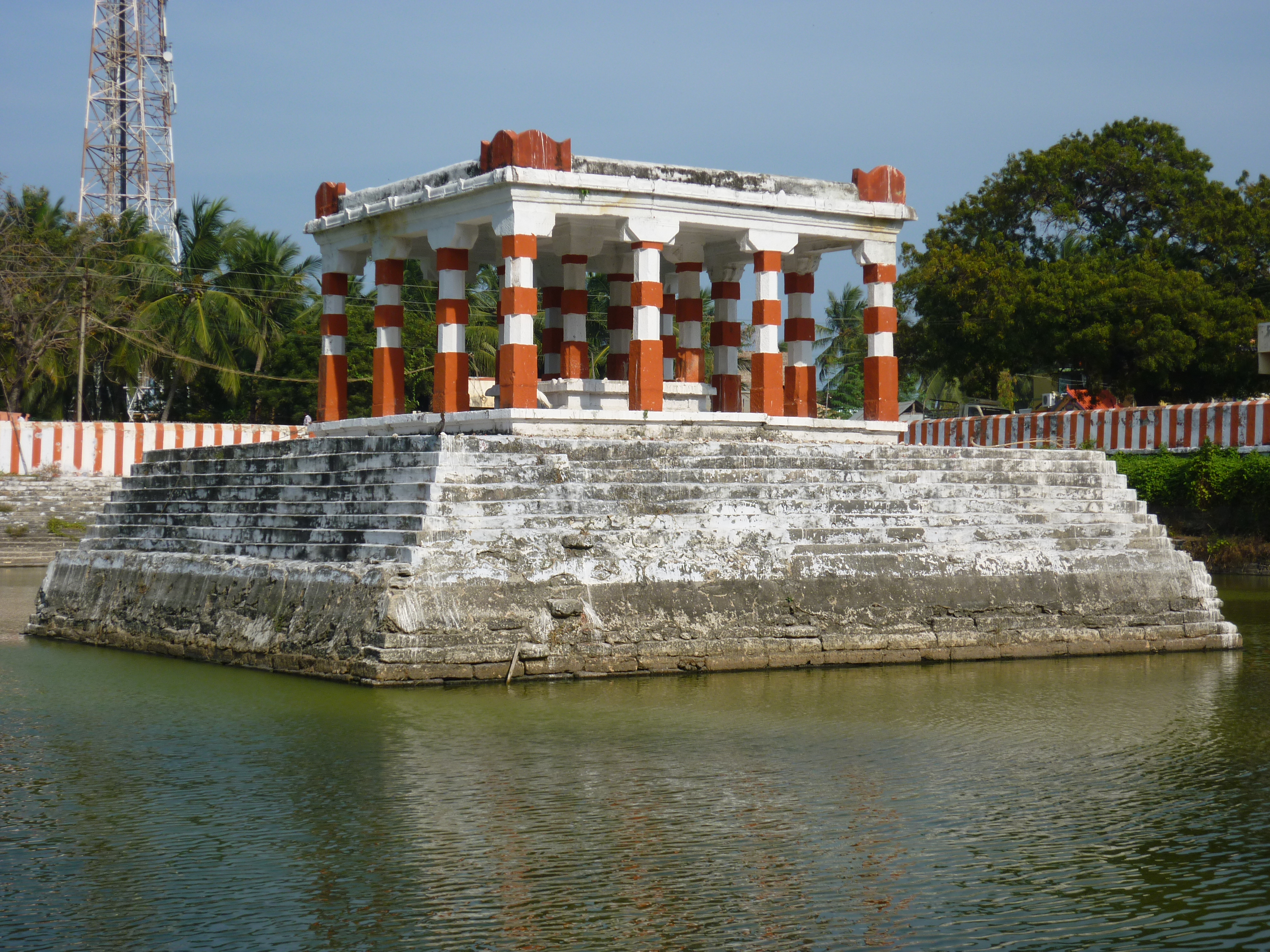
Vandiyur Mariamman Teppakulam - the island temple
Vandiyur Mariamman Teppakulam – the island temple

4. Taking another bus from there to Periyar and a small walk from there through the stinking / dirty by-lanes, we reached the Koodal Alagar temple. A quick pooja and a walk around the temple was a nice boost up. The architecture here too, is similar to that of Meenakshi temple.

5. We had to rush to The Gandhi museum as it would close by 6.00.p.m. However, we could not make it on time. This was once called the Tamakkum palace of Rani Mangammal. Today, the museum supposedly houses 14 articles that were used by Gandhiji, along with his sacred ashes and blood-stained dhotis. Gandhiji is said to have visited the city five times during his lifetime.

6. On our walk back to our hotel, we came across an old marketplace called as Pudumandapam. This is a 1000 years old shopping mall, supported by huge sculpture rich stone pillars. The stalls are occupied with tailors, handicrafts vendors, wholesale dealers of pooja related and general accessories. A good place for shopping traditional artefacts at Madurai, and that too in a market that is so old!

Entrance of the Pudumandapam

7. On the following morning, we boarded a local bus from Periyar bus stand to travel 21kms towards Alagar Kovil. The temple is dedicated to Lord Vishnu, Meenakshi Amman’s brother. The village is surrounded by an old fort wall, it gives a good view of the green hills around the temple. The architecture is similar to Koodal Alagar temple in the city.

8. A trek of 3kms uphill, through green forests and monkey infested walkways lead us to the Murugan temple. It is one among the six abodes of Lord Murugan and hence important among the pilgrims.

9. A walk of half a kilometer further uphill took us to Pazhamudhir Solai temple. A temple dedicated to Goddess Rakkaya exists close to a natural spring called Nuburagangai here, where devotees take a holy bath. But what seemed strange to me was that the place was probably the only temple I had ever been to, which charges an entry fee into the temple itself. This is where the famed Chittrai festival is observed during the month of April.

10. From there, we took the next bus back to Periyar, from where we had to take another connecting bus to Tiruppanakundram. This was a cave temple at the foothills of a hillock. It is believed that Lord Murugan was wedded to Devyani, daughter of Indra at this place. Hence, this is also counted one among the 6 abodes of Lord Murugan.

Entrance to the Tiruppanakundram Murugan temple

11. Up the hills, is the Dargah of Hazrat Sultan Sikandar Badshah shaheed Radiyallah Ta’al anhu. Owing to time constraint and exhaustion, we thought of skipping the climb.

Other lesser known places we skipped due to time constraints were the Kazimar mosque and Goripalyam Dargah. At the center of the city is the Kattabomman junction. This is where a part of the old Madurai fort exists. Today this is not more than a public library. Further, every street in the city has a history behind it: This link to an article from “The Hindu” don’t do this usually, but would make a special mention about the streets of Madurai. Every street in the city has a history behind it: This link to an article from “The Hindu” explains it all- Where moats made way for motorways

This was all about us getting around the place for seeing some of the historically important landmarks around Madurai. But the list is endless and time, very limited ☹ I have covered a few other must-do things while at Madurai in a separate post. I wish to be of some use if you are planning a trip there. (Click here to read further)

The baby steps to Isha foundation

< 02-July-2012>

On one of usual walks at Sankey Tank.. there was this guy at the gate giving away handouts.. the groundnut(kadale-kai) hanging down the handout caught my attention and I stretched my hand out to get one…

Sri Sri Sadhguru Baba (Sorry.. I hadn’t heard of this name before.. my bad..!!) had his program on “Inner Engineering” sometime it read.. All this spirituality stuff is too much to take into my peanut sized brain.. But this fancy handout is the only reason that has inspired me to post this 😛

“Spirituality is belief in an ultimate or an alleged immaterial reality; an inner path enabling a person to discover the essence of his/her being; or the “deepest values and meanings by which people live. Spiritual practices are intended to develop an individual’s inner life. Spiritual experiences include being connected to a larger reality, yielding a more comprehensive self; joining with other individuals or the human community; with nature or the cosmos; or with the divine realm. Spirituality is often experienced as a source of inspiration or orientation in life. It can encompass belief in immaterial realities or experiences of the immanent or transcendent nature of the world.”

Whoa….. that’s an extract from Wikipedia..

“If you do not get out of your shell, you’re just a nut”- This definitely makes sense…

#Update as on 15-may-2020

Someone who started small with this peanut marketing, is now one of the most influential persons in India and the world: Sri Jaggi Vasudev or fondly called as ‘Sadhguru’, the founder of the ‘Isha foundation’. Big milestones are achieved with small baby steps, indeed!

An iconic statue of Adiyogi Shiva’s bust (it holds the guiness record for being the largest bust sculpture) near Coimbatore, Tamil Nadu is a ‘must go’ place on the list of those seeking spiritual cleansing.

For the adventure seekers, you can trek up the Velliangiri hills in the neighborhood while your spiritual accompanice can get enlightened at the Shiva temple atop, considered to be one of the holiest places in South India.

Studying ‘Bachelor of Cycle-logy’ at IIT-Madras

This trip to Chennai is going to be a memorable one. Because, this was my first solo business trip. Apart from traveling alone in a land that spoke a language I barely understood, I managed to pretty decently pull-off the audit at a vendor company, all by myself. Some small little personal milestones! So, here’s a peek into my first solo business day, without business :p

I landed at the Meenambakkam international airport at around 8.00.a.m. and hired a taxi to the vendor’s place. This is when my tryst with Tamil started. The driver did not know my language and I did not know his. But, one thing I learnt quite fast was, being a Kodava really helps while roaming around in South India. I could mix up bits of Malayalam and a little more of Kodava thakk and make it sound pretty much like Tamil. The driver managed to understand the basic instructions. And the rest, sign language it was. But yeah, it was a lucky start for a solo stint.

But imagine finishing work ahead of schedule and having a late night flight to return! Especially when you don’t have a backup plan in hand and do not know the local language. Even if I googled for some place to hang around, I was not able to communicate it to my driver.. The sign language wouldn’t be of much help if I had to spend a longer unplanned day. Hell! I felt stranded in my own country.

That’s when a friend studying at IIT-Madras came to my rescue. I rang him up and he guided the driver in Tamil to reach his campus. The plan was that he would show me around the campus and then drop me back to the airport. Fair! So that’s what I did..

What if I did not crash the GATE (The toughest entrance exam in India) ?? That did not stop me from learning at the prestigious IIT-M..!! Thanks to my friend pursuing research at IIT-M, this was where I completed my “Bachelor of Cycle-logy” which I had left unfinished way back in primary school. He suggested that cycling around the vast campus was the easiest way of getting around and I agreed to his suggestion. He got his bicycle out and borrowed one for me from one of his classmates. Then, we had gotten pedalling on the roads of the vast 600+ acres of lush greenery on the campus of IIT-Madras.

IIT madras campus
Top: Gajanan circle at IIT-M premises; Below: Bonn avenue at IIT-M

IIT-Madras is located adjacent to Guindy national park(the 8th smallest in India)- the last bit of the tropical dry evergreen forest in India. There is so much greenery in the entire canyons, that our cycling stint was indeed refreshing. This allowed me to witness the harmonious co-existence of man and the wild, in an urban setting. While the Black bucks, spotted deers etc. walked around fearlessly on the campus, the humans went about their businesses without coming on the ways of these wild animals.

Wildlife at IIT Madras campus
Wild animals walking around freely inside the IIT-Madras campus

After we had pedalled around almost all corners of the campus, we checked in to the ‘cafe coffee day’ on their campus. Since restaurants are heavily subsidized in such institutions, this was the “Cheapest” CCD I had been till date. It was 5.00.p.m. something and we still had so much time left. So, we decided to hit the “Elliot Beach” in Besant nagar about 6.kms from IIT-M.

We had some corn, I bought a Rajnikanth mask, flew a kite etc. on the sea shore. We did all that which helped us to kill time. The beach was a wee bit dirtier than the ones I had seen all my life (in Mangalore and Kerala). Meanwhile, I waited patiently to see the sunset. I waited and waited… and it was dark already. Only then did I realize that the sun only rises in the East coast 😛

Besantnagar beach in Chennai
Top:The Karl Schmidt memorial; Below: A corn vendor at Elliot’s/ Besantnagar beach

It was going to be 6.30.p.m and we thought it would be wiser to leave, because we had to brave through the Chennai traffic so that we made it on time to the airport.

All in all, a day well spent. Looking forward for many more business trips 😛