Category Archives: Art & Craft

Land where Art is Divine- Pathanamthitta

Dense canopy of trees, swaying coconut palms, houseboats cruising through the pristine backwaters, wooden canoes of the locals fishing in narrow canals- Well, does this paint a picture of Gods own country? When opportunity struck, I decided to give the usual things a miss and explore a region that is least spoken about in a typical tourist circuit in Kerala. I wanted to explore the land where art is considered divine and celebrated in all its form. I was heading towards Pathanamthitta.

My Itinerary:

Day 1: Leave from Bangalore to Kochi (by Flight); Drive from Kochi to Pathanamthitta. Visit Aranmula Parthasarthy temple (take a local foundry tour); Visit Thiruvalla Srivallabha temple (Watch a Kathakali performance in the temple);
Day 2: Gavi or Konni elephant camp, Charalkunnu, Kakki reservoir, Perunthenaruvi waterfalls, Kalloppara church, Paliakkara church and Niranam church. Return to Bengaluru.

The details:

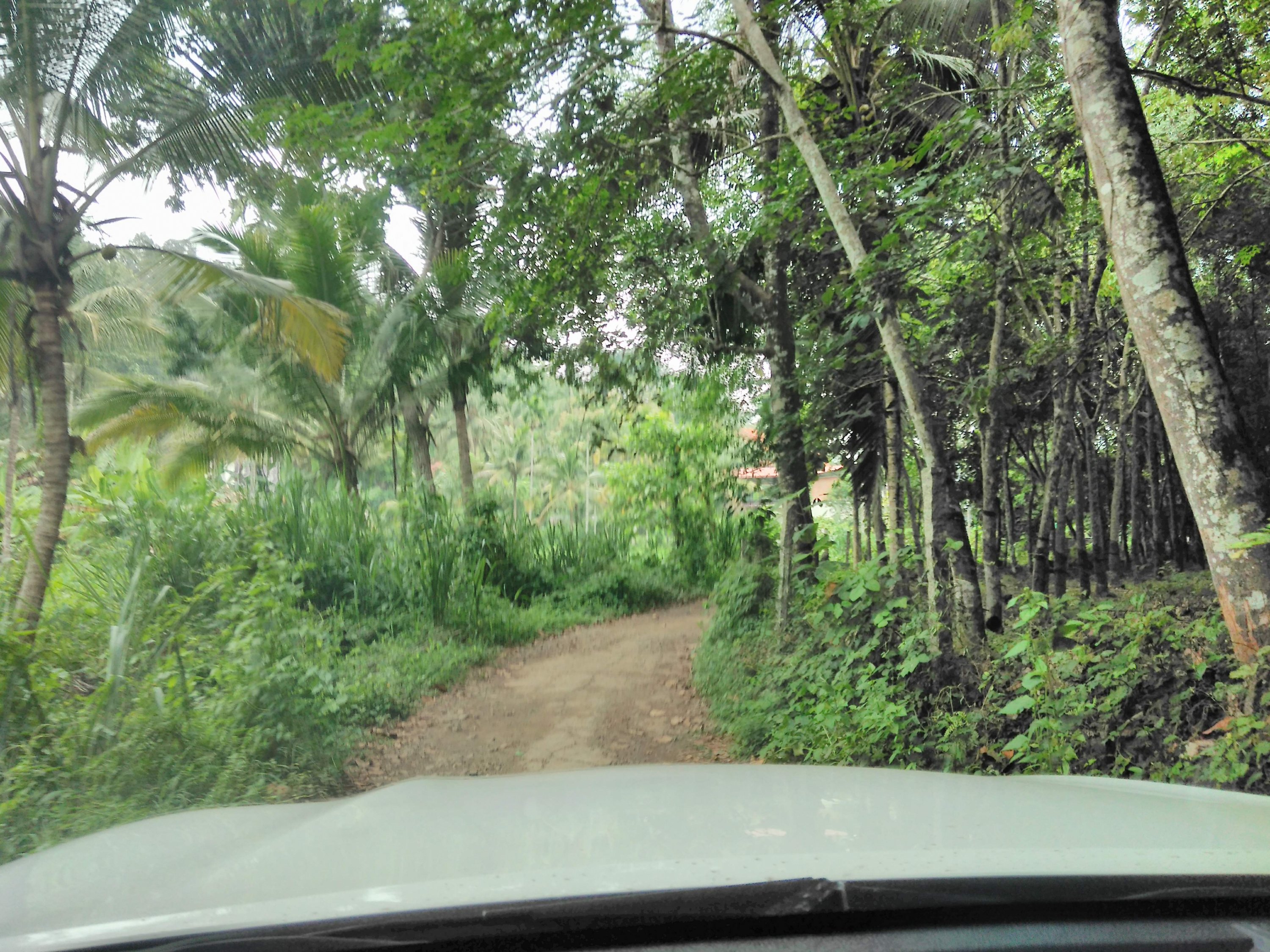
First thing I did while approaching Pathanamthitta was lowering all the windows of my car, to breathe in some clean air. With almost two third of the district comprising of forest cover, it is no wonder that Pathanamthitta is the least polluted city in India. The remaining one third is a combination of the city and plantations. We were heading to the homestay we had booked, not very far from the city centre. It was nestled in what the locals call as a residential area that was far from imagination of a city soul. The narrow roads were flanked by rubber, tapioca and banana plantations for most stretch and marsh lands for the rest. Bunches of jackfruits hung down from tall trees among several other tropical trees like litchi, rambutan etc. that had the fruit lover in me all drooling. My stay was at a traditional Kerala house nestled amidst a huge garden. Its wooden portico with clay tiled roof had me fancy struck.
img_20190531_1320012544330379495427061.jpg
Enroute to the homestay

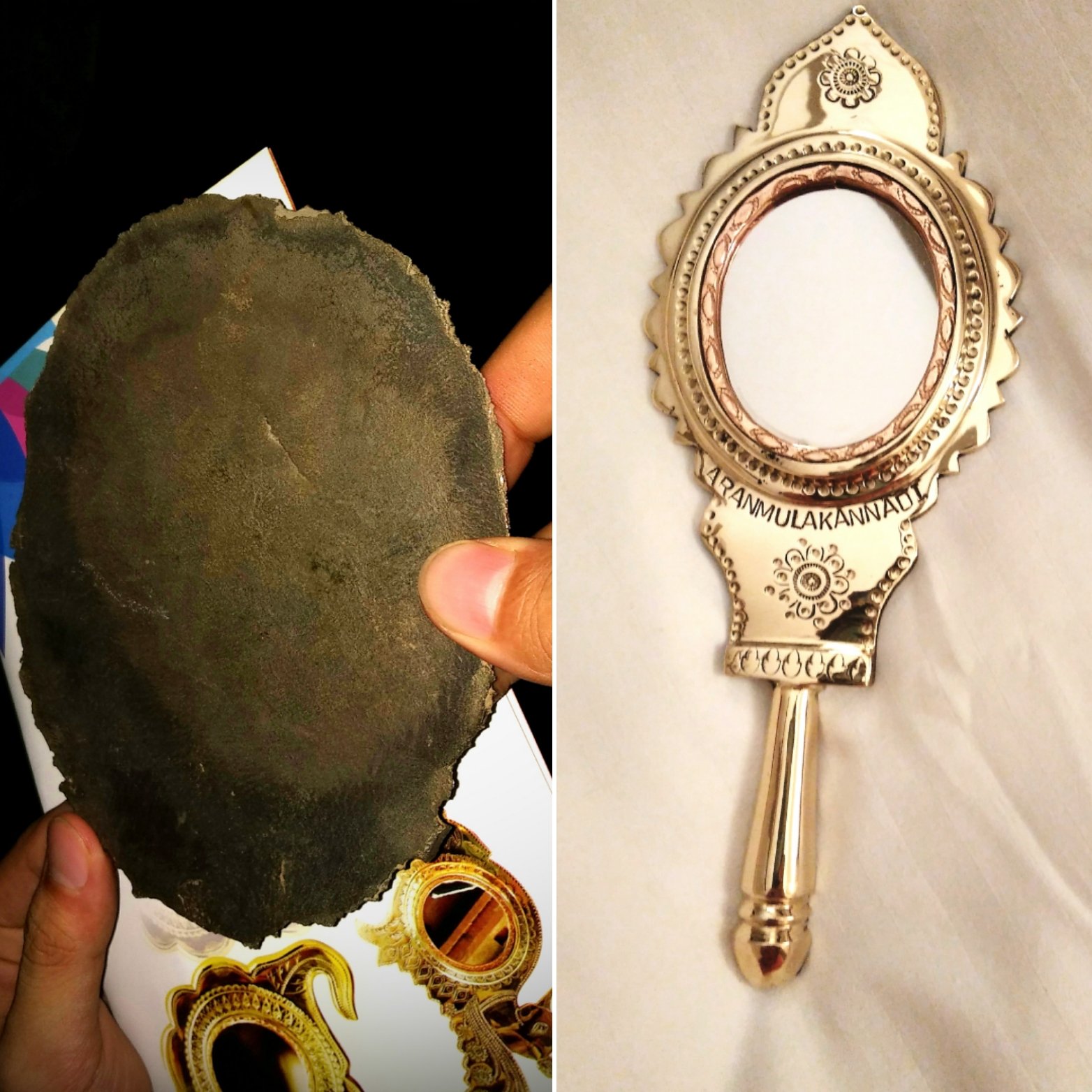
Surprisingly for me, Pathanamthitta hosts some of the largest annual religious congregations in the world. The Sabarimala yatra and Maramon convention are next only to the Haj. Giving a pass to the famous backwaters of Kerala, I had driven this far to explore its vibrant and divine culture and art. My plan for the first day was to visit two of the 108 Divyadesams, both located in Pathanamthitta. I had arrived at the Aranmula Parthasarthy temple, particularly for a tour of a foundry that makes the historical ‘Aranmula Kannadi’ (Click to watch the video).

This GI tagged handicraft is culturally important in the state of Kerala. The know-how of making it is endemic to Aranmula and limited to the descendants of only one family who now live around this temple. Unlike the familiar glass mirrors, these are finely polished metal sheets. Watching these men toiling in their workshop to bring an alloy to life, which is integral in all Malayali celebrations was like living a dream for me.
img_20190622_2343003929859773219572362.jpg

Left: moulded metal sheet before polishing; Right: Polished & finished mirror

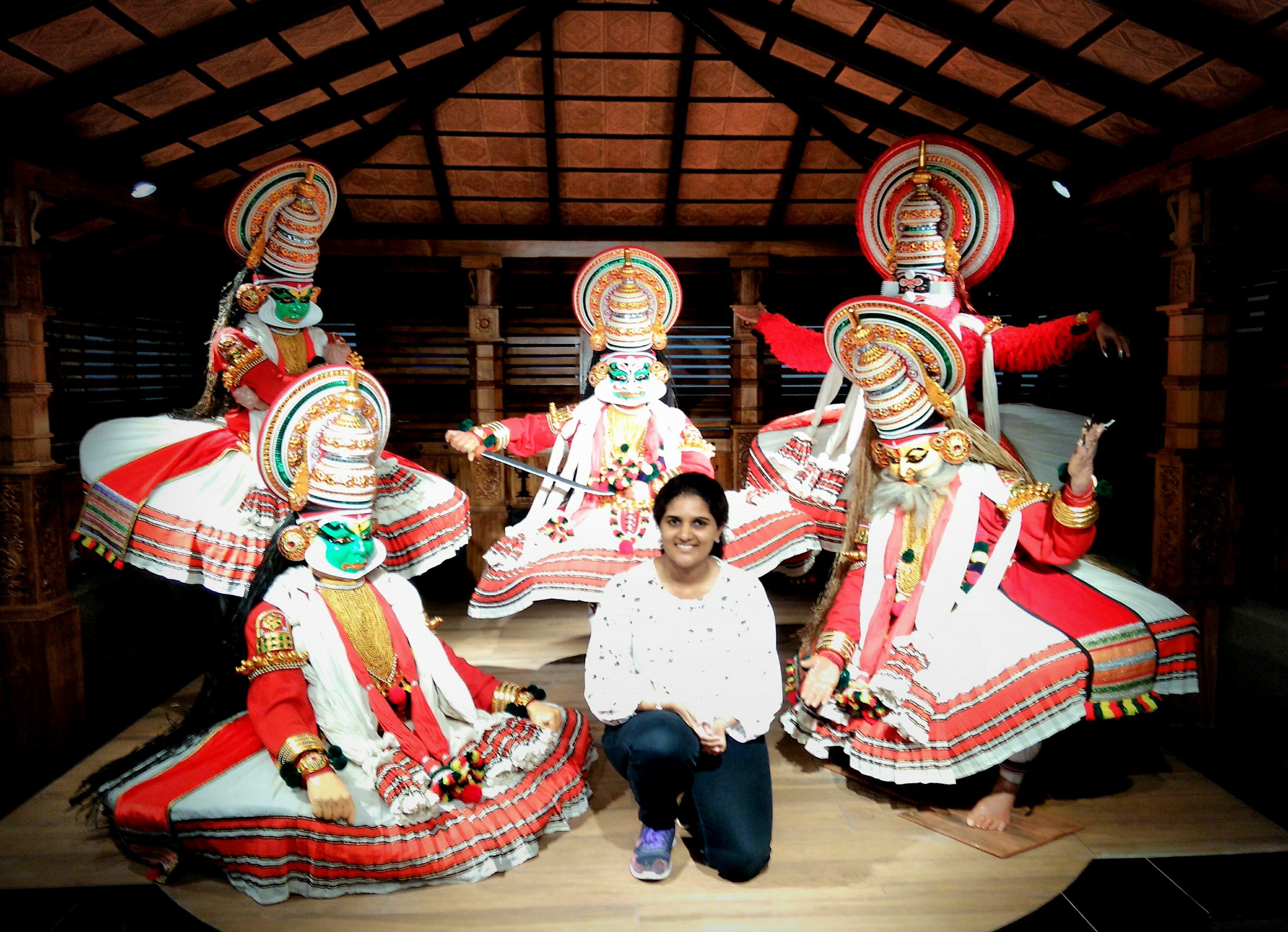
A short drive away from there was my next destination: Thiruvalla Srivallabha temple. With its ancient wooden architecture, this beautiful temple sprawls on a huge area. Here, the prayers are offered five times a day and the last prayer was specifically that interested me the most to visit here. Kathakali is performed inside the temple premises everyday as a form of prayer to put the deity to sleep. I was like a little child in wonderland who lost track of time watching this performance that went late into the night.
img_20190601_1301236968219467911473755.jpg
A traditional Kathakali setup at the Kochi international airport

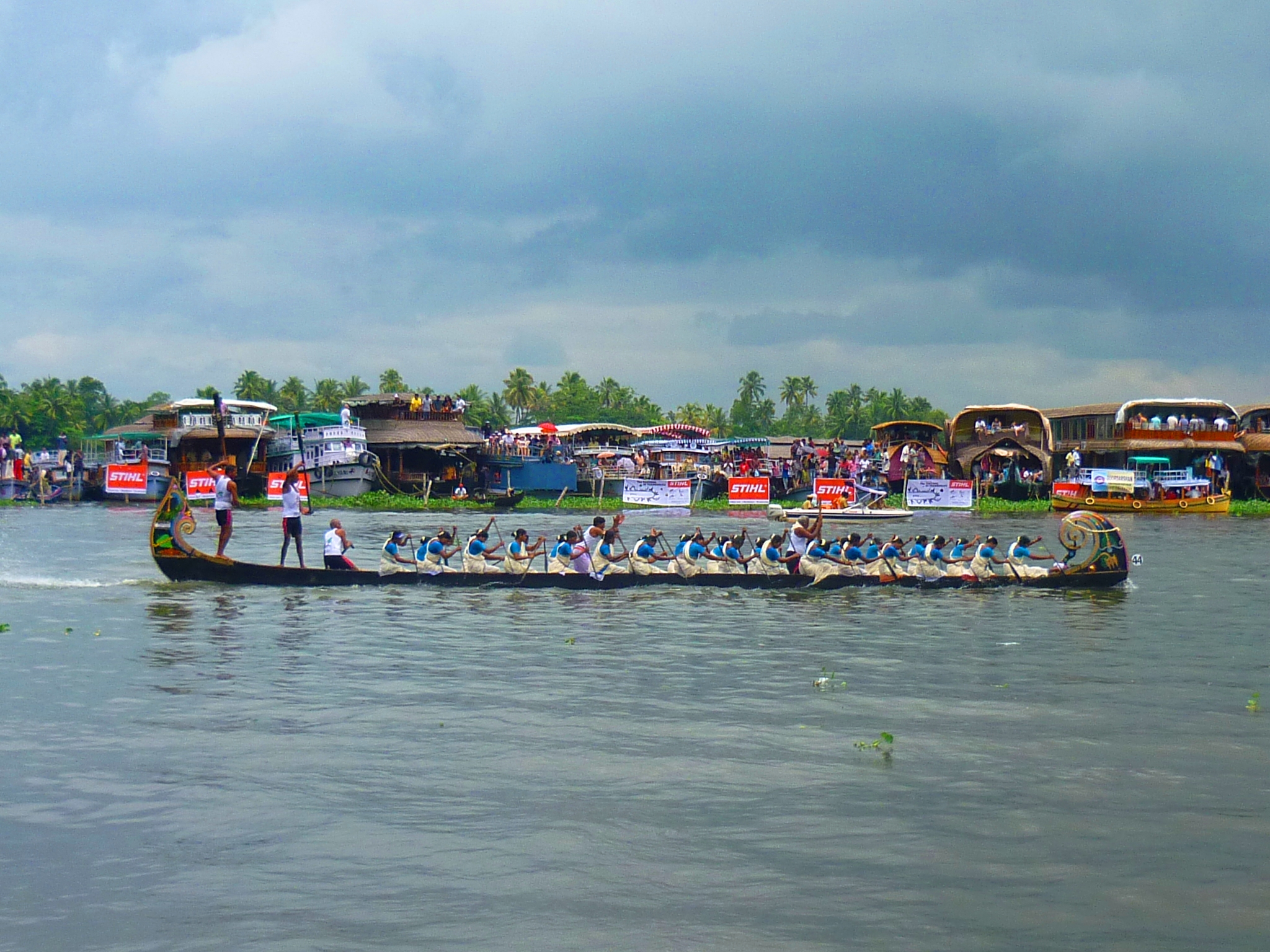
An early morning drive to Gavi or Konni elephant camp is what I was recommended for finding a piece of nature. Charalkunnu, Kakki reservoir, Perunthenaruvi waterfalls are few of the other nearby places that tourists usually visit. But I decided against it all and while away some time exploring the neighbourhood of my homestay before checkout. It was as calm and peaceful as anywhere else. While sipping a cup of Kattan chai, I was reminded of my previous trip to Alleppey. Hundreds of wooden canoes measuring over 100 feet, long enough to be called snake boats, gather from across Kerala to compete for the coveted title. Each boat carries at least hundred oarsmen, all singing the Vanchipattu in chorus. Breathing the heavy air filled with anxiety of the spectators, it was a lifetime experience. Like Alleppey, Aranmula too hosts one of the largest boat races in Kerala. The Aranmula race is held on the last day of Onam as a celebration of Lord Krishna crossing river Pampa.
Boat Race finals (22)
The oarsmen ‘”Women” from Alleppey

I had planned my return route to Kochi such that I could cover some of the interesting landmarks along the way. The first stop was at Kalloppara, where an ancient Hindu inscription exists inside a church. I had read about how two faiths co-exist under the same roof that houses a Bhagavati temple and a Mary’s church. But my drive through the streets of a residential area ended at a bridge that connected Kalloppara. It had collapsed during the floods that ravaged Kerala last year. Having three rivers flowing through it, Pathanamthitta was one of the worst affected.

I hit the main road again and headed to Thiruvalla. Since it was dark the previous night, I was there again to have a look at the famed mural paintings on the altar of the Paliakkara Church. The church at Paliakkara and Niranam (my next destination) both have their history dating back to the arrival of St.Thomas in India in 54.A.D. This trip was all about an amalgamation of art and tradition. Be it wildlife, religion, architecture, history, art or culture, I believe Pathanamthitta has something for everyone.

(P.S.: I’m against the idea of taking photos inside any place of worship, as a form of respect to its sanctity. Hence, I do not have any pictures from the interiors of any place of worship)

Fact File:

  • How to reach: The nearest airports are at Kochi and Trivandrum. Kottayam and Alleppey are the nearest Railway stations. KSRTC buses and taxis are available from these places to reach Pathanamthitta by road.
  • Get around: local buses are quite frequent; Taxis can be easily availed.
  • Best time to visit: September to May (Anytime apart from monsoon)
  • Stay: Luxury hotels are sparse. Cheap and Budget hotels are available in plenty considering the pilgrims who come here for Sabarimala yatra. Homestays are available to experience the true essence of Kerala.
  • Must do: Attend a Kathakali performance, visit a mirror foundry, Bathe elephants at Konni.

A timeless souvenir from Bangalore

Travelling to a new place? What do you carry back as souvenirs to friends and family? This is a common scenario that all of us are put into almost every time. While there are regional specific things that you can pick up, there are common dilemmas associated with each of them.

  • Traditional clothes– might not fit well or the design and the colour might not be liked by the receiver.
  • Local delicacies and sweets– It may not be a good idea if the receiver is dealing with some health conditions or certain diet restrictions. And then, food items also have a shelf life that would not stay fresh until you reach back.
  • Local handicrafts– Again, needs to suit the choice and budget of the giver and the receiver.

Well.. The reasons and dilemmas may be several but it is easy to find options when travelling anywhere regional. But, the metro cities have usually evolved as an amalgamation of several influences. Be it culture, traditions, craft, food, lifestyle etc., they represent variety. Hence, what you might pick up as a souvenir may actually be something that represents a larger region or something very generic.

If you are someone travelling to Bangalore, it is very likely that you will pickup a souvenir that is a part of a larger region (Karnataka). If you are someone looking to take back something that is an authentic piece of Old Bengaluru, then here is my pick. This souvenir is exclusive to Bangalore and does not have influence from any other regions of Karnataka. While several local products can be bought even at a crafts fair at your very own city/town of stay, this is something that can be bought ONLY in Bangalore. These are something which are sold only at authorized showrooms located in this city alone. Gift these souvenirs and you will be loved!

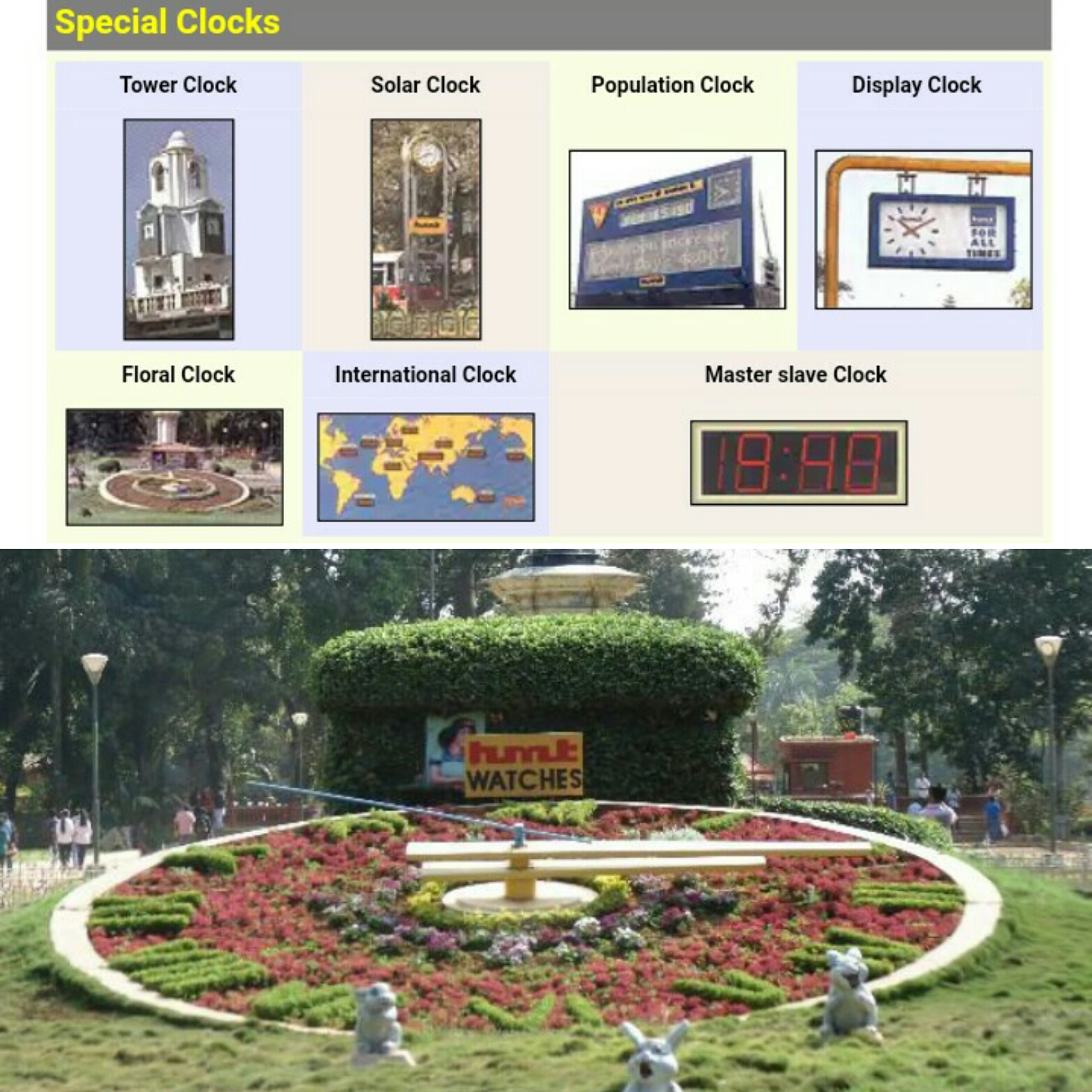
HMT watches: In 1969, it was a subsidiary started by the Government run ‘Hindustan Machine Tools’ with technical collaboration with ‘the Citizen watches co. Japan’. Soon, these watches created some kind of a time revolution (literally) with the HMT watches being mostly recognized as a possession of pride. HMT clocks adorned all major clock towers and railway stations across the country and can be seen ticking in good health even till date. HMT’s seven signature clocks like the tower clock, solar clock, population clock, master slave clock, display clock, the International clock and the floral clock that are symbols of innovation, are placed at different places across the nation. Although HMT watches’ connection with Bangalore is strong because its factory was located here, these timepieces are a representation of a bygone era of not just Bangalore but of an India of the yore. These are masterpieces of Indian craftsmanship and something that was fondly called as the ‘Timekeeper of India’. This iconic factory was shutdown in 2016 due to severe financial and political reasons.

Although the manufacture of the clocks has become obsolete, the last few pieces of their wrist watches are being assembled in a small room above their showroom in Jalahalli. These are valued as prized possessions by several watch collectors and can be bought from a range of handwound mechanical watches, quartz jeweled watches, skeletal watches, automatic and chronographs ranging in the price bracket of Rs.500 to Rs.15000. While these watches are on their way to go out of production (they will be produced only until the stocks of childparts last), they can be a truly meaningful souvenir to take back that could be handed over to the next generation who might never have an opportunity to live through the real era of HMT watches.

Do you agree this is a nice gifting idea? What other things do you think represent Bangalore aptly?

IMG_20190309_151201.jpg
Above: The seven signature clocks of HMT placed across different cities in India Below: Floral clock at Lal Bagh, Bangalore

Riding in the land of miniature paintings- Basohli

If you thought Jammu was all about shrines and temples, wait a minute. You are not alone. Even I did not know about all the beautiful places that exist within a driveable distance from the city. This trip to Basohli was a part of our ‘Peace ride’, sponsored by Jammu tourism as a part of the Himalayan expedition to promote tourism in the lesser explored places of Jammu. The route we covered over the week was Jammu-Mansar-Basholi–Sarthal–Baderwah-Kishtwar-Gulabgarh-Sansari-Gulabgarh-Patnitop-Udhampur-Jammu.This trip was an opportunity for us to see so many beautiful places that are off the tourist map, totally untouched and waiting to be explored.

Places to visit in Basohli:

• Surinsar-Mansar wildlife sanctuary
• Surinsar lake
• Mansar lake
• Atal bridge
• Sunset at Ranjit Sagar Dam & RSD backwaters
• Sunrise from Chanchala mata mandir

The Details:

On a warm Saturday morning, we started from Jammu on a well asphalted highway cutting through the Surinsar-Mansar wildlife sanctuary towards Basohli. Needless to say, the route is blessed with natural bounty with the road flanked by wooded hills all the way. We did a quick stopover at the twin lakes from where the sanctuary gets it same. The Surinsar lake and Mansar lake are serene patches of nature which play an important role among the Hindu pilgrims as it is associated with mythology. It is believed that the arrow shot by Arjuna pierced the earth at Surinsar and came out at Mansar spouting water, what are now the two bunyanesque lakes. If you have nothing to do, then you can forget your watches by just sitting on the banks and feeding the squillion fishes there. These lakes are also known for the Indian flapshell turtles that are found in abundance.

At Mansar lake

After freshening up at the TRC guest house, we headed to the Atal bridge built across river Ravi. This happens to be the first cable suspension bridge in the state of Jammu & Kashmir. We got an eyefull of the setting sun from there and got some good silhoute photos of the fishermen busy with their last catch on their vessels drifting past us from under the bridge. The view of the surrounding lush green hills and several islets in the backwaters of the Ranjit Sagar Dam was a feast for the eyes with a golden backdrop. On a summer evening, it is highly recommended that you spend some time at the dam backwaters, what is fondly refered as the RSD beach by the localites. With swaying palm trees along the sandbars of the river bed, it is a very picturesque place surrounded by the lashing waves of the dam’s backwaters.

Our bike at the Atal bridge

Although we had plans of reaching the Chanchala mata mandir to catch the sunrise next morning, we were woken up rather early by the roaring thunder and the rattle of our window glasses. It was pouring cats and dogs and we watched the dawn break into a bright day while sitting by the window side. There seemed no signs of the rain gods taking a break and hence, we decided to head out in the rains…

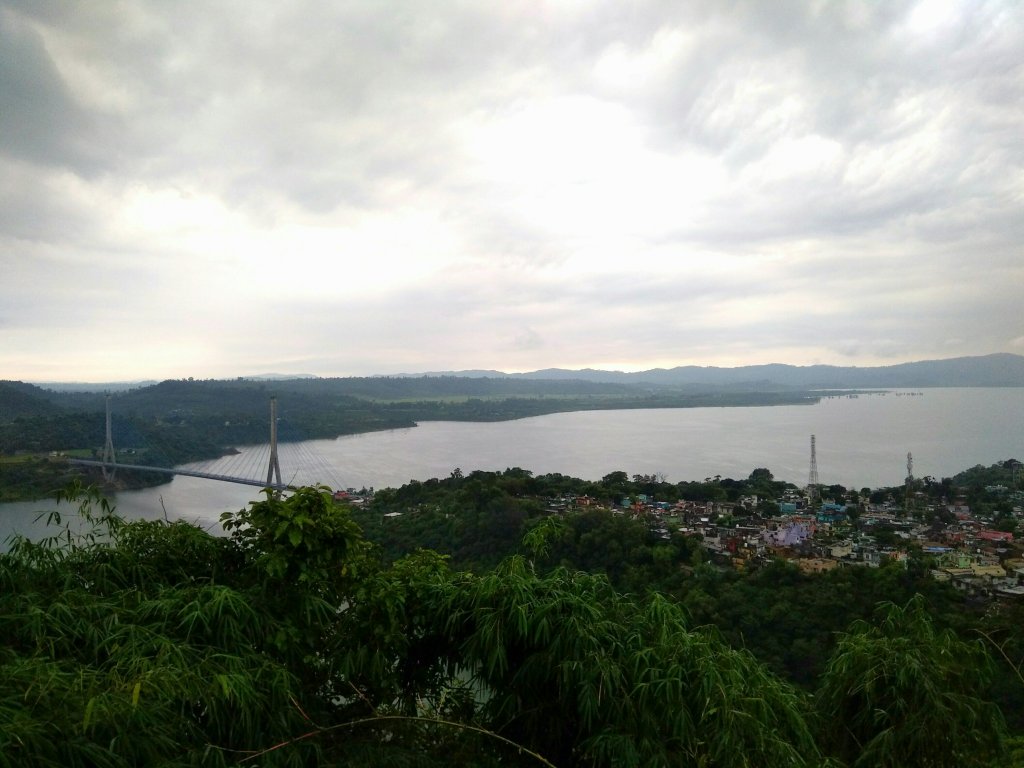
While we sought directions from the public, we realised that this town was home to over a dozen temples dedicated to Durga Mata. With a wild guess, we hit the accelerator towards one that was located atop a hillock. Oh Man! The view from up there was stunning… The temple had a 360degree view of the dam water and the hills. We could see the bridge along with several ruins of the old town dotting the view here and there. With the rocky valley at a distance, the entire Basohli town was visible from up there treating our eyes on a perfect morning!! With such a view around, the silver lightning in the dark grey sky, we couldn’t ask for a better start for the day…We were drenched to the bone but coudn’t get enough of the view. We somehow dragged ourselves back to our bikes, lest be a reason for the delay of all other fellow travellers back in the guest house.

view of Ranjit Sagar dam from Chanchala mata mandir

Basohli is known for the traditional miniature paintings that carry a heritage tag with it. Basohli is believed to be a cradle of a new school of mythological paintings. But sadly, only a handful of practicing artists exist today in this hill town. How much ever I intended to meet these artists and buy a couple of paintings as souvenirs from this land, I couldn’t. A countable number of shops selling these artworks would open only later during the day, a few kilometers away from the place where we were staying at. We decided to return to the guest house.

We were already running late and had nothing left for breakfast, we satiated our stomachs with fruit juices and coffee. When the rain gods seemed to calm down a bit, we called it a wrap for the wonderful time spent in this historical town of Basohli. The journey continued, to yet another beautiful place waiting to be explored, waiting to be talked about to the world outside. A place that I call as my “FAVOURITE” destination in India- Sarthal.

Fact file:

  • Getting there: Jammu is well connected by airport, rail and road. You can hire a self-drive car or a taxi from the city to visit the other sightseeing places. Basohli is 147kms(about 3hrs) by road from Jammu city.
  • Stay: TRC (Tourist Reception Centre) guesthouse is run by the J&K tourism dept. on the banks of Ranjit Sagar dam and offers great views.
  • Must buy: Basohli miniature paintings.

A piazza of paintings- ChitraSanthe

It has been a while since I did the local rounds as I have been tad busy on weekends with lot of get-togethers with family and friends. So to start the year 2017, I did not think twice to go solo shopping in the market. Typically, the one stop campo where all villagers come-together to trade grains, vegetables, cattle, clothes etc. is called a ‘Santhe’ in Kannada. But this was a unique market that sold only paintings (Chithra) of various artists who gather from around the country.

It is an annual event organized by the Karnataka Chitrakala Parishath on the first Sunday of January every year and is all about art in the form of paintings. Canvas, glass, paper, fabric, wood, plastic, beer bottles- you name them and you can find beautiful paintings on them being sold at this fair with products strewn on both sides of an entire road. KumaraKrupa main road and it’s cross roads would be choc-o-block from dawn to dusk with art enthusiasts pouring in large numbers.

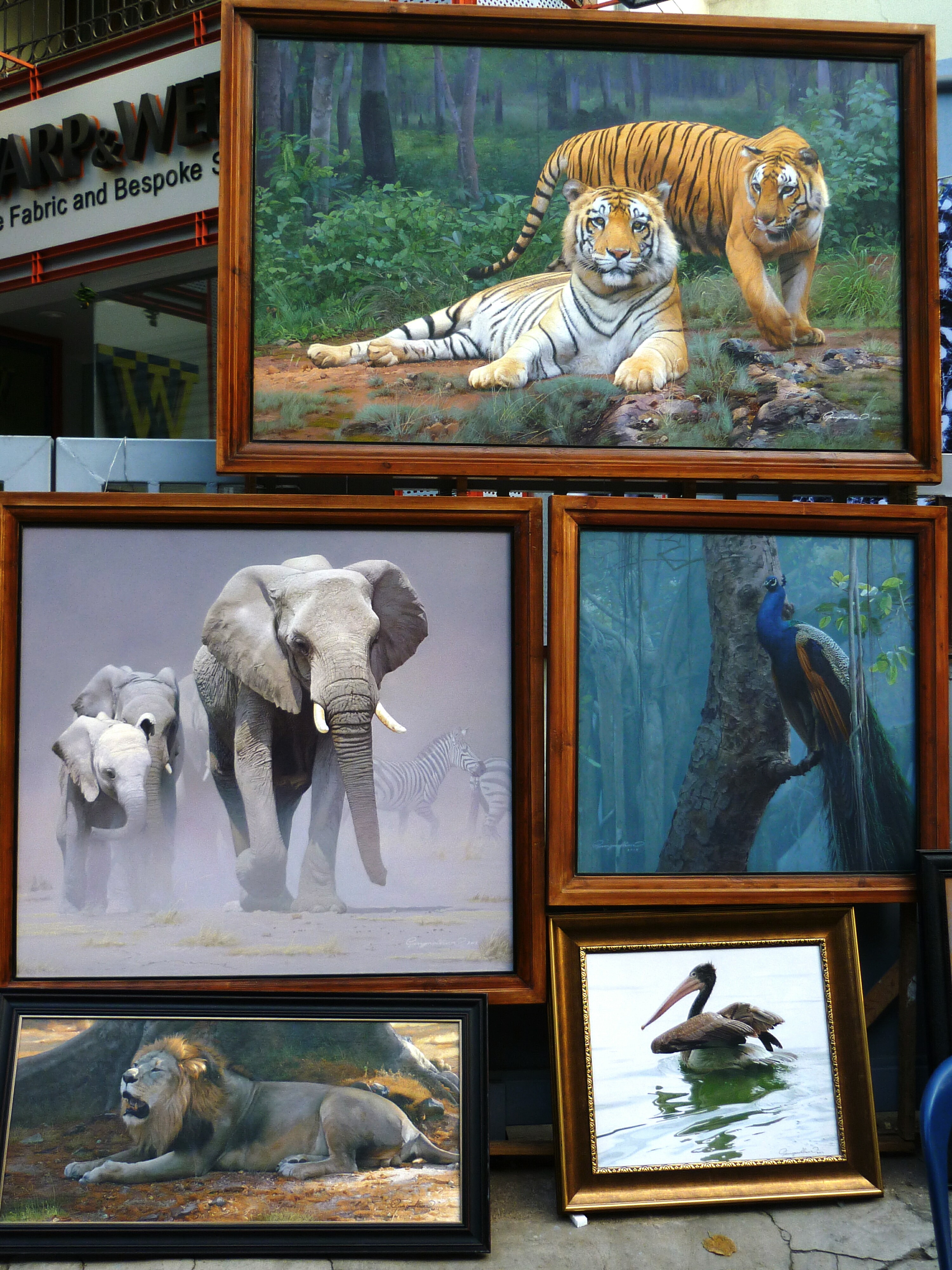
From very modern styles of mass-media art to traditional Madurai and Mysore royal paintings, artwork of school going kids to Octogenarians to handicapped artists, celebrity portraits, wildlife, architecture, conceptual paintings- art lovers will be spoilt for choices. Although the artistic skill cannot be gauged with a price tag, things range from 50Rs. to 1lakh Rs. Per painting depending on the material used and time spent.

img_20170125_111012
Wildlife paintings

This is not an event for the trippers who want to take a selfie and post on social media but a wonderful event for talented artists to get some genuine investors. A must go for the artist in you…

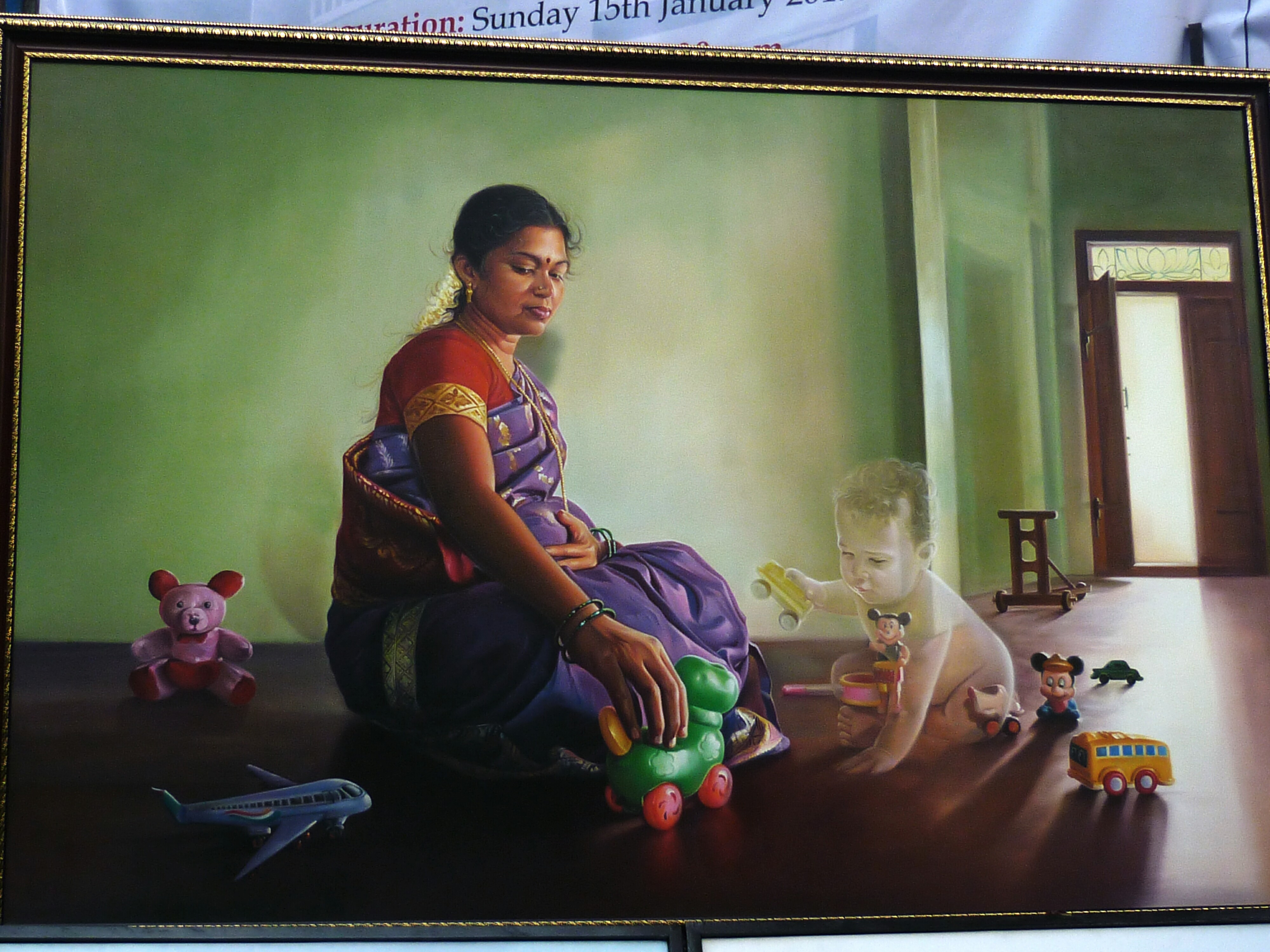
Finally, here is a life sized painting that I loved the most- An expecting mother playing with her unborn baby in the real world. Everything in the real world- the mother, the door and the toys have their shadow except the imaginary baby. The clarity in the artist’s thoughts about his subject has been represented with every detail in this picture looking so real.

img_20170125_111109

PS: Do not reproduce any images as there is a lot of effort that has gone into every piece of art. #Respect

Have you been to ChitraSanthe? What kind of art do you like? What other art festival have you been to? Do let me know what was your favourite part of the visit to this annual market of art in the comments below.

Kanchipuram- Beyond its sarees

The first thing that hits your mind when you hear this city’s name is its Silk sarees. The Kanjeevaram or Kanchi silk sarees define a sense of style, gorgeousness, elegance, classy and royalty. But what goes rather unnoticed is the fact that Kanchipuram is also called a ‘City of temples’. Despite being the erstwhile capital of the Pallavas, the influences of Pandyas, Cholas, Hoysalas, and Vijayanagaras can also be significantly observed in the artistic structures constructed across the city. Also, it is noteworthy that the influences in temple architecture are across different sects of faith. The City of Kanchi can be broadly classified into three- Shiva Kanchi-the holy land of the Shaivaites, the Vishnu Kanchi- the holy land of the Vaishnavaites and the Jaina Kanchi- the holy land of the Jains. Kanchipuram is known to be a land of 108 ancient temples, all unique in their own way. Beyond its world-famous handloom, the sculptures, architecture, classical dance, music and all those traditional art forms of Kanchi puts up the city high up on centers of history and heritage on the map of India. That’s why I like to call Kanchipuram as ‘an abode of the trio- Art, culture and history’.

When my mom planned to buy some drapes from the local weavers of Kanchi, I chanced upon the opportunity to explore this city, beyond its sarees and handlooms. Obviously, one day wouldn’t be sufficient if I had to visit each of these 108 temples, and hence, I made a list of 10 temples based on their mythological importance. Given that I’m mostly a public transport-dependent creature, the ease of commutation was also a factor considered while making my list. We boarded an overnight bus from Bangalore to Kanchipuram.

As we alighted at the Kanchipuram bus terminus, we were greeted by the drizzling rain. Usually, the autorickshaws work this way in this city. You tell them the purpose of your visit, and they will plan and handle the entire itinerary for you. Thus, we hired an autorickshaw and that sorted our transportation for the entire duration of our visit around the city. Our auto driver took us to a travellers’ dormitory where we freshened up quickly and then headed to the first temple on my list.

1. Kanchi Kamakshiamman temple: The timing of our visit was important and we wanted to reach there before sunrise. This is one of the Shakthi peethas in India. The prayers in all other temples in Kanchi starts only after prayers are offered here. Unlike any other temples in India, the first pooja to the presiding deity is offered by an elephant and a cow in the sanctum here. The positive energy we felt in witnessing the ritual was enough to keep us going for at least another week.

The entrance of Kanchi Kamakshiamman temple

2. Next up was a quick visit to Adi Kanchi temple, a relatively smaller of the 3 main temples dedicated to Parvathi in Kanchi. But this place is considered a must if one is on a pilgrimage in Kanchipuram.

3. Adjacent to the Adi Kanchi temple is the Kumarakottam- Murugan Swami temple. It is believed that Lord Bramha was imprisoned by Murugan at this place and later released with Shiva’s interference. The temple is known for the idol in the Soma Skanda posture.

4. Ekambareshwara temple: This is the biggest temple in the city. I’d need a separate post altogether to write about the significance of this temple alone. But the primary reason for me to include this temple in my itinerary is the fact that this is one of the Panchabhuta sthalas of Shiva’s manifestations. The linga here is made up of sand and hence represents Prithvi or the element ‘Earth’. This majestic temple complex houses a very sacred mango tree at its centre, whose 4 branches are believed to represent the 4 Vedas that give its name to the temple. Each branch bears mangoes of four different tastes(sweet, sour, bitter, and spicy) in the 4 seasons. The special souvenir that I take back from Kanchi was not a saree, but a priceless green leaf that withered off from this holy tree right there, as if the tree was communicating with me.. I was quick to pick it up and wrap it carefully to be kept in my handbag.

Under the mango tree at the Ekambareshwara temple

5. Next was the Varadaraja Perumal temple. We had to stand in a really long queue to get a glimpse of the main deity seated atop the elephant hill. As if this wasn’t enough, another long queue to get to touch the sculptures of the holy lizards. These metal lizards are believed to have been installed by lord Indra after he was released from the curse by Goddess Saraswati. It is also believed that people who touch these 2 lizard sculptures (the Golden lizard representing the sun and the silver lizard representing the moon) will be relieved of all sins that are associated with lizards. Another specialty of this temple is the fact that the wooden idol of lord Vishnu is kept deep down inside a 3 tiered well that in turn is in between a large pond at the temple entrance. The idol is taken out only once in 40 years for pooja offerings. (The latest festival was held in 2019.) I would recommend you to hire a guide at this complex so that you can get a better insight into the intricacies of the ornate pillars adorning a 100-pillared hall. You can find sculptures of vivid yogic postures, representations of the usage of arms and ammunitions in ancient battles, musical pillars, etc., which explains the rich heritage of Indian art, history, and science.

A mural at Varadaraja Perumal temple

Thus, with Kamakshiamman temple, Ekambareshwar temple, and the Varadaraja Perumal temple, we had completed the mumurthivasam- or the abode of the trio in Kanchipuram.

6. Just a few meters away from there is the Ulagalandar temple, primarily constructed by the Cholas. Here, Vishnu is celebrated in his Trivikrama pose or the Vamana Avatar. The main idol is a massive 30+ feet tall, and the devotees can see only the legs of the Vamana moorthi. The temple itself is small but an important one for pilgrims on the Divyadesams circuit.

7. Further from here is the Kacchappa Eshwarar temple. Here, Vishnu is seen in his Kuruma avatar or the Tortoise form, worshipping Lord Shiva.

8. We did a quick stopover at Vaikunta Perumal temple or the Tiruparameshwara Vinnagaram, another among the 108 divyadesams. The temple houses lord Vishnu in 3 different postures- sitting, lying, and standing. The corridors are decorated with fine carvings from the Ramayana and Mahabharata, and fine stone pillars around the sanctum.

9. The Kailasanathar temple needs a special mention. This temple, dating back to the Pallava period, is located slightly on the outskirts and hence away from the regular tourist/pilgrim circuit. It is an entire complex of intricate artwork sculpted on limestone. Although a board claims it to be a protected monument, most of the statues have eroded over time and need maintenance. Yet, this place has a very powerful force to draw art lovers and travelers looking for an offbeat experience. One really needs to spend a lot of time here to appreciate the intricacies with which legends and mythological episodes have been carved out. Don’t miss spotting the statue of laughing Parvathi and Shiva performing the thandava here.

The Kailasanathar temple

10. There is also the Vijayaraghava Perumal temple at about 7kms from the city center. It is one of the 108 divyadesams of Rama, where he is believed to have performed the funeral rites of Jatayu, the vulture friend. Since the vulture(Pul) was buried in a pit(Kuli), this place is also called Thiruputkuli.

Not only is Hinduism, but the city is an important place for the Jains too.. Bonus for your temple tour, if you have some more time left. You can include the Trilokyanatha & Chandraprabha twin temples dedicated to lord Mahaveer at Tirupparuthikkundram. It has inscriptions belonging to Pallavas, Cholas, and the Vijayanagara period. I’m told that the place houses beautiful paintings of these periods but lies in utter neglect. The place is frequented by fewer tourists and more vandals, gamblers, and hawkers.

Enroute, we passed through ‘Kanchi Kudil’- an old traditional house that has now been converted to a museum that exhibits the rich Tamilian tradition.

But well, Saree shopping was why the entire visit to Kanchipuram was planned in the first place. Hence off we were, on a handloom circuit. Our driver took us through the narrow bylanes of Kanchi to some of the finest weavers and their handloom workshops. A spectrum of colours, heavy brocades, golden zaris, heavy pattu sarees… we were spoilt for choice… We thanked our driver, Mr.Ravi, heartily for taking us around the city and bearing with us so patiently as we hopped from one shop to another. We picked up some beautiful sarees in silk and cotton and returned to Bangalore in an evening bus.

Thus, ended an eventful weekend…. 🙂

Madurai (Part 2) – Centre of arts and culture

There is no existence of a place without the people, and with civilization exists its culture. Madurai has its own share. My previous post (Madurai Part 1) was exclusively about the architectural landmarks spread across the city. But it would be injustice if the other things associated with this amazing city goes without a mention. Of course, the write-up could run into books if I had to write about each of them. And it isn’t necessary that everyone travelling is a pilgrim or a history buff or an architecture enthusiast. Hence, here’s an attempt to throw light on other aspects that any visitor to Madurai can expect. This is not a detailed one, but I touch upon various dimensions that you can theme your trip around Madurai. Do let me know if this post helps or if there is any other dimension I missed. Here goes my list.

Art:

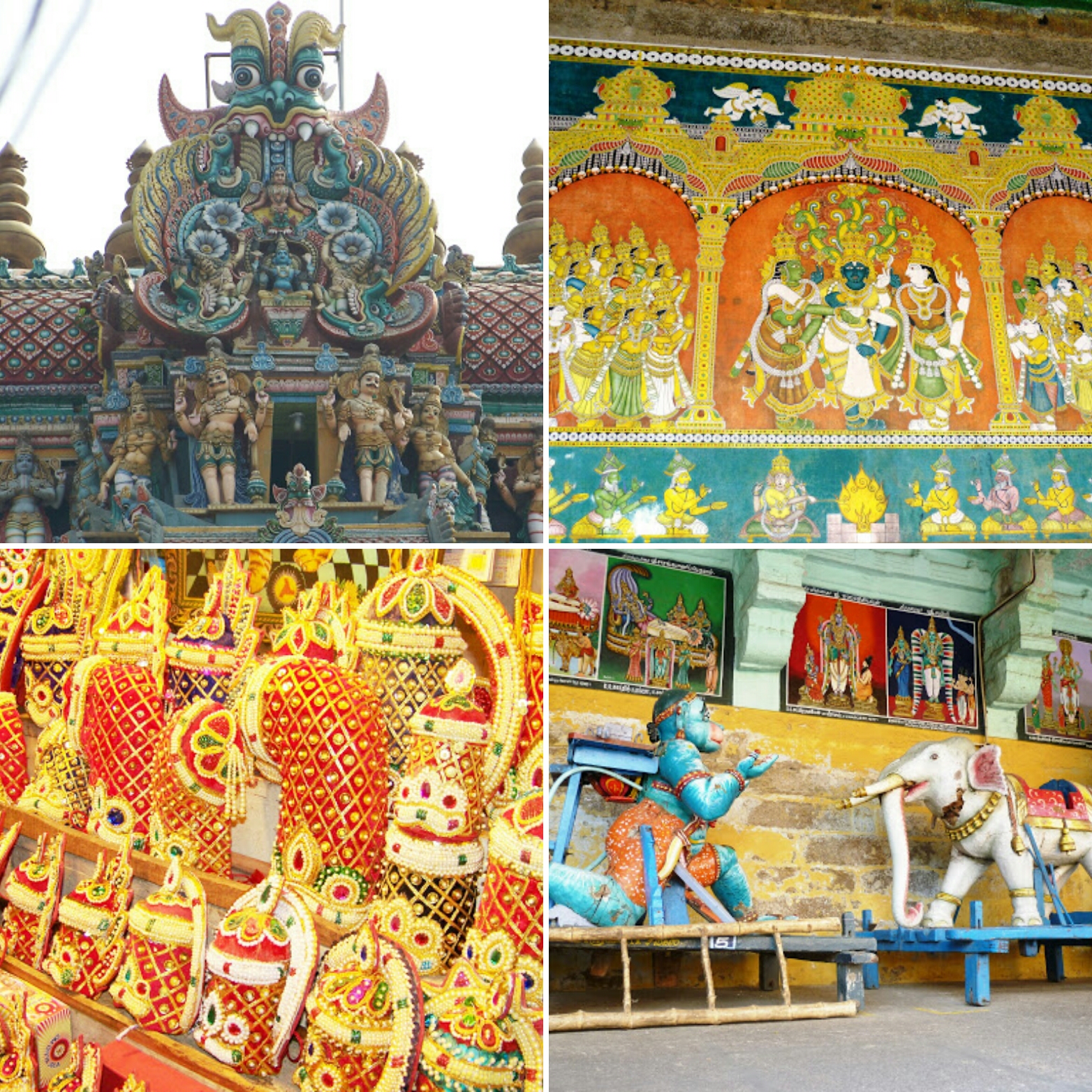
  • Sculptures: adorning every temple wall, pillar and their towers are a marvel in itself.
  • Carpentry: Several wooden vahanas used to carry the idols of the various deities in the temple are something that need the attention of art afficionados.
  • Handicrafts: Various accessories used for decorating Devi idols, made of delicate sequins, etc. are sold in several stall inside the large corridors of the Meenakshi temple.
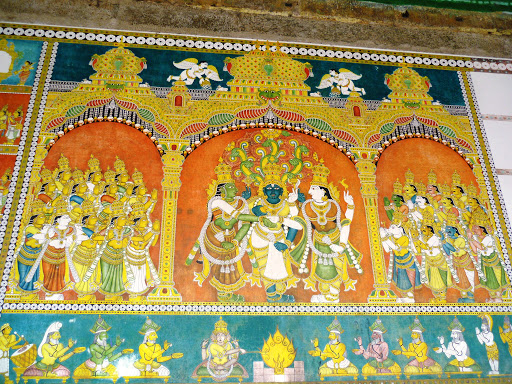
  • Mural paintings: This needs no introduction, the famous Madurai paintings are a gift of the Pandyan era, adorning the temple walls.
Clockwise from top left: 1.The sculptures on the western tower of the Meenakshi temple; 2.One of the mural paintings from the temple walls; 3.The wooden carriages for the temple idols; 4: Handicrafts from the temple stalls

Food:

Listing just a fixed menu while in Madurai would just be an understatement. If you are a foodie, Madurai would need two full days to explore its culinary delights alone. It is famous for both vegetarian and non-vegetarian specialties. I’d probably write a separate post about it sometime later. But this list is the list that we had when my family visited. But believe me- it is BEYOND!

  • Breakfast – Idly & Sambar, Pongal + a cup of filter coffee
    11.00.a.m – Jigarthanda (it’s more like a combination of falooda & kulfi)
  • Lunch- Puliyogare @ the temple store, curd rice, Sambar rice
    4.00.p.m.- Karupatti (palm sugar) coffee
  • Dinner- Anything after 7.00.p.m is called meals. Must try is the ghee roast & rava Masala dosa

Costume:

  • Sarees for women & Dhotis for men.
  • Madurai cotton sarees with simple prints and zari borders with temple designs are popular.

Jewellery:

Among the locals- particularly those belonging to the Thevar cast, it is believed that women are prettier with bigger earlobes. Hence, the girl child born in this community is made to wear a traditional earring called the ‘Thandatti’ when she is young. The thandatti is said to evoke the 3 levels of our world: terrestrial, astral and divine and these levels are associated with Mandala. Each piece of this weighs 27gms and is made of gold and this piece of jewelry is specific to Madurai.

A Thevar woman wearing the traditional Thandatti earring

Shopping:

Shopping at Madurai is all about wholesale vendors and there are specified streets for each of them.

  • Cotton sarees/ dress materials: Shops are all around the temple complex
  • Steel utensils: Plastic beads & girls’ accessories, gold plated imitation jewelry to name a few.
  • Pooja related accessories & crafts: Particularly inside Pudumandapam (1000 years old market)
  • Farm produce: Varieties of plantains / bananas and green groceries among the others.

A brief intro to a city full of life and activities. Justice yet to be done. Signing off with a hope that it has helped someone somewhere in some form who is seeking for some info on this Pandyan city….