Tag Archives: sightseeing in Bengaluru

I Belong to Everywhere: Chamarajpet

This is an attempt to bring back nostalgia. Continued from- “I Belong to Everywhere: Malleswaram

Chamarajpet is one of the two well planned residential areas of Old Bengaluru. Chamarajpet is in the South whereas the other one is Malleswaram, in the North of the original geography of Bengaluru. Chamarajpet is where my parents lived and worked through all the years at the time of my schooling at Madikeri. So, this locality is like my 1.5th home 😛 (first home is in Madikeri and 2nd home was at Vasanthanagar). I came to Bangalore (and thus, to Chamarajpet) only when I had a long vacation from school. Twice a year, to be precise: Once during the monsoon and once during the summers).

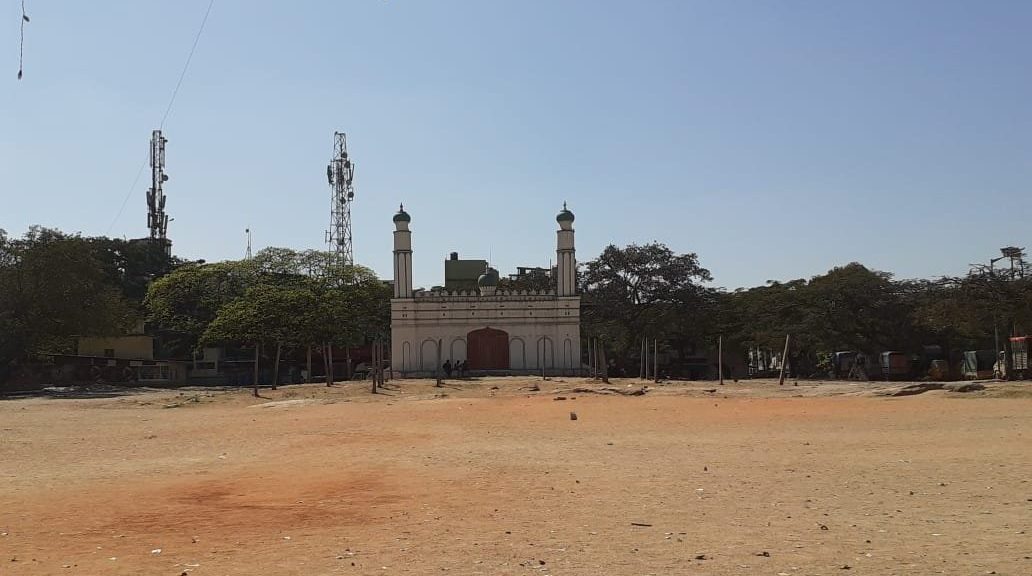
One of the earliest memories I have from this locality is of my family and all our neighbours watching and distributing drinking water and snacks to people who gathered for prayers during festivals at the ‘Eidgah grounds‘ and for the all-night harikatha renditions that happened at the ‘Male-Mahadeshwar temple’ in 2nd main. A large jamun tree in the premises of our house was often mobbed by kids from the entire locality for its fine fruits and the aroma of Rasam from the ‘Vataaras’ of 3rd main are some unforgettable memories.
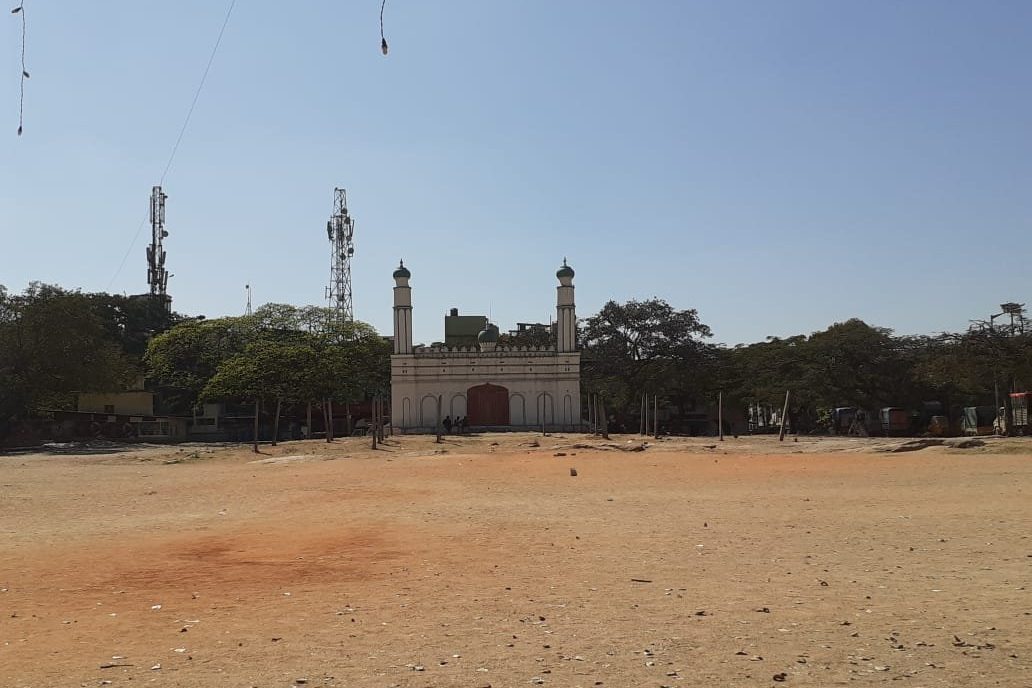
Eidgah ground at Chamarajpet

There were several things that I saw on TV (Doordarshan) and wanted to learn along with regular school while growing up. But there was unavailability of trained people who could teach me any of these extra curricular skills in the small town (Madikeri). Whenever I visited Bangalore during vacation, my effective time spent with my working parents were mostly for eating out in the evenings and making day trips over the weekends. A major chunk of my Bangalore visits was mostly meant for attending summer schools. With a very large community of literary scholars living in and around Chamarajpet, I could learn different art forms. I attended crash courses across various streets of Chamarajpet (and Basavanagudi) to learn sketching, painting, dance and music.

Every stone, structure and lane has history in Chamarajpet. Makkala koota, Bangalore fort area, Tippu’s palace, all the temples around the fort and the old pete area: Talk about them to my mother and she would be in tears of nostalgia. These are the places she saw every day during her career that spanned nearly four decades.
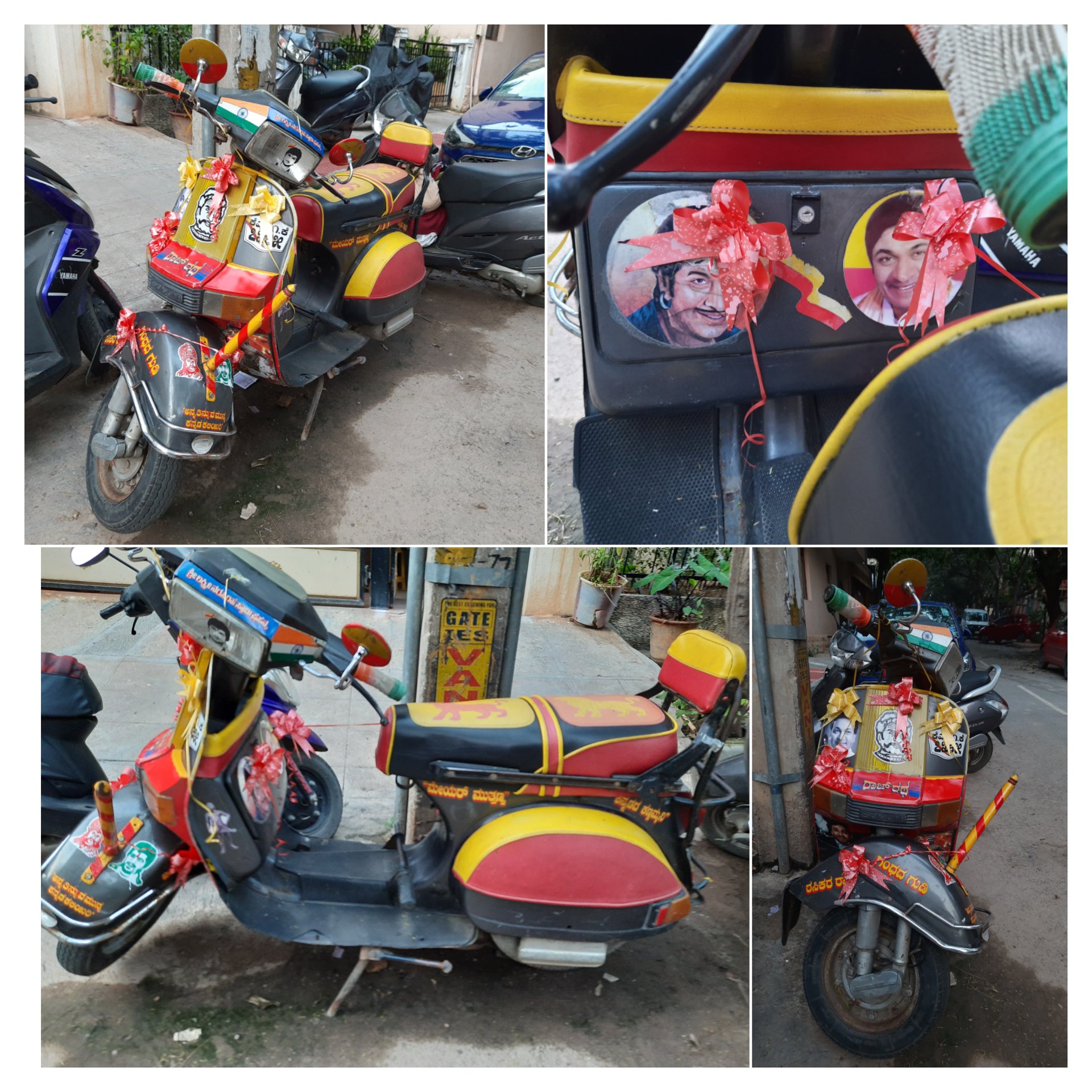
A scooter decked up in a Sandalwood theme (Kannada film industry)

Talking about my family’s favorite eateries, many things have changed and so many old-world structures have been erased now. However, Karnataka Bhel house in 3rd main road along with Gajanana fruit juice center and Iyengar’s bakery in 4th main have managed to stand the test of time.

My family has lived here for 15 years and there is a bond with every lane and its people that we share in Chamarajpet. Here live so many friends, who are more than family to us! Going to Chamarajpet every time is nothing less than travelling to our hometown! So, it is definitely difficult to quantify how much part of me belongs to this area!

To be continued as- “I Belong to Everywhere: Theralu

I Belong to Everywhere: Malleswaram

This is an attempt to bring back nostalgia. Continued from-“I Belong to Everywhere: Abbi falls“.

In the rapidly expanding Bengaluru city, Malleswaram and Chamarajpet are like two lungs that breathe out air of cultural relevance and nostalgia of Old Bengaluru. Malleswaram in the North and Chamarajpet in the South have always stood equal in their heritage of what the real Bangalore once represented. Although one might disagree with my personal viewpoint, Malleswaram represents the face of Bengaluru that boasts of intellects in the science and academics fields whereas Chamarajpet represents a city that is filled with scholars from the creatives like literature, art and commerce. In the proximity to premium research institutes like IISC, ISRO, C.V. Raman institute, the Wood institute and organizations like BEL, HMT, Mysore lamps, Sandal Soap factory etc. Malleswaram was the closest residential area. Meanwhile, Chamarajpet was an extension of the Pete area and is also the home to the Karnataka Sahitya Parishad. So, those in trade, literary luminaries and Pandits naturally moved in here. Anyway, my intention is not to explain those details and get into a debate, but to come to the point on how and why I believe that I belong to Malleswaram. (More on Chamarajpet in the next post)

Kaadu Malleshwara temple at Malleswaram

Talking about Malleswaram, where do I start from? 18th cross, maybe? I often entered into the premises of Sankey tank from Sadashivanagar and I exited from the other end to Malleswaram. For the first two years of living in Sadashivanagar, I played Basketball. I was trained at the ‘Beagles Basketball Club’ and envisioned to make it big in this sport over the coming years (Destiny had different plans and that’s for another story). Mind you, I had been an ardent follower of Kobe Bryant and the Lakers since school!

Finishing the day’s training usually meant savoring a honey cake for Rs.7 and a biscuit sandwich ice-cream for Rs.5 at the lyengar’s bakery at 16th cross. The aroma of filter coffee in the darshini hotels and a walk in the old Malleswaram market are sensory experiences that cannot be taken away from me. The CTR dosey is an inseparable part for my taste buds (I take the metro train from my current residence in South Bengaluru to Malleswaram even to date, just to eat CTR dosa).

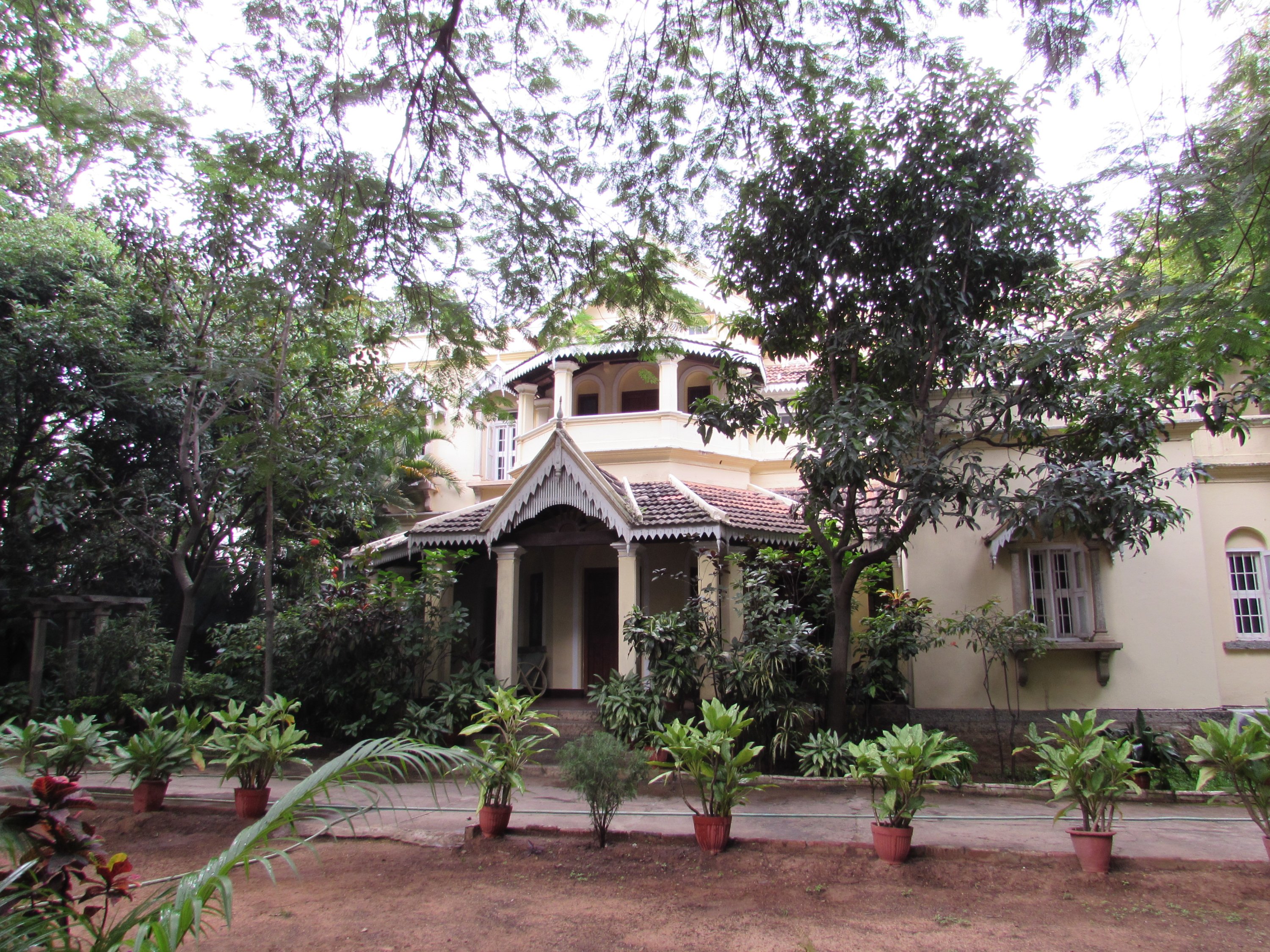
Villa Pottipatti- a heritage hotel in Malleswaram, Bangalore

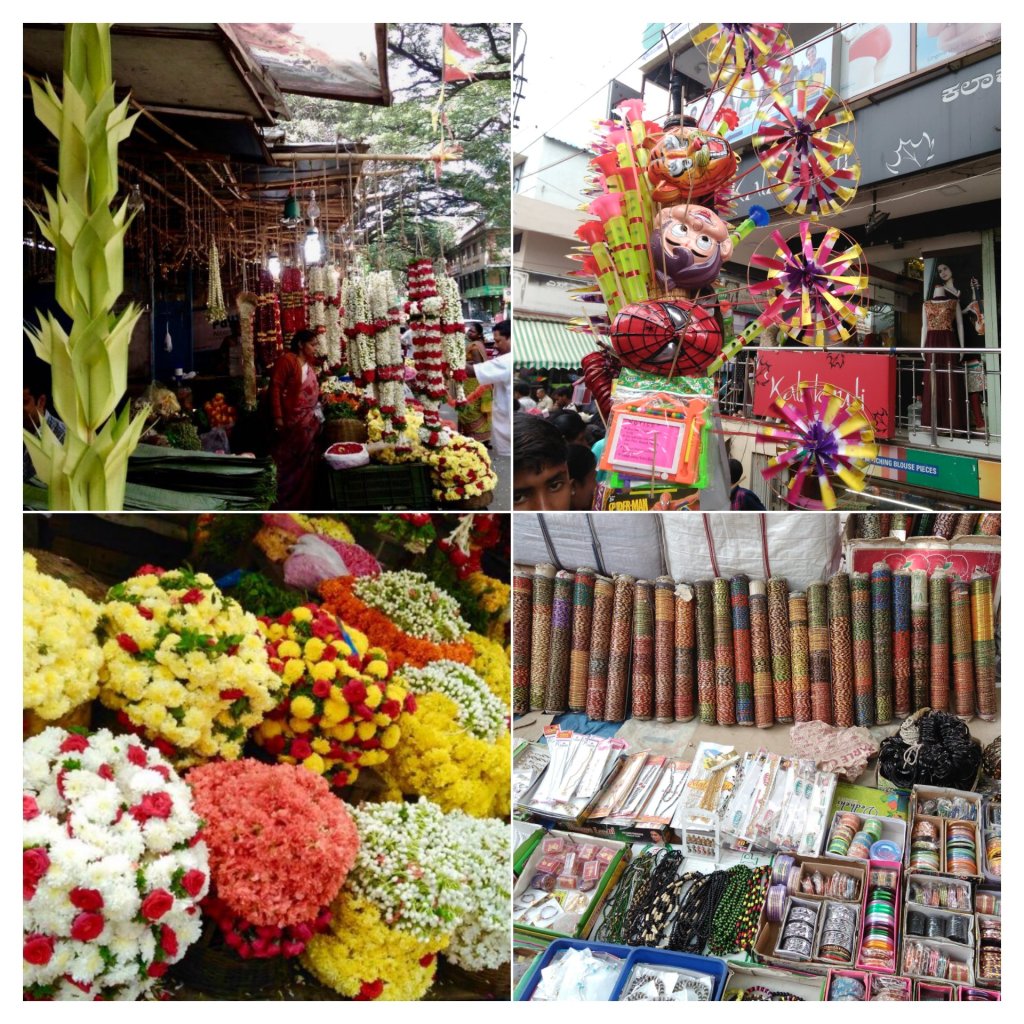
The atmosphere of festivities brought in by scores of vendors on the 8th cross road were the days that were much awaited by me to see what each festival was about and what the key items associated with a specific festival were (decorations, food and other knick-knacks). I had even made up an entire itinerary on my own and applied for a part time job of a tour guide who wanted to walk the interested people through the lanes of this heritage area.

Malleswaram market
Malleswaram market

Since I had only then moved into Bangalore after finishing my schooling in Madikeri, for me Malleswaram served as an open school to open my mind to cultures that I was totally unaware until then. The cuisine, the festivals, the spoken Kannada, the traditions and the mindset of people in general, everything seemed new to me in Bangalore from what I had been exposed to until then. I was quick to adopt and adapt and this is where I became a true blue Bangalorean.

With the premium research institutes of India being around, Malleswaram sort of sparked my urge to keep learning/exploring something constantly and inclined me towards pursuing research in general.

To be continued as- “I Belong to Everywhere: Chamarajpet

I Belong to Everywhere: Ontiangadi

This is an attempt to bring back nostalgia. Continued from- “I Belong to Everywhere: Vasanthanagar“.

‘Ontiangadi’ literally translates to The Only Shop’ in Kannada, and it is the name of a village in South Kodagu, where my paternal lineage hails from. Now, this village has grown beyond just one shop, into a tiny township.

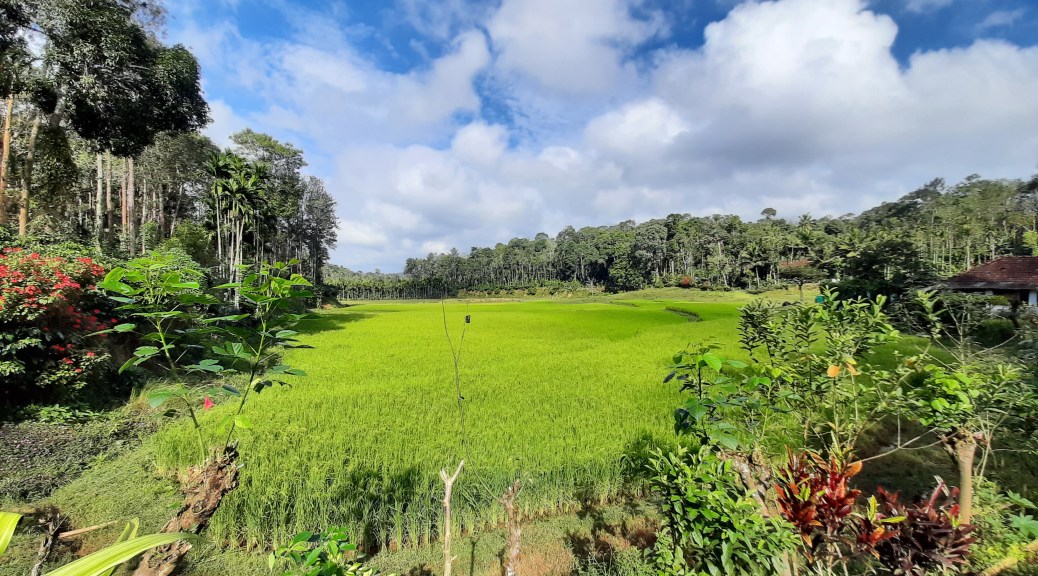
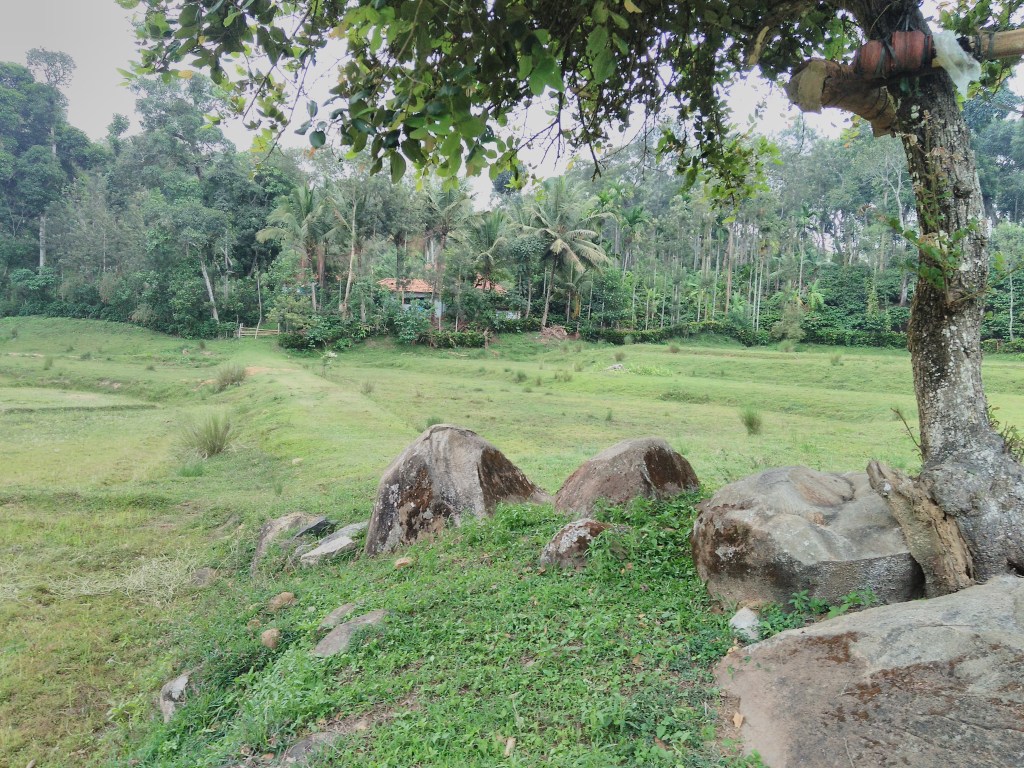
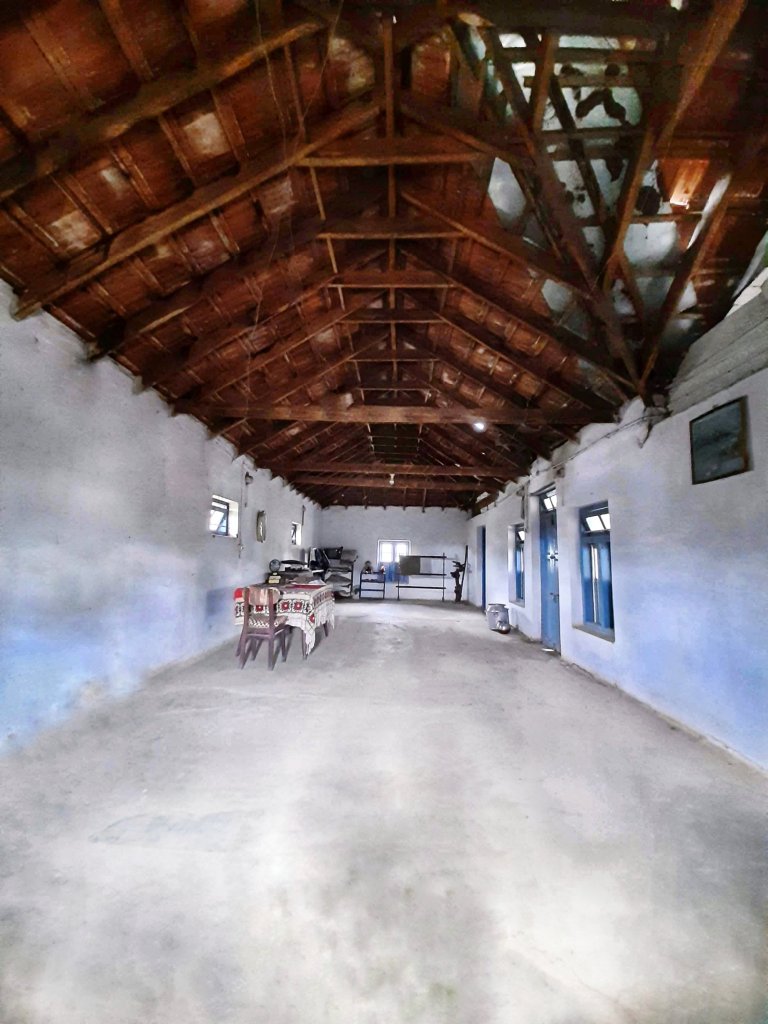
As a child, I would come here on those weekends, when my parents came down from Bangalore. But whenever I came here, there has always been a calm of a different kind. There are two ancestral houses located within the large premises: one nearly 200 years old which is now used as a warehouse and the other, around 50+ years old that is currently being resided at by our family. The latter is surrounded with coffee plants, paddy fields, overflowing ponds and streams, an open well at a walkable distance to fetch potable water. This place has always seemed magical to me, then and now!

View of the farm from our ancestral home in Kodagu

While the green paddy fields have been a treat to the eyes, the offseason is when I have lived some of my best holidays. The paddy field would turn into a playground when my cousins, other kids from the village and their cousins, would all congregate here for a game or two of football. Not with a foot-BALL, but with hollow balls of pomelo skin (grapefruit).

And then, came the first monsoons: we ran to the large wild-mango tree and fought a mango war. Who won or lost the battle would be decided by how much mango juice we were soaked in and who got the maximum scolding from our elders!

The farm and the mango tree, on the drier days in Ontiangadi

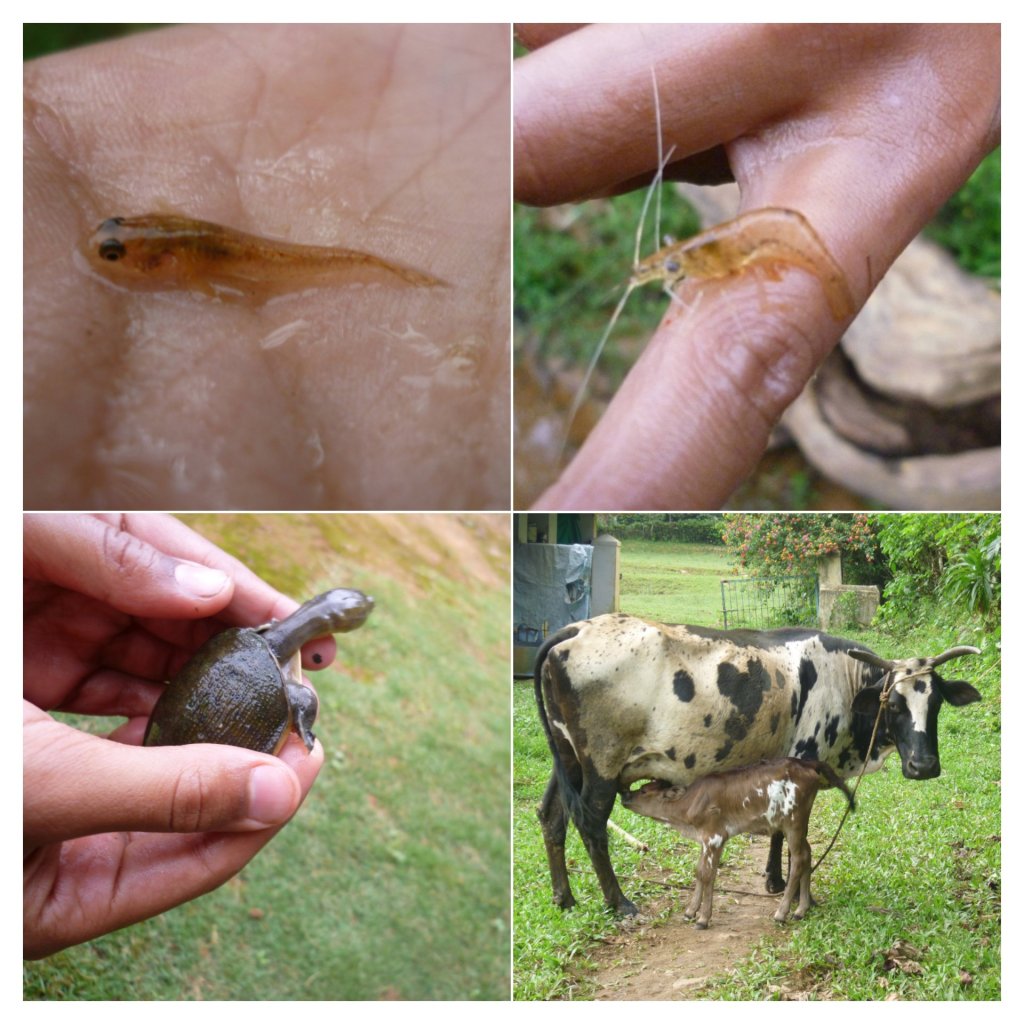
Wait for a few more days to pass by and the monsoon will peak. Then, the streams would overflow and bring that time of the year for our prized catches: Laying bamboo traps to collect fresh water eels and Koile meen (a local fish in Kodagu), fishing out mud-crabs from crevices along the downstream were normal. On (un)Lucky days, one or two smushy crabs would turn out to be snakes after being grabbed out 😀

Once, the workers had brought home several soft shelled turtles which they had found while working in the paddy field. It was timed well with my then recent experience of volunteering for a sea turtle conservation project in Chennai. With all excitement and inspiration, I had written to so many organizations about my new discovery in the western Ghats 😀 Aaah, what memories!

Clockwise from top left: 1. Koile meen, 2. Freshwater shrimp, 3. Cattle, 4. A soft shelled turtle

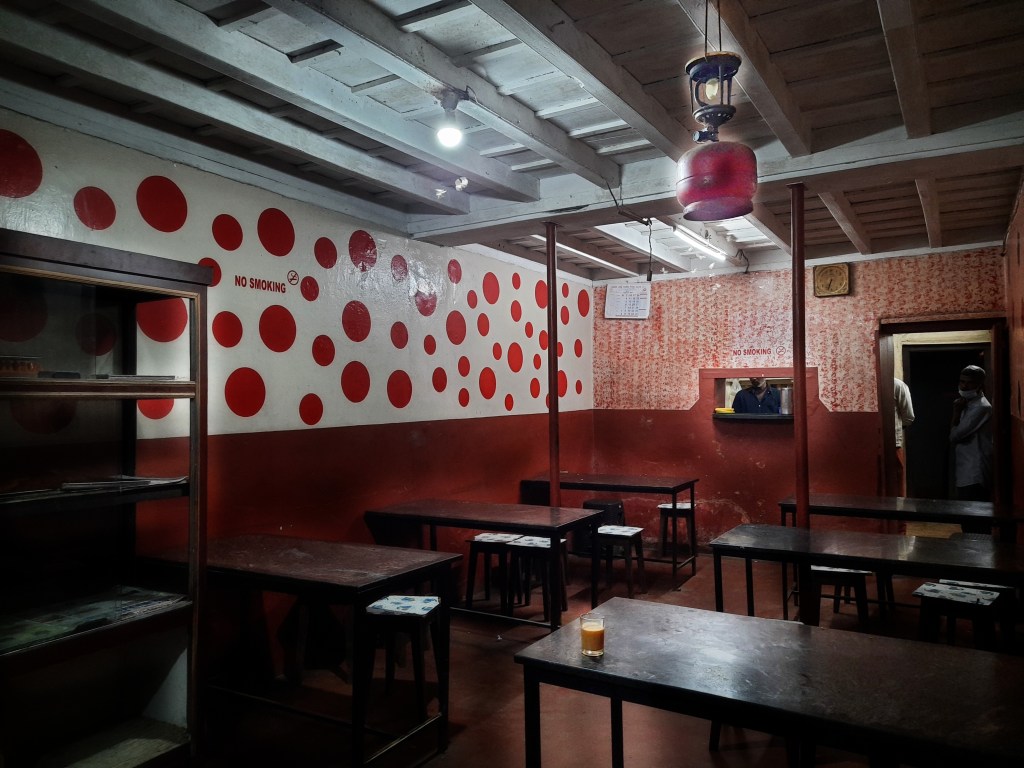
Apart from this, the ‘Subramanya temple’ at Byrambada and the ‘Palli Swamy Dargah’ (Pulkimaad dargah) have been important landmarks in and closer to Ontiangadi. A nice warm day even now, is often concluded with a hot plate of palam pori and a cup of kattan chai from ‘Ganesh hotel’ at Ontiangadi.

'Ganesh hotel' at Ontiangadi, Kodagu
‘Ganesh hotel’ at Ontiangadi, Kodagu

I borrow my surname from this village and so, definitely a part of me belongs here 😀

If you liked this story, you might also want to give a read to: “OMG! Life has changed!” for some more nostalgic content.

To be continued as- “I Belong to Everywhere: Kumbaldal

I Belong to Everywhere: Vasanthanagar

This is an attempt to bring back nostalgia. Continued from- I Belong to Everywhere: Karavalebadaga“.

Vasanthanagar is an old locality in North Bengaluru, adjoining some of the prominent English areas like the Cantonment, Miller’s road, Cunningham road, Palace road etc. I had been visiting and staying in this locality for all the years that my aunt’s family lived here. Right from the time I was an infant to the time I started to go to college, I have been a regular around this locality. Or to say, this has been my second home whenever I have been in Bangalore. (First home in Bangalore is of course where my parents lived, I will talk about it in another post 😀 )

When you live in an area, your boundary extends beyond. Hence, high grounds, racecourse, golf course, Windsor Manor, Indian Express building, Basava Bhavan, Vidhana Soudha were all just a walk away. If you let my aunt or mom take over this page, then probably they would tell you that even Shivajinagar or Commercial street were also walkable from Vasanthanagar (at least considered so, back in the 80’s and 90’s). So, let me take you through some of the landmarks in Vasanthanagar that bring back nostalgia.

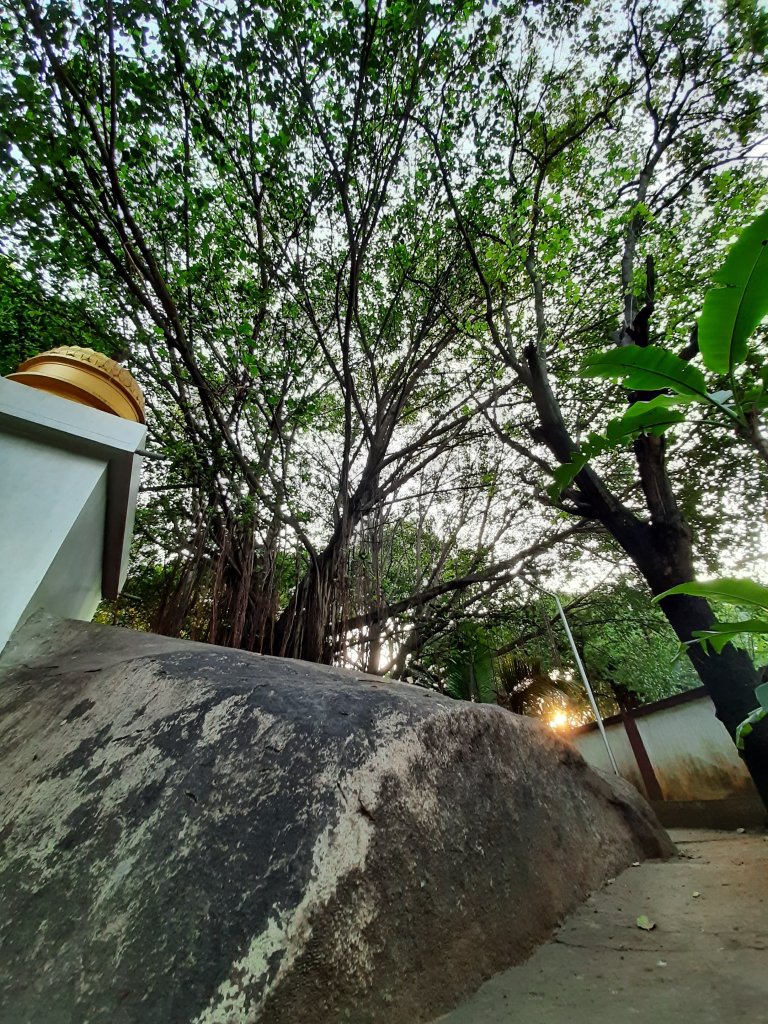
The Sampangi Ramaswamy temple: My aunt’s house was located right opposite to this temple and it was every day, that I woke up to the melody of M.S. Subbalakshmi’s suprabhatam played at this temple. But what best remains with me are the days that my cousin and I were made to believe that a small depression on the boulder in the temple premises were footprints of Lord Rama. So as kids, we would go there every day (whenever I was there) and offer our prayers with vermillion to this rock (and NOT to the temple!)

The premises of Sri Sampangi Ramaswamy temple in Vasanthanagar

Loafers’ lane: Palace road is where a majority of my female cousins have attended school. This is also where I got my pre-university education before graduation. Being an all-women’s college, needless to say that the road running perpendicular to the college gate has always been a haunt of all the men of Bengaluru. Apart from the ‘Dove nuts’ from Chechi’s canteen on campus, the chaats from Raj’s on loafer’s lane has always been synonymous with the crowd.

Kodava Samaja: Then, there is this convention hall where almost all community gatherings like festival celebrations, weddings etc., happen. Even if my aunt’s family and I moved out of the area, Vasanthanagar wouldn’t leave us 😀

The Mount Carmel College junction of Palace road and Loafers' lane at Vasanthanagar
The Mount Carmel College junction of Palace road and Loafers’ lane

Adding to the list, the delicious sizzlers of ‘Miller’s 46’, Mughlai Biriyani from ‘hotel Chandrika’, honey cake from lyengar’s bakery and home-needs supermarket were our family’s go-to places for quick bites. Catching a local gig at ‘Alliance Francaise’, a movie or a Mc.D burger at ‘Sigma mall’, Infinitea and several other cafes and restaurants that sprung up and shut down along the way were other newer additions (during the early 2000s).

Talking about the role of this area on my personality: This place has influenced me in more than one way.

  • If you have ever conversed with me and have spotted a certain peculiar vocabulary sneaking out during a formal discussion, I owe that part of me to Vasanthanagar. That “English” has brushed onto me from my almamater here! For all you should know is that I studied in a gender-neutral women’s college, where we addressed peers as ‘hey, Man!’, ‘hey, Bro!’, ‘hey, dude!’.
  • This is also where I was introduced to ‘fusion rock’ music. The college fest hosted by my almamater is one of the most popular stages in the country for aspiring college bands who seek a launchpad and get recognition. This small-town girl had grown up listening to the voices of Lata Mangeshkar, Mukesh, Rafi, Kishore da, Yesudas, P.B.Srinivas and the likes, until she moved into the city. ‘Fusion’ was a new form of music she was listening to for the first time, here. She had an instant connection.
  • Although tending to animals is in the genes and the blood of this girl who belongs to forests of the western Ghats, I owe my understanding and awareness for conservations of wildlife and nature to Vasanthanagar. My bond with a classmate whose dad worked in the forest department was so deeply rooted about the holistic topic of environmental conservation, that we would spend several sleepless nights discussing about births, deaths and general health of individual animals from the zoos that we both had seen together, met and knew by names (Click here for a detailed read)

Continued as- “I Belong to Everywhere: Ontiangadi

I Belong to Everywhere: Karavalebadaga

This is an attempt to bring back nostalgia. Continued from- “I Belong to Everywhere: The Introduction

This HAS to be the beginning 😀 Madikeri (earlier called as Mercara) is the district headquarters of Kodagu (earlier called as Coorg). In this post, I talk about Karavalebadaga village in Madikeri Taluk, where my house and my school were both located in proximity. Although the village retains its name in the government documents, the newer names of these fragmented localities have now taken over people’s memories.

This is where I was born and have spent most of my life, so far! I was raised by my maternal grandparents who lived in Madikeri. A large compound with a shed full of cows, a kennel full of dogs, a sty full of pigs, a lair full of cats and an attic full of sparrows in their nests; a house surrounded by a colourful garden, fruiting trees and coffee estate; A short walk down, took us to a paddy field in which flowed a pretty little stream. This is where I grew up, in the heart of Madikeri town.

The attic at my maternal grandparents' house
The attic at my maternal grandparents’ house

Throwback to 90’s: As young kids, my cousin and I often sneaked out of the house on weekends for our usual stints. We would steal empty jars of Horlicks and cotton towels from granny’s stash and head towards the stream. We would catch fishes from the stream, get them to fill the tank that had purple lilies in our house’s front yard. We then hid the jar and the towel back near the stream for the next weekend. Come next weekend, the jar would have gone missing and the drill repeated!

Forward to present day: The sheds are empty, the dog is lonely, the sty is erased, the trees are gone and the stream has become part of a concreted sewage.

Watching the rains batter and the lily tank in the frontyard

Throwback to 90’s: My friends and I walked to school, braving the heavy monsoon downpour. Our heavy armours comprising of thick raincoats, high ankle gumboots and wide black umbrellas weren’t enough to keep us dry. Along with this, we made sure we did not return home empty handed in the evening. We filled our lunch boxes with wild mushrooms or mud-crabs that we would pick up from the paddy field for a sumptuous monsoon dinner.

Forward to present day: There exists no trace of a paddy field that has now been transformed to a full fledged housing layout, the present day ‘Cauvery layout’.

The road connecting Ranipet and Cauvery layout in Madikeri is now laid over a sewage stream

Throwback to 90’s: My SCHOOL, the oldest educational institution in the hills is a landmark in itself. Named after it, an entire locality is simply referred to as ‘Convent junction’ that is accessible via a narrow lane (locally called as Oni). This was our alternate route on monsoon days when the paddy fields were flooded. The joy of relishing the masala vadas from ‘Kunyali’s canteen’ or a bite into a pastry from ‘hotel Coorg International’ (probably the only star hotel from our times) gave us a high of a different level.

Forward to present day: The oni is partially gone, but the of joy of taking a ride around the Convent junction and visiting school can never be replaced!

A tour of Convent Junction

They say home is where schooling starts, and then the formal schooling: My personality is probably a reflection of Karavalebadaga because this is where it all started!

So, that’s all folks! Next week, I will share a post about another place where I belong to. I hope you all will enjoy and share your thoughts with me.

But before that, I hope you all have read my earlier throwback post about Madikeri as well. If you haven’t, here’s the link: ‘My growing up days at Madikeri’.

Continued as “I Belong to Everywhere: Vasanthanagar

St. Joseph's convent as seen from Ranipet
St. Joseph’s convent as seen from Ranipet

An Offbeat Day Trip from Bengaluru to Channapatna

The original plan for this short family outing was to make an early morning visit to Sanjeevaraya Swamy temple in Channapatna Taluk of Ramanagara district and return. But, since my workplace is located along the same route, I expressed my disinterest in traveling that way. I pitched in the idea to have a change of route at least for one-way. Hence, I added a couple of other landmarks, picked up an offbeat village road and created a circuit with aid from google maps.

For those of you who are not familiar with the geography of Karnataka, Ramanagara is popularly known for its Sholay hills that was featured as the village- ‘Ramgarh’ in the Bollywood movie Sholay. Channapatna is popular for its cottage industries of wooden toys. I am not going to write about any of these places, the search engines are already flooded enough! I am going to take you around some lesser known places in Channapatna, for a half a day’s trip from Bengaluru.

Our circuit route was:
Bengaluru – Bidadi – Kengal – Devarahosahalli – Neelasandra – Vittalenahalli – Bhoohalli – Kanakapura – Bengaluru

The Details:

We set out on a Saturday morning and decided to have our breakfast on the way. Sri.Renukamba tatte idly (translates to ‘Plate idli’ in Kannada) needs no introduction for the Bengalureans. So, after a filling plate of tatte idly at Bidadi, we proceeded towards our intended destination for the day. To reach there, we had to pass through Kengal, a village popular for yet another Hanuman temple. Moving ahead from there along a small deviation, we arrived at our first major destination: Sanjeevaraya Swamy temple at Devarahosahalli village. This is a small stone structure dedicated to Lord Hanuman and dates back to the Vijayanagar era. The deity is believed to be powerful and hence, we were there to offer or prayers following the recommendations of some well-wishers.

After spending some time there, we continued onward to our next destination, a little cave temple located atop of a hill. The drive, the scenery, the canopy of the majestic trees along the highway was a pleasant one. We stopped by to do some bird watching at the Neelasandra lake as well. We could see Pelicans flocking in large numbers.

Our next major stop came as a rather surprise to us. Gavi Ranganatha Swamy temple was a random destination included in our day based on an internet search result. The drive, the location of the temple, the valley, the village view from the temple porch and the overall scenery was just so stunning and unexpected. There was just no one else in the temple apart from our family and a few local kids playing in the hill, atop which this temple is located. You can watch the video of our visit to Gavi Ranganatha Swamy temple below:

Drive to Gavirangana betta

By this time, the sun was already up and beaming bright. So, we decided to drive back, of course through a different route. We descended the Gavi Ranganatha Swamy hill and took the route that connected to Kanakapura. On the way, we stopped at this beautiful location where the highway passes through green farms on one side, a large lake on the other side and the entire scenery was being overlooked by the temple hill.

Vittalenahalli highway and lake

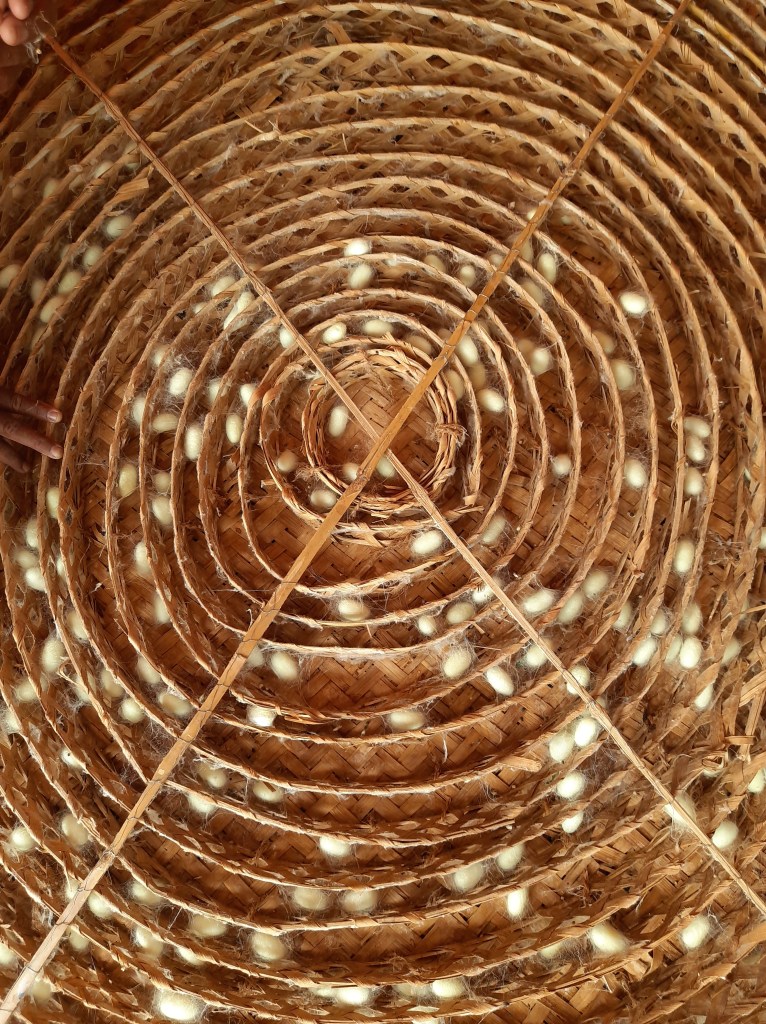
Our drive from there continued through large stretches of rocky hillocks, mango orchards, paddy fields, coconut groves and mulberry farms. Ramanagara is also known for sericulture. Several households in the villages here are involved in silkworm rearing. As we passed through, we noticed that families were sitting out in the verandahs of their traditional houses and collecting the fully grown cocoons from the bamboo trays. We stopped by and walked over to one of the houses on our way and learnt a thing or two about sericulture from them.

Silk Cocoon trays

In a short while, we reached the Kanakapura main road where we had our lunch. Well, it was a late evening lunch before continuing towards home and thus ending a quick trip to the Bengaluru outskirts.

An offbeat drive from Bengaluru to Gulakamale lake

If you are someone who has been following my blogs for some time now, you would know that most of our family trips are on weekends and to random destinations located around the Bangalore outskirts. We leave home with random reasons to drive out and then pick up equally random roads and follow-it till the road reaches a dead-end. We have thus far explored several villages like this. This weekend too was a similar one. And the reason to drive out, you may be curious to know, right?

My dad had long heard of a pig farm located somewhere around Kanakapura road. We had first stopped for lunch at a hotel on Kanakapura road. There, my dad enquired with the hotelier if they knew of any pig-farm around. They informed us that the kitchen waste from their hotel too was collected by someone who runs a pig farm but was unsure of its location. He gave us the possible location of the place with rough directions. After lunch, we headed out in that direction, a deviation before Kaggalipura.

Our drive to Gulakamale lake

With just the deviation, there was a sudden and a contrasting change in the scenery to drive through as compared to the super congested Kanakapura highway. For a moment I felt as if I were driving through some remote lanes of Coastal Karnataka or the Malnad region. There were stretches of areca and banana plantations on either side creating abundant greenery and change in the ambience. Since there were barely any people on the road, we continued to drive till we found some village ahead. By this time, we had covered a good distance and passed through several types of fruit and vegetable farms.

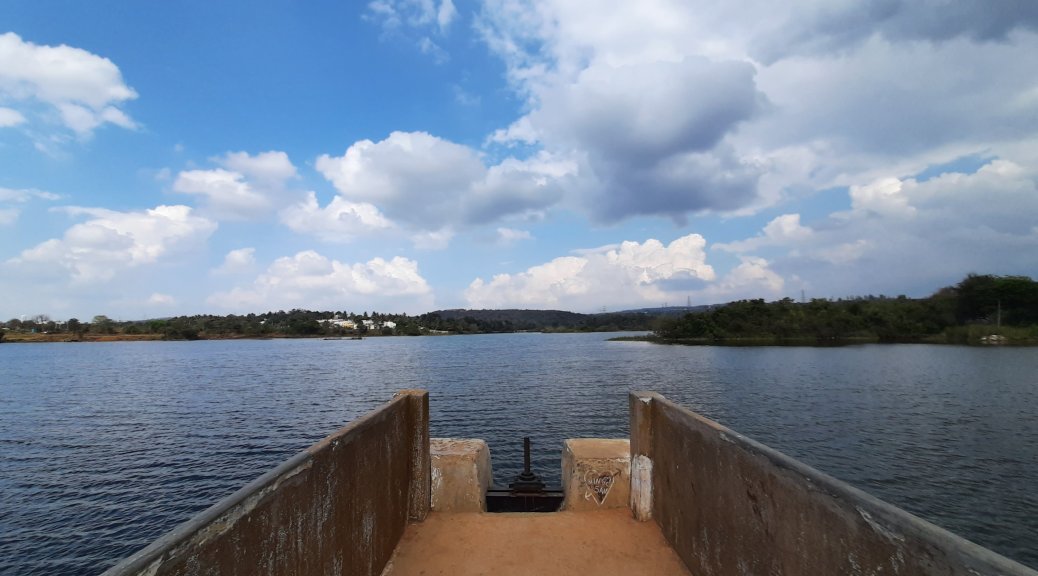
After reaching the village, we stopped by to enquire a villager on the roadside about the farm, he guided us to a pig-farm located next to his farm. But after reaching there, we realized that it was a different one that my dad had heard of and we had no entry into the place where we had now reached. So, we continued our drive further and reached a junction where we had to pick a direction to turn, the left or the right. Instead, we chose to stop the car in a side and walk up a large wall in front of us that looked like a high-rise wall of a reservoir or something. Indeed, it was a lake up there and surrounded by farms and distant hills of Bannerghatta on the other side. A flock of migratory birds too seemed to be resting in a small islet in the middle of the lake. I checked the location on google maps and I learnt that the place was called as ‘Gulakamale lake’.

Gulakamale lake

The water looked so good and we sat there for some time, enjoying the cool breeze even on a hot and humid afternoon. It was just my family in the entire place until we noticed some local kids who arrived there. They removed their clothes and jumped into the lake one after the other, enjoying their fair share of fun time. They took all of us back to our childhood days and it was a pleasure to watch them enjoy it that way.

After a while, we decided to move further on the road. This time, we chose to take the road to our left and continued at it. We passed through millet farms, taking a round about of the same lake, papaya farms and other vegetable farms before arriving at a village called ‘Nallakkanadoddi’. It was a small settlement with nothing noteworthy to see or do. Hence, we went ahead as we saw that the road was newly laid and in good condition.

The road reached a dead-end and that was the parking lot of ‘Tottikallu falls’ commonly known as TK falls among the urban crowd of Bangalore. This was the second time for me that I had reached the entrance of TK falls, both times an unplanned drive had taken me there. Again, I decided not to go there on both occassions given the large crowd that had come down over the weekend. More so, given the Covid-19 situation and the crazy crowd this time, we didn’t even dare to step out of our car. So, TK falls has to wait until next time. From here, we decided to head back home and not stop anywhere on the way. Thanks to the weekend rush on Kanakapura road, we would need good number of hours to make our way back through the traffic.

Hiking to a massive natural arch- Bheemanakindi

With a closed group of family and friends, about 10 of us planned this weekend trek to this lesser known hill, a little away from Bangalore. We started from Bangalore at 05.00.a.m. with an intention to finish the hike back down before the sun goes up. It was dawn by the time we drove towards Kanakapura and reached a village called Kanchanahalli, in Malavalli Taluk of Ramanagara district. The Kaccha road thereafter till the base of the hike, passes through fine landscape and traditional village of ‘Mysore Karnataka’ region. The hill is a part of the ‘Kabbala Forest reserve’ area. The early morning rays added extra charm to the cloud kissed peak of the ‘BheemanaKindi hill’ at the distant end and the fog covered coconut groves and vibrant green farms on either side of the road. What else? Picture this: A dozen peacocks dancing in the middle of the road! Well, a pleasant welcome; I must say 😊

The Drive and trek to Bheemanakindi

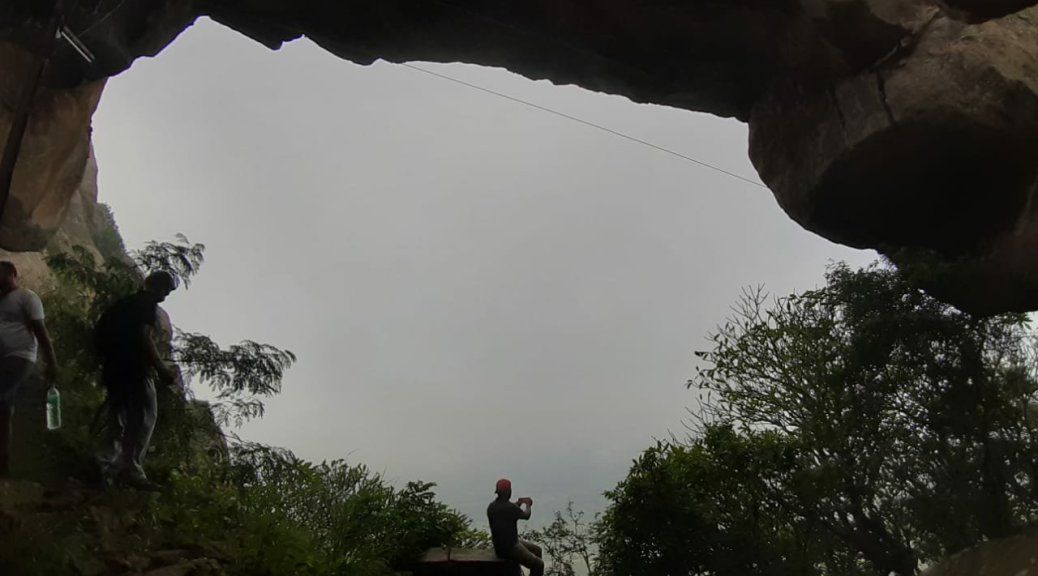
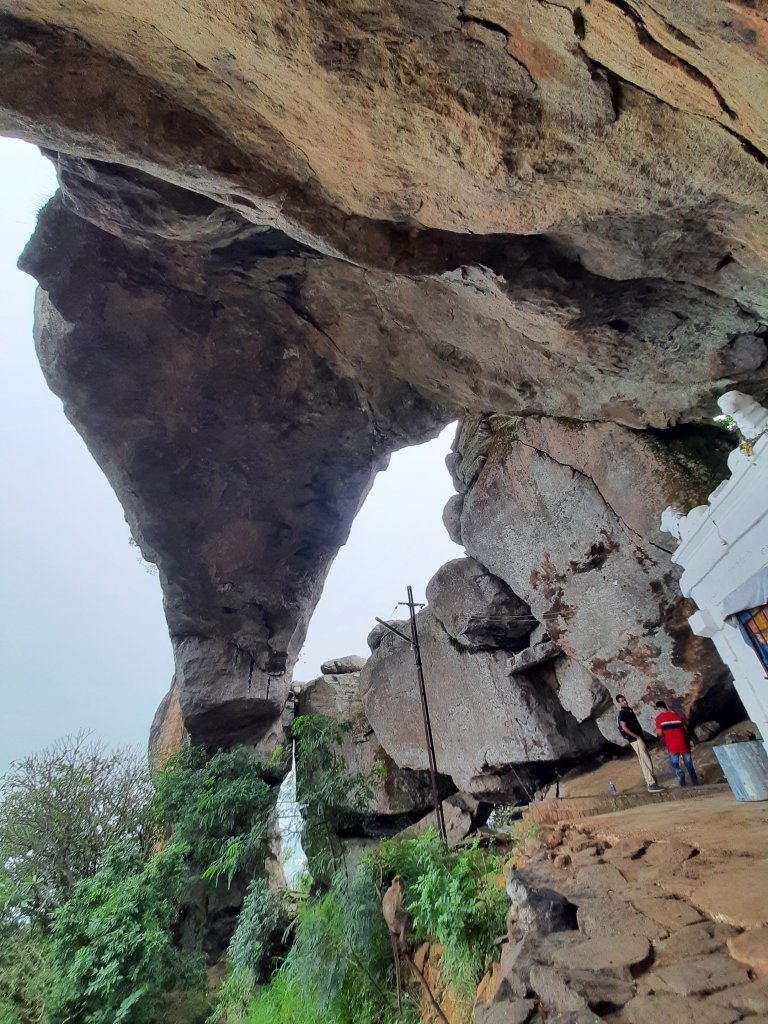
We finally arrived at the base of the hill, parked our cars and started the ascend. It starts at a small godown sort of a structure from where, is a well laid out stone path through the forest, right till the destination. Well, let me clarify that unlike most of the common treks around the city that promise you a breathtaking view after a good climb, this one has a MASSIVE stone arch at the end. With this large arch, goes the legend from Ramayana. ‘Bheema’ hit the large rocky monolith with his ‘Gadhe’ and thus resulted this Natural arch, locally called as ‘Kindi’. The smaller pieces scattered are believed to be the ones which appear to have been arranged one on-top-of the other in the adjoining smaller hillocks by the consecutive civilizations, over a period of time.

The difficulty level of the climb is moderate, but the gradient is steep. Since I hadn’t eaten anything since the previous afternoon, acidity was taking a toll on me. I was feeling nauseous and tired and trailing everyone on this trek. (That’s also the reason I didn’t take many photos of our ascent and the video attached below includes more visuals from the descent). I somehow made it to the top, all worthwhile the effort. A small temple dedicated to Nandi sits in a corner underneath the massive rock arch overlooking the dense forest cover below. Apart from a few squawking peacocks and chirping birds, we thought we were the earliest mammals to arrive there. But not until we saw some freshly laid elephant poop at the peak…!

A portion of the Stone arch and temple at Bheemanakindi

I had some biscuits and relaxed there for a bit until I felt fine. From a few known localites, we had heard that there exists a perennial pond somewhere close by. We walked behind the boulders that overlooks the millet farms beneath. We climbed up the hill further and we ventured out in pursuit of the pond. Mind you, the trek path ends at the temple and we were venturing out beyond, into the forest (Do not try this adventure). The sloppy path didn’t have a proper trail and we followed each other and stayed together so that we wouldn’t get lost. We walked further, a few broken trees (Bamboo, Indian Gooseberry, hog-plums etc.) perhaps warned us from going further, the pachyderms had just crossed the path. From there, we arrived at a small opening in the green cover- a large boulder. As the mist had engulfed the entire view, we sat there for a while hoping for it to clear out and get some good view of the valley below. But no luck and we decided to walk back.

Our stomachs were grumbling for food by the time we reached back to the base by 10.00.a.m. One of the members in our group had a relative in Kanchanahalli and hence, we were invited for brunch at their house. We drove to their house, passing through my FAVOURITE views of Karnataka: The rural hamlets of ‘Mysore Karnataka’ region. Traditional houses with wide porticos on raised platforms, red-oxide floors, clay tiled roofs supported by wooden pillars are a delight, I tell you!! Sometimes, cattle sheds on one side and a bicycle on the porch too is a common sight, so very typical to this region and so warm and old world. I have always gaped at those tiny streets in awe. So, today was my first opportunity to see the interiors of one such house, all that I had only seen in Kannada movies till date. Picture this: they are locally called ‘Thotti mane’ and the central living room has a central area which opens to the sky. Talk about natural ventilation and lighting, it has been part of our ancestral architecture from time immemorial. It also serves as an area to wash our feet and hands when we enter home, before we touch anything else. (Connect it with self-sanitizing during Covid times, after you come home from outside??)

A street at Kanchanahalli, overlooking the Bheemanakindi hill

Well, a pleasant happy day for me and a nice, happy, simple, warm meal for the tummy 😊 We head back to the city…. Hoping for another warm weekend to arrive soon….

From three directions to one destination- Ragihalli Betta

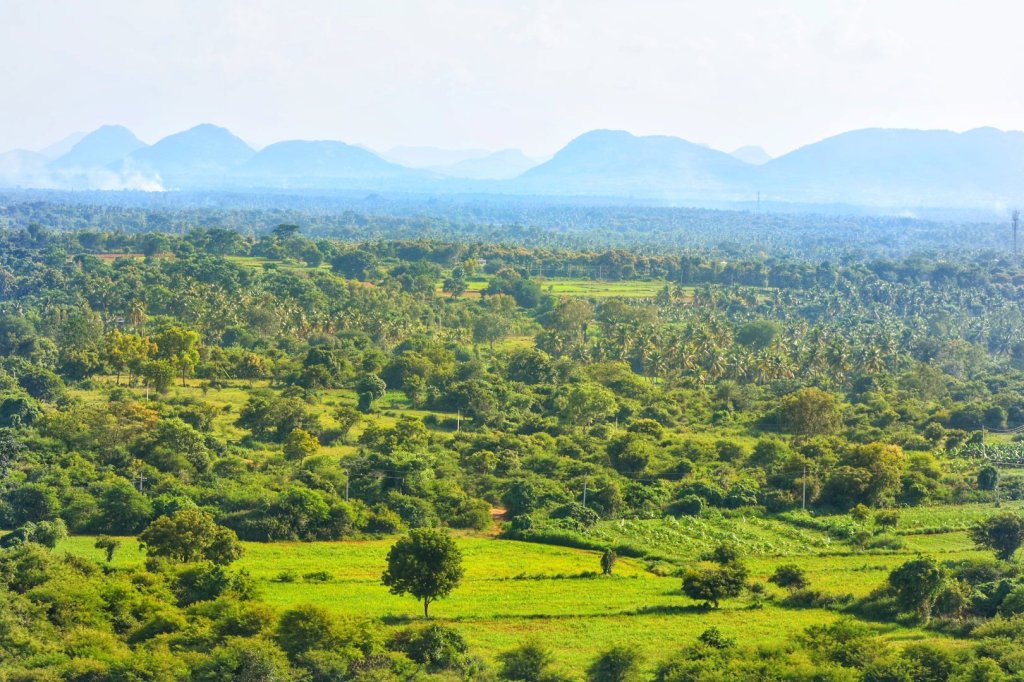
This post is of my family’s random “target destination-less” drive during the Covid unlock period. We set out in three different directions on three separate weekends but reached a place from where we got the view of the same hill, every time. By the shape of the solo hill, we would know that it was the ‘Ragihalli Betta’, located on the fringes of Bannerghatta National park. So, here are the details.

Direction 1: Kanakapura road; Destination explored: Gullahatti Kaval; View: Ragihalli Betta
The aimless drive culminated at a beautiful spot at the backwaters of the Muninagara reservoir in a village called as Gullahatti Kaval (Click here to read the detailed post). The route was mainly through millet and Banana farms dotted by small hamlets.

The road leading to Yogavana Betta, from Kanakapura road

Direction 2: Bannerghatta road; Destination explored: Koratagere Doddi; View: Ragihalli Betta
An offroading drive through Ragihalli state forest, stream crossing, forest trail and then culminating at a viewpoint- was a very welcome drive (Click here to read the detailed post).

View from Yogavana Betta

Direction 3: Mysore road; Destination explored: Yogavana Betta; View: Ragihalli Betta
After passing through small hamlets, an art school and a road with a foresty canopy leading to an ashram called as ‘Yogavana Betta’. We skipped the ashram visit and walked up the hill and climbed up a meditation hall, apparently called ‘Anubhav Mantapa’ to get a 360deg view of the surrounding. One of the views from atop was the Ragihalli Betta. Apart from a casual walk in the green neighborhood, there was nothing specific to do here. But it is a DEFINITE recommendation for those seeking a good ‘Sunset View’ point. Watch the below video of this place and the view surrounding this place.

Yogavana Betta

The little Kabini of Bangalore- Gullahatti Kaval

It has been nearly 3 months of staying at home due to the nationwide lockdown and the fear of the pandemic. With India’s unlock 1.0 in place, our family of four decided to take a short drive outside to breathe some new air. We planned to head to ‘Mango Mandi’ at a village called Somanahalli, off Kanakapura road for this weekend. As we reached there, we learnt from the locals that the government run fruit trading market has been shifted elsewhere for social distancing purposes. However, buying mangoes was just a reason for us to go out and the idea was to go “somewhere” outside home.

This reminds me of some old travel tales of my family. On weekends, my parents used to take us to Majestic bus stand from where we would board a random bus to a destination, that we had unheard of. Back then, BMTC buses plied with boards called red-board and black-board. Red-board for villages outside the city limits and Black-board for those very much within the city. We would sit in just any Red-board bus and buy a ticket to “the last stop”. Most people (Villagers travelling to and from the city) on these routes used to be familiar with the drivers and conductors. Hence, on issuing the ticket to the last stop to us, the conductor would enquire “Whose house we were visiting or where we wanted to go in the last stop”. We used to then get into a conversation with them and get details about the village we would reach at the end of our journey. We would then walk around these villages, appreciating the lung space, learning about new crops, new traditions in the countryside etc. We had thus explored “Remote” villages like Kumbalagodu (coffee plantations), Begur (the oldest Kannada inscription), Hesaraghatta (horticulture & animal husbandry farms), Gollahalli (so many varieties of Gollahallis in different directions of Bengaluru), Harohalli (so many varieties of Harohallis in different directions of Bengaluru), Haniyur (Madure Shani mahatma temple), Devanahalli (Tippu’s fort) etc. Come today, Bengaluru has grown to ‘Bruhat Bengaluru’. People would laugh at you if you called some of these places remote. Why that… even the house where we live now had once been our destination on one such Red-board bus journeys!

20200606_1236438927760731606625895.jpg
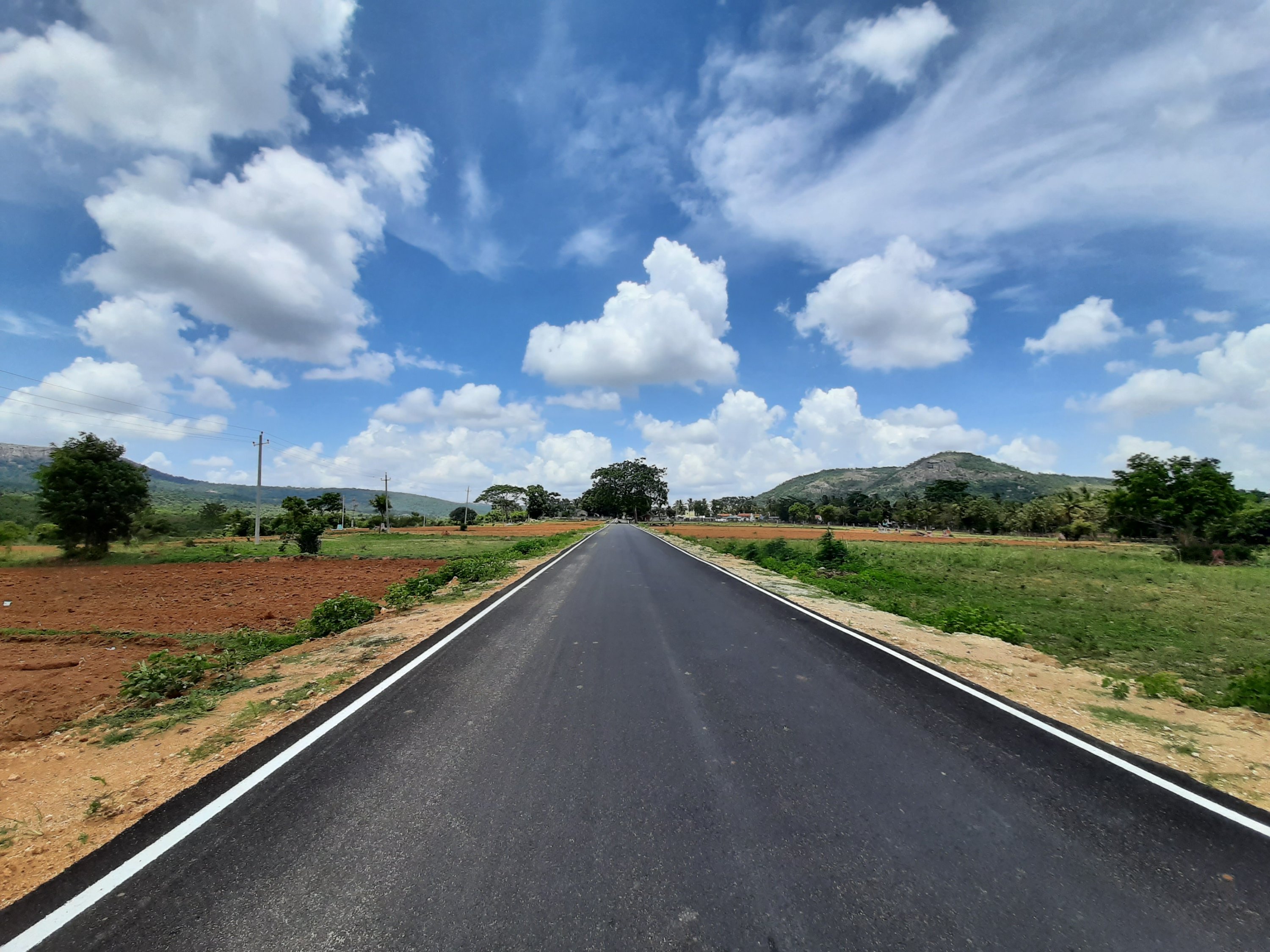
The road between Mukkodlu to Gullahatti kavalu

Back to this weekend of Unlock 1.0, we decided to continue on the road that we were driving until we reached the dead end. And that’s how we reached a village called ‘Mukkodlu’. The name of the village came as a surprise as there exists another village of the same name, back in my native district. The red soil of the farmland was being ploughed all along our route and readied for sowing Ragi millet during the monsoon. The clouds looked amazing with newly laid asphalt road. The green hills complimented the scene well, with ‘Munikallu betta’ to the right and ‘Ragi halli betta’ on the distant left. A little further from there exists the Muninagara reservoir. We thought we would stop by this place on our return.

The reservoir and beyond comes under the supervision of the forest department, a sub-division of the Bannerghatta National park. We proceeded further to know where the milestone indicated ‘1km’ – Gullahatti Kavalu. That also happened to be a ‘Dead end’ on Google maps, from where we would return. Also, the idea of our drive was to not meet any villagers or eat at any petty shops which we normally did on such trips. When we reached our destination, the end of the village was marked by a peepal tree and a government school. The ‘Arali katte’ are arenas buzzing with life and a hub of activities on a usual day in the Indian villages. This one here, was staring at us with all villagers confining themselves to their homes for social distancing. We sat there for some time, soaking in the fresh air on the fringes of Bannerghatta National park before returning.

20200606_1316215320828509429076132.jpg
The dead end point at Gullahatti kavalu

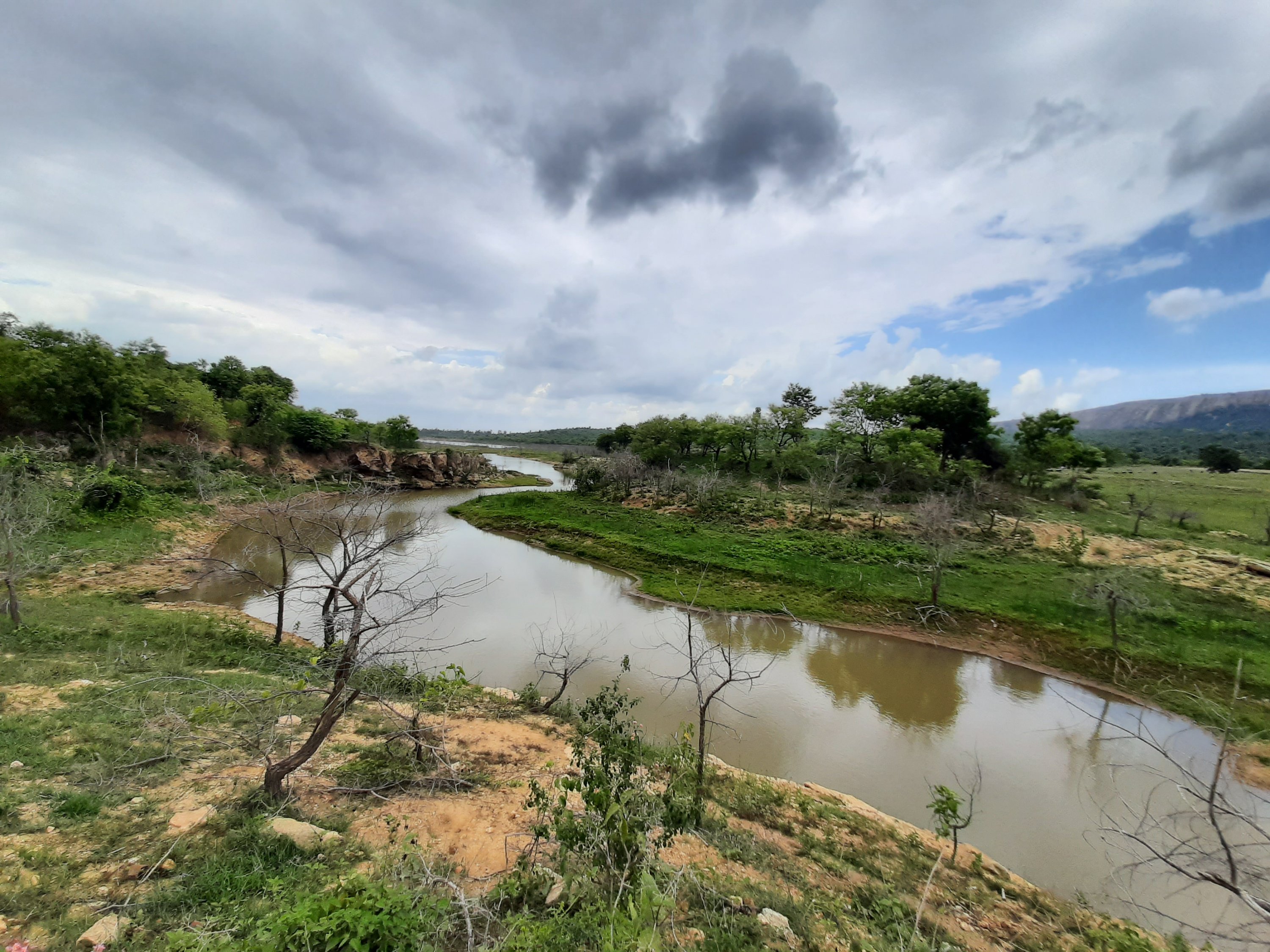
On our way back, we decided to stop at the sight of the reservoir. My itchy feet wanted to hike a bit and I dragged my folks along with me for a few meters away from the road. It was indeed a good decision. Considering we were in the fag end of summer, the reservoir still held a good amount of water. A localite who had come there to graze his cattle told us that wild animals like elephants, leopards, deer, peacocks, wild boars, porcupines etc. are spotted here in the mornings and on most other occasions. At the first sight, it seemed to me like the Kabini backwaters. Kabini is like a summer resort for all wild animals. When all water bodies within the forest run dry, this spot holds enough water and all animals come here to chill in the summers. The fact and the view of Muninagara reservoir too gave me a similar feeling. We sat there for some time until the rain gods showered blessings on us.

20200606_1352147329772729395054691.jpg
The Muninagara reservoir with Ragihalli hill in the backdrop

Thus, a day in India unlock 1.0 was well spent.

Note:
For the adventurous ones, there exists a trekking trail called ‘Muni nagara trails’ on google maps starting from the reservoir to the Ragihalli betta. But ensure that you have all permits in place before venturing on a trek here. As afore mentioned, this area belongs to the Karnataka forest department.