All posts by thelostlander

Experiences from the Indian roads

All you need to know about Girivalam

What is Girivalam?

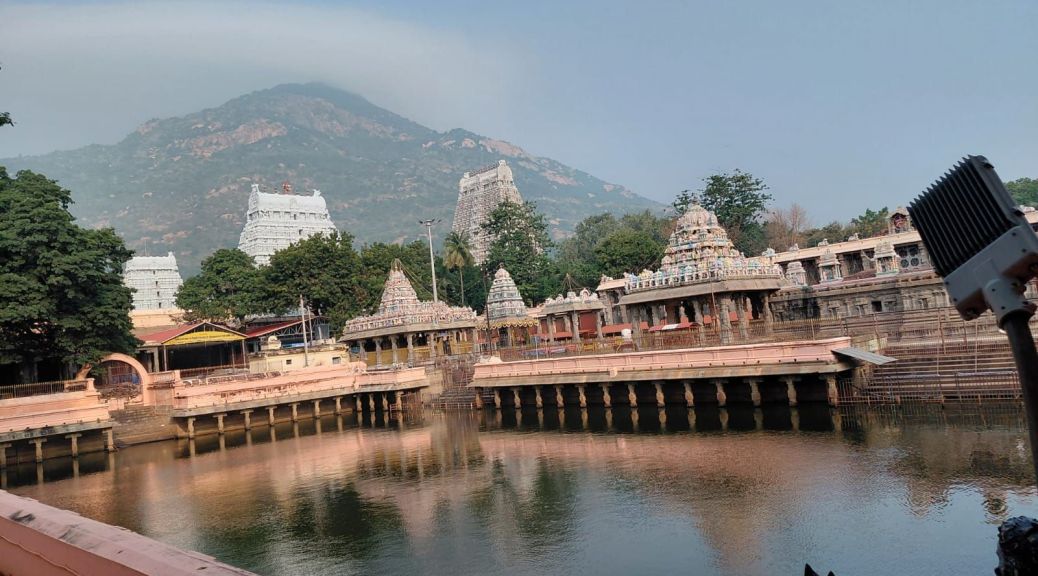
Mythology has it that Brahma and Vishnu got into an argument over their supremacies and finally sought Shiva’s help to resolve the issue. Shiva then created a cosmic column of fire and asked Brahma and Vishnu to find the end of the fire. Whoever found its end would be declared as the supreme god. Bramha went towards Akaasha and Vishnu went towards Pathaala to find the top and bottom ends respectively. However, both returned unsuccessful, thus renouncing Shiva to be supreme. This place came to be called Arunachala hill or Tiruvannamalai. The name of the hill is derived by combining three Tamil words, Thiru- meaning sacred, Vann meaning fire, and Malai meaning mountain, thus meaning “the holy fire mountain”.

Girivalam, also called as Giri Pradakshina is a combination of two words, ‘Giri’ meaning mountain and ‘Valam’ meaning circumambulation. It is a sacred walk covering an approximate distance of 14-kilometer in the clockwise direction around the Arunachala Hill in Tiruvannamalai town of Tamil Nadu. Since the hill is considered a physical manifestation of Lord Shiva, conducting the Giri Pradakshina is believed to offer spiritual purification and liberation.

To commemorate the day of establishing Shiva’s supremacy, a large bonfire is lit atop the hill during the Karthika month of the Tamil calendar. This Karthigai Deepam lit on the previous night of the full moon symbolizes Shiva’s cosmic fire and burns continuously for the next eleven days attracting millions of devotees from all over for this annual festival.
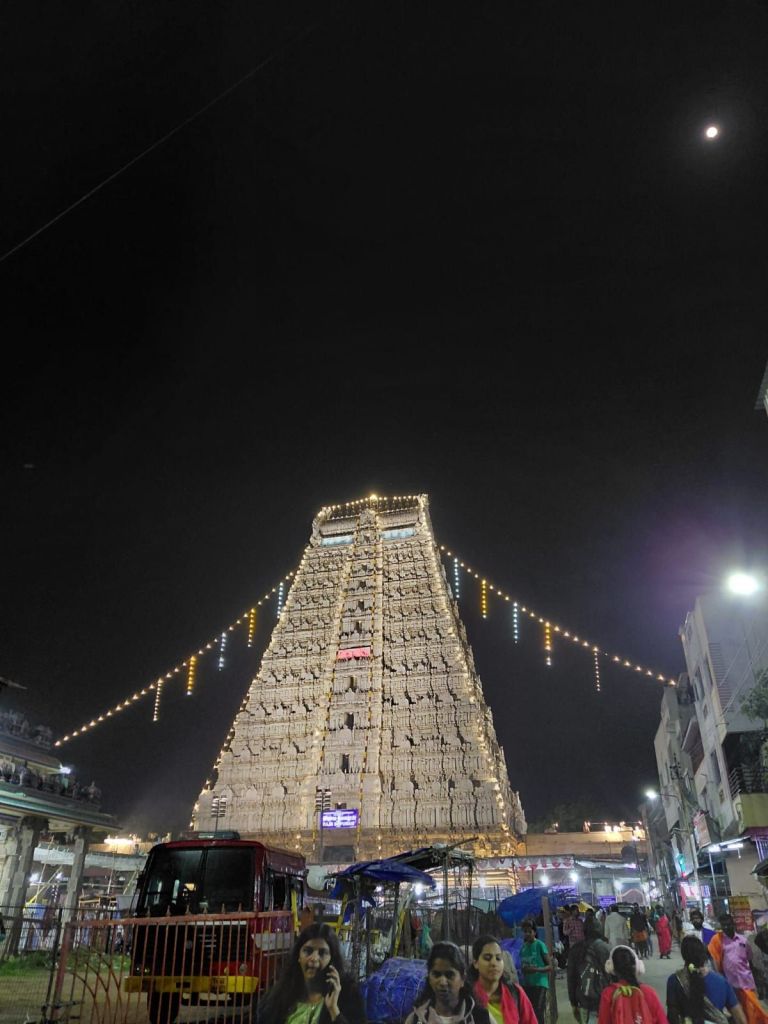
The Rajagopuram on a full moon night of Karthika month

How to do Girivalam?

  • The Pradakshina must start and end at the same spot, usually at the east entrance tower of the Arunachaleshwara temple located at the foothills.
  • Start the Pradakshina by visiting the Kalabhairava and Ganesha shrines, followed by breaking a coconut in front of the east Gopuram of the Arunachaleshwara temple.
  • Traditionally done barefoot, it is not wrong if one opts to wear just socks or footwear during the walk and removed before entering the temples passing along the path.
  • A visit to the Ashta Lingam shrines and other significant temples along the way is believed to enhance the benefits.
  • Girivalam can be conducted on any day and time of the year. However, offering it on full-moon days is considered more auspicious.
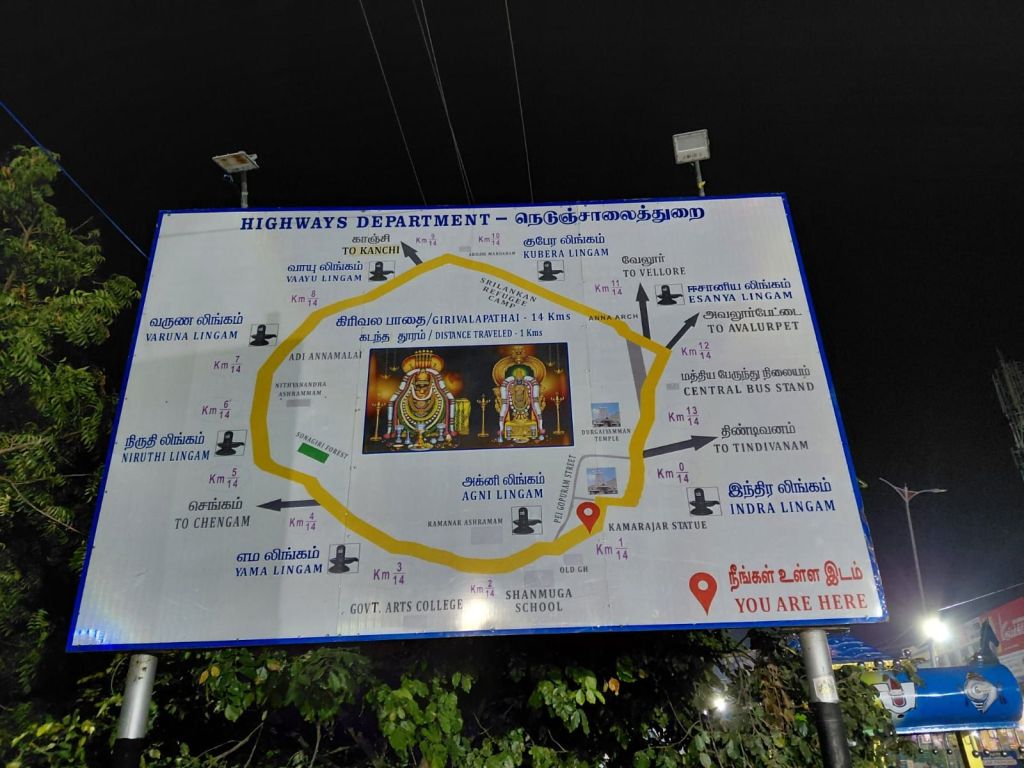
The Girivalam route map

When did I go?

Since my friend and I had been contemplating doing Girivalam for a very long time, it was a spontaneous decision to perform it as the last full-moon day of the 2025 calendar year, and a weekend had arrived together. Coincidentally, it also happened to be the Karthika Month and hence, the Karthika deepam would be lit over the eleven-day period.

We chose to go there on a Friday, which was a day after the full moon, assuming that the crowd of the full moon day would have subsided and the weekend crowd wouldn’t have poured in yet. It turned out to be a smart decision.

We also got lucky that we saw the flames deepam atop the Arunachalar hill, all the décor of the town and all the decoration inside the temple that had been done for the annual festival.

How did I go?

  • There are plenty and frequent public buses run by Karnataka and Tamil-Nadu Road transportation services. We boarded a TNSRTC bus onwards to Tiruvannamalai and KSRTC bus for our return to Bangalore, both without prior bookings.
  • We arrived at Tiruvannamalai at around 07.00.p.m. had a filling dinner and retired early at a hotel we had pre-booked close to the east tower of the temple.
  • We started our pradakshina by around 03.45.a.m. and finished it by 08.00.am.
  • We stood in the ticketed queue for Darshana and were done by noon we ate temple prasada (more like brunch).
  • We then checked out of our hotel and reached Bangalore by night.
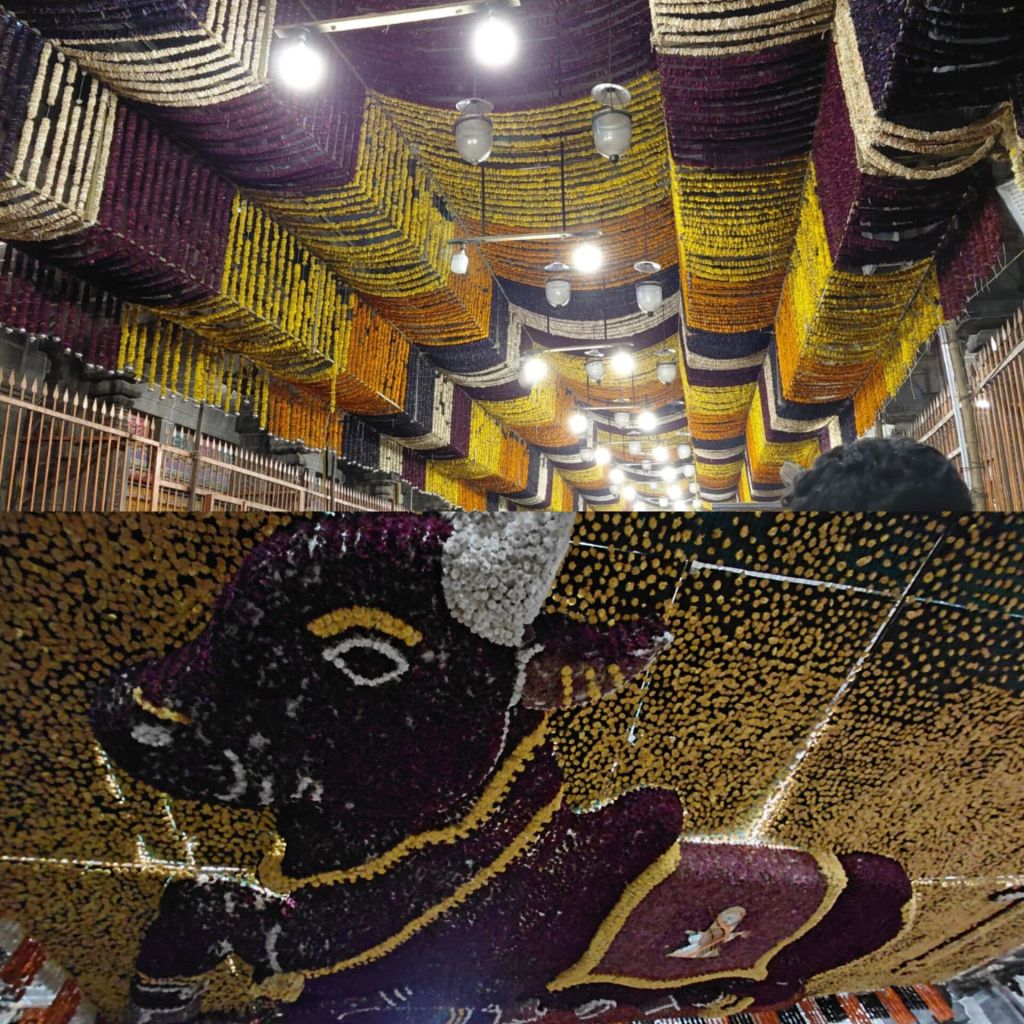
The flower decoration on the inside of the Arunachaleshwara temple on occasion of Karthika deepam

Some tips from my first Girivalam experience

  • The temple closes at night and opens by 06:00. a.m. and there will be a long queue for the Darshan. Hence, it is best advised to reach the temple gate as early as possible to get the earliest darshan with the shortest queue.
  • It is best to do the Pradakshina after sunset and finish it before sunrise to avoid the blazing sun- but also time it well to be able to visit the Ashta Lingams while they too are open.
  • I highly recommend buying the 50Rs. special entry ticket to reduce the walking distance in the queue and thus a faster Darshana.
  • Book a stay as closer to the East Gopuram as possible. This will help to reduce the overall walking distance and ease the accessibility to the Girivalam path.
  • I chose to skip going through the Moksha dwara, a small structure along the path. The queue was extremely long.
  • If possible, offer small donations to as many sanyasis and beggars sitting along the path. It will enhance the benefits of your prayers.
  • There are ample food stalls, water stations and clean public toilets all along the way to keep you going. However, we chose to break our fast only with the temple Prasada after the Darshana was completed.
  • The entire walk will be on an asphalted road / paved footpath. So, expect littering to be normal.

Other noteworthy things to do and places to see during Girivalam

  • Do not miss eating the Pongal and Puliyogare (Tamarind rice) at the paid prasada counter at the exit of the temple. It tastes delicious.
  • Check the timings of the free meals served at the Ramanashram, or simply pay a visit there to experience calmness.
  • You can walk a small distance from the Skandashram to reach a viewpoint where you can see the entire temple premise and Gopurams from.
  • Do not miss the Rudraksha beads distributed for free by volunteers anywhere along the Girivalam path.
  • The deity and the structure of the Ardhanareeshwara temple were unique.
  • Observe how the direction of the Nandi changes in each temple depending on the direction of the holy hill with respect to the location of the Nandi, it always faces the mountain: The Arunachalar.
  • If you’re visiting Tiruvannamalai anytime after ‘Arudra Darshana’ (next full moon after Karthika Deepam, Do not miss collecting the holy Arudra Kajal / Kohl from the temple. It is made from the soot formed by the ‘Karthika deepam’ itself and will be distributed until stocks are available each year.
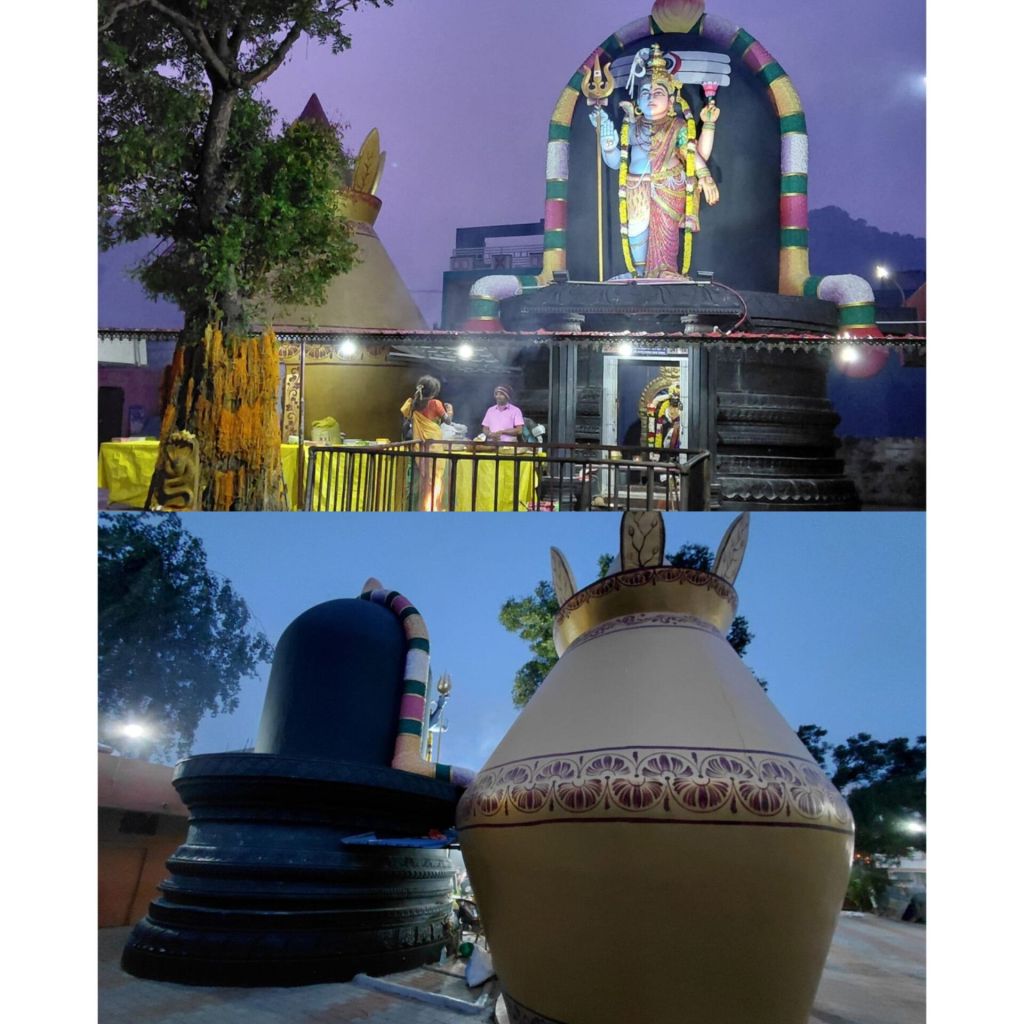
The front and back view of the Ardhanareeshwara temple

Do you have anything to share or ask about Girivalam? Comment below.

My 7-Day Thailand Travel Itinerary With TripFactory

Traveling to Thailand was one of my biggest dreams. For many years, I wanted to see its beautiful beaches, temples, and night markets. A few months ago, I finally decided to make it happen. After checking many websites and reading reviews, I booked a Thailand tour package with TripFactory. It was one of the best choices I have ever made!

I opted for a 7-day all-inclusive itinerary that covered flights, accommodation, meals, local transfers, sightseeing, and even a friendly tour guide. I didn’t have to worry about anything. From the moment I landed in Thailand to the time I took my flight back home, TripFactory took care of everything perfectly.

When I reached Bangkok airport, the TripFactory team was already waiting for me. They helped me with my luggage and took me to my hotel. The hotel impressed me with its cleanliness, comfortable beds, and respectful, welcoming staff. After some rest, I walked around the nearby streets to explore Bangkok on my own. The city was bright, busy, and full of energy. I tried the street food, including Pad Thai and mango sticky rice, and loved every bite!

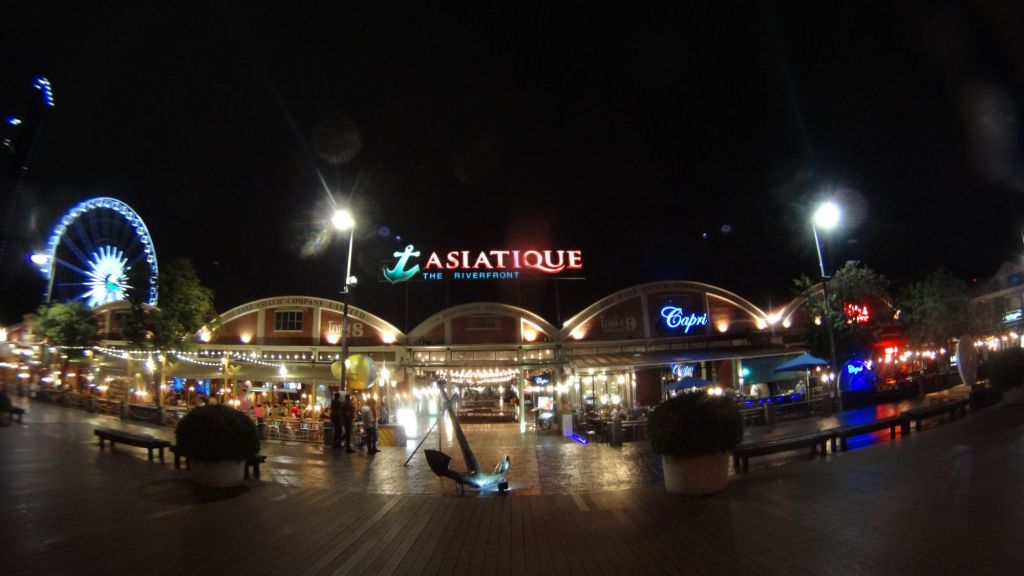
Asiatique riverfront

Day 2: Exploring Bangkok’s Temples and Markets

The next morning, our guide took us for a Bangkok city tour. We visited famous temples like Wat Arun (the Temple of Dawn) and Wat Pho, where I saw the huge golden Reclining Buddha. The guide told us interesting stories about Thai history and culture in simple English, so everyone could understand.

In the afternoon, we went shopping at the Chatuchak Market, one of the biggest in Asia. I bought souvenirs, clothes, and some local snacks. We spent the evening cruising down the Chao Phraya River, admiring the sunset and soaking in the calm atmosphere.

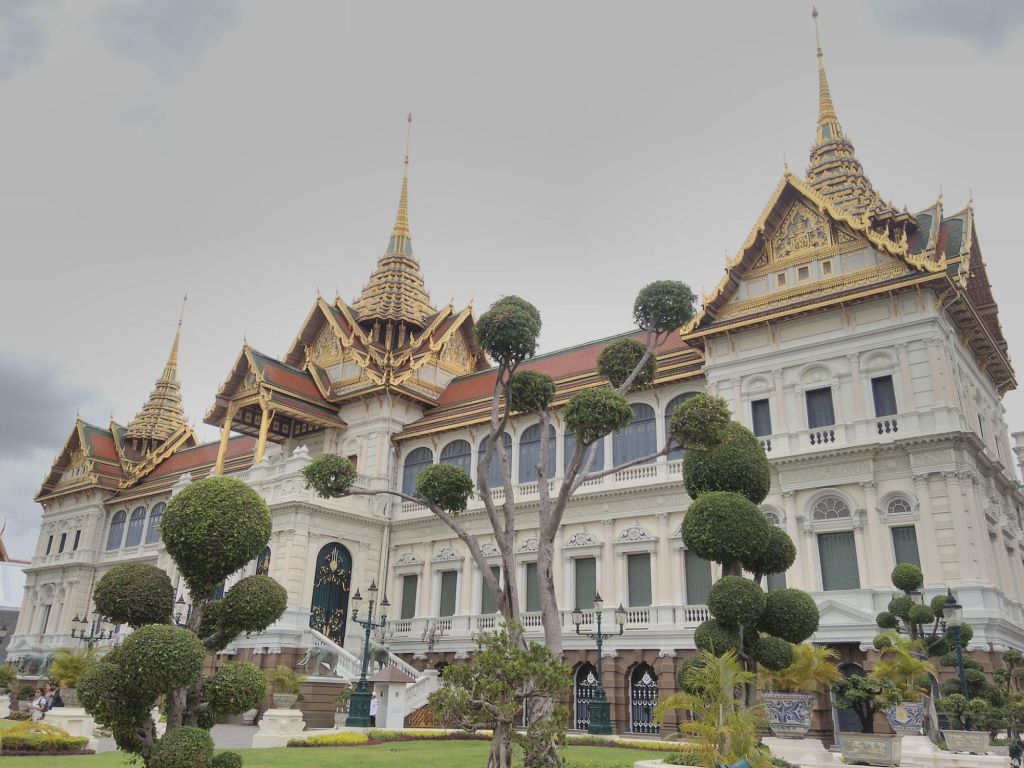
The Royal palace, Bangkok

Day 3: From Bangkok to Pattaya

After breakfast, we traveled to Pattaya, a lively city by the sea. The drive took about two hours and was very comfortable. When we arrived, we checked into another nice hotel with a sea view.

In the evening, we went to the Pattaya Viewpoint, where I saw the whole city shining with lights. Later, we watched the Alcazar Show, a colorful performance full of dance and music. The costumes were beautiful, and the show was full of energy. It was the perfect end to the day.

Day 4: Coral Island Adventure

This was one of the most fun days of my trip! After breakfast, we took a speedboat to Coral Island. The sea was bright blue, and the sand was soft and white.

I tried parasailing and jet skiing for the first time. It was so exciting to fly above the water and feel the wind on my face. Then, I relaxed on the beach, enjoyed some fresh coconut water, and swam in the sea. At a restaurant by the beach, we enjoyed a simple Thai meal that was absolutely packed with taste.

In the evening, we returned to Pattaya, and I took a walk along the beach before dinner. The sound of the waves and the cool breeze made me feel completely relaxed.

Day 5: Traveling to Phuket

After breakfast, we flew to Phuket, one of the most famous islands in Thailand. As soon as I arrived, I could feel the calm and beauty of the place. Our TripFactory-arranged hotel was charming, with palm trees all around and the beach only steps away.

That evening, we visited Patong Beach, which was full of life, music, and food stalls. I had dinner at a seaside restaurant and watched the sunset. The orange and pink sky looked magical.

Day 6: Phi Phi Island Tour

This was my favorite day of the whole trip! Early in the morning, we took a speedboat to Phi Phi Islands. The journey was very beautiful, the sea looked light blue and we crossed tall stone cliffs and green islands.

We stopped at Maya Bay, one of the most famous beaches in the world. I took so many pictures because every view looked like a postcard. Then we went snorkeling in the clear water and saw colorful fish and coral reefs.

We had lunch on one of the islands, and it was delicious with fresh fish, rice, and fruit. Everything was perfectly organized, so all we had to do was enjoy.

When we returned to Phuket in the evening, everyone was tired but very happy. I ended the day with a Thai massage, which was relaxing and refreshing after all the travel.

Day 7: Saying Goodbye to Thailand

On the last day, after breakfast in the hotel, I went to buy souvenirs like small gifts, handmade bags, and Thai food items. The TripFactory team helped with my airport transfer right on time.

As I sat on the plane back home, I felt thankful for such an amazing trip. Every day was full of joy, new experiences, and great memories.

I booked my trip with TripFactory after reading their excellent Google reviews. They have a rating of 4.3 out of 5 stars with over 3700+ reviews. After my trip, I can say those ratings are well deserved.

Their service was always on time. Pickups, hotel check-ins, and tours all happened just like they planned. The staff was friendly, and the guide was patient and spoke clear English. Whenever we needed help, they were just a phone call away.

Most importantly, I felt safe and comfortable throughout my trip. As a solo traveler, that really mattered to me.

After returning home, I couldn’t stop talking about my Thailand adventure. My friends loved the pictures I showed them of the beaches, temples, and bright streets. Many of them were so inspired that they started planning their own Thailand trips with TripFactory!

This 7-day trip was worth every single penny. It gave me new experiences, new friends, and beautiful memories that I’ll cherish forever.

My Thailand vacation with TripFactory felt very special. It was truly an experience of a lifetime. Everything was perfectly arranged, from the hotels to the tours. I explored three wonderful cities: Bangkok, Pattaya, and Phuket. Each city was beautiful and different.

If you’re thinking about visiting Thailand and want a smooth, stress-free holiday, I highly recommend TripFactory. They keep their word by giving excellent service, comfort, and memories you will never forget.

Thailand taught me that travel is not just about seeing new places; it’s about feeling alive, learning new things, and creating memories that stay in your heart forever.

Kashmir Great Lakes Trek – Cost, Best Time, Route & Highlights

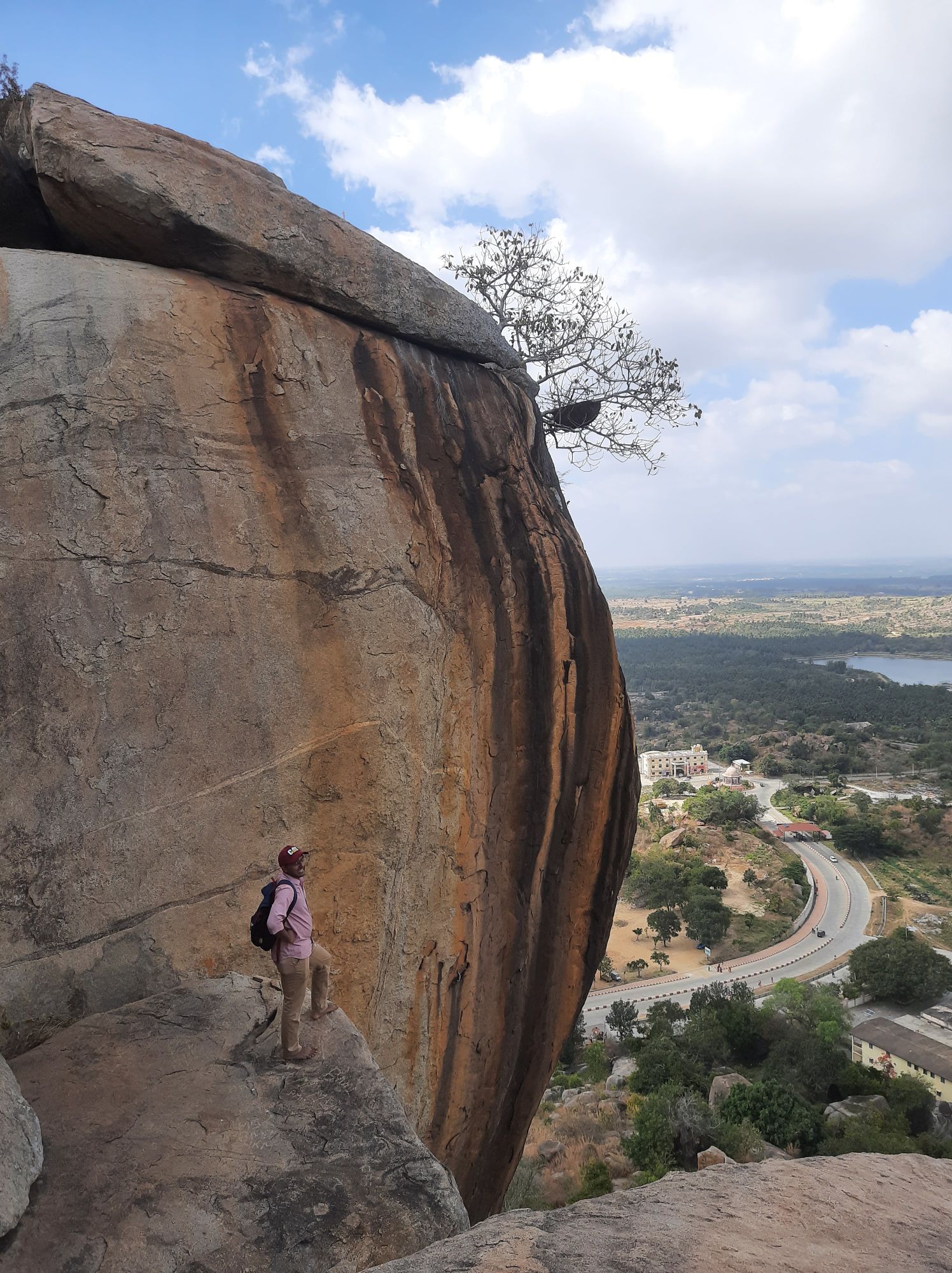
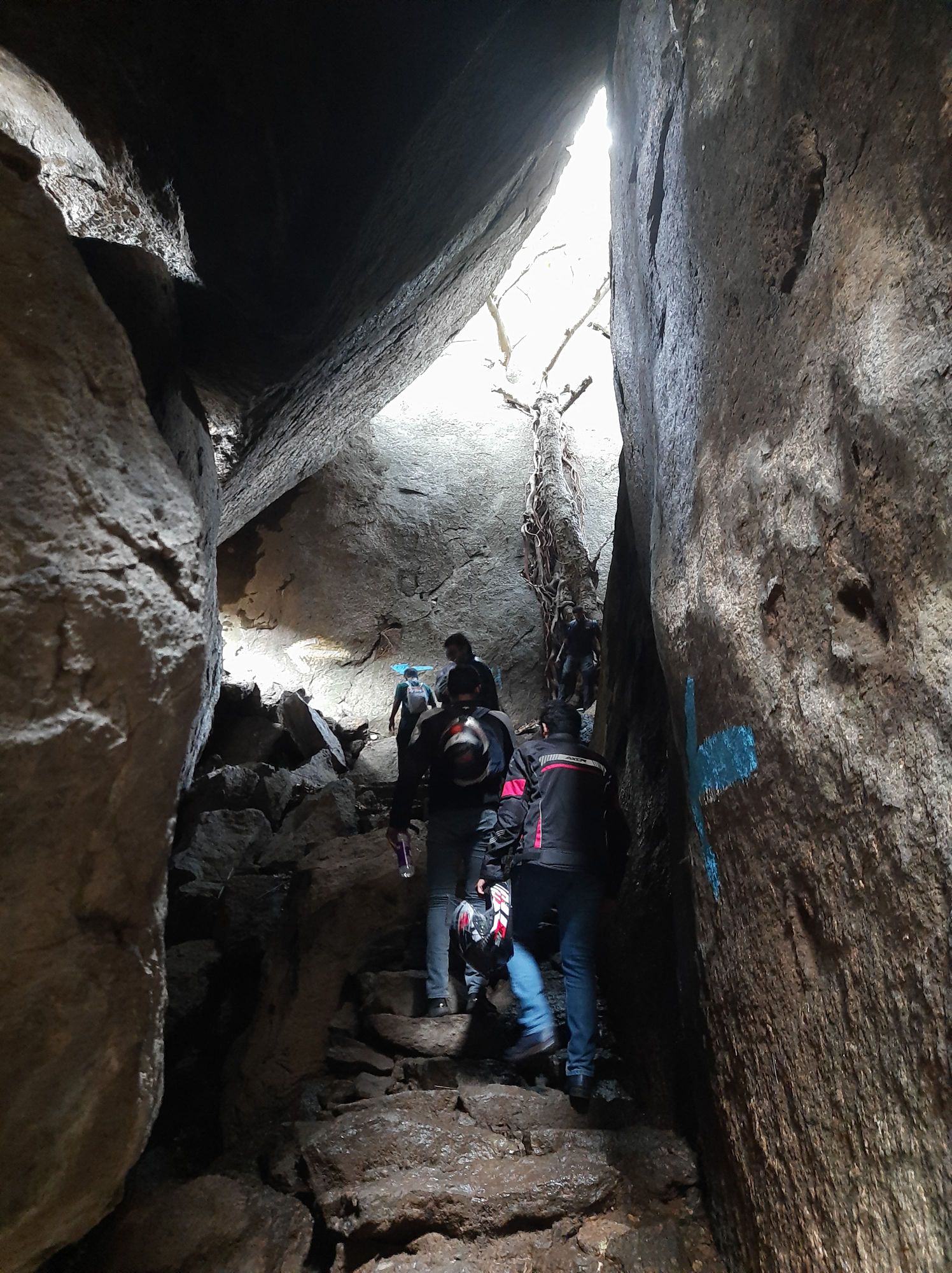
The Kashmir Great Lakes (KGL) trek is widely regarded as one of India’s most spectacular high-altitude circuits. Rolling alpine meadows, jagged granite ridges, and a string of emerald and turquoise lakes make this route feel like walking through a painter’s brightest palette. Great Lakes of Kashmir is a classic 7–9 day trek that usually takes trekkers from Sonamarg to the Naranag valley (or the reverse), crossing several high passes and visiting lakes such as Vishansar, Krishansar, Gadsar, Satsar and Gangabal.

This guide covers the route, daily plan, difficulty, best season, permits and safety, gear, food and packing, acclimatisation and practical tips so you can plan and enjoy the Kashmir Great Lakes trek with confidence.

  • Typical duration: 7–9 days (6–8 days of trekking).
  • Typical distance: ~65–75 km depending on start/end points and exact route.
  • Maximum altitude encountered: ~4,200–4,300 m (Gadsar / Nichnai passes). Most camps lie between 3,500–3,900 m.
  • Difficulty: Moderate to difficult (long days and 1–2 steep passes; not technical but physically demanding).
  • Best months: Late June to early September (peak July–August).

What sets KGL apart is the variety compressed into a single circuit. In a week you move from thick forest and pastoral Sonamarg meadows to barren moraines and dramatic glacial basins. Each lake has its own character — Vishansar’s wide shallow shores, Krishansar’s twin lake views, the dramatic bowl around Gadsar and the grand Gangabal beneath steep cliffs. The landscape changes day by day, making every campsite feel like a new world. Many trekkers call it a once-in-a-lifetime trek for the views alone.

This is a standard itinerary many operators and independent trekkers follow. Distances and times vary by pace and route choice.
Day 1: Srinagar to Sonamarg
Arrive in Srinagar and drive (~2–3 hours) to Sonamarg. Final gear checks, stay in a guesthouse or camp at Sonamarg (2,700–2,800 m).

Day 2: Sonamarg to Nichnai (~10–12 km, 6–8 hrs)
The trail climbs out of Sonamarg through meadows, forests and the Shekdur stretch before arriving at the high pasture of Nichnai (~3,500 m). There may be an army checkpost where ID is required.

Day 3: Nichnai to Vishansar Lake (~10–14 km, 5–7 hrs)
Cross the Nichnai pass (often ~4,100–4,150 m depending on route), then descend and reach Vishansar lake (~3,650 m). A spectacular first high-altitude lake.

Day 4: Vishansar to Gadsar (via Gadsar Pass) (~16 km, 6–8 hrs)
A long but rewarding day: ascent to Gadsar Pass (~4,200 m) and then a descent to the turquoise Gadsar Lake. Gadsar is in a sharp amphitheatre of cliffs and often has ice in early season.

Day 5: Gadsar to Satsar (~11–12 km, 4–6 hrs)
Cross rolling meadows and reach the Satsar lakes — a cluster of multiple small lakes — with scenic campsites.

Day 6 : Satsar to Gangabal (via Zaj or other pass) (~9–12 km, 5–7 hrs)
Cross the pass (sometimes called Zaj or another local saddle) into the Gangabal basin and camp by Gangabal Lake below Mount Harmukh. Gangabal is one of the most dramatic high-altitude lakes in Kashmir.

Day 7: Gangabal to Naranag / Thajiwas valley (~10–14 km)
Descend to Naranag, meet transport and drive back to Srinagar. Naranag has historical temple ruins and is a popular exit point.

Note: Many operators add a buffer day for weather, or extend to 8–9 days to allow lighter daily distances and better acclimatisation.

Kashmir Great Lakes Trek is not a technical climb since you won’t need ropes or glacier travel skills on the usual route but it is a sustained high-altitude Kashmir Trek with long ascents and descents. Expect:

  • Daily walking of 5–8 hours on varied terrain.
  • Two or three high passes around 4,000–4,250 m (steep sections, loose scree on approaches).
  • Nights at 3,500–3,900 m, so altitude symptoms are possible.

Fitness prep: a few weeks of aerobic conditioning (brisk walking, stair climbing, light trail runs) and weekend hikes will help. If you’re new to high altitude, allow an extra acclimatisation day (e.g., at Nichnai or a day in Sonamarg), many guided trek agencies like Cliffhangers India include one buffer day in their itinerary.

The trek is seasonal because snow blocks the high passes for much of the year. Late June to early September is the practical window: the snow melts, meadows bloom and passes are mostly passable. July–August are peak months. Trails are busiest then and weather is most stable; monsoon influence is limited compared with the lower Himalaya but occasional storms and afternoon rain/snow at high altitudes can occur. Early June may still have heavy snow; September can be cold with early snowfall. Plan accordingly.

  • Army or local checkposts are common near Sonamarg; keep valid photo ID (Aadhaar/passport/driving licence) handy for checks. Some itineraries require village levies or fees, your operator will handle.
  • Guided groups: using a local, licensed operator with experienced guides is strongly recommended if you’re new to Himalayan trekking. Operators provide tents, meals, porters/ponies and local knowledge of passes and weather patterns.
  • Altitude sickness: know the symptoms (headache, nausea, dizziness, reduced performance). Don’t push through progressive symptoms, descend immediately and seek medical help. Carry a basic first-aid kit and consider medications like acetazolamide only after consulting a doctor.
  • Operators provide 3 meals a day (simple, high-calorie trekking food). If self-supported, carry freeze-dried meals or easy staples (oats, pasta, nuts, energy bars).
  • Water: treat with chlorine tablets, purification drops or boil. Streams flowing from glaciers look clean but carry microscopic risks. Carry a 2–3 litre hydration setup; water points are frequent near lakes and streams.
  • Campsites are grassy meadows (pack down if wet); expect cold nights and  sleeping bags rated to at least -5°C to -10°C recommended for safety and comfort.
  • Sturdy trekking shoes/boots (broken in).
  • Waterproof shell jacket + insulated midlayer (down or synthetic).
  • Trekking pants, base layers (thermal if early/late season).
  • Hat, gloves (warm, windproof), sunhat.
  • Sleeping bag (rated to –5°C or lower).
  • SPF, sunglasses (high UV at altitude), lip balm.
  • Trekking poles (hugely helpful on steep descents).
  • Headlamp, spare batteries.
  • Water purification method and 1–2 litre bottles or bladder.
  • Light stove if self-cooking (or plan with operator food).
  • Basic medicines, blister kit, altitude info card.
  • ID and photocopies.

The region is home to mountain fauna (pheasants, marmots, ibex at very high altitudes, and sometimes brown bears in the lower forests).

Respect local wildlife, don’t feed animals, keep a safe distance, and store food properly.

The fragile alpine meadows recover slowly from damage, so follow Leave-No-Trace principles: carry out all plastics, avoid cutting vegetation, use designated campsites and follow toilet protocols (bury waste away from water sources or pack out).

Local communities and park authorities also emphasise low-impact travel.

  • Guided trek: expect a price range depending on services,  basic group treks are cheaper; private departures cost more. Pricing covers transport from Srinagar, tents, cooks, ponies/porters, permits and guide fees. Booking through reputable local agencies ensures safety infrastructure.
  • Independent: possible for experienced trekkers who can source local ponies and cooks, but permits, navigation and emergency response are more your responsibility. For first-timers, a guided trek is the safer, simpler option.
  • Gadsar Pass and Gadsar Lake — dramatic bowl views, turquoise water and cirques: one of the most photogenic spots on the trek.
  • Vishansar and Krishansar — approach views from the pass reveal twin lakes and meadows.
  • Gangabal below Harmukh — large alpine basin with sheer cliffs and reflective water — great for sunrise and sunset photos.

Bring a polarising filter if you shoot and protect gear from sudden drizzle or dust.

  • Pace yourself — better to arrive fresh at camp than collapsed; shorter, steadier steps up and down help.
  • Hydrate and snack — dehydration hides behind fatigue; sip water constantly and eat salty snacks to keep electrolytes.
  • Early starts — weather is most stable in the morning and you avoid afternoon wind or cloud.
  • Practice with poles — they save knees on long descents and steady you on screen.
  • Respect local advice — guides know micro-weather patterns and which days are risky for passes.
  • Check weather and pass conditions with your operator 48–24 hrs before start.
  • Confirm transport and meeting points in Srinagar/Sonamarg.
  • Carry sufficient cash (ATMs are not available en route).
  • Make a small emergency plan: share your itinerary with someone and ensure you know how to contact your operator or local authorities.
  • Pack exactly what you’ll need — light but complete.

The Kashmir Great Lakes trek is not the easiest Himalayan circuit, but with good preparation it is one of the most rewarding. Whether you go with a trusted local operator or plan a careful independent trip, respect the mountain, pace yourself, and soak in the views , the lakes will repay every step.

Beyond the physical challenge, KGL rewards with a sense of wonder: silent mornings by glassy lakes, wildflowers in meadows, the crunch of alpine gravel underfoot and nights under impossibly bright stars. It’s a trek that changes how many people think about scale and stillness, a lasting memory rather than just a checklist. Expect to return quieter, tired and richer in stories.

Exploring Ramnami Community: A Journey into Tradition

Over recent years, my travels across India ignited my fascination with how tattoos hold cultural significance among different Indian communities. In many areas, tattoos serve as symbols tied to tribal customs. One community that particularly intrigued me was the Ramnami of Central India. When I shared this with a friend, she too showed interest in delving deeper into this culture. We eventually connected with a community member who graciously allowed us to visit his village, even inviting us to stay with his family. We happily arranged our visit.

We initially flew from Bangalore to Raipur. From there, we caught a local bus to the GPM district. Subsequently, we explored GPM by taxi, which dropped us off at Chandlidih, the Ramnami village. It was raining heavily as we navigated the damaged, flooded roads and finally arrived at the location indicated by Google Maps. We carried our backpacks while crossing a small reservoir wall built over a stream swollen by the monsoon. On the other side was our host’s house. By the time we reached the front yard of the Ramnami family’s modest home, we were covered in mud from puddles stretching from the parking lot to the house.

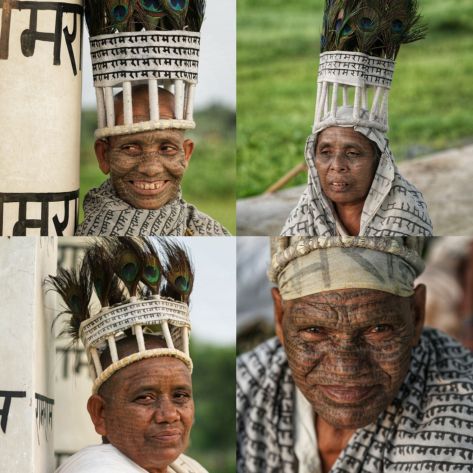
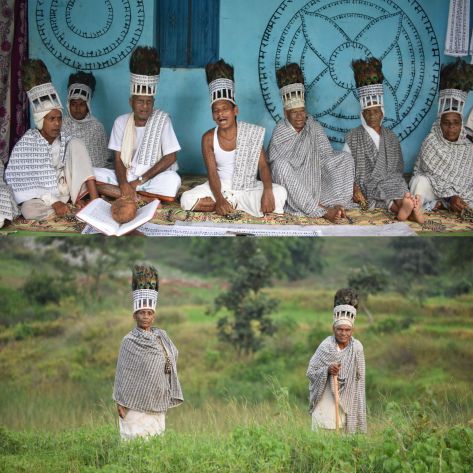
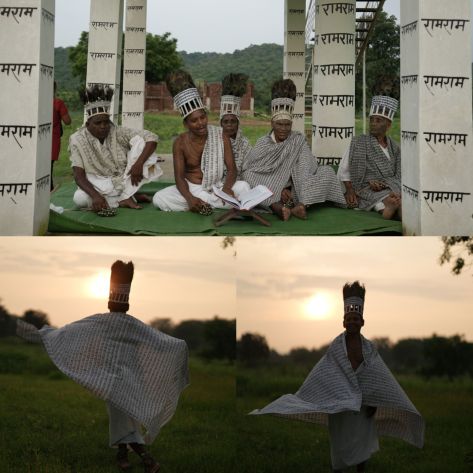
Portraits of the Ramnamis

Our host welcomed us upon arrival and directed us to the guest room to drop off our luggage. The room, an extension of the main house, was built with cob and wood, offering basic amenities such as two beds for resting and a light bulb for illumination at night. We relied on mobile internet throughout our stay. According to tradition, anyone visiting from outside must bathe and cleanse themselves before entering a Ramnami home. The next experience was something my friend and I will both remember for a long time: the bathroom!

It was a simple enclosure with two and a half walls and a roof. Half of the third wall was intentionally built to shoulder height, making it easy to bring in water from outside either with buckets or through a gravity pipe connected to a nearby perennial stream that filled a concrete tank inside the bathroom. The fourth side was left open for easy access, featuring a modest saree stitched into a sliding blind that could be moved to open or close. There was no running water; hot water had to be fetched from an outdoor firewood oven, or one had to make do with the chilly water stored in the tank inside. Our city dwelling bodies were used to a sturdy lockable door for bathing with unlimited hot water from a tap or shower. While the cold-water setup was tolerable for my outdoor spirit, I could not imagine standing unclothed inside a doorless bathroom.

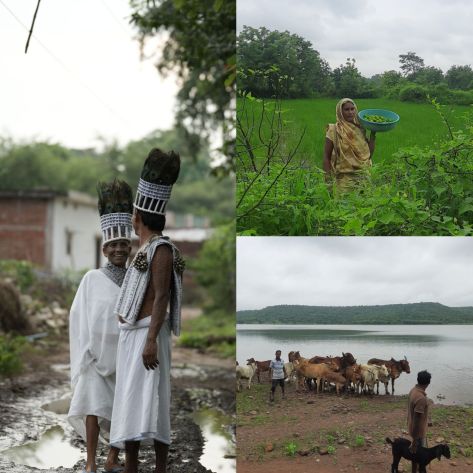
The Ramnami Community

If I were hiking, I could go days without bathing, but here, it was crucial to start our trip by experiencing the Ramnami culture. Hesitantly, I took off my clothes and poured a couple of mugs of water, just as I heard giggles outside. I paused to check if I was imagining things or if it was real. Soon, I saw the shadows of a few kids moving behind the curtain. As I began applying soap, I saw two toddler heads peeking in from the sides of the curtain, giggling again. I panicked, yelled my friend’s name, and hoped she would come to help. She got scared and ran over to see what was wrong. I told her about the curious kids, and she decided to stay at the bathroom entrance until I finished. Later, I returned the favor.

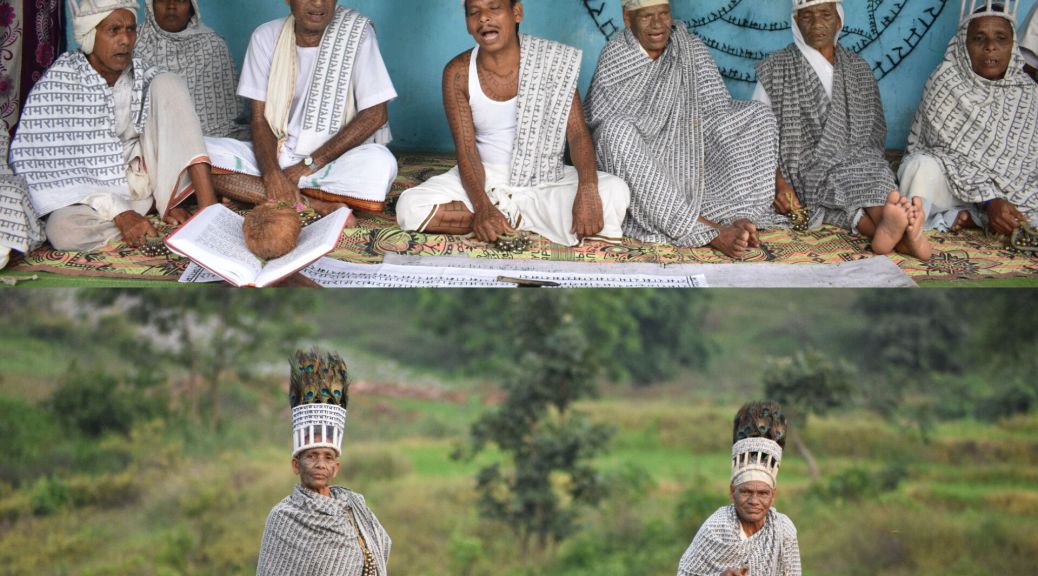
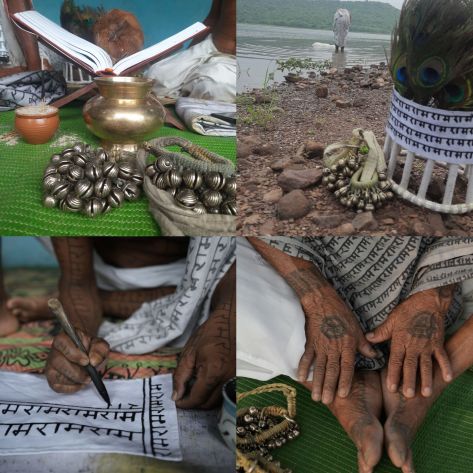
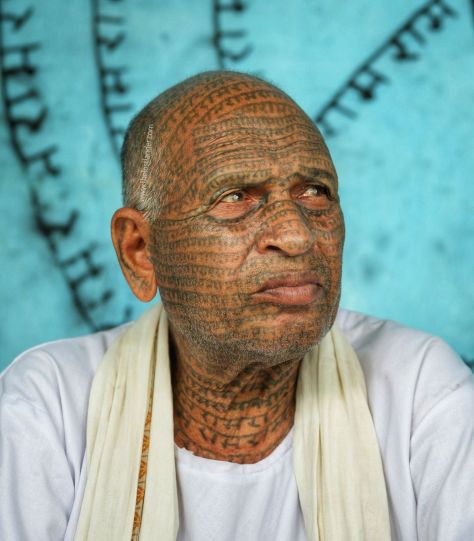
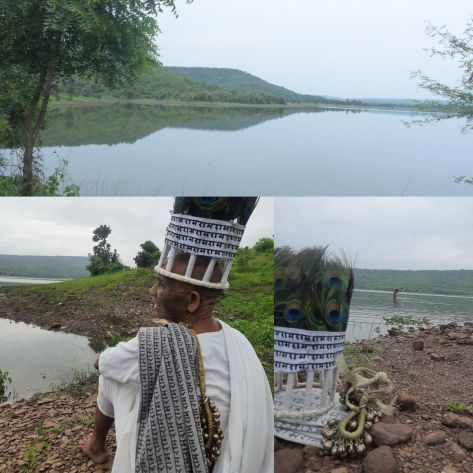
After changing into fresh clothes, my friend and I headed to the porch of their house, where the entire family had been singing hymns of Lord Ram since sunrise, even before we arrived. We greeted them with a coconut and some fresh flowers, which we were asked to bring as part of their tradition of introducing a new guest to the family. Most adults had tattoos reading ‘Ram-Ram’ in Hindi covering their bodies. Some had full-body tattoos, while others had only face, arm, or forehead patches. They all wore pure white clothes handwritten with ‘Ram-Ram’ patterns. Their Dhotis, shawls, and headgear featured the same ‘Ram’ writing in a consistent style. The handmade headgear, unique to the Ramnami, was decorated with peacock feathers. All participants in the Ram bhajan carried strings of small jingling metal bells, each stamped with ‘Ram’ during casting.

We introduced ourselves and joined their Bhajan until lunch was served. I savored a simple Satvik meal made with ingredients from their farm. The faint aroma of firewood used in cooking enhanced the local flavors with a divine touch.

Daily utility items and life of the Ramnamis

We traveled without a fixed schedule, aiming for a slow, immersive experience of this community’s daily life. After lunch, my friend and I joined members singing Ram Bhajans on the porch to understand what defines the Ramnami. We were transported back to the 1890s to learn about their history. Like the rest of India at that time, casteism barred lower castes from entering shared places of worship. Some rebelled by declaring their bodies as temples dedicated to Ram, tattooing the Ram-Nam (Lord’s Name) with a locally made ink derived from herbs. They formed the Ramnami community. A senior member leads events, whether a baby’s birth or a funeral. Their greetings and farewells are solely marked by singing Ram-Bhajans, even during major life events like marriages. They do not conduct any Brahminical rituals, poojas, or havans as part of their practices.

A portrait of a Ramnami community member

With the rain gods commanding the skies and earth, we saw them prepare their shawls, made from woven, stitched white cloth they crafted themselves. These shawls were then covered with Ram-Nam. After carefully observing them write with their native ink for a while, we joined in to write on some of the other pieces. Once finished, they set them aside to dry, initiating a series of procedures to prevent the white cloth from bleeding black.

A walk through Ramnami village

When the rains stopped, our host guided us through their village. We crossed a stream, carefully walked along the paddy field edges, and eventually made our way along muddy, winding roads. We met several members of the Ramnami community, mostly relatives or neighbors from the same village. We greeted women working in the fields and enjoyed coffee at welcoming houses. Later, we visited JayaStambh, a small monument commemorating the annual Ramnami mela held here a few years prior. Some older community members joined us there at sunset, singing Ram bhajans as a tribute to the setting sun. Afterwards, we visited a small reservoir across the lake. The Ram Bhajans, sung warmly around a bonfire, echoed over the calm water, with the sky changing colors dramatically until nightfall.

The evening prayers at the Ramnami Jayastambh

We walked home carefully through the night darkness to avoid slipping on the slush. After a satisfying dinner, we drifted into a peaceful, childlike sleep, concluding a long and exhausting day.

The following morning, we rose early to witness a normal day in the life of the Ramnami. We went to the reservoir with the elder members of our host family, who offered prayers to the sun god and recited blessings before their water dip. After changing into clean clothes, they went back home to continue household tasks such as cleaning, preparing food, and having breakfast.

The morning at the Chandlidih reservoir

Spending time at a Ramnami home offered a genuine glimpse into a culture that is remarkably different from the rest of India. The younger Ramnami generation might not be eager to follow the traditional paths laid out by their elders. However, this community exemplifies how faith in God can help us overcome great challenges. They defied the odds, forging their path, which they believe will lead them to a divine connection.

After a simple breakfast and Ram Bhajans, we packed our bags for our next destination in Chhattisgarh. Our host assisted us with pillion rides on two motorbikes, skimming over the slushy village roads before reaching the highway, where we caught a local bus to continue our journey.

A Weekend Adventure: Hiking to Ankushagiri Fort

On yet another weekend, we were off on yet another hiking expedition. This time, we went to a lesser-known trail on Hosur-Krishnagiri road. The initial plan was to hike to ‘Aiyur Sami Lake’, a day hike organized by the Eco-tourism wing of the Tamil-Nadu tourism department. However, their site was not accepting registrations due to unknown reasons, and hence, we decided to randomly pick a hill around the region on Google Maps and hike it up. That’s when we came across the Ankushagiri fort.

Following the route indicated on Google Maps, we arrived at the base of the start point of the ascent to Ankushagiri. There is a Perumal temple and, hence, a proper space for vehicle parking. Since we arrived on a Saturday morning in the winter months, some pilgrims had already arrived to worship the chief deity here. However, we skipped the temple visit and began our hike toward the fort that was located (once upon a time) on the hilltop.

Ankushagiri Fort and Perumal Temple at Tamil Nadu
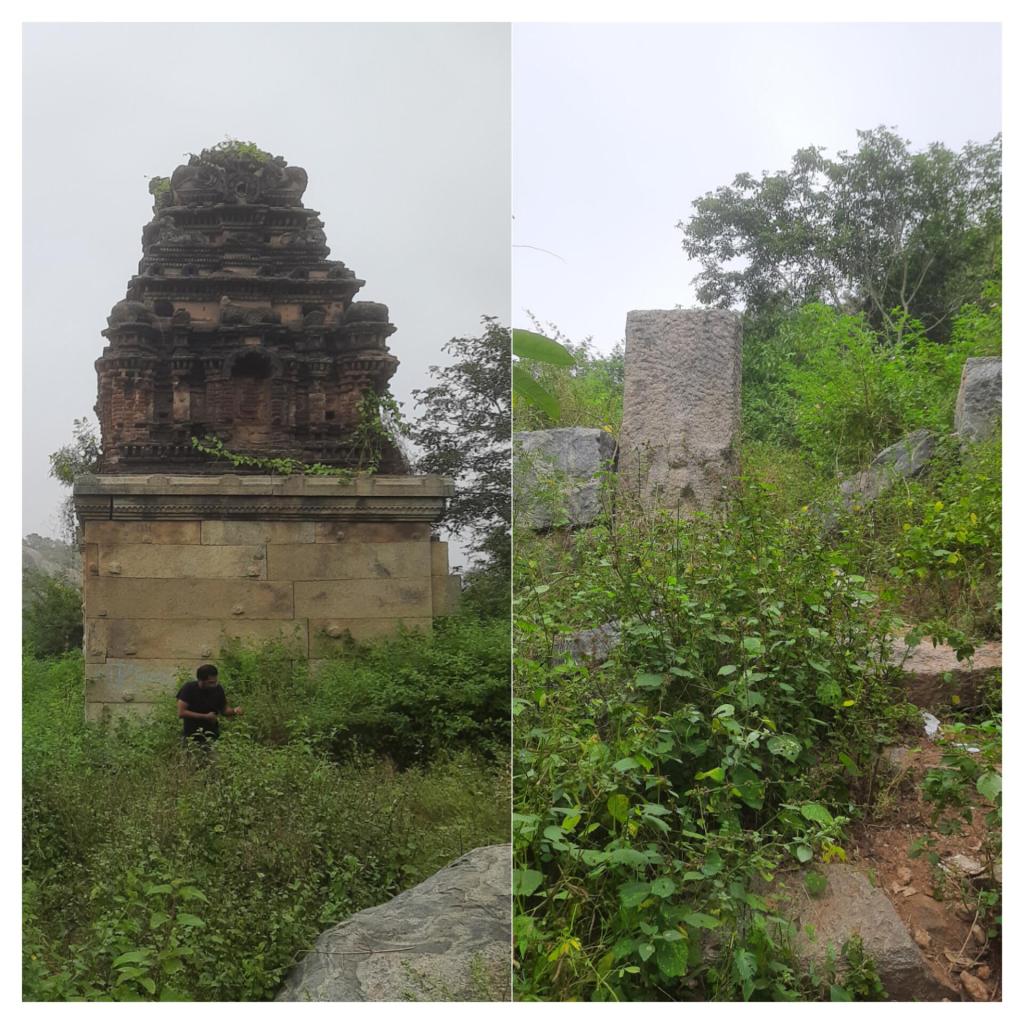
The ruins of the ancient temple at the base of Ankushagiri Hike

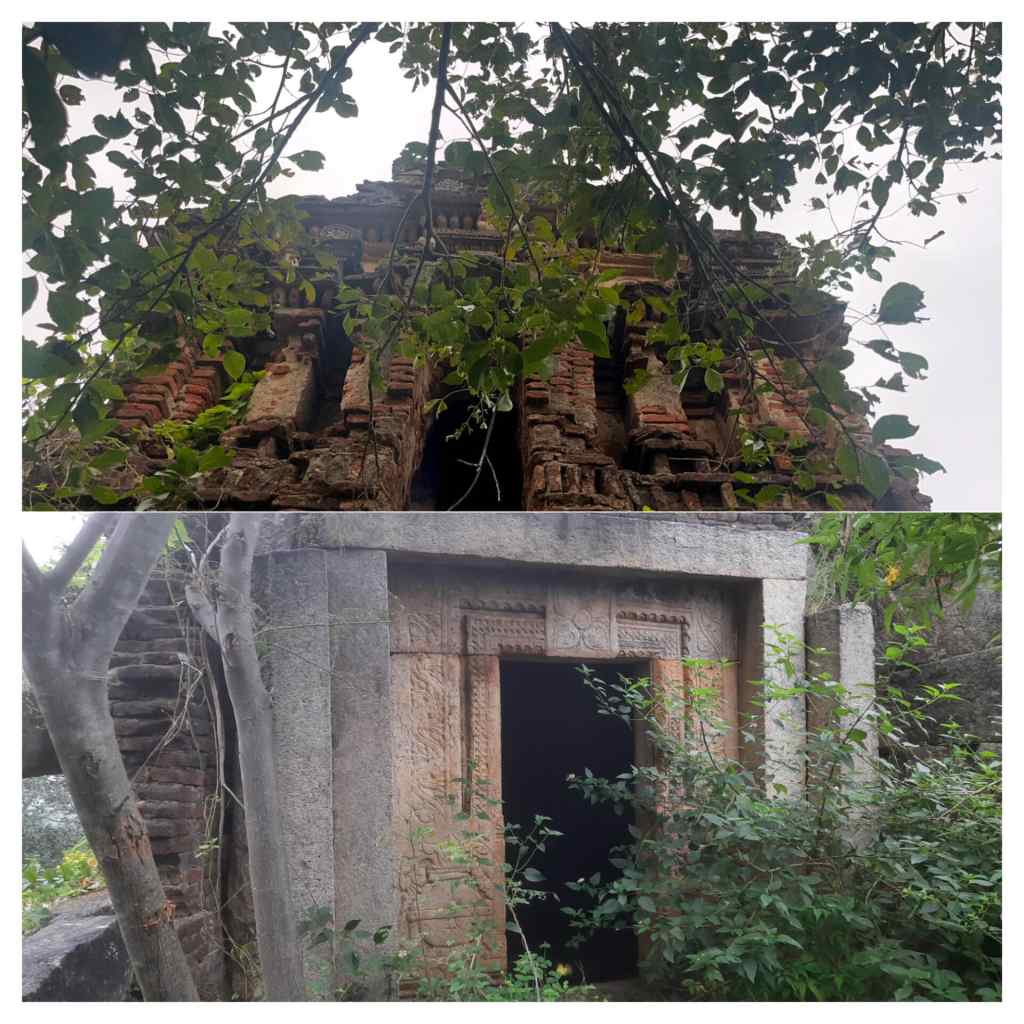
At the beginning of the hike route, there is an ancient structure, now in a dilapidated condition. Today, the Sanctorum lay empty with wild bushes and creepers taking over what once must have been a grand temple. The motifs on the walls of the two adjacent temple structures indicated both Perumal and Shiva.

Ankushagiri Fort and Perumal Temple at Tamil Nadu
The ruins of the ancient temple at the base of Ankushagiri Hike

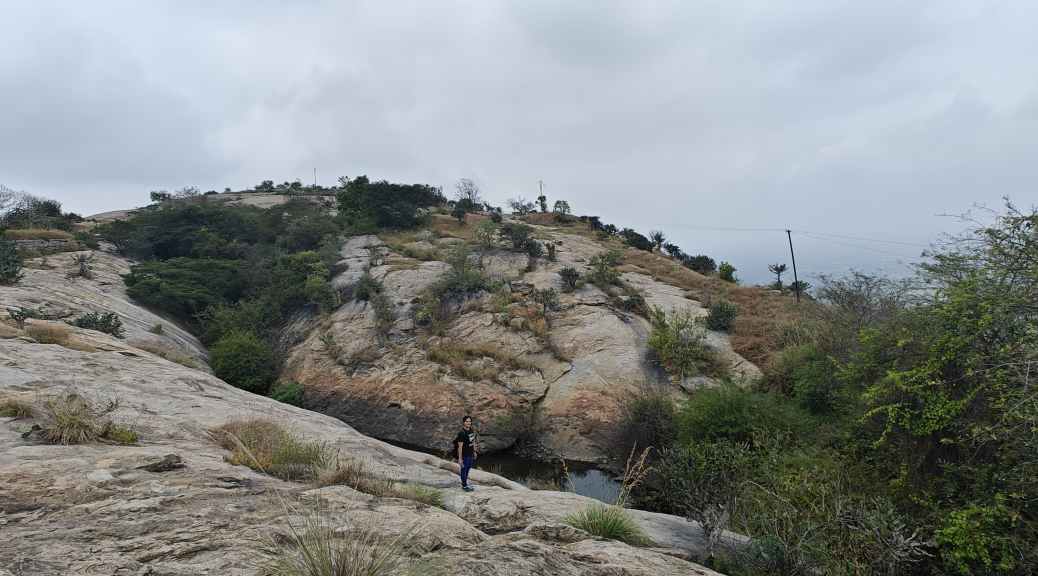
We went ahead from there and stopped after a brief walk. We were confused about the correct trail which seemed to split at a point from where either of them needed some more wear. We casually picked a path and continued to walk on the trail where the thorny bushes then opened to a rocky terrain. The rock looked interesting with varying patterns all over.

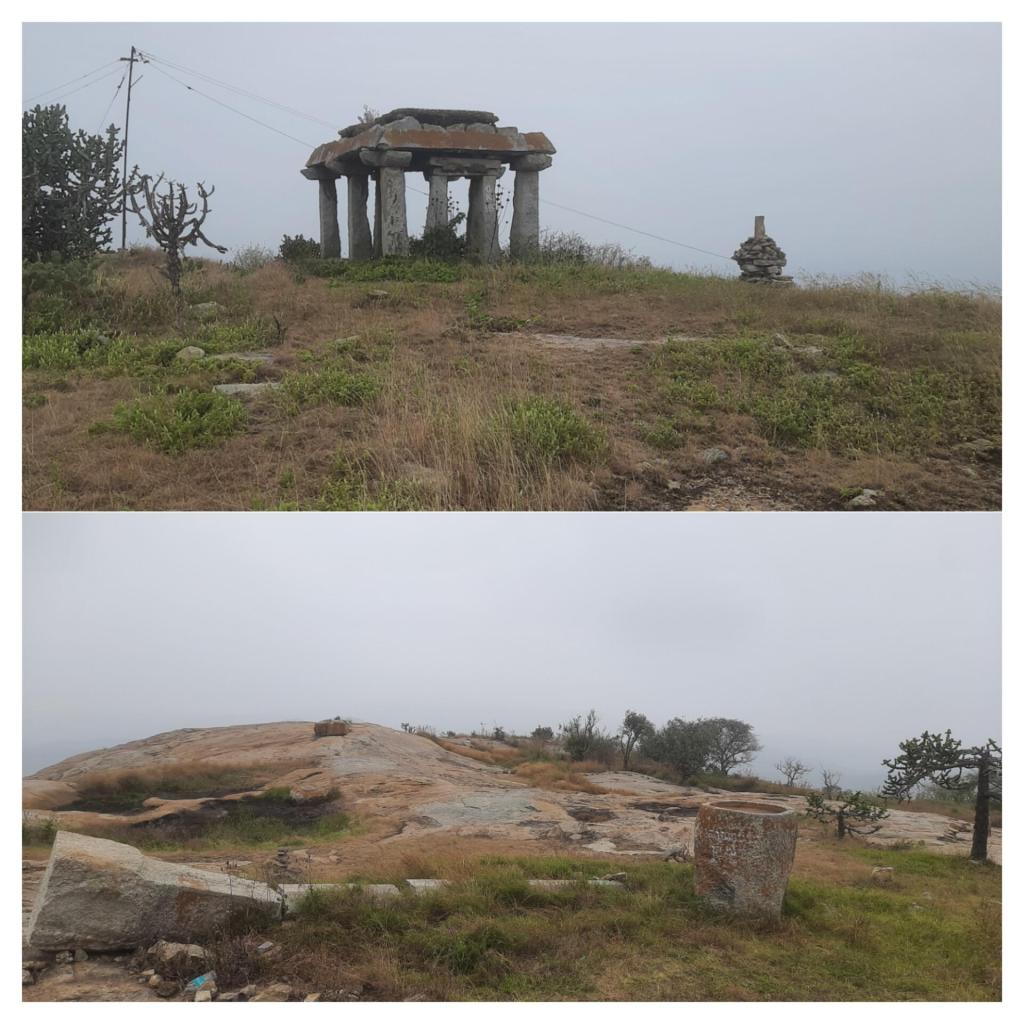
At the top, there were massive cacti plants dotting the area around an abandoned ancient temple structure. Only the pillars remained with the tall Garuda stambha lying down on the side and a stoneware that appeared to be an urn or a waterpot. Some previous visitors to this place had written ‘Someshwara Swamy Temple’ on the stoneware pot for our reference. We rested beside the temple on the large open rock bed overlooking the landscape. The gentle wind caressed our faces while we watched the hills appear one by one at a distance amid the clearing fog.

Ankushagiri Fort and Perumal Temple at Tamil Nadu
The ruins of Someshwara Swamy temple at the peak of Ankushagiri fort

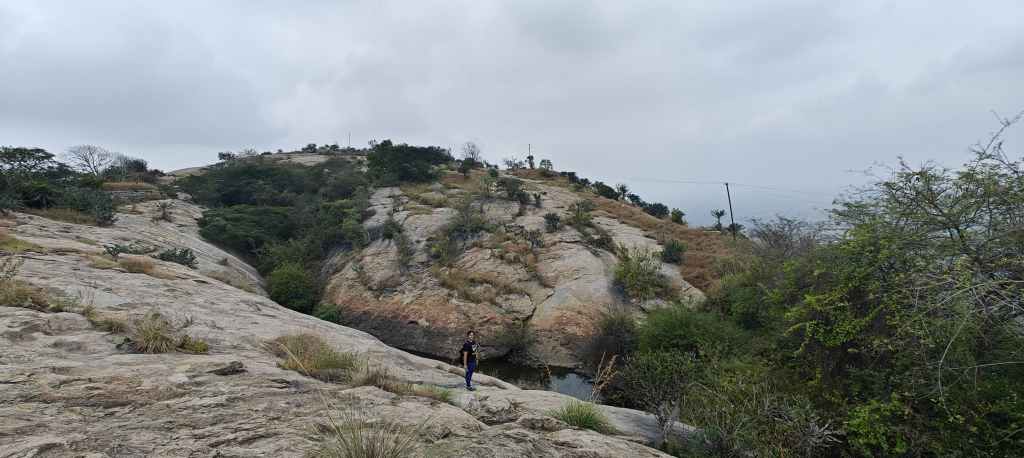
After relaxing for a while and munching on some fruits and nuts that we had carried with us, we proceeded toward the next part of the hill. The trail was beautiful with a rocky gorge on one side and huge cacti lining the path on the other. There, we arrived at a single electric pole that stood in the middle of a heap of ruins of what appeared to be an old fort. Although a circular marking can still be seen to date, only a few large pillars, a few hero-stones like inscriptions, and a couple of kolam designs engraved on the floor were all that existed for us to decipher what might have been the real grandeur, expanse and the purpose of the structure there. Almost little to no history is available to us about who or how this place had served.

Ankushagiri Fort and Perumal Temple at Tamil Nadu
Ankushagiri Hike

Anyway, it was a very interesting outing for us to explore a place so lost in an area where we were the only humans in kilometers around us. We spent ample time there before descending back to the base. We photographed several other patterns on the rocks before arriving at the same bushy junction where we had chosen to take the random path for our ascent.

Upon our return, we paid a quick visit to the Perumal temple before heading back to the city.

Three immersive cultural experiences in Bengaluru

Despite being a cosmopolitan hub, Bengaluru is a metropolis that still firmly holds onto its cultural essence. There may be several festivals being celebrated year-round and across the city but a few of them transcend beyond any religion and community and are rather synonymous with the city’s name. Through this post, I would like to enumerate three such festivals that must be on any Bengaluru resident or tourist’s list of experiences whilst in the city.

    This nine-day festival is a reverence to Adishakti Draupadi and a celebration of her annual homecoming to earth from heaven, on the day of Chaitra Poornami as per the Hindu calendar. Although a main festival of the Thigala community living across Karnataka, people of all castes and religions participate in it. The Karaga bearer (the chief person in the festivities) carries the Karaga (the deity) bedecked with jasmine flowers and begins the procession from Shri Dharmaraya Swamy temple in Nagarathpete, in old Bengaluru. The Karaga bearer is accompanied by the gante dhaari (bell bearer) and hundreds of veerakumaras who together traverse across the streets of the Bengaluru Pete area. The Karaga visits all the temples and the Mastan Saheba Dargah that come along the route until they return to the Shri Dharmaraya Swamy temple before dawn break the following morning.

    Though the festival is observed for nine days, the rituals involving the Karaga bearer spans over several months prior to it. One part of the ritual involves the Karaga bearer undergoing his strength and weight training at one of the several Garadi mane (traditional gyms). Hence, these Garadi manes are considered holy places where replicas of the Karaga and placed and worshipped during the festival. Also, several temples located in the Pete area take out floral palanquins of their deities on procession across the streets of Pete. All these things make Bengaluru Karaga, a special experience.

    Similar Karaga festivals are observed in outskirts of Bengaluru like Hoskote, Kolar, Malur etc. But Bengaluru Karaga is one of its kind and experiences.

    Bangalore’s reputation as a garden city finds a reflection in various traditional festivities of the city. Just as flowers are integral to Karaga, there is another famous festival that has flowers in its very name. The ‘Poo Pallakki Utsava’ is an annual car festival celebrated as part of the Someshwara temple festival in the old locality of Ulsoor. Albeit being a temple festival, it is rather better known as an annual competition between gods and goddesses from temples in and around Ulsoor over which one arrives in the best flower-bedecked palanquin. The car festival is believed to be the wedding day of Someshwara with Kamakshi, and flowers are the theme of all decorations.

    There will be over 80 poo pallakkis from the surrounding temples who attend the wedding celebration of Sri Someshwara Temple with Goddess Kamakshi. The grandest Poo Pallaki is one of the bride, Goddess Kamakshi. Celebrated annually during the Hindu month of Chaitra (around April/May), it is a night long event.

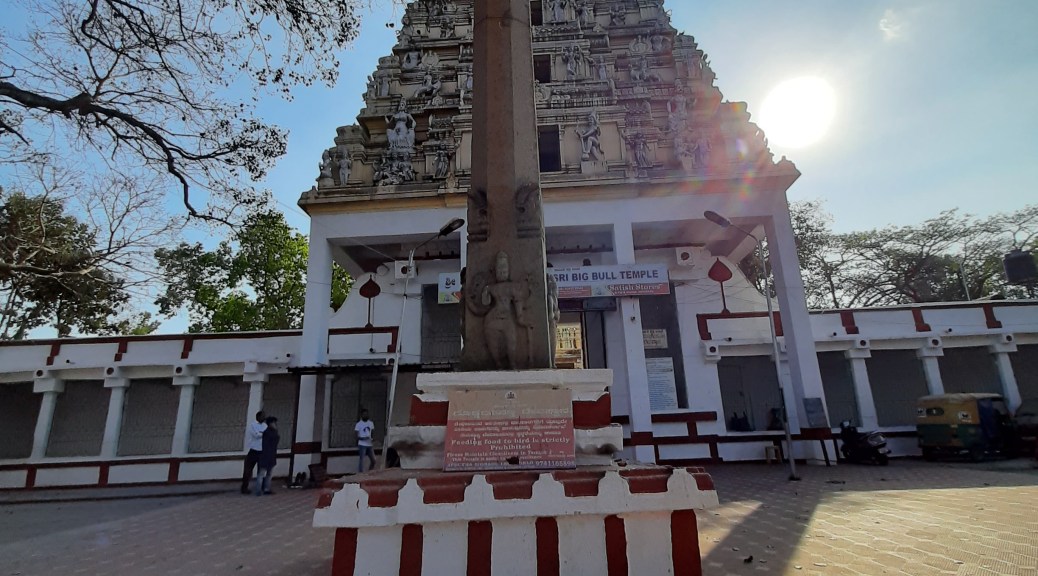
    ‘Kadlekai Parishe’ translating to ‘groundnut fair’ in Kannada is an annual coming together of farmers on the last Monday of Karthika Masa (month in Hindu calendar) celebrated since the 16th century. Legend has it that a raging bull used to damage the groundnut crops that were ready for harvest. The farmers prayed to Basava (bull in Kannada) to protect their harvest, by setting up an idol of a Nandi (Basava / Bull) and a temple at that place and offered their first crop to the Lord. This temple is called Basavanagudi (Bull temple) and the area surrounding it eventually came to be known by the name of the temple.

    Although the groundnut farms made way to residential and commercial structures, the tradition of the groundnut fair is celebrated with great fervor and enthusiasm even today. Farmers from across the state bring their first yield of ground nuts to offer to the temple and to sell them to others during this festival.

    More recently, a similar event is being organized in Malleswaram, around the Kadu Malleswara temple as well.

      A weekend hike from Bengaluru- Akkayammana Betta

      On a random day, we decided to drive towards Kempegowda International Airport with a basic idea to catch the sunset from a nice vantage point. We have explored the Devanahalli fort area on one of our previous day trips and wanted to explore some new places around there. But this time, we had a new family member along with us whose comfort was also meant to be kept in mind while choosing the destination- Our pet dog.

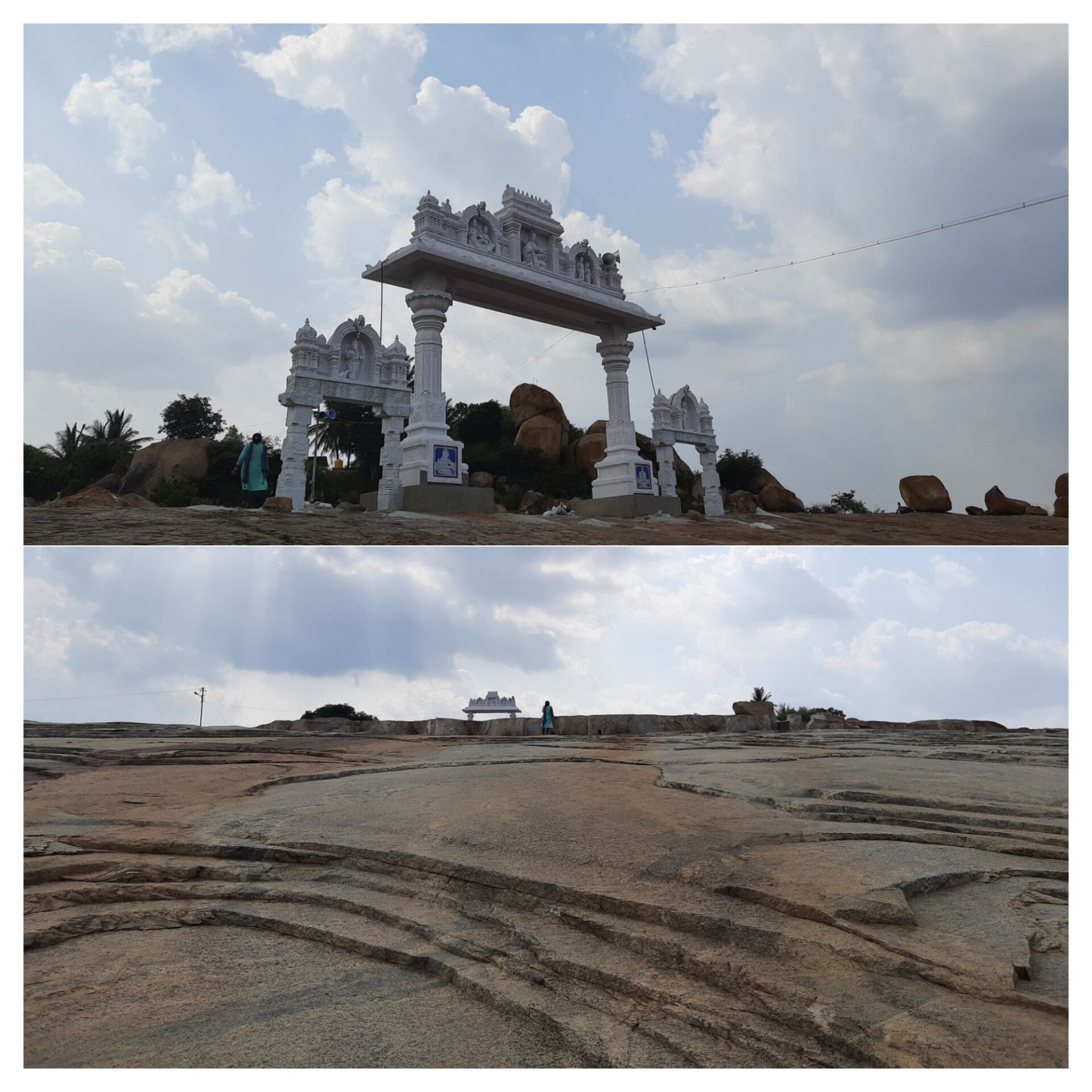
      By looking up a little on google, we came across the sunset point from ‘Akkayammana Betta’. We drove up right until its base where we parked our car and unleashed our dog to freely walk up the small hillock with us. The climb up was easy, leading to a welcome arch of the hilltop temple.

      Akkayammana Betta
      The climb and the welcome arch to Akkayammana Betta

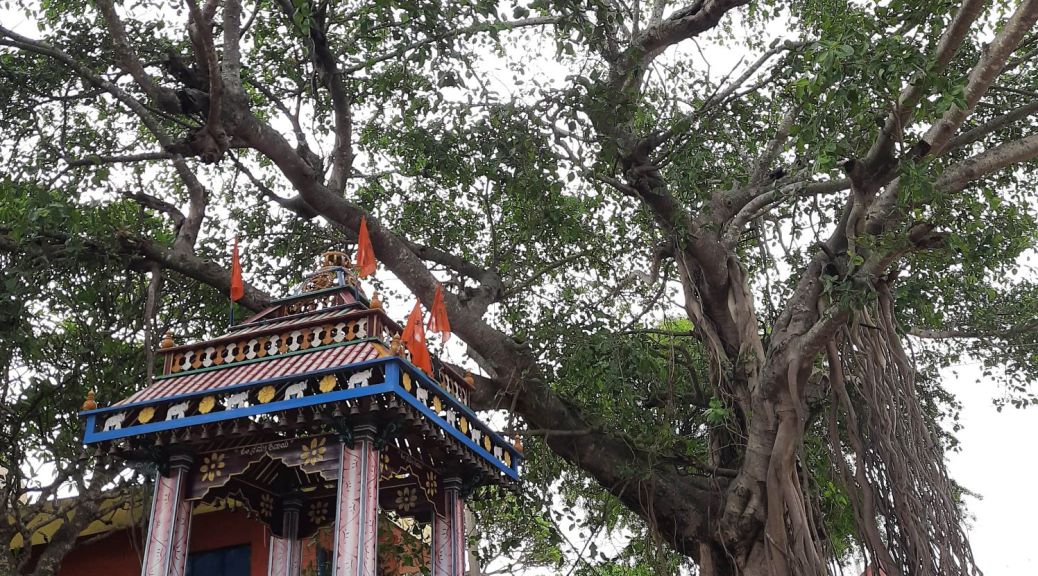
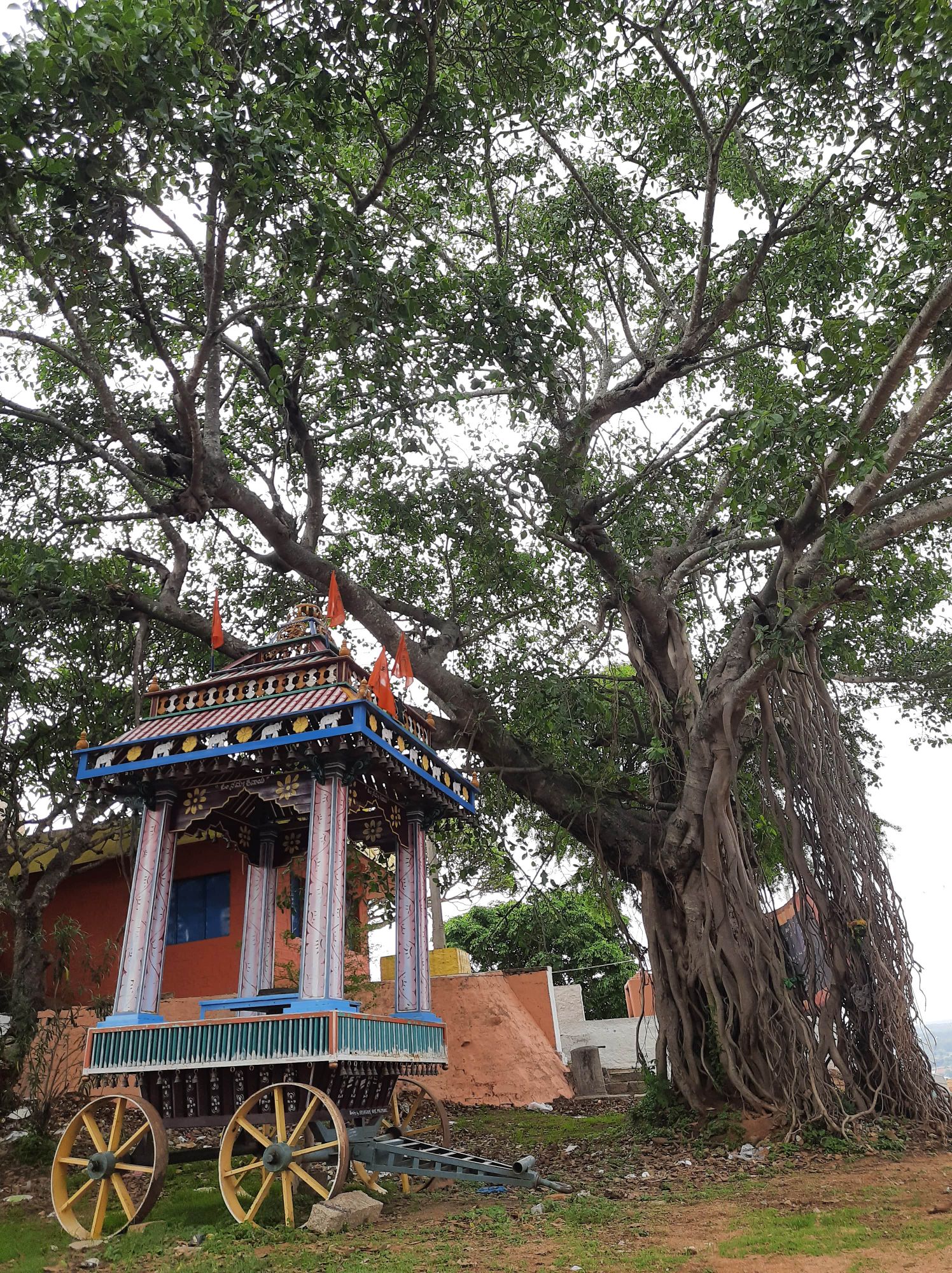
      We walked further and reached a small temple under a large peepal tree that remained closed at the time of our visit. Beyond that was a large rocky tabletop hill offering a view of the surrounding villages and farms.

      Akkayammana Betta
      The temple and the wooden cart at Akkayammana Betta

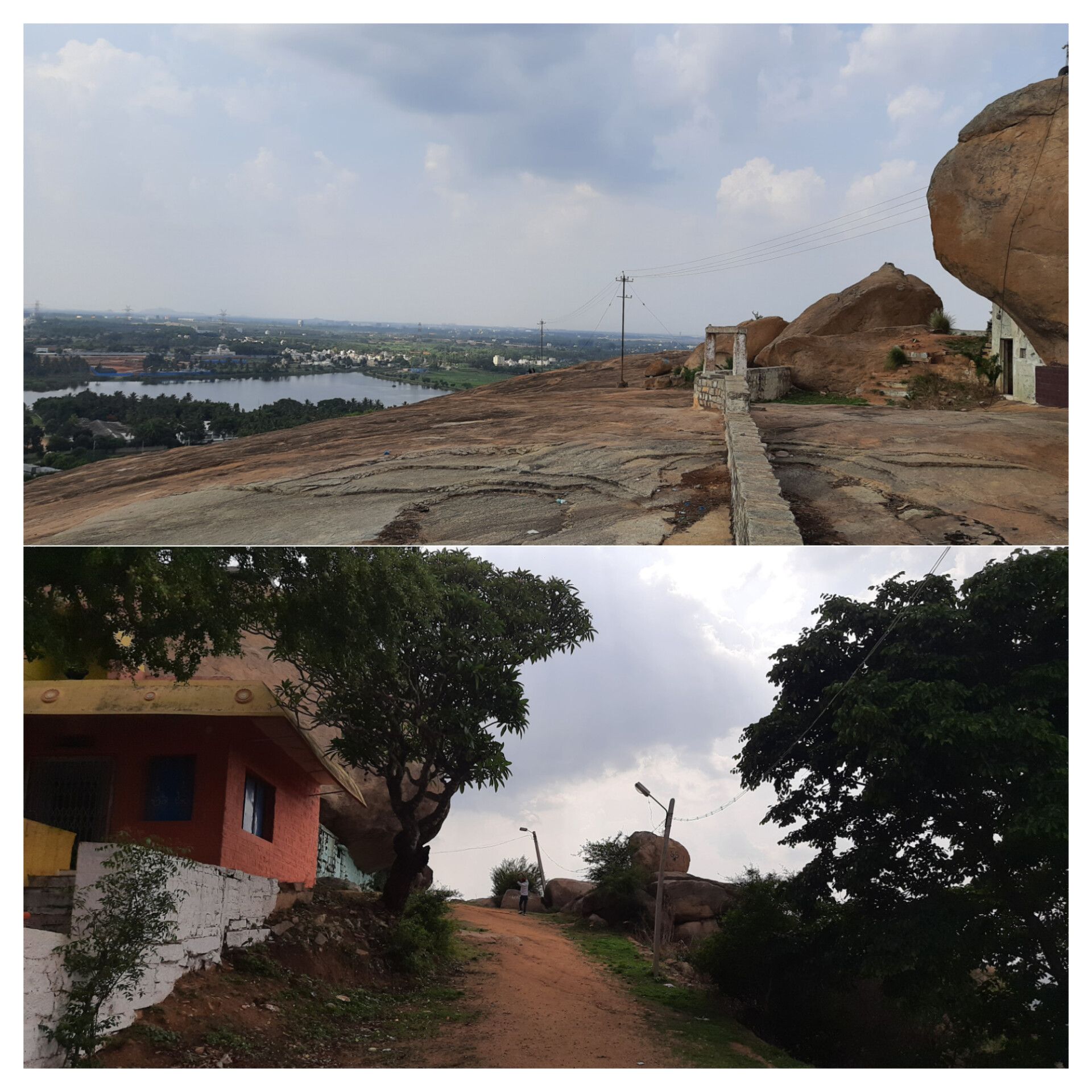
      While our dog got busy enjoying his time in a puddle of rainwater, we comforted ourselves on the rocky ground watching him enjoy his dip as the sky was prepping itself to see-off the setting sun for the day. Until sunset, the airplanes landing and taking-off at the KempeGowda International airport kept us accompanied. It was a beautiful sunset.

      Akkayammana Betta
      The route from the temple to the hilltop view point at Akkayammana Betta

      After that, we took a walk from across the hill and passed by a few other smaller shrines at the top before descending towards our car. As we approached the temple arch, I noticed a petty shop that sold some eatables and soft drinks. We took a small snack break and fed biscuits to the stray dogs that had followed us. We reached back to the car before it got dark and headed back towards the city, thus ending a short day-out.

      A daytrip from Bengaluru- Adi Chunchanagiri

      Adi-Chunchanagiri mutt is the spiritual headquarters of the Natha Parampara and Jogi Cult of Hindus of Karnataka. My dad, who had earlier visited this place with his friends, happened to insist on going there again with his family. His intention was not to take us on the spiritual path but rather to introduce us to a hiking path which he found picturesque after having ascended.

      One Saturday morning, our family set forth to enjoy this day trip towards Adi-Chunchanagiri. We drove towards Hassan, along an excellent highway until Bellur cross from where we had to take a deviation towards Adi-Chunchanagiri betta (hill) as indicated on google-maps. There on, we enjoyed our drive through the countryside, with traditional homes scattered between vegetable farms, coconut groves, and forest patches of brown boulders and green trees. Google is not always right and that’s why we deviated from the course a little more than necessary until we found the correct track again. But it was the deviation which we enjoyed. We realized that the region is declared as Adi-Chunchanagiri peacock sanctuary. It was no surprise that dozens of peacocks were grazing freely on every other farm, moving around at every turn of the road and everywhere else along our way right until we reached the parking lot at the base of the Adi-Chunchanagiri hill.

      Adichunchanagiri
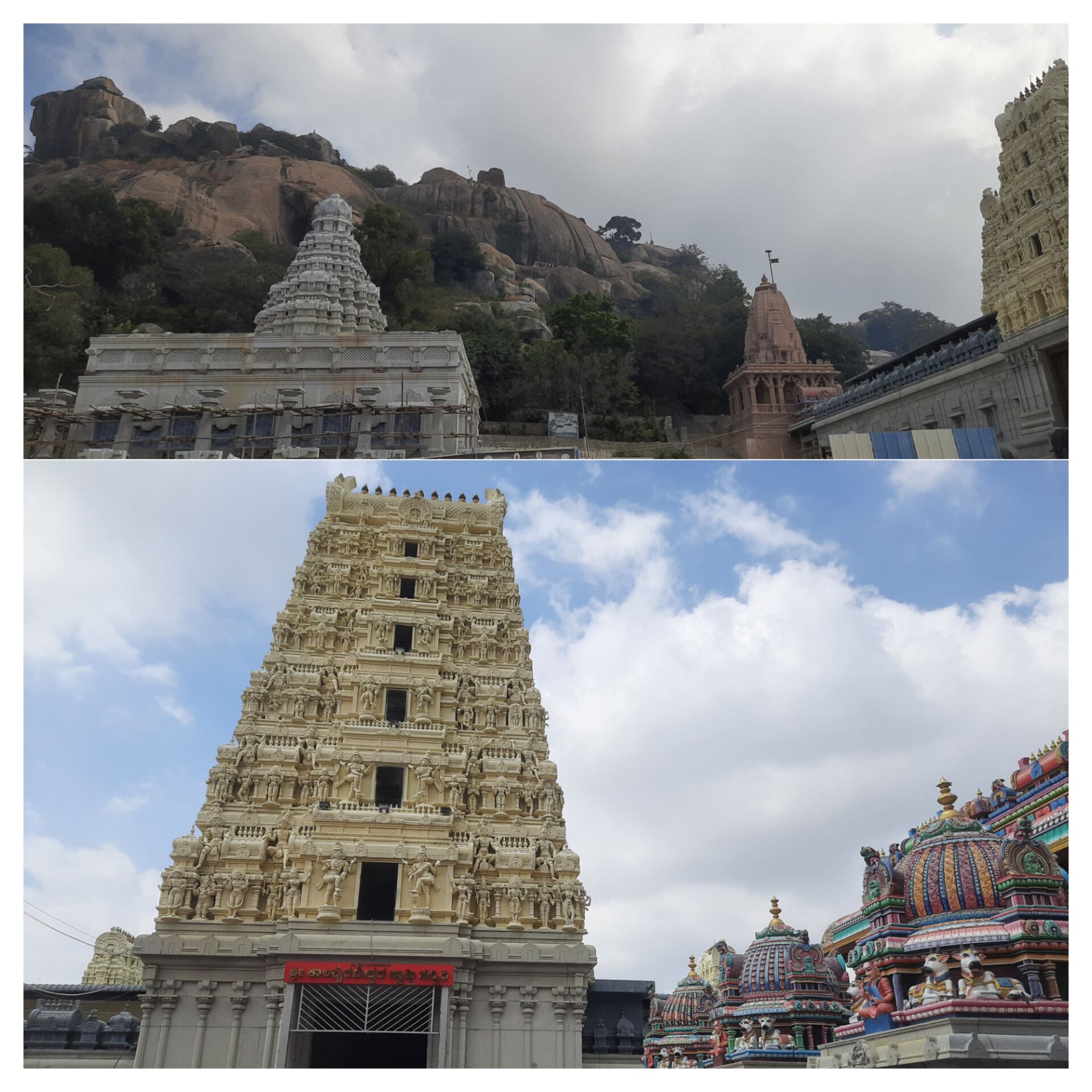
      Top: The first glimpse of the Adichunchanagiri premises; Below: The entrance tower of the main temple

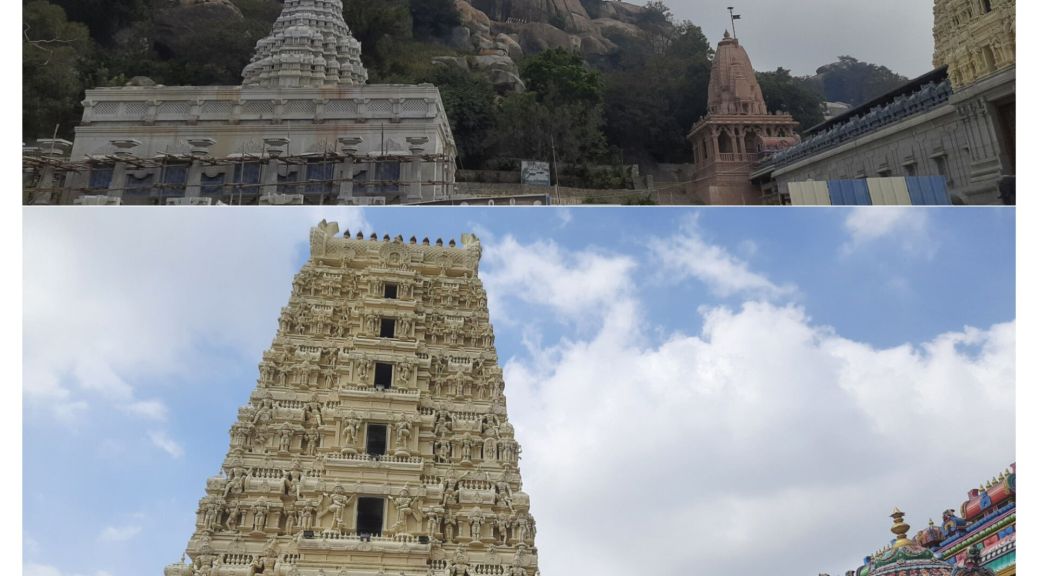
      The initial approach towards the mutt premises starts with an ascent of about 100 steps leading to the welcome gate/ arch giving a visitor the first glimpse of the main temple. The large doors of the main temple opened into an ambience that felt divine and calm. It is entirely built with stones, and it gives a feeling of being in one of the ancient Dravidian temples though this one was built in modern times. The deities believed to be residing inside and revered highly by the pilgrims here are Sri Kalabhairaveshwara Swamy and Sri Stambhambika (Kambadamma).

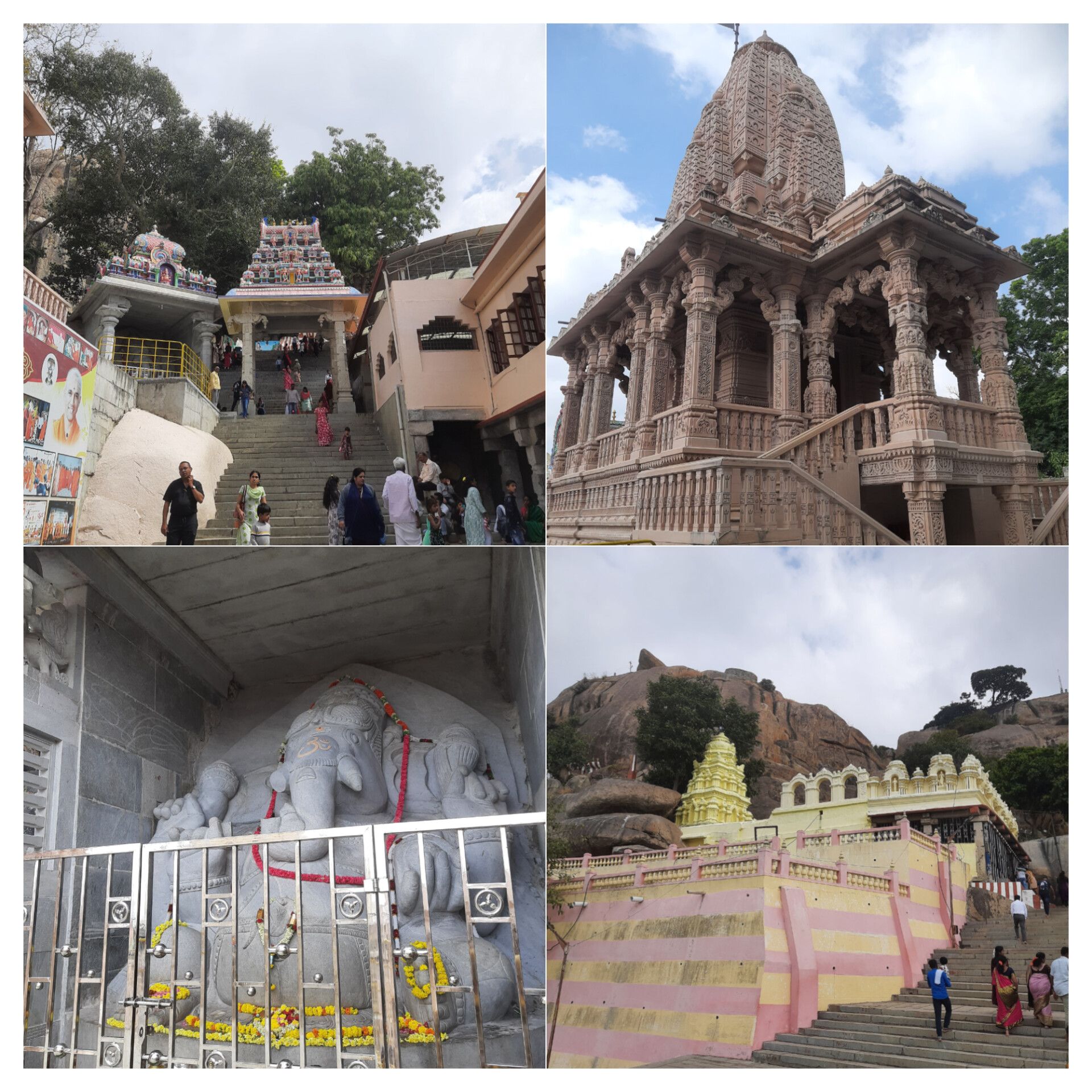
      After sitting there for some time, we began our ascent towards the peak of the hill. Just after coming out of the main temple, there is a large Ganesha idol sculpted out of the rocky wall of the surrounding. We continued our climb by passing by some smaller temples with a look around offering beautiful views of the green cover.

      Adichunchanagiri
      The temples and shrines at the Adichunchanagiri hill

      Scores of people were seen climbing up and down for pilgrimage purposes. The climb to the hilltop is done to see the Panchalingas comprising Gangadhareshwara, Malleshwara, Katthale Someshwara, Gavisiddeshwara and Chandramouleshwara, whose temples or shrines are scattered along the trail leading to the summit. But we were there to hike that hill as a recreational activity for the weekend. We climbed up the steep stairs right up to the top with the trail splitting at random places. My family ended up getting lost from each other’s’ sight and then picked whatever trail lied ahead of us and met each other again at the top. Well, not the peak exactly, but just beneath it.

      That’s where I gave up any further climb. The peak point of the hillock is known as Akasha Bhairava. It can be reached by climbing the last bit of the rocky hill which had no stairs but only with the aid of a big, suspended metal chain. It was a straight climb (almost 90 deg. gradient) which included a small jump from one rock to an another. I doubted my ability to descend safely even if I were able to reach the peak. My brother, on the other hand, climbed it up and down with so much ease (and grace) demonstrating that he still possessed his ancestors’ (apes) strongest traits.

      Adichunchanagiri hill
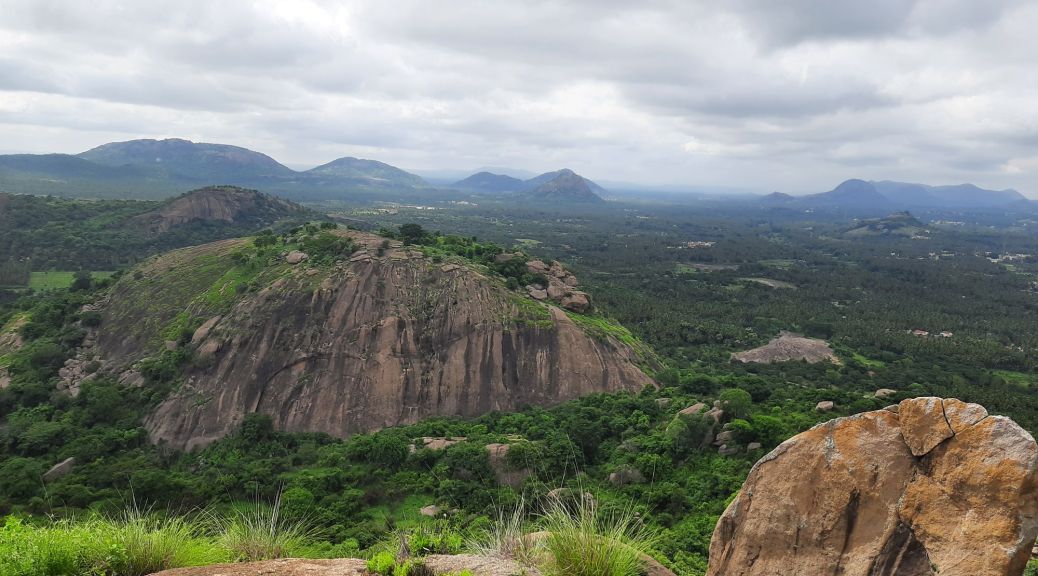
      The view from the top where I was standing beneath the last rock which leads to the peak

      After he returned, we all came down towards the main temple where we were guided towards the dining hall. We devoured the delicious temple food before heading back towards Bangalore.

      We started back just after lunch to avoid the weekend traffic at Bangalore. But, if you are interested to cover more places in this day, you can google for some of the Hoysala temples along your way and add it into your itinerary.

      A day hike from Bengaluru- Kunagalu Betta

      My friends and I picked yet another hill-top around Bengaluru for a day hike. ‘Kunagalu Betta’ on Kanakapura road, it was. We reached there early in the morning before the rest of the world discovered it (for that day). The car could go on to most stretch of the steep road until we parked it beside a small structure built for lord Hanuman by the roadside, under a large rock.

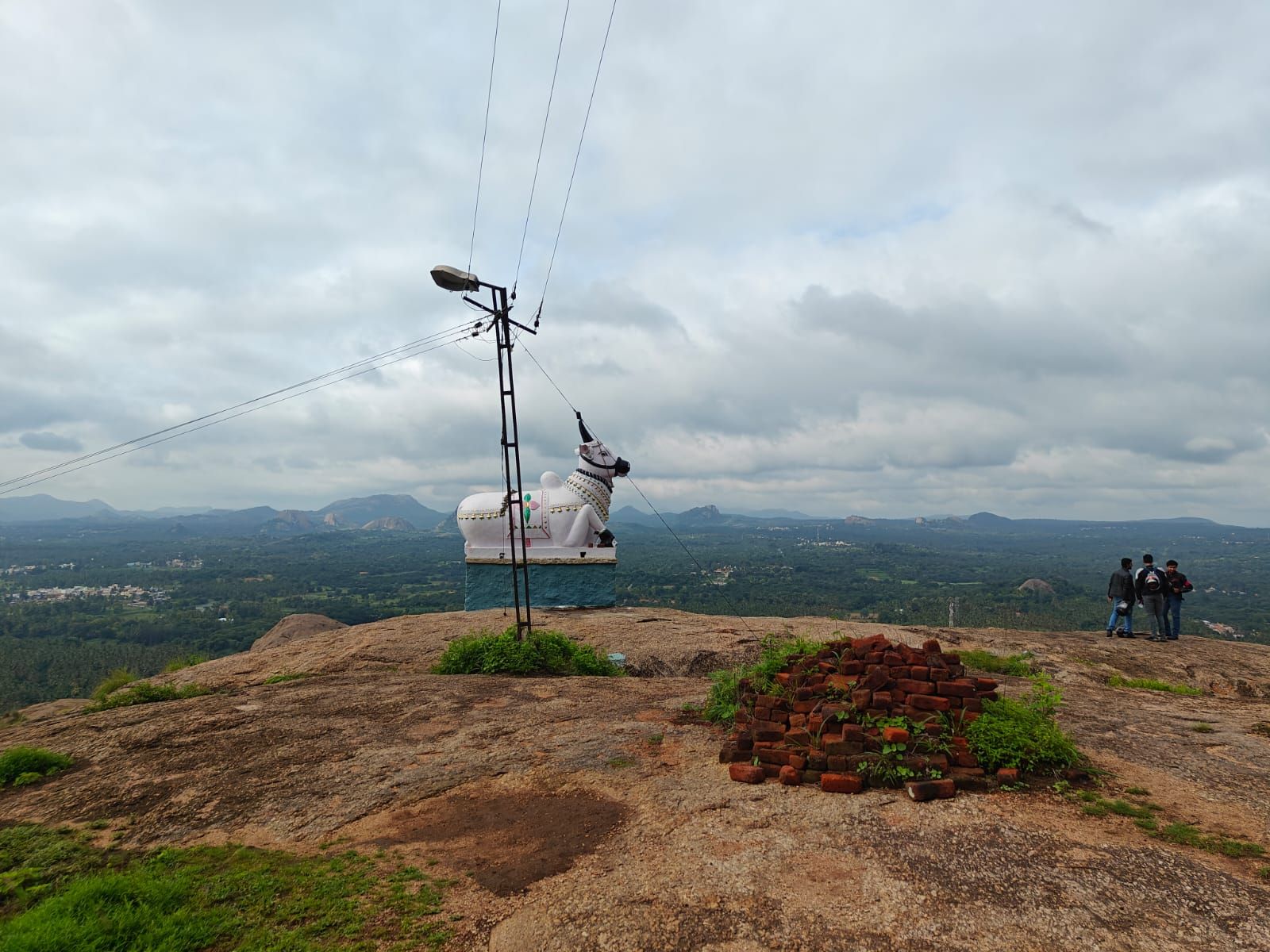
      We started our hike uphill where the route was lined with several trees of custard apples for most stretch. After a kilometer of so, we came across a large rock that formed a cave-arch-like structure that kept the atmosphere inside very cool. After climbing out of the arch, it opened into the sky above a flat hill-top that offered a beautiful view of the other hills around. Do you remember my hike to Acchalu betta, where we went to find a statue of a Nandi on the hill-top? (you can read that story here). A similar Nandi was erected on this hilltop also, which was then overlooked by an ancient temple further atop a rocky outcrop from there.

      The Cave like formation at Kunagalu Betta

      To reach there, we crossed a small wooden brook formed out of a tree branch and then climbed to the peak where the temple stood. We sought the almighty’s blessings which mark the end of the ascent of the hike for most people. We had barely climbed a kilometer and half, and it didn’t feel like a hike yet considering we had done longer trails even on day trips. The breeze was cool, strong and yet soothing and hence, we decided to sit there and spend some time feeling the wind in our hair.

      Kunagalu betta
      The Nandi Statue atop Kunagalu betta

      We then looked around and decided to find our own way to the adjacent hill from there. We climbed down the temple hill and climbed up the adjacent one. We again climbed it down and navigated our way through thick bushes and thorns to ascend yet another small peak. On that peak, we got a sense of getting lost if we tried to explore more hills because at that point, we were the only people and there was no trail that had worn out to lead us anywhere if we were lost. We descended that hill and were trying to find the direction that would lead us back to the temple.

      Kunagalu Betta Peak
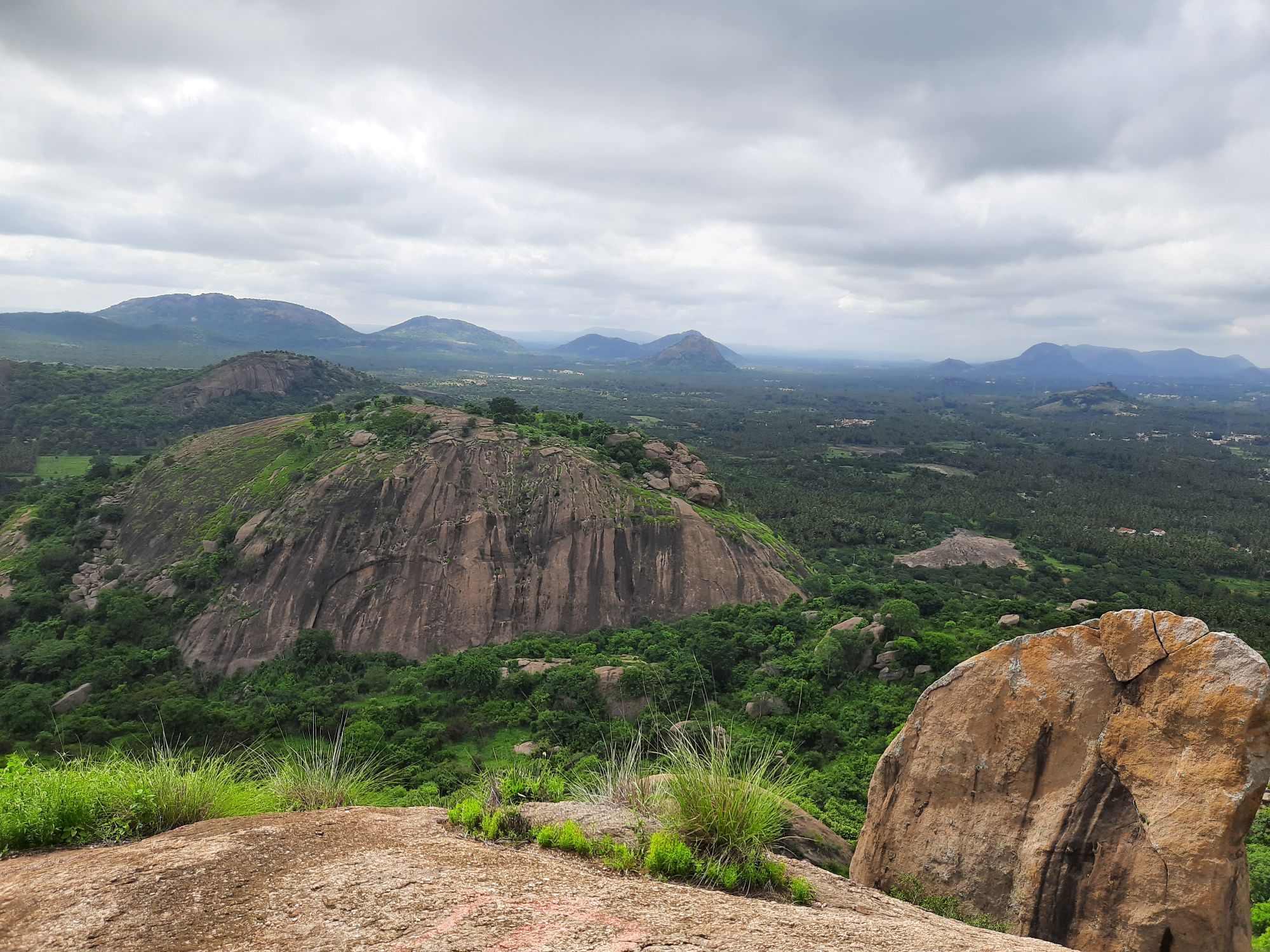
      The view from Kunagalu Betta peak

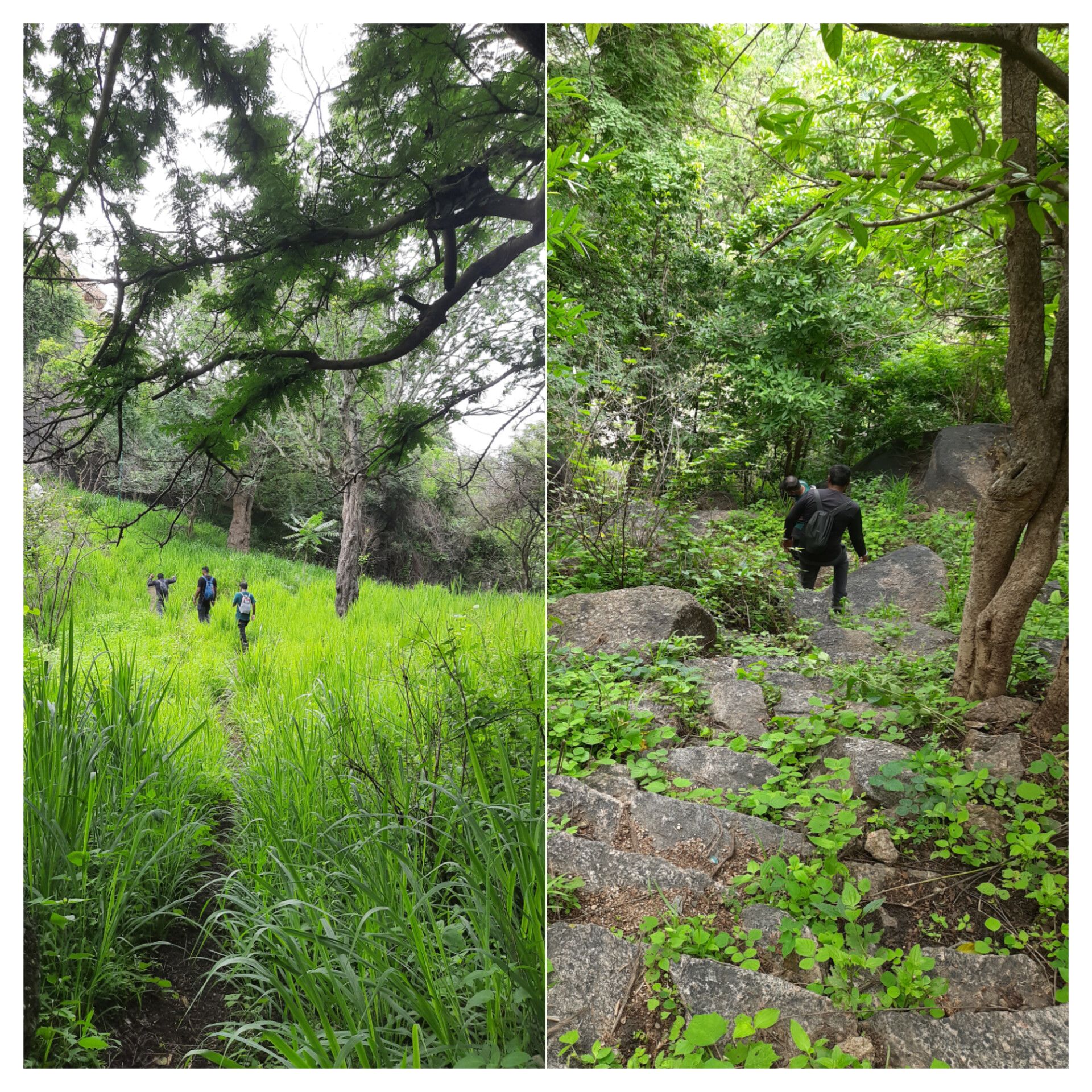
      Just then, our eyes caught a small slope in a random direction and all of us decided to explore one last random trail before heading back. We walked in that direction where the tall grass seemed to need some wear. We walked down further and suddenly out of nowhere; we were in for a surprise. There was a flight of stairs chiseled out of the rocks which was leading downwards. Finding stairs out of nowhere was a surprise, but what assured us was that the stairs would lead us somewhere interesting. Perhaps an abandoned piece of history? We thought as we headed in that direction.

      Kunagalu Betta
      In quest to explore the lost history at Kunagalu Betta

      The grass laden stairs quickly cleared up to the view of a dozen motorbikes all parked side-by-side. That’s when we realized that we had already reached the parking lot. We had found a shortcut on our quest to explore random trails in random directions. Thus ended our quick hike to Kunagalu Betta. I picked up a bag from the car and tried to pluck as many custard apples as possible before heading back.

      In conclusion, it was a short and easy hike. You can combine it with Acchalu betta or any other hike on Kanakapura road and make it a full-day activity.

      A day exploring Lake Pulicat and its heritage

      This story is from quite some time ago. My friend was tracking the arrival season of the flamingoes at Pulicat lake. He had an acquaintance of a Mr. Illaiyaraja, a fisherman who lived in Pulicat village. Through him, we got regular updates on the arrival of these seasonal beauties (flamingoes) who flocked to the brackish lake during their migration period. Meanwhile, our family was planning a drive to Sriharikota, to watch the launch of Chandrayaan 2. That’s another story altogether, you can read it here.

      A week prior to our road trip, Mr. Illaiyaraja telephoned my friend and told him, “Anna, flamingoes vandichi.” loosely translating to “Brother, the flamingoes have arrived”, in Tamil. So, a drive to Lake Pulicat became a part of our road trip as well. Our family took our old reliable friend (Our Tata Indica) out on the road and prepped it for the long road trip. It was as if time was bringing all things together in our favor. The flamingoes had arrived, the rocket was set for its launch and the roads were calling us.

      Pulicat village gets its name from Lake Pulicat, the second largest brackish water lagoon in India on whose banks is this tiny fishing hamlet. The lake itself is so vast that it is spans across Andhra Pradesh and Tamil Nadu. We approached Pulicat from the Tamil Nadu side. After exploring all the places enroute, we parked our car at the entrance of the village and walked by following google maps to the location where we were supposed to meet Mr. Illaiyaraja. With a can of diesel in his hand, he led us to his wooden boat anchored at the jetty. We boarded the boat with him and set off on an unforgettable experience of sailing on a sea-like vast lake, to see.

      The birds at Lake Pulicat

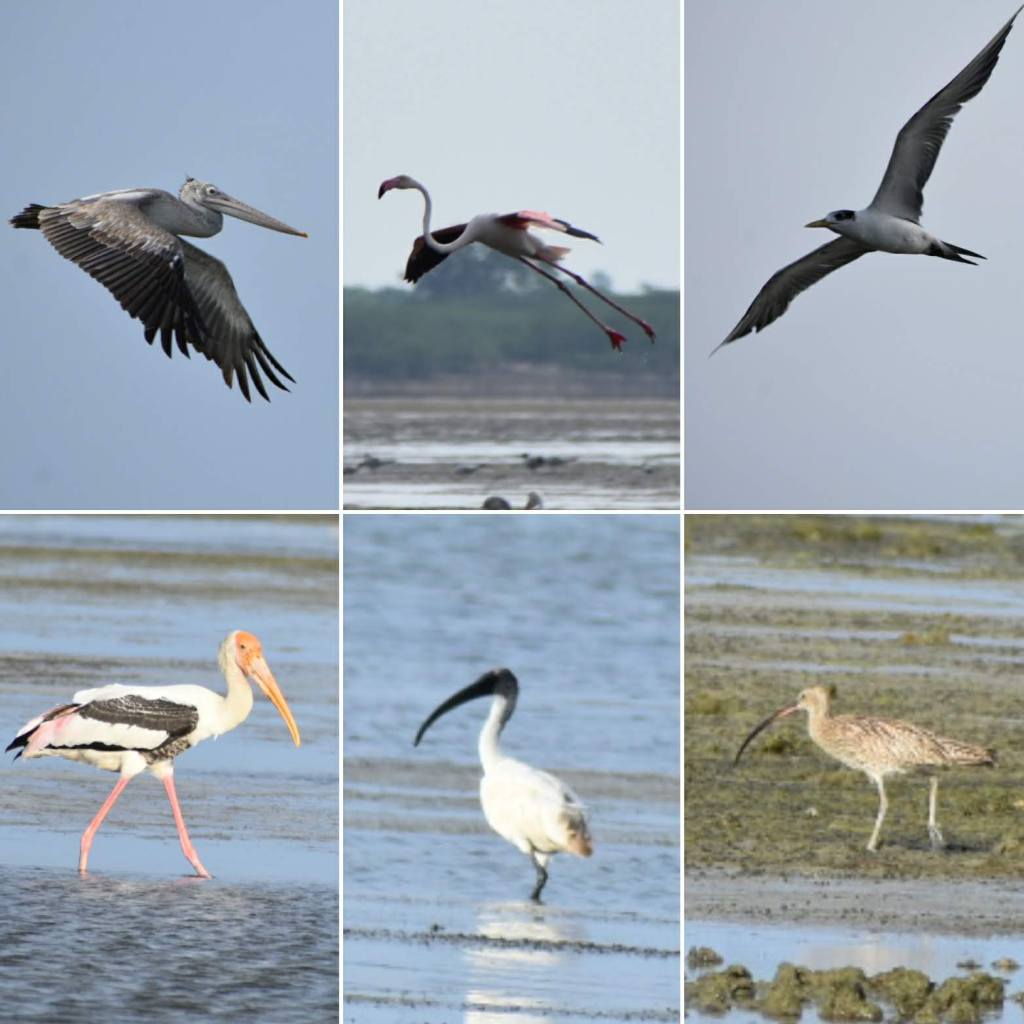
      Aquatic birds and shore birds that had migrated down from far across the globe birds to the Pulicat lake birds’ sanctuary. Pelicans, painted storks, kingfishers, herons, spoonbills, egrets, ducks, terns, gulls and several other species hovered on and off around us. But the peace within us came when the sound of the motorized boat came to a mute and there was an endless visual of the lake merging with the sky in a shade of ‘pink’. The greater flamingoes nesting peacefully in an unexplainable size of the flock. We spent quality time just watching them for a good hour or so before the sun started to turn the sky in hues of red.

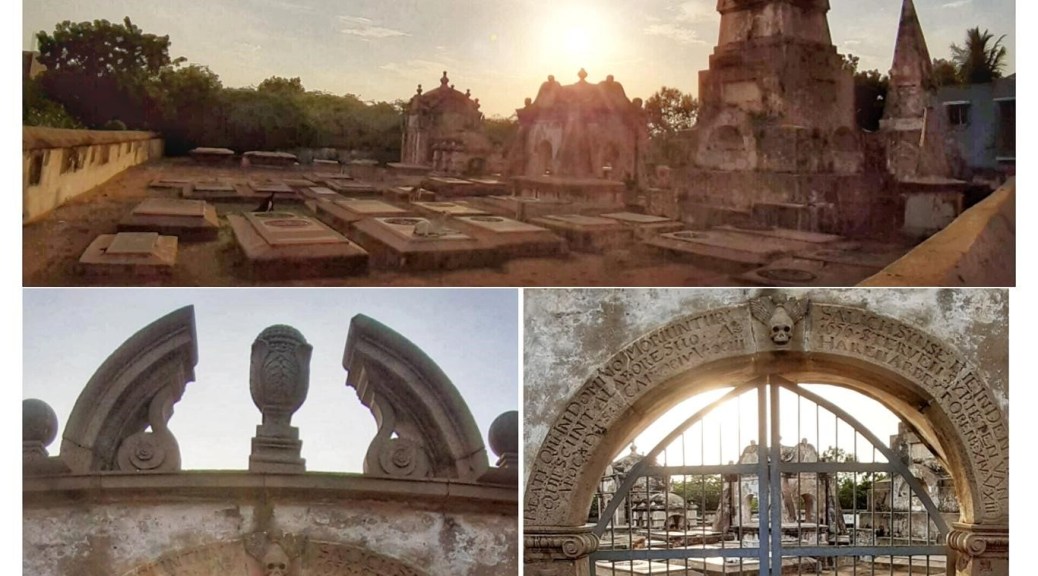
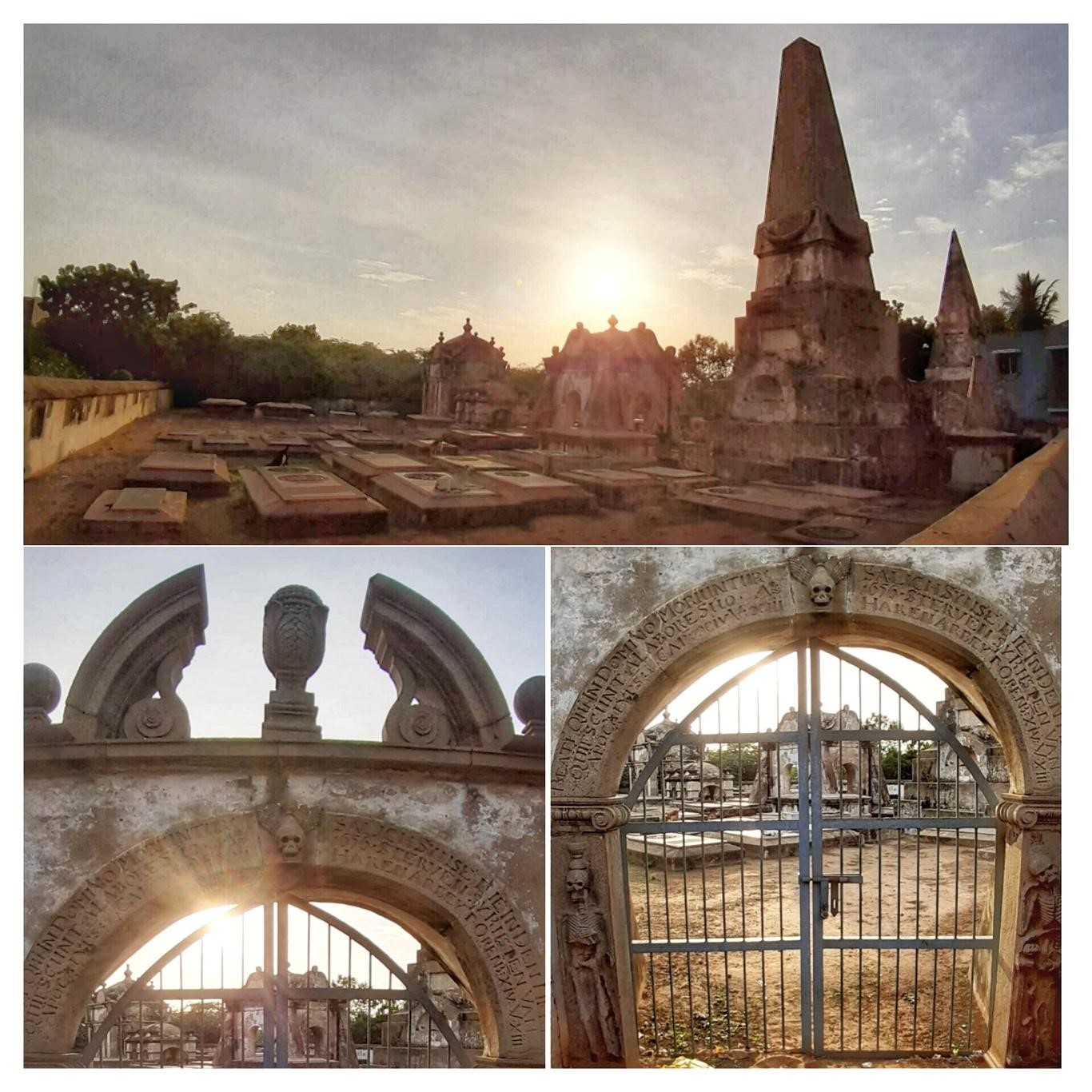
      We returned to the bank and continued to drive in the direction of Sriharikota. While we were exiting from the village and were at a traffic signal waiting to enter the highway, my eyes fell on an interesting but ignored piece of construction by the roadside. I decided to go near and noticed that the entry gates were locked. The architecture style was different than anything I had seen before in the region and some strange alphabets were engraved on its entrance arches. Although interesting, it still seemed eerie and gave me some sense of it being an old, abandoned site of a graveyard. Since it was locked, I clicked a few pictures of the place from outside and returned to the car and continued our drive to Sriharikota.

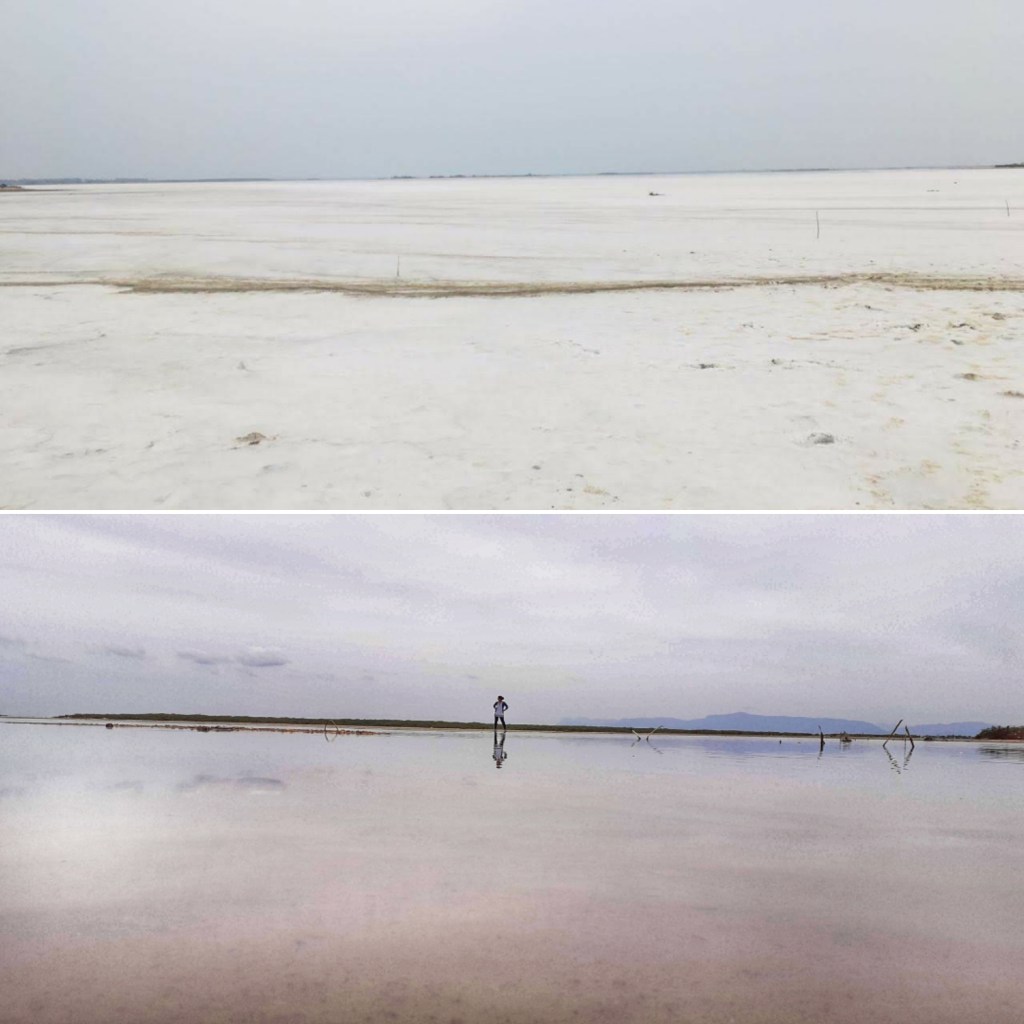
      Top: Lake Pulicat enroute to SHAR in winter; Lake in Summer

      When I looked it up on the internet, I found some interesting information about that old site I had just visited. There are about five main settlements dating back to the Dutch era across India namely at Gujarat (Surat), Kerala (Cochin), Andhra Pradesh (Machilipatnam), Tamil Nadu (Pulicat) and West Bengal (Hooghly) where forts or cemeteries can be found. This day, I had visited a Dutch cemetery which used to be a part of Fort Geldria or Fort Geldaria at Pulicat. Pulicat was the seat of the Dutch Republic’s first settlement in India, and the capital of Dutch Coromandel. This fort was the only fortification in the Indian empire whereas all other positions of the Dutch Company were trading posts. today, this cemetery houses about 76 tombstones, mostly carved in the Netherlands.

      Dutch cemetery
      The Dutch cemetery at Pulicat

      It is interesting how I came across a random site that holds so much historical importance in India’s history of colonization and it is also unfortunate that how inaccessible or neglected are these sites that holds stories of an era bygone. Thus, the sun had set on Pulicat ending our quick visit to this lakeside settlement.