Tag Archives: South Indian Trek

A daytrip from Bengaluru- Adi Chunchanagiri

Adi-Chunchanagiri mutt is the spiritual headquarters of the Natha Parampara and Jogi Cult of Hindus of Karnataka. My dad, who had earlier visited this place with his friends, happened to insist on going there again with his family. His intention was not to take us on the spiritual path but rather to introduce us to a hiking path which he found picturesque after having ascended.

One Saturday morning, our family set forth to enjoy this day trip towards Adi-Chunchanagiri. We drove towards Hassan, along an excellent highway until Bellur cross from where we had to take a deviation towards Adi-Chunchanagiri betta (hill) as indicated on google-maps. There on, we enjoyed our drive through the countryside, with traditional homes scattered between vegetable farms, coconut groves, and forest patches of brown boulders and green trees. Google is not always right and that’s why we deviated from the course a little more than necessary until we found the correct track again. But it was the deviation which we enjoyed. We realized that the region is declared as Adi-Chunchanagiri peacock sanctuary. It was no surprise that dozens of peacocks were grazing freely on every other farm, moving around at every turn of the road and everywhere else along our way right until we reached the parking lot at the base of the Adi-Chunchanagiri hill.

Adichunchanagiri
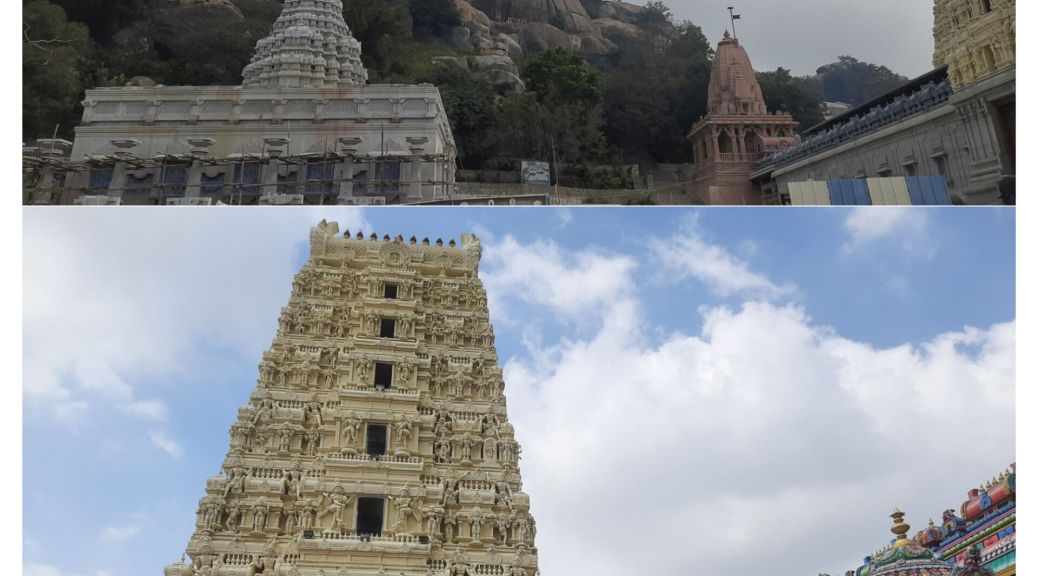
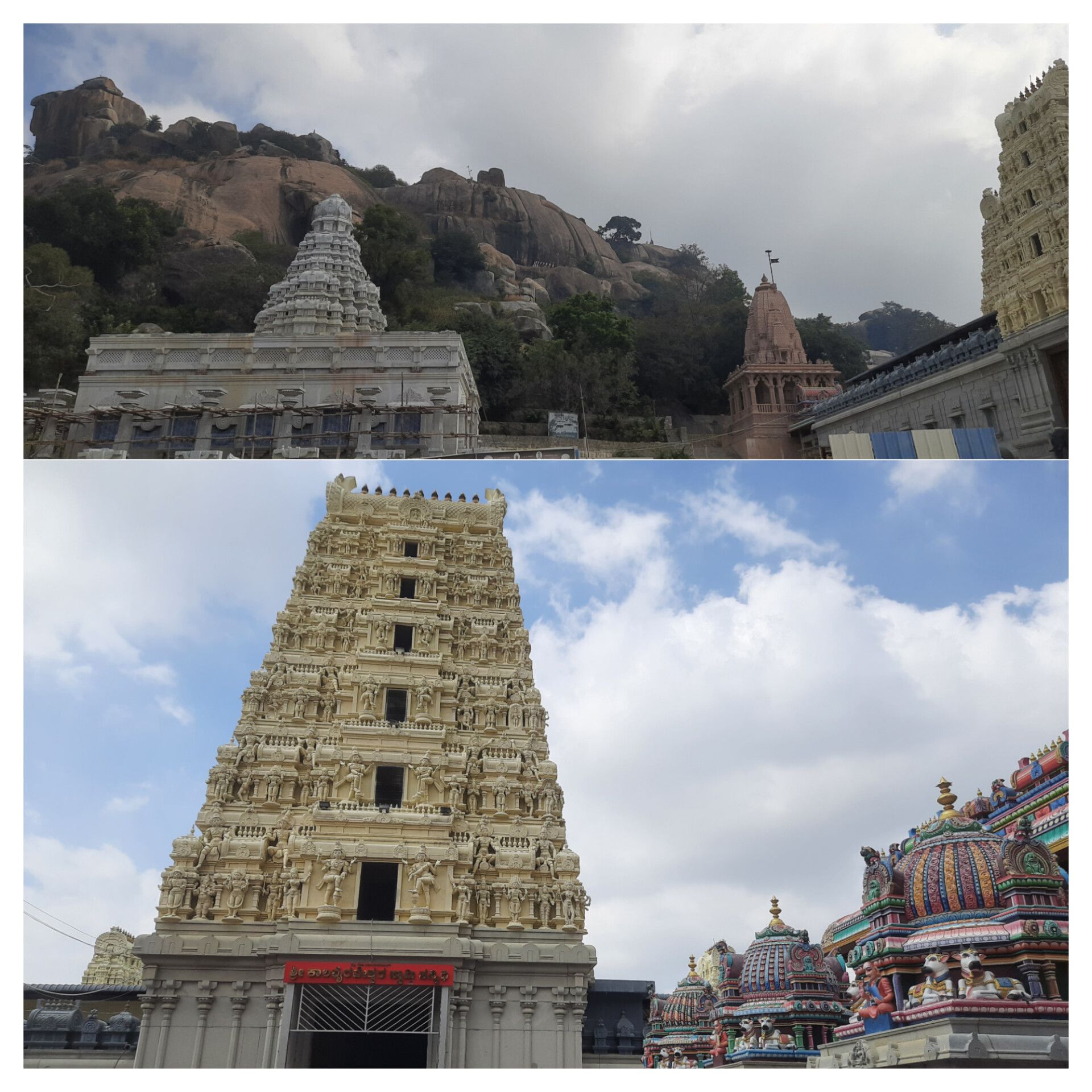
Top: The first glimpse of the Adichunchanagiri premises; Below: The entrance tower of the main temple

The initial approach towards the mutt premises starts with an ascent of about 100 steps leading to the welcome gate/ arch giving a visitor the first glimpse of the main temple. The large doors of the main temple opened into an ambience that felt divine and calm. It is entirely built with stones, and it gives a feeling of being in one of the ancient Dravidian temples though this one was built in modern times. The deities believed to be residing inside and revered highly by the pilgrims here are Sri Kalabhairaveshwara Swamy and Sri Stambhambika (Kambadamma).

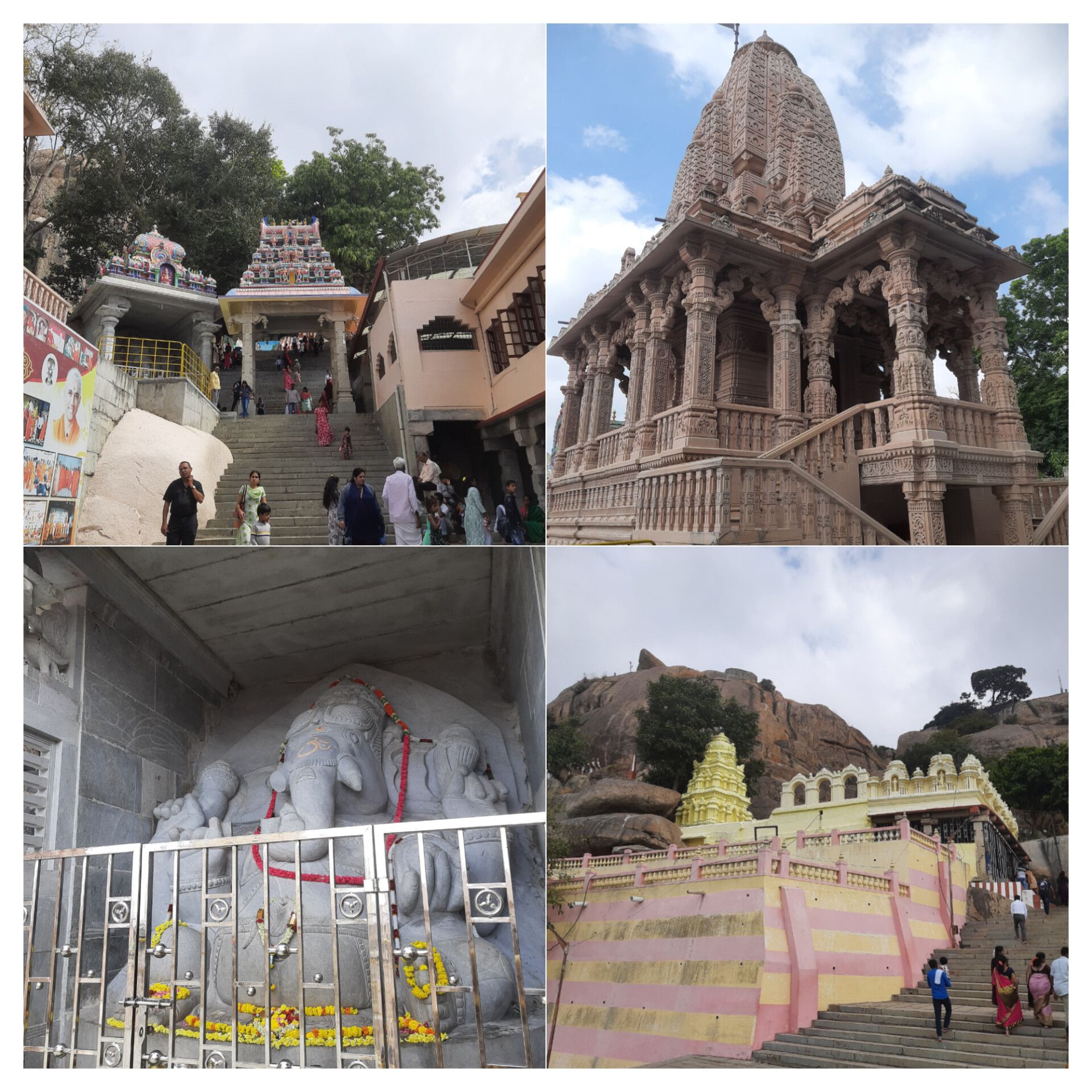
After sitting there for some time, we began our ascent towards the peak of the hill. Just after coming out of the main temple, there is a large Ganesha idol sculpted out of the rocky wall of the surrounding. We continued our climb by passing by some smaller temples with a look around offering beautiful views of the green cover.

Adichunchanagiri
The temples and shrines at the Adichunchanagiri hill

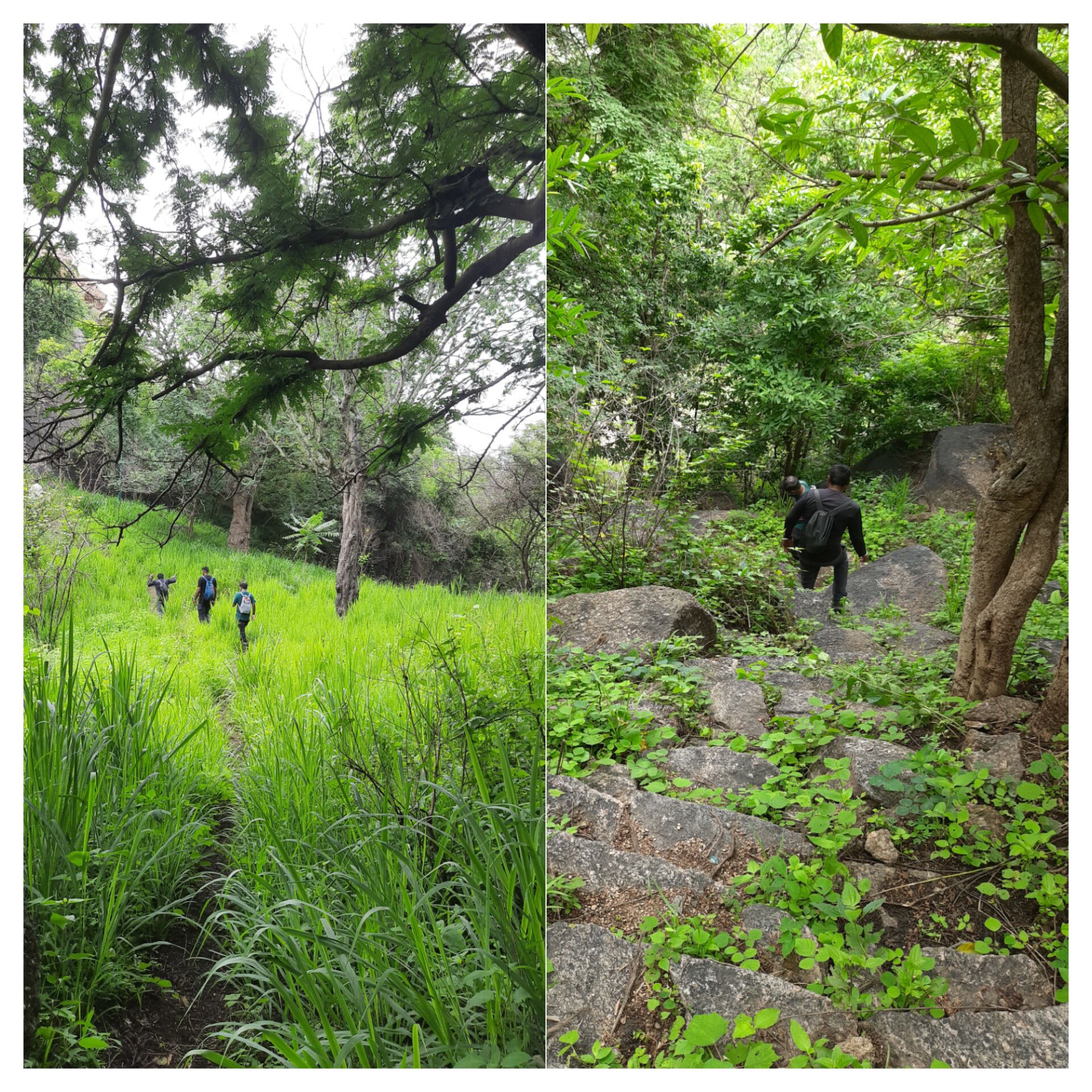
Scores of people were seen climbing up and down for pilgrimage purposes. The climb to the hilltop is done to see the Panchalingas comprising Gangadhareshwara, Malleshwara, Katthale Someshwara, Gavisiddeshwara and Chandramouleshwara, whose temples or shrines are scattered along the trail leading to the summit. But we were there to hike that hill as a recreational activity for the weekend. We climbed up the steep stairs right up to the top with the trail splitting at random places. My family ended up getting lost from each other’s’ sight and then picked whatever trail lied ahead of us and met each other again at the top. Well, not the peak exactly, but just beneath it.

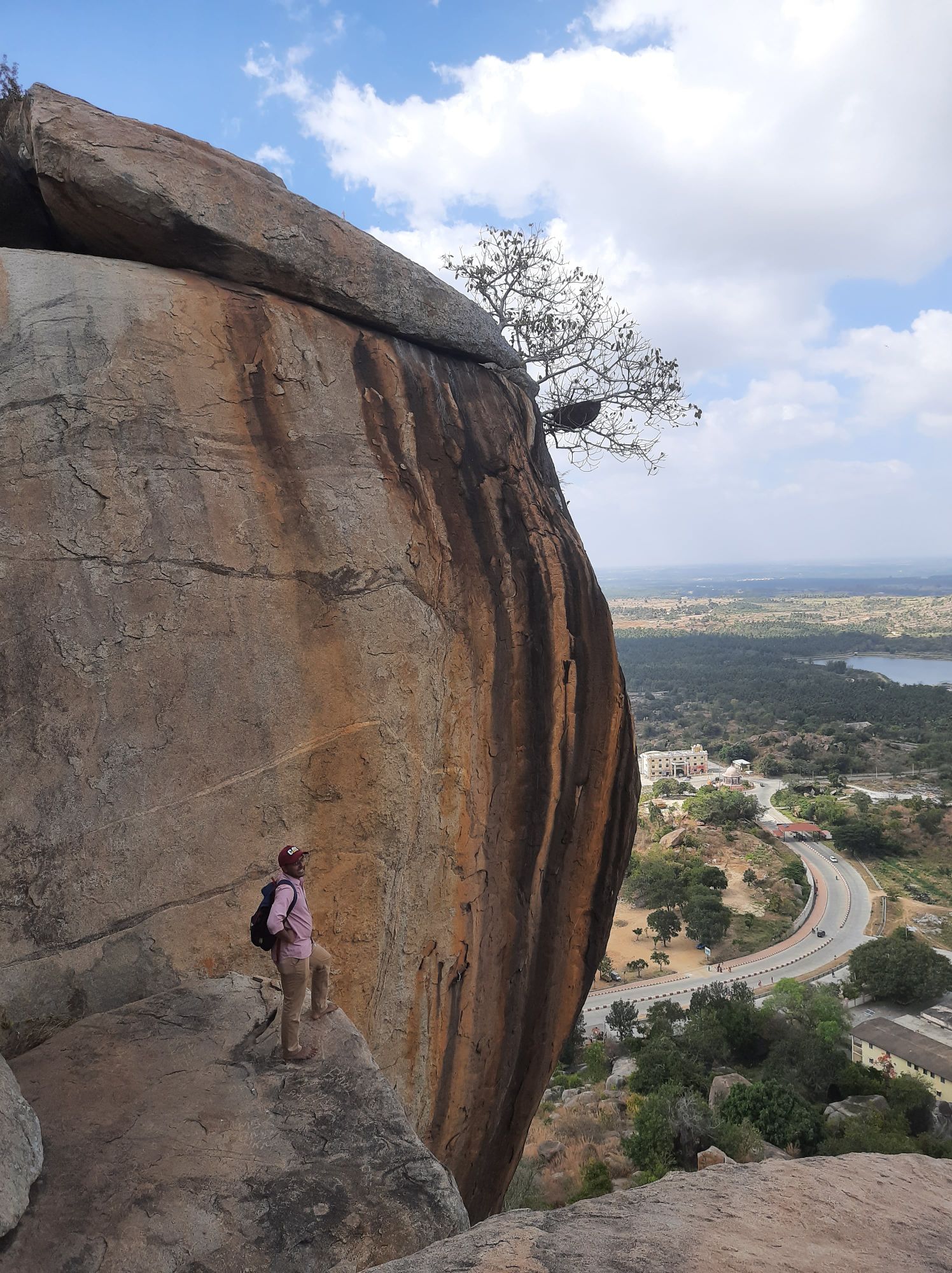
That’s where I gave up any further climb. The peak point of the hillock is known as Akasha Bhairava. It can be reached by climbing the last bit of the rocky hill which had no stairs but only with the aid of a big, suspended metal chain. It was a straight climb (almost 90 deg. gradient) which included a small jump from one rock to an another. I doubted my ability to descend safely even if I were able to reach the peak. My brother, on the other hand, climbed it up and down with so much ease (and grace) demonstrating that he still possessed his ancestors’ (apes) strongest traits.

Adichunchanagiri hill
The view from the top where I was standing beneath the last rock which leads to the peak

After he returned, we all came down towards the main temple where we were guided towards the dining hall. We devoured the delicious temple food before heading back towards Bangalore.

We started back just after lunch to avoid the weekend traffic at Bangalore. But, if you are interested to cover more places in this day, you can google for some of the Hoysala temples along your way and add it into your itinerary.

A day hike from Bengaluru- Kunagalu Betta

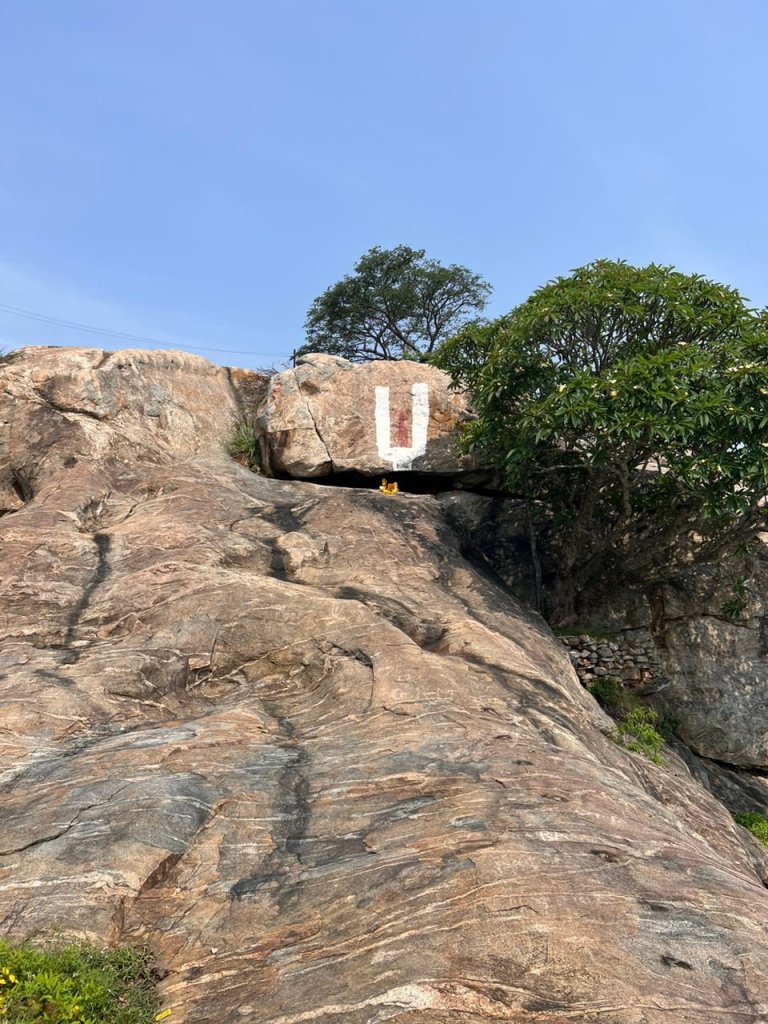
My friends and I picked yet another hill-top around Bengaluru for a day hike. ‘Kunagalu Betta’ on Kanakapura road, it was. We reached there early in the morning before the rest of the world discovered it (for that day). The car could go on to most stretch of the steep road until we parked it beside a small structure built for lord Hanuman by the roadside, under a large rock.

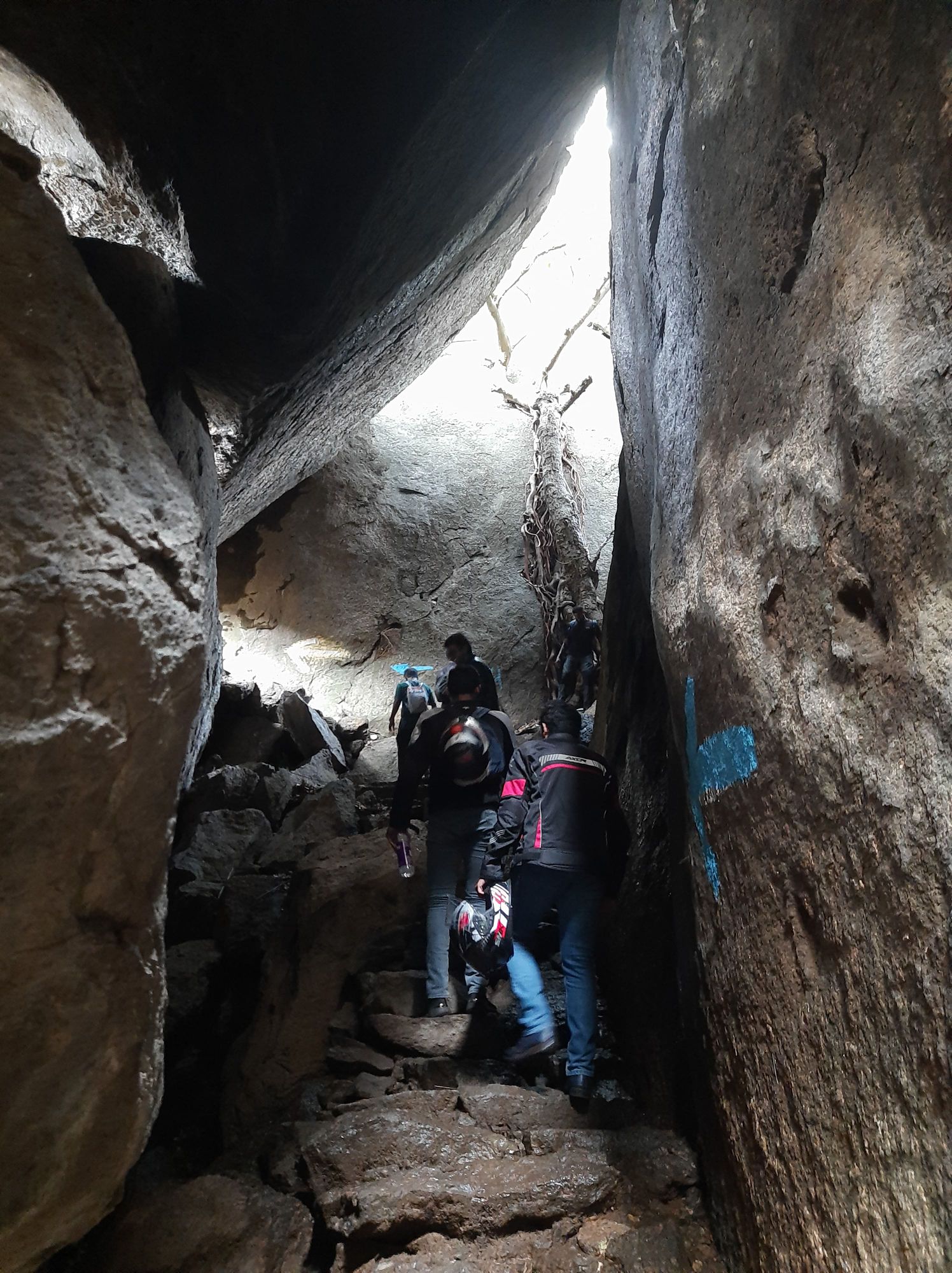
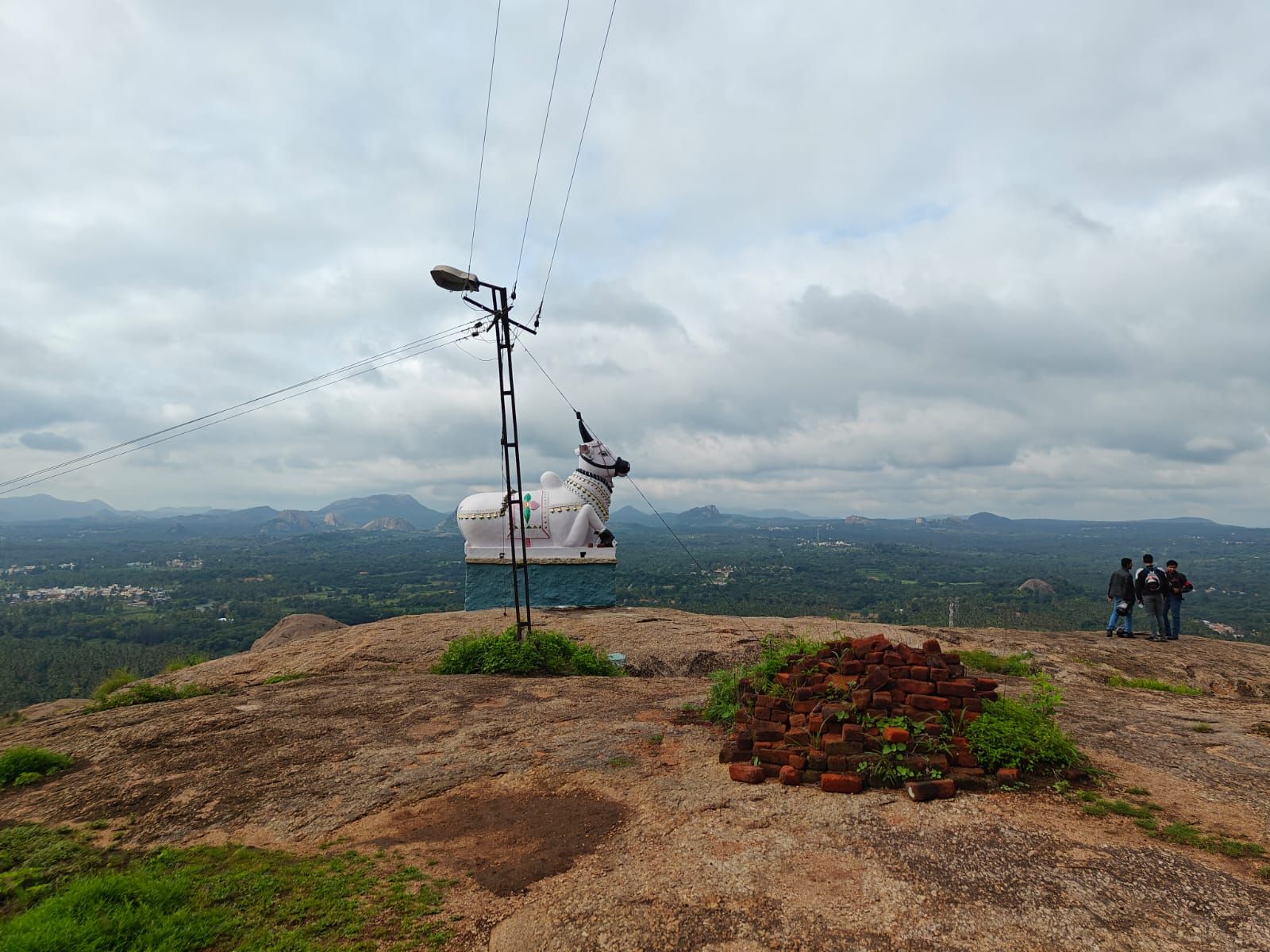
We started our hike uphill where the route was lined with several trees of custard apples for most stretch. After a kilometer of so, we came across a large rock that formed a cave-arch-like structure that kept the atmosphere inside very cool. After climbing out of the arch, it opened into the sky above a flat hill-top that offered a beautiful view of the other hills around. Do you remember my hike to Acchalu betta, where we went to find a statue of a Nandi on the hill-top? (you can read that story here). A similar Nandi was erected on this hilltop also, which was then overlooked by an ancient temple further atop a rocky outcrop from there.

The Cave like formation at Kunagalu Betta

To reach there, we crossed a small wooden brook formed out of a tree branch and then climbed to the peak where the temple stood. We sought the almighty’s blessings which mark the end of the ascent of the hike for most people. We had barely climbed a kilometer and half, and it didn’t feel like a hike yet considering we had done longer trails even on day trips. The breeze was cool, strong and yet soothing and hence, we decided to sit there and spend some time feeling the wind in our hair.

Kunagalu betta
The Nandi Statue atop Kunagalu betta

We then looked around and decided to find our own way to the adjacent hill from there. We climbed down the temple hill and climbed up the adjacent one. We again climbed it down and navigated our way through thick bushes and thorns to ascend yet another small peak. On that peak, we got a sense of getting lost if we tried to explore more hills because at that point, we were the only people and there was no trail that had worn out to lead us anywhere if we were lost. We descended that hill and were trying to find the direction that would lead us back to the temple.

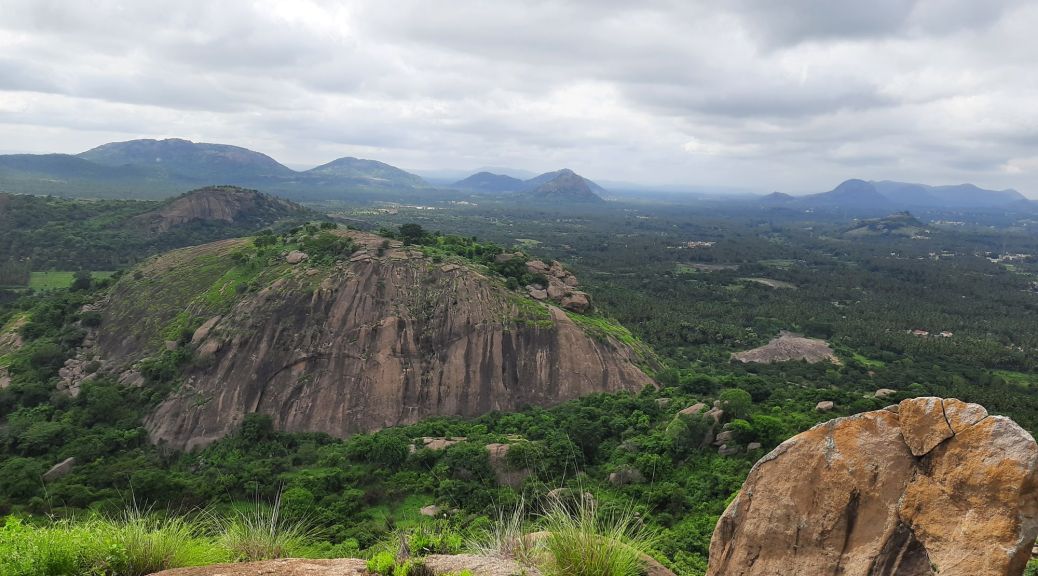
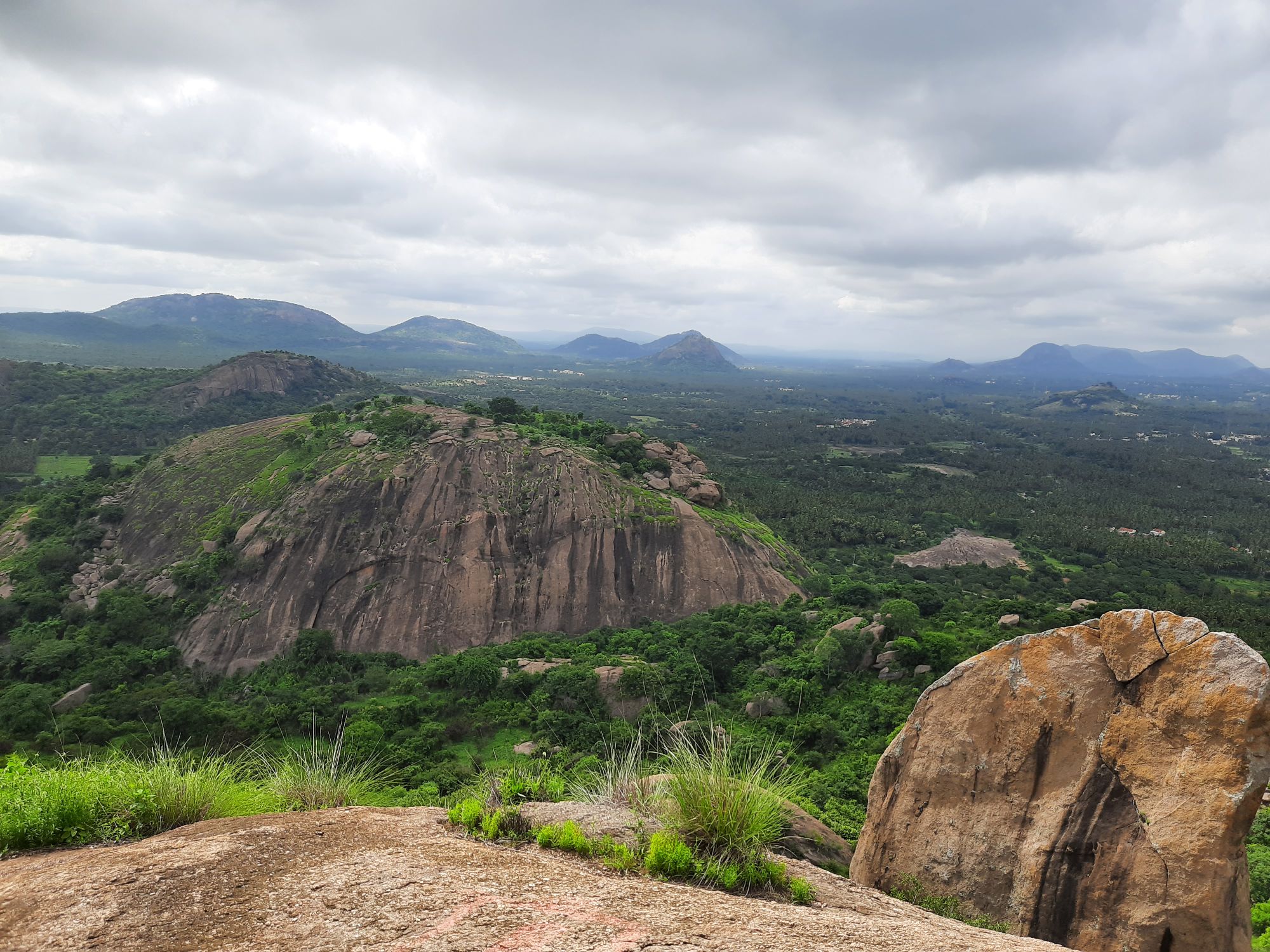
Kunagalu Betta Peak
The view from Kunagalu Betta peak

Just then, our eyes caught a small slope in a random direction and all of us decided to explore one last random trail before heading back. We walked in that direction where the tall grass seemed to need some wear. We walked down further and suddenly out of nowhere; we were in for a surprise. There was a flight of stairs chiseled out of the rocks which was leading downwards. Finding stairs out of nowhere was a surprise, but what assured us was that the stairs would lead us somewhere interesting. Perhaps an abandoned piece of history? We thought as we headed in that direction.

Kunagalu Betta
In quest to explore the lost history at Kunagalu Betta

The grass laden stairs quickly cleared up to the view of a dozen motorbikes all parked side-by-side. That’s when we realized that we had already reached the parking lot. We had found a shortcut on our quest to explore random trails in random directions. Thus ended our quick hike to Kunagalu Betta. I picked up a bag from the car and tried to pluck as many custard apples as possible before heading back.

In conclusion, it was a short and easy hike. You can combine it with Acchalu betta or any other hike on Kanakapura road and make it a full-day activity.

Weekend Drive- Biligundlu Ranganatha Swamy Temple

Another weekend and another offbeat destination. This time, we found a temple on a small hillock in Dharmapuri district of Tamil Nadu. In my earlier post about Hogeynakal waterfalls, I have elaborated on how river Kaveri marks the boundary between the two states of Karnataka and Tamil Nadu. This post is somewhat related to the same connection. Because the history of the temple that we were planning to visit this weekend is rooted on the other side of the river, on the fertile plains of Karnataka.

The original Ranganatha swamy temple dating to the Cholas or the Vijayanagara era (as described by the locals) was on the Karnataka side. The stone structure of the temple is present even today (we hope to visit the structure on another weekend trip). The idol of the deity was destroyed by the British (which needs fact checking) and then, a new idol was reinstated on the Tamil Nadu side of the land where it stands today. The Ranganatha Swamy temple that we were heading to is in Biligundlu village and hence the name. The idol of the deity is carved out of a rock which is part of the hill overlooking the river.

On a summer day, when the water levels in the river are low, one can walk across to the other bank. Whereas, when the river is flowing full, the roads leading to both the old and the new temples are long ones. The old location is reachable via MM. hills in Chamarajanagar district of Karnataka, and the new temple is reachable via Anchetty forests in Dharmapuri district in Tamil Nadu.

The trail to Biligundlu Ranganatha swamy temple

Anyway, coming back to this weekend, we started early on a weekend morning along the Anchetty forest leading to Hogeynakal waterfalls. We skipped the highway restaurants and stopped by a small local restaurant in Anchetty town for breakfast. It was a good decision as the experience was good with local food and the local atmosphere.

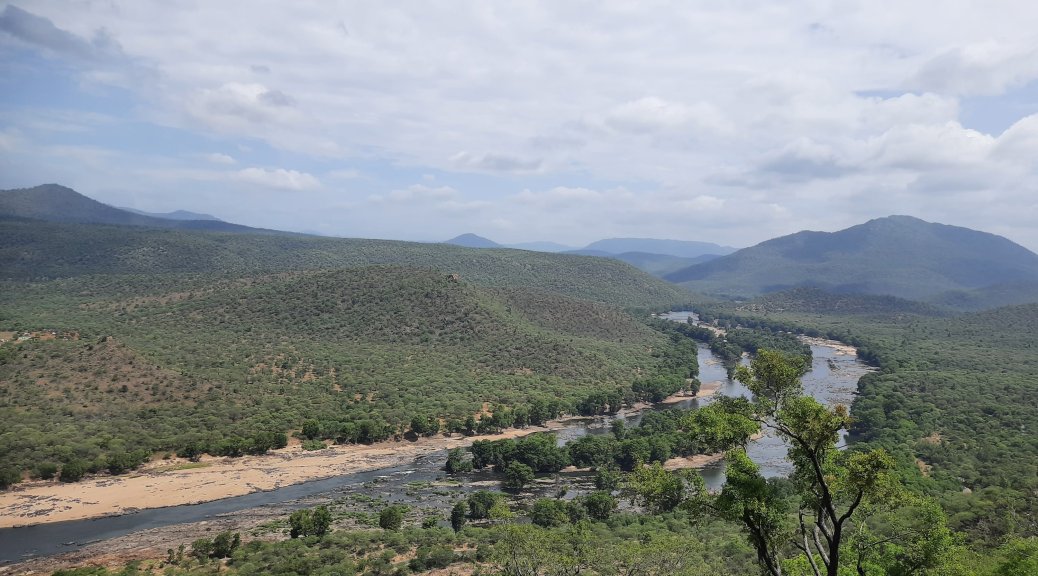
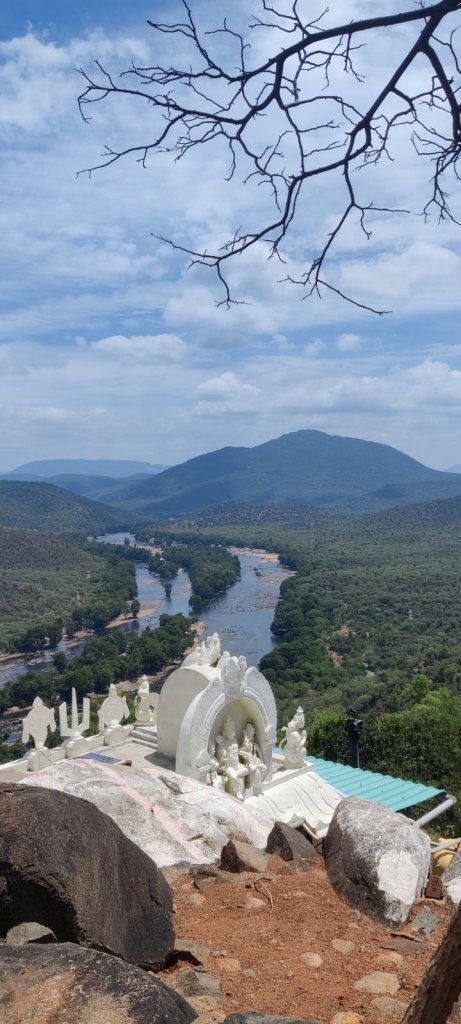
A few kilometers after the Biligundlu cemetery and few kilometers before Hogeynakal waterfalls, we stopped by at a location where river Kaveri flowed onto our right and a tiny structure of brick and mortar was built onto our left… We parked our vehicle there and started our short hike up from there. A properly laid stone path is there all the way to the hilltop which took us around half an hour to hike. The views of the river and hills around were just amazing all the way.

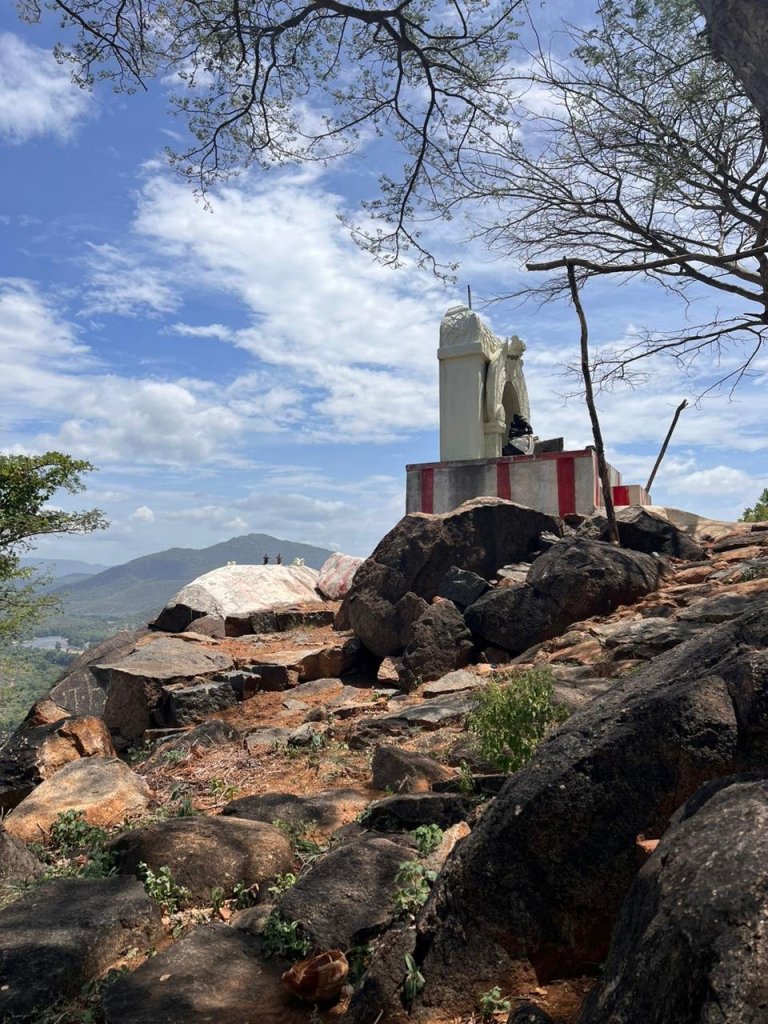
The Ganesha idol at the peak of Biligundlu Ranganatha swamy temple hill

First, we were greeted by an idol of Ganesha sitting under the tree at the peak. This spot gave a splendid view of the river and the hills beyond. We sought Ganesha’s blessings and proceeded to the Ranganatha temple located below, connected by a short flight of stairs. The temple was closed by the time we arrived. However, we could see the idol through the meshed gate. After offering our prayers, we found a spot adjacent to the temple wall and sat there to soak in the beauty of the place. The view of river Kaveri flowing with a backdrop of green rolling hills looked amazing even as the winds caressed our faces. It was a beautiful place, indeed!

View from Biligundlu Ranganatha swamy temple
View from Biligundlu Ranganatha swamy temple; Photo Credits: Sugan @ TheBuffalorider

We headed back after a while and decided to take a dip in the shallow waters of the river to beat the summer sun. A word of caution if you plan to get into the river, that there will be a sudden drop in the depth at many spots and it is believed to have whirlpools as well. We stayed by the shores before calling it a day after a while.

Other nearby places to visit:

Weekend Hike- Bala Kodandaraya Swamy Temple

Although this destination is a recommendation for weekend and day hikers of Bengaluru, it is in Krishnagiri, a district bordering the two states of Karnataka and Tamil Nadu.

The views from an ancient temple had caught the attention of my friend and me, who are always in the look out for less crowded and less explored landscapes and places with cultural and historical importance. One such place was the ‘BalaKodandaraya Swamy temple’ whose history dates to the Vijayanagara era. Based on our online research, we found out that getting to the temple involved a short hike.

We started early on a Saturday morning by car. We had our breakfast along the way, in one of the several restaurants on the Hosur highway. From there, we followed the route on Google maps to reach our destination. A steep deviation to the left of the highway led us through villages. There were asphalted roads and good views of the surrounding hillocks for as long as the road passed through villages. The last couple of kilometers were through unpaved muddy roads passing through a slight forest stretch. We finally arrived at a small open space where we parked our car, at the base of the temple hill.

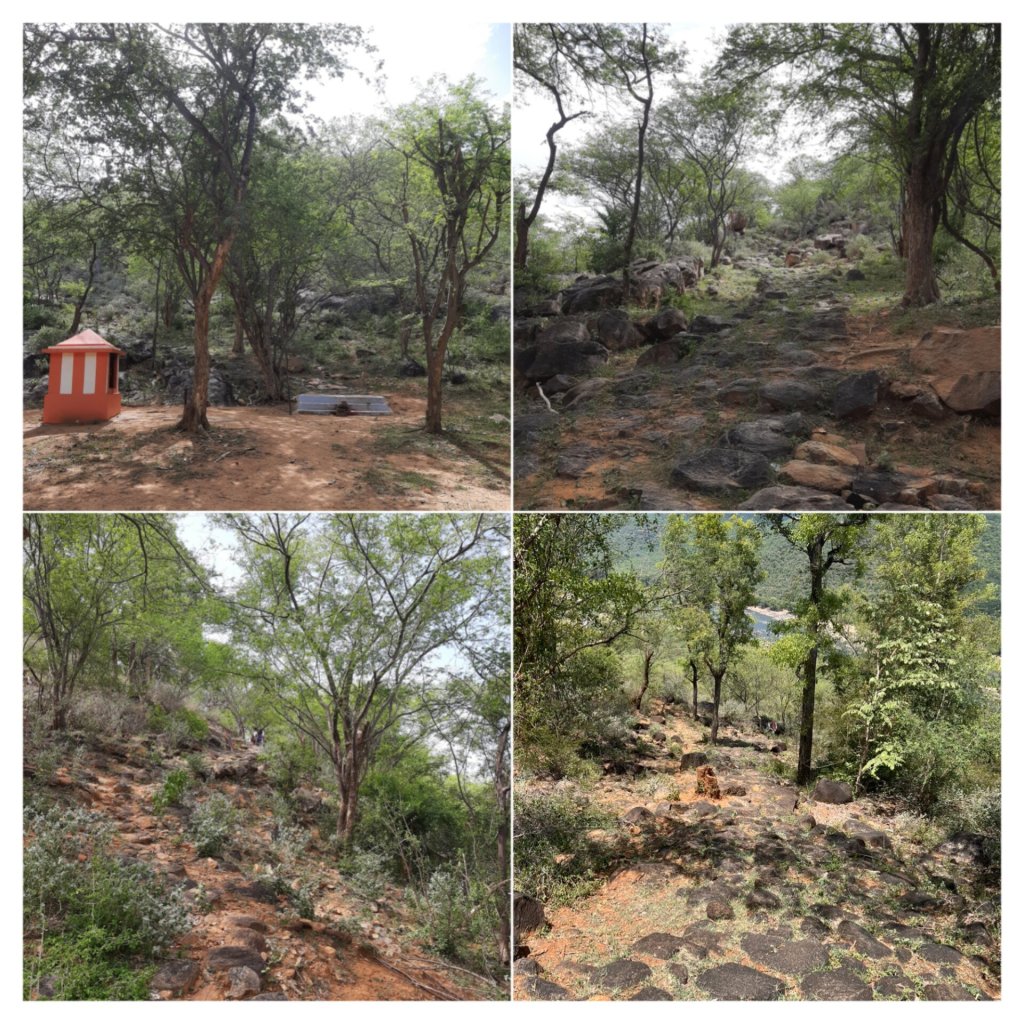
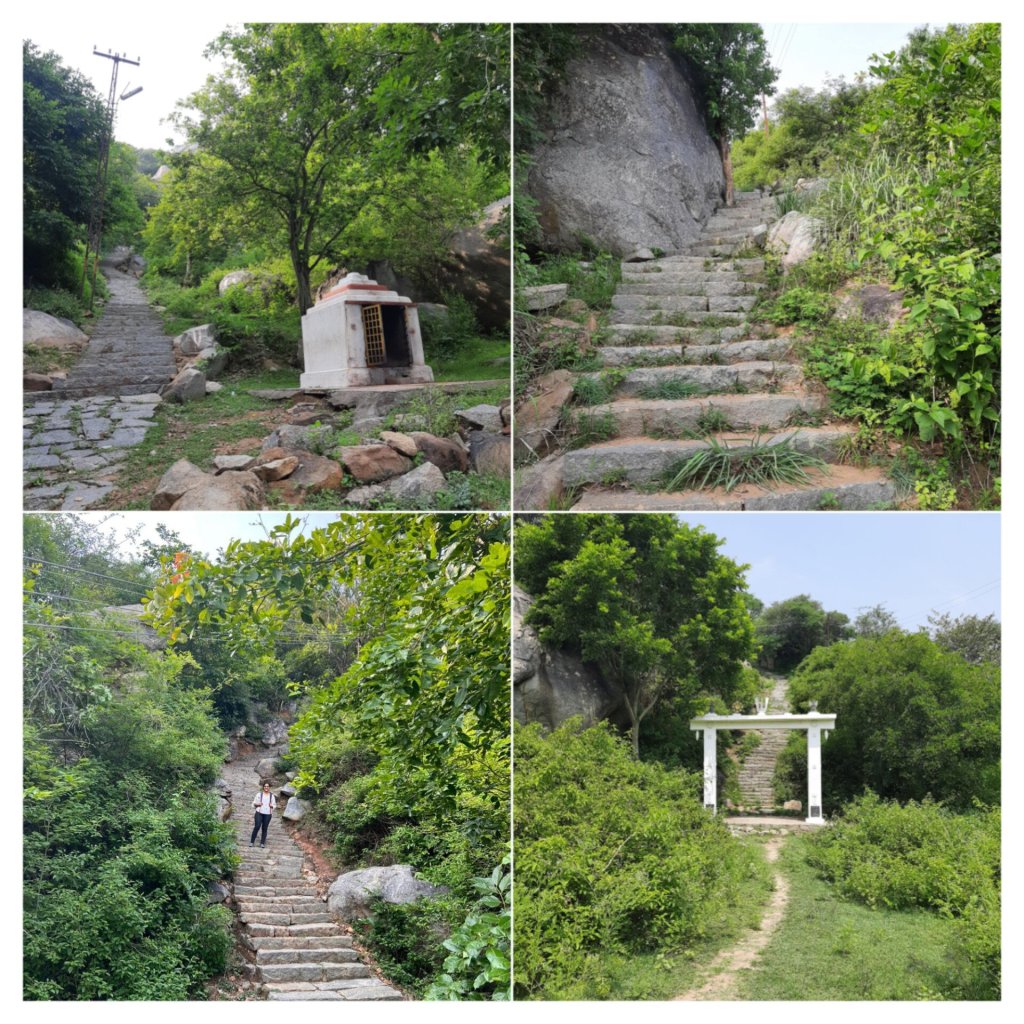
The forest trail
The trail through the forest cover, starting from the base to the temple arch

There was a small structure of brick and mortar (gudi) at the base, from where a flight of stairs led to the hilltop. People lit lamps, agarbattis and camphor here before starting their ascent. It took us about half an hour’s climb along properly laid stone steps leading to the top. These stone slabs bear the names of the devotees who have donated them and the count of their donations on each step. The ascent curved around at multiple places and offered amazing views of the valley below at every turn. The first half of the climb had a forest cover and large boulders on both sides, until we arrived at the welcome arch of the temple.

The path towards the left of the trail, towards the temple

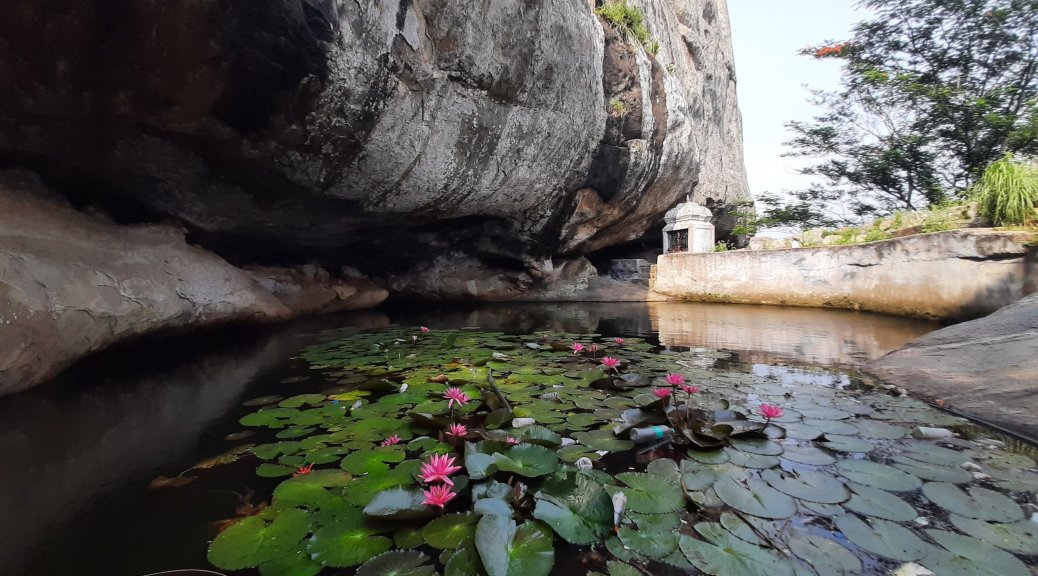
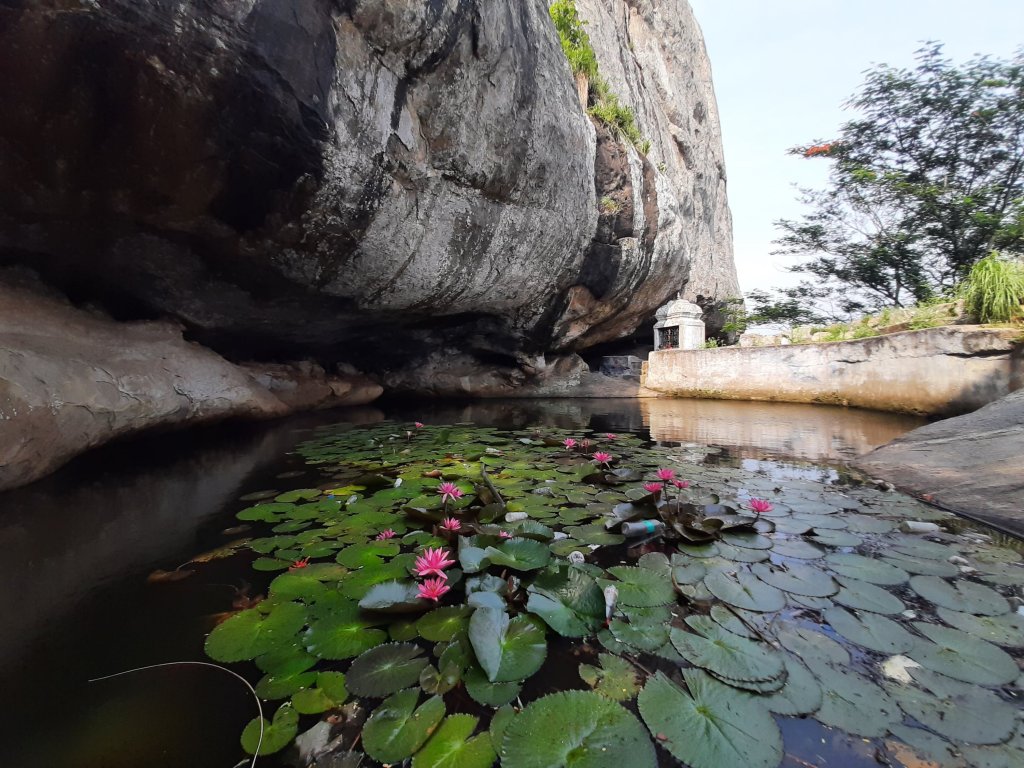
The forest cover ended after a few steps further from there and opened to a panoramic view of the valley of the villages and farms below. As one stands on a large rocky outgrowth, you will find the trail split into two paths. One, straight down through some Gulmohur trees. Second, up towards the temple. We decided to first walk the trail going straight. A few yards from there, the trees made way to a beautiful pond of pink lilies, dug right beneath a large rocky monolith. We later realized that devotees take a dip in this pond before proceeding towards the temple.
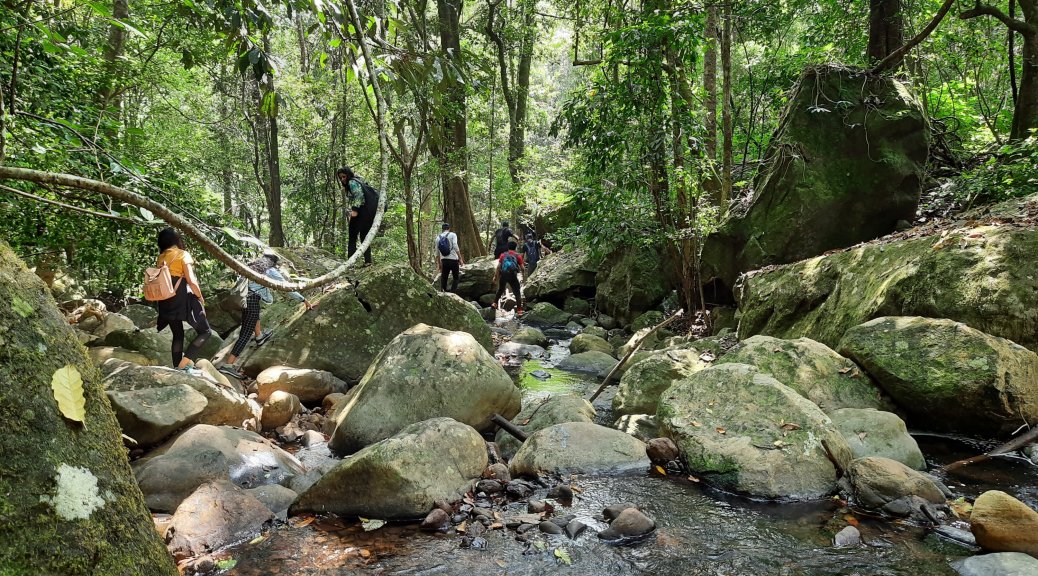
The path towards the right of the trail, leading to the temple pond

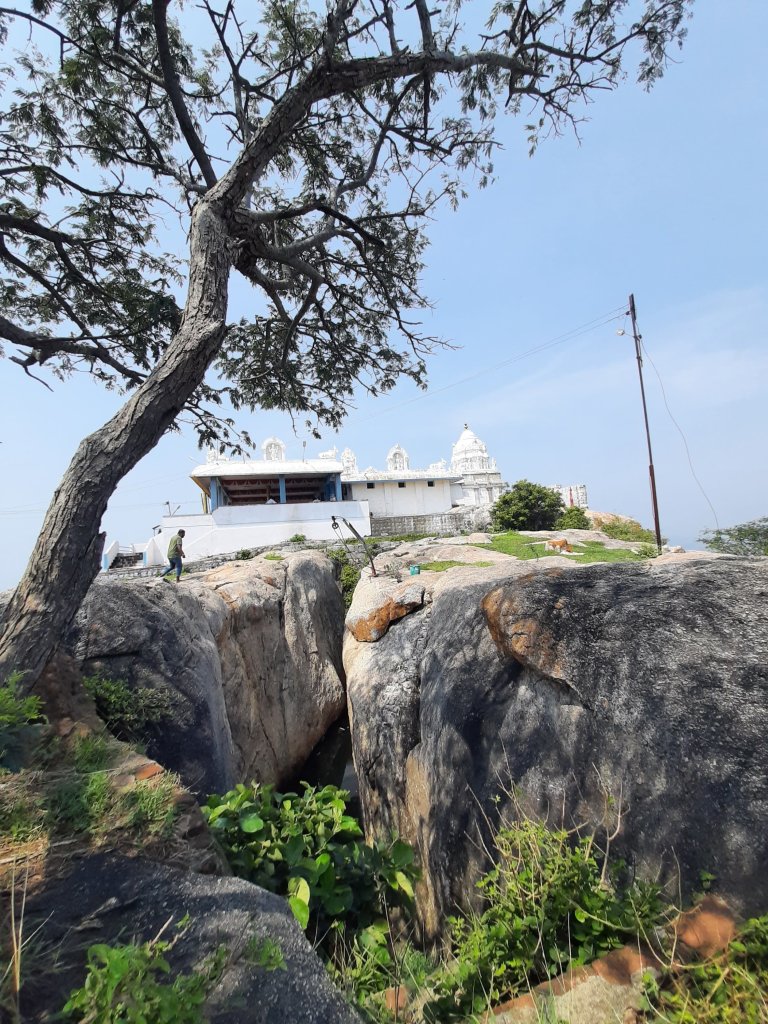
The view of the valley from there and the magical vibe of sitting by this pond of lilies could not let us go easily from there. My friend settled on the banks, with a book to read. Although the water was heavily littered with plastics, it was still a super calm spot to soak in some good energy. After spending a while, we then headed towards the temple, located on the peak of the hill, a short walk away. There was a panoramic 360 degrees view of Hosur and Krishnagiri from the temple, the green cover around, Krishnagiri dam and the Then Pennai river. The temple priest arrived much later at around 10.00.a.m. for the daily prayers.

Balakodandaraya swamy temple, Krishnagiri
Balakodandaraya swamy temple and the cleft for drawing water

Surprisingly, a small cleft in the rocky hill serves as a perennial source of potable water for temple use. The people who had gathered there by then, helped the priest in drawing water from this cleft and clean the temple premises before offering the day’s prayers. We sat there for a while and decided to head back to the base before the sun took over the skies and heated the rocks around. Overall, it was an incredibly beautiful place for a short trip from the city.

Other nearby places:

If you are looking at making it a full day trip, then you can explore the nearby places that include:

Bannerghatta beyond zoo- Bilikal Ranganathaswamy betta

Initially, when a friend mentioned the destination for an impromptu drive on a Saturday morning, I hoped to correct him by telling it was ‘Biligiri Ranganathaswamy Betta’. “No, it is Bili-Kal’, he specified. ‘Bili’ translates to ‘white’ in Kannada. ‘Giri’ means ‘hill’. ‘Kallu’ means ’stone/ rock’. In this context, we were both talking about two different destinations. Although the presiding deity at the temples located atop both these hills are common, Biligiri is more popular than its counterpart at Bilikal. While Biligiri forms the core of Biligiri Ranganathaswamy Temple (BRT) tiger reserve, Bilikal is in the heart of a reserve forest that comes under Kodihalli wildlife division of Bannerghatta National Park. So, this time, we were heading to ‘Bilikal Ranganathaswamy Betta’, the closest of the two to Bangalore city limits, reachable through Kanakapura road.

We stopped by Halagur town for breakfast which has several old and popular eateries that serve unique types and authentic recipes of idlis for breakfast. (Comment below if you need hotel recommendations). Post this break, we followed google maps to reach our destination.

There is a forest check post enroute where one needs to make an entry to continue the journey ahead. The temple hill can be summited via two routes, one is a trek route with stairs, and another is through an unpaved road that is clearly marked till the end. Although four-wheel drive is not mandatory for those opting to drive up, it is recommended to have a vehicle with good ground clearance.

Bilikal ranganathaswamy temple
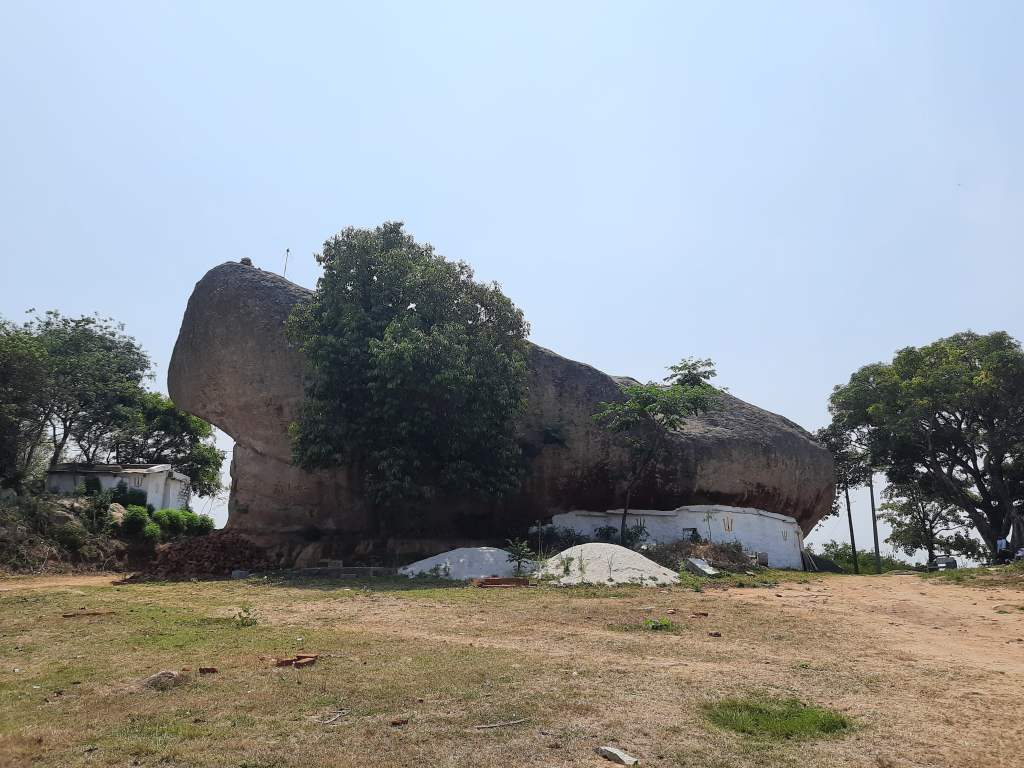
Bilikal ranganathaswamy temple, Rear view of the Monolithic rock

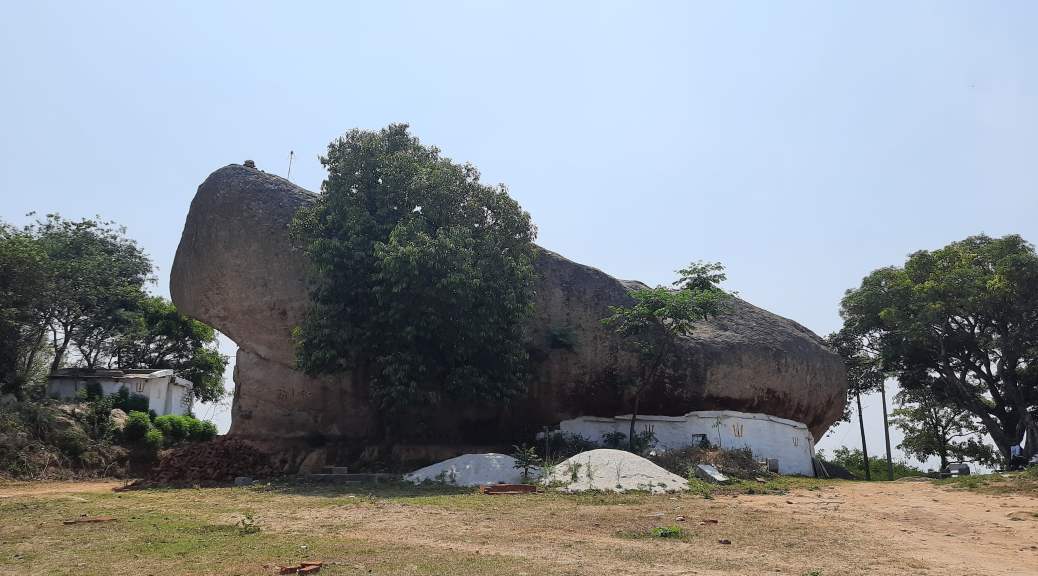
Upon reaching the peak, it was a large open area which came as quite a surprise. While one side of the hill had the temple pond dug into the edge of the rocky hill, the main temple of Ranganathaswamy is located on another side of the hill, overseeing a magnificent view of the surrounding hills. The main deity is carved out of a large monolithic rocky outcrop on the hill, which makes this place unique among all that I had visited thus far. There is a small sculpture on this rock which we were told is the original figurine of worship until it was damaged many years ago. Since then, an alternate idol has been carved out of the larger rock and a simple temple has been built outside leading into the prayer chamber within the monolithic rock.

Next to the temple rock, is another old and small room like stone structure. A few localites who were present there told us that it was the house of an old lady Kamalamma, who lived there and had dedicated her life in the service of Lord Ranganatha. Amid the wilderness of the thick jungle, she lived all alone in the belief that Ranga was her caretaker. She was accompanied by a few cattle that lived there whose milk was used to distribute buttermilk to pilgrims who arrived there every Saturday after a tiring ascent by foot (before the drivable route was laid out). She is no more, and her tomb is now housed inside the structure where she lived.

Bilikal ranganathaswamy temple, front view of the rock temple

A short climb from this structure is another viewpoint, where one can sit on the rocky outcrop under the shade of the surrounding trees and take in some good views of the valley around. We returned after spending some time there. Overall, this was a pleasant and an offbeat outing from the city.

Things to note:

  • The temple and the forest check-post are open for public access only on Saturdays. Only one Pooja is offered to the deity, once per week.
  • The annual temple fair is held here in January when a wooden temple car is assembled and taken around the rock-temple.
  • All along our way, we observed a lot of fresh elephant dung. Hence, we are certain that the trail is frequented by elephants and other wild animals at all times of the day. As both the routes pass through dense forest, it is recommended to comply with all guidelines laid by the forest department.

Other nearby places that you can combine your visit with:

  • Shri Govinakallu Anjaneya swami temple (an offroad drive in the same forest limits)
  • Mekedaatu and Sangama
  • Muthathi riverbank
  • Galibore fishing camp
  • Bheemeshwari adventure and nature camp
Bilikal Ranganatha swamy temple

Pondicherry- 10 Places to Visit and Things to Do While on A Tour

Do you want to visit the tranquil beaches of the south? Journey to Pondicherry. The city was previously a French colony and is now a small union territory on the eastern coast of the Indian subcontinent. In both the monuments and the city’s alleyways, you can still see examples of that era’s architecture. The city is well-known for its beautiful beaches and historical sites to visit. There are also some fantastic cafés and restaurants to visit while on tour. To learn more about the location, try the local food.

Pondicherry is appropriate for individuals of all ages and walks of life. It is ideal for seniors, couples, friends, family, children, and business travellers. While in the city, there are several sites to see, some of which are listed here. Stay at Treebo Hotels in Pondicherry to make your journey unforgettable. These resorts are spread around the city and provide some of the greatest features.

Places to Visit in Pondicherry for an amazing trip:

1. Paradise Beach

Lovers may visit Paradise Beach, which is ideal for relaxing. Tourists are drawn to the area because of its natural beauty. The sun’s rays reflecting on the golden sands of the coast create a captivating view of the entire region. To go to the beach, take a ferry from Chunnambar. The Bay of Bengal’s stunning beauty is worth seeing. It is a photographer’s dream since exotic birds may be found here. So, take a stroll along the beach or spend some quality time with your special someone. There are also food vendors here for some snacking.

2. Sri Aurobindo Ashram

Aurobindo Ashram is a spiritual destination for those who are on a trip. To discover more about the place, visit the Ashram library. The location has expanded from a tiny congregation that worshipped Sri Aurobindo. The site is worth viewing while sightseeing in the city. The Ashram also has a hall where guests may view a short film about Sri Aurobindo’s life and work.

3. The Basilica of Sacred Heart of Jesus

How can one miss the city’s most famous church? This church is a masterpiece of Gothic Medieval Architecture and is well worth seeing. Stained glass and paintings depicting the life of Jesus Christ may be seen inside the church. The church is adorned for Christmas and Easter, and people travel long distances to attend the festivities. The magnificence of the building, on the other hand, draws the majority of tourists to this location. It was built in the early 20th century and has been rebuilt multiple times to keep the entire structure in good condition.

4. Rock Beach

Another beach to visit in Pondicherry is Rock Beach, also known as Promenade Beach. The location is ideal for seeing the sunrise and sunset. During these hours, the waters become golden, creating a beautiful scene. People come here for peace and quiet or to take a stroll with their companions. The palm trees that line the shore are also considered to be the most photographed spot in the city.

5. Varadaraja Perumal Temple

This lovely Dravidian-styled temple is well worth a visit when in the White Town of Pondicherry. During festivals, the temple is inundated with people worshipping Lord Vishnu in and around the shrine. Seek heavenly blessings here and marvel at the temple’s architecture. Lord Vishnu, also known as Lord Varadaraja, is claimed to bless everyone who comes to the temple. The temple was established in the 11th century, and several legends have been told about how the temple came to be. One of the most popular is that the Lord’s idol was discovered in the sea, which is how the temple was established here.

6. French War Memorial

The War Memorial, located in the seaside region of Pondicherry, is recognised to be very important to the French Indians who live here. The war memorial was created to honour the troops who died during World War I. The Memorial was created in the first half of the 20th century and is visited by people from all over the world. Because it is positioned on a beach, the view of the entire region is breathtaking. The 14th of July is marked as a day to remember the martyred warriors. The entire region is illuminated, and people gather to remember the people’s sacrifices.

7. Auroville

This Ashram, which is also a piece of art by the Sri Aurobindo Society, is located about 15 kilometres from Pondicherry’s main city. This location is a must-visit because of the tranquilly and tranquillity it exudes. It is being created as a township and has recently become one of the most popular tourist destinations in the country. Visitors to the city come to view the Matrimandir. The architecture of the Gold Dome is what draws the majority of tourists.

8. Arikamedu

History aficionados might visit the Indo-Pacific bead-making site at Arikamedu. It is an archaeological site located within a few kilometres from Pondicherry’s main city. The site is claimed to have been a trading centre during the 1st century BCE. In addition, the French Jesuit Mission’s ruins may be found here. The traces of a bygone age are a must-see, located in a remote place. The surrounding natural beauty is still undisturbed because not many people visit the location.

9. Chunnambar Boat House

The magnificent seas of the Bay of Bengal are very captivating in this location. The little hamlet outside of Pondicherry’s main city is a popular tourist destination. Visitors may also participate in a variety of water activities in the area. Dolphins may also be seen here. Sit on the beach and soak up the rays, or watch others participate in various sports. For some adventure, one may even take a boat trip in the backwaters here.

10. Shopping in Pondicherry

Last but not least, shopping in Pondicherry’s streets is one of the nicest things to do. Souvenirs for loved ones can be purchased here. Serenity Beach Bazar, Nehru Street Market, Saram China Market, and many more are places to visit while in the city for some shopping. To shop from the city, look for things such as handicrafts, clothing, food, home décor, handbags, and so on.

The streets of Pondicherry are also known for photographic sessions as they are painted in either vibrant colours or plain white. Visit the place to experience all of this.

To check out all these beautiful places in Pondicherry, book your stay at Treebo Pondicherry. These hotels in the city are available at budget-friendly rates and provide some of the best amenities. Some of these services at Hotels in Pondicherry include-

  • Complimentary Breakfast
  • Free internet access
  • Hassle-free check-in
  • Branded Treebo toiletries.

These hotels in Pondicherry by Treebo are:

  1. Itsy by Treebo- Coastal Grand De Heritage
  2. Treebo Trend B Coral
  3. Treebo Trend Yagna Residency
  4. Itsy by Treebo- Red Lotus Heritage
  5. Treebo Trend Raffis’ Andalusia
  6. Treebo Trend South Avenue

I Belong to Everywhere: Theralu

This is an attempt to bring back nostalgia. Continued from- “I Belong to Everywhere: Chamarajpet“.

This is a small village in South Kodagu that is closer to Kerala borders than it is to Madikeri. This is where my maternal cousins originally hail from, and they went to school with me at some point while staying together at our maternal grandparents’ house. So, it was natural that I too would accompany them to their native village on several occasions when they went to their parent’s house at Theralu.

Apart from the expansive Tata tea estates and the Kerala borders some of the other popular landmarks that I enjoyed day tripping here were Irupu waterfalls, Mrithyunjaya temple and the Nagarhole National Park.

For all that I can remember from those visits were that there were people speaking and following different culture than I was familiar with. All the workers that worked in both my maternal and paternal hometowns were from the local tribal communities who spoke and ate quite same as what I did at home. But those working at my Uncle’s estate in Theralu spoke so many different languages. The larger group had almost created a mini-Assam in the site of their labourers quarters. They had built so many structures, equipment, tools out of bamboo (the most common site in all over Assam) and ate food that was made with ingredients that we in Kodagu didn’t know were edible until we saw them.

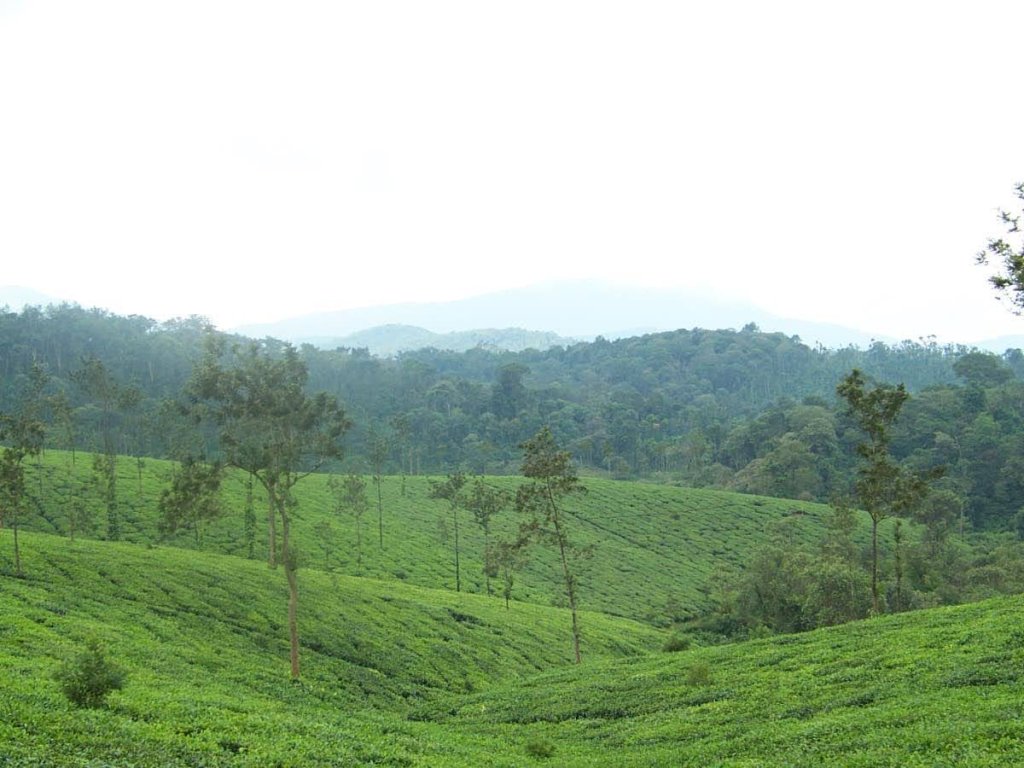
The Glenlorna tea estate Coorg

This is also where I was introduced to Tamil language and their movies. A large group of workers came to work in the farm at Theralu during the peak coffee harvest season and returned back to Tamil Nadu after the season ended. During evenings or on weekends, these workers often came to my cousins house to watch TV. Although I didn’t know their language and didn’t comprehend with most things they communicated, I picked up names of the stars whom they clapped hands in enjoyment or sounded a “Shhhhhh” to express disappointment while watching their favorite stars on the screen. In spite of not understanding a word of what the movie or tele-serial was about, it was an inevitable situation for me to sit and watch through whatever was being played 😀 Looking back at the days, those stars from the early 2000s are the only few whom I can associate with while talking about movies with a Tamilian!

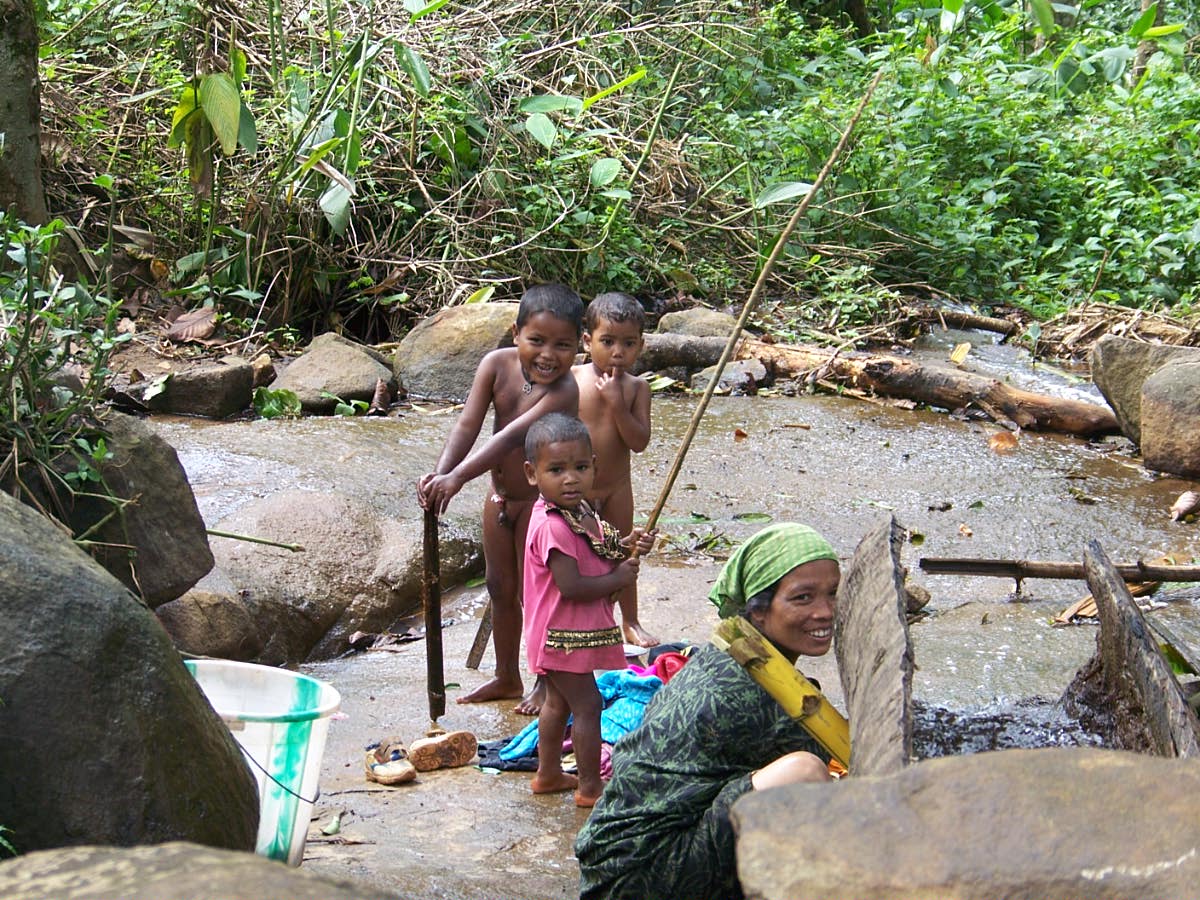
Assamese kids enjoying their shower in a small stream in the estate

With limited means of communication, the major exposure we had in this small hill-district was just limited to living in estates or serving the army. Here, I saw migrant workers coming from faraway places in search of ANY doable jobs, saved a portion of their limited income and sent it to their families back in their hometowns and still lived a life of modesty. I learnt that life was not all easy for people living in other parts of the earth. It always made me think and reflect how unequal and different life was for everyone. Theralu taught me lessons of gratitude for the life I am living!

To be continued as- “I Belong to Everywhere: Jalahalli

A hidden gem of Wayanad- Aranamala waterfalls

I have discussed with you all why I volunteered to become a ‘Trek leader on weekends’ and how much I enjoy doing it with ‘Plan the Unplanned’ (PTU). With Covid19 lockdowns and safety precautions that followed, break from my weekends with PTU has been longer than I had thought. Although I have been travelling with a closed group of friends and family since few months now, the fear of socializing with a bunch of unknown people had kept me away from PTU. Finally, this January, I decided to get out and lead a group of trekkers. The destination assigned for this weekend was Sultan Bathery in Wayanad district of Kerala. And the task was to find a hidden gem in the Aranamala hills. We were going to hike along a stream to see a waterfall.

Itinerary:

Day 0: Leave Bangalore by night
Day 1: Day hike to Aranamala waterfall, Visit sunset-point and night camping at Ambukutti hills
Day 2: Watch sunrise, visit Edakkal caves and explore Wayanad. Return to Bangalore by night.

The Aranmala waterfall trek

The Details:

It is a very hazy memory from the cold dark January morning of sitting inside our bus at the Wayanad wildlife sanctuary’s Sultan Bathery check post. We had arrived much before 06.00.a.m., when the forest gates would open for public entry. Since we were not allowed to make any noise or get out of the bus in the forest area, we all decided to get some sleep until the gates opened. At first, I was woken up by the cries of peacocks that seemed to be somewhere very near to the bus and some distant elephant trumpet. But then, the darkness around and the exhaustion from the previous workday got me back to fall asleep. I was woken up again in a while, by a sound that was very contrasting and disturbing as compared to what I had heard before falling asleep the last time. This time, the loud deafening sounds were of honking buses and trucks that had congregated at the check post. I opened my eyes to see the dawn of the day with a red sun rising over a mist laden green paddy field from my window. The fresh dung just outside the bus gave me a momentary fright at the thought of having had an elephant walk right past us, in the dark. All said and done, the entry formalities at the inter-state border was sorted and we were at a hotel in a bit. We freshened up, had a nice Kerala breakfast and got ready for the long day ahead.

The start of the hike, Thollayiram kandi in the backdrop

After arriving at Meppadi town, we met our local guide and shifted from our minibus to 4WD Jeeps. The initial stretch deceived me in thinking why a 4WD was needed to drive on a properly laid concrete road. Just then, the roads disappeared, and the real ride started… Although I was sitting in the rear end of the vehicle, I preferred not to sit on the seat and chose to hang on to the roof lest have all my joints and bones displaced. The long drive through the thick canopied forest trail culminated at the start point of our hike. We descended through the path that deviated from the main road towards a river. That’s the ‘Thollayiram Kandi’, our guide pointed out at a peak topped by the rolling clouds. “Kandi is a local unit of measurement”, he elaborated as we continued to walk. We walked through cardamom plantations and jumped over a few fallen tree trunks and creeping roots until we reached a stream.

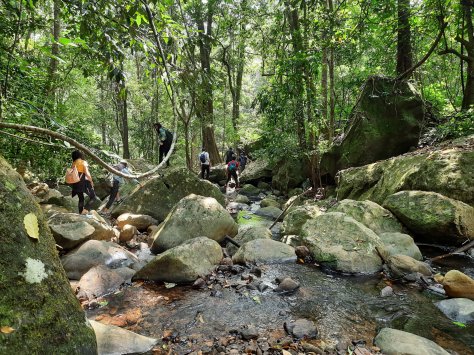
The stream and the hiking trail at Aranamala

From there onwards, the hike was mainly upstream. While enjoying the absolute music of the gurgling waters of the stream, the croaking frogs and the shrilling cicadas, we slipped down a few large rocks and fell into the shallow waters a couple of times. In spite of trying hard not to get our shoes wet, we ended up soaking them up and picking out occasional leeches from our feet. We realized that given our pace of hiking up, we would not be able to return on time with sufficient daylight. Hence from there onwards, our guide made his own path, through the thick forest. He walked ahead by cutting the thick bushes that came across, all by keeping the stream in sight. We did slip and tumble down the steep a couple of times though. But the hanging vines and lianas came to our rescue. And suddenly, our first view of the waterfall emerged. It was beautiful and the water pool looked crystal clear, tempting to step inside. Apart from our group, there was no one else.

The first waterfall enroute

As we got ready to step into the pool, “This is not the main waterfall. We need to walk further ahead”, said our guide. If this waterfall was so calm and beautiful, we wondered how the main waterfall would be like. We were excited! But our excitement sought energy 😛 We had to climb up the same rock, on one end of which the water plunged down. Quite a tricky climb but worth every inch of it! A short walk further from there waaaaasssss the hidden gem that we had come in search of. Now, don’t ask me the name of the waterfall, it is completely off the map and mobile network. So, there is NO way you will find it on google. To make it simple, you can call it the Aranamala waterfall, the waterfall in the Aranamala hills.

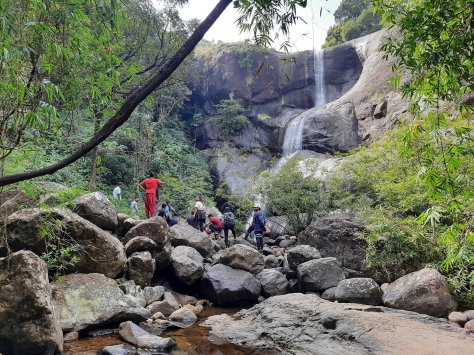
The Aranamala waterfalls

That’s all folks, we’re off into the pool to enjoy our dip! But hey, it was not so easy…. The water was bloody cold, and I had cramps in my feet for the first few minutes. I meanwhile enjoyed my free fish-pedicure too, it sort of eased the cramps for me. And then with a dip, I was all set! A waterfall so secluded, a pool so clear and a feeling so divine, I couldn’t have asked for any better to make up for all the travels missed in nearly a year now. After spending some good time under the waterfall and with our soaking wet clothes on, we decided to return. It was already 03.30.p.m and hence decided to take an easy path instead of walking back through the same terrain of forest and the rocks. So, we were taken through a shorter but a beautiful path through cardamom plantation for our descent.

After a nice filling lunch at a campsite enroute, we boarded the jeeps back towards Meppadi. The original itinerary did include a short sunset ride, but the clouds didn’t seem to part for the entire day. From Meppadi, we reached the base of Ambukutti hills for the night. It took us yet another jeep ride to a homestay where we had our chai and conversations. And a fun time around the bonfire until dinner was served.

Post dinner, we carried our tents and sleeping bags up the hill and managed to pitch them atop. The winds were strong, and the rocky ground was tough. With the thick mist blinding all around and the instructions from our guide to not venture away from the tents, all that we could envisage was a deep valley below. The bonus of holding up in the cold until morning, u ask? ‘The view from the tent, of the sun rising above the clouds at 06.00a.m.’ But come morning, we had a surprise awaiting. There was so many clouds until 09.00.a.m that we got a glimpse of the sun for barely a few seconds. We walked up the hill a little further from our campsite, took in some clean air and good views of the range around. We then returned to pack our tents and freshen up for the day. Our breakfast and our ride back to Meppadi was awaiting us at the homestay.

Ambukutti hills as seen from our campsite

That was my story about offbeat Wayanad with ‘Plan the Unplanned’, of leading a group of weekenders and enjoying my weekend, both at the same time.

Other Travel recommendations:

  • Edakkal caves are located at a walkable distance from the campsite at Ambukutti hills
  • You can visit Tirunelli temple and Irupu waterfalls by driving through Wayanad Wildlife Sanctuary (Tholpetta) and Nagarhole National park.
  • Alternately, you can explore Sultan Bathery, visit the ancient Jain temple and Banasura sagar dam that offers a good view of the surrounding hills.

Offbeat Things to do in Vishakhapatnam

My interest in pursuing a career related to the oceans goes a long way back into history. I intended to study oceanography while in school. Then, in spite of studying at an elite college in Bengaluru that offered the army wing of NCC (National Cadet Corps), I wanted to move out to get a ‘B & C’ certification in the Naval wing. After completing my graduation in mechanical engineering, I thought I could do well with a career in a refinery or a shipping harbor or something. A career in ‘Merchant navy’ never had an approval from my family! I did try to get into the ‘Indian Navy’ through the SSB as well. Anyways, all have been futile attempts as life always had other plans for me. But all the above interests have a deep connection with the port city of Visakhapatnam.

Apart from its strategically important port, Vizag had intrigued me as this city is geographically located between a sprawling beachfront and the eastern Ghats. I have been wanting to tick off Vizag, also called as Vishakhapatnam from my ‘to visit list’ from a really long time. Finally, my stint with Vizag materialized in January’2021. This visit is a part of my family’s road trip through Bengaluru– Telangana – Chhattisgarh – Odisha – Andhra Pradesh – Bengaluru.

I had heard a lot of my acquaintances tell me how beautiful this city is. Also, blame it on me for being spoilt by what my home state has offered me in my upbringing. The beaches of karavali, the hills of western Ghats, the coffee plantations of my native district and the sumptuous spread of regional cuisines, similar things were spoken about at Vizag as well. But all the people who had suggested Vizag on my bucket list were the urban tourists who visited this place to either chill by the beachside or relax and rejuvenate at a resort. For those who know me well, I have always enjoyed the exploratory kind of travel. So, I did manage to find such places and things at Vizag to satiate the explorer in me. Here are my favorites:

The INS Kursura submarine museum: This is like “THE” thing that brought me to Vizag at the first place. The experience of the guided tour inside of this de-commissioned submarine is something that is priceless and cannot be quantified with a price of an entry ticket.

INS Kursura- Submarine museum

The TupoLev142M aircraft museum: This is one of its kind of what I have been before. The experience of walking through a real aircraft that once served in the ‘Indian Navy’ is a million-dollar worth if you are someone who has deep interest in the uniforms, technology, and scientific history.

Tupolev 142m at the aircraft museum at Vizag

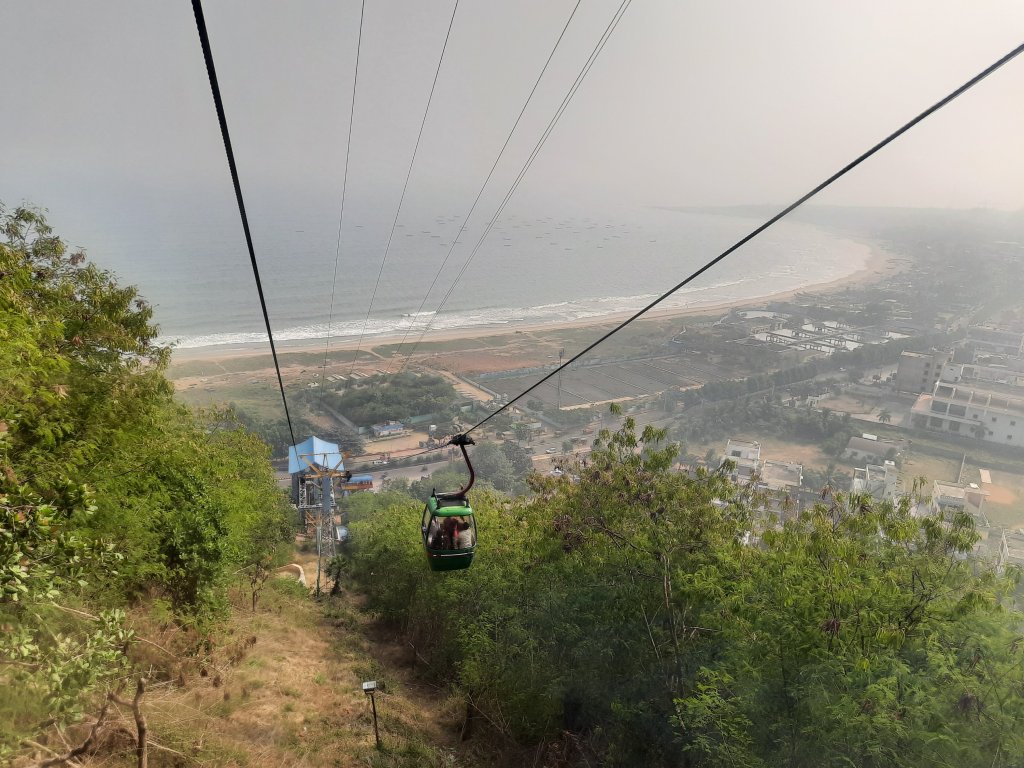
The cable car ride: Kailasagiri hill is a favorite hangout among the locals. They choose to drive up there, walk around the park and hangout at the eateries there. But for me, this was an interesting place because I reached the top of this hill through a cable-car. For all the people drooling over the Singapore tourism’s photos, Vizag is your nearest bet. Once you reach the peak, another recommendation from me is to take a ride on the toy train that goes around the hill. The 360deg view of the city and its enchanting coastline is indeed worth a visit, while you are in Vizag.

View of the coastline from the Cable car in Kailasagiri

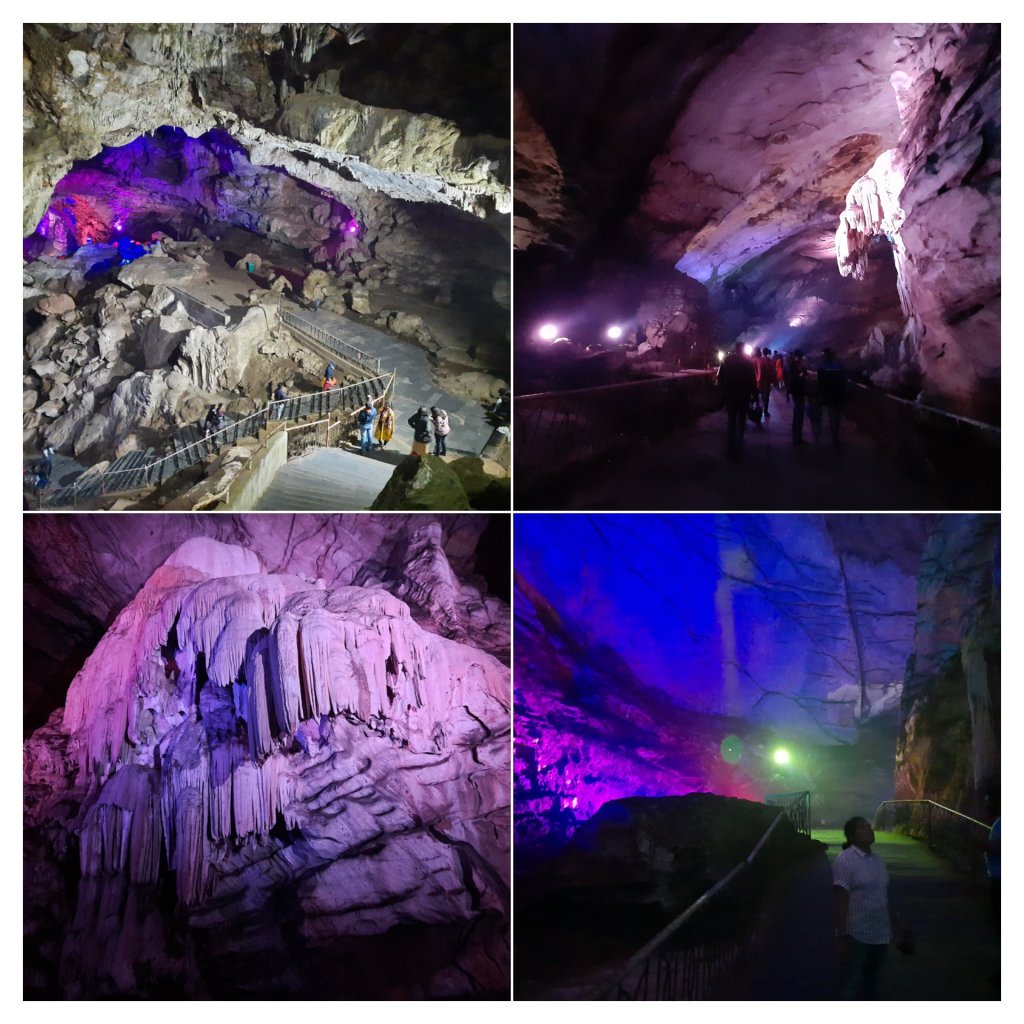
Borra caves: Situated amidst lush greenery, these caves are known to be the widest cave complex in the Indian sub-continent. If possible, time your visit into the caves when a train passes over the land above, you can experience the tremors inside. It is located on the outskirts of Vizag and can be combined as a day trip to Araku valley.

Glimpses of Borra caves

Araku valley: For someone hailing from a place that is called as the ‘Coffee land’ of India (Kodagu district in Karnataka), I found the small patches of the famed ‘Araku valley’ coffee estates overhyped. But still, a meal of ‘bamboo-chicken’ with the valley in the backdrop, a hundred small dotting waterfalls and the beautiful scenery all along the way that made me want to stop for a photo at every turn of the road, all score a definite recommendation from me for a day trip to this valley.

At Araku entrance (From Koraput side)

Sip some kallu by the beach: With its buzzing coastline and palm trees growing in abundance, it is highly likely that you will spot some toddy or Kallu tappers (palm sap collectors) walking past you near the beaches. You can buy the fresh Kallu and enjoy while you are chilling by the beach.

A toddy/ Kallu tapper selling Kallu at one of the shacks

Beach hopping & Ship spotting: Being a major port city on the east coast, it is very likely that you can see some mad-ass big ships that dock at the Tennessee park Beach from across the world. However, there’s ‘MV Maa’, a Bangladeshi cargo ship that’s abandoned after it got beached during the covid-19 lockdown. If you’ve never been so close to a ship before, this is your opportunity to literally walk over, touch and feel a ship. Bonus: News is that if everything goes well, the ship will be converted to a floating restaurant soon 😍

MV Maa- the beached cargo ship of Bangladesh

Have you been to Vishakhapatnam before? What did you like the most?

Making the journey count- to Kodachadri

For the weekend hikers, the ‘K’ in Karnataka represents the must-do three ‘K’ peaks in the state: Kumara Parvata, Kudremukha and Kodachadri. I was heading to the last of the three, for the second time. The first time I went to Kodachadri was over a decade ago, as a part of an industrial tour from college 😀 This time, I was leading a group of weekenders who had signed up for the trek with PTU- ‘Plan the Unplanned’.

The standard itinerary with PTU:
Day 1: Depart from Bangalore (Leave HSR layout) by 08.00.p.m.
Day 2: Reach homestay by 06.00.a.m., freshen up and start the hike by 09.00.a.m.; Return to the homestay by evening
Day 3: Visit Nagara fort enroute home, reach Bengaluru by evening.

The story of my weekend:
A total of 16 people including two trek leaders were supposed to board the bus at various pickup points across Bangalore. While HSR layout was the first pickup point, the last and the biggest bunch of people were supposed to board at Mekhri circle. When the driver cranked the engine to leave HSR, the last member boarding the bus noticed that a rear tyre had a flat. So, it needed to be changed and the punctured tyre required to be fixed before proceeding for the long journey. After about an hour, the stepney was replaced and the bus arrived at the second stop.

People boarded and the Bus… did not start. This time, the battery had drained, completely! A mechanic arrived in a while and told that it could not be topped up and needed a replacement. Well, it was another good couple of hours until the bus finally left…. With an assurance from the ‘travels company’ assuring that there won’t be any more breakdowns.

Meanwhile, I had taken an autorickshaw to reach Mekhri circle to hold up all the people who had arrived there. The co-leader managed the people who had already boarded the PTU bus. Most of them being first timers on their solo travel, their growing anxiety with the extending delay in the tour was quite a challenge to clarify all their doubts and questions. It was 00.30.a.m. by the time the bus finally arrived at Mekhri circle instead of the scheduled 09.30.p.m. We quickly wrapped up the initial welcome and introduction that usually takes a while on normal trips. Everyone needed some sleep before climbing up the Kodachadri trail.

It was approximately 01.30~02.00. a.m. and the bus had reached somewhere around Sira town. Then suddenly, everyone in the bus woke up for a LOUUUD thud noise. The driver stopped the bus. I walked to his cabin and got down with the driver with a torch light to check what the issue was. The driver found a broken bolt under the bus, near the engine room. The radiator had started to leak profusely, and the engine belt had ripped off. The driver informed me that there was no way that the bus could move. Trying to find a mechanic in the middle of the night would only be futile. The options we had was to find one back in Nelamangala (this would take a good few hours) or wait in the bus until morning, find a mechanic in Sira, find spares, get the bus fixed and then proceed. Proceed further to Kodachadri or return to Bangalore. In either case, Saturday would be gone. We pushed the bus to the side of the highway and decided to take time to figure out the next POA (Plan of Action).

Hidlumane falls

I called up the PTU organizers and informed them of the situation. We were fortunate to find a chaiwala (petty Angadi), the ONLY place with light and people movement in the drop-dead night. The people in the bus got down and occupied themselves with their dose of mid-night chai and smokes until we figured out an alternative. None of them would settle for a full refund and wanted PTU to ensure that they got what they had signed up for.

It was a weekend. It wasn’t going to be easy to find an alternate bus or a TT (Tempo Traveler). While my co-lead was waving at every other bus that came on the highway (both KSRTC and private buses) to check if there were empty seats, I was calling up every random travel company listed on google and checking for availability of buses. Either they were all booked for the weekend or people would just abuse me for waking them up in the middle of the night and hang up. To add to it, I was the ONLY person in the entire bus who could speak Kannada. So yeah, I literally had to manage the show and all the translations, communications and co-ordinations.
Finally, one KSRTC bus stopped! They had sufficient seats to accommodate all of us as well. But we had a new challenge. The travellers with us had ganged up and would not agree to board a red bus (Karnataka Sarige bus). All requests to convince seemed futile and we let go off the KSRTC bus. After a total of about an hour, the chaiwala managed to find us a localite who had agreed to come with us for a per kilometer charge that was double the normal price. PTU organizers agreed. The TT arrived. Next challenge? It was a 12-seater TT, we were 16 in total. We, the leaders convinced ourselves to sit on the floor of the ramp between the two rows of seats and another 2 travelers volunteered to fill the already crammed space. Ensuring that everyone else got a comfortable space, the journey continued. Fortunately, we had no more surprises and we reached the homestay by 09.30.a.m.

That’s how we rolled, in our TT (Faces intentionally blurred)

We took time to freshen up, have breakfast, get the forest permits for the trek and finally started our ascend by 11.00.a.m. All went fine, by god’s grace. This was my first PROPER trek in Kodachadri, the previous one was another adventure worth a read. We climbed up the Hidlumane waterfall, arrived at a local house enroute to have a surprise Majjige (buttermilk) stop, crossed paddy fields, areca and banana plantations, Mookambika temple and finally arrived at the peak marked by the Shankaracharya Mantapa. The landscape and the entire path were unrecognizable for me from what I had seen on my previous visit. It was now exploited and overdone by tourists. There were a few hikers who felt exhausted and wanted to give-up halfway. But as a trek leader, it was my personal obligation to ensure that EVERYONE completed what they had signed up for and no one stayed back without some safe company. Finally, everyone made it to the peak, and it was now mission accomplished. Well, only partially!

The real deal was in the descend. We had a 4×4 ride awaiting us for our return. It is one that is BEYOND explanation and you only hold on to the roof bars hoping that you don’t have a few broken bones or dislocated joints by the time it ends. There is NO road, only a slide down a ditchy/bumpy gradient path. This 4×4 jeep ride alone supports the livelihood of several people around the area. Hence, the localites aren’t letting a road happen even if the government wants to develop this important site of tourism (we were told so by one of them). So, if this ride is considered as an adventure and a source of employment, then you can imagine how memorable this experience must be, right?

The view after reaching the keep trail

Well, in spite of all the delays and breakdowns, it gave me a sense of achievement by the end of the day for having met the itinerary. Though we paid late exit fine at the gates, this was a PTU experience in its true sense. More adventures to come, until then- Keep tripping…. Plan the Unplanned!