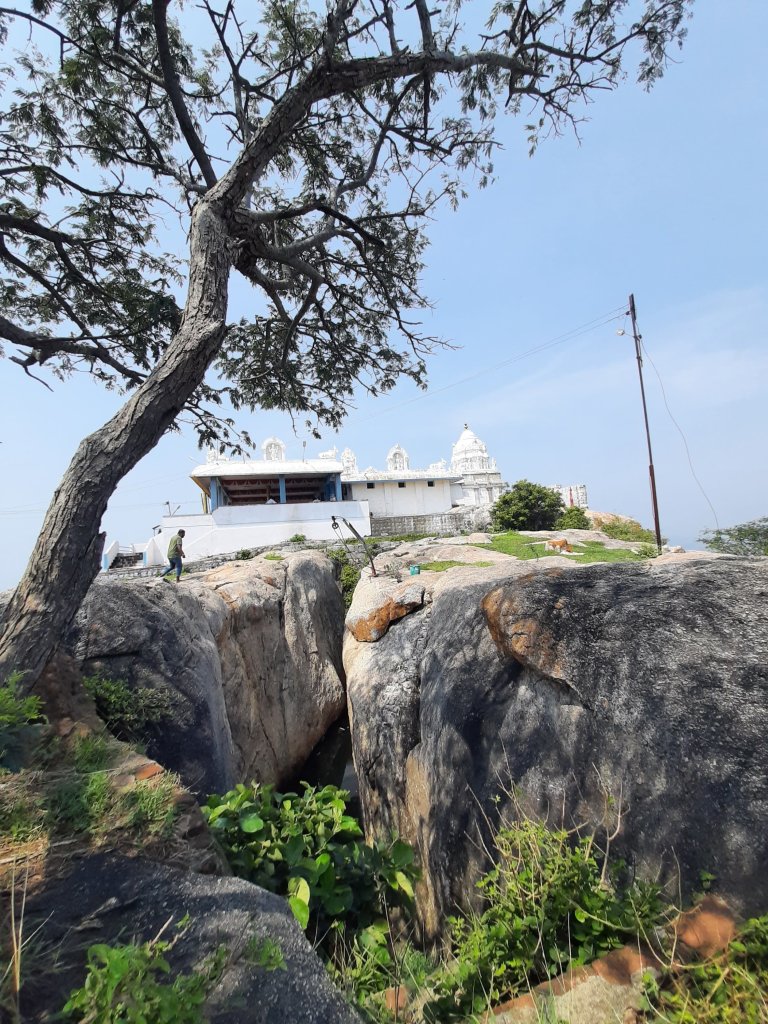
Another weekend and another offbeat destination. This time, we found a temple on a small hillock in Dharmapuri district of Tamil Nadu. In my earlier post about Hogeynakal waterfalls, I have elaborated on how river Kaveri marks the boundary between the two states of Karnataka and Tamil Nadu. This post is somewhat related to the same connection. Because the history of the temple that we were planning to visit this weekend is rooted on the other side of the river, on the fertile plains of Karnataka.
The original Ranganatha swamy temple dating to the Cholas or the Vijayanagara era (as described by the locals) was on the Karnataka side. The stone structure of the temple is present even today (we hope to visit the structure on another weekend trip). The idol of the deity was destroyed by the British (which needs fact checking) and then, a new idol was reinstated on the Tamil Nadu side of the land where it stands today. The Ranganatha Swamy temple that we were heading to is in Biligundlu village and hence the name. The idol of the deity is carved out of a rock which is part of the hill overlooking the river.
On a summer day, when the water levels in the river are low, one can walk across to the other bank. Whereas, when the river is flowing full, the roads leading to both the old and the new temples are long ones. The old location is reachable via MM. hills in Chamarajanagar district of Karnataka, and the new temple is reachable via Anchetty forests in Dharmapuri district in Tamil Nadu.
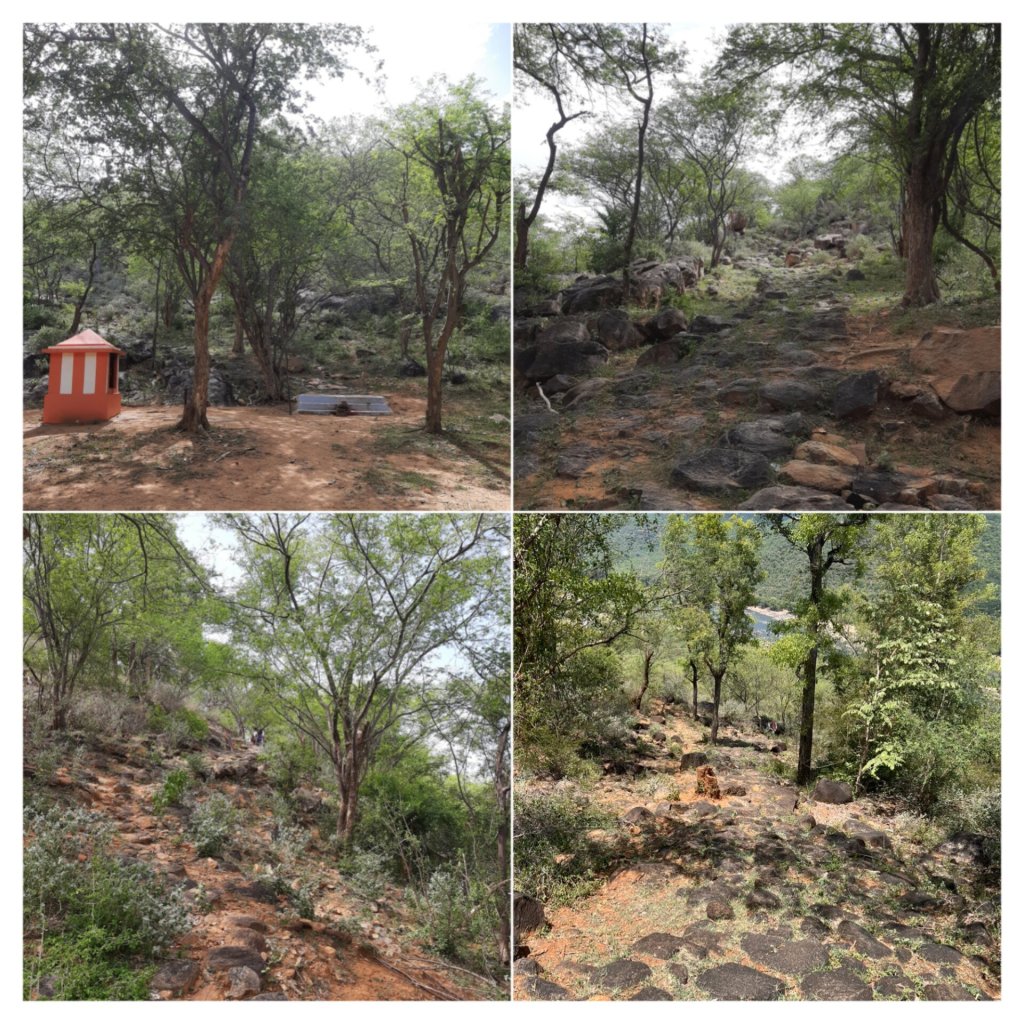
The trail to Biligundlu Ranganatha swamy temple
Anyway, coming back to this weekend, we started early on a weekend morning along the Anchetty forest leading to Hogeynakal waterfalls. We skipped the highway restaurants and stopped by a small local restaurant in Anchetty town for breakfast. It was a good decision as the experience was good with local food and the local atmosphere.
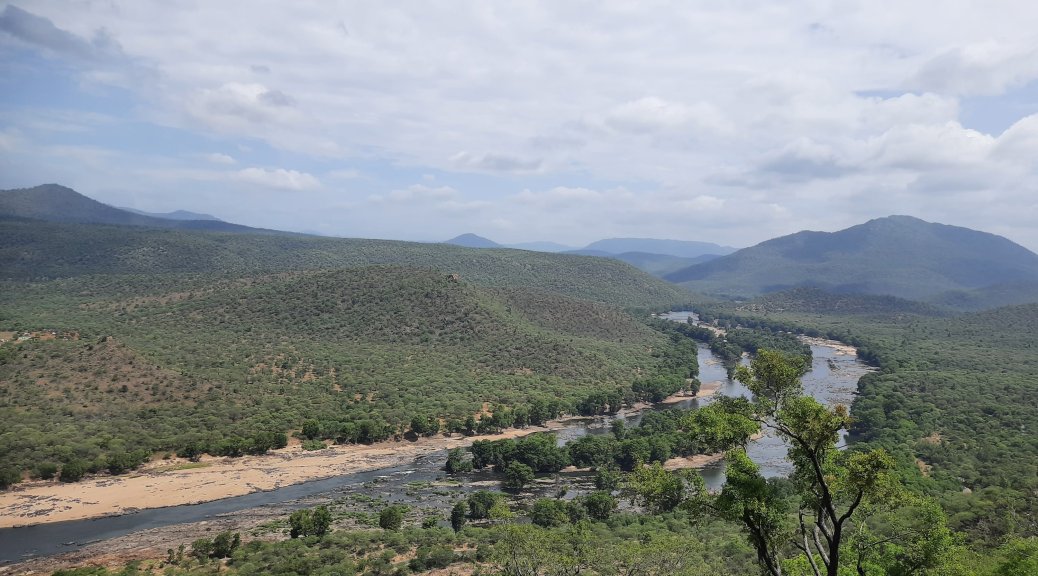
A few kilometers after the Biligundlu cemetery and few kilometers before Hogeynakal waterfalls, we stopped by at a location where river Kaveri flowed onto our right and a tiny structure of brick and mortar was built onto our left… We parked our vehicle there and started our short hike up from there. A properly laid stone path is there all the way to the hilltop which took us around half an hour to hike. The views of the river and hills around were just amazing all the way.
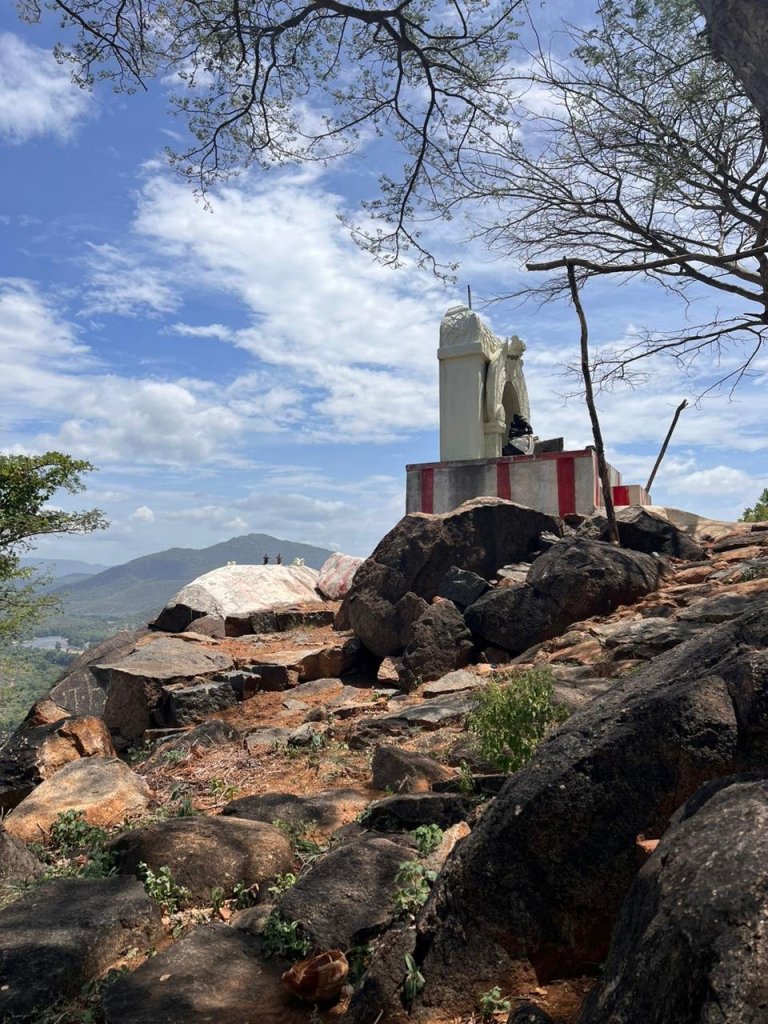
The Ganesha idol at the peak of Biligundlu Ranganatha swamy temple hill
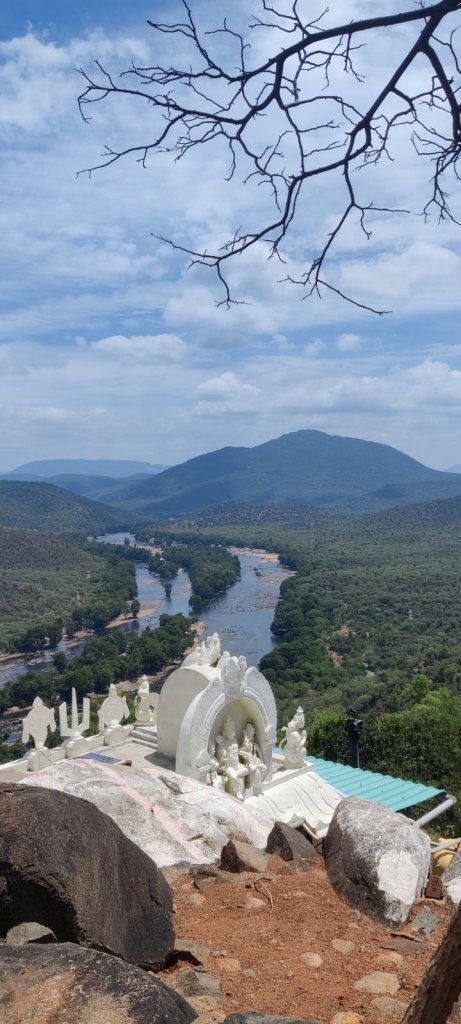
First, we were greeted by an idol of Ganesha sitting under the tree at the peak. This spot gave a splendid view of the river and the hills beyond. We sought Ganesha’s blessings and proceeded to the Ranganatha temple located below, connected by a short flight of stairs. The temple was closed by the time we arrived. However, we could see the idol through the meshed gate. After offering our prayers, we found a spot adjacent to the temple wall and sat there to soak in the beauty of the place. The view of river Kaveri flowing with a backdrop of green rolling hills looked amazing even as the winds caressed our faces. It was a beautiful place, indeed!
We headed back after a while and decided to take a dip in the shallow waters of the river to beat the summer sun. A word of caution if you plan to get into the river, that there will be a sudden drop in the depth at many spots and it is believed to have whirlpools as well. We stayed by the shores before calling it a day after a while.
Although this destination is a recommendation for weekend and day hikers of Bengaluru, it is in Krishnagiri, a district bordering the two states of Karnataka and Tamil Nadu.
The views from an ancient temple had caught the attention of my friend and me, who are always in the look out for less crowded and less explored landscapes and places with cultural and historical importance. One such place was the ‘BalaKodandaraya Swamy temple’ whose history dates to the Vijayanagara era. Based on our online research, we found out that getting to the temple involved a short hike.
We started early on a Saturday morning by car. We had our breakfast along the way, in one of the several restaurants on the Hosur highway. From there, we followed the route on Google maps to reach our destination. A steep deviation to the left of the highway led us through villages. There were asphalted roads and good views of the surrounding hillocks for as long as the road passed through villages. The last couple of kilometers were through unpaved muddy roads passing through a slight forest stretch. We finally arrived at a small open space where we parked our car, at the base of the temple hill.
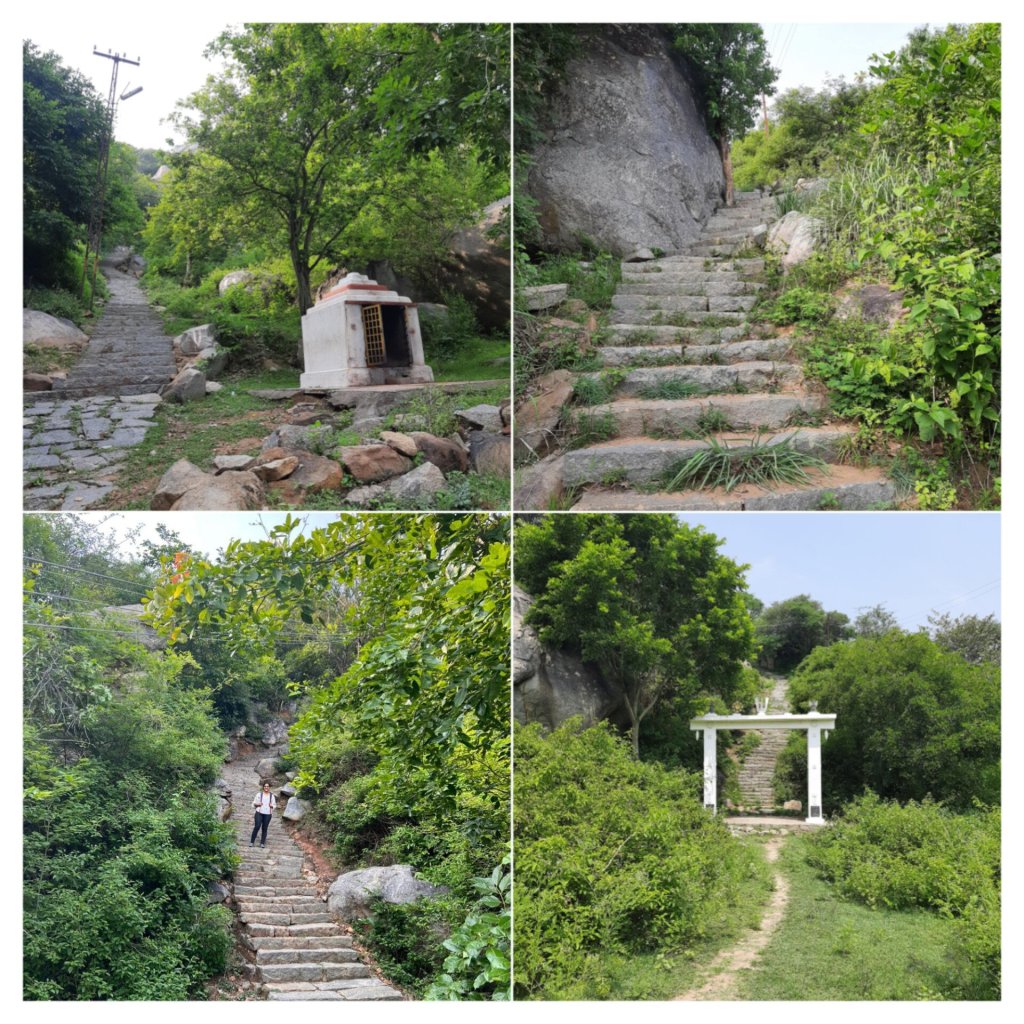
The trail through the forest cover, starting from the base to the temple arch
There was a small structure of brick and mortar (gudi) at the base, from where a flight of stairs led to the hilltop. People lit lamps, agarbattis and camphor here before starting their ascent. It took us about half an hour’s climb along properly laid stone steps leading to the top. These stone slabs bear the names of the devotees who have donated them and the count of their donations on each step. The ascent curved around at multiple places and offered amazing views of the valley below at every turn. The first half of the climb had a forest cover and large boulders on both sides, until we arrived at the welcome arch of the temple.
The path towards the left of the trail, towards the temple
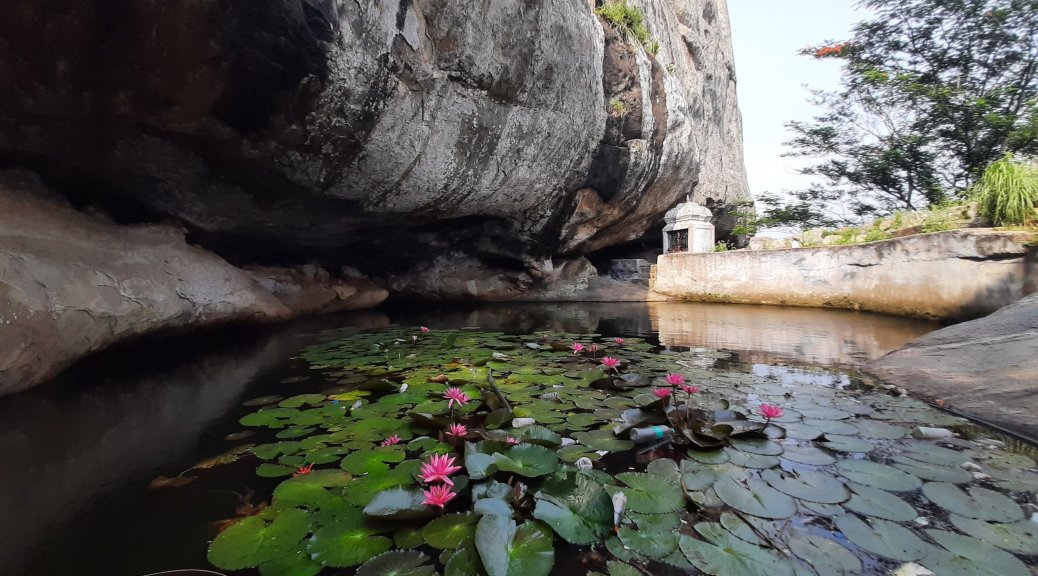
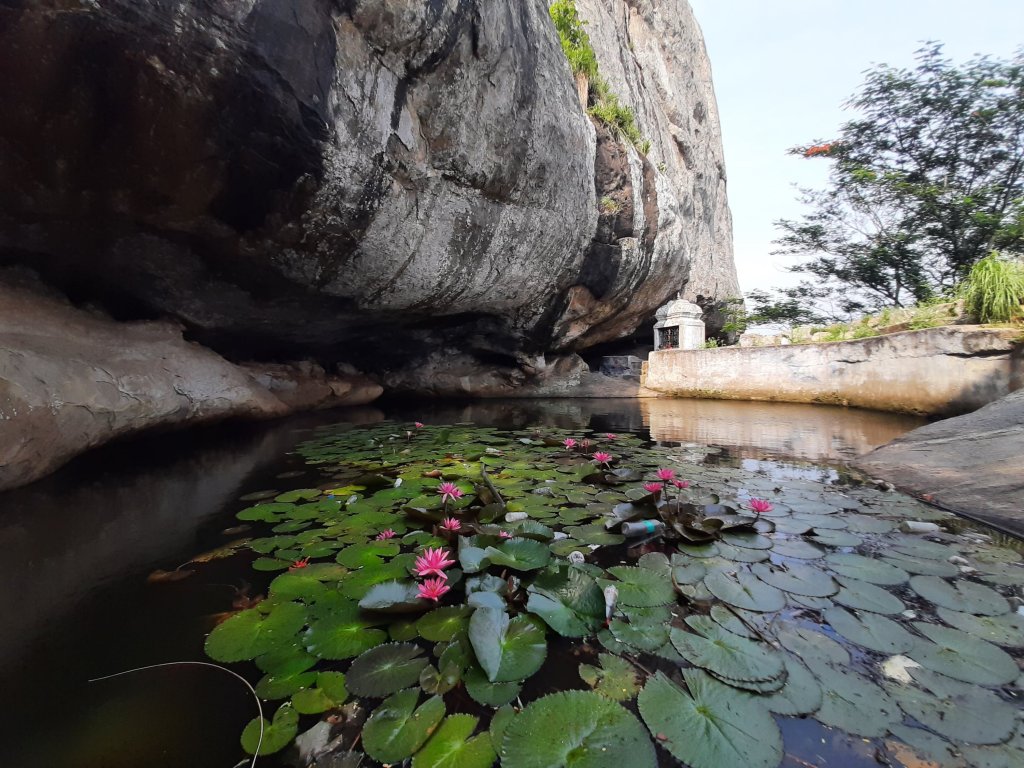
The forest cover ended after a few steps further from there and opened to a panoramic view of the valley of the villages and farms below. As one stands on a large rocky outgrowth, you will find the trail split into two paths. One, straight down through some Gulmohur trees. Second, up towards the temple. We decided to first walk the trail going straight. A few yards from there, the trees made way to a beautiful pond of pink lilies, dug right beneath a large rocky monolith. We later realized that devotees take a dip in this pond before proceeding towards the temple.
The path towards the right of the trail, leading to the temple pond
The view of the valley from there and the magical vibe of sitting by this pond of lilies could not let us go easily from there. My friend settled on the banks, with a book to read. Although the water was heavily littered with plastics, it was still a super calm spot to soak in some good energy. After spending a while, we then headed towards the temple, located on the peak of the hill, a short walk away. There was a panoramic 360 degrees view of Hosur and Krishnagiri from the temple, the green cover around, Krishnagiri dam and the Then Pennai river. The temple priest arrived much later at around 10.00.a.m. for the daily prayers.
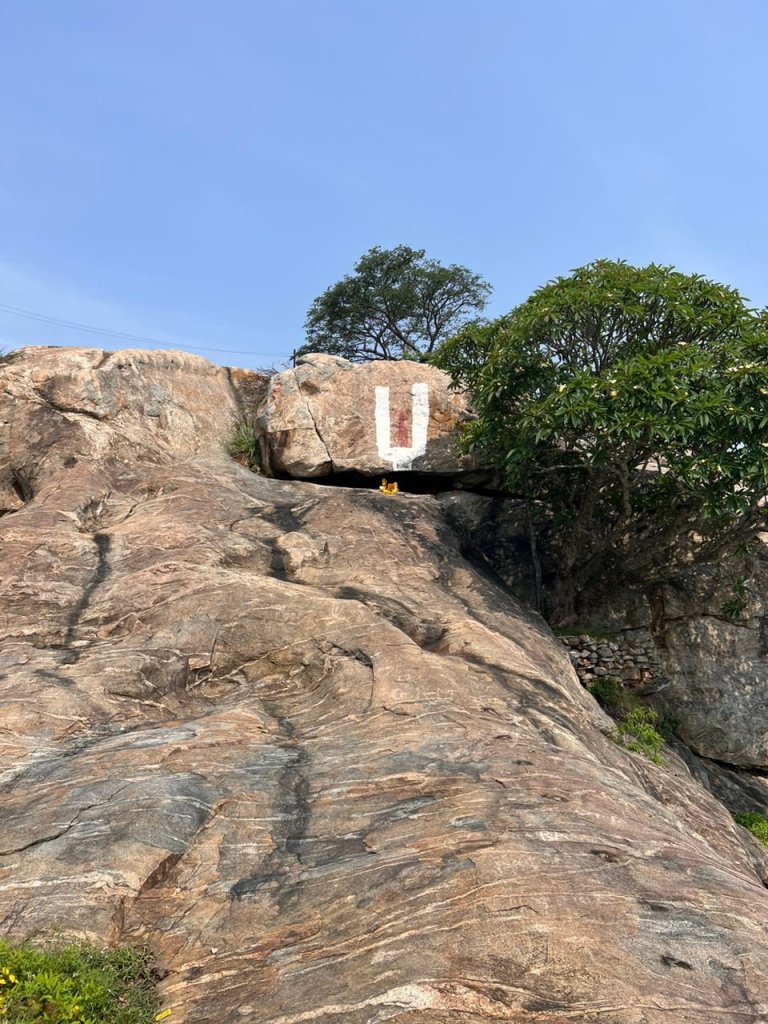
Balakodandaraya swamy temple and the cleft for drawing water
Surprisingly, a small cleft in the rocky hill serves as a perennial source of potable water for temple use. The people who had gathered there by then, helped the priest in drawing water from this cleft and clean the temple premises before offering the day’s prayers. We sat there for a while and decided to head back to the base before the sun took over the skies and heated the rocks around. Overall, it was an incredibly beautiful place for a short trip from the city.
Other nearby places:
If you are looking at making it a full day trip, then you can explore the nearby places that include:
As a high school student, I was intrigued by the terminologies called ‘Stalactites’ and ‘Stalagmites’ in my Geography curriculum. ‘These were formations of calcium deposits formed by continuous flowing of water over several years, below the Earth’s crust’, it read.
“These structures are beautiful to see. I had the opportunity to visit one of these underground caverns during my visit to France. We walked down a flight of stairs and then were taken on a boat, to see stalactites and stalagmites, underground”, my geography teacher said. Her voice echoes in my ears even today, because back then my jaws had dropped in awe wondering how beautiful the landscape and topography of the countries outside India were. I wished to see the stalactites and stalagmites someday.
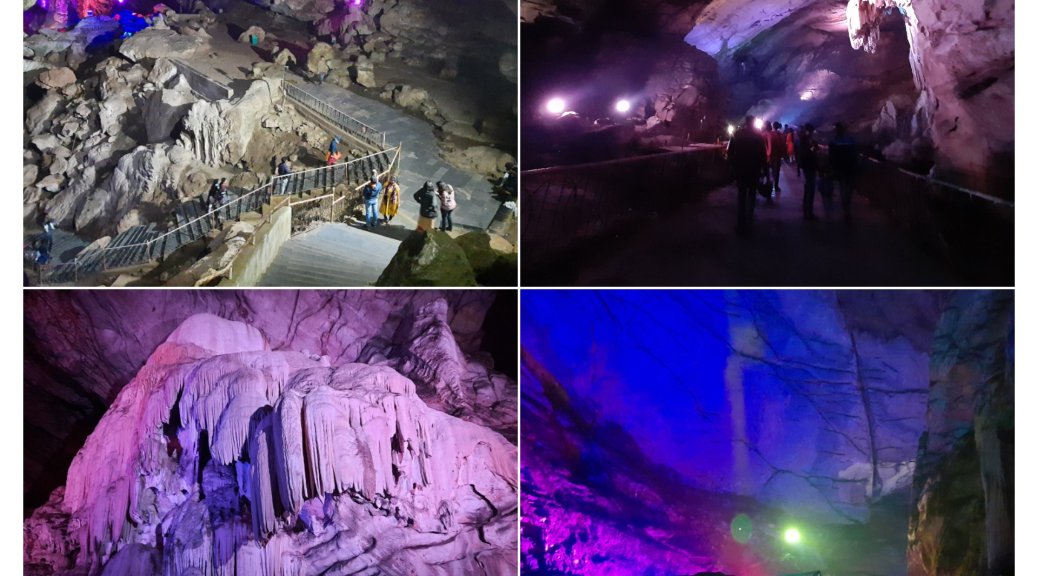
Cut to today, I am so glad that time has been kind on me with so many opportunities to explore my own country, India. These opportunities have opened my senses to realize that “India is a world”. From snow to deserts, mountains to beaches, plains to rainforests, the landscape comprises of EVERY type from across the world! Based on my travels, I have seen some amazing cave systems in India. Without including the caves that have been part of India’s ‘art and architectural heritage’, here are five best places in India where you can explore caves in their natural form.
1. Meghalaya:
Top on the list, there are hundreds of caves that are open to explorers, hundreds being discovered every day and maybe thousands that are still unknown to people yet. ‘Krem Liat Prah’, India’s longest cave system is in Meghalaya.
2. Andhra Pradesh:
‘Borra caves’ in Andhra is the largest cave in India. A heritage railway line passes just above this limestone cave. Having such a big cave system is proof and motivation enough to know that several other caves are available in this region waiting to be explored by adventurers and tourists alike.
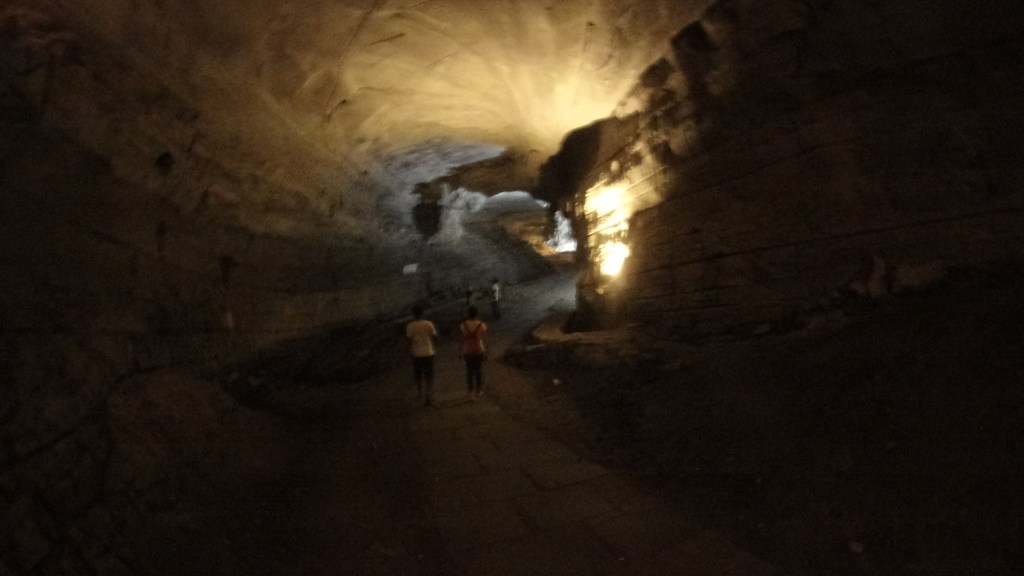
Inside the Belum caves
3. Chhattisgarh:
The state sitting within the mythologically important forests called ‘Dandakaranya,’ these forests are home to several limestone cave systems that are yet untouched by mass-tourism. Only about 57 caves are known to people as of now, and there is immense scope for exploring new caves. The remoteness of the places adds to the joy of the explorer while caving in Chhattisgarh. The video of exploring a cave at Bastar, Chhattisgarh is shared below.
Cave exploration at Madarkonta caves
4. Andaman & Nicobar Islands:
This archipelago and Union territory of India is one of the best kept secrets of nature enthusiasts who want to go caving. In fact, this is where I saw a stalactite and stalagmite for the first time in my life. The connectivity of these remote caves located on different islands through a channel of interconnected mangrove forests passing through pristine blue sea water makes it a memorable experience.
5. Karnataka:
While all the above cave systems I have enlisted above are limestone caves, Karnataka is home to some of the beautiful sandstone caves which are scattered across the middle and northern region of the state. Unlike underground, the caves in Karnataka are formed above the earth’s surface and give a completely distinct perspective of exploring this state, which is my home-state as well!
A compilation of 18 short stories based on my experiences of traveling on the roads of India, I’m happy to share that my second e-book is now available for my readers.
My book- ‘Stories Through Souvenirs‘ is a compilation of my stories of meeting people, hearing their stories and the learnings from my experiences. These are the stories of how these stories influenced me to become who I am.
Do give it a read and I am sure you will like it 😊
I have discussed with you all why I volunteered to become a ‘Trek leader on weekends’ and how much I enjoy doing it with ‘Plan the Unplanned’ (PTU). With Covid19 lockdowns and safety precautions that followed, break from my weekends with PTU has been longer than I had thought. Although I have been travelling with a closed group of friends and family since few months now, the fear of socializing with a bunch of unknown people had kept me away from PTU. Finally, this January, I decided to get out and lead a group of trekkers. The destination assigned for this weekend was Sultan Bathery in Wayanad district of Kerala. And the task was to find a hidden gem in the Aranamala hills. We were going to hike along a stream to see a waterfall.
Itinerary:
Day 0: Leave Bangalore by night Day 1: Day hike to Aranamala waterfall, Visit sunset-point and night camping at Ambukutti hills Day 2: Watch sunrise, visit Edakkal caves and explore Wayanad. Return to Bangalore by night.
The Aranmala waterfall trek
The Details:
It is a very hazy memory from the cold dark January morning of sitting inside our bus at the Wayanad wildlife sanctuary’s Sultan Bathery check post. We had arrived much before 06.00.a.m., when the forest gates would open for public entry. Since we were not allowed to make any noise or get out of the bus in the forest area, we all decided to get some sleep until the gates opened. At first, I was woken up by the cries of peacocks that seemed to be somewhere very near to the bus and some distant elephant trumpet. But then, the darkness around and the exhaustion from the previous workday got me back to fall asleep. I was woken up again in a while, by a sound that was very contrasting and disturbing as compared to what I had heard before falling asleep the last time. This time, the loud deafening sounds were of honking buses and trucks that had congregated at the check post. I opened my eyes to see the dawn of the day with a red sun rising over a mist laden green paddy field from my window. The fresh dung just outside the bus gave me a momentary fright at the thought of having had an elephant walk right past us, in the dark. All said and done, the entry formalities at the inter-state border was sorted and we were at a hotel in a bit. We freshened up, had a nice Kerala breakfast and got ready for the long day ahead.
The start of the hike, Thollayiram kandi in the backdrop
After arriving at Meppadi town, we met our local guide and shifted from our minibus to 4WD Jeeps. The initial stretch deceived me in thinking why a 4WD was needed to drive on a properly laid concrete road. Just then, the roads disappeared, and the real ride started… Although I was sitting in the rear end of the vehicle, I preferred not to sit on the seat and chose to hang on to the roof lest have all my joints and bones displaced. The long drive through the thick canopied forest trail culminated at the start point of our hike. We descended through the path that deviated from the main road towards a river. That’s the ‘Thollayiram Kandi’, our guide pointed out at a peak topped by the rolling clouds. “Kandi is a local unit of measurement”, he elaborated as we continued to walk. We walked through cardamom plantations and jumped over a few fallen tree trunks and creeping roots until we reached a stream.
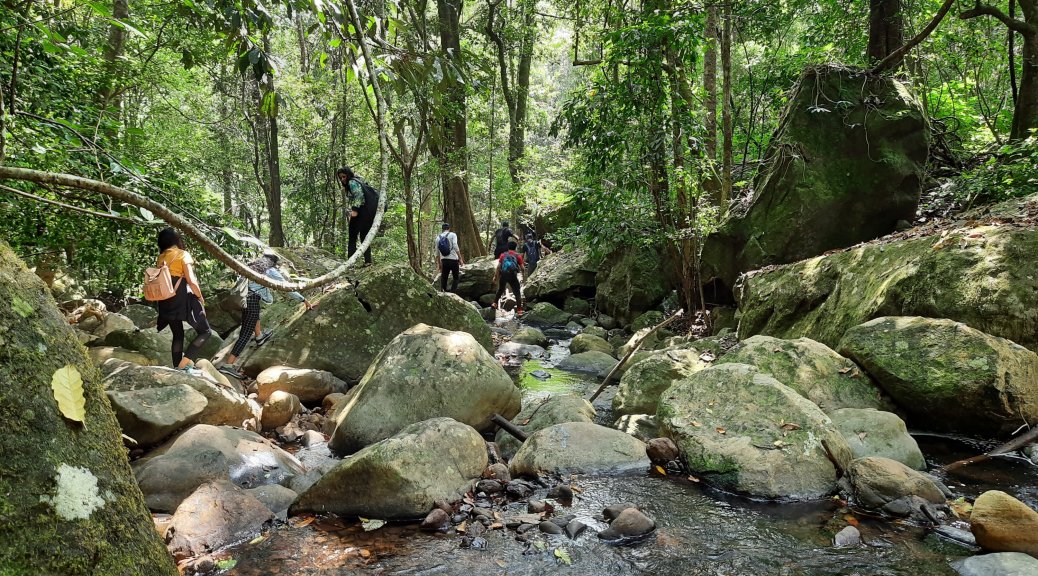
The stream and the hiking trail at Aranamala
From there onwards, the hike was mainly upstream. While enjoying the absolute music of the gurgling waters of the stream, the croaking frogs and the shrilling cicadas, we slipped down a few large rocks and fell into the shallow waters a couple of times. In spite of trying hard not to get our shoes wet, we ended up soaking them up and picking out occasional leeches from our feet. We realized that given our pace of hiking up, we would not be able to return on time with sufficient daylight. Hence from there onwards, our guide made his own path, through the thick forest. He walked ahead by cutting the thick bushes that came across, all by keeping the stream in sight. We did slip and tumble down the steep a couple of times though. But the hanging vines and lianas came to our rescue. And suddenly, our first view of the waterfall emerged. It was beautiful and the water pool looked crystal clear, tempting to step inside. Apart from our group, there was no one else.
The first waterfall enroute
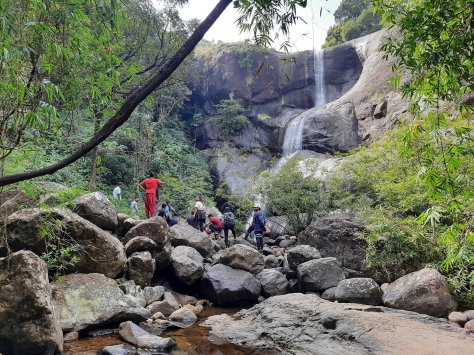
As we got ready to step into the pool, “This is not the main waterfall. We need to walk further ahead”, said our guide. If this waterfall was so calm and beautiful, we wondered how the main waterfall would be like. We were excited! But our excitement sought energy 😛 We had to climb up the same rock, on one end of which the water plunged down. Quite a tricky climb but worth every inch of it! A short walk further from there waaaaasssss the hidden gem that we had come in search of. Now, don’t ask me the name of the waterfall, it is completely off the map and mobile network. So, there is NO way you will find it on google. To make it simple, you can call it the Aranamala waterfall, the waterfall in the Aranamala hills.
The Aranamala waterfalls
That’s all folks, we’re off into the pool to enjoy our dip! But hey, it was not so easy…. The water was bloody cold, and I had cramps in my feet for the first few minutes. I meanwhile enjoyed my free fish-pedicure too, it sort of eased the cramps for me. And then with a dip, I was all set! A waterfall so secluded, a pool so clear and a feeling so divine, I couldn’t have asked for any better to make up for all the travels missed in nearly a year now. After spending some good time under the waterfall and with our soaking wet clothes on, we decided to return. It was already 03.30.p.m and hence decided to take an easy path instead of walking back through the same terrain of forest and the rocks. So, we were taken through a shorter but a beautiful path through cardamom plantation for our descent.
After a nice filling lunch at a campsite enroute, we boarded the jeeps back towards Meppadi. The original itinerary did include a short sunset ride, but the clouds didn’t seem to part for the entire day. From Meppadi, we reached the base of Ambukutti hills for the night. It took us yet another jeep ride to a homestay where we had our chai and conversations. And a fun time around the bonfire until dinner was served.
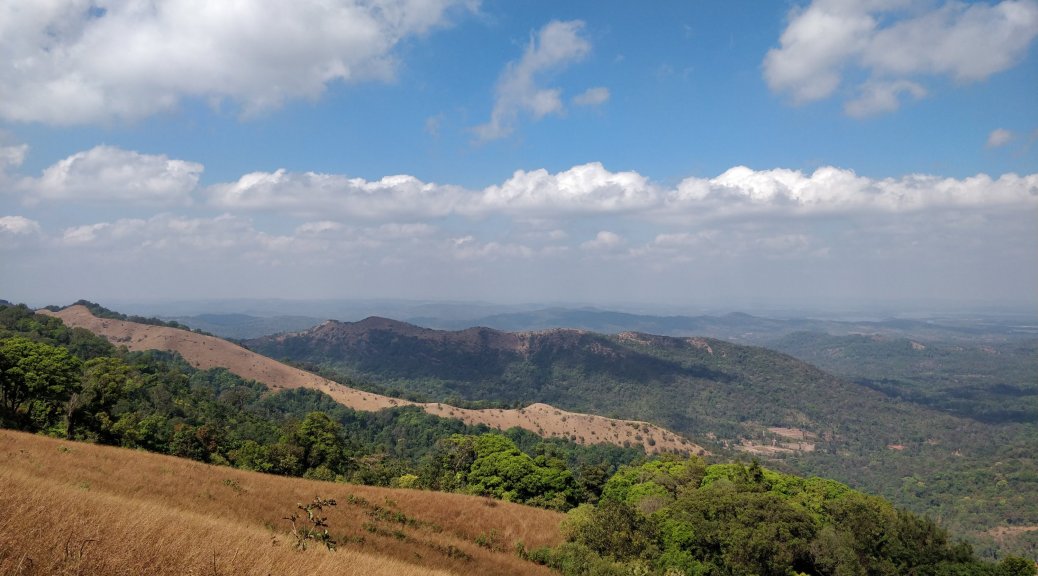
Post dinner, we carried our tents and sleeping bags up the hill and managed to pitch them atop. The winds were strong, and the rocky ground was tough. With the thick mist blinding all around and the instructions from our guide to not venture away from the tents, all that we could envisage was a deep valley below. The bonus of holding up in the cold until morning, u ask? ‘The view from the tent, of the sun rising above the clouds at 06.00a.m.’ But come morning, we had a surprise awaiting. There was so many clouds until 09.00.a.m that we got a glimpse of the sun for barely a few seconds. We walked up the hill a little further from our campsite, took in some clean air and good views of the range around. We then returned to pack our tents and freshen up for the day. Our breakfast and our ride back to Meppadi was awaiting us at the homestay.
Ambukutti hills as seen from our campsite
That was my story about offbeat Wayanad with ‘Plan the Unplanned’, of leading a group of weekenders and enjoying my weekend, both at the same time.
Other Travel recommendations:
Edakkal caves are located at a walkable distance from the campsite at Ambukutti hills
You can visit Tirunelli temple and Irupu waterfalls by driving through Wayanad Wildlife Sanctuary (Tholpetta) and Nagarhole National park.
Alternately, you can explore Sultan Bathery, visit the ancient Jain temple and Banasura sagar dam that offers a good view of the surrounding hills.
The standard itinerary with PTU: Day 1: Depart from Bangalore (Leave HSR layout) by 08.00.p.m. Day 2: Reach homestay by 06.00.a.m., freshen up and start the hike by 09.00.a.m.; Return to the homestay by evening Day 3: Visit Nagara fort enroute home, reach Bengaluru by evening.
The story of my weekend: A total of 16 people including two trek leaders were supposed to board the bus at various pickup points across Bangalore. While HSR layout was the first pickup point, the last and the biggest bunch of people were supposed to board at Mekhri circle. When the driver cranked the engine to leave HSR, the last member boarding the bus noticed that a rear tyre had a flat. So, it needed to be changed and the punctured tyre required to be fixed before proceeding for the long journey. After about an hour, the stepney was replaced and the bus arrived at the second stop.
People boarded and the Bus… did not start. This time, the battery had drained, completely! A mechanic arrived in a while and told that it could not be topped up and needed a replacement. Well, it was another good couple of hours until the bus finally left…. With an assurance from the ‘travels company’ assuring that there won’t be any more breakdowns.
Meanwhile, I had taken an autorickshaw to reach Mekhri circle to hold up all the people who had arrived there. The co-leader managed the people who had already boarded the PTU bus. Most of them being first timers on their solo travel, their growing anxiety with the extending delay in the tour was quite a challenge to clarify all their doubts and questions. It was 00.30.a.m. by the time the bus finally arrived at Mekhri circle instead of the scheduled 09.30.p.m. We quickly wrapped up the initial welcome and introduction that usually takes a while on normal trips. Everyone needed some sleep before climbing up the Kodachadri trail.
It was approximately 01.30~02.00. a.m. and the bus had reached somewhere around Sira town. Then suddenly, everyone in the bus woke up for a LOUUUD thud noise. The driver stopped the bus. I walked to his cabin and got down with the driver with a torch light to check what the issue was. The driver found a broken bolt under the bus, near the engine room. The radiator had started to leak profusely, and the engine belt had ripped off. The driver informed me that there was no way that the bus could move. Trying to find a mechanic in the middle of the night would only be futile. The options we had was to find one back in Nelamangala (this would take a good few hours) or wait in the bus until morning, find a mechanic in Sira, find spares, get the bus fixed and then proceed. Proceed further to Kodachadri or return to Bangalore. In either case, Saturday would be gone. We pushed the bus to the side of the highway and decided to take time to figure out the next POA (Plan of Action).
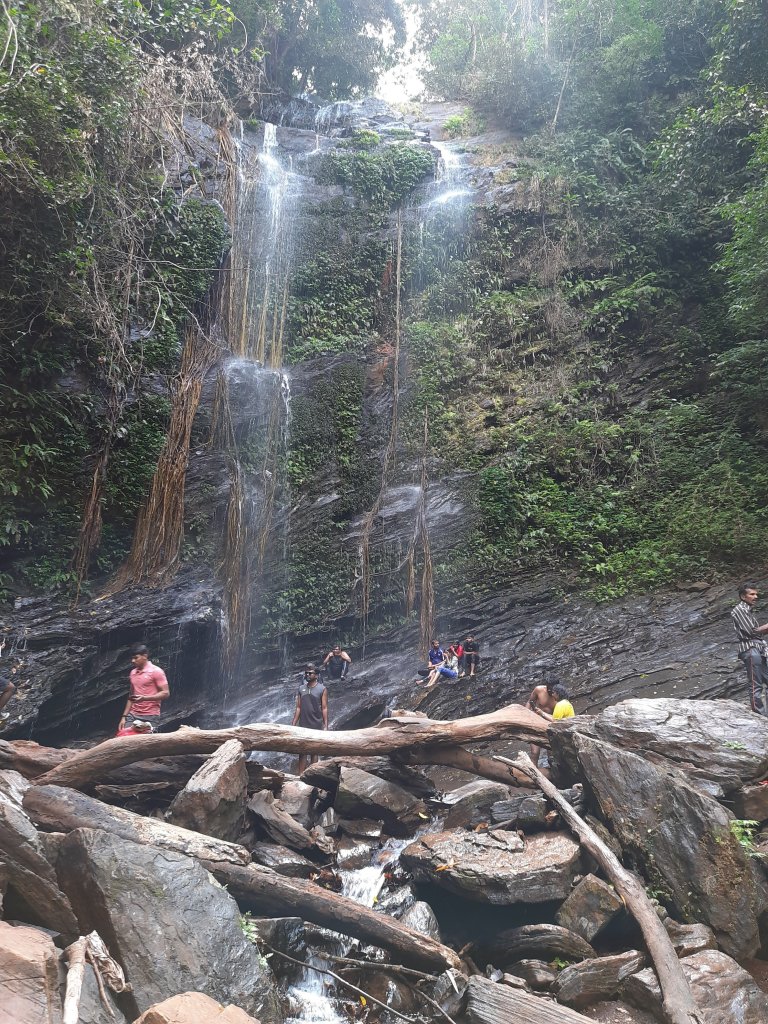
Hidlumane falls
I called up the PTU organizers and informed them of the situation. We were fortunate to find a chaiwala (petty Angadi), the ONLY place with light and people movement in the drop-dead night. The people in the bus got down and occupied themselves with their dose of mid-night chai and smokes until we figured out an alternative. None of them would settle for a full refund and wanted PTU to ensure that they got what they had signed up for.
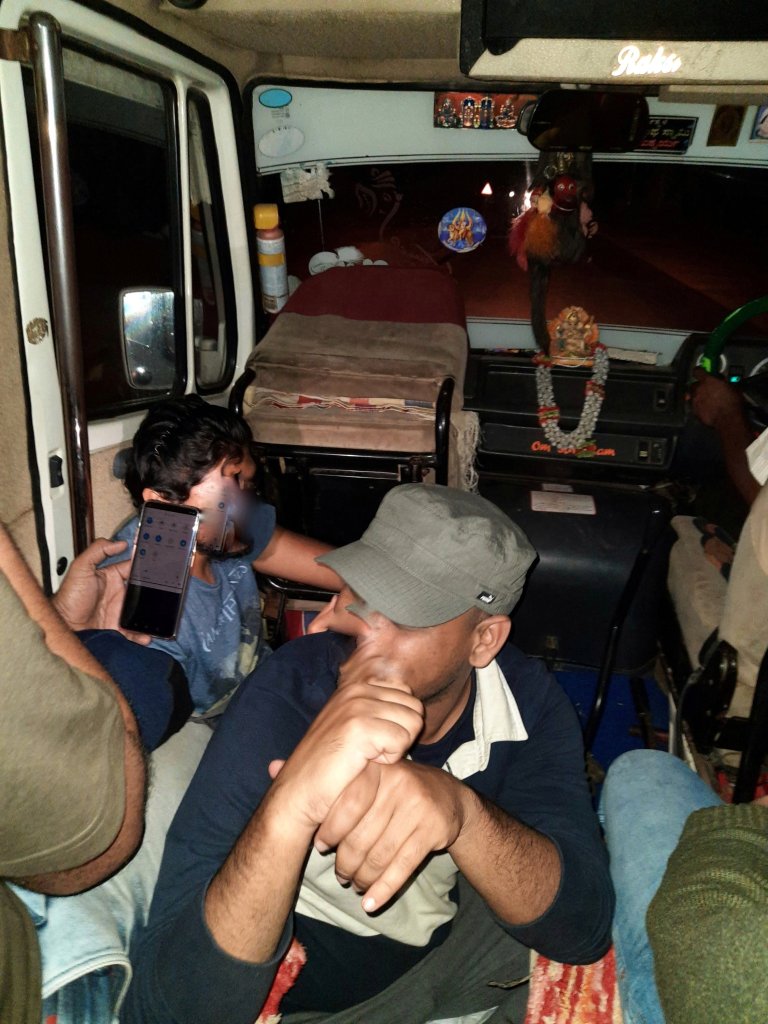
It was a weekend. It wasn’t going to be easy to find an alternate bus or a TT (Tempo Traveler). While my co-lead was waving at every other bus that came on the highway (both KSRTC and private buses) to check if there were empty seats, I was calling up every random travel company listed on google and checking for availability of buses. Either they were all booked for the weekend or people would just abuse me for waking them up in the middle of the night and hang up. To add to it, I was the ONLY person in the entire bus who could speak Kannada. So yeah, I literally had to manage the show and all the translations, communications and co-ordinations. Finally, one KSRTC bus stopped! They had sufficient seats to accommodate all of us as well. But we had a new challenge. The travellers with us had ganged up and would not agree to board a red bus (Karnataka Sarige bus). All requests to convince seemed futile and we let go off the KSRTC bus. After a total of about an hour, the chaiwala managed to find us a localite who had agreed to come with us for a per kilometer charge that was double the normal price. PTU organizers agreed. The TT arrived. Next challenge? It was a 12-seater TT, we were 16 in total. We, the leaders convinced ourselves to sit on the floor of the ramp between the two rows of seats and another 2 travelers volunteered to fill the already crammed space. Ensuring that everyone else got a comfortable space, the journey continued. Fortunately, we had no more surprises and we reached the homestay by 09.30.a.m.
That’s how we rolled, in our TT (Faces intentionally blurred)
We took time to freshen up, have breakfast, get the forest permits for the trek and finally started our ascend by 11.00.a.m. All went fine, by god’s grace. This was my first PROPER trek in Kodachadri, the previous one was another adventure worth a read. We climbed up the Hidlumane waterfall, arrived at a local house enroute to have a surprise Majjige (buttermilk) stop, crossed paddy fields, areca and banana plantations, Mookambika temple and finally arrived at the peak marked by the Shankaracharya Mantapa. The landscape and the entire path were unrecognizable for me from what I had seen on my previous visit. It was now exploited and overdone by tourists. There were a few hikers who felt exhausted and wanted to give-up halfway. But as a trek leader, it was my personal obligation to ensure that EVERYONE completed what they had signed up for and no one stayed back without some safe company. Finally, everyone made it to the peak, and it was now mission accomplished. Well, only partially!
The real deal was in the descend. We had a 4×4 ride awaiting us for our return. It is one that is BEYOND explanation and you only hold on to the roof bars hoping that you don’t have a few broken bones or dislocated joints by the time it ends. There is NO road, only a slide down a ditchy/bumpy gradient path. This 4×4 jeep ride alone supports the livelihood of several people around the area. Hence, the localites aren’t letting a road happen even if the government wants to develop this important site of tourism (we were told so by one of them). So, if this ride is considered as an adventure and a source of employment, then you can imagine how memorable this experience must be, right?
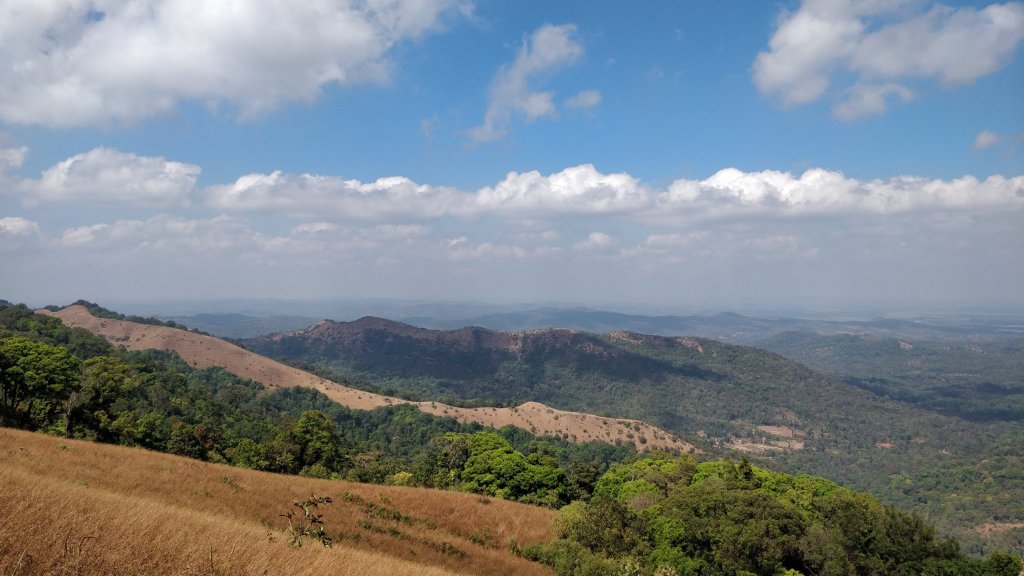
The view after reaching the keep trail
Well, in spite of all the delays and breakdowns, it gave me a sense of achievement by the end of the day for having met the itinerary. Though we paid late exit fine at the gates, this was a PTU experience in its true sense. More adventures to come, until then- Keep tripping…. Plan the Unplanned!
With a closed group of family and friends, about 10 of us planned this weekend trek to this lesser known hill, a little away from Bangalore. We started from Bangalore at 05.00.a.m. with an intention to finish the hike back down before the sun goes up. It was dawn by the time we drove towards Kanakapura and reached a village called Kanchanahalli, in Malavalli Taluk of Ramanagara district. The Kaccha road thereafter till the base of the hike, passes through fine landscape and traditional village of ‘Mysore Karnataka’ region. The hill is a part of the ‘Kabbala Forest reserve’ area. The early morning rays added extra charm to the cloud kissed peak of the ‘BheemanaKindi hill’ at the distant end and the fog covered coconut groves and vibrant green farms on either side of the road. What else? Picture this: A dozen peacocks dancing in the middle of the road! Well, a pleasant welcome; I must say 😊
The Drive and trek to Bheemanakindi
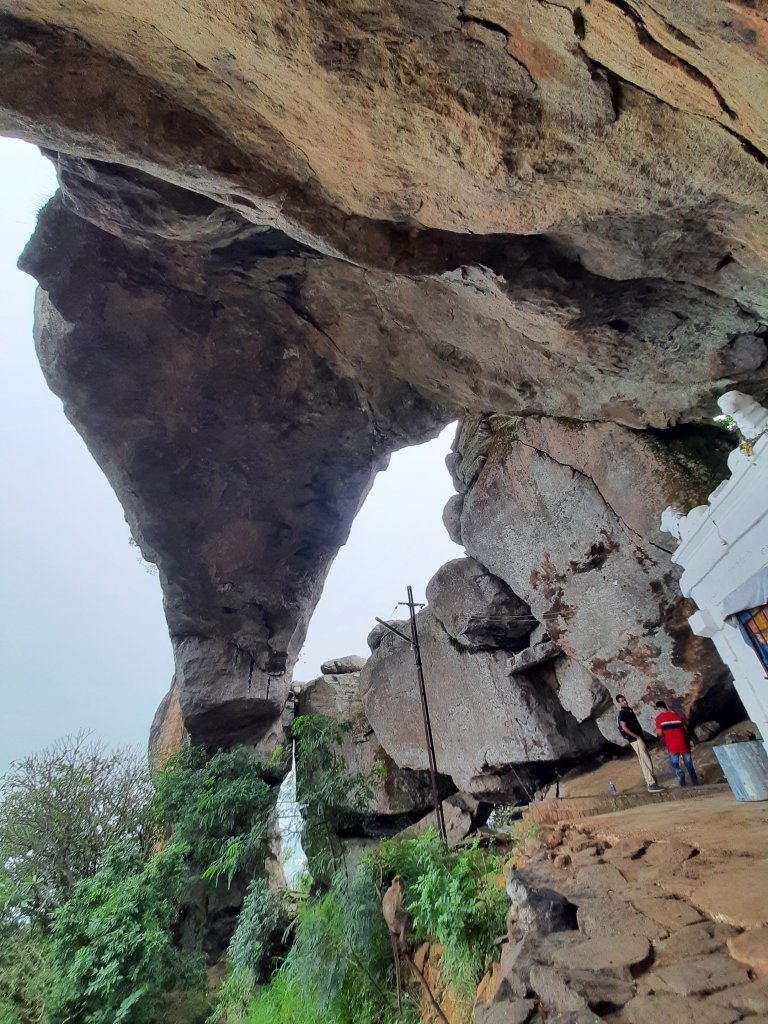
We finally arrived at the base of the hill, parked our cars and started the ascend. It starts at a small godown sort of a structure from where, is a well laid out stone path through the forest, right till the destination. Well, let me clarify that unlike most of the common treks around the city that promise you a breathtaking view after a good climb, this one has a MASSIVE stone arch at the end. With this large arch, goes the legend from Ramayana. ‘Bheema’ hit the large rocky monolith with his ‘Gadhe’ and thus resulted this Natural arch, locally called as ‘Kindi’. The smaller pieces scattered are believed to be the ones which appear to have been arranged one on-top-of the other in the adjoining smaller hillocks by the consecutive civilizations, over a period of time.
The difficulty level of the climb is moderate, but the gradient is steep. Since I hadn’t eaten anything since the previous afternoon, acidity was taking a toll on me. I was feeling nauseous and tired and trailing everyone on this trek. (That’s also the reason I didn’t take many photos of our ascent and the video attached below includes more visuals from the descent). I somehow made it to the top, all worthwhile the effort. A small temple dedicated to Nandi sits in a corner underneath the massive rock arch overlooking the dense forest cover below. Apart from a few squawking peacocks and chirping birds, we thought we were the earliest mammals to arrive there. But not until we saw some freshly laid elephant poop at the peak…!
A portion of the Stone arch and temple at Bheemanakindi
I had some biscuits and relaxed there for a bit until I felt fine. From a few known localites, we had heard that there exists a perennial pond somewhere close by. We walked behind the boulders that overlooks the millet farms beneath. We climbed up the hill further and we ventured out in pursuit of the pond. Mind you, the trek path ends at the temple and we were venturing out beyond, into the forest (Do not try this adventure). The sloppy path didn’t have a proper trail and we followed each other and stayed together so that we wouldn’t get lost. We walked further, a few broken trees (Bamboo, Indian Gooseberry, hog-plums etc.) perhaps warned us from going further, the pachyderms had just crossed the path. From there, we arrived at a small opening in the green cover- a large boulder. As the mist had engulfed the entire view, we sat there for a while hoping for it to clear out and get some good view of the valley below. But no luck and we decided to walk back.
Our stomachs were grumbling for food by the time we reached back to the base by 10.00.a.m. One of the members in our group had a relative in Kanchanahalli and hence, we were invited for brunch at their house. We drove to their house, passing through my FAVOURITE views of Karnataka: The rural hamlets of ‘Mysore Karnataka’ region. Traditional houses with wide porticos on raised platforms, red-oxide floors, clay tiled roofs supported by wooden pillars are a delight, I tell you!! Sometimes, cattle sheds on one side and a bicycle on the porch too is a common sight, so very typical to this region and so warm and old world. I have always gaped at those tiny streets in awe. So, today was my first opportunity to see the interiors of one such house, all that I had only seen in Kannada movies till date. Picture this: they are locally called ‘Thotti mane’ and the central living room has a central area which opens to the sky. Talk about natural ventilation and lighting, it has been part of our ancestral architecture from time immemorial. It also serves as an area to wash our feet and hands when we enter home, before we touch anything else. (Connect it with self-sanitizing during Covid times, after you come home from outside??)
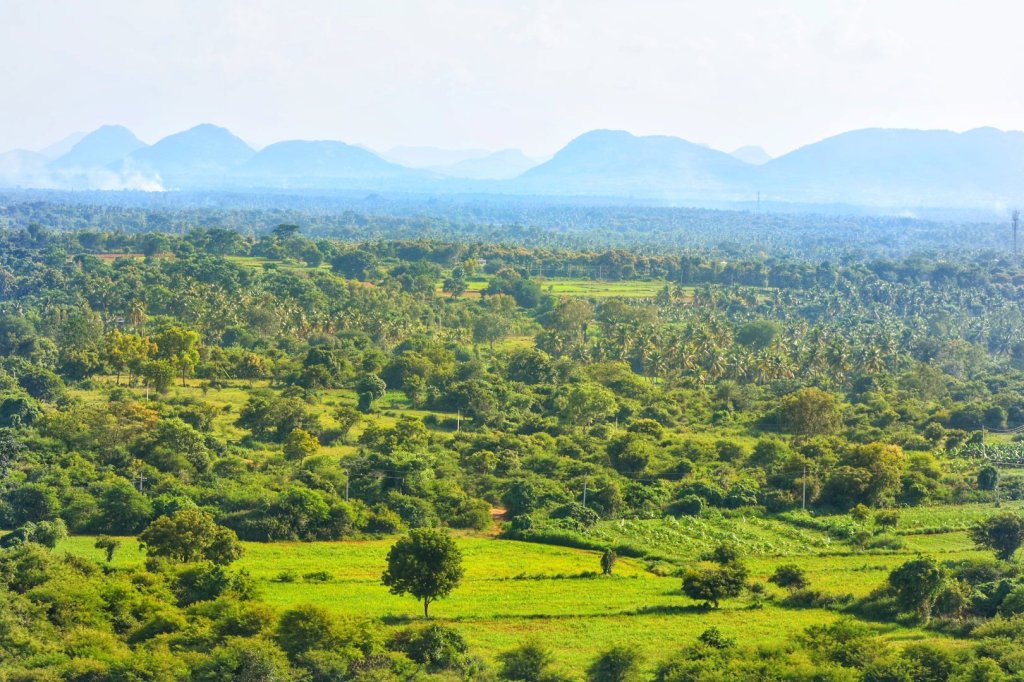
A street at Kanchanahalli, overlooking the Bheemanakindi hill
Well, a pleasant happy day for me and a nice, happy, simple, warm meal for the tummy 😊 We head back to the city…. Hoping for another warm weekend to arrive soon….
This post is of my family’s random “target destination-less” drive during the Covid unlock period. We set out in three different directions on three separate weekends but reached a place from where we got the view of the same hill, every time. By the shape of the solo hill, we would know that it was the ‘Ragihalli Betta’, located on the fringes of Bannerghatta National park. So, here are the details.
Direction 1: Kanakapura road; Destination explored: Gullahatti Kaval; View: Ragihalli Betta The aimless drive culminated at a beautiful spot at the backwaters of the Muninagara reservoir in a village called as Gullahatti Kaval (Click here to read the detailed post). The route was mainly through millet and Banana farms dotted by small hamlets.
The road leading to Yogavana Betta, from Kanakapura road
Direction 2: Bannerghatta road; Destination explored: Koratagere Doddi; View: Ragihalli Betta An offroading drive through Ragihalli state forest, stream crossing, forest trail and then culminating at a viewpoint- was a very welcome drive (Click here to read the detailed post).
View from Yogavana Betta
Direction 3: Mysore road; Destination explored: Yogavana Betta; View: Ragihalli Betta After passing through small hamlets, an art school and a road with a foresty canopy leading to an ashram called as ‘Yogavana Betta’. We skipped the ashram visit and walked up the hill and climbed up a meditation hall, apparently called ‘Anubhav Mantapa’ to get a 360deg view of the surrounding. One of the views from atop was the Ragihalli Betta. Apart from a casual walk in the green neighborhood, there was nothing specific to do here. But it is a DEFINITE recommendation for those seeking a good ‘Sunset View’ point. Watch the below video of this place and the view surrounding this place.
Visiting the Saurashtran region of India was a last-minute inclusion in the itinerary of our trip which was otherwise planned only to ‘The Rann of Kutch’. It was noon by the time my friend and I arrived at Junagadh, by a train from Ahmedabad. After checking into a hotel at a walkable distance from the station and freshening up, we relished a sumptuous ‘Gujarati Thali’ at a nearby restaurant. After a while, we set out to explore this historical city of Junagadh, a place lesser known on a typical backpacker’s circuit.
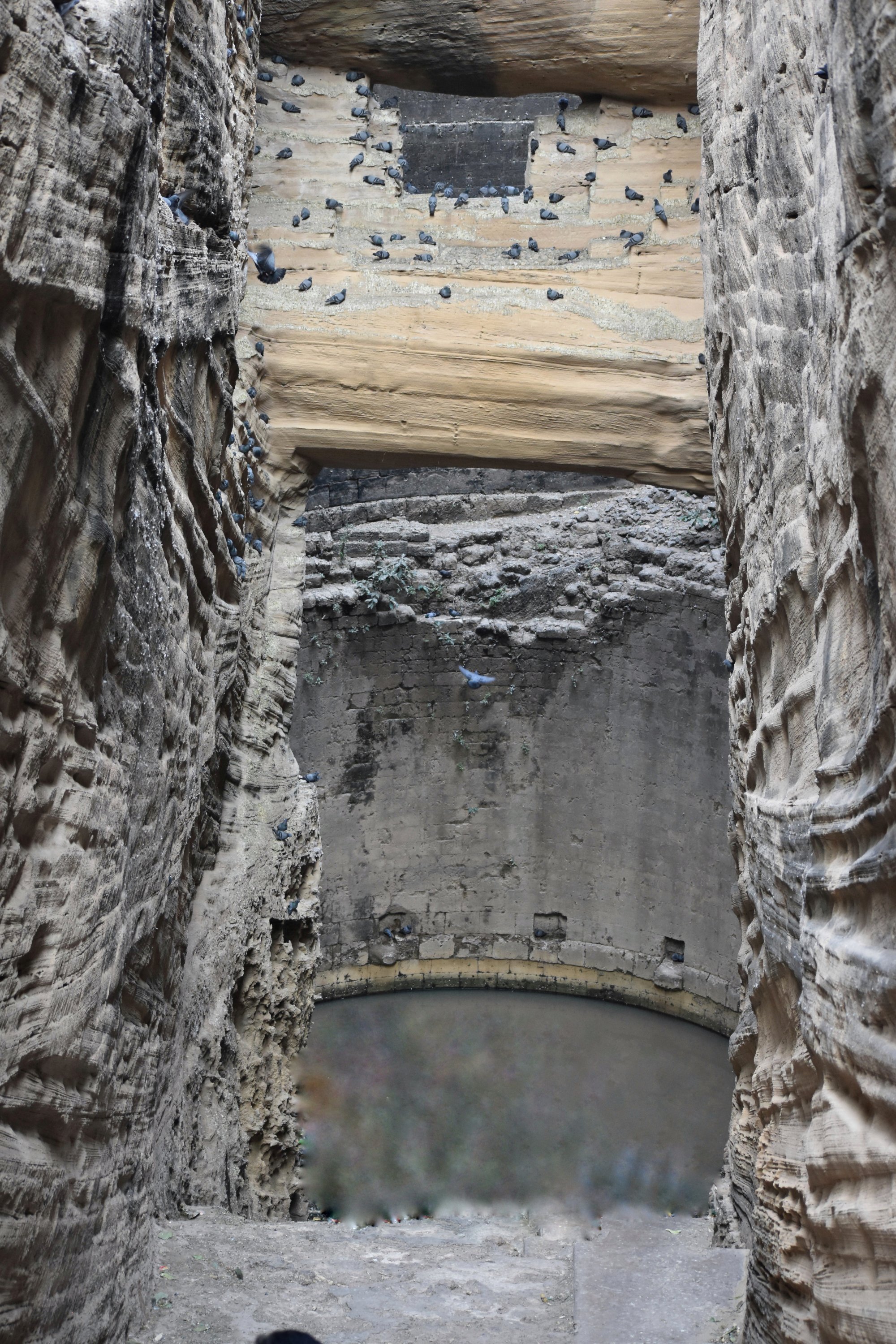
With a short autorickshaw ride, we reached the entrance of the Uparkot fort. This place is what gives its name to the city. ‘Juna-Gadh’ in local language means ‘Ancient Fort’. This fort dates to 3rd century BC, to the Mauryan Era. It must have been a massive structure back then. With several dynasties ruling this region over time, there are many historical remnants of structures that were eventually added. However, all are in bad shape now. The Buddhist cave, the Jumma Masjid, the tomb of Nuri Shah, the Naghan Kuvo stepwell are among the few that have stood in time. But Adi-Kadi Vav and Nawabi lake are the structures that I found interesting among all. Adi-Kadi Vav is a stepwell facing the Girnar hills, to which we had to descend a flight of stairs to reach water (mind you! The water is extremely dirty with all the trash). Whereas the Nawabi lake is an artificial pond that required an ascend of a spiraling staircase where the reflection of the Girnar hills looked beautiful in its water. This spot also had a dozen peacocks walking around the pond. Our walk tour ended in a couple of hours and we decided to walk back to the town.
Adi-Kadi Vav rockcut stepwell at Uparkot fort
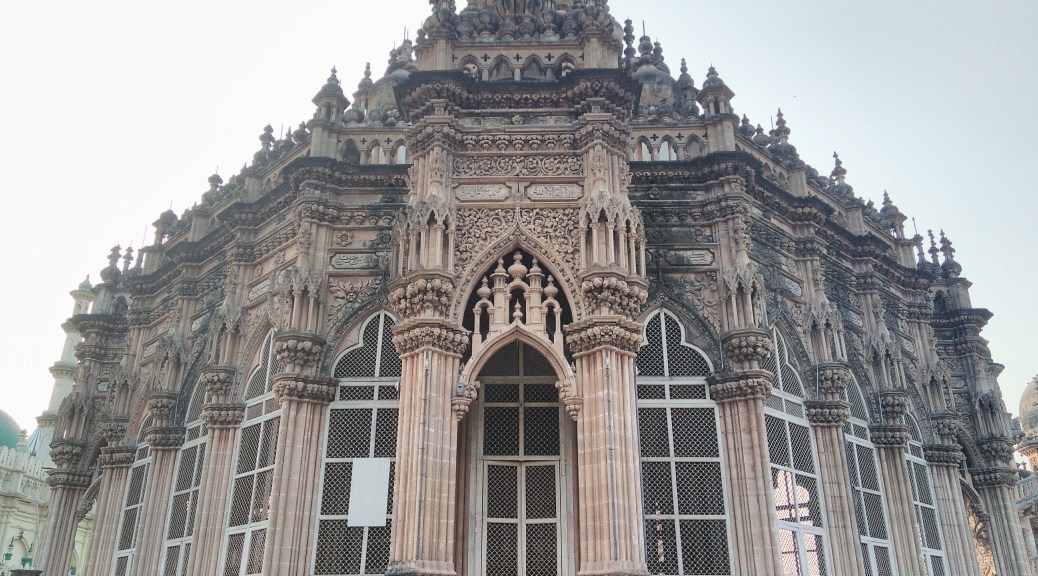
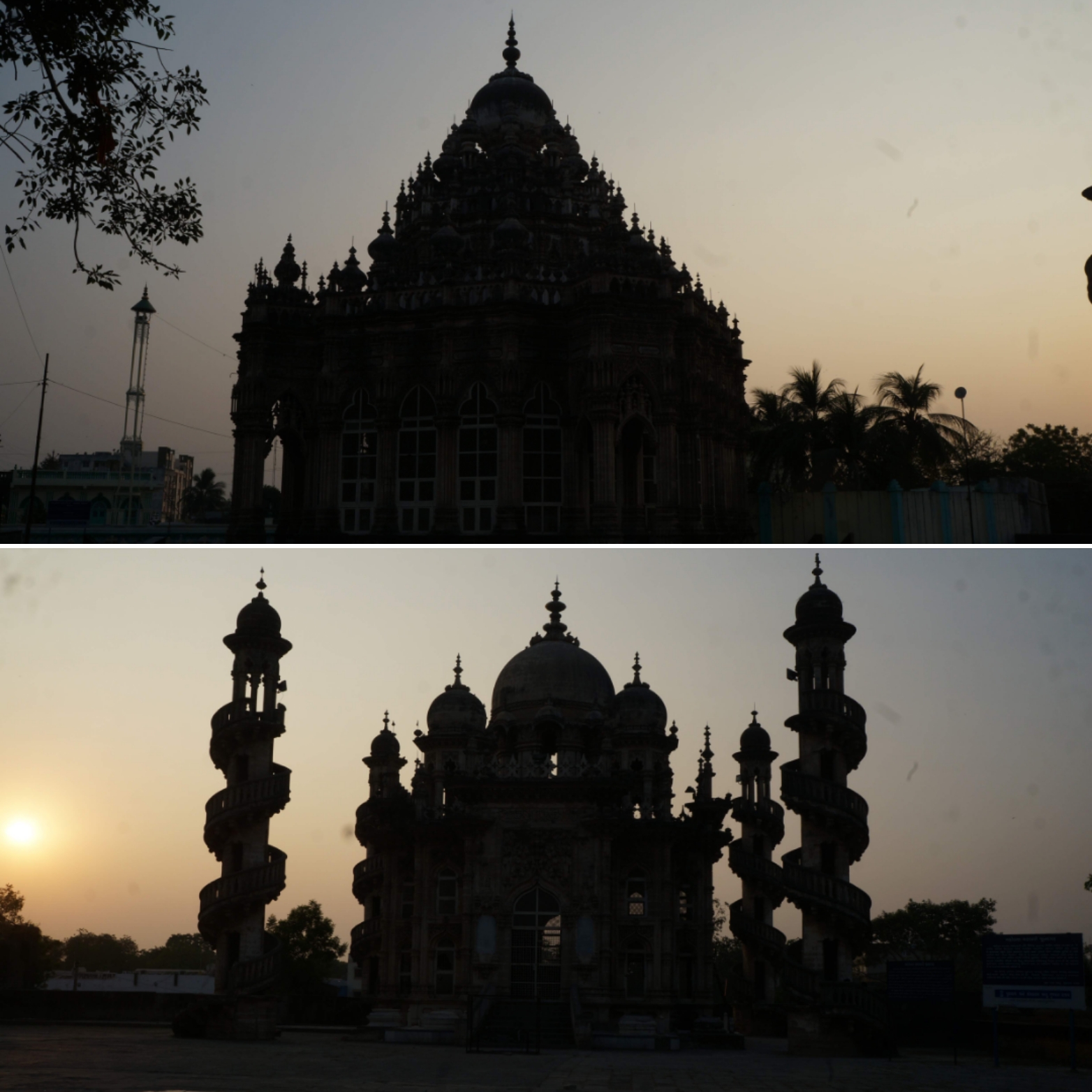
This gave us ample opportunity to photograph the rustic, old world and yet vibrant streets of the old city. Almost every corner of the lanes and its doors seemed like they had stories to narrate. As planned, we arrived at ‘Mahabat ka Maqbara’ at sunset time. These twin tombs of the past rulers are very beautiful, and it is only enhanced by the shades of the setting sun. We were very particular to photograph this place at the golden hour and were happy souls towards the day’s end for capturing those amazing silhouettes.
The twin tombs at Mahabat ka Maqbara
After a long walk further in the quest to explore the market area of the old city, we kind of came to realize that we were lost in the cramped streets of a place that seemed like Namma Bengaluru’s Pete area. Google maps was of very little help so much so that we reached the same spot after walking around in multiple directions. Finally, we hopped into an autorickshaw to get us to the hotel, not minding the short walkable distance that was indicated by Google. We wanted to get some rest as our night was going to be long. We set the alarm to wake up by 10.00.p.m. so that we could start to hike by 11.00.p.m.
However, I slept a wee bit longer and had been shaken up neither by the alarm nor by the panic-stricken friend’s endless calls from outside my closed room doors. When I woke up from deep slumber, it was 01.00.am and my friend was almost in the verge of fainting to know that I was not responding inside a closed room 😀 We then got an auto ride to the base of the Girnar hills, the climb of 10,000 stairs had to be done before sunrise. The plan was to ascend at night, catch the sunrise from the peak and descend back before the harsh sun rose up during the day. Post breakfast, we would leave for our next destination. We were already running behind schedule.
We commenced our hike and there was barely anyone else with us. The winds were very strong and the rustle of the trees as we passed through the initial stretch of forest was creepy in the moonless night. The Girnar hills is believed to be older than the Himalayas and a pilgrimage site for people across faiths. Several structures like emperor Ashoka’s rock edict, Jain temples, ancient inscriptions etc. are things that kindle the history buffs if they are not interested in the pilgrimage including the Jain tonks or several other temples from across time in history. However, after climbing about 5,000 stairs, my legs were tired and couldn’t catch up with my friend’s pace. I could have completed it though, only at a slower pace. But, we wouldn’t have been able to make it back in time if we had to catch a morning bus to our next destination. Fearing which, I decided to sit back and let my friend go ahead and complete the hike. However, he was not okay with the idea to let me sit alone all night (it was bloody dark and windy with NO ONE around) and decided to head back to the hotel with me. So, the descent of 5000 odd stairs on our way back wasn’t easy either. I was unprepared for this long hike and I guess it was a wise decision for me not to continue the ascent. It would’ve taken a real toll on my legs and the rest of the trip would’ve been screwed up. But what makes this a memorable trip is the fact that this was the first EVER hike that I gave up halfway, without completing.
Then, we telephoned the same rickshaw guy to give us a ride back to the hotel. It was a short but a nice ride. The proximity of the Gir National park had herds of Nilghais, boars and other wild animals on the highway that we were travelling on. A stay in the ‘Gir National Park’ is a dream for another day. Perhaps when I have more days in my itinerary and more money in my wallet. Maybe that time, I will have more stamina to reach the peak of Girnar too. But for now, we were reaching our hotel for some more sleep.
Here’s a story of when the ‘Plan A’ went kaput and we were stranded in an alien land without a ‘Plan B’. No mobile phones working and no internet connectivity to reschedule our return tickets, here’s a snippet from our first trip farthest from home. This post is written by Lahar Ganapathi, my brother and my favorite co-traveller on most trips. This is a throwback post to the winter of 2015, When we were among the earliest few Indian travellers: Doing the Chadar trek.
Day 1:
So, it’s the peak of winter in the north of India. Chadar trek was finally happening which was planned a few months in advance. With all the built up excitement, we left Bangalore for Leh. Delhi was where we met a few others doing the same trek, however they had bad news for us. That was of the Zanskar River being blocked due to a landslide upstream and all activities downstream indefinitely banned, or rather a section 144 was imposed. We were not the ones to be disheartened by the news and continued to Leh, onward from Delhi after a night’s sleepover at the Indira Gandhi International airport. So, after an uncomfortable sleep in the waiting lounge of the airport and a few hours of delay later in morning, we finally took off for Leh.
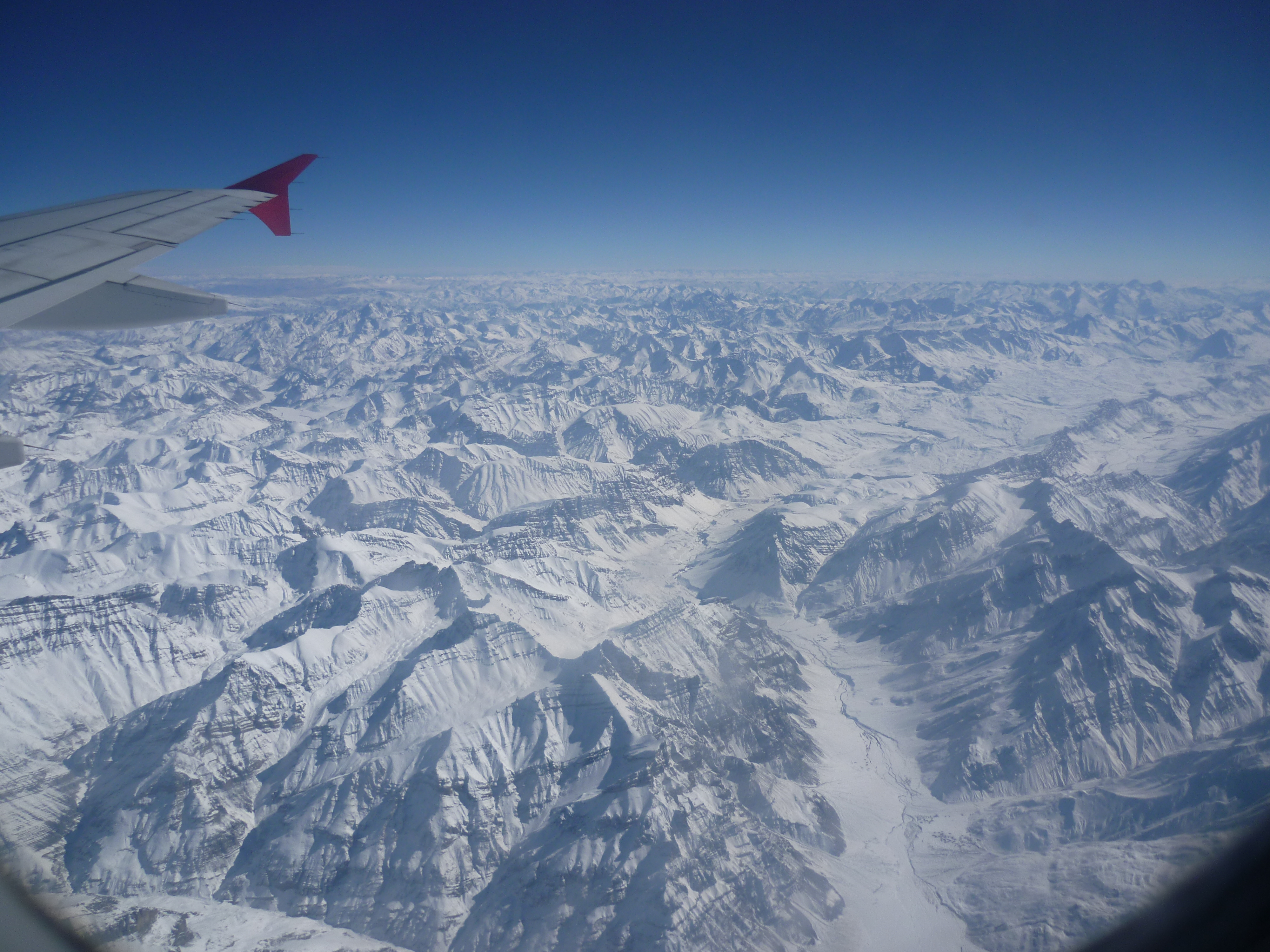
The view from above the Himalayas was breathtaking from the point where the Gangetic plains raised up to the mountains. There was stark difference as we saw a plain flat ground rising drastically, forming the snow-clad mountains in a matter of minutes. A flight to Leh in peak winter provided a beautiful view of the mountains in full glory, as if they were majestically looking down towards flatter lands at the bounty they provided. So, after all the aahs and oohs we finally took notice of the changing landscape as we reached Leh, white snowy terrain giving way to brown rocky terrain. In a moment we were already over Leh airstrip and we landed without any bumps. The announcement stated the temperature as 6 below 0.
You are flying over the Himalayas…
Being from the temperate part of India and never having experienced such a low temperature, excitement took over my sensibility and I got off the plane wearing only a normal woolen sweater (good enough to push through winter in Ooty or any other hill station down south). Yeah, such a jerk I was to do that. At first, the cold did not feel much different from other places. But, trust me it was -6 at 12:30 in the afternoon, with overhead sun. 10 minutes was all it took to knock the heat out of me. As it got unbearably cold, I scrambled for my warmest layer. It took three layers to feel warm enough. We caught a taxi to the hotel where we were scheduled to meet the other trekkers and the organizer. By this time, barely half an hour after laying foot in Leh, the cold had already F*&%$# up my toes to the extent to not feel anything for the next few days. The first news we got from the organizer was what we had heard in Delhi. ‘Zanskar is blocked and the government has banned activities downstream’.
Okay, enough for the first day. We huddled up near a gas heater in the hotel, while sipping on some hot yak milk tea. We were provided with a room for the night at a nearby accommodation. All done, we gathered in the room to discuss plan B for the next few days in Leh. Good night.
Day 2:
We woke up and immediately I noticed the frost on the window glass. The moisture in the room had frozen on the windows. First for everything, I was immediately mesmerized by the intricate pattern ice tended to have. Okay, so after a warm comfortable sleep we were ready to beat the cold. Once outside, we could notice that our body had “somewhat” acclimatized to cold. No tap water in Leh in winter; so don’t expect luxury of running water. You’ll be provided with a bucket of ‘hot’ water, which is normal water ‘feeling’ hot. We were then off to the hotel to meet the organizer, he had his own Plan-B for the situation. He claimed to take us to Nubra valley and Hemis national park, home of the rare Himalayan snow leopards. Our calculations were that, it would be a waste of money to do only two things for the cost of the whole trek. So, we opted out of his itinerary and took refund. We also made friends who liked our approach to the situation, a couple from Hyderabad who incidentally became best of friends over next the few days. So, now we are left in the streets with enough cash, more than enough cold and no idea as to what next.
Our immediate requirement was clear, to find shelter for the next few days. By then it was around 11.00 in the morning and we headed out hunting for a room. Since it was the season when Leh has the least footfall, it was kind of difficult to get a room as most of the hoteliers had shut shop for the season and the remainder were booked. Finally, we did manage to find an accommodation. We stayed with a family who rented out their son’s room to us. So accommodation set, what next?
We set out on a walk to the main market. We made a few enquiries around with the locals, about places of interest in and around Leh. We were immediately made aware of the ongoing Gustor festival at Spituk monastery. We immediately set out for the festival. Hired a cab and off we went. This monastery happens to be right across the Leh airport and has a commanding view of the runway. Looked like the whole of Leh had descended to the monastery. The road leading to the monastery was blocked a mile away due to the surge of vehicles and people coming to the festival. Chill, we ain’t scared to walk a few hundred yards. We passed through various stalls that were selling festive items and tents that served hot tea and lunch. The locals, all had a peculiar warmth in their sun burnt faces: so welcoming and refreshing.
As we walked, an air force plane flew past us to the runway. All ration to Leh is carried out by air in the winter as the roads are closed due to snowfall. The festival was one of a kind experience, something we probably had watched only on TV: Horns, colorful masks, bells, buddhist monks and their humming of prayers. Nice, we sat among the devotees and enjoyed the festivities happening in the courtyard. After it was done, we headed back to the parking. But this time, we stopped for lunch in one of the many tents. Ah, scrumptious, we filled our belly and topped it off with a hot tea. We were set for the next few hours. We headed straight to the main market since we had no other plans yet. Walking around the place, there were quite a few small stupas scattered around the main market area. We stepped into a few shops for the sake of buying souvenirs. At no time did we feel as being outsiders in Leh, pretty easy to mingle among the residents.
Okay done for the day. We walked back to our homestay and settled down. At dinner, it was decided that we eat something what the locals prefer. Not knowing what it was, we just told the landlady to serve us ‘whatever the locals eat’. Yeah, that’s it. In came a bowl of steaming hot thukpa for each of us. More like a thick soup mixed with chunks of meat and lots of vegetables. So much, for not knowing what the locals eat. Blah, it certainly did not satisfy my hunger and I ended up eating my sister’s share, as well as a serving of rice. Okay done for the night. Tomorrow is going to be a good day.
Day 3:
We had done a little socializing in the town last evening and ended up getting a car guy to take us to places around Leh. His was a comfortable Tata Aria. We left to Pangong Tso, A bloody massive lake situated across India and China. We were told by the car guy that it was the lake or place where the last scene of the movie 3-Idiots was shot. Oh okay! We didn’t know that, didn’t care either. Enroute to pangong we passed through the school where the Phunsuk Wangdu from that movie resided. Also, we passed through lakes converted into ice hockey rinks. Ice hockey seemed to have a good following there. But as the driver noted, not much was done to develop the sport.
It was quite a long journey, we took a pee stop at some barren place. Tanks emptied, and what we saw was a vast barren stretch of land. So off we were back in the Aria. We could see snow filled peaks in the distance getting nearer with every passing kilometer. And after a while we were at Chang La, a pass situated at 17688 ft or 5360mts above sea level. Another pit stop, this time it was because of the snow. We stopped just to feel snow, because Why not! Okay my sister barely stepped out of the vehicle only to get back in. It seems she felt a jolt of extreme cold ride in her spine. Ha, rightfully the lostlander, who lost her senses in the cold. Kid me not, every breath there took an effort, the altitude made us tired for every step we took.
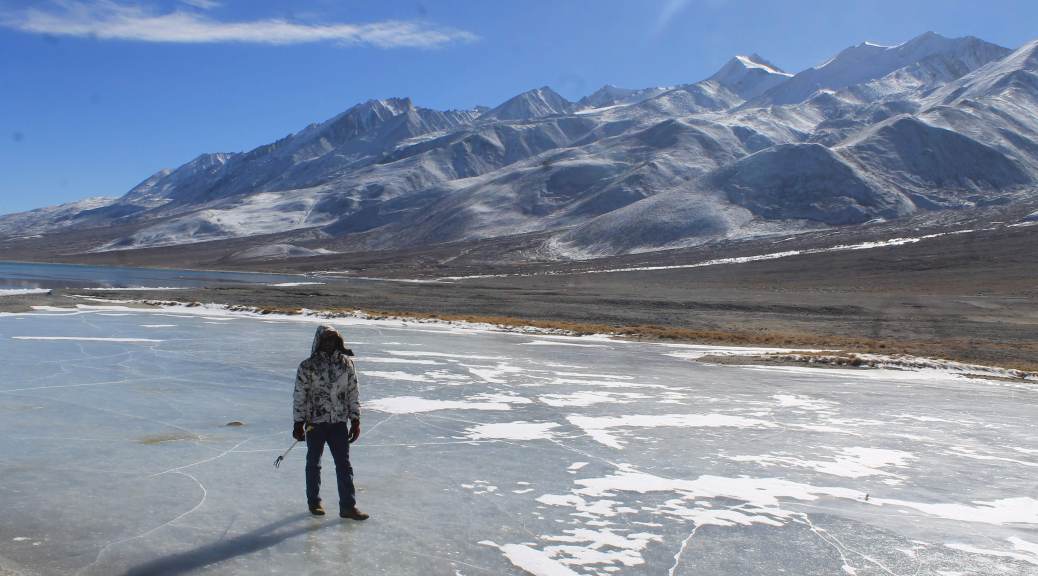
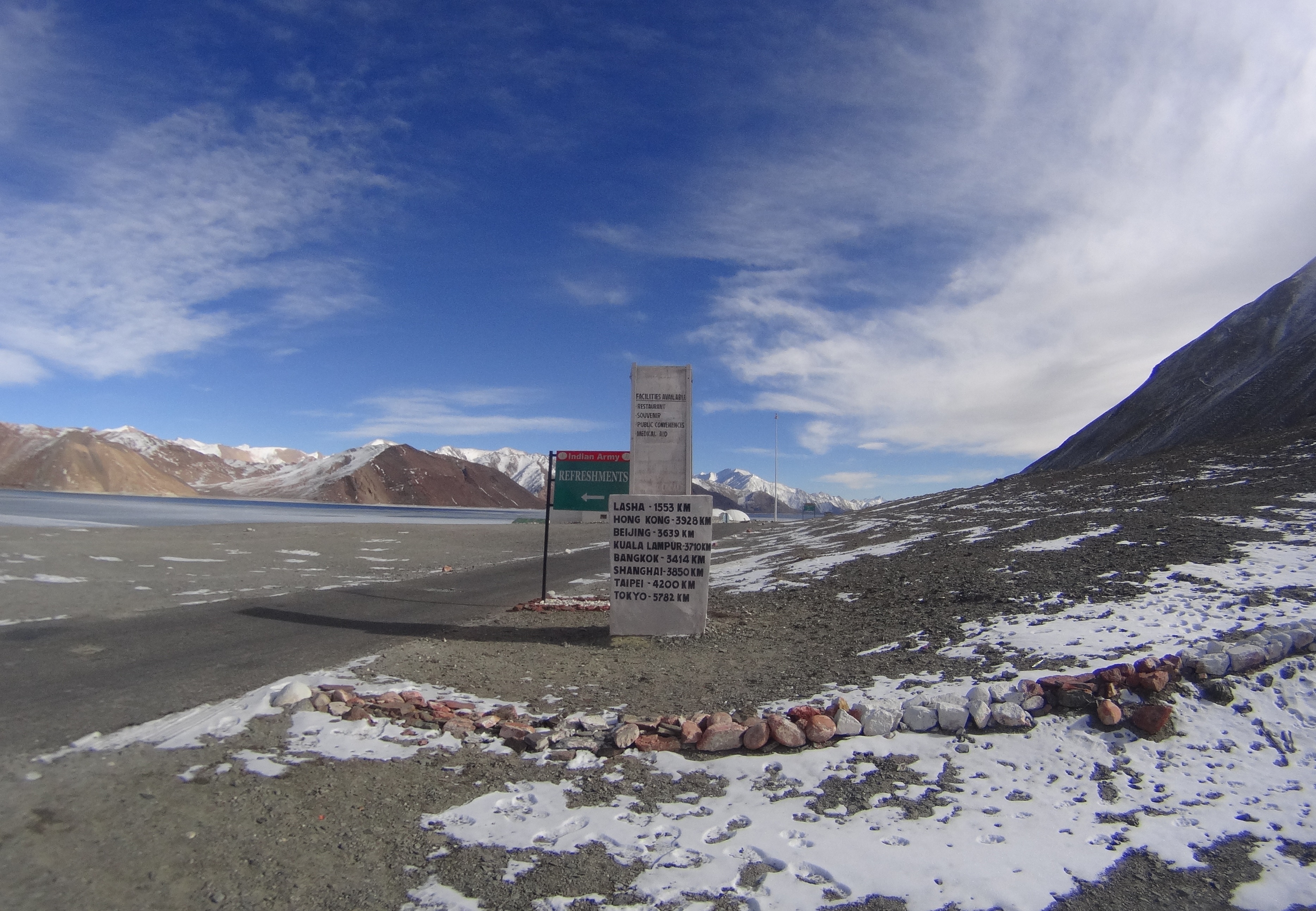
Okay Chang La conquered, next stop was Pangong tso. Maybe an hour or so from changla, we reached Pangong. So much excitement to get on a frozen lake.. So we spent a while there clicking pictures, admiring the beauty of the place. It has been the closest I have been to China. So long to Pangong, we headed back to civilization.
A milestone at the Pangong tso
We were dropped off at Shanti Stupa, a major tourist attraction in leh. Thank god, it was winter and no tourist to crowd the place. We had the whole place to ourselves. It was around 5:30.p.m., so we walked back from there to our home, through the desolate streets of Leh. Not a single soul was seen loitering in the evening. It was getting insane cold as the darkness loomed over…
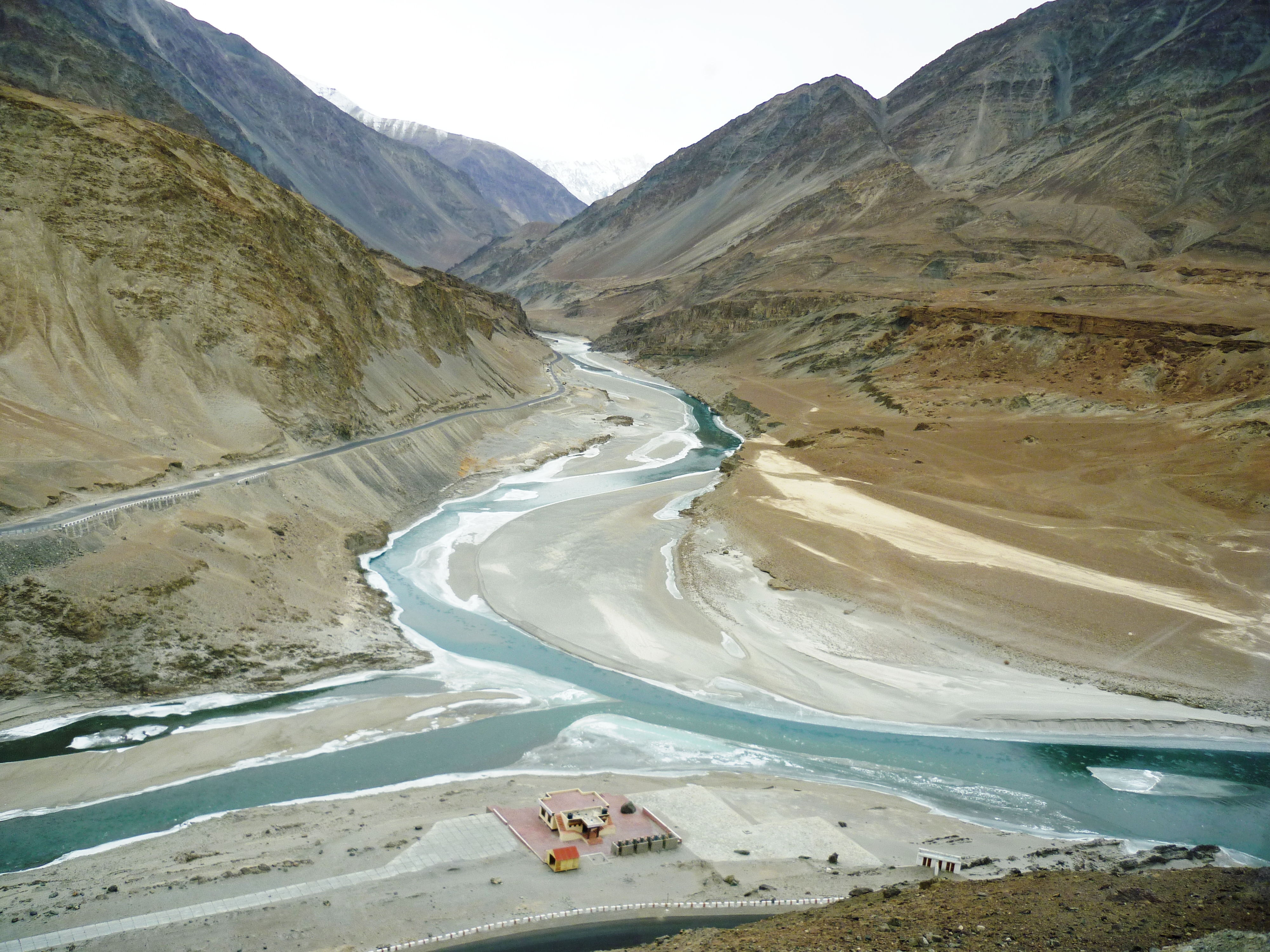
Oh, I forgot to tell about the magnetic hills of ladakh. Our Aria-man took us to this place called as the magnetic hills where cars and others wheelers defy gravity. Stop your car on the slope and watch it slowly roll up the slope defying all known logic of gravity. After this, we were taken to our beloved river which gave haath at the last minute, Zanskar. Or it was rather the confluence of Indus and Zanskar. We did actually go down to river bank when a police van appeared out of nowhere asking us to leave the spot because of the section 144 or curfew imposed in the area (remember the landslide that made us change our plans? That one!).
The confluence of the Indus and the Zanskar
Okay lucky enough not to end up in a police station I guess. The road enroute to this place is somewhat good, vast stretches of dry land with snow filled peaks in the distance. Our Aria-man was kind enough to tell us that these vast stretches served as testing grounds for Mahindra vehicles in high altitudes and that they have tested almost all their vehicles there. This was quite a day actually, we’ve been driving the whole day. For lunch we stopped at this particular town which looked dreamy, with shops lining both sides of the road the entire town’s length.














 The Lost Lander