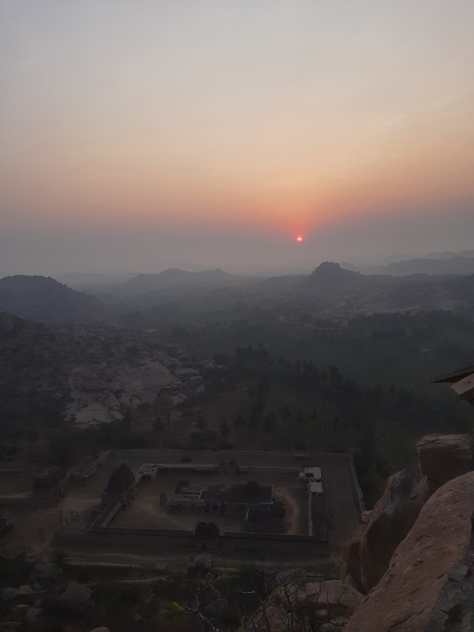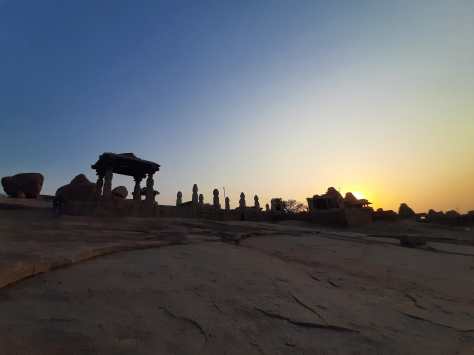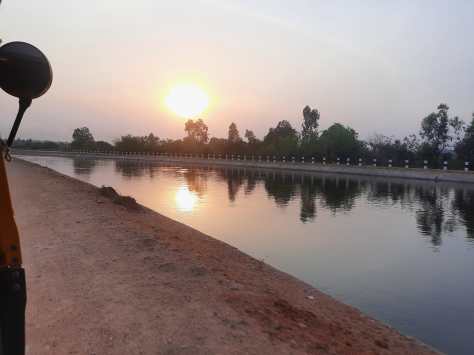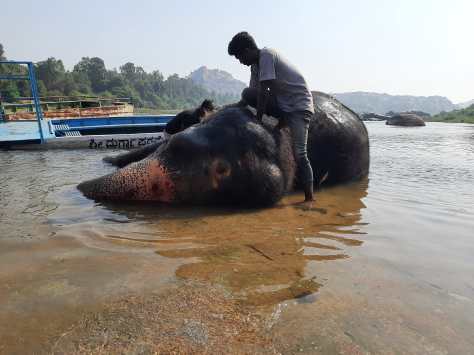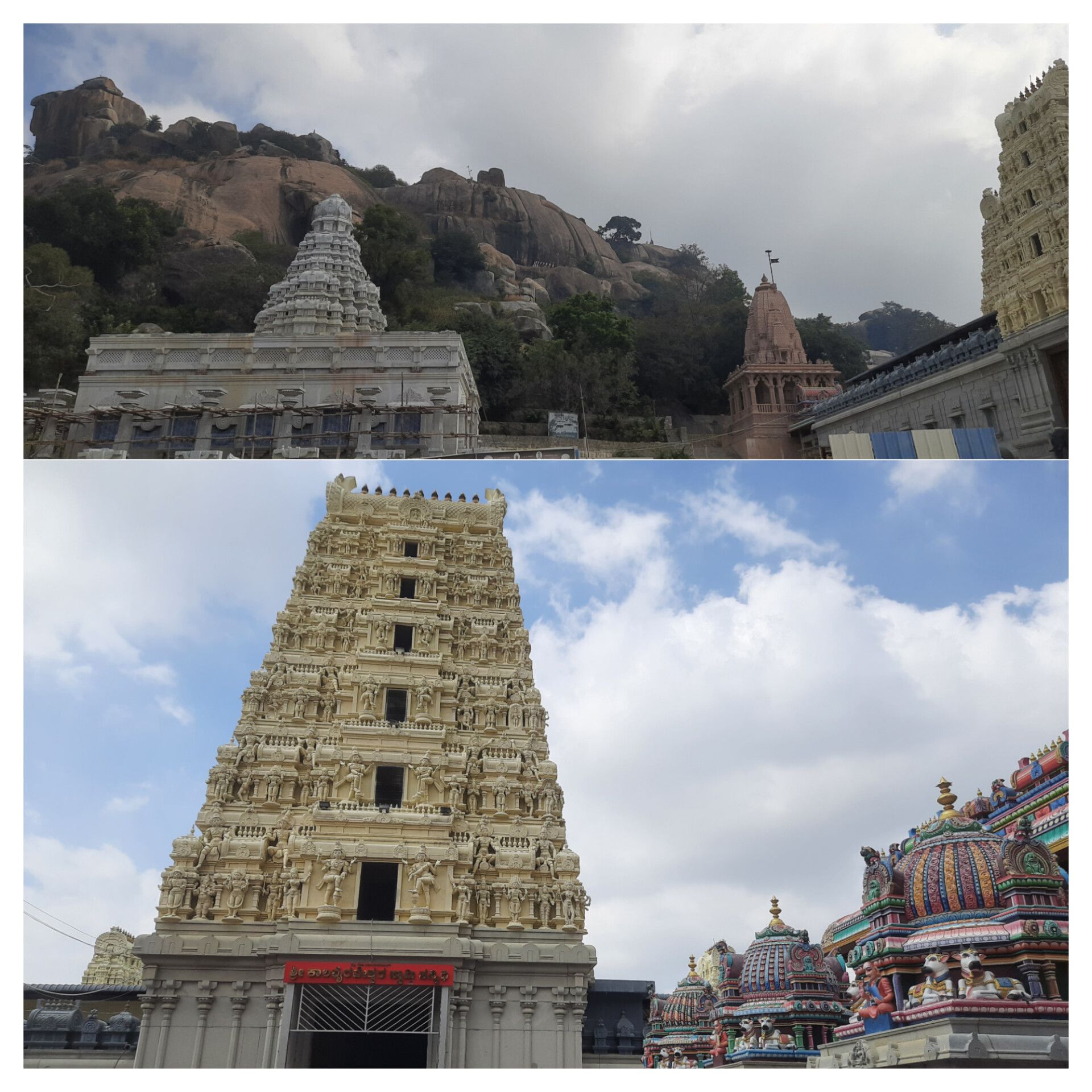
Adi-Chunchanagiri mutt is the spiritual headquarters of the Natha Parampara and Jogi Cult of Hindus of Karnataka. My dad, who had earlier visited this place with his friends, happened to insist on going there again with his family. His intention was not to take us on the spiritual path but rather to introduce us to a hiking path which he found picturesque after having ascended.
One Saturday morning, our family set forth to enjoy this day trip towards Adi-Chunchanagiri. We drove towards Hassan, along an excellent highway until Bellur cross from where we had to take a deviation towards Adi-Chunchanagiri betta (hill) as indicated on google-maps. There on, we enjoyed our drive through the countryside, with traditional homes scattered between vegetable farms, coconut groves, and forest patches of brown boulders and green trees. Google is not always right and that’s why we deviated from the course a little more than necessary until we found the correct track again. But it was the deviation which we enjoyed. We realized that the region is declared as Adi-Chunchanagiri peacock sanctuary. It was no surprise that dozens of peacocks were grazing freely on every other farm, moving around at every turn of the road and everywhere else along our way right until we reached the parking lot at the base of the Adi-Chunchanagiri hill.
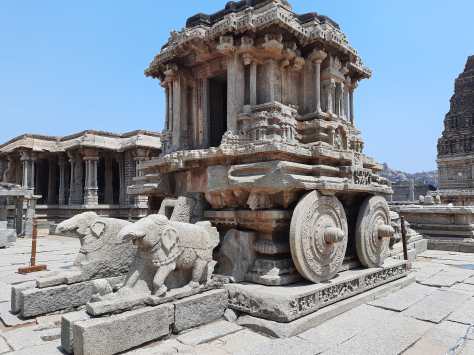
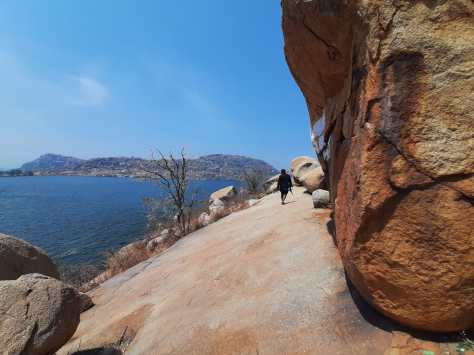
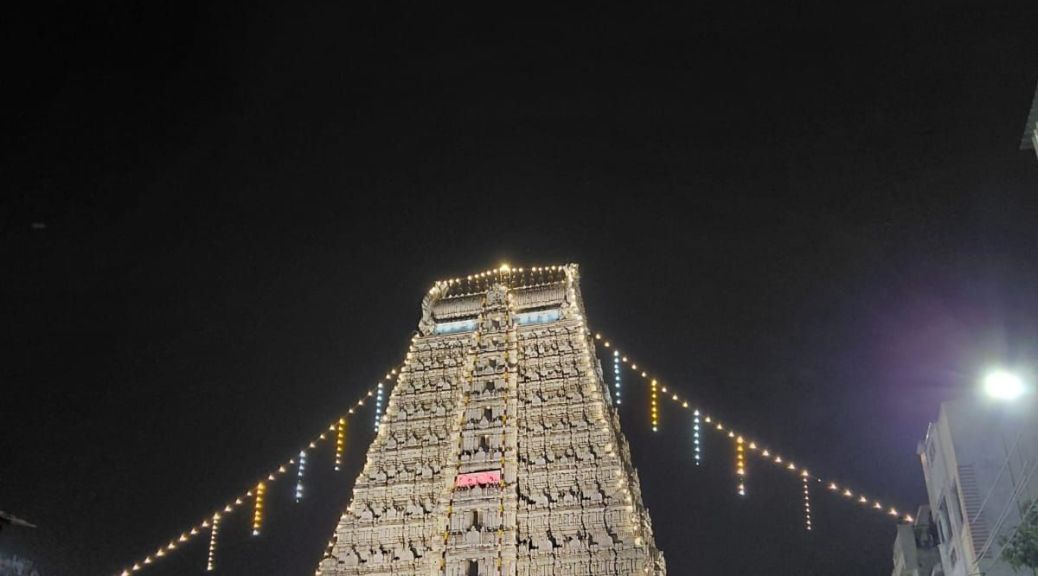
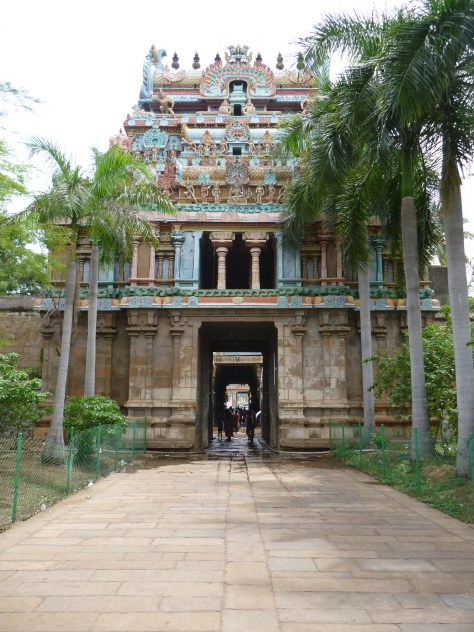
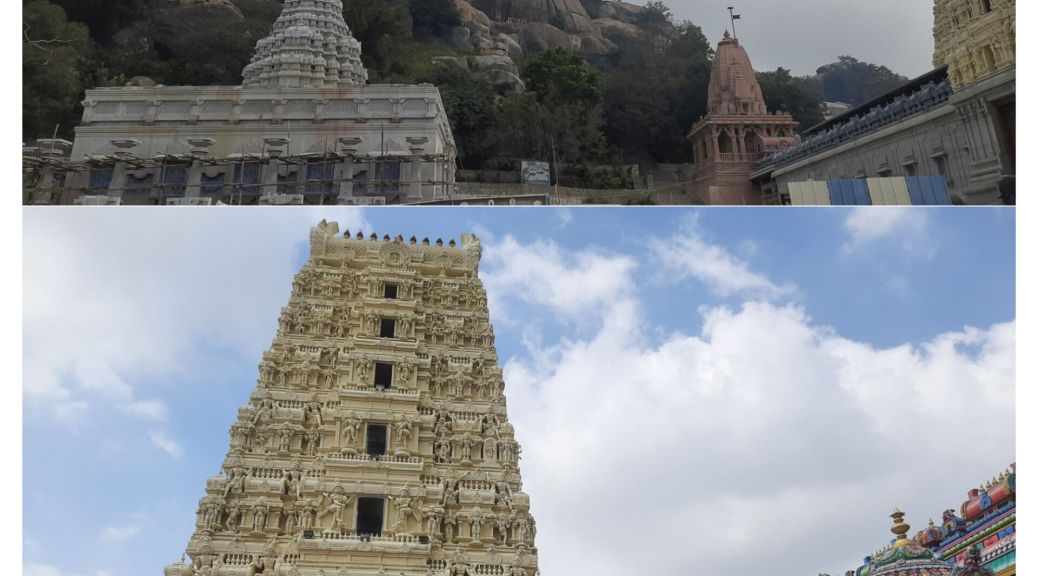
Top: The first glimpse of the Adichunchanagiri premises; Below: The entrance tower of the main temple
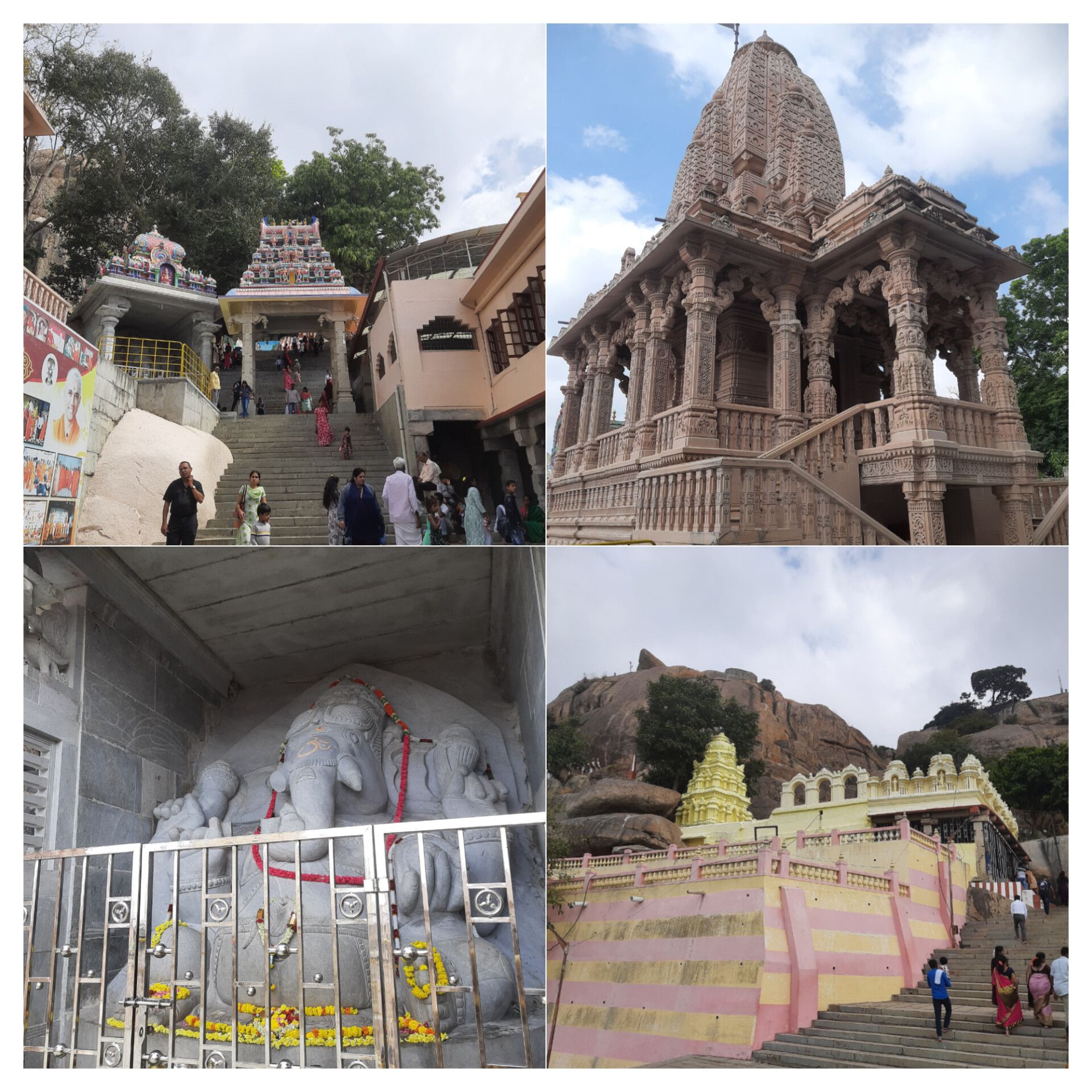
The initial approach towards the mutt premises starts with an ascent of about 100 steps leading to the welcome gate/ arch giving a visitor the first glimpse of the main temple. The large doors of the main temple opened into an ambience that felt divine and calm. It is entirely built with stones, and it gives a feeling of being in one of the ancient Dravidian temples though this one was built in modern times. The deities believed to be residing inside and revered highly by the pilgrims here are Sri Kalabhairaveshwara Swamy and Sri Stambhambika (Kambadamma).
After sitting there for some time, we began our ascent towards the peak of the hill. Just after coming out of the main temple, there is a large Ganesha idol sculpted out of the rocky wall of the surrounding. We continued our climb by passing by some smaller temples with a look around offering beautiful views of the green cover.
The temples and shrines at the Adichunchanagiri hill
Scores of people were seen climbing up and down for pilgrimage purposes. The climb to the hilltop is done to see the Panchalingas comprising Gangadhareshwara, Malleshwara, Katthale Someshwara, Gavisiddeshwara and Chandramouleshwara, whose temples or shrines are scattered along the trail leading to the summit. But we were there to hike that hill as a recreational activity for the weekend. We climbed up the steep stairs right up to the top with the trail splitting at random places. My family ended up getting lost from each other’s’ sight and then picked whatever trail lied ahead of us and met each other again at the top. Well, not the peak exactly, but just beneath it.
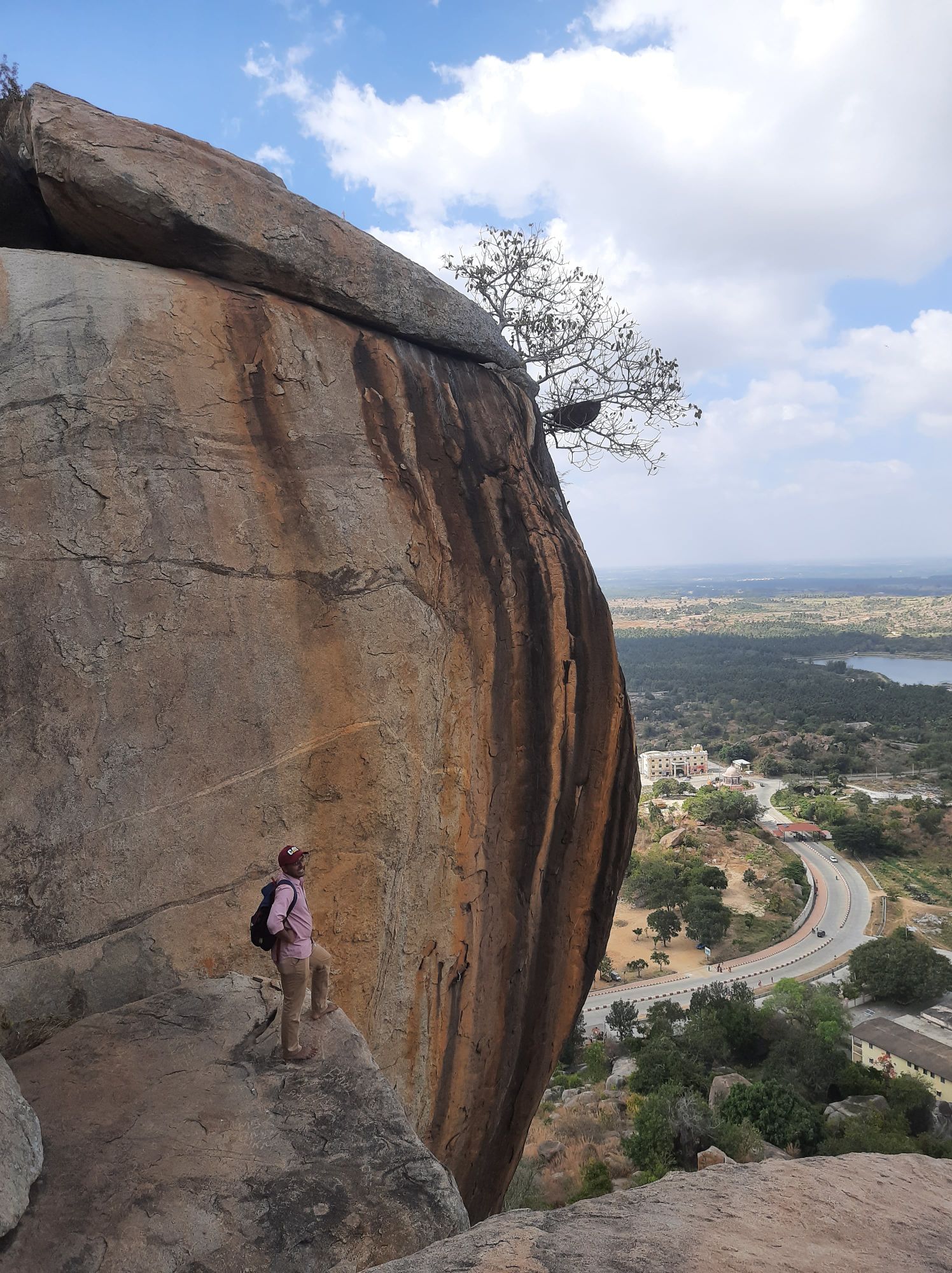
That’s where I gave up any further climb. The peak point of the hillock is known as Akasha Bhairava. It can be reached by climbing the last bit of the rocky hill which had no stairs but only with the aid of a big, suspended metal chain. It was a straight climb (almost 90 deg. gradient) which included a small jump from one rock to an another. I doubted my ability to descend safely even if I were able to reach the peak. My brother, on the other hand, climbed it up and down with so much ease (and grace) demonstrating that he still possessed his ancestors’ (apes) strongest traits.
The view from the top where I was standing beneath the last rock which leads to the peak
After he returned, we all came down towards the main temple where we were guided towards the dining hall. We devoured the delicious temple food before heading back towards Bangalore.
We started back just after lunch to avoid the weekend traffic at Bangalore. But, if you are interested to cover more places in this day, you can google for some of the Hoysala temples along your way and add it into your itinerary.
This story is from quite some time ago. My friend was tracking the arrival season of the flamingoes at Pulicat lake. He had an acquaintance of a Mr. Illaiyaraja, a fisherman who lived in Pulicat village. Through him, we got regular updates on the arrival of these seasonal beauties (flamingoes) who flocked to the brackish lake during their migration period. Meanwhile, our family was planning a drive to Sriharikota, to watch the launch of Chandrayaan 2. That’s another story altogether, you can read it here.
A week prior to our road trip, Mr. Illaiyaraja telephoned my friend and told him, “Anna, flamingoes vandichi.” loosely translating to “Brother, the flamingoes have arrived”, in Tamil. So, a drive to Lake Pulicat became a part of our road trip as well. Our family took our old reliable friend (Our Tata Indica) out on the road and prepped it for the long road trip. It was as if time was bringing all things together in our favor. The flamingoes had arrived, the rocket was set for its launch and the roads were calling us.
Pulicat village gets its name from Lake Pulicat, the second largest brackish water lagoon in India on whose banks is this tiny fishing hamlet. The lake itself is so vast that it is spans across Andhra Pradesh and Tamil Nadu. We approached Pulicat from the Tamil Nadu side. After exploring all the places enroute, we parked our car at the entrance of the village and walked by following google maps to the location where we were supposed to meet Mr. Illaiyaraja. With a can of diesel in his hand, he led us to his wooden boat anchored at the jetty. We boarded the boat with him and set off on an unforgettable experience of sailing on a sea-like vast lake, to see.
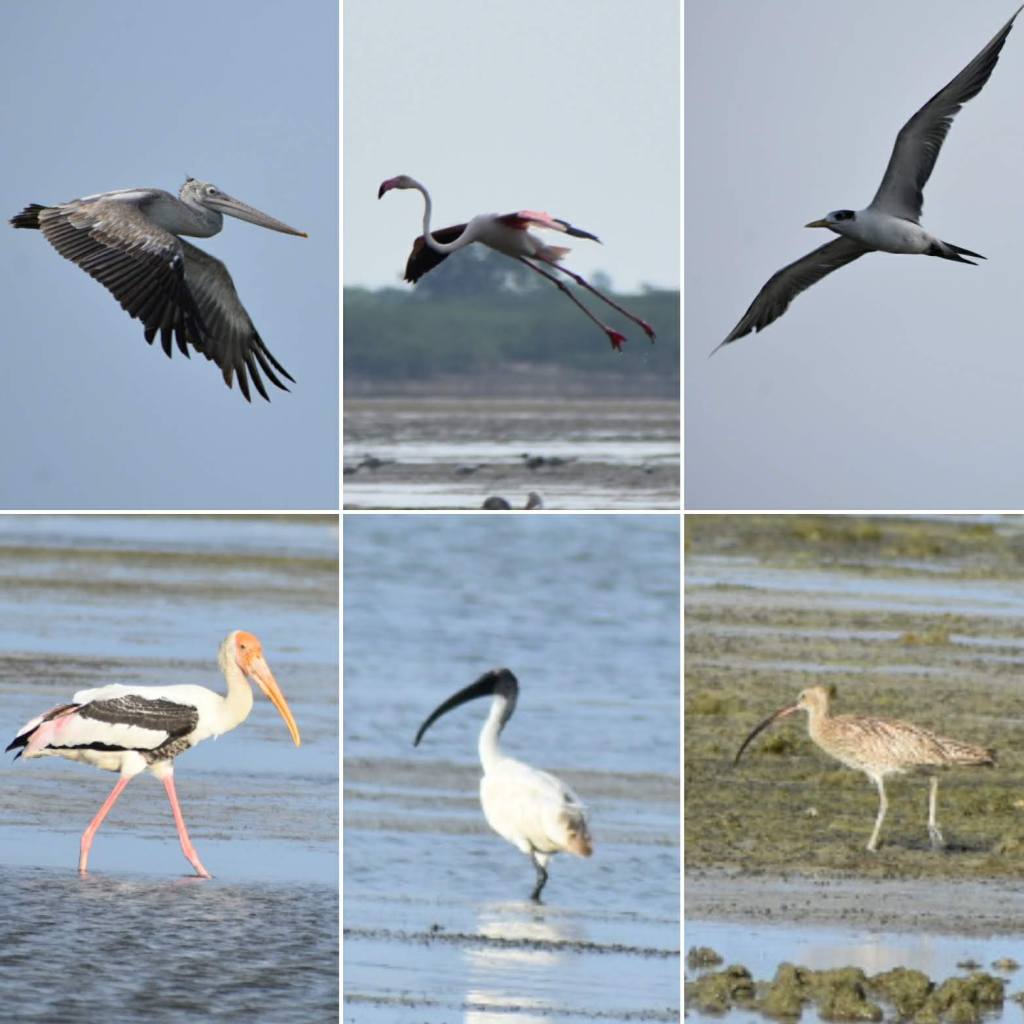
The birds at Lake Pulicat
Aquatic birds and shore birds that had migrated down from far across the globe birds to the Pulicat lake birds’ sanctuary. Pelicans, painted storks, kingfishers, herons, spoonbills, egrets, ducks, terns, gulls and several other species hovered on and off around us. But the peace within us came when the sound of the motorized boat came to a mute and there was an endless visual of the lake merging with the sky in a shade of ‘pink’. The greater flamingoes nesting peacefully in an unexplainable size of the flock. We spent quality time just watching them for a good hour or so before the sun started to turn the sky in hues of red.
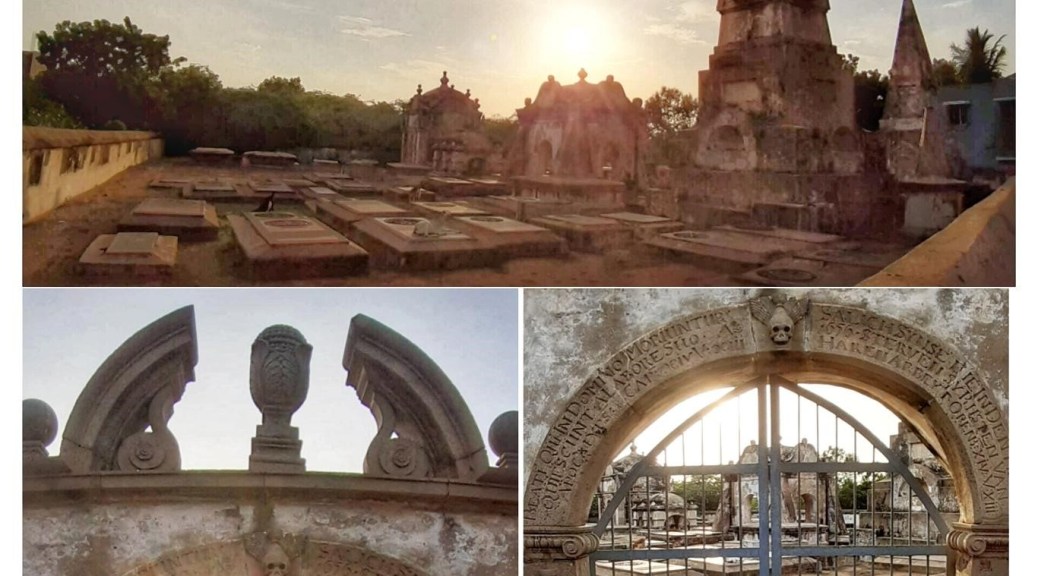
We returned to the bank and continued to drive in the direction of Sriharikota. While we were exiting from the village and were at a traffic signal waiting to enter the highway, my eyes fell on an interesting but ignored piece of construction by the roadside. I decided to go near and noticed that the entry gates were locked. The architecture style was different than anything I had seen before in the region and some strange alphabets were engraved on its entrance arches. Although interesting, it still seemed eerie and gave me some sense of it being an old, abandoned site of a graveyard. Since it was locked, I clicked a few pictures of the place from outside and returned to the car and continued our drive to Sriharikota.
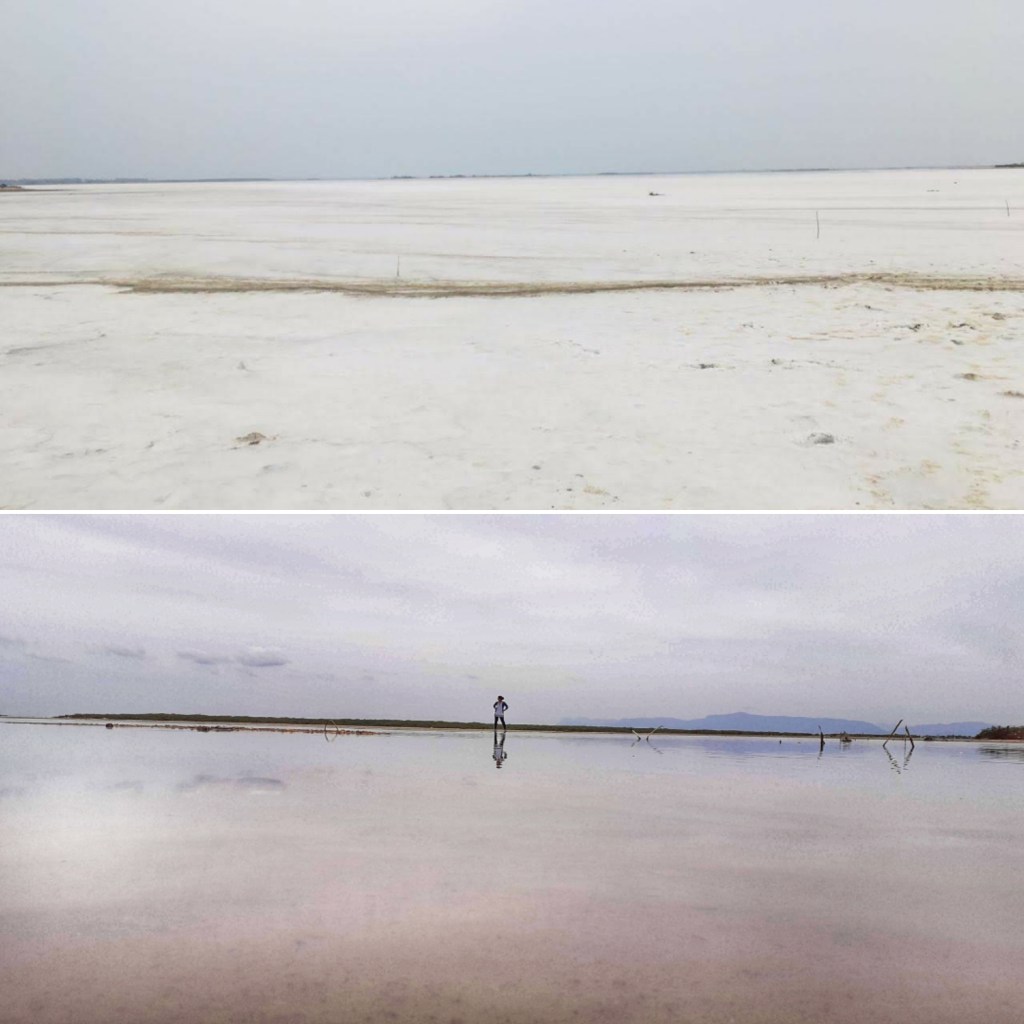
Top: Lake Pulicat enroute to SHAR in winter; Lake in Summer
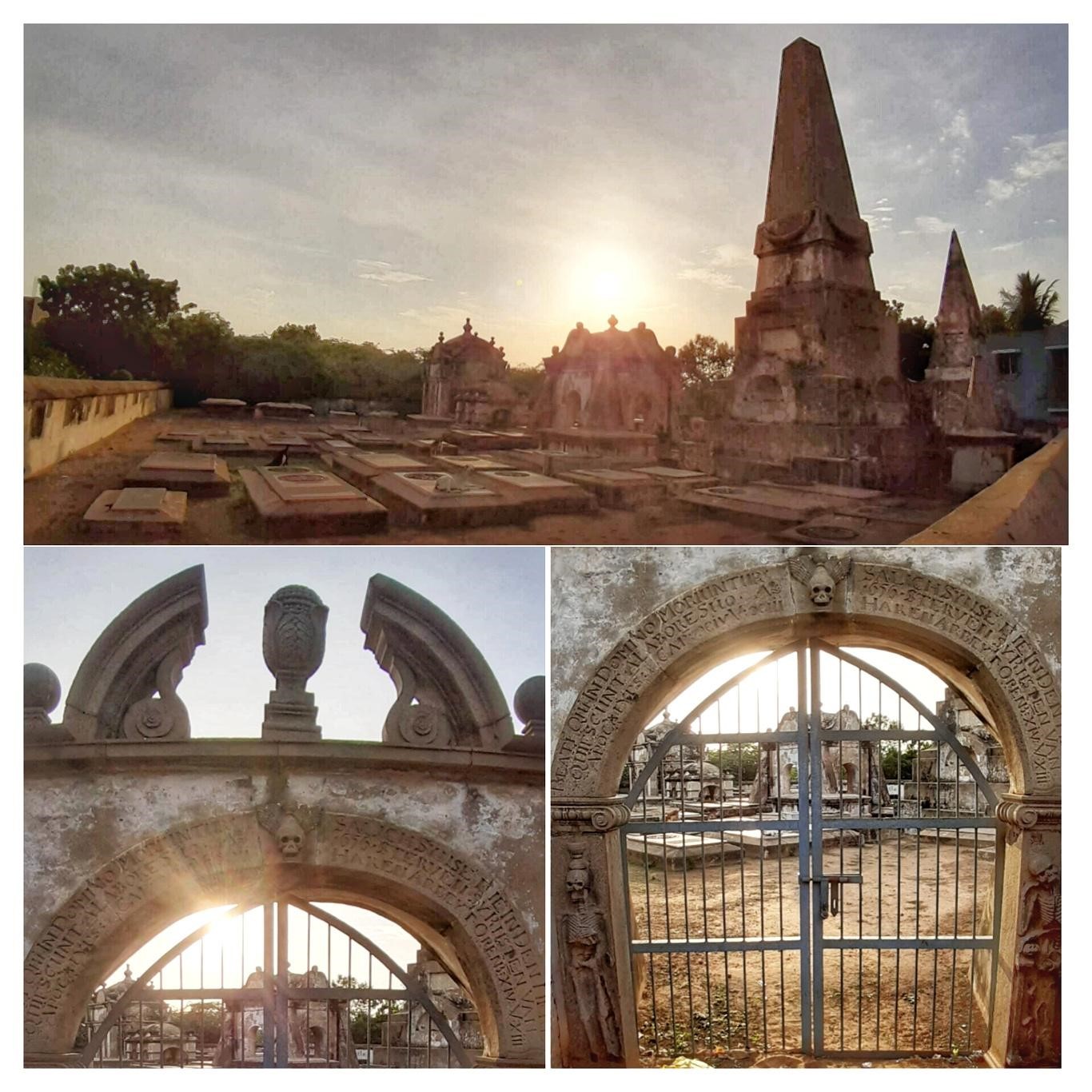
When I looked it up on the internet, I found some interesting information about that old site I had just visited. There are about five main settlements dating back to the Dutch era across India namely at Gujarat (Surat), Kerala (Cochin), Andhra Pradesh (Machilipatnam), Tamil Nadu (Pulicat) and West Bengal (Hooghly) where forts or cemeteries can be found. This day, I had visited a Dutch cemetery which used to be a part of Fort Geldria or Fort Geldaria at Pulicat. Pulicat was the seat of the Dutch Republic’s first settlement in India, and the capital of Dutch Coromandel. This fort was the only fortification in the Indian empire whereas all other positions of the Dutch Company were trading posts. today, this cemetery houses about 76 tombstones, mostly carved in the Netherlands.
The Dutch cemetery at Pulicat
It is interesting how I came across a random site that holds so much historical importance in India’s history of colonization and it is also unfortunate that how inaccessible or neglected are these sites that holds stories of an era bygone. Thus, the sun had set on Pulicat ending our quick visit to this lakeside settlement.
In my wish list to visit as many Hoysala temples as possible in this lifetime, this is the second documentation. I started this series with the temples of Belur and Halebidu, as these were the erstwhile capital cities of the Hoysala. I will move on from there.
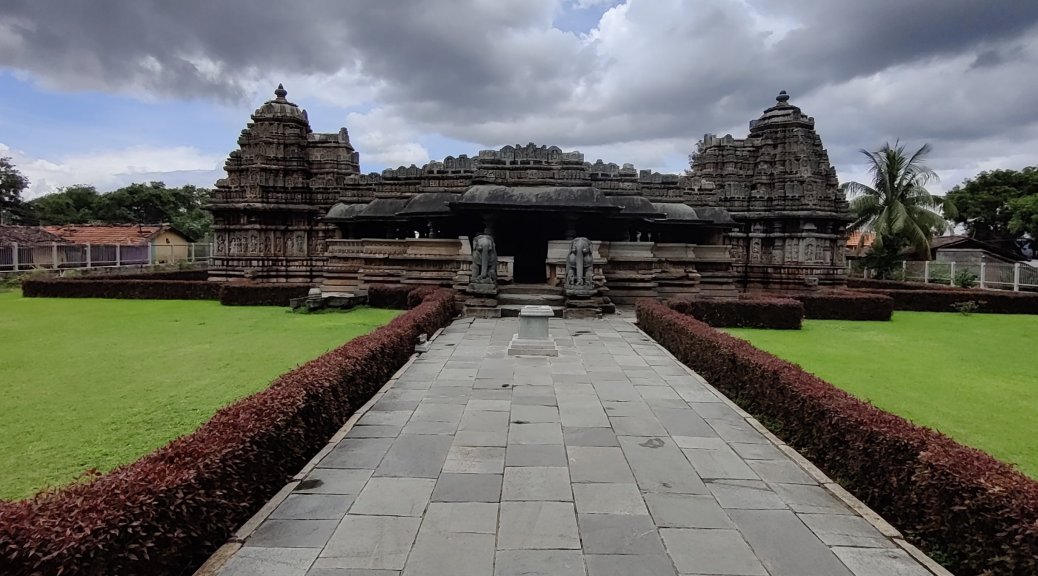
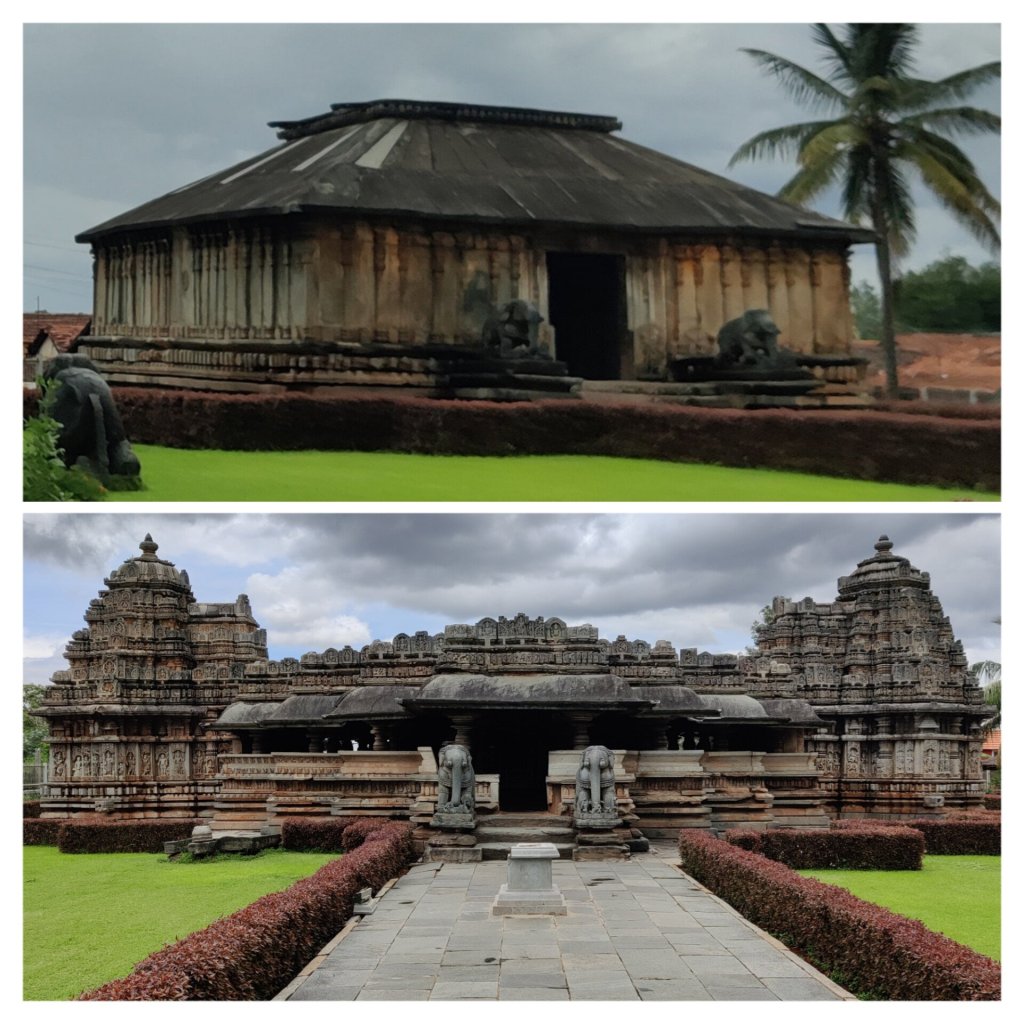
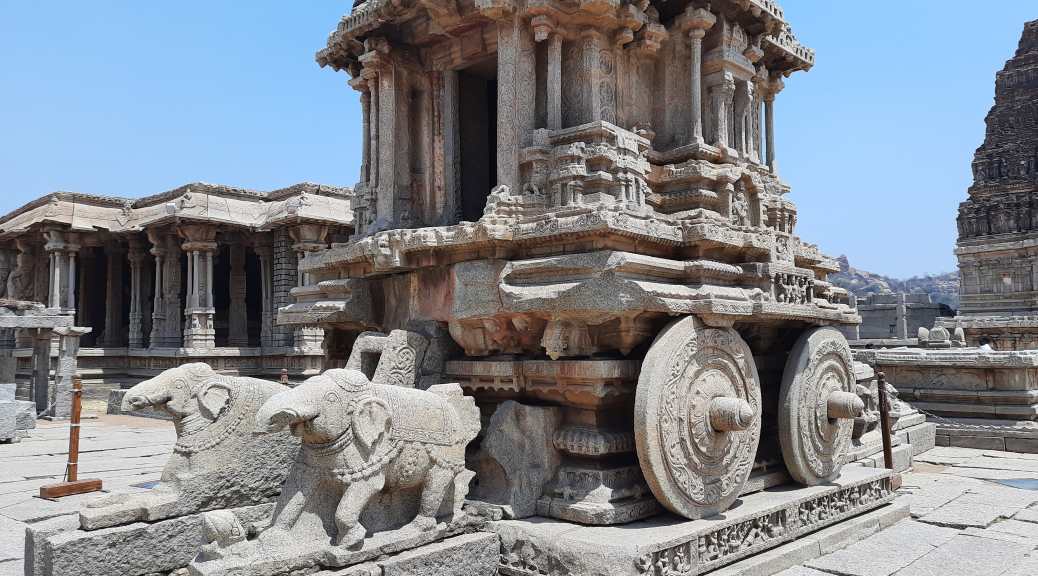
Belavadi is a quaint little village located approximately an hour away from the Hoysala capital town, Belur. The Veera Narayana swamy temple of Belavadi is one of those where the main idol of the presiding deity is still intact and regular prayers continue to be offered. The intricacy of the artwork on stone is very similar to that of the temples at Belur and Halebidu.
Images: Veeranarayanaswamy temple, Belavadi
Top: Outer entrance gate to the temple
Below: Inner entrance to main shrine at Veeranarayanaswamy temple, Belavadi
Unlike the main Gopuram (temple tower) at Belur, the entrance gate at the Belavadi temple is small. There are two ornate statues of two elephants that greets you inside. The sculpture on the outer wall is simple and minimalistic. as you enter, you notice that the inner walls are plain. It is possible that these were stolen, vandalized, or lost over the course of time, only historians can tell me better.
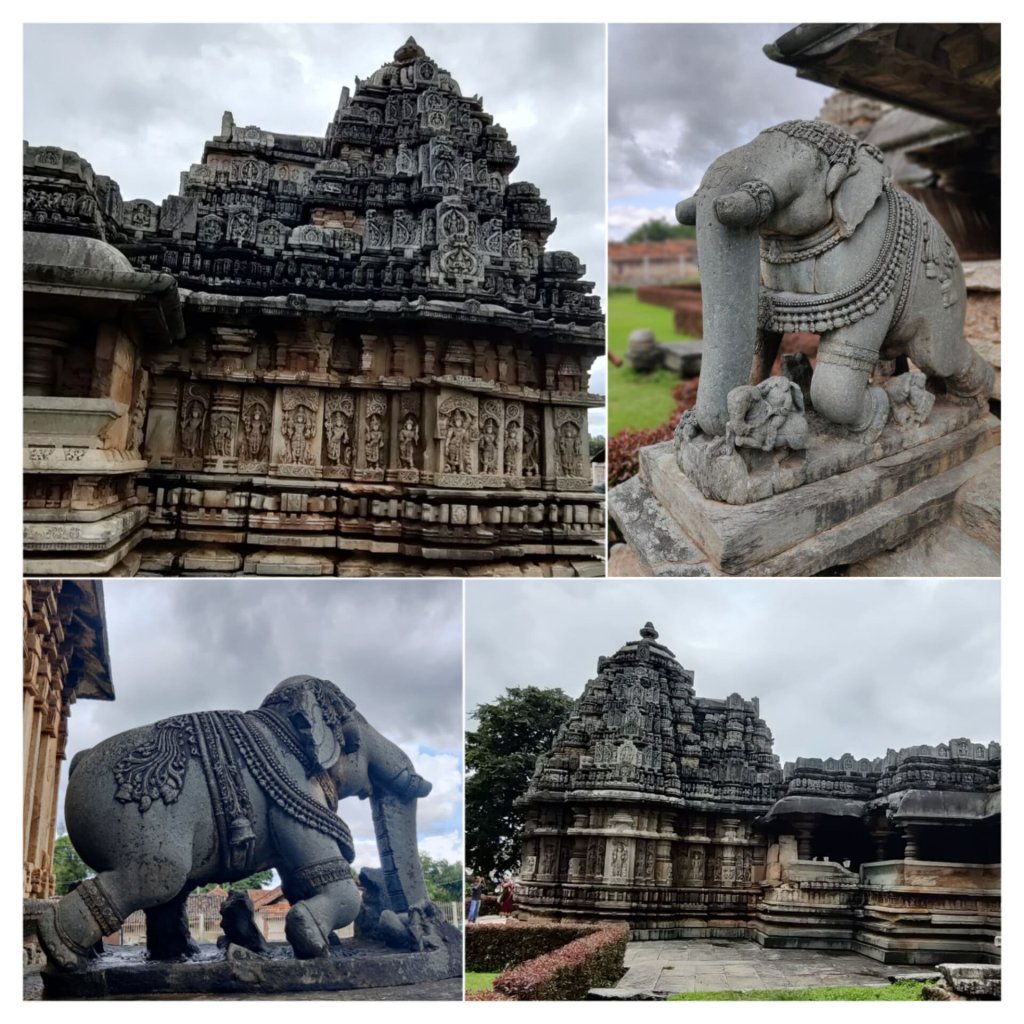
The sculptures on the exterior of Veeranarayana swamy temple, Belavadi
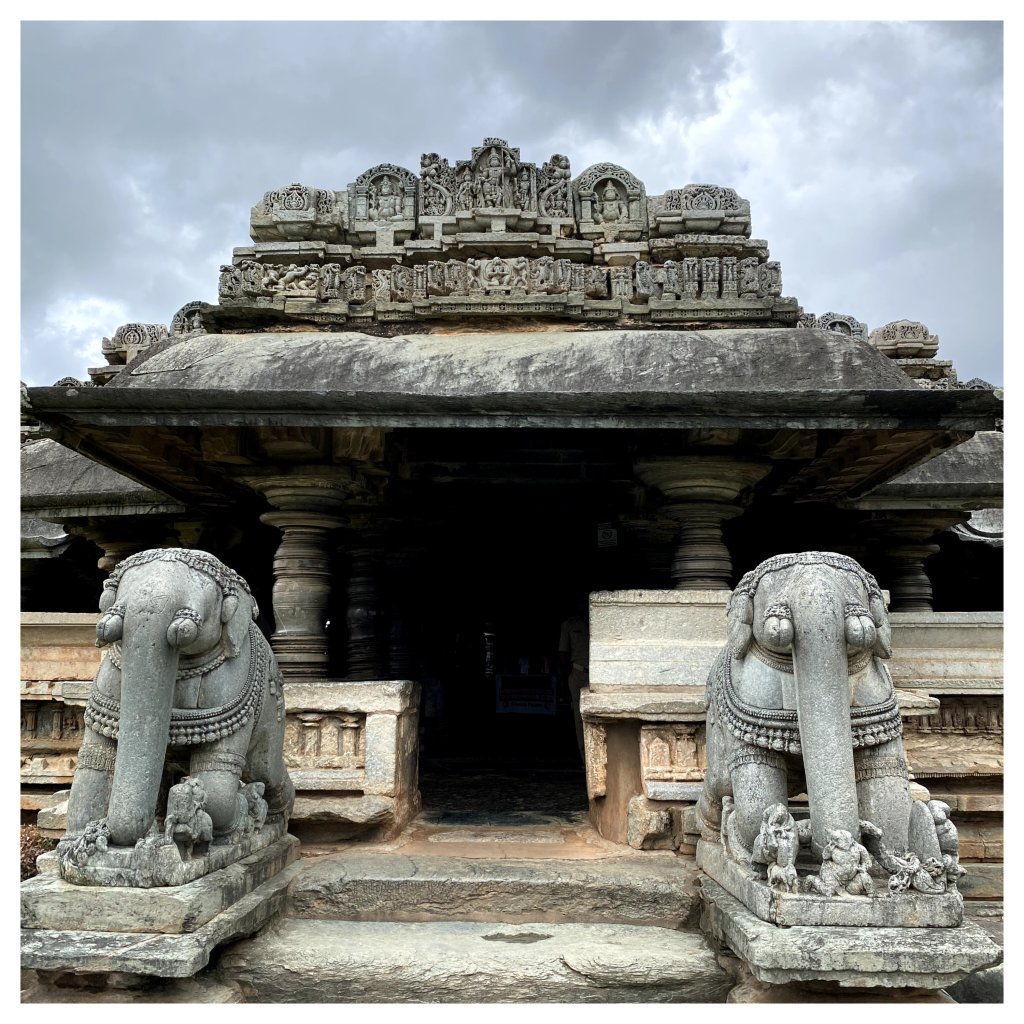
As you walk past this entrance gate, arch you pass the courtyard and are greeted again by a pair of standing elephant statues into the main temple that encompasses the shrines in the trikuta style of temple architecture. The three shrines inside houses idols of Lord Vishnu in three different forms. Huge lathe turned stone pillars and walls bearing fine and intricately carved figurines adorn the inner walls of the temple where photography is prohibited at the time of my visit (in July-2022).
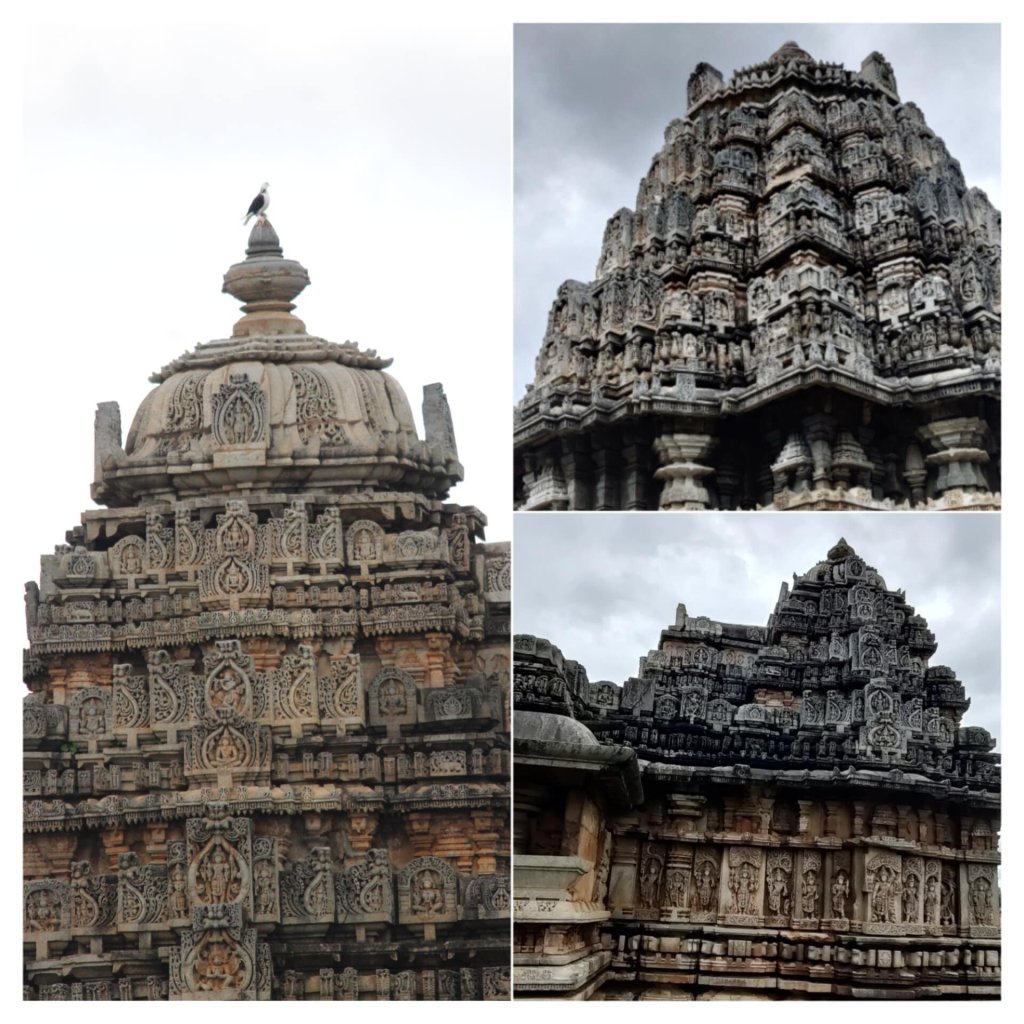
The Trikuta temple towers at Veeranarayana swamy temple, Belavadi
The outer walls are equally gorgeous too with intrinsic stone carvings and embossings all over. Due to limited permissions for photography, my photo story here consists only of photos of the exterior of the temple, but more than sufficient to give an idea of this marvel.
The inner and the main entrance of Veeranarayana swamy temple, Belavadi
Also, a walk around the tiny hamlet of Belavadi is highly recommended. I loved the unique design of these traditional houses that emanated a vibe of an old world.
After an exhausting day exploring the streets crammed with Chettinad houses in Karaikudi, we were dropped at the bus stand to board the local bus to our next destination. The bus snaked through the narrow lanes and we craned our necks out of the window to stare at a few bungalows along the road at Pallathur before we finally alighted at ‘THE’ destination of our tour- Kaanadukathan.
Part 2: Exploring Kaanadukathan
Although we had listed down the must-see things, we felt lost upon our arrival at this village. The place looked like any other village in India and we wondered where had all the stately houses gone, the only reason that had brought us there. It was evening already, and we still didn’t have a definite place to stay. Without having a clue on how to go about further on our trip, we decided to follow our instincts.
Firstly, we decided to walk till that road’s end hoping to find some hotel for our night’s stay. After a short distance, we heaved a sigh of relief when we came across ‘Visalam heritage hotel’. It was a heritage property and expensive on our budget, but it was assurance that there was some place we could fall back to in the worst case of not finding a stay for the night. Having some relief, we decided to walk further down the street in our quest for both a hotel that would fit our budget or for the palatial mansions that had brought us all the way from Bangalore.
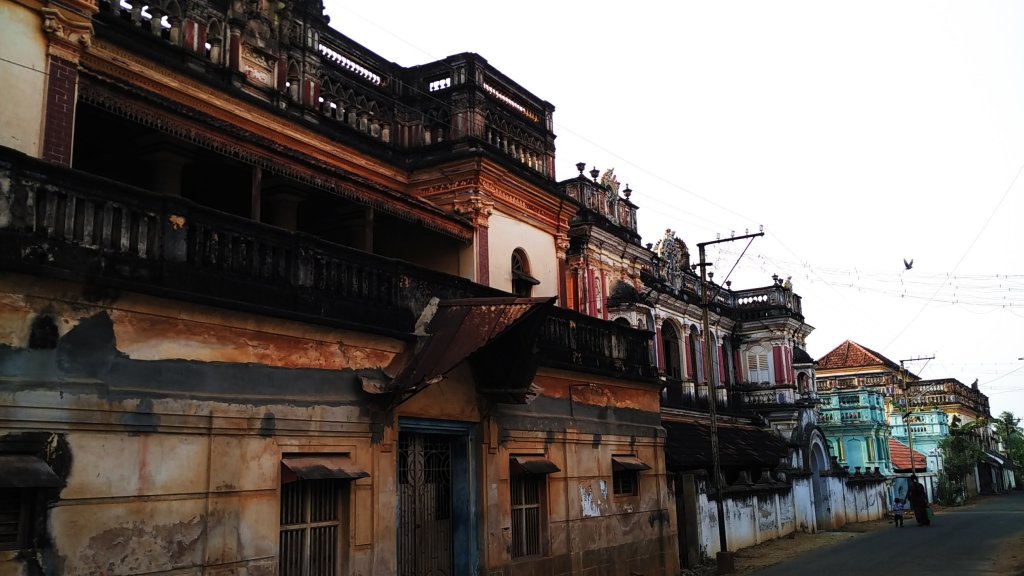
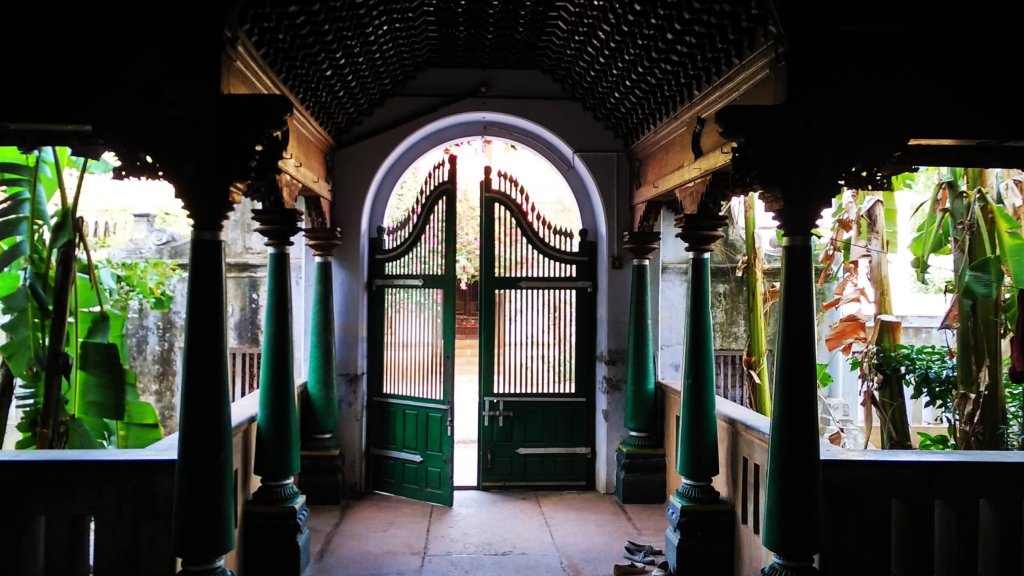
After walking further down the street, my friend and I stopped at the sight in front of us. We were psyched out for a minute when our eyes caught a never-ending stretch of road flanked by the Palatial- country homes on both sides… We were in for an unexpected shock!! We knew there were many large mansions but had never imagined a real street to look just out of a movie setting. The facades of these large villas had fine sculptures of their family deities and the heavy wooden doors at the main entrances were decorated with artistic friezes.
The streets of Kaanaadukathan village
This village in particular did not seem to be very tourist friendly with most of these bungalows being locked up and their owners living elsewhere for various reasons. A few residents, however, have been kind to the keen travelers by permitting entry to their princely manors. Here is a summary of our pursuits of landmarks at Kaanadukathan.
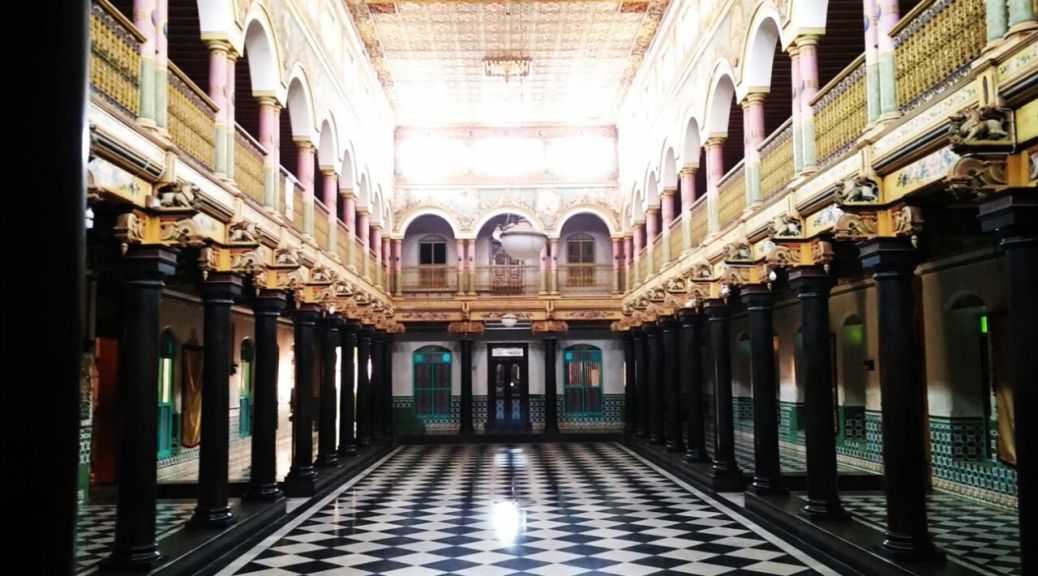
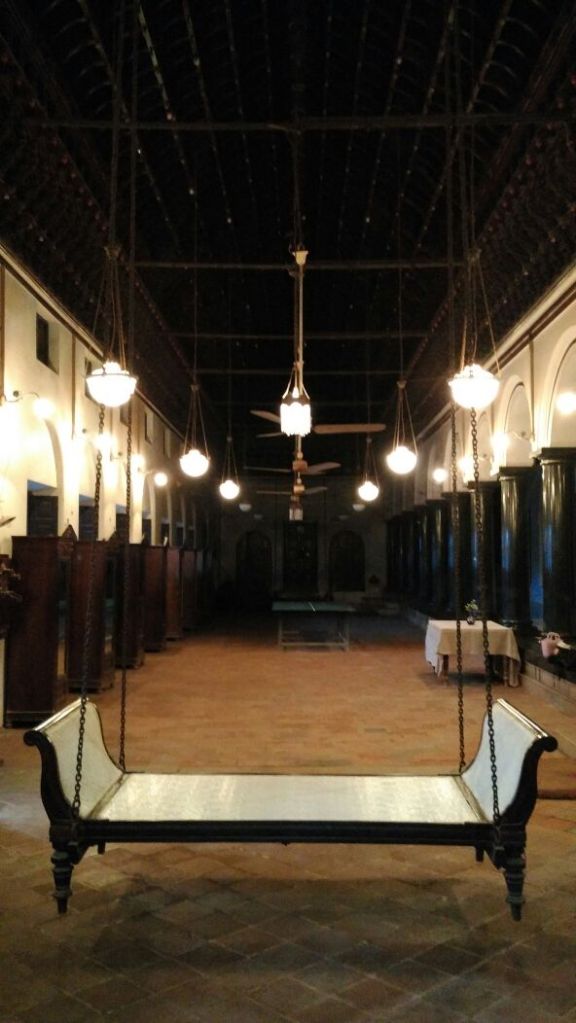
CVRM house: This is one of the very few Chettinad mansions that are open for public viewing that can be visited with a small entry fee. Although, nobody lives in this house now where once lived a large and an affluent family, it is well maintained with some of its antique cupboards, piano, swings etc. kept intact to retain the grandeur of this house. While we were admiring the grand interiors, the caretaker at the mansion recognized that we were lost and offered to accommodate us at her house for the night. Well, meeting such Samaritans needs a separate post.
The CVRM house at Kaanadukathan
We started early on the following morning to make best use of the time before the sun became fully active. There were (ancient) temple visits in the day’s itinerary and a lot of walking to be done. With our host’s support, we managed to book an auto-rickshaw for the entire day and to take us around places as listed below.
The nine clan temples of Chettinad: Temples of Soorakudi, Kundrakudi Murugan temple, Pillayarpatti Vinayaka temple and Vairavanpatti temples are beautiful structures dating back to the Pandya era. These architectural treasures are a win for history buffs in quest of places least touched by the maddening tourists. If one is a pious traveler, one may also consider visiting the temples at Iraniyur, Tirupattur, Velankudi, Kottaiyur, Kandanur and Mathur. Collectively, these temples represent the family deity of each of the nine major clans inhabiting around the region. After having our lunch served by donors at the Vairavanpatti temple, we headed towards our next destination
Aathangudi Palace: Fondly called as the ‘Periyaveedu’ for being the biggest house in the village, this mansion is aptly named as the Aathangudi palace. The roofs, the floors, the walls- they made our jaws drop in awe at their splendor and grandeur as we stood in the portico at its entrance. Although, we were charged an entry fee, we weren’t allowed to stay inside the mansion beyond 15 minutes by the caretakers. Their behavior towards visitors was somewhat a turn-off as they chased us out with verbal abuses. Forget observing the intricacies of the architecture of such a place, 15 minutes weren’t sufficient to even take a casual walk around the entire house.
Inside the Periyaveedu- The Athangudi Palace
There was no heed given to requests by our driver even as he tried to convince them in the local language. Pissed off with their attitude, our driver drove us off from there, towards our next destination. Before I continue ranting about our exploration of the region, I pause a bit to talk about my autorickshaw ride: The cranking lever of the vehicle had come off and was kept under our feet (in the rear seat) and the brake pads had worn out till their last dust. That meant, that the vehicle needed to be push started every time we stopped, and the driver had to jump out of the slow-moving rickshaw to stop it every time we wanted to halt. Especially under the blazing sun and some annoying caretakers like the one mentioned above, it is natural to gain a few additional horsepower in our muscles. So, the raging ride from Aathangudi palace until our next stop was quite a thing!
Aathangudi tiles factory & wood art restoration center: This is a place where we met the men who create beauty out of lifeless soil and wood. We observed demonstration of how these GI tagged colorful tiles are created. An art in themselves, apart from adorning all Chettinad mansions, I remember the grandeur of the Mysore and Bangalore palaces whose flooring is made with tiles sourced from Aathangudi.
Making of the Athangudi tiles
Chettinad railway station: This small and least haunted railway station on a typical traveler’s itinerary was included in our list after we had heard that the local Raja had a special waiting room for himself in the railway station. This quick and an exhausting ride ended in disappointment when we reached there. We learnt that the special room is not open to public viewing and will be opened only on special occasions for the members of the Raja’s family.
The entrance to one of the houses at Kaanadukathan
By this time, our tummies were grumbling of hunger. In spite of having been in the land of spices for two days, our taste buds hadn’t savored authentic Chettinad cuisine yet. It was a hard hunt for us to find a good hotel that served us authentic Chettinad food. Our craving gustatory cells were finally satiated with a lip-smacking array of culinary delight at a small hotel that we found on a random lookout. Post lunch, we decided to spend the rest of the day exploring the somnolent streets of Kaanadukathan by foot.
Local weaving centers: We shopped for the Kandangi handloom saris from one of the many local weaving centers.
Chettinad Raja’s palace: The largest mansion in the whole of Chettinad is a sprawling edifice extending over an entire lane on all four sides. And that’s why it is called as the Chettinad palace. We made futile attempts to get a small peek into the interiors of this massive dwelling space that I had seen in some of the movies.
Our walk tour of Kaanadukathan continued until dusk. We clicked some nice photos of this ‘heritage’ village with the perfect lighting by the setting sun. Along with the setting sun, we set ourselves for the return journey. We had to reach Trichy on time to catch our bus back to Bangalore. Thus, concluded a weekend in Chettinad- the land of palatial mansions and piquant cuisine.
Must-dos in Chettinad:
Take a walk in the Muneeshwaran Koil street or the antique market in Karaikudi
Shop for a colorful palm basket- The local handicraft that has gained a GI tag
Treat your palette with Chettinad cuisine (I definitely mean Non-Veg)
Take a bicycle / walk tour around the streets of Kaanadukathan
River Godavari is the longest river in South India that travels over 1000 kilometers. My first glimpse of this beauty was at Rajahmundry, where the ritualistic ‘Godavari Arati’ is offered to this mighty river every evening. The sunset and a boat ride from the Godavari ghat are experiences in themselves. Among the umpteen dams, reservoirs, bridges that are a built across her, the most noteworthy bridges are located in Rajahmundry. Here is a quick look at these heritage structures.
The heritage bridges in Rajahmundry
Old Godavari bridge – This is the oldest of the three major bridges built across Godavari here. It was originally called as ‘Havelock bridge’ since it was named after Sir Arthur Elibank Havelock, the then governor of Madras. This is a Stone masonry & Steel girder bridge whose construction started in 1897 and commissioned in 1900. After completing 100 years, this railway bridge was decommissioned in 1997.
Godavari bridge – Also called as the ‘Kovvur-Rajahmundry bridge’, was commissioned in 1974. This truss bridge has a two-way road deck over a single-track rail deck making it Asia’s second longest railroad bridge with a length of 4.1kms.
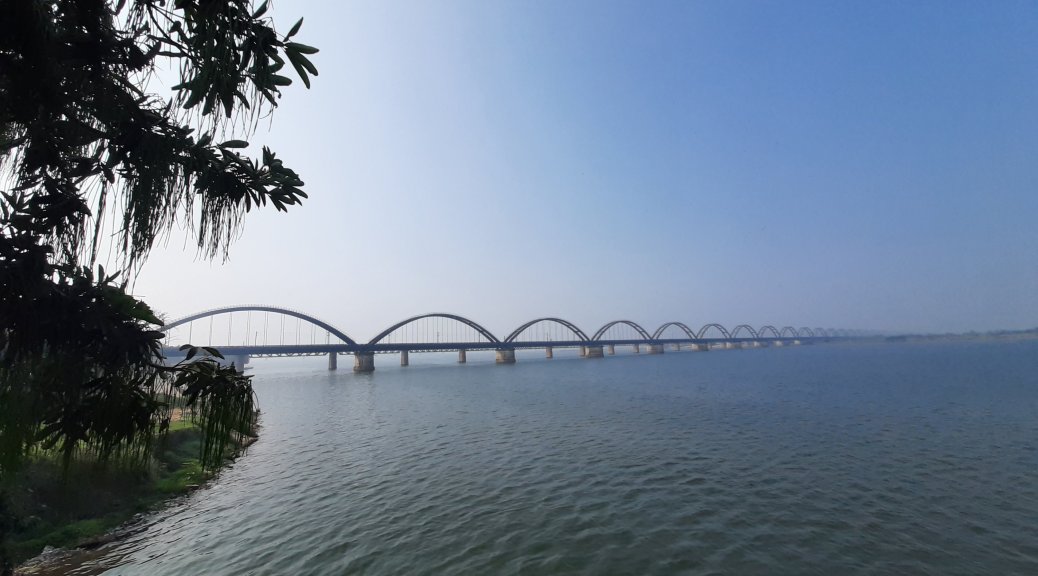
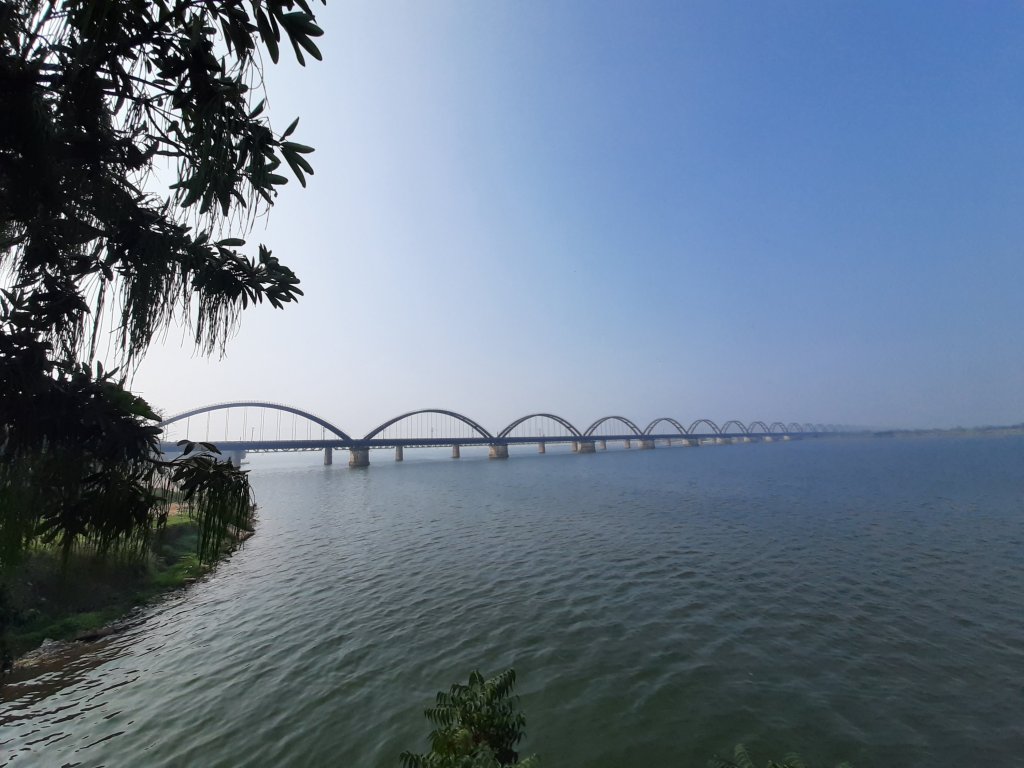
Godavari Arch bridge – Commissioned in 1997, this single line railway bridge is the latest of the three major bridges in Rajahmundry and was constructed as a replacement for the Havelock bridge. This concrete- Bowstring-girder bridge is built parallel to the Havelock bridge with a distance of 200mts.
The arch Bridge at Rajamundry
Apart from the above bridges, there is another road bridge that connects Rajahmundry city with the islands of Konaseema. But what makes this bridge special is that it runs parallel to another heritage structure built across the mighty river. Dowleshwaran Barrage is an irrigation structure built in 1850 by a British engineer, Sir Arthur Thomas Cotton. Earlier to the construction of the barrage, the place used to be constantly flooded and unworthy of anything. This 3.5kms long barrage then allowed the floods to pass through and enriched the place making the unused land worthy of cultivation. It was rebuilt in 1970 and renamed as Sir Arthur Cotton Barrage or Godavari Barrage.
Visiting the Saurashtran region of India was a last-minute inclusion in the itinerary of our trip which was otherwise planned only to ‘The Rann of Kutch’. It was noon by the time my friend and I arrived at Junagadh, by a train from Ahmedabad. After checking into a hotel at a walkable distance from the station and freshening up, we relished a sumptuous ‘Gujarati Thali’ at a nearby restaurant. After a while, we set out to explore this historical city of Junagadh, a place lesser known on a typical backpacker’s circuit.
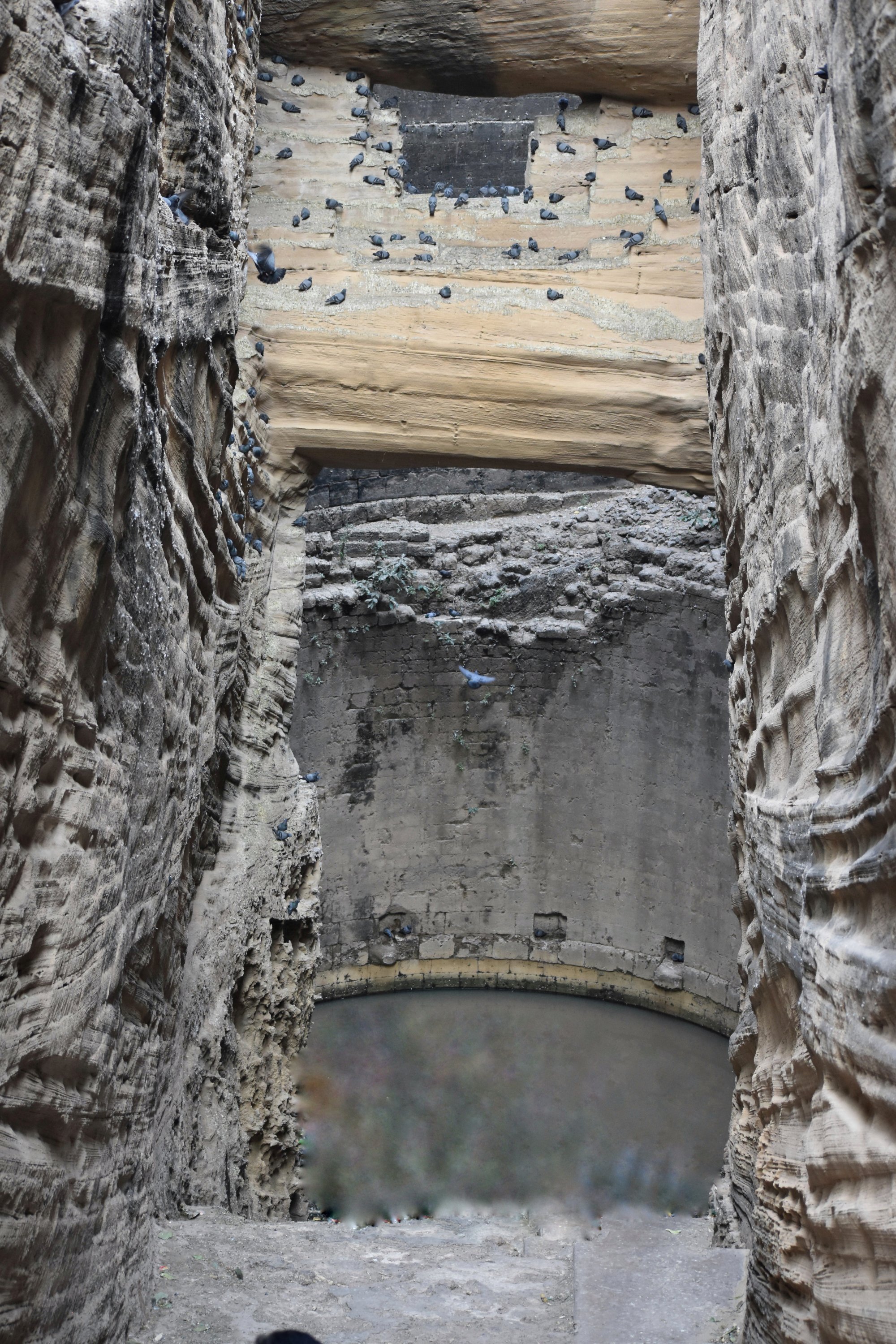
With a short autorickshaw ride, we reached the entrance of the Uparkot fort. This place is what gives its name to the city. ‘Juna-Gadh’ in local language means ‘Ancient Fort’. This fort dates to 3rd century BC, to the Mauryan Era. It must have been a massive structure back then. With several dynasties ruling this region over time, there are many historical remnants of structures that were eventually added. However, all are in bad shape now. The Buddhist cave, the Jumma Masjid, the tomb of Nuri Shah, the Naghan Kuvo stepwell are among the few that have stood in time. But Adi-Kadi Vav and Nawabi lake are the structures that I found interesting among all. Adi-Kadi Vav is a stepwell facing the Girnar hills, to which we had to descend a flight of stairs to reach water (mind you! The water is extremely dirty with all the trash). Whereas the Nawabi lake is an artificial pond that required an ascend of a spiraling staircase where the reflection of the Girnar hills looked beautiful in its water. This spot also had a dozen peacocks walking around the pond. Our walk tour ended in a couple of hours and we decided to walk back to the town.
Adi-Kadi Vav rockcut stepwell at Uparkot fort
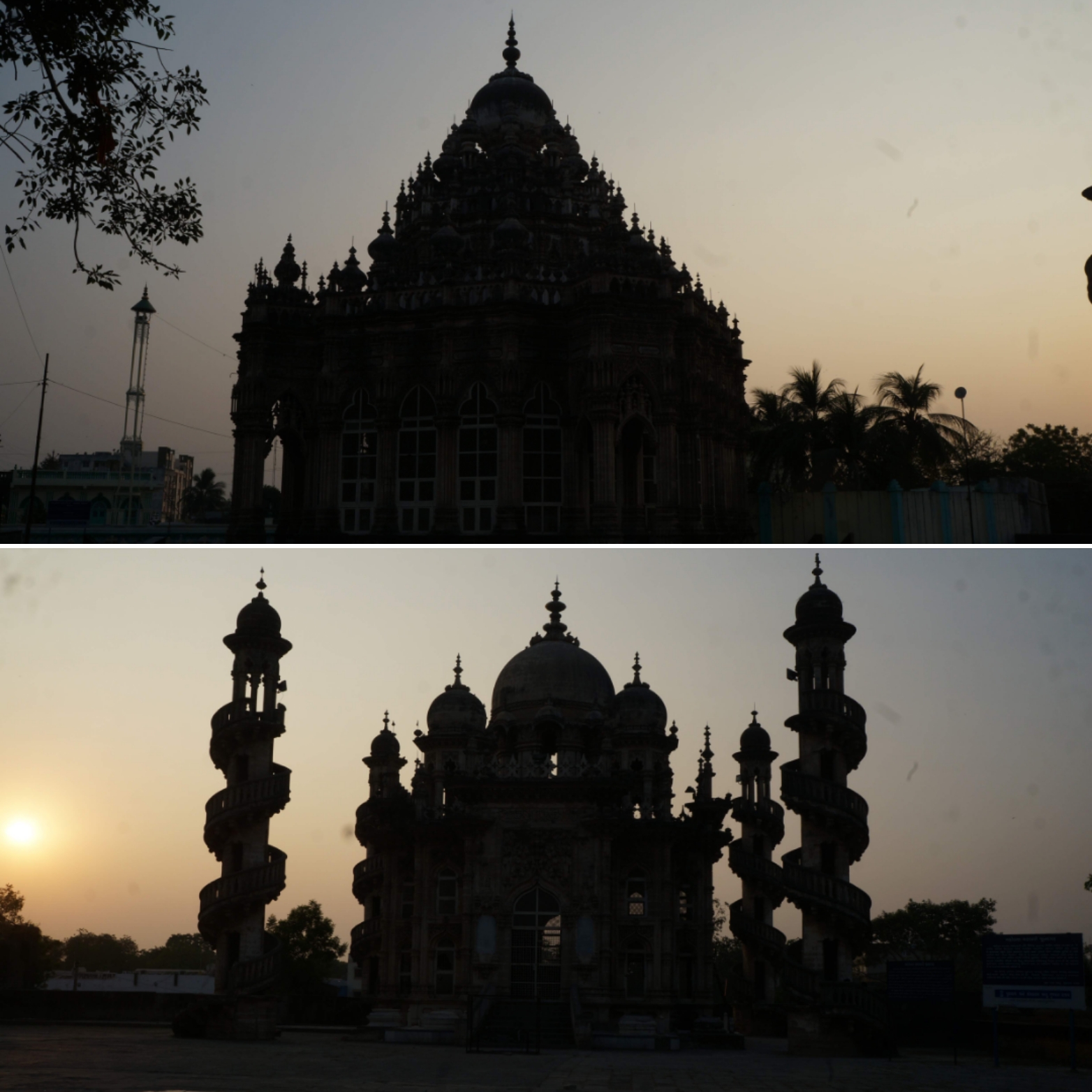
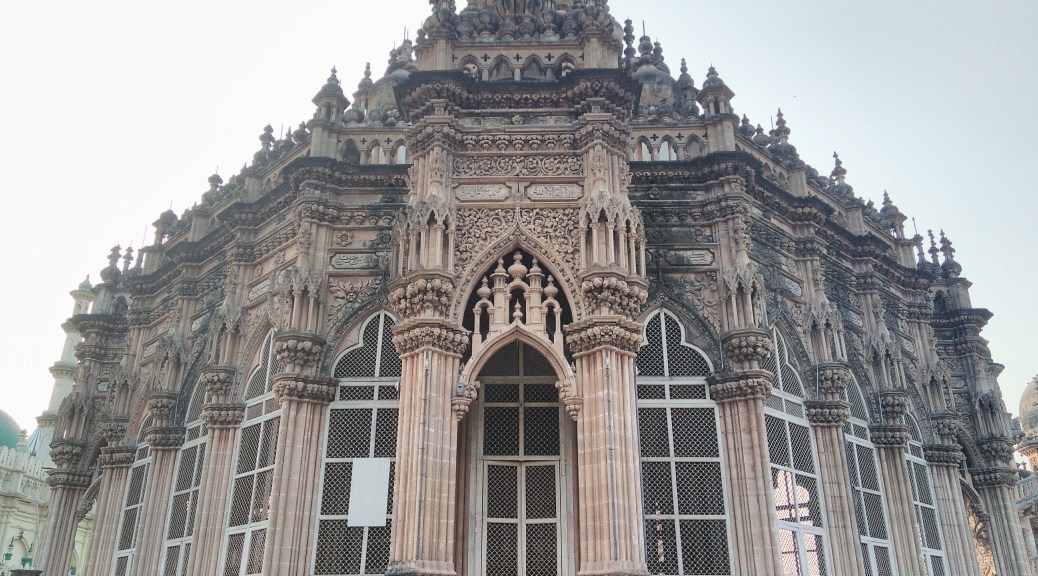
This gave us ample opportunity to photograph the rustic, old world and yet vibrant streets of the old city. Almost every corner of the lanes and its doors seemed like they had stories to narrate. As planned, we arrived at ‘Mahabat ka Maqbara’ at sunset time. These twin tombs of the past rulers are very beautiful, and it is only enhanced by the shades of the setting sun. We were very particular to photograph this place at the golden hour and were happy souls towards the day’s end for capturing those amazing silhouettes.
The twin tombs at Mahabat ka Maqbara
After a long walk further in the quest to explore the market area of the old city, we kind of came to realize that we were lost in the cramped streets of a place that seemed like Namma Bengaluru’s Pete area. Google maps was of very little help so much so that we reached the same spot after walking around in multiple directions. Finally, we hopped into an autorickshaw to get us to the hotel, not minding the short walkable distance that was indicated by Google. We wanted to get some rest as our night was going to be long. We set the alarm to wake up by 10.00.p.m. so that we could start to hike by 11.00.p.m.
However, I slept a wee bit longer and had been shaken up neither by the alarm nor by the panic-stricken friend’s endless calls from outside my closed room doors. When I woke up from deep slumber, it was 01.00.am and my friend was almost in the verge of fainting to know that I was not responding inside a closed room 😀 We then got an auto ride to the base of the Girnar hills, the climb of 10,000 stairs had to be done before sunrise. The plan was to ascend at night, catch the sunrise from the peak and descend back before the harsh sun rose up during the day. Post breakfast, we would leave for our next destination. We were already running behind schedule.
We commenced our hike and there was barely anyone else with us. The winds were very strong and the rustle of the trees as we passed through the initial stretch of forest was creepy in the moonless night. The Girnar hills is believed to be older than the Himalayas and a pilgrimage site for people across faiths. Several structures like emperor Ashoka’s rock edict, Jain temples, ancient inscriptions etc. are things that kindle the history buffs if they are not interested in the pilgrimage including the Jain tonks or several other temples from across time in history. However, after climbing about 5,000 stairs, my legs were tired and couldn’t catch up with my friend’s pace. I could have completed it though, only at a slower pace. But, we wouldn’t have been able to make it back in time if we had to catch a morning bus to our next destination. Fearing which, I decided to sit back and let my friend go ahead and complete the hike. However, he was not okay with the idea to let me sit alone all night (it was bloody dark and windy with NO ONE around) and decided to head back to the hotel with me. So, the descent of 5000 odd stairs on our way back wasn’t easy either. I was unprepared for this long hike and I guess it was a wise decision for me not to continue the ascent. It would’ve taken a real toll on my legs and the rest of the trip would’ve been screwed up. But what makes this a memorable trip is the fact that this was the first EVER hike that I gave up halfway, without completing.
Then, we telephoned the same rickshaw guy to give us a ride back to the hotel. It was a short but a nice ride. The proximity of the Gir National park had herds of Nilghais, boars and other wild animals on the highway that we were travelling on. A stay in the ‘Gir National Park’ is a dream for another day. Perhaps when I have more days in my itinerary and more money in my wallet. Maybe that time, I will have more stamina to reach the peak of Girnar too. But for now, we were reaching our hotel for some more sleep.
I missed the morning bus from Reckong Peo and that gave me some time to take part in the annual mela in the district headquarters. I boarded the next bus at noon, from Peo towards my destination for the day- Nako, a small township in the Hangrang Valley, a part of the Spiti valley. The place gets it’s name from a Tibetan word ‘Nego’ which translates to ‘The Door to a holy place’.
The road from Kinnaur valley, leading to Spiti valley
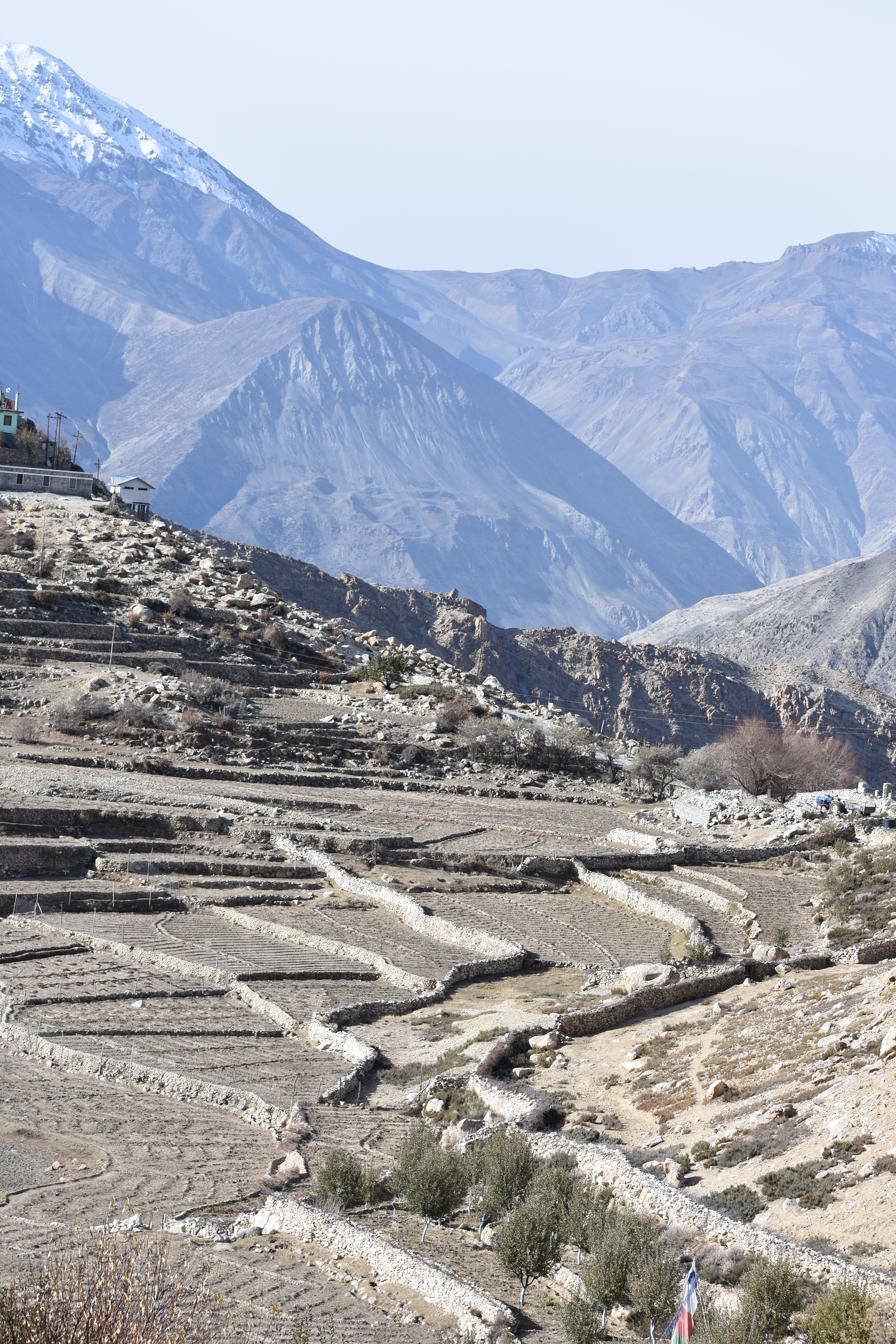
The transition from Kinnaur valley to Spiti valley was evident in its landscape. The road changed from green to rocky to barren along the way, each being spectacular. The snaking road was accompanied by the crisscrossing Spiti river amid a mind-blowing scenery all along the way. Although I was travelling solo, I felt accompanied through warm conversations with the driver and the conductor of the HRTC bus. They were quite surprised and amused to hear that I was from South India, spoke fluent Hindi, was travelling alone and without a fixed itinerary. The bus was stuck in a couple of roadblocks caused by landslides for almost 3 hours in total and that meant- I arrived late at my destination. From all the online research I had done about the place, I knew that Nako was decently popular on the tourist radar and finding a place to stay wouldn’t be difficult. When finally the bus stopped at the Nako bus-stop at 07.00.p.m., I was in for the BIGGEST surprise of my life!
The bus stop was on the highway. That was the LAST public transport of the day. It was pitch-dark already. All the civilization I had read about, did not seem to exist there. Apart from the bright stars twinkling in the clear sky, the only light I could see was that of a dimly lit lantern hanging in a tiny shop. The conductor looked at me blankly and said- this is Nako. “Talk to the shopkeeper and he might help you to find a place to stay”, he said and signaled the driver to proceed their ride.
“Where am I going to stay tonight? Can I trust the shopkeeper? Do I have any other option apart from approaching the shopkeeper?” A million things were running in my head. I stood there for a moment to let my thoughts settle down first. But before that, the biting cold and the rough winds rushed me to the shop for some warmth. In the dim light, I saw hope. The shop was run by an old man and the wrinkles on his surprised face multiplied when I asked him if I could get a place to stay. He nodded a yes and asked me to wait until he attended his last customer and lowered the shutters of his little grocery store.
He walked me through steel shutters behind his shop, got a bunch of keys from his house and asked me to follow him to the floor above his house. He said he runs a homestay (Somang dhaba, hotel and homestay) during summer. Since I was there during offseason, the room wasn’t used for a long time. The room had a low voltage bulb and had no running hot water. I could stay there for the night if I could manage with whatever was available. He was not going to charge me for it. The room had a decent washroom, carpeted floor, enough blankets and a comfortable looking bed. The thought of saying no to the old man and getting adventurous in pursuit of a better homestay in the cold night did not even pass through my head. This place was more than what I had expected to get. I agreed to stay there and grabbed the room keys from him.
As I unpacked my bag to pull out my thermals, Mr.Somang knocked at my door with a bucket of hot water for me to freshen up and told me that he had informed the small dhaba next door to stay up for me so that I can go have my supper. If there was any other problem, I could knock at his door, Mr.Somang lived with his wife in the ground floor. The dhaba was a tiny shed put-up with sheets, was run by a Nepali family and fed the occasional truck drivers who stopped by for chai and Paratha. I had the same for my supper too. As I answered the family’s curious questions, I sat warming myself around the fireplace in their kitchen for some time before heading back to my room.
The township as viewed from the Nako helipad
I was in for a surprise when I woke up in the morning. The view from the window transcended me to another world that I had imagined only on Microsoft Window’s wallpaper. Barren, dry arid landscape and distant snowcapped mountains. A lonely road ran uphill, and I had slept in a roadside house that had this magnificent view. I immediately jumped out of my bed, fetched a bucket of hot water from the host’s house, freshened up and got out quickly, to sink in the morning vibes of the place. I took a walk to the nearby helipad from where I could get a 360deg view of the surrounding mountains. That was the first time I was seeing a landscape so arid, so dry, so different and so beautiful.
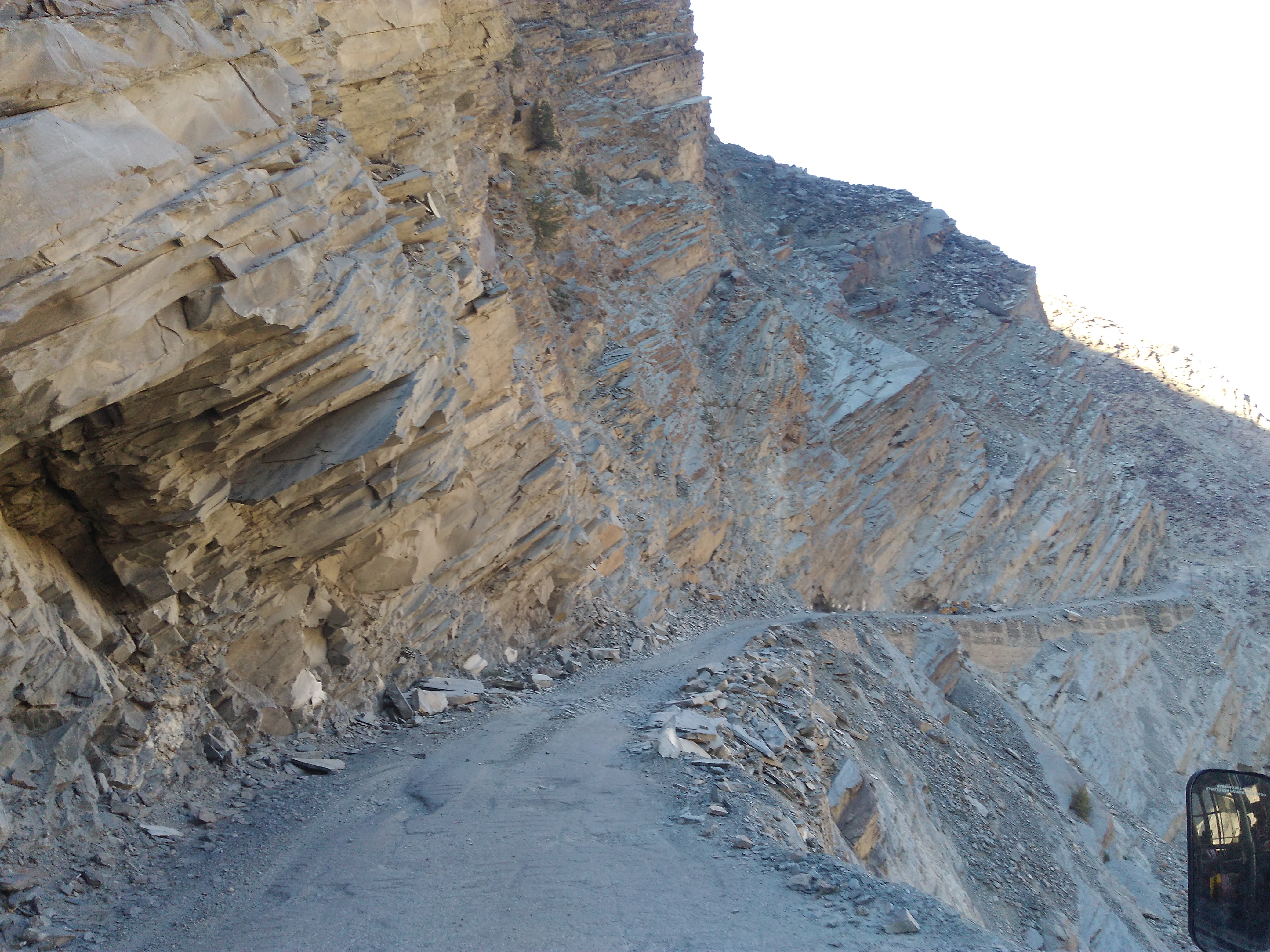
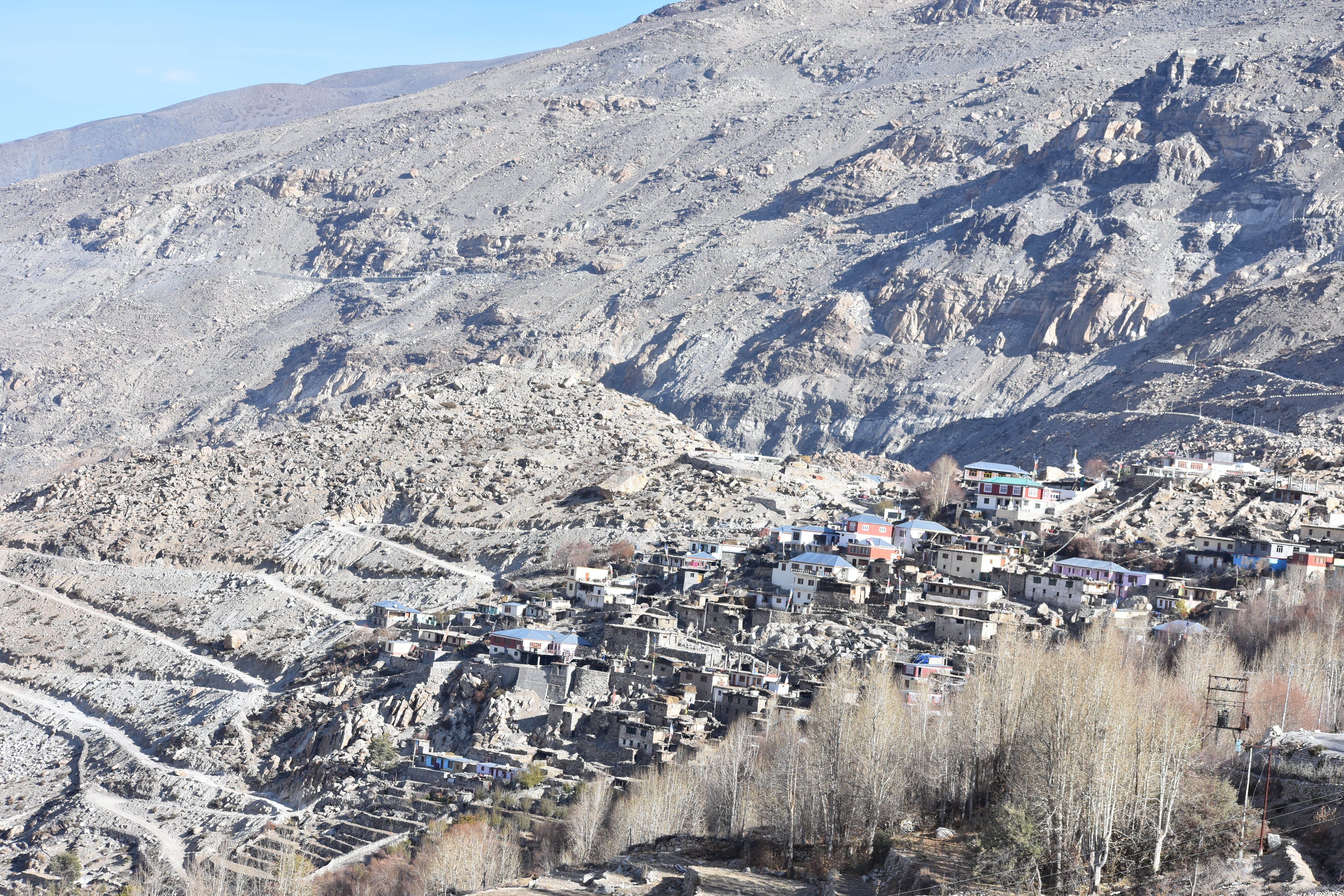
The view from Nako helipad
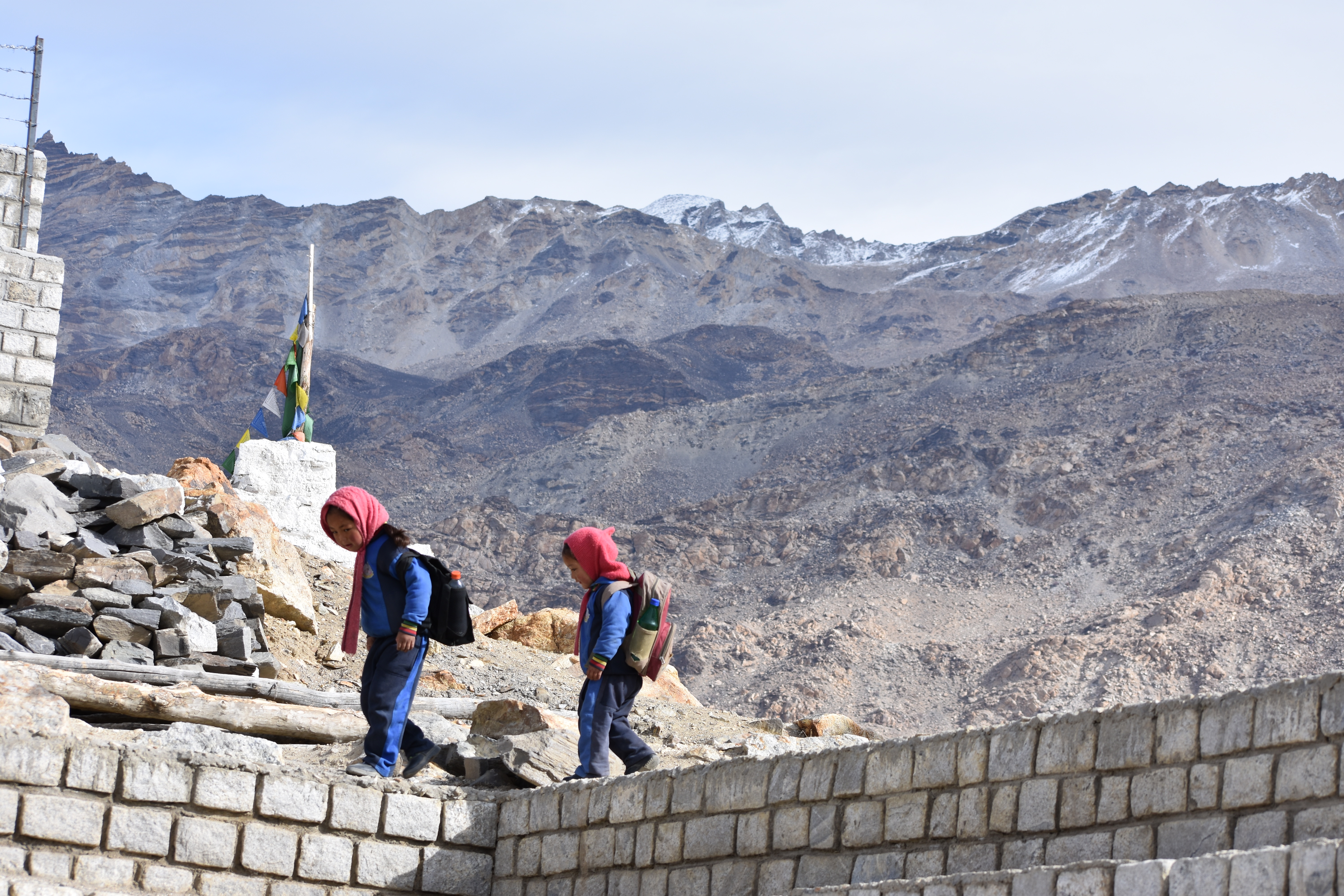
As I walked further, is when I realized that the real civilization of Nako village existed only if I walked further away from the main road. Doing this on a moonless night, in order to find a place to stay would have been next to madness. I was greeted by tiny tots with their heavy backpacks and playfully jumping on their way to school. The sounds of mooing cattle and crowing roosters echoed in the silent streets.
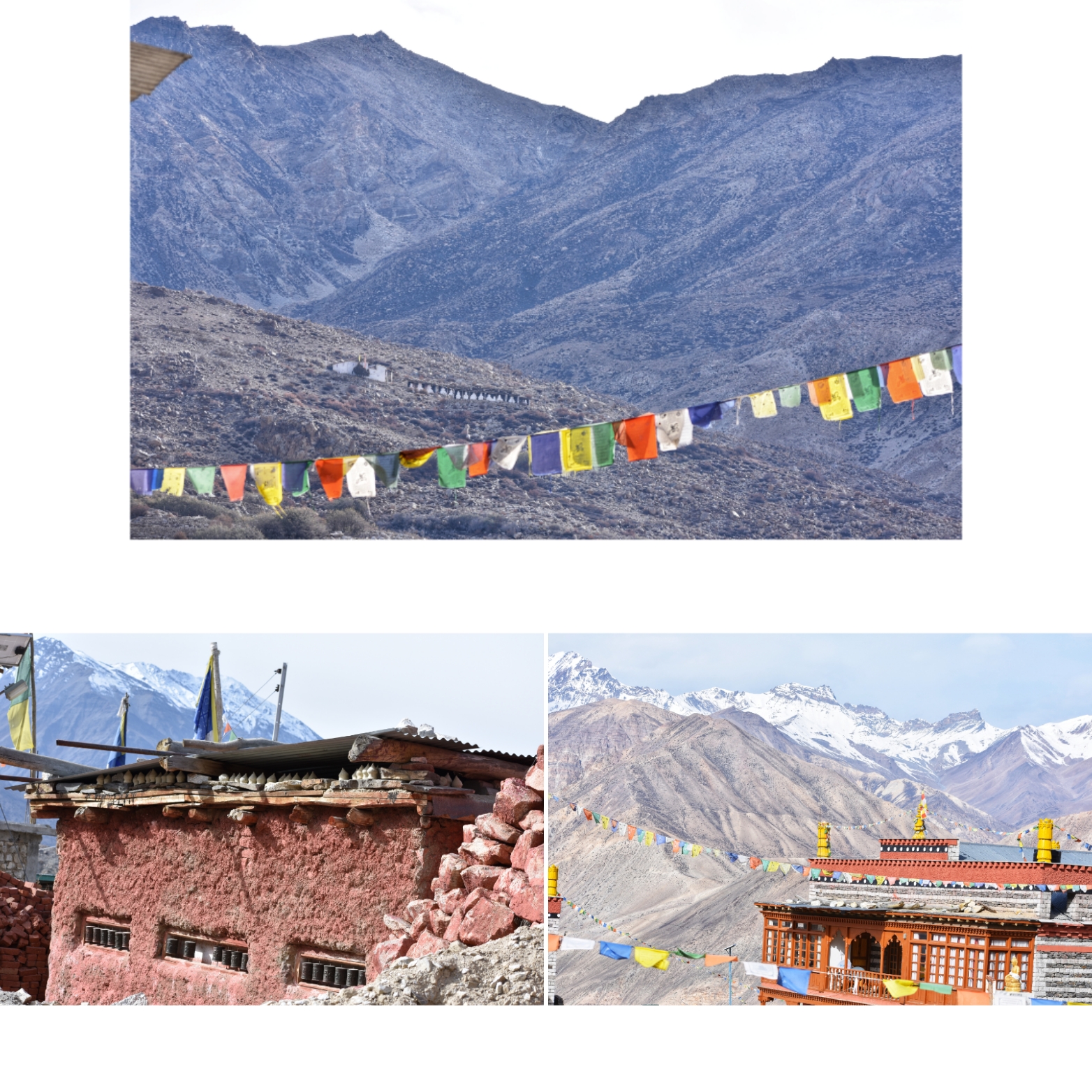
The sweet smell of incense arising from the monastery had engulfed the ambience as I walked towards a small red structure made of clay and red oxide. Prayer drums on its outside indicated that it was the ancient Buddhist monastery where people seemed to be coming to offer their morning prayers. An interesting structure caught my attention to up in the hills. “That’s the old and the main monastery from the 11th century ”, a passerby answered to my question. But it seemed quite far for a lonely walk, so I decided to keep it for some other day. When I have company, perhaps!
The Old and the new monasteries at Nako
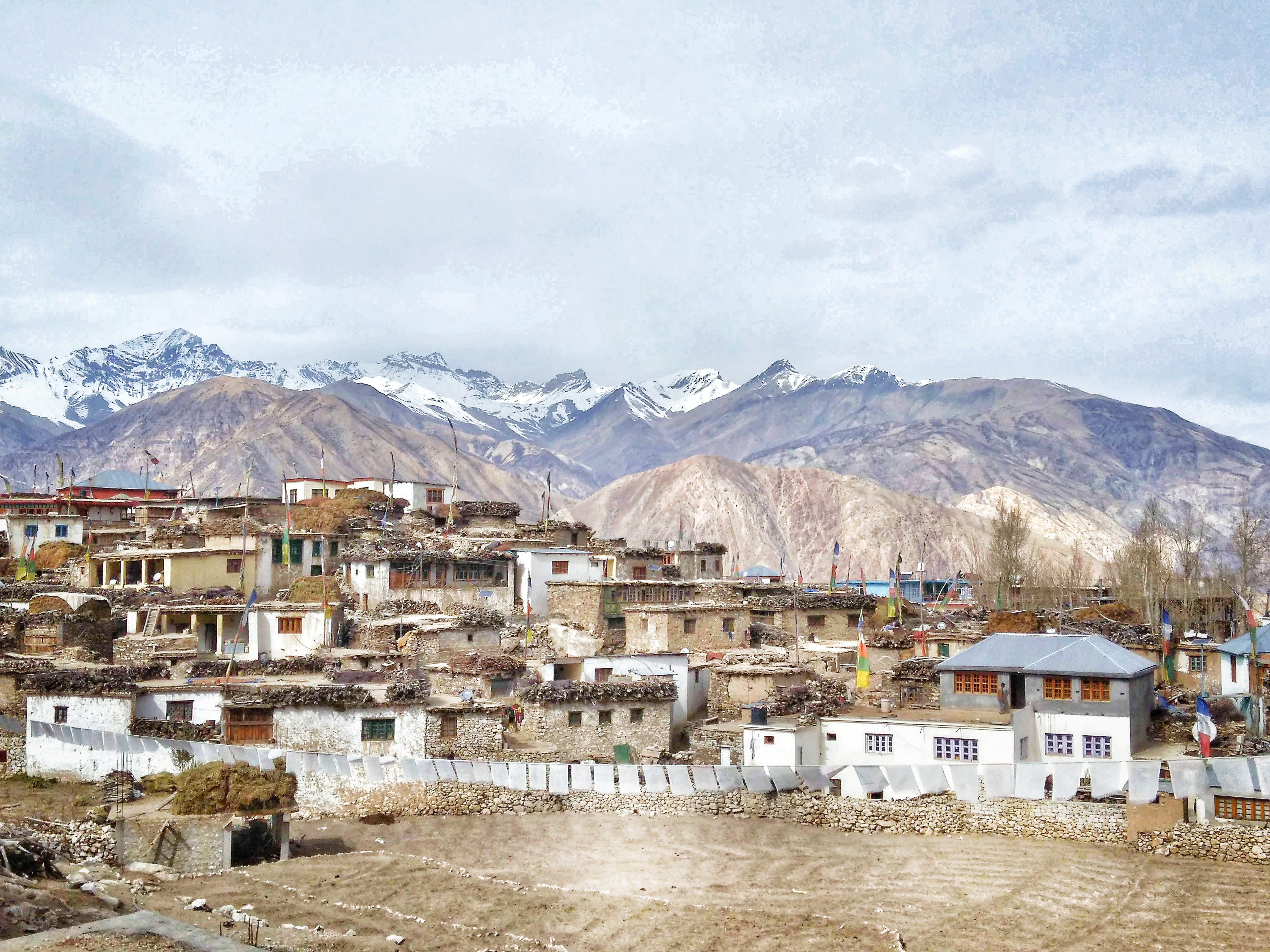
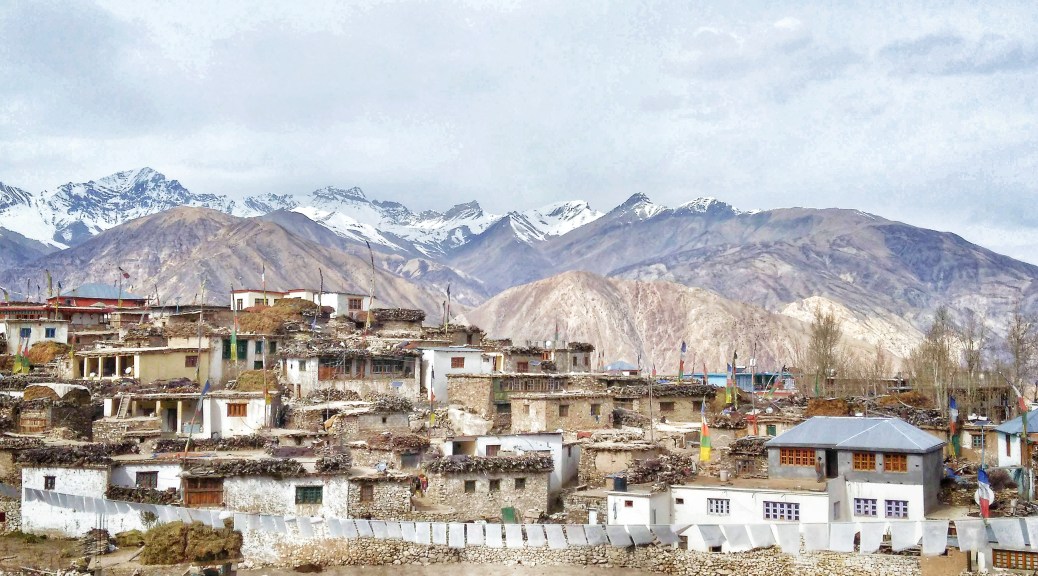
The further I walked into the village, the more magical it started to seem. The structure of the houses was unique to Nako, from what I had seen all this while. The houses are built at an elevation from the ground with wooden beams holding the dry stones, slate roofs covered with hay and all houses painted with white lime. While I was finding my way to the Nako lake through the muddy lanes, reaching random dead ends and taking blind turns, I felt lost in the maze. Just then, a man appeared in front of me and greeted me with a warm smile. He saw me taking photos on my cellphone and asked me if I minded a selfie with him. Although bad at taking selfies, I did not mind getting myself pictured in that unique looking place.
The Nako village
He invited me to his house for a cup of chai and not for a second did I think again. I nodded a yes with joy and followed him to his pretty haven whose courtyard overlooked the Nako lake. His wife got excited at the alien visitor in their little abode and got me chai and biscuits along with some hearty conversations. She took me around her home, and I was quite amused at the style in which it was built (almost entirely of clay, stones and hay), a first time for me. Apart from a heartfelt thank you, I did not have anything to give them back for their wonderful hospitality. And neither did they expect anything in return. I bid goodbye and walked down the lane to the lake, a holy place for the villagers.
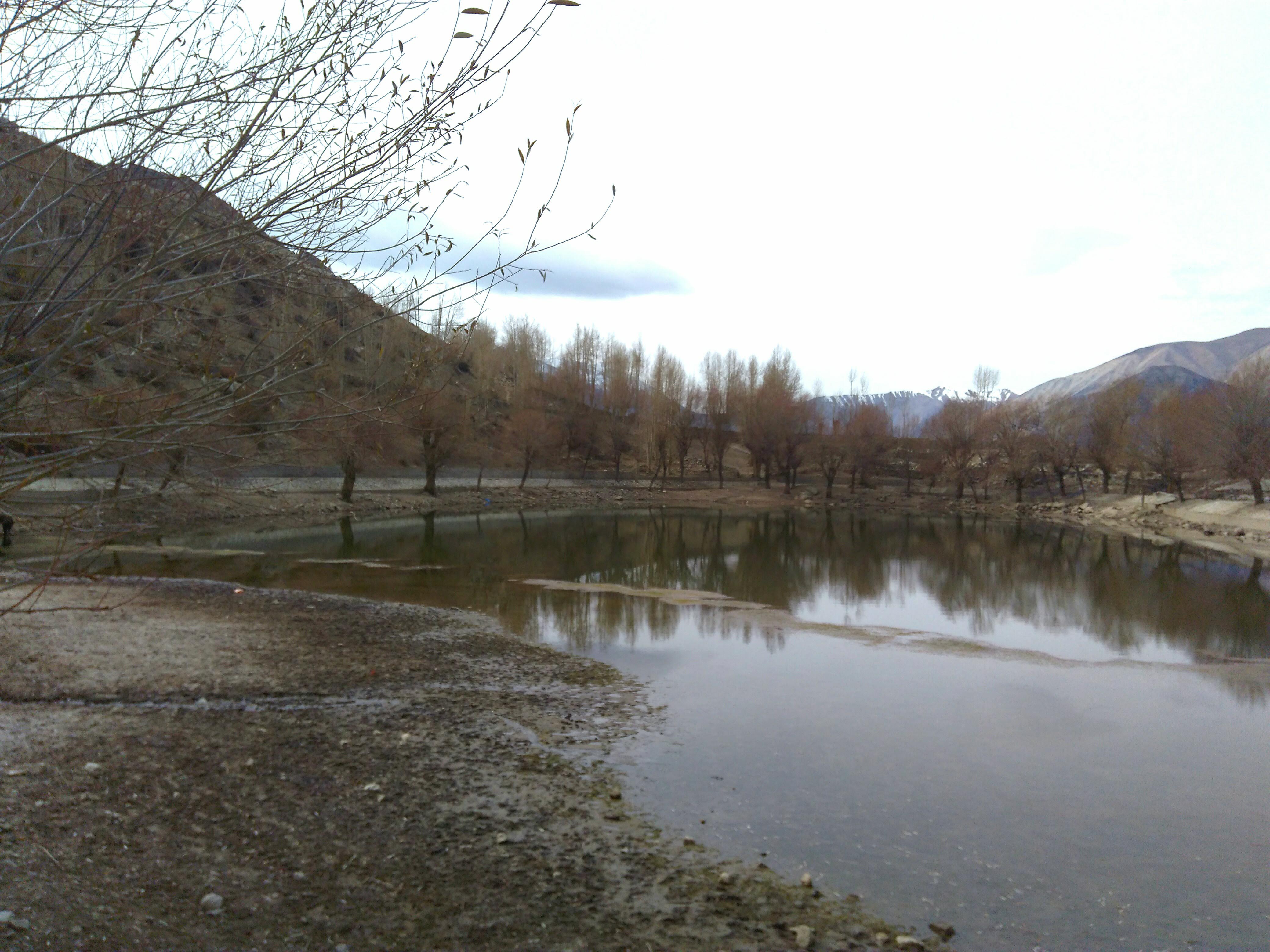
The Nako lake / The sacred pond of Nako
Apart from a few grazing horses, I was the only human there that morning. It was the first time I felt like meditating and decided to sit by the waters for some peaceful moments. The Nako lake is considered holy among the Tibetan Buddhists as Lord Padmasambhava is believed to have meditated here. It is no surprise why I was feeling the unusual calmness and serenity at that place.
A few running kids got me back to reality that I had been sitting there for a while by then. I woke up and got back to the homestay to figure out a way to get to my next destination. But that’s going to be another interesting story (Click her to continue reading)….
This entire journey has been compiled into a book. You can avail it on Amazon or read it for free using your Kindle. Use the link below:
This visit to Saranath is a part of my fortnight long backpacking in the typical pilgrimage circuit of Uttar Pradesh covering Lucknow- Ayodhya- Faizabad- Varanasi- Saranath- Allahabad- Agra- Mathura-Brindavan- Fathehpur Sikri– Delhi
This article was featured in Toyota’s in-house magazine ‘Carz’ Apr~Jun’18 edition
The Details:
Back then, I had read history for the heck of passing the subject and today here I am… Travelling to know more about the rich history soaked heritage of my country… And in the pursuit, my friend and I stumbled upon this little forgotten land from the pages of history- Saranath. It was as if the history textbooks of primary school were walking alive with us… Saranath is an important destination both religiously and historically. So, people of varied interests can be found strolling the streets of Saranath. When we alighted, a volunteer offered to take us for a guided tour around the place and we nodded a yes! A couple of visitors from different countries joined us seeking me to be their translator while the Hindi speaking guide took us around. So I was doubling as a curious traveler and a travel guide cum translator.
Firstly, Saranath is the place where Lord Buddha delivered his first sermon to the five disciples after attaining enlightenment. Hence, a very important place religiously for the Buddhists. Today, the Chaukhandi Stupa, an octagonal structure made of brick and mortar stands at the very same place welcoming the visitors to this town. It was originally built in the Gupta era and later renovated during the Mughal rule.
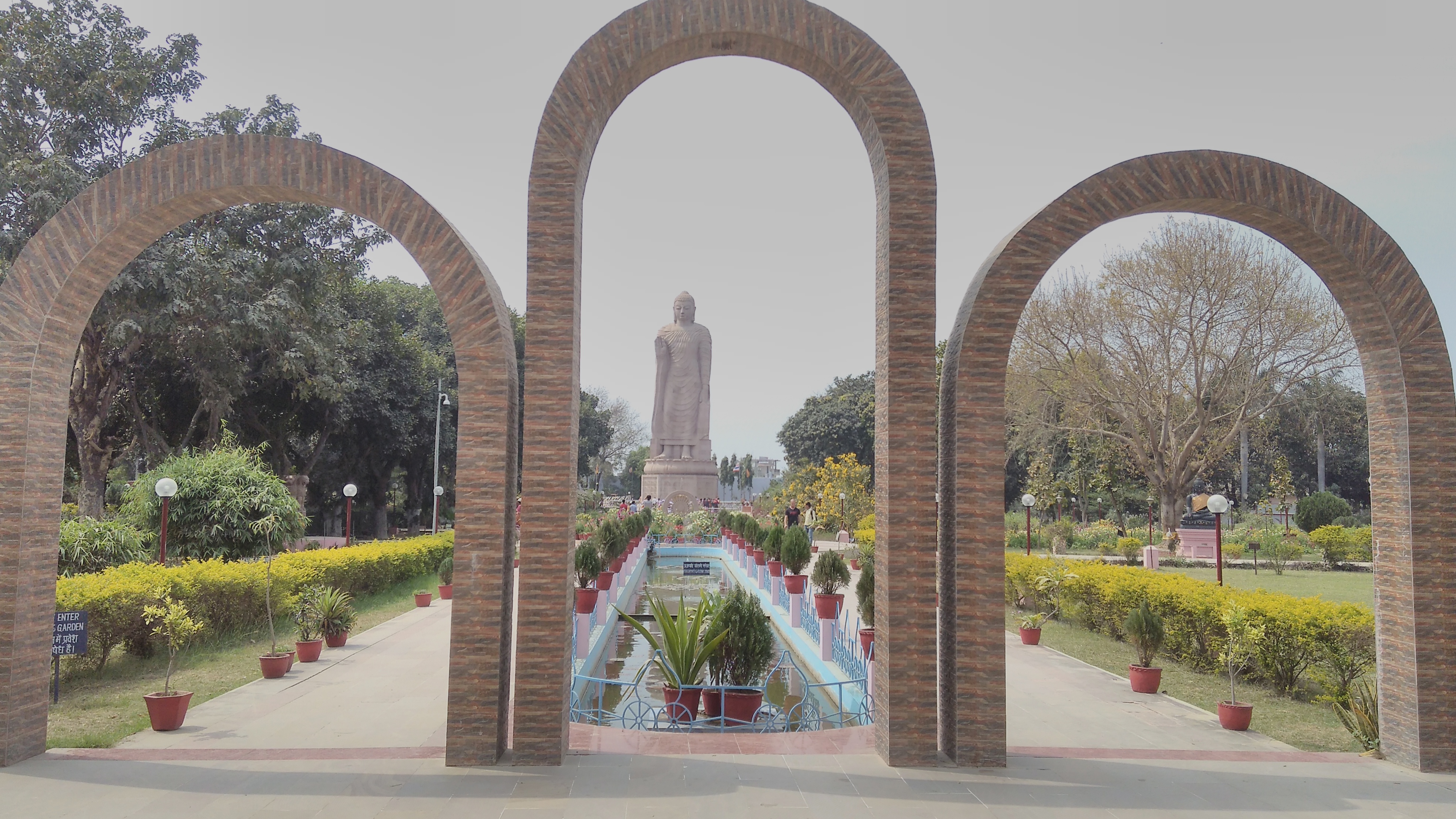
As I explored the place, I realized that people from different countries have made their presence with Buddha temples built in their native styles of architecture. The Nepali, Thai, Chinese, Japanese, Tibetan, Bhutanese etc. to name a few. While each temple style is unique and beautiful, you realize that the statue of Lord Buddha too is different in each of them. Buddha is worshipped in different forms in different countries… Seated Buddha, sleeping Buddha, standing Buddha, meditating Buddha ET all… The murals inside the Japanese temple grabbed my attention… I was told that the complete interiors is made of sandalwood… The idol, palanquin, the doors and even the chandeliers!
A small walk from there, is ‘Mulagandha Kuti Vihar’, the Nepali temple. What makes this place special is the third generation peepal tree adjacent to its premises. Fondly called as the grandson of the Bodhi tree, it is grown from a twig of a peepal tree believed to be the son of the original Bodhi tree that exists in Sri Lanka. With prayer chants and smell of incense in the air, it is truly a place of calm and solitude. We were quick to pick a few leaves of this holy tree as a souvenir from this little place.
The Thai temple
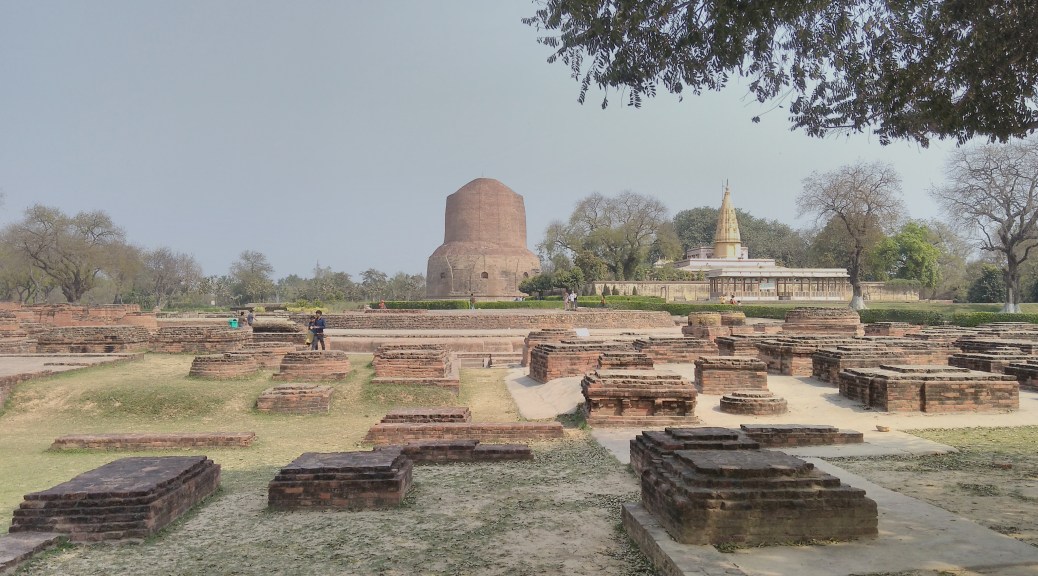
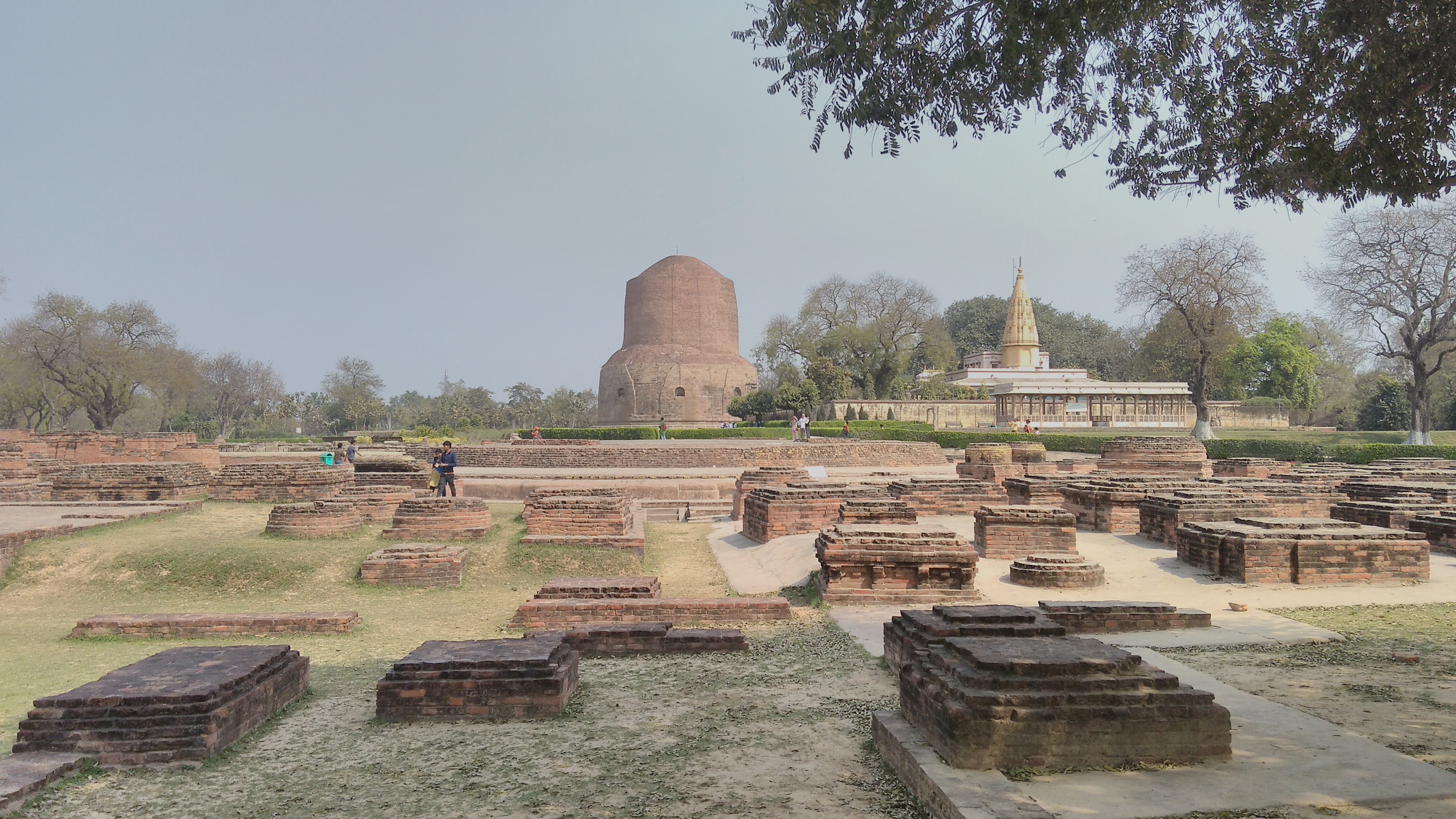
Next, it was some history time! We bought an entry ticket at the ASI counter to take a stroll around the ruins surrounding the Dhammek stupa. It is believed that the Mauryan emperor Ashoka had built small clay mounds at ten places where the ashes, the urn and the embers of Lord Buddha were buried which were eventually refurbished as large stupas by the different rulers in the course of history. Dhammek stupa is believed to be one among these ten stupas and hence, a very important one for the Buddhist pilgrims who throng here from across the globe. And that very place where the Indian National emblem was born! The pillar on which the four headed lion is seated was commissioned by emperor Ashoka to commemorate his visit to Saranath. The broken part of the pillar was found during the excavations of this site and later transferred to the ASI museum in Saranath. Today, the bottom portion of the pillar surrounded by four posts holding a stone slab are the things remaining from the original relics at the exact same spot. One way it is nice that nobody has tried to restore this pillar back as the easy accessibility to it would have got the emblem all over the internet with the insensitive photo/selfie-enthusiastic tourists.
The site of Ashoka pillar with the Dhammek Stupa in the backdrop
A visit to Saranath would definitely be incomplete without getting a glimpse of the ORIGINAL National emblem of India. We deposited our valuables including cameras and cellphones in lockers provided along with the entry ticket to the ASI museum and headed to THE place. A chill ran down my spine on being greeted by this majestic sandstone structure bearing the lion capital, the original form of our National emblem. The four headed Asiatic Lion is seated on a lotus- The national flower of India. Our guide narrated the religious relevance of the emblem in Buddha’s life. The lion represents Buddha himself who stressed upon equality and justice in all spheres of life (all 4 directions). While Gautama was in his mother’s womb- she had a dream of a white elephant entering her womb representing prosperity. The bull represents the young prince Siddhartha’s strength, the horse depicts Siddhartha’s renouncing his royal life and Lion is the depiction of Siddhartha’s transformation into Buddha. When Baby Siddhartha learnt to walk, a lotus bloomed under his feet after the first seven steps and the lotus is said to have faded at the passing away of the Lord- Hence, the inverted lotus. The Ashoka wheel is called the Dharma Chakra, representing the movement of life with 24 spokes- each for the hours of a day… It is true to admit that the national emblem evoked a sense of pride in my heart.
Ours is such a rich country in terms of history, culture and heritage! Every stone in India has a tale to tell… Having been restricted from the access of shutterbugs makes this sight all the more valuable and meaningful! There are several other sculptures and artefacts in this museum making it THE BEST museum day in my life!
The last leg of our Saranath walk tour was a visit to the handloom centre where demonstration of weaving a Banarasi saree was given and there it concludes! Sometimes you end up having this feeling of unplanned trips are the best things to happen… And Saranath is one such place!
Conclusion Remarks:
Must do– Walk tour of the town
Must see– The Original form of the Indian National emblem at the ASI museum
Best souvenir– The leaves of the Grandson of the Bodhi tree.
How to reach– There is a railway station in Saranath. It is more convenient to hire an autorickshaw for a 30minute ride from Varanasi.
Stay– There are several Dharamshalas run by people from different countries.
Under the influence of watching Tamil movies, my friend and I had sufficiently heard about the mansions of Chettinad. Further, our curiosity was piqued when we heard stories about how rich a land this region had been around a century ago, how the native people were involved in a lot of trade between Chettinad and Burma (present Myanmar). There is a Tamil settlement in modern day Myanmar consisting mainly Chettiars who decided to settle there. Burma Teak is still a word that is abundantly used for those familiar with timber and carpentry, primarily adorning these mansions of Chettinad. With that, we wanted to visit this region over a weekend and worked on our google research to set our travel plan.
The native community inhabiting Chettinad are the Chettiars. Well-educated, affluent, entrepreneurial are some adjectives that are synonymous with the Chettiars. The region comprises of 73 villages and spans over two districts of Shivagangai and Pudukkottai. Since we couldn’t be driving down, our usual resort for commutation was public transportation. Given that we had only a weekend’s time in hand, we wanted to plan our itinerary well and be able to make the most use of whatever time and resources we had.
The stay options on the other hand were limited to just a couple of Chettinad houses that have been converted to luxury resorts or heritage homestays. Although we wished that we could stay at one of those palatial mansions, we were restricted with our budget (we had just started to work after graduation from college). There were no budget stays anywhere in the region. So that was something we wanted to figure out after reaching there. In the worst case, we wanted to find at least a floor space where we could lay our sleeping bags.
This article is a first of the two part story about my trip to Chettinad. This post has been featured on BlogAdda’s ‘Spicy Saturday’s Picks’ column.
Our Itinerary:
Day 0: Leave from Bengaluru (Overnight bus to Karaikudi) Day 1: Explore Karaikudi- Koviloor, Devakottai & Pallathur (Night’s stay at Kaanadukathan) Day 2:Explore Kaanadukathan- Aathangudi (Return to Bengaluru by overnight bus from Trichy)
The Details:
Upon reaching Karaikudi on Saturday morning, we freshened up at a nearby hotel. Our day started with a delicious south-Indian breakfast with aromatic ghee roast masala dosa and idiyappams served with coconut milk sweetened to perfection. A piping hot cuppa filter coffee topped it up. Meanwhile, we worked out our options of commutation as we got taking with a very friendly waiter at the hotel. We figured out that hiring an autorickshaw was the best way if we had to get to the remote villages and unexplored lanes of Chettinad. The local bus or even a self-driven car wouldn’t be of much help as it needed someone familiar with the streets to wade through and the hot summer sun would just add up to our woes. After finishing our breakfast, we struck a good deal with an autorickshaw guy who would show us around and help us do a bit of mansion hopping.
Part 1:Exploring Karaikudi
Ariyakudi Perumal temple:Following the plan on our list, we decided to visit the temple first as the temples in South India close by 11.00.a.m. The history of this temple mentions it as an alternative Tirupati. Unfortunately, the temple remained shut at the time of our arrival due to the demise of the temple priest that morning. We spent some time photographing random things around the temple before heading to our next destination, to see the Chettinad houses in Karaikudi.
Ayiram jannal: This was our first tryst with the palatial residential structures of Chettinad. The name that literally translates to “mansion with 1000 windows”, this Chettinad house in Karaikudi is a common shoot location for those familiar with South Indian cinema. Much to our disappointment, tourists do not have access to the inside of this house as the people still live in this house.
The Inner courtyard of one of the mansions in Devakottai
Meenakshi-Sundareswaran temple: We were surprised to see the assembly of 108 idols of lord Ganesha at this temple. He is seen in rare avatars and seated on vahana that are usually considered as the others. We had visited this temple on the outskirts of Karaikudi, while on our way to Devakottai. It was a bumpy auto ride with the stiff tarmac having been withered off at several places and a lot of dust entering our ears, eyes and nose.
Koviloor Shiva temple:This beautiful little temple is set in a very pleasant location and is surrounded with mansions. We had gotten busy clicking photos.
Koviloor antique museum: Excitement was at its peak when our entry into the first stately house happened. It was a strong structure built of granite blocks facing the temple. One part of it has been converted into a museum of antiques that were used by the Chettiars, one part has been converted to a government office while another part is used by some self-help groups for basket weaving, coconut de-husking etc. A few localites had gathered for the afternoon prayers in the two temples housed inside the mansion -one dedicated to Shiva & Parvathi each which had served as personal prayer rooms for the family in the yester years. We envied the people who lived there a century ago thinking of how peacefully they could decorate their own temple with flowers and lamps and celebrate the festivals without the interference of random people in their way of offering prayers.
One of the warehouses at Koviloor
Memorials built for the famous Tamil poets: Since we weren’t keen on visiting memorials, we gave it a miss to visiting the Kamban Mani mandapam & Kaviarasu Kannadasan Mani Mandapam.
Nagara Shivan temple: This temple stop happened by chance as our auto-driver cum guide stopped for a break at a random place after a short ride. We walked into this temple where a sumptuous lunch was served as part of donations from the devotees and that kept us full for the rest of the day.
Devakottai: We had read that this village has some of the well-kept mansions in the region. By now, our driver had a good understanding of our interests in exploring the region. Over the course of the day, he was very accommodative and stopped at several mansions thereby letting us admire and awe at the vast and artistic dwelling places. He even spoke to a dozen of localites to permit us inside their houses as this would help our studies (We never mentioned we were architecture students though!!) Although a couple of mansion owners were kind enough to entertain strangers like us to have a look at their magnificent mansions, we got shooed away at the gate by several others.
The Mansion filled streets of Devakottai
There was one such incident where the proud caretakers gave us a guided tour of the entire house and we were even greeted by a colony of bats flying past our heads when one of the most unused parts of that mansion was opened just for our academic purpose! We climbed up the guano filled wooden stairs leading to an attic where hundreds of bats roosted. We ducked down as we further walked across a wooden bridge opening out into the terrace to be treated with an amazing view of the overstretching lanes of Devakottai filled with mansions.
Kandadevi temple: We stopped at this temple on our way back to Karaikudi from Devakottai. The temple pond is spread across 2 acres and is believed to be the largest in Chettinad.
Alagappa University & the Annavar memorial: Originally, these were not in our list. But we visited these places as our enthusiastic auto-driver wanted us to see these landmarks named after prominent personalities who have contributed in the development of this region.
The making of Athangudi tiles
After an exhausting day exploring the streets crammed with Chettinad houses in Karaikudi, we were dropped at the bus stand to board the local bus to our next destination. The bus snaked through the narrow lanes and we craned our necks out of the window to stare at a few bungalows along the road at Pallathur before we finally alighted at ‘THE’ destination of our tour- Kaanadukathan.
Abstract: This was a family backpacking trip on a long weekend. The target destination was the southernmost tip of mainland India- Kanyakumari. We took a train on both ways. Hence, we had planned our route in such a way that we didn’t repeat the trail and could explore new places on both ways. Here’s a glimpse of the itinerary before I narrate the details:
Overnight train: Bangalore to Nagercoil by the ‘Nagercoil Express’ Day 1: The green stretch of Nagercoil comprising Padmanabhapuram palace, Udayagiri fort, Mathur aqueduct, Thiruvatturu Adi Perumal temple, enter the east coast and drive to Kanyakumari for sunset Day 2: Catch the sunrise at Kanyakumari, a ferry ride to Vivekananda Rock, Vatakottai fort, Suchindran temple and board the night train at Nagercoil.
The details: How can the thought of standing on the edge of land be expressed? As a kid, I always wondered how we stood steadily on a round globe… My curiosity grew further, when I was handed a world map for the first time. On it, the round globe looked flat. And on the world that looked flat on a map, India took the center position. And when carefully observed, I noticed that there is nothing below India but only water. On a closer look of the Indian sub-continent, Kanyakumari pops out in the edge, as the southern-most tip of the Indian mainland. Then I made a wish- ‘to make a journey to that end of land’…
Our overnight train journey was very pleasant through the route that was lush green and beautiful, even in the peak of summer. As the train entered Tirunelveli district, the landscape took a different look. Thousands and thousands of windmills seemed like they were strewn around, until the horizon. Our train slowly chugged past the hills only to later reach its destination- ‘Nagercoil junction’, the next morning.
Day 1: We freshened up at the station and hired a taxi for the rest of the day. I managed to explain our itinerary to the driver with my broken Tamil and he managed to understand the jist: ‘To cover all the places listed down and ensure we make it to the Sunset point at Kanyakumari in time..!!’ That said, our sightseeing started in the order given below:
The Nagaraja temple– The temple that gives its name to the city.
We spent a good couple of hours photographing the BEAUTIFUL Padmanabhapuram palace in Thuckalay. It is by far, one of the beautiful palaces in South India. You don’t regret paying the entry fees as there is so much effort that has gone into the maintenance of this wooden palace. A surprising fact I discovered was that, although this palace is located in the state of Tamil-Nadu, it is maintained and controlled completely by the Kerala Government.
The wooden facade of the Padmanabhapuram palace
3. Next was the Udayagiri fort. It wasn’t a great place as a traveler, but maybe a paradise for the bird watchers. It is converted into a mini zoo and houses the memorial of Commander De Lannoy- of the Dutch east India company.
4. The hanging trough / aqueduct at Mathur– The longest in Asia, is set amid a very beautiful surrounding of lush green cashew, coconut and rubber plantations.
5. Adi Perumal temple at Thiruvatturu- adorned with intricate sculptures (of the Cheras period probably). It was strange to know that the people of the Muslim community do not and cannot live in a radius of 6kms around this temple due to a curse by one of the rulers in history. Tippu Sultan had tried to steal the main idol with the help of the Nawab of Arcot. Also, this is probably the only temple where a grave of a ruler is seen next to the main idol of the temple.
Mathoor aqueduct
6. Jadeshwara temple and Mariamman temple are at a walkable distance from Perumal temple. It is here, Lord Vishnu had come to seek support of his sister- Parvathi to convince Goddess Lakshmi when the latter suspected Vishnu of being involved in an extra-marital affair while he had gone hunting in realty.. Strange legends!!
7. Chittaral jain temple at Vellomcode- is a part of the rocky hills. It is small but a nice place for the history buffs and the pilgrims alike.
8. Thiraparappu Mahadeva temple– This place was a turn off with very less to NO water in the waterfalls and being overly crowded with tourists(NOT pilgrims!!). I suppose it will be worth the while only if it is monsoon and when the river flows with all its might down the gorge forming the beautiful waterfalls and the temple at the backdrop.
9. Pechiparai dam– We gave this one a miss anticipating disappointment with no water in the dam.
For this trip, the drive was the highlight and not the places visited. The main road would have traffic and that would waste our time. Trying to ensure that we could cover all the places, our driver took us through the remote roads of Nagercoil. These narrow and winding roads flanked by coconut trees on either sides were probably least exploited by a normal tourist and hence we could have a feel of the rustic part of an otherwise pilgrim city. The cool and pleasant weather was another surprise. What was more surprising was that the weather in Nagercoil supported the spices plantations, in an otherwise hot and humid climate that Tamil Nadu is recognized with.
It was the southern-most part of the western coast of India, that we were planning to drive through, to reach the end of land. Suddenly, the weather changed and the dark clouds hovered over us. As we were approaching the seashore, the clouds broke hell. As we watched the rain batter, we had lost an hour doing nothing. This meant that if we had to arrive at the Sunset point on time, we could only drive through without stopping anywhere. We drove past the Thengapattinam beach, Colachel port (it has a victory pillar to commemorate the victory of the Travancore king over the Dutch army), Mandaikadu temple, Muttom beach, Tekkurichi beach, Sanguthurai beach, Sothavilai beach and Manarkudi. When we finally reach our destination, what awaited us was sheer disappointment. There were clouds, clouds and more clouds..!!! We spent some time with the waves and headed to the hotel in the city where we had booked our stay.
Day 2: We saw ourselves seated amid thousands of people who had gathered there for the same reason as us. The famous ‘SUNRISE of Kanyakumari’. We watched the sea change its colour from pitch black to different hues of the spectrum until dawn’s break. But, again our woes with badluck continued on day 2 as well. A nebule of cloud sat adamantly blocking the rising sun.. adding much to all our disappointment from the previous evening.
The post sunrise visuals of the Vivekananda rock
We visited the ‘Kanyakumari Amman temple’ and the confluence point of the three oceans along with the other touristy places in the city (There is enough written about the places to see in the internet- I don’t want to repeat the same stuff again!) The wait in the queue that was at least 3 furlongs, under the hot sun was a big turn off. My expectations of finding the calm I was told about across the waters (Read it- the Vivekananda Rock) was let down by the galling tourists who had thronged there in thousands on that weekend. We left Kanyakumari in the afternoon, all disheartened by the way things turned out on a much anticipated trip.
We did a quick visit to Vatakottai fort- a small but a calm place away from the vexing crowd. We then stopped at Suchindran temple that stood grand with its majestic tower, but remained closed when we arrived there. We spent some time sitting by the temple pond and feeding the fishes with puffed rice.. And we finally left back to Nagercoil to board our evening train back to Namma Bengaluru.
Summary: Kanyakumari, being the edge of land is more of an emotion that every Indian grows up listening to. So, this is one of those places in every Indian’s bucket list. Mine was an ideal itinerary covering a lot of places. But the rain gods didn’t seem to be in our favour. But I would like to mention the highlights that SHOULD go into the list of anyone visiting Kanyakumari:
When you go to this particular spot at Kanyakumari- You can feel the waves touching your feet from 3 directions- left, right and center.. quite literally..!! That’s when you sense that you are standing in the end of land where the three seas meet- The Bay of Bengal, The Arabian Sea and the Indian Ocean. The feeling can only be experienced and not expressed.
The ruby nose stud adorned by the chief deity- Goddess Parvathi is believed to be shining so bright that history has it that many ships had been misguided due to its light. And that’s also the reason why the sea facing door on the eastern side of the temple is always kept closed, except for a few special occasions.