The list starts from 2015, a religious celebration of the festival of love and lights- Deepawali. Well, I’m not a religious person who would indulge in ritualistic prayers and pooja on any festival. But what started as travelling during this season to utilise my unused leaves combined with maintenance shutdown period at my workplace, has somehow religiously stuck on as a ritual of travelling to a new place, every year.
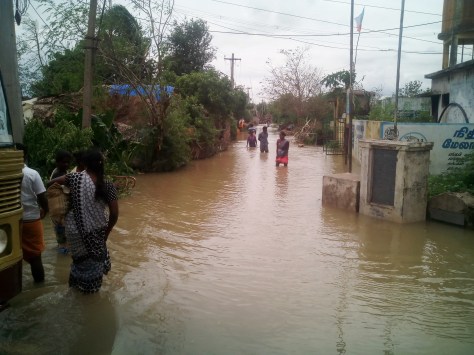
Circa 2015- Tamil Nadu: My brother and I ventured out on our backpacking roadtrip to Tamil Nadu, Kumbakonam to Pondicherry. Well, this was an adventurous start I guess, we had to cut short our trip due to a cyclone that had battered the east coast. Result: Crazy floods and crazy drive through the flooded areas. On the main festival day, we had reached Chidambaram- a must read post about our experience. A bad one then, a memorable one now.
The flooded villages enroute to Chidambaram
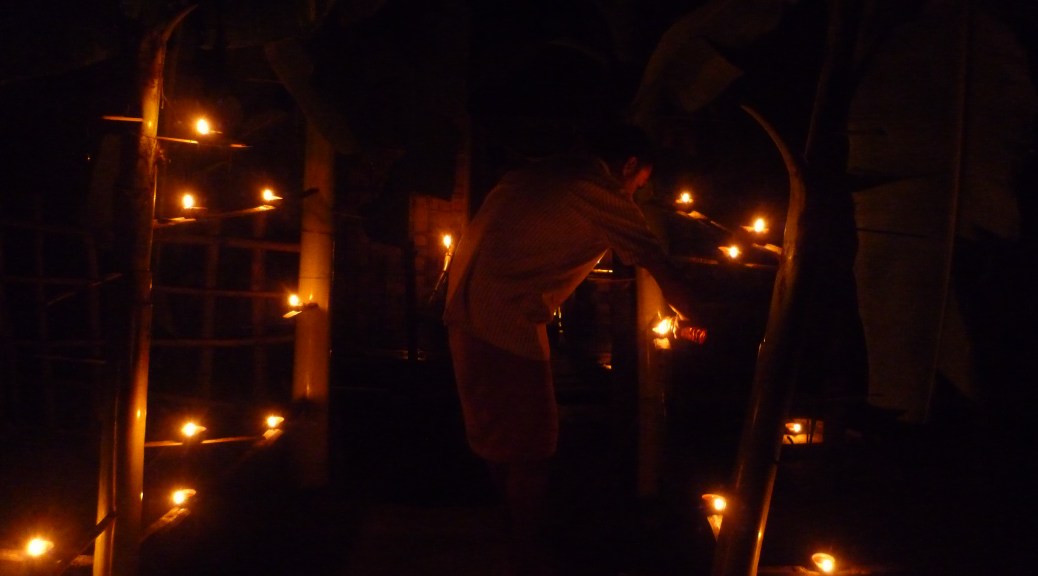
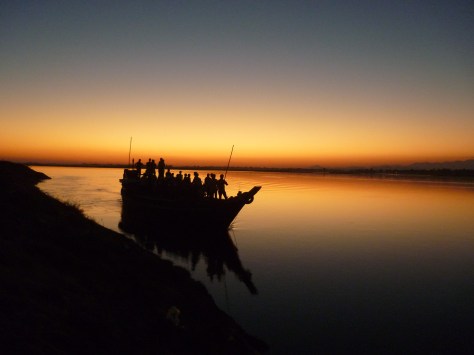
Circa 2016- Assam: This was my first solo trip ever and the first time in the north-eastern part of India. After exploring Meghalaya, I had tagged along with a couple of other fellow travellers. We happened to experience one of the most beautiful Deepawali sights. First, the drive through the lamp lit national highway, then watching the best sunset over river Brahmaputra onboard a ferry to Majuli and the crazy ass lamp lit welcome on the Majuli island.
Sunset at Majuli
Circa 2017- Karnataka: After a crazy long year of travelling across India, my friends and I decided to have a simple deepawali roadtrip, closer home in the western ghats. We drove to the famous Agumbe ghats and the places around.
Circa 2018- Himachal Pradesh: One of THE best solo trips of my life, where I couldn’t find a single traveller to tag along through the entire trip. This thus, became a thorough personal and local experience in the Spiti valley. On the day of Deepawali, I was on my way back with a brief stopover at Shimla. A trip that made an impact on me, perhaps forever.
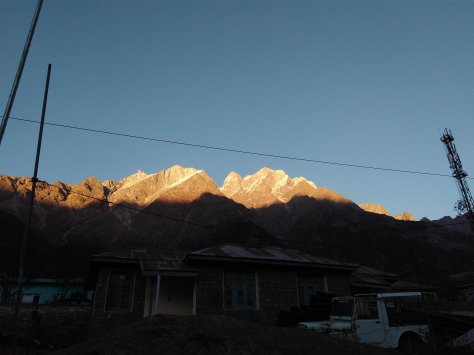
Sunset view from Sangla bus stand
Circa 2019- Kerala: A solo weekend exploring Varkala, it was a short one but yet overwhelming. It was a happy-hippy trip, in a true sense.
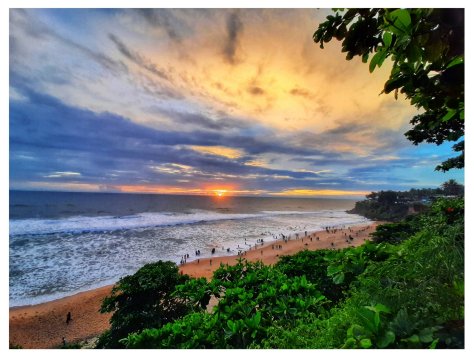
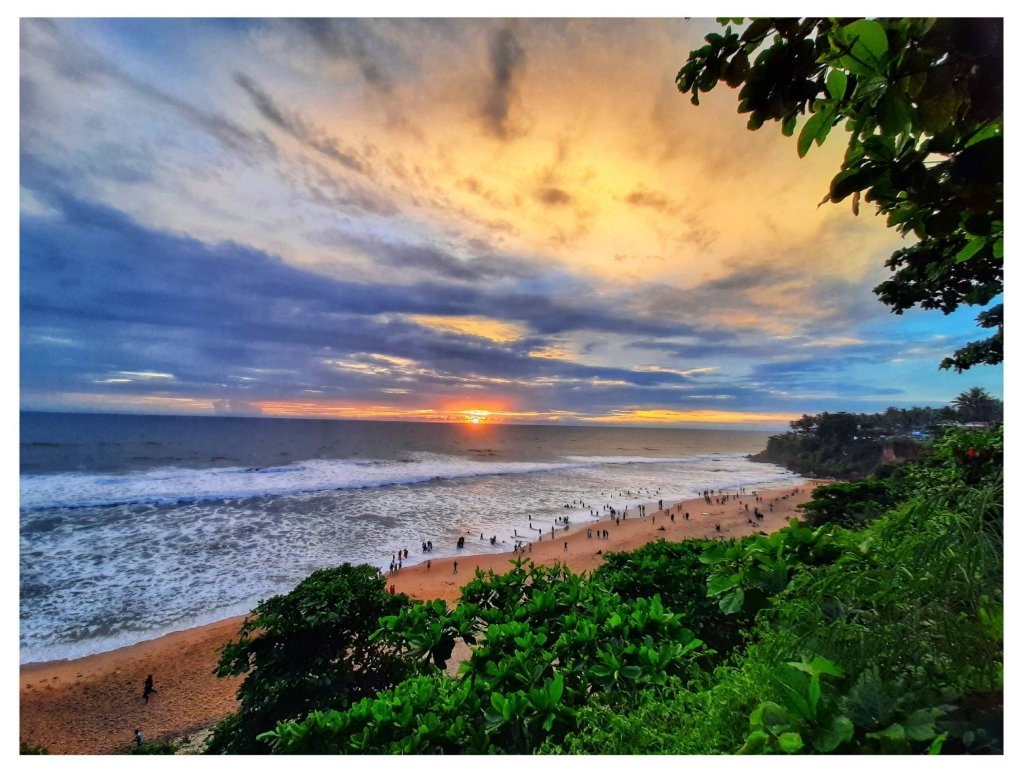
The sunset from Varkala cliff on Deepavali 2019
Circa 2020- Karnataka: Fears of travelling afar due to Covid-19, personal commitments and taking advantage of working from home, this was the longest duration I spent in my hometown in the last 15 years. Quite unlikely to mention the highlights, but the Deepawali of 2020 indeed tops all the above from the list.
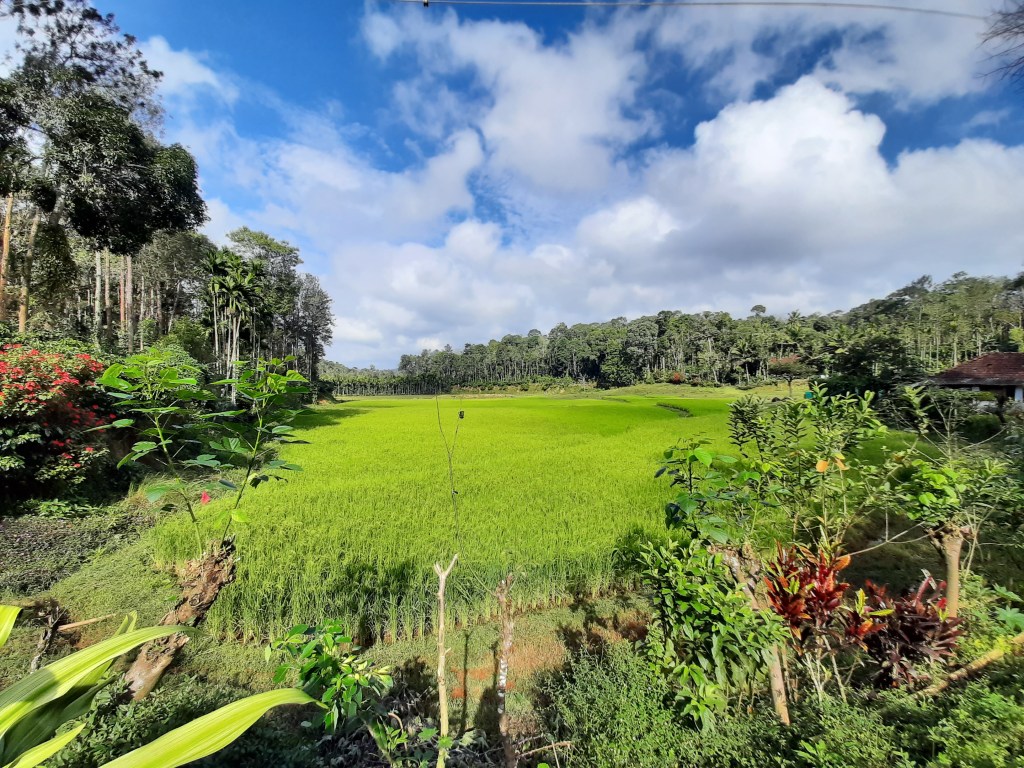
The view of the farm, from our ancestral home in Kodagu
Circa 2021 – West Bengal: This was a trip that was planned on a whim by 2 of my friends and me, where my brother joined in at the last minute. It was a completely new kind of Deepawali celebration which we experienced during trip. Large pandals setup at every 100meters to celebrate Kali Pooja was something unknown to us about Siliguri in the state of West Bengal. That night, we reached ‘Manebhanjang’ a small town located at the entrance of the Sandakphu trek to the Singalila ridge, the highest point of West Bengal. It was yet another experience to witness an amalgamation of Gurkha, Buddhist, and Hindu culture in the way this town celebrates its festival of lights. Much like the carol singers during Christmas, people form into small teams and go from door to door singing, dancing, and spreading joy and blessings.
Circa 2022- Saudi Arabia: It’s a first time for me to spend Deepawali out of my home country but still in accordance to my tradition of visiting a new place during the festival. This time, work brought me here. Although there wasn’t much we could do like in India, some shopping for sweets at Indian sweet meat shops was a little bit of home we brought for ourselves while staying away from homeland. But, I feel grateful for this opportunity and experience life has brought to me during this Deepawali that has helped me to grow into a little stronger person I was when left India.
What are your stories about celebrating Deepawali / Diwali? What do you do normally?
Solo tripping during Deepavali has somehow been a ritual that has caught on to me since 2015. In 2019, I was out in Kerala. I was going to spend three days at a place considered somewhat to be a hippie destination. Train tickets were sold out and hence, I boarded an evening bus from Bengaluru. After a long journey, I alighted at Kollam on the following morning, from where I got a passenger train ride to my destination: Varkala Sivagiri.
The itinerary for three days is as follows: Day 1: Janardhan Swamy temple visit, Lazing and hippying around the cliff and the Varkala Promenade Day 2: Golden island, Sivagiri Mutt, Ajengo Fort, Varkala Light house and Munroe island Day 3: Kappil beach
The Story: It was a pleasant train journey along a scenic route. I had a nice Kerala breakfast at a restaurant across the railway station and then followed google maps to the hostel that I had booked online. I did not mind the long walk to the hostel that was located close to the famous ‘Cliff point’. I always consider walking as an opportunity to explore the streets and get acquainted with any place that I visit. After checking in at the hostel and freshening up, I headed out to visit the ancient Janardhan Swamy temple. After offering my prayers, I walked back to spend the rest of the day at the beach.
While I was walking along the beach and silently enjoying the romance of my feet with the waves, I noticed a woman (in her sixties, which she later mentioned during our conversation) walking on the beach too. With a smile on her face, she was enjoying her lone time. But at the same time, she seemed to be struggling with something. I felt as if she wanted to mingle with the people around there, she wanted to get herself photographed, but something was holding her back. I smiled at her and she smiled in return. I offered to take her photo and she was glad. Eventually as I spoke to her, I realized that she wanted to socialize with the locals but was struggling with the language. She was French and couldn’t speak neither the local language nor English.
As I spoke slowly, she translated it on her phone and communicated back with me through the mobile phone translator. we had become good friends by the next hour. She mentioned to me that she was in India to help herself with the loss of her husband and was accompanied by a friend who had traveled all the way only to be by her side. She was in Varkala since a month and was staying at her cousin’s house who was married to a localite. She was learning Yoga and aromatherapy and was keen on buying good incense sticks from India. She walked me along the entire beach and showed me around the marketplace. She then sought my help to negotiate with a local vendor to buy her a ‘Hapi pan’, a musical instrument that she had been eyeing since the past month that she had been living there.
A demonstration of playing the hand pan/ Hapi pan by the vendor
I managed to get it for her at almost half the price that he had quoted to this ‘Foreigner’ and I can’t explain how happy she was with her new possession. She then walked me down the cliff, laid down her shawl on the ground and sat me down. She started to play her musical instrument and it was a sight to see the sparkle of happiness in her eyes. Sometimes, these little things of bringing joy in others’ life means EVERYTHING!
My friend enjoying her time with the happy pan (Image blurred intentionally)
Post sunset, she walked me till my hostel and bid goodbye with a REALLY tight hug! She said she was extremely glad that she had met me and asked me to join her at the Yoga classes on the following morning if I had time. “The morning recitation of the Shlokas by the beach is my favorite time of the day” she said. I informed her of my plans of exploring other places around Varkala and that I wouldn’t be able to meet her. I gave her my phone number to get in touch if she needed any help and we both parted.
It was a night of celebration at the hostel. The hostel had people from various corners of India and the world and were all dressed up in traditional Indian wear. The premises were decorated with diyas and rangolis. It was a special Diwali, for sure 😊
My visit to the Golden island
The following morning, I hired an auto rickshaw and did a quick visit to the Sivagiri Mutt and the fort before heading towards Ponnumthuruttu. Fondly called as the Golden Island, it is a protected forest area reachable only by boat. It has a few ancient temples and it reminds me much in line of ‘Devarakaadu’ or sacred groves in my hometown. It was indeed a pleasant ride. Apart from the auto driver and the boatman, I was the only other person in the boat, in the island and hence had the blissful time with nature. Although I had plans of taking a boat ride in the nearby Munroe island at Sunset, I later decided to stay back in Varkala itself. By evening, I returned to the cliff again at sunset time. Believe me when I say, the BEST Diwali of my life was in that day’s evening sky. It was a riot of colours.
The sunset from Varkala cliff on Deepavali 2019
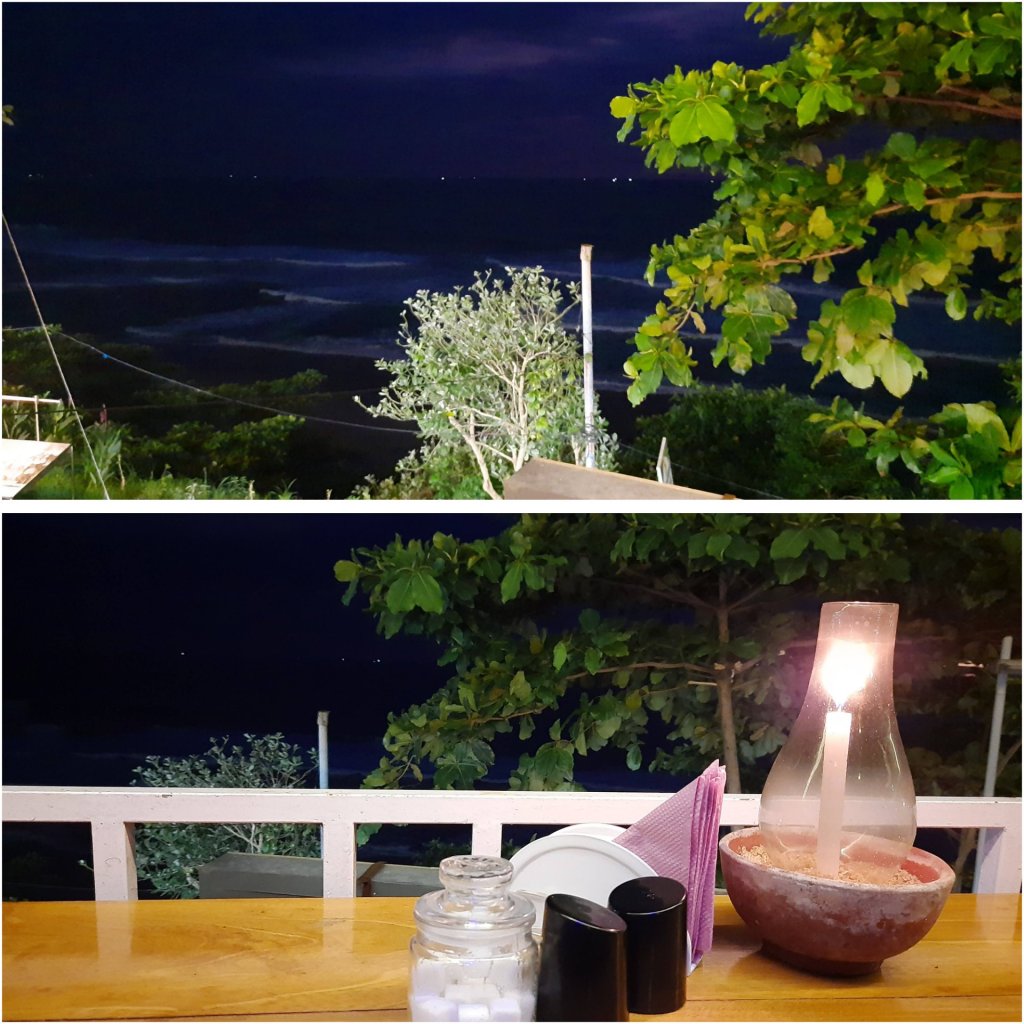
After the sun sank into the horizon completely, I decided to treat myself with some nice sea food. It is one of those strange moments when you are made to feel at home in an unknown land. As I was strolling along the promenade, undecisive of which restaurant to go, I heard someone say: “Akkayya, ninga Kodagu-l elli?” in a male voice. In my mother tongue, that translates to: “Sister, which part of Kodagu do you belong to?” I was astonished and surprised for a moment. We got talking and he said he belonged to a native tribe from Kodagu, settled in Varkala. He had been working at a restaurant there since several years. On being asked how he recognized me to be a Kodavati, he pointed out at my unique Kodava facial features. That was SOMETHING for me to hear now! He volunteered to choose the lobsters and the crab for me from the aquarium, got me a beach-facing-candle-lit table and served the best sea platter I had tasted in a while. It is one of those overwhelming evenings of my life. All time for myself on a Solo-date-dinner night and still made to feel at home by a random person.
My sea view dinner table at Varkala
The next morning, I headed to the beach to grab some English breakfast. I was pleasantly surprised when my French friend and her friend, both arrived at the same restaurant. We three conversed on a multitude of topics and spent good long time together. While the two of them later dispersed, I stayed back at the restaurant waiting for a friend who was riding down from Kochi to meet me. On his arrival, I walked up to settle my restaurant bill at the counter. The cashier said: “No madam, your bill is already settled.” I was amused and told him that I had been eating until now and hadn’t left my table. So, he informed me that a foreigner lady had paid for my orders. There I was, in yet another overwhelming situation. My French friend had paid for my share of the bill too.
Kappil beach
My friend and I then commenced our ride towards Kappil beach, situated on the outskirts of Varkala. It is one of the finest beach side roads I have been to. Somehow, I drew parallels with Maravanthe beach in coastal Karnataka. But moving away from the highway, my friend took me to some deep hidden jewel of locations. I guess it would be fair to call this as my 4th best part of the same trip. Some amazing places can be explored only by hanging out with the locals. He is a Malayali and knowing the offbeat locations enable me to experience one of the craziest bike rides of my life. We drove several kilometers LITERALLY along the edge of the world; like the EDGE! Even if the moist soil under our wheel slipped or the rider went slightly off balance, we both would’ve gone along with the sea, beyond the cliff. All this, while riding through poor visibility due to wild shrubs that were standing taller than us. And then, the shrubs opened into yet another beautiful sunset.
Upon return to Varkala, I picked up some incense sticks with essential oils and dropped them off as souvenirs to my French friend at the Yoga center (A surprise that she would receive only the following morning, after I was gone). Then, I did a quick check out from the hostel and boarded the night train back to Bengaluru. The train route is for yet another post, someday!
My Deepawali of 2019 was all about spreading love and feeling loved. How often have you got lucky and overwhelmed with warm experiences during travel? And how often has it been multiple times on the same trip?
Binge-watching on Netflix, Hotstar or other OTT platforms, reading books, Cooking, meditation are so cliched. Doing these things daily too can get monotonous. Doing something for 21 days can lead to a habit. So, by the end of this lockdown period, we all don’t want to become couch potatoes..
Yes, every Sunday evening of our lockdown period has been made interesting by our Honorable Prime Minister. His tasks have made sure that we all came out to our balconies to get some fresh air and break the monotony. The clapping, clanging of plates, bells and blowing the conches from the confines of our balconies with an aim to Thank the frontline warriors of the Covid-19 Pandemic on 22-Mar-20 was a nice exercise to come out of our couches. Similarly, I’m sure the nation showed its unity and solidarity in hard times by switching off lights and lighting up lamps, candles, torches and flashlights on the evening of 05-Apr-20.
But, what about the other days of being locked down at home? Do your itchy feet rare to travel? And oh, those with little kids must be having the hardest time to keep them indoors. So, if you are looking for an offbeat travel experience to break your routine, while being locked up inside your house, here are five handpicked DIY ideas for you 😊
Have your own bedroom rave party: An endless playlist is available either in your collection or on the OTT platform. Use the apps that also provide disco flashlights. Place your mobile screen between two mirrors that are placed at a distance away, facing each other. Switch off all the lights at home and let your playlist take the center table. Voila, you have your own dance floor! Make some drink or look online for some cocktail ideas with whatever ingredients are available in your kitchen and your party is good to go!
Pitch your own tent or pillow fortress: For those of you who are frequent hikers, chances are that you have your own tent. You can pitch it in your own balcony or terrace and experience the outdoors in your own little campsite. For the others who don’t have a tent, fret not. Remember the ‘Pillow fortresses’ we made as kids? Why not let that kid out of yourselves now? Fold up your beds and stack up you pillows. You can even tie a string across your room and hang down a bedsheet from it. You have your very own DIY tent.
Set-up your travel corner: Re-living old memories by digging up the old photo albums itself can be a great way to time-travel. You can pick up some of your favorite photos and hang-it up with lights in a DIY corner of your house. All you need is some strings and clips to hold your photos in place. You can also draw a huge map and mark the places you have been to and have it in your travel corner. Arranging your collection of souvenirs from your travels around this place too is a great idea.
Star gazing from your balcony or terrace: Now that the skies have cleared, it’s a good activity to hone up your skills of star gazing. There are several apps and websites that can help you in identifying the stars and constellations. It’s a great idea to go out to your balcony and admire the vast expanse of the night’s sky. Who knows, you might even get a glimpse of the ISS (International Space Station) which is believed to be going around the earth- 16 times a day! There is usually one major meteor shower every month. Look up on the dates and catch the shooting stars 🙂
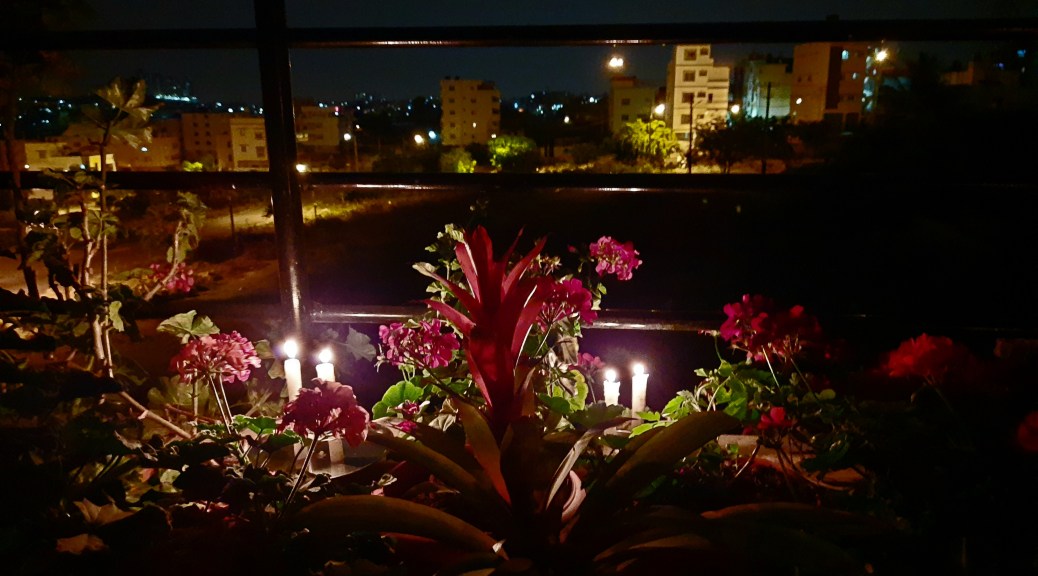
Celebrate a festival: Light up your house as if you would do it for Diwali or for Christmas. Make up a mock festival at home. Festivals have always been a great way to bring in fresh energy and pep up the mood. I’m a sucker for diyas and candle lights and totally in love with the positive vibes it brings with it. No mood for festival décor? Why not cook up a nice meal and have a candle lit dinner?
Sounds fair? Let me know how you are dealing with the lockdown…. What ideas do you have to experience travel without leaving your doorstep?
Come the night of Mahashivaratri, there will be festivities across the country. People stay up all night and participate in bhajans, pooja offerings, chariot pulling etc. all to keep themselves awake for the night, so that their beloved Lord, Shiva gets good rest after taking care of them all year. But it is the day that follows the revered night, that is the essence to this story of mine. The day that follows Mahashivaratri is when Shakthi, the consort of Shiva and thus, the female power is celebrated across the Northern part of Tamil Nadu. The companionship of Mother Angalamman to Shiva, the graveyard dweller is celebrated with a festival called the ‘Mayana Kollai’. As a friend explains, Mayana Kollai translates to the ‘Raid of the graveyard’ in Tamil. I had planned to witness this festival at one such temple dedicated to Angalamman, closer home, at Kaveripattinam.
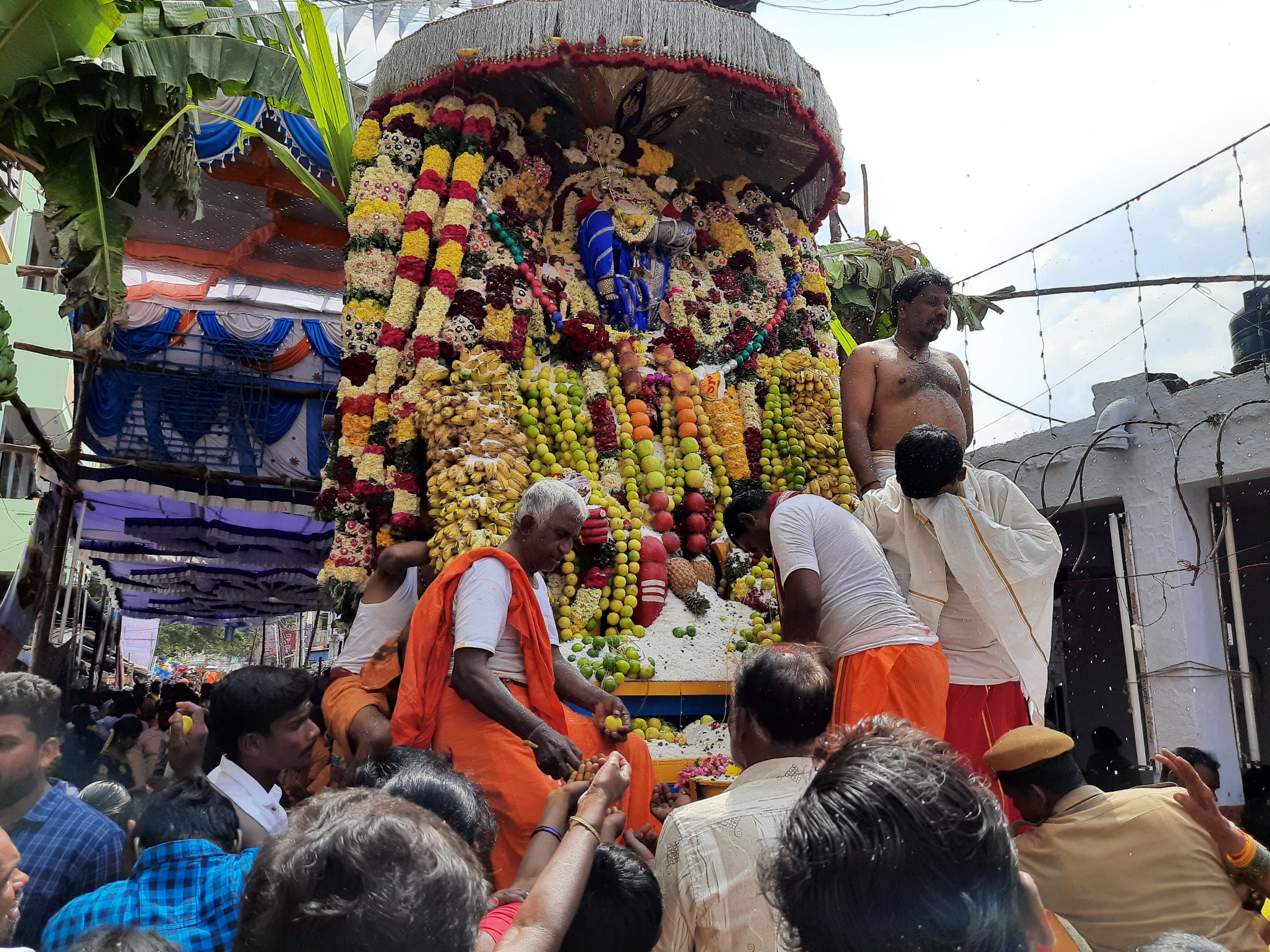
The festivities had started as early as the sunrise at the Angalamman temple, with the Goddess being taken on a temple car/ chariot. She is supposed to travel along the streets of the town, to the graveyard by evening from where she returns to the temple by night. All other rituals that are part of this journey of her’s are what make this festival more interesting. It is a festival where the entire town / village participates with no barrier of caste or societal status. The chariot leaves the temple with the idol of Angalamman.
The diety- Angalamman being taken on a procession on the temple car / chariot
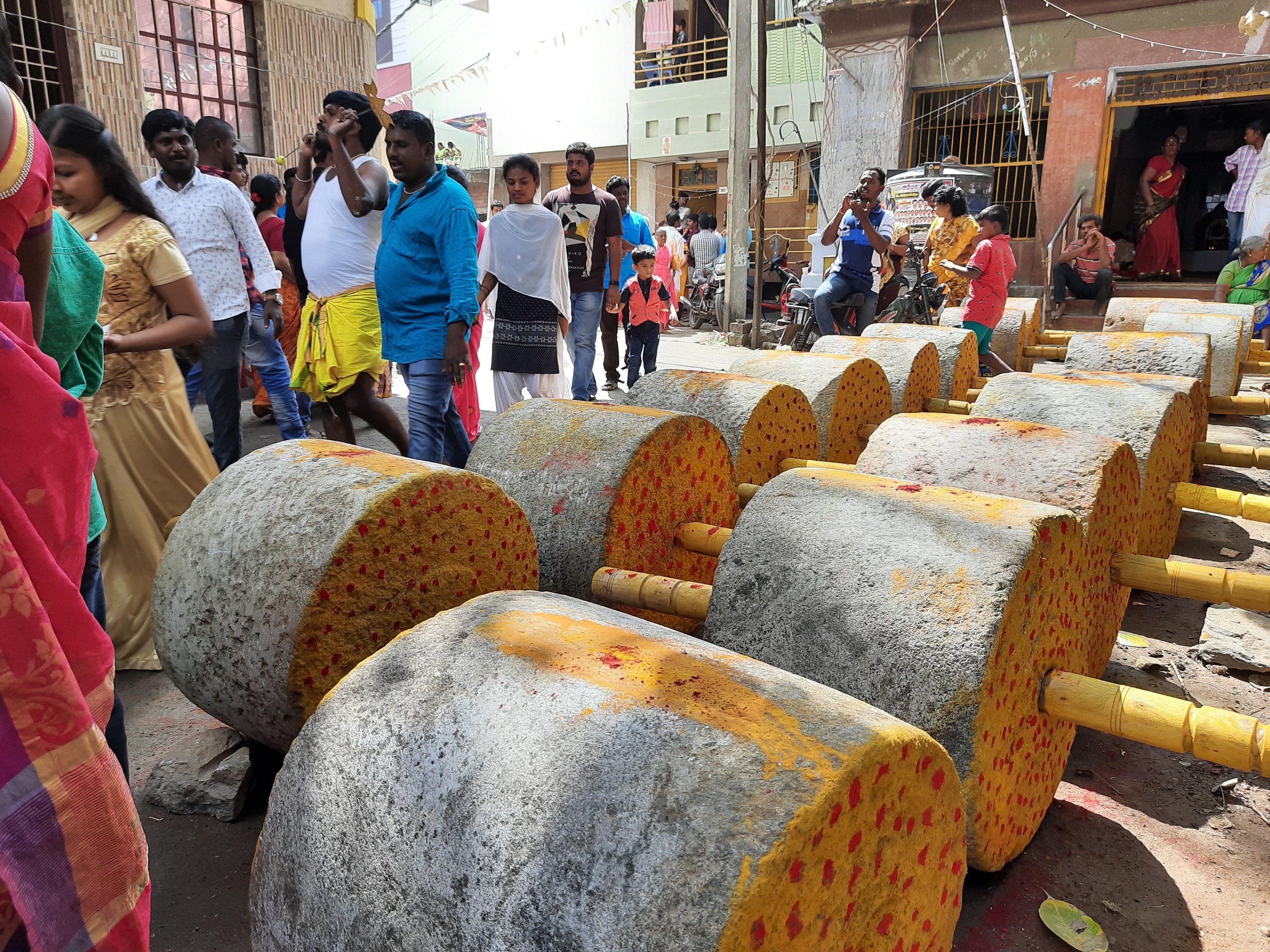
She is greeted by devotees who throw a mixture of salt crystals and black pepper or beans all along her way. She is hailed as a symbol of fertility who is calm throughout the year and takes on her powerful form on this day, once in a year. The villagers get their body pierced with various things near the temple premises and walk across the village to the graveyard, where the piercings are removed. This body paining is what they believe, is a gratitude to the almighty for the wishes that have come true or as a part of a prayer that needs to be fulfilled. The size and things pierced can vary depending on individual’s prayers. While those with tridents pierced around their mouth are a very common sight, the more pious go further to get their torso pierced with hundreds of lemons. Yet, a few pull cars, buses, trucks or large stones with ropes that are hooked through their bare skin.
Stones being readied to be hooked to the body as a man with a trident pierced to his cheeks walks past
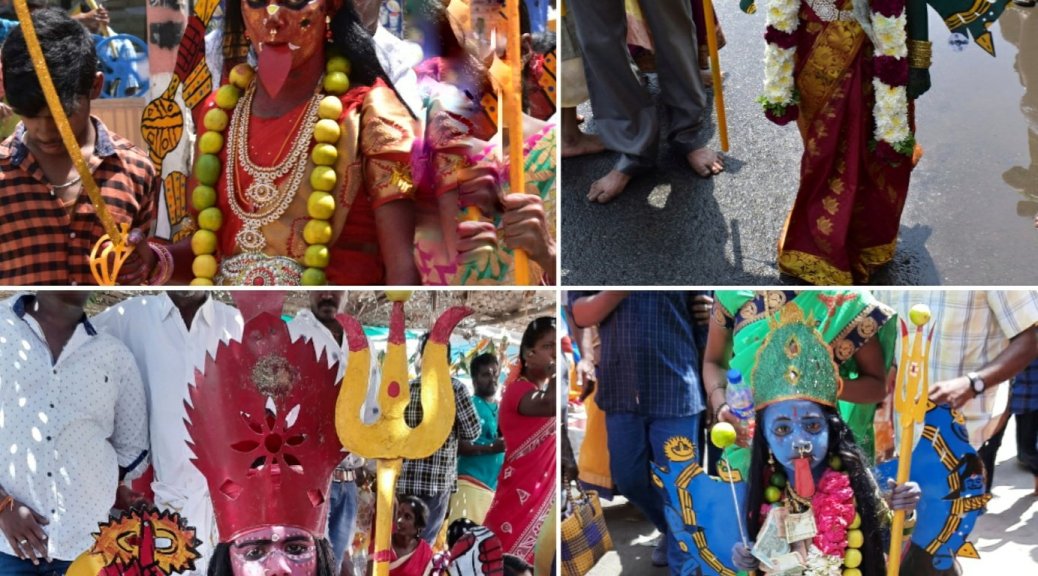
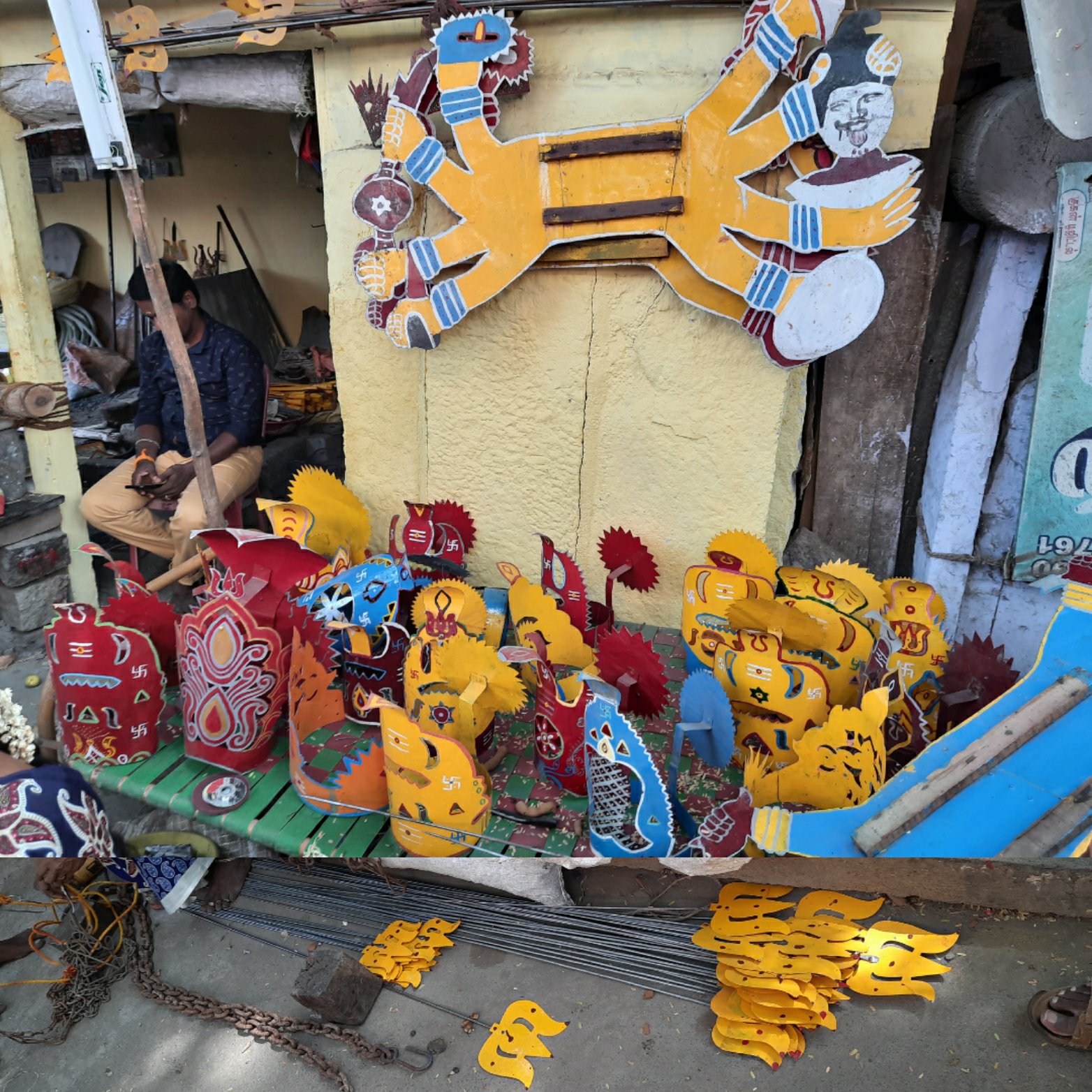
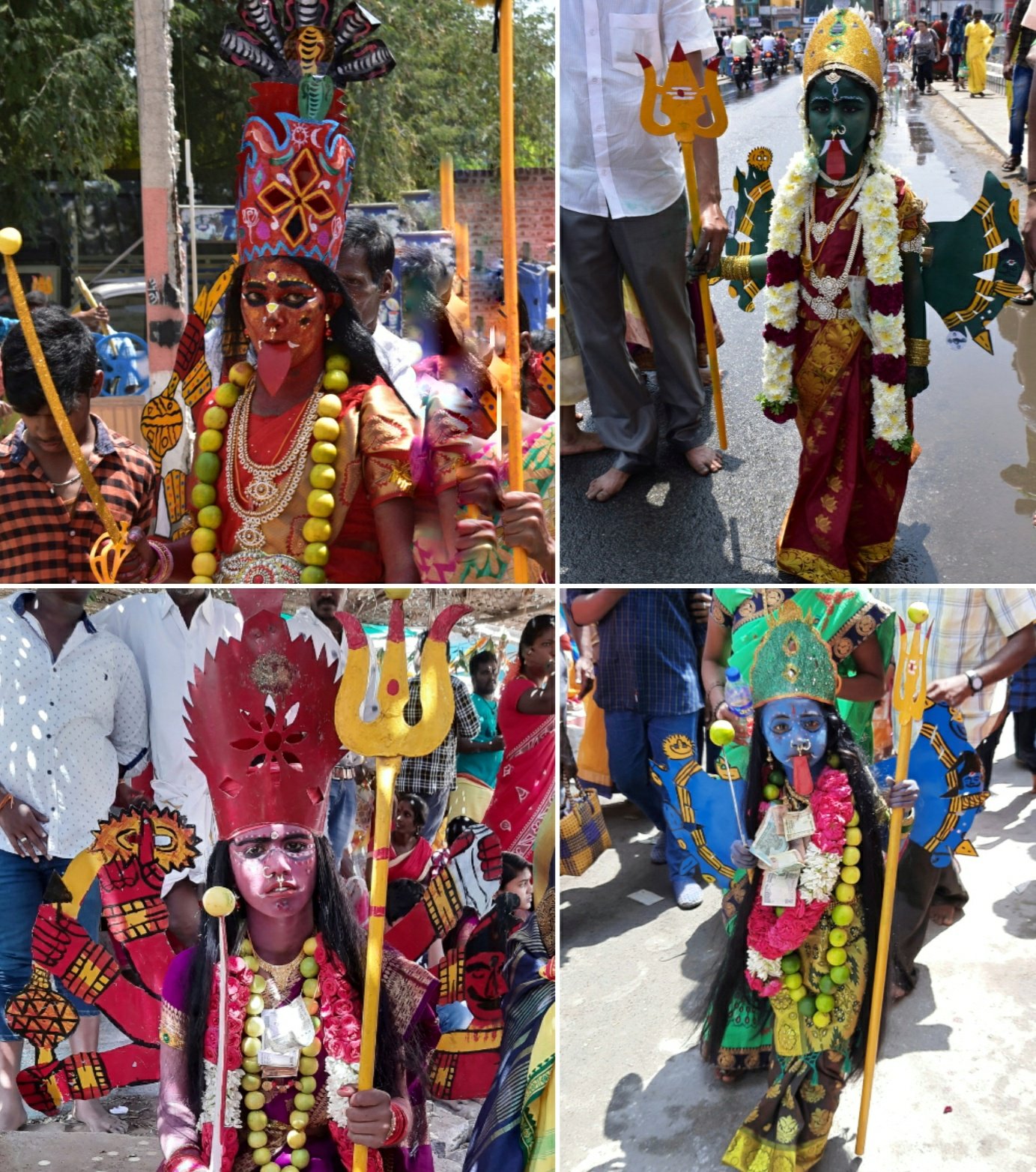
If u peek into one of the many shops (I don’t know if that is the correct noun for such places) around the town, apart from those getting the body piercings, you will find another set of people. Men and children will be getting their faces painted and dressed up in sarees, a representation of Angalamman. With metal arms attached to the backs, elaborate costumes, jewelry and crown worn, Angalamman is impersonated by these people. They hold tridents and dance to the beats of drums across the streets. Several times on their way, they get possessed or get into a state of trance, until they all finally congregate at the graveyard. Animal sacrifice too is a common sight on the streets on this day.
Stalls where the body piercings and paintings will be done
It is evening by the time the temple car and everyone else reaches the graveyard. That is when the most interesting part of the rituals takes place. The folk impersonating the goddess gather around a random grave and dig it up. The bones from the grave are pulled out and chewed by them. This is called the ‘bone chewing’ ritual or what gives the festival its name: Mayana Kollai or the ‘Raid of the graveyard’.
Men and kids dressed up like Angalamman
There are several legends and references that explain the significance of this ritual, depending on the region. Here are some of the references I found on the internet.
Post this ritual, the goddess calms down and returns to the temple on the temple car. The festival culminates when the it reaches its home.
While witnessing all this self-violence, I started to deeply think, why this is necessary to please the gods. Although I couldn’t find a convincing conclusion, what I realized is that this form of ritual is not unique to Hinduism alone. It has been largely practiced worldwide, across all major religions. Some of the closest references are:
Whichever faith be it and whatever the belief, the intentions of every person involved is the same. To get closer to god. Aren’t all our beliefs connected?
It is that traveling exposes one to a multitude of cultures and people. The diverse geography of India is home to some of the most unheard traditions and untold folklores. During my 10 day stint of backpacking in Nagaland, I was introduced to so many of it all, as this little Indian state, tucked in the far North-east is home to more than 17 tribal sects and sub-tribes; each having their own culture, language, traditions and cuisine. Here, is a small list of indigenous musical instruments used in the folk culture of the Nagas.
Mrabung:
Mrabung is an indigenous musical instrument of the Zeliang Nagas. It is a single stringed instrument that is crafted with a hollow/ cured bottle gourd and a fretless wooden neck of about 12 inches long. It is played with hair string bow (Usually a cluster of horse tail tightly tied together to two ends of a thin wooden stick). This bow is used to strike the chords (like a violin) with one hand and the string along the neck is pressed down with the other hand at appropriate places to get the required tune and legato of the song. It is played during merry making in social gatherings and festivals where men and women congregate. I was narrated with a popular folklore of the Nagas wherein, a singer called Arum played the Mrabung. His music captivated the farmers so much that everyone working on the field left their work undone and sat around Arum listening to his songs. Arum had to be barred from playing any songs further just so the people went back to work on their farms. Click below to see an artisan playing the Mrabung.
Atutu:
The Atutu is a handcrafted bamboo trumpet used by the Pochury tribes of Meluri. A particular variety of bamboo is used in making the varied components that are fitted together to make this crafted trumpet. It is played to mark special occasions. For example, blowing of this trumpet towards the end of February means to herald and announce the advent of the Nazhu festival. Also, the male members of the tribe play it in their morungs in the evenings throughout the festival. Apart from this, the trumpet sound is used to ward off birds and animals from the rice fields and prevent from crop damage. In earlier days, trumpeting was a way to alert the collective habitat or a village of a possible enemy attack or as a signal of declaration of a war.
The Atutu: The bamboo trumpet
Dholak:
This common musical instrument has its own version and avatar in every region of India. Be it weddings or festivals, it is the most common and almost an essential part of any merry making in Indian celebrations. Similarly, each tribe in Nagaland has its own version of the dholaks or the Indian hand drums. Made with an outer casing of wood, laced tightly with cotton strings and the drumming surfaces made with the locally available materials, more often animal hide. Here are samples of the dholaks used by the Garos (Long slender shaped, narrowing at the ends), the Mech Kacharis (fatter and shorter than the Garos) and the Aao tribes (Shorter and fatter than the previous two types and Uniform sized throughout its length) of Nagaland. (Click the below link to watch the ceremonial dances of the Naga tribes with their dholaks)
This is my humble attempt at documenting some unique musical instruments that are lesser known to the world outside North-east India. These have been listed based on my actual experiences and interactions with the Nagas during the hornbill festival-2020. If you know any such unique musical instruments, please do share in the comments section below. I would be happy to learn it from you 🙂
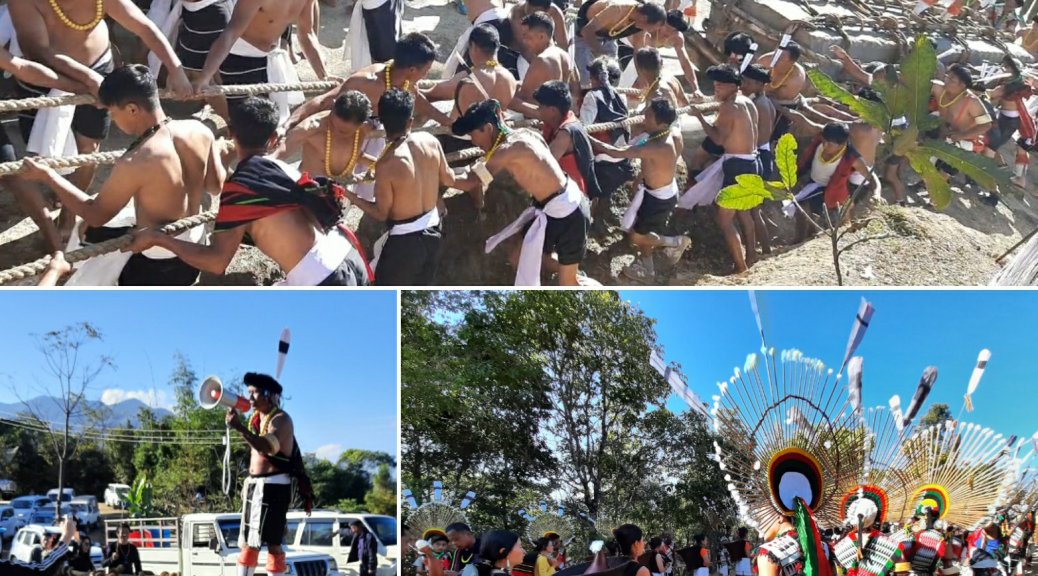
Stone pulling Ceremony is an annual traditional event held across the Angami villages to commemorate a certain important day. It takes place in one village per year on a rotational basis. So that way, it takes about 5 to 10 years by the time this ceremony reoccurs in a particular village. This event is usually timed around the Hornbill festival as there will be people from across Nagaland and outside visiting Kohima (The region where the Angami tribe is a majority).
The stone referred here is a large monolith that weighs several tons and the size and shape is not fixed. It is at the villagers’ liberty to pick the monolith they want to use for the occasion and can be either quarried from the village itself or bought from somewhere else depending on the resources. The large stone slab is then placed on a sled that is made of tree trunks and pulled using thick entwined vines from the forest. Thousands of Angami Naga men pull the large monolith over a few kilometers to finally errect it upright, engrave the details of the event and mark the day.
This year, the stone pulling ceremony was held at Mima village. It was organised to commemorate the 75th anniversary of christianity in the village. The monolith was symbolized for forgiveness, friendship and peace to the enmities that the village had with various villages before the coming of the gospel to Mima village.
The typical stone pulling ceremony (Click here to watch the complete video) is solemnised by the pastor from the village’s church with recitals from the Angami bible before the start. It is then followed by firing a round of shots from the muzzle loaded guns in the air. The captain stands on the slab and shouts Angami cheers through a loudspeaker to motivate the pullers. While all the strong and younger men folk of the village join hands to pull the stone, The eldest two men of the clan walk, leading the tribe. The women get dressed in their traditional attire and walk with a khophi (an utility basket woven with bamboo or cane) hung on their back and they stay around as a mark of support to the pullers. A few of these women carry cotton in containers made of dried bottle guard and walk ahead of the pullers as a part of the tradition. And yet, the remaining women go around distributing gruel made of ‘Job’s tears or Chinese pearl barley’ to all the passersby and the participants from their traditional Aluminium pots. It is served in bamboo cups that are carried in the baskets hung around their foreheads. The gruel provides an instant boost of carbohydrates for the toiling men in the hot sun.
In a Christian majority state, the tribal traditions are still thriving. It was a different experience watching the entire village dressed in their ethnic best and gathering to pull the stone uphill from the starting point to its destination. I somehow drew parallels with the chariot pulling tradition of the Puri Jagannath and several other temples of South India.
Isn’t it true that we all somehow follow the same way of life, only with different names for our faith and the process we follow to achieve it?
Holi is Big in Northern India and the most beautiful in the Braj Bhoomi- the Land of Lord Krishna. Festivities start a week in advance with Lath-mar Holi in Barsana and Nandgaon, phoolonwali Holi (Holi played with flowers) and Widow’s Holi in Vrindavan, Huranga at Baldeo and Holika dahan and Rangowali Holi at Mathura and Vrindavan are some of the major parts of the festival. Articles, blogs and photos are all over the internet about how beautiful this celebration is and the fun of participating in the festival of colours. Deeply inspired, a two week trip was planned through the state of Uttar Pradesh whole-ly, to soak in the festive fervor of Holi.
This visit to Mathura is a part of my fortnight long backpacking in the typical pilgrimage circuit of Uttar Pradesh covering Lucknow- Ayodhya- Faizabad– Varanasi- Saranath– Allahabad- Agra- Mathura-Brindavan- Fathehpur Sikri– Delhi
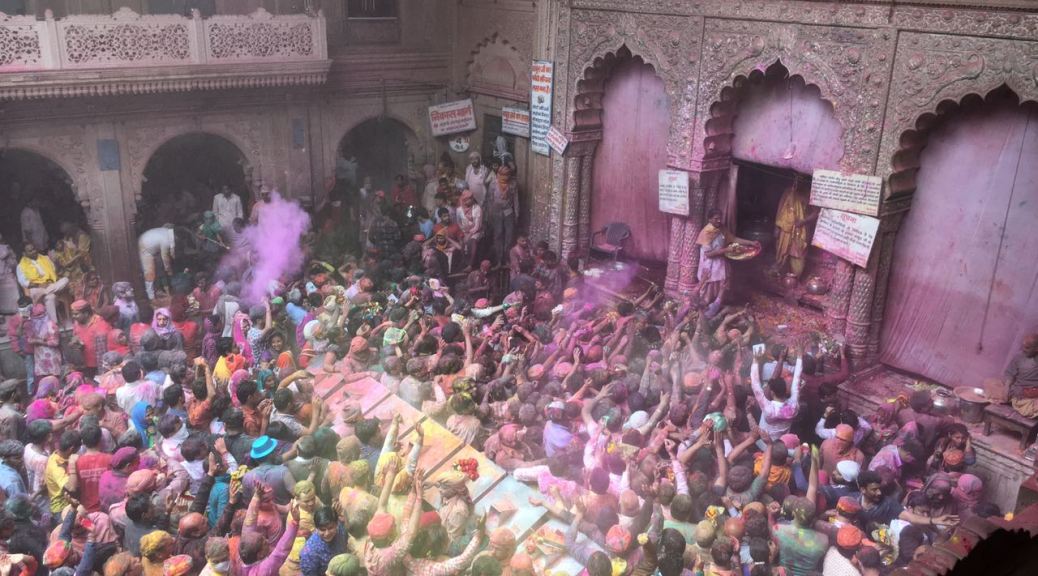
As per plan, we reached Vrindavan to spend the last two days of Holi- the main days and get coloured in different hues of Gulal. The plan was to reach the hotel, change to clothes that we had kept aside specifically for Holi and then go out to the areas where the colours were being thrown at. However, the entire town was already painted with colours by the time we arrived in our delayed train. A samaritan helped us get an e-rickshaw so that we could reach our hotel. The rickshaw had to squeeze its way through the crowd that had already gathered out on all roads. By the time we reached the hotel, we started to feel miserable about having wasted our leaves and having travelled all the way to Mathura from Bangalore was a big mistake. It was very unfortunate that our experience of the famous Vrindavan Holi was no-where close to fun. Although we were inside the rickshaw, we felt more vulnerable to getting coloured than the rickshaw itself. Goon like mobs would specially target people who were new to this kind of celebration. I had atleast 4-5 men together hold me by my head inside the rickshaw and colour my face. Few others even pulled my scarf and shawl to ensure that every inch of skin was coloured. No! It was not a pleasant way to welcome guests to a new place!
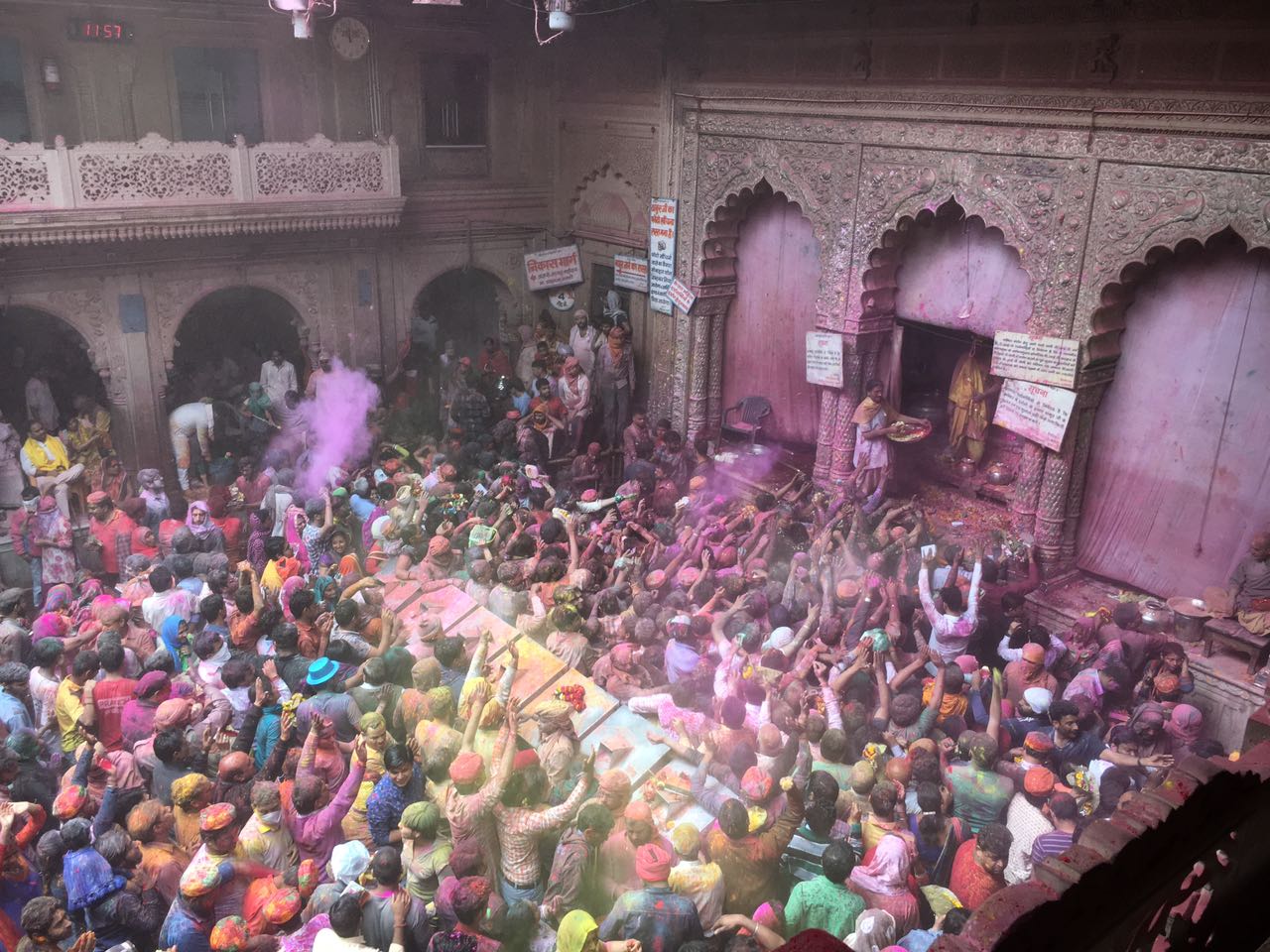
Banke Bihari temple in Vrindavan is where Holi is best celebrated with the priests throwing colours at everyone. On the day of Choti Holi, although we managed to go to the temple, we were drenched in wet colours. Leave that, our faces, hands and every bit of skin was chapped because we were smeared either with coloured cement or sand. This mixture is a norm and hurts like hell when it is being thrown at. We somehow managed to catch glimpses of Holika that were being burnt in some interior corners of the town. Women folk had gathered around effigies placed in the middle of firewood, food grains, vegetables and all other important things required for burning the pyre. We were colour soaked till the bone by the time we braved the task of reaching the safe confines of our hotel doorstep amid all the cemented colours and sand. Taking pity at our plight, our hotel incharge asked us to stay indoors the following day, as the last day could get wilder.
Finally, the main day of our fortnight long trip had arrived. But, we could barely think of venturing out on the streets on the day of Rangowali holi. Since our hotel was located in the main city area, we set our chairs out in the balcony of our room on the 3rd floor and watched the frenzy on the streets. It was disappointing to watch the Rangowali Holi turn into an event of Kheechadwali Holi (Holi played with water from the drainage). This kind of celebration can give the worst memories especially for girls and foreigners while goons attempt with ruthless amount of coloured glass powder. It can affect your eyes, skin, blood vessels anything! On top of it all, people are sloshed in Bhang and one cannot be sure of what’s gonna happen next!
Really, I’m not exaggerating the displeasure; the festival of colours is exaggerated through good photography by the photo enthusiasts who are all mostly male. I’d bet you not to plan your Holi trip to Braj with a bunch of girlfriends or with anyone who is new to this area. I strongly recommend you either plan on the day of Phoolon wali Holi or be a part of a private Holi celebration at a friend’s place amidst known crowd. This trip to Mathura has left scars of ir-repairable displeasure and sadness!
The Banke Bihari temple Clicking credits: Gowtham Shastry
Army and Hockey runs in Kodava blood.. It is that time of the year again when the schools and colleges are closed for summer.. Bosses have approved the leave requests from their Kodava employees atleast a month in advance.. Schedule is out.. Flight tickets booked in time as a player /Techie/Banker working abroad has to make it for their family match.. Its the biggest and the maddest festival dedicated to a sport anywhere in the world… It’s the ‘Kodava Hockey Festival’ yet again…!!
Over 300 teams participate with players including people of all age groups- right from a 10yr old primary school kid to a 75 yrs old granma.. Anyone with a mere passion for the game are allowed to join the team, only to fight it out for the coveted trophy each year.. Only 2 rules apply to participate- #1. Be a Kodava and represent your family team #2. Play the game with passion.
One Kodava family volunteers to take the ownership to organise this huge event each year. This year- it was the ‘Madanda’ family. Hooked up with too much work, I couldn’t make it to this year’s tournament.
The Iychettira cup cover photo
Hence, I’d like to make a mention of the last tournament I had attended- ‘The Iychettira Cup-2012’.
The Indian hockey team during the opening match
The opening ceremony was a gala event with some of the who’s who of the Indian VVIP league gracing the event.. It was followed by a nail biting, action packed, stiff fight during the exhibition match between the ‘Indian national team’ and the ‘Coorg XI’.. The men in blue(Oops.. in white) battled it out at the end though..
Palanganda vs Kaliyanda match in progress
During the 23 days long sporting fiesta, the family where I belong to- The Somayanda family, came through till the 5th round/the quarter finals, but failed to make it further.. The last day was the final fight between Palanganda and Kaliyanda.. The latter lost the cup inspite of a tough fight of 1-2.
Trophies lined up for the final presentation ceremony
One has to experience the madness sitting amidst the crowd cheering for their family teams atleast once in their lifetime.. All up there in the spectator gallery with just one thought in their mind and one feeling in their hearts- ‘HOCKEY’..!!
This was a family backpacking trip planned exclusively to explore Madurai. This city has served as the capital of the Pandyas and is a key destination that has nurtured the Dravidian culture. For anyone who hears the name of this famed city, they know of the Meenakshi Amman Kovil. A typical traveler / tourist / pilgrim would visit just that temple and takes pride in marking it in their travel map of places visited. But what one doesn’t realize is, that Madurai is beyond just this. The contribution of the Pandya kingdom is not limited to just the Madurai Meenakshi temple and can be seen and felt in several structures just around the same city. Also, a portion of the Madurai city has a history beyond the Pandyas too. Hence, our family wanted to reserve this long weekend, exclusively for Madurai. We boarded an overnight bus from Bangalore and reached Madurai at 6.00.a.m. on the following morning.
Like most of our family trips, we wanted this also to be an impromptu vacation. Apart from to and fro travel, nothing else was fixed. As per me, you would need a good 2-3 days to have a quick run around doing this same itinerary as ours, exploring ONLY Madurai. If you are an art and history buff or a foodie, I warn you to carry additional days!
Itinerary:
Day 0: Leave from Bangalore by night (KSRTC Bus) Day 1: Reach Madurai. Visit Meenakshi temple, Thirumalai Nayaka Mahal, Vandiyur temple tank, Koodal Alagar temple, Gandhi museum, Pudumandapam. Day 2: Alagar Kovil, Alagar Murugan temple, Pazhamudhir Solai temple, Tiruppanakundram Murugan temple, Dargah of Hazrat Sultan, return to Bengaluru.
The details:
After alighting the bus, we walked around the Meenakshi Amman Kovil to find a good hotel. Since this is the heart of the city, it wasn’t hard to find a decent lodge around there. We checked into a hotel that was located just in front of the temple’s west gate. We freshened up quickly and left for the main part of the trip for anyone visiting Madurai.
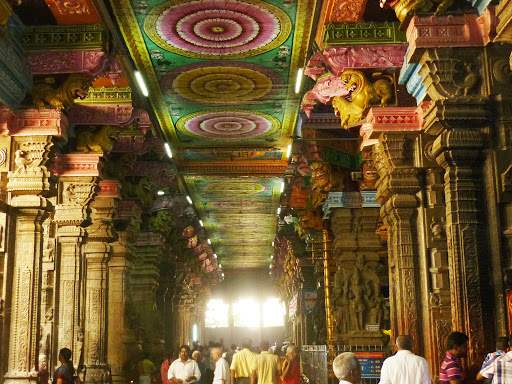
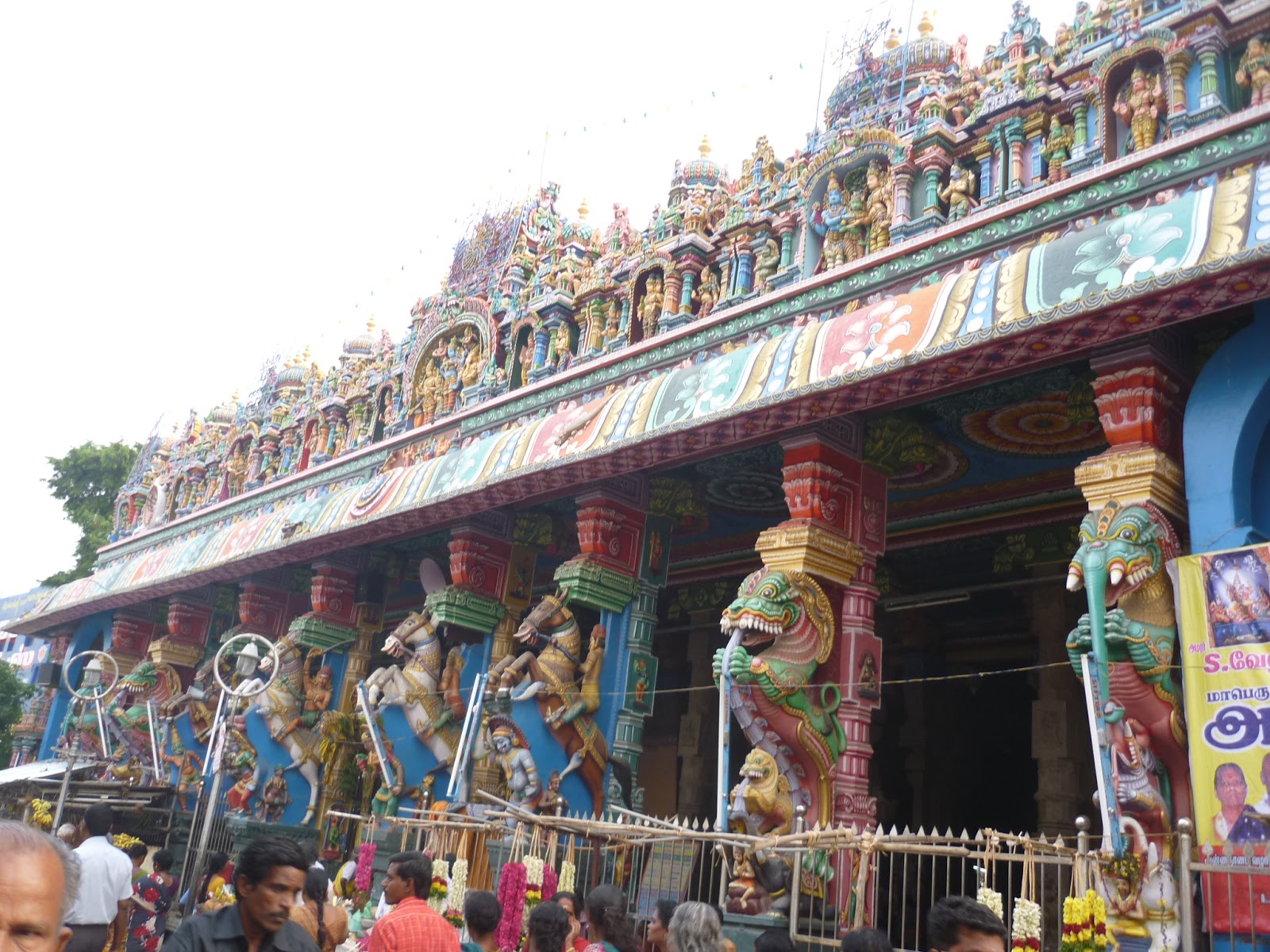
Meenakshi temple: A visit to the abode of the Pandya architecture. The entire temple complex is fortified and has 4 entrance towers, one on each of the 4 directions. The sculptures on each of these towers are out of the world. Once inside the complex, I started to wonder which world of wonder I had stepped into. It took us more than 4 hours to finish only a quick walk around inside the temple and also get the darshan of Meenakshi Amman and Lord Sundareswaran.
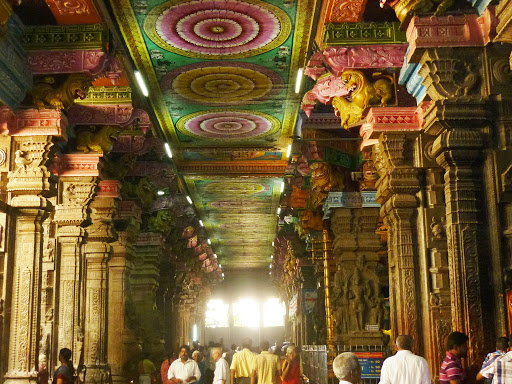
The finely decorated interiors of the Meenakshi Temple
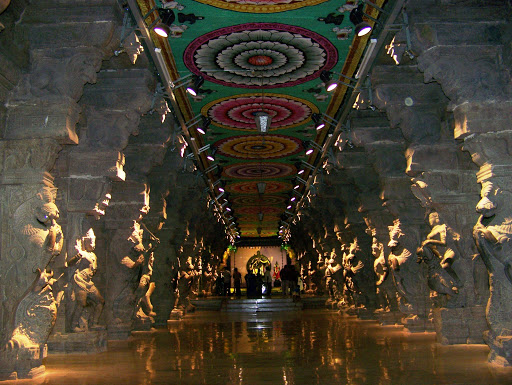
There are a lot of stalls inside the complex selling various handcrafted articles. The temple art museum within the same premises is a must visit. The central sculpture of Natarajan, or the dancing form of Shiva is believed to be one of the Pancha Sabha of the lord. This place represents the silver hall and Shiva is believed to have performed the ‘Sandhya Thandava’ dance form here (More on the Pancha Sabha Kshetras in another post). Also, there are 1000 pillars, all decorated with intricate pieces of sculpture. The dim light used for each pillar added up to the beauty of the place. The Madurai paintings adorning the walls of the temple requires another post to talk about. I go speechless when I get to explain about the South Indian temples. They are beyond words. Internet has plenty to feed and I don’t want to get into the details. After a tour of this massive temple complex, we decided to head out to explore the city beyond the Meenakshi Kovil.
Inside the Temple art museum
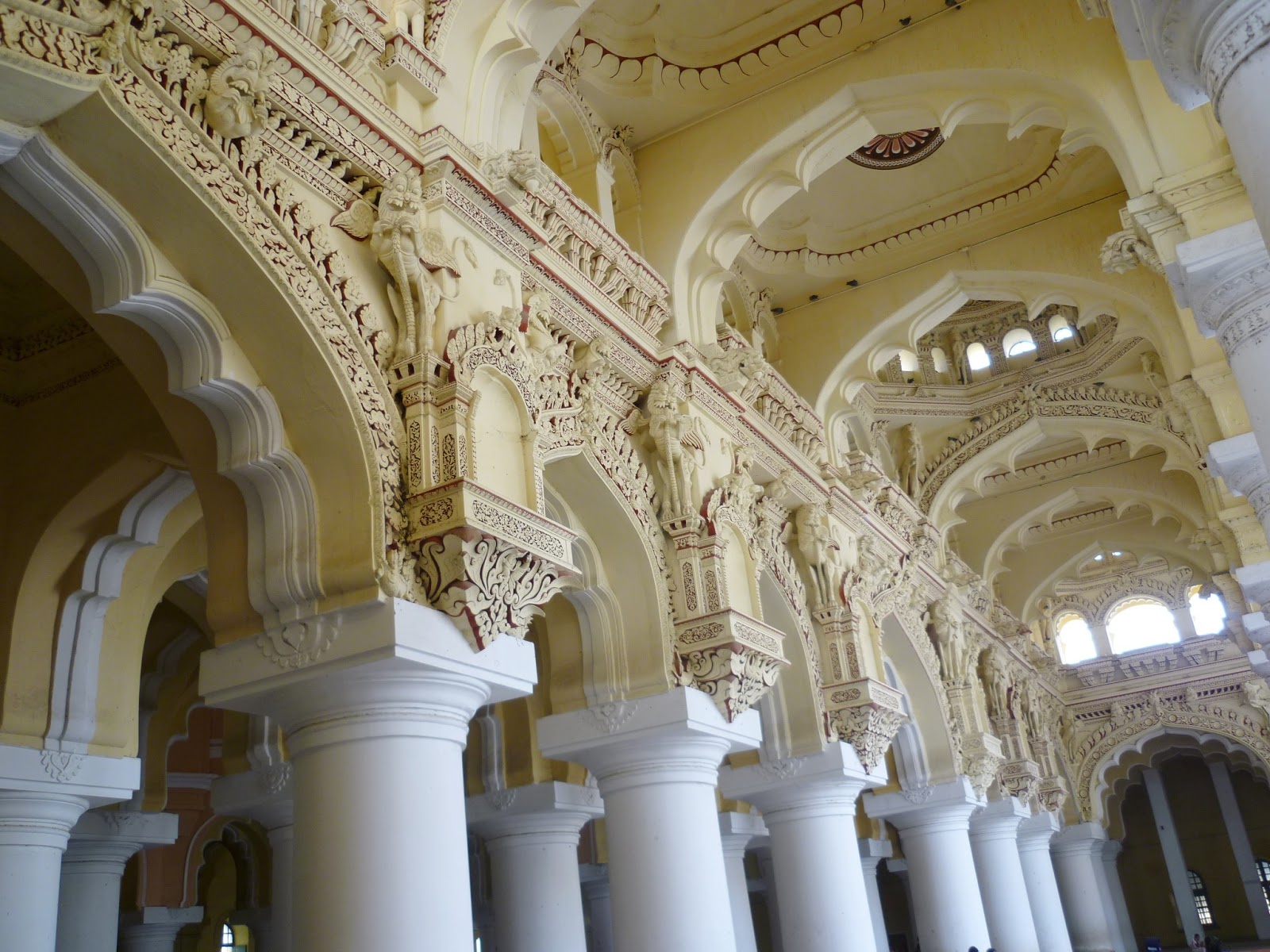
2. A small walk through the narrow lanes took us to the Thirumalai Nayaka Mahal built in the 16th century. Fine architecture with elegant paintings on the roofs and vaults is neatly presented in a simple combination of half-white and velvet red colors. There is sound and lights show conducted here every evening. However, we could not make it.
The interiors of Thirumalai Naickar Mahal
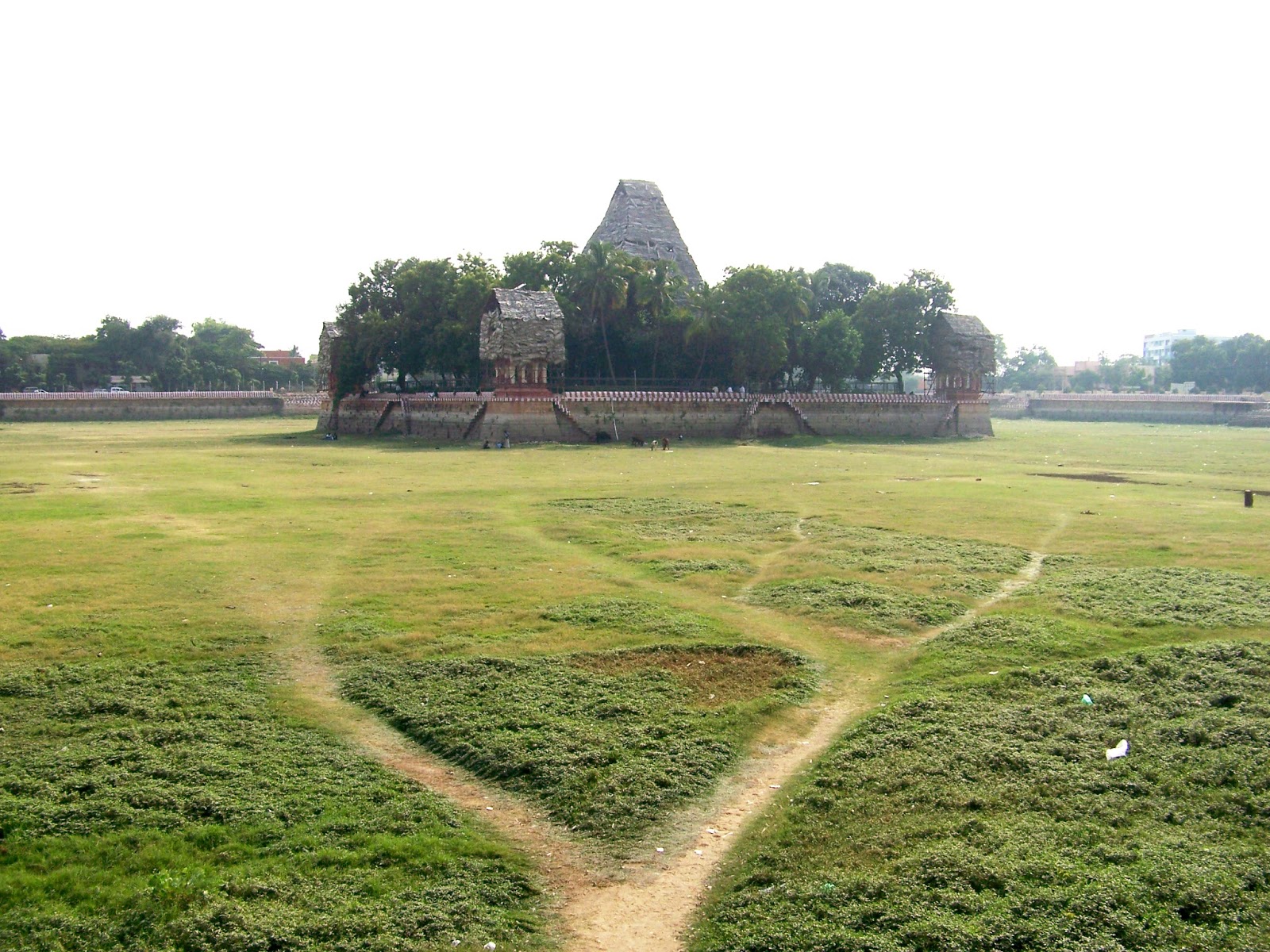
3. From there, we took a local bus to Vandiyur. This is where the annual event of the famed Teppotsavam / Float festival takes place to celebrate the birthday of King Thirumalai Nayak in January. This tank is supposedly the biggest of its kind in the state of Tamil Nadu. With the float festival just 2 months away and monsoon season just passing by, this tank still remained dry during our visit. When we enquired with a few locals passing by about how the event was going to be conducted in a dry tank, we were told that the water will be fed in January from the Vaigai river through artificially laid underground channels. This is truly amazing how such a concept was laid way back in the 16th century. But for a newcomer like me, the dried lake was an eye sore as it was used was a watering hole by many vandals at the time of our visit.
Vandiyur Mariamman Teppakulam – the island temple
4. Taking another bus from there to Periyar and a small walk from there through the stinking / dirty by-lanes, we reached the Koodal Alagar temple. A quick pooja and a walk around the temple was a nice boost up. The architecture here too, is similar to that of Meenakshi temple.
5. We had to rush to The Gandhi museum as it would close by 6.00.p.m. However, we could not make it on time. This was once called the Tamakkum palace of Rani Mangammal. Today, the museum supposedly houses 14 articles that were used by Gandhiji, along with his sacred ashes and blood-stained dhotis. Gandhiji is said to have visited the city five times during his lifetime.
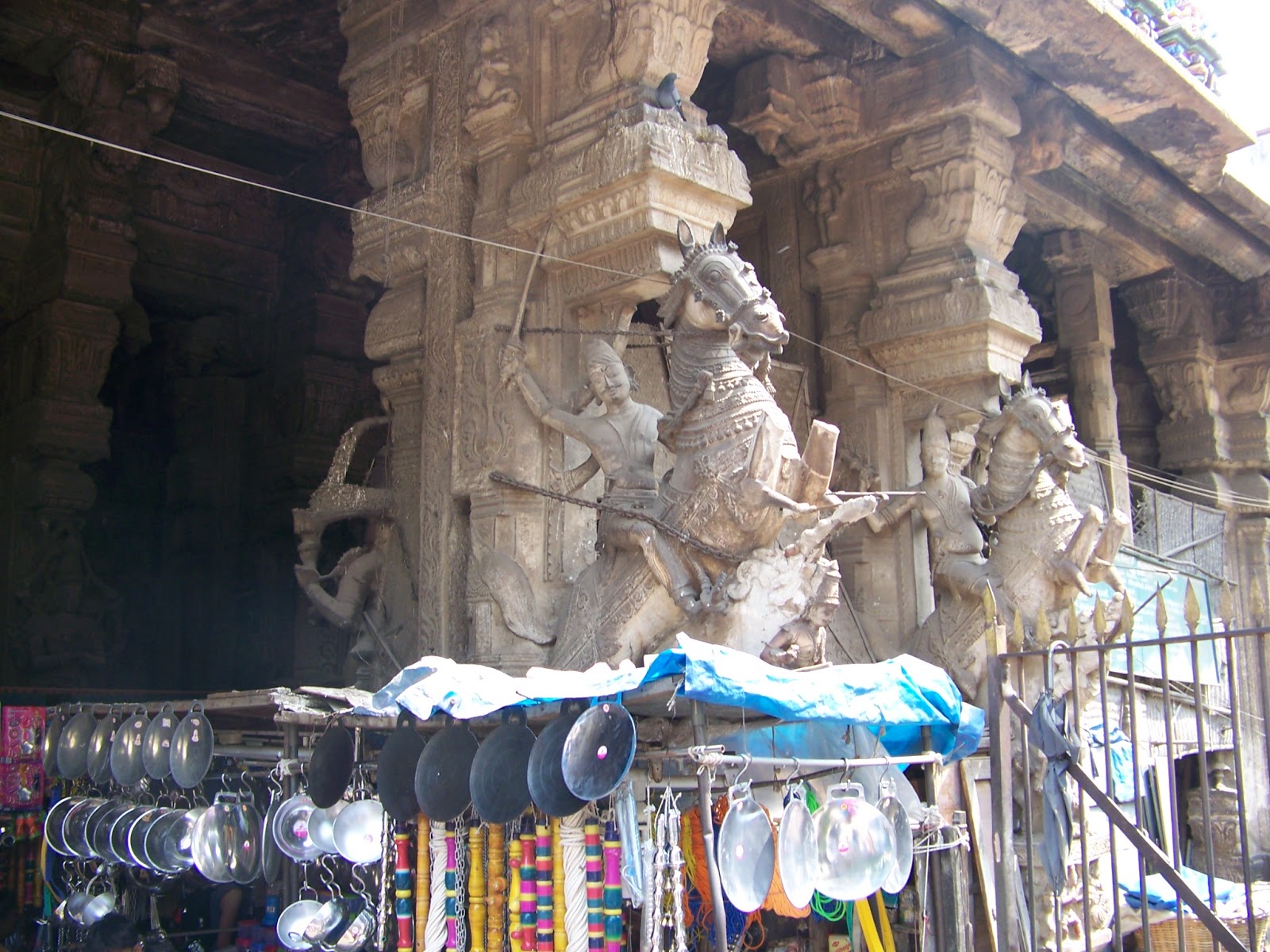
6. On our walk back to our hotel, we came across an old marketplace called as Pudumandapam. This is a 1000 years old shopping mall, supported by huge sculpture rich stone pillars. The stalls are occupied with tailors, handicrafts vendors, wholesale dealers of pooja related and general accessories. A good place for shopping traditional artefacts at Madurai, and that too in a market that is so old!
Entrance of the Pudumandapam
7. On the following morning, we boarded a local bus from Periyar bus stand to travel 21kms towards Alagar Kovil. The temple is dedicated to Lord Vishnu, Meenakshi Amman’s brother. The village is surrounded by an old fort wall, it gives a good view of the green hills around the temple. The architecture is similar to Koodal Alagar temple in the city.
8. A trek of 3kms uphill, through green forests and monkey infested walkways lead us to the Murugan temple. It is one among the six abodes of Lord Murugan and hence important among the pilgrims.
9. A walk of half a kilometer further uphill took us to Pazhamudhir Solai temple. A temple dedicated to Goddess Rakkaya exists close to a natural spring called Nuburagangai here, where devotees take a holy bath. But what seemed strange to me was that the place was probably the only temple I had ever been to, which charges an entry fee into the temple itself. This is where the famed Chittrai festival is observed during the month of April.
10. From there, we took the next bus back to Periyar, from where we had to take another connecting bus to Tiruppanakundram. This was a cave temple at the foothills of a hillock. It is believed that Lord Murugan was wedded to Devyani, daughter of Indra at this place. Hence, this is also counted one among the 6 abodes of Lord Murugan.
Entrance to the Tiruppanakundram Murugan temple
11. Up the hills, is the Dargah of Hazrat Sultan Sikandar Badshah shaheed Radiyallah Ta’al anhu. Owing to time constraint and exhaustion, we thought of skipping the climb.
Other lesser known places we skipped due to time constraints were the Kazimar mosque and Goripalyam Dargah. At the center of the city is the Kattabomman junction. This is where a part of the old Madurai fort exists. Today this is not more than a public library. Further, every street in the city has a history behind it: This link to an article from “The Hindu” don’t do this usually, but would make a special mention about the streets of Madurai. Every street in the city has a history behind it: This link to an article from “The Hindu” explains it all- ‘Where moats made way for motorways‘
This was all about us getting around the place for seeing some of the historically important landmarks around Madurai. But the list is endless and time, very limited ☹ I have covered a few other must-do things while at Madurai in a separate post. I wish to be of some use if you are planning a trip there. (Click here to read further)
I had always wanted to witness this celebration but had been quite apprehensive about facing the wrath of the abuses that would follow with the joy of celebration.. And moreover, this festival happens in the southern part of Kodagu district and I always got to know about the celebration of this festival only after it was over!
But some wild wishes and what one truly seeks, do come true. This time my encounter was unplanned and I’m glad it happened.. I got to witness the unique celebration in Kodagu district, of a festival called “Kunde Namme” a.k.a. Kunde Habba or the “Festival of abuses”.
The tribes belonging to the Jenu-kurubas, Betta-Kurubas, Yeravas, Paniyas, Kembetti and other sects all congregate in a common place- usually a town area to celebrate their festival of abuses and to make merry. By abuse- I mean abuse God, man, machine and everything that they come across on that day. This is a tradition that has passed on through generations among these tribes.
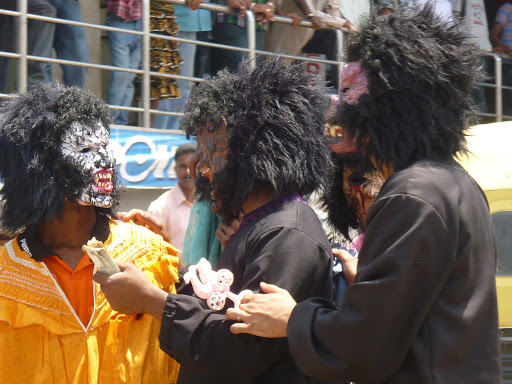
Kunde Namme- The masked men
Legend has it that the main deity Aiyyappa had taken the tribe into a thick jungle for hunting. Deep in the jungle, he fell in love with Bhadrakali and eloped with her leaving his followers abandoned. Since then, the day is observed every year where these tribes abuse their god for betraying them. They find god in everything and every person they come across and hence abuse them in turn.
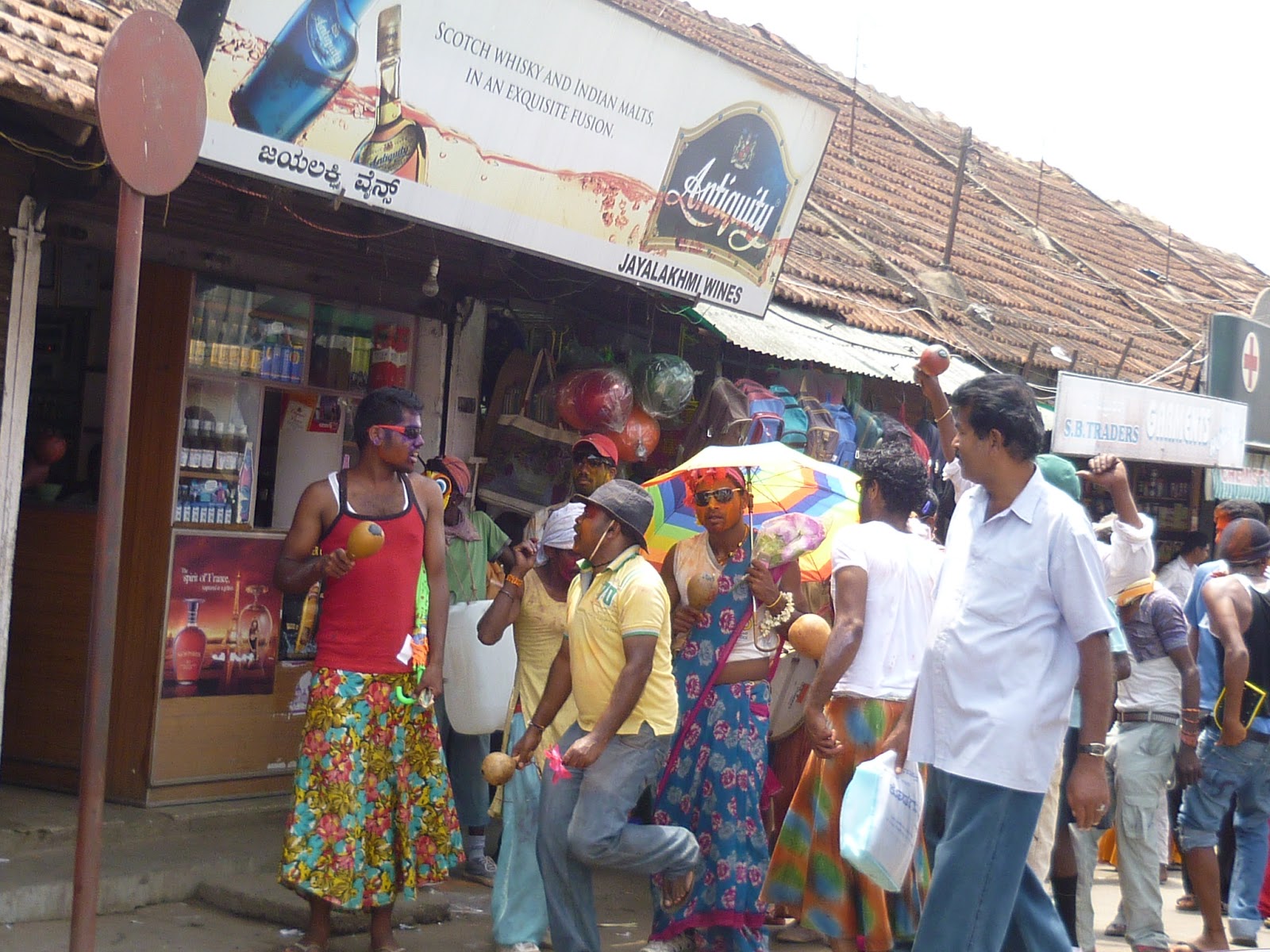
The tribal folk, mostly men are togged in weird clothes. Many take to cross-dressing, some dress like ghosts, some like witches and some dress up in costumes that are just random and as weird as possible.
They block every man(folk who belong to communities outside the above mentioned tribes) on roads, barge into shops in the town and demand money. If their demands are not met, then profound abuses are hurled at them. But one must not assume that they can escape from the wrath of the abuses by simply meeting their demands- they still get abused..!! Remember, no god will come to your rescue on that day as he himself is in being abused 😀
Kunde Namme- Dressed up men all set to charge into a shop
Also, most of the members of this group belong to the labour class who work in estates, domestic helps etc. Hence, the day doubles as a good opportunity for them to vent out all the frustration on their masters..!!
Kunde Namme- The band set guys
But, by the end of the day, they all congregate in their common place of worship and surrender to their god, plead for his mercy and ask for his blessings for the rest of the year. A portion of the total money collected by them on that day is religiously offered to the deity and the remaining is used for a lavish community dinner.
This festival happens on the 4th Thursday in the month of May and is celebrated in and around Gonikoppal considering its proximity to the Nagarhole National Park where most of these tribes are based.














 The Lost Lander