Tag Archives: Road trip

Enraptured on my way- at Sarthal

Talk about beautiful places in India- my mind will take me to this untouched valley in the lower Himalayas tucked away from the maddening frenzy of the tourists in the Kathua district, located in the state of Jammu and Kashmir. Thanks to snowfall in the winters, this region will be cut off from civilization for almost 6months and when the snow disappears, it does not fail to mesmerize every passerby with a different landscape each time.

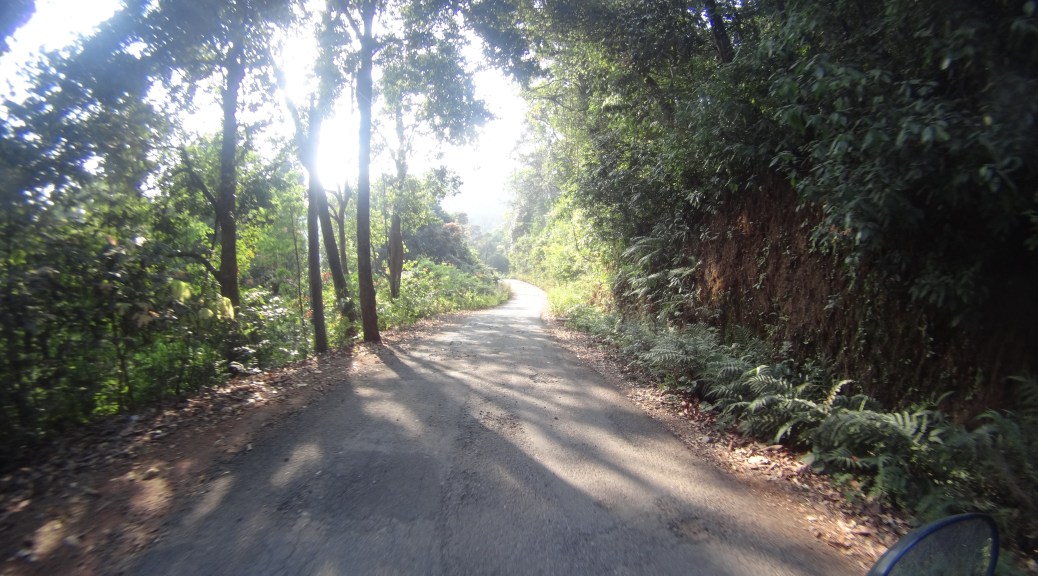
If you have been following me in this journey,  my day started on a rainy morning as a part of the Himalayan expedition from Basohli (Click here to read the complete story) towards Sarthal. In a bid to keep myself warm (like duh!!) I opted a seat in the comfort of the tempo-traveler over a pillion seat of a bike. Although I regretted my choice later, I had my share of fun getting to stop the vehicle almost everywhere and capture the beauty of the landscape all along. The consistent rains over the past couple of days had brought in greenery for as long as the eyes could see. With winding roads, I was accompanied by the tributary of river Ravi on one side and vibrant hills on the other for most part of the road. There was even a magnificent stretch of the dam backwaters and dotting waterfalls by the roadside that added their charm to the beautiful landscape. We stopped over at one of the small rivulets where we relished the packed lunch we had carried for ourselves. The drive along the curvaceous roads almost until the town of Bani is definitely a delight for every passionate rider. Bani is the last major town one arrives until the next destination on this stretch where we all stopped by for a cup of tea. The roads beyond Bani gets a little treacherous with poor roads, deep valley and possible landslides. I remember how we had missed a landslide by a whisker!! But, the beauty of the mountains did not let us down even a bit and continued to fascinate us all the way. It was dark by the time we arrived at the ‘Tourist Reception Centre’ where we were hosted by the Jammu tourism for the night’s stay. Comfortable tents were pitched in with bon-fire to keep us warm through a cold night under a clear starry night’s sky that I had been longing for a long time…

Enroute to Bani from Basohli

When I came out of my tent at the break of dawn- I was blown away with the beauty of the place. Our camp site was surrounded by the beautiful mountain on all sides which we barely knew of while sleeping through the freezing night! The tranquil atmosphere was filled with fragrant air that carried perfumes of wildflowers from the distant mountains. While the other fellow travelers seemed to be snoring still, I decided to venture out to explore the place on my own… After a small stroll amidst the livestock including buffaloes, sheep, goats, horses, donkeys etc. outside the camp, I was warmly greeted by a Gujjar family for a cup of ‘Desi Chai’ with them. The life of these Bakarwals (the shepherd community) was a good motivation for the nomad in me. They are continuously on the move with their makeshift tents who earn their livelihood purely through diary and wool. Meanwhile, I was joined by my brothers who then decided to walk further towards the Gujjar settlements on the slopes. The beautiful setting with rock-laden plains, flat-roofed clay/rock houses, the sturdy wooden bridges across the murmuring stream hoaxed us to get into its ice-cold water. It was a wonderful morning!!

Livestock at Sarthal

We then decided to rush on the bikes to soak in the views of the Lawang valley that we had missed out on the previous evening, since we had travelled after sunset. For the pious ones, there are several temples around the valley that can be done by foot all of which have Chandi mata as the presiding deity. We were looking out for an adventurous trail. We were fascinated by the beauty of the seven waterfalls at around 3kms behind our campsite. The stream that probably originates from the molten glaciers, gushed down in seven tiers making it a surreal place. We wished we had more time with us to hike down the valley and spend a couple of peaceful hours by the water, alas! A quick breakfast post this short ride and we had to pack-up for the road ahead towards Baderwah… Since, the TT I was travelling in was the backup vehicle, we had to drive behind the last rider… So when a rider stayed back with more than 10 punctures in a single tyre, it meant that we had over 2 hours of time to kill… Meanwhile, I hiked up a small hillock from where I got a good view of the Gujjar valley below… Along with a couple of unicorns that had strayed down from nowhere, the local flora was another thing that caught my attention up there!! After spending a couple of peaceful hours, the silence of the atmosphere was broken by the roaring beasts (bikes) that hinted us to get ready to continue our onward journey…

The Gujjar settlements at the Sarthal valley

The roads that we traversed ahead came as a stunner… The drive through the loose gravel laid roads flanked by tall pine trees, snaking through virgin hills which was abundantly blessed with wild flowers of different colours seemed nothing less than traveling in a fairyland. I enjoyed every bit of this road all the way up to Chattargala top, the highest point in this area. We shared a cup of tea and a nice conversation with the soldiers of the Indian army posted up there. Bidding a warm goodbye to them, I then hopped on to the pillion seat of brother’s bike and got set to pull down the valley to our next destination- Baderwah!

Summary:

Must do:
• Spot a white vulture at the Chattargala top. These birds are critically endangered.
• Participate in the 3-day Bani festival and enjoy the Shinj- the wrestling competition.
Must have:
Sip on a cup of piping hot ‘Desi Chai’, a pink coloured drink prepared with tea twigs boiled in sheep milk. It can be consumed either with salt or sugar.

This post is written in collaboration with Jammu Tourism, the tour was a part of ‘The peace ride’ to explore lesser known places in Jammu. The route we covered over the week was Jammu-Mansar-Basholi–Sarthal–Baderwah-Kishtwar-Gulabgarh-Sansari-Gulabgarh-Patnitop-Udhampur-Jammu.

A biking expedition in the Himalayas

When my name was included in the list, I had a bag of mixed feelings. I was glad to have got an all sponsored trip to one of the least explored parts of the country. But at the same time, I had my apprehensions about being a part of an organized trip. I was excited to travel on one of the deadliest roads in the world and then the fear of being a misfit as a pillion among what was supposed to be a biking event with professional riders from across the country kept flashing frequent thoughts of pulling-out of the event! And finally the evening arrived, where we had to start our journey towards Jammu Tawi- The start-point of all the action filled seven-memorable days of my life!!!

No one knew the other fellow rider at the start, but during the course of time- each one ensured they stopped, waited and helped the next one in times of need. Reaching the destination on time did not matter to anyone; they would halt and wait when the rider behind went out of sight in the rear view mirrors. Whether it was running to lift up a rider who slipped on the slush pool or to push one up the steep valley roads when the machine refused to move… whether it was picking up a fallen silencer of a rider who has gone way ahead without noticing or going back to get tools from the back-up vehicle to fix a broken bike.. Whether it was escorting a rider whose headlamps and brakes had given way while riding at night on the treacherous Paddar Valley or towing a halted biker all the way on a militant infested highway… And then, on the last day when I had a miraculous escape from death while trying to avoid overriding on a biker who slipped off-his-course, the entire battalion of riders had stopped by to check on my sprained leg! No fights, no misunderstandings, no quarrels- It ain’t a common thing while you are traveling with a group of over 80 riders from across India who were all strangers. But, they were all united and stood by each other at every turn (literally!!) of life during these 7 days…

Doctors, scientists, engineers, lawyers, were all just educational qualifications. While some made it after a nasty tiff with their bosses, yet a few had quit jobs to do this trip. While some rode to satiate their hunger for travel, some rode to earn livelihood for their towns through promotion of tourism. While some came to make few quick bucks with their photos and videos, yet a few came to love the mountains… Yet, a few rode to spread the good word of beautiful landscapes, safety to travelers and cultural wealth of their hometown which otherwise is perceived with horror and poverty. Every rider had a purpose to travel and a story to tell that’s associated with this trip. Irrespective of the geographical, cultural and educational differences- Travelling was the common religion and riding was the only God… No one big, no one small. No one to judge who you are… For a person that I am who otherwise likes to go slow, walk and take in things and places at my own pace- riding only meant whizzing past things with speed… What I realized during these 7 days is that there lies a whole new perspective to life out there- Biking binds people like brothers… Cheers to all the wonderful friends I made here, who helped me to create truck loads of wonderful memories that I can cherish for several years to come…

The route we covered over the week was Jammu-Mansar-BasholiSarthalBaderwah-Kishtwar-Gulabgarh-Sansari-Gulabgarh-Patnitop-Udhampur-Jammu. It was a complete package with picturesque landscapes accompanied with art, history, culture, religion, natural resources, adventure, offbeat traveling. It had something for every kind of traveler. I strongly recommend this trip for every person who wants to travel but do not like going to the commercialized and overly crowded places that are so done and dusted. This stretch is a must-do once in a lifetime thing!

I will be posting details of each day and each place that I visited in separate posts in days to come. Do subscribe and get updates 🙂

This trip was a part of ‘The Peace ride’ to explore the lesser known places in Jammu and was sponsored by Jammu tourism.

Tracking the Big Five at Kaziranga

The monsoon has caused the mighty Brahmaputra to take a toll on the North-eastern part of India causing innumerable and irreplaceable losses. I saw this one particular photo of a floating carcass of the striped beast, the National animal of India in the newspaper this morning and I was taken back in time when I visited Kaziranga last year, post monsoon.

This post is part of my fortnight long road trip across North-east India, specifically covering parts of Meghalaya – Assam – Arunachal Pradesh I had tagged along with two other travelers and drove around the places in a self-drive car hired at Guwahati. Our visit to Kaziranga had just one agenda, a safari in the Kaziranga National park and get a glimpse of at least one rhinocerous! Kazhiranga National Park is counted in the list of UNESCO’s world Heritage sites.

My Itinerary:

Day 1: Evening drive from Guwahati to Kaziranga (Kohora forest range)
Day 2: Early morning elephant safari & jeep safari in Kaziranga national park, Orchid research centre. Continue the journey onward to Jorhat.

The Details:

After a wonderful drive through the National highway from Guwahati, we reached Kaziranga on a night lit with Diwali lamps all around. Kaziranga national park is divided into four main areas: The Central range at Kohora, Western range at Bagori, Eastern range at Agaratoli and the Burapahar range at Ghorakhati. Here, the tourists can enjoy the elephant and jeep rides into the forest that are organized by either government or private parties. The park is closed during monsoon and we were lucky that the central zone at Kohora had opened just around our visit time. We had a nice meal and settled down at one of the numerous resorts that exist on the boundary of the National park in the Kohora range. Meanwhile, our resort guys helped us to get tickets for a safari ride scheduled for early next morning.

We woke up the next morning and headed towards the forest gates where the elephant ride was supposed to commence. The drive from the resort until the forest gate was so refreshing in itself. With the addictive smell of wet ground, kaccha roads passing through green paddy fields dotted with bamboo huts here and there, thick mist slowly clearing up with dew drops reflecting the rising sun: It was just wonderful all the way.

P1140268
Enroute to the forest gates

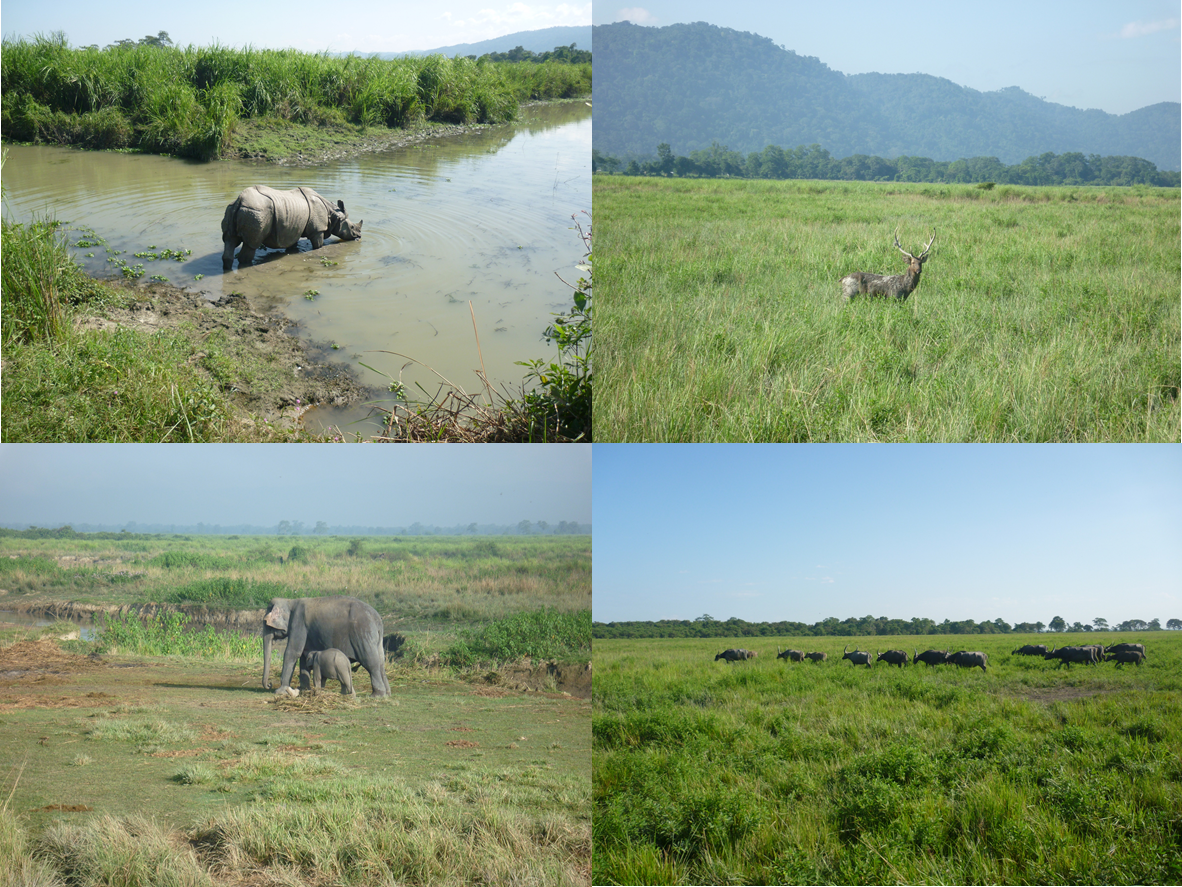
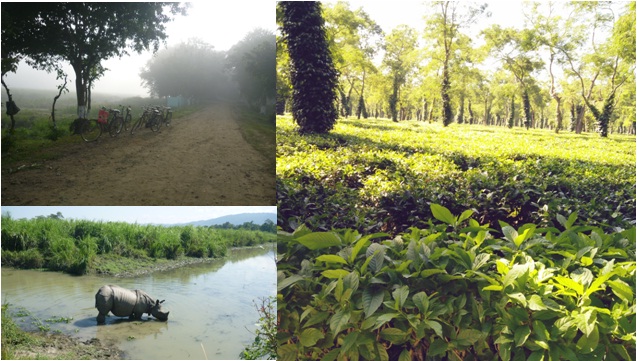
Kaziranga is synonymous with the one-horned rhinoceros. With about 2/3rd of the world’s population of these beauties found in just this area, it was no surprise that we began to spot them one after the other. Even before we started our ride, we spotted rhino families all around the watch tower we were standing at. We even found a few of them grazing in the fields on the sides of the highway. With that we realized, that Kaziranga was beyond rhinos. There are some other wild animals that are exclusive to the park and are collectively called as the ‘Big Five’, a must on the list of every wildlife enthusiast visiting the state of Assam.

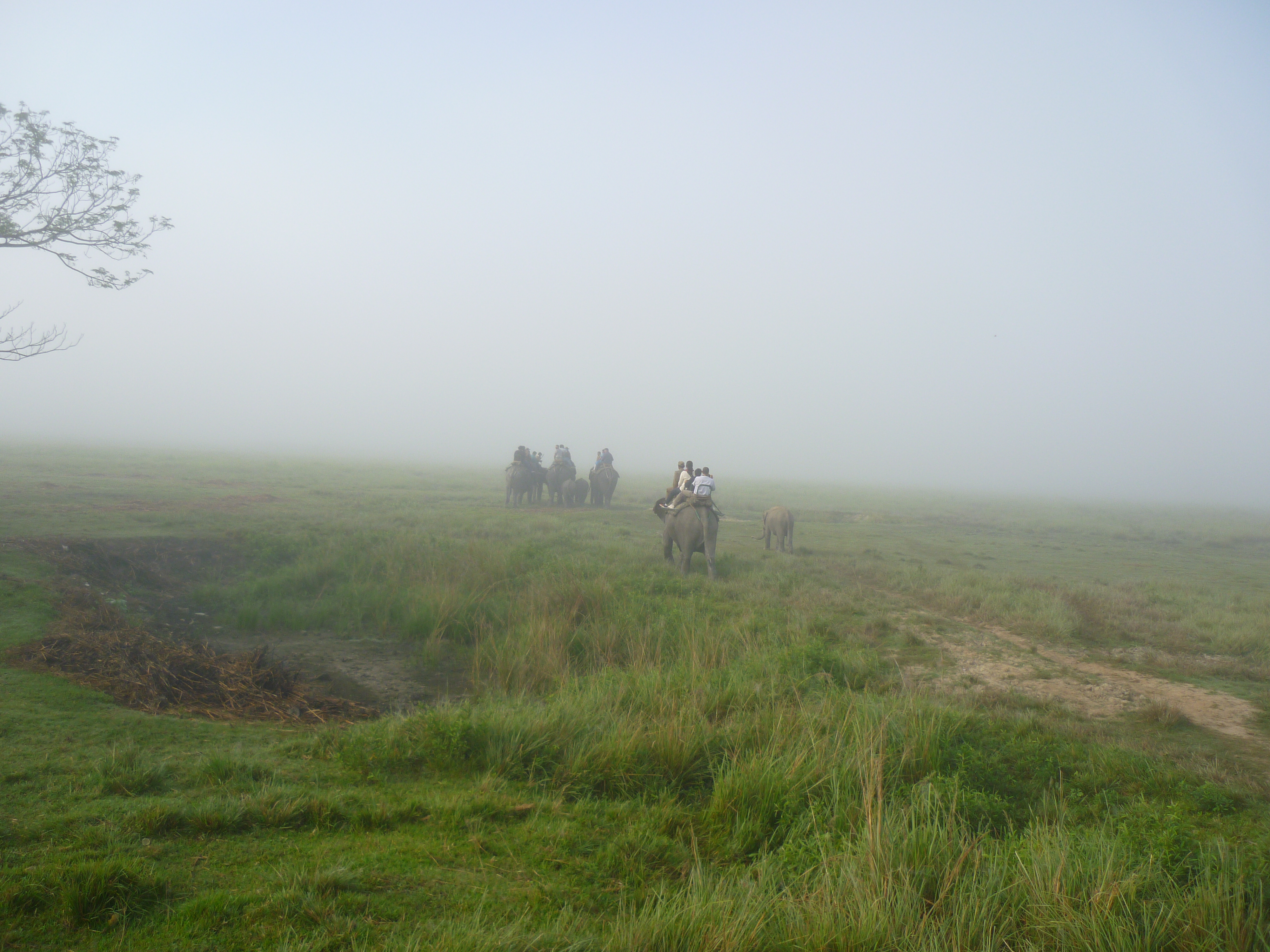
Our elephant had arrived in a bit. We sat atop and started our ride into the haze of the misty green grasslands of Kazhiranga to track the ‘Big Five’ of the this land. The elephants that we were seated on, were walking through dense thickets of elephant grass: the grass that was taller even for elephants to walk through. Slowly, the mahout started to point out and show us the animal at far distance.

P1140264
The elephants marching into the forest

First, it was a wild elephant with its calf. We were told that rhino and elephant conflicts were common and that mother elephant was wounded just that morning in a bid to protect its new born calf. So, that meant we were not safe sitting on one either! We slowly moved out of tall grass to another area where a couple of rhinos were finishing their morning chores. It was very surprising for us to know that large rhino groups identify space where each rhino marks its own spot (making a private toilet space for itself) and does not let any other rhino enter the area.

Wow! We slowly passed that place and spotted herds of swamp deer. World’s largest population of these herbivores too is concentrated in these forests. Swamp deer are handsome animals.

Just as we were photographing them, we saw a herd of Asiatic wild water buffaloes marching out of a slush pool. Until our guide told us, we had no idea that over 57% of the world’s water buffaloes too were accommodated in the woods here!

Kazhiranga
Clockwise: The Single horned Rhino, Swamp deer, Wild water buffaloes and the Asiatic elephants

Another surprise information awaited us: Kazhiranga national park has the highest density of the Royal Bengal tigers in the world!!! Whoa!!!! That’s like……..something that was unknown to me, a person who hails from the land of Nagarhole, Bandipur & Bannerghatta. But as always, no luck with spotting the elusive beast. Seeing a tiger in the wild is a LONG dream, awaiting to be realised. (So much adventure to see a wild tiger, Click here to read more!)

So, we had checked off 4 out of the big 5 of the Kazhiranga before heading towards the exit gates- The One horned rhinos, Asiatic elephants, swamp deer and wild water buffaloes. Meanwhile, we realized that we still had time to make it for the morning batch of jeep ride. So, after enquiry and booking at the counter, we had a gypsy to take us into the forest again. Needless to mention, we were greeted by herds and herds of rhinos all along our path. Wild boars, barking deer etc. too were spotted in abundance. The highlight was however, the innumerable species of migratory birds that were spotted. Our driver cum guide mentioned several bird names, out of which only pelicans and spoon-billed storks were the ones that I have managed to remember.

On the other end of our drive into the forest, we were taken to a watch tower from where we could catch a very good view of hundreds of animals that had come to drink water from the flowing river. It was a very calm and a serene place to spend a while with nature. What caught our curiosity was some random years mentioned on the wall of the watch tower. So, here is a picture that may give an idea of the monsoon fury and severity of floods that affect this area year after year.

The tower itself is located at an elevation from the river. My friend in the below picture is a 6-footer. The water level of 2016 is marked above him… Can you imagine how impossible it is for the animals to escape out of the area??? It’s insane to think of and the image of the floating tiger’s carcass hovers around in my thoughts.

P1140350
Record of the flood water level of the Bramhaputra

The drive back to the resort, on the highway was an extremely nice one which had gone unnoticed during the hurried drive through misty roads in the morning. Tea plantations flanked the roads on both sides. The famous Assam tea grows in flat lands and under shade, totally contrary to what I had seen and grown up seeing in the hills in down South. We stopped by to sip on some hot brew and bought some processed tea leaves for our caffeine addicts back home. A quick visit to the Orchid research centre was an interesting place to drop by too.

P1140352
The Assam tea estate

Overall, our day was eventful at Kazhiranga with warm memories from the woods before heading to our next destination- Jorhat. Although a little disappointed for not being able to spot a tiger by the end of our safari ride, we were feeling content for having our long pending wish of visiting this heritage site come true!

Concluding remarks: For those of you planning to visit Kaziranga, I strongly recommend to try both ways of exploring the woods, on elephant back and by a four-wheel drive. Both are different experiences and the type of terrain and sightings are different. While an elephant will be able to take you through the tall grass, a 4-wheel automobile will be able to enter deeper areas of the forest. If you wish to spend more time with nature, I recommend you all to explore all the 4 ranges of the national park. Don’t go by recommendations of people of which range to go in… Each area is distinct with different types of vegetation, landscape, flora and fauna concentrations.

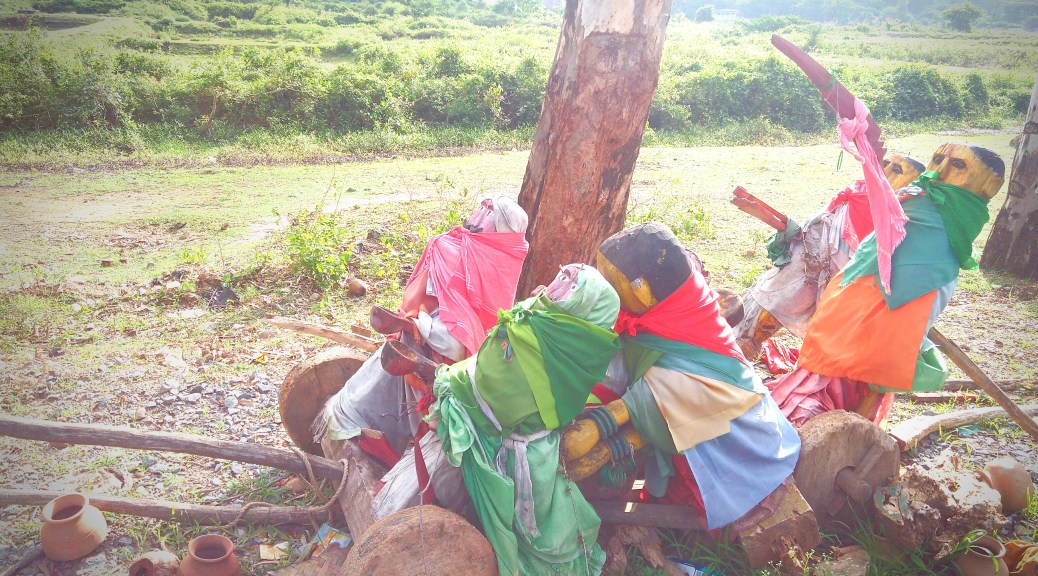
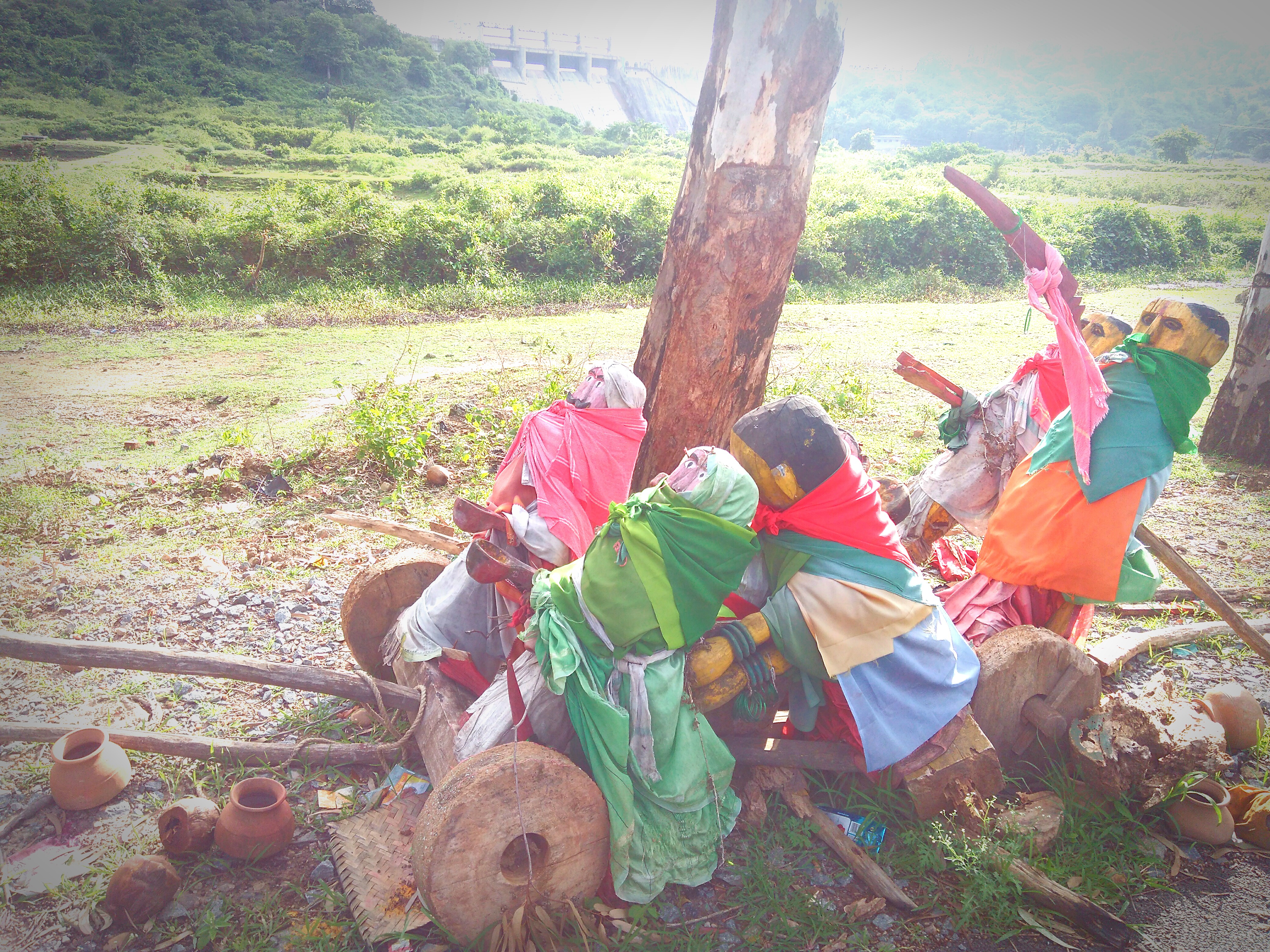
A festival for protection of the borders- Chowdi

While on a random drive around the Malenadu region, my curious eyes fell on a family of road-trippers who were out on a rather interesting journey.. It was an unusual sighting of wooden toys with a beautiful backdrop of the Bhadra dam in the backdrop.. I got off the car to click a few pictures of wooden toys consisting of six people riding on a pull cart.. I did not know what it represented and who had left them.. We continued our journey all the way from Bhadravathi to down the hills of Agumbe via Shimoga while spotting several carts carrying different representations, all lying on roadside. My curiosity grew intense and got an insight into what all of these really meant after consulting a friend who happens to be a native of this region.

This is a part of Chowdi- a festival endemic to this region of Malenaadu. Maari is the sister of goddess Durga, she’s the controller of evils. She likes drinking blood and doesn’t spare any evil passing her way. Gadi Maari- the protector of the borders, keeps a vigil on evil entering into the village. During Chowdi, Gadi Maari who is always stationed at the village border is invited into the village and celebrated once in a year. She is represented with a wooden pull cart.

The cart and all other representations on it are made of a special wood called ‘Ghost wood’, painted and decked up. As the cart enters a boundary, the villagers start to collect money from all localites to manage the expenses of the festivities ahead. Animal sacrifice is an important part of this ritual where blood of either sheep or  roosters is offered to Maari, the village keeper. All possible things are taken care of to keep this violent diety calm and happy. It culminates in a lavish dinner served to all villagers. This is a rather rude way of telling let the evil eyes (Maari Kannu) not fall on the happiness of the village, we have made Maari happy with all that she likes during the festival, now her job is to guard the boundaries, let her stay there!

IMG_20170627_131044
A Gadi Maari cart by the roadside

Then, the cart is hand-pulled and left at the exit boundary of the village i.e. entrance of the next village. There-on the festival starts at the next village and the cart thus moves forward from one village to the other. The transport of these carts to the next village is mostly done during the night so that the evil doesn’t find its way back into the village. People leave broomsticks, clay pots, umbrellas etc. alongside the cart as weapons of Maari. This trip of the Maari thus traverses all the way from the hills down to finally reach the ocean. This entire cycle repeats in every two years.

So with one cart starting in each village, I wondered how many carts may pass through any given village throughout the 2 years period and how many animal sacrifices need to be done. I was told that some villages may have several carts at a time and some may never have any. For convenience, yet some villages accumulate the carts and celebrate all at once. Spread across the calendar, carts keep coming and carts keep going.. But it’s an opportunity for the entire village for some joyous celebration together!

The home of the Indian National Emblem- Saranath

This visit to Saranath is a part of my fortnight long backpacking in the typical pilgrimage circuit of Uttar Pradesh covering Lucknow- Ayodhya- Faizabad- Varanasi- Saranath- Allahabad- Agra- Mathura-Brindavan- Fathehpur Sikri– Delhi

This article was featured in Toyota’s in-house magazine ‘Carz’ Apr~Jun’18 edition

The Details:

Back then, I had read history for the heck of passing the subject and today here I am… Travelling to know more about the rich history soaked heritage of my country… And in the pursuit, my friend and I stumbled upon this little forgotten land from the pages of history- Saranath. It was as if the history textbooks of primary school were walking alive with us… Saranath is an important destination both religiously and historically. So, people of varied interests can be found strolling the streets of Saranath. When we alighted, a volunteer offered to take us for a guided tour around the place and we nodded a yes! A couple of visitors from different countries joined us seeking me to be their translator while the Hindi speaking guide took us around. So I was doubling as a curious traveler and a travel guide cum translator.

Firstly, Saranath is the place where Lord Buddha delivered his first sermon to the five disciples after attaining enlightenment. Hence, a very important place religiously for the Buddhists. Today, the Chaukhandi Stupa, an octagonal structure made of brick and mortar stands at the very same place welcoming the visitors to this town. It was originally built in the Gupta era and later renovated during the Mughal rule.

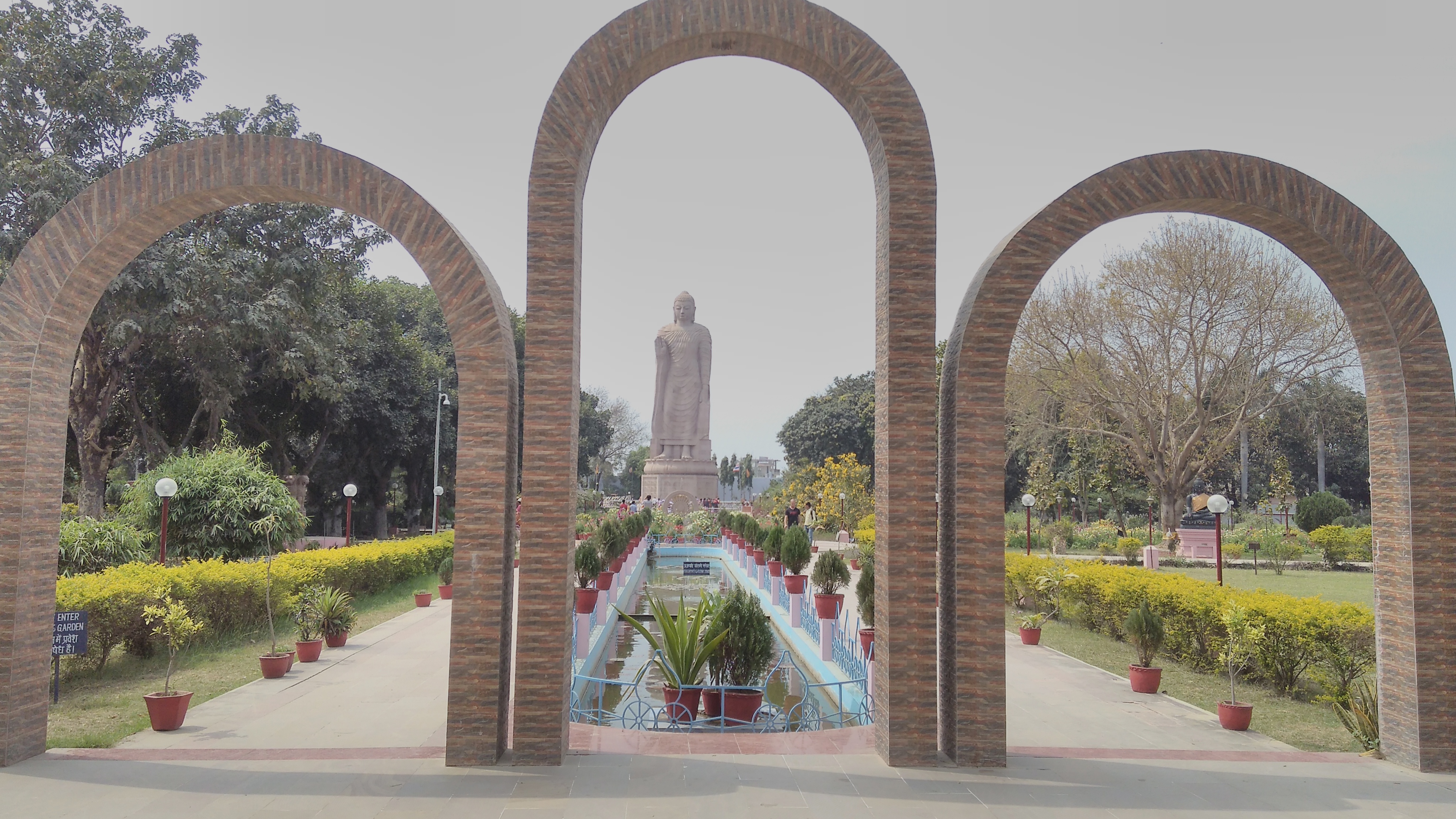
As I explored the place, I realized that people from different countries have made their presence with Buddha temples built in their native styles of architecture. The Nepali, Thai, Chinese, Japanese, Tibetan, Bhutanese etc. to name a few. While each temple style is unique and beautiful, you realize that the statue of Lord Buddha too is different in each of them. Buddha is worshipped in different forms in different countries… Seated Buddha, sleeping Buddha, standing Buddha, meditating Buddha ET all… The murals inside the Japanese temple grabbed my attention… I was told that the complete interiors is made of sandalwood… The idol, palanquin, the doors and even the chandeliers!

A small walk from there, is ‘Mulagandha Kuti Vihar’, the Nepali temple. What makes this place special is the third generation peepal tree adjacent to its premises. Fondly called as the grandson of the Bodhi tree, it is grown from a twig of a peepal tree believed to be the son of the original Bodhi tree that exists in Sri Lanka. With prayer chants and smell of incense in the air, it is truly a place of calm and solitude. We were quick to pick a few leaves of this holy tree as a souvenir from this little place.

IMG_20170309_121021
The Thai temple

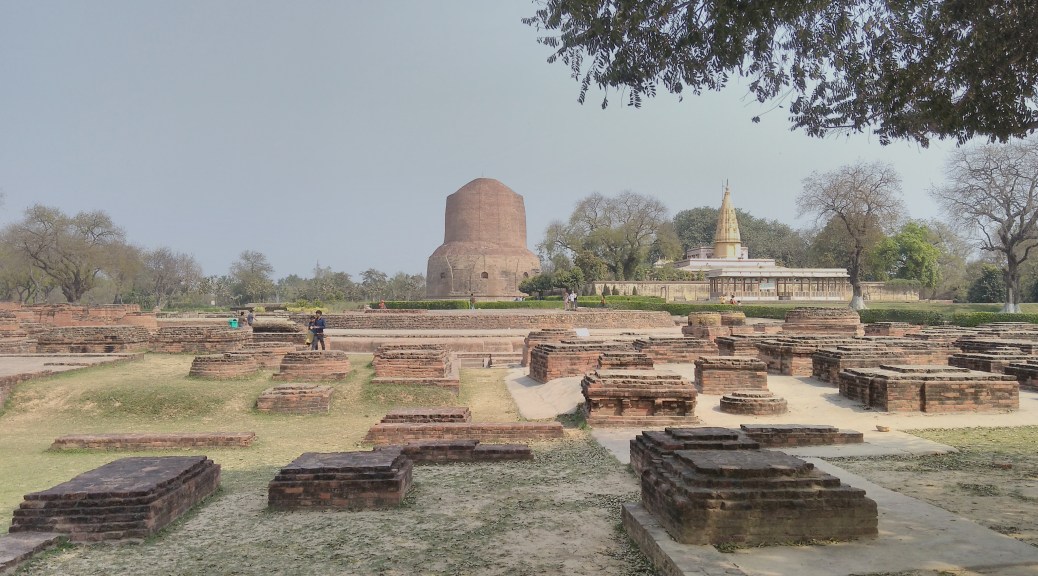
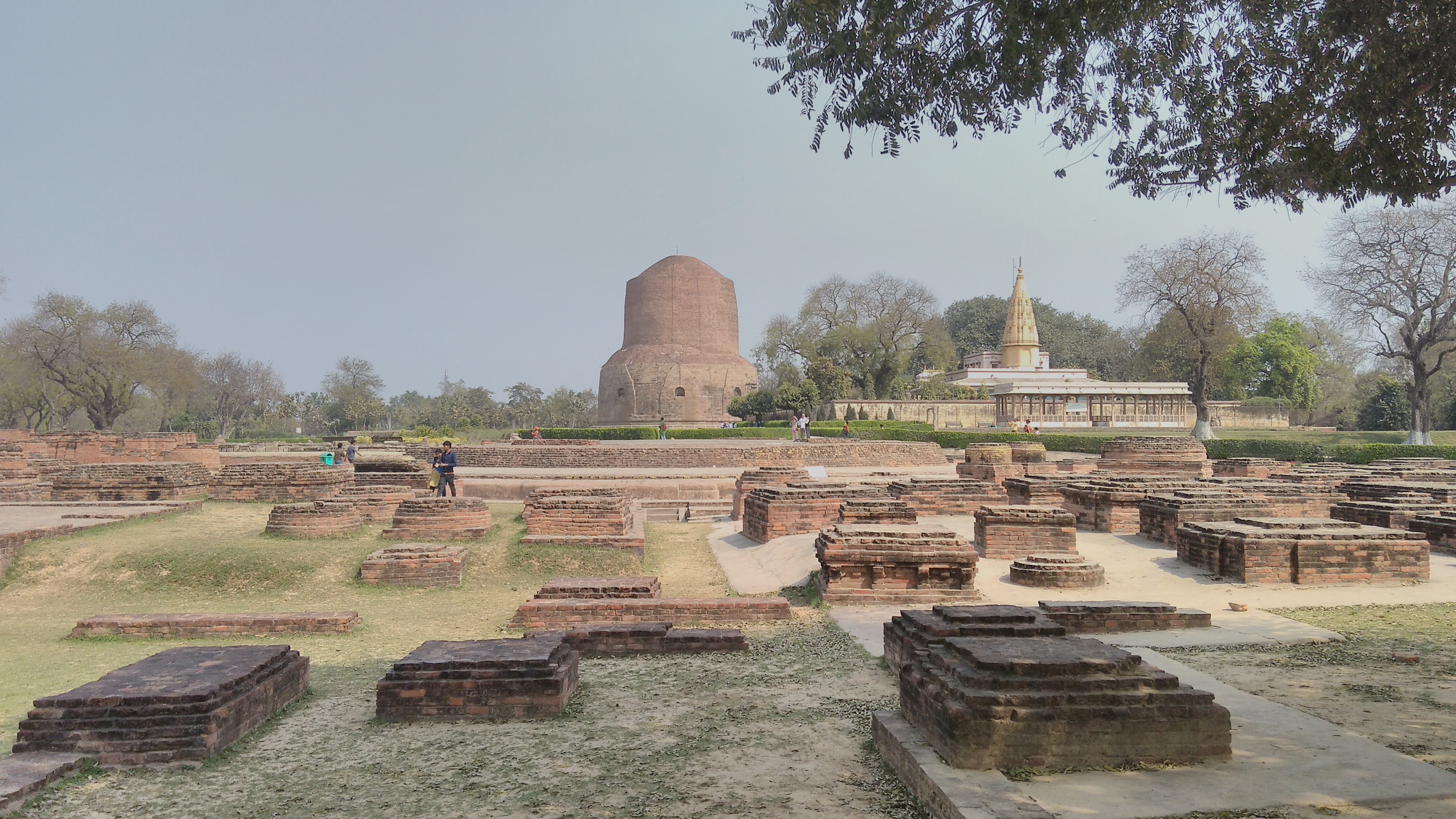
Next, it was some history time! We bought an entry ticket at the ASI counter to take a stroll around the ruins surrounding the Dhammek stupa. It is believed that the Mauryan emperor Ashoka had built small clay mounds at ten places where the ashes, the urn and the embers of Lord Buddha were buried which were eventually refurbished as large stupas by the different rulers in the course of history. Dhammek stupa is believed to be one among these ten stupas and hence, a very important one for the Buddhist pilgrims who throng here from across the globe. And that very place where the Indian National emblem was born! The pillar on which the four headed lion is seated was commissioned by emperor Ashoka to commemorate his visit to Saranath. The broken part of the pillar was found during the excavations of this site and later transferred to the ASI museum in Saranath. Today, the bottom portion of the pillar surrounded by four posts holding a stone slab are the things remaining from the original relics at the exact same spot. One way it is nice that nobody has tried to restore this pillar back as the easy accessibility to it would have got the emblem all over the internet with the insensitive photo/selfie-enthusiastic tourists.

IMG_20170309_135651
The site of Ashoka pillar with the Dhammek Stupa in the backdrop

A visit to Saranath would definitely be incomplete without getting a glimpse of the ORIGINAL National emblem of India. We deposited our valuables including cameras and cellphones in lockers provided along with the entry ticket to the ASI museum and headed to THE place. A chill ran down my spine on being greeted by this majestic sandstone structure bearing the lion capital, the original form of our National emblem. The four headed Asiatic Lion is seated on a lotus- The national flower of India. Our guide narrated the religious relevance of the emblem in Buddha’s life. The lion represents Buddha himself who stressed upon equality and justice in all spheres of life (all 4 directions). While Gautama was in his mother’s womb- she had a dream of a white elephant entering her womb representing prosperity. The bull represents the young prince Siddhartha’s strength, the horse depicts Siddhartha’s renouncing his royal life and Lion is the depiction of Siddhartha’s transformation into Buddha. When Baby Siddhartha learnt to walk, a lotus bloomed under his feet after the first seven steps and the lotus is said to have faded at the passing away of the Lord- Hence, the inverted lotus. The Ashoka wheel is called the Dharma Chakra, representing the movement of life with 24 spokes- each for the hours of a day… It is true to admit that the national emblem evoked a sense of pride in my heart.

Ours is such a rich country in terms of history, culture and heritage! Every stone in India has a tale to tell… Having been restricted from the access of shutterbugs makes this sight all the more valuable and meaningful! There are several other sculptures and artefacts in this museum making it THE BEST museum day in my life!

The last leg of our Saranath walk tour was a visit to the handloom centre where demonstration of weaving a Banarasi saree was given and there it concludes! Sometimes you end up having this feeling of unplanned trips are the best things to happen… And Saranath is one such place!

Conclusion Remarks:

  • Must do– Walk tour of the town
  • Must see– The Original form of the Indian National emblem at the ASI museum
  • Best souvenir– The leaves of the Grandson of the Bodhi tree.
  • How to reach– There is a railway station in Saranath. It is more convenient to hire an autorickshaw for a 30minute ride from Varanasi.
  • Stay– There are several Dharamshalas run by people from different countries.

A Weekend at the Land of Ramayana- Ayodhya

This visit to Ayodhya is a part of my fortnight long backpacking in the typical pilgrimage circuit of Uttar Pradesh covering Lucknow- Ayodhya- Faizabad- Varanasi- Saranath– Allahabad- Agra- Mathura-Brindavan– Fathehpur Sikri– Delhi

We were scheduled to arrive at the land of Ramayana- The Epic of Indian Mythology! Ayodhya is believed to be built by Manu, the first man on earth as per the Vedas. This land was the capital of Ikshvaku dynasty of Suryavamsha- lineage of the Sun, of which Lord Ram was the most popular ruler. Lord Ram has been revered as a symbol of a perfect man. Irrespective of religion, every child born in India grows up listening to stories from the Ramayana. Young girls grow with dreams of having a husband similar to Lord Ram. That said, it was no less a dream to travel all the way to the land where the greatest empire of all times existed, at Ayodhya.

Our Itinerary:

  • Day 1: Arrive at Ayodhya, Lakshman ghat & Saryu Aarti during sunset, boat ride in river Saryu
  • Day 2: Saryu Aarti during sunrise, Treta Ke Thakur, Ram ki Paidi, Nageshwarnath temple, Hanuman Garhi, Dashrath Mahal, Kaikeyi Mahal, Baal Ram Mandir, Dant Dhawan kund, Kanak Bhawan, Ram janmabhoomi, return to Faizabad.

The Details:

A small platform which ended even before the train made its 1 minute long stop, very laid back village scene and just 2 tracks with a yellow ‘AYODHYA’ railway board welcomed us as we arrived there by an afternoon train. An old man and his cycle rickshaw awaited us on the other side of the tracks. We told him our hotel’s name and he said 50 Rs. We hopped on to the cycle and our dream journey kickstarted!

It was as if the rickshaw was our time machine that took us back in time as it slowly inched through the main commercial area.. A typical rural setup. Dusty roads were flanked by old tenements on both sides from end to end. The rich embossings on the facades of each house was unique and gave us a sense of an era bygone. Each house enclosed a shrine from where the smell of incense had filled the environment. The main street had everything being sold in the stalls from colourful plastic ware, brass souvenirs, religious beads, clay articles et all. The Chai-wallas were busy serving their brew in clay cups and the Jalebi-wallas were spiraling the batter into hot oil. Fruit vendors did brisk business on carts.. Amid all this, the prayer chants of ‘Ram Siya Ram, Siya Ram Jai Jai Ram’ from the temples in the bylanes echoed in the air giving us the sense of a heavy atmosphere. There was so much character in this small stretch! Just as if we were woken up from a dream, our rickshaw halted and our driver broke the silence- “Madam, your hotel.” he said pointing out at a very modern building which looked very sophisticated for an otherwise laid back country side.

We freshened up and had a rather sumptuous meal at their inhouse restaurant. It was already sunset time and upon enquiring about the nearest sightseeing places, our hotel caretaker told us to head towards the ghats to catch the Saryu Aarti. We had to rush as the sun was nearing the horizon. While we were asking for directions and running towards the Lakshman Ghat, my friend and I stopped abruptly at a sight.. The first glance of the Ayodhya that we had heard about, as kids. A visual treat that looked straight out of a fairy tale. ‘This is AYODHYA, Man!” we both blurted in unison. The oblique rays of the setting sun added a glorious gold to this Royal beauty. Although the structure is relatively new from the 19th century or so and not the original Kingdom that Ram had spent his days at, we stood there dumbfounded for a couple of minutes. After taking an eyeful of it, we walked towards the Lakshman Ghat where the Aarti was about to begin. We hitched a boat ride across river Saryu and back, from where we watched the aarti. Upon return to the river bank, we took a rickshaw to the Hanuman garhi main road to get our dose of kulladwala chai before calling it a day.

IMG_20170307_070712
Our “The AYODHYA view” at Lakshman ghat

Next day, we woke up early to reach the ghats for the aarti during sunrise. Post that, we took a walk along the chawl photographing the artistic friezes. We explored the inside streets and the several temples inside those ancient tenements. Treta Ke Thakur, Ram ki Paidi, Nageshwarnath temple are all in this surrounding. We got talking to several residents both Muslims and Hindus and they all seemed excited to share what Ram meant to them. For some Lord Ram was a brother, for some a father and a son for some.. A curious family from the chawl even invited us over to their house for breakfast and took us across the fortress to introduce us to their relatives.. We were deeply moved by the innocence and simplicity of these people. We then bid a warm goodbye and headed towards the heart of the town..

From there, we reached the Hanuman Garhi, an important temple built on a fortified walled structure high above the ground level. Lord Hanuman is believed to have had kept a vigil on Lord Ram as a kid. A man offered to guide us around other important temples around the place. Some being Dashrath Mahal, Kaikeyi Mahal, Baal Ram Mandir, Dant Dhawan kund among the important places out of the 7500+ temples that are believed to exist in Ayodhya. Some of these places accepted donation towards the construction of the Ram temple. One’s name would be then sculpted out on a tile or a block of stone which would be used in the construction of the temple, that the localites were hopeful would be built someday, soon.

Kanak Bhawan was the highlight of the places with its architectural beauty. This structure is said to have been entirely plated with gold (Kanak) back when Kaikeyi had gifted it to Sita during Ramayana. A board on the wall explains the evolution and modifications done over different periods and by different rulers who ruled Ayodhya. We attended the aarti at noon before heading towards THE PLACE!! “Ram Janmabhoomi”.

Being one of the MOST controversial areas in India, we had to deposit all the things in a safety locker including watches, water bottles, cameras- basically everything before entering the premises of the birth place of Ram! Rifle armed commandos guarded the entire area. We had a long queue and four rounds of frisking to really get there. Women guards frisked us in really uncomfortable places and it was a strange experience to go through, inside our own country. I was made to throw away even the vermillion I had kept in my pocket from the Hanuman Garhi temple because they couldn’t trust me on carrying random powder.

With all the embarrassment, uncomfort, tiredness in the scorching sun- when we finally made it there: I did not realize that it was Lord Ram’s birth place. The King of Ayodhya!!! Small idols of Ram, Sita and Lakshman were placed inside a Swiss tent as if the trio were still continuing their vanavas in the Kaliyug. Off-beat camping in a deforested jungle. I had still not come into belief that this is how India’s mythological hero was treated in his own house. I burst into tears and I didn’t have a reaction. I went berserk for a while until my friend calmed me down.

We couldn’t visit the Ayodhya research centre which has lot of information collected from across the world about Ramayana and the holy land of Ayodhya. Mani Parvat on the outskirts is another place I would suggest if you have time which gives a good view of Ayodhya. Although a 20Rs. per head ride in a tempo can take you to Faizabad, the district headquarters; I would recommend you to take a 1000Rs. boat ride along the Saryu which will take you to Ram Ghat at Faizabad for the evening aarti.

Summary:

My entire stay here has been a great one with both Hindus and Muslims coexisting and helping me get around the place. Never did I feel the communal rife. It is one BIG political ticket for easy votes and in interest of no social harmony. Like really!! When there is Ali in Diwali and Ram in Ramzan, do we really need to fight in the name of God??? The question needs to be pondered over…

Fact file:

Must buys: Chillums (clay pipes), handmade religious cotton carry bags.
Must dos: Get a glance of the Ramayana trail on the India map at the Ayodhya research centre, boat ride from Lakshman ghat(Ayodhya) to the Ram ghat (Faizabad)

A roadtrip in the coffee land- Karnataka

There’s a proverb in Kannada, “Hitlu gida maddalla” meaning ‘We don’t recognize the medicinal value of plant that’s lying in our backyard’. True to this, I have been traveling and writing about beautiful places from across the country.. And suddenly I felt that I had left out to explore places in my home state itself..!! We just wanted to have a rough theme before we hit the road. What was fitting well in the time available was the coffee tour!

Karnataka produces about 51% of India’s coffee and it is all on the southern stretch of the Malnad region. The coffee grown here is highly priced in the international market owing to its better flavor as it is grown under the shade. That’s it, my brother and I pulled out dad’s bike from our cellar and decided to hit the road for a long weekend covering the entire stretch of coffee belt in Karnataka. Unlike cars, we won’t have the luxury of having a spare wheel in a 2-wheeler. Inorder to get our 125CC, 4-stoke, single cylinder, 10 year old boy running smoothly, it was necessary to give him a fine pair of CEAT tyres that could sustain our long ride on different terrain. So finally, here we go.. Our road trip along the coffee belt on the western ghats.

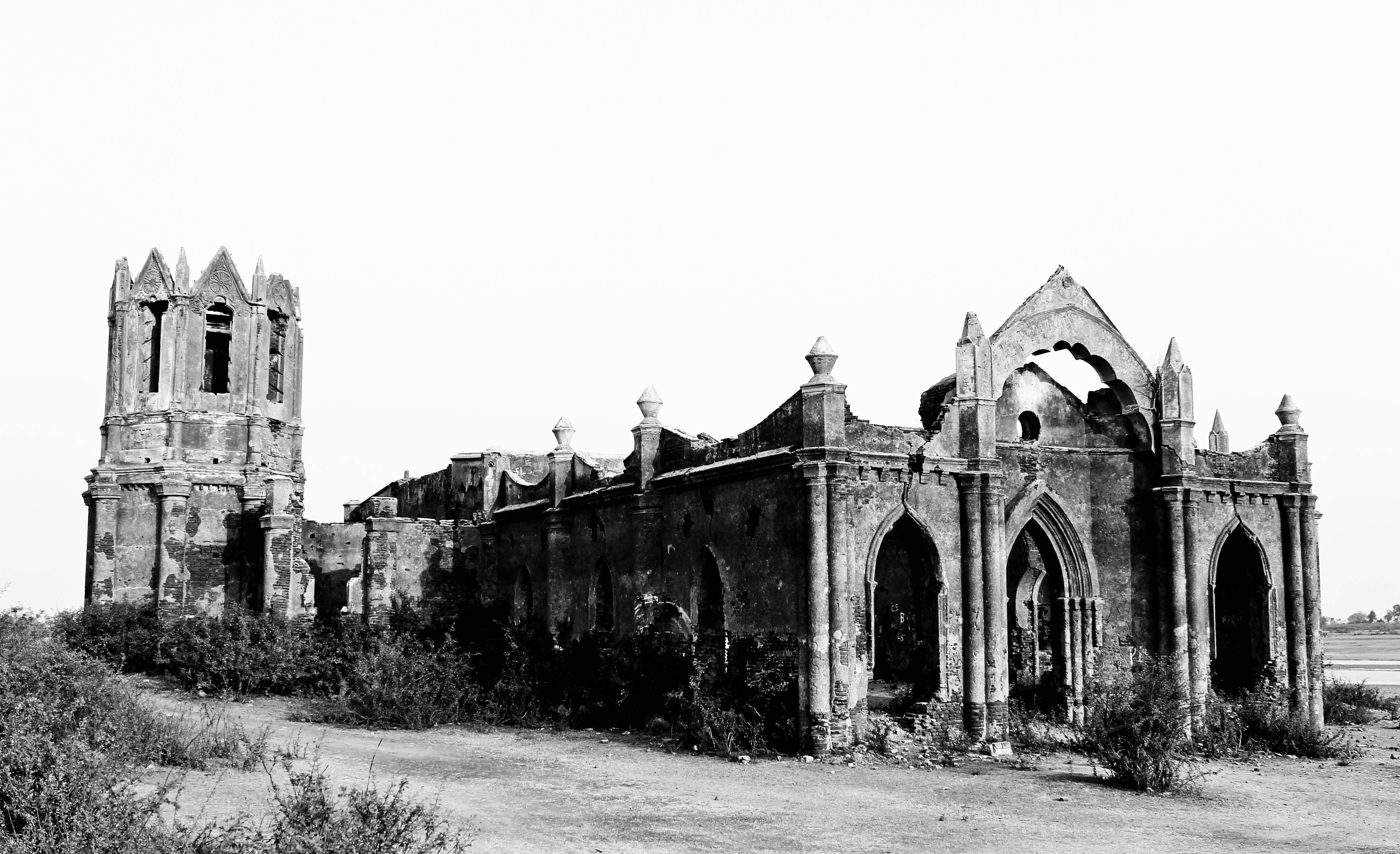
On a January weekend, we rode through the finely maintained NH- through Nelmangala and Kunigal. Our first coffee stop was to sip on some caffeine from the Hassan plantations. A simple hot cuppa at a petty shop before a deviation to Shettyhalli was all that we wanted. At a distance of about 20kms from Hassan, the Rosary church at Shettyhalli stood testimony to time and silently narrated a story of a painful past. This church emerges out when the water levels in river Hemavathi recede as if playing a game of hide and seek. We spent some time admiring this architectural beauty and trying to reconstruct it’s glorious past through our imagination. We left Hassan after a sumptuous lunch at a friend’s house located in the middle of a coffee estate.

IMG_0087-2
The Rosary church at Shettyhalli. Clicking credits: Samson Joseph

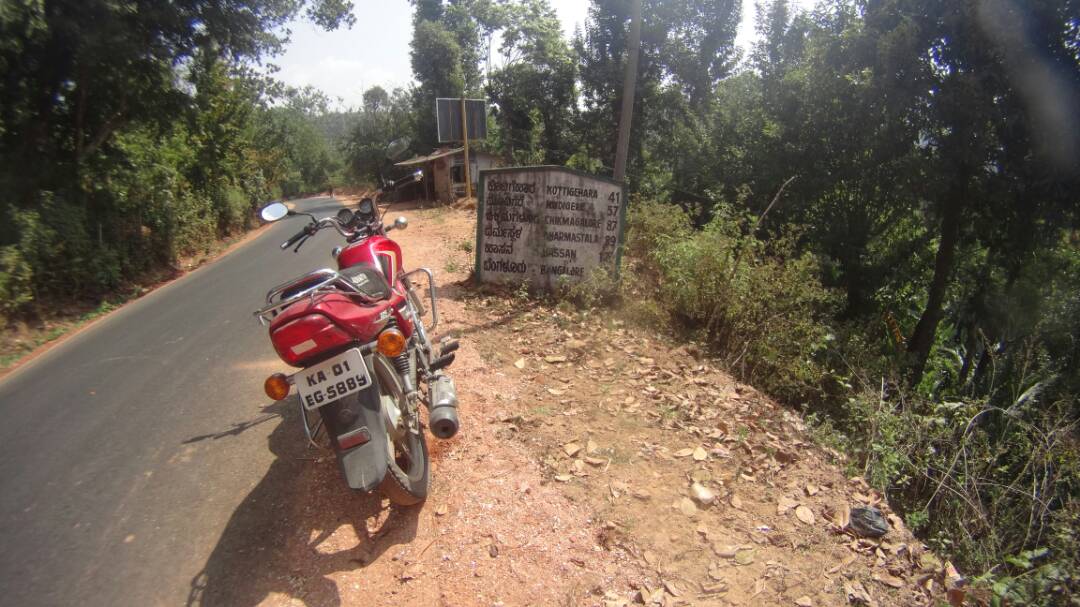
As we passed through the winding roads of Chickmagalur, we were reminded that the hillstation is the birthplace of Indian coffee. Bababudangiri range is the place where coffee was first brought to India and the plantations flourished. Mullayangiri, the highest peak in Karnataka is a hotspot among trekkers. Also, being the native of the famous chain- Café Coffee day, we couldn’t help but stop over for a cup of cappuccino.. After having our dose of caffeine, we continued on the road for our night’s stay at Sringeri.

IMG-20170424-WA0010
Enroute to Chickmagalur

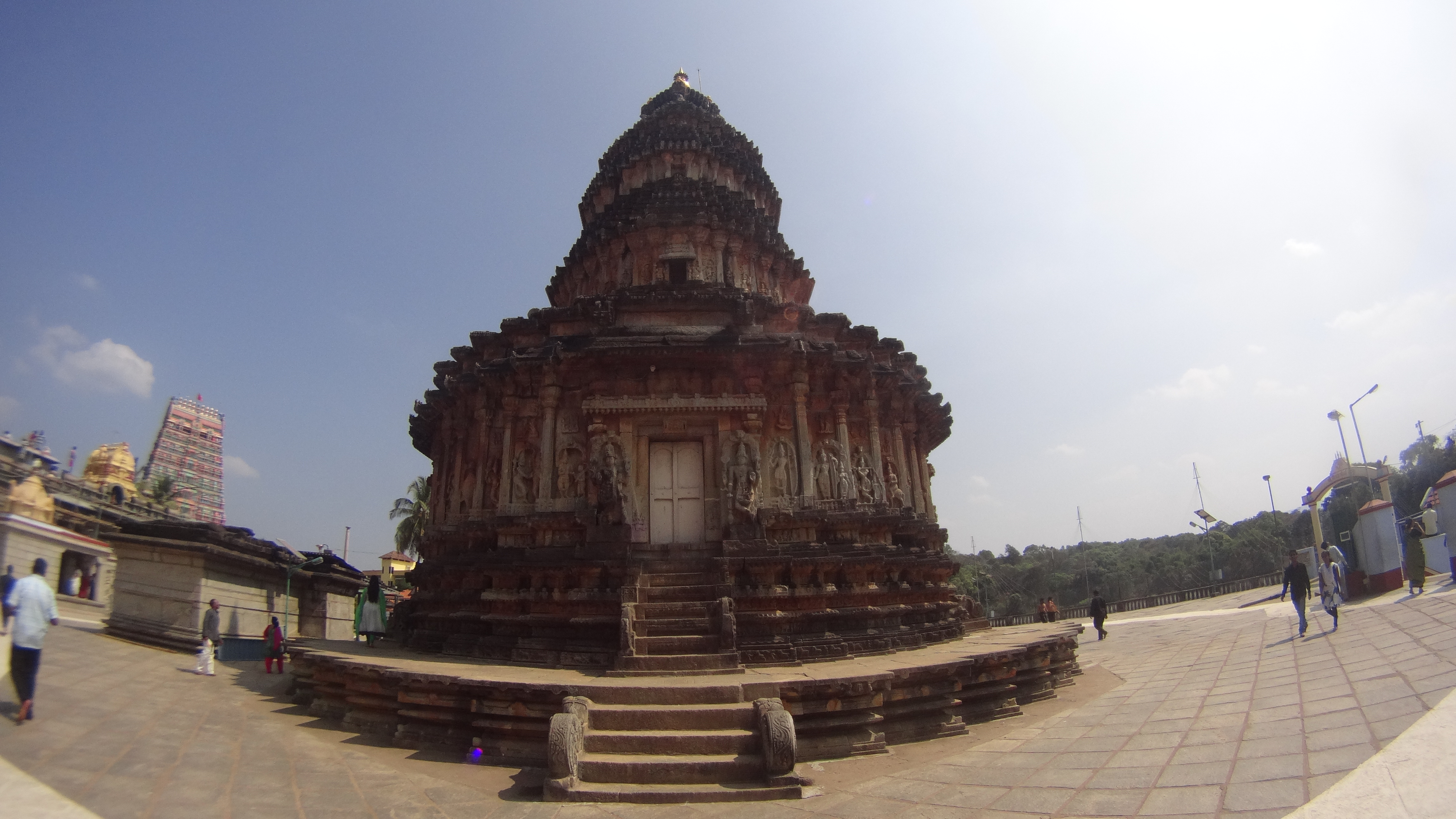
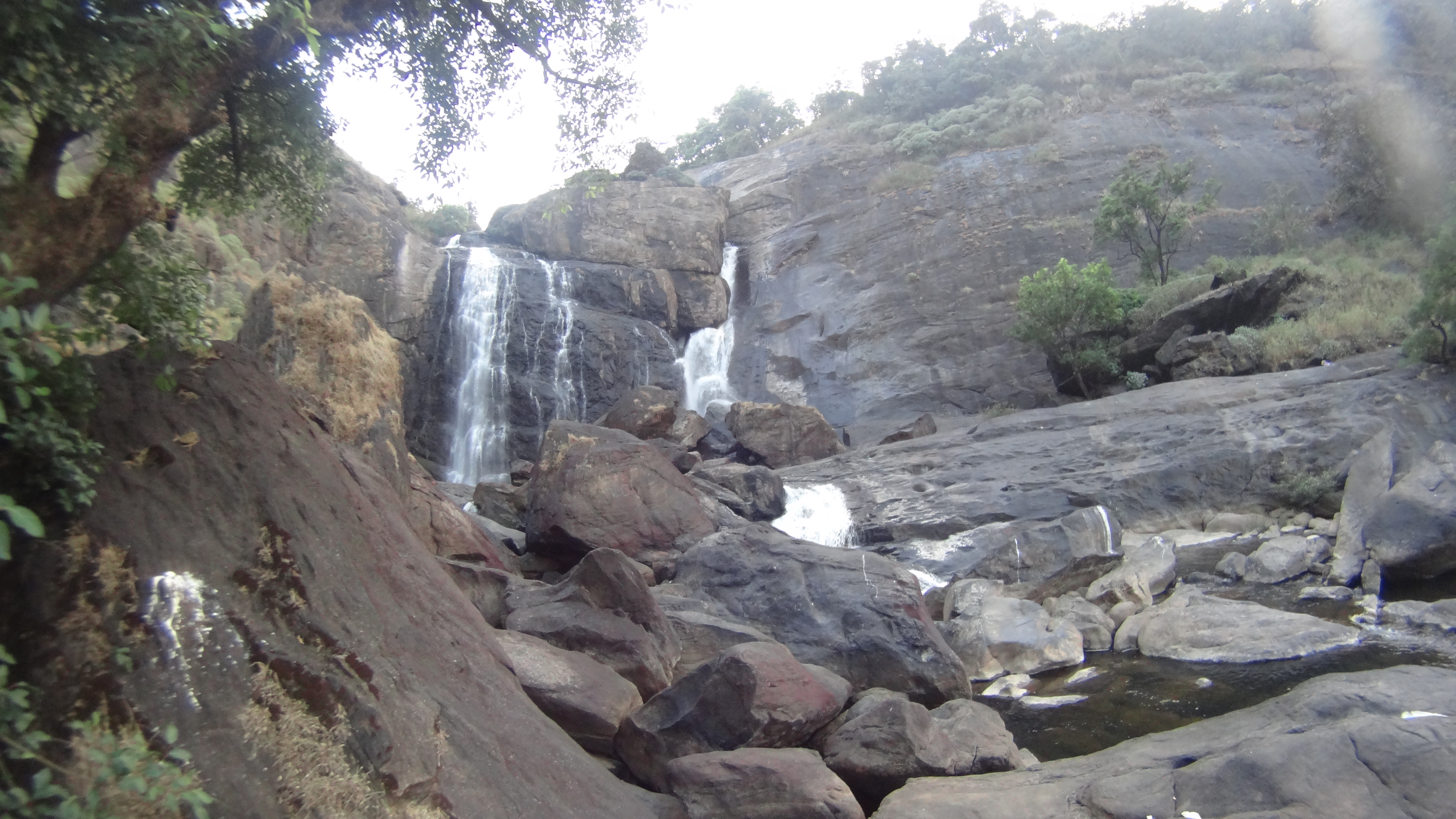
Next day, we set out to explore the pilgrim town of Sringeri. The Sharadamba temple is one among the 4 main Mutts established by Sri.Adi Shankaracharya. The Vidhyashankara temple on the same premises is a beautiful structure built in a combination of Hoysala and Vijayanagara style of architecture. After a small ride, we stopped by at Sri Rushyashrungeshwara swamy temple in Kigga, locally called as the God of rains. The route to our next destination- Sirimane waterfalls was a pleasant one passing through thick jungle on either sides, once notoriously famous as a haven of dacoits. Narasimha Parvata and Meghebaile waterfalls are other places of interest for the forest bums. However, we decided to spend the remaining time whiling away on the banks of river Thunga feeding the school of fishes with puffed rice.

210
The Vidhyashankara temple at Sringeri

We started early the following day as we had a long route to cover and the BEST stretch of our roadtrip. We arrived early at the Kalaseshwara temple and enjoyed the serenity and oneness with nature that Kalasa town had to offer. The Breakfast served at the Annapurna temple happens to be one of the best prasadams and there was no way we were going to miss it. So we had to speed our way towards Horanadu, before the food counter closed. We then had to do a small off-roading which took us to a place of Ultra Calm- Javali in Mudigere Taluk, the birthplace of river Hemavathi.

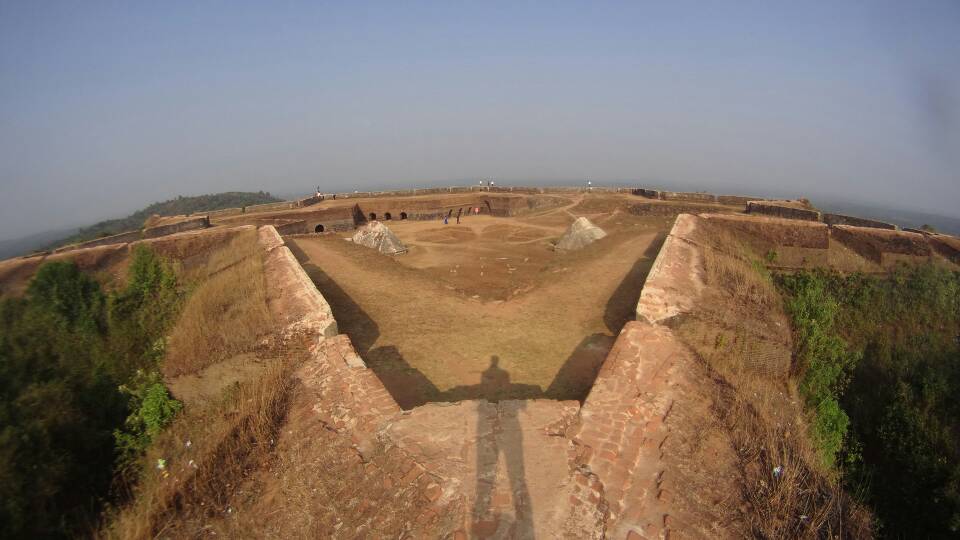
After a refreshing break, we headed towards the next coffee hotspot. It had been an awesome ride so far and time to get our caffeine fix. We parked our bike at one of the stalls put up with a bare table and a stove serving banana fritters and our dose of Sakleshpur coffee. We then climbed up the stairs to reach the beautifully located and strategically built Armory of Tipu Sultan- Manjarabad fort. It is a multi-walled star shaped fortress and worth photographing for an aerial view. Having Shiradi ghat and Bisle ghat in the vicinity, the view from the fort is amazing!

IMG-20170424-WA0005
The Manjarabad fort

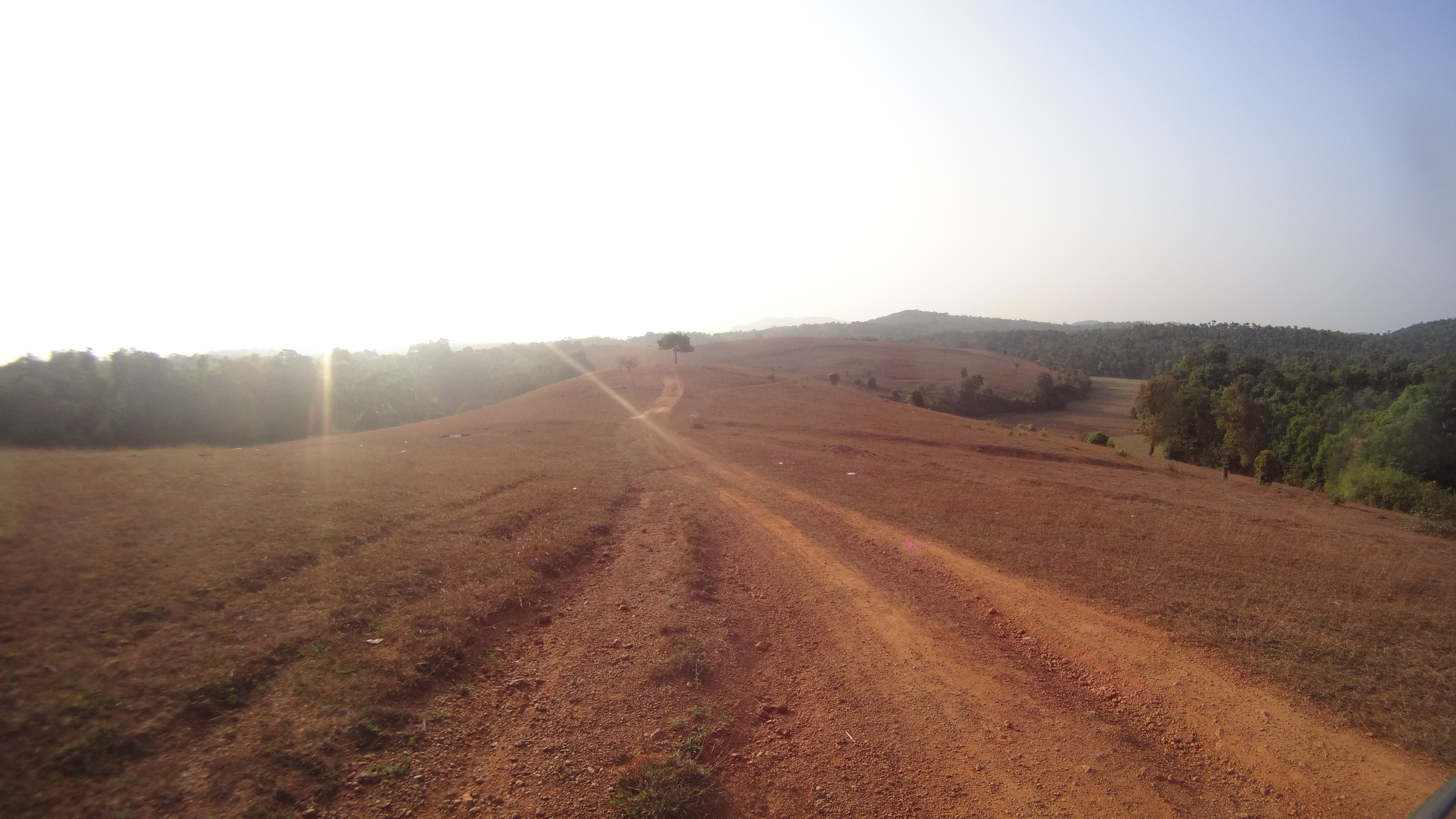
The ride has been brilliant so far and we stopped by for a picture of this solo tree standing in a serene place.

671

As we continued to enjoy our ride further, god decided to add in a tinge of adventure. We lost our way and we missed a deviation.. So that’s when our CEAT tyres were put into real test. We were scared of having lost our way and running on low battery on our mobile phones during our off-roading tryst. However, we were fortunate to reach the main road that ran parallel to our wrong road. Astonishingly, we later got to know that the official name of that road was ‘Kundu-Rasthe’ which literally means ‘Pot-hole road’ in Kannada.

The sun was already setting and we were the last and the only people in the middle of no-where, walking down the stairs towards Mallalli waterfalls. The place was drop-dead deserted by the time we reached there. We hurriedly clicked some photographs and rode for a short coffee break at the last part of our coffee trip, entrance to Coorg or Kodagu district. Interestingly, we passed through several small towns named after the days of the week when the weekly shandy is held. Shukravarapete, ShanivaraSanthe and Somwarpet were among them.

706
The Mallalli falls

So it was past 07.00.p.m. when we finally reached our ancestral home at Madikeri town. And there was no better way to be greeted at home and end the long trip than having a sinful brew of Bella kaapi of Coorg. That said, our ride on the coffee belt had come to an end.. We rode on excellent national highways, state highways and stretches with no roads.. I must mention that coffee kept us awake and the tyres kept us on track and it was a wonderful experience.

Summary:

It is not an expensive car / bike you need for a wonderful trip. An efficient engine and a pair of reliable tyres is all that is required if you have a zeal to conquer the roads.. Bring it on and enjoy the ride!

Request to all riding & driving enthusiasts:

I myself work for an automobile manufacturer and my roles include attending to quality issues of seats & airbags. I have seen tests performed on dummys for evaluation. Trust me, it is insane to imagine the impact of not wearing seat belts.

  1. Seat belts alone can reduces the risk by 60% in case of a collision. In most cars, the airbags don’t deploy unless the seatbelts are worn as they are inter-connected for the electrical system to identify the seat occupancy. So buckle up and ensure all your co-passengers too have!
  2. Helmets on the other hand reduce fatal accidents by up to 60% avoiding severe head injuries. So, please invest on a quality assured helmet and strap it properly for your own safety and DO NOT look out for any cash savings by picking the one’s sold on roadside.

You may be a safe rider/driver. But you don’t know that stranger on the road.. Remember, someone is waiting back at home for your return. Please follow safety rules for their happiness. This is the least you can do!

Endurance testing of a car- A road trip across Assam

I have been involved in testing of new cars that belonged to my company. But, all that are with SOPs and defined patterns. This time, it was about driving a competitor in the extreme road conditions just for the joy of driving and fun of travelling. No SOPs and we were our own bosses… The India unique driving conditions… With money spent from our own pockets… So this is what it was all about.

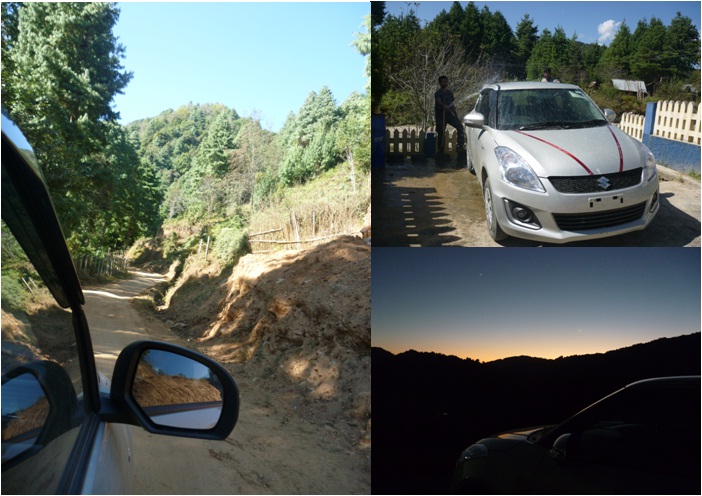
Part 1: We meet our new friend from the showroom- Maruthi Swift Petrol
The car was delivered from the showroom just 30 minutes before our arrival. It had the ribbon on its hood and a TC plate for registration indicating us that we were the first people to drive it. After all the formalities, the experimental trip kicked off in a traditional Indian way- Getting ourselves photographed in front of our brand new car with the self-drive company owner handing over the keys to us. The road ahead is supposedly beautiful with greenery all the way with paddy fields, hills and tea plantations. It was past sunset and hence, it was just a cruise from Guwahati to Kaziranga highway. We checked into the resort by 10.00.p.m which we had booked at Kohra range of Kaziranga National park.

kazhiranga
The National Highway passing through Kazhiranga

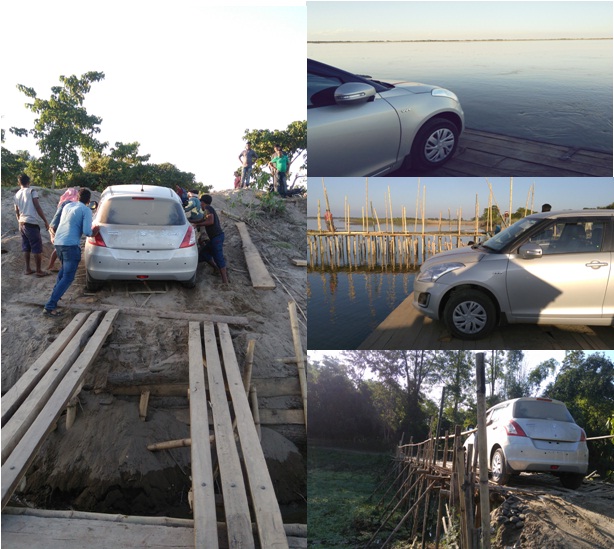
The next morning, we drove through the rustic areas of Kohra to reach the elephant Safari area. It was a splendid view with lush green paddy fields hovered over with mist and mud smeared huts dotting the entire stretch which set a positive tone for the day. We even spotted a couple of rhinos by the roadside itself 😀 An elaborate story of Kaziranga is another post altogether and hence, I will drive you across from here to reach Neemati ghat as the last ferry would leave for Majuli by 04.00.p.m. The car too sped similar to the drive you’ve just been through the post from Kohra to Neemati ghat- HIGH SPEED! Majuli is yet another post in my blog and that comes with Diwali lights, fireworks and a lot of pulling and pushing of the car in the dusty terrain of the countryside. A drive to be truly remembered!

majuli
The kaccha roads of Majuli

Part 2: Driving on the National Highway no.13- A sneak-peak to Arunachal Pradesh
It was complete off-road driving (Read it flying) all along the banks of Brahmaputra from Dhunaguri Ghat of Assam. We had covered a stretch of 165 kms/4hrs via North-Lakhimpur in merely an hour through a shortcut via Parbatipur. We had met a cop from Arunachal Pradesh who had asked us to follow him and we did that although skeptical about his real motives 😛 We heaved a sigh only when we saw some people around and that’s when we realized we were right in front of Arunachal gate at Banderdewa check post. Having sorted out the issues of inner-line permits for us and our swift car with no number plate (We had a temporary registration), a grueling drive into the state of Arunachal had begun along NH.13. It was pitch dark at 6.p.m. in the evening and not a soul on the road san us. We braved a couple of landslides and waterfalls- both plunging right onto the road that we were driving through. It was 12.00.a.m. when we reached Hapoli market in Ziro town of the lower Subansiri district. The three of us were trying to get in touch with the homestay owner for directions from 5 different mobile network providers and yet unable to make a call. All the mobile phone networks were apparently down since evening and felt like the entire valley was paralyzed without communication. And, we were kind of stranded in the middle of a freaking cold night at nowhere!!

There were no civilians on the road but hundreds of cops walking around with balaclava and guns keeping vigil in the place prone to surprise social turbulence. Meanwhile, we were confronted by a CRPF cop as to what we were doing there at that time and we explained our plight to him and sought help. He offered to help us telling BSNL lines were up and he could call our homestay from his mobile- unfortunately, our homestay guy was still not reachable, thanks to his Airtel connection! By that time, we had decided to spend the night on the road with our shorts and loafers to help us bare the zero temperature at Ziro town. But in a while’s time, a miracle happened. Our homestay owner had realized the issue with the mobile networks and come down to Ziro searching for us. He found us! But rightly then, his Maruthi 800 refused to crank… He pushed it aside until next morning, got into our car and took us to safe harbor- his homestay at Siiro!

ziro
The National Highway at Ziro

After all the sightseeing and lifetime experiences at Ziro, we had to now drive back to our next destination- Jatinga. It was the same highway down until Banderdewa, but this time during daytime. So we had ample vistas to soothe our eyes all the way… Deep valley with clear waters and occasional rapids of the Subansiri on one side and thick jungle on the other kept up the motivation for the drive on that Roadless NH road! Occasional Apathani women folk hitch hiking a drop to different villages enroute to Potan and frequent photo stops added to the tempo. Further down, while the sunset added colour, the grazing Mithuns along the valley added charm to the drive. Mithuns are shy animals belonging to the cattle family. They resemble bisons from Nagarhole in their features but are in shades of white colour. They are handsome creatures! In such bad tarmac, we were still able to keep the good condition of our new car with just the rear mudguards hanging down. We crossed the Banderdewa by 06.00.p.m. and thus the next sojourn into Assam happened.

Part 3: Driving on the Asian Highway no.1 to Haflong.
After a short tea break and for dinner, we drove until Tezpur where we decided to stay for the night. After seeing no roads in Arunachal, the new tarmac in Assam seemed more like a speedway in NFS. We were cruising through the NH passes over the 3kms+ long Kolia Bhomora Bridge across the Brahmaputra and cuts through tea plantations and paddy fields in most stretch and was a delight to drive. But, we were watchful at the same time as the beautiful stretch was also known for anti-social elements like militants, Maoists etc. The next morning, we started early towards Dima Hasao district so that we had sufficient time to explore Haflong and make it to Jatinga to watch the famous birds’ mass suicide phenomenon. We were blindly following our dear friend- google maps and cruising on the AH, that is being newly developed in the stretch that we were supposed to drive till Haflong. We were thoroughly enjoying our drive through the newly asphalted 4-lane road passing through the forest reserve area. However, we did not want to risk ourselves by stopping anywhere even for a nature’s call as the entire stretch is known to be socially intolerant and infested with militants. It was only us and no one else amid virgin forests on both sides for as long as our eyes could reach. The map was indicating only ONE road right until Haflong without any crossroads and hence, it was an easy way to go…

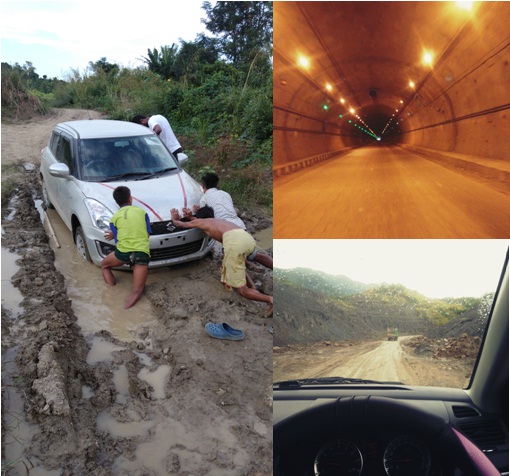
We had just passed through the tunnel near Mahur junction and suddenly the road disappeared. The front wheels of our car were stuck inside a deep pool of slush. It was 01.00.p.m. and our enjoyable drive had halted. The map on all our phones continued to indicate the road ahead. We opened the doors to get out and push the car- we were amused by the knee deep water that we had just got ourselves into. There was a huge rock exactly under the front cross-bar which meant we couldn’t push it forward. Meanwhile, we noticed that the water level was rising due to a continuously flowing stream which posed a risk of the water entering the engine. While 2 of us took to task of digging a water-way for the stream to flow out, the other friend walked back until the tunnel where we hoped to find some help. There were a couple of cars who had lost their way too and drove to the place where we were stuck, but they were quick enough to shift to the reverse gear and drive back. Remember… The place is infested with militants?? Our poor friend near the tunnel- was trying to stop every single vehicle that passed by and no one cared! By 03.00.p.m. he somehow managed to walk back with 3 local boys who came down with a couple of posts to lift the car out of the slush. The ground clearance was bad which at the first place had got us down to where we were. The front bumper seemed fragile to come out if we tried to lift up with it. There were no side skirts or reinforcements that could help us to hold the car up. And then there was a huge dent & a bump on the Rear door while my friend was trying to support his shoulder in between. We together tried all possible tricks and ideas to get the car out but all in vain. The sun had begun to set by then which meant we had very little time left with daylight lest spend the night inside the car in the middle of nowhere with highest possibility of getting mugged at gunpoint and worse- become a meal to some hungry wild animal. It was 04.00.p.m. and we were still stranded.

While we had given up and were thinking about the way forward, a Mizoram bound family arrived in a XUV-500. Seeing a girl, they took pity on us and offered to help us by waiting until we arranged for a rope. Fortunately, another truck arrived on a lost route within the next 10 minutes. The truck driver obliged to open a compartment in his truck which was located deep under and was never touched since the time he had owned the truck. He finally pulled out a big chain which was then attached to the XUV and towed the swift out of the ditch. It was a moment of celebration… not only to us, but to so many people who had gathered during the course. With some navigation help from the locals, we took a small deviation to avoid the landslide that had actually caused the entire episode of getting our car towed. The highway ahead right until Jatinga was under construction with just heavy dust all around. There was a spot where our car was in the middle of like ten JCBs around- Like a scene from the transformers. Wow! A wonderful experience in a no-man’s world…

dima-hasao
The Asian Highway through Dima Hasao

Part 4: Swift gets a face wash
We found a local garage at Haflong who vacuum cleaned the interiors and did a high pressure wash for the exteriors and underbody. Our car looked as new as it was when we took delivery. Only change point was that it had a big bump on the rear door and functionally, the power steering would suddenly get harder than its manual version due to the leaking power steering oil, the brakes took a longer distance to stop and the entire electrical system would suddenly go off during the drive due to the excessive electrolyte spillage in the battery and of course- the wheel alignment had gone for a complete toss. We drove back to Guwahati braving the deadly combination of multiple malfunction Indication Lamps on and horrible road sense of the people on the newly laid highways. We returned the car at Guwahati and the rest is better left untold…

Summary: Sorry for the poor car on it’s first road-trip.. It was driven in extreme conditions for what it is not designed.. Inspite of all that we put it through, it got us back safe to our harbour:)

What was your most memorable road-trip? Let me know!

Gateway to the abode of clouds- RiBhoi

This post is part of my fortnight long road trip across North-east India, specifically covering parts of Meghalaya – Assam – Arunachal Pradesh I had tagged along with two other travelers and drove around the state of Meghalaya visiting Shillong – Smit – Cherrapunjee – Mawlynnong – Dawki – Ribhoi- Shillong.

A long winding highway up the hill from Guwahati leads to Meghalaya: Abode of the clouds. And up there, one will be greeted by blue waters of a calm lake flanking the road on the right with no sign boards indicating the arrival at Ri Bhoi district. With no major landmark to explore for a typical tourist, this small distrct is full of fables and legends. If you’re someone interested in fairy tales, I highly recommend you to take a local person with you and follow my trail.

p1140244
The Umiam lake from NH40

The Umiam Lake or Barapani has been gracefully present there in a serene backdrop of green hills of the state. There is no passerby who doesn’t stop for at least a minute to capture the beauty of this place! This is a man-made lake formed due to the construction of a reservoir across the Umiam river. Today, this reservoir is one of the main sources of potable water to Shillong. For people looking for a leisure trip, one can go for boat rides in the clear waters of the lake. It is also called as the ‘water of tears’ named after a legend which talks about two sisters who were travelling to heaven. It is beleived that one of the sisters slipped from the hills and died, the other sister cried out of grief and her tears are said to have trickled down and formed the lake!

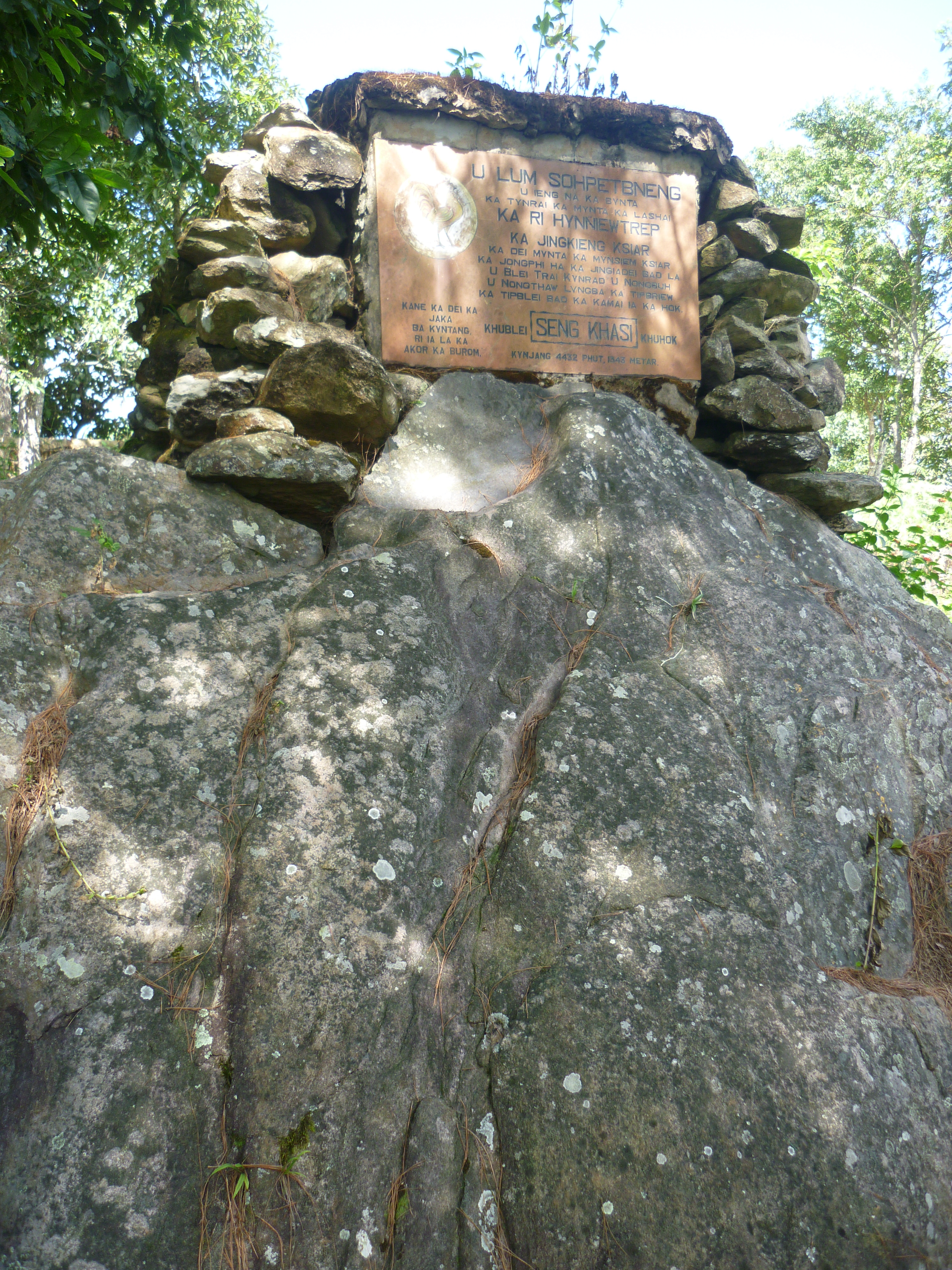
We had read about this place called ‘Lum Sohpetbneng’ close to Umiam and asked our driver if he could take us there. Although he himself had never been there earlier, he readily agreed to take us there. ‘Lum Sohpetbneng’ is a sacred grove of pine trees where a golden ladder is believed to have existed which connected Heaven and Earth. Although there is a motorable road, the place looked eerily deserted with absolutely NO ONE until the peak. We kind of got lost with several deviations in the route but since we were in the middle of the forest, we decided to reach the destination before we gave up. We wanted to know how the ladder looked like that connected God and Man. Finally, we arrived there… Only a dilapidated structure what appeared like some prayer hall and an under-construction structure was there, which our driver told us was a place where an annual fair is held with a large congregation of Hindus.

p1140248
An epitaph at Lum Sohpetbneng

A few steps away from the concrete structure, our driver took us to a neglected patch of land under an old withering tree. He pointed at a rock and told us, “See, these massive footprints here? It is of the humans who tried to climb heaven. Back in the days, humans used to be massive in size. One day, God realized that heaven was getting full and so he cut-off the ladder which laid right here, where this tree is now growing.” Although the shape of a feet with heels and toes were demarked clearly in the footprints, it is interesting to know how we grow up with fables without understanding the scientific logic behind.

There isn’t much to do on the peak apart from a good view of the Umiam Lake on one side and the Jaintia hills, Shillong airport, the Asian highway on the other. We drove back to Shillong.

p1140251
A view of Umiam lake from Lum Sohpetbneng

I personally would not recommend this trip if you are on a packed schedule. But if you are an explorer, interested in studying religion and culture, I would advise you to go there with a person familiar and knowledgeable about the place. A deviation from Umiam Lake can help one to explore the Diengiei Peak, where a crater formed by an extinct volcano exists. Dwarksuid is yet another place we gave a miss on the Umroi Bhoilymbong road where a rocky lake exists and is believed to be ‘Devil’s doorway’ because of the dark colored rocks surrounding the lake.

Closing remarks: Being the first scenic spot while entering Meghalaya through NH40, Umiam Lake is a good stop-over to watch the sunset and chill with friends on the banks. There, you can flip your arms open and let Meghalaya breathe some life into you before you head over for a wonderful trip ahead!

A day out at the Khasi cultural centre- Smit

This post is part of my fortnight long road trip across North-east India, specifically covering parts of Meghalaya – Assam – Arunachal Pradesh I had planned to visit Shillong – Smit – Cherrapunjee – Mawlynnong – Dawki – Ribhoi- Shillong during my weeklong stay in Meghalaya.

I had decided to explore some places all by myself and Smit happens to be one of them. After seeing some spellbinding photos on the internet, I wanted to visit the Laitlum valley as well. Although there are public buses from Shillong to Smit, the connectivity further to Laitlum isn’t great. This is where one needs to have a travel arrangemtn of their own, or in my case: to hitch a ride to reach Laitlum. Since it was my first day in the state, I did not want to get too adventurous for being alone. That’s why, I hired a taxi from Police bazaar (in Shillong) to Laitlum.

This drive was very refreshing for me, whose mind was cluttered by all the madness of traffic, pollution and work tension back in the metropolis (Bengaluru). I was requesting my driver to stop the car after every other kilometer to capture the seducing beauty of the place with my not-so-good camera. The bamboo trees and terrace lands with potato farms, all added charm to the landscape that was very beautiful even otherwise. To add to the pleasure of the drive, I was having a good conversation with the driver as well. Althiugh I had hired a personal taxi, I did not mind to let a few locals into the car when the driver asked me if I could allow them. Given the remoteness of places and the scarce connectivity through transposration, I had absolutely no problem with offering a ride. The next thing I experienced was that there were atleast 50 passengers hopping on and off at every stretch for their ride. And would you know what was exciting for me? All locals who boarded the car used to get overly excited about meeting a foreigner (Yeah… That’s what they called me!).

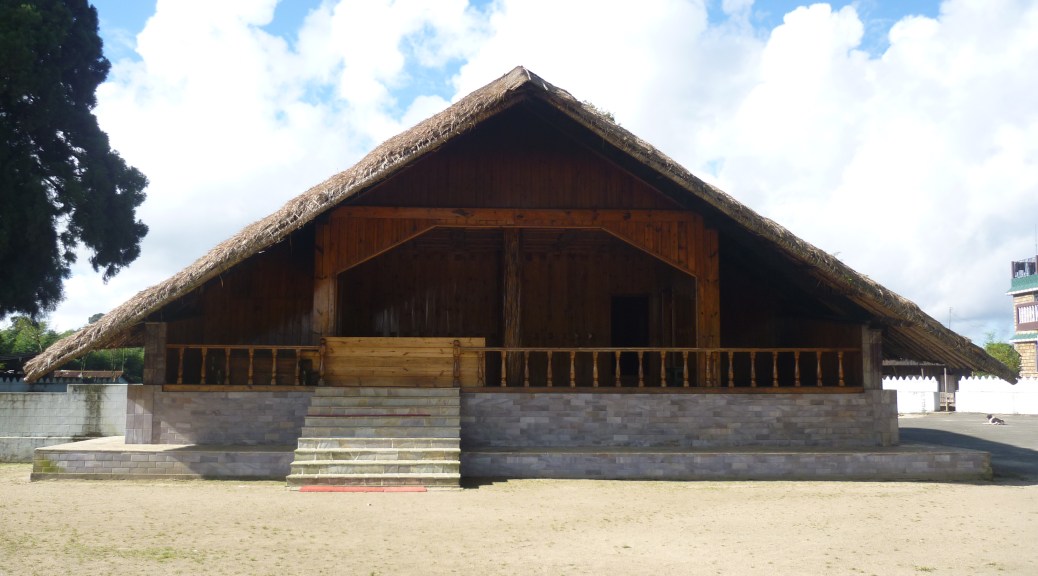
Smit is an old rustic town and the cultural centre of the East Khasi hills, but there isn’t much in this town apart from the Siam’s house. A road flanked with well groomed pine trees lead to the Khasi Raja’s palace. The Raja or the head of the clan is called ‘Siam’ and he lives in the same premises. However, the wooden palace is used only on special occasions when there will be large tribal congregations, like the Nongkrem festival for example. This typical Khasi styled wooden house is said to have been constructed with zero iron nails and only wood for all joints. Although I met the Siam, he did not seem to be a photo friendly person when I asked for permission to photograph his little children.

p1130680
The Siam’s house at Smit

We then drove to Laitlum valley, located at about 5kms ahead of Smit. It was an offbeat drive through the rarest stretches of countryside. We passed by a lot of school kids who were on their way to school. Few were happy waving at me while a few were busy pranking at their pals as they walked. Having been born and raised in a small town myself, it was a flashback of typical childhood days in a rural setup. There were a couple of school teachers in my backseat, chatting happily with me and patiently waiting in the car while I would get down to take photos. Overall, it was a very pleasant drive until we reached the Laitlum gate. While the driver wanted to sit back in the car, he asked me to enjoy the view and return.

I was the only person amid the green scintillating valley until I walked down and saw 2 local boys cleaning the pristine place. They had already parked aside 4-5 sacks full of waste. When I spoke to them, they told me that they came there every morning before leaving for school, to pick up plastics left behind by the previous day’s tourists. While it was a heartfelt respect for these boys for doing their bit to save earth without having any expectations of monetary gain, it was a subtle slap on my face because I too represented the tourists who unmindfully damage the same earth in the name of travel and enjoyment.

P1130730.JPG
The Laitlum valley

I walked down to the cliff and stood in amazement at the beauty that the place beheld. While I was standing on the brink on a large flat rock, it felt like I was the only person in the whole wide beautiful world. The gentle winds kissed my cheeks and the chirping bird was a welcome guest. There were several waterfalls flowing down the valley gracefully at a distance… Then there were a few villagers who appeared to be popping out of the deep valley beneath. They seemed to be friendly and told me that their village was located far down the valley and they had to climb up each time to meet their basic life requirements, trade their farm products etc.

There is a cable car made of bamboo which will be dropped down and pulled up for old people and goods, but their daily commutation is by foot most of the time. I grew curious and my feet dragged me down the stones that were laid on the path to the village. The beauty of the 360 degree greenery and the fresh air had already cleansed my mind off half my worries and tension by the time I clocked the distance to the village. There is a small stream, a church and a few huts in this little fairy tale village nestled deep down the valley. And the villagers I met on my way enriched me with the simplicity and contentment in life. After a good walk down the beautiful valley of Mawkeynrew, my tummy had started to call out for me. I savoured the plantains offered to me by the villagers and unwillingly decided to climb back.

p1130853
The bamboo cable car and the village below

Once I reached the top, I finally sat down at a small hut like stall at the valley gate that had opened by that time. It was run by a lady who couldn’t understand what I was trying to communicate in English. her little son helped me with a cup of lemon tea in English before running to school. The lady there could not understand anything other than Khasi language and I didn’t know that. In spite of the language barrier, we both soon became friends and managed to communicate with hand signs. She cooked maggi noodles and Jadoh with chicken curry for breakfast while I was eagerly waiting for my first Khasi meal. Jadoh is a traditional Khasi meal where rice is cooked with chicken blood instead of water. It was one of the most relishing and sumptuous maggi noodles I had eaten before! What made the meal so special was not that I found it in a no-man’s land or at an extremely low price. It was something that I would travel back again all the way for the humility and dollops of warmth with which the meal was served to me.

She cut a pomello fruit and mixed it with chilly powder and packed it for my road.. With a heart full of gratitude, I bid goodbye to this new Khasi friend of mine!

Kublei Shiboon,
Hitha.