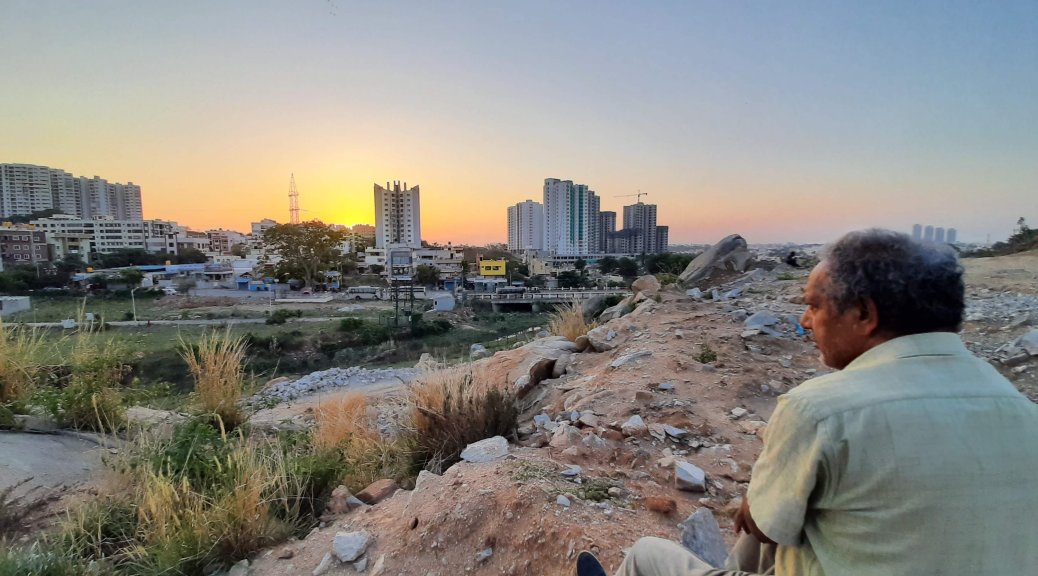
‘Uttarahalli’ translates to ‘Northern Village’ in Kannada. The irony is, it is located in the southern-most part of Bangalore. This is the current place of residence of my family and is also the last post in this series. This home seems like a perfect retirement plan for a family that seeks a little bit of nature in the midst of a bustling metropolitan city.
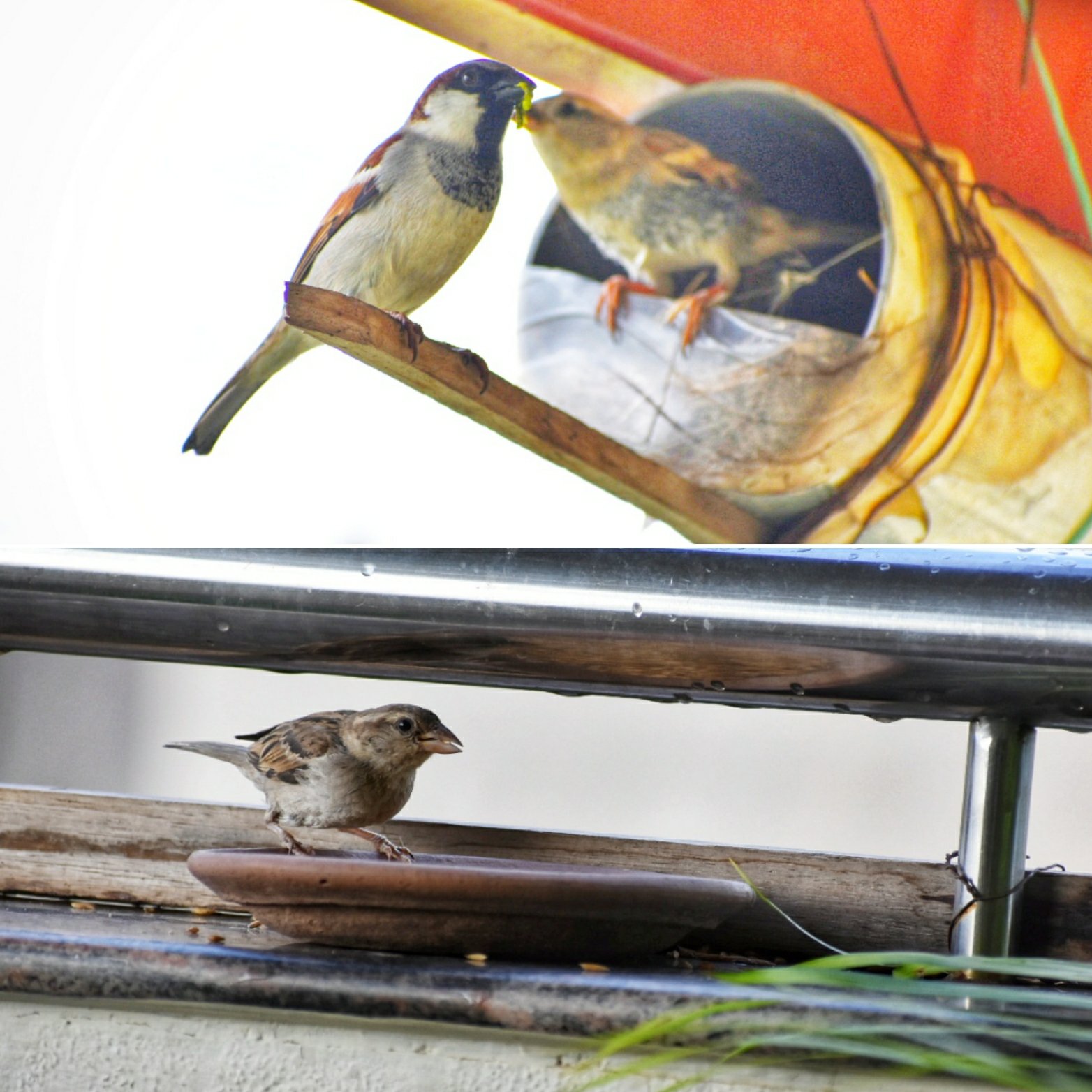
With very little vacant space available, my parents try to grow their own vegetables and fruits, welcome birds and squirrels to have meals with them and sip their ‘kaapi’ while watching the sun go down. These are some among many other things they do to keep themselves running through the day.
The sparrows in my portico
The area is soaked in rich history as well.. While the ‘Vasantha Vallabharaya swamy temple’ dates back to the Chola era, an adjacent cave is believed to be the place where Rishi Mandavya had meditated.
The Turahalli forest is a small patch of lung space nearby, that joggers, cyclists, conservationists and the realtors all seem to have an eye on!
The latest addition to the landmarks is ISKCON’s ‘Krishna Leela theme park’ located on the Vaikunta hill. The sunrises and rainbows on cloudy days are mesmerizing, adding a backdrop to the view of this temple from my doorstep.
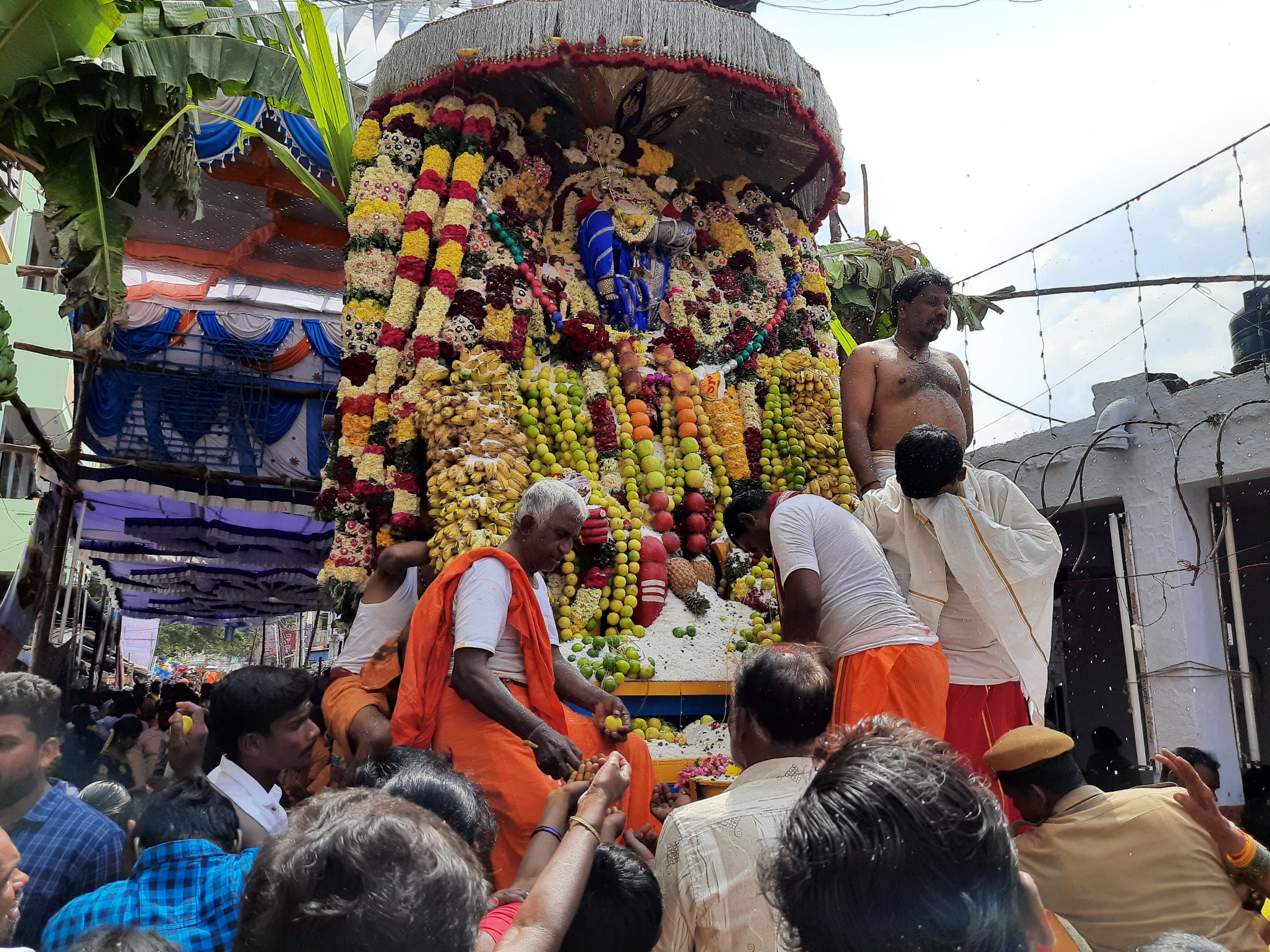
Annual fair of Vasanthavallabha temple, Vasanthapura, Bangalore
This is the last post of this series: “I Belong to Everywhere“. I hope you all have enjoyed time travelling with me hopping on- and off from Bangalore to Kodagu. Which place did you like the most? What place would you want to go after reading my posts? What more do you want to know about, from these places?
Napoklu is a small town located in Madikeri Taluk, in the northern part of Kodagu district. I have spent several memorable holidays here, living a high energy childhood. There are several places of interests for tourists and local pilgrimage that are centered around Napoklu. Some of them are ‘Sri Makki Sastavų temple’, ‘Chelavara waterfalls’ etc. The ‘puttari festival’ is one of the best and the most elaborate one celebrated by the Kodava clan native to Napoklu.
Puttari festival at Kolu Mand
If any of you find a tinge of madness in me, it is likely that it has been due to the influence of my cousin who hails from this town. He has been my closest friend as we both grew up together, roaming farms, fields and streams. On weekends when he didn’t come to our grandparents’ house in Madikeri, we would be roaming together, around the other places that are mentioned in this series of posts.
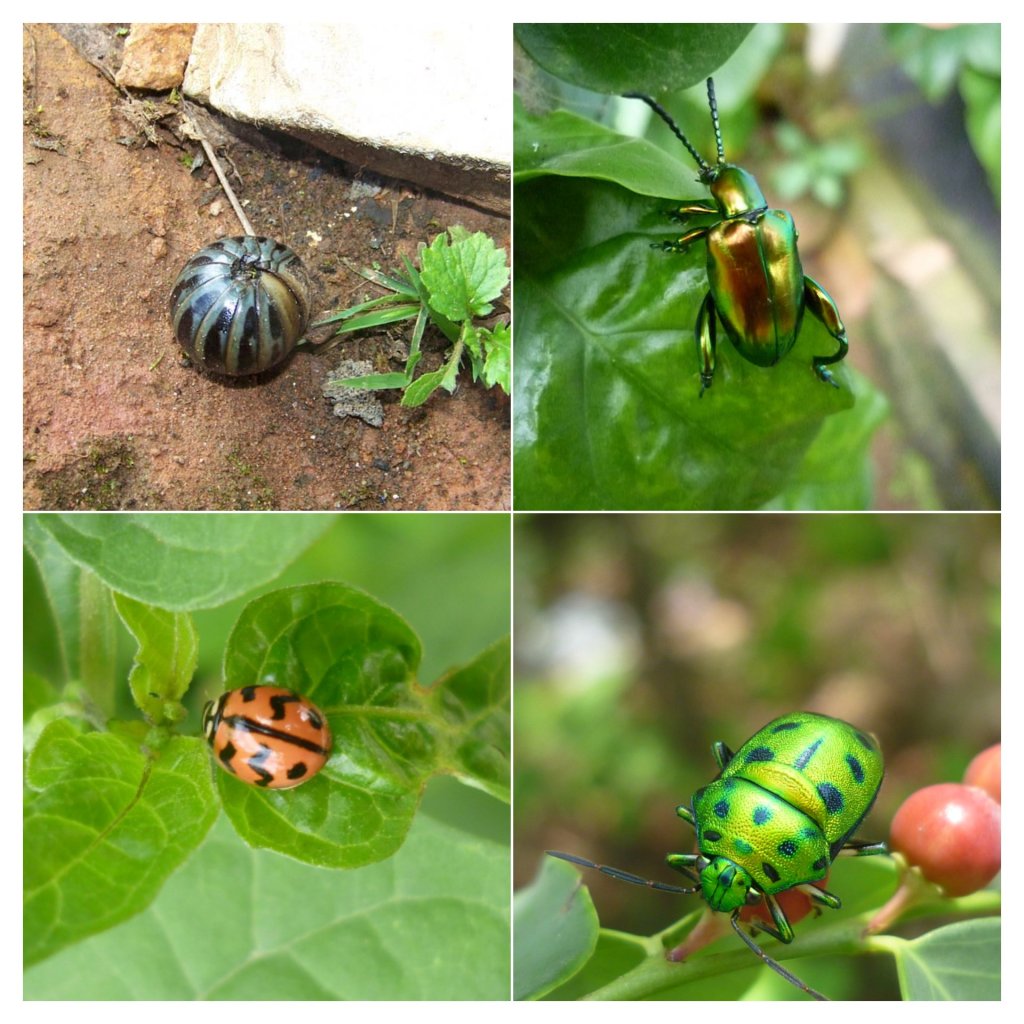
Although I have spoken about how I developed the awareness for conservation of wildlife in one of my earlier posts, but it is in Napoklu, that I originally imbibed the qualities of empathy for animals. Apart from the cattle, dogs and cats that I was surrounded with in Madikeri, my cousin had birds, fishes, tortoises, rabbits and poultry in his house. They shared a unique bond with him. While during the days, we caught dragonflies with aquarium nets, we chased fireflies at night and trapped them all together in empty glass jars to create a mini ecosystem of our own.
Beetles and ladybugs
If you wonder how I know some names of celebrities from across the globe, it is because we followed them. I watched Formula-One, WWF, Tennis and Cricket without missing a single match or a tournament, because the TV remote would always be with this guy and I had no option. The craziest automobile geek I had ever known, much until I became an automobile engineer and met a few other geeks along the way, was this cousin alone. We traded ‘trump cards’ and fought each other over the ownership rights of the rarest WWF and Cricket cards. We still hold back some of these treasured collections and often reminisce those good days of innocent fun. These are the same things that trigger little momentous joy to me even today and that which helps me spread positive energy.
The original plan for this short family outing was to make an early morning visit to Sanjeevaraya Swamy temple in Channapatna Taluk of Ramanagara district and return. But, since my workplace is located along the same route, I expressed my disinterest in traveling that way. I pitched in the idea to have a change of route at least for one-way. Hence, I added a couple of other landmarks, picked up an offbeat village road and created a circuit with aid from google maps.
For those of you who are not familiar with the geography of Karnataka, Ramanagara is popularly known for its Sholay hills that was featured as the village- ‘Ramgarh’ in the Bollywood movie Sholay. Channapatna is popular for its cottage industries of wooden toys. I am not going to write about any of these places, the search engines are already flooded enough! I am going to take you around some lesser known places in Channapatna, for a half a day’s trip from Bengaluru.
We set out on a Saturday morning and decided to have our breakfast on the way. Sri.Renukamba tatte idly (translates to ‘Plate idli’ in Kannada) needs no introduction for the Bengalureans. So, after a filling plate of tatte idly at Bidadi, we proceeded towards our intended destination for the day. To reach there, we had to pass through Kengal, a village popular for yet another Hanuman temple. Moving ahead from there along a small deviation, we arrived at our first major destination: Sanjeevaraya Swamy temple at Devarahosahalli village. This is a small stone structure dedicated to Lord Hanuman and dates back to the Vijayanagar era. The deity is believed to be powerful and hence, we were there to offer or prayers following the recommendations of some well-wishers.
After spending some time there, we continued onward to our next destination, a little cave temple located atop of a hill. The drive, the scenery, the canopy of the majestic trees along the highway was a pleasant one. We stopped by to do some bird watching at the Neelasandra lake as well. We could see Pelicans flocking in large numbers.
Our next major stop came as a rather surprise to us. Gavi Ranganatha Swamy temple was a random destination included in our day based on an internet search result. The drive, the location of the temple, the valley, the village view from the temple porch and the overall scenery was just so stunning and unexpected. There was just no one else in the temple apart from our family and a few local kids playing in the hill, atop which this temple is located. You can watch the video of our visit to Gavi Ranganatha Swamy temple below:
Drive to Gavirangana betta
By this time, the sun was already up and beaming bright. So, we decided to drive back, of course through a different route. We descended the Gavi Ranganatha Swamy hill and took the route that connected to Kanakapura. On the way, we stopped at this beautiful location where the highway passes through green farms on one side, a large lake on the other side and the entire scenery was being overlooked by the temple hill.
Vittalenahalli highway and lake
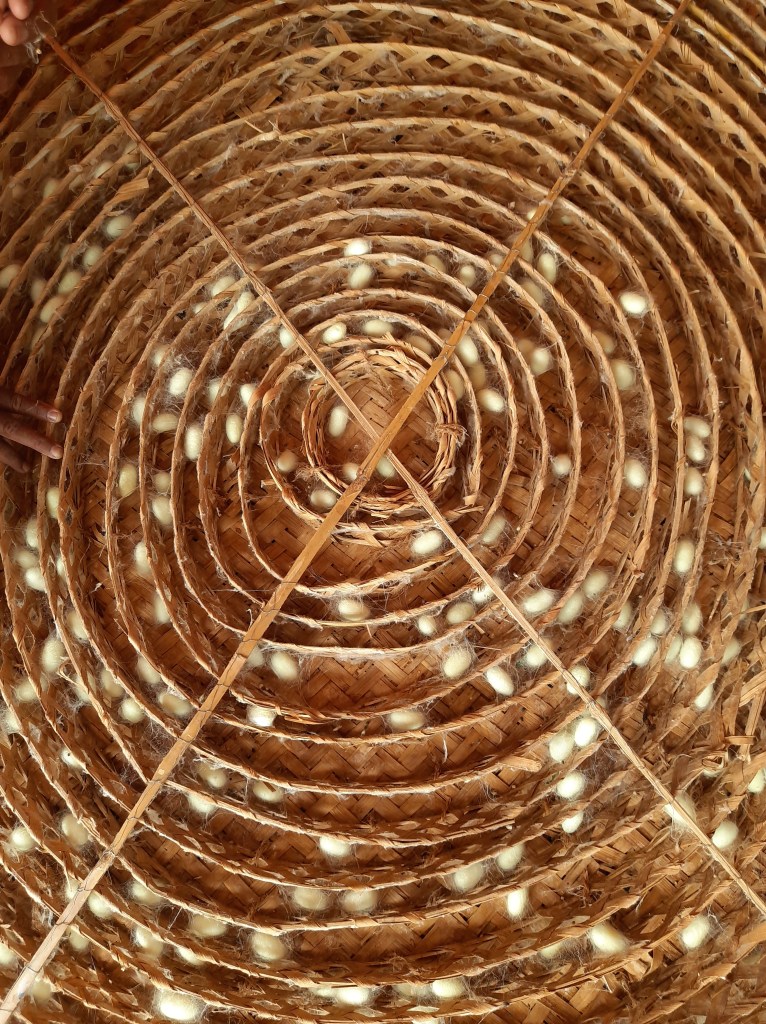
Our drive from there continued through large stretches of rocky hillocks, mango orchards, paddy fields, coconut groves and mulberry farms. Ramanagara is also known for sericulture. Several households in the villages here are involved in silkworm rearing. As we passed through, we noticed that families were sitting out in the verandahs of their traditional houses and collecting the fully grown cocoons from the bamboo trays. We stopped by and walked over to one of the houses on our way and learnt a thing or two about sericulture from them.
Silk Cocoon trays
In a short while, we reached the Kanakapura main road where we had our lunch. Well, it was a late evening lunch before continuing towards home and thus ending a quick trip to the Bengaluru outskirts.
As the lockdown is easing out and the Covid positive cases in India are on a rise, many people are opting DIY (Do it Yourself) day trips and hikes over organized group trips. Either with just family members or a closed knit of friends is what seems to be an option for some time more to come. Quite a few of them have been asking me to give them suggestions of where they can go for short drives or hikes. One such suggestion is ‘Kunti Betta’. Although I had done this hike with an organized itinerary by ‘Plan the Unplanned’, one can try this by themselves. However, a hike in daylight is suggested over our pre-dawn adventure.
We started from Bangalore at midnight as we wanted to reach the peak before sunrise. It was still dark, cold and windy when our minibus reached the parking lot of ‘Sri Shankarananda Bharati Vidyapeeth’ school at Kachenahalli village in Mandya district. We climbed a small flight of stairs, walked past a temple pond (we couldn’t see but only were told by our guide) and continued to walk in a single line following each other’s torchlights. While a couple of them tripped over small stones on their path, a few others got their shoes wet by stepping into water puddles in the dark. With torchlight, our guide navigated the path through thick shrubs, tall grasses and large boulders enroute. We reached the peak in a couple of hours.
The view from the Kunti Betta peak: Before dawn, at dawn break and after sunrise
It was dark when we reached the top and it was unexpectedly cold. I hadn’t gone with enough warmers but that didn’t stop me from sleeping on the cold rock until dawn. I watched the stars in the clear sky and didn’t realise that I had surrendered to the sleep gods. I was awakened by a fellow hiker at dawn. The view of the distant lake and sugarcane farms looked nice from the top. Also, several other rocky hillocks dotted our view. The one we were standing at was named after Kunti, the mother of the Pandavas. History has it that the hill was earlier called as the ‘French Rocks’, named by the French army in the pre-independence era. Although it was partially cloudy by the time the dawn broke, we still got lucky to get a glimpse of the sun that morning. After taking enough photos, we started our descent.
The Kunti Betta hike route
Since there are lot of loose rocks, there were possibilities of slip. Only during descent, we got a sense of the terrain and the view which we had missed while climbing up. We soon reached the temple pond at the base beside which there is a large monolithic rock. The localites use this as a giant slide. I too climbed up this rock and the kid in me had fun sliding down from this version of the desi slide.
The temple pond at the base of Kunti betta
Our stomachs were grumbling by that time and there was no food around. With permission, we could use the washroom at the school. We then commenced our return to Bangalore with a breakfast stop at ‘Maddur Tiffanys’ for their signature dish- Maddur vadas with Masala dosa and filter coffee. The landscape was beautiful with green sugarcane farms extending on both sides of the countryside roads before we hit the highway.
A word of advice though:
Since there are too many hillocks in a cluster, having a guide would be better to find the right peak.
Since we hiked before dawn, there was also the fear of confronting wild animals like bears and leopards. Although, we didn’t see any, this was told by someone in the group.
Although we did only the early morning hike, you can make it a full day activity. These are a few things you can include in your itinerary:
Since Mandya is the ‘Sugar Bowl’ of Karnataka, you can visit any of the small sugar/jaggery making setups on the farms enroute and savor freshly made jaggery.
A lot of people visit the Tonnur lake (about 10kms away) from Kunti Betta and take a dip there. Alternatively, you can visit Manchinabele dam or Kanva reservoir. We skipped it as we were told that the soil on the banks was marshy at the time we visited.
You can visit Ranganathittu Birds sanctuary and take a ferry ride in the river.
You can also visit ‘Janapada Loka’ to get an overview of the folk-culture from across Karnataka.
Lockdown 5.0. simply put, was just another normal day in Karnataka, except that the educational institutions were still under lockdown. So, unwinding on a weekend after a long work week was normal too. With friends, I chose to hike on a Sunday morning to Madhugiri betta, the second highest monolithic hill in Asia. We started from Bangalore at 04.30.am. hoping to start the hike as soon as the gates were opened. While KSTDC has been abundantly promoting post-Covid tourism in the state, we had a surprise awaiting us at the trek base. Since Madhugiri fort comes under ASI’s protected monuments (controlled by the central government), we were told that trekking wasn’t permitted by the Central government. Hence, we were left with two options. Either return home or find another hill nearby where we could hike.
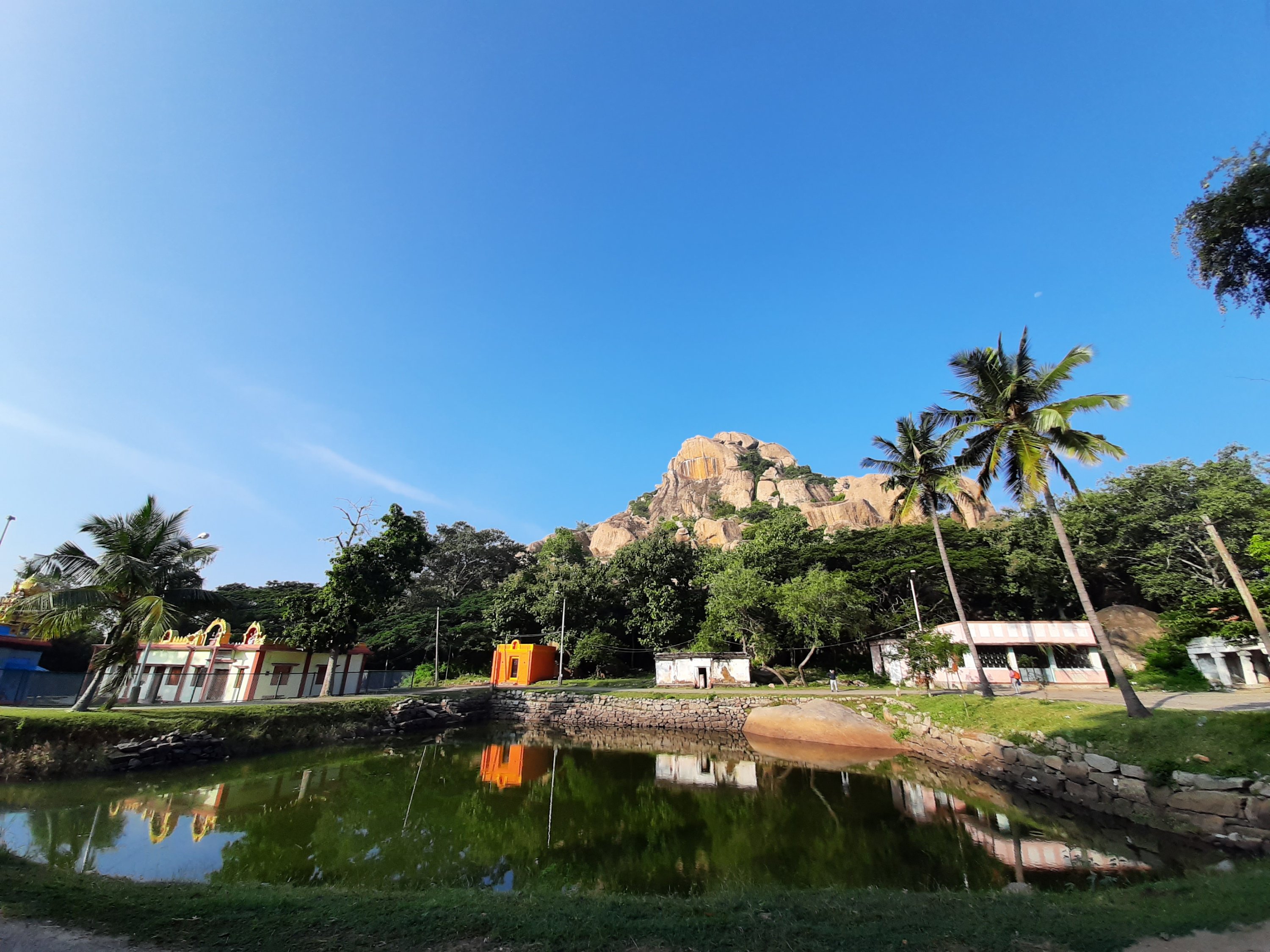
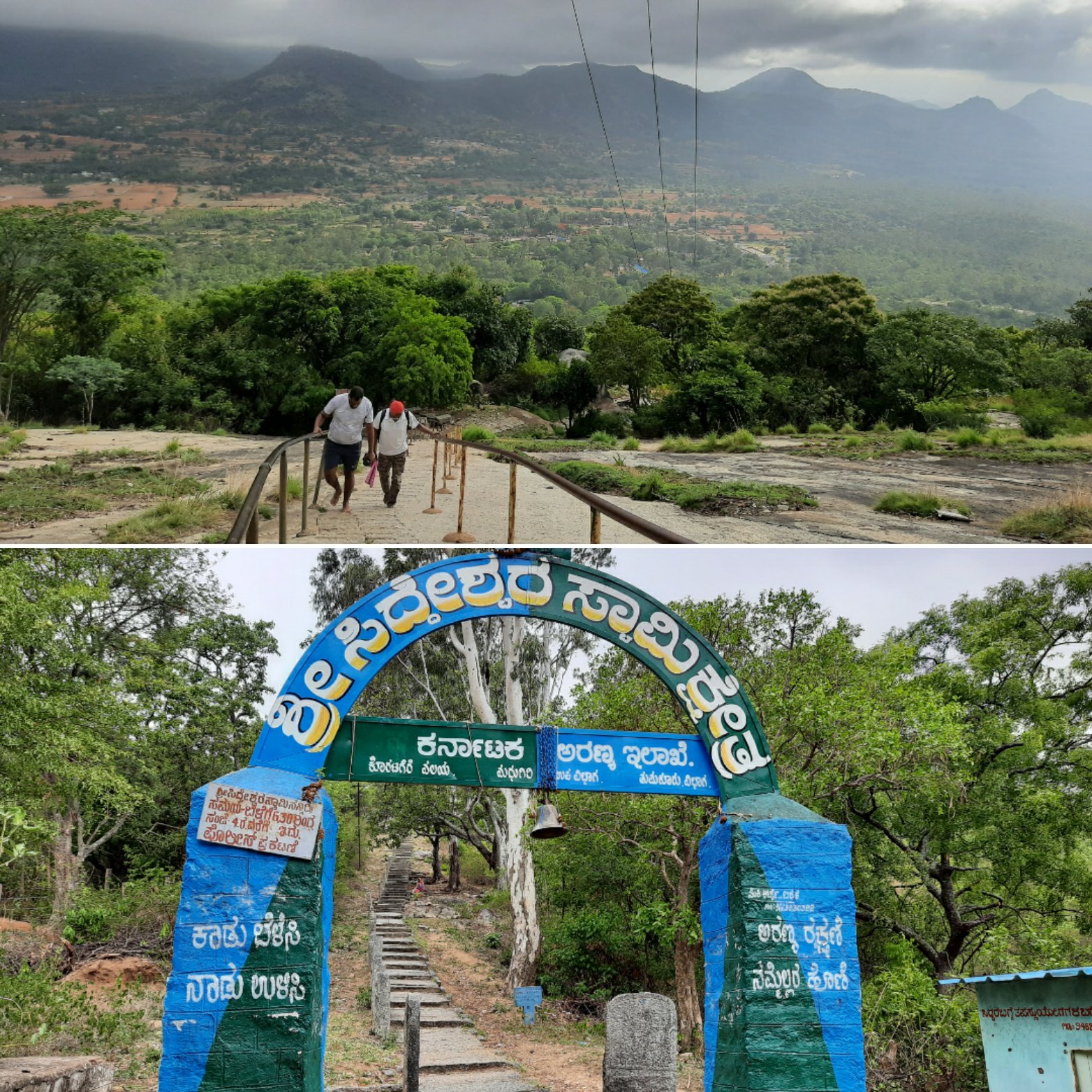
We chose the latter. So instant suggestions that came from someone in the group was Devarayanadurga and Siddarabetta. Then, we decided to give Devarayanadurga a miss as we all favoured a hike over a flight of stairs. We arrived at the base of Siddarabetta where we noticed a board that said, ‘climbing the hill with footwear was a sin’. Since many people use this path to visit a temple situated halfway, we didn’t want to hurt the local sentiments by wearing our shoes. Thinking that ‘a barefoot hike was definitely going to be an experience’ in our heads, we left our shoes back in our car.
Below: The welcome arch at the base; Top: The initial climb
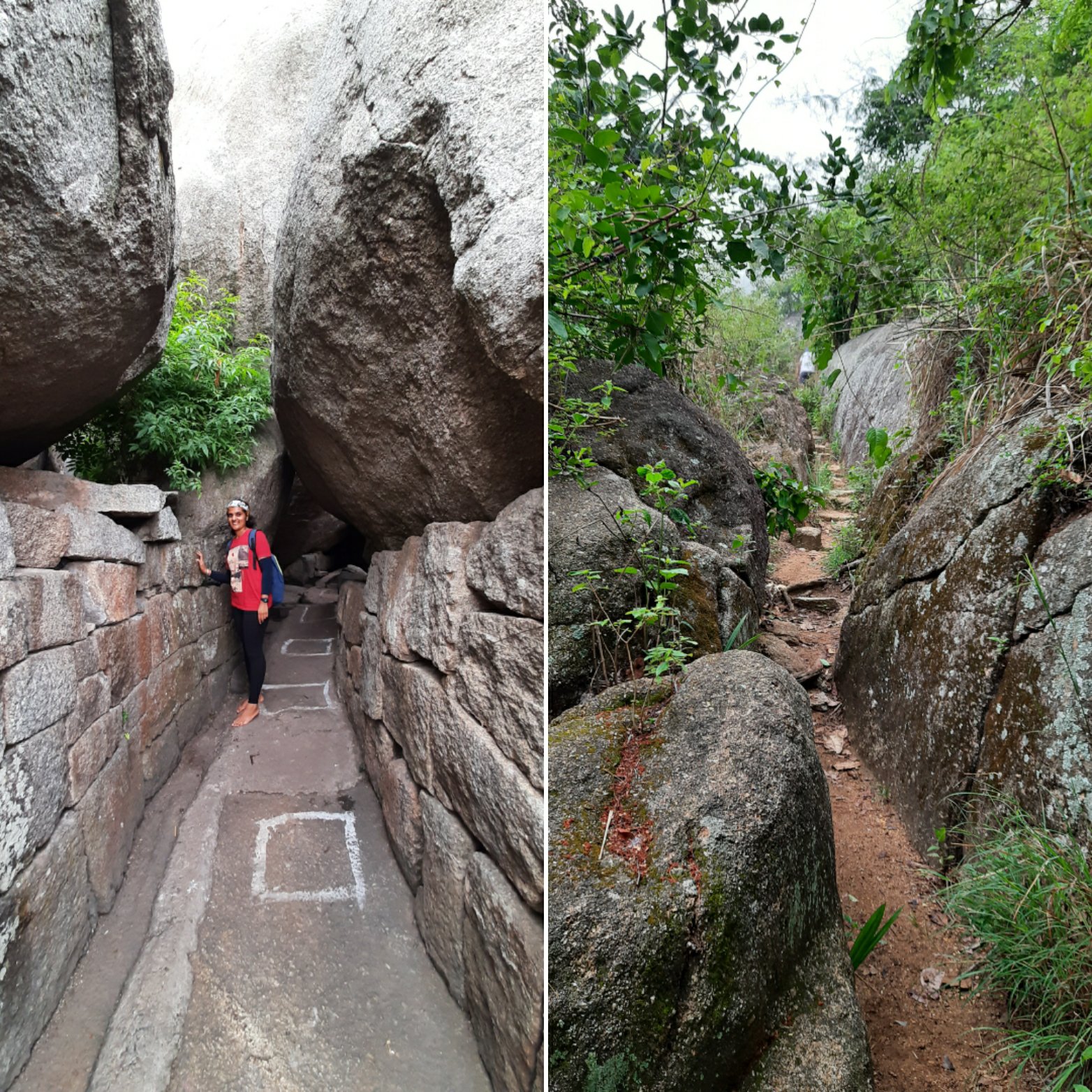
The initial part of the climb, until the Siddeshwara Swamy temple was steep but easy with well laid out steps and iron rods to hold onto. When we reached a small temple kind of a spot, the path split into two. The Siddeshwara Swamy temple was to the left, where too many people seemed to be as if there was no pandemic going on and there exists no concept called ‘Social distancing’. We decided to distance ourselves from the gathering and took the path to the right. With having to pass between too many boulders, it did seem a little confusing initially. The distant passing clouds now seemed as if they had come to meet and greet us. But after walking a little ahead, we reached an area that was a transition from dry rocky mountain to rain soaked green forests. The real challenge of walking barefoot started there, with unassumed ground with gravel and possible thorns from the shrubs.
Left: The rocky path to the temple; Right: The forest path to the view point
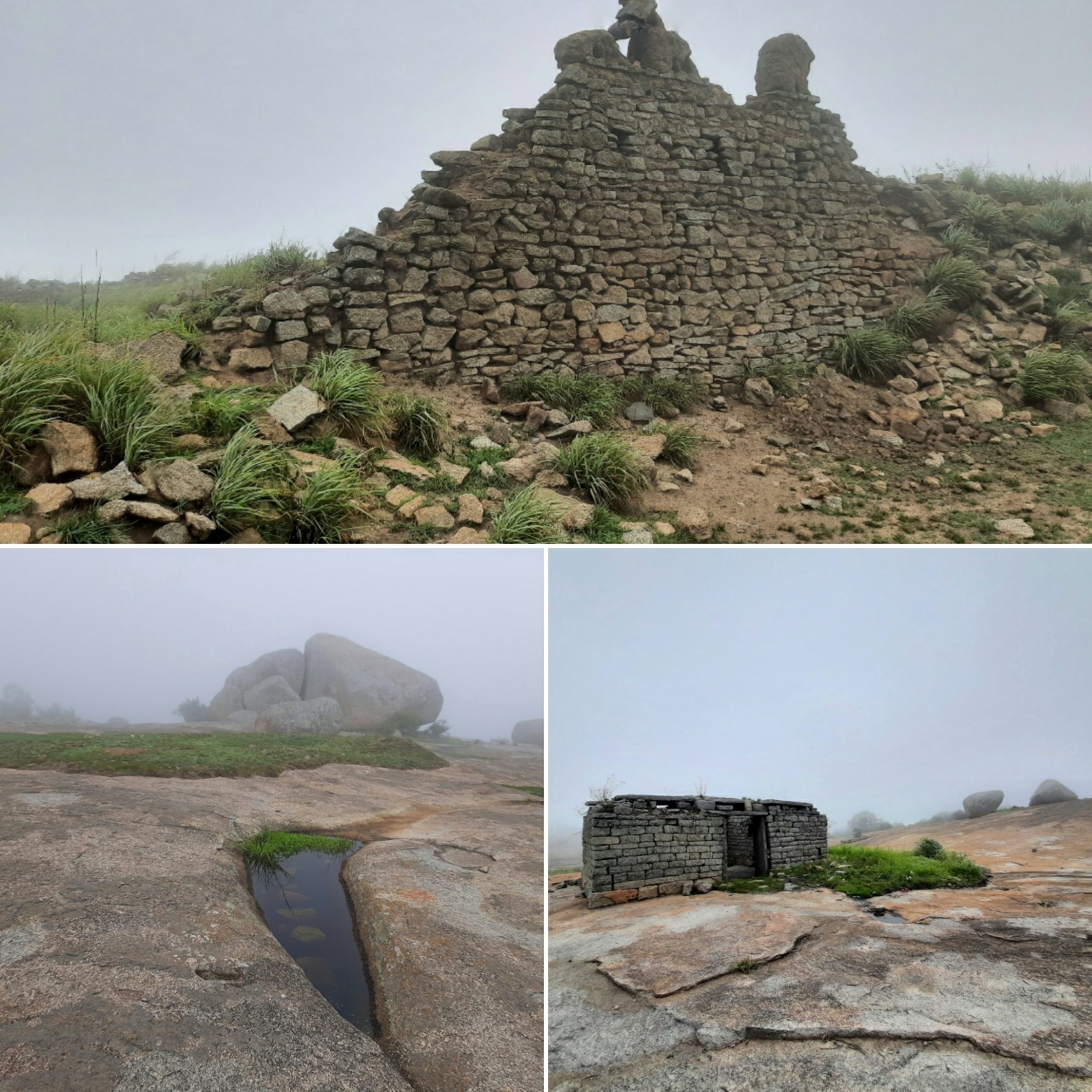
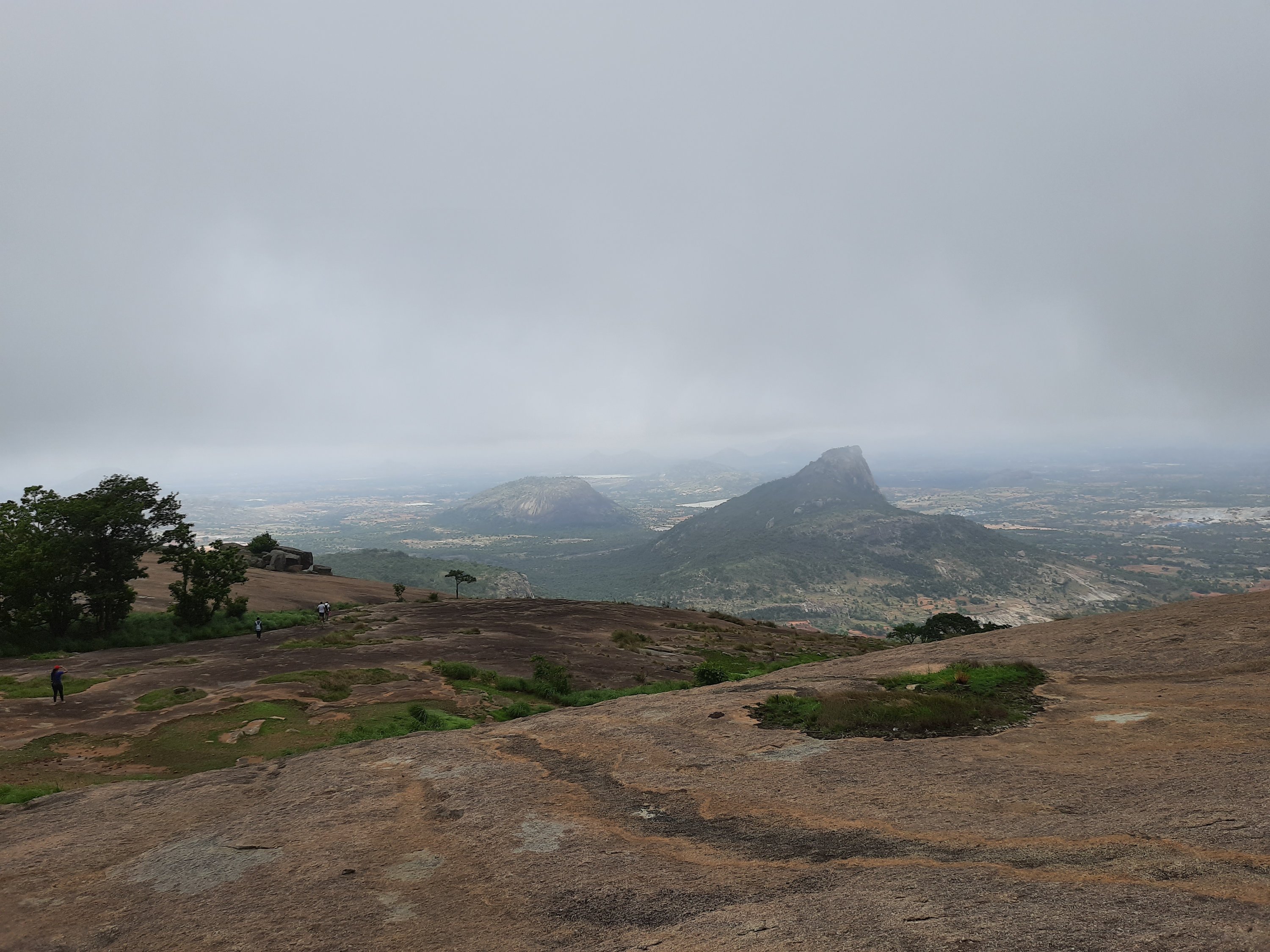
A little further, we reached an open rocky area where the view in front of us was playing hide and seek with each passing cloud. Apart from the drizzle and gusty winds that made it difficult for us to stand, we were mind-blown by the view we saw each time the clouds cleared out. There exists a small rain fed pond, a couple of meditating chambers that house Shiva Lingas (history unknown) and dilapidated remains of an old fortress. There was nobody else other than us in this entire stretch. We walked further and crossed two more hills before deciding to return, or else we would lose our way back.
Top: The dilapidated fortress wall; Bottom left: A large rock; Bottom right: One of the meditating chambers
It started to rain on our return, and we were quite drenched by the time we made it to the car that was parked just at the base point. The small eateries and stalls were slowly opening by that time which we chose not to visit, in order to avoid any social contacts with anyone else outside the group that we had gone in. We ate a few biscuits as a substitute for breakfast that we had carried from home and decided to stop the car next, only at home. It was a much-needed break and a pleasant little hike.
The view at from the peak
Summary:
It is an easy hike and very good for beginners.
Be careful to carry all snacks only in a closed backpack as there are too many monkeys on the way.
You have probably read my earlier post on exploring the offbeat landmarks of Old Bengaluru. Here is another one. This time, it was a culinary trip of Old Bengaluru to a friend who had flown down to this southern metropolis, from the so-called Northern part of India. I had been asked to take him on a gastronomic tour of my city. For someone who has a penchant for everything old school, I thought Old Bengaluru would be perfect to call it a day. ‘From vintage automobiles, architecture, iconic restaurants serving traditional recipes to by lanes and alleys that narrate their own individual story of the city, this section of Bengaluru has everything that would tickle a bone or two of this mad man’, I thought.
Having largely spent my teenage in North Bengaluru and given my familiarity with the area, Malleswaram was my first choice. However, given the convenience of commutation from my current place of stay, I chose to show him around South Bengaluru. But when one says South Bengaluru, it is a world in itself and the geographical area is large to fit all in one day. Hence, I took time to mark a quick map of restaurants to cover, along with giving a peak into the cultural heart of the city. This part of the metro lays in stark contrast to the Bengaluru, that the millennials from Whitefield and Marathahalli know of.
The obvious choice was a walk tour of Basavanagudi and the Pete area. These are the two most important clusters of true Bengaluru that have held onto the roots, despite the rapid and traumatic transition this city has seen in the last decade in the name of urbanization and modernization. Under the canopy of massive native trees, the aroma of the by-two filter kaapis shared at the numerous Shanti Sagar and darshini food joints, the air here feels different from anywhere else. With almost every street dotted with Classical dance and music schools and happy nonagenarian couples whizzing in their Padminis and Ambassadors, it has a different vibe here. One can find some of the traditional old houses and landmark restaurants only in these localities to really experience old Bengaluru. Each of these iconic eateries have a near century old history and their old school ambience is still intact inside the heritage structures that house them. With a small appetite for food and a big quest for exploration, the portions of food were limited only to the signature dishes of each restaurant, to accommodate more places. So, here is my itinerary of a gastronomic tour of Bangalore of yore.
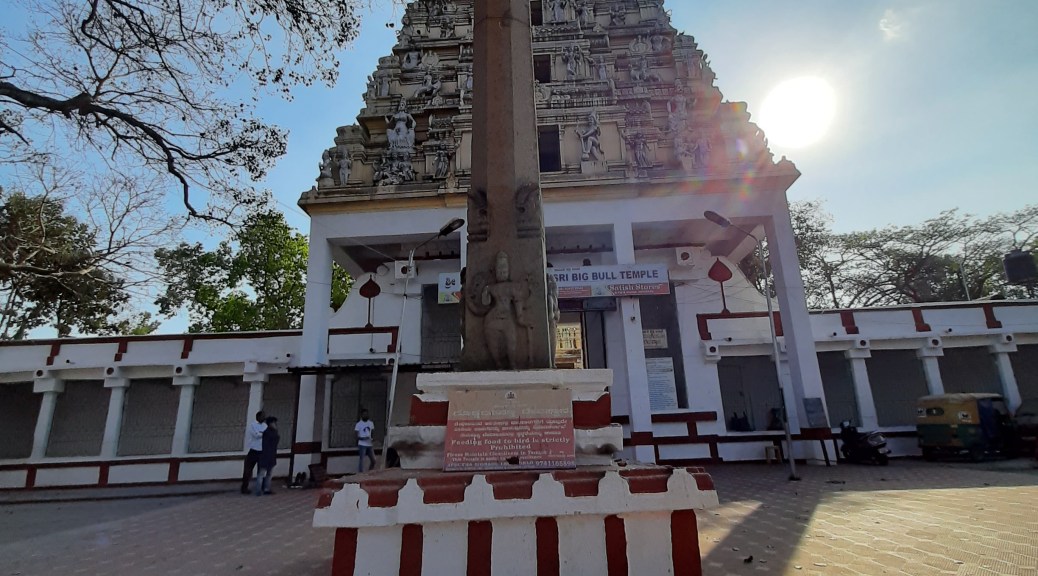
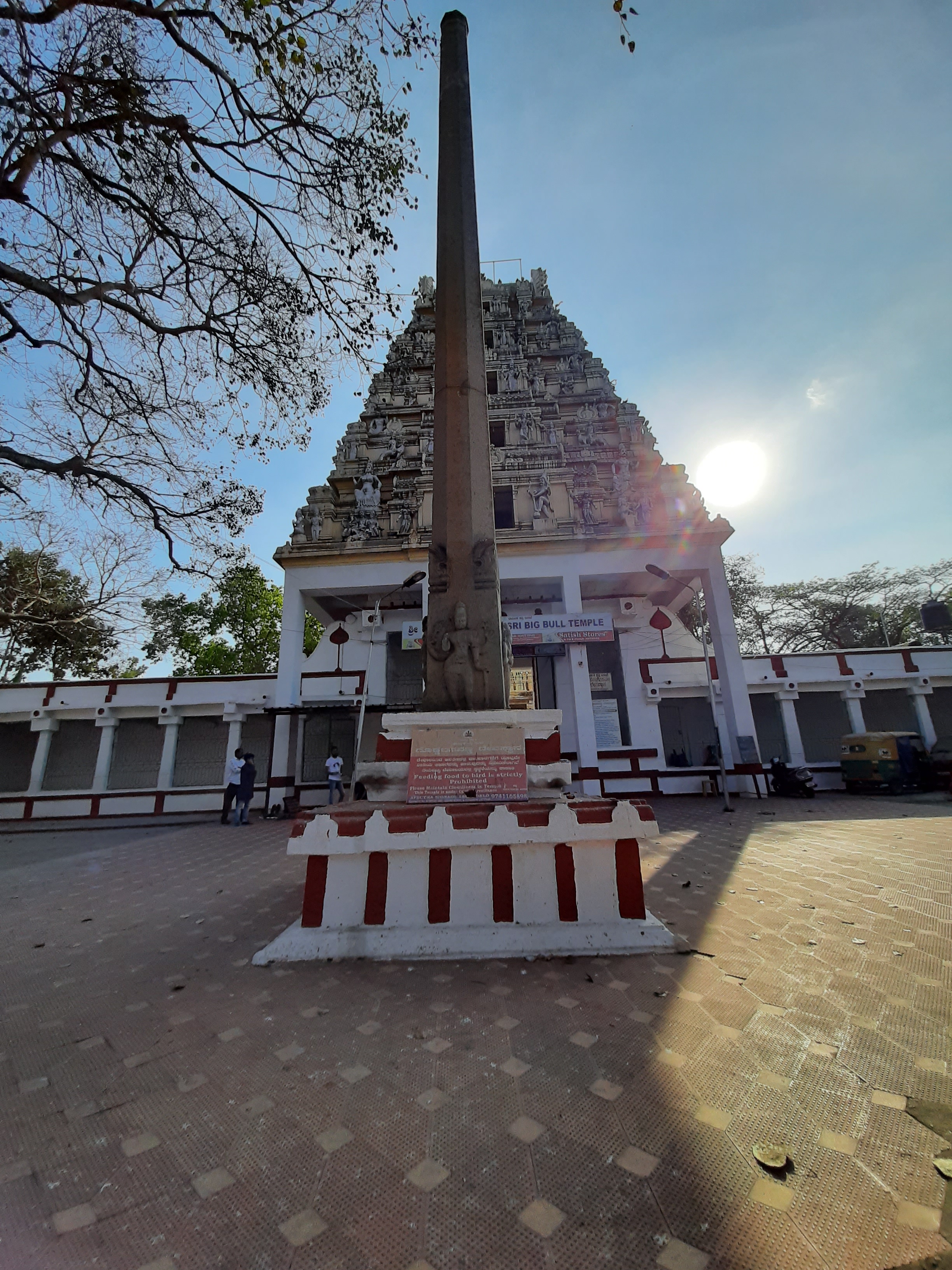
The Big bull temple, Basavanagudi
Meet-up point: Basavanagudi is the name of a temple (It translates to ‘Bull- Temple’). Basavanagudi is the name of a locality in South Bangalore, named after the temple. It is an extension of the Pete area, which was specifically created to accommodate the upper class, and more-specifically the Brahmin community. No trip to South Bengaluru is complete without a visit to this landmark temple built by Kempegowda, the founder of Bengaluru. Apart from the Big Bull temple, the Dodda Ganapathi and the Bugle rock (a small watch tower from the Kempegowda era) are a must visit on the same premises. If you time it up well, you can part-take in the annual groundnut fair in the locality. (Read here to know more about the history of the Kadlekai Parishe). After meeting my friend here, we started our gastronomic tour to our first food stop.
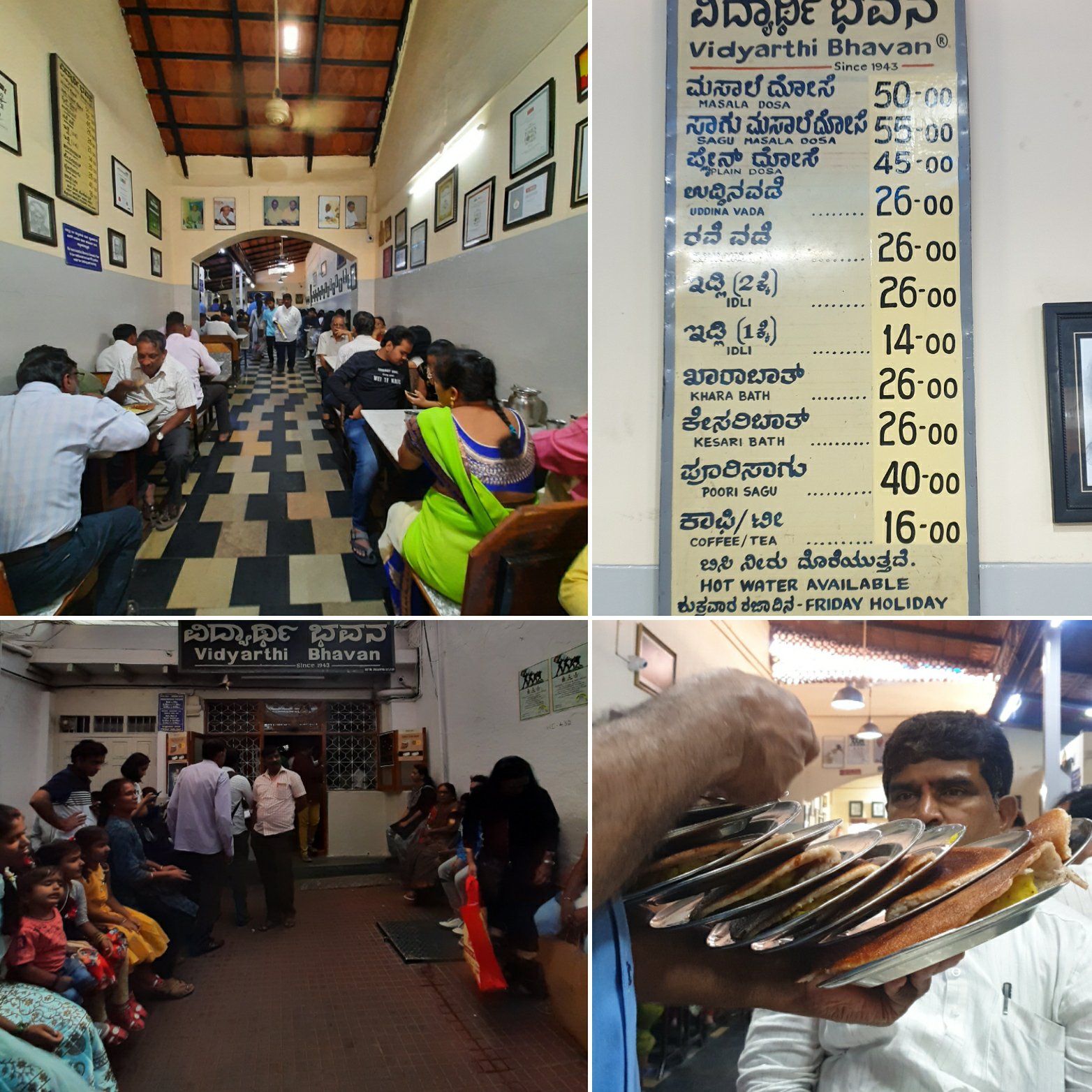
Food stop 1 (Breakfast): As synonymous as Dosa is with South India, Vidyarthi Bhavan is with South Bengaluru. Ask anyone for the best Dosa in the city and this place scores on top unanimously. It is a restaurant started initially to cater to the student community of the area which started a new culture of a hangout place for friends in those days. On most days, the queue can extend well up to a kilometer. My friend and I wiped off our plates of their signature Masala dosa for breakfast. (Click here to read further about the history of Vidyarthi Bhavan)
Vidyarthi bhavan, Basavanagudi
Food stop 2 (Light eats): No foodie who visits Bangalore is satisfied without taking an evening walk on the Eat street at VV-Puram. However, I decided to go here in the morning, in order to avoid the maddening rush. Honey cake and Congress bun at the iconic VB Bakery was what we needed. This is the first Iyengar bakery to be established in Karnataka which has paved a new culture in baking (Read here for more about V.B.Bakery). Avarebele (Val bean) is a favorite ingredient of the Bengalureans, who have a dedicated annual fair to celebrate this pulse (Click here to read further about Avarekai mela). Hence, picking up a packet of avarebele mixture for home from one of the stores there was an obvious choice.
Food stop 3 (11 o clock, coffee): It is an important break time for the employed section of the society. Brahmin’s Coffee bar is a household name for their filter coffee and the delectable chutney served with idly on their very limited menu. This tiny eatery is in a corner of Shankarapuram, which is also famed for the Shankaramatha, a learning center of the advaitha philosophy. We had a quick stopover for a hot cuppa this little place is known for, before heading to Pete. (Read further about Brahmin’s coffee bar here)
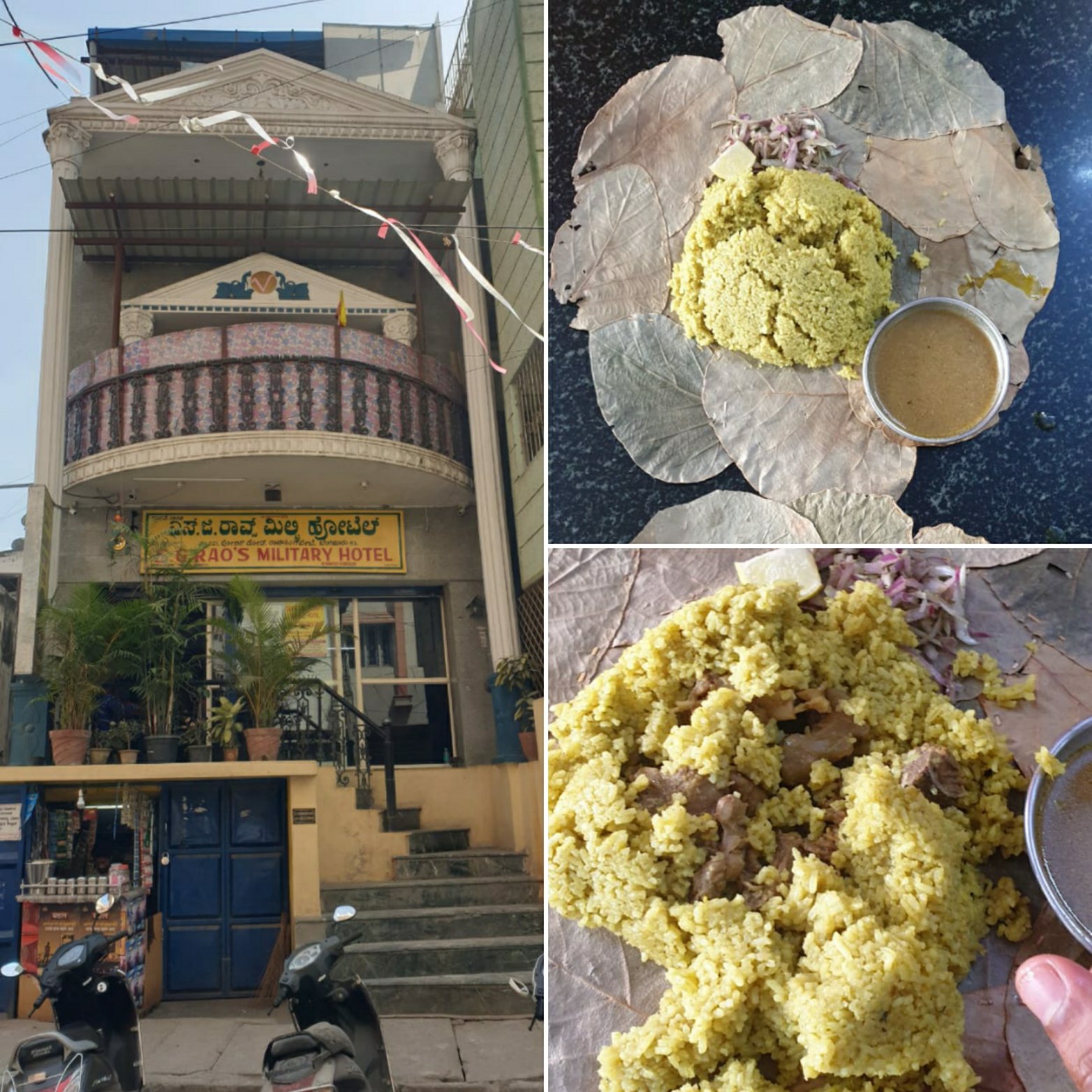
Food stop 4 (Lunch): To satiate the hunger pangs, I planned to treat my friend with an authentic Bangalorean affair. With multiple theories surrounding the origin of the military hotel culture, the history of these restaurants dotting across the southern part of Karnataka is unclear. Bangalore is home to some of the best in the state. I don’t think there would be any better meal than ‘Ragi Mudde oota’ savored at a military hotel to get a peek into the local flavor, including the ambience. Hence, we were lunching that afternoon at S.G. Rao’s military hotel, located in the cotton Pete area. A typical military hotel meal includes Kaal soup, Ragi Mudde and Mutton biriyani. (Click here to read further about S.G. Rao’s military hotel)
S.G.Rao’s military hotel, cottonpete
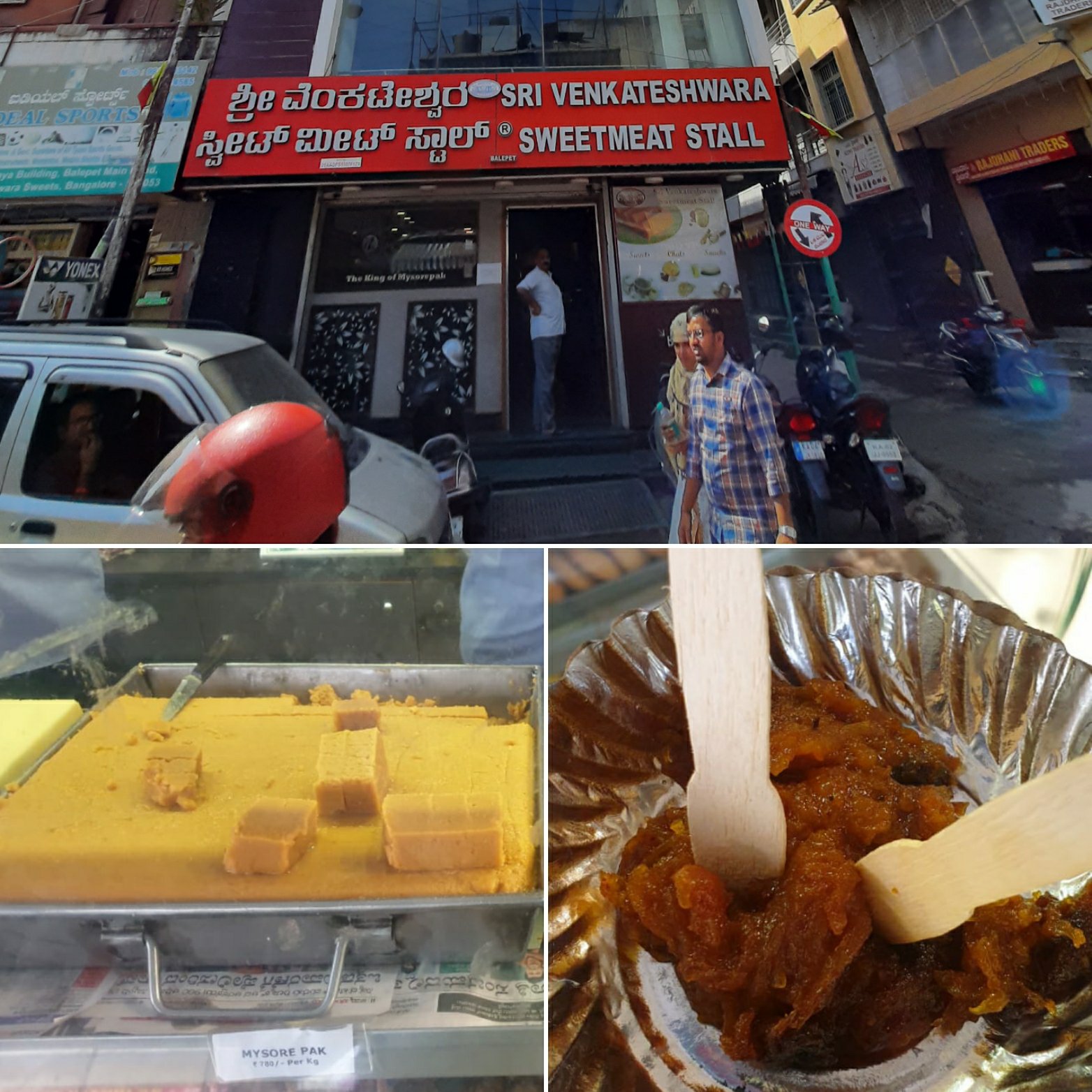
Food stop 5 (dessert): A meal is complete only with a nice dessert. If there is one sweet meat that is synonymous with Karnataka (Mysore state), it is Mysore pak. Since I couldn’t take my guest to Mysore for that, the closest I could get is at Sri Venkateshwara sweet meat stall located at Bale Pete, a short walk away from cotton Pete. Their Mysore pak and dumroot are the sweets my friend packed for his roommates back in his hometown. (Click here to read about Sri Venkateshwara sweet meat stall).
Sri Venkateshwara sweet meat stall, Balepete
The Pete walk: An old Bengaluru exploration is nothing without a walk along the narrow snaking lanes of the Pete area, the true business epicenter of both New and Old Bengaluru. This area is segmented into various sections and named according to the commodity sold and the communities that resided there in the yester years. From green groceries, handloom, steel, plastic to precious metal, everything is available in this locality. An early morning walk in the famed flower market is an experience in itself. We limited ourselves to just the mainstream sections while exploring some of the ancient temples, mosques and heritage houses of the Kempegowda era. In the meanwhile, we kept munching on numerous snacks from several popular stalls on our way. Although these eateries are old, the flavors are largely north Indian, owing to the Marwari and Baniya community that reside here in majority.
The heritage structures of the Victoria hospital, Bangalore fort and Tippu Sultan’s summer palace all lay on the side of the road for the history and architecture buffs who have a little more time in hand. But this is all we could fit in our day. Thus, ended a gastronomic tour of South Bengaluru.
I hope you enjoyed this virtual tour with me too… did you? Or did you not? Share your thoughts with me…
There are many other iconic restaurants in Basavanagudi if you have a larger appetite. These are a few other places that you must check out when you are here: The new modern hotel, Mahalakshmi Tiffin room, Janata Tiffin rooms are a few among many others.
Souvenirs to buy:
Coffee filter and freshly roasted coffee powder: The best filter coffee is available only in South Bengaluru, and hence my friend thought this was a more significant thing to buy from here.
Channapatna wooden toys: These are GI tagged handicrafts made with organic colors and largely popular in the western market, it comprises a large collection of traditional toys.
Come the night of Mahashivaratri, there will be festivities across the country. People stay up all night and participate in bhajans, pooja offerings, chariot pulling etc. all to keep themselves awake for the night, so that their beloved Lord, Shiva gets good rest after taking care of them all year. But it is the day that follows the revered night, that is the essence to this story of mine. The day that follows Mahashivaratri is when Shakthi, the consort of Shiva and thus, the female power is celebrated across the Northern part of Tamil Nadu. The companionship of Mother Angalamman to Shiva, the graveyard dweller is celebrated with a festival called the ‘Mayana Kollai’. As a friend explains, Mayana Kollai translates to the ‘Raid of the graveyard’ in Tamil. I had planned to witness this festival at one such temple dedicated to Angalamman, closer home, at Kaveripattinam.
The festivities had started as early as the sunrise at the Angalamman temple, with the Goddess being taken on a temple car/ chariot. She is supposed to travel along the streets of the town, to the graveyard by evening from where she returns to the temple by night. All other rituals that are part of this journey of her’s are what make this festival more interesting. It is a festival where the entire town / village participates with no barrier of caste or societal status. The chariot leaves the temple with the idol of Angalamman.
The diety- Angalamman being taken on a procession on the temple car / chariot
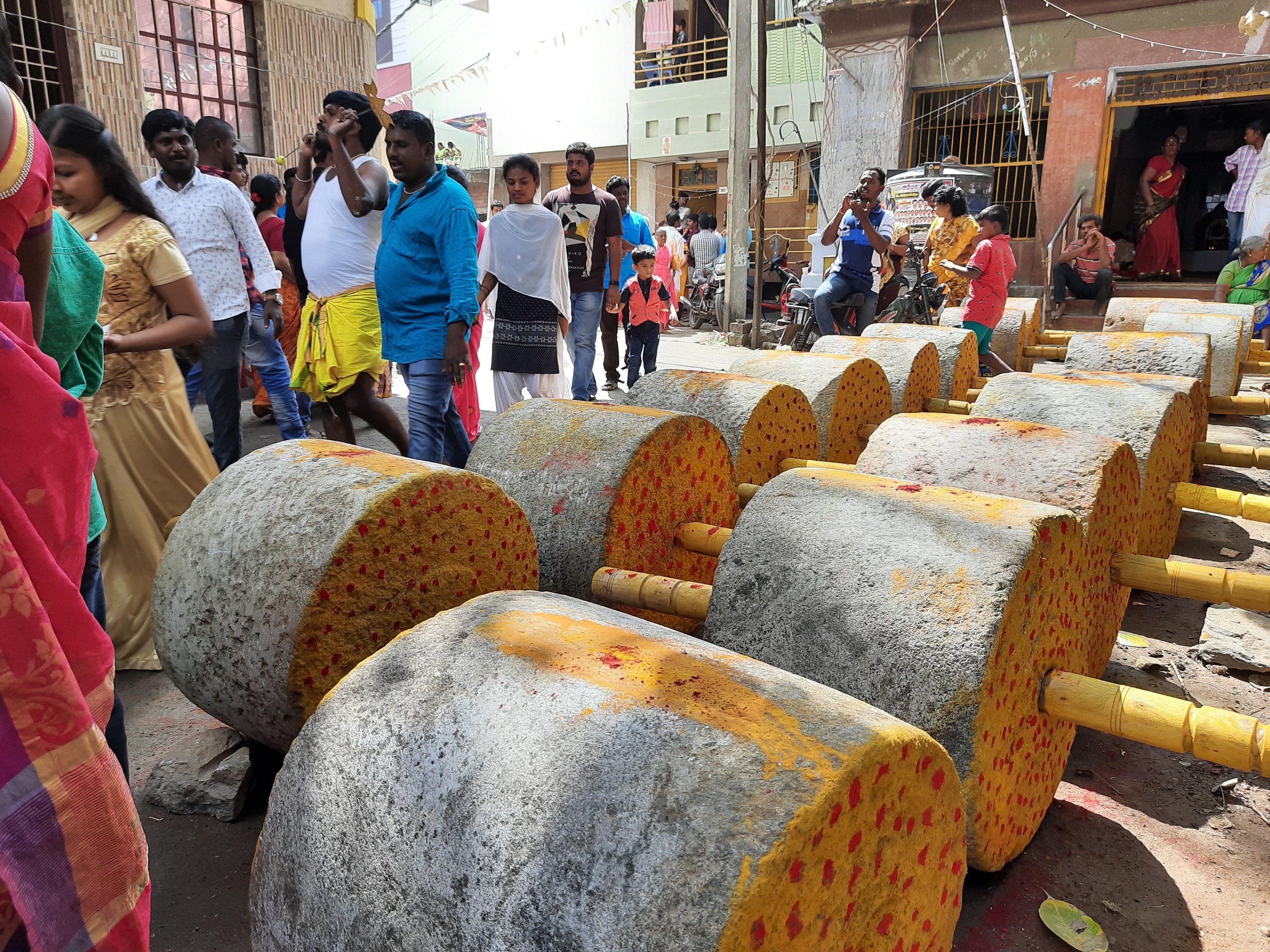
She is greeted by devotees who throw a mixture of salt crystals and black pepper or beans all along her way. She is hailed as a symbol of fertility who is calm throughout the year and takes on her powerful form on this day, once in a year. The villagers get their body pierced with various things near the temple premises and walk across the village to the graveyard, where the piercings are removed. This body paining is what they believe, is a gratitude to the almighty for the wishes that have come true or as a part of a prayer that needs to be fulfilled. The size and things pierced can vary depending on individual’s prayers. While those with tridents pierced around their mouth are a very common sight, the more pious go further to get their torso pierced with hundreds of lemons. Yet, a few pull cars, buses, trucks or large stones with ropes that are hooked through their bare skin.
Stones being readied to be hooked to the body as a man with a trident pierced to his cheeks walks past
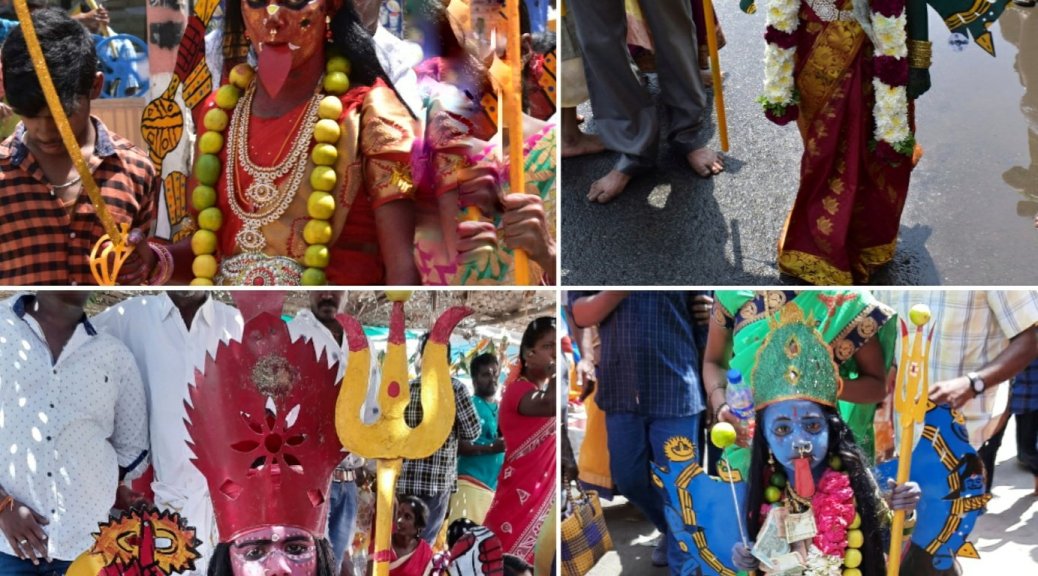
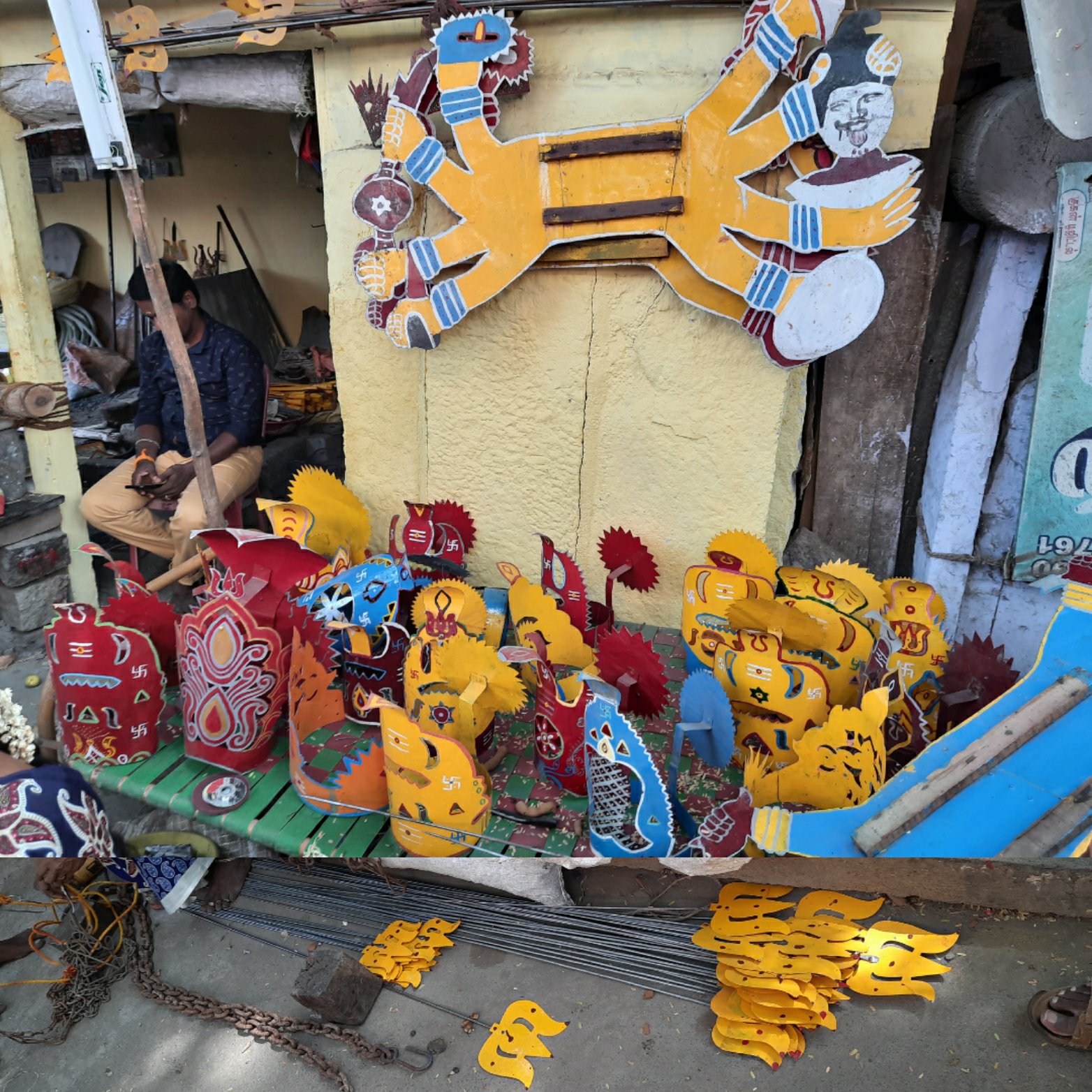
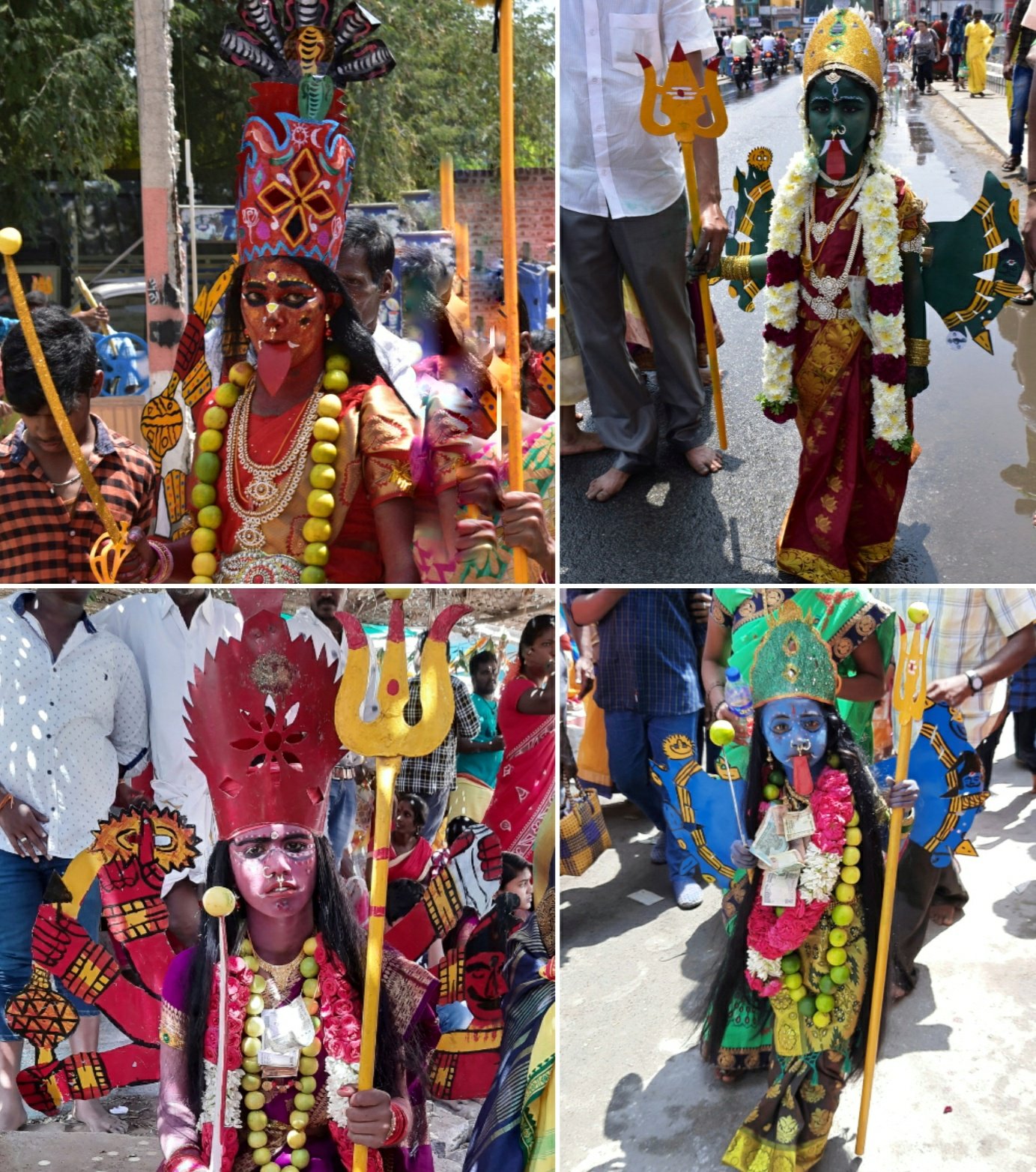
If u peek into one of the many shops (I don’t know if that is the correct noun for such places) around the town, apart from those getting the body piercings, you will find another set of people. Men and children will be getting their faces painted and dressed up in sarees, a representation of Angalamman. With metal arms attached to the backs, elaborate costumes, jewelry and crown worn, Angalamman is impersonated by these people. They hold tridents and dance to the beats of drums across the streets. Several times on their way, they get possessed or get into a state of trance, until they all finally congregate at the graveyard. Animal sacrifice too is a common sight on the streets on this day.
Stalls where the body piercings and paintings will be done
It is evening by the time the temple car and everyone else reaches the graveyard. That is when the most interesting part of the rituals takes place. The folk impersonating the goddess gather around a random grave and dig it up. The bones from the grave are pulled out and chewed by them. This is called the ‘bone chewing’ ritual or what gives the festival its name: Mayana Kollai or the ‘Raid of the graveyard’.
Men and kids dressed up like Angalamman
There are several legends and references that explain the significance of this ritual, depending on the region. Here are some of the references I found on the internet.
Post this ritual, the goddess calms down and returns to the temple on the temple car. The festival culminates when the it reaches its home.
While witnessing all this self-violence, I started to deeply think, why this is necessary to please the gods. Although I couldn’t find a convincing conclusion, what I realized is that this form of ritual is not unique to Hinduism alone. It has been largely practiced worldwide, across all major religions. Some of the closest references are:
Whichever faith be it and whatever the belief, the intentions of every person involved is the same. To get closer to god. Aren’t all our beliefs connected?
Well… Heading to seek blessings from Lord Venkateshwara at Tirumala Tirupati Devasthanam? I’m not a religious person and I’m someone who seeks variety in my travels… The same route and same destination- I have sometimes felt myself being forced into a pilgrimage sort… No doubt, I have loved my general hike up the stairs to the venkateshwara hill, more for the beautiful views, stopover points like deer park, waterfalls and so many eateries all the way up. I have even tried the not-so-pious option of the quick VIP entry for the darshan. But, over time when the route becomes so predictable, even the journey kinda starts to hit you when everyone is sleeping on family vacations that are occasional and are spent on familiar roads!!! So that’s when I started to explore alternate routes and make family road trips more interesting!
While travelling to Tirupati, the usual route one tends to drive through, is the
Bangalore-KGF-Chittoor-Tirupati highway.
But the nice, straight, adventure less route has sometimes made my brother to doze off at the steering. So, the last time we planned to go, we tried taking a slightly longer but interesting route via
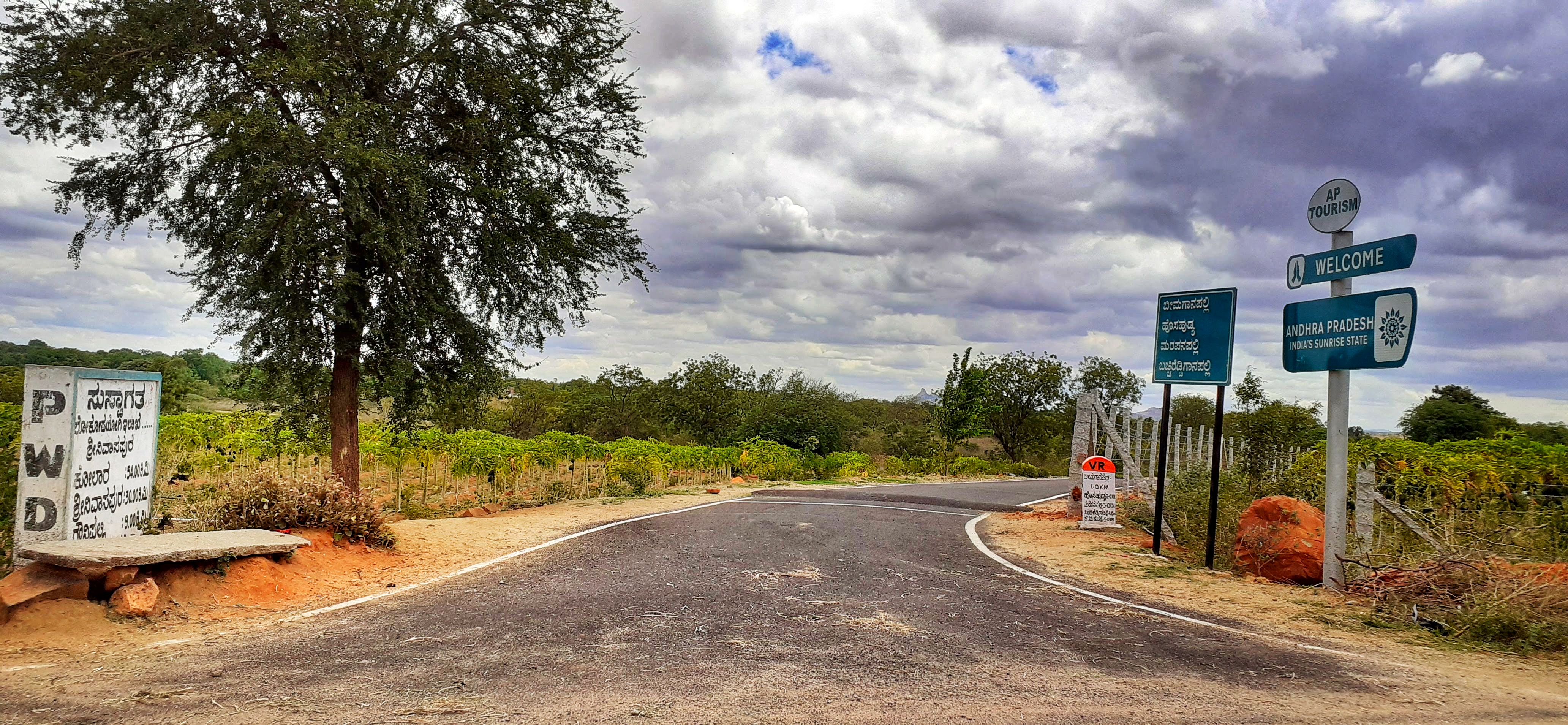
Although this national highway was a single lane, it was absolutely scenic and had so many elements in the travelling. From barren flatlands to lush green hill stations, rustic countryside huts to erstwhile forts, scattered rocky hills to tempting mango orchards and horticultural farms, the route took us through several hues of the deccan plateau. To make it more interesting, we saw milestones with Karnataka’s Kannada and Andhra’s Telugu on either side of the same road marking the boundary of the two states. For the thought of knowing absolutely no words of the language on the other side of this state border, it felt like I was crossing an international border without a passport 😀
The border crossing from Karnataka to Andhra Pradesh through papaya farms
So our itinerary was something like this:
Start from Bangalore by early morning (To avoid the traffic choc-o-bloc at KR Puram)
Reach Horsley hills for a late breakfast or a brunch (before the day trippers, riders and families pour in for lunch)- It is a short ride up but the view up there is worth it.
As we descended the hill, the drive further from there was gorgeous forcing us to take several photo stops.
Drive up to Talakona, the highest waterfall in Andhra. You can book your meal at the forest run jungle resort there before heading out to indulge yourself in some fun activities or getting drenched in the waterfall depending on the water level there. It is also wiser to leave from there before it is dark as it is a national park area and the wild animals get on the road post sunset (Click here for a detailed post on Talakona).
Reach Tirupati and take rest for the night.
Plan your darshan of the deity based on your convenience- a quick visit or a hike up to the temple and return to the room to rest.
The view from Horsley hills
It is quite usual that a lot of people extend their pilgrimage until Srikalahasti. They combine the Vaishnavism faith (Lord Venkateshwara at Tirupati) and Shaivism faith (Lord Shiva at Srikalahasti) in the same trip since both are located not far from each other (More details on Srikalahasti in a separate post).
On the way to Kalahasti with a small deviation, is what I figured out was, that there is a 11th century fort at Chandragiri, the erstwhile capital of the Vijayanagar dynasty. It is beautiful and you will not regret the deviation.
Reach Kalahasti for the evening prayers and find an accommodation there.
So, are you done with the pilgrimage? Is your family feeling all blessed and happy now?
Good morning! Save your sleep for some other day and Buckle up. For I’m going to take you through a different route as you return home. You can thank me later 😉
Drive through eucalyptus and teak groves on a scenic off-road to reach Sullurpeta, Your only place to find decent food before you embark on a long day ahead.
Your next destination is 20kms away- thank me later. Drive through a straight dead road, cutting through what is the second largest Salt Lake in India- the Pulicat lake. You will love the drive and the destination.
Welcome, you have arrived at SHAR, Sriharikota island. India’s Large Rockets’ launching station (Click here to read my struggle to finally get there!). The space museum located on its premises is open to public with online registration. You can witness a rocket launch too if you time your trip well.
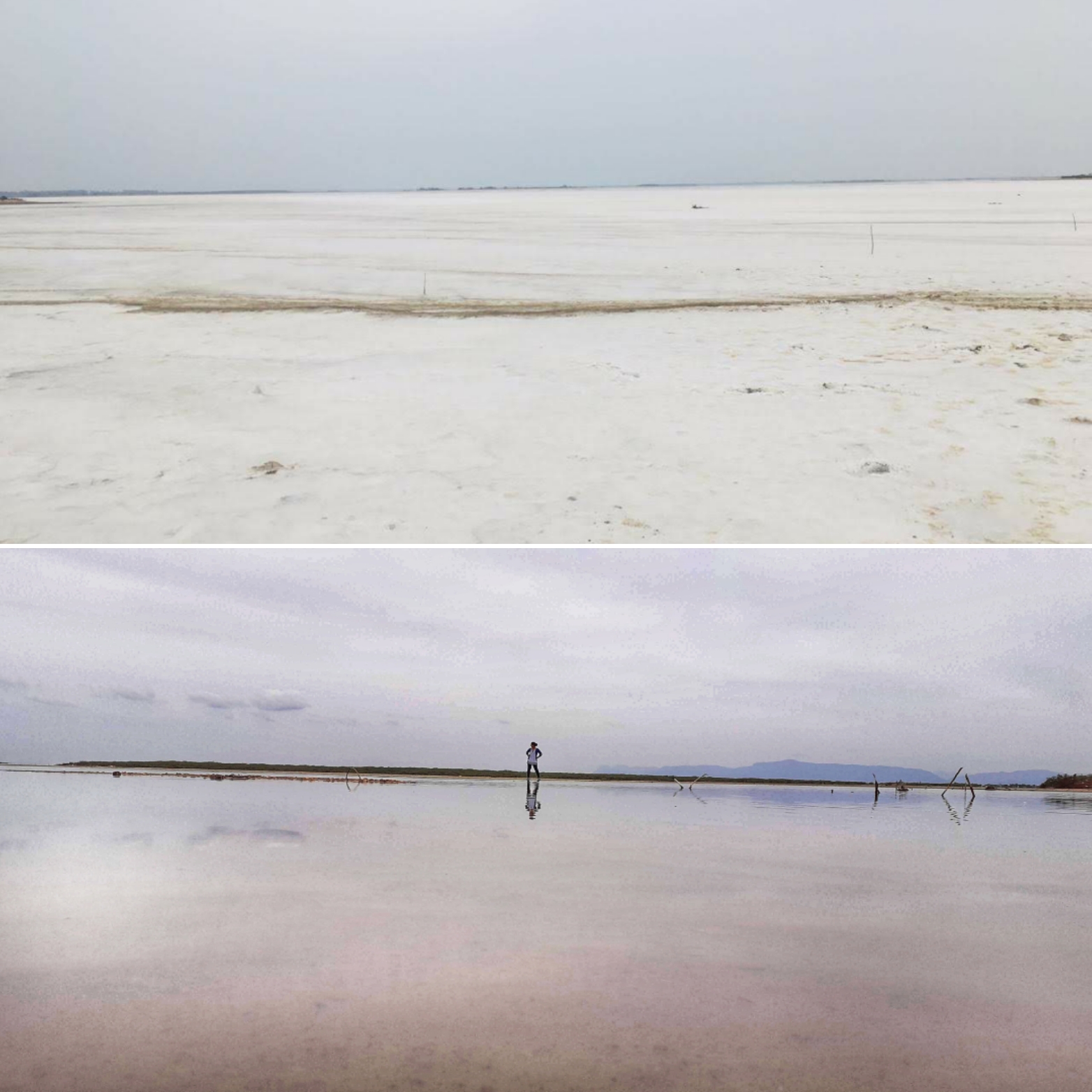
Coming back to the drive, on either side of this straight road you see is this never-ending stretch of salt. Depending on what season you are traveling, you will be warmly greeted by bright white dried salt flats or brackish molten salt. Spend some time at the watch tower there and you will not be disappointed by the variety of migratory birds you encounter. The entire area is declared as the Pulicat birds’ sanctuary.
Top: Lake Pulicat enroute to SHAR in winter; Lake in Summer
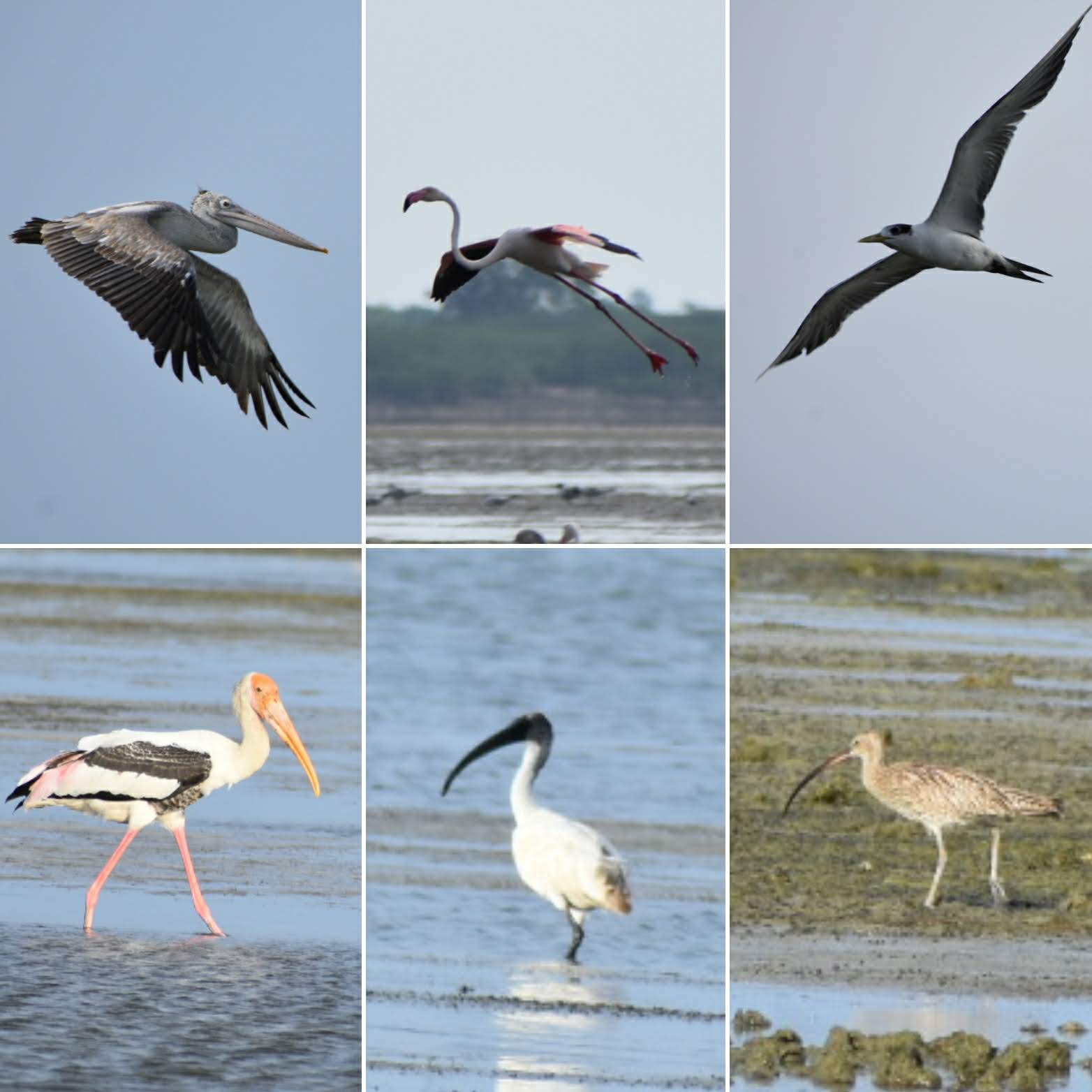
Got fuel? Drive another 60 kms. to a tiny fishing hamlet called Pulicat located towards Chennai. The Pulicat lake is situated between two states, Andhra and Tamil Nadu. Flamingoes and Pelicans are a highlight here along with several other migratory birds that flock the swampy lake every season. Get yourself a boat ride with the local fisherman there and he will take you around the swamy waters. Watching the sunset at the beach will be a perfect way to wind up your day!
The birds at Lake Pulicat
From Pulicat, you can take one of the below three highways to head back home:
Drive through Tada and follow google maps to reach the Chittoor highway. Tada has a waterfall to visit and some decent places to stay overnight. It is a village/ township created for the tribes who were relocated from the Sriharikota island when the space station was established and human settlements had to be cordoned off in that island.
Take the Vellore route with a stop at the Vellore fort and the Golden temple of Lakshmi. Yelagiri is a popular hill station among the urbanites and is just a short drive away from Vellore. I will personally not recommend it as I did not find worth in taking the effort to deviate from the highway.
If you wish to choose option 2 or 3 to reach Bangalore, do not forget to stuff yourself with some good Biriyani at Ambur, Bon appetite!
Ok, I know this is quite an elaborate itinerary which I usually don’t write about. But I did so, thinking it might help a lot of you out there who text me asking trip ideas from Bangalore. You can skip the temples if you are looking only for an offbeat drive route and I’m sure you will enjoy it.
Or do you want me to customize the itinerary based on fewer or more days you have at your disposal? Drop in your requests, doubts and comments below. I will be glad to help you 😊
Dense canopy of trees, swaying coconut palms, houseboats cruising through the pristine backwaters, wooden canoes of the locals fishing in narrow canals- Well, does this paint a picture of Gods own country? When opportunity struck, I decided to give the usual things a miss and explore a region that is least spoken about in a typical tourist circuit in Kerala. I wanted to explore the land where art is considered divine and celebrated in all its form. I was heading towards Pathanamthitta.
My Itinerary:
Day 1: Leave from Bangalore to Kochi (by Flight); Drive from Kochi to Pathanamthitta. Visit Aranmula Parthasarthy temple (take a local foundry tour); Visit Thiruvalla Srivallabha temple (Watch a Kathakali performance in the temple); Day 2: Gavi or Konni elephant camp, Charalkunnu, Kakki reservoir, Perunthenaruvi waterfalls, Kalloppara church, Paliakkara church and Niranam church. Return to Bengaluru.
The details:
First thing I did while approaching Pathanamthitta was lowering all the windows of my car, to breathe in some clean air. With almost two third of the district comprising of forest cover, it is no wonder that Pathanamthitta is the least polluted city in India. The remaining one third is a combination of the city and plantations. We were heading to the homestay we had booked, not very far from the city centre. It was nestled in what the locals call as a residential area that was far from imagination of a city soul. The narrow roads were flanked by rubber, tapioca and banana plantations for most stretch and marsh lands for the rest. Bunches of jackfruits hung down from tall trees among several other tropical trees like litchi, rambutan etc. that had the fruit lover in me all drooling. My stay was at a traditional Kerala house nestled amidst a huge garden. Its wooden portico with clay tiled roof had me fancy struck.
Enroute to the homestay
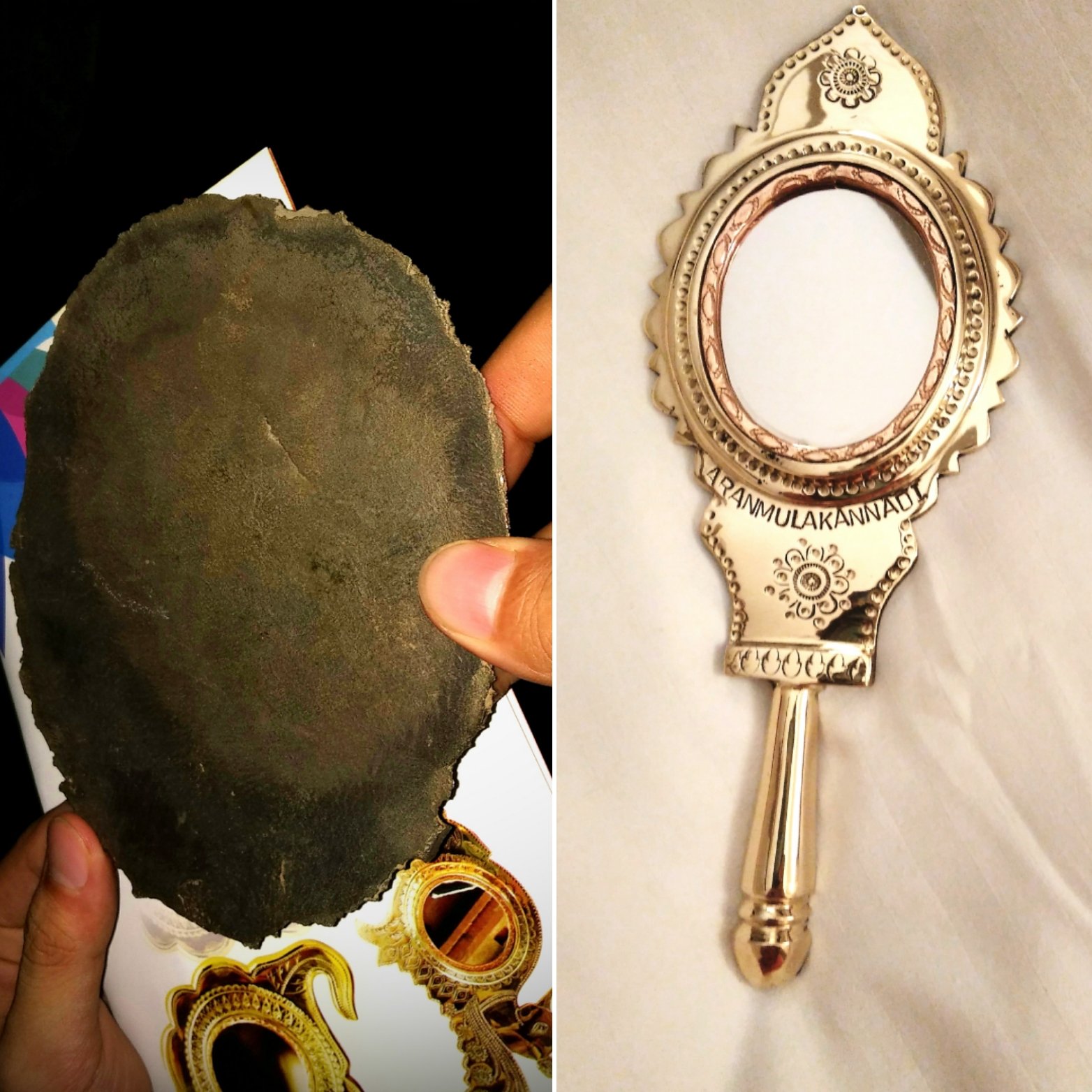
Surprisingly for me, Pathanamthitta hosts some of the largest annual religious congregations in the world. The Sabarimala yatra and Maramon convention are next only to the Haj. Giving a pass to the famous backwaters of Kerala, I had driven this far to explore its vibrant and divine culture and art. My plan for the first day was to visit two of the 108 Divyadesams, both located in Pathanamthitta. I had arrived at the Aranmula Parthasarthy temple, particularly for a tour of a foundry that makes the historical ‘Aranmula Kannadi’ (Click to watch the video).
This GI tagged handicraft is culturally important in the state of Kerala. The know-how of making it is endemic to Aranmula and limited to the descendants of only one family who now live around this temple. Unlike the familiar glass mirrors, these are finely polished metal sheets. Watching these men toiling in their workshop to bring an alloy to life, which is integral in all Malayali celebrations was like living a dream for me.
Left: moulded metal sheet before polishing; Right: Polished & finished mirror
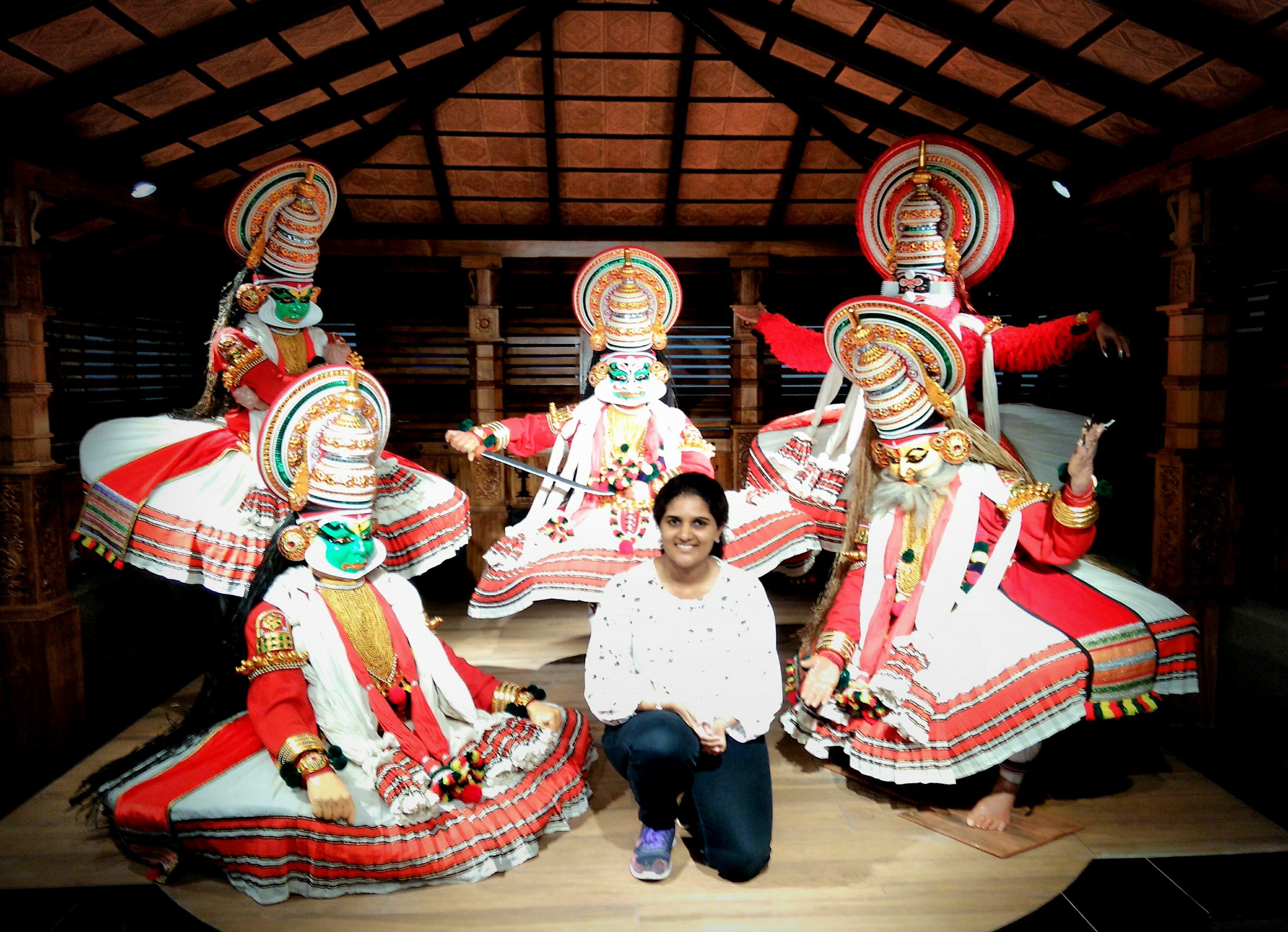
A short drive away from there was my next destination: Thiruvalla Srivallabha temple. With its ancient wooden architecture, this beautiful temple sprawls on a huge area. Here, the prayers are offered five times a day and the last prayer was specifically that interested me the most to visit here. Kathakali is performed inside the temple premises everyday as a form of prayer to put the deity to sleep. I was like a little child in wonderland who lost track of time watching this performance that went late into the night.
A traditional Kathakali setup at the Kochi international airport
I had planned my return route to Kochi such that I could cover some of the interesting landmarks along the way. The first stop was at Kalloppara, where an ancient Hindu inscription exists inside a church. I had read about how two faiths co-exist under the same roof that houses a Bhagavati temple and a Mary’s church. But my drive through the streets of a residential area ended at a bridge that connected Kalloppara. It had collapsed during the floods that ravaged Kerala last year. Having three rivers flowing through it, Pathanamthitta was one of the worst affected.
I hit the main road again and headed to Thiruvalla. Since it was dark the previous night, I was there again to have a look at the famed mural paintings on the altar of the Paliakkara Church. The church at Paliakkara and Niranam (my next destination) both have their history dating back to the arrival of St.Thomas in India in 54.A.D. This trip was all about an amalgamation of art and tradition. Be it wildlife, religion, architecture, history, art or culture, I believe Pathanamthitta has something for everyone.
(P.S.: I’m against the idea of taking photos inside any place of worship, as a form of respect to its sanctity. Hence, I do not have any pictures from the interiors of any place of worship)
Fact File:
How to reach: The nearest airports are at Kochi and Trivandrum. Kottayam and Alleppey are the nearest Railway stations. KSRTC buses and taxis are available from these places to reach Pathanamthitta by road.
Get around: local buses are quite frequent; Taxis can be easily availed.
Best time to visit: September to May (Anytime apart from monsoon)
Stay: Luxury hotels are sparse. Cheap and Budget hotels are available in plenty considering the pilgrims who come here for Sabarimala yatra. Homestays are available to experience the true essence of Kerala.
Must do: Attend a Kathakali performance, visit a mirror foundry, Bathe elephants at Konni.
Although the places that I choose to write about may not stand a chance to be compared with the Sundarbans or the Pichavaram forests… None the less- The Arabian seacoast has its own share of beautiful places in terms of its mangrove creeks. And while Kerala is synonymous with its enchanting backwaters, Karnataka too has its fair share of backwater system which is still untouched and yet to be explored… Through my innumerous journeys in this coastal stretch, I don’t remember a time when I did not put my neck out to be tantalized by the view of the backwaters as I passed on those bridges that fall in between Mangalore and Udupi. So, this time I had set aside one weekend exclusively to explore these lesser known places of the west coast and mark myself in those remote places on the map-of-India.
My itinerary: Friday: Start from Bangalore – Overnight bus journey to Udupi Saturday: Kemmannu (Explore the backwaters in a traditional boat ride), Kodi bengre (explore the village and an estuary), Malpe beach (water sports), Krishna temple and the seven Mathas, Sunday: Chill at Sasihitlu beach and estuary, Kapu beach & lighthouse, return to Bangalore by bus (You can alternate this with a day visit to St. Mary’s island)
The details:
First things first- Having good connectivity, taking the public transport to reach these places has its own experience, the way I enjoyed my trip. But I strongly recommend having your own vehicle to these places. Given the hassle of waiting for a ride, the remoteness of the place and the joy of riding through such a beautiful stretch of road be best enjoyed on a two-wheeler only. That said, my mother and I had reached Udupi by an overnight bus and stayed at a hotel close to the Krishna temple. We freshened up and headed to the service bus stand located at a walkable distance to the hotel.
street leading to Kemmannu
The entire district of Udupi is dotted by innumerous temples and churches and hence, I prefer not to make a mention of them in this post. There is no dearth of local buses to any place within the coastal belt of Karnataka and hence, I relied totally on public transportation for my commutation. All set to explore Thonse, we boarded a bus that passed through Kallianpur village (This was once, a part of the Vijayanagara empire). The ruins of an old laterite fort stand testimony to that era.
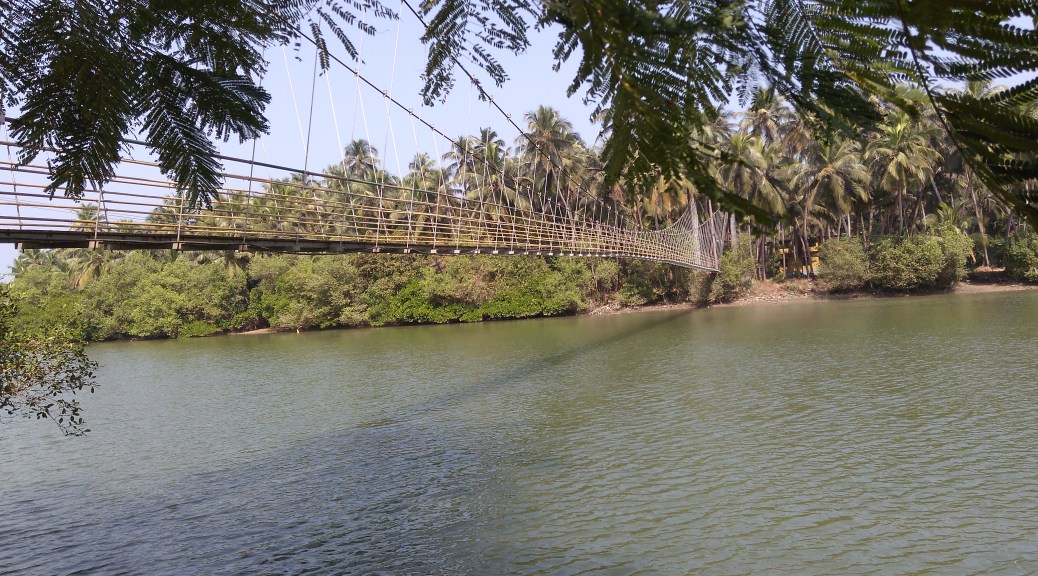
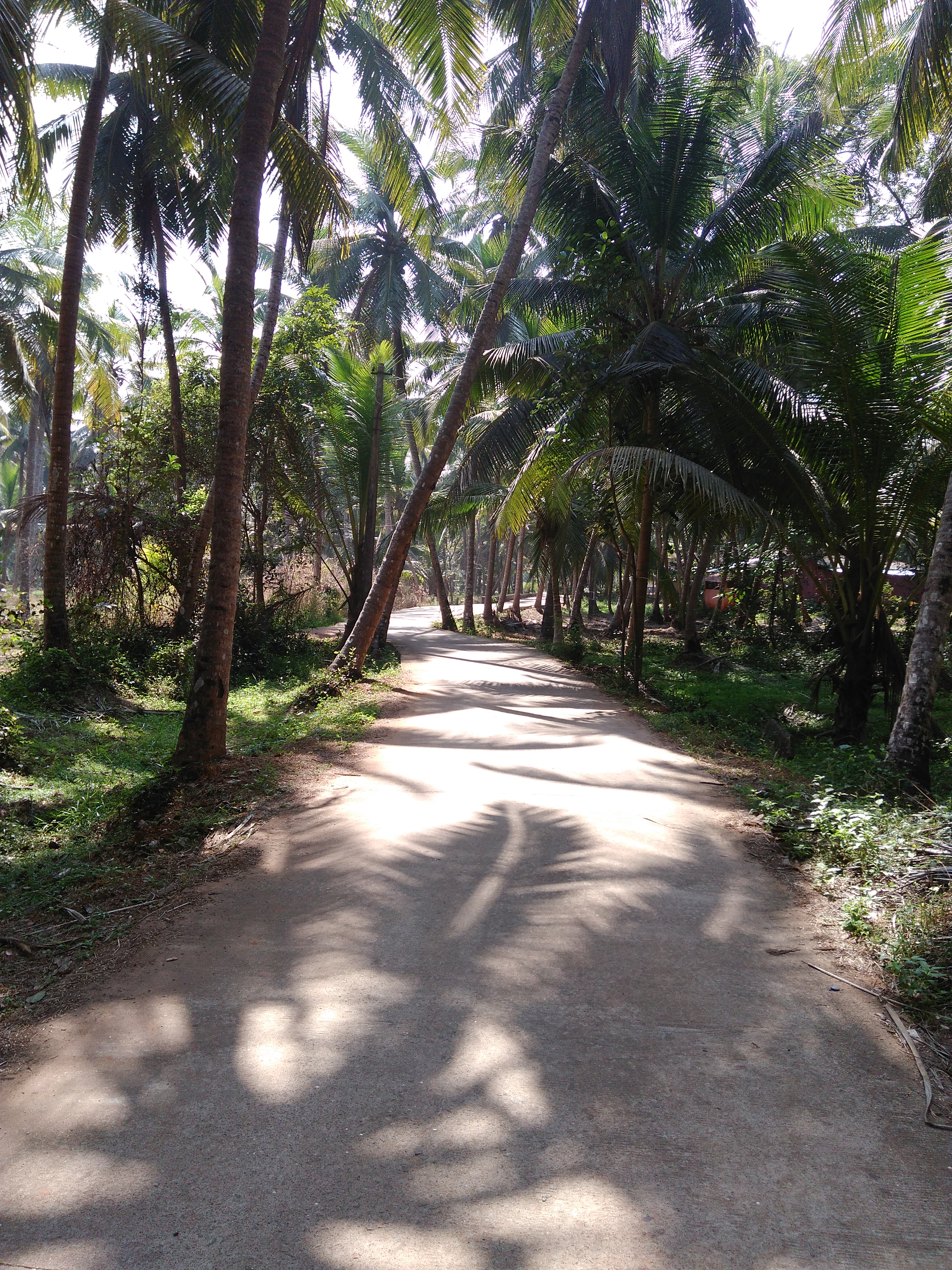
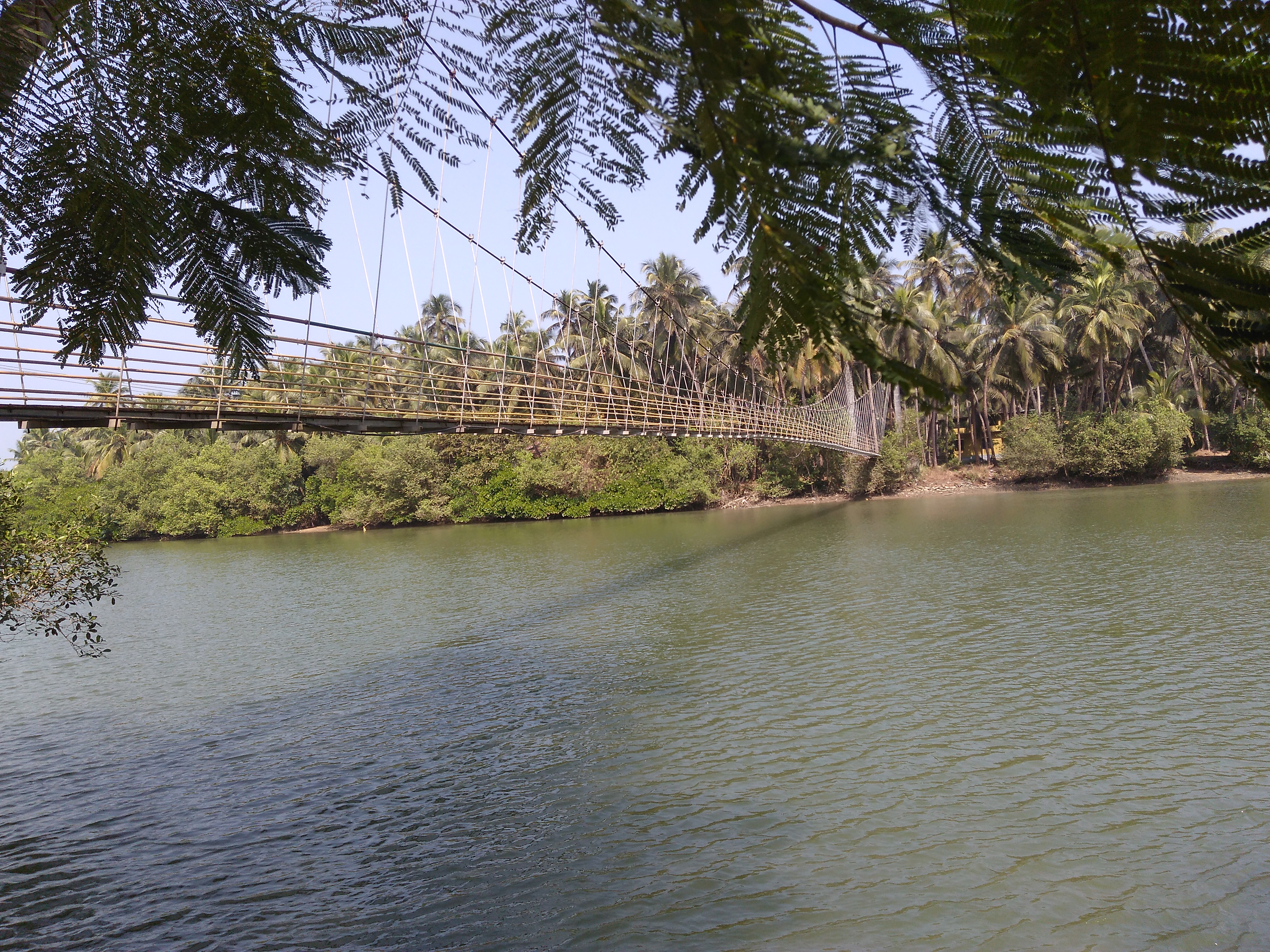
My first stop was at Kemmannu. A short walk on a meandering road through coconut plantations took me to a serene system of backwater canals connected to river Swarna. A suspension bridge has been laid across the river and set in an idyllic location of mangrove creeks. There was a boatman and his family living in a small house on the riverbank. When we enquired with the, they agreed to take us on a ride into the river for a fee. As our country boat set sail in the river, the oarsman suggested us to take a boat ride in the high tides either for sunrise or sunset. According to him, the delta beach would look brilliant at that time. He took us around several islets in the backwaters of river Swarna that gave us good sighting of rare birds. It was a very pleasant experience of sailing in the lap of nature, after having landed from the madness of the metropolis.
The suspension bridge at Kemmannu
From there, we walked back to the main road to get a vehicle to our next destination. While we walked beside a broken bridge, something caught my attention near the harbored boats. There was something amusing happening down there at the canals. I felt as if I was witnessing a bioluminescent spectacle in daylight. The sight was something I had never seen before. On a closer look, I realized that the canal was filled endlessly with jelly fishes of various colors and sizes. After spending some time there video graphing the sight, we boarded the bus to our next destination- Kodi bengre.
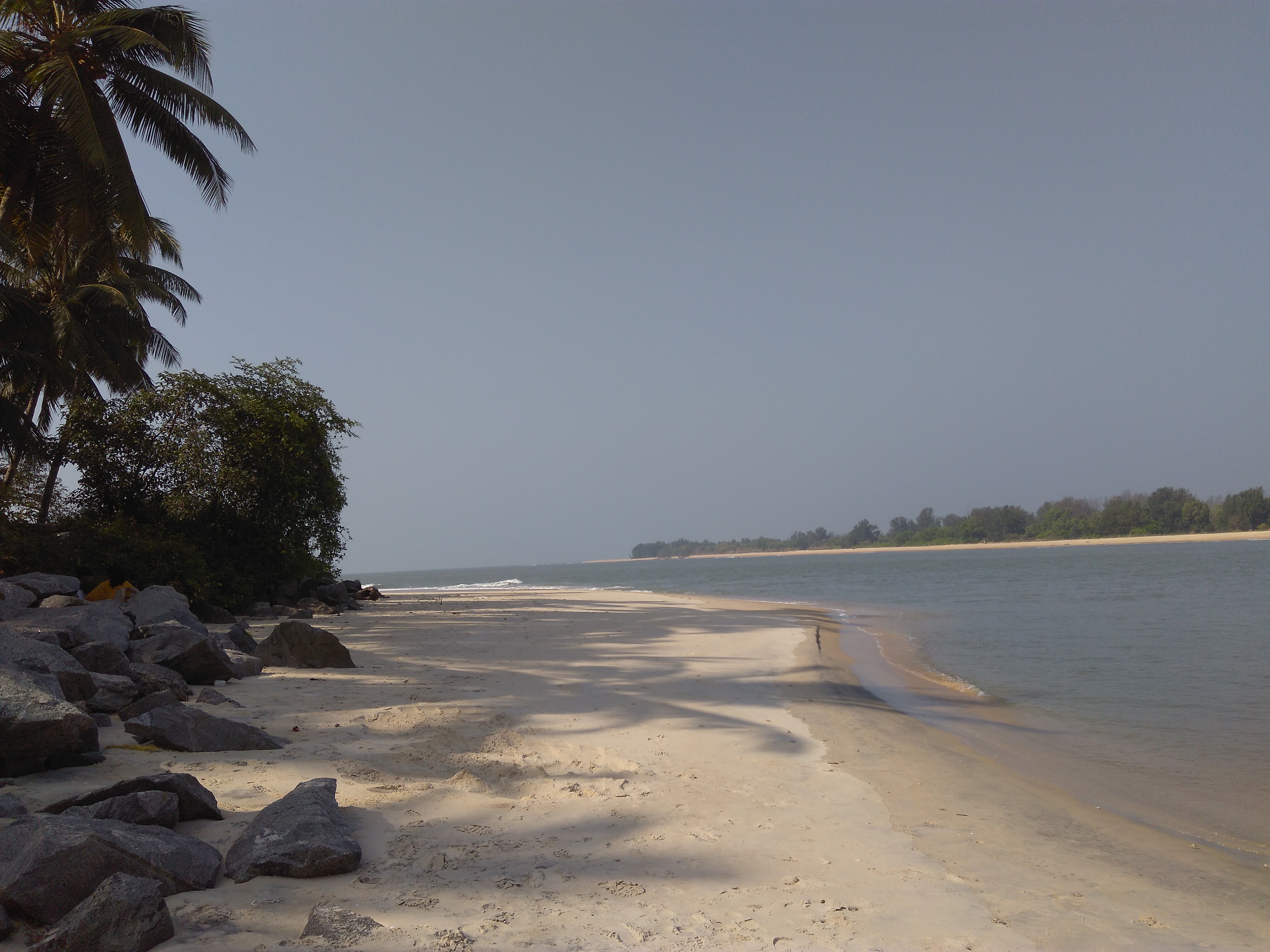
This small fishing hamlet is located on a narrow strip of land mass, placed geographically between river Swarna and the Arabian sea. While your heart will surely skip a beat at the first sight of the vastness of the sea at Hoodi beach, a deviation to the right is what we took. This road narrows into the village and gave us an experiential ride, right until the estuary at Bengre beach. The ‘tip of land’ is a great place for sunset viewing and enjoying the silence with the waves. The several shacks in the hamlet serves freshly caught sea food served spicy hot which is something not to be missed while you’re there!
The Kodi Bengre beach
From there, we took a bus to the coast, on the other side of the junction (Hoodi beach) where we had taken a right deviation from. With a quick ride through country roads flanked with traditional sea facing mansions, we reached Malpe beach. This being a popular tourist place, it was bustling with activities including various water sports. We walked down to the fish market / port area, away from the crowd- and got a good sight of the setting sun. There is a dedicated ferry service from the jetty to the Saint Mary’s Island for those seeking for a day trip which I personally recommend for anyone who is visiting this coastal town. It’s a great place and there is enough information available all over the net to get there… If you are driving your own vehicle, then I recommend you take the Pithrody route to reach back the Udupi town. This will complete your coastal stretch of Udupi giving you an experience of driving through yet another estuary and delta- that’s formed by river Udyavara and the Arabian sea.
You can complement your beach trip with a visit to the Krishna temple and the seven Mathas that are associated with the temple administration. Top it up with delectable Udupi chaats and the famous Gadbad ice-cream that saw its origin in this coastal town.















 The Lost Lander