Journey away from Bangalore that includes night journey and an overnight stay… Especially ones planned on long weekends with Saturday and Sunday off :)
Lockdown 5.0. simply put, was just another normal day in Karnataka, except that the educational institutions were still under lockdown. So, unwinding on a weekend after a long work week was normal too. With friends, I chose to hike on a Sunday morning to Madhugiri betta, the second highest monolithic hill in Asia. We started from Bangalore at 04.30.am. hoping to start the hike as soon as the gates were opened. While KSTDC has been abundantly promoting post-Covid tourism in the state, we had a surprise awaiting us at the trek base. Since Madhugiri fort comes under ASI’s protected monuments (controlled by the central government), we were told that trekking wasn’t permitted by the Central government. Hence, we were left with two options. Either return home or find another hill nearby where we could hike.
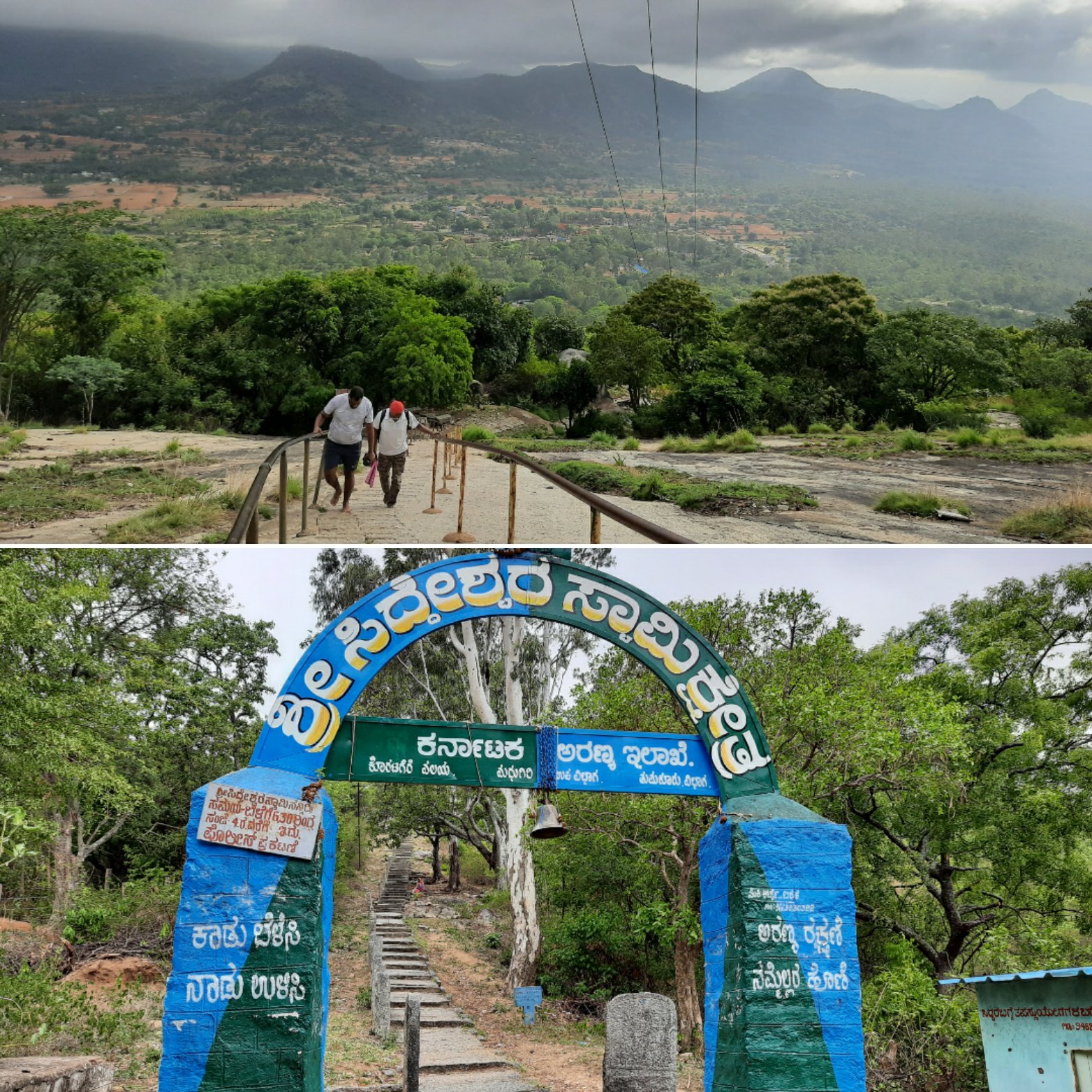
We chose the latter. So instant suggestions that came from someone in the group was Devarayanadurga and Siddarabetta. Then, we decided to give Devarayanadurga a miss as we all favoured a hike over a flight of stairs. We arrived at the base of Siddarabetta where we noticed a board that said, ‘climbing the hill with footwear was a sin’. Since many people use this path to visit a temple situated halfway, we didn’t want to hurt the local sentiments by wearing our shoes. Thinking that ‘a barefoot hike was definitely going to be an experience’ in our heads, we left our shoes back in our car.
Below: The welcome arch at the base; Top: The initial climb
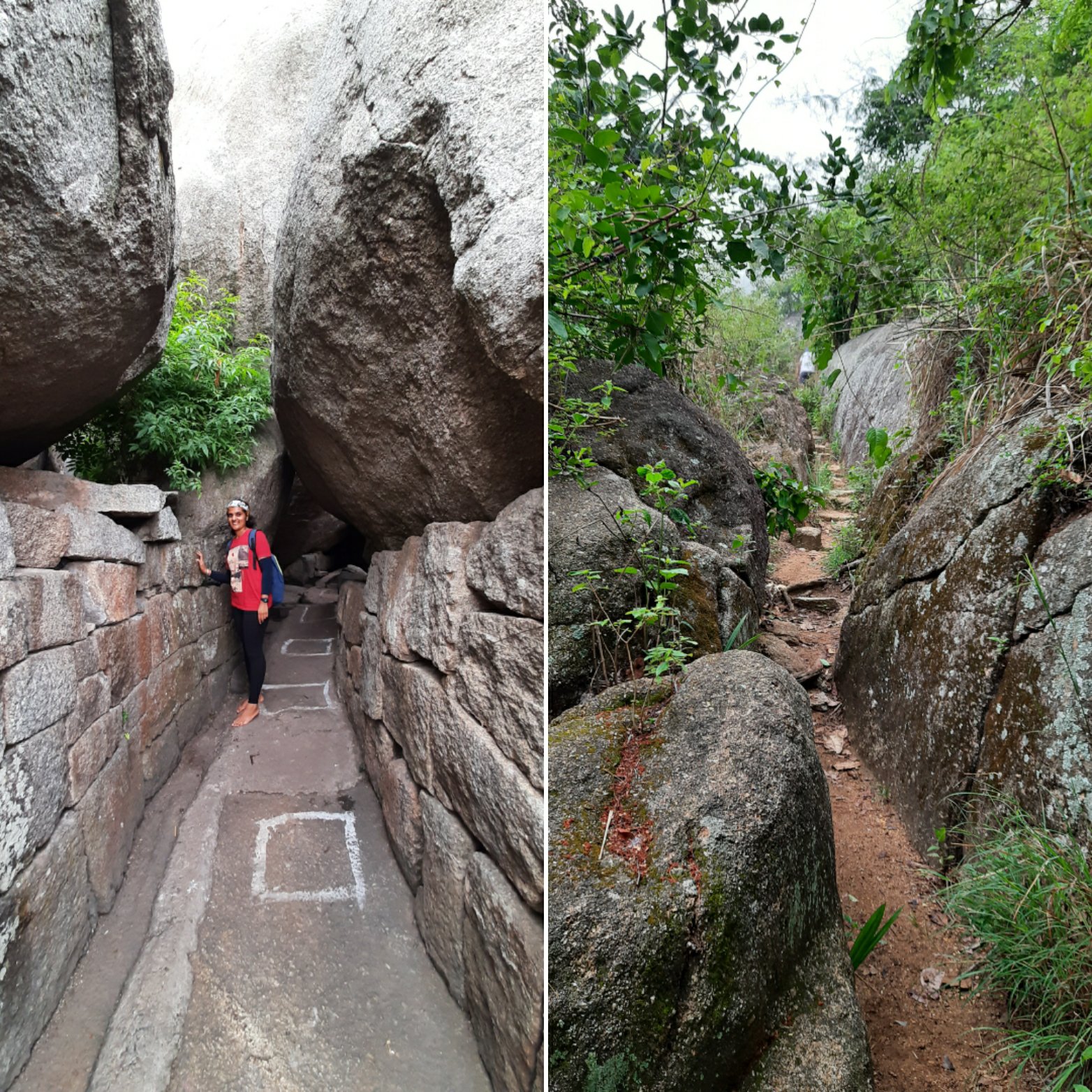
The initial part of the climb, until the Siddeshwara Swamy temple was steep but easy with well laid out steps and iron rods to hold onto. When we reached a small temple kind of a spot, the path split into two. The Siddeshwara Swamy temple was to the left, where too many people seemed to be as if there was no pandemic going on and there exists no concept called ‘Social distancing’. We decided to distance ourselves from the gathering and took the path to the right. With having to pass between too many boulders, it did seem a little confusing initially. The distant passing clouds now seemed as if they had come to meet and greet us. But after walking a little ahead, we reached an area that was a transition from dry rocky mountain to rain soaked green forests. The real challenge of walking barefoot started there, with unassumed ground with gravel and possible thorns from the shrubs.
Left: The rocky path to the temple; Right: The forest path to the view point
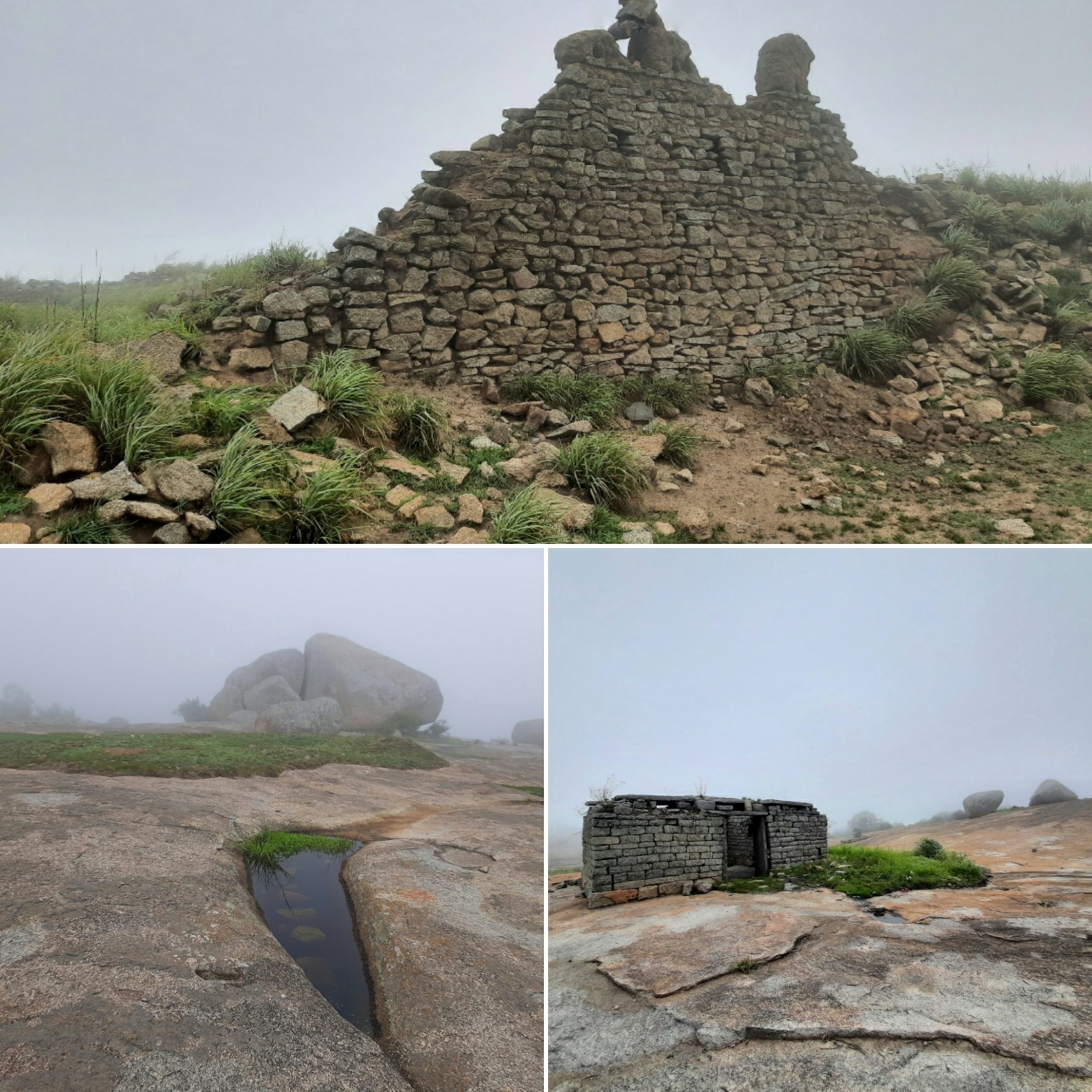
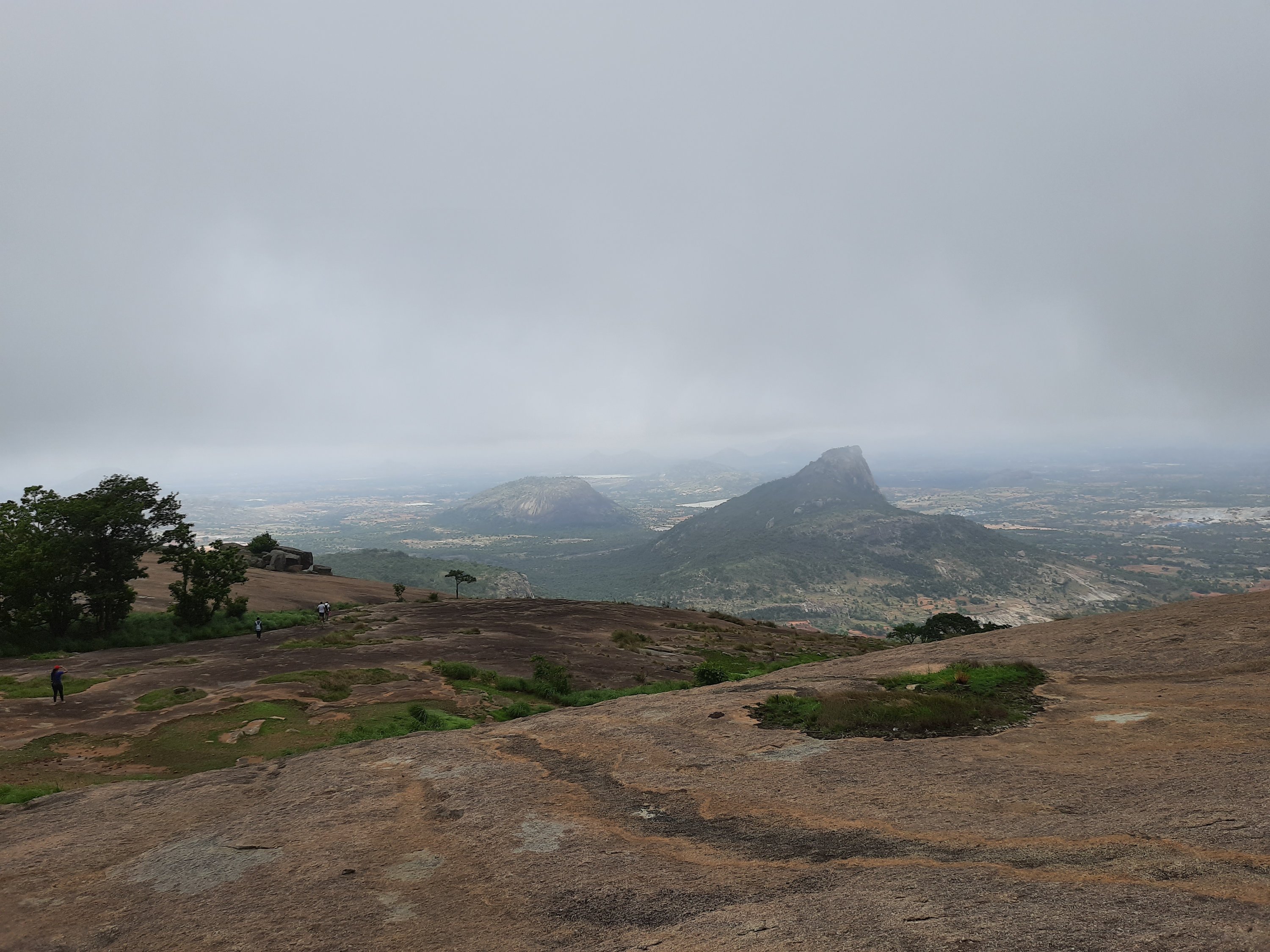
A little further, we reached an open rocky area where the view in front of us was playing hide and seek with each passing cloud. Apart from the drizzle and gusty winds that made it difficult for us to stand, we were mind-blown by the view we saw each time the clouds cleared out. There exists a small rain fed pond, a couple of meditating chambers that house Shiva Lingas (history unknown) and dilapidated remains of an old fortress. There was nobody else other than us in this entire stretch. We walked further and crossed two more hills before deciding to return, or else we would lose our way back.
Top: The dilapidated fortress wall; Bottom left: A large rock; Bottom right: One of the meditating chambers
It started to rain on our return, and we were quite drenched by the time we made it to the car that was parked just at the base point. The small eateries and stalls were slowly opening by that time which we chose not to visit, in order to avoid any social contacts with anyone else outside the group that we had gone in. We ate a few biscuits as a substitute for breakfast that we had carried from home and decided to stop the car next, only at home. It was a much-needed break and a pleasant little hike.
The view at from the peak
Summary:
It is an easy hike and very good for beginners.
Be careful to carry all snacks only in a closed backpack as there are too many monkeys on the way.
It has been nearly 3 months of staying at home due to the nationwide lockdown and the fear of the pandemic. With India’s unlock 1.0 in place, our family of four decided to take a short drive outside to breathe some new air. We planned to head to ‘Mango Mandi’ at a village called Somanahalli, off Kanakapura road for this weekend. As we reached there, we learnt from the locals that the government run fruit trading market has been shifted elsewhere for social distancing purposes. However, buying mangoes was just a reason for us to go out and the idea was to go “somewhere” outside home.
This reminds me of some old travel tales of my family. On weekends, my parents used to take us to Majestic bus stand from where we would board a random bus to a destination, that we had unheard of. Back then, BMTC buses plied with boards called red-board and black-board. Red-board for villages outside the city limits and Black-board for those very much within the city. We would sit in just any Red-board bus and buy a ticket to “the last stop”. Most people (Villagers travelling to and from the city) on these routes used to be familiar with the drivers and conductors. Hence, on issuing the ticket to the last stop to us, the conductor would enquire “Whose house we were visiting or where we wanted to go in the last stop”. We used to then get into a conversation with them and get details about the village we would reach at the end of our journey. We would then walk around these villages, appreciating the lung space, learning about new crops, new traditions in the countryside etc. We had thus explored “Remote” villages like Kumbalagodu (coffee plantations), Begur (the oldest Kannada inscription), Hesaraghatta (horticulture & animal husbandry farms), Gollahalli (so many varieties of Gollahallis in different directions of Bengaluru), Harohalli (so many varieties of Harohallis in different directions of Bengaluru), Haniyur (Madure Shani mahatma temple), Devanahalli (Tippu’s fort) etc. Come today, Bengaluru has grown to ‘Bruhat Bengaluru’. People would laugh at you if you called some of these places remote. Why that… even the house where we live now had once been our destination on one such Red-board bus journeys!
The road between Mukkodlu to Gullahatti kavalu
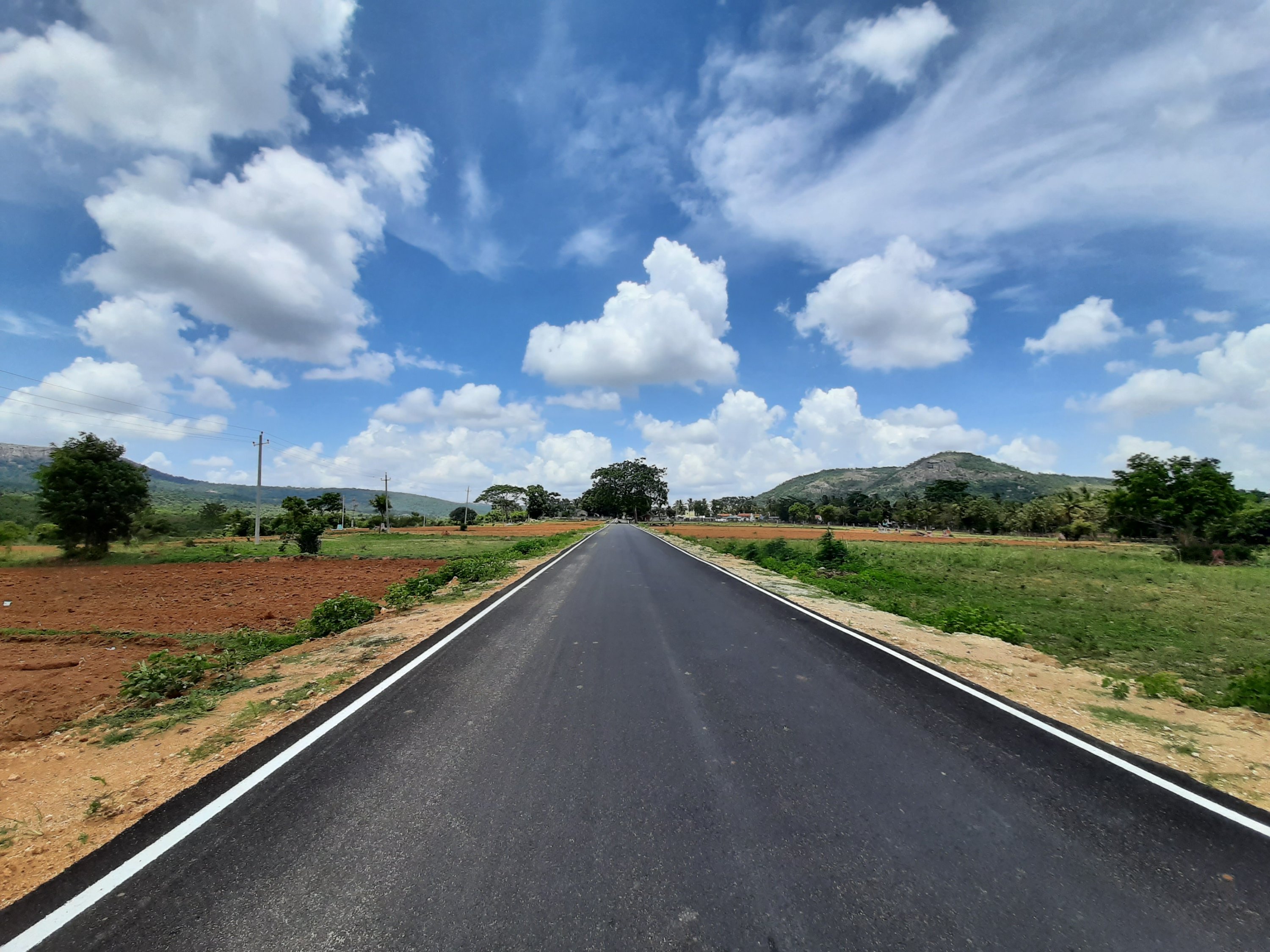
Back to this weekend of Unlock 1.0, we decided to continue on the road that we were driving until we reached the dead end. And that’s how we reached a village called ‘Mukkodlu’. The name of the village came as a surprise as there exists another village of the same name, back in my native district. The red soil of the farmland was being ploughed all along our route and readied for sowing Ragi millet during the monsoon. The clouds looked amazing with newly laid asphalt road. The green hills complimented the scene well, with ‘Munikallu betta’ to the right and ‘Ragi halli betta’ on the distant left. A little further from there exists the Muninagara reservoir. We thought we would stop by this place on our return.
The reservoir and beyond comes under the supervision of the forest department, a sub-division of the Bannerghatta National park. We proceeded further to know where the milestone indicated ‘1km’ – Gullahatti Kavalu. That also happened to be a ‘Dead end’ on Google maps, from where we would return. Also, the idea of our drive was to not meet any villagers or eat at any petty shops which we normally did on such trips. When we reached our destination, the end of the village was marked by a peepal tree and a government school. The ‘Arali katte’ are arenas buzzing with life and a hub of activities on a usual day in the Indian villages. This one here, was staring at us with all villagers confining themselves to their homes for social distancing. We sat there for some time, soaking in the fresh air on the fringes of Bannerghatta National park before returning.
The dead end point at Gullahatti kavalu
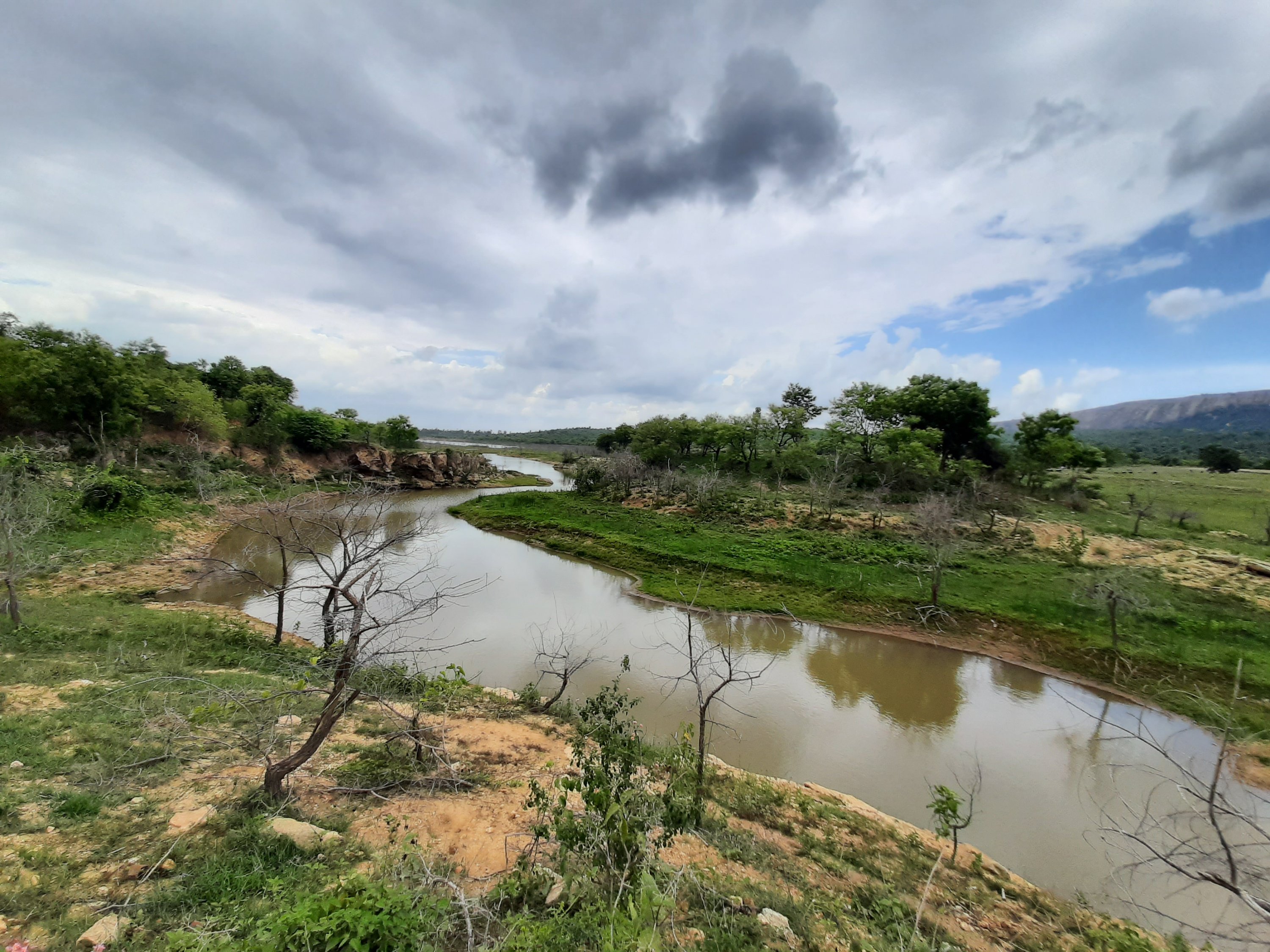
On our way back, we decided to stop at the sight of the reservoir. My itchy feet wanted to hike a bit and I dragged my folks along with me for a few meters away from the road. It was indeed a good decision. Considering we were in the fag end of summer, the reservoir still held a good amount of water. A localite who had come there to graze his cattle told us that wild animals like elephants, leopards, deer, peacocks, wild boars, porcupines etc. are spotted here in the mornings and on most other occasions. At the first sight, it seemed to me like the Kabini backwaters. Kabini is like a summer resort for all wild animals. When all water bodies within the forest run dry, this spot holds enough water and all animals come here to chill in the summers. The fact and the view of Muninagara reservoir too gave me a similar feeling. We sat there for some time until the rain gods showered blessings on us.
The Muninagara reservoir with Ragihalli hill in the backdrop
Thus, a day in India unlock 1.0 was well spent.
Note: For the adventurous ones, there exists a trekking trail called ‘Muni nagara trails’ on google maps starting from the reservoir to the Ragihalli betta. But ensure that you have all permits in place before venturing on a trek here. As afore mentioned, this area belongs to the Karnataka forest department.
As I arrived at Sangla, the setting sun had already laid a golden welcome… I started to walk around the town looking for a homestay. After walking here and there, up and down, I decided to settle down at a homestay, which seemed like a pretty big bungalow. The owner of the house was away, and it was let to the caretaker’s responsibility. I was the only guest. However, this seemed to be better than all the properties I had seen thus far. I freshened up, unpacked and unwound myself while watching the daily evening procession of the deity of the ‘Chandi Mata’ temple from the homestay itself.
Post sunset, I wore all the thermals I needed and ventured out to explore the town. The commercial area seemed just like any other small town I had been before and didn’t want to get too adventurous on my first day in the valley. In the entire town, I was drawn towards a very small restaurant called ’The Buddhist Café’. I was being just one of those typical Indian tourists in the Himalayas; I was tempted to eat momos 😛 The place rather looked dinghy with dim lights and no customers in their main dining area. On enquiry if the restaurant was closed, I was greeted by an old Buddhist lady who guided me to follow her to the kitchen inside. Despite being a little suspicious of her gesture and given the shady looking walkway, I continued to follow her. She made me sit at a table where she served me steaming hot momos and black coffee after taking my orders.
There were a couple of people who came in and out whom the lady attended to but did not take any money from. It seemed to me that they were mostly labour who helped her in fetching supplies to her kitchen and she retuned their favour by providing them free meals. She was speaking very gently to them as if one would talk to their family members. I felt so much positivity emanating from this lady. Eventually, she pulled a chair next to me and settled down to have a long conversation with me. She enquired about my journey and said a few things about herself and her family. We both were so engrossed in our conversation that it was 09.00.p.m. by the time I realized that I had quite a distance to walk back in the darkness to reach my place of stay. The lady took my hand in hers and asked me to promise that I would visit her daily for as long as I was in Sangla. “Tumse baat karke bahut accha laga mujhe. Kal Aajao, gappe maarenge. Zaroor aana, mein intezaar karoongi”, she said. Amused, I left by promising her that I would return.
This trip has been compiled into a book. If you like to read about the complete journey, you can avail it on Amazon or read it for free with your kindle. Use the link below.
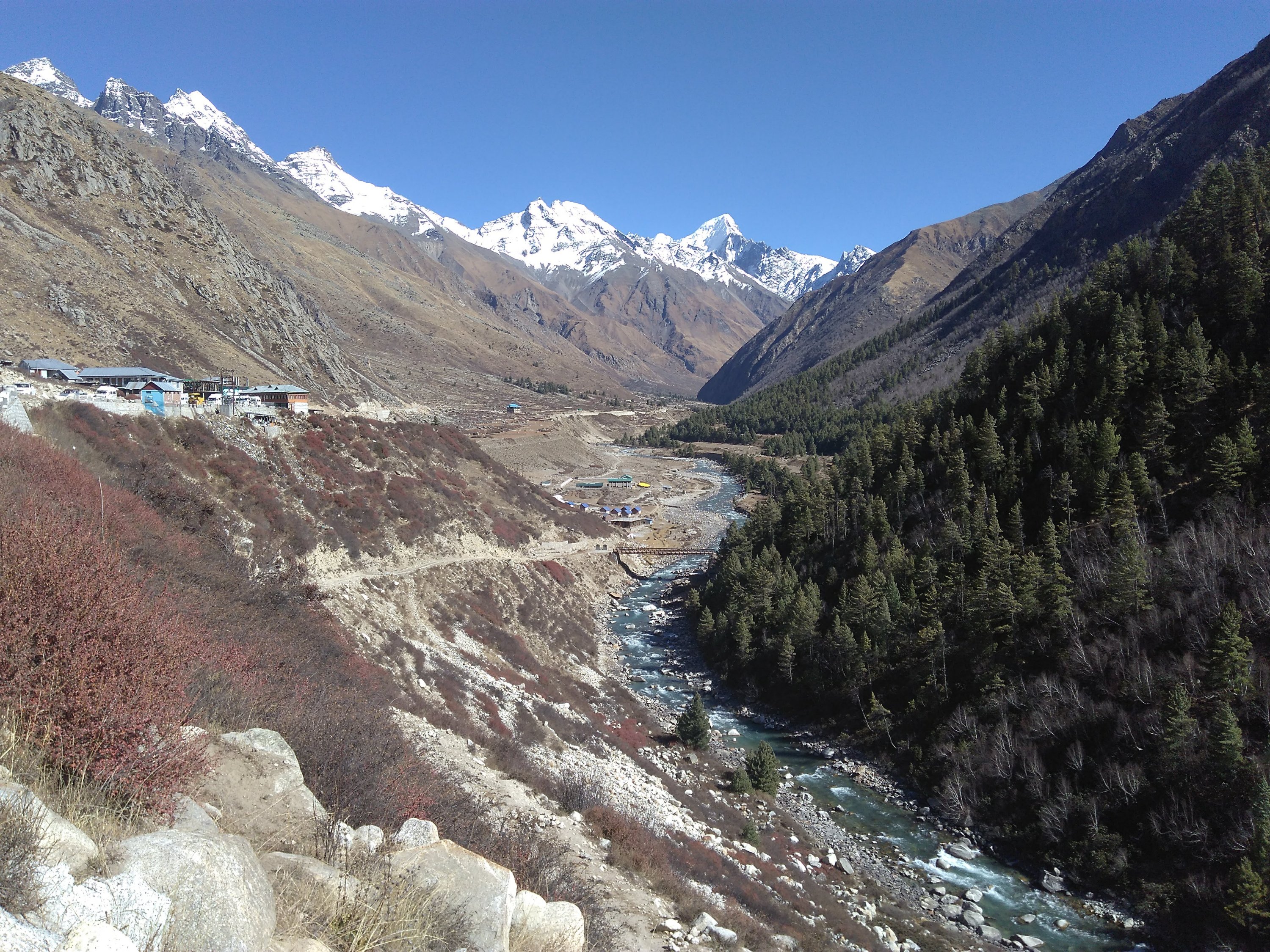
I was an early riser on the following morning in order to make it to the bus stand on time. There was only one bus that ferried passengers to and from the last village in this part of the Indian borders. It ran twice a day, once in the morning and once in the evening. Chitkul is a tiny settlement beyond which, the mountains belong to Tibet & China. After having read enough articles on the internet, I wanted to check this off from my list of places to visit in Himachal. I however de-boarded the bus at a village called Rakcham, a few kilometers ahead of Chitkul. I was standing on the rear side of the famous Kinnaur Kailash mountains. With curious villagers staring at me as if I was a lost alien wandering alone and children walking to school posing for photos looking at my DSLR, with a beautiful sunrise over the mist laden valley and the gushing Baspa river on the other side, the morning walk on the empty road felt magical. Although I had seen apple trees earlier, it was the first time I was seeing apple orchards. The houses in the settlements on the slopes were unique to the area. I spent good amount of time exploring the village perched on hilltop and down in the cold waters of the Baspa before settling down with a cup of sea-buck thorn juice at a campsite that was being disassembled.
The view of Rakcham
I had read that Rakcham valley looked vibrant with pink flowers of a native millet during its season. But I seemed to have arrived late to see the famous pink fields of Rakcham. Anyway, the orchards had turned the valley equally vibrant, in myriad shades of golden. But, honestly, there was nothing specific to see or do there, apart from the solitude that I had found thus far in my trip. I walked back to the main road and enquired with the shopkeepers about getting to Chitkul. A few localites who overheard my enquiries tried to pitch in their suggestions. Going by their suggestions, I waited by the roadside engaging myself in answering the enquiries about my solo travel. It was well over half an-hour as a shared jeep arrived, which they asked me to board to reach Chitkul. Just as the jeep cranked to start, one of the men talking to me asked the driver to wait. The man ran to a shop and returned with a bag. “It was nice talking to you; this is for your way.” he said while dumping a bag full of apples into my hand… I picked two from the bag (not wanting to disappoint him), thanked him warmly for his gesture and convinced him that I couldn’t carry so much luggage with me and bid him goodbye.
The road ahead was bumpy, yet interesting. It passes through forest area that was in bloom, opened to large meadows and then, the snowcapped peaks appeared rather suddenly. Foreigners need to register at the check post that falls enroute as Chitkul is a sensitive area guarded by the ITBP. On reaching Chitkul, I started to walk towards the viewpoint. Yes, no doubt it looked beautiful and I could walk right into the river below that demarks the border. But my heart skipped a beat when I saw the solitary Indian national tricolor waving in the middle of nowhere. Apart from taking a walk along the valley and exploring the tiny hamlet, there seemed nothing much to do. There are quite a few options to stay at both Chitkul and Rakcham, but for a moment, I feared the temperature that I was warned about. The temperatures in Chitkul are colder than anywhere else in Kinnaur. That’s why I changed my mind to return to Sangla for the night. As there was still lot of time left before the bus started, I decided to walk towards Rakcham so that I could click some good landscape photographs along my way. Anyway, the bus arrived in a while and I returned to Sangla.
The Chinese / Tibet border at Chitkul
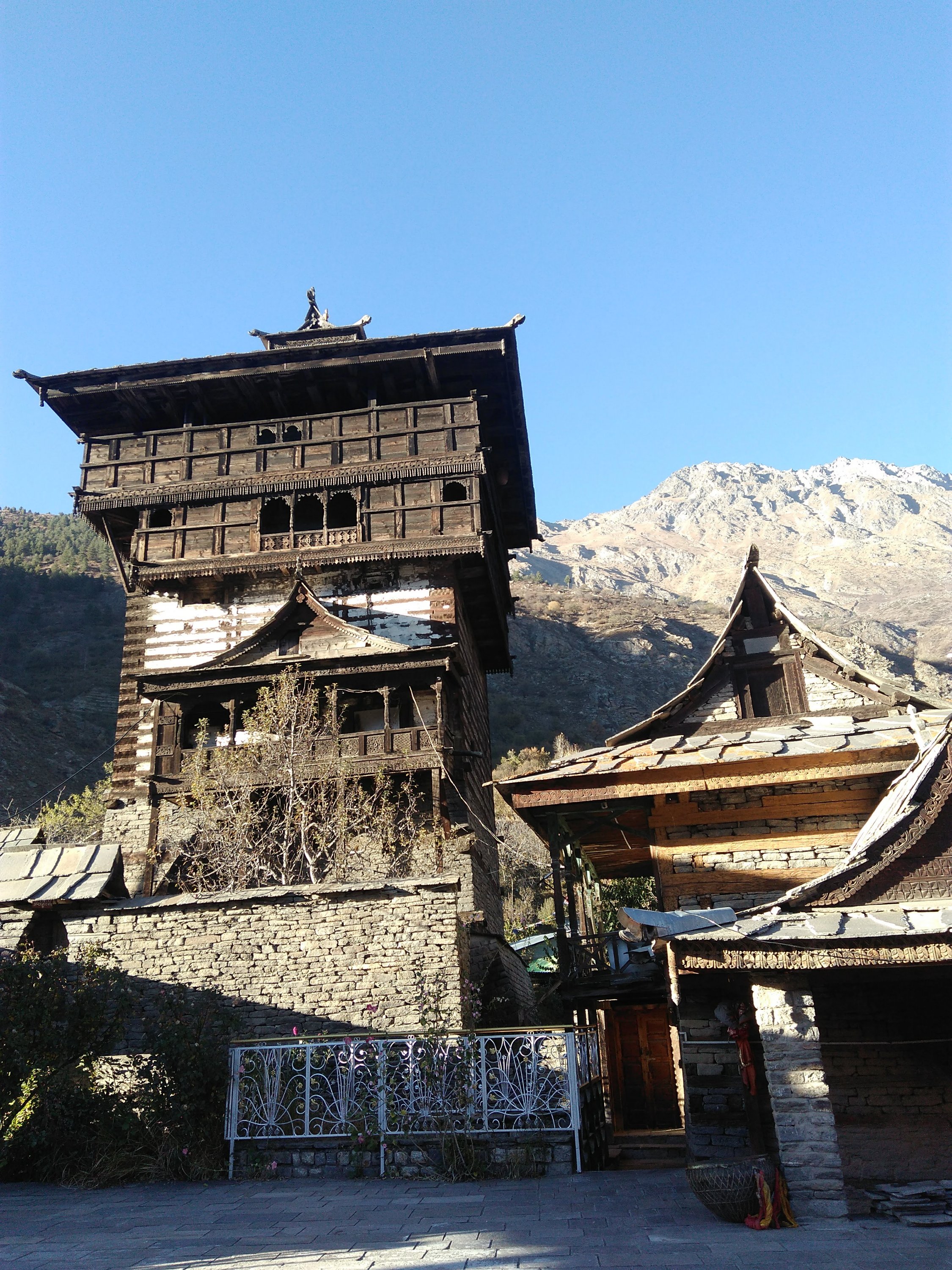
There was still enough daylight time left, and I decided to explore Sangla that evening. I climbed up the Kamru fort from where I could see the magnificent view of the town and the golden sunset that had welcomed me last evening. An ancient wooden temple stands strong on top of the fort and looks brilliant with its detailed sculptures and friezes. There is a dress-code to follow (a head gear and a waist band needs to be worn) to enter inside. Since most of us there didn’t have it, we had to wait for the priest to provide the same to us, and go inside, in turns. The priest also gave me a peak into the history of the fort and how the temple came into existence. It felt very peaceful and I sat back there until the sun had gone down completely.
Temple atop Kamru fort
I had decided to leave Sangla on the following morning to continue my journey ahead. I had also not forgotten that I had promised someone that I would visit her. I wanted to inform her before leaving. That’s why I then headed towards her café for that evening. It is hard to explain how excited she was at seeing me. “I wasn’t sure that you would return. But I was looking for your way”, she exclaimed! She served me noodles and black tea, introduced me to her son whom she had called to talk to me and found good company in talking to me. After a couple of hours had passed, I informed her that I was going to take her leave. Guess what? She gave me a rucksack full of apples which she had specially bought and kept for me. She didn’t own any orchard and hence, she ensured she bought the best apples as souvenirs for me. When I say BEST, I mean THE BEST…. Kinnauri Golden apples! Can you imagine me carrying a rucksack full of apples (souvenirs!!) along with 10kgs of additional backpack that I already had. for the rest of my journey??? 😀 I convinced her that I was sorry, and I couldn’t accommodate so many apples in my luggage. And she still managed to squeeze in a good few kilos telling 2 apples for each member in my family, back in Bangalore…!! She had tears as she saw me off and I cried as I was missing my mom! Sometimes, you never understand how connections work with strangers…
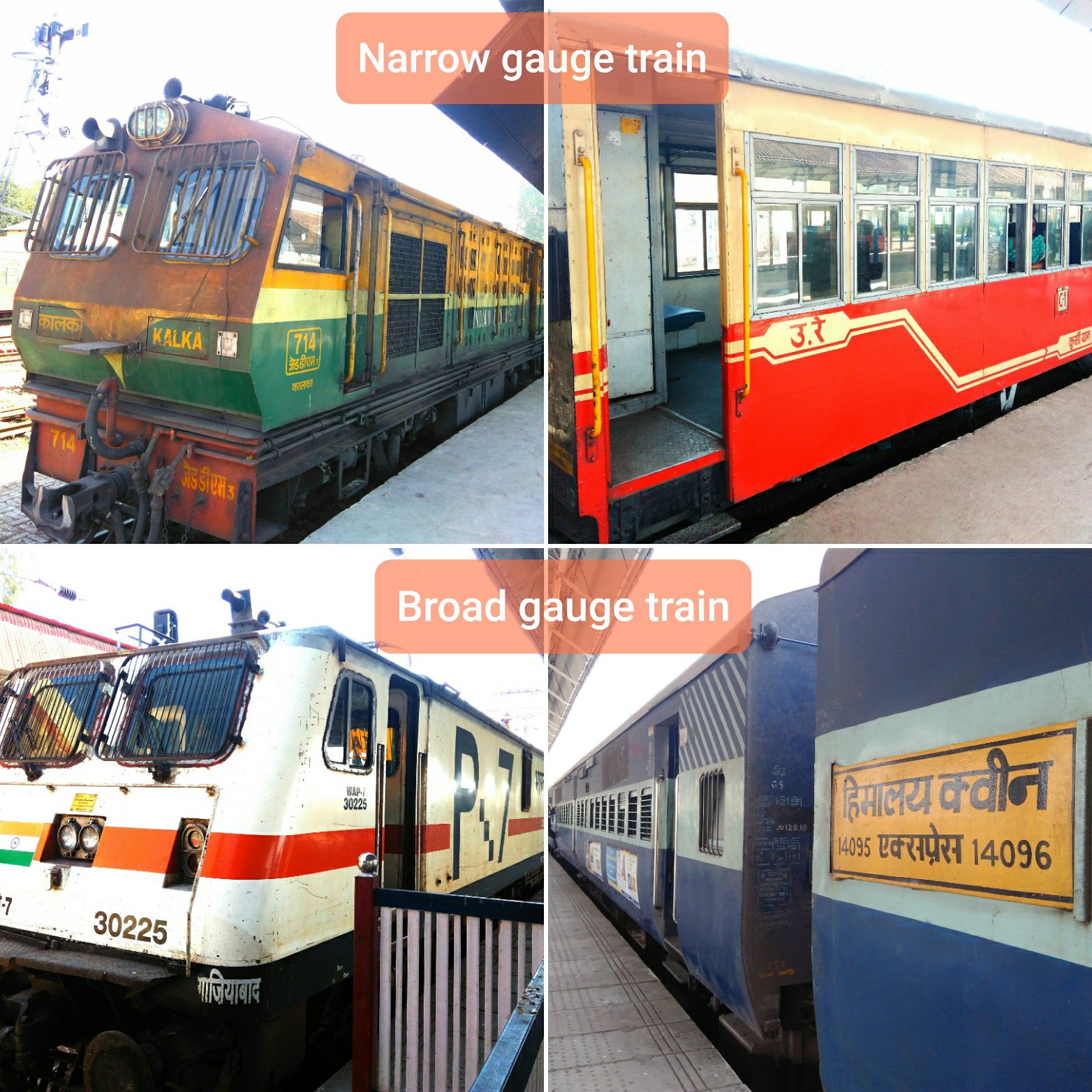
So… I headed straight from office to Bengaluru Airport to catch a late-night flight. Just so that I could make it to the railway station to catch the early morning ‘Himalayan Queen’ on time. Just so that I could reach Kalka on time. My friend in Delhi helped me in my commutation juggle between the airport and the railway station. Then, the Himalayan Queen chugged off from Delhi. Apart from seeing a hazy sunrise through the windows, I slept through most of the journey until I reached my first destination in my 10-day long tour, that afternoon. I ran to the special platform in the other end of the station at Kalka to board the ‘Himalayan Queen’ that ran on a narrow-gauge thereafter. Only to realise that it was delayed by an hour.
The Himalayan Queen Trains. Top: The narrow gauge train between Kalka & Shimla; Bottom: The broad gauge train between Delhi & Kalka
Anyway, the ride in this train which is a part of UNESCO Heritage was a different experience. The 1st class bogie had old cushioned wooden adjustable chairs like you would have at old single screen cinemas, an unfamiliar thing for those familiar with the regular compartments of Indian Railways. The route was scenic as the train passed through hills, forests, tunnels and cliffs. It stops at several stations that allows ample time for photography and for exploration for passengers who are mostly foreigners. One such stop was the halt at the Railway museum at Barog. But yeah, the initial excitement of experiencing a narrow-gauge waned down soon as the journey got monotonous and long having none of the co-passengers to talk to. It was dark and cold by the time I alighted at Shimla. That’s where my real trip began…
The Barog railway station and museum
After searching multiple online sites and walking around in the unknown city in search of a suitable place to stay, I was still clueless of where to go. I finally settled down at a rather shady looking place when I realized that the backpack was quite heavy, and the cold was becoming unbearable for me. The guest house was old and the things in the room were unkempt too… Anyway, I had settled there as the caretaker seemed okay to believe in. I locked myself up in the room, used my sleeping bag inside the warm blankets that were provided and tried to sleep (although I didn’t!).
I checked out of the place at 05.00.a.m. on the following morning and started to walk towards the HSRTC bus-stand based on directions given by the caretaker. I took the wrong deviation and lost my way. I saw that I was reaching the city central area and continued to walk as I hoped to find someone. I heaved a sigh when I saw the army command building. I stopped by to enquire the guard outside for directions. Since I was carrying a large backpack, walking with a face covered with a balaclava, all alone on the empty dark roads, he began to question me suspiciously. Once he heard the girl’s voice and I told him that I was traveling from South India, he introduced himself as a Tamilian who had been posted there just a couple of days ago. He was of little help and I proceeded. Google maps didn’t seem to be of any help either, as the distance only increased every time I walked ahead. I then came across a man on his morning walk who guided me through what he called was the shortest walk path. It was long, dark and scary initially. Although there didn’t exist an official road, the distance (may be aerial) on google map kept shortening. It was a descent downhill and I did back and forth when I had my doubts. Finally, it had dawned when I reached the bus stand and relieved when I saw a few newspaper distributors sorting their dispatches. I had missed the first bus that was heading towards Sangla. They introduced me to a man in a tea stall, whom they said was the driver of the next bus which was scheduled an hour later. The driver offered me chai and asked me to stay around.
Finally, the bus started. It would drop me until Karccham from where I had to board another one. The journey to my destination was going to be a long one. Amidst the early morning rays, the verdant hills looked amazing and I was excited about the road. The bus conductor and the driver were both nice people who kept checking on me every now and then as I was alone and new. They even bought me peanuts to munch along for my journey. An hour on the road, our bus halted. There was a massive traffic jam due to an accident on the highway. A car had gone almost completely under a lorry that came from the opposite side. It was over an hour by the time the police arrived and cleared the spot after inspection. Meanwhile, the hospitable people in the hills obliged to allow me inside their house when I wanted to use a washroom. Would you allow a random person on the road enter your house? I’m certainly not sure if I’d do that myself.
By around noon, the bus that I was travelling in broke down. Given that Rampur Bushar was the nearest town where he could find a mechanic, our driver somehow managed to negotiate the ride till there. Also, the passengers could board another bus from the large terminus in the town. He ensured that I sat in a spot, informed the bus station master to keep an eye on my safety and to guide me to the right bus when it arrived. These are the kind of interactions that make you feel confident about having a safe journey ahead. isn’t it?
That said, I sat in the next bus a good 2 hours later. It was a direct bus to my destination: Sangla. But I had a carry-over ticket from the previous bus only until Karccham. The conductor of that bus was fussy about considering the carry-over ticket until Karccham. But I stuck to what I was instructed by the previous driver. A good argument later, I got my ticket extended by paying only for the journey between Karccham to Sangla. The sun was slowly coming down as I approached my destination.
Sunset view from Sangla bus stand
Finally, when I alighted at the Sangla bus stand, it was by far the most magical sunset I had witnessed all my life until that day. Right in front of me lied the snow-capped Kinnaur Kailash mountains and the peaks had turned golden. The rest is for another story!
This trip has been compiled into a book. If you like to read about the complete journey, you can avail it on Amazon or read it for free with your kindle. Use the link below.
That morning, I had arrived at Reckong Peo and already done 4 rounds of the main road in the town with my heavy backpack, an uphill climb and down. I was searching for a hotel or a homestay. The only one that I found near the bus stand was out of my budget. I enquired with a few in the town and they suggested me to go to Kalpa. Kalpa is around where, all sightseeing places are situated and has a range of options to stay at. Accordingly, I sat in a local tempo traveler and started my ride towards Kalpa.
A narrow winding road, lined with apple trees on both sides with golden foliage, finally took me to a seemingly small town. The conductor announced: “Kalpa, last stop!” with narrow cluttered lanes, shops and eateries inside small sheet moulds, houses tucked behind high rise stone walls- the town looked very old school. Imagine a quaint town overlooked by the beautiful mighty mountains.. for me, it was a moment of ‘awe’ at first sight. I enquired with a few shops at the bus-stop for my stay and they guided me to walk further inside the village. I found a good one and the hotel was very new. So, the clean room, warm blankets and 24×7 hot water were just perfect for me to settle in there. But what lured me the most to the hotel room was the view from the window. Kalpa is very famous for its apple orchards. I was there towards the end of the apple season and so all the leaves were just about to shed their golden leaves. So, imagine a golden stretch against a background of white Himalayan mountains? I was mind blown!
A view of the Kalpa apple orchards with the Kinnaur Kailash mountains in the backdrop
My stomach was growling, and I fed it with Paratha at a small restaurant opposite my hotel. The lady running the eatery was quite amused to see a lone girl who had travelled so far. She enquired about myself and asked me to return in the evening after I had finished my sightseeing. “I am busy attending to customers, come in the evening when both of us are free, let us chat up and spend some time”, she said.
I walked down the alley to the only Buddhist monastery I had seen in the entire trip thus far. It was a very small one compared to all the other ones I had seen in Ladakh or back home in Karnataka. But irrespective of their size, Buddhist monasteries always have their own charm and pull. I lit a couple of incense sticks, rolled a few prayer drums and sat there for a few moments watching the mountains in silence before continuing my walk further, randomly through the alley.
A street in Kothi village, Kalpa
I stopped along my way to ask a man across a fence, for directions to Roughi village. He was working in his apple orchard, busy getting the fruits harvested. He called me inside his farm and enquired where I wanted to go. He told me that my destination was 6+kms away. It would be difficult for me to get a vehicle at that time. I said I was Ok to walk the way as I was more curious in exploring the place. He was quite surprised when I asked him if I could help in plucking the pome. After a while, he handed over a packet full of apricots when I began my hike towards Roughi.
A walkway past an apple orchard at Kalpa
The walk and the scenery are best, only when witnessed and cannot be expressed in words. Only little would my limited photography skills help. I quickly made friends with a dog at a random house along my way. The dog accompanied me, and the owner let it come. Re-iterating again, the view was unbelievable. The stretch of road happens to be one of the steepest and I tried to take a peep down the deadly valley below. I pulled myself back after my head went into a tizzy. The dog continued to walk when I walked and stopped when I paused for a photo. There was a point when he was tired and panting and I had to make a bowl out of a plastic sachet from my bag for him to have some water. That said, we together reached Roughi village just after noon 😊
A bus passes the suicide point, enroute Roughi village
Beautifully groomed orchards, the suicide point, a quaint village in the foothills- Roughi was a warm tiny settlement with nothing very specific to do. After wandering around for a while, I made friends with a few kids who were returning from school, ate a few fresh apples from my bag that I had been received from random passersby on the road and finally settled down at the village entrance, hoping to find a ride back. I was all alone on the road. I spent almost an hour waiting and I was losing my patience as well as fearing the cold that would be brought in by the setting sun. There was no way I could stay there because I had dropped off all my essentials in the hotel in Kalpa itself. I started to walk rather than waiting there. After covering almost a mile, I heard an engine from behind. I turned back and waved them to stop. It was a couple in an Alto car, heading towards Reckong Peo. They obliged to drop me off along their way.
There was still time for sunset, and I thought I could use the daylight to explore the lanes of Kothi village. Although I aint a trained architect, the structure of the ancient Kalpa fort was something that I loved. I walked down through the villages, spoke up with inquisitive villagers, visited the chandika temple and finally settled down at the viewpoint to grab the golden hour of the setting sun over the Kinnaur Kailash mountains. I had seen the mountain from the rear side at Sangla. Now here I was, experiencing the moments of tranquility, in front of one of the holiest destinations of Lord Shiva. Believers who cannot make it to the Kailash mountains in China come here. Hence, Kinnaur Kailash is believed to be the alternate abode of the Lord.
This trip has been compiled into a book. If you like to read about the complete journey, you can avail it on Amazon or read it for free with your kindle. Use the link below.
As I was admiring the sight and capturing it in my DSLR, an old Bengali couple identified me as the one who had taken some nice photographs of them at the Kamru fort in Sangla, a couple of days ago. They asked me for a favour. They asked me to zoom into the peaks of the mountains with my camera and show them their deity… I was perplexed and asked them what it was. They explained……. “To the left side of the mountain was the Shiva Linga and right side was his consort- Parvati”. I was quite amused at hearing this and tried to capture images of both the manifestations with my camera. When I showed the images to them, to my utter surprise- they both started jumping and screaming and clapping with joy. They both folded their hands in front of my camera screen and chanted their prayers. Next thing I saw was the lady kept her palm on my head and saying, “We were saddened that we couldn’t get a closer view of his manifestation even after travelling this far. You showed us our lord! May he bless you with all the best and happiness in the world”, they wished me a good future. For me, it was quite an experience. I was unsure if I had to call it their innocence of praying the camera or admire their faith that had brought them this far. But I was feeling very good about myself that I was able to bring so much joy to someone. I was feeling an inexpressible emotion from within.
Top: Sunset over Kinnaur Kailash; Below: magnified view of the manifestation of Shiva and Parvati
As the sun went down, my jaws started to chatter in the biting cold. I rushed to my room, warmed up myself with the thermals I had and stayed indoors until I felt comfortable. Around 7.00.p.m., I decided to step out to meet the aunty running the restaurant just outside. She said she would be free after closing the shutters at 07.00.p.m. I had carried millet Rotis from home which I thought I will share with her while buying some curds from her to make a dip for my rotis. She was excited at seeing me and called her family members to meet me. The restaurant was only an extension of her house, separated by a closed wooden door. Hence, she took me in and showed me around how traditional Kinnauri houses looked in Kalpa. We were back in the restaurant, chatting up over a hot glass of chai that she made for me. I gave her my rotis for tasting and she made me pulkas for supper. I returned to my hotel after a good couple of hours with her.
I missed the morning bus from Reckong Peo and that gave me some time to take part in the annual mela in the district headquarters. I boarded the next bus at noon, from Peo towards my destination for the day- Nako, a small township in the Hangrang Valley, a part of the Spiti valley. The place gets it’s name from a Tibetan word ‘Nego’ which translates to ‘The Door to a holy place’.
The road from Kinnaur valley, leading to Spiti valley
The transition from Kinnaur valley to Spiti valley was evident in its landscape. The road changed from green to rocky to barren along the way, each being spectacular. The snaking road was accompanied by the crisscrossing Spiti river amid a mind-blowing scenery all along the way. Although I was travelling solo, I felt accompanied through warm conversations with the driver and the conductor of the HRTC bus. They were quite surprised and amused to hear that I was from South India, spoke fluent Hindi, was travelling alone and without a fixed itinerary. The bus was stuck in a couple of roadblocks caused by landslides for almost 3 hours in total and that meant- I arrived late at my destination. From all the online research I had done about the place, I knew that Nako was decently popular on the tourist radar and finding a place to stay wouldn’t be difficult. When finally the bus stopped at the Nako bus-stop at 07.00.p.m., I was in for the BIGGEST surprise of my life!
The bus stop was on the highway. That was the LAST public transport of the day. It was pitch-dark already. All the civilization I had read about, did not seem to exist there. Apart from the bright stars twinkling in the clear sky, the only light I could see was that of a dimly lit lantern hanging in a tiny shop. The conductor looked at me blankly and said- this is Nako. “Talk to the shopkeeper and he might help you to find a place to stay”, he said and signaled the driver to proceed their ride.
“Where am I going to stay tonight? Can I trust the shopkeeper? Do I have any other option apart from approaching the shopkeeper?” A million things were running in my head. I stood there for a moment to let my thoughts settle down first. But before that, the biting cold and the rough winds rushed me to the shop for some warmth. In the dim light, I saw hope. The shop was run by an old man and the wrinkles on his surprised face multiplied when I asked him if I could get a place to stay. He nodded a yes and asked me to wait until he attended his last customer and lowered the shutters of his little grocery store.
He walked me through steel shutters behind his shop, got a bunch of keys from his house and asked me to follow him to the floor above his house. He said he runs a homestay (Somang dhaba, hotel and homestay) during summer. Since I was there during offseason, the room wasn’t used for a long time. The room had a low voltage bulb and had no running hot water. I could stay there for the night if I could manage with whatever was available. He was not going to charge me for it. The room had a decent washroom, carpeted floor, enough blankets and a comfortable looking bed. The thought of saying no to the old man and getting adventurous in pursuit of a better homestay in the cold night did not even pass through my head. This place was more than what I had expected to get. I agreed to stay there and grabbed the room keys from him.
As I unpacked my bag to pull out my thermals, Mr.Somang knocked at my door with a bucket of hot water for me to freshen up and told me that he had informed the small dhaba next door to stay up for me so that I can go have my supper. If there was any other problem, I could knock at his door, Mr.Somang lived with his wife in the ground floor. The dhaba was a tiny shed put-up with sheets, was run by a Nepali family and fed the occasional truck drivers who stopped by for chai and Paratha. I had the same for my supper too. As I answered the family’s curious questions, I sat warming myself around the fireplace in their kitchen for some time before heading back to my room.
The township as viewed from the Nako helipad
I was in for a surprise when I woke up in the morning. The view from the window transcended me to another world that I had imagined only on Microsoft Window’s wallpaper. Barren, dry arid landscape and distant snowcapped mountains. A lonely road ran uphill, and I had slept in a roadside house that had this magnificent view. I immediately jumped out of my bed, fetched a bucket of hot water from the host’s house, freshened up and got out quickly, to sink in the morning vibes of the place. I took a walk to the nearby helipad from where I could get a 360deg view of the surrounding mountains. That was the first time I was seeing a landscape so arid, so dry, so different and so beautiful.
The view from Nako helipad
As I walked further, is when I realized that the real civilization of Nako village existed only if I walked further away from the main road. Doing this on a moonless night, in order to find a place to stay would have been next to madness. I was greeted by tiny tots with their heavy backpacks and playfully jumping on their way to school. The sounds of mooing cattle and crowing roosters echoed in the silent streets.
The sweet smell of incense arising from the monastery had engulfed the ambience as I walked towards a small red structure made of clay and red oxide. Prayer drums on its outside indicated that it was the ancient Buddhist monastery where people seemed to be coming to offer their morning prayers. An interesting structure caught my attention to up in the hills. “That’s the old and the main monastery from the 11th century ”, a passerby answered to my question. But it seemed quite far for a lonely walk, so I decided to keep it for some other day. When I have company, perhaps!
The Old and the new monasteries at Nako
The further I walked into the village, the more magical it started to seem. The structure of the houses was unique to Nako, from what I had seen all this while. The houses are built at an elevation from the ground with wooden beams holding the dry stones, slate roofs covered with hay and all houses painted with white lime. While I was finding my way to the Nako lake through the muddy lanes, reaching random dead ends and taking blind turns, I felt lost in the maze. Just then, a man appeared in front of me and greeted me with a warm smile. He saw me taking photos on my cellphone and asked me if I minded a selfie with him. Although bad at taking selfies, I did not mind getting myself pictured in that unique looking place.
The Nako village
He invited me to his house for a cup of chai and not for a second did I think again. I nodded a yes with joy and followed him to his pretty haven whose courtyard overlooked the Nako lake. His wife got excited at the alien visitor in their little abode and got me chai and biscuits along with some hearty conversations. She took me around her home, and I was quite amused at the style in which it was built (almost entirely of clay, stones and hay), a first time for me. Apart from a heartfelt thank you, I did not have anything to give them back for their wonderful hospitality. And neither did they expect anything in return. I bid goodbye and walked down the lane to the lake, a holy place for the villagers.
The Nako lake / The sacred pond of Nako
Apart from a few grazing horses, I was the only human there that morning. It was the first time I felt like meditating and decided to sit by the waters for some peaceful moments. The Nako lake is considered holy among the Tibetan Buddhists as Lord Padmasambhava is believed to have meditated here. It is no surprise why I was feeling the unusual calmness and serenity at that place.
A few running kids got me back to reality that I had been sitting there for a while by then. I woke up and got back to the homestay to figure out a way to get to my next destination. But that’s going to be another interesting story (Click her to continue reading)….
This entire journey has been compiled into a book. You can avail it on Amazon or read it for free using your Kindle. Use the link below:
The unfortunate lockdown that the pandemic has brought has sure got the netizens busy. I’m not a TV person but sitting in a spot for video conferences all day (for work) gets me worked up sometimes. My terrace is too hot to go out in this hot summer month. This has given me some time to indulge in watching some series online. Not to fall into the fancy of the latest trending series on OTT platforms, I preferred to catch up on some old classics that were a hit on Doordarshan, back in the days of my childhood. That’s why I chose to start with Malgudi days.
While some claim that Agumbe was the ‘Malgudi town’ and there exists a ‘Malgudi house’, nobody really knows where the entire ‘Malgudi days’ serial was shot. However, since most of the episodes were predominantly shot in and around Shimoga, the present-day railway station at Arasalu (near Shimoga) is named as the ‘Malgudi station’ in honour of the famous serial. One of the trains too is named as the ‘Malgudi Express’ by the Southern railways. The popular serial telecast in the late 1980s comprised of 39 episodes shot and directed by Late.Shankarnag. Banking in on its popularity, the other 15 episodes were later directed by Kavita Lankesh in 2016. From what established a cult in Indian cinema, I am keen on taking a trip down the streets of Shankar Nag’s Malgudi because that is what I grew up watching.
Based entirely out of Karnataka, the rural setting, the culture and top-of-the-notch actors were totally relatable for me as I watched it. As I continued to watch the episodes, what started to intrigue me were the familiarity with several places featured in the episodes. I also started to take note that all were not in Shimoga. ‘Armchair travelling’ is a fancy outcome of being locked down by the pandemic and that got me to travel through my home-state Karnataka and map some of the heritage structures that have been featured in the classic ‘Malgudi days’. So, here are my relative screenshots from the serial and photos of the landmarks, as they stand today. You too can contribute your findings and let us unravel the mysterious locations of the old-timer 😊
1. Episode name: Oldman of the temple- Mandir ka budda
The episode opens with the author R.K.Narayanan himself telling that Malgudi is a fictitious town. It being located in Southern India is only half truth. The truth is, it is applicable to anyone anywhere across the world. Here, starts my quest to map the locations of Malgudi, spread across the state of Karnataka.
a. Ofcourse, Sheshadri and his friends are seen sitting on a platform of a tree that is present even today, at the town centre of Agumbe.
b. The old dilapidated temple that the Old man- Krishna Bhattar’s spirit lived in the episode is the ‘Thimmarayaswamy temple at Bettadadasanapura’ on the outskirts of Bangalore.
2. Episode (serial) name: Swami and his friends.
a. This is an 8-episode long story and is one of the most iconic part of the series. The ‘Doddamane’ in Agumbe perhaps is what was Swami’s house. We still need to look at several other structures that have been featured in the serial.
b. Although I am unable to locate the structure that housed ‘Albert Mission School’ in the series, I sure know where the School logo ‘Fide Et Labore’ featured in it came from. It was easy for me to point it out as my brother happens to be an alumnus of the 150+ years old ‘St. Joseph’s European High school’. Given the setting of pre-independence days in the serial, it was obvious for a Bangalore based director to be inspired to borrow the school logo from here.
c. Swami’s Friend- Rajam lived in a huge bungalow. This is the Thippagondanahalli IB (Inspection Bungalow)
d. Yes, most part of the series was shot at Agumbe. But when the team had packed up and Director Shankar Nag felt that a few scenes needed a re-take, the entire street of Malgudi was setup at a street adjacent to Yediyur lake in Bangalore.
Top- The map of Malgudi as conceptualized by Shri.R.K.Narayanan; Below- The present day Arasalu railway station
3. Episode name: A Hero
With some actors replacing the characters of ‘Swami and his friends’, it somewhat is a continuation of the 8-episode series. Though the house indicated as Swami’s house in this episode may not be wholly same as the 8-episode series, it is true that a large part of this episode (The attic of Swami’s house and the riverbank) are common.
4. Episode name: The hoard- Maha Kanjus
This too has been shot in the ‘Doddamane’. The main road facing entrance, the sit-out on either side at the entrance with wooden pillars and doors and the central courtyard indeed are from the ‘Doddamane’ of Agumbe.
Episode: The Hoard; Location: Doddamane, Agumbe
5. Episode (serial) name: Mithai Wala- The vendor of sweets.
All I have heard is that ‘Malgudi’ itself is a fictional town created for the serial. The name was derived as a combination of two prominent townships of Old Bengaluru: Malleswaram and Basavanagudi. The story of its origin can’t go away from its offspring, right? What has always been popular as the ‘Shooting house in Basavanagudi’ is in fact the house where the Mithai Wala lives in this 8-episode long series.
Series: The vendor of sweets; Location: The shooting house of Basavanagudi
6. Episode name: Nitya
Nitya, the protagonist is taken to a distant hill-temple where his parents had a prayer to be offered. The entire setting of the hill-temple is the present-day popular trekking destination- Devarayanadurga’ in Tumkur district, on the outskirts of Bangalore.
Episode: Nitya; Location: Devarayandurga
7. Episode name: The seventh house- Saathvan ghar
This episode has been shot across multiple locations. However, there were a couple of them I could identify.
The scene where the couple and their families go to offer pooja in a temple is Devarayanadurga, same as the one in the episode Nitya.
a. The scene where the couple meet after college has the Town hall building of Mysore in the backdrop.
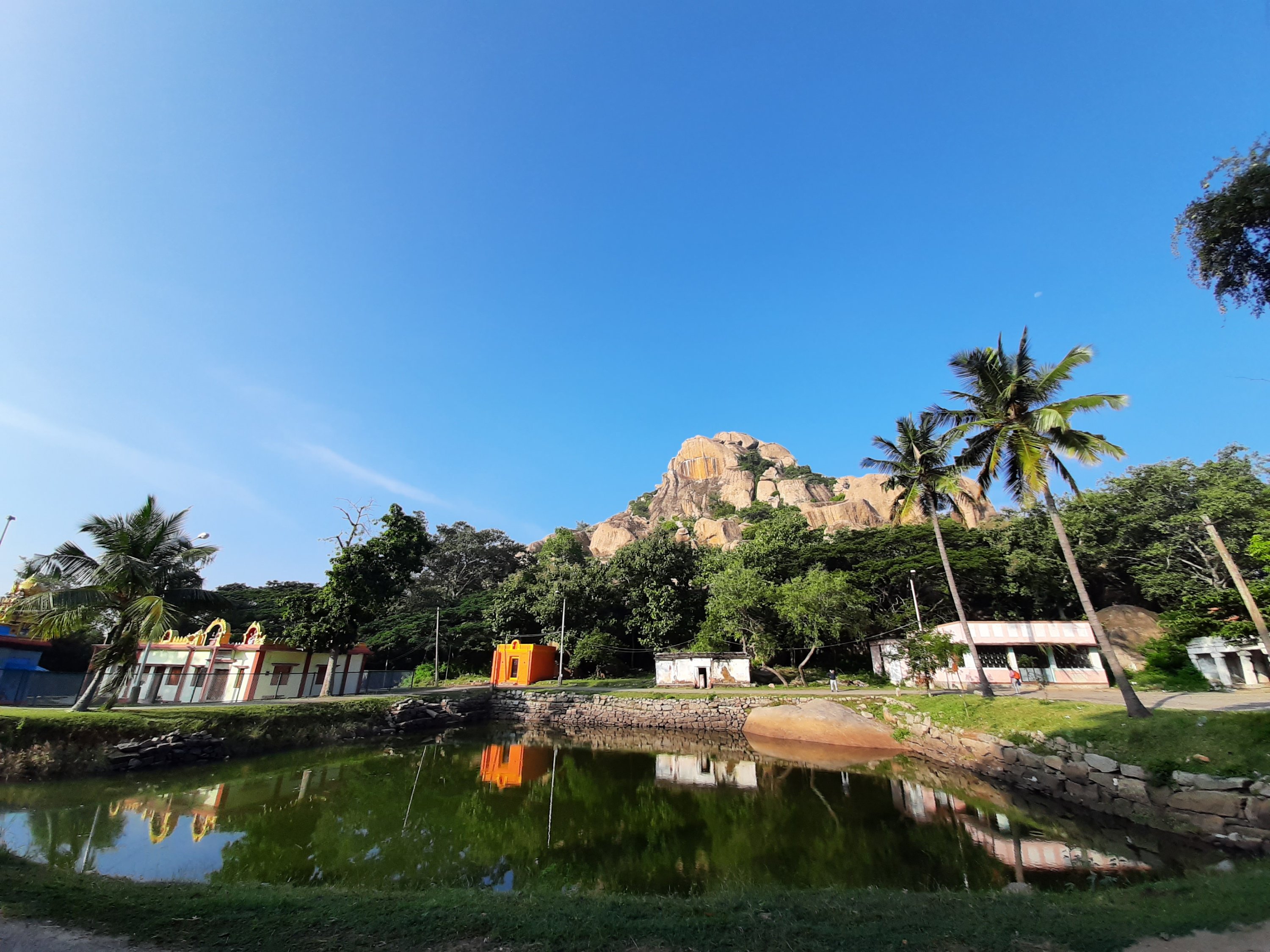
b. The scene where the protagonist rides to see an astrologer is the temple at Kaiwara. It has largely been renovated as on today. But the Narayanappa temple in the background, the rocky hillock on one side and a motorable road seen in a glimpse indicate it is indeed Kaiwara.
Episode: The seventh house; Location: Top- , Below- Kaiwara
8. Episode name: Iswaran
a. The college or the senate hall with its Gothic style of architecture featured in the episode is the ‘Central College of Bangalore University’ located in the heart of Bangalore.
b. The Protagonist, Iswaran watches a movie at a cinema. The palace featured in the movie is the ‘Bangalore Palace’.
c. Time and again, Sarayu river has been mentioned in the episode. Given the typical setting of Karnataka and the writer’s hometown of Mysore, the lifeline of this region is river Kaveri. I believe that the river where the protagonist drowns in at Sangama, near Srirangapatna.
Episode: Iswaran; Location: Top- Central college, Below- Bangalore palace
9. Episode name: The performing child- Abhinetri
Given the fact that it is still one of the iconic lung space of Bengaluru and there runs a toy-train amid a lot of greenery, the train journey featured in the child’s dream is in Cubbon park.
10. Episode name: Roman image- Rome ka Murthi
a. The stone temple that Sheshadri and Professor walk around after climbing up a rocky hillock that overlooks green meadows is the ‘Mantapa’ located at the peak point of Kodachadri.
b. The red structure where professor Bandopadhyay is indicated to be working on a renovation of a Jaipuri palace- is the Shivappa Nayaka’s Palace located near Shimoga.
Episode: The Roman idol; Location: Top- Kodachadri, Below: Shivappa Nayaka’s palace, Shimoga
11. Episode name: The watchman- Chowkidar
Although the structure and the surroundings seems to be in a dilapidated condition in this episode, it has been largely renovated and restored as on date. The entire episode has been shot in the ‘Thimmaraya swamy temple complex at Bettadadasanapura’ in Bangalore. The large trees in the premises, the temple pond, the entrance stone pillars and the fortress like wall encompassing the temple premises on a rocky hillock are the things that stand testimony to the famous episode.
Episode: The watchman; Location: Bettadasanapura temple
12. Episode name: A horse and two goats- Muni
Given the rural setting of the protagonist’s house and the fact that he eats Ragi mudde, it is a story from the Mysore region. The place where he goes to graze his goats daily in a eucalyptus grove and the slopy terrain of the hills where the road passes, could it be the road that leads to Chamundi betta? Or could it be Nandi hills? (as guessed by ‘The light baggage)
13. Episode name: Trail of the green blazer – Pocket maar
The temple where the protagonist offers his prayers with a coconut before heading for stealing is the Panchalingeshwara temple at Begur, located in the outskirts of Bangalore. (Information contributed by ‘The Light Baggage‘)
The Panchalingeshwara temple at Begur
Are there any familiar locations that you could identify in the serial? Let me know..
Here are the remaining episodes 🙂
14. Episode name: Leela’s friend- Siddha
15. Episode name: The missing mail- Dhakia
16. Episode name: Engine trouble- Engine Ki kahani
17. Episode name: Forty-five a month- 45 rupiya
18. Episode name: The career- Ramji Ki Leela
19. Episode (series name)- Naga
20. Episode name: Sweets for angels- Kaali
21. Episode name: A willing slave- Aaya
22. Episode name: Cat within- Paap ka gada
23. Episode name: The gateman’s gift- Govind Singh Ki Bhent
You have probably read my earlier post on exploring the offbeat landmarks of Old Bengaluru. Here is another one. This time, it was a culinary trip of Old Bengaluru to a friend who had flown down to this southern metropolis, from the so-called Northern part of India. I had been asked to take him on a gastronomic tour of my city. For someone who has a penchant for everything old school, I thought Old Bengaluru would be perfect to call it a day. ‘From vintage automobiles, architecture, iconic restaurants serving traditional recipes to by lanes and alleys that narrate their own individual story of the city, this section of Bengaluru has everything that would tickle a bone or two of this mad man’, I thought.
Having largely spent my teenage in North Bengaluru and given my familiarity with the area, Malleswaram was my first choice. However, given the convenience of commutation from my current place of stay, I chose to show him around South Bengaluru. But when one says South Bengaluru, it is a world in itself and the geographical area is large to fit all in one day. Hence, I took time to mark a quick map of restaurants to cover, along with giving a peak into the cultural heart of the city. This part of the metro lays in stark contrast to the Bengaluru, that the millennials from Whitefield and Marathahalli know of.
The obvious choice was a walk tour of Basavanagudi and the Pete area. These are the two most important clusters of true Bengaluru that have held onto the roots, despite the rapid and traumatic transition this city has seen in the last decade in the name of urbanization and modernization. Under the canopy of massive native trees, the aroma of the by-two filter kaapis shared at the numerous Shanti Sagar and darshini food joints, the air here feels different from anywhere else. With almost every street dotted with Classical dance and music schools and happy nonagenarian couples whizzing in their Padminis and Ambassadors, it has a different vibe here. One can find some of the traditional old houses and landmark restaurants only in these localities to really experience old Bengaluru. Each of these iconic eateries have a near century old history and their old school ambience is still intact inside the heritage structures that house them. With a small appetite for food and a big quest for exploration, the portions of food were limited only to the signature dishes of each restaurant, to accommodate more places. So, here is my itinerary of a gastronomic tour of Bangalore of yore.
The Big bull temple, Basavanagudi
Meet-up point: Basavanagudi is the name of a temple (It translates to ‘Bull- Temple’). Basavanagudi is the name of a locality in South Bangalore, named after the temple. It is an extension of the Pete area, which was specifically created to accommodate the upper class, and more-specifically the Brahmin community. No trip to South Bengaluru is complete without a visit to this landmark temple built by Kempegowda, the founder of Bengaluru. Apart from the Big Bull temple, the Dodda Ganapathi and the Bugle rock (a small watch tower from the Kempegowda era) are a must visit on the same premises. If you time it up well, you can part-take in the annual groundnut fair in the locality. (Read here to know more about the history of the Kadlekai Parishe). After meeting my friend here, we started our gastronomic tour to our first food stop.
Food stop 1 (Breakfast): As synonymous as Dosa is with South India, Vidyarthi Bhavan is with South Bengaluru. Ask anyone for the best Dosa in the city and this place scores on top unanimously. It is a restaurant started initially to cater to the student community of the area which started a new culture of a hangout place for friends in those days. On most days, the queue can extend well up to a kilometer. My friend and I wiped off our plates of their signature Masala dosa for breakfast. (Click here to read further about the history of Vidyarthi Bhavan)
Vidyarthi bhavan, Basavanagudi
Food stop 2 (Light eats): No foodie who visits Bangalore is satisfied without taking an evening walk on the Eat street at VV-Puram. However, I decided to go here in the morning, in order to avoid the maddening rush. Honey cake and Congress bun at the iconic VB Bakery was what we needed. This is the first Iyengar bakery to be established in Karnataka which has paved a new culture in baking (Read here for more about V.B.Bakery). Avarebele (Val bean) is a favorite ingredient of the Bengalureans, who have a dedicated annual fair to celebrate this pulse (Click here to read further about Avarekai mela). Hence, picking up a packet of avarebele mixture for home from one of the stores there was an obvious choice.
Food stop 3 (11 o clock, coffee): It is an important break time for the employed section of the society. Brahmin’s Coffee bar is a household name for their filter coffee and the delectable chutney served with idly on their very limited menu. This tiny eatery is in a corner of Shankarapuram, which is also famed for the Shankaramatha, a learning center of the advaitha philosophy. We had a quick stopover for a hot cuppa this little place is known for, before heading to Pete. (Read further about Brahmin’s coffee bar here)
Food stop 4 (Lunch): To satiate the hunger pangs, I planned to treat my friend with an authentic Bangalorean affair. With multiple theories surrounding the origin of the military hotel culture, the history of these restaurants dotting across the southern part of Karnataka is unclear. Bangalore is home to some of the best in the state. I don’t think there would be any better meal than ‘Ragi Mudde oota’ savored at a military hotel to get a peek into the local flavor, including the ambience. Hence, we were lunching that afternoon at S.G. Rao’s military hotel, located in the cotton Pete area. A typical military hotel meal includes Kaal soup, Ragi Mudde and Mutton biriyani. (Click here to read further about S.G. Rao’s military hotel)
S.G.Rao’s military hotel, cottonpete
Food stop 5 (dessert): A meal is complete only with a nice dessert. If there is one sweet meat that is synonymous with Karnataka (Mysore state), it is Mysore pak. Since I couldn’t take my guest to Mysore for that, the closest I could get is at Sri Venkateshwara sweet meat stall located at Bale Pete, a short walk away from cotton Pete. Their Mysore pak and dumroot are the sweets my friend packed for his roommates back in his hometown. (Click here to read about Sri Venkateshwara sweet meat stall).
Sri Venkateshwara sweet meat stall, Balepete
The Pete walk: An old Bengaluru exploration is nothing without a walk along the narrow snaking lanes of the Pete area, the true business epicenter of both New and Old Bengaluru. This area is segmented into various sections and named according to the commodity sold and the communities that resided there in the yester years. From green groceries, handloom, steel, plastic to precious metal, everything is available in this locality. An early morning walk in the famed flower market is an experience in itself. We limited ourselves to just the mainstream sections while exploring some of the ancient temples, mosques and heritage houses of the Kempegowda era. In the meanwhile, we kept munching on numerous snacks from several popular stalls on our way. Although these eateries are old, the flavors are largely north Indian, owing to the Marwari and Baniya community that reside here in majority.
The heritage structures of the Victoria hospital, Bangalore fort and Tippu Sultan’s summer palace all lay on the side of the road for the history and architecture buffs who have a little more time in hand. But this is all we could fit in our day. Thus, ended a gastronomic tour of South Bengaluru.
I hope you enjoyed this virtual tour with me too… did you? Or did you not? Share your thoughts with me…
There are many other iconic restaurants in Basavanagudi if you have a larger appetite. These are a few other places that you must check out when you are here: The new modern hotel, Mahalakshmi Tiffin room, Janata Tiffin rooms are a few among many others.
Souvenirs to buy:
Coffee filter and freshly roasted coffee powder: The best filter coffee is available only in South Bengaluru, and hence my friend thought this was a more significant thing to buy from here.
Channapatna wooden toys: These are GI tagged handicrafts made with organic colors and largely popular in the western market, it comprises a large collection of traditional toys.
Heard of the blue hills? Does the name ‘Nilgiris’ strike any bell? For those who know less, it is a part of the Western Ghats, a UNESCO World heritage site in the southern peninsula of India. The ‘Neel-giris’ literally translates to ‘Blue-Hills’ because these hills get their colour from a particular phenomenon. A particular species of the Strobilanthes kunthiana flowers, locally called the Neela-Kurinji bloom once in twelve years. When in full bloom, the entire hill range looks blue, thus giving the hills their name. The last mass-flowering of the neelakurinji flowers happened in 2018 and I left no leaf unturned to witness this spectacle. There were a couple of hotspots identified by the Kerala forest department where arrangements were made to allow visitors to see the flowers. My friends and I decided to visit the Eravikulam National park, located close to Munnar. This stretch of the hills was where most of the blossoms were supposed to happen. After finalizing the visit dates in Sept’18, the Delhi friends had booked their flight tickets to fly down and the remaining of us booked our bus tickets from Bangalore to Munnar. I had got all the necessary entry permits from the forest authorities and booked accommodation in Munnar for all of us. All this was done months in advance to have a confirmed entry anticipating the tourist influx for such a spectacle, if we waited until later. We were all set and waiting for the travel to finally happen.
Come July’18, the rain gods had wreaked havoc in the western Ghats. The entire stretch of western Ghats in Karnataka and Kerala had been damaged by the heaviest rains in eight decades. The damage done was massive to geography, property and life along these areas. In the event of things, damage was done even to the neelakurinji plants and the blossoms were feared to be washed out. Once the rain gods had calmed down and the ground situation of floods seemed to have receded, we waited to see if there was any luck in waiting until September. We were in constant touch with a few locals who gave us the updates on the status of the blue hills. Come September and we decided to go ahead with our original plan. We all had finally arrived at Munnar and were heading towards Eravikulam National Park.
Once there, Yes, there were enough plants destroyed. The stronger few, had managed to bear flowers. We walked along the laden path, feeling grateful for at least so many of the plants had survived. Since these plants blossom only once every 12 years, it means that their reproduction cycle is longer than usual. This also means that, most of the Neelakurinji vegetation is lost in the 2018 monsoon and the next flowering cycle of the year 2030 may not happen at a mass-scale as it is usually supposed to happen at all!! Anyway, we enjoyed whatever we were witnessing.
The Neelakurinji flowers at Eravikulam National park
Also, Neelakurinji is only a sub-species of the larger group of flowers called the Kurinji. The Kurinji flowers come in several colors- white, peach, purple, etc. Here is a collection of the Kurinji flowers from Eravikulam National park that we saw during our visit.
The various Kurinji flowers at Eravikulam National park
So that said, I was back in my hometown the following week and visited our piece of farmland to check on its status after the monsoon. It used to be a spice plantation that remained unmaintained for a long time before we, siblings ventured into developing it. our farm is a short walk away from the main road. When we arrived there and decided to walk, the entire path was filled with what seemed like some weed that had overgrown during the monsoon. We used a machete to make way for ourselves to walk further. Just a few steps into the area, we were surrounded with pink/ maroon flowers all around us. ‘These weeds had flowered expansively’, we wondered. We took a lot of photos, made way for ourselves, finished our work and returned home. When we discussed about the weeds with the elders in the family, we were surprised to hear that these plants also belonged to the Kurinji family.
The Kurinji flowers from our farm in Kodagu
Further, an important month in the Kodava and the Tamil calendar is the month of Kakkada or Aadi. In Kodagu, on the 18th day of this month a special dish is prepared using a locally available herb. Its juice is believed to contain 18 medicinal values. It leaves a very deep blue/violet pigment when cooked and consumed only on this day. And what is this plant called? Don’t even guess… Locally called ‘Maddh thoppu’ or ‘Aadi soppu’, it is also a variety of Kurunji. So, Kodagu primarily has three types of Kurinji; the flowering weed(Maley Kurinji(as in hill), Etth Kurinji(as in cattle) and Maddh Kurinji(as in medicine). A little bit of googling allowed me learn that there are many sub-species of the Kurinji and each have their own flowering cycles. While some bloom annually, some bloom once in six years and some take a couple of decades. Neelakurinji was just one among them.
Lesson learnt: How often do we tend to ignore the little things from our own backyard? We think these are too trivial to spend time and look for things elsewhere. It is often that people associate that better things come only when money is spent and distances are travelled, but the truth may be that it is something that we have been conveniently ignoring in our own vicinity. What is your take on this thought?
Come the night of Mahashivaratri, there will be festivities across the country. People stay up all night and participate in bhajans, pooja offerings, chariot pulling etc. all to keep themselves awake for the night, so that their beloved Lord, Shiva gets good rest after taking care of them all year. But it is the day that follows the revered night, that is the essence to this story of mine. The day that follows Mahashivaratri is when Shakthi, the consort of Shiva and thus, the female power is celebrated across the Northern part of Tamil Nadu. The companionship of Mother Angalamman to Shiva, the graveyard dweller is celebrated with a festival called the ‘Mayana Kollai’. As a friend explains, Mayana Kollai translates to the ‘Raid of the graveyard’ in Tamil. I had planned to witness this festival at one such temple dedicated to Angalamman, closer home, at Kaveripattinam.
The festivities had started as early as the sunrise at the Angalamman temple, with the Goddess being taken on a temple car/ chariot. She is supposed to travel along the streets of the town, to the graveyard by evening from where she returns to the temple by night. All other rituals that are part of this journey of her’s are what make this festival more interesting. It is a festival where the entire town / village participates with no barrier of caste or societal status. The chariot leaves the temple with the idol of Angalamman.
The diety- Angalamman being taken on a procession on the temple car / chariot
She is greeted by devotees who throw a mixture of salt crystals and black pepper or beans all along her way. She is hailed as a symbol of fertility who is calm throughout the year and takes on her powerful form on this day, once in a year. The villagers get their body pierced with various things near the temple premises and walk across the village to the graveyard, where the piercings are removed. This body paining is what they believe, is a gratitude to the almighty for the wishes that have come true or as a part of a prayer that needs to be fulfilled. The size and things pierced can vary depending on individual’s prayers. While those with tridents pierced around their mouth are a very common sight, the more pious go further to get their torso pierced with hundreds of lemons. Yet, a few pull cars, buses, trucks or large stones with ropes that are hooked through their bare skin.
Stones being readied to be hooked to the body as a man with a trident pierced to his cheeks walks past
If u peek into one of the many shops (I don’t know if that is the correct noun for such places) around the town, apart from those getting the body piercings, you will find another set of people. Men and children will be getting their faces painted and dressed up in sarees, a representation of Angalamman. With metal arms attached to the backs, elaborate costumes, jewelry and crown worn, Angalamman is impersonated by these people. They hold tridents and dance to the beats of drums across the streets. Several times on their way, they get possessed or get into a state of trance, until they all finally congregate at the graveyard. Animal sacrifice too is a common sight on the streets on this day.
Stalls where the body piercings and paintings will be done
It is evening by the time the temple car and everyone else reaches the graveyard. That is when the most interesting part of the rituals takes place. The folk impersonating the goddess gather around a random grave and dig it up. The bones from the grave are pulled out and chewed by them. This is called the ‘bone chewing’ ritual or what gives the festival its name: Mayana Kollai or the ‘Raid of the graveyard’.
Men and kids dressed up like Angalamman
There are several legends and references that explain the significance of this ritual, depending on the region. Here are some of the references I found on the internet.
Post this ritual, the goddess calms down and returns to the temple on the temple car. The festival culminates when the it reaches its home.
While witnessing all this self-violence, I started to deeply think, why this is necessary to please the gods. Although I couldn’t find a convincing conclusion, what I realized is that this form of ritual is not unique to Hinduism alone. It has been largely practiced worldwide, across all major religions. Some of the closest references are:
Whichever faith be it and whatever the belief, the intentions of every person involved is the same. To get closer to god. Aren’t all our beliefs connected?