Tag Archives: culture

The Mountains beckon in the Apple valley of India- Kinnaur

I wasn’t sure if solo-traveling would be safe in Chhattisgarh, the campsite wasn’t ready yet for a Gujarat trip, Rajasthan had the election around the corner albeit having the perfect weather, the public transportation system wasn’t convenient in Arunachal, Uttarakhand had unpredictable weather of late, Jammu was done just last year, Dharamshala stretch would be too mainstream, Lakshadweep was too short a trip for the time I had. Maybe I should just settle down with the Sahyadris in Maharashtra or sign up for a fortnight long yoga session at Rishikesh or a Yakshagana course at Mangalore perhaps! I had tele-travelled almost the whole of India to decide where I wanted to go. And then, this happened! Just 4 days before departure, the mountains beckoned and I had finally decided to visit the Kinnaur valley in Himachal Pradesh.

Click here to read the complete story, on Amazon

Nothing was clear to me apart from the to & fro flights to Delhi. People around me were busy and my vacations couldn’t wait, lest they be lapsed without pay or without use. Although not very keen on solo travelling, I think that’s how life threw itself upon me when I longed to go to the mountains! The mountains have always been kind to me and have had me meeting them regularly over the last 4 years. I don’t know the reason for this special bond I share with the mountains. May be because I come from a nature worshipping community, that my connection with them is so instant and strong. The mountains had me amidst them yet again. From being a shy kid at ice breaking in public gatherings to having done a complete solo backpacking in an off-season, to meeting and hanging out with strangers and making new friends from travels, my journeys have brought me a long way! The mountains have been kind and have protected me all the way…

Given that I would be alone and I get muscle cramps when the temperature drops, the one thing I had to make sure while planning my trip was to not push myself too hard to see too many places or do anything that could drain me out. Hence, I decided to do it one place at a time, plan my next destination only after reaching a place and move only when I felt like I had sunk in well in the current place. So that said and Kinnaur had me there! After I had reached Himachal, there was absolutely no fear of being a solo-women traveller and no worries over safety concerns at any point of time. The people were amazing who derive their strength from their deep values… From being stopped by random locals on the road and being offered the juiciest apples from the valley to eating local food and getting invited to houses for coffees, from befriending the locals and then to being invited to attend a traditional Kinnauri wedding, from waiting for the day’s only public bus or hitch a ride to having stuck in a place for 3 days without any electricity or transportation due to snowfall, from meditating in the millennium old monastery to confronting a mummified Llama in the mountains, from driving past a valley of green-rock-and-sand onward to having returned through the same valley painted white in snow, from being seen-off by a close friend at the trip start to I seeing-off a stranger at the end of the trip: Whoa! What a journey it was!

So, the route taken by me was: Delhi- Kalka- Shimla- Sangla- Rakcham- Chitkul- Sangla-  Reckong Peo- Kalpa- Nako- Geu- Tabo- Rampur- Sarahan- Shimla- Delhi. Some of the key destinations enroute and things I did were:

• The trip started with the ‘Himalayan queen’ train from Delhi and then I connected to the mountain railways from Kalka to Shimla, a part of the UNESCO World heritage. Stopping at several stations enroute, a ride in the loco thugging along the narrow-gauge through in-numerous tunnels and winding pathways in between the green pine laden cliffs and verdant hills was worth an experience.

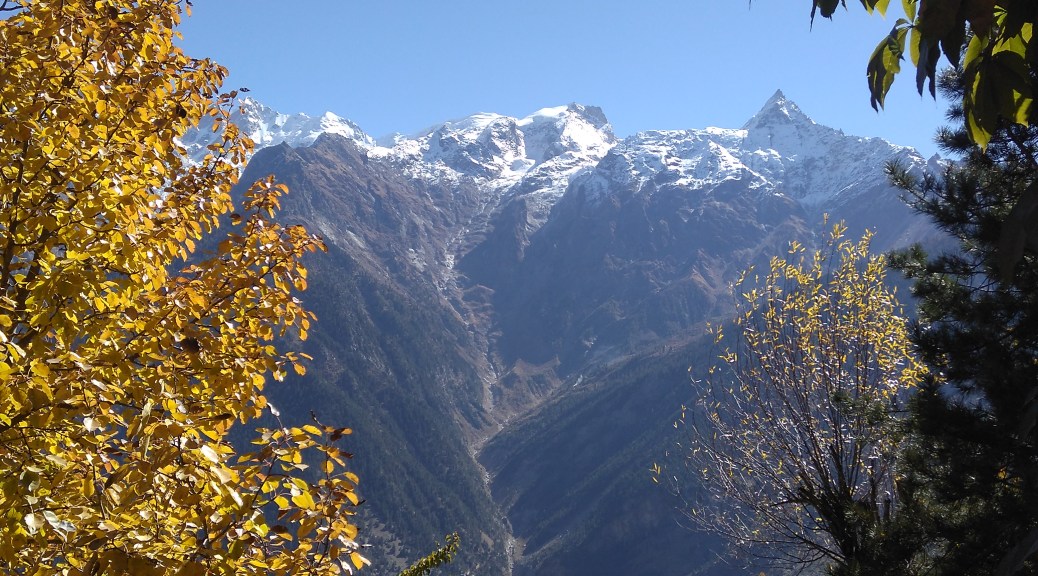
• The hustle of the desi music blasting at full volume had filled the atmosphere as the HPSRTC bus I boarded at Shimla cruised through thickets of sweet smelling Juniper and deodar. A solo snow laden peak emerged from amidst the green mountains. Call it layers of dew laden and mist covered hills, they sparkled as the sun’s early rays found their way forming several vibrant spectrums as the morning ride gave me the first glimpse of a horizon that had a never-ending line of snow-capped mountains.

• When the bus alighted at Sangla after making its way through steep gradient, blind corners and breath-takingly scary heights of the snaking roads, the sun was calling it a day. It had cast a golden red glow to the entire range of Kinnaur Kailash mountains. I couldn’t have asked for more as I stood there to be welcomed by this magnificent view right in front of the bus stand. The hike up the Kamru fort to catch the golden peaks up close was a cherry on the icing.

• The next day was an exhilarating bus ride through the Sangla valley, overlooked by the Kailash mountains on one side and the beloved untamed Baspa river flowing below. The ride was adventurous with waterfall and river crossing, cliff-hangers, landslides and occasional sightings of mountain goats or yaks. Quick stop-over at Batseri village painted in shades of crimson, chrome to ochre with the trees of apples, apricots and walnuts was a feast to the eyes. A walk down to the river at Rackcham helped me to connect with the Kinnauris with very warm conversations. They offered me a ride through apple orchards and buck wheat farms before meeting the sole Indian tricolour waving at Chitkul, a village bordering China & Tibet.

• The following morning, I started early to Kalpa- a quaint tiny village with old traditional houses amid the Kinnaur apple farms. A solo hike through the suicidal roads to Roughi village turned out to be special when a random dog decided to accompany me all the way. Again, the setting crimson sun cast its magical spell over the manifestations of Shiva and Parvathi seated conveniently in the Kinnaur Kailash mountains overlooking the village. With the chants from the Buddhist monastery next door and swaying prayer flags as I looked out of my window the next morning, I couldn’t have asked for a better start for my day.

• That day, I did a bit of shopping and grooving to traditional Kinnauri music with the locals at Reckong Peo, the ‘Gateway to Kinnaur valley’. It was the annual fair where people from all over the state had congregated to buy and sell local Agri-products and handicrafts apart from sipping the local apple brew. Packets of pine-nuts, dried apples and apricots along with the traditional Kinnauri hats were perfect souvenirs to take back before boarding the bus to my next destination.

• This road is when the landscape starts to surprise you. The green canopies make way to steep rocky cliff-hangers. The on-going construction of the Karcham Wangtoo dam only warns you to be aware of shooting stones where landslides are as common as confronting vehicles from the opposite direction on the single-track road. And then, the Rocky mountains disappears suddenly making way for barren landscapes with sand and loose rock laden cliffs. The blue Sutlej river snaked between the valley and the view of the treacherous roads winding around the steep gradient hills was indeed a sight to behold! It was pitch dark and biting cold when I alighted at Nako, to check into a homestay under the clearest star-studded night’s sky.

• Although the weather had gotten more colder, it was one of the finest mornings so far. A walk around the village of Nako, with mud-smeared walls of houses built of wood and clay is one of the highlights of my entire trip. While strolling through those narrow walkways of the village, I felt as if I was exploring a maze. With the early morning vibes of a typical village with cattle roaming around, children walking down to schools, chants and incense from the ancient monastery rising in the dew laden air, it was an altogether different world there. The view of the distant snow-capped mountains and the barren winding landscape around had me spellbound for the rest of the day.

Next destination was Geu, a village that can be reached only if luck be by one’s side. Having no direct connectivity through public transportation, I waited on the highway hoping to hitch a ride to a place that is often cut-off due to landslides. It was wedding bells chiming in this tiny hamlet that day… I was fortunate, to say the least! A large family heading towards Geu not only obliged to offer me a ride in the trailer of their crowded goods carrier, they also invited me to be part of the celebrations. From being treated with the finest Kinnauri delicacies to dancing with the baraathies in a traditional mountain wedding, I could not ask for more. It was an all day and all night affair!

• I woke up in the biting cold next morning to hike up the hill and pay a visit to the mummy of a Buddhist monk, believed to be over a 500yrs old. Strangely, it has been there in open atmosphere without any chemicals and among the only few mummies available in India. Quick breakfast at the wedding house and I was good to head out by hitching another ride until Hurling.

• The weather had gotten worse that day with a forecast of precipitation by day end. As I waited at Hurling for my next ride, the guy making rotis at a hotel offered me a cup of free chai and got me a free drive with his customer to my next destination. With a loaded car and a person with a broken leg hanging out of the rear seat, the people who agreed to drop me were more than sweet to accommodate me in the front seat and they carry my backpack on their lap all the way in the rear seat.

• So then… Tabo happened! This was the place I had been looking forward to all the way. Considered to be one of the holiest places for the Tibetan Buddhists, I sunk into meditation mode for good few hours with the soothing fragrance of the Juniper interiors of this millennium old monastery constructed out of clay. It was BLISS and I can’t explain it further. The millennium old paintings all over its inner walls and roofs, the golden manuscripts were something incredible. Since artificial light sources are believed to damage the organic colours, I eagerly waited for specific time of the day for the sun to light up specific rooms to see this wonder. It is called the ‘Ajanta of the Himalayas’ for a reason, you see!

• The morning when I woke up, the mountains had moved closer to me with a heavy overnight snowfall. This was a sight to which the heart of a snow-deprived-south-Indian-city girl in me had skipped a beat. I had to extend my stay at this monastery due to heavy snowfall for next 2 days and with no electricity, phone connectivity and no plumbing that worked whatsoever, it was ‘THE” time! Amid all this, I had the rare opportunity to relish the Tabo apples (one of the best in the world) every day of what was being offered to the deity at the monastery.

• Finally, after getting my drive back to Shimla- I had plans to stop by at Rampur Bussahr to see the erstwhile palace and stay at Sarahan, one of the Shakthi peethas in the foothills of the Himalayas. But, the mountains had an altogether different itinerary for me for the last 3 days! So, thus was my sojourn in the Himalayas, the mighty incredible Himalayas!

Since Rohtang pass had closed by end of monsoon, I did only Kinnaur and half Spiti and returned the same way back (Although a little hectic with 3 days required only for travel, on the same route). If you are traveling in the summers, then you can start from Shimla and complete Spiti & Lahaul via Kaza and exit from Manali, thereby not repeating your route.

Summary: With the changing landscape throwing surprises at the wink of an eye, each mile was magic. The valleys were overwhelmingly beautiful! When the mountains beckon, just pack your junk and head out! The destination doesn’t count, the journey is worthwhile!

This article is featured in Deccan Herald’s Travel supplement: ‘DH Travel’ on 25-May-2019

Traveling the Toyota Way- 4 things I learnt

Toyota is a brand that the world recognizes for high quality standards. The Toyota Way of doing things is something that the rest of the world still fails to match. These 7+ years of my incredible journey with Toyota may have helped me grow personally and professionally, but here are four key things that I always associate my travel sojourns with.

4. Nemawashi: is the process of discussing problems and consensus building on potential solutions. This will allow to collect ideas of those involved in the event and get agreement on a way forward. I don’t mean that you need to get consensus from many people on your travel plan, but what I mean to say is- Discuss, Talk more to real people! Instead of depending on internet for information(Which are many a times paid articles for promotions), Talk to different people. While you are planning- talk to people who have been there before and take their experience based opinions; while you are on the road- talk to the localites and take their suggestions. You will eventually end up doing, eating, exploring something new and that’s unknown to most people. This way, you can create your own experience based stories.

3. Yokoten: This is something I have been hearing day-in and day-out. Toyota believes in documentation and standardisation of best practices so that these can be used as references by others. Yokoten means to copy/implement good practices from one process to all other similar processes. Also, I guess talking to other travelers let’s you pick and decide what’s good and bad for you during your travel. So I guess, that’s what I have been doing through documentation of my travel stories in my blogs.

2. KeshiGomi: It literally translates to ‘Eraser’ in Japanese. But what they use this for is quite relatable for a traveler. Japanese are strong followers of the PDCA (Plan Do Check Act) in all things that they do. As an important part of their planning, they always make a ‘KeshiGomi sheet’ which is a simple ‘things-to-do list’. Keshi here refers to striking off the activity after it is completed for better visualization of activity status. So, how is this related to a traveler, you may ask??? So that’s where I call it a ‘Bucket List’. Its always good to have a bucket list of places you want to see and things you want to do. Whether it is accomplished or not comes second, but it is a great motivation to chase those things!

1. GenchiGembutsu: Literally translates to ‘Go & see’. One of the most important rules that the Japanese follow is to go to the place and understand the case by self rather than depending on facts narrated by others. The facts may be moderated or altered when it is passed from one person to another and is usually based on somebody else’s perception. So stop imagining about how a place could look and get your bums out of that couch, go travel and experience it all firsthand!

Do you have any such weird places from where you derive inspirations? Let me know through the comments below.

Exploring Vidarbha on a Long Weekend

Vidarbha- the region consisting of Nagpur and Amravati derives its name from the epic city of Mahabharata. With several references made in Ramayana and Mahabharatha, it is not just historically important, but is also economically important as it is a mineral rich region in Central India. Vidarbha is a cultural melting pot with its strong influence in culture, history and geography of the country.

When opportunity knocks at your door, grab it! That’s what I did.. A friend was getting hitched at Amravati and the nearest airport for me to fly down was at Nagpur. So this time, it was an opportunity to explore the Vidarbha region. But that came with its set of challenges. It is one of the hottest places in India and the ceremonies were scheduled during the peak of the summer season. So, my colleagues and I decided to hire a self-drive car to ease the travel hassles of local transport. We wanted to visit the prominent landmarks around the region. There are a plenty of them. Hence, the itinerary was planned such that all major landmarks around Nagpur were covered on a single stretch before hitting the highway for the night’s stay at Amravati. Along with that, the region offers its own delectable cuisine. We wanted to include some of the popular dishes/snacks on our list as well.

So, I present my visit to Vidarbha in two parts. One, listing the landmarks visited and second, with a list of food to try in the region.

Part 1: Places to see in Nagpur and Amravati

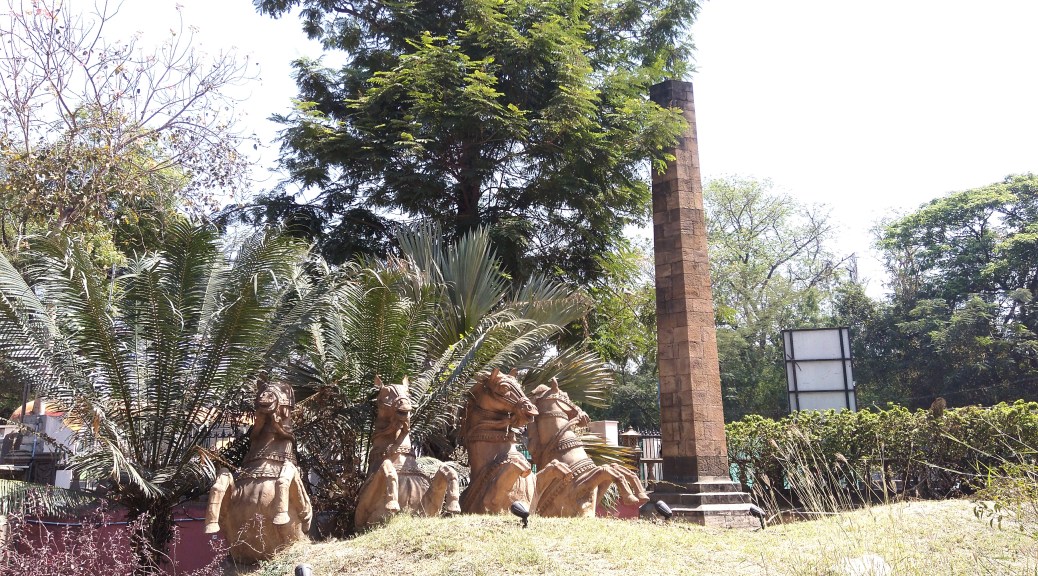
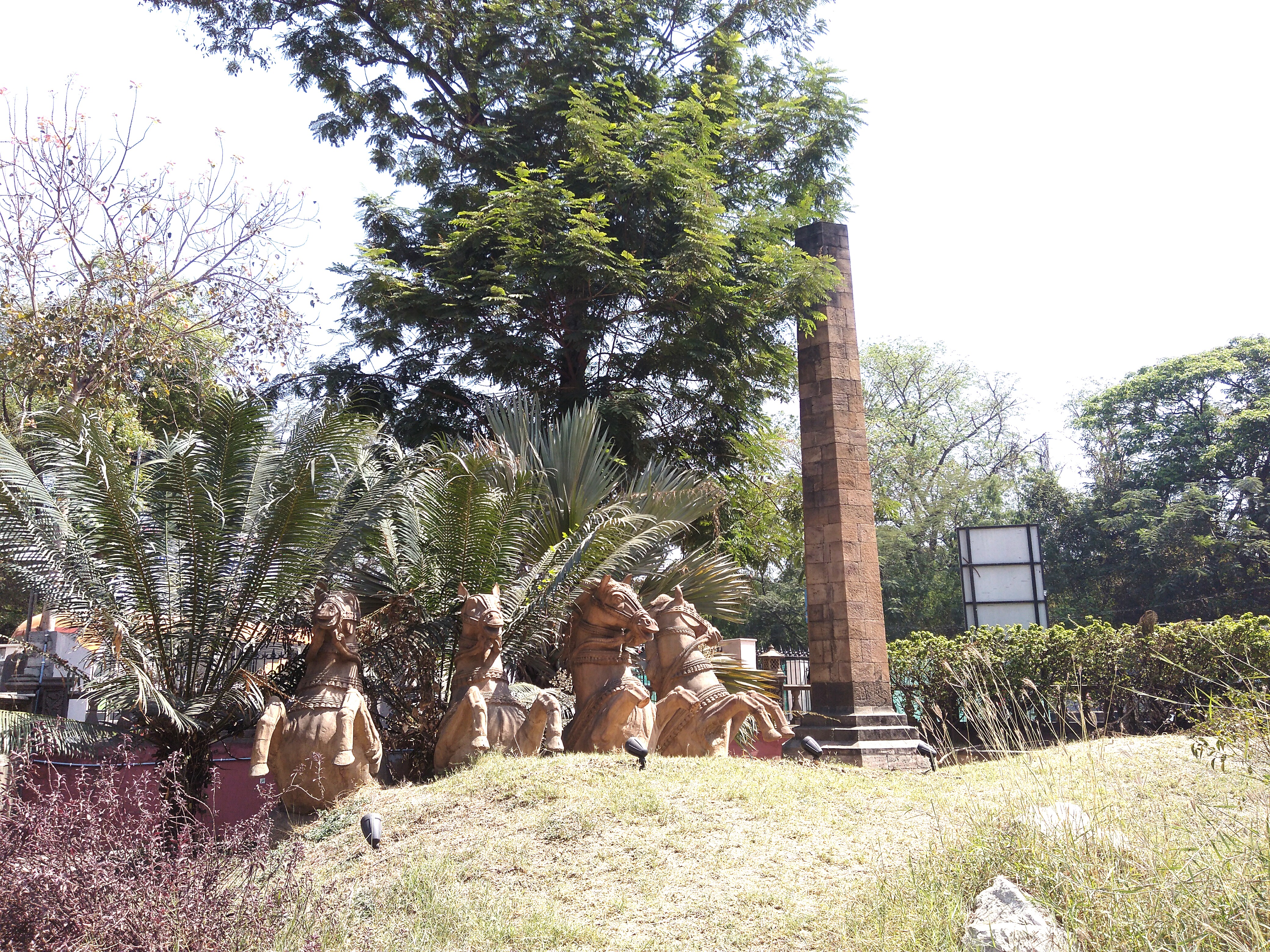
  1. The geographical centre of India before partition: The ‘zero’ milestone is from where all distances were measured and highways originated in India, before Pakistan was formed. For all the hype around this place on social media, I was surmised to see that it was poorly maintained and is located in a corner of a busy main road. I had imagined it to be centrally located at some kind of a junction on a busy road.
IMG_20180324_190242
The zero milestone of undivided India

2. The DeekshaBhoomi meditation centre: This is where Dr.B.R.Ambedkar, the father of the Indian constitution is said to have given his first sermon after he converted to Buddhism.

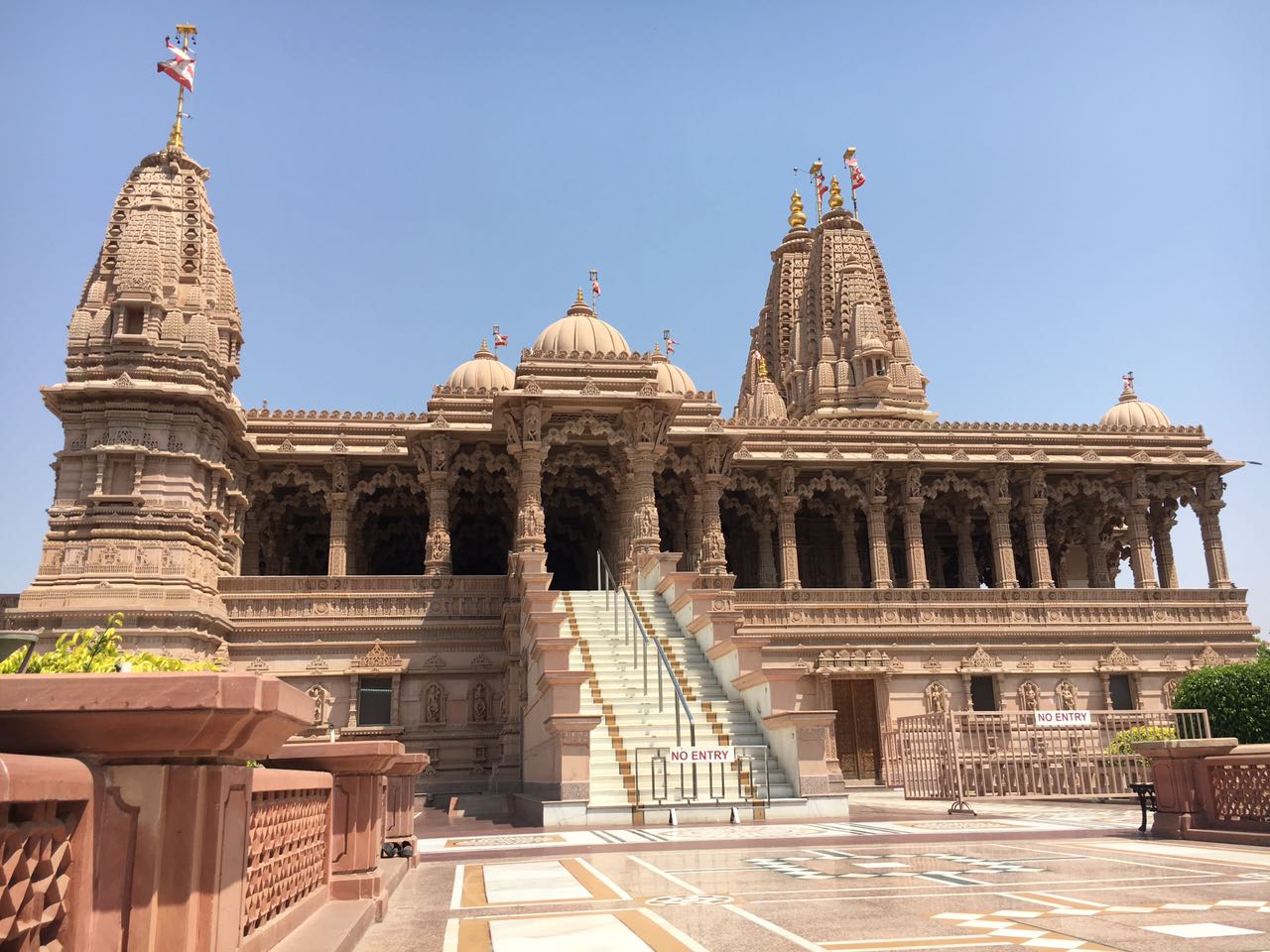
3. The Swaminarayan temple was a beautiful place located within Nagpur city. The Dragon palace temple and Ramdham Park are some other places located within the city if you have more time in leisure. The lakes in the city can easily be given a miss. However, some heritage structures like churches, schools and the railway station lend an old-world charm to the city.

IMG-20180324-WA0062
Swaminarayan Mandir

4. Adasa Ganesh temple: This visit can be done by taking a small deviation before hitting back the same highway.

5. Mansar: This is an archaeologically important site, believed to be of Pravarapura, an erstwhile capital of the Vakataka kingdom that ruled the Vidarbha region.

6. Ramtek: Located at about 5kms from Mansar, this is considered to be a holy hill to people of all faiths. ‘Gad Mandir’, an old beautiful temple dedicated to Lord Ram is situated atop a hillock. Solitude is available in abundance here with a great view of the entire area. The Ramtek hills is also believed to be a place where the mythological King, Kalidas wrote his epic poem- ‘Meghdoot’. There are several places that are significant among the Jains and Buddhists too that are located in the vicinity.

7. The Ambala Lake: The ghats of the lake located at the base of the Ramtek hills are lined with beautiful ancient structures and was my favourite place of the trip.

8. Khindsi Lake: Get yourself cooled with some water sports (recommended if you have leisure time at your disposal.)

9. Nagerdhan fort: Soak in history at the erstwhile capital town of the Vakataka dynasty. (Recommended only if you have some more time for leisure.) It is a further 10kms drive from Ramtek.

10. Pench National park: Don’t miss an opportunity to stay over and do some tiger sighting in the land of ‘The Jungle Book’. It is the same forest where the story of Mowgli and Bhageera is based at, that we have all grown up watching and listening to.

There are a lot of scenic places around Pench that I can help you with if you are planning to stay over at one of the jungle lodges. We did not have the luxury of time as we had to drive back all the way as our stay was booked at Amravati. The Amravati region is home to several wildlife sanctuaries and temples that can be accommodated if you’re traveling on a luxury of time and an own vehicle, which we had to give a miss.

11. Chikaldhara: The highest point of Vidarbha region and the only hill station is located in Amravati. For a person like me hailing from the coffee hills, it was quite exciting to know that Amravati is the only coffee growing region in Maharashtra state.

Part 2: Food and Sweets to try in Nagpur

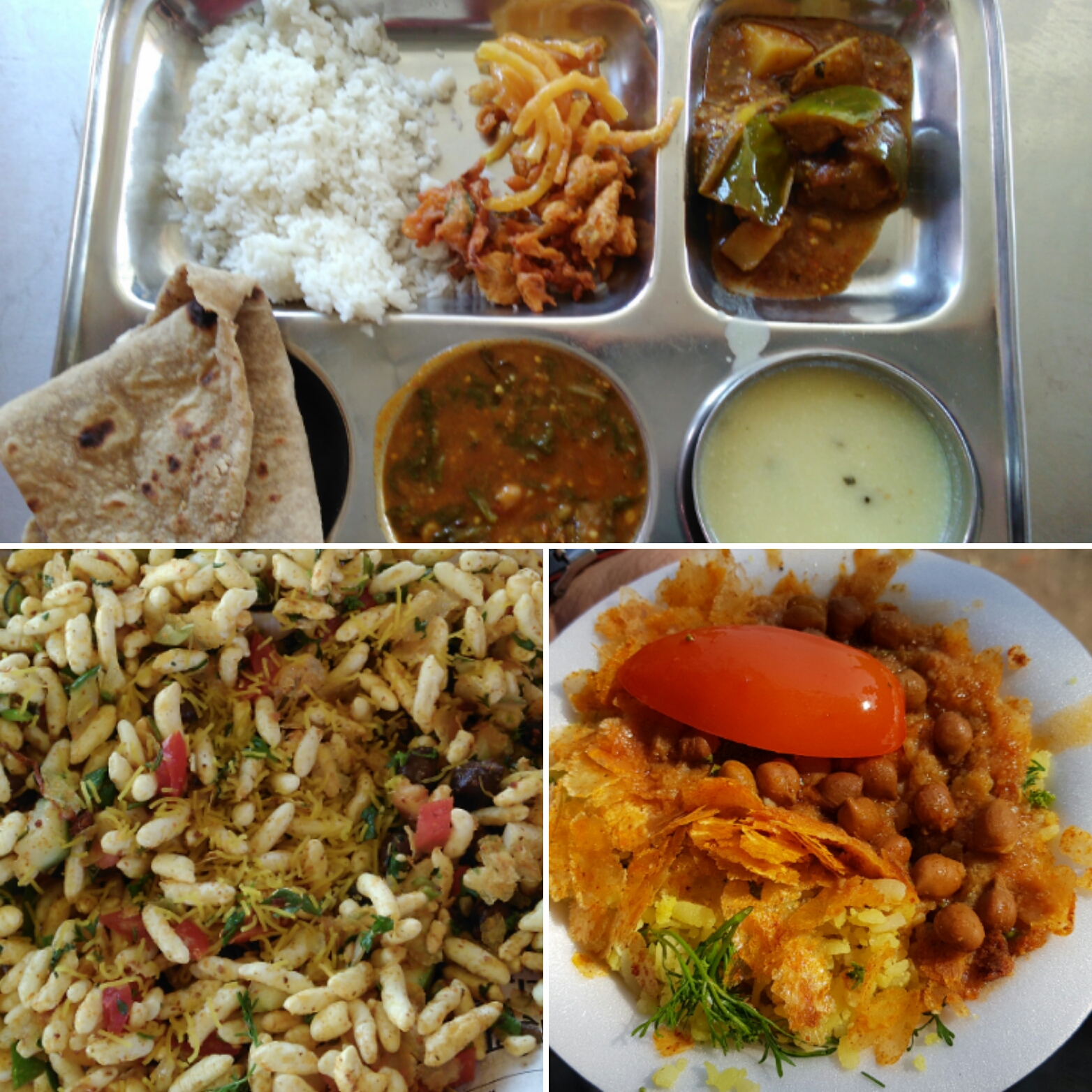
Talking about the highlight of this trip, it was definitely the FOOD!! The Varadi and Saoji are the two popular cuisines of the Vidarbha region. So, it was a culinary treat for our taste buds to experiment on something fiercely spicy and so rustic in taste. While our day started with delicious plates of ‘Poha with Tarri’ and ‘Samosa Tarri’ for breakfast at one of the several roadside tapris, lunch was a simple delectable Varadi thali at the ‘Gad Mandir Bhojanalay’. We managed to find space in our tummies for street food with several pit stops along the way that tasted heavenly and ended our day with a grand non-veg varadi menu for supper at a star hotel where we were put up for the night.

IMG_20180401_143553
The Varadi food that kept us going!

Nagpur is synonymous with oranges and the brand ‘Haldirams’. So, the visit would have been incomplete without trying the ‘Orange Burfi’ at one of the Haldirams outlets spread across the city. Do pick up a box of ‘Mango soan rolls’ from Heera sweets to please your sweet tooth along your return trip!

With the short time of a weekend that we had, this was the best we could accommodate in our schedule. Tell me what other things would you recommend to do, see and experience in Nagpur and Amravathi?

A Visit to the Mecca of India- Ajmer

This was the first time I was stepping into the state of Rajasthan. Time has been kind on me yet again bringing me to the right place when the time was right! And this time it was to Ajmer during the holy month of Ramadan. Ajmer-Marwar region was a separate state until it was merged with Rajasthan. At a distance of 130kms by road from Jaipur, it is believed to be the second holiest place in Islam after Mecca. Apart from exploring Ajmer town, if you are a traveler, you can also include Pushkar in your itinerary, which is located less than 25kms from Ajmer. Apart from being a holy place for the Hindus, Pushkar is a popular haunt for the hippies from world-over. You can use the below itinerary if you have a weekend in hand. However, I could only explore Ajmer on this trip.

A weekend Itinerary:

Day 1: Bangalore to Jaipur (Flight); Jaipur to Ajmer (Hired car); Visit Ajmer dargah, explore Taragarh hill, Adhai-Din-Ka-Jhonpra, Akbar Palace & museum, Soniji-ki-Nasiyan Jain temple, Mayo college campus. (Night’s stay at Taj- Ajmer gateway)
Day 2: Visit Pushkar lake for sunrise, explore Pushkar town (and the annual camel fair, if you time your visit right); return to Jaipur (by road), Jaipur to Bangalore (flight)

The Details:

I was visiting Ajmer on a business trip with three of my colleagues (Click here to read about my job as a car doctor). Hence, I somehow managed to squeeze in sufficient time into my trip so that I could venture out in this city and explore most of whatever it has to offer for the traveller in me. Needless to say, no visit to this holy city is complete without heading to the Ajmer Sharif Dargah dedicated to the Sufi Saint Khwaja Moinuddin Chishti.

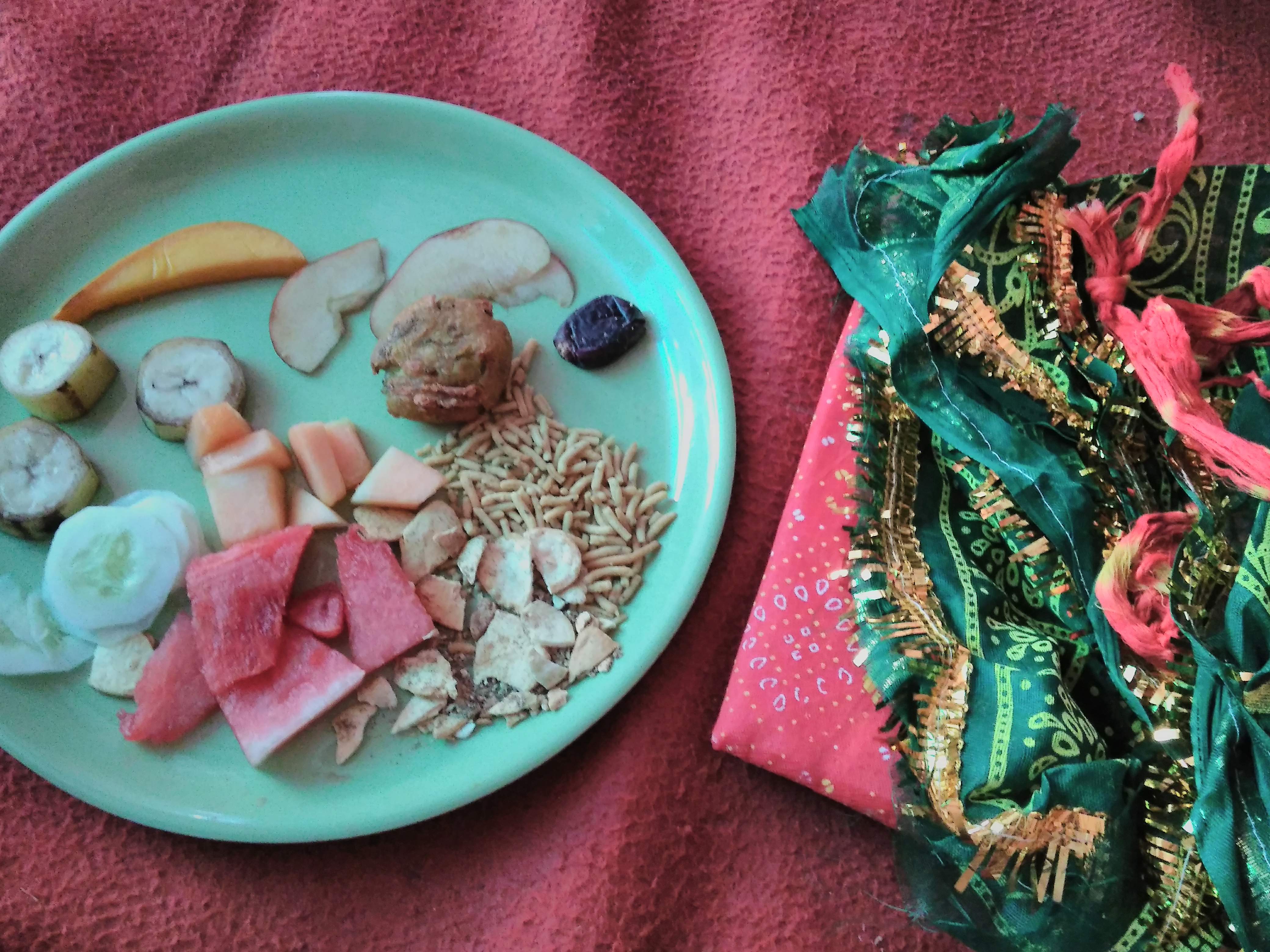
Apart from it being the holiest and the busiest of the times on the Dargah’s calendar, our visit also coincided with the 27th day of the holy month: revered as the ‘Night of Destiny’ in the Islam faith. This is a place where most people struggle to get past the crowds even on normal days. We were fortunate to have contacted one of the trustees of the Dargah who managed our entire visit and made it effortless. It was evening time and we had just finished offering our prayers by donating a Chadar to the diety. What we hadn’t realized was that we were there on the premises of this holy place at the time of breaking the day’s fast. We were offered some fruits, nuts and food by the trustees and other devotees who were distributing food there. I was overwhelmed with the thought of having had such an opportunity, at such a time!

IMG_20180612_183519
Breaking the fast at Ajmer dargah Sharif

The Dargah is located at the base of the Taragarh hill, atop of which a fort is situated. The view of the entire hill overlooking the Dargarh is so beautiful with a township constructed on the steep slopes of the hill. Since, photography is prohibited inside the Dargarh premises, I wasn’t able to capture most of the things. It’s a welcome move in some places like these and respect the sanctity of the place. Enough is said and written about this place on the internet. So, I wish to cover about the other things this historic town has to offer.

After our visit, we walked the by lanes around the Dargah to explore the best of Ajmer. Not in terms of places but in terms of its lip-smacking street food. With a lot of Mughalai and Nawabi influence and it being the Ramadan season, the best of the spread was available. Needless to say, Ajmer is a haven for food lovers. By the time the last ray of the day’s sun had vanished, we were stuffed until our glottis.

If you are a history buff and want to find something to feed your wanderlust, you can take a walk to Adhai-Din-Ka-Jhonpra and the Akbar Palace and museum that are located closer to the Dargah. Soniji-ki-Nasiyan is a nice two-storeyed wooden Jain temple that can be visited enroute to Dargah Sharif. If you are at the luxury of time, a quick ride to quick ride to the Mayo college campus can be ended with some peaceful sunset time spent by the banks of the Ana Sagar Lake. But, for me- something else was awaiting!

IMG_20180623_140401
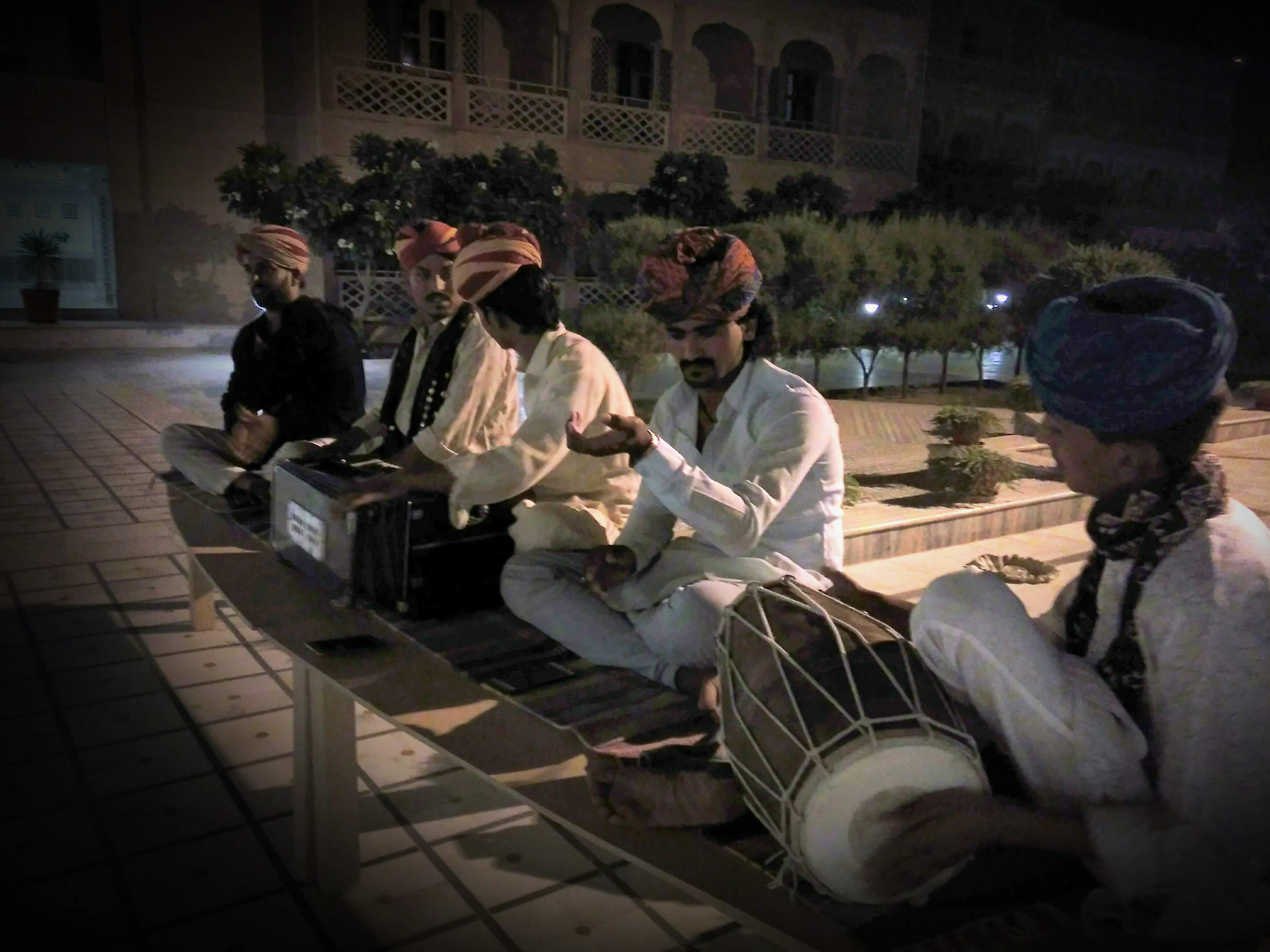
The folk singers performing live in the courtyard of the Taj

I had my stay booked at the Taj- Ajmer gateway for the night, a world in itself to visit and hang around. The drive from Ajmer city towards it outskirts on Pushkar road, through winding roads with the backdrop of the setting golden sun was a picturesque treat after a tiring day of work and toil. All this seemed like only a grand welcome to the beautiful Taj property that’s nestled in the midst of nowhere in the lap of the Aravalis. The sky was dark, when we arrived at this palatial hotel. The entire driveway was lit with dim sodium lamps from the gate through the lounge. A faint outline of the Aravalli hills standing calmly on the backdrop only enhanced its grandeur. It was a warm welcome as the live Rajasthani folk music with the timbre of the Morchang and Khartal resonated from the courtyard. The host personally lead me to the room while explaining the delicately chosen wall murals and paintings as we walked through the elegant corridor. Though my stomach was stuffed with Ajmer’s street food, I did manage to make some space for the delectable dinner that I was hosted at the restaurant. With all items seasoned and cooked to perfection, each dish seemed better than the other. With a refreshing dip in the pool, a day was called!

IMG_20180708_013657.jpg
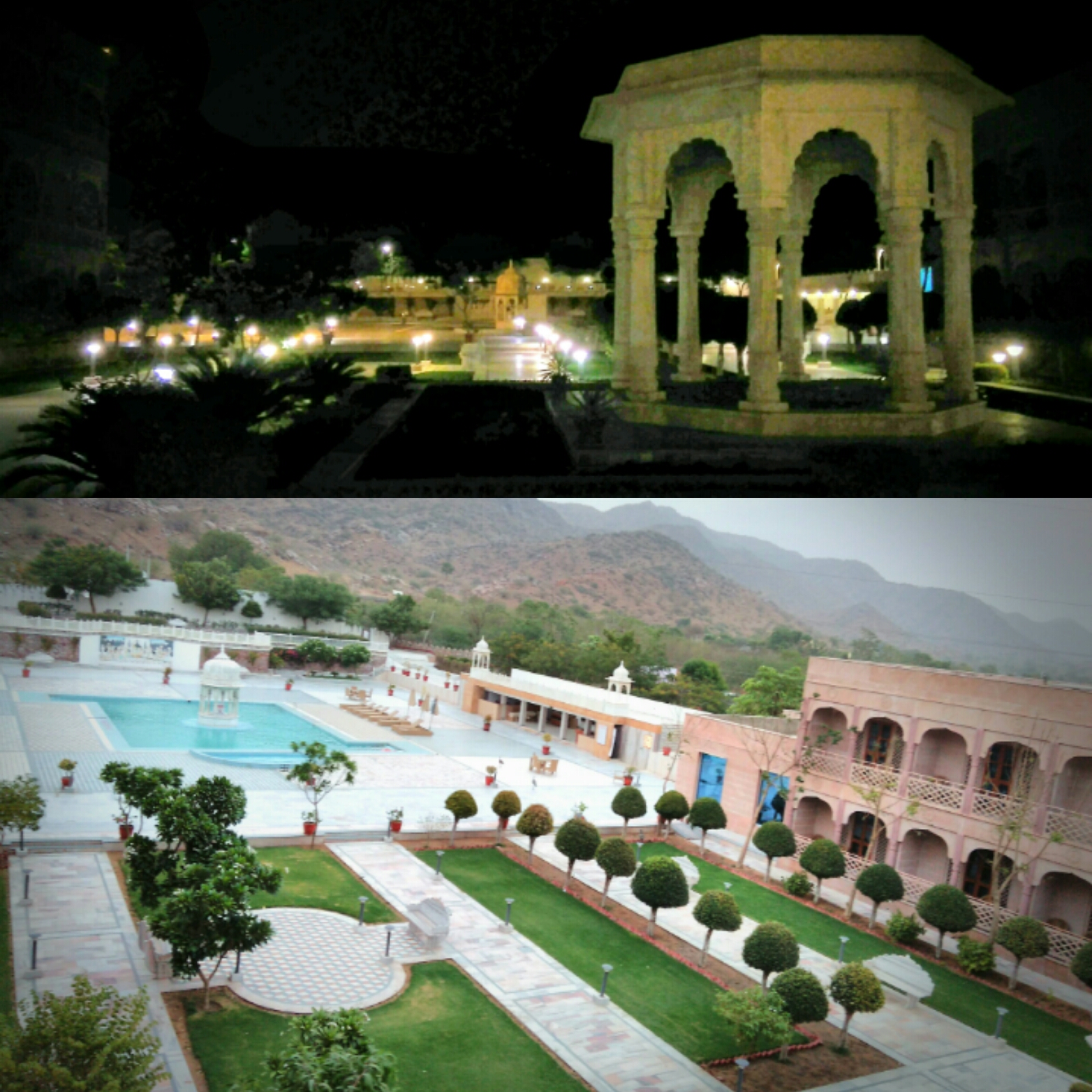
Top: The courtyard at night Below: the morning view from my balcony

I looked forward for the morning as much as I did for the previous evening! I had set the alarm for sunrise but was woken up rather early by the calls of dozens of feral peacocks that had come from the forest/hills just behind the pool. I opened my balcony doors and voila! It was a magical morning with peacocks dancing in the courtyard and a modestly calm sun peeping out of shadowy grey clouds with the glorious green Aravalis forming a backdrop… I soaked in this special moment as much as I could from my balcony before I realised that it was time for me to pack-up. Finishing up the morning chores and ending my stay with the Taj with a wonderful breakfast spread, it was time for me to say good bye to this beautiful city of Ajmer and this beautiful Taj property- the Ajmer gateway!

Fact file:

Must-do: Make a wish by offering the Chadar or the decorated shawl to the deity/tomb at the Dargah Sharif.
Must eats: while the street food and the never-ending list of non-veg dishes are to die for in the month of Ramadan, Kadi Kachori and Soan-Halwa are an all-season recommendations.
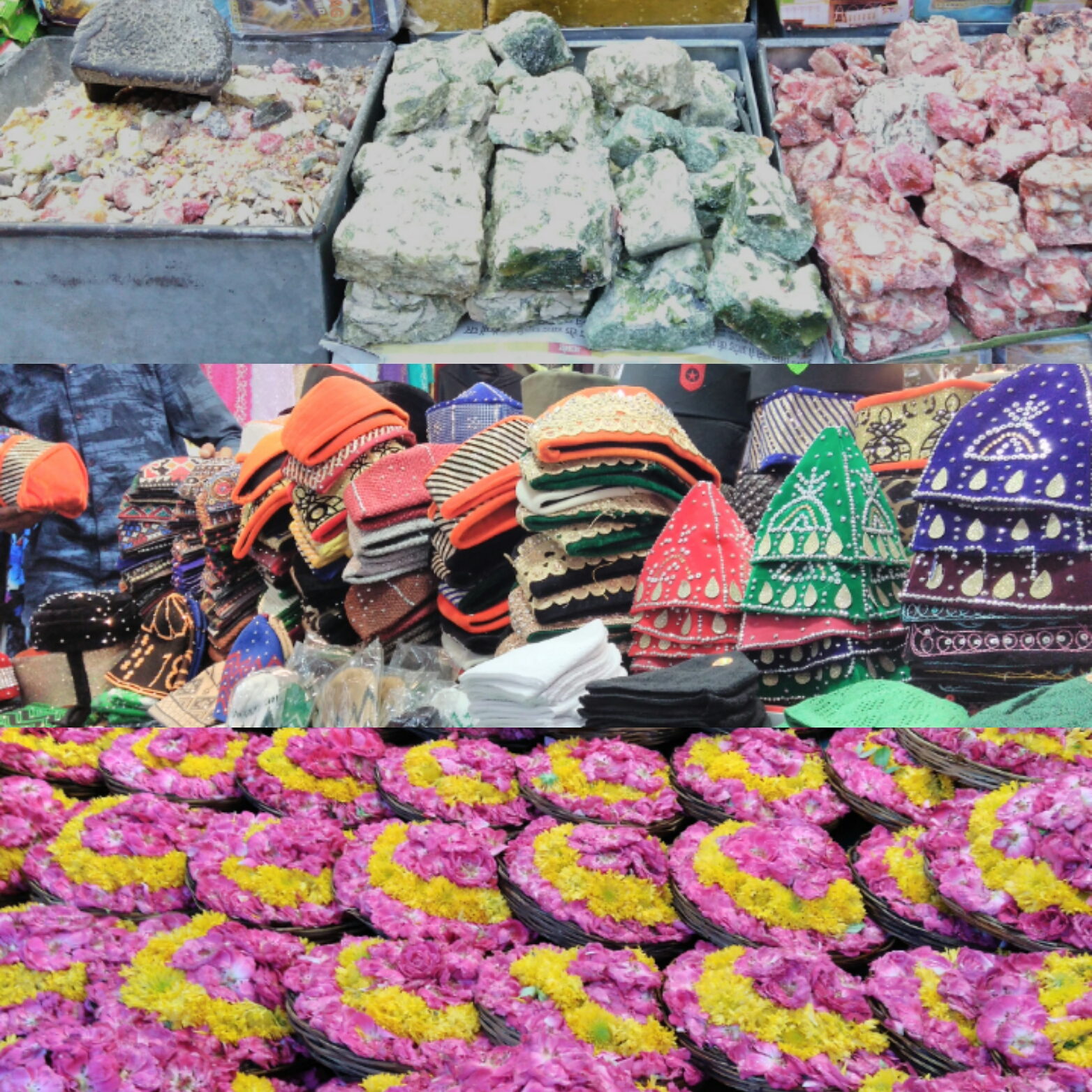
Must buys: variety of prayer caps and incense.

IMG_20180708_013329.jpg
The Street shopping at Ajmer

A day out at the Khasi cultural centre- Smit

This post is part of my fortnight long road trip across North-east India, specifically covering parts of Meghalaya – Assam – Arunachal Pradesh I had planned to visit Shillong – Smit – Cherrapunjee – Mawlynnong – Dawki – Ribhoi- Shillong during my weeklong stay in Meghalaya.

I had decided to explore some places all by myself and Smit happens to be one of them. After seeing some spellbinding photos on the internet, I wanted to visit the Laitlum valley as well. Although there are public buses from Shillong to Smit, the connectivity further to Laitlum isn’t great. This is where one needs to have a travel arrangemtn of their own, or in my case: to hitch a ride to reach Laitlum. Since it was my first day in the state, I did not want to get too adventurous for being alone. That’s why, I hired a taxi from Police bazaar (in Shillong) to Laitlum.

This drive was very refreshing for me, whose mind was cluttered by all the madness of traffic, pollution and work tension back in the metropolis (Bengaluru). I was requesting my driver to stop the car after every other kilometer to capture the seducing beauty of the place with my not-so-good camera. The bamboo trees and terrace lands with potato farms, all added charm to the landscape that was very beautiful even otherwise. To add to the pleasure of the drive, I was having a good conversation with the driver as well. Althiugh I had hired a personal taxi, I did not mind to let a few locals into the car when the driver asked me if I could allow them. Given the remoteness of places and the scarce connectivity through transposration, I had absolutely no problem with offering a ride. The next thing I experienced was that there were atleast 50 passengers hopping on and off at every stretch for their ride. And would you know what was exciting for me? All locals who boarded the car used to get overly excited about meeting a foreigner (Yeah… That’s what they called me!).

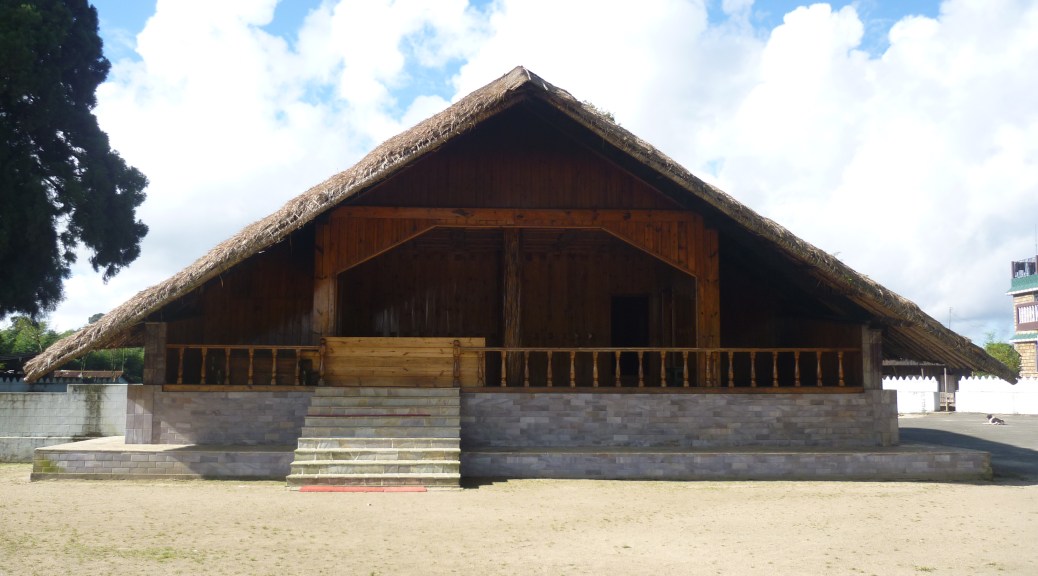
Smit is an old rustic town and the cultural centre of the East Khasi hills, but there isn’t much in this town apart from the Siam’s house. A road flanked with well groomed pine trees lead to the Khasi Raja’s palace. The Raja or the head of the clan is called ‘Siam’ and he lives in the same premises. However, the wooden palace is used only on special occasions when there will be large tribal congregations, like the Nongkrem festival for example. This typical Khasi styled wooden house is said to have been constructed with zero iron nails and only wood for all joints. Although I met the Siam, he did not seem to be a photo friendly person when I asked for permission to photograph his little children.

p1130680
The Siam’s house at Smit

We then drove to Laitlum valley, located at about 5kms ahead of Smit. It was an offbeat drive through the rarest stretches of countryside. We passed by a lot of school kids who were on their way to school. Few were happy waving at me while a few were busy pranking at their pals as they walked. Having been born and raised in a small town myself, it was a flashback of typical childhood days in a rural setup. There were a couple of school teachers in my backseat, chatting happily with me and patiently waiting in the car while I would get down to take photos. Overall, it was a very pleasant drive until we reached the Laitlum gate. While the driver wanted to sit back in the car, he asked me to enjoy the view and return.

I was the only person amid the green scintillating valley until I walked down and saw 2 local boys cleaning the pristine place. They had already parked aside 4-5 sacks full of waste. When I spoke to them, they told me that they came there every morning before leaving for school, to pick up plastics left behind by the previous day’s tourists. While it was a heartfelt respect for these boys for doing their bit to save earth without having any expectations of monetary gain, it was a subtle slap on my face because I too represented the tourists who unmindfully damage the same earth in the name of travel and enjoyment.

P1130730.JPG
The Laitlum valley

I walked down to the cliff and stood in amazement at the beauty that the place beheld. While I was standing on the brink on a large flat rock, it felt like I was the only person in the whole wide beautiful world. The gentle winds kissed my cheeks and the chirping bird was a welcome guest. There were several waterfalls flowing down the valley gracefully at a distance… Then there were a few villagers who appeared to be popping out of the deep valley beneath. They seemed to be friendly and told me that their village was located far down the valley and they had to climb up each time to meet their basic life requirements, trade their farm products etc.

There is a cable car made of bamboo which will be dropped down and pulled up for old people and goods, but their daily commutation is by foot most of the time. I grew curious and my feet dragged me down the stones that were laid on the path to the village. The beauty of the 360 degree greenery and the fresh air had already cleansed my mind off half my worries and tension by the time I clocked the distance to the village. There is a small stream, a church and a few huts in this little fairy tale village nestled deep down the valley. And the villagers I met on my way enriched me with the simplicity and contentment in life. After a good walk down the beautiful valley of Mawkeynrew, my tummy had started to call out for me. I savoured the plantains offered to me by the villagers and unwillingly decided to climb back.

p1130853
The bamboo cable car and the village below

Once I reached the top, I finally sat down at a small hut like stall at the valley gate that had opened by that time. It was run by a lady who couldn’t understand what I was trying to communicate in English. her little son helped me with a cup of lemon tea in English before running to school. The lady there could not understand anything other than Khasi language and I didn’t know that. In spite of the language barrier, we both soon became friends and managed to communicate with hand signs. She cooked maggi noodles and Jadoh with chicken curry for breakfast while I was eagerly waiting for my first Khasi meal. Jadoh is a traditional Khasi meal where rice is cooked with chicken blood instead of water. It was one of the most relishing and sumptuous maggi noodles I had eaten before! What made the meal so special was not that I found it in a no-man’s land or at an extremely low price. It was something that I would travel back again all the way for the humility and dollops of warmth with which the meal was served to me.

She cut a pomello fruit and mixed it with chilly powder and packed it for my road.. With a heart full of gratitude, I bid goodbye to this new Khasi friend of mine!

Kublei Shiboon,
Hitha.

Tracing the abode of celestial congregation- Kollur

While I was flipping through old photos of my college days, I was taken back in time to this so-called ‘Industrial trip’. This class trip consisted of trekking, pilgrimage, beaching and lastly, not to forget our industrial visit (only If time permitted, that was!). Basically, it was less of industries and more of place hopping. So here goes the first part of the so called ‘Not-so-Industrial-Trip’.

Although I had walked for miles to reach places during my school days, this was my first ‘Official’ trek! A trek in the ‘Kodachadri hills’ in Malnad region of the western ghats.. After a really long bus journey, we alighted at the Nittoor forest checkpost late in the evening. We got the permits at the forest checkpost for the night’s camping ahead, at the old forest guesthouse. We parked our bus there and got into the 4WD jeeps that were waiting for us since early evening. There is NO road from Nittor to the guest house and is only a muddy pathway. And in monsoon, it makes way for a deep trench kinda massive slush pool. This stretch can be covered by various modes based on each person’s interest. You can walk up or drive or ride.. The more adventurous people choose the latter; cycling comes with the greatest challenge. We chose the safest- The 4WD. But, driving through such terrain calls for great skill of steering control, lest have at least 7-8 people thrown off the road. That said, it was a crazy drive up the hill, until we reached the guesthouse in the darkness of 10~11.00.p.m.

After reaching the guesthouse, we could barely stand because of the strong winds. So, you can only imagine our next task of pitching tents.. We called off the idea of camping under the moonlight as we struggled to even hold the tents firmly in our hands. The winds were so strong. That’s when we had to camp indoors, at the guesthouse 😛 We had only a roof above us and no mats or sleeping bags. So we decided to pitch the tents inside the guesthouse hall for the rest of the night.

We woke up early next morning and started our hike up the Kodachadri hill. Our hike mainly consisted of two target activities- one was to reach the Shankaracharya mantapa at the peak, for sunrise and the second was to take a shower in the Hidlumane waterfall. We did not hire a guide as the organisers claimed their familiarity with the route. The sight all the way till the mantapa was beautiful and the sunrise and the Arabian Sea at the distant horizon just added up to the view! The climb was great, giving us an eyeful of the valley that was in all bloom with colourful wild flowers. After a brief walk, we reached the Mantapa. After spending some time at the peak, we readied ourselves for the descent.

bye-bye-6
The Kodachadri hills- Overlooking the Arabian sea

The descend was towards the waterfall. With the descending gradient, we slipped, jumped down, clung onto wild creepers in the event of finding our way to the waterfall amidst the thicket of the forest. Somewhere, we had already started to realize that we were lost in the forest. The thumb rule of finding the way out of a forest is to follow a flowing water body. The organisers followed the sound of flowing water and we followed the organisers. We stopped by at a small cave like structure enroute, where someone had installed an idol of Lord Ganesha and offered some flowers. We prayed for our safe exit out of the forest and continued with our pursuit of the waterfall. So we finally reached at the source of the flowing water!

Sure it was a waterfall.. But ain’t the mighty one that we had thought it would be. It was a stream that was directed to a storage tank by the localites and the tank was overflowing forming a waterfall!! Neither the organisers nor the others knew how to react at our misadventurous pursuit. But we were all happy that we had found some pure water where we could fill our water bottles and ease ourselves out of the tiring hike that we had been through so far! We were now sure that the tank was there for a purpose and the pipe attached would lead us back to base point. And the descent continued, along the same stream to the base.

There is a small temple dedicated to Mookambika Devi at the base. It is believed to be the original temple that is tagged to the legend of Shankaracharya’s installation of the idol at Kollur. We reached the priest’s house near the temple where we had a simple-wholesome breakfast. After packing our stuffs from the guesthouse, it was time for us to head out to our next destination: Kollur.

morning-trek-34

A view of the Arabian sea from the Kodachadri peak

People who prefer to trek further, can cover the Agnitheertham waterfalls enroute to Kollur Mookambika temple. But, having had enough in the quest of a waterfall, we decided to take the bus route. The bumpy drive continued until we reached Kollur, the small temple town known for the Mookambika temple, one of the Shakti peethas. This temple is said to have been developed by the Keladi rulers later in time so that pilgrims don’t have to trek up the overlooking Kodachadri hills to worship the goddess. Another legend has it that Lord Shiva appeared before Sage Kola and agreed to be present there in the form of Linga with his consort Devi. Along with Shiva and Parvathi, all other gods and goddesses are believed to be residing in a non-form in the Linga. Hence, Kollur is referred as ‘an abode of the entire celestial congregation’. We took a little time to offer our prayers and admire this beautiful little temple built in the typical Kerala style of architecture. Post that, we proceeded to the forest guest house where we had our stay booked for the night.

7th-morning-6
The forest guesthouse

The forest guest house is located in a serene location in the middle of the ‘Mookambika wildlife sanctuary’ and on the banks of river Sowparnika. With banks I mean, just a couple of steps lie in between the guesthouse and the river. This river is frequented by spotted deers & leopards to drink water. And we were told that just the previous morning, a tiger was spotted on the same steps that we were standing on, at that time! The river flowed gracefully with the crystal clear water and the school of fishes enjoying their swim in between the tree roots that grew beneath. It was a SPECIAL place to go back again indeed! We cherished every moment of our stay there while being in harmony with nature in its purest form.

mookambika-temple-8
The Idol of Mookambika being taken out as a part of the daily ritual

Soon, the dawn broke the next morning awakening us to another day reminding us of our journey to the next destination- Bhadravathi. It was the last day of our tour and that meant we had to do the most important part of this trip ‘Our Industrial visit’! That’s for another story altogether…

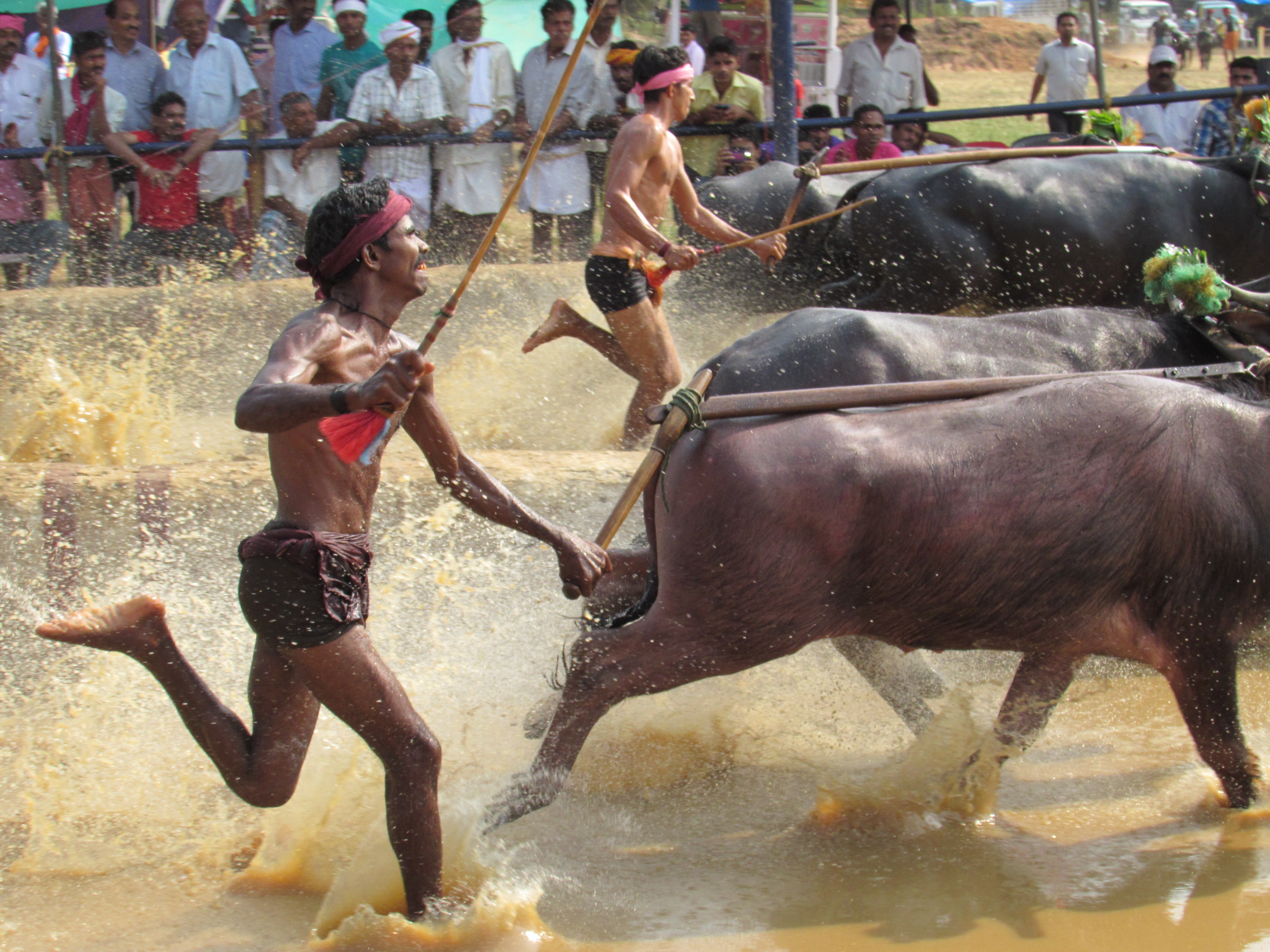
A Buffalo Valentine at Kambala

14-Feb-2016

The air painted red with romance and roses, the atmosphere illuminated with candles and balloons.. Couples holding hands out on dates- both young and old…. That’s the scene in rest of the world on that day.. But for me, Valentine’s day was an unusual form of celebration amid the Tulu-Naadu people. It was a celebration of folk culture and a celebration of earth’s gifts. While in some parts, it is the celebration post harvest, yet in other parts it is a celebration to commence the sowing season for the next crop. The Dakshina Kannada region, fondly called ‘Tulu-Nadu’ was a place where love and war co-existed on that day.. LOVE for a sport of thousands of passionate spectators and a WAR of prestige for hundreds of participating landlords. And amid all pomp and pride, a buffalo soldier fights it out in glory thus emerging as the showstopper..!!

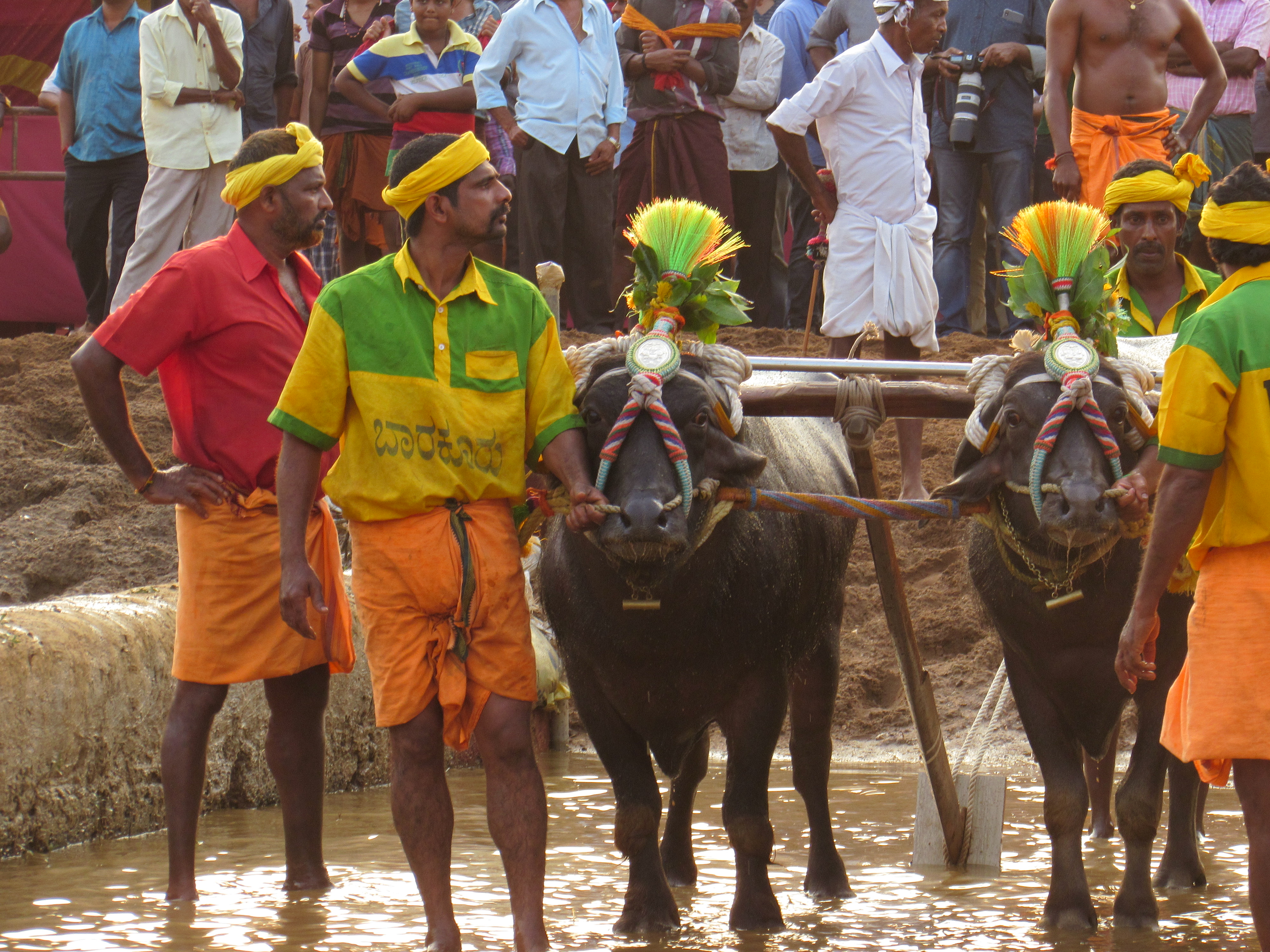
A rickshaw ride from the Mangalore city centre traversed through some Kuccha roads, then across a highway and completely off-road to reach the banks of river Nethravati. Coconut tree lined mud road flanked with dozens of anchored fishing boats on the river bank ended straight at the arena where the big-event was set to take place. As I stood amid thousands of spectators in the gallery, the air felt heavy with anxiety. The show-stealers of the day walked down the ramp(Read it the slush pool) one-by-one to take their places and get set for their D-day. A day where all the effort and hard-work of hundreds of buffalo owners will be put to test. It was time to score off ‘Kambala’ from my bucket list when I decided to spend my weekend at ‘Joppinamogaru Kambala-2016’ in the coastal stretches of Mangalore.

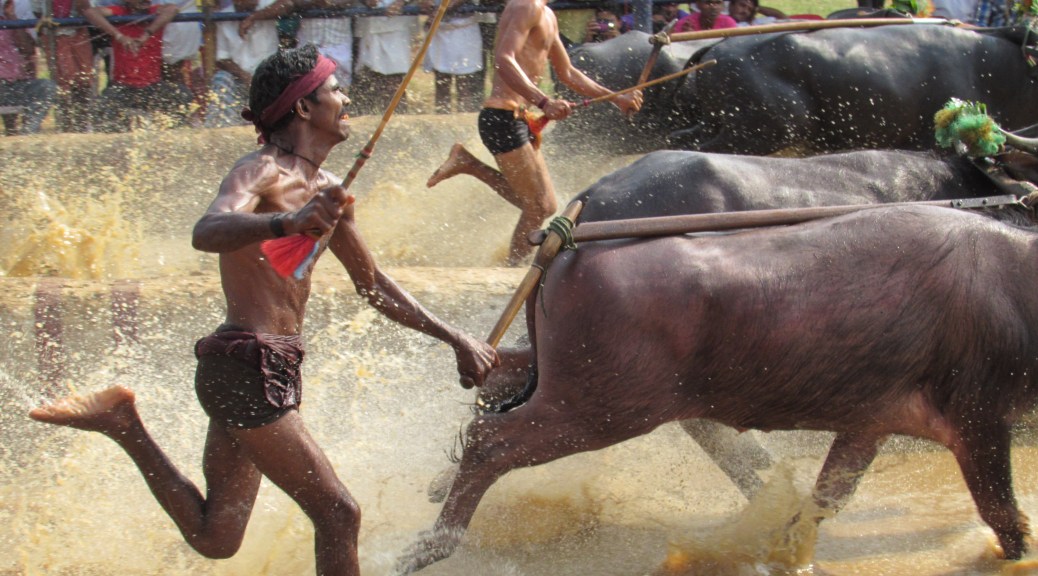
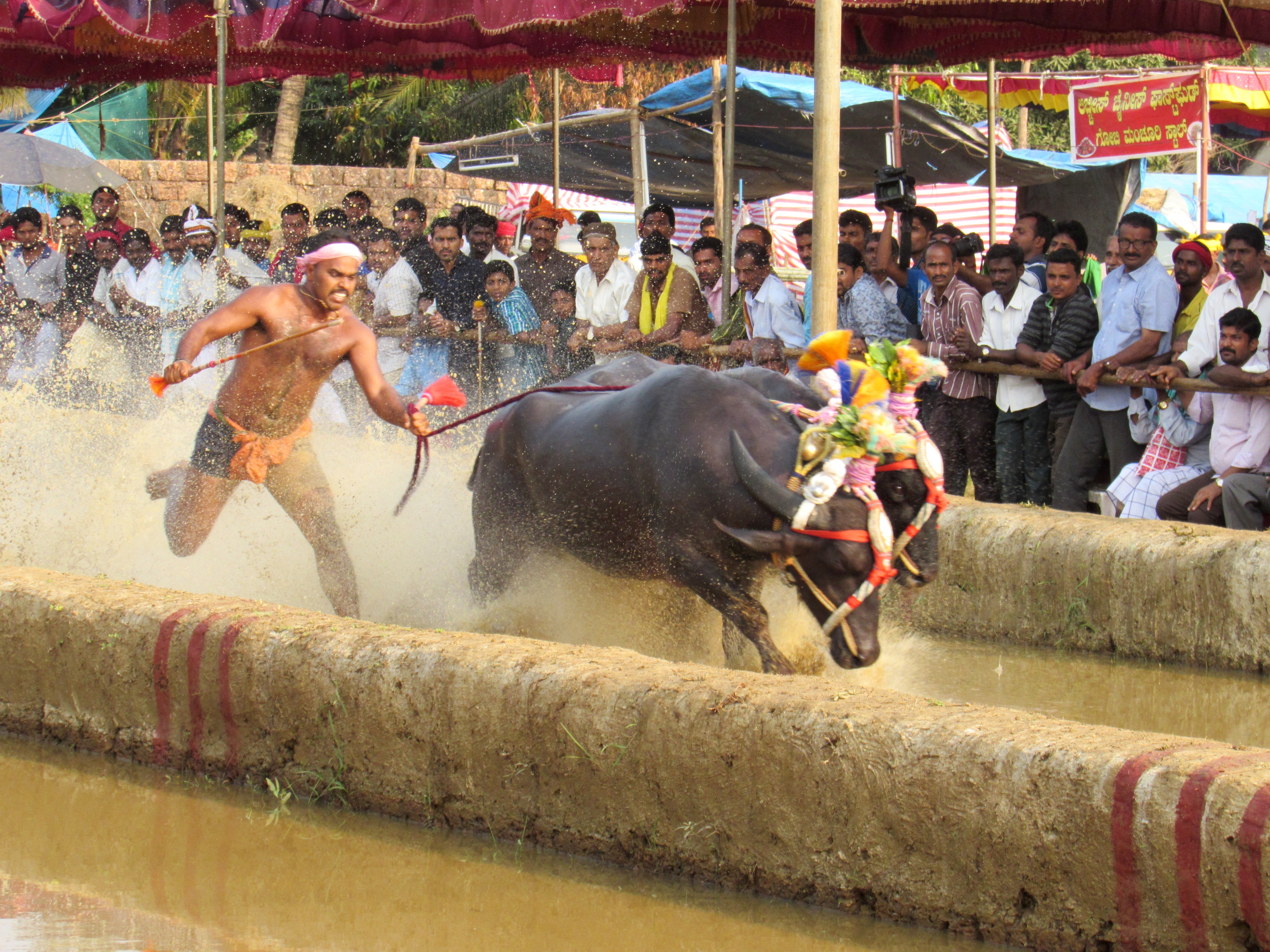
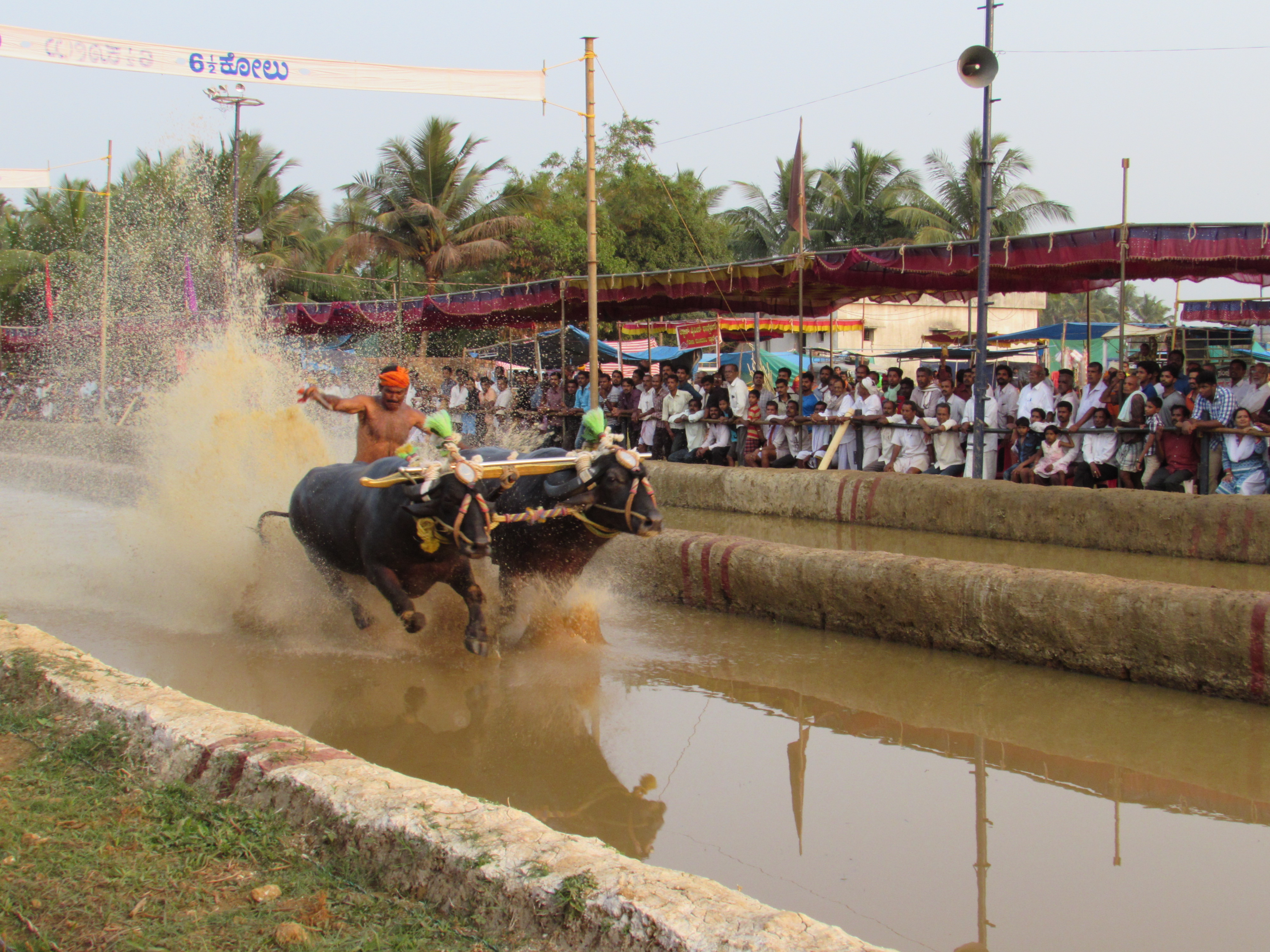
The ‘Raging bull’, the ’Buffalo skinned’ are idioms that we commonly refer to humans as expressions of exasperation. But when all the action brings forth the literal sense of these words- The event happens to be ‘Kambala’. Kambala is a sport where He-buffaloes are made to run on a mud filled slush track to reach the ‘Nishana’ or the finishing post. In the modern races, there are usually two tracks running parallel and thus called ‘Jodu Kare’ or ‘pair of tracks’. Each track is given a name so that it becomes easy to communicate in events where both the tracks are being used. In Joppinamogaru, the tracks are called Jaya kare and Vijaya kare. A coin is tossed for the team to choose the track. As loud drums beats and hoot sound of the timekeeper goes out, the whip lash of the runner crackles in the air before it hits the buffalo and the action finally takes off… The soldiers begin the battle..

There are different forms of kambala. Firstly, the Negilu category- Here, a representation of a plough is attached to the buffaloes which has evolved over period of modernisation. This is a race mostly for the younger buffaloes. Usually two pairs of buffaloes are made to run at a time and the fastest of the two is considered for the consecutive rounds.

IMG_3172
Negilu Kambala

Hagga kambala- This form is similar to the Negilu kambala, only difference being that the negilu or the plough is replaced by a hagga or a rope. Both these forms of the sport requires a great deal of stamina for the runner as he too is expected to run as fast as the buffaloes.

IMG_3236
Hagga Kambala

Adda halage kambala- This is a category mainly for the senior buffaloes(decided by age). A cross wooden plank is attached to the buffaloes on which the driver stands firmly and controls the speed and direction of the buffaloes to reach the Nishana. This is mostly a time based event where one pair runs at a time and the fastest pair is awarded.

IMG_3261
A pair of buffaloes getting ready to run the Adda Halage Kambala

Kane halage kambala- In this form, a round wooden plank with two holes is tied to the buffalo pair and the driver stands on it to control them. Two strips of white cloth are tied across the track which are used for measurement of the height of water spurt. One cloth is tied at a height of 7.5kolu(9.37mts) and the other at 6.5kolu(8.125mts). Faster the pair runs, higher the water spurts out of the holes on the plank. Here, one pair runs at a time and is specific to the senior buffalo category. It is very difficult to run at the expected speed and hence every team that spurts high enough to wet the cloth is awarded unlike the other forms.

IMG_3265
Kane Halage Kambala

With a history of over 500years, the event is a treat to watch the enthusiasm and the energy of the participants and the spectators. However, it is heart wrenching at the same time to see the welts and the swollen bruises on the buffaloes as a result of continuous whip lashing. For this reason, Kambala has been in the radar of seeing a ban for a while now as demanded by several animal rights activists. We don’t know what the future beholds, but one MUST experience the vibrance of India’s rich folk culture in all forms before its name joins the pages of history..

A Not so Blissful Trip to the City of Eternal Bliss- Chidambaram

This trip was part of a backpacking by my brother and me with an original itinerary to cover Bangalore- Kumbakonam – Gangaikondacholapuram – Chidambaram – Pichavaram – Pondicherry – Tiruvannamalai – Bangalore

As per this, we left Bangalore on a Sunday night in a bus and decided to explore further at our own pace, using public transport and staying at places with bookings made on the go. Plan was all set. But well, with a small glitch. We assumed that the monsoon season was the same in the entire southern India. But what we hadn’t taken into consideration was the fact that Tamil Nadu doesn’t come under the south-western monsoon. Hence, the monsoon peaks (with north-east winds) after the season ends in its neighboring states. So, we were now on an exploration of Tamil Nadu in October, during the peak of its monsoon season! Anyway, with its share of travel miseries, poor planning gave us the benefit of experiencing a different kind of backpacking.

Firstly, we explored Kumbakonam, a place which is often spoken less about on a typical tourist’s circuit. It was a wonderful experience to explore a place that is soaked in history and RICH architectural heritage, mostly from the Chola era. (This is elaborated in a separate post, click here to read). From Kumbakonam, our next planned destination for a major halt was the place that’s is often referred as ‘a city of eternal bliss’. But our experience was as unblissful as it could get, even as we wished to get a glimpse of the deity of a temple whose manifestation is revered to be as one of the five elements of life- ‘Space’. I would like to elaborate this trip for my readers to get a wholesome idea of our visit to this city was like for us!

With incessant rains, our mobile-phone network had been patchy. On day 2 at Kumbakonam, we received a call from our parents who had been trying to get in touch with us since the previous night. They informed us about the alert issued by the Met. Department. We checked online and confirmed the news about the weather forecast of cyclone- Roanu and a deep depression in the Bay of Bengal. We were asked not to venture near the seacoast. Our intended trip itself was supposed to be along the Coromandel coast- including Cuddalore and Pondicherry. Since the day was bright, we did not take our Met.dept. seriously and decided to take a chance by continuing with the plan from Kumbakonam.

With a visit to the Brihadeeshwara temple at Gangaikondacholapuram (another of the three living Chola temples), we boarded a bus to Mannarkudi. From Mannarkudi, we were supposed to take another bus towards our next planned destination: Chidambaram. However, the conductor informed us that the road beyond Mannarkudi was blocked since the previous night due to an uprooted tree. Although the tree was cleared, he wasn’t sure if the route was worthy for us to go. Without really understanding the seriousness of his advice, we boarded an overly priced private bus which ferried us to Chidambaram. Our road was flanked by the Kollidam until most stretch. Last time we had seen this part of the state was with our family, during our quest to see the end of river Kaveri. The dam was empty and dry back then. Today, she was flowing in full spate and the Grand Anicut was filled till its maximum limit. Kaveri looked beautiful with her brown waters reflecting back the sun rays that sneaked from amid the thick grey clouds. That was the point from where, the real saga of our road trip started.

As we covered a little distance ahead of the dam, the river began to touch the road around the corners at most turns. Gradually, the river started to spill over the road at some stretches. Instead of plying on the road, it seemed like our bus was driving over the river at these junctions. Further into the journey, the water level increased. Several stretches (in kilometers) of the road was submerged by the river. Our driver was a real super star- who could figure out exactly where the road laid in the ground in spite of the water being above the tire height. Even a slight slip in the road only meant death and nothing less. The entire bus with about 25-30 passengers could have been washed away by the currents of the spiteful river. I had only seen such things in the news. Now I was right there, experiencing a flood scene, firsthand.

The flooded villages enroute to Chidambaram

Stretches of villages laid submerged ahead. At some places, the thatched roofs and the hay huts had given away. We could see utensils floating around on the road, helpless villagers wading across the (once existent) streets, even as the flood water stayed above their waist level. Their plight was heart rendering to see, even as the rest of us inside the bus continued to wonder if we were going to see a safe arrival at our destination at all. The rain of just one night had wreaked so much havoc across the state of Tamil Nadu. However, our driver remained focused and drove us across to reach the safe harbor at Chidambaram by around 03.00.p.m.

My brother and I decided to drop the luggage at the hotel which we had booked online and find some food for ourselves. We hadn’t eaten anything since that morning. On arrival at the hotel, we were a little perplexed to see our room. The bedsheets looked extremely old, torn and dirty. The bathroom was a disaster. The toilet floor was covered with a thick layer of algae, slush and mud, all that had accumulated over years without washing it. The flush lever was broken, the taps rusted and a crazy layer of deposits on the bucket and the mug. The nasty smell of alcohol hit our noses from outside through the opened door even as we continued to feel suffocated inside that room. My brother and I looked at each other’s face- and both of us knew what was running in each other’s mind. In spite of being exhausted and hungry, we decided to leave the place and find some other place to stay. Just when we started to descend the stairs and as if the injury (of finding a bad room online) wasn’t enough, I happened to step on a large mess of barf, thrown up by some drunkard on the stairs and slip down a couple of steps.

Until this moment of our day, I had managed to keep my calm, but my brother gave up. He wanted to end the trip right there and return to Bangalore. While he found no buses that would leave Chidambaram immediately to Bangalore, I managed to convince him to stay calm until we boarded a night bus at least. I found a place near the ‘Nataraja temple’ where I could clean myself and headed to get the darshan of the lord. The visit was peaceful, maybe I will write about in another post someday.

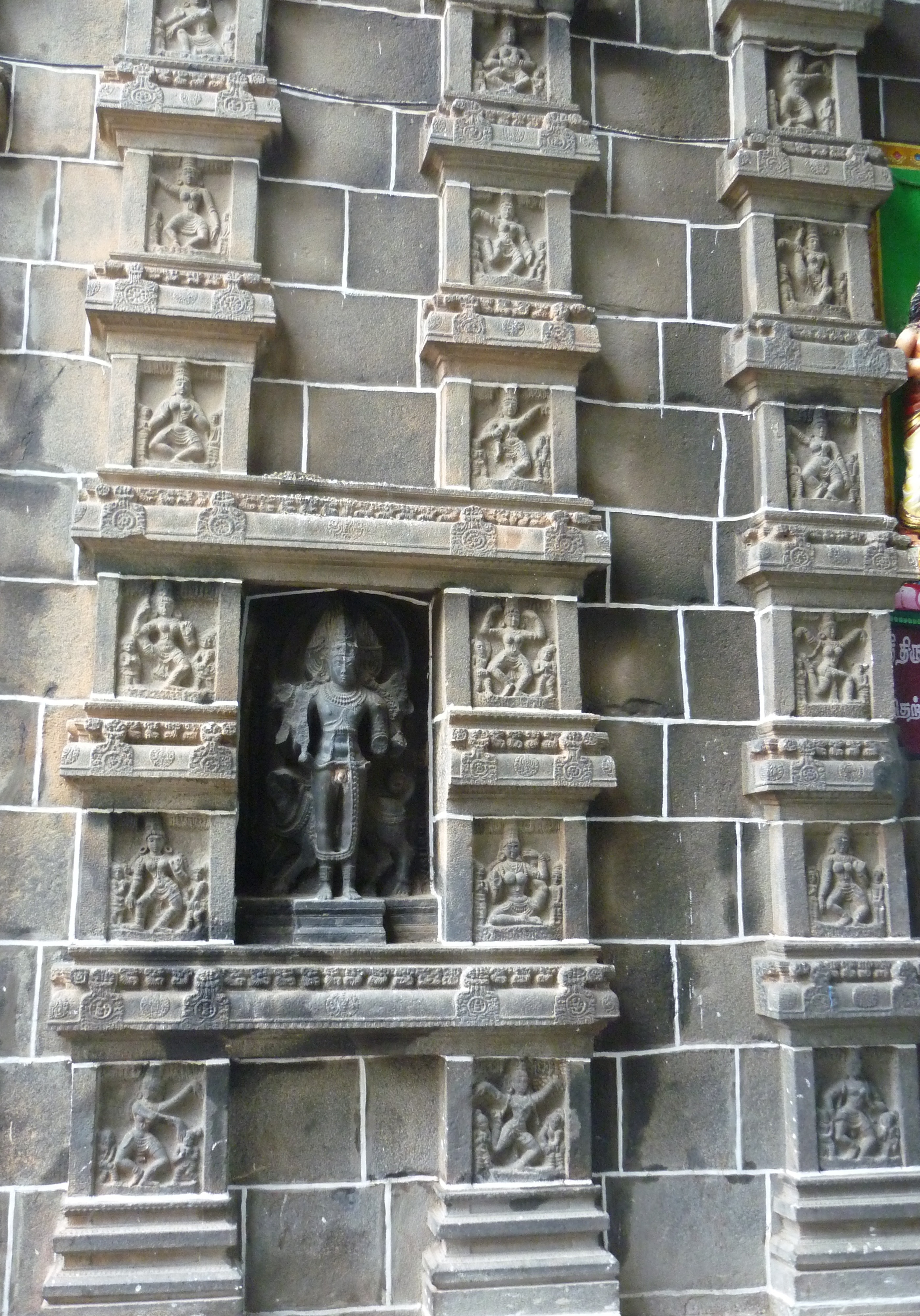
The Bharatanatyam postures sculpted on the walls of the west-tower of the temple

After finishing the evening prayers, my brother booked our tickets to Bangalore for the same night. Since my holidays were still not over, somewhere deep in my mind, I still wanted to complete my trip. I didn’t want one bad experience of the day ruin the entire holiday for us. But, given the weather condition further ahead in our planned route, I couldn’t rule out my apprehensions of getting stranded in the cyclone at Pondicherry as well.

But right now, our priority was different. We had been starving since morning and had to find something to fill our stomach. In spite of walking the WHOLE of Chidambaram town, we couldn’t locate a single place where we could find food. Thanks to the day of Deepawali festival- there were absolutely NO eateries open! Also, the entire town was SOO DIRTY with garbage littered everywhere. After a long search, we finally found ONE supermarket in the entire town. And what did we get to eat there? Just a cup of sweet corn to sate our hungry bodies.

Our city woes did not end after eating the steamed corn. It was still 07.00.p.m and we had three hours more to kill. On enquiring with a few locals, we were told that we would find a decent restaurant near the bus stand. And so as per the recommendations of the local people, we found this AC luxury restaurant called ‘Vandayar- Southern Spice’.

When we arrived there, the waiter informed us that they served only fried rice for the day. The waiter came to our table thrice to take our order (for the only dish available) and after two hours of waiting for food, there arrived a convoy of VIP customers at the restaurant. Bonus for waiting: A feast was set for this VIP family that comprised of all dishes from the menu. Even while all the tables were occupied with middle-class customers including my brother and me, there was no one from the restaurant that cared for our existence that day. Wondering if we were waiting for any free food to be served at 09.00.p.m. several customers grew furious and started to walk out of the restaurant. It was also time for us to board our bus. As we too walked out of this VIP restaurant, there was power cut in the town.

In a dark and dingy bus-stand, we spotted the only stall that served tea and some biscuits. The little candlelight was just enough for the tea-stall guy to reach out to things in his kiosk. We were essentially scared of stamping some more muck that could’ve been laid in the littered path. As we dunked the last biscuit into our chai, we had yet another surprise for us. Our bus to Bangalore was delayed by 2 hrs.!!! As we waited there in the dark platform of the bus stand, some drunk men started to throw glass bottles at the crowd there. Luckily no one was injured, but the downpour of bottles and splatter of glass pieces continued for a while. Our bus arrived after a while and we boarded at 10.00.p.m.

With all the crazy stuff that happened that day, we fell asleep quickly… Only to be woken up at sunrise. That’s when the rain was battering outside, and our bus had broken down on the highway. Although we were given an alternate bus in a while, our anxiety continued until we reached home.

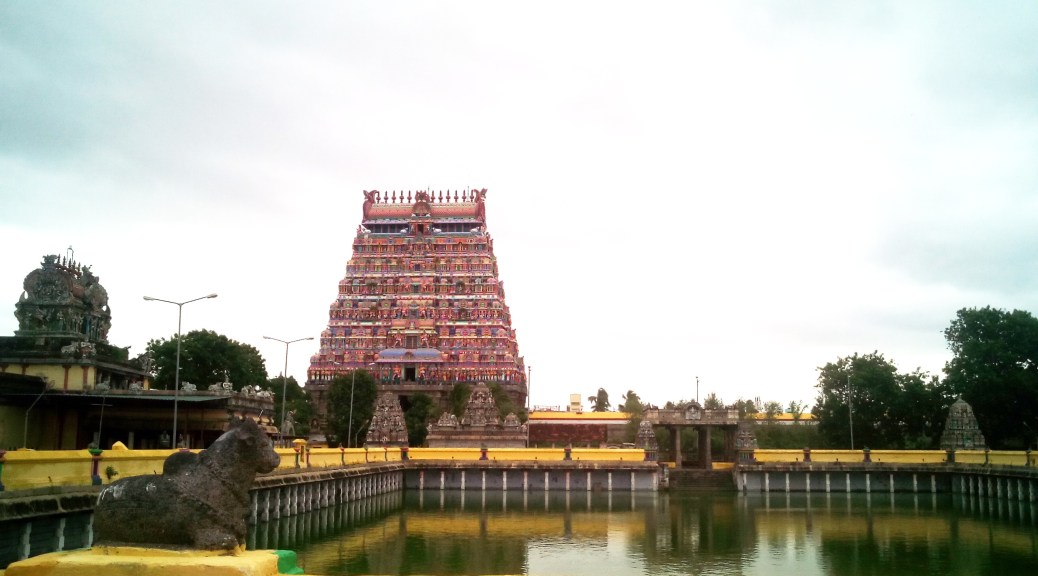
The temple Gopuram at Chidambaram Nataraja temple

Conclusion Remarks: The people on the east coast are god’s chosen ones to have a grand celebration of festivals. Tsunami for Christmas. Cyclones for Diwali…!! One cannot sit in a place, hear stories and imagine of places and people. You need to move yourself to places to experience and explore. This trip was one such experiences where I got a first had experience of braving a flood and starvation of food. Also, this is a trip where I managed to find a place in India that I wouldn’t want to return.

A mind numbing winter experience in Ladakh

So well, thank you for dropping by. This post is an elaborate impromptu itinerary we came up with when we were stranded in Leh, sometime before Ladakh became a separate Union territory. If you’d are interested in planning an itinerary, stick around this post. But, if you’re keen to know the fun story behind our plan going haywire, I recommend you to also read my brother/ co-traveller’s perspective. (Click here to read his story)

Stick around a little more, to know my side of the same story. Then tell me what you liked 🙂

Here’s mine!

What was supposed to be an once in a lifetime experience of trekking on a frozen river- ‘The chadar trek’, rather turned out to be a wonderful experience in its own way.. Thanks to a landslide on the Zanskar, a natural dam had been formed stocking up water for over 5 kms. If incase this natural dam collapsed due to the built up pressure, the stored water would wash away the nearby areas causing flash floods. Hence, citing safety reasons, the goverment had issued ‘section 144 – Shoot at sight’ to anyone attempting to go anywhere close to the river.

We decided to break away from the trek organiser and explore Ladakh on our own.. Oh yeah, before I forget to mention- None of our phones were working(No connectivity via phone or internet)- Thanks to all our pre-paid connections. Only postpaid connections work in this part of the country due to security reasons (given its proximity to disputed border areas). Thus started our lifetime experience of the mind-numbing winters in Ladakh.

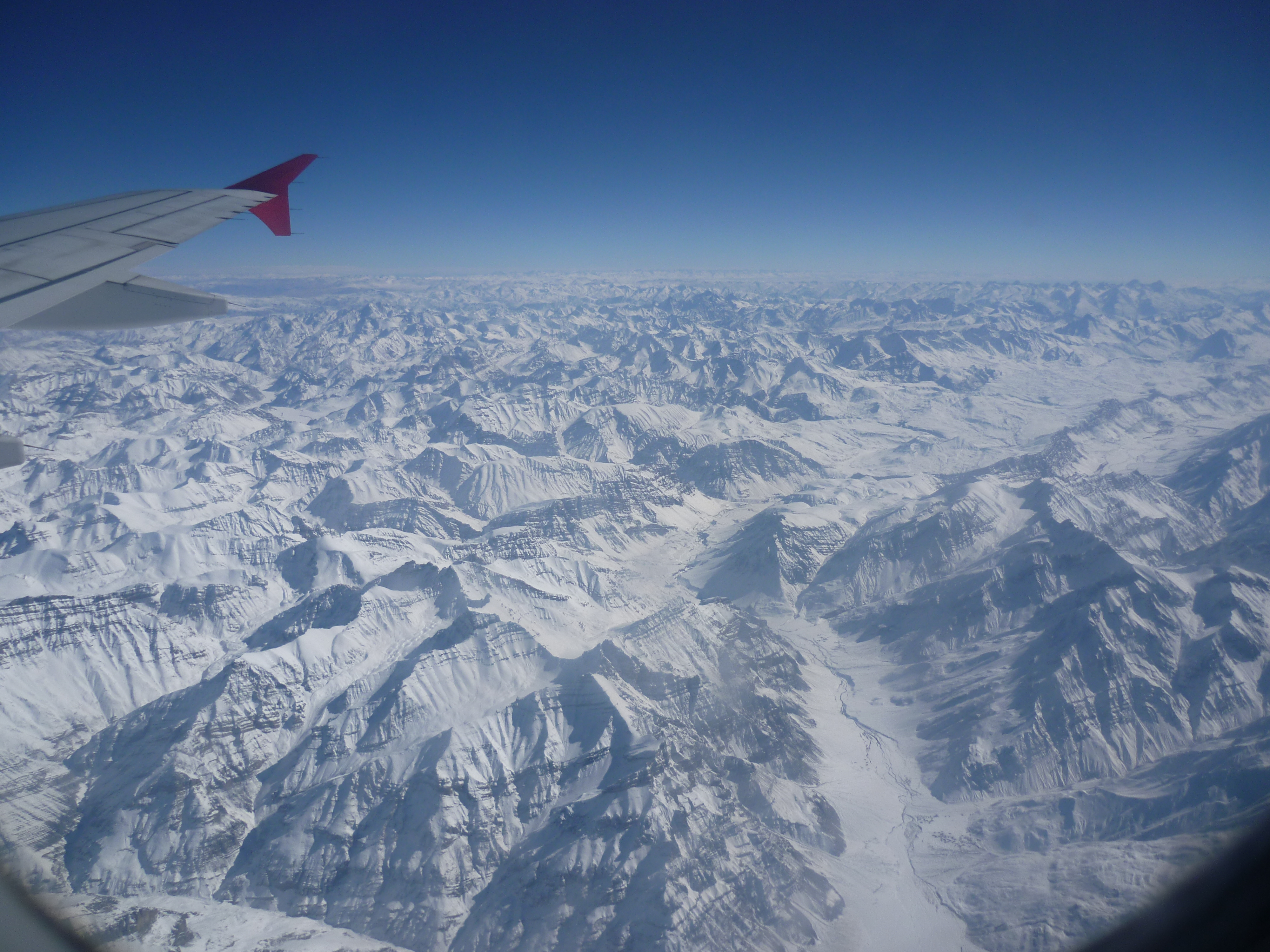
Day 1: It was noon by the time our early morning flight took off from Delhi airport, thanks to bad weather conditions. Just 20minutes after take off, a small but prominent layer of cloud seemed to appear at the horizon.. But within no time, we realised that we were approaching the Himalayas. In just few minutes, the GPS indicated Shimla on the map in the TV infront of our seats. A never-ending stretch of deep gorges, ravines, formed the beautiful landscape below. Few minutes further up.. Yes..!!! we couldn’t contain our excitement of flying over the snow covered mighty Himalayan peaks, we were jumping for a spot at the windows taking turns.. It was the first time we were seeing snow! Click click click…. The cameras went on and on… It was as if we were in an enclosure which was floating up in heaven.. It was absolute FEAST to the senses.. all the way… till touch down🙂

You are flying over the Himalayas...
You are flying over the Himalayas…

Inspite of the glaring bright sun, it was 6 below zero degrees when our flight landed at Leh- one of the highest airstrips in the world. We took a cab to the hotel that we were informed by the trek organiser.

The day went by just making an alternative plan for the trek that could not happen. Also, it was necessary to get acclimatized to a scary combo of High altitude + low temperature(It went upto -25deg on some days of our trip). So we just had to stay bummed to our rooms(without heaters..!!) and warmup ourselves 😛 We shopped for a lot of thermals in Leh market (we got cheap & good quality stuff..)

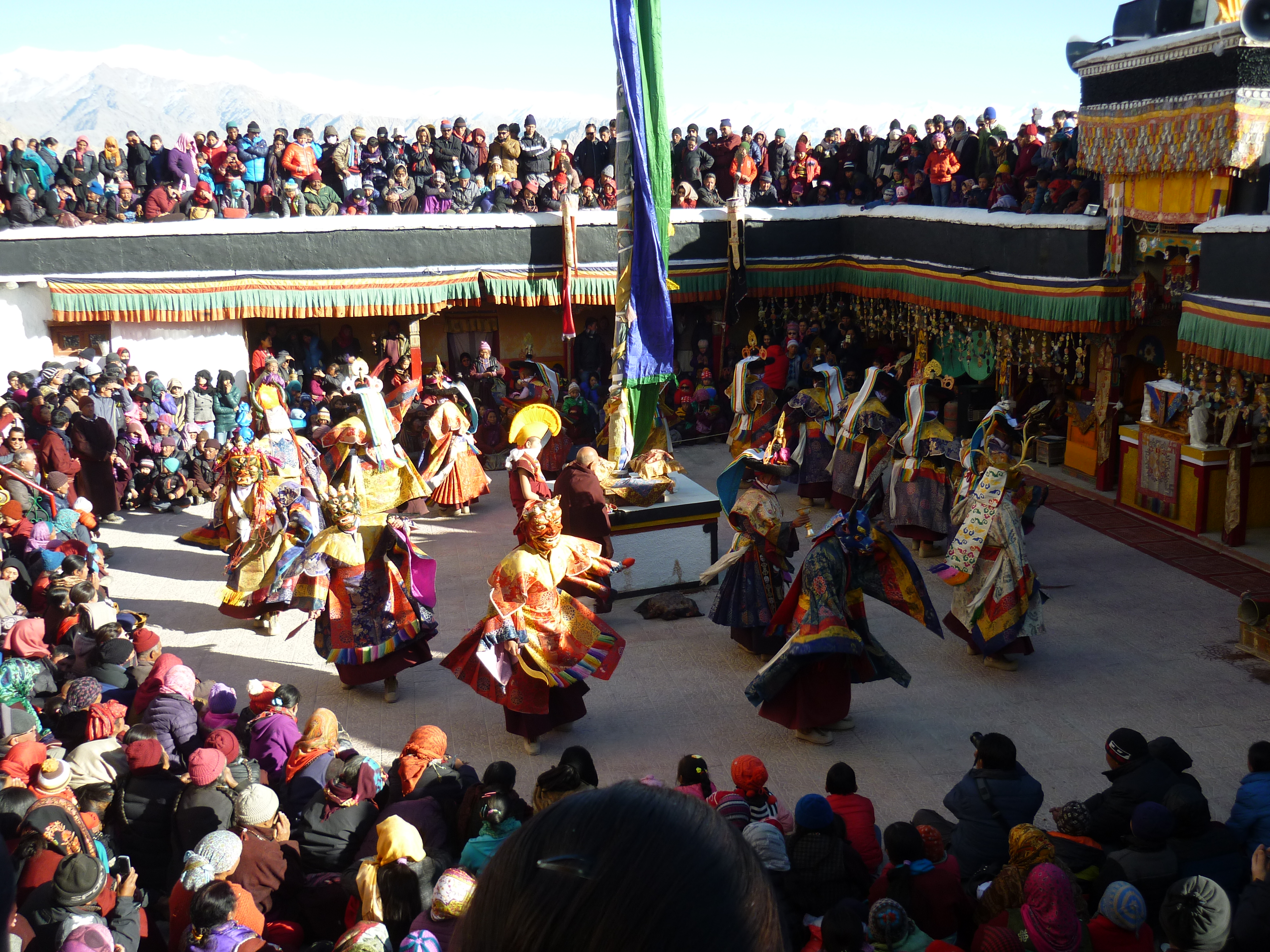
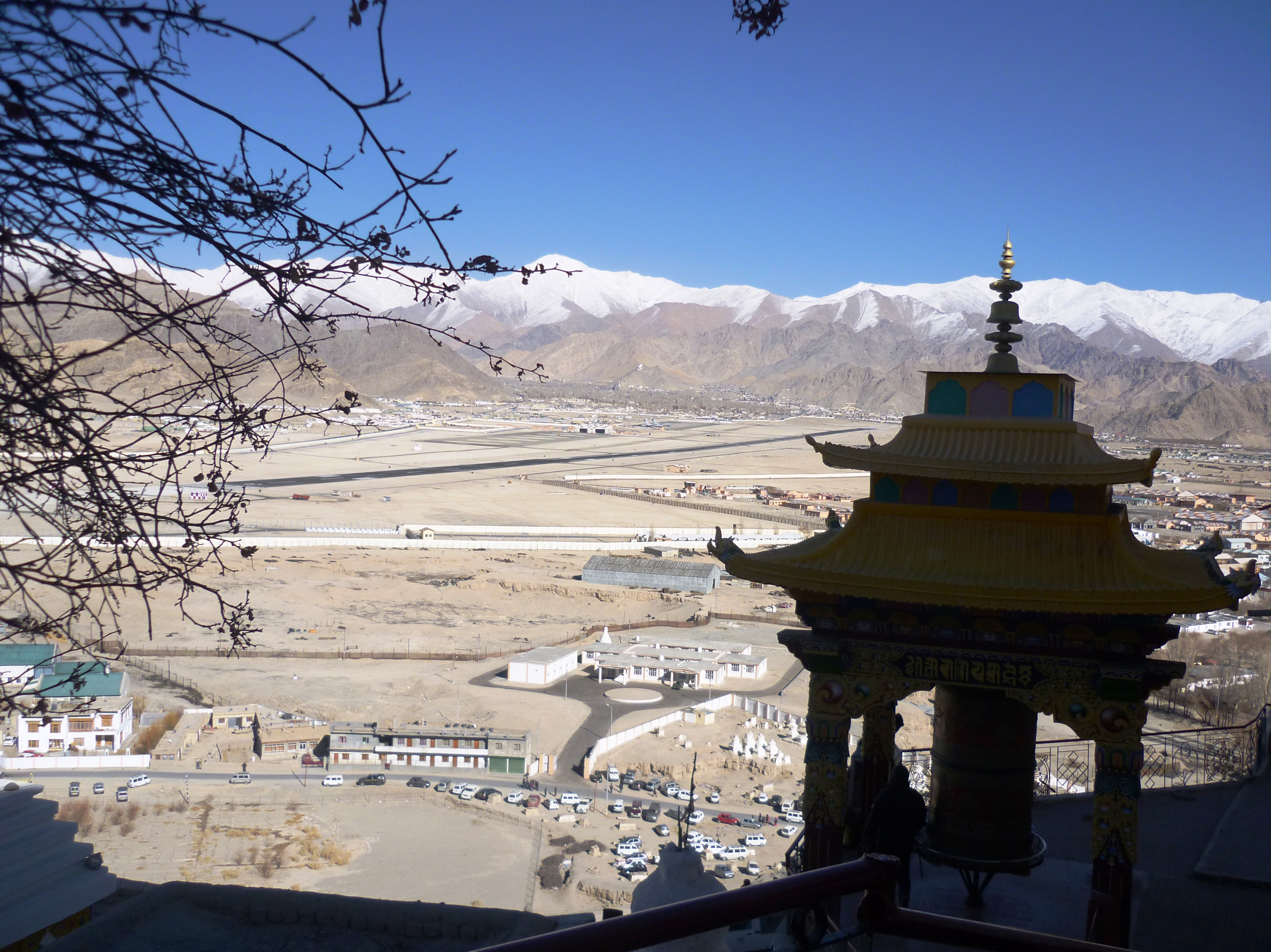
Day 2: It was the last day of the Gustor festival – the annual fair at the Spituk monastery– Enroute we visited the ‘Hall of fame‘- the war museum. We happened to be there at the right time when an Indian airforce carrier was about to land. With the Sham valley & other mountain ranges all around the airstrip, it called for the exact photo that had inspired me to visit Ladakh more than a year ago.. We later headed to the monastery where the day long festivities and mask dance was going on.. We walked up the stairs to the holy abode of Kali(which is open for public viewing only during Gustor festival) before we comforted ourselves by finding a seat amid the chaotic crowd that had assembled. After the event, we did a bit of souvenir shopping at the mela that was put up and a lot of binging on Ladakhi food. We took a cab to Shanti Stupa which is best for sunset viewing. After the sun was down, we took the stairs down which we were told was a shortcut to reach Leh town by foot.

Mask dance at the Gustor festival - the annual fair at the Spituk monastary
Mask dance at the Gustor festival – the annual fair at the Spituk monastery

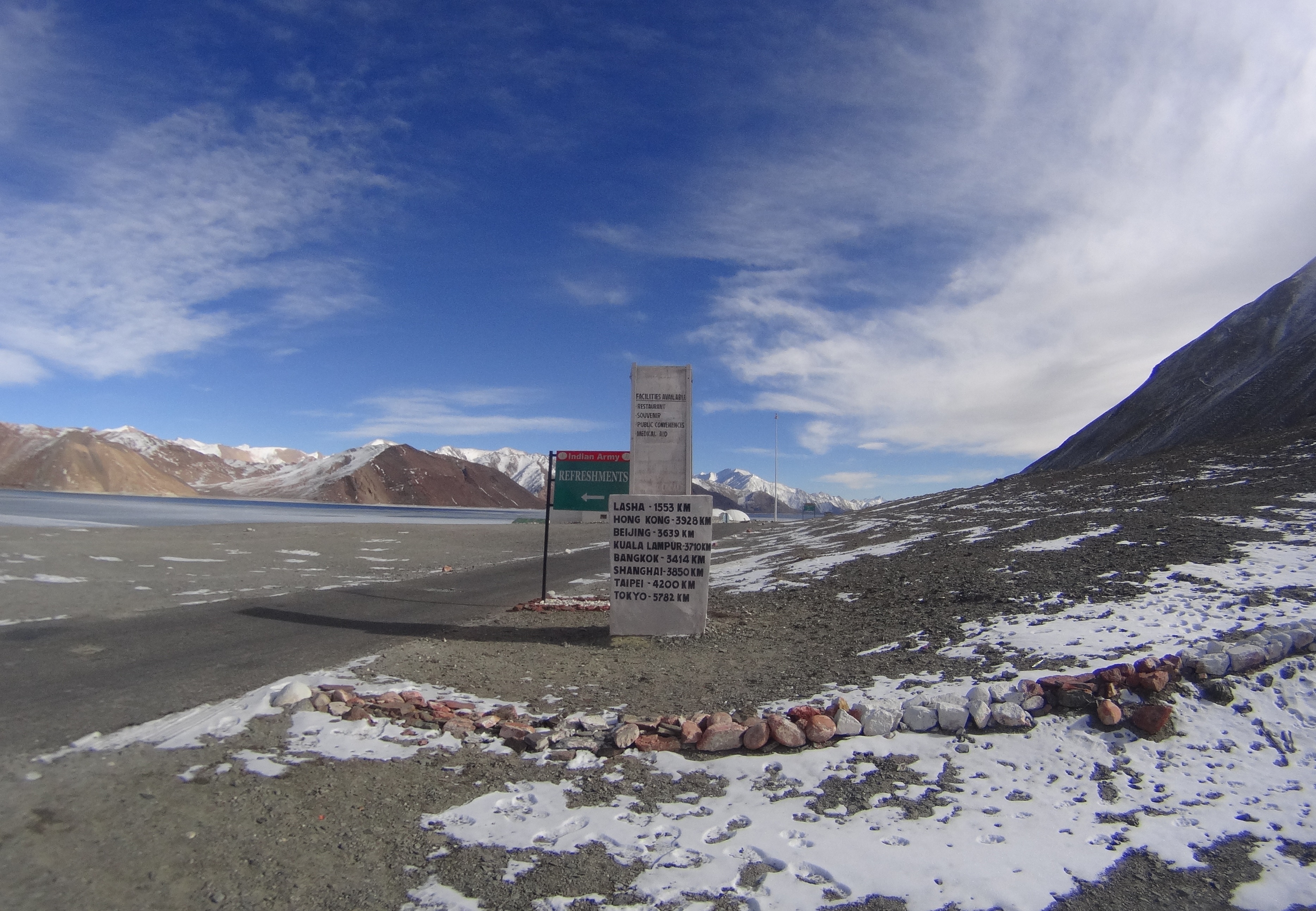
Day 3: Drive through Changla pass(the 3rd highest pass in the world) at a nerve freezing temperature: Get a quick grab of food at Karu town. Here one needs to get the Inner Line Permit to proceed towards Pangong Tso- the controversial border between India & China. The lake was partially frozen- where we could drive over most part of it and experience the chadar partially 😛 If one has an extra day, they could head to Tso Moriri, a salt water lake and camp there overnight before returning to Leh. But, we took back the same route so we could cover the Shey Palace, Thikse monastery & got a glimpse of the Rancho school of the ‘3 Idiots’ fame. Hemis monastery- the wealthiest monastery in India remained unreachable by road since it was winter.

A milestone at the Pangong tso

Day 4: It was a lonng day.. A wonderful drive on a roadless route which seemed to have been carved all out of ice and sprinkled with snow.. A small slip of tyre could get deadly as beautiful as the valley seemed to appear. We couldn’t ask for more when it began to snow just when we alighted at the end of the highest motorable road in the world- the Khardungla pass. Continue on the road that leads to the cold desert of Ladakh- The Nubra valley. With minimal vegetation, and sand dunes all around, you should not be missing out the ride on the Bactrian camels which are endemic to this region and is a critically endangered species. Visit the Diskit monastary- where a 32 feet statue of Maitreya Buddha looks upon Pakistan. Towards the end of the valley is the Siachen glacier- the highest battleground in the world and the glacier forms the source to the biggest irrigation system in the world-The Indus. Catch a good night’s sleep at a traditional homestay there and experience authentic Ladakhi hospitality.

View from a monastary
View from a monastery

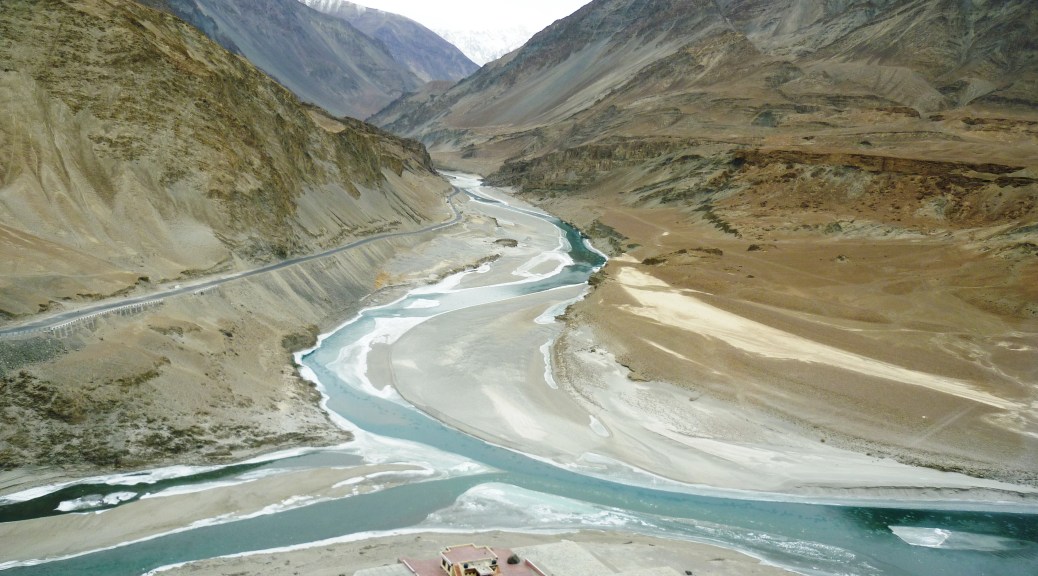
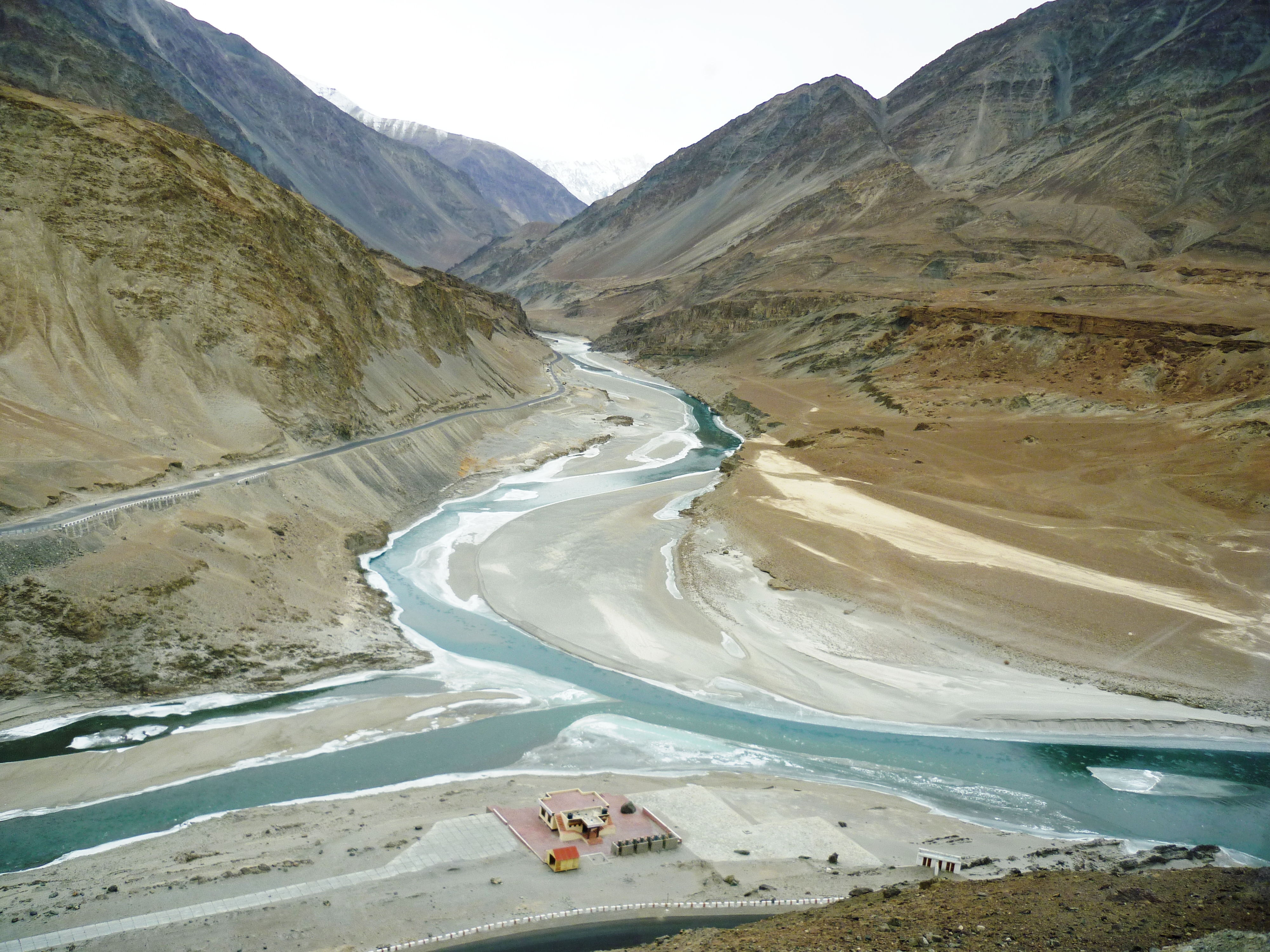
Day 5: Start early cuz the day will be short with too many places to cover on a single stretch from Leh. We took the Kargil road- a drive through Sham valley. First stop was at Nimmoo where we filled our fasting tummies. The next quick stopover was at Pattar Sahib Gurudwara. The straight stretch of road looked as if it was peircing right through the horizon. We were driving through the magnetic hill. The road which is believed to have defied gravity where a car with ignition off and neutral gear moves uphill- against gravity..!! We were not quite convinced with our experience though, which made us agree to the scientific explanation of it being an optical illusion. We arrived at Chilling- The confluence of the Indus and Zanskar. The partially frozen stretch was intimidating to walk over.. But we were warned by a cop not to go near the banks.. all thanks to section 144 😛

The confluence of the Indus and the Zanskar

We continued our journey through rustic Ladakhi villages, monasteries dotting the distant hillocks, frozen waterfalls, bare poplar trees, narrow truss bridges, army barracks, hot water springs, ice hockey fields, etc. We came across wild deers, yaks, pashmina sheep, wild horses and other fauna endemic to this high altitude region.. Likir monastery was beautiful with the Buddha statue smiling in between the snow clad mountains all around. Our last destination was Lamayuru monastery– The start point for many treks in this region.

Unfortunately, we did not have the luxury of a few more hours and safe conditions at the border to go further upto the Kargil border. We wanted to drive back through Drass valley- The coldest inhabited place in India and the second coldest in the world. Again, If I had an additional day in hand, I would have loved to get an inner line permit to spend a day at DhaHanu valley: home to the endangered community of the Dard people. I would love to go back ASAP atleast to document their customs, traditions, photograph their intricate jewellery and costumes before their numbers further deplete. Had I been blessed with a couple more days, I would want to do the Markha valley trek andand experience the tribal life in its raw & purest form.. And spot a snow leopard in its natural habitat at the Hemis national park- the largest national park in India and the highest national park in the world.

During winters, most of the town is shut for the season. The few places that are up, open after 11.00.a.m and close by 5~6.p.m. We missed out on some fine shopping of souvenirs, local handicrafts and dry fruits.. Probably, some form of connectivity of phone or internet could have helped us to cover more places and organise our trip in possibly a better way.. But, NO REGRETS..!! We’ve still done what most people don’t dare to- Experience the bitter winter of Ladakh. That’s all the time we had for.. We had to pack our bags with a super heavy heart to carry back home..

Day 6: It was a rare phenomenon that we had woken up with that day, early at 6.a.m. It was snowing in Leh. There usually is no snowfall at Leh town… But that day I guess the town had started to miss us… the sky was crying heavily.. We reached the airport by 07.30.a.m. The security measures are very stringent for those leaving Leh which easily needs about 2hrs. 2 rounds of passengers’ frisking and 2 rounds of baggage screening. And then, you have to individually identify your baggage until which it will not be loaded to the flight..!! Quite a strenuous task for the security personnel… While it is considered as a fun trip for the touristy people like us.. It’s a salute to the bravehearts : The Indian army.. Who bare all odds like extreme climatic conditions and unpredictable threats to their lives, strive day and night to ensure that we are safe.. The flight took off over the mountainthat said ‘Touch the sky with glory’.. in the true sense…

I will come back ASAP for more..

Julley Leh..!!

Places to Visit in Trichy in a day

This visit to Trichy was a part of our family’s backpacking trip, mainly conceptualized to cover a portion of the Coromandel coast during this trip. Our itinerary for this trip was Bangalore – Mayiladuthurai – Poompuhar – Tarangambadi – Karaikal – Nagapattinam – Velankanni – Tanjavur – Trichy – Bangalore.

After a long day exploring Tanjavur, we boarded an evening bus to Tiruchirappalli. Trichy is a name given by the British, perhaps the shortened version of the original used for the ease of pronunciation. After reaching the town, we checked into a lodge in front of the central bus stand, had a sumptuous meal and retired early.

  • It was day 3 of our backpacking. The places covered in our Trichy day trip were:
    • The island town of Srirangam
    • Thiruvannaikaval
    • St. Lourdes’s church
    • Rock Fort

The visit in detail:

Since this was not the first visit to Trichy for my parents, this plan was just a Trichy day trip. They wanted to just go around the major landmarks that are typically frequented on a traveler’s circuit. But Trichy is beyond just pilgrimage and ours is a family of explorers. So, in spite of covering these popular landmarks, we still added a few elements of history and architectural explorations into it to make it more meaningful than just going around these places. In fact, as someone who views places from a historian’s perspective, places are usually recognized by a specific dynasty that had an influence in its overall culture. For example, Mahabalipuram is associated with the Pallavas, Tanjavur or Kumbakonam is a major territory of the Cholas, Madurai with the Pandya and so on. But, when it comes to Trichy, this town was never a capital of one particular kingdom. However, it has remained a very important place throughout history and across timelines, thereby picking up influences of all major dynasties that ruled over this region. Hence, it is safe to say that Trichy represents a confluence of all south-Indian architectural styles.
I would like to elaborate on the places we visited to give my readers a brief idea of these places when they plan their trip to Trichy.

Landmark 1: Srirangam

We got ready early next morning and boarded a local bus to Srirangam- the abode of Sri Antya Ranganatha Swamy. This is the Tamilian counterpart of AdiRanga at Srirangapatna and MadhyaRanga in Shivana Samudra (All three are island towns formed by river Kaveri). Srirangam is an important place of worship for the Vaishnava sect of Brahmins or the followers of Lord Vishnu. When we arrive there, there was a long queue and we managed to get a glimpse of the historic idol of Sri Ranganatha sleeping on a serpent after a long wait in the queue. (There is a long history of how this idol came into being, worth a read).

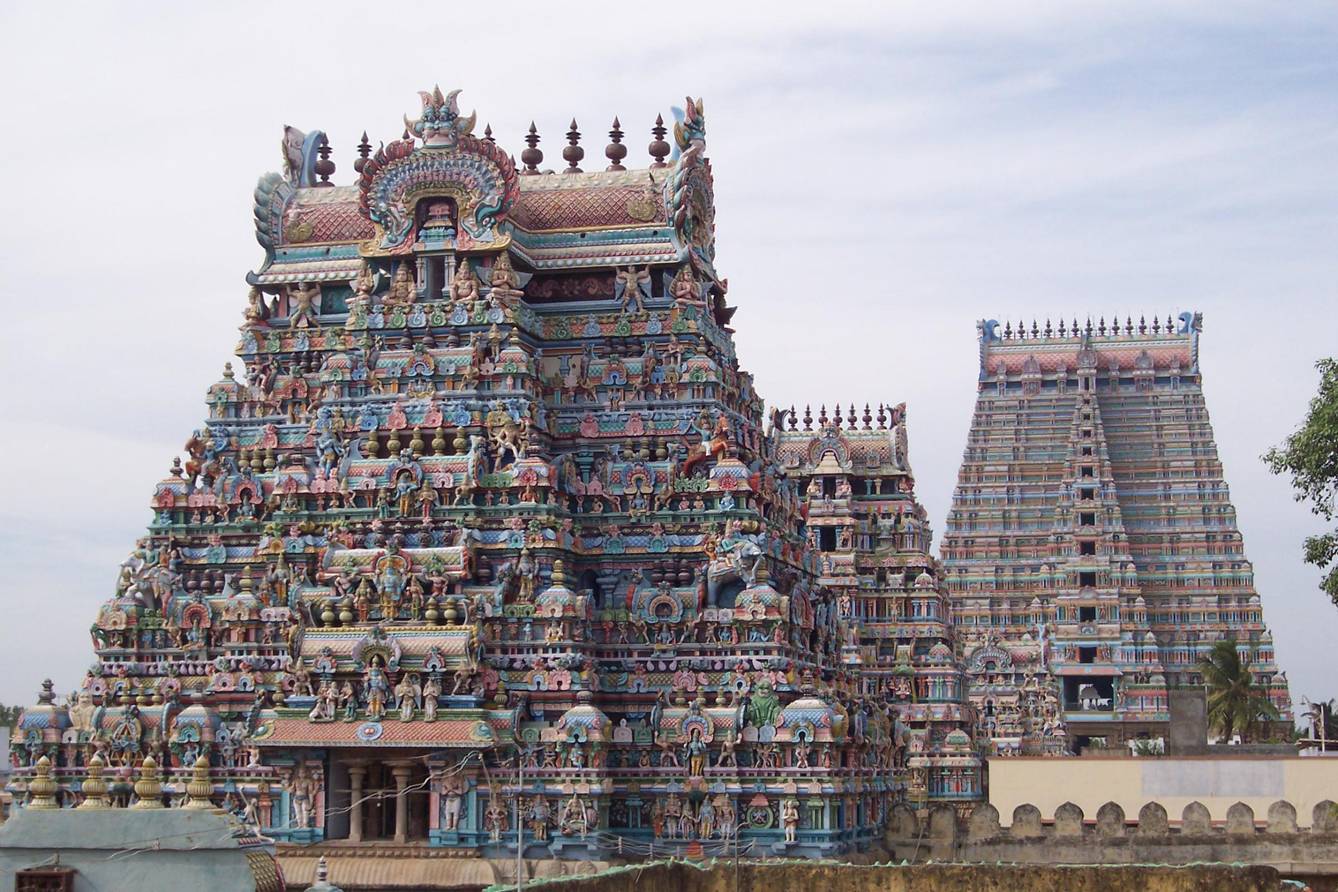
But pilgrimage aside, we were there to enjoy the architectural marvels of the city. If you are someone who loves to walk and explore a place by foot, it would take a good 2-3 hours to simply walk around the main temple complex. Although the main gopuram or the outermost tower is the latest among all the towers in this temple complex, it is the largest temple tower in the world. With a spread of 156 acres, the temple complex itself is believed to be the largest functional temple premises in the world.

The complex consists seven rounds of walls/fortifications before you reach the sanctum sanctorum. Each wall was added by the successive dynasties that reigned in this town including the Pandya, Cholas, Hoysala, Vijayanagar, Pallavas and the others. The art specific to each of these eras can be noticed in the complex. The entire complex has 21 temple gopurams where one could easily get lost in the vastness of the complex if attempting to see each of them individually. After entering the main complex, a ticket of Rs.10 per head took us through narrow stairs leading to the roof of the temple. This is called the temple viewpoint, from where all 21 temple towers could be seen from a single spot. There is also a 1000 pillar hall which was earlier used as a venue to host dance events, now remained locked. We admired the fine sculptures on these pillars through the bars of the closed gates and continued our walk further.

The Antya Ranganathar swamy temple at Srirangam

The banks of river Kaveri is just behind the temple, which can be accessed by walking through the rear door of the temple. With blazing sun even at 10.00.a.m, the sand and the asphalt road were already heated up. Hence, our barefooted attempt to walk to the riverbank was less a walk and more a run. Hailing from a place where the holy river originates and flows gracefully with water all through the year, it was unexpected and disappointing and to see her riverbed running TOTALLY dry in this part of her journey. But after talking to the localites, I cheered up a bit as they were looking forward for a good monsoon in the coming month. We were told that the river would flow almost in spate during the monsoons (Even submerging the very place that I was standing at). We came back to the temple again, had some fresh fruit juice from one of the stalls outside, wore our footwear and took a walk around the temple.

Big houses, with very small entrance, compactly built next to each other, allowing no or very less ventilation inside was the trademark style of Srirangam. These streets take pride in being home to one of the highly educated communities of the country- the Iyengar Brahmins.

Oh yeah…!! It was BURNING hot and I was pretty sure I’d go back home like a grilled chicken after this walk. But then, we wanted to make the most of the visit because life is uncertain, and no one knows for sure when we would be visiting again.

Landmark 2: Thiruvannaikaval

Though the population of Srirangam mainly comprises the Iyengar (the followers of Vaishnavism), the then rulers have also built temples for the Iyers (the followers of Shaivism). Hence, our next destination was to see the temple built for Lord Shiva. We boarded a bus to Thiruvannaikaval. This temple is as beautiful as the Ranganatha temple, however, the history behind the latter has made it more prominent. Though many people visiting this city give a miss to this temple, it should be noted that this is one among the five temples built for Shiva representing the five elements of life. This one represents water or Jala Linga. One of the residents in the complex noticed our interest in exploration and suggested us to visit the Amma or Parvathi temple, another beautiful ancient temple usually missed by visitors. It is located right behind the Shiva temple.

The entrance to Thiruvannaikaval Shiva temple

Landmark 3: St. Lourdes’s church

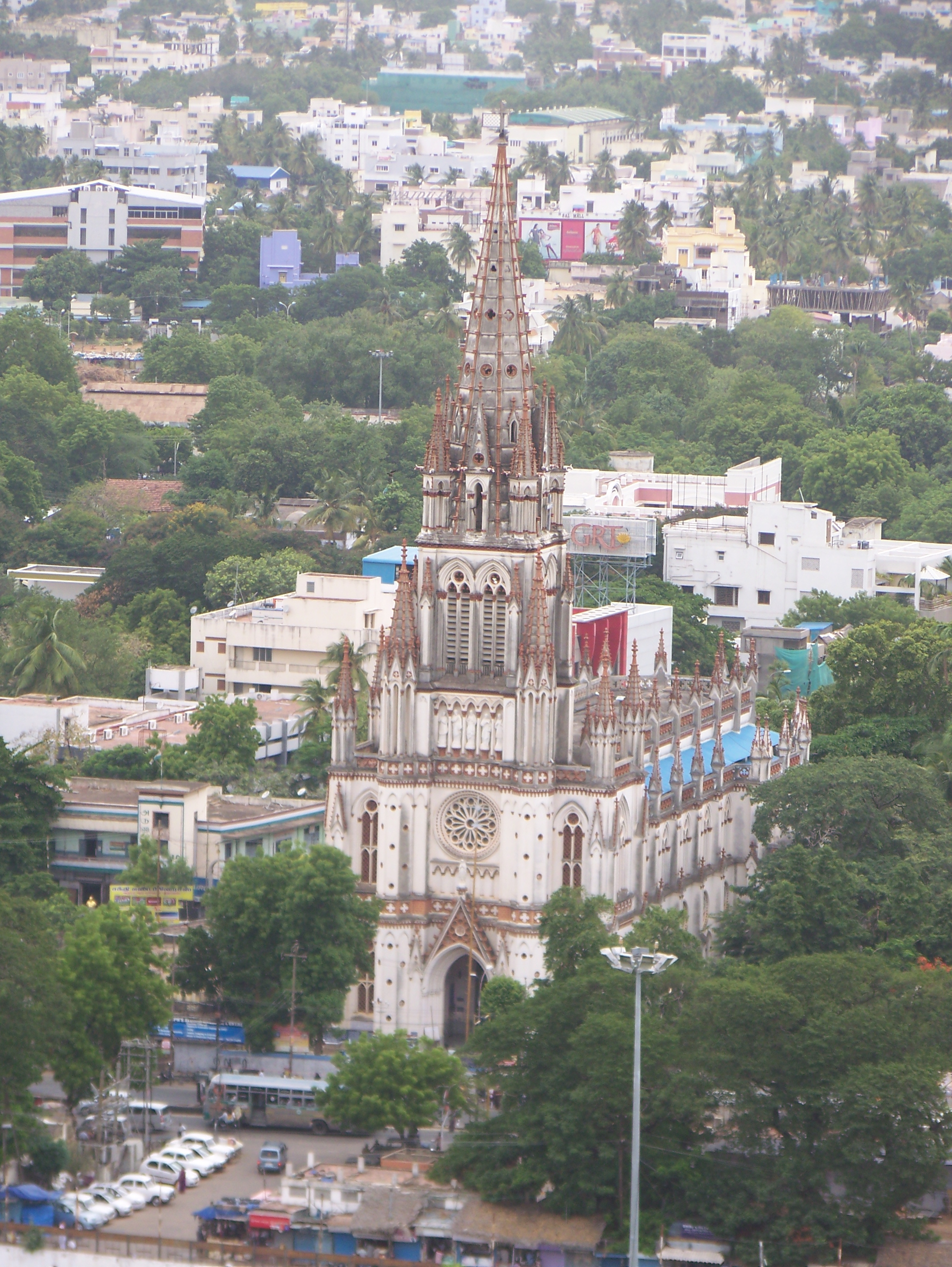
From the temple, we had a nice south Indian meal at a nearby hotel after which we headed back to Trichy town. We visited the St. Lourdes’s church in the city. The Gallo-Catholic design of the church architecture and the neo-Gothic spires are beautiful in this early 2 centuries old heritage structure.

St. Lourde's church
St. Lourde’s church

We did a bit of shopping in the by lanes and the Trichy market around the Teppakulam (Temple tank) before we started our ascend to our next destination.

Landmark 4: Rock Fort

This single projection of land in an otherwise low/Flat Trichy town dates back to the pre-historic era. It is beyond words to describe how in those days, could someone has created such beautiful structures out of a hard monolith. What appears to be just a random protrusion of earth from outside, is in fact a haven for the art lovers in the inside. There are stairs, numerous temples, artistic pillars and idols carved out of the same rock all the way up. There is a Ganesha temple at the summit from where one can enjoy the view of the entire Trichy town, the Kaveri river flowing around Srirangam, the temple gopuram, the rail lines traveling in and outside the city. The fun was doubled by the cool but strong winds that blew taking away all the tiredness from our minds.

The view of river Kaveri from the summit of Rockfort
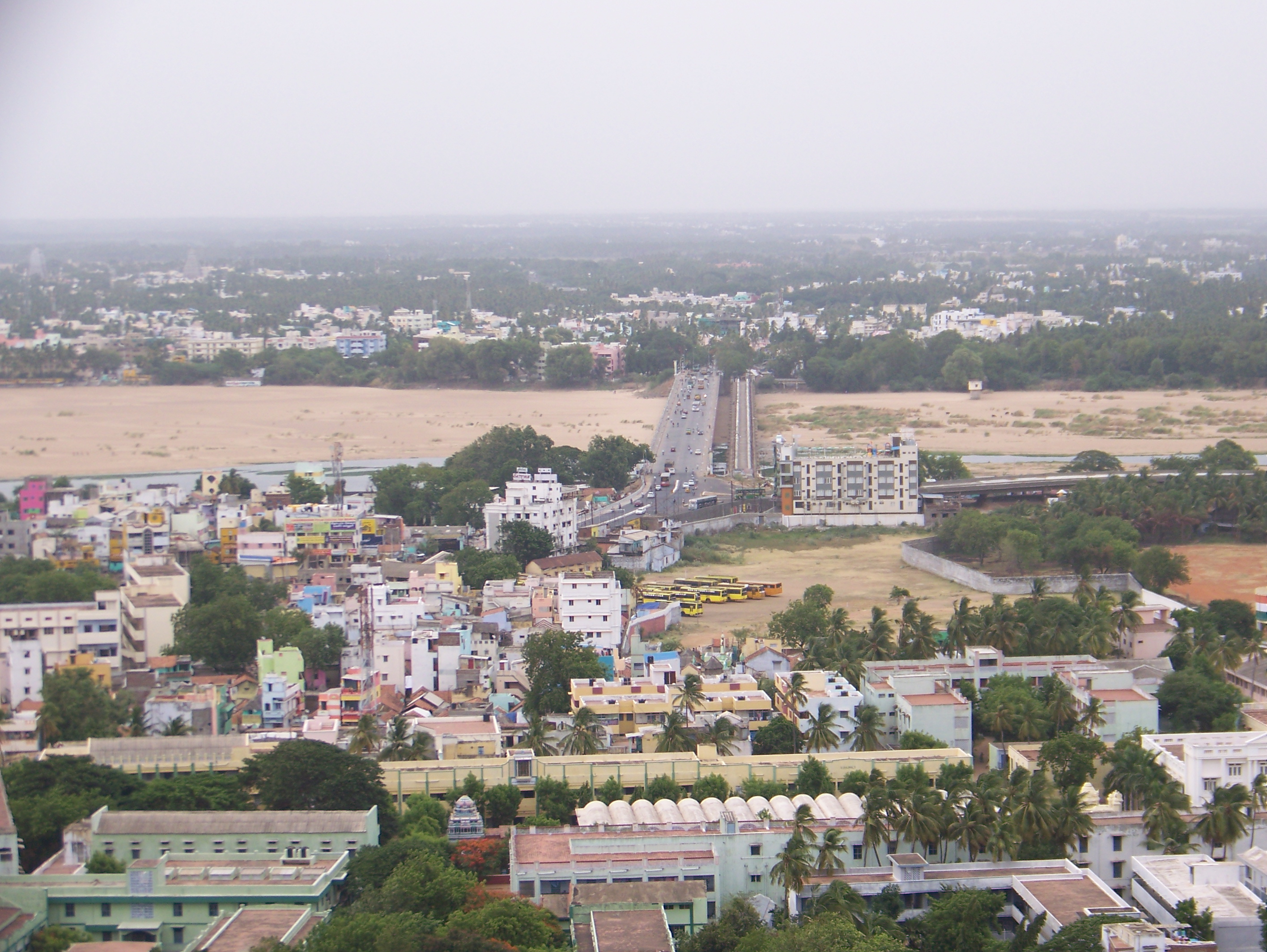
The view of Srirangam and the river bed from the summit of Rockfort

As we decided to descend down, we realized that a door that had remained closed during our ascent was now wide open. There were some beautiful paintings peeking out of the door intimidating us to go inside and see what was there. We stepped inside and it was amusement that followed. It was a vast hall carved out inside the same rock with beautifully sculptured pillars and amazing paintings adorning the walls. A priest noticed our interest and started explaining the story depicted by each painting. He then told us to hurry up and walk inside through another door. There, the maha mangalaarthi (the last pooja of the day.!!) for goddess Parvathi was just about to begin. Just as we reached there, they unveiled the curtains for us to get an eyeful of the beautifully decorated goddess.

Just while we were sipping the holy water, we were again asked to rush through another door, cross a narrow chamber that led to the Shiva temple. The deity was getting ready for the final pooja of the day. Prayers are offered only thrice a day: During sunrise, at noon and before sunset. And we were lucky for being there for one of these (the last one). The curtains were parted from the deity and the huge idol was being bathed in the pancha-Amrutha. Then, he was neatly dressed in dhoti, decorated with fresh flowers and the pooja culminating with Arathi. The curtains were back signaling us that the god would then go to sleep. We felt truly BLESSED…!! by the end of this, I could see my mom weeping in joy for being lucky to witness this Pooja. We had witnessed an event that was so unexpected.

At the exit of the Cave temple / Rockfort

Again, the presence and strong hold of almost all major south Indian dynasties could be felt there with the exquisite designs present in the art there. We thanked the priest and took leave to descend the stairs leading us down to the market.

Landmark 5: GR restaurant

A final destination to our tour: a local recommendation for an evening chai. GR restaurant is housed in an old building in the heart of the city (enroute to Rock fort). The Valli appam is a must try here. The interiors of the hotel are commendable which has rock pillars, structures & collectibles that reminds one of the grandeurs of temple architecture that this region is renowned for. A cup of piping hot filter coffee was a grand ending to our Trichy day trip!
There are many lesser known temples around Trichy and equally beautiful with rich artwork which takes up another full day. But one day was all the time we had with us before wrapping up trip in Trichy to Bangalore. So, I shall come back soon.