Kumbaldal is a village in Madikeri taluk, north of Kodagu district. The descendance of my maternal lineage belongs to this village. Currently, my uncle stays here with his family.
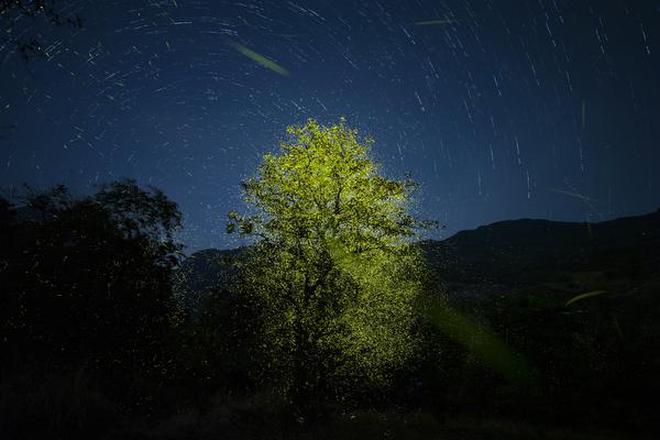
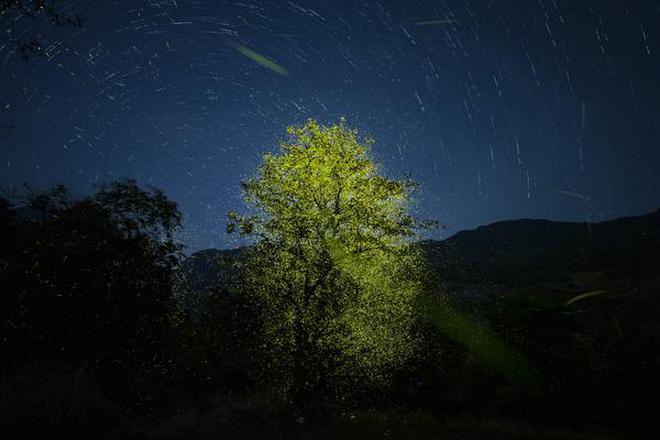
This award-winning wildlife photograph not often but always brings back memories of simply being at Kumbaldal.
‘Lights of Passion’ fetched Aishwarya the ‘Highly Commended’ award at the 56th Wildlife Photographer of the Year Awards (2020) under the ‘Behaviour-Invertebrates’ category. | Photo Credit: Aishwarya Sridhar
If you are there at the right time, then your senses can feast on bioluminescence. Millions of fireflies rest on the ground under the coffee plants all night and it literally feels as if you are standing on the porch of a mud house that is surrounded with a zillion flashlights. No words of mine can justify what I want to express! But, what I now realize is that the experience is not the same anymore. The usage of chemical fertilisers and pesticides have done damage that’s beyond repair to the environment. Going organic would need several decades to fix these glow worms and fireflies back into their normal habitat.
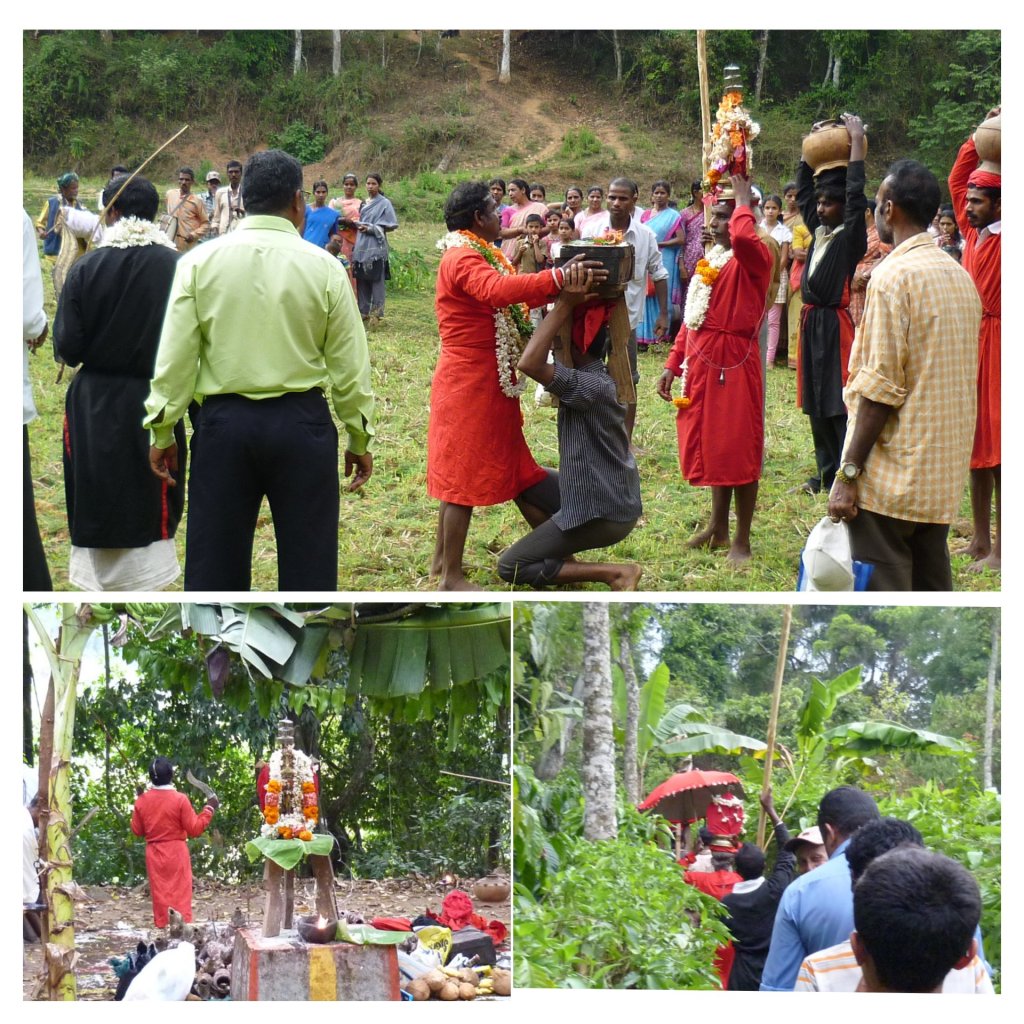
Every village in Kodagu has its own deity and it is quite an experience to participate in these local festivals. At Kumbaldal, the temple’s Kuli kund (the holy bathing pond) happens to be in our land. Hence, the idol of the presiding deity of the village is brought to our farm for the first ceremonial formalities during the village’s annual festival.
The annual village festival at Kumbaldal
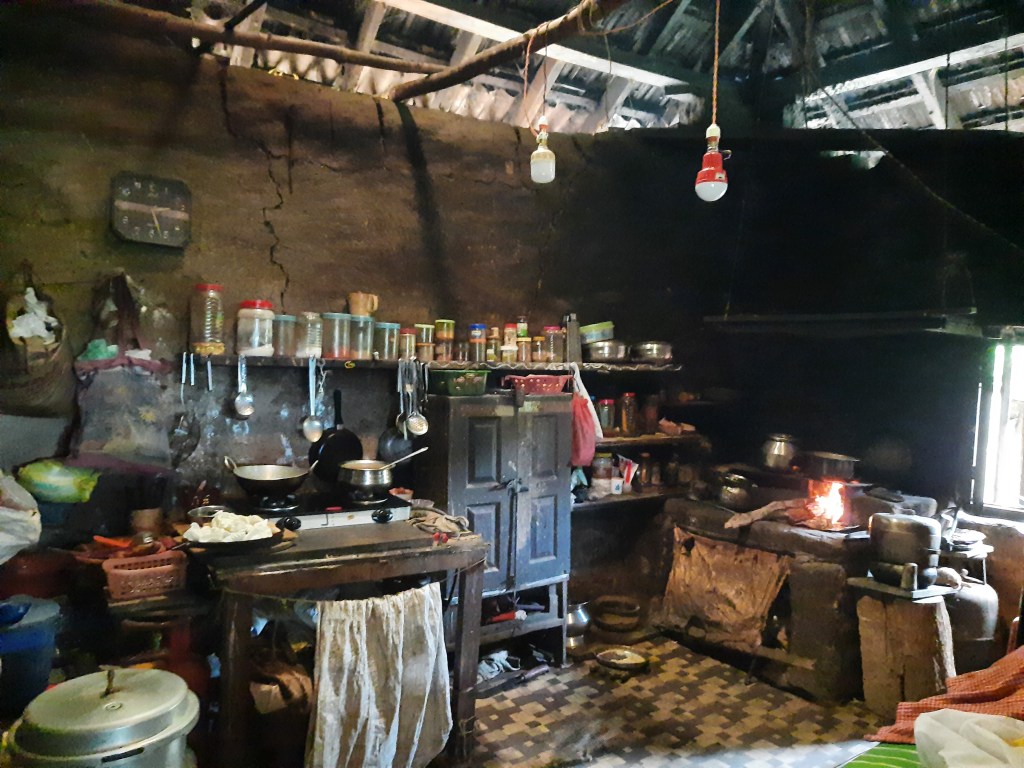
Not until late 2010-ish, that this village house had an electricity connection. The lifestyle was rustic and charming, to say the least. Mud smeared walls, cow dung smeared frontal yard and prayer room, firewood cooked food, kerosene lit lanterns and a perfectly mountain facing portico: Why wouldn’t anyone want a vacation like this! For me, my visits to this village were wholesome experiences.
The kitchen at the Kumbaldal house
Accessibility being scarce for reaching the commercial areas as and when required, the food and the entertainment at uncle’s house used to be the most traditionally rooted. Even to date, a visit to Kumbaldal is welcomed with a festive spread that largely comprises of the traditional Kodava recipes and prepared with the locally available ingredients as much as possible.
When I think of Kumbaldal, it reminds me of staying rooted to my culture and grounded with a minimalistic lifestyle. if you liked this story, you might also want to give a read to: “The monsoon delicacies of Coorg” for some more nostalgia.
‘Ontiangadi’ literally translates to The Only Shop’ in Kannada, and it is the name of a village in South Kodagu, where my paternal lineage hails from. Now, this village has grown beyond just one shop, into a tiny township.
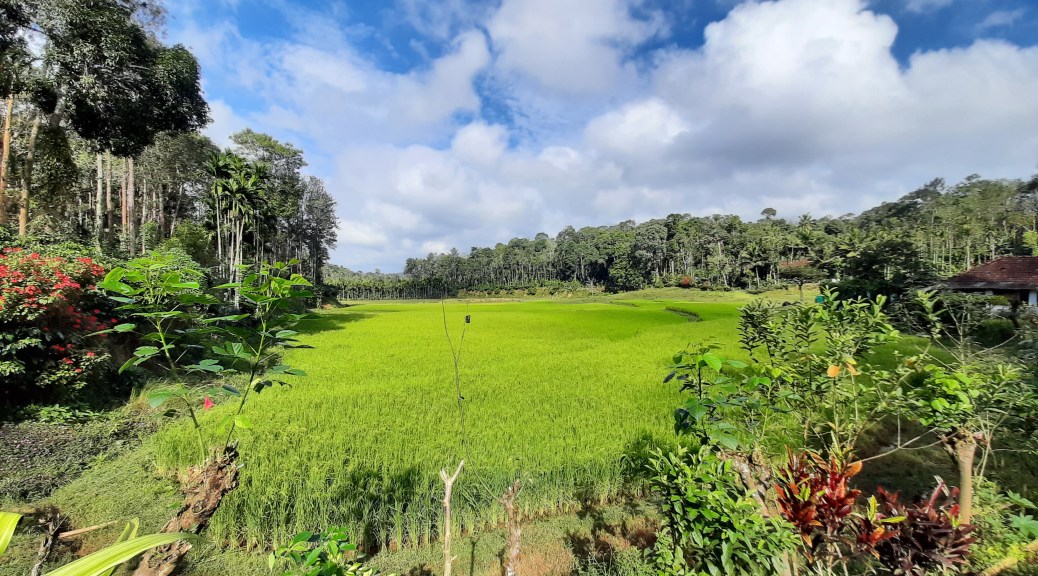
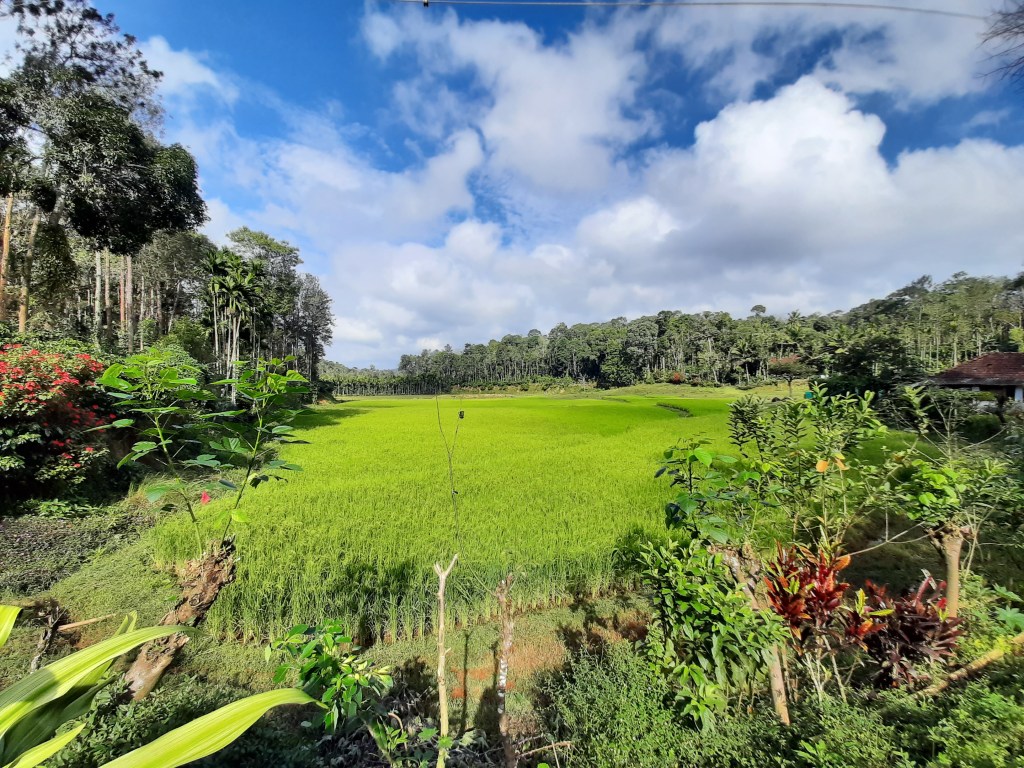
As a child, I would come here on those weekends, when my parents came down from Bangalore. But whenever I came here, there has always been a calm of a different kind. There are two ancestral houses located within the large premises: one nearly 200 years old which is now used as a warehouse and the other, around 50+ years old that is currently being resided at by our family. The latter is surrounded with coffee plants, paddy fields, overflowing ponds and streams, an open well at a walkable distance to fetch potable water. This place has always seemed magical to me, then and now!
View of the farm from our ancestral home in Kodagu
While the green paddy fields have been a treat to the eyes, the offseason is when I have lived some of my best holidays. The paddy field would turn into a playground when my cousins, other kids from the village and their cousins, would all congregate here for a game or two of football. Not with a foot-BALL, but with hollow balls of pomelo skin (grapefruit).
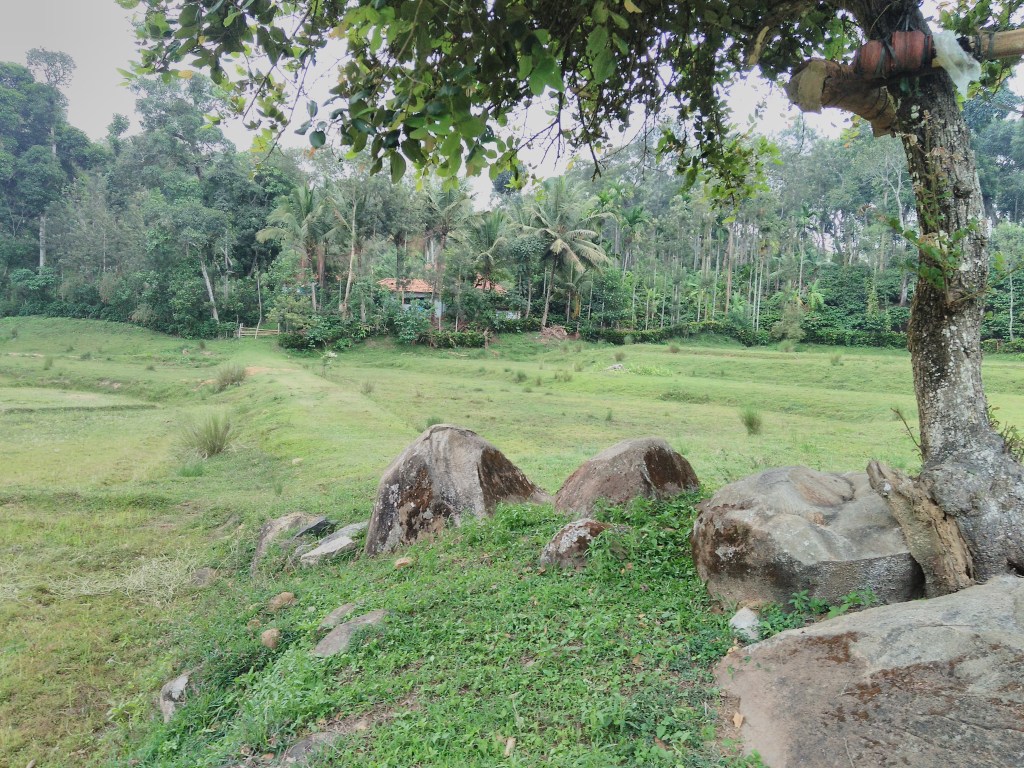
And then, came the first monsoons: we ran to the large wild-mango tree and fought a mango war. Who won or lost the battle would be decided by how much mango juice we were soaked in and who got the maximum scolding from our elders!
The farm and the mango tree, on the drier days in Ontiangadi
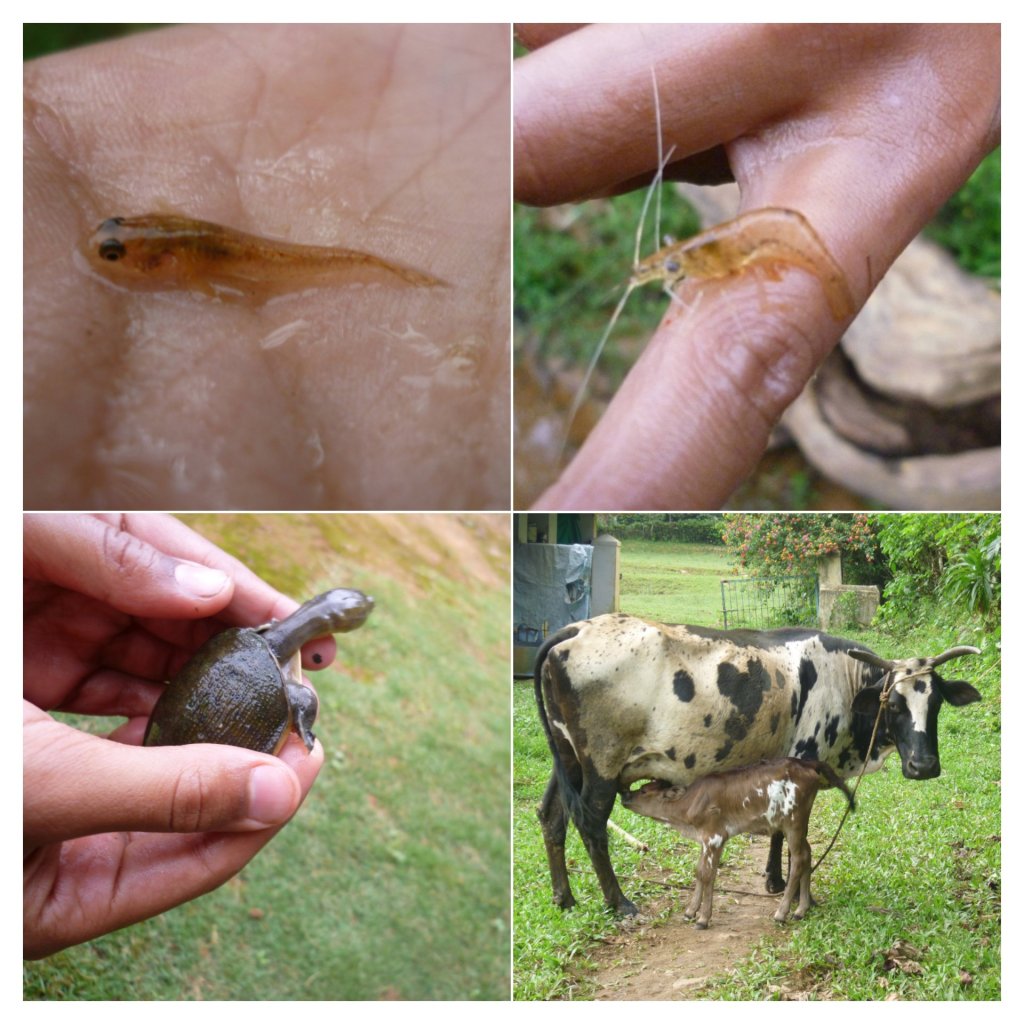
Wait for a few more days to pass by and the monsoon will peak. Then, the streams would overflow and bring that time of the year for our prized catches: Laying bamboo traps to collect fresh water eels and Koile meen (a local fish in Kodagu), fishing out mud-crabs from crevices along the downstream were normal. On (un)Lucky days, one or two smushy crabs would turn out to be snakes after being grabbed out 😀
Once, the workers had brought home several soft shelled turtles which they had found while working in the paddy field. It was timed well with my then recent experience of volunteering for a sea turtle conservation project in Chennai. With all excitement and inspiration, I had written to so many organizations about my new discovery in the western Ghats 😀 Aaah, what memories!
Clockwise from top left: 1. Koile meen, 2. Freshwater shrimp, 3. Cattle, 4. A soft shelled turtle
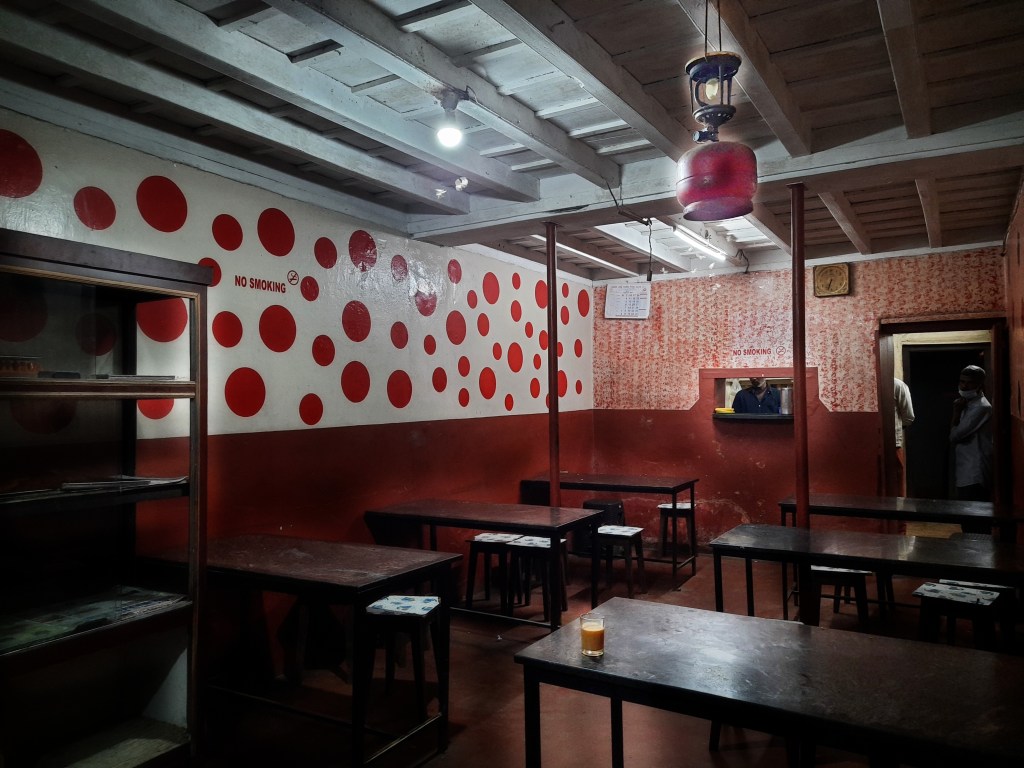
Apart from this, the ‘Subramanya temple’ at Byrambada and the ‘Palli Swamy Dargah’ (Pulkimaad dargah) have been important landmarks in and closer to Ontiangadi. A nice warm day even now, is often concluded with a hot plate of palam pori and a cup of kattan chai from ‘Ganesh hotel’ at Ontiangadi.
‘Ganesh hotel’ at Ontiangadi, Kodagu
I borrow my surname from this village and so, definitely a part of me belongs here 😀
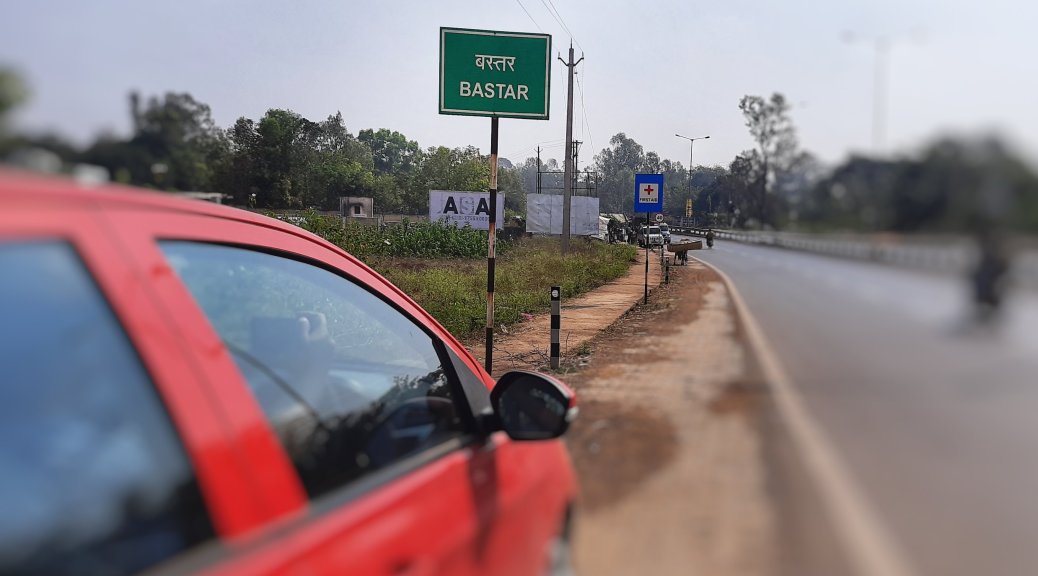
Bastar region in Chhattisgarh is very popular for its Dussehra celebrations and people flock from far away to witness its tribal congregation during this time. Noting that Jagdalpur is the biggest city in Bastar, it is likely that it will be the central place for planning one’s stay and travel around this region. But, if one happens to be there for a very short stay and interested in exploring Bastar beyond its festivities, then here are some of my recommendations.
1. Caving at Madarkonta: There are so many massive limestone caves and cave systems in and around Jagdalpur and just a countable few of them have been promoted by the Chhattisgarh tourism board. Although these are also great places to visit, my caving experience at Madarkonta is one that stands apart. This cave is still inaccessible without a local guide and no tools or digging has been made to accommodate tourists. So, the entire caving experience here is still in its raw form, just the way it was found by the local men, many years ago. You need to duck down and walk barefoot, navigating your way through the hollow limestone chambers with torch light. (Barefoot because the locals believe that some deities reside inside the cave). Watch the entire video below:
Exploring Madarkonta caves
2. A boat ride into the Chitrakoot waterfalls: Chhattisgarh is home to over a hundred amazing waterfalls. But the poster boy on all their tourism ads is the Chitrakoot. Also known as the Chitrakote waterfalls, it is referred to as India’s Niagara for a reason… During monsoon, river Indravati plummets down with all her might in a horseshoe shape, making it the widest waterfall in India. A ride in a country boat right into the waterfalls is an exhilarating experience! Watch the entire video below:
Boat ride at Chitrakote waterfalls
3. A sunrise visit to the Island temple at Dalpat Sagar lake: Although tourists can take a boat ride in the largest artificial lake of Chhattisgarh state all through the day, an experience that stands out is a ride during sunrise, to the temple located in the middle of this lake. I was told that an underground chamber connects the temple to the royal palace located in the city. This chamber is used by the members of the royal family and VIPs to participate in special ceremonies during Dussehra. On other days, if one is lucky to get access to a country boat for an early morning ride (even better if it is along with the temple priest), they can see the entrance of this chamber illuminated with oil torches while the priest makes his visit to offer the first prayers of the day.
An early morning view of the Dalpat Sagar lake in Kondagaon
4. A Gotul visit: I’ve already spoken about the significance about a Gotul in the tribal culture of Bastar in a separate post. This is a great way to get acquainted with the rich tribal culture through its traditions, music, dance and food, all at one common place.
A tribal ceremony at a Gotul in Bastar
5. A tour of the artisans villages: Wrought iron crafts, Dokra art, wooden crafts, stone sculpting, pottery, handloom, paintings, jewelry making- the list of indigenous art in this region is long and the region boasts of several artisans of National and International fame. Even a quick day tour of these hamlets is worth every little time of yours, while you are here!
Making of wrought iron craft at Kondagaon, Bastar
Do you plan to make Chattisgarh your next destination? Or have you already been there before? What are your recommendations or queries? Let me know!
It was long travelling distances leading to high altitude destinations, where cold winds were abundant and oxygen levels lower. For those of us travelling across North and East Sikkim, it had been a long and a tiring trip thus far. Each day of our weeklong travel through this little but important Indian state had been a different experience.
This post is part of our weeklong stay in Sikkim covering Gangtok – Mangan – Lachen – Gurudongmar- Lachung- Zero point – Rumtek – Gangtok – Nathula – Zuluk – Siliguri
Long ago, I had seen a jaw dropping photograph of the old silk-route winding and passing through Sikkim. It had since been my wish to see that view in real. The old silk-route had once served as a major trade route connecting China with the rest of Asia and Middle east. During this trip in Sikkim, we decided to drive along that scenic route during our exit from this tiny state. Hence, the route chosen by us was: Gangtok > Tsongmo/Changu lake > Nathula Pass > Nathang valley > Lungthung village > Thambi viewpoint > Zuluk >Rangpo > Siliguri
The Details:
Only Indian nationals are permitted on this stretch of East Sikkim and an inner line permit was obtained from Gangtok on the morning of our departure.
It had been a cloudy day since dawn break and the drive for the initial stretch felt pleasant as we passed through the wavering peace flags all along the highway. We learnt about the significance of these peace posts in Buddhist culture while conversing with our taxi driver. The white flags are installed in memory of a deceased person by their kith. Similarly, the multicolored flags are believed to bring good luck. Ideally, these flags are supposed to be installed high up in the mountains where the winds are stronger. The wind is believed to free-up the soul of the deceased or bring good energy, depending on the flag’s colour. With reducing space for hoisting more flags and the ease of finding a hoisting place by the roadside, it is now common to find them all along the highways of this Buddhist majority state.
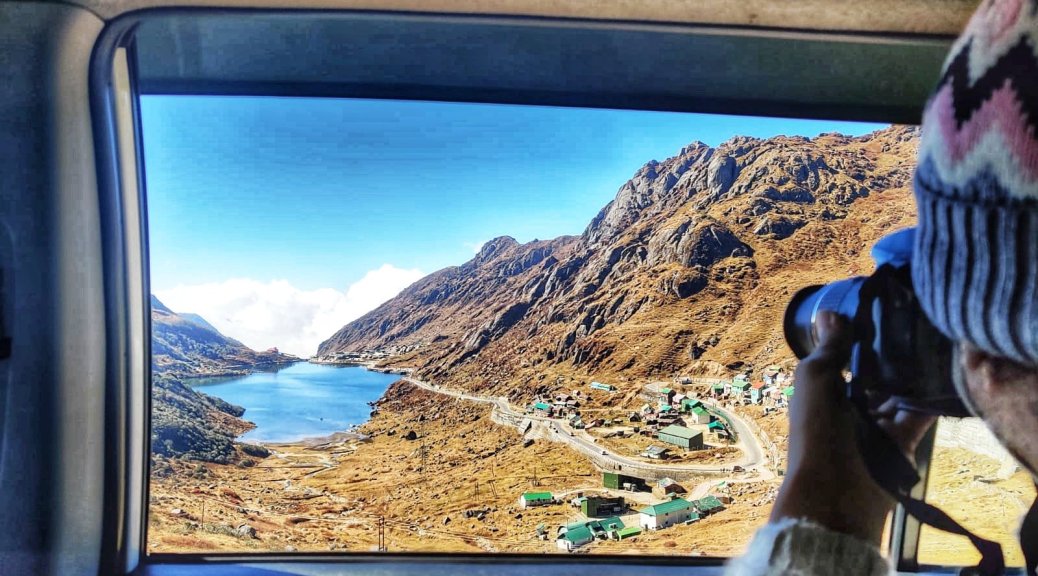
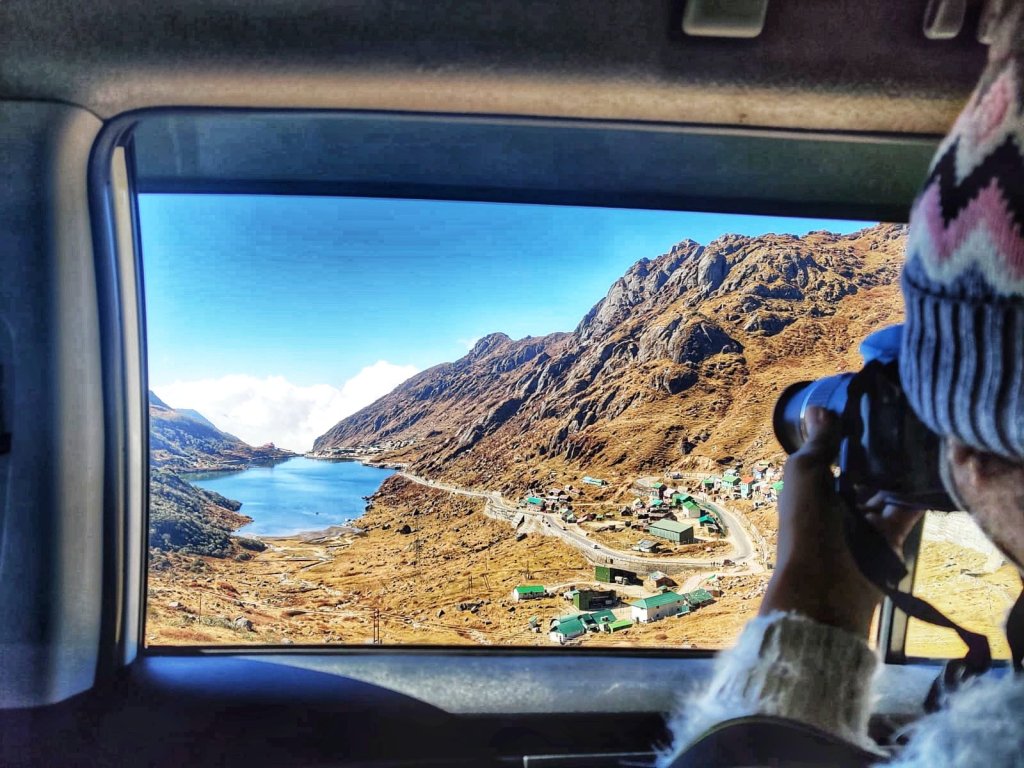
Sooner, the clouds cleared up making way for a gleaming sun in the blue sky. We arrived at the Tsomgo lake in a while. It is a serene lake that is popular among the tourists. We clicked a few photos with the yaks grazing around its periphery before proceeding towards the Indo-China border at Nathula pass.
Nathula was crowded. People were amok and erratic. They had no idea what to expect at an international border. Some were standing in attention with a salute to the Indian tricolor, some were touching and praying the fence that marked the border. Some were putting their feet across the barbed wire to get a feel of going to China and a few more were busy chasing the men in uniform of the Indian army for selfies. And for us, it was a urge to run back to the warmth of the heater of our vehicle 😛 It was biting cold even during the peak of the day. We walked up to the point, saw the border gates of both India and China, the respective embassy buildings, the Chinese and the Indian army camps posted high up and also got a distant view of the mountains that marked Bhutan. We did a quick walk through, taking in all the good views and returned to our vehicle as quickly as we could.
The view enroute Nathula pass Photo credit: Varsha J.
After squeezing out of the maddening crowd at Nathula, we continued our journey towards Nathang valley, only to be stuck in one of the worst traffic jams we had experienced in Sikkim. The last and the major destination on a typical touristy circuit is the temple of Baba Harbhajan Singh. Baba Harbhajan Singh is a folklore hero and an ex-army soldier whose spirit is believed to be roaming around the place, protecting the soldiers posted at this extreme terrain. There are old and the new temples dedicated to him, both maintained by the Indian army. We managed to find our way out of the choco block and continued towards Nathang valley.
Beyond the army temple, I can conveniently say that it was just us all the way. The roads were deserted, except for some BRO trucks and excavators clearing up the landslide prone path and laying new roads. We passed through what the army claims to be world’s highest altitude golf course, several army camps and tiny discrete civilian settlements along our way. Our drive through Nathang valley, thereafter, was something beyond comprehension for our senses, it was so beautiful!
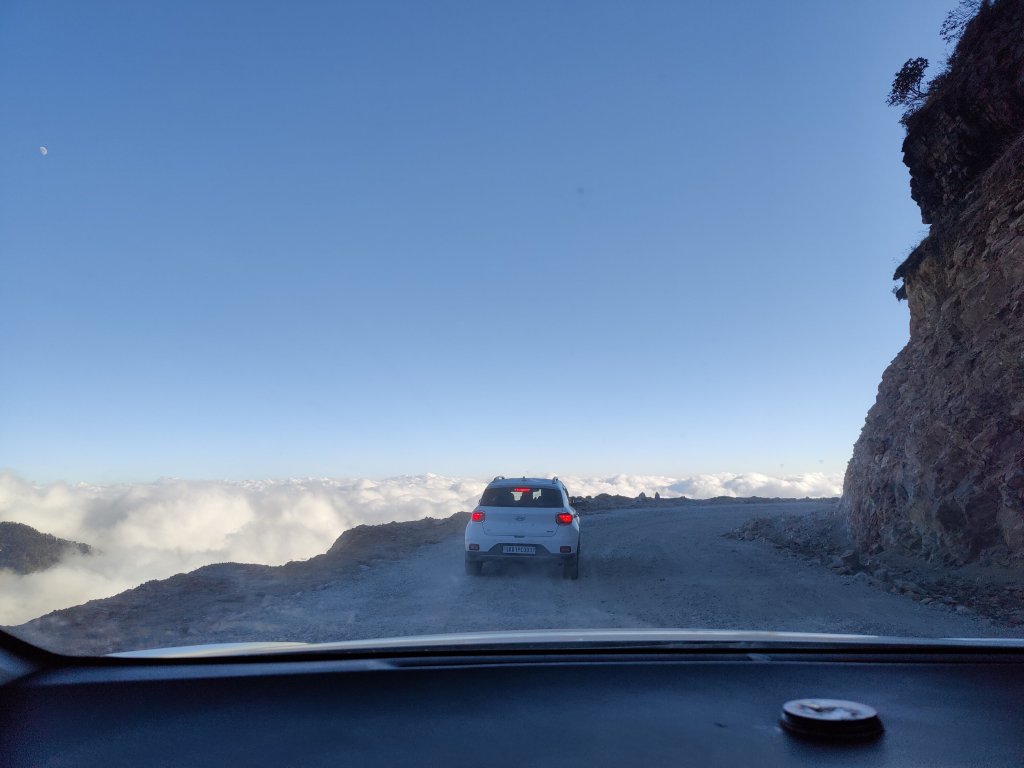
All that we had envisaged of this journey at the time of commencing this drive was passing through a viewpoint and reaching Siliguri for the night’s stay. But as the journey unfolded, we were in for surprises. That day, the clouds had embraced the valley like never before. The road that we were driving on, seemed as if it was curving around the edge of the land. It was clear blue sky with the sun beaming bright and the thick clouds engulfing the horizon. The rhododendron plants had blanketed the entire valley, which I’m sure must be a visual delight during their blooming season. We stopped, like at every half a mile to capture the landscape in our cameras, alas justice be done to what the human eyes saw.
Driving through the edge, above the clouds at Nathang valley
But by late afternoon, the sun had started to descend to the horizon and the fog had taken over again. Our visibility of the road ahead and the possibility to see the view that we wanted, had both now become zero. Our driver soon pulled off our vehicle at a tiny settlement enroute to enquire for availability of a place for us to stay for the night. Lungthung is a tiny village on the valley, with barely 3-4 houses, that too made with metal sheets. By staying in a homestay there, we were going to be the only outsiders for that night at Lungthung!
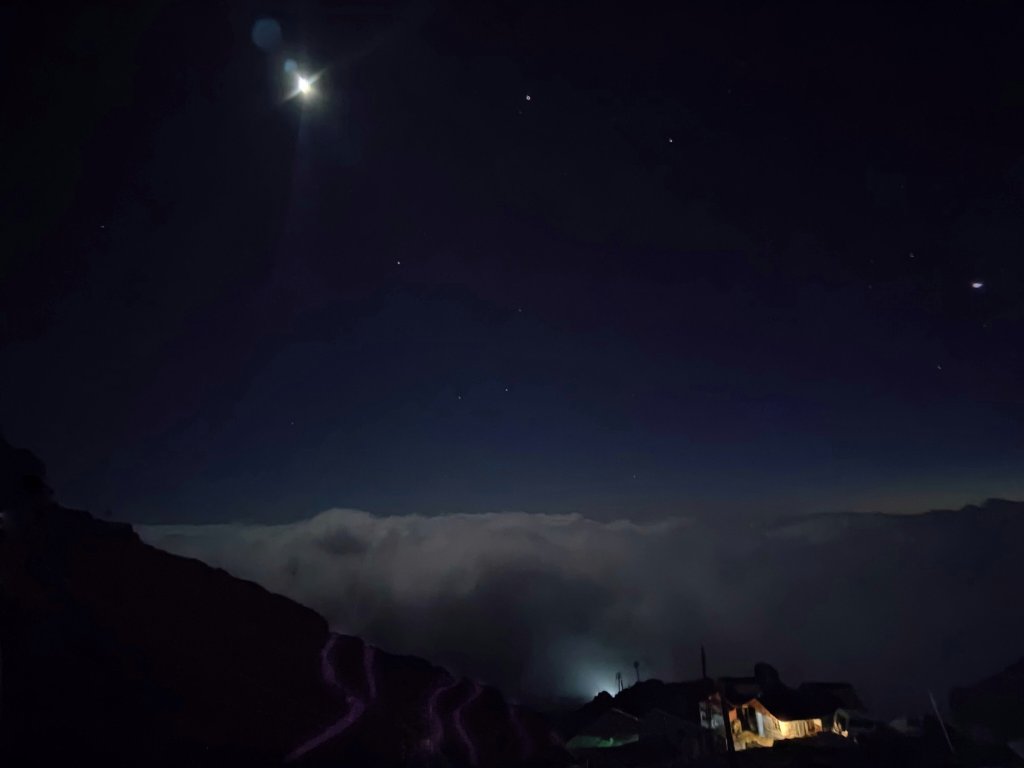
The mercury level was already below zero. But as the night rolled in, the winds too got stronger. The clouds cleared up and the stars and the planets shone brighter than ever. It was our last night at Sikkim and the coldest too! Even as we sat inside the host’s dining room, relishing the handmade thenthuk, we felt like our roof was going to be taken away by the winds. No amount of firewood could keep us warm. Even if we simply stood up for a moment to adjust our seats, they would freeze again. But as I said earlier, it was our last evening at Sikkim before we got back to the grind. There was no way we would hit the bed early. We sat outside, counting stars quite literally… The sky was clear, the moon lit up the road below and a lone filament bulb illuminated a roof at a little distance. Apart from an occasional goods carrying army truck that toughed it out on the slope, there was no civilization around us for miles together… It was an experience so wonderful that we hadn’t imagined about remotely, even a few hours ago… Not in my wildest dreams, had I imagined that I would live a day of my life ON the silk-route!!
The moonlit view of the silk route and the clouds as seen from Lungthung homestay
Anyway, not really being able to sleep due to cold temperature and the noisy sheets fluttering outside our room, we still rolled into our blankets and set an alarm to wake up early. Our host at the homestay had recommended to walk down the road for sunrise…
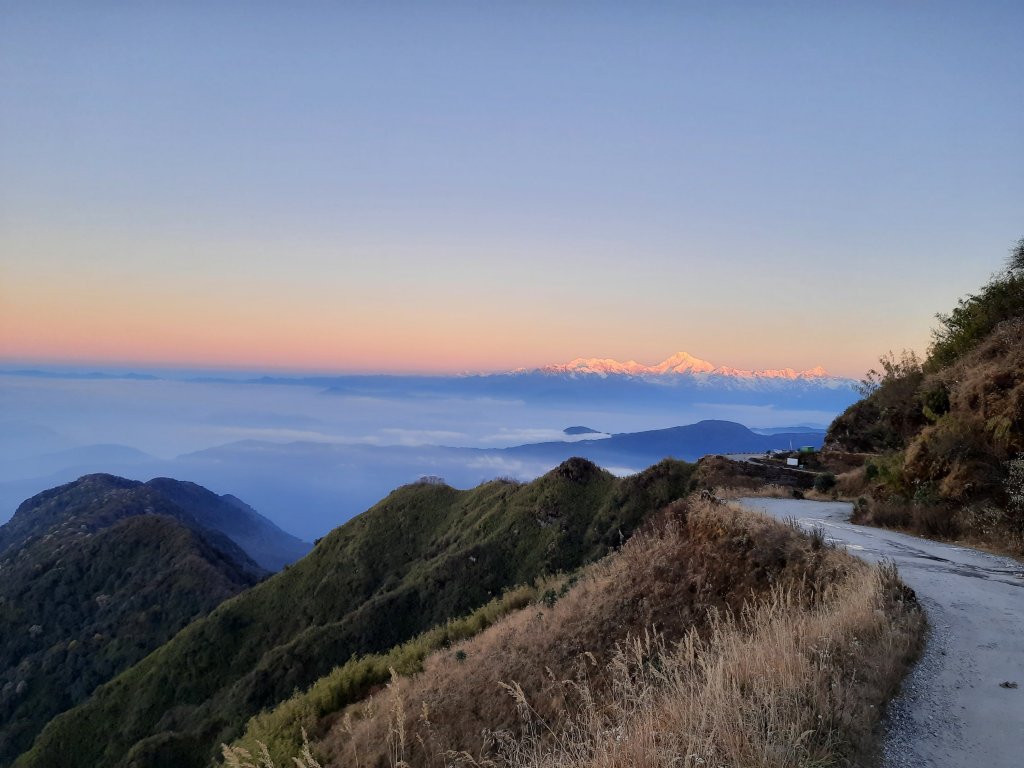
The following morning, it was almost impossible for me to even think of coming out of the blanket. I snoozed the alarm a couple of times. But then something happened. My eyes had one glance at the window glass, and it was enough motivation for me to get my butt off the bed. It was a breaking dawn…. The sky had a streak of deep red, visible right at my window, seen from my bed…. It was for sure, unusual from any normal day. The view made me forget the cold and barge outside to not miss the complete visuals of an unfolding day… I woke my brother up and my friends and we all raced towards the viewpoint that we were told about. We didn’t mind slipping down a couple of times on the frozen roads.
The sun rising over Kanchenjunga at Thambi view point
At such high altitude and low temperature, the running didn’t help to warm us up. As we reached the viewpoint, we were panting for breath and had our jaws dropping. We were gasping, awestruck in amazement at the sight around us, chattering due to the freezing temperature and everything else happened to us at the same time. The moment is inexplainable!
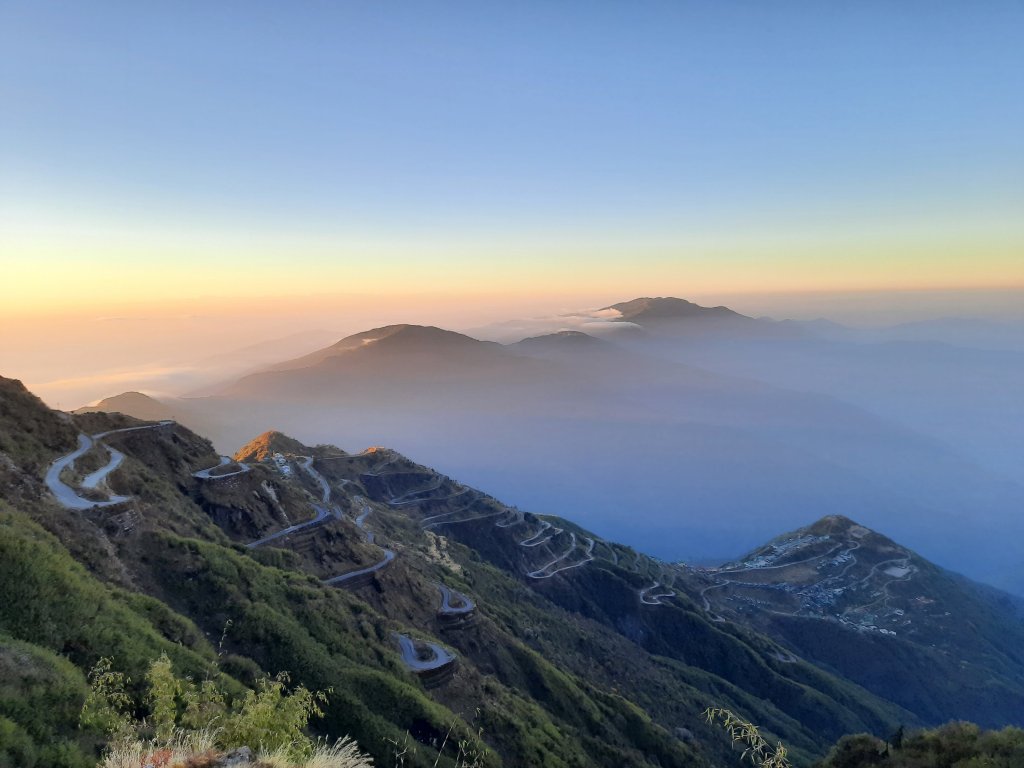
The old silk route at Zuluk valley, as seen from Thambi view point during sunrise
We were standing at Thambi viewpoint and had lost the sense of place for that moment. The Kanchenjunga had lit up in crimson in just a few minutes and the winding roads through Zuluk valley appeared deep down in a while. It was a day and an experience like never before! It was our last day at Sikkim and I could only say that the best was indeed saved for the end!
After an exhausting day exploring the streets crammed with Chettinad houses in Karaikudi, we were dropped at the bus stand to board the local bus to our next destination. The bus snaked through the narrow lanes and we craned our necks out of the window to stare at a few bungalows along the road at Pallathur before we finally alighted at ‘THE’ destination of our tour- Kaanadukathan.
Part 2: Exploring Kaanadukathan
Although we had listed down the must-see things, we felt lost upon our arrival at this village. The place looked like any other village in India and we wondered where had all the stately houses gone, the only reason that had brought us there. It was evening already, and we still didn’t have a definite place to stay. Without having a clue on how to go about further on our trip, we decided to follow our instincts.
Firstly, we decided to walk till that road’s end hoping to find some hotel for our night’s stay. After a short distance, we heaved a sigh of relief when we came across ‘Visalam heritage hotel’. It was a heritage property and expensive on our budget, but it was assurance that there was some place we could fall back to in the worst case of not finding a stay for the night. Having some relief, we decided to walk further down the street in our quest for both a hotel that would fit our budget or for the palatial mansions that had brought us all the way from Bangalore.
After walking further down the street, my friend and I stopped at the sight in front of us. We were psyched out for a minute when our eyes caught a never-ending stretch of road flanked by the Palatial- country homes on both sides… We were in for an unexpected shock!! We knew there were many large mansions but had never imagined a real street to look just out of a movie setting. The facades of these large villas had fine sculptures of their family deities and the heavy wooden doors at the main entrances were decorated with artistic friezes.
The streets of Kaanaadukathan village
This village in particular did not seem to be very tourist friendly with most of these bungalows being locked up and their owners living elsewhere for various reasons. A few residents, however, have been kind to the keen travelers by permitting entry to their princely manors. Here is a summary of our pursuits of landmarks at Kaanadukathan.
CVRM house: This is one of the very few Chettinad mansions that are open for public viewing that can be visited with a small entry fee. Although, nobody lives in this house now where once lived a large and an affluent family, it is well maintained with some of its antique cupboards, piano, swings etc. kept intact to retain the grandeur of this house. While we were admiring the grand interiors, the caretaker at the mansion recognized that we were lost and offered to accommodate us at her house for the night. Well, meeting such Samaritans needs a separate post.
The CVRM house at Kaanadukathan
We started early on the following morning to make best use of the time before the sun became fully active. There were (ancient) temple visits in the day’s itinerary and a lot of walking to be done. With our host’s support, we managed to book an auto-rickshaw for the entire day and to take us around places as listed below.
The nine clan temples of Chettinad: Temples of Soorakudi, Kundrakudi Murugan temple, Pillayarpatti Vinayaka temple and Vairavanpatti temples are beautiful structures dating back to the Pandya era. These architectural treasures are a win for history buffs in quest of places least touched by the maddening tourists. If one is a pious traveler, one may also consider visiting the temples at Iraniyur, Tirupattur, Velankudi, Kottaiyur, Kandanur and Mathur. Collectively, these temples represent the family deity of each of the nine major clans inhabiting around the region. After having our lunch served by donors at the Vairavanpatti temple, we headed towards our next destination
Aathangudi Palace: Fondly called as the ‘Periyaveedu’ for being the biggest house in the village, this mansion is aptly named as the Aathangudi palace. The roofs, the floors, the walls- they made our jaws drop in awe at their splendor and grandeur as we stood in the portico at its entrance. Although, we were charged an entry fee, we weren’t allowed to stay inside the mansion beyond 15 minutes by the caretakers. Their behavior towards visitors was somewhat a turn-off as they chased us out with verbal abuses. Forget observing the intricacies of the architecture of such a place, 15 minutes weren’t sufficient to even take a casual walk around the entire house.
Inside the Periyaveedu- The Athangudi Palace
There was no heed given to requests by our driver even as he tried to convince them in the local language. Pissed off with their attitude, our driver drove us off from there, towards our next destination. Before I continue ranting about our exploration of the region, I pause a bit to talk about my autorickshaw ride: The cranking lever of the vehicle had come off and was kept under our feet (in the rear seat) and the brake pads had worn out till their last dust. That meant, that the vehicle needed to be push started every time we stopped, and the driver had to jump out of the slow-moving rickshaw to stop it every time we wanted to halt. Especially under the blazing sun and some annoying caretakers like the one mentioned above, it is natural to gain a few additional horsepower in our muscles. So, the raging ride from Aathangudi palace until our next stop was quite a thing!
Aathangudi tiles factory & wood art restoration center: This is a place where we met the men who create beauty out of lifeless soil and wood. We observed demonstration of how these GI tagged colorful tiles are created. An art in themselves, apart from adorning all Chettinad mansions, I remember the grandeur of the Mysore and Bangalore palaces whose flooring is made with tiles sourced from Aathangudi.
Making of the Athangudi tiles
Chettinad railway station: This small and least haunted railway station on a typical traveler’s itinerary was included in our list after we had heard that the local Raja had a special waiting room for himself in the railway station. This quick and an exhausting ride ended in disappointment when we reached there. We learnt that the special room is not open to public viewing and will be opened only on special occasions for the members of the Raja’s family.
The entrance to one of the houses at Kaanadukathan
By this time, our tummies were grumbling of hunger. In spite of having been in the land of spices for two days, our taste buds hadn’t savored authentic Chettinad cuisine yet. It was a hard hunt for us to find a good hotel that served us authentic Chettinad food. Our craving gustatory cells were finally satiated with a lip-smacking array of culinary delight at a small hotel that we found on a random lookout. Post lunch, we decided to spend the rest of the day exploring the somnolent streets of Kaanadukathan by foot.
Local weaving centers: We shopped for the Kandangi handloom saris from one of the many local weaving centers.
Chettinad Raja’s palace: The largest mansion in the whole of Chettinad is a sprawling edifice extending over an entire lane on all four sides. And that’s why it is called as the Chettinad palace. We made futile attempts to get a small peek into the interiors of this massive dwelling space that I had seen in some of the movies.
Our walk tour of Kaanadukathan continued until dusk. We clicked some nice photos of this ‘heritage’ village with the perfect lighting by the setting sun. Along with the setting sun, we set ourselves for the return journey. We had to reach Trichy on time to catch our bus back to Bangalore. Thus, concluded a weekend in Chettinad- the land of palatial mansions and piquant cuisine.
Must-dos in Chettinad:
Take a walk in the Muneeshwaran Koil street or the antique market in Karaikudi
Shop for a colorful palm basket- The local handicraft that has gained a GI tag
Treat your palette with Chettinad cuisine (I definitely mean Non-Veg)
Take a bicycle / walk tour around the streets of Kaanadukathan
This was a post monsoon, weekend trip I had planned with two other friends who had joined me from Bangalore to Mahabaleshwar. The main agenda of this trip was to visit the ‘Khas plateau’ in its bloom season, but it was just for a day (Click here to read more about my visit). Since we were travelling all the way, we decided to extend the weekend for a little longer by adding a few other places and make it a backpacking trip around Satara district.
Our Itinerary:
Day 0: Leave from Bengaluru to Satara (overnight private bus) Day 1: Satara to Wai (MSRTC bus), Visit to Menavali village & Dhom Dam; Wai to Panchgani (Local bus), Local sightseeing and night’s stay at Panchgani (Walk and shared taxi for local transportation) Day 2: Panchgani to Mahabaleshwar & local sightseeing at Mahabaleshwar (hired taxi for full day); Mahabaleshwar to Satara (MSRTC bus) and night’s stay at Satara. Day 3: Visit to Khas plateau & local sightseeing at Satara town (hired taxi); Return from Satara to Bengaluru (overnight KSRTC bus)
The details:
Day 1: Wai and Panchgani.
Since we required to start our Khas plateau visit from Satara, we decided to visit the places around the town later (on day 3). So, we moved ahead on the day of our arrival at Satara.
After alighting at Satara bypass on NH4 that morning, we hired an autorickshaw to reach the bus stand located in the town. From there, we boarded a MSRTC bus to our first major destination of the day: Wai.
Part 1: Places to see in Wai
I had come across the name of this place in a newspaper supplement. I had read that a large part of Shahrukh Khan’s “Swades’ movie was shot in and around Wai. Since we had to anyway pass through this place to reach our intended destination of the trip, I thought it was a good idea to add Wai it our itinerary. However, we had no idea of what to see and things to expect in Wai. We decided to just go there and explore the place by ourselves. Upon our arrival at Wai, we enquired with a few locals who guided us to the banks of the Krishna river.
A. Menavali village: A walk of good couple of miles from the Wai bus stand, we arrived at this village located on the banks of river Krishna. The locals call this as the Wai ghat as well. Apart from being a prominent setting for several Bollywood movies, the Wai ghat is also an important destination for history and archeological buffs. It holds great treasures from the times of the Marathas and the Peshwas. It is especially known for the contributions by the 18th century Maratha stateman- Nana Phadnavis.
Phadnavis Wada: Wada is a local name for a residential mansion with an inner courtyard. Residential complexes leading to river banks on one end and housing temples is a signature architectural style of the Peshwa era. The Phadnavis Wada located on the Wai ghat is one of the handful of such structures that still remains intact.
We did a quick visit to the Dholya Ganapathi mandir & Sri Kashi Vishweshwar Mandir (This temple is called as the Kashi of Maharashtra), both situated on the river bank.
Wai ghat on the banks of river Krishna at Menavali village
As we took a stroll along the ghat, I realized that reality was far from the destination on reel. The real Wai looked very laid back and rustic. However, we decided to sit by the riverside and spend some time by photographing the local kids enjoying their time by diving and swimming in the polluted waters of the ghat.
B. Dhom dam: This waterbody is a good place for water sports with a nice view of the surrounding mountains. Located at about 10kms from Wai and connected by frequenting local shared jeeps, it is a nice place for catching a sunset. But, we gave this is a miss since we hadn’t booked our accommodation and has to reach our next destination ASAP. The bus left Wai and travelled around the curvy road of the mountain. The entire journey was beautiful with great views of the Dhom dam whose waters reflected the clear blue sky.
Part 2: Places to see in Panchgani
We had alighted at our next major destination: Panchgani. Although Panchgani is a small hill town that doesn’t extend beyond a stretch of 2 kilometers, surprisingly, it is an educational hub of Maharashtra. Around 42 international schools are located here. Given its small area, all the popular tourist places in Panchgani are located close by. So, we decided to get off with our backpacks at the entrance of the hill station, explore the landmarks and then find a place for our stay. The details of our time in Panchgani is as given below:
a. Harrison’s Foley view point: This is the first major landmark you come across, even before you actually enter the town. However, we thought of giving it a miss because our next stop was going to give us a view of this Foley as well.
b. Sydney point: We got breathtaking view of the Dhom dam from here. After a long day travelling and walking with our backpacks, we thought this was just a perfect place for us sit down and soak in some relaxing views. We sat down right there on the footpath, facing the dam and spent some peaceful time amid nature. After spending some good time and having all our limbs relaxed, we walked back towards the main road.
c. Table land: Our actual plan was to check-in to a hotel and sleep early that evening. However, we changed our minds and decided to visit the table land to use up our time in the remaining daylight. Sometimes, even with no plans, god really wants you to be at the right place at the right time. That’s how this evening turned out to be. As we went up the road leading to this place, it looked like quite a mela up there. There were so many makeshift shops set up and the place had been littered all around with plastic bottles and wrappers. But, as we walked past the maddening crowds, we saw that the table land was a vast stretch than expected. We decided to walk the entire land before dark. The grassland was naturally gifted with vast stretches of native flowers: all white, purple and yellow. It was a magical place that got us busy photographing the silhouettes of the grazing cattle, the horse riders etc. against a beautiful backdrop of the setting sun. An artificial lake amid the grassland added romance to this place. The sky was painted in all hues with a beaming full moon reflecting in the lake’s water, adding to the spectacle. It felt like as if the sun had gone down sooner that day. With that, we had to scoot out of the place as area suddenly started to feel deserted and had no guiding lamps to the main road.
d. Rajapuri caves: This place falls on the way up to the table land. We were told that the cave has a temple dedicated to lord Ayyappan and hence, women of menstruating age are not allowed inside. With that, we headed back to the town and checked-in to a hotel.
We wanted to have some food that are a must try in Panchgani. So, we dumped all our luggage in the hotel room and set-out to walk around the town, yet again.
Panchgani is famous for channa, chikki and fudge: the shops say this all over the place. So. we picked up some of these to carry back home.
What caught our attention was a bottle of strawberry wine at a wine store.
The day’s events concluded with a sumptuous spicy hot ‘veg Kolhapuri with roti‘ for dinner.
On the following morning, the idea was to be at the table-top for sunrise. However, we snoozed the alarm for a little longer and we woke up only when the hotel staff rang the doorbell. We then started our day with a yummy plate of Poha for breakfast and hired a taxi to our next destination: Mahabaleshwar.
Day 2: One day at Mahabaleshwar
The hill station is a favorite haunt of tourists from the nearby metropolis and afar. Mahabaleshwar can be broadly classified into two parts, the New and the Old. Both have been explained in detail in a separate post as the list of things to see and do in Mahabaleshwar is going to be long.
Kate’s point and the elephant head view point at Mahabaleshwar
Day 3: Satara and Khas Plateau
This day was the sole reason that had got us to plan this entire trip. We woke up early to reach Khas plateau for sunrise and get some wonderful photographs. Being early gave us the benefit of avoiding the scorching sun and also to escape the crowds that would normally pour in at a later time.
Apart from my visit to Khas plateau that requires a separate post, I am listing the places of interest around Satara town for those wishing to explore this region:
a. Around Khas plateau: If you have sometime in hand, you can drive further from the Khas lake to reach the boating village of Bamnoli and take a boat tour to Vasota fort or Tapola. b. Vajrai and Thoseghar waterfalls: These picturesque places were a disappointment when we arrived there as these are mainly rainfed cascades. c. Chalkewadi windmill station: Considering that we had visited a windmill station earlier, back in our home state and to save time, we gave this place a miss. d. Forts for the history buffs: Sajjangad, Ajinkyatara, Pratapgad, Kalyangad are places that can all be covered, but only with the convenience of having own transport. We skipped our visits since we were largely dependent on public transportation and taxi service that was expensive. e. Natraj temple: This ancient structure located in the center of Satara town, is worth visiting
The Pink balsam carpet at Khas valley
Food to try in Satara:
Kandi peda: This is a specialty sweet of this region
Zunka baakri: This is roti made of a locally available variety of maize, we had it for a late lunch that kept us filled throughout our return journey.
Fresh strawberry with cream in Mahabaleshwar.
We boarded a bus back to Bengaluru and thus, ending a long weekend in Satara.
Planning your vacation in Mumbai but worried about leaving your little pet behind? Do not worry I’ve got your back. Mumbai is a home to some luxurious and pet-friendly resorts which allows you to not only experience a comfortable stay but also allow you to bring along your little munchkin and play along.
Enjoy your long-drive from Mumbai to reach these locations with the lush green landscape views. The sound of waterfalls flowing during monsoon, panoramic view of valleys, mountains and greenery of these resorts will leave you mesmerized. The resort here is known to offer best-in-class services and amenities and offer a pet-friendly environment so that you can chill and relax while your pet also has something to do. These pet-friendly properties have various facilities to enjoy your holiday that allows you to experience the feel of Home, away from Home.
Manas Resort Nashik
Located in the expanse of the Western Ghats of Igatpuri, Manas Resort Nashik is the first Indian resort with Petting Zoo, hosting human-friendly animals and walk-in aviaries. If you are a true nature lover and love animals, this resort might be the best place for you. Located at just a distance of 2 hours from Mumbai, Manas Resort Nashik allows you to enjoy fun-filled activities in the lap of nature.
This resort has exclusively offered Petting Zoo and Organic farming which is a very different experience to the travellers while they enjoy and take a weekend break from daily life. The resort gives you the privilege to interact with wildlife, The lavish villas with personal pools and modern facilities are ready to give you a warm welcome and with the soothing massages and relaxing sessions, you can enjoy a rejuvenating spa during the stay. The resort has luxurious rooms of various designs and categories, keeping the view of multiple family needs. The Facilities in this resort include an All Day Dining Restaurant, Highway Café, Lawns, Swimming Pool, Spa, Kids Zone, Games Room and Car Park as well. You will also have options to choose from outdoor activities like tours, treks, nature walks etc and make you truly stay fun-filled.
Nestled in a river bank and surrounded by the verdant forest, this thrilling resort offers you a memorable & luxurious stay with modern amenities and gives you a chance to live with nature as you step in this beautiful and relaxing oasis. This beautiful resort is a perfect getaway to spend a weekend with your furry friends. Huge lawns surrounding greenery give you freshness, chill and natural vibes. This is a beautiful property that is highly recommended for those who love a mix of adventure and nature. Head to this exotic bungalow by the river in Karjat and enjoy unwinding in the midst of nature with your furry friends. Huge lawns, gazebos, mind-blowing views of greenery all around with fresh air make it a beautiful place to stay, You will also be offered the cycles to explore the surroundings.
A 60 kilometer drive from Mumbai with your pour paws friend, this is a wonderful eco-friendly resort offering some really comfortable accommodation, surrounded by a forest in Karjat. This beautiful place offers you the fully furnished tree-houses with a splendid mountain view. You can choose the room with a balcony. Barbecue facilities, board games and books for children are the other facilities which you can avail. There is also a swimming pool within the premises for its guests.
You can definitely indulge in trekking, cycling, fishing, etc while kids can play in a spacious play area. This is one of the most ideal pet friendly resorts in Mumbai to bring your four paws friends along for a wonderful holiday. A quick getaway from the hustle bustle of the city, this place offers a relaxing stay, good homely food and an amazing view from the room. No matter which cottage you select it offers view from sides
Eko Stay Sea Breeze Villa
A beach front villa which is situated near Saswane Beach, Eko Stay Sea Breeze Villa is quie n amazing place to come with your pet. This property makes travelling with your pets even more enjoyable as it offers both you & your furry best pal the freedom to enjoy your holiday in a mind blowing surrounding without any unwanted and unusual restrictions which are a norm in various pet friendly resorts near Mumbai.
Eko Stay Sea Breeze Villa allows you to enjoy a crazy evening with your friend. A private pool, and an open-air barbecue are the perfect ingredients for an ideal staycation offered by any resort, and this Villa has it all. Bon fire and candle light dinner with beach view would not be a bad choice though. You can be here solo or as a couple for Honeymoon or with friends, bachelors and family.
Bali Style Villa
Not everyone can fly all the way to Indonesia. A 10 minute walking distance from Mandwa Jetty, this beautiful Bali-isque holiday home is a getaway for Mumbaikars. Whenever you are stressed from work, head out to this delightful farmhouse for a relaxing staycation. This place comprises an expanse of beautiful greenish lawn and comfortable accommodation .This home stay with its serene atmosphere will diminish the stress and strains of daily life. Managed by Eko Stays, the villa consists of 2 bedrooms, a kitchen and 2 bathrooms along with a garden. Moreover, As a pet-friendly place, there are ample open spaces available for your pet to wander about so you can play fetch with your pet or go for a run together, to make your pet happy and relieve your own work pressure. Encircled by greenery all-around, this villa offers indoor and outdoor dining areas to party with your loved ones. Bonfire nights with your colleagues, friends or family will enhance your vocational experience.
This was a part of our family’s five state road trip covering Chhattisgarh – Odisha – Andhra – Telangana – Karnataka in Dec’20.
The visit to the place described in this post was impromptu. While I had just woken up at Rajahmundry and was scrolling through the watsapp status updates of some of my contacts, I happened to see a post with green paddy fields that was captioned as ‘Andhra’s best kept secret- Konaseema’. The videos of my friend driving around those green paddy fields and through the roads lined with coconut trees had me hooked instantly. For a moment, I was reminded of the Kuttanad or Karavali regions of the neighboring states. I looked up on Google and realized that I was just around. As per the original plan, we were supposed to leave for Bengaluru by Afternoon. The drive to Konaseema was in the opposite direction. But, noting a few special things to do in this region, I managed to convince my family to allow me to drive for about 30 additional kilometers before returning to Bengaluru.
Firstly, we drove through the Dowleshwaran barrage. It is one of the chief sources for water based agriculture to the several villages in the surrounding. This heritage barrage passes over the group of islands created by river Godavari. The lush greenery and sandy beaches of these islands seemed to me like they were gleaming in joy from the nourishment of mother Godavari. We were told that boat rides to these islands can be availed during early mornings by talking to the local villagers. For now, we couldn’t afford it on our schedule and hence, proceeded by adding it to our to-visit list. The destination that I wished to visit in Konaseema on this trip was a tiny village called Athreyapuram.
The serene roads of Konaseema
After crossing the Dowleshwaran barrage, the roads suddenly transformed from noisy and dusty to a serene and scenic stretch with lagoons, banana plantations, paddy fields and palm fringed canals. With number of tiny shops suddenly lining the road, we did notice that we had entered Athreyapuram. But the drive and the scenery was so serene that we lost track and drove past the village and gone ahead. We came into our senses only when we realized that there was no sight of any more shops on the road. What shops? These are shops that sell a traditional sweet of Andhra Pradesh called Putharekulu. What’s so special about this Andhra sweet one may ask. This is a snack that looks like paper and tastes like sweet.
It was several years ago that I had tasted this peculiar looking paper at one of the events hosted by the department of Khadi & cottage industries. But it was long forgotten and the memories were rekindled by the early morning watsapp post. It had gotten me all drooling until I reached Athreyapuram. This tiny village is where this sweet paper was invented! For an unassuming person, it looks like lot of ghee, nuts and jiggery is rolled into a super thin white tissue paper before eating. But it is not just the ghee and the jaggery that gives it its flavors, making of this paper is in itself a labour intensive job.
We returned back looking out for a shop and we stopped at a small family run establishment. The excited family demonstrated the steps of making a perfect roll of this traditional Andhra sweet. Boxes of authentic Putharekulu were the souvenirs we bought for our friends and family. Here, is a small video on our drive around Athreyapuram and the demonstration of making Putharekulu.
A tour of Athreyapuram
This is my humble attempt to promote local tourism and help small businesses in these trying times. Please try to reach out to them and order your favorite local products from around India.
What is that one favourite souvenir you have bought from your travels? Please do share your thoughts on this post with me. I would love to hear them.
They say a pen is mightier than a sword. A good writer can win a great battle. I guess it has been all the more true in the Gen-Z era. Although the pen has been replaced with keypads, the social media warriors have continuously upped the war of words 😛 But for a few old-school goers like me, nothing can replace the joy of holding a pen between the fingers and scribbling on paper. The thought instantly takes me back to the earliest days of life when I graduated from a chalk and slate to a pencil and paper. When we reached middle-school, I was a proud owner of my first pen. Writing with a pen was a symbol of growing up; we flaunted it around with those younger than us in school. “Don’t use a ball-point pen, it will spoil your handwriting“, was an instruction given by a teacher to all of us. Filling ink into the fountain pens was a mandatory part of our daily chores. On days that we either wrote more or forgot to fill inks, we would barter drops of ink with our classmates. Although ball-point pens made their way and stayed in the comp-boxes of my pals by the time we reached high-school, I somehow carried the instructions of my teacher with myself for a little longer. I switched over to a ball-point pen only after I graduated from college. But my love for fountain pens and writing on paper still lives on. This is the long story in short, about my connection with fountain pens.
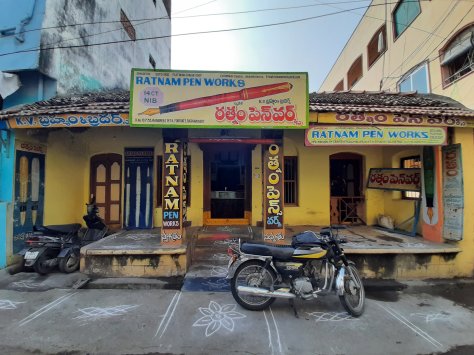
Rajahmundry is a big city in Andhra Pradesh. It is one of the largest exporters of textiles, rice and horticultural products in India. But ignoring all that, my need for exploring the congested bustling streets of the city was to find a fountain pen. With the help of Google maps, I walked through the narrow lanes of the busy shopping area to locate an old graceful house dating back to pre-independence era and surrounded by tall modern buildings. The house was an elegant traditional structure built and maintained in its original form with clay tiled roof and a large open central courtyard. That morning, I had come there to buy an art piece – ‘The Ratnam Pen’.
Ratnam Pens- Manufacturing and Sales Outlet
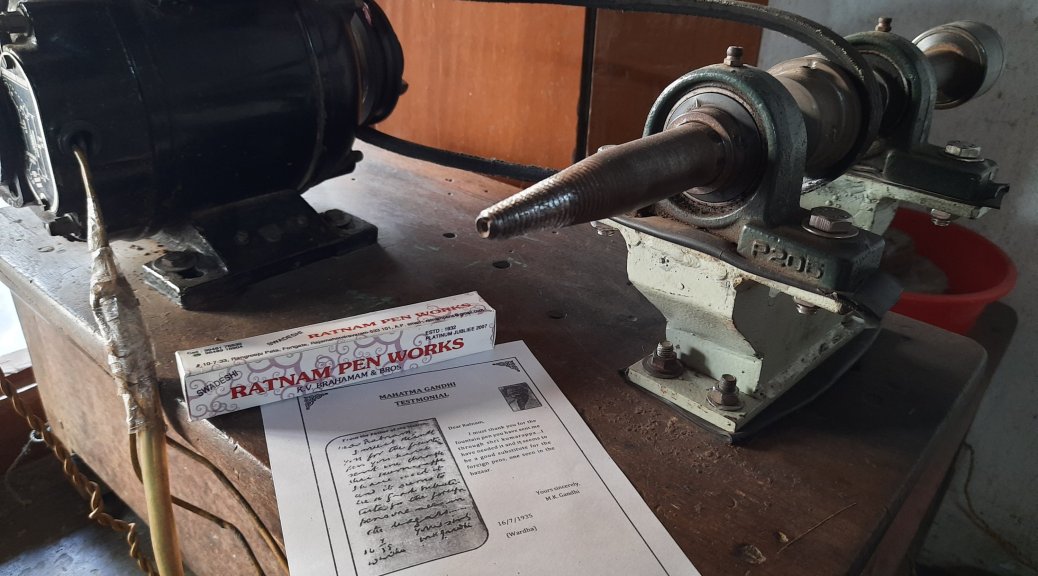
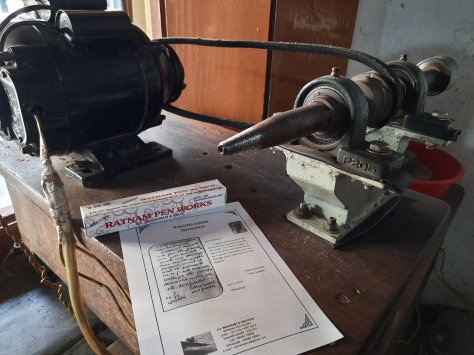
‘Ratnam pen works’ is a heritage fountain pen maker who has been one of the earliest in this business when Mahatma Gandhi largely promoted ‘Make in India’ concept through his ‘Swadeshi’ movement. These pens have been used by some of the famous personalities from across the country and the world. Ratnam pens are a delight for every pen collector. A framed paper on the wall is a prized possession of this craftsman. It is the original copy of a handwritten letter by Gandhiji to the owner of this place in appreciation of his contribution towards the swadeshi movement.
A copy of Gandhiji’s letter, a fountain pen case and the lathe machine at Ratnam pens workshop
Apart from being the shelter to the owner’s family, this house of ‘Ratnam pens’ is a workshop where the mightier pens take form. These famous fountain pens are made and sold only here to which people come down from across the globe. Although these pens are unavailable for online purchases, “Anyone interested to buy them or want spares and service for existing products can do so by calling me directly on my phone”, the owner says. I was more than excited to lay my hands on this new addition to my collection of pens. A happy me was then set on continuing my travel towards another noteworthy village nearby- Details on my next post
This is my humble attempt at promoting domestic tourism and local artisans. I urge my readers to support small businesses by buying locally produced substitutes for imported goods.
What is that one favourite souvenir you have bought from your travels? What are your memories from school? Please do share your thoughts on this post with me. I would love to hear them.
I have discussed with you all why I volunteered to become a ‘Trek leader on weekends’ and how much I enjoy doing it with ‘Plan the Unplanned’ (PTU). With Covid19 lockdowns and safety precautions that followed, break from my weekends with PTU has been longer than I had thought. Although I have been travelling with a closed group of friends and family since few months now, the fear of socializing with a bunch of unknown people had kept me away from PTU. Finally, this January, I decided to get out and lead a group of trekkers. The destination assigned for this weekend was Sultan Bathery in Wayanad district of Kerala. And the task was to find a hidden gem in the Aranamala hills. We were going to hike along a stream to see a waterfall.
Itinerary:
Day 0: Leave Bangalore by night Day 1: Day hike to Aranamala waterfall, Visit sunset-point and night camping at Ambukutti hills Day 2: Watch sunrise, visit Edakkal caves and explore Wayanad. Return to Bangalore by night.
The Aranmala waterfall trek
The Details:
It is a very hazy memory from the cold dark January morning of sitting inside our bus at the Wayanad wildlife sanctuary’s Sultan Bathery check post. We had arrived much before 06.00.a.m., when the forest gates would open for public entry. Since we were not allowed to make any noise or get out of the bus in the forest area, we all decided to get some sleep until the gates opened. At first, I was woken up by the cries of peacocks that seemed to be somewhere very near to the bus and some distant elephant trumpet. But then, the darkness around and the exhaustion from the previous workday got me back to fall asleep. I was woken up again in a while, by a sound that was very contrasting and disturbing as compared to what I had heard before falling asleep the last time. This time, the loud deafening sounds were of honking buses and trucks that had congregated at the check post. I opened my eyes to see the dawn of the day with a red sun rising over a mist laden green paddy field from my window. The fresh dung just outside the bus gave me a momentary fright at the thought of having had an elephant walk right past us, in the dark. All said and done, the entry formalities at the inter-state border was sorted and we were at a hotel in a bit. We freshened up, had a nice Kerala breakfast and got ready for the long day ahead.
The start of the hike, Thollayiram kandi in the backdrop
After arriving at Meppadi town, we met our local guide and shifted from our minibus to 4WD Jeeps. The initial stretch deceived me in thinking why a 4WD was needed to drive on a properly laid concrete road. Just then, the roads disappeared, and the real ride started… Although I was sitting in the rear end of the vehicle, I preferred not to sit on the seat and chose to hang on to the roof lest have all my joints and bones displaced. The long drive through the thick canopied forest trail culminated at the start point of our hike. We descended through the path that deviated from the main road towards a river. That’s the ‘Thollayiram Kandi’, our guide pointed out at a peak topped by the rolling clouds. “Kandi is a local unit of measurement”, he elaborated as we continued to walk. We walked through cardamom plantations and jumped over a few fallen tree trunks and creeping roots until we reached a stream.
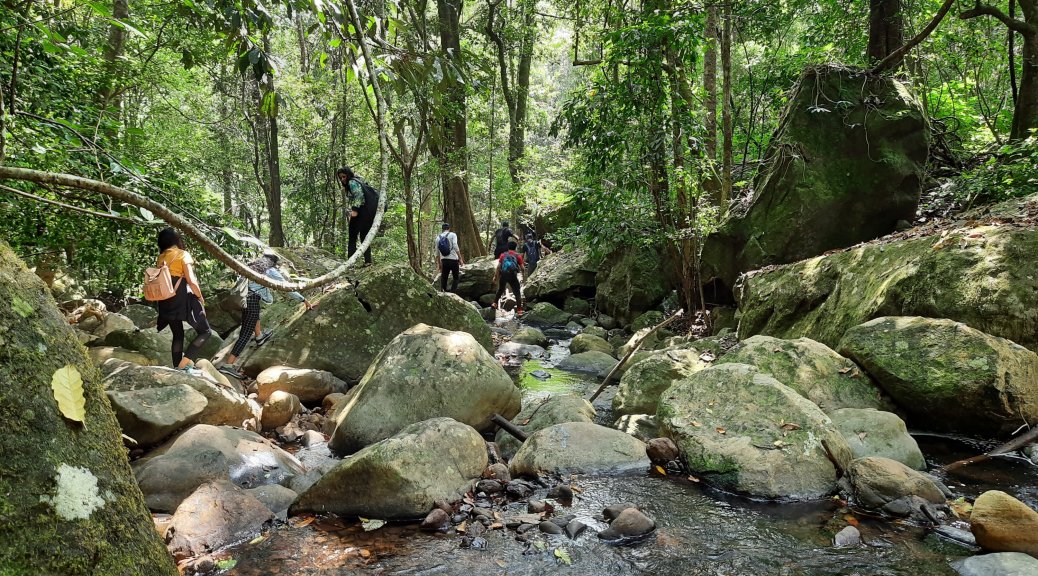
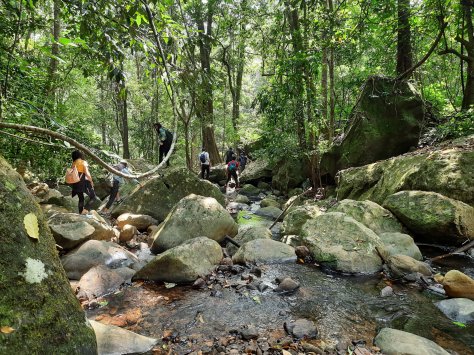
The stream and the hiking trail at Aranamala
From there onwards, the hike was mainly upstream. While enjoying the absolute music of the gurgling waters of the stream, the croaking frogs and the shrilling cicadas, we slipped down a few large rocks and fell into the shallow waters a couple of times. In spite of trying hard not to get our shoes wet, we ended up soaking them up and picking out occasional leeches from our feet. We realized that given our pace of hiking up, we would not be able to return on time with sufficient daylight. Hence from there onwards, our guide made his own path, through the thick forest. He walked ahead by cutting the thick bushes that came across, all by keeping the stream in sight. We did slip and tumble down the steep a couple of times though. But the hanging vines and lianas came to our rescue. And suddenly, our first view of the waterfall emerged. It was beautiful and the water pool looked crystal clear, tempting to step inside. Apart from our group, there was no one else.
The first waterfall enroute
As we got ready to step into the pool, “This is not the main waterfall. We need to walk further ahead”, said our guide. If this waterfall was so calm and beautiful, we wondered how the main waterfall would be like. We were excited! But our excitement sought energy 😛 We had to climb up the same rock, on one end of which the water plunged down. Quite a tricky climb but worth every inch of it! A short walk further from there waaaaasssss the hidden gem that we had come in search of. Now, don’t ask me the name of the waterfall, it is completely off the map and mobile network. So, there is NO way you will find it on google. To make it simple, you can call it the Aranamala waterfall, the waterfall in the Aranamala hills.
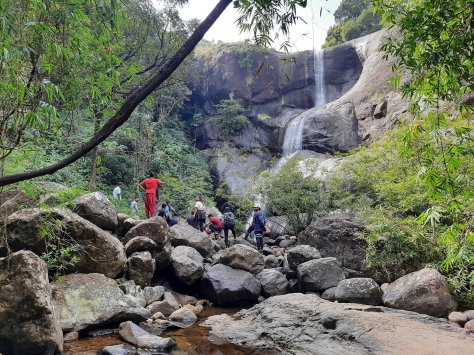
The Aranamala waterfalls
That’s all folks, we’re off into the pool to enjoy our dip! But hey, it was not so easy…. The water was bloody cold, and I had cramps in my feet for the first few minutes. I meanwhile enjoyed my free fish-pedicure too, it sort of eased the cramps for me. And then with a dip, I was all set! A waterfall so secluded, a pool so clear and a feeling so divine, I couldn’t have asked for any better to make up for all the travels missed in nearly a year now. After spending some good time under the waterfall and with our soaking wet clothes on, we decided to return. It was already 03.30.p.m and hence decided to take an easy path instead of walking back through the same terrain of forest and the rocks. So, we were taken through a shorter but a beautiful path through cardamom plantation for our descent.
After a nice filling lunch at a campsite enroute, we boarded the jeeps back towards Meppadi. The original itinerary did include a short sunset ride, but the clouds didn’t seem to part for the entire day. From Meppadi, we reached the base of Ambukutti hills for the night. It took us yet another jeep ride to a homestay where we had our chai and conversations. And a fun time around the bonfire until dinner was served.
Post dinner, we carried our tents and sleeping bags up the hill and managed to pitch them atop. The winds were strong, and the rocky ground was tough. With the thick mist blinding all around and the instructions from our guide to not venture away from the tents, all that we could envisage was a deep valley below. The bonus of holding up in the cold until morning, u ask? ‘The view from the tent, of the sun rising above the clouds at 06.00a.m.’ But come morning, we had a surprise awaiting. There was so many clouds until 09.00.a.m that we got a glimpse of the sun for barely a few seconds. We walked up the hill a little further from our campsite, took in some clean air and good views of the range around. We then returned to pack our tents and freshen up for the day. Our breakfast and our ride back to Meppadi was awaiting us at the homestay.
Ambukutti hills as seen from our campsite
That was my story about offbeat Wayanad with ‘Plan the Unplanned’, of leading a group of weekenders and enjoying my weekend, both at the same time.
Other Travel recommendations:
Edakkal caves are located at a walkable distance from the campsite at Ambukutti hills
You can visit Tirunelli temple and Irupu waterfalls by driving through Wayanad Wildlife Sanctuary (Tholpetta) and Nagarhole National park.
Alternately, you can explore Sultan Bathery, visit the ancient Jain temple and Banasura sagar dam that offers a good view of the surrounding hills.













 The Lost Lander