As the lockdown is easing out and the Covid positive cases in India are on a rise, many people are opting DIY (Do it Yourself) day trips and hikes over organized group trips. Either with just family members or a closed knit of friends is what seems to be an option for some time more to come. Quite a few of them have been asking me to give them suggestions of where they can go for short drives or hikes. One such suggestion is ‘Kunti Betta’. Although I had done this hike with an organized itinerary by ‘Plan the Unplanned’, one can try this by themselves. However, a hike in daylight is suggested over our pre-dawn adventure.
We started from Bangalore at midnight as we wanted to reach the peak before sunrise. It was still dark, cold and windy when our minibus reached the parking lot of ‘Sri Shankarananda Bharati Vidyapeeth’ school at Kachenahalli village in Mandya district. We climbed a small flight of stairs, walked past a temple pond (we couldn’t see but only were told by our guide) and continued to walk in a single line following each other’s torchlights. While a couple of them tripped over small stones on their path, a few others got their shoes wet by stepping into water puddles in the dark. With torchlight, our guide navigated the path through thick shrubs, tall grasses and large boulders enroute. We reached the peak in a couple of hours.
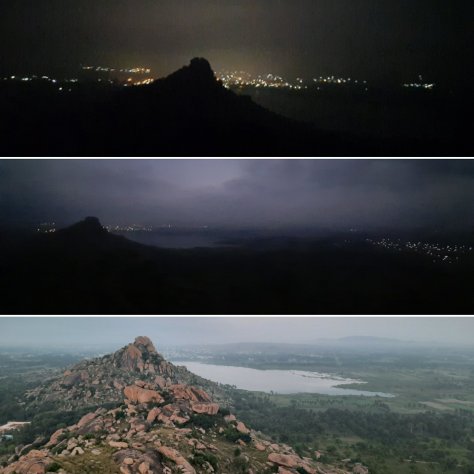
The view from the Kunti Betta peak: Before dawn, at dawn break and after sunrise
It was dark when we reached the top and it was unexpectedly cold. I hadn’t gone with enough warmers but that didn’t stop me from sleeping on the cold rock until dawn. I watched the stars in the clear sky and didn’t realise that I had surrendered to the sleep gods. I was awakened by a fellow hiker at dawn. The view of the distant lake and sugarcane farms looked nice from the top. Also, several other rocky hillocks dotted our view. The one we were standing at was named after Kunti, the mother of the Pandavas. History has it that the hill was earlier called as the ‘French Rocks’, named by the French army in the pre-independence era. Although it was partially cloudy by the time the dawn broke, we still got lucky to get a glimpse of the sun that morning. After taking enough photos, we started our descent.
The Kunti Betta hike route
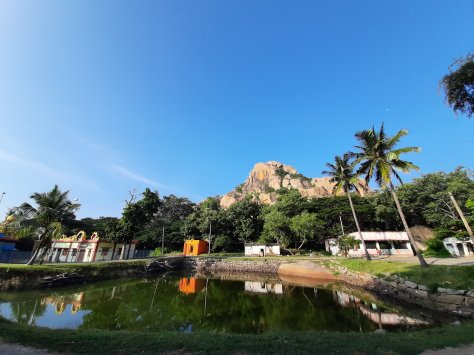
Since there are lot of loose rocks, there were possibilities of slip. Only during descent, we got a sense of the terrain and the view which we had missed while climbing up. We soon reached the temple pond at the base beside which there is a large monolithic rock. The localites use this as a giant slide. I too climbed up this rock and the kid in me had fun sliding down from this version of the desi slide.
The temple pond at the base of Kunti betta
Our stomachs were grumbling by that time and there was no food around. With permission, we could use the washroom at the school. We then commenced our return to Bangalore with a breakfast stop at ‘Maddur Tiffanys’ for their signature dish- Maddur vadas with Masala dosa and filter coffee. The landscape was beautiful with green sugarcane farms extending on both sides of the countryside roads before we hit the highway.
A word of advice though:
Since there are too many hillocks in a cluster, having a guide would be better to find the right peak.
Since we hiked before dawn, there was also the fear of confronting wild animals like bears and leopards. Although, we didn’t see any, this was told by someone in the group.
Although we did only the early morning hike, you can make it a full day activity. These are a few things you can include in your itinerary:
Since Mandya is the ‘Sugar Bowl’ of Karnataka, you can visit any of the small sugar/jaggery making setups on the farms enroute and savor freshly made jaggery.
A lot of people visit the Tonnur lake (about 10kms away) from Kunti Betta and take a dip there. Alternatively, you can visit Manchinabele dam or Kanva reservoir. We skipped it as we were told that the soil on the banks was marshy at the time we visited.
You can visit Ranganathittu Birds sanctuary and take a ferry ride in the river.
You can also visit ‘Janapada Loka’ to get an overview of the folk-culture from across Karnataka.
Lockdown 5.0. simply put, was just another normal day in Karnataka, except that the educational institutions were still under lockdown. So, unwinding on a weekend after a long work week was normal too. With friends, I chose to hike on a Sunday morning to Madhugiri betta, the second highest monolithic hill in Asia. We started from Bangalore at 04.30.am. hoping to start the hike as soon as the gates were opened. While KSTDC has been abundantly promoting post-Covid tourism in the state, we had a surprise awaiting us at the trek base. Since Madhugiri fort comes under ASI’s protected monuments (controlled by the central government), we were told that trekking wasn’t permitted by the Central government. Hence, we were left with two options. Either return home or find another hill nearby where we could hike.
We chose the latter. So instant suggestions that came from someone in the group was Devarayanadurga and Siddarabetta. Then, we decided to give Devarayanadurga a miss as we all favoured a hike over a flight of stairs. We arrived at the base of Siddarabetta where we noticed a board that said, ‘climbing the hill with footwear was a sin’. Since many people use this path to visit a temple situated halfway, we didn’t want to hurt the local sentiments by wearing our shoes. Thinking that ‘a barefoot hike was definitely going to be an experience’ in our heads, we left our shoes back in our car.
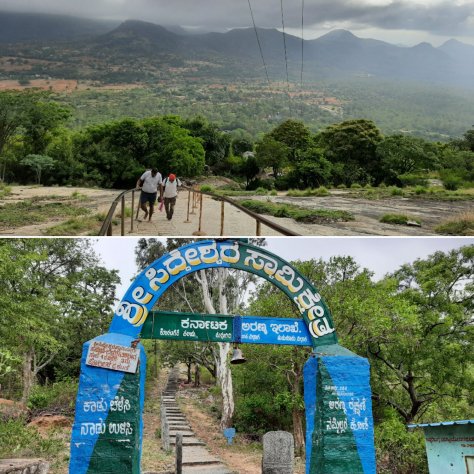
Below: The welcome arch at the base; Top: The initial climb
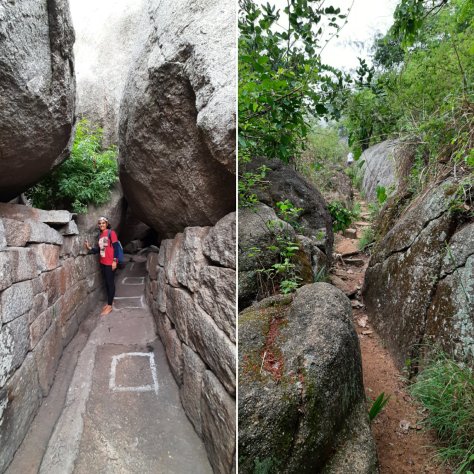
The initial part of the climb, until the Siddeshwara Swamy temple was steep but easy with well laid out steps and iron rods to hold onto. When we reached a small temple kind of a spot, the path split into two. The Siddeshwara Swamy temple was to the left, where too many people seemed to be as if there was no pandemic going on and there exists no concept called ‘Social distancing’. We decided to distance ourselves from the gathering and took the path to the right. With having to pass between too many boulders, it did seem a little confusing initially. The distant passing clouds now seemed as if they had come to meet and greet us. But after walking a little ahead, we reached an area that was a transition from dry rocky mountain to rain soaked green forests. The real challenge of walking barefoot started there, with unassumed ground with gravel and possible thorns from the shrubs.
Left: The rocky path to the temple; Right: The forest path to the view point
A little further, we reached an open rocky area where the view in front of us was playing hide and seek with each passing cloud. Apart from the drizzle and gusty winds that made it difficult for us to stand, we were mind-blown by the view we saw each time the clouds cleared out. There exists a small rain fed pond, a couple of meditating chambers that house Shiva Lingas (history unknown) and dilapidated remains of an old fortress. There was nobody else other than us in this entire stretch. We walked further and crossed two more hills before deciding to return, or else we would lose our way back.
Top: The dilapidated fortress wall; Bottom left: A large rock; Bottom right: One of the meditating chambers
It started to rain on our return, and we were quite drenched by the time we made it to the car that was parked just at the base point. The small eateries and stalls were slowly opening by that time which we chose not to visit, in order to avoid any social contacts with anyone else outside the group that we had gone in. We ate a few biscuits as a substitute for breakfast that we had carried from home and decided to stop the car next, only at home. It was a much-needed break and a pleasant little hike.
The view at from the peak
Summary:
It is an easy hike and very good for beginners.
Be careful to carry all snacks only in a closed backpack as there are too many monkeys on the way.
It has been nearly 3 months of staying at home due to the nationwide lockdown and the fear of the pandemic. With India’s unlock 1.0 in place, our family of four decided to take a short drive outside to breathe some new air. We planned to head to ‘Mango Mandi’ at a village called Somanahalli, off Kanakapura road for this weekend. As we reached there, we learnt from the locals that the government run fruit trading market has been shifted elsewhere for social distancing purposes. However, buying mangoes was just a reason for us to go out and the idea was to go “somewhere” outside home.
This reminds me of some old travel tales of my family. On weekends, my parents used to take us to Majestic bus stand from where we would board a random bus to a destination, that we had unheard of. Back then, BMTC buses plied with boards called red-board and black-board. Red-board for villages outside the city limits and Black-board for those very much within the city. We would sit in just any Red-board bus and buy a ticket to “the last stop”. Most people (Villagers travelling to and from the city) on these routes used to be familiar with the drivers and conductors. Hence, on issuing the ticket to the last stop to us, the conductor would enquire “Whose house we were visiting or where we wanted to go in the last stop”. We used to then get into a conversation with them and get details about the village we would reach at the end of our journey. We would then walk around these villages, appreciating the lung space, learning about new crops, new traditions in the countryside etc. We had thus explored “Remote” villages like Kumbalagodu (coffee plantations), Begur (the oldest Kannada inscription), Hesaraghatta (horticulture & animal husbandry farms), Gollahalli (so many varieties of Gollahallis in different directions of Bengaluru), Harohalli (so many varieties of Harohallis in different directions of Bengaluru), Haniyur (Madure Shani mahatma temple), Devanahalli (Tippu’s fort) etc. Come today, Bengaluru has grown to ‘Bruhat Bengaluru’. People would laugh at you if you called some of these places remote. Why that… even the house where we live now had once been our destination on one such Red-board bus journeys!
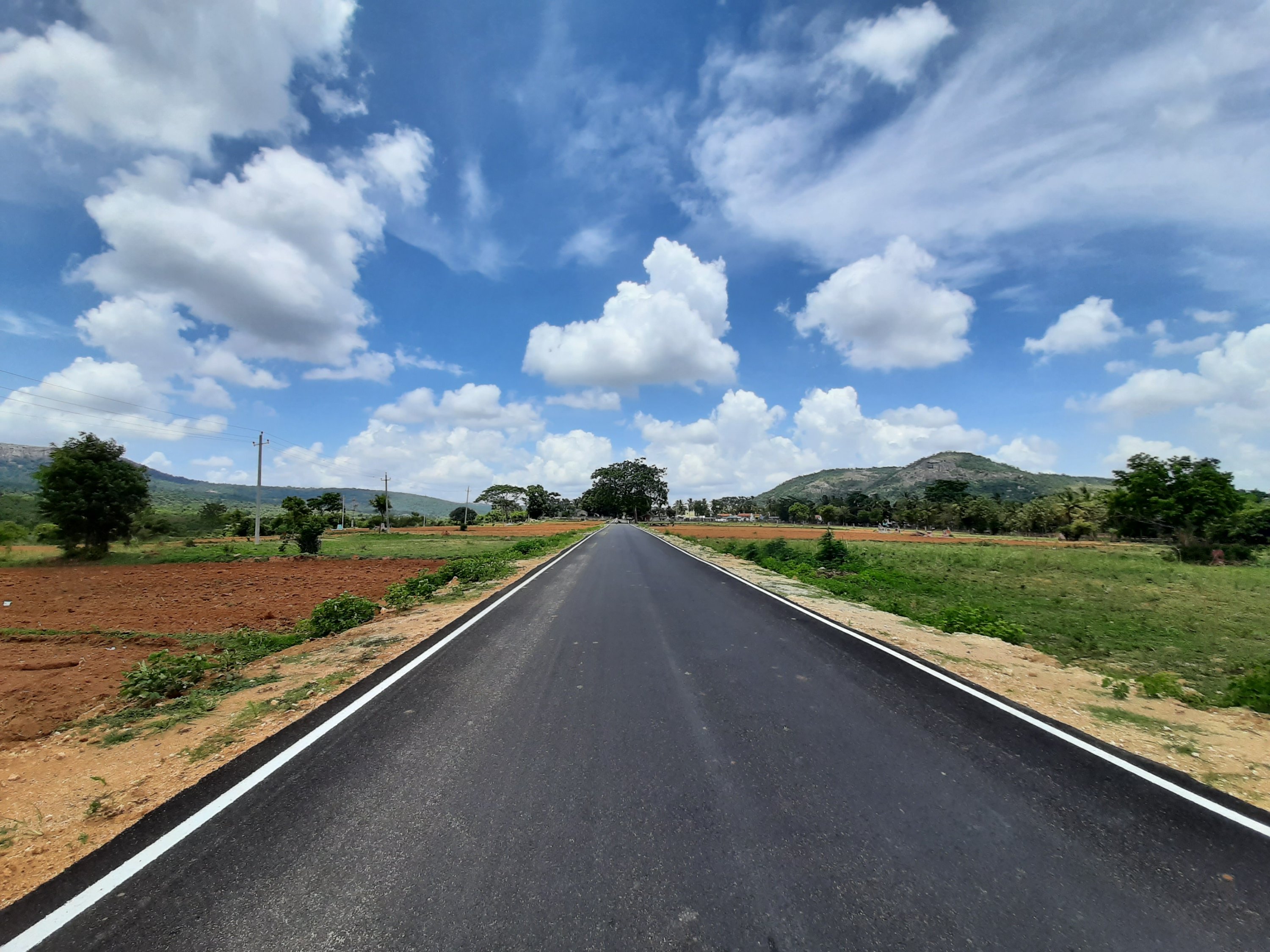
The road between Mukkodlu to Gullahatti kavalu
Back to this weekend of Unlock 1.0, we decided to continue on the road that we were driving until we reached the dead end. And that’s how we reached a village called ‘Mukkodlu’. The name of the village came as a surprise as there exists another village of the same name, back in my native district. The red soil of the farmland was being ploughed all along our route and readied for sowing Ragi millet during the monsoon. The clouds looked amazing with newly laid asphalt road. The green hills complimented the scene well, with ‘Munikallu betta’ to the right and ‘Ragi halli betta’ on the distant left. A little further from there exists the Muninagara reservoir. We thought we would stop by this place on our return.
The reservoir and beyond comes under the supervision of the forest department, a sub-division of the Bannerghatta National park. We proceeded further to know where the milestone indicated ‘1km’ – Gullahatti Kavalu. That also happened to be a ‘Dead end’ on Google maps, from where we would return. Also, the idea of our drive was to not meet any villagers or eat at any petty shops which we normally did on such trips. When we reached our destination, the end of the village was marked by a peepal tree and a government school. The ‘Arali katte’ are arenas buzzing with life and a hub of activities on a usual day in the Indian villages. This one here, was staring at us with all villagers confining themselves to their homes for social distancing. We sat there for some time, soaking in the fresh air on the fringes of Bannerghatta National park before returning.
The dead end point at Gullahatti kavalu
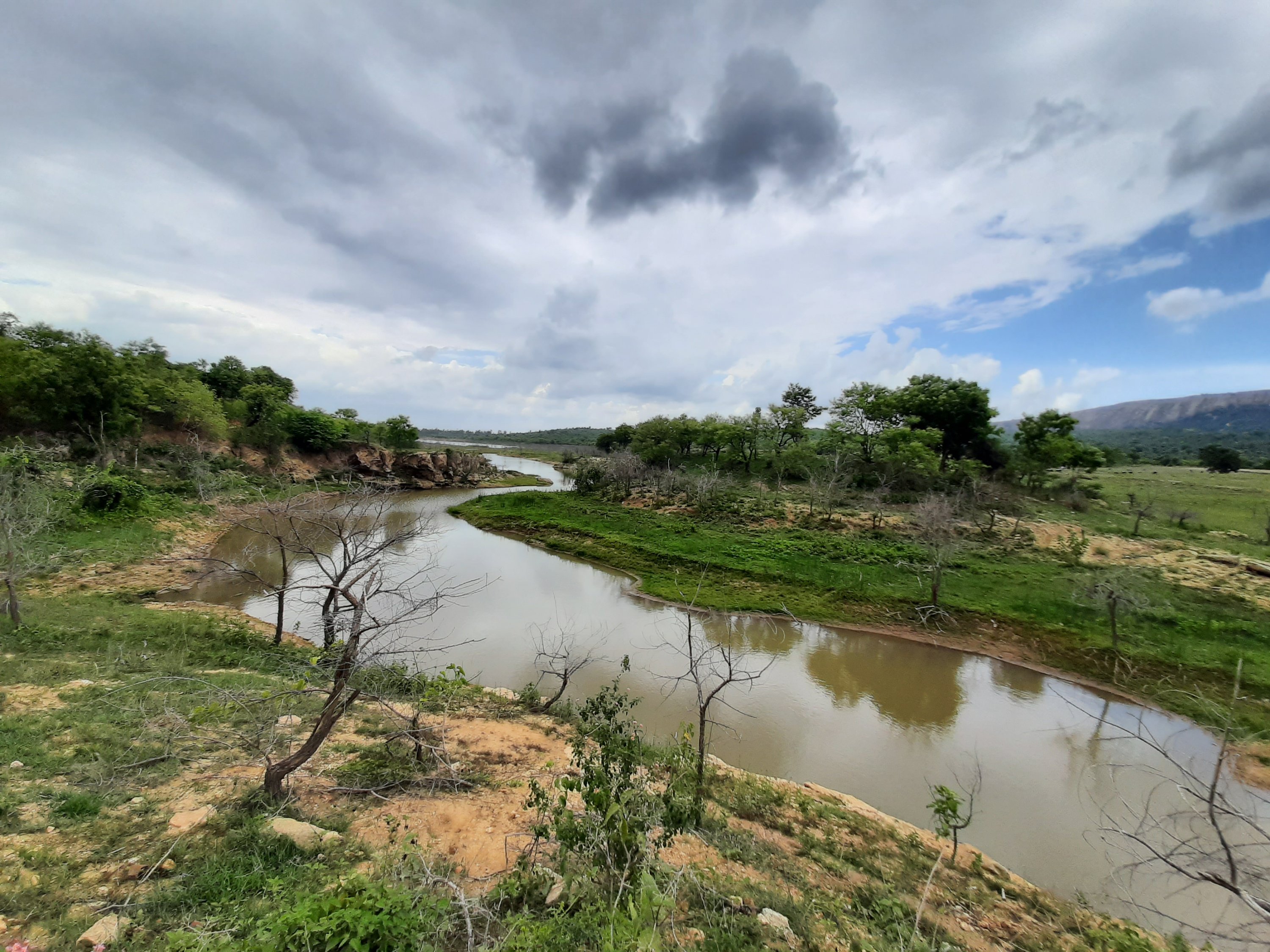
On our way back, we decided to stop at the sight of the reservoir. My itchy feet wanted to hike a bit and I dragged my folks along with me for a few meters away from the road. It was indeed a good decision. Considering we were in the fag end of summer, the reservoir still held a good amount of water. A localite who had come there to graze his cattle told us that wild animals like elephants, leopards, deer, peacocks, wild boars, porcupines etc. are spotted here in the mornings and on most other occasions. At the first sight, it seemed to me like the Kabini backwaters. Kabini is like a summer resort for all wild animals. When all water bodies within the forest run dry, this spot holds enough water and all animals come here to chill in the summers. The fact and the view of Muninagara reservoir too gave me a similar feeling. We sat there for some time until the rain gods showered blessings on us.
The Muninagara reservoir with Ragihalli hill in the backdrop
Thus, a day in India unlock 1.0 was well spent.
Note: For the adventurous ones, there exists a trekking trail called ‘Muni nagara trails’ on google maps starting from the reservoir to the Ragihalli betta. But ensure that you have all permits in place before venturing on a trek here. As afore mentioned, this area belongs to the Karnataka forest department.
I know the entire world is going through a deep crisis with the outburst of the CoViD-19. But that does not mean that the world is going to end, right? Anxiety can hit anyone, any time… that too when someone is locked up inside the house for so many days and weeks. While ‘How many days more?’ has a very uncertain answer, until may be a proven vaccine or cure is invented, nobody is certain- is all one can say. It is human to get hit by anxiety about what’s going to happen next. But let us see the positive side: nearly 50% are recovering. Let’s not panic and do self-care by staying indoors.
I’m someone who has always found company amid nature. Any problem, I believe ‘NATURE HEALS’. For all the abuse and exploitation that man has done to the planet, it is wonderful to see how nature is healing herself (Click here to see the video). That’s said, I am a “Cliched” travel freak who grows restless when I stay confined to a place for over a few hours. I’m sure I’m not alone in battling anxiety. The whole idea is to keep myself away from social media, from where I’m getting all forwards causing more anxiety. Here are a few things that I’m doing to keep myself calm as I continue to stay indoors.
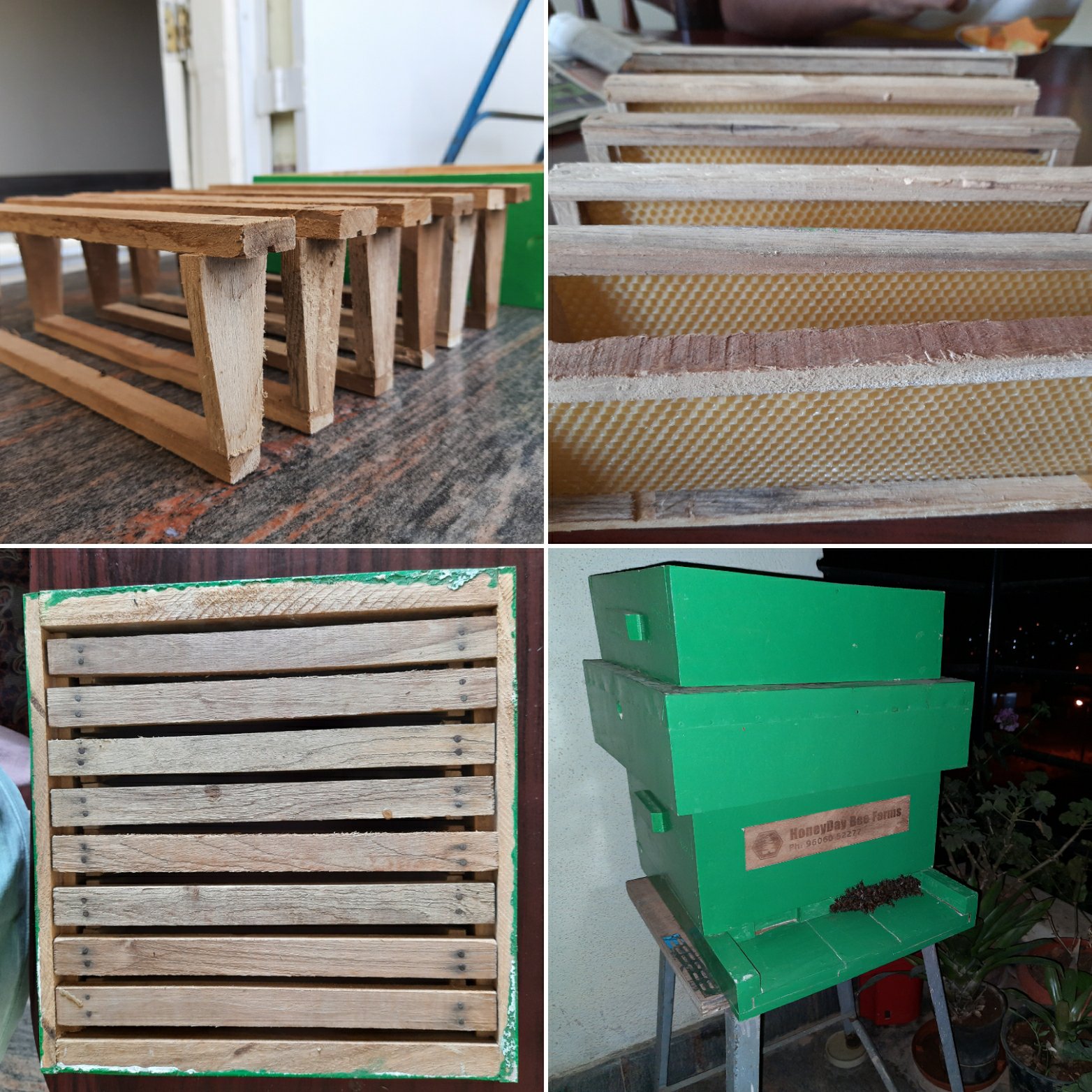
The honey bee-box in my balcony
5. Watch the honeybees toil in my balcony: I have set-up a box for them in my balcony and It is therapeutic to watch them work. It is spring season now and no better way to spend a day than sit and watch nature in her calmest ever. The only noise I can hear is the chirping of the birds and the buzzing of my honeybees.
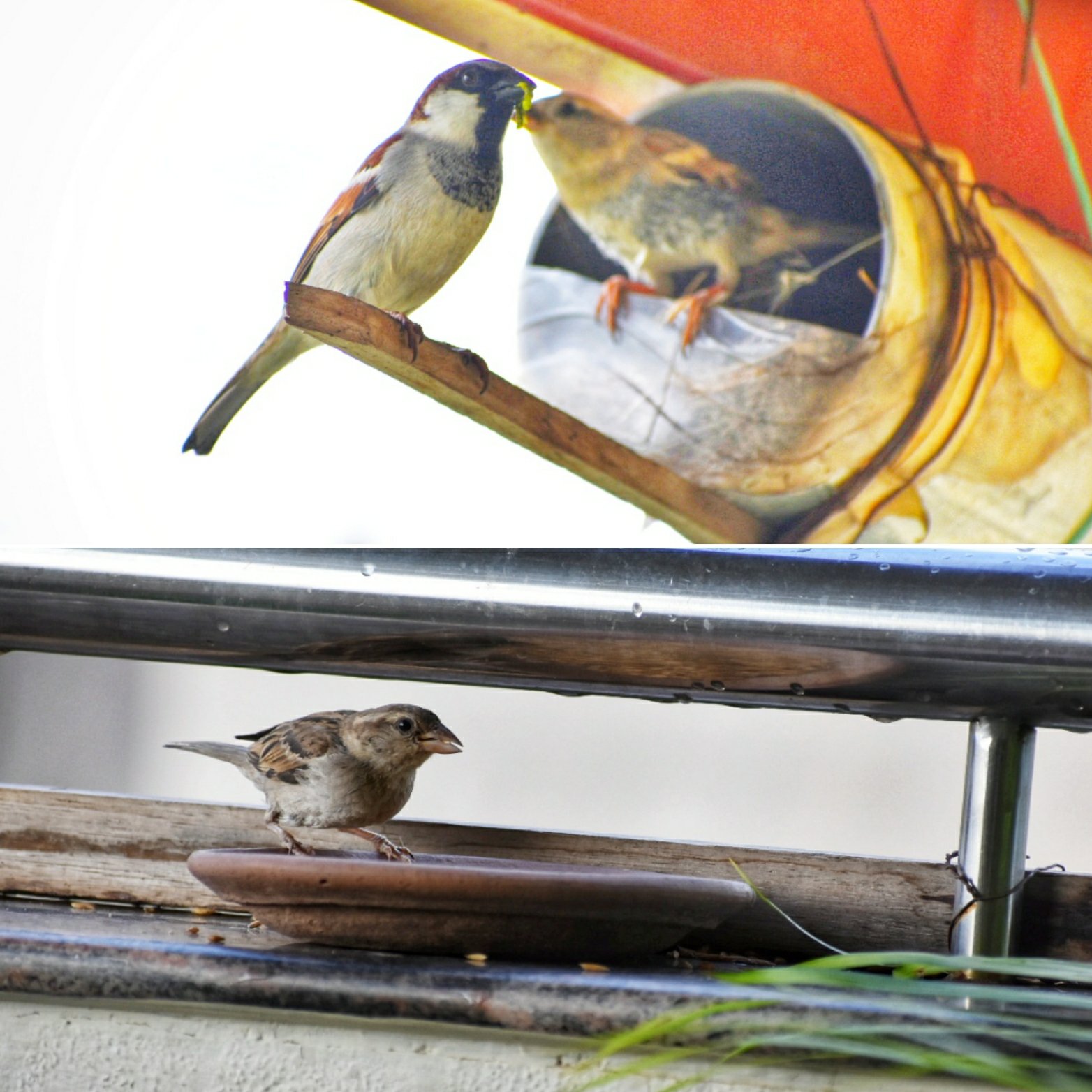
4. Watch the birds flock to the feed and water bowls: The temperature outside has started to rise slowly. As we continue to stay indoors, the birds and squirrels have started to come outside. They will now start frequenting your balconies, only if you’re kind enough to give them a place to sit and take a dip in a water bowl. You will soon become good friends and begin to enjoy each other’s company. I have a good number of sparrows, red-whiskered bulbuls and squirrels occupying spaces in my balcony.
The sparrows in my portico
3. Learn birding: As I continue to sit in my balcony and watch the flowers bloom outside, I have started to realize that I live in a place that is no less than a bird sanctuary. At least 40 varieties of birds have been spotted from here and I’m continuing to learn their names, habitat, bird calls and behavioral patterns. Some of them have been photographed and the photo-story is made (Click here to view the photo story)
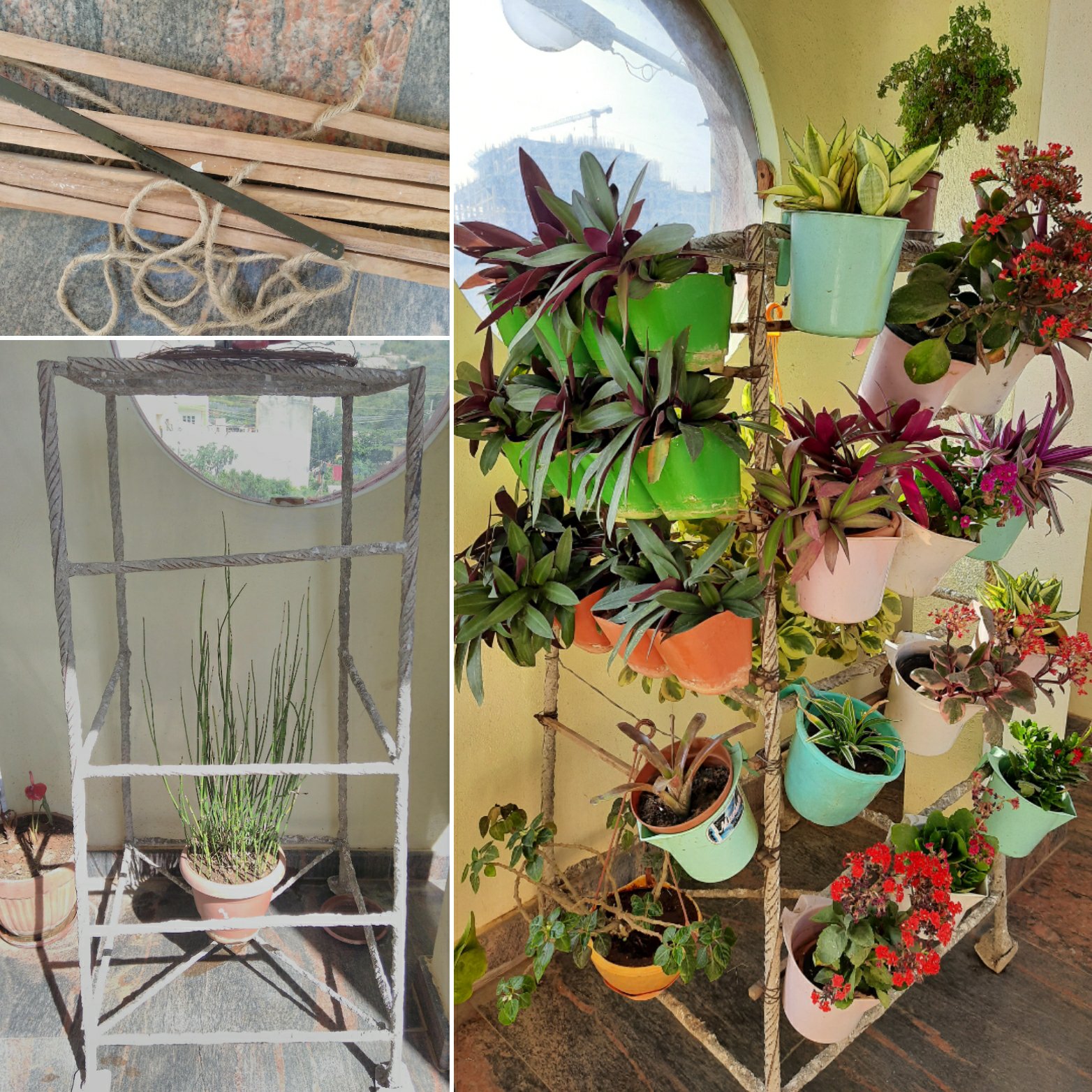
2. Do up a vertical kitchen garden: While going out should be reduced to as minimum as possible, we can grow our own greengroceries in our balconies. I have converted an old ladder / stand, hung old mugs and tied used plastic cups where I’m growing green-groceries and small flowering plants. Some wet waste from the kitchen too is going into these DIY pots for decomposing. Mustard, tomatoes, brinjal, kothimir, beans etc. are some of the seeds you can easily find in your kitchen without having to worry about buying the seeds separately.My DIY vertical garden
1. Re-kindle a dead hobby: Found stacks of water paint that’s been shelved since school days 😛 most of them have dried up in the bottles. I’m finding new ways to make them useful and kill-my time by doing abstract paintings using abstract techniques. Running out of poster colors? Try organic colors. vermillion, turmeric, indigo, leaf extracts… Don’t’ you think its time to explore something new?
Tell me how are you helping yourself to beat anxiety?
How are you killing boredom at home? Share your ideas…
You have probably read my earlier post on exploring the offbeat landmarks of Old Bengaluru. Here is another one. This time, it was a culinary trip of Old Bengaluru to a friend who had flown down to this southern metropolis, from the so-called Northern part of India. I had been asked to take him on a gastronomic tour of my city. For someone who has a penchant for everything old school, I thought Old Bengaluru would be perfect to call it a day. ‘From vintage automobiles, architecture, iconic restaurants serving traditional recipes to by lanes and alleys that narrate their own individual story of the city, this section of Bengaluru has everything that would tickle a bone or two of this mad man’, I thought.
Having largely spent my teenage in North Bengaluru and given my familiarity with the area, Malleswaram was my first choice. However, given the convenience of commutation from my current place of stay, I chose to show him around South Bengaluru. But when one says South Bengaluru, it is a world in itself and the geographical area is large to fit all in one day. Hence, I took time to mark a quick map of restaurants to cover, along with giving a peak into the cultural heart of the city. This part of the metro lays in stark contrast to the Bengaluru, that the millennials from Whitefield and Marathahalli know of.
The obvious choice was a walk tour of Basavanagudi and the Pete area. These are the two most important clusters of true Bengaluru that have held onto the roots, despite the rapid and traumatic transition this city has seen in the last decade in the name of urbanization and modernization. Under the canopy of massive native trees, the aroma of the by-two filter kaapis shared at the numerous Shanti Sagar and darshini food joints, the air here feels different from anywhere else. With almost every street dotted with Classical dance and music schools and happy nonagenarian couples whizzing in their Padminis and Ambassadors, it has a different vibe here. One can find some of the traditional old houses and landmark restaurants only in these localities to really experience old Bengaluru. Each of these iconic eateries have a near century old history and their old school ambience is still intact inside the heritage structures that house them. With a small appetite for food and a big quest for exploration, the portions of food were limited only to the signature dishes of each restaurant, to accommodate more places. So, here is my itinerary of a gastronomic tour of Bangalore of yore.
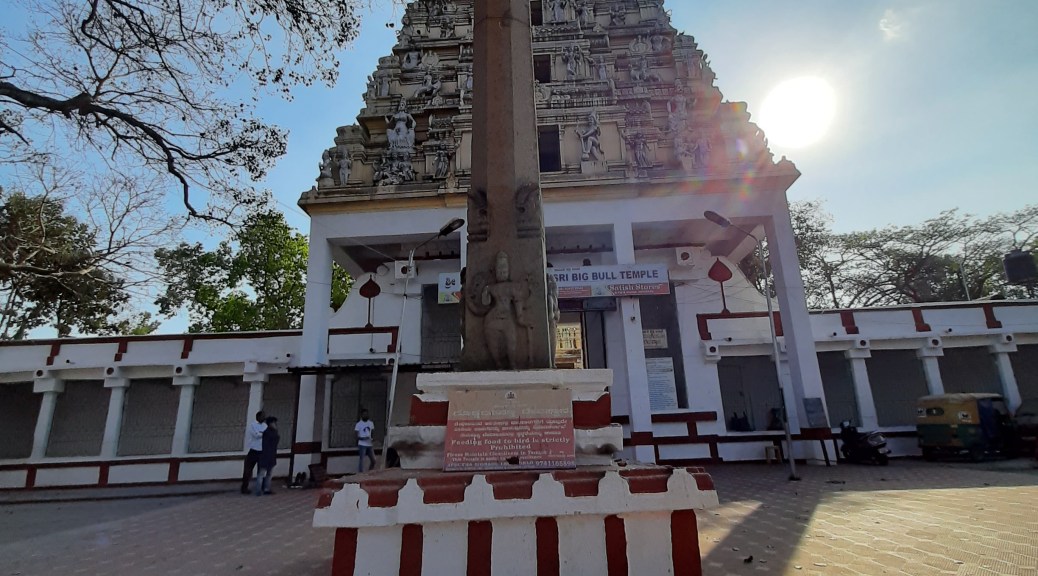
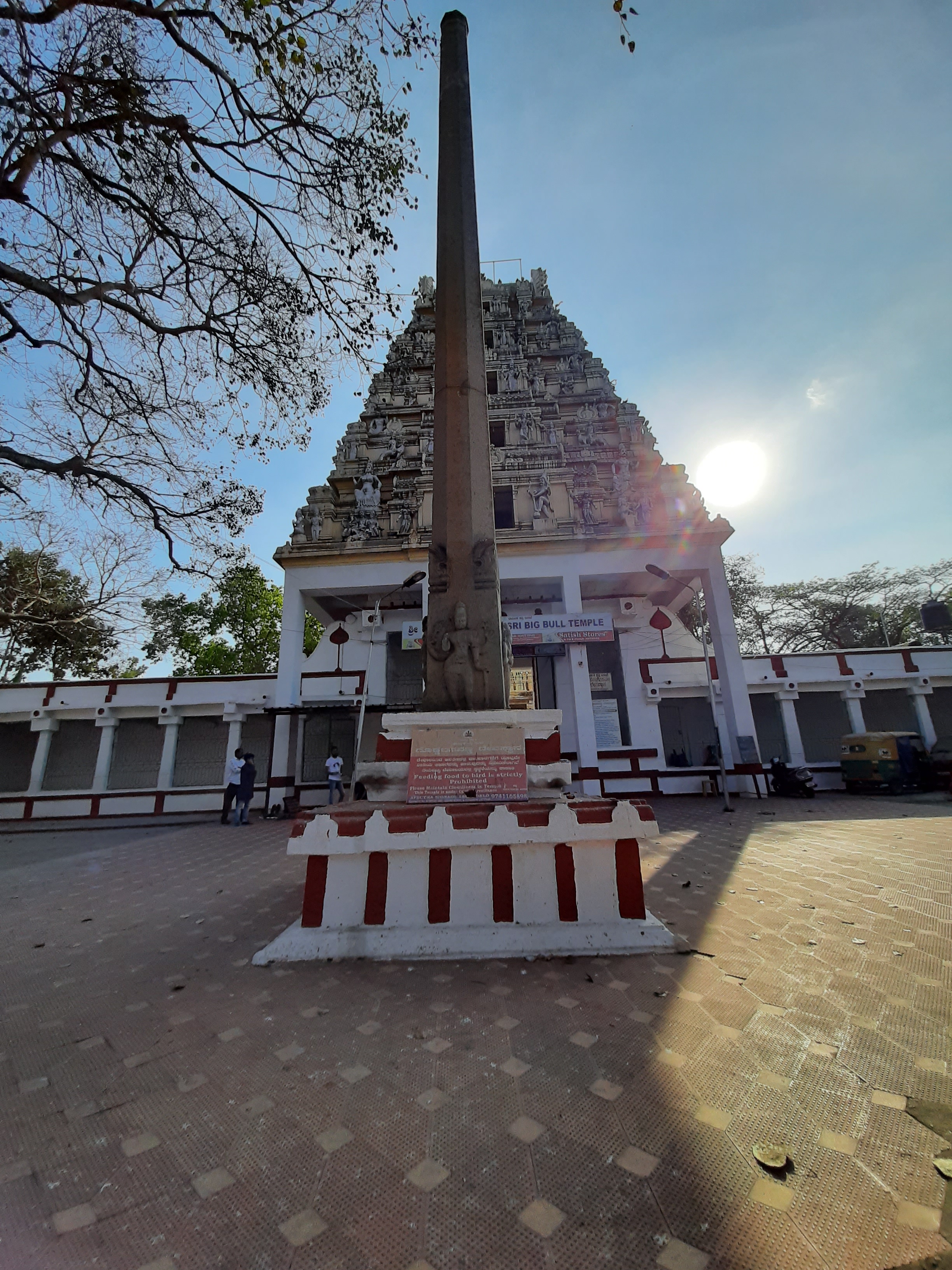
The Big bull temple, Basavanagudi
Meet-up point: Basavanagudi is the name of a temple (It translates to ‘Bull- Temple’). Basavanagudi is the name of a locality in South Bangalore, named after the temple. It is an extension of the Pete area, which was specifically created to accommodate the upper class, and more-specifically the Brahmin community. No trip to South Bengaluru is complete without a visit to this landmark temple built by Kempegowda, the founder of Bengaluru. Apart from the Big Bull temple, the Dodda Ganapathi and the Bugle rock (a small watch tower from the Kempegowda era) are a must visit on the same premises. If you time it up well, you can part-take in the annual groundnut fair in the locality. (Read here to know more about the history of the Kadlekai Parishe). After meeting my friend here, we started our gastronomic tour to our first food stop.
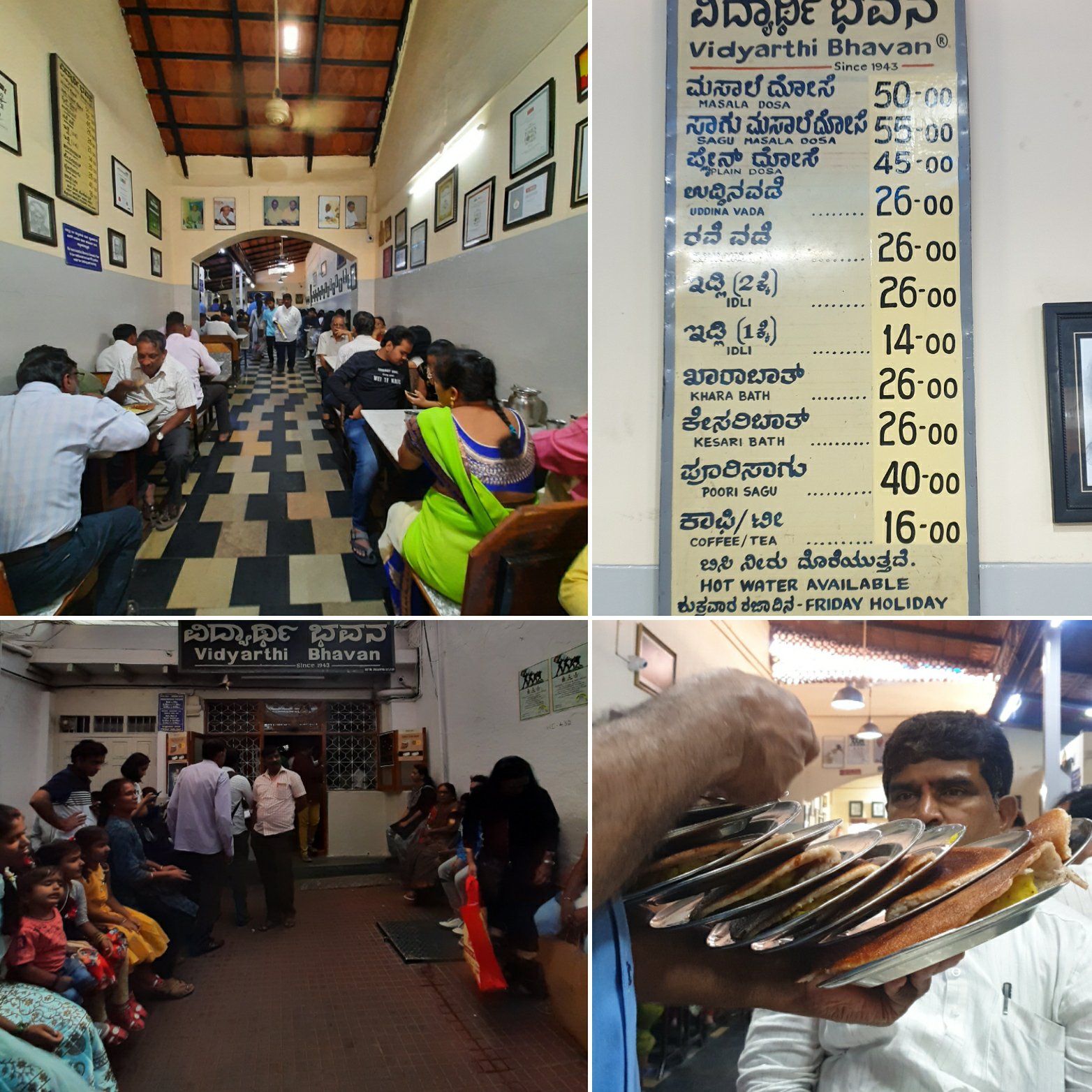
Food stop 1 (Breakfast): As synonymous as Dosa is with South India, Vidyarthi Bhavan is with South Bengaluru. Ask anyone for the best Dosa in the city and this place scores on top unanimously. It is a restaurant started initially to cater to the student community of the area which started a new culture of a hangout place for friends in those days. On most days, the queue can extend well up to a kilometer. My friend and I wiped off our plates of their signature Masala dosa for breakfast. (Click here to read further about the history of Vidyarthi Bhavan)
Vidyarthi bhavan, Basavanagudi
Food stop 2 (Light eats): No foodie who visits Bangalore is satisfied without taking an evening walk on the Eat street at VV-Puram. However, I decided to go here in the morning, in order to avoid the maddening rush. Honey cake and Congress bun at the iconic VB Bakery was what we needed. This is the first Iyengar bakery to be established in Karnataka which has paved a new culture in baking (Read here for more about V.B.Bakery). Avarebele (Val bean) is a favorite ingredient of the Bengalureans, who have a dedicated annual fair to celebrate this pulse (Click here to read further about Avarekai mela). Hence, picking up a packet of avarebele mixture for home from one of the stores there was an obvious choice.
Food stop 3 (11 o clock, coffee): It is an important break time for the employed section of the society. Brahmin’s Coffee bar is a household name for their filter coffee and the delectable chutney served with idly on their very limited menu. This tiny eatery is in a corner of Shankarapuram, which is also famed for the Shankaramatha, a learning center of the advaitha philosophy. We had a quick stopover for a hot cuppa this little place is known for, before heading to Pete. (Read further about Brahmin’s coffee bar here)
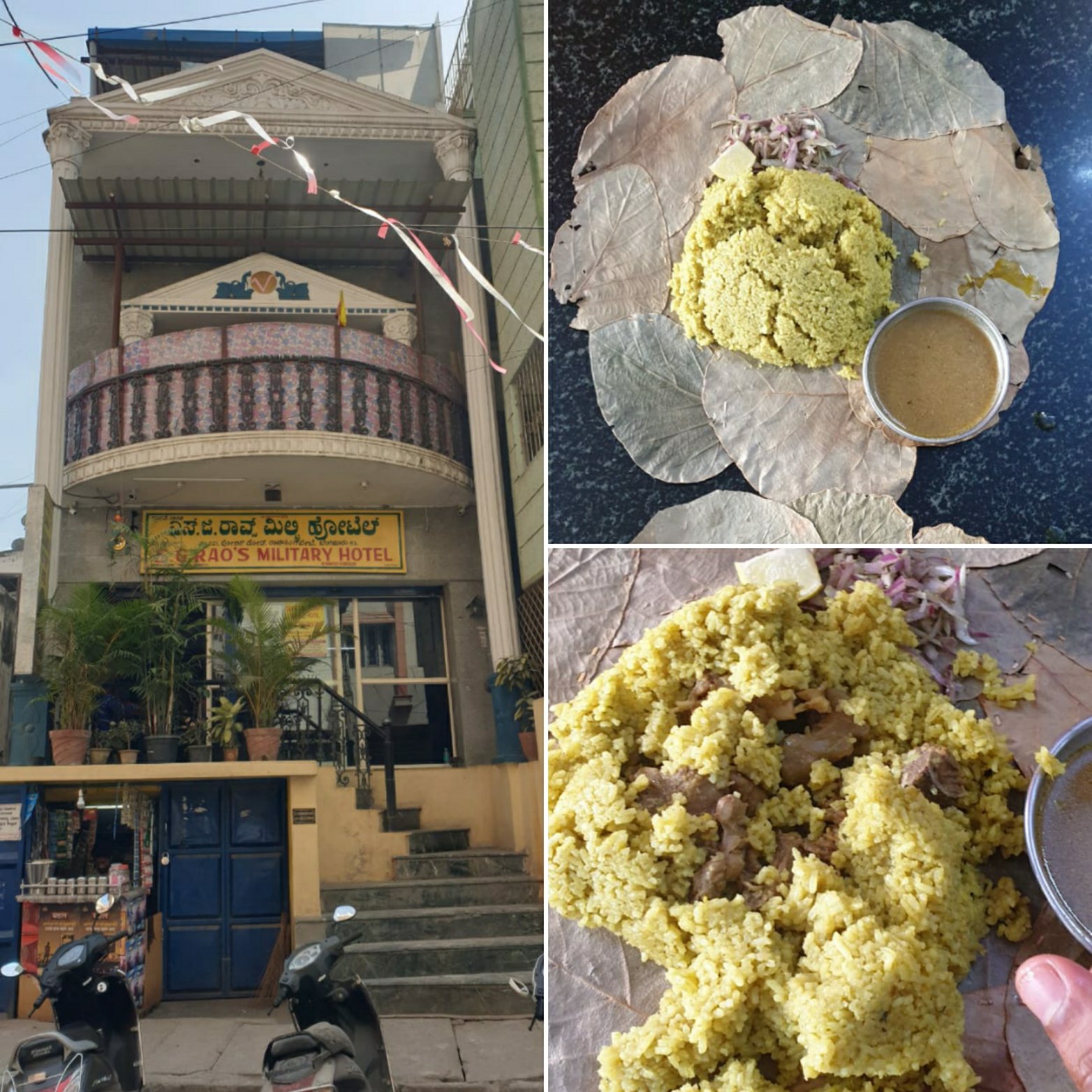
Food stop 4 (Lunch): To satiate the hunger pangs, I planned to treat my friend with an authentic Bangalorean affair. With multiple theories surrounding the origin of the military hotel culture, the history of these restaurants dotting across the southern part of Karnataka is unclear. Bangalore is home to some of the best in the state. I don’t think there would be any better meal than ‘Ragi Mudde oota’ savored at a military hotel to get a peek into the local flavor, including the ambience. Hence, we were lunching that afternoon at S.G. Rao’s military hotel, located in the cotton Pete area. A typical military hotel meal includes Kaal soup, Ragi Mudde and Mutton biriyani. (Click here to read further about S.G. Rao’s military hotel)
S.G.Rao’s military hotel, cottonpete
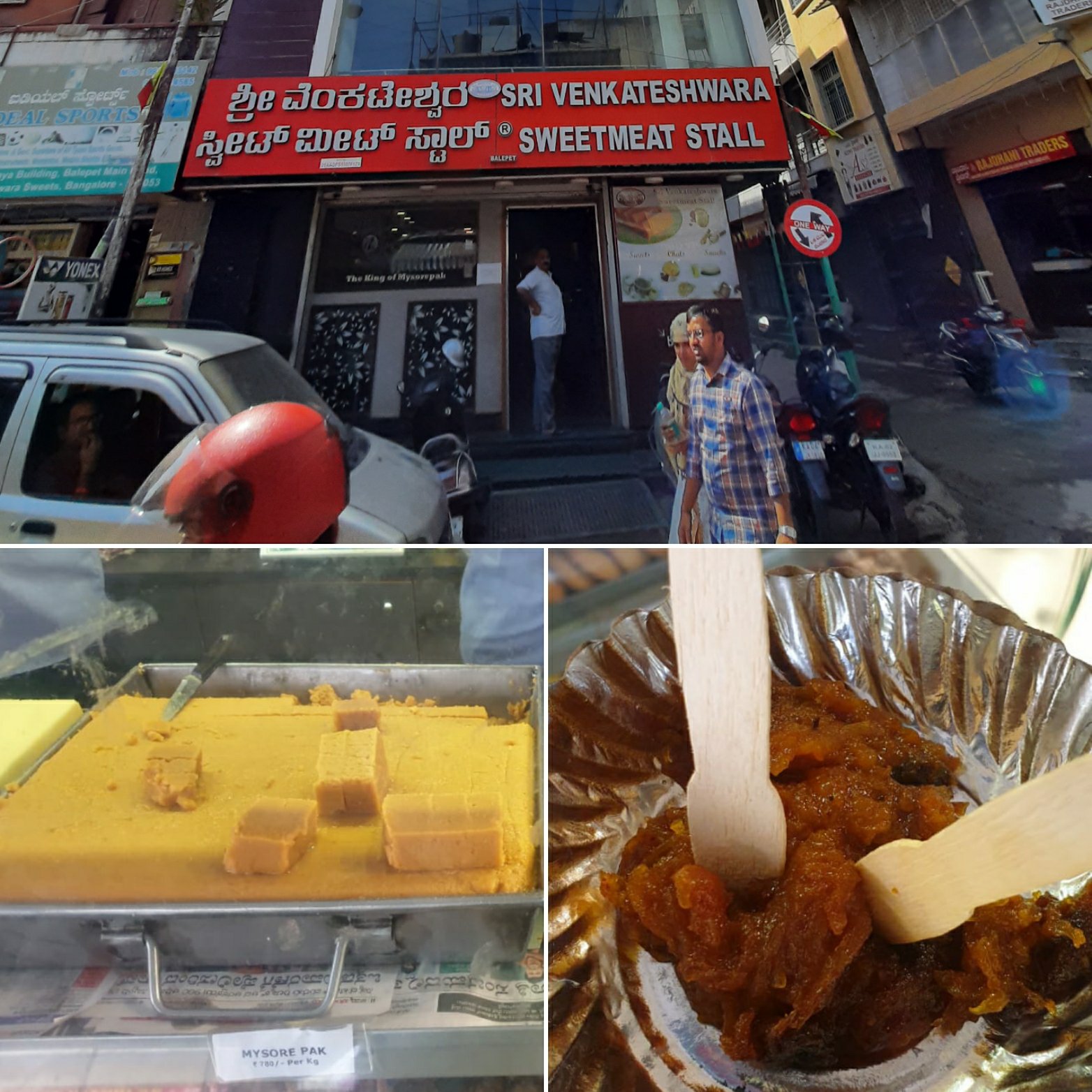
Food stop 5 (dessert): A meal is complete only with a nice dessert. If there is one sweet meat that is synonymous with Karnataka (Mysore state), it is Mysore pak. Since I couldn’t take my guest to Mysore for that, the closest I could get is at Sri Venkateshwara sweet meat stall located at Bale Pete, a short walk away from cotton Pete. Their Mysore pak and dumroot are the sweets my friend packed for his roommates back in his hometown. (Click here to read about Sri Venkateshwara sweet meat stall).
Sri Venkateshwara sweet meat stall, Balepete
The Pete walk: An old Bengaluru exploration is nothing without a walk along the narrow snaking lanes of the Pete area, the true business epicenter of both New and Old Bengaluru. This area is segmented into various sections and named according to the commodity sold and the communities that resided there in the yester years. From green groceries, handloom, steel, plastic to precious metal, everything is available in this locality. An early morning walk in the famed flower market is an experience in itself. We limited ourselves to just the mainstream sections while exploring some of the ancient temples, mosques and heritage houses of the Kempegowda era. In the meanwhile, we kept munching on numerous snacks from several popular stalls on our way. Although these eateries are old, the flavors are largely north Indian, owing to the Marwari and Baniya community that reside here in majority.
The heritage structures of the Victoria hospital, Bangalore fort and Tippu Sultan’s summer palace all lay on the side of the road for the history and architecture buffs who have a little more time in hand. But this is all we could fit in our day. Thus, ended a gastronomic tour of South Bengaluru.
I hope you enjoyed this virtual tour with me too… did you? Or did you not? Share your thoughts with me…
There are many other iconic restaurants in Basavanagudi if you have a larger appetite. These are a few other places that you must check out when you are here: The new modern hotel, Mahalakshmi Tiffin room, Janata Tiffin rooms are a few among many others.
Souvenirs to buy:
Coffee filter and freshly roasted coffee powder: The best filter coffee is available only in South Bengaluru, and hence my friend thought this was a more significant thing to buy from here.
Channapatna wooden toys: These are GI tagged handicrafts made with organic colors and largely popular in the western market, it comprises a large collection of traditional toys.
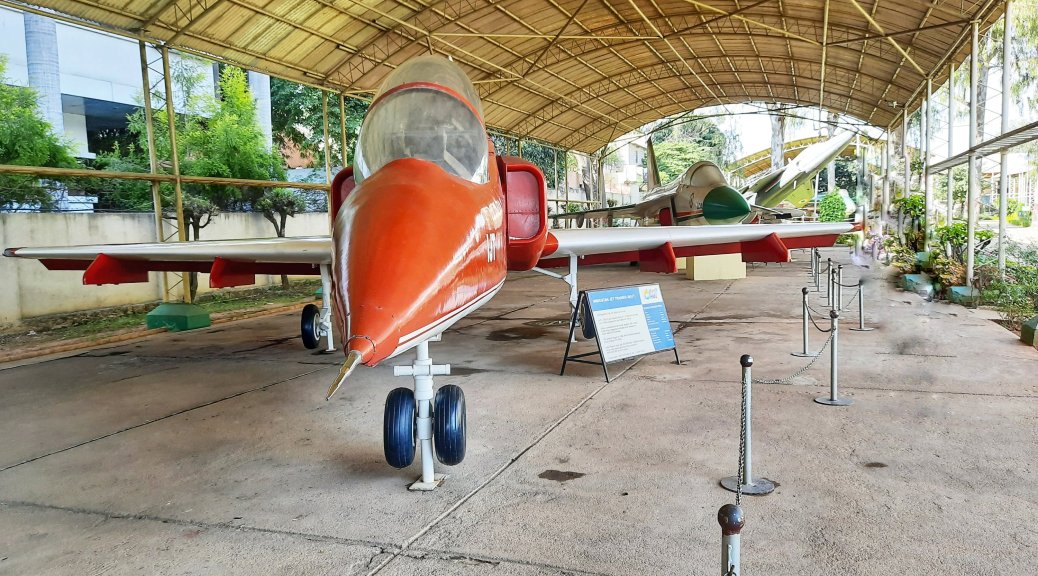
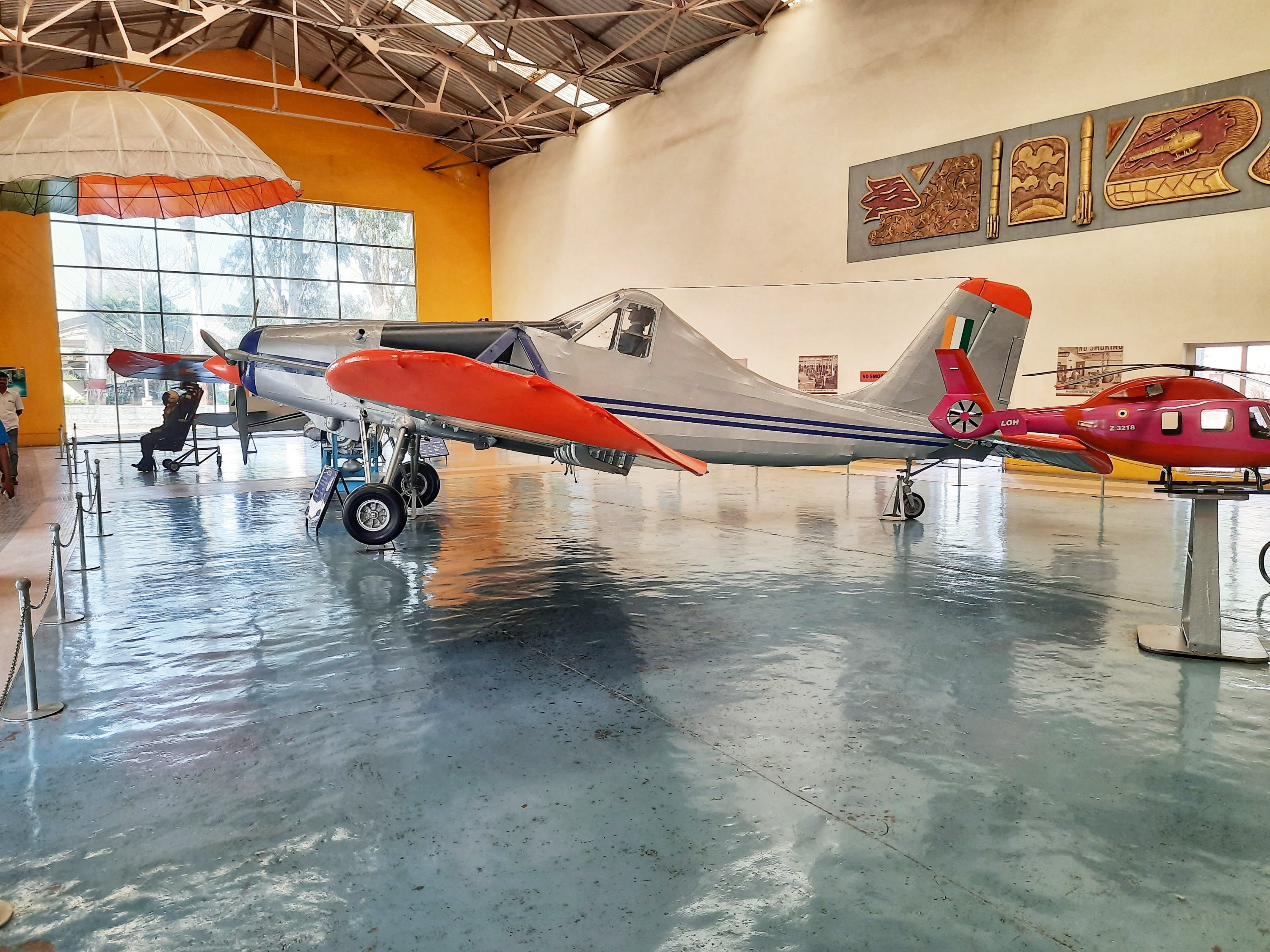
HAL (Hindustan Aeronautics Limited), Asia’s largest and India’s first aerospace establishment was founded and is headquartered in Bangalore. If you want to walk down this journey of how aviation industry has evolved in India, a visit to the HAL Aerospace Museum, India’s first aviation museum located at the HAL premises is highly recommended. From the first aircraft, Harlow PC to be assembled at its stables to manufacturing the most modern helicopters, planes and equipment for present day requirements of the Indian airfare, navy, railways and space research, HAL’s journey has been a long one. One is bound to get amused in another world by taking a walk between vintage planes, flight simulators, mock ATC and all things associated in this subject of fantasy at the museum hall. Now, this place leads me to my next destination: The IISc (Indian Institute of Science).
An exhibit of the Pushpak aircraft at HAL
That morning, I had ordered a plate of idlis at this little restaurant on the IISc campus. Just like any other day at that restaurant, the environment was abuzz with the chitter chatter of the people I was surrounded by. A typical scene on any given day includes the best scientists of India and abroad discussing new experiments over a plate of food in what is one of the premier research institutes in the country! Irony has it that similar discussions happened under the same roof, sometime in history. But back then, the discussions were about something more strategic and destructive. It was right here that a bunch of people discussed a war plot. What is now the top-of-the-notch science and technology institution in India, served as a hub for maintenance and repairs of the aircrafts during World-War II.
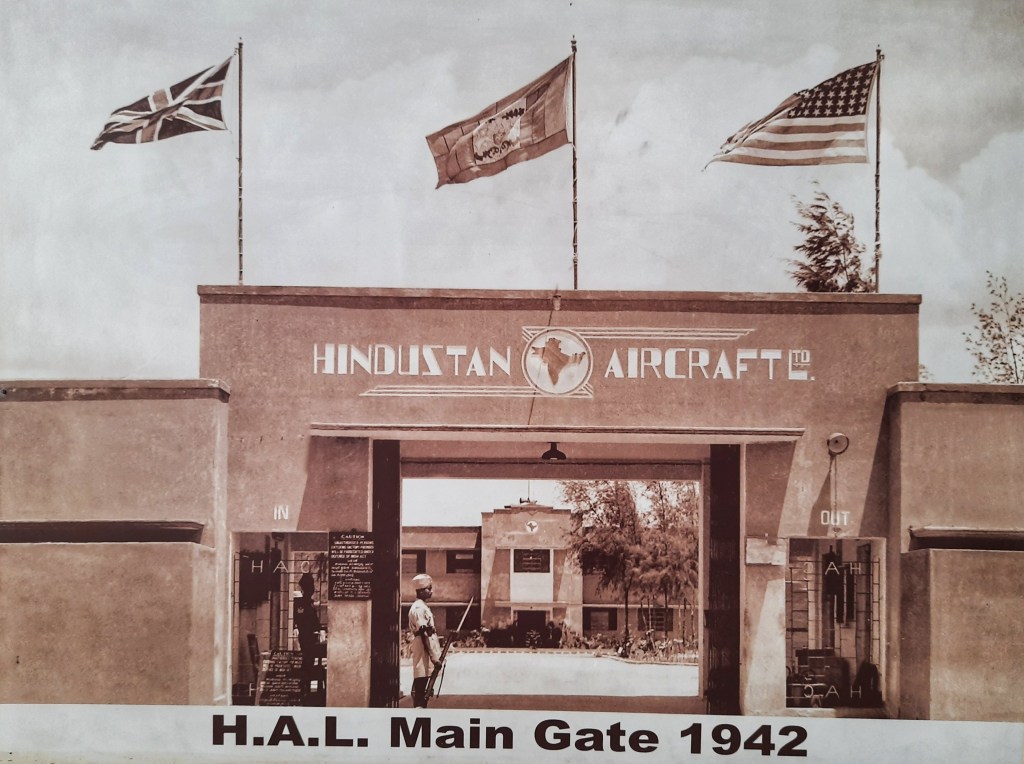
In the late 1930s, a factory meant for automobile maintenance was setup by an industrialist named Walchand Hirachand in the present day IISc campus. History has it that on his way to China, Hirachand chanced upon a meeting with William D. Pawley who was attached to the Intercontinental Aircraft Corporation of New York, an American aircraft exporter. This connection lead to the procurement of the necessary tools and equipment from the US to setup an aircraft production line in India. It was in December 1940, with funds from the Mysore state, the Hindustan Aircraft Private Limited came into being. The plan was to manufacture the Harlow trainer, Hawk fighter and the Vultee attack bombers at this factory. However, this required huge manpower that was trained in Aeronautics which lead to the establishment of the department of Aeronautical engineering.
A 1942 file photo of the HAL main gate.
Photo courtesy: HAL museum gallery
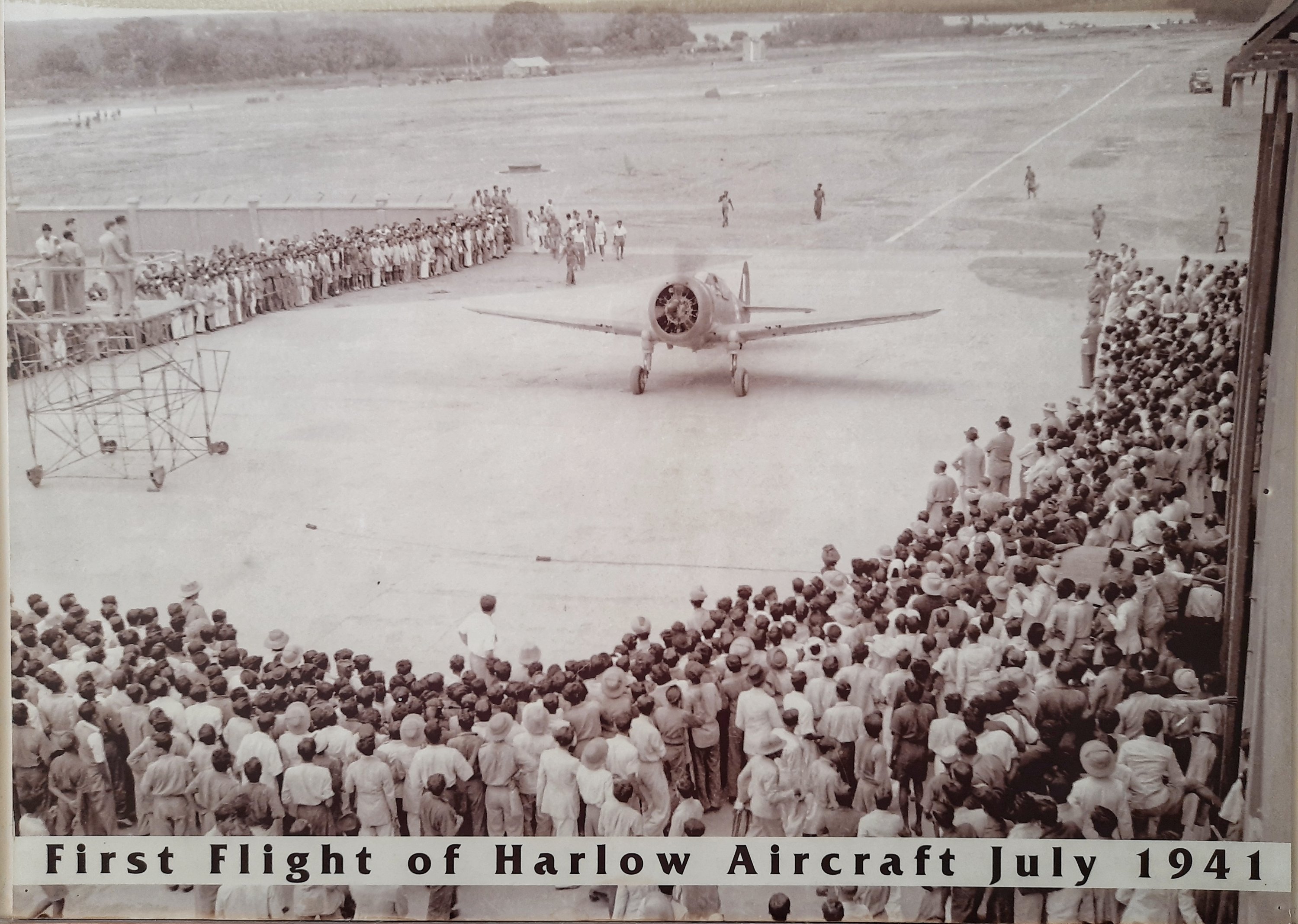
The structure that housed the aeronautical engineering department was designed by German architect Otto Koenigsberger. Otto Koenigsberger was a young Jew who had fled his country during the Nazi regime and was later in time, employed as the government architect of the erstwhile Mysore state. His architectural design is an amalgamation of European and traditional Indian styles and can also be seen in the present-day metallurgical department and the hostel office on the IISc campus along with many structures across India. Talking about the aeronautical engineering building- it is an oblong structure with high ceilings and narrow corridors that integrated natural climate control. He has also designed the closed-circuit wind Tunnel, the first of its kind in India and hydrogen plant among other things that are associated with aircrafts. With all the technical back up from IISc, it was in 1941 that Hindustan Aircraft Limited (HAL) assembled the first aircraft in India: A Harlow PC-5.
Meanwhile, the threat posed by Imperial Japan loomed large in the on-going World War II because of which there was a need by the British Royal Air Force to boost its military hardware supplies in Asia. With all likelihood, HAL was most suitable as a base for the South East Asia Command of the allied forces for servicing their aircrafts. Hence, all the aircraft manufacturing plans in India were abandoned to support the repair and overhaul services of the American aircrafts and the factory was eventually taken over by the US Army Air Forces in 1943. This led to rapid expansion in the facilities and became the 84th Air depot for overhaul and repair of American aircrafts during WWII. The very same hydrogen plant on the IISc premises was used as a loading dock to supply hydrogen for the American aircrafts. Later in 1964, the factory was taken over by the Government of India and has morphed into the modern-day Hindustan Aeronautics Limited (HAL) in its present-day location. However, the original Aeronautical engineering department continues to contribute enormously towards research and has its own little airstrip on the present day IISc campus.
As I finished my plate of idlis, I wondered how unassuming I was. This deceptively functional place had just served my meal that had just been cooked inside a hydrogen plant that powered the military aircrafts during WWII.
Travelling to a new place? What do you carry back as souvenirs to friends and family? This is a common scenario that all of us are put into almost every time. While there are regional specific things that you can pick up, there are common dilemmas associated with each of them.
Traditional clothes– might not fit well or the design and the colour might not be liked by the receiver.
Local delicacies and sweets– It may not be a good idea if the receiver is dealing with some health conditions or certain diet restrictions. And then, food items also have a shelf life that would not stay fresh until you reach back.
Local handicrafts– Again, needs to suit the choice and budget of the giver and the receiver.
Well.. The reasons and dilemmas may be several but it is easy to find options when travelling anywhere regional. But, the metro cities have usually evolved as an amalgamation of several influences. Be it culture, traditions, craft, food, lifestyle etc., they represent variety. Hence, what you might pick up as a souvenir may actually be something that represents a larger region or something very generic.
If you are someone travelling to Bangalore, it is very likely that you will pickup a souvenir that is a part of a larger region (Karnataka). If you are someone looking to take back something that is an authentic piece of Old Bengaluru, then here is my pick. This souvenir is exclusive to Bangalore and does not have influence from any other regions of Karnataka. While several local products can be bought even at a crafts fair at your very own city/town of stay, this is something that can be bought ONLY in Bangalore. These are something which are sold only at authorized showrooms located in this city alone. Gift these souvenirs and you will be loved!
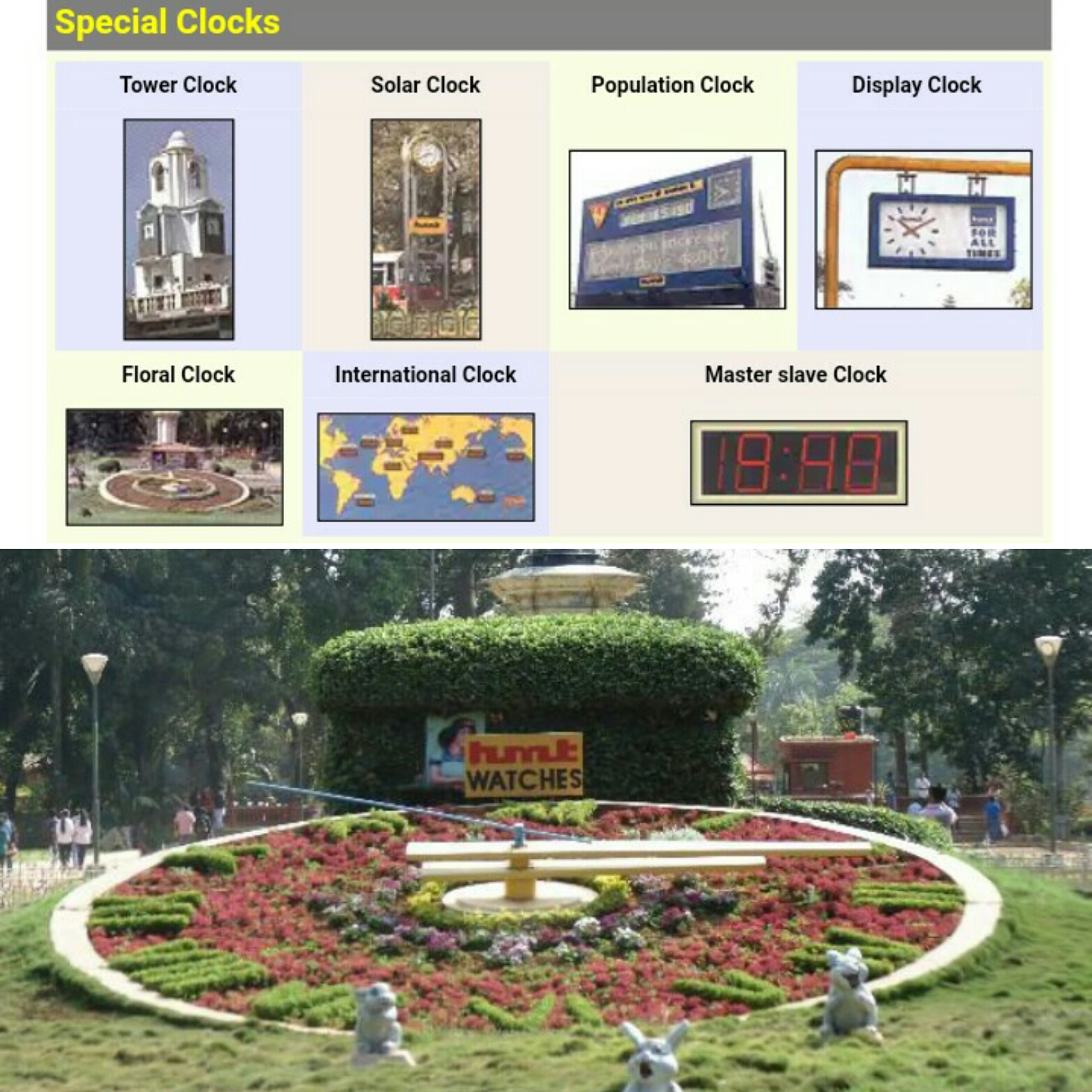
HMT watches: In 1969, it was a subsidiary started by the Government run ‘Hindustan Machine Tools’ with technical collaboration with ‘the Citizen watches co. Japan’. Soon, these watches created some kind of a time revolution (literally) with the HMT watches being mostly recognized as a possession of pride. HMT clocks adorned all major clock towers and railway stations across the country and can be seen ticking in good health even till date. HMT’s seven signature clocks like the tower clock, solar clock, population clock, master slave clock, display clock, the International clock and the floral clock that are symbols of innovation, are placed at different places across the nation. Although HMT watches’ connection with Bangalore is strong because its factory was located here, these timepieces are a representation of a bygone era of not just Bangalore but of an India of the yore. These are masterpieces of Indian craftsmanship and something that was fondly called as the ‘Timekeeper of India’. This iconic factory was shutdown in 2016 due to severe financial and political reasons.
Although the manufacture of the clocks has become obsolete, the last few pieces of their wrist watches are being assembled in a small room above their showroom in Jalahalli. These are valued as prized possessions by several watch collectors and can be bought from a range of handwound mechanical watches, quartz jeweled watches, skeletal watches, automatic and chronographs ranging in the price bracket of Rs.500 to Rs.15000. While these watches are on their way to go out of production (they will be produced only until the stocks of childparts last), they can be a truly meaningful souvenir to take back that could be handed over to the next generation who might never have an opportunity to live through the real era of HMT watches.
Do you agree this is a nice gifting idea? What other things do you think represent Bangalore aptly?
Above: The seven signature clocks of HMT placed across different cities in India Below: Floral clock at Lal Bagh, Bangalore
After having a travel-ful 2018 with atleast one long travel a month, I have decided to have a more relaxed new year. Hence, I have my theme for travel in 2019 tweaked a bit. I have no major long distance travel goals for the year and would like to settle down exploring the surrounding places at Bangalore and my hometown and spend little more time on writing, something that was overlooked in the past couple of years.
So, to start off the year, my January of 2019 had me traveling to my hometown almost every weekend due to several personal commitments. And, amidst all the mayhem that life had for me at Madikeri, I found time to sit back once in a while and travel down the memory lane. Having born and spending my childhood almost entirely in my hometown, there are scores of undocumented memories associated with almost every corner of this hill town. So, would be the case with thousands of those other kids from the 90’s who lived there at some point too… Don’t we all have memories from our growing up days associated with those small places and things? Often in the rat race, we tend to forget to cherish and be thankful for those golden memories from childhood. Here are five things that I re-lived during my last visit to Madikeri and I’m sure all who grew up in this quaint town will reminisce with me.
1. Government hospital– The year started with doing the dutiful rounds at this hospital with a family member who was sick. It was the exact place where this big grown up body came into existence; This hospital is the exact place where I was born. While a lot of things have changed about the hospital as it has been upgraded from being a district hospital to a specialty hospital & medical college, yet there are a few things that are still left unchanged. Like the labor ward where I was born for instance…! Two generations of my family members and the whole line-up of models (Brother & all my cousins summing up to a dozen of them😉) were born there and we all look forward to having our future generations born there as well 😛 There I was, traveling back in time to the earliest of memories…
2. Paris Hotel– The internet has spoken enough about the mutton cutlets of the ‘East end hotel’, masala dosas of the ‘Hill top hotel’ or even a meal with a view at the ‘Valley view hotel’. There is yet another hotel that is older than me which is located right in the heart of the town, the M.G.road of Madikeri. Ooops, read it college road! It is now called the ‘New Paris hotel’ after its renovation. I make sure to grab their signature dishes- Palam pori (Banana fritters) and Masala vada every time I’m in town. These popular snacks of kerala are so good that they run out of the shelves in less than a couple of hours of being stacked. Complimenting it with a nice cup of Malabar tea is a mandate for me and I try my luck to find some stock to pack for Bangalore.
3. Kuppu’s beauty parlour: With almost the third generation of professional barbers of this family that I know, I have very fond memories of getting my regular hair-cuts at this gent’s salon. Today when I go back there for a haircut, I feel like ‘Yeah… times have changed. I have graduated from the baby’s seat to a push-back adult’s seat. And the cost has gone up ten-fold, from Rs.10 to Rs.100 for a lady’s hair-style. The shop too has moved from the ground floor 10 seat something to a single seat salon on the first floor. But somethings never change! There is a bunch of loyal customers (Both Men & women) who travel down from other cities/towns to Kuppu’s just for their haircuts. Such is the popularity of his services. But, reducing the salon size was inevitable says Mr.Ganesh, the present owner and main-man at this popular salon. With age, managing such a big place was getting hard and he prefers the next generation to run nuclear business.
4. Basappa theatre and Kaveri Mahal: The lifeline to all the movie buffs of Madikeri, for not just the 90’s kids but several generations, how can we not give credits to these two single screen cinema halls? From playing the latest Kannada movies and English movies once in a while, these were (probably still are!) the favourite haunt for most native residents of Madikeri and the nearby villages who seek some kind of entertainment after the sun goes down in this silent hill-station. I remember standing in long queues to get the tickets when a movie in the local languages (Kodava Thakk or Are Bashe) are showed. Or do you recollect memories of being taken in batches from school to watch a mandatory documentary at these cinema halls? Weren’t those fond memories? When was the last time you watched a documentary in a big screen? When was the last time you watched a feature film in a single screen movie hall? Was it a Gandhi class or a balcony ticket?
5. Madikeri fort– We had days of marching in the Independence day parade at the fort courtyard and standing through the pouring rain until the chief guest was done with his address. What were we thinking while doing a peek-a-boo down, to the former district jail from above the parapet? Were we hoping to see the inmates..? or did we expect to get back some waves and ‘Hai’s from them? May be! Or even for some of those who would climb up the narrow ladder to get a view from the big bell near the court hall.. Does any of these ring a bell???
Which is your favourite memory of growing up in Madikeri? Share them with me…
Clockwise from top: 1.Madikeri government hospital; 2.Snacks at Paris hotel; 3.A nameplate outside Kuppu’s salon
This is a pick from old memories of exactly a year ago, in August 2013. My mother was away in Belagavi for a month-long business trip and I had decided to catch up with her over the weekend. We then got together, and explored the places around Belgaum, fondly called Belagavi. This time, it was only a day trip around Belgaum with a quick visit to the widest waterfall in my state, the Niagara of Karnataka.
Our Itinerary: Friday: Overnight journey from Bangalore to Belgaum Saturday: Explore Gokak (waterfalls, hanging bridge & Tarakeshwara temple), Godchinmalki waterfalls, Savadatti Yellamma temple)- Return to Bangalore by night journey.
The Details:
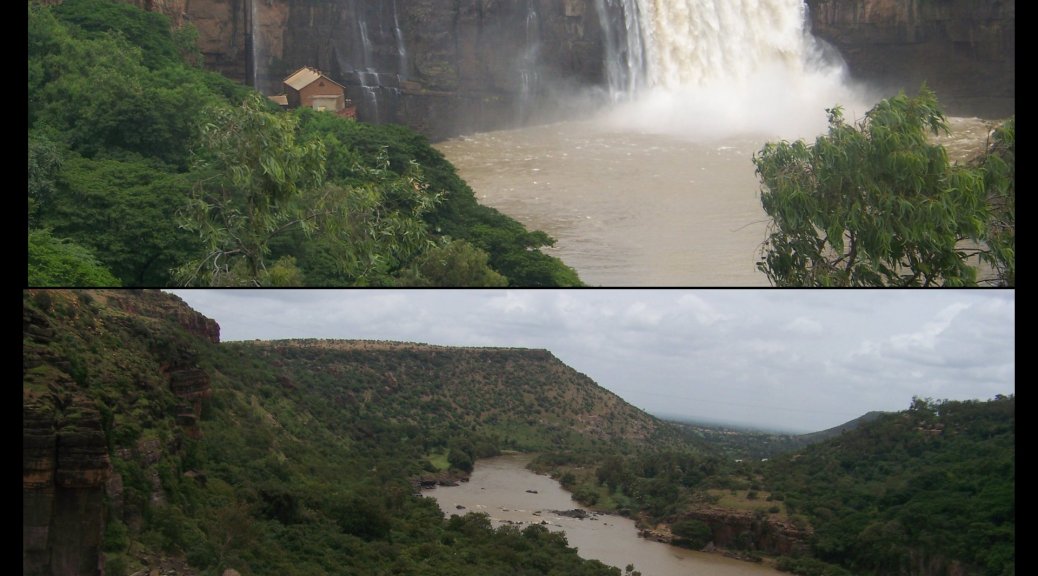
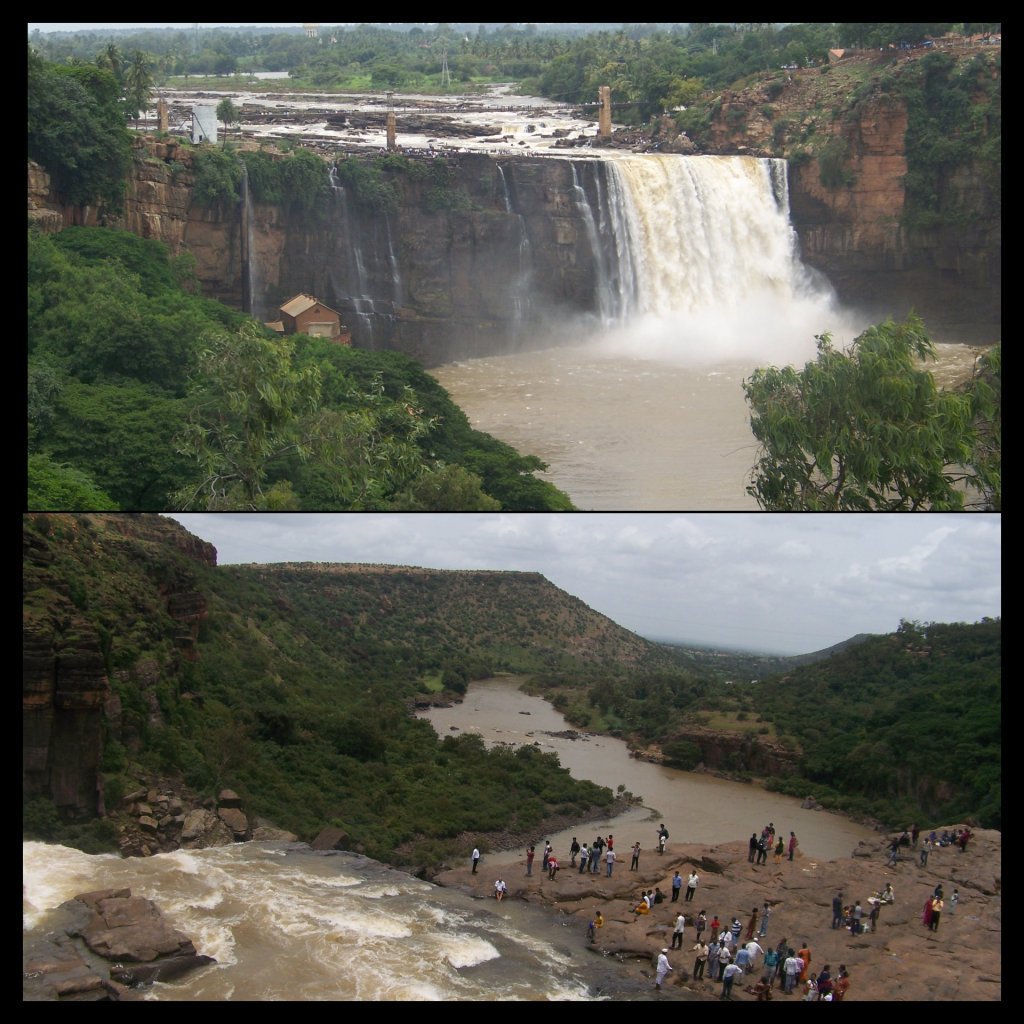
I boarded the bus to Belgaum from Bangalore and my mom was there to receive me when I alighted there the next morning… We freshened up at the place where mom was put up and then headed straight to Gokak. The little town known for its cotton mill, is also famous for the nature’s treat- the mighty Niagara of Karnataka. The bubbling, roaring and crashing waters of the Ghataprabha river creates steady patterns here with endless rhythm while it leaps down from 52meters between two tall, craggy cliffs to form the Gokak falls.
The century old hanging bridge, the only mode for the textile workers to cross the river allows the public to enjoy the breathtaking vista of the waterfall as the gushing water plummets down. The presence of turbines dating back to 1885 stands testimony to the electricity generation station established here which still provides power source for the cotton mill across the street. The 11th century Shiva temple dedicated to Lord Mahalingeshwara (Locally known as Tarakeshwara temple), built in the Kalyani Chalukyan style, faces the cotton mill and flanks one side of the gorge.
Above: The front view of Gokak falls from the Volkart view point; Below: A view from the Hanging bridge.
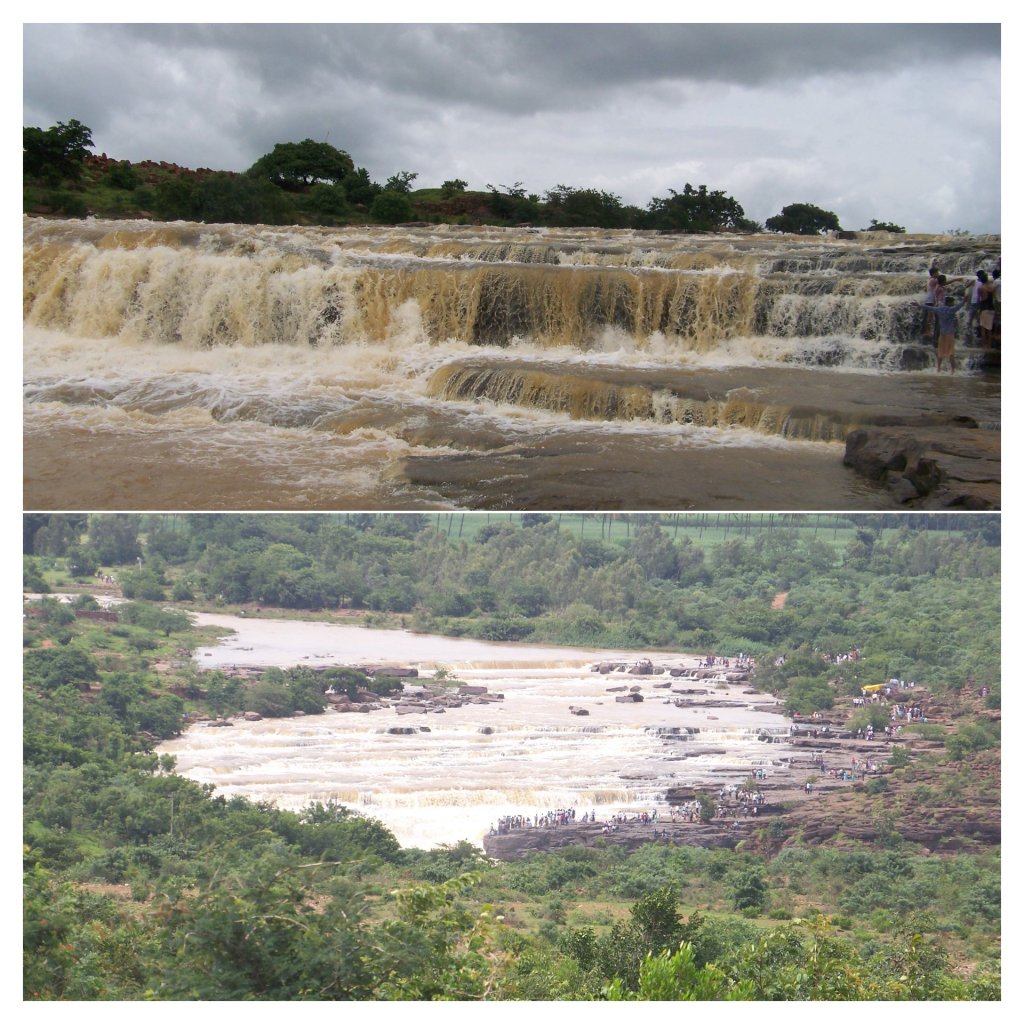
Meanwhile, I called a friend of mine who hails from Belagavi district to enquire about other places that we could visit around his hometown. He guided us to a small village named Godchinmalki where river Markandeya cascades down amid a scenic backdrop forming another beautiful waterfall called by the same name. Mom and I walked down for 2kms through rolling green pastures, fields of maize and banana plantation to reach this waterfall that plummets down in 2 tiers. Once we reached the place, it was a thorough treat to our senses to watch the waterfalls racing ferociously through the deep gorge.
On our way back, we took a little longer route from where we got a complete view of river Markandeya snaking through the greens. A 9kms long underground canal carries water from the river across which can be seen emerging out of the hill from this viewpoint. The snaking roads with beautiful views of the valley was a wonderful drive to the city.
Top: The Godchinmalki waterfalls; Below: The Gochinmalki view point from the main road
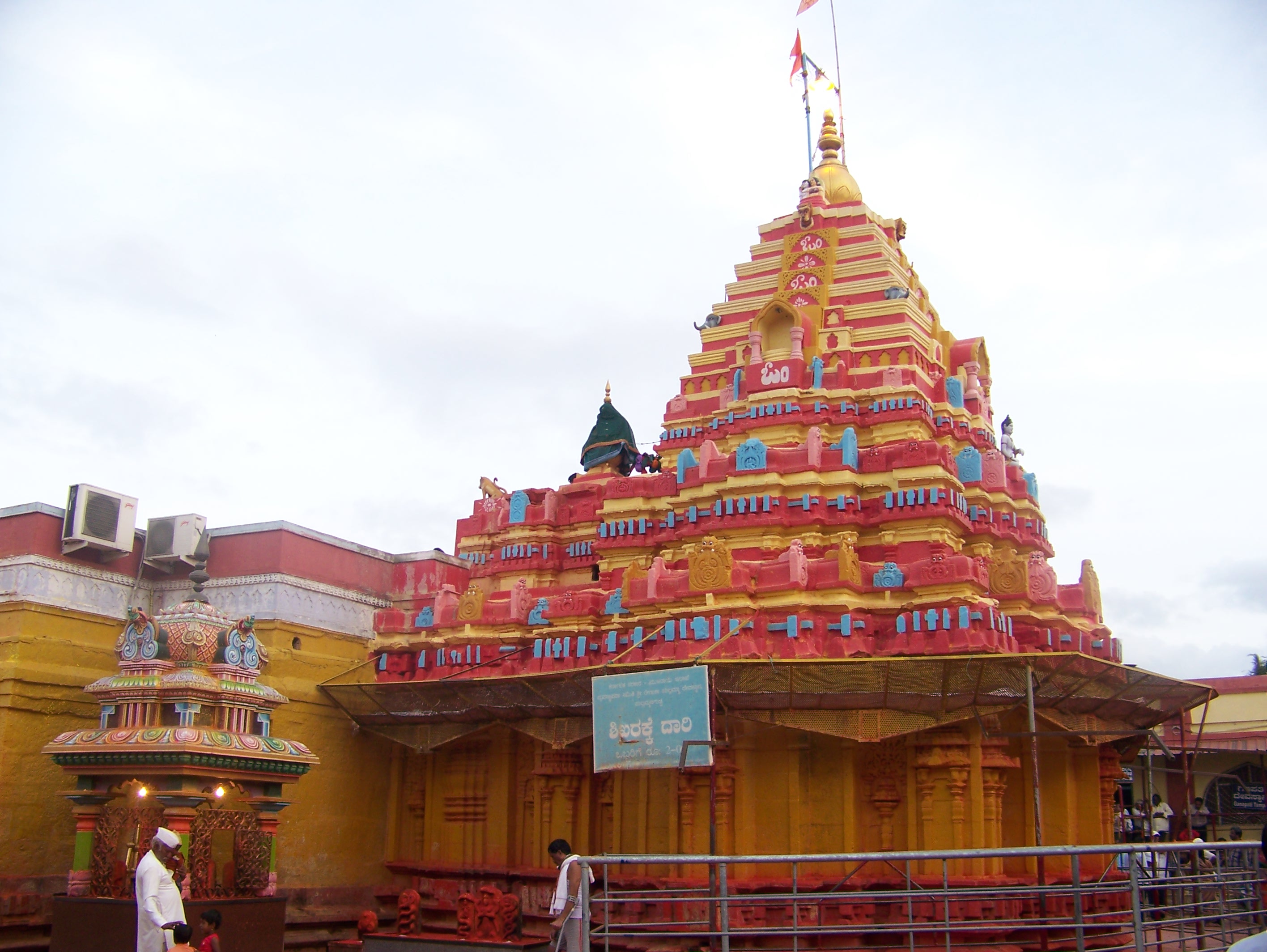
After all the waterfall hopping was done, it was time for some temple visit. We headed to Saundatti a.k.a. Savadatti. This place was the capital of the Ratta / Rastrakuta dynasty from 820, until it was shifted to Belgaum in 1230. There is a fort here also called the Parasgad fort. But the most famous is the Renukadevi temple located atop the Yellamma gudda. This is an important place for devout followers of Goddess Shakthi and also for the devadasis- or the servants of god. We had a good darshan during the evening pooja time.
Savadatti Yellamma temple
With that, it was a quick wrap for a short weekend and time for me to head back to Bangalore for another long and boring work week ahead…
Must eat while at Belagavi/ Belgaum:
Karadantu at Gokak– it is a sweet made with dry fruits rolled into balls with jaggery.
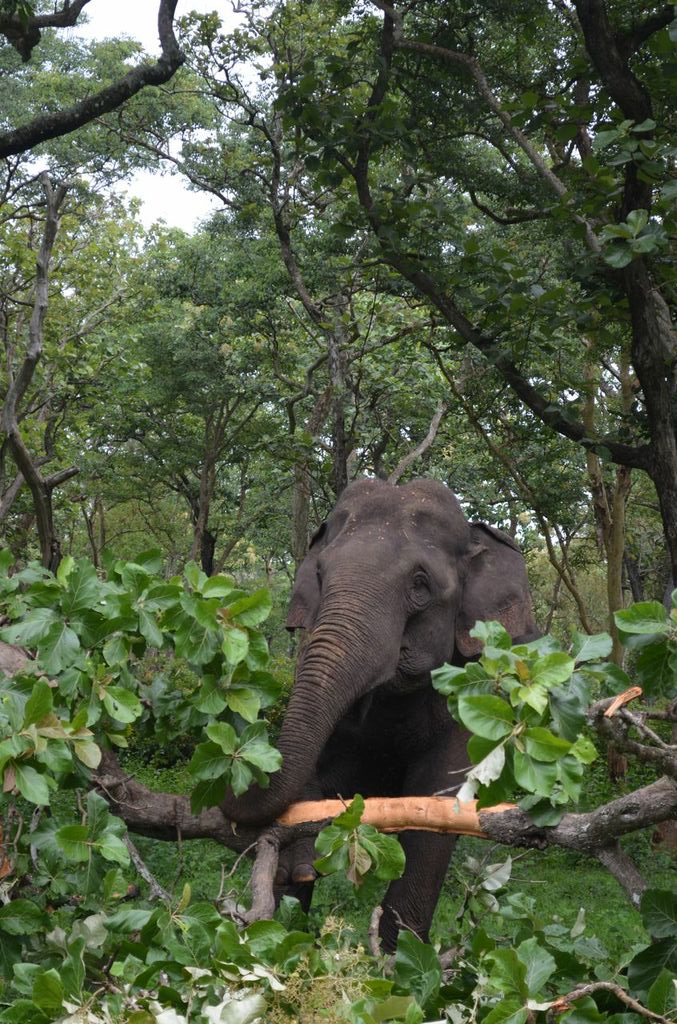
While considering Ooty to Bangalore distance, the Ooty is one of the favourite haunts for Bangaloreans, along with the people from nearby cities like Mysore, Coimbatore, Chennai etc. Popular for its well-groomed tea estates, the pleasant Ooty weather although the year has earned it the title of ‘Queen of Hills’. We were nine friends in two cars on this monsoon weekend trip to explore Ooty district. But this trip was planned by skipping all the tourist places of Ooty and exploring the lesser known corners of the district. We started from Bangalore on a Friday night at 2.00.a.m. hoping to reach Bandipur by 6.00.a.m. That’s when the forest check-post opens, and we hoped that could spot some wild animals along our way. But, due to frequent pit-stops, we made it to the check-post only by 7.00.a.m. Nevertheless, we spotted a good number of elephants, peafowls, fox, deer, sambars, wild boars etc. With so many sightings, it was quite a good start for a trip, I must say! The itinerary for our weekend is as given below.
Itinerary:
Day 0: Leave from Bangalore by night Day 1: Explore Avalanche forest reserve, explore Ooty, stay at Masinagudi Day 2: Trekking and other activities at Masinagudi, Wildlife safari at mudumulai forest or Bandipur range, drive back to Bangalore through Bandipur. (Visit Himavad Gopala Swamy temple, if time permits)
The details:
Part 1: Avalanche and Ooty
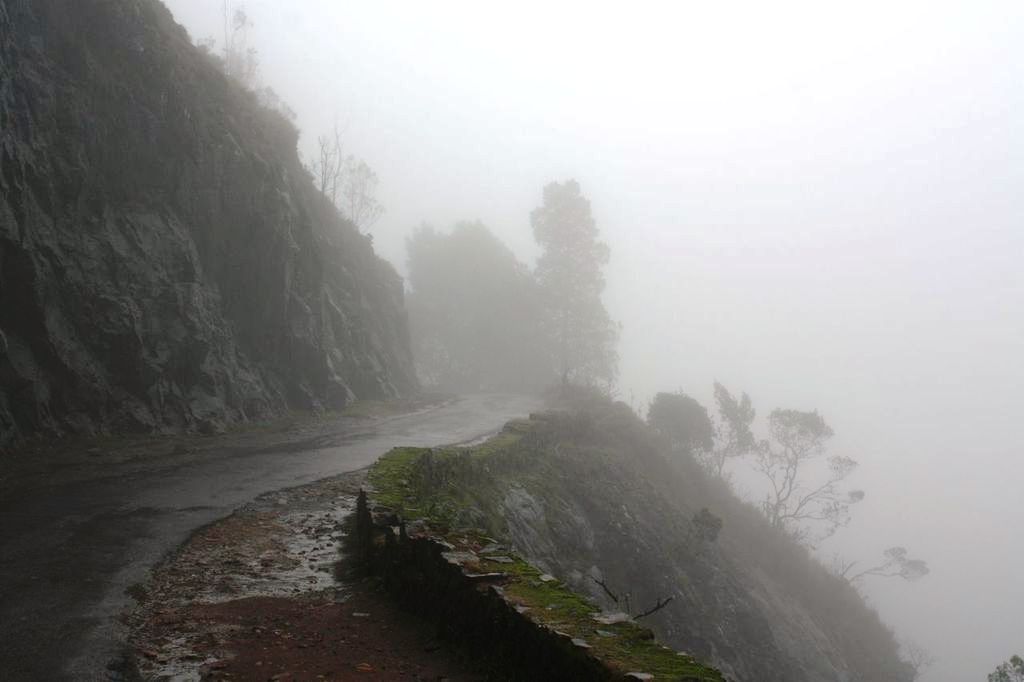
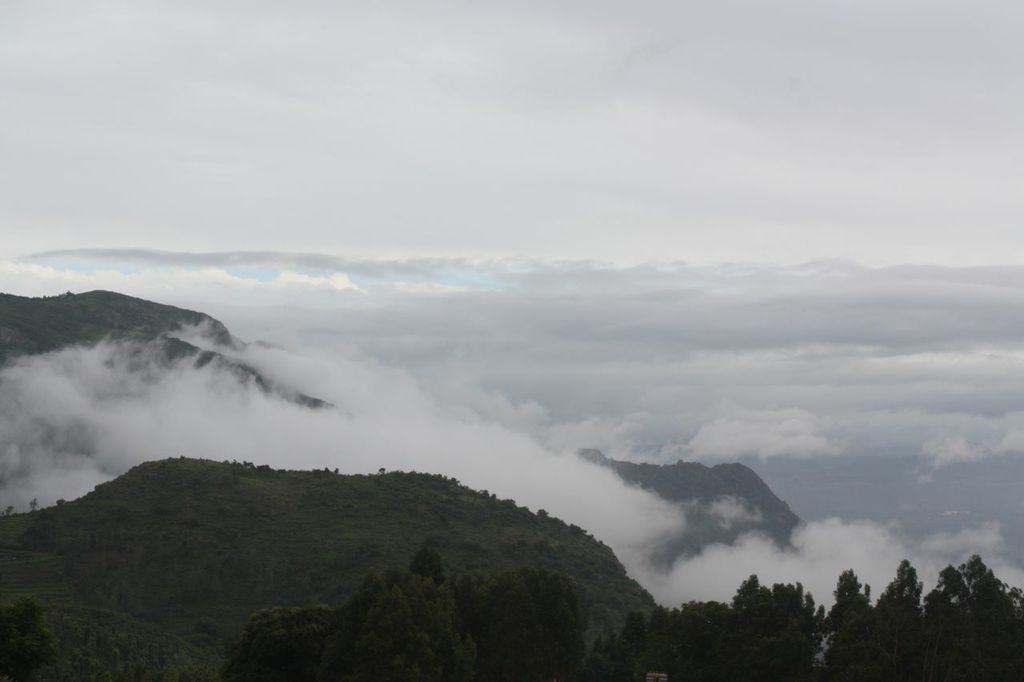
First in the visit list was the Avalanche, a steep & breathtaking climb of 35 hairpin bends with deep valley covered by thick white snowy clouds on one side led us to Udhagamandalam a.k.a. Ootacamund a.k.a. Ooty. Without wasting much time amidst the maddening crowd of tourists there, we drove down another set of 34 hairpin curves- 25 kms further from Ooty to reach the forest check post of Avalanche. Thick rainforests on either side, bumpy waterlogged potholes and scenic view of the Emerald dam backwaters at every turn, accompanied us all the way till the start point of the eco-tour. Once there, we hired the forest jeep for a 24 kms drive through the Shola forests- A place that was BEAUTIFUL.
Enroute to the Bhavani temple at Avalanche
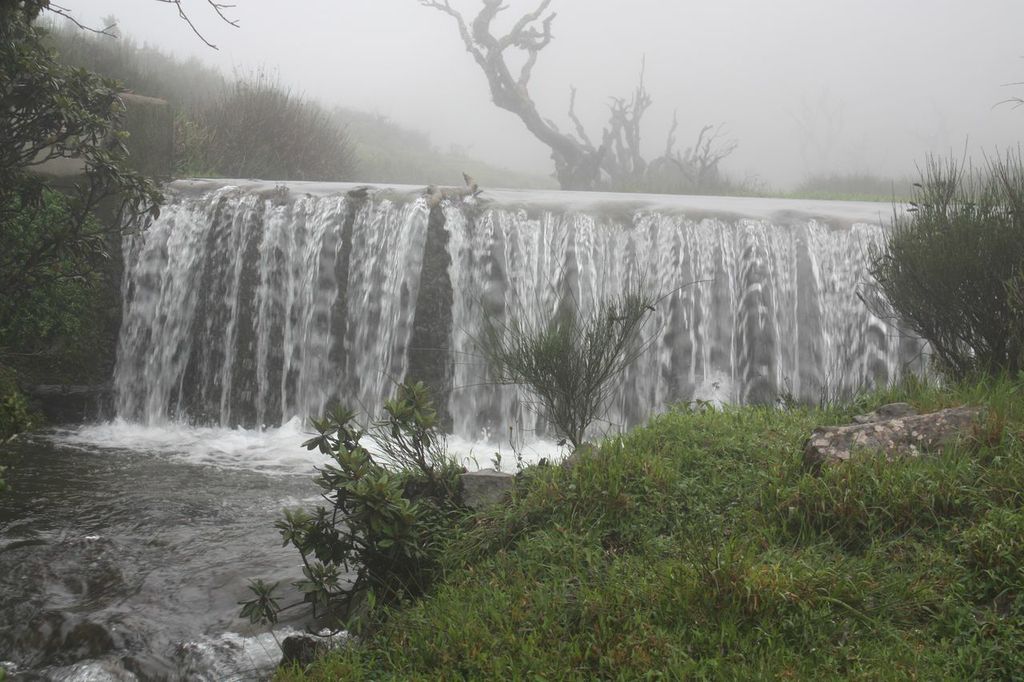
On a clear day, one can see the dam from this place. If one is lucky, he could spot a leopard or an elephant on the way, we were told. Since we were there during monsoon, the thick fog made the visibility poor adding onto the adventure of our jeep ride. On this eco-tour, we visited a century old Bhavani temple, innumerous waterfalls and ended at a beautiful spot called as ‘Lakdi spot’. It had a small stream cascading down in full fury and then running through the shola grasslands surrounded all around. After spending some time there and getting all drenched, we realized that we were all wet till the bones and chattering with cold. Thus, decided to head back to our cars at the entrance.
One of the many waterfalls tucked away in the Avalanche forest
From Avalanche, we commenced our drive towards our next and the main destination of the trip: “Masinagudi. Masinagudi is a part of the Mudumulai forest range, the extension of Bandipur National park (in Karnataka) towards the state of Tamil Nadu. Since Ooty is the only and the last town before heading towards the forest area, we decided to take a short break there. We filled our cars with fuel, withdrew cash from the ATM and bought some Ooty chocolates along with other essentials before heading towards the cottage we had booked for our stay. Our stay was in a private estate adjoining the forest fringes or rather say it was located within the reserve forest itself. It was late evening (already dark) by the time we reached our cottage. (NOTE: The forest check-post closes by 06.p.m)
A view of the valley from one of the hairpin bends of Ooty
Part 2: Masinagudi
We parked our cars at the Singara check post, beyond which the roads are drivable only with a 4WD/SUVs to reach the cottages. Two Mahindra Jeeps were arranged by the cottage guys itself. This 3 km ride from the Singara check post to our cottage was a GRAND welcome in itself: Our road was blocked by herds of elephants, bison and deer. These encounters took our excitement to a soaring high…!!
After a quick round of dinner, we all got ready for the highlight of the trip- The night safari: at 00.00 hrs. in the night, who can believe if we say we drove in an open jeep into the heart of the national park in search of a tiger that was feasting on its latest kill..?? Our safari guide and his clients had been lucky to get this rare sighting on the previous night. And once we were there in the middle of the forest, the screeching engines of our jeep halted, lights were switched off. It was a new-moon day. So, there was no moonlight even, only the open sky with the twinkling stars guided us through. The only 2 sounds we could hear were that of the orchestra of the cicadas and the pounding of our anxious hearts. What we all discovered right there, in the middle of nowhere was “ETERNAL BLISS”. Even after a thorough search through the remotest corners of the grassland, we could not find the tiger until 2.00.a.m. Although we spotted a few other animals, we were definitely sad about the fact. But the bumpy ride to the forest and back was an experience in itself that was all worth it!
Next morning, we were greeted by the excellent view of the Blue mountains (Nilgiris hills) through the window glasses. We all jumped up for the guided walk along the stream, lining the boundary of the reserve area. We captured some rare fauna like the Nilgiri langurs, Malabar grey hornbill, Malabar giant squirrel, peafowl etc. in our machine-gun-sized cameras. The climb to the tree top house is also worth a mention that gave us a good view of the forest around. It was afternoon already by then and we had to pack up for our return journey towards Bangalore.
At Bandipur National forest
Contrary to the normal boring return journeys when all are usually exhausted and silent, all the 9 of us were jumping off our seats every now and then, until we crossed Bandipur: We encountered at least 24 elephants including a herd with a new born, at least 20 peacocks all set to open up their feathers as it had started to drizzle, sounder of wild boars etc.
For someone who finds peace in nature, this was a magical trip! This is that ONE trip that I would love to do all over again and that time, it would be for a longer stay here… in the cradle of mother nature.









 My DIY vertical garden








 The Lost Lander