
Collecting amazing information about the largest railway station in India that can blow your mind with its operations. Indian Railways operates many railway stations, but certain stations made their place on the list of the top 10 largest railway stations within India.
Railway stations are considered the largest in different terms, such as the area covered by the railway station, the number of available platforms, the number of trains that halt daily, the number of tracks, and passenger traffic and the availability of services like food in train, including station food courts, onboard catering, and online meal delivery options for passengers during their journey.
This post will explore railway stations that are considered the largest, based on the number of platforms or tracks, including platform length, which contribute to their ranking as top railway stations within India.
List of the Top 10 Largest Railway Stations in India
Check the list of the top 10 largest railway stations operated under the Indian Railways.
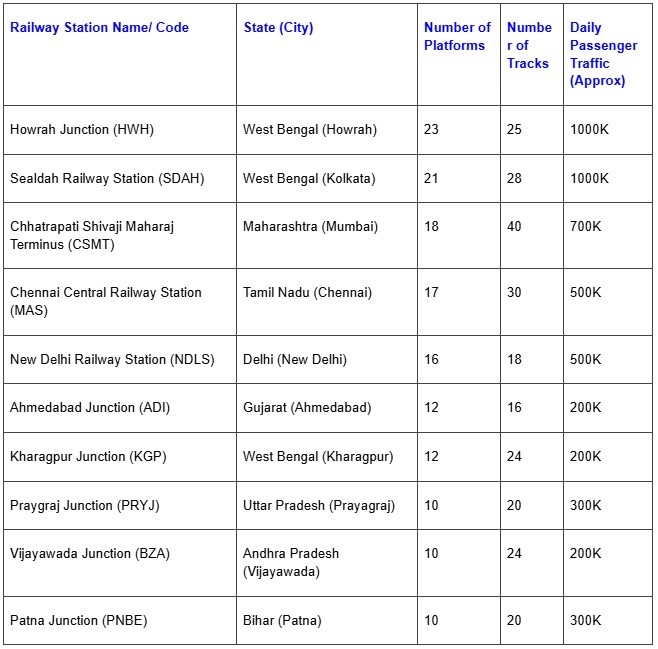
Key Details and Facts About the Largest Railway Station in India
1. Howrah Junction (HWH)
Howrah Junction comes in the top list automatically when you talk about the largest station in India due to the following.
- Located in Howrah (West Bengal)
- One of the oldest railway stations in India.
- Operated under the Eastern Railway zone
- Connect major cities like Mumbai, Delhi, Guwahati, and Chennai.
- More than 23 platforms handle 1000K passengers daily.
2. Sealdah Railway Station (SDAH)
It is the 2nd largest railway station in India, located in West Bengal (Kolkata), due to the following reasons.
- 21 Operational Platforms.
- Handles about 1000K passengers daily.
- One of the busiest suburban railway networks.
- Major hub for local or non-local railway stations.
- Railway food order with RailRestro to get delivery at the next station.
3. Chhatrapati Shivaji Maharaj Terminus (CSMT)
This station is popular as CSMT due to its iconic landmark. Therefore, check the PNR status before reaching the boarding station via the RailRestro app. So, check the following reasons behind it.
- It counts as a UNESCO World Heritage Site.
- It operates around 18 platforms with 40 tracks to manage a large number of trains.
- This railway station is located in Mumbai (Maharashtra) as headquarter of central railway.
- One of the busiest railway stations in India, managing around 700K passengers daily.
4. Chennai Central Railway Station (MAS)
Chennai Central is the primary railway terminus in Chennai, Tamil Nadu, and is considered the busiest railway station in South India. Reasons are as follows.
- It operates 17 platforms with 30 tracks for a large number of trains.
- It connects Tamil Nadu to other states and is considered a major terminal in South India.
- MAS handles more than 500K traffic daily.
- Online food on train service is available with the RailRestro train app.
5. New Delhi Railway Station (NDLS)
New Delhi railway station is one of the busiest and largest railway stations in India in terms of handling daily passengers.
- It operates around 16 platforms that connect all the major cities.
- Top revenue generating railway station in India.
- Handles 400+ trains on a daily basis.
- Located in the capital of India, which connects East, West, North, and South India.
6. Ahmedabad Junction (ADI)
It is another largest railway station that operates under indian Railways. The following points pull it into the list of the largest stations in India.
- It operates 12 platforms to serve around 200K passengers daily.
- It is a major Junction in the Western Railway zone.
- A massive redevelopment project that can offer better connectivity to passengers.
- Offering modern amenities such as 31 passenger lifts, 50 escalators, and others.
7. Kharagpur Junction (KGP)
Kharagpur Junction is not considered for its number of platforms or number of tracks. But it comes in the list of the largest railway station because of the following.
- Longest railway platform in India and also one of the longest across the world.
- It has a 1072-meter-long platform that grabs the attention of travel enthusiasts.
- It handles 200K passengers daily.
- Majorly connected with cities like Delhi, Mumbai, Kolkata, Chennai, and others.
8. Praygraj Junction (PRYJ)
Prayagraj Junction, formerly known as Allahabad Junction, is an important station in Uttar Pradesh. This railway station comes in the longest railway station due to the following reasons.
- It has 10 platforms with 20 tracks to deal with hundreds of trains in a single day.
- It deals with more than 300K footfalls daily.
- This North Central Railway station has major connections with Kanpur, Varanasi, Delhi, Mumbai, and Kolkata.
- Multiple tracks for local and long-distance trains.
9. Vijayawada Junction (BZA)
Vijayawada Junction is the most strategic railway station in Andhra Pradesh including southern India. Certain reasons make it count as the Indian largest railway station are as follows and passengers can easily check the Train Time Table for all arriving and departing trains.
- This railway station operates 10 platforms and 24 tracks to manage hundreds of trains every day.
- It handles over 200K passengers daily.
- The station has major connections with Bengaluru, Chennai, Kolkata, Hyderabad, Howrah, and Delhi.
10. Patna Junction (PNBE)
Patna Junction is one of the largest railway stations in India due to the following reasons.
- The important and busiest railway station in Bihar.
- It connects eastern and northern India with other major cities.
- It also facilitates the passengers and freight traffic.
- PNBE operates 10 platforms and 20 tracks.
- Offers facilities like modern waiting halls, food courts, digital information systems, including ticket counters.
Also Read:
Chain Pulling in Train: Rules, Valid Reasons & Fines
Five Types of Trains to Experience in India
Frequently Asked Questions
Q. Why is Howrah Junction considered the largest railway station in India?
Ans. Howrah Junction is considered as the largest in terms of number of platforms (23) in India, with more than 6000 train movements and daily traffic of about 10 lakh per day.
Q. How many platforms are there at Howrah Junction?
Ans. Howrah Junction operates 23 platforms, which makes it an Indian largest railway station. It helps to deal with large traffic and manage 600+ trains on a daily basis.
Q. What facilities are available at Howrah Junction railway station?
Ans. There are various facilities available at the HWH (Howrah Junction) that are listed below.
- Escalators & Lifts
- Free Wi-Fi
- Retiring Room and Dormitories
- Waiting Room (AC or Non-AC)
- Clock Room
- Parking Facilities
- Food Courts
- Road Connectivity
Q. Which is the second largest railway station in India?
Ans. Sealdah Railway Station is considered the 2nd largest railway station in India because of passenger traffic and numbers of platforms available. It operates with 21 numbers of platforms to deal with 800K to 1000K traffic daily.























 The Lost Lander