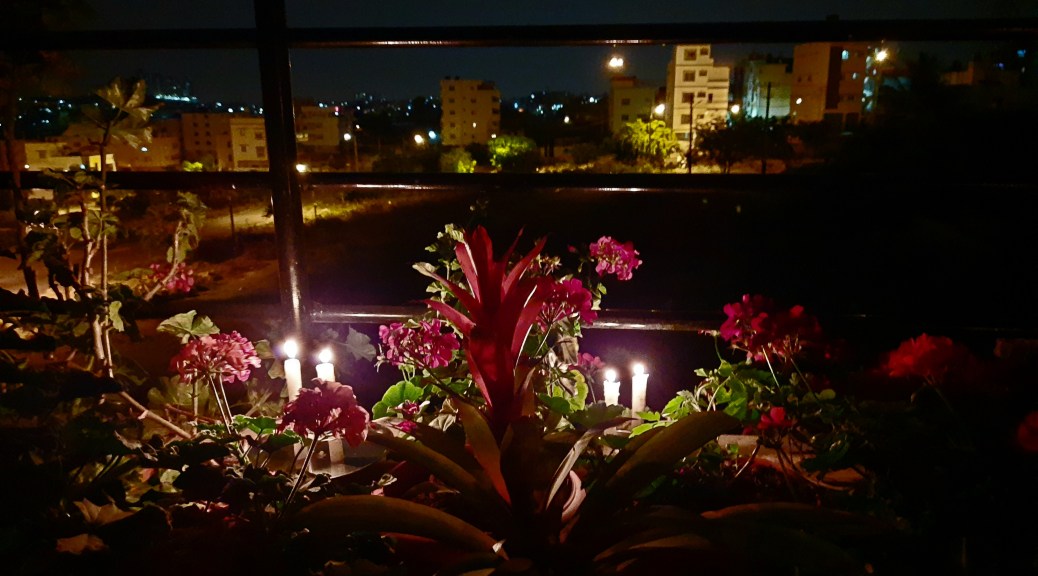
I know the entire world is going through a deep crisis with the outburst of the CoViD-19. But that does not mean that the world is going to end, right? Anxiety can hit anyone, any time… that too when someone is locked up inside the house for so many days and weeks. While ‘How many days more?’ has a very uncertain answer, until may be a proven vaccine or cure is invented, nobody is certain- is all one can say. It is human to get hit by anxiety about what’s going to happen next. But let us see the positive side: nearly 50% are recovering. Let’s not panic and do self-care by staying indoors.
I’m someone who has always found company amid nature. Any problem, I believe ‘NATURE HEALS’. For all the abuse and exploitation that man has done to the planet, it is wonderful to see how nature is healing herself (Click here to see the video). That’s said, I am a “Cliched” travel freak who grows restless when I stay confined to a place for over a few hours. I’m sure I’m not alone in battling anxiety. The whole idea is to keep myself away from social media, from where I’m getting all forwards causing more anxiety. Here are a few things that I’m doing to keep myself calm as I continue to stay indoors.
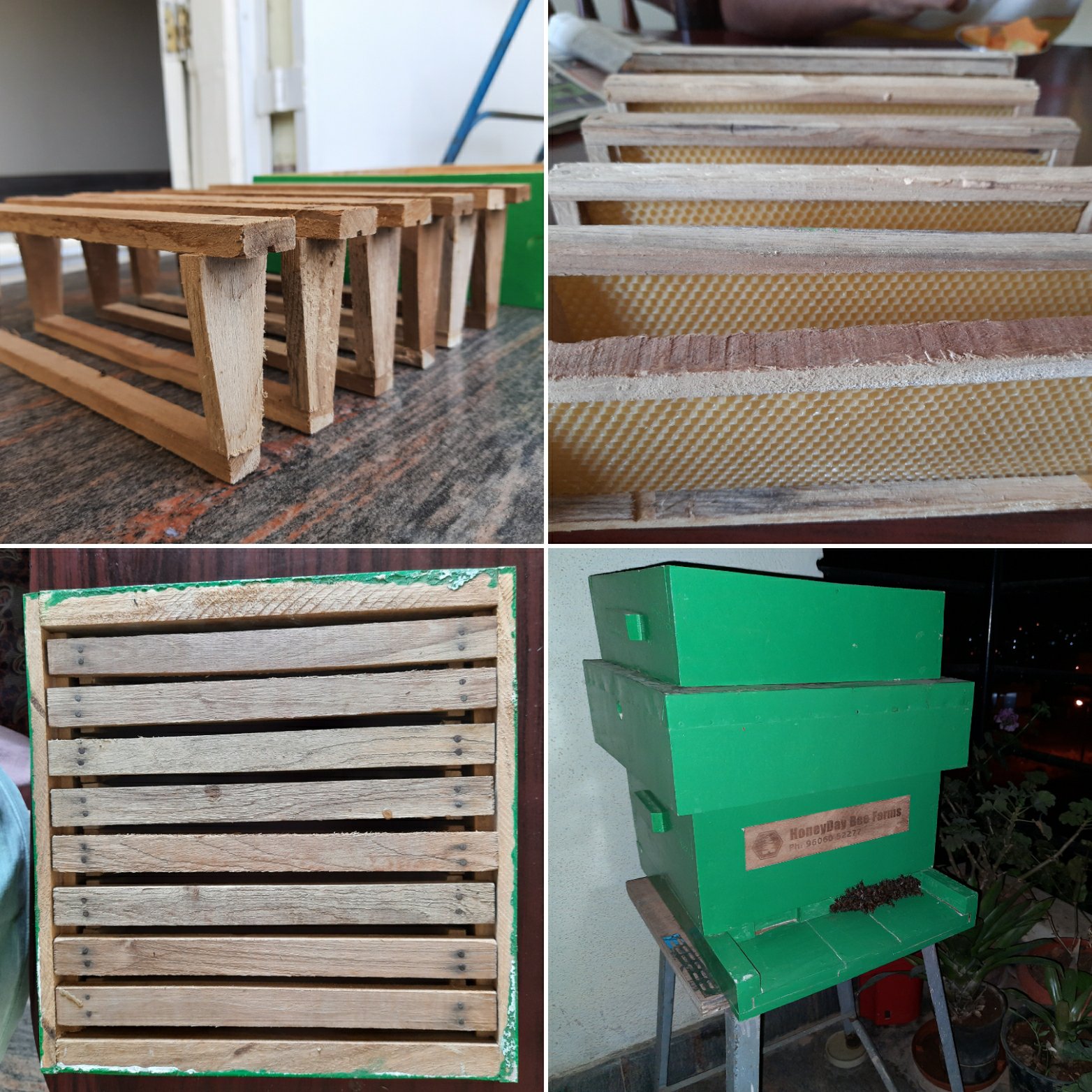
The honey bee-box in my balcony
5. Watch the honeybees toil in my balcony: I have set-up a box for them in my balcony and It is therapeutic to watch them work. It is spring season now and no better way to spend a day than sit and watch nature in her calmest ever. The only noise I can hear is the chirping of the birds and the buzzing of my honeybees.
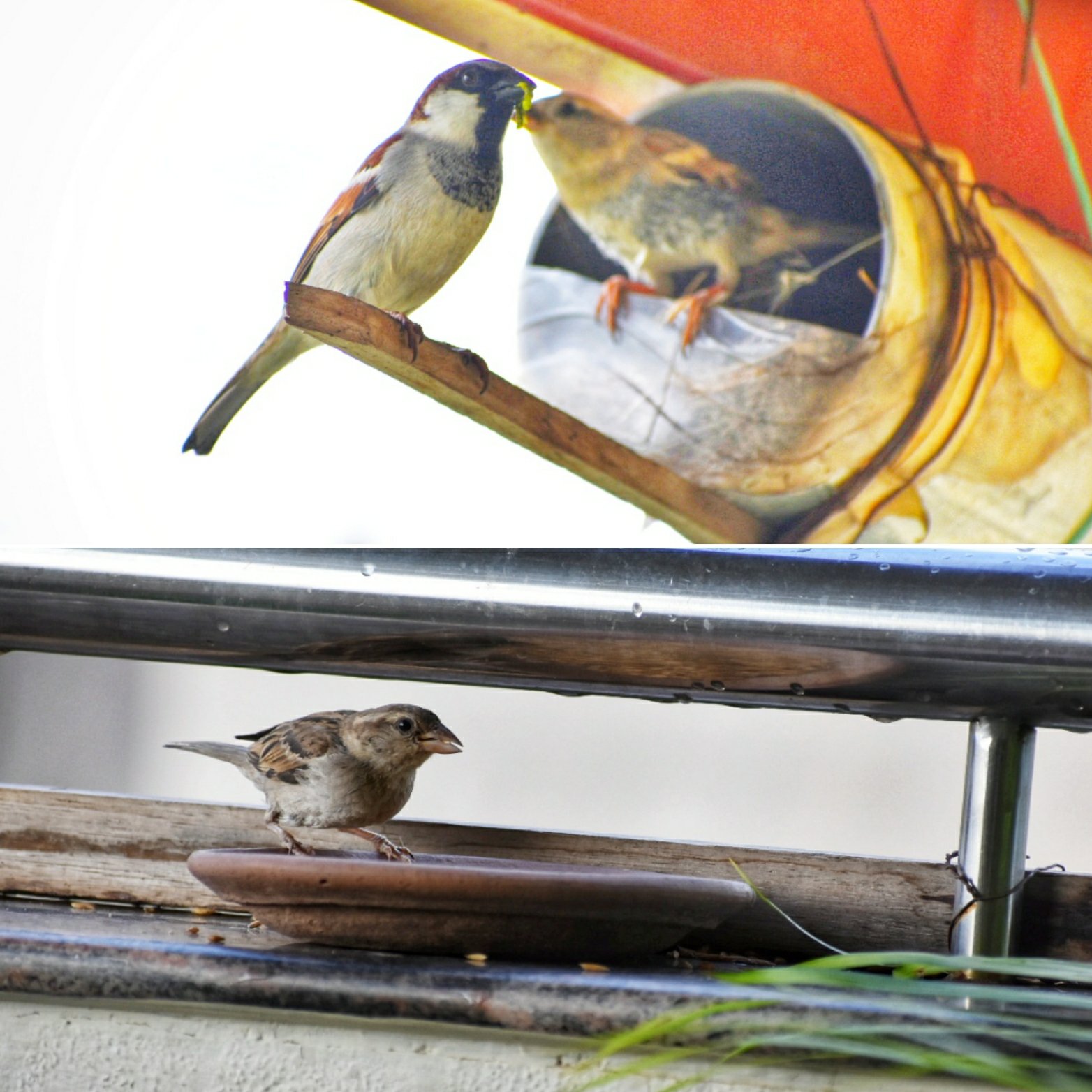
4. Watch the birds flock to the feed and water bowls: The temperature outside has started to rise slowly. As we continue to stay indoors, the birds and squirrels have started to come outside. They will now start frequenting your balconies, only if you’re kind enough to give them a place to sit and take a dip in a water bowl. You will soon become good friends and begin to enjoy each other’s company. I have a good number of sparrows, red-whiskered bulbuls and squirrels occupying spaces in my balcony.
The sparrows in my portico
3. Learn birding: As I continue to sit in my balcony and watch the flowers bloom outside, I have started to realize that I live in a place that is no less than a bird sanctuary. At least 40 varieties of birds have been spotted from here and I’m continuing to learn their names, habitat, bird calls and behavioral patterns. Some of them have been photographed and the photo-story is made (Click here to view the photo story)
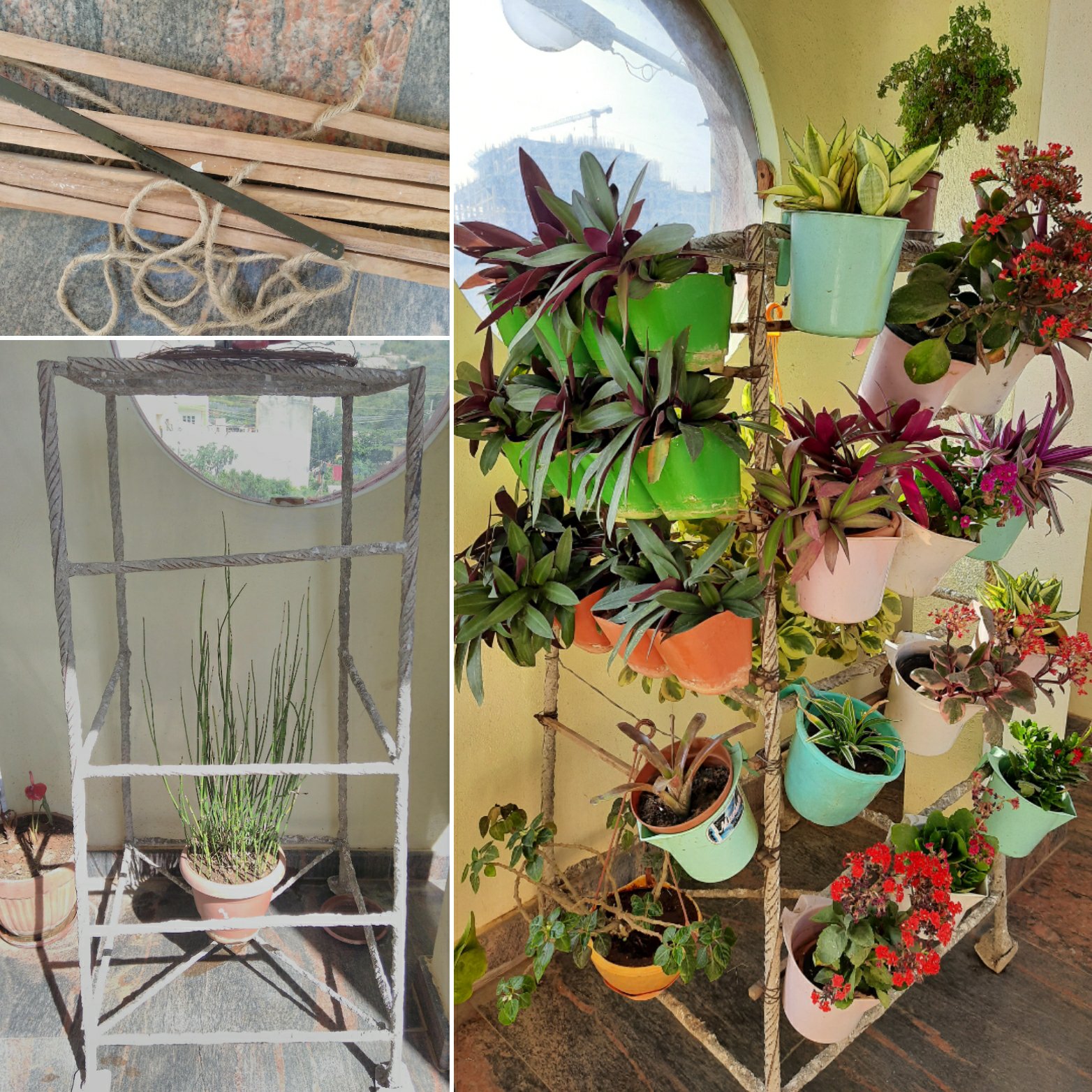
2. Do up a vertical kitchen garden: While going out should be reduced to as minimum as possible, we can grow our own greengroceries in our balconies. I have converted an old ladder / stand, hung old mugs and tied used plastic cups where I’m growing green-groceries and small flowering plants. Some wet waste from the kitchen too is going into these DIY pots for decomposing. Mustard, tomatoes, brinjal, kothimir, beans etc. are some of the seeds you can easily find in your kitchen without having to worry about buying the seeds separately.My DIY vertical garden
1. Re-kindle a dead hobby: Found stacks of water paint that’s been shelved since school days 😛 most of them have dried up in the bottles. I’m finding new ways to make them useful and kill-my time by doing abstract paintings using abstract techniques. Running out of poster colors? Try organic colors. vermillion, turmeric, indigo, leaf extracts… Don’t’ you think its time to explore something new?
Tell me how are you helping yourself to beat anxiety?
How are you killing boredom at home? Share your ideas…
You have probably read my earlier post on exploring the offbeat landmarks of Old Bengaluru. Here is another one. This time, it was a culinary trip of Old Bengaluru to a friend who had flown down to this southern metropolis, from the so-called Northern part of India. I had been asked to take him on a gastronomic tour of my city. For someone who has a penchant for everything old school, I thought Old Bengaluru would be perfect to call it a day. ‘From vintage automobiles, architecture, iconic restaurants serving traditional recipes to by lanes and alleys that narrate their own individual story of the city, this section of Bengaluru has everything that would tickle a bone or two of this mad man’, I thought.
Having largely spent my teenage in North Bengaluru and given my familiarity with the area, Malleswaram was my first choice. However, given the convenience of commutation from my current place of stay, I chose to show him around South Bengaluru. But when one says South Bengaluru, it is a world in itself and the geographical area is large to fit all in one day. Hence, I took time to mark a quick map of restaurants to cover, along with giving a peak into the cultural heart of the city. This part of the metro lays in stark contrast to the Bengaluru, that the millennials from Whitefield and Marathahalli know of.
The obvious choice was a walk tour of Basavanagudi and the Pete area. These are the two most important clusters of true Bengaluru that have held onto the roots, despite the rapid and traumatic transition this city has seen in the last decade in the name of urbanization and modernization. Under the canopy of massive native trees, the aroma of the by-two filter kaapis shared at the numerous Shanti Sagar and darshini food joints, the air here feels different from anywhere else. With almost every street dotted with Classical dance and music schools and happy nonagenarian couples whizzing in their Padminis and Ambassadors, it has a different vibe here. One can find some of the traditional old houses and landmark restaurants only in these localities to really experience old Bengaluru. Each of these iconic eateries have a near century old history and their old school ambience is still intact inside the heritage structures that house them. With a small appetite for food and a big quest for exploration, the portions of food were limited only to the signature dishes of each restaurant, to accommodate more places. So, here is my itinerary of a gastronomic tour of Bangalore of yore.
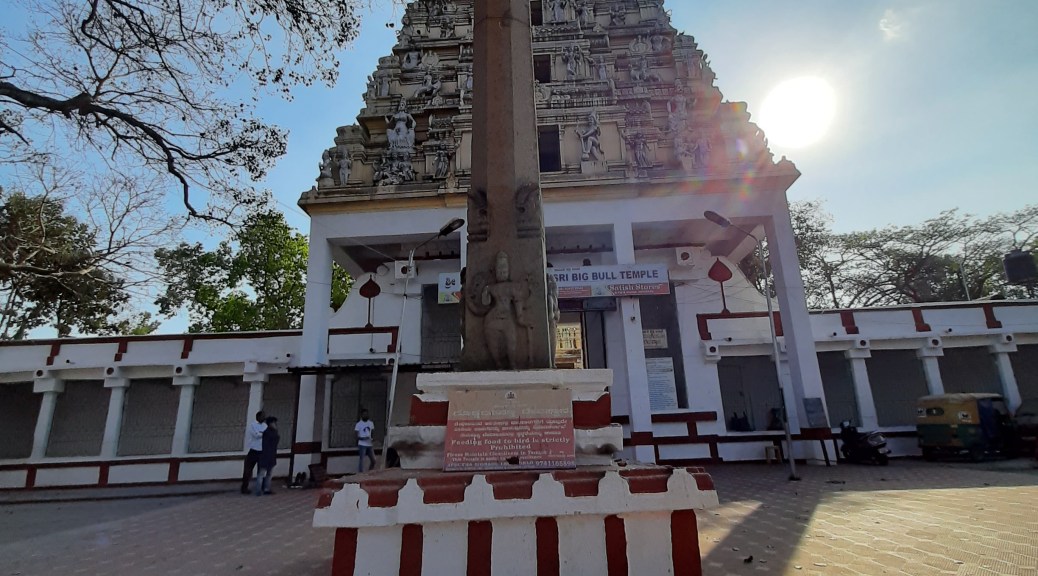
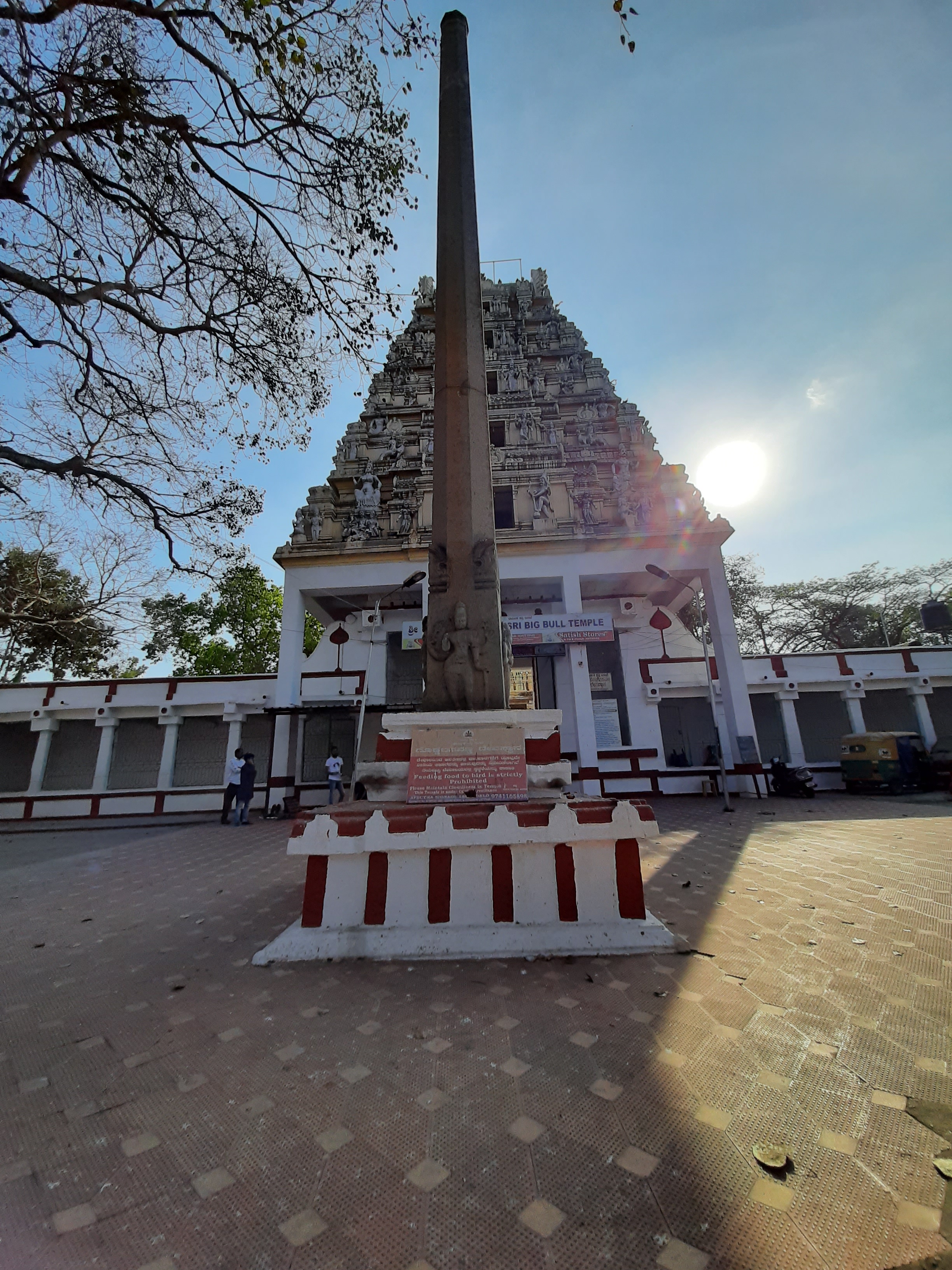
The Big bull temple, Basavanagudi
Meet-up point: Basavanagudi is the name of a temple (It translates to ‘Bull- Temple’). Basavanagudi is the name of a locality in South Bangalore, named after the temple. It is an extension of the Pete area, which was specifically created to accommodate the upper class, and more-specifically the Brahmin community. No trip to South Bengaluru is complete without a visit to this landmark temple built by Kempegowda, the founder of Bengaluru. Apart from the Big Bull temple, the Dodda Ganapathi and the Bugle rock (a small watch tower from the Kempegowda era) are a must visit on the same premises. If you time it up well, you can part-take in the annual groundnut fair in the locality. (Read here to know more about the history of the Kadlekai Parishe). After meeting my friend here, we started our gastronomic tour to our first food stop.
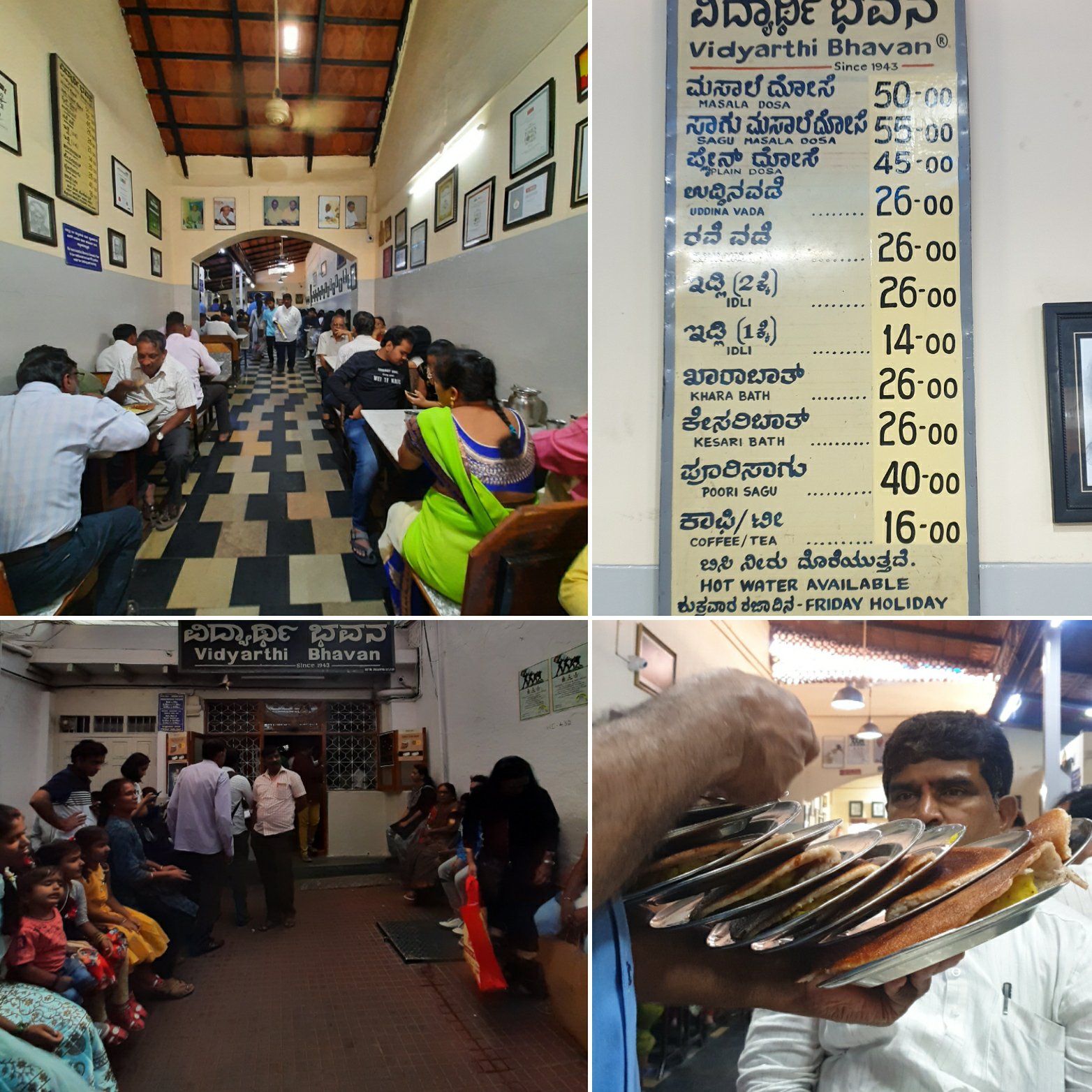
Food stop 1 (Breakfast): As synonymous as Dosa is with South India, Vidyarthi Bhavan is with South Bengaluru. Ask anyone for the best Dosa in the city and this place scores on top unanimously. It is a restaurant started initially to cater to the student community of the area which started a new culture of a hangout place for friends in those days. On most days, the queue can extend well up to a kilometer. My friend and I wiped off our plates of their signature Masala dosa for breakfast. (Click here to read further about the history of Vidyarthi Bhavan)
Vidyarthi bhavan, Basavanagudi
Food stop 2 (Light eats): No foodie who visits Bangalore is satisfied without taking an evening walk on the Eat street at VV-Puram. However, I decided to go here in the morning, in order to avoid the maddening rush. Honey cake and Congress bun at the iconic VB Bakery was what we needed. This is the first Iyengar bakery to be established in Karnataka which has paved a new culture in baking (Read here for more about V.B.Bakery). Avarebele (Val bean) is a favorite ingredient of the Bengalureans, who have a dedicated annual fair to celebrate this pulse (Click here to read further about Avarekai mela). Hence, picking up a packet of avarebele mixture for home from one of the stores there was an obvious choice.
Food stop 3 (11 o clock, coffee): It is an important break time for the employed section of the society. Brahmin’s Coffee bar is a household name for their filter coffee and the delectable chutney served with idly on their very limited menu. This tiny eatery is in a corner of Shankarapuram, which is also famed for the Shankaramatha, a learning center of the advaitha philosophy. We had a quick stopover for a hot cuppa this little place is known for, before heading to Pete. (Read further about Brahmin’s coffee bar here)
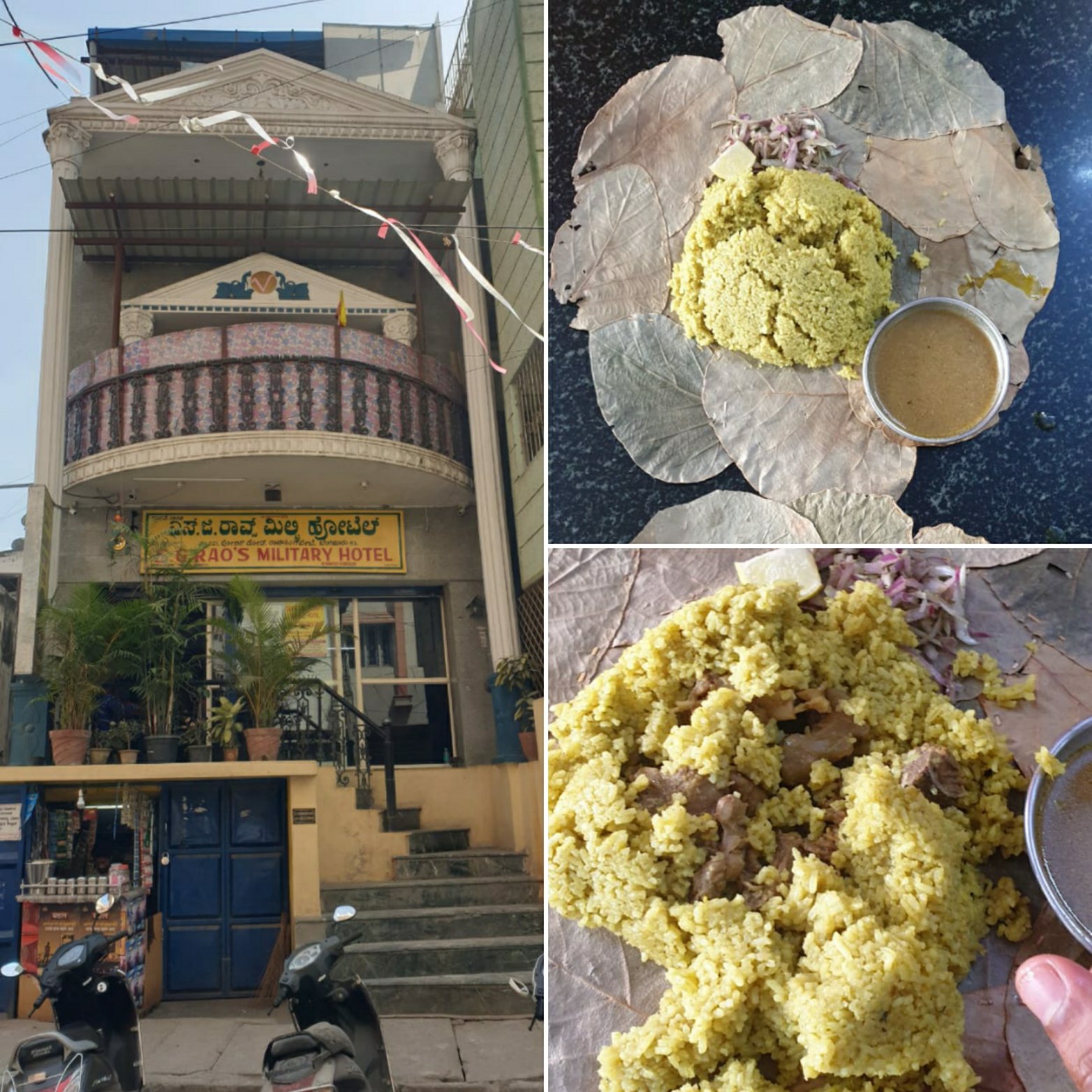
Food stop 4 (Lunch): To satiate the hunger pangs, I planned to treat my friend with an authentic Bangalorean affair. With multiple theories surrounding the origin of the military hotel culture, the history of these restaurants dotting across the southern part of Karnataka is unclear. Bangalore is home to some of the best in the state. I don’t think there would be any better meal than ‘Ragi Mudde oota’ savored at a military hotel to get a peek into the local flavor, including the ambience. Hence, we were lunching that afternoon at S.G. Rao’s military hotel, located in the cotton Pete area. A typical military hotel meal includes Kaal soup, Ragi Mudde and Mutton biriyani. (Click here to read further about S.G. Rao’s military hotel)
S.G.Rao’s military hotel, cottonpete
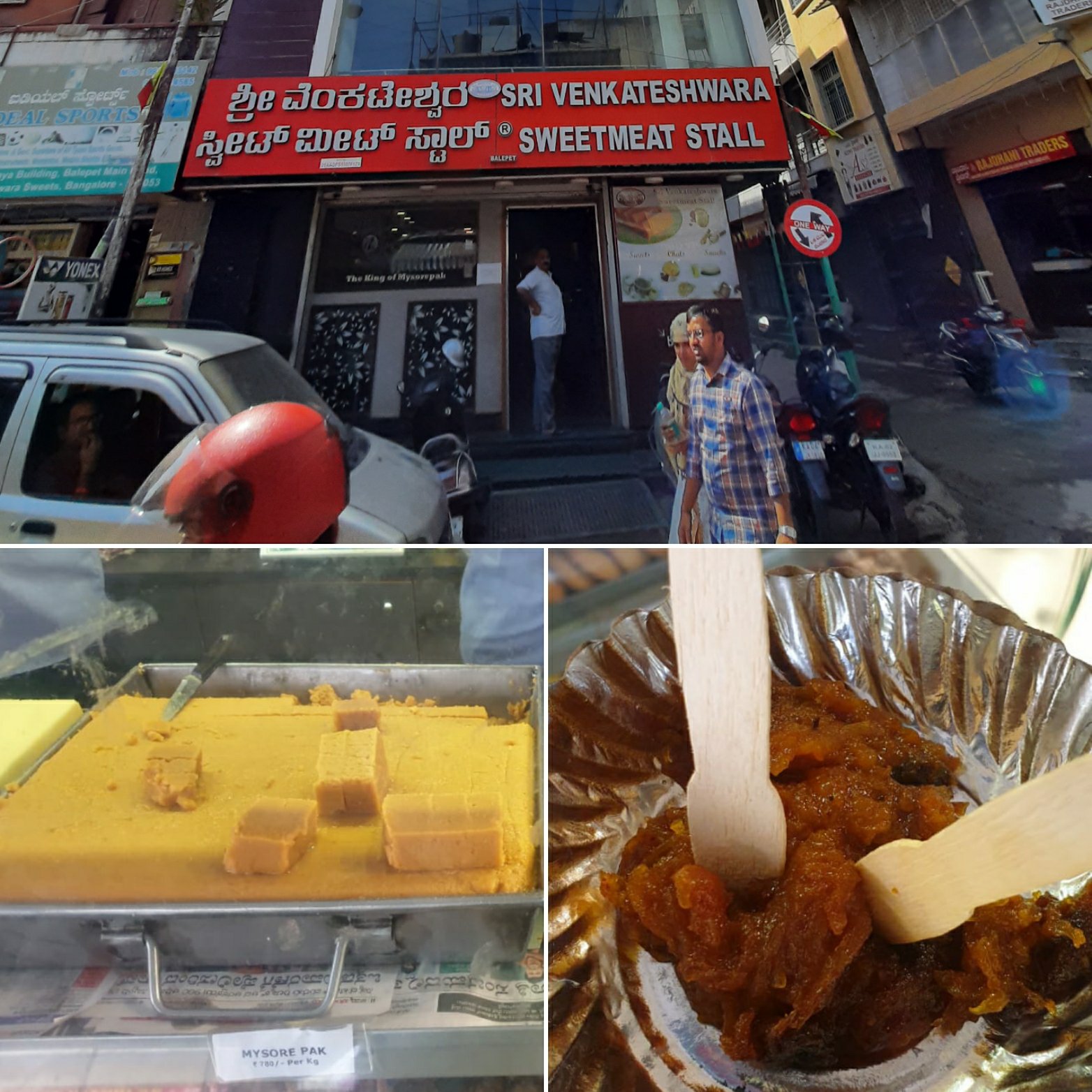
Food stop 5 (dessert): A meal is complete only with a nice dessert. If there is one sweet meat that is synonymous with Karnataka (Mysore state), it is Mysore pak. Since I couldn’t take my guest to Mysore for that, the closest I could get is at Sri Venkateshwara sweet meat stall located at Bale Pete, a short walk away from cotton Pete. Their Mysore pak and dumroot are the sweets my friend packed for his roommates back in his hometown. (Click here to read about Sri Venkateshwara sweet meat stall).
Sri Venkateshwara sweet meat stall, Balepete
The Pete walk: An old Bengaluru exploration is nothing without a walk along the narrow snaking lanes of the Pete area, the true business epicenter of both New and Old Bengaluru. This area is segmented into various sections and named according to the commodity sold and the communities that resided there in the yester years. From green groceries, handloom, steel, plastic to precious metal, everything is available in this locality. An early morning walk in the famed flower market is an experience in itself. We limited ourselves to just the mainstream sections while exploring some of the ancient temples, mosques and heritage houses of the Kempegowda era. In the meanwhile, we kept munching on numerous snacks from several popular stalls on our way. Although these eateries are old, the flavors are largely north Indian, owing to the Marwari and Baniya community that reside here in majority.
The heritage structures of the Victoria hospital, Bangalore fort and Tippu Sultan’s summer palace all lay on the side of the road for the history and architecture buffs who have a little more time in hand. But this is all we could fit in our day. Thus, ended a gastronomic tour of South Bengaluru.
I hope you enjoyed this virtual tour with me too… did you? Or did you not? Share your thoughts with me…
There are many other iconic restaurants in Basavanagudi if you have a larger appetite. These are a few other places that you must check out when you are here: The new modern hotel, Mahalakshmi Tiffin room, Janata Tiffin rooms are a few among many others.
Souvenirs to buy:
Coffee filter and freshly roasted coffee powder: The best filter coffee is available only in South Bengaluru, and hence my friend thought this was a more significant thing to buy from here.
Channapatna wooden toys: These are GI tagged handicrafts made with organic colors and largely popular in the western market, it comprises a large collection of traditional toys.
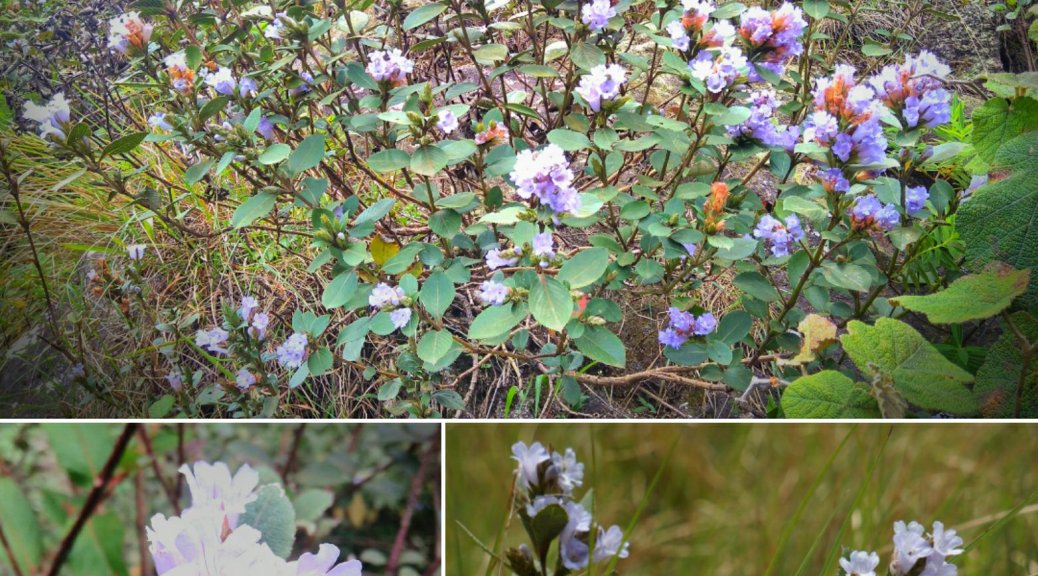
Heard of the blue hills? Does the name ‘Nilgiris’ strike any bell? For those who know less, it is a part of the Western Ghats, a UNESCO World heritage site in the southern peninsula of India. The ‘Neel-giris’ literally translates to ‘Blue-Hills’ because these hills get their colour from a particular phenomenon. A particular species of the Strobilanthes kunthiana flowers, locally called the Neela-Kurinji bloom once in twelve years. When in full bloom, the entire hill range looks blue, thus giving the hills their name. The last mass-flowering of the neelakurinji flowers happened in 2018 and I left no leaf unturned to witness this spectacle. There were a couple of hotspots identified by the Kerala forest department where arrangements were made to allow visitors to see the flowers. My friends and I decided to visit the Eravikulam National park, located close to Munnar. This stretch of the hills was where most of the blossoms were supposed to happen. After finalizing the visit dates in Sept’18, the Delhi friends had booked their flight tickets to fly down and the remaining of us booked our bus tickets from Bangalore to Munnar. I had got all the necessary entry permits from the forest authorities and booked accommodation in Munnar for all of us. All this was done months in advance to have a confirmed entry anticipating the tourist influx for such a spectacle, if we waited until later. We were all set and waiting for the travel to finally happen.
Come July’18, the rain gods had wreaked havoc in the western Ghats. The entire stretch of western Ghats in Karnataka and Kerala had been damaged by the heaviest rains in eight decades. The damage done was massive to geography, property and life along these areas. In the event of things, damage was done even to the neelakurinji plants and the blossoms were feared to be washed out. Once the rain gods had calmed down and the ground situation of floods seemed to have receded, we waited to see if there was any luck in waiting until September. We were in constant touch with a few locals who gave us the updates on the status of the blue hills. Come September and we decided to go ahead with our original plan. We all had finally arrived at Munnar and were heading towards Eravikulam National Park.
Once there, Yes, there were enough plants destroyed. The stronger few, had managed to bear flowers. We walked along the laden path, feeling grateful for at least so many of the plants had survived. Since these plants blossom only once every 12 years, it means that their reproduction cycle is longer than usual. This also means that, most of the Neelakurinji vegetation is lost in the 2018 monsoon and the next flowering cycle of the year 2030 may not happen at a mass-scale as it is usually supposed to happen at all!! Anyway, we enjoyed whatever we were witnessing.
The Neelakurinji flowers at Eravikulam National park
Also, Neelakurinji is only a sub-species of the larger group of flowers called the Kurinji. The Kurinji flowers come in several colors- white, peach, purple, etc. Here is a collection of the Kurinji flowers from Eravikulam National park that we saw during our visit.
The various Kurinji flowers at Eravikulam National park
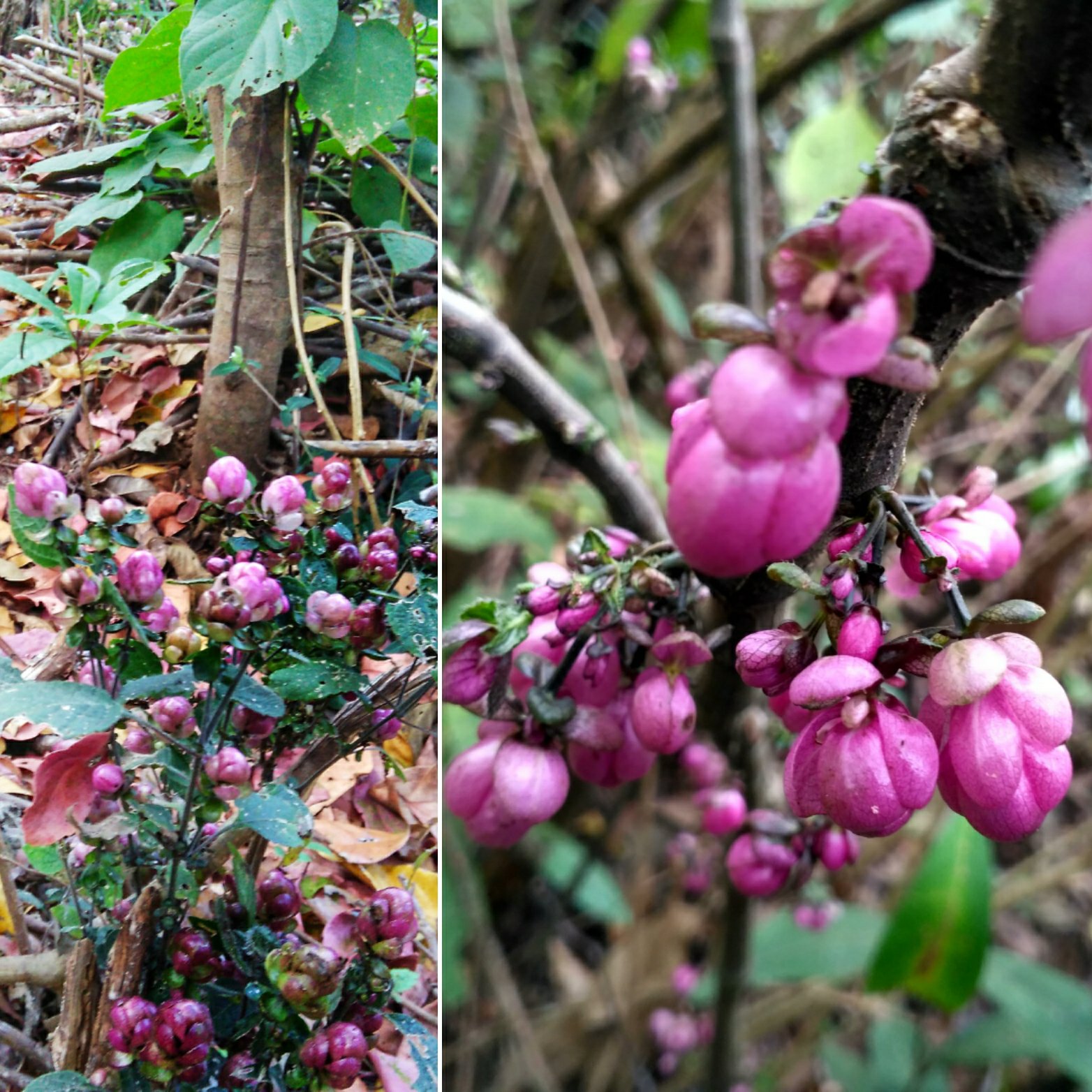
So that said, I was back in my hometown the following week and visited our piece of farmland to check on its status after the monsoon. It used to be a spice plantation that remained unmaintained for a long time before we, siblings ventured into developing it. our farm is a short walk away from the main road. When we arrived there and decided to walk, the entire path was filled with what seemed like some weed that had overgrown during the monsoon. We used a machete to make way for ourselves to walk further. Just a few steps into the area, we were surrounded with pink/ maroon flowers all around us. ‘These weeds had flowered expansively’, we wondered. We took a lot of photos, made way for ourselves, finished our work and returned home. When we discussed about the weeds with the elders in the family, we were surprised to hear that these plants also belonged to the Kurinji family.
The Kurinji flowers from our farm in Kodagu
Further, an important month in the Kodava and the Tamil calendar is the month of Kakkada or Aadi. In Kodagu, on the 18th day of this month a special dish is prepared using a locally available herb. Its juice is believed to contain 18 medicinal values. It leaves a very deep blue/violet pigment when cooked and consumed only on this day. And what is this plant called? Don’t even guess… Locally called ‘Maddh thoppu’ or ‘Aadi soppu’, it is also a variety of Kurunji. So, Kodagu primarily has three types of Kurinji; the flowering weed(Maley Kurinji(as in hill), Etth Kurinji(as in cattle) and Maddh Kurinji(as in medicine). A little bit of googling allowed me learn that there are many sub-species of the Kurinji and each have their own flowering cycles. While some bloom annually, some bloom once in six years and some take a couple of decades. Neelakurinji was just one among them.
Lesson learnt: How often do we tend to ignore the little things from our own backyard? We think these are too trivial to spend time and look for things elsewhere. It is often that people associate that better things come only when money is spent and distances are travelled, but the truth may be that it is something that we have been conveniently ignoring in our own vicinity. What is your take on this thought?
Come the night of Mahashivaratri, there will be festivities across the country. People stay up all night and participate in bhajans, pooja offerings, chariot pulling etc. all to keep themselves awake for the night, so that their beloved Lord, Shiva gets good rest after taking care of them all year. But it is the day that follows the revered night, that is the essence to this story of mine. The day that follows Mahashivaratri is when Shakthi, the consort of Shiva and thus, the female power is celebrated across the Northern part of Tamil Nadu. The companionship of Mother Angalamman to Shiva, the graveyard dweller is celebrated with a festival called the ‘Mayana Kollai’. As a friend explains, Mayana Kollai translates to the ‘Raid of the graveyard’ in Tamil. I had planned to witness this festival at one such temple dedicated to Angalamman, closer home, at Kaveripattinam.
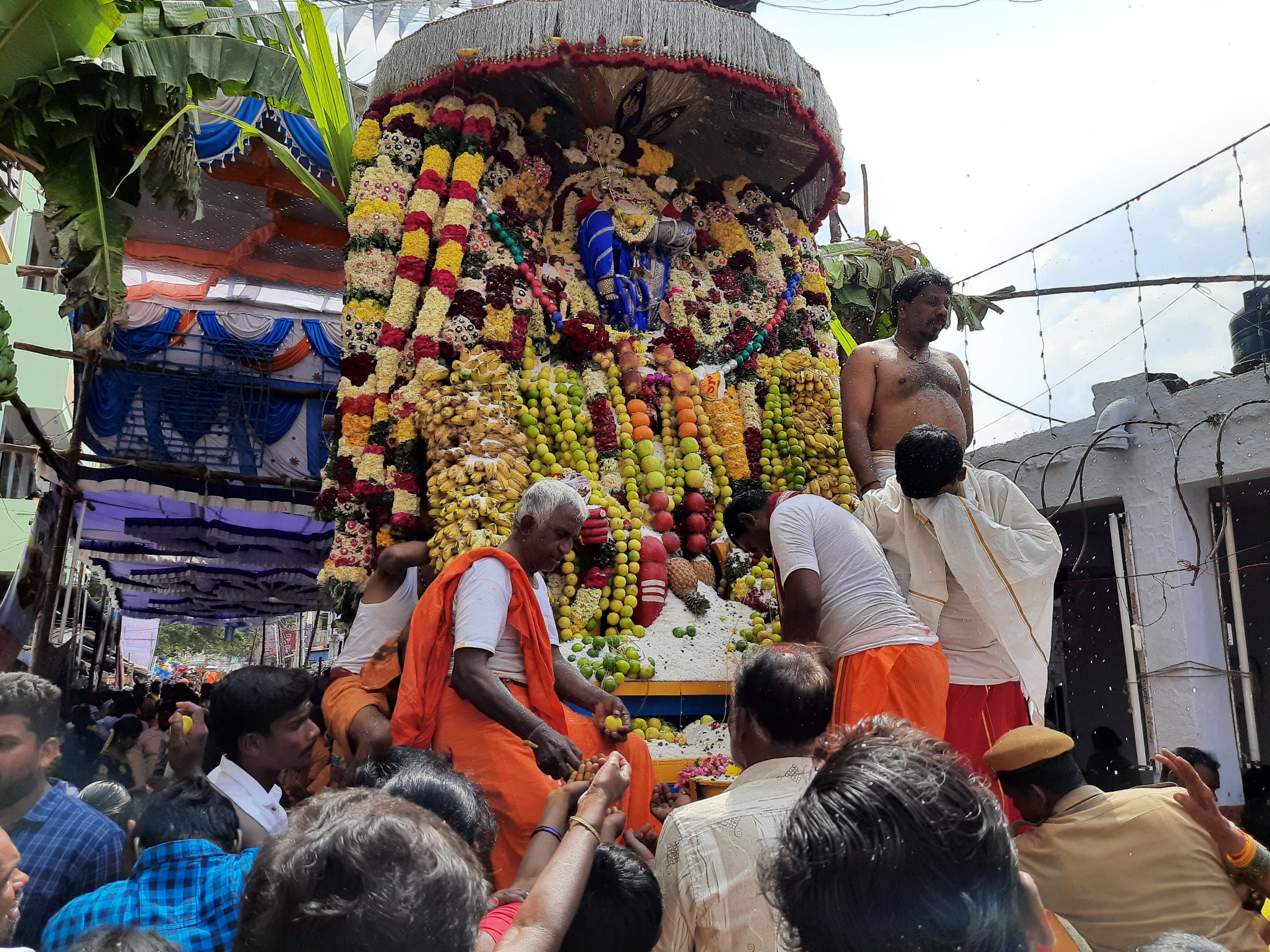
The festivities had started as early as the sunrise at the Angalamman temple, with the Goddess being taken on a temple car/ chariot. She is supposed to travel along the streets of the town, to the graveyard by evening from where she returns to the temple by night. All other rituals that are part of this journey of her’s are what make this festival more interesting. It is a festival where the entire town / village participates with no barrier of caste or societal status. The chariot leaves the temple with the idol of Angalamman.
The diety- Angalamman being taken on a procession on the temple car / chariot
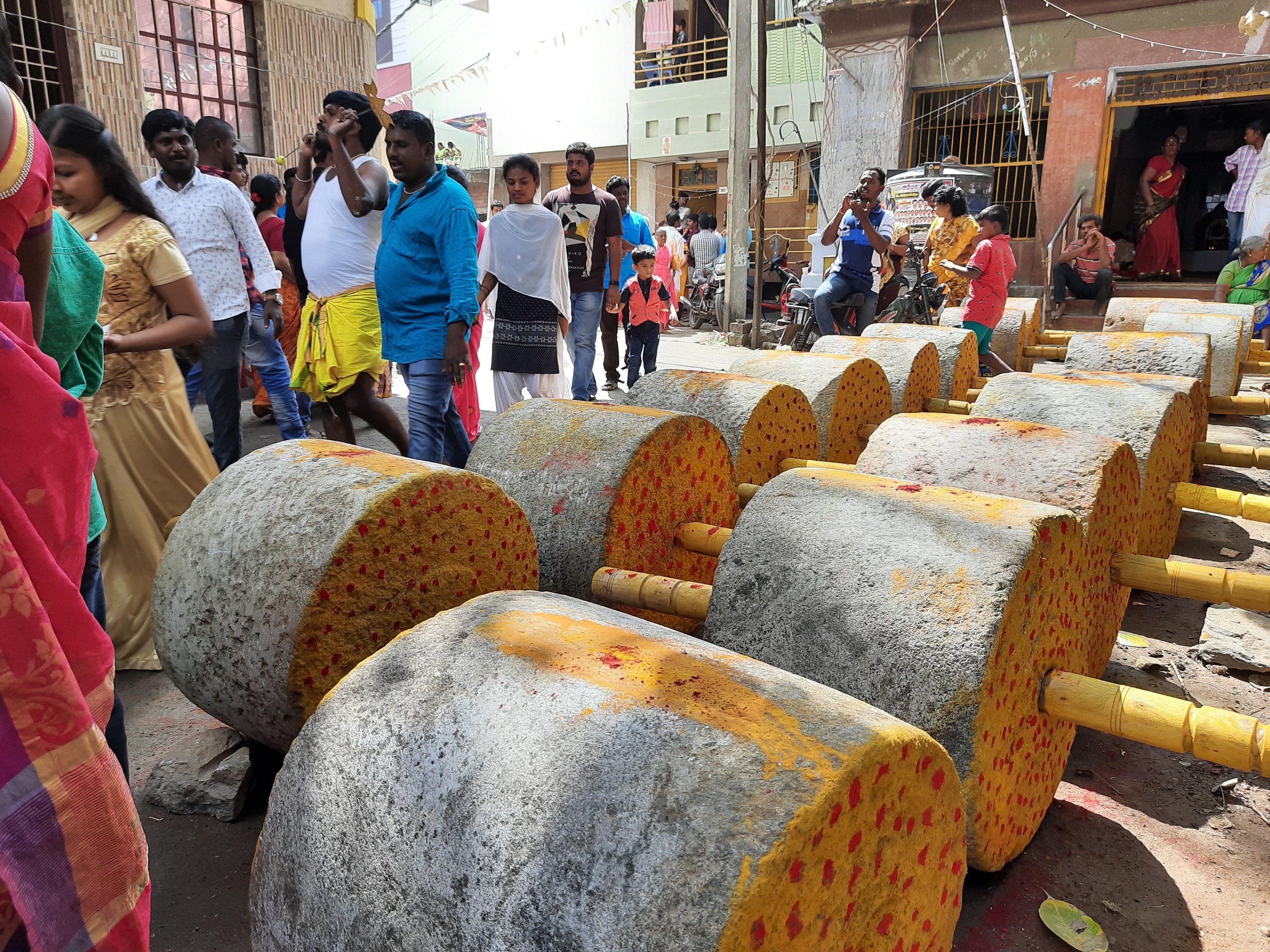
She is greeted by devotees who throw a mixture of salt crystals and black pepper or beans all along her way. She is hailed as a symbol of fertility who is calm throughout the year and takes on her powerful form on this day, once in a year. The villagers get their body pierced with various things near the temple premises and walk across the village to the graveyard, where the piercings are removed. This body paining is what they believe, is a gratitude to the almighty for the wishes that have come true or as a part of a prayer that needs to be fulfilled. The size and things pierced can vary depending on individual’s prayers. While those with tridents pierced around their mouth are a very common sight, the more pious go further to get their torso pierced with hundreds of lemons. Yet, a few pull cars, buses, trucks or large stones with ropes that are hooked through their bare skin.
Stones being readied to be hooked to the body as a man with a trident pierced to his cheeks walks past
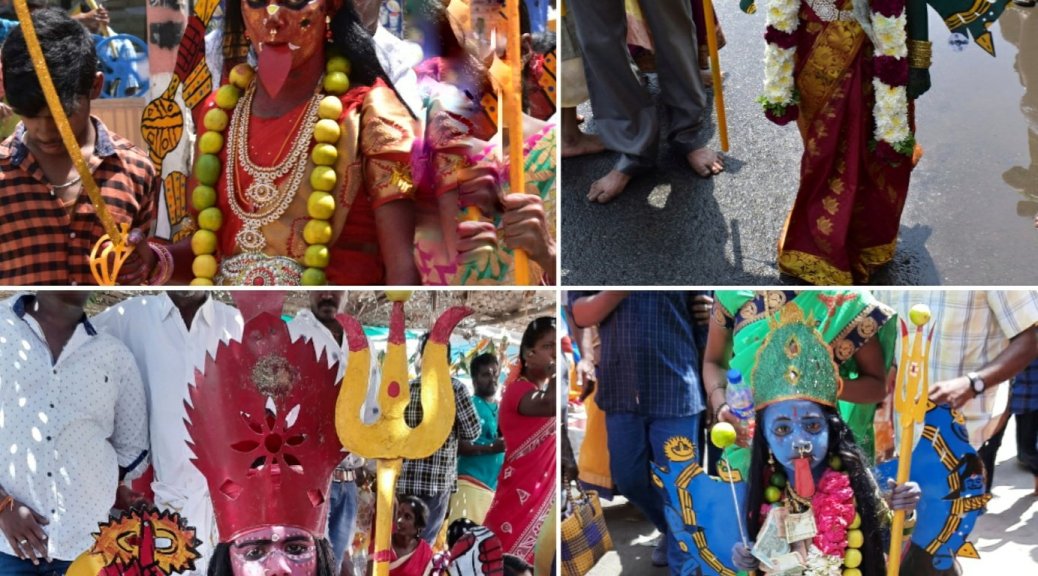
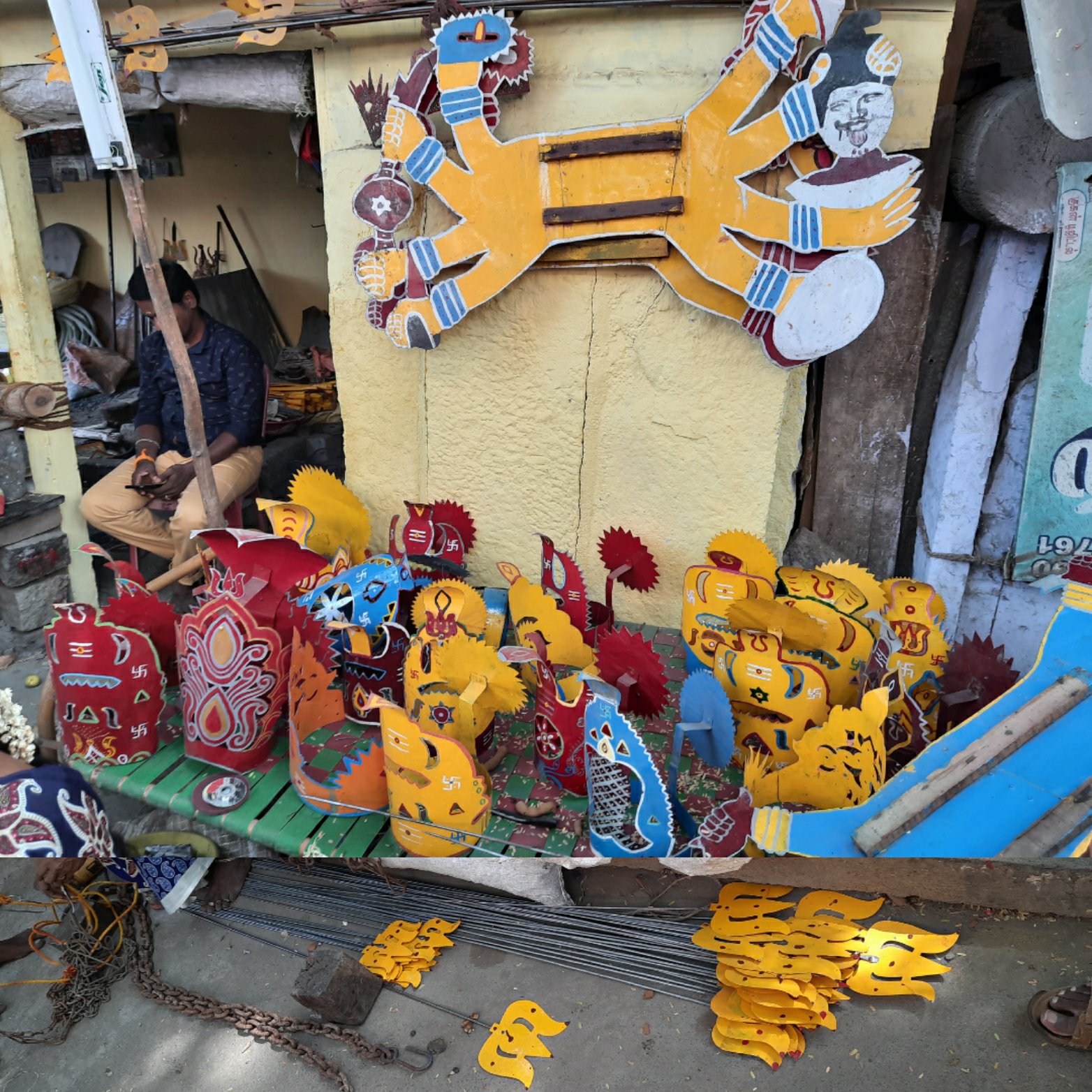
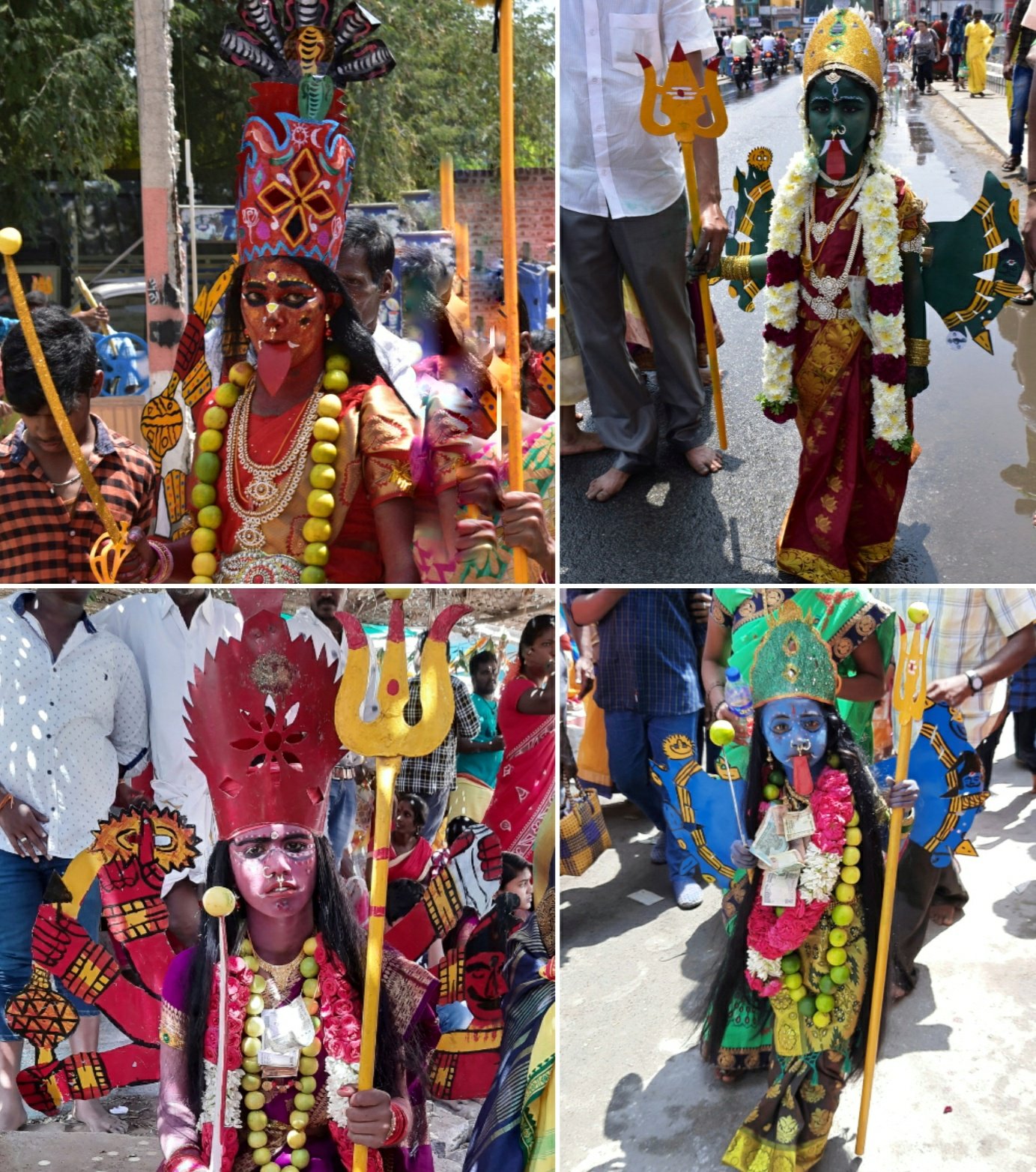
If u peek into one of the many shops (I don’t know if that is the correct noun for such places) around the town, apart from those getting the body piercings, you will find another set of people. Men and children will be getting their faces painted and dressed up in sarees, a representation of Angalamman. With metal arms attached to the backs, elaborate costumes, jewelry and crown worn, Angalamman is impersonated by these people. They hold tridents and dance to the beats of drums across the streets. Several times on their way, they get possessed or get into a state of trance, until they all finally congregate at the graveyard. Animal sacrifice too is a common sight on the streets on this day.
Stalls where the body piercings and paintings will be done
It is evening by the time the temple car and everyone else reaches the graveyard. That is when the most interesting part of the rituals takes place. The folk impersonating the goddess gather around a random grave and dig it up. The bones from the grave are pulled out and chewed by them. This is called the ‘bone chewing’ ritual or what gives the festival its name: Mayana Kollai or the ‘Raid of the graveyard’.
Men and kids dressed up like Angalamman
There are several legends and references that explain the significance of this ritual, depending on the region. Here are some of the references I found on the internet.
Post this ritual, the goddess calms down and returns to the temple on the temple car. The festival culminates when the it reaches its home.
While witnessing all this self-violence, I started to deeply think, why this is necessary to please the gods. Although I couldn’t find a convincing conclusion, what I realized is that this form of ritual is not unique to Hinduism alone. It has been largely practiced worldwide, across all major religions. Some of the closest references are:
Whichever faith be it and whatever the belief, the intentions of every person involved is the same. To get closer to god. Aren’t all our beliefs connected?
One of the earliest science lessons we learnt in school is that friction causes fire. We all have grown past reading how the early cavemen generated fire by rubbing two stones together and eventually how this accidental discovery lead to a massive turnaround in the evolution of mankind.
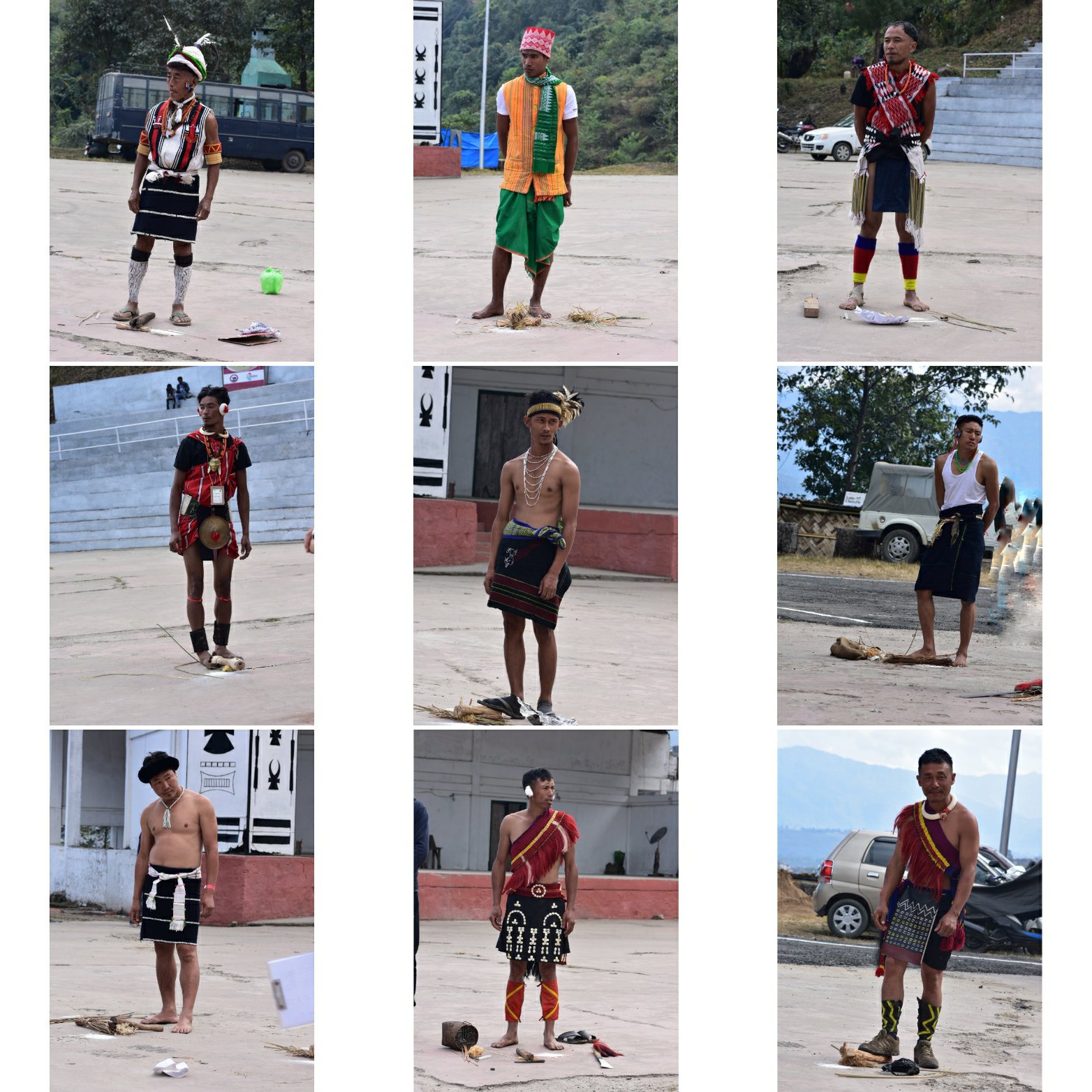
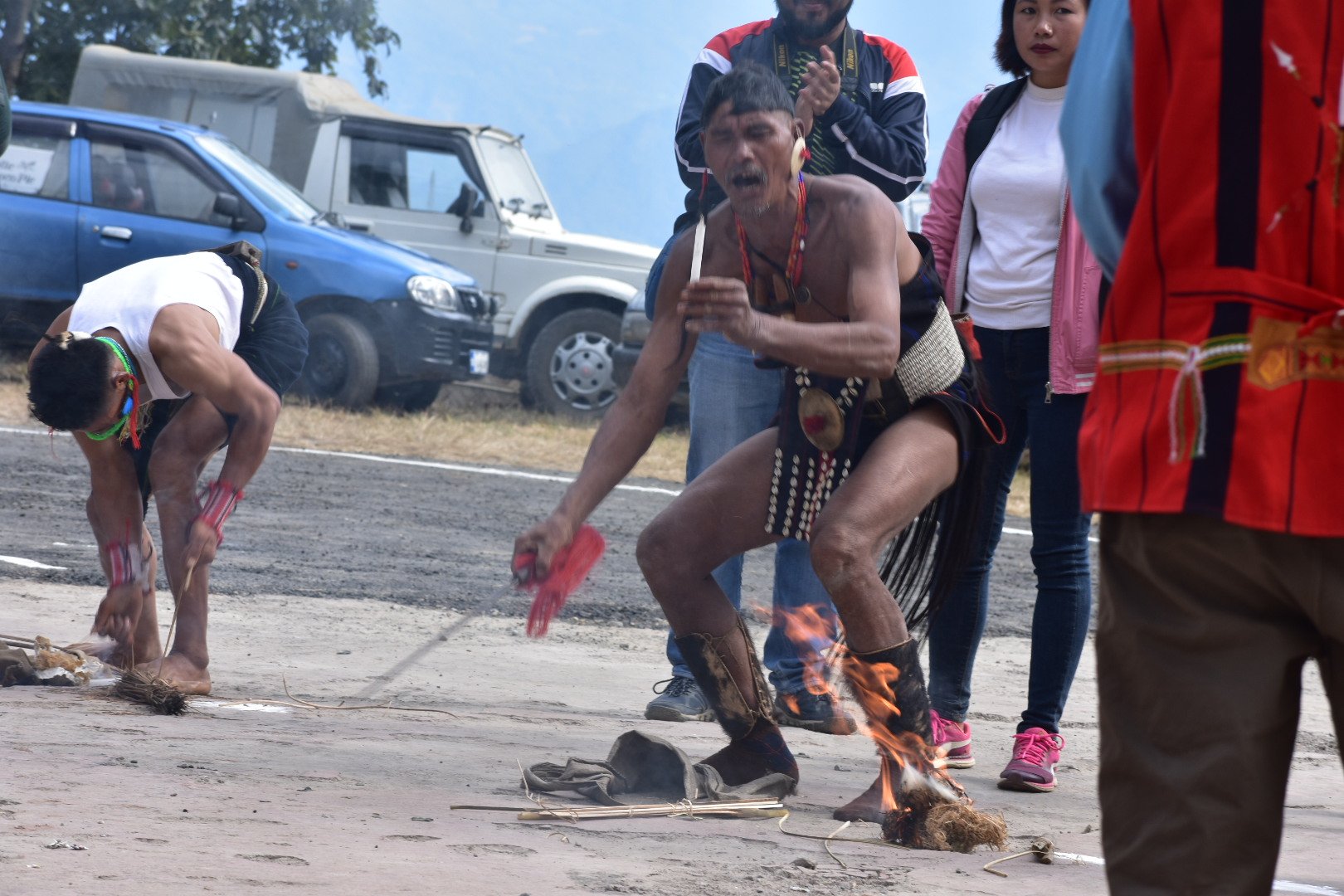
Leaving the past behind, the modern man uses a matchstick or a lighter to create fire, all based on the same science of friction. But, there in Nagaland, the culture still exits where albeit the formal education and access to matchboxes and lighters, the tribes continue to use their indigenous methods of lighting a fire. In order to keep this tradition alive, there are competitions conducted among the various tribes of the state to see who ignites the fire faster. I witnessed one such event during the hornbill festival-2019 in Nagaland.
The nine other participating Naga tribes at the fire making competition
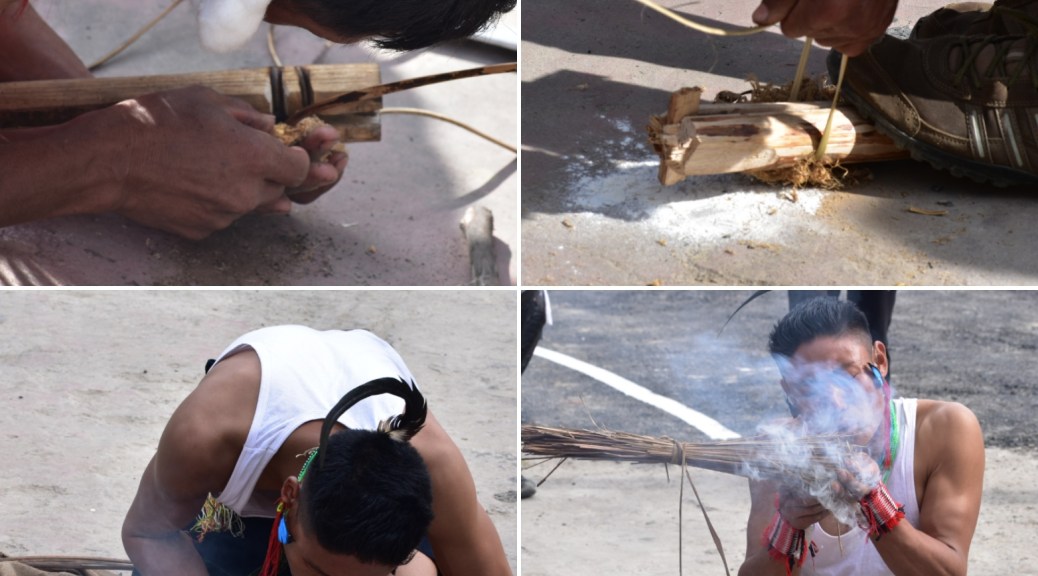
The traditional method of fire making is done by using wooden log and fiber. Wooden saw dust is placed between small crevices made in the log around which the long fiber is then rapidly pulled along, to create friction. The log and the fiber are the two surfaces creating friction and the saw dust is the fuel/ catalyst. It was a very distinct way of lighting fire to watch. The person who first lights a candle using the fire ignited by him in this traditional method gets to take home the trophy.
The winner of the contest (Naga fire making)
Here is a video to see how this fire is made in the indigenous Naga way.
It is that traveling exposes one to a multitude of cultures and people. The diverse geography of India is home to some of the most unheard traditions and untold folklores. During my 10 day stint of backpacking in Nagaland, I was introduced to so many of it all, as this little Indian state, tucked in the far North-east is home to more than 17 tribal sects and sub-tribes; each having their own culture, language, traditions and cuisine. Here, is a small list of indigenous musical instruments used in the folk culture of the Nagas.
Mrabung:
Mrabung is an indigenous musical instrument of the Zeliang Nagas. It is a single stringed instrument that is crafted with a hollow/ cured bottle gourd and a fretless wooden neck of about 12 inches long. It is played with hair string bow (Usually a cluster of horse tail tightly tied together to two ends of a thin wooden stick). This bow is used to strike the chords (like a violin) with one hand and the string along the neck is pressed down with the other hand at appropriate places to get the required tune and legato of the song. It is played during merry making in social gatherings and festivals where men and women congregate. I was narrated with a popular folklore of the Nagas wherein, a singer called Arum played the Mrabung. His music captivated the farmers so much that everyone working on the field left their work undone and sat around Arum listening to his songs. Arum had to be barred from playing any songs further just so the people went back to work on their farms. Click below to see an artisan playing the Mrabung.
Atutu:
The Atutu is a handcrafted bamboo trumpet used by the Pochury tribes of Meluri. A particular variety of bamboo is used in making the varied components that are fitted together to make this crafted trumpet. It is played to mark special occasions. For example, blowing of this trumpet towards the end of February means to herald and announce the advent of the Nazhu festival. Also, the male members of the tribe play it in their morungs in the evenings throughout the festival. Apart from this, the trumpet sound is used to ward off birds and animals from the rice fields and prevent from crop damage. In earlier days, trumpeting was a way to alert the collective habitat or a village of a possible enemy attack or as a signal of declaration of a war.
The Atutu: The bamboo trumpet
Dholak:
This common musical instrument has its own version and avatar in every region of India. Be it weddings or festivals, it is the most common and almost an essential part of any merry making in Indian celebrations. Similarly, each tribe in Nagaland has its own version of the dholaks or the Indian hand drums. Made with an outer casing of wood, laced tightly with cotton strings and the drumming surfaces made with the locally available materials, more often animal hide. Here are samples of the dholaks used by the Garos (Long slender shaped, narrowing at the ends), the Mech Kacharis (fatter and shorter than the Garos) and the Aao tribes (Shorter and fatter than the previous two types and Uniform sized throughout its length) of Nagaland. (Click the below link to watch the ceremonial dances of the Naga tribes with their dholaks)
This is my humble attempt at documenting some unique musical instruments that are lesser known to the world outside North-east India. These have been listed based on my actual experiences and interactions with the Nagas during the hornbill festival-2020. If you know any such unique musical instruments, please do share in the comments section below. I would be happy to learn it from you 🙂
Rolling hills that has many faces to call it BEST described… Every description depends on who saw it during which time of the year. I was heading to this valley in early winter, 1st week of December to be precise. That’s when the days are warm and nights are cold, but there is no snowfall.
So, as planned my friend and I set foot to see a valley that borders the states of Nagaland and Manipur. ‘It’s a magical place’ is the only thing we had heard. I had done enough research about getting there from Nagaland side and learnt that there are two routes with different difficulty levels. One starts from Jakhama village and the other is through Vishema village. Since we had hired a trek guide, we decided to take the route recommended by her. Initially, not knowing what terrain we would be trekking through, we had carried our large backpacks with all the stuff for our fortnight long trip in Nagaland. But then, our guide asked us to carry just thermals and enough water. “Food and blankets can be bought at the peak” we were told. Anyway, additionally we carried our sleeping bags and some food since we had to utilize what we had carried all the way from Bangalore 😛 We left our luggage at our guide’s house in Jakhama and took a short taxi ride to the start point of the trek. (Watch the video below)
We started to climb up from Jakhama by around 11.30.a.m. and the path was unassumingly steep. The entire trail was encompassed in a thick canopy of trees through which the sun rays could hardly penetrate. Although we were climbing at peak noon, it felt as if it was post sunset. The heat generated by the body while burning the calories seemed insufficient to warm us up. The trail only got steeper at almost 80deg gradient and we kept thanking our guide for telling us to leave our excess luggage at the base. Then suddenly, the forests opened to the blue skies… Before our eyes could adjust to the bright light, we were staring at our first glimpse of the valley. I was at a loss of breath. Not because of the tiring climb or the cold winds that was making it difficult for me stand on my feet, but because I was transported to a different world by the setting sun which had engulfed the green valley. I don’t know if I can express that feeling rightly with words, to simply put it: I was SPELLBOUND!
The first view of the valley
It was a short walk further from there. The trail along the cliff with the green hills appearing one after the other and the sky changing its shade with every second, kept us going until we had finally made it to the guest house for the night’s stay. At 4.30.p.m., when we reached there, it just got dark with the last ray of white light. But the sky continued to mesmerize us as it turned from red to black, in between illuminating the silhouettes of the surrounding hills. I had started to freeze and shiver by this time as the temperatures dropped to single digits. But I did not want to move from there as I stared at what was the clearest night’s sky I had seen in a long while. So many stars twinkled over the Dzukou valley! As reality started to hit me hard, I had started to get cramps in my feet and had to hurriedly go and warm myself with the thermals and the firewood that was lit to cook food in the kitchen.
As the night passed, the temperatures dropped further. Our thermals and sleeping bags didn’t seem enough and we borrowed additional blankets to help ourselves in the large hall which had just walls, a roof and a wooden floor to sleep on. I could barely sleep through the cold night. Although awake, I was waiting for the alarm to ring at 05.00.a.m. We were supposed to head out to see the Dzukou valley…
At 05.00.am. I was the first one to get up and step out for the hike down to the valley. The morning light was still dim, and I felt the earth below my feet crackle. It did not take me too long to realize that all the grass on which I was walking and the entire valley that surrounded me was frozen. The temperatures had dropped below zero and the frozen valley at a distance looked splendid! Soon, the others joined me, and we walked down the valley to witness what is supposed to be the main reason for our trek to Dzukou. The sunrise! We walked past what the locals call as the cave and walked over a frozen stream. We clenched bits of frozen waterfalls along the way too… And when the sun rose above and shone over the valley- It looked surreal. It seemed like the phrase ‘Frozen in time’ was framed after someone saw this place. The frozen dew drops reflected the lights of the rising sun and the sight was beyond my ability to describe. What I was experiencing from within was a sense of emptiness, accomplishment, happiness- well a medley of emotions. There has been NO place I had been to more beautiful than this, no I’m not exaggerating.
A frozen pond in Dzukou at Sunrise
The entire valley has a peculiar kind of bamboo grass which gives it its green color. The same valley looks as if it is covered in red/ pink during monsoon. That’s when the lilies, endemic to Dzukou valley bloom. And come during the peak of winter: The entire valley is painted white in snow. This is a photo my guide had shared with me of how the valley looked just 10 days after we returned. The valley does not fail to mesmerize people irrespective of the season they come. Well, after spending a good amount of time, we returned to the guest house, packed up to head back to Kohima, for the hornbill festival.
The sky on our way to Vishema
By now, we were a big team of trekkers and backpackers who had all bonded over at the guest house and together we decided to take the Vishema route for our return. It was a brilliant decision, I guess! Had we taken the same route for our return; we would have missed the magical sky behind the forest canopy. The sky seemed surreal with every turn in the trail. The valley too looked magical at every corner. It was flat land that we were walking on mostly, apart from a short trail of very steep rocks to slide down from, until we finally arrived at the base. A pre-booked Sumo was waiting to pick us back to Kohima. I want to bluntly end this post because this place is something better experienced than written about.
The view point from the guest house. Top: After snowfall; Below: before snowfall
About the trek in short:
I believe what one calls difficult or easy largely depends on individual’s fitness level and trekking experience. According to me, the distance to the peak is short and could be done in 1-1.5hrs if it was me alone. But it was the first hike EVER for my friend and it took us around 4hours to reach the guest house at the peak.
Although people feel Vishema route is easier onwards, in my opinion- we made a good decision by walking the Jakhama route while going up. Since it is steep, climbing would be slow but the distance is shorter. In contrary, if we took Jakhama route to climb down, the gradient would put enormous strain on our knees which is why I suggest taking the Vishema route for the descent.
Cooked (basic & hygienic) food and potable running water is available at the top, so apart from energy bars for your walk, avoid carrying unwanted luggage.
HAL (Hindustan Aeronautics Limited), Asia’s largest and India’s first aerospace establishment was founded and is headquartered in Bangalore. If you want to walk down this journey of how aviation industry has evolved in India, a visit to the HAL Aerospace Museum, India’s first aviation museum located at the HAL premises is highly recommended. From the first aircraft, Harlow PC to be assembled at its stables to manufacturing the most modern helicopters, planes and equipment for present day requirements of the Indian airfare, navy, railways and space research, HAL’s journey has been a long one. One is bound to get amused in another world by taking a walk between vintage planes, flight simulators, mock ATC and all things associated in this subject of fantasy at the museum hall. Now, this place leads me to my next destination: The IISc (Indian Institute of Science).
An exhibit of the Pushpak aircraft at HAL
That morning, I had ordered a plate of idlis at this little restaurant on the IISc campus. Just like any other day at that restaurant, the environment was abuzz with the chitter chatter of the people I was surrounded by. A typical scene on any given day includes the best scientists of India and abroad discussing new experiments over a plate of food in what is one of the premier research institutes in the country! Irony has it that similar discussions happened under the same roof, sometime in history. But back then, the discussions were about something more strategic and destructive. It was right here that a bunch of people discussed a war plot. What is now the top-of-the-notch science and technology institution in India, served as a hub for maintenance and repairs of the aircrafts during World-War II.
In the late 1930s, a factory meant for automobile maintenance was setup by an industrialist named Walchand Hirachand in the present day IISc campus. History has it that on his way to China, Hirachand chanced upon a meeting with William D. Pawley who was attached to the Intercontinental Aircraft Corporation of New York, an American aircraft exporter. This connection lead to the procurement of the necessary tools and equipment from the US to setup an aircraft production line in India. It was in December 1940, with funds from the Mysore state, the Hindustan Aircraft Private Limited came into being. The plan was to manufacture the Harlow trainer, Hawk fighter and the Vultee attack bombers at this factory. However, this required huge manpower that was trained in Aeronautics which lead to the establishment of the department of Aeronautical engineering.
A 1942 file photo of the HAL main gate.
Photo courtesy: HAL museum gallery
The structure that housed the aeronautical engineering department was designed by German architect Otto Koenigsberger. Otto Koenigsberger was a young Jew who had fled his country during the Nazi regime and was later in time, employed as the government architect of the erstwhile Mysore state. His architectural design is an amalgamation of European and traditional Indian styles and can also be seen in the present-day metallurgical department and the hostel office on the IISc campus along with many structures across India. Talking about the aeronautical engineering building- it is an oblong structure with high ceilings and narrow corridors that integrated natural climate control. He has also designed the closed-circuit wind Tunnel, the first of its kind in India and hydrogen plant among other things that are associated with aircrafts. With all the technical back up from IISc, it was in 1941 that Hindustan Aircraft Limited (HAL) assembled the first aircraft in India: A Harlow PC-5.
Meanwhile, the threat posed by Imperial Japan loomed large in the on-going World War II because of which there was a need by the British Royal Air Force to boost its military hardware supplies in Asia. With all likelihood, HAL was most suitable as a base for the South East Asia Command of the allied forces for servicing their aircrafts. Hence, all the aircraft manufacturing plans in India were abandoned to support the repair and overhaul services of the American aircrafts and the factory was eventually taken over by the US Army Air Forces in 1943. This led to rapid expansion in the facilities and became the 84th Air depot for overhaul and repair of American aircrafts during WWII. The very same hydrogen plant on the IISc premises was used as a loading dock to supply hydrogen for the American aircrafts. Later in 1964, the factory was taken over by the Government of India and has morphed into the modern-day Hindustan Aeronautics Limited (HAL) in its present-day location. However, the original Aeronautical engineering department continues to contribute enormously towards research and has its own little airstrip on the present day IISc campus.
As I finished my plate of idlis, I wondered how unassuming I was. This deceptively functional place had just served my meal that had just been cooked inside a hydrogen plant that powered the military aircrafts during WWII.
This post is part of my fortnight long backpacking in the north eastern state of Nagaland in India, specifically covering Dimapur- Kohima– Phek districts of the state during the Hornbill festival.
More often than always, the stories we carry back from our travel are about the people we meet and less about the places we see. Our definition of whether our trip is good or bad is defined by the way we are made to feel by the people we come across. My experience in Pfutsero too has been one of those, where the warmth of the people made me fall in love with Nagaland. All I knew about Pfutsero was that it is the largest town in Phek district, and it is the highest inhabited place in the state of Nagaland. High altitude also means that it is the coldest place in the entire state. Having very little information available on the internet only meant that the place is still off the radar of mainstream tourism. This is what got me inquisitive and itched me to visit Pfutsero which would give ample scope to explore and experience something so raw and unknown to the outside world.
From the day I arrived at Nagaland, I had started to talk to a lot of people to get information about getting from Kohima to Pfutseru. With lack of clear information and high cost of travel, I had almost dropped the plan until the end of my 10-day trip in the state. One last try at finding a cheaper travel to Pfutsero, landed me in a small grocery store at Kezekie taxi stand in Kohima. My friend and I realised that we were at the right place. The courteous owner of the store guided us with all the required information and got our seats booked in the shared taxi that plied from Kohima to Pfutsero the next morning.
My itinerary to explore Phek district:
Day 1: Leave from Kohima to Pfutsero (shared taxi), visit Glory peak (Frozen lake trek if time permits), explore Pfutsero town (Night’s stay at the tourist lodge) Day 2: Chida lake/ Lowho, Lazami village (spirited stone), Kami village view point, return to Kohima.
Video of the view from Glory peak
The Details:
As instructed, we had reached Kezekie by 07.00.am. the following morning to be assured of a seat. But thanks to the traffic, it was 10.30.a.m. by the time we left Kohima. However, there was one ambiguity before leaving for Pfutsero- We hadn’t booked a hotel at Pfutsero for our stay yet. Despite several failed attempts of calling the mini-tourist lodge at Pfutsero, their phone continued to remain switched off. But my friend and I were up for some adventure and decided to travel without a confirmed stay, go there and find one.
Phek district is inhabited by the members of the Chakesang tribes in majority. With the friendliness of the grocery store owner, we had already started to feel the positive vibes of the place we were going to. She had given the contact information of her family who lives in Kezakeno, another village in Phek. She had not just shared the contact info, in fact forced us to stay with her family. We were feeling grateful and partially sorted in the eventuality of not finding a hotel at Pfutsero.
Day 1:
There were both good roads and no roads, all adding up to a patchy drive to Pfutsero. Apart from the mountainous roads that seemed charming outside, the people with whom we shared our drive made our trip indeed a memorable one. One of them helped us to contact the tourist lodge and confirmed our stay at Pfutsero even before we reached. I had clearly started to feel overwhelmed with the hospitality of the people in this part of the country where the locals wanted to make all visitors feel at home. Almost everyone whom we got talking to, was excited to invite us over for a meal with them. Finally, it was 02.00.p.m. when we reached Pfutsero and a cup of hot tea was what we relished at our co-passenger’s house before checking-in at the tourist lodge. A colourful garden welcomed us into her wooden house that was perched on the slope of the hill. Its windows opened out into a majestic view of the entire town and overlooked a lake surrounded by green lawn. The dreamy house seemed to be no less than out of a Bollywood flick. We soon bid her a warm goodbye and headed to the tourist lodge, freshened up and proceeded to the target destination, before the sun called it a day!
Glory peak is the highest point in Pfutsero. A short taxi ride of 3kms through an under-construction road, jaw-dropping view of the surrounding valleys and a climb on a watch tower got us to the top of the town. Mt. Saramati is the highest peak in Nagaland and Mt. Everest needs no introduction. On a clear, bright afternoon, both the mountains can be seen from Glory peak. Since, we had reached there before sunset, the distant mountains were partially hidden by the haze and hence we could get a clear view of only Mt. Saramati. Nevertheless, the 360deg view of verdant hills from the glory peak was something to die for.
View from Glory peak, Pfutsero
For those who have an additional day at hand, a day hike to the frozen lake from the glory peak is highly recommended by the locals. We decided to explore the town a little bit, before it was dark. A hike down the peak was fun as the staircase leading to the town passed through thick forests, strange creepers and colourful butterflies. We spent time exploring the town until sunset. It seemed dusty with poor roads. Apart from a few local snacks, we couldn’t find anything interesting. However, there is one souvenir shop run by an NGO that supports local artisans. One can buy some traditional Chakesang tribal jewellery, textile and food products as souvenirs from here.
The dropping Pfutsero temperature had started to numb our fingers and we decided to head back to the lodge. The lodge is situated on top of a hill and the setting sun looked glorious from the corridor. After wearing my thermals and gloves, I decided to take a stroll around the lodge. It is located adjacent to defence property and that gave me a sense of confidence to venture alone after dark. All the people from the neighbourhood were busy in decorating a nearby church for Christmas. They got me talking to them and eventually I joined them in their chore of setting up the wreaths and light bulbs. It was a fun evening until I decided to head back for the warmth of my room. The lodge was a HUGE property, but we were only two girls staying there that night. Although it was a little scary at the first thought to be the only guests, we were soon occupied in long conversation with the caretaker family of the property living in the same building, later to be joined by the owners. The conversation covered a range of topics and ran into the night. Given the lesser crowd of the cliched tourists, company of comforting hosts and warm conversations, we couldn’t have asked for a safer and a better place to be!
Top: Sunset view from Tourist lodge corridor, Pfutsero; Below: Sunrise view from Tourist lodge room, Pfutsero
Day 2:
The comfort of the heater, cosy blankets and carpeted floors let us sleep like logs, unaware of the freezing sub-zero Pfutsero temperature outside. We were woken up by the alarm next morning, only to be mind-blown by the view of the rising sun over the clouds from our balcony. We packed up and prepared to leave as that was our last day in Nagaland and we had to make it to Dimapur for the night’s train. Meanwhile, we had booked a personal taxi for our return, since we wanted to explore Kezakeno on our way back.
The first stop was at- Chida lake. Locally called as Lowho, this off-road destination is a favourite hangout among the locals who come here for games like fishing and boating. Some enjoy a trekking trail from glory peak to Chida along the Kapamedzu range as well. There is a Border Security Force camp at Chida and hence, it is also referred as Chida Post at times. Since we had reached very early, we were the only tourists there and the place looked absolutely calm and serene.
Lowho lake at Chida, Kezakeno
From there, we headed to Lazami village. This tiny village is of very high historical importance as it is the site from where the various Naga tribes are believed to have migrated to different parts of the state. A veteran from the village was excited to narrate the legend of Tsotawo, the spirited stone in the village. We were warmly invited by almost every person in this village into their house. We finally settled down at a little traditional house for breakfast and a large cup of tea. We carried back love in the form of guavas and local walnuts given by our hosts from this village. Seeing so much affection in these hills was a wonderful feeling that cannot be expressed, for which a city soul in me would want to come back again.
The spirit stone
While continuing our journey from there, we did have a stop at Kami village view point to admire the terraced paddy fields of Lekhromi village, the view looked magnificent under the oblique rays of the early sun.
Making our way through the maddening traffic jam of Kohima is for another story to be written about, some other day! Thus, ended our 2 days of amazement and overwhelming hospitality in the Land of the Chakesang Nagas- Phek district.
Terraced farms at Lekhromi village, Phek
Fact file:
Must eats:
Pfutsero is famous for its organic farming and terrace cultivation. We bought fruits (some known and some new) from the local shops that we could eat once we were back in our room.
One would find a lot of bakeries in the town selling local cookies and muffins. Sticky rice cake, banana cake and banana chips are few of the things I recommend.
Getting around:
Daily shared taxis ply between Kohima and Pfutsero. There are limited seats and the taxis leave immediately when filled. The taxi leaves Pfutsero around 6.00.a.m to Kohima and the same returns to Pfutsero on the same day on a first-cum-first serve basis. So, if one is not early enough to get a seat, he will have to hire a full taxi for him/herself or stay back until the next morning to share it. A one-way shared taxi seat costs 300Rs. Per head and a personal taxi would cost 5-6000rs. irrespective of whether it is a 1 or a 2-way journey.
Within Pfutsero, most places are at walkable distances. But internal taxis are available for local commute. Talk to one of the shopkeepers in the town and they must be able to help in finding one.
Stay:
A very well-maintained tourist lodge and a government run mini lodge are available at a very affordable price.
There are a few homestays available for a more local experience.
This post is part of my fortnight long backpacking in the north eastern state of Nagaland in India, specifically covering Dimapur- Kohima- Phek districts of the state during the Hornbill festival.
Before planning my visit to Nagaland, I had followed a few bloggers who had posted encaptivating photos of what they called the ‘Greenest village in India’. My friend and I had our stay booked at a homestay in this little-known village and were supposed to head there on the first day of our arrival in Nagaland. It was past noon by the time our shared taxi from Dimapur reached Kohima and the temperature had started to drop. Khonoma village, our destination was 20kms away and we stood on the highway, clueless about how we were supposed to get there. The connectivity through public transportation across Nagaland is something that needs the attention of the authorities. Meanwhile, without being able to find an honest taxi driver among all those who were quoting higher than what I had read about, we had started to feel stranded.
We finally managed to get a taxi and the courteous driver ensured our ride on the roadless path was comfortable and entertaining. On our request, the best Nagamese songs from his playlist were streamed and he made humble efforts to explain the meaning of each song and its relevance in Naga culture. It was a long ride considering that we took over an hour to cover the short distance. In Nagaland, each district is inhabited by a particular Tribe in majority and each village represents a particular clan within the tribe. Every tribe has its own language and surprisingly, each village has its own dialect which another clan might struggle to understand. ‘Khonoma is inhabited by the Kuthotsu clan of the Angami Tribe’, we were told.
A village tour of Khonoma
On reaching Khonoma, we registered our entry at the tourism office from where we took directions to our homestay. As a first impression, it felt like it was just another settlement on the hills, something similar to my hometown. But as I began to walk towards the homestay along the narrow lanes and past the tourism office- a new world started to unfold. The entire village is built on a slope, overlooking the paddy fields. The slope makes it a requirement to climb winding stairs to get from one house to another, from one street to another. As you do this, you will not just pass by umpteen number of morungs but also walk through gardens full of colourful flowers and traditional Angami Naga gates. All this, while you are being mind-blown by the gorgeous view of the never-ending terraced fields of paddy and vegetables. If not the same, I bet this is far better and untouched than the terraced farms of Bali that has flooded the Instagram feeds. The guava trees around every corner of the village and the widely covered creepers of the Chayote squash added a vibrant hue of green to the entire valley. The extremely warm and obliging villagers allowed me to pluck a few guavas that tasted like nectar. Those were definitely the best guavas I had in my life till date. We then walked down the streets to our homestay, a cozy simple house that stood overlooking the terraced fields. Since we had little time before sunset (The sun sets by 04.00.p.m.), we dropped our luggage, freshened up quickly and ventured out to explore the village and make the most of the daylight.
Naga Heritage museum at Khonoma
As we strolled around the lanes, we were intrigued by the several morungs and the traditional Angami houses that we passed by. Morungs are Naga structures that are comparable to Gurukuls of olden days. The elders of the village would pass on their knowledge about life skills and tradition to the younger generations here, usually in the evenings after finishing their day’s chores. Although the Morung system is slowly passing into oblivion in modern days, Khonoma is one of the few places where these structures are conserved in their entirety. Every Morung and house had animal skulls (ranging from one to hundreds in number) hanging around their roofs and walls. We were quite fascinated with the collection that ranged from Mithuns and mountains goats to boars and other cattle. As we stood there, watching a few women who were busy with their job of de-husking paddy with a large pestle and stone, we were greeted by them with warm smiles to have a cup of tea in their house. I instantly accepted their invitation, jumping into the idea of seeing how a traditional Angami Naga house looked like inside.
The different skulls inside a traditional Naga house
Basic mud-smeared walls with knitted bamboo doors and their wooden roofs adorned with hundreds of skulls all around. “These skulls are prized possessions that represent the heroics of our ancestors. The Nagas are primarily hunters and our forefathers saved up the skulls of all their kills. The larger the collection, higher was his societal stature until the government brought a ban on hunting. Given the history of Nagas being head-hunters before the coming of missionaries, don’t be surprised if you bump into human skulls in some of the remote villages elsewhere”, explained a member of that house. Although the other members in that family couldn’t speak English or Hindi, they continued to smile at us for as long as we were there. However, communication is never a problem in Nagaland with almost 90% being proficient in either English or Hindi.
We visited the Naga heritage museum and then walked up to a small hill where the church stands at a vantage point, outside the village entrance, overlooking the entire hill range. From there, we walked back to the village and climbed up a few stairs to reach the highest point of the village. The setting sun let the hills in the background cast their shadow on the undulating green paddy terrace. The view of the range of hills and the entire village from there was a sight to behold for which, we had lost our senses and not to the dropping temperatures that had started to numb our skin 😃 After the sun had called it a day behind the hills, we munched on some local snacks like sticky rice roti, pakora at a café at the village entrance. We grabbed a few packets of Puffed sticky rice and Naga chilli smeared channa from a small shop before heading to the homestay. We hurried up to warm ourselves in the comfort of our homestay’s kitchen where firewood was setup to cook the night’s supper. Sips of hot tea and long conversations with our Angami host and other guests culminated with a delicious Angami meal that comprised of boiled vegetables and steamed rice with vegetable stew- all grown organically in our host’s backyard. The country chicken curry was a bonus for the non-vegetarian in me 😊
The plan for the next morning was to catch the sunrise from the paddy fields by walking along the stream that flowed down the valley. However, the freezing temperature made it impossible for us to get out of our cozy layers of blankets. The plan that had to follow our breakfast was a visit to Dzuleke, a quaint little village located 10kms away. It consists of merely 32 houses and the residents are also from Kuthotsu clan who decided to move out from Khonoma to a more secluded place when the land on the outskirts were open for new settlements. Today, it is supposed to be one of the prettiest villages that is promoted by the state’s tourism board and accessible only by foot or one’s own vehicle. Since a one-way ride was costing us 1500Rs., we dropped our plan of a day trip to Dzuleke.
There is one NST bus (Nagaland State Transport) that connects Khonoma to Kohima every morning. But the state is largely shut on a Sunday and it is an important note to consider if you are planning your travel/stay in Nagaland. After the day got a bit warmer, we packed our bags and headed out in a personal taxi to our next destination- Naga heritage village at Kisama, the main arena of the Hornbill festival.
Meanwhile, some interesting things I found in this village:
Large bird feathers are made into a garland and hung high around the farms. “It is just for decoration purpose”, I was told on asking what it signified.
There a large stone erected which signifies the previous rift between the Nagas and the Indians on the mainland (It is quite an interesting read how the Nagas fought the Indian army)