These are my top 5 tips I want to talk about which probably you wouldn’t have given a thought about. You don’t have to be a “Traveller” to use these tips and these are applicable to pretty much anyone who leaves home for a short time or on a vacation.
NEVER flash your boarding passes on social media: I know it seems cool to flash your boarding pass and tell your followers/friends that you are heading to your next destination. But what most of us are unaware is that the QR code printed on our boarding passes contained very confidential information about that individual encrypted to it. It contains details of the transaction you have carried out in the process of buying that ticket. This in turn will be linked to your bank accounts, Aadhar, number of times you have travelled, places etc. It is an easy way to get to all your personal data which is otherwise supposed to remain confidential. So next time remember not to post it on social media and ensure you shred it or store it securely once your trip is completed.
ALWAYS carry a candy or a sachet of sugar with you: Low sugar levels can happen to anyone anytime. I have experienced this twice during my travel. Once, I screamed out of panic when a bus conductor fell unconscious holding my hand while he was issuing my tickets. Some passengers travelling in the same bus came to his first aid by feeding him some chocolates. That’s the day I started to keep a sugar sachet in my wallet. It is probably the FIRST aid that should run through your head if someone is fallen unconscious. So, I make sure it is kept in the most easily accessible spot of my luggage or my wallet.
ALWAYS sanitise your washroom faucets before use: I have always been haunted by the fear of getting a urinary tract infection by using washrooms outside my home. While on the road, there are times when I haven’t consumed a drop of liquid for many days just to avoid going to a washroom. These days, there are several toilet seat sanitizing products in the market to help me in this area. I keep a ‘Toilet Seat Sanitizer’ handy, that I comfortably spray on doorknobs, faucets and toilet seats before using them and relieve myself of my fears… quite literally!
ALWAYS carry your own cutlery set: There is enough said and done about reducing one-time usage plastic cutlery everywhere. Carrying my own set of re-usable cutlery set is my way of doing my bit. Carrying a Swiss knife set or a kit with individual metal spoon, fork and knife would be ideal, but these are not allowed in check-in luggage if you’re taking a flight. So, you can use wooden substitutes for these which can be carried in your handbag/ backpack irrespective of the type of travel you are choosing.
NEVER compromise on comfortable footwear: Shoes, shoes, shoes… is something I swear by! Since I’m a slow traveller who does a LOT of walking and running around, I always wear a comfortable pair of SHOES- trainers, joggers, sneakers whatever you call it, I mean SHOES that are flat, light and breathable. This is one thing I don’t compromise for low cost because the effects of poor shoes are long lasting. Along with this, I carry a waterproof sandals or floaters to let my feet breathe if I’m staying somewhere. Also, I have major issues of getting cramps if I walk with wet shoes, so that’s why these waterproof chappals come in handy!
Indian economy is in a downturn. Everyone is complaining..
The automobile sector is seeing its worst crisis in 2 decades. If automobiles don’t sell, it not only puts my job at a car manufacturing OEM at risk, but has a cascading effect to hundreds of related industries. The steel, the large chain of vendors and sub-suppliers, sales, marketing, advertising agents, dealers to local garages, accessories, insurances, the indirectly dependant canteen, cleaners, gardeners, drivers, IT, so much so that even fuel station workers will lose their jobs. Why am I telling you this? I am no economist, I am no business man, I am no social activist…. I am a Travel blogger and influencer. So why this rant???, one may ask! It is because I want all of you to travel! Explore! Contribute your tiny bit to help our country’s economy.. by TRAVELLING!
It was a casual conversation with a colleague when we discussed about a meeting of his, with one of the top management members of a vendor company, a septuagenerian with over 40 years of experience in the automobile industry.. 4 decades..!! From the day of tariff commissioning to, date where it is more about survival than competition in the industry, he’s probably seen the entire cycle of the “Auto revolution” in India.. His experience and insights were commendable! Most of his qualms with the strategies to boost the sector was to do with the Indian mindset in general. Here is a brief of his insights into what can be done and further elaboration with my own thoughts based on my experience of Thai culture during my maiden trip outside of India!
We Indians have been raised with a mindset to save money. Stash up either in cash or in gold. By doing so, we are pausing the currency from circulation. A country needs monetary circulation for the economy to sustain. There should be buying and selling, both. One way to do that is, to travel.
Ofcourse, there is an endless list of intangible benefits of travelling. From strengthening existing relationships to creating newer contacts, from exposing newer cultures and landscapes to trying new food and meeting new people, travel teaches newer lessons everytime you step out. But the tangible benefit it reflects is that by helping the economy.
Let us start from planning your trip. You browse! So many people out there make up the content on the internet, develop softwares, manage them.. Agents for all your booking needs.. There is a whole lot of people working behind the scenes.
Okay, now you have a plan sorted and are stepping outside your house. You either drive your own car or use public transport. You are in the process, using your automobile. 1. This automobile would need to run. So, you go to a fuel station. 2. Either before, during or after the travel, this mode of transport would need a checkup- you visit a service station. 3. You get some funky accessories for your car/bike if you are using your own mode of transport, or the owner/driver does this incase of a public transport.
Now, you decide to take a pitstop on your journey. You have a cup of chai and some biscuits or let us say hot pakoras by the roadside. You just helped a small business flourish! Oh wait, not one business. He in turn buys the biscuits, milk and the ingredients for the pakoras from several other vendors!
Then, assume you have reached destination ‘X’. You dine at a local restaurant. You stay in a hotel or a homestay. You buy souvenirs. You pay entry fees to so many places of visits. Voila! You helped so businesses survive during your trip. Do you see how many others depend on him for indirect employment?
Now, you tell me, you are not in a mood to travel to a different place. It’s okay! Take your family out for a dinner. Or even better, go shopping. Go to a spa. Go for a walk and eat Pani-puri. Sign up for a course, buy a book, watch a movie. Don’t stash up the money by staying indoors. Go out and do something! Your contribution to the economy is pretty much explained already.
The Thai people are probably the only ones in the world, who spend so much time with family or friends outside their houses. For most of the household don’t even have a functional kitchen. They mostly have food outside, because not only does that allow them to explore newer restaurants, it also saves them the time spent on cooking and money on setting up and managing a kitchen. Their personal life is healthier than we Indians. Even a country as small as Bhutan, measures not the GDP(Gross Domestic Product) but the GNH (Gross National Happiness) index for the country’s progress.
When there is consumption, there is demand and supply! With that, the currency flows, in and out. Businesses start, grow, flourish and sustain. This empowers them with money. Money allows them to buy an automobile of their own. They start travelling. And one fine day, the poor vehicle grows old. What do you do? You buy a new one. The cycle continues… In the process helping the sustenance of hundreds of jobs and stabilizing the country’s economy at large.
By stepping outside your four walls, you only grow, you learn, you evolve. I make it a point to spend atleast 30% of my earnings on my travel needs. I feel rejuvenated, more confident and mentally sound every time I get NEW air away from home.
How does it feel to wake up one day and find yourself to be walking in the pages of history? Having studied all my life about how great a country we live in, where every grain of soil is soaked in rich history- To me, it seemed like I was driving out there in fantasy land. Among the many theories associated with ‘How my country got its name’, it is likely that the place I was heading too has its tales related distantly. India, the land in which the Indus river flows. This region is where the largest recorded human civilization took place in the face of the earth, over 5000 years ago- the Indus valley civilization. With over 1800 sites of Bronze age identified worldwide, I was going to Dholavira, the grandest of all the sites. As if it wasn’t reason enough for me to get excited, this region is an island formed by one of the largest salt marshes in the world, the Rann of Kutch! In the midst of it, exists a fossil site that dates back to the age of dinosaurs!
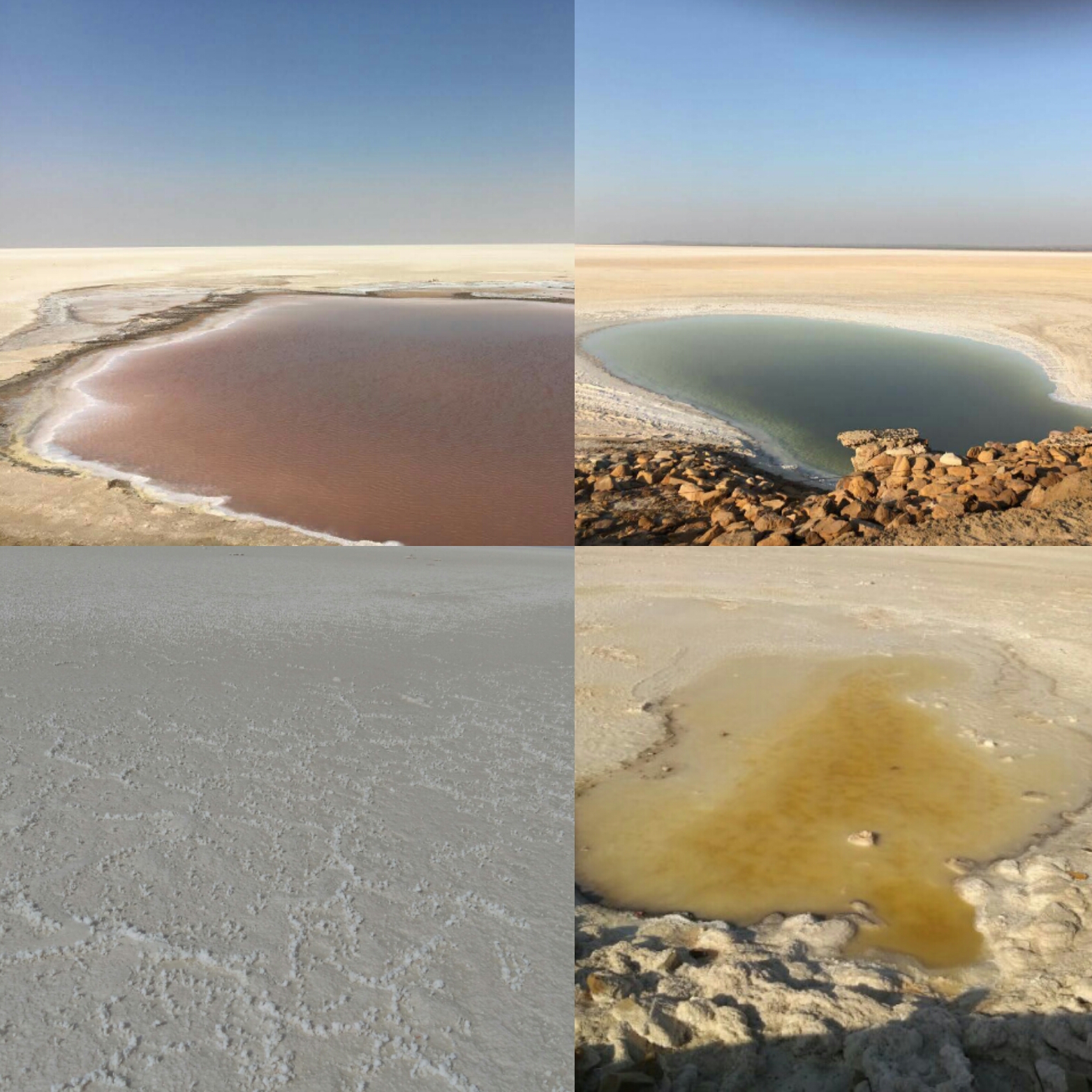
Just a whiz after Rapat village on the mainland, the ‘Khadir Bet’ island appears rather suddenly! I’m quite sure that anyone who is going there for the first time, cannot proceed without stopping here to just sync the coordination between their eyes and the brain! All you see will be a home straight black road, piercing right through the horizon, flanked by an endless stretch of white that confuses the mind to figure out how the blue sky and the brown land disappeared! As in our case, it was noon and the blazing sun was right atop making it difficult for us to open our eyes to see while the glistening white sand looked same as the colour of the sky. I’m not exaggerating when I say that my sight and thoughts had lost coordination for a few minutes before I spotted some puddles of coloured water here and there, in an otherwise clear white desert of salt. These puddles are nothing but salt water from this inland sea marsh that is yet to evaporate and the colouration is due to factors like the effect of temperature and the concentration of the mineral content in them. My friend and I sat there in thoughtlessness for a while until it struck us that we had a long day ahead!
The colourful puddles of salt water
After stopping by for a Kutchi meal with ‘Bajra ki Rotla’ (Millet roti) with gud (Jaggery) and side dishes that were local delicacies, we passed through several small hamlets to reach our first destination. We were bereaved the luxury of time so that we could explore these individual hamlets. Each one of these settlements represent a different tribal group with their own identity of food, culture, costume, art and even the way their Bhungas (Huts) are designed. I would have loved to spend time walking through them all and learning some bits of techniques to sew the famed Kutchi embroidery too. Anyway, let us talk about the nicer things we did with whatever time we had. So, one-and-half-hour was indeed scarce, to walk through history when a guide took us around the site of Dholavira explaining us about the early, mature and the late Harappas. It can run into pages if I write about the details and hence, I cut a long post short at the end of my walk at the north gate. That’s where a 10-letter signboard is mysteriously laid. These are the only letters discovered from the inscriptions of that era and are still beyond the ability of modern man to be deciphered.
Above: One of the remains of a bronze age Bhunga at Dholavira; Bottom: an wooden board marked with the 10mystic letters at the North gate
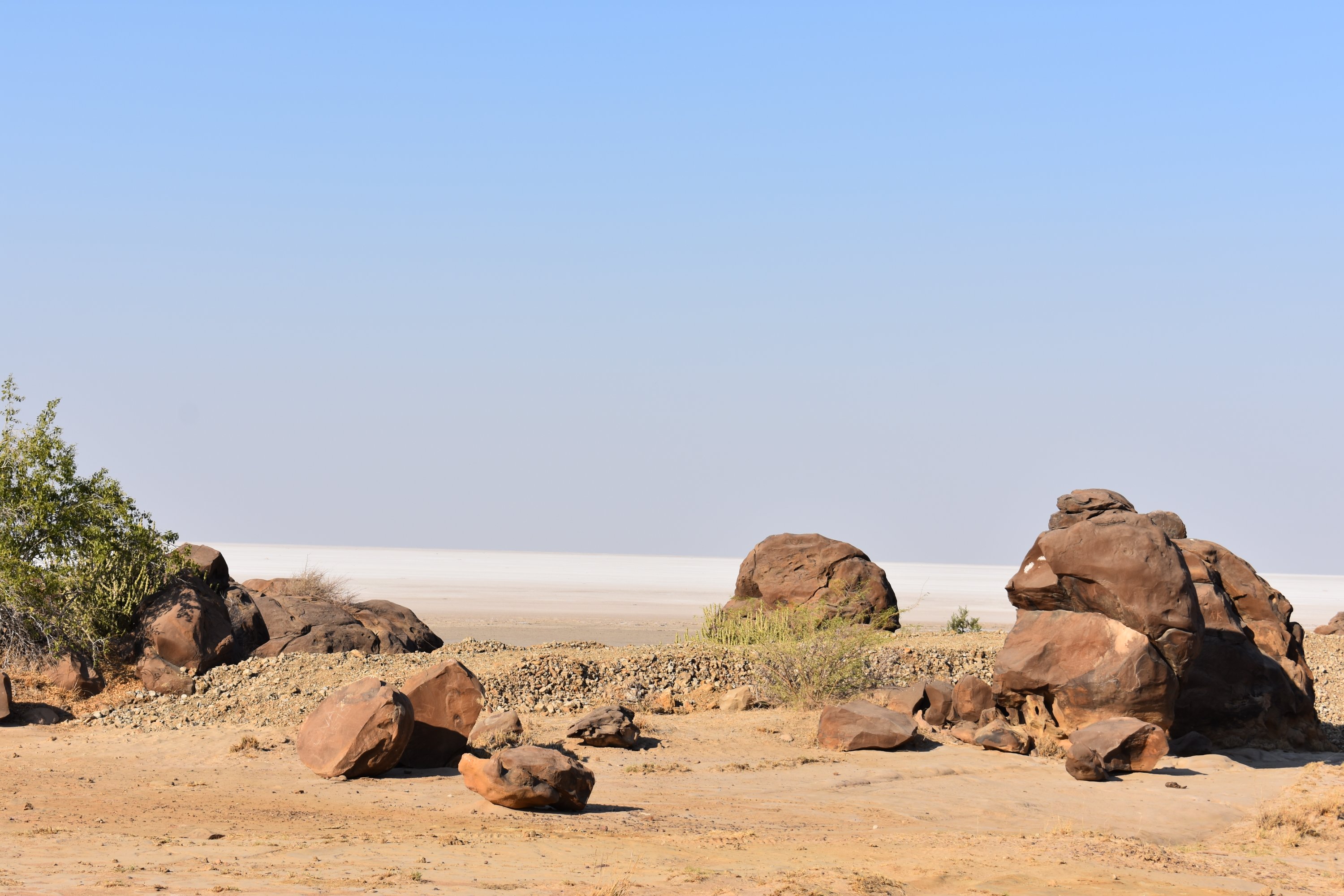
It was a 10kms drive further towards the Indo-Pak border area to walk in to yet another era. It was a jump back in time from the bronze age to the era when dinosaurs walked around on this planet. The trees of the time can be found here which resemble huge boulders now in their fossilized form. A short walk down from there lead us to the salt desert and that’s when a sense of massiveness of this earth hit me. A tiny dot on the planet that I am, I felt surrounded by an endless stretch of white. Only at a farther end appeared a small hill, ‘Kala Dungar’- the highest point in the Rann.
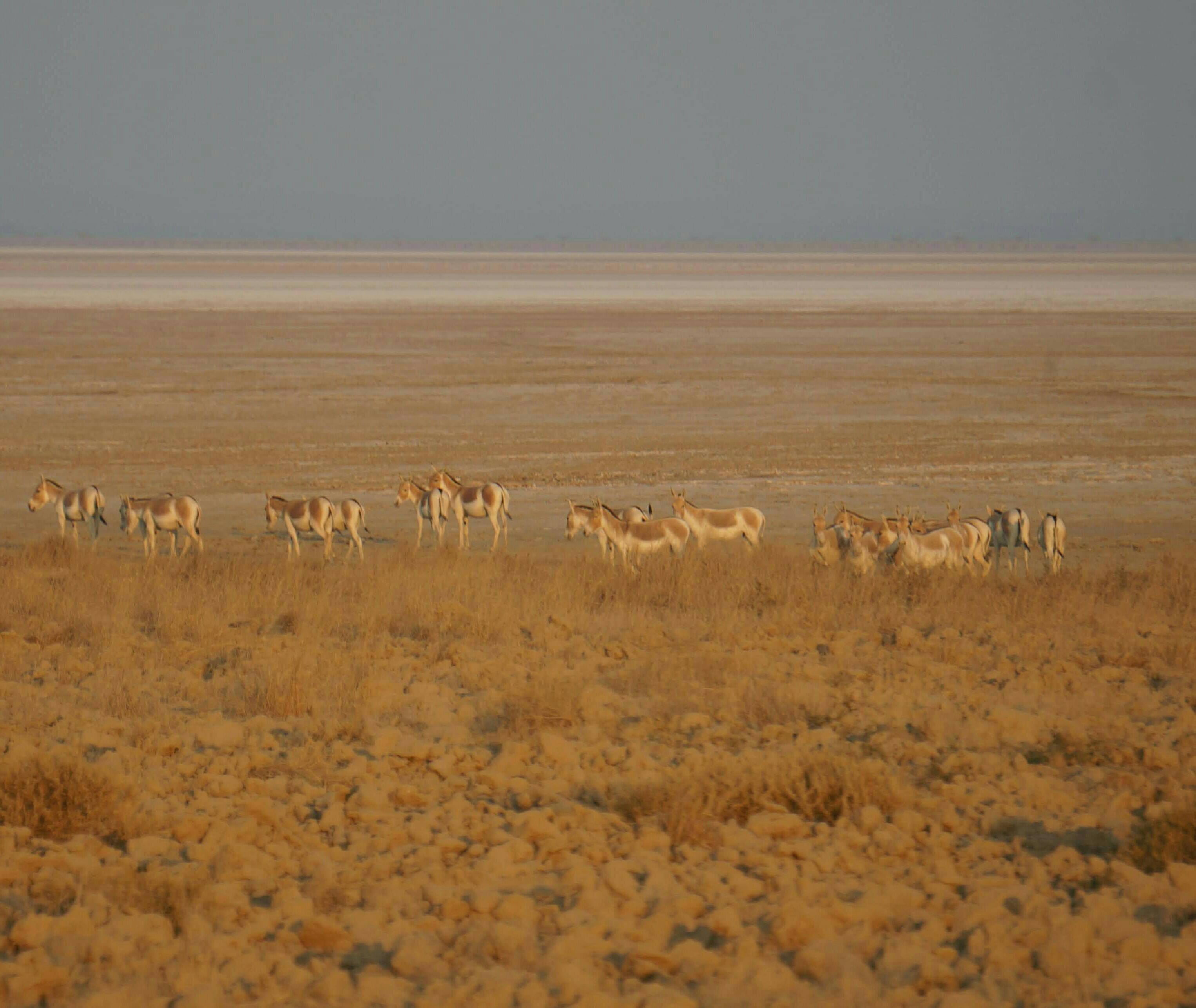
We had contacted a private resort in the region who had arranged for an off-road drive, into the Banni grasslands. A 45minutes bumpy drive on the dusty road cutting through the desert was an experience in itself, while being driven to a place that is known to be the only surviving habitat of the Cheetah in India. We were lucky to see a lot of native residents of this reserved forest including herds of Asiatic Wild Ass, Chinkara, blackbucks, Nilghais, wild boars and even a desert fox. Short grass and bushy trees were a different feature in a landscape that was surrounded by barrenness of the salt flats. These grasslands are also famed for the mysterious phenomenon of light called as the ‘Chir Batti’ or the ghost lights. These moving lights occur at night and are believed to misguide people into the vast marshland if they are followed. Although still a mystery, these lights could be components of methane in combination with other colouring elements, easily flammable in the presence of small amounts of heat and oxygen, if needs a scientific approach to answer.
A herd of Asiatic Wild Ass grazing at the Banni grassland
With the setting sun, came down the temperature as well. With ourselves being covered in white dry dust from head to toe and no thermals with us, the return was a chilling cold drive sitting in the open back of the four-wheeler. But that was the last thing that bothered us, as we watched the golden sun melt into molten red lava merging with white desert before being engulfed into the darkness of the night. Needless to say, watching the setting sun there was ethereal!
Staying back in Dholavira and watching the night pass over the desert and break into dawn is highly recommended. However, we were short of time and had to return to Bhuj the same night. The night’s drive back through the causeway was no less than amazing. We were just 2 days away from the full moon’s night and the moon was almost full (:P). While the rising moon reflected on the salt crystals infront of me, the clear dark sky away from the moon made way for the twinkling stars. So, that was an experience of a lifetime to watch the glittering salt below me on one side of the road and the glittering stars above me on the other side of the road. As our mouths began to chatter with the cold of the night, it was a silent good bye to this mysterious island of Khadir Bhet!
Summary: It is beyond my abilities to put together ‘one word’ to describe a place that has pieces of everything from all ages of evolution of not just humans, but this planet itself. It is a place that has the power to gives you a sense of emptiness of your existence and teach the magnitude of life. Go there, experience it!
India has intrigued the world with its history, geography and culture- each individually dating back to several ages ago. I have been no different from the rest of the world. The LostLander has begun to embrace her landings after getting lost at random places in her incredible country. The more she is exploring her country, the more she has been discovering about its descendance and getting mind blown with new discoveries each time.
“The history of India’s physical geography is older than that of its civilization or even that of the human race. The subcontinent has been a distinct geological entity for millions of years. Therefore, to understand India, we must go back to the very beginning.”
-Sanjeev Sanyal
The fact that it is called as a subcontinent is associated to a larger theory of it being separated out of a supercontinent called ‘Rodinia’ and drifting apart from Africa, Antarctica and then Madagascar before it struck with the Asian continent. No, I’m not time traveling that far for now! It was just to put an exclamation to how amazing this country’s geography has evolved to be and what the natural bounty as we called it, has to offer in this beautiful country to an explorer… To take my article forward and with no biases, I divide the geography of this subcontinent into North and the South, just by drawing an imaginary line passing through its center, Seoni in Madhya Pradesh. Here is a humble attempt to take my readers through some of the beautiful destinations I have been to enjoy the natural marvels of Southern India. They are in random order and listed as and when I recollected them. For more details, you need to read my individual posts on them by clicking on their respective tags!
1. Kurusudai islands: Nestled off the coast of Rameswaram in the Gulf of Mannar, it is the only place in the world where the oldest and the last surviving living fossil is found in the world.
2. The table tops of Maharashtra: Be it the beautifully painted pink valleys of the Khas plateau, valleys of Matheran, Mahabaleshwar or any place thought of for a scenic drive for the Mumbaikars- have all formed out of large volcanic eruptions as the subcontinent merged with Asia. Not just that, these geographical features were strategically used by Shivaji to stop the invasion by the Mughals and hence called the Deccan traps.
3. Limestone caves of Andhra Pradesh: Belum caves, a part of a larger cave complex in the Erramalai region is the largest and longest cave system that is open to public. Similarly, the Borra caves is the deepest in the country. The speleothem formations are worth a visit which have formed due to continuous flowing of water over a thousand years, easily dating back to the Archaean age.
4. Gandikota: People call it as the ‘Grand Canyon of India. It is a beautiful gorge formed by the Pennar river as it squeezes from between the rock formation that has played witness to several kingdoms in history.
5. Eastern Ghats: Although I use a very generic term that specifies an entire region, they are older and mineral rich than their popular counterparts on the western side. All, again a resultant of several tectonic activities in the event of formation of the Indian mass.
6. Dhanushkodi: This abandoned town has more than just history of a cyclone. The revered ‘RamaSethu’ or the Adam’s bridge was formerly considered to be the largest Tombolo in the world and is believed to have formed due to the drifting of India and the Lankan land masses several thousand years ago..
Well… If all these have been the outcomes of several tectonic activities of the earth over a million years, there are yet several other amazing things that nature has to offer in the Southern peninsula.
7. Have you been to Wayanad in Northern Kerala? There is a heart shaped lake after a good climb up the Chembra peak in the western Ghats. It’s the nature’s way of telling ‘I Love You’!
8. Heard of the Barren island? It is the only active volcano in India, with the most recent eruption being in 2017. The sea area around it is considered to be one of the best dive sites in the world!
9. And then there is Baratang islands- It is the only mud volcano in India, situated in the Andaman group of islands.
10. Have you seen the Purple hills? Where do you think the Nilgiri hills in the western Ghats derive their name from? They’re so called because these green verdant hills are painted blue/purple (Neela in Hindi) by the Neelakurinji flowers, something that blooms only once in twelve years. The latest mass-blossoming being in 2018.
11. Cruised through the canals of Kuttanad? Mostly popular among the honeymooners and families alike for its backwaters and houseboats, what many don’t know about this region is that it is the only region in the world where paddy farming is done below sea level.
12. How about a boat ride in the Mangrove forests of the Bay of Bengal? The Sundarbans and Pichavaram forests are the first and the second largest mangrove marshlands in the world. A world heritage site that they are, an extremely important part of the ecology.
13. What happens when a meteor hits the earth? A massive crater is formed giving form to Lonar lake in Maharashtra. This Geo-heritage monument saline soda lake is the only high velocity impact crater lake on earth.
14. Seen the waterfalls of the Deccan plateau? Be it the Chitrakoot falls in Chhattisgarh, Gokak falls in Karnataka, Athirapally in Kerala or Hogeynakal in Tamil Nadu… They’re all so good they can give a good competition to the Niagara!
15. Heard of the Sentinelese tribesmen in the Andaman sea? They’ve long avoided contact with the outside world and their gene pool is believed to be one of the crucial links to early man and the evolution of mankind on the planet.
What India has to offer is abundant! And these are only a few places that I have been to in the southern India. Do you have any recommendations? Have I missed out on anything? I would LOVE to know… Please drop n your suggestions, recommendations, feedback in the comments section below 😊
I wasn’t sure if solo-traveling would be safe in Chhattisgarh, the campsite wasn’t ready yet for a Gujarat trip, Rajasthan had the election around the corner albeit having the perfect weather, the public transportation system wasn’t convenient in Arunachal, Uttarakhand had unpredictable weather of late, Jammu was done just last year, Dharamshala stretch would be too mainstream, Lakshadweep was too short a trip for the time I had. Maybe I should just settle down with the Sahyadris in Maharashtra or sign up for a fortnight long yoga session at Rishikesh or a Yakshagana course at Mangalore perhaps! I had tele-travelled almost the whole of India to decide where I wanted to go. And then, this happened! Just 4 days before departure, the mountains beckoned and I had finally decided to visit the Kinnaur valley in Himachal Pradesh.
Click here to read the complete story, on Amazon
Nothing was clear to me apart from the to & fro flights to Delhi. People around me were busy and my vacations couldn’t wait, lest they be lapsed without pay or without use. Although not very keen on solo travelling, I think that’s how life threw itself upon me when I longed to go to the mountains! The mountains have always been kind to me and have had me meeting them regularly over the last 4 years. I don’t know the reason for this special bond I share with the mountains. May be because I come from a nature worshipping community, that my connection with them is so instant and strong. The mountains had me amidst them yet again. From being a shy kid at ice breaking in public gatherings to having done a complete solo backpacking in an off-season, to meeting and hanging out with strangers and making new friends from travels, my journeys have brought me a long way! The mountains have been kind and have protected me all the way…
Given that I would be alone and I get muscle cramps when the temperature drops, the one thing I had to make sure while planning my trip was to not push myself too hard to see too many places or do anything that could drain me out. Hence, I decided to do it one place at a time, plan my next destination only after reaching a place and move only when I felt like I had sunk in well in the current place. So that said and Kinnaur had me there! After I had reached Himachal, there was absolutely no fear of being a solo-women traveller and no worries over safety concerns at any point of time. The people were amazing who derive their strength from their deep values… From being stopped by random locals on the road and being offered the juiciest apples from the valley to eating local food and getting invited to houses for coffees, from befriending the locals and then to being invited to attend a traditional Kinnauri wedding, from waiting for the day’s only public bus or hitch a ride to having stuck in a place for 3 days without any electricity or transportation due to snowfall, from meditating in the millennium old monastery to confronting a mummified Llama in the mountains, from driving past a valley of green-rock-and-sand onward to having returned through the same valley painted white in snow, from being seen-off by a close friend at the trip start to I seeing-off a stranger at the end of the trip: Whoa! What a journey it was!
So, the route taken by me was: Delhi- Kalka- Shimla- Sangla- Rakcham- Chitkul- Sangla- Reckong Peo- Kalpa- Nako- Geu- Tabo- Rampur- Sarahan- Shimla- Delhi. Some of the key destinations enroute and things I did were:
• The hustle of the desi music blasting at full volume had filled the atmosphere as the HPSRTC bus I boarded at Shimla cruised through thickets of sweet smelling Juniper and deodar. A solo snow laden peak emerged from amidst the green mountains. Call it layers of dew laden and mist covered hills, they sparkled as the sun’s early rays found their way forming several vibrant spectrums as the morning ride gave me the first glimpse of a horizon that had a never-ending line of snow-capped mountains.
• When the bus alighted at Sangla after making its way through steep gradient, blind corners and breath-takingly scary heights of the snaking roads, the sun was calling it a day. It had cast a golden red glow to the entire range of Kinnaur Kailash mountains. I couldn’t have asked for more as I stood there to be welcomed by this magnificent view right in front of the bus stand. The hike up the Kamru fort to catch the golden peaks up close was a cherry on the icing.
• The next day was an exhilarating bus ride through the Sangla valley, overlooked by the Kailash mountains on one side and the beloved untamed Baspa river flowing below. The ride was adventurous with waterfall and river crossing, cliff-hangers, landslides and occasional sightings of mountain goats or yaks. Quick stop-over at Batseri village painted in shades of crimson, chrome to ochre with the trees of apples, apricots and walnuts was a feast to the eyes. A walk down to the river at Rackcham helped me to connect with the Kinnauris with very warm conversations. They offered me a ride through apple orchards and buck wheat farms before meeting the sole Indian tricolour waving at Chitkul, a village bordering China & Tibet.
• The following morning, I started early to Kalpa- a quaint tiny village with old traditional houses amid the Kinnaur apple farms. A solo hike through the suicidal roads to Roughi village turned out to be special when a random dog decided to accompany me all the way. Again, the setting crimson sun cast its magical spell over the manifestations of Shiva and Parvathi seated conveniently in the Kinnaur Kailash mountains overlooking the village. With the chants from the Buddhist monastery next door and swaying prayer flags as I looked out of my window the next morning, I couldn’t have asked for a better start for my day.
• That day, I did a bit of shopping and grooving to traditional Kinnauri music with the locals at Reckong Peo, the ‘Gateway to Kinnaur valley’. It was the annual fair where people from all over the state had congregated to buy and sell local Agri-products and handicrafts apart from sipping the local apple brew. Packets of pine-nuts, dried apples and apricots along with the traditional Kinnauri hats were perfect souvenirs to take back before boarding the bus to my next destination.
• Although the weather had gotten more colder, it was one of the finest mornings so far. A walk around the village of Nako, with mud-smeared walls of houses built of wood and clay is one of the highlights of my entire trip. While strolling through those narrow walkways of the village, I felt as if I was exploring a maze. With the early morning vibes of a typical village with cattle roaming around, children walking down to schools, chants and incense from the ancient monastery rising in the dew laden air, it was an altogether different world there. The view of the distant snow-capped mountains and the barren winding landscape around had me spellbound for the rest of the day.
• I woke up in the biting cold next morning to hike up the hill and pay a visit to the mummy of a Buddhist monk, believed to be over a 500yrs old. Strangely, it has been there in open atmosphere without any chemicals and among the only few mummies available in India. Quick breakfast at the wedding house and I was good to head out by hitching another ride until Hurling.
• The weather had gotten worse that day with a forecast of precipitation by day end. As I waited at Hurling for my next ride, the guy making rotis at a hotel offered me a cup of free chai and got me a free drive with his customer to my next destination. With a loaded car and a person with a broken leg hanging out of the rear seat, the people who agreed to drop me were more than sweet to accommodate me in the front seat and they carry my backpack on their lap all the way in the rear seat.
• The morning when I woke up, the mountains had moved closer to me with a heavy overnight snowfall. This was a sight to which the heart of a snow-deprived-south-Indian-city girl in me had skipped a beat. I had to extend my stay at this monastery due to heavy snowfall for next 2 days and with no electricity, phone connectivity and no plumbing that worked whatsoever, it was ‘THE” time! Amid all this, I had the rare opportunity to relish the Tabo apples (one of the best in the world) every day of what was being offered to the deity at the monastery.
• Finally, after getting my drive back to Shimla- I had plans to stop by at Rampur Bussahr to see the erstwhile palace and stay at Sarahan, one of the Shakthi peethas in the foothills of the Himalayas. But, the mountains had an altogether different itinerary for me for the last 3 days! So, thus was my sojourn in the Himalayas, the mighty incredible Himalayas!
Since Rohtang pass had closed by end of monsoon, I did only Kinnaur and half Spiti and returned the same way back (Although a little hectic with 3 days required only for travel, on the same route). If you are traveling in the summers, then you can start from Shimla and complete Spiti & Lahaul via Kaza and exit from Manali, thereby not repeating your route.
Summary: With the changing landscape throwing surprises at the wink of an eye, each mile was magic. The valleys were overwhelmingly beautiful! When the mountains beckon, just pack your junk and head out! The destination doesn’t count, the journey is worthwhile!
Toyota is a brand that the world recognizes for high quality standards. The Toyota Way of doing things is something that the rest of the world still fails to match. These 7+ years of my incredible journey with Toyota may have helped me grow personally and professionally, but here are four key things that I always associate my travel sojourns with.
4. Nemawashi: is the process of discussing problems and consensus building on potential solutions. This will allow to collect ideas of those involved in the event and get agreement on a way forward. I don’t mean that you need to get consensus from many people on your travel plan, but what I mean to say is- Discuss, Talk more to real people! Instead of depending on internet for information(Which are many a times paid articles for promotions), Talk to different people. While you are planning- talk to people who have been there before and take their experience based opinions; while you are on the road- talk to the localites and take their suggestions. You will eventually end up doing, eating, exploring something new and that’s unknown to most people. This way, you can create your own experience based stories.
3. Yokoten: This is something I have been hearing day-in and day-out. Toyota believes in documentation and standardisation of best practices so that these can be used as references by others. Yokoten means to copy/implement good practices from one process to all other similar processes. Also, I guess talking to other travelers let’s you pick and decide what’s good and bad for you during your travel. So I guess, that’s what I have been doing through documentation of my travel stories in my blogs.
2. KeshiGomi: It literally translates to ‘Eraser’ in Japanese. But what they use this for is quite relatable for a traveler. Japanese are strong followers of the PDCA (Plan Do Check Act) in all things that they do. As an important part of their planning, they always make a ‘KeshiGomi sheet’ which is a simple ‘things-to-do list’. Keshi here refers to striking off the activity after it is completed for better visualization of activity status. So, how is this related to a traveler, you may ask??? So that’s where I call it a ‘Bucket List’. Its always good to have a bucket list of places you want to see and things you want to do. Whether it is accomplished or not comes second, but it is a great motivation to chase those things!
1. GenchiGembutsu: Literally translates to ‘Go & see’. One of the most important rules that the Japanese follow is to go to the place and understand the case by self rather than depending on facts narrated by others. The facts may be moderated or altered when it is passed from one person to another and is usually based on somebody else’s perception. So stop imagining about how a place could look and get your bums out of that couch, go travel and experience it all firsthand!
Do you have any such weird places from where you derive inspirations? Let me know through the comments below.
Vidarbha- the region consisting of Nagpur and Amravati derives its name from the epic city of Mahabharata. With several references made in Ramayana and Mahabharatha, it is not just historically important, but is also economically important as it is a mineral rich region in Central India. Vidarbha is a cultural melting pot with its strong influence in culture, history and geography of the country.
When opportunity knocks at your door, grab it! That’s what I did.. A friend was getting hitched at Amravati and the nearest airport for me to fly down was at Nagpur. So this time, it was an opportunity to explore the Vidarbha region. But that came with its set of challenges. It is one of the hottest places in India and the ceremonies were scheduled during the peak of the summer season. So, my colleagues and I decided to hire a self-drive car to ease the travel hassles of local transport. We wanted to visit the prominent landmarks around the region. There are a plenty of them. Hence, the itinerary was planned such that all major landmarks around Nagpur were covered on a single stretch before hitting the highway for the night’s stay at Amravati. Along with that, the region offers its own delectable cuisine. We wanted to include some of the popular dishes/snacks on our list as well.
So, I present my visit to Vidarbha in two parts. One, listing the landmarks visited and second, with a list of food to try in the region.
Part 1: Places to see in Nagpur and Amravati
The geographical centre of India before partition: The ‘zero’ milestone is from where all distances were measured and highways originated in India, before Pakistan was formed. For all the hype around this place on social media, I was surmised to see that it was poorly maintained and is located in a corner of a busy main road. I had imagined it to be centrally located at some kind of a junction on a busy road.
The zero milestone of undivided India
2. The DeekshaBhoomi meditation centre: This is where Dr.B.R.Ambedkar, the father of the Indian constitution is said to have given his first sermon after he converted to Buddhism.
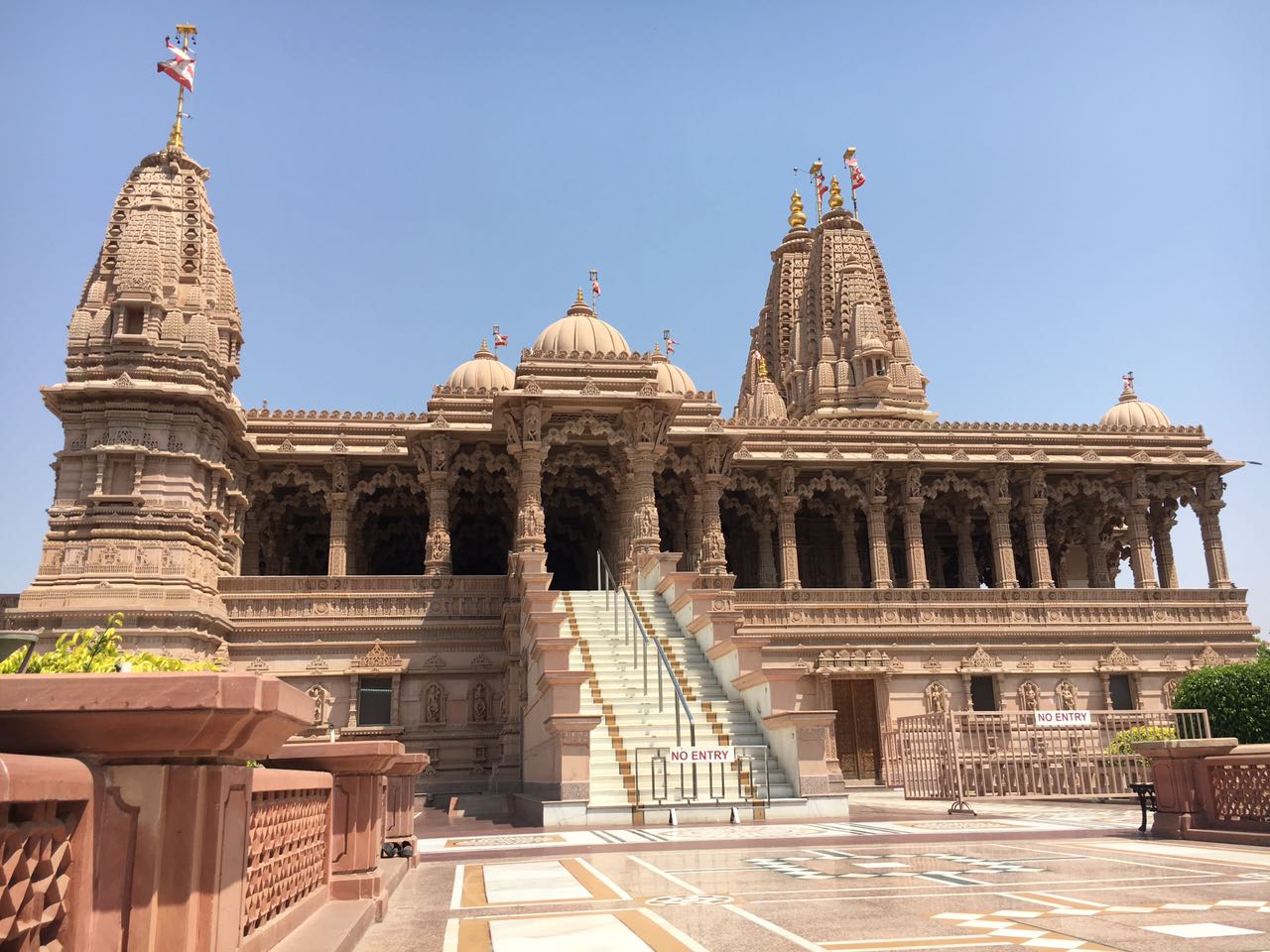
3. The Swaminarayan temple was a beautiful place located within Nagpur city. The Dragon palace temple and Ramdham Park are some other places located within the city if you have more time in leisure. The lakes in the city can easily be given a miss. However, some heritage structures like churches, schools and the railway station lend an old-world charm to the city.
Swaminarayan Mandir
4. Adasa Ganesh temple: This visit can be done by taking a small deviation before hitting back the same highway.
5. Mansar: This is an archaeologically important site, believed to be of Pravarapura, an erstwhile capital of the Vakataka kingdom that ruled the Vidarbha region.
6. Ramtek: Located at about 5kms from Mansar, this is considered to be a holy hill to people of all faiths. ‘Gad Mandir’, an old beautiful temple dedicated to Lord Ram is situated atop a hillock. Solitude is available in abundance here with a great view of the entire area. The Ramtek hills is also believed to be a place where the mythological King, Kalidas wrote his epic poem- ‘Meghdoot’. There are several places that are significant among the Jains and Buddhists too that are located in the vicinity.
7. The Ambala Lake: The ghats of the lake located at the base of the Ramtek hills are lined with beautiful ancient structures and was my favourite place of the trip.
8. Khindsi Lake: Get yourself cooled with some water sports (recommended if you have leisure time at your disposal.)
9. Nagerdhan fort: Soak in history at the erstwhile capital town of the Vakataka dynasty. (Recommended only if you have some more time for leisure.) It is a further 10kms drive from Ramtek.
10. Pench National park: Don’t miss an opportunity to stay over and do some tiger sighting in the land of ‘The Jungle Book’. It is the same forest where the story of Mowgli and Bhageera is based at, that we have all grown up watching and listening to.
There are a lot of scenic places around Pench that I can help you with if you are planning to stay over at one of the jungle lodges. We did not have the luxury of time as we had to drive back all the way as our stay was booked at Amravati. The Amravati region is home to several wildlife sanctuaries and temples that can be accommodated if you’re traveling on a luxury of time and an own vehicle, which we had to give a miss.
11. Chikaldhara: The highest point of Vidarbha region and the only hill station is located in Amravati. For a person like me hailing from the coffee hills, it was quite exciting to know that Amravati is the only coffee growing region in Maharashtra state.
Part 2: Food and Sweets to try in Nagpur
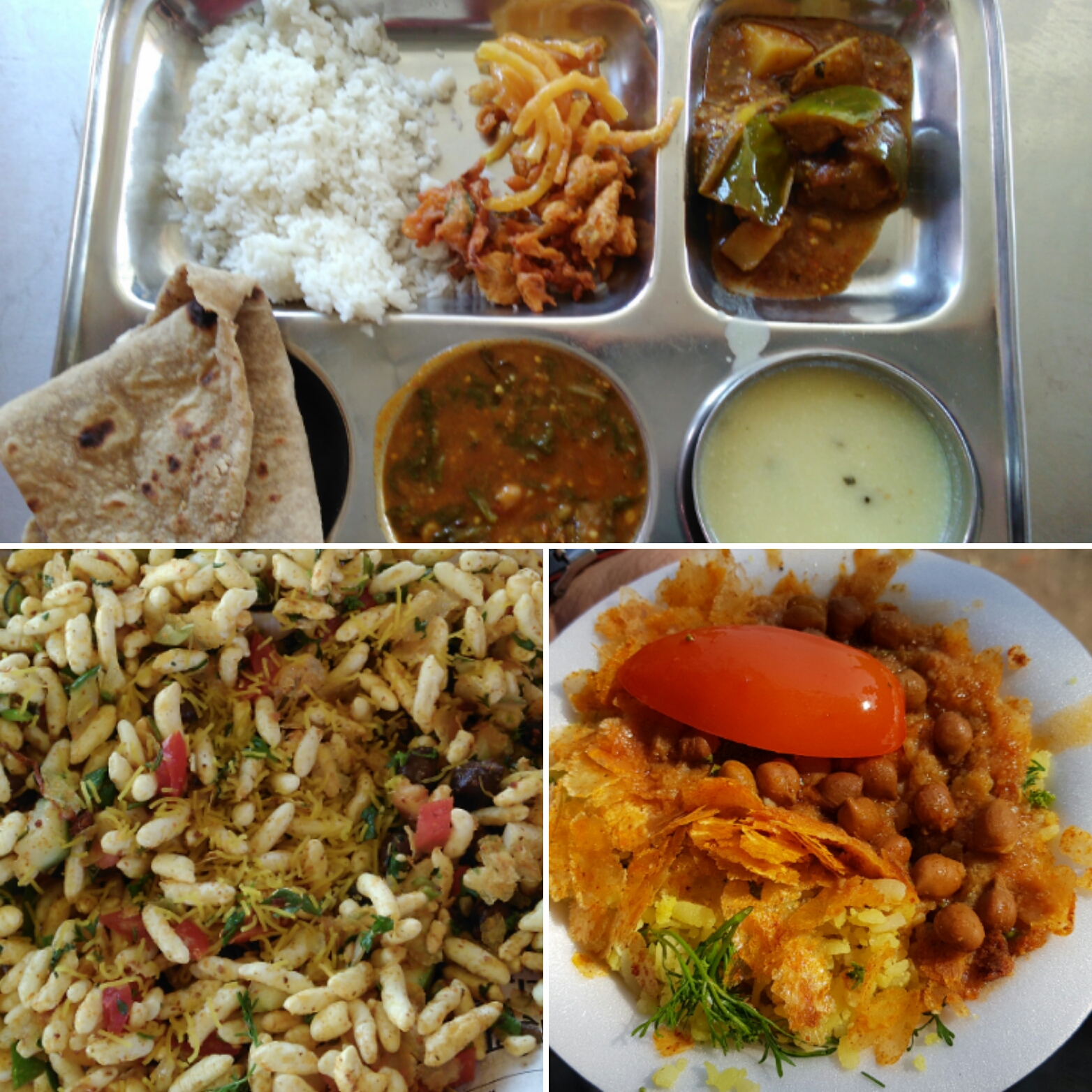
Talking about the highlight of this trip, it was definitely the FOOD!! The Varadi and Saoji are the two popular cuisines of the Vidarbha region. So, it was a culinary treat for our taste buds to experiment on something fiercely spicy and so rustic in taste. While our day started with delicious plates of ‘Poha with Tarri’ and ‘Samosa Tarri’ for breakfast at one of the several roadside tapris, lunch was a simple delectable Varadi thali at the ‘Gad Mandir Bhojanalay’. We managed to find space in our tummies for street food with several pit stops along the way that tasted heavenly and ended our day with a grand non-veg varadi menu for supper at a star hotel where we were put up for the night.
The Varadi food that kept us going!
Nagpur is synonymous with oranges and the brand ‘Haldirams’. So, the visit would have been incomplete without trying the ‘Orange Burfi’ at one of the Haldirams outlets spread across the city. Do pick up a box of ‘Mango soan rolls’ from Heera sweets to please your sweet tooth along your return trip!
With the short time of a weekend that we had, this was the best we could accommodate in our schedule. Tell me what other things would you recommend to do, see and experience in Nagpur and Amravathi?
This was the first time I was stepping into the state of Rajasthan. Time has been kind on me yet again bringing me to the right place when the time was right! And this time it was to Ajmer during the holy month of Ramadan. Ajmer-Marwar region was a separate state until it was merged with Rajasthan. At a distance of 130kms by road from Jaipur, it is believed to be the second holiest place in Islam after Mecca. Apart from exploring Ajmer town, if you are a traveler, you can also include Pushkar in your itinerary, which is located less than 25kms from Ajmer. Apart from being a holy place for the Hindus, Pushkar is a popular haunt for the hippies from world-over. You can use the below itinerary if you have a weekend in hand. However, I could only explore Ajmer on this trip.
A weekend Itinerary:
Day 1: Bangalore to Jaipur (Flight); Jaipur to Ajmer (Hired car); Visit Ajmer dargah, explore Taragarh hill, Adhai-Din-Ka-Jhonpra, Akbar Palace & museum, Soniji-ki-Nasiyan Jain temple, Mayo college campus. (Night’s stay at Taj- Ajmer gateway) Day 2: Visit Pushkar lake for sunrise, explore Pushkar town (and the annual camel fair, if you time your visit right); return to Jaipur (by road), Jaipur to Bangalore (flight)
The Details:
I was visiting Ajmer on a business trip with three of my colleagues (Click here to read about my job as a car doctor). Hence, I somehow managed to squeeze in sufficient time into my trip so that I could venture out in this city and explore most of whatever it has to offer for the traveller in me. Needless to say, no visit to this holy city is complete without heading to the Ajmer Sharif Dargah dedicated to the Sufi Saint Khwaja Moinuddin Chishti.
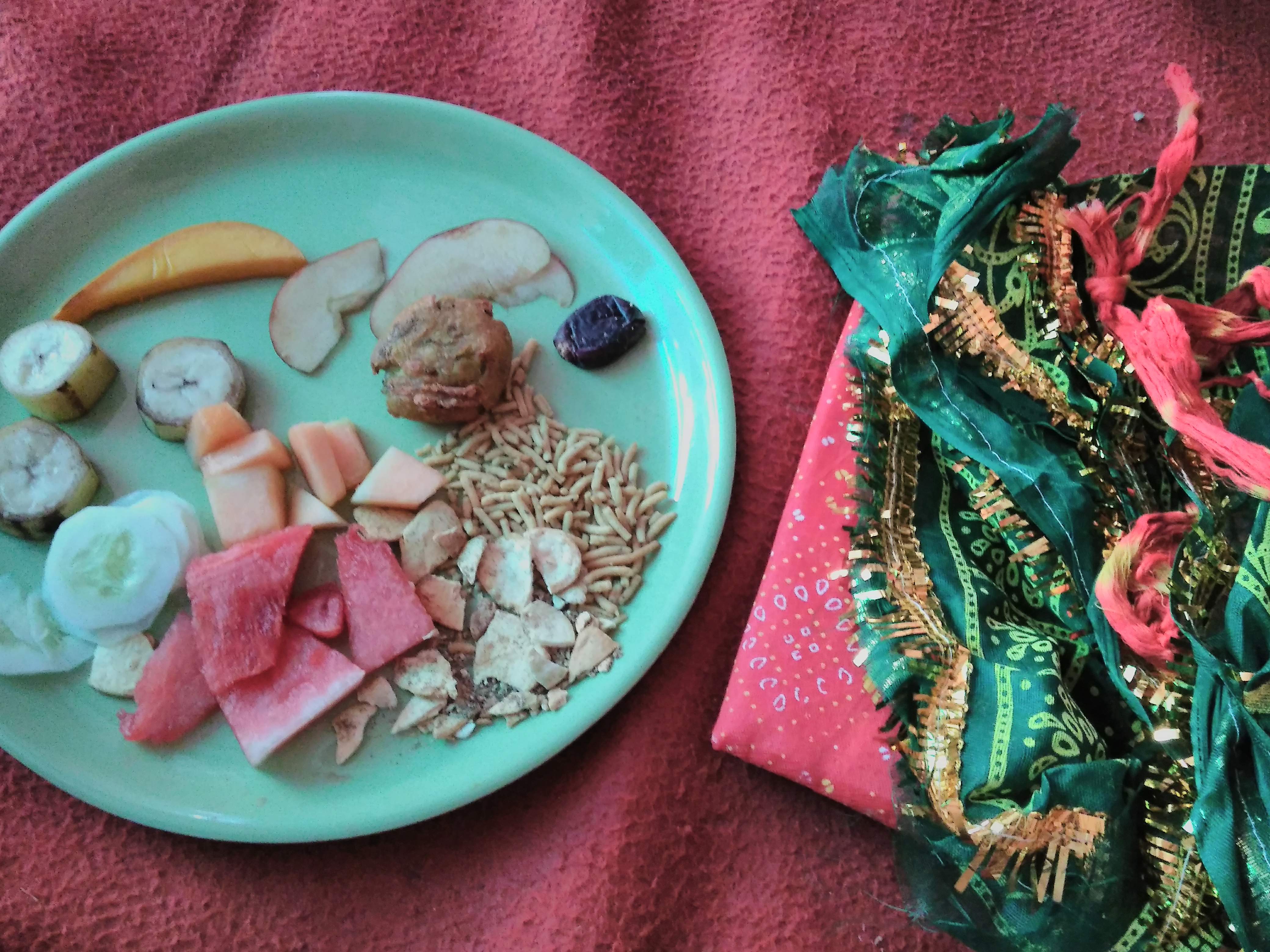
Apart from it being the holiest and the busiest of the times on the Dargah’s calendar, our visit also coincided with the 27th day of the holy month: revered as the ‘Night of Destiny’ in the Islam faith. This is a place where most people struggle to get past the crowds even on normal days. We were fortunate to have contacted one of the trustees of the Dargah who managed our entire visit and made it effortless. It was evening time and we had just finished offering our prayers by donating a Chadar to the diety. What we hadn’t realized was that we were there on the premises of this holy place at the time of breaking the day’s fast. We were offered some fruits, nuts and food by the trustees and other devotees who were distributing food there. I was overwhelmed with the thought of having had such an opportunity, at such a time!
Breaking the fast at Ajmer dargah Sharif
The Dargah is located at the base of the Taragarh hill, atop of which a fort is situated. The view of the entire hill overlooking the Dargarh is so beautiful with a township constructed on the steep slopes of the hill. Since, photography is prohibited inside the Dargarh premises, I wasn’t able to capture most of the things. It’s a welcome move in some places like these and respect the sanctity of the place. Enough is said and written about this place on the internet. So, I wish to cover about the other things this historic town has to offer.
After our visit, we walked the by lanes around the Dargah to explore the best of Ajmer. Not in terms of places but in terms of its lip-smacking street food. With a lot of Mughalai and Nawabi influence and it being the Ramadan season, the best of the spread was available. Needless to say, Ajmer is a haven for food lovers. By the time the last ray of the day’s sun had vanished, we were stuffed until our glottis.
If you are a history buff and want to find something to feed your wanderlust, you can take a walk to Adhai-Din-Ka-Jhonpra and the Akbar Palace and museum that are located closer to the Dargah. Soniji-ki-Nasiyan is a nice two-storeyed wooden Jain temple that can be visited enroute to Dargah Sharif. If you are at the luxury of time, a quick ride to quick ride to the Mayo college campus can be ended with some peaceful sunset time spent by the banks of the Ana Sagar Lake. But, for me- something else was awaiting!
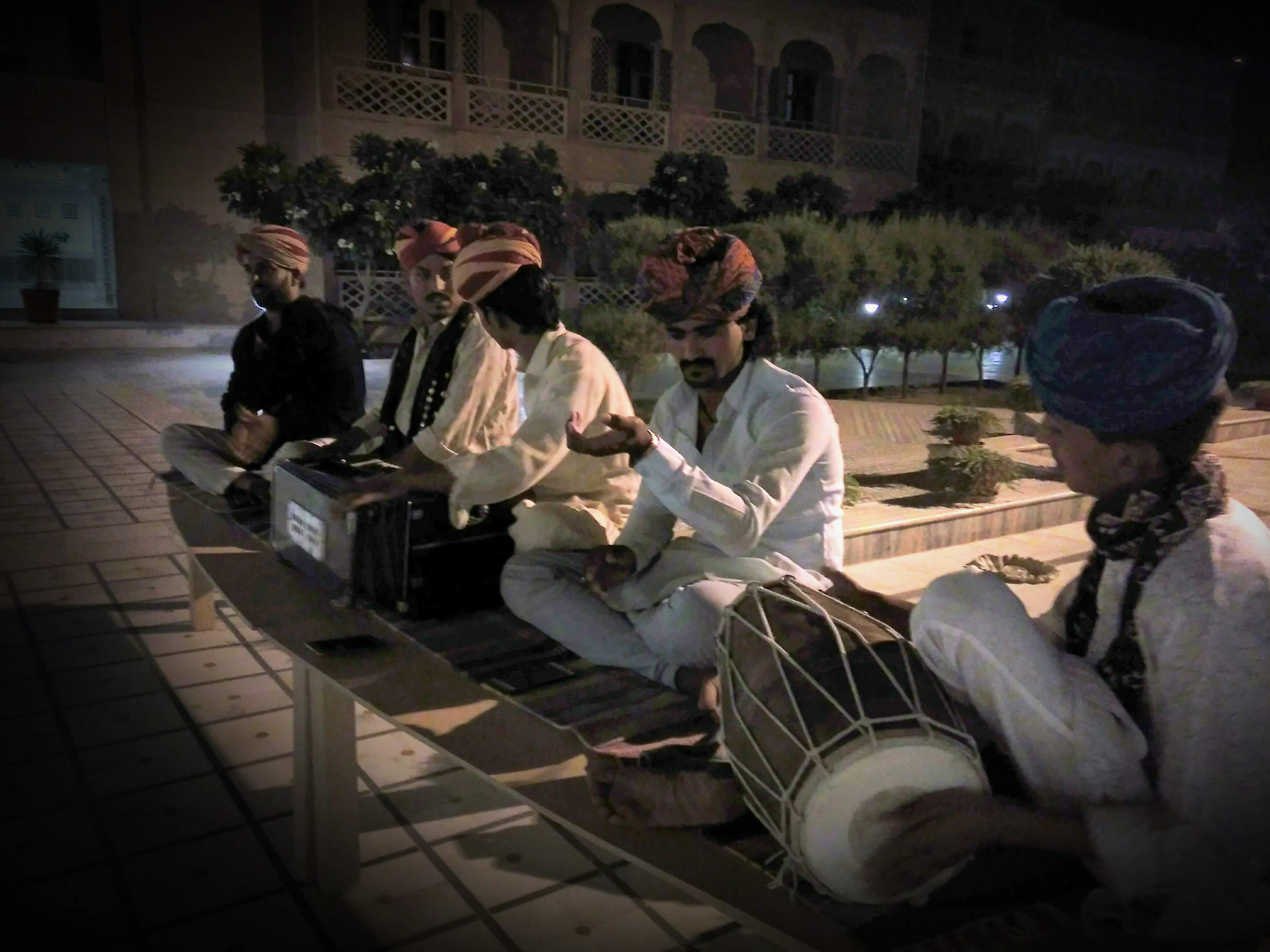
The folk singers performing live in the courtyard of the Taj
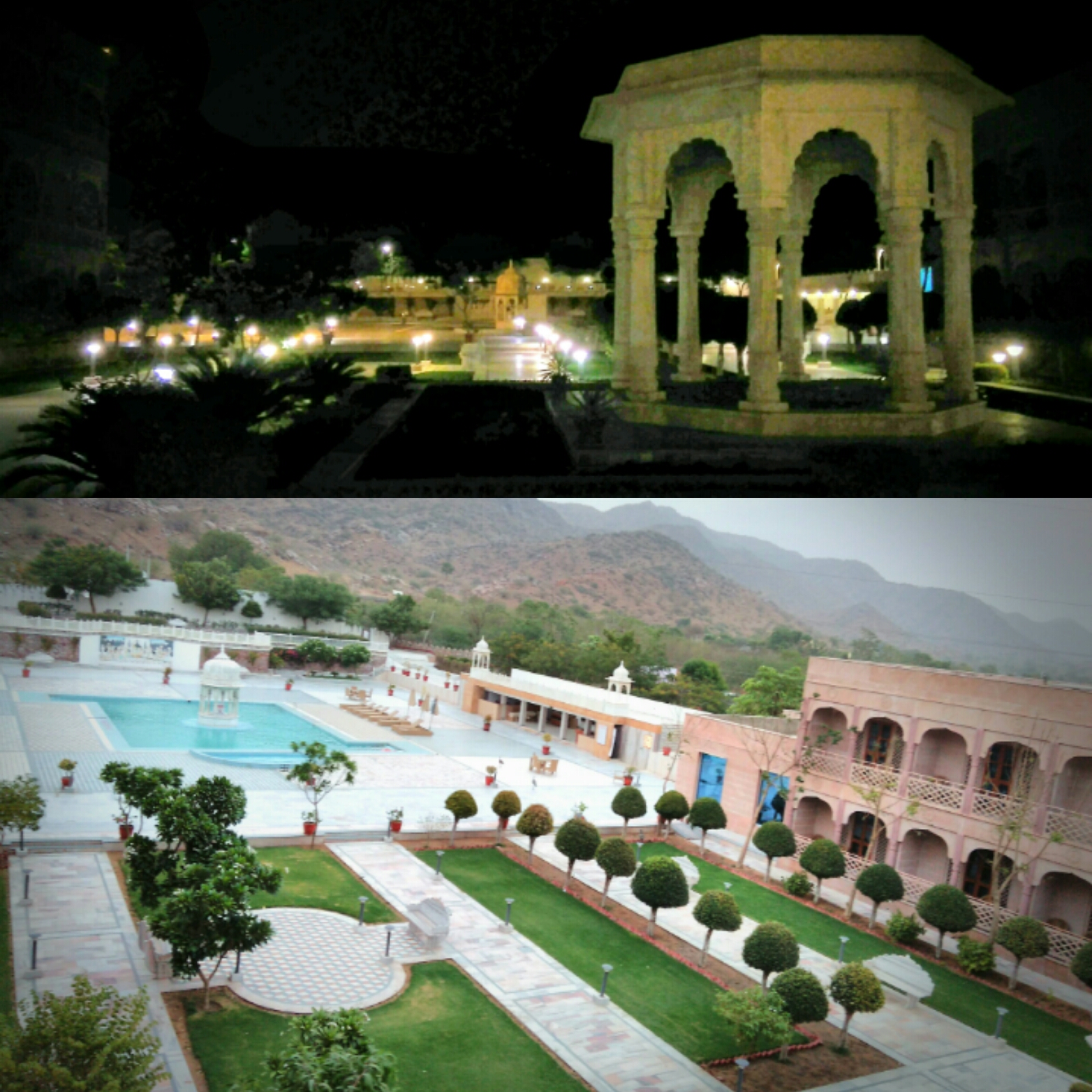
I had my stay booked at the Taj- Ajmer gateway for the night, a world in itself to visit and hang around. The drive from Ajmer city towards it outskirts on Pushkar road, through winding roads with the backdrop of the setting golden sun was a picturesque treat after a tiring day of work and toil. All this seemed like only a grand welcome to the beautiful Taj property that’s nestled in the midst of nowhere in the lap of the Aravalis. The sky was dark, when we arrived at this palatial hotel. The entire driveway was lit with dim sodium lamps from the gate through the lounge. A faint outline of the Aravalli hills standing calmly on the backdrop only enhanced its grandeur. It was a warm welcome as the live Rajasthani folk music with the timbre of the Morchang and Khartal resonated from the courtyard. The host personally lead me to the room while explaining the delicately chosen wall murals and paintings as we walked through the elegant corridor. Though my stomach was stuffed with Ajmer’s street food, I did manage to make some space for the delectable dinner that I was hosted at the restaurant. With all items seasoned and cooked to perfection, each dish seemed better than the other. With a refreshing dip in the pool, a day was called!
Top: The courtyard at night Below: the morning view from my balcony
I looked forward for the morning as much as I did for the previous evening! I had set the alarm for sunrise but was woken up rather early by the calls of dozens of feral peacocks that had come from the forest/hills just behind the pool. I opened my balcony doors and voila! It was a magical morning with peacocks dancing in the courtyard and a modestly calm sun peeping out of shadowy grey clouds with the glorious green Aravalis forming a backdrop… I soaked in this special moment as much as I could from my balcony before I realised that it was time for me to pack-up. Finishing up the morning chores and ending my stay with the Taj with a wonderful breakfast spread, it was time for me to say good bye to this beautiful city of Ajmer and this beautiful Taj property- the Ajmer gateway!
Fact file:
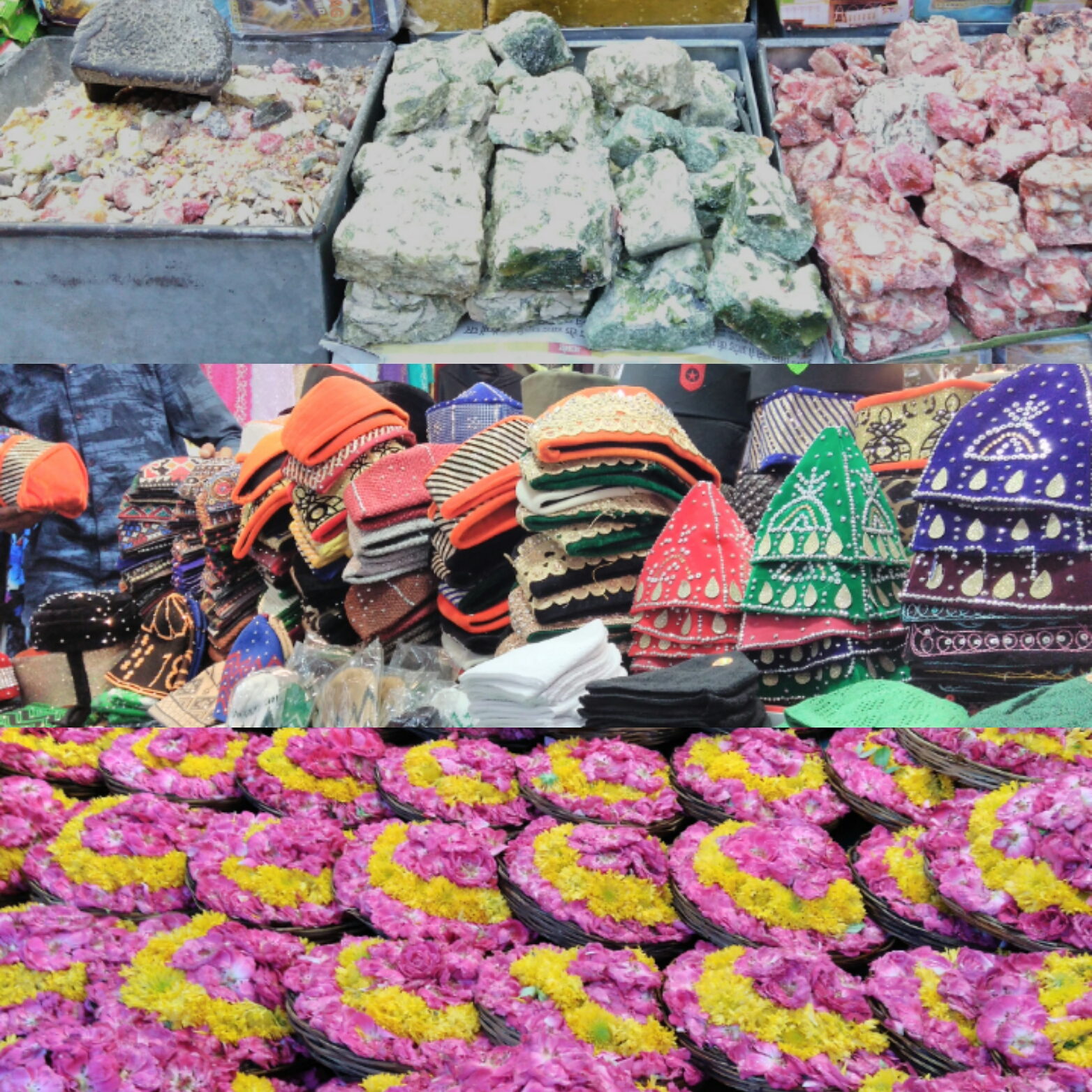
Must-do:Make a wish by offering the Chadar or the decorated shawl to the deity/tomb at the Dargah Sharif. Must eats: while the street food and the never-ending list of non-veg dishes are to die for in the month of Ramadan, Kadi Kachori and Soan-Halwa are an all-season recommendations. Must buys:variety of prayer caps and incense.
Being abundantly blessed with natural beauty, Anshi National park and Dandeli Tiger reserve is one of the first hotspots of the elusive black panthers in India. Apart from its paper mills, Dandeli is also known as the ‘Rishikesh of the South’ for its river rafting in the waters of River Kali. As if these weren’t reasons enough for me to backpack, I got invited to stay at the ‘Dandeli Jungle Camp’. What better way to reconnect the lost bond with nature than camping in the woods? I jumped to grab-in when opportunity struck! This was a Solo trip that was long due, and I had alighted for sunrise at the Dandeli bus stand on a Saturday morning.
Itinerary: Friday: Overnight journey from Bangalore Saturday: Alight at Dandeli town, Drive to ‘Dandeli Jungle Camp’, Visit backwaters of Supa dam, Shop for some forest produces at the tribal shop, Visit Syntheri rocks, sunset hike at the homestay Sunday: Birdwatching at timber depot, river rafting & coracle ride, (Visit Kavala caves or the Siddi tribal village if you have more time), Leave for Bangalore by evening (direct bus from Dandeli or by train from Hubli)
Details:
After a 30mins drive through the forests to Pradhani, a further off-roading of 2kms from the main road lead me to this simple homestay and camp run in the lap of nature amid the woods. The eerie silence of the elusive woods and the stridulations of the crickets instantly calmed my soul by responding to the deep calls of nature. A basic cottage with all the essential and neat amenities was awaiting me in the midst of the jungle overlooking a farm of areca and mangoes. I couldn’t ask for a better place to be, to feed the wanderlust and nomad in me for the weekend. I was excited to be greeted by Malabar giant squirrels and sambar deer at my doorstep to say the least. One can also avail their tenting facilities with bon-fire if it’s a bunch of friends traveling together. Mr. Dharmesh, the ever smiling owner of the property says that the camp was started by a French lady 3 decades ago from whom he has taken over so that he could settle down in the woods after he quit his well-paying job at one of the top-star hotels in Bangalore. He had planned a detailed itinerary for me, and I can’t thank him enough for his warm hospitality. After dumping my luggage and a nice lunch, I set out for some exploration.
View from the Supa dam backwaters
A stroll along the dwindling lonely road on the backwaters of Supa dam offered a panoramic view of the distant hills, only if there was good rainfall- it would have been a gorgeous sight. After a quick stop-over at the tribal shop to relish a glass of kokum juice and buy some jackfruit chips and papads to take back home, I was taken to Syntheri rocks. This is a very beautiful little place located deep in the woods and formed by rich mineral ores that have formed beautiful rock patterns by standing the test of time. A drive to the Kavala caves, A coracle ride in the ferocious rapids of the Kali river, a dip in the natural Jacuzzi, crocodile walk is some of the other activities included in the package that kept me busy through the day. An evening walk in the woods around the property with a personal guide was a memorable time spent identifying the calls of various birds and inhabitants of the forest. The large number of hornbills that fly into their nests in this forest with a small hike into the jungle at sunset or catching the sunrise from my window are only some of the fancy things that my stay offered to me.
Syntheri rocks, Photo by: Gowtham Shastry
The next day, Mr.Dharmesh personally dropped me off for the early morning bird watching walk that was arranged at the Dandeli timber depot. This first time experience of birding is something that I will cherish for a long time and is written about as a separate post. A bird watching tour around the depot where over 150 bird species could be spotted on any given day- was the highlight of my trip to Dandeli!
So, the next big agenda was meeting the Siddhis- The tribal community endemic to the Kali reserve region who are believed to be of the African origin. Be it chilling with them over some rustic music or trying their favourite delicacy- the red ant/ termite chutney, the experience is sure to leave one amused and feel time travelled.
A coracle ride in the Kali River, Photo by: Gowtham Shastry
With so many activities included in the package that kept me on toes through the 2 days I stayed at this property, it is a high recommendation from me. If you wish to extend your stay by another day, you have no dearth of things to do- from river rafting, to a canopy walk and visit to Dudhsagar falls, all can be arranged by the camp guys themselves. After freshening up at the camp, I started my journey back to Bangalore. I took a KSRTC bus from Dandeli to Hubli from where I had booked my train. Whoa! Such a wonderful trip!
‘Dandeli Jungle Camp’ is an offbeat stay which does not have its own webpage or have direction boards to keep commercialization at check. From the time I alighted at the bus stand till the time I boarded for return, my entire trip was managed by www.dandeli.com through whom my package was booked. The connectivity of public transport within the reserve area is scarce and being a solo traveler, all my travel hassles were taken care by these wonderful organizers.
Being one of the first hotspots of the elusive black panthers and a place known as the ‘Rishikesh of the South’ for its river rafting in the waters of River Kali weren’t reasons enough for me to grab-in when opportunity struck! A Solo trip that was long due, finally happened one weekend. I packed my backpack and hit the road in an overnight bus to reach Dandeli. This trip was part of an invitation to review a resort and a homestay at Dandeli, arranged by www.dandeli.com However, the reviews of the places are in separate posts and this one is something else, worth your reading time. Or so, I believe.
Apart from the cool and wonderful green cover that Dandeli has, I had a surprise awaiting me on the second day of my trip. It added yet another perspective to my travels- “Bird-watching”. If you have been following my blogs for a while, then you must already be aware that I have always been interested in wildlife and its conservation. But I neither did I have an opportunity to meet someone closely involved in such form of travel nor did I have any close acquaintances who was good at bird or animal tracking. Here, at Dandeli I met a person who has dedicated time and money in tracking and documenting the birds of the region. The entire experience of birdwatching with this person is something that I will cherish for long time.
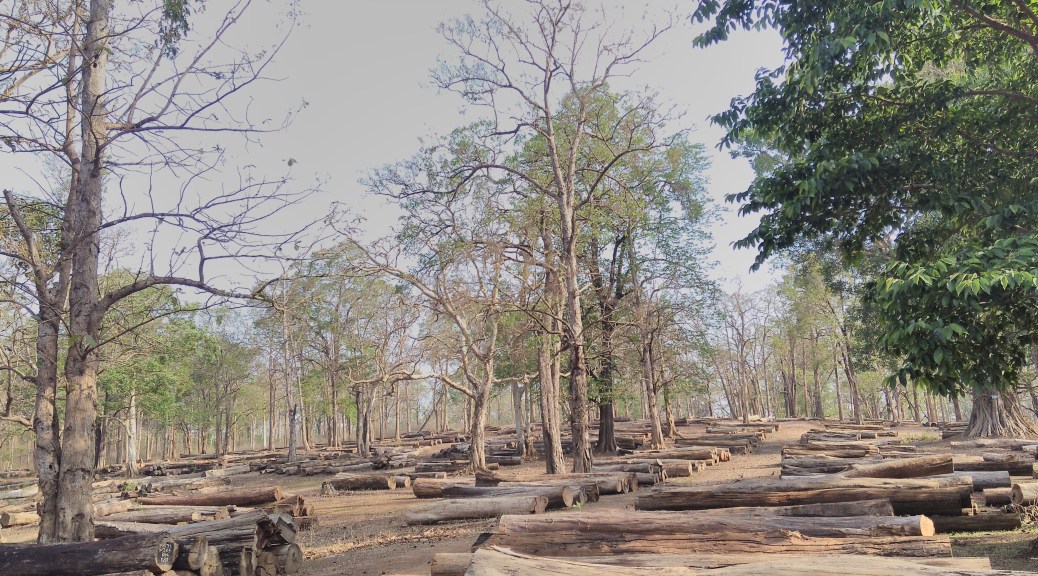
As a part of the trip package by the homestay, I was asked to be ready by 6.00.a.m. and was taken to the Dandeli timber depot. I was introduced to Ms. Rajani, a government schoolteacher by profession and an avid nature keeper by passion. She was assigned to take me on a bird watching tour around the depot where over 150 bird species could be spotted on any given day- A true haven for the bird watchers!
Dandeli timber depot
Among several species that she went on showing me around and shedding light on facts about them, the one that opened my eyes to an all new perspective of seeing avian life were the ‘Hornbills’. The hornbill is one species that is referred to Lord Ram and Sita for the couple bonding that they share. These birds have a very unique way of finding their mates and if ever happened that one bird dies anytime, the other remains single all life without finding another mate which is unique to hornbills. The reproduction cycle of these birds is once in 5 years and hence, the male bird is extremely protective about the female and the chick. The male bestows his beloved with berries of her choice from faraway places during this period. While it carries around 40-50 berries in its beak to feed its family, a few fruits may fall down during its flight, thus contributing to afforestation- The hornbills are the farmers of the forests in true sense and live a life of awe and inspiration to mankind. Another interesting fact is among the 54 species of hornbill across the world, 9 are found in India. Out of these, the world’s largest species- The great Indian hornbill and world’s smallest- the Malabar Grey hornbill with Malabar pied and Indian Grey, 4 species can be found in Dandeli alone. And I was fortunate to see all 4 of these during my 3 days of stay at Dandeli, an experience that cannot be explained but only be felt.
Another unique sighting was of the jungle babbler or the ‘seven sister birds’. With enormous untold stories, the tour ended rather quickly as we both lost track of time.
My enthusiastic guide visits this place every morning and evening which she describes as her day being incomplete without talking to the woods and strengthening her nature connect. She ensures she talks about them to her pupils at school as well. That’s a novel way to inculcate the habit and awareness about nature conservation among children from a very young age itself. I gave her a tight hug for the wonderful ways of teaching her students in school about conservation of natural resources and I bid farewell.
Bonus tip for birdwatching at Dandeli: Watch the hornbills mud-bathing on the riverbank near Ganeshgudi (sometime around winter)
















 The Lost Lander